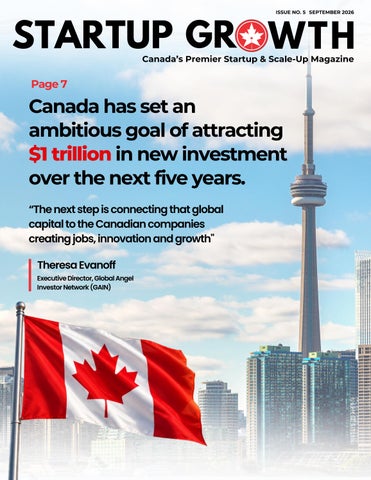
ISSUE NO. 5 SEPTEMBER 2026
STARTUP GR WTH Canada’s Premier Startup & Scale-Up Magazine
Page 7
Canada has set an ambitious goal of attracting $1 trillion in new investment over the next five years. “The next step is connecting that global capital to the Canadian companies creating jobs, innovation and growth" Theresa Evanoff Executive Director, Global Angel Investor Network (GAIN)
Dear Readers, Canada is having a moment of reckoning. Tariffs, shifting trade relationships, and global uncertainty are forcing us to look beyond the markets we have always relied on. I see that as an opportunity. Canadian innovation is too good to have only one direction of travel. That is why we built Startup Growth—not to repeat the stories everyone already knows, but to spotlight the founders who do not always appear on magazine covers: immigrant founders, women, underrepresented entrepreneurs, and builders outside the usual circles. We do not simply want to give them a page. We want to give them a platform. This issue explores the forces shaping Canada’s startup ecosystem. “TrillionDollar Opportunity: How Can FDI Benefit Canadian Startups?” examines how global investment can help Canadian innovators scale, while “The Hiring Momentum Driving Canada’s Startup Ecosystem” highlights the growing demand for skilled talent. In “Talent, Tech, and the Next Wave of Canadian Startups,” Dr. Derek Newton of Mitacs discusses talent, collaboration, and innovation. Meanwhile, Dr. Saira Siddique, Founder and CEO of MedIQ Smart Healthcare, explores the barriers to sustainable growth in “The Scaling Wall: Why Most Startups Never Make It Past the Beginning.” With our first media partnership with the GAIN Innovation Investment Summit, and through the international corridors we are building, our platform is increasingly crossing borders. Startup Growth was born in Canada, but it was never meant to stay here.
startupgrowth.ca raoof@canadiansme.ca / tac@canadiansme.ca Startup-Growth-Business-Magazine canadian_sme startupgrowthmagazine canadiansme
Publisher Shaik Khaleeluddin(SK) Editorial Director Tehmina A Chaudhry Executive Director Hammad Siddiqui Admin Manager Raoof Uddin Shaik Sr. Content Manager Amanda Spearing Creative Design Cmarketing Inc
Discover Canada’s Premier Startup Awards Program, celebrating the innovators shaping Canada’s future.
Social Media Cmarketing Inc
Join us for the Startup Growth Awards at the AGAZ Summit.
Events Shaik Raoof Uddin
Our stories are Canadian. Our ambition is global.
Photography Deposit Photos, Cmarketing Inc.
Web Cmarketing Inc
For Advertisements info@canadiansme.ca Cmarketing Inc 6345 Dixie Rd, Unit 202, Mississauga, ON L5T 2E6 Call us at +1 416 655 0205 /647 668 5785
Published by Cmarketing Inc 6345 Dixie Rd, Unit 202, Mississauga, ON, L5T 2E6 Copyright © 2026 CMarketing Inc. All rights reserved. Reproduction in whole or part of any text, photography or illustrations without written permission from the publisher is prohibited.
Tehmina A Chaudhry Editorial Director Startup Growth Magazine All Images, trademarks, service marks and logos referred to or appearing in this magazine are the property of their respective owners.
The contents in the Startup Growth Magazine are for informational purposes only. Neither Cmarketing Inc, the publishers nor any of its partners, employees or affiliates accept any liability whatsoever for any direct or consequential loss arising from any use of its contents.
STARTUP GR
WTH
AWARDS 2026
STARTUP GROWTH BUSINESS AWARDS 2026 CANADA’S PREMIER STARTUP AWARDS PROGRAM
Join us on 21st September, 2026
AT AGAZ SUMMIT STARTUPGROWTHAWARDS.CA
#STARTUPGROWTHAWARDS 2026
startupgrowth.ca raoof@canadiansme.ca / tac@canadiansme.ca Startup-Growth-Business-Magazine canadian_sme startupgrowthmagazine canadiansme
Publisher Shaik Khaleeluddin(SK) Editorial Director Tehmina A Chaudhry Executive Director Hammad Siddiqui Admin Manager Raoof Uddin Shaik Sr. Content Manager Amanda Spearing Creative Design Cmarketing Inc Social Media Cmarketing Inc Events Shaik Raoof Uddin Photography Deposit Photos, Cmarketing Inc.
Web Cmarketing Inc
For Advertisements info@canadiansme.ca Cmarketing Inc 6345 Dixie Rd, Unit 202, Mississauga, ON L5T 2E6 Call us at +1 416 655 0205 /647 668 5785
Published by Cmarketing Inc 6345 Dixie Rd, Unit 202, Mississauga, ON, L5T 2E6 Copyright © 2026 CMarketing Inc. All rights reserved. Reproduction in whole or part of any text, photography or illustrations without written permission from the publisher is prohibited.
The contents in the Startup Growth Magazine are for informational purposes only. Neither Cmarketing Inc, the publishers nor any of its partners, employees or affiliates accept any liability whatsoever for any direct or consequential loss arising from any use of its contents.
IN THIS ISSUE Startup Growth Magazine
62 Canada Can't Afford to Leave AI to the Enterprises Taylor Duncan
Co-Founder of North Group
11
Toronto Waterloo Powering Canada’s Technology Future
34
Regional Powerhouses: The Cities Driving Canada's Startup Economy
24
The Hiring Momentum Driving Canada's Startup Ecosystem
40
50% Tariffs - What It Means for Startups?
58
The Scale-Up Gap & The Messy Middle
37
Powering Tomorrow: Inside Canada's CleanTech Scale-Up Boom
27
The Canadian Startups Making an Impact in 2026
52
Why Canada’s Startup Capital Engine Is Stalling — And What Must Come Next
IN THIS ISSUE Startup Growth Magazine
20
Is Decentralization the Missing Piece for Innovative Solutions Canada?
49
55
Building AI That Brings Families Closer
From Retired EV Batteries to Energy Assets: Mapleview Energy’s Circular Growth Story
65
71
Toothpod Founder Earns Double Young Entrepreneur Recognition
Are Government Grants and Tax Credits the Cause of Canada’s Lower Tech Company Performance?
68
Canada’s Trade Economy Shifts Toward Services and New Markets
58
The Scale-Up Gap & The Messy Middle
14
The Scaling Wall: Why Most Startups Never Make It Past the Beginning
Trillion-Dollar Opportunity: How can FDI Benefit Canadian Startups? By Hammad Siddiqui
This week, roughly 100 of the world's largest
It is, by any measure, an ambitious
hosted by Prime Minister Mark Carney alongside CPP Investments and PSP Investments. The pitch is for $1 trillion in catalyzed investment over five
the announcement, after this FDI lands in Canada. Deeper questions are, which province will get most
investors, sovereign wealth funds, pension giants, private equity chiefs, descended on Toronto for the first-ever Canada Investment Summit, co-
years, a 167-project prospectus spanning data centers, LNG terminals, critical minerals and
defense manufacturing, and roughly $97 billion in commitments already banked over the past year.
and well-timed exercise in economic diplomacy. But the more interesting question is what happens next, after
share of this capital, and what will be the trickle down impact, right at the bottom of the funnel where startups and scale-ups live?
Image Courtesy: Canva
7 - Startup Growth - September 2026
One of the best opening should be investment leading to exports, a combination of trading and investment will bring good results for the whole business ecosystem. And that is the real test of the Summit's success, whether or not the impact funnels down into the entrepreneurs, scale-ups and research spinouts that make up Canada's own innovation economy.
“Trade agreements and international partnerships open doors, but relationships are what move capital through them. Prime Minister Carney’s track record of building Canada’s global economic
Canada Has Something the World Wants Canada's pitch to investors rests on genuine strengths. Foreign direct investment reached nearly $100 billion in 2025, the highest level since 2015, and the first year in a decade in which inflows exceeded outflows, according to RBC Thought Leadership research drawing on Statistics Canada data. By the end of 2024, the stock of FDI in Canada stood at $1.5 trillion. The underlying case is familiar: a highly educated workforce, free trade access to markets covering roughly 1.5 billion people through 16 agreements, the lowest net debt-to-GDP ratio in the G7, and a resource base spanning critical minerals, clean and conventional energy, and agriculture. RBC's analysts see up to $1.8 trillion in
investment opportunity over the next decade across oil and gas, electricity, agriculture, metals and minerals, defense and space, if execution keeps pace with ambition.
relationships is an important foundation for attracting international investment. The next
That last clause matters. Global capital is also rebalancing for
creating jobs, innovation and growth. That is where organizations like GAIN can play an important role. We are
elsewhere. Both can be true at once.
step is connecting that global capital to the Canadian companies
building those bridges every day, connecting Canadian founders with
angels and investors in Canada and around the world, and helping turn international relationships into real investment opportunities.”
reasons that have little to do with Canadian policy, geopolitical shocks, U.S. tariff uncertainty, and investors' search for stable, rulesbased jurisdictions. Some of Canada's rebound is Canada doing something right; some of it is the world getting more nervous
But Investment Attraction Is Only the First Step The same RBC research that celebrates the rebound also documents the scale of what preceded it: more than $1 trillion in net investment left Canada between 2015 and 2024, for every dollar of inbound FDI, roughly two dollars exited, what the report calls the largest capital
exodus in Canadian history. The authors attribute this less to any single policy failure than to a broader pattern of execution risk, regulatory delay and unpredictability that eroded investor confidence over a decade. Some of Canada's competitiveness claims are also contested. The federal government points to Canada's marginal effective tax rate as the lowest in the G7. Economists including Jack Mintz have challenged that framing, arguing the government's measure excludes major sectors, financial services, mining, oil and gas, and ignores property taxes, carbon levies and personal income tax, and that whatever advantage Canada held over the United States has narrowed sharply since the 2017 U.S. tax reforms.
Theresa Evanoff Executive Director, Global Angel Investor Network (GAIN)
8 - Startup Growth - September 2026
Meanwhile, the Canadian Federation of Independent Business has tracked six consecutive quarters in which more small businesses closed than opened. None of this negates Canada's strengths. It does mean the investment story is more complicated than the summit's marketing suggests, and that attracting capital and improving the conditions that let it multiply are two different jobs.
Coupling FDI with Startup Ecosystem Here is the central distinction this moment demands: attracting investment is not the same as generating economic spillovers from it. A spillover, in plain terms, is what happens when the presence of one economic actor makes other, unrelated actors more productive or more successful, without any money changing hands directly between them. A foreign semiconductor plant that trains hundreds of skilled technicians who later join or found local companies has created a spillover. A foreign plant that imports its own supply chain, staffs itself with expatriate management, and repatriates its profits has not, even if the initial investment figure looked identical on a press release.
The funnel can break at almost any stage, and Canadian evidence suggests it often does. Deloitte, working with BDC Capital, found that only 6% of Canadian companies with more than $1 billion in annual revenue disclose corporate venture capital activity, compared with roughly 40% of comparable U.S. firms, and that most corporate venture investment flowing into Canadian startups already originates from foreign, not domestic, corporations. Research from the DEEP Centre studying Atlantic Canada found that most Canadian corporations simply lack the internal culture and experience to partner effectively with startups, even when the opportunity is obvious on paper.
The pattern shows up again in exit data. The
Business Development Bank of Canada's 2026 Venture Capital Landscape report, bluntly titled
Whether FDI produces spillovers or stays isolated
depends on specific, identifiable mechanisms: does the multinational procure from local suppliers? Does its venture arm invest alongside Canadian
funds? Does its R&D center collaborate with local universities and hire people who eventually move to, or start, Canadian firms? None of this happens automatically. It happens when it is designed to.
around the observation that "Canada is generating innovation, but it isn't consistently capturing its value", found that foreign investors now supply 80% to 90% of capital in Canada's largest late-stage financing rounds. BDC's Geneviève Bouthillier put it plainly: "We're good at starting companies, we're just not getting them across the goal line." There has been no venture-backed IPO in Canada since 2023.
How the Money Can Funnel Through the Ecosystem A useful way to picture this is as a funnel with several stages:
None of this means foreign capital is the problem. It means Canada has not yet built the connective tissue, procurement relationships, co-investment structures, talent pipelines that would let a foreign investment's benefits reach beyond the company that received the cheque.
→ a multinational establishes local operations → it becomes a customer, FDI arrives
investor, or knowledge source for
→ local startups gain capital, contracts, or expertise → talent Canadian firms
and IP circulate through the ecosystem
→ some go on to compete globally → success attracts companies scale
→
further investment.
Image Courtesy: Canva
9 - Startup Growth - September 2026
Canada's Investment Climate: Where the Research Points to Real Constraints Independent of the FDI conversation, several structural issues show up consistently across credible research. Interprovincial trade barriers are perhaps the most quantified problem in Canadian economic policy. An IMF analysis by Federico Díez and Yuanchen Yang, with University of Calgary economist Trevor Tombe, estimated that internal regulatory barriers amount to a national tariff-equivalent of roughly 9%, rising above 40% in services like health care and education where professional licensing isn't portable across provinces. Removing them could lift GDP by nearly 7%, or about $210 billion, over time. A federal-provincial mutual recognition agreement signed in late 2025 was a meaningful start, though it excluded food and alcohol and leaves much of the services economy untouched. Commercialization, not invention, is Canada's weak point. The Council of Canadian Academies' expert panel concluded in late 2025 that Canada's innovation performance is declining even as research strengths persist, citing a lack of large, innovative firms and weak "absorptive capacity" for turning discoveries into products. Canada ranks 123rd globally on the World Intellectual Property Organization's input-to-output conversion measure — a stark gap for a country that performs well on research inputs. Growth-stage capital and corporate venturing remain thin. The gaps documented by BDC and Deloitte above are not one-off findings; they recur across multiple years of data. Tax and regulatory competitiveness are more contested than official messaging suggests, as noted above, worth flagging honestly rather than resolved in either direction. Pension capital presents a genuine policy trade-off rather than an easy win. Business leaders have called for Canada's large pension funds, the "Maple 8," managing over $2 trillion, to invest more domestically, and some research finds Canadian venture and private-equity investments have historically outperformed pension funds' foreign counterparts. But the funds themselves, along with the Fraser Institute and independent researchers, warn that mandated domestic allocations would compromise fiduciary duty and could function, in effect, as a tax on pensioners. This is a real disagreement among credible parties, not a settled question.
What Canada Could Do Differently Drawing on the evidence above, fives interventions stand out as both credible and actionable, while carrying real trade-offs policymakers should weigh openly.
What Canada Could Do Differently Drawing on the evidence above, fives interventions stand out as both credible and actionable, while carrying real tradeoffs policymakers should weigh openly. 1 - Build structured pathways between multinational investors and Canadian startups. 2 - Incentivize domestic corporate venture capital. 3 - Strengthen growth-stage capital and exit pathways. 4 - Tie R&D funding more directly to commercialization outcomes. 5 - Support interprovincial innovation ecosystem coordination.
Conclusion Canada needs foreign investment and a spread that benefits businesses right at the bottom of the funnel, which is a complex chain, also stay focused at opening international markets for Canadian businesses. We need to see results sooner, a multiplier effect worth chasing, and Canadian entrepreneurs should be a deliberate part of it, not an afterthought to it.
10 - Startup Growth - September 2026
Image Courtesy: Canva
Toronto Waterloo Powering Canada’s Technology Future By Tehmina A Chaudhry
With more than 15,000 tech companies, two of the country's top AI research hubs and a $78-billion economic footprint, the corridor has become Canada's clearest proof that research, capital and disciplined scaling can build a globally competitive ecosystem The Toronto-Waterloo corridor has grown from a regional technology cluster into Canada's most significant startup environment. Recent ecosystem surveys of the two cities count more than 15,000 technology companies and 5,200 startups operating in the corridor, underpinned by two of the country's top three AI research hubs at the University of Toronto and the University of Waterloo. In the 2026 Global Startup Ecosystem Report, Toronto-Waterloo ranks 13th globally, tied with Paris, with an estimated economic impact of roughly US$78-billion. The corridor has become the centre of gravity in Canada's broader startup story. Capital, talent and research move in a tight loop between the two cities, letting companies move from idea to product to scale at a pace that rivals the world's leading ecosystems.
The AI-native engine behind the corridor What sets Toronto-Waterloo apart is its AI-
native engine. The Vector Institute in Toronto and the University of Waterloo's Velocity incubator work in tandem to translate cutting-
edge AI research into venture-backed companies at a pace few other regions can match. Early 2026 marked a clear tipping point for the corridor: Waabi, the Toronto-based autonomous-driving company led by Raquel Urtasun, announced up to US$1-billion in new funding alongside a strategic partnership with Uber to deploy at least 25,000 Waabi-powered robotaxis. That contract signals something beyond a large funding round: it suggests AI startups in the corridor are now being trusted with largescale commercial deployment rather than pilot projects. Velocity, the Accelerator Centre and a growing set of campus-to-market programs across Waterloo and Toronto are working together to move startups from prototype to revenue faster than in previous cycles. 11 - Startup Growth - September 2026
Tech Ecosystem
High-growth SaaS and AI, by the numbers
Image Courtesy: Canva
Beneath the marquee AI deals sits a dense layer of SaaS and AI companies scaling out of the corridor. Toronto alone is home to nearly 600 SaaS companies with combined revenue of US$6.7-billion, roughly 40,900 employees and US$6.9-billion in capital raised, along with an extensive base of enterprise customer relationships. The city carries a mature corporatesoftware profile, anchored by companies such as 1Password, Vena, FreshBooks, Dayforce and Wave,
alongside a growing set of AI-SaaS hybrids. On the AI side specifically, Toronto is home to at least 100 leading
AI companies tracked in 2026, led by Cohere, one of the most prominent enterprise large-language-model providers. Cohere's reported US$240-million in sales, US$1.6-billion in investment raised and 140-per-cent
Sales teams across Toronto and Waterloo are trained to run discovery conversations that surface pain points, quantify business impact and map the buyer's decision process before
growth rate illustrate how far AI-driven SaaS can scale within the ecosystem.
ever reaching for a demo — an approach typically supported by internally built playbooks or dedicated sales-enablement software.
Waterloo adds its own, smaller-scale SaaS
Data-driven retention rounds out the playbook.
specialization to the picture. As of June 2026, the city counted 40 SaaS companies with combined revenue of US$651.7-million, roughly 3,400 employees and more
than US$500-million in capital raised. Waterloo's deep-
tech and enterprise-AI character shows up clearly in companies such as CleanDesk AI and Quadrical AI, both of which have built commercial SaaS products on top of the region's research base.
Fast-growing corridor startups track usage metrics, cohort retention and net revenue
retention closely, using product analytics to catch churn risk early and to trigger expansion campaigns for highly engaged accounts. AI companies in particular tend to track modeldriven outcomes — time saved per task, error reduction — and weave those figures directly into customer success stories.
Inside the scaling playbook: ICP, discovery, data A fairly consistent growth playbook has emerged among Toronto-Waterloo's SaaS and AI companies — one other Canadian founders can reasonably borrow from. The most successful teams are disciplined about defining their ideal customer profile, moving away from broad "SMB" labels toward narrower, higher-value segments: mid-market legal firms for Clio, global cybersecurity teams for 1Password, and corporate AI adopters for Cohere. That sharper targeting tends to produce higher lead quality and shorter sales cycles. Structured discovery has become a second core discipline.
Funding corridors and global capital flows Toronto-Waterloo is also central to Canada's 2026 financing story. Independent analyses of Canadian funding corridors consistently identify Toronto as the country's primary capital hub, with Waterloo functioning as its deep-tech base and Montreal and Vancouver narrowing the gap. Early 2026 saw strong deal flow specifically in AI, automation, health technology and life sciences, aided by targeted government support intended to keep fast-growing companies headquartered in Canada.
12 - Startup Growth - September 2026
Tech Ecosystem That strength at the later stages sits alongside a real structural gap earlier in the pipeline. Since 2019, Canada has lost an estimated US$66-billion in ecosystem value and roughly 133,000 jobs to a persistent seed-financing imbalance. The corridor continues to attract strong late-stage rounds and global capital, but there is a growing
case for more early-stage funding to let a broader set of founders actually reach the scaling infrastructure the corridor has built.
A living model for a super-ecosystem Heading further into 2026, Toronto-Waterloo stands as more than Canada's top-ranked startup environment — it is a working example of how research, capital and structured scaling combine to produce a super-ecosystem with genuine global reach. For founders anywhere in the country, understanding how the corridor actually works — not just its headline numbers — is becoming essential to building the next generation of Canadian scale-ups.
Image Courtesy: Canva
Repeatable growth lessons for founders across Canada For entrepreneurs building outside
Toronto and Waterloo, the corridor offers a genuinely repeatable model for growth rather than a story unique to two cities. Its success rests on three pillars: deep AI and SaaS expertise, world-class research institutions, and a culture of disciplined, rather than improvised, scaling.
The playbook translates into three
concrete moves for founders elsewhere: build AI-native products that draw directly on Canada's research infrastructure, rather than layering AI on as a feature; invest early in sales fundamentals — ICP clarity, discovery frameworks and data-driven retention metrics — well before hiring a large sales team; and actively connect Toronto-Waterloo's capital, talent and mentorship networks to developing ecosystems in Calgary, Vancouver, Montreal and beyond, rather than treating the corridor as a closed loop.
Your engagement helps strengthen a growing ecosystem of founders, builders, and business leaders. Startup Growth is designed to deliver practical insights, emerging trends, and real-world strategies that support entrepreneurial success. Click here to subscribe and follow our official channel. Stay connected to us for the latest developments in the startup landscape. Your continued support helps us spotlight innovation and opportunity across Canada. Disclaimer: The content published on StartupGrowth.ca is based on publicly available sources and is provided for general informational purposes only. Startup Growth does not endorse, recommend, or guarantee any products, services, organizations, or claims mentioned. Readers are encouraged to conduct independent research and exercise due diligence before making financial, investment, or business decisions.
13 - Startup Growth - September 2026
The Scaling Wall: Why Most Startups Never Make It Past the Beginning A look at the invisible barrier that stops promising companies in their tracks There is a particular kind of silence that falls over a startup office when the initial rush of product-market fit begins to fade. The early wins — the first hundred customers, the first viral tweet, the first round of funding — start to feel like ancient history. What comes next is harder, messier, and far less romantic: scaling. And it is here, according to
founders, investors, and researchers alike, that the vast majority of startups quietly die.
Industry estimates vary, but most studies agree on one grim statistic: somewhere between 70 and 90 percent of startups fail, and a significant share of those failures happen not at launch, but during the attempt to grow. The company
survives its infancy only to stumble in adolescence.
Image Courtesy: Dr. Saira Siddique
The Founder's Curse One of the most common culprits is deceptively simple: the skills that get a company off the ground are rarely the skills that keep it running once it's airborne.
By Dr. Saira Siddique Founder & CEO MedIQ Smart Healthcare
Image Courtesy: Dr. Saira Siddique
Startup Scaling
"You build a company in your own image," said one Torontobased startup mentor who has advised dozens of early-stage
Companies that scale successfully, she added, tend to obsess over
customer number ten thousand. Founders who can't let go of that control end up becoming the bottleneck in their own company.
growth spurt hits is often too late.
founders. "The scrappy, do-everything-yourself mentality that gets you to your first ten customers becomes a liability at
" This pattern shows up again and again in post-mortems: the visionary founder who insists on approving every hire, every deal, every line of marketing copy — long after the company has outgrown their bandwidth to do so.
Culture Doesn't Scale Itself Beyond leadership bottlenecks, there's a subtler killer: culture that was never built to survive growth. In a ten-person office, everyone absorbs "how we do things" by osmosis. At a hundred people, that osmosis breaks down completely. "Culture isn't a poster on the wall," noted a venture capital partner who focuses on Series B investments. "It's the decisions people make when no one's watching. If you haven't written those decisions down — really articulated your values in a way new hires can act on — your culture doesn't scale. It dilutes, and eventually it disappears."
hiring and onboarding long before they need to. Waiting until the
The Trap of Premature Scaling Perhaps the most counterintuitive failure mode is what researchers call "premature scaling" — pouring resources into growth before the underlying business model is proven. A company might scale its sales team, marketing spend, or geographic footprint before it has truly nailed what customers want and how much they're willing to pay. This is the paradox at the heart of scaling: the instinct to grow fast, so prized in startup culture, is often exactly what causes the growth to fail. 15 - Startup Growth - September 2026
Startup Scaling
Systems, Not Heroics Operational infrastructure is the unglamorous cousin of product and culture, and it's routinely neglected until it breaks. Finance processes built on spreadsheets, customer support handled through personal inboxes, engineering decisions made without documentation — all of it works fine at small scale and collapses under real volume. "Startups run on heroics in the early days," said one operations consultant who specializes in scaling logistics
and supply-chain startups. "Someone pulls an all-nighter, someone makes a call no one else could have made, and it works. But heroics don't scale. Systems scale. The companies that make it through are the ones that trade heroics for boring, repeatable processes — usually before
Image Courtesy: Canva
they think they need to."
Losing the Thread Finally, there is a quieter kind of failure: the company that
scales successfully by every external metric — revenue, headcount, market share — but loses the thing that made it special in the first place. Customer obsession fades into bureaucracy. The product that once solved a real problem becomes bloated with features built to satisfy internal politics rather than user needs.
"Scaling isn't just about getting bigger," the Toronto mentor
reflected. "It's about getting bigger without becoming someone else. Most founders I've worked with don't fail because they couldn't grow. They fail because growth made them forget why anyone wanted what they were building in the first place."
The Takeaway None of these failure modes are exotic. They are, in fact, remarkably ordinary — which may be exactly why they're so dangerous. Founders spend years preparing for the drama of launch, fundraising, and competition, but comparatively little time preparing for the quieter, grinding challenge of what happens after things start working. As one investor put it, half-joking but not entirely: "Startups don't usually die of starvation. They die of indigestion — they grew faster than they could actually chew." 16 - Startup Growth - September 2026
This article draws on learnings of a Canadian serial entrepreneur, Dr. Saira Siddique, who successfully founded and scaled three companies across four geographies. The article also entails common patterns observed across startup research and advisory work. Your engagement helps strengthen a growing ecosystem of founders, builders, and business leaders. Startup Growth is designed to deliver practical insights, emerging trends, and real-world strategies that support entrepreneurial success. Click here to subscribe and follow our official channel. Stay connected to us for the latest developments in the startup landscape. Your continued support helps us spotlight innovation and opportunity across Canada. Disclaimer: The content published on StartupGrowth.ca is based on publicly available sources and is provided for general informational purposes only. Startup Growth does not endorse, recommend, or guarantee any products, services, organizations, or claims mentioned. Readers are encouraged to conduct independent research and exercise due diligence before making financial, investment, or business decisions.
Image Courtesy: Canva
What Canadian Investors Look For Before Funding a Startup By SK Uddin
Round sizes and valuations remain more conservative than in the U.S., but founders say the bar for traction, unit economics and 'investment readiness' has not moved — it has arguably gotten higher Canada's startup ecosystem currently ranks fifth in the world, home to more than 9,500 companies and upward of US$6.7-billion in annual funding. But Canadian venture capital runs on its own rhythm.
Canadian VCs and ecosystem groups consistently report smaller rounds and lower valuations than their U.S. counterparts, even as founders here benefit from a more diverse, non-dilutive capital stack and a deep bench of local funds. Ottawa has been trying to address the later-stage gap directly. In 2025, Canada launched the Growth Venture Capital Catalyst Initiative, a $1-billion fundof-funds program designed to increase late-stage venture and growth-equity capital across the country's regions. Against that backdrop, understanding exactly how Canadian investors evaluate deals has become essential for founders in AI, fintech, clean technology and beyond.
17 - Startup Growth - September 2026
Venture Insights
Who’s Writing Cheques: VCs, Growth Equity, Family Offices Canada's investor base is more varied than it might first appear. The Canadian Venture Capital & Private Equity Association tracks "The 50," a list of the country's major venture funds spanning both national players and regional specialists. In practice, most startups encounter three broad types of investor.
Seed and early-stage venture funds tend to specialize by sector or geography — AI, fintech and digital health concentrated around Toronto-Waterloo, Montreal and Vancouver. Growth-equity funds, both domestic and American,
back companies generating $10-million to $100-million or more in revenue, often alongside non-dilutive funding and strategic investors. And family offices and corporate investment arms have become increasingly active in clean technology, fintech and AI, particularly where there is clear strategic alignment with their core business.
The concentration of capital among that group is significant. A 2026 founder-grade guide to Canadian venture capital found that roughly 75 per cent of funding currently flows to just 30
firms, and the number of active VCs has declined since 2022 — a trend that has, if anything, raised the bar for what counts as investment-ready.
Series A investors, meanwhile, look for $150,000 to $300,000-plus in MRR, net dollar retention above 110 per cent for enterprise software, and a break-even timeline of 18 to 24 months.
Revenue quality and unit economics: beyond the top line Canadian venture investors scrutinize revenue quality and unit economics closely, and ecosystem guidance consistently points to the same handful of SaaS metrics. Monthly or annual recurring revenue remains the primary growth measure, with investors placing far more weight on recurring revenue than onetime sales. Net revenue retention above 100 per cent is treated as a sign of genuine expansion within the existing
customer base. Customer acquisition
cost payback — the number of months needed to recoup the cost of acquiring a customer — is typically expected to fall
under 12 months for B2B SaaS companies. The ratio of lifetime value to acquisition cost is expected to clear 3-to-1 at minimum, with 4-to-1 or better viewed as
Traction benchmarks: what investors expect by stage Canadian investors apply traction benchmarks broadly similar to global norms, but tend to discount valuation rather than lower their expectations for the underlying metrics. Guidance from the Founder Institute and other traction frameworks lays out fairly consistent SaaS milestones: pre-seed companies are typically expected to show $5,000 to $25,000 in monthly recurring revenue, along with completed proofs of concept or paid pilots; seed-stage companies are expected to reach $25,000 to $200,000 in MRR with clear product-market fit and a repeatable acquisition channel; and Series A companies are generally expected to clear $300,000 or more in MRR, backed by at least 12 months of cohort data. A 2026 Canadian traction memo adds further texture: seed rounds typically land in the $25,000-to-$50,000 MRR range with 15-per-cent month-over-month growth, while marketplace startups are expected to reach $100,000 or more in monthly gross merchandise value with a roughly 20-per-cent take rate.
strong. And gross margin is generally expected to exceed 70 per cent for software companies, with anything
meaningfully lower treated as a red flag. A 2026 traction metrics guide breaks down how investment committees actually weigh these figures, describing five distinct archetypes that investment committees use: absolute revenue, growth velocity, retention, efficiency and engagement. Tier-1 brand-name funds tend to prioritize absolute revenue, vertical specialists lean toward retention and efficiency, and product-led-growthfocused funds weight engagement most heavily. With down rounds still a live risk across the market, efficiency measures such as burn multiple and CAC payback have moved to the top of the list for many investors.
18 - Startup Growth - September 2026
Venture Insights
Sector theses: AI, fintech, clean tech and deep tech Beyond the numbers, Canadian investors apply distinct sector theses. In AI, investors look for defensible data advantages, clearly defined enterprise use cases, and evidence that model performance translates into measurable commercial value — AI companies often
command valuation premiums, but they also face tighter scrutiny of burn rate and capital efficiency in return. Canadian fintech investors prioritize regulatory compliance, unit economics and cross-selling potential, and typically expect seed-stage fintech companies to show evidence of recurring customer acquisition and a credible path to $1-million to $3-million in annual revenue within 12 to 18 months. Clean-technology and climate-technology investors weight strong intellectual property, strategic partnerships, and a blended capital stack that draws on non-dilutive sources such as the Scientific Research and Experimental Development program, the Industrial Research Assistance Program,
and sector-specific grants. Deep-tech investors, meanwhile, weigh leadership strength, letters of intent,
proofs of concept and intellectual property more heavily than early revenue.
Across all of these theses, investors expect a company's product story to line up with Canada's established
regional strengths — AI in Toronto and Montreal, clean technology in Vancouver and Calgary, and enterprise SaaS across the Toronto-Waterloo corridor.
What 'investment readiness' looks like in Canada in 2026 Put together, being investment-ready in Canada means considerably more than hitting a single revenue target. A 2026 ecosystem report covering pre-seed, seed and Series A round sizes makes clear that founders are expected to arrive with solid operational fundamentals already in place: a properly incorporated entity, ideally structured as a Canadian-controlled private corporation to preserve SR&ED eligibility; monthly financials and a three-year cash-flow projection; a clean, easily understood capitalization table; and clearly articulated unit economics covering CAC, lifetime value, gross margin and burn multiple. Canadian investors also apply a softer, more qualitative layer at the earliest stages.
As one set of Canadian VC guidance puts it, early-stage investors are essentially "buying judgment" rather than scale, and look for clear ownership of a specific problem rather than a broad, undefined opportunity; early evidence that customers are genuinely being pulled in, even where revenue is still modest; proof that
founders understand what not to build as much as what to build; and a single go-to-market motion that is actually working, paired with a realistic view of where growth is likely to break down. Series A investors raise the bar further,
looking for segment-level unit economics, an expansion strategy that does not depend on the founder's own heroics, and a leadership team that extends meaningfully beyond the founders themselves.
Regional nuances: Toronto, Vancouver, Montreal, Calgary Investor decision frameworks also shift somewhat by region. Toronto-Waterloo
investors, who lead most heavily in SaaS and fintech, hold high expectations for annual
recurring revenue, net revenue retention and CAC efficiency. Vancouver funds concentrate
more on clean technology, climate technology and developer tools, placing heavy emphasis on intellectual property and strategic partnerships. Montreal investors prioritize AI leadership, research ties and model quality, while still expecting a concrete commercialization plan. And Calgary and Edmonton investors prioritize energy technology, industrial SaaS and applied AI, blending conventional venture logic with industrial co-investment and government programs.
Across every one of these regional centres, the message to founders in 2026 stays consistent: Canadian investors are not lowering the bar on traction or unit economics simply because round sizes and valuations tend to run more conservatively than in larger markets. Founders who understand that distinction — and build their companies to clear these screens on the merits — are best positioned to draw on Canada's globally ranked ecosystem for durable, scalable financing. 19 - Startup Growth - September 2026
Image Courtesy: Norman Musengimana
By Norman Musengimana
Business Development Manager- Kingston Economic Development Corporation
Is Decentralization the Missing Piece for Innovative Solutions Canada? The More I Think The Entrepreneurial Funding Challenges, The More I Think So. This is me trying to think aloud, join me to think this through. Innovative Solutions Canada does what almost every post about our commercialization problem as an economy proposes. It makes federal departments buy from Canadian companies. Its testing stream puts unproven Canadian technology inside a real government operation and pays for the trial.
Someone fought hard to get that approved, and it introduced a scaleup program and market opportunity that never existed before it. Under this program, a federal department becomes an unproven technology's first customer for scaleups and companies with the expertise and resources to navigate through its calls for innovations.
20 - Startup Growth - September 2026
Decentralized Innovation
The hard part is already solved It is worth being clear about what the program achieved, because the people who built it might reading this. Before Build in Canada and the program that replaced it, the default answer to a Canadian company with unproven technology was that the government does not buy unproven technology. Changing that default took years of work inside a system built to avoid exactly that risk. That work is done and it does not need redoing. What broke sits one level down, in how the program was assembled.
The concept isn't an experiment anymore. It is validated. With Innovative Solutions Canada, the Federal
Government has proven that it can safely act as an anchor customer for early-stage technology. We proved that public operations can run live trials without risking their core mandates. The hardest policy hurdles, the risk frameworks, the trial structures, and the procurement exceptions have already been cleared. Provinces and municipalities do not need to reinvent
this wheel. They are sitting on a fully tested roadmap.
Every agency of the government that wants access to that data and insights from this program's blueprints to run or decentralize this program locally. But a central team in Ottawa cannot spot regional friction points. It cannot know which ocean tech trial Halifax needs, which agtech platform Saskatchewan requires, or which municipal transit system Calgary is ready to test today.
The validation is complete. If you asked me, the next move is decentralization to unlock Canadian economic dominance.
By taking the proven mechanism of Innovative Solutions Canada and delegating authority to provincial and municipal levels, we align public buying power directly with regional economic priorities. Local operations get the precise technology they need to solve local problems, and local scaleups get the anchor customer required to stay in the region. We do not need a new program. We just need to give the governments closest to the work, the keys to the model we already built, to a proven model.
Two decisions sitting in one office Qualification and money live in the same national
process. One bar, one calendar, one office deciding both which companies are good enough and where the budget goes.
For a government department, taking part means asking someone else for permission and waiting for someone else's timeline because of lack of decentralization of the program. Calls are periodic, and they don't take into account regional economic priorities. For a founder, it means clearing a bar built to survive a national audit, especially for early stage companies.
Eighteen months of runway does not survive that timeline. So the companies that clear the bar tend to be the ones already paying a grant writer, on top of inhouse experts. The startups sitting on inventions coming out of Queen's, Waterloo, Western, MacGill and UBC rarely have a proposal team. That second bracket is the one I care about. If the government does not measure whether a pilot ever became a purchase, then the program is measuring its own activity instead of its own results, and no amount of additional funding fixes that. How might we learn from this wonderful program, and design more decentralized programs with smaller budgets and less strigent requirements?
21 - Startup Growth - September 2026
Decentralized Innovation
Qualify once nationally, buy locally Image Courtesy: Norman Musengimana
The layer that should be national is qualification. The layer that should be local is buying. We have them backwards.
Qualify a company once. One registry, one validation standard, one intake, and the result travels. This is where a signal like angel backing earns its place. A pre-revenue company that has attracted ten or more angel investors who
How the Americans split the same problem Look at how the United States runs the Small Business Innovation Research program. It is built the opposite
previously ran companies in that same industry has already been underwritten by people with money and domain knowledge at risk. Government does not need to re-derive that judgment from scratch. It needs a way to recognize it.
way round.
Each participating agency sets aside a fixed share of its external research budget for the program, and the share is written into statute instead of being negotiated every year. Around eleven agencies take part, from defense to health to energy. Each one writes its own solicitations and picks its own winners against problems it actually has. The Small Business Administration coordinates the policy and does not choose the companies.
Then push the budget and the choice outward. Every agency drawing federal funding gets a sandbox line in its own budget and picks from the qualified pool against its own operational problems. A port
authority and a regional health authority have almost nothing in common operationally, and neither of them needs Ottawa deciding which of their problems is worth solving. Keep the individual contracts small enough to sit under the competitive tender thresholds so the legal path stays simple.
Two features matter for this argument. Selection sits with the buyer. A health agency picks health technology because it has a health problem, and nobody in a central office is ranking that against a defense application. Canada has no equivalent of the second one. A company that completed the earlier phases can receive follow-on work on a sole-source basis, because the original competition is treated as having already done the competitive work. The pilot has a legal road into becoming a purchase. Newer pathways inside the US defense establishment, including AFWERX and the Defense Innovation Unit, push the same logic further and award in weeks.
Moving the money is not enough on its own This is where proposals like mine usually stop, and it is why they usually fail. A public servant who backs a startup that fails owns that failure by name. A public servant who runs a standard competitive tender owns nothing, whatever the outcome. Hand forty agencies a budget without touching that asymmetry and you get forty cautious offices, plus forty new intake processes for founders who already told you the paperwork is the problem.
22 - Startup Growth - September 2026
Decentralized Innovation So write the failure rate into the mandate. A sandbox
We must genuinely rethink this, and we must try new
chartered with an expected loss rate agreed in advance
ways of supporting Canadian innovations and inventions,
turns a single failed pilot into a line in a portfolio instead
because this country has many sitting on IP portals, and
of a career event. Nobody has to defend a decision that
many dead highly scalable companies that could not
the mandate already anticipated.
cross the valley of death. That graveyard of startups and inventions has some of the world most revolutionary technologies rotting there.
I have not found a program anywhere that does this explicitly, which either means it is untested or means I have not looked hard enough. Either way it is the piece that decides whether the rest of this works.
The ask The program already exists. What it needs is the money
Can this model change anything? What does it unlock? Federal purchase orders are validation that a US
funds will price and invest in. It is one of the clearest signal of market potential. That lets a Canadian company raise serious money, build the product properly, and eventually give its earliest Canadian backers a way out.
moved closer to the people who have the problems or who have already defined their respective strategic priorities, and a rule that says a successful pilot can become a purchase without starting over, and over and over again. If a start has already been funded by the government, and the goals were achieved, why make them complete a gazillion of applications while the government already has the data and is aware if they are a serious contender or not?
What happens when investors exit? They look for new opportunities to back, and the cycle continues. Right now that capital sits still. Angels who would
fund the next company are holding positions in the last one. Some industries like medical devices, have sat with that money for more than 10 years. How would you expect to have a scaleup and flourishing startup ecosystem, if more than 40% of the investors capital is stuck in startups that have transformational technologies and inventions, that have lacked market opporunities?
It has almost become an acceptable standard that a Canadian startup at the same stage, same team composition, same moat, etc. will always raise 10% or less than 10% of what their American counterparts raise. How can these standards be accepted as being normal really? We are aiming at the ground level, and the level of ambitions are diminishing over time.
What other initiatives do you think will help build the competitiveness of the Canadian startups and scaleups ecosystems? Is there anything that I am missing? Kindly share so that I can use this as an opportunity to learn.
If you work inside a federal agency, or you fund one: which agency should run the first decentralized sandbox, and what would stop you?
Your engagement helps strengthen a growing ecosystem of founders, builders, and business leaders. Startup Growth is designed to deliver practical insights, emerging trends, and real-world strategies that support entrepreneurial success. Click here to subscribe and follow our official channel. Stay connected to us for the latest developments in the startup landscape. Your continued support helps us spotlight innovation and opportunity across Canada. Disclaimer: The content published on StartupGrowth.ca is based on publicly available sources and is provided for general informational purposes only. Startup Growth does not endorse, recommend, or guarantee any products, services, organizations, or claims mentioned. Readers are encouraged to conduct independent research and exercise due diligence before making financial, investment, or business decisions.
23 - Startup Growth - September 2026
Image Courtesy: Canva
The Hiring Momentum Driving Canada's Startup Ecosystem As venture capital grows more selective, founders and investors alike are turning to headcount growth as a real-time proxy for demand — though even its biggest proponents warn it can mislead as easily as it informs By SK Uddin Canadian founders and investors are leaning more heavily on hiring velocity — the pace at which a startup adds employees — as a growth signal in 2026. With venture capital becoming more selective and macroeconomic conditions still tight, headcount growth is increasingly read as a proxy for demand, revenue confidence and organizational maturity in its own right.
That shift has been formalized in the data available to founders. LinkedIn's Top Startups lists and independent hiring roundups now score companies on employee growth, job-seeker interest, platform engagement and a company's ability to pull talent away from other employers. Understanding what that hiring data actually signals — and where it can mislead — has become a genuine skill for Canadian founders navigating a tighter funding environment.
24 - Startup Growth - September 2026
Startup Hiring
How LinkedIn and growth lists measure velocity LinkedIn's annual Top Startups list for Canada is built on four pillars: employee growth, job-seeker interest, company and employee engagement on the platform, and a company's ability to attract talent away from LinkedIn's own Top Companies list. To qualify, a company must be based in Canada, privately held, have at least 30 full-time employees, and be five years old or younger.
Independent rankings work slightly differently. Kyle Thomas's list of 39 fastest-growing hiring Canadian startups tracks companies in the 90thto-100th percentile for combined social, web, employee and mobile growth over the trailing
eight weeks, then cross-references that momentum against PitchBook data to estimate a company's odds of continued success. Together,
these sources give founders a near-real-time view of where growth-stage companies are actively hiring, and where labour-market demand is concentrated.
A separate ranking of 25 high-growth Canadian startups, from seed stage to unicorn, shows companies including Cohere, Waabi, Clio, Tenstorrent and Wealthsimple still carrying large numbers of unfilled roles in Canada and abroad — evidence that hiring intensity persists well past the earliest growth stage.
LinkedIn's Top Startups: where Canadians want to work LinkedIn's Top Startups rankings add a second dimension to the hiring data: employer appeal. The 2024 and 2025 Canadian lists highlighted fast-growing companies including Neo Financial, Float, Cohere, Hiive, Pine, PostGrid, Waabi and Orennia, selected both for growth and for their ability to attract talent.
Pine, the Toronto-based AI-powered mortgage platform, topped LinkedIn's 2025 list while growing to roughly 65 employees in under five years. Hiive, the
Vancouver-based marketplace for private technologycompany shares, grew past 150 employees in four years. Waabi, the Toronto autonomous-trucking and
robotaxi company, and Cohere, the enterprise AI model
Canada's high-velocity hiring cohort The list of 39 fastest-growing hiring Canadian companies spans AI, finance, clean technology,
health technology and B2B SaaS. In AI and deep technology, the notable names include Private AI, Boosted.ai, LayerZero Labs, Botpress, Spellbook and Blue J. In fintech and financial infrastructure, Helcim, Venn (formerly Vault), Float, Neo Financial and LemFi lead the cohort. Clean technology and climate technology are represented by Svante, veritree, Edgecom Energy and Kathairos, while enterprise SaaS and infrastructure providers on the list include VEERUM, CoLab Software, Alida and SWTCH, along with RideCo. Consumer and marketplace companies round out the group, including Clutch, Fantuan and Tailscale. PitchBook data puts this cohort's success odds above 85 per cent, a figure that ties high recruiting velocity fairly directly to strong capital access, revenue growth and product traction.
developer, appear consistently across both hiring and top-startup lists — a sign of how closely rapid growth
and aggressive talent acquisition track one another at that stage.
The underlying data — headcount growth, job-posting
volume, applicant interest and talent attraction — comes directly from LinkedIn's own platform activity, which is part of what makes these rankings a reasonably efficient shortcut for spotting where capital and labour demand are converging.
Interpreting hiring velocity: signal versus noise For all its usefulness, Canadian investors are consistent in warning that hiring velocity is not sufficient on its own. A 2026 guide to startup traction metrics notes that investment committees weigh a broader set of criteria — absolute revenue, growth velocity, retention, efficiency and engagement — when evaluating a deal.
25 - Startup Growth - September 2026
Startup Hiring Hiring momentum feeds into both the growth and engagement components, but has to be read alongside a handful of other questions: whether additional headcount is actually translating into higher annual recurring revenue or gross merchandise value; whether customer acquisition cost, payback periods and burn multiples are
improving or deteriorating as the team grows; and whether retention is holding, or whether rapid growth is simply masking churn underneath.
Canadian venture investors generally treat fast hiring without corresponding unit-economics strength as an early warning sign of premature
scaling — one of the more common precursors to a down round or a restructuring. Sustained hiring over several years, paired with rising net revenue retention and efficient customer acquisition costs, is read as a far more reliable signal that a
company has entered a genuine period of durable expansion.
How founders and investors put hiring velocity to work For founders, hiring velocity functions as both an internal performance indicator and an external
storytelling tool. Benchmarking a company's own headcount growth and open roles against
LinkedIn's Top Startups and other high-growth lists gives founders a quick way to check whether their
hiring pace is appropriate for their stage and ambition. Demonstrating disciplined, stageappropriate hiring alongside improving unit economics also strengthens fundraising narratives — appearing on a list such as "25 high-growth Canadian companies hiring now" offers a form of informal, third-party validation of momentum. There is a recruiting benefit too: visibility on these lists helps companies attract senior talent looking to join a company already recognized as a breakout, which in turn reinforces the growth-andhiring cycle.For investors, hiring velocity operates mainly as a screening heuristic. Data drawn from high-growth lists and job postings can help identify companies worth a closer look, but the real diligence happens after that first filter, when investors dig into revenue, gross margin, net revenue retention, CAC payback and burn multiple to confirm whether the hiring story actually reflects the underlying financial reality.
Canada's hiring hotspots, by region and sector Hiring-intensive Canadian startups cluster fairly
predictably by region and sector. Toronto-Waterloo remains the centre of gravity for AI, fintech and enterprise SaaS hiring, led by companies such as Cohere, Waabi, Wealthsimple, Clio, Spellbook, Blue J and Float. Vancouver and Calgary carry the bulk of climate-tech, clean-tech and energy-SaaS hiring, through companies including Svante, veritree, Edgecom Energy, Orennia and Summit Nanotech. Montreal and Atlantic Canada concentrate on AI, gaming, medical technology and ocean technology, with companies such as Botpress, Tali AI, Manmade and Traferox alongside a growing cluster of oceantechnology startups.
Those hotspots line up closely with Canada's broader sector strengths and financing patterns, reinforcing the idea that hiring velocity is a genuinely useful lens
for spotting where innovation clusters are forming and scaling in real time.
A more transparent ecosystem Canada's startup ecosystem is more transparent in
2026 than it has been in previous cycles, largely because of how much hiring data is now publicly trackable. For founders, treating recruiting velocity as
a strategic indicator rather than a purely internal HR metric can help align growth plans with what investors are actually looking for. For investors and prospective employees alike, tracking which Canadian teams are growing fastest offers a genuinely current picture of which companies are positioned to be the country's next breakout businesses.
Your engagement helps strengthen a growing ecosystem of founders, builders, and business leaders. Startup Growth is designed to deliver practical insights, emerging trends, and real-world strategies that support entrepreneurial success. Click here to subscribe and follow our official channel. Stay connected to us for the latest developments in the startup landscape. Your continued support helps us spotlight innovation and opportunity across Canada. Disclaimer: The content published on StartupGrowth.ca is based on publicly available sources and is provided for general informational purposes only. Startup Growth does not endorse, recommend, or guarantee any products, services, organizations, or claims mentioned. Readers are encouraged to conduct independent research and exercise due diligence before making financial, investment, or business decisions.
26 - Startup Growth - September 2026
Image Courtesy: Canva
The Canadian Startups Making an Impact in 2026
Canada's startup ecosystem is entering a new phase of scale in 2026. Once
From a Toronto AI lab valued at $7-billion to a B.C. battery recycler building a gigafactory with Mercedes-Benz, a new generation of Canadian companies is redefining what fast growth looks like
That rise has coincided with a new generation of high-growth companies in artificial intelligence, fintech, health technology and clean technology that are reshaping what "fastest-growing" means in a Canadian context.
viewed as a quiet counterpart to Silicon Valley and Europe, hubs such as Toronto-Waterloo, Vancouver, Montreal and Calgary have become genuine engines of global growth. The 2026 Global Startup Ecosystem Report ranks Toronto-Waterloo 13th in the world, tied with Paris, and credits the region with an economic impact exceeding US$78billion on its own.
By Tehmina A Chaudhry
27 - Startup Growth - September 2026
Tech Startups
Defining 'fastest-growing' in 2026 Growth among Canadian startups is now measured by more than fundraising totals. The strongest-performing companies are being assessed on capital raised, valuation growth, headcount expansion and the degree to which they are defining an entire sector. Databases tracking more than 1,200 funded Canadian startups show a deep pipeline of companies with demonstrated
Image Courtesy: Canva
traction, spanning early-stage disruptors to unicorns. The leading criteria for measuring that growth include three-year revenue CAGR, annual recurring revenue expansion, global headcount growth and transaction velocity in enterprise markets.
AI and deep tech: Canada's new powerhouse
Fintech and cybersecurity scaleups reshaping finance
Applied AI and deep technology dominate Canadian
Fintech and cybersecurity make up another core
computing and robotics as Canada's strongest growth engines, with Toronto emerging as a particular hotbed for AI-native startups.
growing companies cluster in fintech, deep tech, cybersecurity and digital health. Wealthsimple, based in Toronto, has grown into what amounts
growth by a wide margin. A 2026 analysis of the country's leading technology companies identifies artificial intelligence, semiconductors, quantum
Cohere, headquartered in Toronto, has become one of Canada's leading artificial intelligence companies, building large language models for enterprise
customers. The company raised roughly US$500-million in 2025, along with a subsequent extension, pushing its reported valuation to US$7-billion and cementing its position as a global AI leader. Waabi, also based in Toronto, is developing an autonomous trucking and robotaxi platform, backed by roughly US$1-billion in funding and a landmark agreement with Uber covering 25,000 robotaxis. Tenstorrent, which builds AI chips and RISC-V processors, has raised hundreds of millions of dollars and reached a multibillion-dollar valuation, strengthening Canada's position in the global semiconductor race. These companies have become reference points for Canadian founders more broadly, pairing AI-first products with ambitious global positioning and aggressive hiring — a pattern visible not just in valuation tables but in the sheer volume of open roles each is advertising across its Canadian and international offices.
pillar of Canada's high-growth startup landscape. A ranking of the country's top startups for 2026 found that Canada's fastest-
to Canada's financial-everything app, serving millions of users. A US$750-million funding
round in late 2025 pushed its reported valuation to roughly US$10-billion, making it one of the country's most valuable consumer fintech platforms.
1Password, the Canadian-born cybersecurity company focused on password and identity management, has reported more than US$400million in annual recurring revenue and a valuation near US$6.8-billion — evidence that Canadian B2B security companies can compete for global leadership in their category. The growth story extends into legal technology as well: Clio, a law-practice management platform built in British Columbia, raised a US$500million Series G at a US$5-billion valuation and pushed its annual recurring revenue above US$400-million. Together, these companies show that Canadian firms can own complex, heavily regulated markets while still achieving venture-scale growth.
28 - Startup Growth - September 2026
Tech Startups
Clean tech and climate tech: growth meets impact A parallel set of fast-growing Canadian companies is tackling climate and environmental challenges directly. Eavor Technologies and Cyclic Materials appear consistently on both award lists and investor watchlists, reflecting sustained interest in Canadian climate solutions. The 2026 CIX Startup Awards recognized Eavor Technologies, a Calgary-based sustainable energy company, alongside Venn and Loopio of Toronto and Hiive of Vancouver in its Growth category. Cyclic Materials, which recycles rare-earth
materials from electric-vehicle motors, raised US$53-million in a Series B round and was named
a rising climate-tech company by MIT. Moment Energy, based in B.C., repurposes retired electricvehicle batteries into energy storage systems and is building one of the world's first batteryrepurposing gigafactories in partnership with
Mercedes-Benz. Collectively, these companies demonstrate that capital-intensive clean
technology can still hit growth-stage velocity when paired with strong intellectual property, industrial partners and a clearly defined climate thesis.
Taken together, the rankings describe a country where founders are doing considerably more than raising capital: they are building teams, creating jobs both domestically and abroad, and constructing businesses built to last.
What the 2026 benchmarks mean for Canadian founders For Canadian founders, the 2026 landscape offers both inspiration and a more realistic set of benchmarks. The AI-first scale-ups underscore the value of sharp global positioning and genuine technical differentiation. Canadian fintech and cybersecurity companies show it is possible to own a regulated sector while still delivering venture-scale returns, and the clean-tech cohort shows that growth and environmental impact are not mutually exclusive when backed by strong partnerships and defensible intellectual property.
What the data makes clearest, though, is that Canada is no longer a secondary market by any reasonable measure. With globally ranked hubs, tens of billions of dollars in measurable economic impact, and a deep pipeline of high-growth companies at every stage from seed to unicorn, Canada has become one of the more compelling places in the world to found, fund and scale a technology company.
Hiring velocity as a signal of momentum Recruiting pace has become one of the clearer indicators of which Canadian companies are actually scaling. A cohort of high-growth firms — Private AI, Boosted.ai, LayerZero Labs, veritree, Spellbook, Float and Neo Financial — now rank in the 90th-to-100th percentile for combined social, web, employee and mobile growth, putting them alongside more established names such as Wealthsimple. A 2026 roundup of 25 high-growth Canadian startups, from seed stage to unicorn status, highlights emerging companies including Spellbook, which builds AI tools for lawyers; Blue J, focused on AI-driven tax research; Float, a corporate-card platform; Neo Financial, a digital bank; and Moment Energy — alongside later-stage leaders such as Cohere, Waabi, Clio, Tenstorrent and Wealthsimple.
Your engagement helps strengthen a growing ecosystem of founders, builders, and business leaders. Startup Growth is designed to deliver practical insights, emerging trends, and real-world strategies that support entrepreneurial success. Click here to subscribe and follow our official channel. Stay connected to us for the latest developments in the startup landscape. Your continued support helps us spotlight innovation and opportunity across Canada. Disclaimer: The content published on StartupGrowth.ca is based on publicly available sources and is provided for general informational purposes only. Startup Growth does not endorse, recommend, or guarantee any products, services, organizations, or claims mentioned. Readers are encouraged to conduct independent research and exercise due diligence before making financial, investment, or business decisions.
29 - Startup Growth - September 2026
Image Courtesy: Dr. Derek Newton
In an exclusive interview with Startup Growth Magazine, Dr. Derek Newton, Senior VicePresident, Business Development and Strategic Partnerships at Mitacs, shares how Canada can strengthen its startup ecosystem by connecting entrepreneurs with research talent, industry expertise, and innovation resources. With a career focused on advancing collaboration between academia and business, Derek discusses how strategic partnerships can help emerging companies move from early ideas to market-ready solutions.
Dr. Derek Newton
Senior Vice-President, Business Development and Strategic Partnerships at Mitacs
Talent, Tech, and the Next Wave of Canadian Startups Interview By Tehmina A Chaudhry Dr. Derek Newton is a recognized leader dedicated to advancing Canada’s research and innovation capacity. As senior vice-president, business development and strategic partnerships at Mitacs, Derek fosters transformative industry partnerships, champions entrepreneurial ventures, and helps companies tap into Canada’s top research talent to develop and adopt transformative technologies. Derek’s career spans senior roles at the University of Toronto, Western University and the Ontario Genomics Institute, where he worked alongside provincial and national funding programs to drive research excellence and innovation.
He is widely regarded for helping companies unlock the value of university partnerships, connecting them with top talent, breakthrough research and impact. His efforts have resulted in enduring collaborations that translate research discoveries into real-world solutions. With a Ph.D. in medical biophysics from the University of Toronto and degrees in chemistry and biochemistry from the University of Waterloo, Derek combines scientific expertise with strategic leadership to advance Canada’s research and innovation ecosystem.
30 - Startup Growth - September 2026
Research Commercialization Mitacs has said that highly skilled talent and research capacity is the single biggest differentiator for SMEs and startups. How does embedding graduate students and researchers into young companies change their growth trajectory compared to startups that try to innovate without that advanced talent? Every company, every startup, everywhere, starts with one thing: a founder. A person who has a great idea and wants to turn that idea into a business.
Many founders are Canadian college and university graduates, PhD and master’s students, and Mitacs has been at the forefront of asking—how do we equip Canadian graduates with entrepreneurial thinking,
business acumen, and surround them with mentors who can help them raise funds and launch new companies?
Mitacs has been building bridges between business, academia, and government for more than 25 years. What does a truly “high-performing” industry–academic partnership look like in practice, and how has this kind of collaboration helped Canadian startups reach new markets or scale faster? Fluid AI is a great example, and Xanadu is also one where Mitacs was one of the first to step in. High-performing industry-academic partnerships: what do we mean by that? The best examples are Canadian
companies that have a research or technical challenge that is preventing them from growing their business. Or perhaps
they need business support, such as taking a new product to market, or entering new marketplaces around the world. We know that connecting these companies to Canadian universities and colleges has great results. Companies get access to some of the top researchers in the world, they can access state-of-the-art equipment, tap into incredible talent, and ultimately increase their productivity, sales and revenue.
Mitacs has a network of over 170 qualified incubator programs across the country. So, whether we’re supporting a founder in the
Mitacs helps these businesses find the right researcher, at the right university or college, who can best tackle their challenges. Mitacs also helps by co-investing in the
qualified incubator program.
attractive for Canadian companies.
healthcare sector, robotics, energy, quantum, or social innovation, Mitacs can connect them to a
partnership and ensuring post-secondary trainees are a part of the solution, making these partnerships even more
We enable student innovators to become
employee #1 in their own company. And then, as that company grows and scales and builds its workforce, we then help that company find the talent they need to succeed—employee #2, employee #3, and so on.
Image Courtesy: Canva
Mitacs also helps innovators and founders protect their ideas, and file patents, so they can turn their idea into an emerging business plan. We also help connect them to applied research centres to turn that idea into a working prototype and towards commercialization. I think this is the impact that Mitacs brings to the Canadian startup ecosystem—helping these new companies grow, scale, and launch into the marketplace. It’s all powered by people and talent and ensuring we equip them for an increasingly competitive—and turbulent—world economy. 31 - Startup Growth - September 2026
Research Commercialization Studies consistently show that firms that invest in R&D and adopt new technologies— like AI, robotics, and automation—see measurable improvements in productivity, revenue, and exports. Based on recent Mitacs outcomes and your role in the federal AI for All strategy, what evidence have you seen that technology adoption is directly moving the needle for Canadian SMEs?
You spent many years working in universities before joining Mitacs as SVP of business development and strategic partnerships. How has that experience with academic institutions shaped your view of what Canadian startups need now—especially around commercialization pathways and competing globally?
We know that companies that invest in R&D see real-world impacts when it comes to
However, we don't punch above our weight when it comes to turning these great ideas into new products and services that
productivity, sales growth, and revenue growth. At Mitacs, we see, firsthand, results which are real and tangible. A 2024 Statistics Canada study found that
companies participating in Mitacs-supported projects for three years between 2009-2018 experienced an 11% boost in productivity, a 9%
increase in revenue, a 16% rise in sales, an 18% increase in employment, and remained committed to significantly higher R&D investments in the years following participation.
We've also seen enormous momentum in AI
specifically, in helping Canadian companies adopt AI technologies into their business operations. Since 2018, Mitacs has supported
more than 4,200 AI-related innovation projects, helping unlock over $228 million in R&D Canadian investments. A majority of these projects have been with Canadian SMEs (companies with fewer than 500 employees) that are integrating AI, advanced analytics, robotics, automation, and other emerging technologies into their operations and to increase productivity. So, whether you're a small-, medium-, or large-sized company, investing in innovation can drive productivity and business growth! For our part, Mitacs helps these companies imagine how to tap into the incredible universities and colleges across Canada, coinvesting in new ideas, how to protect these ideas, and bringing innovative solutions to market to help grow the Canadian econom.
Across Canada, we punch way above our weight when it
comes to research productivity and excellence, along with developing world-class talent.
grow the Canadian economy and accelerate Canadian companies to compete globally.
On the university side, we have world-class researchers and
innovations, but we need to better connect these assets to Canadian companies and partners that can pull these madein-Canada ideas into commercial successes and into the Canadian marketplace.
I am excited to be a part of Mitacs, a national organization
that helps Canadian companies, of all sizes and sectors, unlock the value of Canadian R&D investments. Through the government of Canada, along with each and every province,
including the Yukon territory, Mitacs is helping companies tap into incredible research and training resources, including globally ranked universities, colleges, and polytechnics that are some of the best on the planet. Together, we can further turn our research investments into a competitive advantage for the Canadian economy.
Image Courtesy: Canva
32 - Startup Growth - September 2026
Research Commercialization For this special edition focused on empowering new and aspiring founders, what final advice would you offer to early-stage startups about plugging into Canada’s innovation ecosystem—talent programs, partnerships, and AI initiatives—so they can move from good ideas to market-ready solutions with clear, measurable impact? My advice is simple: do not try to build alone.
So, if you are already an existing founder, or just thinking about starting a new venture, and you're not already working with Mitacs—reach out! Meet your local Mitacs Business Development officer. We have over 70 professionals located in economies and communities across the country. They know the local and national ecosystems and are here to support your
journey to create something new and help you become employee #1—in your own company!
Within your community, college or university, get involved! Roll up your sleeves, find partners and organizations that can support your own
Image Courtesy: Canva
entrepreneurship journey. And Mitacs can also help: we are one of Canada’s foundational entrepreneurship support programs, operating in communities across the country and helping equip, fund, and enable students to make their entrepreneurship journey a full-time job.
Entrepreneurship is more than starting your own company, it is also an attitude and a mindset. It’s about taking risks, trying new ideas, learning how to protect and share your ideas to make them better. Learning to find new partners, to pivot, and to pitch and make your case. All of these are skills that I think every graduate needs, regardless of their career path. These are also the skills that existing Canadian companies look for in developing the talent pipelines they need to succeed.
Disclaimer:The views expressed in this interview are solely those of the interviewee and do not necessarily reflect the views of Startup Growth Magazine. The content is for general information only and is not professional or investment advice.
33 - Startup Growth - September 2026
Regional Powerhouses: The Cities Driving Canada's Startup Economy By Hammad Siddiqui
Toronto and Waterloo still pull the deepest pool of capital, but Calgary's rise and specialized hubs in Ottawa, Montreal and Vancouver mean where a founder builds is now a strategic choice, not a default Canada now ranks fifth in the world for the overall strength of its startup ecosystem, with
The concentration of capital, however, remains stark. A 2026 ecosystem analysis found Toronto
nationwide. Toronto, Vancouver and Montreal remain the most recognized hubs, but
emerged as Canada's fastest-growing technology hub and the Ottawa-Waterloo corridor
six cities placing in North America's top 20 and more than 9,500 startups operating
Calgary, Ottawa and Waterloo are increasingly reshaping where founders choose to launch and scale a company.
Image Courtesy: Canva
34 - Startup Growth - September 2026
alone captures more than 40 per cent of national venture capital investment, even as Calgary has
has carved out a distinct position in deep tech and government technology.
Regional Innovation
Toronto-Waterloo: the anchor super-ecosystem
Montreal: an AI and deep-tech powerhouse
Toronto-Waterloo is Canada's anchor super-ecosystem
Montreal is tied with Vancouver on global
The corridor's sector strength runs deep: artificial intelligence and machine learning, anchored by the Vector Institute, Cohere and Waabi; fintech, led by
Its core strengths are deep learning and artificial intelligence, medical technology and life sciences, and interactive media and game
1Password, Vena and FreshBooks; and a health-technology and life-sciences cluster connected through the MaRS Discovery District.
capital at between 12 and 15 per cent, concentrated in AI, deep-tech hardware and research-intensive companies that depend on
and its top-ranked region globally, placing 13th in the world in the 2026 Global Startup Ecosystem Report — tied with Paris. A recent Canadian ecosystem analysis puts Toronto's share of national venture capital deployment at nearly 40 per cent, with more than $3-billion raised in the region in the first half of 2026 alone.
Wealthsimple and Neo Financial's Toronto presence; enterprise SaaS and cybersecurity companies including
Waterloo's deep-tech strengths complement Toronto's,
with Communitech and Velocity having produced alumni companies worth billions of dollars and the region specializing in complex hardware, deep-tech SaaS and defence-related innovation. For founders targeting regulated, B2B or AI-driven sectors, Toronto-Waterloo
offers the most concentrated mix of capital, customers and technical talent in the country.
ecosystem rankings but ranks second nationally for AI and research-driven startups. The city's machine-learning cluster is anchored at Mila, the Quebec AI Institute, while a robust gaming and media sector fuels a parallel stream of creative-industry innovation.
development. A 2026 ecosystem analysis estimates Montreal's share of national venture
close ties to universities. Accelerators such as FounderFuel provide seed-stage funding and coaching, typically aimed at technical founders and university research commercialization.
Calgary: Canada's fastestgrowing startup ecosystem
Vancouver is Canada's third-strongest region for venture activity, scoring around 40th on global ecosystem indexes alongside Montreal. Ecosystem rankings consistently place it as the top Canadian city for product-led software, climate technology and creative technology.
Calgary has climbed more than 50 spots in global startup rankings since 2020 and now sits in the 41st-to-50th bracket — the fastest ascent of any Canadian city. Local technology employment has grown 78 per cent over the past five years, the fastest rate in North America, while venture capital investment in the city has risen roughly tenfold since 2018.
Its sector strengths span SaaS and developer tools; clean technology covering battery storage, grid technology and carbon solutions; and a substantial digital media, gaming and creative-technology cluster. Institutional backing is a differentiator for the region, including the InBC Investment Fund and Launch Academy, which runs zero-equity programs that help early-stage founders access financing and global networks. Combined with proximity to Pacific Rim markets, Vancouver has become a natural base for founders building product-led software or climate ventures with an eye on Asian expansion.
The city's strengths are concentrated in clean technology and energy technology — carbon capture, grid modernization and methane abatement — alongside AI applied to infrastructure, industrial SaaS, logistics and agricultural technology. Ecosystem analyses attribute Calgary's growth, roughly four times the Canadian average, to corporate innovation labs, local funding and close collaboration between startups and established energy companies.
Vancouver: product-led software and climate tech
35 - Startup Growth - September 2026
Regional Innovation For founders working on climate and infrastructure problems, Calgary offers large industrial customers, deep domain expertise and access to blended capital stacks that combine grants, project finance and equity.
Ottawa and the emerging cities: govtech, defence and specialized niches Rounding out the national picture is a set of smaller but increasingly distinct ecosystems. The Ottawa-Waterloo corridor has built strength in deep tech, cybersecurity, government technology and defence, with Ottawa's proximity to federal ministries, defence agencies and major telecoms making it a natural fit for govtech and secure-communications companies. Edmonton, ranked slightly behind Calgary on most startup-city lists, has
Toronto-Waterloo offers the deepest capital access for AI, fintech, enterprise SaaS and cybersecurity. Vancouver suits product-led software, developer tools and climate technology, particularly for companies with
Pacific market ambitions. Montreal fits deeptech AI, research-heavy ventures and media or gaming businesses tied closely to academic institutions. Calgary offers rapid ecosystem growth for energy technology, industrial SaaS and applied climate innovation. And Ottawa, alongside the smaller emerging cities, makes sense for government technology, defence, agricultural technology or ocean technology, where niche sector alignment and lower costs matter more than raw capital density.
developed strengths in AI, health analytics and energy innovation.
Halifax and the broader Atlantic region have become
emerging centres for ocean technology, coastal climate solutions and bio-innovation, supported by Innovacorp and other regional funds. Guelph and Saskatoon have carved out recognized niches in food innovation and agricultural technology, drawing on industry-specific incentives and university research. Toronto, Waterloo, Vancouver, Montreal, Calgary, Edmonton, Ottawa, Victoria, Hamilton, Mississauga, Markham, Quebec City and Halifax now make up
Canada's top 30 startup cities for the 2024-to-2026
period, a ranking that weighs cost of living, access to capital, ecosystem strength, talent pool and the presence of notable companies — useful criteria for founders deciding where to base a company.
Where founders can most effectively launch and scale Taken together, these rankings point to a clear concentration: a 2026 startup news digest found that six hubs — Toronto, Vancouver, Montreal, Calgary, Ottawa and Waterloo — account for more than 85 per cent of venture capital deployment in Canada. For founders weighing where to build, the regional logic is fairly consistent.
A multi-hub map, not a big-three monopoly By 2026, Canada's startup geography is defined by more than its three largest cities. The country's ecosystem increasingly resembles a multi-hub map with distinct sector
specializations, giving founders room to match a company's thesis to the regional engine best
suited to it — and, in doing so, to accelerate growth by choosing an ecosystem built for their particular kind of innovation rather than defaulting to the largest city on the list.
Your engagement helps strengthen a growing ecosystem of founders, builders, and business leaders. Startup Growth is designed to deliver practical insights, emerging trends, and real-world strategies that support entrepreneurial success. Click here to subscribe and follow our official channel. Stay connected to us for the latest developments in the startup landscape. Your continued support helps us spotlight innovation and opportunity across Canada. Disclaimer: The content published on StartupGrowth.ca is based on publicly available sources and is provided for general informational purposes only. Startup Growth does not endorse, recommend, or guarantee any products, services, organizations, or claims mentioned. Readers are encouraged to conduct independent research and exercise due diligence before making financial, investment, or business decisions.
36 - Startup Growth - September 2026
Image Courtesy: Canva
Powering Tomorrow: Inside Canada's CleanTech Scale-Up Boom By Tehmina A Chaudhry
From carbon capture in Alberta to biofuel plants in York Region, a wave of Canadian climate companies is moving past the pilot stage — and investors are applying SaaS-style growth discipline to hardware and infrastructure
Canada's clean-technology and climate-technology sector has reached a critical growth stage. Government and private capital are converging on carbon capture, grid modernization and sustainable infrastructure, and a growing roster of high-potential companies is showing up in national rankings not as promising pilots but as commercial-scale operators. Canadian climate scale-ups are moving from pilot projects to commercial deployment, including capital-intensive carbon capture projects in Alberta and grid-technology and biofuel operations in Ontario. Investors increasingly describe the sector as a "climate growth engine" — one that pairs environmental benefit with the kind of revenue and growth numbers that used to be the exclusive domain of software.
37 - Startup Growth - September 2026
CleanTech Growth The fastest-growing climate-tech ventures — and the benchmarks that define them Canadian clean-tech scale-ups are increasingly judged by revenue and growth standards borrowed from software but adapted for hardware and infrastructure. Sustainable Development Technology Canada has identified ten portfolio companies that meet a strict set of criteria: at least $10-million in annual revenue, a compound annual growth rate of 20 per cent or higher over the past three years, demonstrable sustainability benefits, a global footprint, and at least half of operations and workforce based in Canada.
That list includes Saltworks Technologies, which treats
Alberta's ambitions are the most visible. A 2025 analysis of the province's carbon capture pipeline counted more than 30 projects at various stages — nine operational, four under construction and nine planned or proposed — representing billions of dollars in anticipated investment. Among them, the Alberta Carbon Grid, a joint venture between Pembina and TC Energy, is designed as a worldscale CO2 transportation and sequestration network capable of moving up to 20 million tonnes of CO2 annually, roughly 10 per cent of the province's industrial emissions, with operations targeted to begin as early as 2025 to 2027.
Projects with that level of defined capacity, timelines and regulatory backing are, investors say, considerably more bankable than the carbon
industrial effluent and refines lithium; Hifi Engineering,
capture proposals of previous investment cycles.
advanced battery-technology maker; and MineSense,
Grid technology, biofuels and sustainable infrastructure
which monitors pipelines and infrastructure; Enerkem, which produces biofuels from waste; Electrovaya, an which builds sensor-based systems for mining optimization.
Each of those companies hits the metrics investors care about — high top-line revenue, double-digit growth and measurable environmental impact. A
separate ranking of 46 Canadian clean-tech startups by Seedtable put total funding raised across the group at roughly US$1.5-billion, or an average of
US$32.7-million per company — a sign of how much capital is now being committed to the sector.
Carbon capture and carbon management move to commercial scale Carbon capture, utilization and storage is a central pillar of Canada's climate strategy. The federal Carbon Management Strategy points to five commercial-scale projects already operating — Quest, the Alberta Carbon Trunk Line, Weyburn-Midale, Boundary Dam and Glacier Gas CCS — as evidence that large-scale carbon capture is no longer aspirational in Alberta and Saskatchewan. A cohort of Canadian companies is scaling alongside those anchor projects with the help of federal and provincial support, including Carbon Engineering, founded in Squamish, B.C.; CO280, which focuses on carbon removal from pulp and paper operations; and CarbonRun, which works on river-based carbon removal.
Beyond carbon capture, Canada's clean-tech
expansion spans grid technology, biofuels and broader infrastructure. In August 2026, Ontariobased Convertus Group secured $135-million in
project financing for a flagship biofuel facility in York Region that will convert organic waste into biomethane and food-grade CO2. The deal illustrates how climate-tech companies are increasingly tapping project-finance markets,
blending private capital with municipal and federal support rather than relying on venture funding alone. Grid-focused and infrastructure companies feature prominently in the Foresight 50 and SDTC portfolios, with a common focus on modernizing power systems, monitoring pipelines and optimizing industrial processes. Investors tend to measure their growth through installed capacity, the number of assets instrumented, the emissions or cost savings delivered to customers, and the share of revenue that recurs. Companies such as Moment Energy, which builds second-life electricvehicle battery storage, and WestGen, which makes hybrid power systems for the oil and gas sector, along with Greenmantra Technologies, which converts waste plastic into polymers, are expanding primarily through long-term contracts with industrial, utility and municipal customers. 38 - Startup Growth - September 2026
CleanTech Growth
What investors look for in capitalintensive, regulated markets Scaling in capital-intensive, regulated markets calls for a different investor lens than pure software. Canadian cleantech investors weigh a broader set of factors than annual recurring revenue alone. SDTC-backed "fast-growing" companies must clear that $10million revenue floor and sustain a three-year compound annual growth rate above 20 per cent. Carbon capture and infrastructure businesses are assessed on project pipeline, construction capability and the size of their long-term contract backlog. The strongest scale-ups typically run a layered capital stack that combines equity, non-dilutive funding such as the Scientific Research and Experimental Development program and government grants, project
finance, and strategic corporate investment. And regulatory alignment matters directly to valuation: investors want to see companies mapped clearly onto federal policy, including
A distinct kind of growth engine What emerges across regions and subsectors is a growth model distinct from the software playbook it borrows from. Canada's clean-tech and climate-tech companies are scaling by combining high environmental impact with focused commercial execution and increasingly sophisticated financing structures — equity layered with grants, project finance and long-term contracts, rather than venture capital alone. For a sector once defined by
long, capital-hungry pilots, that combination is starting to look less like a bet on future technology and more like an established source of long-term economic value, and it is drawing both investors and builders accordingly.
Canada's Carbon Management Strategy and its broader clean-energy investment initiatives.
That policy backing has been reinforced directly: in March
2026, Natural Resources Canada announced $28.9-million for 12 clean-energy projects spanning hydrogen, grid
upgrades and storage — a signal to the market that federal support for climate-tech scale-ups remains active.
Regional climate growth engines: B.C., Alberta, Quebec, Atlantic Canada Clean-tech growth is not concentrated in a single hub; it is distributed across distinct regional strengths. British Columbia hosts leading companies in carbon capture, including Carbon Engineering, alongside battery and mining technology, energy storage and agricultural technology. Alberta has become the country's carbon capture and hydrogen centre, home to large-scale capture projects, pipeline networks and methane-abatement companies such as Kathairos Solutions. Quebec's strength lies in biofuels, waste-to-chemicals processing and industrial process optimization, led by companies such as Enerkem and Green Manganese. And Atlantic Canada has developed a niche around coastal carbon reduction and bio-innovation, with companies including pHathom Technologies and Mara Renewables building out that regional specialty.
Your engagement helps strengthen a growing ecosystem of founders, builders, and business leaders. Startup Growth is designed to deliver practical insights, emerging trends, and realworld strategies that support entrepreneurial success. Click here to subscribe and follow our official channel. Stay connected to us for the latest developments in the startup landscape. Your continued support helps us spotlight innovation and opportunity across Canada. Disclaimer: The content published on StartupGrowth.ca is based on publicly available sources and is provided for general informational purposes only. Startup Growth does not endorse, recommend, or guarantee any products, services, organizations, or claims mentioned. Readers are encouraged to conduct independent research and exercise due diligence before making financial, investment, or business decisions. 39 - Startup Growth - September 2026
50% Tariffs - What It Means for Startups? By Hammad Siddiqui Last month, trade discussions between Canada and The US fell apart and new American tariffs of 50% kicked in on a wide range of Canadian goods. Hockey sticks, cement, wine, and dairy products are now far more expensive to sell south of the border. Prime Minister Mark Carney said that Washington's last-minute demands were "unfair" and "uneconomic," and that they raised doubts about whether any deal with the U.S. could be trusted to hold. He has promised Canada will match the new tariffs "dollar for dollar," with retaliation set to begin September 8.
It is the latest, and one of the sharpest, chapters in a trade fight that has rattled Canadian businesses since Donald Trump returned to office. This time, the U.S. is using a rarely touched legal tool known as Section 338, a rule dating back to the Tariff Act of 1930 that has never before been used to impose tariffs. According to reporting from Axios, the tariffs apply to about
$20 billion U.S. worth of goods, including alcohol, hockey equipment, and dairy, while carving out energy, potash, and critical minerals from the hit list.
Image Courtesy: Canva
What the numbers actually say A new report from RBC Economics helps put the damage in perspective. According to RBC, the newly tariffed goods make up roughly 5% of everything Canada sells to the U.S. That is a real hit, but not one big enough to knock
Canada's overall economy off track. RBC estimates the Canadian-made portion of these goods adds up to only about 0.4% of the country's total economic output and jobs. Still, the pain will not be spread
evenly. RBC notes that plastics, electrical machinery, furniture, and wood products are among the
hardest-hit sectors, with the sharpest effects landing in Quebec, British Columbia, and Ontario. Because the tariff applies only to Canada and at a steep rate, RBC says many of these goods may simply stop being shipped to the U.S. altogether, rather than being sold at the new, much higher price. There is a silver lining buried in the numbers, too. RBC points out that more than 80% of Canadian exports remain protected and duty-free, thanks to exemptions under CUSMA, the trade agreement that replaced NAFTA. That means the broad trading relationship between the two countries is bruised, not broken.
40 - Startup Growth - September 2026
Trade Impact
What it means for Canadian startups
A pattern of broken talks
Some of the newly tariffed goods, dairy, hockey sticks, cement, wine, sound like startup territory. But founders and investors say the damage from a trade fight like this rarely stays confined to the sectors directly hit.
This is not the first time talks have collapsed. Trump has threatened to walk away from the table with Canada at least three times over the past year and a half, according to reporting compiled by Yahoo Finance. In June, it was a fight over Canada's digital services tax on U.S. tech giants. In October, it was an Ontario government ad featuring Ronald Reagan
RBC's report points to the real risk for young
companies: it is not the tariff itself, but the uncertainty around it. RBC notes that unpredictable U.S. trade policy weighs on business confidence "across all trade-exposed industries, not just those directly targeted with tariffs." For a startup trying to plan its next 18 months, not knowing which sector gets hit next makes that planning much harder.
warning against tariffs, which Trump called "egregious." Each time, tensions cooled and negotiators went back to the table , until now.
What is different this time, according to Bloomberg, is
that the two sides had reportedly agreed on the broad shape of a deal, including lower tariffs on autos, steel,
That pattern showed up earlier this year, too. MaRS Discovery District, Toronto's innovation hub,
aluminum, and lumber. The talks reportedly fell apart over how to treat Canadian-made medium and heavy trucks, a disagreement neither side could bridge
holding back until there was more clarity on trade. One founder told MaRS that a lot of people were
What comes next
reported that some founders were struggling to close funding rounds because investors were
sitting on their investments, waiting to see how things played out. Canada's venture capital
association, the CVCA, has separately warned that a sustained slowdown in early-stage funding could leave a weaker pipeline of companies ready for larger funding rounds by 2026 and 2027.
Part of the problem is how tied Canadian startups are to the U.S. to begin with. Canadian startups that often depend on American venture capital, and that a prolonged trade war can make U.S. investors more nervous about putting money into Canadian companies. Cross-border hiring and hardware costs can also get caught up in the same uncertainty, even for companies that never touch a tariffed product directly. The CVCA's response has been to push what its CEO, Benjamin Bergen, calls a "Canada plus" strategy: building up the domestic market while also working harder to diversify where startups raise money and sell their products, rather than relying so heavily on the U.S. It is a slower path than the easy access Canadian founders have enjoyed for years, but after a year and a half of on-again, off-again trade talks, many in the startup world seem to be preparing for exactly that kind of shift. 41 - Startup Growth - September 2026
before the deadline.
RBC's report raises several open questions that even experts cannot yet answer. Will the tariffs last, or will they be softened in the coming weeks, as past measures have been? What form will Canada's
retaliation take, given that Canada actually imports more of these tariffed goods from the U.S. than it exports? And will the uncertainty spook Canadian businesses into pulling back on investment, even in industries not directly targeted?
For now, RBC does not expect the tariffs to be severe enough to push the Bank of Canada into cutting interest rates, though the bank may hold off on raising them given the added uncertainty. The bigger question is whether this is a temporary setback in a long, messy negotiation, or the start of something more permanent. Given the pattern of the past 18 months, most trade watchers are hoping it is the former. Your engagement helps strengthen a growing ecosystem of founders, builders, and business leaders. Startup Growth is designed to deliver practical insights, emerging trends, and real-world strategies that support entrepreneurial success. Click here to subscribe and follow our official channel. Stay connected to us for the latest developments in the startup landscape. Your continued support helps us spotlight innovation and opportunity across Canada. Disclaimer: The content published on StartupGrowth.ca is based on publicly available sources and is provided for general informational purposes only. Startup Growth does not endorse, recommend, or guarantee any products, services, organizations, or claims mentioned. Readers are encouraged to conduct independent research and exercise due diligence before making financial, investment, or business decisions.
Image Courtesy: Canva
From Founder-Led Sales to a Scalable Revenue Engine: Inside the Canadian SaaS Playbook By SK Uddin
As Canadian B2B software companies push past the $2-million to $5-million revenue mark, the intuition and relationships that built the business start to break down — and a growing number are replacing founder heroics with documented process
In the early days of a Canadian software company, the founder is the sales team: they run discovery calls, write the proposals, negotiate the pricing and personally chase the renewal. That founder-led phase is often essential — it is how a company learns what the product-market fit actually is. But the same instincts that get a company to its first million dollars in revenue tend to become the ceiling on the next ten. As Canadian B2B SaaS and AI companies grow from roughly $1million to $10-million in annual recurring revenue, deals routinely slip, pipelines stall and teams burn out when the entire sales function still runs through one or two people. For startups selling into banking, health technology, clean technology and artificial intelligence — sectors with long sales cycles and demanding buying committees — the fix, according to Canadian revenue leaders, is to become a playbook-led organization with defined roles and repeatable process, rather than a company that scales by hiring more founders.
42 - Startup Growth - September 2026
Revenue Operations
The shift: from heroic selling to systemic revenue The core transition is from heroic selling to systemic revenue. In
founder-led mode, results depend on one person's intuition, relationships and sheer drive. In playbook-led mode, results depend on a consistent process, a clearly defined ideal customer profile (ICP) and key performance indicators that every sales development representative, account executive and customer success manager can follow without the founder in the room. Canadian sales leaders describe it as a move from "founder magic" to "revenue systems," in which the quality of the messaging, process and tooling matters more than any individual's volume of cold calls. Canadian SaaS specialists point to a fairly narrow window in which this shift needs to happen: typically between $2-million and $5million in annual recurring revenue, the point at which a founder can no longer personally qualify every lead. Companies that wait to codify their sales strategy until after they have hired a larger team tend to inherit chaotic growth and expensive turnover; the more durable path is to build the playbook first.
Step one: codify a signal-based ICP A playbook-led organization starts with an ideal customer profile built on signals, not just basic firmographics. Canadian B2B SaaS
specialists advise going beyond sector, company size and region to include buying signals such as technology stack, regulatory pressure, digital maturity and specific pain points.
In practice, that looks different by sector: a Toronto-based banking SaaS company selling compliance automation might target Tier 1 and Tier 2 banks facing new OSFI or privacy requirements, with particular attention to their digital channels. A Montreal healthtechnology platform might target multi-location clinics still running outdated electronic medical record systems with weak patientengagement metrics. A Calgary clean-technology analytics startup might target industrial companies facing mandatory carbon-emissions reporting and public environmental targets. The payoff is downstream. Canadian lead-generation playbooks note that a clear ICP simplifies channel selection, messaging, demo focus and pricing. Without one, SDRs chase any logo that will take a meeting, AEs run unfocused discovery calls, and CSMs inherit accounts that were never a strong fit to begin with.
Step two: design a structured, modern sales process Next, founders need to turn whatever has been working informally into a documented, repeatable sales process. Canadian B2B SaaS sales models generally point to three essential components. Discovery scripts are structured question sets that surface pain points,
quantify business impact and map the stakeholders involved in a purchase decision — the point in the process where Canadian regulatory context,
from CASL rules on outreach to health-data and financial-compliance requirements, has to be built in rather than bolted on. Demo flows should be standardized for each ICP segment, built to show initial value quickly before moving into deeper workflow integration, with Canadian sales
guidance emphasizing time-to-value and the specific KPIs that matter to chief financial officers and compliance teams. Mutual action plans, meanwhile, are essential for enterprise deals in banking, health technology and clean technology,
laying out exactly who is responsible for what between the demo and golive. Canadian sales executives generally advise documenting this process before hiring the first SDR or AE. In a talk on moving "From Founder-Led to Sales-Led," Paul Griffin of The Sales Factory has laid out a four-week sequence for founders making the transition: lock the messaging in week one, define the sales motion in week two, build the scoreboard of metrics in week three, and only then start hiring in week four.
43 - Startup Growth - September 2026
Revenue Operations
Step three: build the revenue team — SDR, AE, CSM
Step four: instrument usage dashboards and revenue operations
Once the playbook exists, the next step is building a
To move from intuition to predictability, Canadian
specialized revenue team. Canadian SaaS leadgeneration strategies generally describe a tiered structure.
Sales development representatives run CASLcompliant outbound and intent-based prospecting, qualifying leads against the ICP; in banking and enterprise SaaS specifically, SDRs tend to lean more heavily on LinkedIn, industry events and partner referrals than on cold email. Account executives own
companies are putting more resources into revenue operations and product-usage dashboards. Canadian guidance on SaaS business models points to usage data — time to first value, feature adoption, session depth and renewal risk — as central to a modern sales motion. In AI, health technology and clean technology specifically, that typically means building out three kinds of instrumentation.
discovery, demonstration, proposal and negotiation, navigating complex buying committees with the help
Usage dashboards show customers directly whether they are hitting their targets, whether that is fewer
clinical or operational language of the buyer. Customer success managers own onboarding,
customer integrating additional services. And churn alerts are generated from login frequency, feature
of a systematic process and marketing-automation tools — in health technology and AI, that means being fluent in both the technical product and the
adoption and expansion, running regular quarterly business reviews, usage evaluations and expansion roadmaps aimed at protecting net revenue retention.
The connective tissue across all three roles is a shared set of metrics. Canadian revenue teams generally align on pipeline coverage, win rate, CAC
payback and net revenue retention as common KPIs — a discipline that helps prevent sales, marketing
and customer success from optimizing for shortterm bookings at the expense of long-term retention.
manual hours, fewer errors or lower energy intensity. Expansion playbooks are triggered automatically by events such as usage exceeding a threshold or a
usage and stalled implementation projects, giving CSMs an early warning before a renewal is at risk.
Canadian customer-marketing practice adds a further layer: picking the right customers to highlight and consistently telling their success stories. Using usage data to verify return on investment gives CSMs and AEs the confidence to push upsells and cross-sells, which is ultimately what turns net revenue retention into a predictable, rather than opportunistic, number.
Image Courtesy: Canva
44 - Startup Growth - September 2026
Revenue Operations
Step five: a case-study mindset across banking, health tech, clean tech and AI
What the transition actually buys a company
The most effective Canadian founders treat every closed deal as a future case study. Canadian B2B SaaS growth content increasingly favours detailed, sector-specific case studies — for banks, clinics, energy companies and AI users — that show clear before-and-after results rather than generic testimonials. A banking SaaS vendor might publish a case study on cutting new-adviser onboarding time by 40 per cent at a large Canadian bank. A health-technology platform might document improved
None of this eliminates the founder's role in sales — in most Canadian enterprise deals, founders remain involved in the largest and most strategic accounts well past the early stage. What changes is dependency. A playbook-led revenue organization can absorb a founder's vacation, a key hire's departure, or a
industrial clients in Alberta or Ontario. An AI workflow tool might
carries the institutional knowledge of
patient follow-up rates and fewer no-shows across a national clinic network. A clean-technology analytics startup might highlight measurable energy savings and emissions reductions for quantify the hours saved each week by knowledge workers at a Canadian insurer or telecom company.
Those examples then flow back into the playbook itself, used by SDRs for outreach, AEs for discovery and demos, and CSMs for expansion conversations. Over time, that creates a flywheel: each
sudden jump in inbound demand without the pipeline stalling, because the system, not any single person,
how a deal gets won. For Canadian companies trying to cross from a few million dollars in revenue into double-digit growth, that resilience is arguably the entire point.
new success reinforces the system, and growth becomes progressively less dependent on any one founder's heroics.
Image Courtesy: Canva
Your engagement helps strengthen a growing ecosystem of founders, builders, and business leaders. Startup Growth is designed to deliver practical insights, emerging trends, and real-world strategies that support entrepreneurial success. Click here to subscribe and follow our official channel. Stay connected to us for the latest developments in the startup landscape. Your continued support helps us spotlight innovation and opportunity across Canada. Disclaimer: The content published on StartupGrowth.ca is based on publicly available sources and is provided for general informational purposes only. Startup Growth does not endorse, recommend, or guarantee any products, services, organizations, or claims mentioned. Readers are encouraged to conduct independent research and exercise due diligence before making financial, investment, or business decisions. 45 - Startup Growth - September 2026
Image Courtesy: Canva
Beyond Product-Market Fit:
How Canadian SaaS Companies Are Building an Enterprise Go-to-Market Engine By Tehmina A Chaudhry
From beachhead verticals to CAC-payback discipline, a look at how founders are professionalizing the sales motion that turns early traction into durable enterprise revenue For Canadian business-to-business software companies, reaching product-market fit is only the opening act. The harder task is converting a product that customers like into a repeatable motion that large organizations trust enough to purchase, renew and expand — a shift that requires new discipline in segmentation, sales process and unit economics, according to a systematic corporate go-to-market approach increasingly favoured by Canadian growth advisers. Executed well, it lets companies land larger contracts without burning through cash; executed poorly, it can mask weak fundamentals behind a temporarily rising revenue line.
The stakes are structural. Enterprise buying committees are larger, sales cycles are longer, and expectations for compliance, security and support are higher than the self-serve motions many SaaS companies cut their teeth on. Getting from early traction to enterprise fit means realigning sales, marketing and customer success around a single, disciplined process.
46 - Startup Growth - September 2026
SaaS Growth
Segmenting the market: vertical and corridor first Enterprise go-to-market strategy in Canada begins with
segmentation, and increasingly to the exclusion of a broad, horizontal pitch. Advisers instead point founders toward a single beachhead vertical and geographic corridor, arguing that depth beats breadth in a market of roughly 40 million people. Canada's economy leans heavily on financial services, natural resources, government and technology, and the enterprise SaaS companies that gain traction typically pick one of those verticals — financial services and the public sector are common starting points — build five to ten strong
reference customers, and only then expand into adjacent industries. Geography compounds the effect. A widely cited 2026 market-entry playbook segments the country into distinct corridors: Toronto for enterprise headquarters and financial services, Montreal for artificial intelligence and
gaming, Vancouver for developer-centric and productled growth (PLG) software, and Waterloo for deep tech. The sales approach shifts accordingly — Toronto rewards relationship-based selling, analyst engagement and Bay Street forums, while Vancouver favours product-led growth, developer outreach and open-source participation. Founders who treat each corridor as a distinct market, rather than a single national campaign, tend to see faster adoption and clearer buying signals.
Choosing the motion: sales-led, product-led or hybrid Once a beachhead is identified, founders face a second decision: which motion will actually close deals. Canadian go-to-market frameworks generally point to three options. Sales-led approaches suit large annual contract values — typically above $25,000 to $50,000 — long implementation timelines, and heavily regulated sectors such as banking, health technology and clean technology. Product-led growth works better for high-volume, lowACV products with fast time-to-value and self-serve onboarding, the model favoured by many developer-tools and workflow-software companies. Hybrid motions, in which buyers evaluate a product independently before sales gets involved once the decision grows more complex, have become the most common pattern among Canadian SaaS companies overall.
Advisers increasingly recommend tying the choice of motion directly to acquisition economics: contracts under $10,000 in annual value suit a product-led motion with a six-to12-month payback on customer acquisition cost; the $10,000-to-$25,000 range favours hybrid motions with a 12-to-15-month payback; $25,000 to $100,000 calls for sales-led selling with product support; and contracts above $100,000 justify full enterprise sales and account-based marketing, with a payback window of 18 to 24 months. The framework gives founders a way to build realistic go-to-market and spending projections rather than guessing at headcount and budget.
Building sales playbooks and KPIs for enterprise Enterprise go-to-market strategy also demands a formal sales playbook and a set of leading indicators, since revenue itself only confirms — often months later — whether a motion is working. Canadian B2B SaaS sales guides converge on six components.
The first is a signal-based ideal-customer profile built on firmographics, technology stack,
regulatory pressure, digital maturity and buying triggers, rather than a generic buyer persona. The second is positioning against Canadian, rather than purely global, alternatives — anchoring a company's differentiation in the specific criteria local buyers actually weigh. The third is a structured sales process — discovery, demonstration, proposal and a mutual action plan — adapted to enterprise buying committees and Canadian regulatory requirements. The fourth is multi-channel outreach: evidence from Canadian campaigns suggests that combining anti-spam-compliant email, LinkedIn and phone contact can lift engagement by roughly 40 per cent compared with a single channel. The fifth is pipeline measurement — qualified pipeline, meeting-toopportunity conversion, win rate by segment and deal-cycle length. The sixth tracks what happens after the contract is signed: time to first value, onboarding completion, expansion revenue and net revenue retention. 47 - Startup Growth - September 2026
SaaS Growth
Optimizing CAC payback and LTV-to-CAC
Aligning inbound, outbound and account-based marketing
Unit economics remain the ultimate scoreboard for
The final piece is coordinating how prospects are
enterprise go-to-market strategy. Canadian growth frameworks and investor materials consistently treat customer-acquisition-cost payback and the ratio of lifetime value to acquisition cost as the two clearest health checks on a go-to-market motion. The common benchmarks: a lifetime-value-to-CAC ratio of at least 3-to-1, with 4-to-1 considered a healthy target and 5-to-1 or higher viewed as strong. CAC payback typically runs eight to 12 months for smaller contracts and stretches to 18 to 24 months for large, regulated enterprise deals.
Case studies of Canadian SaaS companies that reached product-market fit only to stumble afterward point to a common failure mode: increasing acquisition spending before fixing onboarding bottlenecks. The result masks a
weakening motion behind rising top-line revenue, and can burn through runway before the underlying problem is diagnosed. The more durable sequence, advisers say, is to prove demand, stabilize marketing spend, and close onboarding and product-usage gaps before increasing acquisition budgets
Marketplace stages and multivertical expansion For marketplace-style SaaS businesses, the sequencing looks slightly different but follows the same underlying logic. Canadian marketplace growth frameworks describe an early stage focused on building liquidity within a single vertical or region, matching supply and demand reliably, and proving unit economics — take rate, churn and CAC payback — in that narrow niche before looking anywhere else. Only once gross merchandise value and retention are healthy in that core vertical do the strongest Canadian marketplaces expand into adjacent industries or geographies. The recommended sequence is consistent across frameworks: pick a beachhead vertical, build reference customers, validate CAC payback, then replicate the motion in a neighbouring vertical — rather than attempting a horizontal push across a 40-million-person market from day one.
found and nurtured. Canadian inbound-marketing research suggests that more than 70 per cent of the buyer journey happens before a prospect ever contacts sales, which puts a premium on localized content and automated nurture sequences rather than early-stage sales outreach. Best practice, according to Canadian growth advisers, is to map content to the awareness, deliberation and decision stages of the buying
journey using Canadian case studies and compliance context; to route product-qualified leads generated by a PLG motion to account executives as high-intent prospects; and to reserve account-based marketing for the highest-value enterprise accounts, where committee-wide customization can lift both deal size and win rate.
From product-market fit to enterprise fit Taken together, the pattern that emerges from
Canadian go-to-market frameworks is less a single tactic than a sequence: sharp segmentation by vertical and corridor, a deliberately chosen sales
motion tied to contract size, a documented playbook with leading indicators, and unit economics that are proven before they are scaled. Founders who follow that order, advisers argue, can move with confidence from product-market fit to enterprise go-to-market fit — and, for marketplace businesses, from early liquidity in one vertical to multi-vertical expansion — without losing control of the business or burning through the runway that got them there.
Your engagement helps strengthen a growing ecosystem of founders, builders, and business leaders. Startup Growth is designed to deliver practical insights, emerging trends, and real-world strategies that support entrepreneurial success. Click here to subscribe and follow our official channel. Stay connected to us for the latest developments in the startup landscape. Your continued support helps us spotlight innovation and opportunity across Canada. Disclaimer: The content published on StartupGrowth.ca is based on publicly available sources and is provided for general informational purposes only. Startup Growth does not endorse, recommend, or guarantee any products, services, organizations, or claims mentioned. Readers are encouraged to conduct independent research and exercise due diligence before making financial, investment, or business decisions.
48 - Startup Growth - September 2026
Image Courtesy: Nadeem Jiwani
Building AI
That Brings Families Closer In an exclusive interview with Startup Growth Magazine, Nadeem Jiwani, Co-Founder and COO of Briidge, shares how a decade of working in wellness revealed a deeper challenge: the growing need for meaningful human connection. After building Float Valley into a trusted wellness destination, Nadeem identified a recurring pattern among clients — people were seeking not only personal well-being but also stronger relationships with their families.
Interview By Tehmina A Chaudhry Nadeem Jiwani is a Toronto-based entrepreneur working at the intersection of technology, wellness, and humanconnection. He describes his work simply: building environments where people remember who they are. Raised in Dubai and educated in Canada, Nadeem founded Float Valley at 21 — a wellness center in Markham,Ontario that grew from a few floatation tanks into one of Canada’s most comprehensive wellness hubs, integratingfloat therapy, sauna and cold exposure, light therapy, and frequency-based technologies. Over eightplus years, Float Valley has served more than 17,000 clients and continues to operate under a dedicated leadership team. It was inside Float Valley that the idea for his current venture took shape. Clients arrived seeking physical recovery,but what surfaced most often was relational: distance from parents, siblings, and children. That insight led Nadeemto found Bridge AI, an AI-powered family communication platform designed to help families have deeper, more meaningful conversations.
Nadeem Jiwani Co-Founder and COO of Briidge Backed by $1.25M in funding and now in beta, Bridge uses conversational intelligence to guide self-awareness, reveal communication patterns, and facilitate emotionally intelligent family dialogue —technology built to restore connection rather than compete for attention. Nadeem’s approach blends systems thinking with a decade of study in psychology, contemplative practice, and human development. His guiding conviction: when people truly understand themselves and each other, every other kind of healing becomes possible. He lives in Toronto and works between Canada and the UAE.
49 - Startup Growth - September 2026
Conscious Technology After eight years building Float Valley, what insight about your clients’ lives led you to create Briidge AI? The insight came from the quiet moments after sessions. People came to Float Valley for physical reasons: recovery,
stress, sleep. But once they slowed down, what surfaced in conversation was rarely physical. It was disconnection. A parent they hadn't really talked to in years. A sibling they'd drifted from. Kids they loved but couldn't reach. After eight years and more than 17,000 clients, I couldn't ignore the pattern. We had built a place that helped people reconnect with themselves, and the deeper craving was connection with each other. The other thing I noticed: in almost every family there is one person quietly carrying the job of keeping everyone connected.
Your platform includes self-awareness tools, conversation-pattern analysis, and AI-guided family dialogue. How can these tools help people feel more understood at home? They work as layers, and the order matters. Me Chat starts with self-understanding, because most communication problems begin there. It helps you map how you communicate, what you need, and where your patterns come from. You cannot explain yourself to your family if you cannot explain yourself to yourself.
Researchers call this person the kinkeeper, and they do
Mirror Chat extends that outward, toward
Valley helped people heal as individuals. Briidge exists to help
experience of you diverge, and the blind
invisible, exhausting work with no tools built for them. Most families sit in the space between "everything's fine" and "we need therapy", and almost nothing serves that space. Float the conversation heal. That is the whole founding idea.
Briidge AI is designed to strengthen family communication rather than create more screen time. How do you build AI that deepens human connection? We start from a simple test: did this help a real conversation happen, with a real person, away from the screen? If a feature makes people spend more time talking to an AI instead of each other, it fails that test no matter how engaging it is.
In practice, that shapes everything. Sessions with Shirin, our AI companion, are designed to have a destination: a clearer understanding of yourself, a question worth asking your mother, a different way to open a hard topic. The product points you back toward your family rather than becoming the relationship itself. We ground the guidance in evidence-based psychology rather than engagement mechanics, and we are deliberate about what Briidge is not. It is not therapy, and when someone needs professional support, we route them to real resources.
understanding the other person. It helps you see the same relationship from their side: where your intentions and their spots you cannot see alone.
Group Chat brings the family together, with AI facilitating so every perspective actually gets heard. When four people describe the same moment, you get four different
stories. Seeing those perspectives side by
side is often the first time family members genuinely understand each other's
experience, and that synthesis is something no individual conversation can produce.
Feeling understood at home happens when people finally have the language for what they feel and a safe structure for saying it. That is what the tools provide: language and structure. The understanding itself still comes from the family.
Image Courtesy: Canva
Screen time is only a problem when the screen replaces people. Technology aimed at helping you understand the people you love can earn its minutes. Our job is making sure every one of those minutes pays off somewhere real: at a dinner table, on a phone call, in a conversation someone had been avoiding for years.
50 - Startup Growth - September 2026
Conscious Technology You moved from operating a physical wellness business to launching a funded software startup. What was the hardest part of that transition, and what lessons from Float Valley still guide you? The hardest part was losing immediate feedback. A wellness centre tells you the truth every day: a client walks out lighter, or they don't. Software is slower and quieter. You can work for months on conviction before the market says anything back, and I had to learn to trust a different rhythm of evidence: user conversations, beta feedback, whether people come back.
The second adjustment was
personal. At Float Valley I could touch every part of the operation. At Briidge, my co-
founder Ali Daudji leads product
Briidge AI is entering beta after raising $1.4 million in funding. Where do you see family communication technology in five years, and what does “conscious technology” mean to you in practice? In five years, I think family communication technology will feel less like
an app category and more like quiet infrastructure. Families are more geographically scattered than any generation before, across cities, countries, and time zones, and the tools they use to stay in touch were built for broadcasting and logistics. The next five years bring tools built for depth: technology that helps a family actually understand each other and carries that understanding across distance and across generations. Early adopters will look back at "how was your day, fine" conversations the way we look back at paper maps. Conscious technology, in practice, means three commitments. First,
success is measured by what happens off the screen, in real conversations. Second, the person stays in control of their own data and their own story, with privacy treated as an ethical foundation rather than a compliance checkbox. Third, the technology knows its limits: it
supports human connection, and it hands people to professional help when that is what they need. Every product decision at Briidge gets tested against those three
commitments. It keeps us honest, and it keeps the technology in service of the family instead of the other way around.
and engineering, and my job is the human side: psychology, operations, partnerships.
Learning to lead in a domain where I am not the expert took humility.
What carried over matters more. Eight years of listening to people at their most open taught me what disconnection actually sounds like, and that intuition shapes the product daily. Float Valley also taught me that experience design is everything: people do not remember features, they remember how something made them feel. And it taught me patience. Meaningful change in people's lives compounds slowly, whether it is a wellness practice or a family learning to talk again.
Image Courtesy: Canva
Disclaimer:The views expressed in this interview are solely those of the interviewee and do not necessarily reflect the views of Startup Growth Magazine. The content is for general information only and is not professional or investment advice.
51 - Startup Growth - September 2026
Image Courtesy: Canva
Why Canada’s Startup Capital Engine Is Stalling — And What Must Come Next By Josef Zankowicz Much is being said about the lack of startup capital in Canada — and rightly so. But the deeper question isn’t why capital isn’t available. It’s why anyone
would deploy risk capital at all in the current environment. As the attached article notes, “the incentive to redirect gains into higher-risk private ventures collapses” when public markets offer liquidity, instant exit options, and a culture of trading that increasingly resembles entertainment rather than investment. To understand Canada’s startup capital problem, we need to zoom out. The issue isn’t simply that investors are cautious. It’s that the traditional mechanisms that once pushed capital from public markets and real estate into early-stage ventures have fundamentally changed. The flywheel that powered Canadian innovation for decades is slowing — and in some segments, has stopped entirely.
The Public Market Effect: When Liquidity Outperforms Conviction For years, Canada relied on a predictable pattern: when investors made money in public markets, some of that capital spilled over into private deals. But today, public markets have become so attractive — and so easy to access — that the spillover is drying up. The TSX rising from roughly 12,900 in 2006 to over 35,000 in 2026 represents not just growth, but a structural shift in investor behaviour. With low-friction trading apps, fractional shares, and a generation of investors who treat volatility as entertainment, public markets have become a dopamine engine. As your article puts it, “stocks trade like memes, volatility trades like entertainment, and capital stays exactly where the dopamine is.” Why lock up capital for 7–10 years in an early-stage company when you can exit a public position in seconds? This is the core behavioural challenge Canada must confront.
52 - Startup Growth - September 2026
Angel Investing These dynamics matter because real estate was never just an asset class — it was a psychological engine. When homeowners felt richer, they invested more broadly. When developers made money, they backed startups. When commercial landlords expanded, they funded innovation. Now, that overflow capital simply isn’t overflowing.
The Liquidity Cycle Problem: Startups Are Becoming Pro-Cyclical Canada’s startup formation is increasingly tied to liquidity cycles rather than long-term conviction. When markets are hot, founders emerge. When markets tighten, Image Courtesy: Josef Zankowicz
formation drops sharply. This creates a fragile ecosystem where innovation is reactive rather than resilient. The result is a startup landscape that expands and contracts with interest rates, public market sentiment,
and global risk appetite. That’s not a stable foundation for national competitiveness.
The Real Estate Factor: The Overflow Has Dried Up Historically, Canadian real estate — especially in the GTA and Vancouver — acted as a wealth creation machine. Rising property values created paper gains, refinancing opportunities, and confidence. That confidence translated into angel cheques, seed investments, and early-stage risk taking. But today: Residential real estate has flattened after a 20-year climb. Commercial real estate is choppy, with only warehousing and data centres showing strength. Interest rates remain structurally higher, pushing cap rates up and valuations down.
The Institutional Pullback: Risk Models Have Shifted Institutional capital — venture funds, private equity, family offices — is behaving differently than it did a
decade ago. Higher interest rates mean safer assets now deliver attractive returns. Why chase a risky early-stage investment when a GIC or corporate bond yields 5–6 percent? This shift is structural, not temporary. Funds are tightening their mandates. LPs are demanding shorter time horizons. Risk committees are recalibrating. And global capital allocators increasingly view Canada as a market with strong talent but weak scale potential. The result: fewer term sheets, smaller rounds, and longer fundraising cycles.
53 - Startup Growth - September 2026
Angel Investing
The Angel Investor Exception: Human Motivation Still Matters And yet, not all investors behave the same. As your article notes, “Angel investors still invest for reasons that have nothing to do with macro cycles — community, legacy, mentorship, or simply wanting to give back.”
3. Strengthen Regional Innovation Corridors Toronto, Vancouver, Montreal, Calgary, and Waterloo each have unique strengths. Canada should double down on regional specialization rather than trying to replicate Silicon Valley everywhere. 4. Support Founder Liquidity Pathways Secondaries, revenue-based financing, and
This is the most important — and most overlooked — part of Canada’s startup capital story.
founder liquidity programs reduce personal risk and encourage more people to start companies.
Angel investors are not driven solely by returns. They invest because:
5. Rebuild the Cultural Narrative Around Risk Canada has world-class talent but a conservative investment culture. We need to celebrate risk taking, normalize failure, and elevate founders as
They want to support local founders. They care about their communities.
They enjoy mentoring. They want to leave a legacy. They believe in the next generation of builders. These motivations are durable even when markets are not. Angels remain the backbone of early-stage formation in Canada, even as institutional capital pulls back.
But angels alone cannot carry the ecosystem. Canada needs a broader strategy to rebuild the conditions that once made early-stage investing attractive.
What Canada Must Do Next: Rebuild the Incentive Structure If Canada wants a healthier startup pipeline, we must address both the macro forces and the human ones. 1. Modernize Accredited Investor Rules Canada’s accredited investor thresholds are outdated and restrictive. They exclude millions of Canadians who are financially capable of participating in private markets. Modernizing these rules would unlock new pools of capital and democratize early-stage investing. 2. Create Tax Incentives for Angel Investment The UK’s SEIS/EIS programs are global gold standards. Canada needs its own version — meaningful tax credits that reward early-stage risk taking and reduce downside exposure.
national assets.
The Bottom Line: Capital Follows Incentives — Innovation Follows People That is the heart of the issue. Canada doesn’t just need more capital. It needs a system that encourages people — investors, founders, mentors, communities — to believe that building something new is worth the risk. The macro environment has changed. The behavioural environment has changed. But Canada’s potential has not. The next decade will be defined by whether we rebuild the conditions that allow innovation to flourish — not just in boom cycles, but in all cycles.
Your engagement helps strengthen a growing ecosystem of founders, builders, and business leaders. Startup Growth is designed to deliver practical insights, emerging trends, and real-world strategies that support entrepreneurial success. Click here to subscribe and follow our official channel. Stay connected to us for the latest developments in the startup landscape. Your continued support helps us spotlight innovation and opportunity across Canada. Disclaimer: The content published on StartupGrowth.ca is based on publicly available sources and is provided for general informational purposes only. Startup Growth does not endorse, recommend, or guarantee any products, services, organizations, or claims mentioned. Readers are encouraged to conduct independent research and exercise due diligence before making financial, investment, or business decisions. 54 - Startup Growth - September 2026
Image Courtesy: Nick Nesbitt
In an exclusive interview with Startup Growth Magazine, Nick Nesbitt, Founder and CEO of Mapleview Energy, shares how he is building a new pathway for Canada’s clean energy future by transforming retired electric vehicle batteries into intelligent energy storage solutions. Through Mapleview Energy, Nick is focused on extending battery life, supporting grid resilience, and creating a more sustainable circular economy.
Interview By Hammad Siddiqui Nick Nesbitt is the Founder and CEO of Mapleview Energy, an Ontario-based cleantech company developing intelligent energy storage systems using repurposed electric vehicle batteries. With more than a decade of experience across cleantech, renewable energy, manufacturing, waste-to-value infrastructure, sustainability, and the circular economy, Nick has built his career around commercializing emerging environmental technologies and developing practical solutions to complex energy and waste challenges. Before founding Mapleview Energy, Nick worked with Generate Upcycle, the waste-to-value platform of Generate Capital, where he supported infrastructure projects for
Nick Nesbitt
Founder and CEO of Mapleview Energy
municipalities, utilities, and industrial customers.
From Retired EV Batteries to Energy Assets: Mapleview Energy’s Circular Growth Story Today, he leads Mapleview’s strategy, fundraising, commercialization, and industry partnerships. The company is building the technologies, processes, and supply-chain relationships needed to transform retired and non-automotive-grade EV batteries into reliable energy storage infrastructure. Mapleview operates across the battery value chain, including battery diagnostics, management systems, second-life energy storage applications, and end-of-life solutions. The company is currently advancing pilot projects in Ontario for agricultural and commercial sites.
Nick holds degrees in Political Science and Environmental Science from Rochester Institute of Technology, as well as an MSc in Sustainability and an LLM in International Law from Durham University. He was an AllAmerican lacrosse player at RIT and has been recognized as a Waste360 40 Under 40 honouree, one of PLANT Magazine’s Top 10 Under 40 manufacturing leaders, and a Peak Emerging Entrepreneur Leader.
55 - Startup Growth - September 2026
Circular Economy What first inspired you to create Mapleview Energy, and when did you realize second-life EV batteries could become the basis for a real business? Mapleview Energy really started while I was studying at Durham University, where I was completing a master’s in sustainability alongside a Master of Laws. I became
interested in the circular economy and started looking at what happens to products and materials after their first intended use. EV batteries stood out because they are incredibly valuable assets, yet we often start thinking about them as “waste” once they no longer meet the demanding performance requirements of a vehicle.
That idea stayed with me as I continued working across manufacturing, waste, and clean infrastructure. As EV adoption accelerated, the opportunity became clearer:
many retired EV batteries still retain meaningful capacity at the same time that businesses and the electricity grid increasingly need affordable energy storage.
The business opportunity was not simply finding used batteries. It was developing the diagnostics, controls,
safety systems, and deployment model needed to turn those batteries into reliable energy infrastructure. That is ultimately what Mapleview Energy was created to do: extend battery life before recycling while helping build a more affordable, resilient, and circular energy system in Canada.
Global battery demand is expected to grow about 25% per year through 2030. What does Canada need to do to build a true circular battery economy, and where do you see the biggest opportunities for new founders? Canada has invested heavily in EV manufacturing and critical minerals, but a circular battery economy requires infrastructure for the entire lifecycle, not just the beginning and end. We need common standards for battery data, testing and grading, clear rules for ownership and transportation, strong safety and certification pathways, and better coordination between automakers, second-life operators, utilities, recyclers, and end users.
The principle should be simple: use the battery at its highest-value application for as long as it can be used safely, then recycle it responsibly.
For founders, that creates opportunities far beyond building battery packs. There is room in diagnostics, battery-health software, logistics, traceability, insurance, power electronics, energymanagement software, refurbishment, financing, and recycling integration. The biggest opportunity is often at the interfaces between industries, where responsibility is fragmented today. Canada already has strong automotive, energy, mining, and cleantech capabilities. If we connect those strengths and build the standards early, we can create a domestic battery-lifecycle industry that is exportable globally.
Many commercial and agricultural sites see a single short demand spike drive a large part of their monthly bill, while good storage can cut demand charges by 20–40%. How can secondlife EV batteries practically help Canadian businesses lower costs, improve resilience, and integrate renewable energy? The practical value of storage is that it gives a
business control over when it draws electricity from the grid. A battery can charge during lowercost periods or when onsite solar is producing excess power, then discharge during a short
demand spike. That can reduce peak demand, time-shift renewable energy, provide backup capability for critical loads, and eventually allow sites to participate more actively in grid programs. Second-life EV batteries can make that value proposition more attractive because we are extending the useful life of an existing asset before recycling it. The key is making the system dependable: batteries need to be tested, graded, monitored, balanced, and controlled based on their actual state of health. At Mapleview, that is exactly what we are working to prove through modular systems and real-world deployments, including a 600 kWh agricultural pilot in Ontario. For farms and commercial sites, storage should not be viewed as a science project; it should be an operating asset that lowers costs, improves resilience, and helps customers use clean energy more effectively. 56 - Startup Growth - September 2026
Circular Economy You’ve raised over $1 million in grants, partnerships, and equity to commercialize Mapleview’s technology. What have been your toughest challenges moving from R&D to real deployments, and what advice would you give to early-stage cleantech founders? The hardest part of moving from R&D to deployment is that the challenge becomes much broader than the technology itself. In second-life batteries, you have to manage variability in battery condition while also solving for safety, certification, insurance, site engineering, controls integration, procurement, financing, and customer timelines. A prototype can work in a lab and still be a
long way from becoming a repeatable commercial product. One lesson for us has been to build around real deployments as early as possible. A customer site forces better decisions than a
Canada is targeting 100% zero-emission new light-duty vehicle sales by 2035. What should entrepreneurs, automakers, utilities, and governments be doing now to make Canada a global leader in battery lifecycle management, and what mindset has guided you through the ups and downs of building Mapleview Energy? Canada’s EV policy has recently changed. The federal government has moved away from the previous requirement for 100% zero-emission light-duty vehicle sales by 2035 and is now pursuing stronger vehicleemissions standards intended to put Canada on a path toward 75% EV sales by 2035 and 90% by 2040. But from a battery-lifecycle perspective, the underlying challenge has not changed: millions of batteries are still going to enter the Canadian market, and we need to start building the infrastructure to manage them responsibly today. Entrepreneurs should focus on the gaps between automotive, energy, and recycling. Automakers can improve battery data access, design for disassembly and reuse, and establish responsible pathways for
retired batteries. Utilities should make it easier for distributed storage to support the grid, while governments can create consistent safety standards, transportation rules, demonstration programs, and procurement policies that reward circular solutions.
The mindset that has guided me is to stay stubborn about the problem but flexible about the path. Policies, markets, and technologies will change. The mission is to keep learning, adapting, and turning uncertainty into measurable progress.
theoretical roadmap because it exposes the practical issues that matter: permitting, installation, commissioning, monitoring, service, and economics.
My advice to early-stage cleantech founders is to raise capital against clear milestones, get customers and project partners involved early, and design for commercialization from day one. Grants are valuable, but treat them as accelerants rather than the business model. Be rigorous about unit economics and technical risk, document everything, and keep moving toward evidence.
Disclaimer:The views expressed in this interview are solely those of the interviewee and do not necessarily reflect the views of Startup Growth Magazine. The content is for general information only and is not professional or investment advice.
In cleantech, credibility is built one validated milestone at a time.
57 - Startup Growth - September 2026
Image Courtesy: Craig MacMullin
The Scale-Up Gap & The Messy Middle Here's a pattern you've probably noticed: a startup gets funded, gets celebrated, builds something genuinely good, and then gets bought by an American or European company. Headquarters moves. Decisions get made somewhere else. And everyone shrugs and says some version of "we're good at creating companies, we're just not good at keeping them." I want to push back on that a little. It's too tidy. It suggests a clean handoff, when a company finishes being a startup and now needs a different kind of help to scale. The Council of Canadian Innovators just published a report that complicates this story. It's called The ScaleUp Gap: From Value Creation to Value Retention based on interviews with founders of 30 Canadian companies that ended up in foreign hands. What it finds isn't a gap between two clean stages. It's a mess in the middle: a long, disorienting stretch where a company can look successful and still be quietly unprepared for what success is about to demand of it. 58 - Startup Growth - September 2026
By Craig MacMullin President & CEO @ CEED
I was prompted to write this after an entrepreneur service organization commented
on the report and walked away with the typical “If only there was more money injected by governments; this problem would be solved.” Not only is that treating a symptom, it concerns me that someone can purport to have read the report and draw that conclusion. That reaction is exactly what happens when you miss the distinction. If the scale-up gap is a clean handoff, then more capital is a coherent answer: give the company enough money and it crosses into the next stage. But if the real terrain is a messy middle, where a company can look successful and still not know whether its demand repeats, whether its pricing survives volume, or whether it can deliver what it's already sold, then money doesn't resolve any of that. It just accelerates a company toward problems it hasn't solved yet, faster and with higher stakes attached.
Growth Strategy Reading a report built entirely on founders describing operational, structural, and readiness failures, and walking away with "we need more government funding" isn't a modest misreading. It's a sign the reader never engaged with the actual finding: that the danger sitting in that middle stretch has very little to do with the size of the check and everything to do with what the company is prepared to do once it cashes it.
"Promising" and "Ready" Are Not The Same Thing Picture a company that's landed a great pilot, signed some early customers, maybe posted its first real revenue. By any normal measure, that's a company doing well. And yet, is it actually ready to scale? Not
necessarily. It might still be leaning on one customer, or one founder holding the whole thing together in their head. It might have no idea whether its early sales can be repeated on purpose, versus happening once through hustle and luck. Its pricing might work at ten customers and fall apart at a hundred. It
might land a big contract and discover it doesn't have the cash to actually deliver it: profitable on paper, insolvent in practice. None of this shows up when you ask "is the company doing well?" It only shows up when you ask: can this thing grow without breaking? Growth is expensive before it's profitable. Bigger customers expect more. New hires mean new management problems. Investors show up with their own clocks running. And the informal, founder-in-their-head decisionmaking that got you this far stops working once nobody can hold it all in their head anymore. A company can be full of promise and still be completely unequipped for that transition. That's the normal condition of a growing business, and it's exactly the moment ecosystems tend to stop paying close attention, because the company already looks like a success story.
Why "Let's Build Another Program" Is The Wrong Instinct If you frame this as a support gap, the obvious fix writes itself: build a scale-up program. But the report's findings suggest that risks making things worse. Founders describe bouncing between grants, agencies, banks, investors, and advisors, each with its own intake form and eligibility rules. Every organization might be doing a good job individually, but the entrepreneur is stuck stitching it all together, re-explaining the business over and over, at exactly the moment they have the least time to spare.
Delay here isn't a paperwork annoyance. It's existential: six months waiting on a funding decision is a lost customer, a hire you couldn't make, and leverage you no longer have. So the honest diagnosis isn't "we lack resources." It's "we
have resources that don't talk to each other." What would
help is continuity within supports that allows an entrepreneur carrying what they've already proven from one door to the next, instead of re-litigating their history every time. No single organization has to do everything, but somebody needs to be tracking the whole journey.
It's tempting to take that diagnosis one step further and conclude the real fix is structural: merge the fragmented
players into a single agency or build a new coordinating body to sit above them all. I'd resist that instinct too, at least for now. Consolidation sounds like it solves the coordination problem, but it actually just relocates it. Standing up a new agency, or forcing a merger of organizations with different mandates, different funders, and different relationships with founders, takes years, and those years are disruptive in exactly the way the report warns about: intake processes change, relationships reset, institutional memory gets lost in the transition. Meanwhile, the businesses actually living in that messy middle can't put their growth on hold while the ecosystem reorganizes itself. The deeper issue isn't that there are too many organizations. It's that the ones that already exist don't share information, don't recognize each other's assessments, and don't hand founders off with any continuity. That's a problem you can fix with better datasharing agreements, shared intake standards, and warm referrals between organizations that already know what they're doing. It doesn't require tearing down the org chart and building a new one, and it's a much faster path to the thing entrepreneurs actually need: someone picking up where the last conversation left off.
59 - Startup Growth - September 2026
Growth Strategy
We're Using The Word "Traction" Way Too Loosely
The Business Can't Scale Faster Than The Founder Does
A successful pilot is traction. A signed customer is traction. Early revenue is traction. But these prove different things. A pilot tells you something can work under limited conditions, not that a customer will pay for the full version. A big contract tells you somebody wants
We've been treating the scale-up gap as a resource problem: not enough capital, not enough customers, not enough coordination. All true. But there's a quieter gap underneath, and it's about the founder, not the business. The
Treating these as interchangeable proof of readiness pushes businesses to scale before they've built what scaling requires. That's not a kindness. It's how promising companies get put in situations they can't survive.
Starting a company and running one aren't the same job. Early on, the founder basically is the business: the salesperson, the product builder, the one who fixes whatever's broken. That total involvement isn't a flaw; it's usually what gets the
founder is: not yet. That's not a verdict on the idea, or the founder's ambition. It means there's real work left:
someone a great founder in year one can become the ceiling in year three.
this, not that the sale is repeatable. Early revenue tells you somebody will pay, not that the price is profitable, or that you can deliver at ten times the volume.
Sometimes the most useful thing anyone can tell a
whether demand repeats, whether the economics hold,
entrepreneur has to change as much as the company does.
thing off the ground. But the instincts that make
whether the company can finance the working capital growth requires, whether delivery can expand without degrading. These aren't bureaucratic hurdles. They're
At some point, the job has to shift from doing the work to building something that can do the work without you: delegating real authority, hiring
down later, usually at a worse time.
reading financial statements instead of feeling your way through cash flow. And it's supposed to
load-bearing walls. Skip them and the building comes
Money Isn't The Whole Story The report makes a solid case that Canada needs bigger,
faster, more patient capital, especially for science-based, capital-intensive companies. But capital doesn't substitute for customers, or for the operational muscle to deliver. One uncomfortable finding in the report concludes it's hard for Canadian companies to land Canadian customers early, especially in public and regulated markets, which routinely ask a young company to prove it's already done largescale deployments before giving it the chance to do one. So is it any wonder that founders go looking outside Canada instead. Foreign customers become reference accounts, reference accounts build credibility, and credibility pulls in foreign investors, executives, and partners. Every step pulls the company further from home. Before a pilot even starts, someone should ask: what does success look like, who has authority to buy, is there budget for full implementation, is there a realistic path from "pilot" to "contract"? Otherwise we're paying to prove something works without building any route to actually buy it. Canada doesn't just need to finance more innovation; it needs to become a better customer for the innovation it's already financing.
people better than you and letting them run it,
happen while the founder is simultaneously
chasing a huge new customer, closing a financing round, and negotiating decisions about ownership and control, often for the first time.
We tend to assume success teaches founders what they need to know next. It doesn't, necessarily. The skills that got someone to a strong pilot (technical depth, stubbornness, a good read on the market) aren't the same skills required to run a fifty-person company with institutional investors and a board. This isn't the founder's fault; the structural problems are real regardless. But pouring more capital, talent, or customers into a business doesn't automatically produce growth if the person steering it isn't ready to use those resources well. Capital speeds up a company with sound strategy and discipline; it also speeds up the damage when those things are missing. A senior hire can be transformative, but only if the founder is willing to hand over real authority, not just a title. Readiness isn't only a property of the business. It's a property of the leadership too. 60 - Startup Growth - September 2026
Growth Strategy So entrepreneurial development can't stop once a company graduates out of "startup." It has to keep evolving alongside the business, tied to the actual decisions the founder is facing, not generic advice for a generic stage. The most useful support usually isn't another workshop; it's applied and specific: help with an actual pricing decision, an actual cash-flow crunch, an actual senior hire, plus honest feedback about which of the founder's
We need to stop measuring support by program participation and start measuring whether real progress is happening: is demand becoming repeatable, are the economics understood, is leadership developing beyond the founder, is the company financeable before growth outruns its foundations. And is the founder actually growing into the job the business now needs, or still running it the way they ran it in year one?
This reframes the talent gap, too. Growing companies need experienced executives, but founders also need the skill to recognize what capability is missing and lead a team that, in some areas, knows more than they do. "Scale
We also need far more continuity between organizations. With the entrepreneur's consent, the evidence and progress a company has already built should travel with them, instead of getting reconstructed from scratch every time. No single organization can be everything to every founder,
doesn't scale; a leader scales a company. Ask both questions, or you're only half-diagnosing the
Canada has already proven it can produce innovative companies. What's still unproven is whether we can
own habits might be limiting growth.
readiness" has to mean two things at once: a business that's ready to grow, and a leader who's ready to grow with it. To be blunt, a company
problem.
Selling Isn't The Failure. Having No Real Alternative Is.
including everything the founder personally needs to learn.
help those companies become sturdy enough to grow, strong enough to absorb serious capital, and secure enough to make deliberate choices about customers and control, while helping the people leading them grow into that job at the same pace the business demands it.
This report doesn't treat every foreign acquisition as a scandal, and it shouldn't. Founders sell for
legitimate reasons: succession, personal financial risk, or a genuine need for capabilities they couldn't build themselves. A sale can be a great outcome.
The real question isn't "did they sell?" It's "did they have a real choice?" A founder who weighs a sale against continued growth, new investment, or a succession plan, and picks the sale, is making a deliberate decision. A founder who sells because financing took too long and domestic customers wouldn't buy didn't really choose; the options were eliminated for them. A healthy ecosystem shouldn't enforce one definition of success. It should make sure entrepreneurs have real options when they reach that decision point. So What Should Actually Change? I don't think the answer is a new program. It's a shift in how we pay attention, to the business, and to the person leading it.
Your engagement helps strengthen a growing ecosystem of founders, builders, and business leaders. Startup Growth is designed to deliver practical insights, emerging trends, and real-world strategies that support entrepreneurial success. Click here to subscribe and follow our official channel. Stay connected to us for the latest developments in the startup landscape. Your continued support helps us spotlight innovation and opportunity across Canada. Disclaimer: The content published on StartupGrowth.ca is based on publicly available sources and is provided for general informational purposes only. Startup Growth does not endorse, recommend, or guarantee any products, services, organizations, or claims mentioned. Readers are encouraged to conduct independent research and exercise due diligence before making financial, investment, or business decisions. 61 - Startup Growth - September 2026
Canada Can't Afford to Leave AI to the Enterprises In an exclusive interview with Startup Growth Magazine, Taylor Duncan, Co-Founder of North Group, shares why the next phase of AI adoption will determine which small and mid-sized businesses stay competitive in the years ahead. Taylor discusses how North Group is helping SMBs access the capabilities of an AI department through customized solutions, workflow automation, and hands-on team training.
Interview By Tehmina A Chaudhry Taylor Duncan is the Co-Founder of North
businesses across North America. Alongside co-founder Julian Wells, he leads growth and client delivery, helping companies across put AI to work through custom software and AI solutions, backed by handson team training. Taylor has been building businesses since age 10. Through North Group he has worked with brands like Sheraton, Westin, Cactus Club Cafe, and so many more. He placed second at GSEA Canada in Montreal in 2025, reached the Top 10 at the 2026 GSEA North American Finals in Chicago, and was named one of Douglas Magazine's "10 to Watch" for 2026 and one of Enactus Canada's Top 12 Young Entrepreneurs of 2026.
Taylor Duncan
Co-Founder of North Group
62 - Startup Growth - September 2026
Image Courtesy: Taylor Duncan
Group. North Group acts as the AI department for small and medium-sized
AI Productivity You call North Group “the AI department small and mid-sized businesses can’t afford to build themselves.” In practice, what does that look like for a 20–50 person company, and how do you decide which AI use cases to tackle first? For a 20 to 50 person company, an AI department is one embedded team covering strategy, building, and training. We start by spending time inside the business, sitting with the people doing the work and mapping where the hours actually go. Then we build custom tools around those workflows: reporting dashboards that pull the numbers leadership checks every week, internal assistants trained on company knowledge, and automation for repetitive admin. Most clients keep us on a monthly retainer, so someone is always accountable for what AI is doing in their business.
On choosing use cases, we look for three things: a task that happens daily or weekly, a clear owner who feels
Image Courtesy: Taylor Duncan
the pain, and a result you can measure in hours or
dollars within the first month. The first win should be boring and obvious. Once a team sees one tool genuinely save them time, they start bringing us the
North Group embeds with clients to build
next use cases themselves.
custom tools and then trains their teams to use them. Why do you believe structured AI training matters as much as the tools
Studies show that over 70% of Canadian SMBs are
themselves, and what changes when a team gets proper training instead of being left to
experimenting with AI tools, but many still lack a clear roadmap for adoption. What are the most common mistakes you see SMEs make when they adopt AI, and how can founders avoid them? The most common mistake is buying tools before defining problems. A company rolls out AI licenses to everyone, nobody gets training, usage spikes for two weeks, and six months later it is a line item nobody can defend. The second is starting with the hardest process in the business, the one full of exceptions and judgment calls, then concluding AI does not work when it struggles. The third is having no owner. AI adoption is an operations change, and like any operations change it dies without someone accountable for it. Founders can avoid all three the same way: pick one repetitive, high-volume workflow, put one person in charge, train the people who touch it, and measure the hours saved after thirty days. It also pays to write a simple AI use policy early, so staff know what data can go into these tools and what cannot. Momentum comes from one measured win, then the next.
“figure it out”? A tool nobody uses is a sunk cost, and most AI
tools inside small businesses go unused because adoption was treated as an afterthought. When a team gets structured training, three things change. Usage sticks past the novelty period, because people learned the tool on their own real work instead of a generic demo. Quality of use goes up: staff learn what AI is reliably good at, where it makes mistakes, and when to check its output. That judgment is the difference between a useful tool and a risky one. The third change is the one I did not expect. Trained teams become the source of the roadmap. Once someone on the floor understands what is possible, they spot opportunities managers never see, because they live inside the workflow every day. Some of the best tools we have built started as a suggestion from a client staff member during a training session. 63 - Startup Growth - September 2026
Image Courtesy: Taylor Duncan
AI Productivity
You signed your first client the day you incorporated and
Image Courtesy: Taylor Duncan
booked around $30K in your first month while still a full-time student. What practical lessons would you share with young founders trying to win national clients and scale a services business from a dorm room? Build a solid network. This is the single most important asset
throughout your lifetime, and getting started on this early will certainly pay dividends. The success of the first few months were
almost all dependent on the incredible networks of founders that my business partner and I had developed over the past few years running our prior companies.
Canada ranks last in productivity among G7 countries, and many experts point to responsible AI adoption as a key lever for closing that gap. From your vantage point, what should Canadian founders and SMB leaders be doing in the next 12–24 months to make AI a true competitive advantage rather than just a buzzword in their business?
Disclaimer:The views expressed in this interview are solely those of the interviewee and do not necessarily reflect the views of Startup Growth Magazine. The content is for general information only and is not professional or investment advice.
Over the next 12 to 24 months, I’m telling SMB leaders to do four things. Write an AI use policy, because right now most staff are either using AI in secret or too nervous to try it. Pick two or three workflows, automate them, and measure the result in hours; if you cannot attach a number to an AI initiative, it is a buzzword. Train everyone, including the people you assume will resist, because AI literacy is becoming as basic as email. And make one person accountable for all of it. The businesses that treat the next 24 months as a training window will be operating at a different speed by 2028.
64 - Startup Growth - September 2026
Toothpod Founder Earns Double Young Entrepreneur Recognition By Vishar Yaghoubian Canadian oral-health startup Toothpod is attracting national attention as founder and CEO Vishar Yaghoubian pursues a simple but ambitious goal: making oral care more accessible in everyday situations where brushing is impractical.
Yaghoubian revealed that a field of 657 entrepreneurs from across Canada produced two
finalists for the 2026 Young Entrepreneur of the Year Awards. The national awards program, launched by the League of Innovators, recognizes Canadian entrepreneurs under the age of thirty.
Building Oral-Care Innovation Around Everyday Life Toothpod, founded in 2022, is developing what the firm calls a dental smart chewable—a functional
Vishar Yaghoubian
Founder and CEO of Toothpod
65 - Startup Growth - September 2026
Image Courtesy: Vishar Yaghoubian
chewing gum suited for situations where access to a toothbrush or toothpaste is limited. Toothpod expressly positions the product as a supplement to conventional oral-care regimens, not a replacement for brushing. The concept combines consumer ease with health innovation. Toothpod contains substances such as hydroxyapatite, resveratrol, magnolia bark extract, and xylitol, and the business claims that each production batch passes through independent safety and quality testing.
HealthTech Innovation
Moving From Startup Concept to Market Commercial traction is starting to accompany ecosystem support. In December 2025, the University of Toronto News reported that Toothpod had officially introduced the dental smart gum and that Dental Care Alliance intended to distribute the product through more than 400 affiliated dental practices in the United States. Toothpod's current website also indicates that the product is available in 400 dental offices across the United States, while the company expands its direct-to-consumer availability. Startupfest also mentions Toothpod,
which has secured more than $1 million in funding, as well as collaborations with Harvard Dentistry and a large dental organization that serves over 400 clinics. Startupfest has nominated Yaghoubian as a 2026 speaker, citing earlier recognition from NEXT Canada.
The trajectory demonstrates an essential lesson for early-stage founders: significant startup development rarely results from a single breakthrough moment. Product creation, research, accelerator participation, fundraising, distribution, and community interactions often build on one another before gaining wider attention.
Recognition During a New Stage of Growth The 2026 Young Entrepreneur of the Year Awards mark an important milestone in Toothpod's progress. The awards program bills itself as "Canada's devoted entrepreneurship award and summit for founders under 30." The categories for 2026 include health and wellness, technology and AI, sustainability, developing entrepreneurship, and other types of entrepreneurial leadership. The winners will participate in an awards ceremony in Vancouver and Whistler in September 2026. For Toothpod, recognition coincides with expansion. In
the LinkedIn announcement about the two finalists, Yaghoubian stated that the company is actively hiring.
The mix of recognition, commercialization, and team expansion indicates that a startup is entering a new phase. The original aim was to demonstrate that an unorthodox dental-care concept could become a
viable enterprise. The next challenge is to scale the product while retaining scientific integrity, consumer trust, and operational discipline. Vishar Yaghoubian
has won the prestigious Female Young Entrepreneur of the Year.
Image Courtesy: Vishar Yaghoubian
Image Courtesy: Canva
66 - Startup Growth - September 2026
HealthTech Innovation
A Canadian Health Startup Worth Watching
Image Courtesy: Vishar Yaghoubian
Toothpod exemplifies the type
of business that is rapidly emerging from Canada's university and accelerator ecosystem: science-informed, consumer-focused, and founded with international goals from the outset. The company has already grown from a concept generated within the University of Toronto's entrepreneurial community to a commercial product distributed
to hundreds of dental offices. At the same time, independent clinical validation remains part of the startup's ongoing journey, with additional clinical research conducted in collaboration with Boston University, according to sources at Toothpod and the University of Toronto.
For founders following that journey, arguably the most important insight is that
invention alone is rarely sufficient. Building a startup
around a new category involves perseverance in product development, research, finance, collaborations, distribution, and narrative. Being recognized as a finalist for the double Young Entrepreneur of the Year award is just another milestone in Toothpod's journey. More crucially, the company now faces the opportunity that every ambitious startup strives for: transforming early momentum into a scalable business with long-term market influence.
Your engagement helps strengthen a growing ecosystem of founders, builders, and business leaders. Startup Growth is designed to deliver practical insights, emerging trends, and real-world strategies that support entrepreneurial success. Click here to subscribe and follow our official channel. Stay connected to us for the latest developments in the startup landscape. Your continued support helps us spotlight innovation and opportunity across Canada. Disclaimer: The content published on StartupGrowth.ca is based on publicly available sources and is provided for general informational purposes only. Startup Growth does not endorse, recommend, or guarantee any products, services, organizations, or claims mentioned. Readers are encouraged to conduct independent research and exercise due diligence before making financial, investment, or business decisions.
67 - Startup Growth - September 2026
Image Courtesy: Canva
Canada’s Trade Economy Shifts Toward Services and New Markets By Hammad Siddiqui Canada began 2026 with a more fragmented and
uncertain global trading climate. Still, the country's most recent trade numbers show an economy that is also diversifying, getting more digitally connected, and increasingly propelled by services. Global Affairs Canada's State of Trade 2026 report examines Canada's foreign economic performance in 2025 and identifies a substantial structural shift in the country's trade landscape. While merchandise exporters faced tariffs, geopolitical uncertainty, and lower demand from the United States, services exports continued to grow, and Canadian businesses achieved significant gains in markets other than the United States. For Canadian small and medium-sized firms, the research highlights a significant opportunity. International expansion is no longer confined to manufacturers who move actual goods across borders. Software companies, consultancies, financial organizations, creative businesses, technology providers, and other service-based enterprises are all becoming more important players in Canadian trade. 68 - Startup Growth - September 2026
Canada Remained Resilient Through a Difficult Trade Year Despite unusually high levels of trade policy uncertainty and rising tariffs, the global economy expanded by 3.4% in 2025. Global merchandise export volumes surged 4.7%, while import levels rose 4.4%. Investment in artificial intelligence was one of the forces driving international economic activity. Canada, however, faced increased pressure. Real GDP rose by 1.9 percent in 2025, the slowest yearly growth since the pandemic. Trade-exposed industries faced unique hurdles as U.S. tariffs and policy uncertainty impacted exports. Overall, Canadian goods and services exports climbed only 0.7 percent in value, while imports increased by 3.0 percent, widening the trade deficit. However, beyond the headline numbers, Canada's commercial connections were altering dramatically.
Digital Trade
Canadian Exporters Are Looking Beyond the United States
Digital Trade Is Changing Who Can Export
One of the most significant trends mentioned in the report was Canada's increased trade diversification. Canadian exports of products and services to the United States fell 3.7 percent in 2025, totalling nearly $26.3 billion. At the same time, exports to nations other
Technology is also changing what it means to be an exporter. Canadian businesses can increasingly supply software, consulting, financial, professional, creative, and data-driven services globally without relying on traditional physical
than the United States climbed by 11.1 percent, or around $33.3 billion. As a result, non-US destinations accounted for 32.8 percent of Canadian goods and services exports in 2025, the highest level since 1981.
The increase was aided by unprecedented growth in gold exports, as well as by rising crude oil shipments to Europe and the Indo-Pacific. Nonetheless, the overall
distribution networks. In 2025, digitally enabled services made up nearly 13% of Canada's exports. Since 2010, their value has climbed by over 200 percent, more than doubling the 92 percent increase recorded for commodity exports during the same period. For smaller businesses, the repercussions are significant. A consulting firm in Toronto can assist clients throughout Europe. A
crucial for Canadian businesses operating in an unpredictable global economy. For SMEs, this means
subscriptions throughout Asia. A creative firm in Halifax can provide services to businesses
trend indicates why market diversity is becoming more
that international strategy may increasingly involve
analyzing consumers and relationships in Europe, the Indo-Pacific, and emerging economies rather than treating the United States as the only viable destination for expansion.
Services Are Becoming a Canadian Trade Powerhouse
software company in Vancouver can sell
worldwide.
Digitalization removes some of the geographic
constraints that have traditionally hampered small businesses' international expansion. However, competitiveness will become increasingly
dependent on digital infrastructure, cybersecurity, data governance, intellectual property protection, and the ability to attract skilled workers.
The 2026 report's distinguishing theme is the increasing
importance of services. Canadian service exports reached a record $240 billion in 2025, more than double their value from 15 years ago. Services now account for approximately one-quarter of all Canadian exports. Even more significantly, services have accounted for the whole $50 billion growth in Canada's exports since 2022. This expansion encompasses commercial services such as computer and information services, financial services, and other professional activities. Services have also proven more resilient during times of disruption because they are less vulnerable to tariffs, commodity price volatility, and border-related transportation issues than physical commodities. This resilience was particularly evident in the US market in 2025. Although overall Canadian exports to the United States fell, service exports to the United States climbed by 6.9 percent, or about $8.3 billion. Commercial services accounted for the majority of the increase.
Services Also Strengthen Traditional Industries Services are not distinct from Canada's product economy. Research, engineering, design, software, and professional skills are commonly integrated into manufactured and exported goods. According to the analysis, domestic services value added accounted for more than 17% of Canada's goods export value in 2024. This demonstrates how digital and professional capabilities can boost productivity, reduce operational costs, and help Canadian firms differentiate their products globally. The future of Canadian trade may rely more on combinations of products and services than on each category alone.
69 - Startup Growth - September 2026
Digital Trade
Foreign Investors Continue to See Opportunity in Canada
Image Courtesy: Canva
In 2025, Canada had a substantial shift in foreign investment. Foreign direct investment into Canada totalled $93 billion, up 1.6% from 2024 and the second-highest annual level recorded in the statistical history. Meanwhile, Canadian direct investment abroad fell 42.2 percent, to $73.8 billion. As a result, foreign direct investment into Canada surpassed Canadian direct investment overseas for the first time since 2013. Although investment flows can vary greatly from year to year, the data show that Canada continued to attract significant overseas money amid trade concerns.
A New Chapter for Canadian Trade What the Report Means for Canadian SMEs Finally, the State of Trade 2026 report gives several key signs for Canadian firms.
Diversification is becoming more crucial.
Businesses that would never consider themselves exporters can now enter global markets thanks to digital services. Skills and intellectual property are becoming key trade assets alongside
physical resources and manufactured commodities. At the same time, geopolitical threats, tariffs, and shifting trade connections require greater flexibility in sourcing products, forming alliances, and pursuing customers.
Global Affairs Canada considers human capital, digital integration, and a solid institutional and regulatory framework to be three key cornerstones for extending Canadian services worldwide. The same priorities apply at the corporate level. SMEs that invest in technology, skilled talent, export preparation, and foreign partnerships may be better positioned to compete in today's changing trade landscape.
Canada remains inextricably linked to the United States,
and this relationship will continue to play a critical role in the country's economy. However, the 2026 State of Trade report indicates that Canada's foreign economic story is
expanding. New markets are absorbing a greater proportion of Canadian exports. Services account for an increasing amount of trade growth. Digital technology facilitates international distribution, and Canadian expertise is emerging as a valuable export. For Canadian businesses, the opportunity is more than just expanding their international sales. It is time to reconsider what Canada
exports, where Canadian companies compete, and how smaller enterprises might participate in the next wave of global commerce.
Your engagement helps strengthen a growing ecosystem of founders, builders, and business leaders. Startup Growth is designed to deliver practical insights, emerging trends, and realworld strategies that support entrepreneurial success. Click here to subscribe and follow our official channel. Stay connected to us for the latest developments in the startup landscape. Your continued support helps us spotlight innovation and opportunity across Canada. Disclaimer: The content published on StartupGrowth.ca is based on publicly available sources and is provided for general informational purposes only. Startup Growth does not endorse, recommend, or guarantee any products, services, organizations, or claims mentioned. Readers are encouraged to conduct independent research and exercise due diligence before making financial, investment, or business decisions. 70 - Startup Growth - September 2026
Are Government Grants and Tax Credits the Cause of Canada’s Lower Tech Company Performance? All this fiddling around with grants last week got me thinking about the effect that these grants and tax credits have on companies. My bet now is that grants and credits are part of the problem we have with lower growth rates and lower rates of returns from the Canadian tech sector.
First let’s start with the numbers I pulled up last
week and my claim last week that grants and tax credits are equal to 31% of funding to Canadian tech companies. Given the impact we really should understand the effect it has.
Image Courtesy: Charles Plant
By Charles Plant Co-CEO of ExactBlue
American firms are pouring more into
commercializing what they build. Canadian firms are pouring more into building it in the first place. And Canadian firms are growing
more slowly and are less attractive as investments. I’ve been saying so often I must be boring you but I firmly believe that this is why we create so many companies that don't look like good potential investments.
The Puzzle Three years ago, I published a paper through the C.D. Howe Institute (link in comments below) asking why Canadian firms scale more slowly than comparable U.S. firms. One thing I found is that among public software companies preparing for IPO, Canadian firms were spending 29.6% of revenue on R&D, versus 25.2% for their U.S. counterparts. On the other side of the ledger, Canadian firms spent only 35.8% of revenue on sales and marketing, compared with 46.8% in the U.S.
Incentives Matter Economists all agree that people respond to incentives. Subsidize one activity more heavily than another, and rational decision-makers do more of the subsidized one. This theory corresponds what I’ve found anecdotally as I have talked to numerous entrepreneurs who spend their investor dollars on R&D because it stretches the money further.
71 - Startup Growth - September 2026
Tech Funding Image Courtesy: Charles Plant
Economists say that a change in the relative price of two activities alters incentives, opportunity costs, and resource allocation and causes
Virtue Signalling
people to gravitate to spending more on the less expensive activity. Make one input cheaper than another, and organizations substitute
Another reason Canadians are
This isn't a criticism of entrepreneurs, and it isn't a criticism of SRED. It's just how incentives work. The real question is whether our innovation
Innovation policy is pointed away from commercialization and towards R&D and patents. There
toward the cheaper one. So, companies gravitate towards spending on R&D instead of M&S.
system has quietly changed the relative attractiveness of invention versus commercialization — without anyone deciding that on purpose. This could be the Law of Unintended Consequences run amok.
Why Would This Happen? Well, one problem might be matching requirements. To get the government to give you money, you have to match it with other money. SRED pays for maybe 55% percent of total R&D, and IRAP pays for about 50%. (Rounding, please don’t jump on me about exact numbers yet.) So, let’s say overall, the government picks up 50% of the cost of R&D. We know from last week that credits and grants are 31% of funding therefore R&D is equal to 62% of funding and 38% is left for M&S and G&A (presuming no revenue.) It’s easy to see from this simple analysis that matching requirements could result in lower M&S spending.
determined to spend more on R&D than M&S is that’s what the government says is important.
are all sorts of grants and credits for R&D and very few for M&S. There are all sorts of programs for IP protection (it seems like they start new ones on a regular basis.)
Just look at government budgets for the last 50 years and everything is tilted to what they call innovation and little on commercialization. If that isn’t virtue signalling, I don’t know what is. Government policy has created a culture that values R&D and not M&S and it is in my fervent opinion, a continuing source of our scaling challenges.
72 - Startup Growth - September 2026
Tech Funding
An Unintended Consequence?
A Hypothesis Worth Testing
Canada's innovation system exists to correct a real market failure. Research throws off knowledge that benefits people well beyond the company that paid for it, and left to its own devices, the market will underinvest in that kind of work. There's a solid economic case for subsidizing R&D. I'm not arguing with it.
For decades, Canada has tried to stimulate innovation by making research cheaper. Maybe it's time to ask whether, in the process, we've made commercialization relatively more expensive.
But commercialization creates value too — and it
doesn't happen by itself. Customers don't adopt an innovation because it exists. Someone has to position the product, build the channel, staff the sales org, and educate a market that has never heard of you.
If that's true, we may have built an innovation system that is very good at making technology and considerably less good at making globally competitive businesses out of it. If the incentive structure is quietly pulling capital toward research and away from commercialization, fixing Canada's competitiveness problem may take more than writing bigger cheques like the $750
And this, unhelpfully, is exactly where Canada has historically struggled. In that same C.D. Howe
million various groups are squabbling over. It may mean rethinking what we choose to fund in the first place.
spend meaningfully less on sales and marketing than comparable U.S. firms, and that the country has a structural shortage of experienced senior
Canada has put billions of dollars behind grants and SR&ED to improve innovation outcomes. Before we commit the next $750 million, we should find out
research, I found that Canadian software firms
marketing and revenue executives to begin with.
whether lack of capital is truly the problem or perhaps the nature of the capital is the real problem.
The Question Nobody's Asking Most of the research on government R&D programs asks some version of the same three questions: Do
grants increase R&D spending? Do tax credits stimulate research? Do firms produce more patents? These are fine questions, but they aren’t the only ones that matter.
Do these programs change how firms allocate scarce capital between invention and commercialization? I went looking for research that answers that directly. There isn't much. Do firms that land significant grants end up hiring more engineers relative to salespeople? Do they spend less on commercialization? Do they take longer to reach meaningful revenue? Do they grow. more dependent on the next round of grant funding? My own experience says yes but that doesn’t qualify as research into this issue.
Your engagement helps strengthen a growing ecosystem of founders, builders, and business leaders. Startup Growth is designed to deliver practical insights, emerging trends, and real-world strategies that support entrepreneurial success. Click here to subscribe and follow our official channel. Stay connected to us for the latest developments in the startup landscape. Your continued support helps us spotlight innovation and opportunity across Canada. Disclaimer: The content published on StartupGrowth.ca is based on publicly available sources and is provided for general informational purposes only. Startup Growth does not endorse, recommend, or guarantee any products, services, organizations, or claims mentioned. Readers are encouraged to conduct independent research and exercise due diligence before making financial, investment, or business decisions.
73 - Startup Growth - September 2026
Presents
SMALL BUSINESS SUMMIT 2026 Beyond AI: Building Intelligent, Resilient, and Human Centered Canadian SMEs
October 13th, 2026 Metro Toronto Convention Centre, North Building, Level 100
Register Now www.smesummit.ca #SMEsummit2026