ISSUE NO. 3 AUGUST 2026
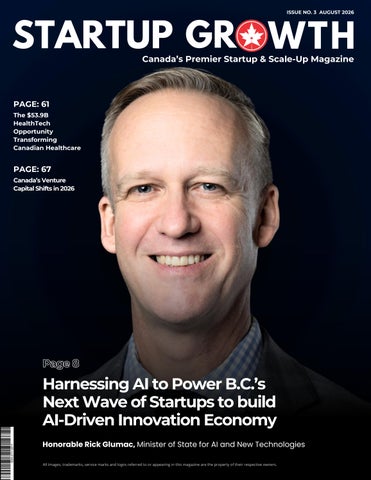
STARTUP GR WTH Canada’s Premier Startup & Scale-Up Magazine
PAGE: 61 The $53.9B HealthTech Opportunity Transforming Canadian Healthcare
PAGE: 67 Canada’s Venture Capital Shifts in 2026
Page 8
Harnessing AI to Power B.C.’s Next Wave of Startups to build AI-Driven Innovation Economy Honorable Rick Glumac, Minister of State for AI and New Technologies All Images, trademarks, service marks and logos referred to or appearing in this magazine are the property of their respective owners.
STARTUP GR
WTH
AWARDS 2026
STARTUP GROWTH BUSINESS AWARDS 2026 CANADA’S PREMIER STARTUP AWARDS PROGRAM ENTRIES FOR THE AWARDS
ARE OPEN NOW DEADLINE: 15TH AUGUST, 2026
APPLY NOW STARTUPGROWTHAWARDS.CA
#STARTUPGROWTHAWARDS2026
Dear Readers, Three issues in, and I keep coming back to why we started Startup Growth Magazine in the first place. Every month, I meet so many founders. Some are one introduction away from funding; others are doing everything right but still can’t get in the room. It’s rarely about talent; it’s about access. And that’s what has stayed with me. Some of the most impressive founders I meet are building great products, but they're building quietly across Canada in labs, small towns, clinics, warehouses, and workshops. They may not have the right connections yet, but their work matters, so they need the right connections to see their innovation scale. That’s the gap we are here to close. At Startup Growth Magazine and Podcast, that's what we want to keep doing: spotlighting the invisible innovators. Not to rank founders or repeat the same names, but to shine a light on the people building what’s next who need more attention from the ecosystem! With this third issue, that mission feels even clearer. Canada’s innovation story is much bigger than a few major cities. If we only look in the usual places, we miss so much.
startupgrowth.ca raoof@canadiansme.ca / tac@canadiansme.ca Startup-Growth-Business-Magazine canadian_sme startupgrowthmagazine canadiansme
Publisher Shaik Khaleeluddin(SK) Editorial Director Tehmina A Chaudhry Executive Director Hammad Siddiqui Admin Manager Raoof Uddin Shaik Sr. Content Manager Amanda Spearing
Capital, connections, and access matter, but visibility often comes first.
Creative Design Cmarketing Inc
That’s what we want to keep doing: helping people be seen.
Social Media Cmarketing Inc
We are still early, and there’s so much more to uncover.
Events Shaik Raoof Uddin
I hope you will find someone in these pages you didn’t know before.
Photography Deposit Photos, Cmarketing Inc.
Web Cmarketing Inc
For Advertisements info@canadiansme.ca Cmarketing Inc 6345 Dixie Rd, Unit 202, Mississauga, ON L5T 2E6 Call us at +1 416 655 0205 /647 668 5785
Published by Cmarketing Inc 6345 Dixie Rd, Unit 202, Mississauga, ON, L5T 2E6 Copyright © 2026 CMarketing Inc. All rights reserved. Reproduction in whole or part of any text, photography or illustrations without written permission from the publisher is prohibited.
Tehmina A Chaudhry Editorial Director Startup Growth Magazine All Images, trademarks, service marks and logos referred to or appearing in this magazine are the property of their respective owners.
The contents in the Startup Growth Magazine are for informational purposes only. Neither Cmarketing Inc, the publishers nor any of its partners, employees or affiliates accept any liability whatsoever for any direct or consequential loss arising from any use of its contents.
The Startup & Investor Lounge Building a Strong Foundation for Future Growth
Website
www.smesummit.ca/startup-investor-lounge Date Presented by
October 13, 2026
Metro Toronto Convention Centre, North Building · Level 100
startupgrowth.ca raoof@canadiansme.ca / tac@canadiansme.ca Startup-Growth-Business-Magazine canadian_sme startupgrowthmagazine canadiansme
Publisher Shaik Khaleeluddin(SK) Editorial Director Tehmina A Chaudhry Executive Director Hammad Siddiqui Admin Manager Raoof Uddin Shaik Sr. Content Manager Amanda Spearing Creative Design Cmarketing Inc Social Media Cmarketing Inc Events Shaik Raoof Uddin Photography Deposit Photos, Cmarketing Inc.
Web Cmarketing Inc
For Advertisements info@canadiansme.ca Cmarketing Inc 6345 Dixie Rd, Unit 202, Mississauga, ON L5T 2E6 Call us at +1 416 655 0205 /647 668 5785
Published by Cmarketing Inc 6345 Dixie Rd, Unit 202, Mississauga, ON, L5T 2E6 Copyright © 2026 CMarketing Inc. All rights reserved. Reproduction in whole or part of any text, photography or illustrations without written permission from the publisher is prohibited.
The contents in the Startup Growth Magazine are for informational purposes only. Neither Cmarketing Inc, the publishers nor any of its partners, employees or affiliates accept any liability whatsoever for any direct or consequential loss arising from any use of its contents.
IN THIS ISSUE Startup Growth Magazine
30 The Great Skill Transfer: Why Canada's Future Depends on Who We Upskill Next Agapi Gessesse
CEO of the Coalition of Innovation Leaders Advancing Respect (CILAR)
71
Unpacking SR&ED Incentive for The Canadian Innovators
48
Who Controls Canada’s Startup Money? Inside the Growing Venture Capital Divide
22
BDC and the Future of Canadian Innovation
52
How CVCA and CPE Analytics Track Canada’s Venture Capital Cycle
34
How CIBC Supports Canada’s Innovation Economy
28
Economic Reports by Scotiabank, TD, and BMO Reflecting on Canada’s Innovation Sector.
54
Why Canada’s University Spinoffs Are Finally Scaling Up
56
The Rise of Canada’s Post-Quantum Billion-Dollar Cybersecurity Economy
IN THIS ISSUE Startup Growth Magazine
15
How DMZ Is Building Canada’s Next Generation of Tech Champions
73
19
Beyond the Rails: Why Regulated Custody is the Bedrock of the New Economy
Turning Captured CO₂ into Industrial Opportunity
40
45
From Lab Research to Quantum at Scale
Old School Canada: The Innovation Gap That Is Bigger Than You Think
59
Canada’s AI Revolution Gets a $500M Boost Through Government Investment
43
Is Creating New Opportunities for Canadian Businesses
24
Canadian Femtech Startups Are Leading Women’s Health Innovation
Image Courtesy: Petite Photography
In an exclusive interview with Startup Growth Magazine, Honorable Rick Glumac, Minister of State for AI and New Technologies, shares his vision for strengthening British Columbia’s position as a global hub for artificial intelligence, innovation, and startup growth. As AI continues to reshape industries, Rick discusses how B.C. is supporting founders through access to talent, commercialization opportunities, research partnerships, and responsible technology adoption.
Interview By SK Uddin Rick Glumac was first elected as MLA for Port Moody-Coquitlam (now Port MoodyBurquitlam) in 2017. Rick was appointed as Minister of State for AI and New Technologies in July 2025.
Honorable Rick Glumac Minister of State for AI and New Technologies
Rick comes to government from the tech sector and a background in computer engineering. He previously served as Minister of State for Trade, Parliamentary Secretary for Technology, as well as Premier’s Liaison to Washington state.
Harnessing AI to Power B.C.’s
Next Wave of Startups to build AI-Driven Innovation Economy
8 - Startup Growth - August 2026
AI Innovation
Rick graduated from Simon Fraser University with a Bachelor of Applied Science in Electronics Engineering. He has worked in a variety of high-tech industries, including animation on films, such as Shrek 2, and video games, and developing mobile apps for Fortune 500 companies. Rick understands first-hand the value of B.C.’s hightech sector and the benefit it brings to the economy.
B.C. is often described as being at the forefront of innovation, with a robust and fast‑growing tech sector. From your perspective, what makes B.C. such fertile ground for AI and startup founders today, and which sectors do you see offering the biggest opportunities in the next few years? B.C. offers a strong environment for AI and startup founders because it combines rapid ecosystem growth, world-class talent, supportive policy, strong research institutions, and real-world opportunities to test and scale innovation.
The province’s AI sector has more than doubled in recent years to over 600 companies, many focused on applied, revenue-generating solutions. Programs like the Integrated Marketplace help startups validate technologies in real-world environments with industry partners, reducing barriers to commercialization and scale. For example, I visited the Vancouver International Airport and saw A&K Robotics’ autonomous robots in action. Their technology helps people with mobility challenges navigate the terminal and was tested directly in the airport environment through the Integrated Marketplace. It has since attracted international interest, including an agreement with Aena, the world’s largest airport operator. B.C. also benefits from strong universities, a growing talent pipeline, and
abundant clean energy to support data infrastructure. Its diverse economy – spanning natural resources, life sciences, transportation, and clean technology
Image Courtesy: Scale AI Canada / Melanie Olmstead
– creates strong demand for applied AI solutions.
Looking ahead, key opportunities include health and life sciences, clean energy and climate solutions, advanced manufacturing, logistics and supply chains, geospatial analytics, and agri-tech. Overall, B.C.’s strength lies in connecting research, talent, infrastructure, and industry demand to enable global scale impact.
9 - Startup Growth - August 2026
AI Innovation You’ve said AI is key to driving productivity, higher‑paying jobs, and broad‑based prosperity. What specific programs or supports are in place—or coming soon—to help early‑stage founders adopt AI responsibly and competitively, and what impact are you already seeing in terms of jobs, investment, or new companies created? AI is changing how we work, learn and connect, and B.C. has the talent and infrastructure to be a global leader in this space. Growth in the tech sector has been strong – for example, employment in the professional, scientific and technical services industry grew 2x more when compared to overall job growth in BC over the last decade.
At ALL IN Talks West you highlighted that events like this help B.C. “be at the forefront of innovation” by bringing together entrepreneurs, researchers, and policymakers. How do you see gatherings like ALL IN Talks West directly benefiting startup founders, and what were your top takeaways for entrepreneurs from this year’s event? Gatherings like ALL IN Talks West directly
benefit startup founders by concentrating the entire innovation ecosystem including
Our tech sector is one of the fastest growing industries in B.C. With over 12,000 tech companies and over 180,000
investors, researchers, industry leaders, and policymakers in one place. This year’s gathering saw over 300 AI providers and
But innovation must be matched with responsibility. Our government has been persistent in advocating the federal
otherwise take months to develop. These types of events can accelerate access to capital, partnerships, and customers. Events
people that are driving innovation and solving real-world problems.
government to take stronger, immediate, enforceable action to protect people, especially children and youth, from online
harms. Strong, enforceable federal rules will help ensure AI is used responsibly, support workers and families, and give people confidence that these powerful technologies are
adopters attending, allowing founders to rapidly build relationships that would
like ALL IN Talks West also provide a great opportunity for founders to learn faster, connect more effectively, and build the momentum needed to compete globally.
being developed and deployed with their safety and wellbeing at the forefront.
At the same time, B.C. is supporting early-stage AI founders through a coordinated set of programs focused on
commercialization, capital, talent, and responsible adoption. Key supports include the small business venture capital tax credit, which encourages early-stage investment in B.C. companies, and the Scientific Research and Experimental Development (SR&ED) tax credit, which helps firms develop new or improved technologies by offsetting R&D costs. Through Innovate BC, new initiatives such as the Microgrant Platform further support early-stage ventures to validate and scale emerging technologies, while organizations like New Ventures BC provide mentorship, funding, and IP support across the startup lifecycle. B.C. is also investing in talent through expanded tech training, internships, and AI literacy initiatives, and infrastructure such as data centres. Our approach ensures early‑stage companies can compete globally while protecting people and creating good jobs here in B.C. 10 - Startup Growth - August 2026
AI Innovation Many startups struggle with access to capital, talent, and first customers, particularly in deep‑tech and AI. How is your role—alongside universities, accelerators, and industry partners— helping to lower those barriers for B.C. founders, and what practical steps should startups take to plug into these resources? B.C. is reducing startup barriers by better connecting talent, capital, and customers across government, universities, accelerators, and industry. A key example is the Integrated
Marketplace platform delivered by Innovate BC, which enables small and medium-sized companies to test and deploy technologies in real-world environments across sectors such as
healthcare, critical minerals, emergency management, and the marine sector. This helps de-risk adoption for industry while allowing startups to validate solutions, secure reference customers, and scale into new markets.
To support talent, the province is expanding tech training, co-op placements, and applied research
internships, and improving credential recognition to attract global expertise. On capital, government focuses on derisking investment and crowding in private funding through commercialization supports, sector strategies, and partnerships in AI, life sciences, and high growth fields. Together, these efforts create an integrated ecosystem that aligns research, training, and industry demand while helping B.C. companies scale globally.
Image Courtesy: WebSummit Vancouver
Startups can plug in by joining accelerators or innovation hubs, partnering with universities for talent and R&D, pursuing pilot and procurement opportunities to secure early customers, aligning with priority sectors to access targeted supports, and working directly with industry partners. Success in B.C. comes from actively engaging the ecosystem to accelerate growth, rather than navigating it alone.
11 - Startup Growth - August 2026
long term?
A practical tip we’ve heard from business leaders is to carefully review contracts with AI vendors to understand data usage, security, and ownership, ensuring you know what happens to business and customer data.
The first step is using AI responsibly. An IBM training manual from
The next step is using AI well. Rather
As the first Minister of State for Artificial Intelligence and New Technologies, you’re helping shape how B.C. balances innovation with responsible AI use and public trust. For new and aspiring founders reading this issue, what final piece of advice or challenge would you offer about building AI‑driven companies that are both competitive and trustworthy for the
1979 put it well: “A computer can never be held accountable, therefore a computer must never make a management decision”. While AI can deliver immense value, it is important to understand where and how it fails.
than focusing on prompt engineering or agentic workflows, ensure you are applying the right AI to problems that it’s well suited to solve. Understand the range of AI methods, knowing that the largest model isn’t always the best - right-
sizing your approach improves cost, speed, and impact. Understanding model capabilities and trade-offs is essential.
Finally, pitch your business, not your tools. Investors care about revenue growth, cost reduction, and managed risk. Success comes from applying the right tools to real problems, not technology for its own sake.
Machine Learning models are driven by statistical relationships, not hard-coded rules or facts. We’ve all
Disclaimer: The views expressed in this interview are solely those of the interviewee and do not necessarily reflect the views of Startup Growth Magazine. The content is for general information only and is not professional or investment advice.
seen AI models confidently produce incorrect answers. These models can also reinforce biases in their training data. Responsible use requires transparency, clear accountability, and human oversight for mission-critical decisions.
12 - Startup Growth - August 2026
Image Courtesy: Canva
Image Courtesy: Canva
Canada's Startup Ecosystem How Canadian Startups Are Rewriting the Rules of Tech Recruitment By Hammad Siddiqui
A wave of international deal-making, delegations and award ceremonies is set to define a pivotal season for the country's founders.
This fall, Canada Startup Association is rewriting the startup ecosystem story at the global stage. CSA is leading a series of initiatives designed to connect domestic founders with capital, partners and markets abroad. The centerpiece of that push is a cluster of events converging on Toronto and Mississauga this September. On September 18, the Innovation Investment Summit, presented in partnership with the Business Development Bank of Canada, the Global Angel Investor Network (GAIN) and CSA, will bring international angel investors, institutional funders and venture capital firms into a single room with ten hand-picked startups competing for attention on the main stage. Three days later, the AGAZ Summit will convene under the banner "Capital Beyond Borders," gathering builders, investors and ecosystem leaders for what organizers describe as an intentionally intimate event, alongside an Investors' Breakfast co-hosted with GAIN aimed at founders seeking early-stage capital and strategic introductions.
13 - Startup Growth - August 2026
Global Expansion The emphasis on capital access reflects a broader argument CSA has been making publicly: that promising companies are no longer confined to a handful of established hubs, and that investors willing to look beyond traditional networks stand to benefit most. It is a thesis the association is also testing overseas. In early September, a CSA-led delegation of five Canadian founders will travel to Seoul for Try Everything 2026, South Korea's flagship startup festival, held at the Dongdaemun Design Plaza. The trip was arranged through a partnership with the Seoul Business Agency, established by the Seoul Metropolitan Government, and includes exhibition booths, pre-matched meetings with global venture capital firms and accommodation for the founders selected.
“South Korea represents an exciting growth opportunity for Informanos. Through Try Everything 2026, we’re looking forward to connecting with investors and strategic partners, learning from Korea’s dynamic technology ecosystem, and exploring how our Canadian-built AI solutions can create impact across the Asian market.” Cynthia Egbunonu, CEO & Co-Founder, Informanos Analytics & Artificial Intelligence Inc.
Later that same week, CSA's involvement extends to Riyadh, where the association will be represented at LEAP, one of the
world's largest technology conferences, drawing more than 200,000 attendees spanning artificial intelligence, robotics and government technology. CSA President Tehmina Chaudhry will speak on a panel addressing how Canada and Saudi Arabia might build trusted partnerships in AI, part of a wider effort to position Canadian startups within emerging Gulf markets.
“CSA is creating opportunities for Canadian founders to shine on the global stage, whether that's in Seoul, Riyadh or Africa. We're closing the gap between Canada and international markets. The rest of the world is moving fast, and Canadian founders need to speedup expanding internationally, they cannot afford to wait to catch up”. - Hammad Siddiqui, Executive Director, CSA
The organization's international ambitions are paired with a domestic recognition effort. The StartupGrowth Awards, a joint initiative between CSA, Canadian SME and StartupGrowth Magazine, opened
nominations this year for founders across all provinces and industries who have shown resilience or meaningful impact. Winners will be featured in StartupGrowth Magazine, gain a speaking slot at the AGAZ Summit and join a network of mentors and fellow entrepreneurs, recognition organizers say is intended to correct a persistent gap between the scale of Canadian founders' achievements and the attention those achievements typically receive.
Underlying all of it is a financial model CSA has been vocal about maintaining: growth without reliance on public funding. At the Engaging Associations Forum this year,
Executive Director Hammad Siddiqui presented how the CSA was built without grants or institutional backing, relying
instead on a self-sustaining revenue model. Session titled "When Purpose Meets Profit: Building Nonprofits as Social
Enterprises," argued that mission-driven organizations need not treat financial sustainability and social purpose as competing priorities.
Taken together, the initiatives point to an organization attempting to operate on two fronts simultaneously, building international bridges for Canadian founders while proving that a non-profit focused on economic development can sustain itself commercially rather than through government support. Whether that dual strategy translates into measurable outcomes for the startups involved will likely become clearer only after the September events conclude and the Seoul and Riyadh delegations report back. For now, CSA's message to the country's founders is straightforward: the opportunities worth chasing increasingly lie beyond Canada's own borders, and the association intends to keep opening doors to them. 14 - Startup Growth - August 2026
How DMZ
Is Building Canada’s Next Generation of Tech Champions By SK Uddin Image Courtesy: DMZ
DMZ at Toronto Metropolitan University, located in downtown Toronto, has become one of the world's top university-based tech incubators. What started out as a student coworking space in 2010 has grown into a worldwide startup ecosystem that helps thousands of founders create high-impact technology ventures.
Toronto Metropolitan University, formerly Ryerson University, founded the incubator to help entrepreneurs in transforming their ideas into profitable businesses. DMZ began as a campus effort and has evolved over the last fifteen years into a global platform that helps companies from early-stage validation to international growth. Entrepreneurs have access to financing networks, market contacts, mentorship, and customized growth strategies that help startups meet important milestones more quickly. To support Canada as a major startup ecosystem on the international stage,, DMZ today works with partners, accelerators, and innovation centers across several continents from its Toronto headquarters.
15 - Startup Growth - August 2026
Tech Incubation
Impact by the Numbers: Driving Startup Growth Since its founding, DMZ has assisted over 2,680 startups, according to official DMZ statistics. Together, these businesses have raised more than $3.18 billion in funding and generated over 25,000 jobs globally. Additionally, the incubator has gained international prominence. DMZ has consistently been named among the world's best university-based startup incubators by research firm UBI Global, demonstrating the quality of its programs and the success of the businesses in its ecosystem. As of 2023,
DMZ is playing a larger role in the rankings, joining UBI Global to support the assessment and selection of top business incubators and accelerators worldwide.
Beyond Canada, DMZ has established programs in more than 15 countries, giving creators access to a global network of more than 3,000 corporate partners, investors, and mentors. These accomplishments have contributed to Toronto's status as one of North America's fastest-growing tech hubs.
How DMZ Helps Founders Build and Scale From early idea validation to international expansion, DMZ's assistance system is built as a complete startup pipeline. The Pre-incubator program is a 9-month program to help startups master sales and turn prospects into paying customers. The Incubator program is an 18-month program that helps startups refine and grow, becoming investor-ready.
To offer more individualized growth strategies rather than uniform startup batches, DMZ has modified its incubation approach in recent years. This change enables founders to get assistance tailored to their industry challenges and stage of growth.
Another essential element of the DMZ ecosystem is access
to financing. Founders learn how to refine their pitch decks and become investor-ready, and are connected to DMZ’s network of investors, including DMZ Ventures, DMZ’s forprofit arm.
Supporting Diverse Founders and Emerging Talent
Image Courtesy: DMZ
DMZ is committed to supporting underrepresented entrepreneurs and increasing access to innovation opportunities. The incubator runs a number of specific programs for Black founders, women founders, and earlystage student founders, among other underrepresented groups.
16 - Startup Growth - August 2026
Tech Incubation The Black Innovation Summit, an annual event that showcases Blackled technology firms and connects them with investors and corporate partners, is one of the best-known efforts. Ten Black-led firms secured a total of $400,000 in investment commitments at the 2025 Black Innovation Summit, according to DMZ, the largest investment commitment in the event's history. Additionally, DMZ runs Basecamp, a student-focused initiative that introduces budding entrepreneurs to innovation and business building.
With these programs, DMZ hopes to
increase the number of Canadian tech entrepreneurs in the pipeline and build a more diverse innovation economy.
Image Courtesy: DMZ
17 - Startup Growth - August 2026
Leadership Perspective on Canada’s Startup Landscape Abdullah Snobar, Executive Director of DMZ and CEO of DMZ Ventures, exemplifies DMZ's founder-first ethos. Speaking during Toronto Tech Week, Snobar emphasized the necessity of ongoing assistance for entrepreneurs while highlighting the difficulties founders encounter in the current startup ecosystem, “Building a company in Canada isn’t for the faint of heart right now. Capital is tighter, and markets are unpredictable. But moments like today, where founders put everything on the line and receive the support they have earned, are what entrepreneurship is all about.”
Tech Incubation
Why DMZ Matters to Canada’s Startup Future Startup incubators are essential to helping entrepreneurs turn ideas into scalable enterprises as the worldwide race for tech leadership heats up. One of the most significant groups advancing that goal is now Toronto Metropolitan University's DMZ. The incubator gives companies the resources they need to move from early-stage experimentation to worldwide expansion by combining mentorship, access to financing, and a global network of partners.
DMZ has become a pillar of Canada's tech ecosystem, supporting over 2,600 startups, raising billions of dollars, and creating over 25,000 jobs. DMZ continues to provide something priceless for the next generation of
Image Courtesy: DMZ
Canadian entrepreneurs: a community based on the conviction that daring concepts and tenacious entrepreneurs can create the businesses that will influence technology's future.
Image Courtesy: DMZ
Your engagement helps strengthen a growing ecosystem of founders, builders, and business leaders. Startup Growth is designed to deliver practical insights, emerging trends, and real-world strategies that support entrepreneurial success. Click here to subscribe and follow our official channel. Stay connected to us for the latest developments in the startup landscape. Your continued support helps us spotlight innovation and opportunity across Canada. Disclaimer: The content published on StartupGrowth.ca is based on publicly available sources and is provided for general informational purposes only. Startup Growth does not endorse, recommend, or guarantee any products, services, organizations, or claims mentioned. Readers are encouraged to conduct independent research and exercise due diligence before making financial, investment, or business decisions.
18 - Startup Growth - August 2026
Image Courtesy: Iain Evans
In an exclusive interview with Startup Growth Magazine, Iain Evans, CEO and Co-Founder of Anodyne Chemistries Inc., shares how his company is redefining industrial manufacturing through its innovative bioelectric® platform. By transforming captured CO₂, water, and renewable electricity into lower-carbon chemicals, Iain is helping build a more sustainable industrial supply chain in Canada.
Interview By Tehmina A Chaudhry Iain Evans is the CEO and co-founder of Anodyne Chemistries Inc., a Burnaby, BC-based chemicals company building a novel bioelectric manufacturing platform, that converts CO₂, water, and renewable electricity into commodity
Ⓡ
and specialty chemicals, replacing fossil-derived feedstocks with a lower-carbon industrial supply chain. Since co-founding Anodyne in 2021 alongside CTO Manou Davies, Iain has grown the company to two locations, employing 25 people, secured public and private investment, and
Iain Evans
CEO and Co-Founder of Anodyne Chemistries Inc.
earned Anodyne a place on the Foresight50 list of Canada's most investable cleantech ventures. Anodyne's team includes industry veterans that bridge the chemical and biotech sectors. Under Iain's leadership, Anodyne is scaling from pilot to commercial operation with its bioelectric
Ⓡ
Turning Captured CO₂ into Industrial Opportunity
platform, targeting markets including agriculture, construction, drilling fluids, and de-icing.
You founded Anodyne Chemistries in 2021 to rethink how industrial chemicals are made, using captured CO₂ instead of fossil feedstocks. What first convinced you this was the right problem to tackle—and the right moment to start a new company around bioelectric manufacturing? It came down to a simple mismatch: the chemical industry still runs almost entirely on fossil feedstocks and thermal processing, while the cost of renewable electricity has been falling for over a decade. Manou and I kept coming back to the idea that if you could pair programmable enzymes with electrochemistry, you could turn CO2, water, and clean power directly into useful industrial chemicals — skipping the fossil intermediates entirely.
19 - Startup Growth - August 2026
Clean Technology What convinced us to actually start Anodyne in 2021 was seeing that the underlying science (electrifying enzymes) had matured just enough to be engineered, while the market pressure on industrial customers to decarbonize their supply
chains was becoming real rather than theoretical. Formate and formic acid stood out as a perfect first product: large, addressable markets in agriculture, de-icing, construction, and drilling fluids, with customers who care about performance and cost, not just sustainability credentials. That combination — a technology finally ready for commercialization and customers with a genuine reason to switch — told us this was the right problem and the right moment. In just a few years, you’ve grown Anodyne to nearly 25 employees, secured public and private investment, and earned a place on the Foresight50 list of Canada’s most investable cleantech ventures. What have been the biggest lessons from that journey so far about building and growing a startup in a fast‑moving, capital‑intensive industry? The biggest lesson has been that capital-intensive hardware businesses reward patience and sequencing far more than speed. It's tempting to chase every milestone at once, but we've learned
to de-risk the technology in discrete, fundable stages (lab, pilot, demonstration) and to bring in operators who've done this before rather than assuming enthusiasm can substitute for scale-up experience. Adding people like Jim Rekoske, who spent decades commercializing technology at UOP & Ecolab, changed how rigorously we think about engineering handoffs and cost basis long before we're ready for a full plant. We've also learned to treat government funding and private capital as complementary, not interchangeable: grants and ITCs let us de-risk technical milestones nondilutively, while equity investors want to see commercial traction and a credible path to margin. Constantly testing with willing customers was a critical external signal, but the real lesson was internal, building a team that can hold both scientific ambition and commercial discipline at the same time, and being honest with ourselves about which milestones actually reduce risk versus which ones just look good on a slide.
Many climate‑tech companies face a “valley of death” between promising lab results and commercial scale. From Anodyne’s experience— securing follow‑on investment for your EZ Formate pilot plant and leveraging local supply chains—what challenges do innovative companies face when trying to scale in Canada, and how have you navigated them? In Canada specifically, the valley of death isn't just about capital, it's about access to physical infrastructure. Finding a site with the right power availability, at the right price, close to existing supply chains, turns out to be as hard as raising the money to build on it. We approached this by treating power and site selection as an engineering problem from day one, screening brownfield sites with existing grid capacity rather than assuming we'd build greenfield, and leaning on regional advantages like low-cost hydro
power. On the financing side, follow-on investment for our pilot came easier once we could show a real customer pipeline, not just technical promise, so we pushed hard to convert early conversations into
structured commercial engagements rather than letting them stay exploratory indefinitely. We've also leaned on Canadian supply chains for equipment and engineering services wherever it de-risks timelines, even when it costs slightly more than importing. The
pattern that's worked for us is sequencing proof points so each raise is backed by something concrete: a working pilot, a signed agreement, a permitted site, rather than asking investors to underwrite the whole journey at once.
Your bioelectric platform aims to supply cost‑competitive, CO₂‑derived chemicals to sectors like agriculture, construction, drilling, and de‑icing. How do you think about balancing technical innovation with real‑world requirements—price, reliability, performance—so that manufacturers can adopt new solutions without compromising on quality? Our products are chemically identical to what is being used today, just without the impurities and emissions hang over that incumbents have. That means qualification testing with real customers happens early and often, well before we're at commercial scale, so we find out about reliability or performance gaps while they're still cheap to fix. 20 - Startup Growth - August 2026
Image Courtesy: Iain Evans
Clean Technology
Innovation, in our world, is mostly invisible to the end user: it lives
in how the product is made, not in asking a manufacturer to change their process to accommodate us. We also resist the temptation to over-promise on sustainability alone, in commodity
and specialty chemical markets, price, quality and reliability get you in the door, and the lower-carbon story is what keeps you there once customers are comfortable. Practically, this means our
commercial team works backward from a customer's existing purchase specification rather than forward from our lab data, and we're deliberately conservative about claiming cost or performance advantages until we can back them with comparative benchmarking.
With your pilot plant about to arrive and new milestones ahead, what’s next for Anodyne over the next few years—and, more broadly, what would you say to other Canadian founders about the opportunities and realities of building climate‑tech ventures that have to move from research to full‑scale industrial impact? Over the next few years, our focus is moving from pilot proof points to our first full commercial demonstration plant, expanding our product portfolio beyond formate into adjacent specialty molecules, and most importantly, getting products into customers hands. For other Canadian founders building in climate-tech, I'd say two things. First, respect how long and capital-intensive the path from lab to industrial scale really is, plan your fundraising and your milestones around that reality rather than around the timeline you wish you had.
Canada has real structural advantages for this kind of manufacturing, clean, low-cost power, strong technical talent, and increasingly sophisticated non-dilutive funding programs, but taking advantage of them requires treating site selection, regulatory engagement, and supply chains as seriously as you treat the core technology. It’s a massive orchestration exercise. The founders who succeed in this space aren't necessarily the ones with the most novel science; they're the ones who can hold technical rigour, commercial discipline, and patience together at the same time, over a much longer runway than a typical software startup.
Disclaimer: The views expressed in this interview are solely those of the interviewee and do not necessarily reflect the views of Startup Growth Magazine. The content is for general information only and is not professional or invstment advice.
21 - Startup Growth - August 2026
Image Courtesy: depositphotos.com
BDC and the Future of Canadian Innovation By Tehmina A Chaudhry
Canada's innovation economy is at a crossroads, developing high-quality startups but struggling to scale them into globally competitive corporations while remaining anchored at home. The Business Development Bank of Canada (BDC), a federal Crown organization dedicated to assisting entrepreneurs, has emerged as one of the most influential voices in assessing the problem and providing solutions. BDC integrates finance, strategy, and public policy concerns through its flagship publication, Canada's Venture Finance Landscape 2026, as well as focused projects like the multibillion-dollar Defence Platform and StrongNorth Fund. This article provides a highlevel summary of BDC's approach to addressing Canada's venture capital needs, including new investment platforms in quantum technology and cybersecurity.
Canada’s Venture Capital Landscape 2026 The BDC's Canada's Venture Capital Landscape 2026 study is one of the most thorough appraisals of the country's venture capital landscape. According to the estimate,
overall venture investment in Canada will be close to $8 billion in 2025, down just around 6% from the previous year. Despite headline stability, capital is becoming concentrated in fewer, larger transactions, leaving many early- and midstage enterprises without the cash they need to grow. BDC contends that Canada is capable of developing innovation but does not consistently harness its economic potential because too few companies make it from seed
stage to commercialization. The paper outlines a structural "scale-up gap," where funding becomes scarce and more selective at Series A and beyond, relying mainly on international investors. In some significant Canadian transactions worth $50 million or more, foreign money contributes for 80 to 90 percent of overall finance. This reliance on foreign financing, paired with limited exit markets, is characterized by BDC as an "economic sovereignty" issue rather than a venture capital challenge.
22 - Startup Growth - August 2026
Innovation Finance
Economic Sovereignty and Scaling Canadian Companies In its news release and commentary on the 2026 report, BDC emphasizes Canada's ability to scale and retain its most promising enterprises, which has implications for national
economic sovereignty. Canadian firms that rely on foreign investors for late-stage investment and limited exits may miss out on the long-term value of indigenous innovation. According to BDC's analysis, exit activity has been muted, venture returns have lagged behind those in areas such as the United States, and domestic fundraising has dropped to its lowest level in years. At the same time, the research highlights that fields such as artificial intelligence are now attracting a sizable portion of available investment capital, with AI accounting for roughly half of all venture dollars invested in Canada by 2025. While this concentration demonstrates investor confidence in AI, it
also highlights the possibility that companies in other areas would struggle to obtain expansion funding. BDC contends that narrowing the scale-up gap and increasing local pools of capital are crucial measures for Canada to be not only a producer of innovation, but also a long-term owner of the wealth generated.
BDC’s Defence Platform and StrongNorth Fund BDC is investing heavily in defence-related innovation, with a Defence Platform offering up to $6 billion in support to Canadian enterprises. The platform provides funding, consultancy services, and venture capital to help small and
medium-sized firms develop and participate in defence and national security value chains. Since the platform's inception, BDC has provided over $90 million in funding to Canadian firms and engaged many organizations in consulting services focused on defence possibilities.
The StrongNorth Fund, a $300 million venture capital institution, is a key component of this plan. It supports early-stage Canadian firms developing deep technologies for defence or dual-use applications. The fund's priority areas include aircraft, autonomous systems, sensors, space technologies, advanced manufacturing, and training and simulation, among others. BDC's investments in quantum and cybersecurity startups,
including Photonic and Lastwall, position the fund as a catalyst for developing home-grown defence capabilities. This defence platform embodies the BDC's belief that innovation, capital, and sovereignty are inextricably connected in vital areas.
Implications for Canadian Entrepreneurs and Policymakers BDC's venture capital and defence work lays out a strategy for strengthening Canada's innovation ecosystem and its
economic resilience. The 2026 venture capital study emphasizes the need to establish companies that can compete for concentrated pools of capital, particularly at later stages. Additionally, entrepreneurs should explore strategic
fields such as AI, deep tech, and defence-related applications. Policymakers should focus on increasing domestic risk capital, improving exit
pathways, and ensuring public programs prioritize long-term value capture over short-term deal volume.
BDC's Defence Platform and StrongNorth Fund demonstrate how targeted publicbacked investment can assist national objectives like cybersecurity and quantum technologies, while also creating commercial opportunities for
Canadian SMEs. Taken together, BDC's analysis and activities position venture capital not only as a driver of innovation, but also as a crucial component of Canada's overall economic sovereignty agenda.
Your engagement helps strengthen a growing ecosystem of founders, builders, and business leaders. Startup Growth is designed to deliver practical insights, emerging trends, and real-world strategies that support entrepreneurial success. Click here to subscribe and follow our official channel. Stay connected to us for the latest developments in the startup landscape. Your continued support helps us spotlight innovation and opportunity across Canada. Disclaimer: The content published on StartupGrowth.ca is based on publicly available sources and is provided for general informational purposes only. Startup Growth does not endorse, recommend, or guarantee any products, services, organizations, or claims mentioned. Readers are encouraged to conduct independent research and exercise due diligence before making financial, investment, or business decisions.
23 - Startup Growth - August 2026
Image Courtesy: Fiona Lake Waslander
By Tehmina A Chaudhry Canada's femtech sector is gaining traction, but the funding behind it is moving too slowly. Across the country, women-led health entrepreneurs are developing solutions for some of healthcare's most ignored issues, such as menopause, fertility, pelvic health, reproductive care, hormone tracking, and midlife wellness. These aren't niche
concerns. They are important health, labour, and economic concerns for millions of women. However, the financing shortfall remains significant.
According to a 2023 Toronto Metropolitan University analysis quoted by The Globe and Mail, women-led firms generate 35% higher average returns on investment than male-led startups.Despite this,
women-owned enterprises in Canada receive approximately 4% of venture capital funding, according to the Government of Canada. According to
Fiona Lake Waslander, CEO and cofounder of Montreal-based Coral, this disparity represents one of the most
significant wasted opportunities in Canadian venture capital. "This capital
Canadian Femtech Startups Are Leading Women’s Health Innovation Fiona Lake Waslander Founder of coral.ca
inefficiency creates a big, massive market opportunity for investors," Ms. Lake Waslander told The Globe and Mail.
Coral’s $4-Million Raise Signals a Major Femtech Moment Coral, a virtual clinic for women going through perimenopause, menopause, and midlife health, concluded a $4 million funding round this spring. The financing increased the company's total capital to $8 million, allowing Coral to expand its virtual services across all Canadian provinces. Ms. Lake Waslander, Anna Chif, and John McCalla founded Coral in 2024 to provide access to coaching, testing, and tailored treatment plans from medical specialists. Users can also monitor their health progress via the company's app. 24 - Startup Growth - August 2026
FemTech Innovation Ms. Lake Waslander founded the company based on personal experience and a clear market gap. After a long career in consumer technology and the sale of her second business, she wanted to create something more mission-driven. Around the same time, she and friends in top positions started talking about menopause and the lack of clear information available to them. “The lack of information was astounding,” Ms. Lake Waslander said. “No one knew what was coming.”
“It’s a societal economic issue on top of a moral issue,” Ms. Lake Waslander said. That phrase illustrates the broader trend in women's health innovation. Femtech encompasses more than simply better apps, wearables, and virtual clinics. It is about reversing decades of underinvestment in health issues that
Through her investigation, she discovered that a lack of menopause care and education was more than just a medical issue. It was also a workplace and leadership issue. Insomnia, anxiety, brain fog, and excessive bleeding are all symptoms that can have an impact on confidence, performance, and
influence women's daily lives, careers, families, and long-term well-being. When women do not obtain prompt diagnosis, support, or treatment, the implications reach well beyond the clinic. They appear in workplaces, productivity, leadership pipelines, and household economics.
“When that promotion comes up, you’re not anywhere on the
Beyond “Bikini Medicine”
professional growth. As Ms. Lake Waslander stated,
thriving scale. You are barely surviving.”
Rachel Bartholomew, the founder of Femtech Canada, has been trying to
create a national network focused on increasing women's health innovation.She told The Globe and Mail that historically, efforts in women's health have
Image Courtesy: Coral
concentrated on what she refers to as "bikini medicine," which includes breast health, gynecology, fertility, and maternity
Women’s Health Is an Economic Issue The timing of femtech innovation in Canada is key. According to a McKinsey Health Institute analysis from 2025, Canadian women spend 24% more time in poor health than men do. The same analysis concluded that bridging the women's health gap could boost Canada's economy by $37 billion per year by 2040.
health.While these areas remain critically important and underfunded, Ms. Bartholomew emphasized that significant gaps exist in illnesses in which women may be impacted in greater numbers or suffer distinct symptoms from men. These include autoimmune diseases, Alzheimer's disease, and cardiovascular disease. She noted that many investors still don't completely understand the industry. “Most of the people who control the money are never going to experience the things that we go through, because they’re men,” Ms. Bartholomew said. That implies femtech founders are often required to educate investors before presenting their business ideas, technologies, or market potential. 25 - Startup Growth - August 2026
FemTech Innovation Her experience mirrors a larger truth about women's health: when data is inadequate, diagnosis is difficult, treatment is slow, and women are frequently left to speak for themselves.
Image Courtesy: Coral
Canadian Femtech Is Winning, But the Ecosystem Needs More Capital Coral isn't the only Canadian
femtech business garnering popularity. According to The Globe and Mail, Calgary's Flora
Aranexx Is Tackling Hormone Tracking Through Wearable Technology Tanya Lindsay, a Toronto-based businesswoman, has firsthand
experience with that difference. Her femtech business, Aranexx, is building a wearable biosensor that will measure everything from heart health to hormone levels in real time. Its app, Bastet Rising, allows women to monitor their symptoms and therapies. Ms. Lindsay was motivated to start the company after going through a tough menopause. As a runner, she had significant joint pain, tiredness, and nausea, but no classic menopause symptoms like hot flashes.
“Even going up and down the stairs, I looked like an old lady because I couldn’t move properly,” she said. After repeated doctor appointments, blood tests, and ultrasounds yielded no clear answers, she concluded that her symptoms were caused by stress and overtraining. She eventually discovered she was going through menopause and asked her doctor to allow her to undergo hormone replacement therapy. “Two weeks on these hormones, it was like magic — I was 90 percent back to my normal self,” Ms. Lindsay said. But that relief quickly turned into frustration. “We can go to Mars, we can study the fricking bottom of the ocean floor, and we don’t know how to measure women’s hormones,” she said.
Fertility raised $5 million in 2026 to expand its fertility insurance concept, allowing clients to receive coverage for costly treatments such as IVF and egg
freezing. MyStoria, a reproductive health app based in Kitchener, Ontario, has also raised $1.65 million in seed funding. These victories demonstrate that
Canadian femtech companies are developing real-world solutions to meet market demands. However, additional investment is needed to fully realize the promise of the broader ecosystem. Ms. Bartholomew, the founder and CEO of Hyivy Health, is developing a pelvic floor rehabilitation system. She believes that women's health is one of the largest unexplored markets in healthcare. “I’ve never seen an industry with as much opportunity as women’s health,” she said. “There’s so much work to do, so many opportunities to hit — it’s 50 percent of the world’s population.” 26 - Startup Growth - August 2026
FemTech Innovation Femtech Canada is also a member of a multiprovincial coalition campaigning for Bill S-243, federal legislation that would establish a national framework to coordinate, fund, and improve women's health research, training, and care across Canada. The alliance is also advocating for a $400 million investment in the field. According to Ms. Bartholomew, Canada's national women's health Image Courtesy: Coral
policy has not been significantly updated since 1999.
Why Investors Should Pay Attention For investors, the femtech funding gap should be seen as more than just a social equality issue. It's also a business opportunity. If
women-led firms generate 35% higher returns on investment, while women-owned businesses receive only 4% of venture capital funding in Canada, the market is plainly undervaluing their potential. That is the point Ms. Lake Waslander made in her LinkedIn post following the Globe and Mail piece. For investors who are
paying attention, she argued, this is one of the most enticing opportunities lying in plain sight. Coral, she said, is expanding into one of healthcare's most neglected markets: women's health. The benefits, she explained, extend beyond commercial success. They represent real-life returns for Canadian women: returning to work, returning to yourself, and returning to the best chapter of your life. Coral's investors include Brightspark Ventures, Diagram, The51, and AQC Capital, indicating that some venture capitalists are already recognizing the scale of the opportunity.
The Future of Canadian Femtech Canada possesses the skills, founders, and health innovation ecosystem required to become a worldwide leader in femTech.
What is required today is improved capital alignment. The opportunity is clear. Women's health affects half of the population.
The economic benefits are measurable. The startup activity is increasing. The founder-market fit is strong. The necessity is urgent. For far too long, women's health has been overlooked, underfunded, and under-researched. Canadian femtech founders are proving that this underserved market is not small. It is fundamental. “The whole society thrives when women are at their peak,” Ms. Lake Waslander said. “An investment in women’s health just serves everyone.”
For Canada’s startup ecosystem, that may be the most important message. Femtech is not waiting to become a major category. It already is one. Now the funding needs to catch up.
Your engagement helps strengthen a growing ecosystem of founders, builders, and business leaders. Startup Growth is designed to deliver practical insights, emerging trends, and real-world strategies that support entrepreneurial success. Click here to subscribe and follow our official channel.Stay connected to us for the latest developments in the startup landscape. Your continued support helps us spotlight innovation and opportunity across Canada.
Disclaimer: The content published on StartupGrowth.ca is based on publicly available sources and is provided for general informational purposes only. Startup Growth does not endorse, recommend, or guarantee any products, services, organizations, or claims mentioned. Readers are encouraged to conduct independent research and exercise due diligence before making financial, investment, or business decisions.
27 - Startup Growth - August 2026
By SK Uddin While some Canadian financial institutions produce specialized reports on venture capital and startup finance, others affect the innovation economy through broader macroeconomic analysis. Scotiabank, TD Bank Group, and BMO Financial Group do not currently have single, periodic publications focused solely on venture capital transaction activity or startup financing, as some of their counterparts do.
Instead, their economic commentary is nested in broader analyses of interest rates, GDP, company investment, and policy developments, all of which have an indirect impact on Canadian entrepreneurs and investors. This article presents a high-level overview of how these three banks contribute to Canada's economic debate through their macro research platforms, despite the lack of specialized innovation and economy reports.
Scotiabank Economics: Macro Outlooks and Policy Commentary Scotiabank Economics publishes a variety of daily and weekly reports on Canadian and worldwide macroeconomic situations. It publishes projections, written reports, films, and podcasts on interest rates, GDP, provincial economic outlooks, and sector-level developments. While these materials do not constitute a separate venture capital or startup finance series, they do provide context for borrowing prices, growth projections, and legislative changes that affect the climate in which Canadian innovators operate. Scotiabank's economic notes frequently cover Bank of Canada decisions, inflation dynamics, and regional
growth forecasts, which can impact the cost of capital and investor mood in high-growth sectors. Its provincial outlooks help businesses understand disparities in
economic momentum across Canadian regions, guiding decisions about expansion, hiring, and investment.
Scotiabank Economics serves a wide range of audiences, including entrepreneurs, investors, and policymakers, by putting these findings in understandable terms, even though it does not track venture capital deals as a standalone series.
Economic Reports by Scotiabank, TD, and BMO Reflecting on Canada’s Innovation Sector. Image Courtesy: Canva
28 - Startup Growth - August 2026
Economic Insights
TD Economics: Business Investment and Innovation‑Relevant Policy TD Economics conducts research and analysis on Canadian, U.S., and global economic trends, which is similar to Scotiabank's focus. It publishes the "Weekly Bottom Line," topical question-and-answer pieces, and longer reports on company investment intentions and fiscal policy changes.
While TD does not have a special publishing series on venture capital or startup finance, it has provided opinion on policies that are extremely important to creative enterprises, such as adjustments to the Scientific Research and Experimental Development (SR&ED) tax credit. The SR&ED program and other innovation-related initiatives
offer context for Canadian governments' efforts to promote R&D spending and industry investment. TD's broader macroeconomic work, which includes analysis of growth
projections, labour markets, and interest rate pathways, helps businesses and investors assess overall risk and opportunity. TD Economics does not provide venture capital statistics or startup-specific dashboards, but this study can help
entrepreneurs and technology companies make informed decisions about capital raises, expansion, and hiring.
BMO Economics: Investor‑Oriented Macroeconomic Research BMO Economics provides studies and forecasts on the global economy and financial markets to its retail, institutional, corporate, and government clients. Its publications offer an investor-oriented perspective on macrotrends, including monetary policy, currency fluctuations, commodities markets, and regional growth. Unlike several peers that have built more specific innovation-economy series, BMO does not appear to offer a dedicated recurring report focused solely on startup or venture capital finance. Nonetheless, BMO's economic work can affect the climate for innovation by shaping investor expectations about risk, returns, and sector performance. When BMO Economics examines economic predictions for Canada, interest rate trajectories, or global demand circumstances, its findings can influence how capital is distributed across asset classes, including equities and private investments. The bank's macro research is indirectly useful for Canadian entrepreneurs, as it does not track individual venture capital transactions or provide startup-focused deal information.
Why Macro Research Still Matters for Canada’s Innovation Economy Although Scotiabank, TD, and BMO do not publish specific venture capital or startup finance series, their economic research continues to influence crucial circumstances in Canada's innovation ecosystem. Macroeconomic examination of interest rates, inflation, and growth impacts borrowing costs and valuations for fast-growing enterprises. Policy-
focused commentary, like TD's work on tax credits and public programs, helps firms understand how government actions may impact investment and research decisions.
For Canadian founders and investors,
reading these institutions' economic reports can provide a more complete view of the ecosystem in which innovation and venture capital activity occur. Investing, hiring, and expanding in Canada requires intelligent decision-making based on macro projections, regional outlooks, and policy analysis, regardless of venturespecific series.
Your engagement helps strengthen a growing ecosystem of founders, builders, and business leaders. Startup Growth is designed to deliver practical insights, emerging trends, and realworld strategies that support entrepreneurial success. Click here to subscribe and follow our official channel.Stay connected to us for the latest developments in the startup landscape. Your continued support helps us spotlight innovation and opportunity across Canada. Disclaimer: The content published on StartupGrowth.ca is based on publicly available sources and is provided for general informational purposes only. Startup Growth does not endorse, recommend, or guarantee any products, services, organizations, or claims mentioned. Readers are encouraged to conduct independent research and exercise due diligence before making financial, investment, or business decisions. 29 - Startup Growth - August 2026
Image Courtesy: Agapi Gessesse
In an exclusive interview with Startup Growth Magazine, Agapi Gessesse, CEO of CILAR (Coalition of Innovation Leaders Against Racism), shares her vision for creating a more inclusive AI-powered economy by expanding access to digital skills and emerging technologies. Through her leadership at CILAR, Agapi is working to equip 100,000 Canadians from underrepresented communities with applied AI and digital skills by 2030.
Interview By Hammad Siddiqui Agapi Gessesse is a national leader at the intersection of innovation, economic justice, and social impact. As CEO of the Coalition of Innovation Leaders Advancing Respect (CILAR), she is driving one of Canada’s boldest talent initiatives: upskilling 100,000 Canadians from underrepresented communities in appliedAI and future-focused digital skills. Under her leadership, CILAR is reshaping how corporations,
Agapi Gessesse
CEO of the Coalition of Innovation Leaders Advancing Respect (CILAR)
The Great Skill Transfer:
governments, and communities collaborate to build an equitable innovation economy. The daughter of Ethiopian refugee parents, Agapi brings a lived understanding of resilience and possibility. Her career has been dedicated to breaking systemic barriers from advancing new workforce pathways to steering large-scale transformation across the public, private, and nonprofit sectors.
Why Canada's Future Depends on Who We Upskill Next 30 - Startup Growth - August 2026
AI Upskilling Before joining CILAR, Agapi served as Executive Director of the CEE Centre for Young Black Professionals, where she led national expansion, built multi-million-dollar partnerships, and solidified CEE as one of Canada’s most influential platforms for Black talent development. She is also the Founder of Lehizibu Strategy, advising institutions on inclusive innovation, organizational design, and government relations. Agapi is a sought-after speaker and media commentator, with appearances on CTV National News, CBC, BNN, Breakfast Television, and The Globe and Mail. Her leadership has been recognized with Canada’s Most Powerful Women: Top 100, the Harry Jerome Decade Leader Award, and YWCA Woman of Distinction. Across every chapter of her work, Agapi champions one purpose: Agapi’s work is anchored in a single purpose: to design systems where opportunity is created by intention, not
Image Courtesy: Agapi Gessesse
chance, and where access is the rule not the exception.
You’re leading CILAR’s mission to equip 100,000 Canadians from underrepresented communities with applied‑AI and digital skills by 2030. What specific gaps in access and opportunity did you see,through your work at CEE and beyond,that convinced you a national, cross‑sector upskilling movement was urgently needed? Throughout my career, I’ve seen the same pattern repeat itself: every major economic shift creates incredible opportunity but only for the people positioned to access it. At CEE, we helped thousands of Black youth connect to careers in technology, finance, skilled trades, and entertainment. What became clear was that talent was never the issue. The barriers were access to networks, exposure to opportunity, and futureready skills. Long before ChatGPT entered the mainstream, we were already seeing AI reshape work. In one of our mortgage underwriter training programs, we used AI-enabled systems to help learners understand how underwriting decisions were made. I remember pushing funders to invest in the same tools being used by industry because I believed AI would become essential workforce infrastructure.
Then one participant said something that stayed with me: “This AI tool is making decisions I wouldn’t agree with. There’s more to the story than what the system is seeing.” That moment shifted my thinking. The challenge wasn’t just AI adoption it was who was shaping it, who was prepared for it, and who was being left behind. That realization ultimately brought me to CILAR, where we are building the coordination layer that connects industry, government, educators, and communities so opportunity keeps pace with innovation.
31 - Startup Growth - August 2026
AI Upskilling
People assume workers are afraid of AI itself. That is not what we hear. They are afraid of becoming irrelevant.
Given the pace of AI, I believe Canada needs to focus far more on upskilling. Most occupations won't disappear overnight; they'll evolve. Retail associates will use AI for inventory management and customer engagement. Manufacturing teams will work alongside intelligent systems. Community service organizations will use AI to streamline administration and spend more time serving people.
Many people do not know where to start. They worry they will ask the wrong question, use the wrong tool, or fall behind
At CILAR, we've found the most effective model combines technical skills with real-
But there is another layer we do not talk about enough: in many organizations, the confusion starts at the leadership
also bring employers into the learning process so training reflects real business
Many professionals are experiencing “AI anxiety”,worrying that they’ll be replaced, left behind, or unable to keep up with rapidly changing tools. Based on what you’re hearing in CILAR programs and labs, what are workers actually most concerned about, and how can employers and ecosystem leaders address those fears while building real confidence and skills?
colleagues who seem further ahead. That uncertainty creates paralysis.
level. Some employers are moving quickly on AI in theory, but not translating that into practical, role-specific understanding across the organization. In some cases, executives are trained while everyone else is left to figure it out alone.
When people do not understand what AI means for their actual job,what it changes, what it removes, and what it makes possible,they default to fear. The solution is not simply access to tools. It is clear
world application. People don't just learn about AI,they apply it to actual workplace scenarios relevant to their industry. We
needs.
The future of work belongs to people who
can adapt continuously. Our goal isn't simply to prepare people for their next job. It's to help them remain valuable throughout their careers.
communication, role-specific training, and safe environments where people can experiment without fear of failure.
CILAR brings together corporations,
Organizations that frame AI as replacement create resistance. Organizations that frame it as augmentation create curiosity.
innovation pathways, including AI pilots and Innovation Labs backing Black and racialized changemakers. Can you share one or two real‑world examples of how this kind of coalition model has already changed someone’s career trajectory or a company’s approach to talent?
The difference is whether they are investing in their people’s potential or simply reacting to change.
You often talk about upskilling versus reskilling and the need to prepare people for jobs that don’t yet exist. How do you define the difference between the two, and what practical models has CILAR found effective for closing Canada’s digital skills gap,especially for workers in sectors like retail, manufacturing, and community services? People often use upskilling and reskilling interchangeably, but they're different. Reskilling prepares someone for a different job. Upskilling helps them succeed in the one they have today,and the one they'll likely have tomorrow.
governments, educators, and communities to build more equitable
No single organization can solve Canada’s AI readiness challenge alone. That is why CILAR was built as a coalition,bringing employers, educators, technology partners, governments, and community organizations together to solve problems that no one sector can solve on its own. One example is AI Powered Futures, where we worked with employers and training partners to design applied AI learning for workers in retail. 32 - Startup Growth - August 2026
AI Upskilling Instead of building a generic curriculum, we started with the actual work: inventory, scheduling, customer service, marketing, operations, and decisionmaking. That meant participants could immediately see how AI connected to their roles, while employers began to
As the daughter of Ethiopian refugee parents and a national leader recognized among Canada’s Most Powerful Women, you’ve said your purpose is to design systems where opportunity is created by intention, not chance. For readers feeling overwhelmed by AI and the future of work, what final message or mindset shift would you offer about continuous learning as a competitive advantage,and about ensuring innovation truly includes everyone?
investment.
That shift matters. The question moves
My parents fled Ethiopia and sought asylum in Greece, rebuilding their lives from nothing before a Canadian family sponsored them to Canada. My mother arrived not speaking
value?”
belief that education was the pathway to opportunity.
see AI not only as a technology investment, but as a workforce
from “How do we automate more?” to “How do we help our people create more
English, starting over in a third language and country while raising a family. Through every challenge, she never lost her
When employers, educators,
She passed away when I was 14, but that belief has stayed with
improve training outcomes. We create pathways for people historically
titles. It was about possibility,and the responsibility to make sure that possibility exists for others too.
governments, and communities align around that question, we do more than
excluded from innovation ecosystems to become contributors, leaders, and builders within them. That is what equitable innovation looks like in practice.
me ever since. She used to tell me that in Canada, I could be anything I wanted to be. Her message was never really about
Today, we talk a lot about the great wealth transfer that is
coming. But for many of the communities grew up in and I've spent my career working alongside, inherited wealth isn't the reality. What is within our reach is something just as powerful: The Great Skill Transfer.
Artificial intelligence is rebuilding our economy in real time. If we're intentional, we can use this moment to expand opportunity rather than concentrate it. The decisions we make today about skills, access, and inclusion will determine who participates in tomorrow's economy. My hope is that this generation is remembered not just for building remarkable technology, but for ensuring everyone had the opportunity to help shape it.
Disclaimer: The views expressed in this interview are solely those of the interviewee and do not necessarily reflect the views of Startup Growth Magazine. The content is for general information only and is not professional or investment advice. Image Courtesy: Canva
33 - Startup Growth - August 2026
How CIBC Supports Canada’s Innovation Economy By SK Uddin Canada's innovation sector is rapidly evolving due to advancements in AI, cloud computing, and high-growth
technological companies nationwide. In this environment,
large financial institutions play an important role in providing funding, market knowledge, and
CIBC’s Focus on Technology and Innovation CIBC's Technology and Innovation Capital Markets group focuses on supporting Canadian technology and innovation-driven firms. This group provides regular market updates to track developments in the Canadian tech industry, including acquisition
activity, valuation trends, and sector-specific themes. The Tech & Innovation Market Update highlights how artificial intelligence is transforming business models and creating long-term value in
the technology sector. This reflects the rapid speed of change experienced by Canadian enterprises. In addition to written publications, CIBC promotes the innovation economy through events and conferences held in key Canadian cities, including
Toronto. For instance, CIBC's retail and consumer conferences bring together industry executives and investors to examine market circumstances and consumer trends for technology-enabled firms in Canada. CIBC aspires to become a long-term partner for Canadian companies experiencing
development and transition by offering capital markets services, insights, and networking opportunities.
advisory services to entrepreneurs and technology startups. CIBC, headquartered in Toronto, offers specialized platforms for innovation banking and capital markets support to tech and growth-oriented enterprises. CIBC provides dedicated newsletters, conferences, and advisory content to keep Canadian firms updated about trends in generative AI, SaaS, and upcoming fields like quantum computing. This article provides a high-level summary of how CIBC contributes to Canada's digital ecosystem, focusing on information and services for Canadian companies and investors. Image Courtesy: depositphotos.com
34 - Startup Growth - August 2026
Innovation Banking
Market Updates for Canadian Tech Ecosystem
Thought Leadership and Educational Resources
CIBC's Tech & Innovation Market Update series is a key tool for communicating trends to Canadian market players. These newsletters provide succinct analysis on quarterly events, which frequently include fundraising activity, public market performance, and developing issues such as generative AI and quantum computing. For example, recent quarterly reports show how AI is causing market repricing and uncertainty about future value generation, which is especially important for Canadian software and platform companies.
In addition to transaction and financing services, CIBC offers thoughtleadership tools for Canadian market participants. The bank provides opinion and analysis on how technologies such as AI are influencing investing strategies, mergers and acquisitions, and initial public offerings (IPOs). CIBC's podcasts and interviews
The series also highlights noteworthy Canadian tales, such as the emergence of Xanadu, a quantum technology business based in Canada, and the overall shift in the SaaS market. By focusing on case studies and sector snapshots, CIBC provides readers with actual examples of how Canadian enterprises compete and innovate in global marketplaces. These insights are intended to
augment CIBC's broader research and consulting capabilities, allowing Canadian entrepreneurs, executives, and investors to stay informed without having to access closed research portals. These market updates can help Canadian founders and
businesses understand how broad developments translate into local possibilities and risks.
Innovation Banking and Growth Support in Canada
investigate how AI is altering valuation methodologies and operational decision-making in technology enterprises, an important factor for
Canadian firms contemplating funding rounds or strategic deals. CIBC's thought-leadership platform provides economic and sector-specific insights that connect Canadian developments to global trends. These materials are presented as general
information rather than personalized financial advice, emphasizing that they are meant to assist readers in understanding the environment rather than to substitute for professional
assistance. This combination of market commentary and instructional content
CIBC offers funding alternatives to technology and innovationdriven enterprises through their innovation banking platform, in addition to capital markets research. This division of the bank provides services such as growth financing and venture debt, geared to the needs of businesses that prioritize research, product development, and rapid expansion. Many of these clients are headquartered in Canadian innovation hubs, such as Toronto and other large cities, and prefer specialized financial products over typical commercial lending.
can help Canadian entrepreneurs and executives evaluate growth strategies and risk management measures.
In addition to innovation banking, CIBC offers thought-leadership content and podcasts with executives, entrepreneurs, and investors from North America's innovation economy. These talks frequently focus on funding environments, scaling problems, and the changing expectations of venture capital and institutional investors, all of which have significant ramifications for Canadian companies. CIBC offers sector-specific finance and educational resources to help Canadian founders navigate growth stages effectively.
Your continued support helps us spotlight innovation and opportunity across Canada.
Your engagement helps strengthen a growing ecosystem of founders, builders, and business leaders. Startup Growth is designed to deliver practical insights, emerging trends, and realworld strategies that support entrepreneurial success. Click here to subscribe and follow our official channel.Stay connected to us for the latest developments in the startup landscape.
Disclaimer: The content published on StartupGrowth.ca is based on publicly available sources and is provided for general informational purposes only. Startup Growth does not endorse, recommend, or guarantee any products, services, organizations, or claims mentioned. Readers are encouraged to conduct independent research and exercise due diligence before making financial, investment, or business decisions. 35 - Startup Growth - August 2026
Image Courtesy: Canva
Mucker Capital Shares Growth Strategies for
Early-Stage B2B Startups By Hammad Siddiqui For early-stage B2B startups, building a strong product is only the beginning. The real test begins when founders must prove that customers understand the problem, see the value, commit budget, and move from interest to action. That dilemma was the focus of a recent Toronto Tech Week workshop presented by Mucker Capital at Davies Ward Phillips & Vineberg's Toronto office.
On May 28, 2026, the panel gathered startup entrepreneurs for a hands-on conversation focused on practical go-tomarket tactics for early-stage B2B enterprises that have progressed beyond the MVP stage. Mucker Capital's Head of Growth Tony Yang and David Mackay from D9Y led the discussion, which focused on how innovators can move from product validation to real customer traction. The lesson was clear: waiting for inbound demand is not the way to gain early traction. It stems from rigorous outbound, crisp client research, organized pilots, and a sales process that the founders actively own.
Why Go-to-Market Is Often the Real Startup Test Many startups do not fail because their technology is inadequate. They fail because the messaging is unclear, the customer's need is not validated, or the sales process does not generate enough urgency.According to CB Insights' examination of company post-mortems, the top reasons for startup failure are a lack of product-market fit and insufficient financing.
36 - Startup Growth - August 2026
B2B Growth For B2B founders, this elevates go-to-market rigour beyond a sales department. It's a survival mechanism. This is especially true in enterprise and mid-market B2B sales, where a single individual rarely makes purchases. According to Gartner, 75% of B2B buyers prefer a repfree sales experience. However, entirely self-service digital transactions are more likely to lead to purchase regret, underscoring the importance of striking the right balance between digital education and human-led selling. For founders, the message is straightforward: buyers may desire control, but complex B2B transactions still necessitate advice, trust, and internal alignment.
The finest early outward move addresses questions like: 1. Who experiences the anguish the most acutely?
2. Which titles grasp the problem the fastest? 3. What language makes the anguish clear? 4. What kind of objections keep appearing? 5. What companies are willing to test, pay, or refer? Founders who treat outbound as research rather than sales can refine their positioning more quickly than those who rely on website traffic to reveal the answer.
Start With Outbound Before Waiting for Inbound
Validate Before You Sell
One of the important takeaways from the Mucker Capital session was that early-stage B2B firms should
importance of validation before scaling the sales motion. Founders were encouraged to undertake customer discovery talks, understand client pain
focus on outbound marketing rather than inbound marketing. Inbound marketing requires time, brand
awareness, a large volume of information, and, in many cases, sponsored distribution. Outbound provides
Another key takeaway from the panel was the
points, and collaborate with design partners before launching aggressively.
creators with complete control over who they target, how quickly they learn, and how accurately they test their ideal customer profile.
That principle is similar to entrepreneur and Lean Startup professor Steve Blank's well-known
Outbound marketing for B2B startups involves more than just scheduling meetings. It is a learning engine. Every cold email, discovery call, objection, no-show, and discussion that is stopped provides founders with valuable market insights.
building," urging innovators to venture outdoors and test their hypotheses with customers.
customer development philosophy. Blank has stated that "there are no facts inside your
For B2B startups, validation entails going beyond good responses. A prospect expressing "this is fascinating" does not imply confirming funding, urgency, decision authority, execution appetite, or executive sponsorship. Strong validation typically includes: Clearly identified customer pain. A measurable business outcome. A design partner willing to participate profoundly A buyer who can explain the internal business case A pathway from pilot to paid deployment. A consistent reason users choose the product now.
Image Courtesy: Canva
37 - Startup Growth - August 2026
B2B Growth This is important because early-stage startups sometimes confuse curiosity with commitment. The panel's advice to validate before selling is a safeguard against creating a pipeline full of polite excitement but little income.
Most Closing Problems Begin at the First Meeting The Mucker Capital conversation also brought up an important sales lesson: most closing challenges are essentially opening problems. Founders were urged to take ownership of the sales process from the very first meeting, to start with exploration questions rather than product demos, and to avoid "happy ears" by distinguishing between
enthusiasm and genuine organizational commitment. This is where many technical entrepreneurs stumble. A prospect
requests to "see the product," and the founder launches into a demo. However, demos without discovery often fail to
Enterprise Deals Need Multi-Threading The panel also stressed the value of multi-threaded business transactions. Single-threaded deals are dangerous because one internal champion may leave, lose influence, confront shifting priorities, or fail to gain executive approval. Engaging various stakeholders at the executive, user, and lateral levels increases the likelihood that a deal will move forward. This becomes increasingly critical as B2B purchasing grows more complex. According to Gartner's research on the modern B2B purchasing
journey, customers increasingly anticipate digital freedom, yet complex purchases still necessitate cross-organizational coordination. For startup entrepreneurs, multi-threading should start early. A founder should not wait until procurement or legal review to find out if finance, IT, operations, compliance, or the executive sponsor have issues. A healthy enterprise opportunity usually includes: An economic buyer A day-to-day champion End users who feel the pain A technical or security stakeholder An executive sponsor A clear internal business case
The larger the customer, the more important internal consensus becomes.
generate sufficient curiosity. The
founder explains features before determining the buyer's problem, current workflow, business priority, decision process, or success criteria. A stronger first meeting should reveal:
Image Courtesy: Canva
Why does the problem matter now? What is the customer utilizing today? Who else is affected by this issue? What if the corporation does nothing? How would success be measured? Who needs to approve the following step? Whether there is a budget or an active endeavour linked to it. Discovery is not a necessary step in early B2B sales. It is the basis of the agreement. 38 - Startup Growth - August 2026
B2B Growth
Pilots Should Be Structured, Paid, and Measurable One of the most important insights from the discussion was that all pilots should have structure. According to the panel's assessment, effective pilots require binary success criteria, executive alignment, a collaborative execution strategy, and a fee. The group also proposed opt-out arrangements to help preserve momentum toward a full agreement. This is a critical step for early-stage entrepreneurs.
Too many pilot positions are unclear, underpaid, and open-ended. They promote activity but not advancement. A strong pilot should answer one question: Did the product add enough measurable value to support expansion?
A well-structured B2B pilot should include: A defined business problem. A clear timeline. Named stakeholders
Measurable success criteria. A paid obligation.
An agreed-upon next action if the pilot succeeds. Before the pilot begins, executives must reach an agreement. The charge does matter. Even a little pilot fee
demonstrates commitment. If a corporation refuses to invest funds, time, data, or executive attention, the founder may not be dealing with a legitimate opportunity.
What Early-Stage B2B Founders Can Learn From the Session The Mucker Capital discussion served as a realistic reminder that go-to-market traction is not accidental. It is built around direct client contact, disciplined qualification, and structured execution. For creators who have passed the MVP stage, the next step is more than just adding new features. It is about demonstrating that the product can go through a legitimate purchasing process.
The main lessons are straightforward: 1. Start with outgoing because it provides control and speed. 2. Validate the discomfort before expanding sales. 3. Use discovery to drive the sales process. 4. Don't confuse excitement with commitment.
5. Multi-threaded enterprise deals start early. 6. Turn pilots into quantifiable commercial steps, rather than endless trials.
In a market where capital is more selective and
consumers are more cautious, these fundamentals are more important than ever. The startups that
succeed do not usually have the loudest launches. They are frequently the ones who learn the fastest, sell with discipline, and convert client discovery into recurring revenue.
Final Takeaway For early-stage B2B startups, traction is more than simply a number. It demonstrates that the market
exists, the issue is urgent, and the product can add significant value. Mucker Capital's Toronto Tech Week session at Davies provided creators with a practical plan for getting there: begin with outbound, validate rigorously, own the sales process, cultivate numerous connections within target companies, and make every pilot count.
Finally, go-to-market is not the next step following product development. For B2B startups, this is where the company genuinely grows.
Your engagement helps strengthen a growing ecosystem of founders, builders, and business leaders. Startup Growth is designed to deliver practical insights, emerging trends, and real-world strategies that support entrepreneurial success. Click here to subscribe and follow our official channel. Stay connected to us for the latest developments in the startup landscape. Your continued support helps us spotlight innovation and opportunity across Canada. Disclaimer: The content published on StartupGrowth.ca is based on publicly available sources and is provided for general informational purposes only. Startup Growth does not endorse, recommend, or guarantee any products, services, organizations, or claims mentioned. Readers are encouraged to conduct independent research and exercise due diligence before making financial, investment, or business decisions. 39 - Startup Growth - August 2026
From Lab Research to Quantum at Scale Image Courtesy: Christian Weedbrook
In an exclusive interview with Startup Growth Magazine, Christian Weedbrook, Founder and CEO of Xanadu Quantum Technologies, shares his journey of transforming advanced quantum research into a company building practical quantum computing solutions. Drawing from two decades of experience across academia, government, and industry, Christian discusses the challenges of commercializing deep technology and turning scientific breakthroughs into scalable products.
Interview By Tehmina A Chaudhry Christian Weedbrook is the CEO and Founder of Xanadu Quantum Technologies, a quantum technology company focused on building quantum computers that are useful and available to people everywhere. A physicist by training and entrepreneur by instinct, Christian has spent the last 20 years at the forefront of bringing quantum technology to the world through his research and leadership in academia, government, and industry.Christian holds a PhD in Physics from the University of Queensland and completed postdoctoral positions at Massachusetts Institute of Technology and the University of Toronto. Under his leadership, Xanadu has grown into one of the world’s leading photonic quantum computing companies, raising more than $500 million USD in funding, becoming a publicly traded company, and earning global recognition for its innovations.
40 - Startup Growth - August 2026
Christian Weedbrook CEO and Founder of Xanadu Quantum Technologies
Quantum Technology You founded Xanadu to make quantum computing useful and accessible, not just a lab experiment. When you look back at the earliest days, what convinced you this was the right moment to commercialize quantum, and what can new deep‑tech founders learn about knowing when a technology is ready for a startup? By the end of my PhD and postdocs in photonic quantum computing, I could see the field shifting from pure theory
to something that could actually be engineered and built. Photonics (using light instead of electrons) stood out because it can work at room temperature, uses existing hardware like lasers and fibre optics, and could eventually scale like data centres. That made it feel
With investors, communication is everything. In the beginning, I spent most meetings explaining what quantum computing was. Over time, the goal shifted to making progress legible: showing concrete experiments, papers, and benchmarks so people could see momentum even if commercialization was years away.
practical, not just academic.
At the same time, the ecosystem was changing. Around 2016, quantum startups were starting to appear, especially in the US, but there was little activity
happening in Toronto. I was also at a turning point, I had finished my academic path and was deciding between a traditional research career or building something new. I had enough experience to see what was missing, and enough belief that it was worth trying to build it. For new deep-tech founders, the key signal isn’t
perfection in the science, but whether it’s becoming buildable, and whether you are positioned early enough to shape how it gets built.
Quantum companies require heavy R&D, long timelines, and significant capital compared to typical software startups. What have you learned about setting milestones, managing burn, and communicating progress to investors that you think other science‑based founders should keep in mind? Early on, it was about setting milestones that proved we were moving from theory to engineering, like publishing in Nature, demonstrating photonic qubits on a chip, or showing how quantum systems like Borealis could solve problems classical supercomputers couldn’t. Later milestones became more industrial: connecting quantum server racks and improving error correction. That meant accepting long R&D cycles but structuring them around clear technical goals. If a milestone wasn’t met, we reassessed quickly rather than continuing blindly.
Many statistics show that most startups fail within their first 5–10 years, and deep‑tech ventures can be even riskier. From Xanadu’s journey so far, what habits, culture choices, or decision frameworks have helped your team stay resilient through technical and market uncertainty? A big part of resilience in deep tech comes
from building around uncertainty instead of trying to eliminate it. At Xanadu, we focus on clear technical
milestones rather than fixed timelines or hype. For example, progress goes beyond “we’re building quantum computers.” We show concrete steps like scaling photonic systems, demonstrating modular architectures like Aurora, or improving error correction and chiplevel performance. That keeps the team aligned on what is actually proven, not just what is hoped for. Another key choice is building a full-stack approach early: hardware, software and applications together. Our open-source platform, PennyLane, which is one of the most widely used software offerings in the world, connects us to researchers and industry users, so feedback comes directly from real users. That helps us adjust faster and avoid building in isolation.
41 - Startup Growth - August 2026
Quantum Technology Culture is also key. We deliberately hire people who are comfortable with continuous change. We focus on rewarding clear thinking and honesty about what is unknown, and we encourage teams to run fast learning cycles through small experiments rather than long, rigid plans. People are given real ownership over problems end-toend, since progress often sits at the intersection of physics, engineering, and software.
For this special edition focused on empowering new and aspiring entrepreneurs, what final message or mindset shift would you share with founders who want to tackle “hard problems” like quantum— especially those intimidated by long timelines, high failure rates, and the scale of the challenge? The goal early on is not to “solve” the problem, but to reduce uncertainty step by step until it becomes solvable. That means accepting that your work may feel incremental or even wrong at times. The challenge can feel overwhelming if you see it
Image Courtesy: Christian Weedbrook
as one giant leap. But in reality, it’s a sequence of many small technical decisions, with each one slightly reducing uncertainty and slightly increasing capability.
What mattered in starting Xanadu wasn’t certainty about quantum computing succeeding, but the realization that photonic systems had reached a point where they Xanadu has grown from a small team of researchers and engineers into a global player in quantum hardware, software, and cloud services. What have you learned about building and retaining world‑class talent in such a specialized field, and what advice would you offer first‑time founders on team and culture? In deep tech, talent is the company. Our first 80 hires were almost all PhDs in quantum physics. That was necessary as we were still very much experimenting and pushing the boundaries of what was even physically possible. As we’ve grown to nearly 300 team members today, with a roughly even split between Canadian and international talent, the mix has shifted. We’re now bringing in more engineers and manufacturing specialists because the challenge is no longer just proving ideas in the lab; it’s building real systems that can scale. That transition marks an important evolution from research towards product. We’ve learned that hiring in deep tech is about finding people who are comfortable working at the edge of uncertainty and who genuinely embrace continuous learning. The field changes quickly, and no one has all the answers upfront.
could be meaningfully engineered. That shift from pure science to early engineering possibility is often the
real trigger for when companies can form. So the mindset shift is: don’t measure yourself against the final vision. Measure yourself against whether the next experiment, prototype, or system is now just within reach.
Disclaimer: The views expressed in this interview are solely those of the interviewee and do not necessarily reflect the views of Startup Growth Magazine. The content is for general information only and is not professional or investment advice.
42 - Startup Growth - August 2026
Image Courtesy: depositphotos.com
How AI Adoption
Is Creating New Opportunities for Canadian Businesses By Tehmina A Chaudhry Every B2B founder should memorize one number from Canada's AI for All strategy: 12%, which represents the percentage of Canadian businesses that use AI. The government's clear national goal is to increase this figure to 60% by 2034. Ottawa has recently given B2B AI companies that provide automation, analytics, or operational efficiency technologies the greatest government-backed demand mandate in Canadian tech history. The federal government has pledged to transform the bulk of Canadian firms into AI purchasers within eight years.
The Adoption Gap Is Already Closing — Faster Than Expected What makes this narrative even more intriguing for investors is that adoption is currently substantially ahead of the projected 2034 trend. According to Statistics Canada's June 2026 survey, 19.2% of Canadian enterprises reported adopting AI in Q2 2026, more than tripling from 6.1% in Q2 2024. This is one of the most rapid two-year adoption accelerations seen in any G7 economy.
43 - Startup Growth - August 2026
AI Adoption The leading sectors are information and cultural industries (42.3%), banking and insurance (40.4%), and professional services (32.4%). 27.8% of organizations with 100 or more employees already use artificial intelligence. Even rural enterprises have reached 9.9%, indicating that usage is extending beyond the urban tech corridors. The demand curve is already steep. The government capital is intended to make it even steeper.
The Capital Stack Behind the Adoption Push The government is not counting on natural market dynamics to achieve
60%. It has implemented a coordinated capital stack specifically geared to
speed up AI adoption among Canadian SMEs: The $700 million AI Compute Access Fund provides grants ranging from $100,000 to $5 million to cover up to 67% of qualified AI compute costs for SMEs developing and deploying AI products. The $500 million BDC LIFT Financing Programme focuses on SME financing for AI tool integration and operational automation. $500 million. Regional AI Initiative: Expanded to help AI businesses scale in health, energy, transportation, agriculture, and manufacturing. $200 million. AI Missions Program: First mission dedicated to health AI— an urgent government-backed procurement pipeline for health tech AI startups. For B2B AI entrepreneurs, each program is both a demand generation mechanism and a channel partnership opportunity.
The Operational Efficiency Thesis: Where the Revenue Lives For investors, operational efficiency is the most instantly commercial category—and the most underinvested in terms of its near-term magnitude. Canadian firms that use AI-driven automation are seeing demonstrable results: a 30-60% decrease in manual effort, 20-40% faster processing times, and 15-25% increases in operational efficiency, with an average ROI of 6-18 months. According to PwC's 2026 Digital Trends in
Operations Survey, 72% of global operations leaders believe that automating activities is a top-3 AI investment goal. According to Statistics Canada data, the highest near-term commercial velocity verticals are finance and insurance (LLM
deployment at 38.8%), professional services (data analytics at 48.6%), and manufacturing (automation and predictive maintenance). For a B2B AI founder building in any of these sectors, the government's 60% adoption target is not an aspiration, but rather a funded buyer funnel.
The Investment Thesis in One Paragraph In 2026, Canada's AI adoption tale contains three features that are rarely seen in the same industry. First, there is a genuine national baseline gap: 12% adoption indicates that 88% of Canadian businesses are not yet AI buyers—an vast TAM with
defined, industry-specific sectors and no dominating incumbents. Second, a government-funded demand acceleration engine: more than $2 billion in federal investment
is particularly intended to convert non-AI enterprises into AI customers by cutting compute costs, funding training, and using federal procurement as a strategic demand anchor. Third, adoption is compounding: it tripled in two years before AI for All was fully deployed. The curve will steepen further. According to CFIB study in Canada, businesses that embrace AI are 5.4 percentage points more likely to invest in employee training. This means that AI adoption leads to greater AI expenditure, offering compounding platform potential for B2B innovators who arrive early. Your engagement helps strengthen a growing ecosystem of founders, builders, and business leaders. Startup Growth is designed to deliver practical insights, emerging trends, and realworld strategies that support entrepreneurial success. Click here to subscribe and follow our official channel.Stay connected to us for the latest developments in the startup landscape. Your continued support helps us spotlight innovation and opportunity across Canada. Disclaimer: The content published on StartupGrowth.ca is based on publicly available sources and is provided for general informational purposes only. Startup Growth does not endorse, recommend, or guarantee any products, services, organizations, or claims mentioned. Readers are encouraged to conduct independent research and exercise due diligence before making financial, investment, or business decisions. 44 - Startup Growth - August 2026
Image Courtesy: Valfrido Lira
Old School Canada: The Innovation Gap That Is Bigger Than You Think When I moved to Canada in 2023, I expected to find companies running the latest technology.
By Valfrido Lira
After all, this is one of the most developed countries in the world. A G7 nation. Home to
world-class AI research institutes, a booming tech sector, and some of the most educated workforces in North America.
After all, this is one of the most developed countries in the world. A G7 nation. Home to world-class AI research institutes, a booming tech sector, and some of the most educated workforces in North America.
IT Business Systems Analyst And I am not just talking about small
businesses. I am talking about established, profitable, mid-size companies that have been around for decades and simply never had the pressure to modernize.
Companies with real revenue, real customers, and real operations still running on gut instinct and Excel files.
What I actually found surprised me. A lot of Canadian companies are still operating like it is 2005. Manual processes held together by spreadsheets. Disconnected systems that do not talk to each other. Data that lives in someone's inbox instead of a dashboard. Workflows that could be automated in a week but have been done by hand for years.
The numbers tell a clear story. According to the Canadian Federation of Independent Businesses, 92% of Canadian SMEs use some form of digital technology. That sounds promising. But here is the part that should make you stop: only 10% have fully integrated that technology across their operations.
45 - Startup Growth - August 2026
Digital Transformation That gap, between having a tool and actually transforming how the business runs, is where the real problem lives.
Let that sink in for a moment. Most of these companies are not failing because the technology does not exist. The tools are there. Automation platforms, ERP systems, low-code solutions, API integrations, business intelligence dashboards. All of it is accessible, and much of it is more affordable than ever.
The gap is not technological. It is human.
Source: https://canadiansme.ca/impact-of-ai-poweredautomation-and-data-driven-decisions/
It gets more interesting. A 2024 PayPal report surveying 500
Canadian business owners found that nearly half of all online small businesses have not expanded in the last three years. When asked why, 59% pointed to a lack of technical expertise as
the leading barrier. Not the economy. Not competition. Technical expertise. And nearly two thirds of Canadian SMEs cite technical expertise gaps as a core barrier to growth overall, even as 94% say they prioritize technology investment.
They know they need to change. They want to invest. But they do not have the people who can make it happen.
There are not enough people who understand how to look at a broken
manual process, identify what is actually happening, and build something that fixes it permanently.
That skill set sits at the intersection of business understanding and technical execution, and it is rarer than the industry wants to admit.
I see this every day in my own work. The company I work for is well-run and successful by any measure. Good leadership, solid operations, a product that sells. And yet when I arrived, I found processes that had never been questioned. Reports that took hours to pull manually. Systems that stored data in ways that made it impossible to analyze at scale. Integrations that did not exist between tools that talked to each other every single day through human effort instead of code. None of that was negligence. It was just the way things had always been done, and nobody had stopped long enough to ask whether it had to be that way.
Source: https://newsroom.ca.paypal-corp.com/2024-05-22-Canadian-SMEsoptimistic-about-growth-despite-technical-skills-challenges
That is the reality inside a lot of Canadian businesses right now.
46 - Startup Growth - August 2026
Digital Transformation
Here is the opportunity nobody is pricing in. Canada's digital transformation market is projected to reach USD 183 billion by 2029, growing at over 25% annually. The investment is coming. The intention is there. But intention without execution is just a roadmap with no driver. Every company running a manual process that should be automated is a company that needs someone who understands how to fix it. Every
business with disconnected systems is a company that needs integration work. Every organization drowning in
spreadsheets is an organization that needs a proper reporting pipeline. Canadian companies implementing proper digital adoption programs experience 23% higher productivity
You automate a process and the next morning someone's job gets easier. You connect two systems that were never talking to each other and a report that used to take three hours now runs in three minutes. You build something and you can see it working the same day. That feedback loop is hard to replicate anywhere else in tech.
The companies that figure this out first will have a serious advantage. The skills that unlock this, systems thinking, process automation, ERP, data pipelines, integration work, are exactly the skills that are undersupplied in the Canadian market right now.
and 18% higher customer
If you are building those skills, you are building toward something with a very long runway.
do not. The ROI is documented. The need is real. What is missing is the
The opportunity is hiding in plain sight, right inside the companies that everyone overlooks.
satisfaction compared to those that
people who can bridge the gap
between the tools that exist and the businesses that need them.
This is why I think the most interesting tech jobs in Canada right now are not at the startups. They are inside traditional businesses that have been around for 20 or 30 years, are generating real revenue, and are sitting on massive inefficiencies waiting to be solved. These are the companies where one person who knows what they are doing can make a visible, immediate difference.
Your engagement helps strengthen a growing ecosystem of founders, builders, and business leaders. Startup Growth is designed to deliver practical insights, emerging trends, and realworld strategies that support entrepreneurial success. Click here to subscribe and follow our official channel. Stay connected to us for the latest developments in the startup landscape. Your continued support helps us spotlight innovation and opportunity across Canada. Disclaimer: The content published on StartupGrowth.ca is based on publicly available sources and is provided for general informational purposes only. Startup Growth does not endorse, recommend, or guarantee any products, services, organizations, or claims mentioned. Readers are encouraged to conduct independent research and exercise due diligence before making financial, investment, or business decisions.
47 - Startup Growth - August 2026
Image Courtesy: Canva
Who Controls Canada’s Startup Money? Inside the Growing Venture Capital Divide By SK Uddin The Canadian venture capital sector is undergoing
Meanwhile, total fundraising for all other funds
small handful of experienced players, leaving earlystage founders and first-time fund managers competing for a decreasing share of the pie. Understanding this transition is as important to businesses across the country as knowing how much funding is available to begin with.
funds, such an imbalance indicates serious structural pressure.
a discreet but major transformation. According to new RBCx research, money is no longer only limited; it is increasingly concentrated in the hands of a
The Concentration Problem According to RBCx's Canadian Venture Capital 2026 Mid-Year Report, the country's top five venture funds — Radical Ventures Fund IV, Portag3 Ventures Fund IV, Yaletown Growth Fund III, Version One Ventures Fund V, and Garage Capital Fund V — now account for 80% of all capital raised, up from 46% in 2023 and 67% in 2024. Even more telling, these leading funds raised roughly half of what they did at the 2021 peak, implying that the entire pool of capital is declining even as it consolidates.
has fallen from $4.5 billion in 2021 to $444 million in 2025, a roughly 90% decline. For an ecosystem that relies on a healthy mix of large and small
Emerging Managers Are Falling Behind The squeeze is particularly severe on developing fund managers, who are often the most eager to sign early-stage cheques for first-time founders. RBCx discovered that emerging managers raised around $2.8 billion over the last three years, which fell far short of the targeted $4.3 billion, or about 36%. Matt Roberts, Managing Director of Venture Coverage at RBCx, stated it simply: "Emerging managers are the driving force behind early-stage innovation in Canada." They're ready to take on riskier bets by funding first-time founders who solve challenges that the market hasn't yet acknowledged. 48 - Startup Growth - August 2026
Startup Funding When young managers are underfunded, there is not only a financial gap, but also an innovation deficit. Weak liquidity, limited payouts, and capital that keeps being called are exacerbating the situation, making it more difficult for managers who raised their first funds during the 2020-2021 boom to raise successor funds today.
Early-Stage Founders Feel the Pinch
A Billion-Dollar Bet on Canadian Growth Against this context, RBC is expressing its confidence in the market. RBC President and CEO Dave McKay reiterated the bank's intention to invest up to $1 billion in Canadian growth-stage startups, describing it as critical to keeping domestic innovation onshore. "I believe Canada can become the world's leading destination for long-term investment — but only if it advances with purpose, urgency, and speed in an everincreasing race for capital," McKay said. The commitment is geared directly at assisting later-stage Canadian companies to develop domestically rather than seeking foreign funding, which has historically siphoned ownership and decision-making from the country. CVCA data underscores the urgency: Q1 2026 saw only 104 agreements worth a total of $936 million, with early-stage deals accounting for roughly 70% of total investment — and only one growth-stage acquisition done in the whole quarter.
The concentration at the top is resulting in actual anguish on the ground. RBCx, which tracks fundraising activity across more than 700 pre-seed and seedstage companies established in Canada, discovered that in Q1 2026, only 61 startups were actively raising financing, a 40%
decrease from the same period in 2025 and 31% less than Q4 2025. The total amount those companies sought also fell roughly 40% year-
over-year, down to nearly $190 million CAD. Notably, the typical seed round has remained relatively stable at roughly $3 million, indicating that founders' financing requirements have not altered - it has merely grown more difficult to find someone ready to write the cheque. Tony Barkett, Head of Banking at RBCx, noted that "venture capital plays an important role in the early stage, especially for businesses in cleantech and life science with high upfront costs in research and development. Without funds available, the innovation pipeline narrows."
What It Means for Founders and the Ecosystem When combined, these statistics provide a picture of a Canadian venture ecosystem in transition: capital is not evaporating, but it is
gathering around fewer, larger funds as early-stage and emergingmanager financing dries up. For creators, this means lengthier
fundraising deadlines, increased due diligence, and a greater emphasis on connections with fewer, more discerning investors. RBCx's research sends a clear message to policymakers and institutional players such as RBC: without purposeful support for rising managers and early-stage founders, Canada risks restricting the very innovation pipeline on which it relies for future growth. Whether initiatives like McKay's $1 billion pledge will offset the greater concentration tendency will be one of the defining concerns for Canadian technology in the rest of 2026.
Your engagement helps strengthen a growing ecosystem of founders, builders, and business leaders. Startup Growth is designed to deliver practical insights, emerging trends, and real-world strategies that support entrepreneurial success. Click here to subscribe and follow our official channel. Stay connected to us for the latest developments in the startup landscape. Your continued support helps us spotlight innovation and opportunity across Canada. Disclaimer: The content published on StartupGrowth.ca is based on publicly available sources and is provided for general informational purposes only. Startup Growth does not endorse, recommend, or guarantee any products, services, organizations, or claims mentioned. Readers are encouraged to conduct independent research and exercise due diligence before making financial, investment, or business decisions.
49 - Startup Growth - August 2026
Image Courtesy: depositphotos.com
Canada’s $117 Billion Critical Minerals Boom Is Reshaping the Startup Ecosystem By Hammad Siddiqui Most founders working on AI, robotics, and industrial automation are looking for clients. Canada's crucial mining sector just delivered 140 of them all at once. According to the federal government's own progress report, approximately 140 mining projects are planned or proposed in Canada between 2024 and 2034, with a total capital investment of CA$117.1 billion.
Approximately 67 of those, totalling $72.4 billion, are in important minerals such as lithium, cobalt, nickel, graphite, rare earth elements, germanium, gallium, and antimony. These are not speculative estimates. They are inventoried and identified projects that have been approved or are in active development, resulting in one of Canada's most dependable, large-scale B2B demand pipelines for technology
The Government's Capital Stack: $3.6B Already Deployed This pipeline has not been left up to chance by the federal government. One of the most extensive resource-sector pledges in Canadian history, a $3.6 billion critical minerals investment package was announced by Ottawa in March 2026. A $2 billion Critical Minerals Sovereign Fund, a $1.5 billion Critical Minerals Infrastructure Fund spread over seven years, and a $4.6 billion commitment from the G7 Critical Minerals Production Alliance in collaboration with foreign partners are all included in the package.
companies to date. 50 - Startup Growth - August 2026
Critical Minerals Then, just a few days ago, on July 6, 2026, the government established the Canada Critical Minerals Accelerator (CCMA) and announced its first strategic agreement: a collaboration between the CCMA, the $15 billion Canada Growth Fund, and Teck Resources, supporting an equitylike investment of up to $400 million into Teck's Trail Operations in British Columbia, which will increase production of antimony, germanium, and gallium.
The Deep Tech Opportunity Hidden Inside the Mining Boom The $117 billion pipeline is more than just a mining
narrative, which is something that is easy to overlook. Founders who recognize that this is a tale about technology procurement are already setting themselves
up at the junction. AI-powered decision-making, autonomous drilling and hauling, remote monitoring via IoT sensor networks, digital twin modeling of ore bodies, and AI-driven environmental compliance platforms are the main themes propelling Canadian mining in 2026. These developments are now operational requirements rather than optional upgrades.
June 2026 saw the opening of fresh submissions for Ontario's Critical Minerals Innovation Fund (CMIF), which
AI-driven geological exploration, autonomous haulage and drilling systems, environmental and safety monitoring via IoT and satellite, cleantech for mine water treatment and emissions management, and rare earth and
battery mineral processing technology are the five different technology categories that comprise the investable opportunity. Startups that set up shop at a Canadian mine site have a government-approved commercial reference and a globally replicable product.
The Window Is Open — Right Now 2026 is a special time to invest because three factors are coming together. First, in order to co-deploy government capital with private investment partners, the CCMA is currently in
operation. Second, demand for technology suppliers is fundamentally guaranteed for the next eight years because of the $117.1 billion
project pipeline. Third, geopolitical tailwinds are blowing in the same direction since Canada has the third-largest reserves of lithium, cobalt, nickel, and rare earth elements in the world, along with G7 security-of-supply obligations.
specifically targeted startups and tech firms creating solutions for extraction, processing, and environmental performance at mining sites. The deadline for applications
This has been called a "generational
market for a founder developing autonomous systems, predictive maintenance, or industrial AI. It is your quickest route to a paying, referenceable client.
created by the combination of government funding, a pipeline of locked-in projects, and a global supply chain reorientation away from China. Founders who construct things for the mining industry. Investors who support those entrepreneurs. This is the trade.
is August 25, 2026. The mining industry is not a stretch
The Investment Thesis: Mining-Scale Revenue, Tech-Scale Margins Critical minerals technology provides investors with a unique combination of technology-grade gross margins, government-backed client validation, and enterprise-scale B2B revenue contracts. A company that secures a monitoring or automation contract with a single mine operation is making money from a client whose capital expenditures are valued in the hundreds of millions. Because of the Canada Growth Fund's equity-like investment in Teck's Trail Operations, government funds are actively flowing into the businesses that will eventually become the biggest clients of these technology suppliers.
opportunity" by the Canadian government, and they are not exaggerating. A unique demand environment for Canadian deep tech has been
Your engagement helps strengthen a growing ecosystem of founders, builders, and business leaders. Startup Growth is designed to deliver practical insights, emerging trends, and realworld strategies that support entrepreneurial success. Click here to subscribe and follow our official channel. Stay connected to us for the latest developments in the startup landscape. Your continued support helps us spotlight innovation and opportunity across Canada. Disclaimer: The content published on StartupGrowth.ca is based on publicly available sources and is provided for general informational purposes only. Startup Growth does not endorse, recommend, or guarantee any products, services, organizations, or claims mentioned. Readers are encouraged to conduct independent research and exercise due diligence before making financial, investment, or business decisions.
51 - Startup Growth - August 2026
Image Courtesy: depositphotos.com
How CVCA and CPE Analytics Track Canada’s Venture Capital Cycle By Tehmina A Chaudhry As Canada's innovation sector faces tighter funding constraints,
independent data sources have become critical to understanding what is happening in venture capital markets. Industry groups
and analytics firms offer deal counts, stage breakdowns, and fundraising figures to supplement bank and government research. Two of the most commonly referenced sources are the Canadian Venture Capital & Private Equity Association (CVCA) and CPE Analytics, both of which provide regular snapshots of Canadian venture activity. This article provides a high-level overview of CVCA's market overviews and CPE Analytics' "Venture Winter in Canada: Q1 2026" report, which help contextualize current dynamics in Canadian venture capital, including decreased deal counts, reduced capital deployment, and focused fundraising.
CVCA: Quarterly Market Overviews for Canadian Venture Capital The Canadian Venture Capital & Private Equity Association (CVCA) publishes quarterly market overview studies, which have become essential resources for understanding Canadian venture capital trends. These reports include information on total capital
deployed, number of transactions, stage distribution, and sector and geographic breakdowns. In its Q1 2026 venture capital overview, CVCA reported that $936 million was committed across 104 transactions, the lowest quarterly deal total since 2017. CVCA's Q1 2026 data shows a significant move towards earlystage financing, with pre-seed and Series B transactions accounting for over 70% of total capital deployed. In Q1, growthstage investment was minimal, with only one transaction at around $1 million, significantly lower than the five-year average of $140 million. Tighter constraints in later stages can exacerbate Canada's "scale-up gap," when companies face difficulty accessing significant growth funds. CVCA Intelligence platform now provides quarterly overviews in interactive web-based formats, enabling users to examine trends in venture capital and private equity. Because the association's publications are frequently cited by banks, the media, and regulators, they serve as a standard benchmark for tracking changes in Canada's private capital markets. 52 - Startup Growth - August 2026
Venture Insights
CPE Analytics: “Venture Winter in Canada: Q1 2026” CPE Analytics' periodic publications, such as "Venture Winter in Canada: Q1 2026," provide another impartial perspective on Canadian venture activity. This analysis discovered that Canadian venture capital investment totalled $1.12 billion across 110 financings in the first quarter of 2026, a decrease from $1.44 billion in Q1 2025. The investigation highlighted that, despite continuous transaction flow, total investment volume has decreased and fundraising has grown more concentrated.
CPE Analytics stated that Canadian venture capital companies raised $362 million across
According to BDC's landscape analysis, the slowdown represents an "economic sovereignty" concern, with Canada excelling at startup creation but falling short on scaling and maintaining them. CVCA's data on near-zero growth-stage activity in Q1 2026 confirms this prognosis, indicating less money reaching later-stage companies. CPE Analytics found that BDC's StrongNorth Fund accounted for 83 percent of Q1 venture funding, highlighting how publicbacked programs are boosting domestic venture capacity. BDC assesses quarterly deal and fundraising fluctuations in relation to long-term strategic risks and policy demands, resulting in a triangulated picture.
Why Independent Trackers Matter for Canadian Founders
13 funds in the first quarter of 2026. Notably, BDC's $300 million contribution to its StrongNorth Fund accounted for around 83%
For Canadian creators, investors, and policymakers, independent trackers like CVCA and CPE Analytics give
quarter. Large public-backed funds play a crucial role in maintaining domestic venture capital capacity amid market slowdowns. CPE
determine if fundraising conditions are tightening, stable, or improving. Understanding stage breakdowns and growth-
of all Canadian venture funding in that
Analytics publishes deal and fundraising numbers in a press-release format, providing an easily accessible snapshot that can be compared to CVCA data and bank research. Its studies emphasize not only the amount of capital spent, but also structural vulnerabilities such as reliance on a few significant fund commitments.
Cross‑Referencing CVCA, CPE Analytics, and BDC To gain a comprehensive understanding of Canada's venture capital landscape, analysts and institutions often combine CVCA and CPE Analytics with publications like BDC's Canada's Venture Capital Landscape 2026. CVCA's Q1 2026 review and CPE Analytics' "Venture Winter" report reveal a slowing in capital deployment and a strong lean toward early-stage acquisitions, supporting BDC's fears about a scale-up funding deficit.
timely signals about the health of the venture industry. Deal counts and capital volumes can help entrepreneurs
stage activity is critical for firms raising larger rounds, as it identifies potential bottlenecks. Fundraising statistics, such as the prevalence of a single major fund allocation in a particular quarter, might reveal how dependent the ecosystem has become on a small number of institutions or initiatives. This data, when
assessed alongside broader landscape assessments, can highlight structural difficulties, such as the scale-up gap, and advocate for governmental or market solutions. As a result, independent trackers are more than just data suppliers; they are important contributors to Canada's continuing discussion about how to create a sustainable, sovereign innovation economy. Your engagement helps strengthen a growing ecosystem of founders, builders, and business leaders. Startup Growth is designed to deliver practical insights, emerging trends, and real-world strategies that support entrepreneurial success. Click here to subscribe and follow our official channel. Stay connected to us for the latest developments in the startup landscape. Your continued support helps us spotlight innovation and opportunity across Canada. Disclaimer: The content published on StartupGrowth.ca is based on publicly available sources and is provided for general informational purposes only. Startup Growth does not endorse, recommend, or guarantee any products, services, organizations, or claims mentioned. Readers are encouraged to conduct independent research and exercise due diligence before making financial, investment, or business decisions. 53 - Startup Growth - August 2026
Why Canada’s University Spinoffs Are Finally Scaling Up By Tehmina A Chaudhry
Canada is home to one of the world's most productive research environments, and most investors have continually underestimated it.
Canadian universities reported a collective research income of $10.06 billion in Fiscal 2024, up 4.8% from the previous year. Canada's public research investment per capita is
$157, surpassing Germany's $102 per capita in university research funding despite operating on a fraction of Germany's total R&D budget. The system's anchor universities, the University of Toronto, the University of Waterloo, McGill, UBC, and the University of Alberta, are in the top 100 in the world for research output, producing advances in AI, quantum photonics, genomics, advanced materials, and clean technology. Canada's issue has always been the transition from lab bench to boardroom.
Ima
ge
C
te our
sy:
Ca
nva
The Commercialization Gap — and Why It Is Finally Closing For years, Canada's commercialization dilemma has been well documented. CIGI described the number of spinoff firms and commercialization earnings as "insignificant when compared to public expenditure in universities." That critique, however, reflects a system that is now being changed. In 2026, three structural drivers will drive significant change. First, the Canada Innovation Corporation (CIC), with an initial budget of $200 million per year, is particularly designated to bridge the gap between university research and company R&D investment by directly subsidizing industry-university collaboration. Second, university promotion standards are being revised to include spinoff production and business ties in addition to scholarly publications, which would change the incentive structure for researchers. Third, proof-of-concept funding and milestone-based awards are supplanting the paperwork-intensive strategies of the preceding decade. 54 - Startup Growth - August 2026
University Innovation
The NSERC Alliance Engine: 2:1 Matching for Industry Partners
The Investment Thesis: Why Spinoffs Are a Structural Edge
The NSERC Alliance Advantage Grant is the single most potent and underutilized option for investors and innovators looking to co-develop deep tech from Canadian institutions, and it will stay open in 2026 with no defined deadlines. The program co-funds collaborative research at a 2:1 ratio, with NSERC contributing $2 for every $1 in partner funding, covering
For investors, Canadian university spinoffs provide three structural advantages that are difficult to reproduce in traditional venture partnerships. First, we de-risk the intellectual property. University spinoffs emerge from peer-reviewed, documented technology, which frequently includes patents, NSERC or NRC
five years, and are accepted on a rolling basis yearround.
smaller at the outset than in most founder-led firms that start from scratch. Second, nondilutive capital stacking. A spinoff that retains
up to 66.7% of total direct research expenditures. Grants range from $20,000 to $1,000,000 each year, for one to
For a business or investor, the strategic benefit is obvious: spend $50,000 in partner capital, receive
$100,000 in NSERC funding, and gain access to university lab infrastructure, graduate student talent, and IP codevelopment rights. Mitacs and NSERC renewed their partnership in May 2025, which streamlines combined access to Alliance and CCI funding.
Waterloo, Toronto, and Montreal: The Three Spinoff Corridors That Matter Most Three Canadian university ecosystems will drive the most
significant spinoff investment activity in 2026. The University of Waterloo became the first postsecondary institution in Canada to invest directly from its endowment in a venture capital fund, a structural commitment that links institutional capital with its own research output. The Adrenaline Fund, a deep techfocused venture capital firm, is based in KitchenerWaterloo and has spun off companies in quantum photonics, encryption, and artificial intelligence systems. The Toronto-Waterloo corridor has a total ecosystem enterprise value of $146 billion, with $2.9 billion in venture capital deployed – making it Canada's largest technology cluster and North America's third-largest. The University of Toronto and McMaster University established a new $40 million seed fund in July 2026, expressly targeting life sciences spinouts from both institutions—the strongest hint yet that universities are directly capitalizing their own research streams.
certification, and a founder with a decade of domain expertise. The technological risk is
NSERC Alliance eligibility through its founding team can continue to receive governmentmatched research capital far into its commercialization phase, extending the runway without requiring additional equity dilution.
Third, institutional anchor support. The $552 million investment in university research
infrastructure by the Canada Foundation for Innovation in March 2026 immediately helps the enterprises that will be formed on those labs, tools, and platforms. The Canadian university spinoff market is not a niche. By
2026, it will be one of the most enticing earlystage investment channels on the continent.
Your engagement helps strengthen a growing ecosystem of founders, builders, and business leaders. Startup Growth is designed to deliver practical insights, emerging trends, and real-world strategies that support entrepreneurial success. Click here to subscribe and follow our official channel. Stay connected to us for the latest developments in the startup landscape. Your continued support helps us spotlight innovation and opportunity across Canada. Disclaimer: The content published on StartupGrowth.ca is based on publicly available sources and is provided for general informational purposes only. Startup Growth does not endorse, recommend, or guarantee any products, services, organizations, or claims mentioned. Readers are encouraged to conduct independent research and exercise due diligence before making financial, investment, or business decisions.
55 - Startup Growth - August 2026
The Rise of Canada’s Post-Quantum Billion-Dollar Cybersecurity Economy By SK Uddin
In June 2025, the Canadian Centre for Cyber Security published ITSM.40.001, a formal roadmap directing the whole Government of Canada to convert all non-classified IT systems to postquantum cryptography. The benchmarks are binding, not aspirational. By April 2026, every federal department must submit a PQC migration plan, appoint a senior PQC migration executive, and commence yearly progress reporting. High-priority systems must be completely migrated by the end of 2031. All remaining systems must comply by the end of 2035.
The April 2026 deadline was noteworthy, as it marked the first time a G7 government implemented a concrete, sovereign PQC migration requirement, ahead of the United States, United
Kingdom, Germany, Japan, France, and Italy. For Canadian cybersecurity businesses, a government-as-firstcustomer industry emerged overnight.
What Migration Actually Requires — and Why It's a Technology Procurement Pipeline Canada's three-phase migration mechanism under its Security Policy Implementation Notice (SPIN), commencing October 2025, provides a clear commercial opportunity: Phase 1 —Preparation (by April 2026): Departments form PQC migration committees, designate executive leads, and amend procurement policies to mandate quantum readiness in all new contracts with a digital component. Image Courtesy: depositphotos.com
56 - Startup Growth - August 2026
Quantum Security
Phase 2 — Identification (2026-2029): A complete cryptographic discovery exercise inventorying every system using vulnerable cryptography—from network infrastructure and operating systems to laptops, printers, and smart cards. Phase 3 — Transition (2029-2035): Complete replacement or upgrading of vulnerable systems to quantum-safe cryptography in accordance with NIST's post-quantum standards The procurement implications are immediate. As of April 1, 2026, all federal contracts with a digital component must include PQC compliance clauses, which include cryptographic agility and CMVP-certified quantum-safe modules. Every vendor selling software or services to the federal government now needs a verified PQC roadmap to obtain or renew contracts.
The NRC's Quantum Safe Technologies Initiative: R&D Meets Commercial Validation
The Market Opportunity: $850M Today, $10B by 2032 The commercial setting for Canada's mandate is a global market with a rapid growth curve. The post-quantum cryptography business was worth $850 million in 2024 and is expected to hit $10 billion by 2032, expanding at a compound annual rate of 38%. Canada's domestic PQC ecosystem has already produced investable enterprises. EvolutionQ
(Waterloo, Ontario) specializes in quantum risk assessment and cryptographic agility systems for enterprises. ISARA Corp. (also known as Waterloo) develops quantumresistant encryption solutions for
enterprises and governments. Both enterprises gain directly from the federal procurement requirements, as the government's PQC compliance requirement is their most effective sales tool.
Along with the procurement mandate, the National Research Council of Canada (NRC) created the Quantum Safe Technologies (QST) Initiative in April 2026, a specialized program aimed at producing real quantum-safe
cybersecurity solutions for Canadian industry. The initiative provides Canadian companies with direct access to NRC R&D
infrastructure, collaborative research partnerships, and government-backed technical validation.For startups developing PQC tooling, cryptographic agility platforms, or quantum-safe key management systems, the NRC QST partnership is a quick path to federal procurement credibility.
Canada's Quantum-Safe Canada consortium connects foundational research and commercialization, and Carleton University sponsored the ETSI/IQC Quantum Safe Cryptography Conference 2026 in Ottawa, cementing Canada's role as the operational hub of the global PQC transition. Image Courtesy: depositphotos.com
57 - Startup Growth - August 2026
Quantum Security
For investors, the thesis is simple: a regulatory mandate with an 8-year execution horizon, a government-as-anchorcustomer model, and a global market increasing at 38% annually. Startups approved by the Canadian federal procurement chain have the most solid go-tomarket foundation of any PQC company on the planet.
The "Harvest Now, Decrypt Later" Threat and Why 2026 Is the Inflection Point The urgency of PQC migration extends beyond regulatory compliance, and knowing it is critical to understanding why the investment case is time-sensitive rather than just real. The "Harvest Now, Decrypt Later" (HNDL) threat implies that adversaries are already gathering encrypted government and
enterprise data, with the goal of decrypting it once quantum computers are powerful enough to break RSA and ECC encryption. Canada's SPIN expressly classifies HNDL as a "highpriority" threat category that necessitates the quickest migration reaction. This means that the clock for PQC migration is set to now rather than the arrival date of quantum computers. Data encrypted now without quantum-safe standards is already at risk.
Canada's government has internalized this, and its procurement policies reflect it. For cybersecurity firms based in Canada, the message is clear: the client has been identified, the budget has been allotted, the deadline has been met, and the threat is active.
Your engagement helps strengthen a growing ecosystem of founders, builders, and business leaders. Startup Growth is designed to deliver practical insights, emerging trends, and real-world strategies that support entrepreneurial success. Click here to subscribe and follow our official channel. Stay connected to us for the latest developments in the startup landscape. Your continued support helps us spotlight innovation and opportunity across Canada. Disclaimer: The content published on StartupGrowth.ca is based on publicly available sources and is provided for general informational purposes only. Startup Growth does not endorse, recommend, or guarantee any products, services, organizations, or claims mentioned. Readers are encouraged to conduct independent research and exercise due diligence before making financial, investment, or business decisions.
58 - Startup Growth - August 2026
Image Courtesy: depositphotos.com
Canada’s AI Revolution Gets a $500M Boost Through Government Investment By SK Uddin For decades, Canadian founders navigating the AI landscape understood the government's role: fill out a form, wait for a grant check, and get back to work. That model has now officially ended. On June 4, 2026, Prime Minister Mark Carney's government announced AI for All, Canada's national artificial intelligence strategy, and buried within its 50 pages was a silent revolution. The centerpiece is a $500 million Canadian Tech Growth Fund, which is intended to invest in the country's most promising AI businesses rather than distribute funds. This is not a subsidy. This represents the federal government becoming a shareholder. The consequences for creators, investors, and the Canadian innovation industry as a whole are enormous.
What the AI Growth Fund Actually Does The Canadian Tech Growth Fund was established to address what Ottawa refers to as the "scale-up funding gap," which occurs when promising Canadian AI businesses run out of domestic runway and are forced to sell to a foreign buyer or transfer to Silicon Valley.Statistics Canada's own statistics demonstrates the urgency: only 12.2% of Canadian businesses employed AI to generate goods or services in 2024-2025, ranking Canada among the lowest in the G7 for corporate AI adoption. The government's goal is to reach 60% by 2034, which will require not only policy but also capital.
59 - Startup Growth - August 2026
AI Investment The fund will provide flexible growth financing, enable the government to purchase equity stakes in premier AI enterprises, and serve as an extra investment layer alongside the Business Development Bank of Canada and the Strategic Innovation Fund. Importantly, the fund concentrates on smaller growth-stage purchases, whereas the $25 billion Canada Strong Fund makes larger strategic bets.
Why This Changes the Game for Founders For Canadian AI founders, having a federal equity co-investor on the cap table is a double-edged sword — and it demands careful consideration. On the plus side, it is an amazing signal. When a sovereign fund invests in your company, it signals to international investors, enterprise clients, and worldwide partners that it is worth supporting.
The government will also function as a "strategic anchor client," purchasing AI products and services from its portfolio companies and providing the kind of first, referenceable customer that is nearly impossible for private competitors to emulate.
Canada has long struggled with what the Carney administration
describes as the "uncomfortable reality" that the United States has become a more appealing destination for Canadian AI talent. The fund addresses this directly by providing domestic development finance on competitive terms, and Ottawa hopes to keep the next generation's Coheres and Waabis from receiving a term sheet from the United States before they do.
The Co-Investment Signal Every Investor Should Understand For private investors — both domestic VCs and international LPs — the Canadian Tech Growth Fund represents a structural opportunity that few have fully explored. In venture capital, government ownership participation has historically served as a risk-reduction signal. When a sovereign vehicle takes a position, it confirms the company's technology, commercial feasibility, and strategic alignment with national interests. This validation reduces diligence friction and accelerates deal timelines for private investors who co-invest with the fund. The wider AI for All policy gives context, with $700 million in increased compute access funding, $500 million in regional AI adoption programs, $200 million for AI in healthcare, and a pledge to build a world-class public supercomputer by 2031.
These are not lofty goals; they are government procurement channels that immediately benefit the fund's portfolio firms. The CVCA's 2026 edition of The 50, published in partnership with Canada's Trade Commissioner Service, has already identified the top fund managers operating in this landscape and made the ecosystem more readable for international investors.
The Bottom Line Canada's $500 million Canadian Tech Growth Fund is not a grant program
with a new name. It represents a structural shift from a government that funds innovation at the margins to one that intends to hold a share of the
upside. For founders investing in AI, the message is clear: if you are growing a Canadian AI firm with defensible IP and
a path to global markets, Ottawa wants to be on your cap table. The fund will supplement, not replace,
BDC Finance, OMERS Ventures, Inovia Capital, and Radical Ventures — but it alters the game by placing sovereign
finance behind a domestic goal that private capital alone cannot carry out. The window is open. Canada is not watching from the sidelines. It entails investing.
Your engagement helps strengthen a growing ecosystem of founders, builders, and business leaders. Startup Growth is designed to deliver practical insights, emerging trends, and real-world strategies that support entrepreneurial success. Click here to subscribe and follow our official channel.Stay connected to us for the latest developments in the startup landscape. Your continued support helps us spotlight innovation and opportunity across Canada. Disclaimer: The content published on StartupGrowth.ca is based on publicly available sources and is provided for general informational purposes only. Startup Growth does not endorse, recommend, or guarantee any products, services, organizations, or claims mentioned. Readers are encouraged to conduct independent research and exercise due diligence before making financial, investment, or business decisions.
60 - Startup Growth - August 2026
HealthTech Opportunity Transforming Canadian Healthcare By Hammad Siddiqui Canada's digital health industry was valued at around USD $19.5 billion in 2023 and is expected to rise to USD $53.9 billion by 2030 at a CAGR of
18.5%, making it one of the fastestgrowing digital health markets in developed economies. That growth is taking place under a single-payer, publicly funded national healthcare system known as Medicare, which covers all 40 million Canadians. That system has a distinguishing feature among high-income markets: the government is more than just a regulator. It's the client. A startup that successfully deploys within a single Canadian provincial health authority has validated its solution at the population level, and that validation carries over to every international market it enters.
61 - Startup Growth - August 2026
The federal government's commitment to digital health hit a new high in 20252026, with combined investments topping $400 million. The most major is the Canadian Precision Health Initiative
(CPHI), which will be launched in March 2025 by Genome Canada with a total investment of $200 million from the government and co-funding from
industry, academia, and public sector partners. The CPHI will sequence the genomes of over 100,000 Canadians
from various backgrounds, creating one of the world's largest population-based genomic datasets.
Image Courtesy: Canva
The $53.9B
The Federal Capital Stack: Over $400M Committed to HealthTech and Genomics
HealthTech Innovation The AI for All national policy has allocated $200 million to its first AI Mission: enhancing health outcomes for Canadians, making health AI the highest-priority applied AI deployment in the country. The Digital Health and Discovery Platform (DHDP) provides an additional $25 million through the Terry Fox Research Institute for cancer-focused digital health innovation.
For investors and creators, this produces a generation of AI-powered startups—in drug development, rare illness diagnostics, cancer genomics, and pharmacogenomics—that can build on the exceptionally rich and diverse Canadian genomic infrastructure.
The Single-Payer Advantage: What No Other Market Can Offer
The Investment Case: Validate at Home, Scale Globally
For HealthTech entrepreneurs, Canada's Medicare system provides something that no fragmented
The clearest expression of the Canadian HealthTech investment thesis: develop in Canada,
consistent procurement routes. In the United States, a HealthTech business must negotiate independently with
firm that achieves clinical validation within the Canadian system has shown its product under
commercial insurance market can: a nationally coherent, standardized health data environment with
hundreds of insurers and hospital networks. In Canada, a firm that won a provincial health authority contract reaches millions of people with a single deployment.
validate at scale, and sell globally. Canada's single-payer system means that a digital health
conditions that are directly equivalent to the NHS in the United Kingdom, the NDIS in Australia, and single-payer systems throughout Europe.
Canada Health Infoway, the government-funded, independent digital health interoperability authority, is
The regulatory systems differ, but the populationscale, government-funded implementation is
a direct procurement pathway that connects HealthTech firms with Canada's national health IT infrastructure. For any startup developing EHR
Discovery District's analysis, digital health firms that achieve provincial deployment in Canada have a commercial model that can be replicated
hosting the 2026 Infoway Innovation Pitch Competition,
integration, virtual care, or population health analytics, this is a shortcut to national-scale commercial deployment.
The Genomics Investment Thesis: Building on 100,000 Genomes Canada's genomics investment case for 2026 is based on an asset that is now being built: a population-scale genetic dataset that will be among the world's most diversified and clinically related. The Canadian Precision Health Initiative will sequence over 100,000 human genomes from underrepresented communities, filling one of the most fundamental gaps in worldwide genomic research: existing datasets overrepresent European ancestry. Genome BC's 2026-2029 Strategic Plan expressly recognizes Canada's "expanding population-based genomic cohorts — connecting genomic data with health, environmental, and lifestyle factors" as the country's primary competitive edge in precision medicine.
identical in character. According to MaRS
globally at the Series B stage. The MaRS HealthTech ecosystem hosts approximately 1,100 firms with more than $1 billion in annual venture capital deployed.
With the $200 million AI Health Mission, $200 million in genomic sequencing infrastructure, and a $53.9 billion market rising at an annual rate of 18.5%, Canada's HealthTech sector in 2026 is not a new story. It is a viable investment opportunity.
Your engagement helps strengthen a growing ecosystem of founders, builders, and business leaders. Startup Growth is designed to deliver practical insights, emerging trends, and real-world strategies that support entrepreneurial success. Click here to subscribe and follow our official channel. Stay connected to us for the latest developments in the startup landscape. Your continued support helps us spotlight innovation and opportunity across Canada. Disclaimer: The content published on StartupGrowth.ca is based on publicly available sources and is provided for general informational purposes only. Startup Growth does not endorse, recommend, or guarantee any products, services, organizations, or claims mentioned. Readers are encouraged to conduct independent research and exercise due diligence before making financial, investment, or business decisions.
62 - Startup Growth - August 2026
Canada’s $92M Quantum
Xanadu (Toronto) is a global leader in photonic quantum computing. On March 27, 2026, it became the first pure-play photonic quantum computing company to go public, trading on Nasdaq and the
Leap Toward Becoming a Global Technology Leader
Toronto Stock Exchange under the ticker XNDU at approximately CA$22.49 per share, with a premoney valuation of around US$3 billion. Photonic Inc. (Coquitlam, B.C.) is developing networked quantum computing with silicon spinphoton architecture. Its $100 million USD round, headed by Microsoft and BCI, placed it as one of the world's best-funded quantum businesses, and in January 2026, it raised a further CA$180 million, led by Planet First Partners.
By SK Uddin
Photonic Inc. (Coquitlam, B.C.) is working on networked quantum computing using silicon spinphoton architecture. Its $100 million USD round, led by Microsoft and BCI, established it as one of the world's best-funded quantum enterprises; in January 2026, it raised a further CA$180 million, led by Planet First Partners.
With four domestic firms backed by sovereign
money, Microsoft, Fidelity, and BCI, and one already trading on Nasdaq, Canada's quantum ambition has taken a significant step from the laboratory to the stock market.
In December 2025, the Canadian government discreetly made one of its most significant wagers in innovation history. Ottawa has
committed up to CA$92 million — CA$23 million each — to four homegrown quantum computing companies: Xanadu Quantum Technologies (Toronto), Photonic Inc. (Coquitlam, B.C.), Nord Quantique (Sherbrooke, Québec), and Anyon
Four Champions, Four Paths to Fault-Tolerant Quantum The CQCP is structurally clever because it does not pick a single winner; instead, it supports four distinct technical architectures at the same time, a diversification technique derived from the world's greatest deep tech venture playbooks.
Image Courtesy: Canva
Systems. Quantum Insider: This was not a research grant. It was a sovereign retention plan — an explicit effort to keep Canada's most advanced quantum enterprises, their people, and their intellectual property anchored on Canadian soil, at a time when the global race for quantum supremacy has become a national security issue.
The Investment Case: Why Global Capital Is Flowing North The CA$92 million in federal money is not the focus; it is the foundation. What it has done is convey a clear message to global investors that these enterprises have sovereign backing, technical credibility, and a government determined to keep them at home.
63 - Startup Growth - August 2026
Quantum Innovation That signal was received loudly. Microsoft's relationship and co-investment in Photonic positions it for deep integration with Azure Quantum Elements, providing access to one of the world's largest enterprise cloud procurement pipelines. BCI, which manages over CA$230 billion in assets, has made Photonic a key component of its deep tech portfolio. Three of the four CQCP companies—Xanadu, Nord Quantique, and Photonic—have moved to Phase 2 of the DARPA Quantum Benchmarking Initiative (QBI), one of the world's most stringent independent technical validation programmes. For private investors, a DARPA Phase 2 classification is a strong approximation for technological maturity and commercial readiness.
What It Means for Founders and Investors Xanadu is open to the public. Nord Quantique is a unicorn. Photonic is funded by the world's most valuable software corporation. Anyon is moving toward fault-tolerant hardware. And the federal government is a co-financier, with an expressed willingness to invest hundreds of millions more. The Champions Program has provided a commercial foundation for founders in adjacent industries such as quantum-safe cybersecurity, quantum sensing, quantum networking software, and business quantum applications.
For investors, the Series A and B deal climate in Canadian quantum has never been wealthier or less risky.
The industry assumption is that quantum computers will achieve 100 logical qubits — the threshold for a true business advantage over classical computing — in 2028 or 2029. Canada has made its choice and intends to own that moment.
The Bigger Picture: A $334M National Strategy The CA$92 million CQCP Phase 1 is part of a bigger CA$334.3 million, five-year national quantum strategy outlined in Budget 2025, with the stated possibility for hundreds of
millions more in later stages as enterprises reach industrial-scale milestones. The
strategy has three objectives: to strengthen Canada's fundamental quantum research leadership; to create quantum-ready enterprises and talent; and to anchor Canada's quantum capacity within national security and economic sovereignty. The National Research Council (NRC) is developing an independent benchmarking project to assess participating technology, providing institutional investors with a reliable, government-backed technical validation method. Canada's government is developing what it calls "strategic infrastructure" — not just backing companies, but also creating an environment in which quantum hardware, software, networking, and talent are economically viable and domestically anchored by the end of the decade.
Image Courtesy: Canva
Your engagement helps strengthen a growing ecosystem of founders, builders, and business leaders. Startup Growth is designed to deliver practical insights, emerging trends, and real-world strategies that support entrepreneurial success. Click here to subscribe and follow our official channel. Stay connected to us for the latest developments in the startup landscape. Your continued support helps us spotlight innovation and opportunity across Canada. Disclaimer: The content published on StartupGrowth.ca is based on publicly available sources and is provided for general informational purposes only. Startup Growth does not endorse, recommend, or guarantee any products, services, organizations, or claims mentioned. Readers are encouraged to conduct independent research and exercise due diligence before making financial, investment, or business decisions. 64 - Startup Growth - August 2026
Image Courtesy: Canva
Inside Canada’s Deep Tech Investment Powerhouse of 2026 By Hammad Siddiqui
Cohere raised a $500 million Series D round valued at $6.8 billion in August 2025, led by Radical Ventures and Inovia Capital, with participation from NVIDIA, AMD Ventures, PSP Investments,
Salesforce Ventures, and Cisco. Waabi secured a $1 billion Series C in January 2026, the largest single financing in Canadian history, headed by Khosla Ventures and G2 Venture Partners, with a $250 million milestone commitment from Uber, as well as NVentures (NVIDIA) and Volvo Group Venture Capital. Both companies are Canadian. Neither relocated to Silicon Valley to raise children. And both rounds were anchored by Canadian institutional funding, which forever changes the debate over whether global-scale deep tech building is conceivable from Canada.
The AI-First Tier: Radical Ventures, Inovia Capital, Georgian Radical Ventures is the most influential Canadian venture capital firm in artificial intelligence. They closed a $650 million USD Fund 4 in October 2025, the largest earlystage AI fund ever funded in Canada, and currently have
six unicorns in their portfolio, including Cohere, Waabi, and Xanadu. Radical operates from Toronto, London, and San Francisco, with CPP Investments as a significant LP. It is the single highest-signal investor any Canadian AI founder can have on their cap table.
Inovia Capital is the most institutionally complete Canadian venture capital platform, with $2.5 billion USD / $3.5 billion CAD in assets under management. They co-led Cohere's Series D, issued a $416 million CAD continuation fund in 2025 to support winners to IPO, and will raise Fund VI in 2026 with a specific AI focus. Georgian, Canada's largest growth-stage VC with $5.9 billion AUM, led Replit's $400 million Series D and is currently building a new $1 billion fund. Their dedicated AI Lab is the true value-add that founders continually highlight.
65 - Startup Growth - August 2026
Deep Tech
The Institutional Backbone: BDC Capital and OMERS Ventures Every significant Canadian tech round is backed by BDC Capital, Canada's national development bank with over CA$8 billion in assets under management and the title of largest institutional VC investor by number of rounds deployed. BDC is a direct investor, a fund-offunds limited partner in Inovia, Radical, and Georgian, and the anchor of the $1 billion Growth VCCI project, which will commence in 2026-27.
OMERS Ventures, the venture capital arm of one of Canada's largest pension funds, will return to Canada in 2025 with its $750 million Fund IV. Writing initial tickets ranging from $5 million to $25 million at Series A through growth, OMERS is the patient institutional
capital driving Shopify's early scaling and remains the preferred growth lead for enterprise technology and fintech.
The Specialists: Vanedge Capital and Portage Ventures — and What the Full Map Tells You Vanedge Capital (Vancouver, $500M+ AUM) is the go-to Series A lead for technical deep tech founders in British Columbia, writing $2M-$8M initial checks in AI infrastructure, data platforms, cybersecurity, and interactive technology, and is open to longer technical roadmaps that pureSaaS VCs reject. Portage Ventures ($5.7 billion AUM) is Canada's leading fintech specialist. In January 2026, they significantly expanded by acquiring select assets from Point72 Ventures' fintech portfolio via a $280 million continuation
vehicle financed by Goldman Sachs Alternatives, making Portage the most significant fintechfocused investment platform in North America centred in Canada.
The complete picture of these ten firms is more than just a directory. It is a diagram of how
The Seed-Stage Gatekeepers: Golden Ventures, Panache, Real Ventures, Garage Capital Four companies set the entry point for Canada's deep tech pipeline in 2026. Golden Ventures (Toronto, $100 million+ Fund V) writes $500K-$3 million early checks in AI, climate, blockchain, and quantum, and is Canada's most founder-recommended seed lead. Notable portfolios include Ada, Hopper, and Wealthsimple. Panache Ventures (Montreal-based, $100M Fund II) is known as "Canada's pre-seed fund," having made over 250 investments worth up to $1.5 million since 2017.
Real Ventures (Montreal) is the seed-stage firm with the deepest ties to Canada's AI research ecosystem, thanks to its proximity to the Mila cluster, which was the first institutional conviction source for entrepreneurs from Montreal's AI pipeline. Garage Capital (Waterloo, $200K-$750K initial cheques) is the native pre-seed investor for University of Waterloo technical founders, operator-led, and the first institutional vote of confidence for Canada's next wave of deep tech builders.
Canada's deep tech capital stack works: sovereign-backed BDC at the foundation, Radical and Inovia in the AI layer, Georgian in the growth
stage, and specialist seed funds feeding startups from every major research corridor—Waterloo, Toronto, Montreal, and Vancouver.
Your engagement helps strengthen a growing ecosystem of founders, builders, and business leaders. Startup Growth is designed to deliver practical insights, emerging trends, and real-world strategies that support entrepreneurial success. Click here to subscribe and follow our official channel. Stay connected to us for the latest developments in the startup landscape. Your continued support helps us spotlight innovation and opportunity across Canada. Disclaimer: The content published on StartupGrowth.ca is based on publicly available sources and is provided for general informational purposes only. Startup Growth does not endorse, recommend, or guarantee any products, services, organizations, or claims mentioned. Readers are encouraged to conduct independent research and exercise due diligence before making financial, investment, or business decisions.
66 - Startup Growth - August 2026
The CVCA stated that Q1 2026 finished with CA$936 million invested over 104 projects, the fewest deals of any quarter since 2017. The media's response was
swift: "venture winter," "slowdown," "concentration risk. However, the CVCA's own analysis revealed a different reality. The average deal size was CA$9.0 million, representing a 6% increase over Q1 2025. For the first time in CVCA history, approximately 70% of total Q1 investment went to pre-
seed via Series B rounds. The smart money moved earlier, with greater conviction, and wrote
larger checks per firm than ever before.
The Record That Matters: Seed-Stage Deal Size at an All-Time High The most noteworthy data point buried in the CVCA's Q1 2026 report: the average seed-stage deal size hit CA$4.5 million, a 37% increase over the previous five-year average and the biggest seed-stage deal size the CVCA has ever recorded. When seed-stage deal sizes increase dramatically, it reflects two forces at once: the quality bar for getting funded is rising (fewer deals, better-qualified companies), and investor confidence in early-stage Canadian companies is growing (investors writing larger initial cheques rather than hedging with smaller commitments).
CVCA President Kim Kornacki termed the capital concentration in early-stage rounds as "unprecedented." In
Q1 2026, pre-seed and seed rounds raised a record amount of funding, accounting for almost 20% of total quarterly capital. For startups in the conception or MVP stage, this is an unusually favourable fundraising environment.
Canada’s Venture Capital Shifts in 2026 67 - Startup Growth - August 2026
Image Courtesy: depositphotos.com
By Tehmina A Chaudhry
Startup Funding
BC and Quebec Lead — But New Ecosystems Are Now on the Map British Columbia and Quebec combined attracted 69% of total Q1 capital, $357 million and $292 million, respectively. Ontario accounted for roughly 40% of all deals but just 15.5% of total funding,
indicating a striking mismatch between deal volume and depth in transformative enterprises. More importantly for forwardthinking investors, CVCA's Kim Kornacki specifically mentioned fresh deal activity in Saskatchewan, Manitoba, and New
Brunswick, provinces that have rarely shown in CVCA quarterly reports prior.
This isn't noise. In April 2026, the federal
government allocated more than $7.9 million to Saskatchewan's AI and agtech ecosystem, and the Prairie region's Co.Labs accelerator is now delivering transactions that are visible nationally.
For overseas LPs and co-investors, this creates a structured entry point: the federal government has recognized and capitalized fund managers, and private co-investors can enter the ecosystem through certified vehicles.
How to Read the Ecosystem as an Investor in 2026 When evaluated through a single lens, Canada's venture ecosystem in 2026 exhibits a purposely misunderstood profile. The BDC's 2026 Venture Money Landscape study reflects the structural tension: investment was around $8 billion in 2025, yet money is consolidating. Seed-stage
activity is still quite strong, but the transition from seed to commercialization remains a "structural bottleneck" as financing becomes scarcer and more selective at Series A and beyond.
For savvy investors, this bottleneck represents an opportunity. The Growth VCCI's $100 million emerging fund manager stream focuses on building Series A
The $1 Billion Structural Catalyst: Growth VCCI Underneath the Q1 data lies the most crucial structural catalyst for Canada's VC ecosystem: the $1 billion Venture and Growth cash Catalyst Initiative (Growth VCCI), which got royal assent under Bill C-15 in March 2026 and begins deploying cash in fiscal year 2026-2027. The Growth VCCI is split into three streams: $700 million for a funds-of-funds programme — investing in established Canadian VC fund managers $200 million for a life sciences stream — targeting biotech, genomics, and deep tech companies $100 million for emerging fund managers — deliberately designed to build VC capacity outside the traditional OntarioBC-Quebec triangle
capabilities in neglected regions and sectors. The CVCA's The 50, its yearly reference to the best Canadian VC fund managers, published together with the Trade Commissioner Service, provides the most authoritative map of where domestic and foreign investments should be directed in 2026.
Your engagement helps strengthen a growing ecosystem of founders, builders, and business leaders. Startup Growth is designed to deliver practical insights, emerging trends, and real-world strategies that support entrepreneurial success. Click here to subscribe and follow our official channel. Stay connected to us for the latest developments in the startup landscape. Your continued support helps us spotlight innovation and opportunity across Canada. Disclaimer: The content published on StartupGrowth.ca is based on publicly available sources and is provided for general informational purposes only. Startup Growth does not endorse, recommend, or guarantee any products, services, organizations, or claims mentioned. Readers are encouraged to conduct independent research and exercise due diligence before making financial, investment, or business decisions. 68 - Startup Growth - August 2026
The $25B
Image Courtesy: Canva
Canada Strong Fund Could Transform the Future of Deep Tech Investment By Hammad Siddiqui On April 27, 2026, The Government of Canada established a sovereign wealth fund. It will rewrite the ecosystem rulebook creators and investors in deep tech, energy, and vital infrastructure players.
A Nation Decides to Own Its Future For the majority of Canada's economic history, the federal government has supported the private sector by subsidizing, guaranteeing, and occasionally lending. On April 27, 2026, Prime Minister Mark Carney made a permanent shift in policy. Carney introduced the Canada Strong Fund, Canada's first national sovereign wealth fund. The fund, seeded with an initial CA$25 billion over three years, would invest directly alongside private and institutional money in Canadian projects and enterprises across energy, essential minerals, infrastructure, agriculture, advanced manufacturing, and deep technology. The message to global investors, founders, and strategic partners was clear: Canada is no longer willing to watch its best firms and technology create riches for others. It aspires to own a significant portion of its own economic future.
What the Fund Is — and What It Is Not The Canada Strong Fund operates as an independent Crown business, with a
professional CEO and an arms-length board of directors. Its mandate is to generate market-
rate commercial returns, not to function as a grant program or development bank. The fund is largely focused on equity investments, which means that the government will own interests in the firms and projects it supports. This is a key distinction. Canada already has the Canada Infrastructure Bank (CIB), which provides concessional loans, and the Canada Growth Fund (CGF), which uses equity stakes and off-take agreements to fund clean economy initiatives. Above both is the Canada Strong Fund, a larger, commercially mandated sovereign instrument that is deliberately designed to attract rather than displace private investments. Retail Canadians will also be able to invest directly through a new bond-like savings product, which is set to launch in the fall of 2026, transforming nation-building into a personal investment opportunity. 69 - Startup Growth - August 2026
Deep Tech Investment
Why Deep Tech Is in the Crosshairs While the Canada Strong Fund's identified focus areas are energy, vital minerals, and infrastructure, deep technology runs through all of them — and is specifically stated in the fund's industrial innovation mandate. Consider what "critical minerals" entails in a 2026 investment context: AI-powered geological investigation, quantum sensor mapping, autonomous extraction systems, and smart logistics. Consider what "advanced manufacturing" entails: Industry 4.0 automation, digital twins, and AI-powered supply chain management. In structural terms, the Canada Strong Fund serves as a demand-generating engine for Canadian deep technology enterprises. This places it alongside — and a multiplier for — the CA$500 million Canadian Tech Growth Fund (AI equity), the CA$300
million AI Compute Access Fund, and the CA$92 million Canadian Quantum Champions Programme. Together, they represent a federal innovation capital stack unprecedented in Canadian history.
The Co-Investment Opportunity: Reading the Signal For foreign limited partners, institutional investors, and strategic capital, the Canada Strong Fund is a unique opportunity: a
government-backed co-investment anchor on a sovereign scale. Funds such as Norway's Government Pension Fund Global and Singapore's Temasek have shown that state wealth, when deployed with commercial discipline, can provide both outsized profits and geopolitical power.
Canada's Asia Pacific Foundation has already identified the fund as a potential platform for Gulf Cooperation Council (GCC) strategic investment, particularly in energy and critical minerals, indicating that the Canada Strong Fund is being positioned as an international co-investment vehicle rather than a domestic programme.
For private investors, the mechanics are simple: when the Canada Strong Fund invests in a Canadian company or initiative, it indicates that the asset fulfills a sovereign-level riskreturn criterion. This signal reduces diligence burden for coinvestors, increases deal deadlines, and provides a credible, long-term anchor that most private funds cannot reproduce.
The Bottom Line for Founders and Investors The Canada Strong Fund is flawed, according to critics at the Fraser Institute and the C.D. Howe Institute, because all CA$25 billion will be borrowed at first, and its multi-role mandate risks diluting its effectiveness. These are legitimate governance concerns that founders and investors should keep an eye on as the Crown company structure is codified over the next few months. But none of this alters the structural reality: Canada now has a sovereign equity entity with a mandate to invest in the country's most strategic enterprises and assets,
alongside private capital, for commercial returns. For the startup ecosystem—especially in deep tech, energy transition, and vital minerals technology—the fund creates a new, powerful co-investor at the top of
the capital stack. Formal co-investment partnerships have not yet been possible. However, for innovators and investors
operating in Canada's key areas, the moment to align with the Canada Strong Fund mandate is now.
Your engagement helps strengthen a growing ecosystem of founders, builders, and business leaders. Startup Growth is designed to deliver practical insights, emerging trends, and realworld strategies that support entrepreneurial success. Click here to subscribe and follow our official channel. Stay connected to us for the latest developments in the startup landscape. Your continued support helps us spotlight innovation and opportunity across Canada. Disclaimer: The content published on StartupGrowth.ca is based on publicly available sources and is provided for general informational purposes only. Startup Growth does not endorse, recommend, or guarantee any products, services, organizations, or claims mentioned. Readers are encouraged to conduct independent research and exercise due diligence before making financial, investment, or business decisions. 70 - Startup Growth - August 2026
Unpacking SR&ED Incentive for The Canadian Innovators By Tehmina A Chaudhry When asked about their most valuable non-dilutive funding source, practically every seasoned Canadian business founder would give the same answer: SR&ED — the Scientific Research and Experimental Development Tax Incentive Program. The Canada Revenue Agency administers SR&ED, which distributes around $4 to $5 billion in tax credits each year, making it the single
greatest source of federal support for industrial R&D in Canada.
The most substantial revisions in over
Image Courtesy: Canva
a decade, effective for tax years beginning on or after December 16, 2024, have increased the program's maximum benefit, broadened
eligibility to public firms, restored capital equipment credits, and implemented a new pre-claim approval route.
2. Capital Expenditures Are Back After 11 Years
The Four Changes That Matter Most 1. The expenditure limit has doubled to $6 million The improved 35% refundable ITC has an annual expenditure ceiling of $6 million, up from $3 million previously. A qualifying CCPC can now generate up to $2.1 million in refundable cash every year, regardless of whether the company earns taxable income.
Capital expenditures, which were removed in 2014, will be reintroduced on December 16, 2024. R&D lab equipment, prototype gear, testing tools, and cloud infrastructure for development are all eligible again, which is a significant win for hardware-intensive businesses in quantum, robotics, and cleantech. 3. Public Companies Are Eligible for the First Time Certain Eligible Canadian Public Corporations (ECPCs) can now benefit from an improved 35% refundable rate on up to $6 million in qualifying R&D spending, a first in the program's history.
71 - Startup Growth - August 2026
Innovation Funding 4. The phase-out thresholds have been raised For CCPCs, the taxable capital level where the enhanced rate begins to phase down has been raised from $10-$50 million to $15-$75 million, indicating that growing enterprises hold the enhanced rate longer.
The Pre-Claim Approval Process: Eliminating the Biggest Risk Historically, the most difficult component of SR&ED was ambiguity - founders would invest significant resources, make a claim, and then learn months or years later whether the activity was judged
qualifying by the CRA. That will change as of April 1, 2026. The new optional Pre-Claim Approval Process enables qualifying enterprises — CCPCs and
Canadian corporations with annual gross incomes of less than $25 million — to submit a technical overview of a proposed R&D project before any work begins. The CRA commits to making an
official eligibility determination within eight weeks. If accepted, the determination is valid for three years, and processing time for claims involving pre-approved projects is reduced from 180 to 90 days. A CRA pre-claim approval is also a strong due diligence signal for founders pitching investors, as it confirms that the fundamental technical work qualifies.
The Stacking Strategy: How Smart Founders Recover 60%+ of R&D Costs Founders who maximize its value use SR&ED as one layer in a coordinated, non-dilutive financing approach. The most potent combination possible in 2026: SR&ED Federal ITC: Up to $2.1M refundable annually (35% on $6M). Provincial SR&ED Credits: B.C. adds 10%, Ontario adds up to 8%, and Québec's CRIC credit offers up to 30% on the first $1M, including precommercialization activities.
NRC IRAP covers 50-80% of eligible technical salary costs for approved R&D projects, complementing SR&ED on non-overlapping expenditures. NSERC Alliance Grants enable multi-year industryuniversity cooperation, reducing risk in early-stage technology development.
When judiciously stacked, a CCPC in Québec can recoup 50% or more of its entire R&D expenses, providing a capital efficiency advantage that no other G7 country can match.
What This Means for Investors The 2026 SR&ED revision should not be overlooked by investors evaluating Canadian deep tech projects. It is a line item in the return computation. A CCPC that spends $6 million per year on qualifying R&D, which is typical for a seed-to-Series A deep tech business, effectively has a net burn of $3.9 million once SR&ED refunds are factored in. This expands the runway, decreases dilution, and raises the number of valuecreation milestones a firm can accomplish before seeking its next financing.
The doubling of the expenditure ceiling also implies
that companies that were previously "topped out" at $3 million in R&D spend now have a second tranche of qualifying expenditure, which changes the economics of developing a research-intensive business in
Canada. Canada's SR&ED programme, as it stands in 2026, is a structural moat. For creators who use it strategically and investors who model it correctly, it is one of the most compelling reasons to start and invest in deep tech in Canada.
Your engagement helps strengthen a growing ecosystem of founders, builders, and business leaders. Startup Growth is designed to deliver practical insights, emerging trends, and real-world strategies that support entrepreneurial success. Click here to subscribe and follow our official channel. Stay connected to us for the latest developments in the startup landscape. Your continued support helps us spotlight innovation and opportunity across Canada. Disclaimer: The content published on StartupGrowth.ca is based on publicly available sources and is provided for general informational purposes only. Startup Growth does not endorse, recommend, or guarantee any products, services, organizations, or claims mentioned. Readers are encouraged to conduct independent research and exercise due diligence before making financial, investment, or business decisions.
72 - Startup Growth - August 2026
Image Courtesy: George Bordianu
Beyond the Rails: Why Regulated Custody is the Bedrock of the New Economy The Vision for Digital Safekeeping
Traditional banking has vaults for physical gold, but how do we protect wealth when it
George Bordianu Co-founder and CEO of Balance
exists purely as digital code? What inspired you to build Balance, and how did you decide to focus on the 'safekeeping' side of this industry rather than just the trading side? Think of the early days of digital assets like the
In an exclusive interview with Startup Growth Magazine, George Bordianu, Co-founder and CEO of Balance, shares how his company is building the trusted infrastructure needed for the next generation of digital finance. Drawing on his technical background and experience as a second-time founder, George discusses why secure digital asset custody is becoming a critical foundation for institutions entering the evolving digital economy.
Interview By Hammad Siddiqui George is the co-founder and CEO of Balance, Canada’s oldest and largest digital asset custodian. He is a second-time founder with a strong technical background, holds an MSc. in Computer Science from McGill University, and prior to Balance worked in the digital media sector as 500px’s Director of Engineering.
Wild West: people were essentially carrying their gold in their pockets. As the industry matured, it became clear that institutions, such as pension funds and investment firms, could not just carry millions in digital assets. They needed a professional vault.
In traditional finance, you do not keep your house deeds under your mattress; a regulated intermediary helps verify you own them. We built Balance to be that regulated intermediary. We chose to focus on custody, which is the safekeeping of assets, because it is the foundation of everything else. Early on, we decided to prioritize becoming a qualified custodian through Balance Trust Company. We are the high security infrastructure that ensures your assets are there when you need them, segregated from our own business and under our professional safekeeping.
73 - Startup Growth - August 2026
Digital Assets Simplifying Complexity for the User
To a non-technical person, 'digital asset custody' sounds like science fiction. How do you design Balance so that an institutional client feels a smooth, reliable experience while you handle the 'armored car' security and complex regulations in the background? The best technology is invisible. We design Balance so that for a client, moving a large amount of assets feels as simple as clicking a few buttons.
Behind the scenes, we have extensive battle-tested and audited processes and controls in place. We sweat through every operational and technical
detail so it’s as seamless as possible for our clients. We use an analogy of offline wallets versus warm wallets. Imagine a bank where most of the money is in a deep, time locked underground vault (our offline storage), but there is a smaller amount in the teller's drawer for daily use (our warm infrastructure). We handle the vault logistics, including multi-signature approvals, encryption,
and physical security, so the client does not have to. Our goal is operational continuity. We provide a
white glove service where an institution can manage their assets with a few clicks, knowing that every movement is protected by the same rigorous controls that a traditional custodian company would use for stocks or bonds.
Second, we prove our security through independent audits like penetration tests and SOC 2 certification. This is like a health inspection for a restaurant, but for our security and financial reporting. We are a FINTRAC-registered entity in Canada. In the U.S., Balance, Balance Trust Company, and DVTR are all registered with FinCEN as Money Services Businesses. By being strict about our regulatory posture, we provide transparency that unregulated
platforms cannot. We never use client assets for our own purposes, your assets are always your assets, segregated and safe.
Scaling with Precision
As Balance continues expanding across North America, how do you decide which new features or jurisdictions to enter? How do you ensure that 'growing fast' doesn't mean 'cutting corners' on security? We grow by following the rules of the road. We do not enter a market unless we can do so with full regulatory clarity. For example, our acquisition of
DVTR, a Wyoming-based money transmitter, was a strategic move to unlock access to licenses across a majority of U.S. states. This allowed us to expand our footprint while staying strictly within the legal frameworks of those jurisdictions.
Building a Culture of Trust
In the digital world, how do you prove to your customers that their assets are truly safe and that they, not you, own them? How does your regulatory status in Canada and the U.S. help tell that story? In our industry, safety is built on two pillars: Legal title ownership and independent verification. First, we provide custody under a legal arrangement called bailment. Legally, this means you retain full ownership and title to your assets. We act as the professional bailee with a duty of safekeeping and return upon your instruction. It is similar to a high end valet service or a secure vault facility where you keep the keys to your property. We hold the assets, but we do not take legal ownership of them. Image Courtesy: Canva
74 - Startup Growth - August 2026
Digital Assets We decide which features to build based on institutional needs. When our clients wanted to participate in securing blockchain networks without moving their assets out of our vaults, we built Balance Yield. This allows them to put their assets to work while keeping them in our qualified custody. We avoid trendy retail features that would distract us from our core mission of institutional safekeeping. For us, scaling is not about moving fast and breaking things; it is about moving precisely and securing Image Courtesy: Canva
things. The Future of Digital Ownership
What is your long-term vision for the digital asset economy, and what advice would you give to other founders building complex products that operate 'behind the scenes' to keep the economy moving? My long-term vision is that the word digital will eventually disappear from our name because all assets, such as stocks, real estate, and money, will eventually live on these secure digital rails. Balance will be the foundation of that new economy: the plumbing that ensures ownership is secure and transferable. For founders building behind the scenes infrastructure: Prioritize compliance as a feature, not a hurdle. In high-stakes industries like finance, being unregulated is a liability, not an advantage.
My advice is to build a foundation of credibility. Get the audits, do the hard work of securing registrations, and be obsessed with transparency. Your customers might not see the many security checks you run every day, but they will certainly feel the peace of mind that comes from knowing their work is held by a team that respects the law as much as it respects the technology.
Disclaimer: The views expressed in this interview are solely those of the interviewee and do not necessarily reflect the views of Startup Growth Magazine. The content is for general information only and is not professional or investment advice.
75 - Startup Growth - August 2026
SMALL BUSINESS SUMMIT 2026 Beyond AI: Building Intelligent, Resilient, and Human Centered Canadian SMEs
October 13th, 2026 Metro Toronto Convention Centre, North Building, Level 100
Register Now www.smesummit.ca #SMEsummit2026