ISSUE NO. 01
NOVEMBER 2026
B2B MARKET Insights on Procurement, Supply Chains, Logistics, AI & B2B Commerce
Page : 6
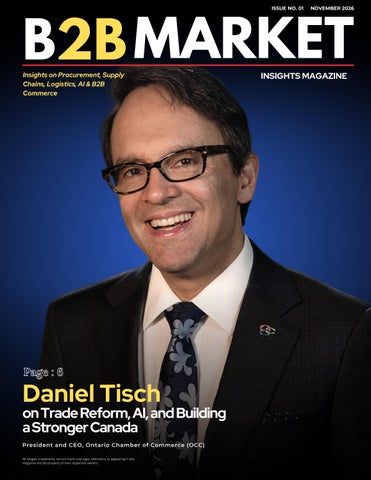
Daniel Tisch
on Trade Reform, AI, and Building a Stronger Canada President and CEO, Ontario Chamber of Commerce (OCC) All Images, trademarks, service marks and logos referred to or appearing in this magazine are the property of their respective owners.
INSIGHTS MAGAZINE
Building Stronger Connections for a Changing B2B World Welcome to the inaugural edition of B2B Market Insights Magazine. We launch with a clear purpose—to connect businesses with ideas, expertise, and perspectives that support better decisions and lasting growth. This first issue explores trade, procurement, and supply chain transformation. Daniel Tisch, President and CEO of the Ontario Chamber of Commerce, discusses trade reform, AI, and building a stronger Canada. Jeferson Guchtain, Procurement and Enterprise Transformation Leader, examines procurement’s role in organizational performance, while Alain Sawaya, Partner and National Leader of Supply Chain and Procurement at KPMG Canada, explores digital twins and AI-driven supply chains. We also feature insights from Ross Prusakowski, Deputy Chief Economist at Export Development Canada, on global diversification for Canadian exporters, alongside a spotlight on Canada’s supply chain community gathering in Québec City. Our articles examine strategic procurement, smarter logistics, and FinTech’s influence on B2B payments. Together, these topics reflect the opportunities businesses have to strengthen partnerships, improve operations, and reach new markets. As we begin this journey, thank you to our contributors, interviewees, and readers for being part of our first edition. We look forward to building a publication that informs, connects, and grows alongside the B2B community.
www.b2bmarket.ca raoof@canadiansme.ca / tac@canadiansme.ca canadiansme canadian_sme b2bmarketinsights canadiansme
Publisher Shaik Khaleeluddin(SK) Editorial Director Tehmina A Chaudhry Executive Director Hammad Siddiqui Admin Manager Raoof Uddin Shaik Sr. Content Manager Amanda Spearing Creative Design Cmarketing Inc Social Media Cmarketing Inc Events Shaik Raoof Uddin Photography Deposit Photos, Cmarketing Inc.
Web Cmarketing Inc
For Advertisements info@canadiansme.ca Cmarketing Inc 6345 Dixie Rd, Unit 202, Mississauga, ON L5T 2E6 Call us at +1 416 655 0205 /647 668 5785
Published by Cmarketing Inc 6345 Dixie Rd, Unit 202, Mississauga, ON, L5T 2E6 Copyright © 2026 CMarketing Inc. All rights reserved. Reproduction in whole or part of any text, photography or illustrations without written permission from the publisher is prohibited.
Tehmina A Chaudhry Editorial Director B2B Market Insights Magazine All Images, trademarks, service marks and logos referred to or appearing in this magazine are the property of their respective owners.
The contents in the B2B Market Insights Magazine are for informational purposes only. Neither Cmarketing Inc, the publishers nor any of its partners, employees or affiliates accept any liability whatsoever for any direct or consequential loss arising from any use of its contents.
IN THIS ISSUE B2B Market Insights Magazine
44 of Embedded Finance in B2B
Finance Without Friction: The Rise Commerce
46 Ecosystem and Its Impact on B2B Canada's Growing FinTech Payments
49 Platforms in Canada’s B2B Economy The Role of Digital Procurement
11 What High-Performing Organizations Do Differently and Why Procurement Is Now a Driver of Business Performance
Jeferson Guchtain
Procurement and Enterprise Transformation Leader
52
How AI Is Transforming Procurement and Supply Chains in Canada
55
Cross-Border Trade Between Canada and the U.S.: What Procurement Leaders Need to Know
58 Are Building More Resilient
How Canadian Manufacturers Supply Chains
68 CETA Opportunity Most Canadian The Buy Canadian Effect:The Businesses Are Missing
71
Canada’s Tariff Playbook: What Exporters Need to Know Right Now
IN THIS ISSUE B2B Market Insights Magazine
42
18 The Great Convergence: When Banking, Data, and Business Operate as One
Canada’s Supply Chain Community Converges on Québec City This May
14
Beyond Reactive Supply Chains: Blueprint for Digital Twins and AI-Driven Supply Chains
IN THIS ISSUE B2B Market Insights Magazine
26
The Future of Procurement: From Cost Centre to Strategic Powerhouse
70 22 Why Global Diversification Is the Smartest Move Canadian Exporters Can Make in 2026
37
28
30
Breaking Down Canada's Interprovincial Trade Barriers: What It Means for Businesses and Supply Chains
32
Smarter Supply Chains: How Technology Is Reshaping B2B Logistics
35
The North Star Strategy: Why Canadian Deep Tech is the Sovereign Hedge for Global B2B Leaders
Code, Cloud, and Intelligence: The Global Procurement Technology Landscape in 2026
The Intelligence Advantage: How AI Is Reshaping B2B Trade
61
Canada–EU Trade:The CETA Opportunity Most Canadian Businesses Are Missing
DANIEL TISCH on Trade Reform, AI, and Building a Stronger Canada Interview By SK Uddin Insights Magazine, Daniel Tisch, President and CEO of the Ontario Chamber of Commerce, shares how digital readiness, AI adoption, procurement access, and trade reform can help Ontario SMEs turn resilience into sustained growth. Ontario’s economy is built on small and medium-sized businesses. Yet many are navigating a trade environment that is more volatile, more protectionist, and more technologically demanding than at any point in recent memory. Rising input costs, tighter labour markets, and ongoing tariff uncertainty are colliding with a rapid shift toward digitized procurement, AI-enabled operations, and more selective global supply chains. Against this backdrop, Daniel Tisch, President and CEO of the Ontario Chamber of Commerce (OCC), sits down with SK Uddin to discuss what the data is telling us about SME confidence, competitiveness, and capacity, and what must change if Ontario businesses are to move from resilience to sustained growth.
Daniel Tisch Echevarría
President and CEO, Ontario Chamber of Commerce (OCC)
Image Courtesy: Ontario Chamber of Commerce (OCC)
In an exclusive interview with B2B Market
Economic Policy
Daniel Tisch is a business, public policy, and community leader, having held executive roles in government and the corporate sector, and senior governance roles at public institutions and nonprofit associations. He is known globally as an expert in corporate communications, public policy, community engagement, crisis and reputation management. From 2003 to 2023, Daniel was the CEO, principal shareholder and driving force in building Argyle Communications (now Changemakers) into Canada’s largest management-owned engagement, communication and reputation advisory firm growing to $40M in revenue, 175 employees and ten North American offices by 2023. Earlier in his career, Daniel held senior communications roles in the Canadian government, including serving as Senior Policy Advisor and Acting Chief of Staff to Canada’s Minister of Foreign Affairs. In the latter role, he was a member of the Canadian delegation to the G7 Economic Summit Daniel has spoken to business audiences on every continent, lectured at Queen’s University’s Smith School of Business since 1996, and contributed to leading public relations and marketing textbooks. He appears regularly in print and broadcast media, including weekly commentary on CBC Radio and Global News during the 2019 and 2021 Canadian federal elections. In 2021, Daniel was named one of the world’s “top 100” social media influencers on public relations. Born in Spain to a Latin American family and raised in Toronto, Daniel speaks English, French and Spanish. He holds two degrees from Queen’s University — a Bachelor of Arts in Political Studies and a Master of Business Administration. He is also a certified corporate director, with an ICD.D designation in corporate governance from the University of Toronto. Daniel has served as vice chair of the Queen’s University Board of Trustees, a leader in the international Scouting movement and a board member of Social Venture Partners International. In 2025, Daniel was awarded the King Charles III Coronation Medal for his contributions to his community, the province and the country. 7 - B2B Market - November 2026
Ontario's SMEs at a Crossroads. B2B Market Insights covers Canada's 1.2 million SMEs closely, and the data are striking: many are still managing procurement and supplier relationships through spreadsheets and email chains. From the OCC's perspective, what is the single biggest structural barrier preventing Ontario's SMEs from competing at the level the current trade environment demands? From the Ontario Chamber’s perspective, the biggest structural barrier preventing Ontario SMEs from competing is capacity. That capacity gap is showing up in the confidence data: confidence is lowest among small businesses, at 20 per cent. Ontario’s economy is built on small businesses. But too many of them are being asked to compete in a global, digital, and increasingly protectionist marketplace without the tools, time, or capital to keep pace. Cost pressures are the most visible constraint, whether it’s inputs, financing or labour. But underneath that is something more structural: too many SMEs lack the digital infrastructure, procurement-ready systems, and supply chain integration that modern commerce demands. In a trade environment shaped by tariffs and uncertainty, those gaps have consequences. When markets tighten, supply chains don’t expand; they become more selective. Without intervention, SMEs risk being locked out of the very opportunities that could help them scale and grow. That’s why the OCC advocates for practical, targeted solutions: support for digitization and AI adoption, improved access to capital, and streamlined procurement systems that are accessible for SMEs.
Policy alone isn’t enough. Programs that connect businesses to new markets while building their internal readiness are just as critical. In both policy and programs, we’re well-positioned to work with governments to close the gaps.
Image Courtesy: Ontario Chamber of Commerce (OCC)
Economic Policy
Buy Canadian and the Digital Readiness Gap: The Buy Canadian Policy is directing billions in federal contracts toward Canadian suppliers — but only those with digital profiles, verified Canadian content data, and structured procurement records will be positioned to capture it. Is the SME community moving fast enough, and what role is the OCC playing in closing that readiness gap? Buy Canadian and Buy Ontario policies are an historic opportunity for Ontario businesses – and one of the largest members cite as a reason for optimism. If we do this right, domestic suppliers stand to gain billions in procurement – with huge benefits for workers and communities. But our Ontario Economic Report makes something clear: not every business is equally positioned to benefit. As you note, too many SMEs lack the capacity to compete in modern procurement. With digital skills gaps, uncertainty about ROI and ongoing cost pressures, it’s hard for them to invest in this type of transformation.
We know they need it. In the OCC’s research, 52 per cent of Ontario businesses report moderate or extensive use of emerging technologies, while 44 per cent report little to no use. Among small businesses, active use drops even further to 49 per cent. So, the risk is real: the opportunity is there, but it’s being seized mainly by those already equipped to compete. At the OCC, we are focused on closing that gap through both advocacy and action. We’re advocating for simplified, consistent and aligned procurement systems, because we know that reducing complexity will expand participation. And we’re acting through programs such as the OCC’s Skills Bridge, which gives SMEs free access to training in AI, cybersecurity, data management, and other critical capabilities, helping them move quickly from intention to implementation. Our Talent Opportunities Program also empowers businesses to hire students, adding to their labour capacity and enabling them to take on additional projects. In short, if Ontario SMEs are going to seize this moment, they need more than access to contracts; they need the capacity to compete for them.
Economic Policy Interprovincial Trade Reform: Real or Rhetorical? The CMRA and the Free Trade and Labour Mobility Act are being called the most significant internal trade reforms in Canada's modern economic history. For a B2B operator in Ontario looking to expand their supplier base or enter new provincial markets, what has genuinely changed, and what remains unfinished business? I remember meeting the Premier in August 2024 – long before Trump’s tariffs threatened our economy – to make the case that Ontario should lead on interprovincial trade. That’s exactly what happened. Today, we finally have alignment between governments and the business community on the need to reduce barriers and build a more seamless Canadian market. This matters because Ontario is still highly exposed to external shocks. The vast majority of Ontario exports still go to U.S. markets. That makes internal trade and domestic diversification not just good policy, but smart risk management. For businesses, interprovincial trade isn’t an abstraction; it’s an opportunity. It’s about whether you can bid on a contract in another province without navigating duplicative rules, inconsistent standards, or entirely different regulatory systems. It’s about whether you can hire qualified professionals from other provinces without jumping through hoops. It’s about growing your talent base, your customer base and your business.
Image Courtesy: Ontario Chamber of Commerce (OCC)
When businesses set up shop in Ontario, they want to stay here and scale here. In our Ontario Economic Report, 49 per cent of out-of-province businesses said they plan to expand here, but only 33 per cent rate the investment environment as attractive. Fewer than one in three say government investment information is easy to find (29 per cent) or that they feel supported by local or provincial governments when considering expansion (30 per cent). For Ontario, the foundation is there. The upside is enormous. And the momentum is real. But the challenge is to turn that momentum into something businesses experience as simple, predictable, and usable.
AI Adoption: Where Ontario Business Actually Stands. Our research shows that while 94% of procurement executives now use generative AI weekly, fewer than four in ten have moved beyond pilots into operational deployment. Does that gap reflect what you're hearing from OCC members — and what does the OCC's AI Hub tell us about where Ontario businesses are actually getting stuck? What you’re seeing in your research is exactly what we’re seeing in the Ontario Economic Report. Just over half of businesses report moderate or extensive use of emerging technologies. But nearly as many say they have little to no adoption. That gap tells us something important. Businesses understand the potential of AI. But they are held back by cost, limited expertise, uncertainty around return on investment, and a lack of clear starting points. 9 - B2B Market - November 2026
Economic Policy And in today’s economy, that gap matters more than ever. Because AI adoption isn’t just about efficiency; it’s about competitiveness. The OCC is trying to close the gap. Through our AI Hub and Skills Bridge program, we’re helping businesses move from exploration to implementation -- building the capabilities they need to deploy these tools, both initially and then at scale. The tools exist. The opportunity is clear. The challenge now is ensuring every business has the capacity to use them. If we succeed, our businesses will be more productive, and our workers will be more valuable.
Supply Chain Resilience as a Board-Level Priority. You bring a rare combination of corporate communications expertise and public policy experience to the CEO role. Supply chain resilience has become a board-level conversation across Canadian industry. In your view, are Ontario businesses treating this as a genuine strategic transformation — or is it still largely a reactive, crisisdriven response? You’re right: Boards and leadership teams understand the importance of supply chain resilience and diversification. But business capabilities remain uneven – particularly among SMEs. The Ontario Economic Report shows the pressure they’re under. Sixtyfive per cent of businesses expect U.S. tariffs, trade policies, and economic uncertainty to negatively impact their operations. Here’s how they’re responding: 25 per cent say they’re raising their prices. 22 per cent are diversifying their suppliers. And 20 per cent are simply absorbing higher costs, which isn’t sustainable for very long.
We welcome the Ontario government’s cut to small business taxes in the 2026 Budget. That give businesses more breathing room. The next step is giving them more incentives and tools to invest in their own resilience and growth strategies.
Resilience doesn’t come from reacting faster. It comes from planning better. In public policy terms, that means investing in infrastructure that supports growth. Building stronger talent pipelines. Helping businesses diversify markets and supply chains. And ensuring businesses have the tools to anticipate disruption - not just absorb it.
That’s why the OCC’s advocacy focuses on strengthening Ontario’s economic foundations, and why our programs aim to help businesses build the capacity to compete in a more complex world. Ontario businesses have shown remarkable resilience. Now, we must equip SMEs with the tools to turn that resilience into sustained growth.
Image Courtesy: Ontario Chamber of Commerce (OCC) 10 - B2B Market - November 2026
Image Courtesy: Jeferson Guchtain
In an exclusive interview with B2B Market Insights Magazine, Jeferson Guchtain, Procurement and Enterprise Transformation Leader, shares a clear perspective on how procurement is evolving into a core driver of business performance in complex organizations. This conversation focuses on the shift from traditional cost control to strategic impact.
Interview By Tehmina A Chaudhry Jeferson Guchtain is an operator specializing in procurement, operations, and enterprise transformation across complex, capitalintensive and technology-driven environments. He has led large-scale initiatives spanning global supply chains, corporate services, digital transformation, and infrastructure programs, with responsibility for over $1B in managed spend.
Jeferson Guchtain
Procurement Co-Founderand andEnterprise CEO of Helius Originals Transformation Leader
What High-Performing Organizations Do Differently and Why Procurement Is Now a Driver of Business Performance His work focuses on connecting business
Jeferson has held leadership roles across
strategy, supplier ecosystems, and
financial services, telecommunications, real
operational execution to drive performance at
estate, and manufacturing, working in global and
scale. Rather than treating procurement as a
highly regulated environments. He is particularly
standalone function, he positions it as a lever
interested in how organizations can simplify
to improve decision-making, accelerate
complexity, leverage data and technology, and
execution, and enable sustainable growth.
build scalable operating models that deliver measurable business outcomes.
11 - B2B Market - November 2026
Enterprise Operations You have led large-scale procurement and transformation initiatives across complex organizations. What has shaped your approach to leadership in these environments, and what does high performance actually look like when operating at scale? High performance in procurement is often misunderstood as control. In reality, it is about clarity, decision speed, and alignment with business priorities. In complex organizations, the challenge is rarely capability; it is prioritization. Teams are surrounded by data, suppliers, and competing demands, but only a small number of decisions truly impact cost, speed, and risk. The ability to identify and align around those decisions is what defines performance at scale. My approach has been shaped by operating in environments where complexity exposes weak decision models. In those situations, adding more process does not improve outcomes; it slows them down. High-performing organizations focus instead on simplifying choices, reducing friction, and enabling faster, more confident decisions.
Image Courtesy: Canva
This requires a shift in how procurement is positioned. Rather than acting as a control function, it must operate as a connector, linking business priorities, supplier capabilities, and operational execution. At scale, performance is not about doing more. It is about being clear on what matters and executing with speed and consistency.
In large organizations, procurement must balance cost, speed, and operational performance across increasingly complex supplier ecosystems. How has the role of procurement evolved in recent years, and where does supplier relationship management sit within that broader transformation? Procurement has evolved from a cost-focused function into a driver of business performance. In the past, success was measured by savings and compliance. Today, it is defined by how effectively procurement enables the organization to operate, influencing speed, resilience, and execution across increasingly complex supplier networks. This evolution changes how suppliers are managed. Organizations can no longer treat their supplier base uniformly. High-performing teams distinguish between transactional suppliers and those that are critical to operational performance, investing time and focus where it matters most. Supplier relationship management plays a central role in this shift. It is no longer about monitoring performance metrics, but about creating alignment, ensuring that key suppliers understand priorities, can respond to change, and contribute to outcomes beyond cost. As complexity increases, the advantage comes from clarity. Organizations that structure their supplier ecosystem deliberately are better positioned to adapt, scale, and execute consistently.
AI and data are reshaping how organizations evaluate and manage their supplier base. From your experience, how do these capabilities change procurement decision-making, and what advantage does that create for suppliers who are able to operate in that environment? AI in procurement is often framed as a technology shift. In practice, it is a shift in decision-making. Most organizations are not constrained by a lack of data; they are constrained by the ability to interpret and act on it quickly. AI reduces that friction by bringing visibility to patterns, risks, and opportunities that would otherwise remain hidden.
12 - B2B Market - November 2026
Enterprise Operations This changes how procurement operates. Decisions that once relied on experience and manual analysis are now supported by structured insights, enabling faster and more consistent outcomes across supplier selection, demand planning, and performance management. For suppliers, the impact is significant. The evaluation process becomes more transparent and more rigorous. It is no longer enough to present capabilities; suppliers must demonstrate value in ways that align with how organizations analyze and prioritize decisions. Those who can clearly articulate their impact, supported by data and aligned with business outcomes, will stand out. In a data-driven environment, clarity and relevance become competitive advantages.
Canadian B2B suppliers, particularly mid-size organizations, often struggle to break into large enterprise procurement pipelines, not because of product quality but because of how they present themselves. From your experience, what are the most common gaps you see, and what makes a supplier immediately stand out? A supplier's success is defined not by features or capabilities, but by how effectively they position their value in relation to the business problem they aim to solve. One of the most common gaps is the disconnect between what suppliers offer and how organizations make decisions. Procurement teams are not evaluating products in isolation; they are assessing impact on cost, speed, risk, and operational performance. Suppliers that are not able to translate their offering into those outcomes struggle to gain traction. Another important factor is context. Suppliers that stand out take the time to understand the environment they are entering, the priorities, constraints, and decision criteria, and align their approach accordingly, rather than presenting a generic solution. Clarity is equally critical. In complex organizations, attention is limited. Suppliers who communicate simply, directly, and with relevance are far more effective than those who rely on volume or technical detail. What differentiates high-performing suppliers is their ability to connect their value to business outcomes in a way that is clear, relevant, and easy to act on. 13 - B2B Market - November 2026
As sustainability and ESG become increasingly central to business performance, how are supplier selection criteria evolving in large organizations? And what advice would you give Canadian B2B companies looking to align with enterprise expectations in 2025 and beyond? Sustainability is moving from a compliance requirement to a performance driver. Organizations are no longer evaluating suppliers solely on cost and capability. They are assessing long-term resilience, risk exposure, and the ability to operate in alignment with broader business objectives, including environmental and social impact. This changes how supplier selection criteria are defined. ESG is becoming embedded in how performance is measured, rather than treated as a separate consideration. Suppliers are expected to demonstrate not only what they do, but how they operate; and how that contributes to stability, transparency, and long-term value. For B2B companies, the opportunity is significant. Those that approach sustainability as part of their core value proposition, rather than an addon, will differentiate themselves in enterprise supply chains. The key is practicality. Organizations are not looking for perfect ESG models; they are looking for clear, measurable progress that aligns with business outcomes. In this environment, suppliers that can connect sustainability to performance will be better positioned to compete and grow.
Disclaimer: This interview is published by B2B Market Insights for informational and educational purposes only and should not be construed as financial, legal, or professional advice. The opinions and insights shared by the interviewee are solely their own and do not necessarily reflect the views of B2B Market Insights or its partners. Our mission is to provide practical, research-driven perspectives that help B2B leaders, marketers, and entrepreneurs make more informed decisions in their markets.
Blueprint for Digital Twins and AI-Driven Supply Chains Interview By SK Uddin In an exclusive interview with B2B Market Insights Magazine, Alain Sawaya, Partner and National Leader of Supply Chain and Procurement at KPMG Canada, shares a forward-looking perspective on how businesses can navigate uncertainty with greater precision and control. This conversation explores the shift from reactive operations to intelligent, scenario-driven supply chains powered by AI and digital twins.
Alain Sawaya
Partner and National Leader of Supply Chain and Procurement at KPMG Canada
14 - B2B Market - November 2026
Image Courtesy: Alain Sawaya
Beyond Reactive Supply Chains:
Digital Supply Chain Alain Sawaya is a Partner and National Leader for Supply Chain and Procurement at KPMG in Canada. He has more than 30 years of experience in commercial supply chain and operations leadership across retail, consumer products, life sciences, and industrial sectors, with international experience in both industry and consulting. Before joining KPMG, he held executive roles at a major home improvement retailer and a Global Consumer Packaged Goods Company.
The "Tariff Stress-Test" of 2026: In your recent analysis of the 25% tariff threats on Canadian goods, you noted that 83% of businesses admit they need more resiliency. Beyond mere diversification, how is KPMG helping clients use AI-enabled digital models to run "continuous inventory scenarios" that can predict the impact of a tariff shock before the policy is even signed? KPMG is helping clients shift from reactive planning to proactive scenario modeling. We helps build AIdriven “digital twins” to emulate the inventory movement in the supply chain – dynamic models that clients us to continuously simulate inventory and supply-demand changes and likelihoods of changing, coupled with mitigation options and derisking capabilities. When a tariff threat emerges (e.g. a potential 25% levy), these models can be used to run “what-if” scenarios to help predict and plan for potential impacts on costs, lead times, and stock levels prior to a policy being confirmed. For example, the model might show how a tariff on a key component would create a week of extra lead time and higher costs for holding or managing inventory – prompting pre-emptive mitigation plans, such as adjusting orders, find alternate suppliers, changing routes and lanes, etc. By running continuous inventory scenarios with predictive capabilities, clients can see the financial and operational implications of a tariff change in advance and take action. In short, KPMG equips companies with predictive scenario engines so they can anticipate and cushion the blow of tariff surprises rather than scrambling after the fact.
Moving from Pilots to "Agentic" Supply Chains: Many Canadian firms are stuck in "pilot purgatory" with disconnected AI tools. In your view, what is the single biggest hurdle preventing a mid-market manufacturer from moving to a fully autonomous, "Agentic" procurement workflow where AI handles supplier risk-scoring and contract triggers without human intervention? The biggest hurdle holistically is adoption that is often anchored in a lack of alignment between pilots and enterprise outcomes, data quality and availability, and organizational change management. Reliability of data on which AI relies remains a hurdle to achieving enterprise-level outcomes. Many AI journeys start with data governance and the daunting undertaking of data sanitization. Technological debt is widespread, particularly in Source-to-Contract (S2C), where AI initiatives must first bridge gaps in the inappropriate functions available in the application layer. In parallel, supplier risk-scoring has benefited in recent years from third-party risk management practices adopted from more regulated industries such as the financial sector. As these capabilities originated in Governance, Risk and Compliance (GRC) rather than Contract Lifecycle Management (CLM), the linkage between those two vantage points were not natively designed for such an integrated, let alone automated, cohesive use case. While low-code options can bridge those two “solitudes”, it requires an intentionally concerted effort between risk and procurement representatives, implying time-intensive change management efforts. Lastly, additional steps implying professional human judgment are required from the stage of supplier risk-scoring to inform commercial terms on the ensuing contract, which are not straightforward to capture in AI logic.
Image Courtesy: Canva
15 - B2B Market - November 2026
Digital Supply Chain
Time-to-value can sometimes be faster than expected if the digital twin project is well-scoped. We typically see an initial “quick win” within 6-9 months — for example, optimizing truck routes or inventory placements that yield immediate cost savings. A full-scale digital twin, that covers an entire supply network, might take a year or more to implement, but it doesn’t need to be a multi-year wait for results. By starting with a specific pain point, such as warehousing or transport and layering on data step by step, a B2B firm can begin slowly reaping benefits in about 6 months and ROI within approximately one year. In the volatile trade market and the state of economics, it’s hard to get a handle on where things will go, but tools for predicting and planning mitigations is key: demand swings, high interest rates, companies that can virtually test decisions (for example in a twin) before making real-world decisions have a competitive edge. In practice, that makes digital twins a very strong option to mitigate risks if one wants to help remain agile and stay cost-effective under pressure.
Solving the "Data Quality" Paradox: You’ve cautioned businesses not to wait for perfect data before acting. However, AI is only as good as its inputs. How does KPMG advise a legacy manufacturer to "clean the plane while flying it"—improving SKU-level data visibility while simultaneously deploying predictive analytics? KPMG advises a “parallel track” approach but start early: improve data quality as you deploy new analytics. In practice, this means you don’t wait for perfect SKU-level data to start a “predictive” project. Begin by rolling out a focused predictive analytics tool (for instance, a demand forecast or maintenance predictor) using the data you have – even if it’s not ideal, but understand the caveats and areas to avoid. This yields two benefits: you get early insights, albeit not perfect, and you quickly discover where the data is weakest. In parallel, focus efforts on cleansing (automatically to some degree) and enrich data - continuously.
Image Courtesy: Canva
The ROI of the "Digital Twin": You’ve advocated for the "digital representation" of the supply chain to optimize transportation networks. For a B2B leader concerned about high interest rates and capital constraints, what is the realistic "Time to Value" for a Digital Twin project? Is this now a mandatory requirement for survival in the 2026 trade environment?
Digital Supply Chain For a legacy manufacturer, this might involve standardizing how SKUs, inventory, and sales data are recorded, and using automated tools to flag anomalies or gaps. Essentially, you’re “cleaning the plane while flying it” to some degree – using AI to drive value now (like reducing stockouts or predicting part failures) while simultaneously fixing data issues in the background. This iterative loop ensures data visibility keeps getting better, which in turn makes the predictive analytics more accurate over time.
The "Friend-Shoring" Math: As businesses move production out of China and toward North American "Friend-Shoring," costs are inevitably rising. How can AI-driven Demand Management help firms absorb these higher COGS (Cost of Goods Sold) by reducing waste and optimizing "click-and-collect" logistics for a more customer-centric model? AI-driven demand management helps buffer higher costs by eliminating inefficiency. If moving production closer to home raises unit costs, some offsets include reducing waste, increase efficiency, and sell smarter. Machine Learning (and AI) models can help forecast demand with greater accuracy at each location, so companies can produce and stock exactly what’s needed – reducing overproduction, spoilage, or markdowns on excess goods, not to mention ensuing impacts on working capital and cash flow. Less inventory waste directly helps absorb to some degree higher Cost of Goods Sold. AI can also optimize “click-and-collect” logistics by analyzing customer and consumer purchase patterns with local inventory in near real time or real-time. For instance, dynamically allocated stocks where orders might be suddenly surging, or adjusting pickup schedules to smooth out peak-hour congestion, could be illustrations of this. By fine-tuning this “last-mile” fulfillment, companies can cut down on costly shipping and improve customer experience (hence helping sales).
17 - B2B Market - November 2026
The "Human-in-the-Loop" for 2026: With your background in mathematics and statistics, you understand the power of the model, but you also emphasize "building genuine relationships." In an era where AI agents are increasingly talking to other AI agents in the B2B ecosystem, what is the one "uniquely human" skill that a 2026 Supply Chain Leader must double down on to remain effective? In an era of hyper-automation, two human skills are worth doubling down on: relationship building grounded in empathy, and the ability to develop AI, data, and analytics literate skillsets. Both are strategic capabilities and far harder to “replace” with AI agents in the short to medium term. This is especially true in supply chain leadership, where the “human touch” remains critical. This means excelling at understanding stakeholder concerns, managing risks, reading between the lines, and building trust across the network – with suppliers, partners, and internal teams. For example, when a disruption hits, an AI can lead to rerouted deliveries, but only a human leader can pick up the phone, empathize with a key supplier’s constraints, and jointly develop creative solutions or concessions that preserve the partnership. Likewise, internally, rallying a team around change or bridging silos requires emotional intelligence and cognitive abilities. In today’s age, what truly differentiates leaders and organizations is the ability to foster genuine relationships, inspire confidence and trust amid uncertainty, and apply human judgment to complex situations. That human element amplifies the value of AI driven tools—ensuring they are context aware, well adopted, and aligned with enterprise goals.
Disclaimer: This interview is published by B2B Market Insights for informational and educational purposes only and should not be construed as financial, legal, or professional advice. The opinions and insights shared by the interviewee are solely their own and do not necessarily reflect the views of B2B Market Insights or its partners. Our mission is to provide practical, research-driven perspectives that help B2B leaders, marketers, and entrepreneurs make more informed decisions in their markets.
The Great Convergence:
When Banking, Data, and Business Operate as One In an exclusive interview with B2B Market Insights Magazine, Abhishek Sinha, Partner at EY Canada and National Technology Strategy Leader for Financial Services, breaks down how the convergence of real-time data, financial systems, and enterprise platforms is reshaping the future of B2B commerce. This conversation explores a shift that goes far beyond digital transformation.
Interview By Tehmina A Chaudhry
Image Courtesy: Abhishek Sinha
Abhishek leads the EY Technology Strategy practices for Financial Services, including strategy development, portfolio management, agile transformation programs, digital transformation and innovation management. He works with organizations as they undertake their transformation journeys from DevOps and agile adoption to re-architecting their operations and technology to embracing a culture of innovation and new business models. In addition, he leads the national EY blockchain practices across the consumer, supply chain, health care, financial services, energy and public sectors as well as the development of EY public financial management platform globally.
Abhishek Sinha, Partner
at EY Canada and National Technology Strategy Leader for Financial Services
Financial Systems You’ve frequently written about the "Great Convergence" between real-time data and financial rails. As we move through 2026, why is it no longer enough for a bank to simply offer an API? How does EY define the shift from "Digital Banking" to a truly "Integrated B2B Ledger" where the bank essentially disappears into the client's ERP? By 2026, simply offering an API is no longer a strategy, it’s table stakes. The deeper issue is that the industry has treated integration as a one‑way street, assuming progress meant pushing banking services into the client’s ERP. The Great Convergence is more fundamental than that, it’s about dissolving the boundary between operational truth and financial truth altogether. One dimension is well understood: payments, liquidity, and credit becoming embedded, real‑time functions inside ERP and treasury workflows. But the inverse pattern is just as critical. Banks are now pulling enterprise context into their own platforms, synchronizing vendors and billers, validating inventory and assets to understand collateral quality and underwriting risk based on live operational data rather than lagging financial statements.
Many of the most profitable SME moments are latent: the liquidity gap that emerges before payroll stress, the credit need that coincides with an unexpected inventory opportunity, the risk that only becomes visible when operational data is viewed in real time. Neobanks actively surface these moments by anticipating intent, not just responding to requests. That requires a willingness to take measured, informed risk and to act decisively at the moment of need. This is where incumbents struggle. Large institutions often default to abstract product definitions, rigid channels, and delayed engagement. Neobanks operate under a different imperative. Their smaller size creates urgency and that urgency shows up as continuous underwriting, dynamic limits, and services delivered directly in the flow of the customer’s business, not through a portal, a form, or a queue.
Image Courtesy: Canva
At EY, we describe this shift as the emergence of an integrated B2B ledger. Think of it less as the bank “disappearing” and more as a shared nervous system: sometimes the ERP initiates the signal, sometimes the bank does but both are continuously aware of the same underlying state. Digital banking was about access and the integrated ledger is about alignment. The banks that lead will be the ones that stop optimizing channels and start fusing balance sheets with business reality.
You’ve led several successful neobank launches that challenged traditional models. What is the #1 feature of the neobank "playbook" that Canada’s incumbent banks must adopt in 2026 to prevent losing their most profitable SME customers to more agile, tech-native competitors? The most important lesson from the neobank playbook isn’t a feature, it’s how neobanks think about unmet and unspoken demand. Neobanks don’t wait for SMEs to articulate their needs, they design for the needs customers haven’t learned to ask for yet.
In 2026, incumbents that retain their most valuable SME customers will adopt this anticipatory, context‑driven model: revealing what the customer needs next and delivering it exactly where and when it matters.
19 - B2B Market - November 2026
Financial Systems You’ve argued that the real value of the Real-Time Rail (RTR) isn't just speed, but its rich data transfer capabilities. For a CFO currently managing hundreds of mismatched invoices and wire confirmations, how will the ISO 20022 standard finally enable "SelfReconciling" supply chains? The real value of real-time rails isn’t speed, it’s structured meaning. For decades, payments moved while the context lived somewhere else, leaving CFOs to reconcile invoices, POs, shipping events, and confirmations across systems that don’t share a common grammar. ISO 20022 changes that by letting payments and remittance data travel on the same rail, with structured fields for things like commercial invoices, purchase orders, and receivables open items so matching becomes the default, not an exception process. Where this goes next is the combination of ISO rails with programmable money. Once the payment message carries standardized business context, settlement can be conditioned on code-verifiable events: goods received, tolerances met, invoice approved, dispute window expired. That’s the beginning of “selfreconciling” supply chains because the reconciliation logic is embedded into the transaction lifecycle, not bolted on after the fact.
Over time, this shifts the trust premium. Instead of relying primarily on institutions to intermediate and validate, more trust is expressed in rules, schemas, and automated controls—auditable, repeatable, and near real time. That direction is increasingly inevitable as richer, faster payments converge with digital currency and tokenized settlement concepts.
20 - B2B Market - November 2026
As EY’s National Blockchain Leader, you’ve seen the technology move from hype to utility. In the context of North American B2B commerce, is blockchain finally providing the "single source of truth" for multi-tier supply chain visibility, or has the "Great Convergence" found a more efficient path through Open Banking APIs? The mistake is treating this as a choice between blockchain and Open Banking APIs. In reality, what’s emerging is a layered architecture, where different technologies solve for different trust and coordination problems. At the foundation, real‑time payment rails and standards like ISO 20022 synchronize financial state with operational events. They do most of the heavy lifting in B2B commerce today, collapsing latency, improving visibility, and aligning cash, invoices, and delivery milestones in near real time. Open Banking APIs sit above that layer, moving context and permissions across systems so banks and enterprises operate off the same data plane. Blockchain becomes relevant further up the stack, where multi‑party coordination and shared state matter more than speed alone. In complex, multi‑tier supply chains, where no single party owns the system of record, distributed ledgers can act as a shared reference point for provenance, asset state, or contractual conditions. The Great Convergence isn’t picking winners, it’s about orchestration. “Single source of truth” is no longer a single system, but a synchronized stack, where rails handle settlement, APIs handle context, and blockchain is applied selectively where decentralized trust adds real value. That layered view leads directly to the next question around embedded finance. Once financial services become modular—delivered through rails, APIs, and selectively through shared infrastructure—the question is no longer who owns the customer, but who owns which layer of value. As non‑financial B2B platforms begin embedding payments, credit, and treasury functions directly into their workflows, we’re seeing the same architectural logic play out commercially: interfaces, balance sheets, and risk are being deliberately unbundled and recomposed. That sets up a much more nuanced conversation than “banks versus platforms.”
Financial Systems We are seeing non-financial B2B platforms (logistics, SaaS, procurement) starting to offer their own credit and payment solutions. Does this "Embedded Finance" trend represent an existential threat to traditional commercial banking, or is there a partnership model where the "Big Five" provide the balance sheet while neobanks provide the interface? Embedded finance isn’t an existential threat to commercial banking but it is an existential test of clarity. What’s being challenged isn’t the balance sheet, it’s the assumption that distribution and interface naturally belong to the bank. Non‑financial B2B platforms sit directly in the flow of work— procurement, logistics, SaaS, marketplaces. When they embed payments or credit, they’re not trying to become banks, they’re solving a timing and context problem. They see intent before the bank does. That gives them a natural advantage at the interface layer. This is where a partnership model becomes not just viable, but logical. The “Big Five” are still uniquely positioned to provide regulated balance sheets, liquidity, and risk management at scale. Neobanks and platforms, meanwhile, position themselves to be better optimized to deliver financial services at the point of need, inside operational workflows. The risk for incumbents isn’t disintermediation, it’s relegation. If banks insist on owning every layer, they’ll lose relevance. If they focus on being the best provider of capital, trust, and resilience while allowing others to own experience, they remain central to the system. Embedded finance doesn’t remove banks from the value chain, it reshapes where, and how, that value is created.
You describe our current era as NAVI (Non-linear, Accelerated, Volatile, Interconnected). In a world where a supply chain shock can happen in seconds, how does an integrated, realtime banking ledger improve a company's "Geostrategy"? Can real-time liquidity data actually help a firm pivot their sourcing strategy faster than a competitor stuck on 30-day reporting cycles? In a NAVI world—non‑linear, accelerated, volatile, interconnected— strategy is increasingly constrained by latency. The issue isn’t whether a firm understands its exposure, it’s when it understands it. Thirty‑day reporting cycles assume a world that no longer exists. An integrated, real‑time banking ledger fundamentally changes geostrategy by collapsing the gap between operational disruption and financial response. When liquidity, payables, receivables, and counterparty exposure are continuously visible, firms can model scenarios as events unfold not weeks later. A supply shock isn’t just identified faster, its cash impact is quantified immediately. That matters because sourcing decisions, supplier diversification, and inventory pivots are ultimately financial decisions. Real‑time liquidity data allows a CFO to answer questions like: Can we shift volume to a higher‑cost supplier today? Can we pre‑fund inventory to secure capacity? Can we withstand a regional disruption without freezing operations? In this context, real‑time banking becomes a strategic sensor, not just a utility. Firms operating with integrated ledgers don’t just react faster, they decide faster. And in a NAVI environment, decision velocity is often the only durable advantage over a competitor still navigating last month’s numbers.
Image Courtesy: Canva
Disclaimer: This interview is published by B2B Market Insights for informational and educational purposes only and should not be construed as financial, legal, or professional advice. The opinions and insights shared by the interviewee are solely their own and do not necessarily reflect the views of B2B Market Insights or its partners. Our mission is to provide practical, research-driven perspectives that help B2B leaders, marketers, and entrepreneurs make more informed decisions in their markets. 21 - B2B Market - November 2026
Why Global Diversification Is the Smartest Move Canadian Exporters Can Make in 2026 Insights from Ross Prusakowski, Deputy Chief Economist, Export Development Canada
By SK Uddin
A Cautious But Resilient Recovery
In a world where trade policy can
EDC's Trade Confidence Index — a long-running barometer of Canadian exporter sentiment — showed a modest upward tick in its latest reading, a welcome sign after one of the four lowest confidence scores recorded in the survey's 25year history. But Prusakowski is measured in his optimism.
shift overnight, Canadian exporters who rely on a single market are playing a dangerous game. That is the clear message from Ross Prusakowski, Deputy Chief Economist and Director at Export Development Canada (EDC), whose team tracks global risk and opportunity for Canadian businesses every day. In a recent conversation on the B2B Market Podcast, Prusakowski broke down the latest Trade Confidence Index findings, explained why U.S.market dependency has become a liability, and laid out a compelling case for Europe and the Asia Pacific as the growth frontiers that Canadian SMEs can no longer afford to ignore.
The improvement reflects resilience rather than exuberance. Exporters are adjusting, adapting, and finding their footing — but no one is declaring victory. Global volatility, complex trade environments, and shifting geopolitical dynamics continue to weigh on business decisions.
"Confidence edged upward from historic lows — but the environment remains complex, and exporters know it."
Export Growth Image Courtesy: Export Development Canada
What the index does reveal is that Canadian businesses
are not paralyzed. They are recalibrating, and a growing number are taking a hard look at markets they once considered out of reach.
In Europe, the appeal lies in scale and stability. The
The U.S. Market: No Longer the Default For decades, the United States was the path of least resistance for Canadian exporters — shared language, geographic proximity, and integrated supply chains. But 2025 and 2026 have changed that calculus significantly. U.S. tariff escalations, the elimination of the $800 de minimis exemption for smaller shipments, and broader policy unpredictability have raised the cost and complexity of doing business south of the border. At the same time, U.S. economic growth is showing signs of cooling relative to faster-moving regions like the Asia Pacific.
EU is the world's secondlargest economic bloc, and existing sector synergies — Canadian energy firms with Norway, agricultural exporters with EU member states — create natural entry points. Historical and cultural ties further smooth the path.
The result? Exporters who once saw the U.S. as the only viable market are now viewing previously daunting international options as genuinely attractive alternatives. That mindset shift, Prusakowski says, is one of the most significant developments in Canadian trade in years. 23 - B2B Market - November 2026
Export Growth
Europe and Asia Pacific: Where the Growth Is Two regions stand out as the most compelling expansion opportunities for Canadian exporters: Europe and the Asia Pacific. The reasons are strategic and structural. Canada's free trade agreements — CETA with the European Union and CPTPP covering the Asia Pacific — are powerful but underutilized tools. These agreements reduce tariffs, cut non-tariff barriers, and simplify market entry, giving Canadian firms a genuine competitive edge. Canada now has free trade access to 51 countries. The businesses that leverage these agreements are competing on advantageous terms. Those that do not are
Asia Pacific presents a different kind of opportunity: velocity. The region's rapidly expanding middle class and accelerating infrastructure investment are creating demand at a pace that mature Western markets simply cannot match. It requires agility and cultural fluency, but the upside is substantial.
"Canada has free trade access to 51 countries. If you aren't leveraging those agreements, you are leaving money on the table."
handing wins to their global rivals by default.
Image Courtesy: Export Development Canada
Export Growth
Productivity: The Engine Behind Global Competitiveness Expanding into new markets is not just a question of will — it is a question of capacity. Prusakowski emphasizes that trade-enabling productivity is the foundation of successful diversification. Technologies like AI and automation are helping Canadian companies reduce costs, manage currency volatility, and adapt their offerings to local market preferences. Even incremental technology adoption, Prusakowski notes, can
unlock growth without requiring massive capital outlay. Digital tools are enabling SMEs to conduct market research, reach customers globally, and scale operations in ways that were simply not available a decade ago.
The companies building this internal efficiency are the ones positioned to absorb the complexity of multi-market
The Bottom Line The message from Export Development
Canada is unambiguous: 2026 is not a year for waiting and watching. The trade landscape has fundamentally shifted, and the businesses that will thrive are the ones actively diversifying their customer base, investing in productivity, and leveraging Canada's considerable trade infrastructure. For Canadian SMEs, the global market is not a distant aspiration — it is an accessible opportunity. The agreements, the programs, and the expertise exist. The only variable is whether businesses choose to use them.
Image Courtesy: Export Development Canada
operations — the logistics, the regulatory variation, the cultural nuance — without breaking.
EDC's $5 Billion Support Program For businesses facing the immediate pressures of tariffs and market disruption, EDC has deployed concrete support. The Trade Impact Program — a $5 billion initiative spanning two years — is designed to help eligible exporters navigate economic challenges, invest in new markets, and build productivity capacity.
But the financial solutions are only part of what EDC offers. With 26 global offices and deep partnerships with Canada's Trade Commissioner Service, EDC provides onthe-ground market intelligence to help businesses navigate local regulations, cultural differences, and business norms in target markets. Free resources like EDC’s Country Risk Quarterly and Global Export Forecast provide SMEs with the economic context they need to make informed decisions. Prusakowski's advice to businesses: engage early, use the data, and do not underestimate the value of relationshipbuilding. The global market is less daunting when you are not navigating it alone.
25 - B2B Market - November 2026
This article is based on an interview recorded for the CanadianSME B2B Market Podcast. Visit canadiansme.ca for the full episode.
The Future of Procurement: From Cost Centre to Strategic Powerhouse By Tehmina A Chaudhry Procurement has long been viewed as a backoffice function — a department tasked with
squeezing margins and processing purchase orders. That perception is now rapidly dissolving.
Across industries, organisations are repositioning procurement as a strategic engine of growth, resilience, and value creation. The forces driving this transformation are numerous: technological acceleration, geopolitical volatility, ESG mandates, and a renewed emphasis on supplier partnerships.
Image Courtesy: Canva
From Tactical to Strategic For decades, procurement's primary mandate was cost control. Today, Chief Procurement Officers (CPOs) are expected to navigate complex regulatory landscapes, manage volatile markets, and drive innovation — all
while maintaining cost discipline. A McKinsey & Company study of more than 50 CPOs across various industries found that procurement must evolve beyond commercial negotiations to proactively advise business units on market trends, risk, and demand management. By 2030, McKinsey expects procurement to fully transform from a support function into a strategic enabler of business growth and resilience. This shift is already underway. A 2025 report from Planergy found that automation has reduced manual procurement workloads by
40%, freeing professionals to focus on highervalue activities. Meanwhile, supplier portals have enhanced trust and collaboration, with 35% improvements in supplier relationship
quality reported across sectors. Perhaps most tellingly, 74% of CPOs now plan to integrate AI into their operations by the end of 2025,
according to research by Ivalua — a figure that underscores just how central technology has become to procurement's future.
Smart Logistics
" By 2030, procurement will transform from a
Supplier diversity is gaining prominence
support function into a strategic enabler of
too. Procurement teams are actively
business growth, innovation, and resilience. "
engaging with minority-owned businesses and underrepresented suppliers, recognising that diverse supply chains drive
Technology as the Backbone of Modern Procurement The global procurement software market is projected to surge to $9.5 billion by 2028, driven by investments in AI, automation, and analytics. Cloud-based procurement solutions now provide real-time visibility into spend, contracts, and supplier activity —
capabilities that were not feasible just a few years ago. Teams benefit from predictive analytics that can anticipate cost shifts or market disruptions and flag anomalies before they escalate into crises.
Blockchain technology is also gaining traction, offering an immutable record of transactions that enhances transparency and reduces fraud risk across supply chains. Some organisations are already leveraging smart contracts and automated payments to
streamline procurement processes, reduce cycle times, and improve compliance. These technologies are not experimental — they are becoming operational standards.
Sustainability and the ESG Imperative Sustainability is no longer a peripheral concern. Environmental, Social, and Governance (ESG) considerations are now central to strategic sourcing decisions. Tracking Scope 3 emissions — indirect emissions generated across the value chain — has become a pressing challenge, with regulatory frameworks like the EU's Carbon Border Adjustment Mechanism (CBAM) demanding greater accountability. Organisations that integrate sustainability into procurement strategies don't just achieve compliance; McKinsey research suggests they can unlock profit boosts of up to 60%.
innovation, resilience, and social equity. The most forward-thinking organisations view supplier diversity not as an obligation, but as a competitive differentiator.
The Skills Imperative Perhaps the most underappreciated challenge in procurement's evolution is human capital. Despite rapid digital transformation, McKinsey estimates that only 10% of procurement teams
are effectively utilising digital tools, exposing a critical skills gap. Organisations must invest in upskilling programmes that build analytical
capability, digital fluency, and strategic thinking across entire procurement teams — not just at the leadership level.
The procurement professionals of tomorrow will be data analysts, risk strategists, and sustainability champions rolled into one. Those organisations that invest in this transformation today will not just survive the volatility ahead — they will define it.
[1] McKinsey & Company – 7 Transformative Trends Shaping the Future of Procurement [2] Ivalua – Procurement Trends 2025: 3 Key Insights & Predictions [3] Planergy – Procurement Trends 2025: Automation, Analytics & Strategy [4] Focal Point – The Future of Procurement: Trends and Predictions for 2025 [5] Consultancy.eu – Six Procurement Trends to Consider in 2025 [6] Sievo – 6 Procurement Priorities for 2025
27 - B2B Market - November 2026
Image Courtesy: Canva
Code, Cloud, and Intelligence: The Global Procurement Technology Landscape in 2026 By SK Uddin Procurement technology has reached
an inflection point. What began as a wave of digitisation — replacing paper purchase orders with e-procurement portals — has evolved into something far more transformative. In 2026, the global procurement software market is valued at $9.88 billion and is on course to more than double, reaching $20.93 billion by 2034 at a compound annual growth rate of 9.42%, according to industry analysts. But raw market size only tells part of the story. The more significant shift is qualitative: procurement platforms are no longer tools for processing transactions. They are becoming intelligent systems capable of making decisions, executing strategies, and orchestrating entire supply ecosystems with minimal human intervention.
The Agentic AI Revolution The defining technology story in procurement for 2026 is the ascent of agentic AI — autonomous systems that can perceive data, reason about outcomes, and act independently within defined parameters. Unlike earlier automation that followed rigid, pre-programmed rules, agentic AI can interpret demand signals, evaluate suppliers, execute sourcing events, and renegotiate contracts — all without manual prompting. The 2025 ProcureCon CPO Report found that 90% of procurement leaders are already considering or actively deploying AI agents, with nearly 40% prioritising enterprise value creation beyond cost savings alone. McKinsey research shows that organisations deploying linked AI agent systems have increased procurement staff efficiency by 20 to 30%, while boosting value capture by 1 to 3%. In one documented case, a chemicals company piloted autonomous sourcing agents that prepare tenders, identify and prequalify suppliers, and analyse competing bids — compressing multi-week sourcing cycles into hours.
Supply Tech
" 90% of procurement leaders are already considering or actively deploying AI agents — the question is no longer whether to adopt, but how fast to scale. " From Generative to Autonomous: The Technology Stack Maturing Generative AI has already achieved mainstream penetration. Research from AI at Wharton found that 94% of procurement executives now use generative AI tools at least weekly — a 44 percentage point jump from just two years ago. Yet only 4% have achieved
large-scale deployment, revealing the enormous runway still ahead. The platforms leading this charge in 2026 — SAP Ariba, Coupa, Ivalua, GEP, and a new generation of AI-native challengers — are embedding intelligence across the full source-to-pay lifecycle.
Autonomous sourcing suites can now move from requisition to award in under 23 minutes, compared to multi-week cycles as recently as 2023, according to Mordor Intelligence. Cloud deployment now accounts for 74% of the market, enabling real-time data synchronisation, seamless updates, and global
accessibility that on-premise systems simply cannot match.
Geopolitical Pressure as a Catalyst Technology adoption is being accelerated by an increasingly hostile operating environment. Tariff volatility, export controls, nearshoring mandates, and an estimated 2,500 pieces of ESG legislation globally are forcing procurement teams to process more complexity, faster, than any human workforce can manage unaided. Gartner predicts that 70% of technology sourcing and procurement leaders will have sustainability-aligned performance objectives by the end of 2026. Platforms are responding with embedded compliance engines, real-time supplier risk monitoring, and carbon tracking integrated directly into sourcing workflows. According to BCG's Inverto procurement research, CPOs are rapidly becoming enterprise leaders — shaping resilience, AI adoption, and supplier ecosystems that extend well beyond traditional purchasing responsibilities.
The Talent and Governance Imperative Technology without capability is infrastructure
without purpose. Despite the sophistication of today's platforms, Deloitte's CPO Survey found that 'Digital Leader' procurement teams achieve
3.2 times higher ROI on AI investments than their peers — a gap driven not by the tools they use, but by how well their organisations have built the human and governance architecture around them. New specialised roles are emerging:
procurement data translators, AI product owners for source-to-pay workflows, and agent
architects who design and supervise autonomous systems at scale. For organisations still operating with fragmented legacy systems and siloed data, McKinsey estimates that procurement functions today use less than 20% of available data in their decision-making — leaving enormous value on the table. Closing that gap is the central challenge, and the central opportunity, of the procurement technology landscape in 2026.
[1] McKinsey – Redefining Procurement Performance in the Era of Agentic AI [2] Procurement Magazine – Top 10 Predictions for 2026 [3] Focal Point – The Future of Procurement: Trends and Predictions for 2026 [4] Inverto / BCG – Procurement Trends 2026 [5] Mordor Intelligence – Procurement Software Market Size, Share & Forecast [6] Art of Procurement – State of AI in Procurement 2026
[7] Infosys BPM – Agentic AI in Procurement: A 2026 Playbook [8] Procurement Tactics – 12 Procurement Trends Reshaping 2026
29 - B2B Market - November 2026
The promise of artificial intelligence in business-to-business commerce has, for years, remained largely aspirational. In 2025, that promise has become measurable reality. Across procurement, sales, logistics, and customer engagement, AI is no longer an optional enhancement — it is fast becoming the operating infrastructure of competitive B2B organisations. The numbers are unambiguous: 78% of all B2B companies now implement AI across at least one business function, with 67% of B2B e-commerce players actively using AI and machine learning to drive growth acceleration.
AI's Sweeping Adoption Across B2B The pace of AI adoption in B2B environments has accelerated dramatically. McKinsey's 2025 research shows 88% of organisations now use AI in at least one business function, and those attributing more than 5% of EBIT to AI Image Courtesy: Canva
have typically redesigned entire workflows around real-time data synchronisation. According to Dentsu's Superpower Index — the largest study of B2B buying behaviour globally, spanning 16,000 interviews across 21 markets — 77% of all B2B buying processes used AI in 2025, a proportion that has expanded in under two years. Forrester corroborates this: 89% of B2B buyers have adopted generative AI as one of their top sources of self-guided information throughout the buying process.
The Intelligence Advantage: How AI Is Reshaping B2B Trade By SK Uddin
" 77% of all B2B buying processes involved AI in 2025 — convenience, speed, and intelligence have become non-negotiable buyer expectations. "
Agentic AI: The New Frontier The most transformative development of 2025 is the rise of agentic AI — autonomous systems capable of executing complex, multi-step processes without continuous human oversight. Unlike traditional automation that follows predefined workflows, agentic AI can make independent decisions within set parameters. Forrester predicts that buyers' procurement teams will deploy agents capable of scaling negotiations across hundreds of suppliers simultaneously, turning static pricing pages into dynamic negotiation interfaces. Gartner, meanwhile, projects that by 2029 agentic AI will autonomously resolve 80% of common customer service issues without human intervention. 30 - B2B Market - November 2026
AI Economy For B2B sellers, this shift carries profound implications. An estimated 80% of B2B sales interactions already occur digitally, according to Gartner. As procurement professionals increasingly use large language model platforms — such as ChatGPT, Gemini, and Perplexity — for product discovery and supplier identification,
B2B organisations that maintain accurate, real-time data across pricing, promotions, inventory, and delivery will gain decisive competitive advantage over those that don't.
AI in Sales, Marketing, and Buyer Engagement AI is reshaping the entire buyer journey. Sales professionals now save an average of two hours and fifteen minutes per day by leveraging AI tools for administrative tasks, note-taking, CRM updates, and email drafting. With 78% of respondents in a SoPro study confirming that AI enables them to focus on higher-value, revenue-generating work, the productivity gains are not abstract — they translate directly into pipeline capacity and revenue per head. On the marketing side, generative AI is mainstream. Some 71% of enterprises deploy generative AI tools across at least one function, with 42% applying it specifically to marketing and sales. AI agents are now building and routing campaigns, sequencing outreach actions, reinforcing quality assurance, and adjusting performance levers in real time — all without waiting for manual intervention. Daily AI tool usage among desk workers rose 233% in just six months according to a Slack Workforce Index study, with daily AI users reporting 64% higher productivity and 81% greater job satisfaction.
Challenges and the Road Ahead Despite the momentum, the gap between AI awareness and AI readiness remains concerning. A study found that while 64% of B2B leaders recognise AI will have a 'very significant' impact on digital sales, only 20% feel adequately prepared for what is coming. Data
quality, legacy system integration, and the need for robust governance frameworks remain persistent barriers. Companies must approach AI implementation with clear metrics, phased rollouts, and cross-functional collaboration to separate genuine value creation from expensive experimentation. Those that succeed will find themselves operating with a structural advantage that compounds over time. In the AI-powered B2B economy, the gap between leaders and laggards is set to grow — not narrow — in the years ahead.
Image Courtesy: Canva
[1] SerpSculpt – How Many B2B Companies Are Using AI to Drive Growth (2025) [2] Commercetools – B2B Digital Commerce 2026: 4 AI Trends Shaping the Future [3] SoPro – 75 Statistics About AI in B2B Sales and Marketing [4] Mirakl – Top 5 AI Trends in B2B Reshaping Commerce in 2026 [5] Demand Gen Report – AI Agents Revolutionized B2B Marketing in 2025 [6] Hyperbound – 2025 B2B Sales Performance Benchmark Report [7] Dentsu B2B / Marketing Week – Superpowers 2025
Image Courtesy: Canva
AI-Driven Demand Forecasting and Inventory Optimisation At the core of modern logistics intelligence is demand forecasting. Traditional models relied on historical sales data — a static, backward-looking approach ill-suited to today's volatile, fast-moving markets. AI has changed the calculus entirely. By integrating real-time point-of-sale data, weather patterns, local events, social media signals, and competitor promotions, AI forecasting systems reduce errors by 20–50% and
help businesses avoid the twin pitfalls of excess inventory and costly stockouts.
Smarter Supply Chains:
How Technology Is Reshaping B2B Logistics By SK Uddin B2B logistics has entered a new era. Once defined by spreadsheets, manual tracking, and reactive problem-solving, the movement of goods across global supply chains is now governed by artificial intelligence, autonomous robotics, IoT sensors, and real-time data analytics. The transformation is not incremental — it is structural. The global AI in logistics market has expanded to $20.8 billion in 2025, representing a staggering compound annual growth rate of 45.6% since 2020, according to the McKinsey Global Institute. And 78% of supply chain leaders report significant operational improvements after implementing AI-powered logistics solutions.
The results are measurable. Companies using AI-
driven inventory systems have achieved a 35% reduction in overall inventory levels while simultaneously boosting service levels by 65%. Target's AI platform monitors 1,900 stores in real time, processing 4.5 million data points hourly to detect inventory anomalies — reducing out-ofstock incidents by 40% and cutting response time to supply disruptions from days to under four hours. By 2025, 67% of supply chain executives report that their organisations have fully or partially automated key processes using AI, according to Gartner's Supply Chain Technology User Survey.
" The global AI in logistics market reached $20.8 billion in 2025 — representing a 45.6% CAGR as intelligent supply chains become the new competitive baseline. "
32 - B2B Market - November 2026
Logistics Tech
Autonomous Warehousing and Robotics Inside the warehouse, the transformation is equally striking. AI-powered robots are no longer experimental add-ons — they are rapidly forming the operational backbone of smart fulfilment centres. Unlike earlier automation that relied on rigid, pre-programmed machinery, modern AI robots integrate machine learning, computer vision, and real-time data processing to enable adaptable, intelligent performance. They learn,
predict, and optimise, recognising items of varying shapes, weights, and textures with impressive pick accuracy.
By 2025, up to 25% of warehouse tasks could be automated, with 93% of respondents to a Gartner study confirming that they have
Predictive Maintenance and Fleet Intelligence Equipment failure is among the most disruptive — and costly — events in logistics operations. The hourly cost of downtime ranges from $36,000 in consumer goods to $2.3 million in automotive manufacturing. Predictive maintenance, powered by AI analysis of sensor data from
vehicles and machinery, is now addressing this challenge head-on. By detecting early warning signs of potential failures before they materialise, predictive systems enable issues to be addressed proactively, reducing delays, extending asset lifetimes, and improving safety across entire supply chains.
Fleet management has similarly been transformed. AI-driven route planning calculates the fastest, safest, and most fuelefficient routes in real time — dynamically adjusting for unexpected delays, traffic conditions, and regulatory
requirements. AI optimisation reduces fuel consumption by
up to 15%, a gain that simultaneously lowers operating costs and reduces carbon emissions. For B2B clients, AI now enables personalised contract terms, pricing models, and service level agreements — a degree of customisation that was previously impossible without AI-driven analytics.
or plan to invest in cyberphysical automation over the next two years. Crucially, this is not a story of replacement — it is one of augmentation. Workers in AI-enabled warehouses are being retrained as robot supervisors, data analysts, and exception managers. Companies investing in upskilling report higher employee satisfaction and stronger retention, a significant advantage in a sector battling chronic labour shortages.
Image Courtesy: Canva
Logistics Tech
IoT, 5G, and Real-Time Visibility Underlying these advances is a new generation of enabling infrastructure. The roll-out of 5G networks, combined with the proliferation of IoT devices — Gartner projects over 75 billion IoTconnected devices globally by 2025 — has created an unprecedented capacity for real-time tracking and predictive responsiveness. DB Schenker's AI-powered control towers now monitor 13 million shipments daily across 2,000 locations, detecting disruptions within three minutes and automatically rerouting affected shipments, saving €45 million annually in expedited shipping costs.
Cross-border logistics has also been streamlined. AI systems are automating customs declarations, verifying compliance with trade restrictions, and reducing errors that previously caused costly delays — gains that are especially significant in
trade corridors where regulations vary sharply by product and destination. As visibility platforms
mature and exception management improves, logistics operations are transitioning from reactive firefighting to proactive orchestration.
Sustainability as a Strategic Imperative Technology is also enabling a greener logistics ecosystem. AI logistics solutions help enterprises calculate and reduce their carbon footprint by comparing route emissions, packaging choices, and transport mode alternatives. DHL's sustainability initiative, launched in 2024, leverages AI and smart energy management systems to target a 50% reduction in carbon footprint by 2030 — and has already achieved a
30% increase in energy efficiency across its operations. As regulatory frameworks tighten and client ESG expectations intensify, logistics providers that can deliver verifiable sustainability credentials will command a premium in the market.
The direction of travel is clear. In B2B logistics, technology is no longer a differentiator — it is
increasingly the price of entry. Organisations that invest decisively in AI, robotics, IoT, and data infrastructure today are building supply chains that are not just faster and cheaper, but fundamentally more resilient to the disruptions that inevitably lie ahead.
[1] DocShipper – How AI is Changing Logistics & Supply Chain in 2025 [2] Noloco – AI in Logistics 2025: Real Use Cases & Industry Results [3] Closeloop – AI in Transportation and Logistics: 2025 Trends That Matter [4] Nomagic – AI Robots Redefine Warehouse Automation in 2025 [5] Logistics Viewpoints – AI in Logistics: What Actually Worked in 2025 [6] Bertling – Trends in Transportation and Logistics 2025 [7] Logistics Management – 2025 Logistics Technology Roundtable [8] Performix Business Services – The Role of AI and Automation in Logistics 2025
34 - B2B Market - November 2026
Image Courtesy: Canva
The North Star Strategy: Why Canadian Deep Tech is the Sovereign Hedge for Global B2B Leaders By Tehmina A Chaudhry
In the volatile landscape of 2026, where global supply chains remain fragile and
energy security is synonymous with national security, a quiet transformation has reached
its tipping point. Canada—historically viewed as a resource-heavy economy—has emerged as the world’s most pragmatic "lab-to-market" engine.
For Enterprise executives and Government procurement officers, the "Canadian Startup" is no longer a niche alternative; it is the strategic hedge against a carbon-intensive, high-risk future.
The Data: A New Global Standing The numbers tell a story of deliberate, resilient growth. As of early 2026, Canada ranks 6th among 125 nations in the Innovators Business Environment Index (IBEI). But the real "hope" lies in the composition of that growth:
35 - B2B Market - November 2026
Sustainable Tech The Global Cleantech 100: Nine Canadian firms— including Cyclic Materials (Named North America's 2026 Company of the Year), Mangrove Lithium, and Pani Energy—anchor this prestigious list, signalling a dominance in critical minerals and water tech. Infrastructure Momentum: Export Development Canada (EDC) has surpassed its aggressive targets, providing over $12 billion in support for cleantech companies and bridging the "Valley of Death" with robust financial products. Efficiency Gains: In a year where productivity is the ultimate B2B KPI, Canadian startups are delivering. From Sollum Technologies’ AI-driven greenhouse lighting platforms to Ayrton Energy’s liquid organic hydrogen carrier (LOHC) technology, the focus has shifted from "green hype" to "operational alpha."
Why Enterprise & Government Should "Buy Canadian" Now The shift from 2025 to 2026 saw a fundamental change in procurement philosophy. It is no longer about CSR (Corporate Social Responsibility); it is about Sovereignty and Solvency.
1 ) Deep Tech with a "Government Wrapper." Canada has modernized its federal procurement through the "Buy Canadian" Policy Framework. Effective as of 2026, this policy gives Canadian suppliers a competitive edge (including a 10% reduction in financial evaluation) in strategic sectors such as infrastructure and defence. For Enterprise buyers, this means partnering with startups that have passed the rigorous technical validation required for federal integration.
2 ) Solving the "Hard-to-Abate" Problems While the world focused on SaaS, Canada went "Deep." Decarbonizing Heavy Industry: CURA is currently piloting technology that cuts cement emissions by 85% at cost parity. Circular Energy: Moment Energy is scaling second-life EV battery storage to gigawatthour levels, providing a scalable solution for industrial energy backup.
3 ) Resilience as a Service (RaaS) With shifting geopolitics, Canada’s reputation for stability has become a product. The country ranks 3rd globally in "Rewards for Innovation" due to enhanced SR&ED (Scientific Research
and Experimental Development) tax incentives that now include streamlined 90-day approval processes. Investing in Canadian deep tech offers a "de-risked" innovation pipeline.
The Bottom Line for 2026 The "Hope of Tomorrow" isn't a vague sentiment; it’s a ledger of deployable, profitable, and sovereign technologies. For the B2B leader, the risk is no longer in choosing the startup—the risk is in waiting until the competition has already secured the supply chain.
The Canadian ecosystem is open for business. The question is: Are you ready to lead the transition, or just watch it happen?
Breaking Down Canada's Interprovincial Trade Barriers: What It Means for Businesses and Supply Chains By Tehmina A Chaudhry For decades, Canada has managed a paradox that would seem absurd to any observer from the outside: a country that negotiates sophisticated free trade agreements with partners on every continent, yet allows its own internal market to be
fragmented by a patchwork of provincial regulations, licensing regimes, and procurement restrictions so complex that cross-border commerce between Canadian provinces can, in some sectors, be harder than exporting to Europe. The consequences have been economically significant and, until recently, stubbornly persistent. In 2026, that is changing with a speed and political consensus rarely seen
in Canadian economic policy. Driven by the twin pressures of US tariff aggression and a renewed national determination to build economic self-reliance, Canada has enacted the most significant package of internal trade reforms in its history — and the implications for businesses and supply chains are profound.
Image Courtesy: Canva
Market Access More than CAD 530 billion in goods and services cross provincial and territorial borders every year, representing nearly 20% of Canada's GDP. The economic prize from liberalising that flow is substantial: economists estimate that fully eliminating nongeographic internal trade barriers could add up to CAD 200 billion annually to the Canadian economy — equivalent to roughly CAD 5,100 per person — and raise GDP by as much as
The cumulative cost was significant. A Statistics Canada study estimated that internal trade barriers impose a burden equivalent to an average 6.9% tariff on goods. The IMF's assessment was more severe, estimating nongeographic interprovincial barriers at
and supply chain diversification is a strategic necessity, that domestic growth opportunity has moved from an academic policy discussion to a boardroom and cabinet priority.
goods and services combined — a figure that would be considered extraordinary in any international trade
7.9%, according to analysis from the IMF and the Government of Canada. In a period when US tariffs are compressing margins
The Scale of the Problem — and What It Cost To understand why the current reforms matter, it helps to
understand what interprovincial trade barriers actually are and what they cost. Non-geographic barriers — the regulatory and administrative frictions that policy can address — span four
broad categories: prohibitive restrictions (such as provincial rules that outright ban cross-border alcohol purchases), technical barriers (sector-specific regulations that differ across jurisdictions, from vehicle weight standards to product safety certifications), and administrative burdens (permits, licensing
requirements, and compliance paperwork imposed on businesses operating in multiple provinces). The Canadian Free Trade
roughly the equivalent of a 21% average tariff on trade flows across
negotiation. In services sectors including education, healthcare, and professional licensing, barriers exceeding the equivalent of a 40% tariff were identified. The burden fell
most heavily on smaller provinces and territories, whose businesses faced the
highest proportional costs in accessing national markets. Larger provinces, with more diversified economies and denser commercial networks, faced
relatively lower internal trade costs — meaning the current reforms stand to deliver their largest proportional gains precisely to the regions that need them most.
Agreement (CFTA), signed in 2017, was supposed to address many of these. In practice, a third of its 334 pages were filled with listed exceptions — carve-outs that preserved the very barriers the agreement was meant to remove.
" Removing interprovincial trade barriers could add up to CAD 200 billion to Canada's economy annually — equivalent to CAD
Image Courtesy: Canva
5,100 per person — with the largest proportional gains for smaller provinces and territories. "
38 - B2B Market - November 2026
Market Access
The 2025–2026 Reform Package: What Has Actually Changed The pace of reform that has been achieved in the past twelve months is, by historical standards, remarkable. The Canadian Federation of Independent Business noted in mid-2025 that more progress had been made on removing internal trade barriers in six months than in the entire eight years since the CFTA was signed. Three inter-related legislative and regulatory developments define the current reform landscape. The first is the Free Trade and Labour Mobility in Canada Act — part of the broader One Canadian
Economy Act — which received Royal Assent in June
2025 and came into force on January 1, 2026. The Act removes federal barriers to interprovincial trade by establishing a principle of regulatory equivalence: a
The third strand of reform is the progressive elimination of exceptions under the CFTA itself. Since January 2025, federal, provincial, and territorial governments have removed 94 of the 296 remaining CFTA exceptions — a 30% reduction in a single year — including all 53 federal exceptions. A financial services chapter is expected to enter into force by May 2026. Interprovincial trucking is covered by a new
Memorandum of Understanding that removes sector-specific barriers to the efficient movement of goods. Labour mobility reforms — including a commitment to a 30-day service standard for processing credential recognition
applications — are reducing the friction that has prevented workers in skilled trades and regulated professions from moving to where demand is highest.
good produced, used, or distributed in compliance with the requirements of any province or territory is recognised as meeting comparable federal requirements. This eliminates duplicate compliance
obligations and removes the need for businesses to recertify products for federal requirements when they already meet provincial standards. Critically, the Act
operates without requiring reciprocity from provinces,
aiming to avoid the fragmented patchwork of bilateral arrangements that had characterised previous reform efforts.
The second major development is the Canadian Mutual Recognition Agreement (CMRA), signed by all provincial and territorial trade ministers alongside the federal government at the Committee on Internal Trade meeting in Yellowknife in November 2025. Championed by British Columbia, the CMRA applies mutual recognition to the sale of all goods — with the exception of food — and is scheduled for full implementation by mid-2026. Under the CMRA, a product certified and legally sold in any signatory province can be bought and sold across Canada without additional regulatory hurdles. The agreement covers thousands of products, from manufacturing inputs and health technologies to clothing, toys, industrial products, vehicles, and tires. British Columbia's own Economic Stabilization (Tariff Response) Act, enacted in May 2025, had provided the legislative foundation for the province's participation and leadership. 39 - B2B Market - November 2026
What It Means for Procurement: New Markets, New Mandates For procurement leaders, the internal trade reforms create both immediate tactical opportunities and longer-term strategic shifts. The most direct implication is a significant expansion of the accessible domestic supplier universe. Products that previously required separate provincial compliance assessments — adding cost, delay, and administrative complexity to the qualification process — can now be sourced and sold across provincial lines with a single certification. Procurement teams that maintained separate supplier lists by province, or that simply defaulted to established national suppliers to avoid multi-jurisdictional complexity, now have operational justification to re-evaluate regional and smaller suppliers who were previously impractical to work with at scale.
Market Access The federal Buy Canadian Policy, which came into force in December 2025, amplifies this effect. Federal procurements of CAD 25 million and above must now prioritise Canadian suppliers and Canadian content — a threshold that expands to CAD 5 million contracts by spring 2026. As organisations seek to qualify
Canadian-made goods and services to meet these thresholds, the CMRA and the Free Trade
Act reduce the friction of sourcing from provinces outside an organisation's primary operating geography. The two policy streams — internal trade liberalisation and domestic procurement preferences — are, in effect,
designed to work together: Buy Canadian creates the demand signal, and the CMRA creates the supply-side accessibility to meet it. Procurement teams should also note the
Supply Chain Implications: Resilience and Reconfiguration Beyond procurement, the internal trade reforms have structural implications for how Canadian supply chains are designed and operated. One of the most consequential effects is the reduced need to maintain province-specific inventory, distribution, and compliance infrastructure. Companies that operated parallel supply streams — maintaining separate product lines, labelling,
or certification documentation for different provincial markets — can now rationalise those structures, reducing
working capital requirements and operational complexity. Distribution networks designed around provincial regulatory differences can be reconfigured around logistics efficiency instead, with the potential to reduce costs and improve service levels simultaneously.
changes to government procurement exceptions under the CFTA. The removal of
The reforms also strengthen Canada's ability to respond to the kind of supply shocks that US tariff actions have
supply chains, with businesses now able to bid on government contracts in provinces where regulatory or administrative barriers previously
system than one fragmented by regulatory divergence. When a US tariff disrupts a supply corridor, the ability to
procurement-specific exceptions opens up new competitive opportunities across public sector
made participation impractical. For Canadian SMEs in particular — which have historically
faced the highest proportional burden from multi-jurisdictional compliance complexity — the reforms represent a meaningful reduction in the cost of operating nationally.
imposed. A national market in which goods can genuinely move freely across provincial lines is a far more resilient
pivot quickly to domestic or alternative-province suppliers — without navigating a separate certification
and compliance process for each provincial destination — materially shortens the response cycle. The just-incase inventory shifts that Canadian manufacturers have adopted in the wake of US tariff uncertainty are more viable, and less costly to execute, in a more integrated domestic market.
The IMF's analysis reinforces the systemic importance of the services sector in this context. Finance, transport, and telecommunications — sectors that are still subject to significant interprovincial friction in some respects — function as critical inputs for nearly all other supply chain activities. Image Courtesy: Canva
Progress in liberalising these sectors would ripple through the broader economy, raising efficiency and reducing costs well beyond the sectors where the barriers originate. The financial services chapter of the CFTA, expected to enter into force by May 2026, is a significant step in that direction. 40 - B2B Market - November 2026
Market Access
What Remains Unfinished — and Why It Matters The scope of what has been achieved should not obscure what remains incomplete. Food is excluded from both the Free Trade Act and the CMRA — a gap that matters significantly for agricultural supply chains and food manufacturers operating across provincial lines. Alcohol is excluded from the federal legislation, though provinces are working toward direct-to-consumer sales agreements with implementation targeted for May 2026. Professional licensing and credential recognition — one of the most cited barriers for service businesses operating nationally — has seen commitments to the 30-day standard and digital verification tools, but the complexity of sector-bysector reconciliation across 13 jurisdictions means full
The direction of travel is clear, and the political and economic logic behind it is more compelling than it has been at any point in Canada's modern economic history. For businesses and supply chain professionals, the task now is to turn that legislative progress into commercial reality —
harmonisation remains a multi-year project.
The CFIB's assessment captures the risk clearly: with seven different jurisdictions having taken seven different legislative approaches to mutual recognition before the CMRA was signed, there is a genuine danger that a patchwork of laws and bilateral agreements, each with their own exceptions and conditions, recreates in more subtle forms the barriers it was meant to remove. The federal government's cooperative rather than coercive
identifying the new markets, new suppliers, and new operational configurations that a more integrated Canadian economy makes possible for the
role means sustained progress depends on provincial political will — which, while currently strong in the context of US trade pressure, is not guaranteed to remain so as
first time.
the immediate tariff threat ebbs. Procurement leaders should build their plans around the reforms that have
been legislated and are now in force, while tracking the implementation timelines for remaining sectors closely. [1] Government of Canada – Removing Barriers to Interprovincial Trade and Labour Mobility [2] Government of Canada – Advancing Internal Trade (Committee on Internal Trade) [3] Canada Gazette – Free Trade and Labour Mobility in Canada Act, January 1, 2026 [4] Government of British Columbia – Canadian Mutual Recognition Agreement Signed, November 2025 [5] Prime Minister of Canada – First Ministers' Statement on Eliminating Internal Trade Barriers [6] RBC Economics – Six Questions About the Significance of Image Courtesy: Canva
Interprovincial Trade Barriers in Canada [7] International Monetary Fund – Canada Can Grow Faster by Unlocking Its Own Market [8] CFIB – Canada's Internal Trade Barriers Are Finally Coming Down [9] BNN Bloomberg – Canada Trade Rules: What's Changed and What's at Stake in 2026? [10] Policy Options / IRPP – Unlocking Growth Through Interprovincial Trade Reform
41 - B2B Market - November 2026
Canada’s Supply Chain Community Converges on Québec City This May By SK Uddin AT A GLANCE Dates: May 27–29, 2026 Venue: Fairmont Le Château Frontenac, Québec City, QC Member Rate: CAD 1,199 | Non-Member Rate: CAD 1,599 Hotel Rate: CAD 389/night (exclusive conference rate, rooms limited) Register: supplychaincanada.com/news-and-events/conference-2026 After a sold-out 2025 edition that drew more than 450 supply chain professionals, Supply Chain Canada is bringing its National Conference to one of Canada’s most iconic destinations. Set against the cobblestone streets and stone ramparts of Old Québec, the 2026 gathering will take place May 27 to 29 at the Fairmont Le Château Frontenac — a venue whose European grandeur feels particularly fitting for an event convening leaders to navigate the most consequential period in Canadian supply chain history in decades.
Industry Gathering This year’s programme reflects the challenges and opportunities that procurement and supply chain professionals are confronting daily. US tariff pressure, domestic sourcing policy, AI deployment, forced labour compliance, and the imperative of building genuine organisational resilience all feature prominently across a schedule that balances strategic keynotes with practical, sessions-level depth.
What to Expect The conference opens on the evening of May
27 with a reception aboard an AML Québec City boat cruise — a fitting curtain-raiser that sets the tone for three days of engagement and idea exchange. The formal programme runs across May 28 and 29, anchored by two keynote addresses that speak directly to where the profession is heading.
On Day One, Corey Weekes, Managing Partner and Co-Founder of The 84 Group Consulting, tackles the question that sits at the top of every executive’s agenda: how to move AI in supply chain from aspirational pilot to
measurable business impact. With AI adoption accelerating across procurement and logistics — and the gap between ambition and execution still wide for many organisations —
Weekes’ session promises a grounded, practical perspective on where genuine value lies. Day Two opens with a keynote from Kevin Grimes, Country Manager of Amazon Business Canada, before shifting into a main plenary session on building resilient operations, exploring the people, culture, and governance dimensions that technology investments alone cannot address.
" Join leaders, innovators, and professionals from across
Beyond the headline sessions, the agenda addresses some of the most pressing issues in Canadian supply chain today. A dedicated panel on forced labour and supply chain responsibility — featuring Lt. Col. James D. Wiley of Counter Forced Labour Technologies — reflects the growing compliance and reputational stakes of supply chain transparency. RBC Commercial Banking will present its Global Economic Outlook, offering a macroeconomic lens that is directly relevant to
procurement and sourcing strategy. A Women in Supply Chain panel will examine the commercial and compliance consequences of tariff classification — a topic with immediate practical weight given Canada’s evolving trade landscape. SAP Canada’s Brad Harris leads a breakout on supply chain orchestration and planning, while CargoM addresses sustainable freight and intermodal transport.
Who Should Attend The Supply Chain Canada National Conference draws
professionals from procurement, logistics, operations, and executive leadership across public and private sector organisations. Whether you are managing the immediate pressures of trade diversification, deploying new technology platforms, or developing your team’s capabilities through the SCMP designation, the
conference provides a concentrated opportunity to learn, benchmark, and build the relationships that matter. With the full speaker lineup still to be announced, further sessions are expected to deepen the programme across all three days.
Registration is open now at the Supply Chain Canada portal. Member pricing is CAD 1,199; non-member rate is CAD 1,599. Accommodation at the Château Frontenac is available at an exclusive conference rate of CAD 389 per night, with rooms limited. Delegates travelling by air can access a preferred conference rate through Air Canada using discount code CTVVRE71, and VIA Rail travellers to Gare du Palais can use code 16039. For organisations looking to build brand visibility with Canada’s supply chain leadership community, sponsorship opportunities remain available through Supply Chain Canada directly.
industries to shape the future of supply chain together — Québec
Register and learn more
City, May 27–29, 2026. "
at supplychaincanada.com/news-andevents/conference-2026
43 - B2B Market - November 2026
Image Courtesy: Canva
Finance Without Friction: The Rise of Embedded Finance in B2B Commerce By SK Uddin For decades, B2B commerce has been plagued by financial friction — late payments, slow credit approvals, manual invoicing, and the constant drain of working capital tied up in lengthy settlement cycles. Embedded finance is changing that equation decisively. By integrating financial services — payments, lending, trade credit, and insurance — directly into the platforms and workflows where business already happens, embedded finance is removing the barriers that once separated commerce from capital. In 2025, this is no longer an emerging trend. It is a structural shift reshaping how businesses buy, sell, and grow.
A Market in Explosive Growth The numbers leave little room for doubt. The global embedded finance market is valued at $148 billion in 2025 and is projected to reach $690 billion by 2030, expanding at a compound annual growth rate of over 36%, according to market research firm Knowledge Sourcing. Within the B2B segment specifically, the opportunity is even larger: the embedded B2B market stands at approximately $4.1 trillion today and is projected to quadruple to $15.6 trillion by 2030, according to Galileo Financial Technologies. Embedded B2B payments alone could reach $16 trillion in transaction value by 2030, according to PYMNTS Intelligence — a figure that underscores just how central financial integration is becoming to the future architecture of global commerce.
Embedded Finance " The embedded B2B market stands at $4.1 trillion today and is projected to quadruple to $15.6 trillion by 2030 — making it one of the defining growth stories of this decade. "
From Consumer Convenience to B2B Transformation Embedded finance first gained mainstream visibility through consumer applications — ride-sharing apps that made payment invisible, e-commerce checkouts offering buy-nowpay-later, car dealerships bundling insurance into the purchase journey. These innovations set a powerful
precedent: financial services should be seamless, contextual, and built into the moment of need. That same logic is now
being applied to B2B transactions, where the stakes are considerably higher. B2B deals involve larger order values, multiple stakeholders, complex compliance requirements, and extended payment terms — precisely the conditions where embedded finance delivers the greatest value. With 62% of businesses now citing ERP integration as their top priority
The Road Ahead Despite the momentum, execution
challenges remain. B2B embedded finance must navigate high-value transactions, multi-jurisdictional compliance, and legacy infrastructure that can slow integration. Venture capital investment in embedded finance startups reached $4.2 billion in the first quarter of 2025 alone, reflecting strong market confidence that these barriers are surmountable. For B2B organisations, the message is clear: finance embedded in the flow of commerce is no longer a differentiator — it is fast becoming the standard. Those that integrate financial services into their platforms and
workflows today will be better positioned to win customer loyalty, reduce friction, and unlock growth that traditional payment models simply cannot support.
when evaluating accounts payable solutions, according to
PYMNTS Intelligence, the demand for finance that lives inside existing workflows — not alongside them — has never been clearer.
Working Capital, Credit, and B2B BNPL Among the most impactful applications is embedded working capital. With 58% of small businesses citing inflation as their top financial challenge in 2025, access to fast, frictionless credit has become operationally critical. Platforms are now embedding invoice financing, dynamic discounting, and B2B buy-now-pay-later directly into procurement and marketplace interfaces — enabling buyers to access flexible net terms at the point of purchase, while sellers receive payment immediately. AI-driven risk models are powering real-time credit decisioning, replacing weeks-long bank processes with near-instant approvals. Virtual card issuance, meanwhile, is giving finance teams granular spend controls and accelerating supplier onboarding, all without leaving their core platforms.
[1] Galileo Financial Technologies – Why Embedded B2B Finance Is Breaking Out in 2025 [2] PYMNTS – $16 Trillion Is Up for Grabs in Embedded B2B Payments [3] Precedence Research – Embedded Finance Market Size 2025–2034 [4] ResolvePay – 17 Statistics That Explain the Rise of Embedded Finance in Wholesale E-Commerce [5] FinTechTris – Embedded Finance + B2B Platforms: The Next Frontier in Fintech [6] Open Ledger – Embedded Finance Trends for SaaS in 2025 [7] PYMNTS – How Embedded Finance, AI and Automation Are Redefining B2B Payment Networks
45 - B2B Market - November 2026
Image Courtesy: Canva
Canada's Growing FinTech Ecosystem and Its Impact on B2B Payments By Tehmina A Chaudhry For years, Canada's fintech sector was
characterised more by promise than by structural progress. Constrained by a banking system dominated by six institutions, a long-delayed open banking framework, and the absence of real-time payment infrastructure, Canadian fintechs operated in the shadow of more advanced ecosystems in the UK, Australia, and the European Union. That era is ending. In 2026, a convergence of regulatory milestones, infrastructure launches, and accelerating AI adoption is fundamentally reshaping Canada's financial services landscape — and nowhere is that transformation more consequential for the business community than in B2B payments. For Canadian organisations large and small, the shift promises faster settlement, lower transaction costs, richer payment data, and a generation of fintech-powered tools that bring enterprise-grade treasury functionality to businesses of every size.
A Market Reaching Maturity Canada's fintech industry has entered a phase of maturation and scale. The market value of the Canadian fintech sector reached USD 10.2 billion in 2025 and is projected to grow at a 12.1% compound annual growth rate through 2033, reaching USD 25.5 billion, according to DataCube Research. Investment appetite is intensifying: KPMG Canada's analysis of 2025 activity shows investors prioritising established fintechs with strong customer penetration and scalable platforms, signalling a market that has moved beyond the speculative early stages into long-term value creation. The Big Six banks still command around 93% of banking assets, but the competitive landscape is shifting as challenger banks mature, global processors including Stripe and Adyen deepen their Canadian engineering presence, and a new cohort of B2B-focused payment platforms build the infrastructure that enterprise procurement teams increasingly demand.
Payment Innovation " Canada's Real-Time Rail — launching in 2026 — will enable 24/7 instant settlement and is projected to grow Canada's real-time payments market from USD 11.4 billion in 2025 to USD 33.2 billion by 2030. "
The Real-Time Rail: Infrastructure That Changes Everything The most consequential development in Canadian payments in a generation is the imminent launch of
the Real-Time Rail (RTR) — Payments Canada's 24/7, 365-day-a-year instant payment system built on ISO
20022 data standards. Budget 2025 confirmed the RTR as a national priority, with a target launch in the second half of 2026 following the completion of comprehensive testing that began in the third quarter of 2025. The market implications are significant:
Open Banking: Unlocking the Data Layer Arriving in parallel with the RTR is Canada's longanticipated open banking framework — now formally branded the Consumer-Driven Banking Framework under the Consumer-Driven Banking Act. Budget 2025 confirmed that read-access functionality, enabling consumers and businesses to securely share their financial data with accredited third parties via APIs, will go live in 2026. Write access — the ability to initiate payments and switch accounts directly through third-party platforms — is targeted for mid-2027, contingent on the RTR's successful deployment. Oversight has been consolidated under the Bank of Canada, which brings both institutional credibility and integration with its existing supervisory role for registered Payment Service
Providers under the Retail Payment Activities Act.
Symcor projects Canada's real-time payments market will grow from USD 11.37 billion in 2025 to USD 33.19 billion by 2030, a trajectory that makes the RTR one of the most commercially impactful infrastructure launches in Canada's recent economic history.
For B2B organisations, the RTR unlocks capabilities
Image Courtesy: Canva
that were previously impossible or prohibitively expensive. Payments can settle in seconds rather than days, eliminating the working capital drag of batchprocessed wire transfers and cheque-based payables. The ISO 20022 messaging standard embedded in the RTR carries rich remittance data alongside each payment — invoice numbers, purchase order references, tax identifiers — dramatically reducing the manual reconciliation burden that consumes finance teams across the country. Treasury management becomes genuinely 24/7: payment runs no longer constrained by cut-off windows, liquidity positions updated in real time, and early payment discount programmes made economically viable for the first time for businesses operating on tight working capital cycles. Forrester projects that AI agents will be present in roughly onethird of B2B payments by the end of 2026, and the RTR's machine-readable data architecture is precisely what makes those autonomous payment workflows possible. 47 - B2B Market - November 2026
Payment Innovation For B2B buyers and suppliers, open banking creates a data layer that changes what fintech-powered payment tools can actually do. With permissioned access to banking data
via standardised APIs, platforms can offer real-time cash flow forecasting, automated accounts-receivable matching, dynamic supplier financing, and seamless ERP integration — capabilities that previously required expensive bespoke integrations with individual banks. The National Crowdfunding and Fintech Association of Canada frames the commercial
opportunity clearly: the RTR and open banking together turn payment platforms into programmable financial infrastructure, where merchants cut payment costs, developers build financial workflows inside existing business tools, and the entire
accounts-payable and receivable
cycle becomes automatable end-toend. For Canadian SMEs in particular — long underserved by the corporate
treasury tools available to large enterprises — this represents a step change in financial capability at an accessible price point.
AI, Fraud, and the Trust Stack The intelligence layer being built on top of Canada's new payment infrastructure is equally significant. As real-time payment volumes scale and agentic AI systems begin executing B2B transactions autonomously, fraud detection and governance must operate at the same velocity. Canada's Budget 2025
confirmed the creation of a national Financial Crimes Agency, signalling a more coordinated, data-driven approach to payments fraud enforcement. Meanwhile, Canadian financial institutions are investing heavily in what VoPay's 2026 fintech analysis describes as the 'trust stack' — API-first compliance, bank account verification, real-time identity validation, and AIpowered fraud monitoring — which is becoming the baseline requirement for participation in Canada's emerging real-time B2B payment ecosystem.
KPMG Canada's fintech analysis also highlights the new
stablecoin regulatory regime taking shape in 2026, which
provides institutional investors and enterprise treasury teams with greater clarity on blockchain-based payments and tokenised asset transfers. Clear standards for stablecoin issuance and reserve management open the door to broader adoption of
programmable money in B2B commerce — a development that could accelerate settlement further, reduce cross-border payment friction, and provide Canadian businesses with new
tools for managing multi-currency payables across their diversifying trade relationships. For Canadian B2B organisations navigating the most complex trade environment in decades,
faster, smarter, and more transparent payment infrastructure is not just a convenience. It is a competitive necessity.
[1] Symcor – Canadian Financial Services: 2025 Year in Review [2] KPMG Canada – Canadian Fintech Investment Steadied in 2025 [3] Mordor Intelligence – B2B Payments Market Size, Report Analysis, Forecast 2025–2031 [4] Mordor Intelligence – Canada Payments Market Size, Growth & Competitive Landscape, 2030 [5] National Crowdfunding & Fintech Association of Canada – Canada Open Banking Commercialization Roadmap [6] McMillan LLP – Canada's Open Banking Framework: Key Updates Image Courtesy: Canva
from Budget 2025 [7] Open Banking Expo – Canadian Government Commits to Implementing Open Banking in Budget 2025 [8] VoPay – 2026 Fintech Predictions & Trends for North America [9] Electronic Payments International – Canada Finally About to Get Real-Time Payments and Open Banking [10] Bill Gosling – How 2026 Will Look for the Fintech Sector in Canada 48 - B2B Market - November 2026
Image Courtesy: Canva
The Role of Digital Procurement Platforms in Canada’s B2B Economy By SK Uddin Canada's business landscape is undergoing a structural shift in how organisations source, manage, and pay for the goods and services that keep them running. Digital procurement platforms — cloud-based systems that automate everything from supplier discovery and purchase orders to contract management and spend analytics — are moving from operational convenience to strategic necessity. In 2026, a confluence of geopolitical pressure, new federal policy, AI maturation, and payments modernisation is accelerating that shift with particular force in Canada. For Canadian B2B organisations of all sizes, the central question is no longer whether to digitalise procurement, but how quickly and how deeply.
A Market With Significant Room to Grow The global procurement software market was valued at USD 8.89 billion in 2025 and is projected to reach USD 20.75 billion by 2034, growing at a compound annual growth rate of 9.7%, according to Fortune Business Insights. North America commands 43% of that market, with Canada identified as a region of accelerating investment as domestic procurement software vendors scale their footprints and global platforms like SAP Ariba, Coupa, and GEP deepen their Canadian presence. Yet despite this momentum, Canada's digital procurement adoption trail lags the pace of transformation seen in the United Kingdom and Australia — a gap that represents both a challenge and a significant opportunity for Canadian businesses prepared to close it.
Digital Procurement The context matters. Canada ranks among the bottom five developed nations for adoption of digital B2B services, according to analysis by the US International Trade Administration — a structural gap most visible among small and medium-sized enterprises. While large Canadian enterprises have deployed enterprise-grade source-to-pay platforms, the majority of the country's 1.2 million SMEs still rely on email chains, spreadsheets, and phone calls to manage supplier relationships and purchasing workflows. As tariff pressures, supply chain disruptions, and the federal Buy
Canadian Policy reshape sourcing requirements, that gap is becoming commercially untenable.
" Digital procurement platforms are no longer a competitive advantage for Canadian businesses — in 2026, they are increasingly the baseline requirement for operating with speed, visibility, and resilience. "
The Buy Canadian Imperative The federal government's Buy Canadian Policy, which came into force in December 2025, has added a powerful new dimension to Canada's digital procurement landscape. Under the policy, federal procurements valued at CAD 25 million and above
must now prioritise Canadian suppliers and Canadian content — a threshold that expands to CAD 5 million contracts by spring 2026. With over CAD 70 billion in additional public investment directed toward Canadian-made goods and services, the policy is generating a surge of demand for domestic supplier databases, Canadian-content tracking tools, and digital platforms capable of verifying supplier origin and content thresholds at scale.
For Canadian SMEs, the accompanying Small and Medium Business Procurement Program — backed by CAD 79.9 million in federal funding — is intended to
simplify access to federal contract opportunities, but that simplification depends on digital readiness. Suppliers without digital profiles, verifiable
certifications, and structured procurement data will struggle to participate competitively. The Buy
Canadian Policy has, in effect, created a new incentive for Canadian businesses to digitise: not just to operate more efficiently, but to become visible and credible participants in the country's most significant procurement channel.
Image Courtesy: Canva
AI Transforms the Platform Layer The procurement platforms being deployed across Canada in 2026 are not the rigid, workflow-driven systems of a decade ago. Artificial intelligence has fundamentally changed what these platforms can do. According to Art of Procurement's State of AI in Procurement research, 94% of procurement executives now use generative AI at least weekly — a figure that has grown by 44 percentage points since 2023. Yet adoption has not translated uniformly into impact: over 90% of Chief Procurement Officers are planning or assessing AI capabilities, but fewer than four in ten have moved beyond pilots into operational deployment. That gap between ambition and execution defines where Canada's procurement transformation currently stands. 50 - B2B Market - November 2026
Digital Procurement Where AI is deployed effectively, the results are compelling. AI-powered spend analytics automate the classification of purchasing data that previously required teams of analysts, surfacing savings opportunities and compliance anomalies in real time. Supplier risk monitoring platforms continuously scan financial, regulatory, ESG, and geopolitical signals to flag potential disruptions before they materialise. Agentic AI systems — capable of autonomously drafting RFPs, evaluating bids, and routing approvals — are compressing sourcing cycle times and freeing procurement professionals to focus on supplier strategy, innovation partnerships, and category
management. Leading organisations are already allocating up to 24% of their technology budgets to digital procurement tools, with early adopters reporting over three times the return on their AI investments in procurement, according to industry analysis published in 2026.
Platforms as Trade Diversification Infrastructure Canada's trade environment in 2026 has given digital procurement platforms an additional strategic role: helping businesses identify and qualify alternative suppliers as US-Canada trade relations remain strained. The blanket 35% tariff imposed by the US government in late 2025, combined with ongoing
CUSMA renegotiation uncertainty, has forced Canadian procurement teams to accelerate diversification toward European, Asia-Pacific, and domestic supply bases. Digital platforms that provide real-time tariff modelling, landed cost calculations, and cross-border compliance automation are becoming essential decision-support tools for organisations managing multi-geography supply chains. Advanced procurement platforms enable real-time supplier risk assessment and cost modelling that incorporate tariff scenarios and logistics constraints — a capability that procurement teams navigating the current environment would previously have had to construct manually across multiple disconnected systems. AI-driven supplier discovery is also reducing the time required to identify and vet alternative suppliers by up to 90%, according to Focal Point's research on supplier relationship management — a transformative gain for Canadian organisations under pressure to move quickly.
The SME Opportunity and the Digital Readiness Gap For Canada's SME community, the accessibility of digital procurement tools has improved substantially. Cloud-based source-to-pay platforms, once the preserve of large enterprises, are now available at tiered price points that bring meaningful capability within reach of businesses with modest technology budgets. The global Supplier Relationship Management software market, valued at USD 13.4 billion in 2025, increasingly reflects SME adoption as its fastestgrowing segment, driven by vendors offering modular, easy-to-integrate solutions that layer onto existing ERP and accounting systems without costly transformations.
Yet adoption remains uneven. Many Canadian
SMEs still lack the foundational data infrastructure — clean supplier records, structured spend data, digital contracts — that AI-powered procurement tools require to deliver their full value. The investment required is not primarily financial: it is organisational. Companies that begin by centralising procurement data, standardising
purchase-to-pay workflows, and establishing digital supplier profiles will be best positioned to benefit from the AI capabilities that platforms are layering on at speed. In Canada's current trade environment, that digital readiness is not a longterm aspiration. It is a near-term competitive requirement.
[1] Fortune Business Insights – Procurement Software Market Size, Trends & Global Report, 2034 [2] US International Trade Administration – Canada: Digital Economy [3] Government of Canada – Buy Canadian Policy Implementation, December 2025 [4] Torys LLP – Federal Government Implements the Buy Canadian Policy [5] Government of Canada – Budget 2025: Buy Canadian & SME Procurement Program [6] Art of Procurement – State of AI in Procurement 2026 [7] Supply Chain Management Review – Doing More with Less: Practical AI Moves for Procurement Teams in 2026 [8] Focal Point – The Future of Procurement: Trends and Predictions for 2026 [9] Invospire – AI Procurement Software Solutions Guide (2026 Edition) [10] Procurement Tactics – 12 Procurement Trends Set to Reshape 2026
Image Courtesy: Canva
How AI Is Transforming Procurement and Supply Chains in Canada By Tehmina A Chaudhry
Artificial intelligence is no longer a pilot programme or a boardroom aspiration for
Canadian procurement and supply chain leaders. It is rapidly becoming the operational backbone of how organizations forecast demand, manage supplier risk, navigate regulatory complexity, and respond to disruption in real time. In a year defined by US tariff volatility, CUSMA uncertainty, and the federal Buy Canadian mandate, the urgency of AI adoption has sharpened considerably. Canadian businesses that have invested in AIenabled procurement and supply chain capabilities are handling today's turbulence with measurably greater agility than those still relying on manual processes and fragmented legacy systems. The gap between the two groups is widening — and in 2026, it is increasingly consequential.
52 - B2B Market - November 2026
Intelligent Supply
Canada's AI Adoption Gap — and the Opportunity It Represents
AI as a Tariff Navigation Tool Nowhere is AI's value more immediately tangible for
Despite the global momentum behind AI adoption, Canada's business community is still in the early stages of this transformation. According to Statistics Canada's Canadian Survey on Business Conditions, just 12.2% of Canadian businesses reported using AI to produce goods or deliver services in the second quarter of 2025 — though that figure had doubled from 6.1% just one year earlier, signalling an acceleration underway. Among larger businesses planning to adopt AI, nearly half intend to deploy data analytics applications, followed by text analytics and virtual agents or chatbots. In procurement and supply chain
specifically, adoption trails other enterprise functions: global research from ISG's 2025 State of Enterprise AI Adoption study found procurement
Canadian businesses in 2026 than in navigating the overlapping tariff regimes and trade policy disruptions that have reshaped procurement economics over the past two years. US Section 232 tariffs on steel and aluminum, Canada's retaliatory surtaxes, the new Buy Canadian requirements for federally-procured materials, and the looming July 2026 CUSMA joint review have combined to create a procurement environment of extraordinary complexity. A single sourcing decision can now involve multiple overlapping tariff classifications, rules-of-origin verification, compliance
documentation requirements, and real-time landed cost calculations that human teams simply cannot process at the required speed and scale.
accounts for just 6% of AI use cases across enterprise functions, behind sales at 16% and operations at 10%.
The opportunity embedded in that gap is
substantial. EY's 2025 Global CPO Survey found that 80% of CPOs globally plan to deploy generative AI
within the next three years, with near-term focus on spend analytics and contract management. Deloitte's 2025 Global CPO Survey identified enhanced decision-making and improved productivity — at 68% and 49% of respondents,
Image Courtesy: Canva
respectively — as the leading areas of expected value from AI. For Canadian organizations willing to close the adoption gap, the potential returns are significant: early movers are already reporting 40% reductions in procurement cycle times, 20 to 30% improvements in staff efficiency, and measurable gains in cost capture and supplier performance.
" Just 12.2% of Canadian businesses used AI in operations in mid-2025 — but the pace is accelerating, and the gap between leaders and laggards is already costing organizations real money. "
53 - B2B Market - November 2026
Intelligent Supply AI-driven trade compliance platforms are stepping into this gap. Organizations are deploying AI systems that integrate real-time tariff data, automate customs classification, verify CUSMA-origin requirements, and model landed cost scenarios across alternative suppliers and routes — all before a purchase order is issued. According to Macmillan Supply Chain Group, 68% of Canadian manufacturers have taken steps to reshore or nearshore operations in response to US
tariffs, with AI-driven customs compliance tools cited as a critical enabler of that transition. As Everstream Analytics rates geopolitical trade fragmentation at a 97% threat level for 2026, the ability to run continuous, AI-powered scenario modelling across sourcing options has moved from a competitive advantage to an operational necessity.
Demand Forecasting and Inventory Intelligence One of the most mature and measurable applications
of AI in Canadian supply chains is demand forecasting. Traditional statistical models, reliant on historical sales data and periodic manual review, have proven ill-suited to the volatility of recent years. AI forecasting systems that integrate real-time point-of-sale data, weather signals, commodity price movements, and supplier
capacity inputs are delivering 12 to 20% improvements in forecast accuracy over baseline methods — reducing safety stock requirements, cutting carrying costs, and improving service levels simultaneously. In a 2025 global supply chain survey, 58% of organizations reported running AI pilots in demand planning and forecasting, with 30% already in early production deployments.
For Canadian businesses, the application naturally extends to inventory optimization during periods of tariff uncertainty. AI enables dynamic inventory positioning — holding strategic buffer stock for tariff-exposed categories while reducing working capital tied up in lower-risk lines. This kind of granular, real-time responsiveness was not achievable with manual planning cycles. SAP's 2026 supply chain research describes the emerging model as one in which AI assistants for material planning, commercial management, and demand forecasting collaborate autonomously to generate recommendations — a 'human plus machine' model that is beginning to appear in leading Canadian supply chain operations.
Agentic AI: From Automation to Autonomy The most consequential shift underway in AIenabled procurement is the transition from tools that assist humans to systems that act autonomously on their behalf. Agentic AI — systems capable of interpreting goals, planning multi-step actions, and executing them within defined parameters — is moving from pilot to production in 2026. According to BCG, agentic systems already accounted for 17% of total enterprise AI value in 2025 and are projected to reach 29% by 2028. In procurement, this means
systems that can autonomously monitor supplier
performance, identify re-sourcing opportunities, prepare and issue RFPs, evaluate bids, and execute purchases for tail-spend categories — all without manual intervention.
For Canadian organizations managing the
combined complexity of domestic-content
compliance, multi-regime tariff exposure, and expanding supplier networks in new trade
corridors, including India and the Indo-Pacific, the scalability of agentic AI is especially compelling. The critical enabler, however, is data quality. McKinsey research shows that procurement
functions currently use less than 20% of available data in their decision-making and that fragmented, siloed data infrastructure is the
primary barrier to successfully scaling AI. The organizations that will lead Canada's AI-driven procurement transformation in the years ahead are those investing now not just in AI platforms, but in the clean, unified data foundations that make those platforms genuinely intelligent.
[1] Statistics Canada – Analysis on Expected Use of Artificial Intelligence by Businesses in Canada, Q3 2025 [2] Art of Procurement – State of AI in Procurement 2026 [3] Supply Chain Management Review – Doing More with Less: Practical AI Moves for Procurement Teams in 2026 [4] Supply Chain Management Review – Where 2025's AI Predictions Hit, Missed, and What Leaders Must Recalibrate in 2026 [5] Dataiku – Supply Chain AI Trends 2026: Building Resilient Operations [6] SAP – Supply Chain Trends for 2026: From Agentic AI to Orchestration [7] McKinsey – Redefining Procurement Performance in the Era of Agentic AI [8] Macmillan SCG – Canada's 2025 Transportation Infrastructure: Challenges & Solutions [9] KPMG – Key Supply Chain Trends Shaping 2026 [10] Inbound Logistics – AI in Supply Chain Management: 2026 Outlook
Cross-Border Trade Between Canada and the U.S.: What Procurement Leaders Need to Know By SK Uddin No bilateral trade relationship in the world is more deeply integrated than the one between Canada and the United States. USD 2.5 billion in goods and services crosses the border every single day, underpinning millions of jobs on both sides and connecting supply chains that span every major sector of both
economies. For procurement leaders, that integration has long been a source of competitive efficiency — the ability to source, manufacture, and distribute across a seamless continental
The Tariff Landscape: Where Things Stand The past 12 months have
produced a layered, rapidly shifting tariff regime that procurement teams must
any point in a generation. The sweeping tariff actions of 2025, the looming CUSMA joint review, and the structural shifts in both
navigate with precision. The US imposed sweeping tariffs on Canadian goods through
of exceptional complexity. Understanding the new rules of crossborder trade is no longer a legal or compliance exercise. It is a core strategic capability.
Section 232 sectoral tariffs on steel, aluminum, automobiles,
market. In 2026, that efficiency is under more pressure than at
countries' trade policies have created a procurement environment
Image Courtesy: Canva
multiple legislative mechanisms in 2025 — most significantly,
and lumber that remain in force and are not subject to a CUSMA exemption. Canada responded
initially with dollar-for-dollar retaliatory surtaxes on roughly CAD 30 billion in US goods, before removing tariffs on approximately 90% of US imports effective September 1, 2025, in recognition of the US allowing most CUSMAcompliant Canadian goods to enter duty-free. Canada continues to maintain 25% countervailing duties on US steel, aluminum, and automobile imports, while the US has offered no equivalent relief.
55 - B2B Market - November 2026
Trade Operations A significant legal development in February 2026 added further complexity. The US Supreme Court ruled that tariffs imposed under the International Emergency Economic Powers Act (IEEPA) were unlawful, striking down a range of tariffs that had applied to non-CUSMA goods. For Canadian procurement teams, the practical impact was limited: the more consequential Section 232
CUSMA Compliance as a Procurement Discipline
and the US administration has signalled readiness to reinstate measures under alternative legal authorities if required. RBC Economics estimates that 89% of
manufactured or processed in Canada — can enter the US at preferred or zero tariff rates, representing a decisive cost advantage over noncompliant alternatives. However, compliance is not automatic. Rules of origin can be complex,
tariffs — which account for the bulk of duties collected on Canadian exports — were not affected by the ruling,
Canadian exports to the US qualify for duty-free treatment under CUSMA rules of origin, making CUSMA
For most Canadian procurement teams, CUSMA compliance is the most immediately actionable tool for managing cross-border cost exposure. Goods that qualify under CUSMA's rules of origin — demonstrating that products were substantially
compliance the single most important lever available to procurement leaders managing cross-border cost exposure.
particularly for products incorporating components from multiple countries or supply chains that have recently been restructured.
" USD 2.5 billion in goods and services crosses
of inputs, maintain documentation that supports CUSMA claims, and build compliance verification
the Canada-US border every day — but in 2026,
Procurement leaders must verify the origin status
into supplier contracts and onboarding processes.
CUSMA compliance has become the most critical variable in managing cross-border procurement cost. "
Image Courtesy: Canva
The CUSMA Joint Review: What Procurement Leaders Must Watch The most consequential near-term development for Canadian procurement is the formal CUSMA joint review, scheduled to commence July 1, 2026. This review — a built-in provision of the agreement — allows all three parties to assess the agreement's performance, recommend modifications, and decide whether to extend the term beyond 2036. While technically a review rather than a renegotiation, the Trump administration has signalled a willingness to use the process to secure concessions from Canada on issues including supply management, digital trade policy, and procurement practices it views as disadvantaging US suppliers. Any outcome that narrows or conditions CUSMA exemptions would have immediate and material implications for procurement teams across every sector that has come to rely on tariff-free cross-border sourcing. 56 - B2B Market - November 2026
Trade Operations Export Development Canada and the Canada Tariff Finder provide accessible starting points for origin verification, but organizations with significant crossborder spend should invest in dedicated trade compliance capabilities — whether in-house or through specialist advisors. The importer-of-record strategy is also gaining traction: structuring contracts so that the US supplier acts as the importer of record can, in some cases, shift tariff liability and reduce the administrative burden for Canadian buyers. Legal review of contract language with this lens is
increasingly standard among procurement teams that manage material cross-border exposure.
Diversification, Domestic Sourcing, and the New Procurement Calculus The tariff environment has fundamentally altered the procurement calculus for Canadian organizations. Where cross-border sourcing from the US once offered clear advantages in cost, speed, and
proximity, those advantages must now be weighed against tariff exposure, compliance complexity, and the geopolitical uncertainty of the CUSMA review
process. The federal Buy Canadian Policy — in force since December 2025 and expanding to contracts of
CAD 5 million and above by spring 2026 — provides both a policy framework and a commercial incentive for shifting procurement toward domestic suppliers. Many organizations are discovering that domestic alternatives that were previously uncompetitive on a per-unit basis become attractive once tariff costs, compliance overhead, and supply disruption risk are factored into the total cost of ownership.
For inputs where domestic alternatives are limited, procurement leaders are accelerating trade diversification — qualifying new suppliers in the UK, Europe, and Asia-Pacific under Canada's CETA and CPTPP frameworks, and taking advantage of Canada's expanding network of bilateral trade agreement negotiations. This diversification is not simply a tariff mitigation strategy: it builds the supplier redundancy that reduces concentration risk regardless of how USCanada trade policy evolves. The organizations that emerge from the current period of disruption with the strongest competitive positions will be those that treated the tariff shock not as a temporary cost to absorb, but as the catalyst for a structural upgrade of their supply base.
Technology as the Compliance and Visibility Infrastructure Navigating cross-border trade complexity at scale requires more than policy awareness — it requires technology infrastructure capable of integrating tariff classification, origin verification, landed cost modelling, and customs compliance into
procurement workflows in real time. Digital procurement platforms with built-in trade compliance modules are enabling procurement teams to assess the true cost of cross-border sourcing decisions before purchase orders are placed, not after duty bills arrive. AI-driven supplier discovery tools are reducing the time required to identify and qualify alternative supply sources — including domestic Canadian suppliers and
international alternatives — from months to days. Modern supply chains no longer compete primarily
on unit cost. They compete on compliance velocity — the speed at which organizations can move goods while remaining aligned with changing regulations. Procurement leaders who embed compliance
checkpoints from purchase order creation through customs clearance and payment settlement into integrated digital systems will manage the current
environment more effectively and be far better positioned for whatever the CUSMA review produces. In Canada-US cross-border trade in 2026, the
procurement leaders who are best informed, best
organized, and best equipped technologically will set the terms on which their organizations compete.
[1] Government of Canada – Canada's Response to US Tariffs [2] CFIB – Canada-US Trade: Tariff Tracker [3] RBC Economics – Preserving CUSMA Exemptions: Canada's Real Priority Amid US IEEPA Ruling [4] Fasken – Looking Ahead to 2026: A New Era of International Trade [5] Blakes – US-Canada Tariffs: Timeline of Key Dates and Documents [6] McMillan LLP – Preparing for the 2026 CUSMA Joint Review [7] Export Development Canada – How Canadian Tariffs on US Goods May Affect Your Business in 2026 [8] Dentons – International Trade in 2026: Tariffs and Regulatory Shifts Affecting Canadian Businesses [9] C.H. Robinson – Navigating Global Supply Chain 2026 [10] ISM Inside Supply Management – Compliance as Growth: Executable Governance in the Cross-Border Supply Chain
Image Courtesy: Canva
How Canadian Manufacturers Are Building More Resilient Supply Chains By SK Uddin
In 2026, disruption is no longer an
exceptional event for Canadian manufacturers — it is the operating environment. The cascade of shocks that
defined recent years, from pandemic-era supply collapses and shipping gridlock to geopolitical realignments and the imposition of sweeping US tariffs, has fundamentally altered how Canada's industrial sector thinks about its supply chains. The question is no longer how to recover from the next disruption. It is how to build operations that absorb it without stalling. Across sectors, Canadian manufacturers are responding with a multi-layered strategy: diversifying away from single-market dependencies, accelerating the deployment of digital and AI-powered tools, and rebuilding supplier networks around proximity, transparency, and long-term partnership.
Smart Manufacturing
A Sector Under Pressure — and Adapting
Diversification: Moving Beyond Single-Market Dependence
The scale of the challenge facing Canadian manufacturers is significant. According to the Canadian Manufacturers & Exporters' Spring 2025 Manufacturing Outlook Report, 68% of Canadian manufacturers experienced supply
The most fundamental strategic response among Canadian manufacturers has been to actively reduce over-reliance on single-source and single-country supply relationships. The logic is straightforward: a supply chain with a single point of failure is a liability, not an asset. Academic and industry research consistently recommends that manufacturers maintain at least three qualified suppliers per critical input category — not to create cost competition, but to build the redundancy that enables
chain disruptions in the past year. More troublingly, only 20% report full visibility into their Tier 2 and Tier 3 suppliers — a blind spot that leaves most companies unable to anticipate problems until they have already cascaded into production delays. Meanwhile, a KPMG Canada survey found that 86% of manufacturing leaders believe Canada must reduce its dependence on single-market supply chains, yet only 54% say their business could withstand a prolonged tariff dispute — well below the 67% national average across sectors.
The US tariff environment has turned these vulnerabilities into acute operational risks. The blanket 35% tariff imposed in late 2025,
combined with ongoing CUSMA renegotiation uncertainty, has disrupted supply corridors that Canadian manufacturers spent decades
rapid adaptation when one source is disrupted. In 2026, that principle has moved from procurement best practice to board-level priority for Canada's industrial sector.
Trade diversification is accelerating at the national level,
too. Canada has launched or relaunched trade agreement negotiations with India, the UAE, Thailand, and the Mercosur bloc in recent months, while advancing CETA and CPTPP as frameworks for non-US market access. For
manufacturers, these diplomatic efforts translate into new sourcing corridors and customer markets — but only for businesses whose digital and operational infrastructure can support the complexity of multi-geography supply. Companies are also increasingly bifurcating their supply
optimizing. Sectors including automotive, steel, aluminum, and forestry products have faced the
chains into distinct Canada-domestic and US-market streams, reducing cross-border exposure while preserving access to North American customers.
effects — on component costs, shipping economics, and customer pricing — extend across the broader industrial base. For Canadian manufacturers, trade policy instability is no longer a background risk to be monitored. It is a primary input into every sourcing, investment, and partnership decision.
Technology as the Backbone of Supply Chain Resilience
most direct pressure, but the downstream
" 68% of Canadian manufacturers experienced supply chain disruptions in the past year — yet only 20% have full visibility beyond their Tier 1 suppliers. That gap defines the resilience challenge of 2026. "
The manufacturers building the most resilient supply chains in Canada are not simply diversifying suppliers — they are investing in the digital infrastructure that makes multi-supplier, multi-geography operations manageable. Integrated ERP platforms that connect shop-floor data with finance, procurement, and logistics are enabling the real-time visibility that allows teams to reroute orders, adjust schedules, and reallocate materials before production stalls. According to industry research published in 2026, 61% of manufacturers plan to increase enterprise software spending over the next twelve months, with AIpowered supply chain planning and predictive analytics among the fastest-growing investment priorities. 59 - B2B Market - November 2026
Smart Manufacturing AI is moving from pilot to production across Canada's industrial sector. A 2026 manufacturing survey found that 94% of respondents reported using some form of AI, with the largest gains in predictive AI applications, supply chain planning, and process optimization. Interest in AI for supply chain planning rose 19 percentage points year-on-year to 35%, reflecting a decisive shift toward operational applications rather than experimental use cases. Predictive maintenance — using sensor data and machine learning to identify equipment failures before they occur — is reducing unplanned downtime and extending asset lifetimes. AIdriven demand forecasting is enabling manufacturers to shift from reactive inventory management to proactive positioning, reducing both excess stock and costly stockouts.
The Just-in-Case Shift: Inventory Strategy in a Tariff Era One of the clearest behavioural shifts among Canadian manufacturers has been the abandonment of pure just-in-time inventory models in favour of strategically buffered just-in-case approaches. The Bank of
Building for the Long Term The manufacturers that will emerge from the current period of disruption in the strongest competitive position are those treating supply chain resilience not as a crisis response, but as a long-term capability investment. That means moving beyond Tier 1 supplier visibility to understand the full depth of their supply networks. It means investing in digital literacy and ERP integration that turns data into operational decisions rather than retrospective reporting. And it means approaching supplier relationships as strategic partnerships — sharing demand forecasts, collaborating on risk mitigation, and building the mutual accountability that makes
supplier networks genuinely adaptive. The 2026 federal government's emphasis on National Security and Supply Chain Resilience as primary funding priorities signals that this agenda has
both governmental backing and commercial logic. For Canadian manufacturers, the path to resilience is clear — and the cost of inaction has never been higher.
Canada's 2025 Business Outlook Survey confirmed that manufacturers began stockpiling inventory ahead of tariff implementation deadlines — buying time to identify alternative suppliers and to restructure their sourcing strategies without disrupting production. This
shift is not a regression to inefficiency: it is a deliberate risk management strategy applied selectively to hightariff, long-lead-time components where exposure to supply disruption is highest. Canadian manufacturers are also rethinking their warehousing geography. Distribution hubs established closer to end markets — reducing repeated crossborder movements and their associated tariff exposure — are proliferating, particularly in British Columbia and Ontario. Vancouver's Pacific gateway position is gaining strategic importance as companies pivot Asian sourcing through Canadian ports rather than US entry points. These infrastructure decisions are not simply tactical responses to current tariff conditions. They represent a structural redesign of North American supply networks that will shape Canadian manufacturing competitiveness for years beyond the current trade cycle.
[1] Canadian Manufacturers & Exporters – Spring 2025 Manufacturing Outlook Report [2] Aktion Associates – How Canadian Manufacturers Are Improving Efficiency in 2026 [3] Area Development – How Canada Stays Competitive: Supply Chain Reorganization [4] Bank of Canada – The Trade Conflict Hasn't Derailed Supply Chains: Here's Why [5] Fasken – Looking Ahead to 2026: A New Era of International Trade [6] Supply Chain Canada – Canadian Supply Chain Challenges and How to Stay Ahead in 2026 [7] Digital Commerce 360 – Manufacturers Move from AI Pilots to Operations in 2026 [8] MHL News – Supply Chains at the Crossroads: Key Lessons from 2025 and What Lies Ahead in 2026 [9] Canadian Alliance – Tariff Shock: How 2025 Trade Tensions Are Reshaping Canadian Warehousing Strategy [10] RSM Canada – Top 2026 Manufacturing Trends to Watch
Image Courtesy: Canva
Canada–EU Trade:
The CETA Opportunity Most Canadian Businesses Are Missing By Tehmina A Chaudhry For most Canadian exporters, the European Union has always been the market they intended to pursue — eventually. The sweeping tariff-free access granted by the Comprehensive Economic and Trade Agreement has been in provisional force since September 2017, yet nearly a decade later, the commercial potential it unlocks remains largely untapped. According to the European Commission’s 2025 ex-post evaluation of CETA, only around six in ten Canadian goods exports to the EU actually claim CETA preferential tariff treatment. The rest pay duties they need not pay, navigate paperwork they could avoid, or simply do not export to Europe at all. In 2026, with US tariffs restructuring Canadian trade economics from the ground up and the federal government actively incentivising market diversification, that gap between CETA’s promise and its utilisation has become one of the most commercially consequential missed opportunities in Canadian business.
61 - B2B Market - November 2026
Export Markets
structural potential. The June 2025 EU-Canada Summit, which produced a “New EU-Canada Strategic Partnership of the Future” and formally launched negotiations on a bilateral Digital Trade Agreement, signals that both sides are determined to close that gap. For Canadian B2B organisations in the right sectors, the window of competitive first-mover advantage is open. The question is whether they are positioned to step through it.
What CETA Actually Delivers — and Why So Few Claim It CETA eliminates duties on 99% of all EU tariff lines for Canadian goods, compared with just 25% duty-free access before the agreement entered force. Rules of origin are deliberately designed to be commercially achievable: products with
sufficient Canadian inputs qualify for preferential treatment, and the self-certification system means no government-issued certificate is required. Exporters include a standardised origin declaration on their commercial invoice and retain supporting documentation for six years. For businesses that have never claimed CETA preferences, the administrative threshold is far lower than commonly assumed.
The reasons for underutilisation are better understood as structural than bureaucratic. Regulatory complexity — product certification, conformity assessment, and sanitary and phytosanitary requirements that differ across EU member states — adds friction that tariff elimination alone does not resolve. Rules of origin compliance requires accurate supply chain mapping that many SMEs have not formalised. And limited awareness of CETA’s scope remains a persistent barrier, particularly among smaller businesses whose export strategies have historically been shaped by geographic proximity to the United States rather than a systematic assessment of the EU’s commercial potential. The 2025 CETA Joint Committee meeting, at which the EU and Canada agreed on further forward-looking actions including expedited investment arbitration and the launch of digital trade negotiations, underscores that the institutional framework is deepening. The commercial infrastructure now needs to catch up. 62 - B2B Market - November 2026
" Only around six in ten Canadian goods exports to the EU claim CETA preferential tariff treatment. The rest pay duties they need not pay — in a market worth CAD 118 billion in bilateral trade. "
Which Sectors Have the Most to Gain CETA’s benefits are not evenly distributed. Several Canadian sectors stand out as particularly wellpositioned to expand their European
footprint in 2026, either because tariff elimination is most commercially
significant, because EU demand is structurally strong, or because Canada holds a comparative advantage that CETA makes easier to deploy.
Image Courtesy: Canva
The scale of the available market makes the underutilisation all the more striking. The EU is the world’s second-largest economy and Canada’s second-largest trading partner, with bilateral goods and services trade reaching CAD 118 billion in 2024. Canada exported CAD 34 billion to the EU in that year — a 57% increase from 2015, according to BDC — yet analysts and policymakers agree that CETA has so far delivered well below its
Export Markets
Cleantech and energy represent perhaps the most strategically compelling opportunity. The EU’s push to eliminate dependence on Russian energy imports has created structural demand for Canadian clean energy solutions, technology, and expertise that did not exist at CETA’s inception. EDC reports that bilateral trade in environmental goods has quadrupled since CETA implementation. Canada’s advanced infrastructure in water, wastewater, and renewable energy positions it as a credible and welcome partner for EU buyers accelerating their decarbonisation programmes. The EU’s Carbon Border Adjustment Mechanism, which fully came into force in 2026, additionally advantages Canadian goods with low embedded carbon content — a structural competitive edge over higher-emission competitors.
63 - B2B Market - November 2026
Export Markets Critical minerals represent a newer but rapidly maturing opportunity. The EU’s Critical Raw Materials Act has identified Canada as a priority strategic partner for the battery metals, rare earths, and industrial minerals that European manufacturers need to execute their green transition. Canadian mining and processing companies with verified domestic supply chains are being actively courted by European industrial buyers seeking to reduce their dependence on Chinese inputs. For Canadian
businesses in this space, CETA provides the legal and tariff framework; the commercial demand is already present and intensifying. For professional services firms, the December 2025 entry into force of the Mutual Recognition Agreement for Architects — the first such MRA between the EU and Canada — opens a concrete new pathway for cross-
border practice. Further professions are under negotiation. Combined with CETA’s temporary entry provisions and intra-company transfer rights, professional services organisations in architecture, engineering, consulting, and technology now have more tools for EU market entry than at any previous point in the agreement’s history.
What EU Market Entry Through Procurement Channels Actually Requires CETA’s government procurement chapter gives Canadian businesses something that no other G20 country can claim: more comprehensive and favourable access to EU public procurement markets than any other non-EU trading partner. Under Chapter 19 of CETA, EU contracting authorities — at the central government, subcentral, and utilities level — are obligated to treat eligible Canadian bids on equal terms with domestic bids, with no discrimination on the basis of nationality. If a Canadian bid scores highest in an evaluation, the contract must be awarded accordingly. Covered contracts span goods, services, and construction across all 27 EU member states, including at the regional and municipal level — a depth of access that was a landmark achievement in CETA negotiations.
The practical entry requirements for EU procurement are well-defined. Contracts above the relevant threshold are published on TED (Tenders Electronic Daily), the EU’s official procurement database, where all covered opportunities must be advertised. Threshold levels vary by contracting authority type: central government contracts for goods and services are covered above approximately €135,000; sub-central bodies above approximately €209,000; and utilities contracts above higher thresholds depending on sector. Construction contracts have higher thresholds still, typically above €5.35 million. The EU Remedies Directive gives Canadian bidders the same legal rights as European companies to challenge procurement decisions that appear
64 - B2B Market - November 2026
discriminatory or procedurally flawed.
Export Markets For Canadian SMEs that cannot fulfil a contract’s full scope independently, the Enterprise Europe Network — the EU’s business support infrastructure operating across 60 countries — provides a structured channel for identifying EU-based subcontracting partners and joint venture opportunities. Green Public Procurement requirements, which are embedded across EU contracting authorities’ evaluation criteria, mean Canadian
suppliers with strong environmental credentials and verifiable sustainability data carry a meaningful competitive advantage over less ESG-prepared competitors. Investing in CSR documentation and environmental certification before bidding is not optional polish — in EU public markets, it is a scoring factor.
Canada’s Trade Commissioner Service maintains offices across all 27 EU member states, providing Canadian businesses with in-
market intelligence, procurement opportunity alerts, and direct support in navigating member state-specific regulatory requirements. EDC’s European
network offers complementary financing, credit insurance, and counterparty risk mitigation for businesses entering EU market relationships for the first time. These resources are under-utilised by Canadian SMEs — in much the same way as CETA itself.
Getting Started: The Practical Checklist For Canadian B2B organisations ready to activate their CETA opportunity, the path forward begins with four concrete actions. First, classify your products under the Harmonized System and use the Canada Tariff Finder or the European Commission’s Access2Markets ROSA tool to confirm the applicable CETA tariff and
rules of origin requirements for your specific goods. Second, prepare your self-certified origin declaration — the standardised wording is set out in Annex 2 of the CETA Protocol on rules of origin and can be incorporated directly onto commercial invoices. Third, register with the Trade Commissioner Service in your target EU market and monitor TED for procurement opportunities in your sector. Fourth, engage EDC’s Export Help Hub to assess financing and risk mitigation options for your first EU transactions.
The political and commercial logic for Canadian businesses to take CETA seriously in 2026 has never been stronger. US tariff pressure is compressing margins and forcing a reassessment of trade geography that many Canadian businesses deferred for years. The EU is offering a stable, rule-of-law market of 500 million affluent consumers, with a government procurement channel that Canadian companies can access on genuinely equal terms with European competitors. The agreement is there. The demand is there. The infrastructure — from EDC to the Trade Commissioner Service to the Enterprise Europe Network — is there. What remains is the decision to act on it.
[1] European Commission – Driving Shared Prosperity: Boosting EU–Canada Trade Through CETA (March 2026) [2] EDC – 2026 Europe Market Intelligence for Canadian Businesses [3] EDC – CETA and Canada–UK Free Trade Agreements Open Doors to Europe [4] EDC – Deep-CETA’d Ties: Canadian Exporter Opportunities in the EU (2025) [5] BDC – CETA: What Does It Mean for Canadian Businesses? [6] Trade Commissioner Service – European Union Government Procurement Guide for Canadian Business [7] Trade Commissioner Service – Step-by-Step Guide for Businesses Using CETA [8] Custom Support Group – EU–Canada Trade & CETA: Growth, Compliance & Customs (2026) [9] Policy Magazine / IRPP – Beyond Eurovision: Why Joining the EU Would Defy Canada’s Economic Reality (2026) [10] European Commission – EU–Canada CETA Agreement Overview
Image Courtesy: Canva
How Canadian Banks Are Supporting Supply Chain Financing for SMEs By SK Uddin
For Canada's 1.2 million small and medium-sized enterprises, the gap between fulfilling a large order and receiving payment has always been a financial pressure point. In 2026, US tariff volatility, supply chain restructuring, and shifting sourcing relationships have turned that working capital gap into an acute strategic risk. Canadian banks — commercial institutions and Crown corporations alike — are responding with an expanding toolkit of supply chain financing instruments designed to ensure that SME liquidity constraints do not become the limiting factor in Canada's economic resilience.
Crown Corporations at the Front Line The most immediate institutional response has come from Canada's two principal trade finance Crown corporations. The Business Development Bank of Canada launched its Pivot to Grow programme in March 2025, committing CAD 500 million in favourably priced working capital loans for SMEs with direct financial exposure to US tariff actions. Loans range from CAD 100,000 to CAD 2 million, with terms of up to 6 years — including the option to defer principal payments for 12 months — at BDC's base rate minus 2%. BDC's 108 business centres are delivering strategic advisory services alongside financing, helping SMEs restructure supply chains, qualify alternative suppliers, and build tariff contingency plans.
66 - B2B Market - November 2026
Finance Solutions Export Development Canada has deployed a parallel response through its Trade Impact Programme, allocating CAD 5 billion over two years in the form of credit insurance, financing, and guarantees for Canadian exporters. For SMEs entering new international supply relationships, EDC's credit insurance products allow businesses to extend competitive payment terms to foreign buyers without absorbing full counterparty risk — a capability that is particularly valuable as Canadian firms accelerate trade diversification toward European and Asia-Pacific markets.
" BDC's CAD 500M Pivot to Grow programme and EDC's CAD 5B Trade Impact Programme together form the most significant institutional supply chain finance backstop in Canada's recent economic history. "
Commercial Banking and the CSBFP
The Infrastructure Horizon: RTR and Open Banking The most consequential longer-term development for SME supply chain financing is the infrastructure being built beneath the entire lending ecosystem. The Real-Time Rail, launching in the second half of 2026, will enable 24/7 instant settlement and eliminate multi-day payment windows that currently erode the economics of early payment discount programmes. Canada's open banking framework, also coming into force in 2026, adds an API-accessible data layer that allows fintechpowered platforms to offer real-time cash flow forecasting, automated receivables matching, and dynamic supplier financing — capabilities previously available only to large enterprises with bespoke bank integrations. For Canadian SMEs long underserved by corporate treasury tools, the convergence of these two infrastructure developments represents a step change in what
supply chain finance can realistically deliver at an accessible price point.
The Canada Small Business Financing Programme (CSBFP) remains the principal mechanism through which commercial banks extend credit to SMEs beyond their standard lending criteria. The
programme provides up to CAD 1.15 million in total financing through participating banks and credit unions, with the federal government covering 85% of eligible losses on defaulted loans. Recent expansions to the CSBFP added working capital eligibility — addressing a prior gap that limited the programme's utility for businesses whose primary need was operational liquidity rather than fixed assets. For SMEs entering new supplier relationships that require upfront deposits or inventory financing, this federally backed channel to commercial bank credit has become increasingly important.
[1] BDC – Pivot to Grow: CAD 500M Financing for SMEs Impacted by US Tariffs [2] EDC – Trade Impact Programme: Tariff Support for Canadian Exporters [3] McMillan LLP – Budget 2025: Trade and Tariff Measures for Canadian Companies [4] OECD – Economic Surveys: Canada 2025 – Raising Business Sector Productivity [5] Competition Bureau Canada – SME Financing Market Study, December 2025 [6] BizFund – Small Business Trends in Canada 2026: Challenges and Struggles [7] Research and Markets – Supply Chain Finance Market Report 2025–2029 [8] Fintech.ca – Supply Chain Finance: The Next Frontier in Financing for SMBs [9] Bill Gosling – How 2026 Will Look for the Fintech Sector in Canada [10] BDC – Canada 2026 Economic Outlook
67 - B2B Market - November 2026
Image Courtesy: Canva
The Buy Canadian Effect: The CETA Opportunity Most Canadian Businesses Are Missing By Tehmina A Chaudhry Federal procurement has always been Canada's most underutilised economic lever. In 2024–25, the Government of Canada awarded CAD 66.9 billion in contracts for goods, services, and construction — a sum that, directed strategically, can reshape domestic supply chains, seed industrial capability, and generate sustained demand for Canadian businesses at every scale. Effective December 16, 2025, that lever has been pulled deliberately and forcefully. The Buy Canadian Policy represents the most significant shift in federal procurement philosophy in Canada's modern economic history, transforming purchasing from a value-for-money exercise into an instrument of national economic resilience. For Canadian B2B organisations — and particularly for the country's 1.2 million SMEs — the commercial implications are substantial and immediate.
68 - B2B Market - November 2026
Policy Impact
What the Policy Actually Requires The Buy Canadian Policy framework comprises two interlocking instruments, both in force as of December 16, 2025. The first — the Policy on Prioritizing Canadian Suppliers and Canadian Content in Strategic Federal Procurements —
requires federal departments and agencies to give measurable advantage to Canadian businesses in bid evaluation processes for strategic contracts. Bids are assessed based on the proportion of Canadian content offered, including manufacturing, research and development, and other economic activities conducted domestically, with additional evaluation points awarded for higher Canadian content commitments. The policy
applies immediately to procurements of CAD 25 million and above, and expands to contracts of CAD 5 million and above by June 15, 2026 — a threshold reduction that
dramatically widens the addressable market for Canadian suppliers. The second instrument — the Policy on
Prioritizing Canadian Materials in Federal Procurements — requires that Canadian-
produced steel, aluminium, and wood products be used in large federal construction and defence projects valued at CAD 25 million or
" CAD 66.9 billion in federal contracts awarded annually — and from June 2026, the Buy Canadian Policy applies to every strategic procurement above CAD 5 million. For Canadian SME suppliers, this is the largest domestic demand signal in a generation. "
The SME Opportunity — and the Readiness Gap The expansion of the policy threshold to CAD 5 million is
the development that matters most for Canada's SME community. Large enterprise procurement teams have the compliance infrastructure, certification capacity, and bidding resources to respond to federal procurement requirements regardless of threshold. SMEs typically do not. The federal government has acknowledged this gap directly: Budget 2025 committed CAD 79.9 million over five years to Innovation, Science and Economic
Development Canada to launch a dedicated Small and Medium Business Procurement Program, designed to
create tailored procurement streams, provide navigation assistance, and ensure SMEs can compete effectively as prime contractors, subcontractors, and supply chain partners on federal work.
more, where at least CAD 250,000 worth of these materials is required and a domestic source exists. Crucially, the policy specifies that materials must be manufactured or processed in Canada, not simply sold by Canadian companies — closing a compliance gap that would otherwise allow foreignproduced materials to flow through domestic distributors. Suppliers must certify their use of Canadian materials before bidding and maintain records during contract execution to confirm ongoing compliance.
Image Courtesy: Canva 69 - B2B Market - November 2026
Policy Impact The practical implication for SME leaders is clear: digital readiness is now a prerequisite for participation. Suppliers without structured procurement data, verifiable Canadian content documentation, and digital profiles on CanadaBuys — the federal procurement platform — will struggle to compete for contracts that the policy is explicitly designed to direct toward them. The Buy Canadian Policy creates the demand signal; digital and operational readiness determines whether individual businesses can capture it.
What Procurement Leaders Need to Do Now For procurement leaders on the buyer side, the policy introduces new compliance obligations that must be embedded into sourcing workflows. Bid evaluations for qualifying contracts must now systematically incorporate Canadian supplier and content scoring; existing supply arrangements and standing offers are subject to the policy requirements at their next renewal. For businesses on the supplier side, the priority actions are equally clear: assess and document your Canadian content percentage across manufacturing, R&D, and service delivery; register or update your CanadaBuys profile with accurate content and certification data; and monitor the June 2026 threshold expansion closely for contract opportunities that fall in the CAD 5–25 million range where competition may be less established. The Buy Canadian Policy does not guarantee contracts to Canadian businesses — it guarantees them a
structural advantage in the evaluation process. Capturing that advantage requires preparation that starts now.
[1] Government of Canada – Buy Canadian Policy Implementation, December 2025 [2] Government of Canada – Buy Canadian Backgrounder [3] CanadaBuys – Policy on Prioritizing Canadian Suppliers and Canadian Content [4] Treasury Board Secretariat – Contracting Policy Notice 2025-7: Buy Canadian Policies [5] Torys LLP – Federal Government Implements the Buy Canadian Policy [6] MLT Aikins – Buying Canadian Stays Top of Mind: Proposed Procurement Policy [7] Blakes – 2025 Federal Budget: Buy Canadian Policy Image Courtesy: Canva
[8] Government of Canada – Budget 2025: Buy Canadian and SME Procurement Program [9] CanadaBuys – Buy Canadian Policy Overview [10] GovCon Exec International – Canada Implements Policy Prioritizing Homegrown Industries in Federal Procurement
70 - B2B Market - November 2026
Image Courtesy: Canva
Canada’s Tariff Playbook:
What Exporters Need to Know Right Now By Tehmina A Chaudhry
A practical guide to the tariff measures, retaliatory surtaxes, and trade diversification strategies reshaping Canadian exports in 2026 The Tariff Landscape: Where Things Stand The Canada–U.S. trade corridor has been through more tariff changes in the past 12 months than in the prior three decades combined. For Canadian exporters, the challenge is not just cost—it is the pace and unpredictability of policy shifts that make planning extraordinarily difficult. Here is the current state of play. Section 232 tariffs on steel (25%), aluminum (25%), and automotive products remain in force and are the most financially consequential barrier facing Canadian manufacturers. In late December 2025, Canada’s tariff rate quotas on primary steel imports were reduced to 20% of 2024 levels for non-FTA partners, with a 50% surtax applying to volumes above the quota. New 25% global tariffs on steel derivatives also took effect.
Canada’s retaliatory response has been firm. Surtaxes of 25% remain in effect on over 300 U.S. product categories, covering roughly CA$30 billion worth of American goods. As of September 2025, Canada lifted its surcharges on CUSMAcompliant goods, but tariffs on steel, aluminum, and nonCUSMA-compliant automobiles remain in place.
71 - B2B Market - November 2026
Trade Landscape
The Supreme Court Ruling: Relief That Wasn’t In February 2026, the U.S. Supreme Court struck down tariffs imposed under the International Emergency Economic Powers Act (IEEPA). The market reaction was brief. Within hours, the administration reimposed equivalent tariffs under Section 122 of the Trade Act of 1974. The legal authority changed; the cost pressure did not.
The practical takeaway: do not build your export strategy around legal challenges. Build it around operational flexibility
Government Support at a Glance Federal: EDC Trade Impact Program ($5B), BDC favourably priced loans ($500M), Farm Credit Canada financing ($1B), $5B Strategic Response Fund for tariff-impacted sectors.
Diversification Is Working—But Unevenly
Provincial: Ontario ($2.5B WSIB rebates and fee reductions), Quebec (Opération Prospérité for SME exporters), Alberta (Export Expansion
Canadian firms have recovered nearly $11 billion of the $18.5 billion in lost U.S. trade by redirecting exports across 27 trading partners. Oil
Program), BC (CUSMA Compliance Advisory Services Initiative), Atlantic Canada (Tariffs and Customs
and aerospace have led the recovery. But sectors hit hardest by Section 232—steel, aluminum, auto, and lumber—have suffered a
Advisory Program).
combined net loss of $8.8 billion relative to 2024.
Market concentration is a risk. Diversification is a hedge that Canadian exporters can no longer afford to defer.
Action Steps for Canadian Exporters Audit your CUSMA compliance: confirm every SKU meets rules-of-origin requirements with proper documentation Model tariff scenarios: build financial projections for current rates, a potential CUSMA renegotiation, and full tariff escalation Explore EDC’s Trade Impact Program: $5 billion in credit insurance, financing, and guarantees for eligible exporters Check provincial programs: Ontario WSIB rebates, Alberta Export Expansion, Quebec Opération Prospérité, BC CCASI Start market diversification now: EDC and the Trade Commissioner Service offer free market intelligence and buyer matching
Bibliography Canadian Federation of Independent Business. “What Canadian Businesses
Need to Know About the Loss of the U.S. De Minimis Exemption.” CFIB.ca, 2025. Business Development Bank of Canada. “How Changes to the De Minimis Rules May Affect Your Business.” BDC.ca, 2026. Ecom Logistics. “Cross-Border Ecommerce After the Supreme Court Tariff Ruling.” March 2026. U.S. Customs and Border Protection. “ECommerce Frequently Asked Questions.” CBP.gov, updated 2026. Avalara. “The De Minimis Exemption Is Ending: Is Your Business Ready?” Updated 2026.
Mark your calendar: CUSMA formal review begins July 1, 2026—prepare for potential changes to rules of origin 72 - B2B Market - November 2026
The De Minimis Collapse: What Every Canadian eCommerce Seller Must Do NowD By Tehmina A Chaudhry
The U.S. eliminated its $800 duty-free threshold. Here’s how to protect your margins and keep selling south of the border. What Happened On August 29, 2025, the United States eliminated its $800 de minimis exemption—the threshold that allowed lowvalue commercial shipments to cross the border duty-free with minimal customs
formalities. For thousands of Canadian direct-to-consumer brands, this single policy change dismantled the
economics of cross-border eCommerce overnight. Before this change, a Canadian merchant could ship a CA$50 product to an American customer with no duties, no formal entry filing, and no brokerage fees. Now, every parcel—regardless of value—requires a formal customs entry with 10-digit Harmonized Tariff Schedule (HTSUS) codes, commercial invoices, and country-of-origin declarations. Brokerage and processing fees of US$15–25 per shipment apply. On a $30 order, those fees alone can erase the entire margin. 73 - B2B Market - November 2026
Why Your Carrier Choice Now Determines Your Duty Bill This is the detail most Canadian sellers are missing: your shipping method now directly determines whether duties
apply. Shipments sent through Canada Post into the USPS postal network will have duties applied, even if your goods are CUSMA-compliant. Postal shipments are processed through the Zonos system, which calculates and collects U.S. duties on behalf of CBP.
Commercial couriers (FedEx, UPS, DHL) can file CUSMA
preferential claims on eligible goods, potentially avoiding duties entirely. Consolidators (Chit Chats, Stallion, Freightcom) offer lower rates, but duty treatment depends on which delivery network they use for the final-mile in the U.S.
Image Courtesy: Canva
eCOMMERCE & Cross-Border
CUSMA compliance is no longer a paperwork formality. It is the foundation of a viable cross-border eCommerce strategy in 2026.
The Fulfillment Consolidation Strategy The most viable adaptation for volume sellers is fulfillment consolidation: ship inventory in bulk to a U.S. warehouse or 3PL, pay brokerage and duties once on the aggregate lot, then fulfill individual American orders domestically. Two critical compliance points: First, goods not yet sold cannot be declared at production cost. U.S. CBP requires the customs value to reflect the price paid or payable when sold for export. Second, if you sell through a U.S. subsidiary entity, the transfer price must reflect an arm’s-length transaction—not just a cost markup to your own affiliate.
Your eCommerce Action Plan Confirm CUSMA compliance for every product: “Made in Canada” does not automatically qualify—rules of origin must be documented Switch to a courier that files CUSMA claims (FedEx, UPS, DHL) for eligible goods Run the math on U.S. fulfillment: compare per-parcel duty costs vs. bulk shipment + 3PL warehousing Adjust pricing to reflect the new cost structure—or clearly communicate DDP vs. DDU to U.S. customers Talk to CFIB ShipTime or Freightcom to compare carrier rates and duty treatment options
This Is Global, Not Just North American The EU plans to remove its €150 de minimis exemption
in 2026. The UK is expected to eliminate its £135 threshold. Canadian merchants diversifying beyond the U.S. market should plan for tightening duty-free thresholds worldwide.
Bibliography Canadian Federation of Independent Business. “What Canadian Businesses Need to Know About the Loss of the U.S. De Minimis Exemption.” CFIB.ca, 2025. Business Development Bank of Canada. “How Changes to the De Minimis Rules May Affect Your Business.” BDC.ca, 2026.
Image Courtesy: Canva
Ecom Logistics. “Cross-Border Ecommerce After the Supreme Court Tariff Ruling.” March 2026. U.S. Customs and Border Protection. “ECommerce Frequently Asked Questions.” CBP.gov, updated 2026. Avalara. “The De Minimis Exemption Is Ending: Is Your Business Ready?” Updated 2026.
74 - B2B Market - November 2026
Image Courtesy: Canva
Transfer Pricing in the Tariff Era: The Compliance Trap Canadian Businesses Must Avoid By Tehmina A Chaudhry
Lowering your transfer price to reduce tariffs? The CRA is watching. Here’s how to stay on the right side of both customs and tax authorities.
75 - B2B Market - November 2026
The Tension Between Tariffs and Transfer Pricing Here is the dilemma facing every Canadian multinational with a U.S. supply chain: a lower transfer price on goods shipped to an American subsidiary means a lower customs value at the border and, therefore, a lower tariff bill. But that same lower transfer price shifts taxable income from Canada to the United States, reducing the Canadian tax base and inviting scrutiny from the Canada Revenue Agency. This is not a hypothetical risk. KPMG Canada has explicitly documented the trend: as tariff pressures mount, multinational enterprises are redesigning transfer pricing structures to manage duty exposure. The CRA, in turn, is increasing its focus on transfer pricing in audits of multinationals. Companies that adjust intercompany pricing without a rigorous arm’s-length analysis are exposing themselves to enforcement from two directions simultaneously.
Tax & Regulatory Compliance
Budget 2025: A New Era for Section 247
A Practical Framework for Managing Both Risks
In November 2025, the federal government introduced the most comprehensive modernization of Canada’s transfer pricing rules in a generation. The new framework, effective for tax years beginning after November 4, 2025, replaces
Transfer Pricing Action Steps
the existing two-branch adjustment rule with a single, unified rule. The CRA can now make adjustments whenever the actual conditions of intercompany transactions differ from arm’slength conditions. This standard is broader, more flexible, and closely aligned with the latest OECD guidelines. This overhaul was catalyzed by the government’s
Conduct a supply chain and transfer pricing review before adjusting intercompany prices to manage tariffs Prepare contemporaneous documentation under Section 247(4)—this is your first line of defence in any CRA audit Model unbundling non-dutiable costs (royalties, services, IP fees) from the customs value—with proper arm’s-length support Ensure alignment between T106 filings, customs
loss in the Cameco case, in which courts ruled that the CRA lacked sufficient authority to
import declarations, and financial statements— mismatches are audit triggers
structures. The new rules definitely close that gap.
Consider a bilateral Advance Pricing
recharacterize legitimate transfer pricing
The intersection of trade and tax compliance has become one of the most consequential risk areas for Canadian exporters. Getting the
Arrangement (APA) with CRA and IRS for multiyear certainty Monitor Canada’s upcoming adoption of OECD Master File and Local File requirements—changes are under discussion
balance wrong can trigger enforcement from both customs and tax authorities.
What Triggers a CRA Transfer Pricing Audit CRA audit selection is risk-based. Practitioners have observed elevated scrutiny when the following conditions are present: a Canadian entity reports persistent operating losses while related foreign affiliates generate substantial profits; large management fees or royalty payments flow to foreign parent companies; mismatches exist between transfer pricing documentation and customs declarations; and corporate restructurings shift functions, risks, or assets offshore. Checking “No” on Question 6 of the T106 form—confirming that no contemporaneous transfer pricing documentation has been prepared—is a well-known red flag.
On Advance Pricing Arrangements: Bilateral APAs between Canada and the U.S. can lock in intercompany pricing methodology for a defined period, eliminating the risk of retrospective adjustments. The upfront investment in documentation and negotiation is significant—but in an environment where tariff rates, transfer pricing rules, and CUSMA terms are all shifting simultaneously, the certainty an APA provides is worth serious consideration.
Bibliography KPMG Canada. “Transfer Pricing Challenges—Are You Ready for 2026?” TaxNewsFlash-Canada No. 2025-40, October 2025. Fasken Martineau. “Tax Alert: Changes to Canada’s Transfer Pricing.” February 18, 2026. Baker McKenzie. “Staying Ahead of Global Tax Audits.” January 2026. Exactera. “Transfer Pricing in Canada: Where Regulators Mean Business.” February 2025. 76 - B2B Market - November 2026
SMALL BUSINESS AWARDS 2026 Celebrating Small Business Success in Canada
Deadline:
15th December, 2026
APPLY NOW WWW.SMEAWARDS.CA #SMEAWARDS2026
Shipping Partner