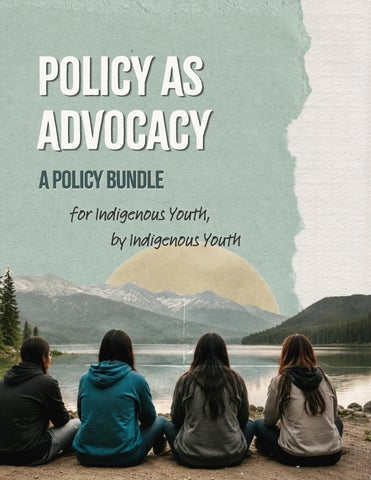
Policy as Advocacy A POLICY BUNDLE for Indigenous Youth, by Indigenous Youth
CONTENTS Introduction
page 4
The Policy Bundle
page 5
Understanding Policy
page 6
Voice
page 12
ACtion
page 13
Influence
page 14
Spirit
page 16
Conclusion
page 18
Acknowledgements
page 19
INTRODUCTION Policy is everywhere—even if we don’t always see it. It shapes the water we drink, the schools we attend, the homes we live in, and the futures we imagine for ourselves. For Indigenous youth, policy is not just something that happens in government buildings—it’s something that directly affects our communities, our rights, and our everyday lives. The good news is, policy isn’t out of reach. It’s something that you can grasp, challenge, and help change. Indigenous youth bring lived experience, knowledge, and vision that can strengthen decision-making and create more inclusive, responsive policies. This Policy Bundle is designed to support Indigenous youth in understanding, navigating, and influencing policy while staying connected to culture, community, and self-determination.
This Policy Bundle was developed through the collaboration of Indigenous youth and partners, including the Centre for Indigenous Policy and Research (CIPR) at Indigenous Youth Roots (IYR), Deloitte’s Future of Canada Centre (FCC), and the FCC Indigenous Youth Advisory Council (IYAC).
Together, this work is grounded in the belief that including Indigenous youth voices is essential to shaping policies that impact their lives, communities, and futures. 4
THE POLICY BUNDLE
The Policy Bundle is a collection of knowledge, skills, and supports that Indigenous youth can carry with them throughout their advocacy journey.
It is inspired by the concept of the “sacred bundle” present in some First Nations cultures— a collection of meaningful items, such as medicines, pipes, smudge bowls, feathers, or anything that holds and protects spiritual, personal, or community knowledge, teachings, and responsibilities.
THE PARTS OF OUR BUN
VOICE
DLE
A sacred bundle is not limited to physical objects or a physical bag, it is the meaning and knowledge carried within it.
INFLUENCE
In the same way, each part of the Policy Bundle offers guidance on how to engage with policy while staying grounded in community, culture, and self-determination. You can use one part or all of it, there is no single path.
SPIRIT
This bundle is meant to support you, grow with you, and be shared as you continue your work creating meaningful change.
ACTION
= UNDERSTANDING OF POLICY 5
UNDERSTANDING POLICY WHO DECIDES AND WHY IT MATTERS
You may have heard about election cycles or new bills being passed in Parliament—but what is policy, really? Before jumping into advocacy, it helps to understand how the policy ecosystem works. Policy shapes everyday life, including education, land, language, health, housing, food systems, and the climate. When we know how policy works, it becomes easier to see where decisions are made, and how to influence them. Knowing who holds power, how decisions move through the policy life cycle, and where you fit into it gives you tools to advocate for what matters to your community. Think of this as the bag holding the bundle: before using what’s inside, you need to understand the structure that holds them.
6
WHAT IS POLICY? A policy is a decision or plan made by a government to guide how something is done. Policies help governments decide what is important, what actions to take, and who benefits. From an Indigenous perspective, policy has often reflected colonial priorities rather than Indigenous worldviews. That’s why understanding policy is a powerful first step toward changing it.
To explore policy concepts in more depth, please see: Indigenous Youth Reconciliation B arometer 2024: Advocacy Toolkit
WHO DECIDES POLICY? Policy decisions in Canada are made at different levels of government and sometimes overlap within each level. Each level affects Indigenous communities in different ways. Learning how to engage with a level of government based on your topic of interest, and who to engage with, is critical for advocacy.
7
WHO DECIDES POLICY? FEDERAL
PROVINCIAL / TERRITORIAL
National government that makes decisions that affect the whole country, with constitutional responsibility for Indigenous Peoples. Often referred to as the “Crown”. Plays a central role in funding, legislation, treaty obligations, and rights recognition.
Responsible for areas that directly shape daily life within your province or territory. Increasingly central in consultation and economic development of Indigenous communities.
Examples of topics to engage on Clean drinking water on reserve Housing on reserve Treaty rights and land claims Resource revenue-sharing networks Environmental assessment for major projects First Nations policing and RCMP Major infrastructure and energy projects (pipelines) Climate change Indigenous healthcare funding Reconciliation policy, UNDRIP
MUNICIPAL Local government responsible for service delivery in cities/towns. Not constitutionally responsible for Indigenous peoples, but increasingly active in urban Indigenous relations and affairs.
Who to engage Member of Parliament (MP) for your riding Crown-Indigenous Relations and Northern Affairs Canada Indigenous Services Canada
Examples of topics to engage on
Who to engage
Mining, forestry, and natural resource development Provincial education system (curriculum and Indigenous inclusion) Healthcare access and culturally appropriate services Child welfare Environmental protection and assessment Local infrastructure (roads, electricity)
Examples of topics to engage on Indigenous placemaking (public spaces, monuments, naming) Land use (zoning and development) Urban Indigenous housing and homelessness Local climate and sustainability Anti-racism initiatives Public art (murals, posters, museums) Public transit access Community services and programming Police relations and public safety Economic inclusion for Indigenous business
Member of Provincial Parliament (MPP/MLA/MNA) for your riding Ministries are provincespecific, but generally cover Natural Resources, Energy Mines, Education, Health, and Environment Provincial Indigenous relations ministries Regulatory bodies (Environmental Assessment Agencies)
Who to engage Mayor and City Councillors City departments (planning, housing, parks, and recreation) Urban Indigenous organizations (Friendship Centres) Local advisory councils on Indigenous relations
8
HOW IS POLICY MADE? Developing policy is like following a step-by-step process to solve problems. Governments look at what issues they want to address, come up with ideas to fix it, and put those ideas into action. This process doesn’t always move in a straight line, but it helps explain how governments turn ideas into action. Importantly, there are opportunities to influence policy at every stage, especially when communities organize, speak up, and advocate together.
POLICY LIFE CYCLE Agenda Setting Foresight scanning Identify emerging issues
Support / Maintenance
Formulation Impact assessments
Crisis response Feedback or updates
Evaluation
Adoption
Evaluate efficiency and effectiveness
Support and advice to regulatory bodies
Implementation Independent verification Methodological guidance
9
WHAT ABOUT INDIGENOUS GOVERNMENTS? Indigenous governments is a blanket name for self-governing nations with inherent rights and varying degrees of autonomy, with ability to govern their own communities, lands (reserve or settlement areas), and cultural, social, and economic priorities. Traditional governance systems were disrupted by colonization and replaced by an imposed patchwork of law and policy that is constantly being adjusted. Today, Indigenous governance is diverse, alive, and nation-specific, and it focuses on efforts towards reclamation and resurgence through self-determination. If you want to engage with your local Indigenous government, engage with: First Nation elected government officials Inuit elected councils Métis elected councils Community administration departments Tribal councils or provincial-territorial organizations National Indigenous Organizations (e.g., Assembly of First Nations, Inuit Tapiriit Kanatami, Métis National Council, Native Women’s Association of Canada)
The following are areas that Indigenous governments have jurisdiction over: Community infrastructure and housing Cultural preservation and language revitalization Land stewardship and land use planning Economic development (e.g., partnerships in mining/energy) Member programming and health/social services
10
WHAT LAWS AND TOOLS SUPPORT INDIGENOUS RIGHTS IN CANADA? As previously noted, policies impact every aspect of our lives. They also intersect deeply with Indigenous rights and concerns. Knowing the foundations of these rights is essential for advocating on Indigenous-specific issues.
If you’d like to explore more on Indigenous governments, please refer to the following resources: Indigenous Self-Government in Canada First Nations, Métis, and Inuit Governance in Canada A New Conversation On Inuit Self Government In Nunavut
Below are key instruments that either inform or influence policy. Section 35 of the Constitution Act, 1982 Aboriginal rights Aboriginal title Duty to Consult United Nations Declaration on the Rights of Indigenous Peoples (UNDRIP) (Canada and British Columbia legislated its implementation) Free, Prior, and Informed Consent (FPIC)
Truth and Reconciliation Commission (TRC) of Canada Final Report National Inquiry into Missing and Murdered Indigenous Women and Girls Final Report (MMIWG)
11
VOICE
IDENTIFYING YOUR ISSUE
As we get into the Policy Bundle, your voice is where change starts. As a young Indigenous person, your lived experience, ideas, and vision for the future matter. Remember, decisions made today will shape your community tomorrow and for generations to come. Youth perspectives can highlight policy blind spots and bring forward solutions that others might overlook.
IYAC in Action:
Rylee (she/her) decided to speak up against changes made to Ontario education, including mandatory online courses and increased class sizes. She joined more than 200,000 elementary and high school students who participated in a mass walk out from their classrooms: “In 2019, we started seeing a bunch of cuts to education in Ontario, and they were planning for a province-wide student walk out organized in multiple cities. The resources and toolkit were public, so I got to talking with staff, students, and organized a walk out at my school. Over 2/3 of students participated in the walkout where we chanted and held signs, we had union leaders, MPs, and media attend to show support as well.”
Start by identifying what you want to change. Look around you: what feels unfair, missing, or could be better? Think about the scale of the issue (does it affect you, your community, or many communities?) and the timing (does it need action now or over time?). Next, consider who the decision-maker is. Is it your community’s leadership, or municipal, provincial, or federal government? Often, complex policy issues involve more than one level. Also think about who else cares about this issue, such as Elders, youth groups, or community organizations. Building a shared voice can make your message even stronger and more visible. Finally, write a clear issue statement: a short sentence that explains what the problem is, who it affects, why it matters, and what could be done to resolve it.
12
ACTION
ORGANIZING AND ADVOCACY
Once you’ve identified your issue, the next step is to take action. Start by gathering evidence to build a strong understanding of the issue and shape your position. This can include community surveys, research reports, statistics, and other sources that help explain what’s happening and why it matters. Learning more about the policy context can also help you understand what’s at stake and where change is possible. At the same time, not all knowledge is found in reports. Many Indigenous issues are under-researched or missing from mainstream data. That’s why it’s important to respectfully include Indigenous knowledge and lived experience. Talk to community members, listen to Elders, and understand the territory and context you’re advocating for. This is a powerful way to decolonize how you gather evidence and ensure your advocacy reflects real experiences. With your evidence in hand, you can begin thinking about how you want to raise awareness around your topic. This might look like starting conversations, hosting community gatherings or workshops, or through creative outlets like art, storytelling, or social media. Advocacy doesn’t have to follow one path, use your strengths and creativity to engage others and build momentum around your issue.
IYAC in Action: Nika (she/her) told us about the importance of getting involved in the local community when it comes to her advocacy approach: “A lot of my action and advocacy is just showing up in the community. Whether that’s a town hall or I’m talking with my mayor or councillor. Change happens at all levels. Often, we think policy is only high level like the federal government or higher-up decision makers. But also, in my community that I am in right now, how do I feel safe and represented? How do I show the decision-makers in my community about the policy work and advocacy that’s already done and can be implemented? Building those relationships is something I think about a lot when it comes to action.”
13
INFLUENCE
DIRECTLY ENGAGING WITH POLICY
Once you’ve built momentum, the next step is influencing decisions. This means bringing your issue to the people and systems that have the power to do something about it. There are a number of ways to do this, and they’re not mutually exclusive. You can pick and choose the tactics you want to use to participate in the policymaking process most effectively for your issue.
IYAC in Action:
Emerald (she/her) demonstrated influence during Indigenous Youth Roots’ Advocacy Week by using the opportunity to meet with leadership in her community: “My favourite part of the week was meeting with the President of the Métis National Council (MNC). It was amazing that such a senior leader took the time to talk to us and answer our questions. My ask was for more transparency around Métis National Council governance frameworks, how MNC policies are created, as well as how and why votes are weighted the way they are between MNC members.”
One of the most direct ways to do this is by meeting with decision-makers— such as elected officials (federal, provincial, municipal) or leaders from your nation. It’s important to be prepared. Clearly explain your issue, share 2–3 key messages, and bring both evidence and real stories to show why it matters. It can also help to point to existing tools or frameworks (like youth or funding strategies) to show how change can happen. If you’d like more information on how to directly engage with policymakers, or to learn practical advocacy skills, you can apply to IYR’s Indigenous Youth Advocacy Week program.
You can also take part in formal policy processes, like submitting written briefs, participating in public consultations, or presenting to committees. These are structured ways governments gather input to inform their decision-making and can be powerful opportunities to ensure Indigenous youth voices are heard in these spaces.
14
Influence also comes from public pressure and collective action. Petitions and letter-writing campaigns can show elected officials how many people care about the issue. Rallies, marches, and protests can raise awareness and push issues into the public spotlight. Often, the most effective way to spread the word is through digital and media advocacy, especially amongst other youth. Social media campaigns, storytelling, and educational content can quickly build awareness and connect people across communities. You can even get in contact with your local news outlet to publish an opinion piece or engage with their journalists to help bring your issue to a wider audience.
IYAC in Action: TJ (they/them) told us about the work they’ve done in community-based advocacy: “We had an artivism workshop on eco-grief and trying to navigate that as Indigenous youth and how getting involved in policy can help address those feelings. We must change the fact that our communities are the forefront of the experiencing environmental emergencies, often because of environmental racism. We looked at how to use art as a way of self-care, to tell our story and experience, and to have our voices be heard in policy spaces.”
Finally, community-based and cultural advocacy is a powerful and meaningful way to create change. Hosting gatherings or teach-ins, sharing knowledge through storytelling, and participating in ceremony can raise awareness while leading through culture and community values. When it comes to influence, it’s important to remember that you don’t have to do this alone. Working with organizations, coalitions, and Indigenous youth networks can help amplify your voice, connect you with allies, and build collective strength. You can also refer to our Indigenous Youth Reconciliation Barometer 2024: Advocacy Toolkit (page 10) to learn more about how you can apply these pathways to your specific policy ask. We always encourage you to partner with groups already working on your issue to open doors and create more opportunities to influence change.
15
SPIRIT
POLICY AS HEART WORK
Policy work isn’t just technical—it’s heart work. For Indigenous People, advocacy is deeply connected to our identity, culture, and community legacies. This means approaching policy and advocacy in a way that reflects your values and supports the wellbeing of your people. An important part of your Policy Bundle is your spirit and having tools to know how to protect it.
IYAC in Action:
Angel (she/her) spoke about how she protects her spirit during advocacy: “When I experience microaggressions from non-Indigenous peoples not only is my spirit affected, but my body stores it. I want to let other youth know that body movements through exercising, yoga, taking a walk on the land, and connecting to nature is super important because it protects your spirit. My body and my spirit are one in the same, and I can’t separate that.”
Decolonizing your policy work starts with understanding how colonial systems have shaped laws, policies, and institutions in Canada. Historically, settler policy and governance systems were designed to advance colonial objectives by displacing Indigenous governance and limiting Indigenous self-determination. This is why it’s important to center Indigenous rights, priorities, and leadership today. This includes creating space for Indigenous-led solutions while also challenging systems strategically when they fall short.
This can be done by grounding your advocacy in Indigenous ways of knowing. What called or inspired you to do what you are doing? Reflect on your values, whether it’s relationships with people, land, and community, responsibility to future generations, or balance across social, environmental, cultural, and spiritual wellbeing. Just like we said in the “action” part of the bundle, bringing Indigenous ways of knowing and lived experiences means respecting storytelling and oral traditions, and applying worldviews to analyze impacts of decisions.
16
Policy work also involves navigating different perspectives, whether it’s within your own community or engaging with non-Indigenous people. When engaging in advocacy work, we recommend entering every space by listening with respect, communicating clearly and honestly, and finding common ground with diverse opinions without compromising your core values. Be aware of challenges like lateral violence or microaggressions and think about how to preserve accountability and care for one another when you engage with other communities (see more). In practice, one way to manage diverse perspectives is to set guiding norms with those you are meeting with. This can include establishing a time to speak, being mindful of others, and setting an agenda and expectations. Whether you are in formal meetings or community spaces, it can be helpful to set the tone and create a space for respectful conversation that is grounded in protecting the spirit of the room and the work you do. Finally, try to protect your spirit. Set boundaries around your time and energy. This can include managing emails, working hours, and expectations so you don’t burn out. Stay connected to culture, land, and community, and seek support from Elders, mentors, and trusted people in your circle. Honour your emotions, including anger, as valid responses to injustice, and ensure you have access to support or practices that center you. IYAC in Action: There has been progress made to improve access for young First Nations, Inuit, and Métis to culturally responsive mental wellness supports and mentorship. You can see a full list of resources to access if you need help in Deloitte’s FCC report, Voices of Indigenous youth leaders on reconciliation: Breaking colonial legacies and mapping new pathways (page 28). You don’t have to carry this work alone—collective care and wellbeing and helping hands are essential to sustaining your advocacy.
Rylee (she/her) explained how she deals with adversity: “I like to think about personality hardiness. Whenever I feel an obstacle in my path is too big, I think about our ancestors and what they had to go through. They had to establish connections politically and communicate outside of their tribe. When I see an obstacle, I tap into that ancestral power and resilience.”
17
CONCLUSION As Indigenous youth and leaders, your voice, your presence, and your leadership are powerful—your existence alone challenges systems and creates space for change. This Policy Bundle is here to support you in that journey. From finding your voice, to inspiring you to take action, influencing decisions, and staying grounded in your spirit, each part will hopefully guide you as you navigate policy in a way that reflects who you are and what you are advocating for. You come from generations of advocates, leaders, and knowledge keepers who have worked toward a better future. That strength and power now lives within you. Stay curious, stay connected to your community, and continue learning how policy shapes your life.
If you’re passionate about policy change, there are many paths forward. You can keep advocating, join youth councils or organizations, or build a career in policy across Indigenous governments, public service, non-profits, advocacy groups, or research.
lready a s i t i t u ime, b t s e k a t s just i e e l d n u Chang b y. This a d y r e v e ctions a r happening u o y d oice an v r u o y ; l one too ife. l o t t i g n ri are what b
18
Acknowledgements Thank you to all the IYR staff and friends who contributed to the creation of this report, with recognition to those who assisted throughout the entire project, and to those who provided support during planning, development, and/or engagement phases: Megan Lewis Rayna Martens Sasha Simmons Kim Wakeford
Deloitte’s Future of Canada Centre gratefully acknowledges the support of those who contributed to the research and development of this report, including: Alexandra Biron Haniah Iqbal Regina Mandamin
To reach out to the Centre of Indigenous Policy and Research for general inquiries, please contact our department email: centre@indigenousyouthroots.ca
19
Indigenous Youth Advisory Circle (IYAC) Thank you to the Indigenous Youth Advisory Circle (IYAC) for providing their valuable expertise to development of this report, including:
TJ Dutton (they/them) TJ is a mixed (Gitxsan, settler, Myanma) Indigenous youth who has been working the past few years as a Junior Policy Analyst in health and environmental policy in southern BC. They hold a degree in Sociology/Anthropology and Psychology from the University of the Fraser Valley. TJ has a passion for bringing Indigenous perspectives to policy issues that impact their communities.
Nika Paziuk (she/her) Nika is a mixed Métis woman residing in amiskwacîwâskahikan (Edmonton AB). During her two terms with the IYAC she brought her lived experiences of working and engaging with youth and how to make policy accessible and attainable for other young folks and their communities. She is grateful for the chance to learn from other like-minded Indigenous youth, Aunties, Elders and the land who all continue to guide her on this journey.
Rylee Peltier (she/her) Rylee is an Ojibwe multi-disciplinary artist and activist residing in Sudbury, ON, with roots in Wikwemikong Unceded Territory. Her experience spans areas such as event organization, workshop facilitation, permaculture gardening, wilderness skills, performance and mixed-media arts, and beyond. She is currently building Anang’s Vision, a social enterprise focused on growing community, communication, and creativity. 20
Angel Sansregrett (she/her) Angel is a Strategy Analyst at Raven Indigenous Outcomes Funds, an Indigenous fund manager creating impactful solutions for Indigenous Peoples. Based in Calgary (Treaty 7 territory), Angel is passionate about fostering community-centred work that contributes to lasting social and economic well-being for Indigenous Peoples.
Emerald UnRuh (she/her) Emerald is a Métis Nation of British Columbia citizen, and her family names are Belhumeur, Fleury, and Desjarlais. Based on lək̓ ʷəŋən territory in Victoria, BC, she holds a degree in Indigenous studies and political science from Simon Fraser University. Emerald applies her passion for anti-racism, reconciliation, and Indigenous empowerment in her role as a Policy Analyst at the BC Ministry of Health, where she works in the Indigenous-Specific Anti-Racism Division.
21