THE BEEF, PORK & POULTRY INDUSTRY DIGITAL MAGAZINE
October 2026
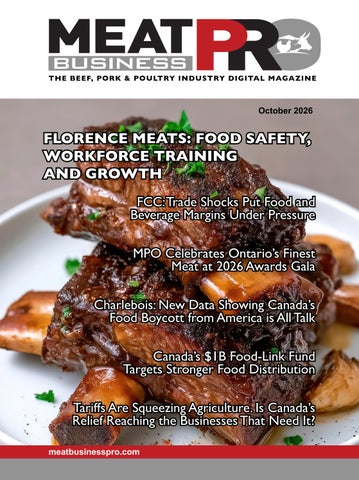
FLORENCE MEATS: FOOD SAFETY, WORKFORCE TRAINING AND GROWTH FCC: Trade Shocks Put Food and Beverage Margins Under Pressure MPO Celebrates Ontario’s Finest Meat at 2026 Awards Gala Charlebois: New Data Showing Canada’s Food Boycott from America is All Talk Canada’s $1B Food-Link Fund Targets Stronger Food Distribution Tariffs Are Squeezing Agriculture. Is Canada’s Relief Reaching the Businesses That Need It? meatbusinesspro.com
2
MEATBUSINESSPRO October 20264
meatbusinesspro.com
October 2026
5 6 9 11
Swine Innovation Porc Opens Advancing Swine Research Call for Proposals Florence Meats: Food Safety, Workforce Training and Growth
FCC: Trade Shocks Put Food and Beverage Margins Under Pressure
MPO Celebrates Ontario’s Finest Meat at 2026 Awards Gala
14 16 19 22
Canada’s $1B Food-Link Fund Targets Stronger Food Distribution
Charlebois: New Data Showing Canada’s Food Boycott from America is All Talk) Marco Mazzarolo of Herrington’s Quality Butchers Crowned Ontario’s Finest Butcher 2026 Tariffs Are Squeezing Agriculture. Is Canada’s Relief Reaching the Businesses That Need It?
4
MEATBUSINESSPRO October 20264
https://www.yesgroup.ca meatbusinesspro.com
THE BEEF, PORK & POULTRY INDUSTRY DIGITAL MAGAZINE
October 2026 Volume 27 Number 10
PUBLISHER Ray Blumenfeld ray@meatbusinesspro.com CO-PUBLISHER Deb Wilson deborah@meatbusinesspro.com DIGITAL MEDIA EDITOR Cam Patterson cam@meatbusinesspro.com CONTRIBUTING WRITERS Dr. Sylvain Charlebois, Ons Dhaoui, Jack Roberts, Ray Benson CREATIVE DIRECTOR Patrick Cairns
Meat Business Pro is published 12 times a year by We Communications West Inc.
COMMUNICATIONS WEST INC.
We Communications West Inc. 106-530 Kenaston Boulevard Winnipeg, MB, Canada R3N 1Z4 Phone: 204.985.9502 Fax: 204.582.9800 E-mail: publishing@meatbusiness.com Website: www.meatbusinesspro.com Meat Business Pro subscriptions are available for $28.00/year or $46.00/two years and includes the annual Buyers Guide issue. ©2026 We Communications West Inc. All rights reserved. The contents of this publication may not be reproduced by any means in whole or in part, without prior written consent from the publisher. Printed in Canada. ISSN 1715-6726
SWINE INNOVATION PORC OPENS ADVANCING SWINE RESEARCH CALL FOR PROPOSALS Swine Innovation Porc (SIP), with support from the Pork Promotion and Research Agency (PPRA), has opened the Advancing Swine Research Call for Proposals to support high-impact research that strengthens the resilience, sustainability and competitiveness of Canada’s pork sector. The call is designed to use sector investment as a catalyst, bringing in research expertise and funding from partners and other programs to advance solutions to priority challenges facing Canadian pork production. “Advancing Swine Research gives our sector an opportunity to direct research investment toward some of the most important challenges facing Canadian pork producers and processors,” said Mark Ferguson, Chair of Swine Innovation Porc. “By bringing industry priorities together with research expertise from across Canada, we can support practical solutions that strengthen our sector for the future.” For this call, SIP is seeking research in six priority areas. These include endemic animal diseases, antimicrobial use and resistance, biosecurity, barn technology and design, pork safety and quality, and more efficient use of energy and water. Together, these areas reflect key industry needs and opportunities to strengthen Canadian pork production. The call will support two types of projects. Discovery & Applied Research projects can receive up to $150,000 over three years, while short-term “Quick Win” projects are typically completed within one year and can receive up to $50,000. “The combination of longer-term applied research and shorter, targeted projects gives us flexibility to pursue strong ideas at different stages of development,” said Dr. Andrew Van Kessel, Chair of SIP’s Science Advisory Body. “Our goal is to support high-quality research that responds directly to the needs of Canada’s pork sector and can ultimately lead to practical outcomes.” Applications will begin with a Letter of Intent, which must be submitted by November 13, 2026 at 4:00 p.m. EDT. Universities and colleges, research organizations, and government research institutions with relevant experience are eligible to apply. Full program details, guidelines and application materials are available at: www.swineinnovationporc.ca/call-for-proposals-2026-27.
meatbusinesspro.com
October 2026 MEATBUSINESSPRO
5
FLORENCE MEATS: FOOD SAFETY, WORKFORCE TRAINING AND GROWTH For meat processors, food safety is not a milestone reached once and filed away. It is a discipline that must evolve with products, people, customers and regulatory expectations.
That is the premise behind the Centre for Meat Innovation and Technology (CMIT)’s Food Safety Excellence (FSE) Program: to give processors practical ways to understand their current systems, identify the next priority and build capability without making the process feel out of reach. From a quick self-assessment to free learning materials and specialist guidance, the program offers an accessible starting point for operations at different stages of maturity. The first step is deliberately straightforward. FSE’s online Self-Assessment Tool is a short, anonymous questionnaire that considers an operation’s existing food safety system and its goals, then recommends a logical next step. For a small or mid-sized processor unsure where to begin, that simplicity matters. The exercise provides a clearer path forward and provides a snapshot goal that management can use to focus time and resources.
6
MEATBUSINESSPRO October 20264
Processors can then build knowledge at their own pace. The FSE Program’s free learning modules explain core food safety concepts, while ready-to-use templates, checklists and reference documents help translate those concepts into daily practice. The FSE Webinar Library adds free expert-led instructional videos teams can watch as needed. Together, these resources support more consistent recordkeeping, clearer procedures and better-informed training, foundations that become increasingly important as a plant grows, introduces new products or prepares for a formal food safety standard.
Guidance is available when a processor needs help turning information into action. CMIT Food Safety Specialist Baljit Kaur Kheeva can help operators interpret their needs, review current systems, identify gaps and locate the most useful tools and resources. That one-on-one support can be especially valuable for businesses where owners and managers balance food safety leadership with production, staffing, sales and customer service. Instead of treating improvement as a single large project, teams can break it into practical, manageable steps.
meatbusinesspro.com
The company’s HACCP journey is about more than passing an audit. “The biggest part of the HACCP journey for Florence Meats is its ability to provide us with documentation and really help modernize our training practices,” Michael says. Better documentation can help transfer hard-won artisan knowledge to new employees while giving the whole team a consistent basis for safe production.
Florence Meats shows what that pathway can look like in practice. The Oakville, Ont., family business is approaching its 50th anniversary and has built its reputation on artisan products, service and quality. Second-generation butcher Damian Goriup produces charcuterie, salamis, prosciuttos and the company’s signature biltong, while Carol Goriup co-owns the business and their son, Michael, represents the next generation. With high-risk products under one roof, continual improvement is not optional. As Carol puts it, “You can never turn your back on [food safety].”
VEMAG
REPLACEMENT PARTS
meatbusinesspro.com
https://www.dhenryandsons.com https://www.
October 2026 MEATBUSINESSPRO
7
For Florence Meats, stronger systems support both confidence and opportunity. HACCP readiness can reinforce the company’s established food safety reputation, enable more consistent training and position the business for future certification, potential CFIA licensing and broader growth. Damian connects that progress to the fundamentals: “Every business’ success is based on service and a good product.” A robust food safety system helps protect both.
For Carol, the FSE Self-Assessment made the opportunity easier to evaluate. Introduced through Meat & Poultry Ontario, it showed that much of the groundwork was already in place. “I didn’t realize how easy it was,” she says. “It was a bit of a no-brainer once that answer came out. I thought, well, we’ve got everything in place. Why not move to the next step?” What initially appeared overwhelming became manageable once the work was organized.
When Florence Meats participated, eligible provincially licensed plants could access up to $30,000 in vendorpaid Implementation Support. Florence Meats used their Implementation Support to hire a food safety consultant for guidance through the HACCP process. Although Implementation Support is no longer available and not part of the current FSE Program offering, the experience illustrates the value of matching an operation’s needs with the right expertise.
That is the wider message for Ontario’s meat sector. Reaching a food safety goal does not have to begin with a complex overhaul. It can start with an honest assessment, one useful template or a focused conversation about a gap. Each step strengthens the system that protects products, customers and the business itself. Carol’s advice to other processors is direct: “Go for it. I think it’s worth it.” With practical tools and informed guidance available, the next step may be closer than it appears.
Find out your next step by completing the quick and anonymous FSE Self-Assessment Tool today: https:// lvvr10axwba.typeform.com/to/Buo0V5OV?typeformsource=www.cmit.ca Food Safety Excellence tools and resources have been developed through funding provided by the Sustainable Canadian Agricultural Partnership (Sustainable CAP), a five-year, federal-provincial-territorial initiative.
8
MEATBUSINESSPRO October 20264
meatbusinesspro.com
FCC: TRADE SHOCKS PUT FOOD AND BEVERAGE MARGINS UNDER PRESSURE Tariffs and trade disruption are shifting the outlook for Canada’s food and beverage manufacturers from resilience to risk management, according to a mid-year update from Farm Credit Canada (FCC) Economics. Sales rose 4% in the first half of 2026, but new U.S. trade restrictions, Canadian counter-tariffs and renewed energy and freight volatility are putting pressure on margins.
Canadian food and beverage manufacturing sales reached $88.1 billion in the first half of 2026, with the gain driven largely by higher prices rather than stronger volumes, the update shows. After adjusting prices, real sales were flat compared to the same period last year.
meatbusinesspro.com
“The first half of 2026 shows the sector remains resilient, but the headline sales number does not tell the whole story. For manufacturers, the key issue is not just whether sales are growing, but what is driving that growth,” said Craig Johnston, vice-president and chief economist at FCC. “When gains are tied more to prices than volumes, it can signal that companies are still operating in a cautious demand environment while also managing higher and less predictable costs.”
October 2026 MEATBUSINESSPRO
9
“As margins remain tight, diversification will become an increasingly important long-term strategy for food and beverage manufacturers,” Johnston said. “Reducing interprovincial trade barriers and expanding internationally can help open broader market opportunities. Helping the food and beverage manufacturing sector to achieve 3% growth over the next decade could contribute an additional $40 billion to Canadian GDP over the next decade, while supporting 217,000 new jobs, $16 billion in wages and benefits and $1.3 billion in tax revenues.”
Results varied significantly across the sector. Grain and oilseed milling, fruit and vegetable processing and animal food manufacturing recorded some of the strongest gains, while sugar and confectionery manufacturing, breweries and distilleries posted declines. The operating environment has also become more challenging. Energy and freight volatility, higher input costs, U.S. trade restrictions and Canadian countertariffs are creating additional uncertainty around production costs, export opportunities and margins.
The mid-year update follows FCC Economics’ annual food and beverage report and examines how sales, costs and margins are evolving across Canada’s food and beverage manufacturing sector. By sharing economic knowledge and forecasts, FCC provides insight and expertise to help those in the business of agriculture and food achieve their goals. For more economic insights and analysis, visit FCC Economics at fcc.ca/Economics.
Margins are expected to improve modestly in 2026 after a difficult year, but the recovery is expected to remain fragile as trade and cost pressures build later in the year. FCC Economics’ estimates suggest the direct impact of the new trade measures will be limited in 2026 because most take effect only in September.
10
MEATBUSINESSPRO October 20264
meatbusinesspro.com
MPO CELEBRATES ONTARIO’S FINEST MEAT AT 2026 AWARDS GALA Meat & Poultry Ontario (MPO) celebrated excellence across Ontario’s meat processing industry in early October as the winners of the 2026 Ontario’s Finest Meat Competition were announced at the MPO Awards Gala at The Westin Toronto Airport.
“Ontario’s Finest Meat Competition celebrates the best of our industry: recipes handed down through generations, products crafted with care, and new flavours that show where the industry is headed,” said Franco Naccarato, Executive Director of Meat & Poultry Ontario. “Every entry reflects the skill and pride of the people behind it. Together, they show the remarkable range of tradition, craftsmanship and innovation among Ontario’s meat processors.”
Ontario’s Finest Meat Competition gives MPO members an opportunity to put their best products forward and compete for recognition among the province’s finest meat processors. The 2026 competition featured 12 categories, spanning fresh sausage, bacon, deli products, smoked specialties, dry and semi-dry products, salumi and charcuterie, and the new Jerky category.
meatbusinesspro.com
October 2026 MEATBUSINESSPRO
11
2026 RON USBORNE AWARD OF EXCELLENCE Introduced in 2007, the Ron Usborne Award of Excellence recognizes the company achieving the highest accumulated score across Ontario’s Finest Meat Competition. Points are awarded based on product placements, with three points for each Platinum award, two points for each Gold award and one point for each Silver award.
Entries were judged by a panel of experienced professionals representing a range of expertise across the food and meat industries. The 2026 judging panel included Chef Maurice Desharnais, Sabrina Falone, Chef Troy Spicer, Emily Richards, Alexa Clark, Steven Canclini and Scott McQuay. Each entry was evaluated according to the requirements of its category, with judges considering factors such as appearance, aroma, texture, flavour and overall product quality. The competition recognizes top-performing products with Silver, Gold, Platinum and Diamond honours.
The winner of the 2026 Ron Usborne Award of Excellence is VG Meats
2026 BEST PORK PRODUCT – SPONSORED BY ONTARIO PORK This award recognizes the highest-scoring pork product in the competition. J & G Quality Meats earned the 2026 title for its Mexican Street Corn Sausage, which achieved the top score among all pork entries.
2026 BEST BEEF PRODUCT – SPONSORED BY BEEF FARMERS OF ONTARIO This award recognizes the highest-scoring beef product in the competition. Florence Meats earned the 2026 title for its Beef Biltong, which achieved the top score among all beef entries.
2026 ONTARIO’S FINEST MEAT COMPETITION DIAMOND WINNER This year, Halenda’s Fine Foods Ltd. earned the Diamond title of Ontario’s Finest Meat 2026 with its Stuffed Iberico Back Bacon, a special distinction given to the single meat or poultry product that achieves the highest overall score across all categories in the competition. 12
MEATBUSINESSPRO October 20264
meatbusinesspro.com
• Jerky: Florence Meats – Beef BiltongZ The Jerky category was introduced for the first time in 2026, giving members a new opportunity to showcase seasoned and dried meat products and expanding the competition’s recognition of Ontario’s diverse meat products. Judging took place at Fanshawe College in London, Ontario, on June 24. The winners were announced at MPO’s annual Awards Gala on October 3.
2026 ONTARIO’S FINEST MEAT COMPETITION PLATINUM WINNERS
The competition is proudly supported by its 2026 partners, Fanshawe College, Erb Transport, Ontario Pork and Ontario Beef.
The Platinum awards recognize the top-scoring products in their respective categories. THE WINNERS ARE: • Bacon – Traditional Side: Metzger's Meat Products Inc. – Side Bacon - Traditional Style • Bacon – OPEN: Halenda’s Fine Foods Ltd. – Stuffed Iberico Back Bacon • Deli Roasts: R. Denninger Ltd. – Smoked Beef • Kielbasa: Highland Packers – Natural Casing Kielbasa • Fresh Sausage – Pork: J & G Quality Meats – Mexican Street Corn Sausage • Fresh Sausage – Other: L'Orignal Packing Ltd. – The Mysterious
About Ontario’s Finest Meat Competition Ontario’s Finest Meat Competition is held every two years and is exclusively open to MPO members. It celebrates the exceptional quality, craftsmanship, and innovation of Ontario’s meat processors. Organized by Meat & Poultry Ontario, the competition brings together MPO members from across the province to showcase their finest products and compete for recognition among Ontario’s best.
• Salumi – Charcuterie: La Cultura Salumi Inc. – Beef Prosciutto • Sausage – Dry/Semi-Dry – Small Diameter: L'Orignal Packing Ltd. – Mini Pepperoni Hot • Smoked Sausage – Traditional: Highland Packers – Smoked Honey Garlic • Smoked Sausage – Specialty: Florence Meats – Kranska with Parano Cheese & Jalapeno • Premium Wiener: Halenda’s Fine Foods Ltd. – Iberico Premium Koby Dog
meatbusinesspro.com
About Meat & Poultry Ontario (MPO) Meat & Poultry Ontario (MPO) is the heart of Ontario’s meat industry. Our members are independent businesses proud to serve the communities they live and work in. The association comprises meat and poultry processors, wholesalers, retailers, industry suppliers, and not-for-profit organizations that support
October 2026 MEATBUSINESSPRO
13
CANADA’S $1B FOOD-LINK FUND TARGETS STRONGER FOOD DISTRIBUTION New federal infrastructure funding could expand cold storage, processing, logistics and market access for meat and food businesses. The Government of Canada is preparing to launch the $1-billion Food-Link Fund, an infrastructure initiative aimed at strengthening competition, improving food distribution and increasing access to affordable, domestically produced food. For Canada’s meat and food-processing sectors, the fund could support upgrades that address persistent bottlenecks between production and market. Eligible areas highlighted by the government include cold storage, transportation, processing and packaging equipment, digital systems, logistics capacity and facility improvements. The initiative forms part of the federal government’s $3.2-billion National Food Security Strategy, announced in June 2026. It will operate through two streams designed to support both national-scale distribution infrastructure and regional food networks.
TWO FUNDING STREAMS The Food Terminal Fund will support the development and expansion of wholesale food terminals and distribution centres. These facilities are intended to give producers, processors, independent retailers and other food businesses more options for selling and sourcing products outside distribution systems controlled by major retailers.
Federal officials say the combined investments are expected to improve supply-chain efficiency, reinforce regional resilience and create new market opportunities for Canadian producers and food businesses.
APPLICATIONS OPEN OCTOBER 14 The eight-week application intake will run from October 14 to December 11, 2026. Organizations must first submit an Expression of Interest. Projects that align with the fund’s objectives will then be invited to submit a full proposal. Meat processors, distributors, logistics providers, producer groups and regional food organizations considering expansion or modernization projects may wish to assess whether planned investments align with the program’s infrastructure and supply-chain priorities.
INDUSTRY TAKEAWAY The Food-Link Fund represents a potentially significant source of capital for projects that improve temperaturecontrolled capacity, processing capability, distribution efficiency and access to Canadian markets.
The Food Hub Program will support regional hubs that connect producers with storage, processing, distribution and market services. The program is intended to close infrastructure gaps in underserved communities and improve the movement of local food into regional markets. 14
MEATBUSINESSPRO October 20264
meatbusinesspro.com
meatbusinesspro.com
October 2026 MEATBUSINESSPRO
15
NEW DATA SHOWING CANADA’S FOOD BOYCOTT FROM AMERICA IS ALL TALK By Dr. Sylvain Charlebois Patriotism won’t reduce our food dependence. Despite the boycott rhetoric and repeated calls to find Competitiveness will. new markets, our agri-food trade remains anchored to the same customer and supplier. Where is the American food boycott? And where is Canada’s agri-food trade diversification? LIMITS TO WHAT FIGURES TELL US There are also limits to what these figures tell us. Import values do not directly measure consumers’ purchasing decisions. Prices, exchange rates and product composition can influence trade totals. An aggregate result can conceal substantial changes in individual categories.
The latest Statistics Canada figures, which came out this week, suggest that both ambitions have yet to meaningfully change our dependence on the United States.
For Canadian farmers and food processors, the data is telling us the United States remains an extraordinarily important customer. Approximately $62 of every $100 in agri-food export value goes there. That concentration creates exposure to American policy decisions, border disruptions and changes in market access.
Between January and August 2026, Canadian agrifood imports from the United States declined by 0.7%, compared with the same period in 2025. That might sound like evidence that Canadians’ determination to avoid American products is having an impact. But Canada’s total agri-food imports declined by 1.2%. Consequently, the American share of our agri-food imports increased from 47.09% to 47.33%, a gain of 0.24 percentage points. The export picture is equally revealing. Between January and August 2025, the United States received 61.92% of Canada’s agri-food exports. During the same period in 2026, that share reached 61.98%. Both figures round to 62%.
16
MEATBUSINESSPRO October 20264
meatbusinesspro.com
DIVERSIFICATION REQUIRES INVESTMENT, WILLINGNESS TO ADDRESS COSTS Diversification is possible. It requires patient commercial work, investment and a willingness to address the costs that make Canadian suppliers less competitive. The import side presents a similar challenge. A shopper can leave an American product on the shelf immediately. A food manufacturer replacing an American ingredient supplier must consider specifications, food safety, price, available quantities and delivery schedules.
It also reflects commercial advantages. The United States is nearby, offers a large customer base and supports established business relationships. Canadian exporters have developed products, transportation arrangements and sales strategies around that market. Replacing those relationships takes more than a trade mission and a photograph. An exporter entering a new market must find reliable buyers, meet regulatory requirements, adapt products where necessary and establish commercially viable distribution. For perishable food, transportation time and cold-chain reliability can determine whether an opportunity is profitable at all.
A retailer sourcing elsewhere must ensure that products arrive consistently and remain affordable. Finding an alternative supplier is only the first step. This is why the discussion needs to move beyond consumer patriotism.
Canadians should be free to support domestic producers and avoid American products if they wish. But grocery shopping should not become a national loyalty test. A household choosing the least expensive food is managing its budget.
meatbusinesspro.com
October 2026 MEATBUSINESSPRO
17
Policy should focus on improving the economics of producing and processing food here. Energy costs, infrastructure, regulatory predictability and barriers to interprovincial trade deserve sustained attention. So does the ability of businesses to expand, modernize and bring new products to market. Export development should be measured by durable commercial results: repeat customers, profitable shipments and a broader distribution of sales. Import diversification should be assessed through reliable alternative supplies, alongside opportunities to expand competitive Canadian production.
If buying Canadian requires families to pay more indefinitely, the strategy will struggle to endure. Consumers need competitive alternatives, and Canadian businesses need the capacity to supply them.
FOCUS NEEDED ON IMPROVING ECONOMICS OF PRODUCING, PRODUCING LOCALLY That brings us to the common problem behind our import and export dependence: competitiveness. We want Canadian companies to replace imported products at home while winning customers overseas. Both objectives require productive farms, efficient processing facilities, reliable transportation and an environment that encourages investment. A maple leaf on a shelf cannot deliver those conditions. Neither can a government declaration that Canada is diversifying.
Reducing dependence does not require abandoning the American market. Canada should continue selling to a valuable customer while building enough alternatives to withstand disruptions. The objective is greater resilience and bargaining power. The latest figures offer a useful reality check. The United States supplies roughly 47% of our agri-food imports and receives approximately 62% of our agri-food exports. Neither share has fallen over the comparison period.
Our frustration with Washington may have changed. The structure of our food economy has barely moved.
Sylvain Charlebois is director of the Agri-Food Analytics Lab at Dalhousie University, co-host of The Food Professor Podcast
18
MEATBUSINESSPRO October 20264
meatbusinesspro.com
MARCO MAZZAROLO OF HERRINGTON’S QUALITY BUTCHERS CROWNED ONTARIO’S FINEST BUTCHER 2026 After an intense competition showcasing some of Ontario’s top butchery talent, Marco Mazzarolo of Herrington’s Quality was crowned Ontario’s Finest Butcher 2026. The Final Round, held on October 3 as part of the Meat Industry Expo at The International Centre in Mississauga, highlighted the exceptional technical skill, creativity and craftsmanship of Ontario’s butchers.
Following the Elimination Round, three competitors advanced to the Final Round: Connor Stewart of J&G Quality Meats, Nick Projkovski of Metro, and Marco Mazzarolo of Herrington’s Quality Butchers. Each finalist demonstrated impressive cutting skill, focus and outstanding work to earn their place among the province’s top three competitors.
Hosted by Meat & Poultry Ontario, this year’s competition brought together 11 talented butchers from across Ontario for the Elimination Round at Handtmann Canada in Waterloo, on September 14. Competitors were challenged to demonstrate their technical precision, workmanship and core butchery competencies under pressure. The 2026 Final Round introduced several new challenges designed to test more than technical butchery skills. Each finalist received advance disclosure of their assigned cuts, worked within a designated pantry budget, and developed a unique display concept and theme. Their displays showcased creativity, butchery skills under pressure, merchandising strategy, visual presentation, consumer appeal and product storytelling. Finalists were also required to explain their creative decisions, product selections and merchandising strategies to the judges and audience. meatbusinesspro.com
October 2026 MEATBUSINESSPRO
19
“Those three butchers are phenomenal. They worked their butts off to get to where they got to, and they had phenomenal displays. Marco just took it to the edge. He had a world junior kind of display, where everything was really organized and set out just perfectly, and that really put him above and beyond the other two”, said judge Stefan Seher, Handtmann Canada Ltd. “It was great to see these young guys coming up, and the future holds a lot for this industry. With competitions like this, it’s great to see.”
At the Final Round, Marco Mazzarolo of Herrington’s Quality Butchers delivered an outstanding overall performance, connecting his products to family stories, impressing the judges with his butchery skills, creativity and ability to bring his display concept to life in front of a live audience. Mazzarolo's performance earned him the title of Ontario’s Finest Butcher 2026, along with the official prize package. The 2026 competition also marked another year of celebrating the people behind Ontario’s meat industry and the skill and dedication that go into the craft of butchery. Now in its 13th year, Ontario’s Finest Butcher Competition continues to provide a platform for talented professionals to showcase their skills, to prove their passion for the trade while inspiring the next generation of Ontario butchers. Mazzarolo has been a full-time butcher for two years, returning to the shop where he first worked while in high school after pursuing a career in Public Health. Drawn back to the hands-on nature of butchery and his passion for the culinary world, Mazzarolo has continued to develop his craft with the guidance of his mentor, Brent Herrington (2019 Ontario’s Finest Butcher). That passion and dedication helped him earn the title of this year competition.
The Ontario’s Finest Butcher Competition is sponsored by Handtmann Canada, Fortinos, Ontario Beef, OMCAN, Malabar Ingredients and Conestoga Meat Packers. Watch the elimination round video here: https://youtu. be/VuFhtdzSux4 Watch the live final round video here: https://www. instagram.com/reel 20
MEATBUSINESSPRO October 20264
meatbusinesspro.com
meatbusinesspro.com
October 2026 MEATBUSINESSPRO https://www.cfib.ca
21
TARIFFS ARE SQUEEZING AGRICULTURE. IS CANADA’S RELIEF REACHING THE BUSINESSES THAT NEED IT? Canada's agriculture and agri-food businesses have spent the last several years navigating one challenge after another. From pandemic-related disruptions and supply chain bottlenecks, to rail and port labour disputes, rising input costs, inflation, and the carbon tax, many producers and processors have been forced to adapt to an increasingly unpredictable business environment. Now, U.S. tariffs are adding yet another layer of uncertainty, threatening export opportunities, squeezing margins, and putting additional pressure on businesses that have already weathered years of economic turbulence. Governments have responded with several support measures. Producers can access programs such as AgriStability, AgriInvest, the Advance Payments Program, the Canadian Agricultural Loans Act Program, and the Farm Credit Canada Trade Disruption Customer Support Program. Support is also available through market-diversification initiatives and broader tariffresponse programs delivered by Farm Credit Canada, the Business Development Bank of Canada, and regional development agencies.
Agricultural businesses are among the sectors most exposed to cross-border trade. According to CFIB's survey, 40% of agricultural exporters report that their products are included on proposed tariff lists, while nearly one-quarter remain uncertain whether they will be impacted. More concerning, 79% say a 50% tariff would make their products less competitive in the U.S. market. Nearly one-third anticipate revenue losses of at least 25%, including 18% who expect to lose half or more of their revenue. 22
MEATBUSINESSPRO October 20264
meatbusinesspro.com
The message from agricultural business owners is clear. They are not only concerned about financing or cash flow. They are also concerned about losing customers, losing markets, and losing their ability to compete. Current support programs help businesses weather the storm, but many do not address the underlying trade disruption causing the damage.
While these programs provide some assistance, they share an important limitation: most help businesses manage the consequences of tariffs rather than the tariffs themselves. Programs such as AgriStability and AgriInvest can provide support when income declines or cash flow becomes strained, but they do not replace lost export sales or restore access to customers. Similarly, financing programs can help businesses survive a difficult period, but additional borrowing does little to address a loss of competitiveness in a key export market. For many small businesses, access can also be a challenge. Tariff-response initiatives administered through regional development agencies and BDC require businesses to meet minimum revenue thresholds, $1 million annually. This may exclude smaller farms, processors, and agri-food enterprises that are nonetheless feeling the impact of trade disruptions.
There is also a timing issue. Programs that support export diversification are important and should be encouraged. However, developing new markets is a long-term strategy. Finding customers, establishing distribution networks, and meeting foreign market requirements can take years. Businesses facing tariffrelated losses today need solutions that address immediate challenges while those diversification efforts are underway. meatbusinesspro.com
Small businesses do not need complicated application processes, support programs that exclude them from eligibility, or financing solutions that require them to take on additional debt during a period of heightened uncertainty. What many need most is targeted relief that reflects the real impact of tariffs on their operations and helps preserve their ability to compete in domestic and international markets.
Canada's agriculture and agri-food sector has repeatedly demonstrated its resilience in the face of economic challenges. With the right policy framework, small businesses can continue to be a driving force behind rural communities, food production, and economic growth across the country
Ons Dhaoui is a Sr. Policy Analyst at the Canadian Federation of Independent Business (CFIB). CFIB is Canada’s largest association of small and medium-sized businesses with 103,000 members (6,500 agri-business members) across every industry and region. CFIB is dedicated to increasing business owners’ chances of success by driving policy change at all levels of government, providing expert advice and tools, and negotiating exclusive savings. Learn more about CFIB and its work to support agri-businesses at Get Growing. .
October 2026 MEATBUSINESSPRO
23
24
MEATBUSINESSPRO October 20264
meatbusinesspro.com