THE BEEF, PORK & POULTRY INDUSTRY DIGITAL MAGAZINE
December 2025
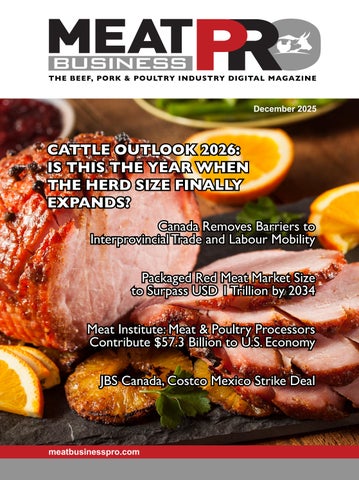
CATTLE OUTLOOK 2026: IS THIS THE YEAR WHEN THE HERD SIZE FINALLY EXPANDS? Canada Removes Barriers to Interprovincial Trade and Labour Mobility Packaged Red Meat Market Size to Surpass USD 1 Trillion by 2034 Meat Institute: Meat & Poultry Processors Contribute $57.3 Billion to U.S. Economy JBS Canada, Costco Mexico Strike Deal
meatbusinesspro.com
https://www.yesgroup.ca 2
MEATBUSINESSPRO December 20254
meatbusinesspro.com
December 2025
5 6 11 14 16
China Extends Beef Import Probe into 2026
Cattle Outlook 2026: Is This the Year When the Herd Size Finally Expands?
18 19 20 22 24
NCIAF Receives $2 Million to Support Capacity Building in Indigenous-Led Bison Initiatives
How Canadian Chicken Farmers Are Reducing Their Environmental Footprint
Canada Removes Barriers to Interprovincial Trade and Labour Mobility
JBS Canada, Costco Mexico Strike Dea
Packaged Red Meat Market Size to Surpass $1 Trillion USD by 2034
FCC Report Highlights Productivity as Key to Canada’s Ag Future
Meat Institute: Meat & Poultry Processors Contribute $57.3 Billion to U.S. Economy & Provide 584,000 Jobs
Federal Budget 2025: Key Takeaways for Agribusinesses
4
MEATBUSINESSPRO December 20254
https://www.yesgroup.ca meatbusinesspro.com
THE BEEF, PORK & POULTRY INDUSTRY DIGITAL MAGAZINE
December 2025 Volume 25 Number 12
PUBLISHER Ray Blumenfeld ray@meatbusinesspro.com CO-PUBLISHER Deb Wilson deborah@meatbusinesspro.com DIGITAL MEDIA EDITOR Cam Patterson cam@meatbusinesspro.com CONTRIBUTING WRITERS Leigh Anderson, Ella Cao, Lewis Jackson, Stephen Tipper, Milan Nguyen, Jack Roberts CREATIVE DIRECTOR Patrick Cairns
Meat Business Pro is published 12 times a year by We Communications West Inc.
COMMUNICATIONS WEST INC.
We Communications West Inc. 106-530 Kenaston Boulevard Winnipeg, MB, Canada R3N 1Z4 Phone: 204.985.9502 Fax: 204.582.9800 Toll Free: 1.800.344.7055 E-mail: publishing@meatbusiness.com Website: www.meatbusinesspro.com Meat Business Pro subscriptions are available for $28.00/year or $46.00/two years and includes the annual Buyers Guide issue. ©2020 We Communications West Inc. All rights reserved. The contents of this publication may not be reproduced by any means in whole or in part, without prior written consent from the publisher. Printed in Canada. ISSN 1715-6726
meatbusinesspro.com
CHINA EXTENDS BEEF IMPORT PROBE INTO 2026 By Ella Cao and Lewis Jackson, Reuters China has extended its investigation into beef imports by another two months, giving global suppliers a longer temporary reprieve from potential trade restrictions as the domestic industry battles a supply glut. The investigation will now run until January 26, 2026, the commerce ministry said, citing "the complexity of the case". It is the second time the ministry has extended the probe since it launched the investigation last December, as slowing demand squeezes the world's largest market for beef imports and consumption. The probe does not target any specific country. In August, China extended the review by three months. Any trade measures to curb imports would affect major suppliers such as Argentina, Australia and Brazil. "The short extension of just two months is unusual - it suggests officials are not as close to reaching a conclusion as some of the industry rumours have suggested," said Even Rogers Pay, a director at Beijing-based Trivium China. "The next few weeks are a busy political period in China, and many major beef trade partners will also be observing major holidays in December, so it could be that everyone needs the extra weeks for finalising the conclusions," she added. Chinese authorities have stepped up policy support for the sector this year. In July, an agriculture ministry official said that beef cattle farming had been "generally profitable" for three consecutive months. Last Friday, the ministry said it aims to consolidate and expand the effects of support measures for beef cattle while promoting a rapid recovery in dairy cow production. Cattle prices held steady at 25.6 yuan per kilogram this week, up from 23.7 yuan per kilogram during the same period last year, according to data from consultancy Mysteel. China imported a record 2.87 million metric tons of beef in 2024. Imports for January-October 2025 rose 2.8% year-on-year to 2.41 million tons.
December 2025 MEATBUSINESSPRO
5
CATTLE OUTLOOK 2026: IS THIS THE YEAR WHEN THE HERD SIZE FINALLY EXPANDS? By Leigh Anderson, Senior Economist, Farm Credit Canada Tight supply pushed up cattle prices to record highs in 2025, and despite recent corrections, the market remains historically strong. Strong prices, abundant feed supplies, and falling feed costs are all boosting optimism in the industry. Yet, the question most often asked is, how long will cattle prices stay elevated and when will rebuilding of the herd occur? In this outlook, we examine where we are in the current cattle cycle, an important indicator of how long high prices might last and share our price projections along with what the sector can expect in 2026 and beyond. THE CATTLE CYCLE: HERD EXPANSION AND CONTRACTION AND RELATIONSHIP TO PRICES
A full cattle cycle usually lasts 10 to 12 years, moving from expansion to contraction before starting over, though it can be a couple of years longer or shorter. During contraction, tight profitability leads producers to make cautious decisions and slow herd growth as more cows are culled than replaced. In expansion, improving prices and profitability encourage producers to retain heifers and grow their herds.
6
MEATBUSINESSPRO December 20254
Predicting the timing of peaks and troughs in the cycle is difficult because these phases can vary in length depending on market trends and economic conditions. Factors like beef demand, production costs, feed availability and pasture conditions e.g. drought, play a big role. The past few cattle cycles have been made longer and were heavily influenced by North American drought conditions (e.g. 2013), and black swan events like the BSE disease over the 2003 – 2005 period. Based upon historical cattle cycles (Figure 1), the cattle market should be nearing the end of contracting, which marks the bottom of the cycle and early stages of the expansion phase. We’ve already seen early signs that the Canadian herd may have stopped contracting, according to July 1, 2025, inventory numbers. However, the U.S. cow inventory is the main driver for overall cattle markets. Because the U.S. did not release July 1, 2024, data, we don’t know if herd rebuilding has started south of the border. Looking at January 1st, 2025, U.S. numbers, the herd still appears to be in the contraction phase.
meatbusinesspro.com
A leading indicator of potential rebuilding is the number of cows and heifers heading to slaughter relative to total cattle slaughtered. Combined cow and heifer slaughter rates need to decline below approximately 47% of total cattle slaughtered before the herd can grow again. While we have seen easing of the number of Canadian heifers heading to slaughter, U.S. slaughter rates through 2025 have not fallen low enough to signal herd expansion is underway. FEW SIGNS OF CATTLE HERD EXPANSION AS U.S. HEIFER AND COWS SLAUGHTER REMAINS ELEVATED
NORTH AMERICAN CATTLE CYCLE - COW INVENTORY AND FEEDER PRICE RELATIONSHIP
VEMAG
REPLACEMENT PARTS
meatbusinesspro.com
https://www.dhenryandsons.com
December 2025 MEATBUSINESSPRO
7
This slaughter trend is critical because it directly influences cattle pricing dynamics, which are closely tied to herd inventory levels. U.S. feeder cattle futures have a strong negative relationship (-0.92 correlation) with North American cow inventory levels. In simple terms, when herd sizes go up, prices tend to go down, and vice versa.
Our forecast for price declines in 2026 need to be understood in the context of how high prices climbed in 2025. It doesn’t necessarily mean prices are weak – just that they’re coming down from last year’s peak. Recall that feeder cattle prices jumped 19% between July and October, right after the U.S. re-closed the Mexican border to cattle. Since peaking, prices have fallen 15% but are still 30% higher than 2024. There are several reasons for the recent drop in cattle prices. One is that markets expect the border might reopen for Mexican cattle imports, even though there is no official confirmation. Additionally, the U.S. recently dropped tariffs on Brazilian beef imports, though these imports remain minimal compared to overall U.S. beef supply, there will be some impact on U.S. cattle pricing. The recent news that one U.S. packing plant is closing, and another is cutting back to a single shift has caused cattle prices to decline.
Historically, cattle prices usually peak in the first year of herd expansion. After that, prices either stay flat or decline slightly, followed by bigger drops two to three years into the expansion phase.
For example, in 2016, cattle prices dropped by 30% as cow numbers increased and the market expected plenty of future beef supply. Prices then stayed mostly flat for several years. Based on this pattern, cattle prices could remain relatively strong until at least 2027, possibly even into 2028. That said, short-term declines are possible—especially since prices have been very high recently. For 2026, our forecasts show cattle prices easing from the elevated levels seen in 2025 but staying well above the five-year average (Table 1). Feeder cattle prices (550–850 lbs) are expected to dip in 2026 after hitting record highs in 2025 while fed steer prices are also expected to be softer but remain closer to last year’s levels.
On top of that, concerns about softer consumer demand are weighing on prices. Feeder cattle prices represent future beef demand, while fed steer prices reflect current demand. Overall, prices are easing from 2025 peaks but remain strong compared to long-term averages, pointing to a continuation of a strong outlook for 2026. Even with cattle prices projected to ease into 2026, abundant feed supplies will continue to support the strong profitability for cow-calf producers. Lower feed costs and a bigger drop in feeder calf prices compared to fed steer prices suggest feedlots could see better margins next year. In 2025, high feeder calf prices squeezed feedlot profits – even though fed cattle prices hit record highs, they didn’t rise as fast as feeder prices. That’s why 2026 could turn out to be a better year for feedlot operations. Continued on page 10
8
MEATBUSINESSPRO December 20254
meatbusinesspro.com
meatbusinesspro.com
December 2025 MEATBUSINESSPRO
9
2. RE-OPENING OF THE U.S. BORDER TO IMPORTS OF MEXICAN CATTLE The potential reopening of the U.S. border to Mexican cattle imports is a key factor for feeder cattle prices and remains something to watch. If imports resume, added supply could push prices lower. If the border stays closed, feeder prices could rise.
While prices are projected to ease a bit in 2026, a few key factors could swing them either way and give us clues if the cattle contraction phase has reached its bottom. 3. CONSUMER DEMAND TRENDS TO MONITOR IN 2026 1. JANUARY 1ST AND JULY 1ST NORTH AMERICAN HERD INVENTORY LEVELS There are few signs that North American cow inventories will show expansion early in 2026. Still, the U.S. and Canadian herd numbers on January 1 and July 1 will be key to seeing if an expansion phase has started and if it’s continuing mid-year. The January report will give the first clear signal of producer plans, especially around heifer retention and cow numbers. If rebuilding is underway, beef supply forecasts could rise and pressure our price projections.
Another trend to monitor is consumer demand. Beef demand has held up well despite higher prices, but it remains a key watch item because changing consumer preferences and substitution to other meats have potential to affect the market. BOTTOM LINE The Canadian cattle sector is set for another year of strong prices and profitability, supported by tight herd numbers and solid demand. While the bottom of the contraction phase of the cattle cycle should be nearing its end, we don’t anticipate major herd rebuilding in 2026. Any expansion will likely be gradual, keeping prices well supported for the next few years. Even if rebuilding begins, the North American herd remains at its lowest level in decades which will support prices. Based on past cattle cycles, prices should stay high— well above the five-year average—through 2026 and into 2027.
The July report will confirm whether the trend holds. A bigger herd by mid-year would point to more beef supply by the end of 2026 and into 2027. However, if contraction continues prices could once again trend higher. 10
MEATBUSINESSPRO December 20254
meatbusinesspro.com
CANADA REMOVES BARRIERS TO INTERPROVINCIAL TRADE AND LABOUR MOBILITY The Government of Canada is building one Canadian economy instead of thirteen by removing federal barriers to internal trade and labour mobility. This will create good-paying jobs, allow businesses to expand, and enhance consumer choice – ultimately bolstering our economic resilience and building a stronger and more self-reliant economy.
“As we move from reliance to resilience, we are building one Canadian economy – so that we can become our own best customer. By making it easier for goods, services, and workers to move freely within Canada, we are giving Canadians greater access to Canadian-made goods and businesses more opportunities to grow. Together with provinces and territories, we are building Canada Strong”, stated Minister LeBlanc.
Dominic LeBlanc, President of the King’s Privy Council for Canada and Minister responsible for Canada-U.S. Trade, Intergovernmental Affairs, Internal Trade and One Canadian Economy announced the upcoming release of the finalized regulations stemming from the Free Trade and Labour Mobility in Canada Act.
The Act and its associated regulations achieve the following objectives: • A good produced, used or distributed in line with the requirements of a province or territory will be recognized as meeting comparable federal requirements. • A service provided in line with the requirements of a province or territory will be recognized as meeting comparable federal requirements. • A worker licensed or certified by a province or territory will be able to work in a comparable occupation in federal jurisdiction. meatbusinesspro.com
December 2025 MEATBUSINESSPRO
11
QUICK FACTS • Every year, more than $530 billion worth of goods and services move across provincial and territorial borders. This is equal to almost 20% of Canada’s gross domestic product.
This removes duplication and red tape across the country, strengthening our economy for Canadian workers, businesses, and consumers. To protect the health, safety and security of Canadians, the regulations also list exceptions to the Act, including food regulated under the Safe Food for Canadians Act. Canada has one of the safest food safety regimes in the world, and maintaining it is vital to the health and safety of our citizens and to our trade diversification goals. With support from stakeholders, the Government of Canada is addressing barriers to trade of agriculture and agri-food products through targeted efforts, including helping businesses obtain a federal food licence to trade within Canada and abroad. The Act and regulations will come into force on January 1, 2026. A user guide will be available in December 2025 to help businesses and industries better understand the changes. The federal government is also working with provinces and territories through First Ministers’ and the Committee on Internal Trade (CIT) to further eliminate barriers to trade and labour mobility. The Committee is currently focused on advancing mutual recognition for consumer goods, negotiating an interprovincial agreement on trucking, implementing a 30-day service standard and reducing onerous administrative requirements for labour mobility applicants. At the upcoming CIT meeting on November 19 in Yellowknife, NWT, the Government of Canada will continue to advance these initiatives.
• It is estimated that eliminating all federal, provincial and territorial internal trade barriers could boost GDP by as much as $200 billion over time, which is equivalent to $5,100 per person.
• The Free Trade and Labour Mobility in Canada Act received Royal Assent on June 26, 2025, demonstrating the government’s continued commitment to remove federal barriers for trade and labour mobility, including removing all federal exceptions under the Canadian Free Trade Agreement, and launching the Canadian Internal Trade Data and Information Hub. The Act also complements recent ambitious provincial and territorial efforts to align regulatory differences, including several Memorandums of Understanding, and encourages provinces and territories to continue this progress.
• During the First Ministers’ meeting on November 17, the Prime Minister joined provincial and territorial premiers to discuss Building Canada Strong. Their discussion highlighted ongoing efforts to remove interprovincial trade barriers, particularly in key sectors such as housing and construction, to build one Canadian economy. 12
MEATBUSINESSPRO December 20254
meatbusinesspro.com
https://www.beaconmetals.com
meatbusinesspro.com
December 2025 MEATBUSINESSPRO
13
PACKAGED RED MEAT MARKET SIZE TO SURPASS $1 TRILLION USD BY 2034 The global packaged red meat market size stood at $630.45 billion USD in 2024 and is predicted to increase from $663.23 billion USD in 2025 to reach around $1,046.67 billion USD by 2034, according to a report published by Towards FnB, a sister firm of Precedence Research. This steady expansion reflects the sector’s increasing reliance on improved processing capabilities, advanced packaging formats, and a widening distribution footprint across both traditional retail and online platforms. The market is expected to grow rapidly in the coming years due to high demand for protein-dense and convenient, ready-to-cook options from consumers with hectic lifestyles and limited time.
• In the U.S. specifically, the packaged red meat market is forecast to grow from roughly $101.06 billion USD in 2025 to about $135.36 billion USD by 2034 (CAGR ~ 3.3%). WHY IT’S GROWING - KEY DRIVERS • Convenience & Lifestyle Changes: Consumers increasingly favour ready-to-cook or pre-packaged red-meat cuts especially with busy lifestyles making convenience a priority.
Here’s a summary of the report:
• Advanced Packaging Technologies: Innovations such as modified-atmosphere packaging (MAP), vacuum sealing, high-barrier films, and other preservation methods extend shelf life and food safety, fueling demand.
MARKET OUTLOOK AND NUMBERS • The global packaged red meat market is projected to grow from $663.23 billion USD in 2025 to about $1,046.67 USD billion by 2034. That represents a compound annual growth rate (CAGR) of 5.2% over the period. • For comparison: the market in 2024 was estimated at $630.45 billion USD. 14
MEATBUSINESSPRO December 20254
• Expanded Distribution Channels: Growth of modern retail (supermarkets/hypermarkets) and rapid expansion of online grocery and e-commerce platforms help make packaged red meat more accessible globally. • Shift in Consumer Preferences: There's rising interest in premium, organic, grass-fed, and sustainable meat by health- and sustainability-conscious consumers. meatbusinesspro.com
• Retailers and online grocers stand to benefit from consumer convenience demand and growing online meat shopping trends. There's a growing premiumization NSF INTERNATIONAL •FOCUSES ONof meat, with demand for organic, grass-fed, sustainably packaged and ethically sourcedWITH red meat rising.NEW CANADIAN FOOD INDUSTRY • The Asia-Pacific region may emerge as a major growth WEBSITE FOR SERVICES IN CANADA engine due to urbanization and rising incomes, creating demandfor for convenient products. Global public health organization showcases services Canada’s meat growing and fast-changing food industry • Regional Growth Opportunities: Fastest growth • At the same time, packaging innovation and supplyNSF International in Canada recently launched a new accredited International Association Continuingfor expected in Asia-Pacific (urbanization, rising income, chain modernization will be critical,forespecially website www.nsfcanada.ca to give Canada’s growing Education and Training (IACET) site. Topics HACCP, expanding cold-chain logistics), while mature maintaining shelf life, safety, and quality include which are and complex food and beverage industry easy access food safety and quality, GFSI benchmarked standards, markets in Europe and North America trend toward increasingly important to consumers. to the global public health organization’s expertise and regulations (including FSMA), food science, food packaging, premiumization and convenience. services in Canada. The website combines information on the depth, experience and capabilities of the NSF MARKET SEGMENTS AND TRENDS International Canadian office with access to NSF International’s global services dedicated to food safety andMeat quality. • By Type: Includes traditional red meats like beef,
pork, lamb,regulations offering variety meet diverse dietary Evolving across to countries and increasing preferences. complexities associated with a globalized food supply network present challenges for NSF International clients in Canada and around world.packaging, The new Canadian website • By Packaging Type: the Vacuum MAP, and highoffers expertise and services to help companies navigate barrier films are becoming standard to preserve quality these challenges, including certification and auditing, and extend shelf life. consulting, technical services, training and education, food and label compliance, packaging, and product and • By Distribution Channel: While supermarkets/ process development.
food microbiology and ISO standards. Training modalities include eLearning, on-site, customized and open enrolment. Additionally, the website includes information about management system registrations for the food, automotive, environmental, information security, medical devices, aerospace and chemical industries, as well as for Ontario drinking water programs.
Visit the new Canadian website at www.nsfcanada.ca to review the food safety services capabilities video, find a list of Canadian food experts, learn For more information, visit https://www.towardsfnb. about upcoming events and global news releases, a question YesGroup_CanadianMeatBusiness-Qtr-pg.pdf 1 submit 2014-05-16 1:20:17 PMor read com/ an FAQ.
hypermarkets remain dominant, online sales and NSF International’s Canadian website provides information e-commerce are rising rapidly. on the following services: Certification & auditing: Third-party food safety audits • By Consumer Segment: Growth not only among and certifications, which are integral components of budget-conscious shoppers but increasingly among supplier selection and regulatory compliance. Accurate healthsustainability-focused buyersverification seeking auditsand are the first step toward successful organic or premium of a company’s foodcuts. safety system, providing improved brand protection and customer confidence. Certifications and audits are available for animal and produce in the WHAT THIS MEANS - OPPORTUNITIES AND OUTLOOK agriculture industry, GFSI certification and management system registration.
• Firms with investment in packaging technology, coldConsulting: full-service team sourcing approach are providing chain logistics,Aand sustainable likely to technical resources, expertise and insight for a wide range lead the growth through 2034. of food safety and quality services. NSF International provides finished product inspection testing for food, packaging and non-food testing for rapid analysis and insight to protect the brand, technical support services from on-site temporary or permanent technical staffing placements, and various types of consulting.
Technical services: A one-stop solution for food product compliance and formulation, from concept to finished product, including food and label compliance, packaging, product and process development, and shelf-life and product evaluation. Training and education: Training for the global food and beverage industry across the supply chain as an meatbusiness.ca meatbusinesspro.com
https://www.yesgroup.ca
September/OctoberDecember 2017 CANADIAN MEAT BUSINESS 23 15 2025 MEATBUSINESSPRO
MEAT INSTITUTE: MEAT & POULTRY PROCESSORS CONTRIBUTE $57.3 BILLION TO U.S. ECONOMY & PROVIDE 584,000 JOBS The Meat Institute released an economic study that found the meat and poultry processing industry contributes $57.3 billion to the US economy and provides 584,000 jobs. The entire meat and poultry industry, including livestock production, animal feed, equipment manufacturing, transportation and more contributes $347.7 billion in value to the nation, supporting 3.2 million jobs. “The meat and poultry industry is a critical and growing part of the US economy, and one that has outsized importance to rural economies,” said Meat Institute President and CEO, Julie Anna Potts. “Our member companies are often the biggest employers in their rural communities, and their impact goes beyond jobs. In addition to the taxes they pay, they invest in their communities with generous donations of food and make financial and other irreplaceable contributions to local infrastructure like housing, community spaces, schools, and childcare.”
• $57.3 billion in value • Nearly 584,000 jobs • $40.6 billion in labor income • $311.0 billion in total sales (output) • $12.5 billion in local, state, and federal taxes
After accounting for these indirect and induced effects, the total economic contribution of the U.S. meat and poultry processing industry is: • $347.7 billion in value • More than 3.2 million jobs • $205.3 billion in labor income • $911.7 billion in total sales (output) • $77.0 billion in local, state, and federal taxes
The Meat Institute commissioned Decision Innovation Solutions to conduct the economic contribution study. KEY FINDINGS: Meat and Poultry Industry Direct Contributions to the National Economy in 2025: 16
MEATBUSINESSPRO December 20254
(Indirect and induced effects: The meat and poultry processing industry generates significant economic activity in other industries including livestock and poultry production, animal feed manufacturing, grain and oilseed production, truck and rail transportation, equipment manufacturing, and more.) About the Meat Institute The Meat Institute represents the full community of people and companies who make the majority of meat American families rely on every day. To learn more, visit MeatInstitute. org.
meatbusinesspro.com
meatbusinesspro.com
December 2025 MEATBUSINESSPRO
https://www.cfib.ca
17
NCIAF RECEIVES $2 MILLION TO SUPPORT CAPACITY BUILDING IN INDIGENOUS-LED BISON INITIATIVES The National Circle for Indigenous Agriculture and Food (NCIAF) has announced it has been selected as a key delivery partner under the new Indigenous Prairie Bison Initiative (IPBI), receiving $2 million over three years to support capacity building, training, and mentorship across the Prairie bison sector. Funded through the Strategic Partnership Initiative (SPI), the IPBI allows federal partners to work together to advance Indigenous-led economic development. The new investment in the NCIAF will help strengthen Prairie Indigenous communities’ participation in bison ranching by expanding access to land-based learning, business planning support, herd management training, and opportunities to connect with experts, lenders, and other Indigenous producers. “The return of the buffalo is more than an agricultural opportunity—it is a healing opportunity. Indigenous Peoples have always held deep relationships with the buffalo as teachers, providers, and protectors. This initiative ensures that communities have the tools, knowledge, and partnerships needed to build sustainable bison herds for food sovereignty, cultural revitalization, and economic independence. The NCIAF is honoured to help lead this work alongside our federal partners and, most importantly, with the communities who have asked for this support,” stated Kallie Wood, President and CEO, National Circle for Indigenous Agriculture and Food
AS A COORDINATING PARTNER IN THE IPBI, THE NCIAF WILL LEAD: • Training and mentorship programs for emerging and existing bison producers. • Business planning and feasibility supports tailored to community needs. • Land-based learning opportunities for youth, Elders, and producers. • Knowledge-sharing and networking activities, including support for a Prairie-wide Learning Herd Network. • Connections to funding programs, financing pathways, and technical expertise to help communities build sustainable operations. The Indigenous Prairie Bison Initiative represents a growing partnership between Indigenous communities, federal departments, scientific partners, and conservation leaders. Over the next three years, this collaboration will help strengthen a culturally grounded bison economy across Manitoba, Saskatchewan, and Alberta. For Indigenous communities interested in participating or learning more about upcoming training and engagement sessions, contact: IPBI@nciaf.ca
18
MEATBUSINESSPRO December 20254
meatbusinesspro.com
HOW CANADIAN CHICKEN FARMERS ARE REDUCING THEIR ENVIRONMENTAL FOOTPRINT Chicken Farmers of Canada has released the results of its latest lifecycle assessment (LCA), confirming that Canadian chicken producers have made measurable improvements in reducing their environmental footprint over the past seven years. The assessment, conducted by Groupe AGÉCO, analyzed greenhouse gas emissions, water use, and other environmental factors associated with chicken production from farm to processing. Since the last comprehensive assessment in 2016, the carbon footprint per kilogram of eviscerated chicken has declined by 6%, reflecting steady progress in efficiency and on-farm practices. “Canadian chicken farmers are committed to continuous improvement,” said Tim Klompmaker, Chair of Chicken Farmers of Canada. “This assessment shows that while chicken is already one of the lowest-carbon animal proteins, our sector continues to find ways to further reduce emissions and use resources more responsibly.”
KEY FINDINGS INCLUDE: • A 6% reduction in the carbon footprint from 2016 to 2023 (2.3 kg CO₂ equivalent per kilogram of chicken in 2016 to 2.2 kg in 2023).
The assessment also underscores that chicken production accounts for just 0.4% of Canada’s total greenhouse gas emissions—highlighting the sector’s relatively small impact compared to other sources. While this footprint is comparatively small, the industry recognizes opportunities for continued progress and is working to further reduce emissions, reinforcing its commitment to environmental stewardship and longterm sustainability.
As sustainability expectations grow across the food system, the findings help CFC and its partners provide transparent, data-backed insights into the sector’s progress and priorities. “This is part of a long-term journey,” added Klompmaker. “We are proud of what our farmers have achieved so far, and we remain committed to working with our partners to continue driving meaningful improvements.”
• A 6% reduction in feed conversion ratio from 2016 to 2023 • Stable water use per kilogram of production. • Feed has a lower carbon footprint of approximately 10% from 2016 to 2023 • Plans by farmers to invest in ventilation upgrades, enhanced insulation, and smart barn technologies over the next five years.
meatbusinesspro.com
For more information, visit https://www.chickenfarmers.ca/
December 2025 MEATBUSINESSPRO
19
JBS CANADA, COSTCO MEXICO STRIKE DEAL By Stephen Tipper, Postmedia News Representing a win for the Canadian beef industry, JBS Canada and Costco Mexico recently struck a deal that will see about 20,000 tonnes of beef shipped from the JBS Brooks plant to Costco stores in Mexico. The agreement, which had been in the works for about a year, was officially announced during a ribbon-cutting ceremony last month at a Costco store just outside Mexico City. Heath MacDonald, Canada’s Agriculture and Agri-Food minister, was among the officials in attendance. Albert Eringfeld, Canada Beef’s vice-president for export market development, said this week that attracting a retailer such as Costco is “huge” for Canada.
Canada already has a big presence in Mexico, which is the third largest export market for Canadian beef. But growth is occurring in some markets, such as Vietnam and the Philippines, that had previously seen little to none, he said. “We can see that some of the work we’re doing is helping to diversify further into other markets,” said Eringfeld. But despite these efforts, the United States remains the top importer of Canadian beef.
“Any new volume of beef to any export market is always a good thing for our beef industry,” he said in an interview. Canada Beef had helped with the introductions and used some money to support the promotion of the beef to help facilitate the deal, said Eringfeld. Canada Beef, which has an office in Mexico, has heard from Mexican buyers that they’re not happy with the “U.S. rhetoric” regarding trade, and are also looking to diversify to other sources of beef, said Eringfeld.
20
MEATBUSINESSPRO December 20254
meatbusinesspro.com
DF: I don’t think being on the island has really impacted us negatively one way or the other. We’ve traveled a lot, met a lot of other farmers and livestock producers in other parts of Canada, and we all seem to have the same issues and same concerns. CMB: I understand that your farm was the first in Atlantic Canada to be involved in the TESA program. were the first farmpay “The U.S.DF: is Yes, suchI think a bigwe market and they east of said Ontario as far as adding I understand. good dollars,” Eringfeld, that I’m not sure why in thethe eastern with production down U.S., it’s an associations wouldn’t have previously even bigger consumer than in the past.
nominated anybody because there are many farms here on PEI doing every The day bit before theas announcement, as much we are as to attain a MacDonald Julio Berdegué, high met level with of sustainability. Anyway, Mexico’swe Agriculture and Rural Development were very surprised when the PEI Cattleman’s secretary, to discussAssociation relationsnominated between our the farm. two countries, as part of a plan aimed at
advancing shared goalsyou over next three CMB: And then werethe attending the years. Canadian Beef conference in Calgary and you won.
According an Agriculture and Agri-Food DF:to Yeah! That was a very nice moment for us. release, But I don’t like tomeetings use the Canada news those win“renewed actually. However, being in occurredword amid momentum” recognized for our commitment was relations between the two countries. a real honour. If you want to know the truth, it was a pretty humbling The meetings followed Prime Minister experience. As I said to CBC when they Mark Carney’s to Mexico and I was phoned visit me after the conference, Mexicanjust President Claudia Sheinbaum’s floored, really couldn’t believe it.
visit to Kananaskis in June for the G7 CMB: So now that you have been Leaders’recognized, Summit, which do you“presented think that willnew opportunities to deepen draw more attentionco-operation and garner more in sustainable agribusiness and inclusive nominations out of Atlantic Canada goingbenefiting forward? economies in both trade, while nations.”DF: Absolutely. We’ve gotten a lot of good press highlighting the island
cattle industry. I’m positive see In a statement, MacDonald saidyou’ll having more farms in our neck of the woods Canadian beef in 42 Costco stores across nominated next year. And I have to give Mexico marks a “significant milestone the Canadian Cattleman’s Association in strengthening Canada–Mexico agrirecognition for choosing a farm from food trade relations and reflects growing Prince Edward Island. We are small consumer demand deepening players in theand national beef industry commercial ties in a key market.” and I think it was a export real credit to their organization to recognize us. They
“This achievement the result of strong treated all theisnominees royally and it was a real class act. was a wonderful collaboration between JBSItFoods Canada, experience. Canada Beef, and Costco Mexico. Canada values these partnerships and remains committed to strengthening mutually beneficial trade with key markets,” said MacDonald. meatbusiness.ca meatbusinesspro.com
https://www.yesgroiup.ca September/October 2017 CANADIAN MEAT BUSINESS 17 December 2025 MEATBUSINESSPRO
21
FCC REPORT HIGHLIGHTS PRODUCTIVITY AS KEY TO CANADA’S AG FUTURE Canadian farmers could see significant income gains and new opportunities if agricultural productivity growth returns to historic highs. The Farm Credit Canada (FCC) report titled Reigniting agricultural productivity in Canada, estimates that boosting productivity growth to two per cent annually could unlock $30 billion in additional farm income, generate $31 billion in GDP, and create nearly 23,000 jobs across the country.
Canada has long been a standout among global food producers. Over the past half-century, the agriculture industry has achieved significant productivity growth through better farm management, improved input efficiency and technological innovation. The report warns, however, that productivity growth has slowed in recent years, threatening the industry’s competitiveness and Canada’s ability to meet growing national and global food demand. “Canada’s agricultural productivity growth has consistently outpaced other G7 countries for more than three decades, showing the strength and adaptability of our producers,” says J.P. Gervais, executive vicepresident strategy and impact at FCC. “Even so, our growth has slowed, turning that around will take continued investments to spur innovation, and smarter ways of working to help producers improve efficiency and stay competitive in a fast-changing global market.”
22
MEATBUSINESSPRO December 20254
Low business investment in agricultural research and development and lagging venture capital investment in ag tech continue to slow productivity gains and limit the commercialization of new innovations. Closing Canada’s investment gap is critical, as every dollar invested in agricultural innovation delivers long-term returns many times over. “Canadian agriculture has the talent, ingenuity and drive to lead the world in sustainable food production,” says Justine Hendricks, president and CEO at FCC. “By putting productivity and innovation at the centre of how we grow, we can strengthen our food system, support the people behind it and build a more resilient industry for today and future generations.” Productivity is about helping farmers make the most of their resources. It means using land, livestock, labour and equipment efficiently, reducing waste, improving quality, and using technology to find new ways to grow.
meatbusinesspro.com
OTHER KEY REPORT FINDINGS: • Since peaking at two per cent in the 1990s and 2000s, annual productivity growth has steadily declined, reaching 1.3 per cent in the 2010s. It is projected to be under one per cent annually, a level reminiscent of the 1970s if current trends continue. • Boosting productivity growth to peak levels seen in past decades could increase returns to farmers by $30 billion – $18.5 billion for crop producers and $11.5 billion for animal producers –significantly improving profitability across the sector. • Every dollar invested in agricultural research and development yields an estimated long-term return of $10 to $20, highlighting the strong economic value of innovation.
THE REPORT IDENTIFIES THREE KEY PATHWAYS FOR PRODUCERS TO BOOST PRODUCTIVITY GROWTH:
• Venture capital investment in ag tech businesses remains vital for driving innovation and supporting commercialization, yet it continues to lag in Canada. In 2024, U.S. firms captured $6.5 billion of these investments, representing 45 per cent of global deal values, while Canadian firms secured $276 million, or about 2 per cent, highlighting a major commercialization gap.
• Improving efficiency by leveraging data and elevating management practices; • Scaling operations through strategic investment; and, • Accelerating innovation by adopting new technologies and approaches on the farm. Turning those goals into action takes practical tools and real-world testing. With a single growth season each year, farmers face substantial risk in testing new production technologies or methods, and returns on these investments take a long time to be fully realized. Through Innovation Farms powered by AgExpert, FCC supports on-farm innovation by helping producers test and refine new practices. FCC has committed $2 billion by 2030 to advance ag and food innovation in Canada. Building on that commitment, FCC Capital is helping scale innovation across the entire value chain. The investment arm supports companies developing technologies and solutions that improve efficiency, productivity and sustainability, helping producers and processors adopt new tools, expand their operations and build a stronger, more competitive agriculture and food industry. meatbusinesspro.com
About FCC FCC is proud to be 100 per cent invested in Canadian agriculture and food. The organization’s employees are committed to the long-standing success of those who produce and process Canadian food. For more information, visit fcc.ca. December 2025 MEATBUSINESSPRO
23
FEDERAL BUDGET 2025: KEY TAKEAWAYS FOR AGRIBUSINESSES To navigate the uncertainty around the U.S. and Chinese tariffs, agribusinesses were hoping to see timely cost relief from government to weather the trade storm and plan for the future. However, cost relief wasn’t on the menu. This November’s Federal Budget did put forward some measures that may impact the agriculture sector. Here is the Canadian Federation of Independent Business’s (CFIB) rundown of the most noteworthy measures. ENHANCEMENTS TO THE CANADIAN FOOD INSPECTION AGENCY’S (CFIA) DIGITAL TOOLS In a recent report, CFIB highlighted the growing regulatory burden associated with the agency and the low level of satisfaction with the CFIA services
IMPROVEMENTS TO REDUCE RED TAPE IN PESTICIDE EVALUATIONS AND SURVEY FREQUENCY Agri-businesses are frustrated with excessive government regulations; 81% agree that reducing red tape should be a priority for governments. The Pest Management Regulatory Agency (PMRA) is often viewed as burdensome and time-consuming for affected businesses. While the budget does not clearly mention the PMRA, it proposes eliminating cyclical pesticide re-evaluations to facilitate modern, riskbased management. This improvement could simplify pesticide evaluations and bring greater certainty for farmers.
Budget 2025 proposes funding to support CFIA’s update of their digital tools and services − exploring artificial intelligence, including the digitalization of import and export certifications. We hope that these investments will help streamline their service and make it easier for SMEs to deal with the CFIA. Budget 2025 also mentioned reducing the frequency of Statistics Canada surveys where modelling data would be enough. CFIB welcomes this announcement since 52% of agri-businesses have identified these surveys as a source of red tape.
24
MEATBUSINESSPRO December 20254
meatbusinesspro.com
INCENTIVES TO ENCOURAGE INVESTMENTS
To boost productivity, most agri-businesses believe governments should support investment in technology, innovation and automation. That is why CFIB was pleased to see that Budget 2025 reintroduces an Accelerated Capital Cost Allowance (CCA) on most capital assets and immediate expensing provisions. The budget also extends immediate expensing to manufacturing and processing buildings. Additionally, it enhanced scientific research and experimental development tax incentives. The government's commitment to increasing the Lifetime Capital Gains Exemption (LCGE) to $1.25 million has been confirmed. This is a welcome measure that could help small business plan their succession with 74% of agribusinesses viewing the threshold increase to be among their top priorities for government in 2024. All of these tax measures are awaiting and subject to legislation.
Fortunately, Budget 2025 also announced funding for the CFIA to expand and restore market access for Canada's agriculture and seafood sectors − allocating $32.8 million over the course of four years starting in 2026-2027 and $9.6 million ongoing. While Budget 2025 announced many investments to stimulate productivity and spur innovation, it failed to deliver what every farmer needs most: fiscal reprieve. CFIB is asking the government to reduce EI premium rate for smaller employers, reduce the small business tax rate, and increase the small business exemption threshold from $500,000 to $700,000 and index it to inflation moving forward.
With greater fiscal reprieve, SMEs would prioritize paying down their debt, expanding their business and investing in automation. All of these things contribute to increasing their productivity and capacity to support the local economy. businesses, including our agri-businesses.
CANADA CARBON REBATE (CCR) The government also reiterated its commitment to remove income taxes from the CCR for Small Business, and to extend the deadline will be introduced. CFIB also secured the return of $623 million in CCR payments to SMEs for the 2024/25 fiscal year, with payments that started on December 2. FUNDS TO BOOST TRADE OPPORTUNITIES THROUGH THE CFIA Many Canadian farmers trade with the U.S. and are deeply impacted by the trade disruptions. Since the government collected counter-tariffs, the amount totaled $6.7 billion. However, they confirmed that $3 billion has already been distributed to existing support measures with no new support for small businesses beyond the additional funding for CanExport. This is a missed opportunity to support businesses that did not make the trade commissioner’s grant application deadline on May 31, 2025, unless the government intends to reopen the program’s applications soon.
meatbusinesspro.com
Milan Nguyen is a Bilingual Legislative Coordinator for the Canadian Federation of Independent Business (CFIB). CFIB is Canada’s largest association of small and medium-sized businesses with 100,000 members (5,950 agri-business members) across every industry and region. CFIB is dedicated to increasing business owners’ chances of success by driving policy change at all levels of government, providing expert advice and tools, and negotiating exclusive savings. Learn more at cfib.ca. .
December 2025 MEATBUSINESSPRO
25
https://www.yesgroup.ca
201 Don Park Road Unit 1, Markham, Ontario, L3R 1C2 Phone: 905-470-1135 1-800-465-3536 Fax: 905-470-8417 Website: www.yesgroup.ca email: sales@yesgroup.ca
Remco and The Yes Group Protecting your Customers
Remco products are colour-coded to help divide the production cycle into different zones. By identifying these zones as different cleaning areas, the movement of bacteria around the production area can be blocked. Our products were developed with the Hazard Analysis Critical Control Point (HACCP) in mind. No matter what colour-coding plan is implemented, Remco Products from The Yes Group provides significant added value at no additional cost. From scoops to squeegees, from brushes to shovels, we have the products and the colours to enhance any professional quality assurance program.
26
MEATBUSINESSPRO December 20254
September/October 2018
meatbusinesspro.com meatbusinesspro.com 31