THE BEEF, PORK & POULTRY INDUSTRY DIGITAL MAGAZINE
August 2026
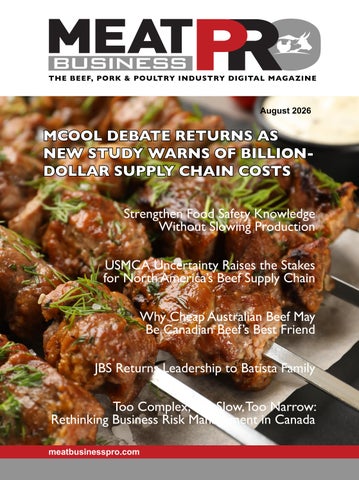
MCOOL DEBATE RETURNS AS NEW STUDY WARNS OF BILLIONDOLLAR SUPPLY CHAIN COSTS Strengthen Food Safety Knowledge Without Slowing Production USMCA Uncertainty Raises the Stakes for North America’s Beef Supply Chain Why Cheap Australian Beef May Be Canadian Beef’s Best Friend JBS Returns Leadership to Batista Family Too Complex, Too Slow, Too Narrow: Rethinking Business Risk Management in Canada meatbusinesspro.com
2
MEATBUSINESSPRO June 20264
meatbusinesspro.com
August 2026
5 6 9 12
Swine Innovation Porc Offers New Research in Action Video Series
mCOOL Debate Returns as New Study Warns of Billion-Dollar Supply Chain Costs Strengthen Food Safety Knowledge Without Slowing Production
USMCA Uncertainty Raises the Stakes for North America’s Beef Supply Chain
17 20 21 24
Why Cheap Australian Beef May Be Canadian Beef’s Best Friend
In Memoriam: Rosemary Mucklow (1932–2026)
JBS Returns Leadership to Batista Family
Too Complex, Too Slow, Too Narrow: Rethinking Business Risk Management in Canada
4
MEATBUSINESSPRO June 20264
https://www.yesgroup.ca meatbusinesspro.com
THE BEEF, PORK & POULTRY INDUSTRY DIGITAL MAGAZINE
August 2026 Volume 27 Number 8
PUBLISHER Ray Blumenfeld ray@meatbusinesspro.com CO-PUBLISHER Deb Wilson deborah@meatbusinesspro.com
SWINE INNOVATION PORC OFFERS NEW RESEARCH IN ACTION VIDEO SERIES
DIGITAL MEDIA EDITOR Cam Patterson cam@meatbusinesspro.com CONTRIBUTING WRITERS Sylvain Charlebois, Moira Wilson, Jack Roberts, Ray Benson CREATIVE DIRECTOR Patrick Cairns
Meat Business Pro is published 12 times a year by We Communications West Inc.
COMMUNICATIONS WEST INC.
We Communications West Inc. 106-530 Kenaston Boulevard Winnipeg, MB, Canada R3N 1Z4 Phone: 204.985.9502 Fax: 204.582.9800 E-mail: publishing@meatbusiness.com Website: www.meatbusinesspro.com Meat Business Pro subscriptions are available for $28.00/year or $46.00/two years and includes the annual Buyers Guide issue. ©2026 We Communications West Inc. All rights reserved. The contents of this publication may not be reproduced by any means in whole or in part, without prior written consent from the publisher.
Following the recent launch of the Pork Research Hub, Swine Innovation Porc (SIP) is expanding the Research in Action section with the debut of a new video series highlighting the researchers and projects behind Canada’s pork research. The Pork Research Hub is Canada’s bilingual online destination for pork research, bringing together practical resources, research findings and innovation stories in one searchable location. Its Research in Action section showcases how Canadian pork research is delivering real-world value through articles, videos, podcasts and other knowledge transfer resources. The first video in the series features Dr. Aline Remus, Research Scientist with Agriculture and Agri-Food Canada, whose Swine Cluster 4 research explores precision feeding systems that can reduce feed costs, lower greenhouse gas emissions and improve the sustainability of pig production. Each month, a new Research in Action video will introduce viewers to a different Swine Cluster 4 project, providing an inside look at the people, partnerships and innovations shaping the future of Canadian pork production. Episodes will be released on the Swine Innovation Porc YouTube channel, with French-language versions also available, and featured in the Research in Action section of the Pork Research Hub. “Research is only valuable if people can discover it, understand it and apply it,” said Daniel Ramage, General Manager of Swine Innovation Porc. “The Pork Research Hub was created to make Canadian pork research more accessible, and the Research in Action section brings that research to life. This video series is another way we’re showcasing the practical impact of Swine Cluster 4 and the researchers helping deliver solutions for producers.”
Printed in Canada. ISSN 1715-6726
Swine Cluster 4 is a five-year national research initiative led by Swine Innovation Porc that supports collaborative research addressing the Canadian pork sector’s most pressing challenges. As the Research in Action section continues to grow, new videos, articles, podcasts and other resources will continue to connect producers and industry with the latest Canadian pork research. Watch the first episode featuring Dr. Aline Remus:
https://porkresearchhub.ca/en/research-action/research-action-videoprecision-feeding-dr-aline-remus meatbusinesspro.com
June 2026 MEATBUSINESSPRO
5
MCOOL DEBATE RETURNS AS NEW STUDY WARNS OF BILLION-DOLLAR SUPPLY CHAIN COSTS Economic analysis says reinstating mandatory countryof-origin labeling for beef and pork would increase operating costs for producers, processors, retailers and consumers.
A renewed push to reinstate mandatory countryof-origin labeling for beef and pork is drawing fresh scrutiny from meat industry stakeholders after a new economic analysis concluded the policy would add more than $1 billion in annual costs across the U.S. meat supply chain. The study, conducted by Decision Innovation Solutions and released by the Meat Institute, evaluates the potential impact of returning to the 2013-style mandatory Country of Origin Labeling program, commonly known as mCOOL.
The findings underscore the operational complexity behind what may appear to be a straightforward consumer-labeling requirement. Mandatory origin labeling would require supply chain participants to maintain origin information from livestock sourcing through processing, packaging, distribution and retail. That would affect not only data systems and documentation, but also plant scheduling, inventory management and product handling. The burden would not be evenly distributed. The report identifies packers, processors and retailers as the businesses likely to face the greatest direct compliance requirements. These companies would need to track animal-origin data, keep certain products separate, modify labels, manage additional audits and retain records demonstrating compliance. Retail beef, in particular, is projected to face the highest compliance costs in the modeled supply chain. In one scenario, retail beef compliance costs could approach $488 million in the first year and exceed $5 billion over a decade.
According to the analysis, reinstating mCOOL would cost the beef and pork sectors approximately $1.02 billion in the first year alone, including $721 million for beef and $296 million for pork. As many of the expenses are tied to ongoing tracking, segregation, recordkeeping, labeling and verification activities, the study estimates cumulative costs would climb to $4.8 billion over five years and $10.1 billion over 10 years.
6
MEATBUSINESSPRO June 20264
meatbusinesspro.com
Ground beef presents one of the most difficult implementation challenges. The product often combines domestic beef trimmings with imported lean beef to achieve desired lean-to-fat ratios, making origin tracking more complex than for single-source cuts. Ground beef accounted for nearly half of U.S. beef consumption in 2025, magnifying the potential cost implications. The study estimates ground beef compliance costs alone could range from $202 million to $688 million annually, depending on the final labeling structure.
Consumers would also feel the impact. The study concludes that many compliance costs would ultimately move through the supply chain and show up in grocery prices. Researchers estimate consumers could pay roughly $835 million more per year for beef and $284 million more per year for pork, representing more than $1.1 billion in added annual food costs. That conclusion is especially notable in a period when many households remain sensitive to food-price inflation and retailers are closely watching demand elasticity.
VEMAG
REPLACEMENT PARTS
meatbusinesspro.com
Livestock producers would face a different set of pressures. While the 2013 framework may place fewer direct administrative costs on cattle and hog producers than earlier versions, the study says producers could still be affected by reduced market efficiency, tighter documentation obligations and less sourcing flexibility throughout the system. Previous USDA and industry analyses cited in the report suggest that mandatory labeling can create market disruptions that reduce livestock value while raising costs for downstream participants.
https://www.dhenryandsons.com https://www.
June 2026 MEATBUSINESSPRO
7
For B2B decision-makers, the study’s central message is that labeling policy has consequences far beyond the package. Mandatory origin rules would require investment in traceability, data management, inventory control, plant procedures and retail execution. Those requirements could ripple through procurement strategies, supplier relationships, production planning and merchandising decisions across both the beef and pork categories.
Meat Institute President and CEO Julie Anna Potts said the findings demonstrate that mCOOL would raise prices for consumers while adding costs at a difficult point in the cattle cycle. Beef packers are already facing margin pressure tied to the smallest U.S. cattle herd in decades and record-high cattle prices. The organization argues that reinstating a mandatory program could weaken demand at a time when consumer purchasing remains essential to keeping the beef sector moving.
Industry groups also point to the USDA’s voluntary “Product of USA” label as an alternative that allows companies to serve consumers seeking domestic-origin products without forcing a mandatory system across all market participants. Supporters of voluntary labeling say it gives brands and retailers flexibility to respond to consumer demand while avoiding broad compliance costs for products and buyers that may not place the same value on origin claims. 8
MEATBUSINESSPRO June 20264
The analysis does not argue that origin information lacks value to consumers. Rather, it questions whether mandatory labeling creates enough additional demand to justify its cost. The report found little evidence that compulsory beef and pork origin labels would meaningfully increase consumer purchases. Instead, it concludes the most measurable effects would be higher operating expenses, higher food prices and greater complexity across an already cost-sensitive supply chain.
As policymakers revisit country-of-origin labeling, the debate is likely to center on how to balance transparency, consumer choice and competitiveness. For meat companies, retailers and foodservice buyers, the potential return of mCOOL would not be simply a labeling change. It would be a major operating shift with implications for cost structure, sourcing flexibility and consumer pricing across two of the most important protein categories in the U.S. market. meatbusinesspro.com
STRENGTHEN FOOD SAFETY KNOWLEDGE WITHOUT SLOWING PRODUCTION In a busy meat processing environment, food safety is never a side project. It is built into every shift, every sanitation step, every record, every employee practice and every decision that affects product quality and consumer trust. Yet even the most committed teams face a familiar challenge: how do you keep food safety knowledge current when production schedules are full, staffing is tight and time away from the floor is limited?
Each webinar is approximately one hour long, which makes the library a practical option for a lunch-andlearn, team training session, onboarding refresher or professional development opportunity. For processors managing multiple priorities, this type of format matters. A one-hour session can fit into the workday while still giving employees access to expertled education on topics that support compliance, operational excellence and continuous improvement.
The Food Safety Excellence (FSE) Webinar Library, available through the Centre for Meat Innovation & Technology (CMIT), was created with that reality in mind. The FSE Program offers free, virtual learning opportunities designed specifically for busy meat processing teams, making it easier for owners, managers, quality assurance staff and production teams to strengthen their food safety knowledge without requiring significant time away from daily operations.
meatbusinesspro.com
Food safety expectations continue to evolve across the meat sector. Customers, regulators, retailers and consumers all expect processors to demonstrate strong controls, accurate documentation, effective employee training and a culture of prevention. For smaller and mid-sized operations, it can be difficult to keep pace with changing expectations while also managing day-today production demands. The FSE Webinar Library helps bridge that gap by providing accessible educational opportunities processors can use when and where it works best for their team. June 2026 MEATBUSINESSPRO
9
One starting point is the Food Safety Excellence SelfAssessment Tool. This quick, anonymous questionnaire helps processors receive a recommended next step to improve their food safety system that is based on their current operation and goals. For a business that is not sure where to begin, the FSE Tool can provide a practical entry point. For a more established processor, it may help identify the next opportunity to strengthen documentation, training, traceability, sanitation, preventive controls or other core elements of a food safety program.
The value of the FSE Library is its simplicity and there is no cost to access the sessions. Teams can learn from anywhere. The topics are built around the needs of processing operations, not generic training content. Because the sessions are virtual and concise, they can be used in a variety of ways: A supervisor may view a webinar to prepare for an internal discussion. A quality assurance team may use one as part of its ongoing training calendar. A plant manager may recommend a session to help employees better understand a specific food safety issue. For processors, that flexibility is important because food safety improvement rarely happens through one large change. It often comes from small, consistent actions such as tightening a procedure, improving a record, refreshing employee knowledge, identifying a gap before it becomes a problem, or helping staff understand why a particular control matters. The FSE Webinar Library supports that kind of incremental progress by making reliable learning available anytime.
CMIT also offers support from its food safety team to help processors navigate available resources and identify opportunities to improve. That support can be especially valuable when a company has limited internal capacity or is trying to determine which improvement activities will have the greatest impact. Access to knowledgeable guidance, including expertise from Baljit Kheeva from CMIT, helps make the program more than a collection of resources. It becomes a practical support system for processors working to build stronger, more resilient operations.
Just as important, the webinar library is part of a broader suite of free Food Safety Excellence resources available through CMIT. The FSE Program was developed to support meat processors on their path to continuous improvement, whether they are building a food safety system from the ground up, strengthening existing practices, preparing for new customer requirements, or exploring more formalized systems and certifications. 10
MEATBUSINESSPRO June 20264
meatbusinesspro.com
As the webinars are free, virtual and approximately one hour in length, there is a low barrier to getting started. A processor does not need to wait for a major training event or take a full day away from production. A team can select a relevant topic, schedule a short session and begin applying the learning immediately. Over time, those small investments in knowledge can contribute to stronger systems, better preparedness and a more proactive food safety culture.
Processors can also access a number of free templates and documents that support day-to-day food safety practices. These downloadable resources can assist with documentation, record-keeping, internal procedures and continuous improvement activities. For many operations, templates are especially useful because they help turn food safety goals into practical workplace systems. A well-designed form, checklist or procedure can make expectations clearer, support consistency across shifts and create better records for review and verification.
The Food Safety Excellence Program is designed to meet processors where they are. Whether an operation is reviewing the fundamentals, refreshing staff knowledge, improving documentation or planning its next stage of growth, CMIT’s free tools, resources and expert support can help identify practical next steps.
Together, these resources reflect an important reality for the meat industry: food safety excellence is not a destination that is reached once and checked off. It is an ongoing process of learning, applying, reviewing and improving. Strong programs depend on trained people, clear procedures, accurate records and a culture that understands the importance of prevention. The FSE Webinar Library gives processors an easy way to keep that learning active.
Use the quick and anonymous FSE Self-Assessment Tool today: https://lvvr10axwba.typeform.com/to/ Buo0V5OV?typeform-source=www.cmit.ca
The business case is clear. Strong food safety systems help protect consumers, support regulatory compliance, reduce risk, strengthen customer confidence and open doors to new market opportunities. For employees, regular training helps connect daily tasks to the larger purpose of producing safe, high-quality meat products. And for the operation as a whole, accessible learning can help build consistency and confidence across the team.
meatbusinesspro.com
For meat processors looking to strengthen food safety knowledge without slowing production, the message is simple, the support is available, the sessions are practical, and the next step can fit into the workday.
Food Safety Excellence tools and resources have been developed through funding provided by the Sustainable Canadian Agricultural Partnership (Sustainable CAP), a five-year, federal-provincial-territorial initiative.
June 2026 MEATBUSINESSPRO
11
USMCA UNCERTAINTY RAISES THE STAKES FOR NORTH AMERICA’S BEEF SUPPLY CHAIN For cattle producers, packers, distributors and foodservice buyers, tariff escalation is not a policy abstraction—it is a margin, pricing and supply-chain issue.
For the North American meat and beef sector, the future of the United States-Mexico-Canada Agreement (USMCA) is more than a trade-policy debate. It is a practical business question that touches cattle movement, feed and input costs, processing margins, cold-chain logistics, retail pricing and the competitiveness of beef in domestic and export markets. New analysis commissioned by the Canadian American Business Council and prepared by Oxford Economics shows how costly a breakdown in the US-Canada trade relationship could become. While the study examines the full economy, its findings are highly relevant to beef and meat businesses because the sector depends on integrated markets, predictable rules and efficient cross-border movement of goods, services and capital.
Over four decades, the United States and Canada have built one of the world’s most integrated commercial relationships. In 2024, bilateral trade reached US$917.3 billion, with roughly 1.4 million American jobs and 2.5 million Canadian jobs tied to that relationship. In agriculture and food manufacturing, that integration is particularly important. Livestock, meat, packaging, ingredients, equipment, transportation services and finished products all rely on a business environment in which companies can plan beyond the next shipment.
That predictability is now under pressure. The July 1, 2026 deadline to extend USMCA passed without renewal, leaving businesses facing annual reviews and a more uncertain tariff environment. Oxford Economics modeled three paths: a Status Quo scenario, in which higher tariffs remain on steel, aluminum, autos and some non-USMCA-compliant goods; a Successful Renegotiation scenario, in which the agreement is extended and most tariffs return close to pre-2025 levels; and a USMCA Breakdown scenario, in which the agreement ends and broad tariffs rise across most goods. Continued on page 14
12
MEATBUSINESSPRO June 20264
meatbusinesspro.com
meatbusinesspro.com
June 2026 MEATBUSINESSPRO
13
The inflation outlook is especially relevant for companies that operate on thin margins. Under a breakdown scenario, 2027 inflation rises to 2.4% in the United States and 2.6% in Canada, compared with 2.1% and 2.2% under the status quo. Even by 2035, consumer prices remain above the status quo path. For packers, processors, further processors, distributors and retailers, that means continued pressure on wage rates, utilities, freight, maintenance, packaging and financing costs. The difference between those scenarios is large. A full USMCA breakdown would cost the United States an estimated US$1.4 trillion in cumulative GDP and Canada C$523 billion over 10 years. Relative to the current elevated-tariff status quo, successful renegotiation would add US$432 billion to U.S. GDP and C$253 billion to Canadian GDP between 2026 and 2035. A breakdown would subtract US$1.0 trillion from the United States and C$271 billion from Canada over the same period.
The trade effects are equally concerning. If USMCA breaks down, exports are projected to fall 4.5% in the United States and 6.2% in Canada by 2035. While the report does not isolate beef alone, the implications for meat businesses are clear. Cross-border customers, suppliers and co-manufacturing partners depend on reliable market access. Any broad reduction in trade volume increases the risk of disrupted flows, higher compliance costs and less efficient allocation of cattle, boxed beef, processed meat and related inputs.
For beef industry leaders, the macroeconomic numbers translate into operational risk. Higher tariffs raise the cost of imported inputs and equipment, including metals used in processing facilities, refrigeration systems, trailers, plant maintenance and packaging lines. They also affect transportation and construction costs, which matter to processors expanding capacity, distributors investing in cold-chain infrastructure and retailers managing logistics networks.
Tariff pressure also reaches the customer. The study estimates that choosing successful renegotiation over breakdown would be worth about US$516 per U.S. household and C$846 per Canadian household per year. In meat departments and foodservice channels, household purchasing power matters. Beef is already a premium protein in many baskets and menus. If tariffs contribute to higher consumer prices and weaker disposable income, buyers may trade down, reduce portion sizes or shift protein mix, pressuring demand throughout the chain.
Employment impacts would add another layer of uncertainty. Successful renegotiation would create an additional 137,000 American jobs and 98,000 Canadian jobs in 2027 compared with the status quo. A breakdown would mean 214,000 fewer U.S. jobs and 102,000 fewer Canadian jobs. For meat plants and distribution networks already competing for skilled labour, mechanics, drivers, quality-assurance staff and frontline production workers, weaker labour markets and reduced investment could slow modernization and capacity planning. Continued on page 16
14
MEATBUSINESSPRO June 20264
meatbusinesspro.com
meatbusinesspro.com
June 2026 MEATBUSINESSPRO
https://www.cfib.ca
15
Companies should respond by stress-testing their exposure now. Procurement teams should review crossborder suppliers, tariff-sensitive inputs and contract language. Processors should model the effect of higher costs on plant investments, maintenance schedules and margin recovery. Sales teams should prepare customers for possible price volatility, while industry associations should make the case that rules-based trade supports food affordability, rural employment and North American competitiveness.
Regional exposure also matters. In the United States, manufacturing-heavy states such as Indiana, Michigan, Texas, Arizona, Washington and Alabama are among the most affected by tariff escalation. In Canada, Ontario and Quebec face the largest gains or losses, while Manitoba and New Brunswick are also disproportionately exposed because of their manufacturing intensity. These regions are important to meat industry logistics, packaging, equipment, retail distribution and broader food manufacturing ecosystems.
For the meat and beef supply chain, a strong USMCA is not simply a diplomatic preference. It is part of the operating infrastructure that keeps cattle, beef products, inputs and equipment moving efficiently. In a sector where cents per pound matter, predictability may be one of the most valuable commodities of all. dustry for all Canadians. fcc.ca
Perhaps the most important finding is that higher tariffs do not deliver the manufacturing gains they are often meant to produce. Because U.S. and Canadian production networks are complementary, tariffs raise costs on both sides of the border and make North American industries less competitive globally. For beef and meat companies, the lesson is straightforward: costlier inputs, weaker demand and less predictable trade rules make it harder to invest, innovate and serve customers efficiently. 16
MEATBUSINESSPRO June 20264
meatbusinesspro.com
WHY CHEAP AUSTRALIAN BEEF MAY BE CANADIAN BEEF’S BEST FRIENDS By Dr. Sylvain Charlebois, Agri-Food Analytics Lab, Dalhousie University Cheap Australian beef is keeping Canadians at the meat counter until Canadian beef becomes affordable again. Insert graphic here At first glance, the presence of inexpensive Australian beef in Canadian grocery stores seems absurd. How can beef raised thousands of kilometres away, shipped across the Pacific and distributed through Canada sell for substantially less than beef produced in Alberta?
Canadian beef prices have reached levels that many households simply cannot absorb. Ground beef, once considered an economical protein, has become increasingly expensive. Premium steaks are now beyond the reach of many middle-income families except for special occasions. Faced with these prices, consumers do not merely purchase less-expensive cuts. They migrate toward chicken, pork, fish or other alternatives.
Recent comparisons circulating online have shown Australian striploin selling for approximately $24 per kilogram while a Canadian alternative was priced above $50. Understandably, Canadian cattle producers and consumers are asking how this is possible. But inexpensive Australian beef may not be the threat to Canadian beef that many assume. For a limited period, it could actually help protect the domestic industry’s most valuable long-term asset: the Canadian beef consumer.
meatbusinesspro.com
June 2026 MEATBUSINESSPRO
17
Australia, meanwhile, has a highly export-oriented beef industry, a climate that permits longer grazing seasons and efficient access to international markets. Under the Comprehensive and Progressive Agreement for Trans-Pacific Partnership, Australian beef also enjoys favourable access to Canada. Despite the distance involved, refrigerated ocean freight adds surprisingly little to the cost of each kilogram when spread across an entire container.
THAT SUBSTITUTION CAN BECOME PERMANENT. Food consumption is largely habitual. When families stop preparing beef regularly, they develop new recipes, shopping routines and preferences. Restaurants change menus. Retailers reduce shelf space. Over time, a temporary supply shortage can cause lasting demand destruction. This is where Australian beef can play a surprisingly constructive role. By offering a more affordable entry point, imported beef keeps consumers engaged with the category. They continue visiting the meat counter, preparing steaks and roasts, purchasing ground beef and treating beef as part of their regular diet. In economic terms, Australian beef can function as a bridge until Canadian production recovers.
None of this means the products are necessarily identical. Canada and Australia use different grading systems. Canadian AAA beef is typically grain-finished and more heavily marbled, while much Australian beef is grass-fed and leaner. An Australian striploin marked at $24 per kilogram should not automatically be considered equivalent to Canadian AAA striploin selling for $52.
Canada’s cattle herd contracted for years and cannot be rebuilt quickly. Even when producers begin retaining more heifers, several years are required before those decisions generate significant additional beef supplies. Canadian consumers cannot reasonably be expected to wait indefinitely while paying historically high prices.
Country of origin, grade, feeding method and whether the product was previously frozen should therefore be clearly disclosed. Consumers deserve enough information to understand what they are comparing.
18
MEATBUSINESSPRO June 20264
meatbusinesspro.com
Imports can also introduce some useful competitive tension into the processing and retail sectors. The price paid to cattle producers explains only part of the final shelf price. Processing capacity, labour, transportation, wholesale negotiations, retail strategies and margins all influence what consumers ultimately pay. A credible imported alternative can place pressure on every participant in that chain to justify costs and improve efficiency. Canadian cattle producers should not be expected to sell below their costs, nor should Canada become permanently dependent on imported beef. The objective must remain a larger, more productive and resilient domestic cattle industry.
Nevertheless, the quality distinction does not invalidate the broader economic argument. A family deciding between affordable Australian beef and abandoning beef altogether is not necessarily taking a sale away from a Canadian producer. At current prices, that household may no longer be a realistic buyer of Canadian beef.
But protection from competition is not the same as protection from consumer abandonment. The imported product may instead preserve that household as a future customer. Canadian beef also retains significant competitive advantages. It enjoys strong domestic recognition, established quality standards and considerable consumer loyalty. When Canadian supplies improve and prices moderate, many consumers will likely return to Canadian beef—provided they have not already abandoned the category.
meatbusinesspro.com
If Australian beef keeps Canadians buying beef during an exceptional period of domestic scarcity, it may support rather than undermine the Canadian industry. The real danger is not that consumers temporarily purchase Australian beef. It is that persistently high Canadian prices drive an entire generation of consumers away from the beef counter. Sometimes an imported competitor does more than take market share. It keeps the market alive.
June 2026 MEATBUSINESSPRO
19
IN MEMORIAM: ROSEMARY MUCKLOW (1932–2026) Rosemary Mucklow, whose more than five decades of leadership helped shape the modern American meat industry, died on July 21, 2026. She was 94.
In 1982, the PCMA merged with the Western States Meat Packers Association to form the National Meat Association (NMA), and Mucklow was named executive director — a position she held for 25 years, until 2007. Under her leadership, NMA became a leading voice for meat packers and processors on regulatory and business issues in Washington and beyond. When NMA later merged with the American Meat Institute to form the North American Meat Institute (NAMI), Mucklow continued her association with the industry as NAMI's Director Emeritus and a consultant, a role she held into her final years — capping a career that spanned more than 55 years in the meat business.
Mucklow was born June 7, 1932, in Edinburgh, Scotland, the daughter of John William and Winifred Margaret Mucklow. Before coming to the United States, she worked in London as a nanny — where her sister, Margaret, served as a secretary to Winston Churchill, a connection Mucklow liked to invoke decades later in her own remarks to the industry. She emigrated to the U.S. in 1959 and became a naturalized citizen in 1968. She went on to earn her bachelor's degree, cum laude, from Golden Gate University in 1970. Mucklow's career in the meat industry began almost by accident. In 1961, she was hired as a stenographer at a small San Francisco trade group, the Pacific Coast Meat Jobbers Association — later renamed the Pacific Coast Meat Association (PCMA). By her own account, she arrived knowing nothing about the meat business or the sweeping changes about to remake it. She would go on to lead that organization as its executive director for the next two decades, guiding it through the era of the "Big Five" packers and the aftermath of the Wholesome Meat Act.
20
MEATBUSINESSPRO June 20264
Mucklow was widely respected for her sharp institutional memory, her plainspoken wit, and her willingness to challenge policymakers on behalf of the industry she served. She was known for colorful, incisive analogies when arguing for risk-based food-safety policy, and for a work ethic that colleagues frequently described as tireless.
meatbusinesspro.com
Beyond her trade association work, Mucklow served on the U.S. Department of Agriculture's meat and poultry advisory committee, and as a trustee of the California Butchers Pension Trust and the Northern California Health Trust. She also served on the board of directors of the Peralta Cancer Research Institute in Oakland.
Her contributions were recognized widely across the industry. In 1996 Rosemary received the E. Floyd Forbes award presented by the National Meat Association in recognition of her outstanding services to the meat industry. In 2015, the U.S. Meat Export Federation honored her with its Mansfield Award, given in recognition of individuals who champion U.S.-Japan trade ties, for her decades of work helping place American meat on international markets. She was later named to the Meat Industry Hall of Fame's Senior Board of Trustees, where she continued to help select new inductees and safeguard the industry's history for the next generation.
Reflecting on her career in 2016, Mucklow paraphrased Winston Churchill's wartime appeal for American support — "Give us the tools and we will finish the job" — to describe the partnership between the U.S. meat industry and the organizations, like USMEF, that helped open markets abroad. It was a fitting summary of how she saw her own decades of work: not as a solitary achievement, but as decades spent equipping an industry to do its job well.
Her passion for the next generation of meat industry leaders helped to create a scholarship foundation. She was active as a member of the Meat Foundation’s Board and has a scholarship in her honor.
meatbusinesspro.com
June 2026 MEATBUSINESSPRO
21
JBS RETURNS LEADERSHIP TO BATISTA FAMILY Wesley Batista Filho’s appointment signals continuity at the world’s largest meatpacker while putting renewed attention on growth, governance and global diversification.
JBS framed the leadership change as part of a planned succession process and emphasized continuity rather than a strategic reset. Batista Filho said the company would continue pursuing diversification across proteins and geographies, while maintaining priorities around customers, producer partners, operational execution and long-term shareholder value. Tomazoni also endorsed the appointment, citing Batista Filho’s understanding of the business, culture and people after more than a decade working alongside him.
JBS is preparing for a generational leadership shift that will return day-to-day control of the world’s largest meatpacker to Brazil’s Batista family. Wesley Batista Filho, 34, grandson of founder José Batista Sobrinho and son of former chief executive Wesley Batista, will become global CEO in January. He will succeed Gilberto Tomazoni, who has led the São Paulo-based company since 2018 and will move into the role of vice-chairman and senior adviser during the transition. For beef and broader animal protein markets, the appointment matters because JBS’s scale gives it influence across cattle procurement, processing capacity, retail supply chains and international trade flows. Batista Filho currently leads JBS USA, the company’s largest business by sales, and has worked across several of the group’s major operating units since joining the company in 2011. His résumé includes leadership roles in Canada, Brazil and Seara, the company’s poultry, prepared foods and alternativeprotein platform. 22
MEATBUSINESSPRO June 20264
The transition comes at a moment when JBS is balancing growth ambitions with pressure on earnings. Alongside the succession announcement, the company reported a second-quarter net loss of $102 million, even as revenue rose 14% to $23.9 billion. Profitability indicators also softened, with EBITDA, operating income and earnings per share declining from the prior year. Investors reacted cautiously: JBS shares on the New York Stock Exchange fell nearly 6% following the announcement. meatbusinesspro.com
The return of a Batista family member to the CEO role also revives scrutiny of governance. Tomazoni became the first non-family executive to lead JBS after Wesley and Joesley Batista were drawn into corruption and insider-trading investigations in Brazil. The brothers remain influential controlling shareholders through J&F Investimentos, the family holding company with interests in sectors ranging from finance and mining to energy and consumer goods.
For industry observers, the key question is how Batista Filho will steer JBS through a complex global protein cycle. In North America, beef processors continue to navigate tight cattle supplies, volatile live cattle markets and margin pressure. At the same time, global demand for protein remains resilient, and companies with diversified exposure to poultry, pork, value-added foods and emerging markets may be better positioned to absorb regional shocks.
Southeast Asia is already emerging as a major focus. JBS recently announced that Indonesian sovereign wealth fund Danantara would invest $2.5 billion for a 25% stake in a joint venture covering Southeast Asia, Australia and New Zealand. Batista Filho has described the region as a new geographic frontier, reflecting the company’s view that rising incomes, urbanization and changing diets will continue to support long-term protein consumption.
meatbusinesspro.com
Environmental scrutiny will also remain part of the company’s operating landscape. JBS has faced criticism from campaigners over the environmental impact of its supply chains, particularly in Brazil. Tomazoni has defended the company’s sustainability record, but investors, customers and regulators are likely to continue pressing large protein companies for stronger traceability, lower emissions and clearer deforestation controls.
For beef-sector suppliers and customers, the practical takeaway is that JBS is signaling stability at the top while keeping its expansion agenda intact. Batista Filho inherits a company with unmatched global reach, but also one facing cyclical margin pressure, sustainability demands and renewed governance attention. His first year as CEO will be watched closely for evidence that the next generation of Batista leadership can deliver both growth and discipline in an increasingly demanding global meat market.
June 2026 MEATBUSINESSPRO
23
TOO COMPLEX, TOO SLOW, TOO NARROW: RETHINKING BUSINESS RISK MANAGEMENT IN CANADA Trade disruptions, extreme weather, and rising costs have given Canada's business risk management (BRM) programs every opportunity to prove their worth in recent years. However, many agri-businesses have found the programs too complex, slow, and poorly designed to help when it matters. When farmers’ livelihoods are on the line, BRM programs cannot afford to fail. On paper, the system has potential. Each program is meant to address a different form of financial hardship: AgriInvest is a self-managed, producer-government savings account for cushioning small income declines; AgriStability provides payments to combat large income declines; the Advance Payments Program grants low-cost cash advances for short-term crises; and AgriInsurance is a cost-shared program that protects income against challenges such as disease and natural disasters. Together, these programs are meant to form a comprehensive financial safety net for Canadian agribusinesses.
In practice, small- and medium-sized enterprises (SMEs) experience extreme difficulty accessing these services. In early 2026, when the Canadian Federation of Independent Business (CFIB) surveyed agri-businesses about their experiences with BRM programs, more than half (53%) said the programs are poorly designed, compared to only 33% who called them well-designed When asked further, three problems came up again and again: administrative burden, slow and unpredictable support, and eligibility gaps. Figure 1: Agri-businesses identify red tape, delays, and design flaws across BRM programs The paperwork and application processes are time-consuming BRM programs provide sufficient financial relief for our business The payments are delivered in a timely manner
BRM programs are well designed Strongly agree
Somewhat agree
33%
39%
15%
7%
43%
16%
12%
34%
26%
29%
Don't know/Unsure
16%
31%
Somewhat disagree
22%
9%
13%
19%
9%
22% Strongly disagree
Source: CFIB, Agriculture Survey, February 11-April 17, 2026, n=133. Question: Overall, thinking about your experiences with BRM programs in general, please indicate the extent to which you agree or disagree with the following statements.
The most common frustration is paperwork. Rather than trying to reduce red tape, BRM programs add to it. Nearly three-quarters (72%) of agri-businesses say the BRM applications and reporting requirements are complex and time-consuming. Larger operations can often absorb this with dedicated administrative staff. Smaller producers face a harder choice, making a productivity-limiting decision between spending their time on paperwork or core operations. To manage this constraint, small agri-businesses often rely on external services to navigate BRM applications – adding costs to a process meant to provide financial relief. As one livestock farmer from British Columbia put it, "We tried AgriStability, but the benefits appeared to barely cover the administration costs for paid staff to complete records. AgriInvest has been much the same."
24
MEATBUSINESSPRO June 20264
meatbusinesspro.com
Even AgriInvest, the most widely used BRM program, draws criticism. The government’s matched contributions are taxed as income on withdrawal and must be used up before farmers can access their own tax-free savings. For many, this reduces the program's value and creates a trade-off between investing in their business and raising their tax burden.
However, getting through the application process is only half of the battle. For many agri-businesses, the speed and value of BRM payments is uncertain. Less than half (46%) agreed that payments are delivered in a timely manner, with some business owners waiting over a year for support to arrive. Others described receiving less than expected or struggling to understand how payment is calculated. For many producers, the time and expense required to apply can be difficult to justify, and participation remains low as a result. While AgriInvest and AgriStability were used by a majority of respondents over the past three years, participation in other BRM programs was much lower. Figure 2: Satisfaction varies across BRM programs AgriInvest
25%
AgriStability
7%
20%
AgriInsurance
9%
14%
Advance Payments Program
8%
11%
29%
11%
4%
9%
7%
9%
9%
45%
14%
13%
29%
56%
Producers also feel that current eligibility rules fail to support farms with atypical structures, such as mixed farms or agri-businesses that simultaneously produce both supply-managed and non-managed goods. AgriStability's whole-farm approach draws particular criticism as eligibility is based on overall farm performance. Mixed farms experiencing significant losses in one portion of operations may not qualify for support if another portion performs well. As a result, critics point out that the current program design favours large monocropping operations over diversified ones. Inconsistencies in how commodities are treated add to this frustration. One livestock producer explained that they received assistance for their heifers but not their dairy cows during a drought, despite both parts of the operation being affected by the same conditions. Unfortunately for small operators, BRM programs often create more frustration than support. Thankfully, the policy changes needed to make the programs more effective for SMEs would make the industry stronger overall. That’s why CFIB is calling for simpler applications, clearer timelines, more transparent payment calculations, and a reduced tax burden to help more businesses use these programs effectively.
66%
Used and very satisfied
Used and somewhat satisfied
Used and somewhat dissatisfied
Used and very dissatisfied
Don’t know/Unsure
Have not used
Source: CFIB, Agriculture Survey, February 11-April 17, 2026, n=175-197 (response varies by program). Question: Which of the following BRM programs has your business used in the past three years, and how satisfied were you with your experience?
The dissatisfaction with program red tape reflects a broader issue in agriculture – one which contributes to both high rates of professional burnout and declining entrepreneurship. CFIB’s 2024 Regulation and Paperburden Survey found that nearly all agri-business owners (95%) reported stress related to regulatory requirements, and over two-thirds (68%) said they would discourage young people from entering the industry due to the level of red tape. If policymakers want BRM programs to have a future, they need to reckon with the toll this is taking on the people the programs are meant to serve.
meatbusinesspro.com
Moira Wilson is a Public Policy and Advocacy Intern for the Canadian Federation of Independent Business (CFIB). CFIB is Canada’s largest association of small and medium-sized businesses with 103,000 members (6,000 agri-business members) across every industry and region. CFIB is dedicated to increasing business owners’ chances of success by driving policy change at all levels of government, providing expert advice and tools, and negotiating exclusive savings. Learn more about CFIB and its work to support agri-businesses at Get Growing.
June 2026 MEATBUSINESSPRO
25
26
MEATBUSINESSPRO June 20264
meatbusinesspro.com