
Learning About Lymphedema
Tips for Talking to Your Patient Insights for Health Care Professionals from an Occupational Therapy Perspective*
Lymphedema is a progressive, chronic inflammatory condition that can affect any area of the body, most commonly the limbs
Early diagnosis and adequate management are important.
Know Your Local Referral Pathways

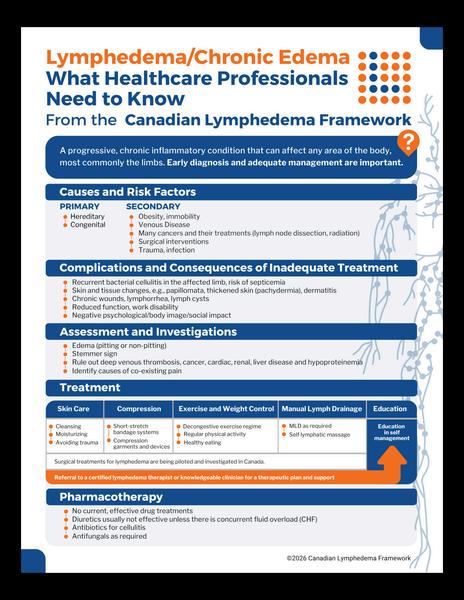
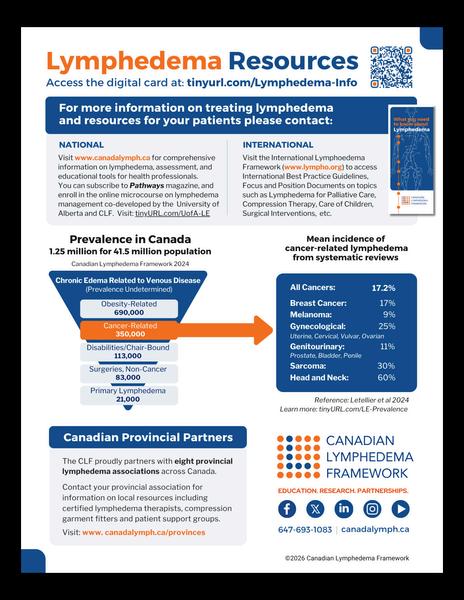
Read the CLF’s resource on Lymphedema/Chronic Edema What Health Care Professionals Need to Know to learn more:
www.tinyurl.com/CLF-EdMaterials
Early referral can help patients access education, assessment, compression, and appropriate interdisciplinary care. Know where to direct patients locally, including lymphedema clinics or programs, certified lymphedema therapists, compression garment fitters, provincial lymphedema associations, and Canadian Lymphedema Framework (CLF) resources.
Start with Validation and Early Recognition
Validating patient concerns and using empathetic communication can build trust, support engagement, and improve patients’ confidence with lymphedema self-management.
Acknowledge early symptoms, such as heaviness, tightness, mild swelling, or changes in fit or function
Take early concerns seriously lymphedema is chronic and progressive, and timely recognition can support earlier referral and management
Use validating language
“I am glad you brought this up.”
“That sounds important. Let’s take a closer look together.”
Many people with lymphedema experience delays in recognition and care; earlier attention can help reduce progression and support better physical, functional, and emotional outcomes
Use a Patient-Centred, Occupational Lens
Move beyond physical symptoms to understand the impact of lymphedema on daily life:
Ask:
‘How is this affecting your day-to-day activities?”
“Are there things you’ve stopped or find harder to do?”
Explore:
Self-care (e g dressing, hygiene)
Productivity (work, school, caregiving)
Leisure (exercise, social participation)
Consider environmental and contextual factors (e g job demands, climate, access to care)
Lymphedema care should look beyond swelling alone to consider how symptoms affect daily activities, routines, roles, work, relationships, and quality of life
Support Self-Management and Shared Decision-Making
Focus on “how to live with lymphedema,” not just “how to treat it“.
Collaborate on realistic, meaningful strategies:
Compression use within daily routines
Activity pacing and energy conservation
Skin care and infection prevention
Tailor recommendations to the person’s lifestyle and priorities
Ask:
“What feels manageable to you right now?”
“What are your goals?”
Self-management strategies are more sustainable when they fit realistically within a person’s daily routines, priorities, goals, and lifestyle
Address the Psychosocial Impact
Normalize emotional responses (frustration, anxiety, body image concerns)
Ask directly:
“How has this been affecting you emotionally?”
Recognize the stigma and invisibility of the condition
Lymphedema commonly affects confidence, body image, relationships, participation, and quality of life, yet these emotional impacts may not always be discussed in clinical care
Use Clear, Supportive Communication
Use plain language and explain unfamiliar terms.
Share information in small, manageable steps.
Provide written instructions or trusted resources when possible.
Confirm understanding in a supportive way (“teach back”):
“Just to make sure I explained that clearly, can you tell me how you’ll manage this at home?
Clear, supportive communication can help patients feel informed, confident, and better able to manage care at home
Faciliate Access to Interdisciplinary Care
Refer appropriately to other professionals: Certified Lymphedema Therapists
Occupational therapy for function/adaptation
Physiotherapy for movement/exercise
Local support groups and networks
Provide information about community resources and financial supports. Develop an information package to give to patients that is specific to your location
Interdisciplinary care can support better outcomes and quality of life, but patients may need help identifying and accessing available lymphedema resources and services

To