PM #40009439 Return undeliverable Canadian addresses to: Suite 202, 2400 Bevan Ave., Sidney BC, V8L 1W1
centurymile.com
centurydowns.com
WHO WILL BE CROWNED CHAMPION?
Join us in Toronto this November to see world-class athletes take centre stage at the 97th annual Royal Agricultural Winter Fair. Don’t miss the finest show jumping, indoor eventing, dressage, heavy horses and the return of the majestic RCMP Musical Ride on opening weekend. The Royal features one million square feet of shopping, entertainment, fine dining, and agricultural competition as well as the Ontario Toyota Dealers Rodeo and the K9-Equine Challenge featuring the President’s Choice® SuperDogs. Book your trip today!
Buy your tickets today at royalfair.org EXHIBITION PLACE, TORONTO SPONSORED IN PART BY:
R O YA L FA I R .O R G
AUTUMN 2019
56
9
39
46
9 Rider Prejudice Against Mares
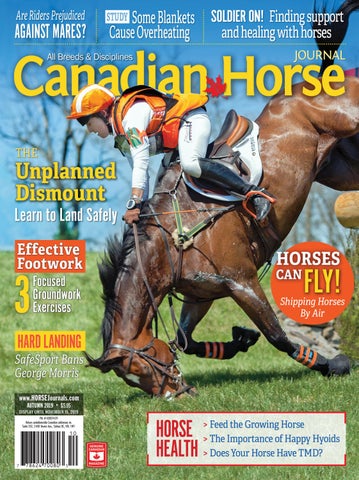
46 The Unplanned Dismount
10 To Blanket or Not?
56 Effective Footwork
Recent research reveals negative attitudes towards the equine fairer sex.
Certain blanket types could be causing horses to overheat.
Canadian Armed Forces members and veterans saddle up and find healing with the RCMP.
39 Horses Above the Clouds
Horses can fly! An inside look at the business of shipping horses by air.
4
www.HORSE Journals.com
::
AUTUMN 2019
Learn how to reduce the risk of injury when the inevitable happens.
Try these focused groundwork exercises to improve your horse’s body symmetry, posture, and core muscles.
60 Hard Landing
George Morris receives a lifetime ban from SafeSport. What does it mean?
||||||||||||||||||||||||||||||||
12 Soldier On!
PHOTOS
SPECIAL FEATURES
9 Shutterstock/Best Animal Photos | 39 Photo: Overseas Horse Transport | 46 Photo: Alamy/Telephoto Images | 56 Illustration: Canadian Horse Journal
b IN THIS ISSUE
ON THE COVER Sharon White and Rafferty’s Rules take a fall at the Rolex Kentucky Three-Day Event. Fortunately, horse and rider were not seriously injured. PHOTO: CLIX PHOTOGRAPHY
AUTUMN 2019
22
12
16 HORSE HEALTH
60 DEPARTMENTS
16 Feed the Growing Horse
How to meet your youngster’s nutritional needs for maintenance, growth and development.
22 Does Your Horse Have TMD?
Head tossing, bit resistance, baffling behaviour. Could a disease of the temporomandibular joint be causing these symptoms?
30 Happy Hyoids!
A close look at the anatomy and function of the equine hyoid apparatus and the far-reaching impact of an unhappy hyoid.
8 Editorial 55 To Subscribe 66 Horse Council BC News 69-71 Country Homes & Acreages 72 Celebration of Horses Photo Contest
73 Manitoba Horse Council News 74 Canadian Therapeutic Riding Association News
75 Index to Advertisers 76 Roundup 6
www.HORSE Journals.com
::
AUTUMN 2019
PHOTOS 12 Photo: Serge Gouin, RCMP | 16 Photo: Shutterstock/NigelBaker Photography | 22 Photo: Shutterstock/Sharon Morris | 60 Photo: Robin Duncan Photography
b IN THIS ISSUE
EDITOR’S DESK
b
The Unplanned Dismount When you fall off the horse, get right back in the saddle. This is a metaphor for life, not really applicable to horseback riding without numerous caveats attached. You’re not a real horse rider until you’ve fallen off seven times. If you’re like me and not quite up to seven crash landings after riding for decades, we can look forward to becoming real riders one day. It’s not enough for a man to know how to ride, he must know how to fall. – Mexican Proverb As Goldilocks would say, this one is JUST RIGHT. We’ve all been there. It’s not something we plan on, but no amount of positive thinking will prevent it from happening. The results of unexpectedly parting company with our horse can range from little more than a bruise or two (on the body and the ego), to having the wind knocked out of you, to suffering a concussion and breaking bones… or worse. If falling is an evitable part of the risk sport of riding, and safety when riding should not be left to chance, then fall safety training should be taught as a regular part of riding lessons. With the focus on safety in all major sports, and the compulsory use of helmets to protect heads in most equestrian activities, wouldn’t it make sense to teach learning-to-fall as a prerequisite to learning to ride? Riders of all ages should learn how to respond to a fall to reduce their risk of injury. In our website poll we asked the following question, and the answers are eye-opening: Q: Riding is a risk sport. Have you ever had a riding accident where you parted company with your horse? For example, fell off your horse, or the horse fell on you? Respondents who answered yes were asked to describe their injuries. Of the 95 percent who answered yes, 19 percent were not injured; 34 percent suffered minor injuries and resumed riding within a few days; 33 percent suffered serious injuries and were not able to ride for several weeks or months; 7 percent suffered major injuries and were not able to ride for more than a year; and 2 percent lost their nerve and have never ridden again. Only 5 percent stated they have never parted company with their horse. “If fall safety training saves just a small number of riders from catastrophic injury outcomes, it’s worth training every rider on the planet.” – Lindsay Nylund, Horse Rider Fall Safety Training. Kathy Smith
MAILBAG In the Matter of Fairness (Early Summer 2019 issue) I find it very hard to fathom that anyone like Jessica McNutt could be punished for her efforts to support Dalhousie University’s equestrian program. Stripping Jessica of her amateur position in Equestrian Canada and punishing her further by imposing a fine and demanding she return all her prizes and awards is an outrage. This shameful demonstration of ill will and vindictiveness makes me ashamed to be a Canadian. I am deeply saddened that the letter of the law would be applied with such a complete lack of humanity. Patri Janyk 8
www.HORSE Journals.com
Your Horse b Your Passion b Your Magazine Published by Horse Community Journals Inc.
Volume 20 • Issue 1 Autumn 2019 Issue (Sept/Oct) of Canadian Horse Journal EDITOR / PUBLISHER Kathy Smith ACCOUNTS Chantal Patterson
ADVERTISING April D. Ray • Terry Andrucko • Janna Reimer SOCIAL MEDIA April D. Ray SUBSCRIPTIONS Steve Smith ADMINISTRATIVE COORDINATOR Nathan Reimer MARKETING Janna Reimer ART DIRECTION, PRODUCTION Elisa Crees CONTRIBUTORS Margaret Evans • Tania Millen • Shawn Hamilton April D. Ray • Jec Ballou • Shelagh Niblock • Jonathan Field Alexa Linton • Equine Guelph • WCVM HCBC • MHC • CanTRA ADVERTISING, SUBSCRIPTIONS & GENERAL INQUIRIES 1-800-299-3799 • 250-655-8883 or email: sales@horsejournals.com ADVERTISING DEADLINE 4 weeks prior to issue date e.g., Oct.1 for Winter (Nov/Dec) issue. ONLINE EDITION
WEBSITE www.horsejournals.com MAIN OFFICE EMAIL editor@horsejournals.com PRODUCTION DEPARTMENT EMAIL design@horsejournals.com
Publishing 6 issues per year SUBSCRIPTIONS – REGULAR RATES 1 yr/6 issues: $24 + tax 2 yr/12 issues: $37 + tax US $59/2 yrs, 12 issues ORDERS FOR SUBSCRIPTIONS, CHANGE OF ADDRESS NOTICES, & UNDELIVERABLE COPIES ARE TO BE SENT TO: THE CANADIAN HORSE JOURNAL Suite 202, 2400 Bevan Ave., Sidney, BC V8L 1W1 (250) 655-8883 • fax: (250) 655-8913 • 1-800-299-3799 POSTAGE PAID AT WINNIPEG, MB PUBLICATIONS MAIL REG. NO. 40009439 GST REG. NO. 829298140 ISSN. NO. 1496-1733
We acknowledge the financial support of the Government of Canada.
REPRODUCTION IN WHOLE OR IN PART OF ANY MATERIAL CONTAINED IN THIS PUBLICATION WITHOUT THE WRITTEN PERMISSION OF THE PUBLISHER IS STRICTLY PROHIBITED. The information and services listed herein are intended to facilitate accessibility to the professionals, products and services that play a part in the horse industry. While readers are encouraged to use the products and services of the merchants listed in this Guide, Horse Community Journals Inc. does not recommend or guarantee the products and services of advertisers or associates listed. Manuscripts and photographs will be returned only if SASE is provided. The return of unsolicited material is not guaranteed. Contributors and advertisers warrant all materials supplied are free of copyright and they have the legal right to use the same. All material accepted for publication is subject to such revisions as are deemed appropriate by Canadian Horse Journal (CHJ). The opinions expressed in CHJ are not necessarily those of the publisher. CHJ reserves the right to refuse any advertising or submission. Contributors consent to have their submissions published in CHJ and on www.HorseJournals.com and elsewhere as determined by the publisher. Printed in Canada. Please recycle.
::
AUTUMN 2019
IIIIIII
RESEARCH
IIIIIIIIIIIIIIIIIIIIIIIIIIIIIIIIIIIIIIIIIIIIIIIIIIIIIIIIIIIIIIIIIIIIIIIIIIIIIIIIIIIIIIIIIIIIIIIIIIIIIIIIIIIIIIIIIIIIIIII
PHOTO: SHUTTERSTOCK/BEST ANIMAL PHOTOS
Rider Prejudice Against Mares Recent research has revealed negative attitudes towards mares. BY MARK ANDREWS Stallions have often been considered difficult or dangerous, but now it seems that mares are being tarred with the same brush. A study into riders’ perceptions of horse temperament and suitability for ridden work, based on horse sex, found that mares are also seen as “bossy” or “unreliable.” The research, published in the scientific journal PLOS ONE, has found horse riders are applying human gender stereotypes to horses — a form of anthropomorphism — which could lead them to overlook the merits of mares and fillies. Lead author Kate Fenner, a Ph.D. student in the Sydney School of Veterinary Science, expressed concern that this gender bias against mares could also jeopardize their welfare. “When riders assume their horses are being ‘bossy,’ ‘difficult,’ ‘flighty,’ or ‘unwilling,’ they may be more likely to punish or correct them as a result,” she says. “A mare disobeying a rider’s
signal could be interpreted as the horse having a ‘bad attitude’ and be met with punishment. However, when a gelding, thought to be reliable and easygoing, disobeys the same signal, the rider may be more likely to conclude that the horse had not understood the signal, and work to establish the signal-response pattern with the horse using reinforcement.” The research shows that both mares and stallions are considered bossy or difficult, but most leisure riders don’t ride stallions because of an existing belief that they may be dangerous. The study surveyed 1,233 people, of whom 94 percent were women and 75 percent were horse riders with at least eight years’ experience. The predominance of women in the study is representative of the riding population in Australia, says senior author Professor Paul McGreevy of the Sydney School of Veterinary Science. The questionnaire asked
respondents to allocate three hypothetical horses (a mare, a gelding, and a stallion) to four riders: a woman, a man, a girl, and a boy. Riders were described as equally capable of riding each horse and each horse was described as suitable for all riders. Participants were significantly more likely to allocate the stallion to the man and nearly 50 percent of respondents did not allocate a horse to the boy, even though they ranked rider gender as the least important factor in their choice. They were also asked which horses (mares, geldings, or stallions) were most suitable for the three equestrian disciplines of show jumping, dressage and trail riding. They overwhelmingly chose geldings for trail riding, with mares being least preferred for both dressage and show jumping. When given the choice of a mare, gelding, or stallion to ride, more than 70 percent of respondents chose the gelding,
despite being told all the horses in the scenario were competent for a specific task. Professor McGreevy believes the gender stereotyping is based on folklore and could ultimately be a self-fulfilling prophecy. “If you’ve grown up believing that mares are moody or fiery or difficult, you will tend to approach them accordingly and ride them differently, [and] then the horses themselves will respond differently,” says Professor McGreevy. “This kind of prejudice against females is a bit like the traditional bias against horses with chestnut (ginger) hair. Many riders believe a chestnut mare is inherently stroppy or more fiery, and there is no evidence for this.” Professor McGreevy says the prejudice underlines the need for the upcoming global survey of horse behaviour from the University of Sydney, due to be launched soon. Printed with permission from Mark Andrews, Equine Science Update.
AUTUMN 2019
::
CANADIAN HORSE JOURNAL
9
RESEARCH
IIIIIIIIIIIIIIIIIIIIIIIIIIIIIIIIIIIIIIIIIIIIIIIIIIIIIIIIIIIIIIIIIIIIIIIIIIIIIIIIIIIIIIIIIIIIIIIIIIIIIIIIIIIIIIIIIIIIIIIIIIIIIII
PHOTO: ISTOCK/STEVERTS
To Blanket or Not? Research suggests that certain types of blanket could be causing horses to overheat. SOURCE: ISES Horse owners are routinely putting blankets (rugs) on their horses all year round. However, new research suggests that certain types of blanket could be causing them to overheat. It has become routine (and even fashionable) for many domestic horses to be blanketed all year round — in fly sheets, all-weather turnouts, stable rugs, fleeces, or perhaps even a onesie. Blankets can be useful in protecting horses from biting insects and from adverse weather conditions; however, until now there have been very few studies on blanketing, and none on the effect of different types of blankets on a 10
www.HORSE Journals.com
::
AUTUMN 2019
horse’s body temperature. Like humans, horses have a “thermoneutral zone” (TNZ) — an optimal range of temperatures within which they can comfortably maintain their own body temperature. For adult horses in mild climates, this is between 5 - 25°C. Humans, on the other hand, have a more limited TNZ of between 25 - 30°C when naked. This means when humans feel cold, horses are still well within their comfortable zone. Humans often make decisions about blanketing their horses based on whether they feel cold themselves, so they may well be using blankets on their horses when not necessary.
Kim Hodgess, a M.Sc. student from Duchy College, UK, carried out a pilot study to investigate how the use of different blankets affects horse temperature, and how this could impact horse welfare. She then presented her findings at the 14th International Society of Equitation Science (ISES) conference in Rome in September 2018. The research team studied horses who were routinely blanketed as part of their management routine, ten kept stabled indoors and two at pasture. Three of the horses wore sweet itch blankets (a sweet itch blanket is a lightweight, nonwaterproof blanket that is used to protect the horse from biting insects and covers the majority of the horse’s body including the neck and belly), six wore fleeces, two wore light quilted blankets, and two control horses were not blanketed (one stabled and one at pasture). The surface temperature of each horse was taken by taping a small temperature data logger directly onto
IIIIIIIIIIIIIIIIIIIIIIIIIIIIIIIIIIIIIIIIIIIIIIIIIIIIIIIIIIIIIIIIIIIIIIIIIIIIIIIIIIIIIIIIIIIIIIIIIIIIIIIIIIIIIIII A sweet itch blanket covers the majority of the horse’s body and provides protection from biting insects. Sweet itch, caused by an allergic response to the bite of midges, is the most common allergic skin condition in horses and results in intense itching along the abdomen, back, mane, and tail.
PHOTO: ISTOCK/KARENS-ART
<
each horse, just below the point of their hip. The environmental temperature was also recorded using temperature data loggers attached to either the horse’s stable door or to a wooden mounting block in the field. All temperatures were then recorded every minute for 24 hours. The results showed significant differences in the temperatures of the horses wearing different blankets, particularly those wearing fleece and light quilted blankets. The horses wearing sweet itch blankets had an average temperature increase of 4.2°C; the temperature of those wearing fleeces increased 11.2°C; and those wearing light quilted blankets had an average increase of 15.8°C. Four blanketed horses had surface temperatures between 24 - 30°C, compared to the control horses at 12.5 - 18.5°C, when the environmental temperature had fallen below the TNZ to 4 - 4.5°C. The researchers concluded that some types of blankets can significantly increase horse surface temperature beyond temperatures that are comfortable for the horse and could therefore compromise horses’ capacity to regulate their own temperature. While the use of blankets may be
necessary for some horses, selecting the right type and weight for the horse’s individual conditions is vital. Appropriate use and application must be seriously considered to ensure the blanket does not have a detrimental impact on horse welfare. “This study was interesting for me as it has left me asking many more questions about the welfare of rugged horses,” says Hodgess. “Questions that remain unanswered for me are: Do dark coloured sweet itch rugs increase horse temperature? Do rugs interfere with mutual grooming? And can skin condition deteriorate with prolonged use of rugs? “Although this study found sweet itch rugs had no impact on thermoregulation, I feel further research with a larger number of horses, in hotter weather conditions, with a mix of dark and light coloured sweet itch rugs, is required before we can be certain there are no negative impacts on equine welfare. “I would like to continue this area of research, as I feel there is a lot more that could be investigated. A greater understanding of the impact rugs have on horse thermoregulation would help inform our rugging decisions, which has the potential to improve horse welfare.” AUTUMN 2019
::
CANADIAN HORSE JOURNAL
11
Soldiers Saddle Up and Find Healing with the RCMP
By Julie Meilleur, Soldier On During their training, soldiers learn to work together as a single unit. Effective communication between individuals is necessary for a team to come together and beat the odds. Riding a horse is no different. To be successful, a rider must put aside their emotions and communicate clearly with their horse through the use of body language and voice commands. The ability to separate from personal problems while working with the horses is a big help to those who have experienced traumatic illness or injury. For the past 12 years, Soldier On has supported close to 5,000 ill and injured Canadian Armed Forces (CAF) members and veterans to acquire sporting equipment and to participate in group structured activities such as fishing, golf, and horseback riding. In 2013, Soldier On partnered with the Royal Canadian Mounted Police (RCMP) to give its members the opportunity to spend a week at the RCMP Musical Ride stables
12
www.HORSE Journals.com
::
AUTUMN 2019
in Ottawa, Ontario. The Saddle Up camp provides members with a safe place to try something new and connect with people who have faced similar challenges during their time in the CAF. Camp participants learn to groom, feed, and ride the same horses that perform in the Musical Ride. Many of the members have no prior horse experience and are thrilled for the opportunity to learn from the Musical Ride staff. The goal of this camp is to have fun; however, many members find healing and peace with the horses. One member expressed surprise at how the horses could calm her when she needed a break from a busy day. Another member, Diane Doiron, found the horses were far more forgiving of her inexperience than she expected. She was appreciative of their patience with her while she learned about horse care and riding. Like many Soldier On members, Diane experienced trauma during her time in the CAF. In 1987, she was released from the military because of her sexual orientation. She felt alone and abandoned by her military family and too ashamed to share her story with friends and relatives. For 30 years, Diane was unable to find the help and support she needed from Veterans Affairs Canada (VAC) or other military support services. In 2017 she, along with 75 other people, received an invitation from the Prime Minister to come to Ottawa for a formal apology regarding the previous discrimination against LGBTQ+ people in the CAF. At that meeting, Diane felt like she was being accepted as a Canadian after 30 years of feeling like an outsider. Since then Diane has been receiving assistance from the military for her post-traumatic stress disorder and, as part of her healing process, she decided to apply to a Soldier On sports camp. A creature of habit with no horse experience, Diane wanted to try something that would push her out of her comfort zone. “I didn’t know that an experience like this was on my bucket list, but now I can cross it off. It’s unlike anything I’ve ever done before!” When Diane arrived at the Saddle Up Soldier On camp and put on her combat pants for the first time in 30 years, she felt like she was being accepted back into the military family she had left so long ago. For Diane, spending a week at the RCMP stables was a once-in-a-lifetime experience and a week she will never forget. Many soldiers feel guilty because they are ill or injured and cannot deploy. Various factors such as health and family AUTUMN 2019
::
CANADIAN HORSE JOURNAL
13
issues can affect why someone does not go overseas, but it doesn’t make them any less of a dedicated soldier. After 23 years in the military, Mylène continues to feel the pressure to give 110 percent in every aspect of her life and often finds it difficult to take time for herself. When she saw the opportunity to spend a week at the RCMP stables, Mylène jumped at the chance but didn’t think she would qualify for the program. When she did get accepted, it was a dream come true. She has always loved working alongside the RCMP and was thrilled to spend a week with them at the stables in Ottawa. “Horses don’t need to ask, they already know how you feel and without even trying to, they help heal you.” Sergeant Major Martin Kohnen, the lead riding instructor for the Musical Ride, has been involved with the Saddle Up Soldier On camp consistently since 2016. He loves being part of the camp because he knows the effect that horses can have in the lives of ill or injured veterans. He is very aware of the value in giving people the opportunity to ride and learn from these amazing animals. Sergeant Major Kohnen says that being with a horse is like looking in a mirror. “The horses teach people to be clear and give them 14
www.HORSE Journals.com
::
AUTUMN 2019
self-awareness. My hope is that when things get tough outside of this setting, our members can remember what they learned from the horses.” Although the goal of the Saddle Up Soldier On camp is to give ill and injured veterans and members of the CAF the chance to learn to ride, have some fun, and make some connections with people with similar experiences, participants also found that the experience was able to bring them increased self-awareness and peace. During their service, many Soldier On members experienced illness or injury that has changed the course of their lives forever. Sometimes when trying to heal from trauma, a break from the normal routine can be an important first step. Joe Kiraly, Communications and Outreach manager, describes the powerful outcomes of the partnership with the RCMP Musical Ride. “Soldier On is very grateful for the amazing support and collaboration offered by the RCMP and its Musical Ride this year and in years past. By having the opportunity to learn from world-class instructors in such an inspirational venue, our ill and injured participants often connect with the activity in a very meaningful way. They frequently return home after the event and link up
with equestrian communities close to their homes. This partnership really helps Soldier On meet its mandate of helping ill and injured serving and retired CAF members to discover or rediscover a passion for horsemanship, and sport in general, and remain active for life.” Soldier On remains committed to helping the ill and injured members and veterans of the CAF by running camps like Saddle Up all over the country. Over the years more and more people have joined Soldier On in the hopes of participating in a camp dedicated to their favourite sport. Since last year there has been a 105 percent increase in interest from veterans and members of the CAF. Camps like Saddle Up are funded solely by the donations of generous Canadians. If you would like to get involved with Soldier On and help our members, please visit www.soldieron.ca/give-support. b Photos by Serge Gouin, RCMP.
Get closer to your horse
Jim Greendyk & Cant Mizz These Guns PHOTO: HAUTE EQUINE
The top saddle pad endorsed by Master Saddlers, Spinal Surgeons, Veterinarians, Trainers and more!
Tack for equestrians of all disciplines for both horse and rider’s comfort and spinal protection
Gareth Graves
PHOTO: TOTEM PHOTOGRAPHY
90% Shock Absorption • Close Contact Feel Shimmable • Available for All Disciplines
Ask for ThinLine at your local tack shop Shop online at www.ThinLineCanada.ca
Your one stop shop for everything equestrian Horseware Ireland, Back on Track, Weaver Leather, Shires Equestrian, Professional Choice and more!
Come in and meet our friendly staff!
www.summersidetack.ca • Call us at (250) 890-9158 1081 Knight Road, Comox, BC • summersidetack@shaw.ca
AUTUMN 2019
::
CANADIAN HORSE JOURNAL
15
Feeding the Growing Horse for HEALTH & PERFORMANCE
You chose both the mare and the stallion,
By Shelagh Niblock, PAS
and you have waited almost a year during
The successful feeding of young horses post-weaning demands that we meet their nutritional needs for maintenance as well as for growth and development, and as they get older there may be nutrients required for work as well. Failure to meet the nutrient needs of growing horses can restrict their development and may affect their productivity later in life. Good nutritional guidelines for growing horses have been established in the National Research Council Nutrient Requirements of Horses (NRC), and there are plenty of manufactured supplements and feeds for growing horses available. So, feeding that young horse should be easy, right? Not always! Genetic factors, forage quality, and management are all significant contributors to the development of a successful feed ration for the growing horse. How do you get it right?
the gestation of your anxiously anticipated foal. Now the foal is here and approaching the age to wean. The mare has done an admirable job of supporting that young life for the past 15 months during pregnancy and nursing, but now you must take over the task of meeting the nutritional requirements of your growing horse. 16
www.HORSE Journals.com
::
AUTUMN 2019
PHOTO: SHUTTERSTOCK/GRIGORITA KO
HEALTH
The Importance of Balance Growth in young horses is multifaceted and consists of bone growth, development of soft tissues, and weight gain. A critical aspect of healthy growth in the young horse is skeletal development. Balanced nutrition is a fundamental aspect of healthy bone growth. Weight gain that is in excess of what the developing skeleton can support will cause problems. Rations for growing horses must be balanced for essential nutrients without providing excessive energy, and for all nutrients to permit good bone development without excessive weight gain.
PHOTO: SHUTTERSTOCK/GRIGORITA KO
Protein is an important nutrient, but even more important is protein quality. Protein is comprised of “building blocks” called amino acids. Some amino acids are in plentiful supply in equine diets, and some are not and so are called “essential amino acids” and must be supplied daily in the diets of growing horses. An example of an important essential amino acid in the diet of a growing horse is lysine. Lysine is a “limiting nutrient” in any equine diet that does not provide sufficient intake of it to support the growth requirement of the horse. In other words, equine diets where lysine is a limiting nutrient will permit only as much growth and development as the amount of lysine. The young horse may continue to gain weight if energy is in plentiful supply in the ration, but skeletal development may be hindered. This can cause slowed or stunted growth and excess body weight gain, a recipe for developmental orthopedic disease (DOD). The same concept applies to other nutrients such as calcium, phosphorous, and trace minerals. Calcium and phosphorous are important for mineralizing the protein matrix in growing bone, but they must be present in both the sufficient amount and the correct ratio for successful growth. Trace minerals are an important part of the mineralization of growing bone and so dietary deficiencies or imbalances in copper, zinc, or selenium may result in any one of those minerals becoming a limiting nutrient. Rations for growing horses must have sufficient nutrients fed in the correct ratios to permit good bone development.
Feed Intake
Ensuring the youngster has sufficient nutrients for healthy growth means you must have some idea of their feed intake. A diet that contains a satisfactory nutrient profile for the growing horse must be consumed in sufficient quantities to deliver the nutrients required. This can be an area of particular concern in the choice of hay for your youngster. Because growing horses have smaller body size, if hay is of poorer quality, consumption may not be enough to meet nutrient demands. Course hay with low digestibility will often result in growing horses with classic signs of nutrient deficiencies including poor hair coat, poor immune function, and pot bellies. Good quality hay is always the foundation of a balanced ration for the growing horse.
The Weaned Foal
The feed intake of a weaned foal is low due to small body size, small mouth, milk teeth, and limited capacity in the cecum or hindgut. At the same time, the growth rate of the weaned foal is very high and accordingly, the nutrient density of the weaned foal diet must be high. Weanlings must have access to quality hay or to pasture with high digestibility. They will also need balanced supplementation of important vitamins and minerals. Ideally, foals should be started on a concentrate prior to weaning. Foals accustomed to eating concentrates like a good quality foal-starter pellet will be far less likely to experience a
PHOTO: CANSTOCK/ARTS
What is a Limiting Nutrient?
A young horse with classic signs of nutrient deficiencies including a pot belly and poor hair coat.
post-weaning slump in condition following the abrupt cessation of mare’s milk. Foals consuming at least a kilogram per day of 16 percent protein foal-starter are usually better equipped for weaning than foals consuming forage alone. Quality hay, good pasture, and foal-starter pellets or balancer pellets fed accord to the bodyweight of the weaned foal can be continued until one year of age. Pay close attention to growth rates and bodyweight gain. Commercial foal starters may provide more energy than that required by large warmblood weanlings who can potentially consume larger quantities of quality forage. In this or similar circumstances, it may be necessary to reduce the foal-starter intake of your warmblood and initiate the feeding of a balancer pellet fed according to the manufacturer’s directions. As noted above, attention must be paid to the amount of lysine the balancer pellet is providing. National Research Council Equine Nutrition Guidelines suggest that growing horses between the ages of four to ten months require approximately 180 milligrams of dietary lysine per kilogram of body weight of the foal per day. If you choose to feed a commercial balancer pellet, check the tag to ensure this requirement is being met. If the lysine content is not noted on the Guaranteed Analysis on the tag, call the manufacturer to ask what the content is and whether the balancer pellet is formulated for growing horses.
The Yearling
Yearlings have a slower growth rate than weanlings and their feed intake is higher due to larger body capacity, so the nutrient density in the diet of the horse between one and two years of age needs to be lower. Key to the successful diet for a yearling is providing quality forage, as well as free choice salt, water, and a good vitamin and mineral supplement given according manufacturer’s directions. Yearlings fed superior quality forage may do better on a diet that also includes a balancer pellet. Diets based on quality hay fed in combination with high nutrient density supplements such as balancer pellets are often a good choice for the slower growing, large breed horses. Yearlings fed balanced rations with sufficient nutrients can look “framey” and still be on track for good growth and AUTUMN 2019
::
CANADIAN HORSE JOURNAL
17
development. Remember, your goal is to allow your young horse to establish a skeleton of strong healthy bone that will withstand the rigours of a productive life. Yearlings can be slightly angular and gawky-looking without being thin. Practice body condition score (BCS) assessing skills with your yearling and get used to evaluating what sufficient (but not excessive) body condition looks like.
Foals accustomed to eating foal-starter prior to weaning usually handle the cessation of mare’s milk better and are less likely to go through a post-weaning slump in condition.
PHOTO: SHUTTERSTOCK/LENKADAN
Two Years and Older
18
www.HORSE Journals.com
::
AUTUMN 2019
Growing horses at two years and older need the same attention to limiting nutrients as younger horses, but because they are larger with slower growth rates, quality forage becomes the feed of choice for them. They still need scrupulous attention to the risks associated with limiting nutrients, and therefore a good mineral must be provided at an intake as directed by the manufacturer. Pay attention to the amount of trace minerals such as copper, zinc, and selenium in the mineral you choose, as well as the amounts of fat soluble vitamins A, D, and E. At this point in their lives, many two-year-old horses are beginning their training and will need to have nutrient requirements for work factored into their ration. Again, good hay ticks a lot of boxes for these horses, but if extra energy is needed, beet pulp, oats, or a manufactured concentrate can help. A diet of oats and grass hay for a growing horse may not meet protein needs, and if fed, a protein/mineral supplement of some sort will be required. When the energy requirements of a young horses increase, often the inclusion of some alfalfa hay cubes or pellets in the diet can provide safe supplemental energy. Different breeds of horses are
Developmental Orthopedic Disease
considered “mature” at different ages. Many of the lighter breeds of horses, such as Arabs, Quarter Horses, Thoroughbreds and pony breeds, are considered mature by the time they are about four to five years old. Large breed horses including draft and warmblood breeds, however, are not generally considered to be of mature size and weight until they are at least six to seven years old. Be sure to feed your five-year-old warmblood, who is now engaged in light but consistent work, like the growing horse he still is.
developmental disease in young horses is multifaceted and can include genetics, the nutritional regimen of the growing horse, and possibly the nutritional regimen of the dam while she was pregnant and lactating. The best protection against DOD in your growing horse is a safe, balanced diet including quality forage and supplements to ensure there are no limiting nutrients. Pre-weaned and weaned foals should be allowed plenty of exercise, but with growing horses be cautious about initiating training too soon. Hard repetitive work too early in the career of a performance horse can result in excessive wear and tear on joints,
Rapid growth in young horses has been associated with an increased incidence of development issues arising from nutritional deficiencies. Developmental orthopedic disease can include epiphysitis, osteochondrosis (OCD), contracted tendons, angular limb deformities, and wobbler syndrome. There is abundant active research in the area of DOD in horses and no direct cause or effective cure has been established at this time. It is assumed that the incidence of
Too Much Energy?
Many concentrates intended for the growing horse are high in starch and are energy dense, but they can be an important part of a good diet for the growing horse as long as it is a balanced ration. Good quality hay will deliver a lot of the key nutrients, but depending on the hay analysis it may be necessary to provide a protein supplement as well. Some commercial foal starters and growers provide an excellent source of essential nutrients, but intake is important. If the supplement has to be fed at a high level in order to provide sufficient essential nutrients, there is a risk that the growing horse will consume more energy than advisable. When feeding supplements containing starch, sugar, or fat, watch the BCS of your young horse very carefully. A good practice is to take regular pictures and record their body weight as determined by the use of a weight formula or weight tape. A photographic record of growth can be invaluable in making management decisions during growth and development.
Body Support
™
Known as Body Builder in USA ™
Natural Alternative to Steroids... CONGRATULATIONS to our client Doug O’Neill and his team on their success.
Kentucky Derby Winner,
Registered and approved for sale in Canada!
2016
THE FIRST, & STILL THE BEST, FOR OVER 33 YEARS! Works so well that others try to replicate it. Don’t Be Fooled !!! They do not use the same quality of ingredients. BODY SUPPORT is cheaper because of the dosage and obvious results!
Carefully monitor growth rate by taking lots of photos and keeping regular records of body weight. The growing horse needs a ration that delivers all essential nutrients without excessive energy and weight gain.
PHOTO: SHUTTERSTOCK/NIGEL BAKER PHOTOGRAPHY
Bottom line, BODY SUPPORT was the first and is still the best. Our Secret? We use the highest quality ingredients and have a proprietary, unique way of mixing them. What’s the difference? The key is absorption.
One Bottle + One Horse + Two Months = Outstanding Results!! For the money, there is no better supplement with faster turn-around results than BODY SUPPORT! Over 33 years of repeat customers prove it! From yearling and 2-year-old prep to racehorses and competition horses, to broodmares and stallions. Yep, it works for all.
Available in various catalogs and at your local tack shops, Greenhawk outlets, and through WeCan Sales distributors. Equiade Products • www.equiade.com • 1-800-413-3702 • (201) 568-5551 AUTUMN 2019
::
CANADIAN HORSE JOURNAL
19
PHOTO: SHUTTERSTOCK/GRIGORITA KO
Different breeds mature at different ages and feeding programs should factor in nutrient requirements for work once training begins. Although lighter breeds such as Arabians and Thoroughbreds are considered mature at four to five years of age, larger breed horses such as drafts and warmbloods are not at mature size and weight until they are at least six to seven years old.
ligaments, and developing bone. Keep the training to what is sufficient to establish a good working relationship with your young horse, but hold off on introducing harder work until later in development.
What is Compensatory Growth?
Young horses who have experienced growth setbacks either due to disease, management, or nutritional shortfalls are at risk of a condition called “compensatory growth” should they suddenly be started on a diet with more nutrient density. Compensatory growth occurs when the young horse’s body is trying to “catch up” and fulfil its genetic potential. Unfortunately, the rapid growth that occurs under conditions of compensatory growth is frequently unsound and it may contribute to the incidence of DOD. If you acquire a youngster who may have had a rough start in life, reintroduce a healthy diet gradually. Slow steady growth is always the best. Young horses who have gained too much weight and need to have their energy intake reduced must never be put on a starvation diet. A gradual reduction in energy intake will generally allow the young horse to grow into his excess body condition. When managing the diet of a young horse who needs to slow down his growth rate, ensure
20
www.HORSE Journals.com
::
AUTUMN 2019
PHOTO: SHUTTERSTOCK/GRIGORITA KO
Guidelines for Feeding Growing Horses
Body size is important. Bigger weanlings can eat more forage. Smaller weanlings can’t manage as well on forage alone. Feed intake should be monitored especially in “at risk” growing horses. Always choose quality forage for the growing horse. That doesn’t have to mean the highest protein hay, but it does mean hay that is vegetative, nutritious, and easy to eat with a smaller mouth. Ensure that the diet you put together for your growing horse is balanced with no risk of limiting nutrients. Good hay and pasture fed in combination with a good commercial supplement can be an excellent way to accomplish this. Remember to include parasite control in your equine management routine. Speak to your veterinarian about an effective deworming protocol for growing horses in your area. As much as possible, manage your young horse to minimize stress and ensure his environment is conducive to healthy growth. Safe barns with good ventilation, good fencing, and turnout where possible are all part of optimum management for the growing horse. Pay attention to growth rate. Take regular photos and keep records of body weight. If signs of DOD develop, contact your veterinarian immediately. Remember that feed quality, management, and genetics have a significant impact on the progress of any growing horse. If you have concerns, speak to a qualified equine nutritionist or your veterinarian right away. Enjoy the experience of watching your young horse grow up and the anticipation of a bright future together. b
PHOTO: SHUTTERSTOCK/NIGEL BAKER PHOTOGRAPHY
that all potentially limiting nutrient needs are always being met.
Carefully monitor growth rate by taking lots of photos and keeping regular records of body weight. The growing horse needs a ration that delivers all essential nutrients without excessive energy and weight gain.
///////////////////////////////////////////////////////////////// Shelagh Niblock PAS is an equine nutritionist with an extensive background in both ruminant nutrition and forage science as it relates to both horses and ruminants. She has spent more than 35 years in the feed industry in BC, and her lengthy experience working initially as a dairy nutritionist piqued her interest in the contribution made by forages to the diets of our horses. Her work in ruminant nutrition has given her some unique insights into equine hind gut health and its impact on equine performance and health. Shelagh currently practices as an equine nutritional consultant, offering advice on the successful feeding and husbandry of horses. Shelagh is a horse owner herself and an enthusiastic pleasure rider who is especially interested in the disciplines of dressage and three-day eventing. A 4-H horse leader for many years, Shelagh is still active as a volunteer in the 4-H program in BC, as well as BC Pony Club. She is a member BC Pony Club as a Horse Master, and a member of the Equine Science Society, the American Dairy Science Association, the American Registry of Professional Animal Scientists, and the American Society of Animal Science. AUTUMN 2019
::
CANADIAN HORSE JOURNAL
21
HEALTH
Head Tossing. Bit Resistance. Sensitive Ears.
Does Your Horse Have
TMD?
Does your horse have trouble responding to the bit? Does he hold his head awkwardly at times, or seem to have problems chewing? Does he show unexplained behaviour under saddle or have problems with certain gaits or leads? Or does he toss his head a lot, especially when pressure is applied with his bit or perhaps a hackamore? These symptoms may be indicators of a wide variety of conditions that should be checked by your vet. But your horse may also be showing signs of TMD, a disease of the temporomandibular joint (TMJ) located just below and in front of the ears, one each on either side of the head. Other symptoms that may indicate a problem include uneven wear of the teeth which would be noticed by your vet, cribbing, ear sensitivity, difficulty flexing at the poll, head shyness, and sensitivity around the jaw. 22
www.HORSE Journals.com
::
AUTUMN 2019
PHOTO: SHUTTERSTOCK/SHARON MORRIS
Baffling Behaviour.
By Margaret Evans
In April 2016, Kim Rose, a professional equitation and hunter/jumper trainer in Delta, British Columbia, purchased Julio, a three-year-old Trakehner/Thoroughbred gelding. He was a beautiful mover and athlete and generally well-behaved under saddle, but he began to have episodes of going from cool to explosive on the lunge line, and his bucking and galloping were beyond simple fresh play. He was completely unpredictable with ballistic, almost angry, reactions. “Julio periodically appeared uncomfortable and didn’t finish his hay overnight,” says Rose. “He liked to stick his tongue out the front of his mouth when in his paddock, stall, or in the cross ties, but has never done so when bridled or working on the ground or under saddle. He has always been schooled in a rubber Happy Mouth Mullen loose ring bit with a plain noseband
Research into TMJs recently took a major step forward. The Mark and Pat DuMont Equine Orthopedics Research Fund awarded $50,000 to Carmalt for a study focusing on the TMJ joints. In addition, he received a graduate student stipend of $18,000 to support his research team’s work on the investigation of the impact of TMJ inflammation on equine performance. People typically say their horse has “TMJ” when referring to this condition, but that is something of a misnomer. “All mammals have two TMJs (one on each side of the head), allowing the mandible to be hung under the cranium,” says Carmalt. “I’m trying to talk people out of calling this problem ‘TMJ.’ TMJ, when used in this manner, is actually a colloquial term for disease of the temporomandibular joint (which can be shortened to TMD). Failure to respond to the bit, ‘rein- or bridlelameness’ which is only visible or felt by the rider, or unexplained explosive behaviour under saddle may be associated with TMD. It is important to rule out other causes such as pain from the neck or back, other causes of lameness, or behavioural problems before focusing on the TMJs. At this point, the TMJ should be treated like any other joint. Local anesthesia (a joint block) should be performed, and the horse re-assessed. If this fundamentally changes the movement of the horse, or ameliorates the offensive behaviour, then it is more likely that the TMJ(s) are the source of the problem.”
Temporomandibular joint (TMJ)
PHOTO: SHUTTERSTOCK/WALLENROCK
Prior to surgery, Julio with his tongue out for pain relief.
PHOTO: KIM ROSE
adjusted loosely and no [other] equipment. I simply do not believe in or use any sort of restrictive or forceful equipment other than loose, evenly-adjusted side reins on occasion and when lunging.” But in May 2018, she observed an intermittent audible clunking from Julio’s head. Research led her to suspect a TMJ problem, but a subsequent visit by her regular vet yielded nothing. By the fall, the sound was more frequent. Rose was worried. She stopped riding Julio and sought further veterinary advice. Radiographs taken by veterinarian Dr. Robyn Kopala of Meadow Lane Equine Clinic, Surrey, BC, revealed that Julio had a radiopaque fragment in the middle of his right TMJ. Further examination and consultation led to Julio having an arthroscopy of the right TMJ. But the procedure did not reveal the location of the chip, although synovitis and articular cartilage damage was evident. Flushing the joint removed several small pieces of cartilage. The problem did not go away. By early December 2018, the clunking sound was back, and it was clearly bothering him. Rose was at a crossroads. In Julio’s condition, she knew he was not safe for saddle work and could not be sold. But she wanted answers. Online research led her to Dr. Travis Smyth’s thesis Osteoarthritis of the Equine TMJ. Smyth was a graduate student at the Western College of Veterinary Medicine (WCVM), University of Saskatchewan, and Dr. James Carmalt was his supervisor throughout his surgical residency and post graduate degree. In no time, Rose was in touch with Smyth who introduced her to Carmalt. On January 19, 2019, Rose loaded Julio into the trailer for the journey to WCVM, Saskatoon, for a CT scan, tests, and full examination. She had no idea at the time that Julio would not be coming home until June.
AUTUMN 2019
::
CANADIAN HORSE JOURNAL
23
PHOTO COURTESY OF WCVM
Kim Rose (right) was invited into the operating room during Julio’s surgery, which lasted for several hours.
24
www.HORSE Journals.com
::
AUTUMN 2019
The causes of the disease may be many and varied and several suggestions have been put forward. Causes might include horses eating out of raised hay racks, use of restrictive nosebands, improperly fitted saddles, a rider’s hard hands, faulty hoof care leading to improper gaits, or even lack of pasture grazing such as when a horse cannot naturally lower its head and eat off the ground. And horses can injure themselves with panic reactions. “In a panic-pull attempt to escape a ‘head caught between gate and post’ situation, my Thoroughbred-cross youngster sprained his TMJ,” says Judy Todd, a physiotherapist in Abbotsford, BC. “He had difficulty opening his mouth wide enough for an apple and there were some impressive clunking sounds coming from one TMJ. As a physiotherapist regularly treating human TMJ dysfunction, I elected to apply some adapted treatment techniques, including heat/ice, liniments, trigger point release and joint glides, which I approached from the outside of his TMJ. There was no way I was going to lay my thumb down on his back molars as I would for a human! Within a couple of weeks, he was functioning normally, accepting the bit and expressing no concern with his annual teeth floating.” Carmalt says that, when addressing TMD in horses, they focus on the intra-articular group of diseases, which include sepsis (infection) or degenerative joint disease such as arthritis. “This is different to that of humans, where intra-articular TMJ disease is only one subclassification of myofascial pain (pain caused by muscle tension, fatigue, or spasm). The reason for this is that we simply do not know if horses get ‘headaches’ etc., from tight muscles in their heads, or other problems.” The temporomandibular joint in humans connects the lower jaw, or mandible, to the temporal bone at the side of the head. You can feel the joint by placing your fingers just in front of your ears and opening and closing your mouth. You feel the joint move smoothly up and down, and that allows us to talk, chew, and yawn. Muscles control the joint’s position and movement. Carmalt says that infection of the TMJ in horses is sometimes associated with an injection of steroids or some other medication into the joint, or it may be related to trauma to the joint. Such conditions are managed by flushing or by careful use of antibiotics. But diseases like arthritis can be more difficult to diagnose. He points out that horses, as prey animals, do not always exhibit pain (to avoid signaling to predators that they are an easy target). If they have some discomfort, they will continue to eat normally by compensating and chewing on the other side of the mouth, thus reducing pressure on a painful joint. The challenge is that there is no one clinical sign specific to TMD. Many of the discomfort signs horses display can often be attributed to other diseases, which need to be ruled out before focusing on the TMJ. Carmalt says that the disease has been found in all breeds of horses, but not in foals. “The condyle of the mandible (the bony portion of the mandible that makes up half of the TMJ) undergoes major shape changes in the first six to twelve months of life. It is possible, but not confirmed, that some problems of this joint (such as cysts) are a type of developmental bone disease, like osteochondrosis, but we have no evidence for that yet.” The research grant will fund two research goals. The first goal is to see if there are fundamental differences between cartilage
types, as well as between joints with and without a meniscus. Cartilage from four different sources will be used to assess the response to inflammation to the different cartilage types. They will be sourced from the stifle (hyaline cartilage/meniscus), fetlock (hyaline cartilage/no meniscus), TMJ (fibrocartilage/ meniscus) and navicular bursa (fibrocartilage/no meniscus). “Some joints have a meniscus,” he says. “This is a thick fibrous band of tissue that allows two bone ends of differing shape to move over each other without damaging the cartilage or creating pain. The most well-known of these is the meniscus of the knee (which is commonly damaged in soccer or football). The temporomandibular joint has a meniscus (also known as a disc) and the spine has discs between each of the vertebrae. “We remove a small portion of normal cartilage from each of these four locations in horses that have been euthanized for reasons other than arthritis. We grow that cartilage in a flask. Then the cartilage cells (chondrocytes) are treated with lipopolysaccharide (LPS). This causes irritation of the cells which respond by producing a cocktail of inflammatory and antiinflammatory proteins. These are what we will be measuring.” LPS is an endotoxin and it is a major component of the outer membrane of bacteria. Once the cartilage cells have been assessed according to their responses to inflammation, the team will determine the responses of the cartilage to different treatments, including IRAP II and Pro-Stride, corticosteroids, and hyaline cartilage. This will show if there are fundamental differences between cartilage types and between joints with and without meniscus. IRAP II is used for osteoarthritis and for joint treatment in horses. IRAP stands for interleukin-1 receptor antagonist protein. The function of IRAP is to block, or tie up, proteins
called cytokines that cause inflammation. Blood is withdrawn into a syringe containing specially treated chromium glass beads. The blood is cultured with the beads for 24 hours. These beads interact with the red blood cells which stimulates the production of anti-inflammatory proteins. Pro-Stride works by blocking pro-inflammatory proteins. The process does not use beads. It is an autologous protein solution, meaning it is a solution derived from the horse’s own blood. It is a concentrate of plasma with white blood cells and enriched platelet growth factors. IRAP II and Pro-Stride are regenerative, biological treatments that work by stimulating the body’s own immune systems. “IRAP II is based on serum (the liquid fraction of blood remaining after the red blood cells coagulate) and incubated with the glass beads,” says Carmalt. “Pro-Stride uses plasma (the liquid fraction of blood removed without letting the red blood cells coagulate) in a centrifugation and dehydration (concentrating) process. These result in a different cocktail of naturally occurring pro- and anti-inflammatory proteins as well as growth factors (proteins stimulating cellular growth and proliferation).” The second goal is to assess the movement of appropriately trained horses on a treadmill using high quality kinematic cameras and markers. Carmalt says they will then induce shortterm, self-limiting inflammation in one of the TMJs on each horse by using LPS as the short-acting, local inflammatory agent. LPS is used because it does not have long-term consequences on the joint or well-being of the horse and was specifically chosen so that the horses are subjected to as little discomfort as possible. “We will look at movement at walk, trot, long-reining, and
Quality Modular Barns, Row Barns, and Run-in Sheds
We will custom build to suit your specs and colour coordinate to suit your existing structures. Many styles and options available.
Serving Ontario and the Canadian West
NEW LOCATION
Brooks, Alberta
DENCO STORAGE SHEDS INC. www.DencoSheds.ca
Moorefield, ON
Brooks, AB
519-638-5550
519-829-5000
AUTUMN 2019
::
CANADIAN HORSE JOURNAL
25
under saddle before, and after, inflammation,” he says. “We are hoping to show that the low-grade discomfort in the TMJ results in changes in movement that we can capture using the cameras and, more importantly, that the rider can ‘feel’ these changes and make corrective inputs. This research will be key to showing people that TMJ inflammation can result in movement aberrations and that this joint deserves more attention in cases of poor performance, or behaviour.” Once Julio had arrived at WCVM in January, Carmalt and his team conducted a CT scan of both TMJs, a lameness exam with a lameness locator, radiographs of stifle joints and tarsometatarsal joints, as well as other procedures. By February it was decided to take a surgical approach, which was scheduled for June. “I travelled to Saskatoon to be onsite and had the honour of being invited into the operating room to see the extent of the disease, which was far worse than the CT or ultrasound revealed,” says Rose. “The surgery was several hours in length as both joints were involved.” Carmalt says they got into both joints, found and debrided the cysts in the mandibular condyles, and removed damaged disc material from the left discomandibular joint. They then put antibiotics, local anesthesia, and morphine into the joints after surgery to help with Julio’s discomfort. His recovery was uncomplicated. He got up with no problem and was soon eating. Julio’s six-month stay in Saskatoon was possible because, fortuitously, his previous owner had moved to the city. “Fortunately for me, the woman from whom I purchased Julio (at the time on Vancouver Island) had moved to Saskatoon,” says Rose.
“He went back and forth [from WCVM] to her place and was out at pasture with her herd. I had to purchase him some new clothes for the -40 Celcius temps. When I loaded him on the trailer in January, I had no idea that he would be staying so long. So, I was able to wait while Dr. Carmalt and his team practiced their approach multiple times on ‘cadavers’ and were ready to perform the surgery on a bona fide clinical case. The coolest part is that the woman caring for Julio also owns his dam and sire, and so Dr. Carmalt had access to [them] and has examined Julio’s entire immediate family. I would not have been able to leave Julio if I didn’t know who he was with.” Julio was discharged June 18 and returned home to Delta. On August 1, Rose says, under saddle work began. Carmalt says they do not know how common TMD is. It seems to be an ambiguous disease that is often attributed to other issues. In one of his recently published papers, he reported that 36 percent of over 1,000 horses that had a computed tomography of the head for reasons not associated with TMJ disease — such as sinusitis or a tooth problem — also had abnormalities of their TMJs. He says it was interesting that this percentage closely matches that of humans who can also have TMD but without obvious clinical signs. “Thirty to forty years ago, diseases of the equine neck and back were overlooked and not considered important,” he says. “Today, those same diseases and injuries are high on the differential diagnosis list of equine clinicians. We believe that the equine TMJ has been overlooked because it is counterintuitive to think that diseases of the equine head may cause lameness or poor behaviour. It is very difficult to find a problem if you don’t even look!” It is also not known if this problem is genetic. At this stage of the research, Carmalt is trying to understand which horses have it and what the clinical significance is of the disease to the horse. “We do know that arthritis subsequent to joint infection occurs in this joint, as well as other joints,” he says. “Additionally, we have diagnosed the problem in TMJs of horses that had trauma to the area (but were not diagnosed with an infected TMJ) in the past. Did one lead to the other? No idea, because no one thought about the TMJ at the time of the trauma. Perhaps the arthritis was already there. Alternatively, perhaps it came on after the trauma.” He says that, once diagnosed or suspected, the TMJ is commonly injected with corticosteroids or hyaluronic acid. Corticosteroids are synthetic drugs that mimic cortisol, a naturally produced hormone. They are widely used for the treatment of conditions such as arthritis, skin ailments, and autoimmune diseases. Hyaluronic acid is a substance naturally produced by the body and found in the skin and joints. It retains water to keep tissues and the space between joints lubricated and prevent bones from grinding against each other, causing pain. “Apparently there is some response, but my feeling is that this treatment is both incomplete and short-acting,” he says. “Whether this is because the fibrocartilage of this joint is fundamentally different from other joints is unknown. We assume that the earlier it is diagnosed the easier it is to treat, but we don’t have any evidence to support this supposition.” In addition to behavioural issues, horses can provide more, if obscure, clues that the TMJ is amiss. “One interesting thing that Julio used to do and what we thought was a cute thing was sticking his tongue out while being groomed or just hanging out in his paddock,” says Rose. “On the TMJ Facebook page,
26
www.HORSE Journals.com
::
AUTUMN 2019
To gather information and find out what riders are experiencing and what veterinarians are seeing, Carmalt invites you to contact him through his Facebook page. “When it comes to nebulous conditions such as neck, back, and TMJ problems, veterinarians are heavily dependent on information from the owner/rider/trainer when coming to a correct definitive diagnosis. So, I am very interested in owner/rider information. I have a Facebook page (Equine TMJ Disease). The goal of the page is to gather information and experience from owners, riders, trainers, and veterinarians to help build a more complete picture of this disease and its prevalence. Additionally, we want to try to build awareness of this condition in horses with the goal of helping horses that might otherwise go undiagnosed.” One of the big challenges in diagnosing TMD is that its symptoms can be so ambiguous, and many times are simply mistaken as poor performance. Behaviour and resistance issues have owners looking at all kinds of curative options except looking at the jaw. It is too often the site of last resort or missed altogether, resulting in hundreds of horses being unnecessarily retired or sadly euthanized. Carmalt is grateful for the grant funding to take his research further and gain insights into TMJ conditions. He stated on his Facebook page that there are three major research groups looking at the disease. There is one in Germany focused on the microscopic level of the joint, one on the Pacific coast of the US
PHOTO COURTESY OF WCVM
I posted about this and someone who suffers TMJ issues commented that sticking the tongue out is actually a prescribed ‘exercise’ to reduce pain. It turns out that Julio must have found some relief in sticking his tongue out and since his surgery has not been observed doing this at all.”
Dr. James Carmalt is a professor, Department of Large Animal Clinical Sciences, at the Western College of Veterinary Medicine, University of Saskatchewan.
looking at imaging, and their own group in Saskatoon. “Our scope is relatively wide, encompassing advanced imaging, biomechanics, and the clinical aspects of the disease,” he says. “Additionally, we hope to investigate the role of the specialized cartilage in the disease process, and its treatment.” "As a professional horse trainer, Dynamint Equine Leg & Muscle Rub is an important aspect of my program. Dynamint is a natural product that has a cooling effect, it calms tired, sore muscles and rejuvenates horses keeping them feeling their best. I use Dynamint on my horses and myself. The results I have experienced have not been matched by any other product in the market. For long hauls and after hard workouts Dynamint is the only product I use on horse's legs. If you are looking for a product that is safe on skin and delivers results, trust Dynamint Equine Leg & Muscle Rub. Your horse will thank you!" — Jill Barron
Dynamint Equine
All natural soothing lotion for sore or strained muscles and joints.
Available in 1L spray bottle for easy and quick application to larger areas, or a 500ml rub bottle. A soothing combination of natural essential oils in a gentle cream base. Specially formulated with natural ingredients to assist in the relief of leg, muscle and joint strain.
National Distributor: Canadian Centurion 1-800-361-3860 Local: Janian Imports • (604) 462-9238
MANUFACTURED FOR: Integrated Bio Systems Inc., 8558 Chilliwack Mountain Rd, Chilliwack, BC V2R 3W8 Phone: 1-877-501-5003 • Fax: 604-391-0029 • E-Mail: intbiosys@shaw.ca
CALGARY STAMPEDE RIDERS and DYNAMINT
www.integratedbiosys.com AUTUMN 2019
::
CANADIAN HORSE JOURNAL
27
Rose says that Julio is now happy, healthy, and most importantly, comfortable. His behaviour is predictable, and he appears to be content. Going forward, Rose recommends that riders pay close attention if their horse’s behaviour seems to change. “Really listen to your horse, understand equine anatomy in general and specifically the importance, function, [and] sensitivity of the equine TMJ. I also feel that increasing knowledge and awareness amongst riders, trainers, [and] competitors will improve human empathy in training techniques and equipment used.” The financial assistance generously given by the DuMont family will go a long way to uncovering the mysteries of TMJ and the disease that plagues the joints. Mark and Pat DuMont live on a farm near Langley, BC and they have a key interest in equine musculoskeletal health. They created the Mark and Pat DuMont Equine Orthopedics Research Fund in 2013 and, in the past six years, the fund has invested $600,000 in WCVM-based equine research studies. Funds have helped to understand key health issues such as septic joint
arthritis, caudal heel pain, and wound healing. In addition to the funds for TMJ research, they also provided $70,000 in funding to Dr. Claire Card who is in the same department as Carmalt. She is doing research on iodine and thyroid hormones in musculoskeletal health in horses. “Given the severe changes observed in Julio’s TMJs, there is, of course, concern for his long-term prognosis,” says Rose. “At some point it is expected that he may experience pain [and] symptoms and will require further management of his TMJ disease. “Julio and Dr. Carmalt and his team have provided an amazing learning experience for me. I have been riding, training, and coaching for a very long time and always do my best to really ‘listen’ to the horses I have the pleasure of working with. “Julio’s past behaviour, although sporadic, caused me to explore and research, resulting in my online discovery of Dr. Smythe’s thesis on equine TMJ disease and him subsequently putting me in touch with Dr. Carmalt. I feel truly blessed to have direct contact with Dr. Carmalt and the WCVM team involved in this journey.” b
//////////////////////////////////////////////////////////////////////////////////////////////////// Margaret Evans is an award-winning freelance writer/ journalist and author with over 45 years’ experience. She has written for a wide variety of newspapers and magazines and has published five books. She offers clinics and courses in writing, editorial services, and gives multimedia talks.
PHOTOS: KIM ROSE
For more information visit www.earthwaysmedia.com.
28
www.HORSE Journals.com
::
AUTUMN 2019
HEALTH
PHOTO: CANSTOCK/ZABAVA
Happy Hyoids!
Anatomy and Function of the Equine Hyoid Apparatus By Alexa Linton, Equine Sports Therapist 30
www.HORSE Journals.com
::
AUTUMN 2019
W
ith the focus on the temporomandibular joint (TMJ) in this issue (TMD — Does Your Horse Have It?, page 22), I found myself wanting to tie this crucial joint between the temporal and mandible bone into an area of current fascination for me, the hyoid bone and its relationship with the fascia. In osteopathy, we are taught to see every part of the body as connected — and not only every part of the body, but everything from the structural, to the fluidic, to the energetic and beyond. The hyoid apparatus, a small collection of bones nestled under the mandible and in front of the cervical spine, and its connection with the fascia exemplify this understanding, with far-reaching
Human Hyoid Bone
Mandible Hyoid Bone Larynx
Hyoid Bone
PHOTO: CANSTOCK/ERSTUDIO
PHOTO: CANDICE CAMILLE
PHOTO: CANSTOCK/ZABAVA
PHOTO: CANSTOCK/DOLGACHOV
To find the human hyoid, swallow once or twice and you’ll feel it move.
AUTUMN 2019
::
CANADIAN HORSE JOURNAL
31
Equine Hyoid Bone
Equine Hyoid Apparatus and Larnyx, Lateral View
Sternothyroid Trachea Omohyoid Sternohyoid
R and L arytenoid cartilages Epiglottic Cricoid cartilage cartilage
HYOID APPARATUS Stylohyoid
Sternothyrohyoid
Epihyoid Omonyoid
Thyroid cartilage
Sternothyrohyoid
Thyrohyoid bone
Ceratohyold bone
Basihyoid bone Lingual Process
HYOID APPARATUS
Stylohyoid
Epihyoid
Thyrohyoid
Ceratohyold
Thyrohyoideus muscle
Basihyoid
Epiglottis
Lingual Process
Styloglossus muscle Tongue
Hyoepiglotticus muscle Sternothyroideus muscle and omohyoideus muscle 32
www.HORSE Journals.com
::
AUTUMN 2019
Basihyoid Genioglossus muscle
connections and the capacity to communicate with structures all the way from the tip of the nose to the tip of the tail. This, of course, can be an awesome thing and a not-so-awesome thing, depending on what is occurring for you and your horse. In this article, we’ll learn how the hyoid can be impacted by both bit and saddle, why scars are such a big deal, what on earth a fascial chain is, and how the TMJ relates to all of this. Put your geek hat on and let’s get started.
Anatomy and Function
Anatomy is one of my favourite things, and hopefully my enthusiasm is contagious. Just to be clear, both horses and humans are happy homes to hyoids, which have some rather interesting differences, given our similar but different structure and biomechanics. To find a human hyoid, we begin in the cranium and then drop down just a little under the mandible (jaw bone) and above the thyroid cartilage to the hyoid apparatus, suspended from the styloid process of the temporal bones by the stylohyoid ligament. I like to find it by swallowing a time or two, as it moves with this action. This fascinating little bundle of bone, which in humans is made up of a main body, two lesser horns, and two greater horns, is quite literally connected, directly and indirectly, to every muscle in the body, which we’ll explore more in this article. In horses, the hyoid apparatus is made up of several paired bones: the stylohyoid, epohyoid, ceratohyoid, and thyrohyoid, attaching to the central basihyoid bone. The basihyoid connects to the lingual process, where the tongue is attached. Unlike humans, the hyoid in horses articulates with the petrous portion of the temporal bone via the stylohyoid bone. This joint can be prone to temporohyoid osteoarthropathy, sometimes referred to as “middle ear disease,” and is caused by an overgrowth of bone and potentially a fusion at the temporohyoid joint. This condition can affect the facial and vestibulocochlear cranial nerves (nerves 7 and 8), responsible for balance, facial
expression, and eye lubrication. If your horse has one eye that consistently leaks or dries out, or a floppy ear on one side, call your vet to investigate. The main functions of the hyoid are to support the tongue, to stabilize the pharynx involved in swallowing, and the larynx involved in breathing and vocalizing, and, due to its complex fascial relationship with the cervical spine, to play a role in maintaining the position of the head. It’s tight relationship with the temporal bones means that it also plays a role in hearing, balance, and, in horses with
the hyoid directly articulating with the temporal bone, in steering. To give you an idea of the potential myofascial impact of this boney apparatus, check out all the muscles that utilize it as a direct anchor. In humans, the four suprahyoid muscles — digastric, stylohyoid, mylohyoid and geniohyoid — attach the hyoid to the tongue, mandible, and cranium. The four infrahyoid muscles — the sternohyoid, sternothyroid, omohyoid, and thyrohyoid — connect it to the sternum, scapula, and thyroid. In horses, the omohyoid muscle connects
AUTUMN 2019
::
CANADIAN HORSE JOURNAL
33
PROBLEM SOLVERS Hoof Flexes to the Terrain
Allow the FROG to do its JOB!
Solving lameness from the hoof to the spine. Reduce strain leverage on suspensory ligaments, pasterns, tendons, shins, knees, hocks, stifles, shoulders, hips and back!
www.GOLDENWINGSHORSESHOES.com 34
www.HORSE Journals.com
::
AUTUMN 2019
PHOTO: ISTOCK/MISHELLA
Equipment that restricts the mobility of the mouth and jaw, and training that creates forced and false flexion at the poll, can significantly inhibit breathing as well as balance and movement throughout the horse’s body.
to the fascia medial to the shoulder joint, which means that an issue in the hyoid can negatively impact the function and mobility of the front limbs, and in a cascade, the ability to engage the hindquarters. Fascia, in our current understanding, is a connective tissue that weaves around muscles fibres, tendons, bones, and organs, stabilizing and enclosing structures. Imagine the fascia as one massive, communicating and connected living tissue, which is amazing in itself, but means that tension in the fascia at one point will apply tension and stress on all other areas. In the human body there are 12 fascial lines present. Working with the important concept of fascial lines in the horse and knowing that fasciae connects one muscle or structure to another through a constant chain, we can follow a ventral line from the omohyoid connecting all the way from the head, along the lower neck, into the shoulder and completing in the lower hind limb. We can also follow the hyoid through the sternohyoid muscle (connecting to the sternum), through the deep pectorals, to the rectus abdominus, extending from the sternum to the pelvis, then onto the psoas minor, the biceps femoris and semitendinous muscles of the hamstrings. Everything is quite literally connected and can affect the healthy biomechanics of our horses. In horses, we also see the connection of the occipitohyoid muscle from the poll to the hyoid, which extends through fascial ties down the nuchal ligament and myofascial chains along the spine and back — meaning that an issue in the poll, incredibly common in horses, can affect the hyoid and the health and relaxation of the back. In researching the anatomical connection between the rider and horse as related to the hyoid apparatus, some fascinating interrelationships appeared. First is one that involves the balance and fit of your bit. The tongue and larynx, as well as the cervical spine, are physically bound to the hyoid, with tongue movement and tension affecting breathing. As you can imagine, a horse who is forced to bend directly at the poll, especially when the atlanto-axis complex is not moving well, or who is wearing a tight bridle or noseband that restricts the mobility of the jaw, will be unable to breathe with ease and will very likely show other
PHOTO: DEVON GILLOTT
Detect an imbalance in the hyoid apparatus by following the inside of the jawbone with a flat hand and pushing up very gently on the soft tissue towards the centre of the cranium. Do this on both sides, and if the horse reacts by raising his head, look closely for other signs of an imbalance as described in the article.
signs of stress while under saddle. This is yet another reason why any training that creates false and forced flexion at the poll, such as Rollkur, or training that supports restricted movement of the mouth and jaw, is a very bad idea. Ensuring that your bridle fits properly, with a well-fitted bit that allows for relaxed movement of the jaw and tongue, is essential to a healthy hyoid and beyond. Speaking of equipment, saddle fit issues impacting the movement of the scapula and shoulder joint can have a direct effect on the balance of the hyoid through the connection of the omohyoid muscle, and vice versa. And as always, good balance of the teeth is a necessity, given the direct bony connection from the hyoid to the temporal bones, and the potential impact of a temporomandibular imbalance on this delicate area.
Detecting an Imbalance
To find out if your horse is experiencing an imbalance of the hyoid apparatus, there is an easy check.
Premium farm and ranch fence solution • Economical • No Maintenance
CONTINUOUS FARM & RANCH FENCE VERY HORSE FRIENDLY
• Practical, durable, user-friendly, reasonable prices • Can be used for arena fencing or large pastures and smaller pens • Fences can be 3, 4, 5, or 6 rails • Suitable for 7 rail stud pens
Great for all kinds of fencing applications, from large paddocks to small pens to working pens. Completely weather and livestock resistant.
• Several spacings available • Completely customizable
SHIPPED THROUGHOUT CANADA & USA INSTALLATION AVAILABLE IN BC AND ALBERTA
CF Fence
250-490-5662
www.cffence.com
alc@cffence.com
3200 WILLOWBROOK ROAD, OLIVER, BC V0H 1T5
AUTUMN 2019
::
CANADIAN HORSE JOURNAL
35
OMOHYOID MUSCLE The omohyoid muscle originates in the subscapular fascia and attaches to the hyoid bone.
Omohyoid muscle (retracts hyoid bone)
Knowing that the fasciae connects one muscle or structure to another in a constant chain, everything is interrelated and a problem in the hyoid can negatively impact the function and mobility of both the front and hind end. 36
www.HORSE Journals.com
::
AUTUMN 2019
Follow the inside of the jawbone with a flat hand and very gently push up on the soft tissue towards the centre of the cranium. Do this on both sides while paying attention to your horse and your safety — this area can be sensitive. If there is a reaction from your horse, generally a raising of the head, the hyoid or surrounding structures may need support. You may observe an imbalance in the level of the eyes, swelling in the temporalis muscle(s) above the eyes, a misalignment of the incisors (at the front of the mouth), or chewing on one side, grinding or sideways movement of the jaw. You may also see behavioural indications such as a reaction to your bit, bridle or saddle, head shaking or shyness, and resistance to flexion at the poll. As the hyoid is very sensitive and delicate, it is recommended to work with a trained professional to bring it back into balance. This goes for humans, too. Hyoid imbalances in humans can be just as farreaching — if you suspect you’ve got some hyoid things going on, look up your closest osteopathic manual practitioner. It is important to note that in rare cases the hyoid apparatus can fracture, and in horses it is specifically susceptible to any kind of force placed on the tongue. This is possibly unnecessary advice, but never pull on your horse’s tongue for any reason. As you can imagine, a fracture of the hyoid is very painful and impacts many structures. If you suspect a break, an immediate visit from the veterinarian for x-rays is necessary.
Scars
Where do scars come in? Scars and adhesions, where the body has laid down collagen fibers irregularly to heal after an injury, are a high priority in the osteopathic methodology because of their impact on mobility, position, and vascularity. A scar, even a small one, can have a wide-reaching impact on the fascial system, and
PHOTO: FLICKR/CANDICE CAMILLE
Thanks for coming on this adventure with me, and I wish you and your horses happy hyoids! b 38
www.HORSE Journals.com
::
AUTUMN 2019
/CAN CKR
FL I
O: OT PH
create a “false” fulcrum, or an area that the body uses as an axis for movement, which can place chronic stress on the system and the structures in it. If you or your horse have a scar, especially one that does not move well, I highly recommend working with a professional to mobilize this tissue. I have had powerful results in sessions from working to mobilize an immobile scar. Most recently, I worked with a horse who had a traumatic injury to the right mandible and hyoid region with large amounts of scar tissue built up. This deep, older scar was impacting her entire spinal cord through the intense pulling on the hyoid, temporal, mandible, and sphenoid bones, causing her to have a lack of reflex in the muscles of her back. After just ten minutes of basic scar work to release the tension, the sensation was coming into her back muscles. Yes, it can happen that quickly. More on scars and simple ways to work with them in an upcoming article.
DACE GR AY
Scar tissue is not as functional as the original tissue it replaced, and can tether and pull on the surrounding tissue, restricting movement and stressing the fascial system and its structures. An osteopath can help release the tension and mobilize the adhesion.
///////////////////////////////////////////////////////////////////////////////////////////////////// A modern-day cowgirl with a mission, Alexa Linton is known for lighting up her world with her infectious personality, bold facilitation style, often irreverent tongue-in-cheek writing, and her menagerie of a therapy practice. With over 12 years of experience working with horses as an equine sports therapist, as well as thousands of other animals and people, Alexa has developed a therapeutic style that is both intuitive and highly collaborative. She is a student in osteopathy, the co-founder of the Cowgirl Re-union, the creator of the Whole Horse Apprenticeship, author of Death Sucks: A Straight-Up Guide to Navigating Your Pet’s Final Transition, and co-steward of Firefly Farm in the gorgeous Cowichan Valley on Vancouver Island, where she lives with her horse, Diva, dogs Reilly and Kia, and cat, Parker. > www.AlexaLinton.com
PHOTO: OVERSEAS HORSE TRANSPORT
Horses Above the Clouds
Shipping Horses By Air By Tania Millen
Horse transportation is an integral part of Canada’s equine industry, and horses are often trailered long distances when they’re bought or sold, when their owner is relocating, for breeding purposes, or for competition. But for horses traveling across North America or overseas, there is an easier way to get from A to B — horses can fly! In 1990, Canada’s World Equestrian Games team horses flew in a chartered plane to the inaugural games in Stockholm, Sweden. Some 30 quarantined horses were trailered to Toronto International Airport where a convoy of trucks and horse trailers formed a semicircle around the front of the plane to prevent the possibility of a horse getting loose and charging down the runway. Once tack trunks, buckets, and miscellaneous gear were hand-loaded onto the plane, a narrow, steep, plywood-sided ramp was built, extending from the side of a five-ton cargo truck up to the plane’s front door.
One by one, the horses were led and hazed through the truck, up the rickety ramp, through a people-sized doorway, and along the makeshift plywood floor of the open cargo plane where narrow stalls were constructed around each horse — three abreast across the plane. The loaded horses then waited impatiently with ears brushing the ceiling, while the rest of the horses were individually loaded and their stalls were constructed. With everyone aboard, the doors were closed and the plane taxied to the takeoff line-up where it sat on the tarmac waiting its turn, while horses and their grooms AUTUMN 2019
::
CANADIAN HORSE JOURNAL
39
PHOTOS: OVERSEAS HORSE TRANSPORT
In preparation for their flight, horses are loaded into large boxes which are in turn loaded onto the cargo plane by giant elevating lifts and conveyor belts.
dripped sweat in the muggy heat. After a grindingly slow flight, the horses arrived in Europe, deplaned via another rickety ramp, went through customs and vet checks, and were hauled in strange trailers to their new quarters. The whole process took over 24 hours, and it was four days before the horses and their grooms recovered from the ordeal. Nowadays, horses fly differently. Today, shipping a horse by air is almost as simple as sending a Christmas present to faraway friends. Horses are packaged up into large boxes called pallets, which are then loaded onto cargo planes by giant elevating lifts and conveyor belts. They arrive at their destination as efficiently as passengers on regular flights. The process isn’t quite as simple as dropping your horse off at the nearest courier service 40
www.HORSE Journals.com
::
AUTUMN 2019
office, but the logistics are fairly straightforward. Although individuals can arrange shipments themselves, it’s simpler and more cost effective to hire a company familiar with the myriad steps involved in the process. Globally, shipping horses by air is big business, with many companies and agents vying for business. In Canada, Quadriga Horse Transport based near Calgary, Alberta, and Overseas Horse Services, with locations in Calgary and Toronto, Ontario, are main players. They transport horses by road and air, and arrange import, export, and flights for all sorts of four-legged friends from minis to upper level performance horses to the superstars of the Canadian Equestrian Team. Both companies offer one-stop-shop services, arranging everything from ground transportation to quarantine, blood testing, vaccinations, health papers, airline documentation, and the flights themselves, depending on where the horse is flying to and from, what is required, and what the client needs. Unlike 30 years ago, horses fly in specially designed air stalls — commonly known as pallets — and stand three abreast (Economy Class), two abreast (Business Class) or have one whole stall to themselves (First Class). As long as the horse is in an air stall, they can fly on any 747, 757,767 or 777 cargo flight. In a typical year, Quadriga Horse Transport arranges 20 to 30 flights, many with more than one horse. “Most popular countries are Netherlands, Germany, Switzerland, Sweden, and the UK,” says Marc Boyer, company owner. Kenneth Serrien is the Managing Director of Overseas Horse Transport Ltd., which arranges flights for approximately 650 horses each year all over the world, including from Canada to Dubai, Hong Kong, Shanghai, and South America, often with stopovers through Europe, Miami, Los Angeles or New York.
PHOTO: QUADRIGA HORSE TRANSPORT
documentation: “The CFIA [Canada Food Inspection Agency] Import Permit (the main document for importing a horse that the government issues to allow the horse into the country); Health Certificate (the official document that travels with the horse which shows that they have been cleared by their respective government body and that they meet all health requirements for travel); and Customs (CBSA) paperwork which includes Air Waybill stating the goods being imported/exported and travels with the horses so the airline knows what is on board.” How is quarantine handled? “CFIA will perform an inspection on quarantine facilities to officially approve them for quarantine purposes. They have strict guidelines than must be followed,” says Boyer. “Import quarantine depends on the sex of the horse, which will determine quarantine period (for example, gelding 7 to 10 days, mare 20 days, stallion up to 90 days).
Specially designed air stalls allow horses to travel Business Class (left), Economy Class (right), or First Class where they have the pallet stall to themselves.
PHOTOS: OVERSEAS HORSE TRANSPORT
PHOTOS: OVERSEAS HORSE TRANSPORT
Naturally, horses aren’t just loaded into On board with Quadriga Horse the cargo hold like a parcel and forgotten Transport. about. On every flight there are professional Compared to grooms who monitor the horses, feed and other forms of water them, respond to emergencies, deal horse transport, with occasional injured or panicky horses, flying is less and know the plane’s emergency procedures. stressful and “Ninety-one percent of the horses that we takes much ship are good travellers, and there are no less time. problems,” says Serrien, adding that it’s usually obvious when the horse is loaded into the pallet if there’ll be problems and at that stage the horse may be tranquilized. The worldwide horse shipping business has grown immensely since horses first started flying in the 1950s. “If you have the time and money, you can fly your horses to Hong Kong or Europe and stay for three months, or Florida and do the World Equestrian Festival, or California, or to a show in New York,” says Serrien. There are lots of possibilities, and nowadays when people move they are bringing their horses with them. “A lot of people coming from the United Kingdom or moving back there are taking their horses with them.” Compared to other means of transport, such as land or sea, the benefits of flying are that it’s less stressful and much shorter timewise. The downside is cost. Typical costs of importing a horse from Europe to Canada are $12,000 to $18,000 Canadian, while exporting a horse to Europe costs approximately $10,000. Meanwhile, flights from Calgary to Toronto cost about $4,000 and take four hours, while flights from Calgary to Florida cost about $6,000 and take seven hours. For comparison, it takes about three days to truck a horse commercially by ground from Calgary to Florida, and it will probably take a week for the horse to recover. But a horse that flies to Toronto or Florida will be ready to work the next day. When horse owners are looking for air transport, what do they typically want to know? “Price is always a big question, as is setup of the crate that the horses are in during travel,” says Boyer. They also ask, “Who looks after the horses during the flight (there is an accredited groom for every two crates on board the flight); who takes care of all the permits and coordination (we do); do I have to pay GST on the horse I bought overseas and am importing (yes, five percent of the purchase price)?” And there’s the inevitable paperwork. Boyer lists the needed
AUTUMN 2019
::
CANADIAN HORSE JOURNAL
41
>>>>>>>>>>>>>>>>>>>>>>>>>>>>>>>>>>>>>>>>>>>>>>>>>> Reducing Horses’ Stress While Travelling Advice from a Flying Groom
The life of a flying groom…
PHOTOS COURTESY OF FEI/PEDEN BLOODSTOCK
The transportation of horses via aircraft is big business, as high-value equines are moved between countries and continents for competitions or breeding purposes. While many of us might worry about our beloved equines boarding the cargo hold of an aircraft, there’s no reason for it
is digestive health, with an increased risk of colic often linked to flight. However, Matt Brooks, a “flying groom” for horse transportation specialist Peden Bloodstock based in Germany, says that good planning and a focus on reducing stress can limit risks of digestive issues. Here’s what Mark told us…
to be any more risky for horses than it is for humans, as long as they are well prepared and well looked after, and that’s the job of the flying groom. Flying grooms have many years of experience working with horses of all breeds and temperaments both on the ground and in the air, and they are familiar with all models of aircraft and procedures at airports around the world. One particular area of concern
42
www.HORSE Journals.com
::
AUTUMN 2019
“Being a flying groom is a great job! We get to spend time with horses and travel around the world. Of course, often we don’t see much of the world and sometimes our stay in another country might be as little as a few hours. “I’ve been transporting horses for more than 30 years, and have worked as a ‘flying groom’ for around a decade. My job involves looking after the welfare of horses as they board the aircraft and then during the course of the flight and beyond. “There are very busy times of the year and periods where it’s not so busy. While the summer might be the busiest time of the year for FEI competitions this is actually the quietest time for me. Most travel around Europe for competition is done by road. “The biggest competitions I’ve worked on were the 2016 Rio
Olympic Games and last year’s FEI World Equestrian Games.”
How horses are transported... “A Boeing 777 can carry up to 75 horses at a time, but this would be the maximum with three horses per stall. For an FEI competition there are just two horses per stall, so there might be between 40 to 50 horses on board. “With 50 horses there would be around 10 flying grooms and a vet. While we might have specific horses that we have responsibility for, before a flight we always reiterate that we are one team with one focus — to ensure the welfare of all the horses on board. If a colleague is busy with one horse but needs assistance, I’ll be there for him.”
How horses cope with flight... “It is very rare that horses experience problems when they are on flights. They fare very well and in some ways it’s less disconcerting for them than travelling in a horse box on the road where they can see the world go by and know that they are moving. In an airplane they seem to react as though they are just in a static stall as they can’t see outside and obviously don’t know they are travelling thousands of miles and above the clouds!
“Horses are required to be held separately from all other animals and can have no physical contact with any other horses. They are allowed to leave their stalls and be exercised but must be alone and away from the other horses. Quadriga’s facility is setup with a separate quarantine barn to accommodate these horses and keeps strict biosecurity measures in place. “Export quarantine is 30 days for all horses and the same rules apply as above. During this period, CFIA does blood testing in order to prepare the health certificate and ensure all EU requirements are met.” Horses can fly almost anywhere in the world, and every cargo airline offers livestock transportation. Horses flying between North America and Europe generally leave from or arrive at one of four main European airports: Luxemburg, Amsterdam, Frankfurt, or Liege (Belgium). In the USA, there are four approved airports for importing horses: New York (JFK), Miami, Chicago, and Los Angeles. However, scheduled international cargo planes only land at two airports in Canada — Calgary and Toronto — so horses flying between Canada and international destinations have to be transported to or from Calgary or Toronto by ground,
>>>>>>>>>>>>>>>>>>>>>>>> “Good planning and the minimization of stress is the key to a safe journey for horses. We always send out a list of requirements to owners, and we would ask them to think about making sure the horse is well looked after ahead of the flight. “They should bear in mind that the airline will want the horses to be on board two hours before departure and the process can take 90 minutes — with similar amounts of time at the other end. “So what might be an eighthour flight from Europe to the USA could well be not far from double that for horses. Ideally their trip to the airport will take this into account. “They should be well hydrated, of course, and have their own hay and food, such as a mash. They should eat their usual food because that way we know they are keen on it and it is something their digestive system is used to. The food should be easily accessible in their stall.”
How we can minimise risk... “Colic can be caused by stress, so reducing that is very important. We want
quiet and good organisation on board when the horses are boarding. Everyone should know where the horse is going and what needs to be done, and there should be no shouting or drama that could spook the horse. Their stall should be nicely organised and not have too much clutter. “Often they will share the stall with a horse they are already familiar with so that we know they’ll get along.”
How colic presents itself... “It’s very rare that horses develop problems, but we would suspect colic if the horse begins to look uncomfortable and perhaps starts to thrash around or try to roll. At this point the vet will take a look at them and may sedate them to make them comfortable, reducing their own stress and the risk of others becoming stressed.” “Horses usually cope extremely well with flight. It never ceases to amaze me how they just accept things. For the horse and the team of people with them the best thing is a boring flight, free of drama!” Printed with permission from FEI.
UADRIGA
International Horse Transport
International Horse Transportation and Quarantine Services • transportation by air & road • experienced grooms for in-flight care • import/export quarantine • layover boarding • veterinary testing & health certificates • documentation, customs clearance, import & transit permits • transport insurance
FULL STABLE-TO-STABLE SERVICES Quadriga is proud to handle imports for world-class competitons at Canada’s top facilities
UADRIGA
International Horse Transport
1-403-606-2987 • info@quadriga.ca
www.QuadrigaHorseTransport.ca AUTUMN 2019
::
CANADIAN HORSE JOURNAL
43
PHOTO: QUADRIGA HORSE TRANSPORT
An imported mare is welcomed to Canada.
before or after flights. But if riders want to fly their horses domestically — say from the British Columbia Lower Mainland to the Royal Winter Fair in Toronto — there are suitable cargo flights between Toronto and all major airports across the country. Chartering a cargo plane is another option. For example, if a group of 50 horses need to fly to a specific place — say Calgary’s Spruce Meadows or Langley’s Thunderbird Show Park — they can fly into any airport in Canada that has the capacity to receive them. Most of the airports have stabling facilities so horses can relax before they get on their flight, plus most big airports worldwide have live animal facilities so that paperwork or veterinary problems can be dealt with efficiently. The Calgary airport welcomes horses from all over the world for tournaments at Spruce Meadows and is well-equipped to handle equine celebrities. “The International Animal Lounge is where the horses stay temporarily when the arrive or before departure,” says Boyer. “It is a mini hotel of sorts where we can monitor the animals 24/7, check vitals, and perform testing prior to and post travel. This is a one-of-a-kind facility in Western Canada. At Quadriga, we also have our own quarantine facility located just north of Calgary with state-of-the-art equipment including a horse water treadmill for exercise while horses are being quarantined.” So, the next time you want to transport your horse across North America, consider flying. Although it will punch a hole in your bank account, it’ll save time and be much easier on the horse. b
///////////////////////////////////////////////////////////////// Tania Millen is a former Canadian Team groom, a trained scientist, an environmental consultant, a former event rider turned backcountry rider, and an author of several books including Pack em Up, Ride em Out: Classic Horse Pack Trips in British Columbia and Alberta; The Joys of Horse Packing; Rockin’ Whitewater; and Go Horse Camping: A funny illustrated guide to camping with your horse. www.taniamillen.com
44
www.HORSE Journals.com
::
AUTUMN 2019
PHOTO: QUADRIGA HORSE TRANSPORT
At the Calgary International Animal Lounge, this horse is fresh off the airplane and waiting to meet his new owners.
Northern Horse Transport
Safe, reliable, coast-to-coast transportation!
1-587-433-5850 • www.northernhorsetransport.com AUTUMN 2019
::
CANADIAN HORSE JOURNAL
45
PHOTO: CLIX PHOTOGRAPHY
SAFER LANDINGS
46
www.HORSE Journals.com
::
AUTUMN 2019
How to Minimize Risk of Injury from Falls “There never was a horse that couldn’t be rode; there never was a rider that couldn’t be throwed.” – Will James, cowboy
out. In retrospect we should have taken him home, but we thought he would settle. He didn’t. In my first class he bolted, and we crashed into a fence. I got back on and rode him for a while in the warm-up ring, but we gave up on the show. A couple of days later, in a lesson, he did a sudden violent sideways spook that dumped me once more, but I mounted up and finished the lesson. “Forty-eight hours later, I tried to put my boots on and could not bend down. I could not sit. Back to my physiotherapist who took one look at me and said, ‘You’ve blown a disc. Who’s your doctor?’ I went on rest and pain management for three months. At the end of that time it wasn’t better. It was far worse. I couldn’t work. I was in agony, popping 50mg of morphine a day, and could not sit or stand for more than about five minutes. A CT scan did indeed show that my L4-L5 disc was ruptured, but my symptoms (muscle atrophy and pain radiating down my leg) indicated L5-S1. A visit to the neurosurgeon brought the diagnosis that I had a sequestered disc. A piece had broken off, travelled down the spinal canal and was lodged
PHOTO: SHUTTERSTOCK/MANA PHOTO
PHOTO: CLIX PHOTOGRAPHY
In January 2003, Penny Woodworth, who lives on Vancouver Island, BC, was taking a jumping lesson. “Smallish jumps, nothing exciting. My long-time error is looking down, which I did that day. My horse stopped, and I tumbled off. Not a bad fall at all, except that I landed with one butt-cheek on the ground pole. I got up and carried on, but I was crooked and stayed that way. After a week or so, still riding crooked and feeling shooting pains down my right leg, I went for physiotherapy. I had dislocated my sacroiliac (SI) joint. Regular physio treatments and exercises finally got it to stay in place and I continued riding. “Later that summer, I attended a horse show where my horse had had some bad experiences and he was freaked
By Margaret Evans
AUTUMN 2019
::
CANADIAN HORSE JOURNAL
47
PHOTO: ISTOCK/INSHOT
When children take riding lessons, they are taught to stay on the horse, but seldom do they learn techniques to protect from injury during a fall.
Let’s Have a Barn Raising at Your Place!
Affordable Barns
Assembled on your property & ready to use in 2 - 3 days!
• Lots of upgrades available including insulation, tack rooms, skylight, windows, window grills, door upgrades and much more!
We are a Canadian Company!
• Barns built starting at as low as $17,995, including stalls and one sliding 6' door.
www.affordablebarns.com • 1-866-500-2276 48
www.HORSE Journals.com
::
AUTUMN 2019
against my sciatic nerve. It’s one of the few cases where surgery helps, and it did for me.” The experience left Woodworth with zero core strength and shattered confidence. She tried to get back into jumping and worked with a sports psychologist, but occasional white-out panic would plague her even in the middle of a tiny course. While she did recover her nerve to ride and even to show, jumping was confined to carefully controlled lessons. “None of these falls was spectacular but there was likely a connection to the severity of my injury. The damage done in the first one weakened my core strength enough that I fell more easily and allowed greater damage to be done, probably because the falls were close together.” At some point, we’ve all been there. A fall during a simple ride hacking along a trail, working out in the arena, schooling over jumps, or on an eventing cross-country course, can turn an ordinary day into a traumatic event. Falling off a horse isn’t something we plan on, but it is an eventuality we need to plan for. The vast majority of falls are straightforward, and the rider can get up unhurt, ready to remount and continue the ride with little more than an annoying bruise. But in a nanosecond a fall can go sideways and result in serious or catastrophic injury, or it can be fatal. Unfortunately, fall safety techniques or how to protect oneself from injury during a fall are seldom taught and even less understood. Riding is widely recognized as a risk sport. A rider is sitting atop a 1,100-pound animal with many moving parts and a mind of its own. As prey animals, horses use flight as their primary defense mechanism, so when they perceive danger,
PHOTO: ISTOCK/INSHOT
their instinct is to shy and jump away, or to flee and bolt. An unruly horse that unseats its rider, a misstep on uneven ground, a jump refusal or stumbling on landing can also result in a fall, and if the horse hits a solid fence it can cause a rotational fall. When children take swimming lessons, they are taught essential water safety skills to help protect them from drowning. When learning gymnastics, they are taught proper body and landing positions, and how to roll out of a dismount. Riders are taught to stay on the horse, and although falling is an inevitable part of riding, most riders are woefully unprepared when it happens. Many riders and coaches spend the majority of their time and energy on improving their horses’ movement and overall carriage, but much of the harmony and unity they are striving for can be improved by the rider focusing on improving their own balance, flexibility, and strength. And not only should riders be fit to ride, they should ride defensively and have some basic skills in play when danger looms. Fitness is one of the strongest defenses against injury, as it will speed reaction time, improve balance, and increase agility.
Learning to Fall
It’s not a question of whether you are going to fall or need to bail off your horse, it’s a question of when. Be prepared with some proactive strategies. Start with understanding how to fall and roll away, then practice on soft ground such as a sandy arena, wearing regular riding clothes and helmet. Have someone with you to watch the exercise and video it so that you can review your actions. Kneel on one knee and, as you do, turn your head and shoulders away from the direction of your intended fall, then drop to the ground, landing on the blade of your shoulder. Draw your knees up, bring up your arms to protect your head in a curl with your chin tucked toward your chest, continue the rotation onto your back, and roll over onto your knees. Once on your knees, immediately get to your feet. Do this exercise many times and in both directions, dropping onto alternate knees to roll. When you are really comfortable with it, you can increase the height a little by standing on a mounting block or low stool. Not every fall from a horse is going to be like this, but it’s a starting place to allow you to experience the mechanics of a fall. “Some riders have a natural ability to respond better in a fall than others,” says Lindsay Nylund, owner of Horse Rider Fall Safety Training in New South Wales, Australia. “However, everyone can improve their skills. While there will be factors other than rider fall skills that may affect injury outcome, such as rider fitness level and the nature of the fall, being trained in how to respond will not make things worse in a fall. Once a fall is inevitable with no prospect of recovery, let go of the reins, get the arms into a brace position, land and tuck-and-roll maintaining muscle tension.” Horse Rider Fall Safety Training features gymnastic equipment including landing mats and crashmats, minitrampoline, foam shapes to teach landing from height and at speed, and a replica and mechanical horse. “It is true that some riders have a natural ability to respond better in a fall than others,” he says. “It’s simple but requires some practice to apply in an emergency. The hands need to be turned in to reduce risk of elbow/wrist injury. With some practice the correct arm position can be done without much conscious thought.” Nylund says that the tuck-and-roll fall safety techniques taught are slightly differently from those taught in standard gymnastics or martial arts techniques.
Mud Control Grids
BEFORE
An INSTANT solution to your muddy high traffic areas!
AFTER
Each grid weighs 14.7 lbs and covers 2.69 square feet. • No ground preparation required
• Made with 100% recycled plastic
• Temporary or permanent solution
• 20-year warranty
For details of a distributor closest to you, please contact
HAHN Plastics (north america) ltd. (519) 218-8800 • sales@hahnplastics.com www.hahnequestrian.ca
AUTUMN 2019
::
CANADIAN HORSE JOURNAL
49
Landsafe Equestrian teaches riders how to fall using a mechanical horse that stops and tosses the rider onto an air-padded mattress.
Never be without power again How Does a Home
Backup Generator Work?
A Generac home backup generator senses a power outage, turns on automatically, and delivers backup power to your home. It will run until utility power returns — whether that's two hours or two weeks.
1
Utility Power Is Lost Perhaps it’s a storm. Maybe it’s an equipment failure. In any case, the electricity you depend on is suddenly gone.
2
Your Generac Generator Senses A Problem Within seconds, your generator prepares to restore your home’s power.
3
The Generator Turns On Automatically — Whether You’re Home Or Away Within a few seconds, it is up to speed and generating electricity.
4
Your Electricity Is Restored The automatic transfer switch sends generator power to your home. And it will continue until utility power returns.
We are your Generac Elite Pro Dealer
ABSOLUTE POWER
Langley, British Columbia
604-600-2230 • Toll Free: 1-855-834-8484 • www.apower.ca
50
www.HORSE Journals.com
::
AUTUMN 2019
“Tuck-and-roll for rider fall safety is essentially taught as a body shape irrespective of fall direction so riders do not have to deliberate on fall direction or carry out too much conscious thought in different fall scenarios. Once a rider is rolling, they just need to hang on to their tuck position until they completely stop.” Vaulting is a unique discipline of riding that combines acrobatic and gymnastic skills and, contrary to many other disciplines, vaulters do not wear helmets when performing. “Vaulters are taught from the beginning how to roll and keep their heads off the ground,” says Colin Schmidt, former vaulter, coach, and judge based in Chilliwack, BC. “For younger vaulters, this can be as simple as a sideways roll with their arms and legs tucked in. As vaulters progress, they are taught to roll from one shoulder to the opposite hip with the head tucked to one side. It is critical that after the roll the vaulter always finishes back up on their feet so they can be mobile and move away from any lingering danger.” Schmidt says it is important that the roll technique and the ability to roll out of a fall be taught and practiced incrementally over time as the vaulters’ skills develop, starting with just the simple sideways roll with the emphasis of finishing back up on their feet. From there they slowly increase the height and the distance each vaulter jumps from/to, only progressing to the next level when the rolls are clean, the head stays off the ground, and they finish on their feet consistently. “It has to be fluid,” says Schmidt. “Don’t stop on a knee. It is better to crouch and stay on the feet. Everything has to be fluid even from the start, because it is the fluidity that disperses the impact of the fall. Always start with gym mats and, after that, soft fluffy sand. Never practice on hard surfaces.” Danny and Keli Warrington run Landsafe Equestrian in Maryland, US. They offer clinics across the country on how to fall using a custom-designed mechanical horse on a track. At various speeds, the mechanical horse will stop and toss the rider onto an air-padded mattress. Each rider is coached before the exercise, then the fall is analyzed. Danny, a former steeplechase jockey who went on to three-star eventing, and Keli, a former high-level gymnast and a gym coach, both know from experience just how important learning to fall is for riders. “Two common mistakes riders make are that they follow the horse’s ears with their eyes into the ground and they hang on to the reins for too long, which stops them from putting their arms out to defend themselves,” says Danny Warrington. “Then there is the lack of tucking the chin into the chest and rounding the back.” Nylund adds that riders who have not been trained come with the view that they should relax into a fall as much as possible. “To execute good tuck-and-roll skills you need to maintain muscle tension,” says Nylund. “Riders should not fall like a ‘raw egg’ but need to be a ‘hardboiled egg.’ For some riders this is counter-intuitive and hence it needs to be trained. Another common misconception is ‘don’t put your arms out because you might break them.’ In some of the worst fall scenarios (such as head-first fall direction) riders may be of the view that they can alter their fall trajectory in midair to avoid direct head impact. From basic laws of physics, we know that it is not possible to alter fall trajectory once airborne. You can only alter your body shape. Riders need to be trained to use their arms to reduce impact forces on their head and neck.” That moment when the fall is coming is when you need to give yourself permission to fall. In that second, your focus needs to be on clearing yourself away from your horse by kicking off the stirrups and letting go of the reins. Hanging on can lead to entanglement, getting dragged at speed, getting kicked or
PHOTO: ALAMY-TELEPHOTO IMAGES
“The risk of having a serious injury is once every 55 falls. A rotational fall, however, increases the risk to once every five falls.” – LandsafeEquestrian.com
trampled, and breaking bones. Let your horse run free; you can retrieve him later. Once you are falling, try to draw yourself into a ball, press your chin to your chest, bring your arms up in a brace position with the elbows slightly bent to protect your head and neck, and bring your knees up. On impact, roll away. Maybe part of our lack of training is our cultural approach. In times past, if we fell, we were always expected to remount and carry on riding. But whether we were physically ready for the fall was never part of the equation. “Riders are not doing athletics because they are riders,” says Warrington. “They are not doing a gym program or workout routines. All they do is ride and all they do is practice perfect. But nothing is perfect. The horse comes to a bad situation that results in a fall. We haven’t practiced that. Then we’re surprised by the outcome. To me, it’s not so much that the sport has changed despite changes in technology, qualifications to get to a level, design of the fences, etc. There are all kinds of things that have improved in the sport. But what has not improved is the defensive education of the rider. Everybody wants to have fun, but no one wants to see the danger side and we’re all upset when the danger side shows its ugly face.” Warrington says that riders need to cross-train and be properly conditioned to do the job — not only to ride, but to be flexible with sufficient core strength to absorb a fall when it happens. Learning fall safety skills will increase a rider’s flexibility, balance, and muscle conditioning. “You must not only be strong enough to ride your horse but strong enough to absorb a hit if you fall,” he says. “The average fall time is 750 milliseconds, or 0.75 seconds. Human reaction time is 250 milliseconds (0.25 seconds). A baseball travels from AUTUMN 2019
::
CANADIAN HORSE JOURNAL
51
the pitcher to the catcher in 500 milliseconds. Baseball organizations spend millions of dollars analyzing that 500 milliseconds and we spend nothing on that 750 milliseconds to analyze a fall.” Nylund agrees wholeheartedly with rider fitness. “Rider fitness is a factor that is associated with reduced injury outcomes,” he says. “Arm strength will improve protection to the head/neck. Core (middle body) strength will improve tuck-and-roll skills and protect the rider’s spine in a fall, providing they have been trained in how to tuck-and-roll. Flexibility will improve balance and reduce the risk of falling. Every sport generally includes repetitive activities which can create muscle imbalances. Cross-training is a good method of ‘ironing out’ these imbalances and will not only reduce injury risk but improve overall athletic performance.”
Rebuilding Confidence
A bad fall can destroy a rider’s confidence and set up a cycle of fear and apprehension. “About eight years ago I was schooling in a lesson with my warmblood, Dexter,” says Emma Laliberte in Victoria, BC. “Dexter was like a puppy dog and I had [owned] him from when he was three to about eight years old. Mid-course, we cantered a small 2’9” jump, but we took off a stride too early, something he commonly did as a young green horse. On the landing side, his left leg buckled, causing him to go down on the left side, while my body went right. The next thing
52
www.HORSE Journals.com
::
AUTUMN 2019
PHOTO COURTESY OF HORSE RIDER FALL SAFETY TRAINING
Lindsay Nylund of Horse Rider Fall Safety Training uses gymnastic equipment including mats and a mini-trampoline, as well as a mechanical horse, to teach safe landing from height and at speed.
I knew, I was pinned underneath Dexter from my waist down. I could feel my spurs stabbing into my other leg. “My trainer and another rider’s dad, who was a surgeon, rushed over to figure out how to get him up. I was pinned between his front legs and his back legs, not an ideal situation for a horse to be getting up from. Me and everyone else kept telling Dexter not to move for this reason and, thank God, he didn’t. He just laid there. My trainer sent someone for ropes to try to flip Dexter over [in] the opposite [direction] so that, when he got up, I wouldn’t break my face. “About five minutes in, Dexter started scrambling and started to get up. I quickly rolled away and escaped a pretty horrifying situation with just a kick or two to the back and head. Somehow both Dexter and I were not seriously injured, but I don’t think either of us were ever the same. It took a very long time to be
able to even talk about the incident because so many other things could have gone way worse. I felt so guilty for taking off long to that jump and putting my horse and myself in that situation. Now I know we all make mistakes but nothing worse did happen, and I’m thankful for that. After that I never really aspired to jump big and instead copped out under 3’6” because my mental game has never been the same.” The mental game of dealing with the experience of a fall can vary from anxiety and lack of confidence to all the crippling effects of post-traumatic stress disorder (PTSD). Pain, trauma, and fear can explode with flashbacks and sleeplessness. Guilt, isolation, unable to talk things through, as well as mood changes play havoc with emotional stability. A network of family and friends as well as an experienced counsellor are essential to helping a rider overcome difficulties.
Our brains are wired to respond instantly to fear, but when people stay on high alert long after the threat has passed, PTSD sets in. A new study from Scripps Research, Florida, suggests it may be possible to disarm traumatic memories and bring about a faster recovery. The research team has identified a key molecule found elevated with the brain’s emotional memory processor, and controlled experiments have suggested that suppressing that molecule may enable a speedier recovery. Much research work is still to be done but results so far look promising. Mental healing begins with baby steps and there are valuable things people can do to help get their lives back together while they seek professional counselling. Mindfulness-based relaxation, meditation, visualization, positive selftalk, art therapy, pet therapy, and starting a journal can all help to cope with trauma. When you are ready, physical activity will help rebuild core strength. Walk, jog, hike, join a gym, swim, take up dancing, yoga, or Tai chi. Many focused physical activities are like a moving form of mindfulness and all will build new skills as well as strengths you’ll need when ready to ride again. Go to the barn. Visit your horse and share a hug. You may not be ready to ride yet, but that sense of connectedness will be important when the time is right. Just experiencing the sights, sounds, and smells of the barn can make you feel at home and on the right path. The key to rebuilding confidence is to start in a space with clear comfort zones. Before even riding, try working with
EQUINE ESSENTIALS
Tack & L aundr y Ser vices We carry all the essentials for the horse, rider and more. FIND US ON FACEBOOK & INSTAGRAM 604-992-5676 • equineessentials@outlook.com Delta, BC • at Greystone Stables, 6087 64th Street
Okanagan Ribbons CANADIAN MADE
in Excelle&ncSe erv ice Qua lit y e 1987 Sinc
MANUFACTURERS OF
AWARD & EVENT RIBBONS Recognize and Reward the Achievements with Beautiful, Hand-crafted Ribbons at all your Events.
Product Catalogue, prices and references available upon request
1-888-545-7647 • okanaganribbons@gmail.com • www.ribbonsonline.net
As a rider, you understand that horseback riding is indescribably magical. At Baker’s Saddlery, we pride ourselves on providing quality products to enhance your experience.
PHOTOS COURTESY OF HORSE RIDER FALL SAFETY TRAINING
Horse Rider Fall Safety Training teaches tuckand-roll fall safety techniques for riders, which are slightly different from those taught in gymnastics or martial arts.
FREE SHIPPING CANADA-WIDE ON ORDERS OVER $200
We now carry the full line of Kentucky Horsewares 11181 Woodbine Ave., Markham, Ontario • 1-800-550-0163
www.BakersSaddlery.com AUTUMN 2019
::
CANADIAN HORSE JOURNAL
53
If fall safety training saves just a small number of riders from catastrophic injury outcomes, it’s worth training every rider on the planet. |||||||||||||||||||||||||||||||||||||||||||||||||||||||||||||| your horse on the ground grooming, leading, hand grazing, or any controlled activity that is beneficial to your relationship with him. When you are ready to mount, have your trainer or a skilled friend with you and keep things at a walk. You may need to ride a horse other than your own, perhaps an older, quieter mount, to help build your confidence before starting back on your own horse. Take stock of your riding clothing and equipment. If your helmet took a knock, replace it. If it’s time to upgrade a worn girth or your stirrup leathers, do so. Consider protective equipment like a chest protector. However, it seems the jury is still out on air vests. “It is not their reliability that’s in question, its whether or not they are effective,” says Warrington. “In my personal experience, they are very effective. But there is more research that needs to be done. My take on air vests is that they don’t prevent you from rolling. If you are going to have a bad fall and you’re going to be in a bad shape when you hit the ground, an air vest is not going to really help you. If you don’t know how to roll across the ground, then an air vest isn’t going to help. Even if you wear an air vest, a body vest, and a helmet, they aren’t going to guarantee that you are safe from injuries.
Falling is Part of Riding
www.HORSE Journals.com
::
Many thanks to our contributors: Danny and Keli Warrington > www.landsafeequestrian.com
Learning to fall starts with accepting that a fall can happen. To make falling a more natural part of riding, the vaulting community has turned it into a game. “When falling is part of the training from the beginning and it is done incrementally without ever pushing the limits, the vaulter should always have complete confidence in their ability to fall from the height and speed they have been trained for so far,” says Schmidt. “We play games, such as Escape Tag, to help pull all the skills together and help ensure they can fall and roll
54
with some speed and without over-thinking it. In Escape Tag, the person being chased can ‘escape’ by rolling and, if they roll, the chaser has to chase someone else; if the escape roll doesn’t complete properly with the one pursued on their feet, they are then stuck on the ground and someone else has to help them up.” The fun of the game is building speed and a flexible ability to quickly roll out of the reach of the pursuer. The purpose is to encourage young riders not to over-think but to drop and roll instinctively so that it becomes second nature. In Maryland, Landsafe Equestrian offers three programs — an introduction, a training program, and an advanced program, and the purpose of every level is to teach people how to defend themselves when a fall happens. Courses are offered across the country and very recently they gave their first course in Canada in New Brunswick. “In Australia, there is growing interest in fall safety training, particularly with Pony Club and adult riders,” says Nylund. “However, there are still a lot of divergent views on the subject matter, for example, some people saying there is no time to respond in a fall. If there is no time to respond in three-quarters of a second (the average fall time in most rider falls), then sports such as gymnastics and baseball would not exist. If fall safety training saves just a small number of riders from catastrophic injury outcomes, it’s worth training every rider on the planet. The Australian Parachute Federation, in their training operations manual, has a mandatory requirement that students must be taught a parachute landing roll before they make their first decent. Gymnastic coaches have a mantra, ‘Before you take them up, teach them how to come down.’ “One of my favourite quotes is the Mexican proverb, ‘It’s not enough to know how to ride. You must know how to fall.’” b
AUTUMN 2019
Lindsay Nylund > www.horseriderfallsafety.com.au Colin Schmidt > www.stablebuzz.com
//////////////////////////////////////////////////////////////////////////////////////////////////// Margaret Evans is an award-winning freelance writer/ journalist and author with over 45 years’ experience. She has written for a wide variety of newspapers and magazines and has published five books. She offers clinics and courses in writing, editorial services, and gives multimedia talks. For more information visit www.earthwaysmedia.com.
Canada’s #1 Horse Magazine Celebrating all breeds and disciplines for 28 years.
k Award Winning Content
My Horse
b
My Passion
b
My Magazine
Looking for the Perfect Holiday Gift? You’re Holding It! Say HAPPY HOLIDAYS with a subscription to – or Treat Yourself. You’ll get: • Canada’s leading magazine for horse health and the latest veterinary research • Expert training advice and management tips • Award-winning content from top industry journalists • 6 BIG Bimonthly issues per year • Both print and digital editions • Canada’s Equine Guide (Special January industry edition)
“Please add to my current subscription. Thanks... Great magazine... hard to put down when received.” – DC, SUBSCRIBER
Subscribe for 3 Years and Get a FREE TOTE BAG! Saves 63% off the combined newsstand and tote bag price.
j
TO ORDER • Call 1-800-299-3799 • Visit www.HORSEJournals.com – Subscribe link • Look for the Subscription Flyer in this issue
“I totally love this bag. Handles are excellent and it has lots of room in separate compartments. I always take it with me when I am going out for the day.”
l
Affordable Gift Ideas
• Gift Subscription
h
Just $18 if you already subscribe.
• Gift Packages Available
PHOTO: DREAMSTIME/SUVILLI
TRAINING
GROUNDWORK Using Footwork to Change Your Horse’s Neuromuscular Patterns Groundwork can serve a range of purposes, from behaviour modification to physical conditioning, but over the long term its greatest contribution is its alteration of neuromuscular patterns. When a horse needs to adopt a new pattern of muscular activation, coordination, or balance, groundwork is often the quickest way to accomplish it. Using focused and brief groundwork sessions daily, many horses’ postural challenges can be rewired with far less tension and confusion than under saddle. The primary benefit of these groundwork sessions is the direct triggering of core muscles through slow-moving, finelycontrolled footwork. It allows full access to the horse’s nervous system without interfering stimulus from a rider or the larger locomotion muscles. Ideally, to change poor postural habits or to further embed good ones for lasting health, the core muscles 56
www.HORSE Journals.com
::
AUTUMN 2019
By Jec A. Ballou
need to be stimulated at the beginning of any session. Once activated, they tend to stay switched on. If a rider’s weekly routine does not include a few minutes of schooling her horse from the ground, I always encourage it to change. On the other hand, if a rider’s routine includes repetitive daily groundwork exercises in excess of ten minutes, I encourage this to change, too. Veterinary and research studies show that short bouts of focused stimulus produce changes in the neuromuscular system more successfully than long sessions with repetitive and dulled movements. By these recommendations, an effective routine would include groundwork exercises for five to ten minutes on two or three days per week. Further, each day should utilize at least a few novel exercises in order to ensure the horse
is not just performing by rote. To ensure new or improved muscular activation, it is necessary that the horse is not executing the exercises with dullness, boredom, or listlessness. I often suggest that riders keep six to ten exercises in their toolboxes. This way, they can alternate between two or three different ones on any given day throughout a week. Remember that your goal is to practice frequently enough to gain all the rewards from each routine, but not so much that it becomes robotic and the horse is not participating fully. So, which are the best exercises? For the purposes of this article, I offer below three simple exercises that benefit all horses regardless of discipline. They are especially useful because of their improvement on the horse’s body symmetry, posture, and core muscles. Obviously, there are many others that you might choose in addition to these. The following ones are helpful as a foundation as well as useful to revisit at least weekly. Further, it is possible to perform them nearly anywhere — a trailhead, field, arena, or wherever you have a section of mostly flat ground.
The Labyrinth Used frequently to help horses become calm and focused, this arrangement of poles improves proprioception. Ideally, poles used to set up this pattern should be 12 or 16 feet long, but shorter ones can suffice if there is no other option. When using shorter poles, you may need to allow some gaps of space between poles at the corners rather than touching them end-to-end. The horse should be able to make a comfortable turn at each corner without excessive confinement. I have found this exercise to be especially useful for correcting the imbalance of horses that tend to travel with heavy weight on the forehand, or ones that stiffen their neck rigidly when in motion.
The Original Dr. Cook Bitless Bridle ®
1 Set up the labyrinth as shown in the photo. 2 Walk your horse very slowly through the labyrinth.
English & Western Styles
3 Take your time and proceed with small, careful steps. Be sure to flex the horse’s poll/neck in the direction of each new turn. 4 Aim for an uninterrupted rhythm of shortened and precise steps without the horse stopping.
US Patent No. 6591589
PHOTO COURTESY OF JEC A. BALLOU
5 Do not be overly concerned if the horse bangs the poles. This is part of the experience.
Prices Start at $69.95 USD
www.bitlessbridle.com Or Call 719-576-4786
Canadian Flat Rate Shipping — $2000 USD AUTUMN 2019
::
CANADIAN HORSE JOURNAL
57
Dynamic Mobilization on an Unstable Mat In human athletic training, greater demands on the motor control system have been measured when athletes performed exercises on unstable surfaces such as inflatable pads. In the following technique, we extend that goal to horses. Rubber pads, mattresses, or other squishy materials can be used to challenge motor control and core stability. At my barn, we use a foam mat intended for children’s gymnastics and tumbling — See Figure 1. 1 With your horse standing squarely on the mat, ask him
to flex his head around toward his hip for a treat, or by guiding him with your hands. 2 Now ask him to reach around towards the outside of his front foot. 3 If he does okay with the two moves above, now ask him to reach for the treat between his knees. 4 Once these maneuvers are going well on each side of the horse, you can get creative with other requests. If your mat size accommodates it, consider asking for
Figure 1
1 Towards the Hip
2 Towards the Fetlock
3 Between the knees
4 Turn-on-the-forehand
approx 0.9m apart
58
www.HORSE Journals.com
> ::
AUTUMN 2019
CANTER
>
>
WALK
20m Circle
>
20m Circle
>
>
TROT
>
approx 1.2m apart
>
20m Circle
>
>
>
Figure 2
>
a turn-on-the-forehand while keeping all feet on the mat, or walk forwards and backwards a couple of steps. Or simply ask the horse to raise and lower his neck several times.
T H E O R I G I N A L T R E E L E S S S A D D L E®
Order Now for Christmas Delivery
Longeing Therapy Combining gait transitions, bending lines, and cavalletti, this routine makes the most of any longeing session by enhancing the horse’s coordination and balance. He has to adjust and organize himself when crossing the poles and shifting between each circle. For this pattern it is better to err on the side of keeping his gaits slow and mellow rather than creating a lot of impulsion. 1 Begin by setting up five poles on one end of your arena in a fan and spaced at a distance for walking (slightly less than one metre apart). At the other end of your arena about 60 metres away, arrange five poles spaced at a distance for trotting (approximately 1.2 metres apart) — see Figure 2.
! w e N
2 Now ask your horse to circle around you on a 20-metre circle, crossing the walking poles first. 3 Make three circles like this.
Genuine Bob Marshall Treed Saddle
Office Hours: 7am-4pm, Mon-Thurs, Central Time
(270) 988-2684 • sportssaddle@tds.net ™
www.sportssaddle.com
PHOTO COURTESY OF JEC A. BALLOU
4 Walk to the middle of your arena away from the poles and ask your horse to canter three circles around you. 5 Transition to a trot and move your circle to the trotting poles on the far end of the arena, making three circles over these poles. 6 Pick up the canter again and move back to the center of the arena for three circles. 7 Return to a walk, move over to the walking poles, and make three circles over them. 8 Keep repeating this sequence for up to 10 minutes, depending on your horse’s fitness, working the horse in both directions. b
//////////////////////////////////////////////////////////////////////////////////////////////////// Jec Aristotle Ballou trains in Santa Cruz, CA, when not giving clinics around the United States. She is the author of 101 Dressage Exercises for Horse and Rider, Equine Fitness, and 101 Western Dressage Exercises for Horse and Rider. For further resources on the above topics, she recommends the following books: Equine Fitness by Jec A. Ballou, and Beyond Horse Massage by Jim Masterson. Jec's newly published book, 55 Corrective Exercises for Horses, helps resolve chronic postural imbalances and challenges that inhibit many performance horses. AUTUMN 2019
::
CANADIAN HORSE JOURNAL
59
HARD LANDING
PHOTO: ISTOCK/BRETT HOLMES PHOTOGRAPHY
By Margaret Evans
60
www.HORSE Journals.com
::
AUTUMN 2019
On August 5, 2019, it was reported in all mainstream media that celebrated American coach, equestrian, and chef d’equipe for the American Olympic show jumping team had been listed as permanently ineligible (subject to appeal) by the United States Center for SafeSport and the United States Equestrian Federation (USEF) because of sexual misconduct involving a minor that occurred some 50 years ago. The knee-jerk reaction from thousands in the equestrian community was shock and dismay, and 81-year-old Morris posted his immediate response online: “I am deeply troubled by the U.S. Center for SafeSport’s findings regarding unsubstantiated charges for events that allegedly occurred between 1968 and 1972. I contest these findings wholeheartedly and am in the process of disputing them. I have devoted my life to equestrian sport and the development of future riders, coaches and Olympians. Any allegations that suggest I have acted in ways that are harmful to any individual, the broader equestrian community, and sport that I love dearly are false and hurtful. “I share our community’s commitment to protecting the safety and well-being of all our athletes who need reliable guidance and encouragement at every level, of which I have provided for over 50 years. I will continue, as I always have, to proudly support equestrianism and its continued development around the world.” Morris was born in 1938 and began riding as a child in New Canaan, Connecticut. He went on to have many early successes in Horsemanship and Hunt Seat Equitation. By the time he was 21, he was representing the United States in international competition and won team gold at the 1959 Pan American Games and team silver at the 1960
Summer Olympics in Rome. Following his retirement from competition, he built a legendary name for himself as a coach and trainer and, as chef d’equipe, the United States show jumping team won gold at the 2008 Beijing Olympics and team gold and individual gold and silver at the 2011 Pan Am Games. He has also written six books. The U.S. Center for SafeSport is recognized by the United States Congress, the United States Olympic Committee (USOC), and the National Governing Bodies (NGBs) as the official safe sport organization for all Olympic, Paralympic, Pan American, and Para Pan American sports in the United States. Many questions came up among those who supported Morris. The bombshell ban immediately prompted an “I Stand With George” Facebook page and hashtag. Why now, they ask of an alleged misconduct that apparently occurred some 50 years ago? Who came forward? What happened? But, as George Morris’ appeal goes through the process, it’s important to understand some of the legal perspectives when it comes to sexual abuse and misconduct allegations. It should also be remembered that all investigations, whether of those in a local club or people of Morris’ stature and calibre, would be expected to be done with the utmost care and thoroughness. The Center for SafeSport was formed in 2017 as an independent not-for-profit organization for not only international and elite sports in the United States, but also for all local clubs, national teams, and all those in between. It responds to all allegations of abuse in sport, standing behind some 14 million athletes, coaches, trainers, and other sports enthusiasts. “Our team of subject matter experts develops best practices, policies and trainings, and regularly consults with researchers and leading organizations,
such as the Centers for Disease Control, the National Center for Missing & Exploited Children and the Rape, Abuse & Incest National Network,” states correspondence from the Center. “Investigators have a wealth of experience and include former prosecutors [with] FBI, NCIS, child protection services, Title IX [a U.S. federal civil rights law], and other fields, making them uniquely qualified to conduct thorough and effective investigations. Many of the Center staff have also competed and coached and care deeply about the integrity of sports and the well-being of its participants.” For decades, major sports, entertainment, religious, and other institutions have had a responsibility to keep people safe from harm. But abuses in some form and at some level have always persisted. Because of fear, stigma, and a social attitude to either ignore or disbelieve a complainer, many abused people have been discouraged from ever coming forward to report abuse. As a result, their silence allows the abusive and often bullying behaviour to continue unchecked. Injustices that include mental/emotional and sometimes physical harm get buried for decades. “That’s why, in part, the SafeSport Code does not put a statute of limitations on reporting abuse,” states the Center. “Anyone who comes forward to report abuse should be heard, regardless of when it happened.” The SafeSport process is an administrative and civil law process. It is not governed by criminal law. “Administrative law is a unique area of civil law,” says Berry Hykin, lawyer with Woodward & Co., which has offices in Victoria, BC, and Whitehorse, Yukon. “An administrative body like SafeSport has quite a lot of discretion and latitude to make their own rules and as long as they follow their own rules and abide by principles of procedural fairness
PHOTO: ROBIN DUNCAN PHOTOGRAPHY
G
George Morris Receives Lifetime Ban from SafeSport
George Morris at the Spruce Meadows Masters in Calgary, 2012.
then generally those decisions are not going to be reviewable. [But] that doesn’t mean they cannot be reviewed and there are lots of cases in the U.S. and Canada where administrative decisions have been reviewed by a court and have been overturned. But there’s a process for that.” Hykin, who is a rider and an EC certified competition coach specialist, says that it seems like a lot of people are upset about the SafeSport rules because the idea that there is no statute of limitations applying to a sexual assault or a sexual misconduct is a new concept in the U.S. “There are some states in the U.S. that have taken away the limitation period for sexual assault cases or have greatly extended it, but in most places in the U.S., as I understand it, there continue to be limitation periods for sexual assaults in both the criminal and civil context. Conversely, in Canada, there is no statute of limitation for sexual assault or sexual misconduct whether under criminal or civil law, so the SafeSport rules don’t constitute a change from the Canadian perspective.” She says that the line between the U.S. system and the Canadian system gets blurred, both in media and in actuality. Riders might compete at shows in Canada and the U.S. and many Canadians are members of the U.S. Equestrian Federation for the purpose of competing in that country. “There’s a lot of overlap. I can understand why people are confused. It’s important for Canadians to understand that Athletics Canada has safe AUTUMN 2019
::
CANADIAN HORSE JOURNAL
61
PHOTO: ROBIN DUNCAN PHOTOGRAPHY
George Morris at a clinic in British Columbia in 2008, riding a student’s horse.
sport rules that are very similar to those of the U.S. Center for SafeSport. Both the SafeSport and Athletics Canada rules and processes are very similar to workplace bullying and harassment policies and complaint processes are very similar. “If you were an employer and you had an employee who was, say, a teacher and they were accused of sexual misconduct with a minor, the very first thing you would likely do to protect yourself from liability as an employer is suspend that employee while the investigation takes place. That’s pretty much everywhere in Canada and I imagine in the U.S., though it might vary from state to state. In Canada, employers can be vicariously liable for the conduct of their employees in these cases, so employers act quickly to prevent further harm. This is somewhat analogous to SafeSport’s interim or temporary measures.” The Center states that, at any time throughout the process, it may issue temporary sanctions out of an abundance of caution. Temporary measures are common tools in other institutions, similar to administrative leave for teachers, police officers, and other professionals facing charges of misconduct. But it is important to note that temporary measures do not represent 62
www.HORSE Journals.com
::
AUTUMN 2019
a finding of misconduct, and that measures can always be appealed through independent arbitration. Much has been made on social media that complainants can report to SafeSport anonymously. But that is not a new concept for reporting in respect of child abuse whether in Canada or the U.S. “Everywhere in Canada and the U.S. the reporting mechanism is, if you suspect child abuse, child neglect, any kind of misconduct with a child, you can report to child welfare offices and agencies anonymously,” says Hykin. “In many cases, you are legally obliged to report depending on your relationship with the child.” The Center states that, upon receiving an allegation of abuse, it reaches out to the accused individuals and gives them the details of the process so that they know and understand the process. They can also choose to provide witnesses, retain a lawyer for advice, and appeal any decision the Center comes to. The Center states that people who are accused of abuse are also provided information regarding the specific allegations and, if possible, the identity of the reporter. Throughout the process, investigators interview both parties, witnesses, and review relevant evidence
CFIA REGISTERED MEAL NO. 990135 FEEDS ACT PELLETS NO.990457 FEEDS ACT
TM
HORSES
Available in many size containers 60 Minerals • 12 Vitamins 21 Amino Acids
Flack’s Bakerview Kelp Products Inc. (1985) • PRITCHARD, BC www.Ultra-Kelp.com • Toll Free 1-888-357-0011
Sometimes all you need is a trail ride with friends to keep you sane.
PHOTO: SHUTTERSTOCK/CUSTOMPHOTOGRAPHYDESIGNS
such as photos and text messages well before issuing any decisions. In addition, says Hykin, if SafeSport receives a report that constitutes sexual misconduct or child abuse, there are reporting obligations in their Code that require the person making the report (unless it is the victim) and SafeSport to report to law enforcement. She does caution, though, that reporting mechanisms and how local law enforcement might address such complaints may vary from state to state and it can get more complex. As for the age of consent, it is not as simple as whether a person was old enough to consent to the conduct. The law imposes other limitations on consent. “In a relationship where there is an imbalance of power in which one person is in a position of authority and trust to another, they may have a fiduciary relationship,” says Hykin. “Where a fiduciary relationship exists, it obligates the person who is in the position of power and authority to exercise their fiduciary duty in good faith. Any coach is in a position of authority and trust to their students. The extent to which a student of that coach can consent to sexual activity with that coach is really limited and the younger or more vulnerable the student is in relation to that coach, the greater the imbalance of power such that any consent can be entirely vitiated. Where the coach and student are both adults, that imbalance of power starts to get mitigated and a court might start to look at other factors to assess whether consent was voluntary and freely given.” SafeSport’s policies clearly define abuse and outline how the Center investigates allegations. It also provides guidance on how the accused can participate in the process in their own defense. It’s important to keep in mind that the Center is not a government entity, has no legal authority, and imposes no legal penalties. While its policies and processes are transparent, safeguarding the identities of those who come forward and disclose is critical. As a result, the Center does not comment on individual matters. To ensure people continue to report abuse, they need to be able to do so free from fear of retaliation and harassment. Since SafeSport is a private, not-forprofit entity and not a government actor, constitutional rights likely do not come into play. Hykin says that a government’s constitution sets out the rights that individuals have in relation to the exercise of power by government, not by private
b AUTUMN 2019
::
CANADIAN HORSE JOURNAL
63
READY-MADE OPPORTUNITY
APPALOOSA HERD
FOR SALE
PHOTO: ISTOCK/CHRISVANLENNEP PHOTO
80 breeding-age mares and 10 breeding-age stallions • Recognized as the most significant Appaloosa herd in Canada • Coaching and mentorship available if desired
BC Appaloosa Centre
Prince George, BC appaloosacentre@telus.net
www.AppaloosaCentre.com
Tennessee Walking Horses
FOR SALE
TRAIL • PLEASURE • SHOW
Broodmares & Young Stock Available
2019 ChampagneColoured Filly
FOR SALE
El Ranchito
Invermere, BC • 204-212-1960
Call Us! Today
www.facebook.com/elranchitowalkers
Sport New Forest Ponies
Competitive Ponies for Adults & Kids!
Pferde Traum Farm
Breton, AB • Dallas Grubenmann 780-898-9706 • dallas@ptfponypower.com
www.ptfponypower.com 64
www.HORSE Journals.com
::
AUTUMN 2019
entities. But individuals have a right to procedural fairness. “This is a voluntary organization and participating in Olympic sports is a privilege, not a right,” she says. “It might not feel that way when you have to join the organization to participate in your sport of choice, or to make your living from that sport, but the fact remains that membership isn’t something imposed by the state. But the sanctions are real, and they do have significant repercussions for the people who are subject to them. A lot of the blowback [in the George Morris case] seems to be people’s concern about the disproportionality of the sanctions in relation to an historical complaint. But if the allegation was that he had raped a little boy yesterday, I think people would have less hesitation about this kind of sanction being imposed on him. But the fact that it’s about an historical claim, the details of which are largely confidential, somehow people think the sanctions should be less severe or even less likely to be imposed.” False reporting, while uncommon, is taken very seriously. The Center is often asked about false reporting, but research indicates it is rare. It is reported in the National Sexual Violence Research Center that false reports of sexual assault account for two to ten percent. Still, the Center takes concerns about false reports seriously and has safeguards in place to prevent the system from being misused. In addition to conducting a thorough investigation, the SafeSport Code prohibits false reporting, which the Center enforces. Hykin says that, on social media, a lot is being made of false allegations and the risks they pose to people’s reputations
and livelihoods. But, as the Center states, the number of false allegations is really low and her understanding that it is indeed in the two to ten percent range. “That number doesn’t take into account that probably 80 percent of sexual misconduct cases aren’t reported, so the number of false allegations is in reality even smaller than that,” says Hykin. “The concern over false allegations is really disproportionate when you think how many sexual assaults are occurring and not getting reported, investigated, or sanctioned. The SafeSport Code has a whole bunch of protections built into it to address the risk of people filing false allegations. There are sanctions for knowingly filing a false allegation, quite severe, and they have made a distinction between a false allegation and an unsubstantiated allegation with different sanctions in relation to each.” In today’s sports climate and the obsession of many young athletes to reach their Olympic goals, they often will remain silent in the face of sexual abuse. This is not unique to equestrian sports but spans the sports spectrum. In fact, in Marquette Sports Law Review, writer Daniel Fiorenza states in his article Blacklisted: SafeSport’s Disciplinary Policy Restrains a Coach’s Livelihood, that the U.S. Olympic Committee estimates that one in four girls and one in six boys will be sexually abused before the age of 18. And it’s not just the U.S. where such outrages take place. In February 2019, a CBC investigation into sexual offenses in sports in Canada revealed that at least 222 coaches involved in 36 different amateur sports across the board over the last 20 years had been convicted of various offenses against
PHOTO: ISTOCK/CHRISVANLENNEP PHOTO
some 600 victims under the age of 18. Of these, equestrian sports accounted for seven charges and five convictions. Getting up to speed with the potential for victims to come forward in future years, Equestrian Canada (EC) announced in July this year that they have retained the services of Brian Ward from W&W Dispute Resolution Services Inc. to provide the equestrian community with expertise to properly address complaints. It’s EC’s step forward for its own Safe Sport movement. Ward has a long history of working in dispute resolution within the sport system. He will be receiving complaints, determining if they are admissible, then dealing with each case with full confidentially. For Morris, even though he is pursuing an appeal, he must deal with the most severe sanctions placed on him by the Center for SafeSport based on the investigator’s findings of fact. Currently, he now no longer has any ability to participate in the sport at any level. In addition, those sanctions could impact anyone who aids Morris in contravening them. “That’s a big hit,” says Hykin. “I can understand why people are so upset to see such an iconic figure removed from the sport, especially if they think they may be impacted in some way by their association with him in whatever context. People are also upset that the sanctions were imposed and announced before the arbitration has taken place. I don’t see how it is much different than announcing the outcome of a trial in BC Supreme Court while the matter is being appealed to the BC Court of Appeal. The purpose of the sanctions is to protect people. They should take effect immediately in order to do that, otherwise we are leaving potential abusers in a position to continue abusing people while we investigate. What we haven’t sorted out as a society is how to restore someone’s reputation, livelihood, and life after the fact if they do successfully appeal a decision through arbitration. Interestingly, at the allegation and investigation stage of the process, we collectively seem to be very quick to blame victims and side with the accused, and yet after someone has a successful appeal and been exonerated, we seem collectively equally unlikely to believe or support that person. That’s where some of the fear about false allegations comes from. I don’t know how to fix that. I wish I did.” Hykin would be the first to recognize that no administrative process is perfect and there have been many criticisms of SafeSport. While the road to SafeSport’s creation was paved with good intentions,
lack of funding, high profile and seemingly heavy-handed sanctions, lack of transparency, and case overloads for investigators have critics seeing the organization coming up short. Perilously so. While the #MeToo movement had many across society coming forward with dark secrets of past abuses, in rare cases some of those accused chose to pay an ultimate price. In February 2019, popular U.S. show jumper Robert Gage received a lifetime ban from the USEF after sanctions imposed by SafeSport due to sexual misconduct involving a minor. He appealed but committed suicide days before his appeal was to be heard. But we should acknowledge that we do not know the full extent of Gage’s torment that led to suicide, and it may not only have been the lifetime ban. While the Center largely focuses on investigating allegations of abuse, prevention education is core to its mission. Since opening its doors, it has trained more than 800,000 people to recognize red flags, understand appropriate boundaries, and report abuse to the Center. This comprehensive training is available online and in-person, and engages athletes, coaches, and others to understand their responsibility to report abuse and misconduct. Additionally, through its investigative process, the Center has resolved more than 1,700 cases, found violations in 551 cases and rendered 285 people permanently ineligible to participate in sports under the U.S. Olympic and Paralympic Committee and the National Governing Bodies’ umbrellas. “If what comes out of this public debate are improvements in the process, that’s real progress,” says Hykin. “Legislators are always amending laws and administrators are always amending their codes. SafeSport has the authority to write their own rules and they can certainly make changes and adapt to correct issues as they come up. But that doesn’t mean that all the criticisms of SafeSport are valid or should be cause for amendments. We have to stay focused on the purpose of the SafeSport organization as a whole, which is to protect people from harm.” b
Welsh Pony & Cob Society of Canada You Never Outgrow a Welsh welshponyandcobsociety@bellnet.ca
Like us on Facebook
///////////////////////////////////////////////////////////////// Margaret Evans is an awardwinning freelance writer/journalist and author with over 45 years’ experience. She has written for a wide variety of newspapers and magazines and has published five books. She offers clinics and courses in writing, editorial services, and gives multimedia talks. AUTUMN 2019
::
CANADIAN HORSE JOURNAL
65
NOTES FROM THE OFFICE BY JOCELYN ADAMS
Join the Fun!
PHOTOS COURTESY OF HCBC
BC Summer Games are coming to Maple Ridge in 2020!
BC Games Purpose: To provide an opportunity for the development of athletes, coaches, and officials in preparation for higher levels of competition in a multisport games event which promotes participation in sport and sporting activities, individual achievement, and community development.
Are You A BC Rider or Vaulter Between the Ages of 12 and 18?
Age Group: Minimum of 12 and a maximum of 18 years of age as of January 1, 2020. Zone Team Composition: 4 Athletes per zone, 8 zones in total.
Be part of the Equestrian Team at the BC Summer Games in Maple Ridge. Qualify for the BC Summer Games to be held July 23 to 26, 2020, at local qualifier shows around the province from now until June 2020.
Wildcards: 16 wildcard spots in addition to the zone team spots. Events and Categories: Dressage, Para Dressage, Jumping, Eventing and Vaulting. New for 2020: Eventing and 1.0m Show Jumping. Please note: • All events are open to both male and female athletes on equal terms and are combined male and female events. • Current Equestrian Canada Rules apply.
PHOTOS COURTESY OF HCBC
• Athlete Declaration forms are available from Horse Council BC, or at qualifying competitions. Forms must be carefully read, completed, signed and returned to Horse Council BC following the competition with all required documentation attached. Athletes must submit a minimum of two scores or official results from a minimum of two different approved competitions achieved within the qualification period and submitted with an Athlete Declaration Form.
66
www.HORSE Journals.com
::
AUTUMN 2019
For more information please contact: Equestrian - Provincial Advisor: Susan Harrison, email harrisonlefebure@gmail.com. Equestrian - Sport Chair: Carlee Thompson, email carlee.t@shaw.ca. To learn more please contact Horse Council BC.
HOW TO REACH US OFFICE HOURS:
Monday to Friday, 8:30am to 4:30pm OFFICE ADDRESS:
27336 Fraser Highway, Aldergrove, BC, V4W 3N5 PHONE: 604-856-4304 FAX: 604-856-4302 TOLL-FREE: 1-800-345-8055 WEBSITE: www.hcbc.ca EXECUTIVE DIRECTOR:
administration@hcbc.ca
AGRICULTURE & INDUSTRY:
industry@hcbc.ca
MEMBERSHIP:
membership@hcbc.ca
COACHING & EDUCATION:
coaching@hcbc.ca
MARKETING & COMMUNICATIONS:
communication@hcbc.ca
RECREATION & TRAILS:
recreation@hcbc.ca
COMPETITION:
competition@hcbc.ca
HCBC FORUMS:
forums@hcbc.ca
HCBC BOOKSTORE:
bookstore@hcbc.ca
FINANCE & GRANT FUNDING:
finance@hcbc.ca
HARASSMENT POLICY:
harassment@hcbc.ca
HORSE INDUSTRY
IIIIIIIIIIIIIIIIIIIIIIIIIIIIIIIIIIIIIIIIIIIIIIIIIIIIIIIIIIIIIIIIIIIIIIIIIIIIIIIIIIIIIIIIIIIIIIIIIIIIIIIIIIIIIIIIIIIIIIII
SPONSORED
CapriCMW Insurance Services Ltd. Insurance for all aspects of the equestrian community is a fact of life today and, as much as it is a financial commitment, it is an essential component of the equestrian landscape.
PHOTO: SHUTTERSTOCK/ANNAELIZABETH PHOTOGRAPHY
Among many insurance providers offering coverage, CapriCMW Insurance Services is a leader in equine liability insurance. “For more than 20 years, we have been providing a liability insurance policy to horse owners as an automatic benefit associated with membership in provincial equine associations across the country (HCBC, AEF, OE, NSEF etc.),” says Michael King, the Partner responsible for equine industry risk management and related programming at CapriCMW. “The insurance program available exclusively through membership with provincial equine associations has insured hundreds of thousands of individuals over the years and continues to be an important part of the risk management associated with a lifestyle where horses are present.” He says that the coverage is very low cost, provides a high limit of $5 million per occurrence and the policy is broad in scope. It will cover the member regardless of the number of
horses owned, leased, or borrowed that are being used for personal purposes and it covers the member worldwide. With no restriction to any single location, coverage is in place no matter how many times the horse leaves the property. “We have a suite of insurance products under the banner of “EquiCare” that includes horse mortality, horse medical and surgical, personal liability, commercial liability, farm, trailer and more. If it involves horses, we have developed a risk management approach through a life of experience. Our staff is made up of current and lifelong horsemen and women who understand the industry very well.” CapriCMW provides coverage for equine industry service providers including professional coaches, trainers, and instructors, and the company firmly believes that they should all be credentialed. For those professionals who are certified, the lowest insurance cost is available, while those not licensed pay more. In addition, coaches and trainers who choose to ignore the availability of continuing education to be trained in their profession will pay dearly in legal courts and the court of public opinion since professional qualification is, today, an industry standard in all sports. King believes that the horse industry is overdue to move forward with licensing and certification given that the benefits are indisputable. To support educational and research initiatives, CapriCMW is proud of its longtime, three-way partnership with Equine Guelph (University of Guelph) and provincial and territorial equine sport organizations (PTSO). “Among many annual educational projects with the University, we are currently providing direct support for a colic education tool that provides significant value to horse owners. Working with PTSO groups, we provide support for The Horse Portal, which is a globally unique web-based education space delivering a variety of courses.” The Horse Portal is run by Equine Guelph and it offers a wide variety of online business management/equine science short courses as well as university-accredited continuing education 12-week online courses. For more information on CapriCMW services, coverage and risk management options, visit our website > www.capricmw.ca/equine
68
www.HORSE Journals.com
::
AUTUMN 2019
Country Homes and Acreages More properties on pages 70 and 71
Osoyoos, BC 11.4 Acres
Newer attractive Santa Fe-style 3 bedroom, 4 bath home, located on 11.4 acres approximately a 20 minute drive east of Osoyoos. Enjoy the warm climate of this location for 3 seasons of the year and then get a mild winter. Ideal horse property, 4 stall barn (30x40’) with tack room, hay storage and shelter. Fenced irrigated pastures, riding arena (70x180’) with land for riding just down the road. For the hobbyist there is a large shop. (25x40’). Great view of mountains and the valley. 9 Mile Creek crosses the property! Home has an open floor design with high ceilings, decorated in a western theme. Nicely appointed Spanish court yards surround the home. MLS 180095
$998,000
4 Season Equestrian Facility Bungalow, In-Law Suite, on 50 Acres Heated Shops, Riding Arenas
Erin, Ontario This impressive 3 bdrm, 4 bath Century home is simply charming with high ceilings and rich wood trim accenting with modern pleasures. The updated kitchen comes fully equipped with an adjacent sun room. The carpet-free flooring is complemented with a lot of updates including windows, geothermal system and metal roof. The 50 acre property offers 18-stall barn & 2-stall stable, 6 paddocks, 12+ acres in hay, 40x30 ft drive shed, 80x220 ft sand ring and 60x160 ft part. heated indoor riding arena for all your equestrian needs. A spring-fed pond, orchard and enchanting forest lets you enjoy nature in a rural setting. The asphalt parking lot leads to the paved road. Close to town and GO train. 5046 Trafalgar Rd. N., Erin, ON MLS $1,675,000
Orangeville, Ontario This private multi-discipline equestrian farm offers a stunning updated 3+1 bdrm, 2 bath bungalow with a separate ground floor 1 bdrm, 2 bath open concept guest house/in-law suite for your family to enjoy. No expense spared in all the updates and upgrades. The 42x20 ft four-car garage and 34x60 ft drive shed/shop w/two 16 ft doors provide insulated & heated work areas. Year-round equestrian training and boarding facility with a 12-stall barn, 10+ acres in fence pasture/paddocks equipped with water hydrants, a 60x120 ft indoor riding arena w/observation room & toilet and 100x200 ft outdoor arena. A beautiful swimming and skating pond offers year-round fun. Just west of Orangeville on a paved road. 064210 Dufferin Rd. 3, Orangeville, ON $2,199,000
BOB GRANHOLM 250-983-3372 www.PropertyPosse.ca bob@propertyposse.ca
AUTUMN 2019
::
CANADIAN HORSE JOURNAL
69
1.800.514.3316
www.brazeauteam.com
“Moving you from Place to Place”
Sales Representatives: Joseph Brazeau, Virginia Brazeau, Jodie Near, Jennifer Brazeau-Barg
Carlisle, Ontario
$3,500,000
Spectacular “State-of-the-Art,” High-income Equestrian Facility On 12 acres in the sought-after community of Carlisle. Main barn has wood-clad walls, high vaulted ceilings, adjoins updated bank barn. Thirty-one rubber-matted stalls, most are 12×12' — 4 convert to 2 foaling boxes. Two large wash stalls, feed room, ample hay/ shavings storage. Two heated studio spaces, 31 tack lockers, 2 offices, 2 laundry rooms and 2 three-piece bathrooms. Heated viewing room overlooks 80×208' sand and fibre indoor arena, has a full kitchen/dining area and balcony overlooking paddocks. Large outdoor sand and fibre arena, 11 post/rail paddocks with access to hydro/water. Two large houses and additional staff accommodation. Main residence is lovely, 2.5 stories, 4 bedroom, century brick, excellent condition; second dwelling has 4000 sq ft common area on main floor, 3 bedrooms/bathrooms upstairs, plus modern 2 bedroom granny annex with a separate entrance.
West Flamborough (Hamilton), Ontario
$3,180,000
“Abbeylara” —Picturesque 110 Acre Equestrian Facility Custom-built brick home (approx. 1980) with 5 bedrooms, 4 bathrooms, family/breakfast room off kitchen, separate living & dining rooms, 2 kitchens, one in the large in-law suite. French doors in rec room open out to a patio by the fish pond, tennis court (may need resurfacing), manicured lawns and beautiful mature trees. The 26-stall barn is conveniently attached to the indoor arena and the hay barn. Two wash stalls, 6 grooming stalls, large tack room with lockers and washroom, kitchenette and viewing area to the indoor arena. Bank barn is in good condition with 2 more stalls and support beam which were reinforced in 2014. Outdoor dressage sand ring, jumping field, 7 paddocks and 60 +/- acres in hay. A working, well-established facility, professionally-run and lovingly maintained since 1980 by current owners who are widely known in the equestrian world.
Please call the Brazeau Team to find out how we can help GET YOUR HOME SOLD. Serving the Ontario Communities of Milton (Town & Country), Campbellville, Halton Hills, Flamborough, Carlisle, Freelton, Waterdown, rural Oakville & Bulington.
twitter.com/josephbrazeau
10 Acres on Vancouver Island • Equestrian Business Potential, or Your Own Piece of Heaven Surrounded by over 30 equestrian properties in the Rocking Horse area of Nanoose Bay on Vancouver Island. Ten acres with one family home — split level, easily converted into two rentals. Current zoning allows for up to 8 horses and two family homes, each with detached in-law/employee rental units. Local council expressed favour in rezoning to commercial recreation with a stipulation that only equestrian use would be permitted. Hay sheds, feed room and 6 paddocks, each with field shelters/water/electric. Larger 2-acre field, and a large arena (70m x 30m) with foundation built to international dressage standards, ready for the top dressing of your choice, irrigation in place. Schooling arena under construction, 60m x20m. Irrigated 15m round pen. Excavated area ready for a building such as a stable or hay barn (plans available). Adjacent well-established country restaurant has a 26-stall barn that currently stands empty. Offers on Diverse-terrain trail with some cross country obstacles runs $1,100,000 around the 10 acre boundary. Well produces 25 gallons-perminute. Two power meters, and internet/phone/cable hookups. CONTACT Between Nanaimo and Parksville on Vancouver Island, with saxonhorse@gmail.com favourable weather for outdoor riding at least 11 months a year. for further details /pictures.
es Acr , BC 59 Saanich . 4 • al
Your Central Okanagan experts in farm, residential and estate properties.
LAKE COUNTRY SW
(2132 Monte Carlo Rd)
Monte Carlo Farms, a quiet and serene 4.53 acre turn-key hobby farm with charming 3/4 bedroom 2790 sf family home, in-ground solar heated pool and triple detached garage. You won’t find another property like it! MLS® $1,232,500
000 ntr 95, Dr., Ce 9 , $1 ace
9 715
ll Wa
CAWSTON
(1050 N. Chopaka Rd)
25 acres freehold organic orchard & primarily class 1 vineyard land in Cawston. Spacious 3300 sf (approx) home, bunk house, original farm house, packing shed, greenhouse & fencing for horses. Two wells + gravity fed irrigation from 2 water licenses. MLS® $2,200,000
LC/OYAMA
(14382 Middle Bench)
2.08 lake view acres. 4,020 sf 2011 built walkout rancher home with large triple car garage and legal non-conforming 1278 sf carriage house with separate road access. Potential for lower prop tax if farm class sought with BC Assessments. Bottom acre is clean and tidy with a 4 stable barn. MLS® $1,280,000
Ideally located in Central Saanich, BC, next to the Victoria Polo Club and Fairlawn Equestrian Centre, with equestrian riding trails nearby. Exceptional 4 bedroom, 4 bathroom home on 4.59 level acres of landscaped gardens, fruit trees and paddocks. The 1,600 sq ft 4-stall barn has its own washroom, tack room (with plumbing) and the upstairs would be perfect for an office/den/workspace. Wonderful home includes: NEW gourmet kitchen with centre island, 35 panel solar system, hot tub, huge master bedroom with large walk-in closet and 5 piece ensuite with jetted tub. New flooring in front entry, kitchen and family room. Enjoy evenings on the private south patio with views of the fields and horses. Walking distance to schools, shopping, groceries, sports, entertainment and more. Just minutes to Brentwood Bay and Saanichton; a short drive to the ferries, MLS® Number: 413264 $1,995,000 airport and Victoria.
Call today to book your private viewing appointment! Curtis Lindsay REALTOR®, RE/MAX Hall of Fame
Results that Move You info@CurtisLindsay.com • 250-744-3301
KEREMEOS
(2625 13th St)
Superb value! 121.5 acre farm with stunning views of valley & mountains. 5 min north of Keremeos. Approx 50 to 60 acres arable, rated class 1, 2, & 3 in Grape Atlas. Water from multiple wells. Two homes on the property: 4 bdr/ 3 bath 2230 sq ft rancher plus 14 x 52 manufactured home. 30x60 shop and 36x48 barn with tack room. MLS®
$1,899,000
Jerry
Elya
Geen
Byrne
Personal Real Estate Corporation
Personal Real Estate Corporation
Jerry@GeenByrne.com Elya@GeenByrne.com
250-878-6545 OkanaganFarms.com OFFICE PHONE: 250-717-5000
AUTUMN 2019
::
CANADIAN HORSE JOURNAL
71
28
th
ANNUAL
CELEBRATION OF HORSES
PHOTO
Contest
CELEBRATING CANADA’S BEAUTIFUL FOALS & FAVOURITE HORSES Open to amateur photographers OVER
$2,000 IN PRIZE
S
Winning photos will be featured in our November/December 2019 issue, and on HORSEJournals.com.
Two Runners-Up per category will also be chosen.
PHOTO: DEBBIE THIESSEN
Enter at www.HORSEJournals.com/contests
2019 CATEGORIES
Stable Stork — Beautiful babies of 2019 Love of Horses — Depicting the human-horse bond n Horses on the Job — Performance, working, heritage n Horses Being Horses — Humour, personality, action n Winter Scenes
ENTRY DEADLINE EXTENDED: October 15, 2019
n
Sleigh rides, winter wonderland, dashing through the snow!
At Liberty
PHOTO: JOSH REIMER
n
n
Horses in action (playing, galloping, with no tack)
Six Category Winners Will Each Receive a Grand Prize INCLUDING... Over • 1 Hay Play Ball
$200 Value!
• 1 Koala Grooming Box • 1 Henry Wag Equine Glove Towel • 2 Bags of Martin Mills Horse Treats
SPECIAL THANKS TO OUR SPONSOR
REIMER PHOTO: JOSH
PHOTO: EVELYN
SABRAW
12 Runners-Up Will Each $40 Value! Receive a Prize Package,
INCLUDING... • 1 Snack
& Play Treat Ball • 1 Bag of Martin Mills Horse Treats
For full descriptions of prizes, visit: www.HORSEJournals.com/contests To find a retailer near you, visit www.canadiansaddlery.com or call 1-800-361-3860.
Manitoba Horse Council Serving Manitoba’s Equine Community
By Linda Hazelwood, MHC Business Manager and ex-Recreation Chair
PHOTOS COURTESY OF MANITOBA HORSE COUNCIL
Looking Back, Looking Forward ated Upd ula! m r o F
Biotin added • No added iron Now with MORE Vitamin E
supplements for horses
www.drreeds.com
FERRIS FENCING
Quality Products • Prompt Service See our ElectroTape and Rope CATALOGUE Portable and Permanent on website — Electric Systems request a copy PastureLIne with pricing - 4mm Monofilament
Manitoba Horse Council held a Horse Day Trail and Wagon Ride to commemorate the 20th anniversary of hosting the 1999 Pan Am Games at Bird’s Hill Park.
Busy Summer at Bird’s Hill Park Manitoba horse riders have had a busy summer, with many very successful shows put on by their more than 20 member clubs. Manitoba Horse Council’s (MHC) Equestrian Facility in Bird’s Hill Park has been home to many of these shows, and MHC Facility staff have been busy working on upgrades and ring changes, along with some new equipment. The Facility was used for the 1999 Pan American Games, and as a 20-year remembrance on Horse Day on June 1st this year, MHC held a trail ride and wagon ride around the cross-country courses. A scrapbook of photos was put together by MHC member Helen Martin, and Geri Sweet, one of our longest-serving volunteers (and Board member in many positions) gave a colour commentary during the rides.
Exciting News: Manitoba Multi-Discipline Team Challenge On September 20 to 22, 2019, MHC will be holding its annual horse show, and this year there is a new format: a Multi-Discipline Team Challenge. Riders and drivers from eight Disciplines (Eventing, Hunter/Jumper, Polo, Endurance, Competitive Trail, Dressage, Western Style Dressage, and Driving) will form teams. They will go through their usual competition paces, but their scores will be tallied into a Multi-Discipline result. We can’t wait to see the results! At the Multi-Discipline Challenge, MHC will
also be pulling the winners of a 50/50 Draw to raise money for additional work at the equestrian facility. If all tickets are sold there will be $12,500 shared out between first, second and third places. If you are reading this before September 22, there may still be tickets available — please email mhc.admin@sportmanitoba.ca.
FORMULA 2 PELLETS
• Diamond Mesh
• No-Climb • Vinyl Post & Rail
• General Farm,
• Woodguard • Gates & Accessories Wildlife & Predator Control - Electric Nets
Your Equine & Farm Fence Specialists info@ferrisfencing.com • 1-800-665-3307
www.ferrisfencing.com
Coaching Course Opportunities MHC’s Coaching Committee and office staff have also been busy arranging a number of Fall Coaching Courses. MHC is very aware of the upcoming Coach Licensing plans from Equestrian Canada and SafeSport initiatives, which affect anyone in a coaching, training, or mentorship position, and the slate is heavy on Respect in Sport, Make Ethical Decisions, Making Headway, First Aid training, and many teaching/learning courses for Instructors, Competition Coach and Competition Coach Specialists. Dates and registration forms are at this link: www.manitobahorsecouncil.ca/Coaches-Upgrading.
www.cummings.ca • Abbotsford, BC
1-877-856-1988
How to Reach Us Manitoba Horse Council, 145 Pacific Avenue, Winnipeg, Manitoba, R3B 2Z6 PHONE (204) 925-57192222 EMAIL mhc.exec@sportmanitoba.ca WEBSITE www.manitobahorsecouncil.ca FACEBOOK Manitoba Horse Council; Manitoba Recreational Riders AUTUMN 2019
::
CANADIAN HORSE JOURNAL
73
Canadian Therapeutic Riding Association News
BY BREN PICKEL
The 2019 CanTRA Awards
L-R: Diane Luxen, Linda Leggette, Rudy, Brenda Spanier, and Shelene Williams.
Paula Bernard with Trin.
L-R: Hilary Webb, Sue Tilley, Sue Schramayr.
CanTRA Outstanding Therapy Horse Award
Jetty Chapman Award: Outstanding Administrator
Andrea Gillies Award: Outstanding Instructor
Sponsor: CanTRA
Sponsors: Christine and Oren Birch
Sponsor: Gay Wood
RUDY – Mount View Special Riding Association (MVSRA), Olds, AB
RUTH CARTER – Fredericton Therapeutic Riding Association (FTRA), Fredericton, NB
PAULA BERNARD – Therapeutic Riding Association of Ottawa (TROtt), Greely, ON
Rudy is a handsome black (now greying) 15.3 hand gentleman with soft eyes, white flecks on his forehead, and the typical tan muzzle of a mule. Yes, Rudy is a mule – a special equid who is patient and reliable with every rider and driver he is entrusted with. Rudy, truly, is the right solution to a variety of needs. Thank you, gentle soul, for your extraordinary service in therapeutic riding and equine-assisted activities.
FTRA has seen a great many changes over the past 35 years, but the one constant has been Ruth Carter, having served in virtually every capacity of the organization. Sharing her knowledge and experience, Ruth has provided valuable guidance to other therapeutic riding associations in Atlantic Canada. “Everything she does is for the joy she sees on the faces of the many riders benefiting from these programs,” says FTRA’s current President.
This award is a celebration of Paula’s devotion to therapeutic riding for over 20 years. As a CanTRA Coach and Examiner, her exemplary skills and focus are unwavering and always for the benefit of the TROtt riders. It’s straightforward, Paula gives – she gives of her time, her knowledge, her humour, her patience, her dedication, and her love for therapeutic riding.
Sponsors: John and Donna Davies
Jennifer Sutherland Green, President of FTRA (left), presents Ruth Carter with her award.
SUSAN TILLEY – The Equestrian Association for the Disabled (TEAD), Mount Hope, ON
PHOTO COURTESY OF FTRA
74
www.HORSE Journals.com
::
AUTUMN 2019
Rhonda Davies Award: Outstanding Volunteer
What every therapeutic riding centre needs is a volunteer who loves helping riders and isn’t afraid of getting their hands dirty. Sue is known for her compassion and patience for every rider and horse she works with, no matter what the situation is. Sue is thoroughly invested in the TEAD program, which is inspired volunteerism at its best. ||||||||||||||||||||||||||||||||||||||||||||||||||||||||||||||||||| For more information or to find a centre near you visit > www.cantra.ca or donate at > www.CanadaHelps.org.
PHOTOS (L-R) COURTESY OF: MVSRA, TROTT, TEAD
Congratulations to our award winners!
>>>> INDEX TO ADVERTISERS <<< 5 Star Equine Products .......................................................49
THOROUGHBRED RETIREMENT
Finding Permanent, Loving Homes for Retired Racehorses.
Affordable Barns ....................................................................48 Baker’s Saddlery...................................................................... 53
MAJOR DUNDEE
GELDING • 16.2 hh • 2010
Major is friendly, sensitive, has good manners and is a people pleaser. He is horse with energy which when worked with and channeled results in positive behavior.
See our web page for horses available for adoption.
Follow us on Facebook:
AeroHippus ...............................................................................26 Alexa Linton - Energy & Equus Workshop................. 27
Do you have room in your heart and home for a new friend?
Volunteers are always welcome! Donate Today – Help a Retired Racehorse!
Absolute Power ......................................................................50
SOCIETY
Gunningforfranks, LongRun Graduate
LongRunTB
www.longrunretirement.com
ADOPT • VOLUNTEER • DONATE
Dedicated to finding adoptive homes and new careers for former Thoroughbred racehorses. 778-985-5673 • www.newstride.com
Bar-Bar-A Horse & Cattle Drinker .................................51 BC Appaloosa Centre............................................................64 Bear Valley Rescue................................................................ 75 Big Bale Buddy.........................................................................62 Body Support ........................................................................... 19 Brattebo, Amy - ReMax .......................................................69 Brazeau Team, The - Royal LePage .............................. 70 Calhoun Super Structures.................................................. 35 Canadian Horse Journal ............................................ 55 Canadian Saddlery ................................................................13 Canadian Warmblood Horse Breeders Association...... 29 CapriCMW Insurance Services Ltd.................................. 18 Celebration of Horses Photo Contest......................72 Century Mile/Down Racetrack and Casinos ...............2 CF Fence ..................................................................................... 35 Circle F Horse Rescue........................................................... 75 Coastal Equine - Building Division ............................... 37
Circle F Horse Rescue ABBOTSFORD, BC
Country Homes & Acreages .................................69-71 Denco Storage Sheds .......................................................... 25 Dilbey, Denise - Royal LePage..........................................69 Dubarry of Ireland ................................................................43 Dynamint Equine ................................................................... 27 EcoLicious Equestrian .........................................................63 El Ranchito ................................................................................64 Equine Choice ..........................................................................11 Equine Essentials.................................................................... 53 Equine Foundation of Canada ........................................ 75 Equiwinner..................................................................................21
Finding loving homes for abused, neglected or surrendered horses for over 20 years.
VOLUNTEERS NEEDED!
Must be over 18 years old. At least 2 years of horse experience preferred.
CircleF.HorseRescue@outlook.com www.CircleF.org
EQyss Grooming Products .....................Inside B/Cover Geen, Jerry - ReMax Kelowna ...........................................71 Goldenwings Horseshoes ..................................................34 Granholm, Bob - ReMax......................................................69 Hahn Plastics ...........................................................................49 Horse Council BC.................................................................... 67 Horse Council of BC - Community Talks ...................68 Horse Habit, The.....................................................................62 Integrity Buildings..................................................................63 KIOTI ................................................................................................1 Lawyer - Catherine Willson ..............................................65 Lindsay, Curtis - ReMax........................................................71 LongRun Thoroughbred Retirement Society ........... 75 Maple Lane Equestrian Trailers .....................................44 NAG Bags ...................................................................................20 New Stride Thoroughbred Adoption Society............ 75 Noble Distributors ................................. Outside B/Cover Northern Horse Transport ................................................45 Okanagan Ribbons ............................................................... 53 Olds College ............................................................................. 57 Original Dr. Cook Bitless Bridle, The ........................... 57
PHOTO: ISTOCK/LUIDMYLASUPYNSKA
Otter Co-op..................................................... Inside F/Cover
b My
Horse b My Passion b My Magazine
Peruvian Horse Association of Canada .....................65 Pferde Traum Farms..............................................................64 Pureform Equine Supplements..........................................5 Quadriga Horse Transport.................................................43 Quinis Equestrian .................................................................. 33 Red Barn Rubber Flooring Systems .............................59 RK Animal Supplies Ltd. ......................................................51 Royal Agricultural Winter Fair, The .................................3 Saxon Horse Enterprises Ltd. ...........................................71 School of Equine Massage and Rehabilatation Therapies, The.......................................................................... 24 Sports Saddle Inc. .................................................................59 Summerside Tack & Equestrian Wear..........................15 ULTRA-KELP................................................................................63 We Cover Structures ...............................................................7 Welsh Pony & Cob Society of Canada ........................65 AUTUMN 2019
::
CANADIAN HORSE JOURNAL
75
SUBSCRIBER SERVICES SERVICES IIIIIIIIIIIIIIIIIIIIIIIIIIIIIIIIIIIIIIIIIIIIIIIIIIIIIIIIIIIIIIIIIIIIIIIIIIIIIII SUBSCRIBER
ROUNDUP
Do you need to —
Intercity Insurance Announces Name Change Intercity Insurance Services Inc., a national leader in equine insurance and risk management based in Aurora, Ontario, announced its name change to CapriCMW Insurance Services Ltd., effective July 1, 2019. The new name marks the company’s next step in its evolution to become a national voice and resource for equine safety and risk management. “We’ve been part of the CapriCMW family for over 20 years and this name change provides us with a strong, unified identity and presence that reflects who we are today and into the future,” said Mike King, partner at Intercity Insurance and CapriCMW Insurance. “We are wellpositioned for continued growth and new opportunities to create long-term value for our clients and communities.” The equine insurance specialists of Intercity
Insurance bring decades of experience and expertise protecting horse enthusiasts and industry professionals from coast to coast. As CapriCMW, they remain an independent, employee and locally-owned company with the same leadership and service team. “Although we’ll be operating under a new name, our commitment to our clients and the horse community remains the same. There will be no change in our product and service offering and all of our clients will continue to be served by the same dedicated team they have come to know over the past two decades.” Founded in 1998, Intercity Insurance is an insurance brokerage and risk management company with strong roots in the equine community. Intercity Insurance is the exclusive insurance partner to all provincial and territorial
Sign Up for our Hoofbeat E-Newsletter and you could win one of these
GREAT PRIZES!
equine associations in Canada, with the exception of Quebec. Mike King is a partner and equine industry leader and is a national figure in this specialized field. King is a lifelong horseman and has been an equine specialist in the insurance industry since 1993. CapriCMW is a uniquely independent, locally and employee-owned company, created through the merger of CMW and Capri Insurance. With decades of experience and specialized expertise, CapriCMW advisors provide custom insurance and risk management solutions to personal and business clients across BC and Canada. With 400 professionals in 14 offices, CapriCMW offers a wide range of professional expertise spanning a multitude of industries, products and services. For more information visit > www.capricmw.ca/
New Contest DRAW DATES: October 1, October 16, November 1, November 18, December 2, 2019
• Renew your subscription? • Give a gift subscription? • Change your address? • Report a delivery problem? • Ask a question? From time to time, Canadian Horse Journal makes its names and addresses available to carefully screened organizations who want to let you know about a product or service that might interest you. If you do not want your name, address, or email address made available, please let us know.
www.horsejournals.com EMAIL: subscriptions@horsejournals.com PHONE: 1-800-299-3799 OR (250) 655-8883
How to Reach Us Display Advertising: sales@horsejournals.com Editorial, General Inquiries: editor@horsejournals.com Subscriptions: subscriptions@horsejournals.com or www.horsejournals.com News, Show reports: news@horsejournals.com Phone (all depts): 1-800-299-3799 (250) 655-8883 Fax line (all depts): (250) 655-8913 Mail: Suite 202, 2400 Bevan Avenue, Sidney, BC, V8L 1W1
To Enter, visit www.HORSEJournals.com/Contests 76
www.HORSE Journals.com
::
AUTUMN 2019
www.HORSEJournals.com b