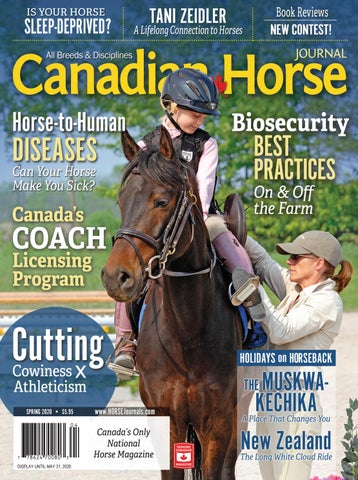
Canada’s Only National Horse Magazine DISPLAY UNTIL MAY 31, 2020
2020.03.01 - Rockerball, Rebellion - Full Page, Canadian Horse.indd 1
2/10/2020 5:09:34 PM
My Horse b My Passion
My Magazine
t s e B ver BOGO Sale! E Subscribe Today During Our Double-The-Term Subscription Sale Get 2 years for the price of 1: $24 (reg $37)
66% Off the Cover Price!
Canada’s Only National Horse Magazine is for all breeds and disciplines
OR
Get 4 years for the price of 2: $37 (reg $59)
75% Off the Cover Price!
Offer available to Canadian residents for new subscriptions, renewals, extending the term of a current subscription, and gifts.
How to Order
visit
www.horsejournals.com
b call
1-800-299-3799
Your Subscription Includes: • 6 BIG BI-MONTHLY ISSUES per year • Both Print and Digital editions • Canada’s Equine Guide — Special Annual • Award-Winning Content
b email
subscriptions@horsejournals.com
THE 2020 SUPER DUTY®
TONS OF TORQUE FOR TONNES OF HAULING. BEST-IN-CLASS MAX. AVAILABLE TOWING 37,000 LBS*
BEST-IN-CLASS AVAILABLE DIESEL TORQUE 1,050 LB-FT**
BEST-IN-CLASS MAX. AVAILABLE PAYLOAD 7,850 LBS^
AVAILABLE CLASS-EXCLUSIVE
PRO TRAILER BACKUP ASSIST TM†
FOR DETAILS, VISIT FORD.CA/SUPERDUTY Vehicle may be shown with optional features. *When properly equipped. Maximum gooseneck tow rating of 37,000 lbs. available on F-450 Regular Cab 4x2 diesel. Class is Full-Size Pickups over 8,500 lbs. GVWR based on Ford segmentation. **When properly equipped. 475 horsepower and 1,050 lb.-ft of torque with the 6.7L PowerStroke® V8 Turbo Diesel engine. Class is Full-Size Pickups over 8,500 lbs. GVWR based on Ford segmentation. ^When properly equipped. Maximum payload on 2019 F-350 DRW 4x2 Regular Cab Long Box with 6.2L gas engine and Heavy-Duty Payload Package. †Class is Full-Size Pickups over 8,500 lbs. GVWR based on Ford segmentation. Driver-assist features are supplemental and do not replace the driver’s attention, judgment and need to control the vehicle. ©2020 Ford Motor Company of Canada, Limited. All rights reserved.
b IN THIS ISSUE
SPRING 2020
34
72
PHOTOS
54
SPECIAL FEATURES 34 Canada’s Coaches to be Licensed and Certified
What does it mean, and how will it change the landscape of Canada’s horse industry?
44 Cutting
4
From show jumping team veteran to owner of a state-of-the-art horse training, breeding, and show facility.
New Zealand’s breathtaking landscape and farmhouse feasts combine in an extraordinary horseback adventure. www.HORSE Journals.com
::
SPRING 2020
||||||||||||||||||||||||||||||||
An unforgettable two-week pack trip through one of the largest and most diverse wilderness areas of North America.
64 The Land of the Long White Cloud Ride
72 Tani Zeidler
The sport that combines precision and athleticism with innate cow sense.
54 Immersed in the Muskwa-Kechika
34 Clix Photography | 44 Janice Reiter Photography | 54 Tania Millen | 72 Jump Media
44
ON THE COVER: Some horses will test you. Some will teach you. And some will bring out the best in you. PHOTO: CLIX PHOTOGRAPHY
b IN THIS ISSUE
SPRING 2020
20
64 DEPARTMENTS
HORSE HEALTH 10 Is Your Horse Getting Enough Sleep?
A new study has found that sleep-deprived horses are at risk of serious injury.
12 Diseases with Horse-to-Human Transmission
6
A refresher on some of the diseases that can potentially be passed to us directly from the equines in our lives.
www.HORSE Journals.com
::
SPRING 2020
20 Biosecurity Best Practices
How to reduce the risk of an infectious disease being introduced to your property and horses.
2 To Subscribe 8-9 Editorial, Letters 76 Horse Council BC News 78-79
Country Homes & Acreages
78, 81
Book Reviews
80 Manitoba Horse Council News 82 Canadian Therapeutic
Riding Association News
83 Index to Advertisers
PHOTOS
10
10 SShutterstock/Grigorita Ko | 12 Shutterstock/Rolf Dannenberg | 20 iStock/BiancaGrueneberg | 64 Clix Photography
12
EDITOR’S DESK
b
We may have all come on different ships, but we’re in the same boat now. — Martin Luther King Jr. Dear Friends, As we go to press with this issue, our country, like the rest of the world, is dealing with the rapidly developing COVID-19 pandemic. With government-mandated bans and warnings from the World Health Organization of the seriousness of this pandemic, many organizations have been left with no choice but to cancel or postpone their events. Our website is being updated daily with news of the latest cancellations of equestrian events within Canada and the United States, and we’ll continue to bring you the latest developments as they happen. In light of public health directives to stay close to home and minimize exposure and risk, we at Canadian Horse Journal are doing just that. Our service levels have not changed; we’re quite used to working remotely, and if you need to contact us, we’re as available as always. Our work of serving and supporting you and our horse industry is more important than ever during these uncertain times, and especially since Canadian Horse Journal is now Canada’s only national horse magazine coast to coast. At the same time, we are doing our part to reduce the spread of COVID-19, because if we all work together in a proactive approach to protecting our communities, we’ll get through this faster and with better outcomes. The extent of the economic impact on the equestrian industry is yet to be determined. Throughout these unsettling times, we and our award-winning writers remain committed and will be working hard to provide you with reliable information and the important news within our industry. Our magazines will continue to be delivered to subscribers; and available at all the usual newsstands, grocery stores and pharmacies; and our regularly-updated website and social media pages are always available. Our Social Media Maven, April Ray, reminds us that there are some activities that carry a very low risk of contracting COVID-19. These include hanging out with your horse, riding your horse, petting your horse, looking at your horse, grooming your horse, and reminding your horse that he/she is a good horse. Until next issue, take good care of yourselves and your loved ones, and stay well. Kathy Smith
Your Horse b Your Passion b Your Magazine Published by Horse Community Journals Inc.
Volume 20 • Issue 4 Spring 2020 Issue (Mar/Apr) of Canadian Horse Journal EDITOR / PUBLISHER Kathy Smith ACCOUNTS Geri Pronovost ADVERTISING April D. Ray • Terry Andrucko • Janna Reimer SOCIAL MEDIA April D. Ray SUBSCRIPTIONS Steve Smith MARKETING & DISTRIBUTION Janna Reimer ART DIRECTION, PRODUCTION Elisa Crees CONTRIBUTORS Margaret Evans • Tania Millen • Shawn Hamilton April D. Ray • Jec Ballou • Shelagh Niblock • Jonathan Field Alexa Linton • Equine Guelph • WCVM HCBC • MHC • CanTRA ADVERTISING, SUBSCRIPTIONS & GENERAL INQUIRIES 1-800-299-3799 • 250-655-8883 or email: sales@horsejournals.com ADVERTISING DEADLINE 4 weeks prior to issue date e.g., Oct.1 for Winter (Nov/Dec) issue. ONLINE EDITION
WEBSITE www.horsejournals.com MAIN OFFICE EMAIL editor@horsejournals.com PRODUCTION DEPARTMENT EMAIL design@horsejournals.com
Publishing 6 issues per year SUBSCRIPTIONS – REGULAR RATES 1 yr/6 issues: $24 + tax 2 yr/12 issues: $37 + tax US $59/2 yrs, 12 issues ORDERS FOR SUBSCRIPTIONS, CHANGE OF ADDRESS NOTICES, & UNDELIVERABLE COPIES ARE TO BE SENT TO: THE CANADIAN HORSE JOURNAL Suite 202, 2400 Bevan Ave., Sidney, BC V8L 1W1 (250) 655-8883 • fax: (250) 655-8913 • 1-800-299-3799 POSTAGE PAID AT WINNIPEG, MB PUBLICATIONS MAIL REG. NO. 40009439 GST REG. NO. 829298140 ISSN. NO. 1496-1733
LETTERS Equestrianism and Animal Rights (CANADA’S EQUINE GUIDE 2020)
I own a horse and treat him at all times with the utmost respect and consideration. I bought him as a twoyear-old and have spent years building a relationship and bond with him. I taught him myself to accept my weight, without fear or force, which he did readily. Never did he express any discomfort or objection to carrying me. I jump with him and he does his job with enthusiasm. He is a 17-hand, 1200pound horse. If he minded doing any of these things, he would let me know.
8
He never tries to avoid me when I go to ride, and comes readily when I call. We know each other. I can tell when he does not feel well, and he knows when I am not myself. Just because animals can’t talk doesn’t mean they can’t communicate. I would NEVER do anything to harm my horse because I love him. I realize that not everyone treats their horses like this. It is the people who lack empathy in this sport who invite the extremists’ attention on all of us. Nicole Herreros, Facebook
We acknowledge the financial support of the Government of Canada.
REPRODUCTION IN WHOLE OR IN PART OF ANY MATERIAL CONTAINED IN THIS PUBLICATION WITHOUT THE WRITTEN PERMISSION OF THE PUBLISHER IS STRICTLY PROHIBITED. The information and services listed herein are intended to facilitate accessibility to the professionals, products and services that play a part in the horse industry. While readers are encouraged to use the products and services of the merchants listed in this Guide, Horse Community Journals Inc. does not recommend or guarantee the products and services of advertisers or associates listed. Manuscripts and photographs will be returned only if SASE is provided. The return of unsolicited material is not guaranteed. Contributors and advertisers warrant all materials supplied are free of copyright and they have the legal right to use the same. All material accepted for publication is subject to such revisions as are deemed appropriate by Canadian Horse Journal (CHJ). The opinions expressed in CHJ are not necessarily those of the publisher. CHJ reserves the right to refuse any advertising or submission. Contributors consent to have their submissions published in CHJ and on www.HorseJournals.com and elsewhere as determined by the publisher. Printed in Canada. Please recycle.
www.HORSE Journals.com
::
SPRING 2020
HOOFBEAT
LETTERS
Canadian Eventer Katharine Morel Dies From Tragic Fall Source: Equestrian Canada
Katharine Morel and Kerry On
Changes to Cross-Country Obstacles in Eventing Competitions Are Necessary I am sharing herewith my e-mail communication to Equestrian Canada, addressing the death of Eventing rider, Katharine Morel and her mare, Kerry On. Originally from Ontario, this rider called Western Canada her home. There should be no deaths of riders or horses in Eventing competition when remedial measures can be implemented to improve the situation. Change has been a long time coming in a sport I consider to be gruelling and extremely dangerous. My letter follows: Letter to Equestrian Canada Attention: Mr. Hood, High Performance Director, EC I just read the news that Canadian Eventing rider Katharine Morel and her mare, Kerry On, died after a rotational fall on course while competing in Florida. This is yet another life lost, as well as the death of a horse, in the competition venue of Eventing. I cannot imagine the pain and anguish involved in this horrific accident. Sadly, I have heard of too many accidents leading to harm or death in this venue. While involvement with horses and equestrian competition does entail personal risk and the potential for harm, it should NEVER be a case of life and death, and/or survival of the fittest. It is time for a change in mindset and rules initiated by Equestrian Canada. As a lifelong horse owner and exhibitor in numerous disciplines, including classes over fences classes, I ask WHY the cross-country obstacles are not built to either collapse or fall upon impact? What infinite wisdom, or lack thereof, dictates that a cross-country fence has to be a fixed or permanent
immovable object? This creates potential danger. It definitely is time to dispense with any prevailing draconian attitudes. The welfare of the riders and horses must be paramount, and the first and foremost consideration. Why not implement a more humane option? I recommend that Equestrian Canada display due diligence, and give prompt consideration to this suggestion for change. The time has come for an overall reassessment of Eventing competition, with a view to establishing sensible solutions and implementing safety measures as they apply to the crosscountry jumps. The time for action is NOW. No more lives should be lost. No more horses should be sacrificed; because that is, in essence, what you are doing, if you and your Eventing Committee and Equestrian Canada choose to do nothing. Make the right choice, for everyone. Thank you. Audrey Wood, Ontario Canada and Massachusetts, USA. Member of OE, NRCHA, NRHA, AQHA, Friends of Sable Island Horses.
We are deeply saddened to report that Katharine Morel of Fort Saskatchewan, Alberta, and her horse, Kerry On, died following an accident on course at the Rocking Horse Winter III Horse Trials in Altoona, Florida, on February 29, 2020. Morel, 33, and the eight-year-old Thoroughbred mare suffered a rotational fall at fence eight of the Intermediate level cross-country course at the United States Eventing Association recognized competition. Morel was immediately transported by Lake County Emergency Medical Services to Waterman Hospital in Tavares, Florida, where she later succumbed to her injuries. Kerry On suffered fatal injuries and passed shortly after the fall. Morel discovered Kerry On as an offthe-track three-year-old, and together the pair worked their way up the levels to make their FEI debut in 2019. “Today, the equestrian industry lost not just an exceptional athlete, but an exceptional person, as well as the horse she loved,” said EC High Performance Director, James Hood. “On behalf of EC, I extend our sincere and heartfelt condolences to the friends and family of Katharine, as well as to the entire team who surrounded Kerry On.” EC will work closely in cooperation with our sister federation, US Equestrian, to investigate the fall and continue developing methods to improve safety for riders and horses alike. For questions, contact James Hood, High Performance Director, Equestrian Canada, jhood@equestrian.ca, 613-287-1515 x 151.
Statement from James Hood, High Performance Director & FEI Relationships, Equestrian Canada: Equestrian Canada is currently working with our partners in the USEA [United States Eventing Association] and USEF [United States Equestrian Federation] as the investigation of the tragic incident is being conducted. Following the reviews, we will continue to look at and explore methods that will increase the safety of our participants, both equine and human. But before we can provide a complete response to the community, we need to finish the reviews and determine the recommendations that can impact safety. Our staff and volunteers are continuing the work in the area. Equestrian Canada will provide a more thorough response at a later date.
SPRING 2020
::
CANADIAN HORSE JOURNAL
9
HEALTH
The Dangers of
Sleep Deprivation
Proper sleep is essential for a horse’s well-being. Horses that don’t lie down may fall into REM-sleep while standing, causing them to collapse due to the associated muscle relaxation.
in Horses
PHOTO: SHUTTERSTOCK/GRIGORITA KO
Source: International Society for Equitation Science (ISES)
Sleep is essential for life. The quality and quantity of a horse’s sleep directly affects their health and well-being. Until now, sleep is rarely considered as part of a horse’s management plan. A new study has found that poor management or physical problems can lead to horses becoming sleep deprived and at risk of serious injury. The study highlighted the following: • Horses that don’t lie down sufficiently suffer from sleep deprivation leading to collapses. • A 24-hour sleep laboratory monitoring study of 36 horses showed between four and 199 instances of collapse during the time period. • Horses that collapsed had an altered and very restless sleep-profile. Their rapid eye movement (REM) sleep phases were shorter and occurred while 10
www.HORSE Journals.com
::
SPRING 2020
they were standing and, in 86 percent of cases, happened during or immediately before the collapse. • The number of collapses depended significantly on how much the horse had laid down in that time period, and horses that did lie down showed significantly fewer collapses. • Over 90 percent of the horses that collapsed were injured at some point. • More research is needed to identify the factors that encourage recumbent sleep and prevent sleep deprivation. • Sleep deprivation should not be confused with narcolepsy, which is a very rare chronic neurological disorder. Sleep is a naturally occurring state involving both the body and the mind. While there is still a lot to be learned about the complex function of sleep, it is performed by almost every species and is
vital for the performance and well-being of an individual. Physiologically, during sleep the individual enters a state of temporary unconsciousness and their muscles become inactive and relaxed. In the behavioural sense, the animal will seek a sheltered environment, adopt a certain posture, and stop responding to external stimuli. There are three stages of physiological sleep and horses can achieve stages one (light sleep) and two (slow wave or deep sleep) while standing up. However, the third stage — REM sleep — occurs only while the horse is lying down due to the complete muscle relaxation required. Previous research has shown horses can achieve REM sleep in both sternal (with their head supported on the floor) and lateral recumbency. Horses in stables have been shown to have a regular total sleep time of three and a half hours per night. The duration of the different sleep stages is relatively constant. REM sleep totals about 30 minutes a night or 15 percent of the total sleep time, and slow-wave sleep takes up the most time at 65 percent. The rest of the total sleep time is spent in light sleep. If horses don’t lie down for any reason, REM sleep deficiency (recumbent sleep deprivation) occurs. As a result, horses may fall into REM sleep while standing, which consequently causes them to collapse due to the associated muscle relaxation. These collapses can cause severe injuries. Christine Fuchs and her team of scientists at the Ludwig-MaximilianUniversity of Munich, Germany set out to research sleep deprivation in horses. She presented their findings at the 14th International Society of Equitation Science (ISES) conference in Rome in 2018. To find subjects for the study, the
event — a management change for example, a change of stable or a physical condition, such orthopaedic problems. Over 90 percent of the horses studied showed injuries after collapsing. Injuries were mostly seen in the knees (72.4 percent) and the fetlocks (68.4 percent). Furthermore, 31.0 percent of the horses had head injuries and 18.4 percent had injuries to the hocks. The examined horses collapsed a minimum of four and a maximum of 199 times during the 24-hour observation period. The individual number of collapses depended significantly on how much that horse had laid down. The
PHOTO: SHUTTERSTOCK/MICHAEL RUCKER
research team recruited owners whose horses had shown signs of collapsing. A detailed online questionnaire was completed by 177 respondents who were readers of a German equestrian magazine. The research team visited 36 horses with collapses in their home environment and seven healthy, control-group horses. Each horse had a clinical examination, was observed for 24 hours, and their management, stabling conditions, and medical histories were documented. Each horse was also fitted with a mobile sleep laboratory to take polysomnographic readings for the 24-hour period. Polysomnography is a diagnostic tool that
measures physiological functions during sleep. It simultaneously measures several body functions such as brain activity (electroencephalogram or EEG), eye movements (electrooculogram or EOG), and muscle tone (electromyogram or EMG), with which the depth and quality of sleep can be determined. The results of the study provide important information. The main causes of the lack of recumbent sleep were issues with the horse’s management or pain from a physical problem. The online questionnaire showed a significant correlation between a change in the horse’s management or environment and their first collapses. A third of the horses visited did not have enough space, according to the German guidelines for box stall dimensions. In half of the horses visited, the onset of collapses was directly related to an
horses that did lie down to sleep showed significantly fewer collapses. The horses that collapsed had an altered and a very restless sleep profile — they spent notably less time in REM-sleep compared to those that did not collapse. Their REM sleep phases were shorter, they occurred while standing, and in over 86 percent of cases were during or immediately before the collapse. Some of the horses in the study were not only suffering from physical issues but also from psychological problems. Stereotypic behaviours like weaving, cribbing, and box walking were present in 25 percent of the horses from the questionnaire. Of the examined horses, eight demonstrated altered behaviour after their collapses had begun — some became listless and others extremely anxious. Two years after the assessments were made, seven horses from the study
have been euthanized due to injuries or behavioural problems supposedly caused by the sleep deprivation. Given the importance of sleep, it is clear that REM-sleep deprivation leads to behavioural changes, and related collapses can cause severe injuries. Treatment for the condition should involve identifying the reason of the horse’s reluctance to lie down, treating any underlying medical conditions, and optimising their environment and management. “We were amazed and shocked at how many horses seemed to suffer from these kinds of collapses,” says Fuchs. “Initially, we thought we might find 10 to 20 horses. To date, approximately 300 horse owners have contacted us and sought our advice. “It is amazing how easy it is to help some horses and how frustrating and difficult it can be to help others. The challenge is that every horse suffering from recumbent sleep deprivation is an individual and has its individual ‘reasons’ why it does not lie down. Horse owners need to be aware that the sleeping behaviour of horses is an important thing to consider. It is important to recognize the symptoms as soon as possible, but prevention is essential. “It was conspicuous that most horses seemed to have a problem after a change of stable. This is one thing we are looking at in a future study, especially moving from a stable to an open communal barn. Open barns are obviously the most appropriate housing type for horses, but unfortunately, many of them have bad management, and horses that were living in a stable for many years might not be able to cope with it.” “It was great to see this important subject being researched,” says Janne Winther Christensen, Hon President of ISES. “Sleep is important for the welfare and performance of horses, and it would be very valuable to see more research on the various factors that influence sleep and sleep deprivation, for example, box sizes, flooring and bedding material, and the social environment. In nature, horses sleep within visual contact of each other and usually one horse remains standing, whereas in the domestic environment, horses often sleep in single boxes with solid box walls where they are unable to see their neighbours while lying down.” b The International Society for Equitation Science (ISES) is a not-for-profit organization that aims to facilitate research into the training of horses to enhance horse welfare and improve the horse-rider relationship. SPRING 2020
::
CANADIAN HORSE JOURNAL
11
PHOTO: SHUTTERSTOCK/ROLF DANNENBERG
Diseases with Horse-to-Human Transmission Source: UC Davis Center for Equine Health
Can you get a disease from your horse? Yes, but the good news is that direct horse-to-human disease transmission is rare. Here’s a quick refresher on some bacterial, fungal, parasitic, and viral diseases that can potentially be transmitted to us directly from the equines in our lives. This list does not include diseases like West Nile virus that can be passed indirectly from horses to humans, for example through an insect bite.
Conditions Commonly Transmitted
All those who spend time around horses should take precautions against the 12
www.HORSE Journals.com
::
SPRING 2020
following conditions that are commonly transmitted from horses to humans:
on the back, muzzle, and limbs that characteristically form dry, “nobbly” crusts.
DERMATOPHILOSIS
Transmission: The bacteria can be transmitted from horses to humans through direct contact with infected animals.
Dermatophilosis is caused by the bacteria Dermatophilus congolensis, which enter the body through an open wound such as a skin abrasion, laceration, or insect bite site. Horses: Dermatophilosis is common in horses and is often known as “rain rot,” “rain scald,” “mud rash,” or “mud fever.” It is most often associated with prolonged exposure to moisture in the form of rain or sweat under blankets or tack. The disease can result in painful lesions and swelling
Humans: In humans, lesions typically occur on the hands and arms. Treatment and prevention: Topical and systemic antibiotics are used to treat dermatophilosis. For horses, it is also important to address management changes to keep animals dry. Although not life threatening, dermatophilosis can lead to secondary infections if left untreated.
PHOTO: WIKIMEDIA/JAMES HEILMAN MD
contaminated surfaces and accidentally transferring the bacteria from their hands to their mouths.
intestines (gastroenteritis) in animals and humans. In fact, it is globally the most common bacterial cause of gastroenteritis.
Humans: Many people show no symptoms of salmonella infection. Others may develop fever, abdominal discomfort, and diarrhea. Clinical disease can be mild or severe and severe cases can be fatal if not treated.
Horses: Infections in horses cause inflammation of the small intestine (enteritis) which leads to diarrhea.
Treatment and prevention: In humans, most cases resolve even without treatment. In horses, non-steroidal anti-inflammatory drugs (NSAIDs) may be used to alleviate pain, and gastrointestinal protectants such as bio-sponge or activated charcoal may bind the bacterial toxin. Severe cases may require treatment with IV fluids and electrolytes. Since the organism is prevalent in the environment, prevention of salmonellosis is difficult. Identification of infected horses and strict biosecurity protocols are the best approach to preventing the spread of the disease.
Ringworm on a human leg, with mildly raised border and central clearing.
RINGWORM
Ringworm, or dermatophytosis, is an infection of the skin or hair caused primarily by the fungi Trichophyton equinum and Trichophyton mentagrophytes. Horses: These fungi live in the soil and horses can be exposed when they dig, roll, or lie down in dirt. The fungi can be transmitted between horses by contact with infected individuals and contaminated objects such as grooming equipment and tack. The clinical signs of ringworm in horses usually consist of patches of crusty, dry skin with hair loss, and circular lesions that are itchy.
Less Common Conditions
Conditions that are less commonly passed from horses to humans, but still warrant appropriate biosecurity precautions are:
CAMPYLOBACTERIOSIS
Bacterial species in the genus Campylobacter can cause irritation and inflammation of the stomach and
Transmission: The fungus can be transmitted from horses to humans by direct contact with an infected animal’s skin or hair or touching contaminated objects.
Transmission: The bacteria are typically transmitted through fecal contamination of the environment, and subsequent ingestion through food or water. People can become infected through horserelated activities, including cleaning stalls and grooming. However, you are more likely to be exposed to Campylobacter in uncooked or undercooked chicken or unpasteurized milk. Humans: Symptoms in humans include abdominal pain, diarrhea, nausea, fever, and vomiting. Treatment and prevention: Antibiotics may be used to treat infected individuals. Campylobacter infection is rarely life threatening.
CRYPTOSPORIDIOSIS
Parasites in the genus Cryptosporidium are an important source of gastrointestinal disease in humans and animals globally. These highly contagious parasites infect the intestine and cause diarrhea and weight loss. Horses: Cryptosporidiosis is most commonly seen in foals, especially those that are immunocompromised or stressed. Horses become infected by
Humans: Similar to horses, humans often develop a scaly, reddened, circular rash.
Campylobacter is the most common bacterial cause of gastroenteritis. People become infected through horse-related activities, including grooming and cleaning stalls.
Treatment and prevention: Infections often clear up without treatment, but medicated shampoos are effective in some cases.
SALMONELLOSIS
Horses: In horses, the bacteria are transmitted through contaminated feed or water. Transmission can also occur by direct contact with infected individuals or surfaces that have been contaminated with manure from an infected horse. Some horses are carriers that do not show any signs of disease but can actively transmit the organism. Carriers can become sick when under stress from surgery, transportation, changes, in feed, etc. Severe cases can be fatal if not treated. Transmission: People that work around horses can get salmonella by touching
PHOTO: CLIX PHOTOGRAPHY
Salmonellosis is caused by the bacteria Salmonella enterica and causes diarrhea in horses and humans.
SPRING 2020
::
CANADIAN HORSE JOURNAL
13
PHOTO: WIKIMEDIA/CHRISTIAN MUELLNER
<
Leptospirosis, often the result of infection through contact with infected urine, can be associated with equine recurrent uveitis (moon blindness).
< Horses become infected with
PHOTO: CANSTOCK/ANAKONDASP
cryptosporidiosis by ingesting the parasite in contaminated food or water. The infection is most commonly seen in foals.
ingesting the parasite in contaminated food or water. Transmission: The parasite can be transmitted from horses to humans in contaminated water, soil, or surfaces, and can survive in the environment for long periods. Humans: In humans, ingestion of the parasite can cause watery diarrhea, vomiting, stomach cramps, and weight loss. Symptoms may last up to two weeks. Treatment and prevention: Symptoms often resolve without treatment in people with healthy immune systems. For those with compromised immune systems or severe infections, anti-parasitic drugs (such as nitazoxanide) and anti-motility agents (such as loperamide) can help relieve diarrhea.
GIARDIASIS
Single-celled organisms of the genus Giardia, most commonly Giardia duodenalis, attach to the intestine, causing problems with absorption of vitamins 14
www.HORSE Journals.com
::
SPRING 2020
and other nutrients, often resulting in diarrhea. Contaminated water and soil are the primary sources of infection. Horses: Giardia can cause intermittent diarrhea in some infected horses, as well as poor hair coat and weight loss. Foals are frequently infected but often do not show clinical signs. Transmission: Infected horses can transmit the parasite to humans indirectly through fecal contamination of water, or directly through handling or on contaminated surfaces. Humans: Symptoms in humans include diarrhea, abdominal cramps, bloating, and weight loss. Treatment and prevention: The antibiotic metronidazole is commonly used to treat giardiasis in both species.
LEPTOSPIROSIS
Equine leptospirosis is often the result of infection with the bacteria Leptospira interrogans through contact with infected
urine, often in contaminated feed or water. The bacteria spreads rapidly to tissues throughout the body via the bloodstream. Leptospirosis can be associated with equine recurrent uveitis (moon blindness). Horses: In horses, the disease is associated with abortions, stillbirths, kidney disease, and equine recurrent uveitis (moon blindness), although some infected horses show no clinical signs. Transmission: Humans can become infected when contaminated water contacts broken skin or mucous membranes (eyes, nose, or mouth). Humans: In humans, leptospirosis causes flu-like symptoms, including abdominal pain, high fever, chills, vomiting, and jaundice, but neurologic, respiratory, cardiac, and ocular issues can occur. Treatment and prevention: Antibiotics and anti-inflammatories are used to treat leptospirosis. There are currently no human vaccines for leptospirosis, but one is available for horses.
RABIES
Rabies, a highly fatal disease found worldwide, is caused by the rabies virus. All mammals are susceptible to rabies, but it is relatively rare in horses, with less than 100 cases reported annually. Horses: Clinical signs in horses include uncoordinated movements (ataxia), partial paralysis (paresis) of the hindquarters, a desire to lie down,
PHOTO: WIKIMEDIA/CHRISTIAN MUELLNER
lameness, difficulty breathing, colic, increased sensitivity to light and sound, and fever. Most horses die of cardiorespiratory failure within two to five days, but it can take up to two weeks in some cases. Transmission: The virus is found in the saliva of animals. Rabies can be transmitted from horses to humans through a bite or contact of infected saliva with the eyes, nose, or mouth, or broken skin. Humans: Symptoms in humans include fever, headache, itching at the site of infection, and pain. People who are infected can become hyperexcitable or suffer from generalized paralysis, and death occurs within two to ten days. In rare cases of survivors, severe neurological disorders may result. Treatment and prevention: There is no treatment for rabies in horses. Humans who think they may have been bitten by a rabid animal are given a series of shots to prevent infection. There is no effective treatment once the infection has become established. Rabies vaccines are available for horses and humans. Rabies is a reportable disease in Canada and the United States; suspected cases must be reported immediately. Rabies infection manifests in two forms: furious (classical or encephalitic) and paralytic. Paralytic rabies accounts for approximately 20 percent of the total human cases; furious rabies accounts for the other 80 percent. This dog is in late-stage paralytic rabies, and appears depressed, lethargic, and uncoordinated, and will gradually become completely paralyzed. When their throat and jaw muscles are paralyzed, the animals will drool and have difficulty swallowing.
Importing Horses & International Travel
considered possible agents of biological attack or bioterrorism.
In addition, those who import horses and/ or travel to other countries for equinerelated business and activities should consider precautions against:
ANTHRAX
Anthrax is caused by the Bacillus anthracis bacterium, which can survive in the soil for decades. The bacteria produce a toxin that breaks down cells in infected tissues. Bacterial spores have historically been weaponized (in aerosolized form) and are
Horses: In horses, the clinical signs of anthrax vary depending on whether the horse ingested the bacteria, or it was transmitted through an insect bite. Fever, loss of appetite, inflammation of the small intestine (enteritis), colic, and bloody diarrhea can occur if the horse ingests the bacteria. Death typically results in two to four days. For cases in which anthrax is introduced via insect bite, clinical signs include swelling at the site of the bite, and on the neck, chest, belly, and genitals.
It Works! We’re the first and still the best since 1986
Body Support
™
Body Builder in USA A Healthy Alternative to Steroids
PHOTO: WIKIMEDIA
From yearlings and 2-year-old prep horses to racehorses and competition horses to broodmares and stallions. Yep, it works for all.
Available in various catalogs and at your local tack shops, Greenhawk outlets, and through WeCan Sales distributors. Equiade, Inc. • www.equiade.com • 1-800-413-3702 • 727-562-2832 SPRING 2020
::
CANADIAN HORSE JOURNAL
15
vaccine is available for horses but is generally only recommended for horses in areas that are known to be contaminated. Anthrax is a reportable disease in Canada and the United States; the appropriate agency must be contacted immediately.
GLANDERS
The bacteria Burkholderia mallei causes glanders and infection and is fatal in most species.
PHOTO: WIKIMEDIA
A skin lesion caused by anthrax, with the characteristic black centre.
Transmission: The disease can be transmitted from horses to humans through handling of infected animals. Humans: In humans, anthrax may be cutaneous, inhalational, or gastrointestinal. The cutaneous form is the most common (and the type that can be transmitted from horses). This form results when the bacteria enter the body through cuts or abrasions in the skin. Lesions with black centres appear on the skin of the arms, hands, face, and neck within two to three days. Death is rare with appropriate antibiotic treatment. Treatment and prevention: Prompt treatment with antibiotics is essential to a successful outcome in both species. Although a human vaccine is available, vaccination is not recommended for the average person since the vaccine is not easily accessible and the risk of infection is considered low in the United States. A
Slow Feeding. Quick Filling.
OPTIMIZE FEEDING HAY • Slow feed netting nestles over hay • Create a safe herd environment
SAVE TIME • Feed less often • Load two bales of hay in less than a minute
STOP WASTING HAY • Keep hay off the ground and clean • Moderate eating
Designed and Manufactured in Canada
www.hayoptimizer.net
16
www.HORSE Journals.com
::
SPRING 2020
Horses: Infection in horses can result in pus-forming lesions on the skin and respiratory infections. The source of infection is discharge from the nose and skin of infected equids. The primary route of infection is believed to be ingestion of feed or water contaminated by B. mallei, although inhalation and skin exposure may occur. Infected equipment, tack and clothing can also transmit the bacteria. Some infected horses show no symptoms but can serve as sources of infection by shedding B. mallei intermittently or constantly. Transmission: People can get the disease through direct contact with infected animals. Humans: Symptoms in humans include fever, muscle pain, chest pain, light sensitivity, and headache. If the bacteria get into the bloodstream, the infection can be fatal without treatment. Treatment and prevention: Antibiotics are used to treat cases of glanders in people. Equine cases are not treated in the United States. Since it is contagious and can be fatal in humans, the bacterium is considered a potential agent of bioterrorism (Tier 1 biological agent). All horses imported to the United States are tested for glanders to prevent introduction of the disease. Glanders is a reportable disease in the United States; suspected
VESICULAR STOMATITIS
This disease is caused by the vesicular stomatitis virus. Horses: Vesicular stomatitis results in lesions and blisters on the tongue, mouth, nose, and lips of horses. Other clinical signs include drooling or frothing at the mouth, lethargy, fever, and loss of appetite. Mortality is rare. Horses typically recover within two weeks, but outbreaks can have significant financial impacts on the equine industry. Vesicular stomatitis has been reported around the world, with most equine outbreaks in the United States limited to western states. Transmission: Transmission to humans can occur through direct contact with the lesions or saliva of infected horses. Humans: Symptoms in humans resemble the flu and include fever, chills, nausea, vomiting, and headache. Lesions may form in the mouth and throat in adults and children may develop encephalitis, although it is rare. Treatment and prevention: In horses, treatment is limited to supportive care and anti-inflammatory medications. Although vaccines are available for some livestock species in some
HEALTHY GUT A MUST
PHOTO: CANSTOCK/PAULB
cases must be reported immediately. In Canada, the Canadian Food Inspection Agency (CFIA) imposes strict regulations on the import of animals and animal products from countries where glanders occurs, enforced through port of entry inspections. Glanders is an immediately notifiable disease in Canada. The CFIA website states that glanders has been eliminated in North America, Australia, Japan and Europe. It is thought to be endemic in parts of the Middle East, Asia, Africa, and South America.
Foals can inhale R. equi or ingest contaminated soil.
countries, there are currently no equine or human vesicular stomatitis vaccines. Vesicular stomatitis is a reportable disease in Canada and the United States; suspected cases must be reported immediately. The CFIA website states that the disease was last diagnosed in Canada in 1949.
Horses Housed with Livestock
Properties that house horses with livestock should also take appropriate precautions to avoid:
BRUCELLOSIS
Most cases of brucellosis in horses are due to the Brucella abortus bacteria, which is also the cause of the disease in cattle. Perhaps not surprisingly, cases of brucellosis in horses usually occur in horses that are housed with cattle.
BREATHING IS EVERYTHING
SOUND & HEALTHY JOINTS
www.mcintoshproline.com • 1-877-825-7325 SPRING 2020
::
CANADIAN HORSE JOURNAL
17
in severe cases. Although reported worldwide, brucellosis has been eradicated from many countries, so infections are rare. Brucellosis is a reportable disease in Canada and the United States; suspected cases must be reported within 48 hours.
Precautions for Those Likely to Contact Infected Animals
PHOTO: CLIX PHOTOGRAPHY
Veterinarians, veterinary technicians, breeding managers, and anyone more likely to come in contact with infected animals should take precautions to protect themselves from:
Anyone likely to come in contact with infected animals should take precautions to protect themselves from diseases that can be transmitted from horses to humans.
Horses: Horses become infected with the bacteria through ingestion, inhalation, or contact with skin abrasions. Termed “poll-evil” or “fistulous withers” in horses, brucellosis causes painful swelling at the base of the neck and sides of the withers, which can lead to abscesses. Joints may also become swollen and reproductive issues, including abortions, have been reported. Transmission: B. abortus may be transmitted from horses to humans through contact with contaminated body
fluids, tissues, or carcasses, although documented cases of transmission are rare. Humans: In humans, the disease can mimic many other infectious and noninfectious diseases. Symptoms include fever, anorexia, headache, backache, joint pain, and weight loss. Even without treatment, most patients recover within three weeks.
MRSA (METHICILLIN-RESISTANT STRAINS OF STAPHYLOCOCCUS AUREUS) Although Staphylococcus aureus often does not cause any problems for humans or animals, antibiotic-resistant forms are difficult to treat. Methicillin-resistant strains of Staphylococcus aureus are resistant to antibiotics that are often used to treat Staphylococcus infections. Horses: In horses, skin, soft tissue, joint, and surgical site infections can occur. Clinical signs may include wounds or surgical sites that discharge pus and fail to heal. Some horses carry MRSA without showing any clinical signs, but they can still transmit the bacteria to people and other horses. Transmission: People can get MRSA from horses through direct contact with infected animals, especially direct handto-nose contact.
Treatment and prevention: Treatment in horses consists of broad-spectrum antibiotics and draining of abscesses. Surgical intervention may be required
Brucellosis causes painful swelling at the base of the neck and sides of the withers, and eventually at the top of the animal’s head, traditionally called “poll evil.”
>>>>>>>>>>>>>>>>>>>>>>>>>>>>>>>>>>>>> • Wash your hands with soap and water or use hand sanitizer often. • Practice good hygiene and sanitation. • Avoid eating and drinking in barns, stables, and other areas where horses are housed. • Isolate sick horses, use dedicated grooming supplies and equipment, and handle these horses last each day if possible. • Vaccinate horses based on risk factors for your area and facility and as recommended by your veterinarian. 18
www.HORSE Journals.com
::
SPRING 2020
• Consider that co-mingling of horses and livestock can spread infections. • Quarantine and test new horses before letting them come in contact with the resident herd. • Control rodents and wildlife in areas where horses are housed. • Use antibiotics as directed by your veterinarian and ensure that the full course of treatment is followed to minimize the spread of antibiotic resistant bacteria.
PHOTO: WIKIMEDIA
Biosecurity Best Practices
Humans: MRSA infections in humans often appear as a red rash or a skin boil. Symptoms may also include fever. Treatment and prevention: Most MRSA infections can be effectively treated with antibiotics if diagnosed early. Healthy horses can carry MRSA, and it is known to be common in people who work with horses, such as veterinarians. This means that it is virtually impossible to eliminate exposure to MRSA in people or horses.
RHODOCOCCUS EQUI INFECTIONS
Rhodococcus equi is a bacterium that lives in the soil and can cause pneumonia in young (one to six months old) foals. In rare cases, immunodeficient adult horses and humans can also become infected. Disease prevalence varies, but R. equi can be detected on most horse farms around the world.
Horses: A foal can inhale airborne bacteria into their respiratory tract or ingest contaminated soil. Unfortunately, foals often do not begin to show signs until the disease has become severe. Clinical signs may include fever, laboured breathing, cough, and depression. Transmission: Since it lives in the soil, R. equi can be inhaled in dust on farms or enter the body through broken skin. The bacteria can also be transmitted by handling infected foals. Humans: In immunocompromised humans, R. equi infection can cause lung infection that results in the formation of abscesses. Mortality can be as high as 50 percent. Among people with healthy immune systems, infections may only affect a small part of the body and are commonly associated with wound sites. Treatment and prevention: Antibiotics can be used to treat the infection in horses, but they can also result in potentially serious side effects. There are no available vaccines. Early detection in foals through bloodwork, ultrasound screening, and antibiotic treatment as needed is currently the best approach to ensure a successful outcome. In humans, a combination of antibiotics may be used to treat the infection, with surgical intervention to drain large abscesses in some cases. b Printed with the kind permission of the UC Davis Center for Equine Health. The UC Davis Center for Equine Health is dedicated to advancing the health, welfare, performance and veterinary care of horses through research, education and public service. https://ceh.vetmed.ucdavis.edu/ SPRING 2020
::
CANADIAN HORSE JOURNAL
19
Biosecurity ON THE
FARM PROTECTING HORSES & HUMANS By Margaret Evans
20
www.HORSE Journals.com
::
SPRING 2020
PHOTO: ISTOCK/BIANCAGRUENEBERG
W
ith the current COVID-19 pandemic and Canadians’ alarm over how quickly a virus can spread across countries and continents, there is an understandable reaction to protect against infection from any and all viruses and pathogens. By extension, it is also essential that there is a level of biosecurity on your farm or acreage to protect horses against agents of disease. According to a document published by the Canadian Food Inspection Agency (CFIA) entitled National Farm and Facility Level Biosecurity Standard for the Equine Sector, infectious diseases in horses continue to rank as one of the major challenges for horse owners and managers. Diseases lead to illnesses that are sometimes fatal and can incur financial costs, welfare concerns, and possible risks to human health. Some infectious diseases are zoonotic, meaning they are caused by viruses, bacteria, or parasites that can spread from animals to humans, putting people at risk.
SPRING 2020
::
CANADIAN HORSE JOURNAL
21
22
www.HORSE Journals.com
::
SPRING 2020
PHOTO: CLIX PHOTOGRAPHY
PHOTO: SHUTTERSTOCK/WAVEBREAKMEDIA
PHOTO: CLIX PHOTOGRAPHY
PHOTO: SHUTTERSTOCK/WAVEBREAKMEDIA
Learn your horse’s baseline vitals to help you determine when to call the veterinarian if the horse shows early signs of a health issue.
Sources of pathogens include other horses that are sick, domestic animals such as pets, contaminated food, water and soil, housing areas, and wildlife and pests such as insects, spiders, ticks, rodents, and other nuisance animals. Transmission of infection can be direct through physical contact and connection with a pest animal; indirect through contact with clothing, tack, or equipment; ingestion through consumption of contaminated food and/or water; aerosol transmission through tiny contaminated droplets being released by coughing, sneezing, snorting, or whinnying; airborne when tiny particles are released from disturbed materials on the ground or in feed; and vectors such as insects and other wild animals. Preventive measures and biosecurity systems are an essential part of horse management, especially given the prevalence of spreading and reemerging diseases. With the influence of climate change and unusual shifts in weather patterns, new diseases are emerging, with microorganisms able to expand their geographic ranges, as well as adapt with a genetic change that allows them to infect other animals for continued transmission to humans as a zoonotic disease. In addition, invasive plants have affected every region in Canada. The CFIA estimates that 1,229 nonnative vascular plants have become established with 486 troublesome enough to be considered invasive or weedy and disruptive to native plants. Horses are constantly surrounded by germs. They are in the ground and ground water, in the bedding, in the air, along fences, and can be passed from horse to horse when they touch noses. Most horses have excellent immune systems to counteract these pathogens, but on occasion when a horse gets sick, they can pass that disease quickly to other horses nearby. Farms and facilities with poor biosecurity may become a significant risk to others in the neighbourhood and beyond, and every farm should have a biosecurity plan that can be readily implemented. Simple procedures can In early spring, review your horse’s vaccination and deworming protocols with your veterinarian to ensure he is well protected during the showing and riding season. SPRING 2020
::
CANADIAN HORSE JOURNAL
23
PHOTO: ISTOCK/WINHORSE
The facility should have a dedicated area where new horses, or those returning home, can be kept isolated until the quarantine time has passed.
Quality Modular Barns, Row Barns, and Run-in Sheds
We will custom build your dream barn to suit you and your horses’ needs. Our team will work with you to design a barn to your specifications.
Serving all of Ontario For over 20 years • Check out our website for floor plans and ideas!
DENCO STORAGE SHEDS INC. www.DencoSheds.ca 8309 Wellington Road, Moorefield, ON • 519-638-5550 24
www.HORSE Journals.com
::
SPRING 2020
reduce the transmission of diseases, enhance animal health and wellbeing, protect public health, reduce costs, and maintain an equine health status that allows for safe movement of animals.
Facility Design and Location If you are thinking of renovating, or expanding your facility and building a new barn, now is the time to consider all the factors for an efficient barn with biosecurity and control of biohazards in mind. Number one is location. Where the barn should be built will be determined by many factors, including biosecurity. If you are living in a geographic area less densely populated with horses and livestock, the chances are good that you are already reducing the risks of exposure to pathogens. But the influence of incoming pathogens can change depending on the health of your horses, their age, underlying conditions, and their genetic predisposition to health issues. The slope of the land, soil type, presence of low areas, and the existence of a river, pond, creeks, or streams on the land will dictate where and where not to build. Ideally, a barn should be located on level, dry, well-drained ground with ease of access all around and away from critical water sources. Consider the value of trees that will provide shade for horses and protection from weather during pasture turnout. Plan for the number of horses that will be stabled, and whether any will live permanently outside. Will any horses travel to competitions or to other farms for breeding? These activities may present greater hazards to horses remaining at home, since the travelers may return to the farm carrying an infectious disease. In the outlining phase of your facility, plan for a dedicated space where a new or returning horse can be kept isolated until it has passed the quarantine time and can mix with other horses. In addition, design the facility with equestrian paths and walkways to control the movements of people, equipment, and machinery. In the initial stages of planning, identify your water source. Will you
PHOTO: CANSTOCK/VICTORBURNSIDE
With numerous sources of pathogens and methods of transmission on a farm, good biosecurity systems are essential for responsible horse management.
SPRING 2020
::
CANADIAN HORSE JOURNAL
25
THERAPEUTIC PADS
>>>>>>>>>>>>>>>>>>>>>>>>>>>>
To aid in preventing and relieving many of your hoof care problems
CUSHION FROG PADS
PHOTO: CLIX PHOTOGRAPHY
SMALL: 6 1/2” x 5 7/8” x 1/16” LARGE: 8” x 7 1/2” x 1/8” TWO DEGREE: 6 1/2” x 5 7/8” x 5/16” TWO DEGREE LARGE: 8” x 8” x 5/16”
EGG BAR PADS
SMALL: 6” x 6 1/2” x 1/8” LARGE: 7 3/8” x 7 7/8” x 1/8” TWO DEGREE: 6” x 6 1/2” x 5/16”
PERFORMANCE PADS
Disease Response The National Farm and Facility Level Biosecurity Standard for the Equine Sector provides the following best practices for disease response processes following the suspicion or identification of disease in a horse at a farm or facility: n Notification — Notify the owner or the person authorized to act on the owner’s behalf. n Separation — Whenever possible, physically separate the suspect and ill horses from the other horses, and manage them as a distinct group to prevent direct and indirect transmission of pathogens.
#4: 6 3/8” x 5 3/4” x 3/16” #5: 7 1/4” x 6 5/8” x 3/16” #4: 6 3/8” x 5 3/4” x 1/4” #5: 7 1/4” x 6 5/8” x 1/4”
IMPAK PADS
#8 IMPAK ABSORBER: 5 1/8” x 4 3/4” x 3/16” #8L IMPAK LARGE ABSORBER: 6 5/8” x 6” x 3/16” (For Prolapsed Frog)
CASTLE PLASTICS Celebrating 100 Years!
1-800-9-CASTLE castleplastics.com 11 Francis Street, Leominster, MA, USA 01453
castle@net1plus.com • Fax: 978-534-9915
26
www.HORSE Journals.com
::
SPRING 2020
n Obtain tentative diagnosis — Consult a veterinarian to determine if the horse is infected with a contagious disease. If a veterinarian is not immediately available to attend the property, request advice from the veterinarian for measures to prevent further spread. n Activate disease response team and implement the communication strategy — For large facilities and events, a team of individuals with different backgrounds and expertise is useful for managing the situation. Designate a spokesperson to communicate the information. Your veterinarian may be required to report certain diseases (a federal reportable disease or a provincial reportable/notifiable disease) to the appropriate government agency. n Identify other potentially exposed horses — While obtaining a tentative diagnosis, determine which other horses may have been exposed. Focus on those that may have had direct contact (nose to nose) or indirect contact (shared equipment, adjacent stall, shared water, and contact with other participants). n Restrict movement — Temporarily restrict movements of ill, suspect and exposed horses, along with their handlers, until a veterinarian has made a tentative diagnosis and a response plan is implemented. n Monitor horses — Observe ill and exposed horses for changes in health status. n Release horses — Prior to removing movement restrictions, consult with the attending veterinarian. Brief all participants leaving the event about the disease and the need to monitor their horses for signs of illness. Horses that are ill and/or exposed through direct and indirect contact should upon their return home be separated from other horses, monitored, and treated as appropriate until their illness clears or their health status is determined. Unexposed horses may be transported to other venues – disclose previous attendance at an event where an infectious disease was present.
>>
need to put in a well? You will need enough pressure to run water for high use, such as filling water troughs in the pasture, washing horses, or for major cleaning jobs which, in a horse barn, seem to be endless. On the subject of water and management of horses in pasture, there are special considerations to be considered should watercourses — a stream, creek, or a pond — exist where the horses will graze. The banks bordering watercourses are fragile riparian areas that support moistureloving plants, distinctly different from aquatic plants in the water and drier grasses in the pasture. They control stream flow, prevent erosion, and support fish and aquatic insect habitat, while providing nesting areas for aquatic birds and reducing pollutants such as phosphorus and nitrates. Horses trampling riparian areas to access drinking water can do a great deal of damage, and ideally should be kept away from these fragile habitats by providing their water in a trough that can be regularly drained and scrubbed.
heater and a sufficient number of taps and sinks for cleaning and handwashing. In addition, consider the value of a horse wash stall, which will require adequate water pressure and hot and cold water, good lighting, and a sink and product storage shelves to keep everything off the floor. It should be plumbed for sufficient subfloor drainage.
Laying Out the Farm Biosecurity Plan Every farm needs a biosecurity plan. It doesn’t have to be costly or complicated,
but should have practical procedures and preventative measures that anyone working at the facility can follow. It starts with communication, since the plan is to protect the health of your horses by looking at all the ways you can minimize risks of disease transmission. The biosecurity plan and procedures should be shared with everyone who either works at the farm or visits to provide services. For those working with you, the plan should include what is expected of them in terms of cleanliness, hygiene, and biosecurity procedures. For those visiting,
Building Materials As spring arrives, horse owners look at new building projects or renovations of existing barns and storage buildings. This is the perfect time to consider biosecurity options as part of the construction plans, and give further thought to long-term arrangements that help keep horses safe. For construction materials, consider using smooth, non-porous and durable materials that are easy to clean and disinfect, such as metal, vinyl-coated metal, some plastics, polymer-coated wood, and sealed concrete. Surfaces sealed with non-toxic marine grade enamel paint are easy to disinfect and keep clean, but avoid sealing surfaces that horses may chew on. Ensure that the paints, sealers, cleaners and disinfectants you use are approved for use in livestock buildings. Consider roofing materials, snow loads, and effective ways to channel rainwater from the roof and gutters into your drainage system. Choose building materials that will not shatter or splinter if a horse kicks them, or which degrade from continued exposure to sunlight or cleaning products. Water supply to any barn structure is essential, so you will need a discussion with your plumbing contractor about installation of both an adequate water SPRING 2020
::
CANADIAN HORSE JOURNAL
27
>>>>>>>>>>>>>>>>>>>>>>
All visitors to your farm, including new boarders, clinicians, riders coming for lessons, and service providers, should have access to your farm’s biosecurity protocols.
Travelling with Horses
With the coming riding season, we start planning to go places with our horses. Wherever our destination, keep these biosecurity tips in mind to reduce risk:
1 Before any trips are
planned, review vaccinations and deworming recommendations with your veterinarian.
2 Before leaving the proper-
ty, check the horse from head to hoof to ensure he is healthy, sound, and fit to travel and ride.
PHOTO: SHUTTERSTOCK/PETER TITMUSS
3 Clean and disinfect the
Let’s Have a Barn Raising at Your Place!
Affordable Barns
Assembled on your property & ready to use in 2 - 3 days!
• Lots of upgrades available including insulation, tack rooms, skylight, windows, window grills, door upgrades and much more!
We are a Canadian Company!
• Barns built starting at as low as $17,995, including stalls and one sliding 6' door.
www.affordablebarns.com • 1-866-500-2276 28
www.HORSE Journals.com
::
SPRING 2020
trailer, including all tack and equipment you’ll be taking along.
4 If your horse is a fussy
loader, spend time retraining or reacquainting him with the trailer, and take him on short trips ahead of time before the longer trip.
5 Pack a first aid kit for
yourself and your horse. Include a thermometer and take the horse’s temperature both before and for 14 days after returning from your trip. If a higher than normal fever is detected, consult with your vet.
6 Try not to ship with
horses from other farms unless you know their horses are healthy and have received recommended vaccinations.
7 Bring along a supply of water to last at least one or two days, enough for the trip and for once you’ve arrived at your destination.
such as delivery people, service providers such as coaches and trainers, visitors arriving for clinics, and anyone who is boarding their horse, the plan should include their access, parking, open access areas inside the barn, access to arenas, and off-limit or controlled access to areas you want to protect, such as stalls for sick horses, pregnant mares, new arrivals still being monitored, and horses with special needs. Think of your plan as a work in progress. It is always up for review and improvement, and is flexible to change, especially when there is a new outbreak of a disease. Infections could be local issues, or they could be widespread. The worldwide COVID-19 pandemic is an extreme example of the need to take effective precautions for the protection of everyone. The same thorough approach to precautions should be applied for all those working and visiting the farm. For biosafety and for tracking the possibility of disease, the plan must stress the importance of keeping records. Every horse should have its own file with its record of vaccinations, dewormings, incidents of accident and illness, names of everyone working with and around the horse, names of the attending veterinarian and farrier and work done (including summaries of pertinent discussions), and general behaviour of the horse including (most importantly) changes in behaviour. Monitor what is normal in the horse’s eating and drinking habits (some horses drink a lot more than others), manure composition (healthy formation compared to a sloppy consistency), and alertness/activity level (a horse with the onset of sickness may be slower, less eager to move, and off its food). Knowing what is normal and what has changed helps identify new or potential risks. It could be a disease, or it could be something obscure, like
>>>>>>>>>>>>>>>>>>>>>>>>>>>>>>>>>>>>>>>>>>>>>> buckets. If you are using the facility’s hose, do not let the end of the hose enter the water or touch the bucket; this prevents transfer of germs from the hose to your horse. Best practice is to pack a short hose that you can attach to the end of the facility’s hose.
9 Bring your own hay, feed, and feed buckets.
10 Bring your own grooming tools and equipment, and don’t borrow or lend.
11 Ensure that the horse
housing at your destination is clean, and optimally has been disinfected, and contains fresh bedding.
PHOTO: SHUTTERSTOCK/JAROMIR CHALABALA
8 On arrival, use your own
When travelling, ask people not to touch your horse, especially his mouth, nose, and eyes.
12 Keep your horse away from
others and don’t let him sniff or touch others. Request that people do not touch your horse, especially his nose, eyes and mouth.
13 Keep plenty of hand sanitizer and liquid soap on hand and wash your hands frequently, especially after helping other people with their horses.
14 On arrival home, shower,
blow your nose, and put on clean clothes and shoes before going near your other horses.
$7995
TERRAIN
MINI BALER
Independence for the hobby farmer and small operators is finally here!
20" X 27" Bale
This simple, easy to use Terrain mini baler will not only make you more productive, but it also won’t break the bank. And by only requiring 20+ hp you don’t need to invest big bucks into a larger tractor to run it.
SIMPLE, AFFORDABLE, PRODUCTIVE.
www.minibaler.ca 306-239-2262
The Tractor Company • Osler, SK
FREE SHIPPING* *TO MOST MAJOR CENTRES
SPRING 2020
::
CANADIAN HORSE JOURNAL
29
>>>>>>>>>>>>>>>>>>>>>>>>>>>>>> Clean • Wash • Disinfect STEP 1 Clean Do a basic manual clean to remove organic matter. If you are cleaning feed tubs or water buckets, manually remove any dirt, bits of bedding, hay, or particles of manure that may have entered the container. STEP 2 Wash Wash with soap and hot water, and scrub the surfaces using a hand brush. Then rinse and let dry. Make sure surfaces are scrubbed and well rinsed so that any materials such as disinfectants you plan on using will work to their maximum effect. STEP 3 Disinfect There are many disinfectants on the market, each with different strengths and purposes. They may or may not be appropriate for horses, especially for feed and water buckets, so ask your veterinarian for guidance on the safest and most effective product to use.
If you are doing a seasonal cleaning of the barn, consider what the best tools would be to clean wall surfaces and how to safely reach high surfaces. Brushing with a long-handled bristle brush may work well on rough surfaces. If it is hot and dry in midsummer and horses are able to remain outside for a day or two, powerwashing might be appropriate. Allow time for everything to thoroughly dry. Clean, wash and disinfect vehicles and horse trailers regularly and after visiting another farm, especially in areas that have high human-horse contact. Clean your tack and everyday equipment regularly, including halters and leads, and store in a warm, dry room to prevent the build-up of mold. Should you choose to disinfect tack, ask your local saddler to suggest a good product to avoid damage to leather or synthetic materials. STEP 4
Protect Yourself
Above all, protect yourself by using the appropriate personal protective equipment such as gloves, coveralls, and masks or protective eyewear/shield.
PHOTO: CANSTOCK/IRABEL8
While these tips seem basic, it helps to review habits and procedures to maximize the value of the time spent on the task.
an invasive plant that has shown up in the pasture that the horse has grazed on. Monitoring pasture grazing areas is part of monitoring horse health, and any invasive plant or spreading weed should be removed. Whether a new facility or an assessment of an existing farm, start with good planning from a biosecurity perspective. To help with the development of your Farm Biosecurity Plan, Equine Guelph has outlined six steps: STEP 1 — Identify the risks, including diseases in the local area and those that could be brought in by other horses or visitors. STEP 2 — Prepare a diagram of the farm. This will illustrate how you can best monitor and control the flow of movement in and out of the property.
NOW AVAILABLE IN CANADA
ALL NATURAL FOR HEALTH AND HEALING Prevents and Kills THRUSH TOUGHENS Hooves of Thin-Soled Horses and Thoroughbreds
tel. 888-779-7775
www.farriersfix.com
FIX SORE FEET • TREATS THRUSH 30
www.HORSE Journals.com
::
SPRING 2020
“I’m always amazed how one treatment of Farriers’ Fix for a stone bruise can make my horse sound in just a day.” — Katharine Burdsall, Winner of The World Cup in 1986 on The Natural
This diagram should show: • property boundaries, fences and gates; • the location of neighbouring properties with horses or livestock; • laneways, pathways, parking locations, and traffic routes; • pasture, animal housing, arena and eventing areas; • storage locations for bedding, feed, manure, and garbage; • water sources, watering and feeding locations. Rate the areas that are high biosecurity concerns, then review the management practices of those areas to minimize risks. STEP 3 — Review the diagram and create a list of key concerns and what to do about them. Management issues include: • asking people to wash their hands before handling a horse. Your bathroom facility should include a sink with hot and cold running water, soap (liquid if possible), paper towels (no cloth towels), and garbage disposal. Hand sanitizer should be available; • minimizing the presence of rodents and insects by keeping feed secure and eliminating standing water; • not using communal water sources or sharing equipment; • knowing how to take vitals and knowing the normal baselines for individual horses; • knowing when to call the vet if a horse shows signs of something out of the ordinary, such as reduced appetite, depression, fever, nasal discharge, coughing, diarrhea, or some symptom of neurologic distress; • creating a vaccination schedule and staying up-to-date with disease concerns in your area; • fixing deteriorating fences and broken equipment, and eliminating water run-off due to spring thaws and summer rains. STEP 4 — Identify your own critical biosecurity goals and best practices by using the information from your diagram to identify those specific challenges that could impact your horses’ health or become an issue for people. STEP 5 — Develop an implementation strategy by prioritizing short-term and long-term goals, and clearly communicate your farm’s biosecurity plan to all visitors, service providers, boarders, and staff. Post your plan on your website.
KIOTI Tractors & Implements
n
Complete Electric Fence Systems
n
Specialty Animal & Acreage Fencing
n
Posts, Rails & Wire Fencing
n
Proudly Serving Northern British Columbia
Wildlife & Predator Control
n
Feed & Supplements
n
Tubs, Waterers, Feeders & Tools
n
Beekeeping Supplies
n
www.NorthernAcreage.ca • 250-596-2273
sales@northernacreage.ca • 4870 Continental Way, Prince George B.C. SPRING 2020
::
CANADIAN HORSE JOURNAL
31
The different biosecure zones on a horse farm. Yellow perimeter fencing creates a controlled access zone. Controlled access points are marked in purple, and restricted access zones are marked in red.
STEP 6 — Assess the effectiveness of the plan and improve it regularly. Herd health records and the secure effectiveness of the farm infrastructure will tell you how well your plan is working. Ensure staff, boarders, outside professionals, and delivery people understand and follow your guidelines, including the use of the appropriate access areas. With the use of gates, you can limit non-essential traffic. For obvious purposes, visitors should not be allowed onto the farm if they have had recent contact (less than 48 hours) with horses known to be or suspected of being infected with a contagious disease, or if they have recently returned (less than five days) from a foreign country where they had contact with equines or other livestock. People wanting to visit, such as a potential boarder, can be referred to the biosecurity plan on your website before arriving. A visitor log can be used to document visitor access, which would be extremely helpful in the event of a disease outbreak at any level. Some larger farms have Standard Operating Procedures in place, which can be reviewed with the veterinarian for updating or following a disease occurrence on the farm. For instance, 32
www.HORSE Journals.com
::
SPRING 2020
equine strep throat, or strangles, is a highly contagious bacterial disease and requires infected horses to be completely separated from the healthy herd. The problem is that the biosecurity management of this is such that recovery is not always clear-cut, and horses that appear to be healthy remain carriers of the bacteria. To keep everyone properly informed, a designated biosecurity person should keep staff trained and updated when changes occur. This is where a maintenance record of staff training would be invaluable, and updates and refresher talks can be scheduled for a short amount of time suitable for everyone.
Managing Access
Access management is described as “the use of physical barriers and/or procedural barriers to reduce transmission of pathogens onto, within, and between horse farms and facilities by people, horses, equipment, materials and vehicles.” Most of the time, visitors and trades people enter farms fairly casually, but you might want to consider a more controlled access to limit biosecurity risks.
FARM BIOSECUR ITY IN EFFECT Please d isinfect be fore entering th is zone
An obvious limited access area would be the one for horses returning from off property, newly acquired horses, and sick horses in recovery. Signage is a perfect way to welcome visitors to the facility and, at the same time, make them aware that there are biosecurity protocols in place. A sign right at the entrance to the farm should direct any visitor to the office, or other appropriate area, to check in. It is both a practical and a courteous way to greet a newcomer. Signs to all designated and off-limits areas should be clearly marked so people don’t accidently wander into the wrong place. Proper access management will help you to… • Identify and block pathways for disease transmission; • Control unwanted and unnecessary access to the facility and horses;
Y
• Manage movement of people, horses, equipment, materials and vehicles; • Reduce the risk of spreading disease in the event of an outbreak. Establishing biosecure zones will allow for the separation and protection of horses, humans and areas within a facility. There are two types of zones: controlled access zones and restricted access zones. A controlled access zone contains facilities that are indirectly involved in caring for horses, and areas such as laneways and storage buildings. Restricted access zones are areas within a controlled access zone where horses commonly reside, such as barns, paddocks and quarantine areas. Restricted access zones will have stricter biosecurity measures and will restrict access to horses. Controlled access points are entry points to each zone. Best practices for horse and facility access management:
Are flies bugging you or your livestock? Then talk to the guys who know flies... Fly parasites are tiny wasps, the size of fruit flies. They do not sting, bite or bother people or animals. The parasites are effective against house flies, biting stable, and lesser house flies (95% of the flies found in manure).
Fly programmes begin in May and end at first frost.
FREE Quotes, No Obligation.
NATURAL INSECT CONTROL 905-382-2904
www.naturalinsectcontrol.com
• Review the facility to determine biosecurity risks and create controlled access and restricted access zones; • Create segregated areas for horses returning from off property, new introductions, and for treatment of sick horses; • Keep all zones free of debris and manure, which may pose a potential disease risk;
Premium farm and ranch fence solution • Economical • No Maintenance
• Ensure all biosecurity equipment, such as hand sanitizer and disinfectant, are provided at designated access points; • Post signage to inform and direct people of biosecurity zones and measures; • Only allow outside equipment, tools and vehicles into controlled access zones if it is unavoidable. Every horse owner needs to do all they can to reduce the risk of an infectious disease from being introduced to their property and horses. Taking basic precautions is common sense and once you’re in the habit, they are quite easy to implement. Reducing the incidence of infectious disease in our animals saves time and money, and enhances the quality of life for both horses and their owners. Prevention is always easier than cleanup. b Information for this article was used with the kind permission of Equine Guelph.
> Margaret Evans is a regular contributor to this magazine — read her bio on page 84.
CONTINUOUS FARM & RANCH FENCE VERY HORSE FRIENDLY
• Practical, durable, user-friendly, reasonable prices • Can be used for arena fencing or large pastures and smaller pens • Fences can be 3, 4, 5, or 6 rails • Suitable for 7 rail stud pens
Great for all kinds of fencing applications, from large paddocks to small pens to working pens. Completely weather and livestock resistant.
• Several spacings available • Completely customizable
SHIPPED THROUGHOUT CANADA & USA INSTALLATION AVAILABLE IN BC AND ALBERTA
CF Fence
250-490-5662
www.cffence.com
alc@cffence.com
3200 WILLOWBROOK ROAD, OLIVER, BC V0H 1T5
SPRING 2020
::
CANADIAN HORSE JOURNAL
33
COACHES in Canada
PHOTO: CLIX PHOTOGRAPHY
to be Licensed & Certified
34
www.HORSE Journals.com
::
SPRING 2020
By Margaret Evans At the Equestrian Canada Convention November 2, 2019, the Coach Licensing Program, which was unanimously approved by the Board, was unveiled. The plan is for all coaches to be licensed and certified by 2025. According to Equestrian Canada (EC), in 2019 over 1,500 coaches maintained their active certification status by paying the Coach Levy. National Coach Certification Program (NCCP) records show that since inception of the certification programs, there have been 3,205 coaches certified in English disciplines and 2,201 certified in Western disciplines. In addition, 20 coaches have completed driving certifications, and 265 coaches completed programs without a specific discipline designation. But the numbers do not necessarily give an accurate count of all active coaches. EC estimates that there could be some 5,000 coaches who will be seeking certification. That analysis comes from event registrations where individuals have identified as coaches against the certification database. “It is important to note that not all coaches have kept their certifications current and may not necessarily be active today,” EC says in a statement. “Outside of the Coach Levy, EC does not currently have an effective way of confirming the number of active coaches, as current national and provincial registration systems (outside of Quebec) do not require coaches to specifically register with their equestrian federations. The Coach License will enable accurate identification of coaches, allowing for increased communication, promotion, and support of coaches.” But the need for coaches to be certified and licensed has grown over recent years.
Certification and licensing will elevate the public standing of coaches and trainers, and the equine sector in general. Among the benefits will be the acknowledgement of our workers as professionals, and recognition of our industry’s contribution to Canada’s economy and society.
Perceptions and understandings have changed. “Society is changing; mindsets and expectations have shifted considerably over the past decade,” says EC President Meg Krueger. “Current and future horse enthusiasts come to equestrian with the expectation that the sport will provide a unique, respectful, safe, and inclusive experience. If we fail to meet this expectation, we will fail to attract and retain equestrians. It is our duty as equestrian stewards to share our passion so that future generations can continue to benefit from the unique experience our sport offers. In order to do so, we must stand united in offering safe, respectful, and inclusive equestrian environments. This means implementing standards for coaching.” Several factors accelerated the licensing process including:
• The implementation of mandatory coach certification that was strongly requested by the provincial and territorial sport organizations (PTSOs) and fully supported by EC for inclusion in the 2018-2020 EC/ PTSO Memorandum of Agreement. However, requiring all coaches to proceed to certification immediately is not feasible within the 2020 timeline, and the Coach License is the first step in a phased-in approach to mandatory coach certification; • The introduction of a series of Safe Sport requirements by Sport Canada and actions emerging from the Red Deer Declaration — For the Prevention of Harassment, Abuse and Discrimination in Sport, signed in February 2019 (www.scics.ca); • In Ontario, in accordance with Rowan’s Law, sport organizations are legally required to ensure access to concussion resources, establish removal-fromsport and return-to-sport protocols, and set out rules of behaviour to support concussion prevention. Rowan’s Law is in memory of Rowan Stringer, a high school rugby player in Ottawa, Ontario, who passed away in 2013 at age 17 from Second Impact Syndrome due to multiple concussions suffered within a short period of time. Following
PHOTO: CLIX PHOTOGRAPHY
PHOTO: CLIX PHOTOGRAPHY
What does it mean and how will it change the landscape of Canada’s horse industry?
SPRING 2020
::
CANADIAN HORSE JOURNAL
35
PHOTO: CLIX PHOTOGRAPHY
<
Parents are much more likely to ask about the license status of those coaching young riders.
PHOTO: CLIX PHOTOGRAPHY
<
36
www.HORSE Journals.com
::
SPRING 2020
An increasing number of coaches and trainers, both English and Western, are aware that new riders entering the industry need a standard to help them choose a reputable professional.
her death, a coroner’s inquest resulted in 49 recommendations to be implemented to prevent another tragedy from happening in the future. Rowan’s Law passed unanimously in the Ontario Legislature on June 7, 2016. Many other sports organizations have mandated licensing and certification programs. They ensure that minimum standards are met, which not only create a standard of care about the safe conduct of activities, but mitigate the risk for participants and the industry as a whole in the absence of a standardized coaching program. The belief is that coaches and trainers will have greater confidence when communicating with parents and athletes, as they will have the knowledge and experience to bring to the relationship. “A benefit is to ensure that all of those coaches participating in competitions have had a minimum of training in safety, thus avoiding things like unsafe jumps in the warm-up ring,” says Dr. Susan Thompson, owner of Crescent Stables, Delta, BC, and EC competition coach specialist. “It also does give the licensing body the power to remove a license for unethical behaviour. Regardless of anyone’s feelings on the Safe Sport process, I am sure everyone wants to ensure athletes are not assaulted or the victims of fraud.” Thompson says that she has had riders who have expressed frustration that they did not get the needed support from coaches unfamiliar with the rules of competition, causing riders some difficulties in a show environment. “Parents are more likely to ask about certification than riders, and I think that will be true of licensing as well for younger riders,” she says. “As licensing becomes the norm, any rider wishing to compete will be asking about the license status of their coach.”
Get closer to your horse The top saddle pad endorsed by Master Saddlers, Spinal Surgeons, Veterinarians, Trainers and more! 90% Shock Absorption Close Contact Feel • Shimmable Available for All Disciplines
Tack for equestrians of all disciplines for both horse and rider’s comfort and spinal protection
Ask for ThinLine at your local tack shop Shop online at
www.ThinLineCanada.ca
Your one stop shop for everything equestrian Horseware Ireland, Back on Track, Weaver Leather, Shires Equestrian, Professional Choice and more!
Come in and meet our friendly staff!
www.summersidetack.ca • Call us at (250) 890-9158 1081 Knight Road, Comox, BC • summersidetack@shaw.ca
SPRING 2020
::
CANADIAN HORSE JOURNAL
37
PHOTO: ISTOCK/FOTOKOSTIC
Equestrian Canada represents only about 15 percent of the horse industry; 85 percent of the industry is not governed by or even influenced by EC.
PROTECT & DEFEND Flexes with Terrain. FROG does its JOB!
SOLVING LAMENESS SOLE TO SPINE
QUANTITY DISCOUNTS AVAILABLE! Less strain on suspensory ligaments, pasterns, tendons, shins, knees, hocks, stifles, shoulders, hips and back! Watch a farrier shoe with Goldenwings: www.horseflix.com/goldenwingshorseshoes
Available on AMAZON and at www.GOLDENWINGSHORSESHOES.com 38
www.HORSE Journals.com
::
SPRING 2020
Over the past few years the number of participants in the equestrian industry has been in steady decline, while there has been an increase in the average age of those remaining. Many people agree that there is a serious need for a grassroots renewal to encourage new people to enter the riding community. “One of the key barriers to entry to our sector is that parents as well as prospective adult riders, drivers, and vaulters often feel at a loss about how to begin, how to sift good coaches and trainers from bad,” said Akaash Maharaj, former CEO of (then) Equine Canada and currently CEO of The Mosaic Institute, Toronto. “The skills, knowledge, and personality traits necessary to be an effective equestrian coach or trainer are rarely obvious to people who have not yet had their first experiences with horses. It would certainly be desirable for all equestrian coaches and trainers to be licensed and certified. Certification can act as a credible thirdparty seal of approval that can reassure those parents and prospective new horse people that they are placing themselves in safe and competent hands. Moreover, any reasonable system of licensing and certification will always include requirements for ongoing education and professional development by the coaches and trainers themselves, to ensure that the quality of both individual professionals and the profession itself will rise over time.” He says that, from a broader perspective, effective certification and licensing could elevate the public standing
of equestrian coaching and training, and by extension, the standing of the broader equine sector. The public and various levels of government tend to regard certain kinds of workers as “professionals” only if those workers have had to meet standards of education or training, demonstrate certain skills, be bound by certain ethical standards, and be accountable to the public through defined oversight bodies. Maharaj believes that the equine sector is a serious part of Canada’s society and economy, and workers deserve to be recognized as professionals. “With licensing there is a further level of assurance for parents and athletes,” says Wendy Sewell, manager of coaching and education with Horse Council BC. “If [an] EC Certified coach is licensed, it shows that they have been trained, screened, and met EC standards for coaching. All sport needs to clearly show more checks and balances for coaching professionals in order to protect vulnerable athletes. Our funding partners are asking for us to adopt and implement Respect in Sport principles for coaches working with athletes and children. Licensing also offers a level of protection for coaches. The need is not new, but EC is being proactive in creating the safer environment because it is time to do so.” The Respect Group was incorporated in 2004 by co-founders Sheldon Kennedy and Wayne McNeil, dedicated to the prevention of bullying, abuse, harassment, and discrimination in sports, schools, and the workplace.
The Respect in Sport Activity Leader/Coach Program educates youth leaders, coaches, officials, and participants (14 years and up) to recognize and respond to negative issues. Their website indicates that the most serious issues facing community sport include harassment (38 percent), intolerance/racism (29 percent), lack of fair play (21 percent) and other issues (12 percent). They recognize that coaches are 95 percent responsible for improving sportsmanship, making coaches important leaders in providing a safe and rewarding environment for youth. “I think this [licensing and certification] is a step in the right direction as a whole,” says EC coach April Dawn Ray with Canadian Horse Journal. “Ensuring the safety of new and current riders by certifying and supporting the coaches who are developing them is a great start to improving and hopefully sustaining the industry. Given the nature of our sport, and the risks involved with riding, I have always been shocked at the number of individuals actively coaching who are not certified, especially when it comes to coaching minors. Having coaches licensed and certified should help to ensure that all riders have quality coaching, and safe, positive experiences.” However, there can be some confusion between a certified coach and a licensed coach. “EC certified coaches have been trained, screened, and evaluated by EC’s professional evaluators and meet specific standards for the context they are certified in,” says Sewell. “Licensed coaches will be insured and screened by EC, but have not been evaluated and proven they meet the EC standards.” Maureen Walters of Grand Forks is a Master Coaching Evaluator for British Columbia and a Competition Coach Specialist in the three disciplines of dressage, hunter/jumper, and eventing. She sees great value in licensing and certification with respect to accountability. “If it makes coaches/trainers follow some rules and be accountable, I am all for it,” says Walters. EC says that a Coach License represents an individual’s eligibility to practice as a coach in the eyes of EC and its member provincial and territorial sport organizations (PTSOs). The EC Coach License confirms that a coach has agreed to abide by EC’s Code of Conduct and other applicable policies, has been screened in accordance with EC’s Screening Policy, and has met minimum
training and certification requirements. EC offers certification as part of the National Coach Certification Program (NCCP), and certifications offered by other organizations are recognized for coach licensing, providing greater flexibility to coaches to determine where and how they learn and demonstrate their competency. Certification requirements and recognitions will evolve with the program. Mike King, partner responsible for equine industry risk management and related programming at CapriCMW, Aurora, Ontario, is firmly supportive of all
coaches being licensed. CapriCMW is the insurance provider for the coach license program across the country. “The license is a credential that every coach, instructor, trainer of riders should have regardless of discipline and regardless of whether or not they ever intend to attend an EC sanctioned event with an athlete,” says King. “Every employer of coaches at every barn in Canada should be demanding that their staff or hired contractors get licensed. If they don’t, they will be exposing themselves to risk. Because the standard
SPRING 2020
::
CANADIAN HORSE JOURNAL
39
PHOTO: CLIX PHOTOGRAPHY
Some mid- to upper-level Quarter Horse trainers believe they do not need to be certified because their reputation and achievements will attract new students and horse training clients to them.
40
www.HORSE Journals.com
::
SPRING 2020
exists, they will be judged accordingly, and this is especially true in a court should a liability claim come forward.” King explains that being licensed may lead some coaches to certify with NCCP at some point in the future and it is hoped that, once a coach has committed to a license, they will consider continuing with their professional education through the NCCP process. The coaching organization is revamping its programs this year to make them more achievable, accessible, and appealing to a broader audience. “As a coach, access to education material through the EC e-learning platform will be interesting to see and something that could prove quite useful,” says Ray. “As the sport is constantly evolving, so should we be as coaches. The cost associated with getting certified is high, but it does look like EC is making an effort to offset that with discounts and insurance options, etc. When I am meeting with new clients or speaking to potential clients, I often lead with the fact that I am certified. It is something that sets you apart as a coach and I think lends a certain amount of credibility and respect.” For those who might resist certification, Ray says that insurance costs do go down dramatically once a coach is certified. “Having renewed my coaching certification in the last few years, I did find it really helpful for me to feel like I was educated and prepared to do my job as a coach,” she says. “Especially the first aid training and concussion training, both mandatory to be a certified coach. I wouldn’t really want to be coaching without that as accidents do happen and I, for one, want to know I have taken the steps to be best prepared to handle those situations should they arise.” Across the country, many riders and coaches have not fully processed what it all means and where the deadlines are coming from. “Riders are not yet truly aware of what it all means and ‘what’s-in-it-for-them,’” says Linda Hazelwood, business manager, Manitoba Horse Council (MHC). “Right now, because the program has not been firmed up for coaches to understand, it cannot be down-communicated to riders. One of the most active EC coaches in terms of Rider Levels in this province comments that her clients have sought out her and her facility because she insists on certification of her instructors.” Hazelwood says that they have a low-key peer-to-peer communication effort to encourage non-certified coaches to start understanding what licensing will mean to them in terms of competition. “We know there are many non-certified coaches at competitions and in facilities, and we have to encourage them to join in without being heavy-handed,” she says. “Certified coaches are worried that it will cost them more. They don’t want to move from the comfort of the insurer that they have had for years, etc.” Hazelwood says that costs are a huge factor and affordability will weigh on potential coaches going forward. “MHC does not speak directly to parents. Their communication would be to their children’s coaches. As with the riders, certification was part of their choice for instructors, mostly because of the consistency of programming through EC. The licensing should not affect parents unless their chosen coach cannot afford to go on teaching. Many current part-time coaches may not be able to continue because they can’t afford the level of program they’ll be required to purchase, especially if they want to train people in the Rider Level program, never mind Rookie Riders. Coaches in this province are predominantly part-time
because they cannot make a living at full-time coaching.” However, Hazelwood says that non-current coaches will need to get started on their program because it is going to become mandatory. From a marketing standpoint, the encouragement would be to become licensed to gain a recognized level of competency and achievement among peers and clients. “I think it is a very ambitious goal but at the same time a very good goal,” says Wayne Burwash, president, Canadian Quarter Horse Association (CQHA). “This goal should be attainable for coaches that are involved in EC approved competitions, but the program will be slow to be accepted and implemented outside this circle. When EC talks about having all coaches being licensed and certified, we must remember that EC represents only approximately 15 percent of the horse industry and that 85 percent of the industry is not governed by or even influenced by EC.” Burwash believes that there is an increasing number of coaches and trainers, both English and Western, who are becoming more aware of the need to be certified, so there is a gauge for new riders entering the industry to choose a reputable professional. “However, through my involvement in the horse industry, I would agree with the HCBC findings that the Western coaches/ trainers/riding instructors have been much slower to buy into a certified coaching program,” he says. “I am not sure if I know why this is. Maybe because their mentorship into becoming a professional horseperson is not formally structured and they tend to be a more independent type of individual, whereas many English riders start out in Pony Club and are raised on a more formal bureaucratic system.” The move toward being licensed and being certified has understandably raised many questions. Some coaches identify themselves as trainers. While some trainers may only be training the horse, many are focused on both the horse and rider and, in King’s opinion, they should be licensed. “I am receiving many questions from both certified and uncertified coaches,” says Sewell. “Most are wondering about the licensing system, how it affects them, what license they should purchase, and why. Many uncertified coaches are requesting information on how they can become certified. Coaches certified by other organizations are asking if they can be licensed.” EC says that the feedback they have received from coaches and athletes has been mixed with both positive and negative reactions to the coach license. However, many individuals feel coach licensing is long overdue, and most recognize that it is necessary to structure and regulate the profession of coaching for the protection and well-being of both participants and coaches. How this translates for upper level Western coaches might be a challenge. “In my circle of middle to upper level Quarter Horse trainers, there is a general thought that there is no need for them to be certified, because their reputation and achievements are much more important to them to attract new students and new training horses than any certificate,” says Burwash. “I think we must be careful not to equate licensing and certification, they can be quite different things. Within the Quarter Horse industry, there is a general consensus that some kind of certification is a very positive thing. The American Quarter Horse Association (AQHA) has what is called the AQHA Professional Horseman group that has similar goals to the EC coaches’ program. I don’t see any issues specific to ‘Western’ coaches that are not common to ‘English’ coaches. I must point out that there is a huge number of Quarter Horse participants who ride English, so we must not categorize the entire Quarter Horse industry as ‘Western.’ I think it is fair for me to say that the vast majority of CQHA members are on board
Dynamint Equine
"As a professional horse trainer, Dynamint Equine Leg & Muscle Rub is an important aspect of my program. Dynamint is a natural product that has a cooling effect, it calms tired, sore muscles and rejuvenates horses keeping them feeling their best. I use Dynamint on my horses and myself. The results I have experienced have not been matched by any other product in the market. For long hauls and after hard workouts Dynamint is the only product I use on horse's legs. If you are looking for a product that is safe on skin and delivers results, trust Dynamint Equine Leg & Muscle Rub. Your horse will thank you!"
All natural soothing lotion for sore or strained muscles and joints.
Available in 1L spray bottle for easy and quick application to larger areas, or a 500ml rub bottle. A soothing combination of natural essential oils in a gentle cream base. Specially formulated with natural ingredients to assist in the relief of leg, muscle and joint strain.
— Jill Barron
National Distributor: Canadian Centurion 1-800-361-3860 Local: Janian Imports • (604) 462-9238
MANUFACTURED FOR: Integrated Bio Systems Inc., 8558 Chilliwack Mountain Rd, Chilliwack, BC V2R 3W8 Phone: 1-877-501-5003 • Fax: 604-391-0029 • E-Mail: intbiosys@shaw.ca
CALGARY STAMPEDE RIDERS and DYNAMINT
www.integratedbiosys.com
The Original Dr. Cook Bitless Bridle ®
English & Western Styles
US Patent No. 6591589
Prices Start at $69.95 USD
www.bitlessbridle.com Or Call 719-576-4786
Canadian Flat Rate Shipping — $2000 USD SPRING 2020
::
CANADIAN HORSE JOURNAL
41
PHOTO: ISTOCK/WAVEBREAKMEDIA
There is a serious need for a grassroots renewal to encourage new people to enter the riding community.
Quality Sport New Forest Ponies COMPETITIVE
PONIES for Adults & Kids!
Standing Imported Stallion Halestorm Branston Pickle
New Forest Ponies are intelligent, friendly and very easy to train. They have horse-like gaits and are sturdy enough to carry adults, even in competition, but narrow enough for children to learn to ride properly.
Pferde Traum Farm Breton, AB • Dallas Grubenmann • 780-898-9706
dallas@ptfponypower.com • www.ptfponypower.com 42
www.HORSE Journals.com
::
SPRING 2020
with the concept of certification, but I would not anticipate any widespread participation in the EC program, certainly not by 2025. Definitely, I cannot see the AQHA endorsing the program even though they would look at it very favourably.” King has reached out to talk to many coaches across the country. “Since the introduction of this in November 2019, I have spoken directly to coaches (hundreds of them) in every province,” he says. “My experience has been that, once the coach gets a sense of the why and wherefore, they are 100 percent on board. Initially, I think many coaches saw this as a money grab by EC or just another issue that only affected the ‘English’ world but, once the details are made clear, I have had nothing but support and enthusiasm. The reality is that the coaches I have interacted with all know that this is long overdue. Virtually every other sport in the country did this work years ago – for [the equestrian industry], its time.” King stresses that the “standard” is now in the marketplace and there really is no excuse not to be licensed. “The courts and responsible insurance risk managers will judge those who take their profession seriously more favourably than those who do not have this basic credential in hand,” he says. “In our case, as an insurance provider of thousands of equine professionals, credits have already been built into our premium calculations for insurance associated with licensed coaches. There are definitely financial incentives for coaches to get on board.” EC says that the development of the coach license has been primarily their initiative in cooperation with its member PTSOs. The license has been designed with the equestrian industry as a whole in mind, not just those who are involved in competitive sport. However, their ability to legislate is limited to sanctioned events, activities, and programs, with the hope that other organizations will see the value of the license and embrace it as a means to address the challenges being faced. To provide coaches with encouragement and enough time to become licensed and certified by 2025, EC has put in place a phased-in approach. This year, the organization will require coaches to be licensed at select EC sanctioned competitions, with the goal of requiring all coaches to be licensed for all EC sanctioned competitions by 2021. The benefits of the Coach Licensing Program include insurance coverage provided by CapriCMW, access to independent third-party complaint management, preferred rates for certified coaches and coaches enrolled in the certification process, access to educational material through the EC e-learning platform, and discounts on EC sport license purchases for those who both coach and compete. But how well the licensing and certification program goes will depend on the quality and efficiency of the system being implemented. A poorly organized system is worse than no system at all. “I know EC is implementing its licensing and certification program with the support of Canada’s National Coaching Certification Program, and that it is part of the International Group for Equestrian Qualifications, which is all very much to the good,” says Maharaj. “Ultimately, though, EC should bear in mind that its efforts will succeed or fail based only on the judgement of Canadian horse people. Over time, if students feel that they are receiving better coaching and training from EC-licensed professionals than from unlicensed providers, and
if EC-licensed coaches and trainers feel that the benefits of the EC system are higher than the costs, then I think EC’s ambitions will be realized. However, if either group does not see the value in the program, it will waste away into irrelevance. “In addition, there is always a critical question around how the system will be governed. In developed democracies, professions are, by their nature, self-governing. Lawyers have their law societies, physicians have their medical associations, and accountants have their institutes. This model reflects the fact that professional licensing, certification, and discipline must be carried out by the professionals themselves, as a democratically self-regulating community of peers, in accordance with publiclyunderstood standards and ethics. EC ended its system of democratic grassroots mass membership several years ago, and it is now instead an organization with only 27 individuals as its legal members. This raises the grave risk that licensing, certification, and discipline will be done to coaches and instructors, instead of done by coaches and instructors. EC should be under no illusion that horse people are fiercely independent, and horse professionals will not support a system that either belittles them or ties them to an external bureaucratic yoke, especially if that yoke is controlled by non-horse people.” Maharaj believes that this kind of sector-wide change will require sustained leadership, across the federation. In his estimate, EC’s last five CEOs have remained in office for an average of only 2.5 years each, and none more than four years. “EC’s Board must put its house in order and break this pattern if it hopes to see any five-year plan through to completion, let alone one that seeks to transform the professional norms and expectations of the sector.” Overall, there is optimism for the program, with the focus on the value of certified coaches to young riders and those new to the industry with high expectations. “As a member of the CED and someone who has been working in the industry for nearly two decades, I believe that we need to work together to modernize the coaching profession,” says Heather Myrer, Executive Director of the Nova Scotia Equestrian Federation, and a member of the joint EC-PTSO Canadian Equestrian Development (CED) Committee. “We know the important role that coaches play in shaping the mindset of young equestrians, and I am very proud that we are making this a priority through the Coach Licensing Program.” Many factors in play should work in EC’s favour. “I think it will have a very positive affect on all aspects of the horse industry,” says Burwash. “The biggest benefit I see is people new to the horse industry will be able to choose a more qualified instructor/trainer/coach, and therefore are more apt to receive a positive start in the horse industry. This should help keep people in the horse industry rather than get turned off by a fly-by-night.” He sees competitive insurance coverage, parental approval, riders’ reassurance that they are working with a qualified trainer, and professionalism as major benefits. The other big plus for the horse industry is that people seeking out the services of better qualified trainer/coaches are much more likely to have positive experiences and stay involved with horses, hopefully reversing the trend of the horse industry shrinking. b
PROGRAMS INCLUDE: Animal Health Technology Equine Reproduction Technician Farrier Science Veterinary Medical Receptionist Veterinary Technical Assistant
APPLY NOW!
THE ORIGINAL TREELESS SADDLE®
! w e N
Genuine Bob Marshall Treed Saddle
More details on the Coach Licensing Program will be announced in the coming months. We are committed to keeping you up to date and informed at www.HORSEJournals.com/EC-Coach-Licensing-Program. Please write to us with your comments and concerns > editor@horsejournals.com. > Margaret Evans is a regular contributor to this magazine — read her bio on page 84.
Office Hours: 7am-4pm, Mon-Thurs, Central Time
(270) 988-2684 • sportssaddle@tds.net ™
www.sportssaddle.com SPRING 2020
::
CANADIAN HORSE JOURNAL
43
CUTTING A Sport of Precision & Strategy By Margaret Evans
Dustin Gonnet riding One Moore Reycy, owned by Robert Krentz, in the four-year-old open at the Heritage Classic, Chilliwack, BC.
44
www.HORSE Journals.com
::
SPRING 2020
Life for a 19th century cowboy
was a steady routine of guarding cattle, moving them to grazing ranges, and driving them to market, often on long and difficult trails. But in those open range days, cattle belonging to one outfit would mingle and graze with cattle from other outfits. Twice a year in spring and fall, ranchers joined in a round-up of hundreds of cattle to sort out the different brands and reclaim their herds. Each outfit had a sizable remuda, or herd of horses, and each cowboy had his own string of horses that he would use for one purpose or another. One horse might be ideal for night patrol, another would be used to ride herd and keep the stragglers and wandering cattle contained, while another might be used for roping. But among a cowboy’s string of horses was one that seemed to have cows figured out better than most. It was his cutting horse — the mount he used to separate a single cow from the herd and keep it apart.
NCHA TESY OF THE
Bill Collins is one of Canada’s legendary horsemen. He has helped develop the sport of cutting in Canada and worldwide, has been a top rodeo competitor, and has mentored and taught thousands of Canadian youth.
knew that he had enough money to provide for his horse in his final days. Today, the Sam Graves Memorial Cutting is held annually at the Wild Horse Prairie Days Ranch Rodeo in Haskell. The first record of a cutting horse exhibition was held in 1919 at the Southwestern Exposition and Fat Stock Show in Fort Worth, Texas, then added to the annual rodeo as a competitive event the following year. Over the next two decades, cutting became so popular that a group of horse owners decided to form an association to set rules and procedures. In 1946, the National Cutting Horse Association was formed
PHOTO: JANICE REITER PHOTOGRAPHY
According to the National Cutting Horse Association website, the Cowboy Reunion received wide publicity from both the Dallas News and the Kansas City Star. This was a unique event and the cutting competition offered $150 prize money, a huge purse in those days. Thousands of people rode to the venue from miles away. Among them was Sam Graves who brought his 22-year-old cutting horse Old Hub out of retirement, filled him with oat mash and hay, then led him on a two-day journey to Haskell, quietly confident of Old Hub’s cutting skills. In total, 11 competitors entered but Graves and Old Hub won the purse. The horse went back into retirement and Sam Graves
PHOTO COUR
With pricked ears, a focused eye, strength, and nimble feet, the horse would have a unique sensitivity to anticipate every move the cow made. It would be able to quietly enter the herd to separate a particular animal without causing anxiety among the others. It would have “cow sense,” seeming to anticipate the cow’s every move, and possess the persistence to get the job done. For the cowboy, a skilled cutting horse made the job easier, safer, and more efficient. They knew too well that one spooked cow could start a lifethreatening stampede. A dependable cutting horse was valuable on so many levels. The horse was not only fun to ride but inspired riders to compare one horse against another in a display of showmanship and, almost by default, launched the sport of cutting. The very first advertised cutting horse competition was held in July 1898 at the Cowboy Reunion in Haskell, Texas, a small town some 80 kilometres north of Abilene. Haskell was originally called Willow Pond Springs when it was founded in 1885, but renamed after Texas Revolutionary War hero Charles Ready Haskell.
In 1964, Bill Collins and other top Canadian cutters, along with six cutting horses, spent three months in England demonstrating their skills to appreciative British crowds. Collins is demonstrating bridleless cutting.
SPRING 2020
::
CANADIAN HORSE JOURNAL
45
PHOTO: JANICE REITER PHOTOGRAPHY
Cayley Wilson riding Right Again, owned by Nancy Wells.
“bulldog” type, stocky with heavy quarters and stout, rough legs. “At times it was difficult to line up five horses to enter, due to the fact that they, and the riders, were otherwise employed back home at the ranch,” writes Mighall. “Transportation was an uncertain affair over miles of dirt roads in a variety of contraptions which passed for horse trailers, which would be regarded today as unfit to haul goats in. Trailers of every type and size were in evidence, all homemade, and equipped with hitches which were the brainchild of the owners. Brakes and lights were not yet fashionable.” If the 1950s launched the sport of cutting in Canada, the 1960s saw it explode across the country. In British PHOTOS: JANICE REITER
and, in the fall, the first show was held in Dublin, Texas. Cutting was equally popular in Canada, so much so that, in the fall of 1949, 25 ranchers and men associated with the cattle industry met in High River, Alberta to explore ideas to put together cutting contests. That meeting led to the formation of the Canadian Cutting Horse Association in 1954. Early contests were held with ranch horses of all breeds and shapes — Quarter Horses, Appaloosas, Arabs — and others of unknown origin. In a collection of historical notes compiled by Denny Mighall, secretary-treasurer for CCHA in its formative years, he wrote that the Quarter Horses were nearly all of the
Heritage Classic Cutting wishes to thank our many sponsors & supporters Without your generosity this event would not be possible
Heritage Classic Cutting
April 23-26, 2020
Bringing NCHA Cutting back to the Fraser Valley Due to the developing situation regarding Coronavirus (COVID-19), event dates may change — check our website for updates.
www.HeritageClassic.ca • cutting@heritageclassic.ca
Chilliwack Heritage Park, 44140 Luckakuck Way, Chilliwack, BC 46
www.HORSE Journals.com
::
SPRING 2020
FOLLOW US ON
Columbia, Charles “Chunky” Woodward, long-time owner of the Douglas Lake Cattle Company in Merritt and grandson of Charles Woodward who founded the department store chain, was instrumental in promoting the sport with his world champion Quarter Horses Peppy San and Stardust Desire. In 1963, Woodward purchased Peppy San as a four-year-old from Texas breeder Gordon Howell. He was the 1967 NCHA World Champion cutting horse, inducted into the American Quarter Horse Hall of Fame, and became the foundation sire for Douglas Lake Ranch’s equine breeding program. He had been trained by Matlock Rose of Gainesville, Texas, who also guided the mare Stardust Desire to world champion status in 1966. Woodward bred the mare and other quality Quarter Horse mares on the ranch to Peppy San, producing a line of world and Canadian national champion cutting horses. Among Canada’s legendary cutting horse trainers was Bill Collins. Born in Alberta in 1924 to a ranching family, Collins grew up surrounded by rodeo and focused on cutting in 1956, eventually offering clinics across Canada, England, and Australia. In 1962, when Woodward hosted HRH Prince Philip at the Douglas Lake Ranch and entertained him with a demonstration of cutting, Collins gave the Prince instruction in Western riding and cutting. The Prince was so taken with the sport that he floated the idea that cutting would be a great attraction at horse shows in England. That one-liner led to a three-month tour of England in 1964 when Canada’s top Quarter Horses and riders, including Collins, showcased their skills to British crowds totaling a million people. Collins won the Canadian Cutting Horse Futurity in 1967, 1972, and 1983, and, in 1974, he won the Canadian Novice & Open Championships on Peponita, a son of Peppy San. In the late 1950s, cutting horses were brought to Ontario. Competitors Roy Ionson with his mare, Gypsy Maid, and Dale Purdy riding his palomino gelding, Pale Pete, showcased the skills of Quarter Horses at the first cutting exhibition at a three-day horse show near St. Catharines. The popularity of the event led to the incorporation of the Ontario Cutting Horse Association in 1973, the same year the British Columbia Cutting Horse Association was incorporated.
horse independently controls the cow and prevents it from returning to the herd. A good cow is intelligent, alert, and sharp, and a great cutting horse is one that can anticipate and block its every move until the cow stops and the rider takes his hand off the horn, or “tags off.” “You are judged on herd work, the way you cut a cow, the way you drive a cow out, move it away from the herd,” says trainer and competitor Travis Rempel of Langley, BC. “A big part of it is the herd work. Once your hand is down [on the horn], then it’s how your horse controls the cow. Does your horse have lots of stop, eye appeal, does it intercept that cow before it goes to the wall and keep the cow in the middle of the pen? Does the rider create a pretty picture? The rest of the points on the score card play into showmanship, courage, and time worked. Did that person work that cow for a while or just a couple of moves and get off of it? Did they show the judge they wanted to win? It’s the factors of the horse and the rider together that create a run. There are a lot of great horses, but if you don’t cut a cow in the right spot in the right way, that horse won’t be set up to work that cow to the best of its ability. Any great horse needs to be piloted well.” The way the competition is scored is that the rider starts with 70 points and, depending on how the horse and rider perform the task, the Travis Rempel riding RPL Smart Ruby Rey, owned by Kathi Fisher, in the Bonanza Cutting Show Open Division at Circle Creek Ranch, Kamloops, BC. The horse is owned by Kathi Fisher.
PHOTO: JANICE REITER PHOTOGRAPHY PHOTO: JANICE REITER PHOTOGRAPHY
But what, exactly, is cutting? While cutting can be defined as separating a cow from its herd, the sport is so much more than that and calls into play precision, anticipation, strategy, and a horse’s innate cow sense. According to the Canadian Cutting Horse Association Rule Book, a rider has two and a half minutes to separate, or cut, two or three cows from a herd. The rider must select one cow from deep inside the herd, which is usually a minimum of 30 cows, and can choose to select another cow from the edges or outer regions of the herd. He is assisted by two turn-back riders who turn the cow back to the contestant if it escapes to the far end of the arena. The other two are herd holders who contain the herd and allow the competitor ample opportunity to enter the herd, cut a cow, and set it up in isolation in the middle of the pen. A rider starts his or her run (performance) with the bridle reins in one hand and the other hand up. Once the rider has separated the cow from the herd, it becomes the job of the horse to keep it isolated. This is the time when the horse runs to block the cow, drops low, and pivots to prevent it from rejoining. When the horse is given control of the cow, the rider drops his free hand onto the horn of the saddle. Once down, the hand cannot be moved. The horse now has its head and is free to make its moves. During this phase, the rider can only give guidance to the horse with his feet. The quality of the run depends on how well the
SPRING 2020
::
CANADIAN HORSE JOURNAL
47
score can drop to 60 or increase to 80 points. The highest score wins. In the bigger shows there may be more judges to a maximum of five. In this case, the highest and lowest scores are set aside and the remaining three are added for a final score. A number of breeds have been trained to compete in cutting, but those that excel are almost exclusively Quarter Horses, especially at the higher levels. “The modern-day cutting horse has a disposition and mind that is very easy to train,” says Dr. Denton Moffat, equine veterinarian in Armstrong, BC, cutting horse trainer, and NCHA Hall of Fame rider. “I always compare a cutting horse to a gymnast in the human field. They are very athletic, agile, and strong. As an open [level] cutting horse, the Quarter Horse is the only breed that excels. There are some Arabs and Morgans that have competed but today we hardly see any other breeds because they are not competitive enough.” Trainer and competitor Brent Stewart of Langley, BC agrees. “Quarter Horses are more suited to
the work, and genetics play a big part,” he says. “The horses need to have conscious thought to be able to be a cutting horse. [Over the years] the horse has been the main change. The level of horses and genetics now is amazing. They work totally different than they did a decade ago.” Horses bred for cutting have an innate sense of a cow’s behaviour. That “cowiness” became a defining trait as breeders produced more superior cutters. The Quarter Horse proved that it could take the pressure, was level-headed, knew its job, and wanted to win. “I had one mare and used to show her years ago,” says competitor Doug Wiens of Chilliwack, BC. “She was quite a producer. Her babies have won over $400,000. I got out of breeding but a couple of years ago I bred another mare and raised her filly. I recently sold her to a buyer in Saskatchewan. I’ve got a four-yearold and
Denton Moffat riding Kit Kat Maisie owned by Dale and Marilyn Henry, in the Four-Year-Old Open, Bonanza Cutting Show at Circle Creek Ranch, Kamloops, BC.
48
www.HORSE Journals.com
::
SPRING 2020
we’re hoping she will be a good broodmare down the road. See how she performs.” As quality horses enter the sport, they raise the expectations and performance of the riders. “As in any equestrian discipline, horses and competitors continue to raise the bar and redefine our version of excellence,” says competitor Lois Clough of Aldergrove, BC. “Today’s cutters are bred for one single purpose, and the movement, cowiness, athleticism just continue to get better and better as breeders hone the DNA. The cutting horse bloodlines are just bred and born to do that job, and with the right training most excel. Trainers and riders seek out the bloodlines that have been proven in that discipline.” She says that cattle are, by nature, not only herd animals but have a tendency to spook. Their first reaction is to move away from the horse and try to return to the herd. The skill of the horse is to block that return. It is that interaction between the two species that is the basis of the competition. “A horse that is quiet around the cattle, reads a cow well, and can anticipate its every move is mandatory,” she says. “When a horse is working a cow, matches its movements, and shuts off its escape at every turn, you will usually see the cow give in either
by standing still or turning away. In the middle of a run this is when we say that the cow has released you and you can quit that cow and go get another. Some horses just mentally and physically defeat a cow quicker than others.” The unique part of cutting, unlike most other equestrian sports, is that there are three independent species involved – humans, horses, and cows. As the rider lets the horse control the cow, Clough says it’s similar to two racehorses running neck and neck on the final stretch. “These animals are communicating with each other even though it is not visible to us,” she says. “It’s not unlike two racehorses matching stride for stride and one often just has the look and the demeanour that causes the other to throw in the towel. It’s the look in the eyes.” Training horses and learning the skills of the sport mean having access to cows. Depending on where you live, that can be a big challenge. “It varies geographically,” says Rempel. “On the west coast, we virtually never get a chance to train on a big herd and the herd work is one of the biggest challenges. In Canada, we tend to cut a lot of Black Angus or Charolais. In the US, they work a lot of Brahmans or Brahman crosses. The best cattle down south are the long-eared cattle.”
He says that, while some competition herds are a minimum of 30 head, herds elsewhere such as at competitions in Calgary are 60 head or more. That might sound more challenging, but a large herd is easier for the line-up of competitors, especially when larger shows call for three cows to be cut per competitor. A large herd provides more fresh cattle. By “fresh,” Rempel means cows in the herd that have not been cut, or worked, by another competitor. “Our big thing is that we want to cut fresh cattle, ones that have not already
been cut in the competition,” he says. “Sometimes in the bigger shows with a bigger herd they will put four head per cutter, so there would be lots of fresh cows to go around, lots of options. With those bigger bunches it’s easier to get better cows and [therefore give] a better show.” The challenge of accessing cattle for training has been offset to some degree by the use of a mechanical cow. Often referred to as a flag, it is a calf-size stuffed cow, or a ball, mounted on a set of cables and it moves back and forth to simulate a cow’s movements. It is run by a control box and The Canadian Cutting Horse Association champions and embraces the values of the west and ranching heritage by promoting the cutting horse through ethical, fair, and competitive horsemanship. The CCHA honours the rich history of cutting in Canada and preserves this legacy by advocating for growth, education, and financial sustainability while exposing the sport of cutting to a broad audience.
HONOURING CANADA’S RICH CUTTING HISTORY
Get in Touch! PRESIDENT: Les Jack Rocanville, SK, 306-435-7630, les.afab@sasktel.net SECRETARY: Robin Powell Innisfail, AB, 403-586-3438, cchacutting@gmail.com
CCHA TRAINERS
Keith Stewart High River, AB Guy Heintz High River, AB Cody Smith Foothills, AB Doug Reinhardt Irricana, AB Johnny Lukacs Olds, AB Brady Jensen Red Deer County, AB Gerry Hansma Granum, AB Dustin Gonnet Cayley, AB Loren Christianson Parkland County, AB Glen Beveridge Valleyview, AB Travis Rempel Fort Langley, BC Denton Moffat Armstrong, BC Kaylan Eek Coldstream, BC Dave Batty Coldstream, BC Bob Zirnhelt Kamloops, BC Wendy Garrard Barriere, BC Donna Hall Grunthal, MB Rod Thiessen Estevan, SK Tyler Darroch Yorkton, SK Clint Christianson Bracken, SK Jeff Schwitzer Melville, SK Brad Pedersen Lacombe, AB
403-601-7370 403-395-2452 403-819-7472 403-350-7460 403-556-7041 507-435-3240 403-687-2360 403-901-9161 780-803-4905 780-350-8881 604-897-7696 250-546-6992 778-953-2092 250-307-7724 250-828-1033 250-682-3531 204-371-7200 306-421-6755 306-607-9124 306-293-7445 780-552-3662 403-350-7460
kstewart7370@gmail.com smithcuttinghorses@gmail.com reinhardt@efirehose.net wapdidy@aol.com brady.cydney.jensen@gmail.com ghansma@xplornet.com gonnetperformancehorses@gmail.com cphorse99@gmail.com gdcuttinghorses@hotmail.com rempel.travis@gmail.com moffatequine@telus.net bjbattyss@gmail.com zirnheltcuttinghorses@gmail.com w_garrard@hotmail.com dhall1027@gmail.com rft@sasktel.net info@darrochperformancehorses.com ranch2@prairie-land.ca heatherpedersen75@gmail.com
www.ccha.ca
PHOTO: JANICE REITER PHOTOGRAPHY
RIDING ARENA • BARNS • CATTLE • GRAIN • HAY/STRAW STORAGE MACHINERY STORAGE • GARAGES • INSULATED SHOPS
SERVING ALL OF WESTERN CANADA
PO Box 55, Rocanville, Saskatchewan, S0A 3L0
TF: 888-816-AFAB (2322) Ph: (306) 645-2180 Celebrating 25 Years!
www.afabindustries.ca SPRING 2020
::
CANADIAN HORSE JOURNAL
49
PHOTO: JANICE REITER PHOTOGRAPHY
Doug Wiens riding This Cats Max in the Non-Pro at the Heritage Classic, Chilliwack, BC.
some systems allow the rider to have a remote controller attached to the wrist. “The mechanical cow is extensively used in every training barn and many cutting trainers will have one in their own arena,” says Clough. “This tool simulates a cow and can be run with a remote control. Much of the training of a horse and rider new to cutting can be done on the flag. It’s also a great introduction to cutting for beginners, as the speed and direction can be controlled by the operator and riders get to learn in a very managed situation. Cattle by nature can be erratic, and cutting horses are quick on their feet when working them. Learning on a flag removes that element.” Like many equestrian sports, cutting associations see their membership numbers fluctuate up and down. There may be many reasons and the local/ regional economy is one of them. While some provincial associations are holding their own, the national association is seeing a marginal increase. “Our number of cuts was up this past year with 200 extra cuts,” says Les Jack, president of the Canadian Cutting Horse Association. “Our membership is slightly up by about four percent, so we had some growth. We have worked really hard at the Canadian level with our affiliates to promote the sport, but people only have
PHOTO: BCQHA
Peppy San (1959 – 1989)
50
www.HORSE Journals.com
::
SPRING 2020
Peppy San was bred by Gordon Howell of El Paso, Texas, and trained by Matlock Rose of Texas. He was purchased as a four-year-old by Charles “Chunky” Woodward, owner of Douglas Lake Ranch in Merritt, BC. In the cutting world, Peppy San was a natural. In 1967, the stallion won the title of NCHA World Champion Cutting Horse and World Champion Cutting Horse Stallion, and also won the NCHA Tournament of Champions in a six go-round event in Vernal, Utah. In 1968, he went home to Douglas Lake to begin his second career as a sire of cutting horses. In December 1971, Peppy San was named to the NCHA Cutting Horse Hall of Fame. Peppy San returned to Texas in 1975 to continue his career as a breeding stallion. Soon after, his daughter Peppy’s Desire, out of the World Champion mare
Stardust Desire, was named NCHA World Champion Cutting Horse of 1975. For the first time, a NCHA World Champion Cutting Horse had sired a World Champion Cutting Horse. It was also the first time one horse dominated both NCHA divisions. Peppy San was inducted into the American Quarter Horse Hall of Fame in 1999. In all, Peppy San sired 493 registered foals including many great cutting horses. His offspring have claimed 10 world champion titles, four NCHA world championships, and one National Reined Cow Horse Association Snaffle Bit Futurity World Championship. He also sired 1991 AQHA World Champion and Hall of Fame member Royal Santana, and five-time AQHA and NCHA Cutting World Champion Peponita, who was also inducted into the NCHA Cutting Horse Hall of Fame.
so much disposable income. But if you really like something, you’ll find a way. Our membership is not a young membership. We have people who are, on average, about 50 to 55. Many are middle-aged.” British Columbia is mirroring that growth after a slump in activity in recent years. In 2018, the BCCHA cancelled three of their regular shows in the Interior due to lack of support. However, 2019 saw a revival with the launch of the Heritage Classic in Chilliwack, with this year’s event to be held April 23 – 26, 2020.¹ This year, the new Bell Creek Arena in Chilliwack is hosting cutting events. “In British Columbia the sport is experiencing an exciting comeback, especially in the Fraser Valley,” says Clough. “Cutting’s heyday was in the 1970s and 1980s when competitions were held at the PNE [Pacific National Exhibition], Thunderbird Show Park, and Cloverdale Rodeo. But the epicentre for cutting moved to the Interior of BC where large herds of cattle were more plentiful and more easily accessed for training and hosting shows.” Similar challenges exist in Ontario. Katherine VanBoekel, a director with the Ontario Cutting Horse Association, raises cutting horses and works with a trainer in Texas. She and her husband compete at the amateur and non-pro level, and travel frequently to the southern States for competitions. “In Ontario, of the cattle available, we can only access cattle that are a little larger than what we prefer,” she says. “But the competition has improved, the riders are better, and the horses are much more athletic. It makes the sport more challenging and more focused. It keeps you looking for that equine athlete that is better than the last one.” If access to cattle is a problem in some regions of the country, access to a trainer is a challenge in other regions. “We have some very good trainers in Saskatchewan, but we only have a few so most people have to travel some distance to get coaching and the quality practice they need to be competitive,” says Kim Brady, president of the Saskatchewan Cutting Horse Association. “We try and focus on the youth cutters and make it as much fun and as affordable for the parents as possible. It’s amazing how fast youth riders can learn and pick up the ¹Due to the developing situation regarding Coronavirus (COVID-19), dates for the 2020 Heritage Classic Cutting in Chilliwack, BC, may change. Please check www.HeritageClassic.ca for updates.
Put His Shine On! Your world revolves around your horse and so does ours! That is why we take great pride in creating grooming products that deliver superior results and are made with ingredients that respect the health of horses and the planet. 100% free of nasty chemicals, silicones, and parabens. GMO free.
we make horses beautiful. naturally. ecoliciousequestrian.com
Okanagan Ribbons CANADIAN MADE
in Excelle&ncSe erv ice Qua lit y e 1987 Sinc
MANUFACTURERS OF
AWARD & EVENT RIBBONS Recognize and Reward the Achievements with Beautiful, Hand-crafted Ribbons at all your Events.
Product Catalogue, prices and references available upon request
1-888-545-7647 • okanaganribbons@gmail.com • www.ribbonsonline.net
EQUINE ESSENTIALS TACK & L AUNDRY SERVICES
We carry all the essentials for your spring riding needs, including spring Bucas Freedom Rainsheets! 604-992-5676 • equineessentials@outlook.com Delta, BC • at Greystone Stables, 6087 64th Street
CFIA REGISTERED MEAL NO. 990135 FEEDS ACT PELLETS NO.990457 FEEDS ACT
SUPERFOOD
TM
HORSES
that supports natural immunity, increasing disease resistance in all animals without antibiotics.
60 Minerals • 12 Vitamins 21 Amino Acids
Flack’s Bakerview Kelp Products Inc. (1985) • PRITCHARD, BC www.Ultra-Kelp.com • Toll Free 1-888-357-0011 SPRING 2020
::
CANADIAN HORSE JOURNAL
51
sport. For them, they don’t need to have the best cutting horse. [They just need] an older, honest horse that will look after them in the show pen.” Moffat points out that helping new riders in our digitally connected times are quality online videos and online information that anyone can access. “There are more clinics and online information available for learning. Access to cattle is always a challenge, but almost anywhere in the cutting community you can meet people and develop a report with those cattlemen.” Going forward, the cutting associations offer incentives to attract new riders and build membership. Kaylen Eek riding Little Fashionista, owned by Meaghan Huffman, in the $1,000 Novice Horse Open at a BC Ranch Cutting Horse Association show.
PHOTOS: JANICE REITER PHOTOGRAPHY
Brent Stewart riding Cattin Dually, owned by Rob Kuiper, in the $25,000 Novice Horse at Highland Valley, Logan Lake, BC.
52
www.HORSE Journals.com
::
SPRING 2020
“They will have a buckle class and it’s for a new person who wants to get into cutting,” says Wiens. “They will compete in a class with riders who have never won a belt buckle. There was a gentleman by the name of Dave Robson who donated a lot of his time to cutting in Canada. He passed away and he left some funds set aside for the CCHA to develop the sport. We created the CCHA Dave Robson Novice Rider Class. The trophies are provided to each affiliate and awarded to a novice in a beginning cutting class.” Like all sports, the costs that come with it and the time it demands can test anyone. “Cutting comes with specific challenges,” says Moffat. “It’s a very time-consuming sport and to be competitive you have to practice a lot, which means a lot of time in the saddle. You need time, money, and skill. A person has to be an advanced horseman to be competitive.” While mature, senior, and young riders all enjoy cutting, each is drawn to the sport for many different and sometimes life-enhancing reasons. Rempel has many clients who are business owners who love cutting because of the statistics. “It’s like getting into a football league,” he says. “Men really love cutting because it’s so statistical. We track all earnings; we track all the horses’ earnings. We base a lot of what a horse is worth on how much it has won. Customers say they have a really good mare that’s won over $50,000 — so should they breed her? It’s like horse racing except, unlike horse racing, the owners get to ride their own horses. I’ve had RCMP officers; I’ve had all kinds of business owners who are challenging themselves. They have an A-type driven personality, are in their 40s, and have never ridden before — now they want to cut. The sport comes with precision, so it mirrors their professional world.” Among the many reasons people come to cutting, some are deeply poignant. Rempel recalls a woman who found in cutting life-nourishing therapy. She turned to cutting after losing her son and made it to placing in the top 15 of her level. The sport gave her a focus, a goal. And peace. Cutting has a rich heritage founded in the beginnings of agriculture, the love of horses, and the sense of accomplishment. Riders today continue to carry those values and the sport forward into a great future. b > Margaret Evans is a regular contributor to this magazine — read her bio on page 84.
PHOTO: JANICE REITER PHOTOGRAPHY
Debbie Hall riding Sanjo Royal in the annual Bridleless class at a BC Ranch Cutting Horse Association show. Every year this class raises money for Canuck Place Children’s Hospice in Vancouver, BC.
SPRING 2020
::
CANADIAN HORSE JOURNAL
53
HOLIDAYS ON HORSEBACK
IMMERSED IN THE
Muskwa-Kechika
A place that changes you. By Tania Millen
I WATCHED INTENTLY as Wayne Sawchuk guided his horse up the far bank of
the Gataga River. I was riding Comet — a solid draft cross — along a sandbar awash with swirling grey water, while waiting for his direction. When Wayne swung his arm perpendicular to the roiling river, I turned Comet into the powerful current and grabbed the saddle horn as his feet were swept out from under him. He swayed from side to side like a ship in heavy seas while frigid water surged around my waist and I carefully balanced in the saddle. It was the summer of 2019, the first hour of a two-week guided pack trip through the vast, untrammelled Muskwa-Kechika Management Area (MKMA) of British Columbia’s Northern Rocky Mountains, and we were swimming our horses across a snorty river.
54
www.HORSE Journals.com
::
SPRING 2020
PHOTO: TANIA MILLEN
< Of six clients, the
PHOTO: WAYNE SAWCHUK
The MKMA, named for the Muskwa and Kechika Rivers that flow through the heart of this massive wilderness, has long fascinated me. It covers 6.4 million hectares — twice the size of Vancouver Island and a similar size to Nova Scotia — and includes 50 unroaded watersheds. It also protects more species in greater abundance than anywhere else in North America, providing opportunities to see wildlife as they’ve existed for millennia. It’s also a mere 1,200 kilometres from my doorstep, and is best traveled by horse. Wayne Sawchuk is intimately familiar with the MKMA, having been involved with its protection for 30 years. In the
author (shown) was the only one who rode regularly, and two clients were on their first pack trip ever.
SPRING 2020
::
CANADIAN HORSE JOURNAL
55
PHOTO: TANIA MILLEN
< Organizing gear on the first day as we prepare to ride through the remote Muskwa-Kechika Management Area of northern BC.
early 1990s, he was an integral part of the Canadian Parks and Wilderness Society’s campaign to protect BC’s Northern Rockies. Subsequently, he was the conservation representative at three Land and Resource Management Plan tables that helped create the MKMA. Currently, Sawchuk is appointed to the Advisory Board, which helps uphold the intent of the management area. But Sawchuk isn’t an armchair conservationist. He’s ridden and hiked through the Northern Rockies for much of his life. Every June, Sawchuk and his wranglers ride into the southern end of the MKMA with a string of horses and follow historical First Nations’ routes north. Rotating groups of clients fly and jet 56
www.HORSE Journals.com
::
SPRING 2020
boat into his camps for two weeks at a time, joining expeditionstyle pack trips through wilderness that few ever see. Three months later in mid-September, Sawchuk and his last group of clients pop out on the Alaska Highway just as the snow flies, having traveled over 800 kilometres through the heart of the Muskwa-Kechika Management Area. With a strong desire to ride in the Muskwa-Kechika, but too intimidated to plan my own pack trip, I joined five other riders in late August for a guided expedition with Sawchuk’s MuskwaKechika Adventures. We met at Northern Rockies Lodge in Muncho Lake Provincial Park west of Fort Nelson, and travelled
<
Wayne Sawchuk has spent his summers riding pack trips through the rugged Muskwa-Kechika area of northeast BC for more than 30 years.
PHOTO: PAT COLGAN
PHOTO: TANIA MILLEN
PHOTO: KATE SIMPSON
A storm is on its way.
SPRING 2020
::
CANADIAN HORSE JOURNAL
57
PHOTO: WAYNE SAWCHUK
Navigating Misery Pass.
PHOTOS: TANIA MILLEN
Heading down from Misery Pass.
58
www.HORSE Journals.com
::
SPRING 2020
PHOTOS: TANIA MILLEN
Tuchodi Lakes, site of the final campsite.
by float plane to Mayfield Lake on the west side of the Rocky Mountains where Sawchuk, three wranglers, and 23 horses waited. As the Gataga River was uncharacteristically high, we enjoyed a couple of days in camp waiting for it to drop so that we could get across it. We got to know each other chatting around the large fire pit, canoeing, spotting caribou, and discussing what to wear to swim our horses across the Gataga – something I’d never done during ten years of packing horses. Of six clients, I was the only one who rode regularly, and two clients were on their first pack trip ever, but all of us were experienced outdoor adventurers familiar with wilderness. We were in good hands, too. One wrangler was only 14 but in her second summer with Sawchuk. The other two wranglers had traveled with Sawchuk for 10 years, while most of the horses had spent their lives on the trail. On the second day, we wrangled the horses from their grazing patches and prepared for an early start the following morning. Excitement mixed with apprehension as we rose early on the third day, tacked up horses, loaded pack horses, and changed into our river-swimming gear. We were a motley crew. One wrangler committed to shorts, while others chose long underwear and beach shoes. I wore lightweight pants, a warm jacket, and wool socks. As our string of 10 riders and 13 pack horses lined out along the trail, I grinned, excited to be riding into the wild country I’d wanted to experience for so long. After 45 minutes we reached the Gataga River, which Sawchuk and the pack horses casually swam across, while the rest of us watched. Once Comet plunged into the river, he swam strongly across the current while I kept my eyes pinned on the far shore to avoid getting vertigo from the water flowing by. None of the horses balked and one rider giggled the whole way across, while another casually admired the scenery. After a few adrenalin-induced “yeehaws” to celebrate our uneventful albeit exciting river crossing, we rode into a meadow, tied up the horses, stripped to our birthday suits, and pulled on hefty layers of dry clothes. The trip was on! That first day of riding we wandered up the Gataga River valley, criss-crossed backwater channels filled with thick grey, silty river water, and plowed through flooded riverside SPRING 2020
::
CANADIAN HORSE JOURNAL
59
PHOTO: WAYNE SAWCHUK
The camp at Misery Pass.
PHOTO: TANIA MILLEN
Awe-inspiring landforms, which are experienced in brief moments, remind me that I’m just a speck of dust on a larger canvas.
60
www.HORSE Journals.com
::
SPRING 2020
meadows. Mid-afternoon we stopped on a grassy island for lunch, and watched slate-coloured clouds unleash curtains of rain up the side valley where our next camp was. Remounting, we rode into the dripping woods and spent three hours switch-backing up to subalpine. Popping out of the woods, we surprised a bull elk and got a sneak peek of the snow-covered Battle of Britain mountain range that we’d be riding through in a few days. In a masterful understatement, Sawchuk announced, “We’ve just got to go down a bit,” and started leading his horse down a steep, overgrown avalanche slide path. Dropping about 300 metres, we arrived at the valley floor at dusk, remounted, and rode into camp in the dark. Within an hour, the horses were unpacked and grazing, our tents were set up, and we were sitting around the fire enjoying dinner while reliving the memorable day. As I settled into my tent that night, I felt incredibly privileged to be traversing undisturbed ecosystems that host some of Canada’s most iconic species — caribou, elk, moose, grizzly bears, mountain goats, and Stone’s sheep. Our expedition would cross the Rocky Mountain divide, which forms the spine of North America between New Mexico, the United States, and northern British Columbia. It divides waters flowing west to the Pacific Ocean from those flowing east to the Gulf of Mexico, Hudson Bay, and the Arctic Ocean. First Nations have traversed this land for millennia, but aside from a couple of hunters, we wouldn’t see a soul in two weeks. I knew the MKMA was large, but I was just starting to get a glimmer of the scale of the place. The next day we rested up, dried out gear, and took a short hike while the horses grazed and napped nearby. Most of the horses were draft crosses, with a few chunky Quarter Horses and Appaloosas mixed in, and the majority were in their teens or twenties. A few of the horses were easy-to-get-on-and-off 15-hands high types, but many were taller, which made packing them more
PHOTO: WAYNE SAWCHUK
Wranglers took good care of the horses.
difficult, albeit kept food and gear boxes dry when crossing rivers. Most of the string were easy keepers with plate-sized feet and hefty bone for plowing through bog. All in all, they were a good bunch of horses who knew their jobs and were easy to handle. Our second day of riding took us up a tightening valley through a blizzard that blew slushy snow sideways, past a grizzly bear and several elk, over colloquially-known Twin Glacier Pass, and toward impressive Mount Churchill. The colours of the dwarf birch and willow bushes adorning the hillsides ranged from golden yellow through burnt orange to deep crimson, reminding us that winter wasn’t far off in these northern mountains. Once again, we rode until the sun sank below the peaks, arriving in camp to flame-hued hillsides and smoky-black shadows. A cold, wet storm blew through camp as we scrambled to pitch tents and cook dinner over the fire, while the long day and a tummystretching meal encouraged an early night. Following a relaxing day in camp, we woke to a bluebird sky, tacked up the horses, lashed on their packs, and followed good trail down to the shallow, upper Gataga River. An easy crossing followed by a brisk trot down a seldom-used gravel airstrip took us to an
PHOTO: WAYNE SAWCHUK
Safely across the Gataga River, waiting for the other riders to make it to shore.
SPRING 2020
::
CANADIAN HORSE JOURNAL
61
PHOTOS: TANIA MILLEN PHOTO: TANIA MILLEN
62
www.HORSE Journals.com
::
SPRING 2020
All of the horses knew their jobs and were easy to handle. Most were draft crosses in their teens or twenties, well-suited to the work, with large feet and good bone.
unkempt outfitters camp, where porcupines had gnawed holes in the cabin doors and toppled the outhouse. After lunch, we followed a switch-backed trail over a treed ridge to our next camp, where we unpacked, hobbled the horses, and pitched tents as dusk fell and frost sparkled underfoot. The following morning, we continued across a massive rockslide and several rock glaciers — a mixture of rock and ice slowly inching down the mountainside — before descending to a high elevation flatbottomed valley wedged between peaks guarding the Rocky Mountain divide. Our camp was at the base of Misery Pass — our highly anticipated divide crossing — in a narrow valley conducive to hiking. Good weather prevailed for our rest day, so we hiked through rugged alpine onto the divide for views into a gorge the likes of which I’d never seen. Waterfalls cascaded down cliff faces, a faint goat trail etched the prohibitive headwall, and river outwash from what must have been a horrendous flood event was visible through kilometres of mature forest. It was impressively wild and forbidding, and I was glad it wasn’t on our route. With only four expedition days left, we
> Tania Millen is a regular contributor to this magazine — read her bio on page 84.
“The first time, it’s a vacation. After that, it’s coming home.”
Just 4 hours north of Vancouver 1-800-553-3533 saddleup@sundanceguestranch.com Get ready for a summer of pleasant riding with one of our
Myles Herman
confident, family-friendly
TRAIL HORSES
LANGLEY, BC 604-309-4616 mylesherman29@gmail.com
EQUINE BODYWORK
15
Prince George, BC appaloosacentre@telus.net
Animal Structural Kinesiology
Every horse deserves, at least once in his life, to be loved by a little girl.
TO CHOOSE FROM!
BC APPALOOSA CENTRE www.AppaloosaCentre.com
PHOTO: CANSTOCK/MELORY
packed up the horses the next morning and led the string up a narrow notch to barren Misery Pass, where we stopped on the divide for a break. Mountain passes and grand peaks have long awakened a kind of reverence in me. Awe-inspiring landforms, which are experienced in brief moments, remind me that I’m just a speck of dust on a larger canvas. Misery Pass, which is just one small link in the 3,000-kilometre Rocky Mountain divide, was no exception. It was raw, harsh, and wind-whipped — a place where humans do not dally — and which encourages transformation in those who pass through. From that inhospitable but starkly beautiful place, we followed well-named Falls Creek down, down, and down some more, to the broad Tuchodi River valley and a rather swampy backwater camp. Once hobbled, the horses promptly took off for some well-earned grazing while we pitched camp in darkness. After breakfast the next morning, we rode east toward Tuchodi Lakes and our final campsite. The trail crossed hardpacked gravel, traversed gloppy riverside muck, and forged a belly-deep watery channel through an immense marsh, which stretched across most of the valley. The two Tuchodi Lakes extend over 25 kilometres and are astoundingly pristine. Elk bellowed on the hillsides, mountain goats clung to cliff ledges, moose leisurely swam the azure waters, while mule deer and caribou tiptoed down the shore to drink. Arriving at the east end of the lakes, we set up our last camp and turned the stalwart horses loose to graze in open-treed meadows. It was odd for the trip to be ending. After so many miles, it felt like I’d been living a long and separate life, even though we’d only been in the MuskwaKechika for an instant. Unlike other pack trips, I wouldn’t be riding to a trailhead, hauling horses home, and unpacking reams of filthy gear. Instead, we would leave Sawchuk, our wrangler friends, and the horses who had worked so hard for us in the wilds of the MKMA, while we jet-boated down the Tuchodi and Muskwa Rivers to civilization. They would ride on through remote valleys and across snowy plateaus to the Alaska Highway while we scattered to our homes, remembering a vast wilderness where challenging rivers run free and epic landscapes awe those who are fortunate enough to visit. A place that changes you. b
SPRING 2020
::
CANADIAN HORSE JOURNAL
63
HOLIDAYS ON HORSEBACK
The Land of the
LONG WHITE CLOUD Ride with _ Wild
Women Expeditions
Story and photos by Shawn Hamilton, CLiXPhoto.com
64
www.HORSE Journals.com
::
SPRING 2020
O
ff grid, offline, and in sync with your breathtaking surroundings is the only way I can describe The Land of the Long White Cloud Ride with Wild Women Expeditions. On this ten-day ride hosted by Adventure Horse Trekking New Zealand in the South Island, one quickly learns to trust their mount as it carefully manoeuvres the trails clinging to the mountainside with the lake below. Civilization and the realities of everyday life are left behind and soon forgotten as you bond with fellow riders lunching alongside a babbling brook, or belting out familiar songs around the crackling fireplace in a herdsman’s hut. The remoteness of a four-day trek around the pristine turquoise coloured Lake Hawea, staying in huts typically used for sheep herders and fly fisherman, is paused only briefly for a day of tasting
local wines near the small town of Wanaka. You are then back in the saddle in the Ahuriri conservation area, climbing mountains for stunning views and galloping through the purple lupines and long grass of the valleys. Landscapes that can only be described as Banff on steroids, combined with traditional dishes slow-cooked with care and patience, makes this women-only riding vacation an unforgettable one. Although the South Island of New Zealand is a popular tourist hub, you cross flowing streams, climb high peaks, and ride along foxglove-bordered paths barely seeing a soul. Your four-footed transportation takes you to places that the average tourist never sees or even knows about. Passing the odd hiker or mountain biker while in the saddle, you remind yourself that they, too, are having the same exceptional experience.
The stunning view of Lake Hawea from Hunter Valley Station.
SPRING 2020
::
CANADIAN HORSE JOURNAL
65
Mountain views on the day ride from Hunter Valley Station, one of the most picturesque places in New Zealand.
I am greeted by driver Mike in the Queenstown airport and whisked into town to pick up the others, including Helen a retired veterinarian and the equestrian representative of Wild Women Expeditions; the adventure company also runs kayak, hiking and other trips for women. There are seven of us in total, including a retired policewoman and a nurse. Mike carefully navigates the hairpin turns up the mountain as we wind our way past the historic Hotel Cardrona near Wanaka. We follow the highway alongside Lake Hawea until turning onto a dirt road leading us to
At Hunter Valley Station, tacked, packed, and ready for adventures. 66
www.HORSE Journals.com
::
SPRING 2020
Hunter Valley Station is a working farm and sheep ranch.
Wrangler Megan is a qualified chef. She also owns The Wetlands Café in Timaru, and The Boutique Farmhouse Barn Stay B&B. On her farm, The Kelford Morgan Farm, she breeds Morgan horses for colour, show jumping, eventing, and trekking.
Hunter Valley Station, a working farm and sheep ranch. After unloading our bags into our designated rooms, we gather on the deck overlooking the horse paddock, backdropped by the turquoise lake with mountains behind. The wind is rustling the trees ever so slightly. It was a threeday trip to get here but it was well worth it for this view alone. John Wall, the owner of Adventure Horse Trekking New Zealand, sorts tack in the barn while his wife and business partner, Angie Leckey, preps hors d’oeuvres to be served with wine on the deck. Now in their seventh
year of business, John and Angie run approximately 25 rides annually in various parts of the South Island of New Zealand. (Don’t worry men — only a few of their rides each year are with Wild Women Expeditions.) Before dinner, Angie gives a slide show depicting the history of the area and some interesting facts about the 35 km long glacier-fed Lake Hawea. At 392 metres deep, it is the deepest lake on the South Island, covering an area of 142 square kilometres. Angie tells us that in 1958 the government raised the lake by 20 metres, cutting off access beyond the
station. While blasting out a new road, then-owner of the Dingleburn Station, Ian Sarginson, blasted himself into the water not once but twice, and was saved by a French fisherman. Lucky for us he managed to complete the trail, as it is the path we will follow when we complete our three-day trek around the lake. After dinner it’s quick to bed with jetlag and the desire to be energized for our first day’s ride. Sipping tea on the deck next morning, I watch the horses being brushed and tacked. They all seem to be big-boned. While sorting out lunches in the dining area, Angie explains that many of the horses are by a Shire stallion, Supreme. “John and I leased Supreme for three years because he had wonderful conformation and a gentle nature. He was such a deeply caring, attentive ‘Dad’ to his foals, and a gentleman with his mares,”
SPRING 2020
::
CANADIAN HORSE JOURNAL
67
Blessed are the pack horses.
she says. Now 28 of the 76 horses in their herd are direct descendants of Supreme. When asked about his breeding program, John tells me: “A traditional Kiwi farm horse was always at least onequarter and often one-half draft horse. This is so they could pull a plough, work the fields, then take their owner to church or to the market, or be saddled for a hunt.” After our hearty breakfast, we pack our lunches into our saddlebags and select the appropriate size of oilskin to carry in case of rain. Angie gives us her safety talk, addressing not only safe riding but also the care and respect they demand for their horses, which she says
are part of their family. I am happy to learn that Wild Women Expeditions has made it mandatory to wear helmets on all of their rides. We sign our waivers and head out to the paddock to meet our mounts. John has graced me with Hannah, a Shire-cross mare. She has a large bubble and needs her space, but she is very surefooted. I am extremely impressed at how she stands in the river allowing all the other horses to cross so I can take photos from her back. Not long after leaving the farm we begin to climb. It is a steep and windy trail, but the breathtaking views at
The day ride from Boundary Hut into Hunter Valley.
Nicky Mead of Dingleburn Station demonstrates her Huntaway dog’s sheep-herding skills.
68
www.HORSE Journals.com
::
SPRING 2020
the top where we stop for lunch make it worthwhile. Hunter Valley Station has been described as one of the most picturesque places in New Zealand, and I now understand why. Unfortunately, the path leading down the mountain is overgrown, forcing us to lead our horses through the steep part. Once the terrain flattens out, we mount up and head back to the ranch where we untack and hose down our horses before leading them back to the paddock to graze. Megan, one of the wranglers and a qualified chef, is busy in the kitchen preparing her traditional family Kiwi Christmas dinner for us. The shrimpand-smoked-salmon cocktail starter is delicious, and the main course of venison tenderloin with berry sauce is exquisite. But it doesn’t stop there — Megan produces a pavlova for dessert! This is a meal to remember. In the morning Angie, Megan, and wrangler Amy, who arrived on day one from Amsterdam, are packing our food for our three-day trek around the lake. We are busy stuffing our supplies into small bags for the packhorses to carry. We all watch Megan and John carefully weigh the packs, load them onto the horses, and tie the diamond hitch at the top. We head north on the west side of Lake Hawea and enjoy lunch next to a small fishing hut where we watch a flock of black swans floating on the lake below. Shortly after passing a waterfall, I begin to feel the
Dingleburn Station, a high country farm of 7,000 hectares, is situated in the heart of New Zealand’s South Island. Here, the Mead family run over 10,000 head of merino sheep and more than 350 Angus cattle.
hours my body has been in the saddle. I am relieved to see Boundary Hut — our home for the next two nights — come into sight. Angie builds the fire in the threeroom cabin and organizes the outdoor kitchen for dinner prep. The temperature drops as the sun goes down, so we dine by the open fire and then sing along as Angie plays her ukulele by candlelight. The packhorses stay to rest, and we split into two groups so those who want to trot and canter in the meadows can do so. Following in the tradition of this old shepherd’s hut, Angie has stayed behind to slow-cook the lamb over the open fire. After a wonderful day’s ride deep into Hunter Valley, the smell of dinner welcomes us home. The temperature has warmed up, allowing us to dine outside on the deck surrounded by mountains. The lamb roast is served with mint jelly and roasted veggies, followed by rhubarb crumble and custard. The full moon starts to peek over the hilltops as we crawl into bed. Just before leaving the cabin, I sign the guest book and chuckle at the comment “It’s real good!” left beside the name George Bush, USA, who was likely there to fly fish. With the packhorses ready to go, we mount up and head to the east side of the lake where we lunch on a beach. Amy braves the water and goes for a dip. Our next destination, Dingleburn Station, sits in a valley on 7,000 hectares
On the road out of Dingleburn Station, which was only accessible by boat horse, or air until the early 1960s, when the owner at the time blasted out a new road.
of land, and is an active Merino sheep and Angus cattle farm. I am looking forward to hot running water and hydro, both of which we have not had since leaving Hunter Valley Station. Run by Nicky Mead, Dingleburn Station was only accessible by boat, horse, or air until the early 1960s. Before the road was blasted out, wool and other supplies were brought in by boat. The old shearers’ quarters have been renovated and the cookshop serves as a kitchen, dining, and gathering area. We take our pick of the six cabins, which sleep 17 in total, and I make a beeline for the showers. It is amazing how we take for
granted the simple pleasures of life until we do without! Nicky and her partner Tim join us for dinner and drinks. The wine is flowing and a conversation abundant as the sun disappears in the valley. Next morning, as promised, Nicky gives us a demonstration of her Huntaway dog at work. Taking instructions from Nicky as she whistles and gives commands, the dog rounds up the large flock of sheep. The farm often uses a helicopter to drop off the dogs at the top of a mountain so they can herd the flocks down to the valleys. Just past the waterfall that provides
River crossing on the ride from Boundary Hut to Dingleburn Station. SPRING 2020
::
CANADIAN HORSE JOURNAL
69
The spectacular scenery of the Ahuriri Conservation Area.
70
www.HORSE Journals.com
::
SPRING 2020
the power for the station, a bull decides to join us on our journey; we divert him at the gate. The lookout view is so beautiful it seems surreal. Continuing on, the road turns into a wide cliff clinging to the side of the mountain. This part of the road, forged by Ian Sarginson all those years ago, is called “The Bluff.” John tells me to go ahead and turn around to take photos, and I put my faith in Hannah, trusting she will not step off the edge and cause us to plummet into the water below. Herds of Merino sheep blend in with the rocks on the mountainside. When we reach the Dingleburn cattle yards, the horses are untacked and half of them are loaded on the trailer, while the others wait in a paddock nearby. We say goodbye to our mounts and hello again to Mike, who takes us to Hotel Hawea, where we bask in luxury for a night. Our day out of the saddle involves wine tasting in two local wineries of Wanaka: Maude Wines, who recently won an award for their Riesling, and Nanny Goat Winery, where we purchase a bottle of Basket-Case, made with hand-picked bunches of whole grapes including the stems. Back in Wanaka, Mike takes us on a bumpy dirt road with signs of washout, to Birchwood Station nestled in the valley
of the Ahuriri Conservation area. This spacious and inviting lodge is typically used for hunters and fishermen. The next few days are spent riding in the valleys and climbing steep pitches to stunning views of the mountain ranges. The horses carefully pick their path through the hairpin turns, taking us to a spectacular lunch spot amongst the clouds. The roads and meadows of the valley provide for wonderful cantering areas. The horses graze in the lush grass of the nearby paddocks, while the night sky glows with the Milky Way. I have to pinch myself to make sure I am not dreaming. New Zealand is so natural and pristine, and one of the most beautiful countries I have visited. I am grateful for Wild Women Expeditions to have hooked up with Adventure Trekking New Zealand, making it possible for me to experience such an incredible country from the saddle. Angie and John run a truly unique experience and the Wild Women Expeditions bring an allwomen perspective. I was blessed to be able to join them and the others on this incredible journey. b > Shawn Hamilton is a regular contributor to this magazine — read her bio on page 84.
For more information, visit these websites: > Wild Women Expeditions is a global
leader in women’s adventure travel, exploring many areas of the world by horseback including the wilds of Iceland, the sweeping landscapes of Mongolia, and under the big blue open skies of Scotland. WWE empowers women and communities around the world. www.WildWomenExpeditions.com
> Adventure Trekking New Zealand
offers horseback riding holidays in New Zealand South Island high country, far from the tourist routes. Angie Leckey and John Wall invite you to explore hidden trails and awe-inspiring locations. www.AdventureHorseTrekking.co.nz
> More must-sees on the South Island, all of which can be booked through www.RealJourneys.co.nz: • Milford Sound • Doubtful Sound • Glow Worm Caves • Walter Peak Gourmet Dinner
The author, Shawn Hamilton, and her mount Hannah, a Shire-cross mare, on the ride out of Dingleburn Station.
SPRING 2020
::
CANADIAN HORSE JOURNAL
71
PHOTO: JUMP MEDIA
Bred by Tani Zeidler (left), India Blue ZF is a Canadian Sport Horse mare that has been ridden to great success by Zeidler’s daughter, Julia Tops (right).
TANI ZEIDLER
Inspired by the Love of Horses Tani Zeidler was 14 years old when she first discovered a farmer’s Quarter Horses living behind the lake cabin where her family spent its summers. Soon after, she began to frequently visit her four-legged neighbours. Before long, spending time with the horses had progressed to riding, and by the end of that summer, she was jumping over hay bales in the farmer’s field. Those horses sparked an ongoing, lifelong love affair with animals, a love that has led Zeidler from representing the Canadian Show Jumping Team to launching her own highly successful breeding and training operation, Zeidler Farm in Calgary, Alberta. 72
www.HORSE Journals.com
::
SPRING 2020
Igniting a Passion
Shortly after discovering her love for horses, Zeidler’s parents enrolled her in lessons at a nearby riding school in Edmonton, Alberta. The idea was that the lessons would be enough to fulfill their daughter’s interest in horses until she outgrew her riding phase. What they did not anticipate was that “the phase” would ultimately span decades. “It was a historical riding school, and they just dropped me off,” explains Zeidler, who grew up in Edmonton. “I loved it; I just kept riding. I was there day and night. If they didn’t drive me, I took my bike and would ride down the ravine
By Emily Randolph, Jump Media
through the woods to get there.” It wasn’t long before her parents realized they were mistaken to think that Zeidler’s passion for riding would be short-lived. Instead of fighting it, they embraced her newfound sport and purchased her first horse for her 16th birthday. “They bought me a horse, and that was it,” recalls Zeidler of the life-defining moment. “I went to shows by myself. I didn’t really have one trainer yet at that time. It was kind of an interesting start; it certainly wasn’t done in an orthodox way whatsoever. But I just loved it!” In the years that followed, Zeidler sought instruction from numerous trainers
With the support and blessing of her parents and grandmother, and with her trainer and veterinarian in tow, Zeidler went to Europe where she found her “first great horse” — Starvos. Only a year after graduating and purchasing Starvos, Zeidler and the bay Selle Français gelding made their World Cup Qualifier debut in Monterrey, Mexico. With a seventh-place finish, it marked the start of an exciting show career for Zeidler. “At that time, I got invited to my first top shows,” explains Zeidler. “After competing in Monterrey, the show organizers said, ‘Well, why don’t you come to Amsterdam?’ I went from show to show, knowing that I had to place to get invited to the next show!” And place she did. With Starvos and other mounts, including Power Lady and Murphy Brown, Zeidler continued to rack up top results throughout the 1990s. She finished second in the Grand Prix of Paris in 1994 as well as the 1995 Grand Prix of Zurich, and claimed numerous Leading Lady Rider titles throughout Europe. In 1995, Zeidler was named to the Canadian Equestrian Team short list and awarded the prestigious Firestone Development Scholarship. The same year, she and Starvos enjoyed a seventh-place finish in the Spruce Meadows ‘Masters’ grand prix, which remains the richest grand prix event in the world. Three short years later, Zeidler made her Canadian Show Jumping Team debut riding in the Nations’ Cup at the 1998 National Horse Show in New York, NY, where she was the top Canadian performer. “I was really blessed,” says Zeidler, whose success continued well into the 2000s with top mounts including Ranville and Loving Dancer. “I am able to look back at it and feel I was incredibly fortunate. I traveled the world competing at the very top shows for years
PHOTO: THE BOOK LLC
An Equestrian Education Abroad
PHOTO: VICTORIA MCFADYEN
PHOTO: JUMP MEDIA
Tani Zeidler and Ranville competing at the 2011 Winter Equestrian Festival.
wherever she went, including in California while she attended Pepperdine University. While there, Zeidler worked with highly successful hunter/jumper professionals and began winning with increasing frequency in the amateur jumper divisions. Zeidler’s parents and grandmother took note of her success and, as Zeidler considered law school following her graduation from Pepperdine in 1993, they made her a very generous offer. “They said, ‘Why don’t you ride for a short time? Go buy yourself two horses!’” recalls Zeidler. This conversation would ultimately shape the next phase of her life and her career with horses.
Tani Zeidler at home in Calgary, Alberta, with mares Maya and Illusion.
SPRING 2020
::
CANADIAN HORSE JOURNAL
73
PHOTO: JUMP MEDIA
Julia Tops and India Blue ZF competing at the Longines Global Champions Tour in London.
representing Canada. It was a privilege. It’s hard to even pick a favourite moment or a favourite horse.” If Zeidler were forced to choose, Starvos would be among the front runners, as would Ranville, the Dutch Warmblood gelding that Zeidler rode to numerous top grand prix placings from 2009 to 2012. Throughout much of 2010, Zeidler was the top-ranked Canadian rider in the North American League World Cup standings due to her success in World Cup qualifying competition with Ranville. “They were all great,” says Zeidler of the horses and highlights throughout her career. “To take one show or anything away would be missing out on a horse or a moment. I kept riding and showing because it truly was my passion. My love for the horses is what it’s all about. For me, it’s always been about the horses.”
The Next Chapter Zeidler’s love for horses helped fuel the next chapter in her life, but there 74
www.HORSE Journals.com
::
SPRING 2020
was also another important determining factor: her daughter, Julia Tops. Amidst her flourishing show career, Zeidler had met her now former husband, Dutch Olympic gold medalist Jan Tops, at Spruce Meadows and the pair married in 1995. Two years later, Zeidler gave birth to their daughter, Julia, on Christmas Eve. Having balanced motherhood with a demanding competition schedule for several years, Zeidler decided it was time to cut back on her time in the show ring and international travel as Julia grew older and began riding herself. Having moved back to Canada, Zeidler settled in Calgary, knowing she wanted horses to continue to be the mainstay of her life. And so, the Zeidler Farm breeding program was born and, in 2006, the first Zeidler Farm-bred foals arrived. By 2012, Zeidler hung up her show coat for good to focus on producing young horses and supporting Julia’s flourishing junior riding career. Breeding provided a new challenge for Zeidler.
“I took a lot of time deciding which stallions to breed to,” says Zeidler, who has used such accomplished stallions as Calvados LV, Cardento, and For Pleasure. “I watched all their videos; you have to research it well. For me, it was really thinking about all the right questions… size, type, character, health issues. For example, I would never breed to a horse that stopped or had a soundness issue. I was methodical and diligent, and it would take me a long time to decide.” As fellow breeders can appreciate, selecting the stallions was just the beginning of the work in store for Zeidler as she began raising her young stock, which she registered as Canadian Sport Horses. No matter how much extra effort it entailed along the way, Zeidler remained committed to producing her horses in a manner that benefitted them the most. “They were all handled every day from the beginning,” says Zeidler. “Then I had a cowboy come, and he would spend all winter with them every year. He taught them everything — to be brave and not spook and to have manners. He was my golden ticket.” After their initial training, Zeidler would turn the young horses back out in the large fields at her home for three months. “A lot of people say, ‘the horse has to stay in work,’” says Zeidler, who is a proponent of the opposite, even as the horses get older and begin competing. “They’ll get sour. I think people are afraid of letting them be turned out for long periods of time, but I think it gives them the chance to be what they are: a horse. They become physically strong and their body naturally heals itself; they are better for it. Mentally, they’re happy to go back to work and do their jobs. It’s like us having a vacation.” While this approach has proven highly successful for Zeidler, she is also the first to admit that breeding is not without its fair share of challenges, particularly in North America. “In North America, the most difficult challenge has always been the cost,” explains Zeidler. “In Europe, you can find riders that really want to ride young horses whereas here, every rider wants to go to the Olympics. I’ve always struggled with finding a rider who can ride babies. It’s a specialty that, I think, North America really misses the boat on.” While finding riders highly adept at producing young show jumping
Zeidler’s love and passion for her horses and her commitment to developing them in the best way possible has proven to be well worth it. Today, Zeidler Farm-bred horses range in age from five to 14, and they are all thriving in their current roles. “I’m not showing anymore, but I still get great satisfaction from the breeding and seeing my horses win with anyone and everyone, anywhere,” says Zeidler, who has watched her horses, including Lady Margaret ZF (Cardento x Iroko), Zinnia ZF (For Pleasure x Iroko), and Jibber Jabber ZF (Calvados IV x Igor de Vauptain), win at venues across North America, from the Winter Equestrian Festival (WEF) in Wellington, Florida, to Spruce Meadows at home in Calgary. “I remember Francie [SteinwedellCarvin] taking India Blue ZF into the International Ring at Spruce Meadows for the first time and jumping clear; I nearly passed out!” laughs Zeidler. “I can’t even explain it. When you’ve been with them since birth, and you’ve been a big part of their life, there’s nothing like it. It’s a completely different connection.” For Zeidler, that special connection and feeling doesn’t end when the Zeidler Farm horses go on to their new homes. In fact, Zeidler finds it equally special. “Papaya is in Seattle winning in the hunters,” says Zeidler, referring to Africa ZF, who has the barn name “Papaya” in keeping with Zeidler’s tradition of nicknaming her homebred fillies after fruits and colts after vegetables. “It just makes me ecstatic. I just got a text from Lady Margaret ZF’s new owner thanking me. It makes you feel good when you know that the horses are doing something good. “I always want them to go to good homes,” continues Zeidler. “So far, every horse that’s been sold, all they do is win in whatever they’re supposed to. That makes
Tani Zeidler presenting Eric Lamaze aboard Take Off as the winner of the Zeidler Cup at Spruce Meadows in 2009.
me really happy, being able to put really good horses out there in the jobs that are best suited to them. I’m not trying to make them something they’re not; I’m very careful who I sell them to. I think it goes back to how I grew up riding. It was because I loved it; I wasn’t trying to make something out of what wasn’t there. I just loved the horses and wanted the best for them.”
Moving Forward
While seeing her farm-bred horses succeed brings Zeidler satisfaction, there is one particular pairing that stands out above the others: that of her daughter, Julia, and Zeidler’s very first foal, India Blue ZF (Mr. Blue x Calvados IV), who goes by the nickname “Apple.” Julia, now 22, has been a big part of Apple’s life from the beginning and, for the past several years. The now 14-year-old mare has been one of Julia’s top mounts as she competes throughout Europe and on the Longines Global Champions Tour. “When I look at Apple with Julia, it’s incredible,” says Zeidler, whose mother purchased India Blue ZF for Julia. “My mom became a huge promoter of the breeding program. She loved it, and she believed in it. Somebody wanted to buy Apple, and my mom said, ‘No, I’m giving her to Julia.’ I said, ‘Are you kidding? We were offered a good amount of money.’ My mom looked at me and said, ‘Selling her is not going to change your life, but she’s going to change Julia’s life.’ How amazing is that? My mom is a big part of the legacy.” It’s a legacy steeped in the passion for
PHOTO: KATHY RUSSELL
The Fruits of Her Labour
PHOTO: MIKE STURK/SPRUCE MEADOWS MEDIA SERVICES
horses was a challenge and further cost prohibitive, Zeidler faced the challenge and added expenses bravely in order to do the best she could for the horses she loved. “Choosing riders was difficult. I really made a conscious decision to say, ‘I’m only going to have really good riders because I don’t want any bad habits for these horses,’” says Zeidler, who has employed top show jumpers including Nick Dello Joio, Francie SteinwedellCarvin, Olympian John Perez, and US Olympic team gold medalist Will Simpson, to compete the young Zeidler Farm horses over the years.
Tani Zeidler began breeding at her Calgary-based Zeidler Farm in 2005.
horses — a love that Zeidler found naturally on those early family vacations; a love that her mother found as she was drawn into the sport by her daughter; and a love that has now been passed down to Julia. As Zeidler Farm’s youngest horses head into their five- and six-year-old years, Zeidler is uncertain of what the next chapter will hold, but she knows one thing for sure: what she does next will undoubtedly reflect her connection with horses. “With horses, we can evolve with what we do with them. I love that about the sport and animals,” says Zeidler. “It will be interesting to see where Zeidler Farm goes next, but I will never not have horses. I love them too much for that to be an option.” b SPRING 2020
::
CANADIAN HORSE JOURNAL
75
Join the Fun!
NOTES FROM THE OFFICE BY JOCELYN ADAMS
BC Summer Games are coming to Maple Ridge in 2020
PHOTO: SHUTTERSTOCK/LENKADAN
July 23-26, 2020
Meet Your 2020 Board of Directors We are pleased to present the full list of HCBC Board of Directors: PRESIDENT Karen Swantje SECRETARY/ TREASURER Sharon Pickthorne OFFICER IN GENERAL Nancy Olson-Beaulieu OFFICER SPECIALIZING IN COMPETITION Susan Harrison OFFICER SPECIALIZING IN COACHING Dr. Susan Thompson VICE PRESIDENT OF INDUSTRY Lynda Atkinson VICE PRESIDENT OF MEMBERSHIP & MARKETING Tracy Carver VICE PRESIDENT OF RECREATION Terre O’Brennan
Affiliate Directors: BACK COUNTRY HORSEMEN SOCIETY OF BC Sharon Pickthorne BC CARRIAGE DRIVING SOCIETY Ellen Hockley BC THERAPEUTIC RIDING ASSOCIATION Karen Swantje CANADIAN PONY CLUBS (BC DIVISION) Karen Ritchey CANADIAN THOROUGHBRED HORSE SOCIETY (BC DIVISION) Grant Watson DRESSAGE BC Wendy Christoff ENDURANCE RIDERS ASSOCIATION OF BC Terre O’Brennan EQUESTRIAN VAULTING ASSOCIATION OF BC Rebecca Bird
HOW TO REACH US
HARNESS RACING BC SOCIETY Lynda Atkinson
VANCOUVER SUNSHINE COAST Gil Hansen
HORSE TRIALS BC Julie Johannson
OKANAGAN SIMILKAMEEN Myrna Thompson
WESTERN CANADIAN REINING ASSOCIATION Theresa Tremmer BC HUNTER JUMPER ASSOCIATION Justine Annandale Regional Directors: EAST KOOTENAYS Arlene Ridge WEST KOOTENAYS Elizabeth Saunders THOMPSON SHUSWAP Carolyn Farris PEACE RIVER Jennifer Petley FRASER VALLEY EAST Elaine Bessuille
PRINCE GEORGE CARIBOO Carolyn Dobbs NORTH WEST Christine Hassell VANCOUVER ISLAND SOUTH Susan Harrison VANCOUVER ISLAND NORTH Teg Harper Directors at Large: Rose Schroeder Joan Chess-Woollacott Alane Lublow Gordon Frazer
FRASER VALLEY WEST Lisa Mander
Are you a BC Rider or Vaulter Between the Ages of 12 and 18? Be part of the Equestrian Team at the BC Summer Games in Maple Ridge. Qualify for the BC Summer Games at local qualifier shows around the province from now until June 2020. BC Games Purpose: To provide an opportunity for the development of athletes, coaches, and officials in preparation for higher levels of competition in a multi-sport games event which promotes participation in sport and sporting activities, individual achievement and community development. Age Group: Minimum of 12 and a maximum of 18 years of age as of January 1, 2020. Zone Team Composition: 4 Athletes per zone - 8 zones in total. Wildcards: 16 wildcard spots in addition to the zone team spots Events and Categories: Dressage, Para Dressage, Jumping, Eventing and Vaulting. New for 2020: Eventing and 1.0m Show Jumping All events are open to both male and female athletes on equal terms and are combined male and female events. Current Equestrian Canada Rules apply. Athlete Declaration forms are available from Horse Council BC, or at qualifying competitions. Forms must be carefully read, completed, signed, and returned to Horse Council BC following the competition with all required documentation attached. Athletes must submit a minimum of two scores or official results from a minimum of two different approved competitions achieved within the qualification period and submitted an Athlete Declaration Form. Equestrian - Provincial Advisor: Susan Harrison, email: harrisonlefebure@gmail.com. For more information visit > www.hcbc.ca.
EXECUTIVE DIRECTOR: administration@hcbc.ca
RECREATION & TRAILS: recreation@hcbc.ca
AGRICULTURE & INDUSTRY: industry@hcbc.ca
COMPETITION: competition@hcbc.ca
27336 Fraser Highway, Aldergrove, BC, V4W 3N5
MEMBERSHIP: membership@hcbc.ca
HCBC FORUMS: forums@hcbc.ca
PHONE: 604-856-4304 • FAX: 604-856-4302 TOLL-FREE: 1-800-345-8055 WEBSITE: www.hcbc.ca
MARKETING & COMMUNICATIONS:
OFFICE HOURS: Monday to Friday, 8:30am to 4:30pm OFFICE ADDRESS:
76
www.HORSE Journals.com
::
SPRING 2020
COACHING & EDUCATION: coaching@hcbc.ca
communication@hcbc.ca
HCBC BOOKSTORE: bookstore@hcbc.ca FINANCE & GRANT FUNDING: finance@hcbc.ca HARASSMENT POLICY: harassment@hcbc.ca
BOOK REVIEW IIIIIIIIIIIIIIIIIIIIIIIIIIIIIIIIIIIIIIIIIIIIIIIIIIIIIIIIIIIIIIIIIIIIIIIIIIIIIIIIIIIIIIIIIIIIIIIIIIIIIIIIIIIIIIIIIIIIIIIIIIIIIIIIIIIIIIII
Training and Retraining Horses The Tellington Way By Linda Tellington-Jones with Amanda Pretty Trafalgar Square Books Non-fiction ISBN 9781570769375 304 pages Paperback, Hardcover, Kindle REVIEWED BY MARGARET EVANS If you are starting a young horse or retraining an older horse, Training and Retraining Horses by Linda Tellington-Jones and published by Trafalgar
Square is for you. This beautifully illustrated, practical book gives step-by-step methods to achieve goals and to solve specific behavioural issues. The Tellington method and TTouch bodywork as a philosophical method to build trust in a horse is well known to many riders and trainers. This book emphasizes the basics that Tellington-Jones originally developed and expanded in her previous publications, and also puts emphasis on the winning mindset in the approach to
Country Homes and Acreages
78
www.HORSE Journals.com
::
SPRING 2020
training a horse. It is the cornerstone of everything she discusses. “Honouring the mind, body, and spirit of the horse through your language, actions, and intention creates some truly amazing results in our horses,” she writes. Tellington’s methods are both practical and sensible. “The key is, start where you can,” she writes. “A very shutdown or nervous horse may feel more comfortable starting with a session from Body Exploration
or Lowering the Head followed by a selection of TTouch bodywork before starting any of the Leading exercises.” In each of the chapters, Tellington provides case studies. Parytet was an Arabian stallion on the Italian endurance team, but he had three very difficult challenges. He was head shy and refused to have his ears or poll touched, so the only way to put the bridle on was to take it apart. He had one speed and that was fast or faster, so he could not be rated at the trot.
IIIIIIIIIIIIIIIIIIIIIIIIIIIIIIIIIIIIIIIIIIIIIIIIIIIIIIIIIIIIIIIIIIIIIIIIIIIIIIIIIIIIIIIIIIIIIIIIIIIIIIIIIIIIIIIIIIIIIIIIIIIIIIIIIIIIIIIIIIIIIIIIIIIIIIIIIIIIIIII
Because of his head shyness, he was not easy to work with in-hand for veterinary assessments at events. But by using a variety of Tellington methods, Linda and Parytet’s owner saw this nervous horse transformed in just days. Fundamental to how the Tellington system works are the nine components of the TTouch. TTouch is a form of bodywork, but it is not massage. It seeks to work with the horse’s entire nervous system at the cellular level, rather than directly influencing the
muscles. The book describes many different TTouches, depending on how the hand is used and how the movement is applied. With excellent illustrations, she explains the pressure touches as well as the circular ones and what parts of the horse’s body benefit the most, in addition to the huge benefits to the horse’s overall well-being and relaxed, mental state. Exercises using ground equipment, additional lines, wraps, saddle pads, and elastic girths all become focal parts of a
training program as the horse progress through the stages. And she does not ignore the needs of the rider, offering suggestions to help the rider stay mentally present with the horse and comfortable both in the saddle and on the ground. “Most horses, no matter what their level of experience or training, can benefit from any of the techniques described in the book,” writes Tellington. “By doing things in a methodical, incremental way that is non-
ALE
Gorgeous Equestrian Ranch
S OR
F
habitual, you will see long-lasting transformations from exercises not obviously related to the changes.” Training and Retraining Horses is an excellent addition to any horse owner’s library.
64.5 Acres • Vernon, BC
MASSIVE 53,000 SQ. FT. ARENA Heated indoor 100’ x 280’ arena w/ 70 heated stalls, a 120’ x 200’ outdoor arena and a 50’ round pen. 34 single fenced paddocks, 7 double fenced paddocks and a 40’ x 80’ hay and equipment barn. Home has 2 master suites, 2 other bedrooms, walk-out basement. Property is a must see in person to appreciate the land, the views and the massive arena facility. MLS 31112002
Lana Polman-Tuin, Sales Associate
250.307.5446 • lpolmantuin@sothebysrealty.ca
www.LanaPolmanTuin.ca
SPRING 2020
::
CANADIAN HORSE JOURNAL
79
ated Upd ula! Form
supplements for horses
FORMULA 2 PELLETS
Manitoba Horse Council
Biotin added • No added iron Now with MORE Vitamin E
Serving Manitoba’s Equine Community
www.drreeds.com
Offering Empowerment & Personal Development using the Wisdom of the Herd annpturner@shaw.ca 604-302-8229
P.Ann Turner — Equine Facilitator
www.WisdomOfTheHerd.com
FERRIS FENCING
PastureLine 4mm No-Wire Monofilament
Complete Electric Systems HorseRail Products 30 Years Serving the Horse Industry info@ferrisfencing.com • 1-800-665-3307
www.ferrisfencing.com
BUSY SEASON AHEAD
Focus on Coaching
It’s going to be a busy season for Manitoba Horse Council (MHC) coaches and candidates on the Coaching Pathway. At the end of last year, Equestrian Canada (EC) announced the basis of the Coach Licensing program. More than 50 coaches and interested parties met at Sport Manitoba to hear more about the program, and delve into the nitty-gritty of the insurance and liability aspects which were on offer starting January 1, 2020. The program is on a structured roll-out and while Manitoba coaches at provincial competitions will not be affected in 2020, MHC is recommending everyone in the coaching community understand the program and what they need to do to become current, licensed, and able to continue with their usual activities. This, of course, has brought some of our experienced coaches forward to fill in missing components of their prerequisites. Those who transferred from the old Coach 1 and 2 scenarios may not have been required to complete certain courses before, but the new Licensing Program will require all gaps to be filled in before the “green light” appears in their annual Licensing application. MHC arranged an Update Weekend in February for Western coaches to learn about the standards for Basic Training, and so that those who were evaluated at that level could evaluate others. This is to be followed by Western Instructor and Competition Coach Evaluations on April 5. To complement these, English Evaluations for Instructor and Competition Coach will be held April 25 and 26. For those starting on the pathway to certification, a Spring Camp will be held April 10, 11 and 12 near Brandon to cover Stable Management, Lunging, Yearly Training Plans, and Practical teaching at Instructor, Competition Coach, and Competition Coach Specialist levels. A seminar will be held at the Royal Manitoba Winter Fair the last week of March to help coaches understand the EC Licensing Program, and MHC staff will be on hand throughout the event for further discussion. Also on the education front, many Manitoba officials will be attending a two-day Stewards Update on March 21 and 22. PHOTO: SHUTTERSTOCK/PETER TITMUSS
Wisdom of the Herd
By Linda Hazelwood, MHC Business Manager and ex-Recreation Chair
For more information about any of the above courses and others in the future, please call 204-925-5718 or check > www.manitobahorsecouncil.ca/Coaches-Upgrading and > www.manitobahorsecouncil.ca/Officials-Certification-Events
How to Reach Us www.cummings.ca • Abbotsford, BC
1-877-856-1988
80
www.HORSE Journals.com
::
SPRING 2020
Manitoba Horse Council, 145 Pacific Avenue, Winnipeg, Manitoba, R3B 2Z6 PHONE (204) 925-5719 EMAIL mhc.exec@sportmanitoba.ca WEBSITE www.manitobahorsecouncil.ca FACEBOOK Manitoba Horse Council; Manitoba Recreational Riders
BOOK REVIEW IIIIIIIIIIIIIIIIIIIIIIIIIIIIIIIIIIIIIIIIIIIIIIIIIIIIIIIIIIIIIIIIIIIIIII
Four Legs Move My Soul
The Authorized Biography of Dressage Olympian Isabell Werth By Isabell Werth and Evi Simeoni Trafalgar Square Books Non-fiction ISBN 9781570769566 336 pages Paperback, Kindle REVIEWED BY MARGARET EVANS You don’t have to be a dressage rider to love Four Legs Move My Soul by Isabell Werth and Evi Simeoni, published in English in 2019 by Trafalgar Square. Beautifully written and amazingly insightful, it is the authorized biography of Olympian dressage rider Isabell Werth, one of the most successful riders in the world. With six Olympic gold medals and countless championship titles, there are few to equal her talent as a rider and a trainer. Werth’s horses are as legendary as she is — Gigolo, Satchmo, Bella Rose, and more. Growing up on a farm, Werth had developed a natural relationship with animals. The bond with animals, and especially horses, was elemental, instinctive. As she opened up to them, they responded in kind. “The animals seem to speak to Isabell, and she seems to be able to hear them,” writes co-author Evi Simeoni, an accomplished sports journalist who has followed Werth’s career from the beginning. That deep level of communication is what has set Werth apart in partnering with her horses. She would know what a horse was about to do before it does it. “I can feel it somewhere in a fibre of my body,” says Werth. “In a nerve that was unknown to me before. In my hands, my seat, in my side, somewhere in my body. Gigolo, my first gold-medal mount, was a generous teacher with regard to communication. He offered himself to me and brought an extremely honest willingness to perform.” What she learned from Gigolo, her Hanoverian chestnut gelding, would be taken to a new level with Satchmo. The talented Hanoverian bay would take her to Grand Prix Special gold at WEG in 2006. But just before, in 2005, something was wrong. In the warm-up ring, Satchmo would be supple and full of
confidence, working through his movements, only to falter in the actual competition. “Then Isabell entered the ring, came around the turn… and it started all over again,” wrote Simeoni. “Satchmo hit an invisible wall without warning, tensed up, stopped breathing, and stopped for two seconds. Isabell rode on again and continued as if nothing had happened.” But it had. Veterinary exams showed that Satchmo had small striations in his eyes, causing a fuzziness in his sight. It led to eye surgery, something Werth did not share with too many people. She knew the dressage crowd had all but given up on Satchmo and journalists deemed his “psychological problem” beyond repair. But the grand prix in Stuttgart, Germany was coming up. “Everyone in the arena felt a tingling sensation and, when Satchmo got underway — supple, honest, without even a trace of anxiety — everybody was astonished,” wrote Werth. “Where had the strange fits gone? Satchmo went brilliantly in all gaits, glamorously in every movement….I sat in the saddle and couldn’t believe it. I had found the way to Satchmo. My heart rejoiced.” So did the judges as they gave the pair a world record score. Four Legs Move My Soul is truly a book to rejoice over. Even the title comes from a philosophical meme popular among equestrians that “two legs move our body, four legs move our soul.” Werth shares her triumphs and failures, her hopes, dreams, and fears. She shares the people in her life who have meant so much including dressage trainer Dr. Uwe SchultenBaumer, and friend Madeleine Winter-Schulz. This fascinating book draws back the curtain for a glimpse into the hardcore workings of training, competition challenges, the pressures, and the high-powered connections that put talented horses and riders together on the quest for gold. It’s an absolute must-read for any horse lover.
TimberlineTours.ca LAKE LOUISE, AB
From 10 minutes to 10 days
RESERVE YOUR SEAT!
d
Customer Parking
Paul & Sue Peyto • 1-888-858-3388
HORSE CAMPGROUND Award-winning content
! y a d o T e b i r c s b u S “Great magazine...
hard to put down.” - Daphne Carter
Canada’s National Horse Magazine www.HORSEJournals.com SPRING 2020
::
CANADIAN HORSE JOURNAL
81
Canadian Therapeutic Riding Association
In Conversation with
PHOTO COURTESY OF VTEA
President of Hippotherapy Canada, founder member of the American Hippotherapy Association (AHA), and CanTRA Coach & Examiner BY BREN PICKEL
I had the opportunity for a short phone interview with Pippa Hodge, who is highly respected and widely admired for her work in the field of Hippotherapy. To start, what is Hippotherapy? Hippotherapy is a specialization reserved for rehabilitation specialists: physiotherapists, occupational therapists, and speech-language pathologists trained in this field. In the same way a physiotherapist will use an exercise ball or have a session in a swimming pool, in Hippotherapy, a physiotherapist (PT) uses the 110 multi-dimensional movements of a horse. The rider will take different positions on the horse to stimulate affected muscle groups.
PHOTO COURTESY OF CANTRA
PIPPA HODGE
What do you recommend for physiotherapists who want to move into Hippotherapy? If the PT isn’t already an experienced equestrian, riding lessons are imperative. To use the horse’s movements properly for therapy, one needs to understand the action and the effects on the body firsthand. Of course, training and certification are essential, so approaching organizations such as CanTRA is helpful when looking at the next steps.
The quality of the horse’s movement is crucial. Horses used in Hippotherapy have to be athletic and balanced with a fluid gait, and have the right amount of forward movement needed for each client’s therapy. Long-lining the horse gives better control for quality movement over leading by hand.
Have there been changes in the practice of Hippotherapy since you started in the field? I would have to say [it’s] the equipment we’re using. We started with just a sheepskin on the horse, where now we have Supracor pads and Christ saddles for better positioning and the health and maintenance of our horses.
Can you comment on the state of Hippotherapy in Canada today? There is a growing interest in this therapy across the country as a result of more research and proven positive results. When I first started practicing Hippotherapy in Canada, there were only two of us, Judy Todd and myself. The numbers of physiotherapists practicing Hippotherapy in Canada are consistently rising, and we even have a Canadian on the AHA board of directors. Are you involved in any research presently? Over the past year, I have been collecting data from a Seniors Pilot Project mainly focused on fall prevention. Otherwise healthy senior adults can be debilitated by a fall that results in a hip fracture. If we can build core strength, increase ankle stability, and improve balance, we can help prevent incidents. The preliminary findings have been very promising.
PHOTO COURTESY OF VTEA
Pippa Hodge is the keynote speaker for CanTRA’s upcoming National Conference Celebrating 40 Years of Leadership, happening May 29-31, 2020, in Olds, Alberta. Details and registration are online at www.cantra.ca.
82
www.HORSE Journals.com
::
SPRING 2020
||||||||||||||||||||||||||||||||||||||||||||||||||||||||||||||||||| For more information or to find a centre near you visit > www.Cantra.ca or donate at > www.CanadaHelps.org to ensure we continue to make strides forward in 2020!
EST. Morning Star Acres Inc. 2007
A place where it’s all about the horses, not the breed.
>>>> INDEX TO ADVERTISERS <<< 5 Star Equine Products ........................................................31 AFAB Industries........................................................................49 Affordable Barns ....................................................................28 Bar W Guest Ranch ...............................................................59 BC Appaloosa ..........................................................................63 Bear Valley Rescue ...............................................................83 Brattebo, Amy - ReMax Little Oak Realty .................. 79
MAJOR DUNDEE
Canadian Cutting Horse Association............................49
GELDING • 16.2 hh • 2010
Canadian Horse Journal........................................................ 2
Major is friendly, sensitive, has good manners and is a people pleaser. He is a horse with energy which when worked with and channeled results in positive behavior.
CapriCMW....................................................................................39
My Jimmy 2003-2019
Castle Plastics .........................................................................26 CF Fence ..................................................................................... 33 Circle F Horse Rescue .........................................................83
Equine Rehabilitation & Rescue Facility (NFP)
ADOPT • VOLUNTEER • DONATE
Dedicated to finding adoptive homes and new careers for former Thoroughbred racehorses. 778-985-5673 • www.newstride.com
Country Homes & Acreages......................................78-79 Copper Cayuse Outfitters................................................... 57
Specializing in rehabilitating, retraining, and rehoming Harcourt, NB horses of all breeds. WORKING CLOSELY www.MorningStarAcres.webs.com
DONATE TODAY
WITH NBSPCA
gogetfunding.com/project/ morning-star-acres-fund
Curt Manufacturing .................................................................1 Denco Storage Sheds .......................................................... 24 Dr. Reed’s Supplements......................................................80 EcoLicious Equestrian...........................................................51 Equiade Inc.................................................................................15 Equine Choice........................................................................... 22 Equine Essentials ...................................................................51 Equine Foundation of Canada ........................................83 Equiwinner ................................................................................ 47 EQyss..................................................................Inside B/Cover Farrier’s Fix Hoof Oil.............................................................30
THOROUGHBRED RETIREMENT
SOCIETY
Finding Permanent, Loving Homes for Retired Racehorses.
Flack’s Bakerview Kelp Products ....................................51 Ford Super Duty.........................................................................3 Goldenwings Horseshoes ..................................................38 Heritage Classic Cutting......................................................46 Hi-Hog ......................................................................................... 29 Horse Council BC.....................................................................77 Horse Habit, The.....................................................................38
Do you have room in your heart and home for a new friend?
Integrated Bio Systems Inc................................................ 41 Integrity Buildings ................................................................. 33 KIOTI ............................................................................................. 19
See our web page for horses available for adoption.
LongRun Thoroughbred Retirement Society............83 Maple Lane Equestrian Trailers.......................................31 McIntosh ProLine ....................................................................17
Volunteers are always welcome! Donate Today – Help a Retired Racehorse! Follow us on Facebook:
Meadow Lake Guest Ranch................................................59 Morning Star Acres ...............................................................83 Myles Herman - Equine Bodywork ...............................63
Gunningforfranks, LongRun Graduate
LongRunTB
www.longrunretirement.com
National Cutting Horse Association ............................. 53 Natural Insect Control.......................................................... 33 New Stride Thoroughbred Adoption Society ..........83 Northern Acreage Supply Ltd. ..........................................31 Okanagan Ribbons..................................................................51 Olds College .............................................................................43
Circle F Horse Rescue ABBOTSFORD, BC
Optimizer ................................................................................... 16 Original Dr. Cook Bitless Bridle, The............................. 41 Otter Co-op..................................................... Inside F/Cover Peruvian Horse of Canada ................................................63 Pferde Traum Farm................................................................ 42 Polman-Tuin, Lana - Sotheby’s ...................................... 79 PrairieCoast Equipment ..................................................... 25 Prestige Italia .............................................................................7 Quinis Equestrian .................................................................. 27 Ritchie Bros. Auctioneers .................................................. 78
Finding loving homes for abused, neglected or surrendered horses for over 20 years.
VOLUNTEERS NEEDED!
School of Equine Massage and Rehabilitation Therapies, The.......................................................................... 16 SciencePure .................................................................................5 Sports Saddle ..........................................................................43 SSG Gloves ................................................. Outside B/Cover Summerside Tack & Equestrian Wear......................... 37 Sundance Guest Ranch........................................................63 Thinline Canada....................................................................... 37 Tractor Company, The ......................................................... 29
Must be over 18 years old. At least 2 years of horse experience preferred.
University of Guelph Open Learning............................40
CircleF.HorseRescue@outlook.com www.CircleF.org
Whole Horse Apprenticeship - Alexa Linton ........... 61
We Cover .................................................................................... 23 Wickaninnish Inn, The.......................................................... 61 Wisdom of the Herd..............................................................80 SPRING 2020
::
CANADIAN HORSE JOURNAL
83
MEET OUR CONTRIBUTORS
SUBSCRIBER SERVICES SERVICES SUBSCRIBER
Do you need to —
Margaret Evans
• Renew your subscription? • Give a gift subscription? • Change your address? • Report a delivery problem? • Ask a question?
Margaret Evans is an award-winning freelance writer/journalist and author with over 45 years’ experience. She has written for a wide variety of newspapers and magazines, and has published five books. She offers clinics and courses in writing, editorial services, and gives multimedia talks. www.EarthwaysMedia.com
From time to time, Canadian Horse Journal makes its names and addresses available to carefully screened organizations who want to let you know about a product or service that might interest you. If you do not want your name, address, or email address made available, please let us know.
Shawn Hamilton Shawn Hamilton is a freelance equine photojournalist based in Ontario, Canada. She has operated Clix Photography since 1984, offering a full range of photography services for editorial and commercial use from health to Olympic sports. Her photography can be found on the covers and inside numerous magazines in Canada and the US, including Canadian Horse Journal. Shawn has co-authored four non-fiction children’s books published by Scholastic Canada. Her written articles specialize in equestrian travel. www.ClixPhoto.com
Tania Millen Tania Millen is a former Canadian Team groom, a trained scientist, an environmental consultant, a former event rider turned backcountry rider, and an author of several books including Pack em Up, Ride em Out: Classic Horse Pack Trips in British Columbia and Alberta; The Joys of Horse Packing; Rockin’ Whitewater; and Go Horse Camping: A funny illustrated guide to camping with your horse. www.TaniaMillen.com
Hairyback Hoofbeat E-Newsletter Contest!
Sign Up for our
HOOFBEAT E-NEWSLETTER
You could win a $50 Gift Certificate from Hairyback Ranch
10 Chances to Win Contest starts April 1, 2020 and runs for 10 weeks with one draw each week.
! ! s e z i r P l a t o T $500 in To Enter, visit
www.HORSEJournals.com/Contests (NO PURCHASE NECESSARY) 84
www.HORSE Journals.com
::
SPRING 2020
www.horsejournals.com EMAIL: subscriptions@horsejournals.com PHONE: 1-800-299-3799 OR (250) 655-8883
How to Reach Us Display Advertising: sales@horsejournals.com Editorial, General Inquiries: editor@horsejournals.com Subscriptions: subscriptions@horsejournals.com or www.horsejournals.com News, Show reports: news@horsejournals.com Phone (all depts): 1-800-299-3799 (250) 655-8883 Fax line (all depts): (250) 655-8913 Mail: Suite 202, 2400 Bevan Avenue, Sidney, BC, V8L 1W1
www.HORSEJournals.com b
S
n?
m?
makes lly know st you. mail
m
com
SPRING 2020
::
CANADIAN HORSE JOURNAL
1