PM #40009439 PM #40009439 Return undeliverable Canadian addresses to: Canadian addresses SuiteReturn 202,undeliverable 2400 Bevan Ave., Sidney BC, V8Lto: 1W1 Suite 201, 2400 Bevan Ave., Sidney BC, V8L 1W1
A healthy horse is a happy horse Purica products support my entire team; horses, dogs, and humans! I love the results I have seen while using Recovery for my animals, and notice a big difference myself for my bad knee.
Georgia Hunt Foxstone Venture
“Best Overall�
Injury Surgery
Joint pain Lameness
Back pain Stifle pain
Also available for you and your pets!
Hock pain Immobility
PHOTO: ISTOCK/JOHNNY GREIG
If horses are your passion, is your magazine.
Subscribe Today. (Your horse will thank you.)
2
www.HORSE Journals.com
::
SPRING 2018
www.HORSEJournals.com • 1-800-299-3799 subscriptions@horsejournals.com
SPRING 2018
::
CANADIAN HORSE JOURNAL
3
SPRING 2018
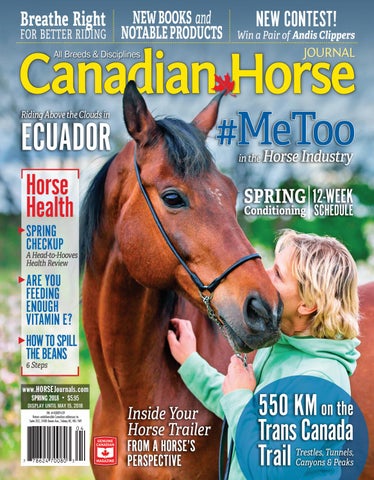
56 34 SPECIAL FEATURES 28 Spring Conditioning
Where and how to start, and a 12-week workout schedule to recondition your horse after downtime.
34 Breathe Right for Better Riding
More effective breathing can give you more stamina, more control, and greater confidence in the saddle.
How going down the road looks and sounds through the eyes and ears of a horse.
46 550 Kilometres on the Trans Canada Trail
4
One woman, one horse, and 550 kms over and through the trestles, tunnels, mountains, and valleys of Southern BC. www.HORSE Journals.com
::
SPRING 2018
56 Riding Above the Clouds: My Ecuador Expedition
Horseback trekking on a gaited Criollo through the Ecuadorian Andes.
66 #MeToo In The Horse Industry
The horse industry joins the worldwide conversation calling for gender equality, respect, and safe places.
|||||||||||||||||||||||||||||||||||||||
38 Inside Your Horse Trailer: From Your Horse’s Perspective
46 ON THE COVER “Horses change lives. They give our young people confidence and self-esteem. They provide peace and tranquility to troubled souls. They give us hope!” — Toni Robinson PHOTO: SHUTTERSTOCK/OSETRIK
34 Photo: Dreamstime/Unicornamira | 46 Photo: Bryn White | 56 Photo: Clix Photography
b IN THIS ISSUE
SPRING 2018
::
CANADIAN HORSE JOURNAL
5
SPRING 2018
38
10 Photo: Shutterstock/Vchal | 28 Photo: Shutterstock/Horsemen | 38 Photo: Shutterstock/K.Appleyard | 66 Photo: Shutterstock/YusufOzluk
b IN THIS ISSUE
10
66 DEPARTMENTS
28 18 Are You Feeding Enough Vitamin E?
With the new riding season about to begin, now is the perfect time to give your horse a head-tohooves health review. www.HORSE Journals.com
74 Horse Council BC News Riding Association News
10 Spring Horse Health Checkup
6
8 Editorial 76 Canadian Therapeutic
HORSE HEALTH
2 To Subscribe
Understanding the role of this important vitamin in the equine diet.
24 How to Spill the Beans
Six steps to the care and cleaning of your male horse’s undercarriage.
77 Manitoba Horse Council News 77, 80, 82, 84
Industry Products, Book Reviews
78-79
Country Homes & Acreages
81, 83
Hitchin’ Post, Index to Advertisers
::
SPRING 2018
DO N’T G ET
S TA L L E D WHEN YOUR HORSE IS SICK, EVERYTHING COMES TO A HALT. Vetera vaccines offer unsurpassed protection, including protection against the latest flu strains, to prevent interruptions in both work and play.
WHY TAKE THE RISK?
TALK TO YOUR VET ABOUT YOUR CUSTOMIZED VACCINATION PLAN. bicanadaequine.ca
POTOMAVACTM and the Horse Head logo are trademarks of Merial (a member of the Boehringer Ingelheim group of companies), used under license. © 2018 Merial Canada Inc. (a member of the Boehringer Ingelheim group of companies). VETERA® and CALVENZA® are registered trademarks of Boehringer Ingelheim, used under license. © 2018 Boehringer Ingelheim (Canada) Ltd. All rights reserved. SPRING 2018
::
CANADIAN HORSE JOURNAL
7
EDITOR’S DESK
b Your Horse b Your Passion b Your Magazine
DRAWING THE LINE This Spring edition tackles the thorny issue of sexual harassment and assault in the horse industry. Sadly, many of us have experienced it. Horses are our therapy for the soul, a place we go for a restorative, positive experience. So it almost seems worse when in this magical place we encounter humiliation, emotional trauma, even assault, which can trigger a cascade of conflicting emotions and troubling consequences. My own story is like many others, except for maybe one important fact. I grew up in a home with an amazing, loving mother, and an abusive father. I got my strength from my mother, and I survived my father. Like so many of us, horses were my refuge. I’ve been a horse lover all my life and a proud horse owner since I was ten years old. Over the years in my working life and in the horse community, I’ve met many wonderful people, and along the way I encountered a few bad apples, too. Fortunately, I would describe my experiences with those bad apples as ranging from embarrassing, humiliating, even infuriating, but none were devastating. I am fortunate because I could have fared much worse; I know what much worse feels like. Looking back, I realize that at the time I fit the profile of the typical victim: unsuspecting, young, and vulnerable. I lacked the confidence to stick up for myself and my main defence was to be inconspicuous; if something negative did happen, I would avoid placing myself in a similar situation again, as much as that was possible, and try to be even more invisible. I would later think of all the things I should have said or done at the time, wishing I’d had the courage and confidence to stick up for myself. Sound familiar? Then one day when I was in my early twenties and upset about 8
www.HORSE Journals.com
::
SPRING 2018
Published by Horse Community Journals Inc.
another bad experience, I had a realization. I couldn’t stop negative experiences from happening in life, but I could control how I dealt with them at the time, and how I would feel about myself and live with myself afterwards. At that moment, in my mind’s eye, I drew a line, and this line would not be crossed again. I pictured the line right there in the dirt between the house and the barn. I can still see it. I’ve seen it and drawn it many times since in life and work situations. I realized that I am responsible for my own happiness, and I will not be defined by the way others treat me or their opinions of me. This realization gave me a feeling of control and the confidence to act, to speak up, rather than simply accepting the hurtful opinions and actions of others. It gave me the confidence to change the things that are within my power to change. Along with this insight is an awareness of the need to go a little easier on myself and on others, to empathize, to give the benefit of the doubt. But when someone has knowingly crossed the line, they will be held accountable. Although the Me Too movement has spread virally, society will not change overnight. Bad apples will continue to look just like regular folks, and their victims will continue to be the unsuspecting, the young, and the vulnerable. We must not blame victims or criticize the ways they handle their bad experiences; each of us must find our own way through. They need our compassion and support, and our promise to hold the perpetrators accountable. Together we will work toward a society and a horse industry where everyone feels safe and is treated with dignity and respect. #MeToo. Kathy Smith
Volume 18 • Issue 4 March/April 2018 Issue of Canadian Horse Journal EDITOR / PUBLISHER Kathy Smith ACCOUNTS Chantal Patterson ADVERTISING April Ray-Peterson • Terry Andrucko SUBSCRIPTIONS Steve Smith ADMINISTRATIVE COORDINATOR Nathan Reimer MARKETING Janna Reimer ART DIRECTION, PRODUCTION Elisa Crees CONTRIBUTORS Margaret Evans • Tania Millen • Shawn Hamilton April Clay • April Ray-Peterson • Shelagh Niblock Dr. Steve Chiasson • Jec A. Ballou • Kevan Garecki HCBC • MHC • CanTRA ADVERTISING, SUBSCRIPTIONS & GENERAL INQUIRIES 1-800-299-3799 • 250-655-8883 or email: sales@horsejournals.com ADVERTISING DEADLINE 4 weeks prior to issue date (eg: Sept. 21 for Nov. issue) ONLINE EDITION
WEBSITE www.horsejournals.com MAIN OFFICE EMAIL editor@horsejournals.com PRODUCTION DEPARTMENT EMAIL design@horsejournals.com
Publishing 6 issues per year SUBSCRIPTIONS – REGULAR RATES 1 yr/6 issues: $24 + tax 2 yr/12 issues: $37 + tax US/Foreign $59/2 yrs, 12 issues ORDERS FOR SUBSCRIPTIONS, CHANGE OF ADDRESS NOTICES, & UNDELIVERABLE COPIES ARE TO BE SENT TO: THE CANADIAN HORSE JOURNAL Suite 202, 2400 Bevan Ave., Sidney, BC V8L 1W1 (250) 655-8883 • fax: (250) 655-8913 • 1-800-299-3799 POSTAGE PAID AT WINNIPEG, MB PUBLICATIONS MAIL REG. NO. 40009439 GST REG. NO. 829298140 ISSN. NO. 1496-1733
We acknowledge the financial support of the Government of Canada.
REPRODUCTION IN WHOLE OR IN PART OF ANY MATERIAL CONTAINED IN THIS PUBLICATION WITHOUT THE WRITTEN PERMISSION OF THE PUBLISHER IS STRICTLY PROHIBITED. The information and services listed herein are intended to facilitate accessibility to the professionals, products and services that play a part in the horse industry. While readers are encouraged to use the products and services of the merchants listed in this Guide, Horse Community Journals Inc. does not recommend or guarantee the products and services of advertisers or associates listed. Manuscripts and photographs will be returned only if SASE is provided. The return of unsolicited material is not guaranteed. Contributors and advertisers warrant all materials supplied are free of copyright and they have the legal right to use the same. All material accepted for publication is subject to such revisions as are deemed appropriate by Canadian Horse Journal (CHJ). The opinions expressed in CHJ are not necessarily those of the publisher. CHJ reserves the right to refuse any advertising or submission. Contributors consent to have their submissions published in CHJ and on www.HorseJournals. com and elsewhere as determined by the publisher. Printed in Canada. Please recycle.
WIN
2 Chances to Win — 2 PAIRS OF CLIPPERS TO BE AWARDED
DRAW DATES: April 13 & April 30, 2018
A PAIR OF
Pulse Ion
No purchase necessary. Contest is open to residents of Canada.
Clippers
RUNNER-UP PRIZES — Canadian Horse Journal Subscriptions
FROM
Over
$750 in Prizes!
EACH ANDIS PRIZE INCLUDES: • • • •
Pair of clippers Bottle blade oil Charging station 4 attachment combs
To Enter, Sign Up for
from
www.HORSEJournals.com — Contests
SPRING 2018
::
CANADIAN HORSE JOURNAL
9
HEALTH
SPRING HORSE HEALTH CHECKUP By Steve Chiasson, DVM, CVMA 10
www.HORSE Journals.com
::
SPRING 2018
With winter releasing its icy grip on most of the country, horse owners are feeling the anticipation of another riding season just around the corner. While Canadians take national pride in fully embracing our cold snow-filled months, it’s hard to deny that springtime is a welcome sight, and horse owners are especially excited. Winter horse care can mean different things depending on your geographic location. Fluctuating temperatures in Eastern Canada create challenges for indoor housing. Folks on the Prairies cope with their incredibly frigid minus 40-degree C days
(how you just “dress for it” I don’t know!). While in Western British Columbia there is constant rain from November to March. Dealing with any of those conditions makes both horse and human welcome the arrival of spring sunshine and open barn doors! The transition between seasons is a natural time to do some spring cleaning around the house and barn. Just as important is the seasonal transition for your horse. Whether spring sees you switching from indoor arena to outdoor riding, changing your horse’s housing from stable to pasture and paddocks, or
PHOTO: SHUTTERSTOCK/135PIXELS PHOTOS COURTESY OF AGWEST VETERINARY GROUP LTD.
The vet will listen to gastrointestinal sounds on both sides of the abdomen both high and low. These rumblings and gurgles are normal in healthy horses, and an indicator of digestive function and intestinal movement.
PHOTO: DREAMSTIME/VIKTORIA MAKAROVA
Performance horses benefit from a full detailed examination and soundness evaluation. The Lameness Locator® provides a computerized analysis that assists in establishing an objective evaluation of baseline soundness. This is particularly useful for comparison if problems develop later on.
beginning new training for the upcoming show season, you will be affecting your horse’s living and working conditions in significant ways. This is a perfect time for getting a spring horse health checkup.
horse’s health. It is a snapshot in time that takes into account both medical history and potential future plans for your horse activities. And it is incredibly valuable.
The Vet Exam
It seems cliché to say “You and your veterinarian are important partners in the health care of your horse,” but the history of health and performance is critical to making evaluations and future decisions for your horse. Nobody is more in tune with how things are going than the person who sees the horse every day — and that’s you. Your checkup exam will always start with a good history.
A spring horse health exam can be quite different from a mid-season exam. During the riding season, veterinarians will often be called to investigate a specific problem that is occurring, such as respiratory difficulty at rest, or worsening lameness that is affecting performance. But the pre-season exam is generally focused on a broader view of your
History
If you recently purchased the horse, you may have an in depth pre-purchase exam report that will have a very detailed summary of past medical history and exam findings (see Unravelling the Mysteries of the Pre-Purchase Exam, Canadian Horse Journal Sept/Oct 2017 issue). Having this information on hand is always helpful when your veterinarian is seeing a new horse for the first time. Everything that has happened over the winter season is also important information: • Has the horse been in work through the winter? SPRING 2018
::
CANADIAN HORSE JOURNAL
11
PHOTO COURTESY OF AGWEST VETERINARIAN GROUP LTD.
Over the course of a year, most horses make enough sharp enamel points to warrant a dental float. Light sedation during the dental exam allows for a more thorough inspection of gums and teeth for abnormalities.
• Describe the horse’s feeding program. Have there been any changes in feed? Is he eating normally or have you noticed any peculiar habits? • Has there been any weight change? Are you feeding a special diet to control body condition? • Have there been any respiratory concerns, coughing, or nasal discharge over the winter?
12
www.HORSE Journals.com
::
SPRING 2018
• Has there been any movement of horses in/out of the facility? • Have you observed any lameness in your horse? Any lumps or swellings? • Describe foot care over the winter. Is your farrier happy with the condition of the feet and/or shoes? • Is your horse receiving any treatments or medications?
These may seem like a lot of questions to answer before we even get to examining the horse, but they help to identify what to look for. Even if you’ve owned your horse for years, things can quietly change over a winter season, and clues from the owner help the vet put the puzzle together.
Baseline General Exam Now for the actual exam. Regardless of the type of horse or your riding discipline, a thorough physical exam is the basis of your spring checkup. More detailed exams might be indicated for specific problems mentioned in the history or for increased levels of performance, but every horse evaluation starts with the baseline general exam.
Cardiovascular and respiratory
Proper heart and lung function is obviously crucial for any horse no matter what level of activity makes up their day. Your vet will listen for heart sounds on both the left and right side of the chest while evaluating the rate and rhythm of the heart beats. Mur-
murs (abnormal sounds) may indicate abnormal heart function. Feeling the pulse strength at different locations can help locate any potential areas that may be experiencing abnormal blood flow. Presence of edema (fluid accumulation) in the legs, abdomen, groin, and neck should all be noted and recorded. Clear nostrils free of discharge and odour is the first sign of a healthy respiratory system. The nasal mucous membranes should be light pink and show no evidence of ulcers or a bloodshot appearance. Lymph nodes under the jaw and around the throat area should be normal size and not painful to touch. The trachea is very easily evaluated in horses, and owners should be able to do this themselves. The first step is listening with a stethoscope right over the midline on the underside of the neck. Normal tracheal sounds are loud and sound the same on inspiration (breathing in) and expiration (out). In most horses, minimal or no mucus fluid should be heard gurgling in the trachea. The next step is testing for an induced cough. Rub the same area very aggressively with the palm of your hand for ten seconds. One dry cough or no cough is normal for most horses. Airway irritation and inflammation will produce repeated coughing or require only light rubbing to induce. The lungs are more difficult to hear and your vet will need a quiet environment and/or a rebreathing test (plastic bag over the nose). The vet will evaluate airflow through all regions of the lung and check for abnormal sounds at different phases of respiration.
This is a combination of both muscle and fat coverage over the body. Understandably, most horses fall into the BCS 5 to 6 range with varying levels of fitness vs. fat. We are also palpating the legs to check for any swellings or painful areas. This is where the accurate history is vital for determining old vs. new findings. Digital pulses should be evaluated along with assessment of the feet and trimming. • Casual Performance Horse — This category includes pleasure horses that may have an above-average amount of riding,
horses that may do a few amateur shows for fun, lesson horses, and horses that will see an increase in their workload for the coming season. Careful palpation of the entire neck, back, and pelvis will help identify any areas of soreness. Detailed limb exams including ligament and tendon palpation is also done, along with range of joint motion and hoof testing. Your veterinarian will discuss any findings that may affect riding or training plans. • The Performance Horse — These horses should have a full detailed examination as
S VISIT UE AT TH
nt e v E e n Ma AB er, Red De27-29 Apr 508 #2 BOOTH
Otter Co-op Feeds and Supplements are Scientifically Formulated for Performance
Gastrointestinal
Your vet will listen for normal bowel sounds in all quadrants of the abdomen on both left and right sides. There should be constant gastrointestinal sounds with no pain or spasms present. Fecal balls should be uniform in size, with short/medium fibre particles, and have some water left to squeeze out.
Musculoskeletal
This area of the exam can easily have the most variation depending on the history and intended use of your horse. While some horses might be totally fine to comfortably live out their days with some minor abnormalities, others need to be monitored and maintained at very high standards to pursue their athletic careers. There are three distinct levels of musculoskeletal evaluations you can do at your spring checkup: • Pleasure and Companion Horse — Every horse should have this level of exam. Your vet is checking for Body Condition Score (BCS) from very thin (1) to very obese (9).
Equine Supplements (800) 663-6038 ext. 6905 for a Dealer Near You!
WWW.OTTERCOOP.COM SPRING 2018
::
CANADIAN HORSE JOURNAL
13
above, with the addition of soundness evaluation in motion. This would include flexion testing of limbs and evaluation of gaits on both hard and soft ground. We find it helpful to utilize the Lameness LocatorÂŽ computerized analysis to establish an objective evaluation of baseline soundness. If any concerns are found or a problem develops later, we have a springtime comparison to fall back on.
Dental Evaluation
Most owners are familiar with the annual visit by the vet to have their horse’s teeth
looked at. This is best done with a fully rinsed mouth and a dental speculum. Your horse may or may not need some light sedation for this exam, but sedation does make for a more thorough and safe procedure. Inspecting the gums and each tooth both visually and by palpation will help identify any loose teeth or other abnormalities. These may include diastemas (spaces between teeth) that have impacted feed, gum recession, transverse ridges, and ulcers to name a few. Not every oral exam finishes with a dental float. On average, within a year, most horses will
make sharp enamel points significant enough to warrant dental correction. Occasionally this interval is shorter, or longer, but your veterinarian will advise you on a schedule that fits your horse best. More frequent oral exams may benefit the show horse. Removal of the sharp points eliminates that source of distraction and pain when under saddle. The pain tolerance among horses is extremely variable and sometimes correction of minor abnormalities can make a huge difference in comfort and riding performance.
Diagnostics
If we heard that a friend had been to the doctor for their yearly checkup and had some blood work done, we would think nothing of it. Sounds pretty routine, right? Well, your horses are really no different. Diagnostic testing can be a valuable tool, and money well spent if it’s done wisely. Just like your human physician, your veterinarian will use a detailed history combined with physical exam findings to determine what diagnostic tests would be of value to you and your horse.
The spring vet checkup is the ideal time to develop a vaccine strategy with your veterinarian to give your horse optimal protection throughout the coming season.
14
www.HORSE Journals.com
::
SPRING 2018
There are several types of diagnostics available:
having specific health issues. Examples of this include PPID (Cushing's disease) with ACTH hormonal testing, or insulin and glucose levels for insulin resistance or equine metabolic syndrome. Most of these procedures can be done on the same visit as your checkup, but discuss this ahead of time with your vet if you have concerns. Some screening tests require special feeding times prior to blood collection for accurate results.
• Bloodwork is easily the most commonly recognized type of checkup test for humans and animals, and with good reason, as evaluation of some body functions is just not possible with a physical exam. There are a variety of blood tests available depending on what is being assessed. • CBC/Chemistry is the most common type of blood screening done. CBC (complete blood count) looks at many characteristics of the horse’s red and white blood cells. The lab reports on the hematocrit (how many red blood cells in a volume of fluid), hemoglobin levels for oxygen carrying, and the appearance of the red blood cells. White counts are extremely useful and tell us the levels and types of white blood cells. This is the primary way to measure response to infection. The chemistry tests look at organ function and electrolyte levels in the body. Liver, kidney, muscles, and the immune system can all be evaluated. Mineral testing of blood serum can also be of value depending on which specific mineral you are interested in.
• Fecal testing — There is definitely a move away from just blindly deworming of horses on a random schedule. Many of
the dewormer programs used in the past have been guilty of administering medications at the wrong time, or treating horses that did not actually need deworming. Incorrect and indiscriminate use of dewormer leads to drug resistance and less effective options for when the medications are really needed. Spring checkup is a great time to get a fecal egg count done on your horse. While there is certainly debate about what is considered a low vs. moderate vs. high shedder, knowing your horse’s tendencies for parasite
PHOTO: SHUTTERSTOCK/VCHAL
• Metabolic testing or screening for certain conditions may be suggested if your veterinarian suspects your horse may be
SPRING 2018
::
CANADIAN HORSE JOURNAL
15
• Anthrax • Botulism • Equine Herpesvirus (Rhinopneumonitis) • Equine Influenza • Equine Viral Arteritis • Leptospirosis • Potomac Horse Fever • Rotaviral Diarrhea • Snake Bite
PHOTO: DREAMSTIME/KENKTENNAPEL
• Strangles
X-rays can monitor the healing progress of a previous injury, and provide information to help you decide your horse’s training plans.
shedding will help you develop a seasonal deworming plan with your vet. • Radiographs (x-rays) and ultrasound imaging can be included in the spring checkup for different reasons. You may be monitoring the healing response of an injury that was rehabilitated over the winter, or perhaps the coming season will be the start of more intensive training for your horse. Well-chosen imaging can give you information to confirm whether future plans are right for your horse, or highlight areas to monitor carefully throughout the season.
Vaccinations This is probably the most common service associated with the spring vet visit. However, as simple as it is to administer the vaccines, the decisions that go into developing a proper vaccine strategy for your horse are complex. This is an excellent time to discuss with your vet exactly what should be done to give your horse optimal protection though the coming season. The two categories and guidelines of vaccines that the American 16
www.HORSE Journals.com
::
SPRING 2018
Association of Equine Practitioners (AAEP) recommends are core vaccines and riskbased vaccines. Core vaccinations are defined as those “that protect from diseases that are endemic to a region, those with potential public health significance, required by law, virulent/highly infectious, and/or those posing a risk of severe disease. Core vaccines have clearly demonstrated efficacy and safety, and thus exhibit a high enough level of patient benefit and low enough level of risk to justify their use in the majority of patients.” The following equine vaccines meet these criteria and are identified as core requirements: • Eastern/Western Equine Encephalomyelitis • Rabies • Tetanus • West Nile virus Risk-based vaccinations are included in a vaccination program after the performance of a risk-benefit analysis. The use of risk-based vaccinations may vary regionally, from farm to farm within an area, or even between individual horses within a given herd. These include:
As you can see, a proper vaccine program has a lot of moving parts and developing the best one for your horse calls for several decisions to be made. The vaccine strategies your friend uses for his horse may not necessarily be correct for yours. For the best advice on choosing the correct vaccines for your particular horse, talk to your veterinarian. You can also visit the AAEP website (www.aaep.org) for more detailed information about the above diseases and to see suggested vaccine schedules for different scenarios. Any time of the year is a good time to give your horse a complete health checkup, but consider taking advantage of the change of seasons as a reminder to get things up-to-date. When possible, combine your vet’s visit with friends at the barn for the opportunity to observe the exams and procedures on other horses. This is a great way to learn all the details of the spring checkup visit, and join discussions with other owners and your veterinarian. We always appreciate an informed, educated owner who wants to be part of their horse’s health care team. b
>>>>>>>>>>>>>>>>>>>>>>>>>>>>>> Dr. Steve Chiasson is originally from Sydney, Nova Scotia. After completing pre-vet studies at the Nova Scotia Agricultural College in Truro, he attended the Atlantic Veterinary College in Charlottetown, graduating with Honours in 1995. During this time, he gained valuable experience at a large veterinary hospital in Alberta while assisting with various clinical research projects and all aspects of rural veterinary medicine. Steve has been living and working in veterinary practice in Abbotsford, BC since 1995, and together with Dr. Fawcett co-founded Agwest Veterinary Group Ltd. in 2004. Particular areas of interest include lameness, acupuncture, and technology implementation into veterinary medicine. Downtime usually finds Steve and his wife, Rachael, traveling throughout BC and Canada, attending their kids’ sporting activities.
David Miller of
Showstring WINS WITH
the POWER of RESULTS OFFICIAL FEED
OFFICIAL FEED
ESSENTIAL K®
A low NSC ration balancer to be fed alone or used as a top dress. Low sugar and starch levels Lower intake and cost
Fixed formula for consistency and quality Essential organic trace minerals
800-472-9507 TRIBUTEEQUINENUTRITION.COM
Essential fatty acids
Essential amino acids
Antioxidants for improved health
HEALTH
Are You Feeding
ENOUGH PHOTO: CANSTOCK/YANIKAP
Vitamin E?
By Shelagh Niblock, PAS
V
itamin E is a fat soluble vitamin that is an essential nutrient in equine diets. Vitamin E functions largely as a biological antioxidant in the equine body, protecting tissues from the oxidative effects of free radicals. Free radicals are a natural outcome of cell metabolism but they can become excessive during conditions of hard work or injury. The more active the cells are in your horse, the more at risk he is of oxidative stress at the cellular level. This means that hard-working performance horses and growing horses are at particular risk of oxidative stress. Vitamin E also functions to enhance immunity at the intracellular level in our horses. Horses do not manufacture vitamin E in their own bodies
Fresh spring pasture is one of the most abundant sources of vitamin E.
18
www.HORSE Journals.com
::
SPRING 2018
and therefore need supplemental sources of it. Dietary sources include fresh forages such as pasture, whole grains with the endosperm intact, as well as fats and oil seeds. Horses that are deficient in vitamin E will have poor immunity and longer recovery times after injury or work due to oxidative stress on the cells within the body. Other nutritional antioxidant sources include carotenoids like beta carotene, as well as vitamin C and selenium. What are the sources of vitamin E in the equine diet? Vitamin E is a naturally occurring organic compound called alpha-tocopherol. Equine diets can contain either synthetic vitamin E (dl-alpha-tocopherol), or natural vitamin E (d-alpha-tocopherol), or
both. Research in multiple species including humans has shown that the natural form of vitamin E is better utilized by the body and is more effective at raising blood serum or plasma vitamin E levels. Vitamin E in either the natural or synthetic form is very unstable and subject to deterioration, so a form that has been esterified is generally added to any manufactured feeds or supplements. A common esterified form is called alphatocopheryl acetate. Esterified vitamin E sources are completely safe and effective, and are rapidly converted back to non-esterified vitamin E in the digestive tract. Over-the-counter natural vitamin E supplements or capsules intended for human consumption may say “natural
How much vitamin E do horses need? The 2007 NRC Equine Nutritional Guidelines provide minimum recommendations for vitamin E intake for horses at different body weights and different metabolic states. It suggests that a mature 500 kg horse at maintenance (doing no work) needs a minimum daily intake about 500 IU (international units) of vitamin E. The requirement doubles to a minimum intake of 1000 IU for the same horse doing hard work. Research has shown that horses consuming diets higher
Hard-working horses benefit from vitamin E supplementation. Horses deficient in vitamin E will have poor immunity and longer recovery times after injury or work due to oxidative stress on the cells within the body.
PHOTO: SHUTTERSTOCK/OLGARU79
source” or “organic” vitamin E, but a review of the ingredient statement will show the nonesterified d-alpha-tocopherol. This can be confusing but it is worthwhile familiarizing yourself with the terminology so you can be sure of what you are buying for yourself or your horse. Sources of vitamin E intended for human consumption work well for horses and can sometimes be more economical. The most metabolically available source of vitamin E for horses is one where vitamin E is processed to make it water soluble. There are a couple of sources of processed vitamin E available in the United States (Nano-E by Kentucky Equine Research and Elevate WS by Kentucky Performance Products), but unfortunately at this time there are no sources available in Canada. Canadian horse owners wanting to source watersoluble vitamin E would need to order the product online and have it shipped to Canada or a pickup point in the US. Fresh spring pasture is one of the most abundant sources of vitamin E, but stored forages like hay or haylage lose their vitamin E activity quickly. Whole grains and some unsaturated fat sources are also good sources of the vitamin but again, the vitamin deteriorates rapidly during storage.
in unsaturated fat sources such as corn, soybean, or canola oil may have reduced efficiency in utilizing dietary vitamin E sources. This could potentially increase the vitamin E requirement for hard-working horses that are consuming high fat feed supplements. Most commercially available complete equine mineral supplements provide vitamin E at a minimum of 500 IU for a mature 500 kg horse, thereby providing supplemental vitamin E at NRC
recommended maintenance levels. This intake will provide an adequate level of the vitamin for most pleasure horses. The expectation is undoubtedly that any additional vitamin E required will be provided by the forages the horse eats or additional complete feed sources. Unfortunately, a reality of modern horse ownership is that few of our horses, especially those in significant training or work, have much access to fresh forage like
pasture. Even semi-sedentary pleasure horses are likely to be limited in their access to pasture as we understand so much more now about the impact it has on horses with metabolic issues. Few pleasure horse are allowed unlimited access to rapidly growing spring pasture because of concerns such as insulin resistance and laminitis. It’s too bad because fresh pasture is probably one of the best sources of vitamin E available for your horse.
SPRING 2018
::
CANADIAN HORSE JOURNAL
19
The amount of vitamin E fed to a pregnant mare will determine the levels the foal has access to in utero, and the levels of vitamin E subsequently available in colostrum and lactation. Since most manufactured supplements are formulated with the average horse in mind, the pregnant or lactating horse should be supplemented from other sources.
Stored forages such as hay have reasonable levels of vitamin E at harvest, but the levels decline rapidly after that. Most equine nutritionists assume that stored forages of any kind contribute no vitamin E to an equine diet. An assessment of your horse’s diet may well show that you are providing your horse with vitamin E at a level that is adequate for maintenance. If, however, you have a horse that is in hard work, senior, growing, pregnant, lactating, or a breeding stallion, it’s definitely worthwhile to consider supplementing his/her diet with additional vitamin E.
Equine Choice is Canada’s #1 Prebiotic + Probiotic that promotes and maintains optimal digestive health, and promotes normal stomach pH and gastric function.
What about vitamin E deficiencies? Several disease conditions have been linked to deficiencies in vitamin E. White muscle disease (also known as nutritional muscular dystrophy) in foals is a noninflammatory degenerative disease that affects skeletal muscle of foals from birth to approximately 11 months of age. Supplements of both vitamin E and
animalproproducts.com
1.800.420.3633 20
www.HORSE Journals.com
::
Can high levels of vitamin E be toxic? Vitamin E is essentially non-toxic and therapeutic doses in equine diets can be as high as 8,000 IU per day. The NRC Equine Nutritional Guidelines suggest that a maximum safe intake of vitamin E for any horse should not exceed 1,000 IU/kg of dry matter intake. Assuming a daily dry matter intake of approximately two percent of body weight, a safe upper limit for vitamin E for a 500 kg horse would be about 10,000 IU: 500 kg X 2% = 10 kg of dry matter intake X 1000IU/kg DM = 10,000 IU
SPRING 2018
selenium are the suggested treatment for this condition, although it is suspected that it may be related to the vitamin E and selenium status of the dam during pregnancy. The best prevention for this disease in foals is to ensure their dams get adequate levels of vitamin E during pregnancy, especially in the final months before foaling. Equine degenerative myeloencephalopathy (EDM) is a degenerative condition of the brain and spinal cord in young horses that results in gait defects. It is suspected that the primary cause of the condition is genetic and not primarily related to vitamin E deficiencies early in life, but it appears that vitamin E deficiencies are implicated in the onset and severity of the disease. If a mare is known to have produced foals with EDM, some research has suggested that supplementing her with vitamin E during pregnancy can reduce the incidence of the condition in subsequent foals. Equine motor neuron disease (EMND) is a degenerative disease of horses two years of age and older. Clinical signs include muscle wasting, trembling, and prolonged recumbency or lying down. It usually appears in horses that have been subjected to prolonged periods of vitamin E deficiency. Supplementation with high levels of vitamin E to affected horses can help slow or reverse the symptoms, but the outcomes are not always good with this condition. Equine protozoal myeloencephalopathy or EPM is a disease not related to a deficiency in vitamin E, but one that
appears to respond well to therapeutic doses of vitamin E as part of the supportive care protocol advised by the veterinarian. It is caused by infection of the central nervous system by a protozoa generally carried by opossums. The disease causes muscle wasting, ataxia, trembling, and excessive sweating. Affected horses seem to respond positively to high levels of vitamin E (at least 8,000 IU per day). Shivers is a chronic neuromuscular syndrome of larger horses that may have a genetic origin. While not caused by vitamin E deficiencies, the suggested treatment of the disease does include supplementation with high levels of vitamin E as well. It isn’t entirely understood how the vitamin E helps these horses, but it is a powerful antioxidant and it supports immune functions and possibly the support it provides is as simple as that: supportive care to facilitate the animal’s own body to fight the infection. What about pregnancy, lactation and growing horses? Vitamin E supplementation for the pregnant and lactating mare is important for the health of both the mare and her
foal. The amount of vitamin E fed to a pregnant mare will dictate the levels the foal has access to in utero and, even more importantly, the levels of vitamin E in both colostrum and subsequent lactation. Fresh pasture can provide a pregnant mare with a good supply of natural vitamin E, but in Canada fresh pasture can be very seasonal and so mares should always be supplemented with a source of additional vitamin E. NRC suggests an intake of at least 800 IU for a 500 kg mare, but more recent research suggests that an intake of at least 1,000 to 2,000 IU is appropriate. The same is true for breeding stallions, especially those that are both working and standing at stud. An intake of 1000 to 2,000 IU and possibly higher depending on work and body weight would not be excessive for these horses. Vitamin E requirements for growing horses have not been well established in the research literature, but NRC suggests a minimum of 80 IU/kg of dry matter. This means that a yearling at approximately 350 kg and eating two percent of his body weight in dry matter intake (seven kg of dry matter intake) will need approximately 560 IU (80 IU/kg of dry matter x 7 kg intake = 560 IU). I would suggest this should be a minimum for
a growing horse as their rapid growth at this age sets the stage for increased metabolic activity and as a consequence, increased oxidative stress. Diets for the growing horse containing closer to 1,000 IU per day would not be excessive. What about working horses? The NRC Equine Guidelines suggest that mature horses engaged in hard work need a minimum of 1,000 to 1,800 IU of vitamin E per day as determined by body weight. As most commercial mineral supplements provide about half of that or less, and many of our working horses have limited if any access to fresh pasture, it raises the question of where our horses will get the balance of their requirement for this very important vitamin. Most manufactured supplements for horses are formulated with the average horse in mind. This is a responsible decision on the part of the manufacturer considering that many nutrients can be toxic if overfed. However, it means that the owner of any horse, and in particular the working or pregnant or lactating horse, needs to consider supplementing vitamin E from other sources. Deficiencies of vitamin E in working horses have been
SPRING 2018
::
CANADIAN HORSE JOURNAL
21
PHOTO: SHUTTERSTOCK/BRONWYN PHOTO
related to increased incidence of injury and slower recovery times after hard work. It is suspected that the incidence of tying-up may be higher in horses that are deficient in vitamin E. Certainly for the horse that is on the road and in intensive competition, the enhanced immunity provided by adequate levels of vitamin E alone is a good reason to supplement. Kentucky Equine Research (KER) in the USA is known for being at the forefront of equine research and they suggest the following intakes of vitamin E for horses: • Daily intake for the mature 500 kg horses including pregnant mares – 1,000 to 2,000 IU • Intake for the mature 500 kg horse in competition —3,000 to 5,000 IU provided 6 to 12 hours prior to an event KER also suggests that, as much as possible, a source of natural vitamin E (d-alpha-tocopherol) be included in the daily intake to ensure superior uptake in the digestive tract. Practical supplementation solutions Vitamin E in all its forms is a very safe vitamin, but if you are considering supplementation in response to a particular issue in your horse, especially if it appears to be a neurological condition, 22
www.HORSE Journals.com
::
SPRING 2018
you should consider consulting your veterinarian first. A blood test for serum alpha-tocopherol can give you a snapshot look at the vitamin E status of your horse. While blood results can be somewhat variable, and can help you establish a trend in his/her vitamin E status going forward. If you are considering supplementing vitamin E at a higher level (in excess of 5,000 IU per day) it may also be helpful for you to consult with an equine nutritionist or your veterinarian to account for all the sources of vitamin E in your horse’s diet. While vitamin E is a very safe nutrient to supplement, it is never a good idea to feed excessive amounts of any nutrient but especially a fat soluble vitamin. You may also want to consider supplementing your horse with selenium at the same time, and again, for safe supplementation you must include all dietary sources in your calculations to ensure that you are not over-supplying it. Consider sourcing natural vitamin E at your grocery store or local drug store. Often the vitamin E supplements, especially the “all natural” d-alphatocopherol capsules aimed at the human market, are very economically priced. Remember to assess ingredient statements to ensure that you are sourcing vitamin E in the form in which you want it.
>>>>>>>>>>>>>>> Vitamin E Temporarily in Short Supply
Stored forages have reasonable levels of vitamin E when harvested, but the vitamin deteriorates quickly during storage. As a result, most equine nutritionists assume that stored forages contribute no vitamin E to the equine diet.
Small meals fed often Horses have relatively limited stomach and small intestine capacity. For this reason it is important to feed small meals often when providing nutrients that must be absorbed in the foregut. For the best utilization of vitamin E by your horse, the maxim for equine diets of “small meals fed often” is good advice. If your schedule will allow it, consider dividing your vitamin E supplementation into at least two meals per day, or more if it can be accommodated. Remember that as a fat soluble vitamin, a supplemental level of vitamin E in your horse’s diet will not necessarily result in consistent increased levels of alpha-tocopherol at the muscle or blood level overnight. Your plan for supplementation needs a long term commitment. The outcome though, even for a pampered pasture pet, can result in many tangible benefits. b
PHOTO: CANSTOCK/ANDRIANOCZ
Most North American equine supplements and complete feeds containing vitamin E are manufactured using the synthetic vitamin E (dl-alpha-tocopheryl), sourced from the German company BASF. On October 31, 2017 the BASF plant was damaged by fire, severely impacting the world supply of synthetic vitamin E. As a result, synthetic vitamin E prices have gone up and inventories have diminished. The outcome of this is it may be more difficult and potentially more expensive for you to provide your horse with your favourite supplements for at least the first half of 2018. BASF is hopeful they can complete the necessary repairs to the plant to get back into production by late spring of 2018, with shipments resuming several weeks after restarting production. Natural vitamin E (d-alpha tocopherol) is manufactured in the United States and so inventories of this vitamin were not affected. Natural vitamin E intended for the human market is easy to use for equine supplementation and usually available at your local drug store.
Matrix BestVet III
Microcurrent therapy kit.
Comes with Back Pad and 4 Leg Wraps.
Matrix Rainbow Meridian LED/Laser System Select from 10 programs.
Matrix SL-50 Laser
Red /Infrared variable control.
/////////////////////////////////////////////////////////////////// Shelagh Niblock PAS is an equine nutritionist with an extensive background in both ruminant nutrition and forage science as it relates to both horses and ruminants. She has spent more than 35 years in the feed industry in BC, and her lengthy experience working initially as a dairy nutritionist piqued her interest in the contribution made by forages to the diets of our horses. Her work in ruminant nutrition has given her some unique insights into equine hind gut health and its impact on equine performance and health. Shelagh currently practices as an equine nutritional consultant, offering advice on the successful feeding and husbandry of horses. Shelagh is a horse owner herself and an enthusiastic pleasure rider who is especially interested in the disciplines of dressage and three-day eventing. A 4-H horse leader for many years, Shelagh is still active as a volunteer in the 4-H program in BC, as well as BC Pony Club. She is a member BC Pony Club as a Horse Master, and a member of the Equine Science Society, the American Dairy Science Association, and the American Registry of Professional Animal Scientists.
Matrix Vibra VM for COPD
Sound waves break up respiratory system congestion.
Matrix SoundWave
Reduces pain, relieves muscle spasms, reduces swelling and inflammation.
MAINTAIN • HEAL • PROTECT
www.TherapyProducts.net (503) 632-7187 • info@therapyproducts.net SPRING 2018
::
CANADIAN HORSE JOURNAL
23
6 Steps to Sheath Cleaning & Bean Removal
By Tania Millen
24
www.HORSE Journals.com
::
SPRING 2018
HORSE PHOTO: SHUTTERSTOCK/ERIC ISSELEE BUCKET PHOTO: SHUTTERSTOCK/AFRICASTUDIO | COTTON SQUARES PHOTO: SHUTTERSTOCK/BK0808
HEALTH
HOW TO
Spill the Beans
PREPUCE
PENIS SHEATH
DIVERTICULUM ENTRANCE TIP OF URETHRA The sheath, prepuce and penis.
G
Swelling is a sign that the sheath may need cleaning or a bean may be present. Other strong indications include discomfort during urination or not urinating with a healthy stream.
PHOTOS: CATHY JACKSON
rooming is an enjoyable way to bond with your horse, and most horses love to be fussed over, but cleaning a male horse’s sheath is an unpleasant chore that owners and riders tend to avoid. From potentially being kicked, to lack of knowledge or squeamishness, those with geldings and stallions often shirk the task altogether. However, veterinarians agree that cleaning and inspecting a horse’s sheath is a necessary and regular part of maintaining their health. Cori Stephen, DVM, owner and one of the veterinarians at Nechako Valley Animal Health Services near Prince George, BC, advises, “The purpose of cleaning a horse’s sheath is to inspect it and make sure it’s healthy. There are lots of diseases that can occur to this part of anatomy — cancers such as squamous cell carcinoma, viruses such as the papilloma virus and a strain of herpes virus, as well as bacterial and fungal infections. So, when you invest in a veterinarian to clean the sheath, you’re paying for more than just the procedure, you’re investing in knowledge.” She points out that the whole sheath area collects debris from horses rolling in shavings, being ridden in dirt arenas, and playing outside in the mud, so it’s important to clean the sheath to minimize debris that can perpetuate infections. To understand the necessity of sheath cleaning, it’s useful to know a bit more about male horses’ private parts. The sheath includes three anatomical parts — the outer sheath, the prepuce which looks like folds of skin, and the penis — and all three require maintenance. To keep the sheath lubricated and allow extension and retraction of the prepuce and penis, male horses naturally produce sebum from sebaceous glands within their sheath. When sebum combines with dirt, natural bacteria and dead skin cells, it forms sticky, smelly, grey-black gunk called smegma that coats the inside of the sheath, the area between the sheath and prepuce, plus the penis. Dr. Stephen explains, “Smegma protects the area from getting chaffed during exercise. Often there are large
Sedation not only allows the horse to relax and let the prepuce and penis hang down, it also reduces the potential for injury to the handler and cleaner. SPRING 2018
::
CANADIAN HORSE JOURNAL
25
THERAPEUTIC PADS To aid in preventing and relieving many of your hoof care problems
CUSHION FROG PADS PHOTO: CATHY JACKSON
SMALL: 6 1/2” x 5 7/8” x 1/16” LARGE: 8” x 7 1/2” x 1/8” TWO DEGREE: 6 1/2” x 5 7/8” x 5/16” TWO DEGREE LARGE: 8” x 8” x 5/16”
EGG BAR PADS PHOTO: TANIA MILLEN
SMALL: 6” x 6 1/2” x 1/8” LARGE: 7 3/8” x 7 7/8” x 1/8” TWO DEGREE: 6” x 6 1/2” x 5/16”
PERFORMANCE PADS
#4: 6 3/8” x 5 3/4” x 3/16” #5: 7 1/4” x 6 5/8” x 3/16” #4: 6 3/8” x 5 3/4” x 1/4” #5: 7 1/4” x 6 5/8” x 1/4”
IMPAK PADS
#8 IMPAK ABSORBER: 5 1/8” x 4 3/4” x 3/16” #8L IMPAK LARGE ABSORBER: 6 5/8” x 6” x 3/16” (For Prolapsed Frog)
CASTLE PLASTICS 1-800-9-CASTLE castle@net1plus.com 11 Francis St., Leominster, MA, USA 01453
www.castleplastics.com 26
www.HORSE Journals.com
::
SPRING 2018
PHOTO: CATHY JACKSON
Beans can be round or long and pencil-like, and feel like a hard lump.
Regular sheath cleaning will minimize the presence of debris that can prolong infection, like the one shown.
peeling flakes of skin on the penis. That’s just the body shedding cells. It’s normal.” During sexual arousal and activity, smegma is naturally dislodged from a wild stallion’s penis, while domestic breeding stallions usually have their sheaths cleaned pre- and post- breeding. But many North American horses are gelded, which prevents natural sexual activity. Since they’re not using their penis for its intended purpose, sheath cleaning and inspection are required. But the fun doesn’t end there. Another important part of male horse anatomy is the urethral diverticulum, which is a small pouch located beside the urethra at the end of the penis shaft. Dr. Stephen says, “What we call a ‘bean’ is a waxy-like yellow, grey blackish conglomerate of urine, calcium carbonate, debris from the environment, and sloughed cells that create a plug in the diverticulum of the penis.” Beans feel like a hard lump where there shouldn’t be one, and can be the size of a quarter, potentially restricting urination. Some are round, some long and more pencil-like, but none are supposed to be there. Dr. Stephen continues, “Beans should be removed. They’re often a source of discomfort, as they take up space in a place where there’s not supposed to be space, and can create pressure sores and changes to the stream of urine.” So how does the horse owner know if their horse’s sheath needs cleaning? Dr. Stephen advises that if the horse’s sheath is obviously dirty — for example
smegma visibly hanging from the sheath, prepuce or penis — and hasn’t been cleaned in 12 months, then it probably needs cleaning and inspection. She further notes that if a gelding no longer urinates with a healthy stream, there’s discomfort during urination, or the sheath or penis is swollen, then the sheath may need cleaning and inspecting, or a bean may be present. For safety and efficacy, Dr. Stephen advises that horses should be sedated during sheath cleaning. For starters, sedation reduces the potential for injury to those doing the checking and cleaning. Just as importantly, sedation relaxes the cremaster muscle, which hides the penis in the sheath, and which must relax for the prepuce and penis to hang down and be visible. Most horses will automatically retract their penis when their sheath is handled, so sedation allows the horse to have a positive experience, rather than a penile tug-o-war that may lead to injury of the horse or cleaner. Rather than sedate specifically for sheath cleaning, it’s common for veterinarians to check and clean sheaths when horses are already sedated for another procedure, such as having their teeth floated. However, for those who are keen to roll up their sleeves, sheath cleaning and bean removal is something that riders and owners can do themselves, and instructions are provided below. Ultimately, the sheath is an important part of anatomy that needs to be included
in the horse’s regular health maintenance program, and an annual veterinary inspection will help ensure that all the parts remain healthy.
Six-Step Sheath Cleaning and Bean Removal 1 Sedate for safety. Speak to a veterinarian about sedation. A properly sedated horse will relax and hang all their parts out, which helps prevent injury to the handler and cleaner. Even sedated horses can kick, so keep an eye on the horse and operate from a safe location. 2 Consider hygiene. Horses carry medically resistant staphylococcus infections that can pass to humans, while humans carry diseases that can transfer to horses, so it’s important to prevent disease transfer when handling a horse’s sheath. The best way to maintain hygiene is to wear disposable gloves and use the clean hand/dirty hand routine described below.
3 Prepare. Collect a bucket of warm water, a bottle of liquid Ivory™
dish soap, cotton squares, and some disposable gloves. Put the gloves on and some cotton in the water. Decide which will be the clean hand and which will be the dirty hand. Put the clean hand in the bucket of water to collect a piece of cotton. Pass the cotton from the clean hand to the dirty hand, and put the dirty hand in the sheath. Once the cotton is dirty, discard it and repeat.
4 Rinse, lather, rinse. With water and cotton, use the clean hand/ dirty hand procedure to remove flaky debris that’s easily dislodged. Once the loose debris is removed, place a small amount of soap in the dirty hand and use it to degrease the sheath and break up more debris. Repeat as necessary. It’s important to maintain the area’s natural flora, so the sheath does not need to be spotlessly clean.
This all-natural sheath cleaner was developed by EcoLicious Equestrian to be gentle yet effective with coconut-derived cleansers and honeysuckle extract. SMEG-U-LATER leaves behind a clean lavender smell, and can also be used to clean delicate skin in other areas, such as around nostrils and eyes.
Once it’s clean enough to inspect, rinse the sheath with warm water to rid the area of soap. 5 Inspect and remove beans. Visually inspect and manually feel for a bean (hard lump) in the diverticulum at the end of the penis. If a bean is found, lever it out of the space. At this point, veterinarians will also inspect and palpate the sheath, prepuce and penis for tumours, abrasions, and injury. 6 Pat dry with clean, damp cotton. b
/////////////////////////////////////////////////////////////////////////////////////////////////////// Tania Millen is a former Canadian Team groom, a trained scientist, an environmental consultant, a former event rider turned backcountry rider, and an author of several books including Pack em Up, Ride em Out: Classic Horse Pack Trips in British Columbia and Alberta; The Joys of Horse Packing; Rockin’ Whitewater; and Go Horse Camping: A funny illustrated guide to camping with your horse. www.taniamillen.com
SPRING 2018
::
CANADIAN HORSE JOURNAL
27
TRAINING
SPRING CONDITIONING
Where Should You Start? By Jec A. Ballou
WHEN SPRING FINALLY ARRIVES, the sunny riding season ahead can greet riders with both excitement and anxiety. Where do I start, you might wonder as you calculate how unfit your horse has become from a winter of being off work. How long will it take to ease him back to fitness? What sorts of exercises and timelines should I use? In this article, I’ll answer these questions, plus offer a simple schedule in addition to some rules you never want to break. 28
www.HORSE Journals.com
::
SPRING 2018
PHOTO: SHUTTERSTOCK/HORSEMEN
School your horse on a variety of surfaces. If most of your riding is done in an arena, spend at least one other day each week on a different riding surface, such as a grass paddock, a firm road, or on wood chips.
PHOTO COURTESY OF JEC A. BALLOU
As a starting point, let’s consider when a horse loses the fitness he might have acquired the previous season. Any time a horse’s exercise routine drops below three 45-minute work sessions per week for a period longer than four weeks, we consider him to have lost a majority of fitness. If he reaches 12 weeks working less than three times per week, his fitness has zeroed out, including any baseline or foundation.
For our purposes in this article, we will assume most readers are starting from this point. Your priorities for the initial six weeks will be the cardiovascular system and core stability muscles. Your workouts should focus on basic conditioning rather than schooling specific skills and maneuvers. These workouts will remain less than 40 minutes and aim to deliver a low to moderate amount of cardiovascular stress, while also emphasizing calisthenics-type exercises to engage the horse’s postural muscles. I will offer a sample schedule to meet these goals below. Keep in mind that you do not need to work your horse at a gasping rate of effort in order to achieve gains. In fact,
this would be counter-productive. Muscle enzymes, capillaries, and plasma volumes are not yet properly developed in order to benefit from these kinds of workloads. Instead, you would raise stress hormones and fail to improve how the body utilizes oxygen, which should be the focus. If you monitor your horse’s heart rate, it should range between 120 and 140 beats per minute for the middle portion of your ride between the warm-up and cooldown. During this initial cardio phase, your strength training should only take the form of slow-moving, controlled calisthenics routines rather than exercises that activate the horse’s big SPRING 2018
::
CANADIAN HORSE JOURNAL
29
During the first six weeks, your workout priorities should focus on basic conditioning with a low to moderate amount of cardiovascular stress.
PHOTO COURTESY OF JEC A. BALLOU
Whether it’s snow, rain, wind, sleet or heat, a HORSEMAN’S CHOICE SHELTER SYSTEM offers protection with no maintenance, quick construction, and can expand and be customized for your needs.
Tuff Stuff Products
• Heavy Duty, Impact Resistant • Heat & Cold Resistant • Chemically Neutral • Holds Heavy Materials • U.V. Resistant • Low Cost • No Rust • High Quality • Smooth Edges • Paintable
FOR INFORMATION, CALL
FRASER VALLEY STEEL & WIRE
1-877-856-3391 • 604-856-3391 or CONTACT A DEALER NEAR YOU: • 100 Mile Feed and Ranch Supply
Exeter Rd.,100 Mile House, BC • 250-395-2408
• Beaver Valley Feeds (1990) Ltd.
1050 S. Mackenzie Ave., Williams Lake, BC 250-392-6282
• Otter Co-op Association
12343 Harris Rd., Pitt Meadows, BC • 604-465-5651
• Dare’s Country Feeds
25236 Fraser Hwy., Aldergrove, BC • 604-856-1611
• Integrity Sales & Dist.
2180 Keating X Rd., Saanichton, BC • 250-544-2072
• North Cariboo Growers Co-Op
1218 Cariboo Hwy 97N, Quesnel, BC 250-992-7274 • 1-888-992-2667
• Northern Acreage Supply
4870 Continental Way, Prince George, BC 250-596-2273
• Purity Feed Co.
471 Okanagan Way, Kamloops, BC 250-372-2233 • 1-877-372-0282
• Purity Feed Co.
1690 Voght St., Merritt, BC • 250-378-4420
• The Horse Barn
517 Mt. Paul Way, Kamloops, BC • 250-374-3511
• Thunderbird Livestock Eqpmt.
1077 Allard Cres., Ft. Langley, BC • 604-830-9812
• Westway Feed & Seed
10600 Ladner Trunk Rd., Delta, BC • 604-590-9355
• Whitehouse Stables
9774 West Saanich Rd., Saanich, BC • 250-656-8701
30
www.HORSE Journals.com
::
SPRING 2018
locomotive muscles like the back, rump, or hamstrings. The connective tissues that stabilize and support these larger muscles — and the joints near them — are not toned at this point and will respond with tension and stiffness trying to play their role. Due to this state in the early phases of conditioning, the horse is prone to developing incorrect neuromotor patterns or faulty proprioceptive signals, which is another reason we avoid challenges that trigger big muscles. Remember, conditioning is not just about muscles and bones and lung capacity. It is just as much about training the nervous system. There is no need to rush. More challenging strength training as well as higher cardiovascular efforts can, and will, happen after the first six weeks. Your workouts in weeks one through six will follow this pattern — basic cardio plus calisthenics to improve stabilizing muscles. A sample schedule will look like the following: WEEK 1: Flat ground work three times per week at a moderate walk for 30 minutes, plus five minutes of calisthenics.* WEEKS 2-3: Flat ground work three times per week at a moderate walk for 40 minutes, plus five minutes calisthenics. WEEKS 4-5: Flat ground work three times per week at moderate walk/trot 40 minutes, plus five minutes calisthenics. *choose from calisthenics list accompanying this article At this point, you have gradually eased the horse’s metabolic system back into a
regular aerobic routine, but he is by no means fit. His cells will be more efficiently shuttling blood and oxygen around the body as plasma volumes increase, clearing out wasteful byproducts of exercise that create soreness. His muscles will have increased their capillary density and enlarged the fibres needed for the work at hand. And perhaps most importantly, the low to moderate workload coupled with consistent calisthenics will have woken up and stimulated his postural muscles, which otherwise would have remained dormant. Now the real work begins. From week six onward, you will be gradually increasing the duration and/or intensity of workouts. Please note that when making workouts harder in any exercise program, you do not increase intensity and duration of exercise simultaneously. During a given workout, you only increase one or the other. For instance, you can make a workout harder by either making it longer or by adding difficult exercises to your normal session length. A sample of the next few weeks follows: WEEKS 6-7: Flat ground work four times per week at moderate walk/trot for 40 minutes. One day per week can include schooling over ground poles not to exceed five minutes. Continue calisthenics three times per week. WEEKS 8-9: Moderate walk, trot, and canter four times per week for 40 minutes; two days per week can be ridden on hilly terrain. One day per week can include schooling ground poles not to exceed eight minutes. Continue calisthenics three times per week. WEEKS 10-12: Moderate walk, trot, and canter four to five times per week for 45 minutes (one of these sessions should last 70-80 minutes). Include two days of calisthenics per week and one day of schooling over ground poles. At this stage, your horse will be well primed to reach his full fitness level, which is still several weeks away, but the above schedule gives you a good basic starting place. From here, you will want to add strength and conditioning routines specific to your chosen discipline at least two days per week, and you will also want to develop a variety in the duration of each workout. Most of your workouts will remain around 45 minutes, but one or two per week
1
Modulate Intensity Levels After week four of a conditioning plan, you want to vary the difficulty or intensity of each session in order to avoid consecutive days of working at the same effort level. Neuromuscular reactions become dulled when they always perform at the same effort, and conditioning effects stop happening. Also, tissues cannot recover and rebuild from harder workouts if they are not given occasional easy sessions. I like to follow a day-to-day pattern of Easy-Moderate-Hard-Repeat.
2
Don’t Rely on Respiration When considering your horse’s perceived effort level, do not rely on sweatiness or how hard he is breathing.
>>>>>>>>>>>>> Calisthenics Exercises
Choose three to five per day to execute on the days noted in the conditioning schedule:
Good luck to all competitors at the Land Rover Kentucky Three-Day Event • Enjoy the ride! • Please come visit GGT Footing in Vendor Row, booth 172, during the Land Rover Kentucky ThreeDay Event in Lexington this April 26-29. We have arena builders and consultants around the globe waiting to help you with your specific needs.
Good Footing is SAFE FOOTING!
• Backing up unmounted 60 steps • Lateral cervical stretching using either your hands or carrot baits • Walking slowly over high raised poles (mounted or unmounted) • Pelvic tucks and/or belly lifts • Walking and bending around a ten-meter circle with a very low stretched neck position (mounted or unmounted) • Tight serpentines (unmounted) • Walking briskly over ground poles placed randomly around an area of varying surfaces, i.e., grass, sand, gravel.
Respiration and sweating are a means of shedding heat. These are indeed partly affected by his energy expenditure, but they are not accurate predictors of fitness. These systems are influenced by a number of outside factors including extra body weight, humidity, thick hair coat, stress, or tension. Many riders inaccurately judge their horse’s fitness by how much he huffs and puffs during a ride, which gives a very incomplete — and sometimes plain wrong — assessment.
PHOTO: TIM NICHOLLS
should run quite a bit longer while one remains shorter than 35 minutes. Your goal is to work the horse at different effort levels day to day, hence these varying times. Sport-specific training is beyond the scope of this article, but regardless of what your chosen sport might be, every horse needs a well-developed base on which to build. The schedule I have offered here does contain some flexibility. For example, how you spend your riding time in weeks one through six is up to you — riding in a flat arena, a pasture, down a flat road, and so on. There are, however, some non-negotiable rules when it comes to reconditioning after downtime, so we should discuss those.
GGT-Footing™- sponsored rider Clayton Fredericks with horse Bendigo
An enjoyable calisthenics exercise to incorporate into your horse’s fitness schedule is lateral cervical stretching. While keeping your horse’s feet immobile, use a treat to entice his head/neck to the following positions:
PHOTO: MICHELLE DUNN
|||||||||||||||||||||||||||||||||||||||||||||||||||||||||||||||||||||||||||||||||||||||||||
GGT-Footing™- sponsored rider Bobby Meyerhoff with horse Dunlavins Token
THE MIDDLE OF THE CHEST (chin to chest)
BETWEEN THE KNEES
BETWEEN THE FRONT FETLOCKS
Accept NO IMITATIONS!! Call Cynthia at GGT Footing™ for arena builders and dealers near you: 864.804.0011 Call Carrie Adams for product purchase without a builder: 864.804.8664 THE GIRTH
THE FLANK/HIP REGION (holding the treat approximately two feet outward from the flank)
www.GGTFooting.com TOWARD THE HIND FETLOCKS
Follow us on
SPRING 2018
::
CANADIAN HORSE JOURNAL
31
prevent soreness while simultaneously helping the horse adapt to more efficient fueling of muscle contractions
PHOTO: SHUTTERSTOCK/OLGA I
5
>>>>>>>>>>>>>>>> Heart Monitor
A heart monitor will give you the most accurate means of measuring your horse’s cardiovascular effort. Making a weekly routine of riding with a heart monitor will help you learn to keep your horse in the right zone to improve his fitness, and it will likely reveal some surprises along the way. It will eliminate the exaggerations and guesswork we often apply to different stages of our horse’s fitness. Equine heart monitors can be found for less than $100, fit easily under the saddle/girth, and are simple to use. During the basic cardio sessions outlined in this article, your horse’s heart rate in trot and canter should be between 120 to 150 beats per minute. During short, harder intervals of work in the later stages of the program, it will be between 160 to 180 beats per minute. For our purposes, you do not want the beats per minute to exceed 180 for any period of time longer than several seconds. On the other hand, when the beats per minute drop below 100 (even when walking), he is not making any fitness gains. Monitoring your horse’s heart rate on an ongoing basis gives you valuable feedback on his fatigue levels day to day, fitness gains, and tells you how he is tolerating the work. 32
www.HORSE Journals.com
::
SPRING 2018
3
Vary your Surfaces Optimal muscle recruitment relies on optimal proprioception, which is the origination of signals for how much tone to employ given the position of each limb and joint position. When a horse works routinely on a single surface, his proprioception suffers. This means the sensory system that governs his motor system becomes dull and it misfires. Horses must be schooled on a variety of surfaces. If the bulk of your riding happens in an arena, spend at least one other day each week somewhere else — the grass paddock, a firm road, treading on wood chips. Or if you ride on trails most of the time, spend a day each week working in a sandy arena.
4
Double Up When Building Up When you are in the building-up phase of your conditioning program following the initial six-week phase, it is almost always better to use two shorter sessions per day rather than a single more intense session. This allows the horse to get maximum fitness gains from each session without taxing soft tissues and metabolic functions past the point of fatigue, at which point they stop making improvements. Also, during a second session, the horse’s muscle cells adapt to using metabolic waste such as lactate, left over from previous efforts as fuel. This flushes these byproducts from the tissues to
Follow Workout Ratios In a balanced training and conditioning program, the warm-up and cool down each day should combine for 20 percent of your total schooling time. In fact, an appropriately gradual warmup and cool down each day determines whether or not a horse gains any conditioning effects from the session. If his metabolic and neurologic systems are not adequately primed and then flushed out afterwards, they either develop the wrong adaptations or none at all. Another ratio to keep in mind is that sport-specific schooling should form only 30 percent of your total riding time. If you ride for an hour, that means you will spend only about 20 minutes drilling maneuvers or exercises for your given sport, never more. Many riders spend too much time schooling for a discipline at the expense of meeting the horse’s ongoing conditioning needs. The remainder of your time after accounting for warmup and schooling should be spent on basic cardio work, flexibility routines, and strength training (two times per week). Maintaining a horse’s fitness after working through the guidelines in this article will require that he continue to work at least three days per week at 70 to 90 percent maximum effort. You can be flexible with his activity type and include lots of cross-training; just ensure that he meets the adequate frequency and effort level in the sessions you do choose. Never fret unduly about periods of time when the horse will lose fitness, such as during inhospitable riding seasons. Just be sensible each time you need to build him back up. By following the information in this article you will find the task straightforward and successful, and your horse will thank you. b
////////////////////////////////////////////////////////////// Jec Aristotle Ballou trains in Santa Cruz, CA, when not giving clinics around the United States. She is the author of 101 Dressage Exercises for Horse and Rider, Equine Fitness, ad the newly released 101 Western Dressage Exercises for Horse and Rider. For further resources on the above topics, she recommends the following books: Equine Fitness by Jec A. Ballou, and Beyond Horse Massage by Jim Masterson.
Body Support
™
Known as Body Builder in USA ™
Natural Alternative to Steroids...
CONGRATULATIONS to our clients on their successes: Doug O’Neill
and his team on
winning the
Kentucky Derby 2016
Steve Asmussen and his team on
winning the
Breeders’ Cup
Registered and approved for sale in Canada!
2017
THE FIRST, & STILL THE BEST, FOR OVER 28 YEARS! Works so well that others try to replicate it. Don’t Be Fooled !!! They do not use the same quality of ingredients. BODY SUPPORT is cheaper because of the dosage and obvious results! Bottom line, BODY SUPPORT was the first and is still the best. Our Secret? We use the highest quality ingredients and have a proprietary, unique way of mixing them. What’s the difference? The key is absorption.
One Bottle + One Horse + Two Months = Outstanding Results!! For the money, there is no better supplement with faster turn-around results than BODY SUPPORT! 28 years of repeat customers prove it! From yearling and 2-year-old prep to racehorses and competition horses, to broodmares and stallions. Yep, it works for all.
Available in various catalogs and at your local tack shops, Greenhawk outlets, and through WeCan Sales distributors. Equiade Products • www.equiade.com • 1-800-413-3702 • (201) 568-5551
TRY IT! YOU WILL LOVE IT!! GUARANTEED! SPRING 2018
::
CANADIAN HORSE JOURNAL
33
Breathe Right
PHOTO: DREAMSTIME/UNICORNAMIRA
FOR BETTER RIDING
By April Clay M.Ed., Registered Psychologist
We breathe more than 20,000 times a day. Most of the time, we don’t give it much thought, since we do it automatically and all seems to go well… except when it doesn’t. Except when your breathing rate changes as a result of fear or stress. Except when your horse starts to experience a very different version of you that begins to set off his fight-or-flight instinct. Except when your ride becomes a mess and you’re at a loss as to how to calm down and get back on track. 34
www.HORSE Journals.com
::
SPRING 2018
At times like these you might start to think about your breathing. And that’s a good thing, because as much as breathing is an automatic process, we are also able to exert control over our breathing, and doing so can be very useful in sport and in life.
Why should you become an expert breather? You will have more stamina. In the sporting world, energy is the gas that drives all performances. Unfortunately, stress and excess tension can zap a rider of this much-needed
resource. Have you ever noticed how tiring it is to be nervous and anxious? That’s because when in this high state of alert your body uses a lot of energy. All of your resources go toward dealing with the stressor, and your performance comes second. If you reset your breathing a few wonderful things will happen. You will replenish your oxygen stores and you will be telling your brain that things are under control, you can handle this. Your mind will settle and clear, making it easier for you to make decisions. Your body will regain its power, thereby improving your riding potential.
PHOTO: DREAMSTIME/DONNA KILDAY
Your body is one big riding aid. If your body becomes impacted by stress, it will change how you communicate with your teammate, and these changes are usually not positive. When your stress response kicks in, it means more rapid breathing and increased muscle tension. Your thinking can become frenzied and distorted. Your horse, being a seasoned prey animal, will surely notice this transformation in you and wonder what’s up. Now you’re both nervous. Learning to breathe correctly and invoking a relaxation response are powerful tools in regulating stress and intensity levels. Being able to effectively calm yourself means sending a message of calm to your horse. When you reverse out of the fight-or-flight alarm, you regain control over your muscles and your aids. The purpose of your ride becomes clearer and your horse, now able to turn off his own fight-or-flight alarm, can get his attention focused back on you. You will manage your thoughts more effectively. When the fight or flight alarm kicks in, guess what you are focused on? Potential danger. What is scary and what can I do about it? How will I survive? These thoughts are not positive-focused; they are threatfocused and tend to be negative. What if I make a mistake? What if the judge doesn’t like my horse? What if I make a fool of myself?
If you are feeling stressed and nervous, your horse’s instincts will tell him there’s something to worry about. By resetting your breathing, both you and your horse will start to feel more relaxed and confident.
When you reset your breath and replenish the oxygen to your brain, it will be easier to think more clearly and purposefully. You will be able to direct your thoughts back to your riding and your goals. This will give you a greater sense of control, which in turn will lead to greater feelings of confidence.
Effective Breathing How-To Now that you know why you should learn to breathe effectively, here is your How-To guide: Basic Practice: When stressed, we tend to breathe shallowly from the chest. There is a corresponding tightness in our upper body as we force the air in and out quickly. To breathe correctly, you want to engage the diaphragm. It’s that muscle that sits between your lungs and abdominal cavity. To begin, sit comfortably on a chair or bed and place one hand on your stomach and one hand on your chest. Breathe normally. At first, just watch and pay attention. Ask yourself a few questions about your breaths — you can call them the three Fs: How far down does it go? How fast? How full does it seem? SPRING 2018
::
CANADIAN HORSE JOURNAL
35
PHOTO: DREAMSTIME/NADEZDA MURMAKOVA
When you’re feeling frazzled at a show, calm yourself using your Breath Reboot and feel your confidence and focus return.
Which hand seems to move the most? If you are breathing shallowly, it will be the hand on your chest. If you are using your diaphragm, if will be your lower hand. Now rate your overall feeling of relaxation on a scale from one to ten, one being the most relaxed. This is your relaxation number. Next, start to apply some direction to
your breathing. Focus on dropping your breathing low, as if you are breathing through your feet. As you are inhaling, it may be helpful to imagine that you are filling up three separate sections of your lungs. First, concentrate on your abdomen, making it expand with air. Next, fill the middle
Continuous Farm & Ranch Fence
• SAFE • DURABLE • AFFORDABLE
Economical • No Maintenance Weather & Livestock Resistent
• Premium farm and ranch fence solution • Practical, durable, user-friendly, reasonable prices • Can be used for arena fencing or large pastures and smaller pens • Fences can be 3, 4, 5, or 6 rails Very • Suitable for 7 rail stud pens SE HORdly • Several spacings available Frien • Completely customizable
INSTALLATION AVAILABLE
CF FENCE www.cffence.com phone
MSG: 250-498-0280
36
250-490-5662
• alc@cffence.com • 3200 Willowbrook Road, Oliver, BC V0H 1T5
www.HORSE Journals.com
::
SPRING 2018
portion of your lungs by expanding the chest cavity and raising the rib cage and chest. Finally, allow the upper portion of your lungs to be filled and you will notice your upper chest expand and your shoulders rise slightly. When you feel “full,” begin to exhale by pulling the abdomen in (this is what pulls the diaphragm up), and you should notice your shoulders and upper chest drop as the air begins to leave your lungs. Make sure the exhalation is complete, forcing all the air out and letting go of all muscular tension as you do. On the exhale, you can try saying silently to yourself: As I breathe out I let go of all the tension in my body. Do several repetitions of this form of breathing until you can feel a shift in your body and your relaxation number. Once you get the hang of doing it sitting, move to standing and then to the saddle. Remember to practice by tying it to something you already do, such as right after your morning coffee or just before you get out of the car at the barn. The idea is to build confidence through repetition. As your practice progresses, you should notice some very awesome things: a sense of calm, renewed energy, a slowing and clearing of your thoughts, and a general sense of well-being. Connecting Breath: If you want to see just how your state impacts that of your teammate, try the “connecting breath.” While on horseback, breathe in slowly and think about letting your breath drop down into your saddle and through to your horse. Notice what this connection feels like, how your body begins to relax and mold itself to fit your teammate comfortably. With each breath, imagine this connection becoming stronger and more unified. You can do this exercise at a halt or a slow walk. The goal is to both practice your own relaxation in the saddle and also to notice how a change in you can effect a change in your horse. Many riders report noticing signs of relaxation in their horses such as slowing of movement, lowered neck, blowing out, and attentive but relaxed placement of ears. The connecting breath is a great tool to add to your daily pre-ride routine. It ensures both of you are starting from a place of calm connection. The Breath Reboot: Getting confident with breath regulation will take time, but the results are very worthwhile. It means you will have the knowledge that you can
Okanagan Ribbons MANUFACTURERS OF
CANADIAN MADE
in Excelle&ncSe erv ice Qua lit y e 1987 Sinc
AWARD & EVENT RIBBONS Recognize and Reward the Achievements with Beautiful, Handcrafted Ribbons at all your Events.
PHOTO: SHUTTERSTOCK/SKUMER
Product Catalogue, prices and references available upon request
1-888-545-7647 • okanaganribbons@gmail.com • www.ribbonsonline.net Get Blinded by the White Our bathing and whitening products are powered by nature’s best – stains won’t see them coming.
More effective breathing will keep you feeling in control and give you more energy for the task at hand.
influence your body when you need to most. When you’ve gained confidence you’ll be able to use a shortened version called the “breath reboot.” It goes like this: • Slowly inhale to a count of six. • Then pause for a few seconds and slowly exhale for a count of eight. • Repeat two to four times. You will be surprised how effectively this can help you refocus. Use it at a show when feeling frazzled or nervous. Use it in between rounds to help let go of what has passed and prepare for what’s next.
100% free of nasty chemicals, silicones, and parabens. At select fine retailers or online at ecoliciousequestrian.com We make horses beautiful. Naturally.
PHOTO: KATHERINE SIMONSEN
YOUR
DREAM CAREER
In general, studies testing impact have noted the positive effects of breathing strategies on enhancing performance across a variety of sports. But it’s not a onesize-fits-all, so go ahead and experiment with several techniques. Find out what works for you and your teammate. b
//////////////////////////////////////////////////////////////////// April Clay is a Registered Psychologist with an independent practice focused in counselling, consulting, and sport psychology. She draws from a wide variety of experiences working with couples, individuals, adolescents, and children, and with many types of athletes and performers. April is a member of the Association for Applied Sport Psychology (AASP), and also works as a service provider for the Canadian Sport Centre Calgary. As an adjunct to her practice, April writes for several local and national magazines, and offers workshops on a variety of topics. As a sports consultant, she draws on some 15 years of experience as a competitive horse show jumper.
*White/Clear & Non-Staining
PEOPLE. PASSION. HORSES.
EQUINE ASSISTED BUSINESS TRAINING. READY-MADE BUSINESS.
The Academy Of Equine Assisted Learning
EQUINECONNECTION.CA
le Helping epeliop chang ves SPRING 2018
::
CANADIAN HORSE JOURNAL
37
TRANSPORT
Inside Your
Horse Trailer
FROM YOUR HORSE’S PERSPECTIVE By Kevan Garecki
38
www.HORSE Journals.com
::
SPRING 2018
U
ntil recently, no major studies had been conducted about the effect of travel on horses. The best advice most folks could hope for was to glean some pearls of wisdom from the ocean of opinions and tales of other road warriors. As a result, I actually found the results of the recent study by the University of California, Davis Campus, noteworthy in that their observations essentially did not differ from what responsible commercial horse transporters have known for years. In other words, they put down in writing what we already practice. The best part about
their study is that it confirmed what we already know and made it knowledge public. So here’s how the road looks and sounds through the eyes and ears of a horse…
Noise-Related Stress Most of us have witnessed the remarkably sensitive hearing that horses possess, but even when we’ve seen them catch the sound of footsteps from a mile away, full awareness escapes us. With hearing sensitive enough to hear that distant footfall, doesn’t it make sense that entering a trailer echoing with noises might be a tad unnerving? Rattling dividers,
PHOTO: CANSTOCK/EGONZITTER
squeaking floors and joints, wind rushing in through open windows, passing traffic, and a myriad of other sounds inundate our horses every second they’re on board. The trend of many trailer manufacturers in recent years has thankfully taken this into consideration. Within the past ten years or so, makers have incorporated alternative fastening materials and have learned from mishaps in an effort to provide us with a safer and less stressful environment for our horses and a more appealing product. However, no matter how well-designed and
HORSE PHOTO: SHUTTERSTOCK/ERICISSELEE TRAILER PHOTO: CANSTOCK/MARIAIT
manufactured a trailer is, it will eventually experience wear. And when things wear out, they often get a little noisier. Formerly quiet trailers develop squeaks, rattles, and other signs of age. Part of my regular maintenance routine involves a “shakedown” of all moving parts, doors, hatches, ramps, and so forth. I will test dividers, give doors and hatches a vigorous shake, and test everything that moves, could move, and a few that shouldn’t move but might. I’ve also asked a friend to drive my rig across a bumpy parking lot while I ride
inside just to see what the horses experience. Noise is a primary stressor for horses, as it is for most prey animals. Stress increases fatigue, reduces the effectiveness of their immune system, and long-term exposure to stressful situations can cause permanent psychological and physiological damage. So by managing the noise levels in our trailers we can effectively reduce the degree and amount of stress our horses experience during transport.
Trailer Interiors Lighting is seldom a concern until we stub a toe or scrape a shin on something in the dark. Some studies have shown that horses seem to have greater visual acuity than humans, but there are also indications that their eyes may take a bit longer to adjust to changing light conditions. We all know that sudden flashes of light can easily spook horses, as can dark shadows. Keeping this in mind, it makes sense to maintain a constant level of light inside our trailers. Commercial transporters know this, and so provide
Munching on hay helps horses pass the time, but grain should not be fed prior to or during a long trip.
artificial lighting inside their rigs, especially at night when streetlights and headlights from other traffic can turn the inside of a dark trailer into a chamber of horrors. Interior lighting helps immensely when loading at night. Horses naturally gravitate toward sources of light, so loading from a dark yard into a brightly lit trailer is actually rather inviting to Dobbin. I’ve used this trick to work with hesitant loaders in the past and have had very positive results. The interior of the trailer itself can lend to or detract from its ambiance. The inside should be bright and lightly coloured. White ceilings and upper walls have a tremendous impact on the sense of security felt by horses in transit. Lower walls should be lined to absorb or at least deflect impacts from hooves while helping to deaden the sound of those blows and scrapes. Rubber matting is by far the most common material; it’s relatively cheap, easy to handle and work with, and has reasonable longevity. SPRING 2018
::
CANADIAN HORSE JOURNAL
39
PHOTO: SHUTTERSTOCK/TANHU
40
www.HORSE Journals.com
::
SPRING 2018
I’ve also used puckboard, which is the same stuff they line the inside of ice arenas with; it is very light, very tough, difficult to cut and fit, lives almost forever, but can splinter in very cold temperatures. And I’ve used hardwood tongue-andgroove planking, the cheapest of all the options, tough enough to handle all but the most violent kicks, but extremely heavy. Horses moved in standing stalls experience higher degrees of transport stress than those moved in box stalls. Horses need enough room to move so they can posture for balance and for urinating. Horses moved in box stalls will frequently find their most comfortable place In the stall, there should be enough room for the horse to shift weight from side to side; three to six inches on either side of the horse is sufficient.
to be and stay there. Box stalls also reduce stress associated with confinement and allow the horse to move around more, thus reducing the possibility of stocking up.
Shipping Fever (pleuropneumonia) Shipping fever seems to be one of the least understood ailments associated with transport, so I will attempt to clear up some myths. The term “shipping fever” is a misnomer; the condition is not a fever per se, but a reaction to circumstances commonly experienced by horses during travel. When horses are in the grazing position with head low to the ground, their respiratory system works remarkably well at defending their lungs against inhaled pathogens and bacteria. Much of the foreign matter inhaled is expelled via muscular activity
Shipping fever typically manifests in lethargy, loss of appetite, and respiratory discharge, and if untreated can lead to pneumonia. As with most infections, there is usually an elevated body temperature, hence the term “fever.” The stress of travel can also compromise the horse’s immune system to the point that he becomes more susceptible to disease and infection. The most effective way to prevent shipping fever is to simply ensure that the horse can lower his head below the withers, thereby allowing his respiratory system to function correctly. Either make the head restraint long enough to let the horse get his head down, or even better, don’t tie at all.
White ceilings and brightly coloured walls on the inside of the trailer give an improved sense of security. The lower walls are lined to absorb impact and sound. With rubber matting and bedding on the floor, this trailer is ready for loading.
PHOTO: SHUTTERSTOCK/OLEG VINNICHENKO
and generation of mucus, which is subsequently expelled normally. When a horse’s head is tied, this system is interrupted, causing some of the invading particles to become trapped in the lungs. If the restraint is too short, causing the horse to hold his head above the withers for an extended period of time, the ingestion of bacteria can rise to the point where the body can no longer get rid of it. Infection sets in and the horse succumbs to pleuro-pneumonia, or shipping fever. Other aspects of travel can exacerbate this process — dust from bedding, mould from hay, and road dust from open windows can all combine to effectively overwhelm the horse’s built-in cleansing processes.
Need a Trailer? We can help.
TRAVALUM HORSE TRAILERS All Aluminum, heavy duty frame design
FRONTIER HORSE TRAILERS Quality components & fully customizable SASKATOON, SK
SOUTHEY, SK
MOOSOMIN, SK
PRINCE ALBERT, SK
YORKTON, SK
SWAN RIVER, MB
888.278.7344 888.966.8618
www.flamantrailers.com
888.719.3861 888.628.5940
888.319.2703 888.891.4751
Call your nearest Flaman location for pricing and details SPRING 2018
::
CANADIAN HORSE JOURNAL
41
Draft horse stalls should have a minimum of eight feet floor-toceiling clearance, and a stall length of ten feet or more. The trailer itself must be built to carry the additional weight.
Miniature Horse . Sale , Saturday, may 26 • 10:30am to 6:00pm
, Gray s Auction Service Inc. Harriston, Ont.
Selling up to 60 Miniature Horses
Mares, Fillies, Stallions, Geldings & Teams Consign Your Horse: Phone 519-338-3722
Join Us at the
Sale!
Tack & Carts Sale at 10:30am Miniature Horse Sale to Follow Cash, Visa, MC or Debit Payment in full on day of sale
, Gray s Auction Service Inc. PHOTO: ISTOCK/DAMNURA
5737 Highway 23, 1 mile west of Harriston, OntARIO
519-338-3722 www.GraysAuction.ca
The Original Dr. Cook Bitless Bridle ®
Prices Start at $69.95 USD
To Order: www.bitlessbridle.com Or Call 719-576-4786
Canadian Flat Rate Shipping, $2000 USD 42
www.HORSE Journals.com
::
SPRING 2018
Canadian Stocking Dealer Pleasant Ridge Saddlery
Hauling, from the Horses’ Perspective Most standard angle-haul trailers are at least 6-feet wide by 7-feet high inside, and will offer a stall length of about 9-feet. This configuration will comfortably accommodate horses up to 16 hands. If your horse is in the 17-plus hand range, opt for a bit more headroom by going for at least 7.5feet of inside height. The most common trailer manufacturer approaches to providing extra stall length are either to make the trailer wider, or to change the angle of the stalls in order to give the horses more room. If your horse is in the 18hand bracket, I’d be looking at trailers with no less than 7-feet 10-inches of headroom, and a minimum body width of 7.5feet. These dimensions not only provide the horses with enough room to shift their weight to balance, but also let them move forward enough to posture in case they have to
relieve themselves. Most horses will not urinate unless they can stretch their hind legs out a bit, so if they can’t do this, they are more likely to hold it, which can be uncomfortable at best, but can also lead to serious health implications. For the draft crowd, whose horses can easily reach 19-hands and weigh a ton or more, don’t bother looking at anything with less than eight feet of clearance from floor to ceiling. Our heavyhorsey friends also need stall lengths of ten feet or more, which usually means a straighthaul trailer designed with open headroom in front of each stall. The increased weight means your trailer must be equipped with heavier axles and tires rated for more weight per square inch. A good rule of thumb is to look at bolt patterns; if you’re looking at a four-horse trailer, those Two relaxed Clydesdales hanging out in their trailer at a horse show in Perthshire, Scotland.
PHOTO: SHUTTERSTOCK/K.APPLEYARD
SPRING 2018
::
CANADIAN HORSE JOURNAL
43
PHOTO: ISTOCK/ROMAOSLO
Ramps reduce the stress on tendons and joints during loading and unloading.
wheels better have an eight-bolt pattern or you’re walking away. Check the manufacturer’s weight rating very carefully. Take a moment to do the math. These figures are general, and may not be applicable in all cases. One of my regular clients has a 17-hand Thoroughbred for whom I must move my dividers to where they would normally accommodate an 18hand horse. This fellow needs the extra length because of his long back, and he also likes to travel with his head down low to the floor. So it’s not always size that will dictate
how big a trailer must be, it’s comfort and safety as well. Sure, you can make that coastto-coast trip in a sub-compact, but wouldn’t you rather do it in a full-sized car? I meet lots of folks who expound on how well their 17.3-hand warmblood loads into their Quarter Horse-sized wagon. I just nod politely and make a point of asking how comfortable they would be on a long trip with no leg or headroom. Most of them pooh-pooh that idea and merrily go back to shoving that big horse into that little trailer. I’ve often thought about asking some of
JUG Waterers keep your livestock’s water clean and free of bacteria, feed, and algae. Uses geothermal energy to keep water flowing in winter. Straight forward use for animals, with no flaps to lift, balls to push, or floats to move out of the way, and Stall Waterers too! clean, fresh water easily visible and available.
CK SAVE YOUR BA UM • IN UM AL Y BU • EBERSTAL PORTABLE STALLS, FABRICATED WITH HIGH-QUALITY DIAMOND BAR TECHNOLOGY. RUGGED, DURABLE, LIGHTWEIGHT!
Available through Huber Ag Equipment 1-403-578-8359 • Coronation, AB
www.huberequipment.com
44
www.HORSE Journals.com
::
SPRING 2018
Also Available... HayBoss Feeders Efficient, Adjustable Forage Feeder
SunTank Freeze-free Solar Heated Waterers
them if they’d try to do the same thing when fitting a saddle. Truth is, a lot of horses are so good-natured they will squeeze themselves into almost any space we ask them to. A comfortable horse is one who is less likely to develop anti-trailering issues later on. Trailer size becomes more important as we increase the number of horses hauled at any one time. It’s one thing to have a horse crammed into a tiny space, but when you get three or four horses with insufficient room, you have a recipe for disaster. It’s just a matter of time before one of them decides he’s had enough and rebels; and when that happens, it’s not too long before the rest of the herd joins in. I’ve never seen a stampede inside a horse trailer, and I’m not sure I’d ever want to. There’s a lot of debate about stall width in trailers. As with pretty much everything else about our equine buddies, it all depends on the horse. Very few horses actually like to lean against a wall or divider, in fact many almost panic if anything touches them at all. You should assess your horses’ needs in this area, and choose accordingly. As a rule, I like to aim for a stall that will give a horse enough room to comfortably shift weight from side to side, but not so much that he runs the risk of turning around or falling in between walls and dividers. In most cases, three to six inches on either side of the horse is plenty for a standing stall. I opt for box stalls whenever possible, as the additional room makes for a much easier trip for the horse. A disturbing trend that obviously fails to take the horse’s comfort into mind is the manufacture of angle-haul trailers with mangers at the head position. This offers us more room to stow gear, but prevents the horse from lowering his head in transit, inviting shipping fever. Here are some common debates, and my views on them: Angle-Haul vs Straight-Haul – Angle-haul trailers were made for people, not for horses. The design permits more horses to be put into a smaller space than conventional straight-haul designs. Let me answer this debate as follows: If anglehaul trailers are so good, professional carriers would use them exclusively. Why don’t we? Simply put, horses standing at an angle to the direction of travel are less secure (contrary to what the makers would have us believe), are put at higher risk for post-trip complications (particularly over longer distances), and lack the headroom that gives a measure of security to claustrophobic travelers. Studies done by UC Davis and other institutions have proven this so effectively we need not address it here.
• Step-up vs Ramp – Ramps can reduce the stress on tendons and joints often associated with loading and unloading incidents. While step-ups are easier for us to manage and most horses can certainly manage the hop needed to enter them, I have witnessed far more injuries resulting from negotiating a step-up than those encountered on ramps. • Feed/Hay — I keep hay bags full while on the road. Munching gives horses something to do, lowers stress, and reduces the chance of post-trip colic. If you’re concerned about airborne dust, wet the hay slightly. Never give grain prior to or during a long trip; the stress of transport can slow or even halt gut motility, leaving grain to ferment in the hindgut which can result in colic. • Bedding — Bedding is essential for the horse’s comfort and safety while in transit. It makes for better footing, reduces road noise and vibration, soaks up urine, and allows for easier cleanup after the trip. As with hay, if you’re worried about dust, water the bedding down slightly just before loading. Adequate bedding is required by law in every jurisdiction in North America. • Tying — I haul loose whenever possible. I may tie horses while loading or unloading others, but once we’re underway I remove head ties to allow the horses to lower their heads enough to breathe properly, which markedly reduces the incidence of shipping fever. A horse will also use his head and neck to balance, so by allowing room to do so we also help to lessen the stress and fatigue experienced on the road. Exceptions to this might include stallions or aggressive horses, those who may use the extra freedom to bother a neighbour, or to prevent smaller horses from ducking under dividers. If you must tie, ensure the lead is long enough to allow as much movement as is safe, but not so long that the horse can get tangled up in the lead. Never restrain a sick or injured horse while in transit; they need the freedom not only to balance but often to alleviate pain or discomfort. b
//////////////////////////////////////////////////////////////////// Kevan Garecki has over 35 years of commercial transport experience, ranging from driving to managing international fleets. He is a licensed commercial driver instructor with over 20 supporting certifications, was a road test assessor for ICBC, and has recently been chosen to deliver the nationally-recognized Certified Livestock Transporters course in BC. He has operated his own successful horse transport business, H4 Services, based in Langley, BC.
Get ready to create your masterpiece Join the millions of adults around the world who are rediscovering the artist within • 32 quality designs provide hours of entertainment • Single-sided pages removable for framing • The perfect gift for a horse lover, or treat yourself! • Only $15.99 each • FREE Shipping within Canada when you order 2 Colouring Books, or when 1 Colouring Book is ordered with a Canadian Horse Journal subscription
Relax • De-Stress • Explore Your Creative Side www.HorseJournals.com – Visit the Shop page • 1-800-299-3799 SPRING 2018
::
CANADIAN HORSE JOURNAL
45
HOLIDAYS ON HORSEBACK
550 Kilometres ON THE
Trans Canada
PHOTO: BRYN WHITE
46
www.HORSE Journals.com
::
SPRING 2018
Trail
By Tania Millen
The most intimidating trestle was 200 metres long, and curved over a deep, wide valley.
Click. Nothing. I pressed the button on top of my headlamp again. Click. Still nothing. Oh crap. My headlamp batteries had just died, and on the worst morning possible. Today was the day I would be riding Chocolate through 912-metre long Bulldog Tunnel as part of our 550 kilometre
I’d been worried about this tunnel since I learned it was on our route. Located two days' ride west of Castlegar, BC along a remote stretch of the TCT, there’s no way around the tunnel; either we had to ride through it or ride over 50 kilometres back to Christina Lake. Not knowing what condition the tunnel was in, and being prone to claustrophobia, I definitely wanted some light for this adventure. Unlike most trips, deciding to ride the TCT didn’t come from a longstanding desire to do so. It was actually just the result of circumstances colliding at the right time. It was 2017 and I wanted to celebrate Canada’s 150th anniversary doing something
PHOTOS: TANIA MILLEN
solo journey along the Trans Canada Trail (TCT). The original Midway railway station is in great condition and a lovely tourist stop. Midway is mile zero of the Kettle Valley Railway heading west to Hope, and where the trail starts following the Columbia & Western Railway bed east to Castlegar. SPRING 2018
::
CANADIAN HORSE JOURNAL
47
PHOTOS: BRYN WHITE
Myra Canyon’s 18 trestles were a significant challenge which Chocolate carefully and confidently negotiated.
48
www.HORSE Journals.com
::
SPRING 2018
challenging that provided an opportunity to connect with our country’s history and geography. I also wanted to experience a horseback journey longer than three weeks. Visiting horse friends in southern BC while exploring new country seemed like an excellent way to meet those needs. Plus, during the dark, cold days of a northern winter, heading south in the spring seemed like a great idea. It’s challenging to find long riding trails in Canada that don’t deteriorate into endless bushwhacks or heinous road rides. Canada simply doesn’t have long distance horsefriendly trails like the Pacific Crest Trail and Continental Divide Trail in the United States, both of which are open to horses and traverse spectacular country for over 4,000 km. But Canada does have one very long trail. The Trans Canada Trail, renamed The Great Trail, connects Canada’s three coasts. It’s a 24,000 kilometre nonlinear trail that includes waterways, roads and trails, many of which are not suitable for horses. However, the TCT’s southern route across BC follows decommissioned rail beds known as rail trails, which seemed ideal for a horseback journey. After doing some research, I decided to ride a 550 kilometre section of trail between the Coquihalla Highway near Merritt, and Castlegar. After the May long weekend, I loaded up and drove south to Merritt, where friends then hauled Chocolate and me to a bit of trail near the highway. It was mid-afternoon when, with Chocolate’s ears pricked and a grin on my face, we set off — just the two of us heading east across BC. I
HORSEBACK VACATIONS
Ride through the Canadian Rockies to the famed Brewster Company Ranch
Follow the Historic Horse Drive Trail on backcountry horse trips for two or four days, and enjoy some of the most scenic areas of the Alberta Foothills and the Rocky Mountains bordering Banff National Park.
CALL OR EMAIL TO MAKE YOUR RESERVATION TODAY 403-762-5454 horses@brewsteradventures.com
www.brewsteradventures.com
Horses, guides, meals, and cabin accommodations are provided. Trips of longer duration can also be accommodated as well as groups up to 20 people.
wasn’t totally sure where we were or where we’d camp that night, but it felt fantastic to start our journey. The first part of our route followed the former Kettle Valley Railway (KVR), which was constructed between Midway and Hope, BC, to connect mineral-rich areas of BC’s Kootenays to Vancouver’s port. Construction began in 1910, and due to the genius of chief engineer Andrew McCullough, it became known as McCullough’s Wonder upon completion. The route is an impressive feat, winding through the Coquihalla Canyon near Hope and Myra Canyon south of Kelowna, plus maintaining less than 2.5 percent grade over three mountain ranges. Portions of the track were abandoned in the 1960s, with the last train chugging down the rails in 1989. Since then, the rail bed has been converted into a recreational trail. This trip was very different from what I usually do, which is self-sufficient pack trips through remote wilderness where it’s rare to meet other travellers. For this adventure, I pre-mailed resupply boxes of food to friends who lived along the way, and my guide was the book Cycling the Kettle Valley Railway. SPRING 2018
::
CANADIAN HORSE JOURNAL
49
PHOTO: BRYN WHITE
Let’s Have a Barn Raising at Your Place!
Affordable Barns
Assembled on your property & ready to use in 2 - 3 days!
• Lots of upgrades available including insulation, tack rooms, skylight, windows, window grills, door upgrades and much more!
We are a Canadian Company!
• Barns built starting at as low as $17,995, including stalls and one sliding 6' door
www.affordablebarns.com • 1-866-500-2276 50
www.HORSE Journals.com
::
SPRING 2018
Trout Creek trestle was the highest trestle and timing our crossing was imperative, as it’s still used by a whistle-blowing tourist train.
The trail goes through cities, and while theoretically non-motorized, many parts are popular with ATVs and dirt bikers. It’s also enjoyed by cyclists. My proposed campsites included everything from recreation areas to friends’ paddocks, Crown land to a ski area, and an AirBNB. There were unusual challenges such as trestles and tunnels, plus I was only taking one horse. Just before the trip started, my pack horse became ill, so Chocolate got the job of carrying both me and all our gear. A big ask, even for an eight-year-old Spanish Mustang with a great work ethic. Chocolate is an excellent trail horse, but we’d never tackled trestles or tunnels. Plus, he’d almost been rear-ended while road riding, so didn’t like vehicles, ATVs, or bikes coming up behind him. However, I felt he was up for the challenge. The first section of trail took four days and ended at a friend’s place in Princeton. On the first afternoon we rode south alongside the Coldwater River to Brodie — a former KVR station. Most of the stations and water towers that serviced the steam trains have been demolished, but where there’s a demolished station there’s usually flat ground with grazing and water, perfect for horse camping. That first night as I clambered into my tent thinking about railway builders and steam trains, Chocolate nickered, wondering where I’d gone, worried about being alone in a strange place with no horse or human friends. So I started a nightly ritual of talking to him from the tent, until he settled under a tree just metres away. Over the next three days, we travelled through the rainy Coast Mountains and along the impressive Tulameen River to scorching Princeton. As the days got hotter, I started breaking camp at 5:30 am
PHOTO: TANIA MILLEN PHOTO: LORRAINE STUBBINS
Brookmere’s original train station still exists.
The concrete base of a former railway station water tower was often the only way to tell where we were on the trail. This one had been restored and turned into a gazebo with a picnic table.
and setting up camp in mid-afternoon. We enjoyed stellar campsites with great grazing and unexpectedly impressive scenery. One sweltering day, a couple on an ATV gave me ice cold Gatorade®, then returned with carrots for Chocolate and watermelon for me. Bliss! During our rest in Princeton, I resupplied and mailed off excess gear, while Chocolate enjoyed free choice hay in a restful paddock. From Princeton, we rode four days through tight valleys, meadows and cottage country to Summerland. One night, we had a dreaded encounter — not a cougar, bear or rattlesnake, all of which were possible on this trip — with a drunk wandering into camp at 10 pm. Fortunately he left when requested, before earning a blast of ever-handy bear spray. However, the bulls that meandered through camp another night weren’t so easily deterred, keeping us awake as they grazed nearby. In Summerland, we had a lovely rest and an escorted ride south to Penticton, then travelled eight days towards Rock Creek. Along the way, I learned about stone baking ovens that are still standing over 100 years after they were constructed, encountered fierce mosquitoes, and pulled 21 ticks off Chocolate. This section also
Contact us for that adventure of a lifetime.
www.duderanch.org • 1-866-399-2339 SPRING 2018
::
CANADIAN HORSE JOURNAL
51
Long views were rare, so this one of the Okanagan Valley was a treat. PHOTOS: TANIA MILLEN
included one of our biggest challenges — Myra Canyon and its 18 tourist-attracting trestles, which BC Parks advised were not suitable for horses. The Myra Canyon route is one of McCullough’s engineering marvels, traversing 11 kilometres of hillside around a canyon that is less than one kilometre wide. The trestles attract over 40,000 people every year. Trestles are similar to bridges but they have train tracks laid directly on spaced railway ties, and no decking. However, there are no tracks on Myra Canyon’s trestles and the centre third of each trestle is purposely decked for cyclists, so I was fairly confident Chocolate would cross them. I also arranged for a horse friend to escort us through the canyon at 6 am to beat the tourist traffic. The first trestle was the most intimidating, at 200 metres long. I hand-walked Chocolate confidently towards it and stepped onto the boards in the centre of the deck. Chocolate looked to one side of the trestle and then the other, checking out the open railway ties near the trestle’s edges where a hoof could easily jamb. Then he carefully stepped onto the middle boards and followed me. Brave lad. Chocolate’s confidence grew with each trestle and I ended up riding him across many. We had the canyon almost entirely to ourselves, and the peaceful sunshine made for a spectacular experience. The trail continued east to a frosty ski area where Chocolate got loose and gaily cantered down the back trail with a cheeky smirk on his face, before letting me catch him. Then one morning, while riding south down the Kettle River valley, Chocolate came up sore behind. It was a devastating moment. Not just because we couldn’t continue our journey, but because after all Chocolate had given me — being brave in new situations and striding down the trail with 52
www.HORSE Journals.com
::
SPRING 2018
Although riding across trestles was challenging, the engineering feats by those building them in the early 1900s were astounding.
Riding non-motorized singletrack through the Kettle River valley was a highlight.
enthusiasm for 350 kilometres — he’d become injured. That didn’t sit well with me. However, one phone call later, a horse friend in Rock Creek rescued us with her trailer, and the next day Chocolate got a massage and new shoes. Fortunately, after a week of rest and massage, Chocolate seemed fine. So after a day-long ride on the section of trail we’d trailered around, we continued east. The trail east of Rock Creek was some of the nicest of the trip — non-motorized horsefriendly single track beside the rollicking Kettle River. After that, I walked most of the final 160 kilometres, to help ensure Chocolate’s injury didn’t recur. In Midway (so named because it’s situated halfway across BC), the KVR ends and the TCT continues on the former Columbia & Western (C&W) Railway line to Castlegar. The C&W went into service in 1900 to transport mine ore and passengers, but most of the line was shut down in 1990 and the rail bed is now rail trail. Near Greenwood there was a locked gate across the trail and the alternate route included riding along the shoulder of Highway 3 — not something I was willing to ask Chocolate to do. This showstopper would have ended our trip, but the horse community rallied and a kind stranger trailered us around the gate. Grand Forks was new to me, and the horse people and community grounds were marvelous during our two-day rest, SPRING 2018
::
CANADIAN HORSE JOURNAL
53
Chocolate became the king of bridges, crossing more than 30 during the trip.
• Covers entire saddle • Waterproof, lightweight fabric • Plenty of pockets • Zippered underarm vents • Leg straps to stop flapping • Easy to close, extra-high
face-protecting collar
• Reflective piping PHOTO: TANIA MILLEN
• Classic Western-style yoke • Fully seam-sealed • Can be washed and
retreated in your washing machine for a
Warm and
DRY Ride
•
RIDER DESIGNED ~
T Orighine a
BY IMMITAT ED
N’T BE FOOL DO
l
Develop Canadead in STED
•
R TE
S! OR
R
ID E
Canada’s Leading Horse Industry Guide
as was the sunshine. Farther along in Christina Lake, we stayed with new horse friends before grinding perpetually uphill on a brutal 37 kilometre day. And then came the Bulldog Tunnel. When my headlamp batteries died, I didn’t have a ny spares. But with great relief, I discovered that my emergency SPOT beacon had the same size batteries as the headlamp. So after swapping batteries, we continued towards the tunnel. At 912 metres long, with rocky, sloshy, uneven footing in pure blackness, Bulldog Tunnel was one heck of a test of Chocolate’s trust in me. I’d prepared him as best I could, supporting him during moments of uncertainty riding through almost 30 shorter tunnels. He’d had many opportunities to question the wisdom of
travelling through dark, damp, enclosed spaces with echoing walls and mysterious footing, but Bulldog Tunnel was a whole new level of difficulty. So when he rose to the challenge and tip-toed through the tunnel, I was really proud of him, just as I imagine all riders are when their horses give them a whole lot of try. After successfully navigating the tunnel, we travelled for two relaxing days downhill to Lower Arrow Lake and our endpoint near Castlegar, where another horse friend kindly picked us up. It felt strange to end our journey, and odd not to have each day organized by the simple rhythm of the trail. It felt downright wrong to put Chocolate in a paddock and desert him by sleeping in a house elsewhere. However, the trip was much more
b
Order Your Copy Today 1-800-299-3799 54
www.HORSE Journals.com
::
SPRING 2018
Railway labourers built rock ovens over 100 years ago, to bake fresh bread while building the railway. Thirteen ovens still exist today, in perfect condition for baking.
PHOTO: TANIA MILLEN
FEATURES INCLUDE: • The 21st Century Cowboy • Find the Money for Horse Sports • Canada’s Horse Industry Trailblazers • Insurance for Natural Disasters • Latest Horse Industry Research • How-To Horsekeeping • The Public Treasure Called Whitemud
There were over 20 tunnels on the trip including the longest and most challenging Bulldog Tunnel.
ILL EN
satisfying than I expected. I’m grateful to have experienced unique parts of BC with a special horse partner, and discover such welcoming horse communities along the way. We survived scorching heat, rides in strange trailers, injury, and an air mattress that stayed inflated for only three nights in five weeks. But we also enjoyed incredible kindness from strangers and friends, marvelous engineering feats, and only four days with rain. So next time spring fever arrives, consider embracing it with an impromptu ride along the Trans Canada Trail, and expect some marvelous surprises along the way. b
PHOTO: BRYN WHITE
A NI TA O: OT PH
M
> See Tania's Bulldog Tunnel video at www.taniamillen.com.
////////////////////////////////////////////////////////////////////////////////////////// Tania Millen is a former Canadian Team groom, a trained scientist, an environmental consultant, a former event rider turned backcountry rider, and an author of several books including Pack em Up, Ride em Out: Classic Horse Pack Trips in British Columbia and Alberta; The Joys of Horse Packing; Rockin’ Whitewater; and Go Horse Camping: A funny illustrated guide to camping with your horse. www.taniamillen.com
Six-day riding holiday in the Pacific Northwest
ALL-INCLUSIVE OF LODGING AND MEALS NO W MA BOO Y T KI HR NG OU 20 GH 18 OC DAT TO ES BE R
Join us on a fabulous riding adventure through Oregon’s spectacular landscape — wine country, temperate rainforest, and spectacular beaches. A faster-paced ride for Intermediate to Advanced level riders (ability to canter required).
English Tack • Nicely-Going Mounts
971-241-2684 willamettecoastride.com SPRING 2018
::
CANADIAN HORSE JOURNAL
55
HOLIDAYS ON HORSEBACK
Riding above the clouds
MY ECUADOR EXPEDITION By Shawn Hamilton My favourite aspects of a riding vacation anywhere in the world are experiencing the spectacular scenery of a new country from the back of a native horse, and glimpsing the true culture and everyday life of the local people. The Wild Andes Expedition Ride with host Gabriel Espinosa of Hacienda La Alegria, which I found through Unicorn Trails, offered a close-up view of life in the mountains at all elevations in the Ecuadorian Andes. We began with small rides in the fertile Machachi valley near the town of Aloag, approximately 45 minutes south of Quito, Ecuador’s capital. This included an overnight ride to a cloud forest, and advanced to clinging to the sides of mountain edges on sure-footed Criollo horses, climbing to elevations of up to 4,300 metres, and camping in villages not accessible by road. This ride offered an up-close-and-personal view of the 56
www.HORSE Journals.com
::
SPRING 2018
way of life, diverse vegetation, wildlife and scenery of Ecuador, all explored quite adventurously from the back of a comfortable, gaited Criollo. The Hacienda La Alegria, where the ride begins, was built by Gabriel’s grandfather in 1911 and houses the family on the still-active organic dairy farm. The 135-hectare ranch boasts approximately 230 dairy cattle and 65 horses; the geldings are used for the rides and the mares for breeding. Gabriel points out a one-week-old foal snoozing in the paddock next to the Hacienda’s flourishing garden. “We start with the Ecuadorian Criollo for character and sure-footedness, then breed in Arab for endurance, Uruguayan Criollo for strength, and the Andalusian for bigger bone structure,” he explains. Rodrigo, a young Ecuadorian man in rubber boots and a
Shawn with Chugo, a strawberry roan Criollo Paso Caminero with incredibly soft gaits.
Rodrigo follows the trail on the edge of the mountain.
SPRING SPRING2018 2018 :: :: CANADIAN CANADIANHORSE HORSEJOURNAL JOURNAL
5757
Riding through the Pรกramo high altitude grasslands.
In the cloud forest we climb to elevations of 4,300 metres.
58 58
www.HORSE www.HORSEJournals.com Journals.com
::::
SPRING SPRING 2018 2018
backwards ballcap, shows up to bring in the horses. He has an infectious smile and is the head Chagra, the Ecuadorean word for wrangler. Gabrielle leads us to a gateway where we watch Rodrigo riding bareback on a pretty grey using one piece of twine in the horse’s mouth as a bit and reins, and another piece of twine to encourage the herd. Our first warm-up ride will be a few hours in close proximity to the Hacienda. Gabriel watches me and my travel mates, Ali and Heather, perform each of the gaits in the ring before giving the nod to proceed. I am on Principe, a six-year-old Paso Caminero, a gaited Criollo. The morning light glistens through the towering eucalyptus, Cyprus, and cedar trees as we ride along The Hacienda’s long cobblestone laneway. Our horses remain calm as dogs run out to greet us, barking ferociously. The afternoon takes in a visit to a local rodeo where boys run around in a ring teasing a bull. Next we hit the local market where there is an incredible abundance of fruits and vegetables. Ecuador grows almost everything with the exception of grapes. Colourful fruits we have not seen before line the tables along with cuy asado or barbequed guinea pig on a stick, which none of us have the courage to try. In the Hacienda’s characteristically decorated living room, we sip wine by the fire with Patty and Gabriel before a delicious meal, always starting with hot soup. We already feel like family. With the Hacienda situated at 2,900 metres, in order to gradually acclimatize our bodies to the elevation, our next ride will take us up to 4,000 metres towards the volcano Corazon before descending into the cloud forest at 3,000 metres to overnight. My mount today is Chugo, a gaited strawberry roan Criollo. The day starts out sunny with blue skies as we ride directly through the town of Aloag, whose canine rooftop dwellers loudly announce our arrival, the streets echoing with their warning to others. We begin to climb as the town disappears below us. Patches of golden grass sway in the wind as we enter the Páramo or high altitude grasslands, beginning around 3,500 metres. The area is abundant with lupines, wild rose hip and blueberry bushes, among many others; it’s the perfect place to stop for our picnic lunch. The afternoon climb continues until we reach our highest point at 4,000 metres, where we can see Bomboli, meaning “round hill.” We are literally riding above the clouds, the same clouds that blow in from the sea to provide the moisture for the cloud forest we enter. Our horses pick their way through the slippery narrow path bordered by gigantic ferns, bamboo, orchids, and bromeliads as water drips from the countless species of flora and fauna. The path widens to reveal a small rustic house with orchids growing from the roof. Ecologist Oswaldo Haro and his wife, Mariana, happily greet us with a welcoming warm cup of tea by the fire. Oswaldo and Mariana bought the abandoned house on 203.5 hectares 35 years ago with the intention of preserving the diverse ecosystems. They remain without electricity, run a small dairy farm, and take in tourists interested in learning more about the area. After a delicious home-cooked meal, we retire to our beds, which delightfully are equipped with hot water bottles — literally water bottles filled with hot water. The small joys of life! With passion twinkling in his eyes, Oswaldo takes us on a morning walking tour describing each and every plant, and how they live symbiotically. He turns over a tiny leaf to reveal even smaller orchids, then hands each of us a plant and instructs us to
th
SPRING 2018
::
CANADIAN HORSE JOURNAL
59
The view of Hosteria San Jose in Sigchos.
Peace of Mind...
Bringing equine knowledge and insurance expertise together.
Personal or Commercial
Lessons, Boarding, Training, Breeding, Day Camps, Coaching, Associations and Farriers
Coverage that makes sense! • Home, Arena, Barn, Tack • Horse, including Guaranteed Renewal, Major Medical, Surgical, Death Claim, Reimbursement • Worldwide Imports and Exports • Equine Liability, including US Travel • Personal or Commercial Automobile • Vacation and Horse Trailers • Watercraft
1707 - 91ST Street SW, Edmonton, AB T6X 0W8
780-638-1557 • info@agpro-insurance.com
www.agpro-insurance.com
60
www.HORSE Journals.com
::
SPRING 2018
Leaving Hosteria San Jose.
dar un beso, give it a kiss, before planting it in a new community. Oswaldo’s dream is to have this area preserved for humanity. He feels that the only reason mankind destroys such marvelous wonders is due to lack of education. We say goodbye to the wonderful couple and mount up to head back down to the valley. The air is damp with thick fog, but I am dry in my chaps and poncho. We dismount to take a small hike through the forest to a quaint waterfall. A hummingbird whirs past us. Potato fields dot the mountainsides as we descend into the valley. Back at the Hacienda, we sip wine in the hot tub while taking in the spectacular view after an afternoon tour of Gabriel’s dairy farm and a visit to his mares and foals.
U of G – OpenEd
Are you looking to learn more about equine health and welfare? Further your career or simply become a knowledgeable horse owner. Our online equine courses will provide you with the advanced knowledge and practical skills to get you there.
To explore our certificate and diploma programs, visit: EquineStudiesOnline.ca
STUDY ONLINE. STAY AT HOME WITH YOUR HORSES.
Ram Heavy Duty Pickups are Born and Bred to Tow.
On the trail in the high Andes.
The first morning of our long trek begins on a nice, wide dirt road with a long canter before the path narrows to three-foot walls of volcanic soil on either side. The rain has begun and the trail turns slippery. Rodrigo motions to us to dismount, tie the reins to the saddle, and let the horses go first down the ridge. At the bottom of the hill, children from a local school run out to greet us. They are waiting for the rain to pass before heading home, the teacher long gone. We take refuge from the rain and eat at the desks of the school with the children chuckling to see such strangers. Ali pulls up a desk and takes a lesson on counting in Spanish. They show us where Ecuador is on the globe and we point out North America. It is surreal and perfect!
2017 Ram 2500 Outdoorsman Truck Crew Cab
CHRYSLER DODGE JEEP RAM 735 St. Andrew Street West, Fergus, ON • 877-475-1559
www.RobinsonChrysler.ca SPRING 2018
::
CANADIAN HORSE JOURNAL
61
A typical farm in the high Andes. Huts are made of large bricks of mud, manure, and grass, with straw roofs, and each has an electrical box attached to it.
We enjoy the sun, river crossings, and scenic valleys while riding above the clouds before descending into Sigchos to soak in the lovely hot tub and swim in the pool at the Hosteria San Jose, while our horses graze on its lush grass. The next few days are spent trekking in the high Andes. The difficulty of the terrain is in direct proportion to the awe of the scenery. Combinations of wonderfully long canters on wide roads, steep narrow paths, and trails clinging to the sides of mountain ridges transport us to wondrous places such as the Quilotoa volcano and the turquoise waters of its three kilometre-wide crater lake. One Angel (left) and Gabriel (right) during morning prep at Angel’s farm, with our tents on straw mat with tarp overhead in the background.
62
www.HORSE Journals.com
::
SPRING 2018
Dynamint Equine ALL NATURAL SOOTHING LOTION for SORE or STRAINED MUSCLES & JOINTS
Available in 1L spray bottle for easy and quick application to larger areas, or a 500ml rub bottle. A soothing combination of natural essential oils in a gentle cream base. Specially formulated with natural ingredients to assist in the relief of leg, mustle and joint strain.
Equiband-Aid
Antibacterial spray bandage for horses with Tea Tree Oil. Forms a flexible, breathable film which seals out water, dirt and bacteria, lasting up to 2 days. This spray bandage covers the affected area like a second skin and allows natural healing. Available in a 500ml handy-grip trigger spray bottle (non-aerosol).
National Distributor: Canadian Centurion • 1-800-361-3860 Local: Janian Imports • (604) 462-9238 A spectacular view on the high Andes ride.
night is spent at the stone-walled farm of Angel Parra, a 72-year-old man who has graciously put out a tarp over a straw floor for us to set up our tents. We use his utility shed as a kitchen and listen to him tell stories as we trade moonshine for rum shots while sitting on a bench supported by potato sacks. It’s not your average tourist spot. Lunches are spent in canyons eating cheese we bought at a local queseria (cheese shop) that we toured, with herds of llamas roaming in the valleys below. Visitors stop to chat, including an elderly lady missing her two front teeth; Gabriel asks her how old she is and she responds in Spanish, “They tell me I am in my 50s,” but she does not know. On the trails we pass people farming on steep patches of fertile mountainsides, including a woman harrowing the land with her young baby watching from the ground beside her. Everyone greets us with a wave and a smile. In an area inaccessible by roads and unvisited by tourists, we pass houses with straw roofs supported by large bricks of mud, manure, and grass. Each, ironically, has an electrical box attached to it. Gabriel tells me the electrical poles are made of fiberglass, light enough to be carried in. We share the trail with two young girls riding what appears to be a small mule, but Gabrielle tells us it is a Paramero horse, a small horse of Barb decent; they are heading home as their dog follows. Two foxes play in the grass as we climb to reach 4,300 metres and stop to take in the breathtaking 360-degree views, including a valley that goes to the sea. The clouds are just starting to blow in below us. We follow a small canal that carries water from the inactive Chimborazo volcano at 6,300 metres, the highest mountain in Ecuador, to the towns below. Women cleaning fish, spinning wool, and tending to their livestock smile and wave as we pass. Ali gives out stickers and My Little Ponies to the children. One boy carrying a
Manufactured for: Integrated Bio Systems Inc., 8558 Chilliwack Mountain Rd, Chilliwack, BC V2R 3W8 Phone: 1-877-501-5003 • Fax: 604-391-0029 • E-Mail: intbiosys@shaw.ca
www.integratedbiosys.com
If you want your horse to be this cute, feed him hay from
Serving the Lower Mainland & Vancouver Island.
We test ALL our hay, and low sugar hay is always available!
Phone: 604-539-2304 • wrayton@telus.net
www.WraytonTransport.com Don’t forget to “LIKE US” on Facebook! SPRING 2018
::
CANADIAN HORSE JOURNAL
63
Quality Equipment for Horses & Their Humans
F O O R P
30 Years in Business!
ellen@horsehabit.ca 323418 East Linton Road East Linton (Owen Sound) ON
519-371-4239 • 1-800-981-6681
www.HorseHabit.ca
Search horsehabit.ca on Facebook
PLEASE NOTE: This file is provided for proofing purposes only. New and unique equestrian
Lunch stop at a local school in the Andes.
productsorforpublished horse and riderin other publications It may not be reproduced from around the world without the consent of Horse Community Journals Inc. ball, half-filled with air, grins as Ali hands
CUSTOMER © 2018, Horse Community Journals Inc. APPRECIATION SATURDAY DAY FIRST OF EACH MONTH
SAVE 10% OFF ANY REGULAR PRICED ITEM
All Budgets & Disciplines
• Bit fitting and rental service • Saddle repair and reflocking Shop or come see us in PRIDDIS, AB Online EnglishTackShop.com
403 931 3605 • info@englishtackshop.com Shires Equestrian UK • Horze • Masta Blankets Neue Schule • Schockemohle Sports Gatehouse Helmets • FITS • B Vertigo • And More!
him a brand new one. The night is spent in the hot springs at El Salado for a warm soak under the stars and full moon, followed by a barbeque dinner of sirloin, which Rodrigo has cooked to perfection. The morning ride travels through small dairy farms. Just before lunch we dismount to coax our horses to jump the wide canal in order to get to our lunch spot overlooking a waterfall. The clouds descend over Chimborazo, teasing us with a slight view of its peak as we take long canters down the
Rio Colorado, a red dirt trail. We spot herds of Vicuñas, a wild South American camelid that lives in the high Andes, and hear their funny warning call. The night is spent in the Posada de la Estación, a Hacienda owned by mountain climber Rodrigo Donoso, facing the Chimborazo canyon. As we mount up for our last day on horseback, we cannot believe how fast the time has flown by. We have seen so much of the countryside that the average tourist will never see. An elderly couple are tying down the grass on their mule, and a horse
Gabriel and Rodrigo riding around the turquoise waters of the crater lake at Quilotoa volcano. 64
www.HORSE Journals.com
::
SPRING 2018
“The first time, it’s a vacation. After that, it’s coming home.”
Just 4 hours north of Vancouver 1-800-553-3533 saddleup@sundanceguestranch.com
EQUINE LAUNDRY SERVICE
Wash • Line Dried • Repair • Waterproofing
WE CARRY PRODUCTS FROM:
Noble Outfitters • Cavalier • BR • Bucas SSG Gloves • Canadian Saddlery • Ger-Ryan
Leaving Angel’s farm in the high Andes.
tied to a cow leads it up the hill. We pass through a town having their Saturday soccer game; a whistle blows and the game stops to allow us to ride through the middle of their field. The sun is shining and the sky is bluer than blue. When we appear out of the woods, our driver extraordinaire, Jorge, greets us with champagne. Our expedition has come to an end. It is a sad moment when the horses are bandaged up and loaded onto the trailer. My Ecuador experience, with its combination of quality horses, spectacular scenery, adventurous riding, and the flavour of the people, puts this ride at the top of my list of favourites. b For more information on Hacienda La Alegria, visit:
>
www.haciendalaalegria.com
For information on Unicorn Trails, visit: > www.unicorntrails.com For information on Ecuador rides, visit: > www.unicorntrails.com/latinamerica/ ecuador/ |||||||||||||||||||||||||||||||||||||||||||||||||||||||||||||||| Photos by Clix Photography/Shawn Hamilton. Shawn Hamilton is a freelance equine photojournalist based in Ontario, Canada.
604-992-5676 • equineessentials@outlook.com Located in Delta, BC at Greystone Stables, 6087 64th St.
60 MINERALS 12 VITAMINS 21 AMINO ACIDS TM
Flack’s Bakerview Kelp Products Inc.
HORSES
(1985)
PRITCHARD, BC
www.Ultra-Kelp.com • Toll Free 1-888-357-0011
Canada’s Leading Horse Industry Guide FEATURES INCLUDE: • The 21st Century Cowboy • Find the Money for Horse Sports • Canada’s Horse Industry Trailblazers
Orders Your Today
b
• Insurance for Natural Disasters • Latest Horse Industry Research • How-To Horsekeeping • The Public Treasure Called Whitemud
1-800-299-3799 SPRING 2018
::
CANADIAN HORSE JOURNAL
65
#MeToo
In The Horse Industry By Margaret Evans
>>>>>>>>>>>>>>>>>>>>>>>>>>>>> He stood there. Distant. Detached. From the centre of the ring, his blue eyes cruised the riders in the equitation hunter class as he called for them to change gait. Yesterday, I would have assessed the gaze of this horse show judge as critically observant of the skills and presentation of the riders. Now, I saw his gaze as predatory, calculating, cold. The night before, I had fallen victim to his sexual assault and I still felt the burning sting of his unwanted and uninvited demanding, invasive touch. And I felt the anger, the sense of misplaced shame, the confusion of colliding, intense emotions that sidelined my confidence. I hated him for the position he had put me in. But when he glanced in my direction there was no hint of recognition, his face a mask of anonymity. I simply didn’t exist. 66
www.HORSE Journals.com
::
SPRING 2018
I get #MeToo. I’ve been there. That encounter with the judge at a horse show happened in the early 1970s when I was in my twenties and building my writing career. I had come to Canada from England and was well aware of the culture of flirting among office colleagues. Mostly, it was pretty harmless fun and did not cross the line to inappropriate innuendo. And it was part of the social culture of the time. But a line is crossed when that social culture becomes sexual harassment or assault, and when bullying and intimidation set a dangerous precedent. It is present in all industries and the horse industry is no exception.
/////////////////////////////////////////////////////////////////////////////////////////////
It is disturbing that, in almost 20 years since 1999, sexual assault is the only violent crime in Canada that is not declining.
PHOTO: ISTOCK/ND3000
/////////////////////////////////////////////////////////////////////////////////////////////
A coach makes inappropriate demands with a comment about being a “team player” and a hint at earning a place on the team. A trainer makes sexual demands with a vague promise that better opportunities will follow. A rider feels uncomfortable at the barn because the barn manager often stands too close and tries to make physical contact. Another rider struggles to control panic attacks in the face of the barn bully. Many horse people agree that it is almost unbelievable what perpetrators
have been able to get away with for so long. This magazine’s editor/publisher, Kathy Smith, knows full well similar kinds of experiences in the horse industry. “Sadly, we’ve all experienced it in some shape or form. I experienced it in my very first office job, as well as many times in the horse industry,” she says. “Coaches and clinicians can be intimidating, belittling, or make fun of a rider’s weight or physical characteristics. In the days before sports bras, most big-busted girls I knew simply refused to ride for fear of being made a laughingstock, terrified of being asked to sit the trot. I’ve taken clinics years ago where, instead of being told to sit up straight with shoulders back, the girls were told to ‘stick your boobs out.’ When I was about 12 years old, I told my middle-aged neighbour I did NOT need help mounting my horse bareback, but he rushed over anyway and grabbed me by the crotch while I was mounting, saying he was ‘helping me get on’ and he left his hand under my crotch until I kicked the horse forward to get away from him. This particular neighbour’s farm and horse pasture were adjacent to my elementary school, and the implications of that are not lost on me…” “I have worked in the the horse industry on and off for most of my life,” says April Ray-Peterson, sales and social media manager at Horse Community
Journals. “As a twenty-something woman, I remember one-night joking about the old hiring practices at my place of work. Apparently, the women had to put their hands behind their head and walk towards a wall, if their boobs touched the wall before their elbows did, they could work in a certain someone’s barn. I laughed about it at the time, feeling thankful that that test was not part of my job interview. But we still battled sexual harassment, gender biases, and less pay than the men who did the same job we did. I recall on multiple occasions our complaints in the barn being chalked up to being a ‘girly thing’ and therefore not worth discussing or resolving. Over the years, if I think about it, I can recall times I felt uncomfortable and even unsafe in the barn or at a horse show. Times I have been treated as less than, purely because of my gender. In an industry often dominated by women, it’s shocking that men have been able to rule the barns and show rings for so long. I, for one, look forward to seeing the #MeToo movement trickle down from Hollywood and into the horse industry.” The sad thing is that sexual harassment and bullying have been so common and pervasive that they have gone almost unnoticed or have been shrugged off with indifference. When I was a child, I was always offering to clean stalls at the local riding stable in return for a riding lesson or a half-hour hack. SPRING 2018
::
CANADIAN HORSE JOURNAL
67
A few guys worked there giving lessons, and one day one of the guys threw a girl from the hayloft into a pile of loose hay below, then jumped on top of her. I can still hear her angry screams as he groped her. It was the joke of the barn. The assumption that it was acceptable to take advantage of women was everywhere and, disturbingly, many women accepted it. At a fish and game conference in Alberta decades ago, men kept buying me drinks and placing them in front of me despite my objections. But the women told me to just say thank you and drink up. “They want to get you drunk and…” they foretold with a shrug to which I replied that wasn’t going to happen. But the harassing behaviour left me vulnerable and alone as I scored a 10 on the unpopularity chart. Sexual assault can have devastating and long-term effects, especially on young people in their teens. Cassie Dawson alleges that she was sexually
assaulted by James Corbett, owner of Cedar Ridge Stables in North Pelham, Ontario, when she was 16 and Corbett was in his mid-50s. “The first time he did it, we were in the back barn,” says Dawson. “I had just finished a ride and was waiting to leave. My mom was in the car waiting for me at the front barn. He [Corbett] had given me a hug and I felt his hands wander down and rest on my buttocks. From there, he attempted to kiss me. I immediately turned away, to which he reacted by grabbing my face with both hands so that I couldn’t turn away and kissed me on the mouth. He continued trying to kiss me but I managed to get myself away. I walked out of the barn and then ran up the driveway to the front barn where my mom was, got in the car, and left. “The second time was right after I had gotten out of the hospital for a suicide attempt. I had spent quite a bit of time in the hospital and it was my
PHOTO COURTESY OF CASSIE DAWSON
Cassie Dawson with her horse.
68
www.HORSE Journals.com
::
SPRING 2018
first time back at the barn since coming home. I was tacking up the horse I was riding in the front barn. I had been brushing him and Jim had come into the barn to see how I was and say that he was happy I was back and doing better, etc. He hugged me and then again, his hands moved down to my buttocks. I immediately reached over and grabbed onto my horse, assuming he would get the hint. The hint was not taken and he proceeded to hold me by the buttocks for another short time. He then released me and left the barn.” After decades — centuries — of sexual harassment and assault, women have had enough. In 2006, US black activist Tarana Burke created the phrase “Me Too” on the MySpace social network to provide support and a grassroots campaign to help girls and women who had suffered from sexual abuse, especially women of colour in underprivileged communities. She had been inspired by a 13-year-old girl who had told her of her own frightening experiences. After sexual harassment accusations surfaced against movie mogul Harvey Weinstein in 2017, actress Alyssa Milano encouraged people who had suffered similar experiences to tweet “Me Too” to give everyone a sense of the magnitude of the problem. The phrase went viral and accusations against others in the entertainment industry and politics flooded the networks. Within days, the #MeToo movement was global. The Canadian Women’s Foundation reports in its facts sheet that, according to Statistics Canada’s General Social Survey on Victimization, women selfreported 553,000 sexual assaults in 2014. While both men and women are the target of sexual assault, women accounted for 92 percent of the policereported incidents in 2008. It is disturbing that, in almost 20 years since 1999, sexual assault is the only violent crime in Canada that is not declining. Not only are women the focus of sexual assault, but certain groups of women are at even greater risk. The Foundation refers to Statistics Canada data which states that the rate of sexual assault of Canadians aged 15 to 24 is 18 times higher than women 55 years of age and older, and 82 percent of all victims under the age of 18 are female. The World Health Organization estimates that sexual assault and violence affects one third of all women worldwide.
>
Sexual assault doesn’t stop with the trauma of the immediate incident. Not only can it lead to the risk of infection and unwanted pregnancy, but also to long-term problems with depression, anxiety, sleep and eating disorders, low self-esteem and substance abuse issues, and, in extreme cases, suicide. Bullying comes under the umbrella of harassment and is intensified today by cyberbullying. A bully can target his or her victim by sending spiteful or threatening emails or text messages, posting humiliating photos of the victim online, pretending to be someone else by using their name, spreading cruel gossip, creating a website to make fun of others, or tricking someone into sharing something personal then broadcasting it across their social network. The greater danger of cyberbullying is that a victim can be followed and harassed day and night, week after week, at school, at college, at work, at the barn or in their home. It doesn’t stop and can ultimately wear down the victim’s strength, resistance, and mental acuity. While there is compassion for the one being bullied, the bully will also have
consequences as a result of antagonistic and antisocial behaviour. They ignore the difference between right and wrong, and may demonstrate delinquent behaviour, have academic problems, gang ties, aggression, and difficulties with their own relationships. If unchecked, they can freefall to a troubled adult life. From a legal standpoint, what is the difference between the bullying behaviour of sexual harassment, and sexual assault? The RCMP defines bullying as, “When there is an imbalance of power; where someone purposely and repeatedly says or does hurtful things to someone else. Bullying can occur one-on-one or in a group(s) of people.” The RCMP defines criminal harassment as repeated tormenting online with texts, phone calls, and/or emails causing the other person to fear for their safety. Assaults are threats or acts of nonconsensual force, violence or bodily harm; and sexual assaults include physical sexual acts without consent. Stealing someone’s identity by creating an online profile in their name is identity theft, and spreading rumours about someone is defamatory libel.
>>>>>>>>>>>>>>>>>>>>>>>>>>>> Sarah’s Story
When I first entered the horse industry as a groom, I started at a major racetrack in the US as a volunteer hot walker and groomer. I was about 17 and looking to get more experience with horses and professional horse people. In those days, there are not many women working there, let alone white women. When I finally found a trainer willing to allow me to work with him and his other grooms, I was so excited. To work with racehorses in such a well-known place was a dream come true of any girl who had grown up loving horses. I learned many things, from how to cool down the horses after their morning training to keeping them calm during a bath with 10 other hotblooded horses in the yard. Unfortunately, that was not all I learned. One of the grooms, I will call him “Kevin,” taught me that being female in a male-dominated job has its drawbacks. From sexual remarks to inappropriate touching when we were grooming, it was something. I did not go to my trainer about this as I did not want to be kicked out of the barns. I did not want to lose the position that I’d worked my butt off for just because I was a young white woman who was having trouble with this professional groom. Now that I am older I know that my trainer would have taken action and fired him or helped me deal with it, but at the time I was afraid to lose the best thing that had ever happened to me. The straw that broke the camel’s back was when one day I had my shirt turned inside out and went into the tack room to fix it. Kevin followed me into the room while I was topless and started to run his hands up and down my back playing with my bra straps. When I told him to stop he started to caress my breasts until finally my senses came back and I punched him in the nose. Sadly, I never told my trainer about the encounter until much later after Kevin had been fired for using drugs on the job. Hopefully other women and men in the horse industry will take this to heart and speak up when something like this is going on instead of being too afraid of losing their job. This kind of behavior is NOT OK for anyone no matter what gender, colour, or age you are.
Pferde Traum Farm Sport New Forest Ponies
Competitive Ponies for
adults & kids!
Dallas Grubenmann • 780-898-9706 Breton, AB • dallas@ptfponypower.com
www.ptfponypower.com Tennessee Walking Horses V RUBY’S MOCKING BIRDY Z
• 2-year-old TWH Filly • Nicely Gaited • Loves People FOR SALE • Halter Trained $2000 • Handles Well
El Ranchito
IN We’ve Moved! NOW BRITISH COLUMBIA
Invermere, BC • 204-967-2630
STALLION
at STUD
HERD REDUCTION SALE!
www.facebook.com/elranchitowalkers
SPRING 2018
::
CANADIAN HORSE JOURNAL
69
70
www.HORSE Journals.com
::
SPRING 2018
PHOTO: SHUTTERSTOCK/DEAM DROBOT
The RCMP encourages anyone who has been the victim of harassment, assault, or cyberbullying to notify their local police detachment. If you suspect any sexual exploitation of children, report it to Canada’s tipline www.cybertip.ca. But, as many people know, taking a grievance to the police is easier said than done. In an Ipsos/Reid poll released in February 2015, eight in ten (82 percent) women victimized by sexual assault did not report the incident to the police. Those who did said the experience was more negative (71 percent) than positive (22 percent). Many felt devastated, distraught, or abandoned by an unsatisfying outcome. Those who chose not to report the assault had many reasons including feeling too young and powerless (56 percent), ashamed and scared (40 percent), blaming themselves (29 percent), chalking it up to experience and moving on (26 percent), believing nothing would happen or they wouldn’t be believed (21 percent), blaming a family member they couldn’t report to authorities (19 percent), fearing that it would affect their future life and relationships (18 percent), and a variety of other reasons including fearing for their own life if they spoke up (7 percent). Statistics can be even more severe for anyone in the LGBTQ community, despite the fact that they have made significant human rights gains and Canadians generally are more accepting and supportive of LGBTQ people. Hate crimes targeting people for their sexual orientation rose from 141 in 2015 to 176 incidents in 2016, with the largest increase in Quebec followed by BC, Ontario, and Saskatchewan. Both the Canadian Pony Club and Equestrian Canada have harassment policies for members. EC states, “Equestrian Canada is committed to promoting an environment in sport in which the terms and conditions of participation are equitable and non-discriminatory. Each participant has the right to be treated with dignity and respect and to work in a milieu conducive to productivity, self-development, and performance advancement based upon individual ability. It is the EC’s intention to foster a sport environment free of harassment on the basis of race, ancestry, place of origin, colour, ethnic
A 2015 Ipsos/Reid poll reports that 82 percent of women victimized by sexual assault did not report the incident to police. Of those who did, 71 percent said the experience was more negative than positive.
origin, citizenship, religion, sex, sexual orientation, disability, age, marital/ family status or an offence for which a pardon has been granted.” In recognizing and defining sexual harassment, EC acknowledges three different types that include: a) unwelcome sexual behaviour such as inappropriate comments about a person’s body or appearance, derogatory sexual terms, questions about a person’s sex life or preferences, sexual graffiti or displaying sexually offensive material, spreading rumours or unwanted touching, patting or leering; b) unwanted sexual advance; c) a reprisal in which a person of authority uses that position to retaliate against an individual who has rejected his or her advances or unwelcome sexual behaviour. The classic example would be dropping someone from a team because of rejection of inappropriate advances. EC recognized in its policy the difficulty for people to sometimes lodge a complaint. For women, those difficulties are universal, inside or outside the horse industry. And it’s harder for children. A child who has been sexually harassed or assaulted is not only affected by shock, fear, denial, confusion, anxiety, withdrawal, anger or grief, but potentially years of post-traumatic
stress disorder leading perhaps to inappropriate behaviour and relationship challenges. Dawson did not immediately tell her parents about the alleged assault. It was not until Corbett was charged with sexually assaulting another girl at the stables that Dawson revealed her own experience. “When my mom first heard that he had been charged, she said that it wasn’t true, but the second I told her that it was true and that it had happened to me, she immediately started crying and telling me to go forward to the police,” says Dawson. “I had my family’s 100 percent support. They backed me and were there for me through everything. My mom was at every court date and my grandmother came down when she could. They were very angry at him and his family for letting it happen. It came out that his wife knew and had warned him that he needed to back off. My family were obviously very sad that it happened to me, but they’re proud of me for being able to keep it together and stand up for myself. That [alleged] sexual assault was a huge contributor to my suicide attempt and why I went down that road.” Subsequent to the initial sexual assault charge laid in November 2015, numerous other allegations were made. Corbett eventually faced 13 charges,
PHOTO: CANSTOCK/ALESSANDRO0770
<
Barn owners should have a zeroharassment policy posted and accessible to all barn users. Take all complaints seriously, and have an open door policy so employers and riders are comfortable confiding their concerns.
< Threats and intimidation are often PHOTO: SHUTTERSTOCK/YUSUFOZLUK
used to keep the victim from reporting the assault.
including eight counts of sexual assault, two counts of sexual interference, and three counts of sexual exploitation. Judge Tori Colvin found inconsistencies in the accusers’ testimony, which meant he could not find Corbett guilty of all charges beyond a reasonable doubt. Corbett was convicted of sexual assault and two counts of assault involving separate victims; the ten additional charges were dismissed. The outcome of the court hearing was not as satisfying as Dawson had hoped. Corbett was sentenced to 12 months of probation and placed on the sex offender registry for ten years following his October 2017 conviction for the sexual
assault of a teenage girl. But the girl in question was not Dawson, whose case was very similar to the other victim. “Judge Tory Colvin didn’t give a reason,” she says. “He used my case and the other case [of a girl Corbett assaulted] but he only put her case through as it was so similar to mine. I’m not sure why he wasn’t found guilty in my case. As happy as I am that it is known that he’s been convicted of sexual assault, I don’t feel any better than I did before. He’s still allowed to teach lessons and he’s still allowed to attend shows. His name being on the registry doesn’t change much. He runs his own business. It’s not like he’s going to be applying for jobs and having a background check run on him. I’m sure that having to attend counselling and report to a probation officer will be far less of a burden and inconvenience than what he did to his victims.” It frustrates her to no end that people still stand behind him.
“He had countless letters of reference written to the judge and his lawyer about his good character. He still has students, his students still compete, barns in the area still support him and his business. People still deny that he did anything wrong.” So, what should women and those who work and ride in the horse industry do? So many just bury the unsavoury experience and put it behind them. Misplaced shame and embarrassment are often drivers. Abuse, especially anything of a sexual nature, is humiliating and dehumanizing. But silence will not solve the problem. A perpetrator may interpret it as acceptance. Yet today there is more compassion than in past decades; people do listen and empathize with the traumatic experiences of others. Sometimes just talking about it with a trusted friend helps. It is a therapeutic way to release emotions that could have been bottled up for months or even years. It’s time to get them out. Juveniles and youth today need to be educated from a very young age about what is appropriate touching and by whom (e.g., parental care), and what is completely unacceptable. If they experience any form of harassment, they need the confidence to speak to a person they trust. However, a child may not be willing to talk, especially if they fear that they won’t be allowed to go to the stables or ride their favourite pony again. Recognizing if a child has been sexually harassed calls for a subtle approach. Watch for signs such as mood swings, unexplained fears, nightmares or trouble sleeping, changes in eating habits, appearing distracted, weeping, difficulties at school, or a change in their relationships with friends. Encourage conversation, and maybe plan a day’s outing with your child to a safe, fun, favourite place where they can relax and perhaps open up. Stay with your child at the barn during a lesson or clinic, and observe everything that is going on. A true red flag is if your child doesn’t want to go to the riding stable and doesn’t enjoy school anymore. Always let them know they can talk to you, you are there to help them and they will never be in trouble for speaking up. Here are some guidelines for what to do if you are sexually harassed or assaulted in any way. Remember, if someone touches you in a sexual SPRING 2018
::
CANADIAN HORSE JOURNAL
71
PHOTO: SHUTTERSTOCK/GRIGORITA KO
As difficult as it is for an adult to deal with sexual harassment or assault, it’s even more devastating for a child.
>>>>>>>>>>>>>>>>>>>>>>>>>>>>>>>>>>>>>>>>>>> Holly’s Story
I got my first horse when I was 12 years old. I had an obsession with horses for as long as I can remember. My parents divorced when I was 12, and so out of guilt, I think, I was finally able to have a horse. Whatever the reason, it worked because that was the happiest time ever! Life went on and I moved out when I was almost 18. I couldn’t afford a horse on my own and pay my part of the rent, so I got a job at a local barn to continue being around horses and keep learning. I worked for a married couple who bred Quarter Horses in north Orange County, California. They were in their mid to late 30s. She was a beautiful professional woman with long hair and he was tall, 72
www.HORSE Journals.com
::
SPRING 2018
strong, and very handsome. Both were well known and respected in the area. She had an office job, which left me alone with him and the Mexican worker who cleaned the stalls five days a week. I was hired to help groom, lunge, and clean tack. At 18 I lacked confidence, hated how I looked, and had low selfesteem. I also lacked any kind of a proper, loving, consistent father figure in my life. I quickly elevated both of them, in my mind, to almost superstar status, and felt so lucky to be working there. Especially him as he was nice to me. One day, he asked me to stay after hours and watch them breed one of the mares. I had never seen this before and was interested. They had her hobbled, and the stallion was
wild and rough. He stood next to me while it happened and for some reason, the whole thing felt wrong. The next day, there was an awkward, uncomfortable feeling that I quickly swept under the rug because I thought I was just being inexperienced and naive. But then things started happening that kept bringing that feeling back in the pit of my stomach. One day, I remember wearing a shirt that had pastel colors, and he said he liked it. That compliment made me nervous and I awkwardly said, “It’s my ice cream shirt because of all the light colours.” He replied, “If you hold still, I’ll lick you like an ice cream.” I can’t put into words how that made me feel. I was shocked into complete silence. I was
also scared and flattered at the same time. I should have quit and never looked back. I think my staying was some sort of approval for him to continue. One very hot afternoon I was in the tack room, which was a tiny, windowless, wooden shack. He walked in and stood behind me. He pinched the top of my right shoulder so hard that I literally buckled at my knees and fell down. Instead of running away screaming, I was completely paralyzed and yet doubted that he was doing anything wrong. I let him rub my shoulders, my back, and then he put his hands on my breasts and down my pants. It was so hot, I was terrified, and I did not move a muscle until he left the shed. I cried, and quietly left.
manner, even over your clothing (an arm over your shoulders, around the waist, or a tap on the buttocks), it is regarded as sexual assault: • Confront the perpetrator. Look them straight in the eye. Tell them what they did was inappropriate and order them not to do it again. Tell them to stop and don’t worry if you are overheard by others. Don’t apologize. Maintain your dignity and your absolute firmness. • Don’t fear retaliation. You have a right to be treated respectfully and in a dignified way, and you have a right to an equal opportunity to be chosen for a team or competitive events, regardless of the consequences threatened by the perpetrator. • Document everything that happened. Keep a record of the perpetrator’s name, date, time, place, kind of advance, what was/wasn’t said or inferred, extent of the harassment, degree of enforcement, your reaction, the person’s response, any witnesses, etc. • Report the incident to barn management. If you are under legal age, report it to your parents, legal guardian, or a person you trust. • Report sexual harassment or assault to the police. This is your right, and this is when the notes you have recorded will be important. You may have already solved the problem with the perpetrator but they could be targeting someone else, and the police will need your notes to build a strong profile. This way, you are helping both yourself and someone else. • Consult legal advice if you have been harmed, feel scared, or feel threatened in any way. Your notes will be important. A lawyer can advise you on what to do and what your legal options are. The lawyer may make suggestions as to how best to work with the barn to eliminate future experiences through better security, better monitoring, or better screening of instructors, managers, etc. • Don’t blame yourself. If the incident continues to haunt you with selfrecrimination, seek help. No, you didn’t “ask for it.” You have been traumatized and that anxiety can destabilize your self-confidence, leaving you more vulnerable to the offender’s persistent advances. Consider joining a support group so that you can rebuild a sense of empowerment. You may help yourself
and others overcome trauma. For barn owners and managers, the following guidelines may be helpful: • Set out a clear zero-harassment policy for your facility including the consequences for harassment, and post the policy where it is available for everyone to read such as in the tack room. • If necessary, get legal advice on the policy or have your lawyer look it over. • Take all complaints seriously and immediately in support of the victim, and follow up with your own investigation including questioning the alleged perpetrator. • Set a standard of behaviour and language. For instance, off-colour, sexist, racist, jokes should not be allowed. ////////////////////////////////////////////
82 percent of all victims under the age of 18 are female. //////////////////////////////////////////// • Monitor your barn and watch for indications that harassment may be taking place. You may want to consider installation of security cameras. • Keep resource information available for anyone who may need it or ask for it. • Have an “open door” policy so that riders and employees feel safe confiding in you regarding concerns they have with respect to sexual harassment and assault. • Do not tolerate retaliatory behaviour against anyone who has made a complaint. • Consult with mental health experts for additional information and programs in the event anyone feels the need to benefit from such services. In October 2017, Alyssa Milano tweeted, “If all the women who have been sexually harassed or sexually assaulted wrote ‘Me Too’ as a status, we might give people a sense of the magnitude of the problem.” Millions have, men included. And they have started a worldwide conversation. While #MeToo has given a voice to victims of sexual abuse, it’s important to remember that the
majority of men are courteous and respectful of the women in their lives and workplaces, and that boys and men are among those who have suffered harassment and assault, and their voices deserve to be heard. Today, Dawson is moving on. She has recovered from the suicide attempt and is exploring a career in the horse industry while currently exercising racehorses. While she feels frustration around what happened, she is focused on planning a future. “There are still a lot of hard feelings and anger toward the entire situation, but I’m learning to cope better and trying very hard to put the entire situation behind me.” By all accounts, the #MeToo movement has triggered strong opinions on both sides of the fence, many voiced on social media. While many fully appreciate where victims are coming from, others see #MeToo as a platform for women and some men to whine and moan and not take responsibility for their actions, thereby allowing victimization to continue. However, what exactly are those actions that they are responsible for is never explained. One person even suggested that women “grow a set” or be taught some skills to be able to defend themselves. So how, exactly, does a child or young teenage girl “grow a set” and fend off the predatory behaviour of someone many times her age and size? As “Holly” indicated in the sidebar to this article, she was frozen with fear. Many of us know how incapacitating fear can be in the face of assault. The experiences of all the people interviewed for this article mirror those of so many victims who struggle to overcome the dominance and demands of the perpetrators and who, until now, were unsure or unaware of what to do or who to talk to. “As a survivor of sexual assault when I was a kid, going to the barn was my therapy,” says Ray-Peterson. “It was and continues to be a place where I as a woman can feel empowered, strong, independent, and worthy. While horses have the ability to build women up, often the people in the industry can try to take us down. In a day and age when across the world, and across so many different sectors, people are calling for gender equality, respect, and safe spaces, I think it’s time that we all do the same for the horse industry, too.” b SPRING 2018
::
CANADIAN HORSE JOURNAL
73
NOTES FROM THE OFFICE BY JOCELYN ADAMS
ON THE TRAILS: About Horse Council BC’s Recreation Department Council. Since 2011, the annual event has brought together hundreds of trail users from all around BC with the aim of promoting harmony on our province’s trails. In 2017, 45 members of the trails community, including riders, hikers, cyclists, and motorized mode users convened in Penticton to discuss the issues facing rail trails in terms of shared use. From the day’s discussions, a working group has formed, developing a set of proven principles that regional advisory groups can use to help the users in their areas make the most of their trails in ways that benefit all users. Share the Trails 2018 planning is underway and promises to be another well attended and successful workshop. The BC Equestrian Trails Fund (BCETF) was established by Horse Council BC’s Recreation Department to offer financial support to member groups working on projects that will improve
Recreational riding and driving is important to many thousands of Canadians, and these Canadians rely on public lands and trails to pursue the outdoor activities they love. Here in British Columbia, from day outings to multi-week pack trips, horsemen are making full use of our spectacular open spaces. Horse Council BC’s Recreation Department exists to support those riders and drivers, with funding for trail improvement projects, current information and education, resource materials for loan or purchase, and promoting recreational rider’s issues with government and other decision makers. Through our various programs, our goal is always to address recreational rider’s needs. Share the Trails themed annual workshops were launched by HCBC, and are now produced in partnership with the Outdoor Recreation
public trail use for all riders. Since 2011 the Fund has disbursed over $175,000 in funding for projects including trail reconstruction, trailhead improvements, bridge construction, trail map kiosks, and many more. The BCETF is made up of donations from individuals and corporations, plus funds allocated to it by HCBC’s Board of Directors. The deadline for applications for BCETF funding in 2018 is April 1st. Our Trails Database was updated in 2017, with a new look and enhanced functionality. Phase 2 planning, in partnership with Back Country Horsemen of BC (BCHBC), is underway now, with the intent to add GPX (GPS Exchange Format) exportable files to each trail. This project depends on the GPS mapping assistance of our trail riding membership, and we’re exploring ways to assist riders in assisting us to create a data-rich trails database, useful not only as
a map but in right-to-ride discussions with government and other influencers. The Ride & Drive Rewards program is a rewards program primarily geared to the recreational rider or driver, although all hours in the saddle or in the driver’s seat count toward rewards, whether on the trails or in the arena. Milestones of 100 hours through 5,000 hours are rewarded with great merchandise, badges and chevrons representing the levels the member has reached. It’s a fun and rewarding way to track your hours spent with your horse, and useful for training purposes too. With no age limits, the Ride & Drive program has members from 8 to 80! The Recreation Department at Horse Council BC is working for you, the trail riders and drivers of BC. We’re always interested in your ideas! Contact us at recreation@hcbc.ca.
HOW TO REACH US OFFICE HOURS:
Monday to Friday, 8:30am to 4:30pm OFFICE ADDRESS:
27336 Fraser Highway, Aldergrove, BC, V4W 3N5 PHONE: 604-856-4304 FAX: 604-856-4302 TOLL-FREE: 1-800-345-8055 WEBSITE: www.hcbc.ca EXECUTIVE DIRECTOR:
administration@hcbc.ca
AGRICULTURE & INDUSTRY:
industry@hcbc.ca
MEMBERSHIP:
membership@hcbc.ca
COACHING & EDUCATION:
coaching@hcbc.ca
MARKETING & COMMUNICATIONS:
communication@hcbc.ca
RECREATION & TRAILS:
recreation@hcbc.ca
COMPETITION:
competition@hcbc.ca
HCBC FORUMS:
forums@hcbc.ca
HCBC BOOKSTORE:
bookstore@hcbc.ca
FINANCE & GRANT FUNDING:
finance@hcbc.ca
HARASSMENT POLICY:
harassment@hcbc.ca
The accompanying photos were all submitted to the HCBC’s Focus on Trails Photo Contest 2017. Annie Fercho
74
www.HORSE Journals.com
Nancy Carr-Hilton
::
SPRING 2018
Isabel Doyle
SPRING 2018
::
CANADIAN HORSE JOURNAL
75
Canadian Therapeutic Riding Association News BY DAPHNE DAVEY
PHOTOS COURTESY OF DAPHNE DAVEY
Rainbow Riders Raise It Up
The colourful exterior of the facility with the old arena (now storage) in the background.
Mugs Tibbo and Daphne Davey (representing CanTRA) with Paralympian Robyn Andrews.
G
ood news deserves to be shared. Great news deserves to be celebrated! So let’s send a message of congratulations from all across the country to Rainbow Riders in St. John’s on the recent “grand unveil” of their spanking new therapeutic riding facility right in the city, rising like a phoenix from the inhibiting deficiencies of the old. Rainbow Riders was cofounded in 1990 by the late Andrea Gillies with Margaret (Mugs) Tibbo, recreation specialist at the Janeway Rehabilitation Centre. Perhaps Rainbow Riders’ proudest achievement was to introduce Robyn Andrews to therapeutic riding, the first steps on her way to representing Canada at the Paralympic Dressage Competition in Rio 2016.
Therapy pony Pickles in a wheelchair-accessible grooming stall, with detachable saddle rack in position. Over the years, Mugs Tibbo has referred many clients from the Janeway. But the program was unable to handle the demand without greatly improved facilities. An inspired “Raise It Up” fundraising campaign brought in support from every direction (and a guest visit from Princess Anne to turn the sod in 2016) and — Voilà! — Rainbow Riders is back in
business and ready to expand. Now the barriers are down. The spacious complex is truly a dream come true. Fully wheelchair-accessible, it includes a horse barn with grooming stalls, wash stalls, tack room/laundry, multipurpose room, offices and kitchen, roomy washrooms, a huge arena, and nine nearby turnout paddocks. One young
rider, strapped into a customdesigned electric wheelchair, was asked what he thinks. For the very first time he was able to maneuver himself from one area of the building to another using only his joystick. Hallelujah! Rainbow Riders received such enormous community support because the program could demonstrate the benefits — physical, psychological, recreational, and competitive — of therapeutic riding to children and adults with disabilities. Let the achievement of Rainbow Riders inspire all of us at our local centres to “Go for the Gold” and make our own particular phoenix rise in our time of need. Your donation to www.CanTRA.ca or CanadaHelps.org will make a difference to a child or adult with a disability. b
IIIIIIIIIIIIIIIIIIIIIIIIIIIIIIIIIIIIIIIIIIIIIIIIIIIIIIIIIIIIIIIIIIIIIIIIIIIIIIIIIIIIIIIIIIIIIIIIIIIIIIIIIIIIIIIIIIIIIIIIIIIIIIIIIIIIIIIIIIIIIIIIIIIIIIIIIIIIIIIIIIIIIIIIIIIIIIII For more information on CanTRA and its member centres, visit www.cantra.ca, or email ctra@golden.net. Please make a difference to a child or adult with a disability by donating to CanTRA at www.cantra.ca, or www.CanadaHelps.org. 76
www.HORSE Journals.com
::
SPRING 2018
Manitoba Horse Council Serving Manitoba’s Equine Community
Looking Back, Looking Forward Late winter is a time of looking forward, looking back. Horse people, especially those on the Prairies, are looking forward to spring. The days are getting longer and we are all waiting impatiently for signs of change. Did you REALLY see some hair giving way on that horse’s rear end? Maybe not. Looking back, for Manitoba riders, 2017 was an eventful year. On the downside, there was much heartbreak as owners suffered a wave of the EHV-1 (Equine Herpes) virus, followed more disastrously by an outbreak of EIA (Equine Infectious Anemia). The EIA affected the whole of Manitoba as barns were quarantined, vets worked tirelessly to administer Coggins tests, and shows were cancelled or moved to alternate locations. The EIA outbreak was Canada-wide, as horses tested positive for the disease right from Alberta to Quebec. It is anticipated in Manitoba that for 2018, Coggins testing will be mandated at the majority of places where horses gather. Certainly, every rider at MHC’s Birds Hill Park
How to Reach Us
Equestrian Centre will be asked to prove negativity of their horse. Although a reactive (after infection) test, it is the only one that will pinpoint affected horses, which have the capability of spreading the disease. Bio-security is the name of the game, with a key factor being blood transmission between horses. On the positive side, the list of competition results from our 26 member clubs is way too lengthy to mention, but we congratulate each and every rider. Manitoba Horse Council is proud to note the addition of new coaches at all levels. All Manitoba’s NCCP coaches are listed on our website at https:// manitobahorsecouncil. ca/Coaches-Directory. Manitoba Horse Council is working hard to ensure that all coaches listed on this directory have achieved and maintained the nationally-mandated requirements to work with young riders. Going through the rider ranks, we congratulate the 55 riders who achieved their Rider Levels 1 through 8 in 2017, and
Manitoba Horse Council 145 Pacific Avenue, Winnipeg, Manitoba, R3B 2Z6 PHONE (204) 925-5719 EMAIL mhc.exec@sportmanitoba.ca WEBSITE www.manitobahorsecouncil.ca FACEBOOK Manitoba Horse Council; Manitoba Recreational Riders
the coaches and evaluators who have steered their successes. In the management of Manitoba Horse Council, John Savard was welcomed as Executive Director, and Linda Hazelwood was appointed Business Manager. During the
BY LINDA HAZELWOOD year, Sheri Parkinson was appointed President of the Board, and Geri Sweet continues with MHC as Past President. Thanks go to Carolyn Lintott (now Director-at-Large) who held the office together for nine months as Interim
Executive Director. Geri is also representative of the Prairies as an Equestrian Canada Voting Member. The Board and staff at Manitoba Horse Council are looking forward to working with and for our members in 2018.
IIIIIIIIIIIIIIIIIIIIIIIIIIIIIIIIIIIIIIIIIIIII HORSE INDUSTRY PRODUCT IIIIIII
Nikwax®
Proper care for your turnout sheets and blankets Turnout sheets and blankets are essential when it comes to keeping your horse dry and comfortable in the pasture. They repel water, but are also breathable and allow your horse to handle temperature changes. As spring (mud season!) is rolling around the corner, make sure you are properly caring for your turnout blankets and sheets to ensure the best performance and the most longevity. CLEANING IS KEY. Dirt and mud on the surface of a turnout sheet will cause it to absorb water, making your horse cold and clammy. Additionally, if your horse is wearing a wet blanket for an extended period, it can have negative health effects. Regular cleaning will keep your sheets and blankets in tip-top condition. PROPER CARE PRODUCTS ARE IMPORTANT. Conventional detergents leave behind residues that harm water-repellency. Using Nikwax Rug Wash deep cleans while ensuring the best possible waterproof performance. WATER-REPELLENCY ISN’T FOREVER. Over time, the factory-applied waterrepellency will wear off. When this happens, there is no need to throw out your sheets and blankets! After cleaning thoroughly with Nikwax Rug Wash, use Nikwax Rug Proof to add water-repellency while maintaining breathability. It’s important to use a waterproofing product that maintains breathability, so your horse can regulate their temperature efficiently when the weather changes. Following these proper care steps will not only ensure your horse is healthy and happy, but will also save you money by getting more seasons out of your turnout sheets and blankets. SPRING 2018
::
To learn more visit > www.Nikwax.com
CANADIAN HORSE JOURNAL
77
78
www.HORSE Journals.com
::
SPRING 2018
Country Homes & Acreages Your Central Okanagan experts in farm, residential and estate properties.
FOR SALE
Okanagan Country Estate • 17.12 acres
PHOTO: FLICKR / DAVID OH
3 bedroom, 3 bath home with French country style. Sunroom, 3 fireplaces, sauna, guest house. Scenic property is fenced and cross fenced. ARMSTRONG, BC MLS®: 10141931 $1,495,000
Lawanda Henderson 250-306-1214 • lawanda.h@telus.net
DOWNTOWN REALTY
145.5 Acres • 140 Year Old Home $1,250,000
LUMBY (357 Lumby Mabel Lake Rd)
76.5 acres with year round creek running through, just 3 min north of Lumby center. Mainly fenced. Quaint, one storey farmhouse, 1678SF home on unfinished casement w/ separate entrance. Currently home to horses. MLS® $949,000
MLS®
Good For Horses, Livestock, Crops, Maple Syrup, Trails & Fun!
NANCY DESJARDINE SALES REPRESENTATIVE
705-875-0888
nancydesjardine@gmail.com www.peterboroughrealestate.ca
Fabulous property! Imagine your very own Victorian farm with potential for 7 horse stalls in the barn (w/ water & hydro) backing onto Lang/Hastings Trans Canada Trail — trail ride for miles! Has: 2 barns, 2 outbuildings, mini 9-hole golf course, 4 ponds, stream, trails, maple trees for syrup production, cleared & pasture land. Can be certified organic! Relax in your beautiful historical 4 bedroom, 3 washrooms, two staircase farmhouse with gingerbread trim owned by same owners for 36 years and built in 1878/1879 by early settler, David Nelson. Front & side porch, deck and in-ground pool. Large country kitchen with energy efficient wood stove curved main staircase, 12"+ baseboards & mainly pine floors.
A must… Visit Video Tour: https://mls.youriguide.com/1695_nelson_rd_keene_on
EQUESTRIAN FACILITIES FOR SALE Claresholm, AB
Lethbridge, AB
ID#1100568
ID#1100603
MOUNTAIN VIEW HORSE RANCH/DREAM FARM
160 acres of land with a great horse facility set-up. The land is seeded to hay with #2 soil producing excellent crops. Originally designed as an equestrian centre but has many possibilities/uses. Features 2100 sq.ft. Bungalow with attached Indoor riding arena. Many other outbuildings plus an outdoor riding arena & second home. Excellent well with good soft water! MLS®
WORLD CLASS EQUESTRIAN CENTRE
Close to Lethbridge on 39.49 acres. 37,400sq.ft. facility has a 21,000sq.ft. indoor arena, hay shed, heated barn (with laundry & showers), 10 box stalls, 2 tack rooms & an office. 28 more stalls have attached outdoor runs and automatic waterers. A 7 bed, 4 bath 2,520sq.ft. home, a 30’x40’ garage & 40 acres SMRID water rights are also include. Water from Lethbridge City Coop.
1.866.345.3414 FARMREALESTATE.COM
ELLISON (2850 Old Vernon Road)
20 acre equestrian property in desirable Ellison district. Exceptionally well designed training facility, turnkey ready for your equestrian business. Home to well known Brooklyn Stables and offering a bright spacious indoor arena, beautiful open concept stables, big outdoor sand ring, outdoor grass ring, 1/2 mile exercise track, 10 acres currently in Hay production and a refurbished 2000 model manufactured home. MLS® $2,495,000
Jerry
Geen Personal Real Estate Corporation
Elya
Byrne Personal Real Estate Corporation
250-870-3888 250-317-1980 Jerry@GeenByrne.com Elya@GeenByrne.com
www.GeenByrne.com Kelowna
OFFICE PHONE: 250-717-5000 SPRING 2018
::
CANADIAN HORSE JOURNAL
79
PRODUCT REVIEW
BOOK REVIEW
SPONSORED
SIROCCO Equals FRESH
SIROCCO is the treatment of choice for your animal bedding materials, whether straw, shavings, or pellets. Certified organic without insect control additives like diatomaceous earth, SIROCCO is ideal for use in horse stalls, trailers, chicken coops, compost bins, and anywhere you want to tame odours. It is a proven ammonia remover and deodorizer made from seaweed extracts, vegetable and mineral absorbents, essential plant oils, trace elements and natural disinfectants. SIROCCO is non-irritating, non-corrosive, and not dangerous to human handlers, and it has a pleasant fresh odour.
Where can I use SIROCCO?
How does SIROCCO work?
• • • • • • • •
• Helps absorb fluids and moisture
Horse stalls Livestock trailers Chicken coops Kitty litter boxes Dog runs and beds Rabbit hutches Compost and garbage bins Control odours and deodorize pet areas • De-skunk dogs • Control odours in sport shoes and work boots • Refrigerators • Kitchen compost bins (in small amounts) to keep insects away.
• Hinders conversion of urine and manure to ammonia • Reduces fermentation and heat generation • Stops the development of stinky and irritating odours
By Dale Portman
Battling with unpleasant and stinky odours? SIROCCO is the perfect answer for odour challenges within stables and other confined areas. It is a highly absorbent product that dries bedding quickly and efficiently. Apply it in barns, stalls, shelters, trailers and other confined areas to inhibit unpleasant odours and reduce ammonia levels in the atmosphere. Harsh ammonia stresses respiratory airways, and is a health risk to animals and their handlers. SIROCCO traps and eliminates ammonia and nitrogen gasses, improving animal and human respiratory health while it improves the atmosphere. SIROCCO is a safe, natural, organic, and effective sanitation and odour control product that you can use with confidence.
368 pages
> ::
My Early Years in the Canadian Rockies — A Park Warden’s Story Rocky Mountain Books, 2017
For more information, visit > www.StrathconaVentures.com www.HORSE Journals.com
The Green Horse
• Essential oils sanitize the air in addition to repelling insects
Keep a small shaker of Sirocco on hand for ease of use.
80
IIIIIIIIIIIIIIIIIIIIIIIIII
SPRING 2018
Memoir ISBN 9781771602266 Paperback, Kindle REVIEWED BY TANIA MILLEN “When you work in the wild, there evolves a relationship between you and nature, a harmony and balance that is ever developing, that spiritual connection that many of us seek in solitude and wilderness,” writes Dale Portman. Portman worked for Canada’s Rocky Mountain warden service for almost 30 years, at a time when backcountry travel and living was an adventure-filled reality. “I had no practical experience that would help me get a job as a guide or wrangler at one of the riding stables in the Banff/Lake Louise area…,” he writes of his teens in the 1960s. However, Portman quickly learned the horse business and tourist trade, leading one-hour trail rides at Brewster Riding Stables on the shores of Lake Louise. With an eye for adventure, Portman parlayed this experience into working for wellknown outfitters in Banff National Park, guiding commercial horse pack trips, packing supplies into fall hunting camps, and galloping hell-bent on spring horse roundups through the mountains. Portman writes, “We had a lot of variety in our working day, but one thing you could be assured of was being up at five in the morning, jingling horses.” Needing winter work but with minimal avalanche understanding, Portman writes, “… winter guiding was something I hadn’t counted on, and it was intimidating.” But guiding helped him secure a position with the avalanche safety program in Roger’s Pass when the legendary Peter Schaerer began Canada’s now
IIIIIIIIIIIIIIIIIIIIIIIIIIIIIIIIIIIIIIIIIIIIIIIIIIIIII
Welcome Healing
Hitchin’ Post
Serving people Energy Healing Sessions bring out the Inner Higher and horses Potential in You & Your Horse since 2004
Contact Homeira Rabbani to book a session
WelcomeHealing.ca • 647-219-7307
supplements for horses
Welsh Pony & Cob Society
Vitamins & Minerals
You Never Outgrow a Welsh
OF CANADA
www.drreeds.com
internationally-recognized avalanche research program. “Everyone working in Rogers Pass at one time or another had a close call with avalanches. Everyone had stories…” With these experiences under his belt, Portman started his almost 30-year career with the warden service in 1969 — spending spring through fall in the mountains with horses, much of it assigned to backcountry areas of Jasper National Park. Portman’s humorous yarns from the 1960s through the 1990s, about renowned individuals and backcountry life in Canada’s wild Rocky Mountains, bring history and geography alive. His stories are filled with the realities of mountain life, such as, “We were forced to cross the north fork of the Brazeau River in the dark. I could only put faith in my saddle horse to know the way.” In another tale, Portman relates, “I had a minor role in a major rescue that occurred on Mount Edith Cavell that winter,” and he subsequently describes how the rescue included “…the first search of an avalanche with a dog team in Canada…” and that subsequently search and rescue dogs became “…an integral part of search and rescue in the Canadian Rockies… in large part due to this team’s early successes.” Through this and many other stories, Portman does a masterful job of bringing Canada’s character-filled mountain culture to life and provides a fascinating view of the warden service lifestyle during some of the best years in our national parks.
welshponyandcobsociety@bellnet.ca
www.welshponyandcob.org
www.cummings.ca • Abbotsford, BC
1-877-856-1988
FERRIS FENCING
PastureLine 4mm No-Wire Monofilament
Complete Electric Systems HorseRail Products
30 Years Serving the Horse Industry info@ferrisfencing.com • 1-800-665-3307
www.ferrisfencing.com
Reserve Your Seat! 10 minutes to 10 days • Lake Louise, AB Paul & Sue Peyto • 1-888-858-3388
TimberlineTours.ca SPRING 2018
::
CANADIAN HORSE JOURNAL
81
BUSINESS PROFILE
Norse Log Homes BY MARGARET EVANS
The late John Dahle, founder of Norse Log Homes, began building log homes in 1975 when he and his wife, Kathy, lived in 100 Mile House, BC. In 1984, they moved to Nanaimo where he was convinced that Vancouver Island had the best Douglas fir house logs in the world. His father, Roald, assisted with some financial investment and, once repaid, John built him a cabin on Horne Lake which became the family’s go-to retreat for decades. “John’s goal was to create a home that the average family could afford,” says Laura Kandall, office manager. “He had a huge passion for camping, fishing, and spending time with his family at the cabin and felt everybody (no matter what their income) should be able to share those family memories 82
www.HORSE Journals.com
::
with their kids. He worked hard on behalf of all his customers to help advocate for lower pricing on home materials and government fees.” The unique service provided by Norse Log Homes is that many of the log house projects are constructed at one of their two sites. Using either Douglas fir or western red or yellow cedar, the logs are hand-peeled using the traditional draw knife method. The home is built with door and window openings cut and the roof system erected. The building is then numerically tagged at every corner, disassembled, loaded onto a truck or into a container, and shipped to the client anywhere across Canada or around the world. It takes only a few days to reassemble the SPRING 2018
home on the customer’s prepared site. “Most of our homes are built with a high grade second cut Douglas fir log, but a few of our homes are western red or yellow cedar,” says Kandall. “Douglas fir is a very tough wood that holds up great in our ‘wet west coast’ weather so it is usually the most popular choice for our customers.” She adds that there is a growing interest in log homes as property buyers move toward more ecofriendly and energyefficient buildings. “We may be building with logs but we get them direct from the sort yards,” she says. “There are less fuel emissions in the transport and creation of a log home compared to a traditional framed home. There is also a lot less waste with a hand-crafted
log home as we use every foot of material that comes into our yard. Our style of hand-crafted log homes is also much more energy efficient, making them ideal for mountain chalets. Logs have a thermal mass and naturally keep the home warm in winter and cool in summer. We had one customer have an energy audit done on her home and she had to open a door to prove the testing unit was working! Using our method of building, a 10inch log is above and beyond the energy requirements for a framed home in the BC building code and we are building with an average 12-inch log, so are even more efficient than those requirements. “On Vancouver Island
we also offer a ‘locked up’ home which consists of the foundation, subfloor, decks, log package, roofing, windows, doors, soffits, siding, and interior shrinkage framing. All that is left is the interior finishing!” She says that log homes typically go up faster than the average framed home as they start building the log package in their yard before getting the permit. Once the permit is issued they can start the foundation and deliver the log package as soon as the subfloor is ready. In the four decades since starting the company, they have shipped hundreds of log homes all over the world.
For more information on Norse Log Homes including styles, layout designs, and to obtain a quote, visit their website at > www.NorseLogHomes.com
IMAGERY BY MANE FRAME
Circle F Horse Rescue
MAJOR DUNDEE
16.2 hh • 2010 • Gelding Major is friendly, sensitive, has good manners, and for horses, old or young, that have been isCaring a people-pleaser. abused or neglected, and providing an alternative to Major will suit an auction slaughter. advanced,orconfident riderWe place horses in screened, loving with a kindadoptive hand. Hehomes can and provide follow up. Abbotsford, be ridden WTC,BCin •a www.circlef.ca • 778-858-7301 Western or English saddle.
ADOPT • VOLUNTEER • DONATE
Dedicated to finding adoptive homes and new careers for former Thoroughbred racehorses. 778-985-5673 • www.newstride.com
THOROUGHBRED RETIREMENT
SOCIETY
Finding Permanent, Loving Homes for Retired Racehorses. Do you have room in your heart and home for a new friend?
ASeeCharitable Equine Organization our web page for horses funding veterinary colleges and available for adoption. students, and other Volunteers are always welcome! equine causes. worthwhile Donate Today – Help Gunningforfranks, awww.equinefoundation.ca Retired Racehorse! LongRun Graduate Follow us on Facebook:President LongRunTB Bob Watson,
www.longrunretirement.com 403-378-4323 • bob@equinefoundation.ca
IMAGERY BY MANE FRAME
Circle F Horse Rescue
A Charitable Equine Organization
Caring for horses, old or young, that have been funding veterinary colleges and to abused or neglected, and providing an alternative auction or students, slaughter. We place horses in screened, and other loving adoptive homes and provide follow up.
worthwhile equine causes. Abbotsford, BC • www.circlef.ca • 778-858-7301
www.equinefoundation.ca Bob Watson, President
403-378-4323 • bob@equinefoundation.ca
THOROUGHBRED RETIREMENT
SOCIETY
Finding Permanent, Loving Homes for MAGIC (MAGIC) RetiredGYPSY Racehorses.
Do you have room in Gelding • Chestnut • 2008 • 16.2 hh your heart and home A lovely big horse, ‘up in front’ with great bone, a comfortable for a new friend? walk, trot and very nice canter. Likes being in a busy environSee our web page for horses available for adoption. ment, is not bothered by dogs, bikes, trucks, noises etc. Good Volunteers are ground manners, great with the farrier. Reacts to leg and rein aids, working on leg yields. A always welcome! past racing injury precludes him from jumping or competition.
Donate Today – Help ADOPT • VOLUNTEER • DONATE Gunningforfranks, a Retired Racehorse! Dedicated to finding adoptive homesLongRun andGraduate Follow us on Facebook: LongRunTB new careers for former Thoroughbred racehorses. www.longrunretirement.com 778-985-5673 • www.newstride.com
Subscribe Today! Nothing will keep me from getting and reading CHJ. – K.M., Ontario
www.HORSEJournals.com
1-800-299-3799
>>>> >>>>INDEX INDEXTO TOADVERTISERS<<<< ADVERTISERS<<<< StarEquine Equine.............................................................................59 55Star ............................................................................51 AffordableTrailer Barns.....................................................................50 Advantage Sales .....................................................46 AgPro Insurance Brokers Inc.............................................60 Affordable Barns ....................................................................51 Anchor D Guiding & Outfitting..........................................51 Arizona Cutting Horse Association ...............................39 Bar W Guest Ranch................................................................. 53 Bar-Bar-A ...................................................21 Bar-Bar-AHorse HorseDrinkers Drinkers...................................................59 BC BCAppaloosa AppaloosaCentre Centre.............................................................63 ............................................................69 Bear ................................................................83 BearValley ValleyRescue Rescue.................................................................83
BitlessVeterinary Bridle, The................................................................... 42 BEMER Line ....................................................... 24 Brattebo, ReMax Little Oak Realty .................. 78 Buddy Inc. Amy - Big—Bale Buddy ..............................................61 Brewster Adventures.............................................................49 Burns, Chris - Engel & Volkers ............ Inside B/Cover Canadian Haflinger Association......................................40 Canadian Horse Journal ..................................................... 3 Canadian Horse Journal........................................................ 2 Castle Plastics ........................................................................ 47 Castle Plastics...........................................................................26 Celebration of Horses Photo Contest .............. 64-73 CF Fence.......................................................................................36 CF Fence .....................................................................................27 Circle F Horse Rescue...........................................................83 Circle Rescue ..........................................................83 CircleFZHorse Ranch........................................................................... 53 Country 79, Inside B/Cover CountryHomes Homes&&Acreages Acreages.......... ............................................. 79 Delta-Mustad Drive-In Studs............................................ 25 Cowbow Magic.......................................................................... 35 Delta-Mustad............................................................................ Dubarry of Ireland ................................................................ 4114 Nancy - Royal LePage.................................. 79 ElDesJardine, Ranchito ...............................................................................63 Dubarry of Ireland.................................................................. 43 English Tack Shop ..................................................................63 Dude Rancher’s Association ..............................................51 Equanimity Edge ..................................................................... 55 Dynamint.....................................................................................63 Equine Foundation of Canada .......................................83 EcoLicious Equestrian........................................................... 37 Equiwinner ............................................................................... 24 El Ranchito.................................................................................69 Ford Super Duty .........................................................................1 English Tack Shop...................................................................64 Equanimity(Boehringer Edge.......................................................................27 GastroGard Ingelheim).............................. 19 Equiade — Body Support........................................... ...........................................79 33 Geen, JerryInc. - ReMax Kelowna Equine Choice...........................................................................20 Gray’s Auction Centre Inc. .................................................59 Equine Connection................................................................. 37 Heather Illustrates ............................................................... 41 Equine Essentials....................................................................65 Hoofjack...................................................................................... 29 Equine Foundation of Canada..........................................83 Horse Council BC .....................................................................77 Equiwinner..................................................................................27 Horse The .....................................................................63 EQyssHabit, Grooming Products....................... Inside B/Cover Huber AgTrailer Equipment ........................................................... 2341 Flaman Sales.............................................................. I Fraser Love Horses Book ......................................... 2 Valley Colouring Steel & Wire..................................................30
Geen, Jerry - ReMax Kelowna............................................ Jonathan Field Horsemanship .........................................5979 Geronimo Guest Ranch..............................................49 Kiwi Feeder Trail ............................................................................... 23 GGT Footing ...............................................................................31 Kix ‘N Bux.....................................................................................61 Gray’s Auction Centre Inc. .................................................. 42 Life Data Labs Inc. .................................................................11 Henderson, Lawanda — Royal LePage ......................... 79 LongRun Thoroughbred Retirement Society ...........83 Horse Council BC..................................................................... 75 Max Pharma Horse Habit,..............................................................................13 The......................................................................64 McIntosh Line ..................................................................17 Huber AgPro Equipment.............................................................44 Jonathan Horsemanship. .........................................40 N.A.G. BagsField - Slow Feeder................................................... 55 KIOTI.................................................................................................1 New Stride Thoroughbred Adoption Society............83 KixThrush ‘N Bux....................................................................................54 No Shop ...................................................................... 29 Life Data Labs Inc.....................................................................21 Noble Outfitters .......................................Outside B/Cover LongRun Thoroughbred Retirement Society.............83 Norse Log Homes ................................................................. 35 Mane ‘n Tail................................................................................ 22 Nova Scotia Equestrian Federation .............................38 Maple Lane Equestrian Trailers.......................................45
Olds College ..............................................................................51 Matrix Therapy Products..................................................... 23 Otter New Coop Stride.................................................................................49 Thoroughbred Adoption Society.............83 NikWaxTraum Waterproofing.............................................................3 Pferde Farms ..............................................................63 No Thrush (SciencePure Shop........................................................................12 PUREFORM Nutraceuticals) .....................5 Noble................................................................ Outfitters.........................................Outside B/Cover Purica Inside F/Cover Okanagan Ribbons................................................................. 37 Real Estate Centre ................................................................ 79 Olds College............................................................................... 43 Robinson Chrysler Dodge Jeep Ram ..............................51 Otter Coop...................................................................................13 Sabanero HorseFarms. Ventures - Costa Rica ....................... 57 Pferde Traum ..............................................................69 Schleese ...................................................................................... 9 PUREFORM (SciencePure Nutraceuticals)......................5 Slow Feed Netting ................................................................. 57 Purica.................................................................. Inside F/Cover Real Estate Centre.................................................................. Summerside Tack & Equestrian Wear .........................2779 RK Animal Supplie..................................................................58 Tandy Leather Factory ........................................................63 Robinson Chrysler Dodge Jeep Ram...............................61 TechSew ..................................................................................... 57 Schleese ....................................................................................... 9 Tom Balding Bits and Spurs ............................................ 53 Sundance Guest Ranch........................................................65 Tough1 ........................................................................................ 37 TechSew.......................................................................................62 Tribute EquineBits Nutrition ......................................................7 Tom Balding and Spurs. ..............................................45 ULTRA-KELP.................................................................................61 Tribute Equine Nutrition.......................................................17 University ofRanch...................................................................64 Guelph - Open Learning ....................... 29 Twin Valley ULTRA-KELP................................................................................65 University of Guelph (ad 1 - Symposium) ..................36 UniversityofofGuelph Guelph(ad — Open Learning........................ ........................61 University 2 - Education) 9 Vetera Vaccines (Boehringer Ingelheim)........................7 Vetera Vaccines (Boehringer Ingelheim) .....................31 We Cover Structures...............................................................15 We Cover Structures ............................................................ 53 Wild Deuce Retreats & Outfitting.................................... 52 Woodmont Canadians .................................................. 42-43 Willamette Coast Ride.......................................................... 55 Wrayton ....................................................... 57 WraytonTransport TransportLtd. Ltd..........................................................63
NOVEMBER/DECEMBER 2017 SPRING 2018
:: ::
CANADIAN HORSE HORSE JOURNAL JOURNAL CANADIAN
83
IIIIIIIIIIIIIIIIIIIIIIIIIIIIIIIIIIIIIIIIIIIIIIIIIIIIIIIIIIIIIIIIIIIIIIIIIIIIIII
BOOK REVIEW
Ya Ha Tinda: A Home Place Celebrating 100 Years of the Canadian Government’s Only Working Horse Ranch
SUBSCRIBER SERVICES
Do you need to — • Renew your subscription? • Give a gift subscription? • Change your address? • Report a delivery problem? • Ask a question? From time to time, Canadian Horse Journal makes its names and addresses available to carefully screened organizations who want to let you know about a product or service that might interest you. If you do not want your name, address, or email address made available, please let us know.
By Kathy Calvert Rocky Mountain Books, 2017 Non-fiction ISBN 9781771602280 192 pages Hardcover, Kindle REVIEWED BY TANIA MILLEN “Anyone who visits Ya Ha Tinda and experiences first-hand the unique beauty of these grasslands, embraced by the sheltering mountains and green rolling hills, knows why people have been drawn here over the centuries,” writes Kathy Calvert. To nomadic Stoney First Nations, the Ya Ha Tinda or “mountain prairie,” was a stunning source of bison and mild winter weather. For Canada’s Rocky Mountain park wardens, Ya Ha Tinda ranch was the heart and soul of the warden operation, and it remains the country’s only government-owned working horse ranch – one where horses and wardens are trained to pack through the mountain parks and where park warden horses overwinter. Ya Ha Tinda’s story is a quintessentially Canadian one, with the ranch’s 100th birthday coinciding with Canada’s 150th anniversary in 2017. As a lifetime resident of Canada’s Rockies and one of our country’s first female national park wardens, Kathy Calvert is well suited to tell the 100-year-strong story of the ranch, it’s geography, and people. Fluently weaving historical facts with character-filled tales, Calvert leads readers through a century of fascinating horse-ridden Canadian history about a place that is revered by many. Calvert explains that the Stoney First Nations travelled the Ya Ha Tinda until 1885, when Rocky Mountains National Park (now Banff National Park [BNP]) was created. In the early 1900s, when BNP boundaries expanded and Alberta became a province, Calvert states, “Thus began the seesaw struggles of the Ya Ha Tinda to remain a federal government ranch, as the province and federal 84
www.HORSE Journals.com
::
SPRING 2018
government began their 100-year battle over control of this remote area.” She continues, “…the written history of the Ya Ha Tinda Ranch begins with the Brewsters… one of early Western Canada’s most famous entrepreneurial families.” Calvert subsequently reveals the colourful story of Brewster’s wild horse roundup in 1917 when their lease was cancelled and the federal government recreated Ya Ha Tinda into a working ranch for the warden service. She explains, “Once the transfer of the Ya Ha Tinda from Brewsters to Rocky Mountains National Park was accomplished, the work of establishing the ranch as a wintering and training ground for park horses began.” Calvert provides thoughtful commentary and entertaining tales from the ranch’s uncertain 1940s future through 2000-era challenges, including dissolution of Ya Ha Tinda’s horse breeding program in favour of buying youngsters, disbandment of the warden service as an entity in 2008, and dramatic job slashes in 2012. She then details the ranch’s 2017 status, writing, “…Ya Ha Tinda is currently one of the centres of operation for the [Banff bison reintroduction] project,” and explains how ranch staff hope the bison project’s need for horse-savvy wardens will encourage the ranch’s longevity. Ultimately, Calvert says that “…for those who have called Ya Ha Tinda home… it’s a ShangriLa of the heart.” A revelatory must-read, Calvert’s beautifully designed photo-packed book is an important tribute to those who have adamantly ensured that Ya Ha Tinda remains a federally-owned horse ranch for the past 100 years, and provides hope for its future. b
www.horsejournals.com EMAIL: subscriptions@horsejournals.com PHONE: 1-800-299-3799 OR (250) 655-8883
How to Reach Us Display Advertising: sales@horsejournals.com Editorial, General Inquiries: editor@horsejournals.com Subscriptions: subscriptions@horsejournals.com or www.horsejournals.com News, Show reports: news@horsejournals.com Phone (all depts): 1-800-299-3799 (250) 655-8883 Fax line (all depts): (250) 655-8913 Mail: Suite 202, 2400 Bevan Avenue, Sidney, BC, V8L 1W1
www.HORSEJournals.com b