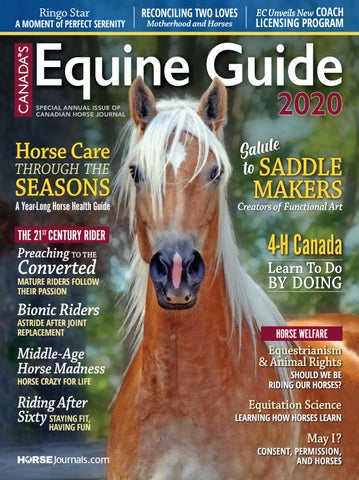
Ringo Star
A MOMENT of PERFECT SERENITY
Horse Care THROUGH THE
SEASONS A Year-Long Horse Health Guide
RECONCILING TWO LOVES Motherhood and Horses
EC Unveils New COACH
LICENSING PROGRAM
Salute to SADDLE
MAKERS Creators of Functional Art
THE 21ST CENTURY RIDER Preaching TO THE
4-H Canada
MATURE RIDERS FOLLOW THEIR PASSION
BY DOING
Converted
Learn To Do
Bionic Riders ASTRIDE AFTER JOINT REPLACEMENT
Middle-Age Horse Madness HORSE CRAZY FOR LIFE
Riding After Sixty STAYING FIT, HAVING FUN
HORSE WELFARE Equestrianism & Animal Rights
SHOULD WE BE RIDING OUR HORSES?
Equitation Science
LEARNING HOW HORSES LEARN
May I?
CONSENT, PERMISSION, AND HORSES
MOBILE TOWING SCALE BetterWeigh™ is a mobile towing scale that wirelessly links to a smartphone to display real-time vehicle and trailer weights. It easily plugs into any standard vehicle diagnostic port (OBD-II), and uses Bluetooth to connect to an Apple or Android phone.
REBELLION™ XD ADJUSTABLE CUSHION HITCH BALL MOUNT For increased comfort and equipment longevity, the new Rebellion™ XD adjustable cushion ball mount dynamically reduces jerking and jarring. It offers exceptional towing capacity and a smooth ride for unmatched confidence.
Learn how our products improve your towing experience
| curtmfg.com | 877.287.8634 |
b
CANADA S
Equine Guide 2020
CANADA’S HORSE INDUSTRY AT YOUR FINGERTIPS A SPECIAL ISSUE OF
CONTENTS 10
Inside 6 Editor’s Desk 84 Horse Council BC News 86 Manitoba Horse Council News Equestrian Canada Unveils Coach Licensing Program
92 Meet Our Contributors 92 Index to Advertisers
Special Features 8 Ringo Star A gentle, horse-scented embrace; a moment of perfect serenity.
10 Horse Care Through the Seasons Take a proactive approach to managing your horse’s health needs all year long.
24 Salute to Saddle Makers These craftsmen are meeting the growing demand from knowledgeable riders choosing custom-designed saddles.
40 50
40 4-H Canada: Learn To Do By Doing For more than 100 years, the 4-H movement has empowered youth to be confident and capable leaders for tomorrow.
On The Cover
The essential joy of being with horses is that it brings us in contact with the rare elements of grace, beauty, spirit, and fire. - SHARON RALLS LEMON
Photo: iStock/Ainslie Brennan 2
Canada’s Equine Guide 2020
CANADA’S HORSE INDUSTRY AT YOUR FINGERTIPS
24
10 PHOTO: SHUTTERSTOCK/ALLA-BERLEZOVA • 24 PHOTO COURTESY OF CLOETE SADDLES • 40 PHOTO COURTESY OF ANGELA MASTERS • 50 PHOTO: SHUTTERSTOCK/JULIA SHEPELEVA
90 The Hoofbeat
b
CANADA S
Equine Guide 2020
CANADA’S HORSE INDUSTRY AT YOUR FINGERTIPS A SPECIAL ISSUE OF
Horse Welfare 50 Equestrianism and Animal Rights
68
CONTENTS 76
A close look at the horse-human relationship and the current objections to the use of horses for riding.
54 Equitation Science To effectively train horses we must understand how they learn and react.
How does the topic of consent around touch apply to the many aspects of horse-human interaction?
62
The 21st Century Rider 62 Preaching to the Converted Mature riders are making their lifelong horse dreams a reality — and revitalizing our industry.
68 Bionic Riders Many riders with artificial joints are returning to the saddle mere months after joint replacement surgery.
72 Middle-Age Horse Madness A growing number of middle-aged women are proving that once bitten by the horse bug, it stays in your blood forever.
76 Riding After Sixty Many Canadian riders are throwing their leg over horses well beyond the age when others are pursuing more sedentary activities.
82 Reconciling Two Loves How motherhood made me a better horseperson, and horses made me a better mother. 4
Canada’s Equine Guide 2020
CANADA’S HORSE INDUSTRY AT YOUR FINGERTIPS
58
58 PHOTO: SHUTTERSTOCK/ROGER COSTA MORERA • 62 PHOTO: LORNE ORDEL • 68 PHOTO: TERESA FINNERTY • 76 PHOTO COURTESY OF TANIA MILLEN
58 The Role of Consent and Permission with Horses
“All I pay my psychiatrist is the cost of feed and hay, and he’ll listen to me any day.” — ANONYMOUS
CANADA S b
Equine Guide
NATIONAL ANNUAL
Volume 20 • Issue 3 • 2020
WELCOME TO
Canada’s Equine Guide is a Special Jan/Feb Issue of EDITOR / PUBLISHER Kathy Smith ACCOUNTS Geri Pronovost
2019 2020
ADVERTISING April D. Ray • Terry Andrucko • Janna Reimer SOCIAL MEDIA April D. Ray
OUR SPECIAL ANNUAL EDITION OF CANADIAN HORSE JOURNAL. We’re happy to welcome several new writers to our annual Guide, and to welcome back many of our popular regular contributors. Our writers are horse people who share many decades of collective experience and bring varied perspectives to enrich your reading experience. Two of the stories in this issue will strike a chord in any horse lover’s heart: Ringo Star, and Reconciling Two Loves. If you’re a horse-loving parent who’s been torn between family commitments and your lifelong horse passion, you’ll echo the sentiments in Elyse Schenk’s Reconciling Two Loves. Danielle McArthur’s Ringo Star: A Moment of Perfect Serenity will resonate because we recognize that what she describes is “horse healing.” Ringo seemed to sense just what his human friend needed on that day and simply gave it. And there’s research to back this up. Studies have shown that horses have the ability to perceive human emotion. They can remember emotional expressions that they’ve seen on human faces and adjust their subsequent behaviour accordingly. What’s more, their memory for emotions is specific to the person concerned. In 2018, research news media reported on a study in which researchers from the University of Portsmouth presented domestic horses with a photograph of a happy or angry human face. Several hours later the horses saw the person from the photograph, this time bearing a neutral expression, in real life. The researchers found that short-term exposure to the photograph of a person’s facial expression was enough to generate clear differences in subsequent responses upon meeting that individual in the flesh later the same day. Despite the fact that the humans were in a neutral state during the live meeting, the horses perceived the person more
SUBSCRIPTIONS Steve Smith MARKETING & DISTRIBUTION Janna Reimer
negatively if they had earlier seen that person looking angry in a photograph. The humans in the study did not know which photographs (angry or happy) had been shown to the horses earlier in the day. “What we’ve found is that horses cannot only read human facial expressions, but they can also remember a person’s previous emotional state when they meet them later that day — and, crucially, that they adapt their behaviour accordingly. Essentially horses have a memory for emotion,” commented researcher Professor Karen McComb. That horses receive and understand our emotional signals doesn’t come as a surprise to a horse person. As prey animals, horses possess excellent communication abilities and have adapted to humans as our work and companion animals down through the ages. Spend any time around horses, and you know that they’ve read your mind and body language from the moment you walked in their direction, especially if they haven’t met you before. But what studies don’t explain is that somehow, with their acute perception and innate honesty, these amazing animals instinctively and selflessly give us what we didn’t know we needed. This theme song resounds in the features in The 21st Century Rider section. Check it out and see if you agree. The thought-provoking articles in the Horse Welfare section continue this refrain, as we further explore the fascinating horse-human relationship. We’re also excited to pay tribute to the 4-H movement’s exemplary work with youth in 4-H Canada: Learn To Do By Doing, and to showcase the gifted craftsmen in Salute to Saddle Makers. And as the stewards of these wonderful animals that generate seemingly endless year-round horsekeeping tasks, Horse Care Through the Seasons will help you to anticipate needs and plan ahead so you can maximize the quality time spent with your horse. Kathy Smith, Editor and Publisher
6
Canada’s Equine Guide 2020
CANADA’S HORSE INDUSTRY AT YOUR FINGERTIPS
ART DIRECTION, PRODUCTION Elisa Crees CONTRIBUTORS Margaret Evans • Tania Millen • April D. Ray Elyse Schenk • Alexa Linton • Judy Andrekson • Danielle McArthur Kathy Fremes • Horse Council BC • Manitoba Horse Council ADVERTISING, SUBSCRIPTIONS & GENERAL INQUIRIES 1-800-299-3799 • 250-655-8883 or email: sales@horsejournals.com ADVERTISING DEADLINE 4 weeks prior to issue date, e.g., Oct. 1 for Winter (Nov/Dec) issue ONLINE EDITION WEBSITE www.horsejournals.com MAIN OFFICE EMAIL editor@horsejournals.com PRODUCTION DEPARTMENT EMAIL design@horsejournals.com
Publishing 6 issues per year SUBSCRIPTIONS – REGULAR RATES 1 yr/6 issues: $24 + tax 2 yr/12 issues: $37 + tax US $59/2 yrs, 12 issues ORDERS FOR SUBSCRIPTIONS, CHANGE OF ADDRESS NOTICES, & UNDELIVERABLE COPIES ARE TO BE SENT TO: THE CANADIAN HORSE JOURNAL Suite 202, 2400 Bevan Ave., Sidney, BC V8L 1W1 (250) 655-8883 • fax: (250) 655-8913 • 1-800-299-3799 POSTAGE PAID AT WINNIPEG, MB PUBLICATIONS MAIL REG. NO. 40009439 GST REG. NO. 829298140 ISSN. NO. 1496-1733
We acknowledge the financial support of the Government of Canada. REPRODUCTION IN WHOLE OR IN PART OF ANY MATERIAL CONTAINED IN THIS PUBLICATION WITHOUT THE WRITTEN PERMISSION OF THE PUBLISHER IS STRICTLY PROHIBITED.
The information and services listed herein are intended to facilitate accessibility to the professionals, products and services that play a part in the horse industry. While readers are encouraged to use the products and services of the merchants listed in this Guide, Horse Community Journals Inc. does not recommend or guarantee the products and services of advertisers or associates listed. Manuscripts and photographs will be returned only if SASE is provided. The return of unsolicited material is not guaranteed. Contributors and advertisers warrant all materials supplied are free of copyright and they have the legal right to use the same. All material accepted for publication is subject to such revisions as are deemed appropriate by The Canadian Horse Journal (CHJ). The opinions expressed in CHJ are not necessarily those of the publisher. CHJ reserves the right to refuse any advertising or submission. Contributors consent to have their submissions published in CHJ and on www.HorseJournals.com and elsewhere as determined by the publisher. Printed in Canada. PLEASE RECYCLE.
Get closer to your horse The top saddle pad endorsed by Master Saddlers, Spinal Surgeons, Veterinarians, Trainers and more! 90% Shock Absorption Close Contact Feel • Shimmable Available for All Disciplines
Tack for equestrians of all disciplines for both horse and rider’s comfort and spinal protection
Ask for ThinLine at your local tack shop Shop online at
www.ThinLineCanada.ca
Your one stop shop for everything equestrian Horseware Ireland, Back on Track, Weaver Leather, Shires Equestrian, Professional Choice and more!
Come in and meet our friendly staff!
www.summersidetack.ca • Call us at (250) 890-9158 1081 Knight Road, Comox, BC • summersidetack@shaw.ca CONNECT TO THE HORSE INDUSTRY
www.HORSEJournals.com
7
RINGO STAR
Annika and Ringo Star.
BY DANIELLE MCARTHUR It was a horse that gave me my first taste of stillness. His name was Ringo Star, and he was a beautiful, golden-coloured chestnut with a splash of white down his nose. He spent several years training for three-dayeventing with my daughter, Annika, but I didn’t get to see them often because I was teaching in Bahrain for most of that time. Only during the summers, when I returned to Canada, was I able to see them together at a show or training clinic. It was during one of those brief glimpses of Annika’s horse-centred world that I had an opportunity for a moment of deep stillness. I will always remember this as a gift from Ringo Star. Don’t get me wrong, Ringo was all horse; alternately keenly intuitive and stark raving mad. His worst nightmare was a pot-bellied pig who lived on the small farm where he was stabled. His nostrils would flare and he’d throw back his head, prancing around in pure panic at the mere sight of the hairy, rotund creature. No matter that he was about ten times the size of the pig. To Ringo, he was Godzilla Pig, devourer of the universe. 8
Canada’s Equine Guide 2020
So now that we have established that Ringo was not even a deeply wise horse, old and worldly after years of battle with his own fears, how then did he help me find stillness? Did he somehow know, with his horsey intuition, how badly I needed it? It had been just over six months since the beginning of the Arab Spring in Bahrain, six months of hope turning to horror, and I was still trying to find out what had happened to a student I was very close to. The heart-breaking complexity of our human world had me buzzing with concern, and so Ringo’s gift was even more precious for its simplicity. Most of the time, my relationship with my daughter’s horse was matter-of-fact. I would often be left holding Ringo by his halter while my daughter moved around, completing the hundreds of small tasks that are part of riding and caring for a horse. Ringo would often spend this time poking his nose into my jacket pockets and everywhere else in search of a treat of some kind. Success would produce no great depth of gratitude, but rather a brief period of chewing and a renewed
CANADA’S HORSE INDUSTRY AT YOUR FINGERTIPS
search. No treats would be cause for a few grumbles, and the occasional halfhearted nip as a reminder that a delicious opportunity had been lost. Occasionally, Ringo would tire of searching and decide to move into one of his standing naps. That a large fourfooted creature can fall asleep that way is still a surprise to me. On this day, I first noticed the subtle shift of weight, and then realized that he was leaning into me ever so slightly. I found myself doing the same, leaning into his strong neck, knowing that I could do so completely without any fear of shifting his centre of balance. At that point, I closed my eyes and had something that I very seldom have: a moment of perfect stillness. Everything stopped except the extraordinary feeling of that long and muscled neck, warm beneath me. I completely lost myself in a gentle horsescented embrace that put the whole world on pause. I don’t know how long we stayed that way, Ringo and I, but I will never forget that rare gift of stillness when the world didn’t have to make sense. It just was. b
PHOTO: DANI MCARTHUR
PHOTO: ISTOCK/TOMZAL
A Moment of Perfect Serenity
SPONSORED
Protect, Prevent, and Heal
With All-Natural HOOF DOCTOR BY KATIE NAVARRA Strong hooves are the foundation of a healthy horse. Without solid feet, a horse can’t live a comfortable life in the performance arena or in the pasture. There are many reasons why horses have weak hooves, such as bad genetics, a congenital issue, a nutritional imbalance, or unsanitary living conditions. A proactive approach is always healthier for the horse to avoid immediate pain and long-term layoffs. Prevention begins with a good diet. Feeding high quality forage and grain, along with supplements recommended by a veterinarian or farrier, ensure the horse is getting the proper nutrients. Maintaining a regular trimming or shoeing schedule is also critical, as is providing as clean a living environment as possible. Following these practices isn’t always enough to protect a horse’s hoofs from developing minor conditions such as thrush, cracks, bruises, or abscesses. In severe cases, white line disease or laminitis can develop in some horses. The most common issues (abscesses, cracks, and thrush) create opportunities for bacteria and fungi to invade the hoof wall and create an infection. When bacteria work their way into the hoof, pus develops creating an abscess. This results in pressure and pain that presents as lameness. Hoof cracks can be equally painful. All cracks (including quarter, toe, and hoof wall cracks) make hooves susceptible to bacteria that can invade the soft tissues and potentially cause an abscess. In addition to proper trimming, making sure the area is free from bacteria supports the hoof and encourages growth. Sometimes, even with the best care, bacteria can work its way into the hoof and cause problems. Immediate farrier and veterinary
attention can quickly resolve most issues, but the key is to prevent these conditions from developing. Hoof Doctor offers a topical, allin-one added layer of protection when painted onto a horse’s hooves. The all-natural formulation acts as a sealant. By coating minor nail holes and surface cracks, the bacteria and fungus that cause thrush, cankers, abscesses, and white line disease are blocked from entering the hoof wall. It also helps the hoof maintain an optimal moisture level by supporting the hoof’s natural process of replacing its outer layers of keratin, making hooves strong. Birch bark extract is one of the main active ingredients found in Hoof Doctor. Birch bark has been used for centuries in both human and veterinarian medicine because of its antimicrobial and anti-inflammatory qualities. The main component of birch bark is called betulin. That’s what gives birch its characteristic white colour. Research studies conducted in human medicine have provided evidence that betulin has naturally occurring pain-relieving qualities, which provide relief to horses suffering from a variety of hoof ailments. Certified omega-3 oil, and Vitamins A and D, which are found in fish oil, are also key ingredients in the Hoof Doctor topical. Together, these components promote tissue repair and encourage the growth of healthy hooves. You can use Hoof Doctor with confidence. The formulation follows FEI regulations and does not include prohibited substances identified on the FEI 2019 Equine Prohibited Substance List.
PHOTO COURTESY OF HOOFDOCTOR.COM
For more information, please visit > www.HoofDoctor.com. This fine product is available at Professional Farrier Supply > www.profarriersupply.com. CONNECT TO THE HORSE INDUSTRY
www.HORSEJournals.com
9
HEALTH
Horse Care
THROUGH THE
By Margaret Evans and Kathy Smith
E
ach season brings with it certain needs for equine care, and an annual horse health care agenda can help with some of the planning as the months rapidly roll by. Horse owners are good at knowing the value of organizing and preparing ahead to help their horses stay healthy, and to budget for the more expensive seasonal needs ahead of time.
Spring
As crocuses push their way through slushy snow, horse owners breathe a sigh of relief that maybe the worst of winter is over and spring is on its way. In any horse barn, the coming of spring launches a flurry of activity in preparation for the coming season, and it’s the perfect opportunity to make sure 10
Canada’s Equine Guide 2020
your horse is healthy and ready to go back into regular work. The pre-season visit from your veterinarian is an important part of the horse’s overall health plan. “The spring horse health exam can be quite different from a mid-season exam,” says Steve Chiasson, DVM, CVMA. “During the riding season, veterinarians will often be called to investigate a specific problem that is occurring, such as respiratory difficulty at rest, or worsening lameness that is affecting performance. But the pre-season exam is generally focused on a broader view of your horse’s health. It is a snapshot in time that takes into account both medical history and potential future plans for your horse activities. And it is incredibly valuable.”
CANADA’S HORSE INDUSTRY AT YOUR FINGERTIPS
The spring checkup should start with a good history of everything that has happened over the winter season. “Nobody is more in tune with how things are going than the person who sees the horse every day — and that’s you,” says Chiasson. The basis of the spring health checkup is a thorough physical exam. This includes an evaluation of cardiovascular, respiratory, and gastrointestinal function, as well as a musculoskeletal evaluation depending on the horse’s history and type of work he does. As part of this checkup, and before your spring conditioning program begins in earnest, a soundness evaluation by the veterinarian can detect subtle problems before they become more serious down the road. Depending on the horse’s
PHOTO: SHUTTERSTOCK/VIKTORIA BONDAVENKO
Your veterinarian will recommend the vaccinations your horse should receive, and help you design an effective parasite control program.
PHOTO: SHUTTERSTOCK/HEDGEHOG94
SEASONS
The spring checkup should include a thorough dental exam, and floating if needed.
history and the findings of the physical exam, the veterinarian may suggest diagnostic tests that would be of value to you and your horse. Chiasson explains the three levels of musculoskeletal evaluations that can be done:
• Casual performance horse — for pleasure horses with an above-average level of riding activity, and amateur competitors; • Performance horse — at this level, a full detailed exam is needed to establish an objective evaluation of baseline soundness, which is valuable if a problem develops later on.
PHOTO: SHUTTERSTOCK/CHELLE129
• Pleasure and companion horse — every horse should have this level;
CONNECT TO THE HORSE INDUSTRY
www.HORSEJournals.com
11
PHOTO: ISTOCK/STEVERTS
Muddy conditions in paddocks and pastures can predispose your horse to pastern dermatitis, or mud fever. Provide your horse with a dry, sheltered turnout area to prevent this condition.
Vaccinations are another staple of the spring vet check. An early spring vaccination appointment will help to protect the horse from bacteria and viruses during spring and summer months, when the likelihood of exposure increases due to travel and the onset of mosquito season. Your veterinarian will recommend the core vaccinations your horse should receive, and risk-based vaccinations depending on various factors including geographical area, your horse’s lifestyle and activities, and medical issues. The spring checkup includes a dental exam. Ideally, the horse will be sedated for this procedure to allow a thorough examination of the entire oral cavity. If needed, a file or a float will be used to level out the sharp points and overgrown teeth. Because pain tolerance varies from one
horse to another, some horses may benefit from having this procedure done more frequently, especially if pain or distraction are exhibited when under saddle. With the horse sedated, now is a good time for the veterinarian to check that the male horse’s sheath is healthy, and to clean it if needed. As this is an oftenoverlooked part of the horse’s anatomy, inspecting and cleaning the sheath should be part of the horse’s annual veterinary checkup. Talk to your vet about parasite control and fecal testing, and ask for help to design a parasite control program tailored to your horse. “Fecal testing is definitely a move away from just blindly deworming of horses on a random schedule,” says Chiasson. “Many of the dewormer programs used in the past have been guilty of
administering medications at the wrong time, or treating horses that did not actually need deworming. Incorrect and indiscriminate use of dewormer leads to drug resistance and less effective options for when the medications are really needed. Spring checkup is a great time to get a fecal egg count done on your horse.” The vet consultation should also include an overview of your feeding program, whether your horse needs a special diet to control body condition, and any supplements that should be given. The most important component of the horse’s diet is fibre from pasture grazing or quality hay. Before adding a supplement, the diet should be assessed to determine what is needed to fill in the nutritional gaps. A high performance horse is more likely to need dietary supplements to support his athletic efforts than a backyard horse with a less demanding workload. Discuss spring grazing protocols with your vet. A horse that is susceptible to laminitis or equine metabolic syndrome (EMS) could be at risk. Laminitis is the second biggest killer of horses after colic, which is considered the top medical cause of death in horses. The basis of EMS management is to prevent high circulating levels of insulin by avoiding the feeds that cause them, and this means an EMS horse should never be grazed. Your feeding plan will tie in with your riding goals for the year as you start your spring conditioning and training program. Any feeding changes should
NOW AVAILABLE IN CANADA
ALL NATURAL FOR HEALTH AND HEALING Apply after shoeing to alleviate any potential SORENESS. TOUGHENS hooves of thin-soled horses and Thoroughbreds.
tel. 888-779-7775
www.farriersfix.com
FIX SORE FEET • TOUGHEN HOOVES 12
Canada’s Equine Guide 2020
CANADA’S HORSE INDUSTRY AT YOUR FINGERTIPS
“I’m always amazed how one treatment of Farriers’ Fix for a stone bruise can make my horse sound in just a day.” — Katharine Burdsall, Winner of The World Cup in 1986 on The Natural
be made gradually, to allow time for the bacteria populations in the horse’s digestive tract to adapt. To dig deeper into the details of the spring vet checkup, including advice on diagnostics and vaccinations, read Spring Horse Health Checkup in the Spring 2018 issue of Canadian Horse Journal, or on the HorseJournals.com website. After their winter layoff, horses should be returned to work gradually. Even if your horse was fighting fit last fall and had plenty of turnout over winter, he’ll have lost conditioning after three or more months of inactivity. Allow sufficient time for the horse to return to optimum body condition, and avoid overworking the horse beyond his level of fitness. “Any time a horse’s exercise routine drops below three 45-minute work sessions per week for a period longer than four weeks, we consider him to have lost a majority of fitness,” says educator and trainer Jec Ballou. “If he reaches 12 weeks working less than three times per week, his fitness has zeroed out, including any baseline or foundation.” For the first six weeks of your returnto-work program, Ballou recommends focusing on basic conditioning rather than schooling specific skills and maneuvers. Workouts should be less than 40 minutes, with low to moderate cardiovascular stress, and an emphasis on calisthenics-type exercises to engage the horse’s postural muscles. After six weeks, the duration and/or intensity can be increased. “When making workouts harder in any exercise program, you do not increase intensity and duration of exercise simultaneously,” says Ballou. “During a given workout, you only increase one or the other. For instance, you can make a workout harder by either making it longer or by adding difficult exercises to your normal session length.” For a sample return-to-work schedule and exercises to successfully bring your horse back into condition, read Spring Conditioning Your Horse: Where Should You Start? in the Spring 2018 issue of Canadian Horse Journal, or on the HorseJournals.com website. If the horse was blanketed during the winter, change to a lighter blanket as the weather warms. Cool nights and mornings give way to warm spring afternoons, causing horses to sweat and leave the blanket damp and cold in the evening air. Pay attention to changing conditions during the blanket transition period and remember that horses are better adapted to cold weather than we give them credit for.
North America’s Most Complete & Cost Effective Horse Feed Supplement
HOLISTIC SUPPLEMENTS PURE, RAW, THERAPEUTIC CONCENTRATES PHOTO: SHUTTERSTOCK / MARIAT
No sugars, flavours, starches, heat processing, toxic binders, or GMOs
Natural Digestive Support Everything You Need In One Horse Feed Nutrition Supplement Encourages optimal gut function by cleaning debris, stimulating motility and providing “good bugs” on a daily basis so your horse can get the most benefit out of the nutrients you are already providing.
Extra Strength Horse Joint Supplement Supports and Enhances Joint Function and Structures A synergistic blend of Hyaluronic Acid, MSM, Glucosamine and Chondroitin to support healthy cartilage in joints and repair damage.
Sunglade Comfort Mouth Bits
FREE SHIPPING in CANADA and the USA ON ORDERS OVER $100
These bits could be the answer to behavior problems in your horse! With a shorter barrel for more flexibility and thicker mouth piece with a gentle curve for even less pressure on the bars. Made from heavy weight German stainless steel for a better feel. Sunglade Ranch Ltd., home of Chics In The Male
1-403-638-3356 • orders@bioequine.com CONNECT TO THE HORSE INDUSTRY
www.HORSEJournals.com
13
With the longer daylight hours, unclipped horses will be shedding their winter hair, and those turned out together will readily groom each other. A good grooming will hasten the process of loosening the hair and take the itch out of the skin. Shedding blades are very helpful, but should not be used on the horse’s bony areas. Hair matted on the belly can be carefully cut away with scissors. Once the shedding process starts, it goes quickly and winter hair is soon replaced by a glossy summer coat. Directly related to the health of the horse is maintenance of its spring and
summer home — the paddock and pasture. With the expectation that horses will be outside longer as weather conditions improve, early spring is an important time to do a thorough pasture check. As soon as the snow has melted, walk the fence lines, check the strength and stability of posts and gates, and make any required repairs. Look for trees and heavy branches that may have fallen on the fence, and hidden hazards such as holes, protruding nails, broken boards, and farm equipment left in the pasture last fall. Water troughs should be thoroughly checked for leaks and general condition,
and their maintenance should include cleaning, repair and replacement of valves, floats, and screens as needed. Natural sources such as streams or ponds should be fenced off to prevent horses from falling through thin spring ice, and to protect riparian areas. If used as water sources in warmer weather, they may still be frozen over, so be sure to continue with your back-up water source. This is a good time to replace the salt block. Adult horses should consume at least one to two ounces of salt daily. If your horse does not use a salt block, their daily maintenance amount should be added to their feed. The more the horse sweats, the more salt he should consume. Heavy rain and spring snow melt can cause muddy conditions in pastures and paddocks, creating slippery conditions, and predisposing your horse to pastern dermatitis (mud fever). To prevent pastern dermatitis, provide horses with access to a dry, sheltered turnout area, free from manure and mud where bacteria and fungi thrive.
Summer Those long summer days filled with sunshine and warm breezes herald the height of riding and competing season. But the season can also be dangerous for horses because the hotter and more humid the weather, the more susceptible the horse is to the negative effects of heat stress. Horses feel the heat much more than humans, says Prof. Michael Lindinger, an animal and exercise physiologist at the University of Guelph. “It only takes 17 minutes of moderate intensity exercise in hot, humid weather to raise a horse’s temperature to dangerous levels. That’s three to ten times faster than in humans. Horses feel the heat much worse than we do,” he says. When muscles are being used, they produce a lot of heat. If the horse’s body temperature increases from the normal 37 or 38 degrees C to 41 degrees C, within working muscles the temperature may be as high as 43 degrees C. And the effects can be serious. Heat stress can cause dehydration, lethargy, and a general malaise. Excessive heat stress can lead to hypotension, colic, and renal failure. Horses produce an abundance of sweat that is effective in cooling by evaporation, but the salts in horse sweat are four times as concentrated as in human sweat. The water and electrolytes in the sweat must be replenished to keep the horse healthy. The following practices can help deal with heat-related issues: 14
Canada’s Equine Guide 2020
CANADA’S HORSE INDUSTRY AT YOUR FINGERTIPS
Working muscles create a lot of heat, and horses produce an abundance of sweat to cool themselves by evaporation. The water and electrolytes in sweat must be replenished.
PHOTO: SHUTTERSTOCK/ROLF DANNENBERG
• Ensure the horse has plenty of clean, fresh water at all times. Keeping the horse properly hydrated is the most important step in protecting it from the harmful effects of heat. • Clip horses and ponies with longer hair, especially those with Pituitary Pars Intermedia Dysfunction (PPID) or Cushing’s disease. • Cool an over-heated horse quickly by repeatedly rinsing the horse’s body with cold water and scraping off the excess. • Provide ample shade, with trees or a shelter. • Consider changing turnout times so the horse goes outside in the evening and overnight when it is cooler, and comes into the barn during the heat of the day. • Install fans in the barn to move the air. Misting the horse with a fine spray can also help offset heat symptoms temporarily. • During hot weather, ride early in the morning or later in the evening when it is cooler, and reduce the intensity of your riding activities. Exercise generates a great deal of heat. • If you are travelling to shows, consider evening or night travel to avoid the heat of the day. Even though the trailer
CONNECT TO THE HORSE INDUSTRY
www.HORSEJournals.com
15
PHOTO: CANSTOCK/VIRGONIRA
Overgrazing damages grass, compacting soil and encouraging noxious weeds to fill in bare areas in the pasture.
It Works! We’re the first and still the best since 1986
Body Support
™
Body Builder in USA A Healthy Alternative to Steroids From yearlings and 2-year-old prep horses to racehorses and competition horses to broodmares and stallions. Yep, it works for all.
Available in various catalogs and at your local tack shops, Greenhawk outlets, and through WeCan Sales distributors. Equiade, Inc. • www.equiade.com • 1-800-413-3702 • 727-562-2832 16
Canada’s Equine Guide 2020
CANADA’S HORSE INDUSTRY AT YOUR FINGERTIPS
windows may be open, the body heat of a hot horse will make the cramped environment hotter and more stressful. • Protect horses, especially grey or light skinned horses, from sunburn by turning out in the early morning or late evening, providing plenty of shade, and applying sunscreen and sheets. • Learn how to test your horse for dehydration using the capillary refill test and the skin pinch test. • In all conditions where heat is causing health-related concerns, consult with your veterinarian. With the onset of summer, the battle of the bugs begins. Flying insects such as midges, gnats, horse flies, deer flies, black flies, face flies, house flies, mosquitos, and others are more than a nuisance — they can cause serious skin irritations and can also carry diseases. To get bugs to back off, use a multilevel approach that includes sprays, wipes, and roll-ons; fly masks and sheets to provide a barrier; as well as environmental management to make barns and pastures inhospitable to the insert’s egg-laying needs. Pest management starts with hygiene in and around the barn. Remove manure and rotting hay or straw, and eliminate standing water in puddles or buckets where midges and mosquitoes breed. Remove rotting leaves and decaying fruit such as windfall apples and wasted berries, all of which become places where eggs are laid. Use fly trap tapes in the barn. Consider using fly parasites for effective and natural fly control. These tiny wasps do not sting or bite, live their entire life cycle on or near manure where the fly pupa are found, and destroy the next generation of flies in that pupa stage. They are effective against 95 percent of the flies found in manure, including house flies and biting stable flies, two of the most common flies found around horses. Sweet itch, caused by a Type 1 allergic response to the bite of midges (insects of the Culicoides genus), is the most common allergic skin condition in horses. “The incidence of sweet itch is hard to nail down but, depending on the geographical location, it can be anywhere from 5 to 60 percent of the equine population,” says Dr. Wendy Pearson, PhD (Dr. of Veterinary Toxicology). It causes intense itching along the abdomen, back, mane, and tail, and in an attempt to relieve the itchiness, affected horses often rub furiously causing
PHOTO: SHUTTERSTOCK/CHELLE129
Horses sensitive to sweet itch should be protected with a full fly sheet and mask.
severe skin eruptions. Sensitive horses should be kept at least 100 metres away from ponds and marshy areas, which are breeding grounds for midges. A fly mask and full fly sheet can help provide protection during turnout. Learn about harmful weeds and be familiar with those that grow in your area. Horse owners should recognize which plants to avoid and why they appear in pastures. Problems generally arise when pastures have been overgrazed, leaving horses no option but to sample plants they would normally leave alone. We know that “nature abhors a vacuum” and in terms of pastures, a vacuum is an overgrazed area or
bare spot with no grass, which weeds will quickly claim. Some of the many plants poisonous or harmful to horses include yew, water hemlock, poison hemlock, oak, rhododendron, cow cockle, cocklebur, jimsonweed, nightshade, oleander, field horsetail, buttercups, stinging nettle, bracken fern, St. John’s wort, alsike clover, arrow grass, and barnyard grass. If in doubt about any strange plant in the pasture, remove it and get it identified. The Canadian Poisonous Plants Information System lists over 250 poisonous plants found in Canada, along with their lethal dose (if known) and symptoms of poisoning.
PHOTO: THINKSTOCK/STEVERTS
Good environmental hygiene is important to reduce the risk of parasite infestation. Removing the manure from pasture and paddock at least twice a week can reduce the horse’s parasite load by more than 80 percent.
Manage pastures by mowing and rotating horses, to allow grass to thrive and discourage the growth of weeds. As long as horses have enough grass, they will be unlikely to eat poisonous pasture plants. With the onset of late summer comes a die-off of pasture growth. To keep horses from eating weeds and losing weight, supplemental hay should be offered well in advance of the pasture dwindling. Pay attention to hay supply as the season progresses. The weather will be an indicator of either plentiful hay in the fall and winter, or the danger of short supplies. This knowledge will allow you to make plans for securing quality hay for the coming months, hopefully at a reasonable price.
Fall leaves are pretty but can pose a potential threat to horses.
HEALTHY GUT A MUST
BREATHING IS EVERYTHING
PHOTO: SHUTTERSTOCK/ANASTASIJA POPOVA
Autumn When fall arrives, it’s once again time to assess your horse’s overall health and body condition, as well as his environment. He may need some special attention before winter sets in, especially if older or coming off a busy riding season. Good nutritional planning will help your horse enjoy the fall and winter season in good condition. With pastures now depleted, horses must rely on their owners to provide them with a nutritionally adequate diet addressing the key factors of
SOUND & HEALTHY JOINTS
www.mcintoshproline.com • 1-877-825-7325 18
Canada’s Equine Guide 2020
CANADA’S HORSE INDUSTRY AT YOUR FINGERTIPS
Botfly eggs attached to the horse’s haircoat can be removed by clipping the hair, scraping the hair with a bot knife, or washing with warm water which will cause the eggs to hatch and the larvae to die before they enter the horse’s mouth.
water, fibre, and essential nutrients. Water is the most important component in the diet of any horse. As drinking tends to decrease with the onset of colder weather, provide an abundant supply of fresh, temperate water to encourage drinking and prevent dehydration, which is a leading cause of impaction colic. Quality forage is an essential component of the horse’s diet. Stock up on the best quality hay you can afford, making sure it is free of dust, mold, and weeds. If you find the hay you want, but don’t have room to store it at home, paying a hay storage fee is preferable to finding quality hay later in the winter when it’s usually in short supply. With the show season over, horses usually have some “down time” during fall and winter. A reduction in the horse’s activity level calls for a reduced need for calories, with lower requirements for grain or concentrate feed. “The protein, trace mineral, and vitamin needs of the horse must be satisfied. Winter is a critical time to supply these nutrients since pasture, a good natural source of nutrients, is no longer available,” says Dr. Tania Cubitt. “Many performance horses are on reduced work or competition schedules and rely on these essential nutrients to repair tissues that have been damaged during the rigors of training.” It’s a delight to see the colourful trees in autumn, but those pretty leaves can be harmful to our horses. Some that are highly toxic to horses include red maple, eastern black walnut, oak, cherry and plum trees. Do not dispose of raked leaves into the pasture, as leaves are dense and can compact the horse’s digestive system, causing colic. “Horses like the taste and smell of recently fallen leaves,” says Cubitt. “Be
aware of leaves and trees that are toxic to your horse, and fence off wooded areas or fence rows that contain possible toxic substances. If branches fall into the pasture, make sure they are removed immediately.” Your fall parasite control program should pay particular attention to stomach bots and tapeworms. Bot flies are honeybee-sized flies that attach their yellowish-white eggs to the horse’s hair coat during summer and fall. The larvae hatch when the horse selfgrooms or licks the site, which generates warmth. The ingestion of the larvae and their accumulation in the intestine may create infestation problems. Combat bots by washing off the eggs with warm water, clipping the hair, or scraping the eggs off the hair with a bot knife. Since not all eggs will be caught, your veterinarian may recommend treating the horse with an ivermectin product. Tapeworm infections are associated with colic and weight loss. Tapeworms have been found in at least 50 percent of grazing horses and their presence should be managed, especially in weanlings and aged horses. Deworming for tapeworms is usually done annually in the fall, based on the veterinarian’s recommendations. Help your horse transition into winter by making sure he is in good body condition, and dewormed based on fecal analysis. Decide in early fall whether your horse will be blanketed, clipped, or left “au naturel.” Will the horse be enjoying a winter layoff, or ridden lightly outdoors once or twice a week, or schooled five days a week in an indoor arena? If the horse will continue in steady work throughout the winter, clipping will reduce sweating and allow body heat to escape, making cooling out faster and easier. A clipped horse must be blanketed. CONNECT TO THE HORSE INDUSTRY
www.HORSEJournals.com
19
PHOTO: SHUTTERSTOCK/MARIE CHAROUZOVA
Water is the most important component of the horse’s diet year-round. Horses should have access to clean, fresh water at all times. PHOTO: SHUTTERSTOCK/JP CHRETIEN
Hoof care is not a seasonal issue, and year-round farrier care is of utmost importance to the horse’s health and soundness. The horse’s hoof care schedule will depend upon seasonal weather conditions, the horse’s function, and the needs of the individual horse.
In normal weather conditions, horses with access to adequate forage and shelter will grow a healthy, thick winter coat and will not need a blanket. Horses with special needs, such as older or thin horses, pregnant mares, and those with compromised health, may need blanketing to help them cope with winter conditions. When deciding whether to blanket,
Trust us with your feeding program... Because you trust them with everything else.
Nutritious Hay Products 20
Canada’s Equine Guide 2020
CANADA’S HORSE INDUSTRY AT YOUR FINGERTIPS
PHOTO: SHUTTERSTOCK/CHELLE129
As temperatures drop, provide additional hay to help the horse stay warm and keep his digestive system functioning as it should.
consider the horse’s health, age, breed, hair coat quality, feeding regimen, and its acclimatization to existing conditions. People often make a decision to blanket based on whether they feel cold themselves, but the horse’s winter hair coat is a natural blanket. “People seem to forget that we have only had blankets for horses recently and they have been domesticated for 6,000 years,” says Gayle Ecker, director of Equine Guelph at the University of Guelph, Ontario. “We have to remember that horses have developed their own ways to thermoregulate, and we have to respect that. There are certainly times when a blanket will be beneficial to a horse for specific reasons and for specific time periods, but many horses do not need the blanketing that they are given by their owners.”
Winter What can we do to help our horses survive and thrive in the cold winter months? The best thing we can do to keep our horses happy and our barn running smoothly during the snowy season is to plan ahead.
Horses allowed to acclimate to cold temperatures usually prefer to be outdoors, as long as they have adequate food, water, and shelter. It’s their ideal environment, providing them with fresh air and meeting their need for movement, and allowing their digestive system to function as nature intended — as long as they are properly cared for. Water is the most important component of the horse’s diet. Snow and ice are never adequate water sources for horses, yet it is still a common practice in some areas of Canada for horse owners to turn their horses out during the winter with no hay or water provided. These horses are expected to paw through the snow to find forage, and to consume snow to satisfy their water needs. “An adult horse that is not working or lactating, in a cool and comfortable environment, requires a minimum of seven to ten gallons of fresh clean water per day,” says Dr. Tania Cubitt. “Research has shown that horses drink the most water when the water temperature is between 45 and 65 degrees Fahrenheit (7 to 18 degrees Celcius), or close to room temperature.
PHOTO: DREAMSTIME/JOAN DAWN
Run-in sheds should be located in a convenient location where they will best protect the horses from prevailing winds. They provide better ventilation and a more natural form of shelter than a stall.
CONNECT TO THE HORSE INDUSTRY
www.HORSEJournals.com
21
University has shown that increasing water temperature from just above freezing to 4-18 degrees Celsius will significantly increase the amount of water consumed — by up to 40 percent. The bottom line is: If water consumption is inadequate, the horse will eat less, impacting its body weight and ability to stay warm. In addition, the risk of impaction colic increases because of decreased ability to keep the fibre in the
horse’s digestive system hydrated. Digestion and fermentation of hay is what produces heat that helps the horse maintain his body temperature. This means the horse’s hay supply must be adjusted as temperatures drop. Like humans, horses have a thermoneutral zone (TNZ), which is an optimal range of temperatures within which they can comfortably maintain their body temperature. Lower critical
PHOTO: SHUTTERSTOCK/ALLA-BERLEZOVA
“Impaction colic during the winter months is a major concern,” she says. “This form of colic is mainly due to a horse becoming dehydrated because it consumes less water due to cooler temperatures (no sweating), less water availability (frozen ponds, cold water, etc.), and a diet of hay at 10 percent water content instead of pasture at 80 percent water content.” Cold water is a hidden cause of dehydration. A study out of Penn State
PHOTO: SHUTTERSTOCK/SARI ONEAL
When feeding a group of horses, scatter the hay in small piles so timid horses don’t get chased away.
22
Canada’s Equine Guide 2020
CANADA’S HORSE INDUSTRY AT YOUR FINGERTIPS
PHOTO: CANSTOCK/DBRIYUL
Horses should be checked over daily, especially the area under their blankets. Unblanketed horses should also be checked for skin infections due to wet, matted coats.
temperature is the temperature below which a horse needs additional energy to maintain body warmth. For adult horses the range is between 5 and 25 degrees Celcius. Therefore, as temperatures drop, or if the horse seems cold, providing additional hay will help him stay warm and keep his digestive system functioning properly. Grain does not produce large amounts of heat during digestion. If horses are turned out as a group, scatter the hay in small piles, making more piles than the number of horses, so timid animals are not bullied away by more dominant animals. If your horses are fairly amenable to feeding close together, consider installing a hay feeder or a round bale feeder. Ideally, a hay feeder under an adequate shelter would protect both the feed and the horses. Consider feeding hay cubes if quality hay is hard to come by or available inconsistently. Hay cubes are a great way to extend the hay supply and meet nutritional needs. The horses adapt to cubes very quickly and typically enjoy them. Not only that, hay cubes take up less storage space and are lower in dust and mold spores than baled hays, and are easier to travel with. Horses stabled in winter will benefit from daily turnout so they can move, stretch, roll, and interact. Turnout will minimize respiratory issues, stiffness, and boredom — the bane of many stalled horses. Whether outside during the day or 24/7, horses must have access to either man-made or natural shelter that provides a windbreak from prevailing winds, snow, and rain. Horses always need fresh air and good ventilation. During cold weather, some horse owners try to keep the barn closed up to make the environment warmer for the humans. “Good ventilation is more important than providing a little warmth, so be sure to
provide good air flow in your barn even in winter time,” advises Dr. Tania Cubitt. With a good air distribution system in the barn, the warm, moist, dusty and smelly air will be replaced with fresh air, and drafts and dead air pockets will be minimized. Whether blanketed or not, the horse should be checked over daily to assess health and body condition. This should include picking out hooves, looking for wounds, and checking for weight loss or gain. Some horses need special consideration in wintertime, so keep a close eye on hard keepers, senior or thin horses, pregnant mares, and those in poor health. Research has shown that donkeys are not well suited to the cold and do not grow a winter hair coat, so they always need extra protection from our cold Canadian winters. Hooves generally grow slower in winter, but trimming should still be done regularly. Barefoot horses have better traction on snow and ice than those that are shod. If the horse is shod, snow pads and studs can help minimize these problems. Hooves are prone to becoming packed with ice or snow balls during winter, increasing the chance of slipping and falling. Pick out the horse’s hooves daily. One or two taps with a hammer on the side of the hoof will usually dislodge the snowball and cause it to pop out. Owning a horse is fun, challenging, and exciting, providing all kinds of competitive and recreational opportunities. Their care and well-being depend on a variety of needs, and as their stewards, we owe it to them to meet those needs to the best of our ability. By planning ahead to keep them healthy and safe, we also make our daily horsekeeping tasks much easier to cope with, and this will maximize our quality time in their company. b CONNECT TO THE HORSE INDUSTRY
www.HORSEJournals.com
23
SALUTE TO
Saddle Makers
———————————————————————————————————————————
CREATORS of FUNCTIONAL ART
——————————————————————————————————————————— BY MARGARET EVANS Two of the most intriguing questions about our relationship with horses are when were they first domesticated, and when were they first ridden. We will never know for sure, but some of the most fascinating evidence comes from the ancient Botai culture in northern Kazakhstan. Almost 6,000 years ago, the people living in a community of villages were foragers and hunter/gatherers. While the abundant wild horses were a staple part of their diet, the Botai came to see the horses as valuable working stock. In the village of Krasnyi Yar, there is evidence the Botai were keeping horses in corrals. Mares’ milk was discovered soaked into pottery shards, evidence they were being milked. But most telling was that, of the thousands of animal bones found at the archaeological sites, 99 percent of them were horse bones. At first, riding would have been a bareback affair. The earliest known saddle-like equipment was used by Assyrian cavalry around 700 BC, and consisted of fringed cloths or animal hide held in place with a surcingle, which included breast straps and cruppers. Antique Japanese kura, from the “Samurai: Armor of the Warrior” exhibit 2011, Musée du Quai Branly, Paris France. “Kura” is the generic name for the Japanese saddle, and the word is most commonly associated with the saddle used by the samurai class of feudal Japan. Over time, the Japanese added elements of their own until the Japanese saddle became an identifiable style, also known as the samurai saddle.
PHOTO: WIKIMEDIA/THIERRY BERNARD
24
Canada’s Equine Guide 2020
CANADA’S HORSE INDUSTRY AT YOUR FINGERTIPS
Franco Cloete of Cloete Saddles understands that as riders’ needs advance, the products they create must also evolve, and this inspires him to continually improve.
———————————————————————————————————————————
PHOTO COURTESY OF CLOETE SADDLES
———————————————————————————————————————————
CONNECT TO THE HORSE INDUSTRY
www.HORSEJournals.com
25
PHOTO: WIKIMEDIA/LORD AMETH
26
Canada’s Equine Guide 2020
Likely, it was the Scythians, or Saka people (nomadic Iranian people of the Eurasian steppe) who put actual saddles on the map. In a 5th century BC Scythian tomb, a cushioned saddle was discovered completely decorated with animal motifs made of leather, felt, hair, and gold. This wasn’t just a saddle; it was a status symbol expressing the owner’s wealth and social position in the community. Further embellishments were added to saddles including leather work, metals such as gold, and carvings in wood or animal horn. The Scythians took saddle making to the next level as they developed a basic frame, which included two parallel leather cushions, pommel, cantle, leather thongs, girth, crupper, breastplate, and a saddlecloth (or shabrack) adorned with animal motifs. Saddles dating to 500 to 400 BC were discovered in tombs in the Pazyryk burial finds of the Ukok plateau in the Altai Mountains, Siberia, south of the Russian city of Novosibirsk and close to the borders with China, Kazakhstan, and Mongolia.
PHOTO: FLICKR/GARY TODD
PHOTO: WIKIPEDIA
This yellow-glazed pottery horse from the Tang Dynasty (AD 618 - 907), was excavated at Xi’an, Shaanxi Province, in 1957. It includes a carefully sculpted saddle, which is decorated with leather straps and ornamental fastenings featuring eight-petalled flowers and apricot leaves. It is from the Exhibition “Treasures of China,” Canadian Museum of Civilization, 2007.
PHOTO: WIKIMEDIA/ SAMURAIANTIQUEWORLD
An antique samurai kura (saddle), showing the stirrup strap, saddle seat, double saddle pads, saddle tree, and tie downs.
Antique samurai stirrups.
This Mongolian saddle from China dates to between 1271–1368 AD, when China was ruled by the Yuan Dynasty. CANADA’S HORSE INDUSTRY AT YOUR FINGERTIPS
PHOTO: WIKIMEDIA/MATTHIAS KABEL PHOTO: WIKIMEDIA/WOLFGANG SAUBER
Reconstructions of one of the earliest solid-treed saddles, the four-horn Roman military saddle without stirrups, used as early as the 1st century.
Around 200 BC, Asian designs of the earliest solid-tree saddles appeared in the Han Dynasty while, in the west, the earliest solid-tree saddle was the four-horn design used by the Romans in the 1st century BC. During the Han Dynasty, improvements were also made in horse harness, in particular replacing a hard yoke with a breast strap for pulling chariots. However, what was still missing from the saddle were stirrups. As horses were used more and more in warfare, it has been said that the third revolutionary development after the chariot and the saddle were stirrups. They would provide the stability and balance riders needed, especially during battle. Warriors were less likely to fall off and get trampled while fighting, and they could more accurately deliver a blow with a weapon. Stirrups first appeared in India in the late 2nd century BC. They were actually toe loops. They were made of rawhide and hung from the bottom of the saddle. In the warmer climate of southern India, riders rode barefoot so having a toe placement gave them some sense of balance.
The Professional Association for Equine Facilitated Wellness is a certification and training community committed to excellence as Equine Professionals in relationship-based horsemanship, Equine Facilitated Learning and Mental Health. 28
Canada’s Equine Guide 2020
CANADA’S HORSE INDUSTRY AT YOUR FINGERTIPS
Honouring The Horse With Every Horse-Human Connection
equinefacilitatedwellness.org
100 Years!
Celebrating
Every Style & Size You Need for
SAFE WINTER RIDING All manufactured in polyurethane material
h
l
Rim Sno Pad
q
Castle Plastics Sno Pad
y l • Regular Snoball Pad • Large Snoball Pad • 2° Snoball Pad • 2° Large Snoball Pad • Draft Snoball Pad • Orange Snoball Pad
Square Toed Rim Sno
Small - 55/8” x 51/2” x 1/8” Large - 65/8” x 5 3/4” x 1/8”
l
m y
Full stirrups first appeared in China and began as a short mounting stirrup on one side of the horse. One of the earliest double stirrup sets was discovered in the tomb of a Northern Yan noble, Feng Sufu, who died in 415 AD. However, Buddhist carvings in the temples of Sanchi, Mathura, and the Bhaja caves dating to the 1st and 2nd centuries BC show horsemen riding in elaborate saddles with their feet looped under girths, hardly a stirrup but a form of foot support of questionable safety. The Sarmatians, a nomadic central Asian people, are also credited with developing the first stirrups. By now, saddles had taken on a life of their own as they were improved upon to meet social and military needs. Over the centuries, saddles went through a steady evolution of shape, design, and function, from a higher pommel and cantle to support the Knights of the Middle Ages, to the English style of saddle for classical dressage and fox hunting. Saddles were developed with a different angle of the saddle flaps, which allowed riders to achieve a forward seat for jumping. In time, saddles were developed for military, police, endurance, sidesaddle, stock, and Western purposes, as well as saddles for various functions in Asian countries. All found a place in the expanding equestrian world. Western saddles arose from the saddles of the Mexican vaqueros, the early horse trainers and cattle herders of Mexico and the American southwest. With the development of the horn atop the pommel, or swells, they were functional, sturdy and appealing, and met the needs of a working cowboy in the saddle for many hours a day. Today, saddle makers are not only passionate about the quality and look of their saddles, but they are part of an exclusive community of craftspeople producing custom saddles for riders around the world. “When I was in my 20s, I wanted to be a guide and outfitter in the Canadian Rockies, so I was pricing out saddles and horses and leasing land,” says Jason McKenzie, who owns Jason McKenzie Custom Saddles in Alder Flats, Alberta. “I talked to a saddle maker the family knew in the Sherwood Park area. As soon as I walked into his saddle shop, I knew that was what I really wanted to do. I focus on Western saddles and build about 18 different styles.” McKenzie says that it takes about five to eight weeks to make a custom saddle. While riders begin with an off-the-rack
• Front & Hind in Black • Front & Hind in Clear • Large Front in Clear • 2° Front & Hind in Black
Orange Rim Sno
Small Front - 61/4” x 55/8” x 1/8” Large Front - 73/8” x 67/8” x 1/8” Hind - 67/8” x 6” x 1/8”
CASTLE PLASTICS 1-800-9-CASTLE • castleplastics.com 11 Francis Street, Leominster, MA, USA 01453 castle@net1plus.com • Fax: 978-534-9915 CONNECT TO THE HORSE INDUSTRY
www.HORSEJournals.com
29
PHOTOS COURTESY OF JOHN A. VISSER SADDLERY
30
John Visser, a saddle maker for 36 years, is respected for his finely-detailed leather work in the California style.
brand, as their riding skills develop, they get more specific about their needs and invest in a custom saddle. “That’s what we have seen over the last 20 years,” he says. But there are many, often personal, reasons why riders choose a custom saddle design specifically for their needs. “I was approached by a judge back in the early 1990s, who confided in me that she was experiencing extreme issues of discomfort and pain — and ongoing bladder infections — and suspected that her saddle was the cause,” says Jochen Schleese, master saddler and founder of Schleese Saddlery Service Ltd., based in Holland Landing, Ontario. “I conferred with my wife’s gynecologist (also a rider), who confirmed that indeed these were ongoing problems she had been dealing with as well. I always try to involve other professionals — equine or medical — in my research, and I came to the conclusion that, although the demographics in the industry had changed to where more and mostly women were riding, the saddles they were using were made for men. We started doing ‘butt casts’ (plaster cast molds) and compared female to male impressions. We also discovered that the anatomical differences in the male and female pelvis led to obvious differences required in the design to accommodate the female form, things like extended stirrup bars, higher cantles, narrower twists, etc.” African-born saddle maker Franco Cloete, founder of Cloete Saddles based in Gray Creek, BC, with a manufacturing facility in South Africa, spent many hours in the saddle during his growing years. He learned that the saddles in use back then did not meet the individual needs of riders. He applied his experience to understanding the function and mechanism of equine equipment, which led to a desire to create better saddles to serve vastly diverse purposes. “As a saddler, I am acutely aware of the dynamic nature of the products we design as riders’ needs advance and evolve, and new, innovative ideas keep urging me to create a more durable product that would work better than before,” says Cloete. So often, the onset of a lifelong career as a craftsman starts with family connections. “When my dad gave me my grandfather’s saddle, it was in need of repair, so I tried my hand at leather work,” recalls Alan Cossentine, who owns Cossentine Saddlery as well as CF Fence, in Oliver, BC. “From that starting point, I began building saddle bags and chaps. At the same time, I practiced on an old
Parkland Farm Equipment 780-963-7411 Stony Plain, AB
Universe Satellite Sales Ltd. 306-645-2669 Rocanville, SK
Harbour City Equipment, Ltd. 778-422-3376 Duncan, BC Timberstar Tractor 250-545-5441 Vernon, BC Northern Acreage Supply Ltd. 250-596-2273 Prince George, BC © 2020 KIOTI Tractor Company a Division of Daedong-USA, Inc.
CONNECT TO THE HORSE INDUSTRY
www.HORSEJournals.com
31
PHOTO: WIKIMEDIA/MCCELLAN SADDLE FORT KEARNY
The McCellan Saddle was a riding saddle designed by George B. McClellan, a career Army officer in the US Army, and adopted by the Army in 1859. The saddle remained in continuous use until the US Army’s last horse cavalry and horse artillery was dismounted in World War II. After that, use of the saddle continued with ceremonial units in the US Army.
THE ORIGINAL TREELESS SADDLE®
! w e N
Genuine Bob Marshall Treed Saddle
Office Hours: 7am-4pm, Mon-Thurs, Central Time
(270) 988-2684 • sportssaddle@tds.net ™
32
www.sportssaddle.com
Canada’s Equine Guide 2020
saddle tree until I got the courage to order a new saddle tree and my saddle-making career began.” For John Visser, who owns John A. Visser Saddlery in Manyberries, Alberta, his launch into saddle-making was a gift of a leather craft kit from his grandparents when he was ten years old. “By 15, I was able to get a job in a local saddle shop doing repairs and small projects,” he says. “Seeing those saddles inspired me to try making a saddle, which I did at [age] 16. Around the same time, I spent two summers working for Warner MacKenzie Outfitters in Banff as a wrangler doing week-long pack trips in the Park. Warner had over 300 horses and mules, so it was the perfect opportunity for me to learn about horses’ backs and saddle fit.” Saddles are all about the proper fit for both the horse and the rider. Much of that comes down to the ground seat, the part of the saddle that is wedged between the visible leather seat and the saddle tree. It is usually made of galvanized sheet metal called a strainer plate, then covered with leather trimmed and shaved to the desired shape. This shape is what determines the usability and longevity of the saddle. Many mass-produced saddles have the ground seat built into the tree, while custom saddlers will make the ground seat of leather. “I put an all-leather ground seat in my saddles,” says McKenzie. “It is the traditional way of building a ground seat. It’s all leather instead of tin or fibreglass. An all-leather ground seat ends up taking the shape of the rider over time. It will shift and mold to your shape and give you a really comfortable seat.” Schleese has made saddles for almost every discipline. While dressage saddles have been their specialty, they are entering the jumper market. They have also developed an innovative Western saddle, with interchangeable male/female ground seats, adjustable in the bars. Schleese has also made saddles for children, ponies, and endurance riders. Prestige Italia, headquartered in Trissino, Italy, produces English saddles for a wide clientele. The company was formed in 1974 and, after much research, produced their first saddle in 1977. They used a nylon tree reinforced with fibreglass and today continue to use a synthetic fibre frame covered in Italian leather. “Our main objective is to produce comfortable saddles, first of all for the horse, and second for the rider,” says Carolina Rossi with the marketing department. “The secret of making this real is the saddle tree. The X-Technology was created to make the rider sit more deeply on the saddle maintaining a high level of comfort, always in total respect of the well-being of the horse. It is a system that allows [the closeness] of the animal to its rider through the interventions made to the saddle tree, studied with precision and in respect of the human anatomy. “Another key feature is the panels. The traditional panels are replaced with a more modern version. They are flocked in Dacron and, in addition, they are made with a honeycomb fabric with elasticity. [They are] breathable and ultralight to bring the rider closer to the horse and ensure all necessary stability without stressing the animal’s back. The benefit of this type of flock compared to classic wool is a zigzag fibre that does not harden and allows the homogeneity of the material.” Rossi says that their latest innovation in the saddle tree is the CPS technology, or Coccyx Protection System. It has an injectedmembrane geometry with the capacity to absorb stress and movement. The concept was developed to protect the ischium bones, the coccyx (a small bone at the base of the spinal column), and the back. Visser says that the biggest issue is for the saddle to fit the horse. “Horses are like people, they come in all different sizes.
CANADA’S HORSE INDUSTRY AT YOUR FINGERTIPS
Their backs are as different as people’s feet,” says Visser. “Mass produced saddles typically go the one-size-fits-all approach. My trees are made with wider bars that distribute the rider’s weight over a larger area, thereby reducing pressure points. My tree bars actually twist to follow the transition from the withers to the loin. As far as the rider goes, it is all about keeping the rider sitting in a natural, comfortable position that is as close as I can get to the horse’s centre of gravity. On the tree, the placement of the stirrup slots and the cantle is crucial in determining not only the rider’s comfort, but also how close I can get them to the horse’s centre of gravity. A properly-fitting tree should create harmony between the rider and their mount.” In the process of making a saddle specific to a rider and their horse, many factors come into play. “When a person orders a saddle, we can take a look at their horse and get a good fit for them,” says McKenzie. “We can talk about what they need. We can build a saddle with bigger bar pads for people who rope heavy and pack heavy, so a bigger bar pad in the bar of the saddle tree will distribute the weight more evenly. With a higher-withered horse, we can make higher gullets. If a person wants a deeper seat, we can change the height of the cantle. This will give them a really good custom fit. “People are of different heights, so a lot of off-the-shelf saddles will have a longer fender stirrup leather,” McKenzie explains. “But when a shorter rider tries to shorten up the stirrup
PHOTO COURTESY OF SCHLEESE SADDLERY
Plaster cast image provided by Schleese Saddlery shows the differences in pelvic structure between a woman (left) and a man (right) and how these affect their position in the saddle. As you can see, the woman’s pubic symphysis supports her position like the third leg in a tripod, whereas the man sits comfortably on his two seat bones.
leathers enough, they lose all the movement in the fenders, which ends up tipping them forward in the seat and they can’t sit properly. It puts a lot of extra pressure on their knees, because it shoves the stirrup leather further back. So, we make different lengths of stirrup leathers for people with various leg lengths, to give them a really good fit so they can ride balanced with the saddles working for them, instead of against them. “People who have broken their backs need a specific seat that keeps them in a perfect spot so they can keep riding,” says McKenzie. “People find our seats are narrow and that takes the pressure off their hips and knees. We get a lot of people who are maybe a little bit older and who have had, or are getting, hip replacements.
Northern Horse Transport
Safe, reliable, coast-to-coast transportation!
1-587-433-5850 • www.northernhorsetransport.com CONNECT TO THE HORSE INDUSTRY
www.HORSEJournals.com
33
PHOTOS COURTESY OF CLOETE SADDLES
Natural and brown saddle
The Original Dr. Cook Bitless Bridle ®
English & Western Styles
US Patent No. 6591589
Examples of fine craftsmanship by Cloete Saddles.
C
A narrow seat isn’t going to pry them apart. Once you’ve ridden in a seat that on really fits you, you ch know what you are oi nla y on h looking for.” orn Cloete says that an imbalanced saddle seat, one that is too wide, results in posterior/anterior rotation of a rider’s pelvis, causing back pain and/or knee pain. “It also puts the rider behind the fulcrum, causing the rider to fight the saddle and in turn the horse fights the rider, and both performance and their relationship are jeopardized,” says Cloete. “Finding a mass-produced saddle that fits a horse and its rider well is rare, as two particular dynamic bodies need to be taken into account during saddle production in order to accomplish a good fit. “That said, a saddle’s custom fit is superior in that the unfortunate possibility for injury is minimized, if not eliminated,” explains Cloete. “When a saddle does not hurt the body it bears, or the body that bears it, it successfully combats the risk of injury and a true equilibrium is accomplished. Thereafter comes enhanced comfort, optimal performance, and balance.” Schleese says it is the rider who is more difficult to fit, which is where the true custom saddle comes into play. “Custom fit should never be an issue for the horse,” says
Prices Start at $69.95 USD
www.bitlessbridle.com Or Call 719-576-4786
Canadian Flat Rate Shipping — $2000 USD 34
Canada’s Equine Guide 2020
CANADA’S HORSE INDUSTRY AT YOUR FINGERTIPS
CABLE RIGGING • DI SCI PLI N E-SPECI FI C DESI GN • B E AU T I F U L
Celtic Edge Tooling
• LIGHTWEIGHT • CUSTOM-TAILORED • BALANCED •
www.cloetesaddles.com
1-403-336-8887 | 1-855-828-8887 franco@cloetesaddles.com | @CLOETESADDLES
ELEGANT • PERSONALIZED FIT • ADJUSTABLE & SHIMMABLE SEAT
Large braid edge tooling
• SUPERIOR CRAFTSMANSHIP • C O M F O RTA B L E •
Let’s Have a Barn Raising at Your Place!
Schleese. “A saddle needs to be fully adjustable in the tree/gullet plate to accommodate shoulder width and angle, and have the proper length to accommodate the saddle support area. Flocking needs to be adjusted to fit the horse’s back. Length is the most difficult thing to change after a saddle is purchased, although as a horse grows and muscles up, his saddle support area can actually decrease in size.” Understandably, every saddle maker has their own techniques and expectations of themselves, and also recognizes the needs and expectations of the client. While the saddles Cloete produces are lightweight and adjustable, he focuses on the ability to fine tune the fit with micro adjustments. “The making of our saddle trees definitely involves a technique in that the saddle trees are constructed based on a set of unique back profile measurements using a customized chemical formula of polyurethane, which meets my requirements of a strong, tough, extreme-weather resistant saddle tree with an ideal flexibility where it’s needed,” says Cloete. “Our saddle trees have an uninterrupted cable infused
Affordable Barns
Assembled on your property & ready to use in 2 - 3 days!
• Lots of upgrades available including insulation, tack rooms, skylight, windows, window grills, door upgrades and much more!
We are a Canadian Company!
• Barns built starting at as low as $17,995, including stalls and one sliding 6' door.
www.affordablebarns.com • 1-866-500-2276 CONNECT TO THE HORSE INDUSTRY
www.HORSEJournals.com
35
PHOTOS: PRESTIGE ITALIA
At Prestige Italia, leather is checked many times before it is used to produce the saddles. The high quality of the product is of utmost importance.
Prestige Italia pays attention to the form and the flocking of the panels. They use steam to soften them before fixing them on the saddle tree, and to give the right shape to the panels.
into the tree, which offers an autoadjustable girth positioning mechanism. Then there’s the dual-foam combination technique we use to construct our three-piece seat, which is contoured and shimmed for balance and comfort. Even though we build custom saddles for individual horses, our removable bar pads make it possible to fit one of our saddles to more than one horse within a similar conformation range. We use the best quality Chahin leather, stainless 36
Canada’s Equine Guide 2020
steel or solid brass hardware, and give our saddles a unique serial number for insurance purposes.” In making saddles for the safari market in South Africa, Cloete focuses on a specific market niche. That includes basically a “minimalist” saddle that offers maximum functionality. In that market, a durable, lightweight saddle is highly sought-after, and it’s expected to last at least a decade and endure 3,000plus kilometres a year. A safari saddle in
CANADA’S HORSE INDUSTRY AT YOUR FINGERTIPS
South Africa would likely translate into a sought-after endurance or long-distance riding saddle in Canada. “Safari saddles do best with minimum hardware, washable parts, low-cost maintenance, practicality of the design of heavy-wearing parts, and strategicallypositioned saddle and water bottle bags,” he says. Pragmatically, Cloete says that while safari clients don’t always know what they want or need, they know what they don’t want and what does not work for them. A lot of McKenzie’s clients ride several different horses and want a really good, average-fitting saddle that will fit several different horses. McKenzie builds Western saddles for many working cowboys, who consistently maintain a string of horses to serve them for the many ranch and cattle management commitments they have all year round. “They want to be able to use that saddle on several horses,” McKenzie says. “We have some trees that tend to fit 95 percent of horses they will ride, with the exception of a super-narrow or super-wide horse. Those horses are tough to fit, in general. So, if you want a custom saddle that will fit most horses, we’ve got some trees that will allow you to do that. If you have a horse that’s difficult to fit, we can take your horse’s measurements and build a tree to fit your horse. For people with special needs, we can take that into consideration as we are building the saddle. We build a lot of saddles for working cowboys and ranchers around Alberta and
Saskatchewan and into the United States as well, and we ship saddles to England.” Of huge distinction on custom built saddles, and especially Western saddles, is the trim and decoration. The precision, artwork, and attention to detail is stunning; it is a craft unto itself that goes beyond the actual saddle construction. “I have been a saddle maker for 36 years,” says Visser. “I began making my own silver saddle trim 26 years ago, and making saddle trees for my saddles 15 years ago. My motivation for making my own silver and trees was quality control. At the time I started doing my own silver work and trees, there were limited sources of the quality I wanted, so I decided to do it all myself. “I suppose the other thing I am known for is my leather carving in the California style,” Visser says. “It is a more realistic, lifelike representation of the flowers as compared to other styles of carving. I am a detail-driven craftsman and spend a lot of time on getting the fit and finish of everything I do just right.” At Prestige Italia, Rossi said that the selection of their materials is a blend of traditional methods and modern technologies. “There are many types of leather and ours comes mainly from the districts of Veneto and Tuscany,” she says. “They are all companies of trust that not only know how to manage the skins, but do so using the most advanced technologies, while respecting the traditions and, of course, they consider the well-being of both the horse and rider. Lux and Super leather for high-end saddles are produced using natural tanning processes with the highest standards to reach the typical softness of calfskin. We made the decision to use water-based colours and glues for our leather in order to respect all the people who produce our products and, of course, the wellbeing of the animals.” All the saddle makers interviewed for this article have seen a growing interest in customers wanting a customdesigned saddle. “When I started out in my career, my primary customer base was ranchers and cowboys, those who made their living with their gear and rode long hours,” says Visser. “They already knew that a custom saddle was what they needed so they and their horses could put in those long hours, day after day. But in the last 14 years or so, the recreational horse person has become more and more my primary customer. That has been influenced by research on the Internet or by taking
Premium farm and ranch fence solution • Economical • No Maintenance
CONTINUOUS FARM & RANCH FENCE VERY HORSE FRIENDLY
• Practical, durable, user-friendly, reasonable prices • Can be used for arena fencing or large pastures and smaller pens • Fences can be 3, 4, 5, or 6 rails • Suitable for 7 rail stud pens
Great for all kinds of fencing applications, from large paddocks to small pens to working pens. Completely weather and livestock resistant.
• Several spacings available • Completely customizable
SHIPPED THROUGHOUT CANADA & USA INSTALLATION AVAILABLE IN BC AND ALBERTA
CF Fence
250-490-5662
www.cffence.com
alc@cffence.com
3200 WILLOWBROOK ROAD, OLIVER, BC V0H 1T5
CONNECT TO THE HORSE INDUSTRY
www.HORSEJournals.com
37
classes offered by clinicians. “People have discovered that a custom saddle can give them a completely different riding experience than a factory-made saddle. Some of these folks thought their factory saddle was comfortable and working for them — until they had a chance to ride in a custom saddle and could feel the difference. I know that I have 35-year-old saddles out there that are still being used every day on big ranches by serious horse people who put on a lot of horseback miles.” Cloete says that, in the 26 years he has been actively involved in the saddle industry, he has seen a remarkable increase in customers wanting a custom-designed saddle. They are not as concerned about the cosmetic look as they are focused on the custom needs of their horses. “Contemporary horsemen and PHOTO COURTESY OF JASON MCKENZIE CUSTOM SADDLES
This ranch saddle is by Jason McKenzie Custom Saddles. Many working cowboys come to McKenzie for a good, average-fitting custom saddle to be used on several different horses.
38
Canada’s Equine Guide 2020
CANADA’S HORSE INDUSTRY AT YOUR FINGERTIPS
PHOTOS COURTESY OF JASON MCKENZIE CUSTOM SADDLES
Jason McKenzie of Jason McKenzie Custom Saddles, and his son Cody.
horsewomen are more knowledgeable due to the increase of available information through social media and the Internet, and therefore are naturally more sensible and critical when it comes to their choice of saddles,” says Cloete. “They are very much aware that the days of slapping on a saddle and taking off, then dealing with problems on the go, are long gone. They are done with generic, substandard saddles and ready to invest in individually-engineered, designer saddles, which not only fit well but also express their individuality and display informed horsemanship.” McKenzie recognizes that many riders have their own favourite saddle maker. “There are not a lot of saddle makers around,” he says. “I wouldn’t call it a dying art, but it is a rare art.” While Cossentine is not currently building saddles due to the commitments with his fencing company, he recognizes that a custom fit saddle is an heirloom to be passed down to those who will continue to appreciate its quality. “A custom fit saddle will continue to work for you as long as it is cared for,” he says. In keeping knowledge, values, and expertise at the forefront of the saddle industry, Prestige Italia provides training for all employees. “Periodically, internal training [sessions] are organized with the experts in the field to show the benefits of our saddles not only on a theoretical level, but also a practical level,” said Rossi. “We also try to convey advice and
A 16-inch Cliff Wade saddle with bucking rolls, by Jason McKenzie Custom Saddles.
KIOTI Tractors & Implements
n
Complete Electric Fence Systems
n
Specialty Animal & Acreage Fencing
n
Posts, Rails & Wire Fencing
n
Proudly Serving Northern British Columbia
Wildlife & Predator Control
n
Feed & Supplements
n
Tubs, Waterers, Feeders & Tools
n
Beekeeping Supplies
n
www.NorthernAcreage.ca • 250-596-2273
sales@northernacreage.ca • 4870 Continental Way, Prince George B.C.
practices with respect to the proper aging of the saddle, with products dedicated to their care and maintenance.” For many riders, the dream of having a custom-built saddle is often hampered by cost. But that cost should be regarded as an investment. “I cannot even count the number of people who have confessed that they have a tack room full of saddles that don’t fit their horses, and finally came to the realization that they should have purchased a custom fit saddle in the first place!” says Cloete. “It is hugely frustrating for them, but honestly the frustration for me as a custom saddler is real. I totally get it — we all want to save our dollars and buy cheaper (not by much) mass-produced saddles, but when we repeatedly spend our hard-earned dollars on products that just don’t work or fit, we end up sour and reluctant to invest in a custom-designed product that will serve our needs. “If every rider applies a long-range point of view to their choice of saddle, we will save more money in the long run, our horses will be happier, and the saddle industry’s carbon footprint will shrink considerably!” Cloete says. “People often have a tendency to live for the present with a vague idea of future investment or long-term consequences of our decisions. This, more often than not, costs us dearly. I want to encourage horse folk to adopt a longer-term perspective on custom fit saddles, which I guarantee would serve them well.” b
Stall Mats
Canadian made rubber matting at wholesale prices Shipping available to every Province • Contact us to become a dealer WE ALSO CARRY • Interlocking Mats • Entrance Matting • Boot Scrapers • Wash Mats
2 Styles to choose from. 4’x6’x3/4”
www.summitrubber.ca
604-378-0065 107-33391 Maclure Rd, Abbotsford BC
CONNECT TO THE HORSE INDUSTRY
www.HORSEJournals.com
39
4-H Canada Learn to do by doing. BY MARGARET EVANS
For over 100 years, 4-H Canada has been one of the most highly respected and widely known youth organizations in the country, offering activities and projects to nurture members’ talents and abilities, and developing leaders who impact their communities. Its core values embodied in its pledge define the profile of 4-H at every level. At the national level, 4-H Canada (previously known as the Canadian 4-H Council) was created in 1933 to represent the 4-H movement. It is run by a volunteer board of directors who oversee the organization’s strategic direction. Age levels for membership in 4-H vary from province to province. Nationally, it is recognized as being from ages nine to twenty-five, while in many provinces the age range is from 40
Canada’s Equine Guide 2020
nine to twenty-one. In addition, some provinces offer the Cloverbud program for children from six to eight years of age. Young members enjoy hands-on activities and can choose projects from a wide variety of topics ranging from agriculture to crafts, life skills, and science. Cloverbud programs are noncompetitive and designed to foster a young child’s curiosity about the world around them.
CANADA’S HORSE INDUSTRY AT YOUR FINGERTIPS
The 4-H activities are all about projects that each member freely chooses and, as of January 1, 2020, there were 41,773 ongoing projects. They are topics each member is passionate about and typically the completion of the project takes the entire year, but can be longer. Projects are organized within the four leadership development pillars: sustainable agriculture and food security, community engagement and communication, environment and healthy living, and science and technology. And, of course, projects can be focused on horses. 4-H began as a simple creation at the rural level. It was 1913, just a year before the outbreak of World War I. Manitoba was a young, growing
PHOTO COURTESY OF ANGELA MASTERS
THE 4-H PLEDGE: I pledge: My head to clearer thinking, My heart to greater loyalty, My hands to larger service, My health to better living, For my club, my community,
PHOTO: WIKIMEDIA/LEWIS HINES
My country, and my world.
4-H boys with their prize heifers at a 4-H Club Fair at Charleston, West Virginia, in October 1921. CONNECT TO THE HORSE INDUSTRY
www.HORSEJournals.com
41
It’s really about making sure young people are all thriving — not just surviving. The Department gave each member one dozen eggs from a good breed of laying hens, and some quality seed of fodder corn and seed potatoes. Each member set the eggs under a hen in the spring and planted the seeds in a corner of a field or in a garden. They tended to the chickens and crops throughout the summer. Then, in the fall, the communities held a fair where the chickens and the produce were judged. The concept of a club for children and youth had already begun in 1901 in the United States where it was called 4-H, representing head, heart, hands, and health. The origin of the four-leaf clover emblem identifying the 4-H organization is credited to Oscar Herman Benson (1875-1951) of Wright County, Iowa, who awarded clover pennants and pins to students’ 42
Canada’s Equine Guide 2020
PHOTO: LIBRARY AND ARCHIVES CANADA/NATIONAL FILM BOARD FONDS/E011177476
PHOTO: LIBRARY AND ARCHIVES CANADA, NO. ACCESSION 1972-047
province with much of its economy based on agriculture. To encourage children to develop skills raising stock and growing produce, the Department of Agriculture, through the Extension Department of the University of Manitoba, organized eight Boys and Girls Clubs. The first community to launch a club was Roland in the Pembina River Valley, located 100 kilometres southwest of Winnipeg. It was a perfect place for children living on farms and in rural areas to show their skills. With its rich fertile soil, farmers in the Roland area continue to produce a variety of cereal grains, corn, sunflowers, and beans. The concept of a Boys and Girls Club caught on and the other communities in Manitoba that were part of the launch that year were Darlingford, Manitou, Neepawa, Oak Lake, Starbuck, Stonewall, and Warren.
ABOVE: A social gathering of a 4-H club in Canada in 1961. LEFT: Enthusiastic New Brunswick 4-H club members Joyce Wilkins (right) and her sister Sharon give their Holstein calf the best of care and intend to make a good showing at the local exhibition (circa 1930-1960).
agricultural and domestic science exhibits at school fairs. Since then, 4-H has honoured its rich grass roots while striving to keep pace with contemporary times. “If you look when 4-H got started, it was pre-war,” says Shelagh Niblock, a 4-H leader from 2002 to 2010 after her daughter joined in 2001. “These were rural, farming communities. It mostly started with farm animal clubs, then we had mixed clubs, then we started getting horse clubs, and horses became a real social pastime and more young people got into horses. It grew from there. “I think at that time it was a much more relaxed environment,” she says. “It was a good social environment for children and mothers. Most mothers were in the home so it was a social outing for them. It got the kids out and it gave them a structure and framework for having a horse.” Niblock still volunteers regularly to judge Achievement Days, Rider Evaluations to establish rider placements at the beginning of the club year, and events such as public speaking, demos, and judging rally. Many people still think of 4-H primarily as an agricultural organization with an equestrian component. But it is far greater than that and, while other non-profit equestrian organizations are seeing drops in membership, 4-H has kept pace with the times and has become among the biggest youth organizations in the world, with some impressive statistics. “Right now, we have between 24,000 and 25,000 members, [1,982 clubs, 7,600 volunteers and over 350,000 alumni],” says Shannon Benner, CEO, 4-H Canada in Ottawa. “It fluctuates a little depending on the time of year. Club years vary a little bit. There are about 3,500 members in equestrian. We have seven million members worldwide across 70 countries. Just five years ago we started a global board to coordinate a network at a global level. We spread country to country, and program by program. Some of the expansion was spread through having armed forces, departments of agriculture, departments of education, and through universities.” Benner says that, in the western US there is a lot of equestrian
CANADA’S HORSE INDUSTRY AT YOUR FINGERTIPS
programming, but young people in the US are also heavily engaged in branches of STEM (science, technology, engineering and math). In African countries members are involved in a lot of agriculture, as well as entrepreneurship and starting their own businesses. Projects often vary according to cultures. “In Canada, there are no two provinces that have the same programming mix,” she says. “But the bigger principles are the same everywhere. Members will become strong, confident leaders and have a positive impact on their community. 4-H is known for its focus on leadership and that progress is accomplished by each member’s project, regardless whether they are working on equestrian or dairy or art. We are helping young people succeed and be successful post-secondary in a career stream. That is always the common thread.” The heart of any project is driven by the 4-H motto Learn to do by doing. Each member decides their own challenge, then works at that project to completion. “4-H is more of a social, personal growth program. That is the plus of 4-H,” says Niblock. “It encourages public speaking. You have to keep a record book of all your activities and all you did for your project.” In Manitoba, membership in 2018-2019 was 2,003 with 18 percent engaged in equestrian activities. Sustainable agricultural projects make up 57 percent of all projects taken, with beef and equine projects the most utilized. “English, Western and Gymkhana are some of our main disciplines practiced at club level,” says Candace Tolton, President of 4-H Manitoba. “Most clubs offer clinics throughout the year focused on more than one discipline to allow members the extra opportunities. Several clubs have open Fun Ride days where they can ride with members of different clubs. We also have some clubs that try new things such as roping or team sorting. There is a project for all interests, besides the offered project books. Members also have the opportunity to design their own project.” In the equestrian program, Benner says the biggest ones are Light Horse and Young Horse. “The Light Horse is really taking off in western Canada and Nova Scotia. Light Horse is an evolution of the horse program. It’s more manageable for younger ages from a risk management perspective. Many
PROGRAMS INCLUDE:
Animal Health Technology, Equine Reproduction Technician, Farrier Science, Veterinary Medical Receptionist, Veterinary Technical Assistant
APPLY NOW!
Sandra Verda Zanatta Certified High Performance Dressage Coach FEI Grand Prix Rider Training through FEI
The Kings County Light Horse Team at a provincial show in Bridgewater, NS.
Young Rider Development
Fit To Ride
PHOTO COURTESY OF NICOLE MARTIN
Pilates for Equestrians Lessons Clinics Training
ALL LEVELS AND DISCIPLINES WELCOME Individual programs to help you reach your riding and fitness goals
604-377-4173 • fit2ride@shaw.ca www.fit2ride.ca CONNECT TO THE HORSE INDUSTRY
www.HORSEJournals.com
43
PHOTOS COURTESY OF SHELAGH NIBLOCK
Shelagh Niblock (standing between horses, above) describes 4-H as a social, personal growth program that is fantastic for youth regardless of their goals and endeavours.
young girls are engaged in the program. Miniature horses are also really growing in Nova Scotia and they are mainly used for driving.” Nova Scotia has 2,500 members with 14 percent (350) of members engaged in equestrian activities. They include Light Horse (English and Western), Light Horse basics (for members with a horse who want to learn basic care), Miniature Horse, and Draft Horse. Light Horse is among the top three livestock projects,
along with Dairy and Rabbit. “Top Life Skills projects are Crafts, Foods, and Photography,” says Angela Masters, Volunteer Services Lead, 4-H Nova Scotia. “All members participate in public speaking, judging, and Achievement Days annually. Additionally, members can participate in Camp Rankin, local exhibitions, and the Nova Scotia Provincial 4-H Show.” Camp Rankin week-long camps are a co-ed residential camp. The camp facilities were built on 60 acres of land at Cape George in Richmond County, Nova Scotia, in 1972. It was the first 4-H camp in the Atlantic provinces, and members enjoy a wide range of activities. Masters says that, given that a primary goal of 4-H is to provide youth with life skills, they offer many new projects to reflect the changing needs of employers and interests of members. “Skills such as time management, record-keeping, communication, teamwork, mentorship, and selfconfidence are developed due to the hands-on approach as members learn through the Learn to do by doing model of experiential learning, which carries through no matter what project is chosen.” 4-H Nova Scotia offers project opportunities from all four core pillars. “Throughout Nova Scotia, the membership is allowed the opportunity to diversify into aspects that they may not have seen before,” says Nicole Martin, 4-H Ambassador. “They are able to do English — Equitation, Pleasure, Hunter Hack, Road Hack, and Dressage — being able to choose any or all of these classes. And you can do Western — Horsemanship,
Participants in Horsemanship at a 4-H Manitoba Rally Day. 4-H has more than 100 years of history in Manitoba, the province recognized as the birthplace of 4-H in Canada.
44
Canada’s Equine Guide 2020
CANADA’S HORSE INDUSTRY AT YOUR FINGERTIPS
Terrain Mini Baler
‘
PHOTO COURTESY OF CANDACE TOLTON
‘
Pleasure, Trail, Reining, and Gymkhana. This allows members to try something new or be able to show the skills they have and that their horse excels in.” The focus on the 4-H equestrian program is perhaps a little different from other equestrian organizations. The intent is not so much about competition, although it is part of the journey, as it is about riders finding their confidence, leadership skills, and accomplishing goals. “A little while back I had to sit down and write a one-page speech for a presentation to the Minister of Agriculture, and I was taken back to all of the things that 4-H has done for me,” says Martin. “One of the greatest things that 4-H has done for me is allow me to find out who I want to be and become who I am. I have been given the opportunities to come out of my shell, have confidence, and give back to the community and membership that did so much for me. 4-H has given me the knowledge of wanting to become a Child and Youth Care Worker. The greatest value that 4-H has given me is the ability to find my voice and advocate for everything that I believe in.” She recognizes that 4-H builds work ethic, compassion, empathy, public speaking skills, confidence, self-esteem, interview skills, how to look after an animal, how to make friends, and much more. “There are workshops that are put in place, members are choosing projects that they want to do, and are not told ‘no’ when they do not have the animal,” says Martin. “This is a large community that finds a way for the members to participate in anything and everything
CONNECT TO THE HORSE INDUSTRY
www.HORSEJournals.com
45
PHOTOS COURTESY OF ANGELA MASTERS
Regardless of the project, the primary goal of 4-H is to provide youth with life skills and personal growth opportunities, to help them become strong, confident leaders who will make a positive impact on their communities. These 4-H members are at a Provincial Show in Nova Scotia.
46
Canada’s Equine Guide 2020
CANADA’S HORSE INDUSTRY AT YOUR FINGERTIPS
This is a large community that finds a way for the members to participate in anything and everything that they want.
PHOTO COURTESY OF NICOLE MARTIN
that they want. Members are given the opportunity to learn, and when you listen to all of them, it is not about winning. It is about having fun with the friends you have made, with the projects that you have. And I personally think that this is why and how we build all of these great qualities and skills within members.” Martin emphasizes that 4-H teaches skills that are not just specific to 4-H. Public speaking is a huge part of the organization and she says that some members come into the program very shy. But when they finish, they are able to travel the world, giving presentations, and engaging in workshops. Many projects are available for horse members, and they are provided with supplementary project books and additional information specific to each project. A project doesn’t have to be finished in one year, but the requirements of each project are to complete the record book, stay active with the club, and take part in the club’s communication activities and Achievement Day. According to the 4-H Horse Reference Manual published by the 4-H Branch of Alberta Agriculture and Forestry, a horse
4-H ambassador, Nicole Martin, riding her horse Goodbye Quixote at a 4-H show in Nova Scotia.
project may involve English or Western riding disciplines. English riding projects may include horsemanship, dressage and jumping. Western riding projects may include horsemanship, ranch horse, rodeo, pack horse, reining, and cattle events. Members interested in the Young Horse Project focus their project on raising and training a young horse, and choose from two participation streams. One gives members an option to complete a project
on their own on a self-directed basis; the second option gives members a chance to link with an industry-based young horse development project. Members must be 12 years of age and must have completed Horsemanship Levels 1– 3 before registering in these projects. The manual describes a Standardbred Young Horse Project, under which a member may receive a Standardbred weanling from a breeder, work through
CONNECT TO THE HORSE INDUSTRY
www.HORSEJournals.com
47
PHOTO COURTESY OF 4-H CANADA
We cannot build the future for our youth, but we can build our youth for the future. That is what 4-H is all about. Our youth are tomorrow’s leaders. the care and development of the young horse, and prepare it for sale for the owner at the annual yearling sale. The Performance Standardbred project calls for the member to take an off-the-track racehorse such as a Standardbred and train the horse for riding. The member then assists in the marketing of the horse for sale. Other horse projects include Junior Horse, Green Horse, and Judging Horse activities. The comprehensive, almost 300-page manual offers enormous scope and guidance for any member focused on an equine activity. All the horse activities require members to record everything they do to accomplish their goals while continuing to be active in the core commitments and activities of the club. “We have a coast-to-coast survey right now,” says Benner. “Generally, what we have heard from alumni of the program is that they are very aware of the impact it has had on them. Folks I meet in the business sector and other industries often tell me about the public 48
Canada’s Equine Guide 2020
speaking and the presentation skills, the showmanship, and the competition part that help them in their careers. The number one thing people tell me about is the communication skills: the ability to present something, show an animal, ride a horse, and how to walk into a board room and talk about something. That comes back to self-confidence and self-esteem. Those leadership skills resonate strongly. “There was some research done in the 1990s, and it found that 4-H members were six times more likely to pursue a post-secondary education, so we are researching that now to have current information. But we do know that about one in four young people come out of the program with a scholarship. The old school view of 4-H is cows and cooking and living on a farm. But it’s not that at all. Our job is to tell young people how relevant 4-H is today, and that the brand is much more than that.” While some clubs may be holding their own in terms of membership numbers,
CANADA’S HORSE INDUSTRY AT YOUR FINGERTIPS
some are experiencing a drop. Benner says that parents today have many pressures on their time. With two or three children, they may all be in different sports and after-school activities that require travel, time commitments, and expenses for equipment. But despite that, she believes that 4-H is a complement, not a competition, to all those other activities. “I don’t think of 4-H as competition with other programs,” she says. “If you put them all together, we are still not scratching the surface with helping young people in Canada. There are still a lot more people out there to be reached, especially in 4-H. There are a lot of young people in rural communities we could be engaging and helping. As a youth organization, we tend to work a lot together and it’s really about making sure young people are all thriving — not just surviving.” Looking to the future, the most important thing is to stay relevant for young people. Children today have to navigate a very different world from the one their parents experienced growing up. 4-H needs to stay on top of its game to remain relevant. It’s not only their biggest challenge; it’s their biggest opportunity. For instance, Discover Science is 4-H Canada’s newest club-level initiative, helping members explore STEM streams.
This year, Discover Science has focused on computer science to show members how they can use code, both personally and as a way of understanding the computer world around them. “At a national level, members can participate in a 4-H Canada science fair as a young person and we have a direct stream into the Canada-wide science fair,” says Benner. “We are winners at the national science fair; there is a member from BC who has won it. She met the Prime Minister and went on to global science fairs. It’s a huge opportunity, especially for young women looking for career opportunities out there. We have a lot invested in thoroughly training leaders on how to work with young people in science and technology, and also programming opportunities for them to be doing science projects. They can also do science club kits where they can learn how to code, and it doesn’t matter where they are or what their school offering is. They can do it in a hands-on way in their community. They can request a science club kit and work with their club. Science is in everything, including working with animals in equestrian science, etc.” Helping their members and finding the funds to keep pushing forward was made a little easier recently. Farm Credit Canada 4-H Club Fund has contributed $100,000 in grants for the 2020 year to 206 clubs, districts, and regions across Canada. “By supporting 4-H clubs across Canada, the FCC 4-H Club Fund is helping pave the way for young people to pursue any number of careers in Canadian agriculture, if that’s where their dreams take them,” says Tod Klink, executive vice president and chief marketing office at FCC. “Through local 4-H clubs, young people are given the opportunity to learn practical skills through handson experience, as well as develop the leadership skills and values that will open up opportunities in the agriculture, food, agribusiness industries, and beyond.” In May 2019, the Hon. Marie-Claude Bibeau, Minister of Agriculture and Agri-Food Canada, announced an investment of up to $3 million for the development and delivery of 4-H programs and initiatives across Canada over the following three years. The ministry has had a long-standing partnership with 4-H Canada to support the development of Canada’s youth leaders in mainly rural and agricultural communities. 4-H enjoys contributions and partnerships with a wide variety of national
sponsors including financial institutions, foundations and corporations. The partnerships give the organization the opportunity to continue to develop and administer programs that develop today’s youth into tomorrow’s leaders, no matter what career path they choose. Niblock believes that 4-H is a fantastic program for youth regardless of their goals and endeavours. “It teaches so much about leadership, teamwork, responsibility,” she says. “There is the opportunity for real personal growth.” In Manitoba, where it all began, Tolton says that 4-H has given so many
members life skills that make the transition into adulthood easier and more successful. “4-H builds confident and capable youth who excel in the world they live in,” she says. “We cannot build the future for our youth, but we can build our youth for the future. That is what 4-H is all about. Our youth are tomorrow’s leaders.” b For more information on 4-H and how to join, visit www.4-h-canada.ca. The website provides a list of the 4-H associations in each province and their contact information.
CONNECT TO THE HORSE INDUSTRY
www.HORSEJournals.com
49
PHOTO: SHUTTERSTOCK/JULIA SHEPELEVA
HORSE WELFARE
OPINION
Equestrianism and Animal Rights BY ELYSE SCHENK
A Close Look at the Horse-Human Relationship 50
Canada’s Equine Guide 2020
Recently, animal rights activists have amplified conversations regarding the proper treatment of the precious animals with whom we share our planet and homes. While animal rights organizations have improved the welfare of animals within many industries, their focus has recently begun to shift towards the equestrian community. Many animal rights activists, such as People for the Ethical Treatment of Animals (PETA), have announced arguments against the use of
CANADA’S HORSE INDUSTRY AT YOUR FINGERTIPS
horses for any and all riding purposes. Thus, now is the time to analyze the relationship we share with horses and ask ourselves the difficult questions: Do horses share our joy in riding? Or is our passion a one-sided arrangement that ought to be reconsidered? We must face the criticisms head-on in order to find a fair and honest answer that prioritizes the well-being of our beloved horses, and secondarily protects the horse industry from toxic, slanderous
“Horses deserve to live their lives as nature intended.”¹ Nature has become romanticized as an innocent, peaceful, and righteous place, representing the optimal state to live. Because nature is idealized, a current belief is trending that a “natural” way of life is inherently better in all respects, while its “adversary” (human civilization) is the source of all oppression and cruelty. However, we mustn’t forget that the purpose of human civilization is to protect us from nature. While nature should be respected and appreciated, the apathetic brutality of its mighty forces made necessary the protective shelter of human infrastructures and institutions. Thus, horses deserve better than to live as nature intended. Since nature is too unforgiving and harsh for most humans to voluntarily inhabit, how is it preferable to subject horses to the like? Domesticated horse breeds today would especially suffer in the wild after generations of genetic and environmental adaptation to human dependence. While horse care and living conditions certainly vary across the philosophically, socioeconomically, and ethically diverse horse industry, equine advocates should still take pride in the unique human ability to provide horses with a home — one free from predators, with reliable access to food and water, generous attention to health, and abundant affection. The reality is that domestication offers horses security and comfort, both luxurious accommodations compared to the struggles of living “as nature intended.”
“We can and must challenge our old patterns of thinking if we want to treat animals ethically — not as subservient to us but as our equals.”¹ If horses preferred to be treated as equals, then they would choose to interact amongst each other with equal authority in a human-free, natural herd setting. Yet, anyone familiar with horses knows that this is far from reality, as hierarchical structures are a pillar of equine behaviour. Specifically, horse herds consist of a spectrum of dominance and submission. Even in the exceptional
cases when the pecking order isn’t perfectly linear or neatly organized, the presence of dominant horses remains extremely consistent within herds. In fact, not only are horses accustomed to having a dominant leader, they prefer this association, as a leader is a figure of reassurance to a horse. While individual horses vary in their willingness to forgo authority, they almost always accept a human leader to show them the way once the person offers clear guidance, purpose, and safety, all of which are precious gifts to a prey animal. This principle is what makes the horse-human relationship possible. The trust a horse grants a human is what motivates him to jump fences, to dance for his rider, or for a dancer to vault upon him. A trusted leader inspires their horse to gallop directly into a water bank; to venture for kilometers into rough, unexplored territory; to climb mountains; and to leap down steep inclines. The single fundamental act of a prey animal calmly accepting a rider aboard its back A wild mare with her foal at foot. Research has shown that horses in the wild live shorter lives and are at greater risk of disease and injury. Horses have survived and evolved from prehistoric times, because they learn from previous experiences and are able to habituate themselves to their environments. Adapting to lifestyles managed by humans has made it possible for horses to live longer, safer lives, and their trainability is what has made the horse/human partnership so successful.
“The decision to take part in horseback riding is made solely by one individual with little benefit to and no input from the other.”¹ Unlike toy horses, humans cannot physically overpower or outrun these animals in order to play the game desired. This leaves us with two options for approaches to riding — manipulative control, or communicative connection. First, as acknowledged, tyrannical control does indeed occur in the equestrian world through various methods of forceful submission, and ought to be criticized from all directions for inflicting distress upon horses. In most cases, however, true horsemen recognize that forceful domination only results in a tense and fearful horse, one that will never outperform an animal who trusts and understands his rider. Thus, the impracticality and cruelty of equine oppression means that working with
PHOTO: ISTOCK/ONE PONY
reputations and unreasonable regulations. The current objections to riding horses are evaluated below, followed by an opportunity to reflect upon the ethical challenges of the activities we engage in with our horses.
is a phenomenon made possible by a familiar and comforting leader-follower relationship. Essentially, a horse will do anything within his power for a leader he trusts, and he will do so not out of fear, but with a willing tranquility and enthusiasm. Unfortunately, and tragically, exceptions do exist, and horses are sometimes compelled to perform through force, discomfort, or fear of punishment. This dynamic almost always limits performance capability, is deservingly unsustainable, and calls for condemnation to avoid conflation between bullies and true horsemen. Animal rights advocates mustn’t confuse these ugly instances for the standard bonds between humans and horses that derive from trust and compassionate leadership.
horses is nearly impossible without their input and consent, leaving us with the preferred approach to riding: connection. Although horses cannot speak the language of humans, nor formally consent to be sat on by verbal permission or contractual agreement, humans have impressively learned to speak the language of horses, enabling us to understand their input and encourage their consent. Specifically, input and consent are achieved through a silent conversation. A rider suggests an action from their horse by applying gentle pressure, and the horse may reply in various fashions, but ideally consent is returned in the form of cooperation, for a horse communicates consent by willing cooperation. Otherwise, the alternative is a refusing
CONNECT TO THE HORSE INDUSTRY
www.HORSEJournals.com
51
horse, discouraged by confusion, fear, discomfort, or lack of trust in his rider. His rider would then acknowledge this feedback, review the integrity of their connection, and the discussion should then clarify and continue. Ultimately, horse riding is an ongoing, wordless dialogue between the two separate species — both listening intently to what their partner is saying, and aiming to act out the game of riding. This conversation is built upon the horse’s input and consent. Any remaining skeptics should pay attention to horse
52
Canada’s Equine Guide 2020
and rider pairs that appear to read each other’s minds, those which are completely connected and magically choreographed. Whoever remains doubtful should explain how such seamless harmony is possible without the horse’s permission.
“We can connect with horses in our care and have a meaningful and mutually beneficial relationship with these sensitive animals without climbing on top of them.” ¹
CANADA’S HORSE INDUSTRY AT YOUR FINGERTIPS
As a species, humans are unique in their ability to transform the world, thus burdening society with deciding the fate of the beings whose habitats they consequently transform. Thus, the reality of earth’s human-animal cohabitation is that species thrive the more they integrate with human lives and hearts. The uncomfortable truth is that the weaker the emotional connection an animal shares with humans, or the lesser the benefit a particular species provides to humans, the weaker the motivation for humans to work for the animals’ conservation. Consider the general distaste for disease-spreading raccoons, filthy rats, dangerous snakes, or predatory wolves, whose welfares are commonly ignored due to the disturbance, emotional distance, and destruction they pose to human lives. The morality of this egocentric tendency is debated, and rightly so, but ignoring the force of its reality will only increasingly harm animal welfare, without exception. If the goal of animal rights extremists were to be realized and horse riding outlawed, then the integration of horses with human lives would strain severely. While many people connect with horses “without climbing on top of them,” the reality is that horses are popular because of their exceptional physical and behavioural traits that give them unique rideability. Clearly, the goal of riding has never been to simply steer horses around like mindless vehicles; rather, humans and horses work and play together in a partnership that simultaneously gives horses a place in our society, just as it has for thousands of years. When the horse was domesticated some 6,000 years ago and its speed and power harnessed, its stature was elevated from that of a source of meat, and it began to play a role that would help shape civilization. Wherever it went and in every aspect of life, the horse changed lives and influenced the course of history. For the majority of today’s horsemen and women, riding is the ultimate goal, and the connection shared between human and horse is inspired by this purpose. This uniquely beautiful activity has enabled meaningful connections with the strength to bond the two species throughout history, and to endure the technological revolution when horses became mechanically unnecessary, resulting in the beloved riding partnership in hobby and sport that we enjoy today. Riding is the heart of our mutually beneficial, human-horse relationship as it sustains the purpose of our interspecies connection.
A true horseman learns to speak the language of horses, and communicates through an ongoing, wordless dialogue built upon trust and the horse’s input and consent.
overly-extreme. If we aren’t prepared to defend ourselves against the particularly extreme and unreasonable assertions of well-intentioned animal advocates, then we risk ambush. Bad press could hinder the progress of the industry through misinformation and misunderstanding. With toxic reputations, harmful policy would likely sprout. Regulations may disrupt the industry’s accessibility and overall success — a bleak outcome, yet avoidable if we ensure our focus remains ethical and we maintain our capacity for thoughtful, realistic debate. A threat to the equestrian industry doesn’t merely carry economic or recreational implications — it is a risk to the meaning of life for thousands, if not millions of people. Life is adventurous and meaningful through connections shared with others, part of that including the bond between humans and horses. This bond makes humanity better, as horses teach people compassion, patience, and sportsmanship. Horses empower us to think beyond ourselves, reducing our selfish tendencies and
PHOTO: SOUL TOUCH PHOTOGRAPHY
When two species provide for each other’s lives in this rare and enhancing manner, we ought to fear the threat of a severe divorce. Should this happen, most likely both humans and horses would lose a major degree of purpose, devastatingly misplacing us all. Ultimately, the abolition of this purpose would decrease horses’ integration with human lives, cursing them to vulnerability and isolation without the protection of human conservation. For equestrians, such a fate would be apocalyptic. Similar to any industry, outliers exist who misrepresent the equestrian community as a whole. To combat this injustice, though challenging and uncomfortable, considering the criticism from non-equestrian animal rights activists will provide the outside perspective necessary to prioritize the best treatment for our beloved horses. More importantly, we must never settle when it comes to promoting equine welfare using the voices within the industry, for equestrians and horsemen are the true horse welfare experts and must use their knowledgeable power for this greater good. However, the indiscriminate resistance to all forms of horse riding is dangerously
nourishing our hearts. Thus, the perseveration of this connection also preserves the means to improve human character, today and for future generations, which the world could use more of, not less. b ¹www.PETA.org
CONNECT TO THE HORSE INDUSTRY
www.HORSEJournals.com
53
HORSE WELFARE
Equitation Science
BY TANIA MILLEN
R
iders train horses to act in ways they deem positive, whether it’s jumping a jump, walking down a trail, or performing movements in an arena. But to train horses effectively and safely, riders, trainers, and coaches must understand how they learn and react. Over the past 15 years, equine scientists have researched the learning theory of horses — how horses process, retain knowledge, and learn. Equitation science applies this evidence-based learning theory of horses to horse training, and explains horse behaviour based on horses being horses – without attributing human emotions, ways of thinking, or behaviour, to them. It’s a burgeoning field that is changing the way many riders and trainers think and act.
54
Canada’s Equine Guide 2020
PHOTO: SHUTTERSTOCK/EDOMA
What is it and how can it help horses and riders? Sara Sellmer is a British Columbiabased upper level three-day-eventing rider and coach who has discovered the benefits of equitation science. About five years ago, Sellmer went to a clinic with Andrew McLean, one of the most well-known researchers in the field of equitation science. “Basically (equine scientists) have done research and identified what works best (for training) in conjunction with how horses learn,” she explains. “It’s huge for horses. For so long, our training systems have been barbaric. But once you get into the brain of them, it’s so fun and easy for both of you. It was a pinnacle moment for me with horses because it described how they learn, and how they think, and how they react to things. It isn’t a method — it’s
CANADA’S HORSE INDUSTRY AT YOUR FINGERTIPS
just understanding the animal.” That understanding intrigues many professionals in the horse world. Tanya Bornmann, an equine scientist based in Ontario, is also a licensed international coach and academic member of the International Society for Equitation Science (ISES). “Horses are not born to naturally understand what humans want from them. Only through correct training will they eventually become reliable and safe riding, driving, working, or companion horses,” she says. “How can we achieve this? We have two choices: use undue force or unjustified punishment to ‘break’ the horse, perhaps creating a state of learned helplessness; or, apply the principles
LEFT: To effectively train horses we must understand how they learn and react.
RIGHT: Sara Sellmer competing at the Woodside International Horse Trials in 2019. She believes that with knowledge of how horses learn, training is easier, safer, and fairer for the horse.
According to a one-hour online course by Equitation Science International (ESI), horses learn through desensitizing (habituation, overshadowing), negative reinforcement (pressure-release), positive reinforcement (rewards), and classical conditioning (cues). The way horses learn is due to how they think: they form associations between things, have a highly developed fear response, an almost photographic memory, and are good at learning through trial and error. High quality training involves utilizing
this knowledge of how horses learn and think, to teach horses what we want from them. This, in turn, ensures that the horse’s welfare is not compromised, and both horse and trainer remain safe. The course further notes that, unlike humans, horses cannot think about a previous action, so they don’t do anything with motive or intent. Additionally, punishing horses inhibits their learning, and may result in the horse associating fear with the handler or environment. Minimizing horses’ fear and stress, and
PHOTO COURTESY OF TANIA MILLEN
of learning theory to modify their behaviour,” she explains. “Knowledge of the correct application of learning theory is extremely important when interacting with horses, regardless of whether it’s from the ground, or in competition. Every horse learns the same way and it’s the trainers’ and riders’ responsibility to become educated about learning theory. We owe this to our horses.” Bornmann isn’t alone in her thinking. In the early 2000s, concerns arose about the detrimental effects of hyperflexion or rollkur on horses during training and competition. These concerns evolved and some horse industry professionals became highly interested in preventing mental distress and physical harm to horses, which can then compromise horse welfare or rider safety. As riders and trainers became more engaged, the concept of equitation science evolved and ISES was born. The mission of the organization is to support research into how horses learn, plus promote and encourage training practices that utilize the findings of current learning theory research. So, what is learning theory for horses?
PHOTOS: KIM F. MILLER/ KELLERHOUSE PRESENTS
Because every horse learns the same way, trainers and riders owe it to their horses to educate themselves about learning theory, says equine scientist Tanja Bornmann.
55
not allowing fearful behaviour to occur, is an imperative part of good training. Interestingly, the course teaches that horses need to confidently complete specific activities about five times before they can associate similar activities. For example, a horse needs to confidently walk across five different bridges before he assumes that all bridges are safe. Plus, since horses can only think about one thing at a time, it’s important to break down training into small individual steps. Where pressure is used to motivate the horse to do something (such as leg pressure to move the horse sideways), it’s actually the welltimed release (removing the leg pressure) that the horse learns from. Sellmer believes that having knowledge of how horses learn makes training simpler, safer for horses and riders, and fairer for the horses, too. “A lot of trainers inadvertently think that horses think like humans and have human-like emotions. But they don’t,” she says. The International Society for Equitation Science (ISES) concurs, stating, “Behaviour problems in the handled and ridden performance or leisure horse, beyond those caused by health and ability factors, should be primarily considered as dysfunctions in application of learning theory.” To help riders and trainers incorporate 56
Canada’s Equine Guide 2020
learning theory, ISES has created a list of ten principles of horse training, based on how horses learn. The organization has also issued researched-based statements and recommendations about the position of a horse’s head and neck when ridden, the use and misuse of leadership and dominance in horse training, the excess use of pressure, and the use of restrictive nosebands. These statements and recommendations are being incorporated into competition regulations to address concerns about horse welfare. For Sellmer, understanding equitation science principles and how to apply that knowledge dramatically affected her riding. Prior to taking equitation science clinics, Sellmer was struggling to put everything together at higher levels of three-dayeventing. “Equitation science helped me figure out a system that I can use in all three phases (of eventing) that doesn’t affect the way I ask the horse to turn or flex or stop or slow down or go,” she says. “My language is the same with them every day. Horses like consistency and predictability, so once I had a consistent system for all three phases, then I had a relaxed partner. And when you have a relaxed partner, wonderful things start to happen.” Bornmann acknowledges that equitation science isn’t just about training and safety, but about horse welfare, too. She would like more coaches, horse trainers,
CANADA’S HORSE INDUSTRY AT YOUR FINGERTIPS
owners, vets, and farriers to understand what the research says. “In my opinion, everyone is responsible for updating their knowledge… but governing bodies such as the FEI [International Federation for Equestrian Sports] and national equestrian federations worldwide should also incorporate this knowledge into their coaching programs. Equitation science researchers have already created a solid foundation of evidence-based knowledge. Now it needs to be transmitted to horse people.” Fortunately, Sellmer believes that equitation science is starting to catch on. She says, “People are going in the right direction with their training, in my opinion. With eventing in particular… if you watch the top riders, their riding is very much equitation science-based, whether they know it or not.” As Andrew McLean says, “Every moment we are with our horses, they are learning something we want, something we don’t want, or learning how to ignore you.” So, choosing to train and interact with horses according to how they actually think just makes sense. b For more information, visit the International Society for Equitation Science website: www.equitationscience.com.
PHOTO: SHUTTERSTOCK/JPS
A horse needs to complete specific activities about five times before associating similar activities. For example, before the horse assumes all bridges are safe, he needs to confidently cross five different bridges.
AMY BRATTEBO PERSONAL REAL ESTATE CORPORATION My expertise in real estate is defined by over 10 years experience assisting clients in buying and selling acreages and equestrian properties. I’m a member of the community in the areas I work, and I’m proud to offer my in-depth firsthand knowledge to support you in your sale or purchase. I love the outdoors and have been riding horseback for decades.
RARE OPPORTUNITY TO OWN 75 ACRES County Line Glen Valley — Langley, BC
24680 80 Avenue, Langley, BC
In one of the most prestigious and sought-after areas of the Fraser Valley! Turn-key, cash flow Equestrian Estate and newly renovated 4300 sq ft home with breathtaking panoramic views.
HISTORIC FAMILY FARM ON 55.55 PRIME ACRES
PICTURESQUE PROPERTY, IDEAL LOCATION
741 248 Street, Langley, BC
25350 64 Ave, Langley, BC
Otter District — Langley, BC
Borders the connector trail to Campbell Valley Park, unobstructed views of Mount Baker. Includes beautiful 2016-3 bed/2 bath open concept dbl wide mobile home. Spectacular building site awaits your dream.
County Line Glen Valley — Langley, BC
On 5 horse-friendly acres, this lovely 4 bd 4 bath farmhouse features 2 ensuited bedrooms, open concept kitchen & living room. 6 paddocks, 6 fields, barn with 9 stalls, heated tack room, lit riding ring.
The acreage and equestrian market is hot! I have buyers looking for acreages and equestrian properties across the Fraser Valley — call me today for a free Market Evaluation! amybrattebo.ca | realestate@amybrattebo.ca | 604.613.1684 |
@ countryhomeamy
May I?
PHOTO: SHUTTERSTOCK/LAURA BATTIATO
HORSE WELFARE
The Role of Consent and Permission with Horses BY ALEXA LINTON, EQUINE SPORTS THERAPIST
I decided to veer off my geeky track for this article, partially because of the rising awareness around consent in human beings and where the line is, and partially because very little has been shared about this subject when it comes to horses. Writing this article was not easy. The world of consent, defined as the permission to do something, is nuanced, subjective, and can feel very personal. In an industry where our beliefs can vary extensively, this article felt important, albeit scary to write! So here goes, an attempt to unpack a tricky, sensitive subject, to shed light on some shadowy spaces of the horse world, and to open up some possibilities for growth. In an effort to narrow down the conversation, as the topic of consent applies to countless aspects of our horse-human relationship, I decided to focus on consent around touch, because horses are one of our mosttouched domesticated animals. This is a fascinating thing, given that in a feral or wild setting, horses might rarely ever touch each other, and would typically not do so without first either giving or receiving permission in the form of 58
Canada’s Equine Guide 2020
behavioural cues. In domestication, we touch horses to halter, groom, saddle, bridle, ride, train, bathe, treat, and often just to feed them. For most horses this happens numerous times every day and is often combined with a restraint of some kind, like a halter, meaning they are not able to move away from this touch. Years ago, with my mare Diva, when she would shy away from me touching her head and face, I forced her into accepting touch, deciding that I should
CANADA’S HORSE INDUSTRY AT YOUR FINGERTIPS
be able to touch every part of my horse. I would do this while she was restrained with a halter, because she would never have stayed with me if she hadn’t been held, convincing myself that this was a required part of “building a strong relationship,” an irony not lost on me today. The reality is, like many of us, I was conditioned to force touch, riding, and work on horses without thinking of asking for their permission, since my journey with horses began as a young girl. Thinking back over my 30 years of interaction with horses, there have been countless times when I did not ask or even think of permission or consent, and when I received a “no” or resistance from a horse, I met that answer with harshness and dominance. I see now that this action was driven by beliefs and conditioning learned at a young age. Only after I started my work as an Equine Sport Therapist at age 23 did I learn that horses could and should have an opinion about what happens with
their bodies, and about how they like to be touched, or not touched. I learned that a horse is not “bad” or “disrespectful” because they express a no. When no is received with grace, you can work with the feedback that is being offered in a way that makes your relationship far stronger, to change the touch or the training strategy for the better. When I began to ask permission to work with every horse, I noticed a considerable change in willingness and involvement from the horse, and in the effectiveness of the session. I now ask Diva’s permission to halter her, to groom (listening to which brushes she would prefer), to ride, and to do
horses, live within a horsemanship culture based in negative reinforcement training, and our horses often experience punishment for attempts to resist this kind of training and the high levels of non-consensual touch it involves. For many people, it has not been well received to say no to others who come into our space or touch us, so we stop sharing early on, usually in childhood, that we feel uncomfortable or unsafe. Horses are the same — early on, many experience the conditioning that if they don’t allow touch or if they resist human contact or requests, there will be consequences. This can cause, as it does in many people, a shutdown of natural expression. Without a voice, our horses rely on us to be advocates for them, and to learn ways to work with them that allow them to feel safe and relaxed. That kind of rapport takes a long while to build, especially with certain horses, my mare Diva being one of them.
PHOTO: SHUTTERSTOCK/ALLA-BERLEZOVA
Most horses very much enjoy connection and time with their humans.
healing work. Not surprisingly, she is happier and more relaxed when I take the time to make sure she’s on board. If I take a moment to ask her permission, her entire body posture and mood changes. Here’s what’s cool about this process: She almost never expresses a no, and when she does, it’s usually because she needs assistance with saddle fit, or she is in pain and requires support. Trust is earned — it takes time and commitment to build rapport and a sense of safety in our horses. Permission and consent are an integral part of trustbuilding, as foundational as fairness, consistency, and communication. If our horse is forced into touch and expresses a strong no, in the form of externalized flight/fight behaviour, physical tension, or internalized stress behaviours, we can unknowingly push them into a state of learned helplessness where their nervous system causes them to shut down as a survival mechanism. Many of us, and consequently our
CONNECT TO THE HORSE INDUSTRY
www.HORSEJournals.com
59
Small Old for the wee ones
for the golden years
Big
Tall
for the big ones
for the extra tall
has them all
60
FACING PAGE: Most of our touching and grooming sessions with our horses include a halter or some type of restraint to keep the horse with us. Yet when the horse is allowed to move away if he is uncomfortable with your closeness or touch, there is a noticeable change in his relaxation and participation.
Rapport is earned with her, just like trust, taking time and a sense that she is being listened to and understood. I don’t know about you, but I’d rather not have a dull-eyed robot as my equine partner, as easy as they might be to deal with. So, when random people ask if they can ride my horse, I say no. Diva has a big space bubble with strangers, and I often joke that she is working on the rejection wounds of my friends and clients as she walks away from their failed attempts at touch and connection. With me, she is very clear — some days she craves touch and even backs up into me for a bum rub, other days she’s just not interested. The way I approach her is important — the days I come to her with a strong agenda or strict expectations, she often resists being haltered, while the days I come with a sense of curiosity and a relational focus, she is happy to connect and a joy to work with. I have found that most horses very much enjoy connection and time with their humans, Diva included, especially when it is paired with mutual respect, consent, carrots, and bum rubs. Within my partnership and yours, there are some easy ways to begin thinking about and practicing consent with our horses. Thankfully, this doesn’t require you to be an animal communicator. Most horse people have a sense of what their horse needs and can feel the yes or no of consent, whether through body language, physical tension levels, facial expressions, behaviour, or intuition. I watch for signs of stress or tension in their face (the Horse Grimace Scale is a great resource for this) and body, and work with horses to make sure their experience of touch is a good one. I’ll often place a hand on their neck (if their body language expresses that they are good with me touching them), share my intention (e.g., to go for a ride), and then ask them to give me a strong blink if they are on board. Horses are socially-minded animals, which means you know you are on the right track if they are relaxed, playful, and willing to engage. Often the biggest keys are to slow down and take your time to listen, and to make sure to leave your agenda at the gate. Dedicate time to getting to know your horse at liberty so they can move away if they are not comfortable with your touch or closeness. Be okay with them moving away, and practice being engaging and interesting, doing less, releasing expectations, and not forcing them into closeness. I’ve been loving reading the book Connection Training, The Heart and Science of Positive Horse Training, by Hannah Weston and Rachel Bedingfield, for some simple, positive training strategies that take into consideration equine emotional states and that optimal learning happens when a horse feels relaxed and safe. When it comes to consent and horses, like many of us I’ve got a long way to go. It’s a constant process of questioning why we do certain things, being honest with ourselves, and trying again differently. As one of my dearest friends says, it’s all a bit of experiment because we’re paving new ground when it comes to horses, and we’re likely to make mistakes. Asking permission doesn’t mean that you need to stop doing what you love to do. It just means that you take the time to gain consent from your equine partner before you move forward, just as you would with any human. I look forward to hearing about the difference you notice in your horse when you make this one simple step a part of your daily ritual together! b
+1.208.278.5283
www.hoofjack.com
Canada’s Equine Guide 2020
CANADA’S HORSE INDUSTRY AT YOUR FINGERTIPS
PHOTO: SHUTTERSTOCK/ROGER COSTA MORERA
CONNECT TO THE HORSE INDUSTRY
www.HORSEJournals.com
61
Kathy Fremes with the latest horse to join the herd of “schoolies” at Country Hill Farm. “At 62, I’m as young as the legs underneath me, and this handsome crossbred just turned 12,” she says.
62
Canada’s Equine Guide 2020
CANADA’S HORSE INDUSTRY AT YOUR FINGERTIPS
THE 21ST CENTURY RIDER
Preaching to the
Converted
PHOTO: J. LEDUC
BY KATHY FREMES, EC CERTIFIED COMPETITION COACH There are always new trends in business, and the horse industry is no exception. Some people say that no one needs a horse in the 21st century, and many worry that soon there won’t be a future for horses. But after 30 years of owning and operating Country Hill Farm in Stouffville, Ontario, I disagree. In recent years, more and more mature riders have contacted me wanting to get back into the sport or asking if we take beginners of a “certain age” — and the answer is yes! Statistics support this observation. The 2010 Canadian Equine Industry Profile Study, conducted by Vel Evans of Strategic Equine Inc., highlights the shift to the majority of horse owners being adult as opposed to youth. Most of the people who buy horses from me are female, well-educated baby boomers. They are buying their first horse, or an additional horse to add to their herd. Data from the 2010 Study supports this observation. There are a few reasons for this, and they have nothing to do with bucket lists. At this stage of life, these horse lovers finally have the time and the money to start riding, or to return to riding after careers and raising families, or to buy the horse they’ve always wanted. They also enjoy spending time with like-minded people in their age group at the barn. A significant number are horse-sharing, using part-boarding or leasing animals owned by others. Some are riding older school masters and are dedicated to these animals in a way I seldom see in younger students. Improvements in instruction/coaching and equipment make the idea of riding less ominous. One of the biggest challenges is just getting started, but after that, most adult beginners (or restarters) find the momentum that carries them along. Even mounting from the ground can be a challenge for an older rider, but the large mounting block at our barn makes getting on a snap. The environment is safer than it was in the past, and more conducive to learning. For example, like many instructors, I use a microphone to amplify my voice, so my students can hear me clearly CONNECT TO THE HORSE INDUSTRY
www.HORSEJournals.com
63
PHOTO: J. LEDUC
LEFT: Peter Grady decided to dust off his chaps and get back in the saddle in his seventies. He is a real estate developer and a part-boarder of the fabulous Tierian, a crossbred owned by Kathy Fremes.
PHOTO: J. LEDUC
ABOVE: After falling in love with Maggie May, the chestnut Thoroughbred mare she part-boards, Denise Chilton just had to be closer to the stable. So, she and her husband moved from Toronto to rural Claremont, and now live five minutes from the barn.
PHOTO: LORNE ORDEL
LEFT: A tender moment between owner Patty Fleischman and her loveable crossbred Dudley, now 27 years old. This couple has been together for over 20 years and are still very much smitten with each other.
inside the arena or outdoors. Although this may sound like a small thing, if you’re on an 1,100-pound animal and can’t hear your coach giving instructions, it can be frustrating and even frightening. I also teach equine management at the University of Guelph, and have noticed the average age of my students there has increased over the past decade. As a coach developer, we now take training all ages a lot more seriously. Within the coaching community, the emphasis is now on Long Term Athlete Development (LTAD), and this is not just to produce elite athletes, but for the general public to become life-long active individuals. Fifty years ago, adults felt uncomfortable in a barn full of mostly teenage girls who were becoming hooked on riding, getting their first pony or horse, and then going off to university. Parents were left “holding the reins” and paying the bills. Today, the vast majority of owners are adults, pushing the youth out to school barns that specialize in group lessons and do very few private lessons, which are the preference of the older student. At Country Hill, more families are riding together, and parents are sharing lessons with their kids, but the principal rider is often the adult. Industry data confirms that the majority of horse owners share their homes with others who share their passion.
Not for Love or Money The sport of horses has a reputation for being expensive, but mature owners do not begrudge the money they spend on their favourite pastime. Dr. Kim Gill bought her horse shortly before retiring from her medical practice. Her riding was jump-started when she took her daughters to their lessons. “I was sick of just watching in the viewing room, and doing my charts as they rode,” says Dr. Gill. “It was always me who loved riding and I wanted to get back in the saddle.” She did just that and now brings granddaughter, Maya, to her lessons at Country Hill Farm, where her first horse still resides. “I bought him after my kids were through university and I had a little extra money to afford a horse of my own — something I’ve always dreamed of,” says Dr. Gill. 64
Canada’s Equine Guide 2020
CANADA’S HORSE INDUSTRY AT YOUR FINGERTIPS
PHOTO: J. LEDUC
Mature rider and former elementary school teacher, Georgia Inglis, shares her knowledge with a short stirrup student at Country Hill.
“This horse is going to change my life,” Mr. Willem Hellema has said of Morris, a Friesian stallion he bought for $20,000 after the horse caught his eye. Morris is now competing at the higher echelons of dressage with a professional rider, with annual costs of $40,000 to $45,000. “You don’t do it for the money,” says Hellema. “This is the only hobby I’ve got, and you’ve got to waste your money on something.” When my students ask me for an average cost to keep their horse, I tell them to budget for about a quarter of what Mr. Hellema pays, but because it is all after-tax income, it’s quite an investment. That is why the part-boarding idea is so popular with owners — they can share costs and rely on someone to help with the regular grooming and exercise that a riding horse requires. Denise Chilton is the ideal part-boarder for Maggie May, a Thoroughbred mare 20-plus years old. Maggie May’s owner is a newly-minted lawyer who acquired the mare when she was 13. The two have been together for many years, but since being called to the bar she no longer has the hours to spend at the barn. Chilton shares the chestnut mare’s horse-keeping costs, showers her with love and attention, and keeps her fit, all of which are of paramount importance to the horse’s owner. Chilton caught the riding bug when she was eight years old. She happily tossed away her ballet slippers for a pair of paddock boots so her parents could afford to pay for riding lessons. Now in her forties, Chilton teaches at Seneca College, Keele Campus, and had commuted to the barn in Stouffville three times a week. However, this changed when she and her suburban-raised husband moved from the city to their new country abode, a stone’s throw away from Country Hill. Chilton found her new rural home through a long-time Country Hill riding student, Gillian Livingston, whose parents live on the farm where Chilton now resides. Recently, Livingston had significant news of her own — she bought the gorgeous Warmblood mare, Victoria Secret, and has eventing plans in their future. Denise is one of many Country Hill riders and horse owners who make the move to the country after making a commitment to a horse. In fact, I was working as an editor-writer and living in The Beach neighbourhood in Toronto before moving to Stouffville 30 years ago. Back then, the town was tiny and had no GO Train. If anyone had told me then that I’d be coaching riding, training, and breeding horses at my own equestrian centre, I would have said they were nuts. CONNECT TO THE HORSE INDUSTRY
www.HORSEJournals.com
65
For Kathy Fremes, the circle of love also includes stray dogs. “Miss Whiz, my pug, was abandoned in the middle of a snowstorm almost three years ago, and I picked her up on the town line with no identification and in very bad shape. Mange had left her coat sticky with blood, rotten teeth made her breath unbearable, and her anal glands were about ready to explode according to my vet. She has become the barn mascot and we’ve even had a fundraiser for Pug-a-Lug, a pug rescue organization, for other dogs like Miss Whiz who didn’t land on their paws.”
PHOTOGRAPHER: J.LEDUC
Kathy Fremes with the 20-plus crossbred school horse, Chocolat, and new rider Georgia Inglis (right) who decided to start riding just as she retired from a teaching career last year.
Quality Sport New Forest Ponies COMPETITIVE
PONIES for Adults & Kids!
Standing Imported Stallion Halestorm Branston Pickle
New Forest Ponies are intelligent, friendly and very easy to train. They have horse-like gaits and are sturdy enough to carry adults, even in competition, but narrow enough for children to learn to ride properly.
Pferde Traum Farm Breton, AB • Dallas Grubenmann • 780-898-9706
dallas@ptfponypower.com • www.ptfponypower.com 66
Canada’s Equine Guide 2020
For the vast majority of urban riders and horse owners, urban sprawl has caused a major commute to the farm where their horse resides. This brings with it significant financial and time commitments. Country Hill Farm has a ride-sharing Facebook page, which is especially popular because clientele largely come from Toronto. Commuting to Stouffville by GO Transit is another option because there is a shuttle service to the farm, only five minutes from the station. Other clients rent a car or take Uber, and share the costs with their fellow passengers. In fact, one Uber driver became a regular riding student that way.
Mature Riders Love School Masters I’ve known for a long time that most horses hate retirement. Along with an older rider demographic, Country Hill has a growing number of serviceably sound senior horses that need a job. They may not be winning races or bringing home ribbons, but these school masters enjoy mature students who shower them with love, kindness, and carrots. Adult students appreciate what these animals have to offer — experience and affection — and form real bonds that enrich their lives and those of the horses. One such rider is Georgia Inglis, a retired teacher who took an online equine studies course at the University of Guelph and is now an adult beginner taking lessons at Country Hill Farm. “My school horse, Chocolat, has proven to be a wonderfully well-trained and gentle horse. It is a joy to learn to ride and my lessons have been great. It is so interesting to learn about the horses, visit the barn, and see the other riders with their horses.”
CANADA’S HORSE INDUSTRY AT YOUR FINGERTIPS
Over the years, Country Hill Farm has gone through a lot of changes since the days of breeding sport horses, and today the focus is on keeping our maturing herd engaged and earning their keep. One of our best senior horse and school masters is Dudley, a 27-year-old Clyde-cross who came to the farm more than 20 years ago. Dudley is well-trained, which mature riders appreciate, and he keeps getting better with age. For Dudley, Country Hill is his forever home, and his owner, Patty Fleischman, says, “He was the best thing I’ve ever bought.” Many students with considerable riding experience feel the same way about their mounts. Peter Grady, a real estate developer in his seventies, was a master of the hounds. In the past he has owned many horses and farms. Now he is getting back to riding after a hiatus, and learning a lot from the horse he part-boards. “Tierian is the best-trained horse I’ve ever ridden. Now it is up to me to get up-to-speed with him. He’s got a lot of bells and whistles I’ve never had before in my hunters. I even plan to take lessons again!” says Grady. “I have a relationship with Tierian and the other riders, and I’m looking forward to hacking out with them come spring.” For my part, seeing older riders rejuvenates me, and not just because I’m one of them. Now 62, I’m not embarrassed about my age or the fact that I just bought a new horse. I’m part of a growing demographic. I loved riding as a girl and it still makes me feel young at heart. But now, I’m a much more knowledgeable rider and my coaching style reflects that. You’re never too old to learn, and horses are great teachers. I’m also teaching a new generation of instructors as a coach developer and clinician. As an industry, one of the most talked about subjects is the future and what it will look like for horses, which were once Ontario’s sixth largest industry. These days I’ve become more positive, and it’s because we’re doing what works best — we’re preaching to the converted. By reaching out to these mature riders, they in turn share their love of horses with family and friends, and it has regenerated what used to look like a sport on the decline. They also mentor the younger generation of riders and serve as role models in a way that is healthy for our industry, teaching care and consideration for horses. In my youth, I was taught that the horse comes first. Good horsemanship, and all it entails, must be passed on to the new generation of riders. There really is a need for horses in the 21st century, and it matters more now than ever before that this sport, and all it has to offer, has a future. b
PHOTO: LORNE ORDEAL
Kathy Fremes with the Trakehner mare, Victoria Secret, owned by event rider Gillian Livingston. A busy editor in Toronto, Livingston fights traffic and a demanding schedule to carve out time to pursue her riding passion.
CONNECT TO THE HORSE INDUSTRY
www.HORSEJournals.com
67
THE 21ST CENTURY RIDER
Robert Gielen, one of Canada’s top endurance athletes, scheduled his knee replacements between competitions.
Joint Replacements Keep Riders Astride
As the riding population ages, joint replacements have become commonplace. Unable to resist the lure of horses, many riders with artificial joints return to the saddle mere months after joint replacement surgery. According to the Canadian Joint Replacement Registry, the number of Canadians having joint replacements has increased 17 percent over the past five years, with 130,000 surgeries now performed annually. In 2017-2018, that included almost 59,000 hip replacements and more than 70,000 knee replacements. Riders are part of those numbers, and with six artificial joints between them, dressage rider Gina Smith, former reining trainer Candace Cameron, and endurance rider Robert Gielen share the benefits and challenges of their joint replacements.
Becoming Pain Free BY TANIA MILLEN
68
Canada’s Equine Guide 2020
Almost a decade ago when she was in her early fifties, Gina Smith started getting arthritis in her hips. Smith is a Canadian dressage rider who has represented Canada internationally many times, including at the 1988 and 1996 Olympics. She admits, “I could ride, but it involved a fair bit of stretching since the width of the horse was a challenge. It wasn’t comfortable. I CANADA’S HORSE INDUSTRY AT YOUR FINGERTIPS
PHOTO: ROBERT GIELEN COLLECTION
Bionic Riders
PHOTO: TANIA MILLEN
was waking up at night due to the pain.” So, in 2012, Smith had both hips replaced. She says, “My surgery was bilateral so both (hips) were replaced at the same time. After two years, it was discovered that one did not grow in properly for some reason, so it was redone. This happens in less than two percent of replacements. [Because of that] the physiotherapy was more extensive to get my body symmetrical again and I continue to work on that.” Smith’s new joints made an amazing difference. “I was immediately pain-free. When I first started back, it took a while for my brain to figure out that straddling an exercise ball or getting on and off a horse would not cause pain.” After her recovery, Smith has continued to ride and compete, bringing along young horses and aiming for the FEI levels while coaching students of all ages. “It’s surprising how many people have (joint) replacements and live very active, full lives. The technology improves all the time,” she says.
For more than 15 years, former reining trainer Candace Cameron had been plagued by pain and decreasing hip mobility, which increasingly limited her riding. After two hip replacements, she is now pain free and able to enjoy her riding passion.
Determined to Ride
PHOTO: DONNA SARAFF
Candace Cameron took a while to decide that hip replacements were the right choice. Cameron is a former reining trainer in British Columbia who was plagued by diminishing hip mobility and increasing pain for over 15 years. Although her physician suggested joint replacement, Cameron put it off, unsure whether the whole ordeal would be worth the effort.
“I was incredibly skeptical. I was a doubter,” says Cameron. “It’s major surgery. At one point your leg is detached from your body. I was scared to go under anesthetic. “But I was really tired of being the weakest link. When we went out with the kids, they had to wait for me. I couldn’t ride anymore. I was lucky if I got 15 minutes in the saddle and then I was a cripple the next day. I thought: Why am I putting this off? I may not be here in ten years, or five years. So I went back to the doctor, booked an appointment, and a week later I had a surgery date.” Cameron had both hips replaced but at separate times — the left hip was worse, so it was done first in June 2019, and once it had healed, the right hip was replaced in September. “Between 10 and 11 weeks after the second surgery, I was back in the saddle.” In November 2019, Cameron’s surgeon and physiotherapist gave her permission to do any activities she had previously enjoyed. She felt total relief. “It’s unbelievable. I would have done this a lot sooner if I’d known. I don’t remember feeling this good in probably 15 or 20 years. More energy. Literally no pain anymore. I had no idea [I was in so much pain],” she says. “To me, riding is an addiction,” she admits. “I couldn’t conceive of never riding again. But the fact that I was so limited, it hurt a lot [emotionally] not to be able to go for a ride. I just can’t say enough good about it.” There has been one challenge, says Cameron. “The biggest thing now is that I’m expecting a bolt of pain and for my hips to lock up like they used to. I’m expecting that, and they’re not doing it, so it’s a real learning curve for me.” Cameron is overjoyed with the results. “It absolutely is a life changer. I’m 50 going on 20 now.” After having both hips replaced in 2012, Canadian Olympian Gina Smith was immediately pain-free, and now continues to ride, compete, coach, and train young horses. CONNECT TO THE HORSE INDUSTRY
www.HORSEJournals.com
69
PHOTO: TANIA MILLEN
Better Than Ever
Robert Gielen is a 69-year-old Canadian endurance rider who has competed at three World Equestrian Games and now has two new knee joints. “My knees just progressively got worse,” says Gielen. “I’d had a couple of injuries from hockey, and also twisted my knee falling off a horse, and I’ve had two or three arthroscopic surgeries. So, my knees were starting to really bother me. It affected my walking and I couldn’t run anymore. Everyone said I walked like an old cowboy with bowed legs, and I was going through probably six or eight anti-inflammatories a day. It was affecting my riding too. I wasn’t as balanced in the saddle.” As an international athlete, Gielen scheduled his knee replacements between competitions. He had the first knee replaced in July 2017 at age 67, then did a 75-mile endurance ride four months later. But the second knee replacement had to wait until after the 2018 World Equestrian Games. “Once I got the first one done, I realized how bad the second one was. I was fairly uncomfortable waiting for the surgery on that [second] one.” The second knee was replaced in October 2018, and in July 2019 Gielen did a 100-mile ride. “I honestly felt better than I had for years. Within about six months of each surgery, I was back to competing pretty successfully. I’m living more comfortably now having had both surgeries and I think I’m a better rider. I’m waiting to see where the World Championships will be in 2022. I have a good horse that should still be good in two years. I feel pretty good. The sky is the limit again.” Less than three months after having her second hip replacement surgery, Candace Cameron was back in the saddle.
Located on the Gold Rush Trail, near Clinton, BC 5 private, renovated houses for short-term rental Bed and Bale with large stables and paddock area 700+ acre property with established riding trails Backs onto Crown land for endless exploration
www.meadowlakeguestranch.com 1-833-213-1200 (toll free) | meadowlakeguestranch@gmail.com 70
Canada’s Equine Guide 2020
CANADA’S HORSE INDUSTRY AT YOUR FINGERTIPS
"As a professional horse trainer, Dynamint Equine Leg & Muscle Rub is an important aspect of my program. Dynamint is a natural product that has a cooling effect, it calms tired, sore muscles and rejuvenates horses keeping them feeling their best. I use Dynamint on my horses and myself. The results I have experienced have not been matched by any other product in the market. For long hauls and after hard workouts Dynamint is the only product I use on horse's legs. If you are looking for a product that is safe on skin and delivers results, trust Dynamint Equine Leg & Muscle Rub. Your horse will thank you!" — Jill Barron
Dynamint Equine
All natural soothing lotion for sore or strained muscles and joints.
Available in 1L spray bottle for easy and quick application to larger areas, or a 500ml rub bottle. A soothing combination of natural essential oils in a gentle cream base. Specially formulated with natural ingredients to assist in the relief of leg, muscle and joint strain.
National Distributor: Canadian Centurion 1-800-361-3860 Local: Janian Imports • (604) 462-9238
MANUFACTURED FOR: Integrated Bio Systems Inc., 8558 Chilliwack Mountain Rd, Chilliwack, BC V2R 3W8 Phone: 1-877-501-5003 • Fax: 604-391-0029 • E-Mail: intbiosys@shaw.ca
www.integratedbiosys.com
PHOTO: TERESA FINNERTY
CALGARY STAMPEDE RIDERS and DYNAMINT
Robert Gielen competing in a 160 km endurance ride eight months after knee surgery.
Advice for Others Smith, Cameron, and Gielen all found their joint replacements were beneficial for both riding and quality of life. Smith says, “Any rider looking at joint replacement should definitely consider it sooner than later. The results from anyone that I have spoken to have been very positive.” Cameron agrees. “Don’t hesitate if it’s restricting what you do. You just don’t know how long you’re going to be here. Why wait? Quality of life is worth something.” “Have it done when you need it,” says Gielen, “rather than waiting too long until you’re suffering unnecessarily.” Good advice from a trio who have joined an increasing number of bionic riders. b CONNECT TO THE HORSE INDUSTRY
www.HORSEJournals.com
71
PHOTO: ISTOCK/PIDJOE
THE 21ST CENTURY RIDER
72
Middle-Age Horse Madness
Canada’s Equine Guide 2020
BY JUDY ANDREKSON
Horse fever, horse crazy, bitten by the horse bug, horse madness: A condition usually associated with pre-teen and young teen girls, characterized by an obsessive love of horses.
Symptoms: Incessantly talking, reading, writing, drawing, and daydreaming about horses; collecting horse posters, magazines, models and horse art in excess; living for the moments when horses can be touched, smelled, ridden, or simply in close proximity.
Treatment: Later teen years (boys!), school, marriage, children, career, lack of money, and lack of time.
Cure: None.
CANADA’S HORSE INDUSTRY AT YOUR FINGERTIPS
PHOTO: JUDY ANDREKSON
Mary Comstock and Stormy.
PHOTO: JUDY ANDREKSON
PHOTO: JUDY ANDREKSON
Judi Mendryk and Porsch.
H
“
orse fever” can never really be cured, it simply lies dormant until the conditions are right for the madness to return. A growing number of middle-aged women are taking up horsemanship and riding for the second time in their lives, proving that once you are bitten by the horse bug, it will always be in your blood. Different catalysts prompt the resurgence of the fever, but the result is almost always the same — a fulfilled, life-embracing, happy, and healthy older woman. Mary Comstock was bitten by the horse bug when she was nine years old and saw the Mounted Police patrolling Point Pleasant Park in Halifax, Nova Scotia. She became so obsessed that she even pretended to be a horse for a while! When she was 11 years old, she started taking lessons with the Halifax Junior Bengal Lancers. She rode with them for two years until a riding accident left her with a serious head injury and badly shaken confidence. Her love of horses didn’t go away, but it would be
Doris Struck Quinn and Ricky.
Finding people who share your crazy is always a good thing. almost four decades later, after university, marriage, children, and moving out west, before she would make it back into the saddle. In 2009, she found a patient instructor who helped her to gradually regain her confidence and rediscover the joy of riding. At age 53, she purchased a Gypsy Vanner gelding named Stormy. The pair has been getting out of the arena and onto the trails together, even trying their hand at competitive trail riding. Horse fever has again taken Comstock by full force now, and she loves every minute of it. As a child, Doris Struck Quinn learned to ride on rented horses. At ten years old, with full-blown horse madness, no helmet, no lessons, alone in a field… she learned the feeling of flying for the first time and was hooked for life. She attended two weeks of lessons each year for three summers, but after her parents were in a serious car accident, 15-year-old Quinn had to grow up quickly and horses were put on the back burner. CONNECT TO THE HORSE INDUSTRY
www.HORSEJournals.com
73
Forty years later, she accepted an invitation to a guest ranch weekend with a friend. The rides took her back to her childhood, and horse fever returned with a vengeance. She started to ride regularly at a ranch close to home. There, she fell in love with a hotheaded, black-and-white paint gelding named Ricky, and bought him a year later. Then in her sixties, Quinn and Ricky tried their hand at jumping lessons, but unfortunately a jumping accident left her with a broken wrist and cracked ribs. The incident would have stopped many her age, but the fever was still strong. So, when Ricky passed away in 2018, Quinn found a new partner named Chester. She now avoids the jumps and sticks to the trails, and there’s no end in sight for their adventures. For Quinn, joy comes in the connections she makes with her horse and the people around her. “The needle on my gratitude metre is way, way up,” she says. “Even when life deals out terrible things to me, my heart is still full and joyous. And that is because of my horse.”
About two years into her daughter’s riding career, she began casual trail riding with some friends, putting the theories she had been watching to practical use on the patient trail horses. Then, at age 16, Mendryk’s daughter lost interest and no longer wanted to ride, and she suddenly came face-to-face with the fact that horses had been her dream, not her daughter’s. She was now 47 years old and her horse fever was raging, so she decided to keep going on her own, bought her first horse — a black Morgan mare named Porsche — and became involved in endurance riding. For the first time in her life, Mendryk had pushed out of her comfort zone and found a place that belonged just to her — and it felt fantastic. Having the passion for horses reemerge later in life can lead women down paths they never even dreamed were possible. One experience can lead to a revelation or even a new career. Sandy Bell had always loved horses, but was a late bloomer in the horse world. She was 47 years old when a friend convinced her to go on
PHOTO: DEBBY HEROLD
Sandy Bell and Alaska
Riding instructor Karen Nelson of Ardrossan, Alberta, coaches many adult “re-riders,” as they are known in the industry, and advises them to go into their renewed adventure gradually. “Adults are often surprised by how sore they are after the first few lessons,” says Nelson. “Re-riders sometimes get frustrated because they know what is supposed to happen, but their body doesn’t want to cooperate. In time, their muscles lengthen and strengthen, and the task gets easier. On the plus side, although their bodies may be slower to cooperate, most adults are quicker to grasp concepts mentally and seem more likely than kids to understand the action-to-consequence relationship.” Some adults had horse fever in childhood, but no opportunity to explore their passion until later in life. Judi Mendryk grew up in the city, obsessed with horses but believing they would never be a part of her reality. She thought them to be the most beautiful animals on earth, and she couldn’t get enough of them, but she never really imagined owning one. Her symptoms went dormant as adult life took over, until a small person in her future reawakened the passion. Mendryk was 42 when her 11-year-old daughter started showing an interest in horses and, one day, asked if she could take riding lessons. The resurgence of her old horse fever took Mendryk by surprise, and she signed her daughter up for lessons that very day. Mendryk attended every lesson her daughter took over the next five years, learning vicariously from the ground. 74
Canada’s Equine Guide 2020
Having the passion for horses reemerge later in life can lead women down paths they never even dreamed were possible.
a four-day pack trip in Alberta’s Rocky Mountains. The ride was not meant for beginners and Bell had never been so sore, tired, or dirty in her life, but by the end of those four days the passion had reawakened, and she was solidly horse-mad. Bell decided to take lessons and tried several different instructors and horses before settling into what felt most comfortable for her. She soon purchased one of the lesson horses, a young Percheron cross named Alaska. The mare was as green as Bell, and their combined lack of experience nearly ruined both of their riding futures. Green rider, green horse, big goals, a trainer who tried to solve their issues by adding increasingly severe equipment to the mare, and a general lack of horse/human communication equalled enormous difficulties, and an increasingly resistant and dangerous mare that no one wanted, leaving Bell very frustrated. Giving up was tempting at times, but Bell’s instincts told her that something was wrong. She eventually found a trainer who took a gentler, more holistic approach with them, teaching her about herd dynamics and ground-level communication. The severe equipment disappeared and a happy partnership, based on trust, understanding, and forgiveness began to evolve. For Bell, the experience was literally life-changing. She started sleeping better, with her mind engaged in learning new things. She found clarity of purpose and says the horses gave her “honest and immediate feedback in the moment.” She had been a selfdescribed “jaded and cynical woman,” but now found herself
CANADA’S HORSE INDUSTRY AT YOUR FINGERTIPS
connected to something bigger, more spiritual, and hopeful. She began taking courses in the field of equine assisted therapy and eventually gained her certificate as an Equine Assisted Personal Development Coach. She now runs Windhorse Retreat, near Rimbey, Alberta, where she and her horses teach people about communication, self-reflection, leadership, and goal setting on an emotional, physical, and spiritual level. Despite their different motivations, or the spark that rekindled horse fever in each of these women, they all agree that the benefits of taking up riding and horsemanship later in life are huge and well worthwhile. The physical benefits are far-reaching, and all of the women report an increase in strength, balance, and a general sense of wellbeing. The symptoms of Bell’s peri-menopause lessened, and Quinn’s chronic lower back issues became more manageable. Spending time outdoors, walking, grooming, lifting, leading, hauling water pails and hay bales, and riding, work a wide variety of muscles that are often under-used in middle-aged women. The reliance on core muscles for balance is of particular benefit, helping with “middleage spread” and other issues common in women of this age group. Riding and horse handling have positive mental benefits as well. Every one of these women conveyed the enormous stressrelieving effect that being around horses has for them. “Even just spending time grooming is good for the soul,” says Mendryk. “There’s nothing like the smell of a horse, or the feeling of calm that comes from being near them.” According to Nelson, adults are more likely to bring work- or home-related stress with them to riding lessons and sometimes need help shifting gears. Warm-up exercises, such as shoulder rolls and deep breathing, helps them wind down and change their mental energy. Mendryk, Bell, Quinn, and Comstock all found a new sense of confidence and pride, a new focus and purpose in their lives, at a time when their old roles were changing. Realizing old dreams, overcoming fears, setting new goals, and the constant learning involved in horsemanship made these women feel more alive and youthful than they had in years. The social benefits are also valuable. “Making new friends and spending time with others who share the same passion is fun and exciting,” says Comstock. “Horse people are CRAZY!” adds Mendryk. Finding people who share your crazy is always a good thing. Horsemanship has deeper, spiritual benefits as well. “It’s a very surface experience as a kid,” explains Comstock. “It’s a challenge and a thrill, and a lot more about competition. As an older adult, it becomes more about the connections, the deeper communications, the quiet moments, and the peace.” Quinn describes it this way: “Life is richer, multi-layered, and fantastic as an older woman. You appreciate everything so much more. Living with the honesty of the horses has enhanced that. We each give as much as we can to this relationship in the best way we can. There is a true connection there. I would not have known these things as a younger woman... you are given these things as gifts as you get older. It is counter-weighted with pieces of your body that hurt, but your emotions and brain will just keep getting better. There really aren’t sufficient words to describe my feelings or all of the benefits I’ve experienced through my time with horses.” Thankfully incurable, horse fever can be the greatest of blessings for women as they head into their middle years of life. Physically, mentally, emotionally, and spiritually, they become stronger, better, more fulfilled, and complete. Perhaps it’s time to dust off those childhood dreams and get into the saddle. It’s never too late! b
TENNESSEE WALKING HORSES E AL S FOR
COCOA LATTE LADY TRIBUTE
& HER COLT
Broodmares and Young Stock Available TRAIL • PLEASURE • SHOW
El Ranchito s
U Call ay! INVERMERE, BC 204-212-1960 Tod www.facebook.com/elranchitowalkers CONNECT TO THE HORSE INDUSTRY
www.HORSEJournals.com
75
For more than 30 years, Wayne Sawchuk has spent his summers riding three-month pack trips through the rugged Muskwa-Kechika area of northeast BC.
BY TANIA MILLEN Many Canadian riders are throwing their leg over horses well beyond the age when others are pursuing more sedentary activities. For example, about 19 percent of Alberta Equestrian Federation members were over the age of 56 from 2015 to 2018. In British Columbia, approximately 19 percent of active Horse Council BC members were over age 60 in 2018. Meanwhile, in Quebec last year, about 12 percent of Cheval Quebec members were age 60 and over. Nationally, approximately 22 percent of Equestrian Canada sport licence holders were older than 50 in 2018, and 10 percent were older than 60. So how can riders delay hanging up their spurs and maximize riding enjoyment into their golden years? What challenges do aging riders face, and how do they address them? To find out, I asked two over-60 riders to share their experiences, and also sought guidance from an international three-day eventing coach, and a physiotherapist with equestrian clients. Here’s what they said. 76
Canada’s Equine Guide 2020
CANADA’S HORSE INDUSTRY AT YOUR FINGERTIPS
PHOTO COURTESY OF TANIA MILLEN
THE 21ST CENTURY RIDER
PHOTO COURTESY OF GRIT HIGH
When she turned 70, three-day-eventer Grit High decided to stop competing and enjoy horses in a different way. She still rides regularly, but her motivation now is to stay healthy and have fun.
PHOTO: SHERI SCOTT
Enjoying Horses Differently British Columbia-based Grit High got serious about eventing in her late 40s, subsequently qualifying for the 1988 Olympics. She rode her last CCI*** three-day event when she was 57, and after retiring her event horse, bought a four-year old warmblood prospect. In her 60s, High rode dressage with Leslie Reid and jumped with Eddie Macken. She says, “I never thought of myself as being old. I could do as much as anybody else when I was competing, so I don’t think age was an issue then.” By her late 60s, High had developed her youngster into a competitive powerhouse, dabbling in 1.2 m jumper classes and pursing dressage to Prix St Georges level. But when she turned 70, High admits, “You become aware of your body not playing fair with you anymore. When you’re 70, you know you’re in there with the seniors. Right?” Now in her late 70s, High says it wasn’t until her 70th birthday that she decided to give up competing and enjoy horses differently. “Part of the reason I quit competing when I was 70 was because I realized that I wasn’t getting any better, and it felt a lot more like hard work than fun. I could have gone to Grand Prix (dressage), but I just ran out of energy. I’d been doing it long enough.” After retiring from competition, High struggled. “You give up competing and it’s like retiring. You have to find something CONNECT TO THE HORSE INDUSTRY
www.HORSEJournals.com
77
PHOTO COURTESY OF TANIA MILLEN
Now in his 60s, Wayne Sawchuk has become more aware of the need to be careful and to stay in shape so he can keep following the backcountry trails he has been riding since the mid-1980s.
to give you incentive and motivation.” Although still riding a few days every week, High says her motivation is staying healthy and having fun. She walks every day, does Pilates twice per week, and has a personal trainer once a week. High says at her age, “Your muscles deteriorate so quickly when you’re not doing anything. You have a little setback and it’s really hard to get back to where you were. Remember that! Don’t get injured.” She also says, “It’s not fun when you get older, but as long as you’re active and keep doing what you’re doing, you don’t think about it so much.”
out on the trail in the summertime,” he says. “I feel pretty fortunate to have been able to do that and to continue it. It’s something to be grateful for.” But in the past few years, Sawchuk has become more aware of the need to be in shape, saying, “I think you have to pay more attention and get yourself in shape. It does take longer now. I do it as part of my normal life … like walking instead of taking the car.” Lorraine Laframboise competing at the Kentucky Rolex Three-Day-Event in 1980 at age 25.
Feeling Grateful Wayne Sawchuk has some similar sentiments, although a very different riding background. Sawchuk is in his early 60s and lives in northeast BC, where he does three-month pack trips through the Muskwa-Kechika area every summer. He grew up with backyard trail horses and started doing pack trips in his 20s when he realized that horses could carry his backpacking gear. “Pretty much every summer since the mid-1980s I’ve spent three months 78
Canada’s Equine Guide 2020
CANADA’S HORSE INDUSTRY AT YOUR FINGERTIPS
EN TANIA MILL URTESY OF PHOTOS CO
“I don’t want to take the chance of injury. I’m pretty careful now, compared to what I used to be,” he admits. Sawchuk is also grateful for the trips he does, saying, “I don’t take it for granted anymore. I used to think I could always do this. There was never any question about that. But now I realize that I’m not going to be doing this forever, and I can see the horizon over there. It’s not very far away, and every day that I’m out there, I appreciate it more. I get more out of it. I’m not quite so anxious. I’m a lot calmer. Any year could be my last year. I’m pretty lucky to be out there, no doubt about that.”
Continuing to Ride Lorraine Laframboise encourages older riders to follow their passion and keep riding. She grew up on her family’s farm in Quebec, subsequently competing at the Kentucky ThreeDay Event in 1980 and coaching the Canadian Three-Day Event Team in the mid-1990s. Now in her early 60s, Laframboise is an international-level Master Coach. She says she wouldn’t be surprised if the number of people riding after age 60 is increasing. “I think there’s a push to get out of the city and go back to horses.” Laframboise continues, “I think people are drawn more and more to (three-day) eventing as they get older. People really appreciate the authenticity of the sport, and that it doesn’t require expensive horses. It’s very accessible to most people who genuinely enjoy riding.” But Laframboise says that it’s important for older riders to have the right horse, and admits if she was horse
CFIA REGISTERED MEAL NO. 990135 FEEDS ACT PELLETS NO.990457 FEEDS ACT
SUPERFOOD
TM
that supports natural immunity, increasing disease resistance in all animals without antibiotics.
HORSES
60 Minerals • 12 Vitamins 21 Amino Acids
Flack’s Bakerview Kelp Products Inc. (1985) • PRITCHARD, BC www.Ultra-Kelp.com • Toll Free 1-888-357-0011
Laframboise encourages older riders to find the right horse and to keep riding.
Are flies bugging you or your livestock? Then talk to the guys who know flies... Fly parasites are tiny wasps, the size of fruit flies. They do not sting, bite or bother people or animals. The parasites are effective against house flies, biting stable, and lesser house flies (95% of the flies found in manure).
Fly programmes begin in May and end at first frost.
FREE Quotes, No Obligation.
NATURAL INSECT CONTROL 905-382-2904
www.naturalinsectcontrol.com CONNECT TO THE HORSE INDUSTRY
www.HORSEJournals.com
79
PROBLEM SOLVERS Flexes with Terrain. FROG does its JOB!
SOLVING LAMENESS SOLE TO SPINE
shopping for an older rider, she’d look for an Appendix Quarter Horse that’s light on its feet, handy, and has a good brain. In terms of coaching, Laframboise finds that the availability of outside training opportunities and competitions really affects older riders, and says, “For people over 50, and definitely over 60, the less they do, the more nervous they get. I have to manufacture circumstances to get my older riders out riding in the snow and mud. “They [older riders] need two or three more training sessions to lower their anxiety, to be able to really practice their physical reaction time,” she says. “As you get older you’re more concerned about injuries. Nobody wants to fall. You can’t afford to do that when you’re older.”
$18.77
/
USD PAIR
Less strain on suspensory ligaments, pasterns, tendons, shins, knees, hocks, stifles, shoulders, hips and back! Watch a farrier shoe with Goldenwings: www.horseflix.com/goldenwingshorseshoes
Available on AMAZON and at www.GOLDENWINGSHORSESHOES.com
RIGHT & BELOW: Physiotherapist and a rider herself, Sandra Sokoloski helps riders restore optimal movement patterns in their bodies. Riding can be enjoyed at any age, but it’s essential to stay active to keep riding well as we get older. PHOTOS COURTESY OF SANDRA SOKOLOSKI
Award-winning content
Subscribe Today! “Great magazine...
hard to put down.” - Daphne Carter
Canada’s National Horse Magazine www.HORSEJournals.com 80
Canada’s Equine Guide 2020
CANADA’S HORSE INDUSTRY AT YOUR FINGERTIPS
Looking After Your Body Sandra Sokoloski’s clients have similar challenges to those experienced by High, Sawchuk and Laframboise. As a physiotherapist — and a rider herself — Sokoloski has spent the past 15 years using specialized techniques and
equipment to help her riding clients restore optimal movement patterns in their bodies. Over 50 percent of Sokoloski’s clients are in their late 50s and early 60s. Many riders come to her because they have hip and back pain, and about 60 percent of them are still competing. Sokoloski says, “I don’t think there’s an age when riders stop wanting to ride well. There’s an age when they accept that they’ll have to change their riding (discipline)… or get a horse that’s more suitable.” She continues, “It’s usually early to mid-50s when people realize that competing isn’t really fulfilling their soul and they just want to have fun. They still have coaches, they still train, they’re still very serious and committed to their riding, but they realize that competing isn’t really what’s filling them with joy. It’s a typical age in life when we look to see if our goals and aspirations really fit with our inner self.” “As we age — 60 to 70 is when you really start to notice it — balance is one of the first things to deteriorate,” says Sokoloski. “Strength is probably the second thing. Reaction time is third.” So, activities that work on balance, glute and core strength, and maintaining hip mobility, are all recommended. She also says, “Activities that allow for more meditative self-awareness in movement, like tai chi or yoga, maintain that ability to sense how you feel on the inside and control your movement patterns.” The challenges older riders face include pain, fear, resignation, physical asymmetries, plus finding someone who can help them. Sokoloski says that to keep riding well, it’s imperative to stay active. She recommends activities that are symmetrical and have a cardio component, such as walking, Pilates, yoga, tai chi, biking, and swimming. Although aging riders have challenges the younger set often don’t worry about, it’s apparent that riding is an activity which can be enjoyed at any age and life stage. Those who continue riding after age 60 work harder to stay fit, ride horses that are suitable for their body and horse sport choices, and accept that change is inevitable. There aren’t many sure things in the horse world, but there is one thing we can all bank on — at some point we’ll be taking our last ride. So, the message from aging riders is clear: enjoy horsing around while you can. b
Okanagan Ribbons MANUFACTURERS OF
CANADIAN MADE
in Excelle&ncSe erv ice Qua lit y e 1987 Sinc
AWARD & EVENT RIBBONS Recognize and Reward the Achievements with Beautiful, Hand-crafted Ribbons at all your Events.
Product Catalogue, prices and references available upon request
1-888-545-7647 • okanaganribbons@gmail.com • www.ribbonsonline.net
EQUINE ESSENTIALS
Tack & L aundr y Ser vices We carry all the essentials for the horse, rider and more. FIND US ON FACEBOOK & INSTAGRAM 604-992-5676 • equineessentials@outlook.com Delta, BC • at Greystone Stables, 6087 64th Street
FULL SERVICE & REPAIR
Steel & Aluminum Trailers
30
Celebrating Years! PETERSEN TRAILERS LTD.
21220 32ND Ave., Langley, BC 604-533-4209 • www.PetersenTrailers.ca
ELECTRICAL • SUSPENSION • STRUCTURAL • BRAKES
CONNECT TO THE HORSE INDUSTRY
www.HORSEJournals.com
81
THE 21ST CENTURY RIDER
Reconciling
TWO LOVES
BY ELYSE SCHENK “Horses will always be waiting for you,” is a well-intentioned reassurance uttered too frequently and exclusively by loved ones who’ve never experienced the isolation of a hiatus from horses. My fiancé offered me the same phrase following the doctor’s orders to stop riding due to minor pregnancy complications that could worsen by the turbulence of a moving horse. This temporary farewell to my lifelong passion served as my first sacrifice of motherhood, and I felt the significance of it at the time. As my baby grew, my doubt and desperation developed along with him. An unbridgeable gap seemed to expand, separating my will to be a great mother from the possibility of reuniting with horses. My time and energy belonged to my son and the thought of getting back into the saddle was only a nostalgic dream. Plus, how could a mother justify briefly abandoning her child for her own enjoyment, no matter how much she missed her cherished, magical creatures? Guilt stabbed me every time my mind wandered from focusing on the needs of the baby, but I couldn’t resist reminiscing over my old life as an equestrian. My previous self was free, only barely bounded by the seemingly trivial responsibilities of studying for my college courses and showing up at the barn to ride. My only stressors included improving control of my seat, balancing more effectively in my heels, and maximizing opportunities to be in the saddle as often as possible. Life was simple, fun, and my perception of the future was filled with horses. Though I felt young and full of potential, only hindsight allowed me to see that I was missing key traits to truly develop as a horseperson. The traits I lacked as a young woman were planted and blossomed once I became a mother. A parent’s role is as a teacher, but I learned from my son every day. First, the demands and utter dependence of an infant didn’t leave any room for useless habits or selfish tendencies. Particularly, he showed me my capacity for patience, which uprooted my tempered proclivities; compassion replaced apathy, generosity proliferated, and I withered out of the center of my universe to become oriented towards the responsibility of nurturing someone else. Motherhood renovated my character, although I wasn’t completely whole. At the very least, an experiment was necessary to try to fill the missing piece. I needed to gauge the possibility of balancing motherhood with the horse world, so the first test began as a weekly riding lesson with fellow amateur ladies. With the overdue but familiar step into the stirrups, and then settling into the saddle for the first time in that new lifetime, my horse elevated me. Returning to the back of a horse was as uplifting as the long-anticipated embrace of a dearly missed friend. But as those reunions often go, an element felt different than how I remembered. Fortunately, change often implies growth. The new connection I shared with these animals was kinder and more mature than before. My new disposition, granted by the responsibility and unconditional love of motherhood, allowed me to become a better
PHOTO COURTESY OF ELYSE SCHENK
Motherhood & Horses
82
Canada’s Equine Guide 2020
CANADA’S HORSE INDUSTRY AT YOUR FINGERTIPS
It became clear that spending
Abbyshire Farm
time with horses wasn’t selfish,
ABBYSHIRES KONIG RYKER
for horses made me a better mother. rider, and more importantly, a better horsewoman. Compassion had become the centre of my relationship with horses. My focus had shifted away from insisting and urging the horse to perform for me, and was transformed instead into a soft, patient guidance. The horse’s comfort, trust, and relaxation became much greater priorities, motivating a gentler demeanor, softer and more giving hands as I rode, and sincerer praises and pats to offer my gratitude. The same nurturing tendencies that were normally spent on my baby were shared with the very deserving and generous horse souls. The experiment of riding as a new mother erased my doubts and inspired my hope. Each night when I return home from a visit with horses, I snuggle with my baby boy even longer, kiss his perfect face more often, and overwhelm him with affection. It became clear that spending time with horses wasn’t selfish, for horses made me a better mother. The brief retreat into my horse haven recharges the inevitable maternal fatigue and improves the interactions my child and I share. Horses and children share my heart. Yet, my love isn’t simply divided between them. Instead, they compliment, enhance, and restore each other, partnered with meaningful compatibility, just like a mother and father, or the balance between productivity and rest, creativity and rationality — one relies upon the other to excel. As a mother and an equestrian, I am whole. b
FRIESIAN STALLIONS
Friesian Shire Stallion
ULKE JILDERT SPORT ELITE
Purebred Friesian Stallion FRESH COOLED SEMEN SHIPS WORLDWIDE • LFG
FOR MORE INFO, VISIT:
www.AbbyshireFarm.ca
NORTH SHORE
• Large Public School E Q U E S T R I A N C E N T R E • Full Board • Indoor & Outdoor Arenas • Trail Access • Dressage/ Hunter/Jumper Programs
1301 Lillooet Road, North Vancouver, BC V7J 2J1
www.WeCreateRiders.com • 604-988-5131
PHOTO COURTESY OF ELYSE SCHENK
Embracing Spirit, Beauty & Strength Registry for the promotion, education and enjoyment of Friesian, Arabo Friesian and Friesian Sport Horses.
www.canadianfriesianhorse.ca CONNECT TO THE HORSE INDUSTRY
www.HORSEJournals.com
83
NOTES FROM THE OFFICE PHOTO: ISTOCK/GARY GRAY
BY JOCELYN ADAMS
BC Equine Education Summit Returns April 2020 Professor Paul McGreevy, BVSc, PhD,
It’s back! BC’s premiere Equine Education Conference will once again be bringing you top internationally recognized professionals presenting the latest findings in equine health, welfare, and training. When: April 24 to 26, 2020 Where: Quality Inn and Conference Centre, 36035 N Parallel Road, Abbotsford, BC, V3G 2C6 Tickets: $200 + GST — Full Weekend Pass (Saturday & Sunday) $125 + GST — Single Day Saturday Pass $125 + GST — Single Day Sunday Pass
Speakers and Topics Dr. Brian Nielsen, Ph.D., PAS, Dpl. ACAN Professor Equine Exercise Physiology, Department of Animal Science, Michigan State University
Equine Bio-Mechanics Dr. Brian D. Nielsen is a professor of Equine Exercise Physiology in the Department of Animal Science at Michigan State University. Dr. Nielsen has authored over 50 peer-reviewed papers and nearly 200 book chapters, conference papers, and abstracts.
Dr. Tania Cubitt Microbiome of the hind gut and intestinal tract Dr. Tania Cubitt received her Bachelor of Science from the University of Queensland in Animal Science. She received her Master of Science from Virginia Tech in Equine Nutrition and Growth. She received her Doctorate of Philosophy in Equine Nutrition and Reproduction from Virginia Tech, with her studies and research focused on nutritional effects on ovarian function.
HOW TO REACH US
FRCVS, MACVS (Animal Welfare), Cert CABC, Grad Cert Higher Ed., VetCompass Australia (Chair of Board)
The health and welfare issues relating to the use of bridles and nosebands.
Paul McGreevy is a riding instructor, veterinarian, and ethologist. The author of over 250 peerreviewed scientific publications and seven books, Paul has received numerous Australian and international awards for his research and teaching innovations. He is a co-founder and Honorary Fellow of the International Society for Equitation Science.
Dr. Christine Fuchs, Veterinary Specialist for Horses at Ludwig-Maximilian University in Munich
Silent suffering: Lack of REM sleep in horses.
Dr. Fuchs and her team of scientists set out to research sleep deprivation in horses. Sleep is essential for life. The quality and quantity of a horse’s sleep directly affects their health and well-being. However, sleep is rarely considered as part of a horse’s management plan.
Dr. Jan Ladewig , DVM, Ph.D. Equitation Safety, everything about your safety in connection with horses. Jan Ladewig is a veterinarian from the Royal Veterinary and Agricultural University, Copenhagen, Denmark. He is an Honorary Fellow of the International Society of Equitation Science. His book “Equitation Safety is arguably the most thorough safety examination of horse-human interactions available… This text should be compulsory for equine science, equine therapy, as well as equestrian and pony club federations and
coaching courses. If horse people followed the advice in this book, there would most certainly be far fewer injuries to both horses and people and there would be much happier horses and people too.” – Dr Andrew McLean, Ph.D. (Equine Cognition & Learning), BSc (Zoology), Dip Ed.
Dr. Katherine (Kate) Robinson, DVM, Diplomate ABVP (Equine Practice)
Obesity and its many health problems. Dr. Robinson is an assistant professor in the WCVM’s Department of Large Animal Clinical Sciences. Her research interests include extracorporeal shockwave therapy for the treatment of navicular syndrome, and the diagnosis and management of equine metabolic syndrome. Her practice interests include preventive medicine, sport horse management, lameness, and diagnostic imaging.
Jennifer Woods, MSc No Stress Horse Hauling This informative presentation deals with making educated choices when purchasing a trailer, horse behaviour and handling, safety, biosecurity, equipment maintenance, horse comfort during transportation, and accident response.
PLUS!
Professional Development Day
Friday January 24 for coaches and officials. An open Friday night panel discussion on the importance of working together with your vet, farrier, and equine nutritionist for optimal welfare.
PLUS PLUS!
Share the Trials Workshop.
For full event details go to www.hcbc.ca.
EXECUTIVE DIRECTOR: administration@hcbc.ca
RECREATION & TRAILS: recreation@hcbc.ca
AGRICULTURE & INDUSTRY: industry@hcbc.ca
COMPETITION: competition@hcbc.ca
27336 Fraser Highway, Aldergrove, BC, V4W 3N5
MEMBERSHIP: membership@hcbc.ca
HCBC FORUMS: forums@hcbc.ca
PHONE: 604-856-4304 • FAX: 604-856-4302 TOLL-FREE: 1-800-345-8055 WEBSITE: www.hcbc.ca
communication@hcbc.ca
OFFICE HOURS: Monday to Friday, 8:30am to 4:30pm OFFICE ADDRESS:
84
Canada’s Equine Guide 2020
COACHING & EDUCATION: coaching@hcbc.ca MARKETING & COMMUNICATIONS:
CANADA’S HORSE INDUSTRY AT YOUR FINGERTIPS
HCBC BOOKSTORE: bookstore@hcbc.ca FINANCE & GRANT FUNDING: finance@hcbc.ca HARASSMENT POLICY: harassment@hcbc.ca
CONNECT TO THE HORSE INDUSTRY
www.HORSEJournals.com
85
Manitoba Horse Council Serving Manitoba’s Equine Community
Points to Ponder
…from a Manitoba Horse Council member and 25-year equestrian industry participant. Manitoba Horse Council (MHC) would normally submit news of the Council’s activities, but in this 2020 issue of Canada’s Equine Guide, the writer’s independent thoughts can’t help but reflect on how and where equestrians get their guidance, and how the industry is changing shape to promote greater safety in all aspects of our sport. In December, MHC held an extremely wellattended evening for coaches. There were presentations on the upcoming Coach Licensing Program from Equestrian Canada; the impact of insurance (and the lack of it) for coaches; and a round-table discussion on concussion and the groundswell of support for concussion programs for riders in all disciplines. Discussions both before, during, and after the event highlighted the many avenues people explore in their hunt for information.
other communication options. We take our ease of access for granted, carrying immense computing power in our pockets, being able to text, video chat, and shop on the other side of the world. Platforms such as Facebook have revolutionized sharing of photos, ideas, concepts, and friendships, giving us all instant power to praise or criticize. When the Coach Licensing Program was announced by Equestrian Canada in November, it was instantly obvious on Facebook pages that personal opinions were being aired, and statements made without any understanding of the realities of the program. Individuals had power to sway others, often into incorrect trains of thought and actions. We have that power, and it should be used carefully before it descends into abuse.
Information Exchange and Social Networks
And on the topic of abuse: One of the activities that all equestrian provincial associations are heavily involved in is bringing the Safe Sport concept to their members. Many people are familiar with the Safe Sport movement through involvement in
Where once a website was the go-to for information, now the sites are more a support for Facebook, Twitter, Instagram, and all the
Safe Sport
other sports, notably hockey. For other people, especially mature riders not in the mainstream of “equestrian,” the concept is new and it’s a challenge to grasp the need for Safe Sport. When you consider the abuse of power instantly available through social media, that potential for abuse lies just below the surface, whether by the words we choose, our body language, or inappropriate actions in relationships. Courses such as Respect In Sport* and Make Ethical Decisions can help us recognize inappropriate patterns of behaviour and deal with them. Of course, the other abuse of power is one not readily recognized as such. It’s the abuse we put on our own minds and bodies, in relation to our sport and athletic ability to perform it. The old school of thinking was, “Fallen off? Get right back on.” Fortunately, that concept is rapidly going out the arena door (and the hacking trail) as medical advances are highlighting the damage that we do to ourselves by getting back on, especially when there is a possible concussion. We’re becoming used to news of concussion-damaged hockey players. The NCCP Making Headway* course gives valuable pointers for recognizing the signs and dealing with them if you or someone close to you is hurt. After 25 years in the industry, this writer is looking forward to the future in a sport which is becoming more attentive to safety and attitude in all disciplines, mainstream or not. — Respectfully submitted by Linda Hazelwood
PHOTO: SHUTTERSTOCK/VERA ZINKOVA
*Equestrian Canada is currently preparing equestrian-specific courses as optional alternatives.
86
Canada’s Equine Guide 2020
CANADA’S HORSE INDUSTRY AT YOUR FINGERTIPS
How to Reach Us Manitoba Horse Council, 145 Pacific Avenue, Winnipeg, Manitoba, R3B 2Z6 PHONE (204) 925-5719 EMAIL mhc.exec@sportmanitoba.ca WEBSITE www.manitobahorsecouncil.ca FACEBOOK Manitoba Horse Council; Manitoba Recreational Riders
CANADA’S EQUINE GUIDE
marketplace
PHOTO: FLICKR / JOHNGOODE
ALBERTA TRAIL RIDING ASSOCIATION ATRA is a vibrant club for recreational riders and drivers of all ages and horse breeds.
Turning Point Ranch & Apiary
ASMARA STABLES
Horses
FULL BOARDING FACILITY
, Honey! n
Indoor Arena, Large Outdoor Sand Ring, and Large Grass Jumping Ring. Easy Access To Trails. 5026 Pringle Road, Armstrong, BC 250-546-6004
RAISING, TRAINING, and SHOWING ARABIANS SINCE 1975
Victoria Saddlery english equestrian tack and apparel
quality makes a difference 2200 Keating Cross Road • Victoria, BC 250-544-4942 • victoriasaddlery.com
Wisdom of the Herd
Offering Empowerment & Personal Development using the Wisdom of the Herd
CANADA’S BEST SOURCE FOR
FARRIER SUPPLIES!
HighCountryHorseshoes.ca • Langley, BC hchorseshoes@gmail.com • 604-530-0761
Yellowhead Hwy #16 & Bighorn Hwy #40 North CONVENIENT STOP-OVER ALONG ATHABASCA RIVER
Box 6054, Hinton, AB T7R 1X4 780-865-4760 • oldentrance@yahoo.com www.oldentrance.ab.ca
Pick Up / Drop Off Available in the Lower Mainland, BC
Lindsay Adams RVT MSFC
778-688-3312 •
tackrepairs@shaw.ca
www.mustangmusts.com
Full care, individual attention. Ideal for winter lay-ups, rest, recuperation or retirement.
250-577-3526 • www.turningpointranch.ca
annpturner@shaw.ca 604-302-8229
P.Ann Turner — Equine Facilitator
www.WisdomOfTheHerd.com
Reserve Your Seat!
Bed & Bale Guided Horseback Trail Riding
All Tack Repairs Done English Saddle Fitting with Complete Back Tracings & Thermal Imaging English Saddle Re-Flocking Adjustments On Site Master Saddle Fitter & Certified Saddler
Pritchard,BC
ARABIAN HORSES AT STUD & FOR SALE • HONEY SALES
www.asmaraarabians.com
www.atra.ca
Custom boarding services for all breeds.
10 minutes to 10 days • Lake Louise, AB Paul & Sue Peyto • 1-888-858-3388
TimberlineTours.ca
THE SADDLE DOCTOR Society of Master Saddlers Qualified Saddle Fitter and Saddler • Servicing BC, Alberta and Vancouver Island • Exclusive Dealer of NSC Brand Saddles • NSC Brand Sheepskin, NSC Boots and Leather Strapping
Lesley McGill • The Saddle Doctor YOUR INDEPENDENT SADDLE FITTER 778-240-9072 • lesley@thesaddledoctor.ca
www.TheSaddleDoctor.ca CONNECT TO THE HORSE INDUSTRY
www.HORSEJournals.com
87
If horses are your passion, is your magazine.
Canada’s National Horse Magazine
Subscribe Today. (Your horse will thank you.)
www.HORSEJournals.com • 1-800-299-3799 subscriptions@horsejournals.com
marketplace PHOTO: FLICKR / JOHNGOODE
Full line of custom sterile & non-sterile SHAWNIGAN LAKE, BC
www.islandpharmacy.ca
250-743-6977 toll free 1-877-743-6944 shawnigan@islandpharmacy.ca
VCLC
VETERINARY CHIROPRACTIC LEARNING CENTRE
ated Upd ula! Form
COMPOUNDED MEDICATIONS
for equine patients, prepared in our state-of-the-art compounding facility.
supplements for horses
FORMULA 2 PELLETS
Biotin added • No added iron Now with MORE Vitamin E
www.drreeds.com
Post-graduate Animal Chiropractic/ Veterinary Spinal Manipulative Therapy education for licensed Chiropractors and Veterinarian (AVCA and CoAC approved) ONTARIO & ALBERTA
www.veterinarychiropractic.ca
Authorized sales & repair centre for: Andis • Case • Dannyco/Forfex • Wahl/Lister Oster/Stewart • Zwilling/Henckels
www.cummings.ca • Abbotsford, BC
1-877-856-1988
202 Wallasey Street, Winnipeg 204-832-3999 • eddies@mts.net
Myles Herman LANGLEY, BC 604-309-4616 mylesherman29@gmail.com
EQUINE BODYWORK Animal Structural Kinesiology CONNECT TO THE HORSE INDUSTRY
www.HORSEJournals.com
89
THE HOOFBEAT
Every Coach to be Licensed and Certified by 2025
Equestrian Canada Unveils Coach Licensing Program SOURCE: EQUESTRIAN CANADA
The Coach Licensing Program While more details on the Coach Licensing Program will be shared in the coming months, here are the highlights presented during the unveiling at the EC Convention: VISION — We are committed as an equestrian community to be industry leaders in the licensing and certification of coaches. We know that the community has been waiting for years for EC to coordinate and lead this process. Through our collaborative work with the PTSOs,
90
Canada’s Equine Guide 2020
we are confident that the approach we are taking will lead to better quality coaching, safer and positive sport experiences, better management of risks, and an increase in the recruitment and retention of athletes. BENEFITS — The benefits of the Coach Licensing Program include: • Industry-leading insurance program provided exclusively by CapriCMW Insurance Services Ltd. • Access to independent third-party complaint management. PHOTO: SHUTTERSTOCK/ROLF DANNENBERG
Following unanimous program approval from the Equestrian Canada (EC) Board, the EC Coach Licensing Program was unveiled during the 2019 EC Convention on November 2, 2019 in Toronto, Ontario. The Coach Licensing Program is part of the 2018-2020 Memorandum of Agreement (MOA) signed by the Provincial and Territorial Sport Organizations (PTSOs) and EC, and addressed during the 2019 EC-PTSO Summit. The official launch was in January 2020, with the vision of ensuring every coach is licensed and certified by 2025. “Society is changing; mindsets and expectations have shifted considerably over the past decade,” says EC President Meg Krueger. “Current and future horse enthusiasts come to equestrian with the expectation that the sport will provide a unique, respectful, safe, and inclusive experience. If we fail to meet this expectation, we will fail to attract and retain equestrians. “It is our duty as equestrian stewards to share our passion so that future generations can continue to benefit from the unique experience our sport offers,” says Krueger. “In order to do so, we must stand united in offering safe, respectful and inclusive equestrian environments. This means implementing standards for coaching.” Heather Myrer, Executive Director of the Nova Scotia Equestrian Federation, and a member of the joint EC-PTSO Canadian Equestrian Development (CED) Committee, adds, “As a member of the CED and someone who has been working in the industry for nearly two decades, I believe that we need to work together to modernize the coaching profession. We know the important role that coaches play in shaping the mindset of young equestrians, and I am very proud that we are making this a priority through the Coach Licensing Program.”
• Preferred rates for certified coaches and coaches enrolled in the certification process. • Ability to purchase Horse Recordings and register as an official without an EC Sport Licence. • Access to educational material through the EC E-learning platform, to be launched shortly. • Discount on EC Sport Licence purchases for those who both coach and compete. The automatically included insurance will prove especially valuable to licensed coaches, as they will benefit from lower insurance costs and consistent coverage to address the specific exposures related to coaching — anywhere in the world. In addition to commercial liability insurance with limits at $5,000,000, the CapriCMW insurance product being provided to licensed coaches includes coverage for professional liability and protections should an allegation of abuse arise. “At CapriCMW, we have always advocated for and rewarded coaching credentials, and we are looking forward to this long-term service partnership with EC and PTSOs from coast-tocoast for the coach licensing program,” says Mike King of CapriCMW Insurance Services Ltd. “We have worked with thousands of coaches across the country for decades, and we look forward to utilizing this national initiative as a platform to give all coaches in Canada access to affordable and comprehensive group coverage and experience-based risk management resources. “Coach licensing is a long overdue and critical step in securing the modernization and longevity of equestrian sport and recreation in today’s environment, and CapriCMW is committed to this initiative to help protect, recognize and support the equestrian community for years to come.”
CANADA’S HORSE INDUSTRY AT YOUR FINGERTIPS
TIMELINE — A phased-in approach is being used to ensure we are providing coaches with enough time to become licensed and certified by 2025. By 2020, EC will be requiring coaches to be licensed at select EC sanctioned competitions, with a goal of requiring all coaches to be licensed for all EC sanctioned competitions by 2021. “It’s time. We are committed to professionalizing our sport, and grateful to those who have been working tirelessly to ensure that our industry reflects the highest ethical standards related to safe sport interactions,” says Executive Director of Ontario Equestrian and member of the CED Committee, Tracey McCague-McElrea. “Coaches are at the centre of the equestrian experience and we are committed to providing them with the support and education they need to support the current and next generation of equestrians.”
Additional Information & Resources To support our equestrian community in learning more about the Coach Licensing Program, we have provided information and resources, including a thorough list of FAQs that will be reviewed and updated regularly, at the Coach Licensing section of the Equestrian Canada website www.Equestrian.ca.
marketplace breeds • stallions • horses for sale PHOTO: FLICKR / JOHNGOODE
CANADIAN WARMBLOOD
Bred to International Standards To contact us, visit:
www.CanadianWarmbloods.com
Turning Point Ranch PUREBRED ARABIANS BREEDING, SALES & BOARDING
STALLION AT STUD
Homozygous BLACK Straight Egyptian Young stock available at all times, including blacks.
1709 Martin Prairie Road, Pritchard, BC Email: horses@turningpointranch.ca
250-577-3526 • www.turningpointranch.ca
Circle F Horse Rescue
READY-MADE OPPORTUNITY
ABBOTSFORD, BC
APPALOOSA HERD
FOR SALE
MAJOR DUNDEE
GELDING • 16.2 hh • 2010
Major is friendly, sensitive, has good manners and is a people pleaser. He is a horse with energy which when worked with and channeled results in positive behavior.
Finding loving homes for abused, neglected or surrendered horses for over 20 years.
ADOPT • VOLUNTEER • DONATE
Dedicated to finding adoptive homes and new careers for former Thoroughbred racehorses. 778-985-5673 • www.newstride.com
THOROUGHBRED RETIREMENT
VOLUNTEERS NEEDED!
Must be over 18 years old. At least 2 years of horse experience preferred.
CircleF.HorseRescue@outlook.com www.CircleF.org
80 breeding-age mares and 10 breeding-age stallions • Recognized as the most significant Appaloosa herd in Canada • Coaching and mentorship available if desired
BC Appaloosa Centre
Prince George, BC appaloosacentre@telus.net
www.AppaloosaCentre.com
SOCIETY
Finding Permanent, Loving Homes for Retired Racehorses.
Preserving, Protecting and Promoting this Unique Heritage Breed.
Do you have room in your heart and home for a new friend? See our web page for horses available for adoption.
Volunteers are always welcome! Donate Today – Help a Retired Racehorse! Follow us on Facebook:
Gunningforfranks, LongRun Graduate
LongRunTB
www.longrunretirement.com
We maintain the Official Registry of the Critically Endangered Newfoundland Pony.
To find out more, visit us at
NewfoundlandPony.com CONNECT TO THE HORSE INDUSTRY
LIKE US ON
www.HORSEJournals.com
91
MEET OUR CONTRIBUTORS Judy Andrekson
Margaret Evans Margaret Evans is an award-winning freelance writer/journalist and author with over 45 years’ experience. She has written for a wide variety of newspapers and magazines, and has published five books. She offers clinics and courses in writing, editorial services, and gives multimedia talks. For more information visit www.earthwaysmedia.com.
2020
Danielle McArthur
Alexa Linton A modern-day cowgirl with a mission, Alexa Linton is known for lighting up her world with her infectious personality, bold facilitation style, often irreverent tongue-in-cheek writing, and her menagerie of a therapy practice. With over 12 years of experience working with horses as an equine sports therapist, as well as thousands of other animals and people, Alexa has developed a therapeutic style that is both intuitive and highly collaborative. She is a student in osteopathy, the co-founder of the Cowgirl Re-union, the creator of the Whole Horse Apprenticeship, author of Death Sucks: A Straight-Up Guide to Navigating Your Pet’s Final Transition, and co-steward of Firefly Farm in the gorgeous Cowichan Valley on Vancouver Island, where she lives with her horse, Diva, dogs Reilly and Kia, and cat, Parker. Visit www.AlexaLinton.com.
Kathy Fremes Kathy Fremes, owner/manager of Country Hill Farm in Stouffville, Ontario for the past 30 years, is an EC competition coach and coach developer, and an instructor at the University of Guelph. She teaches 30 riding students, trains horses, and looks after 55 rolling acres of farmland where she harvests the hay that feeds the 25 horses who call Country Hill home.
The mother of horseloving daughter Annika, Danielle McArthur’s moving story of her beautiful moment with Annika’s horse, Ringo Star, will resonate with every horse lover.
Tania Millen Tania Millen is a former Canadian Team groom, a trained scientist, an environmental consultant, a former event rider turned backcountry rider, and an author of several books including Pack em Up, Ride em Out: Classic Horse Pack Trips in British Columbia and Alberta; The Joys of Horse Packing; Rockin’ Whitewater; and Go Horse Camping: A funny illustrated guide to camping with your horse. Visit www.taniamillen.com.
PHOTO: J. LEDUC
Judy Andrekson is the author of the True Horse Stories series (six books, published Tundra Books) and an assortment of magazine articles. She moved to Alberta, from Nova Scotia, when she was 20 to pursue her great love of horses and hone her skills as a writer. She now lives her dream in Sherwood Park, Alberta, with her daughter and her better half. They own Northern Gold Drum Horses and breed beautiful, gentle giants.
Elyse Schenk A mother and lifelong equestrian, Elyse Schenk is passionate about riding, family, and writing.
Index to Advertisers 5 Star Equine Products. . ...................................37 Abbyshire Farm............................................... 83 Affordable Barns ............................................ 35 Alberta Trail Riding Association.......................87 Alfa Tec............................................................ 20 Asmara Stables ...............................................87 Bar W Guest Ranch . . ....................................... 65 BC Appaloosa Centre.. ......................................91 Bear Valley Rescue.......................................... 89 Big Bale Buddy.................................................78 BioEquine.........................................................13 Brattebo, Amy – ReMax .. ..................................57 Canadian Friesian Horse Association............. 83 Canadian Horse Journal .. ............................... 88 Canadian Warmblood......................................91 Can-Am All Breeds Equine Expo......................52 CapriCMW.........................................................14 Castle Plastics ................................................ 29 CF Fence...........................................................37 Circle F Horse Rescue . . ....................................91 Cloete Saddles .. .............................................. 35 Cummings Trailer Sales & Rentals Ltd............ 89 Curt Manufacturing............................................1 Dr. Reed’s Supplements ................................. 89 Dude Ranchers’ Association .. ..........................75 Eaglewood Equestrian Supplies . . ................... 89
92
Canada’s Equine Guide 2020
EcoLicious Equestrian......................................79 Eddie’s Sharpening......................................... 89 El Ranchito.......................................................75 Equiade Inc.. . ....................................................16 Equine Choice..................................................15 Equine Essentials.............................................81 Equine Foundation of Canada........................ 89 Equiwinner....................................................... 17 Farrier’s Fix Hoof Oil. . .......................................12 Fit 2 Ride .. ....................................................... 43 Flack’s Bakerview Kelp Products .....................79 Goldenwings Horseshoes . . ............................. 80 High Country Horseshoes Ltd. . . .......................87 Hi-Hog Farm & Ranch Equipment Ltd. . . .......... 71 Hoof Boss........................................................ 60 Hoof Doctor. . ..................................................... 9 Hoofjack.......................................................... 60 Horse Council BC. . ........................................... 85 Horse Habit, The.. .............................................78 HorseGuard Canada . . ......................................79 Integrated Bio Systems Inc. . . ........................... 71 Integrity Buildings............................................81 Island Pharmacy ............................................ 89 KIOTI.................................................................31 Knaughty Nets & Pets..................................... 83 LongRun Thoroughbred Retirement Society...91
Magic Cushion............................. Inside B/Cover Maple Lane Equestrian Trailers. . ..................... 39 McIntosh ProLine.............................................18 Meadow Lake Guest Ranch............................. 70 Mustang Musts.................................................87 Myles Herman — Equine Bodywork................ 89 Natural Insect Control......................................79 Nettles Stirrups............................................... 89 New Stride Thoroughbred Adoption Society .. ....91 Newfoundland Pony Society............................91 North Shore Equestrian Centre. . ..................... 83 Northern Acreage Supply Ltd. ........................ 39 Northern Horse Transport . . ............................ 33 Okanagan Ribbons. . .........................................81 Old Entrance B ‘n B..........................................87 Olds College.................................................... 43 Original Dr. Cook Bitless Bridle, The................ 34 Otter Co-op.................................. Inside F/Cover Peruvian Horse Association of Canada. . ..........91 Petersen Trailers Ltd.........................................81 Pferde Traum Farm. . ........................................ 66 Prestige Italia .. .................................................27 Prof. Assoc. for Equine Facilitated Wellness. . .. 28 Quinis Equestrian. . .......................................... 49 Red Barn Rubber Flooring Systems.................67 Ritchie Bros. Auctioneers................................ 45
CANADA’S HORSE INDUSTRY AT YOUR FINGERTIPS
Saddle Doctor, The...........................................87 Saugeen Bluffs Horse Campground. . ...............87 School of Equine Massage and Rehabilitation Therapies, The. . ................67 SciencePure.. ..................................................... 3 Showsheen. . ..................................................... 61 Sports Saddle. . .................................................32 SSG Gloves. . .............................. Outside B/Cover Summerside Tack & Equestrian Wear............. 7 Summit Rubber............................................... 39 Tack Collector, The. . ..........................................87 Thinline Canada.. .............................................. 7 Timberline Tours..............................................87 Tractor Company, The. . .................................... 45 Turning Point Ranch. . ..................................87, 91 Ultrashield. . ..................................................... 53 University of Edinburgh.. ..................................47 University of Guelph Open Learning. . ............. 65 Vetera.....................................................19, 21, 23 Veterinary Chiropractic Learning Centre......... 89 Victoria Saddlery..............................................87 WeCover.. ........................................................... 5 Whole Horse Apprenticeship — Alexa Linton. . ... 70 Wickaninnish Inn, The..................................... 64 Wisdom of the Herd.........................................87 ZenA-min. . ....................................................... 89
MAGIC CUSHION Introducing
®
The Paste Hoof Packing Trusted by Farriers
Cools hooves after exertion • Cushions for comfort • Starts working within one hour “Magic Cushion is my go-to hoof packing. It keeps my horses comfortable and performing at their best.” - Ian Millar Now Available in Canada!
©2019 W. F. Young, Inc.
International Show Jumping Champion