CLEVER HANS
THE
THE STORY OF
MARKETPLACE
Canada’s Horse Industry At Your Fingertips
Equine Guide 2018 SPECIAL ANNUAL ISSUE OF CANADIAN HORSE JOURNAL
SPECIAL FEATURES
Horses in Edmonton The Public Treasure Called Whitemud
Latest Horse Industry Research FROM AROUND THE GLOBE
HOW TO g Horsekeepidins
Hunter Bra aids Jumper Br raids Dressage B p Tidy-Up Cli
Canada’s Horse Industry Builders THE STORIES OF
18 TRAILBLAZERS Extraordinary
THE 21
ST
Century
COWBOY A Legacy Career
Rides On
INSURANCE
Natural Disasters
FOR
Understand Coverage & Reduce Your Risk PM #40009439
$8.95
A Special Issue of
DISPLAY UNTIL AUGUST 31, 2018
Find the Money
for Horse Sports How to Shake the Money Tree
Return undeliverable Canadian addresses to: Suite 202, 2400 Bevan Ave., Sidney, BC V8L 1W1
A healthy horse is a happy horse Purica products support my entire team; horses, dogs, and humans! I love the results I have seen while using Recovery for my animals, and notice a big difference myself for my bad knee.
Georgia Hunt Foxstone Venture
“Best Overall�
Injury Surgery
Joint pain Lameness
Back pain Stifle pain
Also available for you and your pets!
Hock pain Immobility
the power of
CASH Back Offers
Unlimited Hour
Powertrain Warranty
0 Financing %
Kioti.com
If you shop around and compare tractor brands, you’ll quickly realize that KIOTI’s are different. Many tractor manufacturers produce tractors with parts outsourced from around the world. Not us. We actually make our own tractors and almost every part in them. This allows us to produce a more durable and reliable product. Not many companies can say that. Learn more about Kioti’s models ranging from 22 HP - 110 HP at your local authorized KIOTI Tractor Dealer.
Experience the power of
CASH
Unlimited W.R. Scott Equipment Co. Ltd. Hour Timberstar Tractor
0
%
Universe Satellite Sales Ltd. Ag Plus Mechanical Back Offers 403-948-9732 Powertrain Warranty 306-645-2669 Financing 403-504-1111 250-545-5441 Rocanville, SK Medicine Hat, AB Airdrie, AB Vernon, BC If you shop around and compare tractor brands, you’ll quickly realize that KIOTI’s are different. ManyFarm tractor produce tractors parts Enterprises outsourced Brooks Centermanufacturers Harbour City Equipment, Ltd.withCrikside Ltd. from around the world. Not us. We actually make our own tractors and almost every part in them. This allows us to produce a 403-362-8222 778-422-3376 204-326-3431can say that. Learn more about Kioti’s more durable and reliable product. Not many companies models HP - 110 authorized Brooks, AB ranging from 22 Duncan, BC HP at your localSteinbach, MB KIOTI Tractor Dealer. Satellite Sales Ltd. Ag Plus ScottAcreage Equipment Co. Ltd. Ltd. Timberstar W.R. ScottMechanical Equipment Co. Ltd. W.R. Northern Supply St. AndrewsTractor Parts & Power Inc. Universe 306-645-2669 403-504-1111 403-948-9732 250-545-5441 Rocanville, SK Medicine Hat, AB Airdrie, AB Vernon, BC 780-440-4040 250-596-2273 204-953-0030 Brooks Farm Center Harbour City Equipment, Ltd. Crikside Enterprises Ltd. Edmonton, AB Prince George, BC St. Andrews, MB 403-362-8222 778-422-3376 204-326-3431 Brooks, AB Duncan, BC Steinbach, MB W.R. Scott Equipment Co. Ltd. Northern Acreage Supply Ltd. St. Andrews Parts & Power Inc. 780-440-4040 250-596-2273 204-953-0030 Edmonton, AB of eligible new equipment Prince George, BC St. Andrews, Based on purchase defined in promotional program. Financing is subject MB to credit approval.
Offer subject to change without prior notice. Some restrictions may apply. See your authorized KIOTI Tractor Dealer for details. © 2018 KIOTI Tractor Company a Division of Daedong-USA, Inc. Based on purchase of eligible new equipment defined in promotional program. Financing is subject to credit approval. Offer subject to change without prior notice. Some restrictions may apply. See your authorized KIOTI Tractor Dealer for details. © 2018 KIOTI Tractor Company a Division of Daedong-USA, Inc.
Dynamint Equine ALL NATURAL SOOTHING LOTION for SORE or STRAINED MUSCLES & JOINTS
Available in 1L spray bottle for easy and quick application to larger areas, or a 500ml rub bottle. A soothing combination of natural essential oils in a gentle cream base. Specially formulated with natural ingredients to assist in the relief of leg, mustle and joint strain.
Equiband-Aid
Antibacterial spray bandage for horses with Tea Tree Oil. Forms a flexible, breathable film which seals out water, dirt and bacteria, lasting up to 2 days. This spray bandage covers the affected area like a second skin and allows natural healing. Available in a 500ml handy-grip trigger spray bottle (non-aerosol).
National Distributor: Canadian Centurion • 1-800-361-3860 Local: Janian Imports • (604) 462-9238 Manufactured for: Integrated Bio Systems Inc. 34282 Manufacturers Way, Abbotsford, BC V2S 7M1 Phone: 1-877-501-5003 • Fax: 604-852-9016 • E-Mail: intbiosys@shaw.ca
www.integratedbiosys.com
Get Your Foot Back Vettec products help get the foot back to a healthy state whether due to injury, lameness or over-trimming.
Options: • Correct over trimming by extending the hoof wall length where needed with Super Fast • Improve foot health by protecting the sole and frog, maintaining consistent moisture levels and increasing sole depth using a pour–in pad • Repair missing or damaged hoof wall with Adhere
Have a hoof problem? Contact us to talk it over.
1.800.483.8832 | info@vettec.com US Customer Care 1.800.483.8832 | EU Customer Care +420 800 260 001 | www.vettec.net
CONNECT TO THE HORSE INDUSTRY
www.HORSEJournals.com
3
CANADA’S HORSE INDUSTRY AT YOUR FINGERTIPS A SPECIAL ISSUE OF
SPEACIAL FEATURES 10 Research Roundup
42
CONTENTS 10
The latest horse industry research from around the globe:
• A promising new gene therapy for treating tendon injuries • Research highlights the need for a new approach to laminitis • Factors affecting tapeworm infection • A survey of worm control in the United States • Therapeutic riding is not stressful for horses • Long-acting pain relief from shellfish poison • Horses prefer to approach submissive people • Effects of longer day length on pregnant mares
32 Horses for Everyone in Edmonton
INSIDE 8 Editor’s Desk 101,103,105-107 The Marketplace Your comprehensive source for products, services, breeds, stallions, and more.
108 The Story of Clever Hans 108 Index to Advertisers
32
The public treasure called Whitemud is a landmark equestrian centre in Alberta with a fascinating 100-year history.
92 How To Horsekeeping
Step-by-step instructions on how to braid for hunter, jumper, and dressage, and how to do a tidy-up clip to improve the horse’s overall appearance. 4
Canada’s Equine Guide 2018
92 CANADA’S HORSE INDUSTRY AT YOUR FINGERTIPS
10 PHOTO: SHUTTERSTOCK/TINA RENCELJ • 32 PHOTO COURTESY OF WELCA • 42 PHOTO: ROBIN DUNCAN PHOTOGRAPHY • 92 PHOTO: SOUL TOUCH PHOTOGRAPHY
• Research targets equine herpesvirus
CONTENTS
CANADA’S HORSE INDUSTRY AT YOUR FINGERTIPS A SPECIAL ISSUE OF
26
20 HORSE INDUSTRY 20 Insurance Coverage for Natural Disasters
42 Canada’s Horse Industry Builders
26 How to Find the Money for Horse Sports
74 The Enduring Cowboy
6
CANADA’S HORSE INDUSTRY AT YOUR FINGERTIPS
Natural disasters have devastated many parts of Canada in recent years. What types of insurance coverage protect against these risks?
Finding the money for horse sports can be challenging, but with ingenuity, riders can discover funding in unusual places. Canada’s Equine Guide 2018
The careers and stories of extraordinary Canadians who blazed uncharted territory and took our horse industry to new heights.
The 21st century working cowboy embraces new technology while keeping time-honoured traditions alive.
20 PHOTO: SHUTTERSTOCK/DARK MOON PICTURES • 26 PHOTO: SHUTTERSTOCK/GRIGORITA KO • 74 PHOTO: ISTOCK/JOHNRANDALLALVES
74
If you want to be successful, it’s just this simple. Know what you are doing. Love what you are doing. And believe in what you are doing. — WILL ROGERS
CANADA S b
Equine Guide
NATIONAL ANNUAL
Volume 18 • Issue 3 • 2018 Canada’s Equine Guide is a Special Jan/Feb Issue of
WELCOME TO
EDITOR / PUBLISHER Kathy Smith
2018 OUR SPECIAL ANNUAL EDITION OF CANADIAN HORSE JOURNAL Our Canadian equine industry is important. Horses represent a large sector of our agricultural industry, providing significant economic benefit and employment. Yet as every horse person knows, the contributions of these magnificent animals go well beyond dollars and cents. Horses influence our lives in many positive ways. As working partners, they selflessly contribute their strength, athleticism, and unique talents to our accomplishments. As loyal friends, they offer a respite from the stresses and struggles of everyday life. As teachers and therapists, they see us as we really are, they see what is real, and their tolerant companionship gives us insight and comfort. The impact of horses in our lives and livelihoods goes well beyond the bottom line. For this annual industry-focused edition, our editorial team has dug deep and gone behind the scenes to bring you real stories about issues that impact our industry and the people in it. In Canada’s Horse Industry Builders, we share the stories of several extraordinary people who have dedicated their lives to developing our horse industry using their dedication, talent, and vision. Although there are many more who deserve recognition, this feature profiles just a few of these luminary individuals who have helped place Canada among the very best of the world’s equestrian nations. The Whitemud Equine Learning Centre
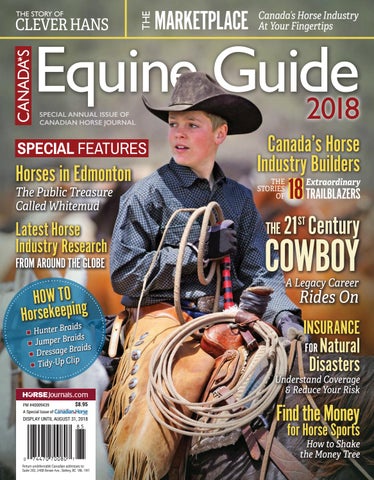
Young cowboy Zane Bishop keeps ranching traditions alive. 8
Canada’s Equine Guide 2018
Photo: © Carien Schipper
On The Cover
Association operates a multi-use facility on a historic site within the City of Edmonton. Learn about its 100-year history and why it’s such a special place in Horses for Everyone in Edmonton: A Public Treasure called Whitemud. With many parts of Canada having been devastated by natural disasters in recent years, Insurance Coverage for Natural Disasters looks at the types of insurance coverage available to protect against these risks. In Research Roundup, we bring you a collection of the latest equine research from around the globe. From exploring the use of shellfish toxin to help horses with bucked shins, to studying how horses approach submissive people, it’s fascinating stuff and we think you’ll agree. Many of us struggle to afford our horse habit and often there’s precious little room in the budget after regular horse care expenses are covered. How to Find the Money for Horse Sports is loaded with ideas on how to discover funding in unusual places. It’s easier than looking for a money tree! The cowboy is a romantic symbol of the Old West. We picture him pushing cattle across the plains or riding through the rugged majesty of the Rocky Mountains in bygone days, and think of a simpler time. Well, think again. Today’s cowboys possess the toughness, resiliency, and independence of their predecessors, but they also move from barn to 21st century boardroom with ease. Whether training horses or operating the latest industry technology, the cowboy remains essential to our cattle and ranching industries. We hope you enjoy The Enduring Cowboy. As with most things in the equestrian world, the braiding of a horse’s mane and tail is not as easy as it looks. Fortunately, our How To Braid feature is here to help, with step-by-step instructions to show you how to create beautiful braids for the hunter, jumper, and dressage ring. Add a tidy-up clip of face and fetlocks — also explained in simple, step-by-step instructions — and your horse will be show ring ready. Your comments are always welcome — we would love to hear from you. Kathy Smith, Editor
CANADA’S HORSE INDUSTRY AT YOUR FINGERTIPS
ACCOUNTS Chantal Patterson ADVERTISING April Ray-Peterson • Terry Andrucko CIRCULATION Steve Smith, Nathan Reimer ADMINISTRATIVE COORDINATOR Nathan Reimer MARKETING Janna Reimer PRODUCTION Elisa Crees CONTRIBUTORS Margaret Evans • Tania Millen April Ray-Peterson • Robin Duncan Photography Western College of Veterinary Medicine • Equine Guelph Karen Weslowski • Carien Schipper ADVERTISING, SUBSCRIPTIONS & GENERAL INQUIRIES 1-800-299-3799 • 250-655-8883 or email: sales@horsejournals.com ADVERTISING DEADLINE 4 weeks prior to issue date (eg: Sept. 30 for Nov/Dec issue) INTERNET EDITION WEB SITE www.horsejournals.com MAIN OFFICE E-MAIL editor@horsejournals.com PRODUCTION DEPARTMENT E-MAIL design@horsejournals.com
Publishing 6 issues per year SUBSCRIPTIONS – REGULAR RATES 1 yr/6 issues: $24 + tax 2 yr/12 issues: $37 + tax US $59/2 yrs, 12 issues ORDERS FOR SUBSCRIPTIONS, CHANGE OF ADDRESS NOTICES, & UNDELIVERABLE COPIES ARE TO BE SENT TO: THE CANADIAN HORSE JOURNAL Suite 202, 2400 Bevan Ave., Sidney, BC V8L 1W1 (250) 655-8883 • fax: (250) 655-8913 • 1-800-299-3799 POSTAGE PAID AT WINNIPEG, MB PUBLICATIONS MAIL REG. NO. 40009439 GST REG. NO. 829298140 ISSN. NO. 1496-1733
We acknowledge the financial support of the Government of Canada. REPRODUCTION IN WHOLE OR IN PART OF ANY MATERIAL CONTAINED IN THIS PUBLICATION WITHOUT THE WRITTEN PERMISSION OF THE PUBLISHER IS STRICTLY PROHIBITED.
The information and services listed herein are intended to facilitate accessibility to the professionals, products and services that play a part in the horse industry. While readers are encouraged to use the products and services of the merchants listed in this Guide, Horse Community Journals Inc. does not recommend or guarantee the products and services of advertisers or associates listed. Manuscripts and photographs will be returned only if SASE is provided. The return of unsolicited material is not guaranteed. Contributors and advertisers warrant all materials supplied are free of copyright and they have the legal right to use the same. All material accepted for publication is subject to such revisions as are deemed appropriate by The Canadian Horse Journal (CHJ). The opinions expressed in CHJ are not necessarily those of the publisher. CHJ reserves the right to refuse any advertising or submission. Contributors consent to have their submissions published in CHJ and on www.HorseJournals.com and elsewhere as determined by the publisher. Printed in Canada. Please recycle.
D O N’T G ET
S TA L L E D WHEN YOUR HORSE IS SICK, EVERYTHING COMES TO A HALT. Vetera vaccines offer unsurpassed protection, including protection against the latest flu strains, to prevent interruptions in both work and play.
WHY TAKE THE RISK?
TALK TO YOUR VET ABOUT YOUR CUSTOMIZED VACCINATION PLAN. bicanadaequine.ca
POTOMAVACTM and the Horse Head logo are trademarks of Merial (a member of the Boehringer Ingelheim group of companies), used under license. © 2018 Merial Canada Inc. (a member of the Boehringer Ingelheim group of companies). VETERA® and CALVENZA® are registered trademarks of Boehringer Ingelheim, used under license. © 2018 Boehringer Ingelheim (Canada) Ltd. All rights reserved.
H O R S E H E A LT H
Research Roundup Latest horse industry research from around the globe
Promising New Gene Therapy Tendon Treatment By Mark Andrews
A new gene therapy shows promise for treating tendon injuries according to a report published in the journal Frontiers in Veterinary Science. The authors claim the technique gives much faster healing than current methods and could significantly reduce relapse rates. The use of gene therapy in two horses with naturally occurring injuries of the suspensory ligament or the superficial digital flexor tendon (SDFT) is described by Milomir Kovak of the Moscow State Academy of Veterinary Medicine and Biotechnology, with Yaroslav A Litvin of the Kazan Federal University, and others. Scientists at Kazan Federal University, Moscow State Academy, and The University of Nottingham collaborated in the work. Two male dressage horses were the subjects of the study. One had desmitis of the lateral branch of the suspensory ligament; the other, tendinitis of the superficial flexor tendon. The treatment involved introducing genes for two specific equine growth factors into the damaged tissue. Plasmid DNA (pDNA) was used to carry genes for equine vascular endothelial growth factor (VEGF) 164 and
10
Canada’s Equine Guide 2018
fibroblast growth factor 2 (FGF2). Both the genes were derived from horses, resulting in the biosynthesis of natural horse proteins in the treated animals. The authors explain: “VEGF164 is a member of a large VEGF proteins family, which promotes proliferation and migration of endothelial cells. FGF2 stimulates proliferation of cells, regeneration of nervous, muscular, and connective tissue.” The pDNA was injected directly into the affected structures under ultrasound guidance on one occasion. Progress was monitored by clinical examination and ultrasound scans. Two to three weeks after the treatment, the authors report that the horses could walk and trot. Within just two months they were back to full health, galloping and competing in dressage competitions. “Advancing medicine,
relieving pain and restoring function were the main aims of this study,” says Professor Albert Rizvanov, who led the study and is based at Kazan Federal University. “We have shown that these are possible, and within a much shorter time span than treatments available at the moment. In addition, we could use this type of therapy in other injuries and in many other situations ranging from fertility problems through to spinal cord injuries.” “This pioneering study advances not only equine medicine but has real implications for how other species and humans are treated for lameness and other disorders in the
CANADA’S HORSE INDUSTRY AT YOUR FINGERTIPS
future,” says Dr. Catrin Rutland, Assistant Professor of Anatomy and Developmental Genetics at the University of Nottingham. “The horses returned to full health after their injuries and did not have any adverse side effects. This is a very exciting medical innovation.” The authors conclude: “Since these preliminary case reports demonstrated improvement in clinical outcome and no adverse side effects, a larger clinical trial is ongoing to further study efficiency of direct gene therapy for the treatment of horse tendinitis and desmitis.” Printed with permission of Mark Andrews, Equine Science Update.
H O R S E H E A LT H
Research Targets Equine Herpesvirus “If a mare is shedding, are there different levels in different places, are you better to swab a horse’s nose or to take a blood sample?” asks Lillie. They will test the samples for presence of the virus or viral DNA levels, and also look at serology, which is the mare’s antibody level or immune response to the virus. Using this information, researchers can then determine how prevalent the virus is, the impact of vaccines on the
Horses carrying equine herpesvirus (EHV) may exhibit signs as minor as a runny nose and mild fever, but the virus is a major cause of neurological, respiratory, and reproductive disease, including abortions, in the equine industry. Often, horses are infected early in life and EHV can remain in the body for life, reactivating at any time, but it’s not clear what causes this to happen. Something pushes it over the edge to disease manifestation, explains Dr. Brandon Lillie, a pathologist in the Department of Pathobiology at the University of Guelph’s Ontario Veterinary College (OVC). While vaccination is recommended to protect against EHV, the virus continues to occur in vaccinated herds. Affected horses may abort their foals, or foals may be born apparently healthy only to die a short time later. Lillie and Dr. Luis Arroyo, a clinician and researcher in OVC’s Department of Clinical Studies, along with their research team, are trying to better understand how the virus exists in the horse population, uncover what triggers the virus to cause disease, and assess ways to maximize current EHV vaccination efficacy and minimize the virus’s effect on horses’ health. In particular, they are focusing on the abortive effect of the virus. EHV can present in a number of ways, explains Arroyo. Horses may demonstrate neurological signs. They may have
difficulty walking; they may have difficulty urinating because the nerves to their bladder are inflamed; or they may exhibit milder symptoms like a runny nose or no symptoms at all. A mare may not show clinical signs of the virus at all, but could lose a foal that is loaded with the virus, he adds. Conversely, some mares may clearly be diseased, but their pregnancy isn’t compromised. The cyclical nature of the virus is part of the challenge. Farms may report no abortions for a couple of years, and then suddenly they have two or three. The researchers began with a survey of Ontario horse farms to better understand the current state of the industry, looking at herd sizes, abortion rates, and prevalence of EHVrelated diseases. Beginning in December 2016, they began sampling horses on farms across Ontario from Ottawa, to Windsor and Sudbury, to the Niagara Region. The farms include large racing operations with dozens of mares to smaller farms with two, three, or six mares. Says Lillie, “We are focusing on the mares because that is the major way that foals get infected. We think that’s an important area to look at and understand.” Horses on each farm will be sampled six times over twelve months, essentially covering the entire gestational cycle of horses. Lillie and Arroyo are also examining the best way to sample for the virus, looking at nasal swabs, vaginal swabs, and blood samples.
suggests not all mares respond the same way to the virus or have the same antibody level patterns over the year. The host, the pathogen, the farm’s management strategy, and the environment all contribute to the occurrence of disease, particularly when a virus is there all the time, adds Lillie. Ultimately, the researchers hope to make some changes in how the disease is diagnosed and managed. “Maybe vaccine
PHOTO: CANSTOCK/PURPLEQUEUE
Researchers at the University of Guelph are searching for clues to better manage a virus that can cause late gestation abortion in mares.
By Karen Mantel, Equine Guelph
EHV can cause pregnant mares to abort their foals late in gestation, or the foal may be born in apparent good health but die a short time later. The research is focussing on the mares because they are the main source of EHV infection in foals.
virus, and the mare’s ability to mount an immune response. On the farms being studied, there is also a fairly even split between those who vaccinate and those who don’t. “Hopefully we’ll start to see some trends,” adds Lillie. “Ultimately, when abortions occur, we can look back and see if the shedding pattern changed and if one type of sampling was a key indicator.” Another area they will assess is how the antibody response pattern changes with horses throughout the year. Preliminary evidence
protocols need tweaking,” he says. “Maybe the current vaccination schedule isn’t the best as far as timing or maybe another one is needed in there, or perhaps the virus has evolved a bit.” Funding for the study has come from the Ontario Ministry of Agriculture, Food and Rural Affairs, and a University of Guelph Catalyst Grant, as well as funding from Equine Guelph and the Zoetis Investment in Innovation Fund. Printed with the kind permission of Equine Guelph.
CONNECT TO THE HORSE INDUSTRY
www.HORSEJournals.com
11
H O R S E H E A LT H
Research Highlights Need for New Approach to Laminitis By Mark Andrews
A new review published in The Veterinary Journal demonstrates how research led by the University of Liverpool has changed the way we think about a crippling disease of horses. have systematically investigated laminitis caused by hormonal dysregulation — endocrine laminitis. She led ground-
research and treatment. Professor McGowan’s understanding of abnormal insulin regulation stemmed from her work as a
PHOTO: BOB LANGRISH
Laminitis is one of the most serious diseases of horses, ponies, and donkeys. It is a painful condition of the tissues (lamellae) that bond the
disease that affects a number of organs and tissues, or affects the body as a whole (systemic) or altered weightbearing rather than being a discrete disease entity. Next, laminitis associated with the endocrine system — endocrine laminitis — is now believed to be the predominant form in animals presenting (primarily) for lameness.
The characteristic stance of a laminitic horse includes hind feet brought forward under its belly in an effort to take weight off the front feet, which are stuck out in front of its normal centre of gravity.
hoof wall to the pedal (coffin) bone in the horse’s hoof. Severe and recurring cases of laminitis can cause chronic painful lameness or result in the horse being destroyed to prevent further suffering. For the past decade, researchers, led by Professor Cathy McGowan from the University’s Department of Equine Clinical Science and Institute of Aging and Chronic Disease,
12
Canada’s Equine Guide 2018
breaking research that showed laminitis was directly caused by insulin, an important hormone involved in dietary glucose (from carbohydrates) control, which overturned previous held theories of laminitis. This new knowledge has now paved the way for improving the veterinary industry’s understanding of this terrible disease, and improving future
veterinary specialist where she has treated many horses and ponies with endocrine disease. She noticed that what they had in common was abnormal insulin regulation. The researchers highlighted three major advances in the understanding of this disease. First, laminitis is now considered to be a clinical syndrome associated with a
CANADA’S HORSE INDUSTRY AT YOUR FINGERTIPS
These simple but important paradigm shifts have several implications, the main one being that an accurate diagnosis of the associated systemic disease (most commonly endocrine disease) would be pivotal for laminitis management, prognosis, and the prevention of recurrence. Third, a series of histological studies, led by Professor McGowan
in conjunction with Veterinary Pathologist Janet Patterson-Kane and PhD student Ninja Karikoski, showed that under the microscope, the changes in the hoof lamellae were subtle in comparison with previous descriptions. Most importantly, there was evidence of a prolonged subclinical phase in at least some horses, as evidenced by the development of divergent hoof rings visible on the hoof wall. These hoof rings may signify a vital window of opportunity for horse owners and their veterinary surgeons to recognise and apply therapeutic intervention before painful laminitis occurs. Under the microscope it was clear that instead of severe basement membrane failure (as had been proposed based on experimental models in severely systemically ill horses), stretching and elongation of the lamellar cells is an early and key event in the disease, and this knowledge will inform research directions in the future. Professor McGowan, Head of Department of Equine Clinical Science, said: “These findings completely change the way we think about a very important disease in horses. This is very important to the equine industry and veterinary profession and will be the basis of future research directions.” Printed with permission of Mark Andrews, Equine Science Update.
David Miller of
Showstring WINS WITH
the POWER of RESULTS OFFICIAL FEED
OFFICIAL FEED
ESSENTIAL K®
A low NSC ration balancer to be fed alone or used as a top dress. Low sugar and starch levels Lower intake and cost
Fixed formula for consistency and quality Essential organic trace minerals
800-472-9507 TRIBUTEEQUINENUTRITION.COM
Essential fatty acids
Essential amino acids
Antioxidants for improved health
Survey of Worm Control in the United States
H O R S E H E A LT H
By Mark Andrews
Recommendations for deworming horses have changed over the years to take account of widespread anthelmintic resistance and changing patterns of infection.
PHOTO: SHUTTERSTOCK/CARTI5
Factors Affecting Tapeworm Infection By Mark Andrews
Where you keep your horse can influence the risk of tapeworm infections, according to research from Poland. The study, by Krzysztof Tomczuk and others of the University of Life Sciences in Lublin, investigated factors affecting tapeworm (Anoplocephala perfoliata) infection in southeastern Poland. The researchers collected fecal samples from nearly 1,000 horses for the study, which ran from 2012 to 2014. Samples came from various farms in southeastern Poland, between the months of October and December. (Previous work by the same research team had shown that late autumn/early winter is the best time of year for detecting tapeworm infections in faecal samples.) They found that the risk of infection increased with the age of the horse. The highest prevalence was noted in the older age group (10 to 20 years of age). Management and
14
Canada’s Equine Guide 2018
pasture type significantly influenced the level of tapeworm infection. Horses kept on stud farms showed three times higher prevalence of A. perfoliata (the most common intestinal tapeworm of horses) compared to those kept in individual stables. Horses housed on shared pastures were four times more likely to be infected than those grazing individual paddocks. Mares had over four times the level of infection of stallions — perhaps because stallions tend to be housed separately. The moisture level of the pasture also played an important role. Horses kept on boggy pastures had significantly higher levels of infection than did those kept on dry pastures. The tapeworm’s larval
stage (cysticercoid) lives in mites (oribatidae) that inhabit the pasture. In dry conditions these mites tend to stay close to the ground. However, in a moist environment they thrive, becoming more numerous and spreading further up the grass, increasing the risk that horses will ingest them while grazing. The researchers concluded that the horses at the highest risk of tapeworm infection were mares over ten years of age, kept in herds and grazing on a shared, boggy pasture. They recommend that these animals should be monitored regularly for tapeworm infection and subjected to anthelmintic treatment as necessary. Printed with permission of Mark Andrews, Equine Science Update.
CANADA’S HORSE INDUSTRY AT YOUR FINGERTIPS
Today, the emphasis is on reducing the intensity of anthelmintic treatment. Fecal egg counts are used to identify horses that need treating for cyathostome (small strongyle) infections. Strategic treatments for specific parasites, such as large strongyles, ascarids and tapeworms, are used as necessary. The guidelines also advise the use of routine faecal egg count reduction tests (FECRT) to assess anthelmintic efficacy. Surprisingly, the last study into equine parasite control in the United States was carried out over 20 years ago. The recent National Animal Health Monitoring Systems (NAHMS) Equine 2015 Study presented an opportunity to look at the equine parasite control strategies followed by owners in the US and see how closely they followed current guidelines. The questionnairebased study approached equine operations in 28 states. Participants provided details of their operation and were questioned about their strategies for deworming and diagnostic testing. A total of 380 respondents provided details. The findings showed that most owners de-
wormed two or three times a year, regardless of the age of the horses. The most commonly used anthelmintic was ivermectin. About 22 percent of participating owners used fecal egg counts, although fewer than 10 percent used them on a regular basis. Fewer than five percent carried out fecal egg count reduction tests to assess that the anthelmintics they were using were still effective. Reporting the findings in the journal Veterinary Parasitology, Martin K Nielsen and colleagues suggest there has been little change since the last nationwide survey was conducted in 1998, as most respondents did not report using FECs. They conclude: “This is in stark contrast to recent European surveys, where 50 to 60 percent of respondents were using FECs routinely. However, the anthelmintic treatment intensity appears to have been lowered compared to 1998. Taken together, these results suggest a continuing need for education and outreach regarding sustainable parasite control.” Printed with permission of Mark Andrews, Equine Science Update.
Body Support
™
Known as Body Builder in USA ™
Natural Alternative to Steroids...
CONGRATULATIONS to our clients on their successes: Doug O’Neill
and his team on
winning the
Kentucky Derby 2016
Steve Asmussen and his team on
winning the
Breeders’ Cup
Registered and approved for sale in Canada!
2017
THE FIRST, & STILL THE BEST, FOR OVER 28 YEARS! Works so well that others try to replicate it. Don’t Be Fooled !!! They do not use the same quality of ingredients. BODY SUPPORT is cheaper because of the dosage and obvious results! Bottom line, BODY SUPPORT was the first and is still the best. Our Secret? We use the highest quality ingredients and have a proprietary, unique way of mixing them. What’s the difference? The key is absorption.
One Bottle + One Horse + Two Months = Outstanding Results!! For the money, there is no better supplement with faster turn-around results than BODY SUPPORT! 28 years of repeat customers prove it! From yearling and 2-year-old prep to racehorses and competition horses, to broodmares and stallions. Yep, it works for all.
Available in various catalogs and at your local tack shops, Greenhawk outlets, and through WeCan Sales distributors. Equiade Products • www.equiade.com • 1-800-413-3702 • (201) 568-5551
TRY IT! YOU WILL LOVE IT!! GUARANTEED!
PHOTO: SHUTTERSTOCK/ADAM BORKOWSKI
H O R S E H E A LT H
Therapeutic Riding Not Stressful For Horses By Mark Andrews
Therapeutic horse riding may be used in the management of various anxiety disorders. But little is known about how these programs affect the stress levels in horses. A University of Missouri study has revealed that horses ridden by veterans with posttraumatic stress disorder (PTSD) did not have undue physiological stress responses, nor did they exhibit behavioural stress while participating in a veterans’ therapy program. “Estimates have shown that approximately 6,300 horses globally work in therapeutic horseback riding (THR) programs at more than 800 centers,” said Rebecca Johnson, a
16
Canada’s Equine Guide 2018
professor in the University of Missouri College of Veterinary Medicine, and the Millsap Professor of Gerontological Nursing in the Sinclair School of Nursing. “While there is a growing body of literature demonstrating the beneficial outcomes from THR programs for people with developmental, cognitive, and psychosocial disabilities, such as veterans with PTSD, it is imperative that we consider horse stress levels to ensure their health and welfare. Our study was de-
CANADA’S HORSE INDUSTRY AT YOUR FINGERTIPS
signed to assess the differences in both physiological stress levels and behavioral stress responses while being ridden by veterans in these programs or by experienced riders.” Two groups were recruited for the study: veterans who were diagnosed with PTSD, and healthy, experienced riders. Each individual horse was ridden in accordance with an approved program for approximately 60 minutes weekly at the same time of day for six weeks. Veterans learned basic horseback riding skills as well as how to apply riding tack to the horse, and how to mount and dismount. Experienced riders were asked to go through the same actions as the veterans. In order to measure physiological stressors on the horses, blood samples were collected 30 minutes before classes started, after the riding tack was applied to the horse, and after the riding class at the first, third, and sixth weeks. Cortisol, an indicator of stress in the body, was measured as well as glucose concentrations and other measurements. Behavioral indicators of stress were assessed by viewing videotapes of the horses obtained for two-minute periods during the first, third, and sixth weeks. Using a stress scale, two researchers scored the videos involving different horses to determine restlessness, jumpiness, and startle-reflexes, as well as how accepting and calm the horses were at other times. “Findings from our
physiological and behavioral data indicated that the horses were not unduly stressed by the THR work; however, we found differences in the horses’ stress levels between rider groups,” Johnson said. “Equine cortisol levels were elevated after riding tack was applied by inexperienced riders, in this case the veterans. However, we think that might be because these riders were applying the tack and mounting the horses a little differently than the experienced riders. The horses also showed elevated physiological and behavioral responses with experienced riders, which could indicate that these riders expect a higher level of performance from the horses. Overall, horses involved in the THR program exhibited low stress responses, indicating no harm from doing the work of THR, which could give retired or unwanted horses a new lease on life.” The interaction between horses and riders has been demonstrated to increase riders’ confidence, self-esteem, sensory sensitivity and social motivation, while decreasing stress. THR programs could enhance their orientation times and curricula to include tacking classes and increasing introductory sessions between horses and riders to decrease stress to the horses, Johnson said. Future studies should include larger groups of participants as well as other measures of physiological stress. Printed with permission of Mark Andrews, Equine Science Update.
PHOTO: SHUTTERSTOCK/TINA RENCELJ
H O R S E H E A LT H
Long-Acting Pain Relief From Shellfish Poison By Mark Andrews
A toxin extracted from shellfish shows promise as a safe and effective long-lasting treatment for horses with bucked shins. Neosaxitoxin is produced by photosynthesis in phytoplankton and cyanobacteria. It may be concentrated by shellfish, and is one of the toxins responsible for Paralytic
Shellfish Poisoning (PSP). It blocks nerve transmission by reversibly binding to receptors in sodium channels, and can be fatal if ingested. Bucked shins (dorsal metatarsal disease) is a
painful, acute periostitis of the dorsal surface of the third metacarpal bone. It is seen most commonly in the forelimbs of young Thoroughbreds (two-yearolds) in training and racing. Neosaxitoxin has been used as a long-acting analgesic in human medicine. Would it be effective as a longlasting analgesic in horses with bucked shins? Gricel Riquelme and coworkers in the Membrane Biochemistry Laboratory, Department of Physiology and Biophysics, Faculty of Medicine, University of Chile, Independencia, investigated. They assessed the response in 14 horses diagnosed with bucked shins, from Club HĂpico Racetrack in Santiago, Chile. Horses were treated with
one of three concentrations of neosaxi-toxin injected under the skin at the top of the affected metacarpal. The research team assessed the response by monitor-ing lameness and noting the sensitivity of the affected area to pressure. They found a significant improvement in pain, measured both by the abolishing of lameness and an increase in the pressure tolerated before lifting the leg. The duration of response was dose dependent, with administration of 600 micrograms being effective for up to three weeks. The researchers conclude that neosaxitoxin infiltration provides safe and effective pain control in bucked shins without adverse side effects. Printed with permission of Mark Andrews, Equine Science Update.
RECOM ER M RI
FS
T EN
HO
O
#1
DED EN
* FA R
Veterinarian Formulated. Farrier Recommended.
U P PLE M
*2017 International Hoof Care Summit Survey
Learn More at www.lifedatalabs.com CONNECT TO THE HORSE INDUSTRY
www.HORSEJournals.com
17
H O R S E H E A LT H
Effects of Longer Day Length on Pregnant Mares
Foals born during the natural breeding and foaling season of April to June tend to have a higher birth weights than foals born January to March. The mares’ length of pregnancy was also reduced as the day length progressed in late spring.
By Mark Andrews
Artificial light has been used to mimic longer day length and hasten the onset of seasonal reproductive activity in mares. Extending the day length to about 16 hours is now a common management tool on horse breeding farms. Research by Dr. Barbara Anne Murphy and colleagues showed that shorter wavelength (blue) light is particularly effective at suppressing melatonin secretion in the horse and initiating ovarian activity. This led to the development of Equilume, a device that provides low-intensity blue
PHOTO: SHUTTERSTOCK/MARIE CHAROUZOVA
light (468 nm) from light-emitting diodes (LED) directed at a single eye. Further research has now been published that shows benefits from the use of the system in mares in late pregnancy. Foals born during the natural breeding season for the horse, which is April, May
A Supplement for Every Need
MSM
Known for its ability to help horses with stiffness and discomfort associated with exercise and normal daily activity.
THE “FLEX” LINE
Uni Flex, Duo Flex, Triple Flex and Multi Flex. A complete line of joint health and mobility for all different levels of necessity.
GOLDEN HORSESHOE has been a trusted name in the equestrian industry for many years, with a complete line of cutting edge health and performance products created to suit your individual equestrian needs.
AVAILABLE AT GREENHAWK HARNESS & EQUESTRIAN SUPPLIES OR AT A FEED SUPPLY/TACK STORE NEAR YOU.
and June in the northern hemisphere, tend to weigh more at birth than foals born in January, February, and March. The increase in day length as the natural foaling season progresses is also associated with a reduction in the duration of pregnancy. A series of studies in Kentucky and Ireland compared mares wearing Equilume light masks in their final months of gestation with untreated mares. The researchers found a significant difference in gestation length between mares that received light therapy and those that did not. Treated mares had pregnancies 11 days shorter on average. A separate study found that foals from light-treated mares were, on average, 3.6 kg heavier than foals from untreated mares. The researchers also report a significant effect on foal birth coat. The third study, conducted in Ireland, compared the weight and length of hair taken from the mane of foals within 48 hours of birth. Foals born to light-treated mares produced mane hair that was significantly lighter and shorter than that of foals from untreated mares. The researchers comment: “Collectively, these studies serve to highlight the influential role of the circa-annual changes in photoperiod length on the pre-partum mare for normal foetal development during the natural breeding season.” They add, “It also emphasizes the potential that exists to improve breeding efficiency parameters by artificially simulating this important environ mental cue in the latter stages of gestation against the backdrop of an economically driven early breeding season.” Printed with permission of Mark Andrews, Equine Science Update.
18
Canada’s Equine Guide 2018
CANADA’S HORSE INDUSTRY AT YOUR FINGERTIPS
Horses Prefer to Approach Submissive People
By Mark Andrews
Horses can tell the difference between dominant and submissive body postures in humans, even with people they don’t know, according to a new study. The research, from the University of Sussex, is published in Animal Cognition. The authors report that the findings enhance our understanding of how animals can communicate using body posture across the species barrier, and are specifically helpful for informing horse handlers and trainers about the ways horses perceive human
dressed in similar clothing and of similar size. A dark neck warmer covered their faces to eye level to minimise facial expression cues. The researchers found that even though the horses had been given food rewards previously by each person when in a neutral body posture, they were significantly more likely to approach the individual displaying a submis-
PHOTO: CANSTOCK/SONYAE
body language. Psychology researchers worked with 30 domestic horses, recruited from equestrian centres in Suffolk and East Sussex, to see whether they were more likely to approach a person displaying a dominant body posture (the person standing straight, with arms and legs apart and chest expanded), or a submissive posture (the person slouching, keeping arms and legs close to the body, relaxed knees). They used ten different demonstrators in a series of trials to introduce variation. Each demonstrator served as dominant and submissive in two out of four trials, to avoid experimenter bias producing a corresponding posture preference. All handlers were women,
sive rather than a dominant posture in follow-up trials. Co-lead author of the study, psychology doctoral student Amy Smith, said: “Horses are often thought to be good at reading human body language based on anecdotal evidence such as the “Clever Hans effect.” [The “Clever Hans effect,” described on page 108, is used in psychology to describe when an animal or a person senses what someone wants them to do, although they are not deliberately given signals.] However, little research has tested this empirically. These results raise interesting questions about the flexibility of cross-species communication.” Dr. Leanne Proops, coauthor (University of Portsmouth), says
“Evolutionarily speaking, animals — including humans — tend to use larger postures to indicate dominance, or threat, and smaller postures to indicate submis-siveness. Horses may therefore have an instinctual under-standing of larger vs. smaller postures.” Last year, Smith, who is part of the Mammal Vocal Communication and Cognition Research Group in the School of Psychology at the University of Sussex, co-led a study that found horses were able to distinguish between angry and happy human facial expressions. Clara Wilson, who coauthored the paper while an undergraduate at the University of Sussex, says, “We were interested in dominant and submissive postures with horses specifically because, although many trainers use posture as a training cue, little research has investigated whether horses would be sensitive to these cues without any specific training.” “Results like these encourage us to be more conscious of the signals we exhibit when interacting with horses and other animals to facilitate a smooth animal-human relationship.” The authors conclude: “This study provides novel evidence that domestic horses may spontaneously discriminate between, and attribute communicative significance to, human body postures of dominance; and further, that familiarity with the signaller is not a requirement for this response.” Printed with permission of Mark Andrews, Equine Science Update.
Equine Choice is Canada’s #1 Prebiotic + Probiotic that promotes and maintains optimal digestive health, and promotes normal stomach pH and gastric function.
animalproproducts.com
1.800.420.3633
CONNECT TO THE HORSE INDUSTRY
www.HORSEJournals.com
19
HORSE INDUSTRY
INSURANCE COVERAGE for
Natural Disasters By Karen L. Weslowski Lawyer, Miller Thomson LLP Vancouver, BC
20
Canada’s Equine Guide 2018
Types of Natural Disasters The insurance coverage available for natural disasters can vary. Not all natural disasters are treated the same way by insurance. Flooding is a good example, as not all sources of flooding are covered by insurance. Floods can result from heavy rainfall, overflowing lakes and rivers, sinkholes or plumbing failures. Insurance policies generally exclude flood-related damage, except for that caused by damaged plumbing, pipes or home appliances. Other types of natural disasters for which insurance coverage may be sought include mudslides, hurricanes, tornadoes, forest fires, and earthquakes. If you live in
CANADA’S HORSE INDUSTRY AT YOUR FINGERTIPS
an area prone to a particular type of natural disaster, it is likely that coverage for those events will be excluded from your insurance coverage, although that coverage may be available for purchase at an additional premium.
Types of Insurance Coverage Available to Response to Natural Disasters Those in the equine community may have several types of insurance coverage available to respond to a natural disaster. Homeowners’ Insurance Policy Typically, the first policy to respond to a natural disaster would be a homeowners’ insurance policy.
PHOTO: DREAMSTIME/ALEXEY STIOP
n recent years, many parts of Canada have been devastated by natural disasters, including forest fires, ice storms, and floods. These disasters have impacted the equine community by causing loss and damage to barns, fencing, pastures, feed supplies and livestock, among other things. Aside from the direct loss of property, there may also be consequential losses, such as loss of business income, resulting from the property loss. Insurance coverage may be available to respond to these losses but it must be secured in advance of the natural disaster. As such, it is helpful to know the types of insurance coverage available to ensure that you are wellprotected against risks.
PHOTO: DREAMSTIME/ALEXEY STIOP
Natural disasters or so-called “acts of God” are not automatically excluded from homeowners’ insurance coverage. The coverage available depends upon the particular terms of your policy and often upon your geographic location. The “Named Perils” or “All Risk” section of the policy will list the events covered by the policy, and usually include fire, lightening, windstorm, hail, explosion, smoke, ice or snow, and freezing of/or water escape from sprinklers, appliances, plumbing, air conditioning or heating systems. These listed perils could cover some natural disasters. The homeowners’ insurance policy will have a section specifically listing the exclusions from coverage. These exclusions often include earthquakes, sinkholes, landslides, hurricanes, flooding, some types of water damage, sump-pump back up, and nuclear war. If you live in an area that is prone to forest fires, flooding or earthquakes, it is quite likely that specific peril (or perils) will be excluded from coverage. The specific language of what is or is not covered by a homeowners’ insurance policy varies from insurer to insurer and by geographical region. You will need to carefully review your own policy to determine what is covered. If a peril is excluded, coverage can often be obtained by way of an “endorsement” to the policy. For instance, earthquake coverage is normally excluded, but can be obtained as an endorsement. Obtaining this coverage can be very expensive and
require a high deductible, particularly if you live in an earthquake-prone area. Commercial Property Insurance If you make a living from your equine activities, your homeowners’ insurance policy will likely not provide coverage for business-related losses because commercial activity is generally excluded from homeowners’ insurance coverage. A commercial property insurance policy will be required. This type of insurance policy is designed to protect the physical assets of a business against loss or damage from a broad range of causes, including natural disaster such as fire, hurricane, earthquakes, and water damage. Again, you will need to carefully review the specific language of your policy to determine if any of these perils is excluded. Business Interruption Insurance For those in the equine business, a natural disaster can affect the ability to carry on business and earn income. Consider, for example, the impact of a fire damaging a barn and indoor riding area used for boarding and lessons. If the barn and indoor riding area cannot be used, the barn owner will lose boarding and lesson income. Insurance is available to cover business losses arising from natural disasters. There are different types of polices for business loss. An “All Risk” policy provides coverage against any risk that is not specifically excluded, while a “Named Perils” policy provides coverage only for those perils specifically listed in the policy. There are different types of business interruption coverage available. A “Limited Indemnity” policy pays only until the damage is repaired or the property is replaced. As soon as your business resumes, the policy stops paying, even if your business has not returned to the previous level of earnings. This type of policy tends to be less expensive but may not provide adequate coverage for business losses. The other type of business interruption coverage available is an “Extended Indemnity” policy, which continues to
If the area you live in is prone to tornadoes, it is unlikely that coverage for this type of natural disaster will be included in your policy, but it may be available for purchase at an additional premium. CONNECT TO THE HORSE INDUSTRY
www.HORSEJournals.com
21
PHOTO: SHUTTERSTOCK/VERA ZINKOVA PHOTO: SHUTTERSTOCK/EUGENE R THIESZEN
PHOTO: SHUTTERSTOCK/DARK MOON PICTURES
Consequential losses can occur as a result of property damage. For example, if a breeder loses their barn or some of their breeding stock in a fire, and is then forced to sell their remaining breeding stock, loss of that future breeding stock or valuable bloodlines is a consequential loss that will not likely be covered by insurance.
22
Canada’s Equine Guide 2018
CANADA’S HORSE INDUSTRY AT YOUR FINGERTIPS
pay until your business resumes its normal, pre-interruption level, subject to the maximum period of indemnity set out in the policy. Equine Association Coverage Many Canadian provincial equine associations provide automatic insurance coverage to their members as a result of membership, which may cover property loss resulting from a natural disaster. This coverage may not be offered automatically, but is usually available for purchase at an additional fee. In British Columbia, the optional coverage includes “Named Perils Insurance,” which covers the death of an “owned” horse resulting from causes such as fire, lightning, and collision/overturn of a conveyance in which a horse was being transported. It also extends to windstorm/hail, earthquake or flood, attack by a dog or wild animal, or collapse of building. There are limits on the amount of coverage available and claims that can be made each year. Coverage is also often provided for lost or damaged tack and equipment, which could occur following a natural disaster. In British Columbia, the limit of this coverage is $10,000 but does not cover clothing or protective equipment worn by riders, wear and tear, mysterious disappearance or horse drawn vehicles.
Direct and Consequential Losses Natural disasters can result in direct losses, such as a barn destroyed by fire or a hay crop destroyed by hail. Direct losses are usually covered by a homeowners’ or commercial property insurance policy. Other losses may occur as a result of property damage, such as the loss of revenue from boarding at your damaged barn, or the loss of profit from selling a foal if your broodmare dies in a fire. These types of losses are described as “consequential.” In some situations, the consequential loss of revenue caused by property damage will be covered by business interruption insurance. However, not all consequential losses will be covered by insurance. For example, if a breeder loses their barn, winter hay supply, and some breeding stock in a fire, and is then forced to sell their remaining breeding stock, the loss of that future breeding stock or valuable bloodlines will not likely be covered by insurance.
Working with our Equine Partners from Coast-to-Coast
Insurance for Horses and their People
IT’S WHAT WE DO!
Intercity
Insurance Services Inc.
®
15221 Yonge St., 2nd Floor, Aurora, ON L4G 1L8
Suite 100, 1500 Hardy St., Kelowna, BC V1Y 8H2
888-394-3330 • Fax: 905-841-0030
800-670-1877 • Fax: 250-860-1213
info@intercityinsurance.com
agriculture@capri.ca
• Horse Mortality/Medical • Farm Property • Commercial Equine Liability
Mitigating Risks Associated with Natural Disasters There are a number of steps you can take to mitigate insurance risks associated with the occurrence of a natural disaster. These include: • Ensure that you have the correct policy for your situation. If you are in the commercial side of the equine industry, a homeowners’ insurance policy will not provide sufficient coverage. You will need the appropriate commercial and business insurance. • Understand what is and is not covered by your policy or policies. You may need to obtain additional coverage if a peril of particular concern to you is usually excluded from your insurance coverage. If you live in an area prone to a particular type of natural disaster, you should discuss the available coverage with your insurance broker and obtain an endorsement to your policy, if required. • Ensure your insurance policy is current. This is particularly important if you have performed any renovations or additions to your home or property. • Represent the true value of your home, property, and contents. An insured must fully disclose the true value of these items to their insurer. The failure to do so, or the misrepresentation of the true value in an attempt to obtain a lower premium, could lead to a voiding of the policy. • Ask your insurance broker about obtaining Guaranteed Replacement Cost coverage on your home. This coverage
www.capri.ca
www.intercityinsurance.com
• Auto and more!
Our Customers DO Come First!
WORLD CLASS FOOTING
Good Footing is Safe Footing
Call
Call
Chris Pack
John Anderson
1-888-818-2473
403-256-8652
for British Columbia and surrounding areas
for Calgary and surrounding areas
Call
Frédéric Authier Pigeon
for Montreal, Ontario, Toronto and surrounding areas
514-815-6996
Cynthia Keating — GGT Footing, National Account Manager 864-804-0011 ARENA BY DISCOUNT DIRTWORKS
CONNECT TO THE HORSE INDUSTRY
www.HORSEJournals.com
23
PHOTO: PIXABAY
A barn destroyed by fire is a direct loss and usually covered by a homeowners’ or commercial property insurance policy.
A commercial property policy will be required if you make a living from your equine activities. Business interruption insurance is available should a natural disaster affect your ability to carry on business and earn income, such as if a fire damages your barn and indoor arena to the extent that they cannot be used for boarding and lessons. The different types of business interruption insurance should be discussed with your insurance broker.
PHOTO: ISTOCK/MENDEL PERKINS
ensures that your home will be rebuilt, even if the cost exceeds the policy limit. This coverage may not extend to outbuildings, such as barns. You should discuss this with your insurance broker to ensure appropriate coverage. • Keep a detailed record of the contents of your home and barn. Take photographs or videos of the contents. Keep your receipts in a safe location away from your home, such as a safety deposit box or office.
• Ensure that your policy takes into account and covers all of your equipment, inventory and vehicles.
Conclusion
• If constructing a new home or barn, consider investing in non-combustible materials for the roof, which may result in savings on your insurance premiums. • Identify the risks faced, prepare an emergency plan and evaluation routes in order to attempt to minimize any losses in the event of a natural disaster. Ensure that your employees are familiar with the emergency plan.
While it may be impossible to predict when a natural disaster is going to strike, taking steps in advance to ensure that you have adequate insurance coverage in place can minimize your potential losses and provide much needed financial assistance to help recover from the disaster. You should discuss your situation and particular needs with a knowledgeable insurance broker to ensure that you have the appropriate insurance coverage. b
Policies generally exclude flood-related damage unless it is caused by home appliances, pipes, or damaged plumbing.
24
Canada’s Equine Guide 2018
CANADA’S HORSE INDUSTRY AT YOUR FINGERTIPS
PHOTO: ISTOCK/STEVERTS
This article is provided as an information service only and is not meant as legal advice. Readers are cautioned not to act on the information provided without seeking specific legal advice with respect to their unique circumstances and the applicable law in their province of residence. Karen Weslowski is called to the British Columbia bar and is a litigation lawyer at Miller Thomson LLP in Vancouver, British Columbia. Miller Thomson LLP is a national law firm with offices in Vancouver, Calgary, Edmonton, Saskatoon, Regina, London, Kitchener-Waterloo, Guelph, Toronto, Vaughan, Markham and Montréal. Prior to practicing law, Karen was a certified Equine Canada Level One coach and a regular competitor in horse shows, particularly in the jumper divisions. For further advice or information about the issues discussed in this article, Karen can be reached at 604.643.1290, or kweslowski@millerthomson.com.
n n n n n n n n
Stall Fronts & Stall Panels Stall Mats & Rubber Flooring Solutions Portable Fence Panels & Trailer Panels Cattle Handling Equipment Nelson Automatic Waterbowls Dutch Doors & Windows Rodeo, Arena & Roping Equipment Feeders, Gates & More
Supply
•
Installation
•
Service
FOR INFORMATION AND ORDERS, PLEASE CONTACT
admin@thunderbirdlivestock.ca 604-856-1604 • Fax: 604-856-1636
CHECK OUT OUR WEBSITE FOR CURRENT INVENTORY & SPECIALS
www.ThunderbirdLivestock.ca Langley, BC • We Ship Anywhere
Pre-Engineered Building Kits • No Welding • No Concrete Foundations
ble a r -Free e u c n a n D e • aint •M
Easy Build Structures’ pre-engineered 2" x 3" galvanized steel framing system is designed for a simplified installation process with the durability to withstand our Canadian winters. All of our Highland Barn structures are maintenance-free and have the combined resistance to fire, termites, mold, and rot with the strength of steel. Our sales team will work with you to customize your Barn package to meet all your requirements. Easy Build supplies everything you need, ranging from overhead or sliding doors, windows, insulation options, sheeting and flashing colours, and hardware. Our barn widths range from 36' - 64' and the length can be as long as you need.
Do-it-yourself with our step-by-step installation manual, or take advantage of our full installation services throughout BC’s Lower Mainland.
Now Callfor a om Cust te Quo
Our engineer can supply stamped and sealed drawings, schedule B and C-B, and your site inspections to help assist you with any permitting processes in your municipality.
Surrey, BC • 604-589-4280 • Toll Free:+1 888-589-4280
www.EasyBuildStructures.ca CONNECT TO THE HORSE INDUSTRY
www.HORSEJournals.com
25
HORSE INDUSTRY
HOW TO
Find the Money for C HORSE SPORTS By Tania Millen
26
Canada’s Equine Guide 2018
Finding the money for horse sport can be challenging, but with ingenuity, riders can discover funding in unusual places. ash with minimal strings attached is available through grants, bursaries, awards, and scholarships. Crowdfunding campaigns can raise funds online through public donations, brand ambassadors receive products at a discount, and sponsors provide free product to their riders. Although these funding sources won’t deliver the holy grail of fully sponsored horses, they can deliver hundreds of dollars in cash or product to riders —
CANADA’S HORSE INDUSTRY AT YOUR FINGERTIPS
significantly reducing costs — and signaling to other sponsors that a rider is worth attention. But before searching for magical money trees, it’s worth considering how funding sources differ, as different sources may be more suitable for some riders than others. Funding sources may be passive (apply and wait), or active (energize strangers for a cause), while benefits and expectations of funding types differ, too. Award recipients may not be required to do anything other
Canadian three-day event rider, Holly Jacks-Smither, competes at the Royal Winter Fair in Toronto, Ontario, with the logo of sponsor Purina visible on her saddle pad.
PHOTO (HORSE): SHUTTERSTOCK/GRIGORITA KO
than have their photo taken when receiving a cheque, while crowdfunding campaign supporters usually expect public recognition. However, sponsoring businesses view sponsorship as a transaction, with riders expected to provide a return on investment. In the funding game, seemingly free money and products aren’t always genuinely free.
Grants, Awards, Bursaries and Scholarships An obvious place to look for cash is from grants, bursaries and awards. These rewards often have no strings attached, however, every application is different, so read the eligibility criteria carefully, then complete the application and provide any required documentation. Sometimes awards are not given out due to lack of applications, so it’s always worth applying.
PHOTO: MACKENZIE CLARK
There’s nothing to lose and much-needed funds to gain. So where do you find these awards? Start with your local, regional, provincial, and national equestrian organizations. For example, Horse Council BC provides travel assistance for athletes attending upper level competitions, while Ontario Horse Trials Association offers bursaries to youth and officials. Saskatchewan Hunter/ Jumper Association, Dressage Development Association, and Reining Horse Association all offer high performance grants. Ontario Equestrian offers bursaries to junior members, while New Brunswick Equestrian Association provides bursaries to youth, plus rider subsidies and funds for coaches. There are many other organizations that provide funding, too, and the internet is a great place to find them.
Some organizations prefer to fund groups of riders rather than individuals, but don’t let this be a deterrent, just figure out how the funds can benefit your group. For example, Horse Council BC provides grants to member clubs to help them organize an event. These grants can be used to help defray overall clinic costs and hence reduce individual riders’ clinic fees. Searching for funding beyond the horse industry can pay off, too. Riders are athletes, and national and international businesses and organizations may have athlete funding available for more competitive riders. For example, provincial ministries in BC, Alberta, Manitoba, and Ontario offer funding to upper level riders. Scholarships are another source of funding. Most scholarships require recipients to be students of an accredited
school, but some are linked to competitive performance instead, so read the award criteria carefully. For example, Vancouver Island Hunter Jumper Association offers scholarships to members in good standing; Horse Trials BC offers a scholarship to help members pursue further education; and Reining Canada offers youth scholarships. Horse Industry Association of Alberta provides a list of 14 organizations that offer scholarships for students pursuing equine-related postsecondary education; Manitoba’s Red River Exhibition Association offers a memorial equine scholarship; and Ontario Harness Horse Association offers college and university level entrance scholarships. 4-H Canada is another potential source of youth scholarships, while American Horse Publications has awards for
CONNECT TO THE HORSE INDUSTRY
www.HORSEJournals.com
27
PHOTO: IAN WOODLEY
Sponsor logos adorn Jacks-Smither’s stalls at events, providing sponsors with the exposure they want. The more successful the rider, the more sponsors they will attract.
PHOTO COURTESY OF HOLLY JACKS-SMITHER
PHOTO: MACKENZIE CLARK
Before agreeing to a sponsorship, Jacks-Smither tries the product to be sure that it works well for her horses and she can stand by it. She also approaches companies for sponsorships of products she likes and uses in her barn.
28
Canada’s Equine Guide 2018
horsey students pursuing media careers. Most post-secondary equine programs have scholarship programs to assist new and returning students, too. For example, University of Guelph offers a tuition scholarship for online equine science certificate courses. Breed associations may offer scholarships as well. For example, American Quarter Horse Association manages over 30 scholarships for youths and students, and Canadian Thoroughbred Horse Society offers a scholarship for postsecondary students. So if you’re a student or plan to be soon, search for funds specifically for riders that need financial help. Awards, bursaries, grants, and scholarships are passive ways to receive financial help — simply complete the requisite application then wait for funding confirmation. However, riders keen to take an active approach to funding their sport may enjoy the challenges and rewards of crowd funding and sponsorship.
Crowdfunding
If you’re willing to publicly share your story and ask for financial help, then consider running a crowdfunding campaign. Crowdfunding entails creating an online campaign for a specific need and requesting support from “the crowd” — both your network, and strangers. Successful crowdfunding requires time, diligence, and social media savvy, along with a commitment to deliver what you’ve promised when and if the campaign is successful.
Sponsorships can be whatever the sponsor and rider decide, and sponsors typically look for exposure in return for product. Boogaloo Brushing Boots has been sponsoring Jacks-Smither since 1997.
CANADA’S HORSE INDUSTRY AT YOUR FINGERTIPS
Kickstarter and GoFundMe are two platforms that have been used successfully for horse-related campaigns. For example, Kickstarter was used to raise over $170,000 for a 3,000 mile trail ride and subsequent movie Unbranded, while a GoFundMe campaign raised over $10,000 for Joni Lynn Peters’ bid to ride on Canada’s Olympic dressage team. Crowdfunding has been used to secure horse ownership, too, with sixfigure international race horses, show jumpers, and event horses all purchased through crowdfunding campaigns. Crowdfunding is a great way to tell your story to those who may not hear it otherwise, but it also takes a lot of planning and energy with no guarantee of success. So consider the benefits and drawbacks before embarking on a campaign.
Sponsorship In the sponsorship world, every rider is a brand, and how riders portray themselves affects potential sponsorship deals. Sponsorship can be whatever the applicant and sponsor decide — from free product to cash — and every rider and sponsor is different. However, all sponsorship deals rely on strong relationships. Holly Jacks-Smither, a Canadian international level three-day event rider, has numerous sponsors and she enthusiastically shared details about her sponsorship success. She says, “One of my first sponsorship experiences was being an ambassador when I was riding intermediate level. But I’ve got a lot more sponsors in the last five years. I’ve been getting better international results, so I’ve become more valuable to sponsors and they’ve been coming to me. But I also approach companies for sponsorship of products that I use in my barn regularly, and that I really like.” But not every sponsorship deal is a perfect fit. Jacks-Smither explains, “Before I ever say yes to sponsorship, I always try the product. I want to make sure it’s best for my horses and that I can stand by the product. Most of my sponsors provide free product
SUPPORTERS
COMMENTS
but many were really supportive when I was fundraising so that I could attend an international event. A lot of my sponsors donated cash or extra goods to auction off during my fundraising auction, which was really great.” How does Jacks-Smither entice sponsors? Her sponsorship package includes recent competitive results, what she can do for the company, how she’ll help promote their product, plus details of her online presence using other sponsored products. She’s adamant that successful sponsorship is all about what she can do for sponsors, not what they can do for her. One of Jacks-Smither’s sponsors is Hit-Air Canada, which provides her with air-bag safety vests. Hit-Air’s eastern Canada representative Mark Greenwood is excited to be part of Jacks-Smither’s success and was happy to chat. “We offer product sponsorship to upper level riders like Jacks-Smither with the expectation that they’ll wear our product and provide exposure. I approached Holly and asked whether she’d wear our vest because of her outgoing personality and because she’s a professional rider. She’s out there
30
Canada’s Equine Guide 2018
38
SUPPORTERS
$4,780 RAISED OF $10,000 GOAL
27
DAYS REMAINING
The Bill Kehler Memorial Scholarships were established in 2003 by the Edmonton Rodeo Cowboy’s Benevolent Foundation and Northlands. Kehler was known as the voice of Canadian Finals Rodeo, Spruce Meadows, and the Calgary Stampede. He demonstrated a life-long commitment to rodeo, broadcasting, and the agricultural industry. L-R: The late Bill Kehler and Ron Southern of Spruce Meadows.
INCENTIVE 1 INCENTIVE 2 INCENTIVE 3
RELATED CAMPAIGNS
PHOTO COURTESY OF HOLLY JACKS-SMITHER
Crowdfunding has been used Help me ride at the next level successfully for horse-related I’ve been a competitive rider for 12 years now, and have all the drive and desire I need to make campaigns it at the next level. including What I don’t have (yet!) is a horse capable of making it there with me. I have been presented with a once-in-a-lifetime It mare who has all the scope opportunity tohorse purchasepurchases. a fantastic Warmblood and athletic ability necessary to compete at an international level. Her name is entails creating an Northern Fancy, she’s out of Northern Night and stands at 16.3 hh. At 9 years old online campaign to her and years ahead of her. she has the perfect amount of experience behind I’ve ridden Fancy a number of times now and the current owner agrees that we explain the project and make a great team, and is willing to give me 5 weeks to raise the purchase price. I need your help to add to the money I’ve saved request support, andso far. Click on the video links to seecommitment, clips of me competing in the past, and some video requires of me trying out Fancy with comments from my coach. diligence, and familiarity with social media.
Grants, bursaries and scholarships are popular sources of funding with few strings attached. The Bill Kehler Memorial Scholarships awards up to four scholarships of $2,500 each year to students who have completed grade 12 and are pursuing post-secondary education, with academic interests in broadcasting or agriculture. Individuals in professional rodeo can also apply for a scholarship to support their post-secondary studies.
HOW TO HELP
PHOTO: SHUTTERSTOCK/CATWALK PHOTOS
CAMPAIGN HOME
Jacks-Smither recently learned how to box and this was her first match. Illustrating their positive sponsor-rider relationship, Hit-Air representative Mark Greenwood came to the fight to cheer her on.
at all the shows, has students out there, and multiple horses that she competes. So she tried it and said yes. She believes in our product. And if a professional rider like Jacks-Smither is wearing it, then up and coming riders will want to wear it, too.” Jacks-Smither also refers students to Hit-Air, which Greenwood notes is a substantial benefit. “But I don’t expect a whole lot from our sponsored riders,” Greenwood says. “It’s really about exposure. JacksSmither sends us pictures wearing our vest and we use
those on social media. We try to give our riders as much as we can, because we get it — horse sport is expensive and they need as much support as they can get.” Marie Hodgson owns Boogaloo Brushing Boots, another of Jacks-Smither’s enthusiastic sponsors. Hodgson says, “Boogaloo has sponsored Jacks-Smither since about 1997. She actually approached us and we’ve been happy to continue sponsoring her. We’re essentially looking for exposure in return for product. JacksSmither hangs our banner in her barn at shows, we use photos on social media, and she refers students to us.” Hodgson feels that riders are more likely to receive sponsorship when they already have funders or sponsors in place. “It’s great for us when riders have
CANADA’S HORSE INDUSTRY AT YOUR FINGERTIPS
PHOTO COURTESY OF SPRUCE MEADOWS
helpinghand
lots of sponsors. We get to interact with other companies and their representatives, which gives our product more exposure. The more the merrier!” From comments like these, it’s obvious that sponsorship can be rewarding for both riders and sponsors, with successful sponsorship partnerships helping both achieve their goals. However, sponsorship is just one piece of the funding puzzle. There are many ways to fund horse sport — from applying for grants, bursaries, scholarships and awards, to embracing the challenges of crowdfunding — so search online for opportunities, tap your networks, and be innovative wherever possible. Perhaps this will be the year that your elusive money tree appears. b
Tania Millen is a former Canadian Team groom, a trained scientist, an environmental consultant, a former event rider turned backcountry rider, and an author of several books including Pack em Up, Ride em Out: Classic Horse Pack Trips in British Columbia and Alberta; The Joys of Horse Packing; Rockin’ Whitewater; and Go Horse Camping: A funny illustrated guide to camping with your horse. www.taniamillen.com
Horses for Everyone in Edmonton
A Public Treasure called
WHITEMUD By Tania Millen
It’s unusual for a horse facility to host public learn-to-ride programs, therapeutic riding programs, hunter-jumper shows and clinics, plus provide boarding services. Plunk that facility down on a historic site in the centre of a large Canadian city, surround it by three parks and multi-use trails for walkers, cyclists, cross-country skiers plus horses, and it’s hard to believe that such a magical place exists. But it does.
32
Canada’s Equine Guide 2018
CANADA’S HORSE INDUSTRY AT YOUR FINGERTIPS
W
hitemud Equine Learning Centre Association (WELCA) is a not-for-profit organization which operates a horse facility in Edmonton that has been a landmark on Alberta’s equestrian scene since the 1950s. Sheila Edmonds, a long-time volunteer and the unofficial historian at WELCA, explains. “In the living memory of Edmontonians, there have always been horses in the valley at Whitemud. The Keillor farm (where WELCA is located) is beautiful, visible, accessible proof that Edmonton preserves, protects, and enhances its precious river valley with unique programs so rare for a city. WELCA links urban and rural interests. It’s a place connecting us to our history and community today, just as it has for generations. The red barns, stone fences, log cabin, stone cottage, gracious old trees, treed hillsides, and horses are a big draw for Edmontonians and visitors alike.” The land was initially developed 100 years ago when returning war veteran
WELCA received access to their new facility in July 2017. “We thought we’d died and gone to heaven,” says volunteer Jean Smith.
Dr. Keillor built a cabin on his land along the North Saskatchewan River. That cabin and Keillor’s farmland still exist today, along with a brand new purposebuilt $7.6 million horse facility. But the new facility is just part of the property’s fascinating 100-year history. In 1918, World War I veteran Dr. Frederick Anton Keillor purchased 61 acres where WELCA now sits, and he built a cabin on the site from hand hewn lumber and river rock. By the late 1920s the farm and surrounding area had become a favourite recreation area for Edmontonians, and a ski club was operating nearby. Keillor subsequently donated land to the city for construction of a road and trail to allow better access to the ski club and river valley. In the 1940s, the farm was in demand by developers, but philanthropicallyminded Keiller insisted the property remain parkland, turning down all private offers in the hopes of making a deal with the recalcitrant city. Edmonds
PHOTO COURTESY OF WELCA
PHOTO: KEN PIPER
The original cabin built by Dr. Keillor of local wood and river rock. Over the fireplace mantle, he placed a heart-shaped stone.
has researched the property’s history and says, “The City of Edmonton grew around Keillor’s farm. When oil was discovered, developers called him daily for nearly ten years to buy the farm.” She explains how Keillor said he was turning down a fortune to preserve the land for the people, and everything he built would last 90 years. People began to write about him, and how his choices to share, preserve, and protect his riverside farm made a difference in their lives. In the 1950s, in an effort to pay hefty property taxes, Keillor unknowingly made a decision that now allows WELCA
to operate one of the few horse facilities that is located in the centre of a Canadian city. He leased the property to a trio of horsemen — Bill Collins, Cliff Ross, and Leo Lemieux. They created Leecoll Stables and in 1958 moved a World War II era airplane hangar onto the site to act as an indoor arena — the same indoor arena that WELCA operated until it was demolished in 2017! Leecoll Stables is a legend in Edmonton. The stables were involved in Canada’s first indoor rodeo in 1958 and the Rodeo of Champions in 1974. Bill Collins was the first cowboy to receive
CONNECT TO THE HORSE INDUSTRY
www.HORSEJournals.com
33
PHOTO COURTESY OF WELCA
Mark Laskin, who rode at Whitemud years ago, returned in December 2017 to conduct a jumping clinic in the new indoor arena. Laskin is currently the chef d’équipe for the Canadian Show Jumping Team.
34
Canada’s Equine Guide 2018
CANADA’S HORSE INDUSTRY AT YOUR FINGERTIPS
the Order of Canada — the next one would be Grant MacEwan, Dr. Keillor’s nephew, and a Lieutenant Governor of Alberta. In the early 1970s, the City of Edmonton finally purchased the property and when the Leecoll lease expired, the city took over the equine operation, changing the name to Whitemud Riding Academy. In 1974, Little Bits Therapeutic Riding Association started offering therapeutic riding programming at the site. Grant MacEwan Equine College operated at Whitemud from 1978 to 1981, and the kitchen of Dr. Keillor’s log cabin was the college office. When the equine college moved to Olds, two graduates of Grant MacEwan Equine College took over the operation and formed Whitemud Equine Centre. In 1985, Friends of Whitemud Equine Centre formed, then amalgamated with Whitemud Equine Centre Association in 2006 to become WELCA. Diane David has been the Executive Director of WELCA for about 30 years, and is one of many whose passionate commitment ensures the facility’s success. She explains what WELCA is all about. “WELCA is really unique. We’re running grassroots community horse programming in the middle of an urban setting where 95 percent of our students don’t own a horse and 35 percent have special needs.” WELCA runs 40-week horsemanship programs where students ride once per week and progress through the Equestrian Canada rider levels, plus there are shorter eightweek Learn-to-Ride programs for ages four to adult. David says, “We get a lot of adults who are coming back to riding — who stopped riding in their teens but are coming back to it. In summer, we hold kids camps, plus we do field trips and tours for schools and community organizations. We even have schools who are interested in providing riding as a unit in their physical education program.” WELCA also offers limited boarding for 25 horses onsite. Plus there is 15 acres worth of show grounds that operate from May to October. The grounds include a grand prix grass ring plus three sand rings, outdoor stabling and a show office. David says, “Edmonton Classic Horse Show runs in May, then we run Pony Club shows, some Wild Rose competitions, plus a couple of big dog shows.” But WELCA is also home to Little Bits Therapeutic Riding Association. Linda Rault
One hundred years ago, Dr. Frederick Anson Keillor purchased the land where WELCA now sits, and built the cabin that still stands today.
But volunteering wasn’t always easy. Smith continues. “Unfortunately, the facility was very old and run down, and it was impossible to keep up with repairs. Soon the rumour was flying that it would all be torn down and turned into park land. All of us who loved the facility were heartbroken and started a campaign to keep the horses in the river valley. In 1999, an auction was held to sell off all the horses and equipment.”
PHOTO COURTESY OF WELCA
is the Riding Program Administrator for Little Bits, and says that all riders in the program are subsidized through in-house fundraising efforts, partnerships with other fundraisers, and public donations. She says, “We always have certified staff on hand, plus one to three certified volunteers per rider, as well. There’s clearly a need for a full-time program — where we could program Monday to Friday during the day and maybe into the evening. But we have to be really fiscally aware of our growth, so our fundraising keeps up with our riders.” Rault continues, “The people of Edmonton and the surrounding area have been phenomenally supportive of this program. We couldn’t do it without them. If you don’t have volunteers, you don’t have a program.” Joanne Billington is a certified therapeutic riding instructor and has worked at Little Bits for 30 years. She says, “We’ve got 115 riders that ride with us yearround, right now. But… it’s about a two-year wait to get into the program and we don’t advertise. People hear about us through word of mouth.” Billington says it’s satisfying to see riders grow and develop over the years. “I’ve seen a lot of riders that started when they were five years old, and now they’re in their early 20s and still riding. We have riders that have been with us for 25 years or more.” But Billington also stays because of the people. “Everybody that’s involved with Little Bits is amazing. We have volunteers who have been here for over 20 years. It’s a family.” Little Bits and WELCA have a very close relationship. Rault explains, “We lease the horses and the facility from WELCA. We don’t own any horses. It’s a wonderful location, accessible to everybody. We work closely with WELCA to ensure we have the horses we need. They have to have such broad minds, these horses. They have to figure out who they’re listening to, and be calm. There’s as close to bombproof as you can get.” You’d think that operating such a complex array of programs would require a massive facility with extensive staff, but WELCA does all this on a compact 48 acre property with only ten full-time staff and a robust group of 400 volunteers. Jean Smith has been an integral part of WELCA since the 1980s. She says, “I started riding at the Whitemud Equine Centre in 1986 after helping out with my son’s grade four school field trip there. Being a life-long lover of animals, particularly horses, I felt the time was right to begin my own formal lessons. My weekly lesson led to a long-term lease on a Quarter Horse that I eventually purchased. I was also volunteering any way I could.”
CONNECT TO THE HORSE INDUSTRY
www.HORSEJournals.com
35
PHOTOS: MARIELLE LAM
The horses, riders, and volunteers alike love the new arena and new barn.
Fortunately, Smith explained, Friends of Whitemud Equine Centre managed to secure the lease on the land and bought enough horses and saddles, bridles, and other equipment at the auction to run the programs. She says, “Hundreds of hours were spent by volunteers repairing the barns and arena so we could keep operational.” Diane David continues. “Almost as soon as WELCA took over the facility in 1999, we recognized that the arena, attached barn, and ATCO trailers that housed the administration were past their lifecycle. From 1999 until 2011, we bandaged and made-do as much as we could. We have a lease with the City of Edmonton for the land so we kept talking to the city about needing to replace the buildings. But as a not-for-profit made up mostly of volunteers and horse people, it was almost overwhelming.” Raising funds to build a new facility or at least upgrade the old one were front of mind for WELCA’s Board of Directors when Canadian Horse Journal visited the site in
36
Canada’s Equine Guide 2018
CANADA’S HORSE INDUSTRY AT YOUR FINGERTIPS
2007. The article Building a Dream: Edmonton’s Whitemud Equine Centre describes an exceptionally rundown facility with a dark uninsulated indoor arena, roads and paddocks that were a muddy morass, and no plumbed washrooms. David remembers that the buildings were beyond the end of their useful life and the future of the facility seemed bleak. However, with an enormous cadre of caring and committed volunteers, the facility kept operating — through freezing winters and sweltering summers — as plans slowly ground along to revitalize the place. WELCA’s staff, volunteers, and partners certainly travelled a long and winding road before attaining the necessary funding for the new facility. It’s taken ten long years for their dreams and schemes to finally come to fruition. In 2011, WELCA approached the city for funding for a replacement building, with the idea that the federal and provincial governments might also provide funding. The
In the living memory of Edmontonians, there have always been horses in the valley at Whitemud.
city agreed, but when the economy tanked, there was no government money available and WELCA was out of luck. Two years later the city conducted structural assessments and became concerned that the facility was unsafe. So WELCA and the city agreed to replace the building using $5.1 million in city funds plus money that WELCA had fundraised, and a social enterprise-funded loan. The City of Edmonton subsequently took over project management, while Dub Architects and Atkinson Construction were hired to design and demolish the old building, plus build a new facility. “We’re so grateful to the City for stepping in like they did, and recognizing that WELCA brings something unique to the city,” David says. WELCA was also fortunate to connect with Edmonton’s Social Enterprise Fund, which provided debt financing. David continues, “We pay a mortgage now, at a rate that we can afford. It’s a wonderful organization and a really good fit for us.” Smith explains how necessary the new facility was. “In May 2016, after many years of planning and fundraising, we were ready to break ground on our new facility — and none too soon, either! For the last few years it had been a challenge to keep a roof over our heads, literally. We were operating out of a building that was so rotten and moldy it was an embarrassment and yet the riders and volunteers kept coming. We had no indoor washrooms and handicap access was minimal at best. There was no insulation in the arena and any heat we managed to generate quickly dissipated. The frost on the inside of the tin roof would build up inches thick in winter and then rain down on us when the sun shone and the temperature warmed up. The footing was very low tech and terribly dusty, and needed constant watering. Barn staff and management worked under incredibly hard conditions to keep us all safe and we are very grateful to them all.” In July 2017, WELCA received access to the new building and started hand-walking the lesson herd over to get them used to all the new sights and smells. Smith reports, “It was a very exciting and yet a surprisingly calm time, and our wonderful, steady horses took it
HORSEBACK VACATIONS
Ride through the Canadian Rockies to the famed Brewster Company Ranch
Follow the Historic Horse Drive Trail on backcountry horse trips for two or four days, and enjoy some of the most scenic areas of the Alberta Foothills and the Rocky Mountains bordering Banff National Park.
CALL OR EMAIL TO MAKE YOUR RESERVATION TODAY 403-762-5454 horses@brewsteradventures.com
www.brewsteradventures.com
Horses, guides, meals, and cabin accommodations are provided. Trips of longer duration can also be accommodated as well as groups up to 20 people.
CONNECT TO THE HORSE INDUSTRY
www.HORSEJournals.com
37
Whitemud sits in the heart of Edmonton, in the North Saskatchewan River Valley, as shown in this photo from 2007.
The City of Edmonton grew around Keillor’s farm. When oil was discovered, developers called him daily for nearly
in their stride. We were so proud of them! All of us were in awe of the light, bright, airy new arena. What a sharp contrast to the old barn and arena. We thought we’d died and gone to heaven.” Smith continues, “Within two weeks Little Bits was able to hold their one-week summer riding camp in a clean, handicapaccessible arena. It was so nice to be able to use the washroom without having to cross the yard, and we couldn’t believe there were water fountains! We no longer have to wash our faces after riding as the footing is a waxed sand-and-fibre material that needs very little grooming and no watering.” Billington agrees. “The horses have been amazing coming in here. It’s a huge arena compared with the old arena. There’s nothing lurking in the corners. It’s nice — clean, no mold, no dust. The footing is great and acoustics are amazing.” But Smith explains that moving into the new arena was a difficult time, too. “The old facility was torn down quickly after we moved, and it was very sad to see it come down. Watching the wrecking crew move in, didn’t seem like a very dignified end to a building that had served us for so long. It was a very emotional day for a lot of us.” However, the new facility is definitely a marvel. It includes a bright climate-controlled indoor arena that is 40 percent larger
38
Canada’s Equine Guide 2018
WELCA’s grassroots programs provide access and safe learning experiences to children and adults, 95 percent of whom don’t own a horse.
than the old one and has TravelRight™ footing — a dust-free surface that simulates turf and is used by high end stables. The new barn area has 12 tie-stalls for teaching students how to groom, tack up, and care for horses, plus indoor plumbing, washrooms, tack rooms, and meeting areas. The facility is fully accessible to people of all abilities and provides a safe, inclusive place for anyone to learn about horses — even those who have never seen one before. Smith says, “The horses love it! We’ve had lots of positive feedback from the community and get loads of visitors, many who have their own stories to tell about the old facility.”
CANADA’S HORSE INDUSTRY AT YOUR FINGERTIPS
PHOTOS COURTESY OF WELCA
ten years to buy the farm.
Need a Trailer? We can help.
TRAVALUM HORSE TRAILERS All Aluminum, heavy duty frame design
FRONTIER HORSE TRAILERS Quality components & fully customizable SASKATOON, SK
SOUTHEY, SK
MOOSOMIN, SK
PRINCE ALBERT, SK
YORKTON, SK
SWAN RIVER, MB
888.278.7344 888.966.8618
www.flamantrailers.com
888.719.3861 888.628.5940
888.319.2703 888.891.4751
Call your nearest Flaman location for pricing and details CONNECT TO THE HORSE INDUSTRY
www.HORSEJournals.com
39
We’re running grassroots community horse programming in the middle of an urban setting where 95 percent of our students don’t own a horse and 35 percent
Since 1975, Whitemud has been home to Little Bits Therapeutic Riding Association, which serves Edmonton and surrounding area.
Edmonton, WELCA and Little Bits, plus some innovative financing, this unique place will continue to serve the Alberta horse community for many years to come. Tens of thousands of cars pass WELCA every day, and many stop in. Edmonds says, “Visitors from around the world come in and say WELCA is the most amazing thing they’ve seen in a city, anywhere. Kids visit Dr. Keillor’s cabin, stand on the hoof-shaped stone on the hearth, and reach up to make a wish on the heart-shaped stone over the mantle, and ask, ‘Who owns this place?’ The answer is, ‘You do!’ This is a place we all own, this rural oasis. WELCA is our public treasure.” b
“We have the best volunteers ever — they keep our lesson programs flowing smoothly, the horses are happy, and the barn is tidy!”
40
Canada’s Equine Guide 2018
CANADA’S HORSE INDUSTRY AT YOUR FINGERTIPS
PHOTO COURTESY OF WELCA
One of the site’s special attractions is Dr. Keillor’s cabin, and the hoof-shaped and heart-shaped rocks that are built into the 100-year-old fireplace. Although the cabin has been upgraded over the years — most notably in 2009 — the original structure is still intact and used for administration offices, providing a lovely historical connection to the site’s patron. There’s no doubt that Whitemud is an important part of Canada’s horse industry history. Many well-known Canadians have ridden horses here — not just Wayne Gretzky and Kurt Browning — but show jumping royalty like Ian Millar, Mark Laskin, and Gail Greenough. It was at Whitemud where Greenough qualified for the 1986 World Show Jumping Championships, which she subsequently won on Mr. T. Greenough became the first rider to win the Championships with zero faults, plus the first North American, first woman, and youngest person to ever win the prestigious title. Quite a feat for someone who learned some of her skills in a freezing cold World War II era airplane hangar. This history doesn’t go unnoticed. Edmonds says, “We feel the spirit of these great horsemen and horsewomen. The wonder of WELCA is that such a unique place exists: visible, accessible, beautiful, and historic.” Smith agrees. “For me WELCA is a dream come true! It gives me a sense of purpose and fulfilment, and gives me a way to use my passion and skills to give back to the community. Over the years I have made many like-minded friends and have watched multitudes of students learn lifelong lessons of responsibility, compassion, and at times, humility.” Now in her mid-sixties and retired, Smith says, “I never had any doubt that WELCA would continue to exist in Edmonton’s river valley but I didn’t think I would be so old when it happened!” With a new facility, strong partnerships between the City of
PHOTO: MARIELLE LAM
have special needs.
Tania Millen is a former Canadian Team groom, a trained scientist, an environmental consultant, a former event rider turned backcountry rider, and an author of several books including Pack em Up, Ride em Out: Classic Horse Pack Trips in British Columbia and Alberta; The Joys of Horse Packing; Rockin’ Whitewater; and Go Horse Camping: A funny illustrated guide to camping with your horse. www.taniamillen.com
Let’s Have a Barn Raising at Your Place!
Affordable Barns
Assembled on your property & ready to use in 2 - 3 days!
• Lots of upgrades available including insulation, tack rooms, skylight, windows, window grills, door upgrades and much more!
We are a Canadian Company!
• Barns built starting at as low as $17,995, including stalls and one sliding 6' door
www.affordablebarns.com • 1-866-500-2276
100% PURE WOOL • NO BREAK-IN TIME ELIMINATES SORE BACKS • 2000+ HOURS OF RIDING
th
www.5StarEquine.com • 870.389.6328
CONNECT TO THE HORSE INDUSTRY
www.HORSEJournals.com
41
CAREERS WITH HORSEPOWER
Canada’s Horse Industry
BUILDERS This article shares the careers and stories of extraordinary horse industry builders who blazed new trails and took Canada’s equine industry to new heights, while at the same time motivating and inspiring the next generation of equestrians. Driving the growth and success of Canada’s horse industry are thousands of people who demonstrate an amazing level of skill, talent, dedication, diversity, and vision. This feature profiles just a few of these luminary individuals who have helped place Canada among the very best of the world’s equestrian nations.
Faith Berghuis By Margaret Evans Faith Berghuis loved her Great Aunt Elsie, a very horsey person who lived at Franklands Farm in Brockville, Ontario, just down the road from the cottage where Faith’s family lived. Elsie Bedford-Jones and her daughter, Gwynneth, were active members of the Montreal Hunt, and Elsie was one of the first women to compete at Madison Square Gardens in New York. She lived on the shore of the St. Lawrence River, on an 80-acre farm that had been in the family since 1920 when Frank Jones purchased it from a descendant of the original Jones family that had come to Brockville just after the 1776 American Revolution. He gave the farm to his sister, Elsie, and she named it Franklands Farm after her brother. One day in 1939, Auntie Elsie was coming to visit and four-yearold Faith had no idea then how much her aunt’s visit was going to decide the course of her life. “She arrived in her car,” recalls
Berghuis. “She got out and opened the back door and out jumped a pony! It was tiny, just about nine hands. His name was Brucie and we had him at the cottage for the whole summer. He lived in a big doll’s house and I just couldn’t be separated from him. But he would go to my aunt’s farm in the winter. That’s how it all began.” The seed was sown for a lifetime of horses, riding, and contributing to the equestrian industry by helping young, immensely talented riders with limited means to find and secure potential Olympic-level horses through the creation of syndicates. Berghuis’ devotion to supporting equestrians led to her receiving the 2013 Lifetime Achievement Award presented by Equine Canada (now Equestrian Canada), and given to an individual who has made exceptional contributions to the industry. In addition, in 1995 she was the first to receive the Owners Award (for show jumping) presented by Equine Canada. And, in 2007, she received the Dressage Owner of the Year Award. Her foundation in riding began with the Canadian Pony Club where she was one of the earliest members in the organization to attain A-level status. “I was from Montreal. I started in Pony Club when I was about ten. Our district commissioner was Barbara Kemp. The club used a stable on top of Mount Royal in the middle of the cemetery. I rode with Barbara a lot and we would ride among the tombstones. Many noted riders came out of Pony Club because of its very solid background.” (L-R) Gwynneth Bedford-Jones and Faith Berghuis at Franklands Farm, welcoming Gina Smith and Dutch Treat home from the 1991 Pan American Games in Cuba, where they won team gold.
42
Canada’s Equine Guide 2018
CANADA’S HORSE INDUSTRY AT YOUR FINGERTIPS
PHOTOS COURTESY OF FAITH BERGHUIS
Faith Berghuis at Franklands Farm.
Barbara Kemp was the legendary FEI dressage and three-day event judge, official, and competition organizer who built the 1976 Olympic three-day event cross-country course in Bromont, Quebec, the first woman in the history of the Olympics to do so. Berghuis went on to become district commissioner of the Leitchcroft Pony Club in Toronto, and was quick to recognize how many talented riders graduated from the organization. She was equally astute to realize that so many gifted riders were hampered in their development toward excellence, and in their opportunities to represent Canada at the international level due to a lack of resources. Elsie Bedford-Jones died in 1956 and her daughter inherited Franklands Farm. She continued the family tradition of breeding and showing outstanding horses. But Berghuis, who would inherit the farm on her cousin’s passing in 2000, set up syndicates that offered opportunities for people to become involved with the acquisition and development of elite level horses. The first such enterprise was the Big Ben syndicate known as Canadian Show Jumpers Unlimited Inc. established in 1983, which also included Warrior and Wotan. The next syndicate she organized was one that involved just her family and Ian Millar. Horse Futures Inc. brought in several prospects for Millar to develop, including Future Shock, Future Vision, El Futuro, and Future Folly.
As much as Berghuis supported show jumping through syndicate opportunities, she was also passionate about dressage. In the 1980s, Canadian dressage rider Gina Smith was training in Germany, and in 1988 Smith was named to the Canadian Olympic team with her horse Malte, and they won bronze at Seoul, Korea. Meanwhile in Brockville, Ontario, horses were becoming too much for Gwynneth, now in her 80s. Berghuis discussed the problem with Ian Millar. She believed Gina Smith would be the perfect person to run the farm and set up a training business there, while she, Berghuis, would continue to form syndicates and partner in the acquisition of horses. “Ian Millar and I went to Germany and we met with Gina,” she says. “Ian told her she was coming back to Canada! That was almost 30 years ago. She came back with Malte in 1990 and she is still with us. She is like family.” Berghuis formed The Dressage Collection Inc. syndicate, and the first horse acquired was Faust, ridden by Smith at the 1996 Summer Olympics in Atlanta, Georgia, as part of Canada’s tenth-placed team. Berghuis inherited the farm in 2000, and returned to breeding top quality horses, which had always been a Franklands’ tradition. She continued forming syndicates, acquiring for Smith the grey Dutch warmblood, Fledermaus. The pair won the Swarovski Canadian League World Cup Final at the Royal Horse Show in 1999 and represented Canada at the World Cup Final in Holland in 2000. Currently another syndicate acquisition, Intrepid, is in training at the farm.
Faith Berghuis with her beloved first pony, circa 1938.
Today, Berghuis continues to see the pressure of costs limiting the scope of so many talented riders, and she worries about the future of the industry. “It is beyond so many people’s means,” she says. “I feel sad about that situation. You see it in smaller communities like Brockville where so many people had fun. People have a hard time maintaining a horse, much less even going to horse
shows. Even the horse shows are disappearing. Is it just a small clique that is going to benefit? For the most part, only the wealthy can afford to be involved with horses. Activity with horses is vanishing at the grassroots. I worry for the future. It is not a sport anymore. It is big business. I can help in a small way through the syndicates.” And, indeed, she has.
1995. Faith Berghuis receiving the first ever Team Owner Award for Show Jumping presented by Ken Peterson with Bill Berghuis and Ian Millar. CONNECT TO THE HORSE INDUSTRY
www.HORSEJournals.com
43
Dr. Hugh Townsend Some highly talented people come along in the horse industry and they go on to enjoy high profile careers and become household names. Others work quietly in the background, yet the impact of their valuable work is felt across Canada and around the world. Dr. Hugh Townsend is one such person. He held positions as a research scientist and program manager at the Vaccine and Infectious Disease OrganizationInternational Vaccine Centre (VIDOInterVac), University of Saskatchewan; an adjunct professor in the Royal University Hospital’s Department of Community Health and Epidemiology; a founding member of the faculty of the School of Public Health as an infectious disease and veterinary internal medicine specialist at the Western College of Veterinary Medicine’s (WCVM) Department of Large Animal Clinical Sciences; and as co-leader of the university’s One Health initiative. The latter program is an approach to foster the well-being of people, animals, and the environment by collaborative problemsolving at all levels — regionally, nationally, and globally. Born and raised in Calgary where his father was a senior orthopedic surgeon, Townsend attended the universities of Calgary and Guelph. He began his veterinary career in 1973 before becoming a research scientist at the Vaccine and Infectious Disease Organization at the University of Saskatchewan. His career included more than 120 publications; he was the editor of the university’s Horse Health Lines and the associate editor (experimental design and statistics) of the Journal of Veterinary Internal Medicine. Throughout his illustrious career, Townsend has been the recipient of many awards including the Pfizer Animal Health Award of Excellence (WCVM); the University of Saskatchewan “100 Alumni of Influence” Award (University of Saskatchewan); the Stan Olson Clinical Teacher of the Year Award (WCVM); and the Saskatchewan Horse Federation – Farm Animal Council of Saskatchewan Award of Distinction (Equine Welfare Communication). Townsend was instrumental in setting up the Equine Health Research Fund (later to be known in tribute to him as the
44
Canada’s Equine Guide 2018
PHOTO: CHRISTINA WEESE, COURTESY UNIVERSITY OF SASKATCHEWAN
By Margaret Evans
Townsend Equine Health Research Fund). Since 1977, the Fund has provided financial support to train equine specialists in surgery, internal medicine, reproduction, epidemiology, and pathology. Research grants are advanced for equine health-related studies and research projects, the results of which have prompted a variety of diagnostic and therapeutic advances in horse health now used throughout the world. At first, though, the EHRF didn’t have its own capital to launch the research projects. Townsend’s father and brother stepped up to help. His father connected the college with horsemen in Alberta who would provide some financial support and his brother connected the WCVM with Calgary and Edmonton business communities. Today, the Fund invests over $100,000
CANADA’S HORSE INDUSTRY AT YOUR FINGERTIPS
annually in equine health research projects, a research fellowship program for graduate veterinary students, and a summer research program for undergraduates. It has provided research grants to more than 150 healthrelated studies conducted by WCVM researchers and collaborators, and promoted equine health education and awareness among the equestrian community through seminars, industry meetings, and the Fund’s news publication Horse Health lines. “I was an Equine Health Research Fund Fellow way back,” says Dr. James Carmalt, professor of equine surgery and an equine surgical specialist at the WCVM. “He was one of my mentors during my internship and he was the kind of mentor who didn’t micromanage. He gave advice when you asked for it and he was generous with his
Every Style and Size You Need for
SAFE WINTER RIDING Castle Plastics Sno Pad time and knowledge. Some of the research done here is groundbreaking. Without the basics and basis of the health research fund we wouldn’t have had the research platform to do any of it.” Carmalt came from Cambridge, England, to study at the University of Saskatchewan and he was the first EHRF-sponsored graduate student to undertake a residency in equine practice at WCVM. Carmalt says that the influence and guidance of Townsend changed his whole career. That influence, that mentoring, became legendary with the Townsend name. When the EHRF was renamed the Townsend Equine Health Research Fund in 2015, Jeanette Neufeld wrote in the press release, “A chance conversation with Dr. Hugh Townsend outside the Western College of Veterinary Medicine (WCVM) led Dr. Joe Bracamonte to focus his career on equine health. ‘He changed my career in the parking lot, just with a conversation,’” Bracamonte, an associate professor specializing in large animal surgery, told Neufeld. Neufeld wrote that Townsend had a gift for inspiring people to pursue equinefocused veterinary medicine. In addition, she says, he has left a lasting legacy in the fields of equine internal medicine, infectious disease, and vaccinology as well as a legion of researchers who have been inspired by him. He was a practical clinician as well as a creative researcher. He set high standards and would review people’s proposals against those high standards. “When West Nile virus came, making its way from New York across the US and into Canada, Hugh and his colleagues saw that coming,” says Dr. Doug Freeman, Dean, WCVMedicine, University of Saskatchewan. “They used [that situation] as an opportunity to set up a trial looking at vaccinated and unvaccinated populations in a newly emerging disease. He always stayed ahead of the curve. He was a very inspirational person to be around.” And he was fun to be around. Freeman says that he was quick to laugh and had a really bright spark in his eye. “He sees positive things and sees humour,” he says. “I can’t think of a conversation I had with Hugh when he didn’t burst out with laughter at one thing or another.”
• Regular Snoball Pad • Large Snoball Pad • 2° Snoball Pad • 2° Large Snoball Pad • Draft Snoball Pad • Orange Snoball Pad
Rim Sno Pad
• Front & Hind in Black • Front & Hind in Clear • Large Front in Clear • 2° Front & Hind in Black
Square Toed Rim Sno Small - 5 5/8” x 5 1/2” x 1/8” Large - 6 5/8” x 5 3/4” x 1/8”
Orange Rim Sno
Small Front - 61/4” x 55/8” x 1/8” Large Front - 7 3/8” x 67/8” x 1/8” Hind - 67/8” x 6” x 1/8”
USE IT SO YOU DON’T LOSE IT
“THE POUR PAD”
FROM CASTLE PLASTICS, INC.
• Designed for use with pour-in materials • Easy application process, and pour will not fall out • Thin, flexible, and strong material that will not rip or tear • Not visible on hoof when applied • Economically priced • Available in two sizes: Small – 6 1/2” x 5 7/8” x 1/16” Large – 7 7/8” x 7 3/8” x 1/16”
36
Castle Plastics 1-800-9-CASTLE
castle@net1plus.com • Fax: 978-534-9915 11 Francis St., Leominster, MA, USA 01453
www.castleplastics.com CONNECT TO THE HORSE INDUSTRY
www.HORSEJournals.com
45
Peter Cameron PHOTO: GLENN CAROL, COURTESY OF PETER CAMERON
By Margaret Evans
PHOTO COURTESY OF PETER CAMERON
Cameron has very high standards for judges, which he strictly adhered to during his career.
46
Canada’s Equine Guide 2018
Few equestrian judges are as respected, admired, or celebrated as Peter Cameron. For decades he provided services as a judge, clinician, and speaker to a multitude of breed association shows and disciplines. According to the Arabian Horse Association, Cameron judged a total of 885 horse shows over 46 years, and held 25 judging cards. In 2014, he received the Lifetime Achievement Award from the Arabian Professional and Amateur Horsemen’s Association, automatically inducting him into their Hall of Fame. It was the first time a Canadian, and a judge, had ever won the award. It ranked with special pride among his many accolades including induction into The Arabian Horse Association Judges Hall of Fame, The Ontario Quarter Horse Hall of Fame, The Arabian Horse Association of Southern California Hall of Fame, The CanAm Equine Emporium Walk of Fame, The St. Catherines Sports Hall of Fame as an Athlete, and The City of Thorold Wall of Fame as an Athlete. He also received two Judge of the Year awards from the Arabian Horseman’s Association. In 2015, the Ontario Equestrian Federation honoured him with its People Make a Difference Award, dedicated to those who work tirelessly behind the scenes to support Ontario’s equestrian community. Born in St. Catharines, Ontario, Cameron began riding at the age of six. At age 15, he purchased his first show horse. In an interview with J.L. Orchard for the article Becoming the Judge: The Life and Lore of Peter Cameron published in Canadian Horse Journal in March 2010, Cameron explained that for his first show he travelled eight hours on horseback to compete. “I rode the horse 35 miles to Hamilton on Friday, placed third on Saturday, then
CANADA’S HORSE INDUSTRY AT YOUR FINGERTIPS
rode home on Sunday.” Very quickly, Cameron’s talents as a rider and trainer became evident. While he was accomplished in a wide variety of sports including baseball, lacrosse, basketball, and ice hockey, he truly excelled as a judge in the show ring. And that opportunity came about purely by accident. In the Becoming the Judge article, Cameron describes attending a show in Hamilton with two horses he had trained. But the judge retained for the show had been delayed in a car accident. Frantic to solve a critical problem, the organizers asked all trainers to throw their names in a hat and the one drawn would be judge for the day. Cameron’s name was drawn and his career as a much-loved and respected judge was launched. He was a gentleman’s judge with integrity, honour, and great humour, a man who never went back on his word. In the ring he worked in the moment, judging every horse no matter whether there were five or fifty on the rail. And he never allowed past knowledge, preconceived notions, or connections — however remote — to interfere with his critique. Cameron judged at all the very best breed championships and shows including Calgary’s Spruce Meadows, Toronto’s Royal Winter Fair, Vancouver’s Pacific National Exhibition, Scottsdale All Arabian in Arizona, Texas State Fair, Quarter Horse Congress, and the US National Arabian Show. He was the first Canadian to judge at the American Quarter Horse World Championship show. But more than casting a discerning eye as a judge, he saw the potential in each rider. As a father and grandfather, Cameron especially enjoyed children and would on occasion give a miniclinic during a youth class. He
PHOTO: BRIAN K. RICHMAN, COURTESY OF PETER CAMERON
offered advice when needed and made it clear to competitors what he wanted to see without ever placing riders in embarrassing or awkward situations. His skills, talents, and demeanour as a judge set the bar for all those following in his footsteps. Cameron knew that a good attitude is as essential as recognizing a good horse. “Sometimes it’s necessary to stand out in the arena for up to 12 hours a day in all kinds of weather,” he commented during
the interview with J.L. Orchard. He had empathy and no shortage of patience for his competitors. “My favourite thing about being a judge was I got to see the best horses in the world from the best position in the ring,” he noted. “And I was getting paid for it.” He retired from judging in 1996 but continued to give clinics, speeches, and offer evaluations of horses. He resides with his wife, Velma, in St. Catharines, Ontario.
PHOTO: DODO KNIGHT, COURTESY OF PETER CAMERON
Cameron loves kids and would often give mini-clinics during youth classes.
His great integrity and dedication made Peter Cameron the most prolific Canadian horse judge of all time. He judged 885 horse shows in his career.
T
BEST TEXTBOO E H K IS THE
REAL WORLD. We’re known nationally for our equine programs. That’s because, along with our world-class facilities, every experience you’ll find here develops real industry skills such as the care and training of horses, riding, driving, breeding, nutrition, and business and stable management. Wherever your equine career takes you, you’ll be ready for the ride.
Located in Morrisville, NY, visit us at morrisville.edu.
CONNECT TO THE HORSE INDUSTRY
www.HORSEJournals.com
47
PHOTO COURTESY OF SUSAN RAYMOND, PHD
Gayle Ecker By Margaret Evans
48
Canada’s Equine Guide 2018
research, and education. “It’s a pyramid and all have to go together,” she says. “They are fully intertwined as the welfare of the horse is so critical. I am all about evidence-based knowledge to support horse health, welfare and safety.” Ecker knew, though, that there were many people who loved horses, or who were fascinated by horses, but knew nothing about them. To reach them, she
CANADA’S HORSE INDUSTRY AT YOUR FINGERTIPS
followed an educational pathway that would have a global reach. “We started building online courses and we now have over 20, making us a world leader,” she says proudly. “No one else is doing this from an accredited university. And the cool thing is that we now have students from over 40 different countries because it’s online. It’s so cool to think about — global horse enthusiasts coming together
PHOTO: EQUINE GUELPH
If there is one thing Gayle Ecker is truly passionate about it’s the health and welfare of horses, and she has made it her life’s work as director of Equine Guelph at the University of Guelph in Ontario. That devotion to horses led to Ecker being awarded the prestigious Equine Industry Vision Award in 2015. The award, presented by the American Horse Publications and sponsored by Zoetis, recognizes Ecker’s innovation, vision, and commitment to the equine industry. And it all began with Pogo. “Pogo was my best friend,” says Ecker who was born in 1958. “He was a dappled grey Shetland pony with a forelock covering his eyes. I would have been in Kindergarten. I learned to ride bareback as we didn’t have a saddle. I don’t even remember, but my mother put me on a horse before I could walk. It’s a family joke about me having no choice but to go into a horse career!” Ecker’s youth was spent enjoying 4-H activities, which naturally led to volunteer work with the organization. She started at the University of Guelph in 1988, working for the Equine Research Centre in research and education. She was part of the creation team that set up Equine Guelph, and has been its director since it opened in 2003. Three things have defined who she is since that inception: horse welfare,
online to learn about horse health, welfare, and safety.” Gayle also has her sights set on youth, and this led to the creation of a unique program called Equimania. Many children today are raised in an urban environment with little opportunity to grow up around animals. But the spark of interest is there and Ecker wants to grab it and help children hold on to it through Equimania’s challenges and quizzes. With a zero-budget each year, volunteers, sponsors, and in-kind donors step up to the plate to take the program to the Royal Agricultural Winter Fair in Toronto (11 years), and the Can-Am All Breeds Equine Expo (10 years). And it was the only Canadian exhibit invited to the 2010 World Equestrian Games in Lexington, Kentucky. Ecker says that parents look at the horse industry and see the cost. But kids love Equimania, and it opens the door to reach their parents who begin to see the horse industry in a very different way because the presentation stresses careers and educational pathways to careers. “I think what makes Gayle unique is her belief that the future of our relationship with the horse is absolutely predicated on the education of horse people and the public at large,” says Jeffrey Wichtel, professor and dean, Ontario Veterinary College, University of Guelph. “There are many individuals that contribute energy and talent to support the health and welfare of horses, and the human-horse relationship more broadly, but Gayle stands out as one who has dedicated most of her life to this goal — she lives and breathes this. I agree that knowledge is the key for every horse person to understand and effectively share the huge responsibility we have for these amazing animals under our care, and Gayle’s vision has filled an important gap. “Gayle’s online students are not just
students to her; she takes a personal interest in all of them and works hard to ensure the knowledge transferred is current, relevant, and immediately applicable. The numbers don’t lie — enrolment in her programs just keeps growing year over year. Every young person she interacts with, whether through Equimania, an online course, or in one of her many other offerings for youth, is seen as critically important for the future of the industry.” For Ecker, the greatest challenge, and opportunity, is education. “I would like to see horse education become more mainstream,” she says. “In the
UK, there is the British Horse Society and its absolutely part of the [equestrian industry] tapestry. In Canada, thousands get into the horse industry with no training. We are creating a learning community within Canada through the Horse Portal.” The Horse Portal provides industry training in an easily-accessible online format to bring horse people together and help them stay current on best health and welfare practices. “I am very optimistic about that program with its potential to develop and grow, and it will become that learning community beyond the provincial federations and Equestrian Canada.”
Ridgetown Campus
We love horses as much as you do. Pursue your dream career through the two-year Associate Diploma in Equine Care and Management. Learn from experts about equine nutrition, reproduction, health, conditioning, business and finance.
PHOTO: EQUINE GUELPH
www.ridgetownc.uoguelph.ca/equine
Gayle Ecker receives the Equine Industry Vision Award from Kate Russo of Zoetis.
PURSUE YOUR PASSION. CONNECT TO THE HORSE INDUSTRY
www.HORSEJournals.com
49
Dr. Gillian Lawrence By Margaret Evans
PHOTO COURTESY OF CANTRA
which was formed in 1980 and today has over 80 centres. CanTRA promotes therapeutic riding for people with disabilities and maintains the standards for riding as a therapeutic, recreational, and sports activity in close collaboration with the medical profession. Lawrence chaired the medical committee and her specialized knowledge guided the writing of the Instructor Certification Manual. The Manual is still a valued reference guide for the several hundred CanTRA-qualified instructors working to provide developmental riding experiences for people with disabilities. According to Equestrian Canada, Lawrence represented Classification on the International Para-Equestrian Committee, and served on the Jury of Appeal at several events. In 1991, she became Chef d’Équipe and led Canada in its first venture into international para-equestrian competition. She filled the Chef d’Équipe position again in 1994, helping Canada to a silver medal
PHOTO: © MCPL. VINCE CARBONNEAU, RIDEAU HALL
Dr. Gillian Lawrence devoted her life to medicine, children, and horses. Born in England where she began her medical career as a family physician, she came to Canada in 1965 with her family and they settled in Amherst, Nova Scotia, where her husband, the late Dr. George Anthony (Tony) Lawrence, was a surgeon in Cumberland County. Tony was a great nephew of the famed novelist D.H. Lawrence. Lawrence devoted her life to the therapeutic riding movement in Canada. She was passionate about children, horses, and medicine and it was a natural fit for her to create a therapeutic riding program at the family home of Burnside Farm that would run for over 30 years. She was a founding member and first president of the Nova Scotia Riding for the Disabled Association and helped fledgling groups set up therapeutic programs. At the national level, Lawrence was a founding member and past-president of the Canadian Therapeutic Riding Association (CanTRA),
50
Canada’s Equine Guide 2018
CANADA’S HORSE INDUSTRY AT YOUR FINGERTIPS
finish at the World Dressage Championships in Hartpury, England. She was instrumental in the development of the classification of disabilities in para-equestrian sport and served as an International Classifier at the debut of Para-Dressage competition during the 1996 Atlanta Paralympic Games and again at the 2000 Sydney Paralympic Games. Lawrence loved people. She was involved in launching a number of social programs in Amhurst including Meals on Wheels and the local food bank. In 2008 she received the Paul Harris Fellowship presented by the Amherst Rotary Club for community service. On August 20, 2013, Lawrence’s contribution to the Canadian equestrian community was officially recognized by the Governor General’s Caring Canadian Award, one of 46 volunteers from various sectors across Canada to receive the honour. Lawrence received her award during a ceremony at Rideau Hall on April 7, 2014 and the event highlighted National Volunteer Week. CanTRA had sponsored Lawrence as a candidate for the award. Created in 1995, the award recognizes Canadians who have made a significant, sustained, unpaid contribution to their community in Canada or abroad. They are often people who work behind the scenes, giving willingly of their time and efforts to help others. The award highlights the example they set in which their compassion
Dr. Gillian Lawrence accepting the 2013 Governor General’s Caring Canadian Award from Gov. Gen. David Johnston.
Looking for your one stop shop for everything equestrian? She touched the world in a positive light in so many ways and leaves a legacy of pure joy, class, and love. and engagement profile Canadian character. In 2015, Equestrian Canada awarded Lawrence with The Lifetime Achievement Award, given to an individual whose contributions to the Canadian equestrian community are considered exceptional by their peers and whose long-term service and dedication contributed directly to the ongoing growth and development of the equestrian sport and industry. Lawrence had been diagnosed with breast cancer, but that didn’t slow her down. She formed a support group for other breast cancer survivors in the Amherst area, providing constant support and, for several years, competed in the Jump for Hope class for breast cancer. The Jump for Hope is a fundraising event at St. Lazare that was launched in 2006 by the Royal Victoria Hospital Foundation for the Cedars Breast Clinic at the McGill University Health Centre. Many breast cancer competitors had never ridden a horse so the challenge to ride over fences became symbolic of facing and conquering the challenging fear of a cancer diagnosis. The challenge and its meaning were a perfect fit for Lawrence’s own values. Lawrence passed away at home surrounded by her family and four-legged friends on May 31, 2016 at age 83. A poignant obituary summarized all that Lawrence meant to so many: “Even more significant than her incredible volunteer work were the everyday thoughtful deeds. She referred to herself as a simple country doctor, but to her patients she was so much more — she was caring and brilliant. Gillian provided a glowing example of how to live and love life. She touched the world in a positive light in so many ways and leaves a legacy of pure joy, class, and love.”
We have everything for both Horse & Rider Horseware Ireland, Back on Track, Weaver Leather, Noble Outfitters, Professional Choice and more!
www.summersidetack.ca • Call us at (250) 890-9158 1081 Knight Road, Comox, BC • summersidetack@shaw.ca
Continuous Farm & Ranch Fence
• SAFE • DURABLE • AFFORDABLE
Economical • No Maintenance Weather & Livestock Resistent
• Premium farm and ranch fence solution • Practical, durable, user-friendly, reasonable prices • Can be used for arena fencing or large pastures and smaller pens • Fences can be 3, 4, 5, or 6 rails Very • Suitable for 7 rail stud pens SE HORdly • Several spacings available Frien • Completely customizable
INSTALLATION AVAILABLE
CF FENCE www.cffence.com phone
MSG: 250-498-0280
250-490-5662
• alc@cffence.com • 3200 Willowbrook Road, Oliver, BC V0H 1T5 CONNECT TO THE HORSE INDUSTRY
www.HORSEJournals.com
51
George and Dianne Tidball By Margaret Evans
52
Canada’s Equine Guide 2018
Okanagan sweethearts Dianne and George Tidball.
PHOTO COURTESY OF THUNDERBIRD SHOW PARK
Langley has long been reputed as the “Horse Capital of British Columbia” and spearheading the provincial equestrian industry have been George and Dianne Tidball, founders of the renowned Thunderbird Show Park. The venue regularly hosts FEI level competitions attracting some of the biggest names in equestrian sport compete. Today they are remembered for their brilliant business acumen and are honoured inductees of Jump Canada Hall of Fame in the Builder category (2009), BC Sports Hall of Fame in the Builder category (2017). Horse Council BC awarded Dianne with a Lifetime Achievement Award for her accomplishments in BC’s equestrian community. Dianne was born in 1932 in Shanghai, China, (where her father managed the manufacturing company Lever Brother’s Far East Division) and George was born in Carstairs, Alberta. Their paths crossed when they both attended BC’s Penticton High School, graduating in 1951. They married in November 1952. But it was during a short stay in England in Dianne’s early years while living with her family at the company town of Port Sunlight, when she took riding lessons and fell in love with horses. It would put her and George on a path to destiny. George, with Dianne’s encouragement and support, cut his business teeth as a chartered accountant and his first job was with Alcan in Kitimat, BC. Offered a scholarship at Harvard University, the couple moved to Boston where, two years later, George graduated at the top of his class as a Baker Scholar. It led to employment and business opportunities. Back in Canada, George was consulting for forest giant MacMillan Bloedel, but
Aerial view of Thunderbird Show Park. PHOTO: TOTEM PHOTOGRAPHICS
Dianne missed the familyfriendly fast food at McDonalds and urged her husband to explore a franchise. Dianne’s instinct for opportunities resulted in George opening the first McDonald’s restaurant in Western Canada in Richmond, BC in 1967. He built 32 McDonalds restaurants before selling out and starting his own restaurant chain in 1971 — The Keg (origin-
ally called The Keg and Cleaver). In 2005, George was inducted into the BC Restaurants Hall of Fame, receiving the Pioneer Award for his contribution to the industry over the course of his career. The Tidballs purchased land in Langley and built the Thunderbird Equestrian Centre in 1973 at 200 Street and the Trans-Canada Highway, which
CANADA’S HORSE INDUSTRY AT YOUR FINGERTIPS
rapidly became a go-to equestrian facility for top shows and competitions. Dianne bred and trained BC’s first homebred AQHA champion. Daughter Laura Tidball-Balisky was a twotime member of the Olympic Show Jumping Team (1984 and 1988); their sons, like George, were avid ropers; and daughter Jane became Thunderbird’s president and tournament director.
PHOTOS COURTESY OF THUNDERBIRD SHOW PARK
In 2000, they sold the land to developers. “The Tidballs decided to build their dream show facility from the ground up and within two years under Dianne’s leadership the 85-acre Thunderbird Show Park, located among Langley’s picturesque rolling hills and tall trees at 248th Street and 72nd Avenue, was born,” says Jason Beck, curator and facility director, BC Sports Hall of Fame. “Designed by the firm that planned the 1996 Atlanta Olympics equestrian venue, Thunderbird featured six competition rings, including one of North America’s best grand prix fields with permanent grandstands, five
warm-up rings, three indoor arenas, five covered stables, a golf course, riding trails, and state-of-the-art footing. Dianne managed the facility until 2005, when daughter Jane took over.” FEI level competitions are regularly held at Thunderbird, drawing some of the biggest names in the sport including Canadian Olympic medalists Eric
Lamaze, Ian Millar, and Jill Henselwood, as well as international competitors from around the world. Since 2011, the North American Riders Group has ranked the Thunderbird Grand Prix event among the top three in North America with three straight years at number two from 2013-15. On June 3, 2014, George
passed away at age 83 surrounded by his loving family. Then, just 18 days later on June 21, Dianne passed away at age 81. With their business instincts and acumen, and their trust and faith in each other, the Tidballs were truly equestrian industry builders leaving a legacy of benefit to everyone.
SHOW RING-QUALITY RESULTS FOR EVERYDAY GROOMING • Detangles manes and tails • Pro-vitamins and silk proteins nourish the coat • Helps promote stronger, longer hair • Repels dust and dirt
©2015 W. F. Young, Inc.
learn more at absorbine.ca
The Horse World’s Most Trusted Name®
CONNECT TO THE HORSE INDUSTRY
www.HORSEJournals.com
53
Guy Weadick By Margaret Evan Guy Weadick, celebrated as the founder of the Calgary Stampede, was born in 1885 in Rochester, New York. Fascinated by the cowboy lifestyle and not interested in following the family tradition in a career in law, he headed west in 1900 and found work as a cowboy from Montana to New Mexico, learning the skills of riding and roping, and especially trick roping. Soon he signed on with the Miller Bros 101 Wild West Show based at the brothers’ 101 Ranch in the Indian Territory of Oklahoma before statehood. In 1906, Weadick’s travels took him to Chicago where he met Grace Maud Bensell, also known as Flores LaDue who, like Weadick, was a fancy roper and trick rider. She had left home as a teenager to join the circus. In five weeks, they married and began a lifelong relationship. They teamed up on
stage for a trick roping show and performed together on the vaudeville circuit into the 1930s. One of the companies they travelled with was the Orpheum Vaudeville. Vaudeville was lighthearted entertainment that included individual acts such as musicians, magicians, acrobats, comedians, trained animals, jugglers, singers, dancers and, of course, rope artists. The Orpheum Vaudeville travelled around the midwestern states and the Pacific coast. While still with the Miller Bros 101 Wild West Show, the Weadicks travelled with them to Calgary in 1908. The federal government had awarded Calgary the Dominion Exhibition, a travelling fair designed to highlight the country’s different regions and opportunities. The attractions included a big pa-
rade and the Wild West Show of which Weadick and his wife were a part. But Weadick was fascinated with the city and, with his natural gift for showmanship, performing, and promoting, he was convinced Calgary would be a great rodeo town. According to the Calgary Stampede website, Weadick thought it would be perfect for a “Frontier Days and Cowboy Championship Contest.” He discussed it with H.C. McMullen, the general livestock agent for the Canadian Pacific Railway, but the agent didn’t think Calgary was ready for it yet. They put up the money for Weadick to stage “the greatest thing of its kind in the world” and their enthusiasm reflected how Calgarians felt about their future. The Stampede took place from September 2 to 7, 1912 to mixed reviews. It didn’t help that it rained, the daily
PHOTO: GLENBOW ARCHIVES NA-5652-37
Guy Weadick and Flores LaDue at the EP Ranch, Pekisko, Alberta, 1923.
54
Canada’s Equine Guide 2018
CANADA’S HORSE INDUSTRY AT YOUR FINGERTIPS
schedule was unreliable, and many events didn’t start on time. There was no infield, no time limits, and many competitors were out of sight of spectators. Yet it drew some 80,000 people and the parade, which included about 1,800 mounted First Nations individuals, was a huge success with spectators. The Duke of Connaught (Governor General of Canada at the time), his wife, Princess Louise Margaret, and their daughter Princess Patricia (whose name would grace Princess Patricia’s Canadian Light Infantry of the Canadian military) all attended the parade and rodeo events. Families from Treaty 7 Nations camped on the grounds, forming the original “Indian Village” that remains a Stampede staple today. Weadick went on to promote a stampede in Winnipeg in 1913, and a rodeo in New York State in 1916. The next Calgary Stampede was in 1919 — the Victory Stampede — which Weadick managed in celebration of returning troops following World War I. The Stampede did not become an annual event until 1923 and Weadick managed it until 1932 when, according to Glenbow Museum, he was fired over a dispute with the Stampede Board. According to the Museum, Weadick purchased a ranch in Eden Valley, west of High River, in 1920, using it as a guest ranch into the 1930s. He and his wife entertained many influential and famous people including Edward, Prince of Wales. Ill health forced the couple to move to Arizona for a warmer climate, and Flores died in 1951. In 1952 Weadick married Dorothy Mullins, who had also competed in the first
Guy Weadick
CHJ20171215-Cda_Equine_Guide_Annual_2018OL.pdf
1
12/19/17
PHOTO: GLENBOW ARCHIVES NA-3164-148
Stampede, but Weadick died the following year. The Guy Weadick School in Calgary was named in his honour in 1979. Weadick was inducted into the Canadian Professional Rodeo Hall of Fame as First Builder July 12, 1982.
1:11:09 PM
Fit is Everything. CONNECT TO THE HORSE INDUSTRY
www.HORSEJournals.com
55
PHOTOS: BC SPORTS HALL OF FAME
David Esworthy By Margaret Evans Among the most dedicated Canadians to influence the horse industry is David Esworthy. Born on January 29, 1929, he became one of our most respected and honoured horsemen, and served in almost every role in equestrian sport as a rider, FEI judge, FEI steward, clinician, show organizer, show chair, administrator, and industry advisor. Esworthy’s influence was felt in all layers of the industry, but perhaps his greatest contribution was his mentorship of so many individuals who went on to become accomplished athletes, officials, and administrators in their own right. Described as a consummate horseman, his involvement in organizations was legendary. As judge, steward, and clinician, he travelled to many parts of the world to attend events including Germany, Australia, New Zealand, Thailand, and Brazil. In 2012, he was named Jump
56
Canada’s Equine Guide 2018
Canada Official of the Year for his outstanding contribution and dedication to the sport. That same year, the BC Sports Hall of Fame added “Equestrian” as a sport discipline and Esworthy was the first to be honoured under that banner when he was inducted in the Builder category for his lifelong contribution to the equestrian community. He had come a long way from his teen years wrangling horses at his aunt’s lodge. “Raised largely in Vancouver, Esworthy’s start with horses came in his teens wrangling horses during summers at the famous Rainbow Lodge,” says Jason Beck, curator and facility director of the BC Sports Hall of Fame. “Owned by his aunt, Myrtle Philip, the lodge later became Whistler Village,
although in those days there wasn’t even a gravel road connecting the area with Vancouver. Some of his best horse education came from horsemen such as Francis Howard, who worked the string of horses there taking guests on rides.” Esworthy studied agriculture at the University of British Columbia and worked for two years on a ranch in the BC Interior (which apparently, according to Beck, cured him of any desire to be a cattle rancher). But it was there he met his future wife, Pat. Back in Vancouver, he and his young family began riding at Northridge Riding Club, and he soon became the club’s instructor. When the club folded, he continued riding at Southlands Riding Club and served as its president from 1969 to 1972. During this time, his reputation for training difficult horses became widespread. While Esworthy worked for
CANADA’S HORSE INDUSTRY AT YOUR FINGERTIPS
40 years at Hastings Brass Foundry — the last four in his career as president and CEO — he always found endless volunteer hours for equestrian sport. “He stands as one of only two Canadian Federation Equestrian Internationale (FEI) stewards who held tickets in all three Olympic disciplines,” says Beck. “Serving as an FEI international judge for many years in some of the world’s most prestigious events, he also taught judging clinics and exams around the world. He assisted in the preparations for equestrian events at both the 1976 and 1984 Olympic Games.” From 1968 to 1977, Esworthy served as chair of the BC Zone of the National Equestrian Federation and vice-president of the national body. “At the same time, he served as a director on the Canadian Horse Council and found himself at the centre of the greatest restructuring in Canadian equestrian history when the two organizations combined,” says Beck. “Esworthy emerged as president of the newly-formed Canadian Equestrian Federation (now Equestrian Canada), serving in that capacity until 1984 and as chairman from 1984-91. One of his greatest accomplishments was writing the new organization’s constitution and bylaws, which included clauses for the formation of stronger provincial organizations. As a result, the creation of Horse Council of British Columbia can be credited to Esworthy as well.” On December 19, 2015, Esworthy passed away at the age of 86 in Langley, BC. But he will forever be remembered for the indelible marks he left on so many aspects of the equestrian world. He inspired so many with his passion for horses, infectious smile, and eternal willingness to help and share his knowledge. Throughout his life, he took the meaning of the word “dedication” to a whole new level.
U of G – OpenEd
Are you looking to learn more about equine health and welfare?
The Equine Canada Lifetime Achievement award is presented to Jack Pemberton (right) by EC president, Al Patterson.
Jack Pemberton
Further your career or simply become a knowledgeable horse owner. Our online equine courses will provide you with the advanced knowledge and practical skills to get you there.
To explore our certificate and diploma programs, visit: EquineStudiesOnline.ca
STUDY ONLINE. STAY AT HOME WITH YOUR HORSES.
By Kathy Smith Jack Pemberton discovered his passion for horses and carriages when he was in the Royal Canadian Air Force. He taught himself to drive, became highly skilled at restoring carriages, showed at fairs across Canada and the US, and became a champion at the Royal Agricultural Winter Fair. Born in Toronto, he lived there until he and his wife, Lillian, bought farm property near Georgetown, Ontario. His commitment to horses and driving led to his involvement with many associations and equine organizations to encourage and promote carriage driving around the world. Pemberton’s impact on equine sport is huge. He attended the first-ever meeting of the Carriage Association of America in 1960, and over the years held various roles in the association including director and chairman. He was made an honorary director in 1988. In 1968, Pemberton represented Canada in carriage driving at the FEI. It led to a long-time involvement with the international organization and he became an FEI driving judge and chair of the driving committee from 1995 to 2003. He gave back by donating a driving trophy to the FEI World Cup Driving Final. The first Jack Pemberton trophy was presented to Australia’s Boyd Exell in 2012. Pemberton’s involvement with the Royal Agricultural Winter Fair began in 1964 when he first exhibited in the coaching class. He became a director for the Fair in 1974 and served as the Fair’s president in 1975, and from 1978-1979. He was also involved with establishing the Ontario Equine Research Center in 1981, and later served as a chairman on the Center’s Advisory Committee for six years. More than 20 equine associations have benefitted from his involvement over the years. He has been made a life member of the British Horse Society, the Canadian Combined Driving Association, Drive Canada, the Canadian Hackney Society, and the Eastern Ontario Pleasure Driving Society. He was also one of the founding directors of Drive Canada and the American Driving Society. In addition to all his volunteer association involvement, Pemberton was also the chair of the Canadian Pleasure Driving Championships. Pemberton was the inaugural recipient of the Lifetime Achievement Award from Equine Canada in 2007, presented to an individual whose contributions to the Canadian equestrian community are considered exceptional by their peers, and whose lifetime of service and dedication has contributed directly to the growth and development of the Canadian equine industry. CONNECT TO THE HORSE INDUSTRY
www.HORSEJournals.com
57
PHOTO: LIBRARY AND ARCHIVES CANADA/ E002505493
Edward Plunket Taylor By Margaret Evans Canada’s best-known Thoroughbred breeder, E.P. Taylor, was born in Ottawa, Ontario, in January, 1901, into a wealthy family. He attended Ashbury College, an independent day and boarding school founded in 1891. Taylor graduated from McGill University, Montreal, in 1922 with a degree in mechanical engineering but he soon became involved in his grandfather’s brewing business, Brading Brewing, which he inherited. Taylor’s entrepreneurial spirit soared. With his Midas touch, he built a financial empire throughout the 1930s by buying up and merging 20 other small breweries to create Canadian Breweries Limited (now Molson Coors Brewing Company) that would grow to be one of the world’s largest brewing companies. Merging and modernizing became the hallmark of his career. During World War II he served Mackenzie King’s government as one of the famed “dollar-a-year” men (business executives who helped the government mobilize and manage industry during wartime), connecting with top businessmen around the world. After the war he and his partners founded Argus Corporation, a powerful holding company with interests throughout Canada’s economy from grocery stores to forestry to mining. At the top of his game, Taylor was one of Canada’s richest businessmen. But if he was a luminary entrepreneur, he was a legendary Thoroughbred racehorse breeder. Just as he was the architect of his phenomenal business dealings, he became the architect of modern racing and breeding. Taylor was introduced to horseracing at Blue Bonnets Raceway during his university days. In the 1930s, together with business partner Jimmy Cosgrave of Cosgrave Breweries, he established Cosgrave Stable. One
58
Canada’s Equine Guide 2018
E.P. Taylor
Northern Dancer PHOTO: THE TONY LEONARD COLLECTION
of its notable racehorses was the chestnut filly Mona Bell, which, in 1938, was Canada’s champion three-year-old “Queen of the Sprinters,” winning the Maple Leaf Stakes and the Breeders Stakes. She was inducted into Canada’s Horse Racing Hall of Fame in 2000. Her full sister Iribelle, owned by Taylor, produced Canadiana (by Taylor’s stallion Chop Chop), the first Canadianbred racehorse to earn more than $100,000 purse money. In the 1950s, Taylor and his wife Winnifred established Windfields Farm in Oshawa, Ontario, and Taylor became president of the Ontario Jockey Club from 1953 to 1973. He took his business savvy and applied
it to the racehorse industry, consolidating many of Ontario’s unprofitable race tracks. He built a new Woodbine Racetrack in 1956 while improving the facilities at the old Woodbine (later named Greenwood), and Fort Erie. Taylor didn’t know it at the time, but 1961 would be a turning point in his life. In his barn a feisty little bay colt was born on May 27. He didn’t grow a lot. In fact, Taylor put the unruly 14.2 hand Thoroughbred in the 1962 yearling sale but he didn’t even fetch the $25,000 reserve. The colt, Northern Dancer, had other things in store for his owner. As a two-year-old, Northern Dancer had seven wins in nine
CANADA’S HORSE INDUSTRY AT YOUR FINGERTIPS
starts and earned the Canadian Juvenile Championship. People began to take notice. Then in 1964 as a three-year-old, Northern Dancer won the Kentucky Derby and two weeks later he won the Preakness Stakes. He placed third in the Belmont Stakes, then returned to Canada to win the Queen’s Plate in June of 1964. In his two years of racing he won 14 of his 18 races, never finishing worse than third. He was the first Canadianbred horse to win the Kentucky Derby, and remains the only horse to win both the Kentucky Derby and the Queen’s Plate. But if he was brilliant as a racehorse, Northern Dancer was legendary at stud. He became the leading male-line
Northern Dancer with owner E.P. Taylor and jockey Bill Hartack after winning the Queen’s Plate in 1964.
progenitor of modern Thoroughbreds worldwide throughout his breeding years from 1965 to 1990. By 2000 his influence on the breeding industry was considered the greatest in the 20th century. He sired over 400 winners, including 146 stakes winners, across North America and Europe and his stud fee rose to $1 million. Northern Dancer was inducted into Canada’s Sports Hall of Fame in 1965, the first horse to be honoured. Taylor himself would be inducted into Canada’s Sports Hall of Fame in 1974 in the Builder category. As a Thoroughbred breeder, Taylor produced many phenomenal winners and stallions at stud that went on to major acclaim. Bull Page, Canadiana, Nearctic, Victoria Park, Canebora, Northern Dancer, and Victoria Era all received the Sovereign Award for Canadian Horse of the Year.
Taylor was the world’s leading horse breeder in 1970 measured by money won. He was voted Thoroughbred racing’s Man of the Year in 1973 and was elected to Canada’s Sports Hall of Fame in 1974 in the Builder category. In 1977 and 1983 he was named the winner of the Eclipse Award for Outstanding Breeder as the leading Thoroughbred breeder in North America. He won the Eclipse award for Man of the Year in 1973; the Sovereign Award for Man of the Year in 1975 and 1977; and the Sovereign Award for Outstanding Breeder in 1976. In 1996 he was inducted into the Ontario Sports Hall of Fame. Horses he bred or owned won 21 runnings of the Queen’s or King’s Plate, and more than 320 stakes races worldwide. Taylor was also a founder of the Jockey Club of Canada. Taylor retired to his home in the Bahamas where he passed away in 1989.
THE HOME OF
We Ship e Worldwid
Solo-Ride AND OUR Signature Hoodies! ®
VISIT US AT
www.HairyBackRanch.com CONNECT TO THE HORSE INDUSTRY
www.HORSEJournals.com
59
Bill Collins
Bill Collins and Smarty Scotian Gold.
By Margaret Evans
PHOTO COURTESY OF TERESA VAN BRYCE
In the history of cutting horse competition, Bill Collins is legendary. For over half a century, he devoted his life to Western equestrian sport by training horses, coaching riders, promoting the cutting horse industry, and upholding his values as a leader, visionary, and mentor. He was inducted into many Halls of Fame in the Western riding world including the Canadian Cutting Horse Association Hall of Fame (1987), Canadian Professional Rodeo Association Hall of Fame (1994), National Cutting Horse Association Hall of Fame (1995), and the American Quarter Horse Association Hall of Fame (2007). In November, 1996, William (Bill) Collins, C.M., D.F.A. (Hon.) became a Member of the Order of Canada, and in recognition of his outstanding achievement, dedication and service described as follows: “He has played a
major role in the preservation of Western Canada’s ranching history and tradition as a cutting horse and rodeo judge, trainer, and prize-winning competitor. One of those naturals who are born in the saddle, he has been an unofficial ambassador for Canada, sharing his rodeo skills and enthusiasm with equestrians around the world, particularly young people.” In 2000, Collins was given the inaugural Alberta Horse Industry Distinguished Service Award “In recognition of the magnitude and magnificence of his contributions to the equine industry in Alberta.” Collins was born in 1924 in Big Valley, Alberta, some 60 kilometres north of Drumheller. His family was in cattle ranching. Riding horses and understanding cow sense became second nature to him.
60
Canada’s Equine Guide 2018
Bill Collins is one of Canada’s legendary horsemen. He has helped develop the sport of cutting in Canada and worldwide, has been a top rodeo competitor, and has mentored and taught thousands of Canadian youth.
PHOTO COURTESY OF BILL COLLINS
Bill Collins and Peter Fraser at the 2009 Horse Breeders and Owners Conference in Red Deer, Alberta. Collins was outspoken about the starting of young horses at the event.
Then, in 1945 he attended his first Calgary Stampede where he instantly got the rodeo bug. The following year he returned as a competitor in calf roping and as an outrider in chuckwagon racing. He won Canadian Calf Roping Championships in 1951, 1952, 1956 and 1957. He was Reserve Champion
CANADA’S HORSE INDUSTRY AT YOUR FINGERTIPS
in 1954, 1958 and 1959. He appeared on the cover of Sports Illustrated in 1954. But his focus changed when, in 1955, a friend asked him to help out at a cutting horse demonstration in Bassano some 140 kilometres east of Calgary. He was hooked and soon after, Collins was asked to show a cutting horse for Leo Lemieux. One thing led to another and he began to travel to roping and cutting competitions. He would go on to become a three-time Canadian Cutting Horse Futurity Champion and win 12 Canadian Cutting Horse Open Championships. In 1958, Collins and Leo Lemieux joined with Cliff Ross, chairman of the Rodeo Committee, to lease Keillor Farm in Edmonton, Alberta (now Whitemud Equine Learning Centre), and set up Leecoll Stables. They soon had up to 75 horses in training in
PHOTO COURTESY OF BILL COLLINS
both English and Western disciplines. Collins was gifted with a wide range of Western and English equestrian talents. Teaching at Leecoll introduced Collins to show jumping, and it wasn’t long before he started helping the kids who were keen to jump fences. Collins excelled at show jumping, winning the Safeway Jumpers Sweepstakes at the 1966 Edmonton Rodeo after a jump-off over five-and-a-halffoot fences. Over the years, thousands of students would benefit from Collins’ talents as a teacher. In 1962, his passion for cutting was taken to a whole new level. He was invited by Charles Nanby “Chunky” Woodward, then owner of Douglas Lake Ranch in British Columbia, to give a cutting demonstration for Prince Philip. Queen Elizabeth and Prince Philip were on a 23-day visit to Canada during which the Prince attended a Commonwealth Study Conference. On the agenda was Prince Philip’s visit to the renowned ranch. The Prince was enthralled by Collins’ horsemanship and the skills of the cutting horse. The encounter led to a three-month visit to Great Britain in 1964 when Collins and his team, along with six cutting horses, demonstrated their skills and wowed crowds totalling a million people. During the 1960s, Collins was a Director of the Canadian Equestrian Federation (now Equestrian Canada) and helped the organization to standardize judging rules. He introduced cutting to the Calgary Stampede in 1973 and was president of the Canadian Cutting Horse Association from 1979 to 1981. Collins’ skills and expertise in giving clinics on cutting were in huge demand as were his skills as a judge. He judged competitions hosted by the Canadian Cutting Horse Association, National Cutting Horse Association, and the American Quarter Horse Association across North America and in Great Britain, Australia, Germany, and Switzerland. At the 2009 Horse Breeders and Owners Conference in Red Deer, Alberta, Collins spoke out about starting horses too young, in particular the three-year-old futurities. “There’s the odd horse that can take it. The very odd one. So that’s why I said that I would change it from a three-year-old futurity in this country back to a four-year-
old (futurity),” said Collins. “This three-yearold (futurity) has ruined more good horses, makings of good horses, than we’ve got in this country, and we’re raising a bunch of good ones now.” Collins stated many times how important it was to give young horses time to mature and understand what they
are being asked to do. Bill Collins’ legacy in cutting spanned over half a century and he is considered Canada’s all-time hero in the sport. On December 31, 2013, he passed away peacefully with his family at his side at the age of 89 years.
Equine Supplements
Pegasus® Equine Supplements are scientifically formulated for performance. Pre & Probiotics
Supports Digestion
2.5kg
VITAMIN E
DHA OMEGA 3
IMMUNE & MUSCLE SUPPORT 2.5kg
Supports Healthy Joints 2.5kg and Flexibility
2.5 kg
I.R. AID
FARRIER’S BEST FRIEND
METABOLIC SUPPORT
Hoof Health Supplement
COOL COMMAND
MAGNESIUM OXIDE
Fat Supplement
2.5kg
2.5kg
CALMING SUPPORT 2.5kg
Pegasus Horse Mineral 2.5kg
HYDRA GUARD
Supports Hydration 2.5kg
Contact 1 (800) 663-6038 ext. 6905 for a Dealer Near You!
www.ottercoop.com CONNECT TO THE HORSE INDUSTRY
www.HORSEJournals.com
61
PHOTOS COURTESY OF HEATHER FLETCHER
Alf Fletcher and his wife, Heather.
Alfred ‘Alf’ Fletcher By Kathy Smith Alf Fletcher of Westbank, BC, was a respected judge and steward, and a former president of Equine Canada. Fletcher grew up in the south Okanagan in the 1930s and 1940s, and pursued his interests in riding at a time when the sport barely existed in BC. He had strong riding skills and participated in various disciplines from tent pegging to jumping. His commitment to his community was evident in his career was as a firefighter and fire prevention officer in Kelowna, BC. Fletcher was a Senior Judge for hunter, jumper, and Western disciplines, and also judged hunt seat, saddle seat, and stock seat equation. His versatility was evident as he was also a Recorded Judge for several breed sports. As an EC Senior National steward for all EC disciplines, and an FEI-X steward for jumper and dressage, he was popular for his sense of humour and strong sense of fair play. David Esworthy, a respected FEI judge and a steward himself, commented that “Alfie worked tirelessly to ensure that all competitors were on a level playing field. Fairness for the competitors and good care for their horses were always paramount in his interpretation and application of the rules. He would not tolerate cruelty, in any form, to any of our four-legged friends.” Many of Canada’s stewards were mentored by Fletcher, among them FEI steward Maureen Walters. “He’s the one who taught me the most about stewarding,” she says. “He always told me that stewards should be out with the people and the horses, and always be accessible.” Fletcher took a personal interest in the careers of the riders he knew. “Alf was always one of my favourite people to see at the horse shows,” says Olympic dressage rider Leslie Reid. “He always had something friendly to say and you got the feeling he was glad to see you. He was very efficient and knowledgeable at his job, and he knew so many people so well.” From 1997 to 2000 as president of Equine Canada, Fletcher assisted in the restructuring of the national federation with a commitment
62
Canada’s Equine Guide 2018
and vision for a strong and viable equestrian industry in Canada. He was named Equine Canada’s Volunteer of the Year (2001) and Jump Canada Official of the Year (2009). He was also an Honourary Lifetime Member of Horse Council BC (HCBC), and each year HCBC awards the prestigious Alf Fletcher Youth Sportsmanship Award to an individual whose conduct exemplifies good sportsmanship. When Fletcher passed away at age 77 in 2009, Akaash Maharaj, then CEO of Equine Canada said, “He had a formative influence on generations of Canadian horsemen and horsewomen and on our national equestrian system itself. Neither our affection for him nor his legacy will ever fade.”
Alf Fletcher jumps Quest. Alf pursued his interest in horses before equestrian sport was widespread in BC.
CANADA’S HORSE INDUSTRY AT YOUR FINGERTIPS
John Scott By Kathy Smith
PHOTOS COURTESY OF HIAA
diverse Alberta landscape. Combine it with unique heartstopping suspense and action. Sneak in a history lesson. Leave the decision makers champing at the bit to return. And all the while leaving the precious landscape unharmed and his two- and four-legged team members happy and safe from harm.
John Scott (right) and Roy Rogers.
The John Scott Ranch is a cornerstone of Alberta’s multi-million dollar movie industry.
“John Scott’s world is all about opportunity — the opportunity to promote his home province; the opportunity to create work for so many people and animals; the opportunity to live each day a meaningful life centered around horses and the Western traditions; the opportunity to have the camera tell meaningful stories about people, places and events dear to his beliefs; the opportunity to promote and preserve; and the opportunity to teach, train, and mentor.” Known as the “Hollywood Hand,” John Scott has provided a wide range of services to the motion picture industry for more than 30 years.
PHOTO COURTESY OF THE CALGARY STAMPEDE
John Scott, the owner of John Scott Productions & Motion Picture Animals, received the 2007 Alberta Horse Industry Distinguished Service Award for his decades-long dedication to making Alberta a go-to province for movie production. In 2008, he received the City of Calgary’s Signature Award for his accomplishments and contribution to bringing signification recognition to Calgary. Scott’s ranch and production company based in Longview, Alberta has worked on five Oscar-winning films including The Revenant (2015), Legends of the Fall (1993), and The Unforgiven (1992), and the Emmywinning film Bury My Heart at Wounded Knee (2007). More than 150 productions for film and television as well as numerous commercials have been shot at the ranch where Scott offers his services as wrangler, producer, host, promoter, negotiator, stunt coordinator, talent scout, and actor. On the Horse Industry Association of Alberta website, he is described as “a man of many hats” who “sees his task as quite simple — help capture the jaw dropping majesty and breathtaking splendor of the
CONNECT TO THE HORSE INDUSTRY
www.HORSEJournals.com
63
Cara Whitham Cara Whitham’s remarkable career in the equestrian industry has spanned everything from high performance dressage rider and certified coach to world-renowned judge, industry leader, and volunteer. A little known fact about Whitham is that she was the first woman in Canada to go for her jockey’s licence. During her riding career, Whitham was named to the Canadian Dressage Team short list numerous times, and she earned many Canadian and provincial grand prix and grand prix freestyle championship titles. She has also had a remarkable impact on dressage within Canada and around the world as a certified High Performance Coach and Coach Evaluator, and FEI Course Director, conducting clinics in Asia, Australia, the Baltics, England, New Zealand, North America, South Africa, and South America. First appointed chef d’équipe for the Canadian Dressage Team during the fouryear European tour leading into the 1984
PHOTO: EQUESTRIAN CANADA
By Equestrian Canada
Los Angeles Olympics, Whitham is also renowned for her input into the high performance plan that produced Canada’s only Olympic Team Medal in Dressage to date — the Team Bronze Medal at the 1988
Your horse’s hooves become verwhelmed by environmental o damage on a daily basis that results in dehydration and a breakdown of the hoof. This breakdown is visible through hoof brittleness and cracking. Hoof Hearted is specifically designed to leave the hoof appropriately hydrated, promoting hoof growth and strength, while protecting the hoof from exterior damage.
AVAILABLE AT GREENHAWK HARNESS & EQUESTRIAN SUPPLIES OR AT A FEED SUPPLY/TACK STORE NEAR YOU.
64
Canada’s Equine Guide 2018
CANADA’S HORSE INDUSTRY AT YOUR FINGERTIPS
Seoul Olympics. In addition, she was the chef d’équipe for the Costa Rican Dressage Team, helping them bring home the Team Gold Medal from the 2013 Central American Games. Subsequently, Costa Rica qualified for the Pan American Games for the first time in their history, attending the 2015 Games in Toronto, where Whitham once again stepped in as chef d’équipe. She has also had a celebrated career as a judge, and continues to be in high demand today, while also mentoring many judges in Canada and around the world. She has held the record of being the only official to obtain FEI 5* judging credentials for both Dressage and Eventing. Plus, she received FEI status as a Dressage Technical Delegate, Eventing Steward, and Dressage Course Director. She was recently appointed Technical Delegate of Dressage for
YOUR
DREAM the 2018 FEI World Equestrian Games in Tryon, NC. Whitham’s judging career has taken her around the world and to the very top of the sport. She was appointed to the Dressage Ground Jury for the 2003 and 2011 Pan American Games, the 2005 European Dressage Championships, and the 2010 FEI World Equestrian Games (WEG). On the eventing side, she was appointed to the Eventing Ground Jury for the 1998 and 2002 WEG, as well as the 2004 Athens Olympic Games. Recognized internationally for her knowledge and insight into equestrian sport, Whitham was hired as a television commentator for the 2007 WEG, as well as the 2004, 2008, and 2012 Olympic Games. In addition, she has been instrumental to the competition system in Canada. She has organized over 200 national and 30 international competitions, and held the position of Technical Advisor for the Coup des Ameriques in Blainville, QC — which was the first FEI Dressage Team competition held within North and South America. She also founded the Canadian FEI Youth Championships and was a leader in introducing the Event and Dressage Young Horse classes in Canada. A former Manager and Director of Dressage for Equestrian Canada (EC), Whitham has given back to the organization throughout her long and illustrious career, providing invaluable service through various volunteer roles, including Chair of the former Dressage Canada Committee. She continues to donate her time and knowledge to the betterment of Canada’s equestrian industry today, and is a current EC Category A Member, as well as current Chair of the Officials’ Task Force. Whitham’s contributions to equestrian sport and industry are immeasurable, and Canada is fortunate to benefit from her dynamic and worldclass talent, bottomless commitment, and invaluable experience. She was the recipient of the EC Lifetime Achievement Award in 2016.
CAREER
PEOPLE. PASSION. HORSES.
EQUINE ASSISTED BUSINESS TRAINING. READY-MADE BUSINESS.
The Academy Of Equine Assisted Learning
EQUINECONNECTION.CA
e l op e p g n i p l e H change lives
JUG Waterers keep your livestock’s water clean and free of bacteria, feed, and algae. Uses geothermal energy to keep water flowing in winter. Straight forward use for animals, with no flaps to lift, balls to push, or floats to move out of the way, and Stall Waterers too! clean, fresh water easily visible and available.
CK SAVE YOUR BA • UM IN UM AL Y • BU EBERSTAL PORTABLE STALLS, FABRICATED WITH HIGH-QUALITY DIAMOND BAR TECHNOLOGY. RUGGED, DURABLE, LIGHTWEIGHT!
Available through Huber Ag Equipment 1-403-578-8359 • Coronation, AB
www.huberequipment.com CONNECT TO THE HORSE INDUSTRY
Also Available... HayBoss Feeders Efficient, Adjustable Forage Feeder
SunTank Freeze-free Solar Heated Waterers
www.HORSEJournals.com
65
Dr. Sherman Olson By Margaret Evans PHOTO COURTESY OF HORSE COUNCIL BC
vision for the benefit of such a trade show resulted in the first Optofair in 1980. It was as an optometrist that he met lifelong friend, Bill Archibald, in 1970. Olson’s younger daughter, Nancy, had a passion for riding and Archibald, who was a member of the Planning and Parks Board, was a trail advisor for the BC Recreation Association. Horses were in their lives and the organization of the equestrian community became a focus of their mutual concern. In British Columbia, two organizations were in play — BC Horse Owners Association and the Equestrian Federation of BC. But Olson and Archibald saw the value of a single organization that would work for the good of all riders — Western and English alike. From that vision was born Horse Council of British Columbia with Olson acting as founding president from 1980 to 1990. In 1981, Olson was the first to receive HCBC’s Lifetime Achievement Award. In 2013, following Olson’s passing, it was renamed
PHOTO COURTESY OF TRAILSBC WEBSITE.
Dr. Sherman Oakley Olson of Maple Ridge, BC, was born in Saskatchewan in 1928 and moved to Vancouver in 1941 where he attended King Edward High School. He studied optometry at the College of Optometry, University of Chicago, and graduated in 1951. For almost 20 years, Olson ran his optometry practice from the Birks Building at Granville and Georgia Streets, Vancouver, before moving his family to Maple Ridge in 1971. Olson and his wife Josephine had two daughters, one of whom was born with cerebral palsy. Olson served as president of the Vancouver Cerebral Palsy Association and was the founding chairman of the BC Neurological Society. He was also president of the BC Association of Optometrists and worked diligently to bring about provincial legislation that brought optometrists under the Medical Services Plan so their services would be covered. He was instrumental in the launch of Optofair, an annual education and tradeshow event for optometrists. His
66
Canada’s Equine Guide 2018
CANADA’S HORSE INDUSTRY AT YOUR FINGERTIPS
the Sherman Olson Lifetime Achievement Award. Olson, along with partners, purchased the Maple Ridge Riding Centre and operated it as a community resource from 1974 to 1984. He was involved with the Canadian Horse Shows Association that would become the Canadian Equestrian Federation (CEF), Equine Canada, and now Equestrian Canada. He served as director of the CEF from 1981 to 1986, vice president from 1986 to 1996, and vice-president recreation 1999-2003. He was active in the restructuring of CEF and its constitution to serve members better by developing programs such as the certified coaching program, fundraising for national and international competitions, and insurance plans. Organizational skills were in Olson’s blood. In 1982 he chaired the committee that hosted the first FEI-recognized Young Riders Championships held in Maple Ridge, which was the first of its kind in Canada. Competitors came from across the country, the US, and Mexico. But perhaps it was his devotion to trails and trail riding that earned Olson the greatest accolades. In 1992, to commemorate Canada’s 125th anniversary, he coordinated the national relay “Ride for Canada.” According to The Trails Society of British
Dr. Sherman Olson at a Trans Canada Trail dedication at Matsqui, BC.
C at h er i n e E . W i l l s on E: willson@gsnh.com P: 416.597.6488
Providing quality legal work and excellent service in the following areas: • Equine Law • Employment Law • Tax & Liability Issues • Board, Sale & Lease Agreements • Syndicates & Owner Disputes Columbia, “This highly publicized event involved equestrian enthusiasts from across Canada taking four months to cross the country. The relay from coast to coast to coast concluded on Parliament Hill in the presence of her Majesty the Queen. He was honoured and received a Governor General’s Award for this project.” In 1993, Olson became a director of the Trans Canada Trail Foundation, and then President from 1995 to 2001. He provided ideas and guidance for provinces to complete their section of the trail. It was a huge dream but by putting in the hard work and taking one step at a time he provided the leadership and inspiration for others to take up the cause and turn the Trans Canada Trail into today’s reality. The official opening of the trail was both poignant and emotional. Three original relay containers carried water from Canada’s three oceans. The relay ended in Hull, Quebec, and the waters were combined symbolizing “Unity, pride, and love for our country.” In 1998, Olson was named Equine Canada’s Volunteer of the Year for his dedication, hard work, and vision that helped shaped Canada’s equestrian community. Closer to home, Maple Ridge was a huge beneficiary of Olson’s skills. According to the Maple Ridge-Pitt Meadows News, he served on the hospital board and the hospital foundation, the Chamber of Commerce, the Arts Council, Maple Ridge Community Foundation, and the Economic Advisory Council. Olson passed away suddenly June 9, 2013 at age 85. On June 23, 2017, he was awarded posthumously Canada’s Meritorious Service Medal. It was presented to his daughter Nancy Olson-Beaulieu by the Right Honourable David Johnston, Governor General of Canada, in recognition of his vision for the Trans Canada Trail as a symbol of a unified Canada, and his ability to motivate thousands of volunteers to harness their energy and make the project a reality. The award recognizes extraordinary people who make Canada proud.
We’re social. Follow Us. 1600-480 University Ave. Toronto, ON M5G 1V2
CONNECT TO THE HORSE INDUSTRY
w w w. g s n h . c o m
www.HORSEJournals.com
67
George Wade By Margaret Evans
68
Canada’s Equine Guide 2018
George Wade during the Apple Blossom Festival Parade in Kentville, NS, circa 1986.
George Wade in 1985 with Jackson Mandate, a stallion bought as a weanling in 1967 along with his full brother, Winston Mandate.
CANADA’S HORSE INDUSTRY AT YOUR FINGERTIPS
PHOTOS: LESLIE WADE
George Wade was born in 1917 in Kentville, Nova Scotia and attended school there, completing his grade 12. His father was in the grocery store business and Wade followed in his footsteps as soon as he graduated. His love of horses began when he was a boy and he quickly became experienced with them as they were used to deliver groceries to customers. Daughter Leslie Wade says her father met her mother, Donalda (“Donni”), while playing badminton at a local school. They married in 1940 and had five children, two sons and three daughters and, naturally, he involved all of them in horses as they grew up. His passion was Morgan horses. “Father had imported a Morgan stallion from Vermont around 1945-1947, arriving by train no less in those days,” she says. “He first crossed Jubilee’s Victory with Standardbred mares and got some wonderful big solid horses built like warmbloods. In 1952, he imported two purebred Morgan mares and his breeding program for purebreds was launched. Over the years, there were over a hundred foals born on the farm. Father was passionate about his horses and loved to show them off to visitors. He also liked to entertain horse people and hosted many events over the years, including launching the first Morgan shows in the form of field days held initially at our old Hobby Horse Farm closer to town. “In 1967, he bought his dream property, a much larger farm about seven miles from town in Coldbrook. Here he was able to continue the field days, only now he was putting a number of people up in his house — he built a large one — and there would be a barbecue for all the participants after the show. Although he was a quiet man, his horses drew him out in his sharing of them. His daughters — three of us — all became passionate about them as well. Horses were our childhood. In fact, I wanted a bike rather than ride [horses] when I was younger, and he wouldn’t buy me one since he had the hope I’d be converted. He even paid me a quarter to be led around the yard, me in tears. He won out.” George Wade’s passion for Morgan horses and their wellbeing was the reason he launched the Canadian Morgan Horse Foundation. Its aims were threefold — to promote the prevention of cruelty, neglect, and mistreatment of horses through education; to sponsor equine research by assisting universities, colleges, schools, and
other qualified institutions to establish and maintain valuable equine research programs; and to award grants and scholarships to worthy students to aid their education in the equine community. To raise funds for those goals, he was convinced the Foundation should have charitable status with Revenue Canada. The taxation bureaucrats, being less than enamored with things equine, took five long, frustrating years to deliberate Ward’s application but they finally granted the Foundation charitable status on February 1, 1983. The Canadian Morgan Horse Foundation was the first organization in Canada devoted entirely to horses to be recognized as a charity by Revenue Canada Taxation. According to the Canadian Morgan Magazine, November-December 1985 issue, fundraising began in 1984. “Charitable work began that same year [1984] with research grants to the Veterinary Medicine Schools at Guelph, Ontario, and Saskatoon, Saskatchewan. This year [1985] another research grant was made to the vet school at Hyacinthe, Quebec, and an education grant to The Canadian Pony Club in Ottawa, Ontario.” The Canadian Morgan Horse Foundation would become the Equine Foundation of Canada in the late 1980s, and the intent was to include all breeds under its umbrella. George Wade served as president of the organization from its 1983 inception to his passing in 1997. In the early years, Wade recognized the shortage of equine vets and his Board directed that the Foundation provide scholarships to students going into equine practice. They included not only students at the Western College of Veterinary Medicine at the University of Saskatchewan and the Equine Research Centre at the University of Guelph, but also the University of Montreal Equine Centre and the Atlantic University Vet College. Today, the Foundation continues to raise funds for scholarships, veterinary colleges, and research centres. Recently, the Foundation and Horse Council BC partnered to raise funds for a mannequin horse and a trailer. The mannequin horse is used to help firefighters and rescuers practice rescuing techniques and, with the trailer, the horse can be transported from one firehall to another for training purposes. The Foundation has provided a grant to the Equine Research Centre, University of Guelph, to purchase a new “super computer” which was utilized by Dr. Vale, a world-renowned specialist in equine pulmonary disease, for his research. A sling to lift horses after surgery was purchased by the facility at St. Hyacinthe with a grant from the Foundation. The Atlantic Veterinary College at the University of Prince Edward Island received a grant to support the development of chiropractic services for horses. Wade would have been extremely
proud of the accomplishments of the Foundation he started. Over the years, Wade had several horse riding accidents, at one time breaking a leg from a fall. In 1987 he had a serious head injury which, his daughter says, sadly changed him although he could continue his work and he rode until, literally, the day he died in 1997. “He was 80 and his horse 30,” Leslie says. “[He] suffered a heart attack the evening after a ride and was rushed to hospital. He was very weak in hospital, not expected to make it by the second week. On Saturday his horse collapsed in the stall and had to be put
down. My father went into a coma shortly afterwards not knowing his horse had died and he passed on Monday, two days later. They are buried beside each other on the farm, my father within a small wrought iron fenced cemetery and the horse just beside it. He had told someone the year before he died that he would pass through the pearly gates on a Morgan and we know that he did. “My father’s dream was for his farm to be appreciated and used by others and we continue to carry on that dream as we host many horse activities, clinics, horse trials, shows, camp, pony club activities, and 4-H as well as a few competitive trail rides.”
Miller Thomson brings extensive experience and in-depth familiarity with the legal issues affecting the equine, sports and event management sector. Our range of services include assistance with: • Disputes arising from the purchase and sale of horses • Litigation arising from accidents • Risk management and insurance • Boarding agreements, breeding agreements and leases • Intellectual property licensing, management, and compliance • Venue & event management For more information, please contact: Karen Weslowski
604.643.1290 kweslowski@millerthomson.com
Forward TogeTher TM M i lle r T h oM s o n .coM VancOuVeR caLgaRy eDMOnTOn saskaTOOn kITcheneR-waTeRLOO gueLph TOROnTO Vaughan
EquineConsumersGuideAd_2016_5x7.35.indd 1
CONNECT TO THE HORSE INDUSTRY
RegIna LOnDOn M aRkha M MOnTRéaL
1/8/2018 12:25:32 PM
www.HORSEJournals.com
69
PHOTOS: ROBIN DUNCAN PHOTOGRAPHY
Marg and Ron Southern at the Masters tournament in 2005.
Ron and Marg Southern By Margaret Evans “The dream of the Southern Family from the start was to create a unique environment of ‘good friendship, good commerce and good sport.’” — THE SPRUCE MEADOWS WEBSITE
Through commitment and passion, the family saw their dream become a reality in 1975 when their newly minted Spruce Meadows in Calgary, Alberta, officially opened. Over the years, the magnificent facility would bring international acclaim and numerous awards, but the path that led to those achievements began
decades earlier. Ron, born in 1930 in Calgary, met his wife, Margaret (nee Visser), born in High River in 1931, when they were classmates at Calgary’s Crescent Heights High School. They married in 1954 and soon two daughters, Nancy and Linda, came along. In 1947, Ron Southern together with his father, S.D. Southern, created their business Alberta Trailer Hire with the purchase of 15 utility trailers designed to meet the housing needs of oil industry workers. The business grew to become
ATCO Ltd., then ATCO Group, an Alberta-based worldwide organization of companies with assets in the billions of dollars and three business divisions including power generation, utilities, and global enterprises. Both Nancy and Linda became competitive riders and their passion for equestrian sport sparked Ron and Marg’s decision to create a world-class equestrian facility. In 1971, they purchased a feedlot south of Calgary and, in 1973, broke ground to start construction. Spruce Meadows held their official opening ceremonies on April 13, 1975. As a result of the leadership and vision of the Southern family, the facility quickly became Canada’s premier show jumping venue, and was soon recognized internationally. Over the next four decades, Spruce Meadows became an iconic sports venue recognized as one of the world’s leading venues for international and national jumping competitions. The first two tournaments held in 1976 were
Aerial view of Spruce Meadows’ show jumping facility.
70
Canada’s Equine Guide 2018
CANADA’S HORSE INDUSTRY AT YOUR FINGERTIPS
The National Tournament (called International), and the Masters Tournament. By 1979, annual attendance reached 50,000. Expansion and upgrades continued and the inaugural $85,000 du Maurier International (the world’s richest grand prix) was held in 1981. In 1982, the tournament list expanded to The National, Canada One, North American, and The Masters. The first EquiFair was held in 1983, and in 1984 Ian Millar brought Big Ben to Spruce Meadows for the first time. Over $1 million in annual prize money was awarded for the first time in 1987. In 1988, Her Majesty Queen Beatrix of the Netherlands visited the facility and, in 1990, Her Majesty Queen Elizabeth II visited, with Marg Southern riding in the coach seated beside the Queen. The year 2000 saw Spruce Meadows hold the first million dollar grand prix in the world at the Masters, and that same year two athletes, Canada’s Ian Millar and Great Britain’s
PHOTO: SPRUCE MEADOWS
Marg and Ron Southern with the horse bronzes commissioned for the visit of Her Majesty Queen Elizabeth II in 1990.
Michael Whitaker, surpassed the $1 million mark in lifetime earnings at the venue. Spruce Meadows was voted the number one outdoor show jumping venue in the world in 2002 and 2004. In 2013 the first Pan American tournament was held. Over the decades competitors, spectators, and visitors alike came to know Spruce Meadows for its commitment to excellence, outstanding competition, and memorable experiences. Today, Spruce Meadows is home to two indoor riding arenas and seven outdoor grass jumping arenas, the most significant of which is the famed Spruce Meadows International Ring, recognized as the most renowned, challenging, and potentially rewarding showjumping stadium in the world. The facility has 85 full-time employees and capacity for 1,000 horses in ten permanent stables. Tournament attendance is well over 400,000 annually, and Spruce Meadows events on television and online reach up to a billion viewers. Over $6 million in prize money was won at the venue in the 2017 season. Ron Southern’s success as a Canadian business icon led to his investiture as a Member of the Order of Canada in 1986 and in 2006 he was promoted to Companion of the Order of Canada, for those who have demonstrated the highest degree of merit to Canada and humanity on the national or international scene. He was inducted into the Canadian Business Hall of Fame in 1995. In 1992, the Southerns were inducted into the Alberta Sports
Hall of Fame & Museum. Ron was inducted as a Member of the British Empire in 1990 in recognition of his promotion of commerce, culture, and sport. He was promoted to Commander of the British Empire in 1995. In 1987 Marg was made a Member of the Order of Canada and promoted to Companion of the Order of Canada in 2007 for having “demonstrated passionate leadership and commitment to sport as a professional and volunteer.” In 2006, Ron and Marg Southern were inducted into the Canadian Sports Hall of Fame in the category of Builder. In 2008 they were inducted into the Jump Canada Hall of Fame, and the Alberta Horse Industry Distinguished Service Award was bestowed on them in 2001. The Queen Elizabeth II Diamond Medal was awarded to Ron and Marg Southern in 2012 by His Honour Donald S. Ethell, Lieutenant Governor of Alberta. In 2015, Spruce Meadows celebrated its 40th anniversary. As prominent as it has become on the world stage, its founders never forgot its modest beginnings as a facility for everyone, offering accessibility to the sport of show jumping and the world of the horse. An excerpt from the Canadian Sports Hall of Fame website reads: “In the early years the Southerns had no idea of the heights to which Spruce Meadows would rise. They built the facility for everyone, hoping to provide integrity and accessibility to the sport of show jumping and to the world of the horse. They created Spruce Meadows based on the tradition of the equestrian sports and a simple recipe of hard work, good friendship, good commerce, and good sport.” In January 2016, at the age of 85, Ron Southern passed away with Marg and his daughters at his side. CONNECT TO THE HORSE INDUSTRY
www.HORSEJournals.com
71
The John Ware ranch at Millarville, Alberta, circa 1896.
John Ware By Margaret Evans Think cowboy and images come to mind of a rugged man riding a horse across the landscape of a bygone era. While those alluring images and the iconic cowboy lifestyle were glamorized in books, television shows, and movies, the fact remains that cowboys were part of the indelible fabric of the opening up of the Canadian and American west. But one man stands apart from so many others. He was black. He had been enslaved. He was tough and a hard worker. In his day, he was the best cowboy Postage stamp that ever sat a bucking of John Ware horse. He was good in honour of natured in a time when Black History such social graciousness Month, issued was seldom extended in February 1, 2012. return to a black man. PHOTO COURTESY OF He became a successful CANADA POST rancher despite the white-centric society of 19th century Canada. And in 2012, he was celebrated on a commemorative Canadian stamp during Black History Month. John Ware was born in the mid-1800s and grew up in slavery. The exact details about his early life are not entirely clear. He was freed at approximately age 20 when slavery was abolished with the ratification of the 13th Amendment of the American Constitution in 1865. Leaving the plantation, he travelled to Texas and pursued a cowboy life, then worked his way north driving cattle to Montana. According to the Glenbow Museum in Calgary, because of prejudice against black people, Ware was given the lower level jobs on cattle drives, such as being the cook’s helper or riding drag. A drag rider rode at the back of the herd in the dust and dirt, pushing up the stragglers, but Ware took it in stride. Good fortune led him to cross paths with a man named Tom Lynch in Idaho, who in 1882 hired him to drive 3,000 head of cattle to the North West Cattle Company, which would become known as the Bar U Ranch in Alberta. The story goes that he was given a somewhat mediocre horse to ride. But one day Ware asked an innocent question that would cement him in cowboy
72
Canada’s Equine Guide 2018
folklore. He asked his boss for a better horse. He may have had a sense that the horse he’d get wouldn’t prove to be “better” in the way he wanted. But he was used to people joking around at his expense and he would prove his worth. The “better” horse was an ornery bronc that had bucked off every cowboy who’d tried to ride it, but Ware sat securely, anticipating every spine-jarring twist, turn, buck, and leap. By the time he dismounted, his companions’ scorn had been replaced by admiration for his skill and courage. That became Ware’s hallmark. He built an enviable reputation by proving his skills with horses and the use of a lariat, staying on task no matter what was given him, working hard, and remaining true to his principles. He quickly discovered that skilled, experienced cowboys were in high demand in Canada and decided to stay, finding work on ranches, including the Quorn Ranch west of Okotoks, Alberta. He deflected prejudice and planned to one day have his own ranch. As the story goes, one day in 1882 Ware’s horse smelled something amiss and refused to drink from Sheep Creek. Apparently, John looked hard at the scum on the water, dismounted, and cautiously tasted it. He definitely agreed with his horse. That scum was oil. Thirty-two years later in 1914, Dingman No. 1 well produced the first oil in Turner Valley. According to Glenbow Museum, in 1887 Ware started his ranch on the north fork of Sheep Creek in the Alberta foothills. In 1892 he married Mildred Lewis who had come to
CANADA’S HORSE INDUSTRY AT YOUR FINGERTIPS
John and Mildred Ware with children Robert and Nettie, circa 1896.
PHOTO: WIKIMEDIA
Calgary with her family from Ontario. They would have six children, one of whom died at age two. Ware continued to earn respect among ranchers and cowboys, and that admiration was further endorsed when, according to the Canada Post website, he pioneered steerwrestling and won his first competition at the Calgary Summer Fair in 1893. It set a precedent for what would much later become a highlight of the Calgary Stampede. In 1901, Ware sold his ranch and resettled northeast of Brooks on the Red Deer River. But life began to take a tragic turn. The following year his home was destroyed by a spring flood. Undaunted, he rebuilt the cabin on higher ground overlooking what is now called Ware Creek. But tragedy struck again when, in March 1905, Mildred died of pneumonia and typhoid. Ware sent his grief-stricken children to stay with Mildred’s parents in Blairmore. The following September, Ware himself was killed when his horse stumbled
Your Central Okanagan experts in farm, residential and estate properties.
OK LANDING VERNON PHOTO: GLENBOW ARCHIVES NA-266-1
(6083 Okanagan Ave)
in a hole and fell on him. Ranchers from around the region attended Ware’s funeral in Calgary, the largest funeral the young city had ever seen. Ware had become a symbol of all that it meant to be a hardworking, trustworthy, talented rancher and horseman, qualities other ranchers respected and admired. Despite the prejudices of the day, Ware was an influential industry builder who took the skills he had and made the best of every situation with humility and good humour. Today, Calgary is home to John Ware Junior High School. At the Southern Alberta Institute of Technology, the John Ware Building houses a student-run retail food market and the 4 Nines Dining Centre. The 4 nines (9999) was Ware’s original registered brand, later changed to 3 nines. The National Film Board is currently in production on a documentary on John Ware titled John Ware Reclaimed. The director is African-Canadian Cheryl Foggo, who also wrote the award-winning play John Ware Reimagined. The film’s
release date is late 2018 or spring 2019. “John Ware is one of the people I admire most from the Canadian story, for a number of reasons,” says Foggo. “I was crazy about horses and cowboys as a young girl, but I didn’t see people of African descent represented in the books I read or films and television shows I watched about cowboy culture. Discovering the existence of a great cowboy and rancher of African descent who was instrumental in creating the brand of my city, Calgary, helped me to unify different aspects of my own identity. He met challenges with a combination of astonishing skills. I am also interested in the beautiful family life he created with Mildred Lewis Ware, his close bonds with her siblings and parents, and the pride his children took in his legacy, although he died when they were young.” For Foggo, the story of Ware’s life connects people from a wide range of cultural and racial backgrounds, occupations, ages, and demographics. Ware would indeed be proud.
Recognizing equestrian industry builders isn’t only about the awards they received, their achievements, or their positions. It is who they are or were as people working with the skills they had, in the time they had, and with the love they gave to an industry they were so passionate about. It was their compassion, their willingness to share knowledge, enthusiasm and encouragement, and their dedication to the horse that made them so remarkable. They left the starting gate of their lives, rode the course of their careers, and crossed the finish line setting new levels of excellence and vision for all of us to follow.
4 acres of creekfront paradise! Zoned A3, non-ALR. OCP Residential Low Density. Build your dream home while living in existing mobile home on flat, useful property. District supplied water for irrigation, deep artesian well for future home. MLS® $499,900
NORTH GLENMORE (2150 Begbie Rd)
1.74 acres on Begbie & Glenmore Rd perfect for fruit stand or hobby farm. Mature landscaping, fencing & barn in place. Great spot for dream home/home based business. Set up currently for horses & would make a great boarding facility. MLS® $579,000
LUMBY VALLEY
(357 Lumby Mabel Lake Rd)
76 acres in the scenic Lumby Valley minutes from town. Bring your horses and cattle to this mainly fenced ranch. Quaint & simple farm house on well with irrigation from Bessette Creek. 39 acres cleared and roughly 29 in hay plus timber across the creek. MLS® $949,000
Jerry
Geen
Personal Real Estate Corporation
Elya
Byrne
Personal Real Estate Corporation
250-870-3888 250-317-1980 Jerry@GeenByrne.com Elya@GeenByrne.com
www.GeenByrne.com Kelowna
OFFICE PHONE: 250-717-5000
CONNECT TO THE HORSE INDUSTRY
www.HORSEJournals.com
73
CAREERS WITH HORSEPOWER
Enduring PHOTO: ISTOCK/CG BALDAUF
The
74
Canada’s Equine Guide 2018
CANADA’S HORSE INDUSTRY AT YOUR FINGERTIPS
Cowboy By Margaret Evans
If you watch a cowboy at work today, forget that it’s 2018, and skip back in time to catch a glimpse of a working cowboy in the 1870s, they would look surprisingly similar. They would be doing basically the same cattle management tasks, be dressed in similar clothing, have similar core skills, and be thriving with the same horsemanship abilities that have made cowboying an enduring career for centuries. The origin of North America’s cattle industry and the need for mounted cowboys can be credited directly to the Spanish explorers. Due mainly to rapid climate change, the horse, which evolved in North America and spread over several million years to Asia and Europe, vanished from this continent at the end of the last Ice Age some 11,000 years ago. Cattle, however,
were not native to North America. But the absence of these two species was to change with the arrival of explorer Christopher Columbus. “In 1493, on Columbus’ second voyage to the Americas, Spanish horses representing Equus caballus were brought back to North The Boss of the Plains was the first cowboy hat designed specifically for cowboys by John B. Stetson.
The cowboy and his reliable, hard-working horse are as much a staple of the cattle industry today as they were 150 years ago. PHOTO (ABOVE): ISTOCK/JOHNRANDALLALVES • PHOTO (BOSS OF THE PLAINS HAT): WIKIMEDIA/GOLDTRADER
CONNECT TO THE HORSE INDUSTRY
www.HORSEJournals.com
75
PHOTO: ISTOCK/SIMONKR
Most cowboys dress in the traditional practical gear, as determined by the season and the weather. Hat, long-sleeve shirt, scarf, waterproof coat or slicker, chaps and boots — each item of clothing serves a practical purpose. Cowboys branding cattle at MacLeod, Alberta, 1900-1910.
76
Canada’s Equine Guide 2018
America, first in the Virgin Islands and, in 1519, they were reintroduced on the continent in modern-day Mexico from where they radiated through the Great Plains after escape from their owners or by pilfering,” write Drs. Jay Kirkpatrick and Patricia Fazio, both with The Science and Conservation Center, ZooMontana. Along with the horses came cattle that were a mix of both Indian and European lineages. Managing the cattle goes back to the mid-1500s when the Spanish in Mexico established the very first ranches. Landowners put indigenous peoples on trained horses to manage the stock and taught them how to handle the wild cattle on open rangeland. Cattle continued to be imported into the North American colonies by colonizing European countries and they also entered the southern US from the Spanish possessions in the West Indies and Mexico, then were dispersed by intercolonial trade. By the early 1700s, cattle ranching had radiated north into what would be Texas, Arizona, and New Mexico as well as southward into Argentina. The earliest cattle in Canada were imported for the northern fur trading posts. While the original plan was to breed them and give trading posts an agricultural backyard, the efforts largely failed and the cattle were slaughtered and consumed. But as the west opened up in the early to mid-1800s with
CANADA’S HORSE INDUSTRY AT YOUR FINGERTIPS
Quality Stall Mats at Wholesale Pricing
3/4” Premium Quality, Non-Porous Revulcanized Rubber Stall Mats will not crack or curl. Provide maximum comfort for your horse while reducing bedding costs and injuries.
Straight or Interlocking mats. Available Canada-wide on HorseMatsCanada.com
SilverTec Mats™
Next Generation 1” Microcellular therapeutic stall mats with 5mm colloidal silver to reduce bacteria and staining. 3 interlocking sides • Ultra-light weight
WE ALSO OFFER:
Rubber Arena Footing • Arena Groomers • Arena Dust Control
www.HorseMatsCanada.com 1-800-720-6287
Serving all of Canada from 5 strategic warehouse locations: Calgary Winnipeg • Torontowww.HORSEJournals.com • Ottawa • Moncton77 CONNECT• TO THE HORSE INDUSTRY
Whether it’s snow, rain, wind, sleet or heat, a HORSEMAN’S CHOICE SHELTER SYSTEM offers protection with no maintenance, quick construction, and can expand and be customized for your needs.
Tuff Stuff Products
• Heavy Duty, Impact Resistant • Heat & Cold Resistant • Chemically Neutral • Holds Heavy Materials • U.V. Resistant • Low Cost • No Rust • High Quality • Smooth Edges • Paintable
FOR INFORMATION, CALL
PHOTO: ISTOCK/CG BALDAUF
FRASER VALLEY STEEL & WIRE
1-877-856-3391 • 604-856-3391 or CONTACT A DEALER NEAR YOU: • 100 Mile Feed and Ranch Supply
Exeter Rd.,100 Mile House, BC • 250-395-2408
• Beaver Valley Feeds (1990) Ltd.
1050 S. Mackenzie Ave., Williams Lake, BC 250-392-6282
s
Larry Ramstad, manager at the Gang Ranch, checks the herd in early spring. Calving season starts at the end of February and continues through March.
• Otter Co-op Association
12343 Harris Rd., Pitt Meadows, BC • 604-465-5651
• Dare’s Country Feeds
25236 Fraser Hwy., Aldergrove, BC • 604-856-1611
• Integrity Sales & Dist.
2180 Keating X Rd., Saanichton, BC • 250-544-2072
• North Cariboo Growers Co-Op
1218 Cariboo Hwy 97N, Quesnel, BC 250-992-7274 • 1-888-992-2667
• Northern Acreage Supply
4870 Continental Way, Prince George, BC 250-596-2273
471 Okanagan Way, Kamloops, BC 250-372-2233 • 1-877-372-0282
• Purity Feed Co.
1690 Voght St., Merritt, BC • 250-378-4420
• The Horse Barn
517 Mt. Paul Way, Kamloops, BC • 250-374-3511
• Thunderbird Livestock Eqpmt.
1077 Allard Cres., Ft. Langley, BC • 604-830-9812
• Westway Feed & Seed
10600 Ladner Trunk Rd., Delta, BC • 604-590-9355
• Whitehouse Stables
9774 West Saanich Rd., Saanich, BC • 250-656-8701
78
Canada’s Equine Guide 2018
CANADA’S HORSE INDUSTRY AT YOUR FINGERTIPS
PHOTO COURTESY OF GANG RANCH
• Purity Feed Co.
explorers, gold miners and pioneer settlers, the need for meat on the hoof became a rapidly expanding industry. In the early 1800s, the Hudson’s Bay Company dominated the Pacific Northwest, monopolizing all trading operations from its headquarters at Fort Vancouver on the Columbia River in what is now Oregon. But its fur trading posts were far flung with forts in Kamloops, Alexandria (near Quesnel), Langley, and Victoria. Workers needed to grow their own food and raise their own livestock. Since Hudson’s Bay owned cattle in Oregon, Chief Factor John McLoughlin orchestrated the first cattle drive into the future British Columbia. According to Alastair McLean’s article in Rangelands (4)3 (June 1982), in 1846 McLoughlin’s cowboy crew herded a supply of cattle and horses to forts Kamloops and Alexandria. In March 1858, the first major gold strike in the Fraser River valley was made at Hill’s Bar. The news exploded as gold was discovered in the Thompson River watershed. Some 33,000 prospectors and miners beat a path to the goldfields. General Joel Palmer, who had been the Superintendent of Indian Affairs in Oregon, organized a cattle drive from Oregon through Osoyoos to the Thompson valley. In 1859, he drove cattle to Fort Alexandria. Over the next decade some 22,000 cattle were moved from Oregon to the Barkerville area and the mining community. Cattle were on the move along some of the legendary routes including the old Brigade Trail leading to the BC Interior and they were being driven by drovers, or cowboys. They were mostly Americans who influenced stock raising, handling techniques, and the ranching concept. One of the most famous cowboys of the time was Benjamin (Ben) Elam Snipes who, in 1859, drove cattle north from the Columbia River through Washington to the gold mining camps along the Fraser River in British Columbia. He knew there was a greater fortune to be made supplying hungry miners with food than pick-axing for gold. By 1864, he owned an estimated 125,000 head of cattle and 20,000 horses. In 1958, Snipes was posthumously inducted in the National Cowboy & Western Heritage Museum, Hall of Great Westerners. In the same year, cowboy and (later) politician Andrew Jackson (Jack) Splawn was also inducted into the Hall of Great Westerners. Splawn was one of the first drovers to guide cattle into Cariboo country when he was just 17 years of age. Cattle were moving into Alberta and, according to the University of Manitoba Archives and Special Collections, the first small herd was brought in by John and CONNECT TO THE HORSE INDUSTRY
www.HORSEJournals.com
79
PHOTO COURTESY OF PARKS CANADA
Cowboys at the Bar U Ranch National Historic Site help to connect Canadians to the story of ranching. Bar U cowboys are shown competing in the annual Old Time Ranch Rodeo.
George MacDougall from Montana to Morleyville in 1871-1872. In 1874, the North-West Mounted Police detachment boosted ranching, providing security and a local market. Soon, great cattle ranches were dominating western Canada including the Gang, Douglas Lake, and Empire Valley ranches in BC; the Cochrane, Bar U, Oxley, and Walrond ranches in Alberta; and the Hitchcock, Matador, and “76” ranches in Saskatchewan. Cowboys, naturally, were at the heart of the cattle industry and their skills in cattle management were matched by their horsemanship skills that included roping, cutting, herding, gathering, and holding. But even more than their knowledge of cattle was their ability to train the horse to work the cattle, whether on the trail on in the branding
80
Canada’s Equine Guide 2018
pen, so that horses developed cow sense. In the process, experience, the demands of an agricultural lifestyle, and a challenging environment came to define the personality and unique qualities of cowboys as much historically as with today’s contemporary ranch hand. “It is a lifestyle choice,” says Michael McLean, product development officer, special projects with the Bar U Ranch National Historic Site in Longview, Alberta. “While a love of the animals under your care is essential, you are at the whim of the weather, fluctuating markets, politics, natural disasters, and disease outbreak. Persistence, adaptability, and being a keen observer are traits that I think serve a cowboy well.” The Bar U Ranch was first established as the North West Cattle Company in 1882 and was one of the four largest ranches in southern Alberta. Not only were cattle raised for meat destined for England, but through its equine program, it created the largest Percheron breeding operation of its kind in the day.
CANADA’S HORSE INDUSTRY AT YOUR FINGERTIPS
“A segment of hands in the US and Canada do embrace tradition and keep alive the stockmanship, horsemanship, and skills that were brought to North American shores by the Spanish, and which found their way into Canada along now historic cattle trails as ranching began in the Canadian west in the 1870s,” says McLean. Mark McMillan, president of the BC Cowboy Heritage Society, agrees with McLean on the adaptability of today’s cowboy. “I would say a cowboy has to be fairly even tempered,” he says. “Very dedicated, absolutely. Love horses, love the outdoors, and hopefully love cows. He [or she] has to be adaptable to working alone on the ranch. There are not a lot of people who would take that as a job.” The BC Cowboy Heritage Society was established in 1996 to promote, encourage, and operate events and activities to foster the preservation of the cowboy heritage and foster community interest. The Society manages the BC Cowboy Hall of Fame, the Kamloops
Cowboy Festival, the BC Cowboy Heritage Society student scholarships, and the Joe Marten Memorial Award for the Preservation of Cowboy Heritage in BC. Joe Marten immigrated to Canada from Germany in 1961 and loved all things cowboy and western. He settled in Ontario, bought a horse, and became a member of the Pioneer Trail Riders Club in Toronto. He moved to the 150 Mile House area of BC after completing a three-month wilderness ride from Williams Lake to Pemberton, a distance of 800 kilometres. He and his wife, Traudl, devoted their lives to collecting and restoring anything western and cowboy, and he became renowned in silversmithing, spur-making, and engraving. Marten died tragically in 1999 after a riding accident but his memory is recognized every year in the awards ceremony. The Gang Ranch in the Chilcotin region of British Columbia was established in 1863 by two American brothers, Thaddeus and Jerome Harper. Like thousands of others, they got gold fever and came to the province in search of wealth. And, like others, they saw real wealth in cattle. They found perfect bunch grass grazing land west of Clinton, settled the land, obtained a crown grant for 160 acres and drove a herd of 500 cattle from Oregon and Washington to the Cariboo. It was first known as the Western Canadian Ranching Company and changed hands a number of times, becoming known as the Gang Ranch when new English owners brought in horse-drawn gang plows for hay production. Today it’s the second largest Canadian ranch behind the Douglas Lake Ranch. The Gang Ranch, which is approximately 50 kilometres northwest of Clinton, has 3,000 head of Aberdeen Angus cattle and 100 Quarter Horses including two stallions for their breeding program. Eight to ten cowboys manage the livestock and train the horses, which all excel in cutting, each generation inheriting good size, cattle savvy, stamina, a quiet nature, and intelligence. But finding cowboys for the ranch’s needs is becoming more and more challenging. “The basic job of cowboying is the same as it has traditionally been — moving cattle on the range,” says Larry Ramstad, ranch manager. “The modern cowboy is a younger person than when I started. Most men on the crew then were in their 40s, 50s. Someone in their 20s would have a mentor. Today, a lot of that is missing. They learn off the Internet how to train a horse or train a dog. But the mentorship is gone.” Without that mentorship or one-on-one guidance, cowboys today have to be savvy, self-reliant, and know they can depend on their horse and often their dog in managing
TM
A Good Measure of Overall Health Flack’s Bakerview Kelp Products Inc.
HORSES
(1985)
PRITCHARD, BC
www.Ultra-Kelp.com • Toll Free 1-888-357-0011
Quality Equestrian Surfaces Made in Canada
CCT Footing • Fibres www.vikingrecycling.ca hello@vikingrecycling.ca
engineering and design solutions for your farm business
1.519.625.8025 www.stonecrestengineering.com
CONNECT TO THE HORSE INDUSTRY
www.HORSEJournals.com
81
Cowboys and their horses at the Douglas Lake Ranch herd, ready for winter work. Each cowboy has a string of several horses and rotates them throughout the year.
cattle. Ramstad was inducted in the BC Cowboy Hall of Fame in 2013 for his contribution to successful ranch management not only at the Gang Ranch but at other significant ranches in BC. “The cowboys have to be independent, able to look after themselves, and know that they won’t get lost,” says Ramstad. “They must be comfortable being on their own and able to think for themselves. I guess there has to be some resiliency to them, some plain toughness, and it may not be that obvious from an outsider point of view. If they aren’t here [at ranch base] sorting cattle, they are out in the camps or living in a cabin holding cattle and working cattle. It could be minus 30 degrees and the wind’s blowing. Yet they do it and you seldom hear a complaint. They’ll say it’s cold but they saddle up and go to work. The wind’s the killer. They aren’t doing anything that is active enough to help them stay warm. They are sitting on a horse holding the backside of a herd of cattle while the foreman does the cutting. But even that doesn’t keep you completely warm.” In the spring, cowboys come from other ranches looking for work. It is a seasonal shift. Ramstad says that some would come from Alberta and Saskatchewan. But ranches, especially the big ones, have broken up to become smaller family ranches so the tradition of cowboys moving around has lessened.
82
Canada’s Equine Guide 2018
“We don’t get the native cowboys anymore,” he says. “In our area — the Chilcotin and even in the Nicola Valley — a number of the crew would be native. But they’ve lost touch with horsemanship and cattle and the young people just aren’t interested. When I started there were always a number of native cowboys on the crew but you don’t see that anymore. Now it’s really difficult and I don’t know exactly why. Things have changed.” However, not all cowboys start out with a ranching background. The foreman in charge of the cowboys at the Gang Ranch is Jason Woolsey, who made a career change when he saw an opportunity for work riding cattle on a ranch. “I came from a construction family and did what my father and brother did,” he says. “But I didn’t like it. I decided to move into a ranching region. I was one of those people who didn’t realize it [cowboying] was still a job. I didn’t realize you could ride full-time and get paid for it, and I thought I’d have to get my riding in on a volunteer basis. It was quite a career shift. I’m 32 and I’ve been doing it for five years now.” Woolsey stresses the importance of patience and adaptability for today’s cowboy. “Patience is a big thing,” he says. “So is endurance. They have to be really adaptable and resourceful. They have to be able to deal with isolation and that’s
CANADA’S HORSE INDUSTRY AT YOUR FINGERTIPS
where adaptability and resourcefulness help. They have to be okay with being alone when they need to be. But we do lose a lot of people because of the distance from town and lack of social life. It’s a challenge. We have people coming and going, trying it. Then there are career people looking for a different region to work in, moving from ranch to ranch. I guess there are fewer cowboys but there are lots who are interested in it.” Originally, cowboys were called vaqueros (from the Spanish word vaca for cow) and, anglicized, the word became buckaroo. They developed roping skills using braided rawhide known as reata (lariat), and livestock production became a thriving industry that continued to spread across the southwest into California. Cowboys would become defined not only by their skills on horseback but by what they wore. And, today, the buckaroo style of the modern cowboy is just as popular and practical as it was over a century ago. “In a lot of the bigger ranches like the Gang Ranch and Douglas Lake Ranch, the cowboys dress in the period,” says McMillan. “If you go to their ranches you’ll see their cowboys are dressed in buckaroo gear, like that of California or Mexico.” Their dress, of course, will be dictated by the weather and the season. “They dress well but, in winter, they don’t look so fancy,” says Ramstad.
MAXIMIZE YOUR FEED! Roll fresh grain for your horse feed!
MICRO 10 bu/hr, ¾ hp, 110/220
ECONO
The Econo & Micro mills are designed for the smaller user. See our Sven line of roller mills for larger end users.
50 bu/hr, 1½ hp,110/220
APOLLO MACHINE & PRODUCTS PHOTO COURTESY OF DOUGLAS LAKE RANCH
2502 Millar Ave., Saskatoon, SK • Toll Free: 877-255-0187 • Phone: 306-242-9884 www.apollomachineandproducts.com • email: apm@sasktel.net
“They’ve got big, floppy hats and ear flaps and scarves and old coats and boots — anything to keep them warm. In summer, they wear traditional gear with chaps, neck scarves, hats, etc. Silk is always the best for a scarf as it wicks away moisture. Their chaps are traditional right down to the fringes. The fringes were designed, particularly in the days of buckskin, to take water away from seams. Rain would drip off the fringes instead of going right through the clothing. There’s a real utility to everything.” McMillan agrees that there is practicality to the gear. Those boots, chaps, long-sleeve shirts, and hats were all designed and worn for protective purposes. Starting at the top, the iconic widebrimmed Stetson hat protects against the sun, the rain, and the dust, and can double up as a pillow when push comes to shove. The hat was designed by hatter John B. Stetson who was born in New Jersey in 1830 and started his hat business in Philadelphia. He spent a lot of time with cowboys and settlers heading west, and his design revolutionized their head gear. The first real cowboy hat became known as the Boss of the Plains. It kept the sun out of a rider’s eyes and off his neck. It acted like an umbrella when it rained. It gave them a bucket (the crown) to water a horse and a cup (the brim) to water themselves. It was a great fan to start a fire and a great tool to wave when shunting cows in one
CAN-AM ALL B RE E DS EQUINE EXPO
’S HEARTLAND RSHALL AMBER MA
MA RKHA M FA IRGROUNDS
ic ia n s in l c A p r i l 6 - 8 , s h o p p in g e d u c at io n g n i r u t a e F n fa m ily f u uble o TERRY JENKINS d Liberty Horsemanship e n in g sh o w v e CANADIAN COWGIRLS
2018
n a d horsemanship
Precision Drill Team
DAVID COWLEY Breaking the Young Horse Two Way Trust LINDSAY PARTRIDGE Harmony Horsemanship LORIS EPIS Reining Performance LAUREN BODE Animal Communicator
HYDE MOFFATT Grand Prix Showjumper
Intercity Insurance Services® Inc. Your trusted broker since 1998
CINDY ISHOY Dressage Olympian
C A N A M EQ U I N E . C A
CONNECT TO THE HORSE INDUSTRY
www.HORSEJournals.com
83
direction or another. The hat was — and is — so popular that its design has remained basically unchanged since the first hat came on the market in 1865. Long sleeved shirts protect from sunburn and insect bites, a vest adds extra protection from the wind and the cold, chaps over jeans protect from scratches and tearing when riding through bush in search of cows, and boots with a heel prevent the foot slipping through the stirrup. Form clearly has function. The efficiency of a cowboy is depends greatly on the abilities and intelligence of the horse he is riding. “They are all well-bred Quarter Horses,” says Ramstad. “There’s the Hancock stallion, and I have Spoon N Cinnamon and he would be a double-bred Bueno Chex that goes back to Poco Bueno. Bueno Chex is a great dam sire. They have good cattle working lines and, for the most part, they are a good size, good-boned with good feet and heart. Most have a number one shoe. But the horses are not as big as they used to be. They were a taller range horse when I first came here [in 1990]. We did long rides. But it’s not a requirement anymore. Now there is more trailering and trucking. Horses are 15.1 to 15.2 hands. I worked on a place previous to this one where they sold horses to the police force. The sergeant would come to pick what he wanted. They had to be solid-coloured geldings, bays or browns. He had his measuring stick and they wanted 16 hands. You would think you had 16 hands until he put the measuring stick against them. Everyone thought their horses were tall until they were measured.” For personality, Ramstad says the horses need to be quiet. Their disposition can make the difference between a good day’s work or frustrating, even dangerous, situations. It makes a huge difference to have an animal a rider can trust. Ramstad says, though, that if a horse is more difficult to ride they can get passed
84
Canada’s Equine Guide 2018
CANADA’S HORSE INDUSTRY AT YOUR FINGERTIPS
PHOTO: ISTOCK/CG BALDAUF
Today’s ranch hands are tech savvy, and many are seeing the potential of using drone technology in traditional jobs such as checking fences and finding lost cattle.
over in the choice of which mount to saddle for the day. As a result, the more difficult horse won’t get the experience it needs to develop into a reliable mount. Part of that reliability comes from horses getting to know their environment and where they are going, and building their own self-confidence. A horse will instinctively look after itself, read the landscape, and notice things that are of value to the cowboy. If the horse cues on eagles or ravens circling, it will be an alert for the rider to check out what they are doing, what they are circling above. It could be a dead calf or cow. The stallions, too, are used as working horses. “They all have really good temperaments,” says Ramstad. “They are used as ranch horses. They trailer with other horses and they work just like a saddle horse. Whenever they are not out in the pasture for breeding they are used just like the other horses. It does them a lot of good too. It gives them something to think about. Even when they are not in the barn or being ridden, I keep them with other horses so they might be running with geldings and they keep their minds straight.” Each horse has its own personality and they all excel at different things. They need endurance since they cover so much ground in a day. They have a quiet mind so they will not spook at the slightest thing. They have a willingness to get along with people, and they are observant watching cows. The high country where the cattle range is wilderness where black and grizzly bears, cougars, and wolves are all residents. “In the spring are black bears,” says Woolsey. “They’re around where the calves are. Then there are wolves. We’re always trying to stay on top of them and we see sign of them. The biggest pack
No More Wasted Hay!
Sizes to fit both square & round bales 1", 1.25", 1.5” and 2" Netting Holes
2255 HWY 20, Unit 6 Welland, Ontario L3B 5N5
(877) 617-8787 www.slowfeednetting.com s
Also available now at Slow Feed Netting!
s
Hay Bolster
This net measures 28” W x 36” L with Velcro and a zipper. The mesh is interchangeable as it is put on using Velcro. Comes in mesh sizes of 1”, 1.25", and 2".
Only $99.95 each m Also available in a 3' X 4' model with a zipper and Velcro closure.
New! Only $169.00 each
CONNECT TO THE HORSE INDUSTRY
www.HORSEJournals.com
85
I saw was 16 animals. They were all lying out on a frozen creek in a meadow.” The cowboys do their own training with their horses but sometimes, Ramstad says, they have people in to help start the colts. But once they are started, the cowboys are expected to continue their training. In addition, cowboys have dogs to help with cattle work, all of them Border Collies or Border Collie crosses. They are invaluable when finding cows in heavy bush. Their bark will lead the cowboy to where the cow is. The horse must be tough and sturdy to navigate through brush and downed timber to get the cow out. “A cowboy has about four, maybe five, horses and they rotate them every month or two,” says Ramstad. “But in summer they could have more.” Woolsey says that, once a cowboy has been working at the ranch for a year, he could have as many as 12 horses in a string. Those horses have to be reliable workers, especially when the
PHOTOS COURTESY OF THOMPSON RIVERS UNIVERSITY
John Church is an associate professor and BC Innovation Chair in Cattle Industry Sustainability at Thompson Rivers University in Kamloops. His job is to explore innovative technologies leading to the sustainability of the cattle industry and rangelands.
cowboys leave headquarters to go to the backcountry camps for the summer. “When they leave headquarters in the spring they move to camp where there are horse pastures and they take a string of horses with them,” says Ramstad. “If we have seven or eight men going, they will take 30 or 40 horses with them. There could be four or five camps spread out and they may be anywhere from 50 to 80 kilometres away from headquarters. All the camps, vehicles, houses, and equipment are equipped with two-way radios so everyone can stay in touch.” That is essential, especially when emergencies happen. Last year the ranch was faced with the massive wildfires that swept the British Columbia Interior. “It was tough for a couple of weeks,” says Woolsey. “A lot of our range burned but the stuff that did burn was thick and tough and needed to burn anyway. It shouldn’t be negative in the long term with new growth coming back. We lost one or two cows
-
86
Canada’s Equine Guide 2018
CANADA’S HORSE INDUSTRY AT YOUR FINGERTIPS
A DJI drone with multispectral camera. Students at Thompson Rivers University are using these drones to assess vegetation, create maps of fields and pastures, and estimate plant biomass, as well as to locate lost cattle.
but there may have been more we’ll never know about.” The seasonal cycle is beginning again. Winter is the time when odd jobs and projects get done. Calving will start around the end of February and go through March. May and June will be branding time and, after that, the cows will be driven to the summer ranges where they will stay until fall when they are gathered and returned to home base. Everything, though, depends on the crew and the weather.
The 21st Century Cowboy
Better ways to track cattle is a continuous need and new technologies in electronic tracking and monitoring are providing valuable tools for cowboys and ranchers. “Knowing our neighbours and in conversation with some of them, they use technology for crop/pasture management as well as computer programs to track herd health and day-to-day ranch/ farm management,” says McLean. For the past 20 years, Canada’s traceability system has been based on animal identification, premises identification, and animal movement. Led by the Canadian Cattle Identification Agency (CCIA), the program is focused on the containment and eradication of animal disease. Each animal in Canada must have a CCIA-approved ear tag before leaving the farm/ranch of origin. These radio-frequency identification (RFID) tags have a unique number and are recorded in a national database so, at all times, the animal’s movements can be monitored and, in the event of a serious animal health issue, it can be traced to its herd of origin. Taking that a step further is drone technology that would allow individual tracking of each cow with unmanned aerial vehicles (UAVs), a tool that could make a cowboy’s work a lot easier in many areas. Drone technology has been the research focus of John Church, associate professor and BC Innovation Chair in Cattle Industry Sustainability at Thompson Rivers University in Kamloops. “We’ve been working on more complex applications,” says Church. “Some of my honours students are looking at near infrared spectrum using multispectral cameras to assess vegetation and plants, and that’s been going very well. We can do large maps of a farmer’s fields and pastures. Through a science called photogammetry [photography to measure distances between objects] we can get a pretty good estimate of plant biomass and how much is there. And we can use the same drone to find lost cattle.” Applying the concepts of precision agriculture to precision ranching, Church was awarded a three-year $663,940 grant in September 2016 which, along with additional contributions from partners, provided $1.1 million to further drone research. He has been working with Southern Alberta Institute of Technology (SAIT) and Jeff Braisher with Kingsclere Ranch in Golden, BC who has also been working with SAIT since 2014 on an ear tag development project. Their research has focused on higher strength, longer lasting polymers, integrating next generation UHF inlays, and improving retention so that the tag does not fall off the ear. But permanent tag retention still remains elusive. “We are still testing,” says Braisher who runs 300 head of
If you want your horse to be this cute, feed him hay from
Serving the Lower Mainland & Vancouver Island.
We test ALL our hay, and low sugar hay is always available!
Phone: 604-539-2304 • wrayton@telus.net
www.WraytonTransport.com Don’t forget to “LIKE US” on Facebook!
CONNECT TO THE HORSE INDUSTRY
www.HORSEJournals.com
87
AUSTRALIAN TACK & CLOTHING PHOTOS COURTESY OF THOMPSON RIVERS UNIVERSITY
AUTHORIZED DISTRIBUTION, DOWN UNDER SADDLE SUPPLY INC., LARGEST SUPPLIER OF AUSSIE SADDLES AND TACK WORDWIDE
Time for a New Saddle? Eliminate knee, back and hip pain while gaining comfort, security and a lighter weight saddle.
Australian Saddles work great out on the trail, working cattle, and at competition events. Dr. Church with a cattle drone at the BC Tech Expo.
BAD DOG RANCH
Wool Felt Saddle Pads
CUSTOM MADE TO ORDER IN KAMLOOPS
www.outbacksaddles.ca SHOP Toll free: 1-866-832-3565 ONLINE Kamloops, BC • info@outbacksaddles.ca
SLOW BALE BUDDY
Slow Feeder Mimics grazing, controls gluttony and eliminates waste.
PAYS FOR ITSELF IN SAVED HAY. AVAILABLE IN 4 SIZES • ONE YEAR WARRANTY
www.BigBaleBuddy.com 866-389-9952 88
Canada’s Equine Guide 2018
breeding cattle and another 125 replacement cattle. “You can simulate in a lab but you can only take it so far before you have to work with the animals. It takes time to do that.” Drone technology has come a long way and many ranchers are seeing the immense potential of using them for herd surveillance and management. Drones can be used to track plant growth and health, check fence lines for damage from wildlife, check gates to ensure they are open/closed and not inadvertently interfered with by hunters, check water sources, look for weather event damage, survey pastures and woodland, identify diseased tree stands, monitor the spread of invasive weeds, and keep track of livestock. This is not to take away from a cowboy’s responsibilities but to aid in greater efficiency. “Drones have really caught on with the ranching community,” says Church. “At least a dozen ranches are using them and more and more ranchers [are] showing interest every day. It’s been transformative technology. I have had ranchers in Alberta and Saskatchewan using them and many are very excited about the technology.” According to Transport Canada, drones must be operated within a continuous line of sight, but in ranch country away from urban areas this opens up a wide expanse of landscape. “Right now, we can do five to seven kilometres, but we can potentially go as far as 10 kilometres with the right antenna,” says Church. A drone would be an ideal tool in a cowboy’s hand when looking for cattle
CANADA’S HORSE INDUSTRY AT YOUR FINGERTIPS
Thompson Rivers University (TRU) M600 drone with infrared thermographic (IRT) and super zoom cameras.
below a ridge, in a grove of trees, or just beyond the crest of a hill. He’ll know where to ride to flush them out, saving many tiring hours of conventional searching. And a drone, which can be launched almost anywhere on the ground or off the back of a truck, is vastly less expensive than contracting the use of a helicopter or fixed wing aircraft. Battery life for flight time is around 20 to 30 minutes so back-up batteries are necessary. A rancher can get started with an efficient drone for around $2,000. “One cow saved is more valuable than that,” says Church. “There’s a lot of interest in using a drone when turning cattle out in a new pasture and you have to check the fence line. They can be used for checking water sources and monitoring problem wildlife. A drone can let ranchers monitor game movement or the presence of predatory animals. A cowboy can do the follow-up work to continue to monitor the identified area.”
Drones have caught on across the prairies. “I know that at least one of our neighbours has purchased a drone and is quite excited about its possibilities in monitoring herd health as well as the state of pastures and fences,” says McLean at the Bar U Ranch. There’s some experimenting when drones are first used on cattle. Braisher used a drone to move along some stragglers and had cowboys on the ground watch reactions. If the cows got excited, he would back off with the drone while the cowboys kept the cows in check. “It seemed to go pretty well,” he says. “The cows moved and did their thing and seemed to learn and move away from the thing that sounded like a swarm of bees. At the time we chalked it up as good. But, later on, the cows remembered that. It took a long time for them to be conditioned not to be afraid of it.” Today’s drones are small (some models fit into a saddle bag), tough, and fast with active collision avoidance, vertical take-off and landing, and a return-tohome function. Braisher says that it is not only the younger people who love this technology but older ranchers who see a valuable tool to help in the entire spectrum of cattle management. It’s a way to make today’s industry more efficient and cost effective. Ramstad agrees. He is looking into the application of drones for his cowboys’ use and is appreciative of the tech savvy nature of today’s ranch hands. “It will definitely happen,” he says. “You need skills other than the direct cowboy skills for this.” Woolsey sees it in their future for better handling of cows. “They would be an extra tool to save time and be more efficient, especially with the right software. This time of year (winter) we are always driving and someone will tell you about cattle tracks. We have to go find them and sometimes they are just standing on the road. But with a drone we could be specific about where they are quickly and drive them out.” Gang Ranch cowboys are tech savvy with social media on their iPhones. With Wi-Fi in the cookhouse and the TV room, everyone is on their iPhones in the evening enjoying the social connection. And speaking of iPhones, the Canadian Cattlemen’s Association has been working on a smartphone tag reader and app that is being field-tested. According to an article by Debbie Furber in The Beef Magazine, the Herdly iPhone app and software for both Mac and PC may go to market in time for
Get Blinded by the White Our bathing and whitening products are powered by nature’s best – stains won’t see them coming. 100% free of nasty chemicals, silicones, and parabens. At select fine retailers or online at ecoliciousequestrian.com We make horses beautiful. Naturally.
*White/Clear & Non-Staining
PHOTO: KATHERINE SIMONSEN
Vancouver Island’s NEWEST Tack Store • High Quality Saddles & Tack • Equestrian Apparel up to Size 2XL • Unique Gifts, Jewelry & Art
Open 7 Days a Week 11 to 5
APRIL’S TACK BOUTIQUE
411 B 1st Ave., Ladysmith, BC • 250-924-0066 aprilstackboutique@shaw.ca FIND US ON FACEBOOK!
EQUINE LAUNDRY SERVICE
Wash • Line Dried • Repair • Waterproofing
WE CARRY PRODUCTS FROM:
Noble Outfitters • Cavalier • BR • Bucas SSG Gloves • Canadian Saddlery • Ger-Ryan 604-992-5676 • equineessentials@outlook.com Located in Delta, BC at Greystone Stables, 6087 64th St.
Okanagan Ribbons CANADIAN MADE
in Excelle&ncSe erv ice Qua lit y e 1987 Sinc
MANUFACTURERS OF
AWARD & EVENT RIBBONS Recognize and Reward the Achievements with Beautiful, Hand Crafted Ribbons at all your Events.
Product Catalogue, prices and references available upon request
1-888-545-7647 • okanaganribbons@gmail.com • www.ribbonsonline.net CONNECT TO THE HORSE INDUSTRY
www.HORSEJournals.com
89
PHOTO COURTESY PARKS CANADA
the calving season this year. But for all the tech innovations, Ramstad sees a downside at the ranch. “I notice here that you walk into the cookhouse and people used to be laughing and joking,” he says. “But now they are just on their iPhones and look at it while eating. That can isolate people.” For Ramstad, tradition — and in no small way manners — are important and they go a long way in keeping the Gang community connected at an essential level. Perhaps it comes back once more to mentoring. “Mentoring can be the small things,” he says thoughtfully and without being judgmental. “Even saying ‘good morning’ and ‘thank you’ to the cook. It’s basic manners. In the old days, young workers had that. Now, it doesn’t take them long to pick it up and generally the young guys are good and the young ladies too, as we’ve had young ladies do the job as well. They pick up on it the first day or two by hearing other people around the cookhouse.” Many might wonder about the future of cowboys, and some have no idea that cowboys still manage cattle but, as Ramstad says, they are here to stay. “As long as there are cattle there will be some form of cowboys, especially in British Columbia where we
90
Canada’s Equine Guide 2018
depend on the forest ranges for permit land [where horses are needed to penetrate the bush]. ATVs [all-terrain vehicles] have their uses in parts of the province, but in Douglas Lake, the Nicola Valley, you don’t want any kind of vehicle going on grassland because of environmental standards.” McLean agrees with that and, while technology will advance a cowboy’s reach, it will not take away from the traditional need for cowboys on horseback. “As today’s agricultural industry becomes more efficient, fewer people are required to do the same tasks,” says McLean. “While off-road vehicles, tractors, and trucks have made it easier to feed the cattle and maintain fences, there’s nothing like a horse to check or move a herd. The horse also helps to preserve the native grass pastures of the foothills with an ecologically friendly footprint. Today’s ranching families along the eastern slopes of the Rocky Mountains embrace many modern innovations to remain competitive in today’s marketplace, but the horse still plays a prominent role in herd management and sustainability of the landscape. The Bar U Ranch started on the open range and developed fenced pastures, irrigation, farming, new market niches, and intensive livestock operations. Today’s cowboy continues to carry that torch forward.” They will endure, McLean says. Skills will endure through competitions such as rodeo and ranch roping, and on the range as long as ranching continues to be a viable industry. Innovation will be key and is surely part of the enduring cowboy’s legacy. b
CANADA’S HORSE INDUSTRY AT YOUR FINGERTIPS
PHOTO: ISTOCK/RANDYJAYBRAUN
Traditional horse skills on the Bar U Ranch include driving teams of Percherons.
BC SUMMEr Games 2018 ARE YOU A BC RIDER OR VAULTER BETWEEN THE AGES OF 11 & 18? Be part of the Equestrian Team at the BC Summer Games in Cowichan! Qualify for the BC Summer Games at local qualifier shows around the province from now until June 2018.
19-22
July
2018
DRESSAGE - PARA-DRESSAGE - JUMPING - VAULTING Age Group: Minimum of 11 and a maximum of 18 years of age as of January 1, 2018. Zone Team Composition: 4 Athletes per zone - 8 zones in total. Wildcards: 16 wildcard spots in addition to the zone team spots For more information on the BC Summer Games, Visit:
HCBC.CA CONNECT TO THE HORSE INDUSTRY
www.HORSEJournals.com
91
The practice of braiding a horse’s mane and tail has a functional history dating back many centuries. One of the earliest reasons for braiding the mane was to keep it from becoming tangled in riding or farming equipment, or in the weapons of mounted hunters and soldiers. In ancient folklore, it was thought that fairies would sneak into the stables at night to tie “elf knots” in the mane, using them as stirrups to mount and ride the horses. In a less enchanting story, thieves would mark a horse they intended to steal by tying knots in its mane. Later on, braids were used to distinguish a horse of finer breeding or stature. Today, braiding remains an effective way to keep hair from tangling. It is most popularly seen at horse shows, where the specific style will vary depending on the horse’s breed or discipline, or the owner’s personal preference. Braids add polish to the horse’s appearance and signify a well-cared-for animal. 92
Canada’s Equine Guide 2018
PHOTO: ELLA DEGEA PHOTOGRAPHY
HOW TO HorseKeeping
HOW TO BRAID
By April Ray-Peterson
Braids can be the icing on the cake of a well turned-out horse. In any equestrian discipline, braids can signify the dedication it takes to work with horses and your respect for the sport and the judges — and in the words of George Morris, your respect for the horse. Regardless of the type of braids you plan to do, start with a clean mane. While some might argue that it’s harder to braid squeaky-clean hair, no one wants to put hours of work into braiding only to have the end result spoiled with dander and dirt. If a clean mane is too hard to work with, there are spray products on the market that can help make it more manageable, or even just a sponge and water can do the trick. Making sure the mane is the right length and thickness for the specific type of braid you plan to do — GEORGE MORRIS will help immensely, whether you’re going for short and tiny hunter braids, big fluffy dressage braids, or neat and tidy jumper braids. Lastly, a horse that will stand still and tolerate being pampered will help make your braiding job much easier and enjoyable for everyone involved.
“Braiding shows respect for the horse. It’s a horse sport, and the horses come first.”
CANADA’S HORSE INDUSTRY AT YOUR FINGERTIPS
HOW TO
1
Hunter Braids Hunter braids should be uniform, short, and plentiful. Depending on the size of the horse and thickness of the mane, you want between 30 and 40 braids to accent the horse’s neck. To achieve this look, you will need a mane that is even in thickness and short, between four to five inches in length. You will need:
• Wool/yarn to match the horse’s hair
3
(I used bright blue for visibility) — cut in lengths of about 24 inches. I wrap the wool around my arm and through my thumb to measure, then cut at the top 1 . Mane comb • Hair clip to hold back hair (I use a • long plastic mane comb to divide and hold back the hair all-in-one) • Pull-through • Large plastic sewing needle • Scissors • Sponge and water or spray • Braiding kit to hold your tools 2 2a .
4
STEP 1
2a
made in the braid before they add the yarn, giving a consistent look to the finished job. Once the yarn is laid across, make one pass of each of the three strands of the braid and then pull down the top section of the wool to join the section of hair with the bottom of the wool 4 and continue braiding almost to the end of the hair. Here you want to wrap the wool around the bottom of the braid, pinching the end with your fingers while knotting with your other hand to prevent the braid from coming undone 5 . Continue to braid the entire mane in this manner, making sure that each braid is the same size in both width and length 6 .
PHOTOS: SOUL TOUCH PHOTOGRAPHY
PHOTOS 1-6: DONALD PETERSON
5
6
Braid down
Start at the top of the mane and section off a small amount of hair. Your first braid is an important one as it sets the size for all the rest. Each braid should match in size and length; make sure each braid is tight and that you are pulling down close to the neck and not up away from it. This will ensure that your braids lay close to the crest of the neck and won’t stick up in an unsightly manner. Once you have braided down the section about two-thirds of the way, you want to add the wool by laying it perpendicular to the ground in the middle section of the braid 3 . Meticulous braiders will note how many crossovers they have
2
CONNECT TO THE HORSE INDUSTRY
www.HORSEJournals.com
93
HOW TO Hunter Braids cont. STEP 2
STEP 3
Pull Up
Take your pull-through and start at the top of the mane with the first braid. Push the pull-through through the middle of the braid, hook the wool and close the hook 7 8 9 . Pull the wool out through the top of the braid and repeat until all the wool in each braid is now on top of the mane 10 .
7
Bobble
Going back to the first braid, make sure that the braid is pulled up tight to the top without coming through 11 . If it does come all the way through, no worries, just pull it back down and try again. Once the bottom of the braid is tight to the top, cross the wool and place it under the braid in a single knot 12 . Take the wool over the braid and tie a surgeon’s knot. You can use your thumb or finger to bump up the top of the braid to create a small bobble and pull the knot tight once you have it in the right spot 13 . The surgeon’s knot will keep it in place, and you can now place a double knot under the bottom of the braid to further secure it 14 . Trim the wool behind the braid so the ends of the wool can be hidden behind 15 .
11
8 12
10 94
Canada’s Equine Guide 2018
CANADA’S HORSE INDUSTRY AT YOUR FINGERTIPS
13
14
15
PHOTOS: DONALD PETERSON
9
If horses are your passion, is your magazine.
Subscribe Today. (Your horse will thank you.)
www.HORSEJournals.com • 1-800-299-2799 subscriptions@horsejournals.com
HOW TO Hunter Braids cont.
Tail
Forelock
A simple French braid can be done in the forelock, starting with three sections at the top, and adding small amounts of hair on each side as you braid down. Once you have run out of hair to add, braid a regular three-strand braid to the end, securing with a knot as you did with your mane braids. At this point, I like to use a large plastic needle to pull the wool through to the top of the French braid 16 . Thread the ends of the wool through the eye and push the needle up through the braid in the middle and closest to the top of the braid as possible. Tie two knots and cut the ends off close to the knot for a clean and tidy look 17 .
While braiding the tail isn’t mandatory for most hunter classes, it truly finishes the look. As with the forelock, do a French braid starting at the top with three sections and adding small pieces of hair as you braid down the tail 18 . The braid should be just an inch or two shy of the end of the tail bone. Once you have reached the desired spot to finish the braid, braid down enough hair to wrap around the tail once or twice. Add in a piece of wool as you did with your braids in the mane, and finish with a knot 19 . Wrap the end of the braid around the tail and tuck the end of your braid under the wrap so the loose hairs at the bottom of your braid join the rest of the tail 20 . Here you can make a double knot around the wrap by taking one piece of wool through the top and one through the bottom and cut off the loose ends. I usually take a piece of that wool and thread it through the wrap of the tail on the opposite side and double knot it to further secure the tail braid 21 . You can also put a few knots in the middle of the braid in a couple of spots starting from the top to ensure it stays in place all day 22 23 . Keeping the tail wrapped in a tensor bandage until ready to show will keep the tail braid clean and intact. 24 — Finished Tail
17 96
Canada’s Equine Guide 2018
CANADA’S HORSE INDUSTRY AT YOUR FINGERTIPS
18
19
20
21
PHOTOS: DONALD PETERSON
16
Lucasia Ranch Vacations All Inclusive Packages
Sharing our Western Heritage
Claresholm, AB • The Lucas Family • info@lucasiaranch.com
403-625-2295 • www.lucasiaranch.com
Letting Legends Lead the Way SASKATCHEWAN • ALBERTA • BRITISH COLUMBIA
22
www.northforkhorses.ca
23
Don’t
FOLLOW PHOTOS: DONALD PETERSON
your dreams.
24
Chase them. PHOTO: CANSTOCK/MARCOGOVEL
CONNECT TO THE HORSE INDUSTRY
www.HORSEJournals.com
97
HOW TO
Jumper Braids Jumper braids can be sewn in, but for this article I will use elastics, which are much easier to use and to take out. Like dressage braids, you want jumper braids to be big, finishing with around 11 to 17 braids. Braids that are even in both thickness and length will improve the end result. You will need: • Braiding elastics to match mane (I used brown for visibility) • Comb • Spray bottle or sponge
2 98
Canada’s Equine Guide 2018
CANADA’S HORSE INDUSTRY AT YOUR FINGERTIPS
3
PHOTOS 1-8: DONALD PETERSON
1
PHOTO: JIA PHOTOGRAPHY
NORTH SHORE Start braiding at the top of the mane with a large section of hair, going nearly to the bottom of the mane where you can secure with a braiding elastic. I like to tuck in the ends of the braid here as I find it easier to hide those ends rather than leaving them loose 1 . Once the mane is braided 2 , go back to the first braid and fold it in half, then fold in half again, creating a button 3 . Take another braiding elastic and go around your button at
least twice to secure 4 5 6 . I like to use two elastics to do this in case one breaks, ensuring the braid won’t fall out. Continue this to the end of the mane. I prefer the look of a loose forelock with jumper braids, but if you prefer to braid the forelock do a simple French braid and secure with an elastic, then button up the ends and secure with two elastics just as you did with the mane braids 7 . 8 Finished Jumper braids.
EQUESTRIAN CENTRE
• Large Public School • Full Board • Indoor & Outdoor Arenas • Trail Access • Dressage/ Hunter/Jumper Programs
1301 Lillooet Road, North Vancouver, BC V7J 2J1
www.WeCreateRiders.com • 604-988-5131
don’t shoot me HIGH VISIBILITY WEAR FOR HORSES, DOGS & RIDERS Dog Vests Helmet Covers Dog Coats Rider Vests Helmet Covers Rider Caps
Fly Veils Turnout Blankets Quarter Sheets Saddle Pads Dog Collars Gift Certificates
.ca 4
5
6
7
8
Red Leaf Brand Inc, Halton Hills, Ontario, Canada
Happiness is...
Having a dream you cannot let go of and a partner who would never ask you to.
PHOTO: SOUL TOUCH PHOTOGRAPHY
CONNECT TO THE HORSE INDUSTRY
www.HORSEJournals.com
99
HOW TO
Dressage Braids
While you can do dressage braids with elastics, I will sew them in for this article. Although it can take a little longer than using elastics, sewing will better secure your braids and give a slightly cleaner look. As opposed to hunter braids, which should be small and plentiful, dressage braids should be large and limited, preferably an odd number between 11 and 17. The mane doesn’t need to be too thin or short for these braids, but you do want it to be even in length and thickness. You will need:
• Comb • Wool to match mane, cut to lengths of
3 100 Canada’s Equine Guide 2018
CANADA’S HORSE INDUSTRY AT YOUR FINGERTIPS
2
4
about 24 inches
• Spray bottle or sponge to wet mane • Large plastic sewing needle • Scissors
Start braiding at the top of the mane. To help achieve a fluffier look, you can start the braid up and away from the neck 1 for the first three or four passes, and keep it loose. Then braid down about two-thirds of the way to where you will add the wool by laying it across the braid perpendicular to the ground, adding the bottom side of the wool to the middle strand of your braid 2 . Complete one pass of your braid until the strand with the wool is in the middle again and pull down the top of your wool to join it 3 . Continue braiding to the end of the hair and secure with a knot 4 .
PHOTOS: DONALD PETERSON
1
CANADA’S EQUINE GUIDE
PHOTO: CANSTOCK PHOTO / TOXAWWW
marketplace
Quality Equipment for Horses & Their Humans
30 Years in Business!
ellen@horsehabit.ca 323418 East Linton Road East Linton (Owen Sound) ON
519-371-4239 • 1-800-981-6681
www.HorseHabit.ca
Search horsehabit.ca on Facebook
Experience Healing with Horses Animal Communication Energy Care for your Horse Body Wisdom Meditation with Horses How to Heal Yourself When No One Else Can
Come for a massage or stay for a week-long healing retreat overlooking beautiful Lac de Roches, BC.
piri@piri.ca • 250-706-2778 www.piri.ca
GYPSY MAGIC (MAGIC) Gelding • Chestnut • 2008 • 16.2 hh
A lovely big horse,‘up in front’ with great bone, a comfortable walk, trot and very nice canter. Likes being in a busy environment, is not bothered by dogs, bikes, trucks, noises etc. Good ground manners, great with the farrier. Reacts to leg and rein aids, working on leg yields. A past racing injury precludes him from jumping or competition.
ADOPT • VOLUNTEER • DONATE
Dedicated to finding adoptive homes and new careers for former Thoroughbred racehorses. 778-985-5673 • www.newstride.com
QUALITY LINIMENTS
Made with Natural Ingredients & Essential Oils “The best liniment by far of all the ones I have tried.” — Josy Rosen, Certified Equine Therapist
WhatWorksEquine.com CONNECT TO THE HORSE INDUSTRY
www.HORSEJournals.com 101
HOW TO Dressage Braids cont. Once your entire mane is braided
5 , take your sewing needle and pull
the wool through the top of the braid 6 . Keeping the needle in, fold the braid in half 7 , and then in half again 8 , creating a button. Holding it in place, take your sewing needle, and sew the braid in place 9 . Make three passes back and forth through the braid, finishing at the front, where you can secure with a double knot and cut as close to the braid as possible 10 . You can braid the forelock if desired and either secure with wool as in the Hunter Braid How-To, or with elastics as in the Jumper Braid How-To.
7
8 As with most activities involving horses, practice makes perfect. Braiding takes lots of practice to achieve that ring-ready look. You can braid for your lessons or in your spare time at the barn. It’s also good for your horse to learn to stand still rather than adding a fidgety, hard-to-braid horse to your nerves on horse show day.
9 102 Canada’s Equine Guide 2018
CANADA’S HORSE INDUSTRY AT YOUR FINGERTIPS
10
Dressage braids with charms.
PHOTOS: DONALD PETERSON
6
5
CANADA’S EQUINE GUIDE
marketplace
Beautiful, precision-cut metal silhouettes
PHOTO: CANSTOCK PHOTO / TOXAW
• Custom Signs • Gates • Indoor & Outdoor Furniture • Fire Pits • Railings • Decor
CREATORS OF HIGH QUALITY METAL ART
www.GreywolfMetalArt.com
New and unique equestrian products for horse and rider from around the world
MASTER SADDLE FITTER
All Tack Repairs Done English Saddle Fitting with Complete Back Tracings & Thermal Imaging English Saddle Re-Flocking Adjustments On Site Custom Personalized Halters & Shanks Pick Up / Drop Off Available in the Lower Mainland, BC
A Charitable Equine Organization funding veterinary colleges and students, and other worthwhile equine causes.
www.equinefoundation.ca Bob Watson, President
403-378-4323 • bob@equinefoundation.ca
Lindsay Adams RVT MSFC 778-688-3312 • tackrepairs@shaw.ca
www.mustangmusts.com
CUSTOMER APPRECIATION SATURDAY DAY FIRST OF EACH MONTH
SAVE 10% OFF ANY REGULAR PRICED ITEM
All Budgets & Disciplines
• Bit fitting and rental service • Saddle repair and reflocking Shop or come see us in PRIDDIS, AB Online EnglishTackShop.com
403 931 3605 • info@englishtackshop.com Shires Equestrian UK • Horze • Masta Blankets Neue Schule • Schockemohle Sports Gatehouse Helmets • FITS • B Vertigo • And More!
Circle F Horse Rescue THOROUGHBRED RETIREMENT
SOCIETY IMAGERY BY MANE FRAME
Finding Permanent, Loving Homes for Retired Racehorses. Do you have room in your heart and home for a new friend?
Caring for horses, old or young, that have been abused or neglected, and providing an alternative to auction or slaughter. We place horses in screened, loving adoptive homes and provide follow up.
See our web page for horses available for adoption.
Volunteers are always welcome! Donate Today – Help a Retired Racehorse! Follow us on Facebook:
Abbotsford, BC • www.circlef.ca • 778-858-7301 Gunningforfranks, LongRun Graduate
LongRunTB
www.longrunretirement.com
CONNECT TO THE HORSE INDUSTRY
www.HORSEJournals.com 103
HOW TO
FACE, BRIDLE PATH, LEGS
The first step to any clipping job, whether a full body clip or just a quick tidy up, should be proper clipper maintenance. Using clean, sharp blades that are welloiled will improve the results of your clip and increase the lifespan of your clippers. Always inspect the clipper and any extension cords you are using to ensure they are in good repair. Whether you have a hairy beast because you’ve avoided doing a full body clip during wintertime, or you’re getting ready for show season, pulling out your clippers and doing a quick cleanup can make a world of difference when it comes to the overall turnout of your horse. To achieve a tidier look, trim the hair around the jawline and cheekbones, ears, bridle path, and legs. If your horse isn’t used to clippers, a small clip job like this can be an excellent opportunity to get him accustomed to them. Sometimes just the sound of the clippers can be very frightening to a horse, so
allow him plenty of time to get used to the sound before starting to clip. The vibrations of the clipper can also be offputting and can take some getting used to. Some horses, like my mare Fire Foot MR5, are just fine with clippers, while others may need lots of time and patience or even require sedation to clip safely. You will need: • Clippers • Extension cord • Blade oil • Brush to clean blades • Stool
Make sure your horse is clean and dry before clipping. For this type of job, I find it’s easiest to start at the legs. This gives the horse a chance to get used to the sound of the clippers before going to their face, which can be more challenging to work around. Clipping around the bottom of the fetlock and the ergot will clean up the look of the legs, especially if they have long feathers there 1 . You might also need to do a quick pass of the clipper down the backs of
the legs, depending on how long the hair has grown 2 . You will want to come at each leg from every angle to get all the excess hair, and it’s helpful to clip the inside of each leg from the opposite side of the horse, if safe to do so. You can also trim the hair around the coronet band if it’s exceedingly long 3 . Keep the bridle path short, between two or three inches long, right where your bridle and halter will sit. Keeping a trimmed bridle path not only
104 Canada’s Equine Guide 2018
1
2
3
4
5
6
7
looks good, but is more comfortable for your horse 4 . Moving from the bridle path to the ears, I like to tidy up the hair without completely hollowing out the inside 5 6 . Often this can be the most challenging part to clip on a horse; putting in ear stuffies to dull the noise can help, and just being patient and rewarding good behaviour will go a long way. Finally, a quick clean up under the jaw and cheekbone. I like to clip here in a
CANADA’S HORSE INDUSTRY AT YOUR FINGERTIPS
downward direction with the blades facing up 7 . Since you are just cleaning up the long hairs in this area, doing this will avoid any obvious lines and blend much better. I leave the whiskers as I feel the horse needs them more than I need them gone, but that’s a personal choice. Now your horses’s transformation should be complete from wild and woolly to neat and tidy! After each use, clean and oil your blades so they’re ready for the next time. b
PHOTOS: DONALD PETERSON
Tidy-Up Clip
breeds • stallions • horses for sale PHOTO: CANSTOCK PHOTO / ADRENALINA
Welsh Pony & Cob SOCIETY OF CANADA
The society protects accuracy of the Stud Book for every Welsh registered in Canada. www.welshponyandcob.org
Turning Point Ranch
JD Sporthorses
PUREBRED ARABIANS
Reg’d Saddlebred Stallion
BREEDING, SALES & BOARDING
Saddlebreds, Crosses and others FOR SALE www.jdsporthorses.com
STALLIONS AT STUD: Pure Polish; homozygous black Straight Egyptian Young stock available at all times, including blacks.
1709 Martin Prairie Road, Pritchard BC Email: horses@turningpointranch.ca
welshponyandcobsociety@bellnet.ca
250-577-3526 • www.turningpointranch.ca
Elko, BC • 250-529-7773 • dmluft64@gmail.com
THE CANADIAN TRAKEHNER HORSE SOCIETY
Rick & Deb Cones Two Locations:
Chase, BC Cayley, AB
• For General Information • Membership • Registration • Horses for Sale • Breeders • Approved Stallions • Inspections
Peruvian Paso Horses
Box 6009, New Hamburg, Ontario N3A 2K6
Horses for Sale • Stallions at Stud
Ph/Fax: (519) 662-3209 E-Mail: cantrakhsivh@golden.net
RINGSTEADRANCH.COM
www.cantrak.on.ca
Pferde Traum Farm
Registrar/Secretary: Ingrid von Hausen
More BREEDS, STALLIONS, and HORSES FOR SALE on pages 2, 97, & 101
Sport New Forest Ponies
Competitive Ponies for
Haflingers
adults & kids!
RIDE DRIVE ENJOY Dallas Grubenmann • 780-898-9706 Breton, AB • dallas@ptfponypower.com
Personality & Versatility
www.ptfponypower.com
www.haflinger.ca
Embracing Spirit, Beauty and Strength
Tennessee Walking Horses V RUBY’S MOCKING BIRDY Z
• 2-year-old TWH Filly • Nicely Gaited FOR SALE • Loves People $2000 • Halter Trained • Handles Well
El Ranchito
Kelwood, MB • 204-967-2630
Registry for the promotion, education and enjoyment of Friesian, Arabo Friesian and Friesian Sport Horses.
www.canadianfriesianhorse.ca
STALLION
at STUD
HERD REDUCTION SALE!
www.facebook.com/elranchitowalkers
CONNECT TO THE HORSE INDUSTRY
www.HORSEJournals.com 105
Elaine Banfield
Jumps R Us
EQUINE SERVICES
DESIGN • SALES • RENTALS
Quality new and used show and farm jumps. PORTABLE STALL RENTALS
TRAINING FOR ALL DISCIPLINES • Specialising in Dressage, beginner to FEI Levels • Lessons, E-Lessons, Clinics and Training • EC Certified Judge and Coach • Equine Sales & Purchasing Agent
www.ElaineBanfieldEquine.com
Cayuga, ON • 289-260-0272 • jumps@tripleadesigns.com
www.tripleadesigns.com
PHOTO: CANSTOCK PHOTO / KBNUTU
marketplace
CANADA’S EQUINE GUIDE
Being Safe Starts with Being Seen An exceptional travel experience for equestrians An An exceptional exceptional travel travel experience experience for for equestrians equestrians offering outstanding education and destinations. offering offering outstanding outstanding education education and and destinations. destinations. Join us and relax, learn, explore. Join Join us us and and relax, relax, learn, learn, explore. explore.
www.SporthorseCruise.com www.SporthorseCruise.com www.SporthorseCruise.com
CANADA’S BEST SOURCE FOR
FARRIER SUPPLIES!
647-226-1936 • www.headsupclothing.ca
HighCountryHorseshoes.ca • Langley, BC hchorseshoes@gmail.com • 604-530-0761
Welcome Healing
Serving people Energy Healing Sessions bring out the Inner Higher and horses Potential in You & Your Horse since 2004
Contact Homeira Rabbani to book a session
WelcomeHealing.ca • 647-219-7307
Full line of custom sterile & non-sterile
COMPOUNDED www.islandpharmacy.ca forMEDICATIONS equine patients, SHAWNIGAN LAKE, BC
250-743-6977 toll free 1-877-743-6944 shawnigan@islandpharmacy.ca
prepared in our state-of-the-art compounding facility.
VCLC
VETERINARY CHIROPRACTIC LEARNING CENTRE
Post-graduate Animal Chiropractic/ Veterinary Spinal Manipulative Therapy education for licensed Chiropractors and Veterinarian (AVCA and CoAC approved) ONTARIO & ALBERTA
www.veterinarychiropractic.ca
Western Clothing, Tack, and Grooming Supplies
P. Ann Turner — Equine Facilitator annpturner@shaw.ca • 604-302-8229
www.WisdomOfTheHerd.com
2200 Keating Cross Road • Victoria, BC 250-544-4942 • victoriasaddlery.com
4921 54th Ave., Grimshaw, AB
Handmade Exterior
106 Canada’s Equine Guide 2018
Offering Empowerment and Personal Development using the Wisdom of the Herd
quality makes a difference
www.mcquarterhorses.net
TimberlineTours.ca
WISDOM OF THE HERD
english equestrian tack and apparel
SHOP ONLINE or IN PERSON
10 minutes to 10 days • Lake Louise, AB Paul & Sue Peyto • 1-888-858-3388
www.geertsema.ca/equine-nutrition
Victoria Saddlery
DAILY HORSE SUPPLY
Reserve Your Seat!
For your growing & performance horse, feed Total Equine. Available through your local Hi-Pro Feeds Dealer
Wood Carved Signs • Business/Residential Signs • Stall Plaques • Memorial Plaques and more!
Signed By C www.signedbyc.ca
signed by c • 250-819-6830
CANADA’S HORSE INDUSTRY AT YOUR FINGERTIPS
Turning Point Ranch & Apiary
Glen Oro Farm
Custom boarding services Horses , Honey! for all breeds. n
Events • Horse Trials
Schooling Horse & Rider Clinics Boarding • Lessons • Horse Sales FOLLOW @glenorofarm USLIKE US ON ON
Full care, individual attention. Ideal for winter lay-ups, rest, recuperation or retirement.
www.glenoro.com
ARABIAN HORSES AT STUD & FOR SALE • HONEY SALES
Oro-Medonte, Ontario
CELEBRATING OVER 50 YEARS OWNED AND OPERATED BY THE SAILA FAMILY
Columbia Valley Equine Services • Livestock Transportation • Riding Lessons, English & Western • Horse Training: all purpose & back country • Equine First Aid Training Golden, BC •250-939-9990 andonia@everythingequine.ca
www.cvequine.ca
Come see us in
Maple Ridge!
Your source for English & Western tack, treats, toys & accessories 22745 Dewdney Trunk Rd., Maple Ridge, BC www.bosleys.com • 604-463-3855
supplements for horses
Vitamins & Minerals
www.drreeds.com
Pritchard,BC
250-577-3526 • www.turningpointranch.ca
FULL SERVICE & REPAIR
ELECTRICAL • SUSPENSION • STRUCTURAL BRAKES • BODYWORK • COLLISION REPAIR STEEL & ALUMINUM TRAILERS 21220 32ND AVE., LANGLEY, BC
604-533-4209 • www.PetersenTrailers.ca
Asmara Stables FULL BOARDING FACILITY
S. DORATTI PHOTOGRAPHY
Indoor Arena, Large Outdoor Sand Ring, and Large Grass Jumping Ring. Easy Access To Trails.
RAISING, TRAINING, & SHOWING ARABIANS SINCE 1975 5026 PRINGLE ROAD, ARMSTRONG, BC 250-546-6004 • www.asmaraarabians.com
FERRIS FENCING
PastureLine 4mm No-Wire Monofilament
Complete Electric Systems HorseRail Products
30 Years Serving the Horse Industry info@ferrisfencing.com • 1-800-665-3307
www.ferrisfencing.com
Bed & Bale Guided Horseback Trail Riding Yellowhead Hwy #16 & Bighorn Hwy #40 North CONVENIENT STOP-OVER ALONG ATHABASCA RIVER
Box 6054, Hinton, AB T7R 1X4 780-865-4760 • oldentrance@yahoo.com www.oldentrance.ab.ca
Authorized sales & repair centre for: Andis • Case • Dannyco/Forfex • Wahl/Lister Oster/Stewart • Zwilling/Henckels
202 Wallasey Street, Winnipeg www.cummings.ca • Abbotsford, BC
1-877-856-1988
204-832-3999 • eddies@mts.net
CONNECT TO THE HORSE INDUSTRY
www.HORSEJournals.com 107
Index to Advertisers
Clever Hans performing in 1904.
Clever Hans In the late 1800s, a German high school mathematics instructor and amateur horse trainer, Wilhelm von Osten, had a horse that he claimed was able to perform arithmetic and other intellectual tasks. Clever Hans, an Orlov Trotter, was said to have been taught to add, subtract, multiply, divide, work with fractions, tell time, spell, read, and understand German. Questions were asked orally and in writing, and the horse answered by tapping his foot. Von Osten exhibited Hans to large and enthusiastic crowds throughout Germany, never charging admission. In 1904, The New York Times reported on the horse’s amazing abilities. The German board of education appointed philosopher and psychologist Carl Stumpf to investigate von Osten’s scientific claims. He formed the Hans Commission, a panel of 13 people who concluded that no tricks were involved in the horse’s performance. A formal investigation in 1907 by psychologist Oskar Pfungst demonstrated after many trials that the horse could get the correct answer even if von Osten did not ask the questions, and got the right answer 89 percent of the time when von Osten knew the correct answer and the horse could see him. When von Osten did not know the answers, Hans got the correct answer only six percent of the time. When the questioner’s behaviour was closely examined, it showed that he made small involuntary postural and expression changes when the horse approached the right answer. The horse was watching the reactions of his trainer and responding directly to involuntary cues in the trainer’s body language rather than actually performing the mental tasks. The trainer was completely unaware that he was providing these cues. The Clever Hans Effect is as likely to occur in experiments with humans as with animals, and continues to be important knowledge in the “observer-expectancy effect” and animal cognition studies. What are you saying to your horse? Wilhelm von Osten and Clever Hans.
108 Canada’s Equine Guide 2018
CANADA’S HORSE INDUSTRY AT YOUR FINGERTIPS
5 Star Equine Products.. ............................. 41 Absorbine — Showsheen........................... 53 Absorbine — Ultrashield. . ........................... 41 Advantage Auto & Trailer........................... 86 Affordable Barns. . ..................................... 41 AgPro Insurance Brokers Inc........................ 25 Apollo Machine & Products....................... 83 April’s Tack Boutique................................ 89 Asmara Stables.. ..................................... 107 Bar-Bar-A Horse & Cattle Drinker. . .............. 85 BC Appaloosa Centre............................... 105 Bear Valley Rescue.................................. 101 Bosley’s Pet Food Mart .. .......................... 107 Brewster Rocky Mountain Adventures........... 37 Canadian Friesian Horse Association.......... 105 Canadian Haflinger Association................. 105 Canadian Horse Journal......................... 95 Canadian Trakehner Horse Society............. 105 Canadian Warmblood.............................. 105 Can-Am Equine Expo................................ 83 Cariboo Outback Saddles & Supplies.. ......... 88 Castle Plastics......................................... 45 Central Wyoming College............................ 67 Certified Horsemanship Association............. 67 CF Fence.. ................................................ 51 Circle F Horse Rescue.............................. 103 Columbia Valley Equine Services. . .............. 107 Cummings Trailer Sales & Rentals Ltd......... 107 Delta Mustad Hoofcare Center.. ................... 35 Diamond Shelters.....................................29 Dr. Reed’s Supplements.. .......................... 107 Dubarry of Ireland.. .................................... 3 Easybuild Structures. . ................................ 25 EC Ventures — The Rodeo Equi-Orb. . .......... 107 EcoLicious Equestrian............................... 89 Eddie’s Sharpening................................. 107 El Ranchito............................................ 105 Elaine Banfield Equine — Meadowview Ranch....................... 106 English Tack Shop................................... 103 Equiade Inc.............................................. 15 Equine Choice.......................................... 19 Equine Connection. . ................................. 65 Equine Cushing’s and Insulin Resistance Group.. ................... 84 Equine Essentials Tack & Laundry Services. . .... 89 Equine Foundation of Canada................... 103 Equine Rehab.. ......................................... 71 Equiwinner.............................................. 16 Essential Principles of Horseshoeing............ 81 Ferris Fencing. . ....................................... 107 Flaman Trailers........................................ 39 Fraser Valley Steel & Wire........................... 78 Geen + Bryne Real Estate Team.. .................. 73 GGT Footing............................................. 23 Glen Oro Farm........................................ 107 Golden Horseshoe Products — Hoof Hearted.. ............................... 64 Golden Horseshoe Products — MSM.. ............................................ 18 Greywolf Metal Art.. ................................. 103 Hairy Back Ranch..................................... 59 Handy Haynets....................................... 106 Heads Up Clothing.................................. 106 High Country Horseshoes Ltd.................... 106 Hi-Hog Farm & Ranch Equipment............... 36 Hoofjack.. ............................................... 39 Horse Council BC...................................... 91 Horse Habit, The..................................... 101 Huber Ag Equipment Ltd........................... 65 Integrated Bio........................................... 3 Intercity Insurance Services Inc.................... 23 Island Pharmacy. . ................................... 106 JD Sporthorses....................................... 105 Jonathan Field Horsemanship..................... 87 Jumps R Us............................................ 106 KIOTI........................................................ 1
Knaughty Nets & Pets................................ 97 Life Data Labs.. ......................................... 17 LongRun Thoroughbred Retirement Society.. ... 103 Lucasia Ranch Vacations............................ 97 Maple Lane Equestrian Trailers.................... 79 MC Quarterhorses Horse Supply................ 106 Mill Store, The........................................ 106 Miller Thomson LLP.................................. 69 Morrisville State College............................. 47 Mustang Musts....................................... 103 N.A.G. Bags. . ............................................. 79 Nettles Stirrups...................................... 101 New Stride Thoroughbred Adoption Society.............................. 101 Nikwax Waterproofing. . .............................. 31 Noble Outfitters. . ....................................... 5 Norse Log Homes.. ................................... 34 North Fork Gypsy Cobs............................... 97 North Shore Equestrian Centre. . ................. 99 Okanagan Ribbons. . ................................. 89 Old Entrance B ‘n B................................. 107 Olds College.. .......................................... 59 Otter Co-op.. ............................................ 61 Paradise Ranch.. ........................................ 2 Petersen Trailers Ltd................................ 107 Pferde Traum Farm. . ................................ 105 Purica.................................... Inside F/Cover Rainbow Spirit — Therapeutic Healing........ 101 Red Leaf Brand. . ...................................... 99 Ringstead Ranch Ltd................................ 105 RK Animal Supplies Ltd... ............................ 71 Robinson Buick GMC.. ................................ 79 Saddle Doctor, The.................................. 103 Saugeen. . .............................................. 107 Schleese................................................. 55 SciencePure. . ............................................ 7 Signed by C. . .......................................... 106 Slow Bale Buddy...................................... 88 Slow Feed Netting.................................... 85 Sporthorse Cruise................................... 106 SSG Gloves.. ......................... Outside B/Cover Stonecrest Engineering Inc.. . ....................... 81 Strathcona Ventures.................................. 37 Summerside Tack & Equestrian Wear........... 51 System Fencing.. ...................... Inside B/Cover Tack Collector, The. . ................................. 101 TechSew.................................................. 57 Thunderbird Livestock Equipment. . .............. 25 Timberline Tours.. ................................... 106 Total Equine. . ......................................... 106 Treadall Equine Products.. .......................... 77 Tribute Equine Nutrition............................. 13 Turning Point Ranch.......................... 105, 107 Twin Valley Ranch................................... 105 Ultra-Kelp. . .............................................. 81 University of Guelph.................................. 57 University of Guelph — Ridgetown Campus. . . 49 Vetera...................................................... 9 Veterinary Chiropractic Learning Centre...... 106 Vettec...................................................... 3 Victoria Saddlery.. ................................... 106 Viking Recycling........................................ 81 We Cover................................................ 39 Welcome Healing.................................... 106 Welsh Pony & Cob Society of Canada.. ........ 105 What Works Equine Solutions.. .................. 101 Whole Horse Apprenticeship — Alexa Linton. . .. 84 Willson, Catherine E. — GSNH...................... 67 Wisdom of the Herd................................ 106 Wrayton Transport Ltd................................ 87 ZenA-min.............................................. 106