

To maintain breed registry, breed purity and provide services that enhance the growth and position of the Angus breed.
We exist to preserve and expand the Angus breed for Canadian cattle producers and beef consumers, providing the best opportunities for profitability today and for future generations.
We envision a strong, data-driven future for Canadian Angus breeders, one where trusted pedigrees, transparent performance data, and market-driven genetics empower the sustainability and profitability of the Canadian beef industry.
Your role as a breeder is vital. This handbook is more than a manual; it’s a living resource built on over a century of Angus excellence, designed to help you thrive in today’s evolving industry.
Contact Us
Canadian Angus Association
Unit 14 – 620 1st Ave. NW
Airdrie, AB T4B 2R3
Toll-Free: 1-888-571-3580
Text: (587) 439-3440
Member Service: registry@cdnangus.ca
General Inquiries: cdnangus@cdnangus.ca Website: www.cdnangus.ca
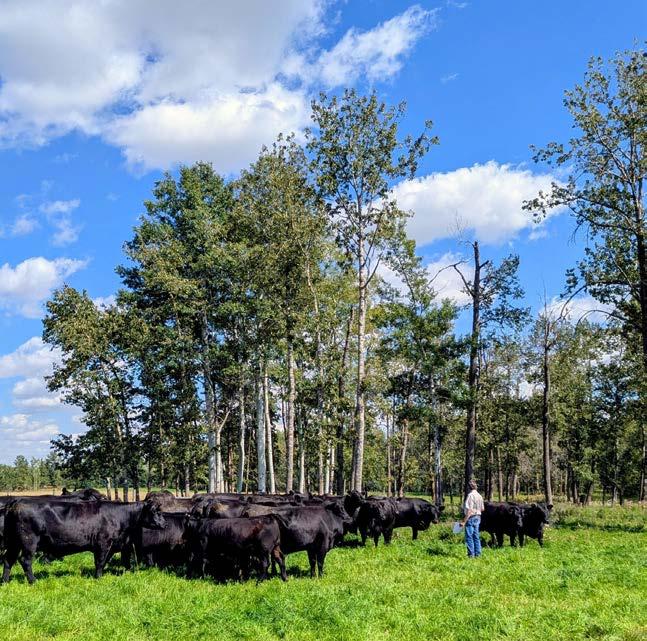
The Canadian Angus Association (CAA) is proud to present the updated Breeder Handbook, your essential guide for navigating the registration process, understanding breed development programs, and accessing the full suite of services we offer to Angus breeders across Canada and internationally.
Since our founding in 1901, the CAA has remained committed to supporting breeders in the advancement of Canadian Angus genetics, enhancing herd value, and promoting the breed’s integrity, both domestically and abroad.
This handbook reflects updates in industry standards, digital tools, and best practices that are now part of modern beef cattle production and pedigree management. Whether you’re a new breeder or a long-standing member, this guide is designed to ensure clarity, compliance, and confidence in every step of your Angus journey.
Registration Procedures
How to register calves, embryo transfer progeny, and imported genetics using CAA’s updated tools.
Breed Development & Performance Programs
Guidance on data collection, Genomically Expected Progeny Differences (GEPDs), and using genomics for herd improvement.
Member Services
Overview of member categories, benefits, and support resources.
Digital Tools
Follow us on:

Our online registry, DNA testing services, and herd management platforms.
Forms & Glossary
Simplified navigation to required documentation and key terms.
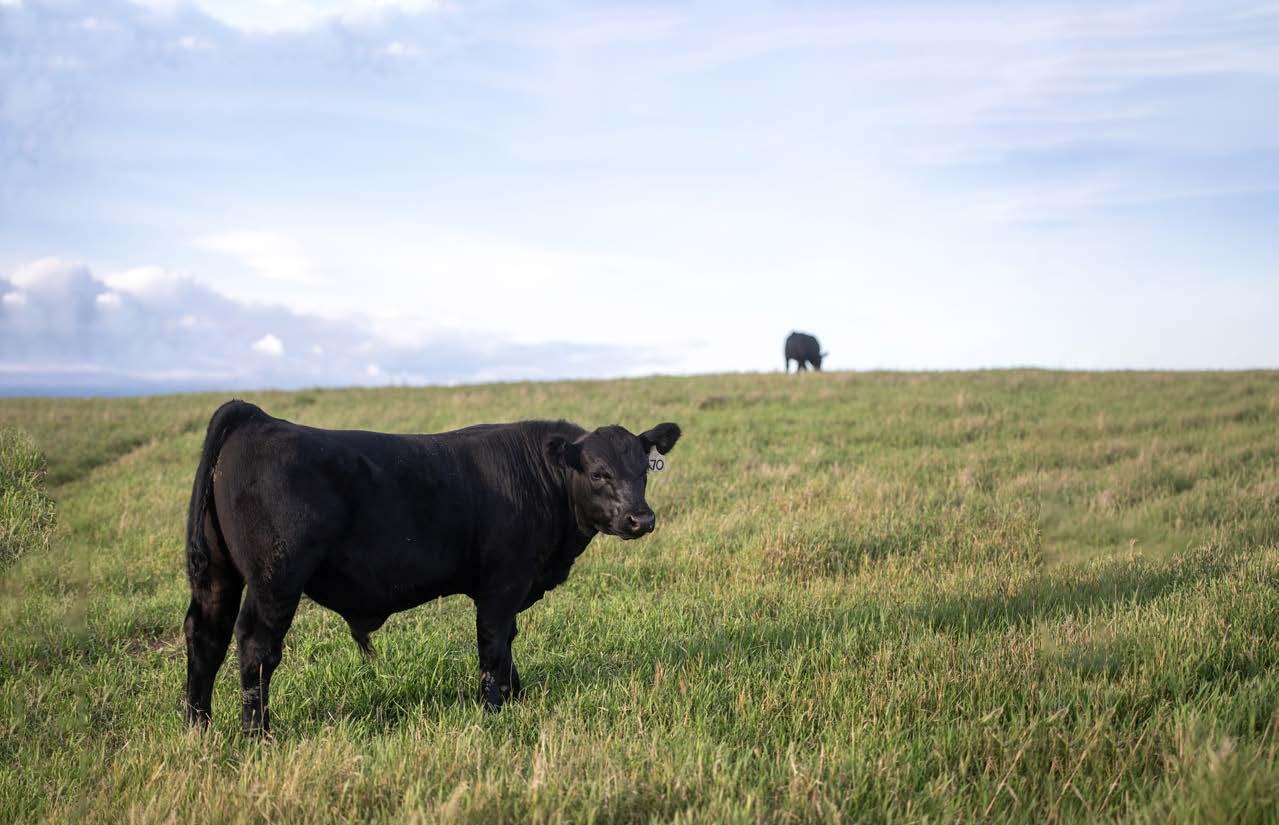
Every Angus operation is different, but a typical year for an Angus breeder may go something like this:
• ACE billing
• Annual membership fees are due on January 1
• Weaning and weighing of fall-born calves
• Submit 365 day weights and ultrasound data for spring-born calves
• Completed Herd Inventory and Application for Registration are encouraged before the calves have reached six months of age, for spring calving herds on the Canadian Angus Performance Program
• Fall calving and tattooing
• Gold Shows and Canadian Junior Angus Association Showdown
• Fall feeder calf sales
• Female sales
• Submit pedigree extract requests for sale catalogues to the Canadian Angus Association
• Weaning of spring-born calves
• Submit 205 day weights for springborn calves and 365 day weights and ultrasound data for fall-born calves
• Gold Shows and Canadian Angus National Show
• Bull congresses and trade shows
• Submit pedigree extract requests for sale catalogues to the Canadian Angus Association
• Bull sales
• Canadian Junior Angus Association GOAL (Guiding Outstanding Angus Leaders) Conference
• Annual National Convention (June)
• Annual report is released
• Female exposure and disposal worksheet due December 1st
• ACE Enrollment due December 1st
• Completed Herd Inventory and Application for Registration are encouraged before calves have reached six months of age for fall calving herds on the performance program
• Contact CCIA to order Canadian Angus RFID ‘Green’ Tags by the end of the year to avoid delays and to receive them in plenty of time for calving season
In addition to being part of the largest beef breed in Canada, membership in the Canadian Angus Association provides you with rights and privileges and access to information to assist you in superior breed development to help ensure your success in the purebred business.
The benefits of membership include:
• Members in good standing are eligible to vote and serve on the Board of Directors
• Members may register eligible animals
• Registered animals may compete in Canadian Angus Association Gold Shows and vie for the annual West and East Show Female of the Year and Show Bull of the Year awards
• Eligible to participate in the Canadian Angus Performance Program and receive Genomically Enhanced Expected Progeny Differences (GEPDs)
• Eligible to request pedigree extracts for sale catalogues which may then be posted on the Canadian Angus Association website
• If you have a valid e-mail address on file, the monthly e-newsletter will be sent to you by e-mail, keeping you informed.
• Regional Ambassadors represents Canadian Angus Association members at sales and industry events across Canada
• Membership in your regional Angus Association is included
• Increased marketing opportunities through the Canadian Angus RFID ‘Green’ Tag Program
Types of membership are Junior, Young Breeder, and Annual. Membership is available to an individual, a partnership, a company or a non-resident of Canada.
No animal can be registered for the calendar year until the annual membership fee for that year has been paid.
Use the Canadian Angus Association Membership Application to apply for membership and to document signing authority for the membership being applied for. Any revisions to a signing authority are to be provided on Signing Authority Agreement on Behalf of Individuals, Partnerships, Ranches, etc.
Junior memberships are available to individuals who are 21 years of age or younger. Junior members have the same rights and privileges as members, but do not have the right to hold office in the Association. A Junior membership application must include the birth date of the junior member making the application.
You may join the Association and have your membership issued in your individual name, in the name of a partnership, or the name under which you operate your business.
When you apply for a membership, you should clearly indicate the name in which the membership is to be issued. If registrations are to be issued in the name of the individual person, the membership should be in the name of the individual; if they are to be issued in the name of a farm or ranch, the membership should be in the exact name of the farm or ranch; if they are to be issued in the name of the partnership, the membership should be in the exact name of the partnership; if they are to be issued in the name of a company, then the membership should be in the exact name of the company.
Please see the current fee schedule for membership fees

If two of more members of the Canadian Angus Association wish to own cattle jointly, they are required to take out a partnership membership. The partnership would thus be shown as the owner of the animal(s) on the registration certificate. Registered tattoo letters are required to register calves in the name of a partnership.
A special membership rate is available to Young Angus breeders who are between the age of 22-31, a date of birth is required on file for these members to receive the special membership rate.
If you are a non-resident you are still able to apply for a Annual or Young Breeder membership. Non-resident members are not able to hold office and are not eligible to vote.
Life memberships were available for purchase by individuals prior to July 1, 1980. They are non-transferable and are no longer available. Life members are entitled to vote and hold office in the Association. An annual activity fee is charged to life members who are active breeders and wish to conduct transactions such as registering and transferring cattle.
Producers who have had a purebred animal transferred into their name, but do not register breeding stock will get an account created automatically. By owning a registered Angus animal you are qualified to purchase Canadian Angus Tags, which visually and electronically identify Angus influence cattle.
In this instance you do not need to apply for membership; an account is automatically granted when the animal is transferred. Commercial members are able to transfer animals through the Association and are subject to the same rules and regulations as members.
In order for us to serve you better, please include your membership name and membership ID number when corresponding with the Canadian Angus Association.
When applying for a new membership, any registration certificates that are in possession of the member making application for membership should be reviewed. Any registration certificates for animals that you currently own can be returned for correction to reflect the membership name and membership ID number being applied for. There will be no charge for this service as it ensures that Herd Inventories will be as accurate as possible and will assure efficiency when registering your Angus animals. When purchasing Angus animals, be sure that the seller uses your membership name and ID number to increase efficiencies and assist with correct transfer applications.
For breeders looking to take advantage of many of the Canadian Angus membership services, the best value just may be the Angus Cow Enrollment program (ACE). The voluntary ACE program gives breeders the option to pay an annual fee of $65/cow enrolled to gain access to a full suite of member services provided at no extra cost.
By enrolling in the ACE program, breeders gain access to more than 25 member services for the year of enrollment. The services provided, discounted and excluded from the ACE program are detailed here:
Included
Membership Fee
Calf Registration
Calf Transfer
Cow Transfer
205-day Weight Submissions
365-day Weight Submissions
Ultrasound Scan Results Processing Charge
Family Transfers
SNP Parentage Verification Test
Export Package
AI Approval Public Access for Domestic Born Sire
Donor Dam Approval
Semen Sire Authorization
Registration of Imported Animal
Registration of Lease
Registration of Herd Name
Registration of Tattoo Letters
Transfer of Herd Name or Tattoo Letters
Name Change of a Registered Animal
Five-Generation Pedigree
Online Herdbook Photos (paid per photo)
Geneprob Report
Herd Data Extract For On-Farm Software Program
Canadian Angus Tag Program RFID Tag
Age Verification
Pedigree Extract
Annual Activity Fee
Discounted
Angus HD ($14 discount)
Excluded
Freemartin Test
Coat Colour DNA Test
Genetic Condition Test
Foreign Markers for Parentage
BVD Test
Canadian Angus Tag Program Management Tags

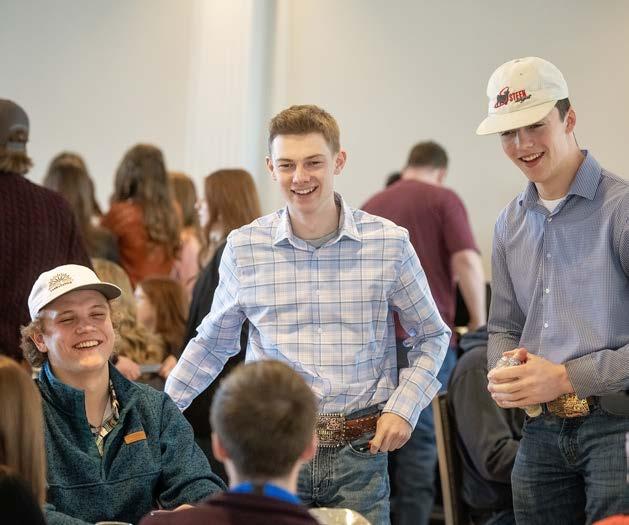
The CJA’s goal is to help prepare future cattlemen for the beef industry by educating and informing Juniors about the Angus industry.
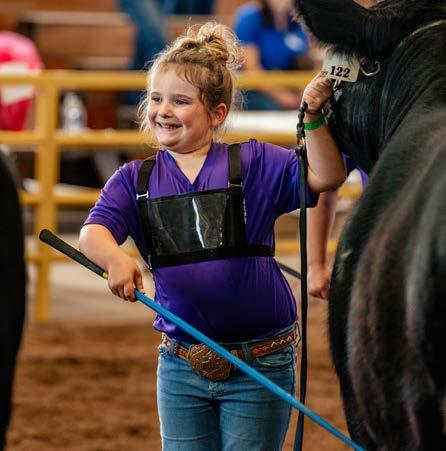
Junior memberships are available to any dedicated Angus enthusiast who is 21 years of age or younger. Junior members are eligible to participate in the CJA Board but do not have the right to vote or hold office in the Canadian Angus Association. The CJA Board acts as the liaison between the Canadian Angus Association and the CJA.
• You will receive a subscription to the CJA newsletter “Junior Connections”.
• If you provide your e-mail address, you will receive the Canadian Angus Association’s monthly electronic newsletter.
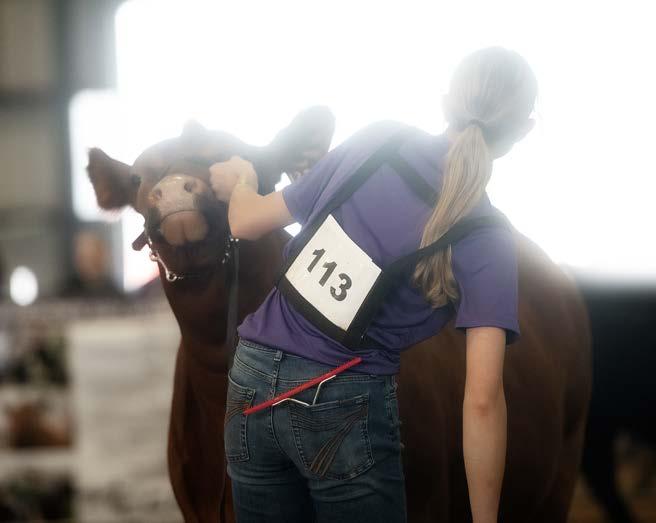
• You are able to participate in all CJA events including Showdown and the annual GOAL (Guiding Outstanding Angus Leaders) conference. Showdown is the Canadian Junior Angus Show and moves between regions and incorporates many activities beyond conformation and showmanship, such as print marketing, sales talks, photography, grooming, farm sign, art, show team judging and public speaking.
GOAL is an annual leadership conference with the main objectives of getting more Junior Angus members involved and excited about the breed with fun and interactive activities and motivational speakers.
• You are eligible to apply for CJA scholarships.
• You have the right to register animals; however, registering your own animals is not required.
• You have access to the Canadian Angus Association’s member tools.
For more information about the CJA scan this code.


The Canadian Angus Foundation is a registered charity that functions to preserve and expand the Angus breed for future generations through education, youth development, scientific and market research, and historical restoration. The Canadian Angus Foundation relies on volunteers and is funded by generous donations from Angus breeders and industry groups.
Through donations, the Canadian Angus Foundation provides scholarships to Junior members of the Canadian Angus Association. In 2005, the Foundation created the Robert C. McHaffie Junior Ambassador program. Being the Junior Ambassador is very rewarding and filled with once-in-a-lifetime opportunities. The purpose of the Junior Ambassador program is to showcase a Junior member as an example to all youth of what is possible.
The Canadian Angus Foundation is committed to maintaining an accurate record of the history of the Angus breed in Canada. Many members of the Canadian Angus Association have been very generous in donating items they feel would be of interest and value to our archives, from old herd books to sales catalogues and photographs. This historical Canadian Angus memorabilia is proudly displayed at Angus Central. Donations of historical Canadian Angus memorabilia are graciously accepted on an ongoing basis.
For more information about the Canadian Angus Foundation, visit the website at www.cdnangus.ca/foundation.
Foundation Legacy Scholarship | Deadline: January 5
Brian Good Memorial Scholarship | Deadline: October 15
Beef Leaders Institute | Application deadline: February 15
The Dick Turner Memorial Scholarship | Deadline: May 15
Canadian Junior Angus Scholarships | Deadline: May 15
Angus Roots Scholarship
Bursaries
GOAL Travel Bursaries
Showdown Travel and Trucking Bursaries
Self-Directed National or International Travel Bursaries
US Exchange Trip
Junior Angus Stockman of the Year | Nominations due April 15

Ways to Donate
For more information about these opportunities:


A donation of 15% of a lot from your sale goes a long ways to helping grow your Canadian Angus Foundation
Outstanding Young Angus Breeder | Nominations due April 15
CAF Robert C. McHaffie Junior Ambassador | Applications due April 30
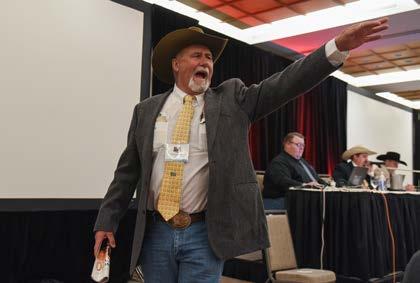
The Building the Legacy Sale is a fundraising auction for the Canadian Angus Foundation. You can participate by donating a lot for the sale or by purchasing one of the great offerings
Developed in 1989 by the CAA, the Gold Show program encourages breeders to move between regions to show cattle. Individual animals must show in a minimum of three Gold Shows in at least two different regions in a given year to qualify for awards. Awards are presented based on the number of points collected over the course of the show season. Each year the following awards are presented in both red and black categories and now in both the West (BC, AB, SK, MB) and East (ON, QC, Maritimes):
(plus runner up & honourable mention)
(plus runner up & honourable mention)
Find current standings and dates of regional shows here:

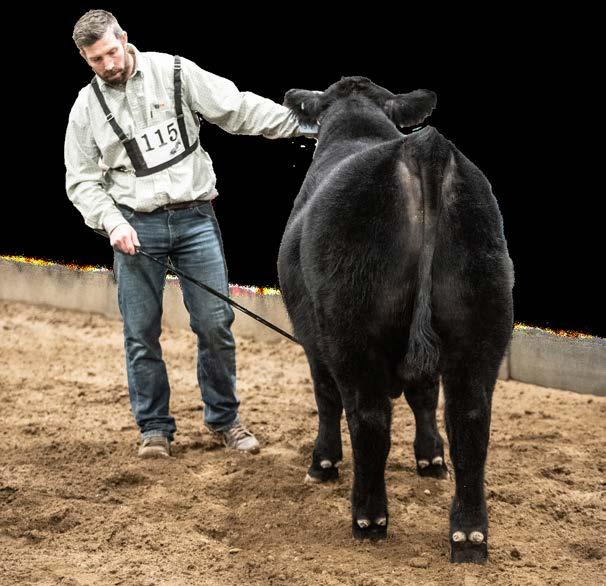
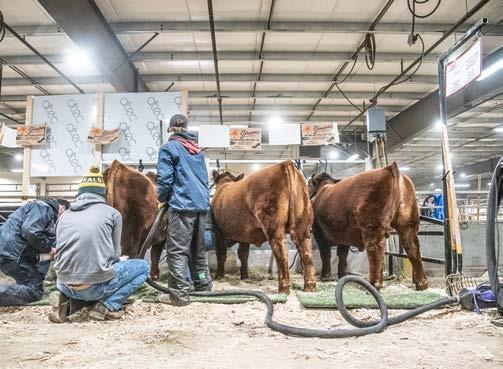
• Each region may designate two shows per year as Gold Shows (except the Maritimes who can designate three shows) in which breeders can accumulate points for individual animals that are exhibited. The Canadian Angus Association maintains the official list of recognized shows.
• Show must be open to all members of the Canadian Angus Association.
• There is no cost to show organizers for inclusion in the program.
• Regions will notify the CAA of which shows have been designated along with show location and show dates by March 1st each year.
• Animals competing must have a Canadian Angus Association registration number at time of judging. Unregistered, pending and “applied for” animals will not be awarded points or count toward grant funding.
• Any animal with colour products applied to it in a Canadian Angus Association sponsored show will be disqualified from the show and the show deemed ineligible for financial support from the CAA.
• The class structure may be determined by the show organizing committee however it is encouraged that the Canadian Angus Association Gold Show Class Structure provided be used whenever possible.
• Individual animal points vary depending on the number of entries in the show. Points are awarded to the top six animals in each class or split, divisional champions and reserve, grand champions and reserve.
• There are no limits on the number of animals that can be exhibited by an individual member.
• Requirements are subject to change. The Canadian Angus Association will communicate changes to the regional associations.
The rules of individual shows differ, and it is the responsibility of each breeder to know and follow the rules of the show. Failure to comply with the show rules may result in an animal’s disqualification.
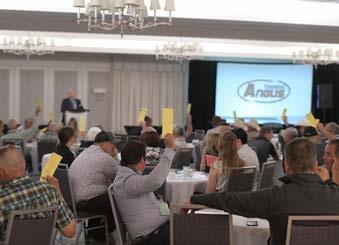
The Canadian Angus Association National Convention is where the energy, innovation, and people behind our breed unite to shape the future of Angus in Canada. Breeders, youth, and industry partners from across the country come together to learn, network, and celebrate what makes Angus the most influential breed in Canadian beef production. Whether you’re a seasoned seedstock leader or just starting to build your herd, Convention is your annual opportunity to gain insights, expand your connections, and elevate your program for long-term success.
The Annual General Meetings of the Canadian Angus Association and the Canadian Angus Foundation are held each year during the National Convention. These meetings provide members with an opportunity to receive a comprehensive overview of the previous year’s financial performance and initiatives, as well as to present recommendations for consideration by the Board of Directors.
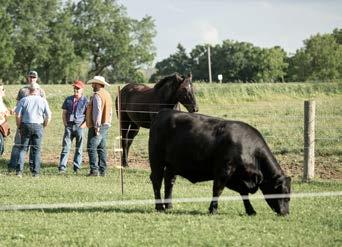
Convention is also where the heart of our Angus community shines. From elite genetic showcases and immersive ranch tours to the always-anticipated Building the Legacy Sale, the event highlights the strength of our national Foundation and the people dedicated to advancing our breed. Every moment; on the tour bus, in the display pens, fosters new perspectives, new friendships, and a renewed passion for the work we do every single day.
year’s Convention:

Our future leaders take centre stage as well. The Junior Ambassador Program inspires confidence, leadership, and advocacy in the next generation of Angus champions, and witnessing their growth and talent in person is a reminder of why we gather. Convention is more than an event; it’s a celebration of who we are and a commitment to where we are going; together.

mimmerkar@cdnangus.ca | 403-571-3581
Talk to the CEO about:
Policy inquiries
Board Governance
klatimer@cdnangus.ca | 403-537-5604
Talk to Science and Technology about:
Performance program
GEPD and genomic technology questions
Research projects
cdnangus@cdnangus.ca | 1-888-571-3580
Talk to marketing and communications about:
Regional programs
National Convention
Adding events to the calendar
Merchandise ordering
Catalogue posting

registry@cdnangus.ca | 1-888-571-3580
Talk to Member Services about:
Registering ACE program
Transferring Ordering management tags
Pedigree extracts Animal imports
Parentage and Genetic conditions
cdnangus@cdnangus.ca | 1-888-571-3580
Talk to the admin department about:
Billing
Career postings


CJA Coordinator and CAF Executive Director
bwagner@cdnangus.ca | 306-537-1518
Talk to the CJA Coordinator and CAF Executive Director about:
Junior events
Donating to the Foundation
Scholarship applications
You can text information to 587-439-3440 or registry@cdnangus.ca to use text to email. If you use the text line, please ensure that you submit full and complete information in one message. The text line is a one-way communication method for Canadian Angus members to submit a quick note with your member service request. Please ensure that the text includes your name, your member ID, and your request and it will be processed just as if you had emailed or mailed us. For example, Hello this is Jane Jones, member ID 5555555, please correct JJ 123F from a male to a female, new name is JJ LASSIE 123F.
The research and development projects that are currently being undertaken by the Canadian Angus Association are both member driven and generously supported by the Canadian Angus Foundation.
The Association surveys its members continuously to identify areas of concern and need in order to direct research and development.
Our goal is to develop new tools and technology that improve the competitive advantage of Canadian Angus genetic both within Canada and across the globe.
Scan here for updates on current Research Projects

In 1998, the Canadian Angus Association instituted a long-term recognition award program to recognize those individuals and families that have demonstrated a long-time commitment to the Angus breed in Canada by maintaining a continuous membership in the Association for at least 50 years. The program was expanded in 2011 to also recognize families with 75 and 100 years of continuous membership.
The recipients of this award are recognized at the annual general meeting each year and are presented with a plaque in recognition of their achievements. In addition, their names are added to an online archive on display on the Canadian Angus website.
British Columbia
Alex Turner—Turner Meadows (2023)
Alberta
Argwen Angus Ranch—Pope Family (2016)
ARDA Farms—Davis Family (2022)
The Bradshaw Family—D.C. Bradshaw/Aberlynn
Angus (2015)
Dalrene Farms—The Flint Family (2011)
Jack Spady Family (2014)
Harold Spady Family (2014)
Riverbend Farm—McBride Family (2011)
Southern Angus Farm (2020)
Warrilow Family (2023)
Willabar Ranch (2015)
Saskatchewan
Almarie Angus—Hage Farms (2025)
Bell Angus—Kenneth Bell (2016)
Early Sunset Ranch (2024)
Isla Bank Angus—Stables Family (2014)
Kenosee Park Angus—The Easton Family, Bob & Margaret Easton (2021)
Kenwaw Angus—The Easton Family (2021)
Parkwood Farm—Jack Burkell (2016)
Switzer Family (2020)
The Lensen Family (2025)
Manitoba
Mountain View Farm (2011)
Prairielane Farms—The Canning Family (2011)
The Anderson Family, Bruce & Ione Anderson, Anderson Cattle Company (2012)
Ontario
Bluewater Angus Club (2021)
Earley Brothers (2014)
Elm Grove—Bailey Acres (2011)
Colin G Trivers—Len Mar Farms (2020)
Rodney J Ribey Family (2016)
Tullamore Angus (2011)
Alberta
Henderson Family (2011)
Matthews Family (2011)
C.H. Richardson Family (2015)
Ontario
Tullamore Angus Farm (2022)
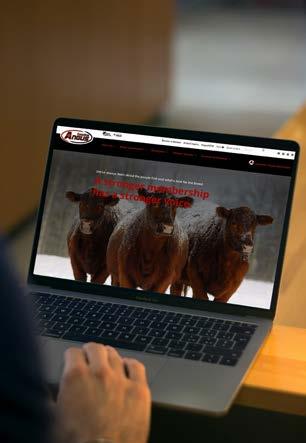
The Canadian Angus Association maintains a website (www.cdnangus.ca). The website is where you can find the most current information about the breed. Although our website is always changing, here are some of the key features that you will find online:
• Contact information for Canadian Angus Association staff, the Board of Directors and regional Angus Association representatives
• Current fee schedule
• Canadian Angus Online Herdbook
• Details about the annual national convention
• Events calendar
• Gold Show dates and locations
• Important deadlines and announcements
• Breed development information such as genetic evaluation results
• List of Canadian Angus Endorsed Sales
• Canadian Angus Tag Program information and order form
• The ability to register calves and enter performance data electronically
• The monthly e-newsletter with announcements, deadline reminders and important information for Angus breeders
• Copies of press releases
Toby is designed to help make it easier and faster for members to find information and navigate our services. Whether you’re looking for details on registration, DNA testing, programs, or forms, Toby is available 24/7 to assist.
Toby works best as a tool to help you locate pages, forms, and general information on the website.
Ask clear, simple questions
For example: “Where can I find the transfer form?”
“How do I register an animal?”
Keep questions general
Toby can explain processes, but cannot look up or provide details about specific animals, registrations, or accounts. One question at a time
This helps Toby give clearer and more accurate results. Follow the links Toby provides Toby will guide you to the correct pages, forms, or documents – click through for full details.
W. Clifford: 1906
S. Martin: 1907
John Tranquair: 1908-10
J.D. McGregor: 1911-20
James Browne: 1921-22
John E. Lowe: 1923-24
James Bowman: 1925-26
Harry Leader: 1927
F.H. Reed: 1928-29
W.J.F. Warren: 1930-31
James Turner: 1932
John R. Hume: 1933
S.J. Henderson: 1934-35
W.D. Lyon: 1936-37
T. Alex Edwards: 1938-39
Roy Ballhorn: 1940-41
C.R. Wade: 1942-43
Chas. C. Matthews: 1944-45
Frank G. Todd: 1946
A.E. Foster: 1947
T. Alex Edwards: 1948
Harry Morrell: 1949-50
Roy Ballhorn: 1951-52
Cowley H. Webster: 1953-54
Thos. Henderson: 1955-56
P.R. Pederson: 1957
T.A. Leader: 1958
C.H. Norman Hodson: 1959
Malcolm Bailey: 1960
Wilfred Willoughby: 1961-62
W.L. McGillivray: 1963
Douglas G. Anderson: 1964
Alex Lamond: 1965
Thos. Jackson: 1966
Harold Simomson: 1967
C.G. “Chuck” Davis: 1968
Donald C. Matthews: 1969
John C. Wilmott: 1970
Edward Heil: 1971
Norman E. Wade: 1972
Elmer Greenslade: 1973
Bruce McGillivray: 1974
David T. Bradshaw: 1975
B.M. “Ben” Blacklock: 1976
Orrin E. Hart: 1977
George Earley: 1978
Neill MacGregor: 1979
George M. Perry: 1980
If you don’t get the answer you’re looking for, try asking your question in a different way.
Know when to contact the office
For things like: Registration or transfer status, DNA sample results or updates, account-specific questions please contact our office directly. Do not enter personal or account informationToby cannot access or process this information.
Use Toby as a starting point
It’s a helpful way to quickly find where to go on the website. Your feedback helps improve Toby
If something isn’t clear or accurate, let us know so we can continue to improve it.
Langley Musgrave: 1981
Lawrence Nason: 1982
E. Glenn Good: 1983
J.J. Willms: 1984
John C. Wilmott: 1985
James P. Peaker: 1986
Donald E. Atkinson: 1987
Larry Walker: 1988
Leverett Bradley: 1989
Dave Wildman: 1990
Mel Sisson: 1991
Bill Jackson: 1992
Dr. B.Z. “Dale” Alyward: 1993
Grand Wilson: 1994
Jim Round: 1995
Gary Harron: 1996
Lori Goodrich: 1997
Robert McHaffie: 1998
Mabel Hamilton: 1999
Barney Creech: 2000
Stan Christensen: 2001
Doug Allen: 2002
Don Mackenzie: 2003
Lawrence P. Toner: 2004
Dyce Bolduc: 2005
Blaine Canning: 2006
Barry Young: 2007
Bob Switzer: 2008
John Donaldson: 2009
Kirk Wildman: 2010
David Bolduc: 2011
Gary Latimer: 2012
Kevin Blair: 2013
Corinne Gibson: 2014
Tammi Ribey: 2015
David Sibbald: 2016
Brett Wildman:2017
Trevor Welch: 2018
Bob Hahn: 2019
Shawn Birmingham: 2020
Sheldon Kyle: 2021
Graham McLean: 2022
Tom deWaal: 2023
Ronnie Ford: 2024
Greg Pugh: 2025
The Canadian Angus Association’s full pedigree database is available online. Through the online Herdbook, you can trace the lineage of any registered Angus animal, locate the progeny of sires and dams, research their GEPD and contact the breeders responsible for Angus genetics. Search options include:
• Animal Inquiry: Search for animals by name, tattoo or registration number, or look for groups of animals using a variety of search criteria.
• GEPD Inquiry: Search for bulls or females that meet your specific GEPD criteria.
• Member Inquiry: Search for members of the Canadian Angus Association using their name, membership number of herd name.
The objective of the Breeder’s Guarantee Guidelines is to provide a framework for both buyer and seller to have equitable agreement in which to create confidence in the buying and selling of purebred Angus cattle.
The sale of purebred Angus, whether it be through a private treaty or through a production or consignment sale, implies the sale is being conducted in compliance with the Breeder’s Guarantee Guidelines unless otherwise stated.
Open: Female which has not been serviced or female which has been serviced but declared open.
Bred: Female which is known to have been served by a bull either through natural breeding or artificial insemination, but this does not guarantee that the female is safe in calf to that service.
Pasture Exposed: Female which is known to have been exposed during a period of time to a bull that was in a specific breeding area.
Safe in calf: A female which has been declared pregnant by a licensed veterinarian or is declared by the seller to be carrying a calf at the time of the sale.
Breeder: The owner or lessee of the dam at the time the dam was served.
Owner: The individual, partnership or corporation in whose name an animal is registered.
Transfer of Ownership:
• This is accomplished by the completion of the transfer form on the reverse side of the registration certificate or by completing Application for Transfer of Ownership which can be done by submitting a transfer form (see QR code in the index) or within the CAA database, or by sending an email to registry@cdnangus.ca including the complete tattoo of the animal, complete contact information of the buyer as well as the transfer date within three months of purchase, signed by the last registered owner, and duly processed by the Canadian Angus Association.
• The seller is responsible for the payment of the transfer fees and other related fees necessary for the processing of the said transfer.
• If a female is sold as bred, the service information must be completed on the transfer form.
• In the case of multiple ownership of an animal, the first owner listed on the registration paper, as agreed upon by the owners, shall be the holder of the registration paper.
Tattoo: Permanent ear identification comprised of herd letters, a unique number and the designated year letter is required. The herd letters are those registered at the Canadian Angus Association in the name of the owner at the time of birth.
Sales Catalogues:
• Must include all known genetic condition test result information available at time of print
• All performance data published must be generated by the Canadian Angus Association.
Registered Animals:
• Any animal that is not registered with the Canadian Angus Association cannot be sold or identified as Angus.
• Any animal that is not registered with the Canadian Angus Association is not subject to the Association’s Breeders Guarantee Guidelines.
• It is the seller’s responsibility to transfer the registration certificate to the buyer within three months of purchase date.
• The Canadian Angus RFID ‘Green’ Tag Program requires at least one parent animal to be registered with the Canadian Angus Association.
Disclosure of Pedigree:
• The seller is responsible for disclosing complete and accurate pedigree information to the buyer.
• The Canadian Angus Association only guarantees the accuracy of performance data generated by the Association.
• The seller is responsible for disclosing all known genetic defect information pertinent to the purchased animal at the date of sale.
After the date of sale, the seller has no liability for a genetic condition that was unknown at the time of the sale.
All bulls offered for sale as breeding bulls, except calves at side, must be guaranteed breeders. The Canadian Angus Association recommends that breeding bulls have passed a semen test and have achieved minimum scrotal circumference.
Min Scrotal Circumference (cm)
12 months 32
13 months 33
14 months 34
15 months 34.5
16–20 months 35
21–30 months 35
If you purchase a bull that fails to prove a natural breeder:
• Should any bull 15 months of age or over fail to prove a natural breeder after being used on cows known to be breeders and free of venereal disease, the buyer shall report in writing to the seller and provide a report of complete examination by a licensed veterinarian.
• This notification shall be provided by the buyer to the seller no later than four months following the date of purchase, or six months after the bull has reached 15 months of age, whichever is the later.
• The buyer shall return the bull to the seller who shall have the opportunity to have the bull examined by a veterinarian of choice.
• In the instance of a fertility re-test by the seller the bull must be in acceptable condition as agreed upon by the buyer and seller, and if non-agreement, then as declared by a licensed veterinarian.
• Once the bull has been declared reconditioned, the seller will then have 45 days to prove this bull a breeder.
• If this bull proves to be a satisfactory breeder the bull shall be returned to the buyer.
• Any guarantees with respect to ability to freeze semen shall be by separate agreement between buyer and seller.
• UNDER NO CIRCUMSTANCES SHALL THE SELLER BE RESPONSIBLE FOR MORE THAN THE PURCHASE PRICE PAID FOR SAID ANIMAL.
• Females sold as being safe in calf are considered breeders without further guarantee.
• Cows and heifers represented as bred or pasture exposed are not guaranteed safe in calf but are guaranteed to be breeders.
• Open heifers selling as individual lots are guaranteed to be open and to be breeders.
If a female fails to prove a natural breeder:
• In the event a female is claimed to be a non-breeder after having been bred naturally to a bull known to be a breeder and after having been examined by a licensed veterinarian, the matter must be reported in writing (with a copy of the veterinarian report) no later than six (6) months after the sale date or prior to the heifer attaining twenty-four (24) months of age, whichever is the later.
• In the instance of the female being returned in unacceptable body condition as agreed upon by the buyer and seller, and if non-agreement, then as declared by a licensed veterinarian, the seller shall have seventy (70) days following the date that the female was declared re-conditioned in which to prove such female as a breeder.
• The seller may use any registered Angus bull available to him/her, in which case the said female will be reclaimed by the buyer at his/her expense.
• Should the seller fail to prove the female a breeder, the buyer has the option to either accept a replacement breeding female from the seller’s ranch or obtain a refund of the original purchase price.
• No incidental expenses incurred will be charged by either party.
• In the event that a buyer of an open heifer finds that she was in fact in calf on the sale day, the animal may be returned to the seller and receive a satisfactory replacement or a refund of the purchase price.
• In the event that a female sold as bred to a specific sire(s) and that is safe in calf gives birth to a calf that is not parent verified to the specified sire(s) the buyer may return both female and calf for the original price paid or a satisfactory replacement female.
• In the event a female sold as being safe in calf does not calve to the published and/or announced breeding date(s), the buyer, after notifying the seller in writing, may return the female and calf and receive an immediate full refund of the purchase price.
• UNDER NO CIRCUMSTANCES SHALL THE SELLER BE RESPONSIBLE FOR MORE THAN THE PURCHASE PRICE PAID FOR SAID ANIMAL.
Exceptions to the Guarantee
• Where gross negligence or willful misconduct by the buyer or his agents or employees has occurred the seller is exempted from any and all guarantees.
• No guarantee is given that a pregnant female will deliver a live calf, or that she will carry the calf to full term.
• In cases where the purchased animal is subjected to pharmaceuticals not approved for animal use, growth hormone treatment, embryo transfer, or surgical reproduction technique after the sale, the guarantee shall be null and void.
Suckling calves: No guarantee of any kind applies to suckling calves less than six (6) months of age.
Rights and Obligations:
• The above terms and conditions of the sale shall constitute a contract between the buyer and seller and be equally binding to both parties.
• The seller is obligated to transfer the purchased animal to the seller within three months of purchase date.
• Resale of animals following purchase shall constitute a separate transaction.
Variations: Any deviations from these guidelines agreed to by the buyer and seller at time of sale, including announcements from the auction block and any additional agreements, must be in writing on the bill of sale (see sample Bill of Sale in the forms section of our website – follow the QR Code in the Index), and shall take precedence over the conditions herein.
Check the ear tattoo of each animal to ensure accuracy.
Verify that the correct buyer information is recorded on the bill of sale and transfer form, including buyer’s name, address and phone number.
Ensure accurate service information is recorded on the transfer form.
Ensure that all agreements are stated clearly, in writing, on the bill of sale.
To see the current up to date forms scan here:

While every deal starts with great intentions. What happens when the deal doesn’t go as planned?
On many occasions, what starts out as a great partnership hits some roadblocks along the way.
The Canadian Angus Association is not involved in the commerce component of the transaction and not equipped to resolve business disputes.
The CAA will provide guidance on the established breeder guidelines and the interpretation of these guidelines.
The one exception will be the need to establish current and correct ownership of an animal under the Animal Pedigree Act rules and authority of the CAA Pedigree Committee to correct an ownership based on information provided. In the case of a purchased animal not transferred, proof of purchase and completed payment may be required clearly identifying the animal sold.
Any registered animal according to the Animal Pedigree Act must be transferred at the request of the buyer unless clearly noted in the sale terms that papers will not accompany the animal.
• Payment should be completed in full before ownership of the animal is required to be transferred
• If a payment plan is in place the seller retains ownership until the payment plan is complete, but the buyer can still register animals
• Sale date will be once terms of the transaction has been completed.
• In the case of genetics sold (such as embryos) but the contractual terms have not been completed, with proper documentation to the CAA, registrations may be withheld until contractual terms are met. Animals sold as registered Angus but registration process is not completed is governed under the Animal Pedigree Act. Repeated infractions of such will be reviewed by the Pedigree Act when reported and potential action for repeat offenders.
Any dispute that cannot be simply rectified under the authority of the Animal Pedigree Act will need to be sorted through proper legal authorities.
Paperwork submitted to the Canadian Angus Association is processed based on the date it is received. The amount of work to be processed fluctuates throughout the year although the normal turnaround time for work to be processed is with in one week of receipt. Member Services offers (next business day) Service for an additional fee (see the current fee schedule for rates) to those members who urgently require paperwork, however, members should be proactive and allow sufficient time for processing of their paperwork rather than rely on rush service.
Funds must accompany all work submitted to the Canadian Angus Association. Members can choose to keep a Visa or Mastercard number on file to be charged as work is processed, can send a cheque or credit card number in the mail with their paperwork, or can pay by electronic transfer. The member submitting the work will be charged.
It’s not Angus without papers to prove it. There is no such thing as a purebred without papers.
All Angus animals registered in Canada are 100% purebred. An animal without a registration number is not considered purebred. If the animal is not intended for sale as a registered Angus, its registration certificate should be returned to the Association for cancellation and the seller must note on the bill of sale that the ‘animal was sold as a commercial animal—no paper available’.
The Canadian Angus Association recommends that buyers and sellers of purebred Angus cattle use a bill of sale and clearly note all details of the sale and/or agreements in writing.
The registration certificate:
• May list the Canadian Angus RFID ‘Green’ Tag number
• Is a legal document
• Qualifies the progeny of the named animal for Canadian Angus RFID ‘Green’ Tags and participating beef programs
Lists the animal’s registration number, tattoo, date of birth and sex
Identifies the owner
Identifies the threegeneration pedigree
Lists individual performance data and current GEPDs as of the date of issue
The tattoo in the animal’s ear must match the tattoo on the animal’s registration paper. If the tattoo does not match the certificate, contact the Canadian Angus Association for advice on how to proceed. If a registration certificate is lost, the Canadian Angus Association can replace the certificate.
Under the Animal Pedigree Act, animals sold as purebred must be transferred into the name of the buyer within six months of the date of sale. A registration certificate is an animal’s ancestral record. It is unique to each animal and is a valuable permanent record of its identification.
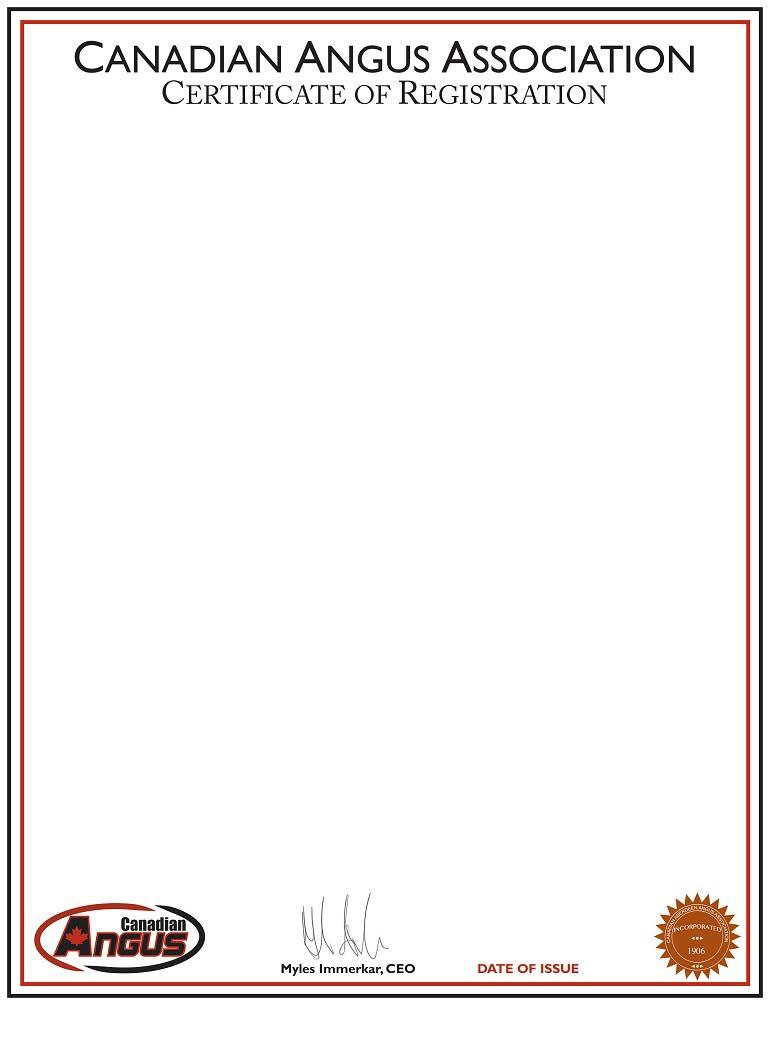
5409 [US]16493710
Indicates if this animal has been sire, dam or parent verified
Indicates whether the animal has been tested for any genetic conditions, and whether there are any known carriers of genetic conditions in the first three generations of its pedigree as of the date of issue
Is a guarantee of authenticity backed by the Canadian Angus Association
To register Angus cattle in Canada, you must apply for and secure the right to use a set of unique tattoo letters using Canadian Angus Association Membership Application: Application for Tattoo Letters and Herd Name—Part 3 of 4. Tattoo letters can be any combination of two, three or four letters. Neither numbers nor the letter Q can be used. Each unique combination is registered with the Association for the exclusive use of a member. A one to four digit herd number and the year letter must follow the combination of tattoo letters to uniquely identify each registered animal.
Registered tattoo letters may be transferred if the registered owner or a representative makes application using Application to Transfer Tattoo Letters and/or Herd Name. The executor of an estate may, for example, transfer from a deceased member to their heir.
Tattoo letters need only be applied for once and stay with the member as long as they are an active member of the Association. If tattoo letters have not been used for seven years they may be reassigned.
Imported cattle with tattoos from their country of origin will be assigned an administrative Canadian Angus Association tattoo for the purpose of unique identification within Canada. It will be preceded with IMP to indicate that the animal is imported. This tattoo is NOT required to be tattooed into the animal’s ear; it is for administrative purposes. The physical right ear and/or left ear tattoo will also be noted on the Canadian Angus registration certificate.
2026 P 2029 T
2027 R 2030 U
2028 S
The letters I, O, Q and V may not be used as a year letter. After Z, the next year’s letter shall revert back to A.
Breeders should check tattoos regularly, whenever an animal is in the chute. If at any time a tattoo mark ceases to be legible or there is a discrepancy, contact the Canadian Angus Association for advice. Once you have been advised on a course of action regarding the placement of another tattoo, submit Application to Alter an Animal’s Name/Tattoo/Pedigree to the Canadian Angus Association along with the affected registration certificate so a replacement can be provided.
If an animal is marked with the same herd number as another animal born in the same year within that herd, the number “0” must be tattooed beside the number in the right ear of one of the animals to differentiate them.
If the wrong year letter is used to mark an animal, the correct year letter must be tattooed beside the incorrect letter and a full description of the mark must be reported on the application for registration (Herd Inventory and Application for Registration).
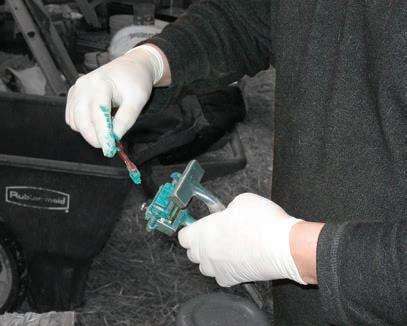
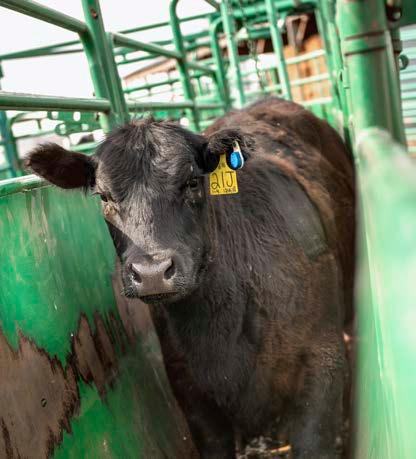
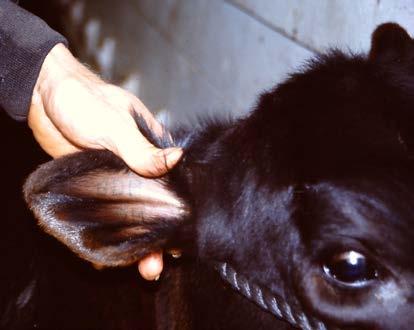
The Canadian Angus Association bylaws state that the tattoo must be in the right ear. When you purchase animals, check the right ear tattoo and make sure it matches the certificate of registration. If the tattoo and registration certificate do not match, contact the Canadian Angus Association office for advice on how to proceed.
Proper animal identification is essential to maintaining accurate herd records. The Association requires every animal to be permanently identified before it is weaned and before it is 8 months of age in order to be eligible for registration. Tattooing can be done at any time before registration is applied for but we recommend that animals are tattooed as young as possible as tattoos grow with calves making the tattoo increasingly legible over time.
A complete tattoo consists of:
• Herd letters (the unique 2–4 letters you applied for and approved by the Association)
• Herd number (any 1–4 digit number, unique within the herd. An effective method of choosing this number is to assign the first calf born in a specific calendar year with a number 1, the second with the number 2, etc.)
• Year letter (see the chart on the previous page for the corresponding year letter)
A tattoo is a permanent identification mark. A properly applied tattoo will last the animal for life. The Canadian Angus Association recommends use of the following equipment and procedures to ensure the best quality tattoo.
The necessary equipment can be purchased at most livestock and veterinary supply stores and can also be ordered through the Canadian Angus Association. You will need:
• Tattoo pliers
• Adequate numeric and letter tattoo digits
• Tattoo paste and toothbrush for application
• Wire brush
• Disinfectant and a soft cloth
• A good working chute to restrain the animal
• Record book
To order tattoo equipment from CAA please scan here:


Calving Book
1 2 3 4 5 6 7 8 9 10 11
Ensure that you have the necessary equipment and that it is all in working order.
Sterilize the tattoo equipment with disinfectant so you don’t spread viruses or diseases from one animal to another.
The animal needs to be properly restrained and unable to move its head if the tattoo is to be legible.
Be sure the ear is completely clean and free of wax and dirt, which will prevent the tattoo paste from penetrating the skin. Clean the ear with a soft cloth and allow it to dry.
While the ear is drying, determine the appropriate tattoo for the calf. Check each tattoo on a piece of cardboard before applying it to the animal’s ear. Check for even perforations and replace characters that are dull or broken.
Liberally apply fresh tattoo ink to the letters and/or digits using the toothbrush.
Apply the tattoo between the ribs or cords of the RIGHT EAR. (To determine right and left, stand behind the animal facing the direction the animal is facing.)
Close the jaws quickly and firmly then release quickly to avoid tearing the punctures. Use enough pressure to pierce the skin but do not use so much pressure that the ear bleeds excessively.
Use a generous amount of fresh tattoo paste, rubbing it into the holes made by the pliers. Use the toothbrush to thoroughly work the paste into the tattoo.
Clean the tattoo characters with a wire brush to remove hair, dirt and excess ink.
Record the tattoo and other relevant information in your record book.
As of January 1, 2013, it has been mandatory for members to use a herd name. Herd names are used as a prefix when naming registered cattle to identify the owner at birth.
Your herd name does not have to be the same as your membership name. For example, Joe Smith owns Twisty Creek Angus Farm and wishes to use “Twisty Creek” in naming his cattle.
There are some restrictions on the words you can use in a herd name. Words such as FARM, RANCH, RED, ANGUS, LTD., and CORP. cannot be part of a herd name. The Association has the right to refuse any name (see page 78).
To register a herd name for your exclusive use, submit Membership Application: Application for Tattoo Letters and Herd Name and pay the appropriate fee (see current fee schedule for rates) to the Association.
Herd names can be shared between members with permission (i.e. parents and children), unlike tattoo letters, which cannot be shared. A herd name need only be applied for once (by each member) and will stay with the member as long as (s)he is an active member of the Association. If a herd name is not used for seven years it may be reassigned.
Membership Name Tattoo Letters Herd Name Animal Example
Joe Smith JS Twisty Creek Twisty Creek Elmo 1X
Twisty Creek Ranch TWST Twisty Creek Red Twisty Creek Ms Erica 1’10
Applewood Stock Farm ASF Applewood Red Applewood Traveler 2X
Bob and Jane Wilson BJW Wilson Wilson Pride 12X
All animals registered with the Canadian Angus Association must be named in accordance with the following rules:
Your registered herd name must be used in its entirety in naming your cattle. Do not shorten or abbreviate your herd name in the animal’s name.
Names shall not exceed 30 character spaces, including all letters, spaces, dashes and/or apostrophes.
Animals that are red in colour will automatically have “RED” added to their name, leaving 26 spaces for the breeder to complete the name.
If the name is longer than 30 character spaces, appropriate abbreviations will be made to achieve the 30 character length.
Avoid using characters other than numbers, letters, dashes, apostrophes and spaces.
Ensure that the name corresponds to the sex of the animal. It is recommended that females carry the same or part of their dam’s name in order to preserve family connections. Naming bulls may follow any pattern; however names can be derived from the name of the sire.
To download the application scan here:

To change the name of a registered animal, written notice must be provided to the Canadian Angus Association (use Application to Alter an Animal’s Name/Tattoo/Pedigree) and the registration certificate must be returned so a new one can be printed. Only the owner at birth can apply to change the name of a registered animal. The original registration certificate and the appropriate fee (see current fee schedule) must be included with the application. Name changes are only allowed if progeny have not been registered with the Canadian Angus Association.
Often part of the tattoo is included in the name, in either format “Twisty Creek 14B ” or “Twisty Creek 14’14” where the letter for 2014 is B.
Duplicate names are not permitted and the Association reserves the right to refuse any names which may be misleading as to the origin or relationship of an animal.
Imported animals shall be registered with the same name that appears on the foreign registration certificate. Animals which are red in colour will have the “RED” prefix added to their name.
Once your membership has been processed and your tattoo letters and herd name have been assigned, you are ready to register your animals. To register cattle, you must pay for a membership for the year in which the animal was born.
1. Complete a registration form and send it in via mail, email (details can be found on the inside cover)
2. Complete a registration form in our online platform
Registration Requirements
For more information on animals that are eligible and ineligible for registration, please see ARTICLE XX in the Constitution and Bylaws. (pg 79)
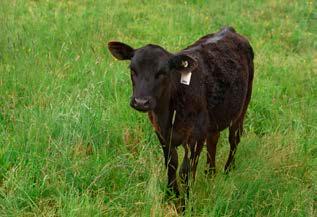
Progeny must be registered by the person owning or leasing the dam at the time of birth.
If a change of ownership has taken place after the birth and before the registration of the calf, a transfer of ownership must be filed for the dam and the calf must be registered by the owner at the time of birth and then transferred separately.
Multiple births must be reported to allow for multiple registrations from the dam in that calving period.
In the event a gestation interval is questionable, a parentage test may be required.
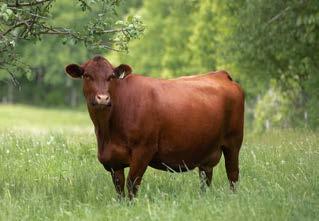
The dam must be registered or leased in the name of the member applying for registration.
A formal copy of all leases must be on file with the Association (use Application for Registration of Lease)
To see the current up to date forms scan here:

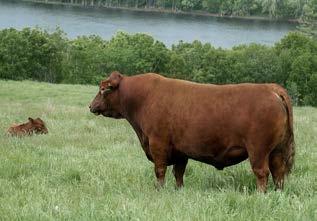
All sires used for breeding must have a DNA profile on record with the Canadian Angus Association verifying Parent Verification qualification before their offspring can be registered.
If you are not the owner of the sire at the time of breeding, please have the owner of the sire sign beside your name on Herd Inventory and Application for Registration or have the owner complete a Sire Authorization Form
If the calf was a result of an AI service, then the calf can be registered provided the bull is AI approved.
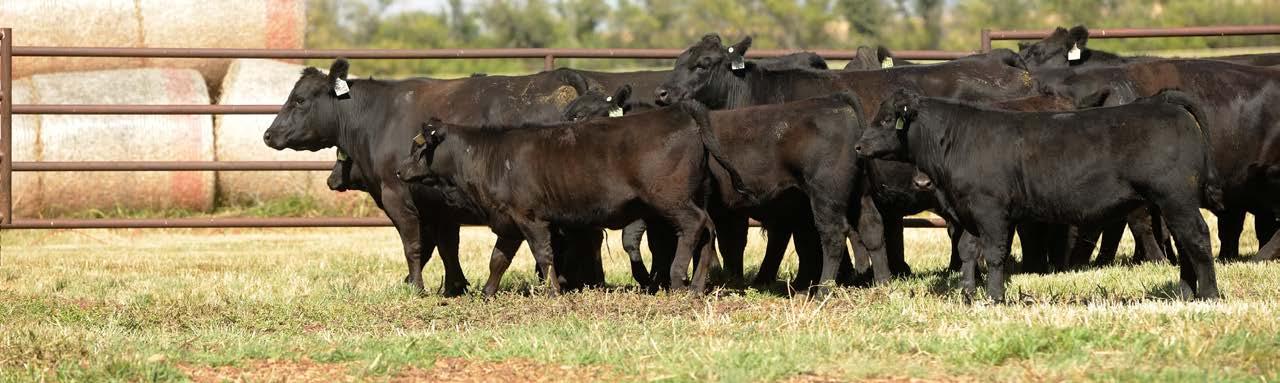
The Canadian Angus Association only issues registration papers for purebred Angus animals that the owner wishes to have registered. However, not all animals need to be registered. Breeders who participate in the Canadian Angus Performance Program record unregistered animals in the herdbook so that they can provide performance data for them. These unregistered animals will be entered into the Association’s database and assigned an identification number that begins with the letters “CM” (commercial). A registration certificate will NOT be issued for a commercial animal although its performance data will be included in our genetic evaluation.
To register a calf that results from AI, enter Y in the column marked AI on the Herd Inventory and Application for Registration. If the bull being used is AI approved, the calf will be registered.
Bulls will now need to meet these requirements to be ‘AI Approved’:
• Be parentage verified by DNA at a laboratory approved by the Canadian Angus Association. In accordance with the Canadian Angus Association’s Parentage Verification Policy.
• As of April 1, 2026 sires are required to be tested for genetic conditions and have an Angus HD test prior to AI approval being granted.
• An owner of the bull will fill out and sign the new Application for AI approval and pay the fee.
• On the application form the owners will designate the bull as either Owner’s Approval Only or Public Access. If they choose Public Access then anyone who meets all other registration eligibility will be able to register progeny from him, or exactly like how we have treated AI approved bulls in the past. If designated as Owner’s Approval Only then listed owners of the bull only have the right to register progeny. An owner can designate other breeders who are not listed as an owner authorization to register progeny similar to a Sire Authorization Form on a walking bull.
All bulls which have previously been approved for AI use will remain so.
To see the current up to date fee schedule scan here:

There are two formats for this worksheet. Pre-printed worksheets are produced in December for Spring Calving Females and in March for Fall Calving Females and are mailed to members. Use these forms to register calves and to record data for the Canadian Angus Performance Program. The worksheet lists all the active cows in a herd that should calve as of the date that the form is produced. The dam information and service sire information on purchased bred females is already filled in. There is also a blank version of this form that can be downloaded from our website. You can also fill out the PDF form online and email this back to registry@cdnangus.ca.
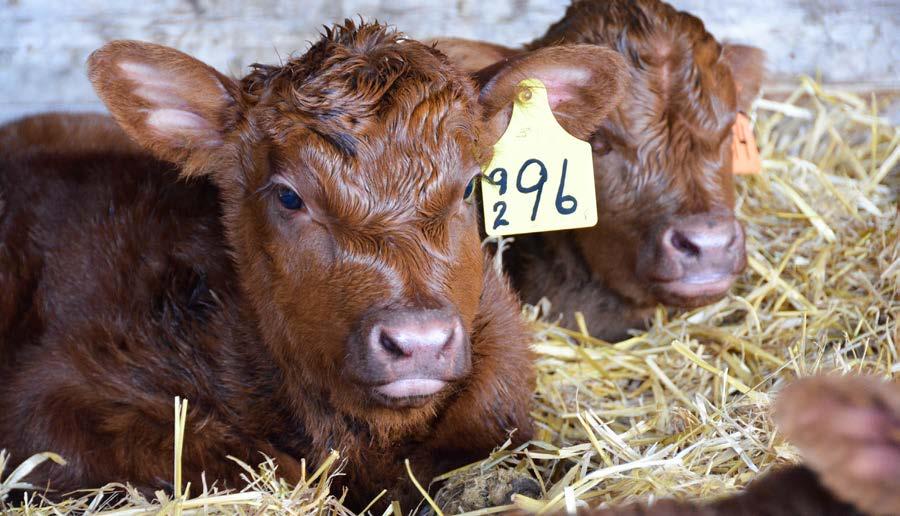
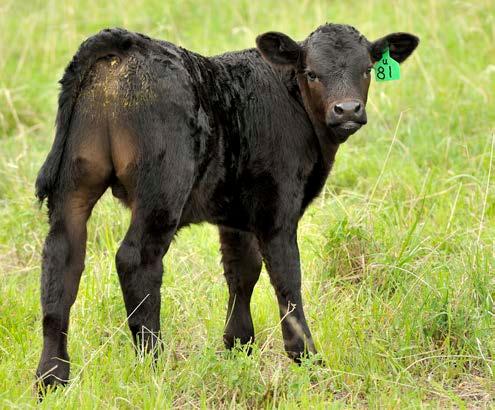
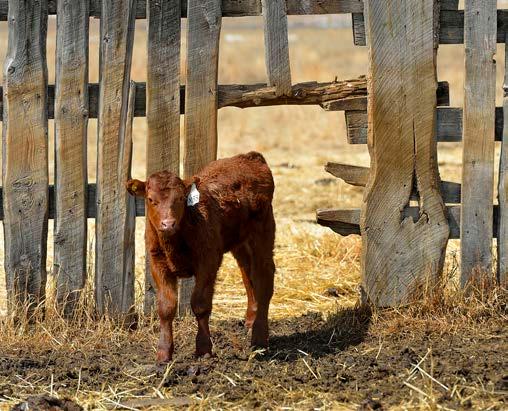
Embryo transfer (ET) is an essential tool for accelerating genetic progress in the Canadian Angus breed. The CAA has specific requirements to ensure accurate pedigree tracking, responsible genetic dissemination, and compliance with genomic testing standards. These requirements cover both donor dam approval and ET calf registration.
Definition: A donor dam is a female designated to provide embryos for breeding purposes. To be eligible for ET calf registration, a donor dam must be formally approved by the CAA.
Requirements for Donor Dam Approval:
Genomic HD Test and Genomic Condition Test
• As of April 1, 2026 donor dams are required to be tested for genetic conditions and have an Angus HD test prior to AI approval being granted.
Application & Fee
• Owners must submit the Application for Donor Dam Approval
• Fees are applied as outlined in the current fee schedule
Donor dam approval is a permanent designation. Once donor dam is approved, her ET calves can be registered once they are parent verified.
Definition: ET calves are progeny produced from embryos collected from a donor dam. Registration requires full documentation of both donor parents and the ET procedure.
Requirements for ET Registration:
(a) Application Form
• Owners of the donor dam use the Embryo Transplant Application for Registration to register the ET calf/ calves.
(b) Donor Parent Registration
• Both donor dam and donor sire must be registered in the Canadian Angus Herdbook.
• Imported embryos require prior registration of donor dam and donor sire using if they are not already in the Canadian Angus Herdbook.
(c) Breeder Designation
• By default, the original owner of the donor dam will be recorded as the breeder
• Alternate designations must be specifically recorded
To see the current up to date forms scan here:
Understanding Private Use vs. Public Access Semen in Relation to CAA Sire Authorization Policy. In the Canadian Angus genetic landscape, semen distribution classification helps guide how breeders access and apply elite sires within their programs. The CAA recognizes two types of access for artificial insemination sires: Owners Use and Public Access. Understanding these distinctions ensures compliance while supporting both strategic breeding goals and breed-wide genetic advancement.
Definition:
Private Use semen refers to semen used by the bull owner and by any individual or herd that the owner authorizes for breeding. This model allows ownership groups to maintain strategic control over the bull’s genetic reach.
Administrative Requirement:
When a bull is designated Private Use, and a non-owner breeder wants to register progeny from that semen:
• A Sire Authorization Form must be submitted to the CAA.
• Effective January 1, 2021, each authorization requires a $50 fee (linked herds may be covered under the same fee)
• As of April 1, 2026 sires are required to be tested for genetic conditions and have an Angus HD test prior to AI approval being granted.
Definition:
Public Access semen is available to all CAA members without requiring approval or authorization from the bull’s owners. This structure is used for bulls intended for broad commercial and breed-wide use.
Administrative Requirements & Fees:
• Owners may opt to designate a bull for Public Access with a one-time $100 fee for domestically collected semen
• Imported semen or an imported AI sire being set to Public Access is subject to a $400 AI approval fee
• Once Public Access status is granted any member may register progeny without owner authorization
• As of April 1, 2026 sires are required to be tested for genetic conditions and have an Angus HD test prior to AI approval being granted.
The following requirements apply when registering calves resulting from cell-cloned transplants:
1. Only replication cell-cloned animals shall be eligible for registration. Genetically modified animals shall not be eligible for registration.
2. The cell-donor animal and the cell-cloned animal must be DNA parentage verified.
3. The breeder of the cell-donor animal must be identified as the breeder of the cell-cloned offspring.
4. The owner on record of the cell-cloned donor, on the date of biopsy removal, will be identified as the first owner, unless the calf is a result of a pregnant recipient, purchased embryo, fresh or frozen, in which case the producer may be identified as the first owner.
5. The Association may require DNA parentage verification of recipient dams.
6. Calves conceived after death of cell-donor animals shall be eligible for registration under the same conditions and provisions governing the eligibility of calves prior to the death of said animal.
7. Registration of cell-cloned transplants shall be made on a special form, provided by the Association, at the regular fee, plus an additional fee as determined by the Board of Directors.
8. Registration certificates issued for cell-cloned transplants shall be so designated. The registration number of the animal, which is being cloned, shall also be stated on the certificate of registration.
Nothing set forth herein should be construed as an indication that the Association takes any position as to the ownership rights, if any, of retained cell material. That is a separate matter reserved for discussion or negotiation between the buyer and seller.
Angus associations have differing policies for registering animals. Thus, any animal imported into the Canadian Angus Herdbook must be eligible for registration according to our rules.
If you have purchased a foreign registered animal from a country that is recognized under the World Angus Secretariat, you would apply to register the animal in the Canadian Angus Herdbook using Application for Registration of an Imported (Foreign) Animal. This form itemizes exactly what paperwork to attach to the completed form, depending on the situation of its entry into Canada.
A foreign animal that is going to be used for artificial insemination must meet the requirements for AI approval; see the section on Official Regulations Governing Artificial Insemination in this handbook on page 25 for details.
A foreign animal that is going to be used as a donor dam must meet the Official Regulations Governing Embryo Transfer; see the section on Official Regulations Governing Artificial Insemination (see page 26 for details).
CFIA proof of import for animals, embryos or semen must accompany application.
Before you submit the completed Application for Registration of an Imported (Foreign) Animal, please ensure you have done the following:
Attach an original or copy of the certificate of registration from the country of origin.
If you are the current owner listed on the foreign registration certificate, attach the completed Application for Registration of an Imported (Foreign) Animal, along with the registration certificate. This will be sufficient for entry into the Canadian Angus Herdbook.
If the animal being applied for is for use as an AI sire or a donor dam and is not owned by the Canadian Angus Association member submitting this application, include Signing Authority Agreement on Behalf of Individuals, Partnerships, Ranches, etc. indicating the animal’s name and foreign registration number.
Note: The service sire will have to have been DNA parentage tested and have parent verification on his DNA parentage report. The Canadian Angus Association will contact the Angus Association of origin for imported animals to obtain DNA SNP markers and parentage reports. All imported AI sires and donor dams must meet the requirements for registration in the Canadian Angus Herdbook and requirements outlined under the Canadian Angus Association Parentage Verification Policy and Genetic Condition Policy.
An imported bull being used as a sire will have to have an acceptable DNA report on file, along with parent verification, before his progeny will be eligible for registration in Canada.
If the animal being applied for is for use as an AI sire or a donor dam and is not owned by the Canadian Angus Association member submitting this application, include Signing Authority Agreement on Behalf of Individuals, Partnerships, Ranches, etc. indicating the animal’s name and foreign registration number.
The service sire will have to have been Parent Verified and have sire verification on his Genomic Parent Verification report.
An imported bull being used as a sire will have to have an acceptable DNA report on file, along with parent verification, before his progeny will be eligible for registration in Canada.
Aberdeen Angus Association, UK
American Angus Association
Argentina Angus Association
Australian Angus Association
Brazil Angus Association
Czech Republic Angus Association
Denmark Angus Association
Germany Angus Association
Irish Angus Association
Mexico Angus Association
Red Angus Association of America
Copy of original registration certificate required
Copy of original registration certificate required No for bulls Yes for Cows and Calves
5 generation pedigree required
Copy of original registration certificate required
Copy of original registration certificate required
SNP parentage verification certificate and SNP markers
Angus HD DM testing
Angus HD
SNP markers, PV certificate
AM, NH, CA, OS, DD, DM, DW, OH (Full GC Package) tested EE
Free for AM, NH, CA, OS, DW, DD, DM, MA
Angus HD
SNP markers, PV certificate
SNP markers, PV certificate
SNP parentage verification certificate and SNP markers (554 SNP markers)
Electronic copy of original registration certificate
Electronic No for Bulls Yes for Cows
Red Angus Association of Australia Electronic No for Bulls Yes for Cows
South Africa Angus Association
SNP parentage verification certificate and SNP markers (554 SNP markers)
SNP markers, PV certificate
SNP markers, PV certificate
SNP parentage verification certificate and SNP markers
Angus HD (50K) required DM testing
Solid Black or Solid Red
Require GEPDs, and percentile ranks
All conditions if no interveening free in pedigree
AM, NH, OS, and MA testing
Angus HD
Solid Black or Solid Red
Solid Black or Solid Red
Require GEPDs
Require weaning weight and weigh date
Sometimes a registration cannot be processed because registry staff has questions about the calves. If this happens, the calf will be assigned a ?number (question mark number) and you will receive a Request for Information (RFI) by e-mail (if you have an e-mail address on file) or in the mail. The RFI identifies the specific information required to proceed with the registration.
You must respond to the RFI in writing. To ensure accuracy, changes cannot be accepted by telephone.
Simply make the corrections or add the necessary information on the RFI and return it to the Canadian Angus Association office by e-mail or mail. The fee for the registration will be held for 180 days from the date the animal was originally entered to allow you time to respond. After 180 days the registration fee will be assessed as per the current fee schedule.
If a genomic parent verification test identifies a parentage problem on a registered animal, a temporary suspension will be applied to the animal and all their progeny and the Canadian Angus Association member service will work toward a solution with the parties involved. Once the parentage and pedigree have been resolved, the suspension will be removed. If the parentage problem remains unsolved, the suspension will remain.
The Animal Pedigree Act requires that all animals sold as registered be officially transferred by the seller and the registration certificate presented to the purchaser within six months of the date of sale.
Any registered Angus animal that is sold must have its registration certificate transferred to the new owner within six months of the sale as per the Canadian Angus Association bylaws. If the animal is not intended for sale as a registered Angus, its registration certificate should be returned to the Association for cancellation, and the seller must note on the bill of sale that the ‘animal was sold as a commercial animal—no paper available’.
The Canadian Angus Association recommends that buyers and sellers of purebred Angus cattle use a bill of sale (see Sample Bill of Sale. and clearly note all details of the sale and/or agreements in writing. If a dispute arises and the seller isn’t cooperating with the transfer of the animal, please contact the Association for advice.
To transfer animals, complete the Application for Transfer of Ownership located on the reverse side of the registration certificate and return it to the Canadian Angus Association with the appropriate fee as per the current fee schedule within six months of the date of sale. If the registration certificate is electronically stored, use Application for Transfer of Ownership.
If a bred female is sold, the service dates and information must be provided on the transfer application. All service sires must be parent verified, and the bull must be AI approved if applicable.
If a semen interest is retained on a bull that is being transferred, please notify the office using the sire authorization form.
In the case where an entire herd is transferred to a new owner, one application for transfer may be completed if a list of animals to be transferred is attached. The completed transfer form and registration certificates of the listed animals must be forwarded to the Canadian Angus Association with the appropriate fees.
PLEASE NOTE:
The transfer fee is the responsibility of the seller unless otherwise noted on the bill of sale. All signatures of listed owners must appear on the transfer, unless Signing Authority Agreement for Canadian Angus Association Registered Animals has been provided.
Non-financial transfers are ownership transfers in which animals are being transferred from one family member to another family member. These transfers are usually between family members, partners, company members or estate settlements. Partnerships and company members must all be recorded with the Canadian Angus Association before a non-financial transfer will be processed at the non-financial transfer fee.
Transfer from an individual to a partnership, or a partnership to an individual.
Addition or deletion of an individual in a partnership or farm name.
Estate transfers to another family member or beneficiary. Estate transfers require either a death certificate, a copy of the will or a letter from the lawyer of the estate, including the name(s) of the executors. The executor will be the signing authority for estate transfers.
Transfers of herd names and tattoo letters can also be included in estate settlements.
Please note: non-financial transfers cannot be done in AngusNOW; they must be sent into the Association office. A Canadian Angus Association membership is NOT required to transfer an animal.
Angus animals may be leased to another party as long as the lessor (the person who owns the animal) completes an Application for Registration of Lease and submits it to the Association to register the lease.
Once the lease is registered with the Canadian Angus Association, the lessee (the person who is leasing the animal from the owner) can register calves sired by the bull or produced by the cows as if (s)he were the actual owner.
If the lease is for a female that has been bred by the owner, the service dates must be provided to the Association at the time the lease is applied for. At the end of the lease period, registration privileges revert back to the recorded owner.
The Application for Registration of Lease supplied by the Association contains only the information required for the Association’s needs. The lease form is not to be construed as a binding agreement between the lessor and the lessee. All lease periods must include a beginning and an ending date; no open-ended leases will be accepted. Should the lessor and the lessee agree to extend the lease, we require updated documents with the new end date. For more information on leasing, please see ARTICLE XXIV (page 81) in the Constitution and Bylaws
Issue: Not closing your AngusNOW work orders
Your transaction is not complete until you submit your pending transactions and pay the balance owing.
Issue: Missing information for transfers
A complete transfer request includes the animal tattoo or registration number, seller membership number or name, buyer name and contact information and the date of the sale.
Issue: Credit card information isn’t up to date
To avoid processing delays and possible interest charges, keep your credit card information up to date.
Issue: Submitting work twice
If you need to add information after submitting work for processing, only submit he NEW information; do not include the information that was already submitted.
Issue: Animals names spelled incorrectly
Staff process your requests as submitted. Ensure the spelling is accurate in the names of your calves.
Issue: Incomplete voice mail messages
If you are leaving a voice mail, please include your name, membership number, complete phone number including area code and the reason you are calling. If you are calling about a specific animal, please include the complete tattoo or registration number.
Issue: Incomplete requests when importing an animal
To import an animal, submit the complete Application for Registration of an Imported (foreign) Animal form and all import paperwork. AI sires and donor dams have additional requirements. Note: all animals, regardless of country of origin, must be eligible for registration according to Canadian Angus Association rules.
Issue: Calling in work requests
To ensure accuracy and accountability, we will only complete work that is submitted in writing. Please send your request to registry@cdnangus.ca. All “work: must be in writing— email, text, fax, mail, or drop off in person.
AngusNOW provides you with the tools to register animals, enter calving data, enter weights, transfer animals and much more from the comfort of your home. With AngusNOW you can receive registration numbers and transfer ownership instantly.
There is no fee to access AngusNOW. To sign up, contact registry@cdnangus.ca. You will receive an e-mail invitation that includes your password. You must have a valid email address for this service, your membership fees must be up to date and you must not have an overdue account.
Our solution to shared, washed, and lost calving books is the Canadian Angus Calving App. The Canadian Angus calving app is designed to be easy to use with the same fields as the paper calving book. It is our objective to provide members with an easy electronic option to record calves on the go, as they come. Members will be able to extract their calving information from the calving app into our registration portal at any time.
Download the Canadian Angus Calving Book from the Apple Store or Google Play. This technology has been developed to bring added value to Canadian Angus members, therefore there is no cost to download the app, however a CAA account is required to use the app.
4 STEP STEP STEP
Create your account log in using your Canadian Angus Association primary member ID. If you don’t know your primary member ID, please contact the office for help. You will be required to choose a password (minimum 8 characters). You can have multiple devices logged into this account (using your primary ID and chosen password) to access the same calving books.
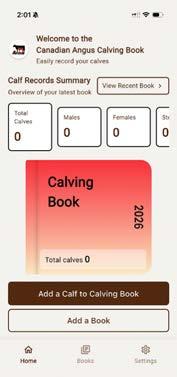
Create a Calving Book by tapping Add a Book. This will open the create a new book screen where you can add a calving book title and year. You must indicate 2026 for your 2026 Cow Inventory to load.
Please note: you don’t need your inventory to be loaded to use the app, you can just type in the names manually.
Once your calving book is created, tap on the book to open it.
5 6
To create a new calf record, click Add a Calf to Calving Book and enter the calf information including date of birth, calf tattoo, dam tattoo, sire tattoo, birth weight, birth weight management group, coat colour, calf sex, calving ease code, teat and udder score for the dam, CCIA RFID number and any notes you would like to record for the calf. You can skip any field you wish to leave empty.
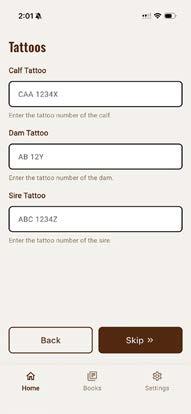
7
All calf records will be listed in your calving book and summarized on the home page.
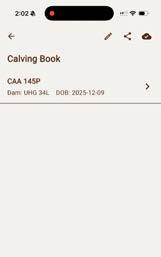
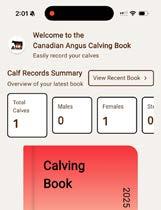
9
This share icon allows you to email yourself a copy, as a backup for your records.
Once you’ve gone through all the information screens the next page will summarize the information and allow you to check your records. If everything looks as expected, tap Confirm or your record won’t be saved in your calving book.
8
You can access your calf records on your computer using our calving app registration portal (www.portal.cdnangus.ca) Here you can enter any missing information required for registration purposes and submit your application for registrations electronically.
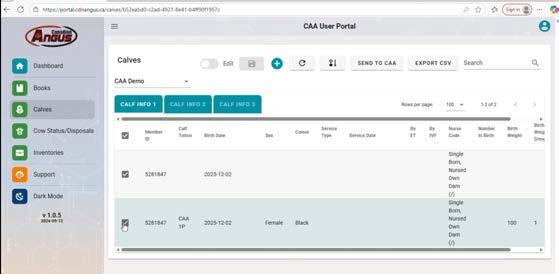
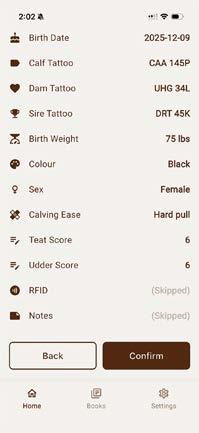
This cloud icon confirms that all info is synced. if you do not see this symbol, wait until you are on a network and synced before logging out.
The app will also confirm your data is saved when you’re logging out.
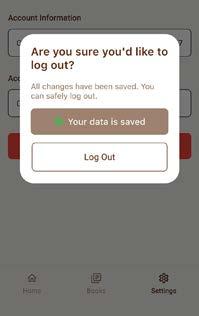
10
Multiple users logging in to the Canadian Angus Calving Book App with the same log in information, can access the calving book. So, if your night shift person recorded five new calves overnight, your day shift person will be able to access these records in the morning, using the same log in information in the Canadian Angus Calving Book App.
11
Please note that under Customize you have the option to delete a book. If there are calf records in your book and you delete the calving book—those calf records will be lost.
Your Association and board of directors’ goal is to help guarantee your genetics and provide bull buyers with the most accurate pedigree information possible. We can provide a SNP Parentage Verification test with double the number of SNPs so that our parentage verification is more accurate than ever. The requirements for parent verification on sires reinforces this. Genomic testing for parentage verification must be conducted through the Canadian Angus Association. All foreign marker requests will need to meet global quality standards and will be subject to a foreign marker fee.
• All sires used for breeding and born on or before December 31, 2018 must have a DNA parentage profile on record with the Canadian Angus Association showing sire verification before their offspring can be registered.
• Effective January 1, 2019, all sires must be fully parent verified in order for offspring to be registered.
• Sires being used for AI must be HD and Genetic Condition tested before they are granted AI approval status.
• All dams used as donor dams must be DNA parentage tested. It is recommended that dams used as donors be parentage verified to the fullest extent possible.
• If a dam is less than 516 days of age when a calf is born, then the calf must be parentage verified to the sire and the dam; in this case the dam would require a DNA parentage test.
• If a cow is re-bred by AI or natural service from a different sire within 14 days of the previous service, the owner is required to report both services to the Canadian Angus Association and request a DNA parentage test so the calf is registered properly once the sire is determined.
• If breeding dates and birthdates are questionable, the Canadian Angus Association will ask breeders for clarification of the dates, and recommend that a DNA parentage test be performed if there is a question regarding correctness of the pedigree.
Parent verification is the process of matching the genetic markers of an animal to its sire and dam through a process called SNP Parentage Verification.
For a spreadsheet to record animals for DNA testing, please scan here:

Angus HD (Angus High Density) is the CAAbranded enhanced genomic test. Members who want to receive GEPDs will request an Angus HD test. This test is directly comparable to all other Angus-branded enhanced genomic tests available such as Angus GS, HD50K and GGP (RAAA’s genomic test). Angus HD tests similar genomic markers, tests 100K and includes parentage verification.
It takes approximately 45 days to receive Angus HD test results after the sample is received by CAA, so it is important to plan ahead if the results are required by a certain date.

If a black dam is not known to be a red carrier and she produces a red calf, a coat colour test will be required on the dam, and a parentage test will be required on the calf. In this case, the Association will send a DNA parentage test kit for the dam and her calf. The owner will be responsible for the DNA parentage test fees, and the Canadian Angus Association will pay for the coat colour test for the dam.

If both parents of a red calf are black and are not known to be red carriers, then the calf will require a DNA parentage test to qualify both parents, and the parents will both require coat colour tests. The owner will be responsible for the DNA parentage test fees and the Canadian Angus Association will
We recommend that coat colour DNA tests be done on all bulls used in artificial insemination
Inheritance Mechanism for Coat Colour
A DNA test is available to distinguish black cattle that carry red genes from those that are homozygous black. If you wish to coat colour test an Angus animal, contact the Association with the tattoo and registration number and we will prepare a test kit for you. Hair samples are used for coat colour
The hide colour of Angus animals is determined by one loci at which three different alleles are possible. E, the dominant black gene; e, the recessive red gene; and E+, the wild type gene that can result in black or red hide colour in the absence of the dominant black gene.
A calf with unexpected coat colour should be parentage verified first. Once the pedigree is verified, the calf and parent animals can be tested for coat colour genes. The coat colour and genotype do not affect an animal’s eligibility for registration.
It is possible for a female that is a twin to a male to be a freemartin, which means she is infertile. It is possible to perform a freemartin test on a female calf to determine her ability to reproduce. Contact the Association to set up a freemartin test using a vial of blood.
Sample Collection
• Purple top tube with blood
• The freemartin test requires a blood sample.
• Requires 3 mL of whole blood in a purple top tube for testing
• Label the tube with the details (complete tattoo, registration number etc)
• Place the tube in a plastic bag and pack the blood well enough to withstand the rigors of shipping - we cannot test a broken sample
• Please include an ice pack to keep the sample cool while in transit
• It is suggested to send the sample overnight, less time in transit, the less opportunity there is for the vial to be damaged
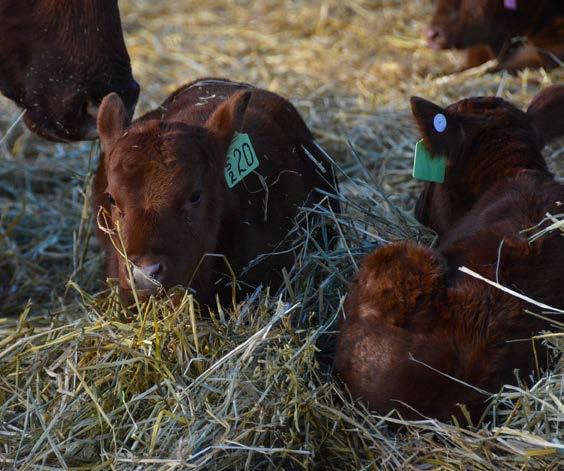
Genomic testing is available for the genetic conditions Arthrogryposis Multiplex (AM), Contractural Arachnodactyly (CA), Developmental Duplication (DD), Double Muscling (DM), Dwarfism (DW), Mannosidosis (MA), Neuropathic Hydrocephalous (NH) Oculocutaneous Hypopigmentation (OH), and Osteopetrosis (OS).
The genetic condition package includes testing for Arthrogryposis Multiplex (AM), Contractural Arachnodactyly (CA), Developmental Duplication (DD), Double Muscling (DM), Dwarfism (DW), Mannosidosis (MA), Neuropathic Hydrocephalous (NH), Oculocutaneous Hypopigmentation (OH), Osteopetrosis (OS) and coat colour with a single request and for one fee.
To learn more about these Genetic Conditions scan here:

To request a Genetic Conditions test scan here:

Your Association strongly recommends that you collect a DNA sample on your animals when you are processing them. You are able to store most types of sample at room temperature in a safe, dry location indefinitely. Please ensure that the samples are well labelled with the animal’s tattoo or registration number for ease of future use.
Hair samples should include the hair root or follicle and be affixed to hair cards available through your Association.
Allflex Tissue Sampling is available through your Association. If using TSUs, please email an Excel spreadsheet of your TSU barcodes and corresponding animal tattoo to Genomic Services
The Canadian Angus Association strongly recommends that breeders collect hair samples when handling their animals for future use. Using the recommended collection process, collect the hair sample and store it in a clean unused envelope, clearly labeled with the animal’s tattoo. Collected samples can be stored in a cardboard box indefinitely. Do not freeze the samples; keep them dry and away from any moisture. The animal’s age at the time of collection doesn’t matter. You can collect hair samples from your newborn calves for future DNA testing.
Blood cards are available through your Association.
For a spreadsheet to record animals for DNA testing, please scan here:
All samples submitted to CAA for testing need to be clearly and legibly labelled with the animal's tattoo or registration number. Including your CAA member number is also beneficial.
• Regardless of whether you prefer to collect hair, blood or tissue samples, they should be stored at room temperature in a safe, dry location.
• Hair samples should include the hair root or follicle and be affixed to hair cards. A minimum of 100 hair roots is recommended.
• If using a blood card, ensure the entire circle is saturated with blood and is completely dry before closing.
• With proper application, tissue samples are automatically collected.After application, check the vial to ensure a piece of tissue has been collected.
• CAA has detailed guidelines for collecting hair samples, taking blood samples, and proper TSU application on our website.
For guidelines on how to take DNA samples, scan here:

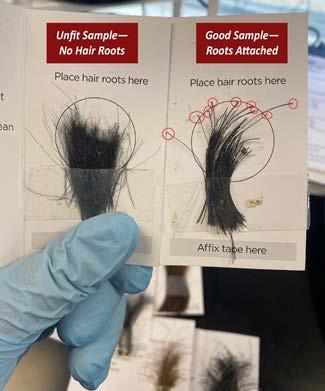
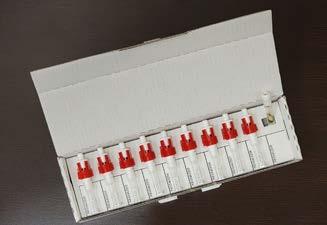
Avoid delays by ensuring that the animal has been submitted to CAA and is recorded in our database. Failure to do so causes delays while CAA staff reach out to the member to get the necessary information so testing can proceed.
Send Samples Directly to the CAA Office
Mail, courier, or drop off* samples to:
Genomic Services
Canadian Angus Association Unit 14 – 620 1st Ave. NW
Airdrie, AB T4B 2R3
*Members who live near or will travel to the Canadian Angus Association office area can drop off their properly collected and stored DNA samples during regular business hours (7:30 a.m.–11:30 a.m. and 12:30 p.m.–4:00 p.m. Monday through Friday)
From our office, Canadian Angus Association staff will prepare DNA samples for genomic testing, log them for tracking purposes, ship them directly to the lab for testing, and will receive and process the genomic test results.
The Performance Program is a voluntary evaluation program designed to help breeders select animals that will propel them toward their breeding goals. The program is based on performance data submitted by breeders and genetic selection tools generated by the Canadian Angus Association.
The most powerful breeding tools used to evaluate cattle herds are Genomically Expected Progeny Differences (GEPDs). GEPDs are values that predict how the future progeny of an animal will perform relative to the progeny of other animals in the breed. GEPDs allow for a fair comparison of animals in different herds, and even in different countries.
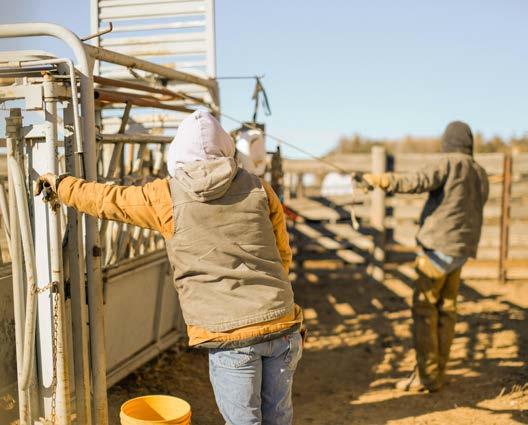
The Canadian Angus Association evaluates Black and Red Angus animals together with American and Australian Angus cattle in the World Angus Evaluation (WAE). The World Angus Evaluation launched in October 2023. Together, the Canadian Angus Association, American Angus Association and Angus Australia genetic evaluation includes more than 2.7 million animals that have been genomically tested.
The Performance Program is based on whole herd reporting. This means every cow in the herd inventory must have either a calf or a cow status code reported. Members are required to complete their cow inventory and submit weaning weight information every season.
Members are also encouraged to submit birth weights, calving ease information, yearling weights, scrotal circumference, hip height, ultrasound scanning data, feed intake data, foot scores, docility scores, teat and udder scores, and mature cow weight, height and body condition score to strengthen their GEPDs. As of January 1, 2024, there are no fees associated with participating in the Performance Program.
Genomically Expected progeny differences (GEPDs), generated through our World Angus Evaluation genetic evaluations, are predicted breeding values that allow for fair comparison of animals across herds, regardless of environment and management differences. They are expectations of how an animal’s progeny will perform, on average, for specific economically relevant traits.
GEPDs are values that predict how the future progeny of an animal will perform relative to the progeny of other animals in the same breed. They are expressed in the units of that particular trait. For example, weaning weight is measured in pounds thus the Weaning Weight GEPD is expressed in pounds. Another way to look at it is GEPDs measure an animal’s value as a parent.
GEPDs are based on pedigree information and performance data such as weight information and are then compared to other animals within a contemporary group. The different traits are adjusted to a standard age to ensure that all animals are equal when they are compared.
All GEPDs have a percentile ranking to summarize where in the breed the animal ranks.
The information provided through whole herd reporting contributes to:
Growth GEPDs (Birth, Weaning & Yearling Weight)
Fertility Trait GEPDs (Calving ease Direct and Maternal, Heifer
Pregnancy, Milk, Functional Longevity, Teat, Udder, and Scrotal Circumference GEPDs)
Carcass Trait GEPDs (Rib Eye Area, Fat, Marbling, Carcass Weight, Yield Grade GEPDs)
Canadian Angus Association provides breeders who participate in the Performance Program with three levels of GEPDs:
Parental Average EPDs: These are the most basic and least accurate EPDs. They are the best guideline available when calves are first reported and there is no performance data on them yet. Parental Average EPDs are indicated by a P for accuracy and are simply an average of the dam and sire’s EPDs.
World Angus Evaluation EPDs: The World Angus Evaluation for all Canadian Angus cattle (Black and Red Angus), American and Australian Angus cattle, was launched in October 2023. There are many advantages to the World Angus Evaluation, including the combined Canadian Angus, American Angus, and Australian Angus data which gives us the ability to calculate more accurate EPDs. Together, the Canadian Angus Association, American Angus Association and Angus Australia genetic evaluation includes more than 2.7 million animals that have been genomically tested. The World Angus Evaluation has also allowed us to expand your genetic evaluation and bring you EPDs for new traits that we believe are priorities for the industry, and economically relevant to you.
World Angus Evaluation GEPD: Using Single-step genomic best linear unbiased prediction (ssGBLUP) we are able to use high density genomic information to calculate genomically enhanced GEPDs (GEPD). This allows us to calculate more accurate GEPDs, and to estimate GEPDs for traits that animals have not been measured for yet. For example, we are able to increase BW GEPD accuracy of a yearling animal with approximately 10% BW GEPD ACC to almost 40%. And, we are able to estimate GEPDs for carcass quality traits using the same genotype even though the animal has not yet been ultrasound scanned. This makes collection of accurate and complete phenotypic data all the more important.
Genetic merit does not describe the parent animal itself. Estimates of genetic merit are predictions of average calf performance for any given trait. For example, an animal’s weaning weight GEPD does not predict what that animal’s weaning weight will be. It predicts the average weaning weight for that animal’s progeny, compared to their contemporary group.
Difference: 10 LB
When Bull A and Bull B are bred to similar cow herd, and the calves are managed the same, on average the calves from Bull B will weigh 10 LB more at weaning weight (205 day weight) than the calves from Bull A. GEPDs estimate average differences in calf performance.
For all traits that we describe in our genetic evaluations, the GEPD describes the relative performance expected from offspring, not the parent animal’s performance. For example, a bull’s Functional Longevity (FL) GEPD does not predict how many calves he himself will have. The bull’s FL GEPD describes how many calves that bull’s daughters will have, standardized to age 6. It’s about his daughters’ performance!

Members can join the Performance Program by contacting us at registry@cdnangus.ca. Participating members are required to complete their herd inventory information and calf weaning weight information every season. Members are also encouraged to submit yearling weights and ultrasound scanning data to strengthen their GEPDs.
Canadian Angus producers, seedstock and commercial, have access to GEPD from the World Angus Evaluation (WAE) where pedigree, performance and genomic data from the American Angus, Australian Angus and Canadian Angus Associations are combined. Animals enrolled in the Canadian Angus Performance Program will have GEPD (with the accuracy) for the following traits published:
Birth Weight GEPD (BW)
Estimates the average difference of birth weight, in pounds, for a bull’s calves
Weaning Weight GEPD (WW)
Estimates the average difference of weaning weight, in pounds, for a bull’s calves at 205 days of age
Yearling Weight GEPD (YW)
Estimates the average difference of yearling weight, in pounds, for a bull’s calves at 365 days of age
Milk GEPD (MILK)
Estimates the average difference of weaning weight, in pounds, that a bull’s daughter will provide through maternal environment
Residual Average Daily Gain GEPD (RADG)
Estimates the average difference of progeny’s ability to gain post weaning weight (lb) on a constant amount of feed
Dry Matter Intake GEPD (DMI)
Estimates the difference of progeny’s appetite or dry matter consumption
Mature Weight GEPD (MW)
Estimates mature cow weight of a sire’s daughters
Mature Height GEPD (MH)
Estimates mature cow height of a sire’s daughters
Calving Ease Direct GEPD (CED)
Estimates the ease with which a bull’s progeny will be born out of a first-time heifer
Calving Ease Maternal GEPD (CEM)
Estimates the probability of a bull’s daughters calving without assistance as first-time heifers
Heifer Pregnancy GEPD (HPG)
Estimates the probability of a bull’s daughters becoming pregnant at first exposure
Scrotal Circumference GEPD (SC)
Expressed in centimeters, is used as a predictor of age of puberty for daughters
Functional Longevity GEPD (FL)
Expressed in number of calves, is a predictor of the number of calves a sire’s daughters will have by 6 years of age compared to another sire’s daughters
Docility GEPD (DOC)
Predicts the average difference of progeny chute-side temperament at yearling age
Claw Set GEPD (CLAW)
Predicts differences in average claw-set score in a sire’s progeny, lower numbers being less scissored and more evenly spaced
Foot Angle GEPD (ANGLE)
Predicts differences in average foot angle score in a sire’s progeny, lower GEPDs indicating closer to the ideal 45-degree pastern angle
Teat Score GEPD (TEAT)
Predicts differences in average teat size in daughters, higher GEPDs indicate smaller teat size
Udder Score GEPD (UDDER)
Predicts differences in average udder suspension score in daughters, higher GEPDs indicate tighter udder suspension
Carcass Weight GEPD (CW)
Predicts average progeny differences in hot carcass weight in pounds
Marbling GEPD (MARB)
Predicts average progeny differences for marbling score
Ribeye Area GEPD (REA)
Predicts average progeny differences for rib eye area in squared inches
Fat Thickness GEPD (FAT)
Predicts average progeny differences for back fat thickness measured at the 12th rib in inches
The heritability of each trait evaluated is considered when calculating GEPDs. All traits have different heritability—the proportion of variation for a particular trait that is determined genetically. The higher the heritability of a trait, the more accurately an individual’s own performance will predict its breeding value for this trait.
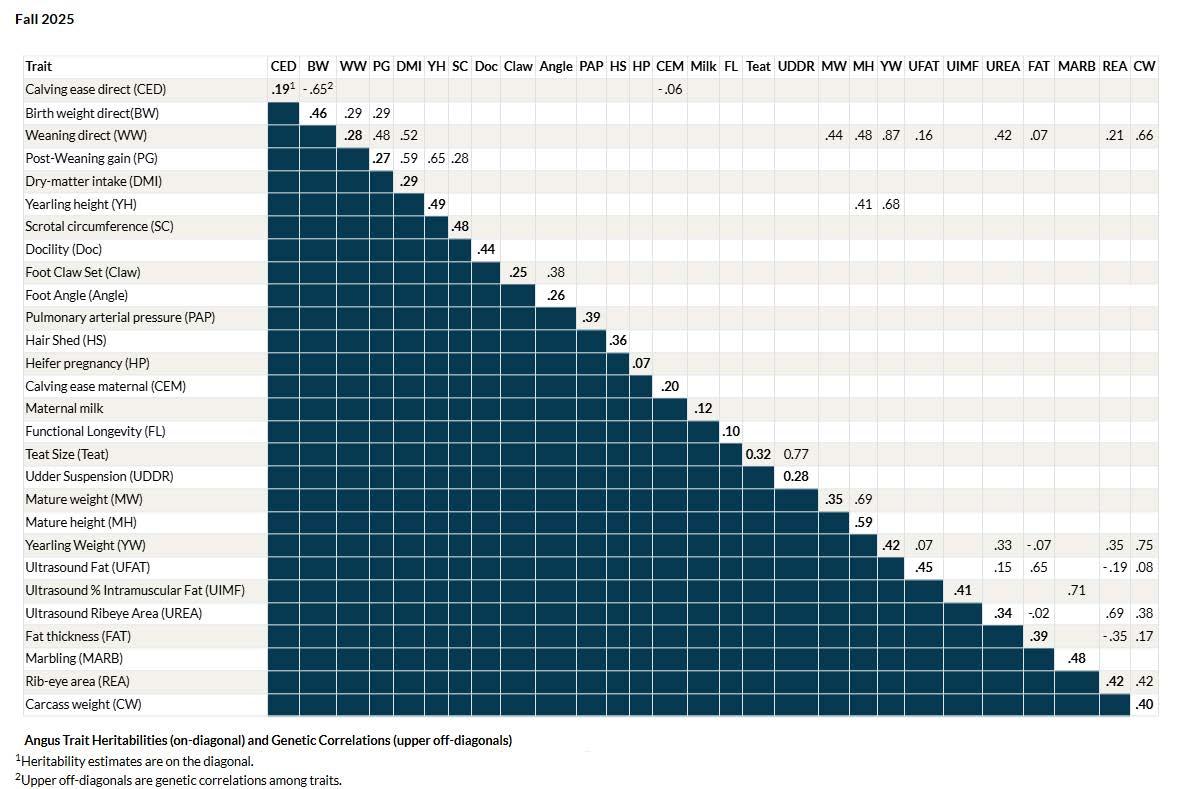
Calving Ease and Milk have low heritability. This means that there are a lot of factors in addition to genetics that influence these traits, and a cow’s own milking ability does not reflect her daughters’ milking ability to a high degree. Conversely, growth traits are moderately heritable and carcass traits are highly heritable.
Applying GEPDs for all these traits into selection and breeding decisions can be challenging. Therefore, the Canadian Angus Association has worked to develop an Economic Selection Index that includes the GEPDs for all traits. Traits are weighted in the index based on their economic impact on the Canadian commercial operation.
Basically, indexes help producers use GEPDs to balance traits. Balancing traits can be complex. Not all traits make an equal contribution to profitability, and some traits counteract each other (e.g. post-weaning growth and cow size/feed requirements). Other traits are important to a certain threshold, then there is less benefit in going any further (e.g. calving ease) or even a direct cost (e.g. milk production).
A well-constructed index can help streamline the process of selecting cattle for breeding. It is not intended to replace individual trait GEPDs (which will still be available) or to tell breeders how to breed. An index can help breeders focus on cattle that will tend to be more profitable under Canadian production systems and markets.
The index is expressed in terms of Canadian dollars and reflects the expected difference in profits between bulls’ progeny.
For example:
Bull A CBI = $250
Bull B CBI = $150
On average, progeny from Bull A will be $100 more profitable in a Canadian commercial operation than the progeny from Bull B
In the United States, Red Angus cattle are registered with the Red Angus Association of America (RAAA) and receive GEPDs produced through International Genetic Solutions, Inc. (IGS). While IGS uses the same single-step methodology to calculate GEPDs, the reference population and data set used for the genetic evaluations differ from those used in the World Angus Evaluation. As a result, GEPDs from IGS genetic evaluations are not directly comparable to the World Angus Evaluation GEPDs that we publish for Canadian Angus cattle, including both Black and Red Angus.
For Canadian Angus members who are marketing Canadian Red Angus genetics to the United States and intend to register those animals with the RAAA, we can, upon request, provide RAAA IGS GEPDs for their Canadian Red Angus genetics. This allows U.S. customers to understand what the animals’ GEPDs will be once registered with the RAAA.
This service is available upon request and is provided at no cost to Canadian Angus Association members who participate in the Canadian Angus Performance Program.
Performance Trait Acceptable Age Range and Notes
Birth Weight
Teat & Udder Score
Calving Ease
Weaning Weight
Feed Intake
Yearling Weight
Claw Set
Within 24 hours of birth
Within 24 hours of birth
Within 24 hours of birth
120 to 280 days of age
160 to 440 days of age
320 to 440 days of age
Yearling and older
Hoof Angle Yearling and older
Ultrasound Carcass Data
Scrotal Circumference
Yearling Hip Height
Docility Score
Mature Cow Weight
Mature Body Condition
Mature Docility
Mature Hip Height
Mature Claw Set
Mature Hoof Angle
320 to 440 days (bulls), 320 to 460 (heifers)
320 to 440 days of age
320 to 440 days of age
320 to 440 days of age
Within +/- 45 days of calf weaning weight
Collect with Mature Cow Weight
Collect with Mature Cow Weight
Collect with Mature Cow Weight
Collect with Mature Cow Weight
Collect with Mature Cow Weight
Using a scale
1 for large, bottle shaped teats to 9 for very small teats and from 1 for very pendulous udders with a broken floor to 9 for very tight udders
U = Unassisted, E = Easy pull, H = Hard pull, M = Malpresentation, S = Surgical
Using a scale
Min 45 days on test, must also have WW and YW recorded
Using a scale
Collect at yearling weight time, and mature weight time
Collect at yearling weight time, and mature weight time
Must go through the CUP Lab
Collect at yearling weight time
Collect at yearling weight time, record in inches
1 = docile, 2 = restless, 3 = nervous, 4 = flighty, 5 = aggressive, 6 = very aggressive
Using a scale
Within +/- 45 days of calf weaning weight
Within +/- 45 days of calf weaning weight
Within +/- 45 days of calf weaning weight
Within +/- 45 days of calf weaning weight
Within +/- 45 days of calf weaning weight
Performance weights are adjusted to a specific age (205 days of age for weaning weights and 365 days age for yearling weights). The weights are also adjusted to factor the dam’s age as it is well documented that the calves’ opportunity to grow is affected by the dams’ age. A 5-year-old cow provides the optimum maternal environment.
To calculate adjusted birth weights, use Tables 1 and 2. First, check how old the dam was when the calf was born. To adjust the calf birth weight, add the appropriate age of dam adjustment factor.
To calculate adjusted weaning weights, first calculate the preweaning average daily gain and add the age of dam adjustment using table 3 above. Then adjust the pre-weaning average daily gain for 205 days and add the birth weight.
Pre-Weaning Average Daily Gain = (Weaning Weight – Birth Weight) / Age on Weight Date + (Age of Dam Adjustment / 205)
Adjusted Weaning Weight = Pre-Weaning Average Daily Gain x 205 + Birth Weight
Adjusted yearling weights do not account for age of dam since the calf growth after weaning is independent of the dam. To calculate adjusted yearling weights, first calculate post-weaning average daily gain.
Post-Weaning Average Daily Gain = (Yearling Weight – Weaning Weight) / (Age at Yearling Weight – Age at Weaning)
Adjusted Yearling Weight =
Post-Weaning Average Daily Gain x 160 +
Adjusted Weaning Weight
Adjusted weights put all weights on the same level so that you can compare animals equally. Ratios give breeders a snapshot of an animal’s performance within its contemporary group. However, care must be taken when comparing animals’ raw or adjusted performance as different environments will affect performance differently.
Table 1
Birth Weight = Birth Weight + Age of Dam Adjustment
to 1,703 days 4 years old
1,704 to 3,926 days 5 to 10 years old 3,927 days or older 11 years or older
Table 2
Adjustment for Birth Weight
Table 3
of Dam Adjustment for Weaning Weight Age of Dam Additive
GEPDs remove the environmental effect on performance and predict only the genetic merit of each animal. In-herd comparisons of animals that have been raised in the same environment and have been given the same opportunities to grow can be made using ratios (indexes and rank).
Ratios give you a measurement of how well each animal in the same contemporary group performed in comparison to the group average (which will be 100). Ratios provided for animals enrolled on the Performance Program are:
Weight per Day of Age: Final Weight / Age
Adjusted Birth Weight Ratio:
(Adjusted Birth Weight / Average Adjusted Birth Weight of Contemporary Group) x 100
Adjusted Weaning Weight Ratio:
(Adjusted WW / Average Adjusted Weaning Weight of Contemporary Group) x 100
Adjusted Yearling Weight Ratio:
(Adjusted YW / Average adjusted Yearling Weight of Contemporary Group) x 100
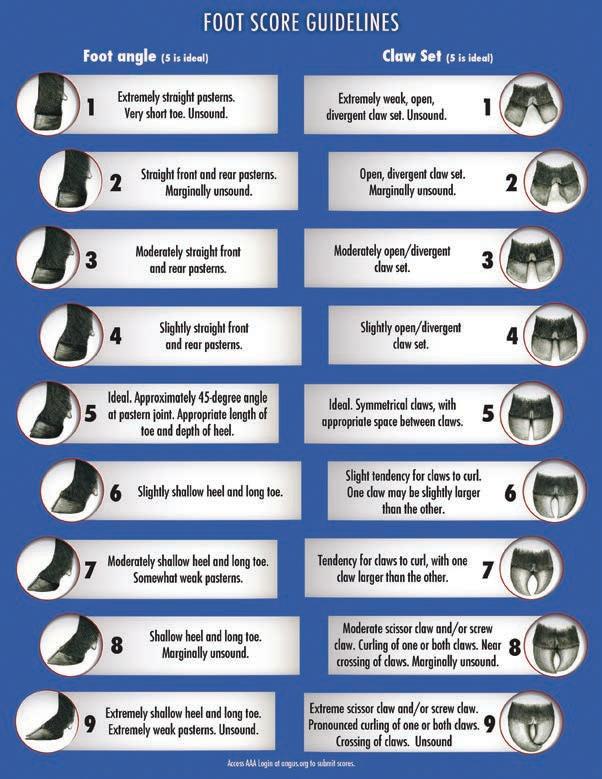

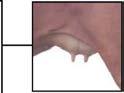
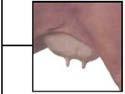
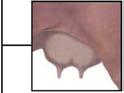
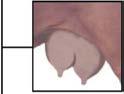

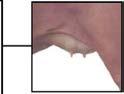
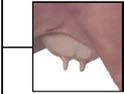
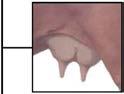
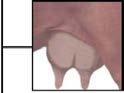

Management Groups: each performance trait that is reported to the Canadian Angus Association must be accompanied by management group information. The management grouping should reflect all the animals that had the same opportunity to develop the trait being reported.
Management groups are numbered from 1 to 99. Most breeders place their main group of calves into management group 1. Calves that were sick enough to affect growth would be placed into a different management group, e.g. 2. Additionally, animals that are given extra feed should be placed into a different management group, e.g. 3, as these animals should not be compared to animals that were not given extra feed.
Linked Herds: calves that are raised together with the same opportunities to grow should be placed in the same management group, regardless of ownership. Members’ herds can be linked together for performance purposes, allowing the calves to be placed in joint management groups. Breeders who raise their herds together should notify the Association.
Contemporary Groups are assigned by the Association for the generation of evaluation data. Calves will be assigned into contemporary groups using the following parameters: sex, age of dam, calving season, twin birth, ET, weigh date, nurse code, and management group assigned by breeder. This means that heifer calves will not be compared to bull calves as males and females have different growth patterns. The contemporary group information is critical to the evaluation program as it is the basis of GEPD, ratio, and index calculation.
The first set of data sheets that must be submitted for each calving season is the Herd Inventory and Application for Registration. (Please refer to the Registry Information section of this handbook for details on completing these worksheets.)
If you participate in the Performance Program then you must complete the form in its entirety. Every cow must have a calf recorded (whether you register it or not) or a dam status code as shown to the right (for a full list of disposal codes please see page 59). Calves that are crossbred or not going to be registered should still be recorded on your worksheet as this information will contribute to the cow’s performance evaluation.
When recording a calf and its birth weight, a breeder must also indicate a birth management group. This is the breeder’s opportunity to indicate if any calf had a different opportunity to develop birth weight. Any cows that are treated differently during pregnancy, especially their last trimester as this is when birth weight is mostly developed, should have their calves assigned to a different birth group than all other calves. Birth groups are numerical and can be assigned any number between 1 and 99. Most breeders use group 1 for their main calf crop and then other groups such as birth group 2 for calves that had different opportunities to grow.
ET calves, twins and fostered calves will be placed in their own contemporary groups by the Association as they should not be compared to other calves as their opportunity to grow is altered by their circumstance. These details are also recorded on the Herd Inventory and Application for Registration.
CALF DISPOSAL CODES
B – Stillborn (Full Term)
C – Died at Birth (Defect)
D – Died at Birth (Other)
E – Died Before Weaning (Disease)
F – Died Before Weaning (Other)
G – Died After Weaning (Disease)
H – Died After Weaning (Other)
I – Sold (no transfer)
J – Sold (transfer forthcoming)
DAM STATUS CODES
11 – Animal on Lease
12 – Open (missed calving opportunity)
13 – ET Donor Dam
14 – ET Recipient Dam
15 – Moved to Next Calving Season
16 – Still to Calve in Current Season
17 – Aborted Calf
1. Single-born or twin-born calf that is fostered onto another cow and nurses alone
2. Twin-born calves that both nurse their genetic dam
3. Twin-born calf that nurses its genetic dam alone (other twin died or is fostered)
Once members have submitted complete herd inventory information, a Birth Averages Summary Report is generated.
Birth Reports can be submitted online on AngusNow or on the calving book app.
Birthing information submitted is used to calculate a summary of each sire’s calving performance for comparison.
The 205 Day Weight Worksheets are also generated once a complete herd inventory has been recorded. 205 day weights or weaning weights should be recorded within a week of calves being weaned, and are required for every calf recorded for that season.
The acceptable age range for weaning weights (205 day weights) is 130–280 days of age for Red Angus and 120–280 days of age for Black Angus. It is best to try and weigh your animals when most of them are closest to 205 days.
Birth date of first calf
Birth date of last calf
{Halfway Date + 205 = Best date to weigh calves in management group
16
29
13
26
10
26
8
23
6
22
6
19
3
17
1
14 November 5
29
May 21 December 12
December 3 June 26
June 18 January 9
December 31 July 24
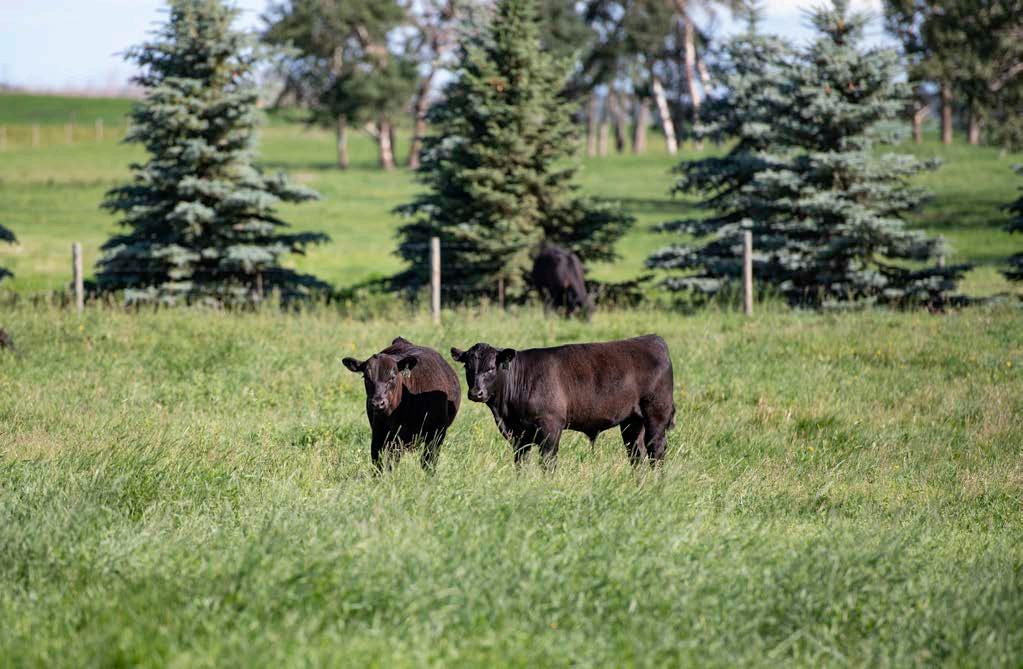
When you receive your 205 Day Weight Worksheet, sections A through G should be pre-filled with information that you provided on the Herd Inventory and Application for Registration. Verify the information on the worksheet and indicate any necessary corrections. Please note that a correction fee may apply.
On a pre-printed worksheet, the words “E-Stored=Yes” will appear under the animal’s name in the Name of Calf box (box N). If you want the certificate to remain electronically stored, place a Y in the box for yes. If you want the registration certificate to print, place an N in the box for no. You may request a registration certificate that is electronically stored to be printed at any time.
How to complete the 205 Day Weight Worksheet

In order to remain compliant on the Canadian Angus Performance Program, complete performance data must be submitted once all calves are weaned and weighed. We recommend that performance data be submitted as soon as it is taken so that it may be processed and allow members the opportunity to review their performance reports and verify the data. Members who have not submitted complete information will be contacted to do so. Non-compliance can result in suspension from the Performance Program and a reinstatement fee will apply.
Weaning reports are generated once all the weaning weights for the calf crop have been submitted. This report identifies the calves, their birth information, the weaning weight data submitted, the adjusted weaning weight, the calves’ average daily gain (ADG), and the calves’ index and rank within their contemporary groups based on ADG. This report allows for in-herd comparisons and a basic evaluation of the calves. It is strongly recommended that breeders verify all the information presented in this report to ensure accuracy.
Animals that are ?pending registrations are not included in this evaluation or in the National Cattle Evaluation.
The Weaning Averages Summary Report lists the herd sires used for the season and summarizes the average weaning weight performance for their progeny for the season. This report provides breeders with a snapshot of how well their sires performed for calves at weaning.
The Weaning Report is accompanied by GEPD reports for calves, sires and dams.
The Calf GEPD Report provides breeders with the most accurate GEPDs available for the calves at that time. Calves will receive either Interim GEPDs (P+) calculated using the weaning weight ratio/index and rank information, or they will receive parental average GEPDs (P) which are simply an average of the dam’s and sire’s GEPDs.
The Sire GEPD Report provides breeders with the most current GEPDs available for the sires of the calves reported for that season. This report is a useful tool to compare sires and their calving performance within each herd.
The Dam GEPD Report provides breeders with the most current GEPDs available for their dams for the calving season, summarizing the herd’s female genetics for evaluation.
A 365 Day Yearling Report is generated after 365 day weights are processed. For each animal for which a yearling weight was submitted, the report identifies the actual weight, adjusted weight, the daily average gain between weaning and yearling, and the animal’s rank and index comparative to their contemporary group. The report also displays the weaning information on record for each animal. This report gives members an in-herd comparison of their animals at both weaning and yearling age.
The Yearling Averages Summary Report shows the herd sires used for the season and summarizes the average yearling weight performance for their progeny for the season. This report provides breeders with a snapshot of how well their sires performed for yearling calves.
To convert hip height into frame scores, follow these tables recommended by the Beef Improvement Federation.
Hip Heights (inches) and Frame Scores for 5–21 Month-Old Bulls
How to Complete the 365 Day Weight Worksheet
The Weaning Weight Report is accompanied by a 365 Day (yearling) Weight Worksheet. Yearling weights are not compulsory but are strongly recommended as they increase the accuracy with which an animal’s genetic merit can be predicted.
How to complete the 365 Day Weight Worksheet

Hip Heights (inches) and Frame Scores for 5–21 Month-Old Heifers
Ultrasound scanning allows breeders to measure carcass traits without having to progeny test using kill floor carcass data. Ultrasound scanning measures traits such as back fat depth, intramuscular fat or marbling, and rib eye area. These trait measurements, when submitted into the Performance Program, are used to calculate carcass GEPDs. Ultrasound scanning is strongly recommended for accurate and robust carcass GEPDs. Bulls must be between 320 and 440 days of age when they are scanned and heifers and steers must be between 320 and 460 days of age.
Ultrasound scanning data and analysis can only be accepted into the Performance Program if the Centralized Ultrasound Processing (CUP) lab and a certified technician process them. Please refer to our website for an up-to-date list of certified technicians in your area.
BREEDER HOW TO How to Complete the Ultrasound Scanning—Barn Worksheet
Ultrasound scan results are recorded by the breeder and Centralized Ultrasound Processing (CUP)-accredited ultrasound technician on the barn worksheet provided.
How to complete the Ultrasound Scanning Barn Worksheet

Diet: Bulls should be placed on a high-energy ration (3 lbs/day gain) after weaning so that differences among bulls for fat thickness and marbling traits are expressed.
Age: Bulls must be between 320 and 440 days of age at time of scanning. Try to schedule the ultrasound scan on bulls at or near the end of the bull test.
Diet: Use a normal heifer development program, preferably with a moderate to high-energy ration, in order to allow heifers to express their genetic potential for fat thickness and percentage intramuscular fat.
Age: Heifers must be between 320 and 460 days of age at time of scanning. It is suggested that heifers be scanned prior to breeding, closer to the 460 day age window.
A contemporary group of cattle is exposed to the same environmental conditions. They have been managed the same, in the same environment. A contemporary group has a minimum of two calves of the same sex and similar age managed the same way. If cattle are treated differently, for example different feeding or one was sick, they must be separated.
Once separated into different management groups they will not be ranked together again. Cattle within a contemporary group must be scanned on the same day or over no more than two consecutive days. Purchased calves have grown in a different environment, so they will be in a separate contemporary group and ranked separately from home-raised calves. Setting proper management groups is a key responsibility of breeders to provide accurate and predictable performance records.
Importance of a 205 day weight: a 205 day weight on record at the Canadian Angus Association office is needed in order to calculate the adjusted weights and lean meat yield for the animal. You must send 205 day weights to obtain your barn worksheet.
The Ultrasound Scanning Results report summarizes the measurements taken during scanning and adjusts them so that all animals in a contemporary group may be fairly compared. Ratios of these comparisons are also provided so that it is clear to see how each animal ranked in its contemporary group.
The ultrasound scanning summary report indicates the calf carcass trait performance of all sires used by the breeder.
The Female Exposure Worksheet is used to keep track of all females that were exposed to bulls either through natural breeding or artificial insemination and the dates of their exposures. This information is used to calculate Heifer Pregnancy GEPDs.
The Heifer Pregnancy GEPD measures fertility and estimates the differences in a sire’s daughter’s ability to conceive and calve as a two year old. It is expressed as a percentage and is available to Canadian Red Angus breeders.
Heifer exposure information is linked to calves reported on the Herd Inventory and Application for Registration
How to complete the Female Exposure Worksheet

The Female Exposure worksheet will be sent to each herd enrolled on the performance program. It will be pre-printed and include each heifer aged 9 to 17 months within your herd.
The Canadian Angus Association recognizes animals that have superior in-herd performance as Elite Dams and Elite Sires.
1. The cow must be enrolled in the Canadian Angus Performance Program.
2. The cow must have a calf with a 205-day weight recorded within the past 18 months.
3. The cow’s first calf must be born and weaned within 1,000 days.
4. The cow must maintain a regular calving interval (regular is considered to be 365 +/- 30 days).
5. The average of the cow’s first four calves’ weaning weight ratio (index) must be at least 105. If she fails to do this with her first four calves (i.e. produces twins or becomes a donor dam), she can qualify later providing she has four calves with an average progeny weaning weight ratio (index) of 105, and she meets the other requirements.
6. The cow’s calves must be in contemporary groups with no less than 10 herd mates to determine the weaning weight ratio.
7. The cow’s progeny must be sired by a registered Angus bull.
1. Must have five or more Elite daughters.
Once an animal has been awarded Elite status it remains Elite although it may not be listed in the current recognition list if it did not qualify in the most recent year.
1. The cow must be enrolled in the Canadian Angus Performance Program.
2. The cow must have a calf with a 205-day weight recorded within the past 18 months.
3. The cow must have her first calf within 1,000 days of her date of birth.
4. The cow must maintain a regular calving interval, calving within 395 days consecutively.
5. The cow must have four consecutive natural born calves that are registered.
6. The cow’s four calves must have Weaning Weight GEPDs that are above breed average and have an accuracy of over 25%
7. The cow must have at least two registered grand calves.
8. Once a cow is designated a Premier Cow, she is always a Premier Cow, however, she will not be published in a year where she does not meet the above criteria.
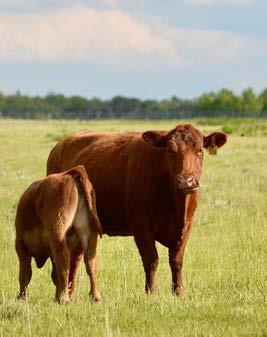
To maintain Angus breed purity in Canada and to assist our members with their breeding decisions, the Canadian Angus Association identifies animals that have been identified as carriers of or have tested free of the causative genes for genetic conditions. Breeders have an ethical responsibility to disclose full pedigree information to potential buyers of an animal. Genetic condition test results are printed on registration certificates and published on our website. Breeders are encouraged to report all test results in sale catalogues.
Basic information about genetic conditions is provided in this handbook. Please also refer to our website (www.cdnangus.ca) for the most current information available.
Breeding a carrier animal to a non-carrier animal will result in half of the calves being both phenotypically and genotypically normal, while the other half of the calves, although phenotypically normal, will have inherited the defect causing allele or gene and be carriers. The following Punnett square shows the results of a homozygous dominant (AA) animal being bred to a heterozygous or carrier (Aa) animal:
A calf that has one carrier parent has a 50% chance of also being a carrier. DNA testing the calf will identify if it is a carrier or not. If a calf is born to parent animals that have not been tested for genetic conditions but has a known carrier animal in its grandparent generation, then it should also be tested because it has a 25% probability of having inherited the gene. However, it might be more economical to test the parent in this case. If the parent did not inherit the gene from the carrier grandparent then there is no way that the calf could have inherited the gene from the grandparent.
Breeding two carrier animals as shown in the following Punnett square will result in one-quarter of the calves being both phenotypically and genotypically normal, half of the calves being carriers, and one-quarter of the calves inheriting both recessive alleles and being born affected:
To maintain Angus breed integrity in Canada and to assist our members with their mating decisions, the Canadian Angus Association identifies animals that have been tested for genetic conditions and reports the subsequent results of this testing. It is good ethical practice to disclose full pedigree information to potential buyers of an animal. Test results are printed on registration certificates and we encourage breeders to report all carriers in sale catalogues.
This “Genetic Condition Policy” replaces all previous policies of the Canadian Angus Association including those titled “Genetic Defect Policy”.
Effective September 22nd, 2013, revised January 27, 2020, and applying to animals born on or after September 22nd, 2013
The Canadian Angus Association currently monitors the following genetic conditions:
Double Muscling (DM), Dwarfism (DW), Developmental Duplication (DD), Heterochromia Irides (HI), Hypotrichosis (HY), Protoporphyria (PR), Pulmonary Hypoplasia (PH), Syndactyly (SN), Tibial Hemimelia (TH), Oculocutaneous Hypopigmentation (OH)
The Canadian Angus Association acknowledges and seeks to identify carriers of the following genetic conditions:
Arthrogryposis Multiplex (AM), Neuropathic Hydrocephalous (NH), Osteopetrosis (OS), Contractural Arachnodactyly (CA), Mannosidosis (MA)
Once the CAA has formally acknowledged and identified a genetic condition, the following process will be enacted:
Calves that have known carriers of a genetic condition in the first two generations (parental and grandparental) of their pedigree, will need to be tested for the causative gene to be eligible for registration. If the animal is found to be a carrier of the causative gene it is eligible for registration and transfer. The subject animal’s genetic condition status will be noted on its registration certificate, including electronically, per Procedure V: Notations on Registration Certificates listed below.
The Association will send an e-mail notification to all members with registered animals (purebred breeders) summarizing the information on any new developments on genetic conditions, both those that are Acknowledged and Identified as well as those being Monitored. The notification will refer members to the Association website.
The following procedures shall be followed in connection with the registration status of potential and known carriers of a genetic condition:
I. Status of Currently Registered Females and Bulls
Notwithstanding any subsequent test results, all registered females and bulls with the impacted genetics in their pedigrees as of January 1st in the year following the CAA’s identification and acknowledgement of a genetic condition shall remain registered.
II. Testing of Animals
Testing to determine whether an animal is a carrier, or free, of the causative gene of a genetic condition shall be conducted through the CAA.
III. Publication of Test Results by the Association
Results of the testing shall be noted on the Registration Certificate of subject animals, including electronically. The Association shall also maintain an updated list of each animal determined to be a carrier, as well as those who have tested free of such condition. Upon request, the CAA shall provide such a list at no cost to the requesting member.
IV. Right to Request a Second DNA Test
In those instances in which an animal previously registered or seeking registration is tested and determined to be a carrier of the genetic condition (and is identified as such electronically on the Association’s website), the member owner of record may request that an approved laboratory conduct a second DNA test on a sample from subject animal. In order to process a request for a second test, the member owner of record must provide materials or samples sufficient to permit the laboratory to verify the parentage of the animal in question.
V. Notations on Registration Certificates
Upon testing of an animal for a genetic condition, the animal’s registration certificate shall be noted in one of the two following manners:
A. the letter “F” designating “FREE” on the registration certificate of any animal that has been determined by such a test to be free of the genetic condition
B. the letter “C” designating “CARRIER” on the registration certificate of any animal that has been determined by such test to be a carrier of the genetic condition.
C. within pedigrees online and on registration certificates, ≠ will indicate animals tested free, and the letter C will indicate a carrier test result.
As of April 1, 2026 sires are required to be tested for genetic conditions and have an Angus HD test prior to AI approval being granted.
Foreign animals with a known carrier of a genetic condition, for which a DNA test is commercially available, in the first two (2) generations of their pedigree must be tested for the causative genetic condition in order to be eligible for registration.
Genetic conditions for which there is no DNA test available
Animals that have known carriers of a genetic condition for which there is NO DNA test commercially available in the first two (2) generations of their pedigree ARE eligible for registration.
Animals born before September 22nd 2013 are subject to the Association Genetic Defect policy which required an animal to be tested free of any genetic condition for which there was a confirmed carrier in the first two generations of its pedigree.
Geneprob Herd Analysis One of the tools that the Canadian Angus Association provides to help members manage genetic conditions is a Geneprob herd analysis. These reports identify the probability of your owned animals carrying the genes for several genetic conditions. Contact the Association to request an analysis for your herd prior to doing any genetic condition testing. The analysis will provide a snapshot of your genetics and allow you to focus your testing economically. Please see the current fee schedule for rates.
Abnormal Calves: calves that are stillborn or born with abnormalities are most commonly affected by environmental factors such as lack of minerals, viral infection, or exposure to toxic materials. All abnormal calves should be reported to the Association using Calf Abnormality Report so that the Association can monitor the occurrence of abnormal calves.
The Canadian Angus Association’s genetic condition policy is designed to eliminate the probability of getting affected calves, the associated economic impacts and also to minimize the frequency of these genes within the Canadian Angus gene pool.
DNA testing is available as a tool to identify carrier animals so that breeders can avoid breeding carrier animals to prevent having affected calves and minimize the number of carriers in the Canadian Angus Herdbook.
To request test kits for genetic defect testing, submit DNA Test Request to the office. You will receive DNA test kits and instructions. The tests can be performed on hair, semen or tissue samples.
Members of the Canadian Angus Association are required to report abnormalities in their herds.
How to complete the Calf Abnormality Report

Canadian Angus Association is committed to supporting breeders in promoting sales, events, and programs through a range of marketing tools and platforms. Our goal is to help increase visibility, consistency, and reach—while making promotion as easy and effective as possible.
Canadian Angus will promote member events through the CAA Event Page, which serves as a centralized hub for Angus-related sales and activities across the country.
• Breeders are encouraged to submit:
• Bull sales
• Bred female sales
• Open houses
• Field days and educational events
Once submitted, events will be listed on the CAA website and shared where appropriate through CAA communication channels.
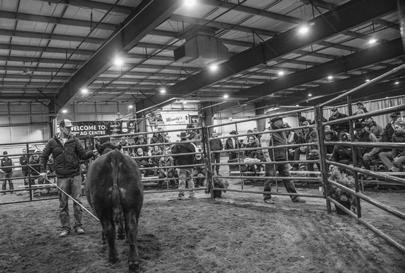
To support consistent and professional promotion, CAA provides readymade advertising assets that breeders can customize for their own use, including:
• Social media graphics
• Print-ready promotional layouts
These tools are designed to save time while maintaining strong Angus brand recognition.
Breeders have access to downloadable Canadian Angus logos and brand assets, which may be used in:
• Sale posters and catalogues
• Websites and social media
• Print and digital advertising Guidelines are provided to ensure correct and consistent use of the Angus brand.
CAA recommends a multi-channel approach to marketing your event, sale or ranch. Effective options include:
• Your local Angus region – regional newsletters, social channels, and word-of-mouth remain valuable and trusted resources.
• Digital Livestock Marketing Services (DLMS.ca) – a proven platform for online and hybrid sales with strong reach across the cattle industry.
• Industry publications, sale calendars, and online platforms relevant to your target audience. CAA staff are available to provide guidance on advertising options and help determine the best fit based on your sale type and goals.
If you are unsure where to start or would like assistance with promotion, the CAA team is here to help. We can:
• Answer questions about event submissions
• Help select appropriate marketing tools
• Provide direction on advertising opportunities
Our goal is to help you promote your program effectively while strengthening the Angus brand nationwide.
The Canadian Angus RFID Tag Program is a marketing program based on the Canadian Cattle Identification Agency (CCIA) tag. Angus tags are CCIA-compliant and identify animals with Angus genetics electronically and visually (with the distinctive green back and stylized letter A). Angus tags differentiate cattle of known Angus-influenced genetics from commodity cattle as animals must have at least one registered Angus parent to be eligible for the tags.
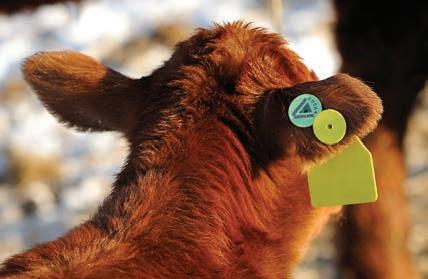
• Qualify cattle for Canadian Angus RFID Tag Program beef programs
• Qualify cattle for Canadian Angus RFID Tag Program sales across Canada
• Certify minimum 50% Angus genetics
• Come with free age verification—use the stickers provided with the tags to submit your information easily
• Can be paired with optional herd management visual (dangle) tags
• Are competitively priced and are delivered to you through the mail or by courier
As a purebred Angus producer and member of the Canadian Angus Association, you cannot only use and benefit from the program; you can also promote it to your commercial customers. Angus tags are a tool for purebred breeders to draw attention to the high quality genetics they provide to commercial cattle.
Guaranteed Genetics
The Canadian Angus RFID Tag Program ensures animals used have minimum 50% Angus genetics through the Angus tag program. This is the only program of its kind in North America.
Traceable
Cattle are traceable through the Canadian Cattle Identification Agency (CCIA) RFID tag.
Increased Demand
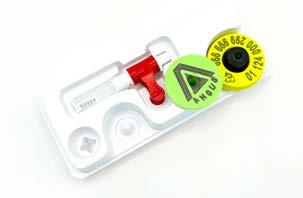
A matching set of your TSU and RFID
Consumers will have increased access to Canadian Angus beef through better product identification at the retail level.
Reputable
The Canadian Angus Association was incorporated in 1906 and has more than 2,500 members across Canada.
CCIA carries both the Datamars brand Temple Tag ComfortEar and the Allflex brand Canadian Angus RFID tags. Canadian Angus RFID tags can only be purchased through CCIA online at https://tags.canadaid.ca or by calling 1-877-909-2333.
To order ATQ Angus tags, call ATQ direct at 1-866-270-4319 or order online at www.agri-tracabilite.qc.ca
The Canadian Angus Association offers a range of management tags in various shapes, colours, and sizes, with customization options available. Please note customized tags require additional turnaround time.
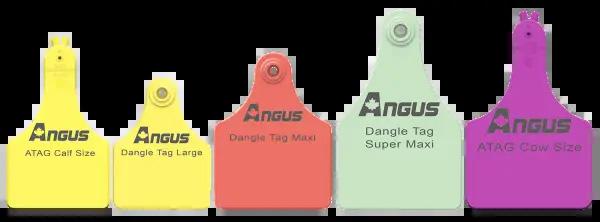
Members who participate in the Canadian Angus Performance Program and who use Centralized Ultrasound Processing have the right to use the logos for these programs in their promotional materials. Contact the Canadian Angus Association office to request the logos you qualify to use.
Use of all other Association logos including the Canadian Angus Association and Canadian Angus RFID Tag Program logos is restricted.
Scan here to access the management tag order form:



Upon request, the Canadian Angus Association can generate pedigree extracts that include the lot number, animal registration number, tattoo information, sex, date of birth, genetic defect test results, three-generation pedigree information and complete performance data including adjusted weights, ratios and the most up-to-date GEPDs for each animal being offered for sale.
In addition to the pedigree extract, members will have their sale catalogue published on our website, promoted through the Association’s social media channels and have the sale details added to our online events calendar. For an additional fee, animal photographs can also be included in the online herdbook.
Scan here to access the pedigree extract form:

To request a pedigree extract, e-mail the Association the list of animals including the lot number if known and the animal registration and tattoo information. To have the catalogue posted on our website, please also include the sale details including sale date, location and contact information for inquiries.
The Canadian Angus Association Elite Cow and Elite Sire programs identify superior cows and bulls within individual herds. Emphasis is placed on regularity of calving and above-average performance of the offspring. Breeders of Elite Cows and Elite Sires can identify their animals as such in sale catalogues, on their websites and in promotional literature. The current criteria and lists of qualified animals are posted on our website.
Age verification is recording the birth date or start of calving season information on your calves in the CCIA database. The Canadian Angus Association offers free third-party age verification for cattle with an Angus RFID tag. Age verification provides the proof of age Canadian beef needs for international markets and is also mandatory for animals born in Alberta.
Your age verification request must include:
• Producer name and mailing address
• Phone number
• Method of age verification—Calving Start Date or Individual Calf Birth Dates
• RFID tag numbers (only the last nine digits of the tag are needed)—you can use the stickers included with your RFID tag instead of writing out each tag number
Calving season age verification can be done as long as the season does not exceed three months. If the calving season is longer, you will need to list the tag numbers in groups with different starting dates of birth.
All Angus tags and Angus ATQ tags are eligible to be cross-referenced to a registered animal and have the tag number printed on the certificate of registration. Once animals are tagged, the data can be submitted to the office with the application for registration or any time if the certificates are electronically stored.
Older animals are also eligible for this service. You can submit the tag number on any animal originating on your premise and the papers will be updated the next time they are printed. If the tag falls out once recorded on the certificate it can be easily updated. Simply return the certificate of registration with an explanation and the new tag number to the office and we will issue you a corrected certificate free of charge.
The Canadian Angus Association offered its first identification tag exclusively for the Angus breed in 1999. The Canadian Angus Tag program was created in response to increased demand for high quality Angus influence cattle that would consistently meet and exceed the stringent carcass quality requirements of the Canadian Angus Beef program. The program was developed to appeal to all sectors involved in beef production including seedstock and commercial cow-calf producers, backgrounders and finishers, order buyers, auction marts and packing plants. In 2005, we made the switch to RFID technology ahead of CCIA.
The Canadian Angus Association began hosting Angus-tag feeder sales in 2000. The first year we hosted five Angus feature sales, which jumped to 11 sales in 2001 and 21 in 2002.
All requests for third-party age verification must be submitted in writing. Send a list of the Canadian Angus Rancher RFID Tag numbers and the corresponding birth dates/start date of calving season by , e-mail or mail to the Canadian Angus Association office. Age verification can only be completed once the animals are tagged. An Age Verification Form is included with your tag invoice.
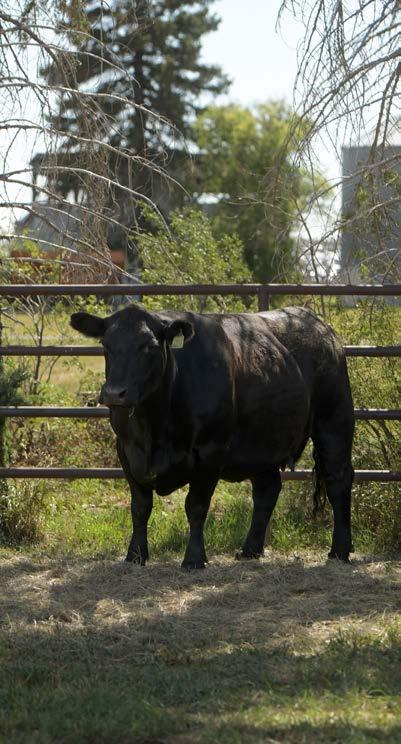
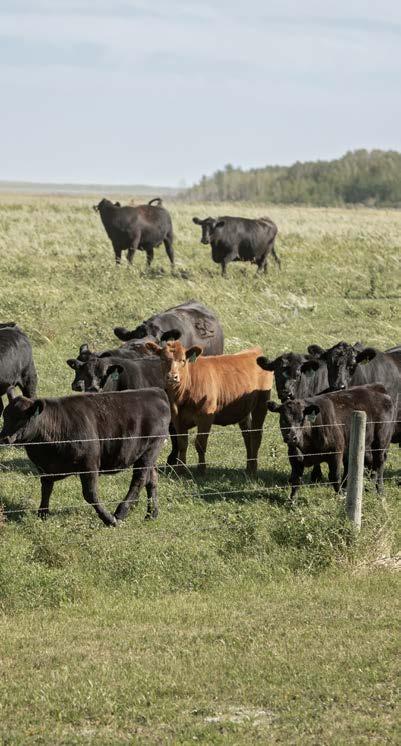
January 1 October 10
January 8 October 17
January 15 October 24
January 22 October 31
January 29 November 7
February 5 November 14
February 12 November 21
February 19 November 28
February 26 December 5
March 5 December 12
March 12 December 19
March 19 December 26
March 26 January 2
April 2 January 9
April 9 January 16
April 16 January 23
April 23 January 30
April 30 February 6
May 7 February 13
May 14 February 20
May 21 February 27
May 28 March 6
June 4 March 13
June 11 March 20
June 18 March 27
June 25 April 3
July 2 April 10
DATE DUE July 9 April 17 July 16 April 24 July 23 May 1 July 30 May 8 August 6 May 15 August 13 May 22 August 20 May 29 August 27 June 5 September 3 June 12 September 10 June 19
September 17 June 26 September 24 July 3 October 1 July 10 October 8 July 17 October 15 July 24 October 22 July 31 October 29 August 7
November 5 August 14
November 12 August 21
November 19 August 28
November 26 September 4
December 3 September 11
December 10 September 18
December 12 September 25
December 24 October 2
December 31 October 9
CALF DISPOSAL CODES
B – Stillborn (Full Term)
C – Died at Birth (Defect)
D – Died at Birth (Other)
E – Died Before Weaning (Disease)
F – Died Before Weaning (Other)
G – Died After Weaning (Disease)
H – Died After Weaning (Other)
I – Sold (no transfer)
J – Sold (transfer forthcoming)
DAM STATUS CODES
11 – Animal on Lease
12 – Open (missed calving opportunity)
13 – ET Donor Dam
14 – ET Recipient Dam
15 – Moved to Next Calving Season
16 – Still to Calve in Current Season
17 – Aborted Calf
MATURE ANIMAL DISPOSAL CODES
1 – Died Disease
2 – Died Age
3 – Died Other
4 – Culled Physical Defect
5 – Culled Fertility
6 – Culled Performance
7 – Culled Temperament
8 – Culled Age
9 – Sold for Breeding (no papers transferred)
10 – Sold for Breeding (transfer forthcoming)
18 – Moved to Commercial Herd
Nurse Codes
1. Single-born or twin born calf that is fostered onto another cow and nurses alone
2. Twin-born calves that both nurse their genetic dam
3. Twin-born calf that nurses its genetic dam alone (other twin died or is fostered)
Calving Ease Codes
U- Unassisted delivery
E- Easy hand-pulled delivery
H- Hard, hand-pulled or mechanical delivery
M- Malpresentation, assisted
S- Surgical, caesarean section
Birth Date
January 1
July 16
January 29
August 13
February 26
September 10
March 26
October 8
April 23
November 5
May 21
December 3
June 18
December 31
July 25
February 6
August 22
March 6
September 19
April 3
October 17
May 1
November 14
May 29
December 12
June 26
January 9
July 24
• Submit on weaning weight worksheets or AngusNOW
• Collect between 120–280 days when the majority of calves are as close to 205 days as possible
• Weigh with a scale, in pounds
• Individual weights should be recorded on the entire weaned group on the same day
• Management group information should reflect different treatment of calves from birth to weaning
• Submit on yearling weight worksheets or AngusNOW
• Collect between 320–440 days when the majority of calves are as close to 365 days as possible
• Weigh with a scale, in pounds
• Individual weights should be recorded on the entire group on the same day
• Management group information should reflect different treatment of calves from weaning to yearling
• Submit on yearling weight worksheets or on AngusNOW
• Collect between 320–440 days of age
• Measure in cm, using a tape placed at the largest diameter of the scrotum
• Same day weight not required
• Management group information should reflect different treatment of calves from weaning to yearling
• Submit on yearling weight worksheets or AngusNOW
• Collect between 320–440 days of age
• Measure the distance from the ground to the hooks or hip bones in inches
• Same day weight is required
• Individual heights should be recorded on the entire group on the same day
• Management group information should reflect different treatment of calves from weaning to yearling
• Submit on AngusNOW and CAA worksheets
1 = Docile (acceptable, mild disposition)
2 = Restless (restless during processing)
3 = Nervous (nervous and impatient)
4 = Flighty (jumpy and out of control, quivers and struggles)
5 = Aggressive (extreme agitation)
6 = Very Aggressive (extremely violent behaviour)
• Submit on AngusNOW and CAA worksheets
• Collect on date of yearling weight and subsequently when scoring mature cow weight on untrimmed cattle
• Management group information includes animals that were fed and pastured the same
• Foot and claw scores range from 1–9 (see chart)
• Leg scoring (rear leg side view and rear leg rear view) ranges from 1–9 (see chart)
ULTRASOUND
• Collect on bulls between 320–440 days of age, and on heifers and steers between 320–460 days of age
• Scanning must be performed by a certified ultrasound technician; data and images must be reported to the Association by the CUP lab
• At least 5 animals, from 2 different sires, are required for the contemporary group to be included in genetic evaluations
• Management group information should reflect different treatment of calves from weaning to yearling




• Submit by member or Growsafe directly, on CAA template spreadsheet
• Collect at 160–480 days of age
• Must be on test a minimum of 45 days with at least 14 days adjustment period
• Weaning Weight, Yearling Weight and In and Out Weights must be recorded
• Submit on CAA template spreadsheet
• Calves must be at least sire verified; dams must be identified
• Calf tattoo, date of birth and sex must be recorded
• Collect harvest data between 360 and 660 days of age
• At least 5 animals, from 2 different sires, are required for the group to be included in genetic evaluations
• Carcass traits recorded include:
- Harvest plant and location
- Hot carcass weight
- Marbling score (e.g., MD30)
- Carcass maturity
- Fat thickness
- Ribeye area
- Percent pelvic, heart, and kidney fat, if available
- Quality grade
- Yield grade
• Submit on AngusNOW or on CAA worksheets
Scan here for form.

BCS 1 = Bone structure of shoulder, ribs, back, hooks and pins are sharp and easily visible, no fat deposits or muscling.
BCS 2 = No fat deposition, some muscling in the hindquarters, the spine feels sharp to the touch.
BCS 3 = Beginning of fat cover over the loin, back and fore ribs, the backbone is still highly visible.
BCS 4 = Fore ribs are not noticeable but the 12th and 13th ribs are still noticeable to the eye. Spine can be felt with slight pressure and feels rounded.
BCS 5 = The 12th and 13th ribs are not visible to the eye. The backbones can only be felt with firm pressure but are not noticeable to the eye, areas on each side of the tail head are well filled but not mounded.
BCS 6 = Ribs are fully covered, hindquarters are plump and full, noticeable sponginess over the fore ribs and on each side of the tail head.
BCS 7 = Abundant fat cover on either side of the tail head with evident patchiness.
BCS 8 = Animal takes on a smooth, blocky appearance, bone structure disappears from sight, fat cover is thick and spongy.
BCS 9 = Bone structure is not seen or felt, tail head is buried in fat, the animal’s mobility may actually be impaired by excessive fat.
• Submit on AngusNOW
• Must be taken +/- 45 days of calf’s weaning weight date
• Must be taken with a body condition score
• Submit on AngusNOW and CAA worksheets
• Collect within 24 hours of calving
• Udder suspension and teat size scores range from 1–9 (see chart)
Scan here for form.

Abnormal calf: a calf that has phenotypical malformations
Aborted: a calf that has died and is not carried to full term by the dam
Accuracy: the measure of the reliability of an GEPD
Adjusted 205-day weight: a calf’s weaning weight corrected to 205 days of age
Adjusted 365-day weight: a calf’s yearling weight corrected to 365 days of age
Age verification: the recording of a date of birth to a CCIA tag number in the national CCIA database
Agri-Tracabilité Québec (ATQ): the organization responsible for identifying and age verifying cattle under the Health of Animals Act in Quebec
Allele: a version of a gene; most genes have two versions or alleles
Artificial insemination (AI): the technique of manually placing semen into a female’s reproductive tract during ovulation
Average daily gain (ADG): the increase in weight over a period of time divided by the time span in days. This is calculated by the Canadian Angus Association from birth to weaning and from weaning to yearling.
Bred: a female which is known to have been served by a bull either through natural breeding or artificial insemination
Breed: animals which have a common origin and common characteristics which distinguish them from other groups of animals within the same species
Breeder: the owner (or lessee) of the dam at the time of conception
Birth weight: the weight of a calf recorded within 24 hours of birth using a calibrated scale and reported to the Association on the Herd Inventory and Application for Registration; expressed in pounds
Body condition score: a Beef Improvement Federation guideline for scoring the amount of muscling and fat on an animal’s body where 1 equals very thin and 9 equals extremely fat
British breed: a breed of cattle originating from the United Kingdom; Angus is an example of a British breed
Calf: generally refers to an animal who is less than 1 year of age
Calving ease: describes the difficulty (or lack thereof) of a calf’s birth. It is reported to the Association on the Herd Inventory and Application for Registration.
Calving season: a block of time during the year in which calving takes place. The Canadian Angus Association splits herds into two seasons, spring and fall. Cows calving between January and May are typically Glossary 2 considered to be part of the spring calving season and cows calving between June and December are fall.
Canadian Cattle Identification Agency (CCIA): an industry-run organization responsible for identification and age verification of cattle under the federal Health of Animals Act in Canada, excluding Quebec
Carrier: an animal that has a particular allele for the gene being referenced; typically the allele is recessive
Clone: an animal that is a genetic replica of another
Conformation: the shape and arrangement of the different body parts of an animal
Congenital: a genetic or birth defect or condition
Contemporary group: a grouping of animals that can fairly be compared to each other for evaluation; the Association generates contemporary groups based on management group, sex, age of dam, calving season, number in birth and nurse code
Continental breed: a breed of cattle originating from Europe; otherwise referred to as an exotic breed
Crossbred: an animal whose genetic makeup is comprised of two or more distinct breeds
Culling: the process of slaughtering less productive or less desirable cattle
Dam: the mother of a bovine animal
DNA (Deoxyribonucleic Acid): the most basic level of genetic information
DNA parentage testing: a DNA test performed using hair samples that uses parentage markers to match an animal to its genetic sire and/or dam
Dominant gene/allele: the allele or version of the gene that is expressed regardless of the nature of the second allele
Donor dam: the biological mother of a calf produced by embryo transfer
Embryo transfer: the process of removing fertilized ova (embryos) from a donor dam and implanting them into a recipient dam to carry the calf to term
Expected Progeny Difference (GEPD): the measure of an animal’s breeding value. GEPDs indicate the average performance expected from an animal’s progeny in comparison to another animal or to the breed average.
Fitting: the preparation of livestock for a show, both in conditioning and the outer appearance of the animal including the clipping and dressing of the hair
Frame: the overall height and size of an animal
Frame score: a numeric value related to the height and size of an animal, calculated using Beef Improvement Federation methodology
Free-martin: a female calf that is born as a twin to a male and that is sterile as a result of exposure to masculinizing hormones produced by the male while in the uterus. Not all female twins are free-martins; a test can be performed to determine if the female is fertile.
Futurity: show class or classes in which owners nominate their animals before the competition and usually includes higher fees. The proceeds are pooled and given to the top placing animals.
Gene: a section of DNA that codes for a particular amino acid, and ultimately, physical trait
Genetic condition: an abnormality that is caused by a specific allele; in Angus these are usually the recessive allele for a gene
Genetic correlation: the amount of common genes that contribute toward two traits; the higher the correlation, the more genes in common the two traits have
Genotype: the allele of an animal at a particular gene, or the animal’s genetic fingerprint as a whole
Gestation: the time from conception to birth, also referred to as pregnancy. An Angus female has an average gestation length of 282 days.
Heifer: a female bovine that has not yet given birth
Herdbook: the official record of all Angus animals in Canada maintained by staff at the Canadian Angus Association office
Herd name: a name chosen by the member and registered on the Association records, to be used when naming Angus animals to identify the owner of the animal at birth
Heritability: the proportion of a trait that is influenced by genes rather than by environmental factors. Traits that are controlled to a large degree by genetics, such as birth weight, scrotal circumference and carcass weight have high measures of heritability.
Heterozygous: an animal that has two different alleles for a specific gene
Hip height: a measurement taken by recording the height of an animal at its hip bones, recorded in inches and reported to the Canadian Angus Association on the yearling weight worksheet
Homozygous: an animal that has only one allele for a specific gene
Index: an in-herd evaluation for specific traits where the group average is 100 and animals are ranked accordingly
Interim GEPD: an GEPD that is generated utilizing Parental GEPD information and the animal’s own performance data in comparison to its contemporaries. This GEPD is more accurate than a Parental Average GEPD but not as reliable as a National GEPD.
Lease: an official agreement between a lessor (owner of an animal on record) and a lessee (the person leasing the animal), whereby the lessee will be considered the owner of the progeny of leased females for the term of the lease
Management group: a grouping of animals that have been raised in the same manner and been given the same opportunity to develop a specific trait. For example, for weaning weight, calves that have been creep fed should be placed in a different management group than those which were not creep fed. Management groups must be assigned a number between 1 and 99.
Marbling: the distribution of intramuscular fat in muscle tissue; evaluated for recording between the 12th and 13th ribs
Member: an individual, partnership or corporation who has paid their yearly membership dues in the current year to the Canadian Angus Association.
Membership name: the individual, partnership or corporation a Canadian Angus Association account is listed under Microsatellite (DNA): a repeated length of DNA that is inherited
National Cattle Evaluation (NCE): a genetic evaluation based on Best Linear Unbiased Prediction (BLUP) methodology, designed to estimate the portion of variation in animals’ performance that is due to genetic merit as opposed to environmental factors. Genetic evaluations are used to calculate breeding values or Expected Progeny Differences (GEPDs) to use as selection tools.
Open: female which has not been served or which has been served but declared not in calf
Owner: the individual, partnership or corporation in whose name an animal is registered
Parentage verified: the process of using DNA parentage testing to confirm an animal’s genetic sire and/or dam
Parental Average GEPD: a simplistic GEPD calculated by averaging the GEPDs of a calf’s dam and sire. This GEPD is a good starting point to evaluate genetic merit for calves but is the least accurate.
Pedigree: the record of ancestry for a registered animal verified by the Canadian Angus Association
Pedigree extract: a service offered by the Association to extract pedigree and performance data on a set of animals for the preparation of a member’s sale catalogue
Performance data: measurements of specific economically relevant traits such as birth weight, weaning weight, yearling weight and ultrasound data
Phenotype: the physical manifestation of an animal’s genetics and environment
Polled: an animal with no horns. Angus cattle inherit the dominant polled allele for the horned gene and are distinctively polled.
Premier breeder: an award presented at shows to a herd that has bred the highest placing animals at the show. Points are awarded in each class to the entries and calculated at the end of the show to determine the recipient Glossary 5
Premier exhibitor: an award presented at shows to the exhibitor who is most successful in the show. Points are awarded in each class for the placing and calculated at the end of the show to determine the recipient.
Progeny: the offspring of an animal or a pairing of animals
Purebred: a purebred Angus is one that is registered and has a known pedigree verified on a registration form issued by the Canadian Angus Association
Ratio: an in-herd evaluation method whereby animals are compared to the group average of 100 for a specific trait
Recessive gene/allele: the version of the gene or the allele that is not expressed in the presence of the dominant version or gene
Recipient dam: a female that has been implanted with embryos from another female
Red carrier: a black-hided animal that has inherited the allele that codes for red coat colour but does not display the phenotype as the allele is recessive to the allele that codes for black hide colour
Scrotal circumference: the size of a bull’s scrotum, measured around the largest part of the scrotum and reported to the Association on the yearling weight worksheets
Scur: any cartilaginous or horny growth which may develop from natural causes through the skin or on the surface of the skin on that part of the head where horns grow on horned cattle
Showmanship: the manner in which livestock are presented and exhibited while in a show ring or in front of a judge
Sire: the father of a bovine animal
Steer: a bull that has been castrated
Stillborn: a calf carried to full term but born dead
Trait leader: an animal that has been recognized as a herd leader for breeding value for a specific trait
Ultrasound scanning: the process by which carcass traits such as rib eye area, marbling and back fat are measured
Weaning weight: an actual weight taken within a week of weaning. The acceptable age range for Red Angus animals is between 130–280 days of age and for Black Angus animals is 120–280 days. Weaning weights are reported to the Association on weaning weight worksheets and are required for Canadian Angus Performance Program herds.
Yearling: generally refers to an animal between one and two years of age
Yearling weight: an actual weight measured when an Angus animal is between 290–440 days of age. It is reported to the Association on a yearling weight worksheet.
As approved by Donald Boucher, Director General, Government of Canada, Agriculture and Agri-Food Canada, on March 8, 2023. The previous bylaws, approved by the Government of Canada, Agriculture and Agri-Food Canada on July 4, 2018, are hereby repealed.
The name of the association is the Canadian Aberdeen Angus Association, operating under the trade name Canadian Angus Association (the “Association”), incorporated pursuant to the Animal Pedigree Act, RSC 1985, c 8 (4th Supp) (the “Act”).
a) The principal purpose of the Association shall be the registration and identification of Aberdeen Angus cattle and the keeping of Aberdeen Angus pedigrees, pursuant to Section 4 of the Act, and the promotion of the breed across Canada and of Canadian Angus cattle internationally.
b) The objectives are to keep the record of the pedigrees of purebred Aberdeen Angus cattle, and to collect, publish and preserve reliable and valuable data concerning the breed. The Association aims to provide the best opportunities for member profitability today and for future generations.
c) The Association’s mission is to preserve and expand the Angus breed to provide the best opportunities for future generations.
d) The Association supports members and in return expects members to act with integrity and agree to be bound by the Act, these Bylaws, the Association’s code of conduct (included as an addendum to these bylaws) and any rules the Association may adopt.
Section 1. Membership.
The membership of the Association shall include those who:
a) subscribe to the purposes of the Association,
b) have applied for membership using the form prescribed by the Board,
c) have paid all membership dues and fees as prescribed by the Board,
d) may want to register eligible animals,
e) agree to be bound by the Act, these Bylaws and any rules the Association may adopt, and f) have not received notice that their membership has been declined or terminated pursuant to these Bylaws.
Section 2. Membership Categories.
There shall be four (4) categories of membership, being:
a) Regular Members,
b) Non-Resident Members,
c) Junior Members, and
d) Life Members.
Section 3. Regular Members.
Regular Members shall be residents of Canada who may be natural persons at least eighteen (18) years of age, partnerships or corporations. A partnership or corporation shall designate one individual, who may also be a Regular Member, to represent the interests of the partnership or corporation. A Regular Member, who is a natural person or the designated representative of a partnership or corporation, shall be eligible for election or appointment as a Director, Officer or Committee member, have the right to receive notices, attend general meetings when any required registration fee has been paid, make motions, speak in debate, and shall have a single voting privilege on each question, unless any rights have been suspended pursuant to these Bylaws. Regular members are automatically granted membership in a regional association based on their province of residence.
Section 4. Non-Resident Members.
Non-Resident Members shall be natural persons at least eighteen (18) years of age, partnerships or corporations, who are non-residents of Canada. A partnership or corporation shall designate one individual, who may also be a Regular Member, to represent the interests of the partnership or corporation. A Non-Resident Member, who is a natural person or the designated representative of a partnership or corporation, shall be eligible for appointment as a Committee member, have the right to receive notices, attend general meetings when any required registration fee has been paid, make motions, and speak in debate, unless any rights have been suspended pursuant to these Bylaws. A Non-Resident Member, who is a natural person or the designated representative of a partnership or corporation, shall not be eligible for election or appointment as a Director or Officer and shall not have any voting privileges.
Section 5. Junior Members.
Junior Members shall be residents of Canada who are natural persons who are less than twenty-one (21) years of age as of January 1 of the membership year. A Junior Member shall be eligible for appointment as a Committee member, have the right to receive notices, attend general meetings when any required registration fee has been paid, make motions, and speak in debate, unless any rights have been suspended pursuant to these Bylaws. A Junior Member shall not be eligible for election or appointment as a Director or Officer and shall not have any voting privileges. Junior members who are eighteen (18) years of age or older and thus eligible to vote in Canada as of March 1 will have the opportunity to vote in elections for the Canadian Angus Association Board of Directors but will not be eligible to serve as a Director or Officer until they have aged out of the Junior program.
Section 6. Life Members.
Life Members are those natural persons who purchased a non-transferable Life Membership prior to July 1, 1980. A Life Member shall be eligible for election or appointment as a Director, Officer or Committee member, have the right to receive notices, attend general meetings when any required registration fee has been paid, make motions, speak in debate, and shall have a single voting privilege on each question, unless any rights have been suspended pursuant to these Bylaws.
Section 7. Dues and Fees.
All membership dues and registration fees shall be set by the Board. No member shall be entitled to any of the rights and privileges of the Association during any year until his/her annual fee for that year is paid.
Section 8. Declined Applications For Membership.
If an application for membership is considered and declined by the Board, the Chief Executive Officer shall notify the applicant of the decision of the Board and refund any membership dues paid with the application within thirty (30) days of the decision of the Board.
Section 9. Annual Membership.
All memberships shall be annual, expiring on December 31 of each year.
Section 10. Suspension.
A member:
a) may have their membership rights restricted or suspended by majority vote of the Board; and b) shall lose all membership rights including the right to register animals while any amounts owing to the Association are past due.
See Article X Discipline for more information on the discipline process and restriction and suspension of membership.
Section 11. Termination.
A membership shall terminate upon:
a) the death of the member;
b) a Member sending a written resignation to the CAA;
c) non-payment of any prescribed annual membership dues or fees;
d) non-payment of any other amounts owed to the Association if not received by the Association within ninety (90) days of the due date; or
e) the termination of the membership pursuant to these Bylaws.
Section 12. Reinstatement of Membership.
A member who has had their membership in the Association suspended or a previous member who had their membership in the Association terminated, may apply to the Board for reinstatement of the membership after one (1) year from the effective date of the suspension or termination, and reinstatement of a membership shall require a majority vote of the Board. If the Board rejects the member’s request for reinstatement, the member can appeal the decision, however requests for reinstatement are limited to once per year per membership.
The Board of the Association, (the “Board”) shall consist of:
a) twelve (12) Directors elected by the voting members of the Association as follows;
a. one (1) Director resident in and elected by voting members resident in British Columbia, Yukon, Northwest Territories and Nunavut,
b. four (4) Directors resident in and elected by voting members resident in Alberta, c. three (3) Directors resident in and elected by voting members resident in Saskatchewan, d. one (1) Director resident in and elected by voting members resident in Manitoba, e. one (1) Director resident in and elected by voting members resident in Ontario,
f. one (1) Director resident in and elected by voting members resident in Quebec, and g. one (1) Director resident in and elected by voting members resident in the Maritimes, and b) the Chief Executive Officer of the Association, who shall be a non-voting member of the Board.
The Board shall, subject to any restriction imposed or direction given at a general meeting, manage and conduct the responsibilities of the Board of Directors, exercise the rights, powers and privileges and carry out the duties of the Association in the name of and on behalf of the Association and carry out the powers and duties of the Board under the Act and the Bylaws, and the Board shall:
a) set the Association’s strategic direction and principles
b) appoint a Chief Executive Officer of the Association;
c) maintain a head office of the Association in the Province of Alberta at a place and under such manner, terms and conditions that the Board shall decide, at which the following shall be located;
i) Articles of Incorporation,
ii) The Association’s Bylaws,
iii) Registration of Pedigrees,
iv) The Business Records and Accounts of the Association;
d) keep complete and approved minutes of what was done at all Board meetings and general meetings in the manner prescribed in the Association’s parliamentary authority and make copies of the minutes available to the Board within fifteen (15) working days. Highlights of each meeting will be made available to CAA members within fifteen (15) working days;
e) cause to be implemented and maintained financial accounting systems and procedures, and the recording of all financial transactions of the Association;
f) cause financial statements to be prepared using Canadian Generally Accepted Accounting Principles;
g) review and approve the year-end financial statements of the Association and make copies of these statements available to members of the Association within six (6) months of the year-end;
h) consider and approve, as may be amended, an annual budget submitted by the CEO containing the anticipated revenues, expenses and capital expenditures for the upcoming fiscal year;
i) not make any operating or capital expenditures unless approved within the approved annual budget or by resolution of the Board;
j) set all fees, dues, levies, penalties, interest rates and such other charges as the Board may decide;
k) determine, by resolution from time to time, the manner in which an Officer or Officers shall sign cheques, drafts, notes and other instruments and documents, including banking forms and authorities not required to be under corporate seal;
l) at least once a year, cause the books and accounts of the Association to be audited by a Chartered Professional Accountant registered with Chartered Professional Accountants Alberta, appointed by the Board;
m) at all times, keep and maintain in force, insurance as deemed appropriate by the Board.
The Board may,
n) appoint or employ for and on behalf of the Association a Chief Executive Officer or equivalent position as it thinks fit in connection with the control, management, maintenance and administration of the Association and its assets;
o) restrict the rights or cancel the membership of any member of the Association;
p) delegate any of its powers and duties, at it thinks fit, to one or more Directors, Officers, persons, panels or committees, and at any time revoke such delegation.
a) Directors shall be elected by the voting members of the Association by each member’s choice of electronic vote or mail-in ballot through a process and within a timeline determined by the CEO in accordance with Article V – Nominations and Elections.
b) The Directors shall serve for a term of three (3) years or until their successors are elected, and their term of office shall begin at the conclusion of the Annual General Meeting, or as determined by the existing Board of Directors for the purpose
of electing the President and President Elect of the coming year. This election may precede the Annual General Meeting for the closing year. The Directors shall continue to hold office after the expiry of the Director’s term until a successor is appointed or elected. If a Director’s term is set to expire and no successor has been identified, the Board of Directors will appoint a successor or extend the Director’s term through a process set by the Board in consultation with the regional association.
c) A member elected to the Board shall not be allowed to serve more than two (2) full consecutive terms plus whatever term may be required if he/she serves in a protected capacity as President Elect, President, or Past President. Should the term of office of the President Elect expire the year (s)he is elected, (s)he shall automatically hold office until his/her terms as President Elect, President and Past President expire and there shall be no election in his/her region until his/her term as Past President is about to expire.
d) If a Director is appointed by the Board to fill a vacancy on the Board, an election shall be held at the next election of Directors for that Director position for the unexpired term of the Director position.
Section 4. Eligibility.
A candidate for election as a Director shall:
a) be a Voting Member of the Association;
b) not be an employee of the Association, and not have been an employee of the Association within the last twelve (12) months;
c) not have any past due amounts owing to the Association;
d) not be involved in any legal proceeding against the Association, its Directors, employees, or committee members;
e) not be the subject of a Certificate or Order issued under the MENTAL HEALTH ACT, RSA 2000, c M-13 or is deemed to be incapable of serving as a Director; and
f) not have been convicted of an indictable offense.
Section 5. Ceasing to Hold Office.
A Director shall cease to be a Director and a vacancy shall be created upon:
a) the Director ceasing to be eligible for election as a Director;
b) the death of the Director;
c) the date specified in a written resignation from the Director delivered to any Officer of the Association;
d) the Director being absent from meetings of the Board for a continuous period of two (2) consecutive meetings without the consent of the Board and a majority of the remaining members of the Board resolve at the next subsequent meeting of the Board that the Board Position be vacated;
e) the Director being removed from the Board through a majority vote of the Board in favour of removal if a Director is found to be in violation of the code of conduct that all Directors are required to sign and adhere to annually for the duration of their term; or
f) the bankruptcy of the Director.
Section 6.
When an elected Director vacancy occurs before the Director’s three-year term is complete, the regional association may appoint a person to fill that office until the next election of Directors is held, provided such person is eligible for election to the Board.
Section 7. Authority and Duties of the Directors.
a) No Director shall have any authority to act on behalf of the Association except as may be authorized in these Bylaws, the standing orders, and as may be authorized, instructed or delegated by the Board.
b) Every Director shall make full disclosure of any potential conflict of interest and any direct or indirect relationships he or she may have with the Association either contractual, financial or employment related.
c) Every Director shall exercise the powers and discharge the duties of the office of Director honestly and in good faith.
The Board shall hold at least four (4) regular meetings during the year at a time and by such means as determined by the Board, and at the call of the President. One of the regular meetings shall be held without notice on the day of and immediately following the adjournment of the Annual General Meeting, the “post-AGM Board meeting” or “organizational meeting”, to discuss business properly brought to the Board through the Annual General Meeting.
The Board shall meet when the President gives the other members of the Board notice of a meeting, specifying the purpose of the special meeting, specifically describing the subject matter of the motions or items of business to be considered at the Special meeting, and the only business that may be transacted is that which has been specified in the call of the meeting.
Section 10. Notice.
a) Every member of the Board shall be given at least four (4) days notice of regular meetings of the Board. A special meeting of the Board of Directors may be held on shorter notice or without written notice, providing all directors have given their consent to the meeting being held and quorum is present. Such consent shall be entered in the minutes.
b) Meetings of the Board shall be noticed to the members of the Board in writing or by electronic mail.
c) Any member of the Board may waive notice of a meeting before, during or after the meeting and such waiver shall be deemed the equivalent of receipt of due and proper notice of the meeting.
d) In computing the number of the days of notice of a meeting of the Board, the day on which the notice is given shall be excluded and the day of the meeting shall be included.
Section 11. Quorum.
A majority of the voting members of the Board shall constitute a quorum at meetings of the Board.
Section 12. Method of Meeting.
Meetings of the Board may be held in person, telephonically, or electronically, so long as all participants can hear each other.
Section 13. Director’s Resolution.
A resolution of the Board in writing signed by all of the Directors shall have the same effect as a resolution passed at a meeting of the Board duly convened and held and provided that the resolution is properly recorded and included in the Board’s official records (e.g. minutes).
Section 1. Nominations.
The names to appear on the ballot for election of Directors from each region shall be all those names nominated by members in good standing. Nominations will first be accepted at a general meeting of the respective regional association and will remain open until January 31 of the year in which the vacancy occurs. The Secretary of the regional association shall submit the names of nominees to the CEO on February 1 each year.
When the name or names submitted equal the number of vacancies that exist, that person or persons shall be declared elected and shall assume duties effective the day following the annual meeting of that year, or as determined by the existing Board of Directors for the purpose of electing the President and President Elect of the coming year.
Section 2. Elections.
a) Elections shall be conducted by a single ballot for each province or region, for all Director positions for which an election is being held in the province or region.
b) Voting members shall have the right to cast the number of votes as there are Director positions for which the election is being held, and a voting member may vote for any eligible candidate.
c) No candidate’s name shall be placed on the ballot prior to the election unless the candidate has provided their consent to serve if elected.
d) The candidate(s) receiving the highest number of ballots shall be declared elected. In the event of a tie, ballot(s) cast by sitting Directors in the region shall be removed from the overall count.
Section 3. Election Process.
a) Voting shall be offered concurrently online and by mail-in ballot to all members in good standing by ninety (90) days prior to the annual meeting. Each membership is entitled to one (1) vote.
b) All ballots, whether mail-in or online, will be tied to the membership number. The CEO will appoint a minimum of one Board-approved scrutineer to verify that only one (1) ballot has been cast per membership number. If more than one ballot is determined to have been cast by a membership number, all ballots for that membership number will be disqualified. Under no circumstances will the candidate selected by a membership be revealed.
c) All mail-in ballots must be returned in an envelope bearing the words “voting ballot enclosed”. Mail-in ballots will be counted six (6) business days following the closing of ballots.
d) Online voting shall be conducted through a secure service. The online results will not be accessed until the day that the mail-in ballots are counted so that all results are tallied at the same time.
e) Upon the completion of the count, the CEO shall make a statement in writing of the results to the candidates and regional secretaries. The candidates have the right to request and receive an accounting of the votes cast and the number they received.
Section 1. Officers.
The Officers of the Association shall be the:
a) President,
b) President Elect,
c) Past President, and
d) Chief Executive Officer.
Section 2. Election, Term of Office.
a) The President and President Elect shall be elected members of Board, elected by the voting members of Board. During their meeting held during the Association’s Annual National Convention, the Board of Directors shall be asked to ratify by simple majority the elevation of President Elect to President. Upon approval, the President Elect shall assume the office of President immediately upon conclusion of the Annual General Meeting for the ensuing year. A President Elect shall also be elected by majority vote by the Board from among their number.
b) When, for any reason, the President Elect does not assume the office of President, the Board of Directors shall elect from among their number, a President for the ensuing year.
c) Elected Officers shall serve a term of one (1) year from the conclusion of the annual general meeting until the conclusion of the next Annual General Meeting or until their successors are elected.
d) At a meeting of the Board with notice or at a special meeting of the Board called for that purpose, an election may be held for any Officer position, for the unexpired term of the Officer position being elected.
Section 3. Eligibility for Election.
A candidate for election as an Officer of the Association shall:
a) be an elected member of Board; and
b) have served at least one (1) year on the Board to be eligible for election to the office of President.
Section 4. Duties of the President. The President shall:
a) preside at, or appoint a presiding officer for, meetings of the Board and general meetings of the Association;
b) have all of those duties and powers of a Chair, or a President or equivalent, set forth for same in the parliamentary authority of the Association; and
c) have such further duties and powers as are set forth in these Bylaws, the standing orders, and as may be authorized or instructed by the Board.
d) At meetings of the Directors the President shall have a vote, as long as (s)he votes at the same time as the others of like mind when the question is put. If a tie vote results the motion shall be declared defeated.
Section 5. Duties of the President Elect.
The President Elect shall:
a) perform the duties of the President during any absence, refusal to act, or inability to act of the President;
b) upon the vacancy of the office of President, assume the position of President for the unexpired term or until a successor is elected to the office of President; and
c) have such duties and powers as are set forth in these bylaws, the standing orders, the parliamentary authority of the Association for a President Elect or Vice-President or equivalent, and as may be authorized or instructed by the Board or the President.
Section 6. Duties of the Past President.
The Past President shall:
a) have such duties and powers as are set forth in these bylaws, the standing orders, the parliamentary authority of the Association for a Past President, and as may be authorized or instructed by the Board or the President.
Section 7. Authority and Duties of the Officers.
a) No Officer shall have any authority to act on behalf of the Association except as may be authorized in these Bylaws, the standing orders, and as may be authorized, instructed or delegated by the Board.
b) Every Officer shall make full disclosure of any potential conflict of interest and any direct or indirect relationships he or she may have with the Association either contractual, financial or employment related.
c) Every Officer shall exercise the powers and discharge the duties of the office and as a member of the Board, honestly and in good faith.
In the event of a vacancy in an elected officer position the Board shall elect an eligible member of the Board to fill the office for the unexpired term or until their successors are elected. The Chief Executive Officer shall secure and transfer the records of a vacant office to the successor expeditiously.
A general meeting is a meeting of the members of the Association and shall be an annual general meeting or a special general meeting.
a) An annual general meeting shall be held once in each calendar year within twelve (12) months of the Association’s yearend, at such time, date and place in Canada as the Board may decide.
b) The order of business at annual general meetings shall be as prescribed in the adopted parliamentary authority
c) The annual general meeting pro forma agenda shall be as follows:
i. Call to Order
ii. Introduction of Canadian Directors, regional representatives and visitors
iii. Canadian Junior Angus Report
iv. Tribute to Deceased Members & Associates
v. Review and Approval of Minutes of the Previous Year’s Annual General Meeting
vi. Old Business/Follow up on the Previous Year’s Recommendations from the Floor
vii. President’s Report
viii. Audited Financial Statements Report
ix. Previous Year’s Highlights
x. Timing and Location of the Next Year’s Annual National Convention
xi. New Business/Recommendations from the Floor
xii. Recognition of Past President
xiii. Announcement of New Executive
xiv. Adjournment
The President shall have authority to add items the agenda as (s)he sees fit provided the above-noted items are included.
a) A general meeting other than an annual general meeting shall be called a special general meeting.
b) The Board of Directors may call a special general meeting whenever it deems such a meeting is necessary.
c) The Board may whenever it thinks fit and shall upon a requisition in writing by at least five (5%) percent of the voting members of the Association as of January 1 of the calendar year convene a special general meeting which shall be held within thirty (30) days of the Board’s receipt of the said requisition unless the special meeting date falls within 60 days prior to the annual general meeting. Should the special meeting date fall within 60 days prior to the Annual General Meeting, the requested special meeting topic will instead be added to the Annual General Meeting agenda.
d) Notice of a special general meeting shall specify the purpose of the special general meeting specifically describing the subject matter of the motions or items of business to be considered at the special general meeting, and the only business that may be transacted is that which has been specified in the call of the meeting.
Section 4. Notice.
a) Notice of each general meeting shall be given to all members of the Association, in writing, by hand delivery, mail or electronic mail provided confirmation of delivery is possible, to the address recorded on the register, at least twenty-one (21) days before every general meeting specifying the place, the date and the hour of meeting.
b) Notice shall be given to the members of the Association in the manner prescribed in these Bylaws, but the accidental omission to give notice to a member of the Association does not invalidate the meeting or any proceedings thereat.
c) In computing the number of days of notice of a general meeting, the day on which the notice is given shall be excluded and the day of the meeting shall be included.
Section 5. Quorum.
a) A quorum for a general meeting shall be twenty-five (25) voting members of the Association, of which at least five (5) must be Directors.
b) No business shall be transacted at any general meeting unless a quorum is present.
Section 6. Voting.
Prior to the commencement of a general meeting, one (1) voting card per voting member shall be issued to eligible voting members for use as instructed by the Chair on the taking of all non-ballot votes and for confirmation of voting on ballot votes. In the case of partnerships and corporations, the voting card will be issued to the designate. No voting card will be issued to a member who has not paid their annual membership dues at least the day prior to the meeting.
Section 7. Proxy Voting.
No member shall vote by proxy.
Section 8. Mail or Electronic Votes.
The Board may direct the taking of a vote by mail or an electronic vote on any question that the membership could decide at a general meeting.
Section 1. Standing Committees.
There shall be the following standing committees:
a) Executive Committee;
b) Pedigree Committee;
c) Governance Committee
d) Audit and Finance Committee.; and
e) Breed Improvement Committee.
Section 2. Executive Committee.
a) The Executive Committee shall be comprised of the Officers of the Association and the President shall be designated to be the Chair of the Executive Committee.
b) Between meetings of the Board, the Executive Committee shall have the authority to consider any business that the Board might consider.
c) All actions taken by the Executive Committee shall be subject to ratification at the next meeting of the Board.
d) Any actions taken by the Executive Committee that are not ratified by the Board shall be invalid.
Section 3. Pedigree Committee.
a) the Pedigree Committee shall be comprised of the President, or their delegate, and the CEO.
b) The Pedigree Committee shall have the authority to authorize change of ownership, and registration of pedigrees where signatures or other information are for any reason unobtainable.
c) The decision of the Pedigree Committee shall be final if unanimous.
d) If the decision of the Pedigree Committee is not unanimous, the matter in question shall be submitted to the Board for decision.
e) The Pedigree Committee shall have no power to authorize the registration of any animal unless the pedigree of breeding submitted complies in all particulars with the rules of eligibility for registration as outlined elsewhere in these Bylaws.
f) All decisions of the Pedigree Committee shall be reported at the next meeting of the Board, and the report shall be attached to the minutes of the meeting at which the report was given.
a) The Board shall appoint the Governance Committee consisting of at least four (4) voting members of the Association, with one of the appointed members being appointed the Chair of the Governance Committee, and the Chief Executive Officer who shall be a non-voting member of the Governance Committee.
b) The Governance Committee shall: receive input regarding the Act, Regulation, these Bylaws and the Policies from members and others;
ii. review the Act, Regulation, these Bylaws, Policies and input received, and shall make recommendations to the Board for amendments to the Act, Regulation, Bylaws or Policies;
iii. oversee the discipline process as outlined in Article X Discipline when the President receives a complaint that warrants investigation.
a) The Board shall appoint the Audit and Finance Committee consisting of at least four (4) voting members of the Association with one of the appointed members being appointed the Chair of the Audit and Finance Committee.
b) The Audit Committee shall: oversee the integrity of the Association’s financial statements, accounting and financial reporting processes, and financial statement audits;
ii. oversee the Association’s compliance with legal and regulatory requirements;
iii. oversee the performance of the Association’s independent auditor;
iv. oversee the Association’s systems and internal controls; and
Section 6. Breed Improvement Committee.
a) The Board shall appoint the Breed Improvement Committee consisting of a minimum of three board members.
b) The Tools and Programs Committee shall: review breed trait and integrity policies and procedures of the organization and report to the Board any recommended changes;
ii. oversee the Association’s role in advancing the operations of breeders through the use of practical technology; and iii. Oversee and make recommendations to the board regarding strategic breed research projects funded or supported by the Association.
Section 7. Special Committees.
Except as otherwise provided in the Bylaws or standing orders, Special Committees may be established by the Board.
Section 8. Terms.
The term of office of each committee member shall begin upon appointment and conclude when a successor is appointed, the appointment is terminated by the appointer, or in the case of a Special Committee upon the completion of the work of the Special Committee.
Section 9. Call of Meetings.
Committee meetings shall be at the call of the Chair of the committee or the President.
Section 10. Quorum.
The quorum of all meetings of committees shall be a majority of the members on the committee.
Section 11. Vacancies.
Any vacancies on a committee may be filled in the same manner as the original appointment of the members of the committee for the balance of the term.
Section 12. Meetings of Standing and Special Committees.
Committee meetings may be held in person, telephonically, or electronically, so long as all participants can hear each other.
Section 13. President’s Ex-Officio Committee Membership.
The President shall be an ex-officio member of all committees except the Executive Committee, and as such, when the Chair is not in attendance shall not be included in determining a quorum, but when in attendance shall be included in the count in determining the presence of a quorum.
Section 1. Appointment of a Chief Executive Officer.
a) The Board shall appoint a Chief Executive Officer who shall:
i. be engaged and appointed by the Board, reporting to the Board, to manage the day-to-day operations of the Association; ii. be a non-voting member of the Board, and as such, shall not be counted in the determination of a quorum of a meeting of the Board;
iii. be an officer of the Association and voting member of the Executive Committee of the Association;
iv. be the primary spokesperson of the Association
v. be a member of all Board committees in the following capacities:
i. voting member of the Executive Committee;
ii. voting member of the Pedigree Committee;
iii. non-voting member of the Governance Committee;
iv. non-voting member of Audit and Finance committee; and
v. voting member of the Breed Improvement Committee
vi. not be a member of, but shall have the right to, notice of meetings, attend, make motions, speak in debate, but not vote, at general meetings;
vii. appoint a Registrar of the Association;
viii. investigate credible information that raises doubt about the propriety of animal registrations in the Canadian Angus Herd Book and temporarily suspend such registration and all offspring registered from the said animal;
ix. oversee the records of the Association, the financial records, and including but not limited to all Board documentation regarding contracts, awards, correspondence, minutes, and notices;
x. be primarily responsible for the financial affairs of the Association, and the preparation and maintenance of the financial records of the Association;
xi. be responsible to compile the information with which to prepare the annual budget and the annual audit;
xii. prepare an annual report of the acts and affairs of the Association (“Annual Report”) and present the Annual Report to the Annual General Meeting;
xiii. report current financial information at each meeting of the Board and at the Annual General Meeting;
xiv. issue notices of General Meetings, be responsible for the minutes of Board and General Meetings, and the conduct of the elections of Directors;
xv. receive complaints against members of the Association, then advise the members of the Board and forward the complaint to the President
xvi. send to the Minister of Agriculture for Canada not more than twenty (20) days after the Annual General Meeting, pursuant to Section 60(b) of the Act;
a. a copy of the Annual Report including the audited financial statement, and b. a list of the directors and officers of the Association,
xvii. perform such other duties and responsibilities as may be assigned by the Board.
The Chief Executive Officer shall engage and appoint an individual to act as Registrar, reporting to the Chief Executive Officer, who shall:
a) carr y out the duties of the Registrar as specified in the Act, Regulation and these Bylaws;
b) be a voting member of the Pedigree Committee;
c) maintain the Canadian Angus Herd Book;
d) approve the forms for the applications of registration;
e) issue a certificate of registration for all eligible animals on the form adopted by the Board;
f) record changes of names, ownership or the death of registered animals pursuant to these Bylaws;
g) cancel and re-record pedigrees that have been recorded incorrectly at the expense of the original applicant for registration or transfer;
h) receive applications for and issue herd names pursuant to these Bylaws;
i) have the right to: notice of meetings, attend, make motions, speak in debate, but not vote, at general meetings, if not a member of the Association;
j) perform such other duties as may be assigned or delegated by the Board or the senior manager.
A member who breaches the rules in a meeting may:
a) be censured, expelled from the meeting, and have a complaint filed with the Chief Executive Officer by a majority vote at the meeting.
The Board shall handle complaints or allegations that a member of the Association may have committed an offense by breaching the rules contained in the Act, these Bylaws, the rules of the Association, the Association’s code of conduct, or other actions that may bring disrepute to the Association, in the following manner.
a) A non-member of the Association may file a complaint against a member of the Association, which shall be for warded to the Chief Executive Officer, who shall;
i) advise the members of the Board of the receipt of the complaint, and ii) for ward the complaint to the President.
b) A member of the Association may file a complaint against another member of the Association, which shall be for warded to the Chief Executive Officer together with any fee as may be specified by the Board, who shall; i) advise the members of the Board of the receipt of the complaint; and ii) for ward the complaint to the President.
c) The President shall appoint an Investigation Committee of at least three (3) persons, and the Investigation Committee shall:
i) Conduct a confidential investigation to determine whether to recommend that further action, including the preferring of charges if necessary, is warranted; and
ii) Prepare a report in writing to the President, adopted by a majority vote of the members of the Investigation Committee and signed by every Investigation Committee member who agrees, outlining the course of its investigations and if thought fit recommending in the report the adoption of resolutions by the Board preferring charges supported by at least one specification, arranging for a trial, and, if desired, suspending the rights of the accused.
d) Upon the receipt of the report from the Investigating Committee by the President, the Board shall consider the recommended resolutions of the Investigating Committee and if a recommendation to prefer charges is adopted by majority vote by the Board, the President shall:
i) Appoint at least one (1) manager who shall have the responsibility to present the evidence against the accused; ii) Appoint a Trial Committee, of at least five (5) members of the Association, who shall not have been members of the Investigating Committee, one of which shall be appointed Chair of the Trial Committee. The Trial Committee shall decide on the innocence or guilt of the accused based on the evidence and arguments presented at trial; and iii) Provide a letter to the accused notifying him of the date, hour, and place of the trial, containing an exact copy of the charge(s) and specifications with the date of their adoption, and directing him/her to appear as cited.
e) A trial shall be conducted pursuant to the processes and rules contained in the adopted parliamentary authority. The Trial Committee shall be presented the evidence against the accused by the manager, and the accused shall have the rights: to be represented by counsel who may not be a member of the Association, to speak, and to produce witnesses in his/her own defense. If the accused is found guilty by two-thirds vote, the manager shall make a motion to the Trial Committee for a non-monetary penalty that shall require a two-thirds vote to adopt.
f) The decisions of the Trial Committee respecting guilt and penalty may be appealed to the Board, who may sustain the decisions of the Trial Committee or amend the decisions as they see fit by majority vote.
g) The Minister of Agriculture for Canada shall be immediately notified of the suspension, expulsion or reinstatement of a member of the Association.
h) A member of the Association suspended or expelled from the Association shall have no claim against the Association, nor its Directors, Officers, and employees for any loss or damage that may be sustained as a result of being suspended or expelled.
i) The Association, and its Directors, Officers, and employees shall not be liable for any loss or damage that may be sustained resulting from the suspension, cancellation or correction of any registration.
The Board shall adopt a code of ethics that all members must abide by. The code is attached as an addendum to these bylaws. By paying annual membership dues, the member agrees to abide by the code of ethics and accepts that they may face disciplinary action for violating the code of ethics.
Section 1. Conflict of Interest.
A Director of the Association who is a party to a material transaction or proposed material transaction with the Association or is a Director or an Officer of or has a material interest in any organization, partnership, company, corporation, society or individual (“Person”) who is a party to a material transaction or proposed material transaction with the Association shall disclose fully the nature and extent of the interest. No such Director of the Association shall vote on any resolution to approve such a transaction, however, the Director can be present during such a vote and if present at the meeting, shall be counted to determine the presence of a quorum at the meeting whether the Director was present for the vote or not.
Section 2. Valid Contracts.
If a material transaction is entered into between the Association and one or more of its Directors, or between the Association and another Person of which a Director of the Association is a Director or Officer or in which he has a material interest: (i) any contract or transaction is neither void or voidable by reason only of the relationship, or by reason only that a Director with an interest in the contract or transaction is present or is counted to determine the presence of a quorum at a meeting of the Board that authorized the contract or transaction: and (ii) a Director or former Director of the Association to whom a profit accrues as a result of the contract or transaction is not liable to the Association for that profit by reason only of holding office as a Director if the Director disclosed their interest in accordance herewith and the contract or transaction was approved by the Board and it was reasonable and fair to the Association at the time it was approved.
Section 3. Notice of Conflict.
A general notice that any Director is entered into a contract(s) as outlined above shall be sufficient disclosure under the previous section and after such notice, it shall not be necessary to give any further notice relating to any particular transaction with such Person.
The Association shall indemnify every Director, committee member, senior manager or employee and his or her heirs, executors and administrators against all loss, costs and expense, including legal fees, reasonably incurred by him/her in connection with any action, suit or proceeding to which (s)he may be made a party by reason of his/her being or having been a Director,
committee member, senior manager or employee of the Association, except as to matters as to which (s)he shall be finally adjudged in such action, suit or proceeding to be liable for costs, fines or penalties imposed:
a) in a criminal action,
b) suit for unjustified profit or advantage,
c) suit for damages incurred by the Association resulting from actions taken by the Executive Committee which were not ratified by the Board,
d) for any illegal act done or attempted in bad faith,
e) dishonesty, or
f) for any breach of the Act or these Bylaws.
In the event of the dissolution of the Association, after payment of all debts, all remaining assets of the Association shall be dispersed to a non-profit entity dedicated to cattle breeding or well being designated by the Board.
The rules and definitions contained in the current edition of Robert’s Rules of Order Newly Revised shall govern and apply to the Association in all cases to which they are applicable and in which they are not inconsistent with any legislation, the Bylaws and any special rules of order that the Association may adopt.
Section 1. Bylaws.
These bylaws shall only be amended through the following procedure:
a) Notice of all proposed amendments to these Bylaws shall be in writing and signed by ten (10) members in good standing or passed by a simple majority of the Board of Directors.
b) These Bylaws may be amended by a majority vote of those members in good standing who vote in a referendum by mail or online which is properly conducted under the regulations established by the Association.
c) No amendments shall be valid until approved by the Minister of Agriculture for Canada and filed at the Department of Agriculture of Canada.
d) Notice of all proposed amendments to these Bylaws shall be provided to the Minister of Agriculture for Canada.
Section 2. Articles of Incorporation, Amalgamating or Dissolution.
A proposal to amend the Articles of Incorporation, amalgamate or dissolve the Association shall only be adopted;
a) by a resolution adopted by an electronic vote,
b) with at least twenty-five percent (25%) of the eligible members voting,
c) with not less than twenty-one (21) days notice given which shall include the wording of the resolution to be proposed,
d) by a two-thirds vote, and
e) with the approval of the Minister of Agriculture for Canada.
Section 1. Fiscal Year.
The fiscal year of the Association shall be from January 1 to December 31.
Section 2. Deposit of Funds.
The funds of the Association shall be kept in such chartered bank, trust company, credit union or Treasury Branch as the Board may direct (or as selected by the CEO).
Section 3. Borrowing.
The Association may borrow or raise or secure the payment of money in such manner as it thinks fit, and in particular, by the issue of debentures, but this power shall be exercised only under the authority of the Association, and in no case shall debentures be issued without the prior approval of the Board by majority vote.
Section 4. Delegation of Authority.
The Board shall appoint, by resolution, those persons who are entitled to sign cheques and evidence of indebtedness on behalf of the Association.
Section 5. Records Inspection.
During the regular business hours of the Association any member of the Association shall have the right to: a) inspect and make copies of the audited and approved financial statements of the Association and these Bylaws; and
Section 6. Corporate Seal.
The seal of the Association will be kept in the custodial care of the Chief Executive Officer and shall be used as directed by the Board. Any document executed under seal shall be signed by persons authorized by the Board.
Section 7. Remuneration.
No Director, committee member or any other member of the Association shall receive any remuneration for their services as a Director, committee member or any other member of the Association or reimbursement of expenses incurred, or advances made, on behalf of the Association unless authorized and instructed by the Board.
Section 8. Profits.
All profits or accretions of value to the property of the Association shall be used in furtherance of the purpose of the Association, and no part of the property or profits of the Association may be distributed, directly or indirectly, to any member of the Association, pursuant to Section 13(2) of the Act.
Section 9. Use Of Funds.
The Association may use its funds to advance the purpose of the Association, including, using its funds for developing and promoting breed improvement programs, making grants to exhibitions and providing services to the breeders of Angus cattle, pursuant to Section 13(1) of the Act.
Section 10. Data.
Data including but not limited to genetic information, genomic information, phenotypes, weights and pedigrees submitted to CAA for use in performance evaluation, research and performance programs are jointly owned by the Association and its members. The CAA acts as the caretaker of the information and is able to use and leverage the information for the betterment of the breed, its programs, services and to the benefit of the Association members as a whole.
Section 1. Subsidiaries.
The Association shall have the following subsidiaries;
a) Canadian Junior Angus Association. The Association may own and manage a subsidiary entity named the Canadian Junior Angus Association, hereinafter referred to as “CJAA”, for the purpose of assuring and promoting the specific interests of those members of the Association who have not reached the age of twenty-two (22) within the current year of their membership. The CJAA represents a special class of membership within the Association and is subject to all membership rights, privileges and responsibilities.
b) Canadian Angus Foundation Inc. Pursuant to Canada Not-For-Profit Corporations Act, the Association may create, own and manage a non-profit entity named the Canadian Angus Foundation Inc., hereinafter referred to as “the Foundation”, for the purpose of fundraising and allocating such funds based on the following four (4) key objectives:
i) Opportunity for personal growth and development for Junior Members of the Association through the activities of, but not limited to, the CJAA;
ii) Collection and preservation of the Association’s and its membership’s historical archives;
iii) Research, development and technological advancement to create and enhance breed improvement tools used by Association members and those supporting and utilizing Angus genetics;
iv) Education of the Association membership and those supporting Angus genetics with national and international cattle and beef interests.
The Foundation will be subject to registration in accordance with federal “not-for-profit” legislation and be bound by all requirements contained therein. The activity of the Foundation shall be confined solely to the previously stated four (4) objectives and shall not conflict in any way with the activities of this Association. A financial statement for the Foundation shall be reported annually in the Annual Report of the Canadian Angus Association.
Section 2. Affiliations.
The Association may participate with and work together with any organization, as the Board may decide, that advances the development, promotion, education, research or breed improvement of Angus cattle.
a) Regional Associations. Members of the Association in good standing may organize regional associations, clubs or societies under bylaws approved by the Board of Directors of the Canadian Angus Association. The activities of any such regional
association shall be confined solely to its provincial interests and shall not conflict in any way with the activities of the Association. Not more than one association in each province shall be organized. Two or more provinces or territories may join together to form one association. A financial statement of each regional association shall be submitted annually to the Canadian Angus Association.
Section 1. Registration of Pedigrees.
a) An accurate copy of all records, known as the Canadian Angus Herd Book, shall be maintained at the office of the Canadian Angus Association.
b) There shall be furnished by the Registrar for all eligible animals a certificate of registration on the form adopted by the Board of Directors.
c) Any person suspended or expelled from membership shall not be allowed the privilege of recording pedigrees in the records of the Association.
d) A person shall be denied the right to have registered, to have identified or to transfer the ownership of any animal, pursuant to Section 61 of the Act, if that person a) is, at the time the right is denied, in arrears of any fees owing to the Association; or b) has contravened
i) a bylaw of the Association relating to a. the eligibility for registration or identification, as the case may be, of animals by the Association, b. the individual identification of animals, or c. the keeping of private breeding records, ii) any provision of the Act or the regulations, or
iii) any provision of the Health of Animals Act or the regulations thereunder relating to the identification, within the meaning of that Act, or testing of animals.
Section 2. Registration of Tattoo Letters.
a) Every Angus animal for which application for registration is made shall be marked for identification by tattoo as provided herein.
b) The owner at the time of birth of every animal born in Canada should tattoo mark such animal.
c) Every animal shall be marked before it is weaned and before it is eight (8) months of age.
d) Imported cattle, if not previously marked by tattoo in the country of origin, shall be marked before application is made for registration in the Canadian Angus Records.
e) Each breeder or owner who desires to register Angus cattle in Canada shall apply for and shall be allotted designated herd letters from the Registrar for his/her exclusive use with which to tattoo mark animals born under his/her ownership.
f) Such tattoo letters shall be tattooed in the right ear in the manner prescribed by the Association.
g) In the event of a change of name of a partnership or company, or if a member of the same family is taken into partnership, the tattoo letters may be transferred on the application of the registered owner or his/her authorized representative. Likewise, transfer may be made from a deceased owner to his/her heir.
Section 3. Registration of Names. All animals entered in the Canadian Angus Herd Book must be named in accordance with the following rules:
a) Names shall not contain more than thirty (30) letters or characters, including numeral affix and spaces.
b) Where an animal is red in colour the word “Red” must be included in the name as the prefix.
c) A breeder must register a unique herd name for his/her exclusive use in naming his/her animals, by applying to the Registrar, and paying the prescribed fee. A particular herd name will be allowed to one (1) person or partnership only, or used by multiple members of a family operation whereby the animals are maintained together, and in registering such a herd name, priority in use and in application for registration shall be considered.
d) Letters may be used as a registered herd name.
e) No herd names shall be issued with the word “Red”.
f) A registered herd name may be used by a member of the immediate family, provided written consent of the registered owner is on file with the Registrar.
g) The registered owner may transfer a herd name on application to the Registrar.
h) The Association reserves the right to refuse any name which may be misleading as to the origin or relationship of an animal. Names of members of the Royal Family or leaders of national governments of the day shall not be used.
i) Any dispute between breeders as to priority right to any herd name shall be referred to the Board of Directors.
j) Where an animal is propagated by embryo transplant, the letters ET must be included on the registration certificate following the sex of the animal.
k) Where an animal is propagated by cloning, the letters CL must be included on the registration certificate following the sex of the animal.
l) Duplication of names shall not be permitted, except in the case of clones where the clone must bear the same name and a numeric indicator.
m) It shall be permissible to change the name of an animal provided no descendants of such animal are yet registered in the Canadian Angus Herd Book. A new application for registration must be completed and signed by the owner at birth, then presented to the Registrar with the certificate of registration and the necessary fee.
n) Animals from other countries shall be registered with the same name as shown on the certificate of registration issued in the country from which they came.
o) Where an animal is a twin the letters “TW” will be used as a prefix before the registration number. Where an animal is from a multiple birth, an “M” will be used as a prefix before the registration number.
Section 1. Eligible Animals.
The following animals are eligible for registration and entry into the Canadian Angus Herd Book:
a) Animals bred and born in Canada, whose sires and dams are recorded in the Canadian Angus Herd Book.
b) An animal imported in utero, whose dam is recorded in the Canadian Angus Herd Book and whose sire is eligible for registration in the Canadian Angus Herd Book.
c) Animals imported from countries where they have been registered in the Herd Book of an association recognized by the Canadian Angus Association, provided the application for registration is accompanied by an official certificate of registration bearing three (3) generations of individually registered ancestry, provided the animals meet the Canadian Angus Association rules of eligibility.
d) A calf the product of artificial insemination shall be eligible for registration, provided the requirements of the Association’s “OFFICIAL REGULATIONS GOVERNING ARTIFICIAL INSEMINATION” are met.
e) Any animal having birth marks or white hairs on traditional black or red coloured skin shall be eligible for registration.
f) A calf propagated by embryo transfer will be eligible for registration under the same terms as a calf propagated by natural or artificial mating provided the requirements of the Association’s “OFFICIAL REGULATIONS GOVERNING EMBRYO TRANSFER” are met.
The following animals are NOT eligible for registration and entry into the Canadian Angus Herd Book:
a) A natural calf born less than prescibed number of days set by the Board of Directors in the CAA registration polices after the birth of the dam’s last calf shall be eligible for registration, provided it meets a parentage verification requirement.
b) An animal with white skin above the underline, in front of the umbilical scar (navel) or on leg or legs, or which does not possess traditional black or red skin colour, shall not be eligible for registration.
c) Animals with a horn or horns shall not be eligible for registration.
d) An animal with a scur or scurs shall not be eligible for registration. Scurs are defined as any cartilaginous or horny growth which may develop from natural causes through the skin or on the surface of the skin on that part of the head where horns grow on horned cattle.
e) In any case where the parentage of an animal that is claimed to be registerable Angus is questioned, or as a periodic parentage verification, the Association may require the use of Deoxyribo-Nucleic Acid (DNA) analysis to determine the correctness of the parentage claim respecting the Association’s “OFFICIAL REGULATIONS GOVERNING PARENTAGE VERIFICATION”.
f) An animal having abnormalities or non-Angus characteristics shall not be eligible for registration. To be eligible for inclusion in the Canadian Angus Association Herd Book, an animal is subject to the Canadian Angus Association GENETIC CONDITION POLICY.
a) All applications for registration of animals under these Bylaws must be made on forms supplied or approved by the Registrar of the Canadian Angus Association and all blank spaces must be filled in electronically, in ink or filled in electronically and printed.
b) Applications for registration of animals from other countries must be signed by the importer, show date of importation and be accompanied by Certificates of Registration showing that they were registered in the record book of the country from which they came, and in the name of the Canadian importer. If any animal is in calf, in order to register the progeny, the service information must be verified by the Recording Association in which the service sire is registered.
c) An application for registration of an animal born in Canada must be signed by the owner of the animal at the time of birth, and by the owner of the sire at the time the dam was served. The dam must be registered in the Canadian Angus Herd Book in the name of the owner signing and the sire must be registered in the Canadian Angus Herd Book in the name of the owner certifying the service.
d) Registration of Canadian bred animals in all cases will be made in the name of the person owning or leasing the dam at the date of birth of the calf. If change of ownership has taken place after birth, the usual transfer must be filed, for which the usual fee will be charged.
e) When an animal is a multiple birth, it shall be so stated when applying for registration, and the sex given of the animals within the multiple birth. Should a multiple birth be entered upon the record, without such statement no subsequent application for entry of an animal multiple birth with the same, shall be accepted.
f) The breeder of an animal is the registered owner or lessee of the dam at the time of conception.
g) The first owner is the registered owner or lessee of the dam at the time she produced the calf.
h) When a donor cow produces embryos the breeder shall be the registered owner or lessee of the dam at the time of recovery. The registered owner of the embryo at the time of the transplant shall be the first owner.
i) Duplicate names must be avoided. The right is reserved to change any name when necessary, preserving, however, as far as possible, some characteristic of the name given in the application.
a) Registration or transfer of ownership of an animal is made on the understanding that the particulars given on the application are correct.
b) Pedigrees recorded incorrectly may be cancelled and re-recorded by the owner or by the Registrar at the expense of the original applicant for registration or transfer.
c) If, after registry of an animal in the Canadian Angus Association Herd Book, information becomes available which raises doubt as to the propriety of such registration, the CEO shall cause the matter to be investigated and the CEO shall have the power to temporarily suspend such registration and all offspring registered from the said animal (hereinafter referred to as “interim suspension”). The CEO shall notify in writing the owner(s) of the animal(s) and any other party with an interest in the matter immediately upon such interim suspension with a description of the grounds for the suspension and the steps proposed for investigating the suspension.
d) Within sixty (60) days of the interim suspension of the registered certificate of any animal the CEO must either: i) Satisfy him/herself that the registration certificate is satisfactory and thus remove the interim suspension; or ii) Satisfy him/herself that the interim suspension should continue. When such determination has been made, the owner(s) or any other party with an interest in the matter shall have ninety (90) days to appeal the matter to the Board of Directors.
e) If no appeal is made within the ninety (90) days following the interim suspension period, the certificate of registration for the animal in question is cancelled.
a) If appealed within the ninety (90) days, the matter of such suspended registration must be placed before the next Board of Directors meeting. The owner(s) of the animal or any other party with an interest in the matter shall be given thirty (30) days notice of the meeting together with advice that he/she may attend the meeting, he/she may be represented by counsel, he/she may call evidence or he/she may present affidavit evidence.
b) At the conclusion of the due hearing, the Board of Directors may either:
i) Continue the suspension until certain conditions have been completed at which point the suspension would be removed; or
ii) Cancel the registration certificate; or
iii) Reinstate the registration certificate.
c) The Board of Directors shall have the power to adjourn any hearing to obtain further information before reaching a decision.
d) The CEO, at his/her discretion, may include more than one (1) animal in any notice to an owner with respect to a hearing before the Board of Directors.
a) Service of any notice on a member shall be in writing to the last address shown in the Association for that member. Service shall be deemed to be received seven (7) days after the notice was sent by the Association.
b) The announcement and publication of any ruling of the Board of Directors shall be within the discretion of the Board of Directors.
c) All proceedings of either the Board of Directors or the annual meeting with respect to proceedings contained within the Bylaws which are not specifically provided herein shall be determined by either the President or, failing the President determining such procedures, the President Elect and shall be announced prior to the beginning of each such hearing.
a) Application for lease must be made to the Canadian Angus Association by the lessor on the form or in the format approved by the Canadian Angus Association.
b) The terms of the lease agreement shall be fully disclosed on the application.
c) The lessee will in all cases be considered the owner of the progeny of leased females for the term of the lease.
a) In case of the sale of an animal, the seller must furnish to the purchaser a transferred certificate of registration in the Canadian Aberdeen Angus Herd Book, showing the purchaser’s ownership.
b) If the animal is sold to any purchaser resident in Canada or outside of Canada, refusal to do so on any grounds whatsoever, unless stated specifically in the terms of sale that the certificate of registration would not be provided, shall be grounds for his/her expulsion, if a member, from the Association. If not a member further application for registration or transfer shall be refused until such time as the dispute is settled to the satisfaction of the Board of Directors of the Canadian Aberdeen Angus Association.
c) Unless otherwise agreed upon between the parties the Association considers an animal sold when the seller receives the full payment for the animal.
d) Applications for registration of change of ownership must be made electronically if the animal is e-stored, or in ink, or filled in electronically and printed on forms supplied by the Registrar or on the back of the original certificate and must give date of sale and date of delivery, and in the case of females, if bred, service information must be provided through the information being shared either electronically or by filling out this section on the back of the original certificate concurrent with transfer information being provided and authorized.
e) All ser vice sires must be DNA tested to ensure their offspring qualify for registration per rules governing parentage verification.
f) Change of ownership will be endorsed on the back of the original certificate of registration which must be forwarded to the Registrar with the application for transfer of ownership.
g) In the case of the sale of an animal for any other reason than breeding purposes, as prescribed by the regulations of this Association, the seller shall not furnish the purchaser with the certificate of registration but forward it, with full details of the sale, to the Registrar. The transfer of ownership of an animal so reported shall not be recorded on the records of this Association.
h) In the case of death of an animal from any cause whatever, the pedigree certificate should be sent to the Registrar with a statement of the reasons therefore.
i) If the sale of any animal takes place, and a transfer of ownership is made on the records of the Association and if it is subsequently discovered that the animal sold or the animal registered is not the animal represented on the records, the Registrar shall on discovery of the same, declare the transfer or pedigree void together with any entry or transfer of descendants of such animal.
A duplicate certificate may be issued if the registered owner or his/her authorized agent files a statutory declaration on a form supplied by the Registrar showing in a satisfactory manner that the original is lost, destroyed, or unobtainable.
Section 1. Private Herd Records.
a) Members shall keep a private herd record in which the name, registration number, and identification mark of each breeding female shall be entered together with such other information regarding each animal as in the opinion of the breeder may be deemed advisable.
b) Opposite or under the name of each breeding female so entered, the date of birth, sex, identification mark, and name, and registration number of the sire of each calf produced by such female, shall be entered at the same time that each calf is marked for identification.
c) The private herd record shall include an inventory of all semen and embryos which are the property of the breeder.
d) The record shall include storage locations and in the case of embryos, shall include the registration number of both sire and dam.
e) Such record shall be open to inspection, as defined herein.
Section 2. Authority to Inspect.
a) The Board of Directors shall have authority to:
i) appoint an inspector at any time to examine on behalf of the Association the manner in which private herd records are kept and the identification system practiced by any breeder, or breeders registering cattle in the Canadian Angus Herd Book;
ii) and may appoint an inspector to investigate a special complaint;
iii) or may at the first meeting after the annual meeting each year, appoint an inspector or inspectors whose duty it shall be to investigate all complaints that are referred to him or them by the Board of Directors.
b) Such duly appointed inspectors shall, after receiving specific instructions from the Association, have authority to enter premises of any breeder who is registering cattle in the Canadian Angus Herd Book, and examine his/her private herd records, and identification system.
c) When as the result of an inspection of the manner in which private herd records are being kept, and identification practiced by any breeder, it is shown that the regulations in that regard as laid down herein are not being observed, the Board of Directors may immediately suspend or expel such breeder if a member. If not a member, further registrations and transfers may be refused.
d) If such inspection should indicate that the private herd records, and identification system as practiced by such breeder are in such a state of confusion as to raise a doubt as to the identity of any number or all of the animals in the herd, the Board of Directors may suspend the pedigrees of any number or all cattle standing in the name of such breeder as from the date of such inspection.
e) Authority to inspect private herd records and identification as practiced by breeders of Angus cattle, shall also extend to the Minister of Agriculture or anyone appointed by him for that purpose, but when such inspection is instituted by the said Minister, the CEO of the Canadian Aberdeen Angus Association shall be immediately notified.
In these Bylaws, words importing the singular or masculine shall include the plural and feminine, and vice versa, unless the context otherwise requires.
b) References or notations to the Act and the Regulation are for reference purposes only, and provisions contained in the Act and Regulation shall prevail over any provision in any other document including these Bylaws.
Excerpts from the Animal Pedigree Act
The Canadian Aberdeen Angus Association is incorporated under the Animal Pedigree Act (previously the Livestock Pedigree Act). The Animal Pedigree Act is federal legislation that all breeders of registered livestock must comply with. Failure to comply with the Animal Pedigree Act is an indictable offense and is grounds to have your membership in the Canadian Angus Association revoked. Breeders of purebred cattle should be familiar with the following excerpts from the Animal
Pedigree Act:
SECTION 63:
(1) Except as authorized by this Act, where an association is authorized by this Act to register or identify animals of a distinct breed or evolving breed, no person shall keep pedigrees in respect of animals of that distinct breed or evolving breed or issue any document purporting to evidence that a particular animal is of that distinct breed or evolving breed or so closely resembling a certificate of registration, or certificate of identification, as the case may be, that it would likely be mistaken for such a certificate. 25
(2) No person shall issue in respect of any animal any document of any kind likely to deceive the public into believing that the document is a certificate of registration or certificate of identification in respect of the animal or that the animal is registered or identified under the authority of this Act.
SECTION 64:
No person shall:
(a) Knowingly sign or present, or cause or procure to be signed or presented, to a recording officer of any association or of the Corporation any declaration or application in relation to the registration, identification or transfer of ownership of any animal, semen or embryo that contains any material false statement or representation;
(b) Knowingly represent that a certificate of registration or certificate of identification applies to an animal other than the one in respect of which it was issued;
(c) Knowingly represent that a semen certificate or embryo certificate applies to any semen or embryo other than the semen or embryo in respect of which it was issued;
(d) Falsify or alter any certificate of registration, certificate of identification, semen certificate or embryo certificate;
(e) Without an express statement that the animal’s registration or identification is from a jurisdiction other than Canada, offer to sell, contract to sell or sell, as registered or identified, or as eligible to be registered or identified, within or outside the meaning of this Act, any animal that is not registered or identified, or eligible to be registered or identified;
(f) Offer to sell, contract to sell or sell, as recorded, or as eligible to be recorded, in the books of any association, or of the Corporation, any semen or embryo that is not recorded or eligible to be recorded in those books;
(g) Knowingly offer to sell, contract to sell or sell any animal in a manner that is likely to create an erroneous impression that the animal is registered or eligible to be registered;
(h) Offer to sell, contract to sell or sell, as a purebred of a breed, any animal that is not registered or eligible to be registered as a purebred by the association authorized to register animals of that breed or by the Corporation;
(i) Without an express statement that the animal’s registration, identification or status as a purebred is from a jurisdiction other than Canada, offer to sell, contract to sell or sell, as registered or identified, or as a purebred, any animal for which there is no individual identification in accordance with the Bylaws of the association that has registered or identified the animal; and
(j) Without an express statement that the animal’s registration, identification or status as a purebred is from a jurisdiction other than Canada and that the animal will not be registered or identified in Canada by the person, sell, as registered or identified, or as eligible to be registered or identified, or as a purebred, any animal without providing to the buyer thereof within six months after the sale the animal’s duly transferred certificate of registration or certificate of identification.
SECTION 65:
No person shall, without lawful authority, use the name of the Corporation or the name of any association or any name so clearly resembling the name of the Corporation or the name of an association in a manner that is likely to deceive the public.
SECTION 66:
(1) Any person who contravenes any provision of this Act or the regulations (a) is guilty of an offence punishable on summar y conviction and liable to a fine not exceeding twenty-five thousand dollars; or (b) is guilty of an indictable offence and liable to a fine not exceeding fifty thousand dollars.
SECTION 67:
The provisions of the Criminal Code prescribing a time limit for making a complaint or laying information in respect of offences punishable on summary conviction do not apply to proceedings in respect of an offence under this Act.
SECTION 68:
(1) The provisions of this Act apply to every association to which the Livestock Pedigree Act applied immediately before the coming into force of this Act.
(2) The application filed with the Department of Agriculture of every association referred to in subsection (1) is deemed to constitute the association’s articles of incorporation for the purposes of this Act.