C A N A D A’ S M O S T P O P U L A R A V I AT I O N N E W S S TA N D T I T L E
SEP/OCT 2026
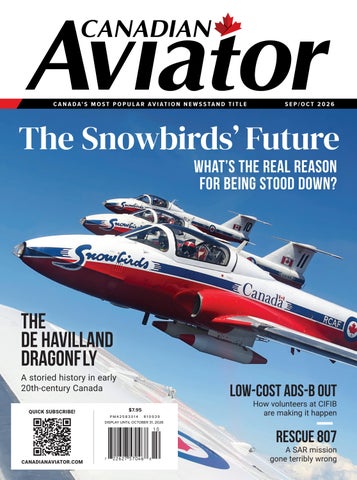
The Snowbirds’ Future WHAT’S THE REAL REASON FOR BEING STOOD DOWN?
The de Havilland Dragonfly A storied history in early 20th-century Canada QUICK SUBSCRIBE!
LOW-COST ADS-B OUT $7.95
PM42583014 R10939 DISPLAY UNTIL OCTOBER 31, 2026
How volunteers at CIFIB are making it happen
RESCUE 807
CANADIANAVIATOR.COM
A SAR mission gone terribly wrong
Cabin Comfort Comfort Cabin
Safe Return™ Return™ Safe Emergency Autoland Emergency Autoland
Personal aviation, elevated. The world’s world’s best-selling, best-selling, high-performance, high-performance, The single-engine piston aircraft, the SR SR Series Series single-engine piston aircraft, the combines revolutionary safety systems, capability combines revolutionary safety systems, capability and comfort comfort in in one one unforgettable unforgettable aircraft. aircraft. and Cirrus Airframe Airframe Cirrus Parachute System®® (CAPS (CAPS®®)) Parachute System
cirrusaircraft.com cirrusaircraft.com
Advanced Avionics Avionics Advanced ©2026 CIRRUS DESIGN CORPORATION D/B/A CIRRUS. ©2026 CIRRUS DESIGN CORPORATION D/B/A CIRRUS.
IN THIS ISSUE SEP/OCT 2026 VOLUME 36 NUMBER 5
ON THE COVER
Renowned Snowbirds photographer Ken Lin, an honorary Snowbird since 2007, captured this stunning photo from on board one of the Tutor jets.
FEATURES
32
Three Aircraft Down in Succession Calamity in Kananaskis Country. By Ed Das
DEPARTMENTS 6 / WAYPOINTS News from the world of aviation
22 / THE PLANE FIXER The best AMEs By Liana Buessecker
10 / GEAR & GADGETS Four aviation products By Aviator staff
24 / EXPERT PILOT Imagine it By Richard Pittet
11 / FLYING STORIES Strange-looking Stranraers By Jack Schofield
27 / PEP TALK Don’t text and fly By Graeme Peppler
12 / INSTRUMENTAL FACTS What’s up with the Snowbirds? By Ed McDonald
14 / RIGHT SEAT Undependable GNSS By Mireille Goyer
16 / TALES FROM THE LAKEVIEW A tail-wheeled wonder By Robert S. Grant
18 / COLE’S NOTES Bush flying in style
28 / WHIRLYBIRD WRITINGS More Somalian adventures By Michael Bellamy
30 / WORDS ABOUT A BOOK Mafia and Fury By René R. Gadacz
50 / BOOKSHELF Top aviation titles
By W.T (Tim) Cole
52 / SERVICE CENTRE Deals and offers
20 / VECTORS Just say no
54 / FLIGHT BAG Puzzle and questions
By Michael Oxner
40
Closing Canada’s ADS-B Gap Volunteers take on what Nav Canada won’t. By Lee Coulman
44
The de Havilland Dragonfly Many were luxury liners in their day. By John Crook CANADIANAVIATOR.COM 3
ROTECH MOTOR LTD. 1-(236)-600-0137 SALES@ROTECHMOTOR.CA ROTECHMOTOR.CA
AUTHORISED ROTAX DISTRIBUTOR
canadianaviator.com editor-in-chief
Steve Drinkwater steve@canadianaviator.com 604.999.2411 associate editor
Robert S. Grant g raphic desig ner
Janice Hildybrant proofreader
Roberta Drinkwater advertising sal es account manag e r
Katherine Kjaer katherine@canadianaviator.com 250.592.5331
FORMULATED FOR THOSE WHO CARE.
director of consumer marketing
Craig Sweetman sub scriptions
Marissa Miller marissa@opmediagroup.ca 1.800.656.7598
XPS AVIATION ENGINE OIL Formulated specifically for Rotax aircraft engines.
Canadian Aviator is published six times a year: Jan/Feb, Mar/Apr, May/Jun, Jul/Aug, Sep/Oct, Nov/Dec
Canadian Aviator Publishing Ltd. PO Box 31071 RPO Luckakuck Chilliwack BC V2R 0C4 Phone: 604.999.2411 canadianaviator.com
CanadianAviatorMedia @canadianaviatormag
QUOTES ON: Cherokee Tanks Fuel Cells & Metal Tanks Repair, overhauled & new Technical Information or Free Fuel Grade Decals
NEW TANKS - 10 YEAR WARRANTY
SUBSCRIPTION HOTLINE
1.800.656.7598 sub scription inquiries admin@canadianaviator.com sub scription rates 1 year (6 issues) $28.00 (Taxes vary by province);
SPECIALIZING IN BEAVER & OTTER FUEL CELLS
MONARCH PREMIUM CAPS Premium Stainless Steel Umbrella Caps for your Cessna 177 through 210 www.hartwigfuelcell.com
info@hartwig-fuelcell.com
editorial sub missions Editorial contributions should be sent to the editor by email in plain text with high-resolution photos attached: steve@canadianaviator.com Printed in Canada. Agreement No. 42583014. Postage paid at Vancouver, B.C. Contents copyright 2026 by Canadian Aviator Publishing Ltd. All rights reserved. ISSN 1492-0255. Return undeliverable Canadian mail to Circulation Department. PO Box 31071 RPO Luckakuck, Chilliwack, BC V2R 0C4. From time to time we make our subscribers’ names available to reputable companies whose products or services we feel may be of interest to you. To be excluded from these mailings, just send us your mailing label with a request to delete your name. Publications Mail Registration No. 10939.
Keeping aircraft in the air since 1952 US: 1-800-843-8033 CDN: 1-800-665-0236 4 CANADIAN AVIATOR SEP/OCT 2026
INTL: 1-204-668-3234 FAX: 1-204-339-3351
50%
WALKAROUND EDITORIAL BY STEVE DRINKWATER
Snowbirds and ADS-B WE ADDRESS TWO PRESSING ISSUES
T
here are two pressing issues that are getting our attention. First, the Snowbirds. As has been announced earlier this year, this is to be the last season of 431 Air Demonstration Squadron’s Snowbirds team this decade. Top figures in both the DND and the RCAF tell the public that this is due to old aircraft, and that we can look forward to a new team flying the CT-157 Siskin II, a Swiss-built turboprop trainer based on the Pilatus PC-21. This is the aircraft chosen to become a new advanced trainer for the RCAF. The plan, as announced by the government, is to resurrect the team in the 2030s. This has been met with dismay by the wider public. However, given the expertise we have in the aviation community, that narrative is being challenged. Former Tutor jet pilot and instructor with the air force and current aviation consultant Ed McDonald
uses his regular Instrumental Facts column (p. 12) to provide us with an insight from someone who knows the actual condition of the fleet of Tutors. Word is that the pause is due to a pilot shortage. Of immense interest to a smaller segment of the population, the GA community, is the issue of ADS-B and how it will be implemented in Canadian Class C, D and E airspace. Nav Canada has been adamant that it will be relying solely on satellite technology which would require 1090ES equipage with antenna diversity (meaning antennae pointing up and down). The most economical solution to meet that requirement in small GA aircraft would set the owner back at least $20,000. This would likely result in many owners deciding that they can no longer afford to fly in airspace other than Class
G, severely reducing the utility of smaller aircraft. That may cause many aircraft owners to give up on recreational flying altogether and probably see the value of their aircraft decline if it cannot fit in to the new airspace requirements. However, there is a much more economical solution that would also improve flight safety for GA pilots. Using a lower-cost, alternative ADS-B system that the U.S. adopted to run parallel to the 1090ES system, referred to as 978UAT, a group of volunteers in Ontario is showing the authorities that there is an alternative that can enhance safety for the GA community. In this month’s feature article on page 40, Lee Coulman explains how Canadian In-Flight Information Broadcasting Association (CIFIB) works and how it could be a viable solution for both Nav Canada and the GA community.
ONE STOP SHOPPING • LOWEST PRICES • SAME DAY SHIPMENT
ALL NEW FREE 2026-2027 CATALOG! CANADIANAVIATOR.COM 5
WAYPOINTS
COMPILED BY AVIATOR STAFF
Cirrus Introduces its TRAC10 Aircraft PISTON-POWERED TRAINING AIRCRAFT MADE ITS DEBUT IN JULY
C
irrus Aircraft of Duluth, Minnesota has revealed is newest aircraft model, a three-place trainer powered by the 160-hp Rotax 916iSc, adding more legitimacy to an engine maker whose line of products was not long ago considered unsuitable for aircraft applications. Cirrus follows on Piper’s initiative of reducing seating in its Piper Pilot 100, which is a training version of its PA-28, from four to three, the thinking being that the front right seat would be occupied by the flight instructor, the front left seat occupied by an advanced flight training student, and the back seat, placed in the centre just behind the pilots’ seats, occupied by a less advanced student, who would learn through observation. In the case of the TRAC10, the single rear seat is somewhat elevated. The TRAC10 comes with Cirrus’s 6 CANADIAN AVIATOR SEP/OCT 2026
CAPS (Cirrus Airframe parachute “Drawing on more than 30 years of System) and is targeting professional designing, building and supporting and college-based flight schools. aircraft worldwide, the TRAC10 is our “The TRAC10 is a complete most deliberate answer yet to what reimagining of the modern training professional flight schools need to aircraft,” said Cirrus president of succeed,” Cirrus CEO Zean Nielsen innovation and said in a press operations Pat Waddick. release. “Our focus “The TRAC10 Cirrus markets the Rotax on safety, efficiency, 916’s low fuel burn of connectivity, and is a complete around six gallons per reliability serves reimagining of the hour at 60 percent power every stakeholder in modern training as a cost-effective feature, the professional pilot aircraft.” and the fact that the training equation — 916 doesn’t like 100LL, we are excited for preferring non-leaded avgas or mogas. students around the world to start The aircraft comes equipped with training in the TRAC10.” Nielson spent Garmin’s state-of-the-art Perspective several years as a Tesla vice-president Core Flight Deck, featuring dual before replacing Cirrus co-founder 11.6-inch touchscreens at the front Dale Klapmeier in June 2019. and a configurable display by the rear The TRAC10 has a starting price of observer’s seat. U$499,999.
Rotax-Powered Carbon Cub UL Crosses Atlantic 6,900 NAUTICAL MILES AND 94.5 HOURS LATER
I
n what surely is a record-setting flight, the owner of a new Carbon Cub UL two-place Light Sport Aircraft (LSA) flew together with a more experienced pilot from Lewiston, Idaho to a grass airstrip in Nowy Targ, Poland. Owner Zbigniew Dziubas and ferry pilot Gabriel Batkiewicz packed immersion suits, life jackets and a life raft into the two-place Cub, which sports a cabin width of only 30 inches. The addition of a belly pod allowed for an extra 25 U.S. gallons (USG) of fuel which, when added to the standard fuel capacity of 44 USG, totalled 69 USG. This stretched the aircraft’s range sufficiently to cover the longest leg of the trip: 695 nautical miles, lasting six hours and 58 minutes. Actual fuel burn on that leg was 41.7 USG. The standard powerplant for the Carbon Cub UL is the turbocharged, FADEC-controlled Rotax 916 iS, rated at 160 horsepower. Average fuel burn was 5.7 to 5.8 USG per hour. Average true airspeed was between 97 and 100 mph, and the enroute altitudes ranged up to 12,000 feet. “I was skeptical of the Rotax engine
before this trip,” said Batkiewicz, “but after flying it across the Atlantic, I’ve completely changed my opinion.” He added, “The aircraft performed exceptionally throughout the entire journey.” CubCrafters’ vice-president of sales and marketing Brad Damm said the flight was an incredible testament to Batkiewicz’s planning, decision-making, and piloting skills. “It’s also an outstanding demonstration of the Carbon Cub UL’s
efficiency, reliability, and capability,” Damm said. As an American LSA, the design maximum takeoff weight was 1,320 lb (600 kg). However, recent rule changes in that country under the MOSAIC program have eliminated that limit. In Canada, it is eligible for registration as an Advanced Ultralight Aircraft (AULA) with a maximum takeoff weight reduced to 1,232 lb (560 kg). The Carbon Cub UL’s price starts at U$293,500.
NEWS The free weekly e-Newsletter from Canadian Aviator is returning. With a fresh look and short, engaging articles on the week’s aviation news, you’ll keep up with the most important developments in the Canadian aviation and aerospace industry. If you are already a subscriber, you should have received the new one by now. If not, subscribe on our website or, easier still, just scan the QR code with your smartphone and you’ll be taken directly to the subscription page.
Subscribe now!
CANADIANAVIATOR.COM 7
WAYPOINTS
COMPILED BY AVIATOR STAFF
NATO Buys SAAB GlobalEye Fleet
SAAB
AEW&C AIRCRAFT BASED ON BOMBARDIER GLOBAL EXPRESS
I
n a press release issued on July 7 at the NATO conference in Ankara, Türkiye, the NATO alliance announced that it will be procuring 10 Saab GlobalEye multirole Airborne Early Warning & Control (AEW&C) aircraft, replacing the existing fleet of three 1960s-era 707-based Boeing E-3 Sentry Airborne Warning and Control System (AWACS). The GlobalEye is based on Bombardier’s Global Express 6000/6500 long range business jet. First taking flight in 2020, five GlobalEye aircraft are already seeing service in the United Arab Emirates. France currently has two on order, with options for an additional two, and Sweden, with three on order and an option for one more. In May of this year, Canada announced it was entering negotiations to purchase six GlobalEye aircraft. Egypt is also at the negotiating stage for a GlobalEye. NATO initially opted for an American aircraft, the Boeing E-7 Wedgetail, based on the 737-NG to replace the 1960s-era Sentry AWACs. Six Wedgetails are in service with Australia (the launch customer), four with South Korea and four with Türkiye. The 8 CANADIAN AVIATOR SEP/OCT 2026
United Kingdom has one in service, with three more on order. However, the United States Air Force announced last year that it was cancelling its planned purchase of 28 Wedgetails and reportedly plans a spacebased monitoring system instead. After the USAF announced its cancellation, NATO followed suit. Although NATO membership comprises 32 countries, only 11 are collaborating on the fleet purchase. These include Belgium, Canada, Denmark, Germany, Latvia, Lithuania, Luxembourg, the Netherlands, Norway, Romania and Sweden. “The GlobalEye system will provide advanced, multi-domain surveillance across air, land and sea from a single platform,” NATO stated in the press release. “It will provide enhanced detection and tracking of complex threats, including drone swarms, ballistic missiles and cruise missiles.” In selecting the Global 6000/6500 jet to base its surveillance systems on, Saab cites several factors, including the aircraft’s ultra-long range and greater than 12 hours of endurance, and its relatively short-field
performance requirement of 6,500 feet. “We are confident that GlobalEye is the right choice for the Alliance, delivering proven capability, adaptability and longterm operational advantage,” Saab’s CEO Micael Johansson said after the NATO announcement. “Today’s announcement clearly positions GlobalEye as the world-leading solution for advanced airborne early warning and control.” Bombardier is happy with the selection of the Global model for military applications. “For years, Bombardier has proudly delivered our Global aircraft to Saab to be transformed into the GlobalEye,” according to its website. “We have the expertise, we have a long-standing and successful relationship with Saab, and we have decades of experience delivering and modifying aircraft for the world’s most demanding missions.” In addition to the six GlobalEye aircraft destined for the RCAF, the federal government recently announced the purchase of a Global 6500 for the National Research Council for critical research and development activities.
BUILDING ENGINES AND RELATIONSHIPS
Visit us in Toronto at the 2026 National Aircraft Maintenance Conference & Skills Challenge November 12 & 13, 2026
GEAR & GADGETS
PRODUCT REVIEWS COMPILED BY AVIATOR STAFF
Flight Simulator
Kneeboard Do you like to use a kneeboard as a holder of different devices, such as a tablet or a smartphone, whether they be Apple or other devices? Then Praguebased Dream Pilot has the solution for you: the Universal Magic Kneeboard. The product is essentially an adjustable elasticized fabric strap that wraps around the pilot’s thigh. Incorporated into the band is a magnetic plate that allows any device to be affixed to it, MagSafe or otherwise. The strap meets the MILSTD-810G-516 standard. About C$54. Learn more at pilotkneeboard.com. Available from aircraftspruce.ca.
Angle of Attack Indicator Lift Management of Fort Lauderdale, Fla offers their Lift Monitor System, an economical solution for determining an aircraft’s angle of attack by using differential air pressure. The indicator can be either panel-mounted or glareshield-mounted and is connected to a wing-mounted probe that is calibrated on the ground by adjusting the probe’s angle. The Lift Monitor System is FAA-approved, requiring a simple logbook entry. About C$593. Learn more at lift-mgt.com. Available at aircraftspruce.ca.
1 0 CANADIAN AVIATOR SEP/OCT 2026
Home-based flight simulators have been proven to aid in acquiring piloting skills. Given the high cost of inflight training, one method of reducing excessive training costs is by investing in a quality flight training device. Not only will you learn valuable skills that can be transferred to a real cockpit, but it will also serve to maintain certain skills even after basic training is finished. Honeycomb Aeronautical, founded in San Diego, offers a three-piece bundle that includes a throttle quadrant, yoke control and rudder pedals that can be configured as a single-engine training aircraft up to a fourengine commercialtype aircraft. About C$1,430. Learn more at, and available from, aircraftspruce.ca.
Chocks Do you find that your aircraft chocks take up considerable room in your cockpit or cabin? Are they bulky or awkward? AirGizmos of Plano, Tex. offers sets of chocks which are stackable, taking up less space than conventional chocks. The sides are made of plastic and have a non-skid base. The chocks are 2" high at one end, rising to 2½" at the other end, and are 8" long. They weigh only 3.2 oz. each. About C$45/pair. Learn more at airgizmos.com. Available from aircraftspruce.ca.
FLYING STORIES HANGAR TALK WITH JACK SCHOFIELD
You Had to Have Been There STRANRAERS WERE INDEED STRANGE LOOKING First published in the Jul/Aug 2019 issue. — Editor
nose of his Stranny. The next time they encountered the U.S. Navy he ordered his co-pilot to go forward and display the sign from the nose hatch of the aircraft. The co-pilot stood up into the slipstream holding the sign over his head. It told the laughing Navy pilot in no uncertain terms to “F… off!” Several years later the Stranny pilot, now a captain with the international carrier Air Canada, was having lunch between flights in a restaurant at New York’s JFK airport. At a table beside him four U.S. Navy pilots from the nearby Annapolis naval base were having a great laugh at a photograph one of them produced as he described that funny flying boat and the event with the sign, which he had caught in his photo. Our Air Canada pilot, overhearing the funny tale, got up and sat down with the Navy pilots and said, “I am about to tell you something even funnier…”.
The British-built Stranraer flying boat was a rag-wing biplane designed in 1930. It was powered by two Bristol Pegasus sleeve-valve engines. During the Second World War they were used to patrol along the British Columbia coast where Japanese submarines made regular visits. This one is parked on the ramp at RCAF Station Jericho Beach in Vancouver.
JETS & PROPS VIA FACEBOOK
I
mmediately following the end of the Second World War the Royal Canadian Air Force (RCAF) sold off or scrapped a lot of its fleet of coastal reconnaissance bombers. Among the first to go were the Supermarine Stranraers, a ragwing biplane designed in the 1930s by R. J. Mitchell, who later redeemed himself by designing the Spitfire. Four of these retired old aircraft were put to work by a 1945 start-up airline called Queen Charlotte Airlines (QCA). These 90-mph airplanes commenced plying the British Columbia coast on a scheduled service, flying into the many little communities along the coast from Vancouver to Prince Rupert in the north. Many funny stories were told of the old flying boats as they became beloved by those who flew them or flew in them. Known as the ‘Stranny,’
and a few other rude names, the aircraft were likened to Vancouver’s old Granville Street Bridge because of their many struts and flying wires, but their crews were fiercely proud of them and became very defensive of their reputation for safety and dependability. The funniest story that emerged from this history involved the United States Navy carrier pilots based on Whidbey Island, just south of the U.S.-Canada border. These jet pilots developed a habit of dropping their dive brakes, lowering their gear, getting slow and dirty in order to fly alongside those 90-mile-an-hour old flying boats, waving and snapping photographs to show their friends this crazy old anachronism that QCA were flying. The QCA pilots were getting tired of this treatment and one of them decided to let the Navy guys know about it. He made a sign out of plywood and stowed it in the rope locker in the
CANADIANAVIATOR.COM 1 1
INSTRUMENTAL FACTS FLYING IFR WITH ED McDONALD
The Imminent Grounding of the RCAF Snowbirds WHAT’S THE REAL REASON FOR THIS?
C
anadians, airshow fans across North America, and Canadian culture and heritage received an unexpected body blow in May when the Minister of National Defence (Honourable David McGuintey) and the Commander of the RCAF (Lieutenant-General Jamie Speiser-Blanchet) announced the termination of 431 (Air Demonstration) Squadron, the Snowbirds, at the end of the 2026 season with a projected rejuvenation sometime in the 2030s. This is a highly unlikely proposition. At the news conference, LGen SpeiserBlanchet claimed that the grounding is due to “engineering studies.” In a recent interview with Canadian Defence Review, the issue of the ejection seats and engines were cited as the reasons for this action. Let’s explore each of these and the state of the Canadair CT-114 Tutor jet in general. 1 2 CANADIAN AVIATOR SEP/OCT 2026
There is no doubt that these aircraft are old, with the last of 190 Tutors coming off the assembly line in September 1966. Flying old aircraft, when properly maintained and monitored, is not unusual. Witness all the Second World War-era Spitfires, Mustangs, Harvards and others that are still flying today, not to mention our famous Lancaster bomber. In the United States, the Boeing B-52 Stratofortress strategic bomber is undergoing a life extension to 2050, making it a century old aircraft; some 500 Northrop T-38 Talon advanced supersonic jet trainers are still in use, and they are older than the Tutor. Indeed, budding RCAF fighter pilots are training on those aircraft today in the U.S. The notion that age is a determinate of the safety and longevity of an aircraft is nonsensical.
Above: The first of the RCAF’s new CT-157 Siskin II turboprop trainers, No. 201, undergoing acceptance trials in Switzerland. Based on the Swissmade Pilatus PC-21, it will serve the air force as an advanced training aircraft. The RCAF has announced that this aircraft model will be used as the next Snowbirds when the air demonstration team is resurrected in the 2030s.
Twenty Snowbird Tutor jets have been undergoing a $30 million avionics modernization program, replacing the original analog instrument panel with modern glass digital instruments, a welcome improvement. Prior to this investment, each and every airframe underwent an Estimated Life Expectancy (ELS) analysis which considers the state of the airframe, engines, avionics, parts, etc. This study determined that the Tutor jet could be flown to at least 2030 with an avionics upgrade. Included in this study is the state of the General Electric J85-CAN-40 engine powering the aircraft. This engine is the same engine (with an added afterburner) powering the American T-38s. It is expertly maintained by Magellan Aerospace and, with the avionics upgrade, has data logging of
“These two issues — the engines and ejection seat — do not justify terminating one of the few Canadian icons left.”
the engine parameters for performance monitoring. In addition to the engines being electronically monitored, so too is the airframe with a fatigue life management program supported by L3Harris in Montreal, likely descendants of the original Canadair engineering support provided to the aircraft. In terms of the ejection seat, yes, it is not the latest and greatest. However, it is the same, basic seat that thousands of RCAF pilots earned their wings on
and in which many pilots, me included, flew thousands of hours. Yet somehow today it is no longer considered safe. These two issues — the engines and ejection seat — do not justify terminating one of the few Canadian icons left. The Snowbirds deserve better, and so do Canadians! As a taxpayer, this decision troubles me as well. The $30 million avionics upgrade was approved when defence spending was tight, 1.4 percent of GDP. And this is now being flushed down the toilet by grounding 20 perfectly serviceable Tutor jets that can be safely flown by the Snowbirds until a replacement aircraft is available. If the RCAF is prepared to waste money during a period of austerity, how can it be trusted to be stewards of our tax dollars when defence spending is two percent and growing?
INTRODUCING THE
UPGRADED
DA50 RG The DA50 RG is here, with carefully crafted enhancements inside and out that elevate the flying experience and improve everyday usability.
See the next evolution of the DA50 RG DiamondAircraft.com | 1-800-268-4001
CANADIANAVIATOR.COM 1 3
RIGHT SEAT ALWAYS LEARNING WITH MIREILLE GOYER
Overreliance on Satellite Navigation BAD ACTORS COULD LEAVE US STRANDED IN THE AIR
T
he first time I experienced a Global Navigation Satellite System (GNSS) signal failure was in a Piper Cheyenne on the way back from Oshkosh, Wisconsin. Out of the blue, the airplane began an uncommanded roll to the left. We were cruising on autopilot navigation mode fed by GNSS signals at the time. Shortly after regaining control and switching to the wing leveller function, the GNSS signal came back. No sweat. But we were not in the midst of shooting a GNSS approach in hard IMC either. I do not know what caused the problem. There were no GNSS outage NOTAMs issued for our route, and we
The four Global Navigation Satellite Systems providing global coverage.
1 4 CANADIAN AVIATOR SEP/OCT 2026
were cruising well above any terrain. However, like all GNSS pilots, I was aware of the weaknesses of the system at the time — satellite signals that are easy to jam, line-of-sight restrictions, and limited satellite availability. Today, satellite availability is no longer an issue. Four different systems — GLONASS (Russia), Galileo (Europe), BeiDou (China), and GPS (United States) — make it possible for multisystem receivers to pick and choose the most suitable signals from up to 50 satellites throughout the world. That abundance also addresses many line-of-sight issues, as it is normally possible to “see” multiple
satellites even in canyons. But one key weakness remains: jammable signals. And a new one has emerged: spoofable data. These two issues have grown worrisome enough that new technologies are emerging to augment or potentially replace GNSS. So, what is happening, and what is a pilot to do until help arrives? First, it is critical to understand that when GNSS signal quality deteriorates, a backup GNSS receiver or tablet is not a viable option. An alternate navigation source is the only solution. As NDBs and VORs disappear, the alternates are limited. For airliners and other high-end aircraft, using the inertial
navigation system (INS) is the standard alternative. For the rest of us, the best alternate is radar vectors when available, especially in instrument conditions where visual navigation is not possible. Dead reckoning still works for both visual and instrument flights. Keeping the heading bug synched to the GNSS track provides an adequate initial direction reference should all GNSS providers quit or become unreliable. As challenging as switching navigation methods on the fly can be, it turns out that the main challenge is often detecting that there is a problem, especially when dealing with spoofing. In case of jamming (bad or no GNSS signal), aircraft equipped with Receiver Autonomous Integrity Monitoring (RAIM) will systematically post alerts in case of system degradation. RAIM’s job is literally to check for appropriate GNSS quality (number of satellites and quality of signal) for the type of operation. Other receivers will also lose navigational information if all signals are blocked, but they may continue to provide unreliable information when GNSS is only degraded. Bad information is worse than no information. Spoofing, on the other hand, consists of feeding GNSS receivers with bad information that looks like good information. The false signal may closely resemble an authentic GNSS signal and offer what appears to be a correct code structure, but with altered location or timing data. Often, when the false signal is stronger than the authentic GNSS signal, the aircraft receiver accepts the false signal as genuine. The result is an erroneous aircraft position, i.e., a “spoofed” position. In the effort to return to the set track, the aircraft will deviate from its original path. If the receiver is fooled by a false signal, so is RAIM. There will be no RAIM alerts in case of spoofing. However, jamming could precede spoofing to block real signals before replacing them with fake signals. Monitor everything carefully after a
RAIM alert in areas with no planned GNSS issues. GNSS signal interference often leads to abnormal differences between Ground Speed and True Airspeed, time and date shifts (check against an analog clock/watch), spurious TAWS (Terrain Awareness and Warning System) alerts, and of course, disagreement in navigation position, such as GNSS/FMS (Flight Management System) position alerts. Jamming and spoofing negatively affect more than basic navigation. Modern terrain, weather, and traffic avoidance systems rely on GNSS. Any data transmitted within the GNSS signal, such as time and satellite position corrections, is no longer available. Lost or spoofed GNSS signals create a major emergency. The loss of multiple systems at once makes figuring out what is going on more challenging. The mental workload is significant. The best approach is to simplify. Pick a heading. Reach a proper altitude. Request a radar position from ATC. Given the complexity and the gravity of such a situation, it is not surprising that one of the newest technologies, Sensor Fusion — already implemented on many military aircraft and some airliners — leverages Artificial Intelligence (AI) to monitor sensor input holistically and detect dysfunctions. Some emerging navigation technologies compare visual camera observations to saved digital maps to determine position, while others use celestial observations or the Earth’s magnetic fields to identify the aircraft’s location. Looking ahead, a Quantum Inertial Navigation System (INS) will virtually eliminate the few limitations of existing INS units. In today’s world, losing GNSS causes major disruptions. That makes the idea of disrupting GNSS attractive to some. In aviation, losing GNSS can lead to a deadly accident. Until we can fully delegate sensor monitoring and error detection to Artificial Intelligence, a knowledgeable and vigilant pilot remains the best defense.
DO YOU FOLLOW US ON INSTAGRAM? Get great article suggestions and post alerts when new issues become available.
CANADIANAVIATOR.COM
CANADIANAVIATOR.COM 1 5
TALES FROM THE LAKEVIEW BUSH FLYING WITH ROBERT S. GRANT
Beechcraft’s Tail-Wheeled Wonder CANADA’S MILITARY IMPORTED OVER 400, WITH MANY ENDING UP IN CIVILIAN DUTY
S
chool children blasted through the doors of their yellow school bus and skidded onto the pristine floors of Sault Ste. Marie’s Canadian Bushplane Heritage Centre. Several held back to admire a Beechcraft Model 18 displayed on a pedestal before the entrance doors. Registered CF-UWE, the aircraft’s unusual aluminum alloy, brass and steel landing gear consisted of rare Bristol Model 5100 retractable wheel-skis. Canada’s first Beechcraft flew with Starratt Airways of Hudson, 15 miles west of Sioux Lookout, Ontario, and conventional ‘straight’ skis manufactured by Canadian Vickers in Montreal. In cruise, the state-of-the-art twin indicated 180 mph above what an 18th century nature writer called “lakes re-
posing in gratitude.” The arrangement weighed 581 lbs. Takeoffs needed 700 feet. American manufacturer Federal Aircraft Minneapolis of Minneapolis, Minnesota fitted Beech 18s with retractable wheel-skis for Alaskan service and Orville Wieben of Thunder Bay’s Superior Airways/Severn Enterprises developed modified fixed-down de Havilland DHC-3 Otter ‘boards,’ as pilots nicknamed them. Museum collections often include Beech 18s. More than 9,000 flew from the Wichita, Kansas, factory from 1937 until 1970, but none survived as skiequipped exhibits. Winnipeg’s Bristol Aerospace marketed complicated wheel-ski arrangements for air services in Canada’s worlds of wilderness. The company prototype flew attached to
leased Beechcraft C-45H Expeditor CF-OWU-X on December 28, 1963, with test pilots Edward H. Birnie and D. Hennigar. Project engineer H.H. Kristiansen rode along as part of the team. The aircraft weighed 7,138 pounds, including 401 pounds of main skis, tail ski with pumps, lines and brackets. Cautious and wise in the regime of test flying, they also carried 85 pounds of parachutes and harnesses. The crew tested the “Twin-Tailed Wonder” through 1.5-foot snowdrifts as well as several hard-surfaced airports. During one flight, skis ceased retracting 10 inches from cycle completion and circuit breakers popped. Before landing at Winnipeg, a malfunctioning wheels-down indicator forced Birnie to activate an emergency hydraulic double-action hand pump.
ROBERT S. GRANT
Winnipeg-based Transair utilized CF-TAV on wheel-skis to serve Indigenous communities such as Norway House or Island Lake.
1 6 CANADIAN AVIATOR SEP/OCT 2026
ROBERT S. GRANT
During the 25-hour test program, vibration, loose eyebolts and scrubbed tires entered the picture. Designers replaced rubber bungees of the retraction mechanism with a helical metal spring and cable-drum apparatus. Birnie entered 257-mph-dives and reported no differing trim changes or handling methods than a standard Beech, until sprocket failure led to a belly landing on the 13th flight. A summary pointed out that emergencies could be carried out “…with only minor damage to the aircraft and no injuries to the occupants.” After the landing mishap, Bristol’s engineering department replaced CFOWU-X’s propellers and flaps, repaired engine nacelles and research continued. The test team recorded 79.5 mph stalling speeds at 9,200 pounds with the 47.5foot wings and a peculiar “oil-canning” sound at 84 mph with flaps 45° and gear down. They concluded that the spiral spring cable functioned as well as the bungees of land-configured Beech 18s. Department of Transport Inspectors demanded their own tests. Deemed “satisfactory,” Bristol Aerospace Model 5100 retractable wheel-skis entered service with organizations such as Winnipeg’s Transair, Yellowknife’s Northwest Territorial Airways and Quebec’s Wheeler-Northland Airways. One 1951 ex-RCAF version declared surplus in September 1964 carried registration CF-RRE for Roberval, Quebec-based St. Felicien Air Services. Considered durable enough to handle the northern region’s bleak rock-covered terrain, CF-RRE proved its mettle until a wheels-up event at Fort Chimo (now Kuujjuaq) on Ungava Bay in Northern Quebec. Reports explained that the incident could not be attributed entirely to Bristol’s wheel-skis. An employee neglected to secure pulleys to the wing’s truss cluster which allowed brackets to twist and chafe the metal. When breakage occurred, the rear section of the skis dropped with the raised undercarriage. Other problems included malfunctioning down locks and persistent circuit breaker issues. Most wilderness pilots experienced in Beech 18s flew the type on non-retract-
able skis with fish tubs as common cargo. Legendary “driver” Hartley Weston of Red Lake, Ontario considered his first exposure to Beech 18s as a “revelation.” In central Manitoba’s spruce and pine woodlands, loaders miscalculated cargo weight during a panic to depart before incoming snowstorms overwhelmed their camp. “I usually got off with no trouble. This time, we just hopped along for a couple miles, and I wondered what the hell’s the matter today,” Weston recalled. “I got balls to the wall, just staggering knowing the general direction of the bloody lake. Didn’t dare pull power back. Just dropped a little more flap when all of a sudden, wummph! we landed and hoped I was going the right way. Speed? Who had time to look at airspeed? It was strictly by instinct, by the hind end and feel.” Bristol Aerospace expected their product to reduce hazards and stress, such as Weston and his colleagues lived with. Now, pilots could deliver directly to airports. The concept appeared sound. Bristol claimed the eight-foot wheel-skis underneath the 450-hp Pratt & Whitney R-985 engines barely effected airspeed. Parka-wrapped, frozen-fingered pilots did not concur. In theory, fewer landings on soggy lakes or airframe-rattling ice reduced maintenance costs. Less time digging aircraft from frozen slush or deep snow meant more fish tubs and reduced inhaling “unnameable abominations” i.e., fish slime seeping into seat tracks. A February 13, 1969, list suggested cautious air service managers did not buy into the complex retractable wheel-skis. Only
Above: Believed to have arrived at Sault Ste. Marie’s Canadian Bushplane Heritage Centre in 2002, Beech 18 CF-UWE was released from the RCAF in 1966. Available information does not include details on usage of rare Bristol Model 5100 retractable wheel-skis.
nine pairs left Winnipeg. Weston, in his forthright style, explained the “terrible problem.” “They were nothing but grief. It was the stupidest setup in history. If you’re taking off in loose snow, here’s all this snow blowing around, getting into everything, eh?” he said. “Now you got all this heat coming back from the engine, melting snow on the cables — instant freeze. So, you go to retract the things and you hear the clutch go ‘boom.’ Every night you had to take the Herman [heater], put heat in there and melt everything out.” Weston added that the retraction unit, similar to a common garage door opener, could not raise the heavy skis, so pilots often left them down and suffered drag penalties. He admitted a preference for non-complicated units common with commercial air service owners. Nevertheless, Bristol demonstrated Canadian resourcefulness. By 1966, the same principles had produced 55 Winnipeg-built sets for de Havilland DHC-6 Twin Otters. Canadian Bushplane Heritage Centre visitors such as fascinated schoolchildren staring at what a Beech aficionado called an example of “clear genetic loveliness” should consider themselves fortunate. They stood within the presence of bush flying history. CANADIANAVIATOR.COM 1 7
COLE’S NOTES CAREER HIGHLIGHTS WITH W.T. (TIM) COLE
Catering to the Rich and Famous THIS BUSH PILOT DINED WITH SILVERWARE AND WHITE LINEN
1 8 CANADIAN AVIATOR SEP/OCT 2026
PHOTOS COURTESY THE COLE COLLECTION
I
worked for Laurentian Air Services main areas of operation were Western stated goals was to promote air tourism. (LAS) from 1967 until 1974 as a pilot Quebec and the Ungava Region of This was a very successful venture, and and, for a couple of years, as the chief northern Quebec and Labrador. They their target area was the lake areas in pilot. LAS was established in 1936 as started out with a de Havilland DH.80A the Laurentians north of Ottawa and, Ottawa’s first commercial air service. Puss Moth and a Waco Standard Cabin to some extent, Montreal. Their main The founding members were A. Barnet YKS-6. The latter was operated on floats genteel clientele was drawn from the Maclaren and Walter Deisher. Both men and skis. eastern United States. The rich and were members of the Ottawa Flying During the life of the company, they famous, movie stars, politicians and Club, which operated the Uplands Aerooperated a wide range of types, and captains of industry were their regular drome. In 1937 Laurentian purchased large numbers of aircraft. They were patrons. Quebec’s Laurentian hills and the site and made considerable improveone of the first operators of the de lake districts were home to the private ments to the rough field conditions that Havilland Beaver and owned, either reserves of many of these wealthy would allow an airport licence to be through the main company or one customers. Laurentian offered these issued. The next year the clients a premium service Department of Transport that not only included purchased the airport from air transportation, but Laurentian for the sum of also satisfied their every $37,500. need, including catering The company retained services that were already their hangar site on a longon board the aircraft term lease arrangement for when they arrived. These many years at a cost of $1 a included their preferred year. The airport expanded groceries, Canadian and is now CYOW, the cheeses, Canadian back Ottawa/Macdonald–Cartier bacon, Canadian whisky, International Airport. their home newspapers Deisher sold his shares and any other personal and Maclaren went on to needs. Checking out on operate the company until the aircraft was the easy Laurentian Air Services’ eight passenger, G21A Grumman Goose. the 1960s, when he sold out part. Checking out on the to his nephew John Bogie, various individual client’s who operated the company until the of their subsidiaries, more Beavers needs was the hard part. mid 1990s. The company was officially than any organization other than de The amphibious Grumman Goose, dissolved in 2004. Havilland and the US Army. They also CF-BXR, played a prominent role in In its over 60 years of operation the operated Otters, Twin Otters, DC3s, this service. We would be waiting at the company had a wide range of activities. Beechcraft, Piper and Cessna aircraft, main terminal for the arrival of our VIP These included charter services, contract and several other types. They were the clients, either by the scheduled airlines services, scheduled services, aircraft first Canadian commercial operator of or by their private corporate aircraft. maintenance, engine overhaul, aircraft the G-21A Grumman Goose amphibian. These were the days prior to stringent sales (including a Cessna dealership), (For a full history of this wonderful old airport security and both private and and outfitting services for hunting and company, I recommend the book For commercial aircraft were allowed to fishing operations. When the company the Love of Flying, by Danielle Metcalfeutilize the apron in front of the terminal. was formed, the purpose was to support Chenail). We even had access to the baggage forestry and mining operations. When Wilderness bush operations were carousels. This would be unheard of I worked for them, they had bases in the company’s forte and is the subject in today’s airport security-conscious Ottawa, Maniwaki, Lac-des-Loups, of other stories. However, when they environment. When the Goose was Schefferville and Labrador City. The started out in the 1930s, one of their not available, our clients would be
Laurentian Air Services’ eightpassenger, G21A Grumman Goose
transported nine miles across the city to the company’s seaplane base at Rockcliffe, on the Ottawa River, where they would be flown out in one of our floatplanes. On arrival at their lakeside destination, the client’s stay was not one of roughing it in the Canadian wilderness, but most often consisted of a lodge-type atmosphere that usually included at least the minimum of a cook and a resident caretaker or guide. One of these locations that comes to my mind was Lac-Désert, situated about 90 miles to the northwest of Ottawa and about 20 miles west of Maniwaki, Quebec. It was owned by a family who operated a large forestry operation in Kentucky. It was what I would imagine an old-time southern plantation was like. Lac-Désert was a large lake with sandy beaches in front of what was essentially a little village of log structures scattered amongst the large white pines. A two-storey lodge that
“On arrival at their lakeside destination, the client’s stay was not one of roughing it in the Canadian wilderness, but most often consisted of a lodge-type atmosphere that usually included at least the minimum of a cook and a resident caretaker or guide.”
had a central open fireplace that could accommodate logs for firewood was surrounded by upstairs rooms that had a balcony that looked down on the lounge area. Off to one side was a large dining room that was set with the finest linens, silverware, chinaware and crystal accoutrements. Other outbuildings consisted of a cookhouse, boathouses, workshops, staff housing, a chapel with an organ. There may have even been a little school house, too. It was a wonderful setting and an example of many of the other sites that we served in the area.
I remember one site owned by a New York City tycoon which had a little inclined elevator, so he did not have to walk up the hill from the dock to the main house. It was heady stuff for a 23-year-old seaplane pilot to be referred to as “Captain” and to dine and rub elbows with the rich and famous. It was a different and more genteel time when pomp and ceremony was adhered to even in a wilderness setting. These are now fond memories of an old timer of days long gone by. May you have tight floats and tailwinds. CANADIANAVIATOR.COM 1 9
VECTORS ATC VIEWPOINT WITH MICHAEL OXNER
When to “Just Say No” to ATC
NAV CANADA
WE OFTEN SAY “NO,” BUT THERE ARE TIMES YOU CAN, TOO
I
n a recent issue of this fine publication, one of my colleagues mentioned what he believed was the most important word in aviation. That word was, “No”. It made me think of a few aspects related to the ATC side of things. Strictly from within the job itself, it’s notable that this philosophy can be applied. Most controllers take pride in their work and don’t want to delay aircraft unreasonably, or even at all, if it can be helped. We have rules that we’re required to apply, and sometimes it goes beyond judgment to the point where we have no choice but to deny a clearance because of those rules. But what if it is related to a judgment call? It could be something so simple as an aircraft enroute that wants an altitude change. The controller sees converging traffic, and the lateral spacing 2 0 CANADIAN AVIATOR SEP/OCT 2026
between the two aircraft is very close. The controller feels it’s better to not permit the altitude change at that moment, and it’s not worth vectoring either (or both) to increase the spacing to permit the change safely as they’ll pass shortly anyway. This is a simple case where the controller says, “No,” to a pilot. Similarly, at a lower-volume airport, weather and traffic may permit using more than one runway. The controller may see two aircraft wishing to use the opposite ends of the same runway. Saying, “Yes,” might be possible if they’re far enough apart, and saying, “No,” may be obvious when they’re going to be on final for their respective ends at exactly the same time. But the grey area in between, when they’re close but not too close, might still warrant a safer call. “No,” may be the answer.
Controllers are generally trained not to “stick their neck out.” This can be seen as self-preservation. After all, who wants to be sitting in a chair being confronted by anyone that didn’t appreciate how the operation was run. But at the same time, safety of aviation operations under their jurisdiction is the primary concern for controllers everywhere. Efficiency must be considered, but it must be a secondary consideration. For a new controller, learning when to say, “No,” to a pilot is an important part of the training, and ongoing growth after licensing. Back to the cockpit. Let’s say a controller issues an instruction that the pilot doesn’t agree with or want to perform. How should the pilot handle that? The answer brings us back to the concept of saying, “No.” There is a
little more to it, obviously. Controllers are tasked with keeping the skies safe and keeping aircraft moving to their goals. As they watch their traffic pictures change, they see opportunities to move aircraft, and they see things that need to occur to keep things moving. For example, a pilot taxiing out for departure is holding short of the runway. The airport controller sees an opportunity to get the aircraft in the air ahead of an arriving aircraft, and asks the pilot, “Are you able an immediate?” I’m sure most pilots know what this means: Once the clearance for an “immediate takeoff” is accepted, the pilot must move onto the runway, line up for takeoff, and commence the takeoff roll without stopping and without delay. If, for whatever reason, the pilot or someone else on board isn’t ready, or just doesn’t want to, the pilot can
refuse this operation. Of course, the phraseology for it goes beyond, “No.” Any time a pilot refuses a clearance or instruction from ATC, the reason for refusal should be stated as soon as possible so the controller may take alternative action. In this case, it may be so simple as, “Alpha Bravo Charlie unable, I’m not ready.” Similarly, in the air, if a pilot is asked to climb, but that action would take the aircraft into cloud, perhaps into known icing, the pilot can say, “I’m unable to climb due to cloud.” The controller will have to resort to Plan B, but at least the reason is known, and now other action can be taken, such as turning your aircraft or the other one. Also, this information can be used by the controller to anticipate actions for subsequent flights. Of course, any action assigned by ATC that puts the aircraft in a haz-
ardous situation must be refused. Controllers are not always aware of everything that is out there, such as traffic you may see out the window that isn’t showing up on ATC surveillance systems, or weather conditions such as squalls or other localized phenomena that you’d rather avoid. Perhaps a vector issued by ATC for traffic points you right at a cumulonimbus cloud the controller is not aware of. Controllers certainly don’t want to put you into that kind of condition and would not do so if they knew about it. In any case, if the right answer is, “No,” then stand by it. Refusal of an ATC instruction is a serious matter and must not be taken lightly. You must have a good reason for refusal. But no controller wants the matter to become more serious. Safety is our primary concern, and if you say, “No,” with a good reason, we’ll take it seriously, too.
CANADIANAVIATOR.COM 2 1
THE PLANE FIXER SWINGING WRENCHES WITH LIANA BUESSECKER
Judging AMEs THEY CAME FROM ACROSS CANADA TO COMPETE
A
t this year’s Alberta Aviation Aerospace and Defence Summit, held at the Edmonton Convention Centre, I had the privilege of being a judge for the AME Skills Competition. This year marks the third annual event, organized by fellow SAIT alumna Cassandra Derks, a mentor with Elevate Aviation and the company’s AME Competition Coordinator, along with Nicole Noseworthy, the director of flight operations at Integrated Sensing & Surveillance Inc. The Skills Competition this year saw four teams compete through two days, completing a total of 12 different challenges for a total of 31 times. Teams drilled and installed rivets, lock-wired bolts, replaced engine components, inspected windows, wrote safety exams, and more. 2 2 CANADIAN AVIATOR SEP/OCT 2026
Judges came from a variety of professional backgrounds, not solely aviation, grading on skill, teamwork and efficiency. Both licensed AMEs and apprentices participated, and teams came from around the country, including a group from the RCAF. Lufthansa Technik operated an engine borescope challenge, and the partnership Aircraft Fabric Covering with 2 Canadians provided a unique experience for some old school techniques not seen on most modern aircraft. Flight school General Lee Aviation supplied a fuselage and wing for the competition, which was a highlight for both spectators and contestants. Rarely does the wider public get up-close access to the remnants of an aircraft that has been written off, and having the opportu-
Some of the competitors pose for a group photo. (Photo submitted.)
nity to watch AMEs in action is truly inspiring. I oversaw the Wing Structure Challenge where competitors were given 30 minutes to drill out the existing rivets on the trailing edge of the wing, clean and inspect the holes, and install new rivets using a hand squeezer. This is a basic exercise that is taught in school to both mechanic and structure students. However, for many mechanics, this might be the first and last time they ever perform such an activity, depending on what company they work for. For the challenge, some competitors went for speed, replacing as many rivets as they could in their limited time. Oth-
A member of the military’s technician team demonstrates his riveting skills.
ers aimed for precision, completing less but with better results. In real life scenarios, this is a fine line to balance. Companies and management always want aircraft to be grounded for as little time as possible, but never at the risk of compromising safety. Earlier this year my own riveting ability was tested during an aircrafton-ground situation when a ski began to separate. Up until this point in my career, the requirement for me to perform structural tasks was few and far between. This specific event was at the forefront of my judging during the competition: as someone with almost 10 years industry experience, I was holding the competitors to the standards of AC43.13 — not the standards I hold for myself, which may be slightly higher. Some of the AMEs asked for feedback and we discussed why their rivets didn’t turn out the way they’d hoped, and what they could’ve done differently. It reminded me of one of the many reasons I chose this industry and this role. Not just because airplanes are cool and I enjoy sharing that excitement and enthusiasm with others who feel the same, but because
aviation is such a large part of life itself. It affects and influences every person I know, in some way or another. And as an avid traveller myself, I never want to get on a plane and question my safety. As mentioned earlier, the summit and competition ran over two days. In the final hour, the top three teams were awarded medals. The RCAF came in first place, the Elevate team comprised fully of woman was second, and a team called Bell Cranks placed third. The top female and top male competitors, both apprentices, received fully funded endorsement courses courtesy of Flightline Training Services, and everyone took home bragging rights. The purpose of the event is to promote the industry and highlight the different roles involved in maintenance. It isn’t just a friendly contest, it’s about learning from each other, making lasting connections, and finding ways — no matter how small — to better aviation in its entirety. Cassandra and Nicole, along with the support of General Lee Aviation, Heavy Aero, and countless other companies and volunteers, have done something really incredible. Multiple grade schools were brought through
the event where students had the opportunity to explore potential career options and learn more about how to turn their dreams into realities. Elevate Aviation recently launched an app called “Echo,” connecting people in the industry throughout Canada. Those looking for mentorship are able to match with a professional who can help guide them through every step of their journey, from finding schools and scholarships to job interview preparation. It’s a fantastic resource; one I wish had been available to me when I first began. What’s my advice for anyone who is just beginning, whether you’re a teenager preparing for university or an adult making a career change? It seems cliché and overused, but networking is crucial. Aviation is somehow a small world, everyone knows someone somewhere, and that could make or break you. I’ve sent an online message to a complete stranger simply because I read their name somewhere, and that relationship has turned into one of the most important ones of my career. We might all be applying to the same jobs, but everyone in this industry is wholesome, we all just want to see each other succeed.
CANADIANAVIATOR.COM 2 3
EXPERT PILOT FLY LIKE A PRO WITH RICHARD PITTET
The Power of Visualization
W
hen I was a starving university student with no access to airplanes apart from flying club rentals, I was steadfastly determined to maintain my multi-engine instrument rating. Should any airline call, I was then sure to be ready and current. Accordingly, I dutifully set aside the finances for one multi-engine IFR training flight prior to my annual instrument check ride. Added to that, I allocated just barely enough cash to cover the twin rental required for the flight test itself. This was during a time when instrument ratings had a “best before” date of one year, and renewal rides were conducted by actual Transport Canada Inspectors. Being of average flying abilities (never mind limited finances), I came to rely heavily on a training method known simply as “Chair Flying.” The basis of this practice skill required you to literally sit with your eyes closed, then visualize the manoeuvres and procedures for every phase of flight. I’d usually start with ground handling, then progress to the takeoff. Next were level-off checks, going so far as to copy an imaginary ATIS. Then came tuning and identifying navigation aids while on imaginary vectors, even visualizing the Piper Seminole’s “steam gauges,” and the expected forces on the control column during configuration changes. In a similar fashion, engine-out drills were practised dozens of times in that old, tired recliner, as were missed approaches. Even the bane of my existence, the dreaded non-standard, fixed card NDB hold was fair game. 2 4 CANADIAN AVIATOR SEP/OCT 2026
Remarkably, the method never failed me. In the end, the many hours I spent practising in that same La-Z-Boy turned out to be enough to get me through my varsity years and the aviation drought better known as the 1980s. It was only years later that I came to realize that where training was concerned, I was
onto something. More than just a simple but effective “hack,” the powers of visualization in flight training began to be more and more apparent as my experience as an instructor in the RCAF grew. While attending the Gatineau air show a few years ago, I stood quietly in a corner of the spectacular Vintage Wings hangar, watching a well-known formation aerobatic team literally walk through their routine. The Team Lead
called out manoeuvres, like “Pitching Up,” and “Rolling Left.” Unaware I was observing, they blocked out their entire show routine on a cement hangar floor; eyes closed, hands moving, bodies leaning as if they were seated in their actual aircraft. More than just a reprieve from the cold and the pounding rain that day, I was reminded just how powerful a tool visualization could be. It turned out even these guys used it. The significance of what they were doing was not lost on me. While instructing and conducting evaluations in Air Canada’s Boeing 787 simulator in Vancouver, I too relied heavily on visualization as a teaching aid. It is a method that allows students to progress more easily through some of the difficult exercises required to successfully earn a type rating. Before attempting any new complex manoeuvre, the questions of “What will you literally see?” followed by “What will you do?” are thoroughly explored. Most heavy jet crews will agree that the most challenging manoeuvre to master in any airliner is a go-around combined with an engine fire leading to a power loss. It is a low-energy, low-airspeed handling problem, made even more difficult by asymmetric thrust effects requiring immediate configuration changes and emergency drills. Add to that a crew still being required to comply with missed approach instructions or clearance. The literal onslaught of multi-coloured symbols, speed and flight path vector data, plus the assorted warnings that modern airliners provide crews with can make the manoeuvre even more challenging.
IMAGE AI GENERATED
ANTICIPATE AND PREPARE FOR EVENTS BEFORE THEY HAPPEN
The crews I observe that seem to handle this exercise with apparent ease might at first appear to have an ability to slow time. I instead see them as pilots who have learned how to use visualization with a high degree of effectiveness. They know exactly what attitude to pitch the airplane to, and as importantly, they can literally “see” the desired outcome before actually executing the manoeuvre. All this done amidst the chaos of warning lights flashing and alarm bells ringing. They are able to visualize both the problem and the solution, which no amount of repetitive training alone can achieve. It is the ultimate demonstration of Level 3 situational awareness, played out in real time. Visualization also has great application in general aviation, specifically for those pilots engaged in basic training and for those wishing to advance beyond simply being “good enough”. Pri-
or to a flight, be it training or a leg flown in challenging crosswinds, visualize all aspects of aircraft handling in the flight conditions you expect to encounter. Begin with engine start; what sounds and indications are you expecting to hear and see? On application of takeoff power, anticipate and compensate for the swing of the nose due to P-factor before it happens. During crosswind conditions, visualize the control inputs needed to stay centred on the runway. If flying a new type, take a mental snapshot of your takeoff attitude. It will closely approximate what you will see seconds before touchdown. Strive to unlearn the “40-foot stare,” a useless gaze that focuses our attention on a focal plane just beyond an aircraft’s nose. Instead, look with purpose and imagine; visualize what you are actually looking to see or avoid. During circuit work, pay more attention to your de-
sired ground track than simple compass headings flown. As pilots we are trained to recognize when a problem occurs. We classify this as Level 1 Situational Awareness. Step this up to “Knowing what to do about it” and you are said to have Level 2 S.A. The end goal - Level 3 Situational Awareness, means you can see the downstream implications of a situation and are already looking beyond the “what comes next.” In my opinion, this ability represents the highest form of the power of visualization, namely an ability to effectively “see” your future flight path, plus any relevant operational considerations and limitations. Whatever type you fly, strive to master this ability. Before you know it, dealing with engine failures and fires in a Boeing 787 simulator will seem easy, and you too will appear to have the ability to slow the passage of time.
C A N A DA’ S E XC LU S I V E D I S T R I B U TO R F O R
1992 BEECHCRAFT F33A BONANZA
2010 AVIAT HUSKY A-1C-180
USD $244,000
1979 CESSNA TURBO R182RG SKYLANE USD $175,000
1977 CESSNA 421C
1978 CESSNA 182Q SKYLANE
1980 MOONEY M20K 231
1976 PIPER CHEROKEE 6/300
1989 SOCATA TB-20 TRINIDAD
USD $239,000
USD $170,000
USD $165,000
USD $395,000
USD $159,000
226-666-2192 / sales@apexaircraft.com
USD $148,000
APEXAIRCRAFT.COM
WE KNOW AIRCRAFT CANADIANAVIATOR.COM 2 5
Your Foremost Source in Aeronautics from FROM THE GROUND UP, 30th Edition For over 80 years, the content of From the Ground Up has stood as a literary benchmark that defines the multitude of theories associated to aeronautics. It describes the practices necessary to achieve the highest levels of distinction as safe, competent and skilled life-long aviators. Through its evolving editions, many generations of readers have used this award-winning title as the foundation of their introduction to the concepts that require thorough understanding in advance of the sought-after hours of flying enjoyment that are the ultimate goal of all who seek to earn their wings and expand their knowledge of flight theory and practice. The content of From the Ground Up may, at times, seem complex, but the pathway to learning the fundamentals of aeronautics is one that reaps much in the way of personal reward for all who pursue the goal of thoroughly understanding the subject. Indeed, it was by design that its original author, “Sandy” A. F. MacDonald — a man recognized as a “father” of what still stands today as the standard curriculum for ground school instruction — devised this aeronautical textbook to be comprehensive and current while conveying its material in such a way as to enhance the reader’s understanding of every written word. Not one to permit his vast experience to allow for foregone conclusions, “Sandy” MacDonald’s meticulous care in the creation of From the Ground Up has become the hallmark for its widespread use and respect as the reference textbook of choice in hundreds of flying schools throughout Canada and around the world. Its latest edition is the 30th Edition. A French-language version is also available under the title Entre Ciel et Terre. Totalling over 400 pages of in-depth content formatted in a sequential, logical and easy-to-read fashion, the publication boasts over 360 graphics, charts, diagrams, illustrations and photos. An additional full-colour navigation chart and a sample weather chart are included. All chapters are current in the latest technological and legislative aeronautical matters and cover such topics as The Airplane, Theory of Flight, Aero Engines, Aeronautical Rules & Procedures, Aviation Weather, Navigation, Radio & Radio Navigation, Airmanship, Human Factors, and Air Safety. From the Ground Up also includes an extensive index, glossary and a 200-question practice examination. Since the 1940’s, virtually every student — civilian, military, commercial, recreational — who has ever learned to fly in Canada has used From the Ground Up as the primary ground school textbook from which they’ve learned everything one can learn about aeronautics, and about flying. Referred to as “the Bible” of ground school instruction, and updated with every frequent re-print, From the Ground Up has long been considered an essential resource for all with any interest whatsoever in the theory of flight, and in the practice of aviating. Also available from Aviation Publishers • From the Ground Up Workbook
• Instrument Procedures Manual
• Canadian Private Pilot Answer Guide
• Flying Beyond: for Commercial Pilots
• Canadian Commercial Pilot Answer Guide
• Unmanned: for RPAS Studies
• Canadian Instrument Pilot Answer Guide
• Flight Test Notes: for Flight Test Prep
For more information about all of our titles, visit us on the web or contact your local pilot supply shop. AVIATION PUBLISHERS CO. LIMITED Box 1361, Station B, Ottawa, Ontario, Canada, K1P 5R4 aviationpublishers.com
2 6 CANADIAN AVIATOR SEP/OCT 2026
PEP TALK AIRMANSHIP WITH GRAEME PEPPLER
Cellphone Use in the Cockpit IT HAS LED TO SEVERAL FATALITIES
TYLER OLSON | DREAMSTIME.COM
I
f there’s one sure place to observe how addictive mobile devices can be, go to the gym. The number of gym-goers these days who are more focussed on the cellphone that they’ve brought with them instead of the workout they’re there to do is an eye-opener. In these “fear of missing out” days, it would seem that a set of bicep curls should never get in the way of that text message for which one needs to immediately respond, or that social media feed that one needs to instantly consume. Phones at the gym have become ubiquitous. But, in such a setting, they’re harmless and merely a distraction that may do nothing more than impact the quality and expediency of the workout one is supposedly there to prioritize. While the degree to which people have become obsessed by their interaction with their mobile devices is disconcerting, in most settings one’s subordination to their portable electronic device (PED) at the expense of everything else raises nothing in way of a threat. However, their presence in the cockpit of an aircraft may present a completely different case. In May of 2023, a helicopter undergoing maintenance checks at an airport in British Columbia started spinning out of control during an engine ground run. Two maintenance workers standing beside the aircraft were struck. One was seriously injured, the other was killed. The pilot at the controls, who was ultimately able to bring the aircraft under control, was uninjured. A report of the accident was recently released. In its findings, it was found that the pilot, via a Bluetooth device, was monitoring a live sporting event on the phone he had with him in the cockpit. It appears that he may have been looking down at his phone when the helicopter began
its deathly spin. Caught off guard by the unexpected rotation, the time it took the pilot to stop it was too late for the maintenance workers to avoid the fate that lay in store. There have been other incidents that have taken place that owed their ensuing tragic results to cellphone use in the cockpit. In 2021, a young pilot flying pipeline patrols was killed when he sheared off a wing of his Cessna against a wire of a radio tower. Thirty seconds before this accident occurred, the pilot had made a post on Snapchat. The accident report stated the obvious: It was likely that the pilot was distracted by his use of his mobile device and was not looking outside to ensure that something solid wasn’t in his flight path. Other incidents over the years have been documented. A pilot flying over a highway hit a power line and crashed to his death while speaking on his cellphone to a friend who was driving
on the same highway. A pilot speaking to a friend over whose home he was doing a low fly-by lost control and spun to his death owing to turbulence he wasn’t expecting. A pilot ran out of fuel and fatally crashed owing to what was determined to be his excessive pre-flight texting which led to him inadequately fuelling up his helicopter prior to his flight. These kinds of accidents just shouldn’t ever occur. But they do. As the examples above show, and as other investigations have determined, PEDrelated distractions have led to accidents involving loss of situational awareness, collisions with obstacles, improper fuel management and loss of control. Pilots, and in some cases passengers, have lost their lives owing to cellphones. Have you ever been walking along a sidewalk and encountered someone walking straight toward you who, owing to their texting, would have walked straight into you had you CANADIANAVIATOR.COM 2 7
WHIRLYBIRD WRITINGS
PEP TALK (continued)
2 8 CANADIAN AVIATOR SEP/OCT 2026
On the Move in Somalia MOGADISHU: OCTOBER ’94
C
anadian Bell 212, a Huey designated UN 322 while on United Nations duty, had a light load with only two passengers, personal effects and Huey spares. On descent and spotting a large, rusted oil tank at the far end of Kismayo’s pier, was my new base. Several ATCO-type construction trailers shared one side of the pier while six white crosses defined chopper pads on the other. Towards the only road access were rows of rusty sea-cans converted to army barracks. A central white building was “White Base,” as the Indian Army referred to their headquarters. No one had responded to my inbound transmission on the VHF and, as usual, the Single Side Band was quiet. Five minutes later I was rolling back the throttles to ground idle as several tanned figures wearing T-shirts and shorts walked towards us. Nice to see familiar Canadian faces again. I looked up at the OAT: 42°C. We made quick work stacking the spares in the maintenance section, tables and benches shaded by camouflaged netting supported by what I now recognized as tall empty rocket launch tubes lashed to the trailer walls. Being newcomers, we cautiously skirted a large
tortoise head and outstretched legs, curiously studying the parade. “That’s Humphrey,” one of the engineers called out. “We rescued him from a bombedout oil storage compound covered in oil.” He added, “He loves watermelon.” A Canadian flag had been painted on its shell. Every Canadian helicopter base in Somalia had adopted a mascot. At Baledogle, a young camel was named “Sopwith” (what else?). At another base a donkey went by “Donkeyhoty.” Then, in Mogadishu “Suzy 212” was an almost feral African Basenji dog who found friendship, food and, above all, safety from the Muslim locals provided by her new friends, the Canadians. With my belongings now stashed into a privileged single occupancy “Hooch,” I went exploring. 1800 hrs: Gazing towards the primordial city of Kismayo, desert-faded buildings blended softly into the distant hills. It was eerily quiet. The lazy, undulating waves across the harbour were dulled by the disappearing sunlight, as it does so punctually this close to the equator. Crowning this view, much farther inland, were towering cumulus clouds with their billowing forms glowing with soundless jagged streaks of lighting. Felucca (single masted fishing boats) with
Abandoned street in Mogadishu, Somalia, that was the dividing line between warring clans, January 19, 1993. PH1 R. ORIEZ/U.S. DEPARTMENT OF DEFENSE
not got out of their way? Informal example though this is, occurrences such as this speak to research that is exposing as a myth the proudly celebrated ability to multitask. The truth, according to cognitive science, is that multitasking is an illusion: it doesn’t exist. What people call multitasking is the rapid switching of attention from one task to another. But it often leads to mistakes, slower performance and increased mental fatigue. The concept of multitasking, in fact, is the ability to process multiple streams of information, or perform multiple cognitive tasks, concurrently. For automatic tasks, an example of which is the often referenced “walking and chewing gum” scenario, multitasking is not an issue. But when cognitive, attention-demanding tasks overlap, such as composing a text while flying an aircraft, they compete for the same neural pathways. When this overlapping happens, the execution of the tasks suffers. PEDs are designed to grab and hold your attention. They are a firehose of connectivity and content. They are stimulants that reward the attention you give them with small doses of dopamine hits every time you look at their screens. They reinforce frequent checking which has the deleterious result of fragmenting the span of your concentration. Flying an aircraft necessitates prudence and concentration. A cockpit is a busy place full of flight information that requires constant vigilance, interpretation and mental processing power. Pilots need to maintain their discipline and shut off the distraction of PEDs when they are not being explicitly used for the benefit of a flight. Text messaging, phone calls and social media postings can, and must, always wait until the flight is done. There is plenty of time to catch up on your PED usage next time you go to the gym.
NORTHERN ADVENTURES WITH MICHAEL BELLAMY
white hulls lay canted, barely visible along the beach. “Dinnertime!” someone shouted towards me. The Indian Army provided electric lights guarding our access road, stringing its way providing power for our lights, air conditioners and, in the dining room, a TV complete with a VCR, which was our only entertainment. Engineers and pilots crowded the wash trailer where I was gratified to see faucets spouting hot water. In the kitchen, two smiling local cooks were serving fresh lobster purchased by them at the local market. The UN allocated funds according to the number being fed. Mysteriously, that list had matured from a dozen to over two dozen. Caffey, the houseboy, greeted everyone in surprisingly good English. He would then abruptly switch to Somali, introducing us using local greetings. Later that evening, driving the cooks to the guarded gate, Caffey admitted he lied about being over 15 years old, desperate to comply with UN requirements as he was supporting two younger brothers – their parents deceased. White Base. The Indian Army officers early the next morning briefed me on their bases, which depended on our 212s for support. I soon realized from their experience that, unlike Mogadishu, our distance from a larger metropolis provided security and Kismayo, with far fewer ongoing conflicts, showed little hostility to our presence. Back at the maintenance section I listed the day’s flights on the bulletin board. One mission that grabbed my attention was a request to fly Doctors Without Borders: four males, two females. They were to arrive at the Kismayo airport, then be flown directly to a village, spending the day attending to injuries and inoculations. Pilots and engineers were curiously looking over my shoulder as I hastily scribbled my name under “Assigned PIC.” My cautious procedure flying out of Mogadishu was to circle the village, watching for the inhabitants’ reaction, preferably landing in an open fenced area. The translator alone would
approach the villagers and, when they turned and waved, deeming it to be safe, the medical team would gather their medical supplies and greet the villagers. Crowds of children and adults all talking excitedly as the doctors and nurses joined them. I continued to watch, still suspicious, paying particular attention further afield. I was hoping against what I had witnessed before, that of men shouting and waving knives and weapons, gesturing towards the intruders, trying to incite violence. Here I saw no indication of that. A lone male Somali approached me, carrying what looked like a machete. It turned out to be just a stick. He smiled up at me, then turned to stand gazing at his villagers. He obviously had been directed to guard the helicopter. I relaxed, reaching overhead and switched ‘Battery’ to ‘Off’. That afternoon we landed back at White Base. The Indian Army, which was totally male, had set aside accommodations for the men only. My hooch had two beds, so I offered it to the nurses and they accepted. I slept elsewhere. Disconcerting messages and phone calls started arriving through White Base about our helicopter base. The first was a request that all air conditioners be removed from our trailers. Apparently, they were urgently needed in Mogadishu. I responded that the air conditioners were assigned to Canadian Helicopters, so our property until we were finished with them. A few days later, another message arrived, directing that we vacate our trailers in preparation for them to be moved to another site. There was a large ship loading a crane at the Kismayo harbour which the UN had been paying a daily rent ever since the base was opened. It was a standing joke with the Indians that, every time there was a request to use the crane, it was temporarily under repair. Turns out the crane was never serviceable. I didn’t advise the UN representative of that. Rather, I told them we were in the process of moving out. When I asked when the ship would arrive, I was told that the contract hadn’t been tendered yet.
Advertise in the best-selling aviation magazine on newsstands in Canada Passionate about aviation, we engage, educate and entertain — which is why each issue of Canadian Aviator is read cover to cover and passed along to business associates, fellow pilots and friends.
C A N A D A’ S M O S T P O P U L A R A V I AT I O N N E W S S TA N D T I T L E
M A R / A P R 2023
FPET Project
The
PIETENPOL WINS AT AIRVENTURE
RCAF
Returns Home
AI & Flight Training COMPUTER-ASSISTED INSTRUCTION
$6.95
CANADIANAVIATOR.COM
PM42583014
R10939
DISPLAY UNTIL APRIL 30, 2023
For more information, contact
KATHERINE KJAER 250.592.5331
katherine@canadianaviator.com
CANADIANAVIATOR.COM 2 9
WORDS ABOUT A BOOK A REVIEW BY RENÉ R. GADACZ
Precision or Devastation? TWO BOOKS EXPLORE THE COMPETING PHILOSOPHIES OF ALLIED STRATEGIC BOMBING IN THE SECOND WORLD WAR.
T
he Bomber Mafia by Canadian author Malcolm Gladwell is the story of two competing visions of how air warfare in the Second World War was to be conducted. The book argues that the dream of precision bombing, championed by a small group of idealistic United States Air Corps officers (Haywood Hansell, Harold George, Laurence Kuter and others – ‘the Mafia’), was both revolutionary and radical. They believed that precision bombing could destroy an enemy’s industrial capacity without destroying its people. The book’s central question, whether precision bombing and morality can coexist in war, remains unresolved to this day. Gladwell invites readers to grapple with the same dilemmas that confronted Generals Haywood Hansell and Curtis LeMay. Gladwell frames the story around these two: Hansell, the idealist who believed in precision bombing as a humane alternative to mass destruction, and LeMay, the pragmatist who ultimately embraced area firebombing to accelerate Japan’s surrender and to avoid a costly American land invasion of Japan. Hansell represented the Bomber Mafia’s faith in technology, particularly the Norden bombsight, as a tool that could make war more ‘ethical’ by striking only vital military and industrial targets. LeMay, by contrast, embodied the brutal calculus of ‘total war,’ arguing that overwhelming force and the use of napalm against civilians would force a quick end to the conflict. The Bomber Mafia believed that precision could replace indiscriminate destruction. However, the fog of war, weather, human error and particularly collateral damage repeatedly undermined their vision. Bombing accuracy was then typically measured in
3 0 CANADIAN AVIATOR SEP/OCT 2026
miles, not metres. Yet the Bomber Mafia believed that with the right aircraft, like the Boeing B-17 Flying Fortress and the Boeing B-29 Superfortress together with the right bombsight, airpower could be used as a scalpel rather than a club (what is now called a “surgical strike”). LeMay’s firebombing of Tokyo is the emotional climax of the book. The contrast between the Bomber Mafia’s belief in precision and the reality of LeMay’s mass incendiary raids that killed hundreds of thousands of Japanese civilians couldn’t be starker. Gladwell frames this belief as a kind of faith in technology. The Norden bombsight, an analog computer that promised pinpoint accuracy, was the centrepiece of that faith. The Norden represented the first serious attempt to integrate computational guidance into aerial bombardment. It was a precursor to modern avionics, GPS-guided munitions and laser targeting. Hansell’s vision of pinpoint strikes is now routine. LeMay’s area bombing doctrine has largely been abandoned but not entirely (as current events show). The comparison between Curtis LeMay in The Bomber Mafia and Arthur Harris in Hansen’s Fire and Fury is a study of the evolution of strategic air power. Arthur Harris is portrayed as both an advocate for area bombing and a controversial, if not despised, leader. Both men became synonymous with large-scale area, or “saturation,” bombing campaigns in the Second World War, yet their approaches emerged from different operational environments and command cultures. Both reasoned that saturation bombing would hasten the end of the war. Historians are still uncertain whether it did. These two books are best read together.
Fire and Fury is about the brutal realities of sustained the Consolidated B-24 Liberator, American crews relied on industrial-scale bombing of cities in Nazi Germany. Hansen’s mutual defensive firepower, escort fighter aircraft and the narrative that even includes German first-person accounts Norden bombsight. situates the reader firmly within the strategic logic that drove The book considers the ethical dimensions of strategic the Royal Air Force Bomber Command and the United States bombing. Hansen explores the debates surrounding the Army Air Forces to prosecute daily and weekly campaigns bombing of cities such as Hamburg and Dresden, where that involved thousands of aircraft, tens of thousands of tons firestorms caused obscenely massive civilian casualties. For of high explosives and incendiaries and tens of thousands the aircrews, Operations Thunderclap, Pointblank and others of aircrews. British and American were not abstract moral dilemmas approaches to bombing differed but lived experiences carried out greatly. RAF Bomber Command with limited or no visibility into under the leadership of Arthur the horrendous consequences Harris embraced area bombing — on the ground. Many RAF nighttime raids aimed at destroying aircrews asked, in their briefing entire urban-industrial areas, both rooms, whether the saturation as payback for the Blitz against bombing of cities and civilians Britain and, opposite from LeMay’s was justified. Some refused to reason to firebomb Japanese cities, participate. Hansen encourages to help ‘clear the way’ for the reflection on the relationship invasion of Europe (Operation between orders, objectives and Overlord). In contrast, the United outcomes — still relevant in States Army Air Forces tried to current discussions of the rules adhere to a doctrine of daylight of war. Likewise, Fire and Fury is precision bombing. This difference a history of the rapid evolution shaped everything from aircraft of aircraft systems, operational design and aircrew composition tactics, the development of to navigation techniques and electronic countermeasures and defensive armament. improvements in navigation Night bombing, as practiced by aids to meet the increasing the RAF, demanded exceptional sophistication of German air skill in dead reckoning, celestial defenses head-on. navigation and, later in the war, Perhaps it was Sir Winston radar-assisted targeting. Hansen Churchill who said that “those underscores the importance of who fail to learn from history are “Hansen encourages technological innovations such destined to repeat it.” It is sad that as H2S radar and the Pathfinder threats like “we’ll bomb them back reflection on the relationship Force which helped mitigate the to the stone ages” or “a whole between orders, objectives inherent inaccuracies of nighttime civilization will die tonight, never and outcomes — still relevant operations. Survival depended on to be brought back again” are still in current discussions of maintaining formation discipline issued 80 years after the horrors the rules of war.” in darkness while evading German of Tokyo, Hamburg, Dresden and night fighters and anti-aircraft dozens of other cities. Principle VI fire. RAF Bomber Command aircraft included the Avro of the Nuremberg Principles (adopted by the United Nations Lancaster (its dominant heavy bomber), the Handley Page in 1950) defines a war crime as “the wanton destruction Halifax, the Short Stirling and the de Havilland Mosquito of cities, towns, or villages, or devastation not justified (for pathfinding and target marking). Daylight precision by military necessity.” The Bomber Mafia and Fire and Fury operations, meanwhile, exposed USAAF crews to an equally leave the reader to decide whether the bombings, surgical lethal environment. Flying in tight formations of hundreds or saturation, were “wanton” or “justified.” Neither author of bombers such as the Boeing B-17 Flying Fortress and offers a firm opinion. The Bomber Mafia: A Dream, A Temptation, and the Longest Night of The Second World War By Malcolm Gladwell | Little, Brown and Company, 2021, 240 pp. Fire and Fury: The Allied Bombing of Germany, 1942-1945 | By Randall Hansen | Anchor Canada, 2009, 353 pp. Both books available from The Aviator’s Bookshelf (aviatorsbookshelf.ca) CANADIANAVIATOR.COM 3 1
two perish in the mouNtains Eleven follow their fate
BY ED DAS
3 2 CANADIAN AVIATOR SEP/OCT 2026
CANADIANAVIATOR.COM 3 3
FALLSVIEW | DREAMSTIME.COM
DAVID LEONHARDT / PEXELS
High in the Kananaskis Range, about 40 miles west of Calgary, lie three alpine lakes known as the Memorial Lakes. For determined hikers who reach them, a commemorative cairn stands as a sombre reminder of one of Canada’s worst controlled-flight-into-terrain (CFIT) aviation disasters, which occurred in the summer of 1986 and gave the lakes their names.
W
hat started as a bighorn sheep monitoring flight by pilot Ken Wolff and wildlife biologist Orval Pall ended tragically when their Cessna 182R Skylane crashed into the forested slope of Mount Kidd. Just a few hours later, with the Skylane overdue, a Cessna 185 left Calgary to find them. It also crashed, striking Mount Lougheed and killing all three on board. The threat lurking in the shadows — or the lack of them, as it turned out — high in the Kananaskis was yet to claim even more lives. When the first crashed aircraft had still not been located a week later, multiple agencies escalated the search efforts by adding a Canadian Armed Forces DHC-6 Twin Otter, operating under the call sign Rescue 807 (serial number 13807). There were eight people on board: two pilots, a flight engineer and five civilian observers, all five volunteers from the Civil Air Search and Rescue Association (CASARA). Both pilots of Rescue 807 were veterans of mountain flying, but a challenge of the search area — a formation commonly known as a box valley — was significant. The valley they planned to fly into was a tight basin whose floor looked smooth and concave, like a pair of cupped hands. After circling above the basin at 6,600 feet to assess the terrain, the Twin Otter descended to 6,100 feet and passed the mouth of the valley on a southeast-to-northwest heading. To their experienced eyes, the basin offered sufficient room to conduct a standard “contour search,” flying just 500 feet above the rising terrain. Entering the basin, they commenced a gradual left-hand turn, keeping the wooded slope to their right.
3 4 CANADIAN AVIATOR SEP/OCT 2026
FULL INSCRIPTION: These three mountain lakes have been named and dedicated to the memory of 13 people who lost their lives in three aircraft accidents in Kananaskis Country in June 1986. Two aircraft were downed in search and rescue operations for an aircraft that went missing on June 6, 1986. These lakes were dedicated on September 27, 1986, in remembrance of June 6, 1986 Kenneth Joseph Wolff Orvall Pall June 6, 1986 Bruce George Platt Hayden David Rosser- Evans Roderick Richard Harradence June 14, 1986 Capt. Donald W. Plumtree Capt. Edward M. Kates Sgt. Brian Burkitt Carl Johnson Grant David John Hall Charles Masur Patricia Mclean Jerome Daniel Schindler “...I have slipped the surly bonds of earth... ...put out my hand and touched the face of God.”
As the airplane flew deeper into the “cup,” a massive rock outcropping, invisible to them just moments earlier, appeared ahead at a distance of about 900 feet. Unfortunately, the sun’s position and a thin cloud layer had diffused the ambient light and muted all shadows. This combined to create a perfect optical illusion: The massive rock face blended seamlessly into the background mountainside, leaving the crew with insufficient time to react. Observers on the ground later reported seeing the Twin Otter pull into an extremely steep left bank of up to 90� just six seconds before impact. Even at full power, the extreme bank angle and low airspeed caused the aircraft to aerodynamically stall. The plane violently struck the ground with its left wing at the base of the outcropping. Investigators later determined that the decelerative forces rendered the crash unsurvivable. The aircraft had missed hitting the rock face directly, but fell out of the sky at an estimated rate of 3,700 feet per minute. On initial impact, the left wing folded rearward and sheared off from the fuselage as the aircraft
entered a left-hand cartwheel. The right wing then separated and swept forward, causing the right engine and propeller to crush the right side of the cockpit. The tail section was also severed, leaving a wide trail of debris scattered down a slope of up to 60�. The centre fuel tank burst into flames. Although rescue teams were on site within minutes, they were initially driven back by the fire, which was subsequently extinguished by an Alberta government firefighting helicopter working nearby. In Canada, accident investigations of military aircraft are conducted by the Department of National Defence (DND) under an independent branch called the Directorate of Flight Safety (DFS). Its head is appointed as the Airworthiness Investigative Authority (AIA) and reports directly to the Minister of National Defence. This structure prevents operational commanders from interfering with or
altering investigation findings. Prior to 1998, investigations were investigated by a Board of Inquiry (BoI) with the DFS providing an accident investigator as a member of the BoI to support the board president in its role to determine the cause of accidents. After an investigation, the DFS makes recommendations which are implemented by the military chain of command who are responsible for developing and carrying out the corrective action. The intent of these investigations was not to assign blame but rather to make recommendations to prevent recurrences. (After 1998, the Director of Flight Safety under the Aeronautics Act was given the statutory authority to investigate accidents independent of the military chain of command.) A thorough flight safety investigation by a Board of Inquiry followed, headed by LtCol R.D. Brown. Technical inspections of the aircraft components — including the engines, fluids,
“The massive rock face blended seamlessly into the background mountainside, leaving the crew with insufficient time to react.”
The 418 Air Reserves Squadron Twin Otter that crashed in Kananaskis Country on June 14, 1986, on an earlier flight.
3 6 CANADIAN AVIATOR SEP/OCT 2026
O�T.6.GE .6.l�Crl.6.FT O�T.6.GE .6.l�Crl.6.FT instruments, and propellers — deemed everything to have been in good operating condition at the moment of impact. Witness statements, the smoke trajectory after the impact, and meteorological data confirmed there were no mountain waves, downdrafts or hazardous winds present. The flight crew was well-rested, properly nourished, and reported to have conducted themselves professionally by aircrew who had flown with them earlier that day. While initial toxicological tests indicated moderate alcohol consumption the previous day, and trace indications of cannabinoids, these levels were deemed inconsequential (after additional testing at the Centre of Forensic Sciences failed to detect any THC in the pilot’s liver) and not a contributing factor to the accident. The aircraft itself was fully operational, and its recently installed engines were developing full power at impact. On the sixth day of the investigation, a helicopter carrying experienced mountain pilots and a film camera retraced Rescue 807’s exact flight path into the box valley at the same altitudes, time of day and lighting conditions. At almost the exact location where witnesses saw the Twin Otter perform its desperate evasion manoeuvre, the helicopter pilots encountered the hidden outcropping. Because of the helicopter’s much slower airspeed and superior manoeuvrability, they were easily able to avoid the hazard. The Canadian Forces Air Command Manual (CFACM) is a multi-volume military publication governing aircrew currency and qualifications. Specifically, the Board of Inquiry cited CFACM 60-2604 to conclude that neither the pilot nor the co-pilot was current under the strict requirements set for the low-level search profile Rescue 807 was flying. Technically, the mission should not have been authorized. The Board also determined that 418 Squadron supervisory staff had failed to ensure the crew’s qualifications were up to date. Because low-level contour flying requires exceptionally honed visual scanning habits and spatial awareness training, strict adherence
FIRE SUPPRESSION FIRE SUPPRESSION
i?O�T.6.GE .6.l�Crl.6.FT i?O�T.6.GE .6.l�Crl.6.FT FIRE SUPPRESSION FIRE SUPPRESSION
FIRE SUPPRESSION
CANADIANAVIATOR.COM 3 7
3 8 CANADIAN AVIATOR SEP/OCT 2026
bination of sun position, prevailing ambient light conditions, local topography, and the limitations of the human eye. These factors produced a visual illusion, leading the crew of Rescue 807 to believe that the basin was safe to enter. The crew were experienced in mountain flying and were aware of the associated hazards. In spite of this, there remains an area of doubt as to whether this accident could have been prevented, under the particular circumstances.” Board investigators also discovered that although the military possessed an extensive library of
percent of all commercial accidents under review. Crucially, this category represented the second-highest source of aviation fatalities, trailing only Loss of Control - Inflight (LOC-I), with approximately 89 percent of CFIT accidents resulting in fatalities. Turboprop aircraft accounted for 70 percent of those crashes. While military operations are inherently more extreme than commercial transport — especially when demanding missions require contour flying — these commercial benchmarks underscore that CFIT remains a deadly risk to all air operations, demanding constant vigilance and evolving technological solutions. The remains of Ken Wolff and Orval Pall were finally located four days after the crash of Rescue 807; neither survived their initial impact. The Kananaskis wilderness had claimed the lives of 13 persons across three aircraft, leaving a devastating toll but prompting institutional reform. The profound sacrifices of these crews and civilian spotters were not in vain. The disaster shattered legacy assumptions surrounding low-level operations forcing the military to overhaul its training, audit procedures and risk management frameworks. These institutional overhauls ultimately contributed to a six-fold drop in the RCAF accident rate per 10,000 flight hours by the 2010s and 2020s. Every year since June 1986, members of 418 Squadron and the families of the victims gather to honour those lost, recognizing the enduring courage of the crews who routinely risk their lives in the perilous domain of mountain flight, and are remembered by those who now return home safely. ROCKY MOUNTAIN RAMBLERS ASSOCIATION
to CFACM 60-2604 was designed as the primary safeguard, tying a pilot’s flight authorization to time-sensitive training milestones. Ultimately, the Board noted: “Discrepancies in pilot currency and flight authorization procedures were noted during the investigation. Improper flight authorization occurred at Calgary but was not a factor in the accident. Although the pilots were deemed technically not current at the commencement of their crew day, they were current at the time the crash occurred.” In the aftermath, verification protocols within the CFACM were amended, legally mandating flight One of the three dispatchers to Memorial Lakes. audit aircrew currency logs before any low-level flight authorization can be granted. One of the investigation’s most critical findings was that military fixed-wing SAR pilots did not receive specialized mountain flying training, unlike their rotary-wing counterparts who regularly attended a formal civilian mountain flying course. Following the Rescue 807 disaster, the military integrated mountain flying as a baseline skill for rotary-wing SAR pilots as they progress to aircraft captain. While no separate mountain certification exists for fixed-wing pilots, mountain flying was formally integrated into their Operational Training Units (OTU) where they qualify as first officers, as well as their SAR Aircraft Captain On-the-Job Training Plans. Mountain operations are now a standard lesson plan on SAR courses and a testable item on checkrides. In its final report, the Directorate of Flight Safety concluded: “This accident occurred due to the com-
instructional mountain flying films, many SAR crews across multiple squadrons were completely unaware of their existence. In response, the DFS issued a directive reminding all flight safety personnel to maximize the use of the media library and ensure frequent, mandatory showings of safety materials. Thirty years later, in 2018, the International Air Transport Association (IATA) released a comprehensive study on Controlled Flight into Terrain, analyzing commercial accidents over the preceding decade to better understand how to mitigate these occurrences. While the report excluded military operations, it noted that CFIT accounted for roughly six
on most models*
THE NEW LYCOMING STANDARD.† For 97 years, Lycoming has built engines that pilots trust with their lives. Today, that trust goes even further. With Lycoming's new Time Between Overhaul extension, even more engine models now reach 2600 hours between overhauls, helping owners spend more time in the air and less time counting down to their next overhaul.
Learn more at lycoming.com/2600
© 2026 Avco Corporation. *Not all engine models qualify. Excludes turbocharged, highspeed, and highhorsepower models. Contact Lycoming Technical Support or an authorized Lycoming distributor to confirm engine eligibility. Refer to the most current version of Service Instruction SI1009 for the complete list of eligible models and conditions. † This advertisement does not constitute approval, authorization, or modification of any maintenance procedures or operating limitations. Operators must consult the most current approved Lycoming Engines technical publications, available at www.lycoming.com/techpubs.
CLOSING CANADA’S ADS-B GAP A pilot-led initiative is demonstrating how affordable surveillance and weather broadcasting can enhance safety at regional airports where traditional services are limited. BY LEE COULMAN
Author Lee Coulman at a CIFIB the weather station.
4 0 CANADIAN AVIATOR SEP/OCT 2026
M
y personal ADS-B journey started in 2016, when I accompanied Dan Oldridge in his 2013 Just Aircraft Highlander on amphibious floats to the COPA Convention in Yarmouth, Nova Scotia from Southern Ontario. Dan had just installed a 1090 MHz Appareo Stratus ESG ADS-B transponder and a Stratus II dual-frequency (1090/978 MHz) receiver, allowing us to see and be seen by other aircraft with ADS-B. Dan’s iPads also displayed 978UAT FIS-B weather that showed some regional radar close to or within the U.S., but no Canadian weather. A year later, I equipped my Searey with ADS-B so we could fly together while receiving weather and traffic information. The most economical choice for this airplane, given that it had a conventional transponder, was a now-discontinued uAvionix EchoUAT, which coupled code and barometric data from my Microair transponder. The EchoUAT also has a dual-band 1090/978 receiver, receiving both TIS-B traffic and FIS-B weather. We quickly found out we could “see” each other on 1090 or 978 but there were clearly gaps. Repositioning the antenna from between the floats to the top of the fuselage provided a clearer antenna view for space-based operations as well as ground-based services and air-to-air aircraft detection. In our 10 years of flying with ADS-B, we’ve had near-misses with non-equipped aircraft and “heard falsehoods” about where non-ADS-B pilots think they were located. We have also navigated through weather challenges in Maine, Ontario, and Quebec using UAT broadcasts from the FAA. Our aircraft passed ADS-B validation checks during our 2018 flights over Maine on 978 and 1090. We are still struggling with performance with Nav Canada’s 1090 MHz satellite-based AIREON, but that is a different story. It was clear that ground services were needed at Canadian airports to improve surrounding traffic and weather safety. As part of a challenge we made in 2018 at the CYYZ (Toronto) airspace symposium with Nav Canada, we proposed to deploy a system at a regional airport to display what could be done to improve safety There are two different in a mixed traffic environment using 978UAT ADS-B. technologies used for The project started at Stratford Municipal Airport (CYSA) as we Automatic Dependent had willing partners to enable this “one-year experiment.” FollowSurveillance-Broadcast ing is the objective we promoted in our presentations: (ADS-B) systems:
ADS-B BRIEFER
To improve flight safety around small and regional airports by encouraging the use of inexpensive ADS-B conspicuity technologies with the intention of reducing conflicts and incursions on and around the airport as well as supplying up-to-date information on weather and flight safety issues to local pilots. This would allow pilots and ground crew to: • track training aircraft on the ground, in the circuit, near the airport and in the training area. • track airport vehicles such as snow plows and maintenance trucks. • track ADS-B equipped aircraft entering the zone and circuit. • track drones that have ADS-B technologies installed, including FLARM targets.
MAGDA EHLERS / PEXELS
• receive in-flight airport winds and altimeter settings on the ground and in flight.
• 1090ES (Extended Squitter), using 1090 MHz frequency. This is the same frequency that aircraft transponders use to communicate with Air Traffic Control (ATC). This system allows for receiving TIS-B (traffic) data, but not FIS-B (weather) data. • 978UAT (Universal Access Transceiver), using 978 MHz frequency. This system allows for the reception of both TIS-B and FIS-B data. For an authoritative description of these systems, refer to the Jul/Aug issue of Canadian Aviator.
“It was clear that ground services were needed at Canadian airports to improve surrounding traffic and weather safety.” CANADIANAVIATOR.COM 4 1
Stratford Air Services Ltd. (SAS), a local flight pitched the idea of a low-power 978UAT transmitschool, provided the space and reinforced the ter that could transmit weather on FIS-B and maybe need for a weather station. VMS Technology Inc. transmit targets on TIS-B for the Stratford system. supplied the radar-like display and purchased a It could be from 1 to 5 W to get started, giving it a dual-band 1090ES/978UAT ADS-B receiver. A new 20 nm range. The FAA (U.S.) UAT systems are field digital weather station and interface hardware were selectable as 25/50/75 W, but we did not need that required. The big unknown was how to get the SAS much power. We had already checked that 978 MHz aircraft to transmit their position via ADS-B. is reserved internationally for aeronautical use, but A Transport Canada compliant ADS-B OUT we would need cooperation with Nav Canada and solution, with or without antenna diversity, was the FAA. out of the question for the six Our talented members startImage 1 aircraft belonging to the SAS ed experimenting and came flight school. It would kill the up with a prototype. These program due to the restrictive initiatives helped to inspire the budget and decimate any kind founding of Canadian In-Flight of schedule during installation. Information Broadcasting Our original key partner for (CIFIB), found on the web at this system was uAvionix, who www.cifib.ca. CIFIB is deploying was going to lend us most of 978UAT stations across Canada. the tools to make this all work, The first site to receive a mimicking their U.K. trials, but CIFIB transmitter was at the they backed out early when Stratford airport. It now has they found out that Nav Canaprogrammable power levels da and Transport Canada had and has been reported to proAbove: An inbound aircraft (in blue) is able to “see” an aircraft in the circuit no plans to enable any UAT vide data up to 50 nm away on (in red) at Stratford airport. technology whatsoever. its experimental transmitter liBelow: A CIFIB transmitter. We searched for a solution cence. Local approved METARs, for over a year, only to have TAFs and WX radar data are Mississauga-based NemoScout now available to all. The approapproach SAS. NemoScout priate NemoScout targets are had just implemented a fleet extracted by the CIFIB server for tracking tool at the Waterloo retransmission as TIS-B targets Flight Centre for their aircraft on 978 MHz (UAT). All ADS-B and were looking for a wider IN receivers “see” the local network. The aircraft segment Stratford targets with minimal consists of a small plug-in latency. Other relevant targets transceiver backed up by from the Open Glider Network the 12/28V utility outlet. Its (OGN) and FLARM are directed strength doesn’t come from as necessary for rebroadcast as the power it transmits, but UAT TIS-B targets. the mesh network it creates As an example, refer to among the other participating image 1. My airplane (in blue) aircraft. It was inexpensive and is approaching CYSA from the didn’t require modification to northeast. CFSDI (a Cessna the aircraft. However, it is not ADS-B compatible 150) is being shown in the circuit doing touch-andand operates on a proprietary 915 MHz link. A go exercises. SDI is a NemoScout target that is being NemoScout base station is required to receive the retransmitted as a TIS-B report on 978UAT. This aircraft reports and relay the data to the NemoScout picture confirms what I heard on the CATF frequenserver. The NemoWX internet site displays the cy. I was able to select my circuit entry time, keeping targets on its own proprietary network along with my distance from SDI. On the FltPlan Go app on airport weather stations. This was a temporary my iPad, conflicting targets are shown in red and solution, but we needed a way to retransmit to announced as “TRAFFIC – TRAFFIC.” This can be a other aircraft with ADS-B. This is where the power nuisance, but a good one. Better software is needed of asking works wonders. to discriminate potential conflicts from real threats, At a Breslau Flyers (COPA Flight 26) meeting we especially in higher density areas. ForeFlight users
4 2 CANADIAN AVIATOR SEP/OCT 2026
would have received a more detailed message like, “Traffic, 12 o’clock, opposite direction, 2 nautical miles, 200 feet below.” There is little doubt that safety is improved dramatically with verbal and visual traffic warnings, especially in busy airspace. “See and Avoid” is an antiquated philosophy yet still supported by both Transport Canada and Nav Canada. The display processor, provided by VMS Technology Inc., is a vital partner in the Stratford UAT system. The design is based upon a system sold to ATC clients. A large screen monitor also can be switched for NemoScout targets or for the VMS display. This display (image 2) shows the airport at the centre with a green wind direction arrow pointing toward it. The Weather Station window shows the current conditions, and the Traffic Monitor identifies traffic within 10 nm. Two targets are shown on the ground on Runways 17-35 as an occupancy alert (red). These targets are all shown as TIS-B with a ‘T’. We are now four years into the “one-year experiment.” This display has now evolved to include: • Area Traffic Monitor, showing targets within the ATZ • Target Altitude is adjusted for barometric and GPS inputs. • Runway occupancy alert, showing Runways 05/23 and 17/35 • Daily ADS-B traffic counts. Showing training movements and others • Obstruction or runway light control capability • Graphic display of wind direction and history • Internet Weather radar overlay (from Environment Canada data) • Large monitor version for public viewing Unicom operators are instructed to not control, or direct aircraft, or provide the altimeter setting. The display is for situational awareness and information only. However, we were honing this tool so that it could be applicable to Flight Information Service Enroute (FISE) or ATC controller use if ADS-B were
Image 2
A CIFIB monitor displaying traffic and weather information.
more widely used in Canada. (Actually, the display can interface to several different radar feeds.) The altimeter setting, or QNH, is available on the VMS display but is not transmitted as a FIS-B message for CYSA. In fact, Transport has asked that CIFIB not transmit station sequences that are not certified to Environment Canada’s MANOBS standards. This is an inexpensive single source weather station from a reputable manufacturer like Young or Vaisala. It is completely solid state with no moving parts. However, the WX station does not have multiple pressure sensors to meet MANOBS. There are dual aneroid instruments at the Unicom station, but these require too much time to get an accurate reading. The single solid-state sensor in the remote weather station is far more reliable, accurate and repeatable than an aneroid device. We learned this in the aircraft environment with newer solid state altitude encoders. Almost all transponder/encoder combinations do not require any manufacturer inspections for continued airworthiness. We have seen a steady increase in the amount of ADS-B equipped aircraft in the Stratford area and the fusion with NemoScout, providing traffic and weather, has worked out well. This experiment was a success but unfortunately the long-term solution for a Canadian ADS-B system remains largely undefined.
About the Author Lee Coulman is a commercial pilot with multiengine land and sea ratings. He is the owner of an amateur-built Searey (C-GJIB) with a top-mounted 1090ES and 978UAT ADS-B IN and OUT. He serves as vice-president of the Kitchener-Waterloo RAA and is a member of Breslau Flyers/COPA Flight 26. Lee is a retired ATC Systems Engineer at Raytheon Canada working on primary and secondary radar systems, as well as communications and display systems for ATC clients including NATS (U.K.), Nav Canada, DND (Canada) and the FAA. He also had previous experience with Transport Canada (ILS, VOR, Comms), Leigh Instruments (CPI/ELT Avionics) and IMP Aerospace (military aircraft support).
CANADIANAVIATOR.COM 4 3
THE DE HAVILLAND DRAGONFLY An Early 20th-Century Luxury Airplane BY JOHN CROOK
4 4 CANADIAN AVIATOR SEP/OCT 2026
C
ommercial, private or publicly owned de Havilland Aircraft from England flew in Canada with varying degrees of success since the early 1920s. Before the First World War, the DH.84 Dragon and DH.89 Dragon Rapide were two examples. In the early 1930s they were built in Britain and assembled in the Toronto area at de Havilland Aircraft of Canada’s facility. All three aircraft in the Dragon family were designed to be fitted with wheels, skis or floats to suit winter or bush flying conditions. They became some of the first commercially viable early regional transports. One lesser-known member of the Dragon lineage includes the DH.90 Dragonfly. It was the last mass-produced biplane built by de Havilland. In its day it was an exceptional, if not a sexy bird which was a reasonably fast executive transport. It could fly a pilot and four passengers at 144 miles per hour (125 knots) with up to 200 pounds of luggage. The Dragonfly could take off in a light wind within 900 feet and land in 1,020 feet, making it close to a short takeoff and landing aircraft when using its trailing edge flaps. The early price of this beautiful aircraft was $8,000. Only eight of the 67 DH.90 Dragonflies built between 1935 and 1938 came to Canada. Amazingly, 90 years after the Dragonfly was first produced, two are still flying in England and New Zealand. Nevertheless, in the run-up to the Second World War, production priorities in England shifted to more strategic military aircraft, such as the de Havilland Mosquito fighter/bomber, curtailing the production of Dragonflies. The DH.90 was eclipsed by more modern monoplane designs by 1940. After the war, surplus aircraft flooded the market previously served by the Dragonfly.
At first glance, the biplane Dragonfly resembles its two de Havilland Dragon family predecessors. Regardless, the Dragonfly was a new design using monocoque plywood fuselage construction. The DH.90 was also a smaller, luxury touring biplane with similar construction, but used more efficient elliptical wings. With dual controls, it also sported the distinct de Havilland tail and two, more powerful, 142-hp Gipsy Major engines. Compared with the DH.84 Dragon which had 20 wing struts and 30 flying and landing wires, the Dragonfly design reduced these drag inducing features to six struts and four wires. This new design was a sleek departure from its two older workhorse cousins. Despite its Dragon family resemblance, the DH9.0 sported tapered, high aspect ratio wings of unequal length several years before Canadian aircraft designer, Beverley Shenstone, used a similar monoplane elliptical wing on the fabled Supermarine Spitfire fighter to get extraordinary performance. Modern features of that era included electrical engine starters, landing lights, directional gyros and an artificial horizon. De Havilland also positioned the fuel tanks in the wing midsection to reduce drag and to reduce the risk of engine fires, which could be caused with the DH.84 and 89 fuel tanks situated close behind hot engines. Ultimately, the sleek monocoque plywood fuselage used by de Havilland forecast the development of the extremely successful DH.98 “wooden wonder” Mosquito of Second World War fame. By July 16, 1936, the first twin-engine DH.90 executive aircraft in Canada was bought by William Archibald as his personal mount. He had a fabled history of flying de Havilland aircraft for early mining exploration and logistics. As a mining engineer with the Canadian Mining and Smelting Company (later Cominco), he was the first to recognize the timing and
CANADIANAVIATOR.COM 4 5
logistical advantage of using aircraft for effective mineral exploration and mine development in remote parts of Canada. Archibald had success with Dragons and Rapides and thought the Dragonfly would be a useful addition to his employer’s operations, so the firm acquired Dragonfly CF-AYF in 1936. She had a successful flying career across Western Canada until a heavy landing in Kimberly, British Columbia, put an end to her flying days after which she became a children’s play structure at the Trail Flying Club. Fittingly, Archibald’s enthusiasm for Gipsy-powered de Havilland aircraft continued until the end of his career as a board director of de Havilland of Canada and ultimately recognized with the awarding of a prestigious Trans Canada (McKee) Trophy in 1935, and by induction into Canada’s Aviation Hall of Fame in 1974. RCMP Commissioner Aylesworth Bowen Perry took a liking to the Dragonfly and bought the first four aircraft to form the RCMP Air Services. The first three Dragonflies arrived in Moncton, New Brunswick on July 7, 1937. They were housed for the summer in a City of Moncton hangar for the princely sum of $40 per aircraft per month. This may have been the beginning of a long romance between the RCMP and cutting-edge aircraft in their service, which continues to this day. CF-BBD was purchased from de Havilland of Canada by the newly formed RCMP Air Section. She was registered as CF-MPC and named “Crocus” in keeping with the last letter in her registration. Her main role was to wave the flag along Canada’s East Coast and to counter rum running and narcotics smuggling along the Gulf of St. Lawrence, Bay of Fundy, and Nova Scotia’s coastal waters. Radio-equipped RCMP Dragonflies operated out of Moncton or Saint John, New Brunswick, and Sydney or Halifax, Nova Scotia. They became an immediate deterrent to seagoing smugglers and possibly the drinking public. Three other Dragonflies were acquired that year and were given floral names for CF-MPA (Anemone), CF-MPB (Buttercup), and CF-
MPD (Dandelion). These aircraft initiated a Mounty tradition of flying spirited, innovative aircraft to “always get their man” by spotting, catching and transporting the bad guys to the courts or prison. Once the Second World War took hold, in 1940 the RCAF took on strength the RCMP’s DH.90s, CF-MPA (RCAF #7626), MPB (RCAF #7627), and MPC (RCAF #7628). They added two which had not been sold by de Haviland of Canada, and one DHC demonstrator. Three were based at Rockcliffe near Ottawa for twin-engine training. CF-MPA did not fare well; she crashed in 1943 and was reduced to spares. RCAF Dragonflies were photographed at various British Commonwealth Air Training Plan aerodromes in Manitoba and Trenton, Ontario. By 1943 and 1944, the remaining two aircraft were returned to de Havilland of Canada. CF-MPB flew on with Clarke-Ruse Aircraft, then Thomas “Tommy” Payne Fox took possession of her in 1945 to start Associated Airways in Edmonton, and it was re-registered as CF-BZA. Unfortunately, on November 17, 1948, she broke through thin ice at Indian Lake in the Northwest Territories. CF-MPC moved on to Paul Sigurdson of Johannesson Flying Services in Winnipeg, Manitoba, in 1945, later to be registered as CF-BXU. Piloted by R.P. Corry on her way to Yellowknife, she experienced a port engine failure and was badly damaged in a forced landing at Thorhild, near Edmonton, on December 23 of that year. The story of CF-MPC/CF-BXU focuses on a piece of her tail, or empennage, which is exhibited protruding from the wall in the Alberta Aviation Museum in Edmonton, a museum full of vintage aircraft which are displayed in their context in historical dioramas. How it got there is a mystery still to be revealed. The tail is the only major part of a Dragonfly airframe known to remain in Canada. The last RCMP Dragonfly, CF-MPD, avoided military service and went through a series of owners between 1938 and 1943. They included Noorduyn Aviation Ltd. near Montreal, Leavens Brothers Airservices, and Canadian Airways Limited. She
“The first three Dragonflies arrived in Moncton, New Brunswick on July 7, 1937 ... This may have been the beginning of a long romance between the RCMP and cutting-edge aircraft in their service, which continues to this day.”
4 6 CANADIAN AVIATOR SEP/OCT 2026
Clockwise from top left: Four new DH.90s lined up on the ramp at de Havilland Aircraft of Canada’s assembly plant; A DH.90 in service with the RCAF; Once in service for Canadian Pacific Air Lines, CF-BPD was destroyed after ground-looping in 1943; CF-BFF on Fairchild Edo WA4665 floats, in service possibly for Cominco.
CHRIS FINNEY
Below: One of only two flying Dragonflies. This one is registered and based in New Zealand.
CANADIANAVIATOR.COM 4 7
ALAMY
reached the West Coast with Ginger Cootes Airways to be absorbed by Canadian Pacific Airlines. Finally, she met her fate on the unlucky 13th of April 1943 when she groundlooped during takeoff from Edmonton, not an unusual tendency of Dragonflies. It should be noted that biplanes have a risk of stalling on takeoff or landing at low speed when their lower wing is lifting due to ground effect, but their upper wing is still not flying. In addition, if the pilot does not get the tail up soon during the takeoff run the aircraft will not fly, regardless of how fast it is going. This phenomenon may well have been a contributing factor in several accidents which ended the careers of DH.84, 89 and 90 biplanes in Canada. CF-BFF became the only DH.90 fitted with floats. This installation was an experiment with Fairchild/Edo floats, and was not repeated on other DH.90s, partly due to the reduced performance caused by the additional weight and drag. Ironically, BFF sank through thin ice on the Ottawa River on December 20, 1949, too late in the season to be using the unique Fairchild-Edo floats she had been fitted with earlier. Dragonflies served with 18 Canadian carriers across Canada, which ultimately evolved into the major carriers we fly with today. The DH.90s were one of many types of aircraft in diverse fleets of aircraft which were bought and sold among operators as companies merged, grew and competed for business. Often, they were taken over by other start-up firms. Examples include Johannesson Flying Service, Lionel A Seguin, and Gold Belt Air Service Ltd. With the passage of time for the enthusiast, not all is lost. Fortunately, two restored Dragonflies are still flying. They include ZK-AYR in Mandeville, South Island, New Zealand, and G-AEDU in Biggin Hill, Kent, U.K. Both aircraft have a long history of different British, American and Commonwealth owners before being lovingly restored to flying condition.
4 8 CANADIAN AVIATOR SEP/OCT 2026
G-AEDU, pictured here over Shoreham, West Sussex, U.K., has been registered in the U.K. since 1992, owned by the Norman Aeroplane Trust. Originally delivered to Angola in 1937, it flew as CR-AAB and later as ZS-CTR in South Africa. It was exported to the U.S. in 1983 as N190DH, but it was returned to England. It is one of only two flying Dragonflies. Nathan DelormeCrabb, an English pilot in his 20s, had the privilege of flying the beautifully restored Dragonfly. In a world where highly valued vintage aircraft are often flown by middle-aged or retired professional pilots, Nathan has shown that even today, vintage aircraft restoration and flying can be a young person’s passion and dream.
C A N A D A’ S M O S T P O P U L A R A V I AT I O N N E W S S TA N D T I T L E
SUBSCRIBE AND SAVE ONE-YEAR SUBSCRIPTION ONLY $28
*
* TAXES MAY VARY BY PROVINCE.
1.800.656.7598 canadianaviator.com
C A N A D A’ S M O S T P O P U L A R A V I AT I O N N E W S S TA N D T I T L E
Aerobatics on Display Aerobatic champ Luke Penner thrills the crowds at CIAS
MAR/APR 2026
VICTORY FLIGHT
Dave Hadfield takes us aboard a Supermarine Spitfire
TRANSPORTING HANDCUFFED PRISONERS
A day in the life of pilot Eric Rempel
FLYING OVER THE ROCKIES
PHOTO: LUKE PENNER
“We almost didn’t make it.”
QUICK SUBSCRIBE!
CANADIANAVIATOR.COM
$7.95 PM42583014 R10939 DISPLAY UNTIL APRIL 30, 2026
The THE BOMBER MAFIA
Your Source for Canadian Aviation Literature BATTLE OF BRITAIN
CANADIAN AIRMEN IN THEIR FINEST HOUR
BUSH & ARCTIC PILOT
Most military thinkers in the years leading up to WW2 saw the airplane as an afterthought. But a small band of idealistic strategists, the “Bomber Mafia,” asked: What if precision bombing could cripple the enemy and make war far less lethal? In contrast, the bombing of Tokyo on the deadliest night of the war was the brainchild of General LeMay, whose scorched-earth tactics in Japan cost thousands of civilian lives, but may have spared even more by averting a planned U.S. invasion. Author Gladwell asks, “Was it worth it?”
For the first time, bestselling military historian Ted Barris tells the riveting story of the crucial role 100 Canadians served in the Royal Air Force in do-or-die-battles: how they accounted for 130 German aircraft destroyed, another 30 likely destroyed and more than 70 damaged, with 20 pilots dying in action and 12 awarded Distinguished Flying Crosses. Battle of Britain (hardcover) is a must for enthusiasts of Canadian military and aviation history.
The aviation adventures of Al Williams, a Saskatchewan farm boy whose goals led him to navigating the untamed North. Winging though the Canadian bush and into the North, Williams piloted 35 different aircraft types, from Piper Cubs to DC-3s. Though he spent less time in the cockpit than many other pilots, few have shared their experiences so vividly. Originally intended as recollections for his grandchildren and subsequent generations, Williams has created an interesting volume that adds to Canadian flying history.
AUTHOR: Malcolm Gladwell PRICE: $32.95 (includes shipping in Canada)
AUTHOR: Ted Barris PRICE: $59.95 (includes shipping in Canada)
AUTHOR: Al Williams PRICE: $33.95 (includes shipping in Canada)
VERTICAL HORIZONS This is the remarkable story of a group of small-town entrepreneurs who would leverage a single Bell 47 into Okanagan Helicopters, the largest helicopter company in the world. The company pioneered the commercial application of helicopters, and its successors continue as leaders in rotary aviation. The author worked for the company for decades and created this comprehensive history of one of Canada’s most important contributions to aviation.(Large format hardcover book — 255 pages with photos.) AUTHOR: Douglas M. Grant PRICE: $63.95 (includes shipping in Canada)
CLEAR
ANCE
BUSH HAWK
The Found family’s name is famous among bush pilots worldwide for having built a tough little freight-hauling aircraft designed for hard service in Canada’s wilderness. The author’s father, Sherman, along with his uncle Nathan (Bud) Found, and with financial backing from department store magnate John David Eaton, took on the Herculean task of gaining FAA certification for their dream aircraft. AUTHOR: S.R. (Rick) Found PRICE: $26.50 (includes shipping in Canada) 5 0 CANADIAN AVIATOR SEP/OCT 2026
CAMOUFLAGED KILLER Royal Canadian Air Force Colonel Russell Williams commanded the largest Canadian Forces base in the country. He had personally piloted prime ministers, dignitaries, and members of the Royal Family, and was one of the most respected and trusted soldiers in the military. He was also a rapist and a murderer. This is the disturbing true account of how one of Canada’s highest-ranking military officers became one of Canada’s most notorious criminals. AUTHOR: David A. Gibb PRICE: $39.95 (includes shipping in Canada)
HIS MAJESTY’S AIRSHIP The tragic fate of the British airship R101 — which went down in a spectacular fireball in 1930, killing more people than died in the Hindenburg disaster seven years later — has been largely forgotten. In His Majesty’s Airship, S.C. Gwynne resurrects it in vivid detail, telling the epic story of great ambition gone terribly wrong. She was the linchpin of an imperial British scheme to link by air the far-flung areas of its empire, from Australia to India, South Africa, Canada, Egypt and Singapore. AUTHOR: S.C. Gwynne PRICE: $36.50 (includes shipping in Canada)
FIRE AND FURY During WW2, Allied air forces dropped nearly two million tons of bombs on Germany, killing more than half a million German citizens and leaving 80,000 pilots dead. But the terrible truth is that much of the bombing was carried out against the expressed demands of the Allied military leadership. Here, for the first time, the story of the American and British air campaigns is told — and the cost accounted for. AUTHOR: Randal Hansen PRICE: $44.95 (includes shipping in Canada)
INTO THE ABYSS A national bestseller, this is the riveting account of a deadly plane crash in northern Canada and its aftermath. Written by an award-winning journalist who is the daughter of one of the survivors, Into the Abyss is a dramatic true story of survival, and a compassionate account of the journey of four men, the rookie pilot, a prominent politician, a cop and the criminal he was escorting to face charges, from the depths of tragedy to the riches of lives begun anew. AUTHOR: Carol Shaben PRICE: $44.95 (includes shipping in Canada)
MANY MORE TITLES TO CHOOSE FROM AT To order, visit aviatorsbookshelf.ca or call 604-999-2411 THE SPITFIRE KIDS
SOVEREIGNTY AND COMMAND
WINGS OF THE NORTH
For decades, films and television programs portrayed our allied heroes as grown-up men and women. However, the Battle of Britain was, in the main, fought and won by teenagers. Based on diaries and memoirs, this book tells the story of the Spitfire through the voices of the teenagers who risked everything to design, build and fly her. This isn’t a story of stiff-upper lips, stoical moustaches and aerial heroics; it’s a story of love and loss, a story of young people who won a battle that turned a war.
The 1940 Ogdensburg Agreement entrenched a formal defence relationship between Canada and the United States. But was Canadian sovereignty upheld? Drawing on untapped archival material, this book documents the close and sometimes fractious relationship between the two countries. Goette provides essential insights into the Royal Canadian Air Force’s paradigm shift away from its Royal Air Force roots toward closer ties with the United States Air Force and the role of the nation’s armed forces in safeguarding its sovereignty.
“I do not pretend that this is a complete treatise on the history of northern aviation. That must be left to others who are more capable than me. [But] if there are any words in this book that will enable the young men and women now entering the world of aviation to become better and safer pilots, and if it brings interest and excitement to others, then I will be well satisfied and content that I have not failed in my objective.”
AUTHOR: Alasdair Cross PRICE: $42.95 (includes shipping in Canada)
AUTHOR: Richard Goette PRICE: $39.95 (includes shipping in Canada)
AUTHOR: Dick Turner PRICE: $24.95 (includes shipping in Canada)
BACK TO THE BARRENS
LIFTING THE SILENCE
Aviation buffs, adventure travel readers, environmentalists, historians and anyone else who is concerned about our changing environment will love Barrens. Like its predecessor True North, Barrens is a celebration of the North – its beauty, history and inhabitants. It’s a celebration lived by a knowledgeable author who probes the depths of the wilderness while having the time of his life.
We are welcomed into the homes, the hearts and the minds of families and friends as we follow Syd Smith and his high-school brotherhood of 13 when they answer the call to duty in 1941. Written with his son David, Lifting the Silence is also a father-and-son journey of discovery that uncovers a remarkable letter that serves as testament to what still defines Canada today.
AUTHOR: George Erickson PRICE: $25.95 (includes shipping in Canada)
AUTHOR: Sydney Percival Smith PRICE: $35.95 (includes shipping in Canada)
BRACE FOR IMPACT The history of air accidents is a harrowing one. Yet today flying is the safest mode of transportation, thanks in no small part to the work of crash detectives. Whenever a plane falls from the sky, the investigators pick through the wreckage for the clues they need to decipher what happened to that flight. Before the invention of the ‘black box’ and the evolution of forensic accident investigation, the causes often remained a mystery. AUTHOR: Peter Pigott PRICE: $53.95 (includes shipping in Canada)
A TRADITION OF EXCELLENCE The extraordinary history of Canada’s airshow teams is recorded in its entirety. Meticulously researched by a former Snowbird team leader, this 768-page hardcover book documents the scores of Canadian military air demonstration teams that have thrilled millions of airshow spectators for over 85 years. From the Siskins to the Golden Hawks to the Golden Centennaires and Snowbirds, every Canadian demonstration team is represented in the book. AUTHOR: LtCol (Ret’d) Dan Dempsey PRICE: $145.99 (includes shipping in Canada)
A MOST EXTRAORDINARY RIDE In A Most Extraordinary Ride: Space, Politics, and the Pursuit of a Canadian Dream, Garneau chronicles his ascent from a mischievous teenager and rebellious naval midshipman to a decorated astronaut and statesman who represented Canada on the world stage — both on and off the planet. With candour and humour, Garneau describes the highs and lows of his life and career, including the awe he experienced first seeing the Earth from space, in this hardcover edition. AUTHOR: Marc Garneau PRICE: $59.95 (includes shipping in Canada)
LOST
UNSOLVED MYSTERIES OF CANADIAN AVIATION
A theme in this book is the enigma of aircraft that disappear, sometimes within miles of busy airports and crowded cities, and cannot be found despite desperate and prolonged searches. Sometimes wreckage is discovered decades later. How can such disappearances be possible? How can determined, skillful, trained search personnel, using sophisticated equipment, be thwarted in their efforts to locate crashed aircraft? The answer is that a downed aircraft, especially in rugged countryside, can be incredibly difficult to spot from the air. AUTHOR: Shirlee Smith Matheson PRICE: $30.95 (includes shipping in Canada) CANADIANAVIATOR.COM 5 1
SERVICE CENTRE
THERE’S A REASON PILOTS USE Q SET PNR $425 ANR BT $785 Featherlight CarbonFiber Tried & True
Multi-engine and instrument rating flight training • Multi-engine and
instrument rating • Experienced professional pilots as instructors • Multiple local flight test examiners • New Diamond DA62/ Garmin G1000 NXi • Flexible schedule and no wait list
COMPLIMENTARY PILOTS WALLET HELMETS ANR BT $980 Learn more at
AVIATIONHEADSETS.CA
800-667-8140
HEADSETS@PRAIRIEFLYING.COM
*COPA MEMBERS RECEIVE EXTENDED WARRANTY.
Established 1974 PT6 100HR O’Ring Kits PT6 Fuel Nozzle Gaskets PT6 Igniter Gaskets
engineers LOG BOOKS Journey Log “Spiral Wound” Tech Log Binders Prop, Engine, Airframe, Mod Logs Seat Track Cleaners Cap Plug Kits Hardware Kits Float Sealer Spiral Wrap Klear to Land Window Cleaner Aircraft Cleaners and Solvents TKS Deicer Fluid ACCESSORY OVERHAUL Starter Generator Specialists
59 Eagle Drive, Winnipeg, Manitoba R2R 1V4 | Tel 204-783-8512 | sales@gouletaircraft.com | www.gouletaircraft.com 5 2 CANADIAN AVIATOR SEP/OCT 2026
To advertise, contact Katherine Kjaer / 250.592.5331 / katherine@canadianaviator.com
PRICE REDUCED
REBUILT WAG AERO/J-3 CUB 198 HOURS TOTAL TIME SUPERB CONDITION $78,700.00 CDN Numerous photos upon request. CONTACT: John Brewer • 902-626-5262 jbrewer@eastlink.ca
2015 HIGHLANDER Only $95,000.00 CDN 30 HOURS TOTAL TIME LIKE NEW • More photos on sellmyplane.ca WANT YOUR PLANE SOLD? CONTACT: John Brewer 902-626-5262 • jbrewer@eastlink.ca
Automated Aircraft Logging, Tracking, and More
airbly.com 888-747-4565 Made in Canada
ADVERTISE IN THIS SECTION Contact
KATHERINE KJAER 250.592.5331 katherine@canadianaviator.com
HERE’S WHAT WE CAN DO FOR YOU: • Architectural & Engineered Drawings • Municipal Applications & Permits • Airport Applications & Approvals • Transport Canada & NavCan Applications • Complete Construction
QUESTIONS? Phone 519.857.7639 or visit www.secandco.com If you already have a design or drawings, send it along in CAD or PDF for an estimate to:
steve.secco@secandco.com CANADIANAVIATOR.COM 5 3
FLIGHT BAG
Aviation Crossword Puzzle — Canadair Aircraft Models — dair Aircraft Models
Refresh Your Memory
Within this puzzle are the company names of 10
Canadair an *). PEPPLER Within this puzzle are the company names of 10 Canadair aircraftaircraft modelsmodels (clues marked BY with GRAEME All other answers are aviation related. (clues marked with an *). All other answers are aviation related. 1
2
3
4
1) Famed pioneer aviator Amelia Earhart took her first flying lessons in what type of aircraft? a) An Avro 504K. b) An Armstrong Whitworth Siskin IIIA. c) A Curtiss JN-4 Canuck. d) A de Havilland DH.60 Moth.
5 6
7 8 9
10
11
2) What Canadian airport has a lounge considered to be the most important modernist room in the country? a) Gander International Airport. b) Montreal-Mirabel International Airport. c) Toronto Pearson International Airport. d) Montreal-Trudeau International Airport.
12 13
14 15
16
3) Which two famed aircraft manufacturers both originated in the small city of Friedrichshafen, Germany? a) Fokker and Heinkel. b) Zeppelin and Dornier. c) Focke-Wulf and Junkers. d) Extra and Grob.
17 18 19 20 21
22
23
24
25 26
14 Aerodynamic vibration of an aircraft due to turbulence.
ACROSS 1 CL-600.*
15 CL-44.*
5 The Concorde was one.
17 What Portland, Maine calls its biggest aviation facility.
6 To lock a gyro instrument. 7 One of 6 in older cockpits?
18 Vertical stabilizers.
8 Piston engine cylinder diameter.
20 What is multiplied with weight to find its moment?
9 CL-30.* 12 Oregon-based GA manufacturer.
21 Radio navigation device, largely obsolete.
13 Passenger area in an aircraft aft of the cockpit.
4) Nicknamed the “Lucky Lady II,” what type of aircraft was it and what is it known for doing? a) It was a B29 Superfortress that became the first aircraft used to circle the globe without ever landing. b) It was a Fokker F.VIIB/3m trimotor that completed the first flight across the Pacific Ocean. c) It was the Lockheed P38 that shot down the Japanese admiral responsible for the Pearl Harbor attack. d) It was a Lockheed L-1049 Super Constellation used by Frank Sinatra for all his personal travel. 5) In aerobatic competitions, pilots must stay within an “aerobatic box.” What are its horizontal dimensions? a) 1,000 metres length by 1,000 metres width. b) 1,400 metres length by 1,200 metres width. c) 1,200 metres length by 1,200 metres width. d) 1,000 metres length by 800 metres width.
22 Taiwanese airline.
6) Who first patented a turbojet engine, when did he do it, in what aircraft did it first fly, and when did it do so? 16 121.5 what? a) Herbert Wagner in 1936. It first flew in a 19 CL-219.* Messerschmitt Me 262 in1941. 24 CL-215.* ANSWERWithin KEY this puzzle are the names of 10 aircraft b) Hans von Ohain in 1935. It first flew in a Heinkel Famous AircraftJUL/AUG Manufacturers manufacturers. I've provided the founders' first Hethe178 in 1939. names (clues marked with an *). You provide 25 CL-84.* Famous Aircraft Manufacturers last ones. All other answers are aviation related. c) Sir Frank Whittle in 1930. It first flew in a Gloster 26 Onetime corporate owner of Learjet. B O M B E R S I K O R S K Y E.28/39 in 1941. O U A C O O d) Frank Halford in 1941. It first flew in a de Havilland M F I R T A B R DOWN Vampire in 1943. B F T U O P I P E R 1 One complete sequence of a A C H I P D N A pressurized flight. 7) What is Maryse Carmichael well known for having R E U E S 2 CL-28.* accomplished? D A S S A U L T H O O D a) She was the first Canadian woman to fly as captain 3 A medical test many pilots will I S E A N N need at some stage. for a commercial airline. E N V V S O R A D A R W R I G H T O b) She was the first Canadian woman to fly faster than 4 CL-90.* Z U L A I R the speed of sound. 5 CL-13.* L O R A N G I M L I L D c) She was the first woman to fly with, and command, 10 A 99s aviation event. R W A A L U the Canadian Forces Snowbirds. 11 CL-41.* D E L T A M O O N E Y Y d) She was the first Canadian woman to fly a fighter jet S Y I D N in a NATO operation. 13 Aeronca model from the 1940s. 15 Typically indicates a caution range on 7-across.
23 A colour-code speed range on an airspeed indicator.
1
2
3
8
4
5
6
7
9
10
11
12
13
14
15
17
18
19
20
21
22
23
24
25
Across 1 B-1 is2026 one. 5 4 CANADIAN AVIATOR SEP/OCT
Down 1 J. Armand.*
4 Igor.*
2 A mic accessory.
8 Gander Oceanic is one.
3 "Slipped the surly bonds of _____".
1.c 2.a 3.b 4.a 5.a 6.c 7.c
16
Meet Rob
58 years old from Timmins, ON • Battling prostate cancer
• Started travelling with Hope Air in 2015 • 13 trips
Help patients get to life saving medical care. Your support means no patient in need will be left behind.
Learn more at Hopeair.ca
It’s PRIME time...
TM
…to talk to the Continental PRIME team! TM
Step up to PRIMETM with a certified factory-new Continental® IO-370 engine as drop-in replacement or performance upgrade for your aircraft. Each one is built to the latest factory standards for the highest possible quality, and is offered with higher availability at an affordable price. Continental® IO-370 engines are now available for select Cessna aircraft, with a short lead-time and 2,200 hours TBO. Isn’t it time you stepped up to PRIMETM time? Available for select Cessna 170, 172 & 175, Piper Archer LX & TX, & Pilot 100i airframes.
www.continental.aero
© 2026 Continental®. All rights reserved.
Scan for more information!