C A N A D A’ S M O S T P O P U L A R A V I AT I O N N E W S S TA N D T I T L E
NOV/DEC 2026
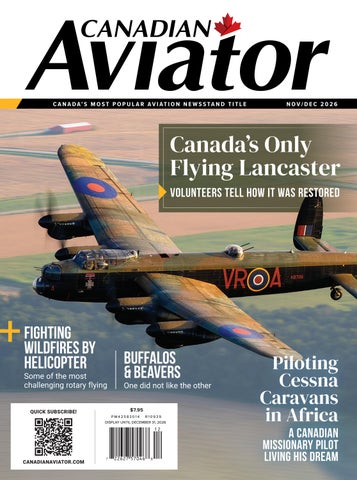
Canada’s Only Flying Lancaster
VOLUNTEERS TELL HOW IT WAS RESTORED
FIGHTING WILDFIRES BY HELICOPTER
Some of the most challenging rotary flying QUICK SUBSCRIBE!
CANADIANAVIATOR.COM
BUFFALOS & BEAVERS
One did not like the other $7.95
PM42583014 R10939 DISPLAY UNTIL DECEMBER 31, 2026
Piloting Cessna Caravans in Africa
A CANADIAN MISSIONARY PILOT LIVING HIS DREAM
Cabin Comfort Comfort Cabin
Safe Return™ Return™ Safe Emergency Autoland Emergency Autoland
Personal aviation, elevated. The world’s world’s best-selling, best-selling, high-performance, high-performance, The single-engine piston aircraft, the SR SR Series Series single-engine piston aircraft, the combines revolutionary safety systems, capability combines revolutionary safety systems, capability and comfort comfort in in one one unforgettable unforgettable aircraft. aircraft. and Cirrus Airframe Airframe Cirrus Parachute System®® (CAPS (CAPS®®)) Parachute System
cirrusaircraft.com cirrusaircraft.com
Advanced Avionics Avionics Advanced ©2026 CIRRUS DESIGN CORPORATION D/B/A CIRRUS. ©2026 CIRRUS DESIGN CORPORATION D/B/A CIRRUS.
IN THIS ISSUE NOV/DEC 2026 VOLUME 36 NUMBER 6
ON THE COVER One of only two flying Avro Lancaster Bombers in the world makes for a majestic sight in Canadian skies. Photo by Dylan Phelps
FEATURES
32
The Restoration of Lancaster Bomber FM213 From a neglected gate guardian to a proud Canadian symbol. By Greg Hannah and Sally Wylie
DEPARTMENTS 5 / WALKAROUND By Steve Drinkwater
6 / WAYPOINTS Commemorations 8 / GEAR & GADGETS Four aviation products By Aviator staff
9 / AIRMAIL Kudos and criticisms 11 / FLYING STORIES Stripping down for the job
18 / TALES FROM THE LAKEVIEW Where the buffalo roam By Robert S. Grant
20 / COLE’S NOTES Revealing Uncle Lloyd By W.T (Tim) Cole
22 / VECTORS Learning to squawk By Michael Oxner
24 / THE PLANE FIXER Round and round I go
By Jack Schofield
By Liana Buessecker
12 / UNUSUAL ATTITUDES A tribute to my coach
27 / PEP TALK Fixers don’t always fix it right
By Luke Penner
By Graeme Peppler
15 / INSTRUMENTAL FACTS Propped up Snowbirds?
28 / WHIRLYBIRD WRITINGS Fighting wildfires
38
Modern Day Caravans Cessna’s venerable 208 meets the challenges of Africa. By Reuben Vermeulen
44
From a Lancaster to an Electra
By Ed McDonald
By Michael Bellamy
16 / RIGHT SEAT Acronyms decoded
30 / WORDS ABOUT A BOOK A killer and the Queen
James Mason’s far-reaching career is profiled by our associate editor Bob Grant.
By René R. Gadacz
By Robert S. Grant
By Mireille Goyer
CANADIANAVIATOR.COM 3
ROTECH MOTOR LTD. 1-(236)-600-0137 SALES@ROTECHMOTOR.CA ROTECHMOTOR.CA
AUTHORISED ROTAX DISTRIBUTOR
canadianaviator.com editor-in-chief
Steve Drinkwater steve@canadianaviator.com 604.999.2411 associate editor
Robert S. Grant g raphic desig ner
Janice Hildybrant proofreader
Roberta Drinkwater advertising sal es account manag e r
Katherine Kjaer katherine@canadianaviator.com 250.592.5331
FORMULATED FOR THOSE WHO CARE.
director of consumer marketing
Craig Sweetman sub scriptions
subscriptions@canadianaviator.com 1.800.656.7598
XPS AVIATION ENGINE OIL Formulated specifically for Rotax aircraft engines.
Canadian Aviator is published six times a year: Jan/Feb, Mar/Apr, May/Jun, Jul/Aug, Sep/Oct, Nov/Dec
Canadian Aviator Publishing Ltd. PO Box 31071 RPO Luckakuck Chilliwack BC V2R 0C4 Phone: 604.999.2411 canadianaviator.com
CanadianAviatorMedia @canadianaviatormag
QUOTES ON: Cherokee Tanks Fuel Cells & Metal Tanks Repair, overhauled & new Technical Information or Free Fuel Grade Decals
NEW TANKS - 10 YEAR WARRANTY
SUBSCRIPTION HOTLINE
1.800.656.7598 sub scription inquiries subscriptions@canadianaviator.com sub scription rates 1 year (6 issues) $28.00 (Taxes vary by province);
SPECIALIZING IN BEAVER & OTTER FUEL CELLS
MONARCH PREMIUM CAPS Premium Stainless Steel Umbrella Caps for your Cessna 177 through 210 www.hartwigfuelcell.com
info@hartwig-fuelcell.com
editorial sub missions Editorial contributions should be sent to the editor by email in plain text with high-resolution photos attached: steve@canadianaviator.com Printed in Canada. Agreement No. 42583014. Postage paid at Vancouver, B.C. Contents copyright 2026 by Canadian Aviator Publishing Ltd. All rights reserved. ISSN 1492-0255. Return undeliverable Canadian mail to Circulation Department. PO Box 31071 RPO Luckakuck, Chilliwack, BC V2R 0C4. From time to time we make our subscribers’ names available to reputable companies whose products or services we feel may be of interest to you. To be excluded from these mailings, just send us your mailing label with a request to delete your name. Publications Mail Registration No. 10939.
Keeping aircraft in the air since 1952 US: 1-800-843-8033 CDN: 1-800-665-0236 4 CANADIAN AVIATOR NOV/DEC 2026
INTL: 1-204-668-3234 FAX: 1-204-339-3351
50%
WALKAROUND EDITORIAL BY STEVE DRINKWATER
The Value of Volunteers WHERE WOULD OUR AVIATION HERITAGE BE WITHOUT THEM?
I
needn’t point out that our cover feature this month is the story of the restoration of an Avro Lancaster Bomber. I encourage you to read it, if you haven’t already. Although the restoration of the Canadian-manufactured ‘Mynarski Lancaster’ was completed, mainly by volunteers, decades ago, it continues to be kept in flying condition by a new generation of volunteers. The ‘Mynarski Lancaster’ regularly appears at air shows in Canada and abroad, from several appearances at AirVenture in Oshkosh, Wisconsin, most recently in 2024 to mark the RCAF’s centennial, to a six-week multi-stop tour of the United Kingdom in 2014, where it appeared in
British skies alongside the only other Lancaster in flying condition, that one based in the U.K. The restoration of Lancaster FM213, and other restored Second World Warera aircraft, continue to provide today’s public with a reminder of what this nation was able to do at a time of national crisis. If it were not for the production in Canada of thousands of military aircraft and their subsequent delivery to the European theatre during the Second World War, its outcome would certainly not have been what it was, and it most certainly would not have been pleasant. Other volunteer efforts to keep our aviation heritage alive include the recent donation to Victoria’s British
Columbia Aviation Museum of the first Canadair Tutor Jet to serve in the Snowbirds Air Demonstration Team (see p. 6), and the ongoing construction of a flying 60-percent scale model of the Arrow by volunteers at the Avro Museum in Springbank. Still in Alberta, Calgary’s Hangar Flight Museum displays a volunteer-restored, Canadian-built Hawker Hurricane. There are in fact a multitude of historical aircraft restoration projects taking place from coast to coast, and at multiple locations in between. Not all are war-era aircraft, but so many are iconic in one way or another. We salute all those who volunteer their time to keep our aviation heritage alive.
ONE STOP SHOPPING • LOWEST PRICES • SAME DAY SHIPMENT
ALL NEW FREE 2026-2027 CATALOG! CANADIANAVIATOR.COM 5
WAYPOINTS
COMPILED BY AVIATOR STAFF
Cooking Lake Airport at 100 EDMONTON-AREA AIRPORT CELEBRATES CENTENNIAL COURTESY OF HEATH MOFFATT, SKIES
O
Snowbird No. 1 THE CANADAIR TUTOR JET FINDS DISTINGUISHED HOME
I
DR. JOHN BLATHERWICK
t was a beautiful summer day, B.C. Day, aptly, in Victoria, British Columbia when the British Columbia Aviation Museum accepted Canadair CT-114 Tutor s/n: 114175 into its collection. This was the very first Tutor to begin life as a CAF Snowbird when the team was founded at CFB Moose Jaw, Saskatchewan in 1971. Snowbird 175 was dedicated to four individuals who made the Snowbirds aerial demonstration team happen. Introduced by emcee and former Snowbirds commanding officer Colonel Dan Dempsey (ret’d) were the late O.B. Philp (Snowbirds founder, represented by his daughter Kim Philp), Team Leaders Glen Younghusband (1971-1972) and George Miller (1973-1974), and Honorary Snowbird Badger Berger-North, designer of the iconic Snowbirds logo. Also present were the Above: Snowbird 175, the first Tutor to join the team, now joins another iconic aircraft, the Martin “Hawaii” Mars, and other entire 2026 Snowbirds team, historic aircraft on display at the B.C. Aviation Museum. who made a memorable flyBelow: Snowbird 175 parked on the apron after a performance over of the David Foster 40th at the Abbotsford International Airshow in 1972. anniversary free outdoor concert at the city’s inner harbour the day before. The crowd on hand for the ceremony rose to their feet and applauded as the team marched in and began signing autographs. The museum set an attendance record for a single day as more than 5,700 came out for the free event.
6 CANADIAN AVIATOR NOV/DEC 2026
n September 12, 2026, the parking lots were full and the runway busy with over 2,000 people driving or flying into Cooking Lake Airport (CEZ3) to celebrate its 100th anniversary. Located just 16 nautical miles southeast of Edmonton, Cooking Lake Airport is proud of its heritage as Canada’s oldest continuously operating public airport. Visitors enjoyed dozens of aircraft on display, a classic car show, speeches by dignitaries, static displays, skydivers from the Eden North Skydiving Club and a complimentary barbecue. A highlight of the event was the fly-in of CF-PEM, a De Havilland Otter, a plane flown by Cliff Blackmur for 25 years that was in and out of Cooking Lake Seaplane Base many times. Grants from Canada Heritage, the Canada Summer Jobs Program, and Strathcona County Council, along with generous sponsorships from presenting sponsor North-Wright Air and several businesses, individuals and organizations, made this event possible. A special ribbon-cutting ceremony welcomed the newly paved runway, completed just in time for the centennial celebrations. Originally paved in 1984, this major project was made possible due to a grant from the Province of Alberta. Exhibits featured a photo gallery marking a century of Cooking Lake Airport welcoming pilots and their aircraft, and the historic lodge that provided nourishing meals and accommodations. The more than
20 exhibits included Fly Boy, a display tracing the life and accomplishments of Second World War pilot John Taylor, a mini exhibit by the Alberta Aviation Museum and displays from flight schools and other aviation organizations. The newly published book, Wind beneath their Wings: 100 Years of flight in and around Canada’s oldest operating airport, was released during the event and Wings over the Sahtu: The North-Wright Air Story was also available for sale. To cap off the celebration, a sold-out evening gala at the Alberta Aviation Museum in Edmonton drew many guests donning 1920s attire. Some guests enjoyed a visit through the Museum before the formalities began, with support from the Cooking Lake Flying Club. Before dinner and dancing, the 100th Anniversary Steering Committee Chair welcomed guests and expressed appreciation to the nearly one hundred volunteers who began work more than a year ago to make this historic day possible. She then turned the hosting activities over to emcee Shane Blakely, a well-known local media personality. Special presentations honoured longstanding board members Jim Johannsson and Don Fraser for their contributions to airport improvement and the flight school for their commit-
ment to excellence in flight instruction. After a talk on the history of Cooking Lake Airport, the new Cooking Lake Airport Logo was unveiled. Finally, the inaugural presentation of the new Cooking Lake Cup was awarded — this year to the group that flew in from the farthest point to attend the festivities, the crew of Buffalo Airways. They flew their Beechcraft King Air from Yellowknife, approximately 550 nautical miles to the north. Mikey McBryan of Buffalo Airways, as guest speaker, entertained the audience with a short talk recalling the company’s history and the connection to “Canada’s
KIRST KING-JONES
This 1946 de Havilland Canada DHC-3 Otter, currently owned by Calgary’s De Havilland Canada, was previously owned by Cliff Blackmur and flown in and out of the Cooking Lake seaplane base (CEE7) for 25 years, providing transportation to his resort, Athabasca Fishing Lodges, in northern Saskatchewan.
Gateway to the North.” He shared the challenges his father Joe (who was in the audience) faced when he started Buffalo Air in 1970. Guests enjoyed a live and silent auction before dancing the night away to a great local band, Black Board Jungle. In 1926, Cooking Lake Airport began as a volunteer-run airport, with pilots doing what needed to be done. One hundred years later, it still operates the same way. Clear skies ahead for this special airport’s future. Submitted by Kimberly Fraser and Shane Blakely.
CANADIANAVIATOR.COM 7
GEAR & GADGETS
PRODUCT REVIEWS COMPILED BY AVIATOR STAFF
Aircraft cleaning product Most aircraft owners and pilots have their favourite cleaning products, either for the fuselage or the cockpit windows. But how many give much thought to how the cleaner is applied? Awesome Products Corp. (APC) of Ponte Vedra Beach, Florida offers their Boss Aircraft Cleaning Kit. APC has been manufacturing their patented fibrous cleaning pads for decades, selling them to both the US Navy and US Air Force. Recently they began offering them to the GA community. APC claims there are no additives or chemicals in their products, making them safe for expensive paint jobs and sensitive surfaces such as acrylic windows. The kits come with the fibrous pads, which are washable and reusable, and applicator tools. The entire kit is light and compact, easily transportable in the smallest of aircraft, allowing you to touch up your plane after landing so it will look its best. About C$114. Learn more at awesomeproductscorp.com. Available from aircraftspruce.ca.
Flight Calculator Do you practice classical navigation instead of relying on electronic flight bags (EFBs)? Perhaps you do but want a more modern method of making calculations than resorting to the now-ancient E6B. Aviation Supplies & Academics, Inc. (ASA) of Kalamazoo, Mich. offers their CX-3 Flight Computer. Handy enough to sit on your flight planning desk, carry in your pilot bag, or use in the cockpit, the CX-3 performs a wide range of essential and useful calculations. Its user interface is designed to follow typical flight planning sequences without the need for excessive keystrokes. It can also alternate between daytime and nighttime screens. It measures 3-1/3" x 6-1/2" x 3/4" and weighs 0.7 lb. About C$185. Learn more at asa2fly.com. Available from aircraftspruce.ca.
8 CANADIAN AVIATOR NOV/DEC 2026
Bomber Jacket With Christmas coming, our thoughts go to choosing a great present for the pilots, or wannabee pilots, in our life. Canadian company Red Canoe of Toronto, Ontario offers a great-looking bomber jacket. Inspired by original RCAF flight jackets, it is made of a cotton-rich blend with nylon lining. Wrist and shoulder pockets feature brushed metal zippers. Heavy canvas shoulder pockets for pens complete the picture. Available in charcoal colour. About C$180. Learn more at, and available from redcanoebrands.com.
Digital Clock/USB ports Are you in need for a replacement chronometer in your cockpit? Want the added convenience of USB ports? Look no further than Wichita, Kansas-based Mid-Continent Instruments and Avionics. Their True Blue Power division offers their multifunction, TSO’d CH93 series Chrono digital clocks. As well as the local and Zulu time, it also displays volts, OAT, countdown time and stopwatch. An internal battery keeps the memory going without ship’s power. The display can be set to automatic dimming using a built-in photocell or can be controlled with the aircraft’s panel lighting circuit. It comes with a pair of USB charging ports, either USB-A or USB-C, or a combination of the two. Fits in standard 2-inch panel openings. About C$1,650. Learn more at mcico.com. Available from aircraftspruce.ca.
AIRMAIL Another great issue!
Vilifying the Allies
I really enjoyed reading the Sep/Oct issue. It brought back three very personal aviation experiences. The first was the Stranraer article (Flying Stories). The painting below was made by my mother in 1941 when I was just one year old. I had it framed in Vancouver when I lived there in the ‘70s, which is where I bought and flew my Lake flying boat. The second was the Grumman Goose article (Cole’s Notes), the flying boat I really wanted but could not afford. The third was about the Kananaskis accidents (“Three Down in Succession”). We moved from Vancouver to Calgary in 1986 and, although I had sold my Lake in Vancouver, I was still flying a friend’s Lake. It was so sad to follow the news of those three planes that crashed. I’m looking forward to the Nov/Dec issue.
The two books reviewed in the Sep/Oct issue (Words About a Book) are the latest in a long list of books, articles, museum displays, film documentaries, etc. critiquing the Second World War air bombing campaign against Germany, and frequently negatively. Reading the article “Precision or Devastation” was enough to discourage me from reading the two books it reviewed. Consider an extract from Churchill’s speech to Parliament following his becoming prime minister, on May 13, 1940: “... to wage war against a monstrous tyranny, never surpassed in the dark, lamentable catalogue of human crime.” The prevalent mood was that Nazism was an evil that had to be entirely destroyed to preserve the democratic freedoms it was bent on eradicating. Hitler’s Luftwaffe had already committed horrendous crimes, such as its attacks on Guernica in the Spanish Civil War, and later across Europe such as on Rotterdam. An extract from the 1943 Casablanca Conference directive to the RAF Bomber Command and the U.S. Eighth Air Force: “Your primary object will be the progressive destruction and dislocation of the German military, industrial and economic system, and the undermining of the morale of the German people to a point where their capacity for armed resistance is fatally weakened.” While war has always been a horrific affair, there were few if any people in the Allied nations who doubted that waging this war against the Nazi tyranny was fundamentally just and existentially necessary. To anyone actually fighting on the allied side, the just side, in the Second World War, this debating about the methods would have been treated as an insult spewing from the mouths of armchair experts who exist, live and enjoy democratic freedoms because of the brave, selfless conduct by the former.
Jack Ciulla Halifax, N.S.
Classic flying skills In reading the article in the Sep/Oct issue by Mireille Goyer entitled “Overreliance on Satellite Navigation” (Right Seat), it set me to wondering about a few things. Some being, are we getting too dependent on electronic gadgetry nowadays, and the fact these gadgets can and do fail? I took flying lessons in the early ‘60s and we were taught the art of map reading, how to use the magnetic compass, use the directional gyro, read a map, lay a protractor on a map to find the degrees, etc. Does anyone remember doing a triangle of velocities? Now I totally understand under IMC map reading isn’t an option, but are the younger guys getting into flying taught enough of these basic skills? Yes, I know I’m a dinosaur. I have been out of the loop for some time now, age caught up to me, but I still love the flying stories and enjoy the magazine very much. Keep up the good work. Gray Cowan, Alida, Sask.
David Green Thornhill, Ont.
Send us your letters. Canadian Aviator welcomes reader letters on topics of concern to Canadian pilots and the aviation industry. Please be brief, to the point and polite in your submissions. Email Steve Drinkwater steve@canadianaviator.com
CANADIANAVIATOR.COM 9
FLYING STORIES HANGAR TALK WITH JACK SCHOFIELD
On Top of Old Smoky OR RATHER, IN THE THICK OF IT
T
he recent rash of fires in the vicinity of La Ronge in northern Saskatchewan brought to mind an incident that happened to me during a similar seasonal outbreak in that general area. I was flying a Beaver for a resort situated on Kasba Lake, which is located a few hundred miles north of La Ronge and just a few minutes north of 60˚ North latitude. Good weather had prevailed for a couple of weeks, making things lovely for black flies, deer flies and Beaver pilots, each operating without electronic navigational aids. I had a callous on my right index finger from following my various paths over this featureless land on a Forest Service map and was gaining confidence from the number of times I actually arrived where I claimed to be going. Eighty forest fires were going to put an end to that. I have no idea who got out there and counted them, but that’s what I was told: 80, not 79, and they were all quite small fires as the trees don’t grow very tall north of 60, but something they do do is make a lot of smoke. I was heading back from a 150-mile trip to locate five empty fuel drums left on a lake by a helicopter crew some five years earlier. The government approves of these things being picked up and rewards those who do so with a good dollar, so the resort owner had sent me out for the retrieval. When I got there (talk about pinpoint navigation) there were four empty 45-gallon drums (204 litres) and one completely full, never-opened drum of Jet B. Well, the four empties were easy. I just had to float them out to the airplane, which was sitting on a sandbar 60 feet (18.3 metres) from shore. Naturally, I swam them out to the plane in my underwear (doesn’t every Beaver pilot do this?). But the full barrel posed a problem, and I had to swim it out (it floated semi-submerged), remove the cap and pump the contents up into one of the 1 0 CANADIAN AVIATOR NOV/DEC 2026
empties in the Beaver’s cabin, then load the now-empty drum up into the Beaver. I was tired, soaking wet, cold and perhaps ill tempered by the time I motored off the sand bar and took off for home. We were talking about 80 forest fires, weren’t we? Well, the smoke from these fires was suddenly becoming evident as I augered through the northern skies, carefully retracing my earlier flights from lake-to-lake over totally unknown country. This is English explorer Samuel Hearne’s country — he walked through this land to the Arctic Ocean — walked! I reminded myself of this as I sat there getting warm and cozy behind that 985 in Geoffrey de Havilland’s favourite airplane; reiterating to myself that, if that guy could walk through this land, what was I doing bellyaching about flying over it without a working compass or an operating ADF? Not being religious, I couldn’t pray that the smoke wouldn’t become denser and obliterate my map-reading ability, but I could hope for that, and the results turned out the same; the smoke did become denser and obliterated my map-reading abilities. I couldn’t see far enough ahead to identify the lakes along the route and, as I proceeded, the only lake I could see was the one under me, and not much of that. I held whatever compass reading was showing on the magnetic compass and reset and uncaged the gyro compass to zero and held that heading and kept augering. There wasn’t a hill in 10 thousand miles, so flying into rising terrain was no problem, but I gradually lost track of exactly where I was. And let’s be honest, a theoretical time and distance problem was, by this time, beyond the reach of my grey matter, so I started to call for my crayons: “Base, this is MAS. Do you read?” Surprise, surprise. Back came the
booming voice of the camp roustabout, who just happened to be walking past the VHF transceiver in the kitchen of the lodge. “Hey, how’re ya doing,” he said, in true Transport Canada radio transmission protocol. “I’m lost, if that’s what you mean,” I said. “I can’t see 10 feet ahead in this smoke. Can you hear me?” I asked. “Yeah, you’re coming through loud and clear,” he replied. “No, I mean can you hear my engine overhead?” I explained. “I must be getting very close.” “Stand by,” he yelled into the mic, “I’ll go outside and listen.” What should have been 20 seconds seemed like an hour before he came back to me. “Only the birds singing out there now, Jack. Ha-ha.” I was flying at 800 feet (you figure out the metres) and beneath me there was some very mirror-like water of a lake whose shores I couldn’t see. I told my radio friend to tell the boss I was going to set down somewhere and wait for better conditions. He agreed to do that then told me what was on the dinner menu for tonight, suggesting that I wouldn’t want to miss that. I did a glassy water landing and as I was coming off the step there on the nearby shore were two familiar little cabins of one of the lodge’s out camps that I had serviced many times. Now I knew exactly where I was. I did a 180 on the water and took off in the same ruts left from the landing, flew over a little saddle of land I was familiar with and landed again on my home lake. “Yeah, 84 fires now,” said the camp roustabout. “Oh, that’s what did it,” I said, “those extra 4 fires. It was filet mignon, medium rare with the cook’s home-baked Yukon Golds.
CANADIANAVIATOR.COM 1 1
ILLUSTRATION BY KATH BOAKE
UNUSUAL ATTITUDES AEROBATICS WITH LUKE PENNER
Aiming For the Top
Mark Cunningham (left) and Luke Penner representing Canada at the 2026 WAC in Mason City, Iowa.
A
fter competing at the World Advanced Aerobatic Championship in Las Vegas in 2023, I knew it would be my last competition in the Advanced category. I wanted to move up to Unlimited. Whether I could become good enough to compete at an Unlimited World Aerobatic Championship was another question entirely. I didn’t know the answer, but I was determined to find out. When it was announced that the 2026 World Aerobatic Championship would be held in Batavia, New York, the possibility suddenly seemed real. The last WAC held in North America was in 2013, the same year Canada last had representation at an Unlimited World Championship. With the event close to home, I knew this was an opportunity that might not come again for a long time. I’ve always felt like an underdog 1 2 CANADIAN AVIATOR NOV/DEC 2026
going into international aerobatic competition. Canada presents some obvious challenges. Our pilots are separated by serious distances and geography, making it difficult to train together, and our winters aren’t particularly conducive to flying unheated, drafty carbon-fibre monoplanes. But I like being the underdog. Normally, my Extra 330SC spends the Manitoba winter tucked away. From November until spring, it’s a break from competing and performing at airshows. This winter was different. In January, I travelled to Spain to get some winter stick time in a rented 330SC with Spanish aerobatic legend Castor Fantoba. From there, I travelled to southern France to spend time with my coach and friend, Pierre Varloteaux. Pierre showed me the countryside around Marseille, near his home, and shared stories from an extraordinary
career that included flying the Mirage 2000 in the French air force and competing at the highest levels of international competition with France’s Équipe de Voltige. More importantly, we had time to get to know each other away from the aerobatic box and plan the year ahead. At the time, I thought it was simply the beginning of our season together. I had no idea how grateful I would eventually become for those few days. My schedule for 2026 was packed: five competitions, seven airshows and three training camps with Pierre, all while continuing my work as chief flight instructor and pilot examiner at Harv’s Air. My first contest took me back to Seward, Nebraska, exactly 10 years after my first aerobatic competition there. In 2016, I arrived as a Sportsman pilot. Ten years later, I returned flying Unlimited. That realization wasn’t lost on me. More than anything, it reminded me just how
PHOTOS BY JOEL KRUTSINGER
WOULD I MAKE MY COACH PIERRE VARLOTEAUX PROUD?
many people had helped me along the ly composed of members of the U.S. Pierre had passed away. I had lost a dear way. Unlimited Aerobatic Team stepped forfriend and my coach, just weeks before Pierre arrived in Manitoba for our ward with an audacious plan to rescue the biggest competition of my life. first training camp in May. For five days, the event and move it to Mason City, Suddenly, the task ahead seemed more he pushed us and established what he Iowa. Their proposal to the Fédération daunting than ever. But quitting wasn’t expected from a pilot preparing for Aéronautique Internationale (FAI) was an option. After other Canadian team a World Championship. Many of the approved and, in roughly three months, members withdrew for various reasons world’s top teams complete numerthe organizers, airport community during the months leading up to the ous week-long camps before a WAC. and people of Mason City and nearby championship, Mark Cunningham and I Between my responsibilities at home Clear Lake somehow put together a were the only two pilots left to represent and the realities Canada. Mark had of putting been working just together a as hard, training Canadian team with his own spread across a coach in Califorcontinent, that nia. I wasn’t going simply wasn’t to abandon him, possible for me. and I wasn’t going I had to make to let everything every day with Pierre had investPierre count. ed in me over Then came the previous two our second years end there. camp in July, The goal had this time changed. More during a Manithan anything, I toba heat wave wanted to honour that pushed my friend. temperatures I arrived in close to 40˚C. Mason City five Pierre stayed days before the The opening briefing at the 2026 WAC where, appropriately, 34 ears of corn were used for pilots to pick at random. It would determine the order of flights. at my home championship for during these official praccamps, and some of my favourite memWorld Championship. Having now tice. Without Pierre, I was largely on ories came after the flying was finished. experienced what they accomplished my own, although Aaron generously We’d drive home after a long day at the firsthand, I remain amazed — and stepped in to offer guidance and encourairport, and I’d listen to stories about incredibly grateful — for the way that agement whenever his responsibilities his life, his time in the French air force community welcomed us. with the U.S. team allowed. Watching and his years in competition aerobatics. Then, in early August, I messaged some of the world’s best pilots practise He had mentioned some back pain, but Pierre to ask when he thought he figure combinations I’d never even he never complained and never gave might return to Manitoba for our final flown made it painfully obvious how anything less than his full effort to the pre-WAC camp. He told me he was in valuable that final camp with Pierre pilots he was coaching. When Pierre left hospital with severe back pain and was would have been. But there was nothing Manitoba in July, I had no idea it would having difficulty walking. He wouldn’t I could do about that now. I simply had be the last time I would see him. be able to return to Manitoba or attend to fly my best. The season had already provided the WAC. I told him not to worry about The opening ceremonies were held in its share of uncertainty. Earlier in the us and to concentrate on getting better. downtown Clear Lake, where it seemed spring, we received shocking news that We agreed that he could still help me as though the entire community had the organizers of the WAC in Batavia remotely through each flight program turned out for the parade of nations. had withdrawn and the championship and, although disappointed, I still felt Walking through those streets beside my was effectively cancelled. After years of like I had my coach in my corner. teammate Mark Cunningham, our team preparation, suddenly there might be no A few days later, my close friend manager Abram Razan and our CIVA* World Championship at all. Thankfully, Aaron McCartan contacted me with representative Carole Holyk, surroundalmost immediately, a new group largenews I was completely unprepared for. ed by Canadian flags and hundreds of CANADIANAVIATOR.COM 1 3
UNUSUAL ATTITUDES (Continued) people cheering for competitors from around the world, I felt an incredible sense of pride. We were actually here. We were Team Canada at the World Aerobatic Championship. The WAC consists of four flight programs, with the final three built around “free-unknown,” sequences the pilots aren’t permitted to practise beforehand. It is one of the purest tests I know of a pilot’s ability to interpret and fly something completely unfamiliar under enormous pressure. I’m proud to say I flew all four programs cleanly, without a hard zero or major error. In the end, I finished 18th among 34 pilots, and Canada finished fifth in the world. For a couple of Canadian underdogs, I’ll take it. But the thing I’ll remember most won’t be where we finished. Before I closed the canopy for Program Four, I looked at Abram and said, “Let’s finish this last one for Pierre.” And that’s what I tried to do. The flight wasn’t perfect. They never are. That’s part of what keeps us coming back to this incredibly difficult sport. There is always another weakness to fix, another figure to improve and another lesson waiting to humble you. This year provided plenty of those lessons. Plans changed. Commitments disappeared. A World Championship was cancelled and resurrected. Most painfully, I lost a coach and friend
The author (seated) stays dry as Team Canada manager Abram Razon handles the umbrella. On the right is the author’s close friend and fellow competitor Aaron McCartan.
whom I fully expected to have standing beside me in Iowa. But I finished what I started. Of course, none of this was something I accomplished alone. There is no way I could have made it this far without the endless support of my family, my company, my friends and my sponsors. They supported this goal through the setbacks, the long days of training, the travel and all the time away that pursuing something like this demands. I will be forever grateful to every one of them for helping make this journey possible. Three years ago, after the World
Advanced Championship in Las Vegas, I wondered whether I could make the jump to Unlimited and someday hold my own at a World Aerobatic Championship. I don’t have to wonder anymore. And of all the people who helped me find the answer, I wish Pierre could have been there to see it. *Commission Internationale de Voltige Aérienne (International Aerobatics Commission), is the body that oversees international aerobatics competitions for the FAI.
This holiday season, show your support for the Royal Canadian Air Force Snowbirds. Each month features a different photograph by professional photographer Terry McBurnie.
$30 (Includes shipping within Canada.) Available now at The Aviator’s Bookshelf: aviatorsbookshelf.ca
1 4 CANADIAN AVIATOR NOV/DEC 2026
INSTRUMENTAL FACTS FLYING IFR WITH ED McDONALD
Will the Snowbirds be Propped Up? WHY THE RCAF’S PROPOSAL IS WRONG
B
esides announcing a standdown to the Snowbirds until the early 2030, the Minister of National Defence and Commander of the RCAF also announced that the Snowbirds will resume flying with a new mount, the Pilatus CT-157 Siskin II. The Siskin II is a fine aircraft. Powered by a massive Pratt & Whitney Canada PT6 turboprop engine, this aircraft has plenty of performance. Publicly available information puts it on par with the Tutor Jet it will be replacing. It’s capable of plenty of Gs: + 8 and - 4. Its maximum speed is slightly less than the Tutor and its maximum altitude is lower too, at 25,000 feet versus 28,000 feet. (The Tutor is capable of 41,000 feet — I have been there — however, it is limited to the lower altitudes by RVSM restrictions*). The Siskin makes a fine basic trainer and aerobatic aircraft but is not a jet. And jets matter. As Canada entered the jet age with military aircraft, its first military jet aerobatic team was the Blue Devils flying the Vampire from 1949-1951. Since then, Canada’s premiere aerobatic teams have all flown jets — the RCAF’s Air Division teams in Europe from 1952-1955, the Golden Hawks which thrilled Canadians from 1959 to 1963, the Golden Centennaires for Canada’s 100th birthday in 1967, then the Snowbirds from 1971 to 2026. These teams punched above their weight next to the mighty American teams’ flying jets, some of which were front line fighter aircraft. Canada was able to hold its head high against our American friends and, while the Snowbirds did not have the flash, speed and noise of the Americans, it had grace and precision in an aerial ballet. The notion that the Snowbirds would emerge from their hiatus as Canada’s premiere military aerobatic team with a turboprop aircraft is a massive step backwards and an embarrassment. Tight formation aerobatics with a prop on the
front of an aircraft are simply not possible; the Snowbirds would lose the key feature that compensates for the speed and noise of the US Navy Blue Angels (F/A-18s) and the US Air Force Thunderbirds (F-16Cs). A turboprop would also signal that Canada is a second-rate nation. While civilian teams can field jet aerobatic teams (the Latvian Baltic Bees Jet Team and the American Patriots Jet Team, both flying the L-39 Albatros), the best the RCAF can offer is a turboprop? Finally, Canada would be the only NATO nation with a turboprop national team while the others all utilize jets. This is unbecoming of a proud country like ours. The RCAF recently announced negotiations to purchase the Italian Leonardo M-346 as a lead-in fighter training aircraft; coincidentally, the International Test Pilot School (ITPS) of London, Ontario announced its purchase of six with an option for another six. If a Canadian, civilian organization can afford to buy a dozen of these jets, surely the RCAF can afford to buy 15 additional for the Snowbirds. Canada’s prestige is at stake. As Laurie Hawn, a former RCAF fighter pilot, Member of Parliament and Parliamentary Secretary to the Minister of National Defence recently said, “The Snowbirds with turboprops is like the RCMP Musical Ride with Shetland Ponies.” *Reduced Vertical Separation Minimum
Above: This is an altered image of an Italian Leonardo M-346 Tutor II displaying Snowbirds livery. The Canadian government is in negotiations to purchase a fleet of M-346s as a lead-in fighter training aircraft to prepare RCAF fighter pilots for the CF-35A Lightning and/or any other advanced jet fighters the military may procure.
WHAT IS RVSM? As air traffic increased over the years, initiatives were undertaken to increase efficient use of limited airspace. Before the implementation of Reduced Vertical Separation Minimum (RVSM), standard aircraft altitudes were set at 2000-foot intervals, rather than 1000 feet as was the standard below FL 29 (29,000 feet ASL). This was because normal altimeters began to lose accuracy at the higher altitudes. RVSM was introduced, and adopted globally, between 1997 and 2005. This allowed for 1000-foot separations above FL 29. However, specially certified altimeters, autopilots and air data computers are required for an aircraft to be RVSM compliant. Although the Canadair CT-114 Tutors in the Snowbirds fleet received upgraded avionics recently, being compliant with RVSM was technically impossible to achieve. — Editor
CANADIANAVIATOR.COM 1 5
RIGHT SEAT ALWAYS LEARNING WITH MIREILLE GOYER
CBTA and EBT FLIGHT TRAINING TERMINOLOGY ASPIRING PILOTS NEED TO KNOW
F
or over a century, precise control of aircraft was the key measurement to determine whether a pilot was qualified or not, at least during flight checks. Plus or minus, fill in the blank, for most altitudes and minus zero for some. Plus or minus, fill in the blank, knots for airspeeds. Plus or minus, fill in the blank, degrees for headings and bank angles. These were the standards that made or killed pilot dreams. It is no surprise then that we took great pride in keeping the needles steady at all times. But we always knew that airmanship, a uniquely human stew of knowledge, experience, and “air sense” used to problem solve and adapt, was as much, if not more, essential to safety than the stick skills we mastered. Accident statistics show that pilots with fewer than 350 hours or more than 10,000 hours of experience are most vulnerable, mostly due to overconfidence and related faulty judgment rather than a lack of prowess. With autopilots, and soon AI, taking over aircraft control and navigation, it was only a matter of time until measuring what someone is worth as a pilot would evolve. The focus switched to developing and measuring airmanship (e.g., why do this or why do that) instead of the traditional drilling and testing of desired physical skills (e.g., do this/do that), particularly at the airline level where automated flight has been prevalent for years. Competency-Based Training and Assessment (CBTA) and EvidenceBased Training (EBT) programs emerged in aviation a few decades ago as a potential solution to the new training and testing challenges. The 1 6 CANADIAN AVIATOR NOV/DEC 2026
philosophy and principles are not unique to aviation. They are offshoots of new educative frameworks such as ADDIE (Analyze, Design, Develop, Deliver/Implement, Evaluate) that adapt software development cycles to develop curricula in an effort to optimize and accelerate training while attempting to enhance quality. So, what is different and how is it working out? Students or full-fledged pilots exposed to CBTA and EBT already know that it is all about scenarios for learning experiences and observable behaviors for grading rather than drill sessions for training and pass/fail marks for assessment. CBTA developers analyze data sourced from the operational environment, regulatory requirements and task lists to determine the
competency gaps. When EBT is utilized, continuous streams of operational data, flight data monitoring (FDM), safety reports and incident statistics further inform the analysis phase of the development and may, in some instances, personalize the training program to the organization or the individual. With the goals defined, the design and development phase can begin. Course developers build an adapted competency model focusing on technical and non-technical skills using scenarios and milestones instead of task lists and completion standards. Scenarios are a structured form of “what if” exercises with a set of behaviour expectations not limited to executing a checklist. The trainee must handle the situation holistically to succeed.
The implement phase begins with training the trainers to familiarize them with the scenarios and standardize the evaluation process, one of the weaknesses of CBTA and EBT training. Evaluating behaviours is more subjective in nature than checking for compliance with data standards and can lead to evaluation inconsistency. How would you grade “problem solving” especially when the problem is actually solved? Creative problem solving might not rate high in the mind of an evaluator who prefers traditional approaches. The last phase of the ADDIE framework evaluates the effectiveness of the training program to provide further data for the initial analysis phase of the process and feed a cycle of continuous program improvement. Thus far, the feedback for CBTA is mixed. On the one hand, most trainees
seem to appreciate the big picture and human approach to training that it facilitates. On the other hand, the process is very data-dependent, which is a challenge for smaller organizations. Furthermore, it requires non-traditional instructor skills. Teaching is no longer a show-and-tell job. At the airline level, implementation studies show that targeting specific behavioral competencies, specifically Threat and Error Management (TEM) and Workload Management, yields a 10 to 20 percent improvement in overall training efficiency while visibly reducing the frequency of unstable approaches and altitude deviations in line operations. What the studies that I reviewed do not show is whether CBTA is the best way to target and improve specific behavioural competencies. Threat and Error Management (TEM) as a
competency skill was first identified and developed by the University of Texas Human Factors Research Project in 1994. There was no specific training to develop these skills until ICAO codified them in late 2006, incidentally at the same time as CBTA and EBT became buzz words. While the military and airlines are busy developing new training methods, pilots-to-be continue to be left at the mercy of luck. Good instructors have always taught far more than stick skills. They have helped their students connect the dots and gain big picture wisdom. That is something that few fast-paced and structured programs with baked-in scenarios can deliver. In a world obsessed with efficiency and speed, there is a truth about learning nobody can escape: It takes both time and savvy human guidance.
C A N A DA’ S E XC LU S I V E D I S T R I B U TO R F O R
1992 BEECHCRAFT F33A BONANZA
2010 AVIAT HUSKY A-1C-180
USD $244,000
1979 CESSNA TURBO R182RG SKYLANE USD $175,000
1977 CESSNA 421C
1978 CESSNA 182Q SKYLANE
1980 MOONEY M20K 231
1976 PIPER CHEROKEE 6/300
1989 SOCATA TB-20 TRINIDAD
USD $239,000
USD $170,000
USD $165,000
USD $395,000
USD $159,000
226-666-2192 / sales@apexaircraft.com
USD $148,000
APEXAIRCRAFT.COM
WE KNOW AIRCRAFT CANADIANAVIATOR.COM 1 7
TALES FROM THE LAKEVIEW BUSH FLYING WITH ROBERT S. GRANT
Where Buffalos Help Beavers ALL IN A DAY’S WORK IN THE PHILIPPINES
Beaver RP-C2016 suits Canadian beaches but really prefers life in tropical paradise.
A
pair of eyes stared long at the white-winged creature with abnormally long aluminum-colour feet and decided, no, he would not join the party. No one had informed the 1,000-pound water buffalo that de Havilland DHC-2 Beaver RP-C2016 on the Philippine island of Palawan needed inspection on dry land. Swiss-Canadian Raymond Schwab, founder of Horizon Sun Charters, dismissed the animal and called upon a contingent of wide-eyed helpers. The Beaver left Downsview’s assembly line in 1957 and entered US Army service until surplused 15 years later. After several Canadian owners, serial number 1096 migrated to the Philippine islands. Years before the aircraft’s transocean container voyage, a 16-year-old high school boy soloed a Cessna 150 at Trois Rivières, Quebec, and embarked on whatever work he could find to earn 1 8 CANADIAN AVIATOR NOV/DEC 2026
a commercial pilot licence with float endorsement. At age 20, he commenced an incredible Indiana Jones-like odyssey to places such as Afghanistan, Papua New Guinea and other remote parts of Asia. Schwab’s understandable attraction to Beavers began on June 7, 1999, when he flew C-GCYX for Campbell River’s Rainbow Airways. After taping the type on his some-day-to-own list, he graduated to other aircraft in remote regions where armed conflict, isolated communities and jungle conditions became part of the operating environment. Eventually, Schwab discovered the wandering white surf lines, mossy forests and limestone cliffs of the Philippines. In 2015, Schwab and life partner Adelpha Bolocon established Horizon Air Charters at Puerto Princesa on Palawan Island, 361 miles southwest of Manila, with a vision of developing practical seaplane access throughout the Philip-
pines. Luck did not enter the equation. The company progressed through years of accumulated knowledge, persistence and hands-on work, from cleaning toilets, maintaining equipment to navigating permits, solving operational problems and doing whatever became necessary to move forward. The regulatory framework was largely designed around conventional commercial operators and offered few established pathways for small water-based air services. At the time, many government officials and communities had limited exposure to modern seaplane operations and potential benefits. Something in their minds “… awakened pleasing emotions of anticipation and delight,” as British author Charles Dickens would have said, had he been present with a certified pilot logbook. “One morning, I had an idea. The real problem wasn’t just finding a place, it
was that few people understood what like this remind us why we do what we only to arrive at the dock and discover seaplanes could do, like faster access to do. It’s not just about flying — it’s hope, a waiting seaplane. Almost every time, hospitals, relief missions and tourism,” humanity and making a difference that the reaction’s the same — excitement Schwab explained. “All of this potential matters most.” and curiosity,” Schwab explained. “After was invisible. I began a mission of seaPalawan and surrounding islands have landing, they usually say ‘We didn’t plane awareness presentations and went everything to attract seaplane operators expect it to be so smooth. That’s what’s town to town as a speaker, including at such as regions waiting to be explored, unique here — no large terminal, crowdconference halls in government buildsuitable operating sites with high-end ed boarding gate or long processing. Just ings and even a movie theatre.” resorts that value guest privacy. Before a short briefing, we load and we go.” On June 21, 2021, aviation officials isthe Spirit of Busuanga (named in honour Schwab has not experienced smooth sued the long-awaited Aircraft Operator of an island) came to Palawan, ferries or rides. His track to a spotless office in recCertificate. After years without inbound motorboats exhausted visitors enroute ognized paradise never consisted of luck, revenue lightening the situation, Horizon to their resorts. With RP-C2016, anyone fate or a winning lottery ticket. From Sun Charters opened for business. The interested splendiferous landscapes farm boy to successful entrepreneur, the first revenue flight occurred March 22, inhabited by monkeys and rare wildlife route demanded sacrifice and, often, 2022. Schwab’s logbook already exceeded can “reach the unreachable.” danger. Young and frequently alone, he 15,000 hours total flight worked in regions where time, including 5,000 armed conflict, terrorism flying hours on amphibor kidnappers could have ious Caravans and de ended the journey. At one Havilland Beavers. point, he earned a paltry Schwab added more $2,300 monthly in hostile knowledge to his repskies for a humanitarian ertoire and learned the organization. peculiarities of swells, Although Schwab wind shifts and tides in wears no flag on his the 7,641 islands of the tropical uniform, he Philippines. He knew evolved into an ambassawhere sheltered bays took dor for the country that the load of a landing Beaenabled a 16-year-old to ver as passengers waited fly a Cessna 150. Behind Although water buffalo serve as gentle draft animals and are known for for the swish of Edo floats the control column of their docile nature, this one did not care to pull RP-C2016 to dry land. on the surface. Experience a Downsview-built gleaned from other waters airplane, he demonstrates added to a safety picture. Passengers and “Unlike predictable runways, our that Canadians possess a never-give-up employees liked Schwab’s affable perwaters are always moving with tides, attitude. They do not quit. sonality and they, too, felt the pulse of a swells and wind shifts. Fixed markings The growth of Horizon Sun Charters radial engine and click of cylinders as the have no place here; every touchdown’s a represents more than the drive of Schwab two-blade propeller swung to a stop. visual judgment, “said Schwab. “No two and Bolocon. The conveyance with wisps In 2025 and 2026, Schwab recognized a landings are the same, so every flight’s of zinc chromate and warm oil brings turning point for Horizon Sun Charters. an adventure where you almost taste the revenue to Philippine people from the Time-softened resorts owners began fragrance of the terrain and feel the touch nation of maple leaves and maple syrup. recognizing the value of the company’s of sea salt.” Beaver RP-C2016 stands as a Canadiservice. Lucrative resort transfers and Clients appear unlike most and arrive an ambassador as does the pilot who long-distance Manila-Palawan charless focused on schedules or crowds. continues carrying Canadian bush flying ters increased. Strong commitments to Rainy seasons do not threaten knockexperience into the waters and islands of preventative maintenance helped keep down cascades pounding from black the Philippines. RP-C2016 operating reliably and clientele skies. They change rhythm and pace. Schwab stated that resorts ensconced content. Weather windows allow calm mornin what outdoors aficionados and bu“It helps that we know when to fly and ing flights. Schwab, versed in reading reaucrats consider the perfect land now when to wait. In one case, a publicized people as he did in Afghanistan and New appreciate the worth of the 5,090-pound medical evacuation saved a young girl Guinea, noticed differences between object in their sky, the one that creates named Kimpol, whose flight was paid vacationers elsewhere. special moments and saves lives. “We’ve for by a friend from New Zealand, Gary “Family members or friends are told been noticed,” he remarked. Thomason,” said Schwab. “Moments they’re taking a long van or boat ride You bet, Captain Schwab. CANADIANAVIATOR.COM 1 9
COLE’S NOTES CAREER HIGHLIGHTS WITH W.T. (TIM) COLE
Serendipity DISCOVERING MY PAST BY OBSERVING THE PRESENT
O
n March 29, 1969, I was landing a wheel-ski equipped Beaver, CF-EYT, in front of the village of Haileybury, Ontario (now called Temiskaming Shores) on big Lake Temiskaming. The lake is part of the upper Ottawa River system and is on the border between Ontario and Quebec. I remembered this day and this flight because I nearly “bought the farm!” The airplane was owned by the United States mining giant, Anaconda American Brass. I had spent the past two and a half months on a small lake in the Val-d’Or mining district in Quebec. I was servicing a winter exploration operation that included a diamond drill outfit. I had daily flights to the various drill sites and a weekly flight to the company’s offices in Noranda, Quebec. This was a compassionate flight for the young geologist who was sitting in the copilot’s seat. He had just received the sad news that his father had passed away, and I was taking him home to be with his family in Haileybury. We landed under low light and whiteout conditions. It was the spring of the year, and I was concerned about the ice conditions close to shore, so I landed parallel to the shoreline and further out than normal. After landing and while taxing towards the shore I was confronted with an ice pressure ridge that was higher than a house. We had to shut down and climb over this huge barrier of broken jagged ice to get to the little town. If I had landed a few hundred metres closer to shore it would have been disastrous. Now, flash back 20 years to 1949 when I saw my first airplane. It was a floatplane tied up to the south shore of the Ottawa River, at Westboro, located just west of the Ottawa city limits. I 2 0 CANADIAN AVIATOR NOV/DEC 2026
Prospectors Airways operated a number of different aircraft in various roles. They had two de Havilland DH.60 Gypsy Moths that were used primarily for exploration and light transportation flights. This image has been altered with an incorrect call sign, but the aircraft is otherwise correctly depicted.
lived with my parents in a little cottage on the edge of the river on a few acres of what was once my grandfather’s large dairy farm. My older cousin, “Uncle Lloyd” Rochester, lived in the big old stone house, Maplelawn, that was the original farm headquarters and was located beside the old horse stables and cow barn. I was told that Uncle Lloyd was the pilot of the airplane. It made a huge impression on a little boy that unknowingly was to shape the rest of his life. Now fast-forward to this past June when I gave a presentation to the Canadian Aviation Historical Society at their annual convention in Kelowna, British Columbia. The topic was “Prospectors Airways,” a company that was formed in 1928 and was the first airline in Canada whose sole purpose
was to serve the mining industry. Lloyd Rochester, who was one of the founding members of the company, was a First World War Royal Flying Corps pilot and he was also a mining engineer. This was an amazing little company that made several significant finds that became operating mines. The use of aircraft in exploration and servicing of the mining industry revolutionized mining operations in Canada. Rather than spending most of their time travelling in canoes in the summer, and by dog teams and snowshoes in the winter, the travel time was cut to a minimum by using airplanes. A prospector’s time was now actually spent out in the wilderness conducting exploration work, rather than spending weeks travelling under arduous conditions.
Lloyd Baillie Rochester was a First World War Royal Flying Corps pilot, mining engineer, prospector and bush pilot who was one of the founders of Prospectors Airways. This airline was formed in 1928 for the sole purpose of serving the mining industry in Canada.
During the company’s operational period, from 1928 until 1963, Prospectors Airways flew over 600,000 miles (965,000 km), transported thousands of passengers, and moved more than 1,300 tons (1,182 tonnes) of supplies and freight. The company utilized Fairchild, de Havilland, WACO and Norseman aircraft for their aerial prospecting and supply missions. I knew that Cousin Lloyd had been associated with bush flying and northern mining exploration, but we had never discussed it, so as I researched the company almost 100 years since its founding, this is when the “serendipity” snuck in. Twenty years after I saw Lloyd’s airplane on the shores of the Ottawa River, I was doing exactly what he and his partners had pioneered 40 years earlier. Pascalis Mines, one of the mines that Prospectors Airways was instrumental in establishing in
1929, was located between Val-d’Or and Senneterre. Forty years later, in 1969, I was based in a bush camp with Anaconda at Lac Blanchin, which was less than 15 miles (24 km) from the Pascalis mine site. The McWatters Gold Mine was another one of their properties and was located adjacent to the RouynNoranda Airport that I visited on a weekly basis. And finally, my memorable flight to Haileybury was where Prospectors Airways had their headquarters during the early years of the company. As a young man flying in the bush, I was unknowingly following in the footsteps and flightpaths of my pioneering “Uncle Lloyd.” Coincidence, or serendipity? Regardless, it brings back many memories of where I started out my lifelong journey as an aviator. May you have tight floats and tailwinds.
CANADIANAVIATOR.COM 2 1
VECTORS ATC VIEWPOINT WITH MICHAEL OXNER
Saying it Right PLEASE DON’T LET ME BE MISUNDERSTOOD
2 2 CANADIAN AVIATOR NOV/DEC 2026
NAV CANADA
A
long time ago, on more than one occasion while I was still earning my wings, I felt like I didn’t know what I was being asked to do by ATC. Controllers are supposed to use standard phraseology most of the time, and only resort to non-standard words and phrases when a standard doesn’t exist, or the situation demands plain-language communication. The idea is to make it common within air traffic control such that a pilot crossing the country will be likely to encounter the same terms and expect them to mean the same thing. Just like there are exceptions to every rule, local variations are impossible to preclude and are often necessary because of requirements specific to a given area. But the meanings in such cases should be clear. I thought it would be good to review a few phrases and the expectations from controllers. For starters, there are a few phrases with transponders that should be understood, since the majority of the jobs done by many controllers are supplemented heavily by surveillance. Many readers may be familiar with the recent prevalence of this term as opposed to the older term once used: “Radar.” While radar is still a mainstay in the provision of service, it’s not the only surveillance tool these days. Multi-Lateration, or MLat, and ADS-B are now included. MLat is a local-area tool used in some locations while ADS-B is available across the country. As such, the old term “radar services” has been replaced by “surveillance services.” The term “radar identified” once indicated that ATC knew which radar “target” represented your aircraft. Today, controllers will simply say you are “identified.” There are many ways controllers can accomplish this, but when a controller says you are identi-
fied, that means they know which target on their screens represents you, and that they are now providing you with surveillance service. This term covers the provisions on watching your aircraft with respect to other traffic visible to ATC (note that not all aircraft will be visible in some airspaces across the country), providing separation between you and other aircraft in airspaces and situations that require that service, and so forth. When ATC can no longer provide the service, the term “surveillance service terminated” is used. This means that the pilot can no longer expect ATC to watch over the aircraft’s progress, though the reason may not be stated. Your aircraft may be entering uncontrolled airspace or may not be visible to ATC surveillance sources anymore.
“Squawk Ident” is still used with a Mode A or Mode C transponder, and simply means the pilot is to operate the IDENT feature on the transponder. It is important not to operate this feature unless specifically asked by a controller — to use the result, the controller must see the indication as an intentional act, not just something at random, and not one of two or more simultaneously in different areas. “Squawk standby” means to turn the transponder to “Standby” (or “Off” if your transponder is not equipped with a “Standby” mode). “Squawk Normal” means to turn it back on. “Squawk Mode Charlie” or “Squawk Mode C” means to ensure your transponder is on and select Mode C for altitude encoding, if your aircraft is equipped. If it is not, advise ATC that
you are not equipped with Mode C. “Recycle your transponder” means to turn it off (not just to standby), wait a few seconds (preferably at least five seconds since that’s the update rate of Canadian ATC surveillance displays), and then turn it back on (to Mode C, if equipped). It’s more like resetting it than the term recycling implies these days. When ATC points out traffic to you, they will normally use the clock system. 12 o’clock meaning straight ahead, 3 o’clock meaning to your right, and so on. It’s important to note that ATC bases that observation on your track and not your heading, as surveillance systems can only plot your position and track over the ground. It’s more like a guideline to get you looking in approximately the right direction and not meant to be perfectly accurate. Strong crosswinds aloft may skew this somewhat, so look a little on either side of the position issued. ATC is generally looking for one of two responses: “Traffic in sight” or “Looking for traffic.” Some pilots have said, “With the traffic,” but does that mean the pilot has the traffic in sight, or merely understands the traffic information communicated? If weather conditions prevent sighting the traffic, such as clouds or showers in the direction stated, inform ATC so they know it’s unlikely that you’ll see the traffic. Once you have the traffic in sight, ATC expects you to keep it in sight and often expects you manoeuvre as required to avoid that traffic. If you lose sight of the traffic, inform ATC and they’ll begin issuing information to help you find them again or take other action or make suggestions, as necessary, to keep you separated. “At your discretion” is a common phrase and is used in different situations, but it always means the same thing: The controller is stating that whatever action is being requested, described or assigned can be accomplished whenever the pilot feels it’s a good time to do so. Changing
altitudes, speeds, or even headings may be left to “pilot’s discretion.” Depending on the situation, it may also involve aircraft in close proximity. An example would include a pilot on departure being given traffic information, reporting sighting the traffic, and being told to turn at pilot’s discretion. In this example, the controller is simply stating that the pilot may turn when certain no further conflict will occur. “Change to enroute frequencies” or an equivalent instruction is used to permit a pilot to change from ATC frequency to another that is appropriate to the current operation for a pilot. This usually follows, “surveillance service terminated,” but not always. It may be used as a pilot approaches uncontrolled airspace or an uncontrolled aerodrome. It may simply be used when ATC is no longer capable of following the progress of a flight, and may mean the pilot is to switch to an Aerodrome Traffic Frequency (ATF), Mandatory Frequency (MF) or another one such as 126.7 to monitor other traffic that may be operating in the area. As an aside to the previous paragraph, ATC expects you to remain in communication with them once it’s established. Many reasons exist where communications may be at least temporarily limited, such as crossing a Mandatory Frequency Area while enroute at low altitude, or communications with FIC may be necessary. If communications with ATC must be interrupted, contact ATC and tell them so, stating the reason. That way, if ATC has information they were going to offer, they can do so at the time and coordinate with the pilot anything further that is needed. There are certainly other words and phrases that can be heard, and if there is ever any doubt as to the meaning, it’s always best to ask the controller. It’s better to take the time to confirm at the moment than to wait until later when it may lead to a problem somewhere else.
Your Northern Aviation Partner
Perimeter Aviation is proud to connect northern communities and the businesses that keep them strong. From people and essential goods to crews and critical cargo, we provide the connections that keep people and industry moving.
Let’s explore how we can work together.
PERIMETER.CA
CANADIANAVIATOR.COM 2 3
THE PLANE FIXER SWINGING WRENCHES WITH LIANA BUESSECKER
From AME, to Pilot, to AME, to Flight Instructor AND NOW I’M GRABBING MY TOOLBOX AGAIN
E
serious enough. Things weren’t done to standard. “But what did pilots know about maintenance standards? They were glorified bus drivers being too picky and too demanding.” Part of my decision to go into maintenance stemmed from the fact I loved aviation but wasn’t keen on the idea of dealing with passengers. I have so much respect for flight attendants and everything they have to put up with, and I’ve always been willing to grease the wheels on a trolley cart or scrub the lavatory mirror to prove it. The earlier part of my career was spent in awe of pilots because, even though I had zero understanding of what their job actually entailed, I knew you couldn’t just pull a plane over to the side of the highway if the engine sounded funny. So for me,
their “petty complaints” hit differently. As a passenger on a plane, I’ve always had the idea that I’m trusting the pilot with my life. As a mechanic, I’ve realized the pilot is trusting me with theirs. That is not something I take lightly and, at the end of the day, if someone isn’t completely satisfied with the state of the aircraft, why wouldn’t I do everything in my power to rectify the situation? The pandemic threw me a curve ball when I was laid off from my airline and left with two options: stay inside for months waiting for the industry to return to normal or go back to school. I chose the latter and, while thousands of pilots were grounded worldwide, I earned my wings. Although obtaining a private and then commercial pilot licence gave me a better understanding
CESSNA
arly in my career I learned that the typical relationship between aircraft maintenance engineers and pilots is not one filled with admiration or appreciation. Rather, the relationship is often strained, tense, with a deep distrust or disrespect for the other. I never understood this. From where I began, at an airline, the pilots wrote snags in the logbook that were usually clear and detailed and justified. The senior engineers didn’t argue with the captains or tell them they were wrong. But in the seclusion of the hangar, the truth would come out, and complaints would go both ways, always returning to the ears of whomever they were about, like they were supposed to hear all along. Maintenance didn’t work fast enough, hard enough, take things
2 4 CANADIAN AVIATOR NOV/DEC 2026
of what was happening in the cockpit, when it came to the workings of the industry, I was still a mechanic. However, that has recently changed and earlier this year I transitioned from a full-time mechanic to a fulltime flight instructor. This has been incredibly rewarding, and exciting, and unbelievably confusing. I have always considered myself a mechanic with a pilot licence, and suddenly I’m a pilot with a mechanic licence. The new role has given me a vastly different view of the industry: I have become the too picky, too demanding, a petty complainer, and “pilot-me” stands by it 100 percent. Every minor inconvenience I have I report to maintenance, and I genuinely believe everyone should do the same. Therefore “mechanic-me” would like to formally apologize to every pilot everywhere who has ever dealt with a less-than-pleasantly-cheerful AME. (Especially every pilot who has dealt with a less-than-pleasantly-cheerful me.) I’ve come to the realization that the animosity existing between mechanics and pilots may very well begin early in the pilot’s training career. In flight schools, there seems to exist a superiority complex wherein the mechanic treats the pilot like they know nothing about anything simply because they’re new. While this very well may be the case in some circumstances — because these student pilots are still learning — don’t they deserve to be educated regarding their concerns instead of dismissed?
Everyone is welcome at Canada’s premier aviation and aerospace celebration. Join us as we recognize industry excellence, disburse $250k in scholarships, and build lasting relationships. Fine food, live entertainment and more! Stay for the weekend with our Travel Partners. CA_BCAC_SW26.indd 1
“Under no circumstance would I tell a pilot they’re exaggerating and everything is fine, so why have I had an AME say that to me?” Teaching people how to fly includes teaching them what it means to have an airworthy aircraft. We follow a checklist and procedures and when things deviate from our standards, they’re always worth mentioning to maintenance, even if we know it isn’t a direct issue for flight. As a mechanic, I have always taken these notes and kept them as a reference so if things do get worse or break entirely, I can look back and see where it began. Under no circumstance would I tell a pilot they’re exaggerating and everything is fine, so why have I had an AME say that to me? Unfortunately, the condescension does not only begin and end within the walls of the hangar. Since my time in the world of general aviation, I have experienced mechanics telling pilots where the plane can and cannot be positioned on the ramp for startup and shutdown, with absolutely zero logic or merit behind the demand. I’ve heard some practices are “better” or “worse” for the engine when the claims are simply not true, and I’ve witnessed attempts to implement changes to flight checklists based on maintenance SOPs.
Recently the accusation was made that the pilots are making too many mistakes in the logbook. I’m genuinely not sure what that has to do with maintenance but as a former auditor I am confident as long as mistakes are being corrected in accordance with Transport Canada standards, nobody cares. And I feel like I’m entirely caught in the middle, because I was an AME first, and I have never before in my life felt such disappointment for other mechanics. I don’t agree with their decisions, or their aggression towards the flight instructors. One of my favourite memories from my career was teaching a first officer how to top up the engine oil on a CRJ-900, and I genuinely don’t understand why other mechanics aren’t happy to share their knowledge and passion with pilots (or anyone) who are interested in learning. So while I’m preparing to return to my toolbox for another season in Antarctica, I’ll be bringing with me a new and updated perspective. I’ve always told myself, my apprentices and my fellow AMEs: if I won’t get on the plane myself after I’ve fixed it, it isn’t good enough, and that’s the bare minimum. My job isn’t just to keep the plane safe, it’s to ensure the pilots feel safe every time they start their engines and taxi away. Whether that requires a conversation, or maybe a little — or even a lot — more work on my end, I’ve officially been in your shoes, and my feet have more growing to do.
Friday, November 6th 17:45 - 22:00 Pacific Vancouver Convention Centre West, Floor 3
bit.ly/SW26 2026-09-21 1:27 PM
CANADIANAVIATOR.COM 2 5
Your Foremost Source in Aeronautics from FROM THE GROUND UP, 30th Edition For over 80 years, the content of From the Ground Up has stood as a literary benchmark that defines the multitude of theories associated to aeronautics. It describes the practices necessary to achieve the highest levels of distinction as safe, competent and skilled life-long aviators. Through its evolving editions, many generations of readers have used this award-winning title as the foundation of their introduction to the concepts that require thorough understanding in advance of the sought-after hours of flying enjoyment that are the ultimate goal of all who seek to earn their wings and expand their knowledge of flight theory and practice. The content of From the Ground Up may, at times, seem complex, but the pathway to learning the fundamentals of aeronautics is one that reaps much in the way of personal reward for all who pursue the goal of thoroughly understanding the subject. Indeed, it was by design that its original author, “Sandy” A. F. MacDonald — a man recognized as a “father” of what still stands today as the standard curriculum for ground school instruction — devised this aeronautical textbook to be comprehensive and current while conveying its material in such a way as to enhance the reader’s understanding of every written word. Not one to permit his vast experience to allow for foregone conclusions, “Sandy” MacDonald’s meticulous care in the creation of From the Ground Up has become the hallmark for its widespread use and respect as the reference textbook of choice in hundreds of flying schools throughout Canada and around the world. Its latest edition is the 30th Edition. A French-language version is also available under the title Entre Ciel et Terre. Totalling over 400 pages of in-depth content formatted in a sequential, logical and easy-to-read fashion, the publication boasts over 360 graphics, charts, diagrams, illustrations and photos. An additional full-colour navigation chart and a sample weather chart are included. All chapters are current in the latest technological and legislative aeronautical matters and cover such topics as The Airplane, Theory of Flight, Aero Engines, Aeronautical Rules & Procedures, Aviation Weather, Navigation, Radio & Radio Navigation, Airmanship, Human Factors, and Air Safety. From the Ground Up also includes an extensive index, glossary and a 200-question practice examination. Since the 1940’s, virtually every student — civilian, military, commercial, recreational — who has ever learned to fly in Canada has used From the Ground Up as the primary ground school textbook from which they’ve learned everything one can learn about aeronautics, and about flying. Referred to as “the Bible” of ground school instruction, and updated with every frequent re-print, From the Ground Up has long been considered an essential resource for all with any interest whatsoever in the theory of flight, and in the practice of aviating. Also available from Aviation Publishers • From the Ground Up Workbook
• Instrument Procedures Manual
• Canadian Private Pilot Answer Guide
• Flying Beyond: for Commercial Pilots
• Canadian Commercial Pilot Answer Guide
• Unmanned: for RPAS Studies
• Canadian Instrument Pilot Answer Guide
• Flight Test Notes: for Flight Test Prep
For more information about all of our titles, visit us on the web or contact your local pilot supply shop. AVIATION PUBLISHERS CO. LIMITED Box 1361, Station B, Ottawa, Ontario, Canada, K1P 5R4 aviationpublishers.com
PEP TALK AIRMANSHIP WITH GRAEME PEPPLER
Leading Causes of GA Accidents MAINTENANCE FAILURES ARE RIGHT UP THERE
PHOTO COURTESY AOPA
I
t’s a paradox. Your aircraft is more likely to have a mechanical failure when it’s just gone through maintenance than if it had not gone through maintenance at all. This is the finding of a study undertaken by Daniele Paolo Scarpazza and Joseph Anthony Hutter who analyzed 16 years of accident data between 2008 and 2024. Their research results weren’t actually new; a study undertaken by the Federal Aviation Administration (FAA) and released in 2002 found the same thing. While pilot error continues to be the first cause of General Aviation (GA) accidents, maintenance errors have been found to be the second. Overall causes of mechanical failures fall into two categories: (1) Failure of newly installed parts, and (2) Maintenance-Induced Failures (MIFs). The former category embodies cases where new parts fail owing either to defects of the parts themselves or to their incorrect integration into existing systems. MIFs, on the other hand, are the cases wherein a failure’s cause owes itself to improperly performed maintenance. Though dated, the earlier study mentioned above found that seven percent of all GA accidents were attributable to a maintenance-related cause or factor. It further estimated that, owing to the methodology used to obtain its results, the probable number of maintenance-related accidents was likely higher than the results it published. In this earlier study, ‘installations’ were identified to be the most frequent form of maintenance being undertaken. Accident reports that identified an installation as a cause or factor accounted for more accident fatalities than any other maintenance activity.
Categories of installation errors include installation of the wrong part, a reversed installation, an incorrect attachment, an omission, and an incorrect connection. The aircraft systems on which these errors were made include the powerplant (in over 50 percent of the cases), the flight controls, the landing gear, the electrical system, the wings, the fuselage, and the flight/navigation instruments. In GA, a large percentage of all maintenance performed is done according to the regulated scheduling of inspections, be they annual inspections or, for instance,100-hour service inspections. During such inspections, faulty systems may be found. This is why inspections are undertaken, and the faulty parts are replaced or repaired. However, systems that are inspected and deemed to be healthy are subject to disassembly and re-assembly to arrive at the evidence of their healthiness. This activity of identifying healthy systems exposes those systems to errors in their
re-assembly. Also, while repairing faulty components, mechanics inadvertently impact healthy ones. As the Scarpazza and Hutter study states, by the action of repairing faulty systems, mechanics sometimes accidentally degrade healthy ones, thus causing early failures after the inspections. There are many classifications to maintenance which run an extensive gamut of activities: maintenance, service of aircraft equipment, inspection, Airworthiness Directive (AD) compliance, annual inspection, adjustment, alignment, installation, lubrication, modification, replacement, major repair, major alteration, design change, overhaul and rebuild. There’s a whole lot of maintenance work that an aircraft can undergo. Consequently, there’s the risk that, during that maintenance, something may not get correctly put back together, or something that didn’t need maintenance now will. Or, even furthermore, a new part has been put on the aeroplane that
CANADIANAVIATOR.COM 2 7
WHIRLYBIRD WRITINGS
PEP TALK (continued)
was not manufactured properly. Maintenance has its risks. Human factors play a role in everything we do. Attention lapses, distractions, complex installation instructions, incomplete training are some of the main reasons mistakes are made in maintenance. The FAA has, in fact, identified the most common maintenance-related causes of errors which include the following: lack of communication, complacency, lack of knowledge, distraction, lack of teamwork, fatigue, lack of resources, pressure, lack of assertiveness, stress, and lack of awareness. Again, there are lots of ways for work to go awry. There are arguments being made that excessive maintenance is hazardous because it increases the risk of MIFs. Every time a mechanic sets his or her tools to an aircraft, there’s something that can go wrong. The more extensive and invasive the work, the higher the consequent risk. This is what the studies are showing. The important point to all the above is this: Given the statistical increase in post-maintenance risk of an incident occurring with your aircraft, an initial cautious approach to post-maintenance flying is a good idea. How that is undertaken could look as follows: (1) Conduct a meticulous pre-flight, (2) Plan a conservative test flight, (3) Gradually return to your normal flying routine, and, if necessary, (4) Get another mechanic to check something you’re unsure about. None of this data gathering is to undermine mechanics. They are very good at what they do and vastly critical to aviation safety. Without them, aircraft would not fly. But, like the pilots who are the leading causes of their own accidents, mechanics are fallible too. Circumspection, then, is key. Flying post-maintenance? Prudence should be your priority. That’s simply the data and the facts. 2 8 CANADIAN AVIATOR NOV/DEC 2026
NORTHERN ADVENTURES WITH MICHAEL BELLAMY
Never a Dull Moment HELI-FLYING IN BRITISH COLUMBIA
I
n December of ‘94 I was home from Africa for Christmas and, amongst our dinner guests, I’m the only one sporting a tan. In the Spring of ‘95 I was reunited with an old friend, the Bell 206B JetRanger GGQL. It was a bit ticklish after flying a Huey, which goes through the air like a bull through a crowd but, after a few circuits, the harmony was back. Now working for Vancouver Island Helicopters, they dispatched me up-island, across the channel then the mainland to a live-aboard barge anchored at the mouth of Doc Creek on the Burke Channel, not far from Bella Bella. My Job was to transport “fallers” over dense forests of Western Hemlock to where they were tasked, as their moniker implied, with felling trees. Once done, heavy lift machines would later sling them down to Doc Creek. A daily routine was flying from a pad a few miles inland from the barge. I would transport a dozen or more fallers and their chainsaws cross open water, then climb up the densely forested escarpment into the logging sites. Once everyone was working, I would then land back at staging and sit in the machine all day monitoring the radio in case of an emergency. I’d bring everyone back at the end of the day. Simple enough until the coastal weather squeezed into the inlet, shrouding the hills in drizzly rainclouds. The fallers had schedules to meet, so I was reluctant to bring them down while I could still see over the ridges. Compounding that “guesstimate” was knowing that I had to make four fights to get them all down. Pulling them too early would raise complaints. Unsettling was the number of times that, after crossing the inlet, I had to feel my way up the escarpment,
sticking the nose close to the treetops, pulling in torque to hover, working my way up through the clouds to the fallers. Old growth grey trunks towered in my path, sometimes 10 feet above the green canopy. Going up they could be seen but, unseen with the 206 level and facing away. Loaded, I climbed vertically out of the pad and, entering cloud, pointed the nose to a compass bearing to where the inlet waited below. With the airspeed now at 60 knots, and on the dials, I descended till we were now VFR below the cloud base with the staging pad in sight. Three more trips. One morning I received a radio call — one of the fallers had been injured. It was serious enough to take him directly to the hospital in Bella Bella. I radioed the rest of the fallers where I was going. A few hours later, back from Bella, I started to pick up the remaining fallers and was told that, with the helicopter no longer on site, it was in their contract that they were no longer allowed to work, so they sat and waited. My six-week tour was coming to an end and so was my enthusiasm for the job. Once home I received a call from Don Stubbs, owner of Delta Helicopters. Forest fires were making the news and one of his Bell 204s, GVEX, needed a driver. I was back in a Huey. In my fixed-wing days I had an interesting and valuable introduction to fighting forest fires. The strategy was taught to me by forest officers while flying for them in a Cessna 310 “bird dog.” We were directing attack after attack on fires and then, the next season, flying a Douglas A-26 Invader for Air Spray, putting what I had learned to the test with an aerial tanker. I was now back flying a Huey and fighting forest fires, both of which I am familiar with and enjoy.
DELTA HELICOPTERS
A Delta Helicopters Bell 204B “Huey,” similar to the one piloted by the author, dropping water from a Bambi Bucket.
Alberta forestry had me and VEX’s engineer Chuck Wicks crisscrossing the province, from one uneventful man-up assignment to another. (Man-up just meant a short-term contract requirement hiring extra helicopters and manpower.) With high temperatures and humidity levels dropping, adding in lightning and/or winds to the forecast, would raise the fire index into “Extreme.” Morning briefing came up with alert times, which meant that VEX was then expected to be ready for a dispatch. Chuck and I were at the machine much earlier doing pre-flight checks and briefing fire crews. The Huey was loaded with pump, hoses and all manner of fire equipment and, of course, our Bambi Bucket. It wasn’t long before a smoke report came in with a bearing and location. Arriving at the smoke, the lead firefighter in the left seat radioed
Forestry, confirming it was a lightning strike, with coordinates, the size of the fire, candling trees, timber type and pumping distance. Looking expectantly at me, then with my nod, he confirmed we could handle the fire; no further resources needed. Landing the machine at a water source site, they unloaded all their equipment, then into a low hover the firefighter hooked up the Bambi Bucket and I was off. I could see the firefighters already laying hose out of their backpacks, zigzagging through the trees. Over the fire two trees were candling, so that was my priority: not to hover but rather drop at a low speed, cooling it down. Returning with a fresh load, I ignored the ground fire in the middle of the burn. Flame was not my target. Rather, stopping the fire from spreading into dry fuels. The old rule of thumb when dropping water or retardant was “half on/half off,”
slowing the fire’s spread and wetting the dry trees. Once the lead firefighter reaches the fire, he would call for specific drops. The charged hose has made it to the fire and signalled me by raising the high-pressure stream vertically, indicating their location. They would call me if there’s a specific hotspot they want cooled. I kept bucketing the perimeter, working towards the hose line until the onehectare fire was corralled, leaving a few last drops raining on any smouldering spot inside the burn that might have potential. With their release I stowed the bucket inside and headed back to base to reload and prepare for the next dispatch. All five men will be overnighting then, after a morning perimeter check, calling on the radio declaring that fire number so and so is extinguished, requesting a pick up. CANADIANAVIATOR.COM 2 9
WORDS ABOUT A BOOK A REVIEW BY RENÉ R. GADACZ
Camouflaged Killer: The Shocking Double Life of Colonel Russell Williams BY DAVID A. GIBB
M
ost aviation books fall into such familiar categories as aircraft histories, combat memoirs, technical studies or biographies of notable pilots. David A. Gibb’s Camouflaged Killer is something quite different. It is a true-crime investigation that remains relevant to Canadian aviation because its central figure was one of the most respected officers and pilots in the Royal Canadian Air Force. The book examines the rise and fall of Colonel Russell Williams, an air force officer, transport pilot and base commander whose public image concealed a history of sexual deviance, forcible confinement, rape and, ultimately, murder. With 86 known victims, the case of Russell Williams remains one of the most disturbing and shocking episodes to hit Canada’s military and aviation community. The fascination with the Williams case lies in the uncomfortable contrast between professional excellence and personal depravity. Williams was not an obscure officer. He was Wing/Base commander of Canada’s largest air base at 8 Wing/CFB Trenton from 2009 until his arrest in 2010. Regarded as an exemplary officer and pilot, he flew prime ministers, senior dignitaries, even members of the Royal Family including Queen Elizabeth II across Canada and overseas. His credentials appeared impeccable, making the revelations of his crimes — spanning from 2007 to 2010 — even more 3 0 CANADIAN AVIATOR NOV/DEC 2026
astonishing. Gibb’s central question is how Williams, who had achieved such professional success, managed to conceal his dark and secret life. An investigative journalist and former private investigator, Gibb focuses less on the later criminal investigation and more on Williams’ earlier life — from childhood through military service promotions to successive top command appointments. The author outlines his progression through the Canadian Forces and the responsibilities associated with his various
appointments. This broader perspective gives insight into the military culture and leadership environment that shaped Williams’ career. The author demonstrates how Williams built a reputation for competence, discipline and professionalism — qualities that are highly prized in the military and traditionally associated with outstanding military service. He was organized, disciplined, meticulous and capable of functioning effectively under pressure. Yet these same traits may have aided his ability to conceal his psychopathic activities. The resulting portrait is disturbing exactly because it challenges assumptions about character and leadership, raising difficult questions about the limitations of screening, performance reviews and organizational oversight. One of the book’s strengths is its examination of “deceptive behaviour.” Commanders trust subordinates. Organizations trust their leaders. Williams exploited those assumptions masterfully. Gibb shows how Williams maintained an image of trust and reliability while simultaneously engaging in increasingly serious deviant and criminal behaviour — “graduating” from voyeurism to fetishistic transvestism, from sexual sadism to murder. Where Camouflaged Killer differs from the usual truecrime books is its examination of the consequences for the Canadian Forces impacted by the case. The Williams
scandal forced military leaders to confront uncomfortable questions about screening, supervision and trust (there is a saying in the Canadian military that “there exist no bad soldiers, only bad officers”). The book is not an easy read. The first several chapters describing Williams’ crimes are graphic, and many passages are emotionally difficult to read. These sections may feel excessive. But they are central to understanding the scale of Williams’ betrayal and the devastating impact on his victims. The forensic work, police procedures and the shocking abundance of evidence meticulously catalogued and documented by Williams himself create an intense narrative. Gibb explains Williams’ behaviour through various theories and profiling concepts, referencing the Diagnostic and Statistical Manual of Mental Disorders (DSM) and University of British Columbia’s Robert Hare’s Psychopathy Checklist-Revised (PCL-R). A valuable aspect of Camouflaged Killer might be its exploration of leadership. Successful commanders, decorated pilots and accomplished aircrew are often celebrated. The Russell Williams case serves as a reminder that professional achievement alone is an incomplete measure of leadership. The story also carries lessons about organizational culture. The military often prides itself on rigorous standards and careful selection processes. Yet Williams successfully navigated these systems for years. Gibb acknowledges the limitations of formal evaluations and the dangers of assuming that professional performance necessarily reflects moral character. Another reason the book is compelling is its Canadian context. Russell Williams joins the likes of Clifford Olson, Karla Homolka, Paul Bernardo, Robert Picton and Bruce McArthur. Camouflaged Killer examines a modern Canadian military scandal that directly affected the Royal Canadian Air Force and challenged public confidence in one of the
country’s most respected institutions. Gibb does not excuse criminal behaviour because of professional success. He balances both aspects, showing how Williams’ respected status made his crimes more shocking and his exposure more consequential. The Russell Williams case remains one of the most important leadership and ethics case studies in Canadian military history to this day. Williams violated everything the Canadian Armed Forces stands for, though by no means has he ever been the only one. The overwhelming majority of CAF members serve honourably and never commit crimes. Upon conviction, Williams was stripped of his rank and military decorations, expelled from the armed forces, his commission scroll shredded, his uniform burned and his medals cut into pieces. Even his Nissan Pathfinder SUV, part of the evidence against him, was crushed and scrapped. Like it or not, the Williams case is part of our military history. We cannot fully understand the history of our Canadian Forces without acknowledging achievements, shortcomings and failures. The Canadian Forces continues to claim it takes sexual harassment, sexual assault and sexual abuse seriously. Nonetheless, the federal government passed Bill C-11 on June 18, 2026, which enshrined into law the requirement that all sexual offences involving military members be handled exclusively by civilian police and courts — stripping Canada’s military of the power to handle sexual assault cases. The move was based on a key recommendation by former Supreme Court Justice Louise Arbour, who is Canada’s current Governor-General and Commander-inChief of the Canadian Armed Forces. Camouflaged Killer: The Shocking Double Life of Colonel Russell Williams By David A. Gibb Penguin Random House, 2011, 400 pp. Available from The Aviator’s Bookshelf aviatorsbookshelf.ca
REACH YOUR AVIATION GOALS AeroCourse offers IFR and ATPL/IATRA ground school training seminars that feature valuable and practical course material taught by highly-qualified professional career pilots.
Leaders in Advanced Aviation training.
1-800-461-8857 aerocourse.com CANADIANAVIATOR.COM 3 1
THE RESTORATION OF
LANCASTER
BOMBER FM213 The Multi-Year Mission as it Unfolded
DOUG FISHER
BY GREG HANNAH & SALLY WYLIE
3 2 CANADIAN AVIATOR NOV/DEC 2026
CANADIANAVIATOR.COM 3 3
THE AIRCRAFT
THE RESTORATION
Some aircraft become famous, a rare few become part of The initial decision-making regarding how to proceed a nation’s memory. The Lancaster Bomber is one of them. with the restoration process was a series of starts and Built for a war that demanded everything from the men stops. Many logistical decisions had to be made before who flew it, the Lancaster carried crews into the most danthe Lancaster could be dismantled and transported to the gerous skies of the Second World War and helped shape the CWHM. The “Lanc,” as it is affectionately known, had been course of history. sitting on pedestals for over 10 years just a few kilometres The Lancaster Bomber was designed and manufactured from Lake Huron’s windward shores, exposing it to severe by A.V. Roe and Company (Avro) and would see wartime weather conditions. Time and weather had taken their service with the Royal Air Force Bomber Command by 1942. toll. But once the structural integrity of the aircraft was During the war, the Lancaster flew over 150,000 sorties, established, more decisions had to be made, such as what dropping more than 600,000 tons of conventional explosives, parts to take off the aircraft first. After much debate, it was incendiaries and specialized ‘ordinance.’ Over 3,000 Landecided to remove the engines and transport them to the casters were lost in action (each carrying a seven-man crew), museum one by one. killing 58,000 “How can the bomb of the 125,000 bay doors be taken airmen in Bomber off?” and “What will Command. There happen when we were about 50,000 drop the undercaraircrew from riage?” Answering Canada in Bombthese two questions er Command, alone translated into with over 10,000 months of work. In of them killed. addition, the four This particupropellers had to be lar Lancaster’s removed and shipped history began in by truck to HamilMalton (Toronton. They were taken to) where the off as the snow fell four-engine during the winter bombers were of 1977-1978. In the built by Victory bitter weather, cold Aircraft Limited hands had a hard time under a 1941 holding onto wrenchcontract with A.V. es and other tools. Roe and CompaDuring the spring Volunteers hard at work at CWHM’s Mount Hope hangar. ny. A total of 430 of 1979, volunteer Lancaster Mk.X aircraft were built there, including FM213, a work crews spent several weekends in Goderich to remove serial number assigned by the RCAF. It was built in July of as many components as possible to lighten the aircraft in 1945, too late to see wartime service. FM213 was then placed preparation for its airlift under a CAF CH-147F Chinook in storage and in 1950 taken on strength by the RCAF. It was helicopter from No. 450 Tactical Helicopter Squadron. Two converted to a Lancaster 10MR (maritime reconnaissance), CAF technicians from Trenton were hired to assist us in where it served mainly on Canada’s east coast. The aircraft removing the wings. It was discovered that the mounting was later damaged in a landing, repaired and, in 1953, bolts were seized, so the attachment links were cut with a converted to a Lancaster 10MP (maritime patrol). One of its disc grinder to separate the wings from the centre section. duties was to escort fighter aircraft to Europe. Once stripped of everything, the aircraft was reduced The aircraft was struck off strength in late 1963 and in weight to the air force’s requirement of a maximum of again placed into storage. In 1964 FM213 was sold to Royal 20,000 lbs for the airlift, which took place on November Canadian Legion Branch 109 in Goderich, Ontario. On June 5, 1979. Once the helicopter was airborne with its load, 14, 1964, it was ferried to Sky Harbour Airport in Goderich, one of the scariest moments occurred. The Lancaster where it was mounted on pedestals and put on display as a began to swing under the helicopter, and the helicopter’s gate guardian. loadmaster was ready with his thumb on the button to In 1977, the Canadian Warplane Heritage Museum drop it. Fortunately, after a trip that lasted one hour and 40 (CWHM) of Mount Hope (now Hamilton), Ontario acquired minutes, the Lancaster arrived safely and was stored in the FM213 with the help of the Sulley Foundation. back of Hangar 4 at the CWHM to await restoration.
3 4 CANADIAN AVIATOR NOV/DEC 2026
During the initial organization of the restoration, two aircraft line to show the public the progress of the restoration important groups were established: the Lancaster Restowork and to help raise funds for the cleaning and preserration Crew and the Lancaster Support Club. The latter vation supplies for the aircraft’s components. The idea of was formed to facilitate the raising of funds to supplement restoring the Lancaster to airworthiness became an ongoing the restoration and the future operational costs for the topic of interest not only to locals, but throughout the global airplane. Over the years, membership grew to nearly five aviation communities and the general public. Each year, visthousand, with over $1 million raised to cover various costs itors to the air show remarked on the progress and could see and restoration needs. News of the project began locally where their donations went. Most importantly, in many the but quickly spread to global aviation communities. As the dream of making it fly again was awakened. The evolution restoration continued, many companies from Canada and of this restoration, its publicity and newsworthiness in an around the world contributed to what was seen as a very era without the presence of social media were a testament to worthy cause. the interest in this unique project. After arriving in Hamilton in 1979, and up until restoThroughout this time, progress wasn’t made in a neat seration began in quential manner. The 1983, the aircraft restoration of parts was cleaned big and small was and preserved. often accomplished Through all simultaneously, or seasons, year after certain parts were year, the piles of started then stopped parts at the back with efforts diverted of the old, dark to other parts for hangar became various reasons. But recognizable and generally, the major serviceable parts work began with the resembling the fuselage. Lancaster’s The fuselage was former self. made up of the cockThe restoration pit, wing attachment began in earnest points, tail attachin 1983 under the ment points and the stewardship of bomb bay doors. The Norm Etheridge, centre section of the Project Engineer. fuselage contained Funds from the two largest fuel From left: Tony Banfield, pilot; Tim Mols, engineer; grants obtained tanks and the supNorm Etheridge, crew chief; and Bob Hill, copilot. from the Ontario port beams for the government contributed to the training of five apprentices. undercarriage. The components attached to the fuselage Etheridge’s dedication to the project, aviation knowledge are its wings, empennage, canopy and the landing gear. and global contacts ensured the success of the restoration Rigging was required for the hydraulic system and flight project. controls too. The work was primarily accomplished by countless Everything had to be taken apart, cleaned and inspected volunteers over six years, working in the unheated hangar for corrosion. During its time in Goderich, the birds had with minimal equipment and space. The restoration crew made convenient nests throughout. It was a laborious job were people whose skills ranged from teachers to tool and to strip all the fuselage components of its paint and rust, die makers, accountants to former Second World War pilots down to bare metal. After the repairs were completed, the and crews, carpenters to retired electricians. Typically, they fuselage was painted with an anti-corrosion primer coat. arrived on Saturdays but, as time went on, more work days The wings had to be reconditioned by removing the fuel were added. It is important to note that this Lancaster wasn’t tanks and mounting straps, removing seized bolts, removrestored in a comfortable, purpose-built hangar with only ing the old paint and any corrosion then repriming the bare highly skilled people with their specialized equipment. metal surfaces. There were eight bolts in the wing spars, That’s what makes the restoration by ordinary people such a with a link attachment between them. They had to come remarkable feat and a story of dedication and commitment. out, and it took two months to get them out. One of them During those restoration years, the Lancaster made took six weeks. These eight bolts, and four shackles on each appearances on the Hamilton International Air Show’s static side, were needed to reattach the wing to the fuselage.
CANADIANAVIATOR.COM 3 5
THE MYNARSKI MEMORIAL LANCASTER Born in October 1916 in Winnipeg, Warrant Officer Andrew Mynarski was manning the upper gun turret of a Canadian-built Lancaster, code-named VR-A, on a mission over France. In the early hours of June 15, 1944, days after D-Day, the bomber was attacked by enemy aircraft and suffered severe damage. Flying Officer Art de Breyne ordered the crew to bail out. As Mynarski was making his way to the rear escape door, he saw Pilot Officer Pat Brophy was trapped in the rear gun turret. Surrounded by
flames, and with his flight suit alit, Mynarski struggled to free his comrade. However, his efforts were in vain, and Brophy eventually waved him away. Before bailing out, Mynarski paused by the escape hatch, turned to Brophy and saluted, saying “Good night, sir.” Mynarski jumped, but with his parachute burning, he landed hard and with severe burns to his body. French farmers found him and took him to a field hospital, where he died. Mynarski is buried in the Méharicourt Communal Cemetery near Amiens, France.
When the Lancaster crashed, Brophy, still in the rear gun turret, was thrown clear and survived. The other crew members also survived after bailing out. On October 11, 1946, Mynarski was posthumously awarded the Victoria Cross for “valour of the highest order” and promoted to the rank of Pilot Officer. Lancaster FM213, rechristened KB726 and VR-A, is dedicated to his memory, lest we forget. — Editor
The six fuel tanks were removed from the wings, cleaned own shipping container. Each container that arrived at the inside and out, inspected for corrosion, filled with water museum was a time for celebration, as it was a step closer and pressure tested. They then received an internal coating to first flight. Each engine was then fitted onto its engine of sloshing compound, eliminating any chance of corromounts, along with their back spinners, piping, wiring, sion forming in future. Even radiators and fire extinguishthe straps that held them in ers. Then, to cover them all, place inside the wings had the cowlings. to be inspected, repaired or At 10.3 metres long, the replaced. bomb bay doors were a conAnother major focus of stant source of visitor amazerestoration was the underment when standing under the carriage, which included belly of the bomber. Looking wheels, brakes and tires, plus up, they saw where the bombs the necessary fluids to make would be attached and the them work. After half a lifefour hydraulic cylinders time since the Second World needed to open and close both War, finding new wheels doors (which had to come off was a challenge. There were and be thoroughly cleaned Above: The Lanc slowly begins to take shape no serviceable Lancaster and inspected). as more engines get installed. tires available, so the wheels Some of the Lancaster parts Below: The 1940s-era cockpit needed a total revamp with newer and undercarriage had to be could be worked on indeand more capable avionics essential for modern-day flight. replaced. Another worldwide pendently and then installed, search began and, with the such as the rear gun turret. help of six commercial comVisitors to the museum panies, two air forces and questioned why gun turrets individuals with specialized and guns were installed. They skills, the combination of rare asked if it meant the gloriaircraft parts provided the fication of war. We replied Lancaster the means to fly that it meant the restoration again. Several companies and would be done as true as Transport Canada were inpossible as a flying memorial volved in many of the highly to those who flew during the critical areas of the Lanc’s war and the many who died restoration. to preserve our freedoms. An The famous Rolls Royce authentic restoration meant Merlin and Packard Merlin aircraft engines were a masterincluding the turrets and guns. piece of engineering that played a pivotal role in the Allied The canopy had to be disassembled too, and the Perspex victory of the Second World War. Over the years, 22 enreplaced. Often, pilots called the canopy the “greenhouse.” gines were scavenged for the Lanc and sent to an overhaul It would get hot up there, with the sun beating down while company. From these engines, four were received for the on long flights. Not only did the pilots need to see, but so aircraft, including enough spare parts to assemble a spare did the navigator and other crew members. The canopy engine. These engines arrived fully assembled, each in its allowed a wide view of other aircraft while flying. 3 6 CANADIAN AVIATOR NOV/DEC 2026
Of all the aircraft At 9 a.m. on the day parts, the instrumenof the inaugural flight, tation, avionics and CWHM’s gates were radios needed a total opened and crowds upgrade for flying in rushed in. Then, with modern-day skies. Tony Banfield, an The volunteers did experienced British test not restore these, pilot, at the controls with but they did have to Canadian Bob Hill as install all of them in co-pilot, Norm Etherthe instrument panel. idge as crew chief and One of the volunTim Mols as assistant teers who worked crew chief on board, the Displaying the Lancaster regularly at the Hamilton International Air Show throughout the restoration allowed the public to follow its progress. on it was known as Lancaster taxied to the “spaghetti man” as end of the runway. The he was often seen with rolls of cables and wires of various Merlin engines then roared and, after being grounded for 24 colours draped over his shoulders. years, the Lancaster took off and flew. Just like the legendAs the restoration was coming to an end, and painting ary phoenix, it rose to fly again. the Second World War-era bomber meant masking it off. Finally, the venerable Lancaster was airborne, making Before painting, however, the aircraft needed hundreds of good what Norm Etheridge always said during the restohours of cleaning with an acid wash. Paint, paper, masking ration: “We can do it.” Emotions were high as this impossitape and 43 hours of painting were required to complete the ble dream became a reality. The men and women who were job (95 percent cleaning and five percent painting). When there cheered and jumped up and down. There wasn’t a the brown masking paper came off, the roundels, identity dry eye to be seen. The Lancaster was joined by a Spitfire letters VR-A and the original aircraft serial number KB726 and Hurricane in a formation to honour the RCAF and RAF, turned the aircraft into the Mynarski Memorial Lancaster. creating a memorable sight. Fittingly, upon completion, this restoration was awarded THE RESURRECTION the Fédération Aéronautique Internationale’s (FAI) Diplôme On September 11, 1988, the official Test Flight Permit Phoenix, one of the most prestigious aviation awards in the was received from Transport Canada. Before the September world. The Vickers Lancaster FM213 is the only Canadi24th inaugural flight, honoured guests began arriving from an-built Lancaster flying, and only one of two Lancasters around the world. In attendance were surviving members of flying in the world. the original Second World War seven-man crew of VR-A, piAn earlier generation built the Lancasters, flew them into lot Art de Breyne, radio operator James Kelly, flight engineer war and after the war. Following generations of volunteers Roy Vigars, navigator Bob Bodie and rear gunner Pat Brophy. rescued, restored, flew and displayed this Lancaster for Absent was bomb aimer Jack Friday. Also in attendance was all to see. Now it’s up to future generations to ensure this Stephanie Holowaty, the sister of mid-upper gunner Andrew Lancaster’s legacy continues as a flying memorial and an Mynarkski, to whom the Lancaster was dedicated. An inauimportant part of our Canadian aviation history. gural ball was held the evening before the flight and attended Authors Greg Hannah and Sally Wylie were members of the by military and civilian dignitaries, politicians and members original restoration crew. of the Restoration Crew and Lancaster Support Club.
NEWS The free weekly e-Newsletter from Canadian Aviator has returned. With a fresh look and short, engaging articles on the week’s aviation news, you’ll keep up with the most important developments in the Canadian aviation and aerospace industry. If you are already a subscriber, you should have received the new one by now. If not, subscribe on our website or, easier still, just scan the QR code with your smartphone and you’ll be taken directly to the subscription page.
Subscribe now!
CANADIANAVIATOR.COM 3 7
modern-day caravans in africa BRINGING LIFE’S NECESSITIES TO THE DISADVANTAGED BY REUBEN VERMEULEN
3 8 CANADIAN AVIATOR NOV/DEC 2026
that people in these locations face — lack of healthcare, nutritious food and clean water. And I consider what an incredible tool this aircraft is operating in such an environment, bringing hope to these isolated villages. As the airplane chimes for top of descent, I’m snapped out of my thoughts and back to the task at hand. I’m descending towards Yuai, one of those many isolated villages that dot the landscape. As I fly overhead, I see crowds gathered alongside the runway. There is no security fence with designated access points, and certainly no RAICs (Restricted Area Identity Cards) here. As a Canadian pilot it’s difficult to call Yuai an “airport.” There is no terminal building, no windsock, no tower, no taxiways or aprons — and no paved runway. When not in use
as a runway, the wide-open area is instead used as a market by the local women or a football field by the local children. As the sound of an aircraft approaches, everyone hurries to the sides, chasing off dogs and goats that straggle behind. There are many things to consider before I can commit to landing at Yuai: the wind direction and strength, obstacles, people and animals, runway length, and the surface condition. The airstrip at Yuai has a black cotton surface — a dark soil that holds water following rain but has huge cracks when dry. The runway can look usable from the air, but if not suitably dry, it will present challenges on landing. Thankfully, we’re in the midst of dry season, so the surface at Yuai is dry, cracked and hard as concrete.
The arrival of MAF’s Caravan is always a welcome sight for the locals.
MAF ARCHIVES
T
hirty minutes after departing Juba, South Sudan, I’m cruising in the Caravan at 12,000 feet. The cruise checks and paperwork are complete, and I get a brief moment to look out the window. Down below, the vast, empty landscape of sub-Saharan Africa slowly passes by. The White Nile runs below, meandering its way through the open plains, slowly dispersing into the Sudd, one of the largest wetlands in the world. Spotted on the landscape are tiny little villages, groups of thatched-roof huts surrounding a central market, and occasionally an empty strip of land used as a runway. In our modern world, it’s hard to comprehend places such as this, practically cut off from the rest of the world — isolated. I consider the hardships
CANADIANAVIATOR.COM 3 9
MATTHEW SCHROEDER
Author Reuben Vermeulen at the controls of the well-equipped Caravan overflying desolate South Sudan countryside.
Today, the Cessna is loaded full of supplies for an upcoming eye clinic. Our partner, The Carter Center, is preparing to run a two-week clinic here in Yuai, bringing sight-saving care to those living in this remote location. With the supplies strapped down in the back of the aircraft, the team will restore sight to more than 800 people through cataract and trachoma surgeries. As I descend on final, I’m slowing the aircraft down and extending my flaps to the full 30 degrees. I stabilize exactly on my approach speed, holding a steady 3-degree approach. As I manage the aircraft, I continually scan the runway for people and animals that often pop out at the last minute. Coming into the flare I’m carefully judging my height above the ground, looking for a soft, smooth touchdown on the rough surface. The Caravan slows quickly under reverse power and heavy braking. All the while I keep back pressure on the yoke to minimize weight on the nose wheel. 4 0 CANADIAN AVIATOR NOV/DEC 2026
As the aircraft slows it kicks up a cloud of dust, letting me know the surface is suitably dry. I taxi over to the parking area, and the aircraft is surrounded by local children, excited to see a plane landing in their village. With lots of eager help, I offload supplies, and they are carried into the village towards the waiting clinic. In the coming days countless lives will be changed through the hands of doctors. People who once could not see will receive hope. And it takes an aircraft to make it possible — to reach these remote and isolated places. Hope comes in many forms. It could be a team of doctors ready to do hundreds of eye surgeries for the local population of Yuai. It could also be teams of NGO workers bringing relief supplies, or doctors to support a local clinic. Back in the 1950s and 1960s, the NGO I work for, Mission Aviation Fellowship (MAF), operated from Khartoum, the capital of Sudan, with outlying bases in Malakal, Akobo and various other locations. The very
first aircraft operated was the twin-engined de Havilland Rapide. The early MAF aviators crisscrossed the skies with nothing more than a map and a compass. Over the years, operations have started and stopped as wars have begun and ended. People have come and gone, and the aircraft have been vastly improved. But the central goal remains the same: to bring help, hope and healing to remote communities and isolated people. Modern-day South Sudan is not much better connected than when the de Havilland Rapide flew these skies. War with northern Sudan, the subsequent formation of South Sudan and the civil wars which followed have left a broken country. The infrastructure system is almost non-existent, and where travel by road may be possible, it is often extremely dangerous due to rebel armies and militia groups. With a lacking infrastructure and road system, aviation holds a vital role in connecting the corners of this young nation. Juba, the capital
accents, quite often leading to significant confusion. It takes a strong eyesout attitude, regular CTAF calls and an extra dose of situational awareness to get through the day. The same conflicts plaguing South Sudan also create issues as we operate our flights. Each morning, we gather as a flight operations team and brief on the current security situation. On the wall is a large map detailing ongoing conflicts and areas of concern across the country. We consider the reports received overnight: armed clashes in Jonglei State, humanitarian workers abducted in Morobo County, or roadside attacks just outside of Wau. Considering this information, we can plan our operations for the day. Occasionally, we cancel flights to certain destinations. Or we limit the amount of time we plan to be on the ground.
“With a lacking infrastructure and road system, aviation holds a vital role in connecting the corners of this young nation.”
Runway incursions are a regular occurrence at many African bush strips.
CANADIANAVIATOR.COM 4 1
REUBEN VERMEULEN
city, has the largest airport, which is home for the majority of operators in South Sudan. It has a 10,000-foot tarmac runway but is only one of three paved runways in the country. In the Juba control tower, local South Sudanese controllers struggle with outdated systems, no radar and a congested frequency. Pilots clog the tower frequency, pushing to be first in line, often overwhelming the controllers working in an outdated system. We listen carefully for the position of other aircraft, aware that the tower is not always completely in control of the situation. As we depart Juba and exit the control zone, we enter the uncontrolled airspace that covers most of the country. Here, IFR and VFR flights mix together, all operating on a single CTAF frequency. Calls are made in various languages and
In certain areas of the country, we won’t fly below 7500 feet AGL to mitigate the risk of small arms fire. In these areas, we plan our approaches with a higher rate of descent, arriving high overhead an airfield and circling down onto our final approach. This procedure puts us within range of small-arms fire for the least amount of time. With our plan set for the day and appropriate risk mitigations in place, we can head out to start our pre-flight. On another flight, I was reminded how essential aviation is in this young country. I departed Juba that morning for a flight to the far northwest. The village of Kanajak was the eventual destination, lying close to the border with Sudan. There, the team on board would be able to help repair a well that was no longer functioning. I joined the team in its work that day and witnessed first-hand the difference an aircraft can make. The closest airstrip to Kanajak was in Malualkon, about 20 kilometres to the east. From the airstrip, we loaded into a Land Cruiser to cover the last kilometres to Kanajak. While it was a manageable drive, the roads were rough and bumpy, and I imagined completing the entire journey from Juba by car. While the flight takes only two hours,
that same journey by road would have taken at least two days. Our trip to Kanajak was a fruitful one. While there, we repaired a well that had sat dry for more than 20 years. The local villagers looked on with excitement that morning — once again they would have clean, fresh water available in their village. No longer would they have to walk great distances to collect water from streams and ponds. Instead, it would be available right here in the middle of their community. Many young children came to watch, young enough that they would never have known a time when water flowed from the pump. When fresh water finally flowed from the newly repaired well that afternoon, the joy was contagious. A truly life-changing day for this remote and isolated community — clean water and hope. There is really only one tool best suited to the work here in South Sudan. The venerable Cessna Caravan, the C208B Grand Caravan to be specific. It is a workhorse that provides the versatility required to operate in and out of these remote locations. It handles the muddy, rough and short runways with relative ease. The mighty PT6 provides the necessary
performance and sufficient margins on all but the hottest of days. While great for low-and-slow, it also allows us to cruise up to 13,000 feet with passengers on board, making the most of cooler air and improved fuel efficiency. Another advantage is a cabin designed for both passengers and cargo. On a typical day, we might carry a full load of passengers to one destination, then remove all the seats for a second rotation carrying more than 2,000 pounds of freight — life-saving supplies heading to the next isolated community. One of the challenges we face above the vast African plains is the sudden onset of weather. Huge thunderstorms have a way of popping up out of nowhere out here. These massive storm systems top out well above 50,000 feet. The Caravan is no match for these huge storms. We do most of our flying VFR, visually avoiding the weather. Equipped with weather radar, we can also continue IFR if the conditions require, using the information given to deviate around the cells. The worst of these storms occurs during the wet season, which runs from April to October. During the following dry season, temperatures skyrocket above 40°, leaving us sweltering on the ground as we unload cargo, install seats and
REUBEN VERMEULEN
“Every flight we make has a new set of challenges that we need to consider: changing weather, unimproved runways that change with the season, uncontrolled airspace, and difficult security situations.”
The optional removable cargo pod for Cessna 208B Caravans add another 111.5 cubic feet (3,157 litres) of storage space.
4 2 CANADIAN AVIATOR NOV/DEC 2026
O�T.6.GE .6.l�Crl.6.FT O�T.6.GE .6.l�Crl.6.FT board passengers. Dust and haze also become an issue during this season, as it obscures visibility to near zero. Despite the weather’s challenges, the need for our work never diminishes, so we continue to push on — bringing hope to remote villages. A few weeks after dropping a plane load of eye clinic supplies, I’m back on the dusty, rough runway at Yuai. This time, my Caravan is empty on arrival because I’m picking up the team of eye surgeons after several busy weeks. More than 1,200 surgeries have been completed, and some people have received surgery on both eyes at once. I chat briefly with the team and hear all about their time in Yuai. It’s been a long and tiring few weeks but knowing that the blind are receiving sight has a way of fending off fatigue. After boarding my tired passengers and securing the surgical supplies, I power up the PT6 and depart for Juba. Every flight we make has a new set of challenges that we need to consider: changing weather, unimproved runways that change with the season, uncontrolled airspace, and difficult security situations. As I depart Yuai and head south for Juba, I’m reminded that this is exactly why I wanted to fly here. Aviation is not just for connecting remote villages. It’s vital for bringing hope to hurting people. And as a pilot, it’s incredibly rewarding to know that your flight, your aircraft, your payload is going to make the difference for these isolated people.
FIRE SUPPRESSION FIRE SUPPRESSION
i?O�T.6.GE .6.l�Crl.6.FT i?O�T.6.GE .6.l�Crl.6.FT FIRE SUPPRESSION FIRE SUPPRESSION
FIRE SUPPRESSION
About the author: Reuben Vermeulen, who caught the aviation bug at a young age, was born and spent 10 years in Western Australia before moving to Ontario with his family. He grew up in a Christian home and felt called to missions following an MAF event in his early teens. Rueben attended Alberta’s Prairie Aviation Training Centre, where he trained to serve as a mission pilot. After graduating, he secured a position as a medevac pilot, where he gained valuable experience in Canada that prepared him to serve with MAF. After a few years he moved with his wife and children first to Kenya, then to South Sudan. CANADIANAVIATOR.COM 4 3
PROFILE
From a Lancaster to an Electra With nearly 24,000 flight hours in between. BY ROBERT S. GRANT
4 4 CANADIAN AVIATOR NOV/DEC 2026
I
n 1956, eight-year-old James D. Mason settled into a Lancaster bomber and, moments later, selected wheels up in climb from Montreal’s Dorval Airport. After returning from his mission over Germany, a nearby faded Curtiss C-46 caught his attention. After engine starts, Mason sailed above the Quebec countryside and soon, his perfect landing impinged the runway’s heat-softened surface. Suddenly, “Get the hell out of there!” brought the young aviator back to reality. He had snuck into the abandoned World-Wide Airways aircraft and used imagination to take him airborne. Owner Donald M. McVicar was not impressed. Mason’s first real world airplane ride took place in a Trans-Canada Air Lines Vickers Viscount six years later. From that moment — which cost three dollars — his goal to become an airline captain occupied almost every moment and led to an incredible accident-free career spanning four continents and all oceans. The journey began when he balanced on a barbed wire fence at Dorval to photo-
graph a 1940 Fleet Finch outside a hangar owned by Timmins Aviation. “I’d never seen a biplane before, but couldn’t get a good picture, so climbed on top of that fence. One of the guys who’d been pushing and pulling the airplane ran over and told me I’d hurt myself,” Mason recalled. “If I’d come down, he’d show it to me with a tour around the general aviation ramp and later told the station manager I could come around anytime since I was harmless.” Air Canada pilot Fred Deveaux’s kindness became the turning point of Mason’s life. Hired part-time by Execaire Aviation, the teenage wannabe became a ‘Joe Boy,’ enduring sharp tangs of nostril-singing floor soaps or laundering coveralls stained by leaking radial engines. When not bandaging fingers, he obtained a flight dispatcher’s licence and worked midnight shifts. Somehow, he reserved time to pursue a science degree until professors refused enrollment in a meteorology course. Mason left the educational milieu.
Above left: At Dorval Airport (re-named Pierre Elliot Trudeau International Airport on January 1, 2004), Air Canada pilot Frederick Deveaux James convinced Mason to come down from a barbed wire fence. As a result, Mason pursued an aviation career and eventually logged time on Douglas DC-3 CF-HVH before moving on to Lockheed 1011s and Boeing 767s. Above right: Mason’s interest in Fleet Finch CF-FUI was a crucial step in his decision to seek an airline career. Enroute to captaining heavy jets, part-time work on Timmins Aviation’s parking ramp led to experience on aircraft as diverse as Mitsubishi Mu-2s and Beechcraft Barons.
CANADIANAVIATOR.COM 4 5
RUI GUERREIRO
JAMES D. MASON
Execaire owner Mitchell Bronfman logged 5,000 hours. During 36 years generate profits. As an instructor and recognized Mason’s potential and, in in Air Canada service, no aircraft he acceptance pilot, Mason welcomed 22 an unusual move, subsidized private touched became just a collection of CRJ 100s and 200s into the fleet. pilot training in 1965 with Cartierrivets or a pathway to paycheques; he In 2008, the little boy who had ville-based Won-Del Aviation. Mason respected them all. dragged cameras to airports and devoted his $50 weekly earnings into While instructing on Airbus 320s, airstrips reached the dreaded moment a commercial pilot licence and instruMason heard rumours of major airwhen company regulations forced ment rating. Images of a future airline craft purchases within the company. departure from what he had attained cockpit seat encouraged through persistence him to act on Deveaux’s and patience. However, sage advice to submit a wiser authorities in other résumé to Air Canada. nations allowed an addiA travel industry slump tional five years. Fellow and minimal flying hours pilots suggested overseas did not bring a place on opportunities which led hiring lists, but Mason reto Netherlands-based fused to sit and sulk. His Confair. not-stained-yet logbook Mason contracted with showed only 170 hours the “widebody wet lease airborne. specialists” to captain “Execaire believed in Airbus 340s who “rented” two-pilot operations and him to Lisbon, Portugal’s put me on everything Hi Fly, which shuttled from Beechcraft Barons him to Arik Air in Lagos, up to Douglas DC-3s. Nigeria. Rotations averApplications went to Air aged 15 days on duty and Above: James Mason enjoyed unusual flights to destinations few pilots Canada for about three equal time off in London, reach, such as Ascension Island. Airbus 340-313 CS-TQM joined Hi Fly years. After around 2,000 England. No stranger to Malta on September 18, 2009, and entered scrap yards in May 2022. hours, Execaire offered international travel, MaBelow: Mason’s logbook includes time logged flying for Nigeria’s a de Havilland DH.125 son began experiencing Arik Air. Here, an Arik Air Airbus A340 is pictured taking off from Portugal’s Lisbon Airport in 2008. business jet course. I cultures far removed from deferred, thinking Air Quebec maple syrup. Canada might soon hire Adventures continued and that would incur with taxis into colourful costs to Execaire so opted Nigerian markets where to claim vacation credits banging and clanging for a European trip,” pots and pans hawked Mason recalled. “Next from oil-blackened sand day, at Dorval’s Eastern patches threatened his Airlines’ shuttle desk, eardrums. Fragrant frying the ticket agent had a foods mingled with pails message to contact home. of boiling mopani caterMy mother said somepillars and street garbage one who sounded ‘Air ensured rolled-up winCanada-ish’ called, so dow jaunts to airports. a frantic word with the Soldiers’ rusting AK-47s hiring office confirmed contrasted with glistening a telex saying my course date was in International “Open Skies” policies bandoliers ambled everywhere, and three days.” meant unrestricted access to marsashaying short-skirted local ladies A move from imaginary Berkets south of the border and within skipped over potholes. lin-bound bombers came next when Canada. Air Canada president Hollis “I didn’t often wander out on my he began a Douglas DC-8 second Harris realized the well-designed own and if I did, never alone at night. officer course. After a trail of Airbus, Canadian product known as the We’d been spoiled at Air Canada with Boeing, Douglas and Lockheed right Bombardier Regional Jet or “RJ” could phenomenal care,” he recalled. “Arik seats, he stepped into a Douglas DC-9 utilize shorter runways and board less Air’s engineers were all good because in 1980 with captain’s stripes and passengers than heavier jets yet still they came from Madrid, but you really 4 6 CANADIAN AVIATOR NOV/DEC 2026
watched the ground handlers. They were rough and sometimes tore cargo liners or bent cargo latches.” Most airport personnel showed little concern or understanding of hazards posed by dangerous goods. Mason noticed stickers glimmering from several boxes while pre-flighting his cockpit, and disembarked to check the contents after being told his aircraft carried no such cargo. “I don’t know, man,” responses resulted in removal at Mason’s insistence. The boxes contained lithium batteries. Next day, he learned the load had simply been transferred to another aircraft. Mason knew the majority of pilots had worked for every airline which had gone bankrupt and were terrified for their jobs. Safety always remained foremost in Mason’s make-up. Long-duration flights, such as a charter from Fukuota to Tokyo, Japan, and Bergen, Norway, with a positioning flight to Lisbon sometimes appeared on rosters. Duty times would have exceeded 16hour legal duty periods. Mason refused such trips and the airline positioned a captain from London as a replacement. He boarded business class for Heathrow and relaxed. Mason enjoyed 4,181-mile British Army personnel rotations from Brize Norton for RAF No. 2 Group to Ascension Island with a 3,950-mile leg to the Falkland Islands the next day. A keen student of international life, especially on the bottom half of the world cruising 541 mph and consuming 15,430 pounds of fuel hourly with CFM56 turbofans pushing out 32,000 pounds of thrust each. He discovered that an informal cold war existed between Britain and Argentina. When entering Latin American airspace, controllers often would not speak to the crew. “Our route from Brize Norton proceeded south abeam Dakar in Senegal and Brazil to Ascension, then abeam Argentina and on to the Falklands. Sometimes, they wouldn’t talk to us since we were loaded with military people and followed flight plan estimates,” he explained. “If we needed to step climb, we’d wait until a calculated waypoint and, if no contact, transmit intentions blind on the appropriate frequency and
The
Your Source for Canadian Aviation Literature
aviatorsbookshelf.ca CANADIANAVIATOR.COM 4 7
121.5. I guess that’s why they kept the military active.” Most locally hired cabin crews earned a paltry $300 per month. On layovers at expensive destinations such as New York, they could barely afford to leave their rooms. When asked to join pilots for dinners, they insisted they could not leave since someone was visiting them. Mason, surmising the actual reason, often invited them and paid meals from his own pocket. Unintentionally, his nature made him an unofficial Canadian ambassador. Cruising globally in wonders like Airbus 340-500s with as many as 375 passengers in an aircraft with an operational weight 541 times more than the Fleet Finch he explored years ago, Mason often reflected on his formative years. He savoured his place and believed in a moral obligation to acknowledge his pioneering predecessors. An example of dedication occurred during his Air Canada era. A fellow employee had noticed that one of Trans-Canada Air Lines’ original six Lockheed 10-A Electras purchased in 1937 still existed in the United States. The airline acquired the mechanical artifact and funded restoration for Air Canada’s 50th anniversary in 1986. Employee volunteers maintained and operated the aircraft on summer commemorative cross-country flights and events for Air Canada’s “Dreams Take 4 8 CANADIAN AVIATOR NOV/DEC 2026
Flight” charity flights. They also recreated TCA’s first flight from Vancouver. Unfortunately, the carrier underwent financial difficulties in 2003 and placed the classic twin in storage. Three years earlier, they had merged with Canadian Airlines International, which also contributed towards in-house conflicts and major morale drops throughout the company structure. Considered a historian by his peers and an Airbus 340 captain at the time, Mason knew of historic CF-TCC resting unseen in storage and, in 2006, approached company president Robert Milton. He suggested the Lockheed’s return to airworthy condition for the airline’s 70th anniversary. Mason found himself “kind of drafted” into the undertaking as project coordinator. Staff throughout the network became enthusiastic as the gleaming Lockheed and its maple leaf crossed Canada and displayed at numerous airports during Trans-Canada Air Lines rise to prominence. The highlight was a September 2022 reenactment of CF-TCC’s inaugural September 1937 Vancouver to Seattle flight, marking the airlines’ 85th anniversary. Between flying duties over the next two years, Mason polished the 79-yearold aircraft alongside company volunteers while logging 61 hours tailwheel time. Managers, reservation clerks, AMEs and cleaners on both sides of the Canada-U.S. border swarmed CF-TCC
with vacuum cleaners and polishing cloths to baby their airplane. Thanks to Mason’s decision to approach an Air Canada president, morale soared and company spirit revived. Winnipeg’s Royal Aviation Museum of Western Canada accepted the 85-year-old aircraft on September 22, 2022, where it rests today. Mason reached the stage of life where regulations no longer permitted him to fly commercially. On April 9, 2013, inbound from Lagos to Heathrow, controllers asked his preferred runway. While taxiing the 16-wheeel Airbus 340-500, Mason noticed rows of fire trucks hosing water over the 208.8-foot wing in honour of his final flight. His last logbook entry showed 23,877.8 flying hours. Mason never flew again but retained the same interest in aviation since when kindly Frederick Deveaux Jr. (diseased: June 5, 2025) talked him away from a barbed wire fence. He regrets that today’s young people cannot access airports and few pursue aviation. His enthusiasm for what he described as an “unlimited realm of enjoyment” in an essay written at age 15 continues as current Canadian Aviation Historical Society president in Montreal. A scholar in many fields, Mason, with wife, Francine, has undergone 22 boat cruises, and together they study whatever crosses their path, especially anything with wings and engines.
VIA ROBERT ARNOLD/ROYAL AVIATION MUSEUM OF WESTERN CANADA
Presented to Winnipeg’s Royal Aviation Museum of Western Canada, CF-TCC last flew in 2018 and, although inactive, it is believed to be one of two operational in the world. The first Trans Canada Air Lines Lockheed 10A resides today at Ottawa’s Canada Aviation and Space Museum.
on most models*
THE NEW LYCOMING STANDARD.† For 97 years, Lycoming has built engines that pilots trust with their lives. Today, that trust goes even further. With Lycoming's new Time Between Overhaul extension, even more engine models now reach 2600 hours between overhauls, helping owners spend more time in the air and less time counting down to their next overhaul.
Learn more at lycoming.com/2600
© 2026 Avco Corporation. *Not all engine models qualify. Excludes turbocharged, highspeed, and highhorsepower models. Contact Lycoming Technical Support or an authorized Lycoming distributor to confirm engine eligibility. Refer to the most current version of Service Instruction SI1009 for the complete list of eligible models and conditions. † This advertisement does not constitute approval, authorization, or modification of any maintenance procedures or operating limitations. Operators must consult the most current approved Lycoming Engines technical publications, available at www.lycoming.com/techpubs.
The THE BOMBER MAFIA
Your Source for Canadian Aviation Literature BATTLE OF BRITAIN
CANADIAN AIRMEN IN THEIR FINEST HOUR
40 YEARS OF UPS & DOWNS
Most military thinkers in the years leading up to WW2 saw the airplane as an afterthought. But a small band of idealistic strategists, the “Bomber Mafia,” asked: What if precision bombing could cripple the enemy and make war far less lethal? In contrast, the bombing of Tokyo on the deadliest night of the war was the brainchild of General LeMay, whose scorched-earth tactics in Japan cost thousands of civilian lives, but may have spared even more by averting a planned U.S. invasion. Author Gladwell asks, “Was it worth it?”
For the first time, bestselling military historian Ted Barris tells the riveting story of the crucial role 100 Canadians served in the Royal Air Force in do-or-die-battles: how they accounted for 130 German aircraft destroyed, another 30 likely destroyed and more than 70 damaged, with 20 pilots dying in action and 12 awarded Distinguished Flying Crosses. Battle of Britain (hardcover) is a must for enthusiasts of Canadian military and aviation history.
From chasing polar bears in the high Arctic to rotating oil workers in the Persian Gulf, this pilot has encountered experiences of a lifetime. Ride along with him as he fights fires in the Rockies, experiences boat people fleeing from Vietnam or escapes a polar bear attack. There was a time when Buhr evacuated a catskinner, who had been impaled by a tree, in the middle of the night. Share the awe-inspiring views as he gazed out at 9,000-foot peaks after dropping off alpine skiers. More than 300 photos.
AUTHOR: Malcolm Gladwell PRICE: $32.95 (includes shipping in Canada)
AUTHOR: Ted Barris PRICE: $59.95 (includes shipping in Canada)
AUTHOR: William “Bill” D. Buhr PRICE: $32.95 (includes shipping in Canada)
VERTICAL HORIZONS This is the remarkable story of a group of small-town entrepreneurs who would leverage a single Bell 47 into Okanagan Helicopters, the largest helicopter company in the world. The company pioneered the commercial application of helicopters, and its successors continue as leaders in rotary aviation. The author worked for the company for decades and created this comprehensive history of one of Canada’s most important contributions to aviation.(Large format hardcover book — 255 pages with photos.) AUTHOR: Douglas M. Grant PRICE: $63.95 (includes shipping in Canada)
CLEAR
ANCE
BUSH HAWK
The Found family’s name is famous among bush pilots worldwide for having built a tough little freight-hauling aircraft designed for hard service in Canada’s wilderness. The author’s father, Sherman, along with his uncle Nathan (Bud) Found, and with financial backing from department store magnate John David Eaton, took on the Herculean task of gaining FAA certification for their dream aircraft. AUTHOR: S.R. (Rick) Found PRICE: $26.50 (includes shipping in Canada) 5 0 CANADIAN AVIATOR NOV/DEC 2026
CAMOUFLAGED KILLER Royal Canadian Air Force Colonel Russell Williams commanded the largest Canadian Forces base in the country. He had personally piloted prime ministers, dignitaries, and members of the Royal Family, and was one of the most respected and trusted soldiers in the military. He was also a rapist and a murderer. This is the disturbing true account of how one of Canada’s highest-ranking military officers became one of Canada’s most notorious criminals. AUTHOR: David A. Gibb PRICE: $39.95 (includes shipping in Canada)
HIS MAJESTY’S AIRSHIP The tragic fate of the British airship R101 — which went down in a spectacular fireball in 1930, killing more people than died in the Hindenburg disaster seven years later — has been largely forgotten. In His Majesty’s Airship, S.C. Gwynne resurrects it in vivid detail, telling the epic story of great ambition gone terribly wrong. She was the linchpin of an imperial British scheme to link by air the far-flung areas of its empire, from Australia to India, South Africa, Canada, Egypt and Singapore. AUTHOR: S.C. Gwynne PRICE: $36.50 (includes shipping in Canada)
FIRE AND FURY During WW2, Allied air forces dropped nearly two million tons of bombs on Germany, killing more than half a million German citizens and leaving 80,000 pilots dead. But the terrible truth is that much of the bombing was carried out against the expressed demands of the Allied military leadership. Here, for the first time, the story of the American and British air campaigns is told — and the cost accounted for. AUTHOR: Randal Hansen PRICE: $44.95 (includes shipping in Canada)
INTO THE ABYSS A national bestseller, this is the riveting account of a deadly plane crash in northern Canada and its aftermath. Written by an award-winning journalist who is the daughter of one of the survivors, Into the Abyss is a dramatic true story of survival, and a compassionate account of the journey of four men, the rookie pilot, a prominent politician, a cop and the criminal he was escorting to face charges, from the depths of tragedy to the riches of lives begun anew. AUTHOR: Carol Shaben PRICE: $44.95 (includes shipping in Canada)
MANY MORE TITLES TO CHOOSE FROM AT To order, visit aviatorsbookshelf.ca or call 604-999-2411 THE SPITFIRE KIDS
SOVEREIGNTY AND COMMAND
WINGS OF THE NORTH
For decades, films and television programs portrayed our allied heroes as grown-up men and women. However, the Battle of Britain was, in the main, fought and won by teenagers. Based on diaries and memoirs, this book tells the story of the Spitfire through the voices of the teenagers who risked everything to design, build and fly her. This isn’t a story of stiff-upper lips, stoical moustaches and aerial heroics; it’s a story of love and loss, a story of young people who won a battle that turned a war.
The 1940 Ogdensburg Agreement entrenched a formal defence relationship between Canada and the United States. But was Canadian sovereignty upheld? Drawing on untapped archival material, this book documents the close and sometimes fractious relationship between the two countries. Goette provides essential insights into the Royal Canadian Air Force’s paradigm shift away from its Royal Air Force roots toward closer ties with the United States Air Force and the role of the nation’s armed forces in safeguarding its sovereignty.
“I do not pretend that this is a complete treatise on the history of northern aviation. That must be left to others who are more capable than me. [But] if there are any words in this book that will enable the young men and women now entering the world of aviation to become better and safer pilots, and if it brings interest and excitement to others, then I will be well satisfied and content that I have not failed in my objective.”
AUTHOR: Alasdair Cross PRICE: $42.95 (includes shipping in Canada)
AUTHOR: Richard Goette PRICE: $39.95 (includes shipping in Canada)
AUTHOR: Dick Turner PRICE: $24.95 (includes shipping in Canada)
BACK TO THE BARRENS
LIFTING THE SILENCE
Aviation buffs, adventure travel readers, environmentalists, historians and anyone else who is concerned about our changing environment will love Barrens. Like its predecessor True North, Barrens is a celebration of the North – its beauty, history and inhabitants. It’s a celebration lived by a knowledgeable author who probes the depths of the wilderness while having the time of his life.
We are welcomed into the homes, the hearts and the minds of families and friends as we follow Syd Smith and his high-school brotherhood of 13 when they answer the call to duty in 1941. Written with his son David, Lifting the Silence is also a father-and-son journey of discovery that uncovers a remarkable letter that serves as testament to what still defines Canada today.
AUTHOR: George Erickson PRICE: $25.95 (includes shipping in Canada)
AUTHOR: Sydney Percival Smith PRICE: $35.95 (includes shipping in Canada)
BRACE FOR IMPACT The history of air accidents is a harrowing one. Yet today flying is the safest mode of transportation, thanks in no small part to the work of crash detectives. Whenever a plane falls from the sky, the investigators pick through the wreckage for the clues they need to decipher what happened to that flight. Before the invention of the ‘black box’ and the evolution of forensic accident investigation, the causes often remained a mystery. AUTHOR: Peter Pigott PRICE: $53.95 (includes shipping in Canada)
A TRADITION OF EXCELLENCE The extraordinary history of Canada’s airshow teams is recorded in its entirety. Meticulously researched by a former Snowbird team leader, this 768-page hardcover book documents the scores of Canadian military air demonstration teams that have thrilled millions of airshow spectators for over 85 years. From the Siskins to the Golden Hawks to the Golden Centennaires and Snowbirds, every Canadian demonstration team is represented in the book. AUTHOR: LtCol (Ret’d) Dan Dempsey PRICE: $145.99 (includes shipping in Canada)
A MOST EXTRAORDINARY RIDE In A Most Extraordinary Ride: Space, Politics, and the Pursuit of a Canadian Dream, Garneau chronicles his ascent from a mischievous teenager and rebellious naval midshipman to a decorated astronaut and statesman who represented Canada on the world stage — both on and off the planet. With candour and humour, Garneau describes the highs and lows of his life and career, including the awe he experienced first seeing the Earth from space, in this hardcover edition. AUTHOR: Marc Garneau PRICE: $59.95 (includes shipping in Canada)
LOST
UNSOLVED MYSTERIES OF CANADIAN AVIATION
A theme in this book is the enigma of aircraft that disappear, sometimes within miles of busy airports and crowded cities, and cannot be found despite desperate and prolonged searches. Sometimes wreckage is discovered decades later. How can such disappearances be possible? How can determined, skillful, trained search personnel, using sophisticated equipment, be thwarted in their efforts to locate crashed aircraft? The answer is that a downed aircraft, especially in rugged countryside, can be incredibly difficult to spot from the air. AUTHOR: Shirlee Smith Matheson PRICE: $30.95 (includes shipping in Canada) CANADIANAVIATOR.COM 5 1
SERVICE CENTRE
THERE’S A REASON PILOTS USE Q SET PNR $425 ANR BT $785 Featherlight CarbonFiber Tried & True
Multi-engine and instrument rating flight training • Multi-engine and
instrument rating • Experienced professional pilots as instructors • Multiple local flight test examiners • New Diamond DA62/ Garmin G1000 NXi • Flexible schedule and no wait list
COMPLIMENTARY PILOTS WALLET HELMETS ANR BT $980 Learn more at
AVIATIONHEADSETS.CA
800-667-8140
HEADSETS@PRAIRIEFLYING.COM
*COPA MEMBERS RECEIVE EXTENDED WARRANTY.
Established 1974 PT6 100HR O’Ring Kits PT6 Fuel Nozzle Gaskets PT6 Igniter Gaskets
engineers LOG BOOKS Journey Log “Spiral Wound” Tech Log Binders Prop, Engine, Airframe, Mod Logs Seat Track Cleaners Cap Plug Kits Hardware Kits Float Sealer Spiral Wrap Klear to Land Window Cleaner Aircraft Cleaners and Solvents TKS Deicer Fluid ACCESSORY OVERHAUL Starter Generator Specialists
59 Eagle Drive, Winnipeg, Manitoba R2R 1V4 | Tel 204-783-8512 | sales@gouletaircraft.com | www.gouletaircraft.com 5 2 CANADIAN AVIATOR NOV/DEC 2026
To advertise, contact Katherine Kjaer / 250.592.5331 / katherine@canadianaviator.com
PRICE REDUCED
REBUILT WAG AERO/J-3 CUB 198 HOURS TOTAL TIME SUPERB CONDITION $78,700.00 CDN Numerous photos upon request. CONTACT: John Brewer • 902-626-5262 jbrewer@eastlink.ca
2015 HIGHLANDER Only $95,000.00 CDN 30 HOURS TOTAL TIME LIKE NEW • More photos on sellmyplane.ca WANT YOUR PLANE SOLD? CONTACT: John Brewer 902-626-5262 • jbrewer@eastlink.ca
Automated Aircraft Logging, Tracking, and More
airbly.com 888-747-4565 Made in Canada
ADVERTISE IN THIS SECTION Contact
KATHERINE KJAER 250.592.5331 katherine@canadianaviator.com
HERE’S WHAT WE CAN DO FOR YOU: • Architectural & Engineered Drawings • Municipal Applications & Permits • Airport Applications & Approvals • Transport Canada & NavCan Applications • Complete Construction
QUESTIONS? Phone 519.857.7639 or visit www.secandco.com If you already have a design or drawings, send it along in CAD or PDF for an estimate to:
steve.secco@secandco.com CANADIANAVIATOR.COM 5 3
FLIGHT BAG
Aviation Crossword Puzzle
Refresh Your Memory
— Canadian Car & Foundry —
ian Car & Foundry
thisCanadian puzzle are the names ofBY 9 aircraft Within this puzzle are the names of 9 aircraft modelsWithin made by GRAEME PEPPLER models made by Canadian Car & Foundry (clues Car & Foundry (clues marked with an *). The number made is also included. marked with an *). The number made is also All other answers are aviation related. 1. What was proven by Ludwig Prandtl’s wing
1
2
7
included. All other answers are aviation related. theory?
3
4
8
10
11
5
6
a. That a wing’s lift is the result of pressure differential in combination with Newton’s third law. b. That minimum induced drag occurs when the wing’s lift is distributed in an elliptical fashion. c. That a rectangular planform produces the least amount of induced drag over the span of a wing. d. That sweepback in a wing’s design is essential for an aircraft to achieve supersonic speeds.
9
12
13
2. What was necessary of the aircraft that competed for the prestigious Schneider Trophy from 1913 to 1931? a. They had to be seaplanes or flying boats. b. They had to be single-cockpit monoplanes. c. They were not allowed to be production airplanes or derivatives of military aircraft. d. They had to have truss type fuselages covered with fabric.
14
15
16
18
17
19
3. When the right rudder pedal of a V-tail aircraft is pressed, in which direction do the ruddervators deflect? a. The right ruddervator deflects upward and the left ruddervator deflects downward. b. The right ruddervator deflects upward while the left ruddervator stays stationary. c. The right ruddervator deflects downward and the left ruddervator deflects upward. d. The right ruddervator stays stationary while the left ruddervator deflects upward.
20 21 22
23
24
ACROSS 4 An airplane with two engines.
7 A engines. US Army L-17. ne with two
y L-17.
8 A propeller can generate it.
10 German maker of aircraft engines during WW1. er can generate it.
12 RCAF version of the Grumman Delfin (52).*
maker of aircraft engines during WW1. 14 Without a radio.
CF-101. ion of the15Grumman Delfin (52).*
25
9 A naval dive bomber made for export Down (835).* 11 Burnelli’s airliner (1).*
1 "Faithful Annie" (641).*
13 Home of US Air Force Base Hickam.
2 Not legal to fly.
14 A Dutchman’s bush plane (52).* 16 on a pilot’s licence. 3 An Anendorsement alliance Canada co-founded. 17 AKA Texan (555).*
5 A STOL STC for a Cessna 182.
22 Permits an inst. scan while looking ahead. 6 See 3-Down.
4. Which of the following is true? a. A negative angle of attack is required to obtain zero lift with a cambered wing. b. A zero angle of attack with a cambered wing produces zero lift. c. An uncambered wing produces positive lift at zero angle of attack. d. An uncambered wing with positive angle of attack has a lift curve that is nonlinear.
5. Though few would know it by its designation, what is the Northrop M2-F2 probably best a radio. 9 A naval dive bomber made for exportknown (835).* for? 19 One who guides another’s development a. It appears in the movie, The Right Stuff, as a SEP/OCT ANSWER KEY Within this puzzle are the company names of 10 (125).* 11 Burnelli's airliner (1).* Canadair Aircraft Models Canadair aircraft models (clues marked withsupersonic an *). jet out of which Chuck Yeager ejected. All other answers are aviation related. Canadair Aircraft Models 20 American kit aircraft maker. b. It’s the airplane that, in the movie The Aviator, tive meaning "flying". 13 Home of US Air Force Base Hickam. C H A L L E N G E R S Howard Hughes crash lands into a beet field. 21 A fighter/dive bomber biplane (1).* Y R C S S T c. It’s the NASA aircraft shown crashing in the guides another's development (125).* 14 22 Elsie MacGill’s claim to fame (1,451).* C AA GDutchman's E G A U bush G E plane A A(52).* opening to the TV series, The Six Million Dollar L U B O R E 24 A famous silver biplane. Man. kit aircraft maker. 16 An endorsement on a pilot's licence. E S I L V E R S T A R F d. It’s the hypersonic aircraft that Pete “Maverick” 25 A Cessna 172. A U E P I C Mitchell crashes in the movie, Top Gun: Maverick. dive bomber biplane (1).* 17 (555).* C AAKA B I Texan N L T G 18 An adjective meaning “flying.”
23 A J-3.
1
2
3
4
5
6
7
8
9
10
11
12
14
H
U
15
16
Y E L L O W
M H Z
Gill's claim to fame (1,451).* 1 “Faithful Annie” (641).*
6. Which of the following aircraft was the first 22 an inst. scan while I Permits F U Y R J T looking ahead.
2 Not legal to fly. silver biplane.
23 F RA EJ-3. E D O M F I G H T E R
172.
3 An alliance Canada co-founded. 5 A STOL STC for a Cessna 182. 6 See 3-Down.
5 4 CANADIAN AVIATOR NOV/DEC 2026
17
E
F
K
18
F
E
E
19
20
T N N P A 22 23 24 A I E A S C O O P E R 25 D Y N A V E R T R M 26 F G A C G A T E S 21
to land fully autonomously at EAA’s AirVenture convention? a. A Cessna 206B Caravan. b. A Lockheed Martin F-35 Lightning II. c. A Robinson R44 Airtruck heavy-lift helicopter. d. A Beta Technologies Alia eVTOL.
1.b 2.a 3.c, 4.a 5.c 6.a
DOWN
13
ROTAX 916 iS/c. THE IMPOSSIBLE ENGINE. THE MASTERPIECE THAT MARKS A NEW ERA.
UNITED BY PASSION. FLYROTAX.COM
AUTHORISED ROTAX DISTRIBUTOR
ROTECH MOTOR LTD. 1-(236)-600-0137 | SALES@ROTECHMOTOR.CA ROTECHMOTOR.CA
HAPPY HOLIDAYS FROM THE AERO RECIP FAMILY
BUILDING ENGINES AND RELATIONSHIPS