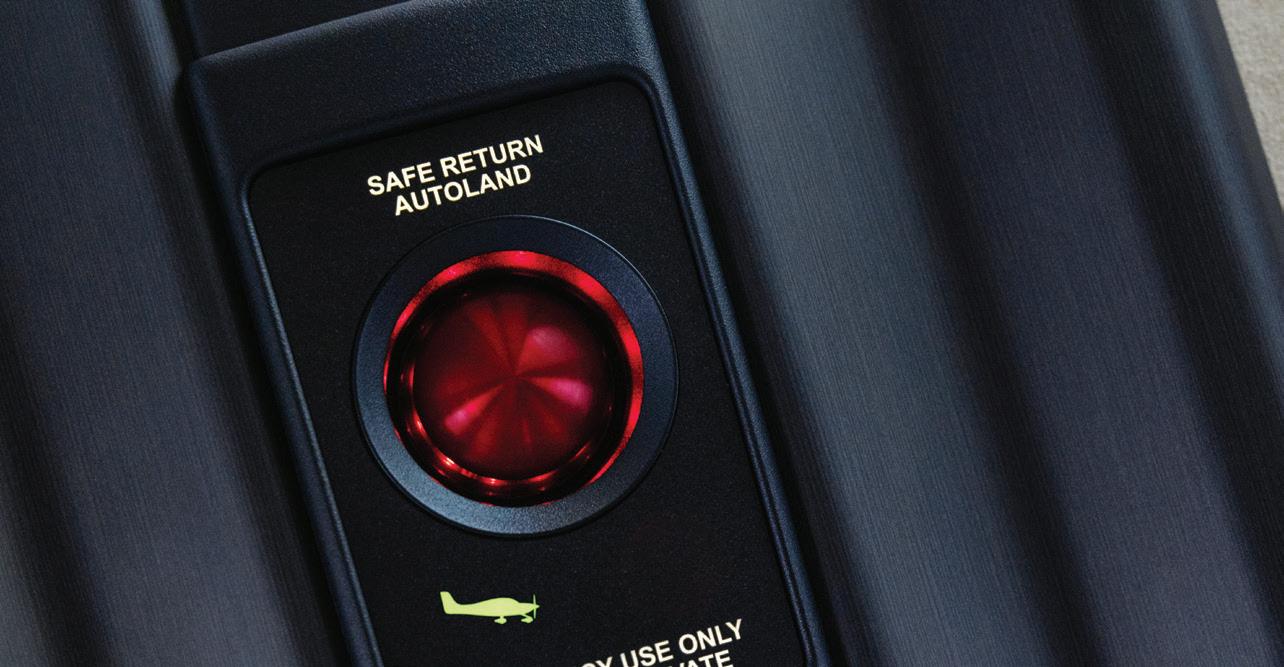
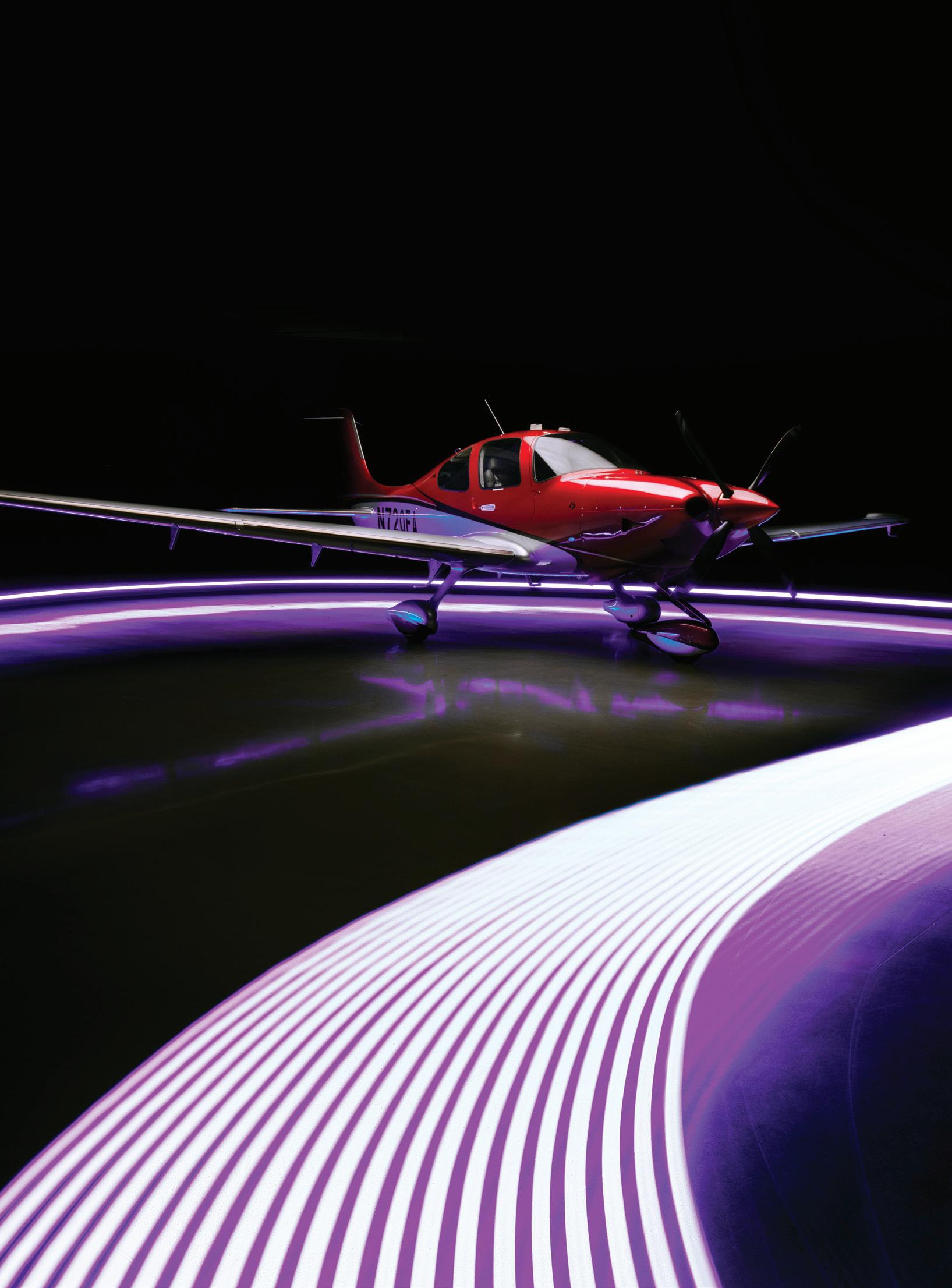
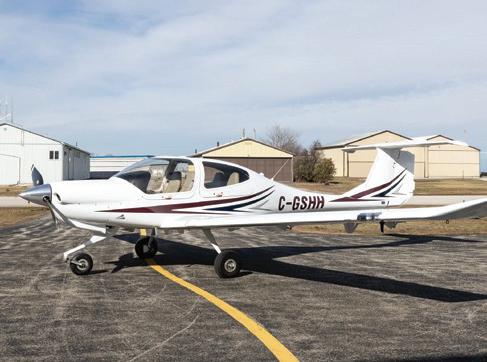
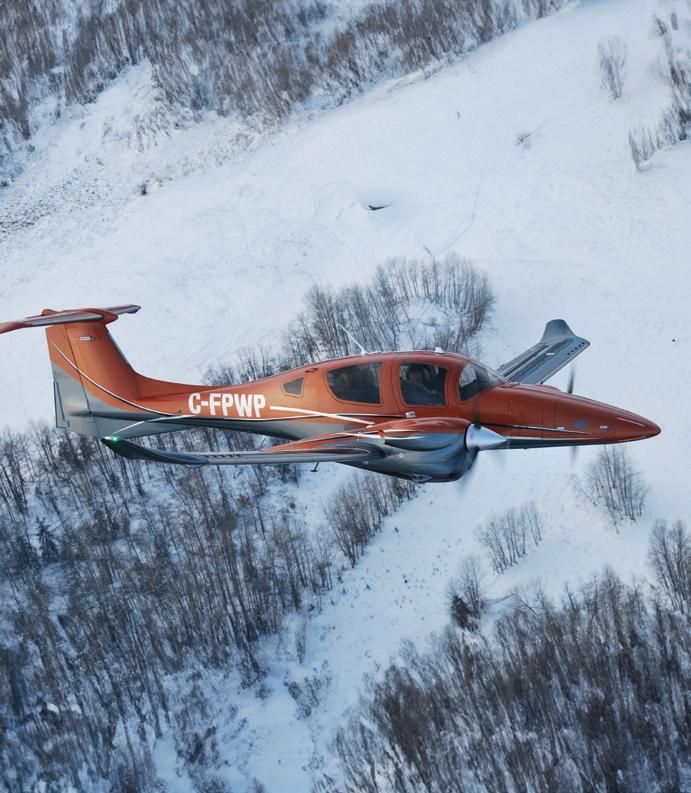
SR Series G7+ featuring Safe Return™ Emergency Autoland, now Transport Canada approved.
DEPARTMENTS
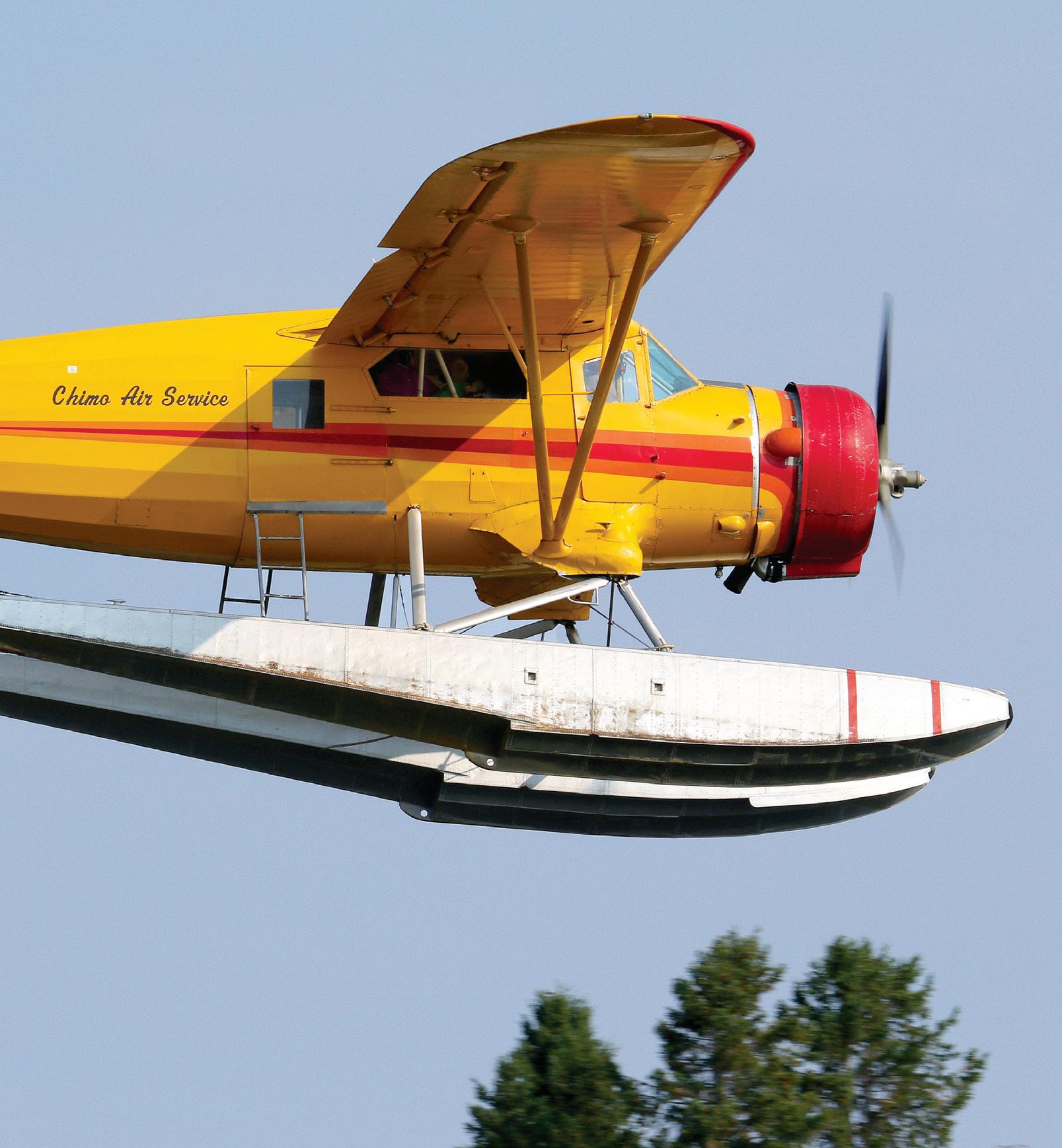
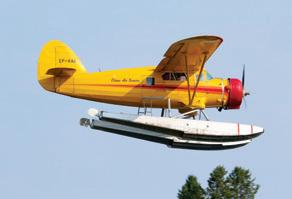
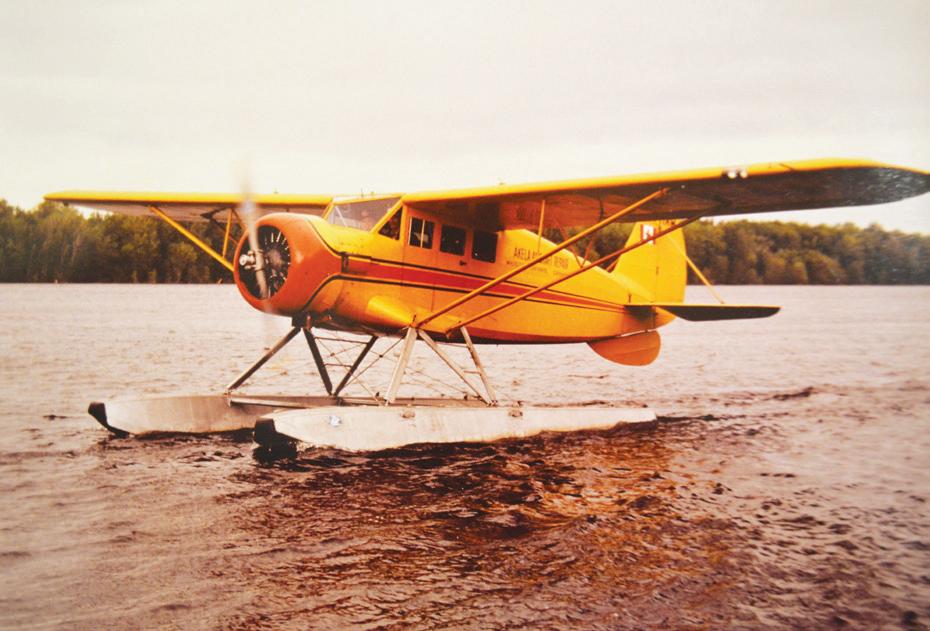
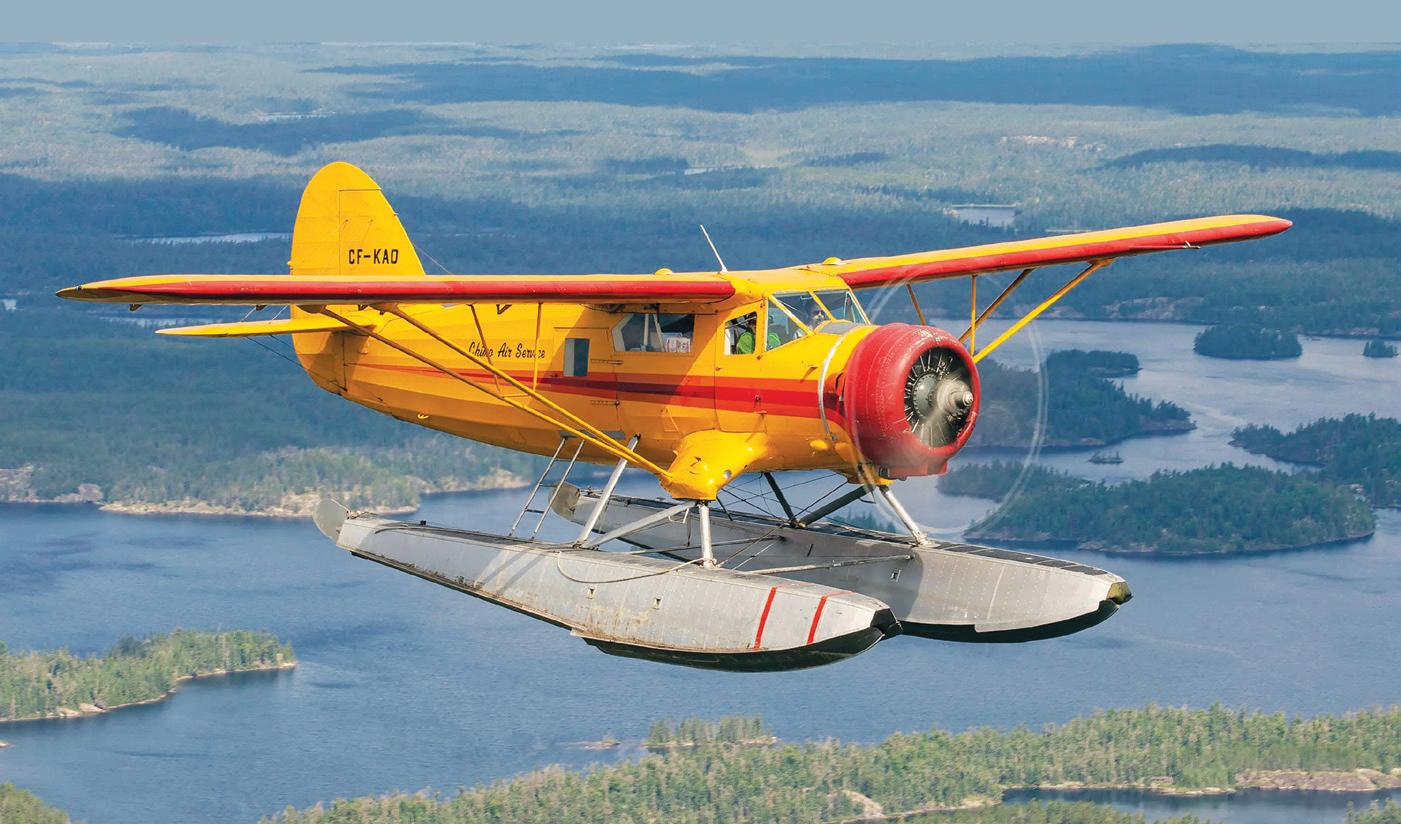
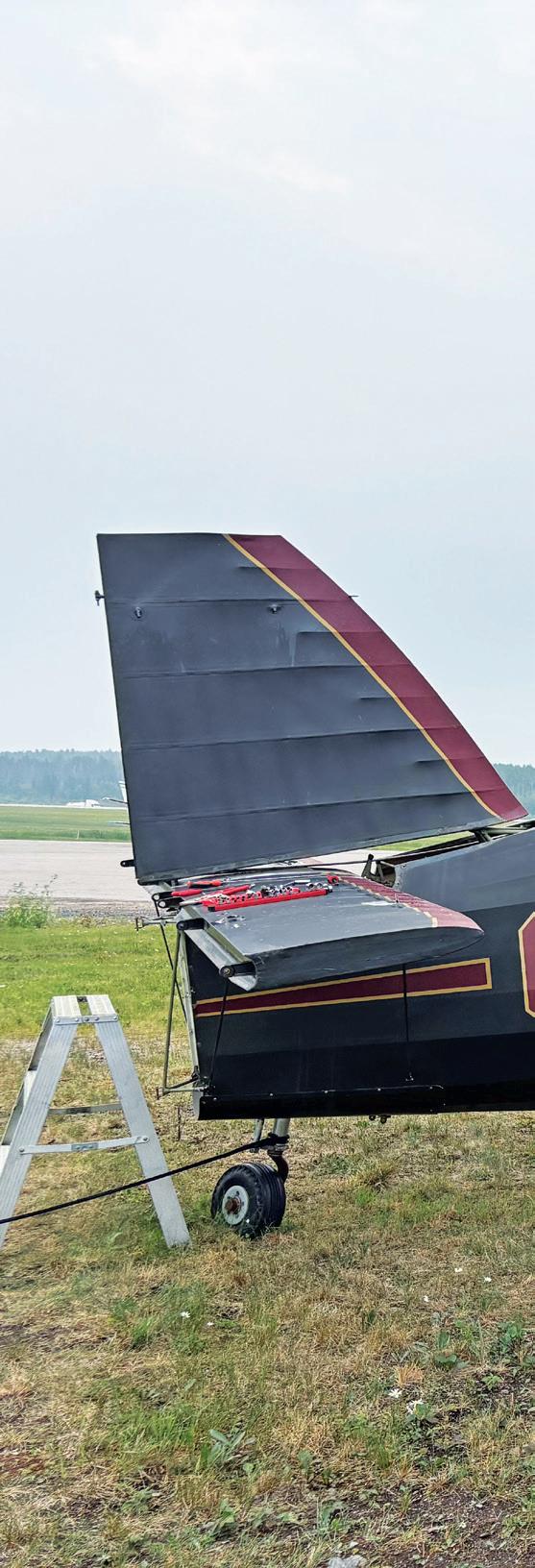
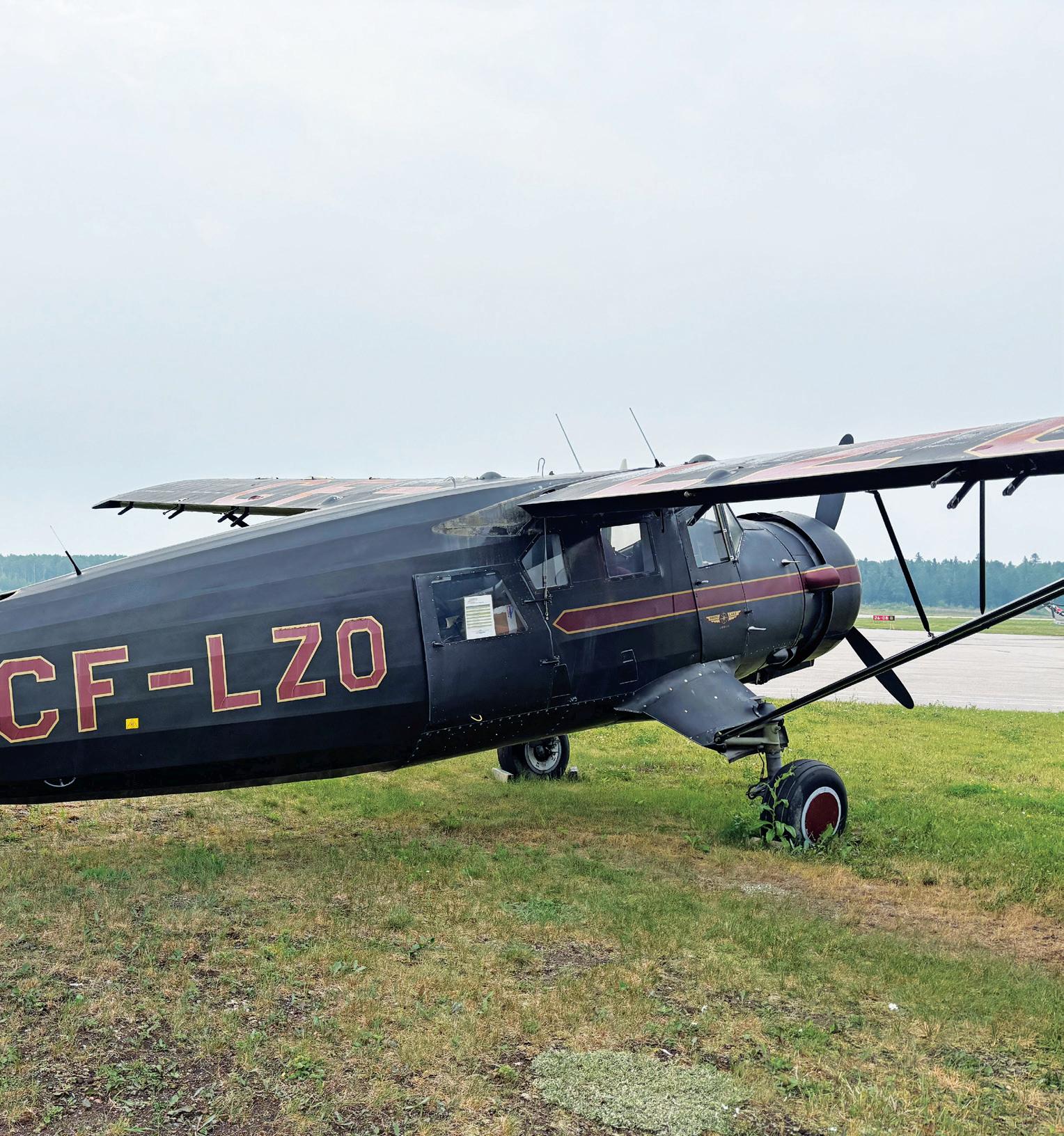
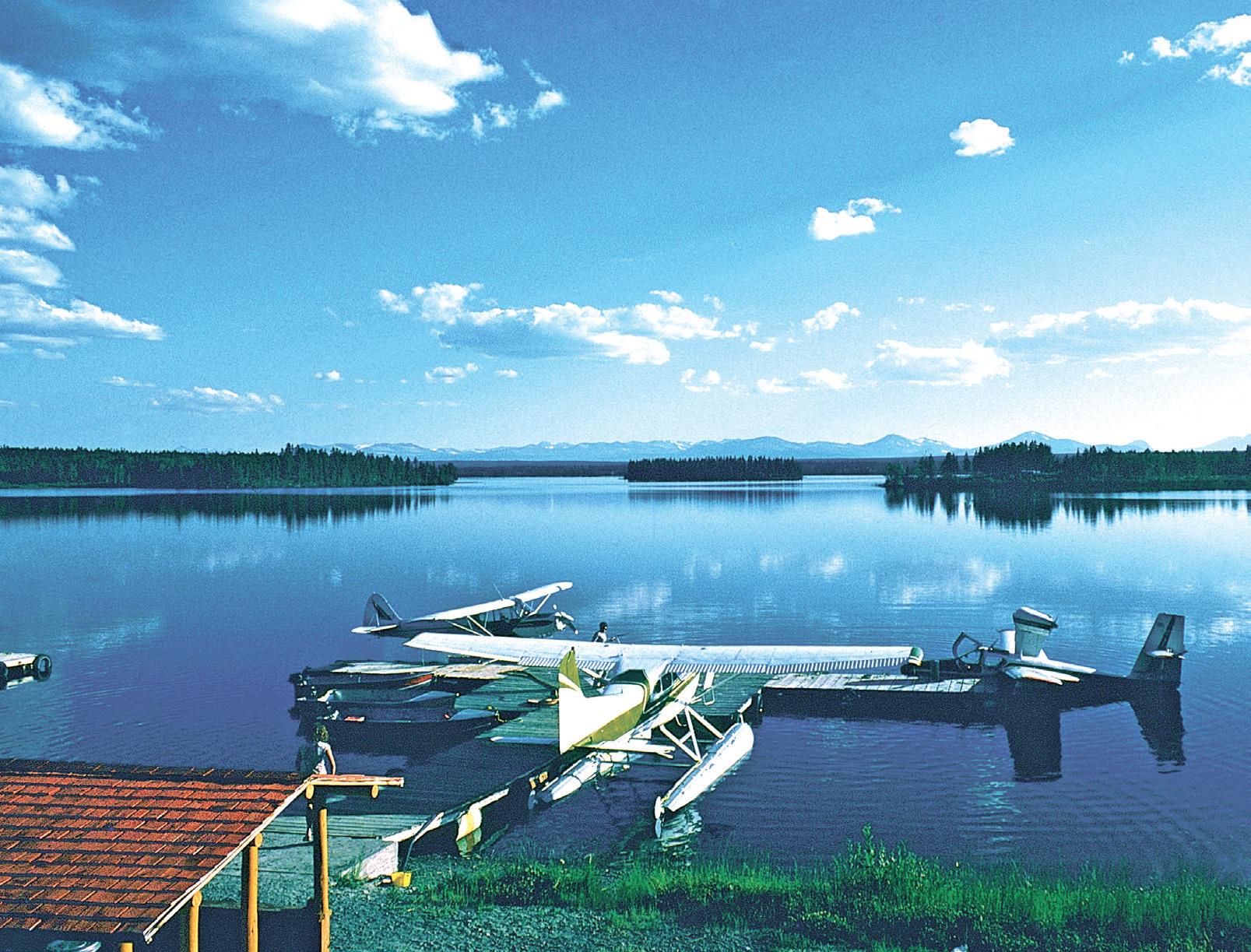
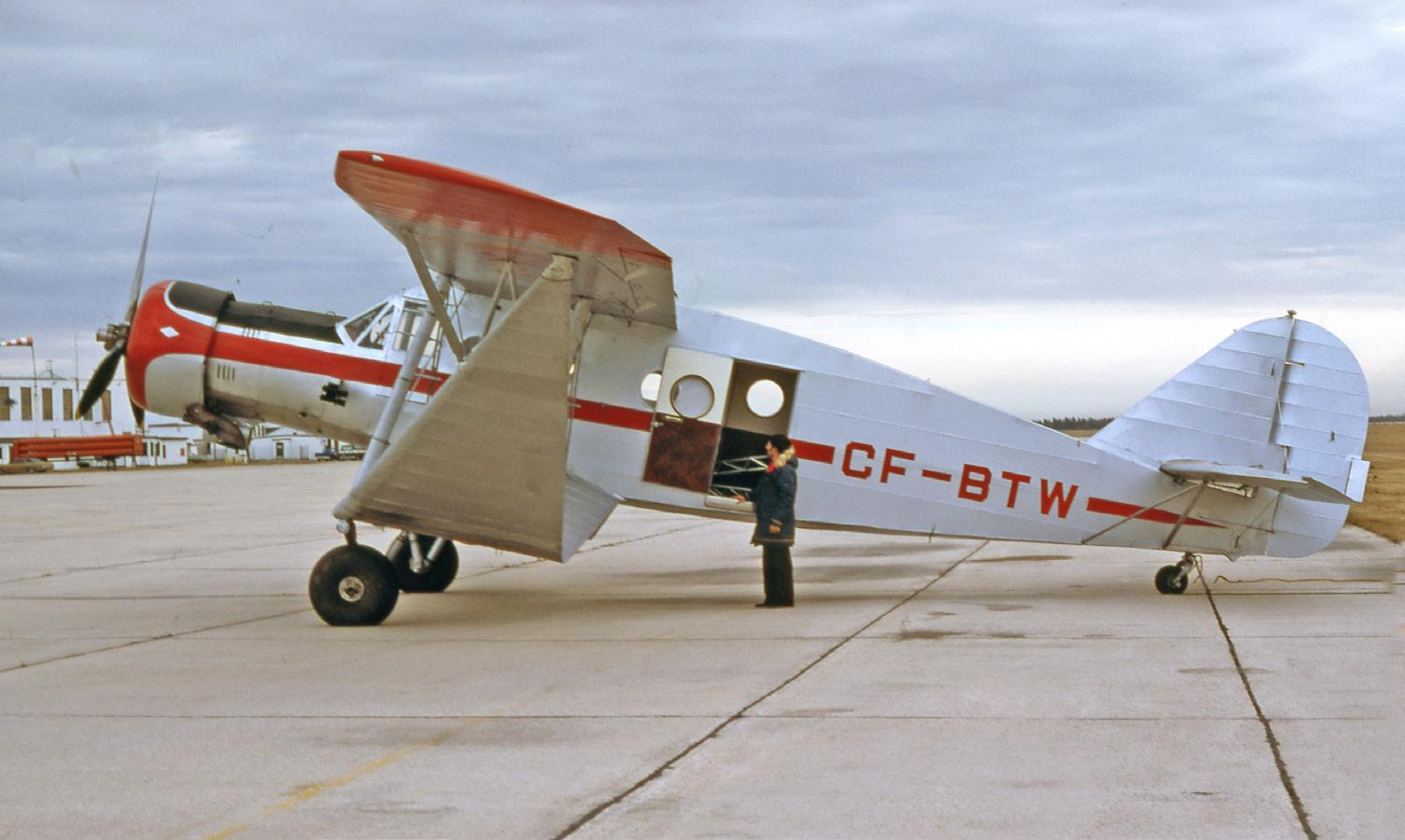
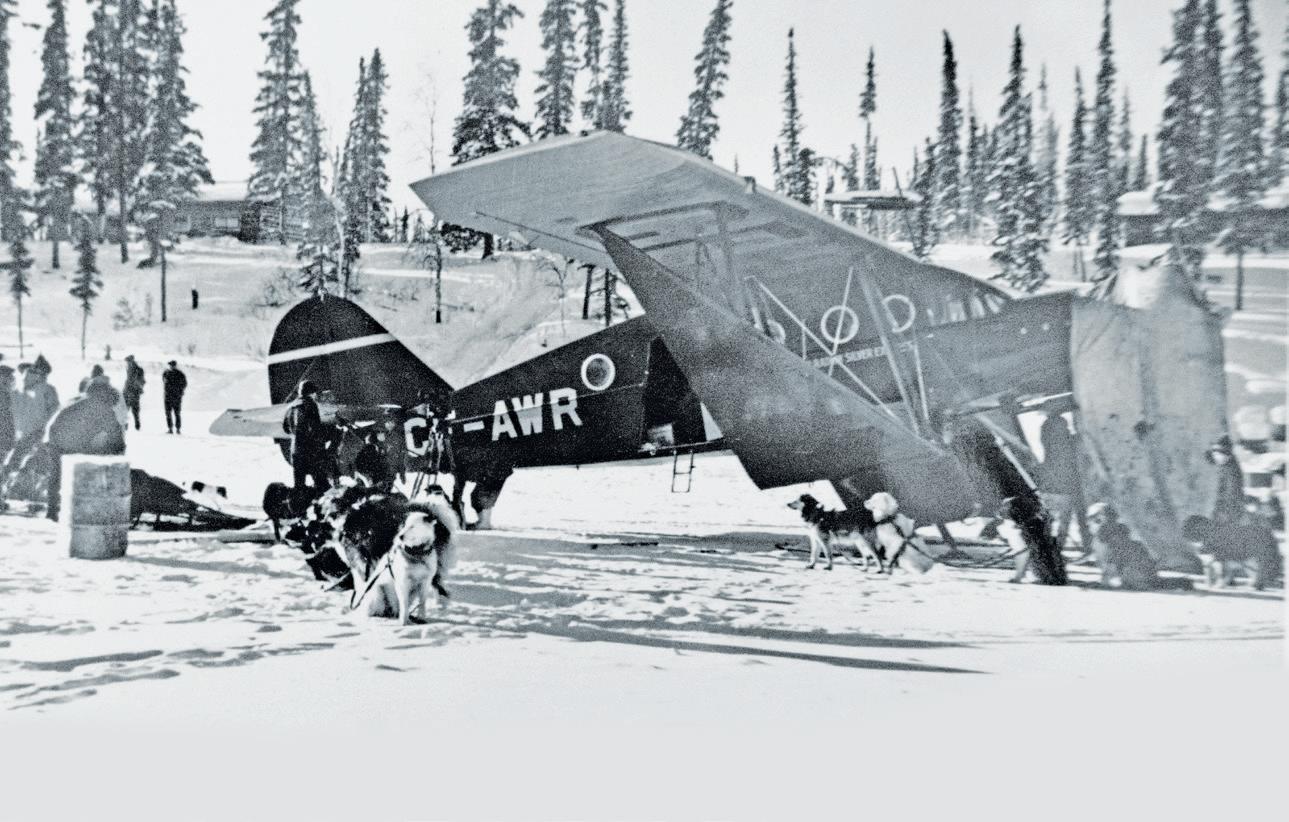
The Noorduyn Norseman was a popular aircraft type for
Robert S. Grant
Chimo Air Services of Red Lake, Ontario.
Photo by Kevin Porter
ANN TALBOT
Unintended Consequences
For those who may have missed Tim Cole’s piece in the Cole’s Notes department in the Mar/Apr 2026 issue, “Transport Canada’s Aircraft Are Disappearing,” he wrote about Transport Canada’s (TC) move to dispose of their fleet of aircraft, both aeroplanes and helicopters. Cole then questions whether TC will be able to attract pilots into their organization with only annual simulator training to keep them proficient.
What is it that attracts experienced pilots to leave industry and seek a job as a government employee? The motivations are many, such as the desire to share their experience to make for safer skies. Some are early retirees from the airlines and are
collecting a pension, so their total income will still be considerable. Others are motivated by the opportunity to have a “9 to 5” job, leaving time for a better family life.
One thing that is common to most, if not all — they want to still enjoy the freedom of flight that no other pursuit can offer, even if it is on a less frequent basis than before. If that opportunity is no longer available, replaced with an advanced computer setup, will they be so willing to sign on with TC? I join Tim in doubting that. This is an unintended consequence of TC’s divestment of its fleet.
In this issue, Richard Pittet writes in Expert Pilot about TC’s move to equip itself with the ability to
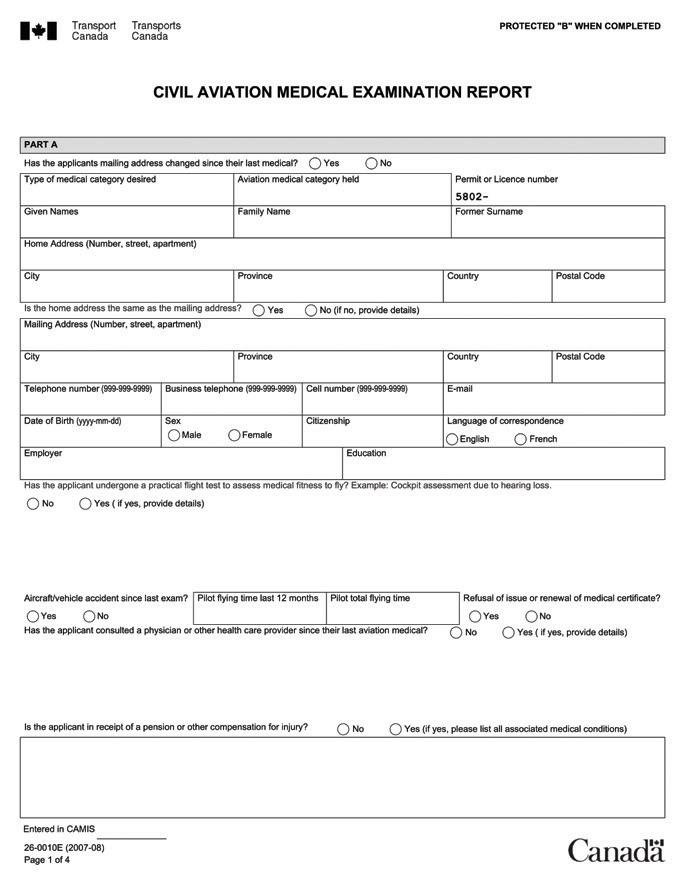
scour the medical records of anyone pursuing a Transport Canada Medical Exam (and potentially share that information among other government departments). A pilot who makes a living on the basis of his or her pilot licence will lose their livelihood if their medical certification is denied. So, if a pilot is not sure whether a condition they are experiencing might affect their ability to pass TC’s standards, will they take a chance of reporting it to their personal physician (as opposed to the CAME)? Or, given many pilots’ ability to easily travel south, might they be tempted to seek medical advice south of the border to keep clear of TC’s prying eyes? Another unintended consequence, perhaps.
Top Aces to Train Argentinian Fighter Pilots
CANADIAN COMPANY WINS CONTRACT TO TRANSITION TO F-16S
Top Aces Inc., the Montreal-based private organization whose mission is to train fighter pilots worldwide, announced in March the awarding of a contract to train Argentine air force pilots to fly General Dynamics (now Lockheed-Martin) F-16s. The Fuerza Aérea Argentina (FAA) is acquiring 34 surplus refurbished F-16s from Denmark as the Scandinavian country transitions to the Lockheed-Martin F-35 Lightning II.
The contract, valued at $33.2 million, was awarded to Top Aces by the U.S. 338 Enterprise Sourcing Squadron (AFMC) and will be managed by the U.S. Air Force Security Assistance Training Squadron (AFSAT).
“Top Aces is honoured to be selected by [Argentina’s] FAA to develop this advanced airpower capability,” Top Aces’ U.S. Group President Steve Haase said. “Our instructor pilots bring extensive U.S. Air Force backgrounds, each with more than 20 years of service and an average of over 2,300 flight hours in the F-16. Having built a fully operational F-16 enterprise from the ground up, Top Aces is uniquely positioned to train the next generation of Argentine combat leaders on their new and highly capable F-16 platform.”
The training will take place in Argentina with that country’s newly acquired F-16s and will last at least two years.
“Following Argentina’s acquisition of the F-16, Top Aces’ ability to rapidly
deliver high-quality, in-country training was a key factor in this award,” Top Aces’ Foreign Military Sales Program Manager Patrick McClelland said. “By deploying our experienced instructors directly to Argentina, we provide seamless training from basic through instructor levels — optimizing student proficiency and progression to efficiently deliver a cost-effective, operationally-relevant solution that directly supports Argentina’s national defense objectives.”
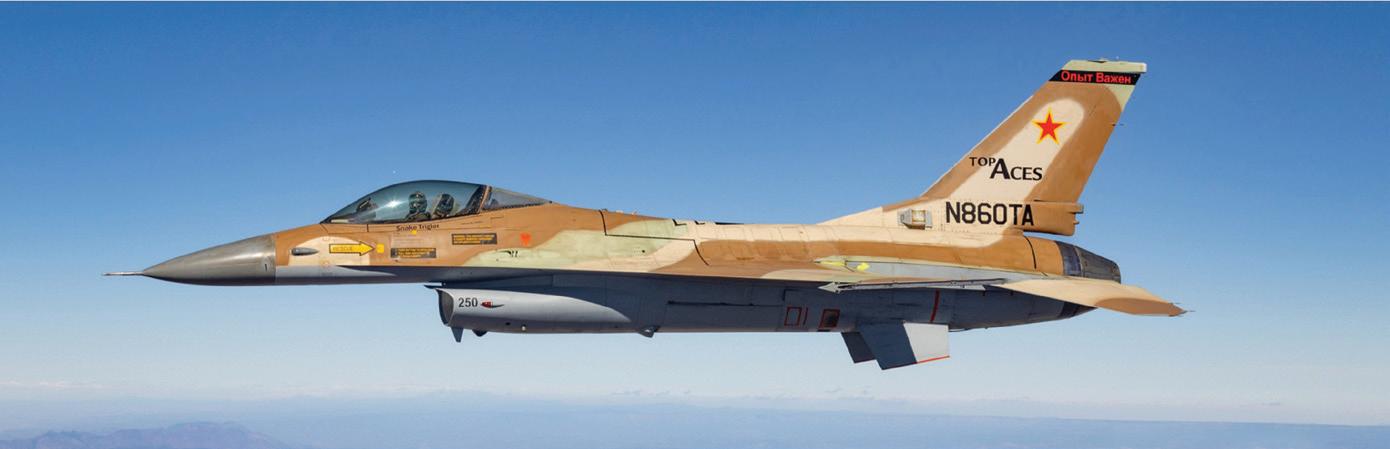
Top Aces was formed in 2000 by three former CAF CF-18 pilots. Today, the company has permanent operating bases in Canada, The United States and Germany. In 2021, Top Aces began taking delivery of a fleet of surplus F-16s from the Israeli Defence Forces (IDF) after establishing their F-16 Center of Excellence in Mesa, Arizona. The company chose to leave the aircraft in IDF livery.
A contract with the Department of National Defence, the Airborne Training Services (CATS) program, sees a Canada-based fleet of Dassault/ Dornier Alpha Jets, Bombardier Learjet 35s and recently upgraded Douglas A-4 Skyhawks used for training RCAF pilots. Top Aces’ F-16s are primarily based at their Mesa base.
JAMES DEBOER/TOP ACES
“Management has listened to us.”
CANADIAN NORTH PILOTS’ UNION REACHES TENTATIVE AGREEMENT
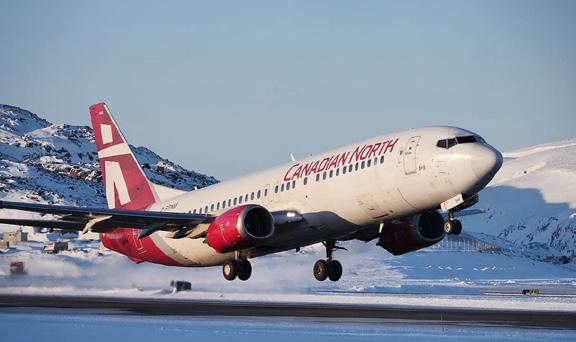
Air Line Pilots Association, Int’l (ALPA-I), the union representing the pilots of Canadian North, have reached a tentative agreement with the airline’s management. The deal was six months in the making. The highlights include fewer hours and fewer duty days.
“Until now, Canadian North pilots lagged behind other ALPA carriers in scheduling and compensation,” said First Officer Steven Bard, chairman of Canadian North Master Executive Council. “This tentative agreement recognizes the value of our specialized technical skillset, which is required to fly the rugged terrain and challenging weather conditions of the Canadian Arctic. I am proud of the hard work from the Negotiating Committee in achieving this fair contract.”
The tentative deal also includes a shift from a salary-based compensation model to a credit-based system, which traditionally is a combination of actual flight time and contractual soft time.
“The gains we have achieved with this tentative agreement will now align us with our industry peers and help make Canadian North a career destination,” Bard added. Canadian North did not immediately comment on the agreement.
As of this writing, pilots are in the process of voting on whether to ratify or reject the proposed deal.
In July of 2025, Winnipeg-based Exchange Income Corporation acquired Canadian North, which adds to their portfolio of aviation-related companies. These include Calm Air, Perimeter Aviation, Keewatin Air, Carson Air, PAL, Regional One and Custom Helicopters.
AIRMAIL
Always learning
I thoroughly enjoy reading the Canadian Aviator as a retired RCAF Nav/RO and then, Flight Surgeon. Each issue has a great mixture of maintenance and flying stories, education and human factors.
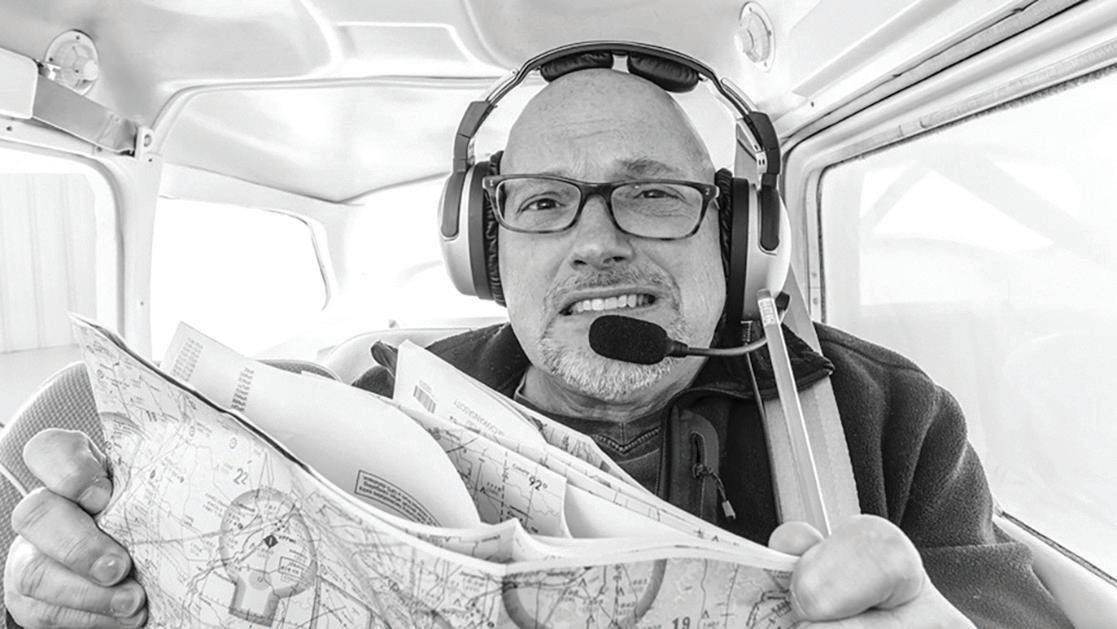
During my time at Queen’s University, Kingston, I acquired a PPL. Flying a club Cherokee around the Kingston area with a map on my knee, before GPS aids, was an enjoyable stress reducer. But, when I look back on that early time, I now realize how little attention I gave to flight planning, weather prediction, C of G or gross weight limits on a hot afternoon with three heavy passengers. Your stories would have been useful to shake up my young pilot complacency.
We all have heard the saying “Learn from the mistakes of others; you will not live long enough to make them all yourself.” Canadian Aviator helps us all learn.
LCol (Ret’d) James R. Popplow, CD, MD Winnipeg, Man.
A Pilot’s Story
The article “No Reason to Leave” by Robert S. Grant (Mar/Apr 2026) was so interesting and well written. The writing brought me to experience what Eric was enduring. It brought joy to my eyes. I felt so happy for Eric Rempel, that he never gave up his joy just to make more money. Thank you, and congratulations to all for providing such a worthy story, which has a true meaning. When things are so bad at the time, and when one looks back in time, we realize it was the right thing to do.
Roy Sobchuk Brandon, Man.
Spitfire History
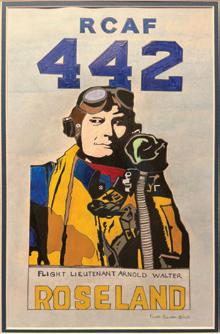
A recent article in Canadian Aviator (“Victory Flight,” Mar/Apr 2026) is of great interest to me and my family. The Mk IX Spitfire flown in the Victory formation article is dedicated to my father, Flight Lieutenant Arnold Roseland. The aircraft’s identification Y2-K was flown by my father on 65 occasions in the Second World War. I was nine months old on July 13,1944 when F/L Arnold Roseland was killed in action over Normandy.
Ronald Roseland-Barnes Oakville, Ont.
Send us your letters.
Canadian Aviator welcomes reader letters on topics of concern to Canadian pilots and the aviation industry. Please be brief, to the point and polite in your submissions. Email Steve Drinkwater steve@canadianaviator.com
GEAR & GADGETS
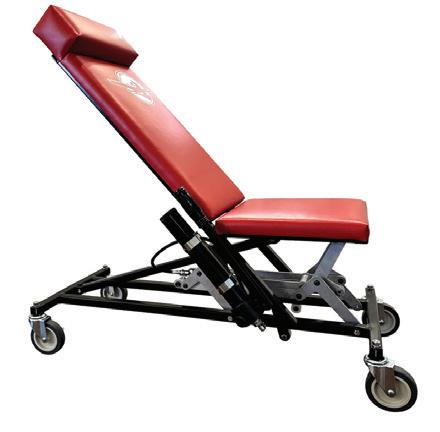
Hydraulic creeper
Have you ever found yourself on a conventional creeper and a bit too low to accomplish the task you set out to do? If so, you probably don’t like having to roll back out into the open, stand up and adjust the creeper to provide a more useful lift. What you need, then, is a creeper whose height you can adjust without having to move more than your arm. The EZ Creeper company of London, Ont. offers their Model H, which they claim is unique in the world, is lightweight and durable, and made in Canada. Dimensions are 36" x 16" x 7" (collapsed) or 41" (fully raised). Heights are based on 3" swivel casters, which are also available in 2," 4" or 5" diameters. About
Learn more at, and available from, ezcreeper.com
iPad Ram mount
For those of you who use an iPad in the cockpit, having it conveniently mounted is sometimes a chore. Many opt for Ram Mounts, a line of products offered by the Seattle-based company. Of particular interest to iPad users who also use an Apple Pencil is their latest iPad offerings, which accommodate the ancillary device in the holder itself (it can also hold a stylus of similar dimensions). Using an Apple Pencil allows for the use of the iPad for making annotations, such as completing an ATIS template or tracing a taxi route ATC clears you for at a complex airport. Ram offers a holder for the latest models of all three configurations of the iPad (Std, Pro and Mini). No need to purchase the entire mount, just the device holder which bolts on to an existing mount. About C$40 to C$50.
Tablet
satchel
Do you use an iPad, regular or mini, as a cockpit tool to aid you with navigation? Would you find it handy to bring it with you to where you’re enjoying your $100 hamburger, or home at the end of the day, in its own stylish imported nylon tote? Red Canoe of Toronto offers the perfect conveyance that will mark you as a person with taste. Check out their Canada Pouch, a versatile, tan-coloured satchel with an adjustable strap and zip enclosures. Dimensions are 9.5" x 10" (24 cm x 25.5). About C$49.
Learn more at rammount.com. Available from aircraftspruce.ca
Learn more at, and available from, redcanoebrands.com
CO detector
Are you still using a paper, stick-on carbon monoxide detector? Do you doubt its sensitivity or reliability? Radiant Instruments of Wichita, Kansas offers a CO monitor in the form of a USB stick. Their CO-USB Carbon Monoxide Detector Alarm plugs into any USB-A port to power up and to charge. If you have a spare USB-A port on your panel, plug it in there and leave it. Alternatively, charge it elsewhere and enjoy an 8-hour battery life. The unit needs three minutes to warm up for the first accurate result and will recover after 90 seconds of CO gas removal. The red LEDs begin flashing at 41 ppm. About C$65.
Learn more at radiantinstruments.com. Available from aircraftspruce.ca
Every Man to His Trade
WHAT A GUY HAD TO DO TO MAKE A LIVING FLYING
Once, when I was moving a logger and his family and all their worldly goods from one camp to another, the family dog threw up on my hand and all down the power quadrant—this during takeoff. On another occasion, while flying on a turbulent day, I reached back to seize the journey logbook from the pocket on the back of the pilot seat and found the book missing. I stuffed my hand deeper into the pocket, and it came out dripping. Seems a considerate passenger had carefully removed the book, placed it on the floor and then vomited into the pocket. Another pilot recalled that, while flying with the door off for a group of skydivers, one of the jumpers had puked out the door. The slipstream blew it all back into the cockpit, completely covering the pilot’s sunglasses and obscuring his view. One other incident — nauseating, but thankfully without the vomiting — bears telling before getting back to the true romance of flight.
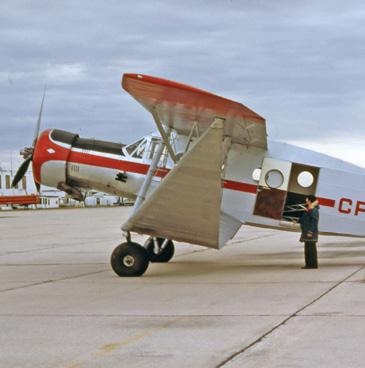
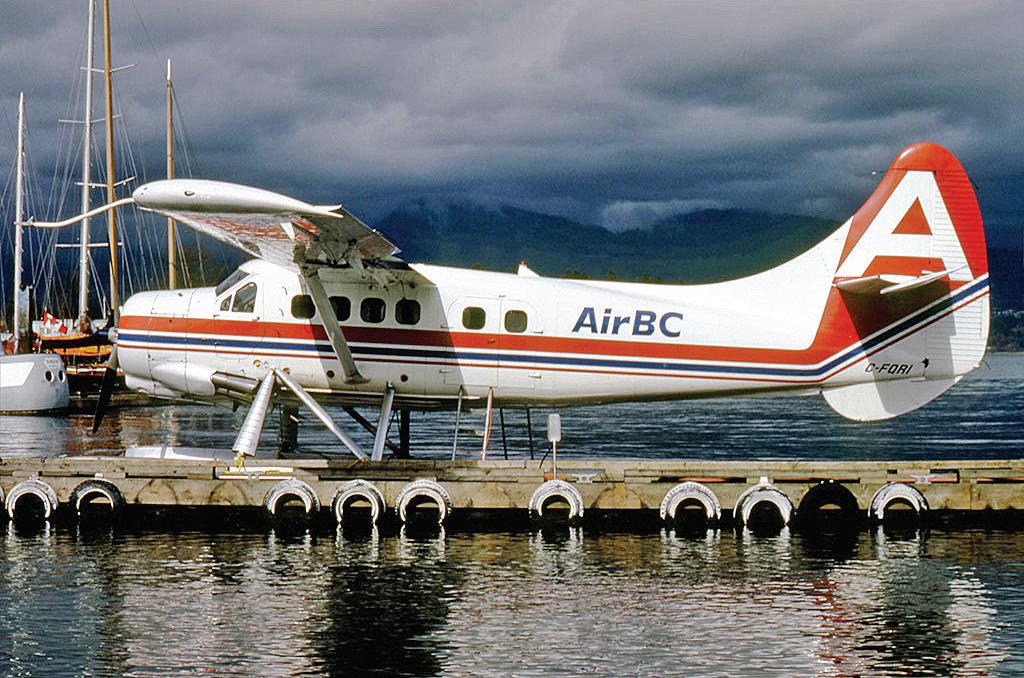
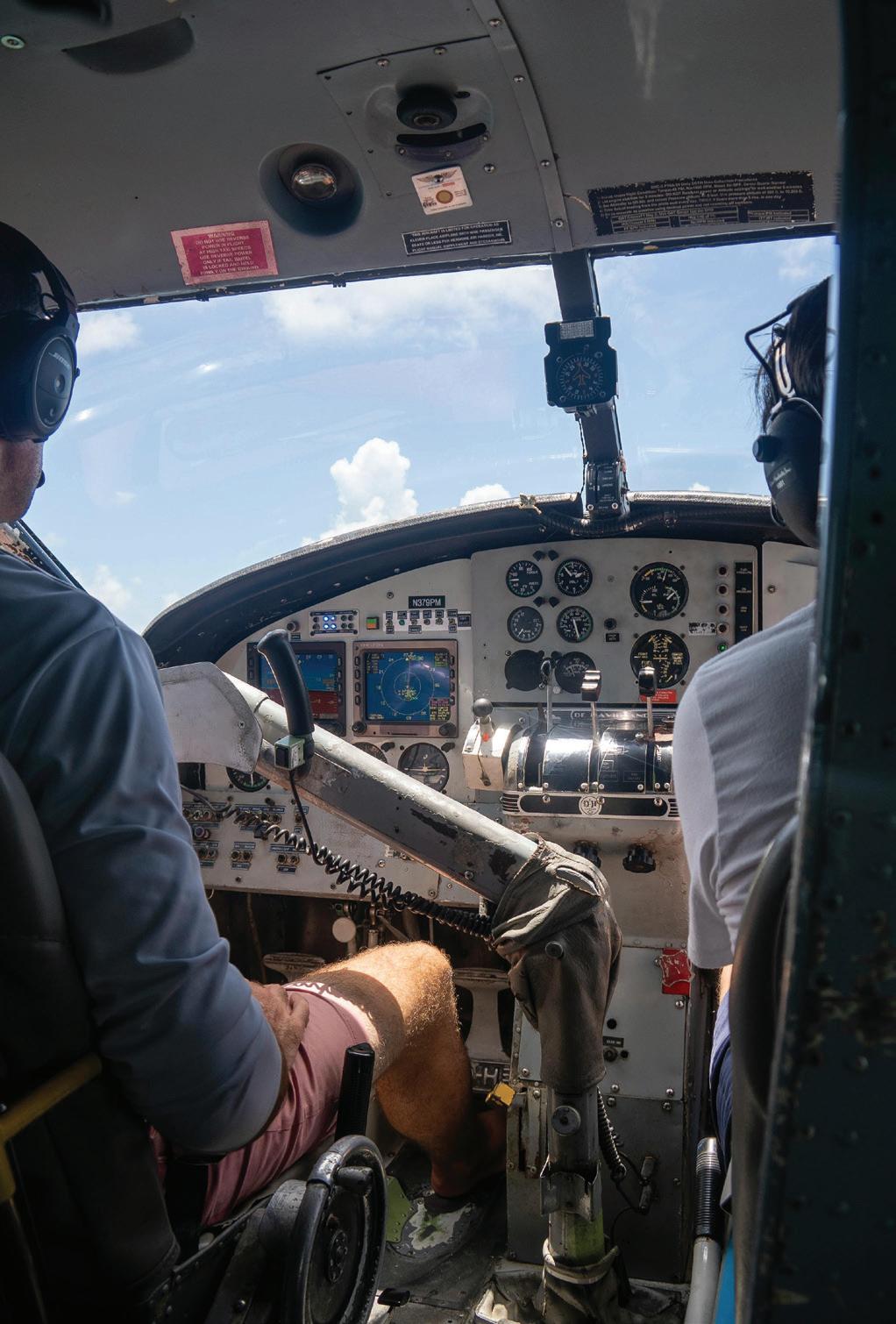
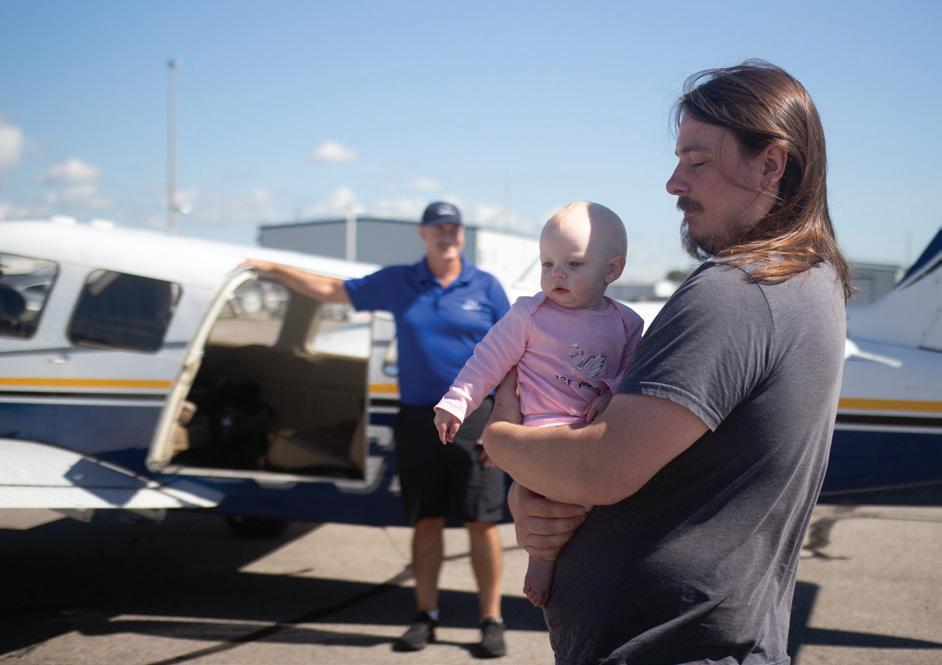
QRI was a Single Otter amphibian powered, in those days, with the 600-horsepower Pratt & Whitney R1340. It stood near the fuel bay at Port Hardy airport awaiting two passengers and what was described in the flight manifest as a full load of “household effects.” The destination was Taleomy, in South Bentinck Arm, near Bella Coola on British Columbia’s west coast. It was a very hot day and all the doors of the plane had been propped open, but the big cabin was stifling from the intense sunshine beating down on it. The concrete tarmac was radiating visible heat from the afternoon sun when the two (in fact, three) passengers, a man and a woman with an infant, arrived in a dilapidated stake truck loaded to the gunwales. The two adults were tree planters heading into camp for the season. They were travelling with
their own personal tent city to set up in the bush. Nothing was packed; everything was loose, from tents to toothbrushes, and each piece had to be loaded aboard the plane separately.
An amphibious Otter stands very tall: a three-step float ladder gets you to the float deck, and then it takes three more rungs of the boarding ladder to reach the cabin. I must have made 100 trips up and down the ladders in that heat to get the passenger cabin fully loaded. There was no “ramp rat” on duty to help because it was a Sunday. The young woman laid a blanket out on the tarmac at the foot of the ladder and proceeded to change the infant’s diaper. She used cloth diapers and saved them — complete with contents — stuffing the fragrant missile into a carryall that already contained three or four used ones from the road trip. This too went aboard.
All the seats in the Otter had been folded up against the fuselage to make room for the load. The exception was the seat on the starboard side, up front at the flight deck bulkhead. The
young hippie-like mother, clutching her baby, climbed in through the pilot’s door and took this seat, while her man sat beside me in the co-pilot seat. He had a singular appearance, having made his own sunglasses from heavy copper wire containing blue bottle-glass lenses. They were like John Lennon’s glasses, very small, and the blue glass hid his eyes completely and cast a coloured shadow on his face.
The Otter was jammed full to the roof with the aromatic cargo as we taxied out to the numbers on Runway 07. The air in the cabin was foul. The combination of dirty diapers with the couple’s “eau de tree farm,” plus the mildewed tents and gear, drove me to stick my head out the pilot-side window both while taxiing and immediately after takeoff — all reminiscent of an earlier flight with a different species aboard.
When I had off-loaded all that stuff at the destination, I was absolutely sacked. An onlooker who helped turn me out from the dock called out to me before I closed the pilot’s door: “Every man to his trade!”
HANGAR TALK WITH JACK SCHOFIELD
This is the aircraft that the author flew from Port Hardy on that rather odorous day.
Horror Over the Potomac
THEY DIDN’T SEE AND AVOID
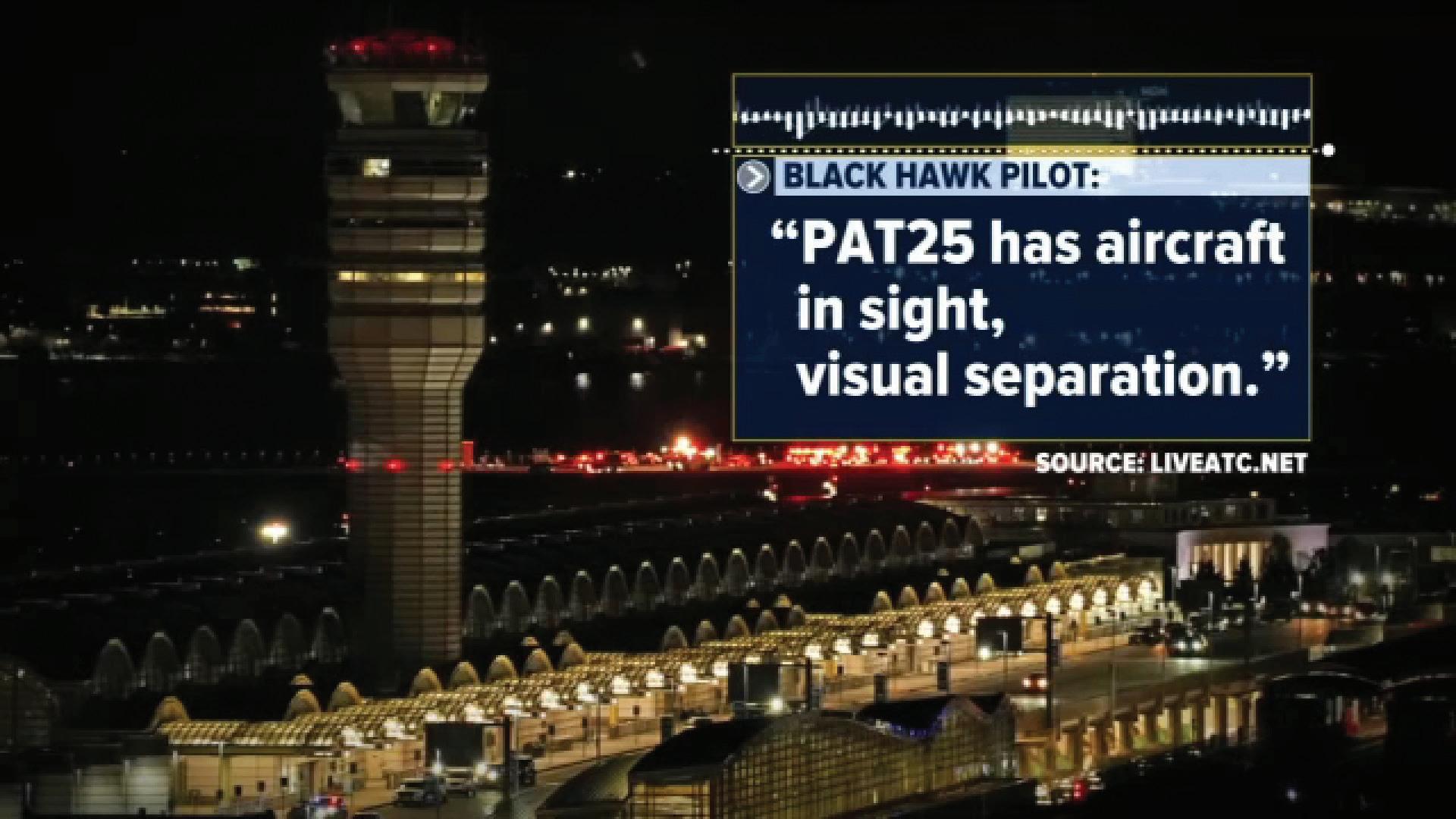
At 20:46:01, the controller advised PAT25, a military Sikorsky UH-60L Black Hawk helicopter conducting training operations, that traffic just south of the Wilson Bridge in Washington, D.C. was a PSA Airlines CRJ 700 (Flight AA5342) at 1,200 feet circling to Runway 33. PAT25 confirmed seven seconds later that they had the traffic in sight and requested visual separation, which the controller approved. Less than two minutes later, the military helicopter collided with the airliner. All passengers and crew on both aircraft died.
One year later, the final report demonstrated that the helicopter
crew misidentified the target. See and avoid. The premise is commonsense and simple enough. Look for traffic and, when you do see it, avoid it. While the avoiding part is a no-brainer, the seeing can be more challenging.
Long before we became airborne creatures, we existed solely as earthbound creatures. We learned to avoid collisions while moving by scanning a mere 60° cone straight ahead of us. In the pilot seat, the required scanning field triples and the speeds are significantly higher.
Picking a 10° section and scanning it up and down before moving on to the next 10° section
allows us to thoroughly inspect that sector for traffic but the technique is not innate to us and requires a deliberate effort. Moreover, when executed properly, a full scan takes 18 to 36 seconds to complete. Two cruising Cessna 152 travelling in directly opposite directions cover two miles in less than 38 seconds.
Environment “pollution” may challenge identification. For example, looking for an aircraft at lower altitude against a busy background might be difficult. Likewise, at nighttime, it can be difficult to pick aircraft position lights against city lights.
Workload increase tends to inversely affect scanning range. The busiest time for a pilot flying in visual conditions is the time spent operating within an airport area. Not surprisingly, most midairs and near misses occur during this type of environment and flight phase. Likewise, flight instruction demands high levels of attention division and accounts for 37 percent of all midair accidents.
The most diligent scanning job cannot alleviate the fact that most aircraft do not come equipped with rear view mirrors — or underneath and above mirrors for that matter — leaving many areas where danger could be lurking if left unmonitored. Electronic collision avoidance systems can help but they also increase workload.
As if that was not enough, physical limitations render our ability to identify traffic within a scanned sector questionable. An aircraft on a collision course appears as a small, fixed speck in the windshield until it is nearly too late. Our vision system is ill-equipped to notice small things that don’t move. Furthermore, just like a camera lens, the eye must be focused to see clearly. The odds are that the tiny speck in the windshield that constitutes an eminent threat is not only motionless, but also blurry.
Proud as we — or autopilot George — may be of holding altitude and course perfectly, such perfection makes us less visible and more at risk. Rocking your wings is not only the proper way to acknowledge ATC instructions in a NORDO environment, it is also the best way to make yourself visible when you can’t spot traffic you know is nearby.
‘Be seen’ includes making regular and accurate position reports on appropriate air-to-air frequencies to help other pilots visually locate you, ensuring that the transponder is on and working to help ATC keep other aircraft away from you even when you are not talking to them, and turning on aircraft lights even during daytime regardless of the potential wear cost.
“While ‘see and avoid’ is the official procedure, ‘see and be seen’ is the best avoidance strategy. It takes into account that there are times when the conflicting aircraft is the aircraft in the best position to ‘see.’”
It takes two to tango. When it comes to midair collisions, that’s certainly true and good news. Out of two aircraft, only one has to see in sufficient time for a collision to be avoided.
While ‘see and avoid’ is the official procedure, ‘see and be seen’ is the best avoidance strategy. It takes into account that there are times when the conflicting aircraft is the aircraft in the best position to ‘see.’
When using flight following or aircraft separation services, never report an aircraft “in sight” unless absolutely sure.
Confessing “aircraft in sight” relieves the controller from his or her separation duties for the aircraft from assuming separation responsibility. There are no major benefits to decreasing the number of people looking out for traffic conflicts.
Midair collisions always yield an accident report and, in 50 percent of cases, a minimum of one fatality. Their relatively low frequency does not diminish their destruction potential. Alarmingly, the number of near miss reports has doubled since reaching an all-time low in 2009. Clearly, that number does not include near miss occurrences that no pilot observed.
Statistically, students on solo flights and pilots with 20,000 hours of experience have an equal opportunity to be involved in a midair collision. There is no right time to relax. Be vigilant, be seen, look, see, and avoid.
article suggestions and post alerts when new issues become available.
TALES FROM THE LAKEVIEW
Classic Stinsons
AS RELIANT AS AN AIRPLANE CAN BE
Strange how links between a Hollywood actress and her private leather-lined luxurious aircraft with roll-down windows could entice a Canadian to rescue a similar type from a scrapyard. More bizarre, that same saved Stinson now attracts stares at Ottawa’s Canada Aviation and Space Museum.
The hero in the saga, pilot Ellis Culliton, resides in Lakefield, five miles north of Peterborough, Ontario, and visits his former favourite whenever he can.
As a child, Culliton lived in a world of pioneering aviation when his father, Jay Patrick Culliton, flew from Ontario Provincial Air Service (OPAS) bases such as Sioux Lookout, 246 miles northwest of Thunder Bay. The renowned Air Arm had acquired what many believed to be actress Carole Lombard’s former luxury liner for supporting forest fire suppression. When smoke ceased and fireweed sprouted, the same Stinson carried pilot and AME families from seasonal bases to Sault Ste. Marie headquarters. Culliton never forgot his trips in the elegant aircraft, which became CF-OBB, during his pre-teen years.
“That Stinson, an SR-9 model, showed up in Sioux Lookout in 1945 with red wings and fuselage, beautiful blue leather interior and roll-down windows. Our OPAS pilot wouldn’t carry fire crews until he made sure it would stay clean, so he removed carpets and put in tarps,” he recalled. “I thought those guys coming in and out of forest fires wouldn’t be too happy and remember thinking how much I really wanted to own something like that.”
Before the opulent SR-9 carried “Hollywood’s finest,” in CF-OBB’s case, Lombard and husband Clark Gable, the Stinson Aircraft Corporation of Wayne near Detroit, Michigan, had announced the first Stinson SR Reliant model. Powered by a 215-hp Lycoming R-680 radial
engine with “harmonious interior and rather pleasing exterior,” the fabric-covered mini-liner carried three passengers and pilots with a 43-foot, 3-inch twospar spruce wing. Five parachute flares and retractable landing light accompanied every sale.
On Edo P-3300 floats, the seaplane empty weight listed at 2,384 pounds and 3,469 gross takeoff. At least 88 left the factory and sold for $3,995. (In 2026, C$92,632). Culliton’s dream machine, registered N13464 and serial numbered 8717, survived several American owners including William Lear who later designed the Lear Jet. By 1953, Lac La Croix-Quetico Air Service near Atikokan, 130 miles west of Thunder Bay, acquired what became CF-HAW with a 300-hp R-680 radial powerplant.
A landing incident nearly resulted in disaster when elevator controls failed. Well-trained, the experienced pilot managed to settle onto the water with full nose-up elevator trim. The touchdown
splash, described by late historian Mac McIntyre in Canadian Aviation Historical Society Journal Fall 1956 issue, sent ravens and whisky jacks scurrying away from a newfound moose carcass.
“Old HAW plopped in with quite a crunch, accompanied by the noise of something ripping loose from the rear fuselage,” McIntyre wrote. “It was found that the battery had broken loose from its mounting and gone down through the stringers and fabric into the lake. Battery acid had eaten the mounting and dripped onto elevator cables which failed in flight. A near miss!”
Culliton had no idea that a Stinson SR version shared the same northern Ontario hinterlands. Unknown to him, Superior Airways founder O. J. Wieben in Fort William assumed ownership in October 1955, and another change occurred when a remote lodge operator bought the aircraft on April 13, 1956. Aging fabric and hard use associated with hauling American bear hunters and fishermen
BUSH FLYING WITH ROBERT S. GRANT
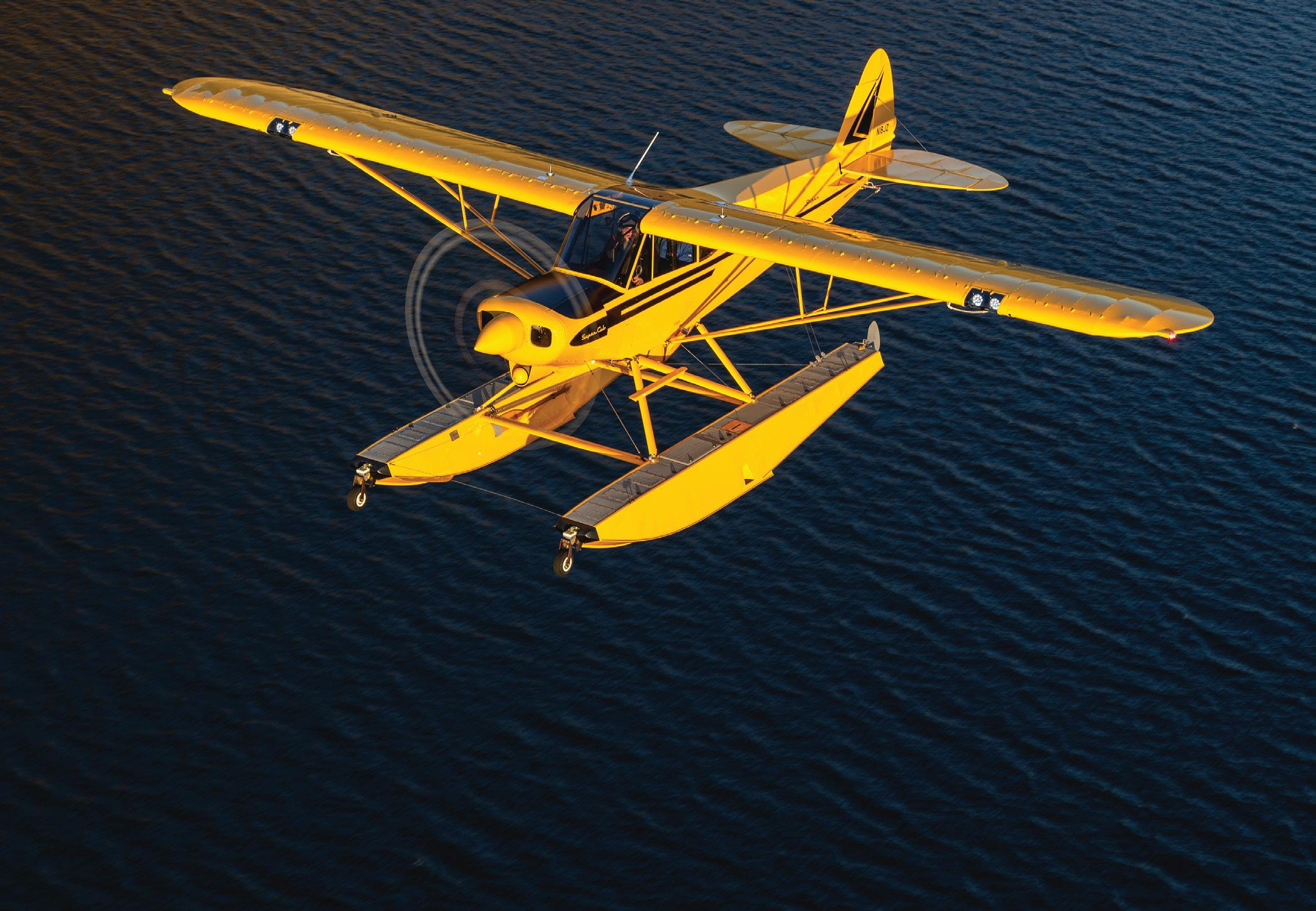
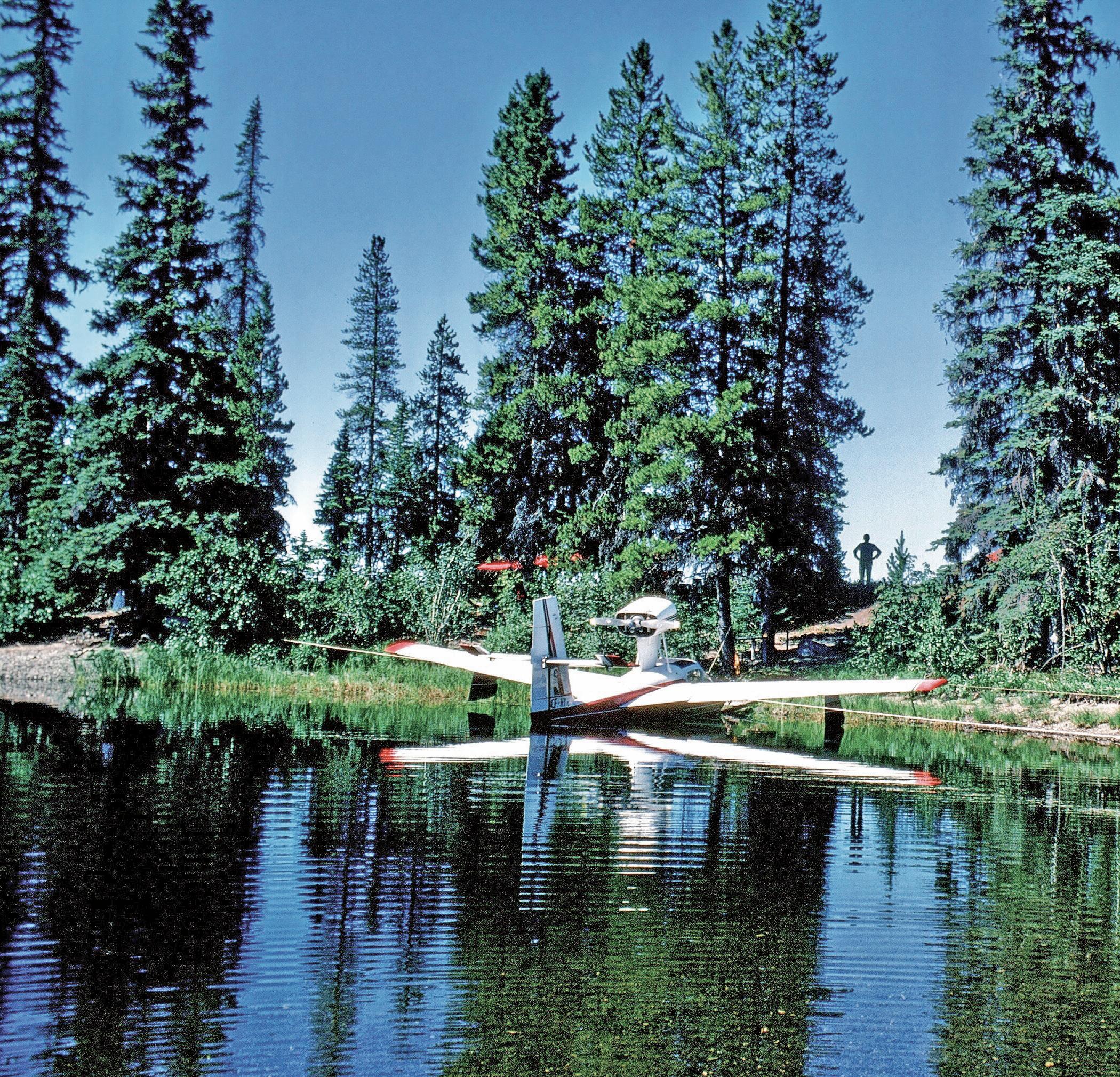
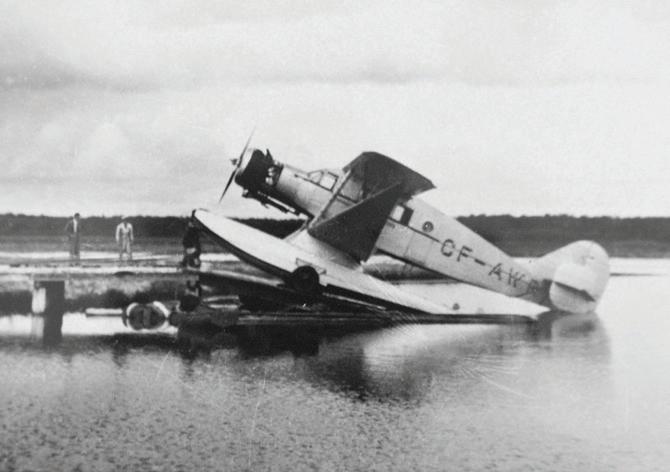
Stinson SR CF-HAW was the ancestor of the more powerful gull-wing Reliant versions, which became popular in Canada’s northern regions. For a brief period, Culliton flew CF-HAW from Gogama, north of Sudbury, Ont.
fortified by maximum loads of Coors and Hershey Bars suggested overhaul. Consequently, AMEs stored Stinson SR CF-HAW outside, and log books went into a hangar which tragically burned. Several aircraft turned into ash piles and CF-HAW’s logbooks perished.
The loss of documentation rendered the former bush plane almost valueless. A scrap dealer purchased the remains and, in 1960, two business partners decided to rebuild the classic. After examining the expired fabric, both lost interests. Without proper paperwork, chances were, the gallant machine would revisit a scrap yard permanently.
Coincidentally, a U.S.-registered Stinson SR enroute from Alaska to Massachusetts dropped into Culliton’s OPAS base, where he had been employed as a newly hired pilot since 1962. The elegant craft sparked memories of childhood trips in CF-OBB and revitalized his passion to track down the same model. Another drop-in guest mentioned an abandoned fuselage near Kapuskasing, Ont. One of CF-HAW’s previous owners decided to convert CF-HAW’s floats into a houseboat. Horrified, Culliton’s determination led to a mission to save what he could before bolts, nails and spikes destroyed an example of aeronautical history. He snapped up the maltreated derelict in 1963.
“So, here’s this fabric airplane sitting outside with little value that had been in the hands of an auto wrecker. I was told by everybody that nobody wanted it, and no one could ever get the thing registered by the Department of Transport,” said Culliton. “I still have photographs of me putting a 21-foot float on a rubber tire tied to the top of my 1956 Volkswagen with windows open and driving south and wet in the rain. A truck driver asked me if I was expecting a flood.”
Culliton entrusted his prize to master AME Gordon of Muskoka Air Trails, who soon created Northland Air Services and moved the pending project to Port Sydney near Huntsville. Restoration of what sceptics considered corroded scrap into artistry worthy of exhibition in Paris’s Louvre (or Washington’s Trumpingham Palace?) became
a two-year undertaking. Culliton tracked down components such as float spreader bars and fittings, researched certification, dealt with bureaucracy and logged thousands of Volkswagen miles.
The adaptation of materials more advanced than 1933 technology improved performance and payload. A lightweight battery decreased gross weight, and aluminum replaced the plywood interior. Instead of a glass windshield, the Hughes substituted plexiglass. They also metalized the wood doors and modified the baggage compartment to increase seating from four to five. By the time of the July 31, 1965, gross weight fell by 200 pounds.
“For final inspection and licensing, I flew to Remi Lake at Kapuskasing where a factory-new Cessna 180 happened to be at the same dock. The inspectors looked CF-HAW over and asked nothing more than to change the aileron balance cable joint and install a lock on the pilot door,” said Culliton. “They also checked the Cessna 180 and found enough faults for grounding yet authorized a licence for a 30-year-old Stinson, which said much for Northland Air Service’s work.”
Culliton had logged experience on many aircraft, including Noorduyn Norsemans, which he considered a lovable and noisy “…heavy bitch of a thing to get off the water.” In contrast, the Stinson SR performed well with the 300-hp Lycoming R-680-13 and constant speed Hamilton-Standard propeller. He cautioned that pilots dared not attempt to (side)slip away from the fuel tank in use when fuel was low. “With Edo 394000 floats, I could park anywhere and never worry about sinking,” he added.
Culliton enjoyed flying with family and friends while consuming 12 U.S. gallons per hour cruising 115 miles per hour. He briefly considered involvement in mining exploration, but personal
circumstances forced the aircraft’s sale. At age 34, he shifted to Air Canada as a Douglas DC-8 second officer and accepted a $100 salary cut from his $500 monthly OPAS rate, which had covered CF-HAW’s routine costs. Goal achieved, he owned the dream airplane of his teen years but found himself forced to turn the classic over to Hakela Aircraft Repair at Whitefish, 22 miles north of Sudbury, in 1981.
A final transaction occurred on June 1, 1983, when Canada’s National Aeronautical Collection representatives watched a yellow airplane on aluminum-coloured seaplane floats taxi to a dock on the Ottawa River. Volunteers soon shifted the classic to their massive building where the sleek shape now attracts daily attention. As for Culliton, he went on to own 19 different aircraft types while logging more than 8,000 hours in the cockpits of Air Canada passenger jets. His first flight in a wheeled aircraft took place on a DC-8 after a career flown only on floats and skis.
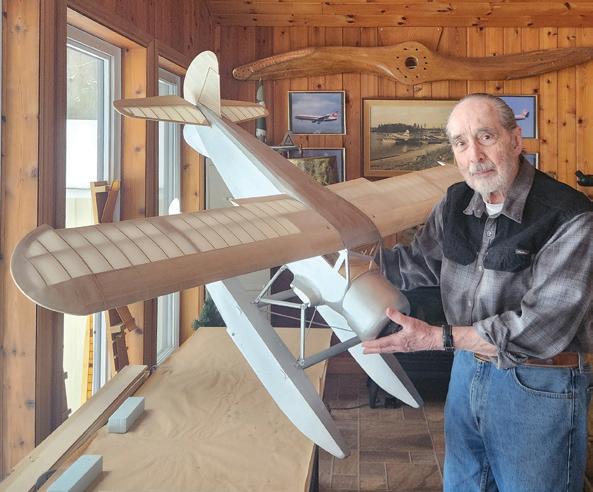
At the Museum (re-named Canada Aviation and Space Museum in May 2010), future aviators contemplate pioneers responsible for their careers as they explore exhibits. Culliton, now 93, keeps his astute mind and memories active with a meticulously hand-built radio-controlled model of a bush plane — CF-HAW.
Ellis Culliton flew with Air Canada on types such as the Boeing 747, Lockheed 1011 and Douglas DC-9 after entering airline flying with Vickers Viscounts. His carefully constructed CF-HAW model helps maintain links with memorable bush flying times.
The Most Important Word in Aviation?
IT MAY SURPRISE YOU
Iwas asked to be a guest lecturer at the British Columbia Institute of Technology’s Aviation Campus near Vancouver International Airport to address a new class of budding commercial pilots. The suggested subject was “Aviation Communications” (Not the Radio). I opened my presentation with the question: “What is the most important word in the aviation communications lexicon?” I received a variety of answers, mostly associated with safety, airspeed, altitude, stalls, etc. The classroom was packed with young “Type A” personalities who had positive attitudes and were keen to get on with the process of learning to fly, to get off the ground and into the air. They were rather shocked when I flashed the word “NO” up on the screen.
I went on to explain that when a pilot or crew member says “NO” it is sure to generate a lot of dialogue. It is probably the hardest word to annunciate to a determined airline operator, a dictatorial captain, a dispatcher or to a determined client who is demanding the planned trip be completed. “No, the weather is below my limits … No, I won’t take the extra load as it will exceed the gross weight … No, the aircraft has a snag that makes it unserviceable … No, I will have to dip into the fuel reserves to complete the flight … No, the runway or the lake is too short … No, the aircraft has no de-icing equipment.”
These are but a few of the examples of situations that every pilot will face during his or her career. Particularly in the early years, when a rookie pilot is gaining experience, and possibly working in non-airline operations, he or she will almost certainly be faced with making the decision of “get it done” or take the correct and safe determination of saying “NO.”
I went on to give several examples of situations that, had the word “NO” been used, and sometimes in a forceful manner, loss of life and or serious accidents or situations could have been avoided.
One example I gave was that of a young inexperienced pilot who had been berated by a crusty old airline operator for turning back due to poor weather. He was told that if he couldn’t hack B.C.’s northern coastal weather, he could go look for a job elsewhere as there were plenty of other young pilots lined up to get a crack at getting their first job and would be willing to fly in poor weather. Shortly after this incident, this young pilot was on a charter flight in Haida Gwaii (formerly the Queen Charlotte Islands), and when he ran into deteriorating poor weather, he kept flying lower and lower until the inevitable happened and his floats snagged the top of the trees and the aircraft plunged to earth. An unsecured toolbox on the middle seat of the Beaver came forward and hit the passenger sitting in the co-pilot’s seat in the back of his head and fatally injured him.
I was called as an expert witness during the tribunal that followed this accident. The young pilot was found responsible for the passenger’s death by continuing to fly into deteriorating weather conditions that were significantly below VFR weather minimums. Who was the real culprit in this sad situation? Was
it the inexperienced pilot who didn’t say “No,” or the airline operator who coerced the young pilot into flying into conditions that were not only below the legal, but also the commonsense minimums?
The failure to be assertive in the cockpit is not only in the realm of small aircraft operations but also exists in the large airline transport world. On December 28, 1978, a Douglas DC-8, (United Airlines Flight 173), was on a flight from New York to Portland with a stopover in Denver. The captain of the flight was one of the most experienced DC-8 pilots employed by United Airlines. On approach to Portland there was a landing gear malfunction and the captain elected to abort the landing and troubleshoot the gear problem by going into an extended low-level holding pattern. The captain became so focused on the landing gear emergency that he failed to monitor the fuel consumption rate while circling at the low altitude with the gear and flaps down. The first officer and the flight engineer where concerned about the aircraft’s fuel state but failed to be assertive enough to gain the attention of the captain and advise him that they were running out of fuel. The result was that a large four-engine jet airliner ran out of fuel and crashed six nautical miles short of the runway, causing the deaths of 10 persons and injuring 27 others. Miraculously, no one on the ground was injured.
Turn your summer flying into life-changing impact.
Join the 2026 Give Hope Wings Expedition in support of Hope Air’s 40th anniversary. Fly the route or fuel the mission. Can’t commit to the full route? Transform a single day’s flight into a powerful fundraiser. Register as an Expedition Pilot or Give Hope Wings Champion today. www.hopeair.ca/ghw
This accident stimulated CRM (Crew Resource Management) training that has now been adopted worldwide by the aviation industry.
There are multiple descriptions of this accident on the internet and several video re-creations on YouTube. This accident, and several others, had a major impact on crew resource management and the importance of the word “NO” in the aviation lexicon. It doesn’t matter if you are private recreational pilot, a single pilot in corporate or commercial operations, or a crewmember in a large multiengine aircraft: it is imperative that you recognize your limitations and/ or an unsafe situation, and when to be assertive and say “NO.”
In a multi-crew situation, everyone involved in the operation must speak up and do so in a decisive manner when they become aware of a situation that will affect the safety of flight. This philosophy extends outside the cockpit and applies to all persons involved in flight operations and includes, but is not limited to, flight crew, flight attendants, aircraft maintenance personnel, dispatchers, ramp attendants, club members and even family members. Speak up when there is a concern and remember that the ultimate person responsible for the safety of flight is the pilot-incommand. Learn when to say “NO.”
Have a safe flight and may you have tight floats and tailwinds.
Stolen Mitchell Bomber
AN RCAF SERGEANT’S ROGUE FLIGHT THAT ENDED IN A CRASH NEAR VANCOUVER
On August 25, 1937, RCAF Squadron Leader Earl MacLeod, Air Staff Officer at Military District Number 11 in Esquimalt, was instructed to finalize the selection of locations for well-placed bases in British Columbia because of the threatening international situation in Europe and the Far East.
One of the station sites selected was at Boundary Bay, approximately 10 miles southeast of the Vancouver airport in Richmond, B.C. By mid-1941, the RCAF station was completed for basic flight training by No. 18 EFTS (Elementary Flying Training School).
RCAF Boundary Bay became the main base of No. 5 OTU (Operational Training Unit) that was equipped with Consolidated B-24 Liberator and North American B-25 Mitchell bombers. Its main function was to train experienced multi-engine pilots for both the Royal Air Force and Royal Canadian Air Force in the complexities of operating large nosewheel-equipped aircraft. Later, it was anticipated that these trained crews would form part of Tiger Force, which was to be a combined allied aerial assault to defeat Japan.
A history of RCAF Station Boundary Bay would be incomplete without reference to Sergeant Donald P. Scratch, RCAF #R60973. Scratch, like many other patriotic Canadians, enlisted in the RCAF and, in his case, it was at Edmonton, Alberta on July 20, 1940. He was selected for aircrew training and sent off to No. 1 Manning Depot in Toronto. After a stint as a security guard, he reported to No. 2 EFTS at Fort William, Ontario where he learned to fly a de Havilland DH.82 Tiger Moth, after which he graduated to North American Harvards with No. 1 Service Flight Training School at Camp Borden, Ontario. There, he was promoted to sergeant and awarded his pilot wings.
Scratch was assigned as pilot to No.
119 (BR) Squadron, first at Yarmouth then Sidney, Nova Scotia, where he flew the twin-engine Bristol Bolingbroke for seven months. On March 16, 1942, Scratch had an engine failure on takeoff. He lost control and the aircraft crashed, killing the navigator. Two other crewmen were injured and Scratch had both ankles broken. He was exonerated as the Board of Enquiry stated that defective spark plugs were to blame. In spite of considerable ongoing pain, he fought his way back to duty as a pilot.
On April 24, 1943, Scratch was commissioned as a Pilot Officer and was posted to Gander, Newfoundland, where he was assigned to fly as Second Pilot (co-pilot) on Liberator bombers on submarine patrols out over the Atlantic Ocean. Scratch wanted to be a Captain, but was told that his accident had left him in an unsuitable state to fly the Liberator as an aircraft commander. He objected to this and, to prove his point (after a few too many), on August 7, 1944, he stole a Liberator from the flight line and spent several hours shooting up the United States Navy base at Argenta, Newfoundland, and his own station at RCAF Gander. Normally it took at least three men to fly a large aircraft like the Liberator, but Scratch handled the aircraft flawlessly by himself. After he landed, he was arrested and court-martialled and lost his commission in the
RCAF effective September 2, 1944.
Two weeks later he reapplied to the RCAF recruiting office and was allowed to re-enlist, but at the rank of Sergeant. Scratch was an excellent pilot and the RCAF needed pilots. He was sent to the West Coast to No. 5 OTU at Boundary Bay to be trained as a pilot for the anticipated Tiger Force, which would form a combined RAF/RCAF unit in Burma to launch the final attack on Japan with Liberator Bombers.
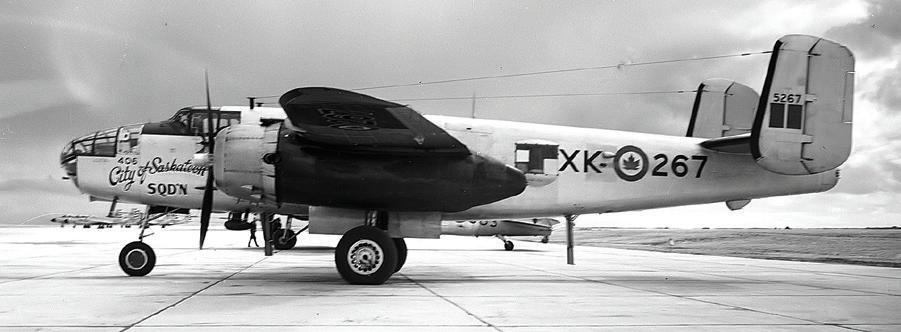
Scratch completed his training and, when the crew listings were posted, he was rated again as a co-pilot. This provoked a feeling of abject depression in Scratch and he proceeded to get drunk on the night of December 5, 1944. Scratch again decided to show his superiors that he was a capable pilot and walked out to the parked aircraft and climbed aboard a Liberator, started the engines and taxied out toward the end of the runway. However, he managed to get one wheel stuck in the mud and he abandoned the aircraft. He then switched to a Mitchell bomber (HG 343) which he in turn started, taxied to the runway, and took off without any runway lights.
For the next five hours and ten minutes he would harass the Fraser Valley and RCAF stations at Vancouver, Abbotsford, Patricia Bay (near Victoria) and Boundary Bay. Western Air Com-
This B-25 Mitchell bomber was similar to the one stolen by Sergeant Scratch.
mand Headquarters ordered Curtiss Kittyhawk fighters to intercept Scratch and attempt to get him to land the aircraft. This, however, was unsuccessful. The Mitchell was a high-performance aircraft and Scratch was a skillful pilot.
Finally, the Mitchell went into a stall turn or hammerhead over Tilbury Island, about six miles northeast of Boundary Bay, at 1,000 feet, and dived straight into the ground, killing Sgt. Scratch and destroying the aircraft. Scratch was 26 years old at the time of his death. His remains were buried in his hometown of St Paul, Alberta.
Air Vice-Marshal Heakes, Air Officer Commanding Western Air Command RCAF, later commented on the incident stating that there were likely not more than five persons who could have given such a display of flying as put on by Scratch.
AVM. Heakes, in a later statement
relating to the official Accident Investigation, stated that Scratch may have run out of fuel. This would later become the preferred cause of Scratch’s fatal crash. Other potential causes suggested were:
1. Loss of control at high speed.
2. Failure of the fuel supply to the left and lower engine, leading to the left and lower engine to cause an unintended dive.
3. Loss of control due to physical exhaustion.
4. Suicide, which was ruled out citing evidence from “Witness No 11,” Squadron Leader Badger, the Senior Medical Officer who stated he was quite sane.
5. Insanity. Also ruled out by the testimony of S/L Badger.
Almost two years later, in the remarks section of a review of Scratch’s status concerning his early discharge, a staff officer wrote (in part) that “He could
not help but speak positively about his (Scratch’s) character, sympathetically about his injuries and even respectfully of his flying ability with regard to the theft of the first Liberator: ‘This officer was considered a very capable pilot and of a very good character. He was keenly interested in flying, and even a serious aircraft accident which almost crippled him for life and kept him in hospital for six months could not change his strong desire to keep on flying.’ ”
Looking back over the documentation and reports in Scratch’s time in the RCAF, it is comforting to see that his commanding officers, squadron diarists and psychological consultants in 1944 were not judgmental.
Readers wishing to read more about this story are referred to the book Trans Canada Airway by Chris Weicht, page 63. Also, Vintage Wings of Canada, (info@vintagewings.ca).
Hold On!
ESSENTIAL TERMINOLOGY EXPLAINED
The word “hold” has many applications in Canadian aviation. In this column, I’ll try to address a few uses for both IFR and VFR pilots that are near and dear to my ATC view.
Perhaps the most important usage of the term “hold” applies to both IFR and VFR pilots alike. Given the prevalence and potential consequences of runway incursions, it is very important to understand the term “hold” as it applies to an airport.
A runway incursion occurs when an aircraft (or a vehicle) enters a runway without permission. Obviously, this can be incredibly dangerous when an aircraft is landing or taking off from the runway involved.
Airport controllers are very vigilant about this and use instructions and clearances to carefully try to avoid such occurrences. In this case, the term we should all be familiar with is “hold short.”
Controllers will issue an instruction with the runway identifier included, such as when instructing a pilot to, “hold short runway three two.”
At many aerodromes, hold lines are painted in such positions as to provide reasonable separation between taxiing aircraft and the runway itself. Where these are not painted, pilots should endeavor to leave a reasonable distance between their aircraft and the runway, perhaps aiming for 200 feet. Using the spacing of runway lights as a guide, where they exist, can be helpful for this purpose.
When a pilot is instructed to “hold short” of a location, taxiway, or especially a runway, the pilot is required to read back the “hold short” instruction to the controller. This is one of many steps used to help reinforce the need for further clearance that is expected to be provided later.
At some airports, Land and Hold Short Operations (LAHSO) may be in
use. The distances will be published or provided by airport controllers, and pilots may be asked to land on one runway and hold short of an intersecting runway.
Controllers will provide the distance available and traffic information and ask if the pilot is able to comply. It is important to note that part of “being able” is being willing. Pilots may refuse to participate in such an operation if they are uncomfortable with the situation, even if they are capable.
ATC will provide alternate instructions in such cases.
If the pilot opts to participate, the “hold short” instruction must be read back to the controller when issued with the landing clearance.
In flight, sometimes the traffic situation may require a controller to slow or stop the progress toward a given point, typically an airport. Obviously, a plane cannot just be put in “park.”
the pilot determine the locations of commonly used holding and reporting points. They may be assigned five-lettername-code identifiers and be available in a VFR pilot’s EFB to assist the pilot in finding the location.
As always, if the instruction isn’t clear, the location cannot be sighted, or if there are extenuating circumstances such as an active or impending emergency, a pilot should inform ATC as soon as possible of the circumstances so controllers can issue clarifications or make alternate arrangements with the rest of the traffic.
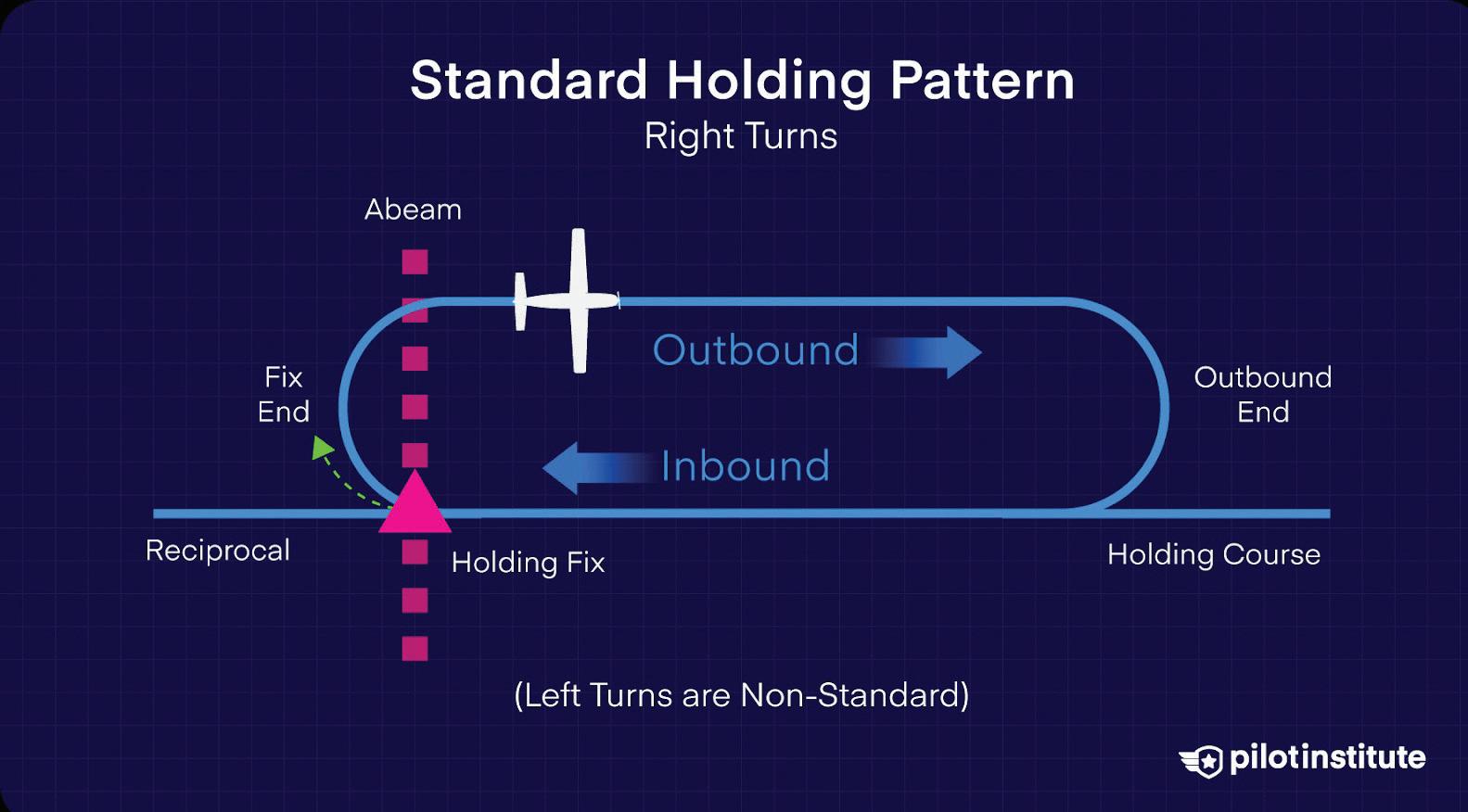
“The holding pattern looks like a racetrack with one leg being inbound to the holding fix, and the other being outbound after a turn starting at the fix. The important leg in the clearance is the inbound leg.”
The pilot should keep a listening watch on the frequency so that further instructions may be received. Such instructions may be directions on where to join the traffic pattern, or perhaps to move to another, closer location to initiate another orbit closer to the aerodrome.
A VFR pilot may be asked to “orbit” over a certain landmark until further instructions can be received. This means to have the pilot circle over the landmark and await further instructions.
Often, landmarks used for such purposes are outside of controlled airport’s Control Zone but may lie within it. Such landmarks may include prominent buildings, bridges, small lakes, gravel pits, racetracks or any other easily identifiable location.
During flight planning, it’s important to look for a VFR Terminal Procedures Chart (VTP) for the destination aerodrome in the Canada Flight Supplement (CFS). Such a chart is intended to help
Where practical, the controller will inform the pilot of the expected delay.
For IFR aircraft in flight, the term “hold” has a more complex procedure to adhere to. Holds may be published on charts (enroute or approach charts), or they may be detailed instructions.
When a controller wishes to hold an IFR aircraft where a hold is not published, the holding clearance generally contains a few basic, common instructions. A typical hold will include a clearance limit, a route to it, an altitude, instructions for the orientation of the hold, and a time. Some holds may be modified with more details.
The holding pattern looks like a racetrack with one leg being inbound
to the holding fix, and the other being outbound after a turn starting at the fix. The important leg in the clearance is the inbound leg.
The Clearance Limit is the fix where the hold is to take place. The route assignment and the altitude assignment are straightforward.
The instructions for the orientation of the hold are a little more involved. There will be a direction relative to the holding fix included, and it is descriptive of where the hold is to be performed in relation to the clearance limit. For example, if a pilot is told to “hold east”, that means the manoeuvring in the hold is to be done mostly on the east side of the clearance limit.
With a holding clearance, the track the pilot is to fly on the “inbound leg” to the clearance limit is normally specified. This may be a final approach course such as a localizer, a bearing from the clearance limit or a track to the clearance limit. To, “hold east, inbound on the localizer,” means to use the localizer for track guidance while inbound to the clearance limit.
The time associated with a holding clearance can be an “Expect Approach
Clearance” time (EAC) or an “Expect Further Clearance” time (EFC).
An EAC is used when an aircraft is being held over a fix from which an instrument approach procedure can be initiated and the intent, ultimately, is to issue an approach clearance when the hold is cancelled.
An EFC is used for an aircraft that must be held short of destination, such as an enroute hold. In the case of an EFC, it may include other instructions such as a routing or altitude to expect at a given time.
The main point of the EAC/EFC times is to provide instructions to the pilot for proceeding once the time is reached in the event of a communications failure. It also provides the pilot with the controller’s intentions for when the hold is ultimately cancelled. Controllers endeavor to provide a pilot with further instructions at least five minutes prior to reaching the EAC/EFC. If nothing is offered, a pilot should inquire.
Typically, standard holds are conducted with right-hand turns unless otherwise specified. The “otherwise specified” may be published in a chart appropriate to the procedure or may be
specified by the controller.
Other details may be specified such as the timing of the turns in terms of time or distance from the holding fix. For example, a clearance may be issued for a pilot to “hold between 10 and 15 miles” from the clearance limit. When the pilot reaches 10 miles from the fix on the assigned inbound track, a turn is commenced to fly the outbound leg. When the aircraft reaches 15 miles, a turn is commenced to rejoin the inbound leg as assigned with the clearance.
All details of a hold can be modified, as required, to suit the pilot’s needs. Longer hold legs to minimize the number of turns, higher speeds to accommodate something like icing being encountered, etc. A pilot needs only to make requests of controllers so they may try to accommodate the needs with the demands of other traffic in the area.
While this information presented is not exhaustive, it should give a pretty good idea of what’s expected of pilots when it comes to holding. ATC tries to minimize delays to aircraft, but sometimes they are necessary for one reason or another.
THE PLANE FIXER
SWINGING WRENCHES WITH LIANA BUESSECKER
Spring Skis and Rivets
NOT YOUR TYPICAL ‘SUMMER’ GIG
Aircraft maintenance is scheduled so tasks that require specialized tooling, components, equipment or manpower are performed in locations where those things are readily available. For a standard airline, this means completing the work when an aircraft overnights at a maintenance base or selecting specific routes to ensure the aircraft will be at a maintenance base when the work comes due. But for operators that work on contracts where the plane is away from a maintenance base for an extended period, this means ensuring all the work is completed before its departure.
In maintenance there are hangar mechanics and field mechanics and, while the main difference is in the name (where they work), the type of work they perform and the circumstances and environment in which they do it are vastly different.
Hangar mechanics have the comfort of four walls and a roof. Their workday is scheduled, whether it’s a day or night shift. They have a toolbox, a workbench, a rolling chair and work stands, all at their disposal. The references they require are readily available, and the timeline to complete the required task is reasonable.
Field mechanics, however, typically spend most of their time outside. If the situation is dire, a makeshift tent may be an option or, if they’re really lucky — and things are really bad — a hangar might be borrowed (often one that is old and rickety, and the plane doesn’t even entirely fit inside). They work out of a to-go box, with the ever-present possibility of setting a tool down in the snow or grass or waterside and never seeing it again. They lay on cardboard and use bundles of dirty rags as cushions. Manuals are often pictures of a page on a phone, or a physical copy that is at risk of blowing away in the wind, or being kept safe in a building or vehicle no-
where nearby. Work is completed in the dark after a flight, or in the scorching midday sun with a plane that is broken and needing to be fixed ASAP (called an AOG: aircraft-on-ground).
Of course, while some planes behave, others are notorious for whatever can go wrong, absolutely will, and that’s when we find ourselves in an AOG situation. Because, if my plane is good,
I will check the oils and top up the oxygen, and maybe pop open the cowls for a quick inspection. And then I’ll get to head back inside. But if my plane is bad, I might spend hours chasing a fault that logistically makes no sense, I might miss dinner replacing components that don’t solve anything, and I might work through the night attempting unsuccessfully to isolate a leak.
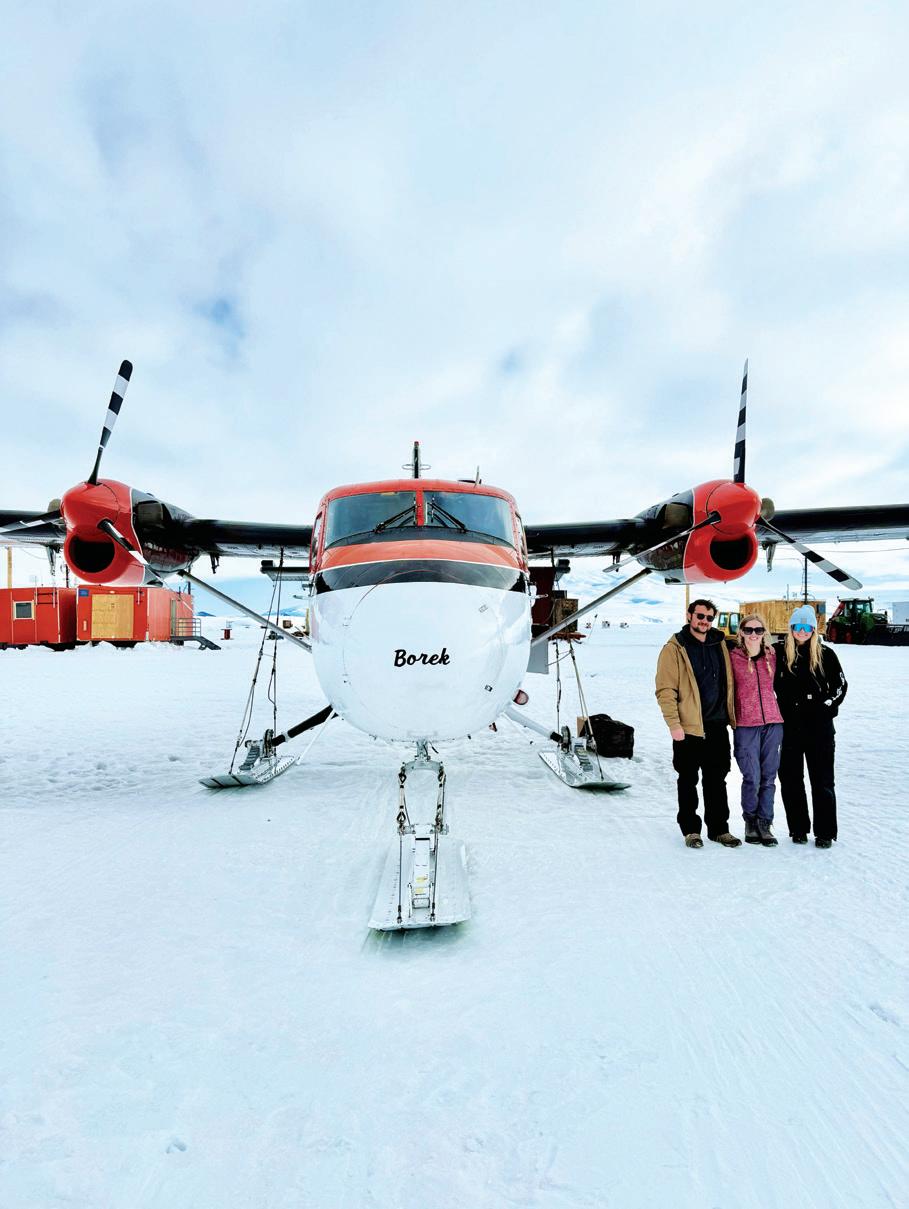
Group photo in McMurdo at end of season. Captain Thomas, Liana Bussecker and First Officer Brooke.
When you’re working away from home base, help might be several time zones away, and a part might take several days to arrive. It’s unbelievably nerve-racking to order a replacement for something when you aren’t even completely certain it will fix the problem. And how do you explain through an email the smell the engine is making?
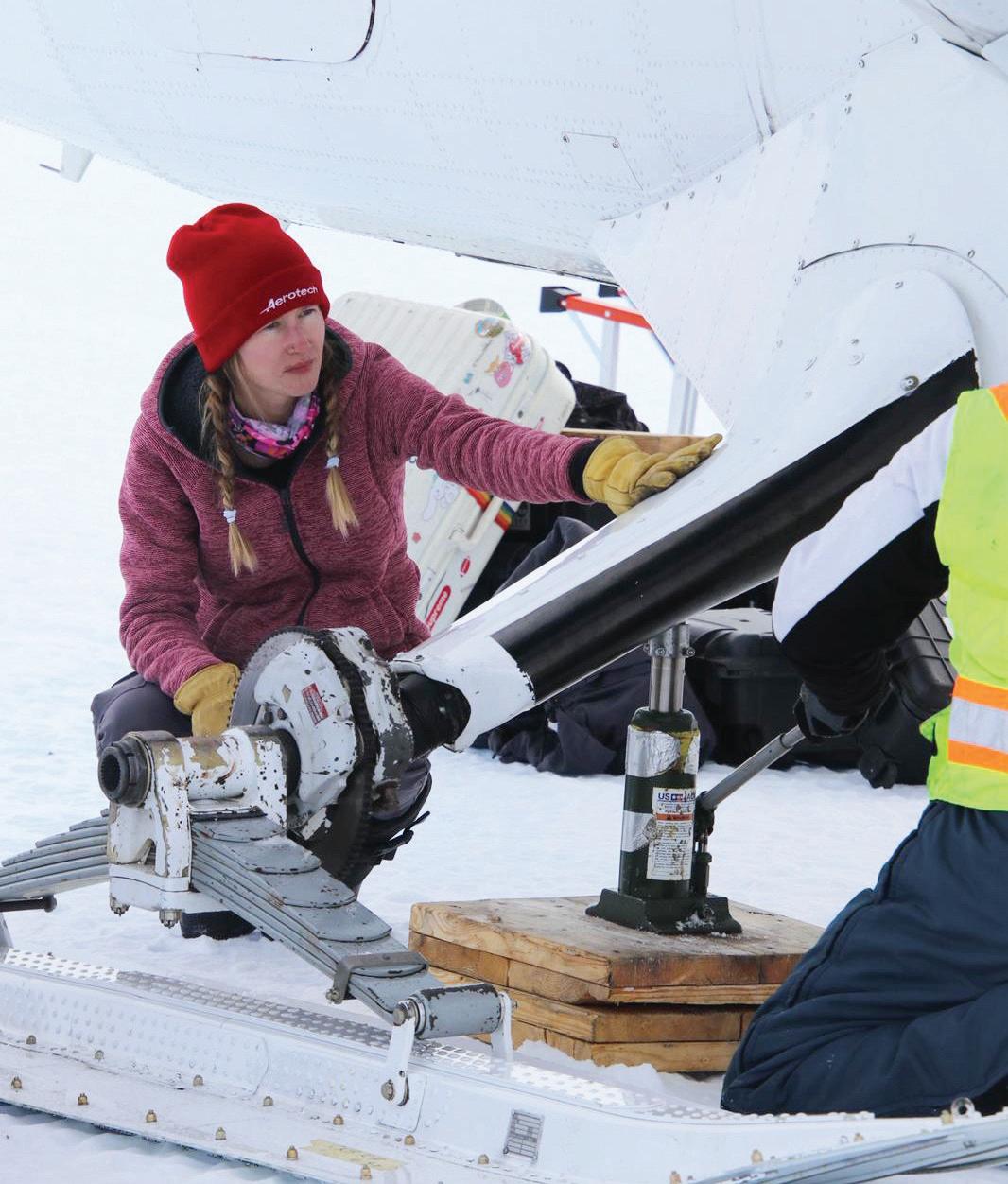
While based in Antarctica I did some heavy maintenance on a spring-ski, which is not, under normal circumstances, a field maintenance activity. During a routine inspection I noticed the ski had a few loose bolts which I immediately replaced, torque-checked the rest, then made note of it. After the next flight I found the same ski not only had loose bolts again, but it was also missing a few rivets. Because I didn’t have a replacement ski, which would’ve been a quick and easy swap, I had to take apart the problem ski and replace the rivets. Thankfully I had an incredible team with me (I was based with other aircraft, so I wasn’t alone), and we were able to get the ski removed, repaired and reinstalled in a day’s work. Had I been by myself it likely would’ve been a very different story. A spare ski was fasttracked to our location that thankfully we didn’t end up needing, but the situation reminded me just how quickly things can go wrong.
For the remainder of my contract on the ice, my plane behaved. We had no funny noises, no intermittent failure lights, and nothing that simply refused to work. The plane saved all this excitement for our ferry trip home.
While at the South Pole our temperature gauge froze. Enroute across the continent one of our engine gauges must’ve been cold because the needle wouldn’t sit steady. Our oxygen shutoff valve refused to open fully — maybe it also just didn’t like the temperature — until we reached South America. And when we
Scheduled ski change at Union Glacier, Antarctica: Putting wheels back on the plane so we can land on the gravel runway at Rothera.
were nearly home, crossing the United States, the wing de-ice boot system was more than happy to turn on, and less than happy to turn off.
Perhaps I jinxed us because I patted the plane on the nose before departing Antarctica’s McMurdo Station, and thanked it for being so cooperative over the season.
By the time we reach our destination, whether the plane broke or not is simply all part of the experience. Sometimes you get grounded in sunny destinations and have to wait days for a part to arrive, with nothing else to do but lay on the beach. Other times you work in the worst weather for hours on end replacing an absurd number of parts that are all buried somewhere within your plane.
When aircraft are sent on extended contracts, they usually carry a spare-
parts box (or several) to reduce the unserviceable time. If the plane is too small to house this additional cargo, or the destination is close enough to home base, a truck and trailer may transport the kit by ground.
These circumstances will depend on the operator and the contract. I’ve had the privilege of experiencing both: flying in a plane home from Antarctica and following a plane by ground from Abbotsford to Whitehorse. Each was an unbelievable experience in its own way.
My next rotation will take me very near to the opposite pole — the remote islands of Nunavut. While I’ll be closer to home, physically and time-zone wise, I imagine it’s just as isolated as Antarctica. At least this time will only take us two days to reach our destination, instead of 10.
Broken Trust
TRANSPORT CANADA NOW INTRUDES ON OUR PRIVACY
In mid-2023 the Montreal-based International Civil Aviation Organization (ICAO), conducted a safety audit of Transport Canada. Their findings were, to be kind, sub-optimal. The U.N agency’s audit highlighted several areas where Transport achieved poor grades, including procedures and oversight of aircraft operations showing the greatest decline.
When compared to the previous audit in 2005, when Canada scored 95 percent by ICAO’s standards, the latest audit assigned Canada an abysmal 65 percent rating, effectively booting us out of ICAO’s Top 10 countries. It turns out that Canadian air navigation also barely met international standards. Similar low grades were assigned to our regulatory system.
Here’s the good news: Although overall we fared dreadfully, the audit did not identify any direct flight safety issues with how we do business in the Great White North. I conclude from this that Canadians charged with actually flying airplanes tend to do pretty well.
this requirement was recently reduced to a “read and understand” condition but know this: Transport Canada still retains the right to fully access your medical records, including those not relating to your aviation medical certification.
If Canada’s overall record of pilot safety is not in question, why then is Transport suddenly so concerned with the medical status of pilots, both Private and Professional? I am of course referring to the ‘Privacy Notice and Declaration,’ effective December 9, that you were initially required to sign, or not be issued a medical certificate. No doubt in response to a public outcry, Canadian pilots, both amateur and professional,
“Many of my colleagues have now told me that where their medical is concerned, they will now answer any question asked of them but offer little more.”
ignore has been the success of the greatest pilot health safety program of all, namely the trust implicit between the Civil Aviation Medical Examiner (CAME) and the pilot, augmented by the obligation all pilots have to self-monitor when fitness to fly is concerned. That relationship has never required the state dig deep into our private medical records, at least until now.
It gets worse. By consenting (implicitly) to this new and limitless intrusion into your personal health history and records, you are effectively granting the federal government disclosure of this same information to unnamed third parties for an unspecified period of time. Were I a cynical man, it would be easy to connect the dots: Transport Canada just got a big scolding from ICAO, and the rights of Canadian pilots are now being offered up as penance. When all other arguments fail, rallying the troops under the flag of “public safety” is a proven means of controlling the masses.
In my opinion this latest requirement is atrocious. It is an egregious violation of privacy and overreach by a government who presents “safety” as the reason for ongoing intrusions into the lives of citizens. Think this is not the case? Ask any law-abiding gun owner in Canada about the state seizing their previously legal firearms. What the new draconian regulations
I recently chatted with a Transport Canada inspector. When I broached this topic with him, he offered a flaccid defence on behalf of his employer, citing the usual arguments of flight safety. He went on to refer to the German Wings pilot who, for apparent reasons of insanity, flew an airliner into the Alps. Good to know; the actions of one lunatic in a foreign regulatory environment over a decade ago is further reason to trample
the rights and freedoms of law-abiding Canadians.
I countered that this policy would have exactly the opposite effect to what are its presumed goals of flight safety. When he politely resorted to telling me that my holding a pilot licence was “not a right … but a privilege,” I actually felt embarrassed for the man; here was a decent guy being asked to defend a policy he himself didn’t agree with. When all else fails, bring out the big guns. If this is the new environment, I now fear that medical issues pilots once discussed openly with their family physician and CAME will now be shrouded in secrecy and never discussed.
Pilots are, by our very nature, rule followers. The litany of regulations that control our every move in aviation pale in comparison to the
even greater power inherent in our voluntary compliance with these same regulations. What I didn’t reveal to the inspector was that I had recently grounded myself after a health concern popped up during a routine physical exam. I reported the condition to my CAME and, even before doing so, I chose not to fly pending the outcome of further medical tests. I did so entirely out of respect for my family, my passengers and my profession.
Character is said to be demonstrated by what you do when nobody is watching. The professionals and skilled amateur pilots I know voluntarily demonstrate this quality — character — every day they go flying, simply by doing it right. Many of my colleagues have now told me that where their medical is concerned, they will now
answer any question asked of them but offer little more.
More than my claiming some moral high ground, my own actions (and those of another colleague who similarly grounded himself out of concerns for his own night vision) are simple proof of a larger idea. Flight safety doesn’t require the involuntary forfeiture of privacy rights, nor the compulsory surrendering of our most personal health information to any government to have safe pilots flying airplanes.
Consider this new attack for what it really is, yet another trampling of personal rights wrapped up as public policy. Without a doubt, safety starts and ends with each pilot, not some regulator hastening the arrival of an Orwellian future.
Your Foremost Source in Aeronautics from
FROM THE GROUND UP, 30th
For over 80 years, the content of From the Ground Up as a literary benchmark that defines the multitude of theories associated to aeronautics. It describes the practices necessary to achieve the highest levels of distinction as safe, competent and skilled life-long aviators.
Through its evolving editions, many generations of readers have used this award-winning title as the foundation of their introduction to the concepts that require thorough understanding in advance of the sought-after hours of flying enjoyment that are the ultimate goal of all who seek to earn their wings and expand their knowledge of flight theory and practice.
The content of From the Ground Up may, at times, seem complex, but the pathway to learning the fundamentals of aeronautics is one that reaps much in the way of personal reward for all who pursue the goal of thoroughly understanding the subject. Indeed, it was by design that its original author, “Sandy” A. F. MacDonald — a man recognized as a “father” of what still stands today as the standard curriculum for ground school instruction — devised this aeronautical textbook to be comprehensive and current while conveying its material in such a way as to enhance the reader’s understanding of every written word.
Not one to permit his vast experience to allow for foregone conclusions, “Sandy” MacDonald’s meticulous care in the creation of From the Ground Up has become the hallmark for its widespread use and respect as the reference textbook of choice in hundreds of flying schools throughout Canada and around the world.
Its latest edition is the 30th Edition. A French-language version is also available under the title Entre Ciel et Terre Totalling over 400 pages of in-depth content formatted in a sequential, logical and easy-to-read fashion, the publication boasts over 360 graphics, charts, diagrams, illustrations and photos. An additional full-colour navigation chart and a sample weather chart are included.
All chapters are current in the latest technological and legislative aeronautical matters and cover such topics as The Airplane, Theory of Flight, Aero Engines, Aeronautical Rules & Procedures, Aviation Weather, Navigation, Radio & Radio Navigation, Airmanship, Human Factors, and Air Safety. From the Ground Up also includes an extensive index, glossary and a 200-question practice examination.
Since the 1940’s, virtually every student — civilian, military, commercial, recreational — who has ever learned to fly in Canada has used From the Ground Up as the primary ground school textbook from which they’ve learned everything one can learn about aeronautics, and about flying. Referred to as “the Bible” of ground school instruction, and updated with every frequent re-print, From the Ground Up has long been considered an essential resource for all with any interest whatsoever in the theory of flight, and in the practice of aviating.
Also available from Aviation Publishers
• From the Ground Up Workbook
• Canadian Private Pilot Answer Guide
• Canadian Commercial Pilot Answer Guide
• Canadian Instrument Pilot Answer Guide
• Instrument Procedures Manual
• Flying Beyond: for Commercial Pilots
• Unmanned: for RPAS Studies
• Flight Test Notes: for Flight Test Prep
For more information about all of our titles, visit us on the web or contact your local pilot supply
Stress in the Cockpit
AT TIMES, GOOD. AT TIMES, BAD
According to a study published in the journal of Aviation Psychology and Applied Human Factors, if you’re a naturally nervous person then you’ll likely be a nervous pilot no matter what degree of experience you have at the controls of an aeroplane. And this natural level of anxiety will stick with you in emergencies regardless of how many flight hours you’ve accumulated. If you’re an anxious type, the pressure of a crisis will impact you more.
The study ran 81 airline pilots through four different types of flight emergencies in a simulator. Those pilots who had higher baseline anxiety levels were found not to cope as well with the emergencies as did the pilots whose baseline anxiety levels were low. Furthermore, so the study suggests, a veteran pilot is just as likely to be startled if things go wrong as is a pilot whose experience is much lower. This study had its admitted limitations; upon its release, it also had its detractors. Nevertheless, and generally speaking, anxiety is a trait that affects a significant number of people, and pilots are in no way immune to its presence nor to the threats of its consequences.
or wrongly) that you are inadequately prepared to cope with it. And if you are generally unsure of your adequacy, you are much more likely to experience stress than if you feel generally confident and secure.
Stress and anxiety are agitators that raise the heartbeat. They are the consequences of fear triggered by the unexpected. This triggering releases adrenaline, the key substance that
a threshold can be exceeded and this physiological adaptation can be an impediment to the assertive actions that a threatening situation requires of you.
“The special composure that pilots need to react to unnerving events of any kind can be learned.”
Think of any great feat in aviation, then consider the likelihood that the folklore of its telling hides an underlying truth that it was accomplished not by a pilot of supernatural coolness, but rather by a pilot who was feeling a natural degree of stress and anxiety within the moment. Some obvious candidates spring to mind: Charles Lindbergh’s first solo crossing of the Atlantic Ocean, or Jimmy Doolittle’s first-ever flight entirely on instruments, or Chuck Yeager’s first exceeding of the sound barrier. These pilots were certainly the best of their generation, but it’s also possible that they were, at some point, clutching their controls with the sweatiest of palms.
People are different: one person’s stressor is another person’s walk-inthe-park. The factors that highlight this dichotomy have to do with the individual’s perception of threat and their tolerance of stress. If a situation is seen as presenting a serious threat, it will be highly stressful to you, not least if your resources for dealing with it render you believing (rightly
hastens your heartbeat and helps your body react to urgent stressor conditions. The brain becomes fully engaged, senses are heightened, and the “fight or flight” response is aggressively mobilized. These physiological responses are innate, wired into the human mechanism for survival. You’re programmed to do this. There is a point, however, when
But consider too, the low-time student who has just been told to do their first solo. No matter how prepared the student may be in the judgment of the instructor, their heart is much more likely to be in their mouth than it is likely that they’ll undertake this momentous milestone with impregnable sang-froid.
The special composure that pilots need to react to unnerving events of any kind can be learned. True, as the study referred to above asserts, some will always be prone to a reaction of raised alarm than will others who, by nature or by nurture, manage their poise to a greater degree. Stress
and performance, indeed, are well connected. (Any athlete will tell you so.) Stress can enhance your focus which improves your performance. But too much stress crosses a threshold, inflates the balloon of anxiety, overwhelms the mechanisms of coping, and at the very least diminishes performance.
The best solution to attenuating stress and anxiety is to increase your exposure, in a controlled way, to stressful activities. In other words: practice, train and repeat. Anxiety-provoking circumstances that have not been anticipated and for which no ready-made coping patterns have been rehearsed, will place an individual under stress that can be coercively debilitating. This is why a pilot’s training should involve repeated exposure to controlled stressors — simulated emergencies and the like — until coping patterns have become entirely rote. The “startle response,” made so mainstream by ‘Sully’ Sullenberger’s accounting of the Miracle on the Hudson, may never be extracted from human nature, but a proactive response that immediately thereafter follows can be ingrained into your neural pathways.
Understanding the nature of a stressful situation and preparing for it will lessen the severity of the stress when it occurs. The more frequently you fly, the more settled you become, not least to make yourself less anxious and more confident with the uncomfortable. While it may be so that some will always be more anxious than others, readying yourself for anxiety-provoking situations equips you with ingrained skills. This will ultimately ensure that you’re a better pilot for the reason Chuck Yeager said it took to be one: “The best pilots fly more than the others,” he asserted. “That’s why they’re the best.”
NORTHERN ADVENTURES WITH MICHAEL BELLAMY
More Peacekeeping Adventures in Somalia
UNITED STATES LIAISON OFFICE, AUGUST 1994 MOGADISHU, SOMALIA
The author first introduced us to his work in Somalia as part of a United Nations peacekeeping mission (UNOSOM II) in the last issue. He was a pilot contracted by Canadian Helicopters International, which in turn was contracted directly by the United Nations. – Ed.
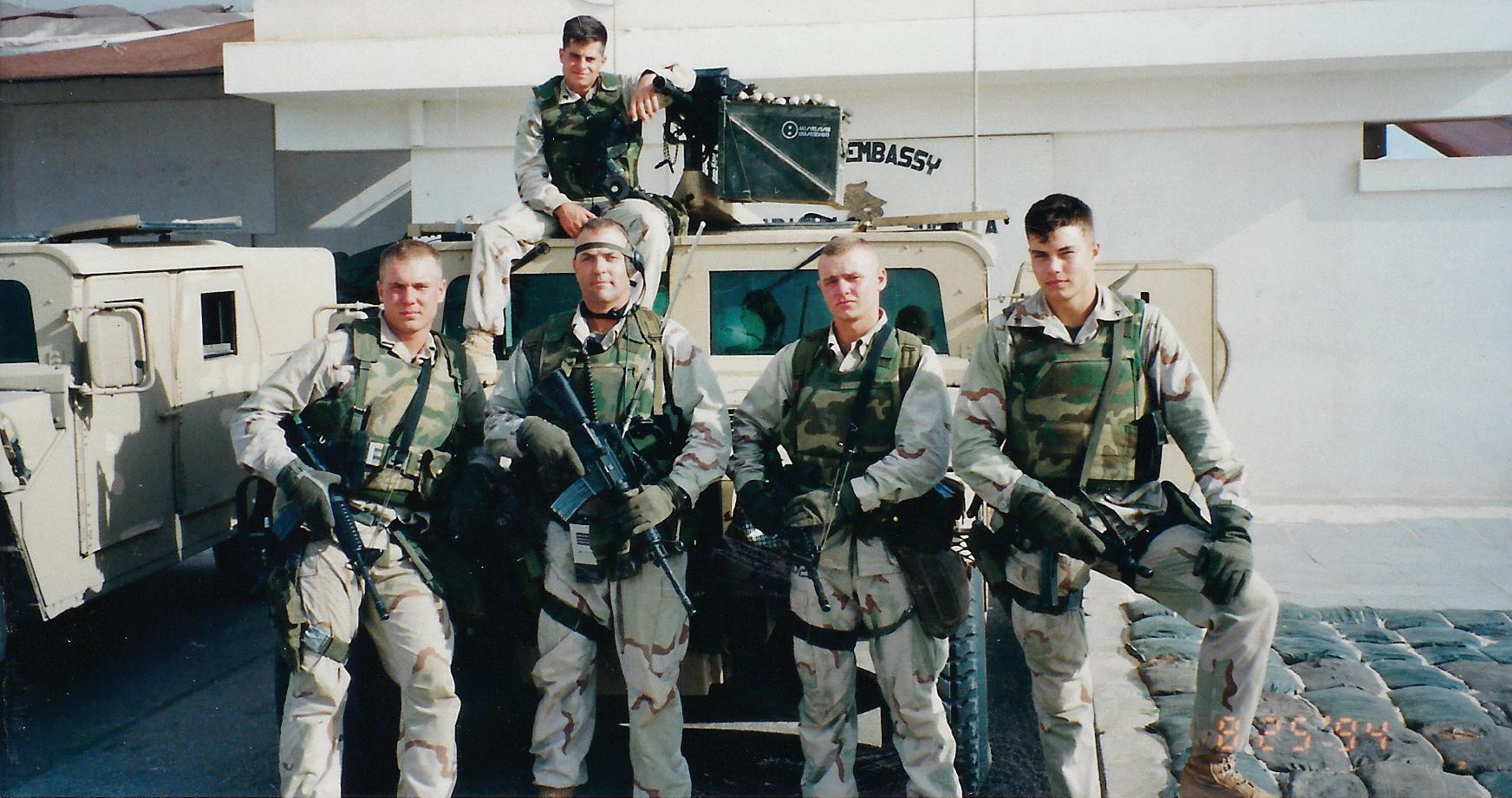
Brian Brake, engineer on Bell 212 C-FSAU, was familiarizing me with the machine that I will be double-crewing with another pilot, Dale Simpson. We were standing on the upper deck inspecting the cowlings. “Every time you return,” Brian grinned, “I do a pretty good scan looking for bullet holes.”
Striding toward us from the U.S. embassy I saw two men in Hawaiian shirts, with Ray-Ban sunglasses and sidearms. “Are you Michael Bellamy?” one of them asked, looking up at me. I nodded a “Yes.” He continued, “My name is Bluebeard.” Then, gesturing towards his companion, “This is Ghost Rider; and from now on, you are Mustang 5.” Climbing down, I asked, “Are you CIA?” Bluebeard responded, “There are no CIA in Somalia. You’re a civilian pilot and we’d like you to do some flying for us while you’re assigned to our embassy. If you follow us to the embassy, we’ll introduce you to ‘Dragon Lady,’ the dispatcher. She’ll be your contact.”
Dragon Lady lived up to her name, what with Asian heritage and sharing the same direct approach as my escort, but with a smile. “I will be cautioning you when returning to land at our embassy pad by radio indicating a colour, Red meaning a firefight in our area, Yellow, occasional fire and Green is quiet, but it’s always your call.”
Dragon Lady continued. “A contingent of [US] Army soldiers guards our embassy and will accompany you when you are providing top surveillance for the embassy convoys as they navigate the city streets. The gunnery sergeant will walk you through the procedures and on occasion we may be firing from the Twin Huey if necessary. We’ll take care of the doors, which will always be open when flying over the city. Do you have any issues with that?” And, when I shook my head, she added, “Oh, and your accommodations are trailers which have sand bags outside piled to the bottom windows with chain link fencing suspended over the roofs. Any questions?” she asked. I again shook my head.
I’d been gun-netting and doping animals from the helicopter, so I was okay with gunners leaning out the door. I had a few more questions but decided to digest what she had just told me for the time being.
Late that night I awoke, hearing gunfire. The radio on my nightstand crackled to life. “Sarge, those Gomers are getting kinda close.” Another voice responded, “Give ‘em some 50-cal to quieten them down.” The heavy thud, thud of the Browning rattled the windows. “Okay, they’re gone now.” Nice to have the US Army on the wall.
The next day Dragon Lady called with a dispatch. The ambassador had arranged a meeting with the Somali General Aidid. Soon we were flying over the city, shepherding a convoy of Humvees,1 three in the front, then the ambassador’s black armoured Chevrolet Suburban, then three more Humvees bringing up the rear. Our task was to roam slightly ahead, giving
the soldiers a good view while looking for suspected ambush sites ahead of the convoy. The soldiers would then direct the Humvees on how to follow another route.
It was fascinating to watch how, in one continuous smooth flow, they approached an intersection; the lead Humvee would block one street while the second would block the other corner, leaving the third Humvee in the lead, guiding the ambassador safely through the intersection. Two of the Humvees that were trailing would immediately overtake the black Suburban to reinforce the sole Humvee now in the lead. The two leaving the intersection they had just vacated would follow, now joining the rear guard.
The American soldiers were very well trained and comfortable in the 212 with the doors wide open, weapons in hand, studying the mostly devastated city buildings sliding just below. I caught a hand signal from the gunnery sergeant: bear to the right a bit. Soon he pointed down with his finger, indicating a tight turn. Rolling in and peering down, we saw a mass of rubble on a city street and watched as kids waved, playing on a crashed Black Hawk helicopter.
With Mogadishu’s Afgooye Boulevard straight ahead, I observed a manned Technical2 parked on the roadway. Dragon Lady’s voice came over the radio with “Yellow.” The embassy pad was just beyond the boulevard. I decided that, instead of slowing for a landing, I’d carry more speed on the approach. There was a loud bang from the floor. My shoulders jerked and I nudged forward on the cyclic looking for more speed; then I heard the soldiers laughing behind me. One of them had dropped his mag clips to watch my reaction. Relieved, I pulled back and dropped the collective, flaring the excess speed as we descended. Tail down, the rear skids touched the pad, and I let it gently pivot us down. I turned my head to see that the soldiers had already stepped off the skids and were 10 metres away, casually walking towards the embassy. After I shut down, the sergeant appeared alongside my open door wearing a big grin. “Don’t worry,” he told me, “They’ve developed a respect for you. They also depend on you, and, in the field, I would step in front of a bullet for you.” Overstated a bit, I thought, looking at his body armour. I then realized that when one of them
was wounded, I was the only one who could get them out. We bumped fists, acknowledging solidarity. Throughout my tour, I never forgot that pledge. Though, over the years, his name sadly has been forgotten.
Ghost Rider and Bluebeard called on me during more than a few missions to feint a passing flight so the Somalis on the ground would think that I was just passing. Then, dropping the collective, I would steeply make for a predetermined landing spot. An abrupt flare, then the skids touching. I could just make out their figures disappearing in the clutter of rusted shelters and surprised Somalis as I pulled on the collective. Later, at a precise time and a new location, I would again feign that I was overflying then abruptly drop the collective, heading towards the target, flare, then touching the ground. Looking over my shoulder, I saw that the soldiers were onboard, giving me a thumbs up. Pulling on the collective, we climbed clear of the ragged cloud of dust and paper and headed for the embassy.
1. HMMWV — High Mobility Multipurpose Wheeled Vehicle.
2. An improvised fighting vehicle, typically a Toyota pickup.
This is the squad of US Army soldiers that the author flew around Somalia in his Bell 212.
WORDS ABOUT A BOOK
A REVIEW BY RENÉ R. GADACZ
Power: The Pratt & Whitney Canada Story
By Kenneth H. Sullivan and Larry Milberry
We have airships, bush planes, fighter jets, water bombers, rotary wing aircraft, giant flying boats, Dreamliners, Airbuses, air taxis and other types of ships and machines. But they don’t just fly on a wing and a prayer. Without powerplants and propulsion, they’re grounded. Enter Sullivan and Milberry’s Power: The Pratt & Whitney Canada Story.
Power chronicles the rise and influence of one of the world’s most significant aerospace engine manufacturers. More than a corporate history, this 320-page coffee table-size book, complete with several hundred black-and-white archival photos of factory floor scenes, engines and aircraft in action, documents the technical and strategic acumen behind Pratt & Whitney Canada’s success (incorporated November 29, 1928; briefly named United Aircraft of Canada, 1962-1975). The authors, respectively a former P&WC director (1972-1984), and an aviation historian who is also an honorary Snowbird (and a 2004 inductee into Canada’s Aviation Hall of Fame), transform what might seem a dry technical exposition into an inspiring tale of technological pioneering.
The book focuses on the period when P&WC had already established its global dominance in specific engine segments, particularly turboprops, turboshafts and gas turbines. In the first two chapters, it documents the company’s journey from its early beginnings as a Canadian offshoot of its American parent company founded in 1860 by Francis Pratt and Amos Whitney in Hartford, Connecticut, later incorporated as P&W Aircraft in 1925. (P&WA and P&WC are now part of the P&W Aircraft Group under the banner of RTX Manufacturing headquartered in Arlington, Virginia).
The authors detail the early challenges, from securing initial contracts to building an engineering and manufacturing base in Longueuil, Quebec, on Montreal’s South Shore.
Power traces P&WC’s evolution through several distinct yet interconnected phases. First, the 1920s and the decision to establish a Canadian operation, followed by the Second World War and the Cold War era that further sparked the burgeoning demand for reliable aircraft engines. P&WC’s involvement in engine technology began with the licensed assembly and servicing of piston engines and components built by its parent company P&WA. Later, during the Second World War, its facilities provided engine manufacture, assembly, overhauls, rebuilds and modifications to support Allied trainers, fighters, bombers and patrol aircraft, aligning Canadian industry with then-evolving propulsion technologies. This experience prepared P&WC for the soon-to-arrive post-war turbine (jet propulsion) technology.
The narrative, even more impressive as it is based on interviews, first-person oral accounts and archival materials, delves into P&WC’s most celebrated achievement: the development of its iconic turboprop and turboshaft engines (chapters four to six). The PT6 engine and its many iterations and versions (49 versions of the PT6A itself were developed between 1963 and 1983) and the PT6B and PT6T versions receive extensive coverage. An appendix lists 95 certified engines and variants produced by P&WC to 1986, including their takeoff ratings (SHP) and RPMs. Described elsewhere in the book, for example, are engines that P&WA, the American division, produced in the 1950s for the
RCAF, such as a pair of J75s powering the CF-105 Avro Arrow.
The authors explain how the revolutionary PT6 became a game changer, powering a vast array of aircraft from regional airliners and business aircraft to helicopters. They detail the engineering challenges, the iterative design process and the pursuit of performance and reliability that clinched the PT6’s legendary status. Power explains why it was a breakthrough, delving into its modular design, reverse-flow architecture and its impact on aircraft design and operational capabilities. Aircraft powered by versions of the PT6 include different models of the de Havilland Beaver, Beechcraft (e.g. King Air 260), Cessna, Cheyenne, Conair, Dornier, Grumman and the de Haviland Twin Otter, to name just a few. Also described is the P&WC LOH program (chapter nine) that produced PT6T engines for numerous helicopters, including the Hiller UH-12, Lockheed XH-5, different models of Bell (including the famous Huey), and heavy-lifters like the Sikorsky Sea King and others (all illustrated in the
book) that were manufactured and installed at the Longueuil facility.
Lesser known perhaps are P&WC’s ST6-series engines (the industrial and marine versions of the PT6) applied to speedboats and hydrofoils, such as the famous HMCS Bras d’Or. Later Tribal Class navy destroyers and frigates like the HMCS Iroquois, Huron, Athabaskan and Algonquin were fitted with FT4A2 engines. Also in chapter seven are examples of snowplows (used by British Columbia Department of Highways on wintry mountain roads), heavy trucks, Canadian National’s Turbo Trains — even an Indy racing car driven by Parnelli Jones. Some of these PT6 industrial turbine ‘experiments’ fell short while others succeeded.
Beyond the PT6, the book looks at P&WC’s development of other crucial engines such as the PW100 (a.k.a. PT7) and the PW150-PW200 family of turboprops for helicopters and business/ commuter jets (e.g. de Havilland Dash 8). As shown in Chapter 10, these were quickly followed by the JT15Ds and PW300, 500, 600 and 800 series turbofans that continue P&WC’s aviation legacy into the 21st century. We see how each new engine family represented not just an incremental improvement but often a significant leap forward. In fact, P&WC’s product range became among the broadest of any aircraft engine manufacturer worldwide.
One strength of Power is its explanation of how P&WC navigated intense global competition that enabled the company to carve out niche markets, often against larger, established competitors like Rolls-Royce Canada and GE Aircraft Engines Canada. The focus on turboprops, turboshafts and business jet engines avoided direct competition with the mega-turbofan giants, that is, strategic specialization that established Canada as a global centre for turboprop innovation (the PT6 as the defining product) was pivotal. While not a deep dive into individual biographies, the book profiles key engineers, technicians and company presidents and directors as principal decision makers. Another compelling aspect is the exploration
of P&WC’s distinct Canadian identity. Power reminds us that P&WC chose to develop turbine engines like the PT6 independent of its American parent company’s priorities, rather than license foreign designs. P&WC thus changed “from manufacturing engines and parts as a branch-plant licensee to an integrated manufacturer of its own gas turbine.”
A consideration for some might be the book’s publication date of 1989. As such, it provides a comprehensive history up to that date, predating significant developments of the last almost four decades such as propulsion research on hybrid-electric powerplants, fuel efficiency improvements and the global push toward decarbonization. It solidifies its place as a foundational text for understanding P&WC’s formative years and initial ascent to prominence. Wrote David Caplan, P&WC’s president in 1988, “One never knows when the next quantum leap will take place. Between the Wright brothers at Kitty Hawk in 1903 and Neil Armstrong’s first step on the moon in 1969, there really were only 66 years. And even fewer years between our startup in 1928 and our becoming the world leader in gas turbine technology.”
As a history of Canadian aviation technology and industry, Power is exemplary. Sullivan’s and Milberry’s book profiles a Canadian company that has created some of the most prolific engine series in aviation history. In addition to its hub in Longueuil, Quebec, P&WC currently has facilities in Mississauga, Ontario, Halifax, Nova Scotia, Lethbridge, Alberta and elsewhere for R&D, precision machining, component manufacturing, assembly, overhaul and ground/air testing.
Next time you’re flying, if you have a chance, check out P&W’s famous eagle logo usually found on the tail and side of their engines.
Power: The Pratt & Whitney Canada Story By Kenneth H. Sullivan and Larry Milberry
CANAV Books, 1989, 320 pp. (Out of print; available on the used market.)
LNAV+V
WHEN TRUSTING YOUR GPS NAVIGATOR COULD BE FATAL
Arecent fatal accident in the United States seems to have all the fingerprints of a pilot blithely following the LNAV+V provided by their GPS navigation system. This may prove to be incorrect but, whether it does or doesn’t, it provides valuable lessons.
The aircraft was a new Epic E1000, a single-engine turboprop. The aircraft was landing at Steamboat Springs, Colorado (KSBS) just after midnight. The weather at the time was 1,600 feet broken and overcast at 2,400 feet. The aircraft struck a hill about three miles from the runway. The following approach plate was likely the procedure the pilot was using for this approach.
Two things become immediately apparent and are boxed in red. First, both the straight-in and circling approaches are Not Authorized (NA) at night. Secondly, the weather was below the approach limits of a 2,300-foot ceiling. These two issues alone should tell one not to even try this approach.
Nevertheless, it was flown. But what would compel a pilot to fly well below the minimums of the approach on an RNAV approach like this? LNAV+V is my educated guess. As professional aviators, instrument procedure designers and an instrument flight instructor, JetPro has seen this type of situation numerous times.
In the Mar/Apr, 2024 issue of Canadian Aviator, my article LNAV + Displayed Vertical Path describes LNAV+V. Briefly, where a professionally designed RNAV approach with vertical guidance (LPV or LNAV/VNAV) is not provided, database providers and avionics manufacturers create a pseudo glidepath that looks and feels like the ILS glideslope, or RNAV LPV or LNAV/VNAV vertical path. This LNAV+V (LP+V for non-vertically guided WAAS procedures) is displayed like the others, and the autopilot can follow it.
But here is the issue — unlike a vertically guided approach (ILS, LPV or LNAV/VNAV) where obstacle clearance is assured from MDA/DA to the runway, LNAV (LP) procedures with the pseudo glidepath (“+V”) does not provide the same assurance of obstacle clearance below MDA/DA.
Here is an example of what can happen:
This is an LNAV approach with the “+V” added, thus the LNAV+V. The pseudo vertical path is provided; the flight director follows it and so does the autopilot. MDA is 1680 feet. If the runway is not visible, a missed approach is required. If, however, one wants to continue below MDA with the +V, the vertical path will take you to the scene of the crash, a hill that is protruding in the visual segment from MDA to the runway.
Point your smartphone at the QR code to see a video, which shows an approach to an airport where the protected area from the MDA to the runway does not satisfy the design standards for a vertically guided approach.
It is easy to fall into this trap and be ignorant when following the guidance provided by the avionics. But what looks and feels like a glidepath (glideslope) is not the same thing.
the noorduyn norseman
Rebirth of a Classic Canadian Bush Plane |
BY JEFF BELL
The Noorduyn Norseman is an iconic Canadian aircraft that has a long history in both commercial and military service, not only in Canada but in over 68 countries around the world. This led Norsemans to become one of the most recognized utility/bush airplanes.
The Norseman was the brainchild of an immigrant to the U.S. named Robert B.C. Noorduyn. The Dutch-born Noorduyn had undertaken technical training in aeronautical engineering in the Netherlands and Germany before starting with Fokker shortly after the First World War, later becoming Fokker’s representative in North America, where he began work on different designs that were used in Canadian bush flying. A couple of his earlier designs were the Fokker Universal and Super Universal, which were popular in the Canadian North. Noorduyn became fascinated with these types of utility aircraft, and he developed a strong desire to design and build the ultimate bush plane. He later worked for Bellanca and Pitcairn in the United States before coming to Canada in the early 1930s.
Noorduyn created Noorduyn Aircraft Ltd. in Montreal in the 1930s and began designing a bush/utility aircraft that operators could make money with. He also wanted the aircraft to be tough, rugged and easily repairable. Introducing concepts such as wing flaps and drooped ailerons were considered revolutionary at the time. Even adding two separate cockpit entry doors was unique. The prototype was first flown in 1935 on floats. Skis and wheels came later.
The first few examples were built with a Wright R-975-E3 Whirlwind engine. However, these largely developmental aircraft were found to be underpowered. Starting with the Norseman IV, the famous 600 hp (450 kW) Pratt & Whitney Wasp S3H-1, part of the 1340 family, was installed. This is when the Norseman came into its own. By the start of the Second World War, 17 examples had been built.
WARTIME SERVICE
At the start of the war, British Commonwealth Air Training Plan (BCATP) was created. It was also at this time that the United States Army Air Force began looking at the Norseman for developing staging routes to Europe across the Canadian North and Greenland. Several were ordered, and several changes were proposed. This resulted in the Norseman Mark VI, or the C-64A (later UC-64A). The RCAF also ordered 38 Norseman Mark IVs for the BCATP. These would see wide use across the program as navigation trainers, general transport and for northern work. These aircraft had a slightly different landing gear attachment, some additional equipment installed, and additional fuel tanks. About 750 UC-64As were built, and these saw service all over the world during the war. They were well-liked and appreciated for their rugged ability to get virtually any job done. By the end of the war, the RCAF had acquired a total of about 100 Norsemans, serving extensively in the BCATP.
POSTWAR
Having developed the Mark IV and Mark VI during the war, Robert Noorduyn had saved the Mark V for a postwar model. The Mark V, which stood for Victory, was a postwar development of the Mark VI/UC-64A. Much of the military equipment was removed, and the aircraft acquired a 3-blade propeller. About 50 of these were built until production ended in 1959.
The Norseman made a major contribution to flying in the north, and some are still flying today. A total of 37 are currently on the Canadian registry. They have developed a loyal following and are much loved. The Municipality of Red Lake, Ontario has a festival each year honouring the Norseman.
Left: Many Norseman aircraft were configured with floats. This particular aircraft, CF-KAO, is serial number 636, built in 1944.
Sidebars by Steve Drinkwater
THE COMMONWEALTH AIR TRAINING PLAN MUSEUM
Since the Norseman had made such a significant contribution to the BCATP, Brandon’s Commonwealth Air Training Plan Museum (CATPM) had a strong desire to acquire one. Its first Norseman came to the Manitoba museum in a very unusual way; Norseman LN-HAO had been a USAAF UC-64A serving in Europe. It was taken over and flown for a civilian operator in Norway. It was repatriated to Canada in the late 1970s, and the partially complete airframe was donated to the museum.
During the 2000s, Gogal Air Services in Manitoba donated the remains of Norseman V CF-ECG to the CATPM. The aircraft had been badly damaged during a forced approach. The wings and fuselage were in very rough condition and would have required major work to be brought back to airworthy condition.
In 2022, I was conducting some flight training at Selkirk Air when the opportunity came to go for a flight in Norseman CFIGX, which was owned by Gary Polinuk and Dave Lindskog. IGX had been beautifully restored by Gordon Hughes of Ignace, Ontario some years earlier. After that flight, I couldn’t let the Norseman go, and we began to look at how we could get a Norseman for the museum.
In 2024 we discovered Norseman Mark VI CF-LZO for sale in Red Lake, so we began discussions with owner Dennis Mockford. The Norseman had been sitting outside for some time, and the wings had become damaged from moisture. In looking at possibly restoring the aircraft to flightworthy condition, the challenging prospect of rebuilding the wings was an issue.
A MOVIE STAR
In 1941, Hollywood studio Warner Bros. leased the first Norseman prototype, a Mk. I built in 1935, from owner Dominion Skyways Ltd., where it was featured in the movie Captains of the Clouds, starring James Cagney, considered a heartthrob of that era. The aircraft used was registered CF-AYO, but bore the registration CF-HGO during filming, which took place around North Bay, Ontario. Many other aircraft of that era were also featured in the film. CF-AYO met its demise when it crashed in 1952 in Algonquin Park. The wreckage is on
display at the Canadian Bushplane Heritage Centre in Sault Ste. Marie, Ont.
Right: Norseman Mark VI CF-LZO required substantial work due to damage from the elements resulting from outdoor exposure.
“In looking at possibly restoring the aircraft to flightworthy condition, the challenging prospect of rebuilding the wings was an issue.”
JEFF BELL
Around this time, we also contacted Curt Enns of Manitoba charter operator Wings over Kississing, just north of Flin Flon, about some advice on rebuilding the wings. Curt surprised us by offering one of his existing Norsemans that he was taking out of service: CF-BHU, which was originally built in 1944 as a Norseman Mark VI (UC-64A). Curt and his father had been operating BHU at their lodge and for Wings Over Kississing for several years after obtaining it in the United States. With Dennis Mockford also gifting us LZO, we felt we could combine the two aircraft to bring a Norseman into the skies with the CATPM. Our museum will never forget the sincere generosity of Curt and Dennis in gifting us these aircraft.
POPULARITY
A total of 903 Norseman aircraft were produced from 1935 to 1959, with more than 80 percent going to various branches of the U.S. military. Civilian operators included more than a dozen in Canada, three in Norway and two in the Philippines. Military operators included Australia (14), Brazil (19) Canada (79 in the RCAF and 21 in the RCN), Israel (17) and Norway (22). The militaries of several other countries obtained one or two Norsemans.
During the summer of 2025, plans were made to bring both aircraft home to Brandon. Through the help of Red Lake Sea Plane Service, we were introduced to Rodney Kozar. Rodney has a long history with the Norseman in Canada. He quickly became our goto source of information and historical knowledge. When we needed parts, we turned to Rodney. The wheel gear was really something problematic to obtain. As most Norsemans had been operating exclusively on floats for the past 40 years, wheel gear had become scarce. Rodney was able to source most of the difficult-to-find brake assemblies for the main wheels. Parts came from the Netherlands and Colorado to complete the brake installations.
Red Lake Sea Plane Service removed the wings and tail planes from Norseman LZO for its trip to Brandon. The damage to the wings meant that this was the only option for us to bring it back. Once returned to Brandon, we removed the engine and propeller for rebuild.
The Manitoba forest fire season in 2025 was unprecedented, and we all watched nervously as fires approached Flin Flon. We also worried about all our new friends in the area when Flin Flon was evacuated. Eventually, the fires subsided and we were able to plan a trip to see BHU for the first time.
Left: Built in 1944 as a Norseman Mark VI (UC-64A), CF-BHU was donated to the museum by Curt Enns of Manitoba charter operator Wings over Kississing.
JEFF BELL
We removed the floats from BHU and brought it back onto its wheel gear. The timed-out engine was also removed, and the aircraft was prepared for the winter. We would plan to get the 1340 engine from LZO rebuilt at Aero Recip in Winnipeg, where it would be installed on BHU at Flin Flon. A Hamilton Standard 12D40 two-blade propeller was purchased in the United States. I need to mention that the staff at Wings Over Kississing were tremendous in their support of our museum.
The engine rebuild at Aero Recip in Winnipeg has also been something of a passing of an era. Aero Recip for many years had a long history overhauling Pratt & Whitney radial engines. Upon delivery of the 1340 for BHU, we were informed that it will be the last 1340 engine overhauled in Canada. Aero Recip had made the difficult decision to shut down overhauls of 985 and 1340 engines.
Our museum is looking forward to bringing CF-BHU home to Brandon. It will be marked in RCAF wartime BCATP colours and will be a part of our flying collection. With all the other parts we have obtained, we plan to operate this aircraft well into the future, so that many people will see the Norseman flying again.
Jeff Bell is the Chief Pilot of the Commonwealth Air Training Plan Museum.
Originally established in Montreal in 1933 by Robert B.C. Noorduyn and Walter Clayton as the Noorduyn Aircraft Company, the following year it acquired the Curtiss-Reid factory in Cartierville, Quebec. In 1935, the company’s name was changed to Noorduyn Aviation. Noorduyn produced the Norseman models through to the Mk. VI. During the war years the company also produced the North American Harvard trainers. In 1946, Canadian Car & Foundry (CCF) acquired the rights to the Norseman and produced 51 Mk. V models while continuing to produce Harvards.
In 1953, CCF sold the rights to the Norseman to Noorduyn Norseman Aircraft Ltd. (NNAL),
which in turn sold them to Norco Associates in 1982. Norco reportedly folded a couple of years later. At some point NNAL became simply Norduyn, specializing in the manufacture of lightweight shipping containers and equipment, especially for aviation and military users. If one searches for Noorduyn on the internet today, the website norduyn.com comes up, and the site describes their military containers. In the “About Us” section, the company’s history is described, starting in 1933. However, the links on the home page are dead. The company appears to have been taken over by Transtex, a company that specializes in transportation products and systems.
THE EVOLUTION OF NOORDUYN
WHEN INSTRUMENTS MISLEAD
A remote seaplane departure, a faulty gauge, and the cockpit assumptions that almost ended a flight before it began.
BY JACK CIULLA | PHOTOS BY ANN TALBOT
It was the end of a 10-day stay,
camped on our favourite island on Sigutlat Lake in British Columbia’s Tweedsmuir Park. My wife Ann and I had just packed up our Lake LA-4S Seaplane (flying boat) and were headed for the Nimpo Lake seaplane base to refuel enroute to our home base in Vancouver. A warm front was moving in fast, bringing rain and dropping the ceiling with reduced visibility.
As always, I set the altimeter to the Sigutlat Lake elevation (2,650 feet), paddled away from the protected bay behind our secluded island and taxied out for takeoff into a misty, light breeze with a September temperature of 60º F.
We had camped here at least a dozen times before and getting up on the step was never a problem. The flying boat’s useful load of 1,040 pounds made for an excellent flying camper and, even though we were close to our gross weight of 2,400 pounds, I expected a normal takeoff. This day, however, it was different.
The Lycoming 180-hp engine with its constant-speed prop was struggling to get us out of the water and onto the step. Instead of reducing power and taxiing back to the island for a look under the engine cowling to see what was the matter, I continued the takeoff run, making instant rationalizations in my mind (moist air and/or very little wind) so we just rocked the boat up onto the step after a much longer than normal takeoff run. Fortunately, Sigutlat Lake is five miles long and, after liftoff, I still had lots of water under me to establish a positive rate of climb (prop and throttle full forward) before turning to the heading for Nimpo Lake.
More often than not, your mind is what is really stopping you from doing things and if you just put your mind to it, almost anything can be accomplished. So goes the saying “mind over matter.” On this day, however, it was just the opposite. It was “matter” (the manifold pressure gauge) over my “mind” that was controlling my actions, although I did not realize it at the time. Left: The flying boat
Relieved that we were climbing and headed for Nimpo Lake, my hand automatically started to close the overhead throttle lever (regulating the manifold pressure). I must have glanced at the gauge seeing 25 inches (the climb setting) and was trying to reduce it to 24 inches (the cruise setting). Then my hand automatically moved to the prop control to reduce from 2,700 rpm (the climb setting) to the cruise setting of 2,400 rpm.
Then, after a minute or two with my eyes mainly watching the mountainous terrain through rainy visibility, I levelled off just under the 5,000-foot ceiling. My hand again reached for the throttle control to reduce the manifold pressure, still reading 25 inches, to 24 inches. Then over to the prop control to reduce from 2,500 rpm to the 2,400-rpm cruise setting. Looking quickly at the reset gauges. I saw 2,400 on the rpm gauge, but the manifold pressure gauge still read 25 inches. I continued to subconsciously close the throttle, wanting to see downward movement on the gauge to 24 inches.
Startled by the stall warning, I glanced at the decaying airspeed as I felt the stall developing and quickly pushed the nose down and started looking for an emergency landing spot. At that point, Ann shouted, “What’s happening?” I replied, “I don’t know what’s happening but we’re losing power! Look for a lake or somewhere to land.” Then when I pushed the throttle full forward and I was stunned to see/feel that it was half-closed! My mind had been thinking that the manifold pressure gauge was reading 25 inches from the engine when, in fact, it was and had been reading the ambient outside air pressure since takeoff because the copper pipe connecting the gauge to the engine had been completely severed on the previous flight! Although I did not realize that at the time, I did confirm that the gauge was not functioning by carefully retarding the throttle with my eyes glued to the gauge and seeing no movement. By this time, we were five miles from Sigutlat and 2,000 feet above the terrain, so I just kept the throttle full forward
Docked at Stewart’s Camp on Nimpo Lake.
“I never again tried to rationalize a takeoff that was not producing full power.”
and decided to fly the 30 minutes to Nimpo Lake (ignoring the manifold pressure gauge).
Happy to be back on the water again, I taxied to the fuel dock. I opened the cowling and quickly discovered that the ¼-inch copper tubing that connects the manifold pressure gauge to one cylinder was completely severed, allowing air (and power) to escape from that cylinder.
But more importantly, causing the manifold pressure gauge to read 25 inches (the ambient air pressure at 5,000) rather than the manifold pressure in the engine. This fooled my mind into thinking that the reading was too high for cruise and leading to my hand closing the throttle and keep closing it until my mind saw 24 inches (cruise setting) on the gauge.
rented a Stewart’s Camp cabin for the night and paid for a commercial flight from nearby Anahim Lake to Vancouver on Saturday morning. On Monday morning, both Lake Aircraft and a Vancouver AME mechanic confirmed that all I had to do was crimp off the copper tubing still tapped into the cylinder (the break was about 14 inches from the cylinder) and fly back to Vancouver without an operating manifold pressure gauge.
So, in addition to forcing a 180-hp engine that was probably only producing 143 hp that day to lift a 2,400-pound flying boat up onto the step and off a mountain lake 2,700 feet above sea level, I was inadvertently allowing a “mind over matter” phenomenon to exacerbate the situation by reducing the real manifold pressure and power of all four cylinders to something probably approaching 100 hp. Not nearly enough power to keep the fully loaded Lake aircraft flying level at 5,000 feet.
While 143 hp was just enough to get our fully loaded Lake flying boat on the step and off a fivemile lake 2,760 feet high, and sufficient to establish a positive rate of climb, once I started, inadvertently closing the throttle to half its full power position, I was setting up a low altitude stall situation over the B.C. wilderness.
I tried calling Lake Aircraft and repair shops in Vancouver for some “field fix-it” advice, but it was after 5 pm on a Friday and everyone was closed for the weekend. It was also 1979 (so Googling an answer or any other way of using the “not yet invented” Internet was not possible). So, we just
So, four airline tickets later Ann and I were back at Nimpo the following Saturday and in five minutes I made the field crimping repair. We then enjoyed a full power takeoff from Nimpo Lake’s 3,500-foot elevation with the manifold pressure gauge covered with a cardboard INOP patch. No GPS in those days, but we were able to calculate our ground speed back to Vancouver at 150 mph, thanks to a strong northerly wind at 8,500 feet.
Over the years that followed, not only did I continue to set the altimeter to the elevation of the lake or airport I was on, I always checked to see what the manifold pressure indication was before starting the engine (comparing it to what it should be; 29.92 inches less one inch per thousand feet of elevation above sea level). I also changed my takeoff instrument scan to look first at the manifold pressure gauge to make sure it was increasing with the application of power.
After that scary day, I also improved my “quickunder-the-cowling” pre-takeoff look at all the tubes and wires with a more thorough flashlight examination. I never again tried to rationalize a takeoff that was not producing full power. I would simply abort the run and taxi back to have an AME check it out.
Had Sigutlat Lake been a thousand feet higher and only two miles long instead of five, this story might have been written up as a Transportation Safety Board accident investigation report.
Securing the engine hatch on Sigutlat Island.
AIRCRUISER AND AIRBUS : Siblings in the Bush
A BELLANCA STORY
BY ROBERT S. GRANT
Rumours sometimes seep into my home concerning fabric-covered creatures slipping back to Canada from south of the border. A clandestine caller mentioned that a Bellanca Aircruiser 66-75 escaped from Oregon and navigated into refuge at Vanderhoof, 62 miles west of Prince George. The same voice whispered that the 750-hp Pratt & Whitney Hornet R-1690-S1EG-powered contrivance arrived on sissy amphibious landing gear and not a fish tub nor grease-covered drill rod flavoured the floor.
The first “Big Bellanca” became known in Canada when a photo appeared in the May 1930 issue of Canadian Aviation. Another publication waxed enthusiastic about “Airbus P-200” and triggered decades of confusion with Aircruiser models. The Newcastle, Delaware factory assembled 23 of both, and five drifted to Canada. Only one carried the Airbus designation.
The Airbus roamed bush country with square cabin windows while sister Aircruisers flogged aloft with five circular ports per side. Only one true Airbus, CFBBJ, operated in Canadian airspace with a shark-fin rudder instead of the rounded Aircruiser version. All wood wings lifted the Airbus, but Aircruisers depended on stainless steel ribs. Both types functioned as multi-door carriers, including one with an internal horse hitching ring.
Built in 1938, the most well-known “Flying W,” named because of angled wing struts and considered the “exquisite embodiment of grace” by early aviators, flourished on wheels as Philippine-registered NPC-41. Gold mining company Elizalde & Co., also a distiller of alcoholic beverages, utilized the aircraft to transport mill equipment 35 miles inland from the Pacific Ocean through clouds of monkey-eating eagles above jungled terrain. Every 26-minute trip replaced three-week slogs by mule train. In spite of tropical rains and coastal fogs, the “Skyliner” worked accident-free until the owner finally glutted the hills of yellow metal. Glendale, California entrepreneur Charles H. Babb stepped up and re-imported NPC-41 back to North America and waited for buyers.
Left: Although staff at Winnipeg’s Royal Aviation Museum monitor CF-AWR closely, few visitors know Whitehorse author-pilot Robert Cameron slept in the hallowed interior. The aircraft was the first acquired by Mackenzie Air Service’s Leigh Brintnell.
The two-spar, 65-foot routed spruce wing (with the ability to carry 15 passengers ensconced in automobile-quality fabric seats, surrounding coach work and access to a lavatory with porcelain fixtures) attracted air services throughout North America.
No contemporary matched the Bellanca in practicality. Mackenzie Air Service founder W. Leigh Brintnell appeared on the scene. Described by American writer Cy Caldwell as having “… muscles developed by carrying moose and elk back to camp,” he pounced on what became CF-BTW on April 13, 1941.
Outsized only by Canadian Airways’ Junkers Ju 52, Brintnell understood Bellancas since his purchase of CF-AWR in October 1934. On March 18, ski-equipped CF-AWR transported over 30,000 pounds of radium and silver concentrate from Great Bear Lake to Fort McMurray. Cruise averaged 130 mph. Temperatures as low as -35°F necessitated custom-made engine pre-heating covers. Pilot Stan MacMillan added no oil during the last leg.
Another Mackenzie Air Service Bellanca, registered CF-BKV, moved on to Central Northern Airways in Lac du Bonnet, 69 miles northeast of Winnipeg. With five passengers and pilot Metro Kirby, a low ceiling and poor visibility resulted in an attempted precautionary landing on October 6, 1949. Almost down, carburetor icing caused engine failure and CF-BKV remained at the bottom of Smoky Lake until salvaged by Winnipeg’s Royal Aviation Museum of Western Canada.
On Edo 42-12700 floats, CF-BTW’s gross weight reached 11,700 pounds. One unintentional overload reached 5,000 lbs when non-arithmetic minded loaders mis-weighed. Generators, dynamite, drywall or whatever oddball loads wilderness residents and workers needed, rode inside and roped-on
“ON AUGUST 3, 1968, BELLANCA AFICIONADOS THOUGHT CF-BTW HAD EXITED THE WORKING MILIEU PERMANENTLY.”
seaplane floats or Stinson SR-9 wings rolled in revenue for the owners. Seaplane cruise averaged 105 mph and the Hornet consumed 40 imperial gallons per hour.
On August 3, 1968, Bellanca aficionados thought CF-BTW had exited the working milieu permanently. Soaked in the stench of fresh fish, 80/87 gasoline and zinc chromate, pilot Harry Swanson eased in takeoff power at Kanuchuan Lake, 144 miles north of Pickle Lake. In the 372-cu.-ft. cabin, he carried 2,600 pounds of whitefish-filled tubs on the linoleum floor. All nine cylinders shimmered the conifers as white water rooster-tailed backwards and, almost airborne, his palms gripped the three-spoke control column, Swanson waited. Aircruisers lacked flaps and he needed room.
A tea-coloured shoal introduced itself to the left float. Bearing down on the time-smoothed rocks, the aircraft careened across stone-cobbled shoreline and slammed to a halt among the willows. When the cataclysm of clanging and crunching dissipated, not a chipmunk chirped. The awestruck whisky jack population sat stunned. Swanson recalled that not one
Pilot Harry Swanson logged 694:05 hours or 73,163 miles in CF-BTW from June 1965 until September 1970 before air service owner Barney Lamm positioned the restored aircraft at Gimli, 56 miles north of Winnipeg.
ROBERT S. GRANT.
fish tub overturned. The “prehistoric pterodactyl,” as some twisted twits dared denigrate Giuseppe Mario Bellanca’s masterpiece, seemed unlikely to leave Kanuchuan Lake and would metamorphose into a forlorn and forsaken raven roost and mouse tenement.
Instead of abandoning what a journalist called the “ugliest, most efficient airplane,” owner Jack Hooker of Hooker Air Service in Pickle Lake would not abandon CF-BTW in spite of a crumpled wing and wrinkled Edos. From the legendary Pickle Lake Hotel, he contacted AME George Fournier, known as “the man who knows Bellancas best.” Hooker dispatched another aircraft to retrieve the valuable whitefish and sent the money-making succulent specimens south to markets.
French-Canadian Fournier and a Cree helper with toolbox, nails, rivets and pine boards arrived in “Pickle” and proceeded to the accident site. First task — assemble a hand-chopped Jackpine crib. No chainsaws in the boreal forest. Next, they winched the 7,176 lb empty behemoth around to face the water. Kanuchuan’s boulders had not been hospitable. After hand-punching holes and riveting tin patches, they filled compartments with polyurethane foam. Disregarding slivers in their fingers, they sculpted a plank into a wing spar splice. Ready for departure with re-doped cotton fabric, CF-BTW needed to reach the water.
Miracle worker Fournier could not graft flocks of loons to the Edos and expect the leech-laden lightweights to waddle away with a Bellanca on their backs. Ferry pilot Noel Love waited
sullenly. No mileage pay for him unless airborne. Resourceful Fournier and stalwart helper peeled balsam logs with axe and knife and roped them around the floats as protective cushions. No one in the history of northern aviation had attempted such a feat.
“The pilot, he was told to give it, the engine, hell. He look at me strange then ram full power,” he recalled. “Once she skip and bounce across the rocks and get to the water, I cut the ropes, they float away and we come home.”
Bellanca 66-70 Aircruiser CF-AWR was damaged beyond repair 130 miles northeast of Sioux Lookout on January 24, 1947. Thanks to efforts of the Western Canada Aviation Museum (now Royal Aviation Museum) volunteers and legendary AME George Fournier, with assistance from a Winnipeg-based RCAF Squadron, the restored aircraft attracts museum visitors.
In service, Aircruiser size and abnormal profile attracted attention. Heavy on the controls, pilots needed to retract the water rudders on takeoff. Directional control on landings demanded straight-ahead touchdowns with both floats contacting the surface simultaneously. In winter, windshields frosted quickly. Engine stoppages occurred when Stromberg carburetors choked. Cylinders failed.
“Every time you lost a cylinder, you lost a 100 horsepower. You always carried a ration box wherever you went because it was always blowing jugs,” recalled Swanson who logged 694:05 hours on type. “I had more engine failures in that airplane than anything I ever flew.”
In 1972, Ontario Central Airways owner Barney Lamm convinced master craftsman Fournier to overhaul CF-BTW at Lac du Bonnet. Nine years later, air testing completed, purchase offers came in. Sold new for $31,000, a British group offered $250,000. In 1990, astonished Canadians watched CF-BTW depart to Oregon’s Tillamook Aviation Museum, 267 miles south of Vancouver. Disappointed at CF-BTW’s loss to Canada, the U.S. museum provided a worthy home for the aircraft that carried nearly two-thirds of a Douglas DC-3 load. During decades of service, CF-BTW coloured the sky north of the Canada-U.S. border, with cargo including oxygen bottles, acetylene tanks or cornflakes and blueberries. Classic airplane enthusiasts believed the Flying W had as much chance of returning as Air Canada pilots opening their wallets at coffee breaks. When they watched ex-airline pilot Glen Pearce fly N2919M
“IN 1990, ASTONISHED CANADIANS WATCHED CF-BTW DEPART TO OREGON’S TILLAMOOK AVIATION MUSEUM, 267 MILES SOUTH OF VANCOUVER.”
A double-hinged trapezium-shaped cargo door allowed easy access to an interior with plywoodlined sidewalls. Late Ontario Central Airlines owner Barney Lamm offered CF-BTW for $1,000 hourly.
On October 23, 1934, the Civil Aviation Branch of the Department of National Defence (today’s Transport Canada) pointed out that CF-AWR was in the “process of manufacture” in Delaware. On April 27, 1935, Brintnell reported that ski-equipped “ship” handled hard usage and averaged 130 mph cruise.
northward, they were relieved despite the never-usedin-bush-country landing gear.
Whitehorse aviation author and professional aviator Robert Cameron, whose background included months in Red Lake, Ontario “driving” Noorduyn Norsemans CF-JIN and CF-KAO during 2002, understood the importance of Bellancas to Yukon history. Two of the majestic sesquiplanes (CF-BLT, CF-BKV) served in the territory from 1938 until 1940. Anxious to view CF-BTW, he tracked to Vanderhoof and, enroute, contemplated the aircraft Canadians didn’t build but rather capitalized on its capabilities. When three wandering USAAC Martin B-26 bombers defaced snow drifts 22 miles northeast of Watson Lake in January 1942, CF-BKV entered the salvage picture in what became “Million Dollar Valley.”
Pilot Page McFee laboured four days in company with two other ski-equipped aircraft to haul detachables from the written-off weapons of war.
Cameron’s serious veneration for historic aircraft restoration overwhelmed Pearce, who succumbed to his unvoiced pleadings with a flight in N2919M. Pearce did not know that Cameron held the honour of logging sleeping time in a genuine Aircruiser. He had overnighted Winnipeg’s Royal Aviation Museum of Western Canada CF-AWR during a 1999 odyssey with Fokker Super Universal CF-AAM to Oshkosh. The sweltering interior forced him to remove all clothing. In the morning, his hosts and fellow pilot-restorer of CF-AAM
worried that Cameron’s unclothed state would dishonour CF-AWR. Worse, visitors would consider him part of the exhibit.
“It’s a big brute of an airplane, especially on amphibs. I only did right-seat time herding it through the sky for a half hour with no landings or takeoffs. It pretty well reminded me of flying the Norseman — very honest and docile,” Cameron reminisced.
Although N2919M will unlikely reside permanently in Canada again, the Royal Aviation Museum retains an example sans itinerant pilots cluttering the interior. After engine failure 130 miles north of Sioux Lookout, Ontario, on January 24, 1947, CF-AWR underwent recovery in 1974. Director of Restoration A.F. Morien developed plans for what Bellanca enthusiasts know as the Eldorado Radium Silver Express. Restorer Robert W. Arnold, a renowned Vickers Viscount guru, became part of the venture and with volunteers polished, welded and measured every component to period-correct status.
The cadre of “difference makers” stood by at the public grand opening on May 21, 2022. They deserved their place of honour. Although CF-BTW’s modified floats no longer match the originals, the move allowed the model of Canadian-American history to access airshows and fly-ins. In Bellanca CF-AWR’s case, it will repose in Winnipeg and stand as an example of ingenuity and courage common to pioneering aviators.
Delaware designers would be proud.
NEW
FIRE AND FURY
During WW2, Allied air forces dropped nearly two million tons of bombs on Germany, killing more than half a million German citizens and leaving 80,000 pilots dead. But the terrible truth is that much of the bombing was carried out against the expressed demands of the Allied military leadership. Here, for the first time, the story of the American and British air campaigns is told — and the cost accounted for.
AUTHOR: Randal Hansen
PRICE: $44.95 (includes shipping in Canada)
VERTICAL HORIZONS
This is the remarkable story of a group of small-town entrepreneurs who would leverage a single Bell 47 into Okanagan Helicopters, the largest helicopter company in the world. The company pioneered the commercial application of helicopters, and its successors continue as leaders in rotary aviation.The author worked for the company for decades and created this comprehensive history of one of Canada’s most important contributions to aviation.(Large format hardcover book — 255 pages with photos.)
AUTHOR: Douglas M. Grant
PRICE: $63.95 (includes shipping in Canada)
CLEARANCE
BUSH HAWK
The Found family’s name is famous among bush pilots worldwide for having built a tough little freight-hauling aircraft designed for hard service in Canada’s wilderness.
The author’s father, Sherman, along with his uncle Nathan (Bud) Found, and with financial backing from department store magnate John David Eaton, took on the Herculean task of gaining FAA certification for their dream aircraft.
AUTHOR: S.R. (Rick) Found
PRICE: $26.50 (includes shipping in Canada)
J OEY
JACOBSON’S WAR
In 1940 Canada sent hundreds to serve in Britain’s Royal Air Force as it began a concerted bombing campaign against Germany. Nearly half of them were killed or captured within a year. This book tells, in Jacobson’s own words, why he enlisted, his understanding of strategy, tactics, and the effectiveness of the air war at its lowest point, how he responded to the inevitable battle stress, and how he became both a hopeful idealist and a seasoned airman.
AUTHOR: Peter J. Usher
PRICE: $52.95 (includes shipping in Canada)
FLYING CANUCKS III
The “Flying Canucks” in this volume include some legends of aviation lore. Donald McDonald speaks for the many Canadian WWII fighter pilots. The aerial achievements of Casey Baldwin and Don Muir serve as bookends of a century of aviation and embody the unconquerable spirit of every era of flying.
AUTHOR: Peter Pigott
PRICE: $31.95 (includes shipping in Canada)
HIS MAJESTY’S AIRSHIP
The tragic fate of the British airship R101 — which went down in a spectacular fireball in 1930, killing more people than died in the Hindenburg disaster seven years later — has been largely forgotten. In His Majesty’s Airship, S.C. Gwynne resurrects it in vivid detail, telling the epic story of great ambition gone terribly wrong. She was the linchpin of an imperial British scheme to link by air the far-flung areas of its empire, from Australia to India, South Africa, Canada, Egypt and Singapore.
AUTHOR: S.C. Gwynne
PRICE: $36.50 (includes shipping in Canada)
NEW
AMAZING AIRMEN:
CANADIAN FLYERS IN THE SECOND WORLD WAR
Canadian and British airmen engaged in fierce and deadly battles in the skies over Europe during the Second World War. Those who survived often had to overcome incredible obstacles to do so — dodging bullets and German troops, escaping from burning planes and enduring forced marches if they became prisoners. These painstakingly researched stories will enable you to feel what now-aging veterans endured when they were young men in the air war against Nazi Germany.
AUTHOR: Ian Darling
PRICE: $33.95 (includes shipping in Canada)
CROSSWINDS — A NOVEL
Bush pilot Scott Brandon forms a volatile alliance with Catherine McGregor, an executive jet pilot from California. Together they search in the Yukon for an old Lufthansa airliner that vanished in 1937. Their path of discovery takes them from the genesis of the Third Reich to the boardrooms of an American empire. Like mariners of old, a bond occurs understood only by those who share a passion for flight.
AUTHOR: Michael Bellamy
PRICE: $44.50 (includes shipping in Canada)
THE AVRO ARROW: FOR THE RECORD
The controversial cancellation of the Avro Arrow continues to inspire debate today. When the program was scrapped in 1959, all completed aircraft and those awaiting assembly were destroyed, along with tooling and technical information. Brimming with information, this new edition also brings to light recently discovered documents that answer whether the U.S. government wished Canada to continue the development of what was considered the world’s most advanced interceptor aircraft. 323 pages with photos.
AUTHOR: Palmiro Campagna
PRICE: $53.50 (includes shipping in Canada)
MANY MORE TITLES TO CHOOSE FROM
FROM FAR AND WIDE
In the early 20th century, Canada’s North was a mystery. In 1874, Canadian Prime Minister Alexander Mackenzie agreed to take up sovereignty of all the Arctic from the British, if only to keep the United States and Tsarist Russia out. But as the nation expanded east and west, the North was largely forgotten. From Far and Wide recounts exclusively the historic activities of the Canadian military in Canada’s North. (Hardcover book — 312 pages with photos.)
AUTHOR: Peter Pigott
PRICE: $55.75 (includes shipping in Canada)
BILLY BISHOP: THE COURAGE OF THE EARLY MORNING
This remarkably objective biography, written by Bishop’s son, is a warmhearted, entertaining and often surprisingly outspoken account of the escapades and heroics of a man of great courage. Eddie Rickenbacker once said, “Richthofen usually waited for enemies to fly into his territory; Bishop was the raider, always seeking the enemy wherever he could be found... I think he’s the only man I ever met who was incapable of fear.”
AUTHOR: William Arthur Bishop
PRICE: $30.95 (includes shipping in Canada)
BRACE FOR IMPACT
The history of air accidents is a harrowing one. Yet today flying is the safest mode of transportation, thanks in no small part to the work of crash detectives. Whenever a plane falls from the sky, the investigators pick through the wreckage for the clues they need to decipher what happened to that flight. Before the invention of the ‘black box’ and the evolution of forensic accident investigation, the causes often remained a mystery.
AUTHOR: Peter Pigott
PRICE: $53.95 (includes shipping in Canada)
NEW
FOUR OF OUR FINEST
Joseph Fall survived the Great War as a pilot in the Royal Naval Air Service, and he survived the Second World War serving as a Group Captain in North Africa. Alfred Atkey flew Bristol Fighters with No. 22 Squadron. William Claxton flew the S.E.5a, one of the most impressive aircraft of the Great War. Francis Quigley began the war as a Sapper with the Canadian Engineers. He transferred to the Royal Flying Corps and joined No. 70 Squadron flying Sopwith Camels.
AUTHOR: Roger Gunn
PRICE: $44.99 (includes shipping in Canada)
CANADA’S AIR FORCE
THE ROYAL CANADIAN AIR FORCE AT 100
In Canada’s Air Force (hardcover), historian David Bercuson shares the history of the first one hundred years of the Royal Canadian Air Force, from its inception in 1924 to its centennial in 2024. Drawing on memoirs, diaries, unpublished histories, archival sources, interview transcripts and standard reference works such as The Bomber Command War Diaries, Bercuson traces the history of the RCAF as not only a fighting force but also a human institution.
AUTHOR: David J. Bercuson
PRICE: $66.50 (includes shipping in Canada)
A TRADITION OF EXCELLENCE
The extraordinary history of Canada’s airshow teams is recorded in its entirety. Meticulously researched by a former Snowbird team leader, this 768-page hardcover book documents the scores of Canadian military air demonstration teams that have thrilled millions of airshow spectators for over 85 years. From the Siskins to the Golden Hawks to the Golden Centennaires and Snowbirds, every Canadian demonstration team is represented in the book.
AUTHOR: LtCol (Ret’d) Dan Dempsey
PRICE: $139.99 (includes shipping in Canada)
WINGWALKERS
From early spellbinding tales of daredevil aviators to the influential decisions made by hard-nosed businessmen, Wingwalkers is a meticulously researched history of the important role Canada’s other airline, which became Canadian Airlines International, played in shaping our nation, transforming itself from a bush flying and mining operation into an international carrier.
AUTHOR: Peter Pigott
PRICE: $49.95 (includes shipping in Canada)
A MOST EXTRAORDINARY RIDE
In A Most Extraordinary Ride: Space, Politics, and the Pursuit of a Canadian Dream, Garneau chronicles his ascent from a mischievous teenager and rebellious naval midshipman to a decorated astronaut and statesman who represented Canada on the world stage — both on and off the planet. With candour and humour, Garneau describes the highs and lows of his life and career, including the awe he experienced first seeing the Earth from space, in this hardcover edition.
AUTHOR: Marc Garneau
PRICE: $59.50 (includes shipping in Canada)
FIRE EATERS
Throughout history, when threatened by wildfires, our only defense was to pray for rain and run – until aircraft changed the way we fight fires. Beginning with the Canadian “H-Boats” in 1924, aircraft have become indispensable in detecting and extinguishing wildfires. Fire Eaters tells the incredible stories of the Ontario Provincial Air Service, the first government aerial fire suppression organization in history; one of its pilots, Carl Crossley, who invented the water scoop-up and drop-off system; and the Canadair CL-215, the first purpose-built water bomber.
AUTHOR: Peter Pigott
PRICE: $34.95 (includes shipping in Canada)
and instrument rating flight training
• Multi-engine and instrument rating
• Experienced professional pilots as instructors
• Multiple local flight test examiners
• New Diamond DA62/ Garmin G1000 NXi
• Flexible schedule and no wait list
WWII Canadian Military Aircraft
Aviation Crossword Puzzle — WWII Canadian Military Aircraft — Refresh Your Memory
Within this puzzle are the names of 10 aircraft that served in the Canadian military and were produced after 1945 (clues marked with an *). All other answers are aviation related.
3 Points the way.*
5 A significant aviation event associated with Berlin.
9 American Airlines regional brand. 10 An ice melter. 11 A religion.*
12 A figure used during pilot training. 13 Common requirement for aviation medical certification.
18 It may occur during aerobatic manoeuvres.
20 A precursor to a rifleman.*
22 A TC set of regulations.
23 Resulting from excessive rudder input.
25 The path of an aircraft.
26 Borders the Niagara River.*
27 A result of improper engine combustion.
1 A compartment found in many aircraft.
2 An ELT switch position.
4 Goes with ‘balance’.
6 Bird of prey.*
7 A gold rush location.* 8 Reindeer.*
BY GRAEME PEPPLER
Within this puzzle are the names of 10 aircraft that served in the Canadian military and were produced after 1945 (clues marked with an *).
other answers are aviation related.
14 A member of a Vancouver-based sports team.*
15 A phase of seaplane flight.
16 Retriever.*
17 Turn a prop blade to reduce drag.
19 Useful item related to 18 Across.
21 Multi-eyed giant.*
23 Maker of the 340.
24 One of two on a 380.
MAR/APR ANSWER KEY Business Jets
CORRECTION: In the Mar/Apr 2026 issue there was an error in the Business Jets crossword. 24-Across should have read “A Piper twin.”
1) Why is an upgoing Frise aileron deliberately designed to increase drag?
a) The drag helps to counteract adverse yaw.
b) The drag reduces the radius of the turn.
c) The drag increases the rate of the turn.
d) The drag increases forces on the controls to give pilots better control feedback.
2) What is a vortilon and what is it designed to do?
a) It is a small vane attached on a lifting surface’s upper side designed to delay air flow separation.
b) It is a plate on a wing’s underside that improves aileron use at low-speed and high angle-of-attack.
c) It is a small surface on the trailing edge of a larger control surface that counters aerodynamic forces.
d) It is a plate on a wing’s upper side that obstructs air flow that could stall an entire wing all at once.
3) These famous three individuals manufactured aircraft together before establishing their own companies.
a) Walter Beech, Clyde Cessna, Lloyd Stearman.
b) Belford Maule, Clyde Cessna, Albert Mooney.
c) Clarence Taylor, Walter Beech, William Piper.
d) William Piper, Lloyd Stearman, Geoffrey de Havilland.
4) Glider pilots use a string as an instrument. So did the Wright Brothers in their Wright Flyer. Why is this so?
a) Glider pilots use it to measure angle of attack, as did the Wrights.
b) Glider pilots use it to measure yaw angle while the Wrights used it to estimate vertical speed.
c) Glider pilots use it to measure sideslip angle while the Wright’s used it to measure angle of attack.
d) Glider pilots use it to measure sideslip angle while the Wright’s used it to measure bank angle.
5) By what name is a Cessna 305 better known?
a) Skycatcher.
b) Skymaster.
c) Bird Dog.
d) Centurion.
6) Which of the following lists incorrectly matches famous Canadians to airports which carry their names?
a) John Diefenbaker (Saskatoon), Billy Bishop (Toronto), Jean Lesage (Quebec City).
b) Pierre Trudeau (Montreal), James Richardson (Winnipeg), Allan MacEachen (Port Hawkesbury).
c) Robert Stanfield (Moncton), Erik Nielson (Yellowknife), Chris Hadfield (Windsor).
d) Douglas McCurdy (Sydney), John Munro (Hamilton), George-Etienne Cartier (Ottawa).
7) The Pratt & Whitney name, synonymous with aircraft engines, morphed out of what original business?
a) Machine tool manufacturing.
b) Design and development of carburettors for automobile engines.
c) Manufacturing of boilers for steam locomotives.
d) Manufacturing of water turbines for dams.
New, Rebuilt, or Overhauled – all backed by 120 years of aviation expertise.