C A N A D A’ S M O S T P O P U L A R A V I AT I O N N E W S S TA N D T I T L E
JAN/FEB 2026
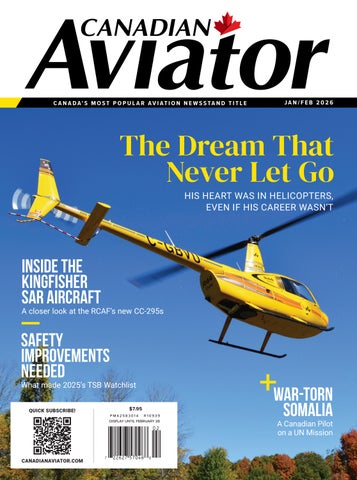
The Dream That Never Let Go HIS HEART WAS IN HELICOPTERS, EVEN IF HIS CAREER WASN’T
INSIDE THE KINGFISHER SAR AIRCRAFT
A closer look at the RCAF’s new CC-295s
SAFETY IMPROVEMENTS NEEDED
What made 2025’s TSB Watchlist QUICK SUBSCRIBE!
CANADIANAVIATOR.COM
$7.95 PM42583014 R10939 DISPLAY UNTIL FEBRUARY 28
WAR-TORN SOMALIA
A Canadian Pilot on a UN Mission
IN THIS ISSUE JAN/FEB 2026 VOLUME 36 NUMBER 1
ON THE COVER Associate Editor Robert S. Grant shot this photo of a Robinson R44 Cadet to accompany this issue’s feature article.
FEATURES
34
From Wings to Rotors This retired Air Canada pilot finally realizes a boyhood dream. By Robert S. Grant
40 The RCAF’s
DEPARTMENTS 5 / WALKAROUND Integrity in the Media 6 / AIRMAIL A Mosquito Bite 7 / WAYPOINTS High Achievers By Aviator staff
8 / GEAR & GADGETS Four aviation products By Aviator staff
9 / FLYING STORIES IFR on the cheap By Jack Schofield
10 / RIGHT SEAT Co-pilots of the future? By Mireille Goyer
12 / COLE’S NOTES Navigating over the Fraser Valley By W.T (Tim) Cole
14 / A PILOT’S LIFE Defending Alaska – Part 2 By Chris Weicht
16 / VECTORS ADS-B revisited By Michael Oxner
18 / UNUSUAL ATTITUDES A tale of two Nationals By Luke Penner
20 / THE PLANE FIXER Taking on the DC-3
CC-295 Kingfisher
By Liana Beussecker
We take a closer look at the RCAF’s latest Search and Rescue tool.
22 / WHIRLYBIRD WRITINGS Experiencing Somalia By Michael Bellamy
By Brian McNair, CD
24 / EXPERT PILOT Seniority rules By Richard Pittet
26 / TALES FROM THE LAKEVIEW A whale of a time By Robert S. Grant
28 / PEP TALK Workload sharing By Graeme Peppler
30 / WORDS ABOUT A BOOK Fire Eaters By René R. Gadacz
33 / INSTRUMENTAL FACTS Choosing your path By Ed McDonald
50 / BOOKSHELF Top aviation titles 52 / SERVICE CENTRE Deals and offers 54 / FLIGHT BAG Puzzle and questions
46
The TSB Watchlist Challenges to aviation safety continue to persist — especially on the ground. By Yoan Marier CANADIANAVIATOR.COM 3
ROTECH MOTOR LTD. 1-(236)-600-0137 SALES@ROTECHMOTOR.CA ROTECHMOTOR.CA
AUTHORISED ROTAX DISTRIBUTOR
canadianaviator.com editor-in-chief
Steve Drinkwater steve@canadianaviator.com 604.999.2411 associate editor
Robert S. Grant g raphic desig ner
Janice Hildybrant proofreader
Roberta Drinkwater advertising sal es account manag e r
Katherine Kjaer katherine@canadianaviator.com 250.592.5331
FORMULATED FOR THOSE WHO CARE.
director of consumer marketing
Craig Sweetman A D M I N I S T R AT I O N g roup control l er
Anthea Williams awilliams@opmediagroup.ca Office 604.428.0261
XPS AVIATION ENGINE OIL Formulated specifically for Rotax aircraft engines.
sub scriptions
Marissa Miller marissa@opmediagroup.ca 1.800.656.7598
Canadian Aviator is published six times a year: Jan/Feb, Mar/Apr, May/Jun, Jul/Aug, Sep/Oct, Nov/Dec
Canadian Aviator Publishing Ltd. 802-1166 Alberni Street Vancouver, B.C. V6E 3Z3 Phone: 604.999.2411 canadianaviator.com CanadianAviatorMedia
QUOTES ON: Cherokee Tanks Fuel Cells & Metal Tanks Repair, overhauled & new Technical Information or Free Fuel Grade Decals
NEW TANKS - 10 YEAR WARRANTY
SUBSCRIPTION HOTLINE
1.800.656.7598 sub scription inquiries admin@canadianaviator.com sub scription rates 1 year (6 issues) $28.00 (Taxes vary by province);
SPECIALIZING IN BEAVER & OTTER FUEL CELLS
MONARCH PREMIUM CAPS Premium Stainless Steel Umbrella Caps for your Cessna 177 through 210 www.hartwigfuelcell.com
@canadianaviatormag
info@hartwig-fuelcell.com
editorial sub missions Editorial contributions should be sent to the editor by email in plain text with high-resolution photos attached: steve@canadianaviator.com Printed in Canada. Agreement No. 42583014. Postage paid at Vancouver, B.C. Contents copyright 2024 by Canadian Aviator Publishing Ltd. All rights reserved. ISSN 1492-0255. Return undeliverable Canadian mail to Circulation Department. 802-1166 Alberni St., Vancouver B.C. V6E 3Z3. From time to time we make our subscribers’ names available to reputable companies whose products or services we feel may be of interest to you. To be excluded from these mailings, just send us your mailing label with a request to delete your name. Publications Mail Registration No. 10939.
Keeping aircraft in the air since 1952 US: 1-800-843-8033 CDN: 1-800-665-0236 4 CANADIAN AVIATOR JAN/FEB 2026
INTL: 1-204-668-3234 FAX: 1-204-339-3351
50%
WALKAROUND EDITORIAL BY STEVE DRINKWATER
Integrity in the Media R
eaders will notice a couple of letters in our Airmail section this issue (page 6). They point out factual errors in the last issue. I always forward such letters to the writers for comment. In the cases of this issue’s letters, both writers stood corrected and one even admitted to being embarrassed for the slipups. As the editor of Canadian Aviator, it is my job to ensure the accuracy of what the contributors offer. Not only do I go through each submission with a hawk’s eye for grammar, spelling, structure, style and other considerations, but I also do a considerable amount of fact checking. As an example, aircraft
model names, especially older ones, get checked for accuracy. Is that Avro Lancaster model a BX, or a B-X? No, it’s a B.X (a Canadian-built B.III with some modifications). How is more than one Noorduyn Norseman referred to? Are they Norsemen? No, they are Norsemans, just as more than one Boeing Stearman are Stearmans. People’s names are also doublechecked for correct spelling. Mainstream media, or legacy media, has come under fire lately, and in many cases for good reason. With popular access to the Internet, it is much easier to check the accuracy of claims than it was years ago, when one
would often have to go to a library to check other sources. While it is incumbent on a good editor to check thoroughly for factual accuracy, I admit to having slacked off a little lately, due partially to some outside commitments that hopefully won’t compromise my attention to the magazine again. Having said all this, it should in no way take away from the quality of writing by the contributors. They contribute greatly to the magazine, and it would not be what it is today without their stories. Everyone on the Canadian Aviator team pledges to double-down and get it right.
ONE STOP SHOPPING • LOWEST PRICES • SAME DAY SHIPMENT
FREE 2025-2026 CATALOG!
CANADIANAVIATOR.COM 5
AIRMAIL For the Record ...
A Mosquito Bite The Wooden Wonder “Mossie” (“The Night Intruder,” p. 46, Nov/ Dec 2025 issue) was not designed by R.J. Mitchell, but by Geoffrey de Havilland, one of the key founders of the de Havilland company. RJ was, of course, the designer of the Spitfire. On YouTube may be found a video of Geoffrey de Havilland passing coffee around while huddled with his design team poring over the Mossie project. David Green Thornhill, Ont.
In going through your excellent publication, I noticed a couple of errata that need to be corrected. On page 12 of the Nov/Dec issue, Chris Weicht refers to the 1939 expulsion of Allied troops from Dunkirk. First, it was not an expulsion, it was an evacuation (338,000 troops), and second, it took place from May 26 to June 4, 1940. On page 47, Nathanael Reed has the Amiens Prison situated in Holland, whereas Amiens is firmly in France, about 120 kms north of Paris. Amiens is also notable for the fact that the Beaumont Hamel Newfoundland Regiment memorial site is just a short drive to the northeast as is the impressive Thiepval Memorial. Richard ‘Buzz’ Bennett Gibsons, B.C.
In both cases, the writers express regret for their errors. Editor
The author admits, and regrets, the error. Editor
Religion-Driven Charity I have enjoyed your magazine for many years now and find most of the articles educational or at least entertaining. However, I found your feature article on page 32 to be offensive (“Prairie Aviation Training Centre”). Everybody has the right to their own religious beliefs but the attempts of individuals and groups attempting to spread their beliefs, has led to millions of deaths throughout history. David Chatters Qualicum Beach, B.C.
Thanks for your feedback, David. Our view is that there are many factors that can lead people to help others in need. For many, it is their religious beliefs. For others, it can be their personal set of morals and values that motivate them. We recognize that many religions have led to negative outcomes but also believe that MAF does far more good than harm, if any, and that this article illustrates yet another benefit of how General Aviation is a force for good. Editor
ERRATA The caption and photo credit were incorrect for the image on p.23 of the Sep/Oct 2025 issue. The correct caption is: The OPAS DH.61 Giant Moth was the largest Yellow Bird in the fleet and participated in mercy missions and firefighting. The correct photo credit is: Canada Aviation and Space Museum CAVM 16992
Send us your letters. Canadian Aviator welcomes reader letters on topics of concern to Canadian pilots and the
aviation industry. Please be brief, to the point and polite in your submissions. Email Steve Drinkwater steve@canadianaviator.com
6 CANADIAN AVIATOR JAN/FEB 2026
COMPILED BY AVIATOR STAFF
KEN LIN
WAYPOINTS
High Achievers in Aviation Recognized THE AWARDS, KNOWN AS ELSIES, HONOURED SEVERAL WOMEN
T
he 16th annual Elsie Awards by the Northern Lights Aero Foundation was held on October 4 at the Pearson Convention Centre in Brampton, Ontario. The event celebrates the achievement of women who excel in aviation and/ or aerospace. They are nominated by their peers for their extraordinarily high achievement. The event was also an opportunity to network amongst aviation professionals, with many aviation organizations in attendance, including airlines, aviation training institutions, aviation and aerospace companies. A special and poignant new award this year was the Captain Christina Thomson ALPA Scholarship, honouring her life and aviation career as a WestJet pilot. Her life was tragically cut short in December 2023 from an intimate partner crime. Christina’s brother Captain Ruarri Thomson, also a commercial pilot, presented Afrah Khan and Elitza Nikolova with the bursary towards their pursuit of aviation careers. The award is named for aviation pioneer and human rights activist Elsie Gregory MacGill, OC, who served as chief aeronautical engineer at Canadian Car and Foundry in Fort William, Ontario during the Second World War. MacGill oversaw the production of 1,451 Hawker Hurricane fighters for both the RAF and the RCAF, and 835 Curtiss Helldiver dive-bombers for the U.S. Navy. Elsie MacGill
The 2025 winners (from left to right) with their respective categories: Samantha Golinski - Business Award (Public Affairs and Global Communications at CAE). Jackie Book - Education Award (former military and current WestJet pilot). Silvia Bianchi - Engineering Award (aerospace engineer with work experience in Europe, Japan, North America and South Africa). Allison Rumbolt - Flight Operations Award (Sikorsky S-92 helicopter captain and base Flight Operation Manager for Cougar Helicopter in St. John’s, NL). Dr. Nathalie Sleno - Government Award (Regional Aviation Medical Officer for the Prairie and Northern region and Technical Lead for Space Medicine Policy at Transport Canada). Denise Egglestone - Trailblazer Award (Air Canada’s first female flight dispatcher and ground school instructor). Heather Hills - Rising Star Award (Porter Airline Q400 captain currently pursuing a Master of Science in Human Factors). Natalie Leung - Rising Star Award (professional engineer with Pratt & Whitney Canada, working on engine designs using 100 percent Sustainable Aviation Fuel, or SAF).
CANADIANAVIATOR.COM 7
GEAR & GADGETS
PRODUCT REVIEWS COMPILED BY AVIATOR STAFF
Emergency Locator Ever wondered if your ELT will work in an actual emergency? Do you want the reassurance that comes with having a backup system? Ocean Signal of Margate, Kent in the U.K. has engineered and built a personal locater beacon (PLB) that every pilot should consider carrying. Their RescueMe PLB1 fits in the palm of your hand and is easy to activate, but difficult to do so unintentionally. When activated, it sends a signal via satellite to a central rescue coordinating centre. And there is no subscription required — it is free to use. It comes equipped with a 121.5 MHz homing beacon and a dedicated 406 MHz distress signal with 66-channel GPS. Its portability means it is an ideal accessory to bring along on any back-country expedition too. About U$395 plus shipping. Learn more at, and available from, oceansignal.com.
Inlet Plugs Thinking of an ideal gift for your loved one on Valentine’s Day? Is he or she a pilot with an airplane? Then look no further and gift a pair of engine inlet plugs with a sense of humour. Put a smile on your airplane! Bruce, known for his down-to-earth aircraft covers, seems to have gotten romantic with time. Cowl plugs are available for a wide range of Piper, Cessna, Mooney, Beech, Cirrus and Van’s models. From C$351 for singles to C$738 for twins. Learn more at aircraftcovers.com. Available from aircraftspruce.ca.
Protective Foam Ever bumped your head while walking in the vicinity of your high-wing airplane? Perhaps you didn’t see the back side of your wing, and you ended up with a cut scalp. It happens to many of us, including this writer. Redwing has a solution in the form of a trailing edge protector. The bright red foam is available in three-foot sections that can easily be cut for a custom fit. They are also useful for preventing damage to other trailing edges from moving equipment or objects around. About C$58. Learn more at, and available from, aircraftspruce.ca.
Flight Planning Do you wish you had a well-designed pad of paper flight planning prompts, one that makes flight planning a breeze? If so, look no further than ASA for a comprehensive solution. On one side is the form for flight planning, and on the flip side is a form that guides you in preparing an ICAO-approved flight plan for filing purposes. Each pad contains 48 pages. About C$9.50 per pad. Learn more at, and available from, aircraftspruce.ca.
8 CANADIAN AVIATOR JAN/FEB 2026
FLYING STORIES HANGAR TALK WITH JACK SCHOFIELD
Chintzy IFR AND OTHER WEST COAST SHENANIGANS
H
PHOTO COURTESY OF WILDERNESS SEAPLANES
e was introduced to me as “Mister Aviation.” That’s how my then-employer at the airline described him to me. “Not only does this guy fly everything from an MU-2 to a 150 in any kind of weather, on floats or on wheels, but he’s the most enthusiastic pilot and member of the B.C. coastal aviation community that you’ll ever hope to meet.” So, a couple of years down the road I met “Mr. Aviation,” and even had the good fortune to be in business with him for a short time. I found him to be all as described and more. Here was my introduction: We climbed into a Grumman Goose on the Port Hardy tarmac. I took the right seat and youknow-who was the PIC. It was a foul day at CYZT with heavy rain and that typical North Island overcast down to a hundred feet or so above the wave tops. “No problem,” he stated happily, as the two Pratt & Whitney R-985 Wasps trucked us to the numbers on Runway 28, where we did the run-up and I got a quick briefing as to how he planned to proceed to the logging camp at Smith Inlet. “We’ll take off on 28 and climb to 2,000 feet while turning seaward until
we intercept and commence tracking the airways (I forget the number). At two thousand, our altitude is one thousand feet below the MEA of that airway, so we have good separation from any IFR traffic and nobody flying VFR will be up here in this clag, they’ll be down 50 feet off the water trying to eyeball the shoreline. We will level off and track that airway just like you would in normal IFR conditions until we reach my checkpoint right here.” He was poking his finger at the chart where there was a little X, but I missed his explanation of how he knew when we were at X — perhaps a bearing from the NDB on Table Island or a DME fix? The roar of our takeoff power blurred his explanation, and we climbed into the overcast and performed exactly what he had described. My VFR mind-set was immediately at odds with his IFR calculations. When we arrived at X we banked onto his predetermined bearing and commenced a letdown at 200 feet per minute on what he was now performing as a DME approach to Smith Inlet. His poking finger was now directed at the panel where the distance measuring was displayed.
“If we don’t cloud break at 200 feet, we do a missed approach and climb back to 2,000 and intercept that same airway and track it below the MEA back to Hardy,” he yelled. We broke cloud at 200 feet and there was the mouth of Smith Inlet dead on the nose and the entrance to the camp at Security Bay visible two miles ahead. This was my introduction to what I later dubbed, “Chintzy IFR.” Now, a much later such flight, but perhaps more highly refined with military controllers at Comox airport providing ground support, has been described to me as taking place in a turbocharged Cessna 206 on Wipline amphib floats. Departing off the strip at Toba Inlet this day enroute to Campbell River, the corporate aircraft was the property of Weldwood Coast Logging for whom “Mr. Aviation” was the corporate pilot. The principal passenger on the aircraft was a company official who, on many previous flights, could be found in the right-hand front seat of the plane in a deep sleep as the aircraft augured through the overcast going in or out of camp. So often was this company executive to fall asleep during flights that our pilot hero and his
This Grumman Goose is similar to the one mentioned in the article. Pacific Coastal Airlines, through their subsidiary Wilderness Seaplanes, continues to provide scheduled airline service on British Columbia’s West Coast with a pair of Gooses.
CANADIANAVIATOR.COM 9
RIGHT SEAT
FLYING STORIES (continued)
1 0 CANADIAN AVIATOR JAN/FEB 2026
Let’s Talk About AI in the Cockpit AND LEARN HOW TO COMMUNICATE WITH OUR SOON-TO-BE COPILOT
IMAGE: ALEX SHIPPS/MIT CSAIL USING THE MIDJOURNEY AI IMAGE GENERATOR
back seat passenger, also a well-known person to the British Columbia aviation community, decided to play a trick on the man. It was described to me like this: “We knew our right seat passenger would choose the right seat beside me on our return flight to Campbell River this day. I had filed our standard IFR flight into the CYBL runway via radar vectors from Comox military radar in the Comox terminal area. Our IFR clearance was given to us over the telephone direct by the GCA radar tech. They were very happy to help us keep our IFR currency with their services. “Our telephone clearance came with a departure slot time of about 20 minutes block time from the upper Toba Strip, so with a nod to my backseat co-conspirator to ensure he was buckled up tight, we began to climb out of Toba Inlet to our assigned “8,000 and not above” while in controlled airspace. “So now, the climb to our assigned altitude, with the cabin heat applied full hot, we watched our victim carefully and wondered how long it would take before he would do his lullaby trick. It didn’t take long, and he was soon slouched over and dead to the world. Our hero winked at the back seat passenger who gave him the thumbs up. He then got on the blower and asked the Comox radar controller to clear us to descend to 1,500 feet in a quick practice diving manoeuvre for training purposes, of course, simulating efforts to get out of icing conditions. We were so cleared, and then the trick began. I slouched over onto the shoulder of our victim seated next to me and pretended to be asleep at the wheel. When our sleepy buddy suddenly came to and looked out the windshield, he saw a whole bunch of islands rotating and coming up fast to greet us. What a pounding I took, as he forced me off his shoulder and into an upright position, making sure I was awake and back at the controls. “Both my backseat friend and I had tears in our eyes from laughing. As for the right seat victim, he was too busy shaking his head to notice. “Remember,” we told him, “Something like this will happen to you if you ever fall asleep in this plane again.”
ALWAYS LEARNING WITH MIREILLE GOYER
A
rtificial intelligence (AI) is quickly transforming how we live. Change is nothing new. However, this emerging technology is fostering a different type of change, one that humankind has never experienced. Previous technological breakthroughs transformed existing processes. For example, the printing press and the internet transformed the way we share knowledge, the engine changed how we powered machines, and aircraft created a new means of transportation. AI will do more than help us perform tasks; it will outsmart us. It is not difficult to foresee the role of “pilot monitoring” in multicrew environments being replaced by AI, and single pilots becoming “multicrew pilots” with AI as their sidekick. Of course, there is also a real potential for no human pilot at all. However, concerns about “black swan” occurrences requiring out-of-the-box solutions mean that, for now at least, AI-augmented pilots will become the standard. How can existing and future pilots learn to leverage and collaborate with AI? The size of the challenge is directly related to the level of existing experience. For example, pilots operating in multicrew environments are already used to querying and discussing data before proceeding, both during normal operations and emergencies. Seeking and discussing information with AI will be more natural to them than to the single pilot whose multicrew environment experience is mostly limited to sharing the flight deck with a flight instructor directing and testing. Some principles applicable to effectively collaborating with human beings like clear communication and setting conditions carry over to working well with AI with few modifications. Others like conflict resolution and coaching do not. AI-specific training is slow to make its way in educational institutions in aviation and elsewhere. It must
go beyond teaching how to prompt (communicate with) AI. The key to successfully leveraging AI lies in learning to collaborate with and manage a high-IQ alien entity. Both high-IQ and alien come with challenges, but the good news is that AI does not have feelings (for now), so being tactful is not a prerequisite to a successful relationship. When using AI as a task assistant, clear communications simply means technically clear communications. For example, “set 121.5 on radio” is simply not clear enough. AI is not a mind-reader. Everything must be spelled out. The proper phrasing to get accurate compliance could be “set 121.8 on radio one and activate.” When using AI as a collaborator with knowledge and reasoning capabilities you may not have, the key is to ask questions (prompt in AI phraseology). The quality of the question is critical. Given AI’s vast knowledge, context and precision are essential. For example, “give me the PIREPs for my route” can yield a lot irrelevant information to sort through. “Provide me the PIREPs reported in the last hour between my current position and XYZ airport within 5,000 feet of my current altitude,” would narrow it down. Depending on operating needs, the instructions could add additional instructions to filter down the information (e.g., only those reported by light aircraft) or to present it (e.g., read the results in plain English from closest to my current position to furthest). One area where AI can really shine, especially for single-pilot operations, is its ability to access expertise not readily available onboard today. What pilot faced with a mechanical issue would not want to consult the vast knowledge of engineers and/or mechanics when the standard procedures do not apply? AI can store manuals, technical troubleshooting data, accident investigations and much more in its database and use all these resources to recall or generate solutions to the problem on-the-fly. Better yet, with the pilot’s additional input, AI can further evaluate the potential
outcome for the proposed solution. When picking AI’s brain for solutions, conflict can arise. The proposed solutions can trigger emotional responses or make no sense. The first reaction should be to ask AI to explain its reasoning and its sources rather than dismiss its “odd” solutions outright. Remember, it is smart and alien. It thinks differently. If after further probing, the solutions still do not make sense then, sharing new conditions and/or context can help redirect AI to generate better suggestions. Coaching is key to relationship building. It feels different when dealing with AI but the goal is the same: getting to know each other to work better together. Coaching AI is not so much about enhancing its knowledge, it is more about raising its awareness and understanding of how humans think/ work to shape it into a better co-worker for us. For example, if AI came up with an interesting solution that needs a human-adjustment, do not simply adjust the solution as you apply it; tell AI what adjustment is required and why, then ask AI to represent the solution with the adjustment to allow it to store it for further use. The transition to AI-augmented operations demands a fundamental shift in human mindset, recognizing that AI is a true collaborator, operating on alien logic. This human-AI partnership is similar to the hunter-and-dog relationship: the hunter must trust the dog’s superior senses and speed (AI’s analytical power), yet success hinges on the paradoxical combination of a positive, cooperative attitude and hyper-precise technical commands. Just as a hunter’s specific whistle or hand signal directs the dog, only quality questions and specific context can harmonize the pilot’s intuitive, real-world understanding with the machine’s analytical power. Ultimately, deliberate education and training are the only way to equip current and future professionals to be masterful handlers of AI, ensuring they can communicate the nuances of the mission and manage their intelligent teammate effectively.
DO YOU FOLLOW US ON INSTAGRAM? Get great article suggestions and post alerts when new issues become available.
CANADIANAVIATOR.COM
CANADIANAVIATOR.COM 1 1
COLE’S NOTES CAREER HIGHLIGHTS WITH W.T. (TIM) COLE
British Columbia’s Lower Mainland AMONG THE BUSIEST AND MOST COMPLEX AIRSPACES ANYWHERE “Keep alert and watch for other aircraft.”
T
THE COLE COLLECTION
his was the catchphrase that ended most radio transmissions by Aircraft Radio Operators in times past. In Vancouver’s Lower Mainland and the Fraser Valley, this catchphrase is most appropriate in today’s busy airspace. The year 2026 marks my 50th anniversary of flying in this area, and I still fly in it on a weekly basis. In 1976 I moved to Vancouver from Eastern
1 2 CANADIAN AVIATOR JAN/FEB 2026
Canada. I was employed as a Twin Otter float captain and flew the routes from Vancouver Harbour to Vancouver Island six to seven times a day. Fifty years ago, it was busy airspace. However, it was much less complicated and less crowded than it is today. The Lower Mainland, Greater Vancouver and the Fraser Valley airspace is triangular in shape. The western base of the triangle is roughly 40 kilometres (25 miles) in length and is bound by
the Pacific Ocean’s Georgia Strait, also known as the Salish Sea. The apex of the triangle is 120 kilometres (75 miles) to the east and terminates at the town of Hope, which has a 4,000-foot grass aerodrome. The north side of the triangle is defined by the Coast Mountain Range which rises to 6,000 feet. The south side is bound by the U.S. border at the 49th parallel, which proceeds eastward until just east of the Abbotsford airport (CYXX), where it meets the North Cas-
cade Mountains, which rise to 7,000 feet. When looking at a map of Canada, this small, roughly 2,400-squarekilometre area doesn’t even rate postage stamp size status but is closer to the size of a pinhead when compared to the country’s total land mass. This little area is one of the busiest and most complex pieces of airspace in Canada. In it there are six airports that have control towers and instrument approach procedures. Vancouver (CYVR) and Abbotsford have scheduled jet airline traffic and Vancouver Harbour (CYHC) is the main base of operations for Helijet, North America’s largest scheduled helicopter operator. Harbour Air Seaplanes also operates from CYVR and the harbour and is the largest, year-round, floatplane
The Fraser Valley’s pastoral farmland belies the complexity of the airspace immediately above it.
operator in North America. Abbotsford is the home base for Conair Aviation, which has the largest privately owned fixed-wing aerial firefighting fleet in the world. The other three towered airports are at: Boundary Bay (CZBB), Pitt Meadows (CYPK) and Langley (CYNJ). These three general aviation airports are home to largescale fixed and rotary wing flight training schools. The Abbotsford and Chilliwack airports also host active flight training schools. There is a large skydiving school just north of the Abbotsford airport and the Hope airport hosts the Vancouver Soaring Association’s glider operations. There are also a few private aerodromes and multiple heliports and seaplane sites located in the area. The western and southwestern portions of this airspace is mostly capped at 2,500 feet and Nav Canada’s controlling agencies are Vancouver Terminal and Victoria Terminal, which control the upper airspace. NOTAM: “Due to reduced system capacity: Limitations in effect…expect delays entering…and/or…remain clear of class C airspace.” This frequent Notice To Airmen is almost a daily occurrence, in the western portion of this airspace. The result is that it restricts most VFR aircraft to below 2,500 feet and has the effect of further compacting already busy airspace to lower and more trafficcongested altitudes. In the eastern portions of the valley there are three main designated training areas that are usually saturated with students learning to fly. A further result is that all the undesignated and uncontrolled airspace has “de facto” become training areas. There are many flight training schools in the area and several of them have been purchased by interests from Asia and Southeast Asia. Many of the students training in these areas are from foreign countries and English is typically a second language for them; comprehension on the radio has become a real issue. In the uncontrolled portions of the valley there are two designated common broadcast advisory frequencies: 122.725 MHz and 122.775 MHz. There is a north-south frequency
changeover line, centred on the bridge spanning the Fraser River at the City of Mission. Both these east and west frequencies are jammed with constant chatter, sometimes almost unintelligible, with students stating their intentions and whereabouts. An example of a recent position report I heard was: “Cessna 150, C-FABC is at fifteen hundred feet westbound and two miles south of the Haunted House!” It was close to Halloween but who knows where this was! In addition to all of this traffic, there are the “Gravel Bar Cowboys,” flying small STOL aircraft equipped with big tires, and also training helicopters landing on the gravel bars on the Fraser River. Sometimes these folks are competing with float-equipped airplanes that are also training on the river and nearby lakes. The description of this airspace and some of its challenges may seem daunting. However, it is one of the most beautiful places to fly in Canada, and it witnesses the vibrant aviation community that exists on the West Coast. My advice to aviators, whether resident pilots or newbies to the area, is to ensure that your flight planning is extensive. This is particularly important for VFR flyers. All the towered airports have published VFR arrival and departure routes, with many local reporting points. Trying to interpret these routes and/or position points on your iPad, VFR Supplement or VTA chart while flying the aircraft is a recipe for trouble, a CADORS report or even something more catastrophic. Because of the complex airspace, a pilot needs to ensure that he or she has the various communication frequencies written down in sequence, as there are frequent changes required as one progresses from each controlling agency, or advisory area, to another. This airspace is crowded! Keep your eyes outside the cockpit and your head on a swivel. That old time radio operator’s admonishment of “Keep Alert and Watch for Other Aircraft” is more pertinent than ever. And, as always, I wish you all the old bush pilot’s blessing: “May you have tight floats and tailwinds.” CANADIANAVIATOR.COM 1 3
A PILOT’S LIFE LIVING THE DREAM WITH CHRIS WEICHT
Canadians Aiding in the Defence of Alaska ENEMY UNITS WERE MOVING IN (PART 2 OF 3)
T
he Royal Canadian Air Force (RCAF) established its X Wing at the United States Army Air Forces (USAAF) Base Elmendorf at Anchorage, Alaska. Four Canadian squadrons would serve with X Wing and were transferred to Alaska beginning in June 1942. The RCAF squadrons would serve together with the USAAF 11th Pursuit Squadron in a defensive role until the Canadian units could be equipped with long range fuel tanks that would allow their Curtiss P-40 Kittyhawks to traverse the over 1000-mile distance of the Aleutian Islands. Changes would also have to be made to install bomb racks needed to accommodate the American-supplied munitions. It was soon established and recognized that strategic and operational control of all forces in the Alaskan North Pacific was an American responsibility. The degree of friendly cooperation which existed between the Alaskan Eleventh Air Force and units of the RCAF was such that any minor differences of opinion were soon resolved. The fear of a Japanese attack at Nome, Alaska instigated the buildup of 2,300 USAAF personnel in a 36-hour period at Nome after the bombing of Dutch Harbor, Alaska in early June 1942, together with reports of Japanese naval activity in the adjacent Bearing Sea. Additionally, there was concern for the safety of the United States Lend-Lease aircraft and ships being supplied to Russia via Nome, Alaska. On June 8, 1942, RCAF No. 8 (BR) Squadron and its Bristol Bolingbroke Mk V aircraft were transferred from RCAF X Wing at the USAAF Base at Anchorage, Alaska, 650 miles distant to the USAAF Base at Marks Field at Nome. Later, on February 26, 1943, No 8 (BR) 1 4 CANADIAN AVIATOR JAN/FEB 2026
Squadron was transferred from Nome to RCAF Station Sea Island at Vancouver, British Columbia and replaced at Nome by RCAF No 14 (F) Squadron on March 2, 1943. Japan had been in a state of war since its invasion of China in 1937. Military leaders now dominated the country’s ruling cabinet; General Hideki Tojo was appointed to the position of prime minister by Emperor Hirohito. Japan under Tojo began to move toward a state of war with the Western Allies. An order was issued to Admiral Yamamoto to complete a plan to destroy the United States Pacific Fleet. On November 27th, 1941, the admiral was ordered to depart for the Hawaiian Islands where, on the early morning of December 7th, 1941, Yamamoto launched his attack on Pearl Harbor in two waves of 360 aircraft. At the finish of Yamamoto’s attack on Pearl Harbor, the United States had suffered the loss of 18 capital ships, 188 aircraft and 3,581 men. They had become the first American casualties of the Second World War. On April 16th, 1942, Imperial Japanese headquarters issued its Midway-Aleutian Directive that comprised the occupation of New Guinea and Midway as well as the destruction of the U.S. Pacific Fleet and the seizure of the western Aleutian Islands. Vice-Admiral Moshiro Hosogaya, having been given the responsibility of directing the Northern Force, dispatched a smaller task force into the Northern Pacific under the command of Rear Admiral Kakuji Kakuta. The Japanese aircraft carriers Ryujo and Junyo between them carried 82 aircraft and were accompanied by two heavy cruisers, a tanker and three destroyers. Their objec-
tive was to launch an air attack against the United States Naval Operations Base at Dutch Harbor on Unalaska Island at the head of the Aleutian chain. At the same time, an invasion force headed further west toward the Aleutian Islands of Adak, Kiska and Attu. United States Naval Intelligence had broken the enemy’s coded messages to the point where they knew that the North Pacific coastal area was in danger of an attack, but the exact details of the Japanese plan still eluded them. Canadian RCAF Stations reported an increase in sightings of Japanese submarines. Both American and Canadian defence stations on the West Coast were on alert. But, despite the vague forewarning, the operations base at Dutch Harbor was a long way from being ready for an attack by the Japanese Navy. Even the weather conspired against them; a cold front was moving in. Heavy rain and thick fog combined to build a grey wall that hid the assembling Japanese strike force from the American PBY Catalina flying boat crews patrolling overhead. There was no U.S. Army Airfield at Dutch Harbor because its terrain would not support its construction, so any air defence would have to come from the U.S. Army Air Force Station at Fort Randall on Unimak Island that was 180 miles from Dutch Harbor. At 03:25 on June 3, 1942, under the watchful eye of Rear Admiral Kakuta, the first Mitsubishi A6M “Zero” fighters took off from the deck of the carrier Junyo. Fifteen minutes later, the carrier Ryujo launched its first wave of Nakajima B5N2 “Kate” dive-bombers, each carrying an 1,100-pound bomb load. The first report received of the imminent attack on Dutch Harbor by Japanese forces came from the United
Alaska’s Aleutian Island group at the bottom left of this map starts at the extreme west with the islands of Attu, Kiska, Adak and then Dutch Harbour Naval Station. The three islands were occupied by the Japanese invaders.
States seaplane tender “Gillis” at 05:40 when its radar operator picked up on his screen more than a dozen fast moving pips coming from the south above the clouds at approximately 10,000 feet and at a range of about 10 miles from his position. The on-duty U.S. Navy Radio Operator at Dutch Harbor received the emergency message from the Seaplane Tender “Gillis” and, in turn, sent it in plain English to the U.S. Army base at Fort Randall near Cold Bay and to the USAAF bases at Fort Glenn on Umnak Island as well as to the USAAF base at Elmendorf Field at Anchorage, Alaska. The message was “Dutch Harbor about to be bombed by enemy planes.” At 05:45, 15 Nakajima “Kate” dive bombers broke out of the 10,000-foot overcast and, finding visibility unrestricted, commenced their attack on Dutch Harbor’s Naval Base, its ships in the harbour, the base itself, and the Navy PBY-5 Catalina flying boats that were attempting to take off. Within four minutes of the alert, the USAAF No 11 Squadron P-40 fighters at Cold Bay on Unimak Island had been scrambled and headed across the 180 miles that separated them from Dutch Harbor. It was a different story at the USAAF base at Fort Glenn on Umnak Island,
where the communications system had failed and pilots on alert status waited for messages that never materialized. The attack lasted 20 minutes, during which the enemy aircraft flew through a fury of anti-aircraft and machine-gun fire until the flight leaders ordered their pilots to enter cloud and return to their aircraft carriers. The U.S. Army barracks had received a direct hit, killing 25 soldiers and injuring many more. Within minutes of the Japanese bombers’ departure, the USAAF 11 Squadron P-40 fighters from Cold Bay, who had flown the 180 miles at maximum power from their airfield on Unimak Island, arrived at Dutch Harbor only to find no enemy to fight. Not a shot was fired. The Japanese Zero fighters from the carrier Junyo had failed to locate Dutch Harbor in the fog and returned to Junyo’s deck. However, at their debriefing, the pilots revealed that after passing Makushin Bay they had sighted a squadron of American Navy destroyers waiting in obvious ambush for the Japanese fleet. On June 4th, 1942, the Japanese carrier aircraft returned to attack Dutch Harbor. This time the Japanese pilots were better prepared, and when the attack ended, the Dutch Harbor oil storage tanks were on fire, the hospital partly destroyed,
and a beached barracks ship was badly damaged. Although USAAF pilots eventually located the Japanese carriers and accompanying vessels, the encountered weather was such that contact was soon lost with the Japanese fleet. Japanese Admirals Hosogaya and Kakuta then turned their respective fleets 1,000 miles westward and invaded and occupied the islands of Attu and Kiska and later attempted to take Amchitka Island. Earlier, during May 1942, Japanese Rear Admiral Shigeaki Yamasaki led his flotilla of six I-400 Sentoku submarines from his flagship I-9. A waterproof hangar on the forward deck was a unique feature of the I-Class boat which housed a Yokosuka E14Y1 “Glen” folding wing seaplane which was launched by a catapult. The Glen carried a pilot and observer/gunner. The Glen seaplane was Admiral Yamasaki’s “eye in the sky.” Its scouting missions were vital to the strategic positioning of his flotilla to support the attack on the Aleutians. On May 25, I-9 launched its Glen over Kiska, observing no military activity save for a weather station, whose operator in turn saw the seaplane circling overhead and contacted the U.S. Navy Base at Dutch Harbor. However, the radio operator at Dutch Harbor did not believe the Kiska identification of the aircraft and did not report it. Had the Navy radio operator been less sceptical, patrols at Dutch Harbor would have been waiting for the Glen seaplane and its I-boat when it arrived at Unalaska Island. RCAF No 115 (BR) Squadron had been relocated in June 1942, to Kodiak Island, Alaska, from Yakutat and, soon after their arrival, were ordered to load 550-pound bombs and immediately search for a reported submarine. No sighting was reported, however. RCAF No 118 (F) Squadron would also serve at Fort Greely, Kodiak Island after relocating from Yakutat, Alaska, often serving together with the U.S. Army Air force and flying their Curtiss P-40 “Warhawks.” To be continued... CANADIANAVIATOR.COM 1 5
VECTORS ATC VIEWPOINT WITH MICHAEL OXNER
Let’s Talk About ADS-B — Again A VIEWPOINT FROM A CONTROLLER WHO IS ALSO AN AIRCRAFT OWNER
1 6 CANADIAN AVIATOR JAN/FEB 2026
Much of the consternation surrounding Canada’s ADS-B mandate comes down to those two issues: Cost for equipage and no data being returned to the aircraft. In Canada, however, a grass-roots movement has been initiated by the Canadian In-Flight Information Broadcast Association (CIFIB), which aims to provide pilots with similar weather and traffic information to pilots in Canada. While not currently supported by the government or Nav Canada, several stations are in use currently with plans for more as sponsors step up. Due to the satellite-based ADS-B network Nav Canada is using, Canada’s proposed ADS-B mandate would require “diverse antennas,” meaning one sky-facing antenna to broadcast upward and a ground-facing one for ground stations. This also means an increase in costs for equipment and installation. As many aircraft owners know — and as I now know first-hand — the costs are not trivial matters. Nav Canada is investing in ground-based ADS-B surveillance in addition to space-based receivers, hoping to increase ADS-B coverage around busier airports. As a Controller, I see the benefits of ADS-B Out. From an IFR perspective, ADS-B coverage has had a huge impact on my ability to make efficient use of airspace. In areas where traffic is not visible to radars, controllers must use “procedural” methods of separation, relying on position reports and issuing restrictions to separate the aircraft. The separation minima we must apply by regulation are huge. ADS-B coverage, due to the spacebased constellation in use, has greatly increased surveillance coverage for those so-equipped in most areas across the country. Now, separation applied MICHAEL OXNER
T
he topic of ADS-B has been a ADS-B In operating on that frequency. controversial one in Canada. I’ve Similarly, the U.S also has a mandate written about it before, trying to for aircraft operating above 18,000 MSL explain the benefits for ATC and how to be equipped with 1090ES. Howevthose benefit pilots. I have a slightly er, they have also opted to permit and different perspective, now, though my support a different mode. Using what’s comments from past articles stand. termed as a Universal Access Transceiver, I’m a part owner of a Piper Warrior, weather data can be sent out in addiand we’re completing the next phase of tion to nearby traffic, providing more an avionics upgrade. The new systems information to GA pilots who don’t have will support ADS-B In. For two trips to weather radar or TCAS on their aircraft. the United States, I wanted that ability. The trouble is that the 1,090 MHz band But a big part of the reason it would be is already quite crowded, and this data helpful there is because of the ADS-B mandates in place in that country. While I look forward to the implementation in our airplane, the ADS-B mandate in Canada is well behind that of the U.S. This means that, in most of my near-term travels, I’ll see airliners already subject to the Class A and B airspace mandate, but only a small portion of other aircraft. I fly primarily from an airport that sees a large volume of VFR training, and only one of the school’s aircraft is equipped with ADS-B Out. It’s worth a slight diversion to briefly explore the differences in the systems in use in Canada and the U.S. Like many other jurisdicThe author’s new panel, which features dual Garmin AV-30s, one of which is needed to code the ADS-B Out transponder. tions, Canada uses Space-based 1090ES. If equipped with ADS-B Out in this mode, your aircraft is too much to add. Therefore, the U.S. sends information including your Flight has also designed and built a groundID (typically your civil registration but based-only system to operate on 978 may be configured otherwise) and your MHz, resulting in the term 978UAT for position (most commonly derived from their equipment and mode of operation. GPS) at regular intervals on the same Equipage for the 978UAT is much less frequency used by ATC radars — 1,090 expensive than the 1090ES that is already MHz. Much more than this can be sent mandated in Canadian Class A and B with aircraft with more capabilities. This airspace and is planned to be mandated information can be received by ground for Class C, D and E airspace no earlier stations, satellites and other aircraft with than 2028.”
between IFR aircraft with ADS-B Out capability can be greatly reduced, and use of extra spacing and holds for subsequent arrivals can be reduced or even eliminated, as well, resulting in fewer and shorter delays. Of course, the IFR aircraft that don’t have ADS-B Out must still be treated procedurally when out of range of radar antennas, meaning others around those aircraft must be treated, at least in part, that way, too. Controllers cannot watch the progress of non-equipped aircraft in the airspace. From an IFR-VFR standpoint, things are different, as well. For example, an IFR arrival may be setting up for an instrument approach to an airport below radar coverage. In such an area, a VFR aircraft operating in the area without ADS-B Out will not be visible to the controller, so traffic information cannot be passed to the IFR arrival, even if the
VFR aircraft has a transponder. Imagine being a controller who is vectoring an IFR arrival at the floor of radar coverage. Suddenly, a target appears on radar, just climbing into the floor of radar coverage in the same area. No warning, just appearing. There is a much greater chance of the controller seeing that VFR aircraft if it has ADS-B Out, giving more time to react and adjust. But it’s not just about the lofty goal of avoiding collisions. Statistically speaking, most IFR aircraft are of the medium or heavy wake turbulence categories. Most aircraft operating under VFR are light. Wake hazards are very dangerous phenomena. With advance notice that your light aircraft is there due to the increased ability of ATC surveillance systems to see your aircraft, the risks can be reduced again, even if you’re not talking to the controller yourself. ADS-B augments surveillance capabilities so
controllers can see more than ever before — but only for those equipped with ADS-B Out. The Canadian ADS-B mandates have been a moving target. Dates have slipped; in part, out of necessity. That said, I have noticed over the last three years that there are more GA aircraft with ADS-B Out, despite the lack of mandate in Class C, D, and E airspaces. This makes being equipped with ADS-B In more valuable. As a controller, I like ADS-B. As a pilot, I look forward to the systems working together to help me spot other traffic, especially in times of haze, or other obscuring phenomena such as smoke from forest fires — which seem to be much more common now than 35 years ago when I first started to fly. Getting a “heads up” to start looking in the right direction for other traffic will be helpful.
CAN A DA , M EET T H E DA50 RG
With its Transport Canada Type Certification complete, the DA50 RG is ready to show Canadian pilots the pinnacle of single-engine aircraft with performance, comfort, and style that raise the bar.
Discover the DA50 RG
CANADIANAVIATOR.COM 1 7
UNUSUAL ATTITUDES AEROBATICS WITH LUKE PENNER
Cross-Border Camaraderie A TALE OF TWO NATIONALS
T
he Canadian National Aerobatic Championships took place this year from August 20 to 22 in Steinbach, Manitoba. Twenty-two pilots gathered across the five categories, from Primary to Unlimited. Once again, our small prairie town became the heart of Canadian competition aerobatics for a few remarkable days. The week began with a training camp led by my longtime friend, coach and collaborator Aaron McCartan of Iowa. Aaron has been a steady, positive influence on Canadian aerobatics for years, having coached the 2023 Canadian Advanced Team, and his ability to build focus and confidence in every pilot is unmatched, in my experience. Among the attendees this year were two Californians who made the long trip north in their GB-1 GameBirds to join us — one of whom happened to be Sean D. Tucker. Having Sean Tucker in Steinbach felt surreal. He’s one of the most recognized names in airshow flying, and someone I idolized growing up. Sean last flew a competition in 1988, and now, after retiring from the airshow circuit, he’s rediscovering his roots in classical aerobatics. Steinbach was his second contest in over three decades. Seeing him on our ramp, talking with pilots, preparing for his flights, and flying with that familiar energy, was inspiring beyond words. For many of us, it was like watching a legend rediscover a first love. Behind every successful contest is an army of volunteers and, in Steinbach, that spirit shone bright. Most of our volunteers came from Harv’s Air’s student body, and they handled everything from placing box markers in the bean field to catering, security and administration. Without them, there simply wouldn’t be a Canadian Nationals. As always, the weather kept us humble. Friday, our registration and official practice day, brought ideal conditions. But 1 8 CANADIAN AVIATOR JAN/FEB 2026
The author in a vertical up line in the aerobatic box in Salina during program #1.
Saturday was a complete washout — low ceilings made flying impossible. After the effort it takes to organize a contest and gather pilots from across the country, that kind of weather day can be crushing. Still, spirits stayed high thanks to the social side of the weekend. Saturday night brought our traditional pool party and barbecue, hosted by my brother Adam Penner, who also serves as our excellent scorer. Sunday evening we gathered again for a dinner in the hangar, a fitting close to a contest that’s as much about community as competition. Thankfully, Sunday’s weather cooperated just enough to let us fly over 30 flights across
all five categories — enough to make it an official contest, even if not every pilot completed all their programs. We had pilots from Alberta, Manitoba, North Dakota, and Minnesota. The University of North Dakota team was out in full force, led by Mike Lents, a longtime force in the sport, and they swept many of the lower-category awards. In Unlimited, it was just Jesse Mack and me. This was Jesse’s first time competing at the Unlimited level — a big leap — and he flew exceptionally well given the amount of time he had to train. We shared my Extra 330SC, trading flights and cheering each other
on. He’ll get his turn to beat me one day, but not quite yet (wink). I wrapped up the contest by flying a Four-Minute Freestyle, a more crowd-focused competition program where smoke and music mix aerobatics with showmanship. It’s always a joy to share that kind of flying with the volunteers and spectators who make the contest possible. Despite the weather challenges, everyone left smiling, already talking about next year’s Nationals. At the end of the following month, I found myself once again in a familiar place: Salina, Kansas, for the U.S. National Aerobatic Championships. Before the contest, I joined a one-week training camp in Newton, Kansas, led by Pierre Varloteau of France. I had been coached by Pierre earlier in the year in Iowa, and his analytical, disciplined approach continues to sharpen my flying and mental discipline. There were seven of us at the camp, including, again, Sean D. Tucker, pushing himself hard to have a strong showing in the very competitive intermediate category. My teammate Jesse drove down from Winnipeg with our support gear while I ferried the Extra 330SC, travelling light with little more than a change of clothes and a toothbrush. On the very first day of the camp things went sideways for me. During flight one, I was going through my second run through of the Unlimited Free-Known sequence with Pierre diligently watching. I injured my lower back in a particularly violent negative one-and-a-quarter snap roll. I dis-
continued the figure immediately, landed, and spent the rest of the day wondering if my US Nationals was over before it started. Through rest, stretching, and some much-needed massage therapy, I managed to minimize the pain and keep training. Competing in Unlimited is a physical and mental test like no other. Every detail of preparation matters, including the state of your paraspinal muscles which, for me, have a tendency to be injured. The 2025 U.S. Nationals were the largest in decades, with 113 pilots registered to fly. Because it was a team selection year for the 2026 World Championships, the Unlimited category was packed with elite talent. Jesse and I competed as HC, or hors concours; we didn’t affect team standings, but that didn’t make the flying any less intense. Unlimited began Sunday afternoon with the Free Known. My first flight went well. I was proud of it, but with the depth of competition, it still placed me only ninth. My second flight, the first Free Unknown, was my best of the contest, scoring nearly 80 percent, which moved me up a place. The second Free Unknown featured some figure combinations I’d never flown before and, though I was early in the rotation (never ideal with cold judges), I managed a clean 74 percent flight and finished sixth overall in the competition. Considering the scale and the strength of the field, I was quite happy with the result. Jesse also finished in the top ten — both of us in positions that would have qualified for the U.S. Unlimited Team had
we been eligible. That alone felt like a huge accomplishment. Throughout the week the contest atmosphere was incredible. Shad Coulson, the Contest Director, led his team with enthusiasm, clarity and heart. His focus on community and camaraderie, through nightly social events, team-building activities and a well-run schedule, was obvious to everyone. Shad’s leadership made a big contest feel personal, and knowing he’ll serve as Contest Director at next year’s World Aerobatic Championships in New York gives me great confidence that it’ll be something truly special. As the final awards were handed out, the two enormous hangars at Salina Regional slowly emptied. Pilots packed up their airplanes, said their goodbyes and the buzz of the week faded into the Kansas wind. My flight home to Manitoba was smooth and fast; tailwinds pushing my ground speed above 210 knots, a small gift after an intense week. Reflecting on both events, I was struck by how different they are, and yet how they share the same heart. The U.S. Nationals is massive, complex and very competitive. The Canadian Nationals is intimate, humble and held together by volunteers who give their time out of love for the sport. But both are built on leadership, passion and the strong spirit of the aerobatic community. Whether you’re flying in front of judges at a small regional contest or at a world championship, the sky doesn’t measure scale — it measures heart.
LORRIE PENNER
Competition pilots, their support teams, and many others who make an event like this possible gather for a group photo along with their aircraft.
CANADIANAVIATOR.COM 1 9
THE PLANE FIXER SWINGING WRENCHES WITH LIANA BUESSECKER
“Progressing” to the DC-3 AND THAT’S WHERE I FOUND A DOG
A company Douglas DC-3 running up.
I
’ve considered myself fortunate to have spent the entirety of my career, until now, working on fairly modern aircraft. The Bombardier Q400 is a maintenance-friendly plane with reasonable access on more frequently accessed systems and an engine monitoring unit (EMU) dedicated for recording and displaying engine data. The EMU will display fault codes when things go wrong onboard, as well as indicating when a chip plug has detected metal or if the auxiliary power unit (APU) has malfunctioned. Maintenance will take note of the code, the date and times it has been detected, as well as which engine channels have indicated the abnormality, and we reference the fault isolation manual (FIM). This manual gives us a description of the fault code, a list of components that could contribute to the 2 0 CANADIAN AVIATOR JAN/FEB 2026
issue, and a recommendation of which order to begin replacing parts. On rare occasions the FIM doesn’t quite hit the target: I once replaced every component identified, right down to the million-dollar FADEC (full authority digital engine control) computer, to no avail - the code remained hard-faulted with “nodispatch” specified. I relinquished control to the avionics technician who spent hours ringing wiring before finally finding a short in the aircraft armpit (where the wing meets the fuselage). The Bombardier CRJ-900 is even more tech-savvy with onboard computers that will specify a door sensor position to the thousandths of an inch. In comparison, some planes will detect the same sensor as simply “near” or “far” or “ok.”
My reminiscing began because I recently had the opportunity to travel back in time to the Douglas DC-3 era. My introduction to the plane began as a course before I’d even set foot inside the cockpit, so I really had no idea what I was getting into. To say there were a few things I was confused about would be an understatement. What is a spade handle? Where is the pressurization panel? And how do the pilots see anything through that tiny windscreen pointed directly at the sky? One of the biggest shocks was that this specific DC-3 has been updated to Pratt & Whitney PT-6 turbine engines. They were originally built with radial piston engines, and I was so looking forward to working on those. The PT-6 nestled securely inside the nacelle resembles the 1/4-inch socket I lost last week and later found hidden inside the
1-1/8-inch socket (it’s absolutely tiny and looks very out of place). I learned the strange sequence required of the multiple handles to raise and lower the landing gear, and the fact the gear doesn’t retract fully into the wheel wells, as if whoever designed the bay, and whoever designed the tire, didn’t speak to each other at all before install. Not to mention the wheel brake looks like something a farmer found in his field and simply deemed sufficient. Training eventually concluded and I was finally introduced to the plane for engine ground-runs. I sat in the left seat and, although the sequence of starting the plane remains quite similar to the Q400, there were several subtle — and some obvious — differences. There was no distinctive click indicating the starter cutout. Instead of watching a digital screen, my focus was divided between several “steam gauges” that vibrated just enough I actually squinted, like that
“This plane is held together by so many rivets and small panels that, up close, it looks like it could be the space shuttle.” would cause them to be steady. And don’t even get me started on the weight of the yoke. Seriously, who is flying this thing? The Hulk? Everything about this plane is archaic in comparison to anything I’ve worked on. Due to the fact there’s no pressurization, the onboard oxygen system is individual nose cannulas for each passenger/crew member. I’m not even certain there’s a seatbelt or “no smoking” sign or switch. This plane is held together by so many rivets and small panels that, up close, it looks like it could be the space shuttle. But despite all of this, it’s an
undeniably reliable plane — there’s good reason why this is one of the few planes that makes the trip to Antarctica each year. The DC-3 is ski-compatible and is entirely accustomed to the frigid temperatures way down south. The fuselage has external plug-ins that provide power to permanently installed heating pads to ensure smooth engine starting regardless of what’s happening outside. That’s certainly not something I’ve ever seen on a modern commercial jet. This plane may not have an autoshutdown feature if a hot start is detected, or a ram air turbine should absolutely everything else go to hell, or an APU to pre-heat the cabin. But it does have a “dog” that locks the landing gear lever in position, and I’m sure the guy who named that particular hunk of metal foresaw a lot of hilarious maintenance write-ups in the plane’s future.
CANADIANAVIATOR.COM 2 1
WHIRLYBIRD WRITINGS NORTHERN ADVENTURES WITH MICHAEL BELLAMY
From Edmonton to Mogadishu IT WAS MORE THAN JUST A CHANGE IN CLIMATE
A
phone call from Canadian International Helicopters early in ‘94 offered me a Bell 212 flying for the United Nations. My wife enthusiastically encouraged me, suggesting that I needed an adventure and, with that, I accepted. “So, where are you going?” she asked, as I sat beside her. “Somalia” I replied. That evening, the news on Somalia reported increased hostilities between UN forces and warlords. My adrenalin rose just a bit. However, my wife assured me that she wasn’t at all worried. Edmonton, Toronto, then Heathrow. A six-hour layover and then Paris followed by an overnight wait in an empty Nairobi terminal. Come morning, an all-white Russian Antonov 24 taxied up. Next stop, Somalia. Turning a wide circuit over the capital, I was curious about the Antonov’s approach, which was going to result in a quartering tailwind on landing. I was told later that a low approach over the city attracted groundfire, so it was safer to go well out to sea and accept the tailwind. “Welcome to Mogadishu,” I thought. The terminal building had been a mortuary but now appeared to be abandoned. Ground operations, both fixed-wing and rotary, were now concentrated on the opposite side of the runway where rows of old sea-cans provided some semblance of protection from sporadic gunfire from the city. This is where our helicopter headquarters were based, in ATCO-type trailer offices and bunkhouses, and a kitchen that provided meals. Surrounding this was a junkyard of wrecked Mikoyan-Gurevich MiG-21s and some military helicopters. Perched on sandy dunes between us and the Indian Ocean were Indian soldiers with their UN blue helmets manning machine gun emplacements that provided security. With the 10-hour time change I was tired, having had little sleep. A quick briefing with the Ops Manager I was told about the arrival of more 212s the following 2 2 CANADIAN AVIATOR JAN/FEB 2026
The author with his Bell 212 in United Nations livery while on duty in Somalia.
morning, one of which would be mine and that I would be flying it to my new base at Baledogle, an abandoned Soviet airfield 60 miles to the northwest. Finding an empty bedroom, and grateful for the air-conditioning, I stretched out on a bare mattress. At 05:00 the next morning I stumbled to a window — the room was shaking as a convoy of tanks rumbled past within a few feet of my trailer. The sky was pale, sunrise was eminent. So I decided to do a little exploring. Lots of asphalt, drifting sand and the wreckage of all manner of smaller aircraft. A hangar with windows vacant and doors ajar looked intriguing, but I had been forewarned of live ordinance still scattered around. I found the wash trailer with the thought of a shower. However, I changed my mind when I discovered only cold-water taps. Movement was detected in the kitchen, and I realized I hadn’t eaten much in the last two days. With the arrival of the Antonov 124, its massive gaping nose became a hive of activity as glistening white Bell 212s appeared, then were rolled down the ramp. Once clear, the only assembly required was to reinstall the outboard stabilizer bar. Ev-
eryone pitched in, pushing them to a pad, discovering in the process that on a few the white paint had yet to dry. Stenciled on the nose of one of them was UN 322; she was mine. The plane was loaded with engineers, their tools and a wide assortment of spare parts. I’d just been introduced to a pilot who would now act as my check pilot. I had discovered a map, but the solid brown hues didn’t show much in the way of landmarks, and roads were mostly trails winding through the sand and acacia trees. I was going to be counting on the little Trimble GPS perched on the glareshield. Spooling up the throttles, I looked into wind and saw that huge bladder bulging full of Jet A fuel stretching ahead of me. I decided to do a ‘CAT A’ vertical climb and sneak across the corner and then follow the coast, clearing the city before on-course. The tower, with a heavy Australian accent, cleared me. I pulled into a hover. We weren’t overly heavy so UN322 powered through ground effect smoothly. It was then that I realized I had neglected to loosen the cyclic friction. I could muscle it through, but it would be jerky, and
the check pilot was watching. Passing OverhAulS,rePAirS, SAleS through a hundred feet he peered out the OVERHAULS, REPAIRS, SALES & EXCHANGES & exchANGeS left window, giving me a thumbs-up for OverhAulS,rePAirS, SAleS traffic. I took advantage of his distraction & exchANGeS and slid my hand down discreetly, giving the friction ring a quick twist, then fed it forward looking for 40 knots. “Smoothly Celebrating done,” came over the intercom. I looked Celebrating 25 Years of Celebrating to the Trimble gratefully, deciding not to over 30 years 25 Years of Service —est.1991— share my embarrassment, but not to forget Service 1991-2016 it either. 1991-2016 Baledogle’s long runway looked serviceable, but everywhere scattered decrepit buildings, even the control tower, Aircraft Propeller & Governor Aircraft Specialists Propeller & Governor Specialists stared blankly down on the only hangar. Non-Destructive Testing Non-Destructive Aircraft Propeller Specialists •Testing Non-Destructive Testing A couple of 212s were visible through the MT Propeller • Sensenich • Hamilton StandardMT Propeller • Sensenich • Hamilton Standard open door, at least sheltered from the sun while being serviced. The access ramp was lined to one side with several more 212s and I wondered briefly how, without McCauley Propeller Propeller McCauleyEngineering Propeller Hartzell Propeller Hartzell Propeller McCauley Propeller Raisbeck All Major MT Propeller All Major Hartzell Approved Dealer Approved Approved Approvedanyone tell them Approved the black numbers, could Approved Authorized GovernorsAuthorized Sales Governors Repair Repair Station Repair Station Repair Station Repair Station Repair Station Station & Service Centre & Distributor apart. A short distance away, a half dozen Tollfree: 1-800-773-6853 ATCO trailers and, in the centre, Tollfree: a kitchen. 1-800-773-6853 1-800-773-6853 24/7 support canadianpropeller.com 24/ 7& AOG & AOG support The dining area was sheltered by green 24/ 7 & AOG support camouflage netting. www.canadianpropeller.com AMO 175-91 AMO 175-91 Shouldering our luggage, we were soon peering into the trailers, looking for an unoccupied room. Then, greeted by the resident pilots and engineers, we were briefed on the camp protocols, the wandering camel spiders, snakes which relished the warm pavement after dark, and wild pigs which looked harmless, but were not. The next morning, several 212s, UN322 included, were lifting off, one after another, heading for Mogadishu and the day’s Intercomp Aircraft Scale assignment. The sun still hadn’t burned Systems are used by over off the low fog and, not being familiar 50% of the world’s aircraft with local weather patterns, I decided to manufacturers, maintenance stay low, maintaining at least marginal depots and private owners. VFR. Suddenly a small village appeared Let’s add you to that list. directly ahead, thorn huts draped with Contact us today for a quote. blue tarps. A child was running toward its mother, who was encouraging the 1-877-747-8371 child, standing in the open doorway with arms outstretched. I belatedly realized the threat I must have posed, thumping low over a village used to the ravages of war. Filled with guilt, I pulled back on the cyclic and the 212 buried its nose in the cloud. A few moments later I climbed DAVCO WEIGHT SCALES INC. clear and could see Mogadishu in the Quesnel, B.C. sales@aircraftscales.ca | 250-747-8371 distance. To be continued...
www.canadianpropeller.com
Canadian distributor for Intercomp Aircraft Scale Systems since 1999
CANADIANAVIATOR.COM 2 3
EXPERT PILOT FLY LIKE A PRO WITH RICHARD PITTET
Airline Seniority WHAT’S IT ALL ABOUT? HOW DOES IT WORK?
2 4 CANADIAN AVIATOR JAN/FEB 2026
AIR CANADA
A
viation chatrooms are full of ideas about the day-to-day lives of pilots employed at major airlines. Occasionally they are even correct. Some of the most misunderstood notions include how an airline decides who gets to fly what. Add to that, “How will I get paid?” And today’s increasingly important, “What kind of lifestyle will this afford me the day after I get hired?” These are all legitimate questions, especially when viewed through the lens of today’s often very young, aspiring new hire. What the self-appointed, online experts are really delving into is the idea of how a Pilot Seniority System works. To start with, all air carriers, regardless of size, have some form of seniority system. At many smaller operators it is often decided simply by “who the boss likes best”. In an ideal world, this method of seniority loosely approximates the idea of a meritocracy, which is to say the cookies are distributed to those pilots who are the most competent and highest performing. Then the real-world kicks in. While frequently imperfect in execution, meritocracies can still be effective in many smaller flying organizations. This same system becomes cumbersome, bordering on unworkable, when you have several hundred or, in some cases, several thousand pilots on the property. Except for the usual zealots, I’m not convinced that most pilots are, by their very nature, unionists. Instead, I see us as Type A personalities who can just barely agree on how to arrange ourselves while still respecting a basic idea best summed up as “fairness.” (If you doubt this notion just watch the sparks fly and hackles come up when two pilot groups are forced to merge into one!) One method of distributing the goodies is a management-designed system which has pilot seniority rotating throughout the year, which to me looks a lot like Churchill’s famous description of
Air Canada’s newest fleet addition, the Airbus 321XLR.
Communism being the “Equal distribution of misery.” Personally, I’ve always preferred taking my lumps early in a career, and then be able to look forward to an increasingly happier tomorrow as the gray hairs set in. Another method is the more common “Date of Hire” system, in which your seniority number is purely a function of when you are hired, and changes mainly by the retirements of those pilots senior to you. The biggest plus of this system is that it virtually removes apple-polishing as a means of getting a jump on your peers. Sadly, this is also its greatest shortcoming, inasmuch as there is little, if anything, you can do to advance in the organization short of abandoning daily line flying completely and entering the management stream. In the simplest of terms, you have signed on to a waiting game, one in which you get to do all the waiting! A labour union, in Air Canada’s case ALPA (Airline Pilots Association), is often said to “own” the seniority list, which in turn is administered by “the Company.” For an entire class hired on the same date, seniority numbers are often drawn to ensure a higher level of cooperation amongst course members during initial training. Just how important is seniority to an
airline pilot? It would not be an exaggeration to say that along with maintaining a valid medical and passing all your check rides, it is a critical factor in how your career will unfold. When equipment bids are released identifying plans for fleet expansion (or, Heaven forbid, contraction), thereby specifying the number of pilots required on each type, it’s your seniority number that translates into so-called bidding capital that ultimately decides how your future at the company will unfold. If it wasn’t already obvious, in all things purely Date-of-Hire seniority-based, the lower your number, the better — so get hired as young as possible. The fortunate pilot with Seniority Number 1 will always be able to fly whatever equipment he or she chooses, usually decide where they want to be based, down to literally what day of the week they wish to work. Add to that what time they want to show up to fly on those days. They will always get summer vacation (if that is their wish) and never have to work a holiday. Finally, they will likely be the best-paid pilot at the airline (not that pilots are motivated by money!). Then there are the rest of us. Comparing two pilot careers separated by just one
seniority number, the power of just one digit should never be underestimated. Back to my previous references to vacations for a moment. For many years, I would log on to our company’s oneline annual vacation bid, able to see in real-time what slots were hopefully still available when my time to bid came up. Year after year I would sit and watch my senior friends and colleagues predictably and methodically eliminating the photons on the screen that for me translated to “summer vacation” and “Christmas holidays.” It was hard to be mad, or even disappointed, about what a pilot just one number senior to me was inflicting on yours truly because a colleague just one seniority number below me was thinking similar unkind thoughts about me. Such is the nature of a Date of Hire seniority system; always remember that whatever it’s doing to you at any time, it’s not
personal. You might be a great pilot and a wonderful employee, but ultimately when it’s time to hand out the cookies, those personal qualities and professional traits mean literally nothing. In its most basic form and theoretical iteration, a Date of Hire seniority list assigns one half the pilot group to the captain’s list, the other half to the First Officer’s, all on one type of aircraft (which we refer to as “equipment”). At carriers like Air Canada, this is anything but the case. Instead, there are over 5,400 pilots spread out over four pilot bases, flying multiple equipment types, totalling over 200 airframes, some with three different flight-deck seats. The effect of this is to effectively create several mini seniority lists — by location and equipment type, further subdivided into Captains, First Officers and, in some cases, Cruise pilots. What this translates into is that a junior Boeing 777
First Officer at the Vancouver base could very well hold a senior narrow body captain’s seat in Toronto, if they so wished. There is another looming force giving airlines staffing issues nobody except demographers saw coming, and it pales in comparison to the current pilot shortage. These are changing social patterns being seen in the airline’s new-hire pilots. A basic tenant of the current seniority system is that pilots will use their bidding power to move into bigger airplanes, in effect matching jobs with experience. In another era this system had successfully dovetailed a company’s pilot requirements with pilots seeking to move up with near perfection. It turns out this is not happening with the predictability it once did. Crazy as it seems to us dinosaurs from the 1950s, many kids today are as focused on family and lifestyle as they are on career. Interesting times indeed.
C A N A D A’ S M O S T P O P U L A R AV I AT I O N N E W S STA N D T I T L E
C A N A D A’ S M O S T P O P U L A R A V I AT I O N N E W S S TA N D T I T L E
C A N A D A’ S M O S T P O P U L A R A V I AT I O N N E W S S TA N D T I T L E
M AY / J U N 2 0 2 5
PIPISTREL’S ELECTRIC MARVEL
AIR-TAXI OPERATIONS
QUICK SUBSCRIBE!
BOMBARDIER’S GLOBAL 7500
$7.95 PM42583014
R10939
QUICK SUBSCRIBE!
AVIATION MENTOR
$7.95
C A N A D A’ S M O S T P O P U L A R A V I AT I O N N E W S S TA N D T I T L E
A real-life fire on the runway
C A N A D A’ S M O S T P O P U L A R A V I AT I O N N E W S S TA N D T I T L E
QUICK SUBSCRIBE!
CANADA’S HALL OF FAME
Meet the 2024 Inductees
$7.95 PM42583014
R10939
The realization of a dream
$7.95 PM42583014 R10939 DISPLAY UNTIL FEBRUARY 28
ROTATING WINGS
A look at helicopter flying
CANADIANAVIATOR.COM
C A N A D A’ S M O S T P O P U L A R A V I AT I O N N E W S S TA N D T I T L E
M AY / J U N 2024
RCAF FIGHTERS OF TODAY AND YESTERYEAR
Accounts from both pilots take us behind the scenes and into their cockpits
+
FLORIDA’S SUN ’N FUN 2024
Crossing the Atlantic in an Aeronca 65-C
Our Michael Oxner Takes You There in His Piper Warrior
IT DIDN’T WORK OUT
QUICK SUBSCRIBE!
$7.95 PM42583014
R10939
DISPLAY UNTIL AUGUST 31
DISPLAY UNTIL OCTOBER 31
“HUH? WHAT’S THAT?”
FLYING MEDEVACS
BOEING AIRCRAFT OF CANADA
CANADIANAVIATOR.COM
Cessna 182 Panel Makeover
The Aerospace Giant’s Early Days in Vancouver QUICK SUBSCRIBE!
DEEP POCKETS MAY BE REQUIRED
CANADIANAVIATOR.COM
ONE YEAR SUBSCRIPTION
$28
(TAXES MAY VARY BY PROVINCE.)
1.800.656.7598 canadianaviator.com
$7.95 PM42583014
R10939
DISPLAY UNTIL JUNE 30
The Good, The Bad and the Downright Awful
How Aviation Harms Hearing
CANADIANAVIATOR.COM
COAST TO COAST
QUICK SUBSCRIBE!
J U L / AU G 2024
HARBOUR AIR’S eBEAVER MAKES A SPLASH AT AIRVENTURE 2024
Broken Arrow Mysteries in Canada Persist
AIR SUPPORT IN FRANCE
THE LAKE AMPHIBIAN CANADA’S AIRBORNE RECREATIONAL VEHICLE
SUBSCRIBE AND SAVE
Canadian Aces in the Battle of the Somme
EVACUATE!
S E P / O C T 2024
ELECTRIFYING PRESENCE
Every pilot needs one — mine was Ernie Eve
PM42583014 R10939 DISPLAY UNTIL APRIL 30
CANADIANAVIATOR.COM
CANADIANAVIATOR.COM
Exercise Cobra Warrior 2024
At home among Beavers and Otters
Long-haul business jet made in Canada
DISPLAY UNTIL JUNE 30
JAN/FEB 2025
WANDERING THE NORTH
Improvements in safety needed
London-Victoria: Part 2
C A N A D A’ S M O S T P O P U L A R A V I AT I O N N E W S S TA N D T I T L E
RCAF Flies the Flag in Britain
FIGHTING THE WORLD’S WILDFIRES
New Era for Flight Training
The Great Canadian Air Race
MAR/APR 2025
Canadair’s Waterbombers
WAAS and Augmented GPS ED McDONALD EXPLAINS THEIR WORKINGS
CANADIANAVIATOR.COM 2 5
TALES FROM THE LAKEVIEW BUSH FLYING WITH ROBERT S. GRANT
Battle of the Belugas BOMBING THE WHITE CETACEANS WAS GOVERNMENT POLICY
C
anada has participated in numerous clashes and conflicts, including several with the United States and some within our own boundaries. The most bizarre campaign took place during 1929 when residents along the St. Lawrence River encountered “dangerous agents of destruction” weighing up to 3,500 pounds. None of the so-called invaders carried firearms or flashed flags but all frisked peacefully in frigid waters. “White Devils,” or beluga whales, caught the attention of Basque fishermen who penetrated the North American continent in the 16th century. Climactic changes forced massive migrations of Delphinapterus leucas through the Strait of Belle Isle where they supposedly decimated the cod, herring and eel which provided sustenance to settlers along the historic waterway. Already existing in poverty, emaciated river residents faced starvation. Experts, including vote-seeking politicians, jumped in and, with belugas scapegoated culpable, onslaughts against the surprised cetaceans began. Nets, traps and blocked migration routes would surely discourage the fish-eating foes. Quebec’s Minister of Colonization and Fisheries suggested offering $15 for whale flukes, and a bright Toronto Star Weekly writer printed that the harassed inhabitants spent nights beating rusty pails and howling chants to frighten away their adversaries. A priest even intoned “From the porpoises deliver us, O Lord.” Someone beyond the fisher-people realm remembered that dead belugas, or “porpoises,” as French-speaking locals incorrectly named them, might have practical value. Ground bones could become dog food or fertilizer, and hides rendered into horse harnesses and shoelaces. Melted blubber fuelled lamps. Thinned to oil, the slippery substance served as lubricating fluids welcomed by watchmakers. A Rivière-au-Tonnerre priest, 44 2 6 CANADIAN AVIATOR JAN/FEB 2026
miles north of Anticosti Island, came up with a scheme to airdrop bombs. After all, he claimed, such exercises had been carried out in France. (Historian Rénald Fortier, associated with the Ottawa’s Ingenium family of museums, pointed out that belugas may have been found near Norway’s coast or even the Baltic Sea, yet unlikely in France.) Appeals, complaints and petitions swamped the well-fed politicians far removed from the proposed battlefield. Some groups suggested machine guns and harpoons, but by 1927 commissioners still did nothing. In spring 1928, authorities finally announced proposals to rid waterways of belugas although American zoologist Glover Morrill Allen insisted bombing would be impractical. Nevertheless, Quebec City-based Laurentian Air Express received $5,295.26 for wages, crew, bombs and an airplane to formulate action plans to wage systemic merciless assault. By April 1929, the organization’s Pas-de-Calais, France-born president Dr. Louis Eugène Cuisinier founded a three-airplane air force, including two underpowered Aeromarine-Klemm AKL-25As. Useless in the forthcoming fray, a 57-pound payload remained with pilot and fuel aboard. For impending sorties, Dr. Cuisinier inserted an Edo float-equipped Curtiss Robin C-1, registered CF-ACF, into the picture. Powered by a 170-hp Curtiss R-600 radial engine turning a 106-inch propeller, the fabric-covered aircraft weighed 1,885 pounds empty. Curtiss-Robertson Aircraft Manufacturing Company proclaimed Robins comparable to five-passenger automobiles with closed cabins and rolled-up windows. A nickel-plated control stick and baggage compartment sealed with hookless fasteners for three small suitcases added class. Dr. Cuisinier’s “hydroplane,” as the Montreal Express called it, depended on one-piece stamped alclad ribs and
chrome-molybdenum tubing for strength. The famed Charles Lindbergh himself had looped the same aircraft type seven consecutive times. Cargos of sensitive explosives for dumping on marine mammals doubtfully entered the designers’ minds when the first model flew on August 7, 1928. The blitzkrieg would begin when the bombs arrived. On August 5, 1929, a La Presse issue portrayed Dr. Cuisinier with a 100-pound device purchased from Canadian Explosives in Hamilton, Ontario. Historian Fortier explained that the first bombs depended on fuses ignited with handheld matches to produce explosions 30 seconds after entering water and the surprised whales would promptly disperse. The next projectiles described as “homemade” exploded on contact with percussion-trig-
An August 5, 1929, La Presse showed Dr. Louis Cuisinier with a 45-lb bomb intended for the Beluga War. On January 15, 1930, a priest suggested a 37-mm machine gun since he lacked confidence in nets or airplanes.
Above, left: On August 2, 1929, Curtiss Robin C-1 CF-ACF on Edo floats weighed 1,885 pounds and showed 2,660 pounds gross weight. Right: Advertisements in 1928 coaxed potential buyers to study the Robin’s interior “appointments,” including deep cushion seats. A roof skylight may have been appealing, but no mention of whale bombing hatches.
gering devices. Whatever the delivery method, unstable air or overcontrol turned the project into a perilous occupation for pilot and bombardier. “The provincial government has tasked an aviator, Dr. Louis Cuisinier, with making, if possible, a fricassée of the populous colony of porpoises by bombing them from a (air)plane,” assured a Quebec City newspaper. According to author Timothy Dubé’s May 2014 article published by the Canadian Aviation Historical Society, Dr. Cuisinier began dropping tests near Quebec City and discovered his bombs exploded too far underwater to do little more than tickle the doomed animals. Public sensitivity to Laurentian Air Express’s procedures suggested Dr. Cuisinier relocate from his Quebec City seaplane base to Havre St. Pierre, 423 miles downriver. With pilots Édouard O. Champagne, J. Armand Gagnon and Lucien Gendron, the crusaders readied for operations in August 1929. Apostolic Vicar Julien-Marie Leventoux blessed the orange aircraft, and the “destructive gang” went to work. A faded newspaper image showed an open bomb bay door probably modified from the Robin’s baggage compartment. Gagnon manoeuvred the 100-pound bombs through the hatch with no misfires. Fishermen informed Dr. Cuisinier they believed the underwater blasts forced the belugas to flee. None of the
bulky mammals defended themselves by standing on their tails and foaming out of the river like great white sharks with teeth bared to bring down their assailants from the sky. A message claimed “...four bombs had the most devastating effect.” Not satisfied, Dr. Cuisinier decided his Robin flew too fast and considered utilizing an 80-hp Avro-built Cierva C.19 autogyro at Quebec City in October 1929. Test flights took place with the two-seat contraption, yet none of the flimsy machines flew commercially in Canada. According to figures noted by Ingenium’s Fortier, surveys estimated seasonal counts between 7,800 and 10,100 belugas at the beginning of the 20th century. Dr. Cuisinier’s team and waterborne rifle-carrying fishermen eliminated only 37 belugas during a five-day period. A sceptical journalist stated that payment to Laurentian Air Express would be “… money thrown in the water.” Another critic pointed out that bombs might wipe out schools of herrings or sardines. “If the results were rather uncertain, the matter made the headlines in the newspapers and the (political) opposition took advantage of the situation to accuse the government of wasting money,” concluded Monseigneur René Bélanger. Conflict ended in the autumn of 1929 although killings continued by other means. In 1979, authorities granted protection bans to the beleaguered creatures.
Later, studies indicated that the so-called “scourge of the white whale” did not cause deprived fish catches. Unknown to contemporary science, overfishing and water temperature variations accounted for fluctuations in aquatic species. Sadly, lingering depression influence and underestimated operating costs led to Laurentian Air Express’s closure on April 29, 1930. Stalwart Robin CF-ACF passed through several ownership changes and two fuselage fires until wind squalls at La Sarre, Quebec, on April 5, 1942, placed it in permanent respite from the hardships of bush flying. No known references indicate what became of Dr. Cuisinier’s unused bombs. Seagulls along the St. Lawrence’s rocky shoreline relaxed. Their feathers would unlikely be blown away again and the charming “Sea Canaries” (belugas), named for their peculiar chirp and squeak communication, would wait decades to enjoy their future status as tourist attractions. Thanks to the efforts of dedicated historians like Dubé and Ingenium’s Fortier, many Canadians, and likely Americans, learned about the pilot-doctor who emigrated from war-torn France. A pioneer with several air services and an obstetrician serving his adopted nation, Cuisinier perished in a road accident on January 1, 1950. A street sign in Quebec City commemorates the great man. CANADIANAVIATOR.COM 2 7
PEP TALK AIRMANSHIP WITH GRAEME PEPPLER
Share the Load YOUR TRAVEL COMPANION CAN EASE THE BURDEN
S
itting there for long flights and taking in the uniqueness of the views is a perfectly understandable way of passing one’s time while sitting right-seat in the cockpit of a small aeroplane. And to anyone who has never had the benefit of being in such a position, it’s probably what any pilot would want their cockpit neighbour to experience if it’s their first time being aloft for a ride. This is, after all, what captured the imagination of so many who sought their way into personal aviation in the first place: for the splendour of being airborne and the associated opportunities to appreciate the beauty of Earth from the perspective of an avian’s eye. However, if one is regularly the occupant of that right seat, perhaps being engaged in the process of the flight might capture one’s interest. As the pilot-in-command (PIC) of an aircraft for which a frequent flying companion sits to their right, then there’s plenty to have them do to facilitate the tasks that make up any journey. As PIC, you can do lots to involve a regular right-seater in the flight. Your workload as PIC is heavy enough. Why not give them various tasks to reduce the load on your shoulders? For the accompanying non-pilot (most of whom may likely be their spouse), the tasks can start before you even leave for the airport. As a starter, have your flying companion research the destination airport. Show them how to use the Canada Flight Supplement (CFS) — or have them check the Internet or show them how to use your preferred flight app — to extract information about services that the airport offers, the operating times of any fixedbase operator (FBO), fuel availability, parking requirements, what fees may be charged, what hotels or restaurants are in the area, etc. The gathering of this type of information by your flying compan2 8 CANADIAN AVIATOR JAN/FEB 2026
ion allows you, as PIC, to focus on core flight-related matters. Further to the above, why not give your cockpit companion the task of packing snacks and hydration for a flight, particularly if it’s going to be a long cross-country? Have them organize a travel bag containing packets of nutrition and liquids. Inside the cabin, have them ensure that it’s well-placed and accessible so that
retrieving nutritional aids to keep blood sugars up, thirst down and alertness at necessary levels isn’t a contortionist’s nightmare. If your flying companion resides in your household, there is nobody better placed to assess your readiness to fly. Pilots should by now be familiar with the IMSAFE checklist. It’s the list that encourages you to self-assess for: Illness, consequences of Medications, Stress, lingering Alcohol effects, Fatigue, or any destabilizing Emotional states. Burdened with one, or a mix, of these factors may overwhelm your faculties to recognize their detrimental presence. An objective flying companion can wave a red flag that you’re failing to see yourself. Once at the airport, there’s a plethora of tasks to train a flying companion to do so that you can focus your attention on the flight to come. Have them untie tiedown ropes, remove wheel chocks, remove wing, engine and/or canopy covers. They can clean the windshield and wipe dead bugs off the leading edges of wings. If you’ve taught them the importance of
the procedure, have them drain the fuel sample from the tanks to verify for water. You could even train them to check the oil level. Flying companions can be taught how to fuel an aeroplane (inclusive of the need for grounding the aircraft). If you choose to do the fuel filling yourself, then save time by having them pay the bill while you move the aeroplane away from the pumps. Regarding the pre-flight walkaround, maybe have your cockpit companion join you in the process. It’s essential that you do the walkaround yourself. Nevertheless, a seasoned second pair of eyes can identify questionable items that you may miss. Once in the cockpit and ready to fire up, assign your non-pilot the role of calling out all checklist items — from start-up to shut-down — throughout the flight. The above pre-flight tasks are merely scratching the surface of what you can have a non-pilot flying companion do for you. Helpful in-flight tasks can be numerous too. They can: be ready with organized charts, monitor gauges on the panel’s right side, call out altitudes and other instrument readings, listen in on air traffic control instructions, track navigation progress, spot destination airports and, most critically, keep their eyes peeled for other traffic. And if you’re simply needing a break while in flight, they can take the controls when you’re in straight and level cruise. Whatever tasks you may have your non-flying cockpit companion do, train them thoroughly. Though they may not be certified pilots, you can introduce them to a sufficient number of useful protocols so as to make them proficient in ways that ease your burden and benefit your management of the journey. And, who knows: the degree to which you engage them in your flying could become the foundation that propels them toward seeking a licence of their own.
Your Foremost Source in Aeronautics from FROM THE GROUND UP, 30th Edition For over 80 years, the content of From the Ground Up has stood as a literary benchmark that defines the multitude of theories associated to aeronautics. It describes the practices necessary to achieve the highest levels of distinction as safe, competent and skilled life-long aviators. Through its evolving editions, many generations of readers have used this award-winning title as the foundation of their introduction to the concepts that require thorough understanding in advance of the sought-after hours of flying enjoyment that are the ultimate goal of all who seek to earn their wings and expand their knowledge of flight theory and practice. The content of From the Ground Up may, at times, seem complex, but the pathway to learning the fundamentals of aeronautics is one that reaps much in the way of personal reward for all who pursue the goal of thoroughly understanding the subject. Indeed, it was by design that its original author, “Sandy” A. F. MacDonald — a man recognized as a “father” of what still stands today as the standard curriculum for ground school instruction — devised this aeronautical textbook to be comprehensive and current while conveying its material in such a way as to enhance the reader’s understanding of every written word. Not one to permit his vast experience to allow for foregone conclusions, “Sandy” MacDonald’s meticulous care in the creation of From the Ground Up has become the hallmark for its widespread use and respect as the reference textbook of choice in hundreds of flying schools throughout Canada and around the world. Its latest edition is the 30th Edition. A French-language version is also available under the title Entre Ciel et Terre. Totalling over 400 pages of in-depth content formatted in a sequential, logical and easy-to-read fashion, the publication boasts over 360 graphics, charts, diagrams, illustrations and photos. An additional full-colour navigation chart and a sample weather chart are included. All chapters are current in the latest technological and legislative aeronautical matters and cover such topics as The Airplane, Theory of Flight, Aero Engines, Aeronautical Rules & Procedures, Aviation Weather, Navigation, Radio & Radio Navigation, Airmanship, Human Factors, and Air Safety. From the Ground Up also includes an extensive index, glossary and a 200-question practice examination. Since the 1940’s, virtually every student — civilian, military, commercial, recreational — who has ever learned to fly in Canada has used From the Ground Up as the primary ground school textbook from which they’ve learned everything one can learn about aeronautics, and about flying. Referred to as “the Bible” of ground school instruction, and updated with every frequent re-print, From the Ground Up has long been considered an essential resource for all with any interest whatsoever in the theory of flight, and in the practice of aviating. Also available from Aviation Publishers • From the Ground Up Workbook
• Instrument Procedures Manual
• Canadian Private Pilot Answer Guide
• Flying Beyond: for Commercial Pilots
• Canadian Commercial Pilot Answer Guide
• Unmanned: for RPAS Studies
• Canadian Instrument Pilot Answer Guide
• Flight Test Notes: for Flight Test Prep
For more information about all of our titles, visit us on the web or contact your local pilot supply shop. AVIATION PUBLISHERS CO. LIMITED Box 1361, Station B, Ottawa, Ontario, Canada, K1P 5R4 aviationpublishers.com
WORDS ABOUT A BOOK A REVIEW BY RENÉ R. GADACZ
Fire Eaters THE PEOPLE AND AIRCRAFT COMBATTING WILDFIRES OVER THE LAST CENTURY By Peter Pigott
I
“
n the autumn of 2023, Canadians were tentatively beginning to grasp the magnitude of what had taken place in their country that summer… Alberta declared a Provincial State of Emergency due to wildland fires, followed by Nova Scotia, the Northwest Territories, British Columbia… The following year wasn’t much better.” Readers can recall the fires that destroyed Fort McMurray in 2016, one-third of Jasper in 2024 and locations in the Central Okanagan and across the Prairies in 2025. The Maritime provinces were also hit hard. Some say this is just the beginning, that we have entered the Pyrocene — the age of fire. In fact, by late 2025 the fire season was described as the worst on record, surpassing previous years in the magnitude and scope of evacuations, structure losses and transboundary smoke episodes severely impacting air quality and respiratory health. So begins Pigott’s book, a blend of aviation history and natural disaster that combines facts, first-person narratives and real-life events. The first chapters set the broader historical context that includes such memorable fires as London’s “Great Fire” of 1666, the 1870 fire that devastated Quebec’s Lac-SaintJean region, the “Great Fire of 1900” that destroyed two-thirds of Ottawa (the author’s home town, as he notes), the “Big Burn of 1910” in the United States upper mid-West, the 1916 Black River-Matheson (Ontario) fire — the list goes on — that involved tremendous loss of life and property. It was the Big Burn of 1910 that forced both the American and Canadian governments to recognize the economic consequences of neglecting forest management, and the importance of organized detection and suppression of wildfires. Initially, detection was
3 0 CANADIAN AVIATOR JAN/FEB 2026
limited to foot and horseback patrols by fire wardens, tower lookout systems perched on mountain tops (manned mostly by women) relaying information by mirrors, Morse code and, before radio, telephones that required thousands of miles of line strung through forests. Even as aircraft and satellite detection capabilities increased over the decades, tower lookouts still play a role, though limited, to this day. The first aerial forest patrols in history began in Wisconsin, USA, in 1915. By 1919 the value of aircraft in detecting wildfires was affirmed when a Curtiss JN-4D spotted and then reported a fire near Duncan on Vancouver Island. The pilot had to land to report to the forest branch. Detection was paramount; reporting fires and their locations was more problematic. Communication with bases was even by homing pigeon. The advent of air-to-ground radio by 1925 was a definite game changer. In Fire Eaters, aviation author Peter
Pigott focusses on one of the most ‘Canadian’ branches of flying — aerial firefighting. Pigott’s book is the first to stitch together an historical and chronological account of how Canada’s aircraft and aircrews became world leaders in fighting fire from the sky. The ever-evolving and modifying of airframes and engines (from rugged radials to turboprops) over the decades increased the ability to detect and report fires, increased the capacity to bring fire suppression teams and their gear to battle the blazes (there’s a whole chapter on “smokejumpers,” a.k.a. “rapattack” crews) and increased the dropping of water and/or suppressant in ever larger quantities, ever faster. For example, Canadair’s CL-215 and CL-215T, the first aircraft in history built purposely as a water bomber, could carry 1,412 gallons (6,419 litres) of water in two fuselage tanks that can be scoop-filled in 10 seconds while water taxiing at 70 knots. Later aircraft had even larger capacities and faster capabilities. Pigott roots the origins of aerial firefighting in the pioneer bush pilots of the 1920s and 1930s and later. Long before purpose-built water bombers, air tankers and air tractors, there were floatplanes and single-engine biplanes such as the Curtiss HS-2L (the famous H-Boats), one named La Vigilance, another the Vickers Vedette, the first mass-produced aircraft designed and built in Canada specifically for fire detection. These were followed by de Havilland Moths, DHC-2 Beavers, Noorduyn Norsemans and others. These ships have become venerated museum pieces. Fire detection was the priority but it’s equally interesting to read about attempts to drop waterfilled paper bags and wooden beer kegs to quench the flames. These
improvisations set the stage for the development of specialized aircraft such as the Canadair CL-415 “Super Scooper” (now part of De Havilland Canada), some even sent by Quebec to help battle the terrible 2025 season fires in California. Fire Eaters devotes nine chapters to Canada’s great firefighting workhorses, starting with early converted surplus First World War and retrofitted Second World War military aircraft such as the B-25 Mitchell, B-29 Superfortress, P-47 Thunderbolt and Junkers 34. It would be remiss to not mention the Catalina PBY-1 flying boat and the Canso PBY5A waterbomber (variously Vickers/ Boeing/Canadair joint ventures) as predecessors to the Canadair CL-215 but still flying well into the 1980s. Post-war aircraft included the Boeing Stearman, Douglas DC-7s, Grumman Avengers TBM (Torpedo Bomber General Motors) and others. All are described fighting wildfires in these chapters. None, however, can match the giant Glenn Martin flying boats that include the Martin JRM-1 Mars, the world’s largest operational flying boat and water bomber. Of those launched at the close of the Second World War, the 79-year-old Hawaii Mars’ last flight was in August 2024. Piloted by Peter Killin and Rick Matthews, the Hawaii Mars passed “over several B.C. communities to commemorate the forest industry’s original establishment of the Martin Mars water bomber program.” On final approach to Victoria to land in Patricia Bay, the iconic firebomber was joined by the Canadian Forces Snowbirds from 431 Squadron, its CT-114 Tutors flying in formation [see the Nov/Dec 2024 issue of Canadian Aviator for Killin’s take on flying this behemoth]. If aircraft are the tools, Pigott makes sure to emphasize the pilots’ skill in wielding them. Firebombing is the ultimate test of low-level flying: a scooping run on a choppy northern lake, throttles firewalled as the aircraft claws back into the sky, then a steep, turbulent drop into smoke where
visibility can vanish in seconds. There are the crosswinds and updrafts, heat that can buckle a wing and the stress of flying 12 or more sorties a day. Fire Eaters includes interviews and first-person narratives (18 in total) that includes smokejumpers, “birddoggers” and helicopter pilots flying their “Bambi Buckets” that can drop loads with pinpoint accuracy. They recount losses and fatalities — pilots who hit trees, mid-air collisions, terrain misjudged and mechanical failure. Aerial firefighting remains one of the most hazardous jobs in aviation. One of the book’s strongest points is recognizing Canada’s leadership in global aerial firefighting. The Canadair CL-215 and CL-415 waterbombers [check out the March/April 2025 issue of Canadian Aviator for a deeper dive on these ships] became exports to Europe, the Mediterranean and beyond. Pigott documents how Canadian pilots help train their European counterparts and how Canadian-designed aircraft and operational philosophy became the standard in international fleets. “If Canada had a signature contribution to global aviation beyond the bush plane, it was the water bomber.” While climate change and the growing intensity of wildfires are discussed in passing, Fire Eaters is about history and heritage, not environmentalism. The firefighting toolkit is expanding with the use of drones, UAVs, tree-mounted sensors and a WildFireSat (satellite) surveillance system being developed. But there’s still the heavy lifting to be done. This book is a tribute to the ‘fire eaters’ who continue to fly into flame and smoke because “in the end, fire always returns.” Fire Eaters: The People and Aircraft Combatting Wildfires Over the Last Century By Peter Pigott Dundurn Press, 2025, 230 pp. Available from The Aviator’s Bookshelf (aviatorsbookshelf.ca)
Advertise in the best-selling aviation magazine on newsstands in Canada Passionate about aviation, we engage, educate and entertain — which is why each issue of Canadian Aviator is read cover to cover and passed along to business associates, fellow pilots and friends.
C A N A D A’ S M O S T P O P U L A R A V I AT I O N N E W S S TA N D T I T L E
M A R / A P R 2023
FPET Project
The
PIETENPOL WINS AT AIRVENTURE
RCAF
Returns Home
AI & Flight Training COMPUTER-ASSISTED INSTRUCTION
$6.95
CANADIANAVIATOR.COM
PM42583014
R10939
DISPLAY UNTIL APRIL 30, 2023
For more information, contact
KATHERINE KJAER 250.592.5331
katherine@canadianaviator.com
CANADIANAVIATOR.COM 3 1
The
Your Source for Canadian Aviation Literature
aviatorsbookshelf.ca
INSTRUMENTAL FACTS FLYING IFR WITH ED McDONALD
Clearing Obstacles After Takeoff in IMC AND WHEN COURSE OPTIONS MIGHT BECOME IMMEDIATELY AVAILABLE
T
EFF 15 JUN 23
Source of Canadian Civil Aeronautical Data: © 2025 NAV CANADA All rights reserved
here are two major classifications of instrument departures: Pilot initiated, Obstacle Clearance Departure (OCD) and Standard Instrument Departure (SID), both designed to manage air traffic flow. The most common OCD is known as a Diverse Departure. The reason for that name will become clearer shortly. A diverse departure contemplates an aircraft climbing on a runway heading (not runway track, i.e., no accommodation for wind drift, until 400 feet above the Departure End of Runway (DER) elevation. At that point, the pilot can turn the aircraft anywhere within a 360-degree arc, provided there are no published restrictions. These restrictions could be due to obstacles, terrain, controlled airspace or Class F airspace. Sundre, Alberta (CFN7) has a little of everything. Located in the foothills northwest of Calgary, departures from both primary runway ends have restrictions due to terrain and Class F airspace. The asterisk (*) in the Takeoff Minima Box alerts the pilot to certain restrictions for the instrument departure for Runways 15 and 33. While standard visibility (1/2 sm) is still applicable, the climb to 5,000 feet (Runway 33) or 5,400 feet (Runway 15) on runway heading is used to gain altitude prior to turning — this is intended for any aircraft turning west toward the Rocky Mountains. This Departure Procedure is designed to provide obstacle clearance for aircraft departing straight out on the runway heading, assuming no turns are made until reaching the specified altitude above the DER. It is important for pilots to be aware that, unless otherwise directed, turns before this altitude may compromise safety due to proximity to obstacles or airspace constraints. By following these headings while maintaining a minimum climb gradient of 200 ft/nm, obstacle clearance over the mountains is assured. The heading restrictions pertaining to CYAs 226 and 266 are used to avoid the alert areas when they are active. These areas are too close and too high to climb over them, so steering around them is the only option, assuming a 200 ft/nm climb gradient. If the aircraft has a better climb performance, once above the top of the CYA, the heading restriction no longer applies.
The notes in the Departure Procedure are known as a Close-in Obstacle Notes. Any obstacles that penetrate the protected surface of the departure within two nautical miles of the departure end of the runway are noted as a pilot “see and avoid”; this is particularly helpful as many airports have obstacles in and around the departure path that would otherwise prohibit an instrument departure.
CANADIANAVIATOR.COM 3 3
FROM WINGS TO ROTORS How One Pilot Found His Way Back to the Dream That Started It All BY ROBERT S. GRANT
3 4 CANADIAN AVIATOR
ROBERT S. GRANT
H
igh schooler Robert Owen Pearson pushed through the entrance flaps of a blackfly-infested tent and, minutes later, opened the right front door of Bell 47D CF-FCO. While the idling two-blade helicopter rippled nearby Sona Lake, 70 miles west of Goose Bay, the dark-haired 17-year-old settled into the passenger seat. The trip for Labrador-based British Newfoundland Corporation would not be his first. Pilot Ivan Sarazan had already demonstrated the wonderment of rotor regimes to the ebullient teenager. From a similar bush camp in 1951, Pearson, then aged 15, during the first of three summers in Labradorian wilderness went aloft for his first airplane flight. His ride in seatless de Havilland DHC-2 Beaver CF-EYU to fight forest fires took place with an overworked crew of sweat-soaked Montagnais natives. Later, his exuberant ‘driver’ spun the bottom-heavy float aircraft downward toward Hamilton Falls. The awe-struck youth retained visions of whirling greenery in his astute mind for decades. To Montreal-raised Pearson, a pilot’s life seemed like a non-stop catalogue of scenic vistas with gourmet meals in semi-permanent seaplane bases. Although he had witnessed Canso CF-FKV slam a shoreline, bounce through a marsh and disrupt a placid pool with clouds of wing parts, Pearson pondered his future and queried every pilot he encountered.
Robert Pearson approaches for his first helicopter landing. Numerous flights from Labrador’s Sona Lake in Bell 47D CF-FCO during teen years paved his entry into aviation.
CANADIANAVIATOR.COM 3 5
The eager acolyte sought helicopter rides whenever Persistent Pearson recalled rumours of Trans-Canada Airhe could. During forays as a communications technician lines’ need for first officers on Douglas DC-3s (re-named Air repairing Second World War-vintage radios, he enjoyed Canada, January 1, 1965). He contacted headquarters from Labrador’s granite-sided rivers and trout-packed isolated his Sainte-Anne-de-Bellevue residence and followed up by waters. Ivan Sarazan often asked him to serve as a camera trudging to a CPR station for an interview in Montreal. In mount while hovering into deep chasms. Not surprisingly, May 1957, the 21-year-old former logger, firefighter and rathe concept evolved that mastering helicopters would be a dio technician inserted his 5-foot, 9-inch frame into the first fulfilling career. In 1956, he left bush officer seat of a Douglas DC-3. Three country and embarked on steps that gold stripes adorned the company-iswould influence his life. sued white shirt and black polished With nowhere to spend payshoes scuffed the mighty aircraft’s cheques while ensconced in mouldy dimpled floor. Pearson had expended tents and subsisting on tinned meat $3,000 for the right to earn a stunning with mould-laced bannock, Pearmonthly $200. son invested his seasonal savings “That DC-3 was a real challenge, into flight training at Cartierville’s more than I’d thought possible, Laurentide Aviation. Emptied banks but I enjoyed everything about it. accounts brought him to the brink And then they sent me on a Vickof peddling pencils to itinerant ers Viscount course and suddenly, magazine editors until he sacrificed Holy Christ, I’m in a four-engine his powder blue “the girls loved it” airplane,” he recalled. “Now, I was 1938 Ford for $250 and stepped down getting around and suddenly fixated Pearson sacrificed his luxurious four-door to a $100 decrepit British Prefect. The on seeing the country. Covering the convertible for flying time. move financed another 10 Cessna Maritimes, out to Thunder Bay or 120 hours, and first solo took place on October 25, 1956. north to Val d’ Or, my world began expanding.” Finally, 200 hours (and six minutes) at $10 ‘solo’ and $12 Despite good times, Pearson did not overlook his helicopter ‘dual’ brought a commercial pilot licence into the picture dream. When the magic 500 hours appeared, he planned to exand prompted a proposal to Vancouver-based Okanagan change uniforms for blue jeans, soak himself in insect repellent Helicopters which sponsored selected individuals for rotary and remigrate to cherished northlands where black bears stole training. A friendly reply informed the wannabe “fling food caches and mice munched bootlaces. Scheduled airline winger” that only candidates with 500 hours of fixed-wing life proved more satisfying than anticipated. Focus changed, time qualified to indenture their lives. enthusiasm for helicopters did not — it went on hold.
Pearson learned to fly on flapless Cessna 120s. Training included hours of sideslipping which helped in later life.
3 6 CANADIAN AVIATOR JAN/FEB 2026
ROBERT S. GRANT
Above: Pearson’s flying time stands at 21,250 hours. Much of his global career took place at 660 mph. An expert aviator, he respectfully absorbed Richardson’s pre-flight briefing. Below: Professionals Patrick Richardson and Pearson prepare to depart for an introductory trip in Robinson R44 C-GBVU. Select Aviation students log a minimum of 100 hours to obtain a commercial rotary pilot licence.
ROBERT S. GRANT
Pearson prevailed with Air Canada. Management promoted him to captain in 1967, and he went on to fly nearly every jet in company inventory. Flights in foreign nations converted him into a mobile encyclopedia and, off duty, he taught glider aerobatics and marketed ultralight Lazairs. After retirement on October 31, 1993, Pearson signed a two-year contract with Asiana Airlines in Seoul, South Korea, before finally coming home to Dalkeith, 65 miles east of Ottawa. Today, he monitors a small alpaca herd, feeds barn cats and, with partner Pearl Dion, guards adjacent soya bean fields from marauding wild turkeys. Pearson’s suppressed aspirations to hover away from the earth and sling water pumps and pork chops to firefighters resurfaced at the Gatineau Aero Show on September 13, 2025, due to a chance meeting with Select Aviation College (Collège Select Aviation) president-owner Patrick Richardson. Fascinated with Pearson’s route to pristine Boeing 747s in speckless high-altitude airways, he sensed the aerial veteran’s passion for aviation. Two weeks later, Richardson’s respect brought about the entrance of a 210-hp Lycoming 0-540-powered Robinson R44 Cadet into the Pearl-Pearson Empire. In mid-visit to Robert’s and Pearl’s Dalkeith estate, I placed my teacup down the instant Robinson R44 C-GBVU appeared above the 42,000 pines planted by Pearson and friend Douglas Roland in 1962. With them, I adjourned to watch the stateof-the-art machine Richardson and super-achiever helicopter ace Amanda Divine were shifting from Montreal to GatineauOttawa Executive Airport. With 4,000 hours on R44s, including 1,000 as an instructor, Richardson intended to enable an accomplished pilot to fulfill a dream that never faded. Pearson stood transfixed in what author Joseph Conrad called “awed contemplation” until the squeak of a rotor brake and sudden cataclysm of silence interrupted his reverie. He had not placed his size 11s in a helicopter for 70 years.
CANADIANAVIATOR.COM 3 7
PATRICK RICHARDSON/SELECT AVIATION COLLEGE
Time did not suffice for a 760-hour theoretical ground school After glossy yellow C-GBVU faded from sight beyond and 100-question exam such as Select Aviation College trainees the pines, we watched the ravens and waited. Later, Richexperienced. In a multitude of three (Dion, Devine and me), ardson regaled us with tales of Pearson’s bask into his past: we listened as the preflight briefing familiarized Pearson with No daydreaming. Serious focus every moment. Pearson forthcoming procedures. Technicalities like collective and pedcourteously avoided overflying neighbourhood cattle, chickal as opposed to rudder pedal came up so quickly, Pearson adens and goats. His intuitive control movements proved that, mitted later, he could barely match Richardson’s zealous pace. had Trans-Canada Airlines refused his low-time commercial Engaging a clutch in a helicopter almost mystified him. Both licence aboard a Douglas DC-3 in May 1957, Pearson would secured the three-point safety belts. They latched their doors, have succeeded as a professional helicopter pilot. and Pearson faced the 18-light annunciator panel. A mass of “Watching someone with his wisdom and years of expedormant metal with unseen pistons, pumps and parts would rience still happily thriving was inspiring,” added Divine soon become a creature lifting from alpaca-cleared grass. postflight. “He easily did honest self-reflection on how he The turn of an automobile-like starter key activated 12 spark did and realized there’s room to grow and that’s one of the plugs. After warm-up, Richardson raised collective, blasted most respected qualities as a pilot.” the lawn chairs over and, at 60 knots and 500 feet, imparted Unlike Pearson’s near-tangible delight with the touch of a control to his right seat guest. The last aircraft Pearson lifted device relegated to the labyrinths of his mind, he will never from a solid surface grossed again see Sona Lake. 998,000 pounds; the RobinSadly, the 2,520 square son maxed 2,400 pounds. miles of Labrador water Within minutes, his movedisappeared within the ments gave way to instincts Smallwood Reservoir absorbed in Labrador as he created for the Churchill caught every movement. Falls Generating Station. Unlike most first-timers, No-one can place a Bell he looked far ahead and 47D on the same shorenot below for reference. line rocks from which “Adequate input control” Ivan Sarazan motivated a seemed second nature and friend’s lifelong interderived from 21,250 hours est. Thanks to Patrick flying time in aircraft from Richardson and Select 45-mph Lazairs to 600-mph Aviation College, one four-engine jets. man’s sublimated ambi“I’d gone online trying to tion has been brought to find as much understandthe surface. ing as possible about heliPearson described copter flying and already the true reason he went knew there’d be no autoto wilderness north of pilot, but I wouldn’t have Forestville, Quebec, used one anyway,” Pearson on the St. Lawrence said. “Our DC-3s never had River. During days at them and sometimes we’d Sainte-Anne-de-Bellevhand fly DC-8s across the ue’s Macdonald High Pearson’s control of C-GBVU proved superb, although he had not handled aircraft since stepping back from complex Boeing 747 panels in 1993. Atlantic as well as the 747s School, a bully targeted from Korea to Alaska.” the ‘scrawny little kid’. Throughout the 30-minute flight, Richardson believed To “toughen myself up,” 15-year-old Pearson falsified his his student, whose abilities exceeded most first-timers, to be age and talked his way into the hazardous lumber industry. younger than Pearson’s true age (90!). No warning beeps With hob-nailed boots and peavey pole, he pushed and or low rpm lights plagued the experience, nor did overconpulled eight-foot logs along rapid rivers. Stronger each time trolling concern an instructor who had serious interests in he returned to classrooms, the bully finally stayed clear. The keeping his $400,000 revenue producer intact. “No regrets,” last summer ended with Pearson’s arrival at Laurentide. he said. Robert “Bob” Pearson is the Air Canada captain of Flight “Catching the hover often takes ab initio students around 143, who saved 69 lives by landing a powerless Boeing 767 six hours and, in this case, my hands were completely off the on a dragstrip in Gimli, Manitoba, on July 23, 1983. I wonder controls within minutes,” Richardson added. “That showed what the results would have been if he had signed into the he had a good wrist and solid understanding of every mehelicopter life. chanical principle.”
3 8 CANADIAN AVIATOR JAN/FEB 2026
C A N A D A’ S M O S T P O P U L A R A V I AT I O N N E W S S TA N D T I T L E
SUBSCRIBE AND SAVE ONE-YEAR SUBSCRIPTION ONLY $28
*
* TAXES MAY VARY BY PROVINCE.
1.800.656.7598 canadianaviator.com
C A N A D A’ S M O S T P O P U L A R A V I AT I O N N E W S S TA N D T I T L E
JAN/FEB 2025
RCAF Flies the Flag in Britain
Exercise Cobra Warrior 2024
AIR SUPPORT IN FRANCE
Canadian Aces in the Battle of the Somme
PHOTO: LUKE PENNER
COAST TO COAST
QUICK SUBSCRIBE!
$7.95
The realization of a dream
PM42583014 R10939 DISPLAY UNTIL FEBRUARY 28
ROTATING WINGS
CANADIANAVIATOR.COM
A look at helicopter flying
Meet the Next Generation of Canadian Search and Rescue Aircraft
The RCAF’s CC-295
Kingfisher By Brian McNair, CD
4 0 CANADIAN AVIATOR JAN/FEB 2026
H
ow do you prepare for the future in a world defined by rapidly changing climates, escalating forest fires, and increasingly severe weather events? How do you enhance search and rescue (SAR) capabilities to meet these challenges while maintaining and surpassing the level of safety and protection Canadians expect? For the Royal Canadian Air Force (RCAF), these aren’t abstract questions: they are operational imperatives. The RCAF’s answer has come on three decisive fronts: the introduction of the Airbus CC-295 Kingfisher, the construction of a new state-of-the-art training facility at 19 Wing Comox, and the reactivation of 418 Squadron in the operational training role. Together, these initiatives form the backbone of Canada’s future search and rescue posture, designed to ensure that when Canadians are in distress, from the Atlantic to the Pacific, and deep into the Arctic, help is never far away.
A Coast-to-Coast Rescue Network The RCAF’s new fleet of 16 Airbus CC-295 Kingfisher aircraft will be distributed across four key Transport and Rescue (T&R) squadrons, providing unparalleled coast-to-coast coverage: • 413 T&R Squadron, 14 Wing Greenwood, Nova Scotia • 424 T&R Squadron, 8 Wing Trenton, Ontario • 435 T&R Squadron, 17 Wing Winnipeg, Manitoba • 442 T&R Squadron, 19 Wing Comox, British Columbia This distribution ensures that every region of Canada will benefit from the Kingfisher’s advanced sensors, endurance and crew training. The aircraft’s introduction marks a generational leap in technology and capability, providing the RCAF with a platform designed specifically for the complex demands of search and rescue across Canada’s vast and varied regions.
From the C295 to the CC-295: A Canadian Evolution The CC-295 Kingfisher is a Canadian variant of the Airbus C295W, a proven multi-role platform that has earned its reputation with more than 36 nations worldwide. The base model, known in some markets as the C295 Spartan, serves in diverse missions ranging from troop transport and maritime patrol to signals intelligence and anti-submarine warfare. Canada, however, required something different: an aircraft built to thrive in the country’s challenging climate and geography, and to integrate seamlessly into the RCAF’s demanding SAR framework. To achieve that, over 30 Canadian-specific modifications were introduced to the standard C295W platform, transforming it into the CC-295 Kingfisher. Among these modifications are: • A cockpit roof hatch for emergency egress • Enclosed main landing gear to reduce aerodynamic drag and improve performance • An advanced Head-Up Display (HUD) for improved situational awareness • An enhanced sensor suite for search operations in all weather conditions • Blended winglets and vortex generators for improved fuel efficiency and safer parachute drops • Full night-vision goggle (NVG) compatibility for low-light operations The Kingfisher is powered by two Pratt & Whitney Canada PW127G turboprop engines, delivering exceptional fuel efficiency and reliability. These engines contribute to the overall readiness and availability of the aircraft, while maintaining the endurance needed to cover Canada’s enormous search regions. Left: The flight deck of the CC-295 Simulator showing the HUD and a view of the Enhanced Vision System (in green) displaying the terrain that would be visible in low light and poor weather conditions.
CANADIANAVIATOR.COM 4 1
The Kingfisher Aircraft Maintenance Trainer (AMT), located in the 418 Sqn building, gives maintenance technicians hands-on familiarity with the aircraft.
Training for Tomorrow: CAE and the Comox Facility A critical component of the Kingfisher program is training, ensuring that aircrews and maintenance technicians are as advanced as the aircraft itself. The training contract was awarded to Montreal-based CAE Defense and Space, a global leader in simulation-based aviation training. As part of the comprehensive training package, CAE and Airbus jointly developed an integrated training centre at 19 Wing Comox, British Columbia, which includes: • A full flight simulator (FFS) the CAE 7000 XR Series, configured specifically for the CC-295 • A Cockpit Procedures Trainer (CPT) • A Sensor Station Simulator (Triple S) • An Operational Mission Simulator (OMS) that networks the FFS, CPT, and Triple S for full-crew mission training This advanced suite enables pilots, tactical coordinators and sensor operators to train together in realistic mission conditions, refining teamwork and decision-making before ever taking to the skies. To help achieve superior technical training, Airbus provided a non-operational CC-295 airframe, aircraft number 517, to serve as an Aircraft Maintenance Trainer (AMT). Flown from Seville, Spain, to Comox, the aircraft was partially disassembled, towed into the facility, and reassembled inside. It now serves as a hands-on classroom for RCAF technicians, giving them invaluable experience maintaining the Kingfisher fleet before they touch operational aircraft.
4 2 CANADIAN AVIATOR JAN/FEB 2026
The full-motion flight simulator, designed and built by Montrealbased CAE, provides state-ofthe-art flight simulation training for Kingfisher pilots.
Inside the Kingfisher: Advanced Technology Meets Mission Focus Visiting 19 Wing Comox reveals not just a new aircraft, but an entirely new training environment. During a recent tour, Sergeant Nathan Devlieger, an Airborne Sensor Operator (ASOP) with 418 Squadron, and Captain Max Chevalier, a pilot and simulator operator, showcased the Kingfisher’s integrated technology suite and training simulators. Their enthusiasm underscored the pride and professionalism of the crews who will fly and maintain this aircraft for decades to come. One of the most distinctive visual features of the Kingfisher is its 360-degree ball turret mounted beneath the nose. Inside this turret sits the Canadian-developed WESCAM MX-15 Electro-Optic/Infrared (EO/ IR) sensor, capable of detecting and identifying targets more than 40 kilometres away. The MX-15 provides multiple imaging modes, daylight, low light, and infrared, enabling crews to locate objects or individuals in virtually any visibility condition. A unique feature of the MX-15 is its Near-Infrared Laser Illuminator, humorously nicknamed the “finger of God.” The laser projects a beam visible through night-vision goggles, allowing crews to mark targets or guide other assets, such as CH-149 Cormorant helicopters, directly to the location of interest, a critical coordination tool in multi-platform SAR missions.
A Canadian-developed WESCAM MX-15 Electro-Optic/ Infrared (EO/IR) sensor, mounted below the nose, is capable of detecting and identifying targets more than 40 kilometres away.
Sgt. Nathan Devlieger at the Sensor Station Simulator as it would be configured on the aircraft during a search and rescue mission.
CANADIANAVIATOR.COM 4 3
Eyes Beyond the Horizon: Radar and Data Integration Complementing the optical suite is a Multi-Function Synthetic Aperture Radar (SAR) system that can detect and track multiple contacts, even those outside the active search grid. This radar provides the situational awareness needed to identify potential targets faster, reducing time and resource expenditure. Integrated with the radar is the Automatic Identification System (AIS), which automatically identifies commercial shipping vessels equipped with transponders. This helps narrow down search areas by distinguishing between known vessels and unidentified or distressed contacts. At the heart of the mission operations centre are two interconnected workstations, one for the Airborne Sensor Operator (ASOP) and the other for the Tactical Coordinator (TACCO). Using the Fully Integrated Tactical (FIT) Station, these operators synthesize radar, optical and positional data, coordinating the progress of the search and sharing live information with both the flight deck and external command centers. The FIT system turns the Kingfisher into a flying coordination hub, capable of integrating seamlessly with other RCAF assets, the Canadian Coast Guard and international SAR partners. The Human Element: SAR Techs and Crew Integration In the rear cabin, Search and Rescue Technicians (SAR Techs) maintain visual surveillance through large bubble windows and can deploy emergency equipment such as Sea Rescue Kits (SRKs) or survival pods using the aircraft’s ramp. SAR Techs are also often required to parachute into some of the most hostile environments in Canada, bringing lifesaving medical skills directly to survivors. It is often their courage and skill that transforms an operation from locate and recover to rescue and reunite.
4 4 CANADIAN AVIATOR JAN/FEB 2026
A Smarter, Safer Flight Deck The Kingfisher’s cockpit represents a quantum leap forward in situational awareness and flight safety. The Enhanced Vision System (EVS) uses infrared cameras to penetrate fog, smoke or darkness, providing the pilot with real-time imagery directly through the Head-Up Display (HUD). Combined with the Collins Aerospace Pro Line Fusion avionics suite, which features high-resolution displays and intuitive controls, the system dramatically reduces pilot workload and enhances mission safety.
Above: A view through the Head Up Display (HUD) showing the flight instruments and the (green) Enhanced Vision System giving a real-time view of the surrounding terrain.
“Every aspect of the flight deck has been optimized for 24/7 operations in Canada’s demanding environments ... Even the vortex generators at the rear of the fuselage are designed with safety in mind, minimizing turbulence during parachute jumps.”
The average equipment load carried by a SAR Tech parachuting into a critical event can weigh over 70 pounds/32 kilograms.
Every aspect of the flight deck has been optimized for 24/7 operations in Canada’s demanding environments. NVG-compatible lighting allows safe nighttime missions, while the aircraft’s aerodynamic refinements, including blended winglets and enclosed landing gear, improve range and performance. Even the vortex generators at the rear of the fuselage are designed with safety in mind, minimizing turbulence during parachute jumps.
The Crew Behind the Machine Despite the aircraft’s impressive technology, every RCAF member who spoke about the Kingfisher emphasized the same truth: it’s not the sensors or systems that make the real difference, it’s the crew. As Sergeant Devlieger put it, “It’s not just the cameras or sensor package on the Kingfisher that give it the advantage. They just complement an already existing group of legacy skills and assets that the crew already have. If it’s a boat we’re looking for, we might find it on radar first. If it’s an airplane, we could get a hit off the ELT and direction-find it. A crash in the woods? Our pilots might see smoke out the front window. Or a person in the water, it could be one of the SAR Techs looking out the back.” The Kingfisher’s real strength is found in the combination of technology and well trained, dedicated and professional, men and women, who choose to serve and sacrifice on our behalf every day.
A Future-Ready Search and Rescue Force With its new fleet, modernized training systems and the revitalization of 418 Squadron, the RCAF is redefining Canada’s ability to respond to emergencies in a rapidly changing world. The CC-295 Kingfisher represents not only an upgrade in aircraft but a transformation in how search and rescue will be conducted well into the next decades. Whether combating the challenges of climate-intensified disasters, vast distance northern rescues or maritime emergencies, the Kingfisher brings unprecedented capability to Canada’s SAR arsenal. Its combination of endurance, adaptability and technology ensures that no matter where a call for help originates, Canada’s rescuers can answer swiftly, safely, and effectively. Conclusion: To the Stars — and Beyond Forward-thinking investments, strategic modernization and an unwavering commitment to crew excellence have positioned the RCAF to meet the demands of tomorrow’s search and rescue missions. The CC-295 Kingfisher is more than an aircraft; it is a testament to Canada’s enduring dedication to protecting its citizens across one of the most challenging environments on the planet. As the RCAF motto reminds us, Ad Astra (To the Stars). With the Kingfisher, Canada’s search and rescue community is ready not just to reach the stars, but to ensure that no one in need is ever truly beyond reach. CANADIANAVIATOR.COM 4 5
The TSB Watchlist
CONFRONTING LONG-STANDING CHALLENGES IN AVIATION SAFETY BY YOAN MARIER Chair of the Transportation Safety Board of Canada
4 6 CANADIAN AVIATOR JAN/FEB 2026
ALL PHOTOS: TRANSPORTATION SAFETY BOARD
I
n less than a second, a routine takeoff can turn into disaster. This was almost the case in September 2025, when a Bombardier Global 7500 passed a hold short line at an intersection at Toronto Pearson International Airport, with its nose approximately 35 feet into the active runway, as an Airbus A220-300 was accelerating on its takeoff roll. The Airbus became airborne just before the intersection point. That close-quarters situation is a reminder that even with decades of progress, some of our most persistent safety challenges remain. The TSB is currently investigating this runway incursion (A25O0130)1 and, although it’s too soon to elaborate on why it happened, it’s an example of the systemic safety issues that have been highlighted in the TSB’s Watchlist2 for 15 years. These problems persist not because we lack solutions, but because they demand coordinated, sustained action. The newest edition of the Watchlist identifies five safety issues that persist in aviation. Runway incursions, like the one mentioned above, and runway overruns have been on the Watchlist since its inception in 2010. The others—fatigue management, safety management, and regulatory surveillance—are broader in scope, posing challenges not only to aviation, but also to the marine and rail sectors. Each issue tells the same story: progress is being made, but more needs to be done.
Too close for comfort: Runway incursions on the rise Across Canada, runway incursions are increasing. In 2024, Nav Canada recorded 639 runway incursions, the highest number recorded in over 15 years. Although most were low risk, it only takes a single incursion to lead to catastrophic consequences. Our investigation into a 2023 occurrence, where two aircraft tugs entered an active runway at the Calgary International Airport (A23W0122)3, revealed that procedural drift over time, resulting from a lack of recurrent training and oversight, was an underlying factor in the incursion. Furthermore, the ground traffic controller and the lead tug driver had differing mental models: the controller expected the tugs to follow a specific taxi route that avoided entering the runway, while the driver believed entering the runway was the only way forward. As a result, the driver entered the active runway while a departing aircraft was accelerating for takeoff. This occurrence shows how gaps in training, communication, and oversight can align to create a high-risk situation. We know that there is no one-size-fits-all solution for this issue. Mitigating these risks requires strategies that are tailored at the individual airport level. But they also need to be supported by broader technological advancements and sustained collaboration across the sector.
A runway overrun at Waterloo International Airport (A22O0161) in November 2022. The aircraft came to a stop approximately 500 feet from the end of the paved surface.
Runway overruns: When the runway runs out Every day, thousands of landings take place safely across Canada. Yet an average of nine runway overruns occur each year, often during challenging weather or at small airports. For instance, in 2022, a Boeing 737 came to a stop 500 feet after the end of the runway at the Kitchener/Waterloo Airport in Ontario (A22O0161)4. Our investigation found that during the final approach, the captain inadvertently activated the takeoff/go-around switch instead of disengaging the autothrottle. This went unnoticed as the crew was focused outside during the flare and landing. After touchdown, the autothrottle commanded go-around thrust on one engine and deactivated automatic CANADIANAVIATOR.COM 4 7
TSB investigators work to not only find out what happened but why.
braking. The crew encountered difficulty with the directional control of the aircraft and initiated manual braking; however, they were unable to stop the aircraft before it overran the runway, ending in a grassy area beyond the end of the runway. As we’ve emphasized in the past, runway end safety areas (RESAs) can mitigate the consequences of runway overruns by providing critical space to help stop an aircraft in emergency situations. Although the grassy area after the runway in this case was not categorized as a RESA, the outcome of this occurrence clearly demonstrates their effectiveness. In 2007, the TSB issued Recommendation A07-065 for Transport Canada (TC) to require all runways that are 1,800 metres or more in length to have a 300-metre RESA. Since then, TC has passed regulations requiring a 150metre RESA at airports handling over 325,000 commercial passengers
4 8 CANADIAN AVIATOR JAN/FEB 2026
annually. Although this is welcomed progress, it does not meet our recommendation, nor does it meet the standards and recommendations of the International Civil Aviation Organization (ICAO), which are based on runway length, not passenger count.
Fatigue: The risk that hides in plain sight Fatigue is one of the most persistent and least visible threats in aviation. It doesn’t announce itself with alarms or warnings; it builds quietly, blurring focus and slowing reaction times until a critical cue is missed. Even well-rested, experienced pilots can find themselves operating on the edge of alertness when schedules, circadian lows, and operational demands align. Despite clear regulations and rest requirements, fatigue continues to surface in many of our investigations. In the overrun investigation above, fatigue played an important role. Although the captain had the regulated time free
from duty, and had performed a self-assessment determining that he was fit for duty, he had built up a significant sleep debt. On the day of the incident, he was operating the aircraft after a nearly 18hour wakefulness period, at the end of a circadian low. As a result, at the time of the occurrence, his level of fatigue decreased his attention and vigilance and increased the likelihood of a slip. This occurrence raises an important point: even when air operators comply with regulations, extended wakefulness or irregular schedules can erode performance and decision making. Since the early 1990s, the TSB has made findings related to fatigue-related performance degradation in 49 air investigations. Consultations have highlighted disagreements within the industry over the use of fatigue risk management systems and exemptions, with some associations warning that weak oversight could undermine safety protections.
Exterior view of the aircraft’s rear fuselage, showing the missing tail strike switch after it struck the runway at the Sandy Lake Airport in Ontario (A22C0093).
Aviation operates 24 hours a day across multiple time zones. Fatigue is difficult to avoid, but it is manageable. What is needed is a shared commitment to stronger fatigue management plans, one that blends science, oversight, and operational flexibility. When safety is on the line, no one, from the cockpit to the control tower, should be asked to perform at less than their best.
Safety starts before takeoff An effective safety management system (SMS) helps crew spot the warning signs before emergencies strike. They allow companies to identify hazards, manage risk, and make operations safer, ideally before an accident occurs. Despite the clear benefits of an SMS, over 90 percent of commercial aviation operators in Canada are still not required to have one. The good news is, through our recent Watchlist consultations, we found that many operators have implemented one voluntarily — a great step forward. However, one challenge remains. Without formal oversight from Transport Canada, these voluntarily implemented systems often lack the external checks and balances that ensure their effectiveness. As a result, operators are left to manage safety on their own, which can lead to risks and overlooked issues. For instance, in 2022, while on approach, the first officer of a de Havilland DHC-8 made significant adjustments to the power settings in an attempt to maintain the proper landing path. However, this created an unstable approach. The aircraft’s main landing gear struck the runway, and the aircraft’s pitch angle continued to increase, causing the rear fuselage to strike the runway. Our investigation into this occurrence (A22C0093)6 revealed a lack of detail in the standard operating procedures and the absence of awareness training on stabilized approach criteria. Because of this gap, the flight crew did not recognize the warning signs of the destabilized
approach and continued the descent. Although voluntary action is very encouraging, a well-implemented SMS must ensure that an operator can identify hazards (such as gaps in training), refine its procedures and, most importantly, mitigate risks before accidents happen.
Regulatory surveillance: An ongoing process Every issue on the Watchlist shares a common thread: the need for robust regulatory surveillance. As the regulator, TC plays a critical role in ensuring that operators meet safety standards through inspections and audits. These oversight mechanisms are essential to ensure that operators not only comply with regulations but also continuously improve their safety practices. Yet, our data shows a concerning gap: TC is not consistently identifying regulatory non-compliances and deficiencies in air operators’ safety management processes. And when issues are flagged, corrective actions are not always enforced effectively.
“When safety is on the line, no one, from the cockpit to the control tower, should be asked to perform at less than their best.”
Regulatory surveillance is not about checking boxes. It’s meant to uphold minimum levels of safety across the industry. Only through consistent and thorough surveillance can we ensure that safeguards to protect safety are not just in place—but are working as intended. Doing what’s right, not just what’s required At its core, our Watchlist is meant to prompt change. It is a call on regulators to address these systemic issues. But it’s also a call to action for the industry. It’s an invitation to look inward, to assess your own operations, and to ask: What can we improve? Safety is a shared responsibility, and TC needs to enhance its surveillance activities and support for operators. But operators don’t need to wait for the regulator to take action. Whether it’s enhancing training, adopting new technologies, or strengthening internal procedures, operators have the power to go beyond the regulatory minimum. Raising the bar on safety isn’t about doing what’s required, it’s about doing what’s right. Yoan Marier is the Chair of the Transportation Safety Board of Canada and has many years of experience in the field of federally regulated transportation and regulatory compliance.
https://www.bst.gc.ca/eng/enquetes-investigations/aviation/2025/a25o0130/a25o0130.html
1
https://www.tsb.gc.ca/eng/surveillance-watchlist/2025.html
2
https://www.tsb.gc.ca/eng/enquetes-investigations/aviation/2023/a23w0122/a23w0122.html
3
https://www.tsb.gc.ca/eng/rapports-reports/aviation/2022/a22o0161/a22o0161.html
4
https://www.tsb.gc.ca/eng/recommandations-recommendations/aviation/2007/rec-a0706.html
5
https://www.tsb.gc.ca/eng/enquetes-investigations/aviation/2022/a22c0093/a22c0093.html
6
CANADIANAVIATOR.COM 4 9
The
NEW
FIRE AND FURY
Your Source for Canadian Aviation Literature
NEW
J OEY JACOBSON’S WAR
During WW2, Allied air forces dropped nearly two million tons of bombs on Germany, killing more than half a million German citizens and leaving 80,000 pilots dead. But the terrible truth is that much of the bombing was carried out against the expressed demands of the Allied military leadership. Here, for the first time, the story of the American and British air campaigns is told — and the cost accounted for.
In 1940 Canada sent hundreds to serve in Britain’s Royal Air Force as it began a concerted bombing campaign against Germany. Nearly half of them were killed or captured within a year. This book tells, in Jacobson’s own words, why he enlisted, his understanding of strategy, tactics, and the effectiveness of the air war at its lowest point, how he responded to the inevitable battle stress, and how he became both a hopeful idealist and a seasoned airman.
AUTHOR: Randal Hansen PRICE: $44.95 (includes shipping in Canada)
AUTHOR: Peter J. Usher PRICE: $52.95 (includes shipping in Canada)
NEW
CANADIAN WINGS: A
REMARKABLE CENTURY OF FLIGHT
Lavishly illustrated and richly told, using the resources of the Canada Aviation Museum, Canadian Wings is a stunning tribute to the people, machines and daredevil achievements of Canadian flight. This book, edited by the Museum’s Curator Stephen Payne, gives a full account of how powered flight developed during its first century in Canada, as well as the contribution that Canadians made to the wider story of flight in the world. EDITOR: Stephen Payne (Curator) PRICE: $64.95 (includes shipping in Canada)
THE AVRO ARROW: FOR THE RECORD
CROSSWINDS — A NOVEL
AIR CANADA — THE HISTORY
The controversial cancellation of the Avro Arrow continues to inspire debate today. When the program was scrapped in 1959, all completed aircraft and those awaiting assembly were destroyed, along with tooling and technical information. Was abandoning the program the right decision? Brimming with information, this new edition also brings to light recently discovered documents that answer whether the U.S. government wished Canada to continue the development of what was considered the world’s most advanced interceptor aircraft. 323 pages with photos.
Bush pilot Scott Brandon forms a volatile alliance with Catherine McGregor, an executive jet pilot from California. Together they search in the Yukon for an old Lufthansa airliner that vanished in 1937. Their path of discovery takes them from the genesis of the Third Reich to the boardrooms of an American empire. Like mariners of old, a bond occurs understood only by those who share a passion for flight.
Air Canada: The History explores a modern miracle that has made commercial air travel in our country an everyday occurrence. The airline was born in 1937 as “Trans Canada Airlines,” a ward of the Canadian National Railway. Renamed “Air Canada” in 1964 to reflect its status as a jet-age airline, it survived devastating air crashes, financial deficits, self-serving politicians, strikes, privatization and the Airbus scandal. This is its story.
AUTHOR: Palmiro Campagna PRICE: $49.99 (includes shipping in Canada)
AUTHOR: Michael Bellamy PRICE: $44.50 (includes shipping in Canada)
AUTHOR: Peter Pigott PRICE: $49.95 (includes shipping in Canada)
CLEAR
ANCE
BUSH HAWK
The Found family’s name is famous among bush pilots worldwide for having built a tough little freight-hauling aircraft designed for hard service in Canada’s wilderness. The author’s father, Sherman, along with his uncle Nathan (Bud) Found, and with financial backing from department store magnate John David Eaton, took on the Herculean task of gaining FAA certification for their dream aircraft. AUTHOR: S.R. (Rick) Found PRICE: $26.50 (includes shipping in Canada) 5 0 CANADIAN AVIATOR JAN/FEB 2026
HIS MAJESTY’S AIRSHIP
THE MIGHTY MARTIN MARS
The tragic fate of the British airship R101 — which went down in a spectacular fireball in 1930, killing more people than died in the Hindenburg disaster seven years later — has been largely forgotten. In His Majesty’s Airship, S.C. Gwynne resurrects it in vivid detail, telling the epic story of great ambition gone terribly wrong. She was the linchpin of an imperial British scheme to link by air the far-flung areas of its empire, from Australia to India, South Africa, Canada, Egypt and Singapore.
One of only five Martin Mars originally built, the giant flying boat Hawaii Mars is destined to join the B.C. Aviation Museum after its final flight. Join us on a historical journey through 65 years of operations, from 1945 U.S. Navy transport to 21st century initial attack firefighting.
AUTHOR: S.C. Gwynne PRICE: $36.50 (includes shipping in Canada)
AUTHORS: Wayne Coulson & Steve Ginter PRICE: $32.00 (includes shipping in Canada)
MANY MORE TITLES TO CHOOSE FROM AT To order, visit aviatorsbookshelf.ca or call 604-999-2411 NEW
AMAZING AIRMEN: CANADIAN
FLYERS IN THE SECOND WORLD WAR
NEW
ON CANADIAN WINGS:
A CENTURY OF FLIGHT
Canadian and British airmen engaged in fierce and deadly battles in the skies over Europe during the Second World War. Those who survived often had to overcome incredible obstacles to do so — dodging bullets and German troops, escaping from burning planes and enduring forced marches if they became prisoners. These painstakingly researched stories will enable you to feel what now-aging veterans endured when they were young men in the air war against Nazi Germany.
Don’t miss the third in a series of photo essays on aviation in Canada, covering almost 100 years of flight by Canadians. In this large format, hardcover book dramatic visuals accompany each step of aviation’s advances, from Canada’s first military aircraft to Billy Bishop’s Nieuport, from the earliest bush planes to the beginnings of passenger travel. Whether famous or forgotten, all aircraft featured were designed, built and/or flown by Canadians.
AUTHOR: Ian Darling PRICE: $33.95 (includes shipping in Canada)
AUTHOR: Peter Pigott PRICE: $69.99 (includes shipping in Canada)
BILLY BISHOP: THE COURAGE OF THE EARLY MORNING
CANADA’S AIR FORCE
THE ROYAL CANADIAN AIR FORCE AT 100
‘WHISPERING’ DUKE SCHILLER This book is a compelling tribute to Clarence Alvin “Duke” Schiller, an under-celebrated pioneer in the field of aviation. It spans Schiller’s early life in Canada, detailing his journey from his birth in Iowa to his family’s resettlement in Cooksville, Ontario, and outlines his significant contributions to early aviation, including his time as a bush pilot and his service in multiple air forces. AUTHOR: Tom Douglas PRICE: $38.45 (includes shipping in Canada)
A MOST EXTRAORDINARY RIDE
This remarkably objective biography, written by Bishop’s son, is a warmhearted, entertaining and often surprisingly outspoken account of the escapades and heroics of a man of great courage. Eddie Rickenbacker once said, “Richthofen usually waited for enemies to fly into his territory; Bishop was the raider, always seeking the enemy wherever he could be found... I think he’s the only man I ever met who was incapable of fear.”
In Canada’s Air Force (hardcover), historian David Bercuson shares the history of the first one hundred years of the Royal Canadian Air Force, from its inception in 1924 to its centennial in 2024. Drawing on memoirs, diaries, unpublished histories, archival sources, interview transcripts and standard reference works such as The Bomber Command War Diaries, Bercuson traces the history of the RCAF as not only a fighting force but also a human institution.
In A Most Extraordinary Ride: Space, Politics, and the Pursuit of a Canadian Dream, Garneau chronicles his ascent from a mischievous teenager and rebellious naval midshipman to a decorated astronaut and statesman who represented Canada on the world stage — both on and off the planet. With candour and humour, Garneau describes the highs and lows of his life and career, including the awe he experienced first seeing the Earth from space, in this hardcover edition.
AUTHOR: William Arthur Bishop PRICE: $30.95 (includes shipping in Canada)
AUTHOR: David J. Bercuson PRICE: $66.50 (includes shipping in Canada)
AUTHOR: Marc Garneau PRICE: $59.50 (includes shipping in Canada)
LOACH PILOT
A TRADITION OF EXCELLENCE
FIRE EATERS
The Contras, the Sandinistas – and the Canadians? A gripping story of how a kid from Richmond, B.C. became a Canadian Forces pilot and deployed to Central America to fly helicopter missions at the end of the Contra War. ‘Loach pilots’ were born in the Vietnam War and were a rare breed by the early 1990s. Carnegie’s first tour was flying the LOH (Loach) CH-136 Kiowa helicopter when he was sent to Honduras and Nicaragua in support of the Contra demobilization.
The extraordinary history of Canada’s airshow teams is recorded in its entirety. Meticulously researched by a former Snowbird team leader, this 768-page hardcover book documents the scores of Canadian military air demonstration teams that have thrilled millions of airshow spectators for over 85 years. From the Siskins to the Golden Hawks to the Golden Centennaires and Snowbirds, every Canadian demonstration team is represented in the book.
Throughout history, when threatened by wildfires, our only defense was to pray for rain and run – until aircraft changed the way we fight fires. Beginning with the Canadian “H-Boats” in 1924, aircraft have become indispensable in detecting and extinguishing wildfires. Fire Eaters tells the incredible stories of the Ontario Provincial Air Service, the first government aerial fire suppression organization in history; one of its pilots, Carl Crossley, who invented the water scoop-up and drop-off system; and the Canadair CL-215, the first purpose-built water bomber.
AUTHOR: Bruce L. Carnegie PRICE: $30.45 (includes shipping in Canada)
AUTHOR: LtCol (Ret’d) Dan Dempsey PRICE: $139.99 (includes shipping in Canada)
AUTHOR: Peter Pigott PRICE: $34.95 (includes shipping in Canada) CANADIANAVIATOR.COM 5 1
SERVICE CENTRE
THERE’S A REASON PILOTS USE Q SET PNR $425 ANR BT $785 Featherlight CarbonFiber Tried & True
Multi-engine and instrument rating flight training
Contact
KATHERINE KJAER 250.592.5331 katherine@canadianaviator.com
Automated Aircraft Logging, Tracking, and More
• Multi-engine and
instrument rating • Experienced professional pilots as instructors • Multiple local flight test examiners • New Diamond DA62/ Garmin G1000 NXi • Flexible schedule and no wait list
ADVERTISE IN THIS SECTION
COMPLIMENTARY PILOTS WALLET HELMETS ANR BT $980 Learn more at
AVIATIONHEADSETS.CA
800-667-8140
HEADSETS@PRAIRIEFLYING.COM
*COPA MEMBERS RECEIVE EXTENDED WARRANTY.
airbly.com 888-747-4565 Made in Canada
Established 1974 PT6 100HR O’Ring Kits PT6 Fuel Nozzle Gaskets PT6 Igniter Gaskets
engineers LOG BOOKS Journey Log “Spiral Wound” Tech Log Binders Prop, Engine, Airframe, Mod Logs Seat Track Cleaners Cap Plug Kits Hardware Kits Float Sealer Spiral Wrap Klear to Land Window Cleaner Aircraft Cleaners and Solvents TKS Deicer Fluid ACCESSORY OVERHAUL Starter Generator Specialists
59 Eagle Drive, Winnipeg, Manitoba R2R 1V4 | Tel 204-783-8512 | sales@gouletaircraft.com | www.gouletaircraft.com 5 2 CANADIAN AVIATOR JAN/FEB 2026
To advertise, contact Katherine Kjaer / 250.592.5331 / katherine@canadianaviator.com
DO YOU FOLLOW US ON INSTAGRAM? Get great article suggestions and post alerts when new issues become available.
HERE’S WHAT WE CAN DO FOR YOU: • Architectural & Engineered Drawings • Municipal Applications & Permits • Airport Applications & Approvals • Transport Canada & NavCan Applications
CANADIANAVIATOR.COM
• Complete Construction
QUESTIONS? Phone 519.857.7639 or visit www.secandco.com If you already have a design or drawings, send it along in CAD or PDF for an estimate to:
steve.secco@secandco.com CANADIANAVIATOR.COM 5 3
FLIGHT BAG
Aviation Crossword Puzzle — French Aircraft Models —
BY GRAEME PEPPLER
Within this puzzle are the names of 10 French aircraft models (clues marked with an *). All other answers are aviation related.
ch Aircraft Models 2
3
4
6 7
8 9
10 11
12
2) Which of the avian species identified below, unlike the others listed, is one that can actually fly? a) The burrowing owl. b) The northern cassowary. c) The yellow-eyed penguin. d) The Chubut steamer duck.
13
14 15
16
17 18
3) Which of the following was the first fighter aircraft to go supersonic in level flight? a) The McDonnell F-101 Voodoo. b) The North American F-100 Super Sabre. c) The Republic F-105 Thunderchief. d) The Avro CF-105 Arrow.
19
20 21 22
4) What is the oldest airline still operating under its original name? a) Air France. b) American Airlines. c) KLM. d) Aeroflot.
23
24
5) Immediately after takeoff for its global circumnavigation, what parts dislodged from the Rutan Voyager? a) The vortex generators on the wings’ leading 12 A bird of prey.* edges. 1 Connecting throttle to engine? b) The antennae for the VOR and NDB 16 What portion of the runway has a 2 Common sight over Pearl Harbor, once. hard surface? c) The left and right winglets. d) An exhaust baffle and a backup pitot tube. 17 Often sighted in a desert.*
ACROSS 3 Fast run.*
11 A sensor often used in helicopters Down (2 words).
7 A competitor of Pan Am. 8 A reciprocating engine specification.
titor of Pan Am.
9 Port of Spain is its capital.*
4 The role of a spark plug.
ocating engine specification. 13 A French turboprop single.
20 Areas around control towers.
6) Canada’s SkyAlyne-managed RCAF program is acquiring this aircraft for all its ab initio pilot training. 6 Keeps count of rotations. 23 French leisure airline. a) The Grob CT-102B Astra II. 10 Common North American songbird.* b) The Pilatus PC-21. c) The Textron T-6C Texan II. NOV/DEC ANSWER KEY The Zlin Z 143 LSi Genius. 11 A sensor often used in helicopters (2d)words).
5 Port of Spain is its capital.*
14 capital.* Port city in Mexico.* pain is its
22 Billy Bishop was one.
15 A possible event during turbulence.
h turboprop single.
18 Hummingbird (Fr).*
in Mexico.* 19 Radial engine brand.
Large cat.* le event 21 during turbulence. 23 A part prone to wear in an older
gbird (Fr).* electricity-generating device.
Mooney Models Mooney Models 12 ASbird of prey.* A E R O S P A C E 1
DOWN
1 Connecting throttleelectricity to engine? one to wear in an older ng device. 2 Common sight over Pearl Harbor, once.
4 What a spark plug does. ench jetliner.*
5 Port of Spain is its capital.* 6 Indicates rotations. 10 Common North American songbird.*
2
3
In this month's puzzle there are names of 10 aircraft models built by Mooney. All other clues are aviation related. 4
5
7) It was the first airliner to be put into service
with fly-by-wire controls. C O M B O X O A 8 U R E AaGrunway L E G with a hard a) The Boeing 747. 16 That portion of 9 10 11 12 D Y N A M I C O R E V S b) The Concorde. surface. A V U D T c) The Airbus A320. 13 14 W O V A T I O N T A d) The Boeing Stratocruiser. sighted in a desert.* 17 Often 15 L E G I I T 16 17 D R V M I T E 18 19 8) This famous car builder designed a purposearound towers. 20 Areas M C A D E control T E S 20 21 built one-off air racer in 1939 that ultimately U N A S T E A M 22 wasEone. A 22 Billy never flew. S W Bishop U N G A 23 a) Ettore Bugatti. T E N C O R E B N 24 25 leisure airline. 23 French A R I S L I N G b) Ferdinand Porsche. N A E N c) Enzo Ferrari. 26 G R A P H I C A L S E d) Louis-Joseph Chevrolet. 6
24 Early French jetliner.* ngine brand.
t*.
5
1) It was the site used for B-29 aircrew training and their testing of prototype atomic bombings during WWII. a) The Bonneville Salt Flats in Wendover, Utah. b) The dry lake known as China Lake near Ridgecrest, California. c) The Woomera Range Complex north-west of Adelaide in the Australian Outback. d) Midway Island, part of the Hawaiian Archipelago in the North Pacific Ocean.
Across 2 Above and beyond?
5 4 CANADIAN AVIATOR JAN/FEB 2026 6 One variation of a 747. 8 Bird of prey.*
7
Down 1 Weather with a very low ceiling? 3 One who makes decisions?* 4 The first one is a memorable event for a pilot.
1.a 2.a 3.b 4.c 5.c 6.a 7.c 8.a
.*
1
Refresh Your Memory
Meet Tammy 51 years old from St. John’s, NFLD • Battling eye cancer
• Started travelling with Hope Air in 2019 • 3 trips
Help patients get to life saving medical care. Your support means no patient in need will be left behind.
Learn more at Hopeair.ca
ROTAX 916 iS/c. THE IMPOSSIBLE ENGINE. THE MASTERPIECE THAT MARKS A NEW ERA.
UNITED BY PASSION. FLYROTAX.COM
AUTHORISED ROTAX DISTRIBUTOR
ROTECH MOTOR LTD. 1-(236)-600-0137 | SALES@ROTECHMOTOR.CA ROTECHMOTOR.CA