Coins of the Nuestra Senora de Atocha,
Santa Margarita and Land finds from The Treasure Coast
Edification by Leah Miguel and Scot Congress
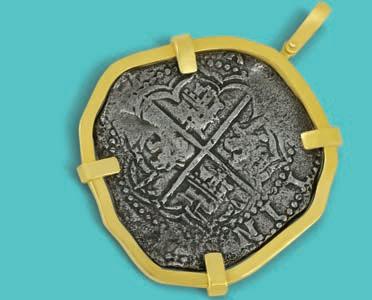
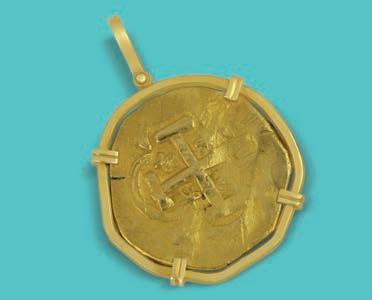
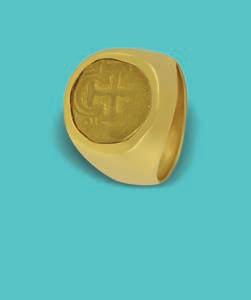
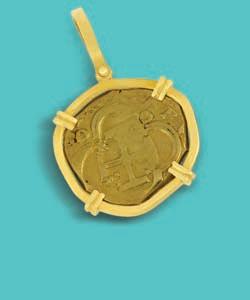
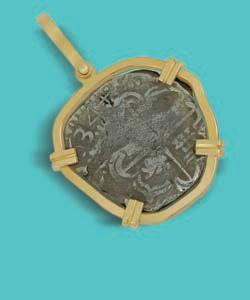
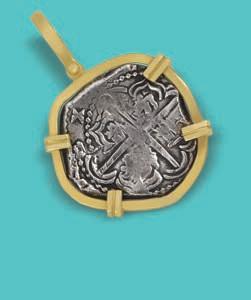
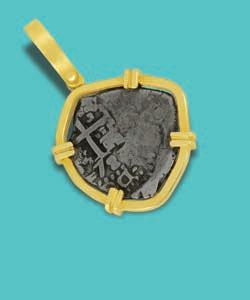
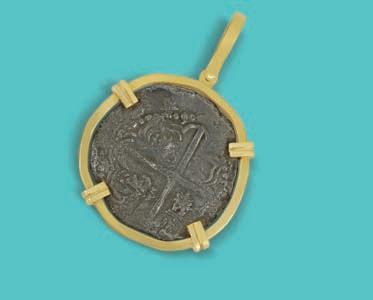
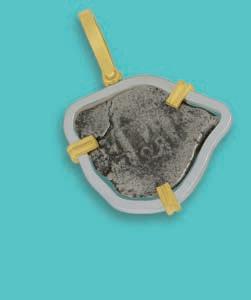
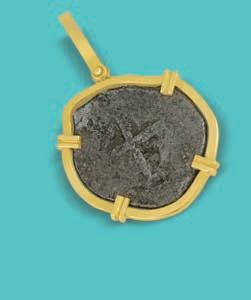
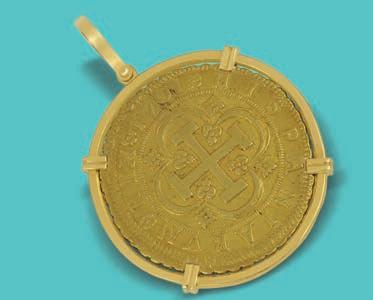
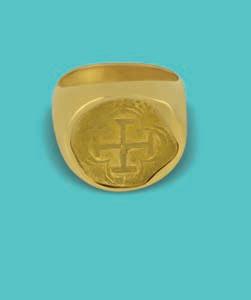
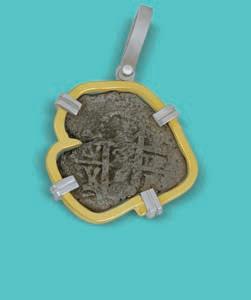
My father and I started collecting coins in the early 1980’s. We then met Mel Fisher who led us to a collection of over 3,000 grade 1 and 2, “2” Reale coins. This large collection was salvaged by Mel in 1985 and was once on board the Nuestra Senora de Atocha…thus began my “love” of Spanish Treasure! Using our jewelry skills, we perfected the methods to individually frame our “loot” in beautiful one-of a-kind 14K and 18K yellow gold bezels to be proudly worn as pendants. At the same time we learned exactly what to look for in an authentic treasure coin. As the years passed, the original group of 3000+ Reales were sold out, but I never lost my passion for the Treasure. I found that fine, authentic Treasure Coins with high quality markings are near impossible to find. In the last several years, I have re-engagedandhavecuratedacollectionofonlytherarestoriginalcoins thatI canfind soI maycarryon thefamilytraditionof thehighestquality of Spanish artifacts. To this day, we still bezel each of our authentic coins in our workshops, using only the finest technique and precious metal. My hope is that you enjoy learning the history that has captivated our imaginations for what is now generations!
Scot Congress
MINTING PROCEDURES IN A “NEW WORLD” MINT
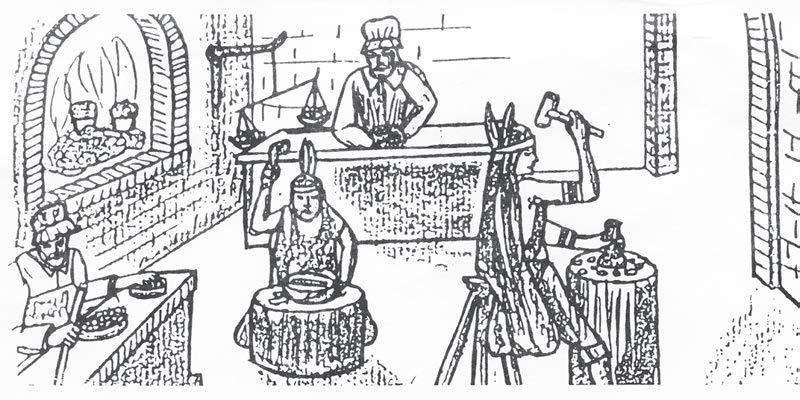
The above illustration shows the Mintmaster and his fellow workers engaged in producing coins at the Mint. The Indian in the center is taking freshly poured strips of silver and beating the strips flat. He then hands the beaten strips to the worker at the left, who cuts the strips into coin blanks. The Indian at the right takes these coin blanks and puts them one at a time on top of the bottom coin die. He then holds the top die with his left hand and strikes the die with a hammer which impresses the die design onto both sides of the coin blank. These newly struck coins are passed to the Mintmaster who weighs them and clips off any excess silver. The coins are now ready for distribution. Due to the shape and irregularities, these coins will not have the complete die design on them.
SPANISH SILVER COIN DENOMINATIONS
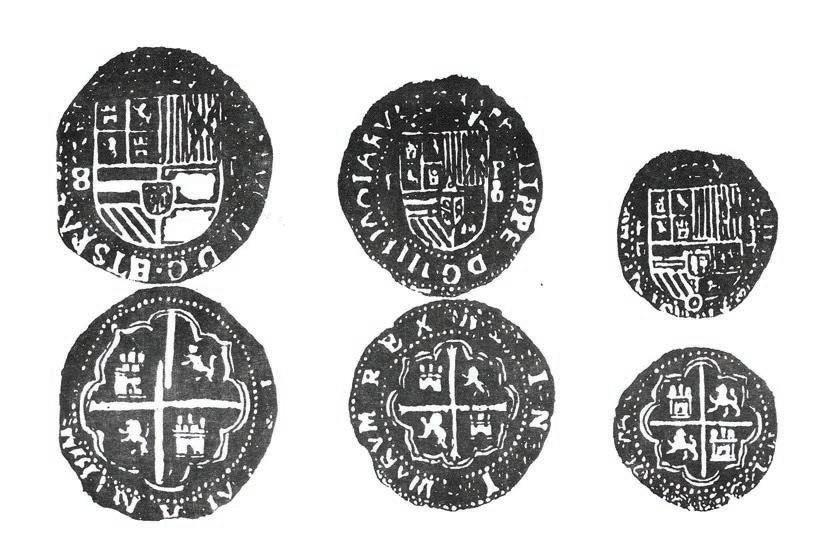
8 Reales
17.5 dwt.
27.2 grams
4 Reales
8.75 dwt. 13.6 grams
2 Reales
4.37 dwt. 6.8 grams
The above illustrated coins represent all of the denominations of silver coins. The ideal maximum of weights in pennyweight and grams are listed below the coins. These coins are from the Lima mint with the design of the period 1571 to 1588 and the “D” is the initial of the Mint Assayer, Diego de la Torre. There is a star on the crest side of the coin, obverse side, which is the symbol of the city of Lima. At this time in history, the Lima Mint was producing carefully rounded coins. Later on the coins would become cruder and more “cob” shaped.
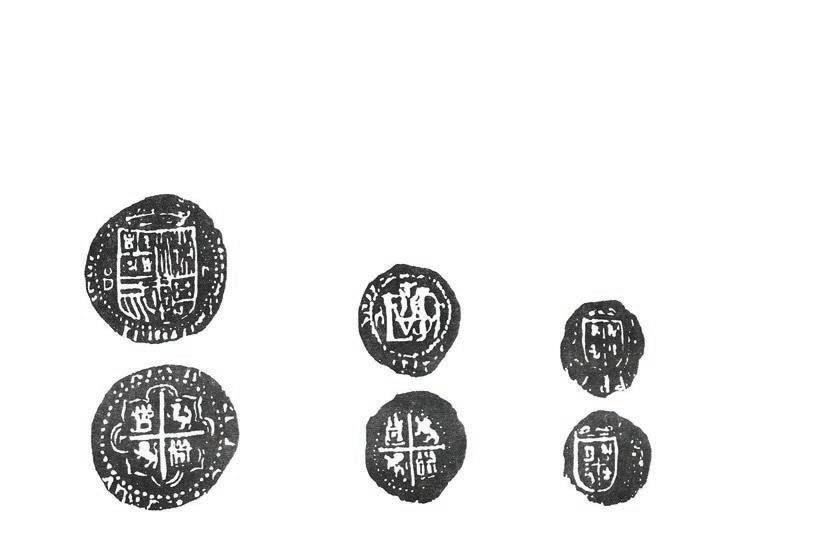
1 Reales
2.1 dwt.
3.4 grams
1/2 Reales
1.7 dwt. 1.7 grams
1/4 Reales .55dwt. .85 grams
A BRIEF EXPLANATION
If there is a single statement that can be made about coins recovered from the Atocha Margarita Shipwrecks it must be that each is “Unique”. Other than the purity of the silver there is not one single feature about them, including the weight, which is always consistent.
The statement that the Hapsburg Shieldis on the obverse (front) of the majority of the coins is correct. however not absolutely correct. Different features of the shield “coat of arms” are frequently missing or not uncommonly reversed. There is even a disagreement among coin experts as to which is the “obverse” as there is no human likeness on Spanish coins of this period. The shield representing the ruling monarch will be called obverse for our purposes.
Dies designed for two or four reales have sometimes been used to stamp eight reale coin blanks (with corrected denominations). The assayer and mint marks usually seen on the left of the shield may be on the right. The denomination might not only be on the opposite side from its correct position, but the manner it is presented may be changed. Usually stamped in roman numerals VIII, IIII or II we sometime find Arabic 8, 4 or 2 with an added twist of the four or two being struck backward.
The monarch’s name is usually in Latin but not always. Phillipvs is frequently seen as Philip and often all of the Ps are reversed. Upper and lower case letters are mixed and reversed in the legends on both sides. Mint marks are often backwards.
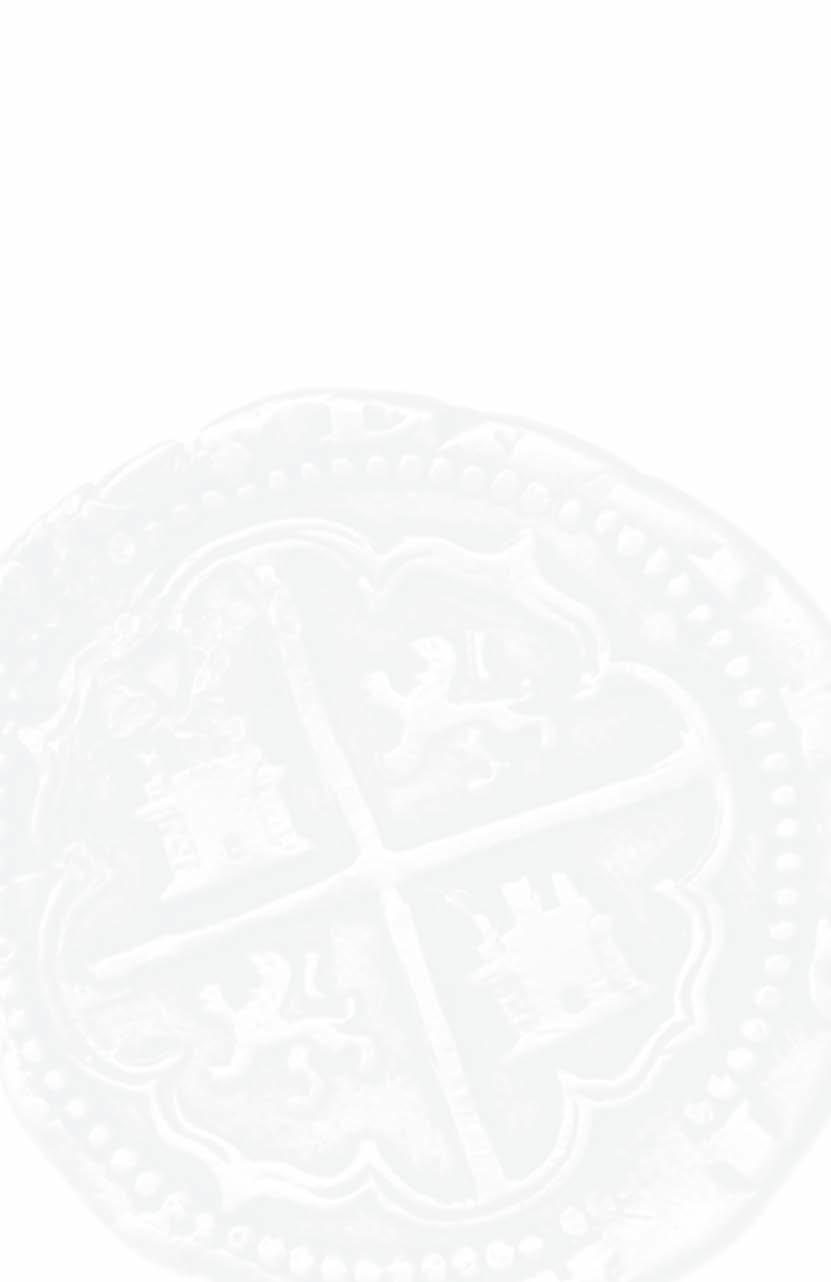
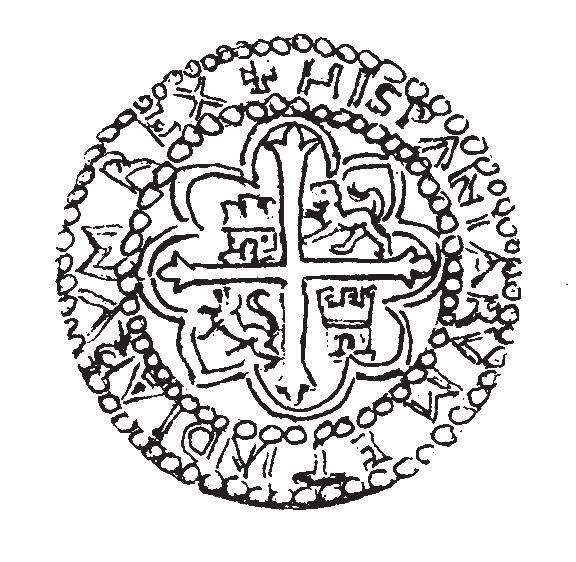
The “Reverse” design is a simple cross with lion and castles in the quadrants of the cross. The lion is traditionally in the upper right, lower left positions but this is frequently reversed.
The date, more than any other feature of these early colonial coins
seem to have held no importance with their markers. If they were inclined to place a date on a Potosi coin, it should be placed at the end of the inscription in the legend on the revrse...approximately the 11 o’clock position. In reality the numbers were placed rather haphazardly. Here are a few partially dated coins ( sometimes the first two numbers of the year, sometimes the last two) very rarely is there an entire date. On occasion the letter L is inverted to make a 7, o is used as a zero and Z is used as 2.
Please consider all statements made to identify coins in light of the foregoing statement. Descriptions will be given for the “usual” production of mint and assayer. It would be impossible to give examples of all the variations found on the quarter of million coins recoverd from the two weeks.
MINT MARK ASSAYER OR MINT MASTER
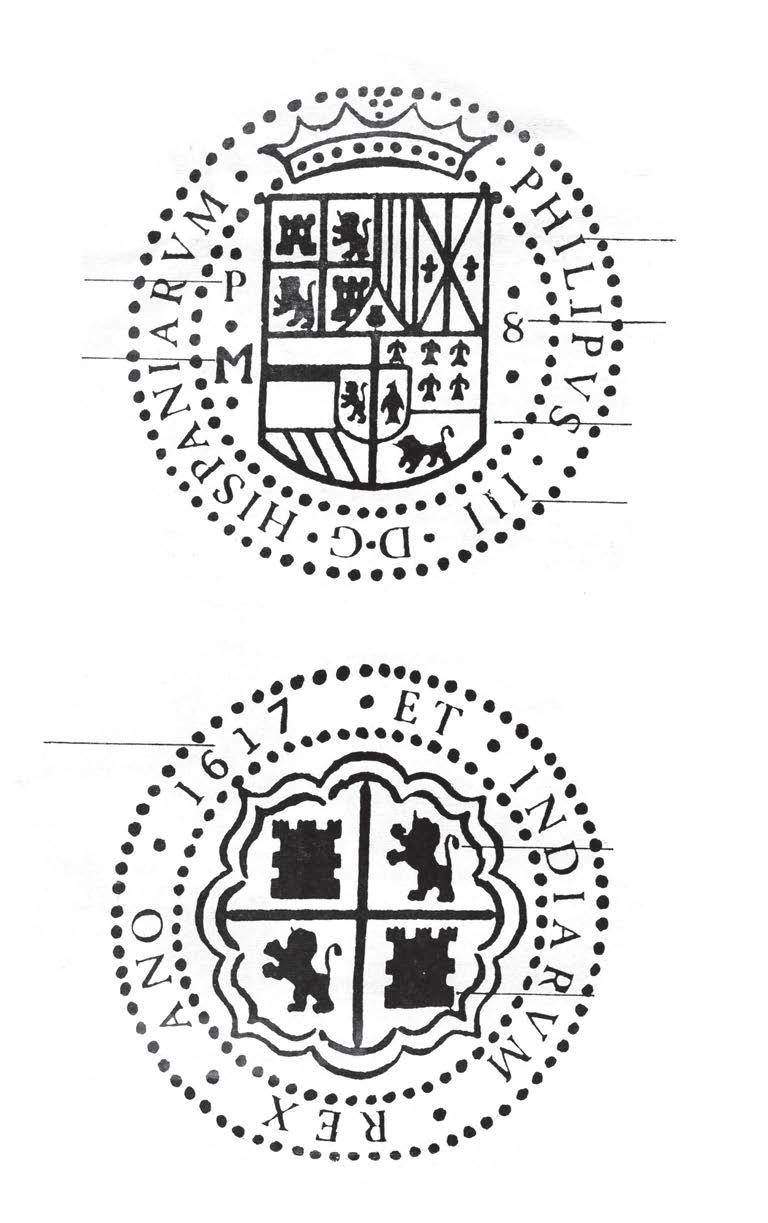
MONARCH
DENOMINATION
HAPSBURG SHIELD
REIGN
POTOSI MINT
REVERSE SIDE
DATE
LIONS OF LEON
CASTLES OF CASTILE
THE “GREAT” SHIELD OF THE HOUSE OF HAPSBURG
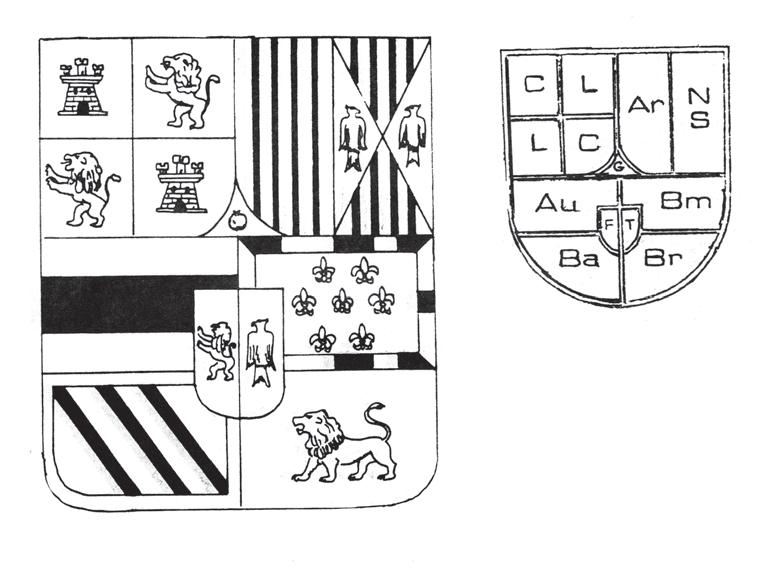
Coutries represented:
C Castile
L ..... Leon
G .... Granada
Ar ... Aragon
NS .. Naples
Au. .. Austria
Bm.....Burgundy
F...........Flanders
T...........Tyrol
Br..........Brabant
Ba.........The Low Countries
The “Great Shield of Hapsburg” was the prototype of the shield used on the Obverse during the reigns of Philip II, Philip III, Philip IV and Carlos II.
After the conquest of Portugal, in the year 1580, the coat-of-arms of that country was added but it was customary to show this addition on the coins struck only in the Old World and has been omitted from this sketch.
The early die-sinkers of Potosi, in the vice-royalty of Peru, copied the prototype much more faithfully than did those of New Spain (Mexico) and almost all others are simplified.
MONARCHS, MINTS AND MARKS MEXICO
POTOSI
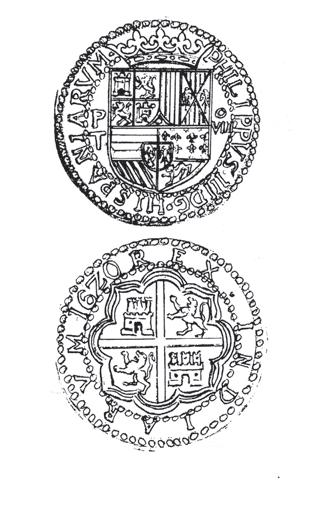
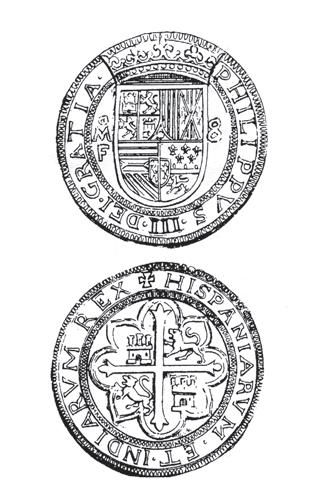
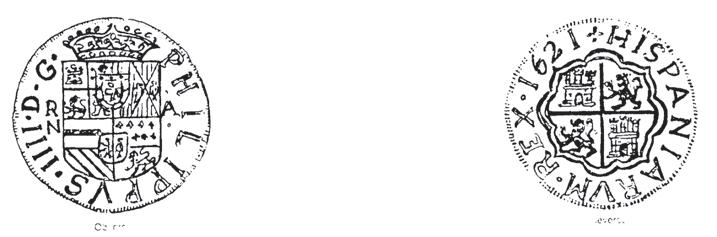
“Philippvs III-Dei Gratia” “Philip III by the Grace of God” is the inscription in the legend of the drawing of Mexican coin to the left. When a Mexican coin is dated the date is usually on the shield side at the 11 o’clock position, following the word “gratia” “Hispaniarvm Et. Indiarvm Rex”, “King of Spain and the Indies” is the legend on the reverse.
The inscription on the Potosi mint coin is slightly different however meaning the same. The obverse inscription reads “Philippvs III-D.G. Hispanarivm”, the reverse read “Rex Indiarvm 1620”. “Philip III, by the grace of God, king of Spain.” “King of the Indes 1620”. There are many variations of the statements in the legends and different arrangements of the words but the legends usually are the statements as presented here.
The Hapsburg shield on the coins can indicate the reign in the bendlets, showing two slashes for Philip II and three for Philip III and IV. Due to breakage of the dies and inconsistency however the marks can only be a clue at best, not a totally reliable identificatio.
Sometimes enough of the king’s nane is visible to make a positive identification however, when the name is partially missing a few letters the name can establish the reign. “Car”, “Los” or “Ivs” would indicate the monarch is Carlos. Likewise, “Ph” or “pvs” would be one of the Philips. Philip II coins are unique in that Philippvs is followed by “GD” with no oridinal II.
MONARCH
LATIN NAME
Spanish catalogs and coin research books list Philip as Filipe but no coins have the name spelled as such.
No gold coins were minted in the new world in time to be on the 1622 shipwrecks. The gold coins recovered from both wrecks were minted in Spain.
MEXICO 1535-1821
LA PLATA, PERU
MINT MARKS
The first mint in the New World was established in 1535 and by 1536 was producing silver coins in denominations of 1/4, 1/2, 1, 2, and 3. The three was unpopular and discontinued in 1537 when they replaced it with the 4 reales. The first coinage was Carlos and Joana reign with printing in gothic type letters. Most of the Mexican coins recovered from the Atocha and Margarita are Philip II and Philip III with Shield and Cross design. The reverse cross is unique from other mints in that the ends of the arms are flared into a Fleur-de-lis design.
The coins produced by Lima mint are the most attractive and consistently well made of the hand-hammered colonial coins. With few exceptions of “royals” they are unequalled in workmanship. During the first two years of operation the design was the “Columnar PlusUltra” type. In 1570 the mint adopted the “Shield-Cross” design used by all Spanish mints at the time. In 1577 a six pointed star was added to the shield side, usually over the assayer’s marks, however it is frequently found over the denomination.
The mint was only in operation for about a year. Very few coins exist from this mint. In design they are similar to Lima and Potosi. They are distinguished by “B” over “C” or “C” alone as assayer marks. The mint closed and its equipment and personnel mored to Potosi.
POTOSI, PERU
SANTA FE DE BOGATA
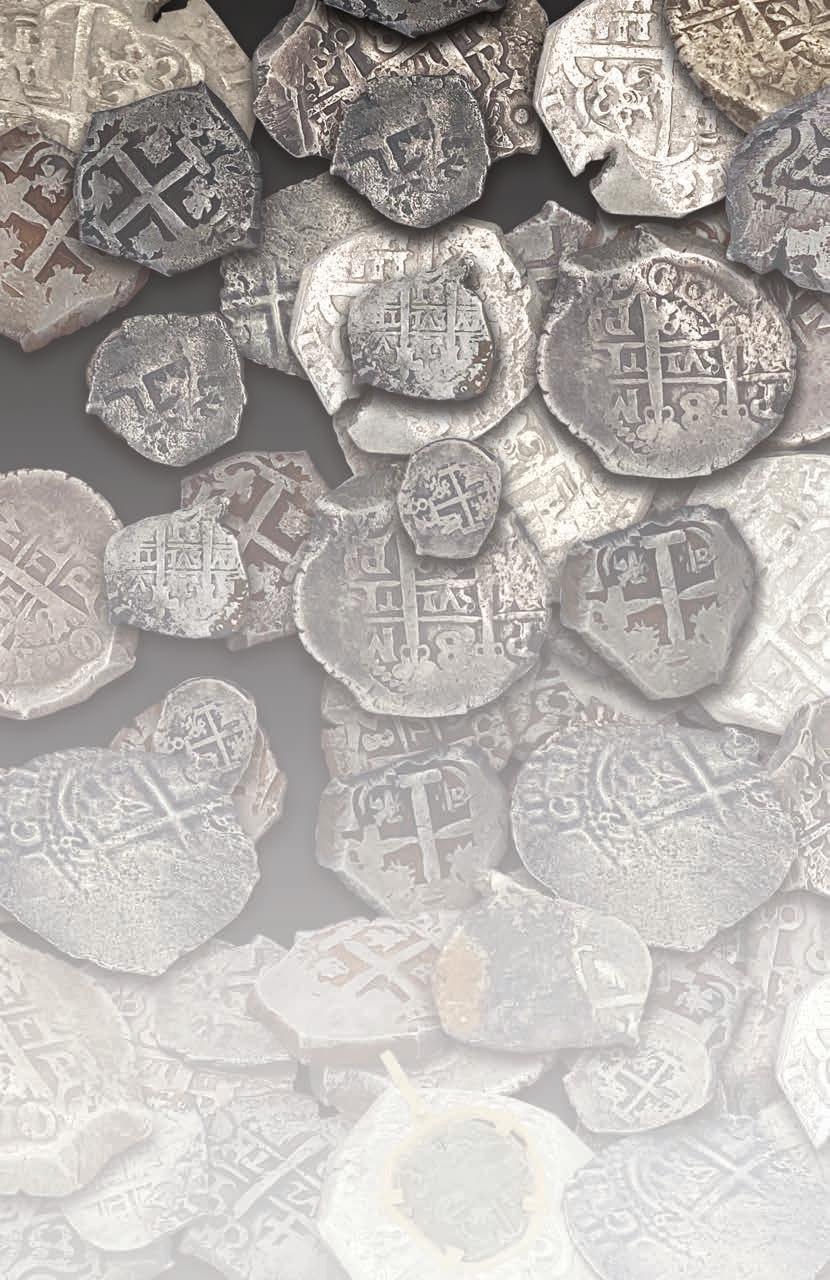
The majority of coins recovered from the Atocha and Margarita were minted in Potosi. The mint was located high in the Andes near the richest silver mine in the world. Tons of coins and ingots were produced at this mint. A constant demand from Spain for more and faster production with no requirement for quality resulted in extremely crude, poorly stamped “cob” coins with irregular shapes and missing features. The only requirement made was that the assayer and mint marks be placed on each coin as a guarantee of weight and purity of silver. An entire chest of coins was recovered in which the assayer marks had been removed. They appear to be coins which were not to be circulated and were being sent to Spain as bullion.
The most remarkable coin recoveries from the Atocha were twelve “Pieces of Eight” minted at Bogata. It has long been known that the mint was open in 1621 but there has never before been any evidence of coins to prove it. The twelve, beautifully preserved fully dated 8 Reales have provided that proof.
ASSAYER MARKS
LIMA
1568-1571 Columnar Plus-Ultra design Philip II
R Alonso de Rincon 1572-1573 M Xines Martines
1573-1574 B Alonso Lopez de Barrials
1575 L Alonso Lopez de Barrials (rare)
1577 D Diego de la Torre (star is added to dies) 1588 Mint closed
LA PLATA Opened late 1573 - closed beginning 1575
1574 B “B” sometimes erased or overstruck with”C” “C” alone very rare.
POTOSI
1575-1586 B Alonso Lopez de Barriales Philip II
1586-1591/92 A Juan Alvarez Reynaltes
1591-1598 B Alonso Lopez de Barrials
1591-1598 R Gasper Ruiz
1599-1608 R Gaspar Ruiz
1608-1617 R Philip III
B Juan de Ballesteros Narvaez
NEW DIES FROM SPAIN
1617 M 1617 only known date - some dated 1617-1621 Q 1517-1618 RL Written as a monogram
RAL Balasar Ramos Leceta 1618-1621 T Many reversals and broken dies 1620 PT
1617-1622 P Pedo Parez de Carrion 1617-1622 R
SANTA FE DE BOGATA
1621 A Alonso Truillo de Yebra Philip IV
MEXICO Columnar Type for Charles and Johana 1516-1556
1516-1556
Early Series -No 8 reales struck
“R” Francisco Del Rincon
“G” Juan Gutierrez
“F” Esteban Franko
“P’ Pedro de Espina
1556 Columnar type carry from
Charles and Johana on obverse side Philip II
Late Series: ”G”
1556-1598
“L” Luis Rodriquez
“O”
Shield and cross type die “F” “O”
1598-1621 “A”
Philip III
1621 “D” Philip IIII
COIN GRADING SYSTEM
GRADE I
A clean strike should exist on both the obverse and reverse. No pitting or erosion should be evident except for details missing at edges. Mintmarks and Assayer’s marks and other details should be clearly visible. No cracks or smears should mar the details.
GRADE II
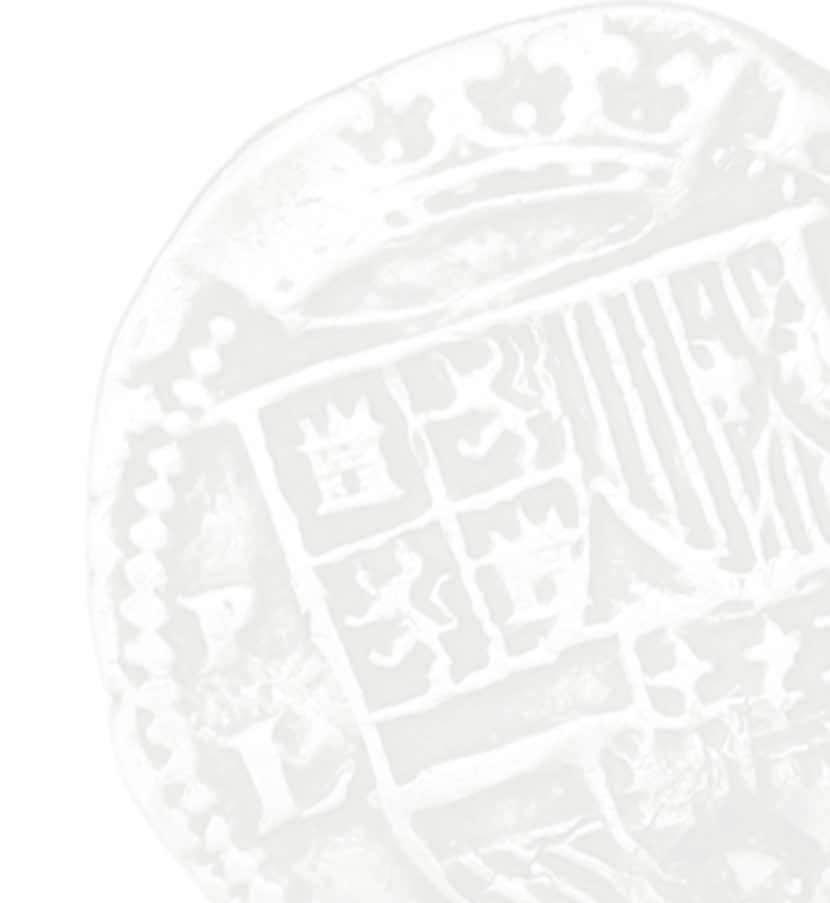
A Grade II specimen should resemble a Grade I coin except for presence of smudging, discoloration or erosion the odscure the details outlined for Grade I coins. Either the Mintmarks or Assayer’s marks, some details of the sheild, and at least one each on the lions and castles should be identifiable.
GRADE III
One side should be fairly legible and the other side reasonably so. The piece should resemble a Grade II coin except for pitting; absence of detail on either the shield or cross; discoloration; erosion of one edge beyond the mint, assayer or denomination spaces at the sides; or erosion of the entire crown at top or into shield at the bottom. The mint should be easily recognized from cross to details, and at least some of the shield details should be legible.
GRADE IV
One side should be identifiable as a coin of this period by any of the details given in the three higher grades.
ACKNOWLEDGMENTS
Henry M. Taylor, III, Identification Guide to Spanish Colonial Coins of the New World: 1535-1733.
A.J.S. McNickle, Spanish Colonial Coins of North American - Mexico Mint. Sociedad Numismatica de Mexico.
Henry Grunthal The Coinage of Peru
Ernesto Sellschop Printed in Germany
N. Neil Harris, Coins of the Nuestra Senora de Atocha. The Numismatist-October 1986 edition.
Leah Miguel Curator -Treasure Salvors, Inc. Key West, FL.
About the Author
As curator for Treasure Salvors, Inc. Leah Sanders Miguel has researched and certified the authenticity of more than 175,000 coins and artifacts recovered fro the Nuestra Senora de Atocha and Santa Margarita.
A life long love of history is the motivation behind Mrs. Miguel’s many years with Treasure Salvors She is presently Librarian for the Mel Fisher Maritime heritage Society and is setting up a research Library for the society.
Mrs. Miguel is married to Theodore Miguel, Captain USN Retired who has been the operations manager for Treasure Salvors since 1976 and who is presently starting a new aspect of treasure business as conservator of silver oins.
The Miguel’s have two sons and two daughters and four grandchildren.
CERTIFICATION
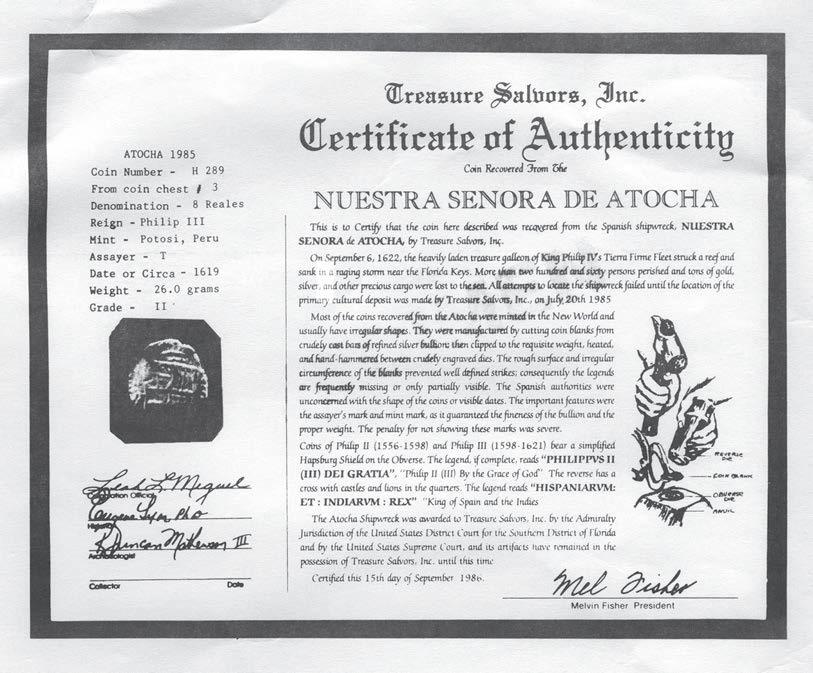
Every coin recovered from the Atocha and Margarita receives a Certificate of Authenticity which contains the coin’s serial number, denomination, reign, weight, date (when known) and picture as positive identification.
The value of the coins lies not only in their value as antiques but also in the great adventure which they were a part of. An adventure which has been well documented by the Spanish and kept in the Archives of the Indies, Seville, Spain. This story was translated and published in the ‘Search for the Atocha” by Historian Eugene Lyon, PhD., an exciting book which relates the loss ot the Tierra Firme Fleet and the search for the ships by Treasure Salvor, Inc.
Even today, from the time of discovery until they are released by a federal Judge to Treasure Salvors, the coins are under the Jurisdiction of the United States District Court. All phases of their recovery, cleaning and grading have been documented and reported to the authorities.
To hold one of these coins is to momentarily be in touch with one of the world’s greatest adventures, which was described by Queen Sophia of Spain as “...one of the magnificient endeavors of our time”.