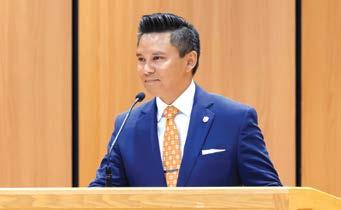
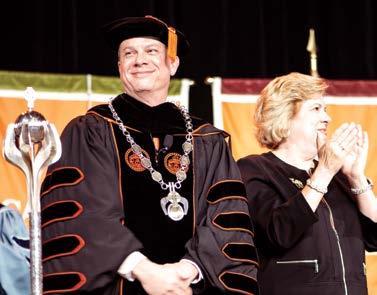
This edition of Campbell Magazine dedicates 24 pages to the first nine months in office for Campbell University’s sixth president, Dr. William M. Downs, leading up to his historical inauguration in March.
CLASS OF ’26: THEN & NOW
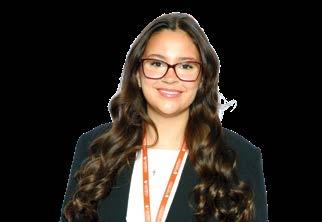
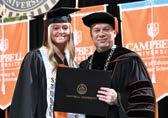
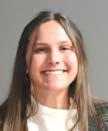
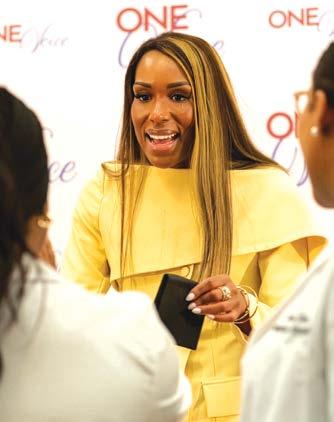
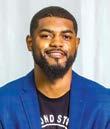
New graduate Danztler Bonner talks about her growth — professionally and in confidence — since she was interviewed by Campbell Magazine four years ago.
SERVICE: BUILT FOR KICKS
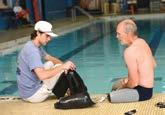
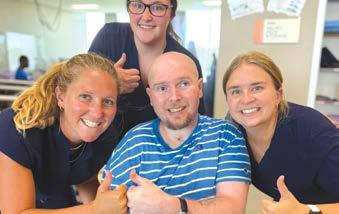
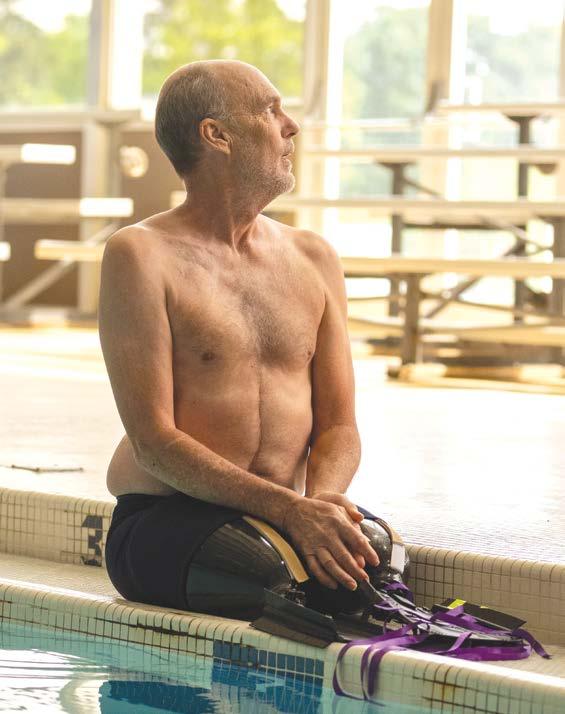
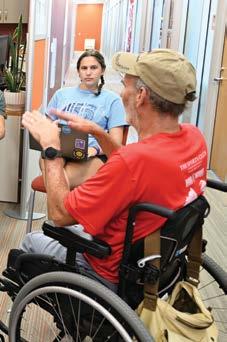
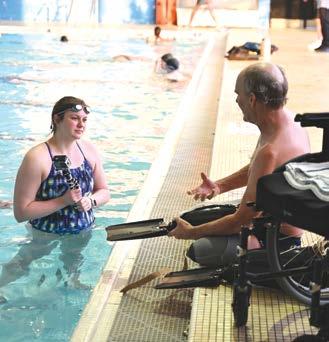
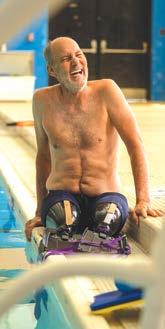
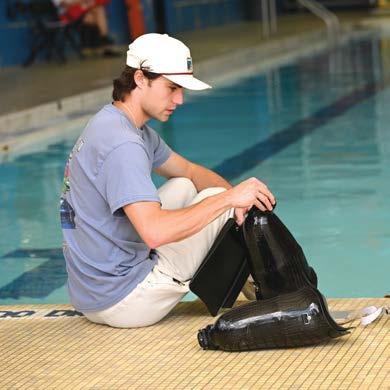
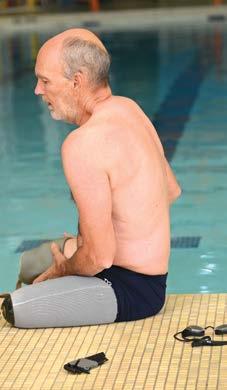
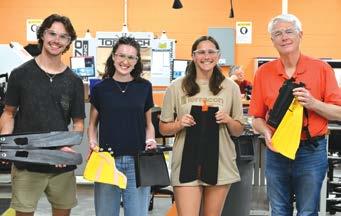
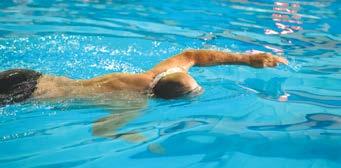
After losing both legs to an artery disease, Doug Thingelstad turned to Campbell students to design prosthetic fins built for swimming.
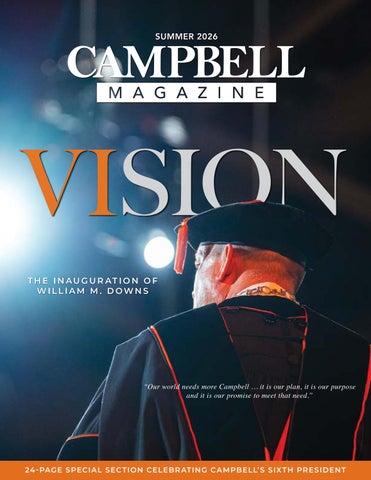
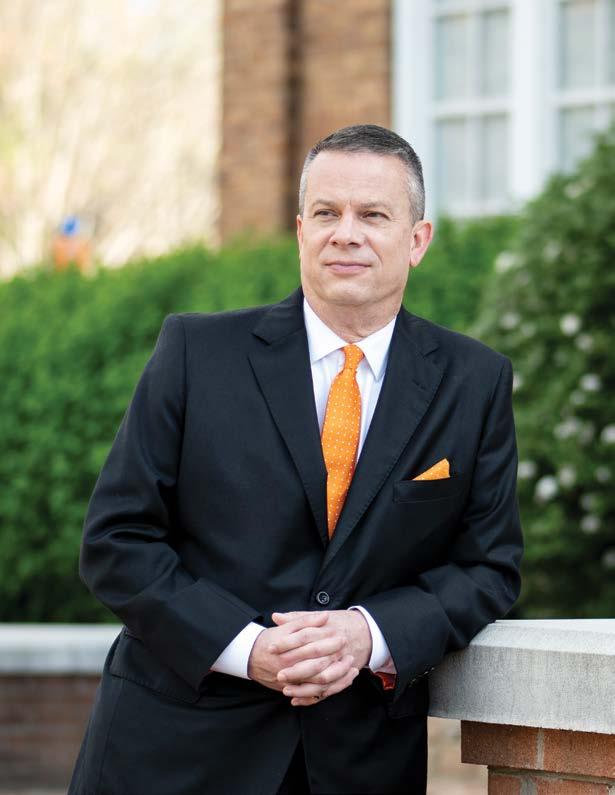
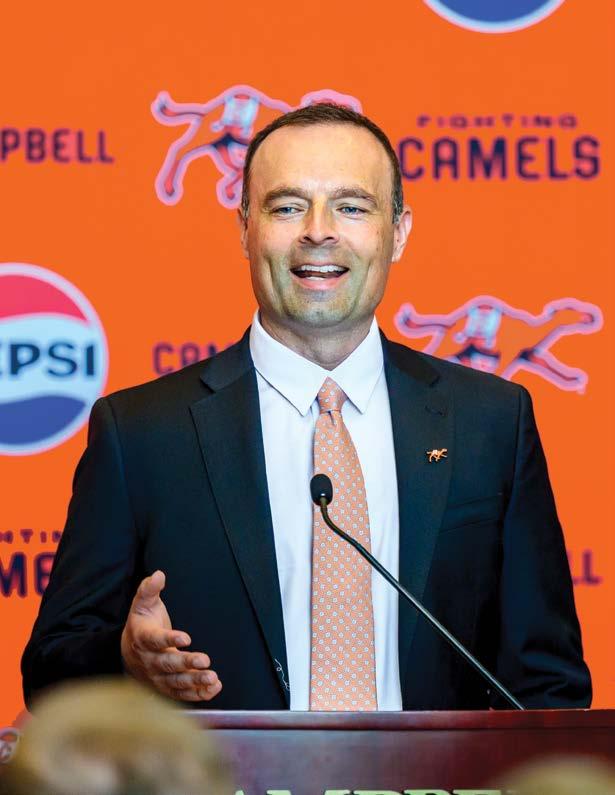
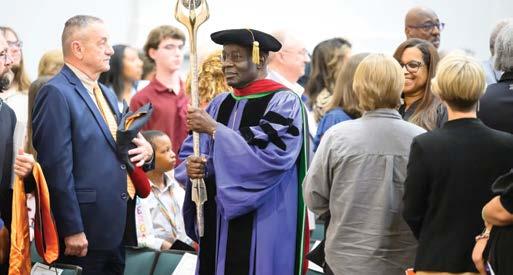
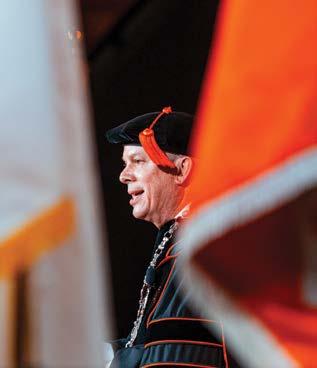
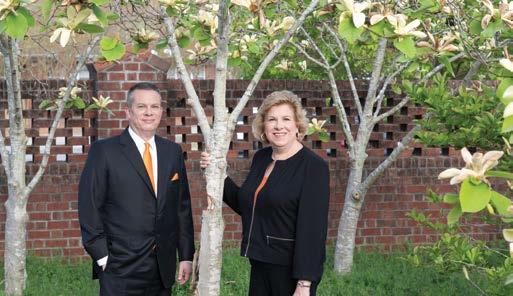
About the cover: Photographer Zach Berly captured Campbell University’s sixth president, Dr. William M. Downs, looking out on the crowd gathered for his investiture ceremony on March 27.
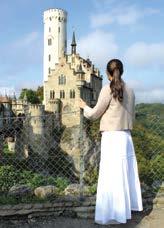
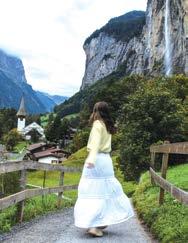
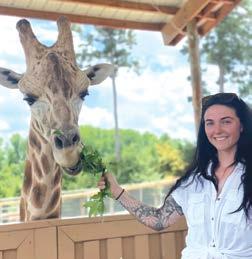
Lexie Weidner (’17) found her passion — world travel — during her first Study Abroad trip at Campbell. She’s since visited 30 countries before turning 30. 8 46 52
ALUMNI:
WHERE NEXT?
PRESIDENT
Dr. William M. Downs
CHIEF MARKETING OFFICER
Vincent Benbenek
ASSISTANT VICE PRESIDENT FOR COMMUNICATIONS & MARKETING
Haven Hottel
DIRECTOR OF NEWS & PUBLICATIONS & MAGAZINE EDITOR
Billy Liggett
DIRECTOR OF SOCIAL MEDIA STRATEGY
Evan Budrovich
CONTRIBUTORS
Zach Berly, Ben Brown, Lissa Gotwals, Bennett Scarborough, Kyle Smith, John F. Trump
ACCOLADES
Finalist: CASE International Robert Sibley Magazine of the Year (2020)
Campbell Magazine has won 56 awards at the CASE international and District III levels since 2012.
Founded in 1887, Campbell University is a private, coeducational institution where faith, learning and service excel. Campbell offers programs in the liberal arts, sciences and professions with undergraduate, graduate and doctoral degrees. The University is comprised of nine colleges and schools and was ranked among the Best National Universities by U.S. News & World Report in its America’s Best Colleges 2026 edition.
Campbell University publishes Campbell Magazine three times a year.
The University affirms its standing policy of non-discrimination in employment and in all of its programs and activities, with respect to race, color, sex, sexual orientation, gender identity or expression, age, religion, ethnicity or national origin, disability, genetic information, protected veteran status, military status and any other characteristic protected by law, except where exemption is appropriate and authorized by law.
William M. Downs
“As a leader, your new president checks all the boxes. He is courageous. He is authentic. ... He has a keen ability to visualize success and to find pathways to get there. He is accessible, and he is approachable. But perhaps above all else, he is a highly engaged leader.”
— Dr. Ron Mitchelson, former ECU provost, on Dr. William Downs
Photo by Lissa Gotwals
B ecoming Campbell 6.0
Dear friends of Campbell University,
This issue of Campbell Magazine features coverage of Inauguration Week 2026 and my installation as our University’s sixth president. To all our readers who participated in the events of that historic week, I extend my heartfelt thanks.
For you, the pages that follow provide an opportunity to relive moments from our wonderful celebration of 139 years of higher education in Buies Creek. To others who were unable to attend, I invite you to read through the stories of how we paid tribute to our past, how we mobilized energy around our present, and how we dared to dream about our bright future. It truly was a grand week, and I offer here some personal reflections on what it was like to become one of the authors of this storied institution’s next chapter… Campbell 6.0.
Our founder, J. A. Campbell, never had an inauguration when he launched Buies Creek Academy in 1887. That means the events of March 2026 constituted only the fifth such investiture of a new president at our school. Infrequency lends some historic weight to occasions like this, and we made sure to carefully plan a week’s worth of activities that showcased the breadth of what makes Campbell distinctive.
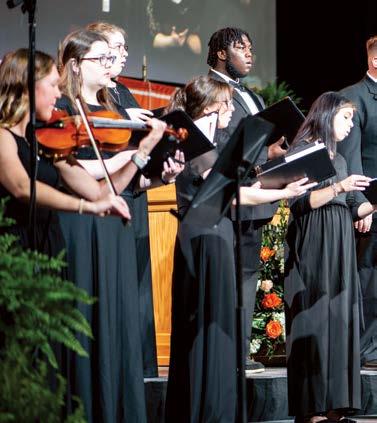
We began, intentionally, with a worship service in Butler Chapel. As one campus family we gathered in that beautiful space on a Sunday evening to pray for one another. We gathered to sing songs of praise and hope, songs that speak to our sense of calling at Campbell.
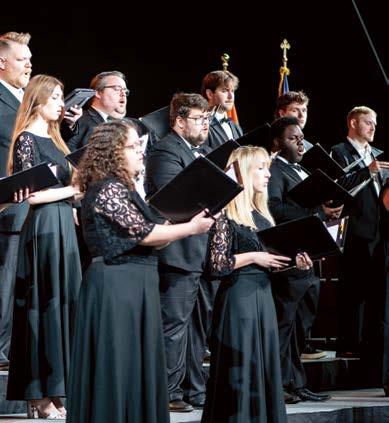
It was particularly special to me to hear a choir’s perfect rendition of Dan Schutte’s “Here I Am, Lord.” That was one of those moments that you close your eyes, breathe it all in, and give in to the goosebumps. I love that song, and it provided an inspirational start to our week. So, too, did the scriptural message for the evening: Do justice. Love mercy. Walk humbly with God.
Other highlights from Inauguration Week included an academic lecture in my discipline of political science, provided by Dr. Peter Francia from East Carolina University. Later that week, a small but engaged audience indulged my lifelong fascination with political science once again by joining me to watch the movie, Darkest Hour (2018), that portrayed Winston Churchill’s fierce spirit and unique leadership as Britain’s wartime prime minister. We also dedicated time during the week to showcase student scholarship at the Campbell University Academic Symposium. I was grateful for the invitation to provide the keynote address for that symposium, during which I shared key lessons from my own career as a researcher.
As if this wasn’t enough, Inauguration Week also featured the dedication of a plaque honoring the history of our newly named Founders Oak on Academic Circle. We simultaneously planted a Legacy Tree across the circle to dedicate ourselves to future growth at Campbell. We convened a Day of Service, with scores of students, faculty and staff engaging in projects across campus and around the community. More than a thousand hungry Camels then enjoyed a BBQ picnic and concert in Saylor Park.
My biggest worry heading into Friday’s formal Installation Ceremony was that, well, we wouldn’t have any students in attendance. After all, it was a Friday afternoon on a gorgeous, warm Spring day in Buies Creek … why would they stick around for a stuffy academic ritual?
Yet, somehow, they did.
We had 1,600 people in attendance for the oath of office and for my “Campbell Forward!” address. In my remarks, I underscored a message familiar to those who had heard me speak before: “Campbell University 6.0. A new chapter. New possibilities. Renewed energy. An indomitable will to grow, to lead with purpose, to serve with humility, to honor and live out our faith. ... Let us lead Campbell forward, together. And let us do it now.”
It was a grand week, indeed.
A week to celebrate Campbell’s rich history. A week to thank all of those who have helped build this amazing institution. A week to rally around our shared mission. And a week to rededicate ourselves to the building of something special here in Buies Creek, in Raleigh, and wherever Camels call home.
Thank you, Campbell family. It’s so good to now, officially, be with you.
Dr. William M. Downs President
SCHOOL OF OSTEOPATHIC MEDICINE
10 graduations, 1,500 physicians, 1 big impact
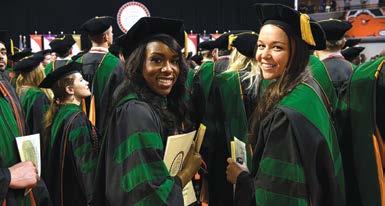
Milestone commencement ceremony reiterates the mission of Campbell’s medical school
Four simple letters. Each the first of four simple words. But the sentence they form is profound. Easy to say — yet much harder to realize. I, A, T, P.
It’s about the patient.
This was the message from Dr. Robert A. Cain, president and CEO of the American Association of Colleges of Osteopathic Medicine, during the 10th commencement ceremony of the Jerry M. Wallace School of Osteopathic Medicine on May 7. In the school’s 14-year history, it has graduated more than 1,500 doctors, many of whom have gone on to practice in rural, underserved areas in North Carolina and the Southeast, where physicians are needed most. Campbell physicians care, Campbell President William M. Downs told the graduates moments before they officially became doctors.
“And in a world where empathy is in short supply, you have it in abundance,” he said. “Our world doesn’t just need more doctors, it needs more Campbell doctors, healers who treat the whole person — body, mind and spirit — with the empathy and the faith that defines our community.”
Dr. Melissa M. Davies, a member of the university’s Board of Trustees and the first person admitted to Campbell’s med school, returned to speak to the 10th graduating class.
“The truth,” Davies said, “is simple but powerful. You are the future. You are the ones who will discover new solutions, who will break new ground, who will bring hope where it is needed most and, because of that, there is every reason to feel optimistic about what lies ahead.”
Cain left the graduates with a thought by renowned physician and author Dr. Rachel Naomi Remen: “In the end, medicine comes down to this: One human being choosing to care for another, sometimes in their darkest moments. ... You are ready. And, if your ‘why’ is ever challenged, come back to those four letters.”
RURAL FOCUSED
Campbell’s medical school ranks among the best in the nation for “Medical Schools With the Most Graduates Practicing in Rural Areas,” according to U.S. News’s list of top medical schools. Campbell was ranked 11th overall, with 15 percent of graduates practicing in rural areas. .
by
Photo
Bennett Scarborough
THEN & NOW
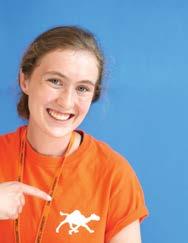
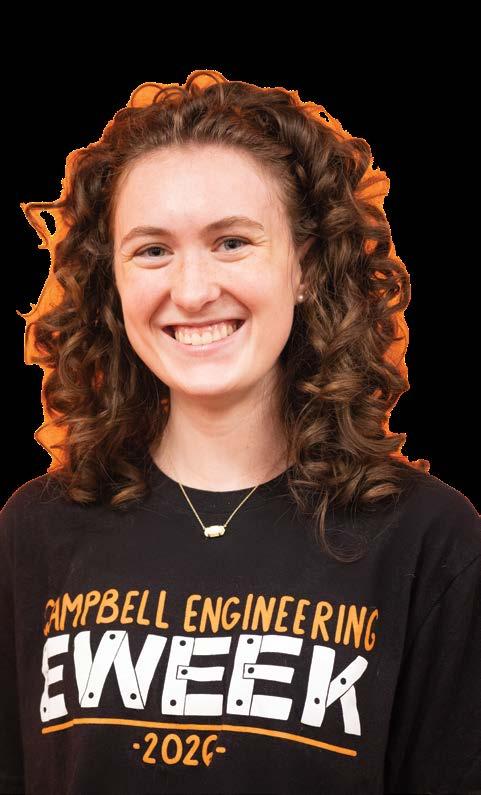
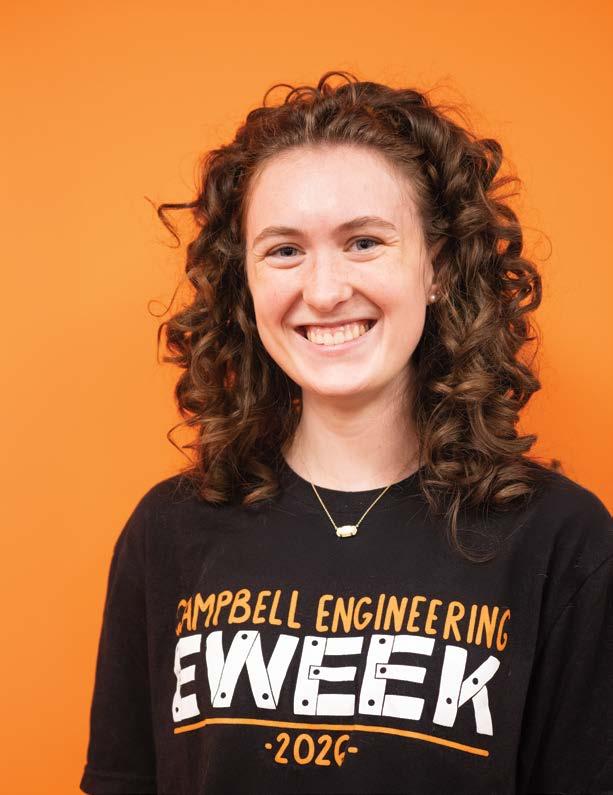
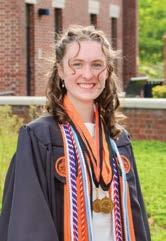
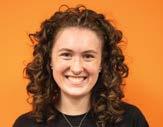
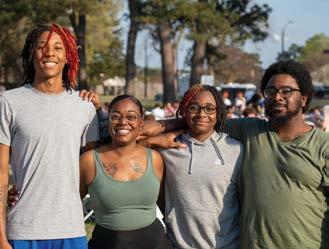
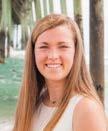
Danztler Bonner (shown a week before graduation and four years ago during her freshman orientation) says coming to Campbell was the best choice she could have made: “From Day 1, the faculty and staff are here to help you, and the students all help each other. It’s just an all-around tight-knit community, and you couldn’t ask for anything better in engineering.”
Dantzler Bonner | Class of ‘26
CLASS OF 2026
THE CAMPBELL EXPERIENCE
Interviewed by Campbell Magazine as a freshman four years ago, new graduate
Dantzler Bonner shares how Campbell University exceeded her expectations
Editor’s Note: In 2022, Campbell Magazine interviewed 12 freshmen (picked randomly) during summer orientation to discuss their goals and expectations for their next four years. As expected, not every student stayed at Campbell. Those who stuck it out will be featured in future editions of Campbell Magazine, beginning with engineering major Dantzler Bonner:
Dantzler Bonner says she’s changed a lot since freshman orientation nearly four years ago, and she’s talking about more than just her hair. Watching a video of her precollege self answering questions about her hopes and dreams, Bonner sees a different person.
“She was nervous,” she admits. “I think I’m much more confident in myself now. Definitely more comfortable speaking in front of people. More extroverted and better at being myself and making friends.”
Bonner graduated with a degree in engineering from Campbell on May 9, roughly 45 months after agreeing to take part in an interview with Campbell Magazine for a feature on the Class of 2026, a group of freshmen whose high school experiences were marred greatly by a global pandemic and a group that saw college as a chance to rediscover their social side.
Dantzler Bonner was a member of the Class of 2026, earning her degree in engineering. Her advice for incoming students considering engineering at Campbell? “Do it.”
She was among 12 soon-to-be students randomly selected for the feature, and she was among a handful still at Campbell four years later — the retention rate skewed because several were student athletes, many of whom took part in the NCAA’s transfer portal. A native of the small town of Farmville, North Carolina (located
just outside of Greenville), Bonner was accepted into Campbell’s Honors Program upon her arrival in 2022, and from Day 1, she immersed herself into her classes and labs in the School of Engineering.
She revealed in her freshman interview that engineering was the reason she chose Campbell: “My grandpa was an engineer, and so was my dad,” she said. “So it’s been in my family, and engineering just really interests me.”
Bonner took accelerated math and engineering courses at Wayne Community College while in high school, and she chose Campbell because of the promise of a hands-on curriculum and the opportunity to immerse herself in labs and projects in her first semester.
“On the first day of class, instead of getting a textbook, you get a toolbox, and you’re making circuits on the first day,” she says. “In your first semester, you make a robot that follows a line and has to collect a [rubber] duck or interact with the other robots to complete a common mission. In the second semester, you have your freshman design project and something called the fish tank project , which everybody’s scared of, but it’s so much fun.”
shared
that she says best represent her four years at Campbell include a Honors Program trip to Germany and various service projects, study sessions and events with her engineering classmates.
In four years, Bonner graduated from “fish” to fins for her senior design project, working with two other engineering students and two students from Campbell University’s Doctor of Physical Therapy program to design and build prosthetic fins for swimming for a local man who lost both legs to peripheral artery disease in the last five years. The project involved working with the recipient for months and altering the design based on his comfort level and the efficiency of the fins. The final design was finished just days before the team’s Senior Design Project presentation in April, and Bonner called the experience both educational and fulfilling.
“To see him go from not being able to have any propulsion from his lower body at the beginning to being able to kick and swim again just made me really happy,” Bonner says. “It meant a lot to see that my work could help somebody in that manner, because that’s really my end goal with engineering — to improve the quality of life for others.”
In the fall, Bonner will take another step toward that goal when she enrolls into Duke University’s Master of Engineering in Materials Science program. She’ll spend the summer before that as an intern (for the third time) for the engineering team at Grady-White Boats in Greenville.
Her Campbell experience wasn’t completely defined by engineering
Watch engineering graduate Dantzler Bonner react to a video of her talking about her hopes and dreams during her freshman orientation at Campbell University in the online version of this story at campbell.edu/magazine
Images
by Dantzler Bonner
A SECOND HOME
Mio Umemoto prepared for her year-long study abroad journey in the United States by watching American movies that highlighted the experiences of high school and college students.
Her favorite: High School Musical
“A lot of High School Musical,” laughs Umemoto, a 20-year-old sophomore from outside of Fukuoka, Japan. Aside from students suddenly bursting into song and dance, she says, “It was good preparation.”
(though it made up a huge part of it).
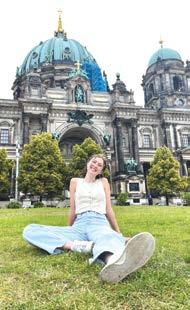
She says one of the highlights of her four years was a two-week expedition to Germany as part of the Honors Program, which she joined as a freshman. She was enthralled by the history, the castles and the cathedrals and says she finds herself talking about the trip all the time: “I would return this afternoon if I could.”
Asked four years ago what she hoped to get out of her college experience, Bonner said she wanted to “learn more people skills” and gain confidence in team and workplace settings, “especially in the sim field.” She says Campbell delivered on that and more.
“Campbell prepares you really well,” she says. “We had all these professional development events like career fairs that we attended, and you’re always doing some sort of project or presentation. Just being able to speak in front of people like that … it just really gives you better social skills. And you’re always working in teams.
“You have to learn how to be a leader, how to work with people and how to navigate all those things.”
Asked about the advice the 2026 Campbell graduate would give the 2022 freshman version of herself heading into college, Bonner is quick to say, “Don’t be afraid.”
“It’s going to be hard, but you can do it,” she says. “You can do anything you put your mind to, and you’re going to do great things here. You’re going to be a great person.”
And for those on the fence about coming to Campbell to study engineering, she’s even quicker to say, “Do it.”
“The faculty and staff are so great. Their doors are always open,” she says. “The community is there, and it’s really strong. From Day 1, you’re helping each other. It’s just an all-around tightknit community, and you can’t ask for anything better in engineering.”
After two semesters at Campbell — an experience that ended in May — Umemoto says she’s found a second home in Buies Creek, a place that both reminds her of her hometown and has provided the new experiences and slice of “American life” she was hoping for. She says she’ll have a lot of stories to tell her family and friends about her time here.
“I will talk about hanging out with my friends,” she says. “I am very thankful for being here and having this experience.”
Full story: campbell.edu
Dr. Jacqueline Gartner was named the recipient of ASEE’s Ray W. Fahien Award, given each year to engineering professors who demonstrate outstanding teaching effectiveness and who have made significant contributions to chemical engineering education. Gartner is a founding faculty member for the School of Engineering and was the first chemical engineer hired by founding dean Dr. Jenna Carpenter.
Campbell University’s PGA Golf Management program ran away with the title at the annual Carolinas Cup tournament held at Lonnie Poole Golf Course near the campus of NC State University in April. Campbell’s lineup of Cooper Klein, Andrew Bull, Emily Martin, Brandon Bowman and Colby Stephens topped second-place defending champion Coastal Carolina University by 22 strokes. The win was Campbell’s first since 2019.
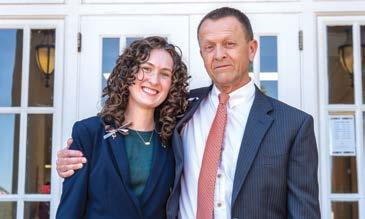
Dantzler Bonner with her father, Carl Bonner, during her School of Engineering Tau Beta Pi induction ceremony in April. Photo by Evan Budrovich
ON CAMPUS
ALI JAQUES TO LEAD WOMEN’S PROGRAM
Ali Jaques was named the third head coach of Campbell’s women’s basketball program in May.
With nearly three decades of Division I coaching experience, including nine seasons as head coach at Siena College, Jaques comes to Buies Creek after spending the previous two seasons as the associate head coach at Rhode Island, where the Rams won a program-record 28 games last year and qualified for the NCAA Tournament.
“Coach Jaques has won a national championship as a player, and as a head coach she’s tallied 116 victories. She’s also a tremendous recruiter,” said Campbell President William M. Downs. “Beyond the numbers, what impresses me most is her understanding of what we’re trying to build here at Campbell … winning programs with high character student-athletes who represent our campus community with class and integrity.”
She is a 1998 graduate of New York University, where she was a member of the basketball and soccer teams and led the Violets to the 1997 Division III National Championship, a 1996 Final Four appearance and two Sweet 16’s.
‘Right guy’ to build a winner BASKETBALL
Campbell lands South Athletic Coach of the Year to lead program
In front of a crowd of athletes, fellow coaches and longtime Campbell Athletics supporters at his opening press conference, Campbell University’s new mens basketball coach Jimmie Williams shared details of the 10-hour interview that led to his hiring as the seventh head coach in the program’s Division I era (since 1977).
“[The conversation] went from 8 a.m. until 6 p.m., and it was nonstop, chalked with wonderful people,” said Williams, joined by his wife Stephanie and their four children that day. “Everything is about fit for me … can I be who God has called me to be in this environment? Every person I met — from the academic support team to the coaches to all the wonderful people in strength conditioning and athletic training — every person was saying the same thing. It’s special here. It’s a tight-knit community here. It’s family here.”
In Williams, Campbell landed this year’s South Athletic Conference Coach of the Year who led Anderson University to a 29-3 record and the program’s first conference championship and a top 10 NCAA Division II ranking.
Williams initially took the helm at Anderson in 2022 and guided the program to a 69-49 overall record across four seasons. The 2025-26 Trojans boasted a scoring offense (83.4) and scoring defense (68.2) ranked in the nation’s top 40. In addition to his own Coach of the Year honors, Williams coached this year’s conference Freshman of the Year, Defensive Player of the Year and three first-team all-conference players.
Williams said he has big expectations taking over a Campbell program that last had a winning season in 2022. He said he will recruit unselfish players who are committed to playing hard on defense and have high basketball IQs. He said the “process” for his players will be more important than the end result. He also said in addition to his players becoming better basketball players, they will become better men.
“We want to have people who are motivated to be the best versions of themselves,” he said. “I am a much better leader, I’m a much better coach, and I’m a much better investor in the relationships with my players because of my family. For me, family will always be first, and we want to build a family environment here at Campbell.”
President Dr. William M. Downs called Williams’ hiring “a great day for Campbell University.”
“We are here to start the process of building a program that will contend each and every year for a banner and for a championship ring. Make no mistake about it, we’re here to win. We’re here to win the right way, with the right guy,” Downs said. “And I am very excited that we have found the right guy.”
Campbell announced a new partnership in February between the N.C. Department of Adult Correction and Campbell Adult & Online Education to expand educational opportunities for employees of correctional facilities through discounted tuition. This partnership supports employees pursuing online programs, as well as those enrolled at the University’s Fort Bragg, Pope Air Force Base and Camp Lejeune campuses.
Campbell’s PharmD program is ranked among the top 10 private pharmacy schools in the nation and number 62 nationally in the 2026 U.S. News & World Report rankings. “This recognition reflects more than a single year, it represents 40 years of education and a sustained commitment to preparing practice-ready pharmacists,” said Dr. Jeff Mercer, College of Pharmacy & Health Sciences dean.
THE NEW COACH
In Jimmie Williams, Campbell has found a coach who will “embrace our values, engage our community as a servant leader and understand that college athletics can, should and will contribute in positive and meaningful ways to the overall student experience here at Campbell University,” according to President William M. Downs.
Photo by Bennett Scarborough
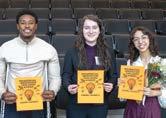
J.A. Campbell Scholarship winners
Campbell University announced four of the five recipients of this year’s J.A. Campbell Scholarship in the spring (the fifth recipient will be announced this summer). The winners competed against more than 200 graduating high school seniors to earn the scholarships. Joining Hannah Harley are:
Mackenzie Whitaker will study biology at Campbell and pursue a career studying natural science. “I was really looking for a Christian school where I could grow my faith and be a part of a community rooted in Christ,” she says. “Coming here will allow me to branch out and be independent. Being so close to the ocean and the mountains was a big plus.”
Taryn Barnett brings an impressive high school (and community college) resume to Campbell. A senior at Lenoir Early College, she was named the recipient of LCC’s Academic Excellence Award and the first early college student to be nominated by LCC for the statewide Academic Excellence Award. She will major in English with a pre-law focus.
Cadence Castellano of Cedar Point, N.C. wants to study business and trust (and eventually law school) to follow in the footsteps of her mother, a business lawyer who, she says, goes out of her way to help people. “One of the things she does is speak up for people and help them better understand the law. She’s definitely my biggest inspiration.”
‘What God has called me to do’
J.A. Campbell Scholar wants to cure autoimmune diseases she’s battled since childhood
Hannah Harley was a toddler when she was first diagnosed with juvenile rheumatoid arthritis and kidney issues. Throughout her young life, she’s endured surgeries, chemotherapy, regular blood tests and even stretches of time where she’s relied on wheelchairs.
Throughout it all, her faith has kept her strong. “It’s been my rock,” says Harley, a high school senior from Bel Air, Maryland. “I have a great support community here, and when I was looking for a college, I wanted to have that kind of community.”
This spring, Harley was named one of five recipients of the full-ride J.A. Campbell Scholarship. As part of Campbell President William M. Downs’ Strategic Plan and its emphasis on enrollment growth, the scholarship was expanded this year to include more applicants. Harley competed against more than 200 high school seniors in the fall through a series of essays and oncampus interviews.
When she starts classes this fall, Harley plans to study biochemistry with a double minor in math and Christian Studies. Her dream is to work in medical research and one day cure autoimmune diseases like the ones she’s battled her whole life.
“I have more of an aptitude toward [research] than
working directly with patients,” she says. “I had the opportunity to intern at Johns Hopkins in a lab, and I got to do all those experiments. And I loved it — I really love chemistry and biology and being able to work in a lab setting. I feel like this is what God has called me to do.”
Harley first heard about Campbell University while visiting her aunt in Raleigh, who suggested a campus tour after learning that her niece was looking for smaller, private Christian universities. She loved the campus, and the more she learned about the school online, the more intrigued she became. She says earning the full-ride scholarship removes a huge financial burden for her family.
“It’s just a huge weight off my shoulders, especially because I’ve been praying for a while for God to make it extremely obvious where I’m supposed to go. But then God just reaffirmed — this is where you’re supposed to be.”
Dr. Kevin O’Mara stepped down as dean of the Lundy-Fetterman School of Business in May. He will return to the school’s faculty as a tenured, full, chaired professor in the Management and Economics Department. O’Mara began serving as dean at the beginning of the 2016-17 academic year. During his tenure, he primarily focused on enhancing student engagement, developing student experiences and building the reputation of the business school.
Hannah Harley is one of five recipients of this year’s full-ride J.A. Campbell Scholarship.
The Divinity School launched the Empowering Families Podcast, designed to equip parents and caregivers with practical resources, biblical insight and real-life support to help children grow in their faith. The podcast is part of the Empowering Families for Spiritual Formation Initiative, supported by Lilly Endowment Inc. through its Christian Parenting and Caregiving Initiative to help parents and caregivers share their faith and values with their children.
Physical therapy student earns grant to serve Harnett County patients
Doctor of Physical Therapy student Anna Fish (pictured above, left) was awarded the APTA North Carolina Impact Grant for her project, Move with Purpose: A Rural Mobility & Wellness Initiative
The program aims to improve functional independence, balance, fall prevention and overall physical activity for older adults living in rural Harnett County, a population often facing barriers to these services.
“Anna’s project is an excellent example of how student-led initiatives can directly impact underserved communities,” said Dr. Lori Leineke, associate professor and Fish’s faculty mentor. “She has worked diligently to give back to her community, not only benefit the residents of Harnett County, but also showcase the strong clinical skills and service-minded approach of Campbell’s DPT students.”
Nursing student Adriana Cepeda and her parents were named the 2026 Campbell University Family of the Year. Campus Minister Rev. Louisa Ward said the Cepedas represent well what makes Campbell University special — family, faith and an unwavering belief in God’s provision. A junior, Adriana says her calling to care for others is rooted in the faith, sacrifice and encouragement she received at home.
Student’s invention can test blood in rural settings
Student doctor Caleb Perez presented a patent-pending “Low Cost Open-Source Basic Metabolic Analyzer for Rural and Mission-Based Clinical Settings” at the med school’s research symposium this spring. In his words, the device can test a patient’s blood anywhere to extract metabolic data, such as results for respective levels of calcium and bilirubin.
Myriad levels of government approvals, and a lot more money, are needed before Perez could take the next steps toward making his machine a viable option. “I want to do rural medicine … medical mission work. And in the middle of Chad, Africa, you can’t set up a $300,000 machine. I just wanted to show that it’s possible to make something way cheaper.”
A small car powered by chemical energy created by a team of Campbell Engineering students cracked the Top 3 in the regional AIChE Conference competition held in Atlanta. Campbell’s team consisted of captain Ryan Klingenberg, Abby Adams, Kara Shinn, Alena Suarez, Alex Chappell and Kendall Wilson. The group finished behind only South Florida and South Carolina.
TUITION-FREE GUARANTEE FOR HARNETT STUDENTS
New first-year, full-time students who reside in Harnett County will have 100 percent of their undergraduate tuition covered by Campbell University beginning this coming fall. The Campbell University Tuition-Free Guarantee for Harnett County Residents initiative reflects Campbell’s commitment to expanding access, supporting local students and families and investing in future leaders who will serve and shape our communities.
“As Campbell implements a new and aggressive recruitment strategy that extends our geographic reach, we want to simultaneously rededicate ourselves to the local county that has nurtured our school for the last 138 years,” said President Dr. William M. Downs. “Harnett is home. With this new initiative, we signal to the neighbors that Campbell can and should be their home, their destination of first choice when deciding on where to get a world-class education.
“Access and affordability are key concerns for college-seekers, and Campbell will be rolling out a variety of new incentives for multiple constituencies, all while maintaining the exceptionally high value associated with a Campbell education.”
FIVE STRAIGHT
Campbell Softball finished the regular season with its fifth consecutive 30-win campaign, going 34-23 and 18-6 in the Coastal Athletic Association. Among the highlights were two wins over Big 10 teams (Ohio State and Iowa) and a big 18-1 win over Elon in conference play. Photo: Campbell Athletics
In defense of the word ‘campus’
Campbell professors publish national article challenging nomenclature of AI data centers
As rural areas deal with the onset of large, energy-intensive data centers to meet the country’s artificial intelligence and cloud computing demands, two Campbell University professors are challenging the industry’s use of a word they hold dear to them.
Dr. David Tillman, professor of public health, and Dr. Justin Nelson, associate professor of sociology, co-authored the article, “Data Centers Are Not ‘Campuses,’” published on Jan. 28 by The New Republic, a prominent U.S.based monthly magazine and daily online platform focusing on politics, culture and the arts. In the article, Tillman and Nelson challenge companies like OpenAI, Oracle and AVAIO Digital and their use of the word “campus” to describe their new multi-billion-dollar data centers in Michigan and Arkansas.
“None of these projects resemble anything most people would recognize as a campus,” they wrote. “These are industrial facilities designed to house computation at scale. … They are typically insulated from the surrounding community, both physically and
economically. To call them campuses is ridiculous — unless, of course, the point is to provide the sheen of civic legitimacy, obscure how few humans are actually involved and gloss over questions of the true public value of these operations.”
Nelson has become a national voice on the social implications of AI. In 2025, he coauthored the book Society Without People with Baylor University sociology lecturer Dr. Christopher Pieper, where they sought answers to “preserving human dignity” in a world increasingly mediated by machines.
Tillman has been a longtime advocate for rural health, having consulted with health care systems, local health departments and state governments regarding strategies to improve health in underserved areas. Recently, several rural areas within 30 miles of Campbell University have been eyed for future centers — a single center can draw enormous amounts of energy and water (one center can use as much power as 200,000 North Carolina homes).
According to Tillman, this makes AI and the facilities that power it very much a public health and rural health issue.
Their article focuses strongly on the industry’s use of the word “campus,” a word that has grown to describe “a place ordered toward people engaged in shared work” — much like a university or a hospital where healing and teaching are at the forefront. A data center, they write, does not gather people — “these buildings typically occupy hundreds of thousands of square feet on hundreds of acres of land while supporting only a few dozen permanent workers, many of them contractors, with most operations managed remotely.”
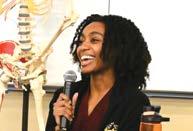
A panel discussion led by a group of women, students and professors in the College of Pharmacy & Health Sciences focused on the history, experiences and cultural importance of Black hair in society and in today’s healthcare community.
Panel members also talked about the cultural significance of the natural hair movements in the 1960s and 2000s, as well as the relevance of the “Big Chop.”
The discussion, “Black Hair in Healthcare,” included Dr. Robin M. Baker, an assistant professor of Physical Therapy; Zaria Dunlap, a student in the Physician Assistant program; and Dr. Catherine Wente, an assistant professor of Pharmacy. Moderator and Public Health/PA student Jasmine Chanel, talked about using relaxers — chemicals designed to straighten curly hair.
“The history behind that is long and complicated, but, essentially, our parents did it in order to, one, help us fit into a society that … that is what we needed to do, and also to help us manage it,” Chanel said. “But then when we transition (to natural hair) … learning how to take care of our natural hair.”
A former resident of Campbell’s School of Osteopathic Medicine and noted social media influencer appeared in a Super Bowl commercial for Neutrogena in February. Dr. Muneeb Shah — better known as “DermDoctor” on TikTok with more than 17.7 million followers — appeared with Canadian singer-songwriter and dancer Tate McRae in a 15-second spot for Neutrogena Hydro Boost.
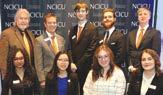
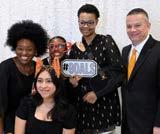
Campbell was well represented at the 2026 NCICU Ethics Bowl at the North Carolina Legislative Building in Raleigh. Team coaches Adam English and Ken Vandergriff (both professors of Christian Studies) were recognized and honored by as two of only four coaches who have participated in the annual competition since its inception 15 years ago. The team included Landon Green, Mackenzie Davis, Wil Blackburn and Bella Segnere.
CALL SUPPORT
Divinity School’s new Center for Calling & Ministry — made possible by a $10 million grant from Lilly Endowment Inc. — aims to find, train future pastoral leaders
Churches and ministry organizations are facing real challenges in identifying and supporting pastoral leadership. High burnout rates, financial strain and shallow leadership pipelines are causing many churches to operate reactively, filling roles out of desperation rather than developing emerging leaders internally.
Campbell Divinity School wants to help.
This spring, Campbell University announced the establishment of the Center for Calling & Ministry, a major new initiative designed to help Christian congregations and ministry organizations strengthen how they identify, develop and support pastoral leaders. The center will be made possible by a $10 million grant from Lilly Endowment Inc.
through its Pathways for Tomorrow Initiative and when realized, will lead a long-term, collaborative effort to help Christians explore a sense of calling, cultivate vocational discernment in congregational life and support current and emerging pastoral leaders
“The Center for Calling and Ministry is a strategic, collaborative response,” said Dr. Barry Jones, dean and Tyner Chair of Bible at the Divinity School. “Together, we seek to equip congregations and organizations to nurture discernment, encourage emerging leaders and strengthen pathways into ministry.”
Jones said the center represents a significant step in the Divinity School’s mission to prepare leaders for Christian congregations and organizations through Christ-centered, Bible-based, and ministry-focused theological education.
By helping Christians explore calling earlier and more deeply, it aims to strengthen the pipeline of individuals considering ministry leadership.
The Center is housed in Taylor Hall, and its work has already begun. In the spring, the Divinity School appointed the Rev. Rebecca Mathis as the inaugural executive director. Mathis previously served as director of strategic initiatives for the Divinity School and brings extensive experience in nonprofit executive leadership roles.
As part of the grant award, Lilly Endowment has approved $3 million in matching funds, which will be unlocked when the Divinity School secures $1.5 million in charitable gifts — resulting in a $4.5 million endowment to sustain the Center’s work beyond the initial grant period.
Law student’s research on female death row inmates earns award
Women make up a small percentage of death row inmates in the U.S. — 2 percent — yet their prosecutions reveal shortcomings in the nation’s judicial system rooted in gender bias. That history has fascinated thirdyear law school student LeAnn Cain, one nearly 200 students who presented their research at the Wiggins Memorial Library Academic Symposium in March.
Cain’s presentation, “When Women Bear the Ultimate Responsibility: Gendered Blame in Capital Prosecutions” was the lone High Merit winner in oral presentations at the graduate level, as her research found that gender-based stereotypes against women who didn’t conform to “traditional norms of femininity” resulted in hyper-villifications and dehumanization during their trials.
In May, Cain learned her article earned an honorable mention in the national 2025 Marshall M. Schulman Annual Competition for Student Papers in Criminal Law and/or Criminal Procedure and would be published in the California Lawyers Association’s Criminal Law Journal
Senior blasts 4 home runs in game against UNCW
Joey Morton launched four home runs in a 16-12 win over UNC Wilmington in May, marking the second-most in a single game in program history. Only Henry Rochelle, who blasted five on March 30, 1985 against Radford, had more.
Morton also collected 8 RBI in the game, tying for the third in team history.
A native of Oxford, Pennsylvania, Morton was named first-team All Coastal Athletic Association as a redshirt senior to help lead Campbell to its first-ever regular season CAA championship. In two full seasons with the Camels, Morton hit 35 home runs and drove in 119 runs.
TOLENTINO NAMED MEDICAL SCHOOL DEAN
Dr. David Tolentino was named the third dean of the Jerry M. Wallace School of Osteopathic Medicine after serving as interim dean since July 1.
He was chosen after a competitive national search conducted by Campbell in partnership with Washington, D.C.-based AGB Search.
Tolentino earned the nod for “his demonstrated leadership in growing clinical education programs, developing new affiliate partnerships and contributing to medical training across the region,” according to President William M. Downs.
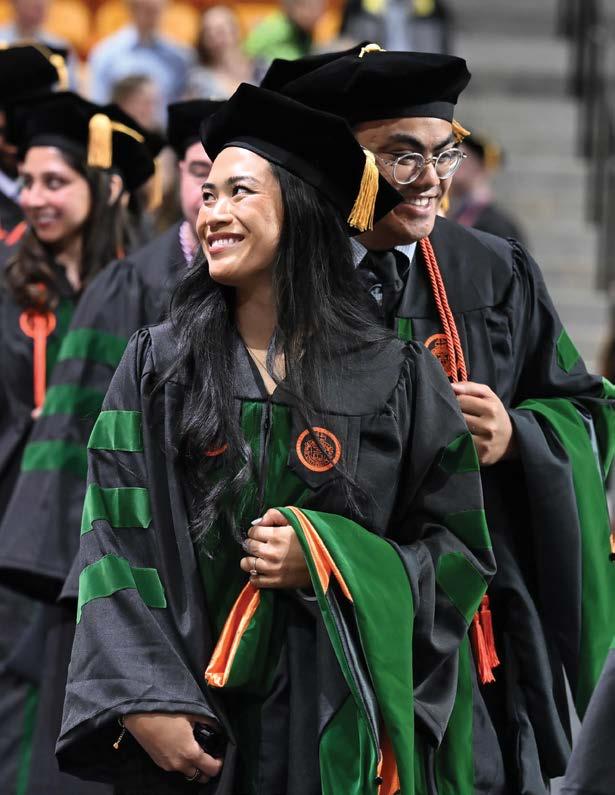
Campbell University conferred roughly 980 degrees over seven spring commencement ceremonies between May 7-11, beginning with the 10th graduation of the Jerry M. Wallace School of Osteopathic Medicine. The week marked the first grad season for President Dr. William M. Downs, who told graduates to remember Ad Astra Per Aspera … To the stars, through difficulties. “Friends, find your North Star and let nothing stand in your way,” he said.
“It was essential that our faculty, staff and students participate in the selection process, to hear from candidates with diverse backgrounds and to ultimately share feedback on the school’s future,” Downs said. “Dr. Tolentino enjoys broad support across campus, and he has demonstrated the appropriate level of dedication we need to ensure world-class medical education at Campbell.”
The Alpha Zeta Chapter of Phi Lambda Sigma from the College of Pharmacy & Health Sciences was recognized on a national level as the Division I Chapter of the Year, an honor that highlights the strength, dedication, and leadership of its student members. Campbell’s chapter demonstrated “exceptional engagement, innovation and commitment to advancing leadership within the profession.”
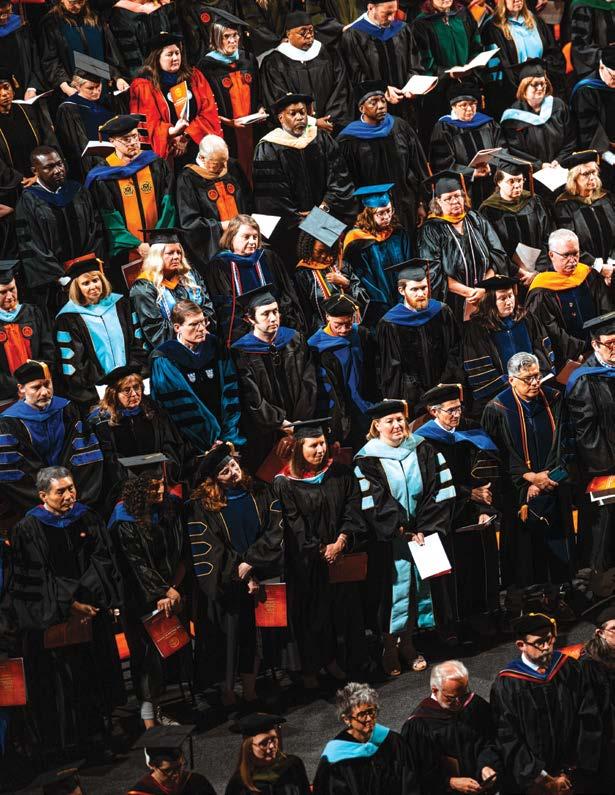
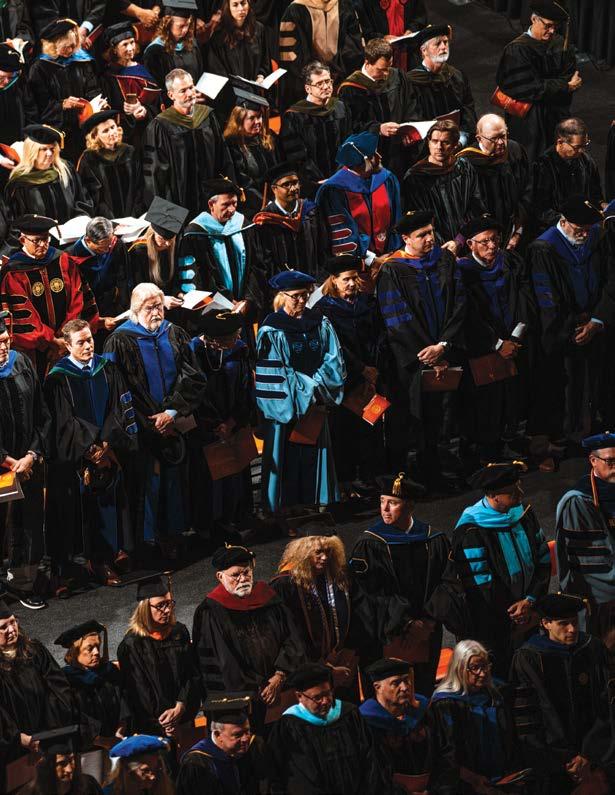
SEA OF ROBES
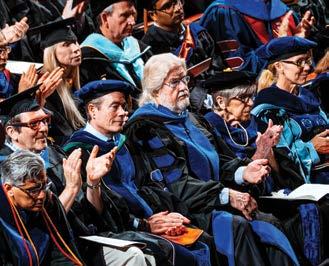
Campbell University professors stand for the investiture ceremony of President Dr. William M. Downs in Gore Arena on March 27. The ceremony marked only the fifth inauguration event for a Campbell president in the school’s 139-year history.
Photo by Zach Berly
THE INAUGURATION OF WILLIAM M. DOWNS
VISION
UNIVERSITY’S
SIXTH PRESIDENT DECLARES ‘THE WORLD NEEDS MORE CAMPBELL’ TO CAP A MEMORABLE INAUGURATION WEEK
BY BILLY LIGGETT
PHOTOS BY LISSA GOTWALS, ZACH BERLY AND BENNETT SCARBOROUGH
President Dr. William M. Downs called for Campbell to rededicate itself to a “powerful and world-changing mission” on the day he was formally invested and sworn in as just the sixth president in the University’s 139-year history on March 27.
More than 1,600 delegates, faculty, staff, students, community members, family and friends were on hand for the Investiture Ceremony held on the floor of Gore Arena inside Campbell’s Pope Convocation Center. The event capped six days of build up for Inauguration Week in the form of a worship program, academic lecture, student research symposium, dedication ceremony for the campus’ 300-year-old oak tree, day of service and campus-wide cookout.
The week celebrated both the storied past of Campbell, as well as its current mission and exciting future. In his
34-minute speech, Downs echoed the school’s second president, Leslie H. Campbell, saying the University’s future demands “our wholehearted endeavor.”
“Ours is a world filled with uncertainty,” he said, referencing a current war, global financial instability, pandemic recovery, declining trust in institutions of higher education and falling membership in churches. “Some question the very value of a college education. Artificial intelligence causes us to question what we see, what we read and what we once thought we could understand as the truth. Social media has, without a doubt, dumbed down our national discourse. These are challenging times, my friends.
“So in a world filled with uncertainty, let Campbell University be the answer. Let Campbell be a beacon that will guide us safely through it. Campbell will be the answer, because Campbell truly is special.”
A DISTINGUISHED CAREER IN ACADEMIA
An accomplished academic leader and political science scholar with more than 30 years of experience in higher education, Dr. William M. Downs was named president of Campbell University on Feb. 11, 2025. He officially took office as just the sixth president in Campbell’s 138year history on July 1, 2025.
Prior to coming to Campbell, he served as the 13th president of GardnerWebb University and as dean of the Thomas Harriot College of Arts and Sciences, professor of political science, and W. Keats Sparrow distinguished chair in liberal arts at ECU.
A Raleigh native, Downs earned his Bachelor of Arts degree in political science from North Carolina State University. He also holds his master’s degree and Ph.D. in political science from Emory University in Atlanta.
Downs’ research has focused on various areas of political science, including political extremism, antiimmigration movements, political parties and electoral systems and nationalism and ethnoterritorial politics.
Downs is married to Kimberly Harwood Downs, a 1989 graduate of UNCChapel Hill’s School of Pharmacy. The two have raised two children — Rachel, a 2018 graduate of the University of Georgia, and Bradley, a graduate of NC State University. They are the proud, new grandparents of two, Reagan (December) and Holden (April).
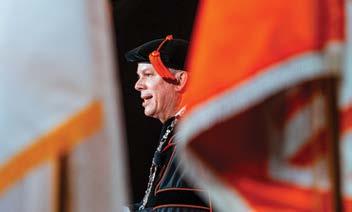
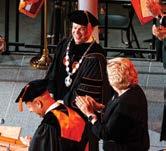
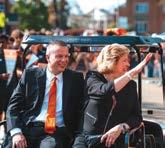
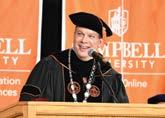
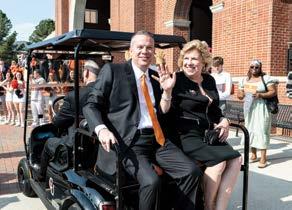
President William M. Downs and First Lady Kimberly Downs acknowledge the crowd shortly after he received the presidential medallion and chain during his investiture ceremony on March 27 in the Pope Convocation Center.
Downs’ investiture ceremony came nearly nine months after his arrival in Buies Creek on July 1. Prior to coming to Campbell, he was the 13th president of Gardner-Webb University, leading that school through the COVID pandemic and a devastating hurricane while advancing academics, athletics and student life and spearheading major capital projects. Before becoming a university president, he was dean of the Thomas Harriot College of Arts & Sciences at East Carolina University and served a number of roles at Georgia State University.
Former ECU Provost Dr. Ron Mitchelson was among the seven speakers who delivered greetings prior to Downs’ investiture speech.
FEB. 11-12, 2025: Dr. William M. Downs was unanimously elected as the sixth president of Campbell University on Feb. 10 at a special board of trustees meeting. He and First Lady Kimberly Downs visited campus that same week for a whirlwind two-day introduction, meeting students, staff, faculty and trustees. Downs said he was pleasantly surprised by the “sentiment of eagerness, hope and excitement” form all he met.
He summarized Downs’ five years of service in Greenville by calling him the school’s “most popular and most effective dean.”
“As a leader, your new president checks all the boxes,” Mitchelson said. “He is courageous. He is authentic. He is intentional in all that he does, and he holds himself accountable. He has a keen ability to visualize success and to find pathways to get there. Your new president is accessible, and he is approachable. But perhaps above all else, he is a highly engaged leader … and I believe President Downs’ level of meaningful engagement is quite rare today among university administrators.”
JULY 1, 2025: Downs officially begins his tenure as Campbell University president. From Day 1, he pledged a “controlled urgency” approach. “Now is the time to roll up our sleeves,” he said. “Campbell will build on its foundation of faith as we welcome new generations of students eager to learn boldly, lead faithfully and grow in a community where values are put into action.”
In his short time at Campbell, Downs has been productive. His tenure began with a speaking tour that included stops in Charlotte, Raleigh, WinstonSalem, Wilmington and back home in Buies Creek. He hosted three town hall meetings on campus dedicated to laying the groundwork of a five-year strategic plan. He initiated meetings and guided tours with every dean and nearly every program on campus. Early actions included immediate improvements to the student experience on campus, a new staff appreciation awards program, new admissions initiatives at both the undergraduate and graduate level and a record-breaking Giving Day last fall.
In February, Campbell University unveiled Downs’ Day 1 promise: Campbell University 2026-2031: A Strategic Plan for Renewal, Growth and Recognition, which was unanimously approved by the Board of Trustees on Jan. 28. The priorities of the plan focus on enrollment growth, financial strength, community impact and identity — the same priorities Downs said were communicated to him during the interview process before becoming Campbell’s president. Downs lauded the plan during his inauguration speech.
“We’re most excited to have the audacity to dream big about Campbell’s future and to have the determination to deliver on those dreams,” Downs said. “Having completed a strategic plan, we’re now busy addressing the fact that our master plan for the university’s physical space is more than 22 years old. A strategic plan, a master plan, a comprehensive fundraising campaign — there’s your holy trinity for getting us moving in the right direction.”
In his inauguration address to the Campbell community on March 27, President William M. Downs talked of the Strategic Plan and its emphasis on enrollment: “We promise to defy the demographic cliff and to grow our enrollment. ... It is our first and most urgent core commitment.
JULY 15, 2025: Two weeks into the new role, Downs lauded the addition of more than 365 new washer and dryer units for residence halls — part of a large-scale effort to improve conditions for students living on campus. The new units were just the beginning of overall campus improvements would include new AC and boiler units, significant roof repairs, new lighting and renovations to on-campus residence halls and apartments.
JULY 28, 2025: The new president spent his first month on campus meeting professors and staff and talking to students and athletes who remained on campus during the summer. In his talk to Campbell’s men’s basketball team, Downs spoke of the importance of being ambassadors: “People care about how you behave on the court ... but they’ll also care about how you’re doing in the classroom.”
Campbell graduate and Chair of the Board of Trustees Gene Lewis III — who led the Presidential Search Committee that landed Downs — called his investiture ceremony a historic day, as it was only the fifth transfer of power in the University’s long and storied history.
“President Downs joins a legacy that only five men lived first,” Lewis said. “All profound leaders, strong men of God, courageous and passionate in their support of our beloved Campbell. We are eternally grateful to each of them and their leadership. … Today we celebrate history, a legacy and a very bright future.”
North Carolina Secretary of State and 1981 Campbell Law graduate Elaine Marshall shared how Campbell changed her life and opened doors that she didn’t know existed, setting her on the path of “purpose, service and leadership.” She called the ceremony a “pivotal chapter” in Campbell’s story and a moment where the community can tell its new president that “we believe in you, we’re counting on you and we are ready to follow where you lead.”
“To the students here today, you are the reason this moment matters,” Marshall said. “You will learn in classrooms shaped by this leadership and be mentored by faculty supported by his vision and carry forward his legacy. Leadership does not happen alone. It happens through those who teach, guide and invest in students every day. And to my fellow trustees, we share the responsibility to support this mission and ensure Campbell’s strength for generations to come.”
Associate Professor of New Testament Dr. Thomas P. Dixon referenced a Bible verse, 1 Thessalonians 5, where Paul deals with authority he never asked for; authority that led to a lot of suffering and objection.
“He says, ‘Brothers and sisters, respect those who labor among you and are over you in the world,’” Dixon shared. “I hope we can commit to respecting President Downs as he labors among us … honoring the office and calling that God has given him.”
President William M. Downs had one word to describe his Inauguration Week and Investiture Ceremony experience: Euphoric. “I came away from that week really re-energized. It has been a very busy first 10 months, and that week was just a jolt of new energy and very appreciated,” he said.
THE FIRST INAUGURATION
The school that would one day become Campbell University didn’t hold its first presidential inauguration ceremony until its 47th year of existence. In 1935, less than a year after the death of founder J.A. Campbell, the then junior college celebrated the transition of leadership to his son, Leslie Campbell, who would serve for an additional 33 years.
The one-day event began with a meeting of the Board of Trustees, followed by a church service and the evening banquet, which included Leslie Campbell’s formal message.
“The events of this hour constitute only a link between a past set with marvelous achievement and a future calling for our wholehearted endeavor,” he said. “This is no coronation day. Rather, it witnesses the solemn dedication and surrender of all there is in us to a holy cause.”
Thirty-three years later, at the inauguration of his successor, Norman Adrian Wiggins, Campbell reminisced about the lack of pomp and circumstance surrounding his event: “Things have changed a great deal since 1935. Of course, at that time, we were only a fledgling junior college.”
Downs ended his speech with a familiar refrain, one that he used during tour stops and at various gatherings with faculty and staff — the world needs more Campbell.
“I’m going to say it again because I truly, truly believe it. I believe that the world we live in today needs more Campbell doctors and more Campbell nurses, physician assistants, pharmacists, and healthcare professionals. We need more Campbell teachers, mental health counselors and pastors. Let them be the solution to a society that desperately needs healers and uniters and peacemakers. Our world needs more Campbell … and it is our plan, it is our purpose and it is our promise to meet that need.
“At Campbell University, we will not be outworked by anyone as we set out to become America’s next great higher education success story.”
A FAMILY AFFAIR
Dr. Rachel Downs Oglesby, daughter of President Downs and First Lady Kimberly Downs, could not be in attendance for the ceremony, but for very good reason. She was expecting her first child — the Downs’ second grandchild — at any moment.
“If Kim gets up and walks out [mid ceremony], that is why,” the president joked during his speech.
She did not have to leave, and the Downs’ second grandchild, Holden James, would enter the world six days later.
Kimberly Downs has been a visible asset to the president during his first 10 months on campus. The couple met as 10-year-old kids in Raleigh, and Downs said their journey has
AUG. 15, 2025: Downs spoke to a full house in the Keith Family Ballroom to welcome faculty and staff back to campus for orientation heading into his first semester as president. In his speech, Downs said his immediate goal was to bring eager ears, fresh eyes and a jolt of energy, optimism and positivity to his role as president — followed by a willingness to search and ask for the resources that are needed.
taken them from Raleigh to Atlanta, Brussels to Belgium and Denmark, Massachusetts to Atlanta, Greenville to Boiling Springs and now Buies Creek.
“For the first time in 36 years, honey, we’re back home, and, oh, doesn’t it feel good,” Downs said. “I have said over and over since I arrived here that Kim is the better part of the package that Campbell got when they hired me. And so far, nobody — nobody — has disagreed.”
One of the seven speakers who took the stage prior to the investiture shared a last name with the Man of the Hour. Dr. Alan Downs, an associate professor of history at Georgia Southern University, older brother of the president and husband to Campbell alumna Judi Downs, called the ceremony a “profound honor” for the family.
“It’s a special joy to see my little brother honored in this way,” he said. “I have seen his work ethic, his deep sense of calling and his genuine care for people — qualities that make this moment not only fitting, but deeply deserved. We have seen firsthand his dedication to faith, scholarship and service — values that reflect the very heart of Campbell’s mission.”
Also in attendance at the ceremony was their sister, Suzanne Grimes, and their 97-year-old father, Dr. Murray Downs, a U.S. Army veteran who spent his entire post-military career in higher education as a scholar, teacher and academic leader, much of it at NC State University.
“Thank you, dad, for making this the family business,” President Downs said during his speech. “My mom taught English at NC State for decades, and though she passed away eight years ago, I know she is here with me today. That is a great, great inspiration.”
AUGUST 2025: Of the several capital improvement projects at Campbell University launched during Downs’ first summer as president, perhaps the most significant was the replacement and upgrading of existing older HVAC units and boiler systems across the main campus. The overdue improvements will not only make buildings more comfortable, they’ve led to savings in utility costs.
AUGUST 2025: Among Downs’ first plans to strengthen undergraduate enrollment was his early fall announcement of new initiatives for freshman and transfer students who enroll early, as well as significant tweaks to the J.A. Campbell Scholarship program. The scholarship — a four-year, full-ride award — would draw hundreds of applicants, with more than 200 attending campus in the fall to compete.
AUG. 28, 2025: Vanessa Jackson, the associate registrar for the Norman A. Wiggins School of Law, was the recipient of the first Cherished Camel Award, recognizing her contributions to the school since joining in 2022. The Cherished Camel was an early initiative by Downs to regularly recognize “exceptional performance” by staff and provide visible university-wide appreciation.
Dr. Murray Downs (top), the 97-yearold father of President Downs, was in attendance along with several family members for the investiture ceremony. Prior to the event, Downs was proudly showing photos of his first grandchild, Reagan, to Trustees Board Chair Gene Lewis III and N.C. Secretary of State (and Campbell alumna) Elaine Marshall.
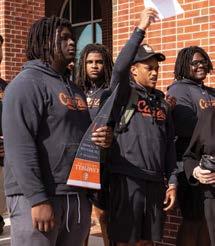
Hundreds of Campbell students attended Dr. Downs’ investiture ceremony on March 27, and hundreds more helped line the streets from the Pope Convocation Center to the Oscar N. Harris Student Union to congratulate him afterward. A month after the event, Dr. Downs said thinking about the student involvement that day still makes him emotional. “They showed up. They were engaged. They were supportive. They are the reason I get up every morning, and they got up for me on that day. And I love that.”
SEPT. 18, 2025: President Downs made the first of six Campbell Forward speaking tour stops in Charlotte, where he laid out his plans and hopes for Campbell University and took questions from alumni in each city (which also included Winston-Salem, Wilmington, Raleigh, Fayetteville and back home in Buies Creek). In his first stop, he declared that Campbell’s days as a “hidden gem” must come to an end.
NOV. 5, 2025: n the lead-up to his fiveyear Strategic Plan, President Downs held three town hall-style gatherings for students, faculty and staff in late October and early November. The final meeting included more than 150 staff members on Nov. 5, and the discussion focused on enrollment growth, fiscal sustainability, community engagement and strengthening the University’s identity.
STUDENTS SHOW UP BIG
Asked by Gene Lewis in the moments leading up to his ceremony what he hoped for most out of the day, Downs said he wanted to see a lot of students in attendance.
“I think you’ll be pleasantly surprised,” Lewis said with a smile.
Hundreds of Campbell students were in the seats for Downs’ big day inside Pope Convocation Center — the president joked that they could have picked anywhere else to be on a warm spring Friday with no classes that afternoon.
“This must have been some serious extra credit,” he said with a laugh. “But whatever got you here today, I will repeat the commitment that I made the day I was first named president. You, our students, are our most important constituents. You are our No. 1 priority. You are the reason that we will scrap and fight and claw to strengthen this university every day during my administration, just as those before us have done for 139 years. You, my friends, are our reason to be.”
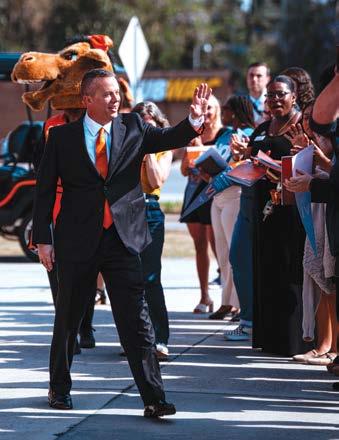
If Downs was happy with the inside turnout, he was in awe of those who awaited outside to greet him postceremony. Hundreds more formed a line from the convocation center to the Oscar N. Harris Student Union, holding signs, pennants and banners congratulating the president and First Lady as they paraded through the line on the back of a golf cart.
Upon seeing the crowd, Downs mouthed the word “Wow” repeatedly.
Daphne Dew, a senior English major, called the day “exciting” and said she wanted to be there for Downs, because
he’s been there for students since July.
“Dr. Downs has been so involved in the student community, and so getting to see him talk about his plans for the remainder of his service here is really exciting,” she said.
Freshman engineering major Lucas Honan said he attended because it was a big, historic day, and he has enjoyed hearing the president talk about upcoming capital improvement plans. “I really want to see what the plans are for the School of Engineering, so all of this sparks my interest, of course,” he said.
Student Body President Cutler Bryant represented helped introduce Downs on stage during the investiture ceremony, and he applauded the president’s commitment to hearing what he and his classmates have to say.
“On his first day in office, Dr. Downs sought out time to meet with me and other student leaders. This was not just a meet-and-greet photo opportunity. It was a meaningful, hourlong constructive conversation about the student experience at Campbell University. We spoke candidly about what it means to be a student here — our challenges, our opportunities and our hopes for the future,” Bryan said.
“What stood out to me the most and what still stands out to me today was that he not only listened to those concerns, but those conversations did not end in the room. In the weeks, and the months since, we have already begun to see the results of those conversations. So on behalf of the undergraduate student life, I want to say that we are excited, we are vocal, and we are ready for this new chapter in life of Campbell University.”
first academic year
NOV. 12, 2025: Campbell celebrated a historic milestone as 2,381 alumni, students, parents, friends, faculty and staff united for Campbell Giving Day, setting an all-time record for total number of donors. In Downs’ first Giving Day, donors from all 50 states helped raise more than $1.2 million to support student scholarships, programs and the overall future of Campbell University.
NOV. 10, 2025: Campbell University and Cape Fear Community College signed a new articulation agreement providing CFCC students with a “direct and seamless” pathway to continue their education at Campbell. In his
as president, Downs would sign similar Campbell Assured Admission Program pacts with Carteret Community College and Richmond Community College.
THE INAUGURATION OF WILLIAM M. DOWNS
A WEEK TO REMEMBER
The March 27 investiture ceremony of President William M. Downs capped a six-day build up — Inauguration Week — that included a worship program, academic lecture, student research symposium, dedication ceremony for the campus’ 300-year-old oak tree, day of service and a campus-wide cookout.
Those gatherings celebrated both the storied past of Campbell University, as well as its current mission and exciting future. Downs called the week “euphoric” an “re-energizing” after a busy first 10 months on the job, and he
said the enthusiasm shown by students, faculty and staff reminded him of why he chose to come to Campbell.
“I have lived and worked in many different places over the course of my career, and there is something decidedly different about this place. When I walk this campus, I see it and I sense it,” he said in his inauguration speech. “There is an authenticity to the people’s affection for Campbell, unlike any I have ever seen elsewhere. People, community, family, relationships. Those will be the foundation of everything we will build here in the years to come.”
NOV. 13, 2025: Tasked with sharing ideas on how to make the university they call home a better place, more than 120 Campbell students took part in President Downs’ first Presidential Innovation Challenge. Mark Biggins, a trust and wealth management major, took first place for the creation of an AI copilot called Vinco that can help students and new graduates eliminate cold outreach when applying for jobs.
Worship service focuses on justice, mercy, humility
The weeklong celebration of the inauguration of Dr. William M. Downs began on a Sunday night with a Biblical charge, not just for the president, but the Campbell community as a whole.
Do justice. Love mercy. Walk humbly with God.
This simple call from the Book of Micah (6:6-8) in the Old Testament represented the theme of the Inauguration Week Worship Service, kicking off a week of events that culminated with Down’s investiture ceremony. The message was a reminder to the Campbell community as a whole that a close, obedient and humble relationship with God is obtained through actions, not outward appearances.
“Ten words, three actions and one powerful message,” said Dr. Barry Jones, dean of Campbell’s Divinity school and one of three to present a sermon Sunday night inside Butler Chapel. “These are not just clear instructions. They are universal instructions. … This Scripture challenges us to ask, ‘What does God require of us as a Christian university as we rededicate ourselves to our mission under Dr. Downs’ leadership?’”
Downs said starting a week that celebrated Campbell’s past and future with a worship service was intentional. The school’s first inauguration celebration — for second president Leslie Campbell in 1935, also began in a church.
“Our faith foundation started with J.A. Campbell [a Baptist minister] 139 years ago,” Downs said. “That’s the DNA of this university.”
DEC. 8, 2025: Campbell announced its Tuition-Free Guarantee for Harnett County Residents initiative, reflecting the school’s commitment to expanding access, supporting local families and investing in future leaders who will serve and shape our communities. Under the initiative, first-year, full-time students who reside in Harnett County will have 100 percent of their undergraduate tuition covered.
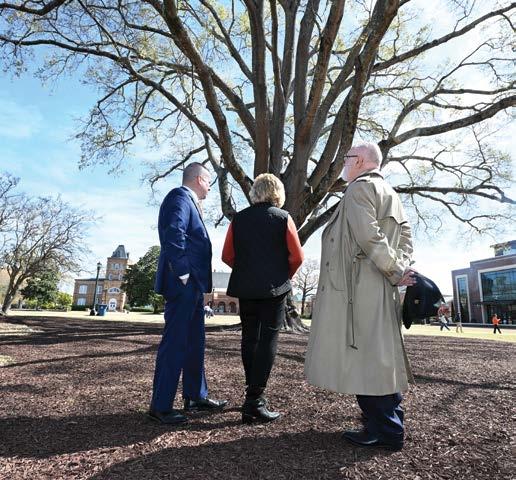
TWO TREES — one that has seen all 139 years of Campbell history and one that it is hoped will see the next 139 years — were dedicated in the University’s Academic Circle during Inauguration Week. President William M. Downs was joined by students and staff on a bright, brisk spring day to dedicate the Founders Oak — the 90-foot tall, roughly 300-year-old willow oak tree near the Oscar N. Harris Student Union — and a newly planted Legacy Tree about 50 yards away to honor both the past and future of Campbell. Recognizing the campus’ oldest natural structure was the idea of 1963 graduate and member of the Alumni Board of Directors Carroll Leggett (above, right). Campbell brought in the North Carolina Forestry Service to conduct tests on the tree last April and determined it to be between 275 and 300 years old. The Legacy Tree is a sugar maple that can grow, on average, 70 to 100 feet high when fully mature, with leaves that will turn, fittingly, bright orange in the fall.
FEB. 2, 2026: Campbell announced the establishment of the Center for Calling and Ministry, a major new initiative designed to help Christian congregations and ministry organizations strengthen how they identify, develop, and support pastoral leaders. Funded by a $10 million grant from Lilly Endowment Inc., the Center will help Christians explore calling and support current and emerging pastoral leaders.
FEB. 4, 2026: President Downs fulfilled a Day 1 promise with the public release of the University’s strategic plan, a document he hopes will “clearly and succinctly map out a set of institutional priorities that will guide us into a bright future.” Campbell University 2026-2031: A Strategic Plan for Renewal, Growth and Recognition charts a pathway to “more fully and faithfully realize our existing institutional mission.”
MARCH 27, 2026: Dr. William M. Downs called on Campbell University to rededicate itself to a “powerful and world-changing mission” on the day he is formally invested and sworn in as just the sixth president in the University’s 139-year history. More than 1,600 delegates, faculty, staff, students, community members, family and friends were on hand for the Investiture Ceremony held in the Pope Convocation Center.
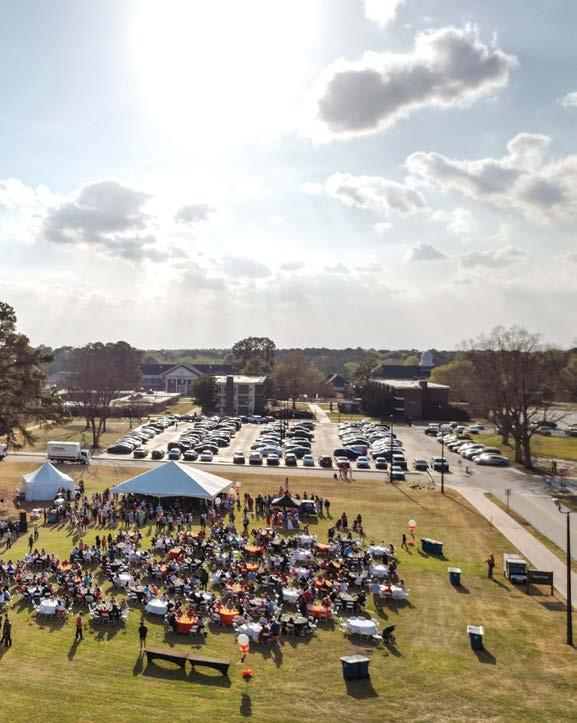
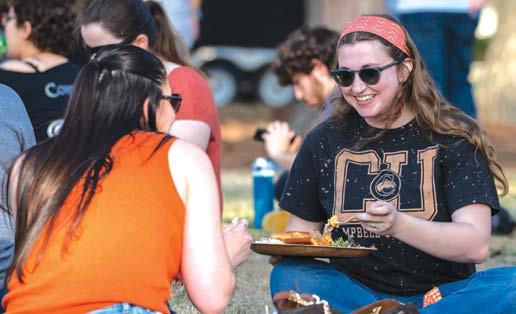
SAYLOR PARK was the site for the President’s Picnic on the eve of Dr. Downs’ investiture ceremony. Roughly, 1,000 students, faculty and staff attended the event on a gorgeous late March evening. Live music from Campbell favorites Bantum Rooster followed. Said First Lady Kimberly Downs: “I remember going from thinking, ‘Who’s going to eat all this food?’ to ‘How are we going to feed all of these people?’ by the time it started. The turnout was incredible.”
APRIL 2026: Major reroofing projects were completed on Lundy-Fetterman School of Business and Butler Chapel, and work began on Wiggins Library. The roofs — in addition to HVAC work and upgrades in residence halls and other on-campus apartments and buildings — were part of a Year 1 plan to focus on needed (and long put-off) infrastructure projects to improve the campus experience.
A lesson in Carolina split-ticket politics
North Carolina’s unique split-ticket voting history was the subject of a lecture presented by East Carolina University Political Science Professor Dr. Peter L. Francia — titled “Split-Ticket Voting in North Carolina: Understanding the 2024 Elections and the Road to 2026” — to kick off President Downs’ Inauguration Week.
As polarization between the country’s two political parties and the ideological divide among U.S. citizens continues to grow, North Carolina has — for the past 40-plus years — remained an anomaly when it comes to its voters splitting their tickets for big-stage elections. In eight of the past 12 presidential elections — 1980, 1992, 1996, 2000, 2004, 2016, 2020 and, most recently, 2024 —the Tar Heel State voted for a governor of one party and a president of another.
Downs — who holds a doctorate in political science and worked with Francia while dean of the Thomas Harriot College of Arts and Sciences at East Carolina University — said North Carolinians have a “front row seat to some fantastic political theater” and lauded Francia’s career and expertise in political polling.
MAY 4, 2026: In a move to reinforce the Campbell’s commitment to expanding access to high quality higher education for working adults, military affiliated students and lifelong learners — and as part of Downs’ Strategic Plan focus on undergraduate enrollment — Campbell’s Adult & Online Education program announced a reduced undergraduate tuition rate for the Summer 2026 session.
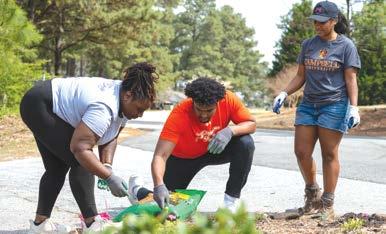
Community joins president for a Day of Service
Campus clean ups. A daylong blood drive. Beautification and birdhouse building at a nearby community park. Letters for seniors (both the college type and those in local assisted living facilities).
These were among the several events held on the eve of the inauguration ceremony for Dr. William M. Downs. Several Campbell students spent much of their day taking part in beautification efforts at Coats Community Park, located six miles east of campus and a much-used spot featuring youth baseball fields, walking trails and a playground.
First-year Pharmacy student Daria Brown of Fayetteville said she signed up to be a volunteer because one of the
reasons she chose Campbell University was its dedication to service to rural areas in North Carolina.
“It just makes me happy knowing that I did pick the right school, and today I picked the right activity, because I love being outside,” said Brown as she and her classmates dug holes for flowering plants near the entrance of the park. “So being able to do something that I love while also helping out a local community really makes me feel good.”
Campbell Librarian Jennifer Seagraves, who led an effort to clean up the north side of Campbell’s campus, said the day wasn’t just about picking up litter. “It’s about coming together as a community to invest in the place we call home,” she said. “We’re excited to be part of the Campbell Day of Service and to contribute in a way that highlights the care for our community within our neighborhood.”
MAY 9, 2026: President Downs completed his first complete academic year at Campbell by delivering the welcome remarks at the 2026 Spring Commencement Ceremony. “With this new chapter — this new beginning — your future is bright, your path is clear, and your potential is limitless,” he told the graduates. “The world awaits you, and it is our privilege to be with you and send you off in style.”
It’s good to be home
Friends since the fourth grade, president and first lady grateful to be near family, in a welcoming Campbell community
BY BILLY LIGGETT
BY LISSA GOTWALS AND ZACH BERLY
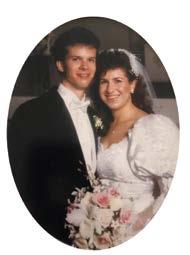
William and Kimberly Downs first met in a Sunday School class as 10-year-olds in their hometown of Raleigh, North Carolina. If you’ve heard Campbell’s sixth president speak during his first year in the role, you probably know this already — he’s happy to share the story of their fourth-grade “meet cute,” as the kids call it these days.
Their heated political battle for fifth grade president at Helen Y. Stough Elementary School the following year isn’t as widely known.
“She had a gimmick speech,” William Downs says to begin the story, foreshadowing the result.
The gimmick: Kimberly Downs, on the advice of her older sister, had everybody in the class scoot to the left of their chairs, then scoot to the right. “Look at what I’ve done,” she told her classmates. “I’ve just cleaned all these chairs in the auditorium.” The kids laughed. The teachers laughed. And Kimberly Downs proved she could make things happen.
She went on to win class president in what will be forever remembered as a highly partisan election (i.e., she got the “girl vote”).
“My 24-point program for revitalizing the fifth grade wasn’t as effective,” jokes William Downs, who would take his defeat and, years later, turn it into an undergraduate, graduate and doctorate degree in political science.
PHOTOS
TAKING IT IN
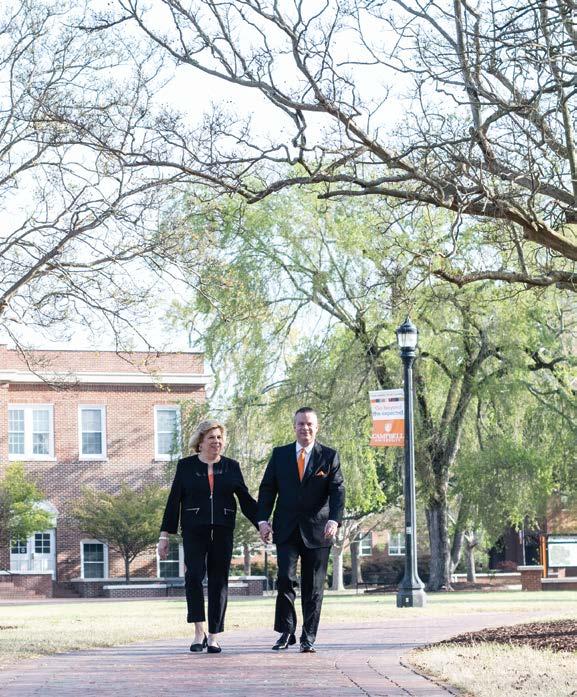
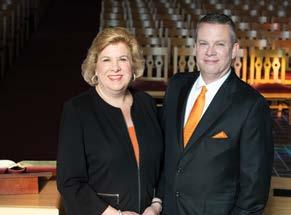
Dr. William M. Downs and First Lady Kimberly Downs share a walk through the Academic Circle in the days leading up to his investiture ceremony in March. The couple, who met in Raleigh when they were in the fourth grade, say they have appreciated the community’s love for Campbell University and their optimism about the future to come.
Photo by Lissa Gotwals
“Bill was always the smartest one in the class. He was always the one who ruined the curve for the rest of us.”
Despite his crushing defeat, William and Kimberly Downs would remain friends throughout their childhood and teen years — he hung out with her twin brother, so their paths crossed often. At church. At the pool. At school. William Downs admits a crush existed, but the friendship never blossomed into more through high school.
“Let’s just be clear,” he says. “She was too cool. A cheerleader.”
He, they agree, was more of a bookworm.
“Bill was always the smartest one in the class,” Kimberly Downs says. “He was always the one who ruined the curve for the rest of us. He was always at the top of the class in everything he did, and I remember he always stayed up late at night to do his homework. He’d pull an all-nighter and come home with an A-plus the next day, while the rest of us struggled for our Bs.”
The two would share a classroom several times in high school. They took French together for all four years. Chemistry. Math. English. Their friendship grew over those four years — he even took her to Homecoming (as friends, of course) during their senior year.
They chose different colleges after high school — William Downs fulfilled his lifelong dream of attending North Carolina State University, where both of his parents taught and instilled a passion for all things Wolfpack in him from an early age; and Kimberly Downs chose the University of North Carolina in Chapel Hill to study pharmacy (and so she wouldn’t have to live at home as an undergrad).
“We saw each other over breaks and remained good friends in college,” Kimberly Downs says. “And I started to appreciate him even more.”
Kimberly Downs would go home most weekends to work at the local Kerr Drugs pharmacy, which was near William Downs’ home. And when she needed a date for her dorm’s semi-formal dance, she turned to her longtime friend and one-time Homecoming partner.
“It just sort of blossomed after that,” she says.
They began dating as sophomores and three years later, on a moonlit beach in Cape Cod, Massachusetts, William Downs popped the question.
President William M. Downs and First Lady Kimberly Downs stand for a photo among the magnolia trees outside of the Dinah E. Gore Bell Tower near Butler Chapel on Campbell’s main campus. Photo by Lissa Gotwals
Kimberly Downs
On her early friendship with William Downs that began in elementary school in Raleigh
HOME AND ABROAD
While most of his friends and classmates were spending their summers on North Carolina’s beaches and in North Carolina’s mountains, William Downs was joining his parents — professors of British history and British literature — on their academic (and family) trips to Europe. He spent his first summer “abroad” when he was 9, and that trip and his subsequent journeys across the pond had a profound impact on him and his eventual decision to study European politics in college.
“My dad studied abroad at the University of Edinburgh, and he still had friends there. So we’d go visit them,” William Downs says. “We visited France, Switzerland, Netherlands and Great Britain. We spent a lot of time traipsing over Roman ruins and castles. That sparks the imagination of a young kid. And I just got an appreciation for the richness of the world.”
As an undergrad at NC State, William Down studied abroad in the United Kingdom, and as a graduate student, he traveled to Belgium as a Fulbright dissertation researcher. His first post-doctoral positions were on the faculties of two universities in Denmark — the University of Southern Denmark and Aarhus University. Kimberly Downs joined on those trips to Belgium and Denmark, her first experiences outside of the U.S. “I had to get my first passport,” she recalls. “My parents didn’t travel … my parents were farmers, and I guess you could say they were tied to the land.”
North Carolina and Boiling Springs, North Carolina before he accepted the job as Campbell University’s sixth president in February of 2025.
At each stop (except overseas), Kimberly Downs was able to work as a pharmacist, which provided her an opportunity to not only do what she loved, but also get to know people in each community. She says she always loved the science of the profession, and it wasn’t until she began working that she discovered she also loved the interactions with people of all walks of life as well.
“I loved my work,” she says. “I would see my patients in places like the grocery store, and some of them are still Facebook friends today.”
When she learned that Campbell University was home to the College of Pharmacy & Health Sciences, Kimberly Downs says she was excited to reconnect with the profession. She is a member of the Dean’s Advisory Council, took part in a panel discussion hosted by the College and recently spoke to third-year PharmD students about her own career and what they can expect in the “real world.”
“It’s been fun getting involved, and I hope to do more with pharmacy students in the future,” she says.
Kimberly Downs recalls the two being “starving grad students” during that first trip to Belgium. The little money they had, they spent on train tickets for little weekend getaways when William Downs wasn’t working. She joined a Bible study fellowship for international women and made several friends there — the experience was so rewarding, she continued the program in the U.S. when they returned.
William Downs moved to Atlanta to earn a master’s degree and Ph.D. in political science at Emory University, and Kimberly Downs stayed in North Carolina to finish pharmacy school and plan their wedding. She joined him in Atlanta in August of 1989 after their wedding, and William Downs’ career would take them to Brussels; Belgium; Cambridge, Massachusetts; back to Atlanta; Greenville,
Williams Downs grew up loving history, and he always viewed politics as “current history.” He says he did two things in college that assured him that he chose his major wisely — he studied abroad in the United Kingdom and he worked for North Carolina’s lieutenant governor writing speeches.
“It was such a fun, immersive experience,” he says. “I even considered a career [in politics], but when the lieutenant governor I worked for ran for another office and didn’t win, I learned how fleeting a life in politics can be.”
Instead, he chose a career in higher education, teaching and passing his passion on to others.
“I love to study it. I love to interact with [elected officials]. I love to write about it. I’ve met a bunch of presidents who came through the schools I worked at and got excited about it,” William Downs says. “But politics can be a dirty business, and I guess I cherished integrity. I chose to stay in the family business. I chose academia.”
William and Kimberly Downs were married in August of 1989.
WELCOME HOME
Kimberly Downs grew up in a large family — three older sisters and a twin brother. Her childhood was spent outdoors, playing with her brother and the neighborhood kids. No cell phones and no tablets. She stayed out until her mother called her in for lunch or dinner. Then she headed outside again.
“We loved growing up [in Raleigh],” she says. “And my family is still here — two of my sisters live in the area. It’s always been home.”
William Downs practically grew up on NC State’s campus. He was a huge Wolfpack basketball fan, there for those national championships in 1974 and 1983 (his mother taught many from that miracle ’83 team in her English class).
Raleigh means a lot to William and Kimberly Downs, and they’re thankful for the opportunity to be closer to home in Buies Creek. Their daughter Rachel and her husband Sam live along the North Carolina coast, so coming here allowed them to be closer for the birth of their second grandchild in April (their first grandchild from their son Bradley and his wife Gabriella in Oklahoma arrived in December).
“It’s just been so nice to be closer and to be a part of their lives,” Kimberly Downs says. “And for them to be a part of our lives, too. And I don’t want to say we’ve ‘reconnected’ with our siblings, because we were never really ‘disconnected,’ but we’re able to do a lot more things with them now.”
A ‘WOW’ JOB
It had been over 30 years since William and Kimberly Downs left their hometown when the job for Campbell University’s sixth president came open. Buies Creek is a 28-mile drive from the state capital, and the opportunity to come to Campbell also meant an opportunity to return home for the Downs.
More than that, Campbell offered everything William Downs wanted in a presidency.
“At my previous school, we were scrapping, clawing and fighting to launch an engineering program. Campbell had engineering,” he says. “It had a med school, a law school and all those
President William M. Downs and First Lady Kimberly Downs during Inauguration Week. Photos by Lissa Gotwals
jewels in the crown. And boy, Campbell is sellable. You can come to a place like this and convince people to enroll and invest here. That was wildly attractive to me. The stellar quality of the academic programs here just made it a ‘wow’ job.”
For Kimberly Downs, excitement came in the form of a prayer book she received from Christian Life during her husband’s interview process. The book stated Campbell’s mission, which in part states: “The University embraces the conviction that there is no conflict between the life of faith and the life of inquiry.”
“I loved that,” she says. “That combination doesn’t exist at some schools.”
“The fact that Campbell sees no fundamental opposition between faith and inquiry is pretty special,” William Downs adds.
From their first public visit to campus in February after William Downs was unanimously picked by the Board of Trustees, he and Kimberly Downs were impressed by the passion the students, faculty, staff, alumni and community have for Campbell University.
“People here have strong feelings about Campbell,” William Downs says. “And that impressed us. It made us want to be part of this community.”
Those strong feelings weren’t all positive, they admit. Excitement accompanied “angst” from several who want to see increased enrollment, pay raises and better overall stability.
“There’s been a sense of, ‘My goodness, we have to make these things happen,’” William Downs says. “We can’t let these people down. I’ve said that to myself and to my team over and over again for the last nine months. We can’t let these people down.”
Inauguration Week in March came approximately nine months after the president’s first official day on July 1, 2025. The time in between lived up to his early promise of “controlled urgency” — to have a plan on Day 1 and to execute that plan with a “determined but careful approach.” Countless meetings. A six-city speaking tour. Determining and addressing infrastructure needs on campus. The introduction of a comprehensive five-year Strategic Plan.
William Downs says those first nine months were fun, but busy. Kimberly Downs says she’s seen her husband put everything he has into the job.
“He’s been working this hard his entire life. He’s always been this way,” she says. “He’s eager to get things done … just highly motivated. What has helped has been the community here. They’re kind and optimistic. Even in the face of everything that Campbell is facing, people are eager and excited about the future. So that makes us optimistic, too.”
Inauguration Week, which began with a prayer service and ended with an energetic Investiture Ceremony, was nothing short of “euphoric,” William Downs says.
“It was a busy first nine months, and this really reenergized me. It was a jolt of new energy,” he says.
“Even in the face of everything Campbell is facing, people are eager and excited about the future. So that makes us optimistic, too.”
Kimberly Downs
On the community embracing her husband and his vision going forward
His biggest worry was the Friday Investiture Ceremony, not because he feared something would go wrong, but rather he wondered if students would take time on a Friday — a beautiful spring day with afternoon classes called off — to attend. He worried for nothing. Hundreds of students were in the seats during the ceremony and hundreds more gathered outside to form an enthusiastic receiving line for William and Kimberly Downs’ trek from the convocation center to the student union.
“Thinking about it even now, it can bring me to tears,” William Downs says. “They showed up. They were engaged, and they were supportive. They’re the reason we get up every morning, and they got up for me that day. And I loved that.”
Renewal, growth & recognition
President Downs’ Strategic Plan highlights identity, enrollment, service and finances to guide university for next five years
BY BILLY LIGGETT
When President William Downs delivered on his Day 1 promise of a strategic plan for Campbell this spring, he revealed four pillars — enrollment growth, financial strength, community impact and institutional identity — that would guide the University’s decision making during his first five years in office.
While all are vital to Campbell’s survival in an increasingly challenging higher educational landscape, it’s the fourth pillar that Downs suggests might be the most important. From the beginning, when founder Baptist minister J.A. Campbell held his first class in a small school house and started the day with a hymn and a Bible passage, faith has been the University’s pilot.
“It’s the DNA of this school,” says Downs. “I’ve seen schools where you couldn’t pray. I’ve seen schools use faith instrumentally, rather than authentically. I think in this country today, there is a huge appetite with young people for authentic spirituality. I don’t think they care as much about denominations, but there is a hunger for spiritual formation and growth.
“To be at a place like Campbell where you can live out your personal faith and build it authentically … that’s impact. We need to lean more into that.”
SOLID GROUND
Campbell University received good news this summer, ranking sixth in North Carolina out of 34 private colleges and universities in financial strength, according to Forbes. “Nobody here is satisfied with coming in No. 6 in anything,” said President Downs. “We will build on this ... to further strengthen our position as we grow into the future.”
Photo by Ben Brown
ENROLLMENT GROWTH
Campbell commits to more effective fulfillment of its mission through a University-wide effort to achieve sustainable growth in overall student enrollments, with a target of 2 percent average annual growth over the five-year planning period (net increase of roughly 500 students).
FINANCIAL STRENGTH
Campbell commits to strengthening its financial health by ensuring that annual revenues regularly exceed expenses, expanding and diversifying revenue streams, increasing philanthropic support, remedying a backlog of deferred maintenance issues and investing in employees in ways that reward merit.
Downs unveiled Campbell University 2026-2031: A Strategic Plan for Renewal, Growth and Recognition in early February after it was unanimously approved by the Board of Trustees on Jan. 28. In it, he and a committee of faculty, staff, students and alumni committed to strengthening Campbell’s broader reputation as a Christcentered institution of higher education and a school that embraces the conviction that there is no conflict between the life of faith and the life of inquiry.
“When I first started the interview process for this job, there was a ‘D-word’ floating around, ‘drift,’” Downs says. “There’s worry that Christian colleges and universities have drifted away from their faith foundations. And I think many have. It was clear to me this was a place that was ready to lean back into faith and of the other three pillars of the strategic plan. Faith is the one that has received the most attention, and it’s received the most enthusiasm and love from across this community.”
The strategic plan was the work of a 12-person committee tasked to chart a pathway to “more fully and faithfully realize our existing institutional mission,” Downs said in a letter to the community on Feb. 4.
“The challenges and opportunities we face require our immediate attention, and it was imperative to set our vision to paper so that we could then get busy fixing, building and growing,” he wrote. “I have preached ‘controlled urgency’ since my first day at Campbell, and that has been our approach to completing this major strategic task.”
Downs became Campbell University’s sixth president on July 1, 2025, and one of his first actions as president was creating the committee that oversaw the creation of the new plan. Over the course of months, the group administered a survey that generated more than two thousand responses from alumni, students, administrators, trustees and faculty and staff. Those responses shaped the conversations in three 90-minute town halls held during the fall that led to open discussion from faculty, students and staff.
Downs also hosted 10 one hour-long listening sessions with units across the campus to draft the plan’s strategic priorities. Those priorities — enrollment growth, financial strength, community impact and identity — were the same priorities Downs said were communicated to him during the interview process before becoming president.
“Trustees, alumni, students and staff all made it abundantly clear that these were institutional priorities. Those early signals were subsequently reinforced throughout my first months at Campbell in conversations across campus and in our broader community. They then reappeared in the survey data analyzed by our planning committee.” Downs said.
“Settling on these four themes as the core pillars of Campbell’s new Strategic Plan was perhaps the easiest part of our work … everything we heard and everything we now know tells us that our University’s future hinges on enrollment growth, robust financial health, constructive engagement with the community and a sharpened understanding of our identity.”
In his letter to the Campbell community, Downs laid out several scenarios of what Campbell will look like in the next five years as a result of the Strategic Plan. Campbell, he said, will be home to more students from its backyard and across the nation and the world. More students will continue their education at Campbell after beginning in community colleges, and pathways toward a graduate education at Campbell will be better defined.
Also in five years, Campbell will be well into its most ambitious, comprehensive fundraising campaign to date, and the financial health of the institution will be more sound.
“Campbell will be better and stronger in 2031 if we have become a destination of first choice for more students,” Downs said. “Increased enrollment means that we have become more closely aligned with what prospective students want, with what employers need, and what our society demands. Enrollment growth, increased philanthropic support, greater fiscal
COMMUNITY IMPACT
Campbell commits to becoming the region’s most vital private educational partner for economic growth, workforce development and improved health care. We will actively cultivate opportunities to expand Campbell’s geographic footprint in other areas of the state.
discipline and more aggressive pursuit of external funding will enhance our financial health. A financially healthy Campbell is one that provides students with the services they expect, one that compensates its employees appropriately, and one that has the means to realize its dreams.”
Then there’s the all-important faith element. The plan will ensure that Campbell’s Christian identity is more clearly and consistently reflected in both internal and external marketing and communications efforts, including social media and Campbell Magazine. More endowed scholarships will be awarded to incoming undergrads based on character and not solely based on GPA and other traditional measurements. Campbell will also improve onboarding of new students to better educate them on the school’s history and its Christian foundation. Finally, Butler Chapel will see increased use as a venue for worship and spiritual formation by not only students, faculty and staff, but the greater Campbell community as well.
In his inauguration speech on March 27, Downs said Campbell will rededicate itself as a “gathering space for people from all backgrounds who wish to live, learn and grow in a thriving Christian community.” Strengthening the faith element of a Campbell education, he said, will help the school secure its reputation as North Carolina’s top producer of graduates prepared for lives of service leadership.
Downs said a university that dares to dream big is one that will become inextricably linked to the fortunes of its surrounding community. He said Campbell can and should be a partner and a catalyst for progress in the Triangle region.
“Campbell will be better and stronger in 2031, because we will define ourselves not by explaining who we are not, but by confidently knowing precisely who we are,” he added. “Put all these things together and Campbell at the close of this initial five-year plan will be better off because it will be busy faithfully fulfilling the mission we have all been blessed to inherit.”
INSTITUTIONAL IDENTITY
Campbell commits to strengthening its broader reputation as a Christcentered institution of higher education, as a gathering space for people from all backgrounds who wish to live, learn and grow in a thriving Christian community, and as the state’s top producer of graduates prepared for lives of servant leadership.
Dr. William M. Downs listens to audience feedback at one of his six Campbell Forward speaking tour events (this one in Fayetteville) last fall. Downs said those events played a big role in shaping the strategic plan released in January this year.
Photo by Bennett Scarborough
FIN
ENGINEERING PHYSICAL THERAPY
NOVATION
AFTER LOSING BOTH LEGS TO ARTERY DISEASE, LOCAL MAN TURNS TO CAMPBELL STUDENTS TO DESIGN PROSTHETIC SWIM FINS
BY BILLY LIGGETT
PHOTOS BY CHARISSA ENGLISH, EVAN BUDROVICH AND WILL BRATTON
Doug Thingelstad catches his breath as he’s — for the fifth time today — surrounded by students and professors holding notepads and cameras, monitoring and recording his every kick and stroke. Every breath and heartbeat. The sweat beads on his already wet brow after his sixth lap in 15 minutes inside a sunlit Nathan Johnson Aquatic Center.
The 63-year-old Harnett County man has never been a fan of having an audience. But he’s grown used to this crowd and this attention, created last fall in the name of education, research and his own good health. This team of future engineers and physical therapists are here to build the perfect prosthetic fin so Thingelstad — who lost his legs in 2020 from peripheral artery disease — can swim with less burden on his upper body and focus more on his “healthspan” instead of his limitations.
TEST LAPS
Doug Thingestad has worked with a team of students and professors from Campbell University’s physical therapy and engineering departments to design and build a more efficient fin prosthetic as he continues to find ways to stay in shape after losing both legs to peripheral artery disease.
Photo by Evan Budrovich
It’s early April, and the design is almost complete. On this day, Thingelstad cuts through the water like a zebrafish (the aquatic version of a lab rat), and these fins are the closest he’s felt to “natural swimming” since this whole process began.
“When something like this happens to you, it’s easy to just give up and do nothing,” he says after an hour of laps, tests and Q&As from his Campbell team. “I chose to go a different route. And I think what these students are doing is important work, and not just because they’re doing it for me.
“This can help a lot of people.”
“After something like this happens to a person, it’s easy to stay at home and do nothing. I didn’t want to do that.”
Doug Thingelstad
Thingelstad was always active, always in a sport growing up in Virginia Beach. He played volleyball in college and played in high-level beach volleyball leagues well into his 30s.
He was in his 50s when the pain and numbness began in his legs. Thingelstad was diagnosed with peripheral artery disease, a circulatory problem where narrowed arteries in the extremities reduce blood flow. Extreme cases, like his, lead to tissue death and, in those cases, amputation.
His first amputation, above the knee, came when he was 55, and two years later, he lost his other leg. According to several studies, roughly a third of people who lose a limb experience clinically significant depression — and Thingelstad says he faced a crossroads following his amputations.
Feel sorry for himself, or get out there and make the most of it? He chose the latter.
“After something like this happens to a person, it’s easy to stay at home and do
nothing,” he says. “I didn’t want to do that. I just think it’s important to stay active — it beats sitting on my ass all day doing nothing.”
If there was a sport with leagues for differently abled people, Thingelstad wanted to try it. Volleyball, of course. Tennis. The recent Winter Olympics inspired him to give sled hockey a try.
Thingelstad moved to Harnett County before his health issues, and despite the proximity, didn’t know a whole lot about Campbell University until he heard about a wellness program offered by the Doctor of Physical Therapy program that provides a service to local residents who need it locally while providing hands-on, faculty-supervised training for the future therapists. He signed up to learn about stretches and exercises for his hips and to stay in shape for the new sports he was taking on.
He also inquired about using the swimming pools at nearby Keith Hills Country Club and the Nathan Johnson Aquatic Center on campus.
Doug Thingelstad taking part in one of the pro-bono therapy clinics offered by Campbell’s nursing and physical therapy programs (above), meeting with PT and engineering students to discuss the design of prosthetic swim fins (right) and talking about the feel of those fins with PT student Emily Macon during a recent swim session at the Nathan Johnson Aquatic Center.
On his decision to seek physical therapy and swimming after losing both of his legs
“I didn’t think they’d let me in the pool, to be honest,” Thingelstad says. “At least not without passing some sort of swim test. You know, here’s a guy with no legs trying to swim … I thought I’d be too much of a risk.”
He was offered swim lessons at Keith Hill Country Club, and it was at this time when he met physical therapy students Emily Macon and Kelsie Underwood — both of whom he knew through his therapy on the health sciences campus. Macon and Underwood provided therapy as students to train him for the pool and eventually the sessions he’d go through to test his customized prosthetics.
Macon, a Wake Forest native, says swimming is what got her into physical therapy to begin with. She suffered an injury in the sport in middle school and sought help from licensed PTs during her recovery. That experience, she says, was life changing. “I knew from then on I always wanted to work with athletes, and I haven’t looked back,” she says.
For swimmers, the common thought is that the sport requires 70 percent upper body work (arms, shoulders, chest muscles) and
30 percent legs. Proper swimming technique demands significant leg strength and endurance. Swimming with no prosthetics means extra upper body work, Thingelstad says, which gets exhausting very quickly.
It’s also a “weird” feeling, he says.
“It’s impossible to explain how it feels, because your mind is telling you to kick, and you can’t. The whole lack of balance is crazy,” he says.
“But once you get in the pool — and once you get used to the fact that your bottom half is going to try to float upward — you learn to adjust. But it’s much harder to do.”
Not long into his lessons, Thingelstad asked about prosthetic fins. Did they exist? Could the school help in his search for some? Could they get access to the School of Engineering’s 3D printer and create some? Campbell offered something better. The School of Engineering put three of its students — seniors Dantzler Bonner, Noah Baker and Sarah Fitzkee — on the project to work with Macon and Underwood on finding (and creating) the right fins to make swimming feel as natural as possible.
Kelsie Underwood Doctor of Physical Therapy Program
“One of the ways this helps us as physical therapy students is in the way we communicate with the people we’re working with. In class, we learn a second language as PTs. We understand what we’re saying, but working with patients and with the engineering students, we’ve learned to reframe what we say so that everyone is on the same page.”
SARAH FITZKEE School of Engineering
“In engineering, we’re taught to see things as very quantitative. In working with the [physical therapy students], we all had to look at it from a different angle and not exactly ‘quantify’ the results, but rather, adjust based on the man we were doing this for. Just getting his opinion helped a great deal, and it caused us to change our mindset on ways that we can get the best results.”
“I didn’t know it was going to be such a big thing,” Thingelstad admits. “But when you think about it, they actually have to be able to fit into the sockets that I have, they have to see what works best for me, and they have to do a lot of testing. There was definitely a lot more thought put into it than I ever imagined.”
The five students, along with Dr. Kim Fowler from the School of Engineering and Dr. Lori Leineke and Dr. T.R. Goins from the Department of Physical Therapy, worked with Thingelstad for several months beginning last fall — determining his goals and what they needed to do to make them happen. The group monitored vitals, lap times and overall comfort as he swam countless laps using an assortment of fins and custom-designed alternations.
On this day in April, the fins are very close to the final design. He says there’s a big difference between the feel of the custom fins and what he was testing at the beginning of all of this. His hips are getting the most benefit from his newfound ability to swim — most sports and training programs for people like him focus on the upper body.
He also enjoys seeing the enthusiasm from the students he’s working with and being part of a project that is not only helping him, but may help others down the line.
“These students are just so optimistic, and at my age, optimism doesn’t come easy. In fact, it left me a long time ago,” he says. “I think what these kids are doing in physical therapy and in engineering is just so important.”
Macon and Underwood presented their role in Thingelstad’s therapy and training at the 2026 Wiggins Library Academic Symposium. Bonner, Baker and Fitzkee also presented the engineering side at the Symposium and presented it as their Senior Project prior to graduation in May. The final design was finished just days before they spoke, and Bonner calls the experience both educational and fulfilling.
“To see him go from not being able to have any propulsion from his lower body at the beginning to being able to kick and swim again just made me really happy,” she says. “It meant a lot to see that my work could help somebody in that manner, because
Doug Thingelstad tests one of the final designs of his prosthetic swim fins with engineering and physical therapy students at Campbell University’s Nathan Johnson Aquatic Center in April.
that’s really my end goal with engineering — to improve the quality of life for others.”
Fitzkee says the experience showed her that engineering is more than math and science — listening to others, whether they’re working on your team or you’re working for them, is a big key to success.
“In engineering, we’re taught to see things as very quantitative,” she says. “In working with the [physical therapy students], we all had to look at it from a different angle and not exactly ‘quantify’ the results, but rather, adjust based on the man we were doing this for. Just getting his opinion helped a great deal, and it caused us to change our mindset on ways that we can get the best results.”
It’s late in the afternoon, and the sunbeams are starting to pierce the front windows of the aquatic center, illuminating the pool as Thingelstad finishes his final laps for science. In between heart rate tests with the professors and short Q&As after each lap, he chats with
Baker about the feel of the latest alteration and with Bonner — who’s the one on this day in a swimsuit and a GoPro attached to her head to document his movements underwater.
For him, the experience has benefited more than his physical health. He’s made friends at Campbell, and he says he’s proud to have taken part in the work and research that’s gone into making the prosthetics.
“Campbell has been so good to me,” he says. “When I moved here about 16 years ago, I had no idea I would ever have anything to do with Campbell. What these students, Lori and T.R. have done for me … I just can’t thank them enough. They’ve been fantastic.
“I really love being out there. I do stuff now, I travel and I play sports. I wasn’t doing any of that before I met them. So all of this is a direct relation to what Campbell has done for me. I’m so grateful.”
“It meant a lot to see that my work could help someone ... because that’s really my end goal with engineering — to improve the quality of life of others.”
Dantzler Bonner
School of Engineering
Class of 2026
GRAND VIEW
Lexie Weidner’s first Study Abroad trip at Campbell University in 2016 changed her life. A decade later, she’s hit her goal of visiting 30 countries before she turns 30. Some of her favorite places, however, are closer to home, such as Grand Teton National Park (pictured) in Wyoming.
Photo courtesy of Lexie Weidner
WHERE NEXT?
Campbell alumna credits her first Study Abroad trip as a sophomore with sparking her passion for world travel
Lexie Weidner stepped off the plane in Frankfurt, Germany, ready to embark on a fourmonth study abroad stint in a new (to her) country to learn a new (to her) language.
She was met with chaos.
It was 2016, and Weidner — a 19-year-old sophomore at Campbell University at the time — hadn’t properly prepared for the bustling city’s public transportation system. International data plans for her cell phone were iffy then, and Weidner had to rely on her wits to get her to her host family’s home. She got on the wrong train, had to double back and eventually sought out a nearby police station to put her on the right path. A trip that should have taken less than an hour took more than three.
“I think most people would have panicked in that situation,” Weidner says, recalling the trip a decade later. “But me, I loved that I was forced to figure this out on my own. I loved that I couldn’t understand what everyone was saying, because I was curious. I loved the chaos.”
That first trip had a profound impact on Weidner, a name of upstate New
York who came to Campbell to study communications and marketing. Born from it was a goal to visit 30 countries before she turned 30 — a goal she has since accomplished — and eventually the idea to start a website chronicling her journeys and offering tips and guides for trip planners.
Through wherenextwithlex.com , Weidner shares “itineraries, hidden gems, where to stay and more,” and what began as more of a blog site has blossomed into a handy tool for others ready to venture out into the unknown.
Thinking back on her stay in Frankfurt — the first of two Study Abroad trips to Germany during her four years in Buies Creek — Weidner says the early problem solving and adapting to new surroundings eventually gave her the courage to venture out more.
She spent a long weekend in the United Kingdom, this time exploring without having a host family to rely on. By the time she returned to North Carolina at the end of her semester in Europe, she had the bug. She needed to see more.
“Nothing felt like enough,” she says. “It was always, ‘Where next? What’s next? Where can I go again? How can I sneak in another weekend trip? Maybe I’ll have enough money if I just eat sandwiches this week.’
“I just never wanted to stop exploring.”
Lexie Weidner, a 2018 graduate of Campbell University, takes in the view of Lichtenstein Castle in Germany, originally built in 1390 and reconstructed in 1837. Photo courtesy of Lexie Weidner
STUDY ABROAD AT CAMPBELL
International trips to Ireland (history and religion), Austria (psychology and music), China (risk management), the United Kingdom (risk management) and Chile (pharmacy) and a course in Hawaii (ecology and culture) were on the 20252026 slate for the facultyled programs offered by Campbell University Study Abroad.
Those faculty-led trips are usually one or two weeks long and are often tied to a specific course of study. Students, like Lexie Weidner, can also take part in lengthier Study Abroad experiences through one of several programs that partner with Campbell.
“Experience is the biggest selling point of our programs,” says Nora Greer with SSA Education Abroad, a third-party provider that focuses on trips to Spain and other Latin American countries. “More specifically, the opportunity to be able to do something like this will never be easier for them in their life than it is through a Study Abroad program.”
Info: campbell.edu/study-abroad
Lexie Weidner visited Japan for the first time this year — a trip that, despite her experience traveling, tested her confidence. She wrote about it on her site, wherenextwithlex.com, and offered advice for others considering a trip to Asia for the first time.
Weidner’s inquisitiveness was evident in her decision to attend Campbell University. A native of Ogdensburg in upstate New York — where she says “travel” meant crossing the water into Canada or, if you’re lucky, spring break in Florida — she excelled at soccer and basketball and was getting looks from local Division II colleges to play at the next level. But Weidner wanted to “reject familiarity” and look for far-away schools that offered a change of scenery.
She discovered Campbell during her college search and fell in love with both the campus and the idea that she was heading off into the unknown, at least to her.
“My parents were pretty against it at the time, but they were supportive and helped me pack and move,” she says.
“Now they’ll say it’s one of the best decisions I could have made for myself.”
One of the first classes she enrolled in at Campbell was German. Her greatgrandparents are from Germany, and she was always curious when they would speak in German to each other. Her professor suggested Weidner visit Germany to really immerse herself in the culture and, in turn, better learn the language. She made a beeline to former Global Engagement Coordinator Kendra Granger and expressed interest in spending a semester in Europe through one of Campbell’s several partnerships with programs that offer long-term educational opportunities.
Weidner was dismayed to learn that such trips were frowned upon for sophomores, but she persisted. Granger presented a list of what she had to do to make a spring trip possible that year, and Weidner worked hard to make it happen.
“The course of my life changed forever when I stepped off an airplane in Germany solo at 19 years old to travel. My hope is that you can take my stories & tips to create your own adventures all over the world.” — Lexie Weidner in a promotion of her travel guide website, wherenextwithlex.com.
“The moment I got back to the U.S. after those four months, there was no question of ‘If I ever do that again … It was just a matter of when.”
Her second Study Abroad trip during her senior year brought her back to Germany, where she visited fairy tale-esque castles and centuries-old towns. Since those two trips, she’s returned to Europe several times (including for her wedding in Italy). She says she’s captivated by “fleeting conversations with strangers, the smells drifting from shop windows, unfamiliar flavors and the constant feeling of learning something new.”
After Campbell, she set a goal to visit 30 countries in total before she turned 30 (a goal she hit in April with her first trip to Japan). Her favorites have been Iceland and Switzerland, specifically the Jungfrau region, which she calls one of the most spectacular places on Earth — “I’ve truly never witnessed panoramic views that take my breath away in every direction,” she wrote on her site. The many mistakes she made during her early travels — such as the time she unintentionally canceled a flight (while rebooking another one) that would have caused her to miss another plane home — inspired her to create her website, which not only provides the “where to go” advice but also features “things I wished I had known” blog entries and “things you must bring” for certain destinations. She has monetized the site by taking on an influencer role with links to her favorite “must have” travel items.
a separate place for all of this. I wanted to write down all the things I experienced and just have it somewhere so my family and friends could read it. Then about five years ago, I realized I could do more with it.
“I’ve made so many mistakes. My first trip to Rome was just terrible. I don’t want someone to make those same mistakes I did. I want them to go to Rome and love it.”
Weidner and her husband, Justin Cook, currently live in Colorado, where she works in talent acquisition for a company based in Denver. She hopes to be able to take on the website full time in the near future.
“I’ve made so many mistakes. My first trip to Rome was terrible. I don’t want someone to make those same mistakes ... I want them to to go Rome and love it. ”
— Lexie Weidner —
On why she created her travel guide website, wherenextwithlex.com
Posed with the relevant question of where next?, Weidner says she has two short trips coming up that will take her to London and to the Carribbean. What’s planned after that is anybody’s guess, and that is part of the excitement, she says.
“Traveling has become my passion, and if I get to motivate others to get out and travel — in whatever form that is — that’s my goal,” she says.
Learn more: wherenextwithlex.com
1960s-90s
DAN HOLLAND (’69) retired after 40 years as director of music at First Methodist Church in Clinton. He celebrated with a concert of his favorite anthems at the church in March.
DON GORDON (’83) celebrated his fifth anniversary as founder and CEO of C3 — Christians Caring for Creation, a nonprofit that promotes loving God and neighbor by loving all God’s creation.
THOMAS D. CARRUTHERS (’86 LAW) was named city attorney for the City of Asheboro in April. Previously, he served as deputy general counsel for the North Carolina League of Municipalities.
“The site started as a diary,” she says, “because I felt like I was bombarding people with photos on Instagram, and I wanted
Trips to Germany for Study Abroad during her time at Campbell sparked a passion for Lexie Weidner. Eastern European countries remain among her favorite destinations.
JOHNNY CRISCOE (’90), a tenured professor at Campbell University’s Norman A. Wiggins School of Law, announced his retirement following the 2026 spring semester. Chriscoe began his career at Campbell in 2000 and has been known for “bringing charm and intellect into the classroom“ for over 25 years.
BRIAN KALK (’91) was named president of Bismarck State College in Bismarck, North Dakota. Kalk is a former public service commissioner for the state’s energy industry and was chief research office at the University of North Dakota’s Energy and Environmental Research Center. Bismarck State has many programs tied to the energy industry.
BROOKE WILLIAMS (’17 DO)
Advocate for doctor diversity
Member of Campbell’s first class of physicians founder of nonprofit mentoring minority student docs
By JOHN TRUMP
The relatively small number of minorities entering the field of medicine did not go unnoticed by Dr. Brooke Williams and her best friend and business partner.
They saw the lack of diversity, the need to bolster recruitment efforts toward attracting people of color and the need to advocate for minorities who want to enter a career in medicine. They saw the need to reach out to communities and develop programs toward that goal — to promote mentorship and to cultivate mentors.
In 2018, Williams, then a secondyear resident at Franciscan Health in Chicago, and her business partner, Dr. Desiree Leach, who was doing post-doctoral work at Northwestern University, got to work on starting a nonprofit. They met every weekend they could at coffee and sandwich shops. They didn’t have a lot of money, but they developed a business plan and began unraveling the bureaucratic red tape to establish that nonprofit.
Since then, Color of Medicine has grown and flourished, now including
Dr. Brooke Williams is a double boardcertified physician — internal and obesity medicine — for Novant Health in the Triad and an adjunct clinical professor at the Jerry M. Wallace School of Osteopathic Medicine.
Photo: Color of Medicine
one-on-one mentoring, STEM labs, shadowing opportunities and myriad services to prepare students to pursue a career in medicine. Color of Medicine, the website says, exists to break down barriers and open doors to education, mentorship and career opportunities.
“We believe early exposure, culturally competent guidance and visible representation can transform the paths of students, families and communities — helping them envision and achieve futures once thought out of reach,” the site says.
Says Williams: “Obviously we want it to be even bigger and better, but we’re very proud of what we’ve accomplished thus far.”
Williams is a double board-certified physician — internal and obesity medicine — for Novant Health in the Triad and an adjunct clinical professor at the Jerry M. Wallace School of Osteopathic Medicine, where she was founding class president of the Student National Medical Association.
She knows the value of mentors and knows that student doctors — almost anyone, really — should pursue mentors who will lead and guide them. Throughout their careers.
“I’ve always felt like mentorship was a ... part of my core existence,” Williams says. “I know it’s cliche, but if I can make it, you can make it. When you see that coming to fruition, it’s a great feeling.”
The mentoring process is ongoing, continuing throughout medical school, residency and long careers. Sometimes, people forget that, Williams says.
“Even when you graduate to the next level, you still need that mentor. To maintain that relationship is a two-way street.”
Find a leader whom you admire, she says. Let them know you want them as your mentor. Be persistent.
Today, Williams wears many hats, including that of medical director of Modern Aesthetics Medical Spa in Charlotte, where she provides physician leadership and clinical oversight to ensure the delivery of “safe, ethical and evidencebased care across medical aesthetic and wellness services.” She is also a member of Medical Review Board for Prevention. com and Good Housekeeping Magazine . Born in Winston-Salem, she attended NC State University for her bachelor’s degree and Hampton University for a master’s degree in medical science, in addition to a summer enrichment program at the University of North Carolina Chapel Hill.
As far as medical school, she says, it was always Campbell. Her first campus visit came before the Leon Levine Hall of Medical Sciences was even built. “I knew God was speaking to me. .. I can’t explain it, but I knew I was going to Campbell … I just knew.”
She remembers the acceptance call and remembers withdrawing applications from other med schools. Today, she advocates for Campbell in the same way she says the school advocated for her.
“I say it’s a great institution. I still feel like I’m a student there, like they’re protective of me,” she says. “You can’t ask for that, because sometimes you feel like you’re just a number. I’m still part of that family, and I will always be a Camel — which is important, because we have a sense of belonging. I feel like I am indebted to pour back into that institution to give to their students. I definitely credit where I’m at today to Campbell.”
Leach, her friend and business partner, is a biomedical scientist and an expert in cardiology, neurology, infectious disease and endocrinology. She serves as an adjunct biology professor at Truman College, City Colleges of Chicago. The two co-host a podcast, and they use social media to spread their message of encouragement and empowerment. The health care system is replete with challenges, she says, and overcoming biases is chief among them. The podcast and website, and, inherently, Color of Medicine, address the problems. More importantly, they offer hope and the support to help young health care professionals persevere, lead, teach, motivate and inspire.
Continue to lean on your mentors, as leaders and role models, Williams tells her mentees. “We’ve got to look to you to change the way things are going, and we’ve got to remain hopeful. We can’t throw in the towel … we’ve got to make sure that we’re spreading this message.”
NANCY HALE BEASLEY (’91), former director of financial aid at Campbell University, earned the FAAC designation from the National Association of Student Financial Aid Administrators’ accredited Certified Financial Aid Administrator program.
HERNÁN MORALES (’94) published his first peerreviewed academic article titled “The Interview Trap: A Systematic Review on Factors Affecting the Validity of Employment Interviews.“ His study examines how interviewer bias, lack of structure and power dynamics can compromise hiring decisions and organizational performance.
HARRY SIDERIS (’98 MBA) delivered the address for NC State University’s spring graduation ceremony on May 9. Sideris is the president and CEO of Duke Energy, one of the nation’s largest regulated energy utilities.
2000s
JONATHAN RORIE (’01) was named city manager for the City of Washington, N.C., in April. Rorie has over 37 years of experience in public administration, serving as city manager previously in Spring Lake, Camden, South Carolina and Peachtree City, Georgia.
Dr. Brooke Williams (left) was a member of Campbell University’s first graduating class of the Jerry M. Wallace School of Osteopathic Medicine in 2017. Photo: Campbell Archives
MARY CANDACE LEE SEAGLE (’08) celebrated 10 years working in dermatology and now works at Cardinal Dermatology in Cary. She says one of the best parts of her job is precepting Campbell University PA students.
RICHARD A. WAUGAMAN III (’09, ’12 LAW) was named among the 20 winners of the Triangle Business Journal’s inaugural Triangle Law Awards, honoring outstanding attorneys in the area.
2010s
ANGELICA TAYLOR (’10) was promoted to president of Cabot Hosiery Mills, a Vermontbased manufacturer of premium socks “with uncompromising comfort, durability and fit.“
SARAH RATLEY (’13) is founder and director of The Well Natured Child, a nature school program that teaches children about the outdoors, animals and education fundamentals located in Fremont.
LAUREN STRICKLAND (’13 MSA) was named Assistant Principal of the Year for the 20252026 academic year at Johnston County Public Schools.
Alumni Weekend, held in April, featured 16 events, from history lectures and class reunions to athletics events and music and theater performances.
ALUMNI NOTES
CHRIS CLARK (’13) was promoted to graphic design and web manager at GoTriangle, which provides public transportation in and around the rapidly growing Raleigh area.
KENDALL MARIAH DUNN (’14) released her debut book, “This Little Fire of Mine,“ with Thomas Nelson, a division of HarperCollins. Mariah is a content creator with nearly one million followers, as well as an adoptive mom and Army wife.
JONATHAN NAYLOR (’14, ’17 LAW) as appointed by Gov. Josh Stein as District Court Judge for North Carolina Judicial District 5, covering Duplin, Jones, Onslow and Sampson counties.
JAMES FORTHOFER (’17) won the Visiting Clubhouse Manager of the Year award in the Carolina League for the Fayetteville Woodpeckers.
EMILY G. MASSEY (’17 LAW) was named among the 20 winners of the Triangle Business Journal’s inaugural Triangle Law Awards, honoring outstanding attorneys in the area. An attorney with Ward and Smith PA, she was recognized for her work in the practice area of labor and employment.
DAMIAN DOOLITTLE (’18) and Devyn McGowan Doolittle welcomed their first child, a baby girl named Dawson on Dec. 7.
facility care while supporting the park’s mission
animal welfare and community engagement.
Campbell University honored STERLING TA’BON (’20 MSPH) during Winter Commencement on Dec. 13 with the prestigious Algernon Sydney Sullivan Award, recognizing his unwavering commitment to service, leadership and community impact.
Ta’Bon is the communities and care coordinator for the South Carolina Department of Health and Environmental Control. He is also co-founder and director of DiamondStackz Classic, a nonprofit focused on the development of children through leadership, sports, arts and service mentorship.
The Physician Assistant program announced the establishment of the JESSICA SCHAVONE PA MEMORIAL ENDOWED SCHOLARSHIP, created by her husband Nick Schavone, family and friends to honor the life, legacy and compassionate spirit of 2021 Master of Physician Assistant Practice graduate who died in 2025 at the age of 30.
Said Nick Schavone: “The PA program gave her the knowledge, confidence and sense of purpose that she carried into every exam room. This scholarship is our way of honoring the light she brought into the world while supporting future PA students who share her commitment.”
SEND US YOUR NEWS! Weddings, births, promotions and other big announcements — we want to hear them all. Visit alumni.campbell.edu to submit an Alumni Note (include a picture, too!).
KENNY SHORE (’77), a singer/ songwriter from WinstonSalem, released a new album this year, Happiness & Misery, focusing on the human experience. While a student at Campbell, Shore formed the band The Prince and the Paupers with Campbell students Rick McDuffie, Allen Schulyer and Mike Thompson.
JOHN KENNERTY (’04 MBA) launched Gameday Nuts, a Charleston-based company putting a fresh spin on a true Southern favorite. Now in its second year, Gameday Nuts is the only company to offer boiled peanuts without the shells making it easier than ever to enjoy this Lowcountry classic. Learn more at gamedaynuts.net.
HALEY RIFFLE JERNIGAN (’16) serves as facility manager at Broadway Zoological Park, overseeing daily operations and
of
MACC) and Alexander Abling were married at Butler Chapel on Sept. 13, surrounded by their friends and family. The couple now resides in Coats and visit their
KRISTIN AYERS RICE (’08) and NATHAN RICE (’07) welcomed a son, James “Jack” Nathan Rice Jr. on Sept. 12.
TAYLOR SCOTT WELLS (’16 PHARMD, ’19 MBA) and JACOB WELLS (’16, ’18 MSPS, ’22 DO) welcomed their sweet baby, William James Wells, into the world on Oct. 7. His grandpa is College of Arts & Sciences Dean Dr. Michael Wells.
Alumni gathered in June for CAMELS IN THE CITY, an annual Alumni Association event designed to strengthen connections among graduates and build local networks in communities across North Carolina and the country — Charlotte, Fuquay-Varina, Raleigh, Wilmington and Winston-Salem, as well as Richmond, Va. and Austin, Texas were all represented. The event offered alumni the opportunity to reconnect with former classmates, meet fellow Camels living nearby and celebrate their shared Campbell experience.
ALUMNI NOTES
Doctor of Health Science candidate SHANNON ELLIS (’18, ’20 MSCR) married Ashley Lovely in an intimate ceremony in Riviera Maya, Mexico, on Oct. 6. Alongside Shannon stood a bridal party of all Campbell alumni Jessica Newman (’18, ’20 MSCR), Tamika Sanders (’18 PharmD), Denise Faublas (’16, ’17 MBA) and Andrew Ellis.
DR. KATIE PROSSER (’19 DO) joined Healthstar Primary Care in Kingsport, Tennessee, as a family physician. Her services include preventive care, chronic disease management and osteopathic manipulative treatment.
DR. CORI EGLI (’19 DPT) was named center manager for physical therapy for Hartville Novacare in Ohio. Egli specializes in dry needling, instrumentassisted soft tissue mobilization, cupping and the McKenzie method for low back pain.
2020s
MARCO GRIFFIN (’22) published his book, Strength in Shadows: Navigating Mental Health as a Black Man. Griffin says the book speaks to the often unspoken challenges surrounding mental health, particularly within the Black community, and aims to encourage healing, awareness and open dialogue.
MOSES
MENSAH (’22) signed with Spokane Velocity FC in Washington, which is moving up to USL League One. Mensah was a First Team All Big South, Freshman of the Year and Defender of the Year while at Campbell.
ALEXA KALLESTEN ABLING (’20, ’21
alma mater frequently for events throughout the year.
DEAN MONROE MARTIN, 83
Dean Monroe Martin died on April 12 at the age of 83. A native of Missouri and a die-hard St. Louis Cardinals fan, Martin was a beloved professor of theology and philosophy at Campbell University and then at Baylor University, from which he retired. He was active in his church and served as deacon for many years.
From 1993 religion graduate Melanie Stewart: “I was so blessed that Dean Martin was assigned as my student advisor in the religion department at Campbell. Not only was he an awesome advisor, but he was an excellent professor.”
JOAN WYNN (’71)
Joan Jernigan Wynn passed away on Sept. 8. She completed a Bachelor of Science degree from Campbell College in 1971 and went on to a distinguished 37-year teaching career — including 35 years of teaching Family & Consumer Sciences at Poquoson High School in Virginia.
In 1996, Wynn was awarded Teacher of the Year by the Poquoson City Schools. She will be best remembered as a loving mother, relative, friend and dedicated teacher.
Dr.
DR. MICHAEL COGDILL (1949-2025)
Divinity founding dean was a ‘professor with a pastor’s heart’
Michael Cogdill, the founding dean of the Divinity School who served 36 years as a leader and educator, died in December at the age of 76.
Dr. Cogdill arrived at Campbell in 1979 to serve as assistant professor in the Department of Religion and Philosophy. After a four-year stint as pastor of Spilman Memorial Church in Kinston, he returned to Campbell in 1988 as chair of the Religion Department.
In 1995, the University tapped him to start a new graduate theological school in response to dramatic changes in the leadership and direction of the Southern Baptist seminaries. He often talked about the challenge and the excitement of beginning Campbell Divinity School “with a blank sheet of paper.”
Cogdill envisioned a school that would extend the Religion Department’s emphasis on academic excellence into graduate theological education, while building on the reputation of Campbell’s professional schools for preparing students with skills to do the work on day one. He also envisioned a school that would expand
on Campbell’s decades of service to local churches. Through collaboration with then Provost Jerry Wallace and Associate Dean Bruce Powers, Cogdill created the mission statement that defined the vision and ethos of the school: “to provide Christ-centered, Bible-based, and ministry-focused theological education.”
“The legacy of Dr. Michael Cogdill is hard to describe adequately in words. He was a professor and dean with a pastor’s heart,” said current Divinity School Dean Dr. Barry Jones.
“He believed that academic excellence and service to the church went hand-in-glove. He understood and taught that Christian ministry had to satisfy the mind and speak to the heart.
“Campbell University Divinity School was built on the personal trust that many, many people across North Carolina had in Mike Cogdill’s character and leadership. Beyond the University, he ministered to countless people as an interim pastor, preacher and friend. Those who knew him knew that his life was anchored in his personal faith in Jesus Christ and the good news of God’s eternal love. That hope guides all of us who mourn his loss.”
Michael Cogdill was chosen to be the founding dean of Campbell Divinity School when it launched in 1995. He served the University for 36 years as a leader and educator. Archive Photo
DAPHNE PERRY (1941-2026)
From student to alumna, Perry was avid Campbell supporter
Daphne Snell Perry, a 1960 Campbell College graduate and longtime supporter of Campbell University Athletics, died on Feb. 3, at the age of 84.
A native of Roper, Perry studied business education at Campbell, where she excelled academically, athletically and musically. She was a captain on the Campbell women’s basketball team, and she received the Vivian Dawson Massey Music Award while serving as Librarian for the prestigious Campbell Tour Choir. She was also a member of the New House Council, Future Business Leaders of America, the Beta Club and the May Court. She was honored with the school’s Outstanding Student Award.
It was at Campbell where she met the love of her life, James (“Jim”) Perry, and the two were married on Dec. 3, 1960. Jim Perry would go on to a long, successful career as a Major League Baseball pitcher — a three time All-Star and winner of the 1970 Cy Young Award.
A devout Christian, Daphne Perry dedicated her life to spreading God’s love and helping others. She not only taught Sunday school for many
years, she was an instrumental leader with the Stonecroft Ministries’ Christian Women’s Club, serving as president of the Minneapolis chapter during Jim’s years with the Minnesota Twins.
She spent her later years enjoying golf, both as a player, as well as assisting her husband with numerous charitable tournaments and events. With a vivacious personality, she could visit with sports legends and Hollywood celebrities just as she would with the neighbor next door.
In 2013, Daphne Perry was named a Distinguished Alumna of Campbell University. That same year, Campbell dedicated its newly renovated baseball stadium as Jim Perry Stadium. In 2017, the Perry family contributed to the expansion of the stadium to include the Jim and Daphne Perry Pavilion, home to additional seating, new offices, a state-of-the-art locker room, in-ground dugouts and a viewing deck.
Daphne Perry is survived by her spouse, Jim, her son Chris, and daughters Pamela and Michelle, as well as seven grandchildren, two great grandchildren, her brother Mack, and sister, Laura, and several close friends.
PETE WISH (’67)
Former Campbell men’s basketball standout and Hall of Fame member Dr. Peter “Pete” Allen Wish passed away at home on Feb. 25.
Wish was born May 13, 1942, in Camden, N.J., to Florence Selsor Wish and Peter Adam. A 1967 graduate with a B.S. in biology, Wish ended his playing career ranked as one of the top scorers in Campbell basketball history. He went on to become one of the outstanding college professors in the state.
An all-state performer in 1960 at Camden Catholic High School, where he set the single-game scoring record of 40 points, Wish joined Coach Fred McCall’s Camels in 1962 and began a distinguished academic and athletic career. He established a school record for scoring by a guard with 1,188 points in 103 games.
Wish also served as 1967 senior class president, was a member of the Men’s Executive Council, Vice-President of the Walker Group, president of Kitchen Dormitory and was a Dean’s List student. He went on to NC State University where he took his M.S. in Science Education in 1969 and later earned his Ph.D. in 1976.
He began his teaching career at his alma mater in 1969 and was presented the Outstanding Teaching Award by Dr. Norman A. Wiggins. He then accepted a position at UNC Pembroke as professor of science education. He was inducted into the Campbell Athletics Hall of Fame in 2003.
Daphne Perry with her husband Jim Perry at a 2012 ceremony announcing the renaming of Campbell’s baseball stadium to Jim Perry Stadium. Archive Photo
Old dog, new calling
Calling has become a big topic at Campbell University in the last few years. It’s one of our Hallmarks, joining “character” and “initiative” as this school aims to include more character education into its curriculum. And just this year, Campbell Divinity School announced the formation of its Center for Calling and Ministry to help shape future pastoral leaders.
I discovered my calling — at least in the professional sense — in college. My first major was called “broadcast communications,” and I entered higher education thinking I wanted to one day become a sportscaster or announcer.
I was a full four years into what would be six years of undergrad (don’t ask) when I discovered my true love, journalism. It took a professor pulling me aside in a Journalism 201 class and telling me I had a knack for it to convince me to write for the school paper and, eventually, land my first job as a government reporter at a daily newspaper while still a student.
Seeing my name in print for the first time was exhilarating. Becoming a part of newsrooms when newspapers were still important was thrilling. I found my people, and I found work that made me happy.
I understand “calling” is more than that. A true calling not only provides you with a sense of purpose, but it puts you in a position to help and serve others as well. I saw “service” in a lot of the work I did in newspapers — author and lecturer Robert McKee once called storytelling the “most powerful way to put ideas into the world.”
I turn 50 this summer. My back hurts. I’m enamored with Ken Burns documentaries. And I like to mow my yard. I have also learned at the age of 49 that someone can find mulitple callings in a lifetime.
When my daughter was 8, I coached her recreational basketball team. We went 4-4, and she ended up not really liking the sport. I moved on to coach my youngest son’s soccer team when he turned 8. Five years later, I’m still a coach for a travel team in the Sanford Area Soccer League. And I freaking love it.
I love the teaching part of it. I never played soccer growing up (football was king in Texas), but I’ve learned much about the sport, aside from what truly constitutes “offsides.” I love the camaraderie. Watching young men and women come together as a team. Picking each other up when they’re down. Lifting them higher when they succeed. I hope I’ve been able to pass on lessons they’ll remember — winning is great, but it isn’t everything; discipline is important; teamwork is key; fun is what it’s all about.
I was talking about a game with my wife on a recent walk, and she — noticing my joy — stopped me to suggest maybe I’d missed my calling in life. I thought about it, and maybe she’s right. Or maybe it’s all part of one big calling — happiness and making others happy. I like to think of it that way.
Billy Liggett Editor | Campbell Magazine
SEEING RED
Capt. Eugene Red McDaniel (’52) was honored at Campbell University’s 1978 spring commencement ceremony, five years after his release from six years in a Vietnamese prisoner of war camp — following his fighter jet being shot down and his eventual capture. McDaniels, who turned 94 this year, was featured in the fall 2018 edition of Campbell Magazine in the awardwinning feature, “The Prisoner of War.” Pictured with McDaniel is Campbell University’s third president, Norman A. Wiggins.