FALL 2025
Nursing THE ‘CARE’ IN HEALTHCARE
The students and staff who make up Campbell’s fastest-growing major share why nursing is their calling
PROGRAM FIRST Campbell’s men’s soccer team earned its first-ever Coastal Athletic Association Championship Tournament win at home on Nov. 6 when it blanked UNC-Wilmington, 4-0, in front of a large, enthusiastic home crowd of ‘Creek Freaks’ at Athletics Complex. Campbell’s appearnace in the CAAs was its first since joining the conference in 2022. Photo: Campbell Athletics
Campbell College Alpha Phi Omega club students hang out at the old O.E. Dixon Grocery store in 1969. This photo is one more than 18,000 photos ranging from the 1940s through the early 2000s that has been added to Wiggins Memorial Library’s growing digital photo archive system in recent months. See more archived photos at library.campbell.edu.
FROM THE VAULT
FALL 2025
VOLUME 20 | ISSUE 2
16
_____________________________________ PRESIDENT
Dr. William M. Downs CHIEF MARKETING OFFICER
Vincent Benbenek
ASSISTANT VICE PRESIDENT FOR COMMUNICATIONS & MARKETING
Haven Hottel _____________________________________ DIRECTOR OF NEWS & PUBLICATIONS & MAGAZINE EDITOR
Billy Liggett
DIRECTOR OF SOCIAL MEDIA STRATEGY
Evan Budrovich CONTRIBUTORS
COVER STORY
NURSING: THE CARE IN HEALTH CARE As the country faces an unprecedented shortage of registered nurses, Campbell pre-nursing majors are on the rise, and the Catherine W. Wood School of Nursing is enjoying its largest incoming class. We take a look at the young history of Campbell’s program and the future of the profession.
28
38
Ben Brown, Colleen Cassell, Stan Cole, Bennett Scarborough, John F. Trump _____________________________________ ACCOLADES
Finalist: CASE International Robert Sibley Magazine of the Year (2020) CASE International Circle of Excellence Awards Magazine: 2020 (Grand Gold) Feature Writing: 2021 (Gold), 2022 (Silver), 2017 (Bronze) Photography Series: 2021 (Gold) Photography Portraits: 2022 (Silver) Illustrations: 2020 (Gold) Cover Design: 2018 (Silver) Campbell Magazine has won 56 awards at the CASE international and District III levels since 2012.
BASKETBALL: GOING BIG
ENGINEERING: SPACE RACERS
New men’s head basketball coach John Andrzejek comes to Buies Creek with a national championship and a desire to turn Campbell basketball into a winner.
The School of Engineering’s Mars Rover program, in a short time, has grown to become one of the nation’s best ... and has picked up a rival along the way.
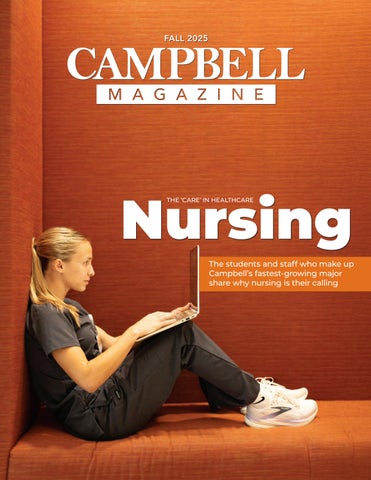
ALSO INSIDE 3.............................................From the President 4..............................................Campbell Forward 6...............................................On Campus Briefs 50...................................Distinguished Alumni 57....................................................From the Vault About the cover: Junior Emily Pierce takes a break during a lab in the Tracy F. Smith Hall of Nursing & Health Sciences. Photo by Billy Liggett
2 FALL 2025
Founded in 1887, Campbell University is a private, coeducational institution where faith, learning and service excel. Campbell offers programs in the liberal arts, sciences and professions with undergraduate, graduate and doctoral degrees. The University is comprised of nine colleges and schools and was ranked among the Best National Universities by U.S. News & World Report in its America’s Best Colleges 2025 edition. Campbell University publishes Campbell Magazine three times a year.
42......................................... A Man of Character 56..................................................From the Editor
_____________________________________
46 ALUMNI: KING FOR A DAY Forty years later, Henry Rochelle looks back on the day he set a then-NCAA record with five home runs in a single game against Radford.
The University affirms its standing policy of non-discrimination in employment and in all of its programs and activities, with respect to race, color, sex, sexual orientation, gender identity or expression, age, religion, ethnicity or national origin, disability, genetic information, protected veteran status, military status and any other characteristic protected by law, except where exemption is appropriate and authorized by law.
_____________________________________
FROM THE PRESIDENT
Why I chose Campbell Dear Friends of Campbell University,
I
am pleased to share with you this latest issue of Campbell Magazine, our signature publication for alumni and friends of Campbell University. In the pages that follow, I hope that you will enjoy catching up on the successes of our students, the expertise of our faculty and the dedication of our staff. I am confident ou will be impressed, and I invite you to follow us throughout 2026 as we continue the 138-year mission to serve our community and to lead with purpose. My Campbell journey began on July 15. As Campbell’s sixth president, I have the privilege and the responsibility of leading our institution forward into a bright and promising future. I take that responsibility very seriously, and I am energized each day by all that we are and by all that we can become. Kim and I have now fully immersed ourselves in the business of our campus and in the life of our community. What a joy it is to be here and to be part of Camel Nation!
This issu ’s cover spotlights one of Campbell’s catalysts for growth ... our nursing program. As the health care needs of our region continue to mount, the Catherine W. Wood School of Nursing is among our University’s acclaimed programs that stands ready to meet the challenge. So many Campbell academic degree programs are poised to do precisely the same thing; namely, to align our graduates with the dynamic demands of employers and of our increasingly diverse society. Whether it’s nurses, engineers, teachers, doctors, lawyers or any of the vast array of programs available to our students, Campbell is stepping forward and making an increasingly indelible mark.
MAGAZINE.CAMPBELL.EDU
Dr. William M. Downs, shown chatting with Campus Safety officers, became Campbell University’s sixth president on July 1. Photo by Evan Budrovich
When I chose to join the Campbell family, I did so for many of the same reasons that so many of you love our school. I chose Campbell for the high quality of our academic programs. I chose Campbell because we are home to a world class faculty that actually takes time to learn the names of the students sitting in their classrooms. I chose Campbell because we are supported by a talented and professional staff that makes ou institution run smoothly each and every day. I chose Campbell because of its caring, compassionate, welcoming and authentic Christian community. I chose Campbell because it is a pleasure to come to work on such a beautiful and safe campus.
Magazine. I also want to encourage you to be an active part of writing our University’s next chapter. The e are more than 55,000 living Campbell alumni spread out across the country and indeed around the globe. Our goal is to connect or reconnect with as many of you as possible. We are eager to hear your stories, to learn how Campbell prepared you for life and for career and to determine how we may best continue to stay engaged in each other’s respective journeys. We’d love to hear from you, to see you on campus, and to remain in touch. Until then, enjoy Campbell Magazine!
I chose Campbell because, well, it feels like home.
Whatever your passion for Campbell, I hope you will dive in and consume the news from this latest issue of Campbell
Dr. William M. Downs President
CAMPBELL UNIVERSITY 3
CAMPBELL FORWARD President William M. Downs’ Campbell Forward speaking tour — which held events in Charlotte, Winston-Salem, Raleigh, Fayetteville, Wilmington and on campus in Buies Creek — invited the community to hear Downs’ vision for the University’s future and express their own dreams and concerns for Campbell as it inches closer to its 150th anniversary. Photo by Bennett Scarborough
4 FALL 2025
HIT THE
GROUND
RUNNING Th ough campus town hall gatherings and a six-city speaking tour, President William M. Downs is listening to the Campbell community and laying the groundwork for an ambitious Strategic Plan
H
is message was clear the day he first stepped on campus on a cold, gray mid-February day just minutes after officially being announce as the sixth president in Campbell University’s 138-year history.
Downs says his goal from Day 1 has been to bring “eager ears, fresh eyes and a jolt of energy, optimism and positivity” to his role as president, as well as a willingness to search and ask for the resources that are needed. In his first Campbell orward speaking tour stop in Charlotte in September, he laid out three priorities for the coming months — strengthen and defend what works well at Campbell, fi what doesn’t work well and “have the audacity to dream big about Campbell’s future and the determination to deliver on those dreams.”
Dr. William M. Downs was ready to get to work. “I have studied as much as I can about Campbell University,” Downs told a chapel full of faculty, staff an students that day. “I have absorbed the data; I have watched every YouTube video possible. I’m an up-tempo guy, and the moment I arrive on July 1, we’re going to get busy. I’m excited about that.” True to his word, the first five-plus months of Downs’ tenure in Buies Creek have been productive. A sixcity speaking tour from the Queen City to the coast. Th ee town hall meetings dedicated to laying the groundwork of a fi e-year strategic plan. Meetings and guided tours with every dean and nearly every program on campus. Immediate improvements to the student experience on campus.
MAGAZINE.CAMPBELL.EDU
THE TOUR Dr. William M. Downs, shown talking to students during a Dean’s List awards ceremony in September, vowed to be an active listener during his first several months as Campbell’s president.
A well-executed staff app eciation awards program. New admissions initiatives for both undergraduate and graduate programs. A record-breaking Giving Day. And those are just the public-facing events.
The speaking tour stops in Charlotte Winston-Salem, Raleigh, Fayetteville, Wilmington and on campus in Buies Creek were designed to be “meet the president” events for Campbell’s growing list of alumni in those cities. They ere also a chance for Downs to present an early blueprint of his vision for Campbell. At his first sto in Charlotte, Downs declared that the University’s days of being “North Carolina’s hidden gem” must come to an immediate end. CAMPBELL UNIVERSITY 5
IMMEDIATE IMPACT July: Two weeks into President Downs’ tenure, Campbell’s residence halls saw the installation of more than 365 new washer and dryer units, all outfitted with modern amenities and each replacing outdated machines. August: Downs announced the overhaul of old HVAC and boiler systems on campus with more reliable and energyefficient cooling and heating systems. These improvements and replacements are ongoing. August: Campbell launched its new MyCampbell app over the summer, touting it as the “digital front door” to the university. The app provides easy access to event calendars, financial services and grades for students and convenient HR, IT and health services links for faculty and staff. September: Campbell announces changes to the J.A. Campbell Scholarship in an effort to garner more participation in the contest portion of the four-year fullride scholarship named after Campbell University’s founder. November: The College of Pharmacy & Health Sciences announced a new Guaranteed Pathway for Admission into its Doctor of Pharmacy program for undergraduates, part of Downs’ initiative to strengthen Campbell’s undergraduate programs and retain those who seek graduate school. November: Sparked by several challenges led by Downs, Campbell’s Giving Day set a record for most donors (2,381) and raised more than $1.2 million to support student scholarships, programs and the future of Campbell University.
President William M. Downs and First Lady Kimberly Downs with mascots Gladys and Gaylord at the Buies Creek stop of the Campbell Forward tour. Photo by Bennett Scarborough
“Campbell has become the quintessential ‘best kept secret,’ and in my view, that’s a problem,” he said. “Not enough people know about us, and they can’t choose you if they don’t know about you.” In Winston-Salem, Downs encouraged alumni to step up and become a bigger part of the formula for Campbell’s success and to use their talents to support their alma mater. In Fayetteville, he asked alumni to help in expanding Campbell’s footprint in Cumberland County. And in Buies Creek — in front of a large audience of faculty, staff and near y residents — Downs spoke of Campbell’s important distinction of enrolling more North Carolinians than any private university in the state. “The e are schools that have been successful in our state that have simply turned their back on North Carolina students in order to attract students from elsewhere. We will never do that,” he said. “That means e have got to be physically present, both in
August: In an effort to show appreciation for Campbell University’s staff, President Downs launched the Cherished Camel Awards in August to recognize performance and “promote excellence and provide visible university-wide appreciation of employees who demonstrate daily dedication, initiative and productivity.” Winners were Vanessa Jackson, Ben Severin, Nancy Lawrence, Carla Danks and Crystal Dark.
6 FALL 2025
our high schools and in our churches. … We are inextricably tied to one another, town and gown. They say that fo tune favors the bold, and when Campbell has been bold, our county, our region and our community have all benefited ” At his final stop in Wilmington in November, Downs said he and his wife, Kimberly Downs, thoroughly enjoyed getting to know a Campbell community that deeply loves its alma mater and has genuine interest in Campbell’s future. “We shook a lot of hands, learned many new names, and shared countless laughs with the Campbell faithful who remember their campus experiences with great fondness,” he said. “We’ve been fortunate to hear alumni success stories at every visit. Those a e mic drop-worthy moments. Hearing their stories speaks to our incredible mission and the important work we do at Campbell.”
September: College-bound students who want to take part in the Campbell’s new Early Campbell Commitment Program will not only have early access to housing and course registration, they’ll receive priority financial aid packaging and other benefits. The initiative was launched this fall to encourage incoming freshmen to commit to Campbell University earlier in the admissions process.
THE PLAN
Downs says Campbell University is “long overdue” for a strategic plan. In September, he announced the launch of a process that will lead to Campbell University 2026-2031: A Strategic Plan for Renewal, Growth and Recognition.
Asked what Campbell could do better moving toward the future, staff member spoke on topics like career development, student retention programs and better communication with prospective students and the existing Campbell community. Much of the discussion focused on ideas to increase undergraduate enrollment, which Downs has consistently pointed to since becoming president as a top priority both now and in the coming years.
According to Downs, the plan will “clearly and succinctly map out a set of institutional priorities that will guide us into a bright future.” He said it Downs said a good university strategic will reaffirm c e plan should be no commitments, more than fi e pages sharpen institutional “Campbell University and should set out to identity, pinpoint a has been at its best focus on three to fi e set of unexploited over the years when it big commitments. opportunities and Once written, vetted help direct resources has dared to dream ... and revised, it will in ways that will and then set out to be presented to the maximize impact. deliver on those Board of Trustees, “The best plans a e dreams. This [strategic and the plan will those that focus on plan] invites us all to be to “transform a limited number vision into action.” dream again.” of ambitious but The second phas achievable objectives will involve “unit— Dr. William M. Downs — that will facilitate level planning,” President, Campbell University forward progress,” he with more detailed said. “The best plan fi e-year plans are bold, distinctive and authentic.” created by 14 schools, colleges and major Downs hosted town hall-style meetings departments on campus. with students, faculty and staff on campu Downs talked a lot about rolling up his between Oct. 28 and Nov. 5, allowing sleeves and hitting the ground running interested members of the Campbell when he was introduced to the Campbell community to offer their input an community back in February. The last five elaborate on questions asked in a survey months have shown they weren’t just words. sent out earlier this fall (a survey that “Campbell University has been at its best garnered more than 2,000 responses). over the years when it has dared to dream The ov. 5 event was attended by more … and then set out to deliver on those than 150 staff members and focuse dreams,” he said. “This strategic plannin on discussions surrounding enrollment process invites us all to dream again … growth, fiscal sustainabilit , community I cannot wait to see what we can build engagement and strengthening the together.” University’s identity.
October: In the leadup to his five-year Strategic Plan for Renewal, Growth and Recognition for Campbell University, President Downs held three town hall gatherings for students, faculty and staff between Oct. 28 and Nov. 5. The 90-minute forums allowed interested members of the Campbell community to offer their input and elaborate on questions asked in a survey sent out earlier this fall.
MAGAZINE.CAMPBELL.EDU
COMING HOME Downs has said on multiple occasions that coming to Campbell was like coming home. A native of Raleigh, he earned his Bachelor of Arts degree in political science from NC State University before earning his master’s degree and Ph.D. in political science from Emory University in Atlanta.
His career in higher education has sent him to Georgia State University in Atlanta, Harvard University’s Minda de Gunzberg Center for European Studies, a research fellowship in Belgium, East Carolina University and, most recently, Gardner-Webb University, where Downs served as president for over five years. Throughout his journey in higher education as a research fellow, faculty member, dean and president, Downs has faced struggles brought on by events like the Sept. 11 attacks, the economic collapse of 2008, multiple hurricanes and the COVID pandemic. He says if the old adage, “what doesn’t kill you makes you stronger” is true, he comes to Campbell “pretty strong.” “And from those experiences, I come to Campbell with a strong belief that we can live out this institution’s motto — to the stars, through difficulties — regardless of what comes our way. We can navigate anything if we do it together.”
November: Campbell and Cape Fear Community College signed a new articulation agreement — the Campbell Assured Admission Program — which provides CFCC students with a “direct and seamless” pathway to continue their education at Campbell. “This is a win-win for both schools and for degreeseekers who will go on to strengthen our workforce,” Downs said.
CAMPBELL UNIVERSITY 7
ON CAMPUS 8 FALL 2025
Law school celebrates a milestone Campbell Law’s 50th incoming class its most diverse cohort to date
T
he first- ear law students entering the 2025 academic year at Campbell Law School represent a major milestone for the law school — they make up the 50th entering class. It’s also the most diverse class in the law school’s history. In his welcome to this year’s class, Dean J. Rich Leonard talked about the school’s award-winning trial advocacy program, its extensive externship and internship opportunities, its growing pro bono clinics and student-led projects, dual degrees and international opportunities. He also described Raleigh as no longer a sleepy, little Southern capital but one of the most “sophisticated, savvy and coolest places to live and work.”
OVER THE EDGE Five brave Campbell Law students went “Over the Edge” on the Pendo Building in downtown Raleigh in September to raise money for Special Olympics of North Carolina. Students Caroline Shabet (pictured), Cole Bright, Lauren Collins, Christian McClure and Elijah Colpaert rappeled down the 19-story building with the help of professional climbers and raised thousands for a good cause. MAGAZINE.CAMPBELL.EDU
Ninety students made up the Norman Adrian Wiggins School of Law’s first class in 1976. n Sen. Robert Morgan’s address to that first class, he said expectations were great, because Campbell expects more of them. “Integrity and competence must be combined if we are to have the respect of our neighbors,” he said. “Honesty and professionalism must, in the attorney life, be as inseparable as the wind that blows and the tree that is blown.” CAMPBELL UNIVERSITY 9
ON CAMPUS
Eddie Hill joined the Campbell men’s basketball staff in June as an associate head coach, following a three-year stint at UC Riverside. Shortly after his arrival, Hill was diagnosed with Stage 3 cancer. He has juggled radiation and chemotherapy treatments with his new duties coaching the Camels. Photo by Campbell Athletics
A promise to ‘Fight like Hill’ Associate head basketball coach’s current battle with Stage 3 cancer made easier, he says, thanks to the support of his new community
T
he first day of summer also marked Eddie Hill’s first day as associate head coach under new Campbell men’s basketball coach John Andrzejek. Before his arrival, the former assistant at UC Riverside underwent a routine colonoscopy, recommended for all men
10 FALL 2025
in their mid 40s to early 50s. That test revealed a few polyps and a larger mass that required surgery for removal. A biopsy showed no cancer, and an MRI was inconclusive. Hill’s start in Buies Creek came under a cloud of uncertainty. Eight weeks into his time with his new team and new program, he fl w to Dallas for his surgery in August. The surge y was a success, but the doctors determined the mass was malignant. Even worse, the cancer had spread to his lymph nodes — Stage 3 cancer. The last f w months have been a roller coaster for Hill. He remained in Dallas when the basketball team began spring workouts for his radiation and chemotherapy treatments. He returned to Buies Creek full time a week before the season began in November, and he has been with the team ever since, including traveling to Wisconsin and West Virginia for games against Power 5 programs. “I’ve tried to coach as much as I could,”
Hill said in a video produced by Campbell Athletics to announce his Fight Like Hill fundraising campaign, which partnered with the V Foundation (honoring former NC State head coach Jim Valvano) to raise money for cancer research. “I’m a little tired — a little out of practice myself as a coach — but it was great to see the guys, talk to the guys, hug the guys and, you know, shed a tear or two with the guys about life and appreciating every moment you have around people you care about and people who care for you.” Hill continues to undergo regular treatment at the Duke Cancer Center in Durham. Now months into his cancer fight, h ’s called the experience “life changing.” He said he’s grateful for the support of the Campbell community, especially Athletics Director Hannah Bazemore, Deputy Athletics Director Justin Wilkins and Andrzejek. “I’ve had so many people offer pra ers, and they’ve been so supportive,” he said. “When you go through something like
ON CAMPUS this, you recognize how fragile life is and how important every moment is. You realize how important the relationships you have are, with the people that you love and those that love you. They [the team were there for me, and I want to be there for them.” The V Foundation for Cancer Research was founded in 1993 and is dedicated to funding game-changing cancer research and scientists to accelerate Victory over Cancer and save lives. The oundation was awarded more than $458 million in grants across North America, with 100 percent of direct donations going directly to cancer research, as an endowment covers administrative expenses. To support the V Foundation and make a donation in Hill’s honor, visit v.org/FightLikeHill.
More than a name Kamden Sixkiller gets noticed for his moniker, but the Camels’ quarterback is out to prove there’s much more to him KAMDEN SIXKILLER has been proving
people wrong his entire young life.
After a freak accident when he was only 4 — he walked behind his brother who was swinging a golf club, fracturing his skull — Sixkiller’s parents were told their son could never play contact sports after surgery for a metal plate and four screws. For the Norman, Oklahoma native who, even that young, lived and breathed Sooner football, that news was devastating. Yet, he persisted. Playing for a high school deep in talent, Sixkiller didn’t Kamden Sixkiller turned in his best game as a collegiate quarterback in make his varsity squad until his senior a 50-48 double overtime win over year. When he got his chance, he Bryant, throwing for 334 yards and turned in a 1st Team All-State and five toucdowns. Photo: Campbell Athletics District Co-MVP season, throwing for 2,225 yards and 25 touchdowns. Still under appreciated, he didn’t get a ton of looks by colleges and landed at McNeese State University in Louisiana, where he climbed the ranks and started 13 games before entering the transfer portal and landing in Buies Creek this summer. “I told my coaches [at Campbell] three things when I got here: I want an opportunity to play. I want a place where I can develop. And I want to get along with coaches who are trustworthy,” he says. “I’ve found that at Campbell, and I’m in a place where I can get a degree and hopefully a master’s as well.” As for his name, Sixkiller has gotten a lot of attention from national writers on their “best football names” lists. The name is common in the klahoma Native American community. The most famous ixkiller was Sonny, former quarterback for the University of Washington who made the cover of Sports Illustrated and appeared in the movie, “The Longest Yard.” Kamden is distantly related to Sonny.
Eddie Hill returned to the sidelines for Campbell’s men’s basketball team before the start of the season. “They were there for me, and I want to be there for them,” he said of his return. Photo by Campbell Athletics
Campbell elevated assistant coach and former three-time All-American T.J. Dudley to head wrestling coach. “T.J. embodies all the qualities that I was looking for as we set out to hire the next head coach of our storied wrestling program,” said President William Downs. “He is a proven winner. He is a fierce competitor driven by the desire to exceed previous heights of excellence.”
MAGAZINE.CAMPBELL.EDU
“I’ve learned to accept that my name attracts attention,” Kamden says. “The onl drawback is I have to wear the number 6. Every coach since high school has pretty much demanded it, so why fight it?
Read more: magazine.campbell.edu
Picked to finish 10th in the CAA preseason poll, Campbell’s volleyball team finished tied for the conference title and won the conference tournament, qualifying for just its second NCAA Tournament in program history. The team was led by Gwen Wolkow, Maja Daca, Aly Clent, Hannah Pattie, Lauren Wheeler, Barbara Illig, Hailey Heytvelt and Victoria Tupy.
CAMPBELL UNIVERSITY 11
ON CAMPUS
Living in a generated world Book by professors from Campbell and Baylor universities tackles the social implications of the Metaverse and AI and asks how we can preserve what it means to be human Learn more about Society Without People and purchase the book at its website, societywithoutpeople.org
12 FALL 2025
W
hat happens when chatbots replace neighbors, and virtual worlds become more appealing than the real one? In their book, Society Without People: Th Social Implications of the Metaverse and AI, Campbell University Associate Professor of Sociology Dr. Justin Nelson and Baylor University Senior Lecturer of Sociology Dr. Christopher Pieper ask the questions needed for this pivotal time in history: How do we preserve human dignity in a world increasingly mediated by machines? Published by De Gruyter, Society Without People offers a s eeping and accessible analysis of how emerging technologies — especially generative AI and immersive virtual worlds — are reshaping identity, community and the very meaning of human connection. In their book, Nelson
and Pieper argue that these tools are not just technological novelties, but powerful forces re-architecting our social fabric. “People have had a lot of questions about how technology is going to change their lives and change the lives of their children,” says Pieper. “That was actually one o the major motivations for Justin and me, because we have young daughters under the age of 10, and we think a lot about the world they’re going to grow up in. Thi concern has resonated with a lot of people out there, and I think the publishers seemed very interested in supplying this kind of content to the broader market.” From virtual identity formation and algorithmic governance to the ethics of digital personhood, the book explores how society is evolving under the influence of platforms, a atars and artificial agents
ON CAMPUS It introduces the provocative theory of Gamism — the idea that game logic may become the dominant ideology of our digital future. The book begins with a quot from J. Robert Oppenheimer, inventor of the atomic bomb: “Knowledge cannot be pursued without morality.” But Nelson says the overall message isn’t a dystopian warning, but rather a call to “understand how our lives are changing and to engage with those changes thoughtfully and ethically.”
Balanced (a mix of positive and negative effects). elson and Pieper stress that while many books on the future include projections, they usually arrive at a single vision, which is typically exaggerated and inaccurate. “We are trying to think in terms of ranges of probability rather than precise events or timelines,” says Nelson. “The goal is not to b right or wrong in terms of predictions, but to thoroughly describe the whole scope of social effects that could arise if a gi en scenario is realized. We feel this is a more valuable social contribution than winning the prophet award.”
“We also quote Tristan Harris of the Center for Humane Technology, and he talks about how society’s first encounter with A was social media,” De Gruyter touts Nelson says. “And he Nelson’s and Pieper’s provocatively says we “There are no book as the “first majo lost that encounter. scholarly analysis” guardrails to direct The e are reams of how we’re going to use tackling the subject of data and students and [artificial intelligence]. AI and the Metaverse’s personal experiences social and cultural that indicate this It’s about who can get impact. The book cam has shaped political there first. It’s roughly three years after dysfunction. This ha a study published by not about putting shaped loneliness and Nelson and Pieper on humanity first.” how we feel about smartphone users and ourselves. And he uses their reliance on mobile — Justin Nelson — this other analogy that devices and social media Associate Professor of Sociology we used in the book: to fill their need fo Campbell University Imagine it’s the mid purpose and meaning. 1940s and you get a Nelson says the goal call from Oppenheimer. And he says, ‘Hey, of the book is to invite more people into I’m working on this technology that’s going the conversation — especially scientists and to change everything.’ And there are no social scientists — to think “as creatively guardrails to direct how we’re going to use and as widely as possible” on the plausible this. It’s about who can get there first. t’s pathways society is currently taking and the not about putting humanity first ” outcomes we are heading toward. Another feature that sets their book “The mo e people who get involved in this apart is the sketching of three plausible conversation, the more likely we’re going to future scenarios for each aspect of society have something more plausibly utopian than the authors examined. These scenario something darker,” he says. are identified as topian (best possible outcome), Dystopian (worst possible) and — BILLY LIGGETT
Campbell and its medical school cut the ribbon on a 6,000-SQUARE-FOOT STATION HOUSE, which is now home to four Mobile Health and Education Clinics, delivering crucial healthcare services to the underserved in Harnett, Duplin, Johnston and Sampson counties. The station includes three offices, a large storage area for supplies needed for the units and a meeting room.
MAGAZINE.CAMPBELL.EDU
On Sept. 16, DR. BARRY JONES was formally
installed as the third dean of Campbell University’s Divinity School. A native North Carolinian and Campbell graduate, Jones came back to his alma mater to teach in 2000 after earning his Ph.D. in Hebrew Bible and Semitic studies from Duke University. Jones took part in a Q&A after his installation ceremony and talked about the challenges that face his school and all divinity students in the near future. “What has changed about the Divinity School is the world outside the Divinity school,” he said. “Fewer people are going to seminary and divinity school, and fewer people are sensing a call to ministry. So we have to respond to that environment. We have to be more intentional about our recruiting,” he said. “I want the Divinity School to play a positive role on the campus. I want the Divinity School to contribute to the spiritual community on campus. I’d like for us to be encouragers of other people in living out their faith and living out their calling no matter what their job or subject area is. And so I think that’s very important for the school.” Read our full Q&A with Dr. Barry Jones online at campbell.edu/magazine
Professor of History DR. SAL MERCOGLIANO spoke before the U.S. Senate Commerce Committee’s subcommittee on Coast Guard, Maritime and Fisheries during a two-hour Oct. 28 hearing in Washington, D.C., on U.S. shipbuilding. Mercogliano — an expert in maritime history, nautical archaeology and maritime industry policy and nationally known for his popular YouTube channel on maritime shipping — was one of three witnesses called to share insight on reviving the country’s commercial shipbuilding industry.
CAMPBELL UNIVERSITY 13
ON CAMPUS
COMMUNITY EFFORT Second annual Camels Care CommUNITY Days brings together health science students from multiple programs for a day of service throughout the Triangle
T
hey’re the moments you just can’t experience in a classroom. And for Kelsey Bryant, a junior entering her first ear in the Catherine W. Wood School of Nursing, that moment was being paired with a “buddy” from Harnett County Schools’ Exceptional Children Program, consisting of children with various physical and intellectual disabilities. Bryant was one of several students who took the time to spend hours with their new friends — playing games, solving puzzles and sharing stories — at one of several stops along Campbell University’s second Camels Care Community Days event, held
14 FALL 2025
Sept. 12-13 both on campus and throughout the Triangle area. “Being here, it’s awesome,” said Bryant, who was taking part in her first se vice event as a student. “And it’s a great learning experience, too — helping people just makes me happy, and I know that’s an important trait to have as a nurse.” Camels Care CommUNITY Days was launched last year by the College of Pharmacy & Health Sciences (CPHS) as a way to bring students, faculty and staff together to se ve the communities that support Campbell. Organizers say the two-day event is about more than volunteering — it’s about living out
Campbell’s mission of service, leadership and community engagement. Starting with a kickoff dinner on ept. 11, nearly 20 separate events and projects happened in myriad locations across Eastern North Carolina, including food banks and donation sites in Raleigh, Dunn, Durham and Fayetteville, Make-A-Wish Eastern N.C., Special Olympics, as well as the Miracle League of the Triangle in Cary, among many others. In Year 2, CPHS and its programs were joined by students, faculty and staff from the Jerry M. Wallace School of Osteopathic Medicine. Dean Dr. Jeff Mercer said adding the medical school strengthened the goal of coming together and making a diffe ence.
ON CAMPUS “The interp ofessional nature of this initiative — with students, faculty and staff from a range of health professions working side by side — demonstrated the strength of teamwork and the value of learning from one another in service to others,” Mercer said. More than 600 Campbell students, faculty and staff olunteered at nine sites across fi e counties over the ensuing weekend with volunteers logging more than 3,500 hours of service. They epresented the med school, social work, clinical research, nursing, pharmacy, pharmaceutical sciences, physical therapy, physician assistant practice and public health. Volunteers gathered at Holly Springs United Church of Christ for Compassion Day, an event focused on showing love and support to the unhoused, or those with low incomes. At the Coharie Pow Wow Health Fair, part of the 55th Annual Coharie Pow
Wow, Campbell volunteers set up a variety of healthcare stations, where they took vital signs, tested lipid and glucose levels and provided information on nutrition and staying healthy. Back on campus, the Tracey F. Smith Hall of Nursing & Health Sciences was full of Campbell students and children from the community, both indoors and outside. Social work major Kyle Thompson sai students like him should experience service projects like CommUNITY Days and consider themselves part of a service industry. A U.S. Army veteran, Thompso said CommUNITY Days was a valuable experience for him and his fellow students. “I want to be a part of a system that helps not just veterans with mental health issues, but my community as well. The se vice aspect of this day is important, and it’s important that students get to experience this.”
Campbell medical students led the way in raising more than $4,700 through a local golf tournament to help a fellow student diagnosed with a rare form of leukemia. OWEN KURTZ was diagnosed in October 2024. “He has been fighting his cancer since and has a tremendous response to treatment, but is still facing many battles, including paying for his therapy and financial loans,” said John DiCristo, a second-year med student and president of the Student Government Association. Kurtz’s road ahead includes intensive treatment, numerous hospital stays and a long recovery process. In addition to the fundraiser, a GoFundMe page has been created to help Kurtz’ family cover medical bills. Search “Owen Kurtz” to learn more or donate.
Fourth-year medical student ASIALA’RAE M. WALKER was elected to serve as the student member on the board of directors for the Society of Teachers of Family Medicine, a national community of academic leaders committed to developing an accomplished family medicine workforce and prepared to serve as the foundation of America’s health care system.
“These students kept our athletes safe, engaged in the game and helped each player walk away with a brand-new friend. This partnership is also deeply meaningful because of the real-world learning it provides for Campbell’s health sciences students.” — Kyle Coburn, grants coordinator for the Miracle League of the Triangle. Photos by Will Bratton
MAGAZINE.CAMPBELL.EDU
A group of Campbell engineering students (and one political science student) were tasked with drawing up a plan to power the city of Raleigh over the next 30 years while cutting down costs for residents and improving the environmental impact. DiscoverE’s FUTURE CITY FELLOWSHIP, in its pilot year, is part of a nonprofit committed to sparking students’ interest in engineering, strengthening their STEM skills, and deepening their knowledge.
CAMPBELL UNIVERSITY 15
HER CALLING Emily Pierce takes a break from her Year 1 nursing lab on the second floor of the Tracy F. Smith Hall of Nursing & Health Sciences. Pierce, who is an accomplished athlete and member of Campbell’s cross country and track teams, credits her mother (a CRNA) and the care she received from nurses as a child during two brain surgeries for her decision to enter Campbell’s BSN program.
16 FALL 2025
COVER STORY
The CARE in healthcare The students and staff who make up Campbell’s fastest-growing major share how and why NURSING became their calling
E
By Billy Liggett
mily Pierce was in second grade when she underwent the first of two brain surgeries after being diagnose with Chiari malformation, a rare defect of the cerebellum, which controls balance and movement. As frightened as any 7-year-old would be before such a major procedure, Pierce says it was the floor nurses who took multipl hours talking her through everything at her level and putting her at ease leading up to surgery. Her mother, a certified egistered nurse anesthetist, showed her what the mask that put her to sleep would look like … how she’d feel when she went under and after she woke up. “It was the nurses who took such great care in explaining what was going to happen — all of that stuck with me,” she says.
MAGAZINE.CAMPBELL.EDU
CAMPBELL UNIVERSITY 17
BY THE NUMBERS U.S. NURSING
12.6
Percentage of men who are in the nursing profession, up from 9.4 percent in 2020.
46
The median age for registered nurses in the U.S. More than one-fourth of RNs report they plan to leave the profession or retire by 2030.
72
Percentage of employers who “strongly prefer” their nurses have a BSN, compared to 28 percent who currently require it.
203K
When she battled pneumonia shortly after her procedure and when she had to return to the operating table fi e years later for a follow up, nurses were there, by her side, holding her hand and guiding her through her medical journey. Pierce would overcome the surgeries, a 42-degree scoliosis curvature in her spine and having to wear a back brace at times to become an accomplished athlete — she’d score 21 goals and dish out 20 assists in two years of varsity soccer and play two years of varsity basketball for Eno River Academy in Hillsborough. Surprisingly, considering her condition, she excelled most in cross country, where she was captain of her team for multiple years and finished ninth verall in the Class 1A state cross country meet in 2022. Not surprisingly, when it came time to consider a career, for Pierce, it was always nursing. When choosing colleges, she wanted a school where she could continue to run and a school with a strong nursing program. Campbell University — which launched the
Number of projected new RN positions in the U.S. between 2021 and 2031.
4.7M
Nursing is the U.S.’s largest healthcare profession, with nearly 4.7 million registered nurses nationwide.
82M
The number of Americans aged 65 or older is expected to grow from 58 to 82 million by the year 2050, highlighting the need for more health care professionals.
Emily Pierce, a junior in the Catherine W. Wood School of Nursing, shows off her “Note in the Coat” during the Class of 2027’s White Coat Ceremony this fall.
18 FALL 2025
Catherine W. Wood School of Nursing in 2016 — checked all the boxes for that next step. Now a junior, Pierce is excelling as a long-distance runner at Campbell. She holds the program’s record in the women’s 4K, and she has the fifth-fastest ma k in school history in the 5K race. She’s also entering the first ear of a twoyear Bachelor of Science in Nursing (BSN) curriculum at Campbell, a program that — in a short time — has grown to house one of the University’s most popular undergraduate tracks. Pre-nursing has become one of Campbell’s top freshmen majors, and the School enjoyed its largest incoming class this fall. The p ogram’s popularity comes at a pivotal time for the profession, both in North Carolina and nationally. Statewide, the shortage of 12,500 registered nurses is expected by 2033, according to a 2021 study by the Cecil G. Sheps Center for Health Services Research at UNC-Chapel Hill. Th North Carolina Center on the Workforce for Health says 13 percent of the state’s
registered nurse positions are unfilled (highe than the national average of 10 percent). Campbell-educated nurses are eating into that shortage and can be found all over the state. The p ogram is currently capped at about 100 students and takes in roughly 50 each year among a field of p e-nursing candidates who have spent their first two ears taking core classes and electives. Campbell Nursing touts a strong interprofessional setting where nurses can work alongside future physicians, physician assistants, physical therapists and pharmacists and offers modern simulation facilities an hands-on opportunities in regional hospitals and clinics. “I really enjoy coming to this beautiful building every day and getting to work with a lot of other professionals and students in [osteopathic medicine] and physical therapy,” Pierce says. “We have to dress up every day, which I also really like — it all just feels really professional, and the way the program is set up, because the focus is all nursing in the fina two years.” MAGAZINE.CAMPBELL.EDU
She compares the curriculum to a graduate program within an undergraduate program. The final two ears are all nursing — classroom courses, hands-on labs and clinical rotations have the feel of masters-level courses. “Everything they’ve put in place ... it really feels like you’re getting ready for your career,” Pierce says.
Like her classmate, Annapolis Shaw needed nurses as a child.
Both she and her brother were born with a condition that required major surgery as an infant. She survived the procedure. Her brother did not.
First-year Campbell Nursing students took part in a career fair in October to learn about possible externships and career possibilities after graduation. The program reported a 100-percent job placement rate for its graduates between 2020 and 2024. Campbell graduates also scored a 96-percent first-time passage rate on the NCLEX RN exam in 2023, one of the highest passage rates in North Carolina.
“I know the doctors and the nurses did everything they could to save both of us,” she says. “I’m here today because of them, and one day I want to be there for other children and make sure they come out the other side feeling loved and cared for. I want to be a part of giving them a second chance at living a long, healthy life.”
CAMPBELL UNIVERSITY 19
On the day of her White Coat Ceremony — held in August, it’s a celebration of each student’s acceptance into the competitive program — Shaw shared a photo on Facebook of herself as a baby, resting peacefully in an infant car seat while still hooked up to breathing tubes and various IVs and monitors. In her post, Shaw credited God and “those who worked tirelessly to save my life” in making it this far. Currently a certified nurse assistant in Durham while she works toward her BSN at Campbell, Shaw says she’s seen up-close the diffe ence a nurse can make in a patient’s health journey. Their impact, she says, can be greater than the doctors in charge. “Nurses are there, around-the-clock, and I want to be that person who provides 24-7 care to somebody else,” she says. “I want to be someone’s light.” When Campbell University announced its intentions to launch a nursing program in January 2014, thenPresident Jerry Wallace — fresh off starting a new school of osteopathic medicine — said the program would strengthen Campbell’s mission to “serve our neighbors by expanding access to healthcare, especially to those who are in rural and underserved areas.” From the beginning, the program actively sought students like Shaw and Pierce, those with a passion for helping others. When the first class of 43 nursing students graduated in spring of 2018, founding Director Dr. Nancy Duffy said the students learned the most valuable tools every nurse needs — a brain, a mouth and a spinal cord. “The brain to fig e out what is happening to the patient, the mouth to speak for that patient and the spine to advocate for that student and see to it that their needs are always met,” Duffy said then. “They did ’t know what this meant on Day 1, but they get it now. We’re all about patient advocacy and clinical reasoning, and I’m satisfied that they understand this and are ready to integrate it into their practices.”
20 FALL 2025
12,500 By 2033, North Carolina faces an estimated shortage of nearly 12,500 registered nurses and slightly more than 5,000 licensed practical nurses. The biggest shortfall is projected to occur in hospitals, where demand could exceed supply by nearly 10,000 positions by 2033. According to NC NurseCast, the areas of the state most affected by the shortage will be the Triangle and Triad regions.
MAGAZINE.CAMPBELL.EDU
CAMPBELL UNIVERSITY 21
HER CALLING Annapolis Shaw said doctors and nurses saved her life when she underwent a serious surgery as an infant. She chose a career in nursing — possibly pediatrics — because she wants to be on the ‘front lines’ of patient care and be a part of teams that give people young and old a second chance at a healthy life.
22 FALL 2025
Campbell has since conferred more than 250 BSN degrees heading into the current academic year, which saw its largest class of incoming first- ear student nurses. Current Director Dr. Pam Edwards, who came to Campbell in December 2023 after serving as assistant vice president of education at Duke University Health System, credits the program’s current success on several factors — smaller class sizes, modern facilities and clinical opportunities are but a few. She also says students enjoy Campbell’s faith-based mission and the program’s Christian worldview. “I think there’s a spiritual nature about our students. The ’re attracted to Campbell, because it’s diffe ent from other nursing programs,” Edwards says. “Every program is going to teach students that we take care of and respect all patients — no matter their background, their ethnicity, their gender or their sexual orientation. But Campbell adds that spiritual element. … We teach our students to be present and to be there with patients and families. Talk to them, touch them or just be present. Tha ’s really all people want to know — that somebody cares for them.”
Pre-nursing has risen to become one of Campbell’s most popular majors for incoming freshmen. That makes for eal competition for the between 40 and 60 open seats for those who wish to enter the BSN program as a junior. Edwards says the program looks at GPA and a resume that includes service projects and overall involvement. “We like to see a well-rounded student,” she says. “The ’ll do either a written essay, or we’ll conduct an interview, which gives us a chance to learn more about the student as a whole. A student who may not have the best GPA can stand out in other areas — we haven’t gambled too often and seen it not pay off. And students who come into Campbell as a freshman and stick with the program have priority.” The junior ear begins with 300-level courses on professional nursing practice, fundamentals of nursing practice with older adults, health assessment and concepts of pathophysiology and pharmacology. Their second semester includes courses on research- and evidencebased practice and psychiatric and mental health practice. The senior ear includes
courses on leadership and health policy, nursing practice of women and children, nursing roles and population health, among others. Th program requires 780 hours of clinical work, which includes skills labs and the simulation center. Students also travel to area hospitals, clinics, medical centers and nursing homes and long-term care facilities for their clinical work. Students are required to dress “business casual” for the classroom and in their nursing uniforms for labs and clinicals. Th attire requirements are another thing that distinguish nursing from other undergraduate programs at Campbell. “It’s a professional program, and the students treat it as such,” says Abigail Blalock, the school’s new program manager, who joined in the summer. “You can tell the diffe ence in their approach and demeanor [just weeks after] orientation. And I think the dress code MAGAZINE.CAMPBELL.EDU
is just part of what sets them up for success and getting used to working in a professional atmosphere.” Few are bigger cheerleaders for the program than Krystle Edge, assistant director of nursing and assistant professor. A native of nearby Sampson County, Edge describes herself as “100 percent pro-nursing, all the time,” and says the profession was her calling. “I used to sneak and read my mom’s anatomy books when I was 12, and I remember thinking I was doing something wrong at the time,” she says. “I learned all there is to know about the reproductive system before [most children].”
“I think most programs can say this, but here it’s absolutely the truth — we have an exceptional group of faculty members who really want to make this program work and who really care about these students from Day 1.” — Nursing Director Dr. Pam Edwards
Edge was a registered nurse for Cape Fear Valley Medical Center in Fayetteville and at Betsy Johnson Hospital in Harnett County when she first became an inst uctor at Sampson Community College. She came to
CAMPBELL UNIVERSITY 23
One big selling point of Campbell’s School of Nursing is its interprofessional program, where students work alongside medical students, PA students, physical therapy students and more. Nursing joins DPT for regular pro-bono clinics that offer free therapy for nearby residents who otherwise couldn’t afford it.
24 FALL 2025
Campbell in 2019 as an assistant professor and was named Edwards’ assistant director in 2024.
didn’t meet her expectations — and she says Campbell Nursing has exceeded her hopes just a few months into it.
She says one big thing Campbell’s program has going for it is its interprofessional setting. Nursing students are often seen working alongside physical therapy doctoral candidates in labs and during regular pro bono clinics that invite real patients — many of whom couldn’t affo d it otherwise — to campus for free therapy. Nurses also work alongside medical and physician assistant grad students on Campbell’s health science campus and often in the field at f ee clinics or health fairs.
“I love it so much,” she says. “I couldn’t have asked for anything better. Here you are equipped with professors and instructors who want you to succeed and will help you every single step of the way. They a e completely 100 percent encouraging. Every day that you walk in, they are positive, and they speak into existence that you will be a nurse. And it’s just very uplifting for us. I love the atmosphere, and I love being able to actually challenge myself here.”
The p ogram’s other big asset, she says, is its faculty. “These students get faculty members wh really care about them,” Edge says. “We want them to be successful. I’m not saying that doesn’t happen at other schools, but I know it’s real here.” Shaw transferred to Campbell after enrolling in another nursing program — one that
BY THE NUMBERS N.C. NURSING
50%
Roughly half of registered nurses who enter North Carolina’s workforce each year are from outside of the state.
352
The increase in the number of registered nurses who passed the NCLEX in 2024 from the previous year (4,593 total, compared to 4,241), still a long way from meeting the demand.
Pierce says Campbell’s strength is in its simulation labs and interprofessional settings. “It all looks exactly like a doctor’s office a hospital wing, and I think that’s preparing me more than anything,” she says. “I’ll admit I was really nervous when I got here, but the labs have prepared me. It feels like riding a bike now — I think I’ll be prepared for any challenge that comes my way.”
12K
By 2033, North Carolina faces an estimated shortage of 12,459 registered nurses, with the largest need in hospital, nursing home and hospice care settings.
$73K
Average starting salary for an entrylevel registered nurse with a BSN in North Carolina, according to ZipRecruiter.
153K
The current number of registered nurses (along with 23,000 LPNs) working in North Carolina’s 46 community health and hospital systems.
Service is an important part of Campbell’s nursing program. Students are shown participating in the Campbell Cares CommUNITY Days event held during the fall.
MAGAZINE.CAMPBELL.EDU
CAMPBELL UNIVERSITY 25
THEIR CALLING Rachel Remick and Cooper Wilson are the first two Campbell nursing students to be accepted into the Wallace Servant Leadership & Character Fellowship program. Remick, an Air Force veteran from Orlando, says the program has been an “uplifting” experience. “You get the sense here that everyone wants you to succeed and do well. It feels like a tight-knit community, and you don’t always get that at other places.”
Cooper Wilson knows how to flip the switch.
He arrived in 2022 at Campbell University as Cooper Wilson, No. 73, offensi e lineman from Hendersonville High School. He’ll graduate in May as Cooper Wilson, registered nurse. Both roles require being fleet of foot, quick decision making and grit. Both also lean heavily on teamwork The biggest diff ence: mean streaks don’t work as well in nursing. And compassion for the person across from you is frowned upon in football. For Wilson, compassion is part of his strength. His father was a nurse, and growing up, Wilson saw a man who brought joy to others and had a passion for helping his patients. “I remember growing up, he just always said he loved what he did,” he says. “He’d work two diffe ent hospitals, two diffe ent units, and he enjoyed every minute of it. He just loved helping people, especially those who needed it most.” When Wilson decided to follow in those footsteps and pursue a career in nursing while playing football at Campbell, his father gave
26 FALL 2025
him some advice — take nursing school seriously. It’s going to be difficult, he said. An when you graduate, the profession doesn’t get any easier. In U.S. News & World Report’s 2025 list of the 15 most stressful jobs in the country, registered nurse ranked 14th and nurse practitioner ranked 12th (veterinarian technician ranked first, and other st essful careers included pilot, baker, construction worker and dental hygienist). This list said both nursing jobs a e “physically and emotionally demanding due to long shifts, constant high-stress situations and caring for patients who are experiencing pain and distress.” A 2025 Florida Atlantic University study found that stress, burnout and chronic short staffi all jeopardize the well-being of nurses and the quality of patient care in the U.S. Their findin found 65 percent of nurses report high levels of stress and burnout and more than two-thirds of student nurses are concerned about their potential workload after graduation. Nurses leaving the profession due to burnout (much of it reaching its peak during the
COVID pandemic) and to retirement — added to the rising number of elderly people in the U.S. and the increase in health care clinics and hospitals — are the biggest factors behind the current shortage of nurses at all levels in both North Carolina and across the country. According to the North Carolina Health Talent Alliance, about 13 percent of the state’s registered nurses positions are unfilled. The number is higher for vacant LPN positions. “We lost a lot of nurses during COVID — thousands in North Carolina alone,” says Edwards. “The e’s, hopefully, not going to be anything like COVID again, but I hope we learned from that experience. We make sure our students know they are likely going to work in tough environments. We just finished up the N.C. nstitute of Medicine report on nursing and the workforce, and the recommendations that came out of it were to increase the amount of time dedicated to teaching mental health and self care to our students. The e were a lot of recommendations to improve workplace environments and to train nurses on how to handle incivility and bullying from patients and their families.” According to Edge, mental health — whether it’s dealing with patients with mental health issues or paying attention to one’s own health — is covered in every professional course in the nursing program.
job in the country, according to the 2025 list. Nurse anesthetist ranks 16th, and registered nurse comes in at 54th. Pierce beams when asked about her future in nursing. She’ll be forever grateful to the nurses who cared for her during her own health scare, so she’s eyeing a career in pediatrics, hopefully as a nurse practitioner. “My goal is to be able to connect with my patients and make them feel better and make their day better — to make someone smile during their most vulnerable moments,” she says. “With kids, even the smallest thing you can do can mean the world to them. Having gone through it all myself, I can tell them that their setbacks are going to be the reason they come out stronger.” She says every time she steps to the white line before a long-distance race, she thinks back to her surgeries. She reminds herself that she’s come this far despite all of it. “I remember the days I couldn’t get out of bed. Those ere the hardest days of my life, but I was grateful that I had a great support system. I know not everyone has that, so [as a nurse], I want to be that support. I want to tell them to never give up. They may not ealize how important that is in the moment, but if they’re like me, they’ll always remember it.”
As a child, Emily Pierce remembers seeing her mother come home from work crying because of a difficult day at w k or because someone died under her care. When Pierce chose nursing, her mother talked to her about the difficult p ts of the profession, but her focus was more on the rewards of being a nurse. One the flip side of U.S. News & World Report’s “most stressful jobs” list is their other recent list of “best jobs in America” and “best jobs in health care.”
MORE ONLINE Campbell Nursing Learn more about Campbell’s nursing program, from admissions to curriculum, at campbell.edu. Tyresha Campbell Twenty-nine years after being born at Central Carolina Hospital in Sanford, Tyresh Campbell returned for her first job as a nurse to help deliver babies. Read her story at campbell. edu/magazine. Courtney Dahlquist Inspired by her mother’s breast cancer fight and her own serious injuries, basketball standout Courtney Dahlquist chose a career in nursing and excelled both on the court and in the classroom during her time at Campbell. Read more at campbell.edu/ magazine.
Nurse practitioner — a position that requires a master’s degree and has a median salary in the U.S. of $126,000 a year — is the No. 1
“Everything they’ve put into place [in the nursing program], it really feels like you’re getting ready for your career.” — junior BSN major Emily Pierce
MAGAZINE.CAMPBELL.EDU
CAMPBELL UNIVERSITY 27
GOING
BIG JOHN ANDR ZE JEK HELPED BUILD A NATIONAL CH AMPION AT THE UNIV ERSIT Y OF FLOR IDA. H IS A R R I VA L AT C A M P B E L L C OM E S W ITH BIG OPPONENTS ON BIG STAGES AND BIG DR E AMS TO BUILD A W INNER IN BUIES CR EEK .
BY BI L LY L IG GET T
28 FALL 2025
MAGAZINE.CAMPBELL.EDU
CAMPBELL UNIVERSITY 29
A
mid the confetti, the tears and the hugs in the moments following the University of Florida’s national championship in men’s basketball last April, John Andrzejek’s thoughts returned to a high school baseball game — yes, baseball — 16 years earlier.
He was a sophomore that year and a starter for a Hamilton High School baseball squad that rode a 20-4 record all the way to the 2009 New York Class D state semifinals. is Emerald Knights were down 2-1 heading into the final inning of pitchers’ duel against the Arkport Blue Jays, and after a leadoff single and a sacrifi bunt that moved the runner to second, Andrzejek was up with one out and a runner in scoring position. A chance to be the hero.
“And I tagged one pretty good,” he recalls, his smile giving way to a wince. “But I hit it right at the first baseman. ut. Then my buddy came up next and flew out to center to end the game.” He’s replayed the pitch, his swing and the hit many times. Sometimes, he is the hero. “Maybe I hit it just a quarter inch lower, I line it to right field, and e tie the game,” he says. “Just a little lower, and I put it right over the first basema ’s head.”
30 FALL 2025
John Andrzejek cut his piece of the net after Florida won the NCAA men’s basketball national championship in San Antonio last April. He brought it to his opening press conference as Campbell University’s new basketball coach just days later. “That piece of thread is symbolic. There will be struggles, but it shows that you can do anything. I’ve been a part of a lot of great teams that had success and can be proud of that success for a long time. But actually finishing on top is special. It’s something I’ll never forget.”
the basket and knocks the ball out of bounds off Cougar’s knee. Florida 64, Houston 63 0:19: Down two (after another Florida free throw), Houston has the final possession and can tie it o win it. Four Florida defenders apply pressure at the 3-point line, forcing Houston’s Emanuel Sharp to shoot with Gator star (and eventual NBA Lottery pick) Walter Clayton Jr. in his face. Sharp is unable to get the shot off and d ops the ball. The cloc runs out with no shot taken. Final: Florida 65, Houston 63 It’s the new biggest game of John Andrzejek’s life. He’s the assistant coach for the University of Florida’s men’s basketball team, brought in to shore up the team’s defense. He’s done that and more in the last two years — Florida ranks sixth in the nation in defensive efficien , climbing from 94th the previous season.
Tonight, the Gators faces the Houston Cougars in the NCAA Tournament championship game in San Antonio. Andrzejek’s defense is great. Houston’s is better. Not only are the Cougars ranked first as a unit, the ’re one of the most dominant defensive teams in the last 50 years. Two minutes are left. Houston leads by one. Andrzejek is at the plate again. 1:21: Florida blocks a 3-pointer and swarms a Houston big man after an offensi e board, forcing a turnover. Houston 63, Florida 62 0:52: The ators’ Alex Condon fleeces a ouston shooter after an awkward layup attempt and begins a fast break on the other end, leading to a foul and two free throws. Florida 64, Houston 63
It was Houston that entered the tournament with a once-in-a-generation defense, but it’s Andrzejek’s unit that comes up big in the final minutes. Three months later, sitting in his new office in uies Creek, North Carolina, he describes that moment as “euphoria.” “The e’s a clip of me [at the buzzer] just sprinting,” he says. “I didn’t know I could reach those top speeds. That was about as ha d as I could go … just looking for somebody to hug. The e are so many hours that go into trying to get to that moment — so many seasons where you come up short, or you’re looking up at the mountain going, ‘Wow, what would it take to get there?’ “To do it — to see the summit — it’s something.” Amid those sought-after hugs, the confetti and climbing a ladder to take his own piece of the net that night, he can’t help but think back to that baseball game. To that moment where it was all on him, and he fell short. “It was all very cathartic,” he says. “The bu den was lifted. I felt like I didn’t have to worry about that anymore.”
0:26: Florida’s Will Richard disrupts another drive to
MAGAZINE.CAMPBELL.EDU
CAMPBELL UNIVERSITY 31
Twenty-five days before John Andrzejek
became a national champion, he became a Camel.
When Florida beat Tennessee in Nashville to win the SEC Tournament on March 16, Andrzejek didn’t fly back wit the team — instead he fl w to Raleigh to interview for the vacant head coaching job at Campbell, which parted ways with Kevin McGeehan after 12 seasons (which included the team’s first NIT appearance in 2019) That e ening, Andrzejek’s team learned it would also be heading to Raleigh for the first two ounds of the NCAA Tournament. A day before the No. 1 seed Gators faced 16-seed Norfolk State at the Lenovo Center, Andrzejek was surprised by Campbell Athletic Director Hannah Basemore and Deputy AD Justin Wilkins, who presented him with a term sheet to become the program’s sixth head coach since joining Division I in 1977. News spread quickly that afternoon, sparking a whirlwind weekend of congratulation calls and texts, interview requests and — not to be forgotten — two tournament games (including a two-point squeaker against UConn in the second round). “I think with a clearer mind, we could have probably guarded UConn a little bit better,” Andrzejek says with a laugh. “You can say that in hindsight. But it all worked out.”
On April 9 — just two days after climbing the ladder and cutting the net — Andrzejek stood before a packed lobby in the Pope Convocation Center and was formally introduced to community as head coach for GOING BIG the a Campbell program that hasn’t seen the NCAA Tournament since New Campbell head basketball 1992 (before Andrzejek was born). coach John Andrzejek has As he stepped to the podium, he scheduled some of the nation’s top basketball programs for his looked around and mouthed the first non-conference schedule word “Wow” before beginning this season. his speech, which touched on his expectations and what style of basketball fans could come to expect in the coming years. WISCONSIN NOV. 3
W. VIRGINIA NOV. 6
WAKE FOREST NOV. 25
PENN ST. DEC. 2
GONZAGA
DEC. 17 The e were a lot of late nights in those 25 days, as Andrzejek says he struggled with how to divide his time between the team he helped build in Gainesville and the team he wanted to build in Buies Creek. He credits the man who would become his associate head coach at Campbell, Landry Kosmalski, for helping him set his priorities and focus on the team in Florida that needed him for at least three more weeks.
“I was conflicted, because I kn w I needed to build a staff and start recruiting at Campbell. But I also owed these Florida kids a chance to live out their dreams and reach the Final Four,” he says. “And it was Landry who helped
32 FALL 2025
me by saying, ‘Hey, the best thing for Campbell is you guys winning a national title. Even if we get behind on recruiting, [a national championship] will help our brand. It’ll help us attract more talented guys. So, it’s OK … you’re not cheating Campbell by going 70-30 for Florida. Just make sure you win the Final Four.’”
MINNESOTA DEC. 21
“[The moment] hit me — this i my opportunity,” he recalls. “I get a chance to take over this program, I get to work with these people, and I get to be a part of this community. You spend all this time preparing and trying to get the job — then you realize this is all real. It was genuinely one of the best moments I’ve ever had.” Andrzejek brought a friend to his opening press conference and revealed it midway through his speech. The six-inch piece of whit nylon rope from the net he helped cut down in San Antonio received the second largest applause that day.
“That piece of th ead is just symbolic,” he says. “The e will be struggles, but [the net] shows that you can do anything. I’ve been a part of a lot of great teams that had success and can be proud of that success for a long time. But actually finishing on top is special. t’s something I’ll never forget.”
MAGAZINE.CAMPBELL.EDU
CAMPBELL UNIVERSITY 33
His build and athletic ability
might have been more suited for baseball or even football, but basketball was always Andrzejek’s first l ve. “I was a pass-first gu ,” he says. “Good passer. I played hard. Tried to rebound. Not a great shooter.” He played all three sports growing up in tiny Hamilton, New York, a town roughly the size of Lillington and home to Colgate University. The salutatorian of his 2011 graduatin class, Andrzejek was a member of the school newspaper, the Colgate Seminar Program, French Club, Model U.N. and Mathletics club. He was accepted into an Ivy League school — Columbia University — as a John Jay Scholar and had it in his mind that he would one day be a teacher or professor in philosophy or psychology. Maybe even math. But he also wanted to be a high school basketball coach. And when he got to Columbia, he sent an email to Head Basketball Coach Kyle Smith and asked if he needed someone to help out. “I think the No. 1 reason he replied is because I said I was from Hamilton, and he played at Hamilton College,” Andrzejek says. “That kind of sta ted the butterfly effec ”
34 FALL 2025
He earned a degree in philosophy in just two and a half years, graduating with a 3.85 GPA while also working full time as Smith’s team manager and assistant to the director of operations (he also played for the program’s junior varsity squad). He was charged with coordinating videos from the coaching staff and managing mith’s “unique” statistical database (Smith’s coaching style was dubbed “Nerdball” because of his early use of analytics in his decision making). After graduation, Andrzejek became Columbia’s director of basketball operations in 2014. He followed Smith to the University of San Francisco in 2016 before landing his firs assistant coaching job at Johns Hopkins. Under Smith (now the head coach at Stanford University), Andrzejek says he learned a lot from an approach that blended analytics with an “old school” approach. “It’s all about accountability,” he says. “It’s about findin blue-collar guys who may have been underappreciated on the recruiting trail. Guys from diffe ent backgrounds who have great attitudes and great work ethics. It’s about working hard and having fun, growing from where you’re planted, taking pride and being in the moment.” Columbia went 25-10 during the 2015-16 season — the school’s best season in decades — and won the
CollegeInsider.com Postseason Tournament. Smith, with Andrzejek by his side, would post winning seasons in all three years at San Francisco and three of his fi e seasons at Washington State (including an NCAA Tournament win in 2024) before taking the Stanford job. “The biggest thing I can say about his p ograms is he spends a lot of time and takes a lot of care into making sure he gets the right people on the bus, so to speak,” Andrzejek says of Smith. “Every manager, every coach and every player … there’s an extensive vetting process. He really gets to know people — what makes them tick — and he’s not afraid to pass on some big talent if they’re not going to fit the cultu e. And I think that’s hard to do. Nowadays, you’re kind of ingrained to just take the most talent and try to figu e it out. But he has the self confidence to make su e he gets the people who are going to get along, going to be good teammates and good coworkers, and they’re going to be a good fit for the p ogram. “Tha ’s the kind of coach I want to be.” One of the other coaches who got his start at Columbia and followed Smith to San Francisco was a young man named Todd Golden, who became the successor at USF when Smith moved on with Andrzejek to Washington State. In his third year, in 2022, Golden led the Dons to a 24-10 record and their
MAGAZINE.CAMPBELL.EDU
first NCAA Tournament appearance in 24 years. The day afte his first- ound loss to Murray State, Golden was named head coach at the University of Florida. After a 16-17 first season, olden reached out to Andrzejek in 2023 to become his assistant. In Andrzejek’s two seasons under Golden at Florida, the Gators posted a 50-16 overall record, two trips to the NCAA Tournament and one national championship. When Andrzejek took the Campbell job, Golden spoke of those days at Columbia and the coaching tree that has grown under Smith in the last 10 years. “That staff has e head coaches now, and we were not that good, which makes it even better,” Golden said. “I’m incredibly proud, [and] I know my mentor Kyle Smith is incredibly proud that people are appreciating what, for lack of a better term, our tree has been able to do in college. When you see a guy like John get an opportunity at a great place like Campbell to come in and take over the job and see what he’s able to do with his imprint on the program, he knows he has my full support. Myself and Kyle will be there for him whatever he needs.” Andrzejek says he’s sought advice from his mentors since taking the job, and the message has been the same — just be yourself.
CAMPBELL UNIVERSITY 35
“I think there’s a trap that some new head coaches fall into where they try to just be a facsimile of their mentors, but it’s a balancing act,” he says. “You’ve got to take the great things that you learned from them and make those a part of your identity and philosophy, but you have to be uniquely yourself, too. Players are going to sniff it out if ou’re trying to be somebody else or if you’re trying to be phony. Tha ’s never been a problem for me. “I realize that as a head coach in this modern era — with the transfer portal and revenue sharing and NIL — you’re also a CEO. The e’s a lot to this job, and you need to be able to hire people who are elite in their own right and trust them to do what they’re good at. I can’t micromanage every little aspect and expect to succeed.”
The average age of a first-time colleg basketball head coach at the Division I level is between 42 and 43 years old. At just 32, Andrzejek — despite his experience and the “skins” he’s accumulated as an assistant — is still considered a “pup” in the game. Asked over the summer why now was the right time and why Campbell was the right fit, he flipped the calendar back a w months to December — Christmas Eve, to be exact — and the night he proposed to his now-fiancé
“After I proposed, people asked me, ‘How’d you know she was the one?’ and the answer I gave then is the answer I give now,” he says. “When you know, you just know.” Since his hiring, Andrzejek has immersed himself in the Campbell community, buying a home in nearby Angier and getting to know Camel fans, whether they’re approaching him at the grocery store or at the handful of Campbell Caravan events hosted by Campbell Athletics over the summer. In several interviews, he’s compared Buies Creek to his hometown of Hamilton and even the town of Pullman, Washington, where he coached at WSU for three seasons. It’s been over 30 years since Campbell has been to the NCAA Tournament. Camel fans, Andrzejek says, are excited and hungry for a winner. “They want us to be successful, but these a e smart fans. The understand it’s going to take a little time,” he says. “Don’t get me wrong, this team and this staff a e focused on having a great year and going as far as we can go, but I’m not going to put a ceiling up just yet. I think we’ll be capable of a lot. But we have to build things the right way and build it organically. “Everyone from our coaching tree is a big believer in process over results. Build the type of program we want and trust that 36 FALL 2025
it will lead to us getting to where we want to go.” The oster heading into the fall included just four holdovers from last year’s 15-17 team that finished fifth (out of 14) the Coastal Athletic Association last spring. Of the four, Cam Gregory and Tasos Cook saw significant playing time las year, averaging roughly 8 and 5 points a game, respectively. The est of the roster features transfers from other mid-major programs — including NCAA Tournament teams Norfolk State and Robert Morris and larger programs like Pepperdine, Western Kentucky and Green Bay-Wisconsin. Andrzejek looked for guys who played big roles on those teams (most averaged between 9 and 13 points a game) and who understand what it takes to win at the mid-major level. “The most impo tant thing is I need guys with great attitudes, who work really hard and who want to be here,” he says. “Having a great attitude means being a fountain, not a drain. Being a light bulb and bringing energy to a room. We’re up front about playing in a small town, which has led to a lot of self-selecting and a roster of really good kids. You have to be proud to be here. And I think that’s what we’re building.” Like Florida, Campbell’s squad under Andrzejek will feature two “bigs,” run hard, play a side-to-side style and rely on heavy ball screens and a motion offense. efensively, his teams will be physical, keep teams out of the paint and “ice on the side-ball screens.” While there will be nuance and changes here and there, the overall blueprint will remain the same. If it ain’t broke, don’t fix it “I did a little exercise with our team this summer,” Andrzejek says. “I asked them, ‘Do you know when the Florida players last year made it a goal for themselves to win a national title?’ I went around the room, and they said, ‘Sept. 1,’ ‘the first game of the ear’ or ‘during the summer.’ Everyone had diffe ent answers. But I said, ‘No. We never made it a goal.’ Process over results. Before every game, Todd Golden told the team they needed to prove they’re one of the best teams in America. From the first game to the national title game. The same message. “You can come in to a new program making too many goals, because sometimes great things happen a little ahead of schedule, and sometimes it’s slightly behind schedule. We want to build this into one of the best programs of the CAA. If there’s a goal, that’s it. We want our quality to be really high, and we’ll just trust that if each year we’re one of the best two, three or four programs in the conference, that will eventually lead us back to the NCAA Tournament.”
MAGAZINE.CAMPBELL.EDU
CAMPBELL UNIVERSITY 37
ENGINEERING
SPACE RACERS CAMPBELL’S MARS ROVER TEAM HAS GROWN FROM NEWBIE TO ONE OF THE NATION’S BEST
M
uch like their athletics counterparts, the engineering students in Campbell University’s NASA Human Exploration Rover Challenge team found a rival heading into the 2025 competition last spring. The niversity of Alabama Huntsville is located just three minutes from the U.S. Space & Rocket Center, which hosts the annual NASA HERC event, and the home team had won the competition fi e times since 1996 — including back-to-back wins in 2023-2024 — and was the favorite yet again to threepeat this year. Campbell’s team, meanwhile, didn’t form a team until 2019 (the school itself is just now turning 10), and 2024 was its best showing ever — a third-place overall finish and a it Crew Award for its repair work after a somewhat rocky start. Campbell viewed UAH as the Michigan to its Ohio State. The uke to its UNC. A Goliath to its team of Davids. “The ’re the home team. A lot of their parents work at NASA, and they’ve had close contact with them over the years,” says Dr. Lee Rynearson, associate professor of engineering and the faculty sponsor for Campbell’s HERC squad. “The ’re the model team. The ’re what our team strived to become.”
38 FALL 2025
THE CHAMPS Ethan Kessler, Rachel Stokes, Austin Pearce, Josh Terrio and Julian Brickhouse were the leaders of the 2025 NASA HERC team that won first place in Huntsville, Alabama last spring. The team spent months putting together their rover and competed on a course that simulated the terrain of a planet like Mars. Photo by Evan Budrovich
MAGAZINE.CAMPBELL.EDU
CAMPBELL UNIVERSITY 39
Huntsville’s winning rover in 2024 was named Theseus, a name that Campbel ’s team found motivation in. While Theseus, in reek mythology, was a hero known for slaying the Minotaur, there’s also a philosophical thought experiment called the Ship of Theseus, whic questions whether an object remains the same if all of its original components are gradually replaced over time. “The e are many reasons why you might name your rover Theseus, but our students saw it a their team taking minimal risks and rebuilding the same rover,” Rynearson says with a smile. “So heading into this year, our team went with Icarus.” Rachel Stokes Co-Pilot “The biggest thing I’ll take away from this competition is the hands-on experience and learning to persevere even when there are stumbles along the way. This event teaches you how to coach others and how to be coached — how to use the skills you have but also acknowledge the skills of your teammates and work together.”
Ethan Kessler Lead Engineer “My biggest takeaway from being a part of this team is leadership. They put me in a lead role in just my second year, and I learned a lot about skills delegation. I got to learn about working with others, knowing what people are capable of and then being able to break down our approach, assess our needs and just execute.”
40 FALL 2025
Icarus, another famous figu e in Greek myth, was the son of the inventor Daedalus, who made Icarus artificial wings made of feather and wax. Icarus fl w too close to the sun with his new wings, and the melting wax eventually led to his downfall. Icarus’ story is a cautionary tale against hubris and ignoring wise advice. “The name also signaled that e were willing to take technical risks,” Rynearson says. “We were going to fly close to the sun ” The name was a burn — pa don the pun — to their rivals. The extra moti ation (and the carbon fiber wings” used for their rover’s carbon leaf suspension) pushed Campbell’s team over the top. On April 12, Campbell took home the top prize — first place verall in the Collegiate Division (their rivals finishe third). And the program’s new HERO team placed second overall in NASA’s new remotecontrol rover competition. It was a banner day for a team competing for just the seventh time since 2019 (a few of those years were virtual due to the pandemic) and for a School of Engineering still less than a decade old. The HE C competition draws more than 500 students from 35 colleges and universities and 40 high schools from 20 states, Puerto Rico and 16 other countries. Teams are given instructions each December and are tasked with building a machine that can navigate a half-mile obstacle course — built to simulate the surface of Mars — while conducting mission-specific task challenges and completing multiple safety and design reviews with NASA engineers. The over challenge is one of NASA’s eight Artemis Student Challenges reflecting th goals of the Artemis campaign, which will land
Americans on the Moon while establishing a long-term presence for science and exploration, preparing for future human missions to Mars. Last spring, the competition added a HERO competition, tasking teams with creating a model-sized rover that can be controlled by a remote control. A separate team from Campbell placed second overall in that competition and won a “Most Improved” award for best score increases between the first and second uns. The niversity’s performance in Alabama was huge for Campbell’s engineering program, says founding Dean Dr. Jenna Carpenter, who called both groups’ performances “a tremendous accomplishment.” “Our students have literally spent hundreds of hours designing and building the rovers, as well as completing the required documentation, oral presentation, STEM outreach activities and social media campaigns,” Carpenter said. “The technical and p ofessional skills and expertise they’ve gained is immeasurable.”
Ethan Kessler, last spring’s lead engineer who will enter his fourth year in the team this fall, says the HERC experience offers an educationa experience you can’t usually find in the class oom. “Going into the workforce, if you want to become a manager at any level, it helps that you’ve had experience interacting with a team like this. You learn here that being a leader isn’t bossing people around. It’s working with them toward a shared goal,” Kessler says. “And I’m studying electrical engineering, but the mechanical engineering experience I’ve received from being a part of this is invaluable.” It’s not just building and teamwork, both competitions also teach another valuable lesson for future engineers — documentation. According to last spring’s flight surgeon an recent Campbell graduate Julian Brickhouse, documentation matters big to NASA engineers. “NASA requires not only for us to do the entire physical competition, but for us to write about everything that we’re building as well,” he says. “If you can’t prove that it’s going to work and you can’t prove that you did the work to do it, then you can’t really claim it’s your work. MAGAZINE.CAMPBELL.EDU
Documentation was the reason that we got as close as we did to be able to get first place. t felt awesome knowing that we were able to finall figu e out what NASA was looking for in the reporting. Some of our reports were more than 100 pages long.” Going forward, Campbell’s program hopes to build a “blue chip program” like the one in Huntsville, and Rynearson hopes future teams see orange and black and associate that with engineering success. More importantly, he hopes students continue to compete for spots on the HERC and HERO teams, because of the value of the experience. “This competition teaches ou how to coach others and how to be coached,” says Rachel Stokes, who piloted the winning rover in April. “It teaches you how to use the skills you have but also acknowledge the skills of your teammates and work together. We’re getting so much more out of being a part of this.” Online: Learn more about the HERO team that placed second in NASA’s first-ever remote-controlled rover competition.
Austin Pearce Team Member “Coming in as a freshman, I’d seen pictures and videos of patch rovers, but I had no idea all that went into a project like this. Just seeing the teamwork that goes into building a rover, I learned so much. Next year, I hope I can move into a leadership role and keep this success going.”
CAMPBELL UNIVERSITY 41
42 FALL 2025
Illustration by Amanda Dockery
A man of
C haracter
Dr. J. Bradley Creed on his legacy and importance of character education
BY BILLY LIGGE T T
T
he majority of colleges and universities that formed in the years leading up to the Civil War in the early and mid 19th Century were formed — much like Buies Creek Academy several years later — by Christian ministers or church groups. Curriculums were often interdisciplinary, and students didn’t always have majors and minors. And often, the capstone unit required of all students was a course in moral philosophy. “I’m sure it was dry as dust at times,” J. Bradley Creed says in recalling this bit of U.S. antebellum higher education history, “particularly because it was the president of those schools who taught it.” The p eeminent textbook on moral philosophy at the time was The lements of Moral Science, by Brown University President Francis Wayland, a Baptist minister and early advocate for anti-slavery causes. His book dedicated a chapter to character, calling it “by far the most important of all possessions in which a man can call his own” and “the great practical aim of Christianity.” When J.A. Campbell launched his academy 12 years after the end of the Civil War, he was careful not to tie it to any one religious denomination, but rather as a school that “emphasized moral training and its influence on the formation of good characte .” Somewhere along the way in the 138 years that followed, Creed says, higher education as a whole in the U.S. got away from prioritizing “character education.” As only the fift president in Campbell University’s history, he sought to reintroduce the idea to the school’s 21st Century curriculum. In 2024, the University became one of 29 schools in the country to receive an Institutional Impact Grant from Wake Forest University’s Educating Character Initiative, and under Creed, Campbell launched its Hallmarks Initiative, infusing character, initiative and calling into the school’s undergraduate learning experience.
MAGAZINE.CAMPBELL.EDU
CAMPBELL UNIVERSITY 43
Creed on the Student Union “It was a much needed addition to this campus. It was way overdue and it became very symbolic that the students were important and that Campbell could be more than a suitcase school. Now it’s hard to believe we didn’t have it for so long. It’s become an interpersonal place where people gather, sit around tables for meals or to study and just interact with others face to face. It’s what our university already was, and we just needed a building to bring out what is at the heart of Campbell University.”
In his 10 years as president, Creed oversaw the construction of the Oscar N. Harris Student Union and the massive fundraising campaign that made it happen, guided Campbell through the COVID pandemic and paved the way for the athletics program’s inclusion into the Coastal Athletic Association. But when asked about his legacy leading up to his retirement — which became official on uly 1 — Creed points to character and his effo ts to make it a big part of who a Campbell University graduate is and what he or she will become. “I’ve spent a lifetime reflecting on wha education should be, particularly at a place like Campbell,” Creed says. “We’re a knowledge enterprise, but we’re also in the business of changing people’s lives. Campbell is a place where you can become prepared to do certain things in life, but it’s also where you can become a certain kind of person. I think that’s part of the diffe ence that we offe .” Creed says Campbell’s focus on character education comes at a time when character has become less of a “criterion” of leaders and elected official
44 FALL 2025
“I think some of the most notorious and public failures — whether it’s somebody in business or politics — are often due to failures of character and not competence,” he says. “Tha ’s why it’s important now more than ever that we focus on this.” Creed and Vice President for Student Life and Christian Mission Dr. Faithe Beam charged faculty to become early adopters of the character initiative at Campbell and incorporate its hallmarks into their instruction. The niversity hired Rachel Nelson as director of the initiative and got groups like Student Life and Athletics to create workshops to encourage open dialogue and new ideas. The goal wa to include character as a capstone to an undergraduate’s education journey. “We hear so much about identity and students trying to ‘find themsel es,’” Creed says. “It’s part of the reason why Campbell is so important. A part of who these students are going to become is tied to their experience here.” More important than being a person who is great in their careers, Creed says he wants students to become “good people, because the world needs more good people.”
“When we talk about character here, we think about the classic virtues,” he says. “The e’s ethics in business, medicine and journalism, and while I think there’s a place for that, too often we’re teaching students what they need to know so they don’t mess up or get in trouble. [Character education] is more about the formation of the person. It’s very consonant with our ideas of the Christian faith and growing in Christ.” Campbell’s Hallmarks initiative, he says, is an expression of the University’s mission. He says incorporating character, initiative and calling into the curriculum and into faculty and staff training is one thing faith-base institutions can do (and do well) that other schools can’t. “I think with what’s happening in our country — not just at the political level, but all across the board — we need more good people and people of character,” he says. “Because it’s essential that we have a moral compass guiding us. I think schools like Campbell have a place to shine brightly going forward into the darkness.” WISE WORDS
In a ceremony honoring his 10 years of service last spring — just weeks before his final day as p esident — Creed got a surprise recorded message from his father, Dr. Charles Creed. In it, the elder Creed, who turned 97 this year, told his son how proud he was of the work he and wife Kathy did in Buies Creek and asked him to hurry up and get to their hometown of Jacksonville, Texas for a visit.
the same for the students under his charge. He says the Bible verse his father passed on to him — the same one his grandmother passed on to his father — is from Proverbs 3: 5-6, “Trust in the Lord with all you heart and lean not in your own understanding. In all your ways acknowledge him, and he will direct your paths.” In his 10 years at Campbell, Creed let just about anyone and everyone know of his Texas roots and love for the Lone Star State. So he said it may come to a shock to many that he and Kathy are staying in North Carolina for retirement. He said higher education has been a rewarding career, but it’s come with several “big moves” — 14 to be exact — and the Creeds are ready to settle down. Also, their daughter lives in Raleigh, and his son (currently in Texas) is looking to move east for his medical school residency. Just weeks before he handed the keys to the presidential office to Campbe ’s sixth president, Dr. Willliam Downs, Creed said he had found peace in his decision to retire. The e is writing and more research to be done, he says, and friends and family to visit. But most of all, he just wants to “succeed at being retired.” “My enthusiasm about what lies ahead is increasing. And my biggest plan is to just be with my wife Kathy and enjoy whatever the future has in store for us.”
Creed on the Covid pandemic “The pandemic put enormous stress on the University. But there were some real takeaways from the experience. We will forever be indebted to that response team that was made up of medical personnel and others who monitored the situation and led us through it. It was almost divine intervention that the medical school launched just a few years before, and we had all of these professionals on campus who made a huge difference. And then the cooperation of faculty, staff and students — our students experienced very real challenges during that time, and they were nothing but cooperative, understanding and encouraging. I’ll forever be grateful to them.”
Creed smiled as tears welled up in his eyes during the message. He’d later say he was touched by the gesture by Campbell and the words from his father, who “always knows the right thing to say in the right circumstances.” “I had a really good relationship with my father, so I knew my destiny was a life of respectable mediocrity,” he jokes. “Because, as you know, those who have not-so-great relationships with their parents are the ones who go on to do big things, because they have something to prove.” The character his pa ents instilled in him is the reason Creed feels so strongly about doing
MAGAZINE.CAMPBELL.EDU
Dr. J. Bradley Creed says what he looks forward to most in retirement is spending more time with his wife, Kathy Creed. The two will reside in Raleigh near family and plan to travel a lot more. Creed says he will spend retirement doing more writing and research.
CAMPBELL UNIVERSITY 45
ALUMNI
Henry Rochelle shows the bat he used to hit an NCAA record five home runs in a game in 1985 to then Campbell University President Norman A. Wiggins. Rochelle was a freshman from Holly Ridge who had only hit four home runs total in high school before his magical day against Radford University. Photo: Campbell Archives
THE FRESHMAN
For a standout high school athlete who starred in football, basketball and baseball, the move to a Division I program was quite an adjustment. In the mid-1980s, NCAA baseball teams played about a dozen exhibition games in the fall semester before the spring season commenced in late February or early March. “In high school, I was a three-sport athlete with my name in the paper every week, but when I got here, it was like I was just another fly on the wall, because e erybody was better than you. We played 13 games in fall ball, and I sat the bench,” he said. Six of his teammates went on to play professional baseball: Greg Cloninger, John Posey, Cory Satterfield, arty Warren, James White and Bill Wilkes. “My dad just said, ‘Keep doing what the coaches ask, and it’ll happen,’” Rochelle says.
HENRY ROCHELLE (‘88)
King for a day Forty years later, Henry Rochelle recalls the day he hit a record fi e home runs in one game By STAN COLE
O
n March 30, 1985, Henry Rochelle — a freshman from Holly Ridge, North Carolina — hit his firs home run at the collegiate level. Then h hit another. And another. And another. And another.
46 FALL 2025
Before then, no other player in college or major league history had hit more than four home runs in a game — not even Hank Aaron, Babe Ruth or Willie Mays. Against a first- ear program and conference opponent, Radford, Rochelle blasted fi e home runs in addition to three singles in eight trips to the plate. He broke NCAA records for homers and total bases (23) while matching the mark for runs scored (8) in a game. Not a bad afternoon for any baseball player — especially for a young man who only hit four home runs in his high school career, and who one year earlier wasn’t even planning on attending Campbell University. Forty years later, teammates, opponents and those who stood outside the fence that day at Taylor Field — now Jim Perry Stadium — still recall the day.
The 1985 egular season opened Feb. 27 in Chapel Hill against a UNC team that featured the eventual No. 1 (B.J. Surhoff and No. 11 (Walt Weiss) selections in the Major League Baseball June draft. One day later, Koonce inserted Rochelle into the lineup as a pinch-hitter — in the ninth inning with two out and the tying runs aboard against Coastal Carolina, Campbell’s first ig South opponent. Rochelle admits he took two bad swings at low and away pitches from Coastal reliever Rick Murray. Down to his final strike, h delivered on the next pitch and doubled down the right field line to tie the game one that the Camels eventually won 18-17 in extra innings. Two days later, Rochelle tossed threeplus innings of relief against Wake Forest and struck out fi e in his first moun appearance. On March 4, Koonce put him at the top of the lineup, starting in right
additional three to fi e miles per hour on his fastball, which then touched the low 90s. As Henry approached his early teens, his father taught him to throw a knuckleball, which he used as his changeup.
field at ugusta College. Rochelle singled and doubled in his first two at-bats i Campbell’s 9-6 victory. He picked up his first ca eer pitching win in relief on March 11 against Clemson and saved both games in a March 13 doubleheader sweep of Western Carolina.
In two seasons as a two-way player under Koonce, Rochelle made 23 relief appearances, started a game and compiled a 7-0 record with 11 saves. Over that same span (1985-86), he batted .303 with 23 doubles, 18 home runs and 71 RBI in 80 games as the Camels’ everyday right fielde .
Koonce pitched 10 years in the major leagues and was a member of the 1969 Amazin’ Mets World Series championship team after earning junior college AllAmerica honors at Campbell. He was known as a no-nonsense head coach, and Rochelle thrived under his tutelage. “I always had a great relationship with Coach Koonce,” says Rochelle. “I had to relearn how to pitch in three weeks’ time. He was a great coach. He was a stickler and had rules. But, being an introverted person, I’m a rule follower.” Rochelle went to Campbell because he wanted to pitch. But Koonce had other ideas. He tried him at shortstop, but that put him behind [future Atlanta Braves draftee] Greg Cloninger, 6-foot-4 with a rifle arm
Henry Rochelle (19) is congratulated at home plate by teammates after one of his NCAA-record five home runs against Radford in 1985. Photo: Campbell Archives
“He then asked if I’d ever played any outfield. We need you in right field because your arm is so strong.” Koonce taught Rochelle to throw a slider and changed his delivery to give him an
Later in life, Rochelle tutored aspiring players in the Onslow County area and shared much of the knowledge he learned from Koonce and fellow former big league pitcher Mike Caldwell, who coached him during his final two ears at Campbell. “I used to tell the parents that how I’m teaching your kids to pitch is exactly how Cal Koonce told me to hold a baseball and pitch, to tighten up your body and windup to get more push to the plate,” said Rochelle. “I had two really good coaches — two World Series pitchers who coached me at Campbell.”
Alumni April 17-18, 2026
d n e k e e W
Classes of 2021, ’16, ’11, ’06, ’01, 1996, ’91, ’86, ’81, ’76+ APRIL 17-18
MAGAZINE.CAMPBELL.EDU
CAMPBELL UNIVERSITY 47
ALUMNI NOTES 1980s-90s STAN COLE (’87) was
a national winner of the Fred Stabley Sr. Writing Contest, announced by College Sports Communicators. Cole, the associate athletics director for community and alumni engagement at Campbell, is a 37-year veteran of the Fighting Camels’ athletic department. COL. RAYMOND H. HAWKINS (’87) was selected for
inclusion in Marquis Who’s Who for excellence in military service and spiritual leadership. Hawkins built a career spanning three decades in pastoral care, military chaplaincy and spiritual leadership. Johnston County District Attorney
SUSAN DOYLE (’93 LAW)
retired on July 1 after serving nearly 20 years in the seat, winning her first election in 2006. For 13 years before that, she was assistant district attorney.
CAROLINE F. QUINN (’94 LAW) was
sworn in as District Court Judge in Judicial District 8 (Wilson, N.C.) in July. Quinn previously served as clerk of Superior Court in Wilson County for seven years. CHRIS COLLIER (’94 MBA)
was named senior vice president and dealer floor plan relationship manager at SmartBank, a full-service commercial bank with 42 branches across Tennessee, Alabama and Florida.
48 FALL 2025
MARCH 30, 1985
“Coach, I think Henry’s going to hit a home run today.” Assistant coach Frank Carmichael shared this thought with Koonce in the dugout before the Camels took the field against the visitin Radford Highlanders that day.He would not only go on to hit fi e home runs, he added three singles in an 8-for-8 day. He also scored eight times. “It was one of those days,” Rochelle recalls. “The ball looked like a olleyball.” Rochelle’s recall of each at-bat is as clear as it was in 1985. “I can tell you every one of them, it’s ingrained in my memory,” he said. “I remember the first at-bat, I got a ball that was off m hands and just made it over the fence, 10 to 15 feet from the foul pole. My second, fifth and sixth times up, I hit hard ground balls for singles between short and third.” As the Camels batted around in both the third and fourth innings, Rochelle homered to left in both frames. “The guys who eren’t pitching that day were in charge of running down foul balls and home run balls,” recalls Scott Evans, who like Rochelle was a freshman from eastern North Carolina on the 1985 squad. “I remember after Henry hit his third home run, Doug Barefoot said, ‘Damn Henry, you’re wearing us out!’” His two-run drive off a belt-high cu ve ball in the seventh inning cleared the light pole in left center field and extended the lead to 31-0. In the latter innings, Koonce substituted for most of the other players in the starting lineup, including slugging first baseman ill Wilkes (who finished with two homers and se en RBI). Ralph Berrier, a freshman walk-on outfielder for Radford’s first baseball team, emembers his mind wandering late in the game. “When I got into the game, about the seventh or something, somebody hit a home run and I looked at the scoreboard we were down 30-something to nothing, and I was thinking, they might score 40, that might be really cool,” says Berrier, who as a longtime columnist for The Roanoke Times and freelance journalist has written numerous times about Radford’s inaugural baseball season. “Then it dawned on me ... hell, Ive never seen anybody score 30 runs in a game.” Rochelle asked for one more at-bat in the eighth, and Koonce gave him the opportunity. After being brushed back for the second-
To celebrate the 40th anniversary of his historic five home run game, Henry Rochelle returned to Jim Perry Stadium in the spring to throw out the first pitch.
straight time on the first pitch y Radford reliever Gene Riggs, Rochelle again launched a waist-high curve to the same spot. Forty years ago, few baseball players — except for “Mr. October” Reggie Jackson — drew attention to themselves while rounding the bases following a home run. That sense of decorum was expected to be observed on a Cal Koonce-coached team. “When I rounded second base, I looked up at Coach Koonce in the third base coach’s box, and he did the key sign to his mouth,” said Rochelle. “I just kept my head down and kept running around the bases. If you look at the pictures taken at home plate when my teammates were congratulating me, I didn’t even smile.” Rochelle broke NCAA Division I single game records for home runs (5) and total bases (23) and tied the mark for runs scored (8). Th Camels set a new NCAA mark for total bases (72) in a game, while posting the second-highest total number of hits (37), home runs (10) and RBI (36) recorded in a game at the time. Campbell scored in every inning. Harnett County native Ron McLamb was a student broadcaster for the Campbell-owned WCCE radio station and on the call that day. “When you’re calling a game, obviously you’re aware that if someone hits a home run, he might hit another, and when they hit two,
ALUMNI NOTES you kind of think they might hit a third,” says McLamb, who spent 12 years behind the mic for Campbell basketball and baseball games. “When he hit the third one, you think there’s no way he’s going to hit four. Then laughingly you think to yourself, there’s no way he’s going to hit a fifth; and then he does ”
played in 171 games with a .297 batting average, 38 doubles, 24 home runs and 93 RBI. On the mound, his .850 winning percentage (17-3 won-lost record) still stands as the best in CU Division I history. He fashioned a 3.85 ERA and added 11 saves over 45 appearances. He was an all-conference selection as a senior in 1988.
THE REACTION
TIME GOES BY
As he did after each game in the days before email and even fax machines, Campbell sports information director David Snipes phoned in (or sent a story via a telecopier, which required eight minutes to transmit one typewritten page) game scores and details to local and regional newspapers, TV and radio stations and both the Associated Press and United Press International wire services.
McLamb, who is still active as a public address announcer for Triton High School football and UNC softball games, remembers just how good that 1985 squad was.
By the time Rochelle returned home to Holly Ridge that night, his high school AD, baseball and football coach already knew. Growing up, Rochelle and his cousin Ronald Shepard were regarded as two of the best athletes in Onslow County. Their ri alry was friendly, but keen, and it just so happened that when Rochelle walked into a nightclub in Jacksonville that Saturday night after his big game, one of the first people he saw wa Shepard, who had enjoyed a great game that day while playing for Lenoir Community College. “[Ronald] said, ‘Hey Henry, did ya’ll play ball today? How’d you do?’ and I said, ‘We won.’ I didn’t want to say anything about it. So, I asked him how they did, and he said, ‘We won; I went 3-for-5 and had two home runs today.’ Then he looked at me and said, ‘ ow did you do today?’ and I didn’t want to say anything, but I said, ‘I went 8-for-8, hit fi e home runs and we won 38-0.’ Fourteen years after Rochelle’s big day, in 1999, Marshall McDougall joined the very short list of the only NCAA players to hit more than four homers in a game. However, McDougall hit six in Florida State’s 26-2 win at Maryland. Today, Rochelle’s reaction to having his record broken is the same as it was in 1999. “Records are meant to be broken; enjoy it while it lasts,” he says. “When somebody else breaks it, congratulate them and move on.” For the record, Henry’s four-year career included many more highlights. Over his four seasons, Campbell averaged 30 wins per year, and Henry
MAGAZINE.CAMPBELL.EDU
“Winning that game 38-0 that day was memorable, but that team beat Clemson, Maryland twice, UNC Wilmington three times, Western Carolina three times, UNC Charlotte, East Carolina twice, Coastal Carolina. Tha was just a good team,” says McLamb, who was also on the call fi e years later when the Camels earned their first trip to the NCAA egionals. When Rochelle was featured in Sports Illustrated magazine’s “Faces in the Crowd” segment in 1985, not only was his and his team’s performance highlighted, but Radford was included in the 38-0 final sco e. “Jerry Crittenden — who was the catcher on the team — 40 years later said, ‘I don’t know why we didn’t drill that S.O.B.’” Berrier adds. “Th funny thing to me is that the rest of us have laughed it off ver the years; it’s kind of neat to be associated with an NCAA record, but Jerry hadn’t gotten over it.” Rochelle and many of his teammates have returned to Buies Creek through the years for baseball games, golf and most importantly, spending time catching up and sharing old stories. On April 26, they gathered once again as Rochelle threw out the first pitch to hi college catcher Eric Ellis at Jim Perry Stadium to celebrate the 40th anniversary. “You go through life getting married, having a family and spending your time with your family, but 10 or 12 years ago, we started going back [to Campbell],” he says. “It’s like a fraternity — your baseball teammates and friends and the camaraderie we have. When we get together, it’s like where did all the years go? It’s funny how when I see anybody from Campbell, it brings so many good memories back. We relish the time we had together.” Read Stan Cole’s full story at gocamels.com.
BRYAN CHADWICK (’95) was
named town manager for Holden Beach, North Carolina, in August. A former police officer, Chadwick has held town manager positions in Indian Beach, North Topsail Beach, Newport and Archer Lodge. MATTHEW SMITH (’95, ’98 LAW) was
sworn in as president of the North Carolina State Bar in March. Smith joined the Bar Council in 2014 and has served in a number of leadership roles.
JINA BOWMAN PROPST (’98 LAW) was named deputy
city manager for the City of Durham, overseeing seven departments, managing a workforce of more than 1,000 and handling annual budgets of more than $225 million.
2000s LETITIA LEE (’01) was
named Johnston County Schools’ 2025 Central Office Employee of the Year. Lee joined the school district in 2017 as a licensure specialist. JANICE WASHINGTON (’01, ’04 MBA) was
named head coach of the Greensboro Groove, a founding member of the Upshot League, a new women’s professional basketball league that will begin play in 2026. Washington played for Campbell and spent nine seasons as an assistant coach at her alma mater.
CAMPBELL UNIVERSITY 49
ALUMNI NOTES Cordell Wise, Campbell University’s first Black student in 1967 and the school’s first-ever NAIA basketball All-American, was named a Distinguished Alumnus and honored during a Homecoming Week ceremony in October. He joined 1987 graduates Lew Starling and Tim Stevens on Campbell’s growing list of recognized alumni.
I’d ever seen, and without a doubt, the greatest to play for any sports team at Campbell during my years there.” In Wise’s first ear with the team, Campbell went 16-10, a six-game improvement from the previous year. The ’d go on to win 20 in 1969 and 24 in 1970, the program’s first two 20-wi seasons as a senior college. That 197 season saw the Camels beat nationally ranked Elizabeth City State in the District 29 championships to advance to its first-e er NAIA national tournament berth in Kansas City.
CORDELL WISE (‘70)
Recognition well worth the long wait Nearly 60 years later, first lack student adds ‘Distinguished Alum’ to Campbell Hall of Fame honor
C
ordell Wise made history on the basketball court as Campbell College’s firs NAIA men’s basketball AllAmerican. Between 1967 and 1970, he scored 1,584 points and led the Camels to a 60–27 overall record. By far his biggest impact came off the cou t as a trailblazer.
50 FALL 2025
When Wise arrived on campus in 1967 as a transfer from Temple University, he became Campbell’s first lack student. On Oct. 17, Wise — along with Luther “Lew” D. Starling Jr. (’87) and Tim Stevens (MBA ’87) — was named a Distinguished Alumnus of Campbell University, nearly 60 years after leaving his mark on the school. “When I got to Campbell, I met people who accepted me,” Wise said during a ceremony on campus during Homecoming week in October. “At that time, this was a school in the middle of a challenging place, and it could have been dangerous. But it wasn’t. Campbell was a beacon of light shining through the cracks, and it continues to be that light today.” Wise says, at the time, he didn’t consider his arrival at Campbell to be anything monumental. He was just there to play basketball. And play he did. Classmate David Fulton, a 1970 graduate, called Wise “one of the most dynamic athletes
Over his three-year career at Campbell, Wise led the Camels to a 60-27 overall record and was a two-time NAIA AllAmerican. He was the fastest player in program history to reach 1,000 points (in just 53 games) and set a school mark with 26 rebounds in a game against High Point. That 24-win ma k in 1970 still stands as the second-highest win total in Campbell history. And basketball wasn’t the only sport he excelled at. Wise was a highly touted and recruited wide receiver on his high school football team, but Campbell had nixed its football program in the early 1950s. The school did have a flag football team — and in one game where Wise had scored “three or four” touchdowns, he was approached by the track coach, George Wood, who was “in need of a sprinter.” He found one. Wise competed in the 100-, 220- and 440-yard dashes and won the 1969 District 29 title in the 220, sending him to the NAIA national championship in Billings, Montana, where he advanced to the second round. He did all of that without training. By the time Cordell Wise graduated from Campbell College with his degree in physical education in 1970, there were at
ALUMNI NOTES JUSTIN MERRITT (’04)
least six Black students enrolled in the school — a number that would more than double by 1972. Those ears also saw a rise in the number of Asian and Latino students. After Campbell, Wise was picked up by the Eastern Basketball League, a semi-pro league full of Division I players who fell just short of the NBA and ABA. Wise lasted three seasons in what he called a “rough and tumble league,” before starting his post-basketball career. He found jobs in the casino industry in Atlantic City before moving on to investment banking as a stockbroker and branch administrator. He also taught and coached in Trenton, Willingboro and Camden schools in New Jersey for a decade. He’d go on to become director of tennis at Mill Creek Park in Willingboro for 10 years and site director for the National Junior Tennis and Learning Center in Trenton. He most recently worked as assistant pro at Sea Pines Racquet Club in Hilton Head, South Carolina, where he taught alongside two-time major champion and former World No. 1 singles player Stan Smith. In 2024, Wise was inducted into the 2024 Campbell Athletics Hall of Fame class, recognizing his significant impact on the schoo both on and off the cou t. A year later, during the ceremony for his honor as Distinguished Alumnus, Wise asked the room to remember his old coach, Fred McCall, the man who brought him to Campbell and gave him a chance. “We have much to celebrate,” he said. “We are all part of the same family, the Campbell family.”
was named city manager for the City of Shelby, North Carolina. Merritt was the city’s former assistant manager and finance director. ARNOLD CASTRO (’07)
LUTHER D. STARLING JR. (’87) A lifelong public servant and attorney, Lew Starling has dedicated his career to his hometown of Clinton, North Carolina. After earning his business degree from Campbell and his law degree from Wake Forest University, Starling became managing partner at Daughtry, Woodard, Lawrence & Starling, with offices in Clinton and Smithfield. He has served as mayor of Clinton since 2001, leading the city to recognition as an AllAmerican City and earning the N.C. Bar Association’s Citizen Lawyer Award. “What a great place the Lord has put here for a specific person, for a purpose,” Starling said upon receiving his award. “The discipline you learn here prepares you for the challenges of life. I am satisfied that the Lord put me here, and I truly love Campbell.”
MAGAZINE.CAMPBELL.EDU
QUINN LESAGE (’07) was named to the American Legion Helena Senators Baseball Hall of Fame in Montana. During his playing career for the Senators in the mid2000s, LeSage recorded 10 victories on the mound and hit over .400 at the plate.
TIM STEVENS (’87 MBA) For nearly five decades, Tim Stevens has been one of North Carolina’s most respected journalists and storytellers. A longtime reporter for The Raleigh Times and The News & Observer, Stevens wrote more than 12,000 stories and became a leading voice in high school athletics. His work earned induction into the National High School Athletics, N.C. Sports and N.C. High School Athletic Association halls of fame, as well as receiving the Order of the Longleaf Pine.
Cordell Wise takes part in a snowball fight with classmates in 1969.
became the Texas A&M University Mays Business School’s first assistant dean of artificial intelligence, bringing over two decades of experience with emerging technologies, including data analytics, machine learning and AI. Castro was chief data and technology officer for MFG Analytic, where he guided organizations worldwide in adopting AI.
“What I learned from Campbell is that it’s going to demand your best, but at the same time, it’s going to help bring out the best in you,” Stevens said. He dedicated the honor to those who supported him along the way, especially his wife. “This recognition ... is about everyone who’s ever helped me: my family, professors, coworkers and this remarkable university that believes in people like me.”
2010s TIM ELLMERS (’10 PHARMD)
was promoted to clinical pharmacy manager at Mission Hospital in Angier. MEAGAN KISER (’10 LAW)
was appointed general counsel and vice chancellor for legal affairs at East Carolina University in May. JOHN MADDUX (’10 LAW) was
named city attorney for the City of Charlottesville, Virginia, in June. Prior, Maddux was the deputy city attorney for the City of Asheville.
CAMPBELL UNIVERSITY 51
ALUMNI NOTES DR. PAUL DIMONDI (’11 PHARMD)
was the commencement speaker for the College of Pharmacy & Health Science’s spring commencement ceremony last May. A former Campbell professor, DiMondi has held significant roles at Janssen, Pfizer and ViiV Healthcare. BRAD SALMON (’11 LAW) was
named to the district court bench in Johnston, Harnett and Lee counties by Gov Roy Cooper. BEN SEVERIN (’14 MBA)
was named Campbell University director of financial aid. Formerly an assistant director and associate director of financial aid at Campbell since 2019, Severin leads the Financial Aid Office in providing service to students and families.
BEN BOLLING (’15) was
promoted to assistant linebackers coach in his fifth season with the Houston Texans. Bolling initially joined the Texans after spending five seasons (2016-20) as an assistant coach at Campbell, where he played wide receiver and caught 100 passes for 1,329 yards and 8 touchdowns in his career. NATHAN KRAISSER (’17)
was named an assistant wrestling coach at Brown University after serving as head coach at the Naval Academy and an assistant at PennWest Clarion. Kraisser was a standout All-American wrestler at Campbell.
52 FALL 2025
Shelby Howard (’20) returned to her alma mater in July to be director of the Office of Alumni Engagement. Campbell alumni can reach her at showard@campbell.edu.
SHELBY HOWARD (‘20)
All roads lead home Campbell graduate returns to run alumni operations after four years running nonprofit fund aising
S
helby Howard returned the school she loves in July as the new director of Campbell’s Office of Alum Engagement. A proud Campbell alumna, Howard brings a strong background in leadership, administration and fundraising to the role. “Campbell University has been so good to me,” said Howard. “From the very first tou through the transition process and navigating a global pandemic, I have always felt confiden in Campbell’s mission and its interest in caring deeply for its students. As an alumna, I have felt that sense of belonging with my fellow alumni. I am thrilled to be back in the Creek and honored to be the director of alumni
engagement. I look forward to meeting you soon and working together to stay connected to our beloved alma mater.” A native of Dawsonville, Georgia, Howard graduated summa cum laude from Campbell in 2020 with a degree in Christian Studies. As a student, she was heavily involved across campus, serving as chaplain and later president of the Sigma Alpha Omega sorority. She also spent time working in the Department of Christian Studies and also earned membership in the Theta Alpha Kappa honor societ . After graduating from Campbell, Howard moved to Atlanta to complete her Master of Theologica Studies at McAfee School of Theolog . She most recently spent the past four years as an operations administrative assistant with Soliant Health, providing direct sales support to top account executives, managing client and candidate relationships and overseeing summer interns. Howard also served two years as treasurer and director of fundraising for the Sigma Alpha Omega Foundation, assisting in fundraising effo ts, budgeting and reporting. Howard resides in Holly Springs with her husband and enjoys spending time with her schnauzer, friends and family— including her brother, who is currently a student at Campbell.
ALUMNI NOTES DR. ANDREW BAE (’18 DO)
joined Wilson Physician Practices as an orthopedic surgeon specializing in total joint replacements. Bae has advanced training in total hip replacement using the minimally invasive direct anterior approach. DR. SHAYNE CASWELL (’18 DO) joined Pee Dee
Surgical Group, performing procedures out of McLeod Regional Medical Center in Florence, South Carolina. AUSTIN BURNETTE (’19) was
Richard Carden was one of the alumni speakers at the first Campbell Forward presidential speaking tour event in Charlotte in September. Photo by Bennett Scarborough
DONOR SPOTLIGHT
Inspired to give back Trust graduate says getting involved in Campbell’s alumni association his way of helping alma mater grow
R
ichard Carden (’18) got far more than a Trust and Wealth Management degree from Campbell University.
The school, he says, off ed a community that helped him grow academically, personally and spiritually, and where he built relationships that continue to guide his life today. “Campbell was a place for learning and opportunity,” he says. “It allowed me to develop meaningful relationships, grow personally and position myself for the future.” Getting involved was the highlight of Carden’s student experience at Campbell. From intramural sports and Greek life to the Camel Crazies, campus activities and peer mentoring, MAGAZINE.CAMPBELL.EDU
he immersed himself in all Campbell had to offe . He notes that the community and experiences he was involved with were what made student life truly special. Carden says he entered the wealth management field eady to excel. Now serving as a wealth advisor with Vanguard in Charlotte, he says Campbell gave him the skills and confidence to walk into rooms early in my career and hold my weight.” After graduation, he joined the Alumni Association Board of Directors, helping serve as an ambassador for the university. “Campbell provided me so much, from opportunities to education to lifelong friendships,” he says. “Serving on the alumni board allows me to help grow that mission and connect with other alumni.” Giving back, in his view, begins with volunteering and being present. Whether through mentoring, attending alumni events, or supporting Campbell athletics, Carden believes every effo t helps strengthen the Campbell alumni network. “It’s all about planting seeds. The mo e we give back, the more valuable our degree becomes, and the stronger Campbell’s future will be.” Learn how you can give back to Campbell University at alumni.campbell.edu.
named an assistant men’s basketball coach in May. A former player at Campbell, Burnett returns to his alma mater after two seasons as an assistant coach at North Alabama. DR. JAMES WERT (’19 DO)
joined Florida Cancer Specialists & Research Institute in Fort Myers over the summer. Wert completed internal medicine residency training at AdventHealth Orlando and a hematology/ oncology fellowship at the University of Mississippi.
2020s CAROLINE AUSTIN (’20 LAW)
joined Smith Debnam’s divorce and family law practice group, representing a wide range of family law issues. DR. STEPHEN MUSIC (’20 DO) joined FirstHealth
of the Carolinas on its interventional pain care team in Pinehurst.
CAMPBELL UNIVERSITY 53
ALUMNI NOTES MCKINLEY POLLACK (’21 DPT) was elected Piedmont
regional director of the North Carolina chapter of the American Physical Therapy Association.
CHRISTOPHER DOXEY (’21 DO) joined St. Luke
Wood River in Ketchum, Idaho, on the hospital’s behavioral health team. Doxey brings his passion for rural medicine and clinical interests in bipolar disorder and treatment-resistant depression to the team. PONTUS NYHOLM (’21)
won his first Korn Ferry Tour event on May 25 at the Visit Knoxville Open at Holston Hills Country Club. He earned PGA Tour membership for the first time this summer by finishing among the top 20 players in the season-long Korn Ferry Tour points list. JOSH HEIL (’22) was
named to the wrestling coaching staff at the University of Wyoming in July. As a wrestler at Campbell, Heil qualified for the NCAA Championships five times, and as a coach at Campbell, he helped the Camels win the 2024 SoCon title. DORCUS EWOI (’23)
won a silver medal in the women’s 1500-meter run at the 2025 World Athletics Championships in Tokyo on Sept. 16. Ewoi was a cross country runner and long-distance track star at Campbell where she took second in the Big South Championship 5K and 23rd in the NCAA Southeast Regional as a senior and set school records as an NCAA qualifier in the 800-meter and 1500-meter runs.
54 FALL 2025
Burgess Marshbanks Jr. spent almost all of his life in Buies Creek and ran his dentist practice in Lillington for many years until his retirement. Photo: Campbell archives
BURGESS MARSHBANKS JR. (1923-2025)
Longtime supporter, historian was ‘encyclopedia of knowledge’
B
urgess Marshbanks Jr. lived 100 of his 102 years of life in Buies Creek (those other two years he spent overseas serving his country during World War II). He attended both elementary school and college at Kivett Hall, and he even recalls meeting the founder of what is now Campbell University, J.A. Campbell, who gave Marashbanks a quarter when he was a young boy.
Marshbanks attended for two years before going to Wake Forest College for his four-year degree and Emory University for his doctorate in dentistry.
“It was the most money I’d ever seen at the time, it being the Great Depression,” he said recently. “I thought I was really well off with a qua ter.”
Marshbanks was an active oral historian and mentor at Campbell University after retirement. Well into his 90s, he supported student-led interviews and underscored the importance of preserving local history. At one of the early Academic Symposiums hosted by Wiggins Memorial Library in 2013, Marshbanks and his wife attended a student’s presentation that highlighted interviews they’d performed with communication studies students.
A walking encyclopedia of knowledge for the school he held dear to his heart, Burgess Marshbanks Jr. died on Friday, surrounded by his three daughters, Lynn, Alice and Ann Marie. Born in Buies Creek (back then, it was Buie’s with an apostrophe), he was the son of Lottie Marshbanks and Burgess Marshbanks Sr. He and his three sisters grew up on a family farm near Buies Creek Academy, which became Campbell Junior College when Marshbanks turned 3. His father was a professor and eventually a vice president of the school, which
He served in World War II as a dentist for the U.S. Army Air Corps’ 79th Fighter Squadron and established a dental practice in Lillington, where he worked until retirement.
He shared why it was important for scholars to collect oral histories: “I had a really, really good friend whom I once heard say the age-old truth: ‘If you don’t know where you’ve been, you aren’t going to know where you’re going.’”
ALUMNI NOTES LISA MILLER (’23 DHSC)
was named executive director of Baby Cafe USA, a nonprofit organization created to improve community health and reduce disparities by establishing free programs offering professional-level breastfeeding support and peer social connection. CAILIN BAILEY (’24) co-wrote
Bernard McLeod (front, center) with his family during a ceremony following his honorary doctorate from Campbell University in 2023. Photo: Campbell archives
BERNARD MCLEOD (1926-2025)
McLeod family’s Campbell ties date back to school’s founding
B
ernard F. McLeod Jr. — a 1945 graduate of Campbell Junior College, lifetime member of the Board of Trustees and benefactor of the McLeod Admissions Building dedicated in 2018 — passed away in September at the age of 98. His mother was once a housekeeper for Dr. Campbell, and his father was close friends with Campbell and taught at then Buies Creek Academy. The family home in uies Creek stood where the John W. Pope Convocation Center is today. McLeod was born in 1926, the year his father joined the school’s Board of Trustees and the year BCA became Campbell Junior College. He played baseball and basketball as a student during his two years and finished his bachelo ’s degree at Wake Forest University. McLeod went on to a successful career as an automobile dealer, insurance agent, tobacco purchaser and real estate developer. He held fast to his connection to his hometown and its university. McLeod served on Campbell’s Board of Trustees for 10 years and was named
MAGAZINE.CAMPBELL.EDU
a Lifetime Trustee in 2018. In 2010m he was presented the James Archibald Campbell Meritorious Service Award. In 2021, the Campbell Alumni Association named McLeod a Distinguished Alumnus, and in 2023, he was awarded an honorary degree. In 2018, Campbell dedicated the Bernard McLeod Sr. Admissions & Financial Center, the naming gift provided by McLeod Jr. in honor of his family’s legacy in Buies Creek and with the University. The building was the firs step in a re-imagining of the Academic Circle on Campbell’s main campus — its neighbor, the Oscar N. Harris Student Union, was dedicated two years later. McLeod was the great-great-grandson of a Scottish immigrant, four generations removed from Scotland. As a child of the Great Depression, he knew well the value of a dollar and the merits of a thrifty lifestyle. The cLeods hailed from the Highlands of Scotland, a land of striking beauty, yet harsh and rugged. As the saying goes, “a bonnie Scotsman can make much from little.”
an article with Chair and Professor of Communication Studies Dr. J. Dean Farmer published in the 2025 volume of the Journal of The Speech and Theatre Association of Missouri. Their article, “Do you even know who you are wearing?” looked at misogyny in hockey and hockey fandom that demeans women. LUKAS EPPSDAWSON (’24 LAW) joined
the firm of Young, Moore and Henderson PA as an associate attorney. In his role, Epps-Dawson focuses on civil litigation and insurance law.
JAKE MURRAY (’25) signed a
professional contract to pitch for the Minnesota Twins in August. The left-hander was named All-CAA Honorable Mention and tabbed CAA Pitcher of the Week twice in his final season with the Camels in 2025.
SEND US YOUR NEWS!
Get included in our Alumni Notes, or let us tell your story! Email us at alumni@campbell.edu for career, wedding, engagement or birth announcements.
CAMPBELL UNIVERSITY 55
PROGRAM FIRST FROM FROM THETHE EDITOR EDITOR
Campbell’s men’s soccer team earned its first-ever Coastal Athletic Association Championship Tournament win at home on Nov. 6 when it blanked UNC-Wilmington, 4-0, in front of heyenthusiastic tellhey youtell very you early veryon early — on when — whenThe knife Theinknife my in heamy t was heapushed t was pushed in a little in a little a large, home crowd yourFreaks’ child yourischild still snuggly is still snuggly wrapped wrappeddeeperdeeper while all while of this all of was this happening was happening when my when my of ‘Creek at Athletics Complex. in theCampbell’s white, in the white, blueappearnace and blue pink andstriped pink stripeddaughter daughter received received her first herletter firstfletter om an f om in- an inin theblanket CAAsblanket was first since fromitsthe from hospital the hospital — that—it that state it college, state college, lettingletting her (and herher (and parents) her parents) know know joining the conference in 2022. all goesallbygoes too by fast. tooAnd fast.for And thefor first thefive first years five years that her that next herstep nexttoward step toward adulthood adulthood is rightis right
Preparing Preparing toto letlet gogo
TT
Athletics of myPhoto: of daughter’s myCampbell daughter’s beautiful beautiful life, I thought life, I thought they they aroundaround the corner. the corner. were allwere fullall of full it. of it. Thi ty Thi months ty months away. Thi away. ty Thi months. ty months. Those Those days ofdays diaper of diaper changes, changes, 3 a.m. 3feedings, a.m. feedings, Part ofPart me wants of me to wants hidetoallhide future all future admissions admissions unsuccessful unsuccessful attempts attempts at getting at getting them back them back letters,letters, and part andofpart me wants of me to wants be excited to be excited to sleep, to strapping sleep, strapping them in them andin outand of out car of car about this about monumental this monumental time oftime life she’s of lifeabout she’s about seats, hauling seats, hauling that stroller that stroller everywhere everywhere you you to experience. to experience. (And another (And another part of part me wants of me to wants to go, bringing go, bringing them their themown theirneatly own neatly sorted sorted ask Campbell ask Campbell why they why haven’t they haven’t reachedreached out). out). kit of food kit ofon food trips, onfinding trips, finding da care, datrusting care, trusting daycare, daycare, cleaning cleaning up spills, up cleaning spills, cleaning up spills up spills Those Those same pa same entspawho entswere whoquick were to quick warnto warn and cleaning and cleaning up spills up...spills those ...days thosedrag, daysmy drag, myme about me the about passage the passage of timeof16time years 16ago years —ago I —I friends.friends. If you’re If you’re lucky — lucky and— I was andlucky I was — lucky —need their needadvice their advice again. again. How do How I not dofocus I noton focus on you love youevery lovelong everysecond long second of it, because of it, because deep deepthe inevitable? the inevitable? How do How I fully do Iappreciate fully appreciate the the down you down know you there knowwill there bewill a day bewhen a day you when youtime she time stillshe lives stillunder lives under my roof? myHow roof?do How I letdo I let don’t need don’ttoneed readtoa read bedtime a bedtime story, astory, day when a day when go andgo trust andthat trustthis that world this isn’t world asisn’t terrible as terrible as I as I you can you nocan longer no longer pick them pickup them andup a day and a day sometimes sometimes believebelieve it can be? it can be? when they’re when they’re not embarrassed not embarrassed to be around to be around you. you. How can How thiscan bethis so sad be so andsad exciting and exciting at once? at once? But still. ButYears still.1-5 Years take 1-5forever. take forever. She’s not She’s ournot only ourchild. only She child. hasShe twohas younger two younger Whey Whey “they” “they” don’t tell don’t youtell is you that isatthat someatpoint, some point, brothers, brothers, both ofboth whom of whom are equally are equally brilliant brilliant it does it flydoes y. fly I’m writing y. I’m writing this column this column two days two days in my in eyes myand eyes both andofboth whom of whom are starting are starting to to after taking after taking my oldest my oldest of threeoftothree the to DMV the DMV to to becomebecome their own theirpeople own people (despite (despite their current their current take her take driver’s her driver’s test. I write test. Ithis write just this one just day one dayincessant incessant middlemiddle school school infatuation infatuation with the with the after the after firstthetime firstshe time asked she ifasked she could if she grab could grabnumbers numbers 6 and 7). 6 and 7). the keys, thepick keys,uppick herup friend her friend down the down road theand road and But you But only youhave onlyone have “first one”“first and thinking ” and thinking go get go some getice some cream. ice cream. And inAnd just in a few justdays, a few days, about of this all of —this and— putting and putting my thoughts my thoughts to to we’ll bewe’ll handing be handing her theher keys thetokeys a vehicle to a vehicle that thatabout all paper — paper has — been has a been struggle. a struggle. I am fully I am aware fully I aware I will, whether will, whether I like itI or likenot, it orbenot, hers.be hers. am incredibly am incredibly fortunate fortunate to be attothis be at point, this point, and and And I say Andthis I say without this without a shreda of shred sensationalism of sensationalism none ofnone thatofis that lost on is lost me.on But me. it still But hurts. it still hurts. for column’s for column’s sake —sake it feels — itlike feels only likeyesterday only yesterday for me,for I have me, Iaccess have to access a whole to a network whole network she wasshe performing was performing a dancea routine dance routine in her in her Lucky Lucky of men of and men women and women with a with vested a vested interest interest in in elementary elementary school school graduation graduation ceremony. ceremony. In In higher higher education, education, and many and of many you of are you parents are parents fact, that fact,was that during was during COVID. COVID. It reallyIt was really just was just or soon-to-be or soon-to-be parentsparents of a Campbell of a Campbell student. student. yesterday, yesterday, in the grand in the scheme grand scheme of things. of things. I welcome I welcome your advice your advice — not— justnot onjust howontohow to Facebook Facebook is doing is me doing no me favors no favors with itswith its navigate navigate these next these30next months, 30 months, but how buttohow be to be constant constant “memories” “memories” reminders reminders showing showing there for there them forand them help andguide help their guidebig their decisions. big decisions. me herme first hersteps, first her steps,arry her Potter-themed arry Potter-themed Email: Email: liggettb@campbell.edu liggettb@campbell.edu birthday birthday party and party theand firstthetime firstshe time pe she formed pe formed
as a dancing as a dancing plate inplate a “Beauty in a “Beauty and theand Beast” the Beast” musical. musical. I’m dumbfounded I’m dumbfounded that wethat gotwe to got to this point, this point, and I find and myself I find myself wanting wanting to warnto warn colleagues colleagues who’vewho’ve becomebecome new parents new parents that it that it really does reallygodoes by in goaby blink. in a blink.
56 FALL 56 FALL 2025 2025
Billy Liggett Billy Liggett Editor |Editor Campbell | Campbell Magazine Magazine
Ca clu O. ph ran ea W dig m lib
Campbell College Alpha Phi Omega club students hang out at the old O.E. Dixon Grocery store in 1969. This photo is one more than 18,000 photos ranging from the 1940s through the early 2000s that has been added to Wiggins Memorial Library’s growing digital photo archive system in recent months. See more archived photos at library.campbell.edu.
MAGAZINE.CAMPBELL.EDU
FROM THE VAULT
CAMPBELL UNIVERSITY 57
Post Office Box 567 Buies Creek, NC 27506 www.campbell.edu
With more than 150 undergraduate majors and graduate programs in medicine, pharmacy, business, divinity, education and more, Campbell University is where students come for life-changing degrees. Learn more at campbell.edu.
58 FALL 2025 Photo by Bennett Scarborough