thegood CAMPBELL HALL MAGAZINE
SUMMER 2018 I VOL . 7
thegood CAMPBELL HALL MAGAZINE
Campbell Hall is committed to fostering a community that
HONORS THE DIVERSITY OF THE HUMAN EXPERIENCE. We are devoted to cultivating and sustaining a safe environment that empowers individuals and groups to discover and celebrate their identity. We believe race, ethnicity, religion, culture, national origin, gender identity and expression, sexual orientation, age, ability, and socioeconomic status to be examples of what constitutes diversity in our community. Through personal and corporate innovation, affirmation, and education, we strive to build and support an open and inclusive community dedicated to the principle of respect. We are ever mindful of our call to be decent, loving, and responsible human beings.
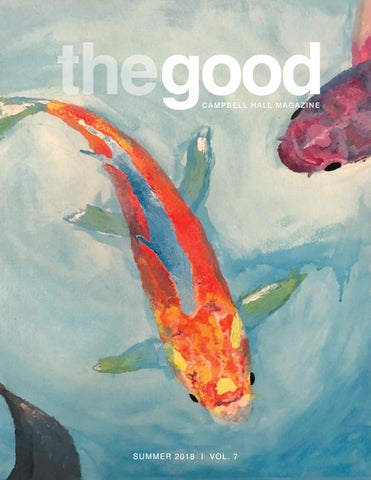
O N THE C OVE R 2 campbell hall magazine I SUMMER 2018by Zander Miner ’21 in Painting I course. Acrylic on canvas created
4
graduations + awards + honors
FROM THE HEADMASTER By The Rev. Canon Julian P. Bull
16
6
Valedictorian Speech Matriculation List High School Awards
READERS + WRITERS + INQUIRERS By Robin Frank
18
INTROSPECTIVE PROFESSIONAL DEVELOPMENT By Marina Kheel, ED.D.
20
HIGH SCHOOL GRADUATION
ENGAGING + INSPIRING STUDENTS
52
ROBOTICS TEAM
54
SPEECH & DEBATE TEAM
57
GIRL SCOUT GOLD
72
6th GRADE PROMOTION + AWARDS
By Carolyn LaGaly
feature stories 24
FROM THE DIRECTOR OF DIVERSITY & INCLUSION
good people
36
By Stephanie Carrillo
BUILDING INDEPENDENCE, FREEDOM, AND A SENSE OF GLOBAL COMMUNITY By Jonny Rodgers
30
34
FROM THE PIPER Female Empowerment at Campbell Hall Realizing My American Dream SPECIAL CHAPEL: THURGOOD MARSHALL
73
PARENTS’ ASSOCIATION Volunteers of the Year
good vibrations
58
PERFORMING ARTS Campus Events Leaps & Bounds by Henry Carr ‘18
good sports
64
WINTER + SPRING SEASON ATHLETIC UPDATES College-Bound Student Athletes
good times
32
FAMILY VOICES
33
FAMILY GAME NIGHT
74
PARTY BOOK
75
GRANDPARENTS’ & SPECIAL FRIENDS’ DAY
76
BAGPIPER’S BALL
By Patrice Chanel 35
A WOMAN IN A MAN’S WORLD By Shelby Stockton
38
THE AIDS QUILT RETURNS TO CH By Erik Koski
40
TEACHING FOR TOLERANCE By Brandy Curry
41
BRINGING TOGETHER WORLD RELIGIONS By The Rev. Canon Norman Hull
42
THROUGH EACH OTHER’S EYES By Elieen Powers
44
IMPACT OF RACIAL INEQUALITY By Sarah Huss
45
MASTERS OF THEIR ARTS
46
VISUAL ARTS SHOWS By Joe Sola
50
THE REAL REWARD OF WRITING
friends for good 78
ALUMNI Spotlight: Jordan Mayerson ’07 Class Notes & Events
credits Editors + Designers Hilary Palmer Rehder ’94 Catherine LaGaly ’09 Suzanne Turpin
By Glen Hirshberg 55
ACADEMIC HONOR BOARD CONFERENCE
56
INSPIRING FRIENDSHIP + KINDNESS
Contributors Danny Baker/Epic Imagery Vivianne Fernquist Carolyn LaGaly Parent Photographers Student Photographers
ON T HE M AST HE AD hall magazine 2018 3 3D print from The STEAMcampbell Exhibition, more onI SUMMER page 46
FROM THE
headmaster
BY T HE REV. CANON JULI AN P. BULL
F
or many years now, Campbell Hall has offered a four-day Diversity and Inclusion Summer Institute training for faculty and staff, with occasional visitors from other Episcopal schools [see related story by Stephanie Carrillo on page 29]. The genius of this particular training is that it situates our work with diversity and inclusion in the context of the school’s unique identity and history as an Episcopal school and a community of inquiry. In true Anglican (and Buddhist!) fashion, the school steers a “middle way,” in this case between the shoals of leftist political correctness and rightist denial. The essential question driving our inquiry is: if the children we teach are children of God, how do we teach and nurture them in ways that allow that God-given identity to emerge and grow strong? How do we acknowledge the role of implicit bias, racism, and sexism in our history, and the polarizing politics of our present, and yet deny their power to victimize this generation? How do we work as adults to build a just and inclusive community for our children and for each other? In this way, Campbell Hall can channel the reforming zeal of movements such as #MeToo and #BlackLivesMatter while avoiding their excesses. Episcopal churches and schools have particular “street cred” for such pastoral (as opposed to ideological) work on identity and inclusion. Bishop Ollie Garver (of the Garver Gym fame!) marched for civil rights in the South back when a collar wouldn’t necessarily keep you safe in those marches. The Episcopal Church has fought a long, difficult, but conclusive battle against the mistaken notion that God-given identity and LGBTQ identities are mutually exclusive. High school chaplain SJ Stephens says in the recently released video titled Spiritual Development at Campbell Hall, “The best part about Campbell Hall is that all the teachers feel as though a spiritual identity is just as important as any other identity that you have.” I would take it a step further: if our spiritual identity is strong, who can be against us as we inquire honestly into the issues of the day? And if our community has a strong spiritual grounding, what do we have to fear as we examine our curriculum, policies, and practices for bias? Next year’s student body will include the highest percentage of students of color (37%) in the school’s history - and race is only one aspect of our diversity. We should expect and even welcome a robust and sometimes challenging debate as evidence of our community’s spiritual maturity, allowing us to disagree without dismissing each other. Indeed, we need each other in all of our glorious differences to keep each other honest as we grow.
4 campbell hall magazine I SUMMER 2018
Indeed, we need each other in all of our glorious differences to keep each other honest as we grow.
walt disney concert hall 06.11.18
â??
VA L E D I C T O R I A N DA N I E L FA R I D
To one of the best classes that Campbell Hall has ever seen, with the best families, friends, and teachers, good evening and thank you for making tonight so special. I would like to take a moment to thank my grandparents, who have traveled all the way from Cairo to be here with me tonight. I am beyond honored to represent the Class of 2018 in, sadly, our last time together as Campbell Hall students. After tonight, we will leave behind our role of classmates, and continue our lives as friends. My name is Danny, I’m Egyptian, and yes, I actually have ridden on the back of a camel up to the steps of the Great Pyramids while staring into the distance at the Sphinx (ask my mom for a picture). I have been at Campbell Hall since kindergarten, and over the years, friends and family have learned that I am obsessed with Apple products, Dwyane Wade, and especially the color orange. I am very disappointed that neither my Mom nor Gracie Giacchino allowed me to wear an orange shirt tonight. However, close friend or not, one thing that most people know about me is that I absolutely love math.
8 campbell hall magazine I SUMMER 2018
valedictorian speech I love math because it is logical, elegant, and it works exactly how you would expect it to: 1+1 will never equal 3. Unlike English, where a blue curtain in a novel in AP Lit could either mean that the homeowner likes the color blue or that he is deeply depressed. Math is inclusive; it transcends culture, gender, and race. However, as much as I appreciate the sensibility of math, one of my favorite proofs (yes, I have a favorite proof) is chaotic, confusing, and seemingly impossible. Let me explain. This proof says that 1+2+3+4+5… all the way up to infinity, is equal to negative one over 12. I’ll say that again: 1+2+3+4+5… all the way up to infinity, is equal to negative one divided by 12. When I first saw this, I thought “Wow! That doesn't make any sense.” But I knew that it had to be true, because I saw it being proven right there on my computer screen. I was determined and excited to learn more and dive deeper. I worked hard to open myself to the idea of this chaotic and confusing proof, and through exposing myself to something uncomfortable, I experienced something unexpected and exciting. What I thought to be impossible before became possible right before my eyes as I made order of this chaos and was finally able to appreciate its beauty. The Class of 2018’s journey through Campbell Hall was much like my journey with this proof, as our Viking experience transitioned from confusion to curiosity to understanding to appreciation. Junior high and freshman year were confusing and foreign. I will never forget seeing Aidan Brown come to school on the first day of 7th grade in a full Lakers jumpsuit and thinking “this is going to be a long year.” A lot of us did not yet understand how to thrive socially and academically. We were confused and did not know how to navigate the chaos of high school. Sophomore year brought a new level of familiarity, both academically and socially. We still felt day-to-day stress, but we became increasingly more involved and curious. 10th grade marked the creation of Hands for Haiti, an organization that is incredibly meaningful to me and many others in this year’s graduating class. Charlie Rettig’s lastminute decision during lunch one Tuesday to join the Haiti team proved to be one of the most important and rewarding decisions in his life. As a class, we were determined to become more involved in and dedicated to the world, bettering ourselves in the process.
Junior year brought new challenges, with harder classes, standardized testing, and the beginning of the college process. However, we also brought a unique sense of maturity and understanding to these difficult times. An 8-hour study session on the weekend with Mr. Griffin and my AP Chemistry class before the AP exam exemplifies this. We supported each other through the undeniable difficulties of junior year, and as a result, our class grew closer and stronger. I will always appreciate the talks I had with Chris Simmons when I was deciding whether or not to continue playing basketball; his support helped me tremendously. We started to understand that the only way we could thrive was together, and through this supportive atmosphere, relationships and friendships reached unforgettable heights. Obviously, our teachers and families also played a life-changing role in our high school experience, supporting us at all costs throughout our entire four years in high school. Our senior year marked more than just the end of our high school experience; it brought order to it. We now not only understand all of the social and academic aspects of high school, but we also have thrived through it all. Campbell Hall has given us all the knowledge and tools to bring order to any chaos that comes our way, in high school, college, and beyond. We even took our learning one step further, and shared it with the freshmen through the Senior Mentor program. Just like the proof, which looked impossible to me at first, but ultimately made sense, it takes a lot of work, support, and dedication to finally and fully understand. As our time as Campbell Hall students, a whole 13 years for some of those behind me, comes to a final ending in the next couple of hours, we should all be incredibly proud of what we were able to accomplish. To the Class of 2018, no matter what life holds for us in the future, I encourage everyone to embrace chaos, seek knowledge, support those around you, and dedicate yourself to your passions. Just like I did with the proof, you all have the power to make the impossible possible. We have Campbell Hall, our families, our teachers, and each other to thank for that. So as we say goodbye and head off to do amazing things in college, never forget: 1+2+3+4+5… all the way to infinity, equals negative 1 over 12. Now, it doesn’t seem so impossible. It is beautiful. Thank you.
campbell hall magazine I SUMMER 2018 9
Matriculation The Class of 2018 will attend the following colleges and universities: Amherst College Bennington College Berklee College of Music Boston University Brandeis University Brown University Carnegie Mellon University Chapman University Colburn School Colby College Colgate University Colorado College Connecticut College Duke University Eastern Washington University Elon University Fairfield University Goucher College Grinnell College Haverford College Howard University Indiana University at Bloomington John Cabot University Lehigh University Lewis & Clark College Loyola Marymount University Michigan State University MidAmerica Nazarene University New York University Northwestern University Oberlin College Occidental College Parsons School of Design Pasadena City College Rice University
Santa Barbara City College Santa Clara University Sewanee: The University of the South Southern Methodist University Stanford University Syracuse University Tulane University United States Military Academy, West Point United States Naval Academy The University of Arizona University of California, Berkeley University of California, Davis University of California, Los Angeles University of California, Riverside University of California, Santa Barbara University of California, Santa Cruz University of Colorado at Boulder University of Illinois Urbana-Champaign University of Miami University of Michigan University of Oregon University of Richmond University of San Diego University of San Francisco University of Southern California University of Tennessee, Knoxville University of Utah University of Wisconsin, Madison Vassar College Washington University in St. Louis Weber State University Wesleyan University Willamette University Williams College Yale University
High School Awards Awards and honors reflect the dual purposes expressed in the school’s mission statement: “Campbell Hall is a community of inquiry committed to academic excellence and to the nurturing of decent, loving, and responsible human beings.” We believe that true excellence, both academic and personal, is attained over a period of time, that it is reflected in attitudes as well as in specific achievements, and that it should be rewarded publicly because, at each level of the school, such awards exemplify those qualities that are most valued. We, therefore, reward excellence in scholarship and in citizenship, we limit the number of awards presented in our public ceremonies, and we assure that each award reflects the school’s philosophy appropriately for the level at which it was earned. At the close of each school year, awards and honors are presented to students at the Awards Assembly and at the Commencement Ceremony at Walt Disney Concert Hall. GRADUATION AWARDS
COMMUNITY SERVICE AWARDS
Valedictorian: Daniel Farid
This year, Campbell Hall high school students gave over 22,271 hours of service to our community. The community service awards recognize one student in each grade who has demonstrated an extraordinary commitment to serving the community based on service accrued by May 14, 2018.
Salutatorian: Cady DeCamara Highlander Award: Emma Friedenberg Headmaster’s Award: Gabrielle Baba-Conn Caledonian Award: John Kustin Viking Spirit Award: Luke Patrick Alumni Award: Henry Carr Bishop’s Award: Summer Quinn 13-Year Student Recognition: Kyle Adomian Gabrielle Baba-Conn Helaina Bechguenturian Lauren Berg Sarah Bunting Cadence Davis James DeKay Daniel Farid Keith Grossman Huston Haro Jack Hermann Addison Marsh Charles Rettig Chloe Schechter Christopher Simmons Sarah Solomon Brooke Ward
Ava Rosson - 9th grade Lily Serber - 10th grade Grace Kim - 11th grade Livia Balian - 12th grade
COLLEGE BOOK AWARDS The Brandeis Book Award is given to an outstanding high school junior in the top 10% of the class who demonstrates a commitment to social justice, volunteerism, or activism. The 2018 recipient of the Brandeis book award is Sophie Craig. The George Washington Book Award is given to a junior who demonstrates significant achievement in the following three areas: civic engagement, service, and independent and creative thought. The recipient of the GW book award is SJ Stephens. The Harvard Book Award is given to an outstanding junior who combines excellence in scholarship and character together with achievement in other fields.The recipient of the Harvard book award is Sophia Latessa. The Kenyon Book Award is given to the member of the junior class who embodies the highest level of intellectual engagement, creativity, and commitment to community that are central to the liberal arts and sciences. The recipient of the Kenyon book award is Brenne Hoeven. The Princeton Book Award is given to a junior in the top 5% of the class who has demonstrated intellectual leadership and made positive contributions to extracurricular life at Campbell Hall. The recipient of the Princeton book award is Taylor Kamemoto.
14 campbell hall magazine I SUMMER 2018
ARTW ORK BY W I LL RI C HT E R ’ 1 9
DEPARTMENT AWARDS FOR EXCELLENCE Academic Excellence Awards honor students who embody academic excellence and seek more than just an answer— they seek a deep understanding of the world around them. Their curiosity extends beyond the walls of a classroom as they ask significant questions, make meaningful connections, and extend into their lives a sense of insatiable wonder. They never lose sight of the possibilities ahead and actively pursue opportunities to enhance their depth of understanding.
The Outstanding Athlete of the Year Award honors two athletes from any grade level who competed in at least two varsity sports, had an exceptional season in at least one of those sports, and demonstrated good sportsmanship and leadership. Liza Jacoby ’18 (cross-country, track & field) Jonny Garnett ’19 (football, basketball) Three-Sport Athletes: Marcelo Navarro ’19 (football, soccer, volleyball)
SCIENCE Emma Friedenberg
Josh Cuevas ’21(football, basketball, football) Auzzie Ankai ’21(football, basketball, track & field) Andrew Mutchnik ’20 (cross-country, soccer, track & field)
COMPUTER SCIENCE Ethan Moscot MATHEMATICS Liza Jacoby HISTORY Mia Stone-Molloy ENGLISH Jacklyn Florman WORLD LANGUAGE Giulia Palermo ATHLETICS The Scholar Athlete Award honors two senior studentathletes with the highest grade point average. Abby Mapes (volleyball) Daniel Farid (golf) The Rookie of the Year Award honors two student-athletes with outstanding overall contributions in their first year of high school athletic competition at Campbell Hall. The awardwinners must have potential for continued growth and development in sports, dedication to their sports, and good sportsmanship. Kaia Glickman ’21(softball) Josh Cuevas ’21(football, baseball, basketball)
Bausch and Lomb Honorary Science Award Bausch and Lomb, in association with the University of Rochester, New York, has been offering the Bausch and Lomb Honorary Science Award for over 70 years. Recipients of this award who are accepted to and enroll at the University of Rochester will receive a scholarship of $10,000 per year for a total of $40,000 over four years. This year’s award winner is Jonah Cho ’19. The Rensselaer Medal was first presented over 100 years ago with two purposes: to recognize the superlative academic achievement of young men and women and to motivate students toward careers in science, engineering, and technology. Award winners who apply, are accepted and enroll at Rensselaer Polytechnic Institute, will receive a guaranteed $25,000 per year scholarship. The Rensselaer Medal recipient is Katherine Samuel ’19. National Merit Scholarship The National Merit Scholarship Program was founded in 1955 and is an annual academic competition for recognition and undergraduate scholarships. The program was founded to identify and honor scholastically talented American youth and to encourage them to develop their skills to the fullest. As National Merit considers finalists for college scholarships, they take into consideration a student's academic record, information about Campbell Hall, test scores, recommendation letters, information about activities, community involvement, and leadership as well as their potential in college and beyond. From approximately 1.5 million students who entered the competition, only 15,000 of them are named finalists, and only 7,500 attain winner status and are awarded a college scholarship. John Kustin ’18 - 2018 Winner Daniel Farid ’18 - 2018 Finalist
campbell hall magazine I SUMMER 2018 15
FROM
elementary school
Readers + Writers + Inquirers Fostering Inclusion through Elementary School Curricula
BY R OB IN F R ANK , ELEMENTARY SCH OOL PRI NCI PAL
All students deserve to read, write, think, and talk for the same authentic purposes that people have throughout the ages: to enrich our lives by connecting us with others, exploring who we are and who we want to become, understanding the world we live in, and figuring out the roles we want to play in that world.” —- Kate Garcia-Beaudet and Dana Bowden, Powerful Choices Educational Consulting The Campbell Hall Diversity and Inclusion mission states that “Campbell Hall is committed to fostering a community that honors the diversity of the human experience.” This has been especially true in the lives of our elementary school readers and writers this year who have been immersed in inclusive experiences through reading and writing workshops, fifth and sixth grade book clubs and (of course) Book Week. For the past two years, our elementary school language arts teachers have worked closely with Powerful Choices Educational Consulting in order to provide a rich, balanced literacy program through the implementation of reading and writing workshops. Reading and writing workshops are the brainchild of Lucy Calkins, who founded the Reading and Writing Project at Teachers College, Columbia University, whose mission is to “help young people become avid and skilled readers, writers, and inquirers.”
16 campbell hall magazine I SUMMER 2018
In the primary grades, students have had the opportunity to select books that are at their “just right” reading levels and have read non-fiction books about different cultures and countries, exposing the students to things they may not have been made aware of otherwise at this age. Students have “seen themselves” in stories from authors such as Mark Gonzalez (Yo Soy Muslim), Ezra Jack Keats (A Snowy Day), and Selina Alko (The Case for Loving) to name just a few. Library Director Linda Pechin, whose goal is “to have the library's curriculum and collection reflect inclusion and diversity throughout,” chose books for the book clubs that are representative of that goal. The fifth grade book club enjoyed Katherine Applegate’s Crenshaw as well as Rain, Reign by Ann Martin. The sixth grade book club read Best Man by Richard Peck and Kristin Levine’s The Lions of Little Rock. Finally, the elementary school faculty book club read George by Alex Gino as well as Holly Goldberg Sloan’s Counting by 7s. Fifth grade students had the opportunity to view life through another’s eyes when teachers Garry Carr and Dani Staahl had students read Sharon Draper’s Out of My Mind, a story told in the first person by an 11 year-old girl with cerebral palsy. Our fifth grade students then had the opportunity to bring the book alive through their work with the non-profit organization Shane’s Inspiration as they took part in their “Together We Are Able” program. This program pairs students with students who have disabilities and provides an interactive field trip to an inclusive playground for a day of play and learning. The elementary school writer’s workshop has been another avenue for inclusive opportunities. One elementary school teacher said, “We are never telling the students they must write about x, y, z; rather, every small moment, personal narrative, informational piece, or opinion writing is created by drawing upon and reflecting on their own personal experiences. Those stories are then shared with their peers at the end of each writer’s workshop session. This gives students a deeper look into each other’s lives and a better understanding of how our experiences are different. Students can connect with one another and establish a greater awareness of their similarities and differences.”
“I do believe something very magical can happen when you read a book.” – J.K. Rowling All students were truly immersed in the literary experience during Book Week where “Queen Peaches” made an appearance every day in elementary school chapel, high school thespians shared poetry, and religious leaders from the Guibord Center told stories centering on kindness and compassion from their traditions. The finale of Book Week was a visit for our fourth, fifth and sixth grade students from Newbery Medal-winning and New York Times bestselling author, poet, speaker, and educator Kwame Alexander. Mr. Alexander read excerpts from his books The Crossover, Rebound, Booked, Surf’s Up, and Acoustic Rooster. He hooked the students immediately by saying to his musical accompanist, Randy Preston, “I want you to play the score to my basketball story, and let’s make it like a movie.” He presented an engaging combination of talk, reading, music, and audience participation. Mr. Alexander told the students, “I wanted to include music to add a different dimension to the readings and make the words come off the page for all of you.” He encouraged, “You got to believe in yourself, never give up, it sounds like this (say it with a beat) dribble, fake, shoot, miss, dribble, fake, shoot, miss, dribble, fake, shoot, SWISH...eventually, you’re gonna make it. You just gotta keep shooting.” He left the students with this final message; “Be a star in your mind. Believe in yourself. Keep trying and don’t give up if you know it’s worth it, no matter how often you are told no.” Upon hearing they would all be receiving a signed copy of his book Rebound, students gave loud cheers and a standing ovation. Mr. Alexander truly brought to life the diversity of the human experience for our students.
campbell hall magazine I SUMMER 2018 17
FROM
middle school
Introspective Professional Development Middle School Faculty Fostering a more Inclusive Student Body BY MAR INA KH EEL , ED.D., MI DDLE SCH OOL PRI NCI PAL
18 campbell hall magazine I SUMMER 2018
How do I create a feeling of safety in the classroom? How do I effectively teach students of color as a white teacher? Which students have I unknowingly discriminated against or made uncomfortable? How can we improve the cultural understanding of different groups within the community? How do I provide meaningful experiences of empathy and teach kids to be more kind? As an advisor, how can I make my advisees feel connected to each other and the community? If a wise middle school educator were in the room, and you could ask that educator anything about teaching young adolescents, what would you ask? The middle school faculty began the year with a “mysteries council” to create an outline of work for the year. The council harvested the questions above. The middle school has taken time during monthly division meetings to explore how to further our commitment to being an inclusive community and build on our existing strength as a diverse school. To deepen our understanding of diversity topics we have read, a number of seminal articles, including “The Psychological Experience of Students of Color,” by Michael Thompson and Kathy Schultz, “What White Children Need to know About Race,” by Ali Michael and Eleanora Bartoli, and “Speak Up at School: How to Respond to Everyday Prejudice, Bias, and Stereotypes,” a publication of Teaching Tolerance. Through journaling, our faculty has explored pivotal questions such as, “What is good and useful in talking about race?” and “What is hard and scary in talking about race?” We used the central tenets of the articles and applied them to case studies, challenging teachers to respond to real world classroom situations. They discussed how to respond to racial and gender stereotypes and lean into difficult conversations that may arise among students. They grappled with which tools were comfortable or difficult for them to use to combat prejudice and how to build their capacity to embrace problematic incidents. Finally, we have used council, a form of group communication, to elicit personal stories that build empathy and multiple perspective-taking. Our last council asked participants to reflect on what it meant to be their racial identity and share with the group. This powerful experience elicited responses such as: “Being white means reminding myself that I walk around with privilege that I didn’t earn.” “To be African-American is to be a spiritual being that is strong, resilient, loving, compassionate, creative, and intelligent.” “For me, being Hawaiian means holding onto, believing, living, and expressing the core values of the Hawaiian culture. There are a few of them, but my favorite ones are aloha, malama, and ha’aha’a (love, to care for, and humbleness).” Ultimately, the design of these meetings has helped us understand one another on a deeper level and connect to our authentic selves. This work has brought us closer as a community of educators, with the goal of connecting more deeply with our students.
campbell hall magazine I SUMMER 2018 19
FROM
high school
Engaging + Inspiring Students Diverse Approaches to Teaching and Learning BY C AR OLY N LAGALY, H I GH SCH OOL PRI NCI PAL
Earlier this year, Campbell Hall welcomed a visiting committee to campus for a three-day visit as a part of an accreditation process that most independent schools actively participate in every six years. The committee was impressed by the school’s diversity of approach to teaching and learning and noted in their Visiting Team Report released in April 2018 that “it appears the school is...inviting organic, authentic ways for pedagogy to evolve with an eye toward amplifying the learning experience for all students.” This acknowledgment was no surprise to us as central to our mission and vision as a community of inquiry is the encouragement that “faculty and administrators create programs that allow students to pursue inquiries wherever they lead, and give students an experience of the transformative power of essential questions. We encourage faculty and administrators to explore approaches that help students’ curiosity expand rather than contract. A Campbell Hall education will raise issues of meaning, identity, and ultimate truth at every opportunity, but also will acknowledge the limits of human reason in the face of life’s most profound questions.” We were delighted, of course, that the committee recognized what we work so carefully to achieve in our classrooms, and we share with you here how some of our high school teachers create and invite their students into rich, meaningful learning experiences.
Donna Chung PA I N TING Students in Painting (and for that matter any visual arts course) come to understand the importance of objective judgment and subjective meaning in both the making and critique of a painting. This distinction arises quite organically in our first group critiques but is also reflected in an early project: a still life painting from a series of photographs, taken by the painter, in a personal space. This seemingly simple idea of static objects accruing meaning can be a revelatory reflection of each student’s subjective experience as well as a bit of alchemy: still life transformed into a self-portrait.
Josh Adell T H E AT R E PR ODU C T ION The overall goal of this advanced-level course for juniors and seniors is to offer the students leadership tools to independently produce, direct, write, and perform theatre work. My hope is that, when theatre students leave Campbell Hall, if they wish to produce their own work in college or professionally, they can refer back to the techniques they learned while in high school. An assignment that I have crafted to help students understand the process of independently producing their own work happens to be their first assignment of the semester. I challenge the students to create a specific environment in the drama lab, invite an audience or customers, and host them in the environment. In
20 campbell hall magazine I SUMMER 2018
past years, students have created a haunted house, a bakery, or a carnival. This year, students turned the drama lab into a meditation retreat. They had two days to collaborate in creating the prop, set, sound, lighting, and costume design. When customers arrived, they guided them to various stations in the room: yoga, guided meditation, a fruit and cucumber water bar, and palm reading. Then we debrief on the process. We ask what went well, where did we succeed, where did we fail? What happened that we didn't anticipate? Did we achieve what we set out to do? The exercise serves as a microcosm for the entire production process. By identifying at the beginning of the semester what the group did well, and what the group needs to improve, we can begin our real production with a clear set of goals.
Glen Hirshberg CREATI VE W RI TI NG One key skill that all of my creative writing classes attempt to develop in students is the ability to formulate, offer, accept, and act on specific, constructive criticism. The core experience, around which my entire program revolves, is essentially a graduate school-style workshop in which a student brings a new creative piece to class, reads it aloud to the group, then sits quietly and listens to the ensuing conversation. While I am always there to guide or redirect, the students themselves drive and arrive at the direction, specificity, and conclusions on their own.
To do this work well, students must be able to read closely (meaning, figure out what is pleasing or displeasing them in any given piece, and also how they know what they know, and also what they wish they knew more of or don’t understand), be comfortable and confident enough to jump actively into conversations, remain flexible and open enough to incorporate or challenge divergent or opposing perspectives, be specific enough to be helpful, and be kind and focused enough on the work in question (rather than the writer) to make their comments palatable to the author. Writers, meanwhile, must develop enough trust in both their classmates and the process to derive support, help, and inspiration from the conversation. The workshop experience, by design and necessity, is always different and individual to each new piece. It is in the constant give and take of ideas and conversations that writers learn faith in and commitment to the process, the limitless possibilities for improvement, and the potential power of their own ideas and perspective.
Greg Williams
E N GIN EER ING
In the engineering classes at Campbell Hall, one of our primary goals is to get students comfortable with the idea of failure. In Engineering Principles, students are given several challenges over the course of a semester. For example, students are asked to design a 3D-printed rocket with a recovery system that will bring it safely back to earth or build a balsa wood bridge that holds as much weight as possible. For many of these projects, we go through two iterations of the design process. It’s common for our projects to experience some sort of failure on the first iteration, sometimes due to errors in the manufacturing/building process and sometimes due to our design. A rocket may be unstable and tumble through the air because of its weight distribution. A bridge may break prematurely because certain joints were weak. It’s because of these failures that we have the most meaningful discussions and learning experiences, and we use these experiences to improve our design for our second iteration. We try again. Innovation happens at the intersection of creativity and risk taking. Deep, integrated learning occurs when students are comfortable with the knowledge that failure is not a dead end to accomplishing goals but rather the starting point.
Mary Pearle
H U M A N DEV ELOP MEN T
Ninth grade is a time of real challenge for our new high school students as they adjust to academic and social demands. As they race to complete homework, prepare for tests, and participate in myriad extracurricular activities, sometimes it can be a struggle just to get enough sleep. Therefore, my primary goal is to give students a time and a place on campus where they can slow down, take a breath, and reflect on their own personal inner experience. One of my favorite activities during the
semester is the final Initiation ceremony, which is designed to help students see their ninth-grade journey as part of their larger journey of pushing themselves out of their comfort zone past where they thought they could go and towards a fuller realization of their own unique path. Every successful ritual requires careful preparation, and there are numerous activities that lay the foundation for the final day. During the Dreamwork curriculum, students review material from Joseph Campbell's hero/heroine's journey and explore the archetypal characters and struggles that appear in their own dreams. Closer to the Initiation day, a class is devoted to exploring the important adolescent rites of passage ceremonies of previous and current world cultures. Our ninth grade students have studied ancient history and are familiar with Greek and Roman religious rituals and also remember that, in order to receive a gift from the gods, you first have to make an offering. Students must create an appropriate gift for a classmate and write individual, positive peer reflections for the other members of their section. During the penultimate class of the semester, a series of activities helps them imagine themselves standing behind a line that demarcates their passage from ninth grade to their life beyond. They must ask themselves two questions: First, as I step over this line, what relationships/selfjudgments/fears/habits do I want to leave behind? And second: what experiences/ opportunities/skills/relationships do I want to find on the other side? The final class they perform the ritual itself, facing challenges and trials to test their resolve and to make their intentions manifest in their ordinary lives.
Lucine Ohannessian AP STATI STI C S In AP Statistics, my goal is for students to really understand what statisticians do: the sampling, the study or experiment, the analyzing of data and, finally, making the appropriate conclusions. And although getting ready for the AP exam should help in achieving that goal, I think the students really understand the material in a practical sense with a project they do after the exam. Students choose a question that is meaningful to them and either run a study or experiment on that question. They obtain a random sample, run the study or experiment, and make their final conclusions about the question based on the data they collect. I’ve had students who loved art explore “Do you think Pollock or Raphael is more artful?” and students who were just curious ask “Is there an association between believing in God and the subject you teach?” When students go through all the steps that a statistician goes through in investigating a question that is relevant to them, the concepts presented throughout the year truly come alive.
Melodie Roden SPANI SH
Jason Mills C O M P U T ER S C IEN C E In thinking about my computer science courses, there are two main things I keep in mind. Primarily, I want my students to think about how computer science can help the world, and my secondary goal is to encourage algorithmic thinking. Historically, the students I’ve found drawn to computer science were inspired by video games and other forms of entertainment, and these students weren’t always plugged into a community service frame of mind. To address this, I’ve made a point to introduce technologies that are specifically designed to help people or technologies that are being repurposed to focus on assistance. Computerized prosthetics, autodrive cars, and ADA-compliant websites are all examples of putting technology to work in a way that benefits a lot of people. Students are invited to choose a topic in that vein that inspires them, and then they give slide presentations to walk the class through the details. They have to highlight specifics on how the technology is helping people and how computer science students could hope to participate at some point. Putting these ideas into practice requires a focus on algorithmic thinking. The main idea is to put processes into logical order without trying to memorize rote practices. We start with a classic project like analyzing the results of giving a robot very literal directions for making a sandwich. Then we take the unique approach of writing a fair amount of code on paper before writing on the computer because I’ve found students are more thoughtful when doing work slowly, by hand, without the luxury of undo or copy-and-paste.
22 campbell hall magazine I SUMMER 2018
In my Spanish classes, my primary goal is to have students feel comfortable communicating in Spanish and to balance their listening, speaking, reading and writing skills. The receptive skills (listening and reading) develop the productive skills (speaking and writing). I start every class with an audio activity in order for the students to switch their brains over to Spanish. I pause the audio activities frequently to ask questions in Spanish so the students remain engaged and can practice expressing themselves. I also believe it is very important to conduct the class primarily in the target language and require the students to speak Spanish. Students self-evaluate their use of Spanish during class, which motivates them to take ownership of their learning. Another way to reach my goal is with oral presentations. Students give several presentations throughout the year related to the themes they are learning. They are required to use images to help them remember what to say but also to ensure all students learn the thematic vocabulary. After each presentation, the students and I ask the presenter questions that develop the student’s spontaneous speaking skills. The oral presentations also help to develop their writing and listening skills. Students also read several short stories throughout the year and use them as models to write and illustrate their own. Finally, I incorporate culture through songs, videos, and movies so students develop an interest in Spanish-speaking countries and people. I love to hear stories from my students about how they were able to use their Spanish here in Los Angeles and when they travel and hope to inspire my students to travel and study abroad to deepen their second language acquisition.
Elena Malone MODERN W ORLD H I STORY In thinking about my 10th grade course, I consider how students can explore the past to shape the future. My hope is that the curriculum inspires, challenges, and develops students into independent thinkers who become engaged citizens of the world.
The most recent assignment required students to investigate an extremely difficult topic. Students reviewed and discussed genocide in the 20th century and today. They grappled with the definition and the international community’s response to genocide. Finally, they broke up into small groups to propose what the American policy on genocide should be. Their proposal was presented to the Senate Foreign Relations Committee, which was a student panel charged with questioning each group about the political, historical, economic, and military implications of each option. Options ranged from leading the world in the fight to stop genocide to intervening only when US interests are directly threatened. Students asked a series of questions including “How will other countries perceive the United States’ refusal to join the International Criminal Court while blatantly violating the state sovereignty of other nations? Couldn’t this promote an already prominent anti-American sentiment?” After the simulation, we discussed further questions: “Do individuals have a responsibility to act against genocide? What choices do people have in times of war or distress? What factors contribute to the choices people make? Some consider perpetrators and informed bystanders to be equally responsible for atrocities, do you? What can a high school student in LA do about a problem happening on the other side of the world?” We used these discussions as a starting point to look at human rights organizations and the actions of young people in the world today. Several students attended the Walk to End Genocide in LA on April 22, and all students researched and participated in some form of political activism regarding human rights. My hope is that, by having these discussions, students contemplate the role of individuals and their own role in history.
Suzy Stevens
C H A I EN GLIS H LITER AT U R E
I think of 12th grade Advanced Inquiry English Literature and Composition (a redesign of AP English Literature) as a course in cultural literacy, one that uses great literature, traditional and modern, to offer insight into the most important issues confronting us today. An obvious example is our unit on the Abrahamic faiths. The objective is to expose students to the religious foundations that shape our values and our history. In addition to reading Genesis, Exodus and the Gospel According to Matthew, students study the history, beliefs and practices of Islam, and are introduced to the Qu'ran. By comparing the Ten Commandments, Jesus's Sermon on the Mount and the Five Pillars of Islam, students discern the philosophical differences that characterize each code of ethics. They then read Women Without Men, a novel by Iranian feminist Shahrnush Parsipur.
Brad Himes BASEBALL SKI LLS Baseball Skills students have two projects during the semester. One of the projects is to create a financial budget for the baseball season. Students are to create their budget as if they were head of their own baseball program, and each student has a budget of $15,000. I allow them to use what the Campbell Hall baseball program has as a starting point for what they need to purchase; all of the equipment, baseball, bats, helmets, field maintenance equipment, and uniforms that our school already has on hand from the outset in their inventory. They then need to purchase spirit packs (hats, practice t-shirt, shorts, and a sweatshirt) for the 25 members of their program. These spirit packs are not optional, but they could use any brand that they choose. Students are to have an Excel spreadsheet detailing items purchased, quantity, and total price with an aim of getting as close to $15,000 without going over budget. Students quickly learn that money spends quicky. The first time we worked on the project in class, many of the students eagerly said at the beginning, “I’m going to order new uniforms!” and “Team cleats for me and maybe team sunglasses!” They quickly realized that it made a large dent in their budgets and some sacrifices had to be made. Sorry, no team Oakleys. All of the students were quite successful with the project, and most landed within $200 of their max. Before the students completed and turned in their budgets, I did a budget with the same parameters. After reviewing each student’s final ledger, I distributed my budget. “We all forgot to buy line up cards!” they realized. Overall, it was an eye opener as to how the program operates. The goal of a project like this one is to provide students a chance to develop real-life skills in a baseball environment. They learn the importance of working inside a budget, prioritizing and making decisions not only for them but for the people around them.
In our exploration of the Qu'ran, we listen to passages recited in Arabic by an imam, then respond to the muezzin’s 5-times-daily call to prayer by kneeling together on the floor and performing the prostrations required by the prayer ritual. More than anything, this group prayer stuns students into feeling the power of shared action and shared beliefs under Islam. The final phase of this unit investigates the Israeli-Palestinian conflict and more broadly, the turmoil in the Middle East today. AR TWOR KS BY JAMI E MORELAND ’18
Stephanie Carrillo, pictured far right, with students and faculty at the Student Voices event.
Stephanie Carrillo Director of Diversity and Inclusion
Stephanie Carrillo is a high school history teacher and the Director of Diversity and Inclusion. She works closely with Headmaster Bull to provide strategic oversight and leadership in the area of diversity for the K-12 community. Stephanie has taught in Los Angeles schools for more than 20 years and has a particular passion for area art, history, and culture. Below are excerpts from a keynote address Stephanie delivered at the Independent School Alliance organization’s Across Colors Diversity Conference (ACDC) this past November: I began my career in education in an untraditional manner. In 1993, I responded to an advertisement in the Los Angeles Times that said only: “Teacher Wanted for Girls’ Juvenile Detention Facility” with nothing else but a phone number. Although I had never taught before, I figured that my two years facilitating drug and alcohol prevention classes at a community center to teenagers suspended from school was sufficient qualification, and the juvenile facility apparently agreed. There was no teacher training program. I was handed a history textbook a week before classes started and went to work.
24 campbell hall magazine I SUMMER 2018
Many students, I soon found, had severe learning challenges. Many girls had missed years of schooling. Some were 15 or 16 years old and could not read; some students could not write anything beyond their own name. The academic complications were not even the most pressing issues in the classroom as nearly everyone there had been profoundly impacted by trauma, violence, or abuse. Looking back, I appreciate the protective quality of my youthful idealism. I was simply too naive to be discouraged, overwhelmed, or afraid. It never occurred to me that the experience could end in disaster. I never considered the possibility of failure. All I had in my possession was the dream of becoming a teacher and the belief that I could do it, and that, coupled with a complete lack of doubt, seemed to be enough. It’s hard to put into words how incredibly grateful I am for the five years of teaching in a girls’ juvenile facility. That experience was both my introduction and my master class for what it means to be an educator. Teaching in that environment forced me to confront myself head-on. Nothing in that school was ever done for show because there was no one to impress. The bureaucracies that oversaw the facilities never came to check on us. We didn’t host an open house for parents or give any tours. No one was trying to get
No matter what subject we teach, we can never forget that we are always simultaneously teaching the students about themselves.
into the school on purpose. Not surprisingly, resources were nonexistent. I was provided with a dry erase board, a set of markers, a 10-year-old textbook and a single map of the world and sent off to teach history. Believe it or not, this was the best environment in the world to learn the art of teaching. There were no bells and whistles to fall back on, no external incentives to offer, no punishments with which to threaten my students. If the students were going to apply themselves, it would only be because they wanted to. No one was motivated by the promise of making honor roll or earning a certain GPA for college admissions. If students didn’t do any work, what consequence could I possibly inflict? Everything of value had already been stripped from them at the door- their freedom, their privacy, their contact with loved ones, their possessions and autonomy… what exactly did I think I was going to take away? And was it really my desire to take things away from them? Didn’t I want to become a teacher so I could add to people’s lives? In the juvenile facility, it became immediately apparent that at the core, teaching is all about relationships. With no freedom or possessions to speak of, what else of value did students there really have? In such harsh circumstances, there are many strategies people can use to get by; however, to thrive in a place so bleak, our only hope is to connect.
As educators, we must invite the histories and stories of our students into the room. In doing so, we model that every one of us belongs, and that there is no single narrative in the center that must apply to all. Every student should experience the power and importance of their own story. All of our children walk into our classrooms as the experts of their own lives and we must always honor that. No matter what subject we teach, we can never forget that we are always simultaneously teaching the students about themselves. What lessons do we impart to our students about who they are, what they are capable of, how they are valued and why? It’s the things we don’t realize we are teaching that the kids remember most. My years teaching in a juvenile facility provided the framework for everything I know and believe about education. It taught me that the basis of all good teaching is authentic relationships and that investing in the lives of students is the most important work educators can do. I will forever credit my first students for teaching me how to be a teacher and that there is nothing more powerful than genuine connection with others. Although I had incredible relationships with students in the juvenile facility, these could not, by definition, last. Being in independent schools for 20 years has in turn allowed me to experience the joy of just how lasting, meaningful, and lifelong those teacher-student relationships can be and how our connections with school communities can strengthen, build, and deepen over time.
How do we connect? By seeing people in their full humanity, by hearing their stories, by taking joy in their triumphs, and by allowing ourselves to feel their pain. By accepting their flaws while still holding them in loving accountability. By letting people in. By taking the risk of putting our authentic self out there. By seeking the divine in everyone around us and believing that we will find it. By seeing the good in people and nurturing it. By being the portal through which others can see themselves in a different, more positive light.
campbell hall magazine I SUMMER 2018 25
Diversity, Equity, and Social Justice An Extension of our Episcopal Identity
Campbell Hall values and celebrates diversity within our community and encourages a culture of equity. Through a multitude of programs, the school emphasizes the importance of crosscultural understanding, gender equality, and social justice. Campbell Hall has participated in The People of Color Conference (PoCC) each year since the conference began in 1986. Established by the National Association of Independent Schools (NAIS), the mission of the conference is to provide a safe space for leadership, professional development, and networking for people of color and allies of all backgrounds in independent schools. Attending faculty come away with knowledge and tools that they bring back to the classroom and campus to enhance communication and understanding among all community members.
26 campbell hall magazine I SUMMER 2018
The Student Diversity Leadership Conference (SDLC) component was added to the conference in 1992, and Campbell Hall has sent a delegation of student leaders each year since. SDLC is a multiracial, multicultural gathering of high school student leaders from across the United States. Through the conference, Campbell Hall students gain self-expression skills and develop strategies for social justice. This year, Campbell Hall was one of only three schools selected by NAIS as a school visit site in conjunction with PoCC and was chosen for its exemplary diversity and inclusion programming. On November 29, 2017, Campbell Hall hosted eight out-of-state educators for a full-day visit. They toured the campus, observed classes, met with the diversity and inclusion leadership team, learned about Campbell Hall’s public partnership programs, had lunch with student affinity group members from BSUG (Black Student Union for Girls) and M.E. (Multi Ethnic affinity group), and experienced ďŹ rst-hand how diversity and inclusion is an extension of our Episcopal identity.
In addition, Campbell Hall is in its third year of hosting the SEED (Seeking Educational Equity and Diversity) program on campus. SEED offers faculty, staff, administrators, and parents the opportunity to learn from one another in a safe environment that encourages open inquiry. Through a series of eight meetings held during the school year, participants are challenged to examine the social systems that can divide us. The seminar consists of experiential, interactive exercises, and conversations that lead to honest reflection on diversity and equity. By exploring systems of oppression and privilege, participants work to break down subscribed norms and explore ways in which we can work together to become a more fair and just society.
Facilitator and designs the SEED curriculum for our community. Participants are from varied backgrounds and, as part of the seminar series, share their own experiences and narratives. Acquiring a deeper understanding of societal issues in a very personal setting broadens each teacher’s perspective, allowing for a more robust learning environment and a richer curricular experience for both faculty and students. Both programs speak to Campbell Hall’s commitment to engaging in challenging conversations and effecting positive change for the good of all.
Campbell Hall’s Director of Diversity and Inclusion, Stephanie Carrillo, is a certified National SEED Project
campbell hall magazine I SUMMER 2018 27
Senior Seminar Examining the History of Social Justice
BY S TEP HANIE CAR R I LLO, DI RECTOR OF DI VERSI TY AND I NCLUSI ON
The Equity, Justice and Leadership Senior Seminar course was first offered in the Fall of 2017. Using case studies from the Civil Rights Movement, the Chicano Student Movement, the Gay Rights Movement, and other social justice collective actions, students examine both the roots and repercussions of racism, prejudice, sexism, heterocentrism, and anti-Semitism in order to make essential connections between history and the moral choices they confront in their own lives. The course also includes a whole-group service learning project designed and executed by the students. This year, the students’ video project, #Studentstaywoke, which included interviews with a diverse group of students from both the Campbell Hall community and other L.A. area independent schools, was screened at the Southern California Regional Meeting at the national People of Color Conference in Anaheim, and served as an invitation to the Community Engagement Initiative Project hosted at Campbell Hall in February of this year.
28 campbell hall magazine I SUMMER 2018
Goals for Equity, Justice, and Leadership Course:
Provide a common language, set of mental models, and overall framework to increase students’ level of understanding and command of the complex dynamics of diversity and change leadership that eventually lead to experiences of systemic inclusion, equity, and justice. Develop greater self-awareness about diversity and inclusion concepts and principles to increase students’ ability to recognize individual, cultural, and institutional dynamics at work and to interrupt barriers to equity and social justice. Integrate the skills and principles of cultural competency, identity development, and bias awareness into one’s roles both within the school and within one’s communities to enhance experiences of inclusion and equity for all. Create justice in the spaces we inhabit. It is essential that we
“Before [this] class, I didn’t truly know what being a bystander actually meant. I always took the approach of, ‘Well, since I’m not contributing to the negative things that are going on, then I’m
PROFESSIONAL DEVELOPMENT
good.’ I realized that doing this makes me a
Summer Inclusion Institute Gets a Redesign
bystander. I can’t be a bystander when it comes to things I am passionate about. Honestly, I can’t be a bystander towards anything. If I see an injustice happening, it is my obligation to do the best that I can to try and stop it. It’s always hard to be the first person to do something, but I have to be willing to take the initiative…”
Since 2012, Campbell Hall has provided a four-day, intensive, in-house professional development opportunity for administrators, faculty, and staff to develop cultural competency, cultivate and sustain an inclusive school environment, and explore the role of diversity and inclusion within our Episcopal identity. Rosa Dominguez, our former Director of Diversity, developed the institute.
—Chris Simmons ’18
begin our practice of equity, justice, and inclusion in our shared classroom space and that all students understand the importance of upholding the values of equity, justice, and mutual respect at the interpersonal level. Doing so will build student capacity to branch outward to create change on the institutional level and societal level. Students reflect on values learned from the course:
“Leadership is probably something I learned the most about in this class. We learned that you don’t have to be the next Martin Luther King, Jr. in order to be a leader. You can organize a walkout with your classmates to protest school district policy, or you can sit at a lunch counter and refuse to move until justice is served, or do something as simple as physically attend a protest…” – Carol Ryan ’18 “[Learning] the story of the L.A. Riots meant regaining a piece of my Korean American identity that I was not privy to initially. Understanding the complexities of what it means to be Korean in predominantly non-Asian communities, and the origin of the distrust between races in Los Angeles [was important.] ” – Nicolas Ryu ’18 “My most significant takeaway from this class has been developing the ability to sit down with a group of people, listen to what they have to share, and not judge. It’s natural for us to have presumptions about others, but it shouldn’t be that way. I learned how to interact with others who identify differently from me and to have the capacity to understand and relate to them. To me, this was the greatest gift…” – Jackie Bravo ’18
This summer, the diversity and inclusion team (Stephanie Carrillo, Tamara Dillon, and Kirsten Caplan) have redesigned the Inclusion Institute to build on the existing programs strengths and to provide a deeper, more hands-on experience for our attendees that will focus on each individual’s role within the school community. The purpose of the redesign is to: Ensure a baseline understanding of terminology and best practices on core concepts such as multicultural identity, gender identity development, affinity group spaces, implicit bias, microaggressions, stereotypes and stereotype threat, cultural competency, and inclusive classroom practices. Engage participants in a variety of strategies, approaches and modalities that are transferable to one’s own role within the community. Provide opportunities for self-reflection and the evaluation of one’s own practices and curriculum. Deepen faculty relationships and create a community of learners within the Inclusion Institute. Over 100 current Campbell Hall faculty and staff have attended the Inclusion Institute, and for the past three years we have hosted attendees from outside schools including participants from Harvard-Westlake School, St. Matthews, St. John’s School in Houston, TX, and The Episcopal Academy in Philadelphia, PA.
campbell hall magazine I SUMMER 2018 29
FROM
the piper
Female Empowerment at Campbell Hall BY H ELAI NA BECH GUENTARI AN ‘18 AND KAYLI N K I M ‘ 2 0
On January 29, Campbell Hall hosted the “Lead like a Girl” panel for incoming 7th grade girls and their families. The goal was to give prospective families an overview of the female student experience and how girls are empowered within the Campbell Hall community. Maddy Robbins ’18 , one of the student panelists, believes that her teachers, specifically her math teachers, have helped her come out of her ‘quiet’ persona by encouraging her to speak more during class and answering problems publically. “[My teachers] have pushed me to talk more in class and participate more because I usually never raise my hand,” Robbins said. “Campbell Hall really works for bringing the best out of all people. Not just men or women, but the best from all people.” Anoushka Redding ’20 credits her experiences at Campbell Hall with her becoming a female leader. She believes that the community empowers girls to feel comfortable and pushes girls to live out their goals. Redding especially feels this support when working with all genders in group projects since she sees the different dynamics and mindsets different people have. “[Campbell Hall] keeps pushing you until you find who you are,” Redding said. “I’ve learned to be confident and always say what I believe. Because when you do that, you can be more confident, make more friends, and be successful.” Noelle Trageser ’20 feels the Campbell Hall community is a space where everyone, both male and female, listen to one another and can speak openly about their opinions. “Being in a co-ed environment where at all times I am with my male and female peers, shows that I am equal to everyone,” Trageser said. “I don’t see Campbell Hall encouraging a message that says, ‘Hey, boys are stronger and better.’ They do a good job by never promoting one gender over others too much.” Madison Burnett ’20 enjoyed talking about gender diversity in the human development class she took in her freshman year. Burnett wants to see the focus on gender diversity to be continued as she progresses in high school. “A panel [about gender diversity] would be a good idea,” Burnett said. “But talking about it in advisory and [bringing] in a female opinion to guy advisories [would be beneficial] so that [everyone can] understand what the women feel. I would like to see more female coaches teaching PE classes, and for Campbell Hall to not be so closed off to the idea [of further promoting gender diversity].” Trageser wants to make sure that the importance of talking about masculinity is still addressed even as Campbell Hall continues to empower girls. “Boys did have it pretty good for hundreds and hundreds of years, but now the empowerment of women forces guys to not really know what they can do with their [emotions],” Trageser said. “We need to make sure that boys feel okay with showing their emotions and [know] that it’s okay to be emotionally vulnerable and feminine.” Robbins is also the captain of the robotics team and feels that the school can further empower girls and women by getting people involved and more aware of the prevalent issue of gender inequality. “As captain, I’ve been trying to get more girls involved,” Robbins said. “I know a lot of people think ‘Oh I’m a girl I can’t do that’ or ‘It’s mostly men’ or ‘I’m not a builder or a programmer’ but it’s not all about building and programming. It’s about being [on] a team and working together to create an end goal.” Excerpt from The Piper, the Campbell Hall student-run newspaper
30 campbell hall magazine I SUMMER 2018
FROM
the piper
Realizing My American Dream BY JACKI E GARCI A ’18
The American Dream: you come to America, you work hard, you follow your dreams, and you will (hopefully) be successful and find happiness. Immigrants from all over the world come to the United States to follow this mantra and what it promises. My dad first arrived in the United States in 1982. He was a tall, lanky 17-year-old who was forced to embrace adulthood at a very early age. His journey in coming to the United States was one filled with pain, setbacks, and heartbreaks. Mexico is a beautiful country with a rich history and the most loving people. But when my parents lived in Mexico, the only certainty was poverty. Getting an education was expensive, and the few job opportunities provided an income on which a family of 12 could hardly survive. My parents wanted opportunity, and their only way to reach it was by coming to the United States. My dad first arrived to East Los Angeles with all of his brothers. He tried crossing the border four times. He walked long, harsh journeys through the desert for days and was caught and arrested multiple times until he finally succeeded. In 1986, after four years of living in America, my dad was able to live in this country legally for the first time through Ronald Reagan’s Amnesty act. Everything in America was new to my dad. The traditions and cultural norms were different. The language was impossible to understand. There were people of all different backgrounds. He had to, and wanted to, embrace America. After several years, once my father had grown more accustomed to life in the United States, he decided to visit Mexico. There, he reunited with his long-time childhood friend, my mother. They fell in love, and soon after she joined him here in the United States. My family’s journey in achieving the dream has proven to be difficult. My parents were faced with language barriers, few job opportunities, and complete culture shock. Fortunately, my parents embraced American culture in the heart of East Los Angeles where they related to Chicano culture, along with many other immigrants from Mexico and Central America. There, they were greeted with authentic Mexican restaurants at every corner. There were frequently parties where music from Mexico would be played all the time. East Los Angeles became a safe haven for
many Mexican immigrants and Mexican-Americans. It became my parents’ new home. My parents had four daughters, including me. They had to navigate a school system that was completely different from the school system in Mexico. They had to make sure we were healthy and visited doctors. They had to do everything while knowing very little English. My sisters and I were all raised speaking only Spanish and learned English as a second language. As my parents embraced our broken Spanish, we embraced their broken English. My sisters and I saw our parents work tirelessly to provide for us and to make sure we could have the best life possible. Education has always been a top priority for my family. My dad stopped going to school in ninth grade due to his family’s financial situation, and my mother was forced to leave school in sixth grade simply because she was a girl. As customs were different in Mexico, my parents wanted to make sure that we did not follow in their footsteps. They wanted us to continue with our education in order to reach our goals and have the life they always wanted. This was their American Dream. As I anxiously decide where I will attend college next year, the American Dream comes to mind. The past 18 years have led to this moment: my American Dream. I can’t help but think of everything that has led to this. I think of my family, their journey, their struggles, their sacrifices. Growing up, I never thought of my life as being the epitome of the American Dream. I was surrounded by people just like me. The immigrant experience was everyone’s experience. Every immigrant parent anxiously saw their children grow up the way they wish they could have back in their home countries. I am grateful for all that immigrant parents do for their children as they will do the impossible to see their children be happy in a country where they are sometimes not welcomed. Immigrants deserve the chance to a happy life and they deserve all the respect in the world for their sacrifices and grit. Every immigrant has their own story and every immigrant deserves their own chance at the American Dream.
Originally published in The Piper, the Campbell Hall student-run newspaper campbell hall magazine I SUMMER 2018 31
good times
Family Voices The Power of Storytelling
Stories instantly connect us. That connection was felt by more than 100 people who attended this year’s sixth annual elementary school gathering, Family Voices. The evening featured eight Campbell Hall students and one Campbell Hall parent as storytellers, whose personal narratives ranged from tales of heroism, to love stories, to adventure tales. This special event brings so much joy among both the storytellers and the audience. This year’s storytellers: Isla N. ’29 (and her father Uri) told a story about her great grandfather, who would have perished in a concentration camp had the events of his life not lead him to boarding school, where he roomed with a young man who would one day be the German soldier who decided his fate. Katherine M. ’26 and Olivia M. ’29 spoke about their great grandfather who embarked on a lifelong journey of identity relative to the climate against the Jewish people at the time. Having his life come full circle over the course of 50 years led him to be reunited with loved ones he’d left behind and was welcomed with open arms.
with George Harrison, The Beach Boys, and even playing on the “It’s a Small World” soundtrack) were inspirational. Stella Luna I.’28 shared her mother’s powerful story of overcoming a difficult childhood on her journey to success in Hollywood, which was intensified by falling in love and starting a family.
Ava B. ’26 spoke about her great grandparents and their stories of survival and love of family.
Another family story was shared by Chris Lacroix, father of Ellie L. ’24. He discussed the night Ellie was born, and the quick journey to parenthood with his husband Rollin. Imagine completing an adoption application, and only three weeks later you are in the delivery room. We all chuckled as he described the long trip to Target that Rollin had to take, while he stayed at the hospital to learn how to take care of their new precious baby girl.
Arya K. ’24 shared the story of her mother’s survival after escaping Afghanistan as royalty, and finding herself in America with very little. She overcame many adversities to obtain her Ph. D. and become a professor.
A repeat storyteller from Family Voices 2017, Stella B. ’28, told a story about her uncle who survived World War II, and met the love of his life in a military hospital after his plane was shot down during battle.
Carolina H. ’29 told a story about her grandfather, Emil Richards (who was in attendance), a legendary musician. Her stories of his musical endeavours and incredible success (including working
Family Voices continues to deliver the authenticity of the human experience as well as bring Campbell Hall families together to celebrate our shared values of community, service, and love for one another.
32 campbell hall magazine I SUMMER 2018
good times
Family Game Night Excites Elementary Students’ Passion for Math and Science
The first elementary school Family Game Night took place in April and brought together elementary students, parents, and grandparents for an evening of interactive math and science strategy-based games. Founded and led by elementary technology teacher Alex Fishman and elementary math teacher Amanda Skubick, students engaged with friends and family to learn through play. “Learning through play strengthens social and cognitive skills that are vital for greater understanding and this event was planned with those learning concepts in mind,” said Alex Fishman. The elementary school gym was converted into a gaming stadium with numerous stations that provided interactive experiences for all attendees. Teachers and high school students helped with each gaming area and encouraged families to challenge themselves with new experiences. In addition to the interactive game tables, the gym stage featured a virtual reality art studio led by K-12 STEAM Coordinator Greg Williams and his team of high school volunteers, where students wore headsets and painted in a virtual space. Another group of high school students ran an iPad station where games that teach programming and math skills were introduced to families. One table taught students to create paper cranes that were later donated to the Museum of Tolerance Peace Project. The paper cranes will be on display at the Museum of Tolerance with over a million other paper cranes created by children from around the world in an effort to promote peace and remember the 1.5 million Jewish children who died during the Holocaust. This event is sure to become a new Campbell Hall tradition.
campbell hall magazine I SUMMER 2018 33
Dr. King Chapel Celebrates the Life of Thurgood Marshall Marshall Producers Discuss Importance of Film
BY PATRI CE CH ANEL ADMI S SI ONS I NTERVI EW ER + FOUNDER & ARTI STI C DI RECTOR, GOSPEL CH OI R
In honor of the Dr. Martin Luther King, Jr. holiday, Marshall producer Jonathan Sanger (grandparent of Harrison ’20, Miles ’25, and father-in-law of Director of Educational Support Services Dr. Courtney Behrenhausen), and assistant producer MJ (Michael Jones) presented the movie’s research and behind-thescenes details, stories, and anecdotes in high school chapel. The powerful film tells the life story of Thurgood Marshall, the NAACP’s top attorney who, from 1938 to 1961, argued 32 civil rights cases before the Supreme Court; he won 29 of those cases. Along with this special chapel, the film was also screened on campus for Campbell Hall families.
34 campbell hall magazine I SUMMER 2018
A Woman in a Man’s World Middle School Teacher Shares Experiences as Female Stand-Up Comic
BY S HELBY STOCKTON, MI DDLE SCH OOL TEACH ER
One thing I love about teaching at Campbell Hall is the flexibility it provides its teachers and staff to pursue other interests. Campbell Hall not only encourages its employees to branch out into “the real world,” it also invites diverse perspectives to be shared within the CH community. I was called upon during the 8th grade Diversity Day for this very reason. Not only do I teach 7th grade English in the middle school, but I have also been a part of the Los Angeles stand-up community for the last 12 years. Standup, and comedy in general, has the reputation of being a “boys club,” so Middle School Principal Dr. Kheel thought it would be interesting for me to deliver the keynote address on what it’s like to be a female comic. I get up in front of strangers quite often, spouting my observations on dating, politics, social norms, and much more, without a thought. I rarely get nervous anymore. I’ve honed my skill, and if the audience doesn’t get me - so be it. Diversity Day was different. Talking about comedy from a woman’s perspective to 100+ 8th graders had me shaken. Luckily for me, the experience was a pleasure. They were respectful when I addressed how difficult it can be to get booked by male producers, or how we constantly deal with the phrase “Women aren’t funny.” I discussed intersectionality and
how much female-driven films bring in at the box office. But it really got interesting during audience questions. Of course I received the predictable “Tell us a joke!” I was also asked who I had worked with and “Do you know any famous people?” It was light-hearted and easy. And then I got the big one from an 8th grade girl: “How do you deal with political correctness and avoid saying negative things about men?” I paused. It was a headscratcher. I was being challenged - in a good way. I wanted to answer honestly and still be 8th grade appropriate. I told her, “Wow, that’s a great question. Let me think.” So I thought. And I told the truth: “Everything I say on stage is honest, real, and happened to me personally. If a man was behaving badly, then he can own his bad behavior while I call attention to it in a funny way.” Applause break! It’s what every comic wants in a performance. In the industry, we call what I did a “one off.” I only got to do my Diversity Day keynote once, so my mistakes cannot be amended, but I hope I at least opened up one mind while I discussed what it’s like being a woman in a man’s world. Whether it gave a girl a little more courage to be herself, or a boy some understanding that the world is not a fair place for everyone, then it was a success.
campbell hall magazine I SUMMER 2018 35
Building Independence, Freedom, and a Sense of Global Community
E
ach year Campbell Hall partners with the non-profit organization Corazon for an annual service learning trip to Tijuana. Our mission each year is to build a small house for a family in need, and we do that. This is no small task. It takes 45 students, nine teachers, and about 12 volunteers from Corazon a whole day to put together the four walls and a roof that become the new home for whichever family has done the requisite 600 hours of volunteer work with Corazon. The house is modest but typically a vast improvement for the family, and most importantly, they own the home outright. The thing is, that’s not the only thing we’re building. We build all sorts of things that are less tangible than plywood and beams, things not as easy to measure as shingles and windows and doors. We build a sense of independence, stability, freedom, and most importantly, a sense of global community. I sat down with one of our student volunteers, Alexi Mejia ’20, to talk to her about her perspective on this trip. In my conversation with her, it became clear to me that the actual manual labor was just a foundation for the more substantive work: the work of connecting to the family and their community. Alexi had the special task of working as our official student translator. Alexi’s family speaks some Spanish at home, but she was less than confident with her role: “I was kind of nervous to translate, because we speak Spanish at my house, but it’s not very often that we speak Spanish, and so I was scared thinking that my Spanish would be broken.” It turned out that connecting with the family (a family of five: mom, dad, and three daughters) wasn’t just difficult because of the language barrier but because of cultural and socioeconomic barriers as well. According to Alexi, “In the beginning, they were a little standoffish, because especially, you
36 campbell hall magazine I SUMMER 2018
Campbell Hall’s Annual Service Learning Trip to Tijuana Builds More Than a Home BY JONNY RODGERS H I GH SCH OOL COMMUNI TY AND OUTDOOR SE RVI C E LEARNI NG COORDI NATOR
know, a predominantly white school coming to a predominantly darker skin-toned country; they were kind of nervous. They didn’t really want to talk about their financial status and their living space, mostly because I think they thought that we would kind of look down upon it, so they didn’t want to speak to anybody. But then, as soon as they got to know the [Campbell Hall] volunteers, they opened up. As soon as they saw that we didn’t really care [about our differences], that we were just there to help them, they were okay with talking about their issues.” Alexi was able to hear the story of the family directly from them, and even met a 17 year-old girl named Perla from a neighboring family who would have a Corazon house built for them later that year. They became fast friends and soon were sharing lunch and laughing together despite the heat of the sun and the sawdust in the air. Everyone was becoming much more aware of the things that connected them. Many of us, students and teachers alike, are so painfully aware of our differences. They are discussed in media, social settings, school, at home, and as such they have an enormous power over our perception of the world. As a teacher trying to connect students with the rest of the world, any opportunities to shatter the power these differences have by finding and nurturing our common ground, by discovering our global community, are immensely valuable. This trip is one such opportunity. At the end of our interview, I asked Alexi if she felt the trip were worth it for her. She had some advise for those that would consider going on future trips: “I think if a person is considering it, they should definitely do it. I loved it. I would want to do it again, definitely. It helped me realize how lucky I am and I grew in the aspect of being proud of who I am and being proud of what I have and thankful for it. I’m still in touch with Perla and Angela, one of the girls we built the house for. Angela continues to talk to some of the friends she made while we were working there, so I think building those international friendships is more powerful than one person thinks it could be.”
good people
Students are shown a part of the world that is quite common but often hidden from view: poverty. So often those in poverty are relegated to the shadows, swept under the rug because the reality they represent is difficult to handle for those of us who have been provided enough privilege to ignore them. This trip offers the chance for students to see beyond the label of poverty and into the eyes of people just like them but with a different set of circumstances. It is revealed in just a day how large a role luck plays in all our lives, starting at birth. It is also revealed how powerful it can be to sit with someone, to share stories, to laugh together, to overcome hardship together, and to end the day as friends, where before we were strangers.
campbell hall magazine I SUMMER 2018 37
The AIDS Quilt Returns to Campbell Hall BY ER IK KOSKI , MUSI C H I STORY TEACH ER
hough I organize each year’s LGBT history chapel, I do not consider myself an expert on queer history. I never heard the words “Stonewall” until I was in college. It’s not that I didn’t care. As a gay man growing up in the 80s and 90s, I cared deeply about the LGBT struggle, but no teacher in my high school dared speak of such things. My public high school had no GSA (Gay-Straight Alliance), and bullying was rampant. My gay best friend ended up dropping out of school and getting his diploma at the community college. There was no support from my school community and no visible allies amongst the faculty. When I started Campbell Hall’s Ally Week and LGBT history chapels three years ago, I didn’t just want to tell the stories of my people. I wanted to give our queer students what I never had in high school: visible allies and an aspirational mirror. I wanted our students, straight and queer, to understand why the LGBT community is as strong, visible, and proud as it is today. Each year, Campbell Hall dedicates two high school chapels to LGBT themes. In the fall, we celebrate Ally Week. In this chapel, both faculty and students talk about what it means to be an LGBT ally. In the spring, we have another chapel dedicated to LGBT History. In this year’s LGBT history chapel, we discussed how the AIDS crisis changed the queer rights movement. To better tell this story, we brought two panels of The AIDS Quilt to our campus and displayed them in the Nathanson-Swiger Chapel and Spiritual Center for viewing and reflection. This was the second time CH has hosted panels from The Quilt; the first was in 2002. It was Stephanie Carrillo, our director of diversity and inclusion, who suggested bringing panels of The Quilt to Campbell Hall. Ms. Carrillo told me how powerful she thought it would be for our students – she was right. Seeing the panels in person was far more impactful than even I imagined. I felt as if I somehow knew these people – I had spent hours learning their stories in detail. I had memorized their
38 campbell hall magazine I SUMMER 2018
names. When I saw the panels hanging in the Chapel, I felt as if they had become a part of our community. I felt their presence through the cloth, fabric, and sequins. In our chapel, we gave an overview of how the AIDS crisis began in 1981. We talked about the lack of government action and funding, and how AIDS was used by politicians and clergy to demonize the gay community. Most of our chapel, however, was spent telling the stories of the individuals represented in The Quilt. I wanted our students to understand that each panel represents a life that was lost, a person who was loved. We told the story of a group of four men who had been friends for 25 years. Three would eventually die of AIDS and are represented in The Quilt. We also brought the quilt of Howard Ashman, the brilliant lyricist and playwright who penned the words to Little Shop of Horrors, The Little Mermaid, and Beauty and the Beast just to name a few. These stories created a profound human connection to an epidemic most students have only read about in history books. Many of our students were shocked to learn that faculty and staff members lost friends and loved ones to the disease. Human Development teacher, Mary Pearle, was a close friend of Ashman’s and worked with him in many theatre productions. In a recent article for the CH newspaper, The Piper, Ms. Pearle reminisced about her time with Ashman. She recalled: “Howard was a force of nature. People knew him as a gifted lyricist and writer, and his lyrics are phenomenal. But many don't know that he also directed his shows, so that his vision for the story would shape every aspect of the production. And I’ll never forget the way Howard could jump inside all the characters and sing their songs! So he was in charge of pretty much everything. He wore all the hats. To those of us who were lucky enough to know him better, he was also an incredibly kind and loving man who was fiercely loyal to his friends.” In the article, Ms. Pearle also talked about what it was like living in Greenwich Village in the 1980s during the height of the AIDS crisis.
“My grandfather died of AIDS before I ever got the chance to meet him. This chapel made me feel closer to him, and although it made me sentimental, I was incredibly proud to be a part of a community in
which we could have that talk and take it seriously. Seeing everyone stand-up after the chapel in appreciation while they clapped and cheered, it was truly amazing.” deteriorated. As a member of the LGBT community, the sorrow of the chapel was even more heightened. The AIDS Quilt reminded me of how lucky I am to live in the world of today.” Students reflect on the chapel:
“It made me happy because it’s things like this that remind me of how supportive Campbell Hall is of the LGBT community.” “I felt a bit overwhelmed when I first saw it. I immediately knew what it was when I walked in the gym and I was pretty excited that part of The Quilt would be here for the CH community. I’ve never been able to see so much of the quilt in person and as a queer person, I was pretty emotional. I was filled with awe and also with sadness for those who had died but there was also so much time and love put into the quilt that I could feel that radiated off of it as well.” “The Quilt and AIDS crisis are not often thought about in our generation, who did not directly feel the effects of it. By having the Quilt here and not just hearing stories, we visually saw the story of AIDS and the beautiful way that people were able to celebrate their loved ones lives’ in the wake of this tragedy.” “I felt like the humanity in the world was restored…” “…. One of the sections in particular spoke to me, messier than the rest. It was clearly the work of a child, a young girl grieving her older brother. It reminded me of the innocence of all the victims of the AIDS crisis, unable to do anything but watch as their bodies
“I did not know the story of Howard Ashman, and I thought it was an honor to his memory that his incredible life story was being shared with a new generation.” “As a student with two moms, I was very affected. My mom lost her best friends to AIDS – this was very powerful.” “I’m really proud to attend a school that includes important topics like this. Most schools would only share the medical aspect of it, but I love how we included the LGBT community and social part of it.” Harvey Milk once said that the most important thing queer people can do for the LGBT movement is come out of the closet. Today, coming out is something many kids do before they leave high school. After coming out, I believe the most important thing queer people can do is share their stories. It is important for us at Campbell Hall to tell these stories because we have students who are queer. It is important because we have a growing number of LGBT faculty and staff who are part of our community. It is important because we have LGBT parents and guardians who look to our community to teach and practice the values of tolerance and love. And it is important to tell these stories because our students will soon write the next chapter of LGBT history and make the world a more decent and loving place for generations to come.
campbell hall magazine I SUMMER 2018 39
Teaching for Tolerance “Acknowledging that different people need different learning support systems reflects a deep commitment to valuing diversity.” —Teaching for Tolerance BY B R ANDY CURRY, ELEMENTARY DANCE FACULTY
For more than 20 years, The Museum of Tolerance has commissioned artists, educators, diplomats, politicians, and youth government agencies to their educational center, inviting these diverse voices to speak on their platforms for social justice and equality. Teaching for Tolerance, a partnership of the Southern Poverty Law Center and the Museum of Tolerance, is a professional development seminar and training for educators and administrators. Teaching for Tolerance provides a two-day training on social justice curriculum that is easy to apply to any K-12 subject. Campbell Hall sent several faculty members to dive into, lean into, and learn the anti-bias framework with Teaching for Tolerance. We explored ways to infuse social justice resources into our current K-12 curriculum. A walk through the museum each day was cold, intense, and powerful. The winding wall of fame with pictures of the Museum of Tolerance Holocaust survivors is not without a few familiar faces including Campbell Hall grandparents and great-grandparents. Activism in K-12 schools has often been seen as too political or inappropriate. My love for education, ocean conservancy, the pride I have in my identity as a multi-ethnic and interfaith woman, and my passion for the performing arts are tools I use to teach my students about social justice and equality. Finding the beauty in teaching the root of this intersectionality is my
professional commitment. If schools affirm the identity of their students, and the faculty/staff and parent community, we become culturally competent and can truly embrace anti-bias/social-conscious framework. The Four Goals of Anti-Bias Education are Identity, Diversity, Justice, Action. These social justice standards complement our very own core Campbell Hall values. Setting these standards as a priority across the K-12 curriculum is our next step. Critical practices for antibias education not only support each student at Campbell Hall–they ensure the seamless process of embracing a diverse democracy. Educators are activists, and Campbell Hall is a place where diversity is celebrated! We are passing on this connection to anti-bias work in education onto the next generation of young activists.
Bringing Together World Religions BY TH E REV. CANON NORMAN H ULL
“Turning religions inside out” is the motto of The Guibord Center, an interfaith organization celebrating the spiritual power of the world’s great religions. Visitors from The Guibord Center visited Campbell Hall in April and provided a glimpse of different cultures, religious traditions, and stories in honor of Book Week. The middle school chapel welcomed speakers from the Muslim, Hindu, and Sikh religions, who shared their stories and traditions that have shaped their religious experience. They also reflected on how excited they are to be a part of the interfaith movement, which continues to promote a greater respect and understanding among the world’s religions. After the guests’ presentation, students had an opportunity to ask them questions. Many of the student questions focused on the challenges of practicing their religion in today’s world, where there is often prejudice and misunderstanding. Students in the elementary school chapel heard a variety of stories from the Hindu, Muslim, and Zoroastrian traditions. Campbell Hall plans to continue to build upon the relationship with The Guibord Center and draw from the wide array of religious speakers connected to the program to enhance our students’ understanding of the richness of world religions.
campbell hall magazine I SUMMER 2018 41
Through Each Other’s Eyes 20-20 Exchange Public Partnership Program with Westchester Magnet BY EILEEN P OWER S , DIR ECTOR OF PUBLI C PARTNERSH I PS + FI NANCI AL AI D
20-20
is a Public Partnership Program that pairs African American affinity groups at Campbell Hall with students from Westchester Enriched Sciences Magnet, as an exchange program, with the goal of allowing students to see the world through each other’s eyes. The program begins with an all-day symposium at Loyola Marymount University with the theme of identity as an African American young man or woman in today’s world. Each group then attends classes at each other’s schools for a day. The high school students are intrigued by the differences between a large public school and a smaller private school. Students experience how it feels to be in a school where they are the majority or minority demographic. Westchester’s enrollment is, for the most part, African-American and the Campbell Hall students from BSUG (Black Student Union for Girls) and 42 (African American Young Men Affinity Group) experienced a day of immersing themselves in school life. The students from both schools enjoyed getting to know each other and have plans to keep in touch. And while both schools had a great day on each other’s campuses, both love their own school the best!
Jabari Walker ’20, CAMP B ELL HALL S TU DEN T “I am very happy I chose to participate in the exchange program. It was great to see the different environments of the school and meet new people. I will definitely be participating in this program for the next two years. I wish we could stay longer or even do something with them more than once, I wanted to experience a little more, but overall it was a great experience, and I really enjoyed it.”
Chaz Cotton ’19, C A MPB ELL HALL S TU DEN T “The 20/20 experience was really cool. I got to see how a public school operates first hand. I had a great time at Westchester, and I learned a lot. I learned that no matter what school you go to, what you make out of your education is entirely up to you.”
Zechariah Dardaine ’18, C AMPB ELL HALL S TU DENT “I really enjoyed the Westchester field trip and this whole experience. I learned many new things at Westchester and met so many new people. I loved going to the other school’s classes and seeing the difference between their school and our school. The experience at the other school was very memorable.
42 campbell hall magazine I SUMMER 2018
The only thing that I would change is that I would make it a little bit longer.”
Cai Ford ’18, W ESTCH ESTER MAGNET STUDENT “As Senior Class President at Westchester, I am invested in my school and am always looking for new ways to improve our campus. Visiting Campbell Hall opened my eyes to the difference between a public and private school. Although Campbell Hall students have a lot more freedom, and money to put towards student activities and events, both of our school populations value the positive school environment we strive to create. Both of our schools have positive faculty and staff who support students. Meeting the students and attending classes at Campbell Hall was an exciting, fun, and educational experience that future Westchester Comets and Campbell Hall students should look forward to.”
KeAndre Lee ’18, W ESTCH ESTER MAGNET STUD E NT “I valued the opportunity to meet and visit with Campbell Hall students in both school settings. All the students and staff got along well. While at Campbell hall, I felt safe, very much like my own school. The Campbell Hall students made me feel like I was a part of their family. I learned from the teachers while visiting classes and felt welcomed. This program is a great experience for students to be exposed to the school cultures of others. I value what I have at Westchester and I found I had a lot in common with the Campbell Hall students. Many of us exchanged information to keep in touch.”
Maya Tyson ’18, W ESTCH ESTER MAGNET STUD E NT “As Commissioner of Spirit at Westchester, I am actively engaged in my school culture and environment. Both staff and students were welcoming and took on the responsibility for making our experience at Campbell Hall an amazing one. We all had a great time. I learned that Campbell Hall students have access to resources that Westchester students do not. For example, I had the privilege of seeing a recording studio. This is an awesome space that Campbell Hall students have access to. I was also able to sit in on a physics class with hands-on experiments, much like at Westchester. While at Campbell Hall, I felt at home especially because I was accompanied by someone who looked like me. Overall, the opportunity to be a part of this exchange was extremely valuable.
“I even gained a friend whom I still remain in contact with today. Continuing this exchange will give other students like myself an experience of other school cultures and students outside of their high school environment.” M AYA T YS O N, W E S TCHE S T E R MA G NE T S T UDE NT
Danielle Rawls ’18, WES TCHES TER MAGN ET S T U DENT “I am the Student Body President at Westchester and greatly enjoyed visiting and exploring Campbell Hall. It was a completely different atmosphere. I especially loved the new architecture and state of the art technology integrated in to the everyday curriculum evident through the photography class and the dark room. All the talented students I met inspired me to spend more time creating and viewing visual art. The atmosphere and structure of the school evokes a very inviting feeling that encourages artistic and self expression. Additionally, I was very excited to sit in on a science class.The school has a very interactive and project-based curriculum that is similar to many of my sciences classes at Westchester. I loved the freedom of having block schedules and free/study periods. Overall, this was a great experience and I truly appreciate the change of scenery and the chance to compare public school to private school. I also made many new connections and friends that I will never forget. Thank you for this opportunity. I hope that other Comets and Campbell Hall students can experience this exchange in the future.”
Taylor Wagner ’18, WES TC HES T ER MAGNET S T U DENT “I valued my experience with the 20/20 Campbell Hall program. I really appreciated the fact that Campbell Hall provides a space for students to embrace their religion. The chapel was a great space. Having this on campus for students not only gives students a space to acknowledge their religion but also a space where they can freely express themselves. I also admired the fact that Campbell Hall students have a free period to study or handle their personal business. I enjoyed participating in Chapel with the students and staff. I enjoyed their songs, stories, and sharing of events.”
Alaysia Giles ’18, WES TCHES TER MAGN ET S T U DENT “I had a great experience with the Campbell Hall students during the exchange program. When I was on the campus, I noticed a community, a family, not just a school. Although our school environments are different, both also feel like a community with supportive individuals. I valued the fact that although we as students come from different backgrounds and are educated in different environments, we support our communities and stick together. I felt very safe at Campbell Hall and very welcomed by all the students. If I had the opportunity to visit more often or even again, I would do so. I appreciate all the staff and student for making the event happen. The experience has definitely left an impact on my view of high schools both public and private. I valued the chance to meet other students and network with them.”
campbell hall magazine I SUMMER 2018 43
Impact of Racial Inequality Parent Ed Speakers Unpack Current Movements BY S AR AH HU S S , DIR ECTOR OF H UMAN DEVELOPMENT + PARENT EDUCATI ON
I
mages of police brutality in cities across the country, white supremacist hate in Charlottesville, VA, a political climate filled with racial, ethnic, and religious-based barbs, and a new antiharassment movement taking center stage in our own city has compelled students to ask pointed questions about race, class, and gender. In response, teachers have had to hone their own cultural competency. As an Episcopal school committed to the spiritual development of our students, Campbell Hall provides an important foundation for our students to nurture their own identities while building the critical thinking skills to intelligently debate these important issues. Screening the documentary Traces of the Trade by filmmaker Katrina Browne was an opportunity to bring parents into these important conversations. Traces of the Trade tells the story of the film’s director and nine of her family members as they discover the history and legacy of their prominent Episcopal family’s role in the slave trade. This fierce yet tender look at New England’s complicity in slavery invites people of all backgrounds into a conversation about the history we inherited as citizens and the role Northern whites and the Episcopal church played in it. It asks the important question of what reparations—spiritual and material—would really look like. The gathering of parents, grandparents, students and friends watched intently and then engaged in a discussion with Ms. Browne about the history they had not been taught and its myriad impacts on our current human condition. As one father implored, “This is such an important story! The whole school should be here to witness it!” We followed up the movie screening with a down-to-earth and poignant presentation by educator Jason David, co-founder of the Alliance for White Anti-Racists Everywhere (AWARE-LA). Jason began with his own story of identity formation and ultimate transformation: a spiritual awakening in his young adult life in
which he was confronted with the stories and life experiences of a large group of diverse, multicultural peers at a camp dedicated to authentic inquiry. He then led the audience of parents, teachers, and community members in a conversation about the concept of white privilege and the role institutional racism plays in the inequities in our society. African American and Latino parents shared stories of their children’s experience with micro-aggressions and belonging. White parents asked about ways they could talk with their children about race. In the weeks that followed, parents mentioned the impact of the event and how the voices they heard that night had resonated. A 2009 article by the National Association of Independent Schools entitled, “Addressing White Privilege in Independent Schools” states, “Ultimately, undoing systems of inequality and privilege is everyone’s business. In order to live up to the more lofty parts of our schools’ missions, and to fulfill the obligation to equal opportunity in which our nation professes to believe, white privilege must be addressed and ultimately rooted out of our institutions….[it] will not be easy….[but] we do none of our children any favors by educating them in spaces of profound racial inequity.” 1 As community members of an Episcopal school dedicated to the spiritual development of each of our students, we must understand and acknowledge the devastating impact of racial inequity on our students’ healthy growth and development. Parents and schools are partners in the nurturing of decent and loving human beings. I am confident that conversations like the ones we engaged in this year in our Parent Education program will continue to strengthen our resolve and resources to create a more just and equitable experience for all of our community members.
Blackburn, Greg and Tim Wise. “Addressing White Privilege in Independent Schools.” NAIS Independent School Magazine, 2009.
1
44 campbell hall magazine I SUMMER 2018
Masters of Their Arts Professional Musicians visit Campbell Hall Performing Arts Classes
EMIL RICHARDS The high school Steel Drum Band and World Drumming classes were honored to have Emil Richards perform and discuss music as part of a Master Class. Mr. Richards (parent of alum Camille Radoccia Hecks ’91 and grandparent to Carolina H. ’29) is a vibraphonist and percussionist legend and has recorded music with many famous singers including, Frank Sinatra, George Harrison, and Judy Garland. His music has been featured in hundreds of blockbuster movies. He spent the afternoon listening to each band perform their repertoire for the World Music Concert and offered feedback for improvement. JOHN DOLMAYAN Thanks to CH parents Carla and Jim Lee, drummer John Dolmayan from System of a Down visited Campbell Hall to teach a drum Master Class to the high school students. His incredible talent and knowledge of the music business was inspirational to our students who are interested in pursuing a career in music. YOSHIMASSA OTSUKA Yoshimassa Otsuka from Tokyo performed with Mr. Bruns’ professional Jazz Trio and gave a Master Class to the Campbell Hall Jazz Band. He also collaborated with the World Languages department to teach the 8th Grade (sensei Yoshioka) and high school (sensei Sakamoto) Japanese classes a traditional Japanese song and have conversations with students in Japanese.
campbell hall magazine I SUMMER 2018 45
THE STEAM EXHIBITION BY J OE S O LA , CAMPBELL H ALL ART GALLERY DI RECTOR
The STEAM Exhibition, which took place in January and February this year, developed out of a collaborative high school class led by science teacher Greg Williams and visual arts teacher Donna Chung. The use of new technologies and engineering was a central component in the objects and pictures that were on display in the gallery, created by students in grades 7-12. Throughout the exhibition, Greg Williams led weekly demos for students and faculty of the new technologies, including 3D scanning, 3D printing, Virtual Reality Painting, and Digital Sculpting.
campbell hall magazine I SUMMER 2018 47
THE WALL SHOW
The nature of the process working directly on a wall, coupled with the
freedom express freedom to toexpress whatever they choose in this social environment creates a free-flowing energy in the gallery. BY J OE SO LA , C A M P B E L L HALL AR T GALLER Y DIR EC T OR
This fall, the Campbell Hall Art Gallery mounted the second Wall Show. The idea for this exhibition started four years ago with our Junior Curators, who are responsible for installing Campbell Hall’s exhibitions, managing the gallery, and communicating about art to the student body. They were busy at work hanging the Arts Festival and Senior Show exhibitions when Jill Schulman, visual arts department chair, seeing this excitement with how students were working in mass, suggested this idea to us. The Junior Curators loved the idea. This project is designed so that students have three weeks to paint and draw directly onto the gallery walls, turning the gallery into a giant communal studio, after which all art supplies and floor protection are removed and the walls are left on display for five weeks. Students are given few prompts: use water based paints and don’t work over other artists’ works–then they are let loose. The nature of the process–working directly on a wall, coupled with the freedom to express whatever they choose in this social environment–creates a free-flowing energy in the gallery. This enthusiasm is often voiced by the students who say they love to lose themselves in the large, creative space. Student curiosity is not only limited to the making of art but continues throughout the exhibition. Time after time I have been in the gallery while students come in alone, or with a friend, taking a break from their busy day, and spend time looking at art their friends have made, carefully combing through the hundreds of pictures, communicating to each other in new, non-digital ways. The spirit of the gallery was elevated during this exhibition; you could see it on the walls!
campbell hall magazine I SUMMER 2018 49
The Real Reward of Writing BY GLEN H I RSH BERG H IGH S CHOOL ENGLIS H AND C R EATI VE W RI TI NG TEACH ER + LI TERARY PUBLI CATI ONS ADVI SOR
ne frequent topic of conversation in the Advanced Creative Writing and independent study courses I’ve designed for our most committed and passionate young artists—other than the writing itself—is the idea of reward. To survive as a writer and to keep writing in the world as it is, one often has to redefine (or perhaps just more precisely define) what sorts of rewards are realistic to expect from dedicating countless hours and thought space to a task with so few guarantees of financial or even prestige-based markers of success. There really are rewards, of course. There’s the rare and powerful experience of making someone else laugh or cry or rise up in protest or rethink a whole way of being with your words alone. There’s the souldeep satisfaction that comes with seeing something you’ve written in print. Most of all, there’s the centeredness, the perspective, the never-ending challenge, and the profound internal satisfaction that comes with the work itself. And sometimes–just occasionally– there are days like we all got to have on January 5 of this year. On that day, 28 of our Advanced Creative Writing students, including all eight of this year’s Creative Writing Fellows, came to school as usual, but they did not report to their usual classes. Instead, they spent the entire day in workshops, lectures, casual meals, and informal conversation with three very different major guest writers, each of whom has cobbled together a significant, rewarding, and viable life from his or her art. This isn’t the first time Campbell Hall has hosted a day-long conference for its creative writers. In the early 2000s, at a series of Saturday morning events, our program lured such luminaries as novelists Aimee Bender and Eden Lupecki, and poets Matt Hart and Darcie Dennigan to campus to work with our students. But this much more elaborate and ambitious event marks an evolution of the concept, driven by our students’ ever-increasing hunger for and joy in their work, as well as their formidable collective talent.
Guests this year included the celebrated memoirist/novelist James Brown (a former colleague of mine at Cal State San Bernardino and the primary architect of the program there), poet Nikia Chaney, and novelist Emily Chenoweth. Our students responded with their usual all-in enthusiasm, and they seemed to get an enormous amount out of the experience. Logan Smith ’18, one of our graduating Fellows, told me, “It was wonderful to be able to listen to people who are living their adult lives as writers to varying degrees. We got to discuss what ‘success’ means to an artist, which is a very convoluted and difficult thing to measure. This was amazing, and I hope it continues each year!” Another Fellow, Waylon Sall ’18, commented, “I thought the Writers’ Conference was a great time that I wish I was able to experience more than once. To have three different writers, each with their own complicated career paths as well as wildly different views on what it means to be a writer, is something really special. Hopefully it becomes a tradition for students to look forward to.” Alexandra Jourden ’19, who expects to complete her Creative Writing Fellow work next year, said, “Getting to work with published writers and have them read our work was incredible, but to be honest my favorite part was getting to talk to them as people and fellow writers during lunch.” The guest writers themselves seemed equally impressed with the Campbell Hall students. Even more, they told me they simply loved being here. James Brown just stared at me after the last student left, and finally shook his head. “Your kids are fantastic, man,” he said. Then he and Emily and Nikia lingered for more than an hour in the ACAL Boardroom, buzzing about the whole experience, marveling about what our students had produced, laughing about things they’d said and ideas they’d provoked and delighted in with each other. Pretty much the way I get to do every single teaching day…
50 campbell hall magazine I SUMMER 2018
Creative writer, Brenne Hoeven ’19, received a Scholastic Arts & Writers Awards national Gold Key Award (highest possible honor) for a poem and a Silver Medal Award for her work this year. Brenne was also accepted into The University of Iowa’s Summer Writing Residency at their Berlin-Blank Center, an elite creative writing track for some of the top high school creative writers in the country.
A RECENT POEM BY BRENNE H OEVEN ’19
Suburban Street Slope Night shrouds the suburban street slope like a secret. The sight, greyscale: true black asphalt, mirrored ash gutters, traffic lines, bridal runways sharply painted down the road, lawns like sooty lashes, two beady orbs by the street corner, unblinking, pairs of tarmac windows, black currant roofs, silver sparrow trees and their linen halo, like footprints left from a moon which must be somewhere, caught behind iron mountain hills or waiting at the shape of a pewter stop sign.
James Brown just stared at me [Glen Hirshberg] after the last student left, and finally shook his head. “Your kids are fantastic, man,” he said.
A siren swallows closer, sound gulping up space and space and space, the man’s voice, an eye swollen shut in its socket. Traffic lines disappear, one, then two, then three, the truck melted into the concrete, only observable by light it covers up. Bolted to the car top, a megaphone broadcasting into starless sky, blasting until he breaks into static, the man’s voice, garbled bits of aluminum. It bends sky, warping air like exhaust fumes, as the truck’s shadow passes,
campbell hall magazine I SUMMER 2018 51
Making School History Viking Robotics Team 580 Competes in Robotics World Championship in Houston needed to get everyone up to speed for the year. Maddy, along with team mentors Angie Robbins, Rick Galinson, and Pete Robbins ’89, decided that eight weeks of training would be needed before the build season so that when the game was revealed, the team would be prepared to start building the robot right away.
F
or the first time in its 13-year history, the Campbell Hall Viking Robotics Team qualified to go to the World Championships in Houston, Texas, to compete among 408 of the best teams from around the world. The team had a successful season making it to the final rounds at both of their regional competitions, which led them to the World Championships. The journey to World Championship was not an easy one and was met with many challenges. Team Captain Maddy Robbins ’18 wanted her last year in robotics to be successful, both in competitions and in creating a long-lasting legacy for the team’s future. Maddy set out the year with some basic goals, such as increasing the number of team members in order to build a strong foundation for the future of the robotics program and starting a community outreach program. Another mission of hers was to ensure that women are equally represented in the STEM field. Too often, robotics and STEMrelated fields are seen as male dominated industries, but Maddy set out to break that stereotype not only for herself but for all girls in the Campbell Hall community. She encouraged girls to join robotics at many Chapel presentations and as a speaker on the “Lead Like A Girl” 7th grade admissions panel where she stated, “Robotics isn’t just for boys, it is for anyone who has the desire to be a part of a team.” Because of the work Maddy did at the start of the year promoting robotics, our team now consists of mostly freshmen, including some talented and strong female students. The amazing recruiting, however, also meant a lot of training was going to be
52 campbell hall magazine I SUMMER 2018
In January, the team started the six-week build season, and many ideas were discussed: What kind of drive-train would the robot need? How should they design a mechanism to pick up boxes and place them on top of a swinging platform seven feet off the ground? How do they incorporate a way for the robot to climb? The team decided on building a grabber that would expand and contract along with spinning bands to grab the boxes, a lead screw to extend a center post up to seven feet, and a winch system that would move the grabber up and down. Finally, the center post would attach to a rung in the middle of the field and lift the robot off the ground. With every feature the team added onto the robot, a new complication would be revealed. This led the team to work for long hours after school and on weekends to solve each new problem in order to get their robot ready for the competition in time. At the team’s first regional competition, the FIRST Ventura Regional, the team ranked 17th and was chosen by the 8th-ranked alliance, making it to quarterfinals. While the results were outstanding, the Vikings knew they would be better prepared for their next competition. The second competition, the FIRST Los Angeles Regional, proved they were right. The Vikings ranked 34th and were chosen by the 1st-ranked team during the alliance selections. With the alliance of three different teams, they made it to the finals; however, after winning the first final match, they lost the second, and the tiebreaker. Despite finishing in 2nd place, one of the teams on the winning alliance had already qualified for the World Championships at a previous regional, thus generating a wild card. This wild card was granted to Team 580, which qualified the Viking Robotics team to go to the World Championships for the first time in Campbell Hall’s history. World Championships was an experience that nobody on the team will ever forget. The
Ari Berkowicz (above, far right), former member of Team 1759 at El Segundo High School, joined Team 580 in Houston as a co-mentor. In a previous competition, CH alum and former Team 580 team member, Logan Drescher ’17, came to Team 1759’s rescue when they were having trouble with their robot’s programming. Grateful for the assistance, Ari offered his support to Team 580 in future competitions and paid his own way to support the Campbell Hall team in Houston.
drive team (which included Maddy, Justin Galinson ’18, Ethan Moscot ’18, and Ian Weiss ’20) shipped their robot and tools to Houston before flying out for the championships. The team ranked 4th in their division after the first day of competitions, accomplishing a double climb with another robot using the manufactured buddy bar system, and finishing 17th out of 68 teams. While the team did not advance to the final rounds, Campbell Hall Viking Robotics has made a name for itself this year as many teams commented on the strong design and how impressive the climb mechanism was. “I’m really excited for the future of the robotics program at Campbell Hall. We learned that our team is capable of competing with some of the best teams in the world!” said Maddy.
campbell hall magazine I SUMMER 2018 53
There Is No Debating Speech and Debate’s Success
The Speech and Debate Team has continued to achieve both local and national success this year. Campbell Hall qualiďŹ ed three public forum teams to the prestigious Tournament of Champions in Kentucky and sent record numbers of speech and debate competitors to both the California State Tournament in Mountain House and the National Tournament in Florida. Most impressively, Campbell Hall also captured the Los Angeles District Debate Sweepstakes Award, which means that CH competitors had better records than those of any other school in West Los Angeles.
54 campbell hall magazine I SUMMER 2018
High School Academic Honor Board Attends Conference on Honor Systems BY WILL C U LLIN AN , HIS T OR Y T EACH ER + FACULTY MEMBER OF TH E ACADEMI C B OARD
The interest in this year’s Center for Spiritual and Ethical Education (CSEE) Conference came from the students themselves: Kate Rozansky ’19, Katherine Samuel ’19, and Devin Derian ’20. Although we have sent delegations to CSEE honor conferences in the past (I myself attended the conference in Dallas in 2014 with some CH students), this year some of our student members approached Ms. Levine with the idea. The administration generously approved the funding, and we were off to Atlanta. And while the weekend was full of enough karaoke and BBQ to last us a while, we also got a lengthy, immersive experience in the world of high school honor councils. While there, we listened to speakers, engaged in case study-based discussions, and the students got an excellent chance to witness first-hand that there are countless ways of both forming and running an honor board. At the end, the director of CSEE referred to the conference as “going to the grocery store while hungry,” which describes our experience perfectly. The delegation came back to CH bursting with new ideas for the board but also with plenty of reassurance that our approach is consistently thorough and just. With a recharged battery and perhaps even a renewed sense of purpose, the juniors that were in attendance are now even more prepared to lead the board next year.
Katherine Samuel ’19 “I thought going to the conference was a really valuable experience. Being the school-sponsored and student-run organization that we are, the AHB is always looking for ways to improve the system, its effect, and how it is perceived in the Campbell Hall community. I think getting to converse with other students in the same position, hearing them describe their systems, and having debates about mutual areas of interest with respect to honor in the school environment is a proactive and fascinating way to accomplish this. I hope we will take what we learned from this conference and find great ways to adapt some of their ideas to mold well with Campbell Hall’s values and what students, teachers, and parents expect from the Academic Honor Board as a whole.” Kate Rozansky ’19 “I’m a new member on the board, and the conference really helped me understand not only the honor codes/ boards at other schools, but at our own. Being able to converse with other students about how their Academic Honor Boards may handle certain infractions showed me the many ways to look at a case. When deliberating over cases at Campbell Hall, I have begun to consider the case studies we discussed there, and in turn contribute ideas that our board may have never thought of before.”
campbell hall magazine I SUMMER 2018 55
Inspiring Friendship + Kindness Fifth Graders work with Non-Profit Shane’s Inspiration
Students participated this year for the first time in the Shane’s Inspiration “Together We Are Able” program as part of fostering inclusion by learning to view life through another’s eyes. The program allows students to interact with their peers with disabilities first-hand. Students engage in a classroom ability awareness workshop (led by Shane’s Inspiration specialists), which is followed by interactive field trips to Shane’s Inspiration playgrounds (each CH student is paired with a “buddy” who has a disability), and a classroom debrief, teaching the powerful lessons of acceptance and compassion while promoting social skills development. The Shane’s Inspiration Program is a wonderful culmination to the study of the novel Out of My Mind (the students read in the fall about an 11-year old girl with cerebral palsy). What makes this program even more meaningful is that the park the students experienced (Rocket’s Universe at North Weddington Park) was built in honor of a Campbell Hall family, Taylor ’92 and Mia Williams’ (Finch ’22 + Evie ’26) son, John Taylor “Rocket” Williams IV, who passed away. “We took our son Rocket to the Shane’s Inspiration playground in Griffith Park when he was little. It was the first time we had gone to a playground where both he and our daughter Finch could play, and it changed our lives. I loved it and was amazed at what Shane’s family had done in his memory. We started participating in the Shane’s Walk and Roll every year, which Campbell Hall’s Megan Adell introduced us to. The event raises money to keep the organization going and to keep building playgrounds. We kept attending after Rocket died, and a couple of years ago, Taylor’s parents told us that they wanted to build a playground in Rocket’s memory. Working with Shane’s Inspiration to design and build the playground was an amazing experience. They are an
56 campbell hall magazine I SUMMER 2018
incredible team and love what they do. They pour everything they have into these playgrounds, every piece of equipment and every graphic is carefully thought out, with the needs of kids of all abilities in mind for each piece. We were so excited when the playground opened last June 2017. Whenever we go, we see the joy the playground brings in all of the kids’ smiles. To see kids of all abilities playing in the same space, together, is wonderful. It is an incredible honor to have the playground named after our son, and we are so proud to be involved with Shane’s Inspiration” –Mia Williams.
Quotes from fifth grade students: My buddy taught me: “it’s easy to connect with people with challenges” “that I can communicate with sign language” “that I am more social than I thought I was” What is the message you want to share with others? “Even though these kids have challenges, they are like everyone else. Just like us.” “These kids can do the same things we can do; they just need a little more time and extra support.” “Even though they have challenges, they can do so much!” What gift did you give your buddy? “Friendship” “Kindness” “Comfort” “Happiness” What gift did your buddy give to you? “Happiness” “Understanding” “Surprise” “Playfulness” “Patience” “Gratitude” “Friendship”
Girl Scout Gold High School Students Awarded for Sustainable Community Service Projects
Sarah LaPedis ’19 and SJ Stephens ’18 have been in the same Girls Scout troop since kindergarten at Campbell Hall. Both girls recently completed their Gold Award, the most prestigious and highest achievement a Girl Scout can be awarded. The Gold Award is for an independent, sustainable community service project that solves a community problem.
Sarah LaPedis
SJ Stephens
“For my Gold Award project, I painted a 63-foot mural for Valley Friendship Circle, an organization that helps special needs children and their families. I was inspired to help special needs children who are frequently excluded from social situations, bullied, isolated and rejected. Many do not have a community where they can be themselves and build their friendship skills. My project was intended to help create a beautiful, welcoming, enjoyable, and safe space for children of all ages and abilities, family members, and the greater community. Valley Friendship Circle has reported to me that the children are enjoying playing together and making new friendships in their community backyard."
“My Gold Award project consisted of an event with speakers on a variety of topics regarding the topics of social justice, mental health, and navigating an LGBTQ+ identity. These Social Justice & Self Care Presentations seek to raise awareness as well as give tips to activists in the community. I also live-streamed the entire event on Facebook. I was inspired to complete this project because I knew that this information was important for my community. I held my event at the East Valley Family YMCA, which has given me an amazing community over the years. I wanted to give back to that community by sharing knowledge surrounding the topics that I care about most. I was also fortunate enough to have Headmaster Bull talk about how Campbell Hall celebrates diversity within the spiritual community and CH faculty member Erik Koski talk about being an active member of the Episcopal community as an openly gay man. I will continue to put on these presentations as the year goes on as I have been appointed as the East Valley Family YMCA’s Youth Director of Community Programming.”
campbell hall magazine I SUMMER 2018 57
good vibrations
58 campbell hall magazine I SUMMER 2018
“Chicago” Musical • “Godspell” Musical • Jazz Concert • Repertory Dance Company Spring Concert • World Music Concert • Elementary Spring Arts Festival • Choral Concert • Popular Music Concert • Secondary Spring Curricular Dance Performance • Gospel Concert • TV Production Festival • Technical Theater • Orchestra Concert
campbell hall magazine I SUMMER 2018 59
good vibrations
60 campbell hall magazine I SUMMER 2018
good vibrations
campbell hall magazine I SUMMER 2018 61
good vibrations
62 campbell hall magazine I SUMMER 2018
BY HE N R Y C A R R ‘1 8
The stage gleams. Black, velvet curtains ––with flickering lights like teardrops woven through the fabric–– wrap around the dance floor. A rainbow-assortment of iridescent gowns pop off the dim backdrop. The girls gather centerstage; their fathers, in matching vests and bow-ties, follow. A floor-to-ceiling canvas Christmas tree towers overhead, embellished with homemade ornaments––tin foil, glitter, and paper maché. The people bow and curtsey towards one another as Tchaikovsky’s music begins. This is “The FatherDaughter Dance,” a Campbell Hall tradition in which fourth-grade girls and their fathers dance in the party scene of the Nutcracker. As a young boy and son of an elementary school teacher here, I watched as a guest from the stands dreaming that one day I could be just as elegant. At school, I try playing sports. Basketball. I make the “C” team–– not very good. On the court, the boys move with their backs hunched-over, hands at their sides, ready to anticipate any change of direction or speed. I look different in my jersey. My back is straight. I don’t run, I spring. After games, I come home and put on my ballet slippers. My mother knows she couldn’t remove them from my feet if she tried; they’d formed to my calluses. But she doesn’t try. She lets me watch Baryshnikov in Swan Lake on DVD, my movements following his, as if in a mirror. In fourth grade, “The Father-Daughter Dance” approaches. There’s talk among the girls: what color dress they’ll wear, how funny their dads will look when bowing. Giggles and excitement. “I want to do it, Mom,” I tell her. “So, let’s.” She smiles. “It’ll be a Campbell Hall first: the fatherdaughter and mother-son dance.” “I’m just… scared.” She takes my hand. “If anyone should be scared, it’s me. I mean, it’ll look pretty embarrassing if you outshine me, which is certain.” I laugh. On performance day we look metallic together, my vest and her floor-length dress both gold.The musical cue rings through the speakers. The girls gather centerstage; their fathers follow. And then there are my mom and me, front and center. She looks at me and smiles before curtseying, that same smile as when I told her I wanted to do this. The dance progresses, and I’m where I belong. There are the lights. The Christmas tree. The waltz. My mother. And the movement. In the years since, I have watched more and more boys fill the Nutcracker stage. Six have now participated in the newly renamed “Family Waltz.” I watch from the stands, just as I did as a little boy. Last year, I actually choreographed and directed a show on that same stage. Back then, I didn’t know that I was performing an act of bravery and self-expression. Back then, I didn’t plan on opening a door that allowed a wave of boys to be themselves. Back then? Well, I just wanted to dance. I still do. Henry Carr will attend NYU Tisch in the Fall.
Leaps & Bounds Paving the Way for Dance Diversity
good sports
Winter + Spring Athletics BY SH AU N A JOHNS ON, AT H LE T IC C O M MU NICAT ION S C O O R D INAT OR
Elementary School WINTER SEASON 4th Grade Boys’ Basketball The first-time teams, coached by Elan and Michael Buller, began their CH basketball careers strongly. The Blue team was undefeated during the season (5-0) playing both hard defense and strong offense. The White and Gold teams played with a ton of energy and demonstrated great sportsmanship. 4th Grade Girls’ Soccer, coached by Sydney Velasquez and Chris King, fielded two incredibly successful teams this year. The Blue was undefeated this season. The Vikings won their last game in double overtime, with a drive down the line and a cross to a player running down the field who scored the winning goal. Many of the Vikings Gold team had never played before, but the girls all worked hard and improved their skills throughout the year. The Gold team finished .500 on the year. 5th Grade Boys’ Basketball, coached by Elan and Michael Buller, represented Campbell Hall with three outstanding teams in the 2017-18 season. Blue Basketball had a perfect, 5-0 record. The Vikings were a team that hustled and scored mostly through defensive stops that led to layups. Several Vikings on this team learned and played a variety of positions. The Gold team played as a solid team and showed great sportsmanship throughout the year. 64 campbell hall magazine I SUMMER 2018
5th Grade Girls’ Soccer, coached by Sydney Velasquez and Chris King, had two teams that finished strong and showed great potential for the future. The Blue team went undefeated in 2017-18 after finishing in third place last year. The Vikings emphasized practicing outside of school and came into the season ready to win. They even beat Viewpoint in the championship, a team that hadn’t lost a game since 4th grade. Fifth grade Gold team finished second in their division, losing just one game during the year. 6th Grade Boys’ Basketball, coached by Elan and Michael Buller, spent the year working hard and preparing for the leap to middle school. Sixth grade Blue team won the elementary championship beating Lainer and finished up the season 6-1. They beat teams with their outstanding 1-2-2 trap defense. The Gold team was disciplined and organized, continuously executing plays and getting second-chance points. The White team grew stronger as the season went on, proven by their own championship win over a team that had beaten them earlier in the year. 6th Grade Girls’ Soccer, coached by Sydney Velasquez, fielded just one team this season but saw great improvement from their 4th and 5th grade years. The Vikings scored more goals this year and continued to have fun out on the field.
good sports
SPRING SEASON 4th Grade Baseball, coached by Michael Buller, played with a ton of energy in the 2018 season. The Vikings showed a lot of heart in their first season, and the players improved by leaps and bounds. 5th Grade Baseball, coached by Wes Radulovich, was very athletic for such a young team. Fifth grade played with an incredible amount of Vikings pride and fought hard for some good solid wins in 2018. 4th Grade Girls’ Volleyball, coached by Sydney Velasquez and Chris King, had three teams that had the primary goal of learning the game of volleyball in 2018. The Gold and White teams competed in every game and walked away with more knowledge and fundamental skills like serving the ball effectively over the net. The Blue team went 3-2 and finished in third place in their league. The fourth graders are looking forward to a bright, skilled future in volleyball. 5th Grade Girls’ Volleyball, coached by Sydney Velasquez and Chris King, had three very successful teams this year. The White team made tremendous strides in their skill level, hustling for more contact and getting to the ball better during games. The Blue team finished in second place in their league, building on skills learned during practice time. The Gold team finished with an even 3-3 record, finishing strong at the end of the 2018 season.
6th Grade Girls’ Volleyball, coached by Sydney Velasquez and Chris King, fielded two teams that honed skills that can be used at the middle school level. Both the Blue and Gold teams radiated teamwork and worked on serving, passing and hitting the ball over the net. The Vikings just missed the playoffs this year but came together and bonded not just as a team but more of a sisterhood. 4th Grade Boys’ Soccer, coached by Elan Buller, worked hard and had a tremendous amount of fun. It was the first time playing soccer for a lot of the young Vikings, but their hard work propelled them to a .500 record. 5th Grade Boys’ Soccer, coached by Elan Buller, had an outstanding season. The Vikings went undefeated for the year and won the 5th grade championship. The boys did it by learning to pass the ball, move it up field, and look for teammates to put it in the goal. They propelled themselves to the championship, and their teamwork helped them win it all. 6th Grade Boys’ Soccer, coached by Sydney Velazquez and Michael Buller, had two great teams that showed improved skills throughout the season. The Blue team had a great year, but they just missed the playoffs by one game. The Gold team played their heart out all season and ended up with a 6-3 record, coming up just short of winning a championship. Both sixth grade teams are looking to improve on their skills and bring some heat to the middle school level. campbell hall magazine I SUMMER 2018 65
good sports
Middle School WINTER SEASON 7th Grade San Fernando Boys’ Basketball, coached by Ivan Cuevas, made tremendous improvements as the year went on. There was an important role for every Viking to play, but the top honor went to Nikolas Marmershteyn ’23 who was named AllLeague. Coach Cuevas was proud of the team’s efforts and was impressed by how supportive the Vikings were on and off the court. 8th Grade San Fernando Boys’ Basketball, coached by Lamont Williams, had a never-quit attitude out on the court. The Vikings played hard every game and walked away with a greater knowledge of the game. Griffin Thorn ’22 received the Vikings top honor of All-League player. 8th Grade San Fernando Basketball looks forward to bringing their hard work and dedication to high school with them. 7th Grade Delphic Boys’ Basketball, coached by Gabe Alfred, finished just above .500 with a 6-5 record for 2018-18. Every player was willing to learn and get better as the year progressed. The Viking had character and were a joy to coach and watch. The 7th Grade Delphic Basketball player that represented All-League was Law Agovino ’23. 8th Grade Delphic Boys’ Basketball, coached by Mike Balian, had a very successful season, coming up just short of the championship game, losing to Heritage Christian in the semifinals. The Vikings finished 8-4 on the year by working hard and improving their basketball skills every week. This was a phenomenal group of athletes that learned how to sacrifice for one another and really play as a team. These Vikings can’t wait to make an impact in the high school level next year. Christopher Hammond ’22 was named All-League for the Vikings. Middle School Girls’ Basketball Blue, coached by Wes Radulovich, Macy Tone, and Jaelyn Wilson, had a triumphant season going 7-2 and playing in the middle school championship game. The Vikings came up just short of the crown, losing to Brentwood by single digits. Paige Kamamoto ’22 was a leader on the court and was named All-League. This team was intensely competitive and looks to bring some of their talents and winning streak to the high school level. 66 campbell hall magazine I SUMMER 2018
Middle School Girls’ Basketball Gold, coached by Wes Radulovich, Macy Tone, and Jaelyn Wilson, also had very successful season, playing in the championship game of their division. This was the first time in a long time both girls’ teams reached the championship game. Again, the Vikings came up just short of the title, losing to Village Christian, but their hard work and competitive attitudes pushed them far. Ellie Phillips ’22 was named All-League for the Vikings. Middle School Boys’ Soccer San Fernando, coached by Brandon Escobar, had a tough year, but every Viking improved from the beginning of the season. The Vikings won only one game but had a great time and formed close bonds which really made the season a great success. Coach Escobar was extremely proud of his players, whom he said played hard all the way until the end of the game, no matter the outcome. Jack Goetz ’23 was the Vikings most outstanding player and was named All-League. Middle School Boys’ Soccer Delphic, coached by Evan Greenwood, won the middle school championship, beating Viewpoint 1-0 for the title. This Vikings team was filled with determined, hard-working soccer players. The boys were eager to learn and give 100% in every practice and every game. These boys are looking to carry forth the strong, winning Campbell Hall soccer tradition as they head into high school. Nick Nakagawa ’22, was a true leader on the field and was named named All-League. Middle School Girls’ Soccer, coached by Nancy Avesyan and Gabby Cohen, had a tough season but marked it positively by team bonding and being strong no matter what the circumstances. The Vikings started the season strong, but due to some injuries, had a faltering in the middle of the year. It was a sweet finish, though, capping off a truly fun season for the girls. Showing their strength at the end, the Vikings came together for the last game of the season and won big over Marlborough, 4-0. Elianna Zeichick ’22 was named All-League for the Vikings.
good sports
SPRING SEASON Softball, coached by Jaelyn Wilson, had a practice squad this year. Several girls learned the sport, and we hope to have a full team next year. Golf, coached by Mike Burke, had 22 kids on the team ranging from medal winners to beginners that all love the game of golf. All 22 Vikings were able to participate in practice matches and compete in the prestigious middle school finals at The Lakes in El Segundo. Golfer Hudson Barber ’23 was the most outstanding Viking at the finals, finishing in second place out of 53 Delphic League golfers. He shot a 31 at the finals and was named boys All-Delphic League. Katie Lee ’23 was named the girls All-Delphic League selection. Boys’ Tennis, coached by Melissa Detwiler, had a season of improvement and laughs, along with life-long lessons. The Vikings had a bit of a rough start to the season but made a strong finish ending with a 2-3 record on the year. Brodie Young-Smith ’22 was the Vikings number one singles starter all year and was named All-Delphic League because of his consistent performances on the court. Baseball, coached by Juan Velazquez, was a memorable one. The Vikings finished with a 6-4 overall record and displayed skills that are typically seen at the high school level. Middle school baseball was very united and understood the importance of playing as one, which led to a number two seed in the playoffs. Unfortunately, the Vikings came up short of their goal of a championship but finished second in the Delphic League and walked away with friendships and experiences that will last a lifetime. Ryan Limerick ’23, who hit .417 and led the team with three home runs, was named All-League.
Track and Field, coached by Helena Selkirk, Steve Kilroy and alumna Lauren Holiday ‘12, were incredibly successful in the 2018 season winning several medals and badges and setting many personal records. Most importantly, there were several young Vikings who tried the sport for the first time and still did outstandingly well. Maggie Chiappetta-Uberti ’22 and Tyler Boim ’22 were the girls and boys All-Delphic League selections. Results from the finals: Boim – 3rd in the 800M, 7th in the 1600M Ethan Fullerton ’23, Blake Cotton ’22, Jack Goetz ’23, Aidan Disney ’22 – 3rd in the 4x100 Boim, Toby Lim ’22, Ethan Edelstein ’23, Dean Sourapas ’22 – 3rd on the 4x400 Disney – 6th in the High Jump Peter Bario ’23 - 3rd in the Shot Put Boys’ Volleyball Delphic, coached by Polo Kahale, was one of the most talented middle school volleyball teams in Campbell Hall history. Coach Kahale was very proud of the way they competed every day and how much they improved through the season. The Vikings were a well-oiled machine by the end of the 2018 season. Although the boys lost in the championship match, they beat some really good teams in Delphic League, teams the Vikings had never beaten before. So walking away the second place team, with a 9-2 overall record, was definitely something to be proud of. But more importantly, not only were these boys skilled athletes, they were also nice kids who always displayed good sportsmanship and teamwork. They genuinely enjoyed each other’s company, and their positive attitudes were radiant and contagious. Oliver Sohn ’22 was named All-Delphic League for his outstanding performance out on the court this year.
Boys’ Volleyball San Fernando, coached by TJ Gooding, were the San Fernando League Champions in 2018! The team, despite being made up of mostly beginners, triumphed in a plethora of contests, going 4-1 in league play. Jax Fogel ’22 was named to the All-San Fernando League team.
campbell hall magazine I SUMMER 2018 67
High School WINTER SEASON Varsity Boys’ Basketball, coached by Thomas Blunt, started off the 2017-18 season with wins in both the Burbank High School Tournament and the Las Vegas Tarkanian Classic Tournament. These two tournament wins gave the Vikings tremendous confidence going into the Gold Coast League season. Boys’ Basketball finished fifth in league and received a CIF playoff berth. Playoffs saw the Vikings get two big wins, including an upset over top seed Mayfair in the second round. Unfortunately, the Vikings weren’t able to go all the way, losing in the last seconds of a hard-fought game to Upland High School in the quarter-final round. For the first time in a long time, the Vikings had four out of five starters make All-League. Mike Meadows ’18 was named first team All-Gold Coast League while Charlie Riordan ’18, Jonny Garnett ’19, and Chris Garnett ’19 were all named to the second team. JV Boys’ Basketball, coached by Marcus Everett, had another successful season, keeping the Campbell Hall basketball system strong. The Vikings finished with an 11-7 overall record and a Gold Coast League record of 4-2. The team had a strong mix of young freshman and veteran sophomores. There were some ups and downs to the Vikings season, but the last game showed this program’s true grit and determination. With 30 seconds left in the game against Brentwood, the Vikings were down by five points. Tony Fontana ’21 made crucial baskets in the waning seconds, and fellow freshman Freedom Rhames sealed the win with two late free throws. These Vikings are looking to take their commitment and persistence to the Varsity level with them next year.
a bright future of Campbell Hall Girls’ Basketball. The girls came together, played every league opponent tough, and never quit even when the chips were down. The Vikings were a young team, but every player showed improvement as the season went on. One game that stood out to Coach Canty was a tournament game against AGBU. Outsized and out-numbered, the Vikings fought hard for every possession and walked away with a big victory. Taylor Kamamoto ’19 was named first team All-Gold Coast League and Samantha Zwillinger ’19 was named second team All-Gold Coast League. Varsity Boys’ Soccer, coached by TJ Gooding, had a terrific season this year and for the second year in a row, played multiple playoff games. The team began the season with a record of six wins, three losses, and four ties. After an inspiring team meeting, the boys really buckled down and won nine games in a row without conceding a goal on defense. The team scored 42 straight goals without giving up one, leading them to a secondplace finish in league and a CIF playoff berth. In playoffs, the Vikings won their first two games until finally losing in the quarterfinals in double-overtime to the number one seed. The Vikings featured seven all-league players in the Gold Coast League – Jake Cedergren ’19, Ethan Bae ’20, and Marcelo Navarro ’19 were all named first team all-Gold Coast League. Second team players were Matthew Buchanan ’18, Diego Garcia ’19, Ethan Francais ’18, and Phil Ahn ’18. Cedergren, who led the Vikings with 22 goals this year, was also named to the Daily News AllArea Boys Soccer team.
Frosh/Soph Boys’ Basketball, coached by Corey Jones, had a very rewarding season for such a young team. The players showed up to practice every day eager to learn and hone their skills to move up the ranks of Campbell Hall Basketball. These young Vikings always had positive attitudes. Coach Jones believed the Vikings had a tremendously successful season and looks forward to these Vikings’ basketball futures.
JV Boys’ Soccer, coached by Pablo Lastortia, had a very strong season this year. They finished with a winning record of seven wins and four losses. Multiple players were called up to play in Varsity games as the team was very talented and played terrific soccer. The Vikings had some big wins over Buckley and league rivals Brentwood and Viewpoint. Last year’s successes certainly bode well for the future of Campbell Hall Boys’ Soccer on both the Varsity and JV levels.
Varsity Girls’ Basketball, coached by Alex Canty, had a better season than the previous one, leaving everyone looking towards
Varsity Girls’ Soccer, coached by Marty Rackham, had a muchimproved 2017-18 season with a younger team ready to fight in
68 campbell hall magazine I SUMMER 2018
the future. The Vikings finished one game above .500 with an 8-7 overall record. Early in league play, Campbell Hall had several one-goal losses where the ball just didn’t fall their way. Improving throughout the year, though, the Vikings had more league ties and wins, almost receiving a CIF playoff berth. Kara Stark ’20 was named first team All-Gold Coast League, while Gina Bouza ’18 and Eva Carloss ’19 were both named to the second team.
SPRING SEASON Varsity Golf, coached by Freedom McCullough, had a tough season as a team but had some real bright spots for individuals. The Vikings faced a tough Gold Coast League that was ready to challenge the CH golfers. Freshman Danielle Landis ’21 was a powerhouse for the Vikings - she was the only girl to compete in a field of boys and was one of the most consistent golfers on the course. For the fourth year in a row Sean Maruyama ’18 was named Gold Coast League MVP after winning the individuals title. Maruyama went on to finish his season and the Southern California Regional Championships. Maruyama will be attending UCLA in the fall and playing golf for the Bruins. Varsity Swim, coached by Toya Holiday, had some of their greatest successes as a program in 2018. Freshman diver Dara Reyblat medaled during CIF Finals. She finished in 8th place in the Southern Section and is looking towards a bright future on the diving board. Brothers Luke ’20 and Jake Pollard ’21 really carried the swim team for the Vikings in ’18. Older brother Luke won the Gold Coast League Individual Championship in the 500 freestyle event while setting a league record with a time of 4.46.02. Younger brother Jake finished second in the event with both Pollards qualifying for CIF prelims. Although both competed in prelims, it was Luke who went on to swim in the 500 freestyle finals. He finished first in his heat, and eighth overall. JV Baseball, coached by David Freedman, put together a fourgame winning streak, went a perfect 3-0 on Saturdays, and sent an amazing 12 batters to the plate in one inning. Asher Stolberg ’20, Connor Woods-Tutson ’20, and Brandon Zwillinger ’21 led the Vikings with most pitching appearances. These Vikings also
led the team in batting throughout the year, hitting 1, 2 and 3 in the lineup. Coach Freedman ultimately wanted the Vikings to walk away knowing it is as important to be a great teammate as it is to be a great player. Varsity Baseball, coached by Brad Himes, welcomed six new starters to the varsity roster including three freshmen, all of whom made immediate impacts to the team. Edwin Groff ’21 led the Vikings with 15 runs batted in, Josh Cuevas ’21 posted a .290 batting average in league, and Malik Ware ’21 held down a solid fielding percentage of .980. It wasn’t just young kids that carried the Vikings, though. Seniors AC Plum and Blake Mills combined to pitch 116 innings and strike out 99 batters. Not to be outdone, the future leaders of the team, juniors Charlie Stern and Max Prather, posted the highest batting averages on the team all year–hitting .321 and. 315, respectively. Varsity Baseball finished fourth in the Gold Coast League and made Division III playoffs. Stern and Prather were rewarded for their outstanding seasons, both making first team All-Gold Coast League. Mills and Cuevas were named to the second team. Plum will be playing baseball at Rice University beginning this fall, and Jamis DeKay ’18 will be playing at Yale University after a gap year. Varsity Softball, coached by Shauna Johnson, had one of the best seasons in Campbell Hall history. The Vikings finished third in the Gold Coast League, one place higher than the previous year. This was in large part due to the outstanding young duo the Vikings have in the circle. Sophomore Hannah Elias and freshman Kaia Glickman both finished with 5-3 regular season records, each totalling 50+ strikeouts and pitching 45+ innings. While pitching was great, it was the offense that really shone for the Vikings–winning 8 of their total 12 wins by 10 or more runs. Glickman led the team offensively as well with 21 runs batted in; Elias led with 21 hits. Ashley Forge ’18 had three at bats in a row during league where she hit a home run. It was the Vikings deep playoff run, however, that put them in the ranks with the best softball teams at CH. The Vikings made it to the quarterfinal round, beating Coast Union 10-6 and Public Safety Academy 3-2 in the first two rounds. It was a tough quarter-final loss to Serra that held the Vikings up from their ultimate goal of a banner.
campbell hall magazine I SUMMER 2018 69
Elias and Glickman were both named first team All-Gold Coast League. Elizabeth Davis ’18, Izzy Garvey ’19, and Olivia Landa ’20 were named second team. Track and Field, coached by Helena Selkirk, had an excellent season finishing in second place for the second year in a row behind a tough Paraclete team. The second place Gold Coast League finish came from some outstanding individual performances from various Vikings: Jamie Moreland ’18 won the 3200M, 1600M, and 800M events and was named boys distance MVP. Kelly Grossman ’20 won the 1600M and the 800M events and was named girls’ distance MVP. Liza Jacoby ’18 won the 400M and was named girls’ sprints MVP. Luke Patrick ’18 won the 400M. Andrew Villeneuve ’18 won the discus throw. Several Viking went on to compete at CIF prelims, with Moreland and Daniel Kelly ’18 making it to the finals round. Moreland continued his outstanding career by winning the 800M CIF championship and qualifying for the prestigious Master’s Meet. Kelly finished fifth in the 800M finals meet. Moreland placed sixth at the Master’s Meet and qualified for the California State Meet where he finished seventh with an incredible time of 1:52.17. This was the furthest a track athlete has been in the postseason in Campbell Hall history. Track has three runners moving on to run at the collegiate level. Moreland will be running at Haverford College; Jacoby and Keith Grossman ’18 will be running at Williams College. Varsity Boys’ Tennis, coached by Steve Kuechel, had an outstanding season with a balanced approach on the court. The Vikings finished third in the Gold Coast League with a strong 7-3 record. Boys’ tennis made it to playoffs but were thwarted in the first round by a tough Walnut High School team–the Vikings lost by just two points. Their strength came from talented senior Blaine Hovenier. He went an incredible 33-0 during the Vikings regular season and finished second in the Gold Coast League individuals tournament. Competing individually in CIF, Hovenier made it further than any male tennis player in Campbell Hall history reaching the Individuals round of 16, where he lost a tough
70 campbell hall magazine I SUMMER 2018
match to the number two seed. Hovenier will be playing tennis at UCLA come the Fall. JV Boys’ Tennis, coached by Nikki Robbins 85’, had the most players it has had in many years. The team was led by junior captions Ian Hetz, with his calm and dedicated demeanor, and Zeke Shapiro with his passion and energy. The Vikings began the year with two tough losses against West Ranch and Brentwood. But their next match against Windward was a close victory–their first win in two years. This gave the Vikings tennis players tremendous confidence for the rest of the year, finishing with a 6-4 record, a far better record than the previous two years of 1-18. Varsity Boys’ Volleyball, coached by Robe Roberson, was the best and most enjoyable team coach Roberson has had in his almost 20 years of coaching experience. After being so close last year, everyone came in fired up to do their jobs and get all the way to the finals. The boys truly believe this and that was the Vikings success—belief! The boys finished second in the tough Gold Coast League. They finished 24 out of 54 teams in the Vegas Invitational against accomplished and ranked teams well beyond our school size and caliber. The boys made it to the second round of playoffs before losing a tough one to St. Margaret’s. Gus Acord ’19 and Milo Reed ’18 were both selected first team All-Gold Coast league. John Kustin ’18 and Jack Candido ’20 were selected to the second team. The season highlights were the trip to Vegas, not losing a single match to anyone after Vegas, the day-to-day practices with these boys, and watching them get better as players while becoming better young men. With six seniors graduating, it’ll be a task to repeat, but these seniors were all homegrown players within Campbell Hall, and they laid the groundwork for a repeat.
College Commitment Ceremony Congratulations to these seniors who have committed to continue their athletic careers at the following colleges: 1. TRACK & FIELD: Jamie Moreland, Haverford College; Liza Jacoby and Keith Grossman, Williams College; 2. FOOTBALL: Lucas Bahner, MidAmerica Nazarene University; Griffin Fields, University of San Diego; 3. BASEBALL: Jamis DeKay,Yale University, AC Plum, Rice University; 4. BASKETBALL: Charlie Riordan, Oberlin College. 5. BASKETBALL: Mike Meadows, Eastern Washington University; Hiram Smith, Amherst College; and TENNIS: Blaine Hovenier, National Letter of Intent, UCLA. 6. GOLF: Sean Maruyama, National Letter of Intent, UCLA.
1
2
3
4
5
6
campbell hall magazine I SUMMER 2018 71
6th Grade Promotion + Awards THE MARY KENT AWARD
Lotus Landau-Levy Named in honor of Mrs. Kent who served as school secretary beginning in 1956, this award recognizes a student council member who demonstrates strong leadership, loyalty, and commitment to school service as well as excellent citizenship and work habits in the classroom.
THE MILDRED E. HAWKS AWARD
Faber Emmerich-Dewar Claire Cawley Named in honor of our founding principal Mrs. Hawks, this award recognizes a student who demonstrates excellent citizenship, support for other students, and is helpful, kind, and honest.
THE HEADMASTER’S AWARD
Jamie Gautrey Given to a well-rounded student or students who demonstrate the values of community, self-worth, compassion, respect, service, and responsibility.
72 campbell hall magazine I SUMMER 2018
good people
The Thomas R. Von Der Ahe Volunteers of the Year The Thomas R. Von Der Ahe Volunteer of the Year Award is presented to a member (or members) of the community, who goes “above and beyond” the scope of his or her role as a Campbell Hall volunteer. The school thrives because of this hallmark spirit of volunteerism: the award is a gesture intended to be symbolic of that collective goodwill and selflessness. A special thank you to the event hosts David Damus ’83 and Edie Gelardi-Damus, who graciously opened their home for our 2018 celebration honoring Adrienne Bunting, Pete Robbins, and Phyllis Schwarz.
Phyllis Schwarz
Pete Robbins
Adrienne Bunting
Phyllis has been a part of the Campbell Hall community for the last 41 years and now has five Campbell Hall grandchildren, which rivals that of the Von Der Ahe family. She has served on the CH Grandparents’ Committee for six years and has made a lasting impact on the community. Phyllis organizes grandparent volunteers to tackle admissions’ holiday greeting cards, participates in all the faculty & staff appreciation lunches, and organizes auction baskets that the Grandparents’ Committee donates to the Bagpiper’s Ball. Phyllis reads regularly to the elementary school students as part of the Grandparents’ Reading Program and also chairs the Viking Care grandparent subcommittee. She was one of the first members of the Grandparents’ Committee to champion vigorously the idea that grandparents should “do more than just serve food.” Her diligence and innovation have elevated grandparents’ involvement at Campbell Hall.
Like Phyllis, Pete has also been a part of the Campbell Hall community for 41 years as a student, and now a parent and integral Alumni Board member. Over the last 15 years serving on Alumni Board, he has helped to usher in a new era of alumni participation. Pete even met his business partner through the Alumni Board. As a Campbell Hall parent, Pete and his wife were instrumental in bringing the CH Robotics team back from a several-year hiatus. You can find him in the physics room or in the back field with the rest of the robotics team building and testing out the robots. After a few short years of dedication, the team has had some amazing performances at regionals and just competed in the First Robotics World Championships in Houston with his daughter as the team captain.
Adrienne first joined Campbell Hall as a kindergarten parent 13 years ago and now has two daughters in the high school, one of whom just graduated as a member of the Class of 2018. She has served in multiple volunteer roles: elementary school class coordinator, elementary school vice president, middle school class coordinator, and Parents’ Association President. Her composure, calmness, and dedication to our community is boundless. There is no volunteer job too small or menial; she is “right there in the trenches” as she says with each and every parent volunteer. She truly leads by example. Although she is stepping down as Parents’ Association President, she’s already volunteered to co-chair our 75th celebration year. Cheers to this selfless woman we’ve been fortunate to have lead the Parents’ Association.
campbell hall magazine I SUMMER 2018 73
good times
PARTY BOOK
Campbell Hall parents raised over $52,000 by hosting the following Party Book events during the 2017-18 school year: An Evening at The Magic Castle, Time Travel Maj Jongg Party, Kids Valentine’s Day Baking Party, 3rd Annual Campbell Hall Poker Tournament, Kinder Day Out, Hauser & Wirth Private Art Tour + Dinner, An Evening of Song with Neil Sedaka, Parents’ Movie Night, Surf & Turf Dinner, New Belgium Beer Party, and Beverly Hills Scavenger Hunt & Dinner at Via Allora. Funds raised benefitted the Rev. Canon Norman Hall Endowed Scholarship Fund for Financial Aid and, for the first time ever, the Elementary Diversity + Inclusion Fund.
good times
ELEMENTARY GRANDPARENTS’ + SPECIAL FRIENDS DAY Over 325 special guests explored the elementary school campus, enjoyed an energetic elementary school performance, and took part in classroom activities alongside their students.
good times
BAGPIPER’S BALL The 64th Annual Bagpiper’s Ball Masquerade at the Beverly Hilton raised a record-breaking $1,015,000. 670 attendees enjoyed a glamorous evening featuring Live Auctioneer Sharon Stone and performances by Fitz and the Tantrums and West Coast Music.
good times
An Unforeseeable Journey By Jordan Mayerson ’07 CO - F OUNDER & CEO AT H OPLI TE POW ER
F
rom an early age, I was mesmerized by the inner-workings of the business world. I mean, I started investing and following the markets soon after my bar mitzvah at age 13, and thought someday I would build my own financial advisory firm that specialized in investment banking and private equity–I was an interesting teenager to say the least. But because business was not a subject taught in middle and high school, I had to find another topic of interest to focus my studies on, and naturally developed a voracious curiosity for the sciences and technology. I wanted to learn how things worked, how the world worked. While at Campbell Hall, I took every science course I could. Given my interest in business and technology, it was only appropriate that I continue my education at UPenn’s Jerome Fisher Program in Management and Technology. During my time there, I focused on finance, operations management, and computer science, the last being ironic since after taking an Intro to Java course at CH, I swore I’d never touch computer programming again! Although I was in both Wharton and the School of Engineering, I always found myself more connected to my business school peers, and therefore decided to pursue a career in investment banking after graduation. As a 21-yearold fresh out of school and ready to conquer the business world, I would have never thought I’d be back to tech so soon. After spending five years in big finance, my life as a tech entrepreneur started officially on January 28, 2015, the day I quit my job at Goldman Sachs. I don’t think I will ever forget the 30 minutes I spent at my desk that day convincing myself to go through with this leap of faith, stepping willfully into the unknown. Plenty of people probably thought I was crazy to walk away from a firm like Goldman
78 campbell hall magazine I SUMMER 2018
alumni spotlight
and a six-figure paycheck, but I was determined to accomplish something more, something where my contributions were material and meaningful. Consequently, I decided to take a complete left turn and dove headfirst into the hardware start-up space. And what was the business concept that was powerful enough to cause this monumental shift in my career trajectory? Enter Hoplite Power. Hoplite Power started with the simple idea that power for our mobile devices should be conveniently accessible when on the go so that individuals can enjoy the connectivity to which they have grown accustomed. As such, we planned to develop an ondemand smartphone “charge-sharing” network consisting of Hoplite Hubs (vending kiosks), which would store, dispense, and automatically re-accept Hoplites (universal battery packs). You would be able to rent a Hoplite from or return a Hoplite to any Hub in the network, allowing you to charge your phone effortlessly whenever, wherever. We had the idea, now we had to make it a reality. In terms of roles and responsibilities, it was always my expectation to serve as the main interconnect between the engineeringrelated and business-related functions of the company since I could understand both languages, so to speak. It was never my expectation to become a multi-disciplinary engineer leading software and electrical development, but as it turns out, that is exactly what happened. In the beginning, like most young entrepreneurs, we were downright naive. We hired a few
engineering consultants, developed a barely working prototype, got a 100+ businesses to indicate their interest in partnering with us, and went to raise capital; we thought we had it all figured out. After a few laughable pitches, it was back to the drawing board with less time and even less money. People say that necessity is the mother of invention, but in our case it was utter desperation. We needed to build a consumer-ready product on a bootstrapped budget and get it to market ASAP. To make a long story short, during the course of 2016, I went from not having programmed in four years to becoming a full-stack software engineer and selftaught electrical engineer who helped to design, build, and program a smart, connected vending kiosk, all because it needed to be done and no one else was going to do it. Fast forward to today, we are continuing to expand our network, developing our next generation Hub and Hoplite, and are looking to take Hoplite to the next level. We still have a long way to go and I have no way of knowing whether the venture will succeed or fail in the end, but that doesn’t stop us from pressing forward. Rarely does the launch of a new venture go according to plan, try as you might. Clearly I am not positing anything groundbreaking here, and am reiterating what most of you already know, but at the end of the day, I’d make the choice to embark on this wild, unforeseeable journey time and time again. CONTACT I NFO: Email: jordan@hoplitepower.com. Website: hoplitepower.com Instagram/Facebook: @hoplitepower
campbell hall magazine I SUMMER 2018 79
friends for good Reunion 2018 On June 2, 137 faculty and alumni from the classes ending in “8” and “3” returned to campus to celebrate and reconnect with their alma mater.
80 campbell hall magazine I SUMMER 2018
A LU M N I C L A S S N O T E S ACHIEVEMENTS
BABIES
Congratulations to Aaron Holiday ’15 who was selected in the first round NBA draft by the Indiana Pacers. He joins his brothers Jrue ’08 (New Orleans Pelicans) and Justin ’07 (Chicago Bulls), who also play in the NBA. Congratulations to alumnus and director Paul Thomas Anderson ’88 for the multiple Academy Award nominations this year, including best film and best director, for his film Phantom Thread.
Michael Riccard ’08 & Anna Rose Riccard welcomed baby Brielle Jane Riccard born October 15, 2017.
Katie Kline ’01 & Brett Scieszka welcomed baby Scout Louise born April 3, 2018.
Andrew Mulkeen ’02 & Sarah Mulkeen welcomed baby Charlotte Evalyn Mulkeen born January 23, 2018.
Laura Sils ’95 & David Rivera welcomed baby Benjamin Oliver Sils Rivera born December 17, 2017.
Sydney Nichols ’05 & Eric Kufs welcomed baby Sally Jane Ava Kufs born December 6, 2017.
Margie Slater Berberian ’04 & Chris Berberian ’03 welcomed baby Jack Robert Berberian born January 8, 2018.
Kelly (Kawan) Fast ’86, Near-Earth Object Observations Program Manager for Planetary Defense at NASA, visited campus and spoke to the high school science class.
Lauren Steinberg ’11, founder of Queen V, is featured in Forbes magazine for her millennial approach to ending feminine hygiene stigmas.
IN MEMORIAM
Sina Sayyah ’97 passed away May 2018
Ethan Reid ’12 passed away March 2018
LET US KNOW WHAT YOU’RE UP TO! Email alumni@campbellhall.org to include a class note in the next issue of The Good. campbell hall magazine I SUMMER 2018 81
friends for good
A LU M N I E V E N T S
1
2
3
4
5
6
7
8
1-2. Argyll Brunch at Walt’s Wharf organized by faculty emerita Gail Rolf and Lynn Dingledy Topar ’72. 3. Alumni at Jrue Holiday’s ’08 New Orleans Pelicans vs. Los Angeles Clippers game on March 6 at Staples Center. 4. Grateful for this fantastic panel of accomplished alumnae who returned to campus to speak to admissions families about their empowering experiences growing up at Campbell Hall. Participants included: Leanna Balaban ’09, Director of Marketing and Digital Strategy at Connected Apparel; Lauren Jones ’10, Content Review Associate at Snapchat, Sports Reporter; Stephanie LaPedis ’87, Pediatric Speech Language Pathologist; Daniella Haile Robinson-Asfaw ’03, Vice President of Field Marketing & Promotions at Annapurna Pictures; Pia Rosner ’96, DNA Technical Leader of the Los Angeles Police Department Forensic Science Division.
friends for good
A LU M N I E V E N T S
9
10
11
12
13
14
15
16
5-6. Alex Arntzen ’09 and Pia Rosner ’96 spoke to high school students at an Alumni Chapel on February 26. Also in attendance was Alumni board member Bernard Dillard ’10 (far left). 7-8. San Francisco Meet-up at Chamber’s with Julian Bull on March 15. 9-12. NYC Meet-up at Mr. Fong’s with Julian Bull on March 1. 13-16. Alumni Playdate on the kindergarten playground on April 15.
campbell hall magazine I SUMMER 2018 83
•
•
We are so grateful to our generous Campbell Hall community whose unwavering support makes it possible for each and every student to experience the very best in education. From contributions to the CH Fund that make up part of the operating budget, to donations made to Endowment and special campaigns like the Elementary Diversity and Inclusion Fund that provide additional resources to meet the school’s needs, to dedicated volunteers who better every aspect of the school, it is clear that Campbell Hall is made up of caring individuals. It is with the deepest appreciation that we acknowledge the board members, parents, faculty, alumni, parents of alumni, friends, and grandparents who made the 2017-18 school year a success. Campbell Hall is a stronger school because of you. We are all Vikings. Together we row.
84 campbell hall magazine I SUMMER 2018
CELEBRATE WITH US! O CTOB ER 1 3 , 2 0 1 8
Homecoming Carnival N OVEMB ER 1 1 , 2 0 1 8
CH Rocks F E BR UAR Y 7 , 2 0 1 9
Founder’s Day S P R ING 2 0 1 9
Bagpiper’s Ball
NON PROFIT ORG U.S. POSTAGE
PAID 4533 Laurel Canyon Boulevard Studio City, California 91607 818.980.7280 campbellhall.org Follow us @campbellhallvikings
PA R E N T S O F ALUM N I :
Please forward this publication and notify alumni@campbellhall.org with updated address.
Printed on recycled paper (50% content with 15% post consumer) using soy BASE inks and certified by the Forest Stewardship Council.
VAN NUYS, CA Permit No. 12