The voice of Maria Dolens
n.41
Year IV January 2024
Monthly newsletter from the Peace Bell Foundation
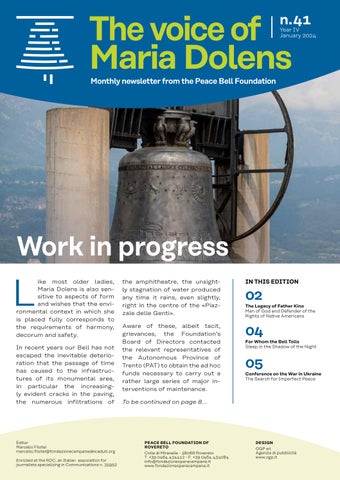
Work in progress
L
ike most older ladies, Maria Dolens is also sensitive to aspects of form and wishes that the environmental context in which she is placed fully corresponds to the requirements of harmony, decorum and safety. In recent years our Bell has not escaped the inevitable deterioration that the passage of time has caused to the infrastructures of its monumental area, in particular the increasingly evident cracks in the paving, the numerous infiltrations of
Editor Marcello Filotei marcello.filotei@fondazionecampanadeicaduti.org Enrolled at the ROC, an Italian association for journalists specializing in Communications n. 35952
the amphitheatre, the unsightly stagnation of water produced any time it rains, even slightly, right in the centre of the «Piazzale delle Genti».
IN THIS EDITION
Aware of these, albeit tacit, grievances, the Foundation’s Board of Directors contacted the relevant representatives of the Autonomous Province of Trento (PAT) to obtain the ad hoc funds necessary to carry out a rather large series of major interventions of maintenance.
04
02 The Legacy of Father Kino Man of God and Defender of the Rights of Native Americans
For Whom the Bell Tolls Sleep in the Shadow of the Night
05 Conference on the War in Ukraine The Search for Imperfect Peace
To be continued on page 8...
PEACE BELL FOUNDATION OF ROVERETO Colle di Miravalle - 38068 Rovereto T. +39 0464.434412 - F. +39 0464.434084 info@fondazioneoperacampana.it www.fondazioneoperacampana.it
DESIGN OGP srl Agenzia di pubblicità www.ogp.it
02
The voice of Maria Dolens
n.41
Year IV • January 2024
Father Kino’s legacy MAN OF GOD AND DEFENDER OF NATIVE AMERICAN RIGHTS Monument to Father Kino in Segno, in the province of Trento
The exhibition entitled: «I Kino – Imaginary Diary of the Apostle of the Native Americans. Father Eusebio Francesco Chini (Kino)» is on show until January 28th at the Rovereto Peace Bell Centre. The exhibition offers the visitor paintings by Luigi Ballarin and stories by Mauro Neri. We asked Alberto Chini, President of the Father Eusebio Francesco Chini Cultural Association, to trace the path of a man who, in an era of conquest, managed to reconcile his religious vocation with respect for Native American traditions.
E
usebio Chini was born in Segno, in the Trentino Non Valley, on 10 August 1645. Baptized in the parish church of Torra, he undertook his studies in the Jesuit college of Trento, to continue them in Hall, in Tyrol, where in 1663 he fell seriously ill and, on his deathbed, prayed to Saint Francis Xavier for his recovery, promising to dedicate his life to the missions. Eusebius recovered and as a sign of gratitude added the name of the saint to his already existing name. He continued his studies at universities in Bavaria then enrolled at the Archducal University of Freiburg im Breisgau to study literature, philosophy, astronomy and natural sciences. In Ingolstadt Eusebio studied astronomy, cartography, geography and mathematics. In 1675 he received a visit from Elector of Bavaria, Duke Ferdinand Maria, who wanted him as a mathematics teacher at the University and in private for his son Max II Emanuel, but he refused the offer owing to his vow to become a missionary. In June 1677 he was ordained a priest in Eichstätt by the Prince Bishop and underwent his last period of preparation in Altötting, a place of pilgrimage known as the “Loreto of Bavaria”. After repeated requests to the Father General of the Jesuits to dedicate himself to the missions in the Indies as Martino Martini had done a few years before him, he was assigned to the missions of “New Spain”. On 30 March 1678, Eusebio Francesco Chini left Altötting for Genoa where on 17 June he embarked with 17 other Jesuits for Cadiz.
Unfortunately, he arrived there several hours after the departure of the Atlantic fleet. He thus remained in Spain for almost three years where he deepened his knowledge of the Spanish language and taught mathematics and cartography in Seville. Finally on January 29, 1681, he embarked for Veracruz where he arrived after 96 days together with his brothers. During the crossing he observed the Great Comet, or “Kirch’s Comet”, on which he wrote a treatise which he then published in Mexico City. The Jesuit Eusebio Francesco Chini at the age of 36 Hispanicized his name to Francisco Kino after Spanish attempts to create permanent settlements in the Baja California peninsula and, on 13 March 1687, began the undertaking of his life: the evangelization and the civil, social and economic development of the inhabitants of the Pimeria Alta, the tribes of the Pima people, north-east of the Rio Sonora. However, the missionary experience in Baja California remained in his heart. The memory of the Indians to whom he began to teach the Gospel and whom he had to abandon was still alive. His explorations in search of a land passage to Baja California, then believed to be an island, were aimed at providing help to these populations by sending food, seeds and farm animals. The adventure lasted until his death in 1711: for twenty-four years Father Kino was the soul of the many missions he founded, now thriving cities in the states of Sonora and Arizona. He was both a man of God and defender of American Indian rights. He was an explorer, historiographer, cartographer, pioneer, cowboy and rancher.
n.41
The voice of Maria Dolens
Year IV • January 2024
03
«Father Kino’s Christmas», Luigi Ballarin
He taught the cultivation of fruits and vegetables unknown in those lands and introduced cattle breeding. He strenuously protected the dignity and interests of the locals against the arrogance of the conquerors. He shaped and determined the economic development of a sun-scorched desert land. He made many exploratory trips north to the Rio Colorado, providing scientific proof that California was a peninsula.
«Apache with calumet», Luigi Ballarin
He died at midnight on March 15, 1711, in Magdalena, the same way as he lived: «In peace and poverty, on the edge of something much greater» (P. Charles W. Polzer). The cult of Father Kino was born immediately in Magdalena among the faithful of Sonora, Arizona, Sinaloa, Chihuahua and Baja California. A cult that has transformed, for three hundred years, Father Kino’s devotion to Saint Francis Xavier into the homage of the Indians to the pioneer father of Pimeria Alta. On February 14, 1965, in the National Hall of Statuary in Washington, Arizona experienced a day of great celebration: in the U.S. Capitol Building the statue was dedicated of the founding father of the state, Eusebio Francisco Kino, alongside the most famous figures of the United States. Explorer, Historian, Rancher, Mission builder and Apostle to the Indians reads the writing on the base and summarizes an entire life dedicated to God and the Pima Indians.
In 1966, Mexico dedicated the city of Magdalena de Kino to him with a monumental square and the mausoleum where his mortal remains are kept as an object of veneration. In numerous other cities in America and Mexico, monuments have been erected that commemorate him and testify to their gratitude. In July 2020, Pope Francis declared Father Eusebio Francisco Kino “venerable”. His figure, the legacy he left us with a life dedicated to helping others, is increasingly a testimony of peace, of union between peoples, of mutual help with the construction of bridges that unite and share difficulties and opportunity. The gratitude of the populations that Father Kino met more than three hundred years ago is increasingly alive and witnessed even in the most varied artistic forms: writings, paintings, murals, sculptures, festivals and films, as far as our land, his homeland, influencing it and giving impetus to our activities.
04
n.41
The voice of Maria Dolens
Year IV • January 2024
FOR WHOM THE BELL TOLLS - P4
Sleep in the shadow of the night
P
rojects almost always seem obvious once they have come to fruition. But there are many variables to consider when you embark on an undertaking that has no precedents with which to refer to. For example, it must be taken into account that a bell while swinging may cause damage. Serious even. It could for example cause a tower to collapse. For this reason, between September and October 1924 engineers and technicians went to the Malipiero bastion several times to verify the Bell’s stability. At the end of the investigations, it turned out to be a suitable place for the installation of «the monumental Bell of the Fallen, both because it is in an eminently elevated and central position in the city and for its robust construction». But something had to be done: «the oscillation of the bell requires the strengthening of the upper slab of the tower in the form of a circular ring of reinforced concrete», the experts decreed.
At the centre of the bell the face of Ecce Homo was placed, further down the departure of the soldier, the instruments of war and then death with the funeral procession of weeping women. Finally, the victory announced by blaring trumpets, soldiers on horseback and by a young woman carrying peace, in the form of the Winged Victory of Samothrace, placed on the altar where the dates 1914-1918 are engraved. Conflicts are evoked in their rawness. This is why the soldiers in the last scene are portrayed without military uniform, naked. They’re just men. It doesn’t matter which nation they come from, the ideals for which they fight, the actions that made them heroes or cowards. They are just men, naked because the war takes away everything. But Don Rossaro was also thinking of an inscription that could give an unambiguous meaning to the entire work. He himself recounts this in his diaries.
While the technicians were doing their work, however, Don Rossaro was thinking of something else and had already signed the contract for the fusing of the bell with the «Luigi Colbacchini e Figli» company of Trento. But that still wasn’t enough. There was a need to think about embellishment and a word, a phrase, a motto. In short, something that explained exactly what the meaning of the operation was. The Trentino artist Stefano Zuech was summoned and proposed an elaborate series of symbolic bas-reliefs. The meaning of those figures had to reflect Don Rossaro’s thoughts regarding the war: a mixture of heroism and reflection on the mystery of death.
Bell embellishment
He particularly remembers the moment of inspiration, which came to him while he was accompanying «an old Veronese lady» among the cemeteries of Monte Zugna in search of the tomb of her son. It was while wandering among the tombs that for the first time he thought of death as a long sleep in darkness, illuminated however by the light of Christ. «The Bell – wrote Don Rossaro – will sing, taming all the peoples under its maternal caress, fusing them into one heart, just as one day it felt the ferocious cannons of all the nations melting in its bosom». It was this intertwining of feelings, on the one hand the homeland, on the other the universal Christian vision, that pushed the priest to compose the Latin couplets that were chiselled on the back of the Bell: Dormite in umbra noctis, laetamini in lumine Christi. Dum aere jungo populos, et vestras laudes celebro (Sleep in the shadow of the night, rejoice in the light of Christ, while with bronze I unite the people and celebrate your glory).
n.41
The voice of Maria Dolens
Year IV • January 2024
05
ALLEN LYNCH’S LECTURE ON THE WAR IN UKRAINE
In search of imperfect peace Last December 5th at Colle di Miravalle, the ‘Trentini nel Mondo’ Association and the Rovereto Peace Bell Foundation organized a conference on the question «War in Ukraine and the Middle East: is the world in danger? ». The meeting was moderated by the journalist and director of the «Atlas of Wars and Conflicts in the World» Raffaele Crocco. Following the intervention of the Foundation President, Marco Marsilli, and the introduction from the president of the ‘Trentini nel Mondo’, Armando Maistri, the current geopolitical situation was analysed by Allen Charles Lynch, Professor Emeritus in political science at Virginia University (USA) and Associate Professor at Luiss. Below we propose excerpts from his report.
M
ore than twenty months have passed since the beginning of the conflict between Russia and Ukraine, which in actual fact has also become a proxy war between Moscow and what Putin calls “the collective West”. Twenty months after the outbreak of World War I, all the great European powers, including the Ottoman Empire, were intact. The United States had yet to enter the war. The Germans, together with Austria-Hungary and Ottoman Turkey, sought to establish their hegemony in Europe by defeating Russia and France; the French, along with the English and Russians, sought to reclaim Alsace-Lorraine and, in the process, forever destroy Germany’s ability to threaten France; the Russians wanted to expand once again at the expense of the Ottomans and claimed Constantinople; the Italians, together with the French, English and Russians, tried to annex the unredeemed lands in Trentino, Alto Adige and along the Adriatic; the Americans, under the presidency of Woodrow Wilson, wished to mediate a “peace without victory”. We all know how the story ended: rather than “peace without victory”, there was “victory without peace”. Two and a half years later Germany had not accepted the legitimacy of the defeat; the Austro-Hungarian, Russian, and Ottoman empires were disintegrating; the French and English paid a terrible price for their “victory,” so much so that the beginning of the end of their empires can be dated to November 1918; an Italy penalized at the conference table saw a wave of militant nationalism that cannot be separated from the triumph of fascism in 1922; the American people soundly rejected President Wilson’s plan for a League of Nations in the 1920 national elections, resulting in a fateful U.S. withdrawal from European security matters.
If European leaders had known all this in June 1916, what price would they have paid to avoid a similar fate? But they didn’t know it and, instead of acknowledging their ignorance and putting an end to the war, they bet everything on “plan A” for there was no “plan B”. Let’s take a second example: the Korean War. After 11 months of brutal fighting, the lines stabilized very close to the pre-war border, the thirty-eighth parallel. But the war, which became a proxy war between the Soviet Union and Communist China, on the one hand, and the United States and its allies, on the other, continued for more than two years, during which the lines practically remained the same. How many of the more than 1.2 million deaths in combat could have been avoided if the war had ended two years earlier? How many of the more than 1 million civilian casualties in North and South Korea could have been avoided?
A moment from the conference
06
The voice of Maria Dolens
The armistice that ended the Korean War was not a peace treaty and left all parties far from their ultimate goals. But who would say today that an indefinite continuation of that war would have been preferable to the highly imperfect peace that has prevailed on the Korean Peninsula since July 1953? Russia and Ukraine find themselves in positions similar to those of the European leaders in June 1916 and the “principles” of the Cold War in June 1951: no one has achieved the results they aimed for and the prospects of achieving them in the near future appear remote. Nonetheless, both Moscow and Kiev and its allies remain engaged in a war aimed at achieving the highest objectives: for Moscow, to conquer and hold as much of Ukraine as possible in the hope of eventually triggering a regime change in the neighbouring country. For Kiev, expel Moscow’s soldiers from all territory, including the Crimean Peninsula. If we take the leaders in Kiev at their word, anything less than the complete expulsion of Russian troops from all of Ukraine would be a defeat. However, the initial Russian war plan which involved the occupation of the enemy capital has already failed. So, one could say that Kiev has achieved an important victory. Furthermore, the Ukrainian army managed to force the Russians to withdraw the fleet from Crimea. This grants Ukraine the ability to export grain and other products from Odessa to the world. But how long will the country be able to tolerate the high number of deaths in combat, which among other things remains a state secret?
n.41
Year IV • January 2024
And what could be an acceptable victory for Russia? Putin may think back to the experience of his grandfather Spiridon, who became Vladimir Lenin’s personal chef. Putin’s grandfather, whom the current president knew until the age of thirteen, witnessed the collapse of the Russian army in 1917. This was the trigger for the subsequent communist takeover, the disintegration of the empire and the civil war that consumed Russia between 1918 and 1920. Simply put, the authorities in Moscow continued to wage a war that they could not win, could not finance and could not logistically administer leading to disaster. Returning to the present, consider that both Kiev and Moscow have their own “narratives” supporting the war. For Kiev and its Western supporters, Ukraine is the David attacked by the Russian Goliath. According to Moscow, however, it is the Russian David that is being attacked, through a proxy war, by the “collective West”. In my opinion, Russia will never accept a “defeat” in Ukraine. So, instead of re-examining the course of politics that led to the debacle, Moscow would blame the West for its fate and try, like Germany after 1918, to react as soon as possible. Likewise, the Zelensky government cannot accept anything less than total victory without committing political suicide. And the president seems “hostage” to the most radical wing of Ukrainian ethno-nationalists, whose power has understandably increased over the course of the war. In short, we are faced with the prospect of a conflict of indefinite duration. Hatred has accumulated that will last generations. And what’s worse, too often the parties seem to believe that not only defeat, but the “disappearance” of the other is the minimum condition for an acceptable peace. As is also happening in the Israeli-Palestinian conflict, we are faced with the prospect of a conflict with unattainable objectives, which will transform the foreign and domestic policies of all the countries involved, including Ukraine’s allies. However, there are a number of diplomatic tools that could be used to end this war, with the understanding that an agreement must be negotiated in good faith.
Professor Allen Charles Lynch with the Vice-President of the Foundation, Lorenzo Saiani
First, Russia and Ukraine must agree to an immediate, comprehensive and indefinite ceasefire pending the withdrawal of Moscow’s troops. Ukrainian soldiers would remain in place. The temporary ceasefire line may be patrolled and monitored by UN observers.
n.41
The voice of Maria Dolens
Year IV • January 2024
07
The agreement could incorporate the following elements: 1. Ukraine accepts whatever status voters in Crimea and the East want, on the condition that elections are held under UN supervision.
© EvgeniyShkolenko
2. Ukraine and Russia agree on a demilitarized zone of approximately 100 kilometres along each side of the border. 3. Ukraine accepts neutrality as long as Russia respects the conditions of the demilitarized zone. 4. US and NATO agree not to deploy certain classes of attack weapons in Ukraine. 5. Once Russian troops withdraw from Ukraine, the West and Russia will lift all economic and financial sanctions in place since Russia’s annexation of Crimea in 2014. 6. In the meantime, United Nations observers will be sent to monitor humanitarian channels.
7. There will be UN funding for reconstruction in Ukraine. In the absence of the political will of Russia, Ukraine and the United States to explore these terms of solution, the prospect is that of an indefinite proxy war between Russia and NATO during which Ukraine
NOTES OF PEACE FROM ROVERETO TO BETHLEHEM Three choirs, two in Rovereto and one in Bethlehem, came together on December 2nd at the Bell to remind us that there is no alternative to peace. The meeting, jointly promoted by the Foundation and the Custody of the Holy Land, wished to focus on the unifying power of music. «Notes of Peace. Rovereto - Bethlehem» is the title of an initiative that may still be viewed on YouTube at the following link https:// www.youtube.com/watch?v=o7uYJdOHefQ It is possible to listen to the entire speech by Secretary to the Foundation, Paolo Mirandola, who brought greetings from Foundation President Marco Marsilli, and reiterated that «we cannot tolerate what has happened and is happening». «Gaza, Jerusalem and Bethlehem – he added – are the places where
would be progressively destroyed, while the Atlantic Alliance and Moscow would maintain a significant risk of escalation of the conflict, to the point of direct war. In this case, Europe would perpetually have a new conflict on its borders along the Arab Israeli model.
we reaffirm the purpose of the Bell of the Fallen». And you can still see and hear the youngsters of the Rovereto Children’s Choir who, directed by Maestro Gianpaolo Daicampi, remind us that «peace is possible», as well as the adults of the Sant’Ilario Choir, directed by Maestro Federico Mozzi, who opened their performance in Friulian dialect with Ai preat, a prayer for the end of all wars. Approximately 3,600 kilometres to the south-east there was another choir, made up of boys from Bethlehem who that evening were not sure which way to go home so as to avoid the bombings. However, they didn’t want to give up singing in live streaming to remind everyone that there must be hope. There was only one main difference between the Rovereto children and them which was highlighted by Father Ibrahim Faltas, Vicar of the Custody of the Holy Land in Jerusalem, in his apt introduction: «these kids haven’t laughed for weeks».
08
The voice of Maria Dolens
To be continued from page 1... Both the current and the previous agreements concluded with the PAT do not, in fact, allow the ordinary annual contribution to be utilized, even in part, to areas not falling within the institutional activity of the Foundation, i.e. the organization of seminars and conferences, the staging of art exhibitions and musical events, the preparation of visits, both incoming in relation to various guests and, outgoing with regard to participation in events in Italy and abroad. In response to this request, with resolution no. 1967 of 20 October 2023, the Autonomous Province has allocated the substantial sum of 450,000 euros, spread over two years, to finance these interventions. This is a decision of great importance for the present and future of the Foundation, for which I would like, on behalf of the Board of Directors and myself, to express public thanks to the Provincial Council as a whole and, in particular, to the President of the Autonomous Province, Maurizio Fugatti. As is widely known, in 2025 Maria Dolens will celebrate the hundredth year of her life. This is a very significant date which the Foundation intends to adequately honour, also through the preparation of a series of structural improvements, which ad hoc financing will make possible. To name but a few, these include the new paving of the «Viale delle Bandiere», the arrangement of the open-air grandstand of the amphitheatre, the repositioning of the porphyry walkways, and to end the necessary overhaul of the engine of the historic Bell. Consequently, in 2024 the institutional activities planned at Colle di Miravalle will have to take into account the limitations and conditions unavoidably linked to future works, which are destined, with our sincere regret, to also influence the increasingly numerous requests for “hospitality”. Taking this into account, with the belief that the information may also be of interest to our external counterparts, over the next 12 months the Rovereto Peace Bell Foundation intends to pursue the three basic priorities listed below: - complete the contemplated major renovation by December 2024 once a precise timeline has been established; - ensure, subject to exceptional and limited-time needs, the regular opening of the monumental area, possibly arranging alternative access routes for visitors;
n.41
Year IV • January 2024
- in relation to institutional activity, favour events that can take place in the Auditorium, not affected by the renovation work, verifying for each individual case the feasibility of those, normally with greater public participation, usually held in the open area outdoors which is involved in the afore-mentioned interventions. As already highlighted, this is certainly not an ideal situation, since in the short term it does not allow for the full use of a location that is increasingly known and appreciated even beyond the territory of our region. From a broader perspective that looks beyond the fundamental deadline of 2025, the above work will translate, once completed, into very positive repercussions, in terms of decorum and safety, for future events and demonstrations that will take place there, whether independently promoted by the Foundation or organized by our partners. And, in this way, Maria Dolens will have the opportunity to celebrate her hundredth birthday, as she strongly hoped for, in a setting absolutely worthy of her long and glorious history as well as the very high civil, moral and religious reference that, according to unanimous opinion, she represents today. Reggente Marco Marsilli, Foundation President