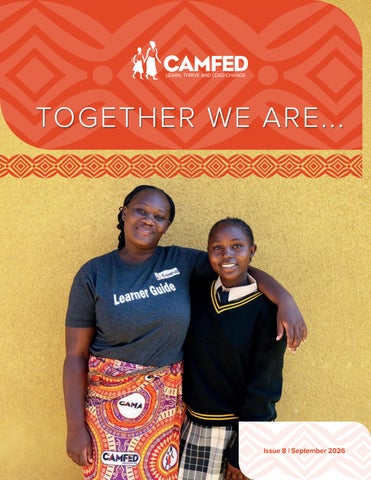
TOGETHER WE ARE...
Issue 8 | September 2026
WELCOME
September 2026
A common thread through this year’s stories speaks to a favorite proverb: “If you go into the river with two feet, be prepared to swim”. On this mission, we cannot afford to dip our toes in the water and test the temperature and current before we go in. When we are called to action by a girl who needs support, we jump in with two feet. We go prepared to swim because the girl whose education is most endangered may not know how her situation will change. If her needs prevail, we go the distance. This year’s Together We Are shares insights into the remarkable responses from all those called to action – stories of accelerating, anchoring, valuing. More young women have volunteered as post-school mentors in the last two years than in the 30 years of our work prior. And governments are collaborating with us to reach millions more children every year. Together we are a powerful force for good. Yet we do not let the numbers obscure the very personal nature of what we do, and the very real stakes for each individual. For Christabel - finally securing a birth registration aged 22; for Mwanne - having a second chance at school; for Hamdia - to save her profits in a bank account. We welcome you to this year’s report knowing the absolute commitment we have, and the responsibility we know you share to each individual girl’s rights and dreams. At its heart, this report shares how we rose to the challenge this year and how, together, we jumped into the river, and swam. Tuko Pamoja: Together We Are,
& Angie Murimirwa, CAMFED’s Chief Executive Officer & Maxime Michel, Executive Director
In this report, we revisit our phenomenal journey of the last year, through which, against the odds, together we are leading change and creating opportunity. You will learn about how we clear a path for the most marginalized girls to achieve their potential – 97% of CAMFED-supported girls are progressing through school. You will hear from school graduates who, with the support of their sisters in the CAMFED Association, are expanding their life choices, meaning that members of the network are 13-times less likely to be child brides than their peers nationally. And you will see how young women are securing productive livelihoods within a year of completing school and navigating the transition to young adulthood – creating 281,000 jobs to date. These extraordinary outcomes are the result of collective action from around the world. And your philanthropy is a vital catalyst for this change. THE NUMBERS...
6 355k+ MILLION girls reached, on track to
10M by 2030
CAMFED Association members
130k+ community champions
CONTENTS 8
10
14
16
20
22
12
18
TOGETHER WE ARE... 8 PICKING UP THE LITTLE LUCIAS 10 RECLAIMING THE NARRATIVE 12 CHARTING OUR COURSE 14 THINKING BIGGER 16 ANCHORED BY OUR ACTIVISM 18 LIVING OUR VALUES 20 WHY I GIVE... 22 CANADIAN VOICES
t: +1 416 861-0755 | e: canada@camfed.org | w: camfed.org Photo credits: Abby Brooks, Alivia Moore, Annie Mpango, Brad Peters, Christabel Munyoro, Claire Gribbin, Edna Salila, Felicity Chilver, Hamdia Bongaamwine, Rhoda Mubita With some photographs, generative AI may have been used to extend and subtly enhance photography. CAMFED always uses AI with extreme sensitivity and always with full consideration for the subject’s integrity.
Together we are...
PICKING UP THE LITTLE LUCIAS
U
ntil she was a mother herself, Zimbabwean-born Christabel felt she did not have any official proof of who she was.
“I am an orphan, raised by my extended family, and my birth was never registered,” says Christabel, who decided to register aged 22 after giving birth to her first child. “It wasn’t until I held the certificate with my name on it that I felt I had proof of my identity.” Christabel’s story is not unusual in her district of Chikomba. While children born in hospitals are automatically issued certificates, in rural areas women are more likely to give birth at home, and national surveys estimate that only 39% of children under five years old have a birth certificate.1 Although the process is free for children under six, CAMFED staff in Chikomba estimate it costs a family $40 to make the long journey to the registration office – equivalent to a month’s worth of food. As an unregistered student, Christabel’s options were limited. Every day she would walk six kilometers to school on an empty stomach, but despite her commitment to education, without a national ID she was ineligible to pursue O-level exams or formal employment, to open a bank account or secure a passport.
Christabel, with her new birth certificate and national ID
At the point when she was denied a loan to launch her own business, Christabel’s former school teacher, Lucia, became aware of the situation and stepped in. “Lucia helped connect me with district officials who worked with my husband and me to complete the process,” she recalls. “They needed witnesses, affidavits, official documents, a letter from the village head and ward councillor.” Lucia says: “For many, the advantages of documentation are simply not worth the time and cost. But there is a psychological burden to not being registered; years of wondering ‘Who am I? What is my identity?’ and having many limits placed on you. If you don’t have a birth certificate, you are invisible.” 1
Zimbabwe Demographic and Health Survey, 2023-24
8 Together we are...
As a teacher in one of CAMFED’s partner schools Lucia receives specialist training to offer responsive support to students. She has first-hand experience of the challenges children face, having herself been one of the first bursary-supported students in Zimbabwe, and a founding member of the Association in 1998. She says: “I’m quick to pick up the little Lucias in my class who are experiencing the same things as I did at their age. It’s my role to connect them with all of the support that is available.” Be That Girl, a Switzerland-based foundation focused on helping women live self-determined lives, has been supporting CAMFED’s mentoring work for four years, as part of its grant-making portfolio. It is also on the verge of launching the Pathway Centre in Lusaka, Zambia, its own program to support young women through post-secondary transitions.
Lucia, Teacher and Teacher Mentor, Zimbabwe
“CAMFED is a recognized pioneer in the mentoring of adolescent girls and young women in sub-Saharan Africa, so we are looking up to them to learn from their experience in this space,” says Foundation CEO Ottavia Pesce.
Trizah Gakwa, portfolio manager for the Foundation, agrees with the critical value of mentoring in building young women’s decision-making power. She says: “Education is not enough. It takes another woman, someone that has walked their journey, someone from their context, who understands their challenges, and has herself overcome them, to walk them through that journey.” Christabel and Lucia’s story is a prime example of the power of this approach. Lucia continues to check in on Christabel and her family since helping secure her birth certificate, and together they share big ambitions for their community of women change-makers in Chikomba. Lucia says: “We understand what it means to lack, what it means not to achieve, especially when the resources are scarce. We are doing those things together, so there’s joy in us, and it is making us stronger for other challenges to come.” It is also important to Be That Girl Foundation that CAMFED is working beyond the individual and local level, to eliminate the barriers to registration for all families. “We look at where our funding can be catalytic,” says Ottavia. “I admire how CAMFED works really closely with governments to ensure that it reaches girls across many rural locations.”
2
97%
of the marginalized girls supported by CAMFED are progressing to the next grade in a context where less than
38%
of rural children complete secondary school2
There is currently no directly comparable number for the poorest girls in rural areas, https://www.education-inequalities.org/
Together we are... 9
Together we are...
RECLAIMING THE NARRATIVE
T
he road blocks to education take many and varied forms, and the building blocks to success still more. This is a reality well-known to Mwanne, who excelled in class until, one year away from finishing secondary school, she became pregnant. “I was so young and full of dreams, and I suddenly found myself trapped in circumstances that would eventually alter the direction of my entire life,” she remembers. At the time, pregnant girls in Tanzania faced exclusion from mainstream education and Mwanne was forced to drop out of school. However, with the support of her family, she found one of the only pathways to qualification open to young mothers at the time – a local adult education center.
“Without financial support, and emotionally exhausted, I saw my educational dreams slowly disappearing,” says Mwanne. “But with encouragement from my family, I started to believe that perhaps my story was not ending after all but only beginning differently.” In 2022, Tanzania changed the law to permit mothers to re-enroll in mainstream schools after giving birth. At that time, 25% of young women nationally were mothers by age 18. “The announcement felt like light breaking through years of darkness,” says Mwanne, who subsequently returned to school with a CAMFED bursary. “The support became more than financial assistance; it became a bridge to a future filled with purpose, confidence, and larger dreams than I once imagined possible for myself.
10 Together we are...
“I refused to allow fear or shame to destroy my future. Education became the weapon I used to fight for my life and my family’s future.” Given the complex barriers facing young mothers returning to school, CAMFED peer mentors (known as Learner Guides) are equipped with psychosocial training as part of their structured volunteer program. In the last year, more than 20,000 young women have stepped into these roles, supporting students like Mwanne through school. We also partner with the government on ways to resource and scale cost-effective solutions for student retention and re-entry. A recent partnership helped teachers record and use data on attendance, participation and academic results to identify learners most at risk of dropping out. The solution is now being replicated at scale by the Ministry of Education to more than 280 schools across 45 councils. A participating teacher shares: “Before the training, I knew some of my students were falling behind, but I didn’t have a clear picture of who needed the support. Now, I can intervene early. For example, when I noticed that a few girls were missing classes due to family responsibilities, we introduced peer support and flexible mentoring sessions to help them catch up.” Improvements like these mean that schools can take action before drop outs happen, and can provide additional support to students like Mwanne who are returning following a period of absence. “Whenever I think about the life I went through, I gain strength to study harder,” reflects Mwanne, who is now studying Business Administration at university. “One road block need not mean the end of our journey.” Alex Axiotiadis, a fintech founder who gives to CAMFED through his company, Juno Finance, knows what it means to be given a second chance at life through education. He was nine years old when he and his two sisters were sent from war-torn Lebanon to Greece with their grandmother, while their parents stayed behind to provide for their education. “My sisters, mother and grandmother shaped the person I am today and showed me the importance of women’s strength,” says Alex, who is now a father and grandfather himself. “The responsibility and selflessness they showed me are qualities I see reflected in the young women I support through CAMFED today. “Educated girls, as they grow up, contribute to the fabric of our society. I have experienced the multiplier effect of their education and know exactly what it means and how precious it is to this world.”
CAMFED Association members are
13X
less likely to be married at age 18 than their peers
In collaboration with two local reproductive health organizations and supported by the Children’s Investment Fund Foundation, CAMFED helped facilitate referrals to health clinics for adolescents in Tanzania and Ghana. The two-year pilot reached 24,050 girls with sexual and reproductive health advice or information, with 88% reporting a positive experience.
Together we are... 11
Together we are...
CHARTING OUR COURSE
T
oday’s new bank account will be the sixteenth Sonia has set up this year, as she accompanies the latest of her mentees on this important step towards financial independence. Sonia’s mentees have joined the 63% of women in Ghana who have opened their own bank account – up from just 27% a decade prior.3 It is an important trend within a country that sees only 21% of employed women accessing formal employment4, because without a bank account they are typically excluded from decisionmaking over their finances and expenses, and face limited life choices. “It’s all about understanding that you can make a plan for your own future,” says Sonia, 27. “Small decisions now can add up to bigger decisions later. “When you open a bank account, you can put just a bit to the side each month. If later you want to apply to tertiary education, that choice is now yours; you no longer have to get others’ permission to follow that path.”
3 4
World Bank, Global Findex Report. 2025. International Labour Organisation, Informal Employment Rate in Ghana. 2015.
Entrepreneurs like Ghanaian cooking oil producer Grace (above) use the budgeting skills they learned from the Transition program to help them keep track of each sale, and keep a close eye on their profit margins. She is one of the 152,068 entrepreneurs across our pan-African network. 12 Together we are...
Sonia, who herself works in marketing, also volunteers as a Transition Guide, a post-school equivalent of the Learner Guide program mentioned earlier, which helps young women build confidence in the steps they take after completing school. She says: “I remember all the questions I had at that age: Which degree program? Which institution? What grades do I need? I was the first person that I knew to try to go to tertiary education, so there was no one to help me answer these big questions.”
Sonia with one of her mentees
The Transition program, which includes training in skills like bookkeeping, budgeting, and preparing for job interviews, has to date reached more than 140,000 young women in Ghana (and 368,436 across all our operating countries). In 2025, 87% of those who completed the program moved into education, employment, or entrepreneurship within 12 months. Two-thirds of them had launched their own business within a year, Hamdia among them.
“It started with a three-day residential program, which came at the right time because I didn’t have a clear plan beyond school,” says Hamdia, 24. “It taught me how to anticipate and take charge of my own journey. It taught me financial literacy, and I came back home prepared to open a bank account and start my own business.” Hamdia founded a clothing business in 2021, finding connections to suppliers through fellow CAMFED Association members. Today, she is making a profit of 2,000 cedis ($170 USD) per month, enough to support her own further education and to provide learning materials for over 100 children in her district. Her next ambition is a permanent, full-time job and a business that allows her to employ others.
Hamdia in her clothing business
A valued partner from the private sector helping cultivate this entrepreneurial spirit is Cummins Inc., a global power leader. Through its commitment to strengthening communities, Cummins supports young graduates in developing the skills, confidence and experience needed to thrive in the workforce. Thierry Pimi, Vice President - DBU International Operations and Executive Sponsor for Cummins Powers Women in Africa Middle East, says: “When we invest in a young woman through CAMFED, we’re not just changing one life, we’re setting off a ripple that reaches her family, her community, and the generation she’ll one day lead. That’s the kind of return on investment that outlasts any balance sheet.” Namenda Malupande, Executive Director, CAMFED Zambia, says: “Programs like this bring new opportunities and pathways to light for school graduates who might otherwise never encounter them, and are a great example of mutually-beneficial private-public partnership.”
Together we are... 13
Together we are...
THINKING BIGGER
14 Together we are...
Digital upgrades are reducing reliance on paper-based data collection and manual processes when issuing bursaries - even in extremely remote areas with unreliable connectivity. With the support of a pro bono consultant, CAMFED has been exploring new ways of automating and digitizing within our existing secure databases, which serve upwards of 170,000 bursaries a year.
A resource hub designed to work online and offline in contexts with limited internet access is connecting Learner Guides across Africa with on-demand monitoring and training tools. Already, more than 11,000 users have access to the digital hub, which offers locallyrelevant information and refresher training across our six countries of operation and will accommodate the steep growth trajectory of the Guide program. The pooling of partner and local resources is helping female entrepreneurs in the CAMFED Association take their businesses to the next level. Groups like the Nthambi Cooperative, with 72 members in rural Malawi, are accessing specialist training to increase the value of their products. Initially enabled by donor funds and then through a partnership with the Mastercard Foundation and Children’s Investment Fund Foundation, the Cooperative this year won a competitive $86,000 USD Malawi government grant to purchase new machinery. These women are among 158,213 who have participated in training to learn how to maximize their resources: for example, making baobab fruit into oil can increase its value five hundred fold.
Together we are... 15
Together we are...
ANCHORED BY OUR ACTIVISM
R
hoda is Head of Biology at a secondary school in Lusaka but sees an equally important job for herself outside of working hours.
She is one of 355,000 CAMFED Association (CAMA) members, and one of approximately 1,700 in a pan-African collective of ‘CAMA Professionals’ who coordinate their philanthropic support for the next generation. The collective comprises teachers, police officers, civil servants, nurses and businesswomen who completed school with CAMFED’s support. An elected treasurer represents each country and meets quarterly to share insights across the group.
“When people come together, they bring different strengths, ideas and resources,” says Rhoda. “As individuals, we make a difference, yes, but as a group, we transform communities.” While on average, each CAMFED Association member provides four children with support to go to school, business owners typically help between five and six, and CAMA Professionals further amplify their reach through collective action. For example, in Zambia earlier this year they raised sufficient funds to donate 85 mattresses to a girls’ boarding school.
CAMA Professionals across many varied sectors provide resources, expertise and linkages to their peers in the sisterhood, teachers help strengthen the classroom practice of Learner Guides and nurses donate equipment like blood pressure monitors and scales. “When one woman rises, she does not rise alone,” says Rhoda. The sentiment is shared by a parallel collective in the United States, called Together Women Rise, which for two decades has pooled resources to advance girls’ and women’s wellbeing around the world and began a partnership with CAMFED last year.
“When one woman rises, she does not rise alone,” Rhoda, Teacher and CAMFED Association Member
16 Together we are...
“Women and young girls understand that they have a responsibility to give back,” says CEO Beverley Francis-Gibson. “Someone else fed and supported you, and now you’re in a position to do the same.” Together Women Rise has grown from two friends into a movement with 5,000 members across 300 chapters. Like the CAMA Professionals, members need not disclose how much they donate. Beverley says: “It’s not about how much you give, it’s the fact that you’re giving. So many people say, ‘I’m not a philanthropist’. We’re reframing that. If you believe in the betterment of society, then you are a philanthropist.” “We loved the fact that CAMFED was deliberate in finding ways to make sure girls know their value and what gifts they have to offer the world above and beyond where they are today. If young girls can envision that there is something beyond where they are right now, that is the spark that takes them to the next level,” says Beverley. Robert McDowell, a donor and Board member of CAMFED USA, shared similar reflections with 135
Association members attending their quarterly online meeting this month. “It’s all about people. Even today, I rely as much on human connections as I do on anything technical. You have amazingly powerful connections with this network, and people are willing to help. “We always have to give back – to reach a hand out to help the next person along just as someone helped us.” For Rhoda, the future holds one certainty: “Wherever we are, as long as we are connected to one another, the work still continues.”
Approximately
100
CAMFED Association members living outside of Africa also give through regional chapters in the US, UK and Canada. Rhoda in front of her school
Together we are... 17
Together we are...
LIVING OUR VALUES
S
ixty-two learners are back in the classroom in Malawi after a young woman chose to put the CAMFED model into action in her local school.
Chimwemwe volunteered in her local school for three years, delivering critical life skills, conducting home visits and donating profits from her chicken farm to buy menstrual products for girls. She sounds like one of our CAMFED Association members, but Chimwemwe never received our support in school. Her mentorship was born out of a collaboration between CAMFED and Malawi’s Ministry of Education that replicates our model nationwide to reach even more marginalized girls with social and learning support. Chimwemwe remembers starting out, “I would look to the CAMFED Association members and wonder if I could ever feel so confident interacting with others. But now we all help each other. We all have the same values.” As the three-year government-led initiative comes to completion, Chimwemwe and 1,180 others were invited to join the CAMFED Association to continue their outreach. Their membership connects them with peers from similar backgrounds and to products and services, such as training and no-risk loans. Matilda is another young woman volunteer who is not a former client of CAMFED, one of 300 in Ghana. She taught and mentored students every week for one year through a government National Service Scheme initiative based on our Learner Guide model. “When I was a student, I really admired the impact CAMFED was making with the community,” says Matilda. “While I am not an Association member myself, I share the same mission and values: encouraging learners to take their studies seriously, stay in school, and become responsible people.” “Serving in this role makes me excited because I feel like I am already contributing in the same way CAMFED Association members do,” says Chimwemwe. In expanding the Learner Guide model into new regions and adapting it to different contexts, government partners have been uncompromising in maintaining the values at its core. For example, governments in Malawi and Tanzania are recruiting with the same expectation that volunteers share a background with the marginalized children they support. And in Zambia, the government is incorporating content from the program in the national curriculum. Charm Kalimbika, the then Acting Permanent Secretary of the Ministry of Education in Zambia, said: “The program helps marginalized girls, especially those at risk of early marriage, stay in school. As we integrate it into the national education system, we are excited to expand its reach, ensuring even more learners benefit and contribute to Zambia’s educational progress.” 18 Together we are...
Another
303
women with no previous experience of CAMFED support have been recruited into the inaugural Learner Guide cohort in Kenya to kick-start programming in
86
schools later this year.
Annie, a CAMFED Association member from Malawi who helped launch the Kenya chapter, welcomed the new members with a poem:
I stepped in like a whisper that wasn’t sure it should be heard, a new name balancing awkwardly on confident tongues, trying not to trip over introductions or the quiet fear of being “the one who doesn’t quite fit”. Even my smile felt rehearsed like I had practised belonging before I understood it. They called it CAMFED Association, and I expected something formal, maybe distant, but instead I found warmth that asked questions back, smiles that didn’t let you disappear in the background, and a kind of welcome that felt suspiciously like, “You’re one of us now… whether you’re ready or not.” The benefits didn’t come with announcements, they slipped in quietly skills dressed as conversations, entrepreneurship hidden in everyday advice, opportunities disguised as “Can you try this?” and suddenly I was doing things I used to admire from afar. Ironical ly, I thought I needed guidance like a map, but what I got was a mirror: women reflecting strength I hadn’t claimed, pushing me gently, then firmly, then unapologetically, until “I can’t” started sounding outdated even to my own ears. Support here wasn’t soft all the time, it was real. It looked like sisterhood that checks on you, lifts you, corrects you, and still claps the loudest. A safety net made of shared stories, where falling doesn’t mean failing, just learning differently. Now I laugh at the version of me who tiptoed in, thinking she had to earn her place quietly. Because somewhere between doubt and daring, between listening and leading, I became part of the noise, the good kind… the kind that builds. - Annie from Malawi
Together we are... 19
WHY I GIVE... Sailing for education – Plymouth, UK Skipper Claire Gribbin and her all-women crew took six awards and 10,000 school days away from their second race in the Eddystone Charity Sailing Pursuit this summer. Returning to the 26-mile race around the iconic Eddystone Lighthouse in Plymouth, the team has now cumulatively raised enough to fund 10,266 school days through CAMFED: a complete secondary-level education for 15 girls. Crew member Lou Anning reflects: “The best thing you can do to improve the health of a population is to educate women.”
Growing legacy – Zurich, Switzerland Dorothy’s commitment to securing a Doctorate in 1970s-Virginia still inspires her grandson Brad today. Dorothy taught at a rural school serving children living in poverty in Appalachia while pursuing her own higher education, and worked at the end of her career as a school administrator in rural Kentucky. “She seeded my interest in women’s education, showing how education can propel you to different things,” says Brad Peters, who lives in Zurich, Switzerland, and donates to CAMFED on a monthly basis. “By supporting one woman’s education, we can create an environment where people are propelled upward to create even more societal good.”
Hiking Kilimanjaro – Buckingham, UK In memory of her late mum’s work in Tanzania and passion for girls’ education, Felicity Chilver climbed to the highest point on the African continent raising enough to fund 4,310 days of school. “My mum was utterly inspiring – energetic, determined and endlessly compassionate. Supporting girls and women to reach their full potential was a cause my mum was passionate about – and I care deeply about it too,” says Felicity, who acknowledges the 5,895-metre hike up Kilimanjaro as the most physically challenging thing she has ever done. Felicity, from Buckingham in the UK, hiked for six days with no bed, no shower, no running water and through altitude sickness, continuing ‘pole pole’ (Swahili for ‘go slowly’) to Uhuru Peak. 20 Together we are...
Honoring memories – Vermont, USA Wife and husband Barbara Felitti and Wayne Curley give to CAMFED as a way to honor the legacy of their mothers – first-generation Americans who themselves overcame the odds to secure their education. “My mother began attending college but stopped after a semester, lacking the support she needed to continue,” says Barbara, who lives in Vermont. “It is one of the reasons she felt education was so important. Contributing to CAMFED is one way to honor the memories of our much loved mothers.” “My own career in international development also makes me appreciate CAMFED’s work and approach all the more. At a time when there is a great deal of strife in the world, it is a light of hope and promise.”
Creating a blueprint for change – London, UK Architect Daniel Poku-Davies sees in the built environment a world of creativity, the realities of inequality and the potential for structural change. Born in Ghana, his fascination with buildings began with his first sight of a skyscraper and seeing the possibilities of human construction. Over time, he came to acknowledge a very different reality: one where the built environment is shaped by inequality, and where women still face barriers to representation, leadership and opportunity. Daniel recently convened leaders in architecture, infrastructure, construction and design at an event in Clerkenwell, UK, to champion greater equity within the built environment. He led conversations on structural change alongside a curated silent art auction that raised funds for CAMFED. “Creating opportunities for dialogue, connection and action is an important step towards building a more inclusive future within the built environment and beyond,” says Daniel, co-founder of Bridge + Impact. “Study after study has shown that when women are given equal opportunities to learn, lead and thrive, organisations perform better, economies grow stronger, and communities become more resilient. Supporting CAMFED is an opportunity to champion the potential of young women and help create a future where talent, not circumstance, determines what someone can achieve.”
Achieving potential - Ontario, Canada “As a woman who has had every opportunity to achieve her potential in life largely as a result of luck and circumstances, I believe it is only right for me to do what I can to contribute to the circumstances that may help other women and girls achieve their potential. And this world needs the active engagement of more women in public life – especially those who have had the benefit of perspective-broadening education. CAMFED’s program of mentoring and support is just what is needed to achieve both these individual and universal objectives.” - Deborah Duffy
Together we are... 21
CANADIAN VOICES John Sun, Alberta Life is not fair. I am fortunate to have landed on the side of plenty; so I need to share my surplus. Perhaps I am just too practical, but I feel better to give than to waste money on a fancy car or extravagant holiday.
Jeff Brown, Alberta While there is no shortage of donation opportunities in Canada for specific causes, we have chosen to support what we believe are meaningful agents of change globally What my wife and I find appealing about CAMFED is that it is an enabler. Rather than simply deciding what is best and doing things for someone they provide the encouragement and financial resources to motivated women who have built the compassionate community in which CAMFED exists. The result is a virtuous circle as graduates become supporters relying more on themselves than outside forces.
In terms of CAMFED, the results speak for themselves. This is an inspiring example of an organization providing a hand and not simply a handout. Education level is a great predictor of economic wellbeing. By enabling as many young women as possible to experience a high-quality education the future of the countries participating with CAMFED is certain to be brighter.
Dave Bury, Ontario I believe that helping others when you are able to is simply the right thing to do. And amid the deluge of pleas for charity, it seems best to choose one for which the benefits are obvious and attainable.
22 Together we are...
Together we are...
A HUGE THANK YOU TO ALL OUR INCREDIBLE SUPPORTERS!
Contact the Development Team at CAMFED CAMFED International
CAMFED USA
Emily Zemke Chief Development Officer ezemke@camfed.org
Brooke Hutchinson Executive Director bhutchinson@camfed.org
Katie Maude-Barker Associate Director km-barker@camfed.org
Ann Marie Almeida Director of Development aalmeida@camfed.org
Becs Brocken Head of Corporate Relations bbrocken@camfed.org Karen Jones Manager, Philanthropic Partnerships kjones@camfed.org
Adrienne Dishman Manager, Institutional Partnerships adishman@camfed.org Kaitlyn Neel Manager, Major Gifts kneel@camfed.org CAMFED Canada
General inquiries philanthropy@camfed.org switzerland@camfed.org +44(0)1223 362 648 (UK) +1 415 963 4489 (USA) +1 416 861-0755 (Canada)
Maxime Michel Executive Director mmichel@camfed.org Heather Bunting Senior Manager, Donor Engagement hbunting@camfed.org
Together we are... 23
121 Richmond St. West, Suite 400 Toronto, Ontario, M5H 2K1 CAMFED Canada Charitable Registration: #84498 8659 RR0001 t: +1 416 861-0755 | e: canada@camfed.org | w: camfed.org /camfed
/camfed
/camfed
@camfedsisterhood
@camfed.bsky.social