At 7:30 p.m., Feb. 26-28, and 2 p.m., Feb. 29, in the Cameron University Theatre, Cameron University presented its production of “A Year With Frog and Toad” for students and the community. The production featured one of the smallest musical casts in recent years, but its impact reached far beyond the stage.
Based on the children’s books by Arnold Lobel, the musical follows
ultimately highlight the value of patience, kindness and friendship.
The lighthearted musical blends humor with moments of reflection, allowing audiences to connect with the characters’ everyday struggles and triumphs.
The production required work from both performers and crew members behind the scenes. From auditions to the final bows, the show depended on the coordination of many moving parts and careful collaboration among the cast, designers and technical crew.
coordinated lighting, sound and costume changes to prepare the show for live audiences.
Rose Landrum performed several ensemble roles, including Bird 2, Turtle, Squirrel 2, Mother Frog and Mole 2.
“As an ensemble member playing (five) different roles, I had to ensure each character was clearly distinguishable,” Landrum said. “It was
and give them a good first experience,” Kirby said. “The hardest part
"It was neat to see how much the show throughout the process ... The best part is seeing it go from abstract something tangible
Abbey Kirby, who began as a volunteer with Cameron University Theatre, served as stage manager for the production.
Kirby worked on the show’s development even before auditions began.
“It was neat to see how much the show changes throughout the process,”
Kirby said.
inseparable Frog and Toad as they navigate a full year together. From waking up after a long winter hibernation to planting a garden — going swimming, raking leaves in the fall and sledding in the winter — the pair encounters small challenges that
“There are so many improvements and ideas and people getting on board with so many things. The best part is seeing it go from abstract ideas to something tangible.”
The cast rehearsed from 7 - 10 p.m. Monday through Friday leading up to opening night. During rehearsals performers refined choreography, blocking and musical timing while the technical team
What’s Inside
very physically intensive — it was absolutely a labor of love.”
Cameron University Theatre provides opportunities for students to gain experience in a formal theatre environment while also contributing creatively to productions.
“I was able to choreograph my own short dance solo during a section called ‘Underwater Ballet,’ which follows the song ‘Get a Load of Toad,’” Landrum said. “Our director consistently asked for our creative input, but he allowed me to choreograph that section entirely on my own. I don’t get that opportunity often, so it was very special.”
After the public performances, the production continued its run with school matinees. At 10 a.m. March 4 - 7, the show welcomed elementary school students from across the community.
Kirby said performing for young audiences required a different perspective.
“Our goal is to introduce kids to theatre
marketing effort led by student publicist Skylar Edwards, who worked to expand the theatre program’s online presence and promote performances to a wider audience.
“We’ve been trying to grow our advertising this year, so I put a lot of effort into this show,” Edwards said.
“We created TikTok and Instagram accounts, and after the show we officially launched a Facebook page. We’re also raising money through events like gift baskets, 50-50 tickets and concessions.”
Edwards also created themed photo areas for audiences only 32 advanced to the semifinals, and I advanced to that round.”
According to faculty in the department, Landrum became the first Cameron student in several years to reach the semifinal round.
Despite a demanding schedule of performances and competitions, the theatre department continues to welcome new participants.
Cameron University Theatre productions are open to students of all majors as well as
community members. Opportunities extend beyond acting and bewillia@cameron.edu.
Graphicsby AngelicaMartinez
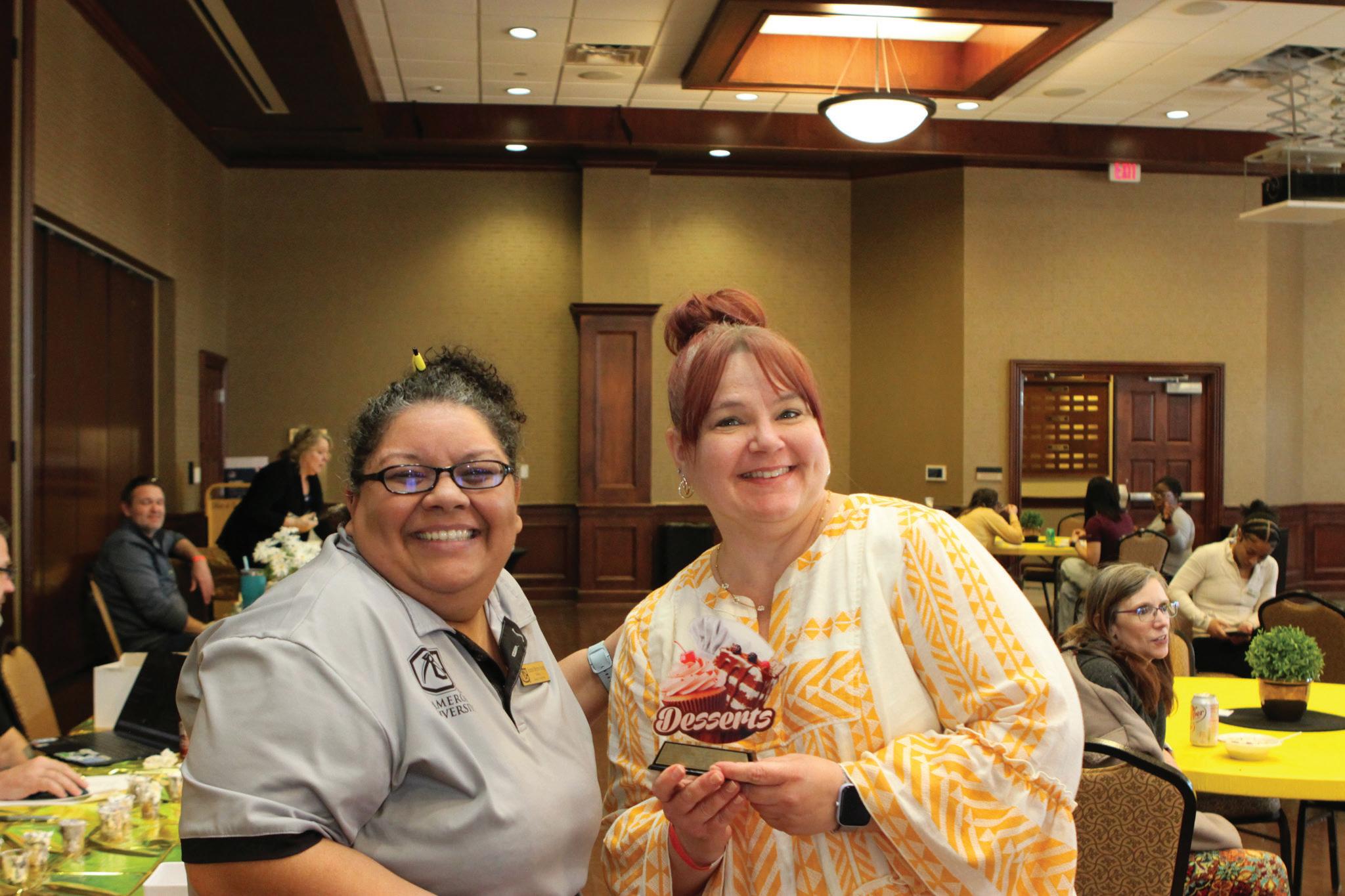
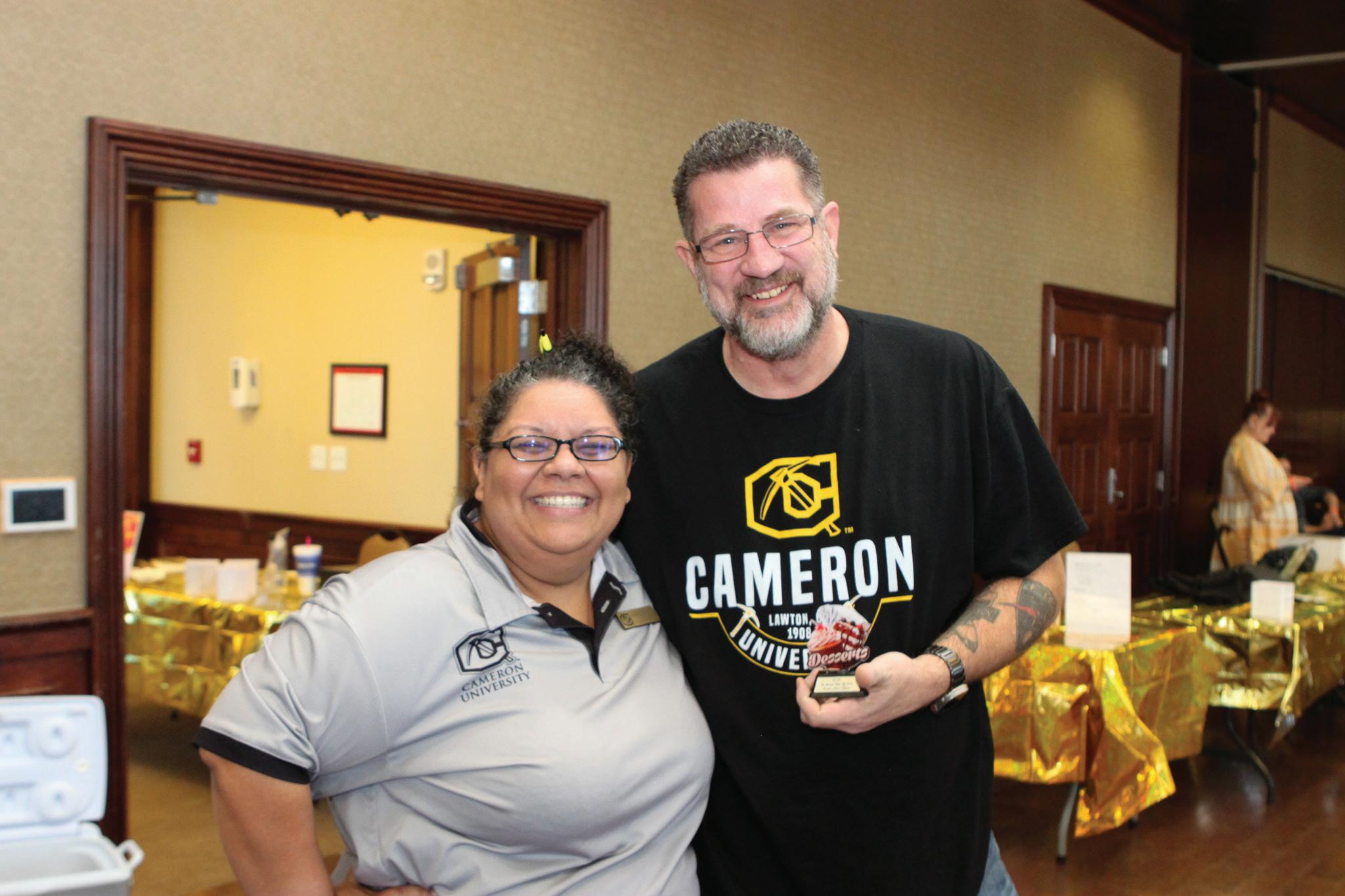
At 11:30 a.m., Feb. 26 in the MCC Ballroom the OnCampus Alumni Committee held their second annual Chili Cookoff, adding a brand new bake-off alongside it. The event brought together faculty, staff, students and alumni for a day of friendly competition and good food.
Those who wanted to taste the chili either bought tickets ahead of time or at the door. But according to the event coordinator Alannah Meyers-Young, a surprise donor provided their own funding to allow anyone who was interested to taste, or receive a reimbursement.
“Everybody who actually paid for their own entry ended up getting their money back.” Meyers-Young said, “I guess they just wanted to make sure it was a success.”
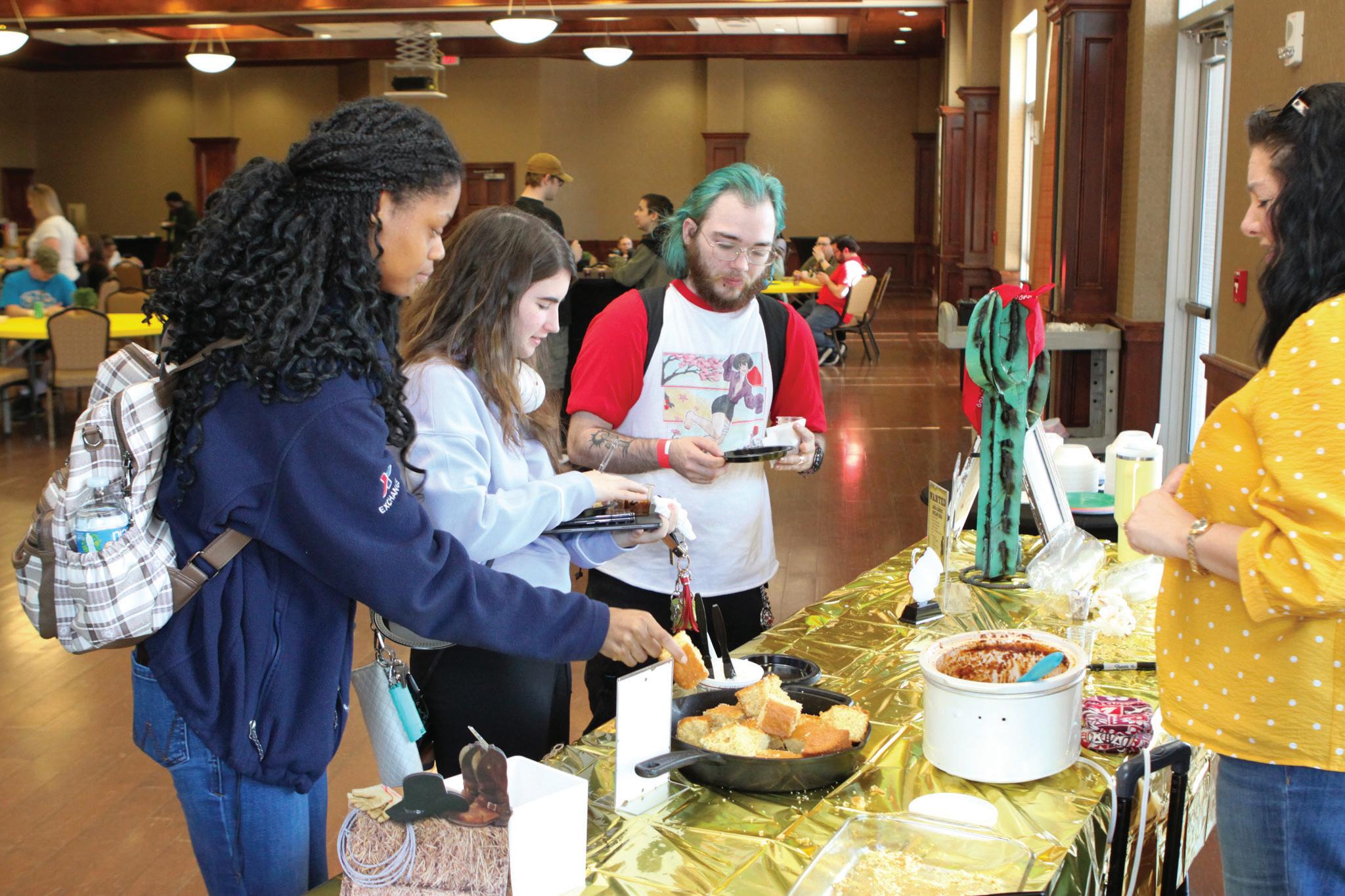
Participants who wanted to compete entered their chili recipes and desserts, while attendees sampled the entries using small “chili shooters” that allowed everyone to try multiple dishes throughout the event. Judges were ACE Award-winning alumni employees and select students who were particularly involved oncampus events.
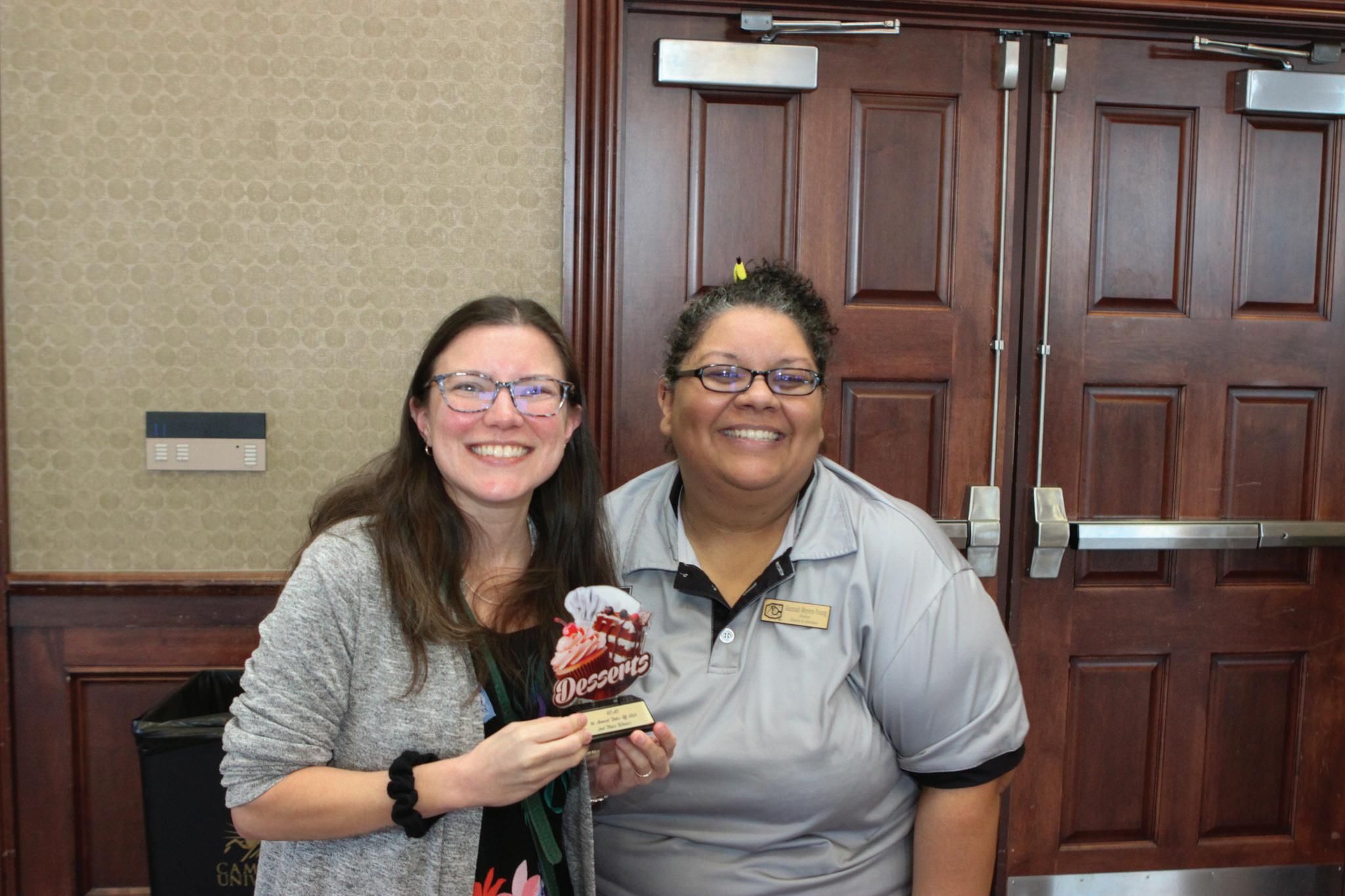
In the chili competition, voted by the select board of judges, Belinda Foley, a Cameron ITS technician took first place; followed by Melissa Caro, from Student Development in second. As for the cakes, Leslie Cothren, the Dean of Students, took first place; while Amy Jester, from admissions, took second place.
The People’s Choice awards went to Jennifer Pruchniki and Micheal Phillips, whose chili and cake earned the most votes from attendees respectively. Guests voted for their
overall favorites using their own coins or provided tolkens. Each entry had a container where guests could drop coins to cast their vote, with each coin counting as one vote regardless of value.
The newly introduced bake-off featured cakes and pies, although this year’s entries were limited to cakes. Judges had a particularly difficult decision as the competition initially ended in a tie.
Alannah Meyers-Young said the cookoff was a success and highlighted the enthusiastic turnout from the Cameron community, although, there was some feedback she thought to mention.
“I feel like it was a sucess, everyone who came had a great time,” she said. “Although, I heard next time we might need to include some milk — some people really
Photos by John Kindred
Graphics by Fabiola Perez-Aponte
Burnout: The thief of wellness
Elizabeth Lehman Staff Writer
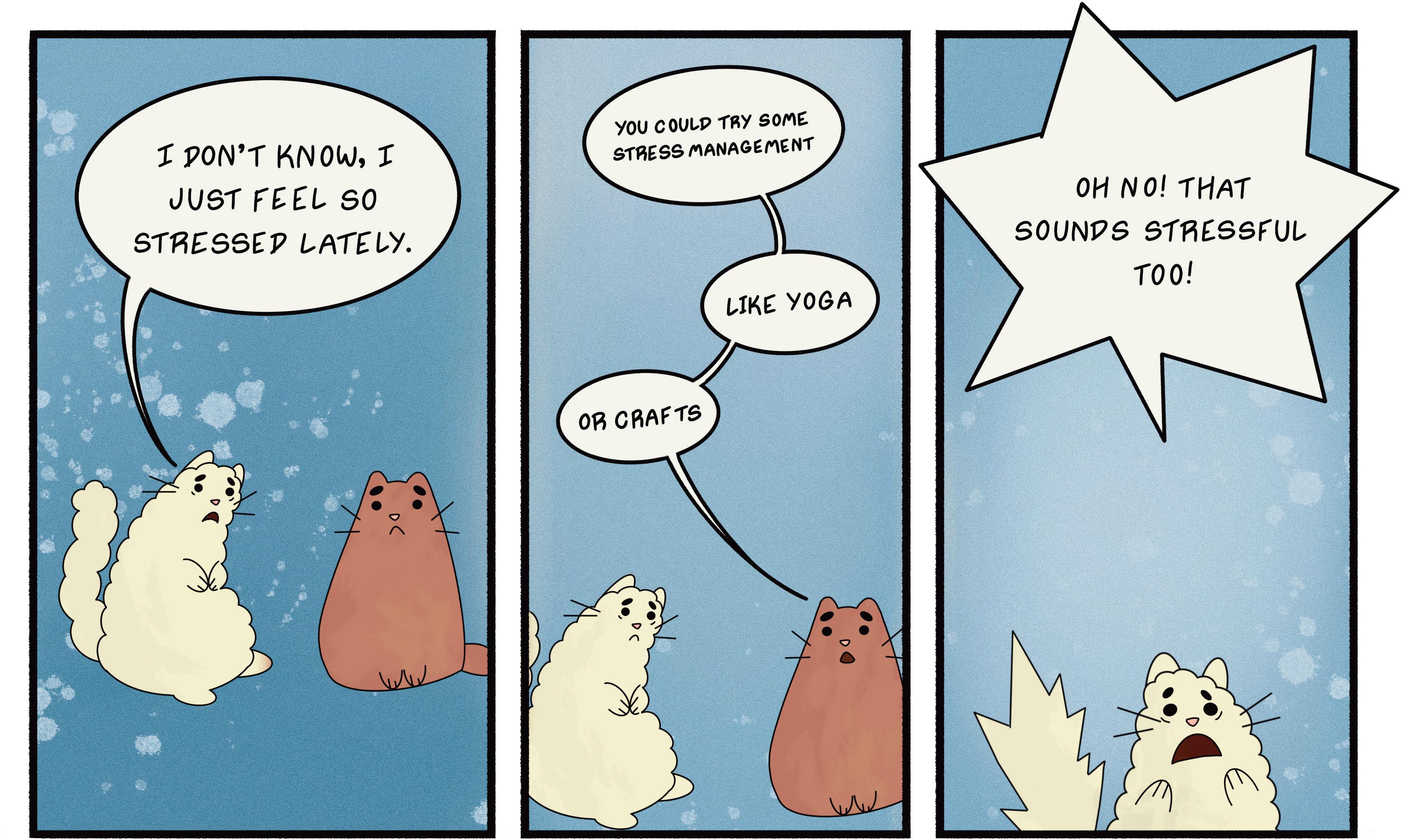
It is getting closer to the end of Spring semester at Cameron University, and many students may be experiencing the terrible, formidable, abominable burnout. What is Burnout?
Burnout is a state of severe emotional, physical and mental exhaustion caused by prolonged, excessive stress. Most often, burnout is related to work but is a reaction to cumulative stress.
You may feel stressed, fatigued, detached or unmotivated. Even though burnout is stress-related, it is different from acute stressors, like a loved one falling ill or a test you forgot to study for.
Burnout is a physical reaction of the nervous system from longterm ongoing smaller stressors. A cumulative stress reaction refers to the buildup of ongoing pressure over time when the body and mind do not get enough recovery.
It shows up through several kinds of symptoms. Physically a person may experience chronic fatigue, insomnia, headaches, muscle tension and digestive problems. Emotionally it can cause irritability, mood swings, increased anxiety, depression and feelings of hopelessness or helplessness.
Cognitively people often notice a difficulty concentrating, poor memory, “brain fog” and reduced ability to make decisions. Behaviorally it may lead to avoidant or unproductive habits, declining work performance and sometimes increased substance use.
Cumulative stress usually develops from a combination of small daily stressors: long-term situations like a packed daily schedule or financial strain, and not having time to rest from repeated stressful events. College students face a unique combination of stressors that can build quickly over time. According
to Southern New Hampshire University, “College stressors include heavy academic workloads, exam pressure, financial burdens and time management challenges.”
In addition to academic demands, students often experience social anxiety, loneliness, roommate conflicts and pressure to secure internships or career opportunities. The transition from having a direct support system to independence, managing sleep, food, healthcare and responsibilities without support can heighten college students’ level of stress.
Stressors fall into several key areas. Academic stress comes from high expectations for grades, overstudying and fear of failure. Financial strain includes tuition costs, textbooks, housing expenses and learning to manage a budget. Social and emotional stress may involve making new friends, navigating relationships and maintaining a social life while balancing responsibilities. Lifestyle changes require students to develop independence, improve time management and maintain daily health habits. Planning for the future adds another layer of anxiety. Students think about internships, careers and life after graduation.
Southern New Hampshire University says these stressors can manifest in both physical and mental symptoms.
Students may experience symptoms of fatigue, headaches, muscle pain and stomach issues, as well as anxiety, depression, burnout, irritability and a lack of motivation. These overlapping pressures contribute to cumulative stress or burnout, and it negatively affects academic performance as well as students’ overall health.
College students must learn to manage and prioritize their responsibilities in order to reduce stress and prevent burnout. A collaborative, college-aged focused YouTube channel called BUILT BY GIRLS recommends never studying
past midnight.
They stress that consistent sleep is essential for both mental clarity and emotional stability. They also encourage students to make time for hobbies, as it is important to have something outside of academics to look forward to. Hobbies should be scheduled just like classes, work or social events. Hobbies and scheduled time for self care and enjoyment are just as important as friends and classwork.
Preventing burnout also requires time management. Large assignments and long-term projects should be broken into smaller, manageable steps so you don’t feel overwhelmed. Use planners, calendar and to-do lists to track deadlines and progress. Setting boundaries is equally important. Students must learn to say “no” to commitments when their schedules are full. Do not negotiate.
Physical health plays a foundational role in stress management. As emphasized through guidance shared by BUILT BY GIRLS, mental health begins with caring for the body. Sleep, balanced nutrition and regular exercise supports mood regulation and positive mental health overall. Incorporating short breaks during study sessions can also prevent mental fatigue and improve your recall.
Students should pay attention to early warning signs of burnout, constant exhaustion, declining performance, irritability or feeling detached from their work. If you notice these signs, take a break immediately.
Taking a break is more effective than forcing yourself to be productive. Reach out to friends, family or campus support services. By managing time intentionally, protecting physical health, maintaining boundaries and prioritizing time for enjoyment, college students can significantly lower stress and sustain long-term academic success.
Cameron University offers a variety
of Student Support Services (SSS) designed to assist students who meet specific requirements. Students may qualify if they are first-generation college students (meaning neither parent held a four-year degree at the time of application), meet federal guidelines for economic need (such as Pell Grant eligibility, which applies to the majority of participants) or have a documented learning or physical disability. To apply, students should visit the Student Support Services office in Room 431 of North Shepler to pick up an application. Those who were previously involved in TRIO programs such as Upward Bound or Open Doors are also eligible to become SSS members, as SSS is part of the TRIO program.
Students who are accepted into SSS receive priority placement in designated sections of supplemental College Algebra, supplemental Writing and Composition I. Tutoring labs, staffed by faculty, provide consistent academic assistance in math and English.
Additional services offered through the SSS program include Academic Advisement, access to computer facilities and services, math and writing tutoring, educational workshops and in some cases, financial assistance.
For students who do not qualify for Student Support Services but still need academic help, Cameron University provides access to Tutor. com, a 24/7 online tutoring platform available to all enrolled students. Each student receives up to 10 hours of free tutoring and can connect with expert tutors through the Tutor.com link in their Blackboard courses.
Beyond academic assistance, college students can manage stress by utilizing free on-campus counseling services, attending stress management workshops, joining peer support groups and speaking regularly with academic advisors. Immediate mental health support is also available through the 988 Crisis Lifeline.
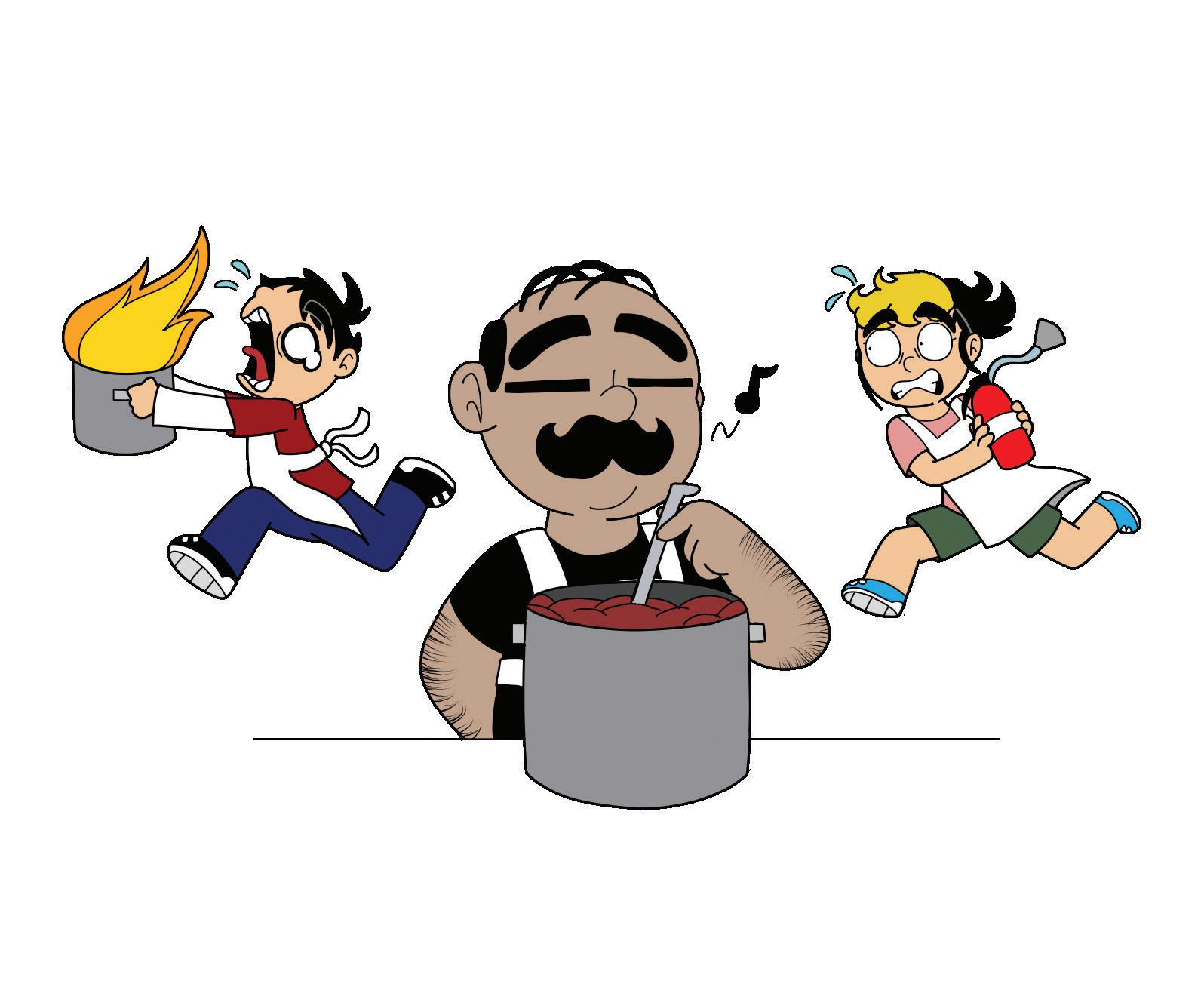
Comic by Jaley Melton-Wiley
Lawton Community Theatre
‘Sweeney Todd’
Amanda Purser Mangaging Editor
In the quaint interior of the Lawton Community Theatre (LCT), a talented cast brought a Broadway musical “Sweeney Todd” to life for a local audience’s viewing pleasure. A packed house of chairs surrounded three sides of the two-level stage that is centered in the building, located in Lawton, Oklahoma, at 1316 NW Bell avenue. The intimate nature of this playhouse allows viewers to feel close to the performers and captivated with each scene, in an almost immersive experience.
London to seek revenge for his wife’s mistreatment and the miscarriage of justice brought on by a local judge. The performers who brought some of these beloved characters to life, such as Sweeney Todd himself and Mrs. Lovett, the pie shop owner who sublets the barber space to Todd, captivated the audience.
“Sweeney Todd: The Demon Barber of Fleet Street” is a musical thriller adapted from Christopher Bond’s adaptation of the Harold Prince Broadway production. With music and lyrics by Stephen Sondheim this production was brought to the Lawton community from Feb. 20-22, and 26, before completion on March 1.
The rights for the music and production materials were licensed and acquired through the Musical Theatre International (MTI) organization, with special permission for LCT to perform it.
The ensemble and primary cast featured performers from across the state of Oklahoma including many Lawton locals. Together the infamous tale of the Demon Barber of Fleet Street was brought to life. Many are familiar with this long running plot; Sweeney Todd returns to
Todd was played by Kristoffer Pendergraft-Pak, and his rendition was spectacular, with incredible vocals and acting that brought the demon barber to life. Lovett was played by Alyssa Martinez who brought humor, wit, dynamic vocals and a believable cockney accent that helped transport the audience to 19th century London.
Michael Kidd Harden practically stole each scene he was featured in, while portraying the hilarious, charismatic and flamboyant Beadle Bamford.
Perhaps one of the most impressive performances was from the character Tobias Ragg, played by the young Angelo Chip. A recent MacArthur High School graduate, Chip seemed poised and in control each time he stepped onto the stage, showcasing his natural talents for music and performance, with an experienced maturity far beyond his age.
The cast and ensemble was guided by a team of hardworking professionals, from the crew, to the choreographers, along with the stage managers all led by Director Addam Tate.
Making her Musical Directing debut on this
production, Kat Frye-Davies of Lawton was responsible for bringing Tate’s vision to life, with respect to the music. Frye-Davies had limited time to work individually with the cast and ensemble, so she wanted to ensure that she was wellprepared for every component.
“Sweeney Todd is one of those musicals, you can listen to it a million times, you can watch the movie, you can go to the show, and you can think you know it, and you don’t,” Frye-Davies said. “It’s really hard music, and even though I’m very familiar with it, I still had to sit down and go through every part. Every principle’s part, every ensemble’s part… so I’d sit at home with those books and I’d learn the parts so that when it came time for rehearsals, I would know that I’m teaching them the right thing.”
Frye-Davies is a classically trained flautist and private piano instructor, as well as a certified musical therapist who grew up around music, playing the piano and flute at an early age. After moving to Lawton in 2024, she auditioned for LCT that summer, for the “Rocky Horror Show” production and was selected. After a few performances, Frye-Davies was asked to be a stage manager, which helped to propel her into the behind the scenes leadership of which her education and background seemed to prepare her well for.
Stepping into the musical director role for “Sweeney Todd” was a difficult choice as Frye-Davies was unable to
perform in the production that holds a special place in her heart.
“I really wanted to be in it, I love that show, it’s so good,” she said. “That music is really beautiful, really powerful — Sondheim composed it, and hits all the notes as you might say.”
The commitment from the entire cast and crew was demanding, with rehearsals from 6:30 - 9:30 p.m. Mon.Thurs., until a few weeks out from opening night, when they moved to Mon.- Fri.
The performers, many of whom do this for a living and some simply as a passion or the pure enjoyment, all have to decide that working on a production like this can be prioritized in their lives.
“We had about 25 people on this cast, give or take, and there were over 50 people who auditioned,” Frye-Davies said. “People are looking for these opportunities and when they see them, they try and grab them.”
Frye-Davies is inspired by the passionate team at LCT and looks forward to what the future holds for this little playhouse in Lawton, which clearly has the ability and talent to perform far beyond what most might expect from a tiny community theater.
“I’m seeing these ideas and where they’re going,” she said. “The creativity, the attention to little things, and also the desire to show this Lawton community that the arts are very accessible. I think anyone who saw ‘Sweeney Todd’, something in that resonated with them.”
The Lawton Community
The theatre and its crew have come a long way since the first production in December of 1952, where they performed at schools, churches and even members’ backyards, according to their website. They established a more stable location in 1966 at the same building they perform out of today, which bears the name
“The John Denney Playhouse” after its Director-Emeritus, John Denney, who directed 58 productions in the 18 years he was actively involved with Lawton Community Theater. For the continued supporters of the LCT, the performers and crew who keep this tangible art alive and active in southwest Oklahoma, and the spectators who keep the seats full, we can continue to bring more powerful productions to our community for generations to come.
“Support your local arts,” Frye-Davies said. “I’m so proud of this show, it was really an amazing experience. The fact that we had just about every night sold-out, shows that people want to come and see these things. Even if something isn’t as familiar to you as ‘Sweeney Todd’, trust the experience still.”
Gorillaz: ‘The Mountain’
Elizabeth Lehman Staff writer
On Feb. 27, the Gorillaz released their ninth studio album, “The Mountain”. “The Mountain” sounds unlike anything you’ve heard from Gorillaz before. The opening track is obviously inspired by Indian music. And it’s not surprising considering this track features Dennis Hopper, Ajay Prasanna, Anoushka Shankar and Amaan Ali Bangash.
The track itself feels eerie and calming at the same time. Bubbly drums, sweeping strings and gorgeous wind instruments build slowly into a layered instrumental chorus that feels almost spiritual. Airy male vocalizations drift back and forth. It sounds almost like meditation chants. By the end, the repeated phrase “the mountain” turns the whole thing hypnotic and ritualistic, like the album is inviting you into its world.
This dreamy atmosphere continues into “The Moon Cave,” which intro sounds like something
but it feels intentional. This track is about the vibe. Halfway through, Black Thought jumps in with a rap breakdown. The beat feels reminiscent of Latin rap.
Then comes “The Happy Dictator,” featuring Sparks. Inspired by a trip to Turkey, this track satirically opens with angelic vocals. Maybe it’s a soprano, maybe it’s a synth choir. It sings over a ritualistic melody that concludes with the word “amen.” Right when you settle into that groove, the track flips to ’70’s style Hindi pop. Staccato rhythms and arpeggios drive the beat. The robot was made for this song. This track is chaotic in a strangely beautiful way. The recurring flute motif from earlier tracks returns here too, quietly tying the album together before the song fades into a soft echo. “Oh, what a happy land we live in.”
“The Hardest Thing” is one of the more emotional songs from the album. It features the late Tony Allen. Tony Allen’s deep baritone chants in Yorùbá, “Oya, é dì dé, è róo òri” (Get up, we’re almost home) three times. It immediately sets a solemn tone. The arpeggios here feel different from the earlier tracks. They rise and fall like waves of grief. The flute returns again, joined horns and layered vocals that guide the listener through something closer to a spiritual hymn than a conventional pop song. Then, as suddenly as it began, the track ends. The abrupt silence mirrors the suddenness of death.
“Orange County” feels like a direct continuation of the previous track. It opens with the line “Y’know the hardest thing… Is to say goodbye to someone you love.”
The phrase repeats throughout the song, anchoring the track in the same theme of grief.
A melancholy whistle carries the melody at first but when the upbeat backtrack kicks in, it flips the mood entirely. The mournful track suddenly
feels alive. The instrumentation here is some of the most complex on the album: layered, playful and full of complexity. The breakdown is bright and plucky, a welcome shift after the heaviness of the previous track. It captures something honest about grief: we heal, but we never forget. The song closes by circling back to the line “that’s the hardest thing,” completing the emotional journey right back at the start.
The mood darkens again with “The God of Lying,” featuring the British post-punk band IDLES. It has a sinister beat that reminds me of some of Gorillaz’s earlier material. IDLES takes the forefront here, delivering their gritty vocals over a spacey retro instrumental. The synth sounds like someone is playing Space Invaders in the background and losing. The breakdown doesn’t hit quite as hard as it could but the beat itself is ridiculous enough to carry the whole track. It’s experimental, hypnotic and is best played on big speakers to get the full effect of the song’s absolute best.
There are seven more tracks on the album worth digging into, but the one that stuck with me the most is “The Manifesto.” It might be my favorite Gorillaz song, period.
The track opens with a playful groove built around a triangle, something you’d never expect from the band. Trueno jumps in with a Spanish verse that adds yet another flavor to the mix. Then halfway through, the song completely flips. Proof slides in with a hard gangster rap framed by dark mafia horns and suddenly the track explodes with creativity. It’s layered, chaotic in the best way, and somehow every piece fits.
Trueno returns again later, weaving Spanish verses back into the track before everything collapses into a gorgeous rhythmic breakdown from Damon. It’s one of those songs that’s impossible to describe, you really just have to hear it for yourself. The sounds might be familiar, but the way they’re arranged here is something else entirely.
“The Mountain” feels like a band experimenting with sound, grief and spirituality all at once. Somehow they make it work. I would recommend this album to anyone who wants to be taken somewhere strange, layered and unexpectedly passionate and emotional.
I would give this album 4 out of 5 stars.
At 1 p.m. on Feb. 6, in Italy, the 2026 Winter Olympics kicked off with Hudson Williams and Conner Storrie, among others, carrying the torches during the opening ceremony.
The United States had many hopes for the games; they sent the largest delegation to Italy, comprising 232 athletes, making it the largest delegation in United States history.
This strategy ended up paying off at the end of the games; the United States went home with twelve gold medals and 33 total medals, making it the best-ever Winter Olympic performance from the United States. The Olympics showcase the best athletes of a country, and some, more than others, stole the show.
Ilia Malinin is a United States males singles figure skater, and without a doubt, is the most iconic name in the sport right now.
Malinin came into the Olympics holding the world record title; not only that, he is the only man who has ever landed a quad-axel in competition.
The quadaxel is the hardest jump in figure skating. It requires the skater to jump and do four and a half rotations, a half rotation longer than the rest of the jumps.
skater Mikahail Shaidorov.
United States hockey team from the first game showed the world that they were a force to be reckoned with.
The axel also requires that the skater take off going forwards; they have to reach up to two feet in the air and tuck their arms into their body to be able to have rotation speeds faster than 300 rpm.
If that wasn’t enough, they do it all in less than a second, and when they land, it’s up to 6 times their body weight all on one blade.
At the 2025 Grand Prix Final, Malinin landed seven quadruple jumps, which no man has been able to achieve. While he sets and breaks records left and right, Malinin also changes what figure skating looks like.
Malinin added back in the backflip, which at one point became banned from competition, and he skates to music like NF, while other skaters keep to more traditional themes.
The press named Malinin the biggest threat to figure skating before the Olympics even began, and after securing the gold medal for the team event in figure skating, Malinin headed to the individual event.
After his short program, Malinin placed well, and when the free skate came, the figure skating world felt shocked.
After a rough start but an admirable finish, Malinin placed eighth–impressive but far below what people expected. However, in a show of true sportsmanship,
sportsmanship led Malinin to win the Olympic Fair Play Award as well as the respect of the figure skating world.
While Malinin was skating on thin ice, Cory Thiesse and Korey Dropkin represented the United States in mixed doubles curling at these Olympics.
Curling wasn’t discussed in the media as something that the United States was supposed to medal in. However, these Americans had something to prove.
This team set the new record for the longest shutout in Olympic history.
The team was able to hold off a goal from opposing teams for over 16 periods.
The previous record
face off on the last day of the Olympics, Feb. 22, 2026.
The game became heated very quickly, with penalties from both teams, and United States player Jack Hughes lost teeth during the game.
At the end of regulation, the score was tied one-to-one. The game went into overtime, which means that both teams are allowed to have three skaters and one goalie on the ice.
After a tense start to overtime, Hughes was able to score the winning “golden goal,” on the 46th anniversary of the “miracle on ice” no less.
Thiesse and Dropkin found their way to the gold medal match, which in and of itself became historical because it was the first time that a woman made it that far in curling.
Thiesse and Dropkin were unable to beat the Swedish team and bring home the gold, but the pair set records of their own.
Thiesse and Dropkin are the first Americans to win an Olympic medal in mixed doubles curling, and they join the list of just three United States curling teams that have won medals.
Thiesse became the first woman in America to ever win a medal in curling. After winning, Thiesse said that she’s looking forward to inspiring the next generation
medal.
The game ended up going into overtime. Megan Keller scored the winning goal, giving the women’s US hockey team their first gold medal since 2018.
The men’s United States hockey team came to the Olympics with something to prove. The team had been in a gold medal drought since Feb. 22, 1980, the “miracle on ice” team.
The United States men’s team has a history with the Canadian team, and before the Olympics even started, both teams produced media proclaiming that the gold medal match is to be Canada versus the United States.
Jordan Stolz, a United States speed skater, performed his own miracle
Stolz was America’s top performer, taking home the most medals of all the
Stolz came into the Olympics as a favorite and did not disappoint. Stolz won gold in the men’s 500-meter and the men’s 1,000-meter
Stolz received a silver medal in the men’s 1,500-meter race, which came as a surprise to not only audiences but Stolz
After the race, he said that he felt that he just didn’t have it. Stolz narrowly missed a bronze in men’s mass start, but he still went home with
The United States team had athletes giving performances
dance team, helped their team win gold in the team event, and they themselves took home silver in the individual event.
Alysa Liu won gold in the women’s single skating, proving that you can prioritize happiness and mental health and still be a good athlete.
In Alpine skiing, Mikaela Shiffrin and Breezy Johnson both won gold.
Elana Meyers Taylor competed in the women’s monobob and was able to win her sixth medal and her firstever gold.
Taylor also made history as the oldest athlete to win an individual gold medal in the Winter Olympics.
After two weeks chock full of record-breaking performances and mediaworthy moments, the 2026 Olympics came to an end.
The Olympics were a worldwide phenomenon; it took over the internet, the news and daily conversations. People watched it during class, after work and anytime in between.
I, myself, could be found watching the new “miracle on ice” from the backseat of a car, watching the United States make history once again with my family.
As I reflect on these past Olympics, I am reminded that while the Olympics may only be every two years, the stories that come out of them will live on in the hearts of viewers worldwide.
Keep this in mind, as we look forward to our very own Summer 2028 LA Olympics.
others, Malinin congratulated the surprising winner, Kazakhstan