Collegian T he Cameron University
www.aggiecentral.com
Monday, February 17, 2020
Volume 102 Issue 3
Photo by Stacie Larsen
A rare experience
Biology students perform excavation
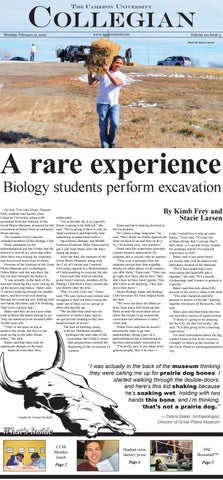
On Feb. 7, at Lake Elmer Thomas Park, students and faculty from Cameron University, along with personnel from the Institute of the Great Plains Museum, prepared for the excavation of bones from an unknown Bison species. The students from Cameron included members of the Biology Club. Work continued on the paleontological dig that Friday, but the discovery started six years ago when three boys were fishing for crawdads and discovered some type of bones. Director of the Institute of the Great Plains Museum and Archeologist Debra Baker said she was there the day the boys brought the bones in. “I was actually in the back of the museum thinking they were calling me up for prairie dog bones,” Baker said. “I started walking through the doubledoors, and here’s this kid shaking because he’s soaking wet, holding with two hands this bone, and I’m thinking, ‘that’s not a prairie dog.’” Baker said they do not know what kind of Bison the bones belong to yet. They are believed to be around 8,00010,000 years old. “They’re not quite as big as modern day bison, but they’re not quite as big as the other Bison either,” she said. Baker said that there may be significant changes to the bone material since they were
submerged. “So, to be able say it is a specific Bison is going to be difficult,” she said. “We’re going to have to rely on what’s around it and hopefully find something in association with it.” Agriculture, Biology and Health Sciences Professor Mike Dunn said he got a call from Baker after the boys found the bones. After the find, the Institute of the Great Plains Museum, along with the City of Lawton and Cameron University, agreed to a Memorandum of Understanding to excavate the site. Dunn said that with an internal grant from Cameron, members of the Biology Club built a fence around the site shortly after the find. “But, it’s still a low site,” Dunn said. “We just worked and worked and struggled to find out how to keep the water out of there, so we can go in there and dig this up. “We decided that sand was too expensive to build a dam, and so we got private funding to buy onehundred bales of straw.” The lack of funding, along with the Oklahoma weather, prolonged the start date of the excavation, but Friday’s straw dam preparations marked the beginning of the excavation in earnest.
By Kimb Frey and Stacie Larsen Dunn said he is looking forward to the excavation. “It’s taken a long, long time,” he said. “but I think we finally figured out what we need to do and how to do it. So, I’m feeling very, very positive.” Dunn said this experience provides a great research opportunity for students and is exactly why he teaches. “This is an experience that our students can get here that arguably, maybe ten other places in the country can offer them,” Dunn said. “They can go right over there and do this. They don’t have to have travel agents. They don’t have to do anything. They just drive over there.” Junior Biology major and Biology Club Secretary RJ Trent helped build the dam. “We were out there for about an hour, hour and a half stacking hay bales around the excavation site to allow the stream to go around the excavation site whenever it rains,” Trent said. While Trent said that he doesn’t necessarily want to go into paleontology, being a part of a paleontological dig is something he has been particularly interested in. “I’m pretty sure if you asked most general people, they’d be like —
yeah, I would love to dig up some bones,” Trent said. “It’s just one of those things that I can say that I have done — I can put on my resume for graduate school. It’s research experience as well.” Baker said if any more bones are found, they will be taken to the laboratory located in the Museum. “We’ll start analyzing it and everything and hopefully put it together,” she said. “It’s a puzzle. Archaeology and Science in general is a puzzle.” Baker said that only about fifty percent of the work is done in the field. “The other hundred-and-fifty percent is always in the lab – putting together the pieces of the puzzle,” she said. Baker also said that finds like this one provide a variety of opportunities. “I think it’s going to be amazing for the City, for the University,” she said. “It’s also going to be a learning experience.” For more information about the dig, contact Dunn in the in the Sciences Complex or Baker at the Institute of the Great Plains at intitutegreateplains. org.
“I was actually in the back of the museum thinking they were calling me up for prairie dog bones. I started walking through the double-doors, and here’s this kid shaking because he’s soaking wet, holding with two hands this bone, and I’m thinking, ‘that’s not a prairie dog.’” — Debra Baker, Archaeologist, Director of Great Plains Museum
Graphic by Victoria Orndorff
What’s Inside CCM Monday lunch Page 2
Student wins literary prize
PAC Bossaball™
Page 4
Page 5
2
News
February 17, 2020
www.aggiecentral.com
CAMERON CAMPUS MINISTRIES
Feeding the students Brittany Otero
highlights of the week, really, for me,” he said. Copy Editor “To get to make all these sandwiches, deliver them, At 11 a.m. on Feb. 10, give them to the students. the Cameron Campus We have snacks, granola Ministry (CCM) hosted bars, chips — besides lunch in the Shepler fruit — that go with the Center’s Wichita Room. sandwich. And water The event lasted until 12:30 p.m.; CCM Director and soda. The students Kacie Scherler and CCM have the big choice of Coordinator Peter Macias eating, and I’m sure they appreciate it.” also invited students to Sports & Exercise write Valentine’s Day sophomore Tamaura cards for veterans. Scherler said that these Shelton said she attends CCM’s lunches often and lunches take place every loves everything that the Monday and are just one organization does. way for the organization “For as long as I’ve to help make the world a known him, that’s been better place. Peter’s biggest saying,” “We serve lunch here she said. “‘We don’t want in the Wichita Room, 11 to 12:30, except we really to make everybody a are ready at about 10 a.m. Christian; we just want to feed them.’ And, I mean, because some students that’s how it should be. come by early before You don’t have to impress class,” she said. “So, we the gospel and everything try to make it possible for as many people to get on someone to feed them.” here as possible. Scherler said that after “We really just want to she became director, she be a safe space for people noticed students dropping of all beliefs, as well as by for lunch and leaving people who don’t really immediately after. align themselves to any “I thought it would be particular faith,” Scherler neat to have some sort of said. “The thing that we want to be the root of our interactive component,” she said. “So, we just organization is loving started. Last week and people and being a place for them to come and ask the week before, I made a big sheet of butcher questions.” paper, and I did ‘write a Macias said he change you wish to see in always looks forward to the world.’ We had lots of preparing the lunch. students write what their “It’s one of the
vision for the world would be, and it was so cool — I get goosebumps just thinking about it. “I want to have an activity here every morning that gets students thinking and engaged with the community or some sort of global issue,” Scherler said. “What are the little things that we can do, or the little changes that we can make in our day-
to-day lives, to make an impact? To get us where that greater vision is?” Macias said that CCM does a variety of mission work. “Besides being here on Monday, we’re also in the community,” he said. “We volunteer. We are active in activism. If there’s some kind of protest going on, we’re probably going to be there. Some of our representatives will
go.” Macias also said that the organization’s goal is not to bring students on a spiritual journey, but to show them love and inclusion. “Sometimes,” he said, “a person feels like they’re all alone. On campus, even. They’ll think ‘no one knows me,’ so they feel excluded simply because of what they are. We don’t care
what you are — we want you. We want you here because you have thoughts. You have ideas, and you have goals. You have dreams, and we want to share those dreams. We want to help make those dreams happen.” For more information about the Monday lunches and activities or CCM, contact Kacie Scherler at kacie.scherler@gmail. com. Photos by Stacie Larsen
3
Voices
February 17, 2020
www.aggiecentral.com
Photo courtesy of Tribune News Agency
cons of our
legal justice system
Amanda King Voices Editor @the_amandaking
Early last year, Fox premiered a new television show called “Proven Innocent.” According to the official premise, the show follows a wrongful conviction law firm and its employees as they reopen criminal cases and attempt to exonerate convicts who have been “proven” guilty. The show, and the premise itself, portrays a worthy cause; after all, how many convicted criminals alone had verdicts overturned when DNA evidence was first widespreadly tested and matched? Moreover, haven’t those working in the legal system just written off wrongful convictions as just collateral damage for decades? A tragic side effect of our process of trial by jury? Perhaps, perhaps not. Regardless, the fact remains that innocent people have been wrongfully convicted in the past — and of course, many still are now. What we can do about such injustice is questionable because, in some ways, the people who assume it’s just bound to happen are right. When all evidence points to a defendant, and all the jury has is the information before them, mistakes can be made. Juries are only composed of humans, after all. If you want to see some evidence for yourself, go to innocenceproject.org — who at any given time, are evaluating between 6,000 and 8,000 cases. Consider Antron McCray, 15; Kevin Richardson, 14; Yusef Salaam, 15; Raymond Santana, 14; and Korey Wise, 16 — a.k.a., the “Central Park 5.” Accused of raping a female jogger in New York City’s Central Park, these five boys were victims of a wild media frenzy which culminated in a wrongful conviction, despite “inconsistent confessions, DNA evidence exclusion and a lack of any other evidence linking them to the crime scene.” Thankfully, they were all exonerated in 2002, but many wrongful convictions still stand — as the Innocent Project’s website, if not it’s existence itself, heartbreakingly shows. Whether the wrongfully convicted are rightly set free or not, cases such as these are just plainly tragic. They highlight the very worst aspects of our justice system — when the fate of someone’s freedom relies solely on twelve jurors and their ability to differentiate fact from fiction in the courtroom. Not to mention difficulties in appealing a verdict. But once I finished ruminating on the injustice of it all, once I started to really consider the drawbacks of About Us
The official student newspaper of Cameron University, The Cameron Collegian is available twenty Mondays during the year. It is printed by the Norman Transcript. The first issue is provided for free. Each subsequent issue is $1.50.
Our Views
The opinions expressed in The Collegian pages or personal columns are those of the signed author. The unsigned editorial under the heading “Voices” represents the opinion of the majority of the editorial board. The opinions expressed in The Collegian do not necessarily represent those of Cameron University or the state of Oklahoma. Our student media are designated public forums, and free from censorship and advance approval of content. Because content and funding are unrelated, and because the role of adviser does not include advance review of content, student media are free to develop editorial policies and news coverage with the understanding that students and student organizations speak only for themselves. Administrators, faculty, staff or other agents shall not consider the student media’s content when making decisions regarding the media’s funding or faculty adviser.
our legal justice system, I started wondering about the other kinds of cases. The ones we don’t hear about in the news or on charitable websites. Likely because if we did, the public would be in a constant state of panic. What about the people who are definitely guilty, but can’t be convicted? The people who would have been found guilty, if certain evidence had been deemed admissible? The people who were tried once for a certain crime and can’t be tried again once new and incriminating evidence is found, because of double jeopardy? It happens more than anyone wants to think, because who wants to think that dangerous people who slipped through the justice system are walking around free to commit more heinous crimes? Simply because evidence was found from a faulty warrant that wasn’t specific enough, or was given to police by a third-party, or the statute of limitations had expired, the list goes on and on. Don’t get me wrong, there are some rules in place to prevent some of these “technicalities.” For example, as per Cornell Law School’s Legal Information Institute, there’s the “inevitable discovery” exemption, wherein if law enforcement can prove that they would’ve found the evidence eventually through the course of an investigation, it can be used in a criminal case. The problem, though, is that this is difficult to prove, and if inevitable discovery can’t be proven, the evidence falls victim to the “exclusionary rule” and is suppressed. Moreover, inevitable discovery generally only applies to derivative evidence; Most states don’t allow for primary evidence to apply. And an even worse phenomenon: fruit of the poisonous tree. Let’s say someone leaves DNA at a crime scene. The police run it through their database and get no matches. They widen the parameters and find a familial match that leads to the suspect. The suspect refuses to give DNA, and now he can’t be compelled to give it — because, that’s right, fruit of the poisonous tree. The suspect was found in an illegal DNA search, and thus any evidence police found after it is inadmissible. This example is specific, but the new advances in DNA evidence research have been revolutionary to law enforcement: Police caught the Golden State Killer, Joseph DeAngelo, guilty of more than 50 rapes and 13 murders, after 30 years of evading law enforcement after they ran his DNA through a personal genomics website and got a familial hit. But only a limited number of states allow such
evidence, and civil rights activists vehemently protest the ethics of such methods. So what is the solution to these problems? These two problems are blaringly different sides of the same coin of the American justice system, both horrifyingly unjust — but what do we do here? We can see the problems, we know they exist, but how can we fix them? What better alternative is there? For wrongful convictions, on the heads side, maybe there isn’t an immediate solution. In Japan, the justice system operates under a “guilty until proven innocent” mentality. Imagine if the U.S. decided to shift the burden of proof from the accuser to the accused? If, instead of being instructed to find a defendant innocent until proven guilty “beyond a reasonable doubt,” they were instead asked to convict anyone under suspicion of being guilty? Millions would be wrongfully imprisoned on circumstantial evidence alone. This wouldn’t be beneficial to anyone — on the contrary, it would imprison even more innocents. So perhaps the heads side of this coin must stay the same for now… until we can find a better alternative. But what about the tales side? What if we were allowed to try someone for the same crime more than once? Prosecutors might just retry defendants until they get the verdict they want. But they also might choose not to waste more resources, unless they could find definitive evidence for the second time around. How about allowing in evidence that was seized without a specific warrant? Or letting law enforcement use secondary DNA matches? Wouldn’t that violate some of the most basic of civil rights? But wouldn’t it be worth it? I say absolutely. Even criminals have civil rights — but if absolute proof was found that someone commited a crime, isn’t it completely reasonable to assert that the government should be able to use it against them? Or should we do as civil rights activists do in situations like these — such as the ones that opposed DeAngelo’s conviction — and refuse to consider the horrors, both past and future, that a serial criminal has and will continue to commit because absolute proof was found through arguable means? Perhaps I’m too idealistic in overlooking the potential negative consequences that changing some of these canon laws would have on civil rights. But I would rather be too idealistic, than think about all of the victims who could have been saved if our justice system had not failed.
THE CAMERON UNIVERSITY
Letters Policy
COLLEGIAN Founded in 1926 veritas sempiterna
Letters to the editor will be printed in the order in which they are received and on a space available basis.
Editorial Staff
The Collegian reserves the right to edit all letters for content and length. Letters should be no more than 250 words. Letters from individual authors will be published only once every four weeks.
Managing Editor - Payton Williams and Madison Lyda A&E Editors - Lea Killian and Kimberly Frey Sports Editor - David Perkins Voices Editor - Amanda King Copy Editor - Brittany Otero Student Life Editors - Cambron Alsbrook, Adrianna Finch Social Media Editor - James Rowbottom Photographers - Katie Hall, Stacie Larsen
Newsroom Staff
Financial Officer - Susan Hill Staff Writers - Bryan Araujo, Katie Hall, Xavier McClure, Isabel Rosales-Aparicio Circulation Manager - Bryan Araujo Faculty Adviser - Prof. David Bublitz
All letters from students should include first and last names, classification and major. No nicknames will be used. Letters from people outside the Cameron community should include name, address and phone number for verification. Letters can be sent by regular mail, by e-mail to aggiecentral@ cameron.edu or they may be dropped off at our office - Academic Commons 101 or at www.aggiecentral.com.
4
A&E
February 17, 2020
www.aggiecentral.com
CU’s own Pushcart Prize nominee: Kimb Frey
Briley Jones
A&E Editor @kimbfrey
Cameron University’s own Senior Creative Writing Major Briley Jones is gaining recognition on a national scale with his recent nomination for the Pushcart Prize. The Pushcart Prize is a prestigious literary prize established in 1976 by the Pushcart Press to recognize new writers featured in small press publications. Jones said that to be considered for the prize, he had to be nominated by just such a publisher. “I submitted to a journal in New York City called ‘Night Picnic Journal’,” Jones said. “It’s a bilingual publication in English and Russian, and I got accepted. Then a few months later, they sent me a letter that I had been nominated for a Pushcart Prize out of the one-hundred or so pieces they had published that year.” Jones said that he really didn’t have a say in his nomination for the prize. “The Pushcart Prize isn’t something you go after,” he said. “It just kind of happens.” Small magazine and book presses from across the globe can submit up to six nominations to the Pushcart Press for prize consideration. The Pushcart Prize is a big deal in the literary world, receiving praise and recognition by the likes of “The New York Times” and “Publisher’s Weekly.” The editors of “Night Picnic Journal” published Jones’ short story
“Minnie” in their June 2019 issue. “Minnie,” is a story about a man who abandons his family — save for his daughter Minnie — to preach to the Indigenous Peoples of the western United States.
Communications, English and Foreign Languages (CEFL) Assistant Professor Leah Chaffins said that Jones is the perfect storm of talent, professionalism, a willingness to learn, and an unrelenting dedication to Courtesy Photo
“Minnie” wasn’t Jones’ first work to be presented in a national publication. “The Nasiona,” a monthly magazine dedicated to nonfiction, published Jones’ creative nonfiction piece “Cluttered Table” in their April 2019 issue.
writing. “Having an undergraduate student nominated for a Pushcart award is an outstanding recognition for our university and the CEFL department,” Chaffins said. “Briley is a perfect example of the accomplishments that
can be achieved when students are motivated and apply the suggestions and recommendations of people within a field’s network.” Jones said he’s moved on from short stories and has been focusing on writing longer works. “I’m working on a novel now about 1970’s Los Angeles and Nixonian reaction,” Jones said. “I really like writing period pieces. I’m really into the 1960s and 70s culture, but I’m really fascinated with westerns. I like to mix and match genres.” Jones plans to go to graduate school in the fall for a Master of Fine Arts (MFA) in Fiction Writing and has been accepted into the University of South Carolina’s program and is on Ohio State University’s waitlist. “I’ll spend the next two or three years, depending on which school I get into, getting my MFA,” Jones said, “and during that time, I’ll be working on that same novel.” After graduate school, Jones plans to spend time polishing and putting the final touches on the novel and pursuing a traditional publishing route. Chaffins said she looks forward to seeing what Briley does with his future. The “Night Picnic Journal” is available for purchase on Amazon. “The Nasiona” is free at www. thenasiona.com, and check out Cameron University’s own free publications, the 2019 editions of the “Goldmine” and “The Rose” journals, in which Jones also has published work.
Cabello proves romance isn’t dead Lea Killian
and you’re the living proof.” “Romance” encapsulates that concept and so much A&E Editor more. One might have feared that the album would @talkinglea appear too … well, romantic. However, Cabello On Dec. 6, 2019, Camila Cabello released her expertly navigates the waters of what love can look second studio album, “Romance.” like via her songwriting and storytelling abilities. She first stepped into the spotlight at the age of 15 While the album does certainly feature dreamy, when she performed on “The X Factor” where the relationship-positive songs like “Easy,” “Dream of judges paired Cabello with Normani Kordei, Lauren You” and “Used to This,” Cabello doesn’t shy away Jauregui, Ally Brooke and Dinah Jane, and formed from singing about her hardships and confusion in Fifth Harmony. traversing a love turned cold. The girl group proved immensely popular, releasing “Bad Kind of Butterflies,” for example, illustrates three albums together. They continued churning out the pain of having to break someone’s heart or risk hits like “Worth It” and “Work from Home,” the breaking your own. former earning triple platinum certification in the U.S. “What do I do when I love you and want somebody and the latter becoming the group’s first top-ten single else? / What do I lose if I don’t choose and keep it to on Billboard Hot 100 until Cabello’s departure from myself?” the group in 2016. Cabello layers her vocals in the last half of the The four remaining members of the group released song to create a haunting experience for her listeners, one final self-titled album together and then disbanded capturing the anxiety of indecisiveness. This is just in 2018 to work on their own solo projects. one example of Cabello’s honesty. Meanwhile, Cabello had just released her own solo The album features two other artists, DaBaby album, “Camila.” on “My Oh My” and Shawn Mendes on “Señorita,” The album debuted at number one on the Billboard 200 in the U.S., earning Cabello a Grammy Courtesy Photo nomination for Best Pop Vocal Album. She released singles off the album including “Havana” and “Never Be the Same,” her most popular songs. She even performed as an opening act on Taylor Swift’s “Reputation Stadium Tour.” Finally, in Sept. 2019, Cabello started teasing her second album, releasing a YouTube clip in which she wonders if she knows anything at all about love. “All I know is that love changes you,” she said. “If you’re lucky, to something better. Falling in love with life itself makes an artist out of everyone. I thought I was making art before. For me, writing songs was making art, but now I want my life to be the work of art, and my songwriting to be the camera that I take a picture of it with. That’s what I’m living. That’s the art. What do I know about love? Maybe nothing — and that’s why it’s everything.” Cabello released six songs from “Romance” before the album dropped, promoting them through music videos and live television performances. This is an area of her career in which Cabello truly shines. Most of her performances contain extravagant costume changes, actors, elaborate choreography and a definitive element of storytelling. Even when Cabello performs a simple ballad alone on stage, her ever-improving vocal skills endlessly captivate her audiences. A revealing example of this is Cabello’s performance of “Living Proof,” at the 2019 American Music Awards in which she hoped to express the feminine energy and sensuality that the song represents: “Where did you come from, baby? / And were you sent to save me? / Oh, there’s God in every move / Oh,
which positively contribute to Cabello’s intended theme and aesthetic of the album. The final song, and perhaps the gem of the entire album, “First Man,” brings the record full circle, in which Cabello sings to her father about the way he loved her as a child and how that informs her idea of love in adulthood. “I swear on my heart that he’s a good man / I know you’ll stay up late just waitin’ for me / You held me so tight, now someone else can / But you were the first man that really loved me” Few pop artists have displayed as much growth and maturity between their albums as Cabello has between “Camila” and “Romance.” Whether her rising talent in the last two years came from new experiences or a lifetime of writing songs on her bedroom floor, Cabello has proven that romance, in fact, isn’t dead. “Romance,” is a well-balanced, finely tuned display of honest songwriting that beautifully illustrates female sexuality, the heartache of saying goodbye to chapters of one’s life and the magic of newfound love. Camila Cabello has never been better. I rate this album 10/10.
February 17, 2020
5
Student Life
PAC PRESENTS: Ultimate Bossaball™ www.aggiecentral.com
Adrianna Finch Student Life Editor
At 4-8 p.m. on Jan. 28, in the Aggie Rec Center, Cameron’s Programming Activity Council (PAC) hosted Ultimate Bossaball™. Bossaball™ is a sport that mixes elements of volleyball and soccer and is played on an inflated court. The court is divided by a net with trampolines on either side of the net. PAC set up the Bossaball™ court on half of the Rec Center basketball court, so students were still able to use the other court. PAC Vice President Kathrine Monaghan said that the turn-out was better than expected, and she was excited to see how many teams came. “The teams were first come first serve, so students didn’t have to register or anything,” Monaghan said. “They just had to show up and sign the waiver. So far, we have had about fifty students, and we are expecting more. People have messaged me saying they are going to bring their groups later and play the game [Bossaball™] as well.” Each team contained up to six players. One player, the Bosskeep, played on the trampoline with the remaining players on the court. Teams scored points based on how players touched the ball before they delivered it over the net. If players hit the ball with a volleyball method — using their hands or arms — the team that hit the ball over the net received one point. The point system was the same for the soccer method — using their feet, legs, head or back. The team that scored the most points in 15 minutes won and played against the next team. The losing team could return to court after all other teams had a chance to play. Biology freshman Aubrey Robinson said that she enjoyed playing Bossaball. “It’s an intense game, but I had a lot of fun,” she said. For more information about future PAC events, email pac@cameron.edu or call 580-581-2217.
Photos by Stacie Larsen
Homecoming Roundtable Cam Alsbrook
to enjoy thanks to the Programming Activities Sports Editor Council, who spends a portion of their annual At 4 p.m. on Jan 30, budget on homecoming Campus Life hosted each year. the Homecoming Campus Life Roundtable in the Coordinator Daniel McMahon Centennial Complex upstairs in the McFadden who said that Cameron has been doing Buddy Green Room. The event’s goal was Homecoming for over 20 to relay information for years. “Cameron University Homecoming. has some really exciting Administrative traditions such as the Assistant Nichole Fun Run and a bonfire/ Ritter went over the prep rally.” McFadden homecoming week said. “We packet passed out to are starting a student organization new tradition officers. “The packet includes called the Homecoming the Homecoming Relay. Some week activities and other classic schedule. Deadlines traditions are for Homecoming the Crowning participation, and guidelines to follow for of the Monarch and Free Homecoming Royalty, Pizza.” Sandwich Board McFadden Painting, Cameron Foam said C, and the Homecoming Homecoming Relay,” Ritter said. takes a lot of The information provides a scope into the preparation. “Each event week of homecoming is important to week to help student Homecoming.” organizations prepare McFadden said. their activities. Homecoming brings “From setup to cleanup, traditions for students
everyone has an important role to play and we all do it to the best of our ability.” Student organizations will be able to participate in Homecoming by designing large foam “C” displays and painting double-sided wood signs that will be displayed across campus. Homecoming participation also includes “Homecoming Royalty.” Juniors and Seniors
are allowed to run for Homecoming Monarch. Students will be campaigning to be elected as Homecoming royalty as the time of nomination approaches. McFadden’s said that Homecoming 2018 is one of his most treasured memories of being at Cameron. “My best Homecoming memory was back in 2018; when my first day working at Cameron University was
Homecoming,” McFadden said. “So it was amazing to jump right in and see all the school spirit happening. It will always be one of my favorite Cameron memories.” The theme of Homecoming 2020 is “An Aggie Adventure.” McFadden said that the Homecoming Committee decides the themes each year. “A Homecoming Committee is put together — which is created with
Campus Life, Alumni Office, Athletics, and the Dean of Students.” McFadden said. ”The committee meets together and discusses potential ideas for a theme. Eventually, we narrow down the options and select the theme.” For information about Homecoming, contact the office of Campus Life on the second floor of the McMahon Centennial Complex or call 580-5012217. Photo by Cam Alsbrook
6
Sports
February 17, 2020
www.aggiecentral.com
Photos by Cam Alsbrook
Prepping for the League of Legends: League of Legends collegiate player Anton Pickens plays League of Legend for the Pickaxes — Cameron’s Esports team. Practice sessions for the team have been in full force in preparation for the start of their first season as a team.
Cam Alsbrook Sports Editor
The Pickaxes — Cameron’s collegiate Esports team — brought on talented players in Fall 2019 that press towards success in their practice sessions, and are preparing for the start of their legacy. One player for the League of Legends team, Anton Pickens, will to make their start in the Esports collegiate scene this semester. Pickens found interest in Esports through his journey of playing League competitively — a hobby of
his since 2014. “I like the game,” Pickens said. “I found improvement through climbing the competitive rank ladders.” League features both a leveling system and a seasonal rank system that display the level of the player and their activity in the current season. Changes to the League of Legends meta encouraged growth for Pickens as a player, forcing him to adapt to the changes. “I enjoy all meta changes since it always makes me have to relearn old and new things to better myself,” Pickens said.
Meta changes translate to balance updates for the game — for example, changes to character speed or attack ranges. Pickens said players and viewers alike should research ways to improve their mentality and understand how balancing is done for the game. “League can be both beneficial to the mental state and harmful if players are not careful,” Pickens said. His method of dealing with negative emotions is through gaming, which has provided him with many friends over the year. Pickens has an interest in other genres of Esports as well, but education is their main focus. “I play a lot of game genres,” Pickens said. ”Fighting, role playing games, massive multiplayer online games, racing games, and more. “I wanted to try a fighting game Esport, but I wouldn’t have the time to learn another Esport, since I’m not a hundred percent focused on games — but my education.” Pickens hopes to see more diversity in the future changes to League of Legends’ meta, from both developers and players alike. “I want to see more love
towards creating more unique builds,” Pickens said. “That way, it will force players to really think of unique counter builds.” Pickens hopes that the future of esports provides more visibility to smaller organizations that take part in the competitive scenes and more local tournaments to sprout up. For now though, he likes improving match after match and hanging out with friends after stressful games. “My favorite part of the game is both winning and losing,” Pickens said. “I like the game even in the worst of matches. I can always learn from all of my games.” Due to playing strong opponents and participating as part of the Pickaxes with his friends, Pickens can accomplish his goal of participating in Esports — growing as a person. League of Legends is one of four games that the Pickaxes are dipping their toes into – the Overwatch, Smash Bros. Ultimate and Rocket League teams at Cameron also boast driven players like Pickens who are going to be starting their first season this semester as well. For more information about the Pickaxe Esports teams and upcoming participation, contact Esports Coach John Cunningham at 580–581–7944, or at jocunnin@cameron.edu.