Collegian T he Cameron University
www.aggiecentral.com
Monday, September 10, 2018
Volume 99 Issue 1
Departments merge
Photos by Stacie Larsen
Communication, English and Foreign Languages Stacie Larsen
Managing Editor
Cameron University’s Department of Communication and Department of English and Foreign Languages merged over the summer, creating the Department of Communication, English and Foreign Languages. Professor and Dean of the School of Arts and Sciences Dr. Von Underwood said several considerations weighed into the decision to merge the departments—one being the fact that both departments had recently lost teachers. “We looked at the picture and were thinking: ‘What are we going to do? How are we going to handle this, and what are we trying to do in the year ahead?’ Underwood
said. He also said the University is interested in looking at Associate programs and certificate programs because those things have value for students and employers. “We are not intending for people to stop at those degrees necessarily,” he said, “but they do give you a goal to set. “It’s important that any degree ... we put in place has value to the student, and it has value to a potential employer and value on the market when you are trying to get a job and you are putting it out there. “ With the merging of the departments, Underwood said things were starting to look promising for the years ahead. “What we are really hoping is that we can make a lot of progress
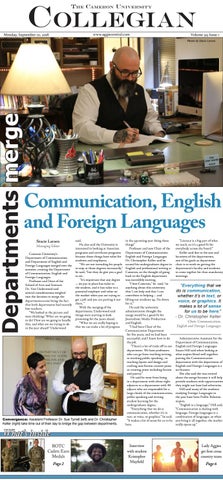
Convergence: Assistant Professor Dr. Sue Tyrrell (left) and Dr. Christopher Keller (right) take time out of their day to bridge the gap between departments.
in the upcoming year doing these things” Professor and new Chair of the Department of Communication, English and Foreign Languages Dr. Christopher Keller said he earned his undergraduate degree in English and professional writing at Cameron, so the thought of going back to the English department was incredibly exciting. “I love Cameron,” he said, “so anything about this university that I can help and that I can contribute to helping ... and lifting our students up, I’m down for it.” He said the university administration thought the merge would be a good fit for Journalism, Media Production and English. “I had been Chair of the Communication Department for five years, and we had been successful, and I knew how to do the job. “There’s a lot of trade off in our department. We have professors who can go from teaching writing, to teaching public speaking , to teaching layout and design and crafting non-fiction creative prose or creating prose including fiction and poetry.” He said he went from being in a department with about eight adjuncts to a department with 40 adjucts who are responsible for a large chunk of the communication, public speaking and writing student learning for the undergraduate degree. “Everything that we do is communication, whether it’s in text, or voice, or graphics,” he said. “It makes a lot of sense for us to be here.
“Literacy is a big part of what we teach, so it’s a good fit for everybody across the board.” Keller said due to the size and locations of the departments, one of his goals as department chair is to work on getting the department’s faculty and students to come togther for than mandatory meetings.
“Everything that we do is communication, whether it’s in text, or voice, or graphics. It makes a lot of sense for us to be here.” - Dr. Christopher Keller
Chair, Communication, English and Foreign Languages
Administrative Assistant for the Department of Communication, English and Foreign Languages Susan Hill said when looking at what majors blend well together, putting the Communication department with the department of English and Foreign Languages is a no-brainer. She also said she was excited about the merge because it will help provide students with opportunities they might not have had otherwise. Hill said many of the students studying Foreign Languages in the past have been Public Relation majors. “English is a language,” Hill said, “Communication is dealing with language. Foreign languages is a combination of languages, so when you bring it all together, the market really opens up.”
What’s inside ROTC Cadets Earn Medals Page 2
Interview with student Kristopher Mayfield
Lady Aggies get first cross country team Page 6
News
2 Drue Watkins
September 10, 2018 www.aggiecentral.com
Photos courtesy of Audrey Shifflet
Co-Managing Editor During the 2018 summer, two Cameron University ROTC cadets attended specialized U.S. Army schools, graduating with full honors. The first ROTC Cadet was junior Robin Boudiette, who completed Airborne training at Fort Benning, Georgia, and became a paratrooper. Airborne training consists of a three-week long regimen—known as Basic Airborne Course (BAC)— which teaches Soldiers the techniques involved in parachuting from airplanes and landing safely. Boudiette said joining the Airborne was something he always wanted. “It’s a dream of mine,” he said. “I want to branch into Infantry and being Airborne is a pretty big part of that. I made my decision, committed to it and gave it my all.” The BAC follows a rigid structure that slowly exposes soldiers to airplane safety, with an emphasis on physical exercise and creating instinctive reactions when exiting a plane’s doors. Boudiette said he felt as though he was wellprepared, mainly due to his ROTC training. Getting Tactical: ROTC Cadet Robin Boudiette (left) straps together a harness late at night to simulate a “I’m used to being high-pressure situation. Cadets Boudiette and Crosswhite attended specialized training over the summer. around a lot of military personnel,” he said, “and as Jump Week, when soldiers must National Guard Warrior Training Center. that helped out. successfully, and finally, jump out of a live Crosswhite said he was extremely “I wasn’t really concerned about the plane (model C-130) five times at 1,250 proud when he completed the training, physical aspect of the school—you know, feet. earning his Air Assault Badge and the 2B things like pushups, sit ups and running. I Boudiette said his first time jumping out Additional Skill Identifier (ASI). was confident in myself.” a plane was nerve-racking, but it was also “When I first graduated Air Assault The most challenging part for Boudiette one of the most profound moments of his School, I had a sense of relief,” he said. revolved around learning the intangibles of life. “I did not want to let my ROTC program jumping out an airplane. “I was shaking and terrified,” he said, down since they are the ones who sent The instructors, known as Black Hats, “and I was the second guy out the door. me—coming back with wings on your used mock doors and had soldiers land I closed my eyes on the jump, but it felt chest is a great feeling.” safely on gravel a foot below. really peaceful after a moment. We did Though the training emphasizes rigorous Boudiette said learning how to position a ‘Hollywood Daytime Jump,’ which is and physically exhausting workouts, his body for a landing proved difficult. basically just a parachute without your using methods such as 12-mile hikes in “It’s even harder when you have to combat equipment.” under three hours with full gear, it is also learn how to navigate mass exits with Those who pass the training get the mentally demanding, as candidates need people on your left and right,” he said. honor of applying the Silver Wing to their to learn aircraft safety and orientation, “And it’s also hot—you know, it’s Georgia uniform, officially becoming US Army alongside the principles of aero-medical in midsummer, ninety-five degrees, paratroopers. evacuation and combat assault operations. maximum humidity with our helmets on. Boudiette said it was amazing to Crosswhite said his ROTC program It’s one of those mind over matter things.” represent Cameron University throughout prepared him well for the situations he Boudiette said the Black Hats were the the whole experience. had to endure, like studying in stressful only reason anyone made it through, and “It’s just a dream, jumping out of environments. that their instructions made the soldiers airplanes,” he said. “Without Cameron “The whole thing was hard,” he said. the best they could be. ROTC, I wouldn’t have had this chance. “From the physical aspect of it, to the “The Black Hats were really good,” he “I loved every second, and representing sling load operations, and to eventually said. “They knew what they were doing Cameron felt great. I was glad to be given repelling out of the UH-60 (helicopter). A and pushed us enough to succeed. We the opportunity.” lot of it you have to learn on the fly while would’ve been lost without them.” As for his future in the Army, Boudiette you are there.” The final week of training is known said he has most of it mapped out. Each Soldier attending the school “I plan on going must go through different phases to Infantry and getting my graduate; for example, the Rappelling Ranger tab,” he said. Phase is a three-day series that consists “I’d like to start out my of completing two rappels from a 34-foot career at the 25th Infantry tower and two rappels from a UH-60 Division in Alaska. Blackhawk helicopter, which is hovering “As someone who really at 70-90 feet in the air. likes the outdoors, I think Many cadets across the nation apply it fits me.” for these specialized schools, making the The second Cadet who possibility for acceptance very low. competed during the Crosswhite said the ultimate decision to summer is junior Robert attend the school was up to his cadre, and Crosswhite, who went to that he appreciates their efforts to send Fort Benning, Georgia, to him there. participate in Air Assault For his future career in the military, School. Crosswhite said he feels like it’s pretty Air Assault School is a standard. 10-day, highly competitive “My first and primary goal is to course designed to prepare commission like every other cadet in the U.S. Army Soldiers for nation,” he said. “After that, I have no insertion, evacuation idea. I might just stay in for four years and and pathfinder missions get out.” that utilize multipurpose For more information on Cameron Front and Center: Cadet Robin Boudiette (left) and Cadet helicopters. ROTC or military science, visit Burch Robert Crosswhite (right) stand at attention before Big Ollie the This particular school Hall Room 110 or check out cameron. artillery piece. is hosted by the Army edu/militaryscience.
CU Cadets Succeed
Student Life
September 10, 2018
www.aggiecentral.com
3
The 2018 CU Organization Fair
Photo by Madison Lyda
Madison Lyda
Student Life Editor @maddilinee On Aug. 30, student organizations on campus gathered at the Science Complex East Lawn for the annual Fall Student Organization Fair. Organizations from all corners of campus united in effort to attract the incoming freshman class and corresponding classes interested in becoming involved on campus. The Organization Fair offers groups on campus the opportunity to reach out to the student body in a convenient and social setting for a long enough span of time so that students do not have to worry about missing their classes to
attend and learn. The event focused on encouraging students to be involved in at least one organization during their stay at Cameron. Organizational groups such as the Resident Hall Association, the Nepalese Club and Greek life appeared with various sources of information regarding individual group organizations. Students were given specific information regarding group missions, meeting times and locations, special upcoming events and contact information. Sophomore Biology major and Earth Club President Kaylee Craig said the Organization Fair offered her group the opportunity to grow in membership and awareness, “Our goal coming
into the event was honestly just to increase membership. Being a new organization, we don’t really have any members right now. It was important for us to be able to inform others of not only our organization but of how we plan to help the environment.” Craig said she appreciated the opportunity to express the goals of their organization to new students, “We don’t often have many opportunities to talk about our organization before the semester starts, and it’s really cool that we are given a platform like this early on in the semester to reach out to students before the craziness of classes start.” In addition to learning about the different organizations and clubs on campus, students learned
about academic groups and meet professors involved on campus as well. The event offered an opportunity to socialize with other students with the same interests and to make valuable connections. Making its first appearance at the event was Cameron’s newest organization, Earth Club. Earth Club is dedicated to the betterment of the environment and teaching members how to maintain a sustainable and healthy environment around them. Greek life informed prospective members of upcoming social events and provided information regarding what students can expect from their individual chapters before recruitment commenced. Senior Psychology major and
Omega Zeta Theta president Sarah McGarr shared how important it is to the Greek chapters to be able to spark an interest in incoming students as early as possible, “Our main goal was to answer any and all questions students had about Greek life or OZT in general. We were able to take down important contact information for interested individuals. It is so important to reach out to students as soon as possible so they’re aware of their options early on.” The fall Organization Fair is an annual event held by the Office of Campus Life, any additional information or questions can be answered by contacting them at (580)581-2217 or by email at lcothren@cameron.edu.
Photo by Madison Lyda
Stepping up with Madison Lyda
Kristopher Mayfield
“People started to see me more as a person to look Student Life Editor up to and not just another @maddilinee kid. When they started Cameron University to view me as the kid that senior Kristopher Mayfield ‘did everything right,’ who has always been a source of never cursed or started any stability for his family. trouble,” Kris said. “I lost the “Living at home was opportunity to interact with rough,” Kris said. “A lot of that side of myself.” the time, I was the keeper of Over time, Kris started order. I was in charge of who to gain insight to how people did their chores and who perceived him, motivating kept their room clean.” him even more to succeed – Growing up in the small to remain a positive influence rural town of Okmulgee, in his school and community. Oklahoma, Kris lived at Kris said people who live home with his mother, in a small town grow very father and three siblings. close. Toward the end of high “But that closeness school, Kris’ father was no wasn’t always positive,” Kris longer present in his life, said. “It was a place where encouraging Kris to step up you grew up with the same and help his mother. people you started school “I developed a ‘you’re with. There was comfort in supposed to set the that, but there were a lot of standard’ attitude,” Kris restrictions.” said. “I was dependable and As time progressed, reliable; I was needed.” classmates began to feel Even in school, Kris like family, and the joys and shared how his classmates pains of having a second and teachers relied on him family extended further than to do the things nobody else just classwork. would. He was always the Early on, Kris joined his one who gave big speeches school’s academic team and and ran important errands. leadership organizations. He
joined the speech and debate team his junior year. In debate, he would often speak to mature topics that required him to think strategically about how he communicated with other people. “Communication was sheltered. I learned to be aware of who I was and check my words before speaking because the second you said something somebody else didn’t agree with, everyone knew. Which wasn’t always a good thing.” Drawing on his experiences at home and considering how they shaped him today, Kris lifted his chin and smiled. “I’m not my past, and it will never define me,” Kris said. “I am a trail of constant decisions and experiences both right and wrong that continue to make me who I am.” As one chapter closed and the time came to move on to college, Kris wanted to expand his horizons and learn more about the people and things that make up the world.
“I wanted something more,” Kris said. “Somewhere comfortable and enough room to grow.” After touring his firstchoice university, Kris came to realize that it just wasn’t what he wanted anymore. That’s when he remembered the speech and debate camp he attended at Cameron University years prior. Within a matter of weeks, Kris toured the campus, auditioned for the debate team and fell in love with the community. He has since won many awards and honors for speech and debate. “It was a rollercoaster, and it was overwhelming, but it was worth it. Every year posed a new challenge, but every year brought new lessons to learn,” he said. “I remember this one year I had a speech that I hated by the end of the year. I just couldn’t memorize it, I struggled for so long,” he said. “Elizabeth Good sat me down one day and just said ‘Kris, you’re making this harder than it has to be. Sit down and memorize it.’ and I
remember just saying ‘It’s not that easy’ and she replied, ‘It is that easy,’ walked into the other room and by the end of that day I had memorized half of the speech.” Kris took home a National Championship that year for his speech. Even though it was a massive achievement, he doesn’t want his national title to define him. “People give me all of this praise for winning, but I don’t want it to be something that makes it so that everything that I do after this is determined or compared to this one event,” he stated. “I use it as a motivator, but not something that constricted me to feeling like anything that I do besides getting National Champion isn’t good enough.” For Kris’ senior year, he decided to leave the team. Feeling as though he had learned all of the lessons debate could teach him, he moved on to other passions in his life. For the last few years, Kris has been a Student Housing Resident
Assistant in both Shepler and the Village. This year, Kris became the Senior Resident Assistant for Student Housing. This opportunity is giving him the leadership and organization skills needed to excel in graduate school. Kris is excited to learn he will be attending Louisiana State University for his Masters and hopes to receive a Residential Assistant scholarship, so he can continue doing what he loves most. “Change is going to come whether it’s sooner or later. I like to stay on my toes nowadays,” he said. “I’m not done climbing for success because I’m not done moving yet.” Kris said his most important life lesson has been a lesson of selfexperience. “I was always the kind of person who wanted to learn from other people’s mistakes instead of go through them on my own. I know now that I can’t do that, and I’m taking the mistakes as they come and as they go.
Voices
4
September 10, 2018 www.aggiecentral.com
Journalism and Advertising
A Complicated Relationship
Payton Williams Voices Editor
@YoureSoVanya
In a recent conversation, a friend of mine made a joke that has stuck in my mind. We were talking about public trust in the media and what might be causing people to distrust the worldview presented by major news networks and talk shows. Then my friend made a point that was more serious than I think either of us really grasped at the time. “I haven’t really been able to believe anything I see on T.V. after hearing David Letterman call ‘Jack and Jill’ ‘hilarious’ while interviewing Adam Sandler.” For those who don’t know, “Jack and Jill” is a film in which Adam Sandler plays both a man and a woman, and in which Academy Award-winning actor Al Pacino has a lengthy synchronized dance number in which he sings about Dunkin Donuts. It has a 3% on Rotten Tomatoes. We both laughed at this observation at the time, but there is, as is often the case, something a little deeper to this seemingly inconsequential joke. David Letterman and Adam Sandler are both paid, in one way or another, by Sony Corporation. Sony pays Adam Sandler directly, as Sony Corporation owns Columbia pictures, the distributor for the film. But, more importantly, David Letterman gets paid, too. The fact is, a major company pays for advertising, and they don’t pay in the millions. They pay in the billions. In this case, last year, according to Nasdaq trading information, Sony Corporation spent an impressive $3.27 billion in advertising worldwide. Much of this money, of course, goes directly to major television networks in order to buy airtime for commercials and for other forms of advertising, such as native ads, which are ads
presented as part of the networks actual programming, such as news reports that highlight the use of a product. This advertising is the main source of revenue for almost every network. So, with that in mind, it wouldn’t be a terrible surprise that a television host might be inclined to say something nice about a universally panned movie in order to stay in the good graces of a company that helps pay his bills. Again, a company like Sony Corporation pays $3.27 billion for advertising. Most of that money goes to major networks, so even if only a few million dollars of that money goes to the network producing the show in question, a few million dollars to buy a lot of good will. There’s nothing much wrong with this process morally. While David Letterman
About Us
The official student newspaper of Cameron University, The Cameron Collegian is available each Monday during the year. It is printed by the Lawton Constitution. The first issue is provided for free. Each subsequent issue is $1.50.
Our Views
The opinions expressed in The Collegian pages or personal columns are those of the signed author. The unsigned editorial under the heading “Voices” represents the opinion of the majority of the editorial board. The opinions expressed in The Collegian do not necessarily represent those of Cameron University or the state of Oklahoma. Our student media are designated public forums, and free from censorship and advance approval of content. Because content and funding are unrelated, and because the role of adviser does not include advance review of content, student media are free to develop editorial policies and news coverage with the understanding that students and student organizations speak only for themselves. Administrators, faculty, staff or other agents shall not consider the student media’s content when making decisions regarding the media’s funding or faculty adviser.
loses a little bit of his integrity, it’s not as though he puts anybody at risk by pretending to like a terrible movie, and he makes a little money for himself and for the studio. Everyone goes on to punch a clock another day. By and large, this is accepted as the way things must be done. Networks need to make money, advertisers need to sell their products. It’s a completely fair and even somewhat inevitable system. Consider another scenario. Let’s say a reporter for CNN, or MSNBC, or Fox News is presented with a story, or even a few stories, about a medication that has been causing serious medical conditions in patients prescribed these medications by a doctor. Now let’s consider that pharmaceutical companies pay a combined $6 billion in advertising, double that of a media empire like Sony Corporation. Does this $6 billion provide an incentive for major medical stories to be ignored? This is a difficult point to prove or disprove. For obvious reasons, there isn’t a lot of media coverage about the media’s possible inability to police itself in the face of powerful corporations. So, instead, an inference must be drawn based on statistical information. According to a report from the National Center for Health Statistics, the statistical arm of the Centers for Disease Control (CDC), in the US alone, approximately 106,000 patients die annually due to adverse reactions to drugs. Prior to researching this article, I had certainly never heard this statistic, and I suspect many readers hadn’t either. It’s not a statistic that I remember hearing reported by a news network. My first reaction was even to doubt the statistics, and if both the FDA and CDC had not published reports with similar findings, I would have discounted the number as fake. So, why haven’t I heard this number before? It’s a pretty significant one, especially considering that it is limited to only one country. Once again, I am forced to ask, could $6 billion spent in advertising be an incentive to a major network to ignore reports of adverse reactions to drugs? This is, of course, a very extreme example, but the conflict of interest
THE CAMERON UNIVERSITY
COLLEGIAN
represented by a situation like this should be fairly clear. Consider any number of less extreme examples, such as political groups who either directly, through ad space, or indirectly, through organizational donations give money to networks. Let’s say, as is perfectly reasonable, that even with all this money coming in from advertisers, that the networks, are not swayed. Let’s say that the competition between these networks is enough that they don’t all have the same advertisers paying them the same money and that this competitiveness provides them with enough incentive to run stories that aren’t necessarily complimentary to an errant company. What incentive is there, for a smaller, print media news organization? As has often been said, print media is dying. There is simply not as much money in running a newspaper as there has historically been, and it is certainly not economically sustainable to run one based on the subscription system of days past. As a matter of fact, it is becoming rapidly harder to keep a printed newspaper or magazine going and, in light of this fact, most publications are moving more and more toward a completely digital format. This digital format, though it expedites the publication process in many exciting ways, is weakened by the fact that it is, as of now, almost completely based around advertising. Printed newspapers are also now almost entirely sustained through advertising. So, we have a dying industry, working in a system that is little understood, and based almost entirely around advertising. What sort of incentives might that create? I don’t believe this problem is a permanent one. I believe that as time goes on, the business model for webbased publications will continue to evolve to make publishers more beholden to readers. But for now, at least, I believe that a little healthy skepticism in the media we consume is a good thing Skepticism, after all, is the basis of all good journalism, and it may very well be the first step toward anything that even resembles truth. Letters Policy
Founded in 1926 veritas sempiterna
Letters to the editor will be printed in the order in which they are received and on a space available basis.
Editorial Staff
The Collegian reserves the right to edit all letters for content and length. Letters should be no more than 250 words. Letters from individual authors will be published only once every four weeks.
Managing Editor - Stacie Larsen Managing Editor - Drue Watkins A&E Editor - Sarae Ticeahkie Sports Editor - Katie Livingston Student Life Editor - Maddie Lyda Voices Editor - Payton Williams Copy Editor - Destiny Garcia Aggie Central Editor - Jeff Larson Social Media Editor - Abby Gonzalez Staff Writers - Jackson Miller, Mason Orso, Bryan Arauje, Justin Rose, David Perkins, Celeste Powell Photographers - Dontaye Abram, Lauren Johnson
Newsroom Staff
Financial Officer - Susan Hill Advertising Manager - Hannah Spoon Faculty Adviser - David Bublitz
All letters from students should include first and last names, classification and major. No nicknames will be used. Letters from people outside the Cameron community should include name, address and phone number for verification. Letters can be sent by regular mail, by e-mail to aggiecentral@ cameron.edu or they may be dropped off at our office - Academic Commons 101 or at www.aggiecentral.com.
September 10, 2018 www.aggiecentral.com
A&E
5
CU’s 5th Annual
French Film Festival Sarae Ticeahkie A&E Editor
students and the general public the From Aug. 23-25, opportunity enjoy movies, Cameron University’s not only at the annual 5th annual French Film festival, but all year long. Festival took place in the Clement said he likes Cameron Theatre. the idea of Lawton and The weekend long Cameron coming together festival showcased three to be able to experience French films, hosted the emotional and French-themed events and educational effect that held a small reception for different cultures can the Marco’s Fund Award. have on a person. The festival allowed “For me, the French people of all ages to come Film Festival does what together and experience a a university is supposed different culture. to do,” he said. “Not only With the event being for students, but for the open to students and community.” the public, the Lawton A part from the community came movies, the event together, making the included French wine festival a full experience. tastings, French Brew and Assistant Professor Croissants and a Dessert of English Literature and Dinner. William Dean Clement, The 5th annual French organized this year’s Film Festival continues festival, and has always to bring a cultural had an involvement with experience to Lawton the festival in the past. with the help of Marco’s Clement is also Fund, Fort Sill Apache co-faculty advisor of Casino, Comanche Cameron University’s Nation Casino and Magic Lantern Society. Lectures and Concerts. The Magic Lantern Film Society gives @SylviaSeeks
Also, additional support for the festival came from Cache Road Liquor, The Percolator, Green Acres market and many more local businesses. Each film focused on specific genres to cater to everyone’s liking. The three-day festival started Thursday night with the 1992 movie, “Indochine.” “Indochine” is a romantic-drama set in French colonial Indochina in the 1930s. It tells the story of a French widow who raises a Vietnamese princess. Both fall in love with a French navy officer who changes their lives dramatically. The Friday night showing of the 2009 film “Le Petit Nicola” followed ‘Indochine.’
“Le Petit Nicola” is a family comedy about a young boy named Nicolas, who has the perfect family and the best group of friends. He finds out that his mother is pregnant, which could ruin his perfect life. Senior Communication major Edward Muniz attended the friday showing of “Le Petit Nicolas”. Muniz enjoyed the audience’s repsonse and anticipation for the cute family night movie and French culture. “The people in the audience who understood it [French language] hollared and hooted about it,” he said.
“I also enjoyed the excitement that everyone brought with them. Everyone was on the edge of their seats waiting for the movie to begin.” The festival ended with a red-carpet event, showing the 2006 movie, “Tell No One.” ‘Tell No One’ is a dramatic mystery about a husband whose beloved wife has been murdered. He’s accused of murfering his wife. Eight years has passed and evidence is brought
to light, the husband recieves a video showing his wife alive and well. For more information about The Magic Lantern Film Society or future events , contact Professor Dean Clement at 580581-2925 or dclement@ cameron.edu or Professor John G. Morris at 580581-2329 or johnmor@ cameron.edu.
Graphic by Sarae Ticeahkie
A ‘Crazy Rich’ response to a romcom Sarae Ticeahkie A&E Editor
@SylviaSeeks
Spoiler alert: On Aug. 16, the anticipated romantic comedy “Crazy Rich Asians” released worldwide, earning $35.3 million on its opening weekend. Directed by Jom M. Chu, “Crazy Rich Asians”—for the third week in a row—continues to be the top movie in the North American Box Office, earning over $100 million. The film is also Hollywood’s first movie featuring an all Asian cast in over 25 years, making a definite mark in the movie industry. This rom-com is based on the 2013 novel ‘Crazy rich Asians’, written by Kevin Kwan. The novel continues as a trilogy, which includes “China Rich Girlfriend” (2015) and ‘Rich People Problems’ (2017). Made on a budget of $30 million, “Crazy Rich Asians” tells the story of American-Asian NYU economic professor Rachel Chu (Constance Wu) and yearlong boyfriend Nick Young (Henry Golding), who both travel to Singapore for Nick’s best friend’s wedding. Rachel realizes she doesn’t know much about Nick’s family, which makes for a good suspenseful plot. For Rachel, it comes as a surprise when she finds out that they are crazy rich—as the title of the film implies. Along with finding out that Nick comes from old money, Rachel must face the cultural high standards of Nick’s mother, Eleanor Young (Michelle Yeoh), and the rest of the materialistic family. With Eleanor’s very strict Chinese mindset, she is not fond of Rachel, who is an American-Asian who had no father growing up, eventually following her dream to become a professor. Throughout the film, Rachel must try and win over Eleanor, which is challenging, considering that Eleanor believes Rachel is not good enough for her son. As Rachel goes through all the obstacles to
becoming the perfect girl for mama’s boy Nick, she has the man. some help achieving it. Now fans will just have to wait and see if Hollywood Rachel’s college friend, Awkwafina (Peik Lin Goh), will continue the story that became the best romance is the comedic sidekick who stands by Rachel’s side as movie of the summer. she faces the big bad mother. Awkwafina’s character keeps the Tribune News Service film lighthearted with her funky style clothing and her comedic, outspoken family. There is a perfect balance between romance and comedy in the film. “Crazy Rich Asians” also focuses on the ups and downs of a lavish living lifestyle and how money isn’t always the answer for happiness. During the film, the audience can witness that lifestyle in a more detailed sense. There are huge parties every other night, so viewers see all these characters dressed in million-dollar clothing, consuming never-ending alcohol, enjoying the fanciest of foods and partying with music—all of this pulls the audience into the life of these characters. With Nick ready to give up the high life and the chance to take over the family business, he asks Rachel to marry him. Rachel turns him down and decides to go back to New York without Nick but not before putting Eleanor in her place. The mother realizes that the Asian culture way of doing things isn’t always the answer for her family’s happiness. The movie ends like all romantic comedies, with Rachel getting the approval of the mother and getting
Sports
6
September 10, 2018
www.aggiecentral.com
Graphic by Katie Livingston
Katie Livingston Sports Editor At 6:30 a.m. every morning, Cameron cross country runners congregate in front of the Aggie Recreational Center. It’s pitch black outside, with only the faded yellow light of a street lamp to illuminate the runners as they line up, using cracks in the sidewalk as makeshift starting lines to set off for their morning run. While this scene may not seem an unusual one, it is markedly strange for Cameron. This year, the runners are women. At the start of the Fall 2018 semester, Cameron introduced its first women’s cross country and track team. According to Head Cross Country and Track Coach Zach Johnson, Cameron added men’s cross country to meet an eligibility requirement for men’s sports in the Lone Star Conference. Now that Cameron has added women’s cross country, Johnson said he is excited about what the addition means for Cameron athletics. “I think the women’s presence helps us with the attitude and atmosphere in
the program,” he said. Thanks to the hard work Johnson put in during recruitment, and work the players put in over the course of their high school careers, Cameron has a solid group of runners to kick off women’s cross country program. The Graduate Assistant Women’s Cross Country and Track Coach SarahEmily Woodward is impressed by the girls’ work ethic, enthusiasm and sense of camaraderie. “They’re so young and they’re so excited,” she said, “and I love seeing that. I just love seeing that. They all work together so well.” On the pavement and off, it’s clear that the runners have already formed a strong bond. Woodward said that during workouts the girls often run in packs, making sure that no one falls too far behind. “I think that’s what makes a better runner,” she said. “Sticking with your team mates.” They stick together during lunches, too. After their morning work outs the runners filter into the cafeteria, pile food onto their plates and sit down together at one of the long, family style tables. “Family” is just the word that many
of them would use to describe both their relationship to their teammates and their coaches. For runner Chloe Philips, that sense of closeness is what keeps her going strong. “My teammates are my rock already,” she said. “Even though I’ve only known them for a few weeks, they are the reason that getting up at 5 a.m. is bearable, maybe even a little bit enjoyable. Because I get to spend time with them.” The women’s cross-country team is not only characterized by their supportive nature, but also by their collective drive. Both coaches and players have set the bar high for themselves this semester and are taking active steps to meet their goals. Right now, Johnson has his sights on the Lone Star Conference. “The Lone Star is one of the toughest conferences in division two,” he said. “Since we’re a young team, I’d be happy if we could get to the top half of the conference or close to that.” Woodward said she is also looking for success in the Lone Star Conference, but continues to have goals outside of it. “We would love to see them do very well at regionals,” she said. “And hopefully we can get one of them to
MAKING THE DIFFERENCE Katie Livingston
side of competitiveness,” Woodward said. “The thing I love Sports Editor about running is it’s such a mental sport. If you have the discipline Coach Sarah-Emily and willingness to do it you really Woodward knows that work ethic, not talent, is what makes the are passionate.” While running for Austin difference — both in running and Peay State University Woodward in life. realized that she wanted to instill The former runner for, and the next generation of runners recent graduate of, Austin Peay with that same passion. She State University began working said Cameron’s women’s crossas Cameron’s first female crosscountry team already has that country and track coach in August — making her presence of solid foundation of comradery and historical significance for women’s discipline. “They are all like firey balls of athletics at Cameron. energy,” she said, “ready to go in Woodward will bear the the morning. But to that same responsibility of laying the point, they take what they’re doing foundation for a new sport on very seriously, and they know campus, a challenge which drew they’re here for a reason: to work her to apply for the position. “I wanted to be a part of that,” hard, to do this.” This season, Woodward hopes she said, “I just said, ‘You know to strengthen the relationship that what? I think I’m going to apply. runners have to one another and I would really love to be a part of to their coaches. Runner Chloe a foundation building.’ I think Phillips said Woodward is well on being a part of this and making her way to doing just that. history is a once in a life time “Coach W is definitely my opportunity.” mom figure on campus,” she For Woodward, running is said. “She gives me advice and personal. It’s a sport that ignites her drive to become a better, more motivational words when I need disciplined person. From the first them most, she’s super supportive, and also has high expectations for time she took the pavement in fifth grade, she knew that running us because she truly believes in us. And I can’t speak for the other would be a significant part of her girls but that means everything to life. me.” “It brought out this different
Through the season, Woodward also hopes to instill in her players a strong sense of work ethic. She hopes the runners can see the sport in the same light that she does, as a catalysis for selfimprovement that can permeate every other aspect of life. “Anyone can have talent but not everyone can have work ethic,” she said, “and what I want to be able to do is tell people that really what it comes down to on that starting Photos by Katie Livingston line is the work ethic they have.”
Pittsburg, which is nationals.” The runners are working hard to achieve these goals by adhering to nutritional plans and intensive workouts including mile repeats, strength training and distance runs. Though it’s early in the season, runner Taylor Esquivel is optimistic about what lies ahead. “I feel like we’re going to do really good this season,” she said. “We have a lot of strong runners who are really up there; it’s really exciting.” Alma Duran said she agreed with her teammate’s sentiment. “I think we’ll improve mentally and physically,” she said. “It’ll be nice to see.” While the runners are confident in their abilities, Woodward said she doesn’t believe they’ve even begun to comprehend their capabilities. “I think these girls have so much potential,” she said. “I think they don’t even see all the potential they do have.” She said hopes that they will continue to believe in themselves, work toward their goals and create strong relationships where women support women. Because this year, the runners are women.