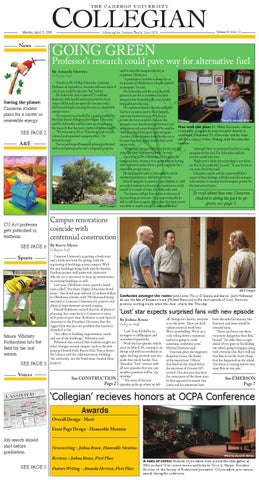
COLLEGIAN THE CA M ERON U N I V ER SIT Y
Informing the Cameron Family Since 1926
Monday, April 21, 2008
News
Volume 82 Issue 12
GOING GREEN
Professor’s research could pave way for alternative fuel By Amanda Herrera Collegian Staff
Saving the planet: Cameron student plans for a career in renewable energy. SEE PAGE 2
A&E
Thanks to Dr. Phillip Schroeder, Assistant Professor of Agriculture, the state will soon know if a local tree could be the next “big” biofuel. Dr. Schroeder and a team of CU students linked up with faculty and representatives from Texas A&M and have spent the last year and a half researching local mesquite trees as a renewable energy source. The research was funded by a grant provided by the State Board of Regents for Higher Education, and Dr. Schroeder and his team are wrapping up the research that has been conducted in two stages. “We went out to 65 or 70 locations and actually counted and measured mesquite trees,” Dr. Schroeder said. The second stage of research is being performed with aerial photographs and a computer program
MCT Campus
CU Art professor gets published in textbook.
used to map the mesquite density in southwest Oklahoma. “A preliminary number is about five or six percent of Oklahoma is actually covered in mesquite,” he said. Dr. Schroeder said the purpose of the grant is to see if it is economical to turn mesquite into biofuel locally, and possibly bring jobs into the area. He explained that for decades mesquite has been a pasture pest to local farmers, and some landowners pay $95 an acre to have the trees removed. Because the Photo by Amanda Herrera mesquite trees absorb most of the water and nutrients in soil, grass that could be used for Man with the plan: Dr. Phillip Schroeder utilizes a computer program to map mesquite density in cattle grazing doesn’t grow near mesquite. Another reason farmers don’t like the tree is southwest Oklahoma. Dr. Schroeder and his team will file a report of their findings with the state this because they have sharp needles that could summer. injure cattle. “We’ve been trying to kill them for the last 80 Although there are potential benefits in using years, but they keep coming back,” he said. mesquite for bio fuel, Dr. Schroeder said the According to Dr. Schroeder, the fact that the process would take time. unwanted trees continue to re-grow without having “Right now I think the technology is not there to be replanted makes them a good candidate for a for that to be profitable,” he said. “It may be five or renewable energy source. ten years down the road.” He said another plus is that mesquite needs Schroeder said he and his team would file a minimal maintenance and water to thrive. report of their findings with the state this summer If local mesquite is converted into biofuel, it could and continue to monitor local mesquite growth for not only stimulate local economy, landowners could the next several years. benefit in a couple of ways, Dr. Schroeder said. To read about how one Cameron “The farmer will get four or five or six years of increased hay production. They may eventually be student is doing his part to go able to sell that mesquite, but at first they may receive green, see page 2. very little or maybe just get it removed for free.”
Campus renovations coincide with centennial construction
SEE PAGE 6 By Kerry Myers Collegian Staff
Sports
Senior Whitney Richardson hits the field for her last season. SEE PAGE 5
Voices
Cameron University is getting a fresh start and a fresh new look for spring, with the repainting of buildings across campus. With the new buildings being built and the Bentley Gardens project well underway, university officials see it necessary to keep up maintenance on existing buildings as well. Last year, Oklahoma voters passed a bond issue called “The State Higher Education Bond Issue.” This bond issue allowed 12 million dollars to Oklahoma schools, with 700 thousand being awarded to Cameron University for projects and physical improvements around campus. Harold Robinson, retired director of physical planning, has come back to Cameron to assist with projects part time. Robinson is now Special Assistant to the President. He states that the Aggie Gym was just one problem that has been identified so far. “The effort is building improvement, inside and out of the buildings,” Robinson said. Robinson also noticed that students might see other changes around campus, such as the new paint in Howell Hall, Burch Hall, Nance-Boyer, the Library and the Administration building. The university, not the bond issue, funded these projects.
See CONSTRUCTION Page 2
MCT Campus
Confusion amongst the ranks: John Locke (Terry O’Quinn) and Sawyer (Josh Holloway) discuss the fate of Benjamin Linus (Michael Emerson) in the next episode of ‘Lost.’ Emerson promises exciting events when the show returns this Thursday.
‘Lost’ star expects surprised fans with new episode By Joshua Rouse Collegian Staff “Lost” fans should be no strangers to cliff hangers and unanswered questions. With the last episode, which aired on March 20, coming to an abrupt end with no resolution in sight, the long six-week wait was made that much harder. This Thursday, “Lost” returns with all new episodes that one cast member promises will be “eye opening.” “The story of the new episodes picks up where we left
off. Things are chaotic; everyone is on the move. There are dark violent events at work here. We’re snowballing. We’re on a rock rolling down a mountain and we’re going to crash sometime, sometime soon,” Michael Emerson said. Emerson plays the enigmatic Benjamin Linus, the leader of the mysterious “Others” that lived on the island before the survivors of Oceanic 815 arrived. His character has been the centerpiece of the show since he first appeared in season two. Linus and his intentions have
been shrouded in mystery, but Emerson said more would be revealed soon. “There are forces out there even more dangerous than Ben,” he said. “I’m only three scripts ahead of you guys so I’m finding out what’s going to happen along with everyone else. But I will say that Ben is not the worst thing that has happened on the island. The worst is coming and we may want Ben on our side.”
See EMERSON Page 7
‘Collegian’ recieves honors at OCPA Conference Awards Overall Design - Merit Front Page Design - Honorable Mention
Job search should start before graduation.
Newswriting - Joshua Rouse, Honorable Mention Reviews - Joshua Rouse, First Place
SEE PAGE 3
Feature Writing - Amanda Herrera, First Place
Photo by David R. Bublitz
A code of ethics: Students of journalism from around the state gather at OSU on April 10 to receive honors and listen to Terry G. Harper, Executive Director of the Society of Professional Journalists. CU journalists won various awards during the conference.
News 2 Biology senior wishes to pursue renewable energy career April 21, 2008
By Amanda Herrera Collegian Staff Thomas Sodhi, Biology senior at Cameron University, has no desire to be a superhero, but he does want to pursue a career in saving the planet. Sodhi is an avid recycler and grew up embracing nature. He said that his grandfather’s dedicated work with conservation in Comanche County is what first sparked his interest in preserving the planet. “I have a botany concentration, and I like plants,” Sodhi said.
Last year, Sodhi began interning for Assistant Professor of Agriculture, Dr. Phillip Schroeder, who received a grant from the State Board of Regents for Higher Education to explore turning local mesquite into a renewable energy source. “He’s mapping the mesquite density in southwest Oklahoma,” Sodhi said. “Because mesquite isn’t an invasive species, they are looking at it in order to see if it is a potential biofuel.” Sodhi said helping Dr. Schroeder perform his geographical information systems
Thomas Sodhi
(GIS) mapping sparked a great deal of interest in exploring alternative fuels. So much so that Sodhi began researching other possible sources for biofuel, and decided to write his Capstone research paper on using the cellulosic process to create biofuel from switch grass. “The one they are looking at right now is switch grass,” Sodhi said. “Because switch grass is a grass, once you’ve got it established it re-grows every year, and unlike corn which is actually used as food, there’s not going to be an economic impact.” Sodhi said the research indicates switch grass is a better alternative than other popular choices such as corn and sugarcane. “Using switch grass as a potential energy source is a huge difference when compared to
corn ethanol or even sugarcane ethanol because there’s 91 percent less greenhouse gas emitted when using switch grass ethanol.” As a graduating senior, Sodhi is currently exploring job
opportunities, and said his dream career would be helping to solve the alternative fuel crisis in the U.S. He said he defines true success as “having an alternative fuel choice at every pump.”
MCT Campus
CONSTRUCTION continued from page 1 “The Aggie Gym is the only project that we are working on right now that is part of the bond issue,” Robinson said. “The improvement of the exterior of the gym is wonderful.” Robinson expects the painting projects to be finished within a couple of months, since most of the projects have already been completed. Just last week, Nance-Boyer received its facelift and with the exception of the south and west sides, the Aggie Gym renovation is almost finished. The University is working hard to maintain the older buildings on campus while working on multiple projects. “The improvements are noticeable, and they look great,” Robinson said.
Photo by John Robertson
English Awards Banquet: Initiates are welcomed into Sigma Tau Delta in a candle lighting ceremony. The ceremony along with an awards banquet was held over the weekend.
Photo by Kerry Myers
Congratulations
Ph.D
Justin Walton, Assistant Professor of Communications, is now...Dr. Walton. Congratulations from the Collegian
Voices
April 21, 2008
3
Mental health watch:
Senioritis epidemic on the rise during final semester Fellow seniors, the end is nigh. I’ve been going to school since 2001, long enough to be an astronaut, or so it seems sometimes. This makes me feel like an old and wise curmudgeon no one wants to listen to. Nor should they. I never wanted to be on the edge of graduation and suddenly feel the need to turn around and exclaim to the student masses behind me, “Hang in there, buddy!” with thumbs up—which can only induce the wish to snap them off. But that is essentially what I’m doing. Your future is spread out before you, a Choose Your Own Adventure book. Another book to be cracked just like the ones for required courses and the upper level electives you kicked yourself for taking. There is no automatic “W” out there. Student loans will need to be paid off. Housing plans may change. A job may have been offered and the first day of work may be right after graduation. For some, the Great Job Hunt begins. Depending on disposition, the last semester of the senior year can be a time of anxiety and apathy. Years of cramming,
all-nighters and the A+ papers written the night before can make the average senior cocky. One begins to think, “I’ve got this down. I can relax a little.” Meanwhile, the pile of assignments grows. Extensions, if you can get them, approach and pass. Guilt sets in and finally, everything is due tomorrow, right before the finals that you have yet to study for. Surely I am not only speaking for myself? These are all symptoms of senioritis. Other symptoms include: turning the alarm off in your sleep, skipping classes to complete work for another class, consuming copious amounts of caffeine, staring into space or at a blank Word document and mumbling without a care if anyone listens and half-hoping that they don’t. You change the subject midsentence and yes, the predjudice against pitbulls is unfair. You may find yourself questioning whether or not it’s time to accept permanent residence behind a fast food counter. “Would you like fries with that?” Yeah, that sounds easy, much easier than the presentation you have to give next week. And with the increasingly competitive job market, you will at least have a job. The tasks before you melt away with your greater future and you wave
goodbye to the baby as it goes down the drain with the bathwater. It was not until a few weeks ago that I began to understand why students have dropped out during the last semester of their senior year. My own work ethic has slipped a notch here and few notches there. Later I feel overwhelmed with my shortcomings and try to make up for my shoddy work. This usually means my work ethic slips in another class. It is a rabid, horrifying cycle. Take heed, freshmen, sophomores and juniors. Take the advice as it falls from my cold, dead, carpel tunnel ridden hand. With some luck, seniors, we’ll trudge through these last weeks. I think I would be ungrateful not to believe in luck. There is a strong possibility that I will have a technical writing job after I graduate. By strong possibility, I mean that I’ve been offered the job and accepted, but there is always the hesitance to just say “Yippee!” and do a little I-got-the-job dance. I would like to say that this stems from a saintly amount of humility, but I think fear is a more appropriate term. After all these years,
it seems impossible that the future is really just a few short weeks away. Surely, something will go wrong. Like … my head might catch on fire or … something. But enough about my neurosis. As much as the senioritis bug has bit me, I can honestly say I’m going to miss college. Cameron University has an outstanding faculty and staff. While negative experiences are inevitable, it must be said that I learned from the few negative experiences I had. These experiences were also softened by the luxury of always having someone to turn to for help. I would urge students who feel alone and lost on the college campus to look around. This university is full of professors, students and staff who often feel as you do. When you have a problem that can’t be shrugged, start somewhere. Like other CU seniors, I’ve got big changes ahead of me. I will soon be moving into my own place and when I get off from work, I will have no homework. This concept is alien to me after seven years of college. Now, I’m sure that
Jessica Lane
Career planning starts before graduation When asked about their postgraduation career choices, a few of my students had a ready answer, one or two had a facetious answer, but most had no answer. Since these students are members of the 11th grade, their answers, or lack thereof were not surprising to me, especially considering the answers university professors get when they ask David L. college students a similar question on the first day of class. There is an obvious lack of mentorship in the parent/educator community if the majority of fourth-year college students are career clueless. It may be nearly excusable for a large group of 11th-grade students to have no conception of their future careers. It is entirely inexcusable for students to walk across the stages of universities career clueless. Something is seriously wrong. As I have mentioned in a previous column, these students are walking across the stage straight into a brick wall. Parents and educator seem to be ok with this. They must be, since many students continue to graduate from universities all across the country with no tangible conception of the connection between career research, education and career acquisition. I put parents and educators on the spot because, as we say in the army, this is their lane, this is their responsibility. As a student teacher, I have come to understand and even accept that all high school students are not going to want to go to college, graduate and embrace a white-collared career. Some want to be blue-collared and red-necked. I understand this because I have spent 20 years as a
blue-collared redneck myself. Nothing is wrong with that. But when parents send their children to college, the implication is that these parents want something better for their kids than digging a ditch, f lipping burgers, or working at Goodyear. However, it is short-sighted to believe that sending a kid to college like pulling the trigger on a Bublitz fire-and- forget missile is going to magically make a six-figure career appear. Without conducting a little bit of career research, parents should just save their money and make some room on the assembly line. Because, what usually happens is their kids do not view college as job training, but simply more school. Thus, many students spend a great deal of time, effort, and expense for nothing but another uninspired and unwanted job. The lack of adequate educational-to-career mentorship programs for students is not the problem. Cameron University’s Student Development Office has numerous career research programs that provide all the tools parents and students need to bridge the gap between students’ educational decisions and rewarding careers. At the Career Services Office, as a part of CU’s Office of Student Development, Cameron students can access online job listings, construct their resume, even practice their job interview skills. However, these services mean little unless students know what careers they want to pursue.
Career research that connects a student’s personal profile to a career field is the first step in finding a career that students will look forward to daily, rather than a dreadful necessity. CU’s Career Services will provide students with access to a complete self-assessment program which assesses a student’s personal skills, aptitudes, and interests, then connects this personal profile to an extensive list of career fields. The program then provides students with precise information about the career field. Students can learn what the job pays by state, employment outlook by state, even what a typical day in the job is like. Most importantly, the program lets students know what
college major satisfies the career requirements for each career they research. I believe it is completely unreasonable to require a new student to pick a major without conducting some kind of career research that connects their major to a career. Colleges are not the only places where students can conduct career research. I recently discovered that all Lawton high schools have access to similar online career research services in their libraries. It boggles my mind that secondary and even postsecondary students continue their education without a plan, when all the career research tools are so readily accessible. Oh well, I guess McDonalds is always hiring.
the first couple of weeks I will simply bask in the glow of an evening with nothing due the next day that I have to work on that evening. Two extra hours will be added to my day since I won’t need to commute to my new job. I may be the only one not complaining about gas prices, since a tank of gas will last me more than one week and (finish later).
THE CAMERON UNIVERSITY
COLLEGIAN Founded in 1926 veritas sempiterna
Editorial Board Editor-in-Chief - Jessica Lane News Editor - Josh Rouse Assistant News Editor - Jim Horinek A&E Editor - Amanda Herrera Sports Editor - Kareem Guiste Variety Editor - Bira Vidal Assistant Editor - David R. Bublitz Copy Editor - Laura Batule
Newsroom Staff Ads Manager - Kelley Burt Cartoonist - Thomas Pruitt Financial Officer - Susan Hill Staff Writers - Chris Allison, John Robertson, Alexis DelCiello, Kerry Meyers, Brandi O’Daniel, Ashley Wilkerson
Faculty Adviser Dr. Christopher Keller
Newswriting Students Jenifer Biles, Donnale Mann
About Us The official student newspaper of Cameron University, The Cameron Collegian is available each Monday during the year. It is printed by the Times Record News in Wichita Falls, Texas.
Letters Policy Letters to the editor will be printed in the order in which they are received and on a space available basis. The Collegian reserves the right to edit all letters for content and length. Letters should be no more than 250 words. Letters from individual authors will be published only once every four weeks. All letters from students should include first and last names, classification and major. No nicknames will be used. Letters from people outside the Cameron community should include name, address and phone number for verification. Letters can be sent by regular mail or e-mail to collegian@cameron.edu, or they may be dropped off at our office - Nance Boyer 2060.
Our Views The opinions expressed in The Collegian pages or personal columns are those of the signed author. The unsigned editorial under the heading “Our Voice” represents the opinion of the majority of the editorial board. The opinions expressed in The Collegian do not necessarily represent those of Cameron University or the state of Oklahoma. Our student media are designated public forums, and free from censorship and advance approval of content. Because content and funding are unrelated, and because the role of adviser does not include advance review of content, student media are free to develop editorial policies and news coverage with the understanding that students and student organizations speak only for themselves. Administrators, faculty, staff or other agents shall not consider the student media’s content when making decisions regarding the media’s funding or faculty adviser.
Sports 4 Shumaker’s last stroke at CU takes him back to the green April 21, 2008
By Alexis Del Cielo Collegian Staff It may have been a set of parents that passed along the gene for playing sports or a big brother that introduced a new game but, for one CU golfer it was as simple as being seen on the practice fields after school. Before beginning his college golfing career at CU, senior golfer Cane Shumaker made his mark in the history books in northeastern Oklahoma. Within five years of being introduced to the game of golf, Shumaker broke a local country club record, qualified as the youngest for a tour event playing with the pros, won five tournaments, was named an allstate golfer and all-conference champion and went on to play golf
at Northeastern, a junior college. “When I was fourteen, I was playing at the country club in Miami and the youngest person to ever shoot from under par there from the back tees was 16 years old,” Shumaker said, “and that day I shot 200 par, so I was the newest kid to shoot under par. I got to sign a hat and that same day that round I had my very first hole in one.” Although he thought baseball was the ticket to anywhere, Shumaker quickly put down his glove at the age of twelve and took interest in a new sport presented by an older role model. “Really I had just played baseball my whole life because that’s what kids do when they are younger. I got into golf because my brother started playing,” Shumaker said. “I was one of those little kids that
always wanted to do what his older brother did. That kick started me into it [golf]. I fell in love with it so I continued to play and realized that I better concentrate on that because golf could probably take me further than baseball could.” As with any sport, it takes a few rough runs to decide that you can play whatever you set your mind to, and it was no different for Shumaker. Following the suggestion of an older brother, Shumaker signed up for a junior tournament and quickly found out his brother was right about the atmosphere of a tournament setting. “When anybody first starts they’re not very good, so when I first started I definitely wasn’t good,” Shumaker said. “My brother kept telling me I needed to play in tournaments to get tournament
experience. So he got me in this tournament and told me I needed to play with these older kids and cut through some of the stuff quicker. There were probably 40 kids in the junior tournament and I got dead last. I felt like I hated golf and never wanted to play again.” With the initial shock of tournament culture over and a successful high school golf career under his belt, Shumaker was seasoned and ready to play collegiate golf at CU under the direction of CU men’s golf coach Jerry Hrnciar. “He has really stepped in and been a starter for three years,” Hrnciar said. “His game has improved as he has gained experience. He is someone I can depend on. He is a solid person and a solid teammate. He has worked hard academically and getting better and better.” Roles have switched for Shumaker, once a follower of his older brother; he is now the team leader on the green. “He is our only senior,” Hrnciar said. “He provides the leadership on the team. He realizes that this is his last go around and he is really working hard to give us the opportunity to make it to nationals. He has been playing from tee to green very well. I think he will have a strong finish.” This May, with his leadership skills and a criminal justice degree, Shumaker plans to pursue a career in the golfing industry with the
possibility of returning to the green in a tour event or teaching golf lessons. “After college I will go to an advanced PGA school in Florida. It certifies you to be a PGA head professional at resorts,” Shumaker said. “As head golf professional you give lessons, take care of the public, make sure the operations are going smoothly in the pro shop and merchandising.” With CU ranked 24th in the NCAA and 23rd in the coach’s standings poll, Shumaker and the CU’s men’s golf team are working toward a third regional championship and another trip to nationals. “We will be going for our third regional championship,” Hrnciar said. “No one had ever won it two years in a row until last year when we won our second in a row. So we are going for a ‘three-peat’ this year.” Looking forward to the dream of playing for a third regional championship and a third national’s tournament run; Shumaker is just doing what he loves. “From [when I was] a little kid, it is a dream come true,” Shumaker said. “The only thing I ever wanted to do was play sports. So I just played them all – basketball, baseball, football, golf, everything. Then you get that edge on, and then when it happens, it is kind of a relief and you just sit back and enjoy it. It is a dream to play a college sport. It has been a pleasure to play for Jerry.”
Photo by Kareem Guiste
Assessing the green: Cane Shumaker stands and looks beyond the horizon at Cameron University. He looks into a professional career after.
Sports
April 21 2008
5
Richardson plays in her last season By Kareem Guiste Collegian Staff Looking ahead toward her last season at Cameron, Whitney Richardson will be calling it a day when she wears the Aggie softball jersey for the last time. Hailing from her hometown of Gunter, Texas where she attended Grayson County Junior College before transferring to Cameron. Richardson said that she has made good friends and acquired a wealth of softball knowledge as part of the Aggie team. “I have had a lot of fun and learned more about the game by playing here at Cameron for the last two years,” Richardson said. “I also understood and learned better ways to look at the game, and of course, a lot more smarter ways to play it as well.” Before being selected to join the Aggies’ team, Richardson was a part of a similar squad at Grayson County Junior College. Richardson told “The Collegian” that she had heard about outfielders on the Cameron squad who were graduating and on their way out. Richardson wanted to tryout and hoped to be selected for the new squad, and play for Coach Shaw. With the will to make the final cut for the Aggies, Richardson said that she came to Cameron for a visit, practiced with the team a few times and got a chance to play on the first team. To date, Richardson has never been injured throughout her tenure at the helm of the Aggies, and has maintained her position in the outfield for her faithful Aggie squad. In drawing a comparison between the 2007 and 2008 seasons, Richardson felt that the team started out much better this season,
and therefore have been wining many more games as a result of being more prepared. “I think we have become more confident in our selves and obviously become more trusting amongst each other,” Richardson said. “We no longer feel intimidated and we have been just enjoying the season by trying to make it a better and winning season.” After a self-evaluation of her seasons at Cameron, Richardson feels that she has been very consistent with her performance as part of the Aggie softball team. She said that around this time last year she had more home runs but does not see it as something that she should be too concerned about. “My performance has been the same throughout,” Richardson said. “I have had ups and downs, with no injuries, so that is good. But last year I did have more home runs than to date.” Looking ahead at the balance of her time here at Cameron, Richardson said that she will be looking forward to moving on to study her specialized education field once she graduates from Cameron. “After this semester I will have maybe one to one and a half more years here at Cameron before I get to graduate,” Richardson said. “Then I will go on to pharmacy school at the Oklahoma University, OU in Norman.” Cameron athletes come and Cameron athletes go, but the one thing that is important and the one thing that matters, is that when they complete their final season and eventually move on, they leave an indelible mark with their charm and athletic brilliance on the field of play.
Photos by Kareem Guiste
Keeping it together: (Above) Whitney Richardson works out at the Aggie Gymnasium ahead of one the team’s weekend games at home. (Left) Richardson shows just how she positions herself at the plate to face the many pitchers in the past and present. The team has performed well this season.
Mascheroni hails unified no.1 By Donnale Mann Newswriting Student Nicholas Mascheroni, a three season veteran of the Aggie men’s tennis team, serves up the secret to their success. Cameron University’s men’s tennis team is ranked #1 in the Long Star Conference and #7 in the nation among NCAA Division II teams. “We are seventh in the nation right now and all of this is thanks to Coach Helvey and to the team’s commitment to one another,” Assistant Coach Zurita Mascheroni said. Mascheroni, a senior majoring in Business Management, emphasized the team’s friendship and support for one another as the main reason for the team’s strong season. “We are a really good team,” Mascheroni said. “We are friends inside the court and we are friends outside the court. We support each other really good and that is the main thing that makes our team really strong.” Mascheroni described the team’s successful season as a very emotional one. He also said this is the highest Cameron has been ranked since Coach Helvey started coaching the team.
“This season was really emotional for us and for Coach Helvey,” Mascheroni said. “We beat Abilene Christian University. It was the first time in 15 years that Coach Helvey beat Abilene Christian University.” So far, the men’s tennis team is undefeated in conference play, and they are 14-4 overall for the season. The men’s tennis program was established in 1993 with James Helvey as the head coach. According to the Aggies men’s tennis web site, the men’s team has advanced 14 consecutive times to the NCAA Division II National Championship Tournament since 1994. Mascheroni not only wants to attend the tournament this year, he wants the team to win it. “Now, that we realize that we are playing good,” Mascheroni said, “we’re hoping to go to nationals and win.” Mascheroni explained that Cameron’s cost and its well-known tennis program is what attracted him to the university. “I played my first season of eligibility at Fresno State in California. I transferred here because it was very expensive over there,” he said. “It was the good program that Coach Helvey offered here. Cameron is well
known. Cameron ranks among the top 20 teams in Division II every single year, and that is good.” This is Mascheroni’s last season with the tennis team. After graduation he plans to work in the United States before returning to his native country of Uruguay. “I am a senior and this is my third season playing tennis for Cameron,” he said. “I like the way people have treated me since I have arrived here; it has been good. I’m a management major and I think I’m graduating from an important program.” Mascheroni credits his coaches and teammates for his most successful season at Cameron. “We have built a strong, mentally tough team that works hard and grows stronger every day,” he said, “that’s why I’m telling you that this is my best year.” For information on the Cameron Univeristy tennis team men’s and women’s schedule, please log on to www.goaggies. cameron.edu. The team is continuing to aspire for the goal of National Championships and with the current form that exist within both team, there is no doubt that the Cameron squad can reap for there successes this season.
Photo courtesy of Nicholas Mascheroni
Absolute control: Mascheroni gives a strong forehand return at Whichita Falls. The teams, both men and women, have shown consistency throughout the season.
A&E
6
April 21, 2008
CU Art professor contributes to textbook
Textbook art: Katherine Liontas-Warren, CU Art professor, will be one of the featured artists in the textbook “Drawing from Observation.”
By David R. Bublitz Collegian Staff Two drawings by Cameron University professor of Art Katherine Liontas-Warren were selected to appear in Brian Curtis’s “Drawing from Observation” textbook. “‘Drawing from Observation’ is the textbook that I use in the Drawing I class,” Liontas-Warren
said. “It’s basically a book that talks about perceptual drawing - a very academic way of drawing.” Liontas-Warren went on to explain how perceptual drawing skills play a major role in helping students to better develop as growing artists. “My philosophy is to draw from observation as opposed to drawing from the photograph,” she said. “The student learns and
challenges him or herself more if they draw what’s directly in front of them as opposed to looking at something that is f lat. It helps students developing strong foundations. This is a really wonderful book if your philosophy of teaching is to develop stronger perceptual thinking.” One of the two pieces selected for publication, “East Texas Landscape,” speaks to LiontasWarren’s passion for perceptual drawing, her deeply rooted sense of family, and to nature. “That [“East Texas Landscape”] was created in 2006. We have some land in southern Texas, and we go back there for the holidays and the summer. That was a drawing of the tall pines in east Texas. It was the last drawing in the series when I was doing landscape drawings in black and white.” Before being selected for publication, “East Texas Landscape” has been in several shows and was exhibited nationally. Also selected for publication in Curtis’s “Drawing from Observation,” is LiontasWarren’s “The Global Watcher” another work that is very
much tied to family and nature. Liontas-Warren said: “That was created during my sabbatical. That was the second drawing that started the bird series. They’re all personal examples that represent my family. ‘The Global Watcher’ is a metaphor for my husband and his love for tending to a summer vegetable garden. The surrounding hills are brown while his garden is green and fertile.” In addition to her own work, Liontas-Warren provided Curtis with some drawings from Cameron art students. After reviewing the student work, Curtis said that the Cameron art and work from students in Praetoria, South Africa, were “the best sets since the book [Drawing from Observation] came out.”
Artwork courtesy of Katherine Liontas-Warren
Reading Series program brings poet to campus By Brandi O’Daniel Collegian Staff On Monday, April 28, poet Clay Matthews will be at Cameron talking with CU students about his career in literature and reading exerts from his new book “Superfecta.” The poet will be reading from his new book that recently came out April 15 and talking with students about his early inspirations and his work today. The Oklahoma native is currently pursuing a Ph. D in Creative Writing at Oklahoma State University in Stillwater while continuing to contribute his poetry to numerous
magazines and journals throughout the region. Julie Hensley, Assistant Professor of English and Director of Creative Writing, said that Matthews will be answering questions regarding his latest work and his experience in the literary field for curious students perhaps looking to go into a similar occupation. Hensley said: “He will be reading a selection of poems from his book ‘Superfecta’ and then take questions about his craft. This is especially great for student poets to allow them to pick his brain and learn about his work.” Hensley added that that the poetry
Courtesy Photo
Poetry in print: Poet Clay Matthews recently published “Superfecta.” Matthews will be on campus April 28 to discuss his work and answer questions.
reading is a great opportunity for whatever it is we call the canon: Yeats, students to talk with an accomplished Tennyson, C. Roseetti, Whitman, etc. writer from the area and learn from But I came to these writers at a young his background in writing. age, and so they didn’t really knock “It is important to celebrate all good my socks off, which I think is as good things that come from Oklahoma a way as any to describe the effect and Texoma,” Hensley said. “I think poetry can have.” that students Matthews secretly write added that poems and he what drew “He will be reading a selection have a need him into other of poems from his book for expression. writers was ‘Superfecta’ and then take It can be the fact that questions about his craft.” inspiring and he was able to liberating.” identify with The —Julie Hensley them on some narrative level. Director of Creative Writing poet has been “Weldon published in Kees was numerous an early journals and obsession, and magazines in his career including, probably closer to where I was coming “Court Green,” “Black Warrior,” and from—a small, rural community,” the “Oklahoma Review.” His latest Matthews said. “I worked a lot of work “Superfecta” is a collection of odd jobs as a kid so Phillip Levine hit poems from Ghost Road Press that home.” deals with trouble, time, relationships According to Hensley, Matthews and love. is the last writer visiting Cameron In a past interview with Nate students this semester as part of their Pritts from MIPOepsias magazine, Reading Series. The Reading Series Matthews said that he gravitated is hosted by Lectures and Concerts towards poetry at a young age, but Committee, the English Department was not inspired by the standard well and the English Honor Society, known writers, such as Whitman and Sigma Tau Delta and is an aspect of Tennyson. the English Department. The Series Matthews said: “In the traditional features an assortment of writers sense, the poets whose work pulled me in fiction, nonfiction and poetry into poetry were largely those poets of to give students a broad range of
accomplished writers to talk with. Hensley said: “The Reading Series plan for speakers a year in advance with poets, nonfiction and fiction writers. We occasionally get a handful of writers that contact us.” For the writers that do contact the Department and want to come and talk with students, Hensley said that their work must first be approved. Matthews contacted Hensley about reading exerts from his book to students and allowed the department to look over his past work before being allowed to come to Cameron. Hensley said: “We first have to deem their work appropriate before we allow them to come to Cameron. When he contacted us it was a great surprise. His work is very experimental.” As this year’s Reading Series comes to an end, next years speakers are already scheduled to come and talk with CU students about their writing technique. According to Hensley, writers Kevin Rabas, Rilla Askew and Marcia Douglas are scheduled to visit during next school year, as well as Cameron’s own English Professor, Dr. John Morris. Dr. Morris will be reading from his new book of poetry due out soon. For students interested in talking with Matthews, he will be presenting his book on April 28 in the Shepler Ball Room at 3:00. Anyone interest in learning more about Matthews or future guest speakers contact the English Department at 581.2272/2929 or Julie Hensley at 581. 2930 or jhensley@cameron.edu.
A&E
April 21, 2008
7
LOST continued from page 1 In 2007, the ABC network announced “Lost” would show it is. With the significant break the strike created, run for 48 more episodes. Instead of having two standard- many of those factors had to be reassessed. length seasons of 24 episodes, the series would be divided “Nothing was easily remedied after the strike ended. into three 16-episode seasons. When the Writers Guild It made things difficult and chaotic on pretty much every of America went on strike on Nov. level. It made a lot of scheduling 5, the fate of the fourth season was “The story of the new problems. For guest actors and called into jeopardy. Eight episodes episodes picks up where we recurring characters, their lives had been produced and were ready were not based on the show. The left off. Things are chaotic; to air, but the remaining eight show is now struggling to line up everyone is on the move. weren’t even written yet. the talent they needed,” Emerson After the writers and the studios There are dark violent said. “There were all kinds of reached an agreement and formally logistics like seasonal weather events at work here. We’re ended the strike on Feb. 12, the patterns. Everything has been producers of “Lost” have been hard snowballing. We’re on a rock much harder since we got back. rolling down a mountain at work to get the season back on We’ve had to do an awful lot in a track. Still, with the delay, a number and we’re going to crash short period of time. The deadline of episodes had to be cut. is harder because we have to have sometime, sometime soon.” “Rather than take a hit and lose these episodes ready by the 24th of some episodes, there was an effort April.” to do some compressing so that even — Michael Emerson Even with the problems, if we only did five more, we would “Lost” Emerson wanted to assure the fans could have put out as much story as that “Lost” would return without a we could have done in six or seven hitch and many questions would be episodes,” Emerson said. “There wasn’t as much script answered before the season ended. He said things are going loss as there could have been.” to get “very interesting.” When “Lost” returns this week, it will be the first of “We’re going to learn more about Ben sometime; his six episodes that will culminate with a three-hour season back-story – his future story. We’re going to learn more finale in May. Originally, ABC only planned to produce about the Oceanic 6 and the terms by which they got off five more episodes to round out the season with 13. But the island. And we’re also going to face big, dangerous rumors began circulating on the Internet two weeks ago threats from outside. A lot more action takes place off the that ABC had given the green light a 14th episode. island from here are on in,” Emerson said. “It took me by surprise,” Emerson said. “We’re pushing “Lost” returns at 9 p.m., Thursday on ABC. hard to get episodes out. But they’re going to do it so we can give the fans more ‘Lost’ before we go on hiatus Check the next issue for the second again.” Coming back from the strike hasn’t been easy for half of Josh Rouse’s interview with Emerson and other members of the “Lost” cast. There are “Lost” star Michael Emerson a lot of factors involved in making “Lost” the successful
MCT Campus
Dining with the devil: Benjamin Linus (Michael Emerson) eats breakfast while being held prisoner. While Linus is perceived to be the villian of ‘Lost,’ Emerson said Ben may not be the bad guy people think he is.
‘21’ fails to impress with intriguing ‘true story’ By Chris Allison Collegian Staff
MCT Campus
‘Bringing down the house’: Kevin Spacey stars as Professor Micky Rosa who leads a group of MIT students in a scam of Las Vegas casinos in ‘21.’ The movie was based off a book written about the ‘MIT Blackjack Team’ that operated from 1979 until 2001.
Las Vegas and gambling has been the setting and plot for many movies and while “21” shows some razzle-dazzle in its depiction of the “Sin City,” it unfortunately wears out its welcome in the second half of the film. “21” is inspired by true events and is based on a non-fiction novel entitled, “Bringing Down the House.” I say it’s “inspired” by true events because there was some controversy of the novel’s alleged exaggeration of some facts. The book was about MIT card counters, or the MIT Blackjack Team. They were a group of mostly male Asian-American MIT students, who beat the house in Vegas by counting cards.
This method uses probability and variables of probability to determine what the next hand will be. “21” Americanizes the team with most of the team members played by white British or American actors. There are a few Asian-American team members in the film, but their roles are very peripheral. The movie is told from the point of view of Ben Campbell, played by British actor and “Across the Universe” star, Jim Sturgess. Campbell is a promising MIT student who is on the verge of being accepted into Harvard medical school. He has two problems though. Campbell has not had any life experiences that would dazzle people in his entrance essay and he does not have the $300,000 necessary to pay for tuition. Enter an overacting Kevin Spacey as Mickey Rosa, Campbell’s mathematics professor. Rosa has secretly developed a team of mathematically gifted students, who spend their weekends at Las Vegas counting cards and winning at the blackjack tables. Rosa claims that technically what they are doing is not illegal. It’s just frowned upon by the casino bosses. Soon, Campbell is recruited and learns the tricks of the trade. They have different mnemonic codes to indicate what the count is at the table. For instance, “sweet” means plus sixteen as in the phrase “sweet sixteen.” They also have different bodily gestures to signal whether to stay at a table
MCT Campus
deemed “good to play” or whether to leave before being caught by the pit bosses. Before long, Campbell is caught up in a whirlwind of Vegas gambling, and the card counting team starts turning against each other. I enjoyed the first half of the film, where we learn the complicated rules and techniques of counting cards. When the film finally gets to Las Vegas, the audience is treated with repeated scenes of somebody winning a lot of money. By the time they showed a close-up of the “10 of clubs” or the “ace of spades” for what seemed to be the 50 billionth time, the film got a little boring. Vegas movies should never be boring. The film is also predictable. When they started playing in Vegas, I thought it’s only a matter of time before things go wrong, such as being beaten up by a pit boss. In this case, an overacting Laurence Fishburne plays the pit boss. I knew that once they introduced Kate Bosworth’s character, the female card counter the protagonist has a crush on, that it will be only a matter of time before these two get in bed together. If it weren’t for the boring repetition and the clear predictability of its second half, “21” might have garnered a mild recommendation from me for its intriguing plot.
8
Backpage
April 21, 2008