
Jack C. Richards SIXTH
Teach with confidence.
With the role of English as the world’s second language, effective communication skills in English are an increasing priority for today’s world citizens.
Providing teachers and students with resources that offer meaningful, engaging, and successful learning opportunities has always been the goal of the Interchange series.
The sixth edition reflects features that will ensure Interchange continues to be the favorite coursebook for millions of teachers and students worldwide. These include:

• All new Video Program: including dramas, documentaries, and social media clips. Creative projects allow students to make their own videos, bringing their English to life.

100% brand-new video
• Easy audio access: on the page for quick access to the audio.

• Refreshed content: a refreshed design of the flexible unit structure that teachers and students love.

Scan the QR codes on the page for quick access to the audio. New content and and the support it offers for confident and effective teaching

We are proud to introduce the sixth edition of Interchange and the support it offers for confident and effective teaching and learning.
Jack C. Richards



Interchange, the world’s favorite English course, has a long tradition of teaching students how to speak confidently. Millions of people all over the world attest to its effectiveness.
What Makes Special?

Jack C. Richards’ communicative methodology: Refined over years and in countless classrooms, the Interchange approach is rooted in solid pedagogy.


Flexible units: Instructors can change the order of the activities in each unit, keeping lessons fresh and students engaged. Additional photocopiable activities and a full video program give teachers even more freedom to make Interchange their own.
Students speak right from the start: The solid research and winning content give students the confidence to speak early and often.

What’s New in the Sixth Edition?

All new Video Program: 100% brand-new video including dramas, documentaries, and social media clips. Creative projects allow students to make their own videos, bringing their English to life.
Easy audio access: Scan the QR codes on the page for quick access to the audio.
Refreshed content: New content and a refreshed design of the flexible unit structure that teachers and students love.



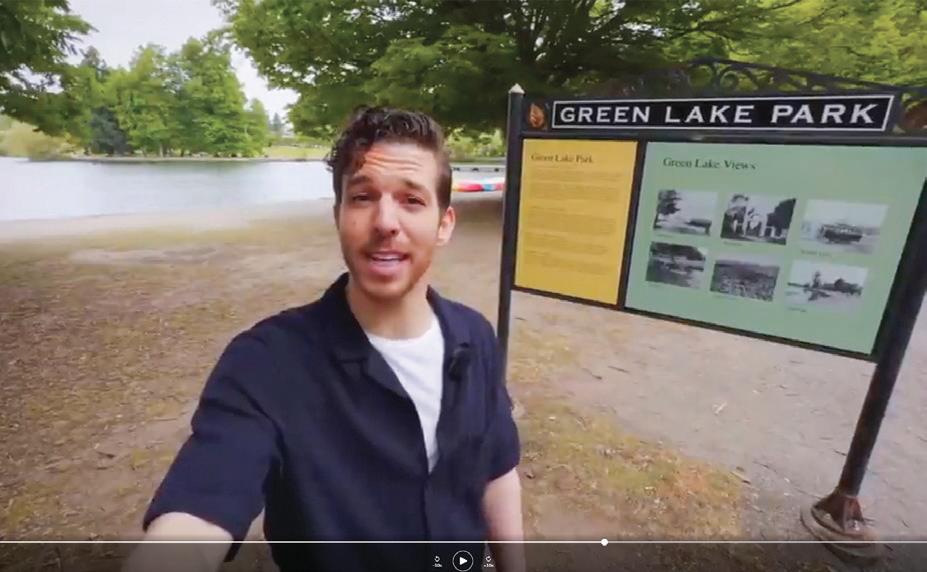















Student’s Book overview
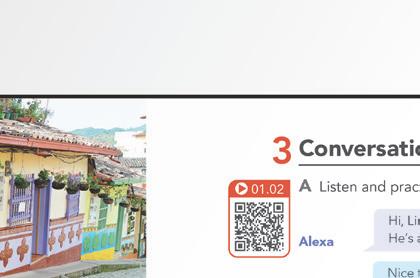
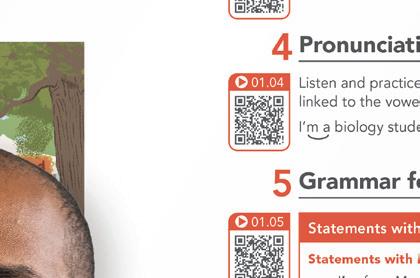
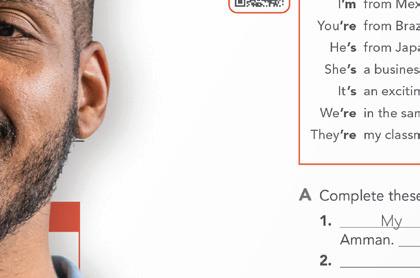
Every unit in Interchange Sixth Edition contains two cycles, each of which has a specific topic, grammar point, and function. The units contain a variety of exercises, including a Snapshot, Conversation, Grammar focus, Pronunciation, Discussion (or Speaking), Word power, Listening, Writing, Reading, and Interchange activity. The sequence of these exercises differs from unit to unit. Here is a sample unit from Level 1.
Cycle 1 (Exercises 1–8)
Topic: free-time and weekend activities
Grammar: simple past
Function: describe past daily and free-time activities

































Snapshot
• Introduces the unit or cycle topic
• Presents vocabulary for discussing the topic
• Uses real-world information
• Provides personalized guided discussion questions

Conversation
• Features structured listening and speaking practice



QR Code


• Introduces the meaning and use of Cycle 1 grammar in context
• Uses pictures to set the scene and illustrate new vocabulary
• Provides follow-up listening tasks


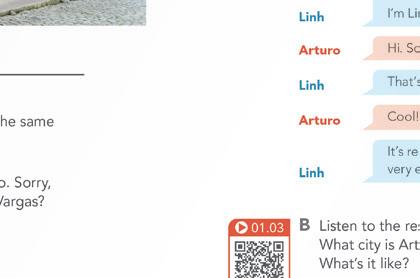
• Scan the QR code for quick access to the audio.
Grammar focus

• Includes audio recordings of the grammar focus boxes
• Offers controlled grammar practice in realistic contexts, such as short conversations
• Facilitates freer, more personalized speaking practice
Pronunciation

•
• Promotes extended or personalized pronunciation practice
Word power Chores and activities
A
Find
party make a phone call take a day off
B Group work • Choose the things you did last weekend. Then compare with your partners.
A: I went shopping with my friends. We had a good time. What about you?
B: I didn’t have a very good time.



A:
Grammar focus
Simple past
Did you work on Saturday? What did Neil do on Saturday?
Yes, did I worked all day. He stayed home and studied for a test.
No, didn’t didn’t work at all.
Did you go anywhere last weekend? How did Cara spend her weekend? Yes, did I went to the movies. She went to a club and danced with some friends. No, didn’t didn’t go anywhere. Grammar plus see page 138
A Complete these conversations. Then practice with a partner.
1. A: you (stay) home on Sunday?
B: No, I (call) my friend Anna. We (drive) to a local food truck.
2. A: How you (spend) your last birthday?
B: I (have) a party. Everyone (enjoy) it, but the neighbors next door (not, like) the noise.
3. A: What you (do) last night?
B: I (see) a sci-fi movie at the Cineplex. I (love) it! Amazing special effects!
4. A: you (do) anything special over the weekend?
B: Yes, I . (go) to a thrift store. I (buy) a new jacket. I love it.
5. A: you (go) out on Friday night?
B: No, I . I (invite) friends over, and I (cook) lasagna for them.
B Pair work • Take turns asking the questions in part A. Give your own information when answering.
A: Did you stay home on Sunday?
B: No, I didn’t. I went for a picnic in the park.


Pronunciation Reduction of did you A Listen and practice. Notice how did you is reduced in the following questions. [dıdʒə] Did you have a good time?
















How did you like the movie? B Pair work • Practice the questions in Exercise 3,















Word power
















• Presents vocabulary related to the unit topic
• Includes practice with collocations and categorizing vocabulary
• Encourages freer, more personalized practice


Discussion

• Provides communicative tasks that help develop oral fluency
• Includes pair work, group work, and class activities
Listening
• Begins with pre-listening focus tasks or questions
• Develops a variety of listening skills, such as listening for main ideas and details
Cycle 2 (Exercises 9–14)
Topic: vacations
Grammar: past of be
Function: describe past vacations
Conversation

• Provides structured listening and speaking practice
• Introduces the meaning and use of Cycle 2 grammar, useful expressions, and discourse
• Uses pictures to set the scene and illustrate new vocabulary
Grammar focus

• Presents examples from the previous conversation
• Offers controlled grammar practice in realistic contexts, such as short conversations

Conversation
A
Leah:
Cody:
Leah:
Cody:
Leah:
Cody:

B
B
Discussion Past and future vacations
A Group work • Ask your classmates about their last vacations.
Ask these questions or use your own ideas.
Where did you spend your last vacation? What did you do?
How long was your vacation? How was the weather? Who were you with? What would you like to do on your next vacation?





Discussion



• Provides communicative tasks that help develop oral fluency
• Includes pair work, group work, and class activities

A








Writing
• Provides a model writing sample
• Develops skills in writing different texts, such as blogs and email messages
• Reinforces the vocabulary and grammar in the cycle or unit

Listening
• Begins with pre-listening focus tasks or questions

• Develops a variety of listening skills, such as listening for main ideas and details
Reading
• Presents a variety of text types
• Introduces the text with a pre-reading task
• Develops a variety of reading skills, such as reading for main ideas, reading for details, and inferencing
• Promotes discussion that involves personalization and analysis


















In the back of the book
Interchange activity

• Expands on the unit topic, vocabulary, and grammar
• Provides opportunities to consolidate new language in a creative or fun way

• Promotes fluency with communicative activities such as discussions, information gaps, and games









Grammar plus
• Explores the unit grammar in greater depth
• Practices the grammar with controlled exercises
• Can be done in class or assigned as homework






Digital Pack

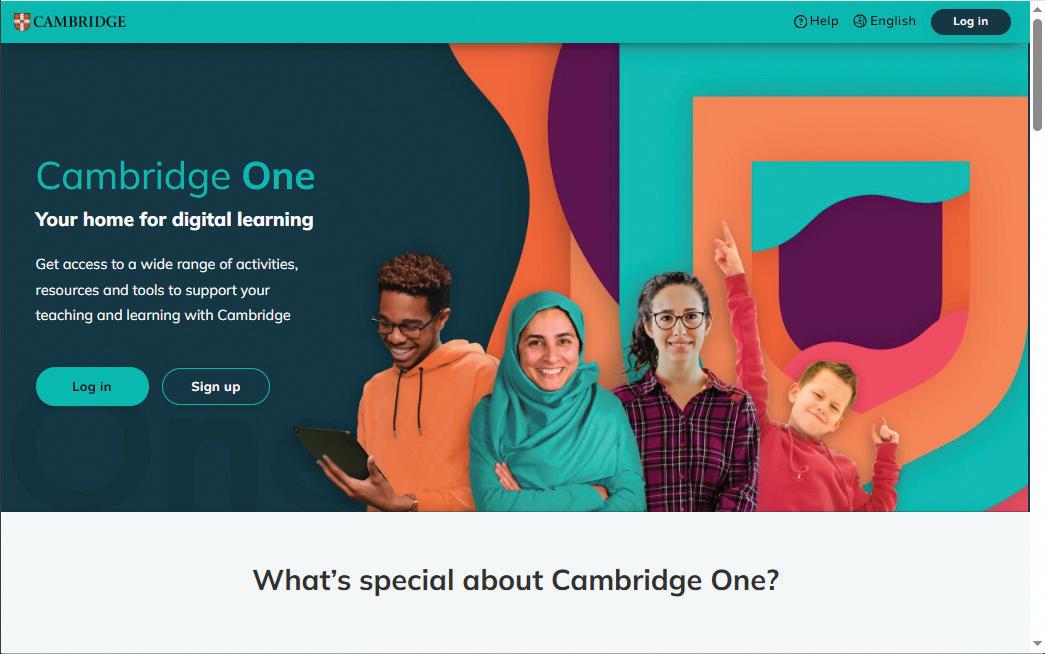
Interchange Sixth Edition’s digital content is available on the Cambridge One platform. Here, students can access the eBook, and students with a Digital Pack will also find further practice activities and resources to support their learning. Instructions on how to access the digital content on Cambridge One can be found on the inside front cover of the Student’s Book.
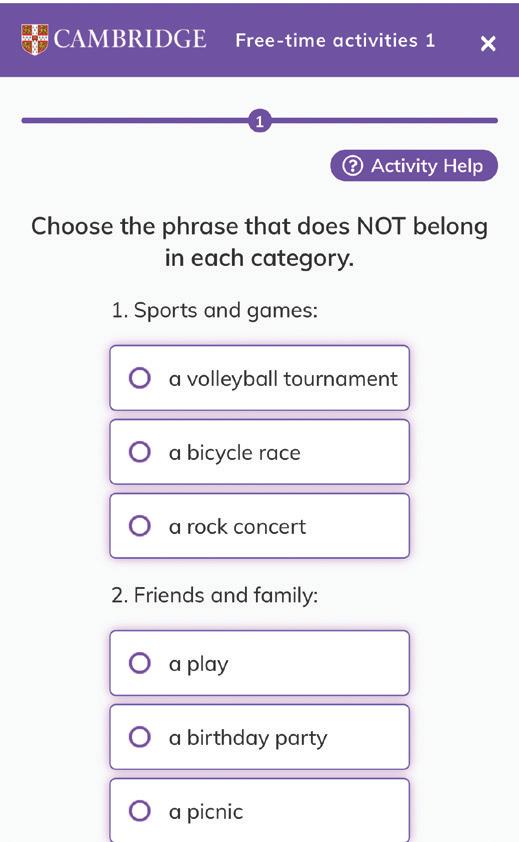
The Teacher’s Digital Pack includes:
Presentation Plus
Digital Workbook
Video Program
Testing Program
Teacher Resources, including practical articles, correlations, language summaries, overviews of supplementary materials, ideas for games and extra activities, and all Student’s Resources
To access the Teacher’s Digital Pack, use the activation code from the inside front cover of the Teacher’s Edition.


The Student’s Digital Pack includes:
Student’s eBook
Digital Workbook
Video Program
Student’s Resources, including class audio and downloadable worksheets for projects and extra practice of vocabulary, grammar, listening, writing, and speaking


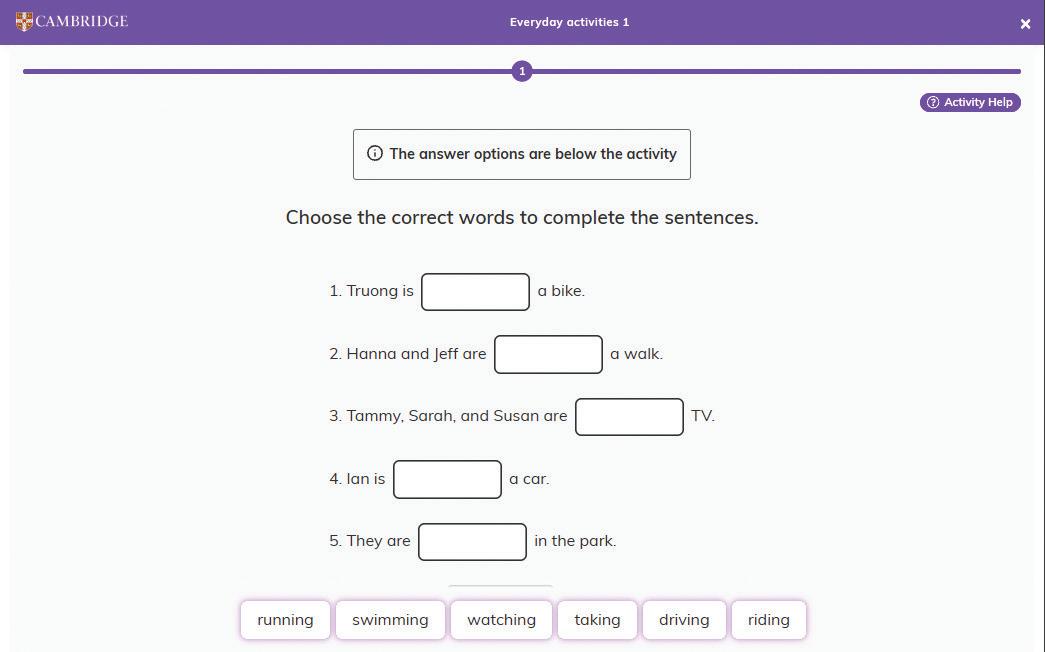
Digital Workbook

The Interchange Sixth Edition Digital Workbook provides additional activities to reinforce what is presented in the corresponding Student’s Book. It offers all the familiarity of a traditional print workbook with the ease of online delivery. Each Digital Workbook includes:
A variety of interactive activities which correspond to each Student’s Book lesson, allowing students to interact with material in a fresh, lively way.
Instant feedback for hundreds of activities, challenging students to focus on areas for improvement.
Simple tools for teachers to monitor students’ progress such as scores, attendance, and time spent practicing online.




Workbook
Interchange Sixth Edition provides students with additional opportunities to practice the language taught in the Student’s Book outside of the classroom by using the Workbook that accompanies each level.
Vocabulary
• Provides vocabulary practice based on the unit topic

Grammar
• Reinforces the unit grammar through controlled practice













Reading
• Gives additional reading practice based on the theme of the unit





• Introduces the text with a pre-reading task
• Reinforces reading skills used in the Student’s Book





Writing






• Promotes freer, more personalized practice
• Reinforces the vocabulary and grammar in the unit
Teacher’s Edition
The Teacher’s Editions provide complete support for teachers who are using Interchange Sixth Edition. They contain Language summaries, Student’s Book and Workbook answer keys, Audio scripts, Fresh ideas, and Games. They also include detailed teaching notes for the units and Progress checks in the Student’s Books.
Teaching notes

Learning objectives for each exercise
Step-by-step lesson plans
Audio scripts
Answers and Vocabulary definitions
Stimulating and fun Games to review or practice skills such as grammar and vocabulary
Alternative ways to present and review exercises in the Fresh ideas
Tips that promote teacher training and development
Options for alternative presentations or expansions
Suggestions for further practice in other Interchange Sixth Edition components and online
Suggestions for regular assessment using quizzes and tests




Testing Program
The Testing Program contains oral and written quizzes and tests. It includes PDF and Microsoft Word versions of all quizzes, midterm and final tests, the placement test program, audio, audio scripts, and answer keys.


Presentation Plus
Presentation Plus allows teachers to project the contents of the Student’s Book in front of the class for a livelier, more interactive classroom. Teachers can seamlessly toggle between the Student’s Book, Workbook, and Video Program and easily access class audio, answer keys, and videos.
Project or screen share pages from the Student’s Book, Workbook, and Video Program.
Streamable or downloadable with the Cambridge One desktop app.
Reveal answers to Student’s Book, Workbook, and Video Program exercises.
Play audio and video right off the page.
Videos with subtitles and audio can be slowed down or sped up to accommodate different proficiency levels.
You can access Presentation Plus by activating the Teacher’s Digital Pack. See the activation code and instructions on the inside front cover of the Teacher’s Edition.

































Video Program
The brand-new Interchange Video Program complements the Interchange Sixth Edition Student’s Books.
Eight videos per level, to watch after every two units.
Three genres: dramas, social media, and documentaries.
Further listening and speaking practice, using some of the topics, language, and vocabulary introduced in the corresponding Student’s Book units.
Video projects inspire additional personalized communication.
Program Components
Video Resource Book
Engaging photocopiable worksheets for students
Detailed teaching notes
Answer keys for student worksheets
Complete video transcripts
Teaching a Video Sequence
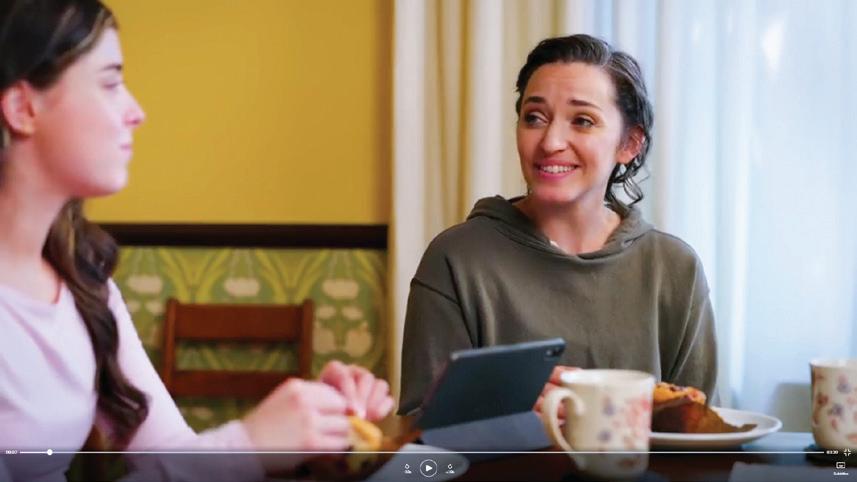
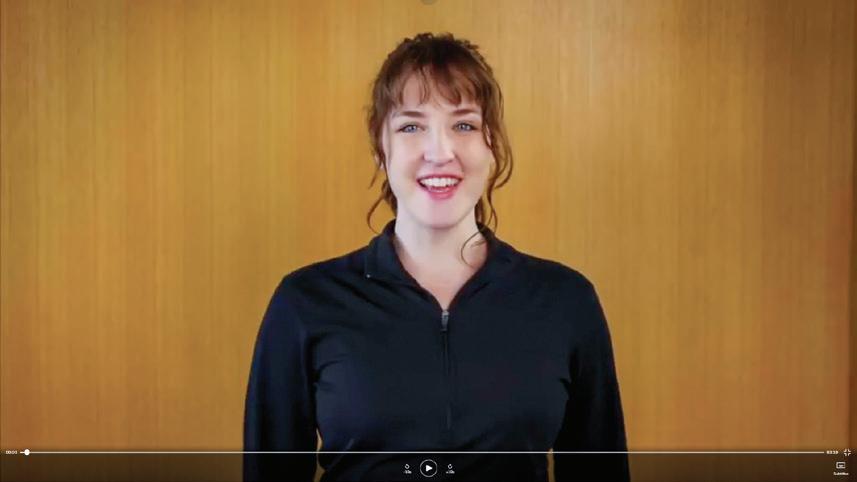
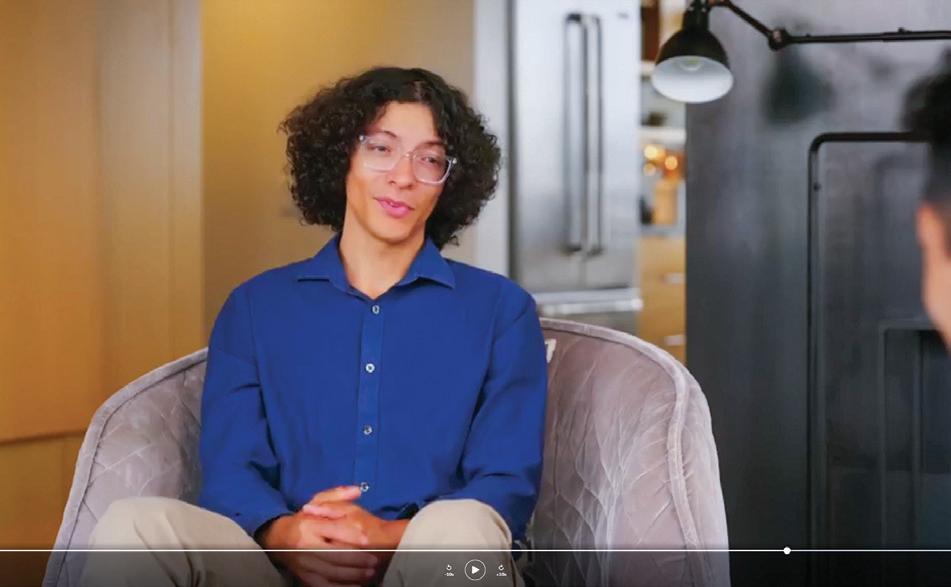
Each video lesson includes Preview, Watch, and Follow-up activities:
Preview: Builds background knowledge and key vocabulary to better understand the video.
Watch: Guides students to focus on gist and identify important details and language.
Follow-up: Encourages personalization by voicing opinions and carrying out communicative tasks.
Video Projects
Students create personalized videos inspired by the Interchange Video Program. Projects include step-by-step worksheets for brainstorming, writing, and planning. They offer a creative way to practice English and allow teachers to assess oral fluency.
Video Project Teaching Notes
Provide teachers with clear, genre-specific instructions for guiding students in pairs or small groups through planning and production during class time.


Introduction to the CEFR
About the Common European Framework of Reference for Languages (CEFR)
The Common European Framework of Reference for Languages (CEFR) is an international standard for describing language ability. It describes language ability on a six-point scale, from A1 for beginners, up to C2 for those who have mastered a language. This makes it easy for anyone involved in language teaching and testing, such as teachers or learners, to see the level of different teaching and learning materials and qualifications. It also means that employers and educational institutions can easily compare our qualifications to other exams in their country.
Interchange Sixth Edition and the CEFR
The table below shows how Interchange Sixth Edition correlates with the CEFR levels and with some major international examinations.
Source: https://www.cambridgeenglish.org/exams-and-tests/cefr/
Book Plans
Included in this Executive Preview Edition are the book plans for levels Intro, 1, 2, and 3 of Interchange Sixth Edition, featuring:
• Unit Titles and Topics
• Speaking
• Grammar
• Pronunciation and Listening
• Writing and Reading
• Interchange Activities
To learn more about Interchange Sixth Edition, visit us online at:





















































































































Plan of Intro Book Plan of Intro Book
Titles/Topics

What’s your name?
Alphabet; greetings and leavetakings; names and titles of address; numbers 0–10, phone numbers, and email addresses
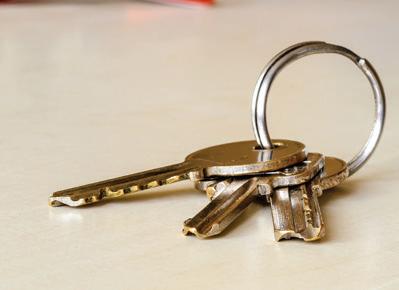
Where are my keys?
Possessions, classroom objects, personal items, and locations in a room
Progress check Pages 14–15
Speaking
Introducing yourself and friends; saying hello and good-bye; asking for names and phone numbers
Grammar
Possessive adjectives my, your, his, her ; the verb be; affirmative statements and contractions
Naming objects; asking for and giving the locations of objects
Articles a, an, and the; this/these, it /they ; plurals; yes/no and where questions with be; prepositions of place: in, in front of, behind, on, next to, and under

Where are you from?
Cities and countries; adjectives of personality and appearance; numbers 11–103 and ages
Is this coat yours?
Clothing; colors; weather and seasons



Progress check Pages 28–29
Talking about cities and countries; asking for and giving information about place of origin, nationality, first language, and age; describing people
Asking about and describing clothing and colors; talking about the weather and seasons; finding the owners of objects
The verb be: affirmative and negative statements, yes/no questions, short answers, and Wh-questions
Possessives: adjectives our and their, pronouns, names, and whose; present continuous statements and yes/no questions; conjunctions and, but, and so; placement of adjectives before nouns
Clock time; times of the day; everyday activities
Unit 6 Pages 36–41
I ride my bike to school.
Transportation; family relationships; daily routines; days of the week
Progress check Pages 42–43
Unit 7 Pages 44–49
Does it have a view?
Houses and apartments; rooms; furniture
Unit 8 Pages 50–55
Where do you work?
Jobs and workplaces
Progress check Pages 56–57
Asking for and telling time; asking about and describing current activities
Asking for and giving information about how people go to work or school; talking about family members; describing daily and weekly routines
Time expressions: o’clock, a m , p m , noon, midnight, in the morning/ afternoon/evening, at 7:00/night / midnight ; present continuous Wh-questions
Simple present statements with regular and irregular verbs; simple present yes/no and Wh-questions; time expressions: early, late, every day, on Sundays/weekends/weekdays
Asking about and describing houses and apartments; talking about the furniture in a room
Asking for and giving information about work; giving opinions about jobs; describing workday routines
Simple present short answers; there is, there are; there’s no, there isn’t a, there are no, there aren’t any
Simple present Wh-questions with do and does; placement of adjectives after be and before nouns
Pronunciation/Listening Writing/Reading
Linked sounds
Listening for the spelling of names, phone numbers, and email addresses
Plural -s endings
Listening for the locations of objects
Writing a list of names, phone numbers, and email addresses
Interchange Activity
“Celebrity classmates”: Introducing yourself to new people
Page 114
Writing the locations of objects
“Find the differences”: Comparing two pictures of a room
Page 115
Syllable stress
Listening for countries, cities, and languages; listening to descriptions of people
The letters s and sh
Listening for descriptions of clothing and colors
Writing questions requesting personal information
“Let’s talk!”: Finding out more about your classmates
Page 118
Writing questions about what people are wearing
“Celebrity fashions”: Describing celebrities’ clothing
Pages 116–117
Rising and falling intonation
Listening for times of the day; listening to identify people’s actions
Third-person singular -s endings
Listening for activities and days of the week
Writing times of the day
“Message Me!”: Reading an online chat between two friends
Writing about your weekly routine
“What’s Your Schedule Like?”: Reading about someone’s daily schedule
“What’s wrong with this picture?”: Describing what’s wrong with a picture
Page 119
“Class survey”: Finding out more about classmates’ habits and routines
Page 120
Words with th
Listening to descriptions of homes; listening to people shop for furniture
Reduction of do
Listening to people describe their jobs
Writing about your dream home
“Awesome Places to Stay”: Reading about two interesting hotels
Writing about jobs
“Dream Jobs”: Reading about two unusual jobs
“Find the differences”: Comparing two apartments
Page 121
“The perfect job”: Figuring out what job is right for you
Page 122
Titles/Topics


Unit 9 Pages 58–63
I always eat breakfast.
Basic foods; breakfast foods; meals
Unit 10 Pages 64–69
What sports do you like?
Sports; abilities and talents
Progress check Pages 70–71
Speaking
Talking about food likes and dislikes; giving opinions about healthy and unhealthy foods; talking about foods you have and need; describing eating habits
Asking about free-time activities; asking for and giving information about abilities and talents

Unit 11 Pages 72–77
I’m going to have a party. Months and dates; birthdays, holidays, festivals, and special days
Unit 12 Pages 78–83
How do you feel?
Parts of the body; health problems and advice; medications
Progress check Pages 84–85
Asking about birthdays; talking about plans for the evening, weekend, and other occasions
Describing health problems; talking about common medications; giving advice for health problems


Unit 13 Pages 86–91
How do I get there?
Stores and things you can buy there; tourist attractions
Unit 14 Pages 92–97
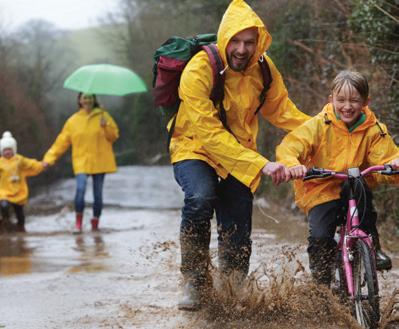
I had a good time.
Weekends; chores and fun activities; vacations; summer activities
Progress check Pages 98–99


Unit 15 Pages 100–105
Where were you born?
Biographical information; years; school days
Unit 16 Pages 106–111
Can I take a message?
Locations; telephone calls; invitations; going out with friends
Progress check Pages 112–113
Grammar plus Pages 132–150
Talking about stores and other places; asking for and giving directions
Grammar
Count and noncount nouns; some and any ; adverbs of frequency: always, usually, often, sometimes, hardly ever, never
Simple present Wh-questions; can for ability; yes/no and Wh-questions with can
Asking for and giving information about weekend and vacation activities
The future with be going to; yes/no and Wh-questions with be going to; future time expressions
Have + noun; feel + adjective; negative and positive adjectives; imperatives
Asking for and giving information about date and place of birth; describing school experiences and memories
Describing people’s locations; making, accepting, and declining invitations; making excuses
Prepositions of place: on, on the corner of, across from, next to, between; giving directions with imperatives
Simple past statements with regular and irregular verbs; simple past yes/no questions and short answers
Statements and questions with the past of be; Wh-questions with did, was, and were
Prepositional phrases; subject and object pronouns; invitations with Do you want to…? and Would you like to…?; verb + to
Pronunciation/Listening Writing/Reading
Sentence stress
Listening for people’s food preferences
Pronunciation of can and can’t
Listening for people’s favorite sports to watch or play; listening to people talk about their abilities
Writing about mealtime habits
“It’s a Food Festival!”: Reading about foods people celebrate
Writing questions about sports
“Awesome Sports Records”: Reading about fitness records from around the world
Interchange Activity
“Planning a party”: Choose snacks for a party and compare answers
Page 123
“Hidden talents and abilities”: Finding out more about your classmates’ hidden talents
Page 124
Reduction of going to
Listening to people talk about their holiday plans
Sentence intonation
Listening to people talk about health problems; listening for medications
Writing about weekend plans
“Happy Birthday to You!”: Reading about birthday customs in different places
Writing advice for health problems
“Do You Know Your Body?”: Reading interesting facts about your body
“Take a guess”: Making guesses about a classmate’s plans
Page 125
“Problems, problems”: Giving advice for some common problems
Page 126
Compound nouns
Listening to people talk about shopping; listening to directions
Simple past -ed endings
Listening to people talk about their past summer activities
Writing directions
“A Tour of Cartagena, Colombia”: Reading about popular tourist attractions in Colombia
Writing about last weekend
“Did You Have a Good Weekend?”: Reading about four people’s weekend experiences
“Giving directions”: Asking for directions in a neighborhood
Pages 127–128
“Past activities”: Comparing your classmates’ childhoods
Page 129
Negative contractions
Listening for places and dates of birth
Reduction of want to and have to
Listening to phone conversations about making and changing plans
Writing questions about a person’s life
“Adithi: A Third Culture Kid”: Reading about a child’s life
Writing about weekend plans
“Austin City Limits!”: Reading about events at a festival
“This is your life.”: Finding out more about your classmates’ lives
Page 130
“The perfect weekend”: Making plans with your classmates
Page 131
Plan of Book 1 Plan of Book 1
Titles/Topics Speaking












Unit 1 Pages 2–7
Where are you from?
Introductions and greetings; names, countries, and nationalities
Unit 2 Pages 8–13
What do you do?
Jobs, workplaces, and school; daily schedules; clock time
Progress check Pages 14–15
Unit 3 Pages 16–21
How much are these?
Shopping and prices; clothing and personal items; colors and materials
Unit 4 Pages 22–27
Do you play the guitar?
Music, movies, and TV programs; entertainers; invitations and excuses; dates and times
Introducing oneself; introducing someone; checking information; exchanging personal information; saying hello and good-bye; talking about school subjects
Describing work and school; asking for and giving opinions; describing daily schedules
Grammar
Wh-questions and statements with be; questions with what, where, who, and how ; yes/no questions and short answers with be; subject pronouns; possessive adjectives
Simple present Wh-questions and statements; question: when; time expressions: at, in, on, around, early, late, until, before, and after
Talking about prices; giving opinions; discussing preferences; making comparisons; buying and selling things
Talking about likes and dislikes; giving opinions; making invitations and excuses
Demonstratives: this, that, these, those; one and ones; questions: how much and which; comparisons with adjectives
Yes/no and Wh-questions with do; question: what kind; object pronouns; modal verb would; verb + to + verb Progress check Pages 28–29
Unit 5 Pages 30–35
What an interesting family!
Family members; typical families
Unit 6 Pages 36–41
How often do you run?
Sports, fitness activities, and exercise; routines
Progress check Pages 42–43
Unit 7 Pages 44–49
We went dancing!
Free-time and weekend activities
Unit 8 Pages 50–55
How’s the neighborhood?
Stores and places in a city; neighborhoods; houses and apartments
Progress check Pages 56–57
Talking about families and family members; exchanging information about the present; describing family life
Asking about and describing routines and exercise; talking about frequency; discussing sports and athletes; talking about abilities
Present continuous yes/no and Wh-questions, statements, and short answers; quantifiers: all, nearly all, most, many, a lot of, some, not many, and few ; pronoun: no one
Adverbs of frequency: always, almost always, usually, often, sometimes, hardly ever, almost never, and never ; questions: how often, how long, how well, and how good; short answers
Talking about past events; giving opinions about past experiences; talking about vacations
Asking about and describing locations of places; asking about and describing neighborhoods; asking about quantities
Simple past yes/no and Wh-questions, statements, and short answers with regular and irregular verbs; past of be
There is/there are; one, any, and some; prepositions of place; quantifiers; questions: how many and how much; count and noncount nouns
Pronunciation/Listening Writing/Reading
Linked sounds
Listening for names, countries, and school subjects
Syllable stress
Listening to descriptions of jobs and daily routines
Writing questions requesting personal information
“What’s in a Name?”: Reading about last names
Writing a biography of a classmate
“My Parents Don’t Understand My Job!”: Reading about four jobs
Interchange Activity
“Getting to know you”: Collecting personal information about classmates Page 114
“What we have in common”: Finding similarities in classmates’ daily schedules Page 115
Sentence stress
Listening to people shopping; listening for items, colors, and prices
Intonation in questions
Listening for likes and dislikes
Intonation in statements
Listening for family relationships
Writing about favorite clothes
“Online Shopping: The Crazy Things People Buy”: Reading about unusual online items
Writing text messages
“The Biggest Star in Today’s Musical Sky”: Reading about a famous musician
“Flea market”: Buying and selling things Pages 116–117
“Are you free this weekend?”: Making plans; inviting and giving excuses Page 118
Intonation with direct address
Listening to people talking about free-time activities; listening to descriptions of sports participation
Writing an email about family
“Do Families Spend a Lot of Time Together?”: Reading about four families
Writing about weekly activities
“Fit and Healthy? Take the Quiz!”: Reading about health and taking a quiz
“Is that true?”: Finding out information about classmates’ families Page 119
“What’s your talent?”: Finding out about classmates’ abilities Page 120
Reduction of did you
Listening to descriptions and opinions of past events and vacations
Reduction of there is/there are
Listening for locations and descriptions of places
Writing a blog post
“Awesome Vacations”: Reading about different kinds of vacations
Writing about neighborhoods
“Hip Neighborhoods of the World”: Reading about popular neighborhoods
“Memories”: Playing a board game Page 121
“Where are we?”: Describing and guessing locations Page 122


Titles/Topics
Unit 9 Pages 58–63
What does she look like?
Appearance and dress; clothing and clothing styles; people
Unit 10 Pages 64–69
Have you ever been there?
Past experiences; unusual activities
Speaking
Asking about and describing people’s appearance; identifying people
Grammar
Questions for describing people: What look like, how old, how tall, how long, and what color ; modifiers with participles and prepositions
Describing past experiences; exchanging information about past experiences and events






Progress check Pages 70–71
Unit 11 Pages 72–77
It’s a really nice city. Cities; hometowns; countries
Unit 12 Pages 78–83
It’s important to get rest.
Health problems; medication and remedies; products in a pharmacy
Progress check Pages 84–85
Unit 13 Pages 86–91
What would you like?
Food and restaurants
Unit 14 Pages 92–97
It’s the coldest city! World geography and facts; countries
Progress check Pages 98–99
Unit 15 Pages 100–105
What are you doing later?
Invitations and excuses; free-time activities; phone messages
Unit 16 Pages 106–111
How have you changed?
Life changes; plans and hopes for the future
Progress check Pages 112–113
Grammar plus Pages 132–150
Asking about and describing cities; asking for and giving suggestions; talking about travel
Talking about health problems; asking for and giving advice; making requests; asking for and giving suggestions
Present perfect yes/no and Whquestions, statements, and short answers with regular and irregular past participles; already and yet; present perfect vs. simple past; for and since
Expressing likes and dislikes; agreeing and disagreeing; ordering a meal
Describing countries; making comparisons; expressing opinions; talking about distances and measurements
Adverbs before adjectives; conjunctions: and, but, though, and however ; modal verbs can and should
Adjective + infinitive; noun + infinitive; modal verbs could and should for suggestions; modal verbs can, could, and may for requests
Talking about plans; making invitations; accepting and refusing invitations; giving reasons; taking and leaving messages
Exchanging personal information; describing changes; talking about plans for the future
So, too, neither, and either ; modal verbs would and will for requests
Comparative and superlative forms of adjectives; questions: how far, how big, how high, how deep, how long, how hot, and how cold
Future with present continuous and be going to; messages with tell and ask
Describing changes with the present tense, the past tense, the present perfect, and the comparative; verb + infinitive
Pronunciation/Listening Writing/Reading
Contrastive stress in responses
Listening to descriptions of people; identifying people
Linked sounds
Listening to descriptions of events
Writing an email describing a person “The Age of Selfies”: Reading about the history of selfies
Writing an email to an old friend “Unique Experiences”: Reading about four peoples’ unusual experiences
Interchange Activity
“Find the differences”: Comparing two pictures of a party Pages 123–124
“Fun survey”: Finding out about a classmate’s lifestyle Page 125
Can’t and shouldn’t
Listening to descriptions of cities, towns, and countries
Reduction of to Listening to health problems and advice
Writing about hometowns “A Big ‘Hello!’ From . . . “: Reading about interesting cities
Writing a blog post “Toothache? Visit the Rainforest!”: Reading about a plant used as medicine
“Welcome to our city!”: Creating a guide to fun places in a city Page 126
“What should I do?”: Give suggestions for situations Page 127
Stress in responses
Listening to restaurant orders
Questions of choice
Listening to a TV quiz show
Writing a restaurant review “The Tip of the Iceberg”: Reading about tipping customs
Writing an article about a place “Earth’s Cleanest Places”: Reading about three very clean places
“Planning a food festival”: Creating a menu Page 128
“How much do you know?”: Taking a general knowledge quiz Page 129
Reduction of could you and would you Listening to phone messages
Vowel sounds /oʊ/ and /ʌ/
Listening to descriptions of changes
Writing text message requests “Cell Phone Trouble!”: Reading about cell phone problems
Writing a plan for a class trip “A Fighter for the Forest”: Reading about a person’s goals
“Weekend plans”: Finding out about classmates’ weekend plans Page 130
“Our possible future”: Planning a possible future Page 131
Plan of Book 2
Plan of Book 2
Titles/Topics


Unit 1
Good memories
People; childhood; memories
Speaking
2–7
Introducing yourself; talking about yourself; exchanging personal information; remembering your childhood; asking about someone’s childhood
Grammar
Past tense; used to for habitual actions Unit 2 Pages 8–13
Life in the city Transportation; transportation problems; city services













3
Making changes
Houses and apartments; lifestyle changes; wishes
4
Have you ever tried it?
Food; recipes; cooking instructions; cooking methods
Progress check Pages 28–29
Unit 5 Pages 30–35
Hit the road!
Travel; vacations; plans
Unit 6 Pages 36–41
Sure! I’ll do it.
Complaints; household chores; requests; excuses; apologies
Progress check Pages 42–43
Unit 7 Pages 44–49
What do you use this for?
Technology; instructions
Unit 8 Pages 50–55
Time to celebrate!
Holidays; festivals; customs; celebrations
Progress check Pages 56–57
Talking about transportation and transportation problems; evaluating city services; asking for and giving information
Expressions of quantity with count and noncount nouns: too many, too much, fewer, less, more, not enough; indirect questions from Wh-questions
Describing positive and negative features; making comparisons; talking about lifestyle changes; expressing wishes
Evaluations and comparisons with adjectives: not . . . enough, too, (not) as . . . as; evaluations and comparisons with nouns: not enough . . . , too much/many . . . , (not) as much/many . . . as; wish
Talking about food; expressing likes and dislikes; describing a favorite snack; giving step-by-step instructions
Describing vacation plans; giving travel advice; planning a vacation
Making requests; agreeing to and refusing requests; complaining; apologizing; giving excuses
Simple past vs. present perfect; sequence adverbs: first, then, next, after that, finally
Describing technology; giving instructions; giving suggestions
Future with be going to and will; modals for necessity and suggestion: must, need to, (don’t) have to, ought to, -‘d better, should (not)
Two-part verbs; will for responding to requests; requests with modals and Would you mind . . . ?
Infinitives and gerunds for uses and purposes; imperatives and infinitives for giving suggestions
Describing holidays, festivals, customs, and special events
Relative clauses of time; adverbial clauses of time: when, after, before
Pronunciation/Listening Writing/Reading
Reduced form of used to
Listening to people talk about their past
Syllable stress
Listening to a description of a transportation system
Unpronounced vowels
Listening to people talk about a hanok in Seoul
Writing a paragraph about your childhood
“A Life in Paintings: The Frida Kahlo Story”: Reading about the life of this Mexican painter
Writing a post on a social networking page about a local issue
“This Year’s Best Cities!”: Reading about the best cities someone has visited this year
Interchange Activity
“We have a lot in common.”: Finding out about a classmate’s childhood Page 114
“Top travel destinations”: Suggesting ways to attract tourists to a city Page 115
Consonant clusters
Listening to descriptions of foods
Writing a message comparing two living spaces
“From City Lights to Starry Nights”: Reading about a big life change
Writing a recipe
“Pizza: The World’s Favorite Food?”: Reading about the history of pizza
“A dream come true”: Finding out about a classmate’s wishes Page 116
Linked sounds with /w/ and /y/ Listening to travel advice
Stress in two-part verbs
Listening to the results of a survey about family life
Writing an email with travel suggestions “Adventure Vacations”: Reading about unusual vacations
Writing a message making a request “Roommate Requests”: Reading about unusual roommate requests
“Oh, really?”: Surveying classmates about their experiences Page 117
“Fun trips”: Deciding on a trip Pages 118, 120
“I’m terribly sorry.”: Apologizing and making amends Page 119
Syllable stress
Listening to apps for travel; listening to suggestions for using technology
Stress and rhythm
Listening to a description of Carnival in Brazil
Writing a message asking for specific favors
“The Sharing Economy – Good for Everybody?”: Reading about the sharing economy
Writing an entry on a travel blog about a cultural custom
“Out with the Old, in with the New”: Reading about interesting New Year’s customs
“Free advice”: Giving advice to classmates Page 121
“It’s worth celebrating.”: Finding out how classmates celebrate special occasions Page 122




Titles/Topics
Unit 9 Pages 58–63
Only time will tell.
Life in the past, present, and future; changes and contrasts; consequences
Speaking
Talking about change; comparing time periods; describing possible consequences



Unit 10 Pages 64–69
I like working with people.
Abilities and skills; job preferences; personality traits; careers

It’s really worth seeing!
Landmarks and monuments; world knowledge
It’s a long story.
Storytelling; unexpected recent past events




Progress check Pages 84–85
Unit 13 Pages 86–91
That’s entertainment!
Entertainment; movies and books; reactions and opinions
Now I get it!
Nonverbal communication; gestures and meaning; signs; drawing conclusions
Describing abilities and skills; talking about job preferences; describing personality traits
Grammar
Time contrasts; conditional sentences with if clauses
Talking about landmarks and monuments; describing countries; discussing facts
Describing recent past events and experiences; discussing someone’s activities lately
Gerunds; short responses; clauses with because
Passive with by (simple past); passive without by (simple present)
Past continuous vs. simple past; present perfect continuous
Describing movies and books; talking about actors; asking for and giving reactions and opinions
Interpreting body language; explaining gestures and meanings; describing acceptable and prohibited behavior in different situations; asking about signs and their meaning
Participles as adjectives; relative pronouns for people and things
Modals and adverbs: might, may, could, must, maybe, perhaps, probably, definitely ; permission, obligation, and prohibition Progress check Pages 98–99 Unit 15 Pages
I wouldn’t have done that.
Money; hopes; predicaments; speculations
Unit 16 Pages 106–111
Making excuses
Requests; excuses; invitations
Progress check Pages 112–113
Grammar plus Pages 132–150
Speculating about past and future events; describing a predicament; giving advice and suggestions
Reporting what people said; making polite requests; making invitations and excuses
Unreal conditional sentences with if clauses; past modals
Reported speech: requests and statements
Pronunciation/Listening Writing/Reading
Intonation in statements with time phrases
Listening to people talk about changes
Unreleased and released /t/ and /d/
Listening to people talk about their job preferences
Writing a paragraph describing a person’s past, present, and possible future
“Aguaviva: Fighting for a Future”: Reading about a town’s attempt to attract new residents
Writing a short cover letter for a job application
“Global Work Solutions”: Reading about understanding cultural differences in an international company
Interchange Activity
“Cause and effect”: Agreeing and disagreeing with classmates Page 123
“You’re hired.”: Interviewing for a job Page 124
The letter o
Listening to descriptions of monuments; listening for information about a country
Contrastive stress in responses
Listening to a description of a chef and humanitarian; listening to old friends catch up
Writing an introduction to an online city guide
Reading about unusual museums
Writing a description of a recent experience
“Reinventing the Music Industry”: Reading about the impact of AI-created music
“True or false?”: Sharing information about famous works Page 125
“It’s my life.”: Playing a board game to share past experiences Page 126
Emphatic stress
Listening for opinions; listening to a movie review
Pitch
Listening to people talk about the meaning of signs
Writing a movie review
“The Real Art of Acting”: Reading about unpleasant experiences actors put themselves through
Writing a list of rules
“Understanding Idioms”: Reading about idioms and their meanings
“It was hilarious!”: Asking classmates’ opinions about movies, TV shows, and celebrities Page 127
“Casual observers”: Interpreting body language Page 128
Reduction of have
Listening to people talk about predicaments; listening to an advice podcast
Reduction of had and would
Listening for excuses
Writing a blog post asking for advice
“TOPTIPS.com”: Reading an online advice forum
Writing a report about people’s responses to a survey
“A Good Excuse for a Day Off Work”: Reading about taking a sick day
“Tough choices”: Deciding what to do in a difficult situation Page 130
“Just a bunch of excuses”: Discussing calendar conflicts and making up excuses Pages 129, 131
Plan of Book 3 Plan of Book 3


Titles/Topics
Unit 1 Pages 2–7
That’s my kind of friend!
Personality types and qualities; relationships; likes and dislikes
Unit 2 Pages 8–13
Working 9 to 5
Jobs; career bene ts; job skills; summer jobs







14–15 Unit 3 Pages 16–21
Lend a hand
Favors; formal and informal requests; messages
Speaking
Describing personalities; expressing likes and dislikes; agreeing and disagreeing; complaining
Talking about possible careers; describing jobs; deciding between two jobs
Grammar
Relative pronouns as subjects and objects; it clauses + adverbial clauses with when
Gerund phrases as subjects and objects; comparisons with adjectives, nouns, verbs, and past participles
Making direct and indirect requests; accepting and declining requests
Requests with modals, if clauses, and gerunds; indirect requests Unit 4 Pages 22–27
What happened?
The media; news stories; exceptional events


Expanding your horizons
Cultural comparisons and culture shock; moving abroad; emotions; customs; tourism and travel abroad
That needs xing.
Consumer complaints; everyday problems; problems with electronics; repairs

What can we do?
The environment; global challenges; current issues
Narrating a story; describing events and experiences in the past
Past continuous vs. simple past; past perfect
Talking about moving abroad; expressing emotions; describing cultural expectations; giving advice
Describing problems; making complaints; explaining something that needs to be done
Noun phrases containing relative clauses; expectations: the custom to, (not) supposed to, expected to, (not) acceptable to
Describing problems with past participles as adjectives and with nouns; describing problems with need + gerund, need + passive in nitive, and keep + gerund
Identifying and describing problems; coming up with solutions
Passive in the present continuous and present perfect; prepositions of cause; in nitive clauses and phrases Unit 8 Pages 50–55
Never stop learning.
Education; learner choices; strategies for learning; life skills
Asking about preferences; discussing different skills to be learned; talking about learning methods; talking about life skills
Would rather and would prefer; by + gerund to describe how to do things
Pronunciation/Listening
Linked sounds
Listening for descriptions of people; listening for opinions
Stress with compound nouns
Listening to the good and bad parts of a job; listening for complaints
Writing/Reading
Writing a description of a good friend “Connecting for Change”: Reading about online communities for sustainable and eco-friendly living
Writing about two career choices “The Changing World of Work”: Reading about different work models
Interchange Activity
“Personality quiz”: Interviewing a classmate to nd out about personality characteristics Page 114
“Networking”: Comparing people’s careers and personalities to make a seating chart for a dinner party
Page 115
Unreleased consonants
Listening to people making, accepting, and declining requests
Intonation in complex sentences
Listening to messages and a podcast; listening to news stories
Writing a message with requests “Can You Tell It Like It Is?”: Reading about talking to friends about dif cult subjects
Writing a personal account “Believing More Than We Should”: Reading about the reliability of online content
“Beg and borrow”: Asking classmates to borrow items; lending or refusing to lend items Page 116
“Spin a yarn”: Inventing a story from three random elements
Page 117
Word stress in sentences
Listening for information about living abroad; listening to opinions about customs
Contrastive stress
Listening to complaints; listening to people return things in a store; listening to a conversation about a “throwaway culture”
Writing a pamphlet for tourists “Culture Shock”: Reading about moving to another country
Writing a critical online review
“Ask the Fixer!”: Reading about a problem with a ride-sharing service
“Cultural dos and taboos”: Comparing customs in different countries Page 118
“Home makeover”: Comparing problems in two pictures of an apartment Pages 119–120
Reduction of auxiliary verbs
Listening to environmental problems; listening for solutions
Intonation in questions of choice
Listening to a conversation with a guidance counselor; listening for additional information
Writing a post on a community website “Kamikatsu: A Model of Sustainability”: Reading about one town’s approach to reducing waste
Writing about a skill
“Are You Studying the ‘Right’ Way?”: Reading about different studying styles
“Take action!”: Choosing an issue and deciding on an effective method of protest; devising a strategy Page 121
“Making choices”: Choosing between different things you want to learn Page 122


Titles/Topics
Unit 9 Pages 58–63
Getting things done
Everyday services; recommendations; self-improvement
Speaking Grammar
Talking about things you need to have done; asking for and giving advice or suggestions
Get or have something done; making suggestions with modals + verbs, gerunds, negative questions, and in nitives Unit 10 Pages 64–69
A matter of time
Historic events and people; biography; the future
Progress check Pages 70–71









Rites of passage
Milestones and turning points; behavior and personality; regrets
Talking about historic events; talking about things to be accomplished in the future
Referring to time in the past with adverbs and prepositions: during, in, ago, from…to, for, since; predicting the future with will, future continuous, and future perfect
Keys to success
Qualities for success; successful businesses; advertising
Progress check Pages 84–85
Unit 13 Pages 86–91
What might have been
Pet peeves; unexplained events; reactions; complicated situations and advice
Unit 14 Pages 92–97
Creative careers
Movies; media and entertainment professions; processes
Progress check Pages 98–99
Unit 15 Pages 100–105
A law must be passed!
Recommendations; opinions; community issues; controversial topics
Unit 16 Pages 106–111
Reaching your goals
Challenges; accomplishments; goals; inspirational sayings
Progress check Pages 112–113
Grammar plus Pages 132–150
Describing milestones; describing turning points; describing regrets and hypothetical situations
Time clauses: before, after, once, the moment, as soon as, until, by the time; expressing regret with should (not) have + past participle; describing hypothetical situations with if clauses + past perfect and would/could have + past participle
Describing qualities for success; giving reasons for success; interviewing for a job; talking about ads and slogans
Describing purpose with in nitive clauses and in nitive clauses with for ; giving reasons with for, because, since, because of, due to, and the reason (that/why)
Drawing conclusions; offering explanations; describing hypothetical events; giving advice for complicated situations
Past modals for degrees of certainty: must (not) have, may (not) have, might (not) have, could (not) have; past modals for judgments and suggestions: should (not) have, could (not) have, would (not) have
Describing how something is done or made; describing careers in lm, TV, publishing, gaming, and music
The passive to describe process with is/are + past participle and modal + be + past participle; de ning and non-de ning relative clauses
Giving opinions for and against controversial topics; offering a different opinion; agreeing and disagreeing
Giving opinions about inspirational sayings; talking about the past and the future
Giving recommendations and opinions with passive modals: should be, ought to be, must be, has to be, has got to be; tag questions for opinions
Accomplishments with the simple past and present perfect; goals with the future perfect and would like to have + past participle
Pronunciation/Listening Writing/Reading
Sentence stress
Listening to New Year’s resolutions
Syllable stress
Listening to dates and time periods; listening to predictions
Writing a message of advice
“The Boy Who Invented Braigo”: Reading about young inventor Shubham Banerjee
Interchange Activity
“Absolutely not!”: Discussing different points of view of parents and their children Page 123
Writing a biography
“Looking Into the Future”: Reading about futurists and their predictions for the year 2050
Reduction of have and been
Listening to descriptions of important events; listening to regrets and explanations
Reduced words
Listening for features and slogans
Writing a message of apology
“Stella’s Answers”: Reading about a con ict with a friend and advice on how to x it
“History buff”: Taking a history quiz Pages 124, 126
Reduction in past modals
Listening to explanations; listening for the best solution
Writing a TV or online commercial
“Brain Invasion: Why We Can’t Forget Some Ads”: Reading about what makes some advertisements memorable
“Good choices, bad choices”: Playing a board game to talk about how you were and could have been Page 125
“Advertising taglines”: Creating a slogan and logo for a product Page 127
Review of stress in compound nouns
Listening for parts of a movie
Writing about a complicated situation
“Alien Bodies Discovered in Peru?”: Reading about a sensational story
Intonation in tag questions
Listening for solutions to everyday annoyances; listening to issues and opinions
Stress and rhythm
Listening to past obstacles and how they were overcome; listening for people’s goals for the future
Writing about a process
“The Truth About Being a Film Extra”: Reading about what the job of a lm extra is like
“Think of the possibilities!”: Drawing possible conclusions about situations Page 128
“Celebrities”: Guessing famous people from clues Page 129
Writing a persuasive essay
“That’s Plagiarism?”: Reading about plagiarism in the digital age
Writing a personal statement for an application
“Yusra Mardini: From Refugee to Olympian”: Reading about the athlete Yusra Mardini
“On the wrong side of the law”: Deciding on punishments for common offenses Page 130
“A digital nomad”: Taking a quiz about working remotely Page 131
STUDENT’S BOOK with
digital pack
Jack C. Richards with Jonathan Hull and Susan Proctor
1 Where are you from?
Introduce oneself and others Talk about oneself and learn about others
1
Conversation Please call me Alexa.
Listen and practice.
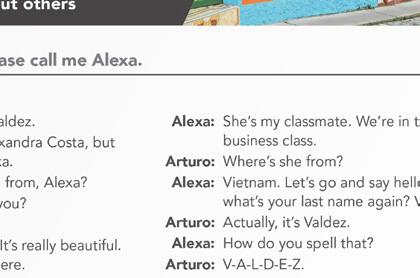
Arturo: Hello, I’m Arturo Valdez.
Alexa: Hi. My name is Alexandra Costa, but please call me Alexa.
Arturo: OK. Where are you from, Alexa?
Alexa: Brazil. How about you?
Arturo: I’m from Mexico.
Alexa: Oh, I love Mexico! It’s really beautiful. Oh, good. Linh is here.
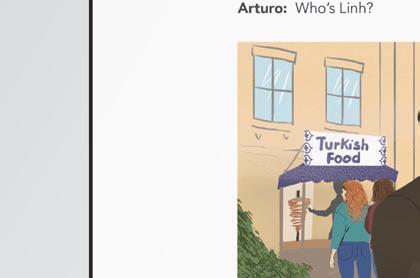
Arturo: Who’s Linh?

Alexa: She’s my classmate. We’re in the same business class.
Arturo: Where’s she from?
Alexa: Vietnam. Let’s go and say hello. Sorry, what’s your last name again? Vargas?
Arturo: Actually, it’s Valdez.
Alexa: How do you spell that?
Arturo: V-A-L-D-E-Z.

2
Speaking Checking information
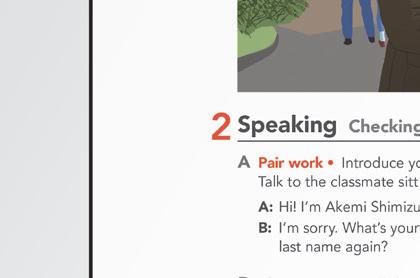
A Pair work • Introduce yourself with your full name. Use the expressions in the box. Talk to the classmate sitting next to you and to three more classmates.
A: Hi! I’m Akemi Shimizu. A: Shimizu.
B: I’m sorry. What’s your B: How do you spell that? last name again?
B Class activity • Tell the class the name of the first classmate you talked to. Make a list of names.
“Her name is Akemi Shimizu. She spells her name . . .”
useful expressions
Hi! I’m . . .
I’m sorry. What’s your first / last name again?
How do you spell that?
What do people call you?
3
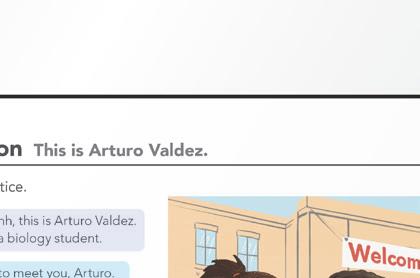
Conversation This is Arturo Valdez.
A Listen and practice. Nice to meet you, Arturo. I’m Linh Pham. Linh
Hi, Linh, this is Arturo Valdez. He’s a biology student. Alexa
Hi. So, you’re from Vietnam? Arturo
That’s right. I’m from Hanoi. Linh
Cool! What’s Hanoi like? Arturo
It’s really nice. It’s a very exciting city. Linh
B Listen to the rest of the conversation. What city is Arturo from? What’s it like?
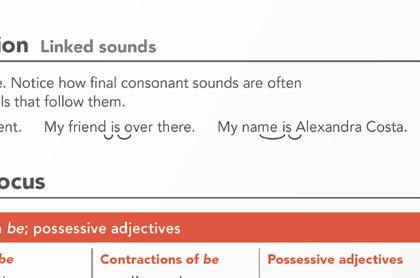
Pronunciation Linked sounds

Listen and practice. Notice how final consonant sounds are often linked to the vowels that follow them.
I’m a biology student. My friend is over there. My name is Alexandra Costa.
Grammar focus
5 Where are you from?
Statements with be ; possessive adjectives
Statements with be I ’m from Mexico.
You ’re from Brazil. He ’s from Japan.
She’s a business student.
It ’s an exciting city. We ’re in the same class. They ’re my classmates.
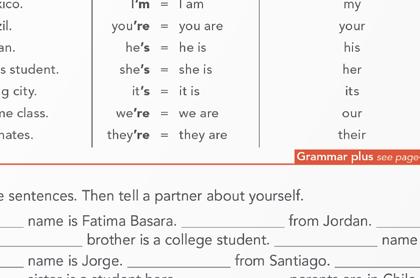
Contractions of be I ’m = I am
you ’re = you are he’s = he is she’s = she is it ’s = it is
we ’re = we are they ’re = they are
Possessive adjectives my your his her its our their Grammar plus see page 132
A Complete these sentences. Then tell a partner about yourself.
1. My name is Fatima Basara. from Jordan. family is in Amman. brother is a college student. name is Malik.
2. name is Jorge. from Santiago. a really nice city. sister is a student here. parents are in Chile right now.
3. Angelica, but everyone calls me Angie. last name is Newton. a student at City College. parents are on vacation this week. in Miami.
Wh-questions with be
Where’s your friend? He’s in class.
Who’s Linh? She’s my classmate.
What’s Hanoi like? It’s a very exciting city.
Where are you and Vanessa from? We’re from Brazil.
How are your classes? They’re pretty interesting. What are your classmates like? They’re really nice.
Grammar plus see page 132
For a list of countries and nationalities, see the appendix at the back of the book.
B Complete these questions. Then practice with a partner.
1. A: Who’s that?
B: Oh, that’s Mrs. Connor.
4. A: the two students over there?
B: Their names are Mason and Ava.
2. A: she from? 5. A: they from?
B: She’s from Chicago.
B: They’re from Vancouver.
3. A: her first name? 6. A: they ?
B: It’s Caroline.
B: They’re shy, but very friendly.
C Group work • Write five questions about your classmates. Then ask and answer the questions.
Snapshot

What’s your last name? Where’s Jay from? 6 math literature history chemistry physics geography biology physical education


School Subjects



Write the names of the school subjects under the pictures. What is (or was) your favorite school subject? What subjects don’t (or didn’t) you like? 1 math 6 8 3 2 5 7 4

8
Are Kate and Phil from Chicago? 7
Conversation How’s it going?
Listen and practice.
Arturo
Linh
Linh
Hi, Linh!
Hey, Arturo. How’s it going?
Great! How are you?
Arturo Yes, they are. I really love biology.
I’m fine, thanks. So, are your classes interesting this semester?
Arturo
Linh
Arturo
Linh
Arturo
Biology? Are you and Alexa in the same class?
No, we’re not. My class is in the morning. Her class is in the afternoon.
Oh, OK. Hey, do you have time for coffee?
Sure. I’d love some coffee.
Grammar focus
Yes/No questions and short answers with be
Are you free?

Yes, I am. No, I ’m not . Is Arturo from Mexico? Yes, he is. No, he ’s not ./No, he isn’t . Is Alexa’s class in the morning? Yes, it is. No, it ’s not ./No, it isn’t
Are you and Alexa in the same class? Yes, we are. No, we ’re not ./No, we aren’t
Are your classes interesting? Yes, they are. No, they ’re not ./No, they aren’t . Grammar plus see page 132
A Complete the conversations. Then practice with a partner.
1. A: Is Mr. Jones from the United States? 3. A: you and Giovanna from Italy? B: Yes, he . from B: Yes, we . from Naples. San Francisco.
2. A: English class at 2:00? 4. A: Mr. and Mrs. Flores Brazilian? B: No, it at 3:00. B: No, they Peruvian.
B Answer these questions. If you answer “no,” give the correct information. Then ask your partner the questions.
1. Are you from the United States?
2. Is your teacher from Canada?
3. Is your English class in the morning?
4. Are you free after class?
C Group work • Write five questions about your classmates. Then ask and answer the questions.

Word power Hello and good-bye
A Do you know these expressions? Which ones are “hellos” and which ones are “good-byes”? Complete the chart. Add expressions of your own.
✓ Bye. How are you?
✓ Good morning. How’s it going? Good night. See you later. Have a good day. See you tomorrow. Hey. Talk to you later.
Hi. What’s up?
Hello
Good-bye
Good morning. Bye.


B Match each expression with the best response.
1. Have a good day
2. Hi. How are you?
3. What’s up?
4. Good morning.
a. Oh, not much.
b. Thank you. You, too.
c. Good morning.
d. Pretty good, thanks.
C Class activity • Practice saying hello. Then practice saying good-bye.
A: Hi, Sakura. How’s it going?
B: Pretty good, thanks. How are you?
Listening Everyone calls me Bill.
Listen to the conversations. Complete the information about each person.
William
Min-soo
Ortiz
Interchange 1 Getting to know you
Find out about your classmates. Go to Interchange 1 on page 114.
Reading
A Look at the last names in the article. Are any of the names common in your country? What last names are common in your country?
What’s in a
Name?
Parents choose first names for their children like Leo or Mia, but people can’t choose their last name. Where do last names come from?
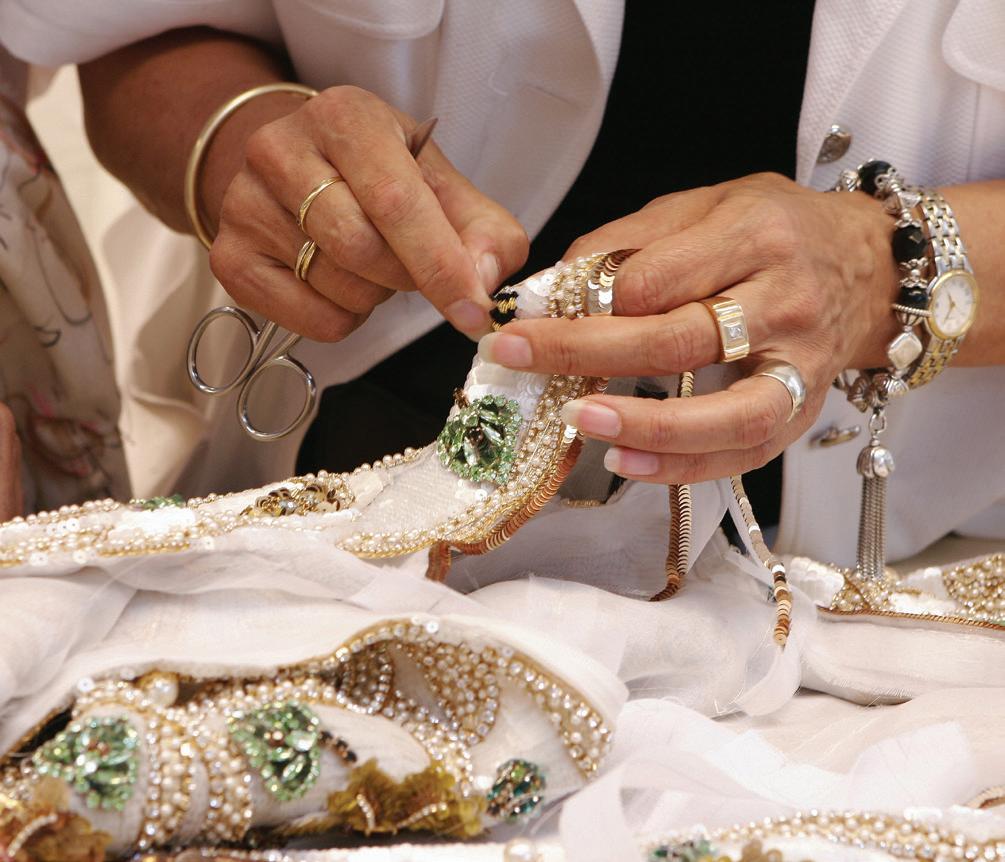
Well, some come from the names of jobs. In the U.S., more than 9% of the population has the last name Smith. A smith is a person who makes things from metal and wood. Today, we don’t use the job title anymore, but we still have the name. Tailor and Marinero are other common last names. A tailor is a person who makes clothes, and a marinero is a sailor in Spanish. Other last names come from the first name of the father. In the past, in Spanish speaking countries, when a man with the name Hernán had a son, he called the boy Hernández, which means son of Hernán. Later, Hernández became a last name. Today, 4% of people in Mexico have the name Hernández. The same thing happened in Europe. For example, a man with the name John called his son Johnson.
Other names come from personality types. In Japan, more people have the last name Sato than any other name. Sato means a person who helps others. In the past, anyone who worked for rich, important people and was good at their job had this name.

Why don’t you google your last name and see what you can learn about it? Can you guess where these last names come from?
B Read the article. Then check (✓) the sentences that are true.
1. A smith is a common job title today.
2. A tailor works with metal.
3. Today, Hernández is a first name.
4. Johnson is a name from Europe.
5. Sato is the most common name in Japan today.
6. People named Sato were very important people.
C Group work • Do you know where your last name comes from? Are there any unusual last names in your country? Can people change their last names in your country?
a blacksmith
a tailor
1. Japan, 2. England/Scotland, 3. England, 4. England, 5. Spain, 6. Spain
Suzuki
Butcher
González
Zapatero
Interchange activities
Interchange 1
Getting to know you
A Class activity • Add one more question to the chart. Go around the class and interview three classmates. Complete the chart.



What’s your first name?
What’s your last name?
What city are you from?
When’s your birthday?
What’s your favorite color?
What are your hobbies?
B Group work • Compare your information. Then discuss these questions. Who . . . ?
has a long first name has the next birthday has a long last name likes orange or brown is not from a big city has an interesting hobby
Classmate 1
Classmate 2
Classmate 3
Grammar plus
1 Statements with be; possessive adjectives page 3
■ Don’t confuse contractions of be with possessive adjectives: You’re a student. Your class is English 1. (not: You’re class is English 1.) He’s my classmate. His name is Ricardo. (not: He’s name is Ricardo.)
Choose the correct words.
1. This is / are Dulce Castelo. She’s / Her a new student from Santo Domingo.
2. My name am / is Sergio. I’m / He’s from Brazil.
3. My brother and I is / are students here. Our / We’re names are Nate and Chad.
4. He’s / His Kento. He’s / His 19 years old.
5. They’re / Their in my English class. It’s / Its a big class.
2 Wh-questions with be page 4
■ Use What to ask about things: What’s in your bag? Use Where to ask about places: Where’s your friend from? Use Who to ask about people: Who’s your teacher? Use What . . . like? to ask for a description: What’s your friend like?
Match the questions with the answers.
1. Who’s that? f
2. Where’s your teacher?
3. What are your friends like?
4. Where’s she from?
5. Who are they?
6. What’s his name?
a. They’re really nice.
b. She’s from South Korea.
c. They’re my brother and sister.
d. His name is Daniel.
e. He’s in class.
f. That’s our new classmate.
3 Yes/No questions and short answers with be page 5
■ Use short answers to answer yes/no questions. Don’t use contractions with short answers with Yes: Are you from Mexico? Yes, I am. (not: Yes, I’m.)
Complete the conversations.
1. A: Are they in your class?
B: No, . They’re in English 2.
2. A: Hi! in this class?
B: Yes, . I’m a new student here.
3. A: from the United States?
B: No, . We’re from Calgary, Canada.
4. A: Hi, Monica. free?
B: No, . I’m on my way to class.
5. A: That’s the new student. from Paraguay?
B: No, . He’s from Uruguay.
6. A: from Indonesia?
B: Yes, . She’s from Jakarta.



Jack C. Richards with Jonathan Hull and Susan Proctor
1 Where are you from?

Write about yourself.
My rst name is . My last name is Please call me . I’m from 1

Put the words in order to make questions. Then answer the questions.
1. class your how English is
A: How is your English class ? B: It’s pre y interesting
2. name teacher’s your what’s A: ? B:
3. from your teacher where is
5. classmates what your are like A: ? B: 2
4. your what friends’ are names
Choose the correct responses.
1. A: Hi, I’m Emily.
B: Oh, hi. I’m Peter.
• Oh, hi. I’m Peter.
• What do people call you?
2. A: My name is Noah Matory.
B:
• Nice to meet you, Noah.
• Let’s go and say hello.
3. A: Hello. I’m a new student here.
B:
• Thanks.
• Welcome.
Look at the answers. What are the questions? 3 4
4. A: I’m sorry. What’s your name again?
B:
• P-A-R-K.
• Eun-ha Park.
5. A: How do you spell your rst name?
B:
• I’m Akira.
• A-K-I-R-A.
6. A: What do people call you?
B:
• It’s Angela Young.
• Everyone calls me Angie.


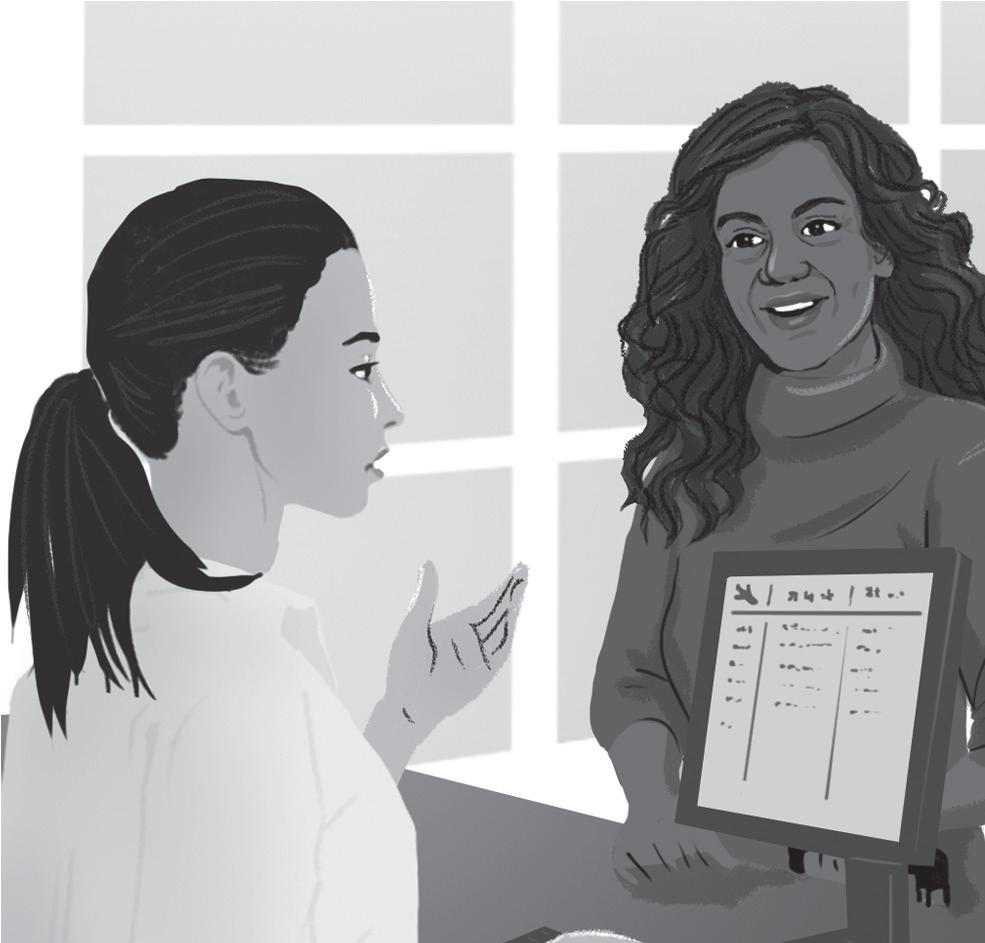
1. Agent: What ’s your name?
Camila: My name’s Camila.
2. Agent: What
Camila: My last name’s Almeida.
3. Agent: Who
Camila: That’s my husband.
4. Agent: What
Camila: His name’s Gustavo.
5. Agent: Where
Camila: We’re from Brazil.
6. Agent: Who
Camila: They’re my children.

1. That’s Antonio. He is in my class. (He / His)
2. I’m from Barcelona, Spain. is a beautiful city. (It / It’s)
3. Excuse me. What’s last name again? (you / your)
4. They’re my classmates. names are Jill and Tae-min. (They / Their)
5. name is Naoko. Please call me Nao. (I / My)
6. This is Elena’s husband. name is Tim. (His / Her)
7. My parents are on vacation. are in Australia. (We / They)
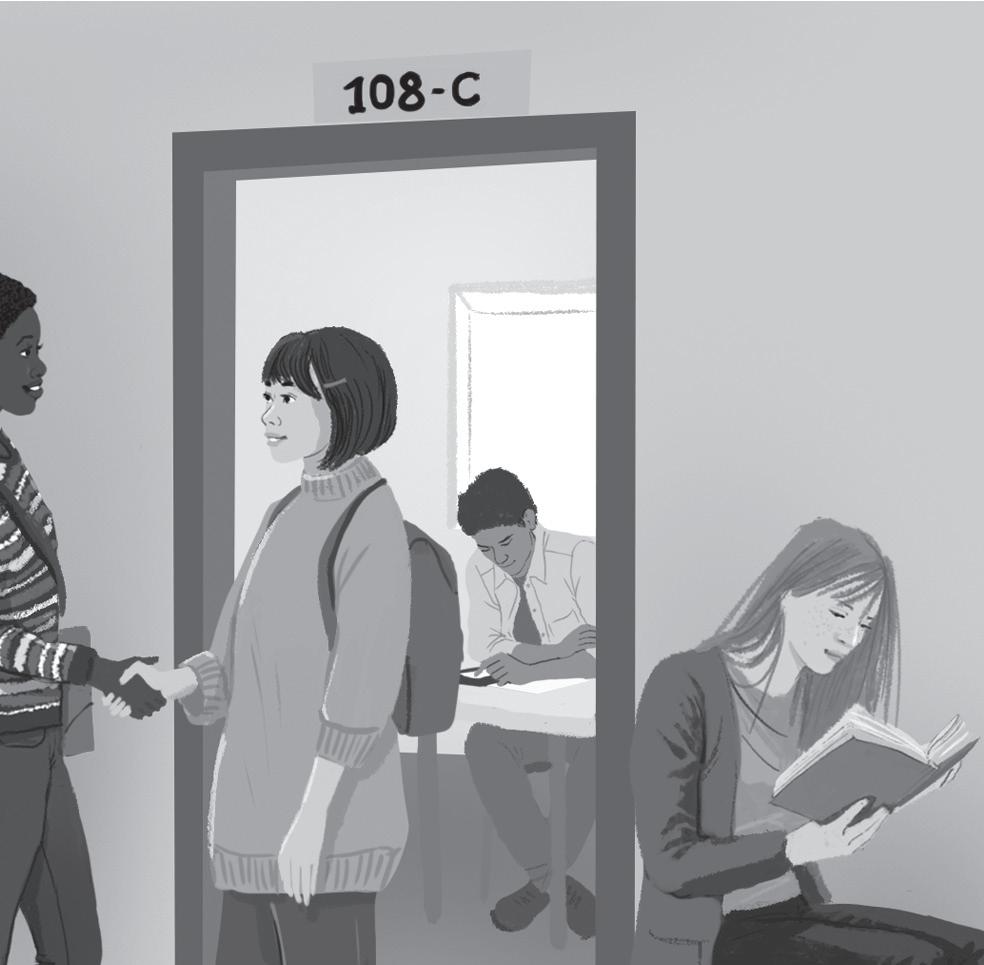
8. We have English at 10:00. classroom number is 108-C. (We / Our)
Complete this conversation with am , are, or is .
Amber: Who are the men over there, Ethan?
Ethan: Oh, they on my baseball team. Let me introduce you. Hi, Pablo, this Amber Fox.
Pablo: Nice to meet you, Amber.
Amber: Nice to meet you, too. Where you from?
Pablo: I from Cuba.
Ethan: And this Marco. He from Colombia.
Amber: Hi, Marco.
Hello and welcome!
A Read these four student biographies. Then complete the chart below.
International Language School


Rafael is in English 101. He is from Puebla, Mexico. His rst language is Spanish, and he also speaks a little French. He wants to be on the school volleyball team. He says he doesn’t play very well, but he wants to learn!
Every month, we meet new students at the school. This month, we want to introduce four new students to you. Please say “hello” to them!

Fatima is in English 103. She is from Tunis, Tunisia. She speaks Arabic and French. She is an engineering student. She wants to be an engineer. She says she doesn’t play any sports. She wants to make a lot of new friends in her class.

Su-yin is in English 102. She is from Wuhan, China. She says she writes and reads English pretty well, but she needs a lot of practice speaking English. Her rst language is Chinese. She wants to play volleyball on the school team.
Finally, meet Arun. He is in Fatima’s class. He says he speaks English well, but his writing isn’t very good! Arun is from Chennai, India, and his rst language is Tamil. He is a soccer player, and he wants to be on the school soccer team.
B Write a short biography of a classmate.
Name Where from Languages Sports
1. Rafael
2. Tunis, Tunisia
Chinese and English
soccer
9
Choose the correct sentences to complete this conversation.
You, too. Talk to you later.
✓ Hi, Stacey. I’m Omar. How are you? I really like biology.
Yes, I am. I’m an exchange student from Egypt. Yes, he is. We’re in Biology 300. Is he your friend?
Stacey: Hello, I’m Stacey.
Omar: Hi, Stacey. I’m Omar. How are you?
Stacey: Pretty good, thanks. Are you a student here?
Omar:
Stacey: Welcome. Do you like it here? What’s your favorite subject?
Omar:
Stacey: Oh, really? Is Ben Jones in your class?
Omar:
Stacey: No, he’s my brother! Actually, I have to go meet him now. Nice to meet you, Omar.
Omar:
Complete this conversation. Use contractions where possible.
Grammar note: Contractions
Do not use contractions for short answers with Yes. Are you from Argentina? Is he from Greece? Yes, I am. (not Yes, I’m.) Yes, he is. (not Yes, he’s.)
Alex: Hello. I’m Alex Robles. And this is my sister Celia.
Paula: Hi. Paula Vieira.
Celia: Are you from South America, Paula?
Paula: Yes, from Brazil. Where are you both from?
Alex: from Puerto Rico.
Paula: Are you from San Juan?
Celia: No, . from Ponce. By the way, are you in English 101?
Paula: No, . I’m in English 102.

6. Are you a student at a university? 10 11 12
Look at the answers. What are the questions?
1.A: Who’s Allison?
B: Allison is my best friend.
2.A:
B: My favorite school subject is history.
3.A:
B: No, we’re not from Germany. We’re from Switzerland.
4.A:
B: Yes, it’s an interesting class.
5.A:
B: Yes, Mary and Yuka are in my class.
6.A:
B: Ryan is funny and friendly.
7.A:
B: No, Ms. Rogers isn’t my English teacher. She’s my math teacher.
Read the expressions. Which ones say “hello” and which ones say “good-bye”?
Hello Good-bye
1. How are you? ✓
2. See you tomorrow.
3. Good night.
4. Good morning.
5. Talk to you later.
6. How’s it going?
7. Have a good day.
8. What’s up?

Answer these questions about yourself. Use contractions where possible.
1. Are you on vacation?
2. Is your teacher from Canada?
3. Is your rst name popular?
4. Is your English class in the morning?
5. Are you from Vietnam?
TEACHER’S EDITION
with digital pack
Jack C. Richards
with Jonathan Hull and Susan Proctor
Where are you from?
Cycle 1, Exercises 1–5
Conversation
Learning Objective: use be and possessive adjectives in a conversation about people meeting for the rst time
TIP
To learn your Ss’ names, have them make name cards. Each S folds a piece of paper in thirds and writes his or her name on one side. Then they place the name cards on their desks.
01.01
• Focus Ss’ attention on the picture. Ask: “Where are the people? What are they doing? How old are they?” Encourage Ss to make guesses.
• Set the scene. Arturo is meeting Alexa for the rst time.
• Books closed. Write these questions on the board:
1.Where is Alexa from?
2.Where is Arturo from?
• Play the rst part of the audio. Elicit Ss’ answers. (Answers: 1. Brazil 2. Mexico)
Speaking
Learning Objectives: introduce oneself; check information about others
A Pair work
• Introduce yourself to the class using your rst and last names. Explain that sometimes people misunderstand information like names, so it’s important to ask polite questions to check information. Focus Ss’ attention on the useful expressions box. Go over each expression. Point out the intonation of the questions.
• Have Ss ask you the questions from the box. Respond with information about yourself. Then model the example dialogue with a strong S, and spell your last name.
In Unit 1, students introduce themselves and others and talk about themselves and learn about others. By the end of Cycle 1, students will be able to introduce themselves and others using be and possessive adjectives, and ask and answer Wh-questions to nd out information about others and to state information about themselves. By the end of Cycle 2, students will be able to ask and answer yes/no questions to nd out information about others and to state information about themselves.
• Write this on the board for the next task: First name Last name Alexandra/Alexa Arturo
• Play the rst part of the audio again. Ss listen to nd out Alexa’s and Arturo’s last names. Then elicit the answers and write them on the board. (Answers: Costa, Valdez)
• Books open. Play the rst part of the audio again. Ss listen and read silently. Ss stand up and practice the conversation in pairs. Go around the class and give help as needed.
• Option: Ss use their own information to practice the rst part of the conversation. Before they start, ask Ss to underline the names and countries, so they know what information to substitute.
• Ask: “Where is Linh from?” Play the rest of the audio and elicit the answer. (Answer: Vietnam)
• Ss practice the conversation in pairs.
• Ss use their own information to ask and answer the questions with the classmate sitting next to them and then with three different classmates.
• Option: Review the letters of the alphabet.
B Class activity
• Explain the task. Then choose a student and model the task for the class. Tell the class the student’s name and how to spell it.
• Ss tell the class about the rst person they spoke to in part A.
4
Conversation
Learning Objective: use be in a conversation between three people who have just met
A 01.02
• Books closed. Set the scene. Alexa is introducing Arturo to Linh. Ask: “What is Linh’s last name?” Play the audio and elicit the answer. (Answer: Pham)
• Books open. Elicit or explain the meaning of What’s . . . like? Ask the class: “Where is Arturo from? What’s it like?” Ss check answers in the Conversation on page 2. (Answers: Mexico, really beautiful)
• Play the audio again. Ss listen and read the conversation silently. Then they practice it. For a new way to practice this conversation, try Look Up and Speak! – download it from the Teacher’s Resources on Cambridge One.
Pronunciation
Learning Objective: sound more natural by linking words
01.04
• Explain that some English words sound unnatural when pronounced separately. Therefore, native speakers usually link these words.
5
Grammar focus
Learning Objectives: make statements/contractions with be; use possessive adjectives to describe oneself and others; ask and answer Wh-questions with be
01.05
Statements with be and contractions of be
• Introduce yourself (“I’m . . .”). Explain that it’s common to use contractions (e.g., I’m) when speaking. Tell Ss to go around the room and introduce themselves.
• Go over the contractions in the Grammar focus box. Close your thumb and rst nger to show how the pronouns + be become contractions. For example, your thumb (you) and rst nger (are) contract to become you’re.
Possessive adjectives
• Explain the difference between subject pronouns and possessive adjectives by writing this on the board: I am Arturo.My name is Arturo. You are Linh.Your name is Linh.
• Play the audio for the rst Grammar focus box.
B 01.03
• Elicit names of cities in Mexico (e.g., Mexico City, Acapulco). Then read the two focus questions.
• Play the audio. Ss listen to nd the answers to the questions. Elicit the answers.
Audio script
Linh So, Arturo, where are you from?
Arturo I’m from Mexico.
Linh Really? What city?
Arturo Puebla.
Linh Interesting. What’s it like there?
Arturo Well, it’s a really beautiful city, and the food there is great!
Answers
Arturo is from Puebla. It’s a really beautiful city, and the food is great.
• Play the audio. Point out the linked sounds. Ask Ss to practice the sentences.
• Option: Play the audio for the Conversation on page 3 again. Then tell Ss to practice linking sounds in selected sentences (e.g., This is Arturo.).
AFor more practice with possessive adjectives, play the Chain Game – download it from the Teacher’s Resources on Cambridge One.
• Ss complete the sentences individually or in pairs. Go over answers with the class.
Answers
1. My name is Fatima Basara. I’m from Jordan. My family is in Amman. My brother is a college student. His name is Malik.
2. My name is Jorge. I’m from Santiago. It’s a really nice city. My sister is a student here. Our parents are in Chile right now.
3. I’m Angelica, but everyone calls me Angie. My last name is Newton. I’m a student at City College. My parents are on vacation this week. They’re in Miami.
Wh-questions with be
• Write these questions and answers on the board: Questions Answers
Where’s your friend?She’s my classmate. Who’s Linh? It’s a very exciting city. What’s Hanoi like?He’s in class. Where are you and VanessaThey’re really nice. from? We’re from Brazil. How are your classes?They’re pre y What are your classmates interesting. like?
Books closed. Ask Ss to match the questions and answers on the board.
• Books open. Ss check answers with the Grammar focus box. Answer any questions.
• Play the audio.
• Option: Divide the class into two groups. Group A asks the questions and Group B answers. Then change roles.
B
• Ss complete the questions individually. Go over answers with the class.
Answers
1. Who is/Who’s that?
2. Where is/Where’s she from?
3. What is/What’s her rst name?
4. Who are the two students over there?
5. Where are they from?
6. What are they like?
Cycle 2, Exercises 6–12
Snapshot
Learning Objective: discuss school subjects
• Books closed. Ask Ss what school subjects they study in addition to English. Then ask Ss to name as many school subjects as they can.
• Books open. Focus Ss’ attention on the pictures. Then read the list of school subjects in the box. Did the class name all of these subjects? Elicit or explain any unfamiliar subjects.
• Students write the names of the subjects under the pictures individually.
• Go over the answers with the class.
• Explain the second part of the task. Ss practice the conversations in pairs. Model the task with a strong S and then with another S.
• Ss complete the task in pairs.
C Group work
• Explain the task. Read the example questions in the box. Elicit possible Wh-questions from the class.
• Option: Ss look at the Conversations on pages 2 and 3 for examples of Wh-questions with be. (Answers: Where are you from? Who’s Linh? Where’s she from? What’s your last name again? What’s Hanoi like?)
• Ss write ve Wh-questions individually. Go around the class and give help as needed.
• Ss work in small groups. They take turns asking and answering their questions.
• Go around the class and write down any errors. Then write the questions or answers with errors on the board. Ss correct the errors as a class.
End of Cycle 1
See the Supplementary Resources chart for additional teaching materials and student activities related to this Cycle. Download it from the Teacher’s Resources on Cambridge One.
Answers
1.math 5.physical education
2.biology6.literature
3.history7.chemistry
4.geography8.physics
• Discuss the questions with the class. Say the subjects aloud. Have Ss raise their hand when you say their favorite. Then call on individual Ss to name subjects they don’t like.
• Option: Put Ss into small groups based on their favorite subject. Then each group decides on their least favorite subjects and gives reasons. Have groups share their answers with the class.
Conversation
Learning Objective: use yes/no questions and short answers with be in a conversation between new friends
01.07
• Introduce the Conversation title. Ask: “How’s it going?” Help Ss with responses (e.g., ne, not bad).
• Set the scene. A few days after meeting, Arturo sees Linh and starts a conversation.
• Write these questions on the board:
1.Are Arturo’s classes interesting this semester?
2.Are Arturo and Alexa in the same biology class?
3.Is Arturo’s class in the afternoon?
4.Does Linh invite Arturo to get co ee?
Grammar focus
Learning Objective: askyes/no questions and give short answers with be
01.08
Yes/No questions
• Write several statements with be about Arturo and Linh or your own Ss on the board. For example: Arturo is a student.
Julia and Elena are sisters.
• Focus Ss’ attention on the statements. Point out that statements begin with a subject + verb. Arturois a student.
SV
Julia and Elena are sisters. S V
• Option: If you don’t want to teach the terms subject and verb, use the numbers 1 and 2 instead.
• Explain that yes/no questions begin with a verb + subject. For example: IsArturo a student?
VS
Are Julia and Elena sisters? VS
• Ask Ss to change any remaining statements on the board to yes/no questions. Give help as needed.
• Ss study the Grammar focus box questions.
Short answers with be
• Present the short answers in the Grammar focus box. Point out that there are two ways of saying “no” for each pronoun, except for I
• Ask yes/no questions with be about Ss in the class. Ss respond with short answers.
• Play the audio. Focus Ss’ attention on the stress in short answers (e.g., Yes, I am. No, I’m not.).
• Elicit or explain any new vocabulary. A semester is a part of the school year, usually about 15–18 weeks.
• Books closed. Play the audio twice. Elicit answers to the questions on the board. (Answers: 1. yes 2. no 3. no 4. yes)
• Books open. Play the audio again. Ss look at the picture and read the conversation silently.
• Ss stand up and practice the conversation in pairs.
A
• Ss complete the conversations individually. Go over answers with the class.
Answers
1.A: Is Mr. Jones from the United States?
B:Yes, he is He’s from San Francisco.
2.A: Is English class at 2:00?
B:No, it isn’t / it’s not It’s at 3:00.
3.A: Are you and Giovanna from Italy?
B:Yes, we are We’re from Naples.
4.A: Are Mr. and Mrs. Flores Brazilian?
B:No, they aren’t /they’re not They’re Peruvian.
• Model the rst conversation with a strong S and the second conversation with a different S. Then Ss practice the conversations in pairs.
B
• Explain the task. Ss write answers to the questions individually. Then they ask and answer the questions in pairs, giving the correct information for “no” answers.
C Group work
• Model the task with the rst question. Ss write questions individually. Then they ask their questions.
• Option: Ss write questions in small groups. Collect the questions and give them to different groups. Ss take turns asking and answering the questions.
Word power
Learning Objective: say hello and good-bye in various ways
TIP
To show Ss the purpose of an activity, write the learning objective on the board. At the end of the activity, ask Ss to say what they have achieved.
A
• Explain the task. Ss write the expressions they know in the chart.
• Copy the chart headings Hello and Good-bye on the board. Go over the rst two examples with the class.
• Elicit the answers from the class and write them on the chart. Go over each expression as you write it. Then elicit more expressions and have Ss write them in the chart on the board.
Answers
Hello Good-bye
Good morning.Bye. Hey. Good night.
Listening
Learning Objective: listen for detail in conversations in which people give information about themselves
01.09
• Explain the task and the information in the chart. Ask the class: “What is William’s last name? What else do we need to nd out about him?”
• Play the rst conversation in the audio. Ss listen for William’s last name, where he’s from, and what he studies.
• Play the rest of the audio. As Ss listen and complete the chart, copy the chart on the board.
• Elicit answers and have Ss write them in the chart on the board. Do not correct wrong answers.
• Play the audio again. Stop after each conversation and discuss the answers on the board.
Audio script
1.
Man Bill, this is my friend Amber. She studies history, too.
William Hi, Amber. I’m William Davis. But everyone calls me Bill.
Amber Nice to meet you, Bill. What’s your last name again?
William It’s Davis. D-A-V-I-S.
Amber And where are you from, Bill?
Hi. Have a good day. How are you?See you later. How’s it going?See you tomorrow. What’s up? Talk to you later. Good afternoon.See you. Good evening.Later.
(Note: Additional expressions are italicized.)
B
• Model the rst greeting and response with a few Ss.
• Ss match the greetings and responses.
Answers
C Class activity
• Model the conversation with a S.
• Ss stand up and go around the room to practice greeting their classmates using expressions from the Hello column in part A. Then they practice using expressions from the Good-bye column.
William I’m originally from Chicago. My parents have a house there.
Amber Cool! And do you like studying history?
William Yes, I do. I think it’s really exciting.
2.
Clerk OK, Ms. Ortiz. Let me just check this information. Is your rst name Josephine?
Jose na Actually, it’s Jose na. It’s spelled J-O-S-E-F-IN-A.
Clerk OK. Thanks. And you’re from Costa Rica, right?
Jose na Oh, no, I’m not from Costa Rica. I’m from Mexico.
Clerk Oh, sorry. Mexico. But you are studying English.
Jose na Actually, I’m not. I’m a business student.
Clerk Business. OK. Got it.
3.
Man Excuse me. Are you Jun-young Park?
Jun-young Yes, I am.
Man Is your brother Min-soo Park?
Jun-young Yes, he is.
Man Tell me, is Min-soo still here at the university?
Jun-young No, he’s not. He’s at home in South Korea.
Man Oh, he’s in South Korea. Is he in school there?
Jun-young Yeah. He’s studying math at Seoul University.
Reading
Learning Objective: scan and read for details in an article about names
TIP
Explain that in real life people read in different ways for different purposes. For example, they read manuals or recipes slowly and in detail, but they skim magazines or scan websites more quickly.
A
• Ask: “What names are common in your country?” Elicit answers.
• Focus Ss’ attention on the title of the article. Ask: “What do you think this article is about?” Elicit ideas.
• Ss scan the text quickly to nd the names. Ask: “Are any of these names common in your country?” Elicit names from the class.
B
• Explain the task. Read the statements.
• Call Ss’ attention to the rst sentence in the article. Explain that in the U.S., people usually receive the last name of their parents when they are born. They can change their last name later if they want. For example, many people change their last name when they get married.
• Ask Ss: “What last names do people have when they are born in your country?” Encourage class discussion if Ss are from different countries, as customs may vary between countries. Don’t ask yet if Ss can change their last names in their countries, as they will discuss that in part C.
• Ss read the article individually.
• Elicit or explain any unfamiliar words from the article.
Vocabulary
%: (percent) the number out of one hundred population: all the people living in one country, area, or place metal: a usually hard, shiny material such as iron, steel, gold, or silver wood: the hard material that we get from trees sailor: a person who works on a ship personality: the way you are as a person google: to search for information on the Internet
• Then they complete the task. Go over answers with the class.
Answers
4 and 5 should be checked.
• Direct Ss’ attention to the nal question and six last names in the yellow box at the end of the text. Have Ss cover the answers at the bottom. Read the names with the class and ask Ss to say what countries they think the names are from. Then look at the answers.
C Group work
• Explain the task. Read the questions aloud and give your own answers as a model.
• Ss complete the task in small groups.
• Call on students to tell the class about some of the names they discussed.
For a new way to practice this reading, try Running Dictation – download it from the Teacher’s Resources on Cambridge One.
End of Cycle 2
See the Supplementary Resources chart for additional teaching materials and student activities related to this Cycle. Download it from the Teacher’s Resources on Cambridge One.


VIDEO RESOURCE BOOK
Jack C. Richards
Hotspots in my Town 1

In North America, people with full-time jobs usually work eight hours a day, Monday through Friday. They often work from 8:00 a.m. to 5:00 p.m., with one hour of free time for lunch. On their lunch breaks, some workers order food in a cafeteria in their of ce building or in a restaurant near their of ce. Others like to go outside during their lunch hour. They often bring their food from home and eat it in a park. Some people like to exercise during their lunch hour. They can go walking, biking, or jogging in the park. This is good for their mental and physical health.
What are typical of ce hours in your country?
Where do most of ce workers eat their lunch in your country? Are there many parks in your town or city? If so, what do people typically do there?
GUESS THE STORY


Watch the rst minute of the video with the sound off. Answer the questions.



1. Who do you think the man is? Why do you think he is making a video?
2. Who do you think the woman is? What is she talking about?
3
Video
Watch the video
GET THE PICTURE
A Check your answers to Exercise 2. Did you guess correctly?
B Check (✓) the true statements. Then correct the false statements. Compare with a partner.
1. Jacob and Caro are friends.
2. Many animals live in Green Lake Park.
3. Green Lake is a new lake.


4
WATCH FOR DETAILS
Check (✓) the correct answer. Then compare with a partner.
1. Jacob is from Seattle New York City
2. Jacob is a recreation assistant social media assistant
3. Caro works at home in an of ce
Follow-up
5
ROLE PLAY Social media in uencer
A PAIR WORK • Imagine you are making a video for social media. Work with a partner to decide what information to include in a short introduction about yourself.
4. Green Lake is years old. 50,000 5,000
5. A created Green Lake. volcano man


6
B CLASS ACTIVITY • Share your introduction with the class.
LOCAL HOTSPOTS
PAIR WORK • Work with a partner. Discuss the local hotspots in your city. Why do you like them? What do you know about their history? When do you go there?






Video Project 1
Video 1 – Hot Spots in my Town
Genre: Social media
Theme: Talking about popular places in your town
PAIR OR GROUP WORK • Make your own video. Follow these steps.
Step 1
PLAN THE SCRIPT
Complete the chart with your ideas.
Title: Hot Spots in my Town
Name of the “hot spot”
Location
Things to do or see there
Interesting facts
Name
Job
Things they like
Name Job
Things they like

Character 1 (Interviewer)
Character 2 (Interviewee)
Step 2
WRITE THE SCRIPT
You can use the video transcript for video 1 to help you. (Video Resource Book 1, page 71)

Step 3
MAKE THE FILMING PLAN
Complete the chart.
Location: Equipment:


Step 4
MAKE THE VIDEO
Be sure everyone speaks.
Step 5
EDIT THE VIDEO
Add sound effects, visual effects, music, emojis, etc.
Step 6
SHARE THE VIDEO
Share your video with the class.
Step 7
SELF-REFLECTION
Answer the questions.
1. What did I learn from this project?
2. What was easy or fun?
3. What was difficult?
4. One thing I liked about our video:
5. One thing I would change next time:
6. What did I enjoy about working as a group?
Props:
Hotspots in my Town 1

LANGUAGE
SUMMARY
Topics/Functions: Introducing oneself; asking for and giving opinions
Structures: Simple present Wh- questions and statements; contractions of be
STORY SUMMARY
Jacob is a man who uses social media regularly. He tells viewers about Green Lake Park in Seattle.
Preview
1 CULTURE
The culture note gives students information about a typical work schedule of people with full-time jobs in North America. It explains some different ways that workers use their time during their lunch breaks.
• Have students read the culture note silently. Then, answer their questions about vocabulary or content.
• Read the questions aloud, and have students work in small groups to answer them.
• Check answers around the class.
2
GUESS THE STORY
In this activity, students prepare to watch the video by using visual information to make predictions about the story.
• Explain the task and read the instructions and the questions aloud.
• Suggest that students watch for the answers as you play the first minute of the video with the sound off (until Jacob finishes interviewing Caro). Tell students they will find out if their predictions are correct in the next activity.
Answers
1. The man is Jacob. He is making a video to tell his viewers about Green Lake Park.
2. The woman is Caro, a passerby in the park. She is talking about why she likes to go to the park.
Watch the video
3 GET THE PICTURE
In the first activity, students watch and listen to the video, checking the predictions they made in Exercise 2. In the second activity, they focus on details in the video that will help determine whether the statements are true or false.
A
• Explain the task, and make sure students understand that they should look at their answers in Exercise 2 to check their predictions.
• Play the entire video with the sound on as students complete the task. Have selected students share their answers and replay the video as necessary.
B
• Explain the task and read the statements aloud.
• Play the entire video with the sound on.
• Have students work alone to complete the task and then have them compare their answers with a partner.
• Check answers as a class.
Answers
1. False; Jacob and Caro meet for the first time.
2. True
3. False; Green Lake is over 50,000 years old.
4 WATCH FOR DETAILS
In this activity, students focus on details in the video that will help them answer more detailed questions about it.
• Explain the task and read through the items and answer choices. Answer any vocabulary questions that arise.
• Have students work alone to answer as many questions as they can before they watch the video again.
• Play the entire video with the sound on.
• Have students work alone to check their answers. Then, have them compare answers with a partner.
• Check answers as a class.
A
• Explain the task and read the instructions aloud.
• Tell students to work in pairs to decide what information to include in their introduction.
• Have students practice their introductions in pairs.
B
• Ask individual students to perform their social media introductions for the class.
6 LOCAL HOTSPOTS
In this activity, students work in pairs to discuss local hotspots in their city.
• Explain the task. Make sure students understand that they should answer according to their own opinions.
• Put students in pairs to discuss the topic. Have them use the questions to guide their discussion.
Follow-up
5
ROLE PLAY Social media influencer
In the first activity, students work in pairs to note the information for the role play and practice in pairs. In the second activity, students perform the role play for the class.

Video Project 1
THAT MOMENT WHEN…
Jacob joins the online trend hot spots in my town to showcase Green Lake Park in Seattle, a park he visits during lunch breaks from his nearby office.
STUDENT VIDEO NOTE
Instruct Ss to make a “video blog” about a popular place (hotspot) in their town.
INSPIRATION
• Video 1: Hotspots in my Town
• SB Unit 2: 4 Conversation; 6 Writing; 7 Conversation
Step 1
PLAN THE SCRIPT (15 MINS)
• Tell Ss they will work in pairs to make their own social media-style video like Video 1.
• Explain to Ss that they, like Jacob in the video, will be participating in the hot spots in my town trend and making a video about a place they love.
• Encourage students to be as creative as possible and to use the video as inspiration, rather than copying it.
• Be sure Ss understand the meaning of “hotspot”. (A popular place where people like to go for fun or to relax).
• Have Ss brainstorm a list of fun and popular places they both know and like to visit.
• Have Ss use the chart on the student worksheet to organize their ideas.
• Have Ss agree on the location to feature in their video.
• Have Ss add a few interesting things that people can see or do in the place they chose.
• Have Ss add an interesting fact about the place. Encourage Ss to use their phones to research additional details.
• Have Ss agree on the characters and their roles. Who are they and what are they like?
Step 2
WRITE THE SCRIPT (20 MINS)
• Refer Ss to the video transcript on page 71 of the Video Resource Book for additional support.
• Have Ss work together to write their scripts.
• Option: Ss can have the interviewer interview more than one person in the park.
• Go around the room and give help as needed.
• Have Ss choose roles and then rehearse their scripts.
Step 3
MAKE A FILMING PLAN (10 MINS)
• Have Ss plan where and how they will record their videos.
• Encourage Ss to make a list of the props and equipment they will need (make sure students understand the meaning of props and equipment).
Step 4
MAKE THE VIDEO
• Have Ss make their videos. Remind them that they can change their scripts while they work.
Step 5
EDIT THE VIDEO
• Encourage Ss to be creative in shooting and editing their videos. Encourage Ss to add sounds, music, and graphics to make them more fun.
Step 6
SHARE THE VIDEO
• Option: Encourage a class discussion about which hotspot sounded most interesting.
• Option: Have a group or class discussion about the videos. Ss can vote on which video had the best script, the best acting, the best camera work, the best special effects, etc.
Step 7
SELF-REFLECTION (15 MINS)
• Option: Have Ss answer the reflection questions on the student worksheet and share what stood out to them about making their own video.
MY SELF-REFLECTION
1. What did I learn from working with the student's on their projects?
2. What was challenging about working with the student's on the projects?
3. What would I change the next time I worked with the students on a video project?