

Focus area: Disputes under the law


OUTCOMES:
In this focus area, the student:
• describes legal principles and judicial processes used in the legal system
• explains the role, formation and reform of law
• explains methods to resolve conflict and encourage cooperation between individuals, groups and nation-states
• analyses legal issues to determine the extent to which the law achieves justice for individuals, groups and society
• uses and analyses a range of sources to assess the effectiveness of the law in addressing issues
• uses legal concepts to communicate information and legal reasoning to form a judgement
Enhance your learning with these integrated online resources:
UNCORRECTEDSAMPLEPAGES
• Suggested responses
• Download or answer questions

• Chapter tests
• Exam Generator
• Teachers: planning documents
CHAPTER OBJECTIVES

By the end of this chapter, you will be able to:
• describe the purpose and characteristics of criminal law
• outline the elements of a crime
• describe the different types of crime
• define what is meant by “burden of proof” and “standard of proof”
• identify the burden of proof and standard of proof in criminal law
• outline the procedures in New South Wales criminal courts
• explain why legal representation is important in criminal cases
• describe the roles of different parties in a criminal trial
• describe the different types of punishments, and what their aims are

• explain the key concepts of justice as illustrated in the case R v Dawson [2022] NSWSC 1130.


RELEVANT LAW
IMPORTANT LEGISLATION
Crimes Act 1900 (NSW)
Crimes Legislation Amendment (Coercive Control) Act 2022 (NSW)
Crimes Amendment (Intimate Images) Act 2017 (NSW)
Summary Offences Act 1988 (NSW)
Crimes Legislation Amendment (Sexual Consent Reforms) Act 2021 (NSW)
Crimes (Sentencing Procedure) Act 1999 (NSW)
Young Offenders Act 1997 (NSW)
Criminal Assets Recovery Act 1990 (NSW)
UNCORRECTEDSAMPLEPAGES
Crimes (Sentencing Legislation)
Amendment (Intensive Correction Orders) Act 2010 (NSW)
Jury Act 1977 (NSW)
Evidence Act 1995 (NSW)
Legal Aid Commission Act 1979 (NSW)
Crimes (Sentencing Procedure)
Amendment (Sentencing Options) Act 2017 (NSW)

Crimes (Sentencing Legislation)
Amendment (Intensive Correction Orders) Act 2010 (NSW)


SIGNIFICANT CASES
Swan v The Queen [2020] HCA 11
R v Thomas Sam; R v Manju Sam (No 18) [2009] NSWSC 1003
Boughey v The Queen [1986] 161 CLR 10
Campbell [2014] NSWCCA 102
Burns v The Queen [2012] HCA 35
R v AEM (Snr); R v KEM; R v MM [2002] NSWCCA 58
Dietrich v The Queen [1992] 177 CLR 292
R v Dawson [2022] NSWSC 1130


state a government and the people it governs; also a country
crime an act or omission against the community at large that is punishable by the state
8.1 The purpose and characteristics of criminal law
LEARNING OBJECTIVE 8.1
DESCRIBE the purpose and characteristics of criminal law
UNCORRECTEDSAMPLEPAGES
The purpose of criminal law is to maintain social order, protect the community and provide a framework for dealing with unlawful conduct. It is distinct from civil law, as it involves offences committed against the state , or society as a whole, rather than disputes between private individuals. The Australian Legal Dictionary says the purpose of criminal law is to “outlaw any conduct which violates the rights of the community at large, punishable by a recognised criminal sanction upon proof of guilt in a criminal proceeding initiated and presented by officers of the crown or its agencies”.
There is no definition, however, that tells the community what actually constitutes criminal behaviour and activity. If a person wanted to know if certain behaviour was a violation of the law, they would be none the wiser by the definitions provided. This is because a crime is any act that lawmakers in a particular society have deemed to be criminal, which in itself may cause injustice. As such the nature of what is criminal is determined by values and beliefs of each society; its sense of public morality that informs and guides conduct or behaviour that causes offence, harm or injury to an individual and hence to the community at large.
Many countries and societies have different views about what kinds of acts society needs to be protected from and which acts should be considered criminal. Culture, history, legal traditions, social attitudes, religious beliefs and political systems are all factors in every society that combine to determine how crime is defined and punished. In other words, what one society deems a crime, another may not. This often results in frustration for the legal system. For example, the act of murder is considered a crime throughout the world, though with varying definitions and qualifications. However, other acts, which are entirely legal in Australia, such as sex outside marriage or the consumption of alcohol, are deemed crimes in other societies.
One important characteristic of criminal law is that it is constantly evolving as values and understanding change over time. For example, for centuries the practice of witchcraft was considered a serious offence punishable by death throughout the British Empire. As society’s attitudes evolved, the position was eventually reversed in Great Britain with the introduction of the Witchcraft Act 1735, 9 Geo II, c 5, which removed the offence of witchcraft and instead made it a crime to pretend to practise acts of witchcraft. In Australia today, such acts would be governed by consumer protection regulations that protect against fraudulent activity.
Similarly, new crimes are often created where none existed before. For example, the Crimes Amendment (Computer Offences) Act 2001 (NSW) introduced a new part titled “Computer Offences” to the Crimes Act 1900 (NSW). The Commonwealth Copyright Amendment Act 2006 (Cth) also introduced a number of new offences aimed at dealing with the growing problem of internet piracy and copyright infringement. The Copyright Amendment (Online Infringement) Act 2015 (Cth), which commenced in June 2015, is a
further amendment to the Copyright Act 1968 (Cth). It introduces new laws to give rights holders who discover infringing material online a way of requiring carriage service providers to take reasonable steps to block access to the content, via an injunction from the Federal Court.
More recently, and with a greater understanding of the link to coercive control and escalation into domestic violence related offences, the Crimes Legislation Amendment (Coercive Control) Act 2022 (NSW) was introduced. The Act makes coercive control in current and former intimate partner relationships a criminal offence. Digital harassment and the non-consensual distribution of images have become problematic for many Australians, leading to the introduction of the Crimes Amendment (Intimate Images) Act 2017 (NSW).

UNCORRECTEDSAMPLEPAGES
Criminal law has a number of important characteristics that distinguish it from other areas of the law:
• Criminal law is about protecting society. A crime is punishable by the state because it is an offence against society as a whole. This differs from civil law, which relates primarily to rights and responsibilities between individuals.
• Criminal actions can include crimes against a person, the state and/or property. The law provides for the state to take legal action against an accused; that is, to prosecute them in a court of law to achieve some type of punishment or sanction.
• The decision to prosecute the offender in court is made by the police and/or the Director of Public Prosecutions. They are known as the state or the Crown, and the offender is known as the defendant or the accused. This differs from civil law, where an action against the alleged perpetrator is brought before the courts by an individual who is affected (the plaintiff).
• The Crown must prove its case beyond reasonable doubt. If any other reasonable conclusion besides proving the criminal charges can be drawn from the evidence, there is reasonable doubt. If there is any doubt as to the guilt of the defendant, a “not guilty” verdict must be given. This differs from civil law, where a much lower standard of proof is required (the balance of probabilities).
• The aim of criminal law is to protect the community and to provide a sanction or punishment to an offender who is found guilty by a court of law. This differs from civil law, where the aim is to address the defendant’s wrong by way of a remedy or court order in favour of the plaintiff.
accused the person or alleged offender who criminal action is being taken against prosecute when the Crown or state takes action against an accused person in a court of law
Crown the state party that commences a criminal action in a court of law; in New South Wales, the action is usually commenced by the Director of Public Prosecutions; if the alleged crime is against a federal criminal law, the action is usually commenced by the Commonwealth Director of Public Prosecutions
download
Review 8.1 questions
1. Recall the purpose of criminal law.
2. Identify two recently created criminal law amendments in New South Wales.
3. Discuss the nature of influences that determine criminal laws.
4. Compare how criminal and civil laws are handled in court.
Figure 8.1.1 The Crimes Legislation Amendment (Coercive Control) Act 2022 makes coercive control in current and former intimate partner relationships a criminal offence.
actus reus a Latin term meaning “guilty act” that refers to the physical act of carrying out a crime
mens rea a Latin term meaning “guilty mind”, meaning that the accused intended (to some degree) to commit the crime, knowing their actions were wrong

8.2 Elements of criminal law
LEARNING OBJECTIVE 8.2
OUTLINE the elements of a crime
UNCORRECTEDSAMPLEPAGES
The Crimes Act 1900 (NSW) is the main body of law that defines and sets the penalties for the major, traditionally understood, serious crimes (known as indictable offences) against people, property and public order. It encompasses the critical elements of a crime that must be considered to determine if a crime has been committed.
Before a criminal act can be brought to trial, the police and prosecutors need to prove that the elements of the particular offence are present. There are two fundamental elements applicable to most offences:
• that the accused person actually committed the crime (actus reus )
• that the accused person sufficiently intended to commit the crime (mens rea ).
Actus reus
Actus reus is a Latin term meaning “guilty act” and refers to the physical act of carrying out the crime. The prosecution must prove that the accused did in fact carry out the relevant act required for the crime. Physical evidence and witness testimony can help the prosecution prove that it was the accused that carried out the act. This is often the easiest element for the prosecution to prove.
The actus reus must be a voluntary act but can also include an omission or failure to act, particularly in cases of criminal negligence, if the accused failed to take a course of action when they had a duty to do so.
Mens rea
Mens rea is a Latin term meaning “guilty mind” and refers to the mental state of the accused. In order for the prosecution to succeed, it must be able to prove that, to the necessary degree, the accused intended to commit the crime.
There is no widely accepted definition for mens rea. One common understanding, however, is that it is the state of mind of a defendant and their knowledge of the facts that make the conduct criminal. In other words, the defendant understood what was happening when the act was committed. Another view is to regard mens rea as the conscious and willing mind that was present in performing a crime. Often, if the police or Crown cannot prove that the defendant acted intentionally, fraudulently, maliciously, negligently, recklessly or willfully, the charge will not be proved. For example, when a person intentionally shoots someone, that person has probably intended to commit a criminal act and cause harm. Whether that person intended to kill or only injure the victim is something that will need to be established. Another situation is when a defendant knows what will happen if they continue certain behaviour but recklessly carries on. For example, the shooter may have been reckless as to whether the victim might die from the injuries inflicted. In all cases, except
Video 8.2.1 Actus reus and mens rea (01:30)
for strict liability offences (discussed in the next section, on page xx), the prosecution must prove that the accused was aware (at least to some degree) that their actions would result in the likelihood of a crime being committed.
The degree of intention required to prove a crime can differ and will often be specified in the legislation where the crime is defined. The three main levels of mens rea are:
• intention – a clear, malicious or wilful intention to commit the crime. This is the highest and usually most difficult level of mens rea for the prosecution to prove.

UNCORRECTEDSAMPLEPAGES
• recklessness – an intermediate level of intent, this means that the accused was aware that their action could lead to a crime being committed but chose to take that risk anyway. Perhaps the accused wanted to show off or was unable to make a sensible decision. In the case of recklessness, the prosecution will attempt to prove that the risk was obvious to a reasonable person and although the accused knew the risk they were taking, they didn’t care about the consequences.
• criminal negligence – where the accused fails to foresee the risk where they should have and so allows the avoidable danger to occur, usually resulting in harm to or the death of another person that the accused had a duty to protect. This is the lowest level of intention for mens rea, but it is still a much higher standard than the civil law requires for negligence to be considered criminal. An example of a case involving criminal negligence is R v Thomas Sam, referred to in In Court 8.2.1.
In 2019, 18-year-old Christopher Cassaniti, died at the scene of a workplace scaffolding collapse. In 2022, New South Wales District Court Judge Andrew Scotting found the company Synergy Scaffolding Services had put workers in “significant peril” and the collapse was the consequence of a “culmination of events”, including the unauthorised removal of building ties. He fined the company $2 million, after a 10 per cent reduction for the guilty plea. Cassaniti’s parents said the fine was “laughable”, as this amount would not be a deterrent for a big company. They called for New South Wales to introduce industrial manslaughter laws, in line with other states.
IN COURT 8.2.1
R v Thomas Sam; R v Manju Sam (No 18) [2009] NSWSC 1003
In this case, a father and mother were charged with manslaughter by criminal negligence. The case revolved around the death of the couple’s nine-month-old daughter, who suffered from eczema. The parents had repeatedly rejected conventional medical treatment, and instead relied on ineffective homeopathic treatments, despite the child constantly crying in pain and having broken skin oozing fluid.
The court found that eczema was medically treatable, yet because treatment was denied the child had unnecessarily suffered and died from the condition. The court found that both
recklessness when the accused was aware that their action could lead to a crime being committed, but chose to take that course of action anyway criminal negligence where the accused fails to foresee the risk when they should have and so allows the avoidable danger to occur
Figure 8.2.1 Shoplifters will be prosecuted sign
sentence the sanction imposed by the state in relation to the offender’s criminal conduct (e.g. fines, imprisonment and rehabilitation)
parents were well educated and should have known to seek appropriate medical treatment for their daughter, which they failed to do. The court also found that the father had a higher duty of care, as he was a trained homeopath with a higher degree of medical knowledge. The judge in the case, Justice Peter Johnson, concluded that it was the “most serious case of manslaughter by criminal negligence” he had ever dealt with.
The parents were both found guilty of manslaughter and sentenced to imprisonment. On appeal, both sentences were increased, with the father receiving eight years’ imprisonment and the mother receiving a sentence of imprisonment of five years and four months.
Causation
causation the link between the behaviour of the accused and the result (i.e. that the behaviour of the accused actually caused the alleged criminal act)
A further consideration that is relevant when establishing the elements of a crime is causation – proving that there is sufficient causal link between the actions of the accused and the result. This will often be relevant in proving the actus reus and requires the prosecution to prove a substantial link between the act and the crime.
IN COURT 8.2.2
Swan v The Queen [2020] HCA 11
In this case, the High Court extended the law of causation in homicide cases. The court found that in order for someone to be held legally responsible for a homicide, it must be proven beyond a reasonable doubt that the person’s actions were “a substantial or significant cause of the death”. Mr Swan was appealing against a finding that he had murdered Mr Kormilets when he attacked him after breaking into his house. Mr Kormilets suffered significant injuries, and after four months in hospital he was transferred to a nursing home. He died eight months after the initial attack, following a fall in the nursing home. Mr Swan could not have foreseen the fall in the nursing home, but in 2016 he and an accomplice were found guilty of homicide. Mr Swan appealed the decision, but both the Court of Criminal Appeal, and then the High Court, found that the chain of causation had not been broken, and so dismissed Mr Swan’s appeal against the conviction.
REVISE AND SUMMARISE 8.2
Go online to assign and download questions, view results and more!
Review 8.2 questions
1. Explain the difference between actus reus and mens rea
Access sample responses and results
3. Why is the level of intention explicitly named in some legislation in order to get a conviction? Online quiz Review questions
2. Using a specific crime as an example (e.g. drink-driving, murder, robbery), describe the crime’s actus reus and mens rea
8.3 Types of crime
LEARNING OBJECTIVE 8.3
DESCRIBE the different types of crime
UNCORRECTEDSAMPLEPAGES
Strict liability offences
There are particular offences that do not require the prosecution to prove mens rea. For some offences, only the element of actus reus will need to be shown. These offences are known as strict liability offences.
A strict liability offence is one where the prosecution only needs to prove that the accused carried out the act and is not required to show that the accused intended to commit the crime. Strict liability offences dramatically lower the level of proof required to achieve a criminal conviction and so lessen an accused’s rights in the criminal process. Because of this, they are generally restricted to minor offences, such as traffic offences or breaches of regulations. For example, a speeding offence is a strict liability offence and as such the police do not need to show that a person intended to break the speed limit (that is, had mens rea); they only have to show that the person did so (committed the actus reus). That is, a person only has to be caught speeding to incur a fine.
Another example of strict liability offences is selling alcohol or cigarettes to people under the age of 18 – it does not matter whether the seller knew the buyers were underage; the only thing that matters is that they were underage. Strict liability is applied to offences because of its administrative advantages – for example, to assist the legal system in coping with the daily volume of traffic violations – or to put a greater onus on society to comply with a particular law. In some cases, there can be a defence to strict liability: if the accused can prove the act was an “honest and reasonable mistake”.
Summary and indictable offences
All criminal offences are separated into two important categories, according to their severity: a criminal offence is either a summary offence or an indictable offence Whether the offence is summary or indictable is crucial to the way the case is prosecuted and heard in court.
Summary offences are considered less serious offences and will usually incur lesser penalties than indictable offences, although they may still have serious consequences. They will be heard and sentenced in a Local Court before a magistrate and not tried in front of a jury. Penalties may range from a bond or fine to a jail sentence of up to two years, or five if a person is convicted of more than one offence. Many summary offences are listed in the Summary Offences Act 1988 (NSW); they include regulatory offences.
Indictable offences are more serious offences, such as assault, and are generally heard in the District Court. An initial committal hearing will be held in the Local Court, where a magistrate will determine whether the prosecution’s evidence is sufficient to go to trial. Indictable offences will then be heard and sentenced by a judge or, where a “not guilty” plea is entered, before a judge and jury.
summary offence a less severe offence that is heard and sentenced by a magistrate in a Local Court indictable offence a more severe offence that is heard and sentenced by a judge in a District Court or tried before a judge and jury
Many indictable offences will also be “triable summarily”. This means that the accused will be able to choose to have the case heard by a magistrate in the Local Court or a judge and jury in the District Court. Cases heard in the Local Court can have significant administrative advantages, such as an earlier hearing date, a faster hearing, less formality and cost, and the possibility of a lesser sentence due to Local Court restrictions on maximum sentences. However, where a “not guilty” plea is entered, the District Court offers the advantage of a jury trial, which might be more inclined to acquit, although this would not be guaranteed.
The main differences between summary and indictable offences are outlined in Table 8.3.1.
Table 8.3.1 A comparison of summary and indictable offences
Summary offence
Less serious offence tried by a magistrate in the Local Court
Indictable offence
More serious offence (such as murder or rape) tried by a judge and jury
Judgment and punishment determined by a magistrateJudgment determined by a jury, punishment determined by a judge
Charge usually laid by a police prosecutor or a government officer
Punishment usually less severe, such as a fine, good behaviour bond or community service
Crimes against people
homicide the unlawful killing of a human being
murder the deliberate killing of a person
manslaughter the killing of a person in a manner that is considered to be less intentional than murder infanticide the death of a baby under the age of 12 months at the hands of its mother
UNCORRECTEDSAMPLEPAGES
Charge brought by a public prosecutor working for the state
Punishment usually imprisonment or a hefty fine
Offences against the person involve some form of harm or injury to an individual. Because there are so many ways that someone can cause injury to another person, these types of crime are predominantly divided into three main areas, each including numerous offences: homicide , assault and sexual offences.
Homicide
In the criminal justice system, homicide is defined as the unlawful killing of another person. This includes both deliberate and accidental acts of killing, with varying degrees of mens rea applicable. In a homicide case, causation must be established between the actions of the accused and the death of the victim.
There are four main categories of homicide in New South Wales law: murder , manslaughter , infanticide and dangerous driving causing death.
Murder
Murder is the most serious homicide offence and is punishable by life imprisonment. In order to prove in court that a killing was murder (that is, directly related to the actions of the accused), the prosecution must show that at least one of the following exists:
• the accused intended to deliberately kill the victim
• the accused set out to inflict serious bodily harm, which resulted in death
• the act was done with reckless indifference to another human life; that is the doing of an act with the foresight of the probability of death arising from that act
• the act was done while committing or attempting to commit another serious crime punishable by life or 25 years’ imprisonment.
The third of these elements is usually the hardest to prove. In Boughey v The Queen (1986) 161 CLR 10, a doctor strangled his wife during a sex “game”. The court held that there was a substantial or good chance of harm, that Boughey had the knowledge and capacity to know better, and that the act constituted a “reckless indifference to human life”. Boughey was convicted of the murder. See also Campbell [2014] NSWCCA 102.
UNCORRECTEDSAMPLEPAGES
Murder is one of the most serious crimes possible and attracts some of the harshest penalties. As a result, murder cases often receive a great deal of media attention as impact of these crimes for victims, their families and the community are devastating. In reality, the opposite is true. The murder rate per in New South Wales is one of the lowest in Australia, and in 2024 it there were 85 murders per 100,000 population. For the same period, in comparison, the rate of domestic and family violence victims was 705.
According to the Australian Institute of Criminology, most murder victims are killed by a family member or friend, and up to 43 per cent of all homicides are domestic violence related.
Manslaughter
Manslaughter is the second type of homicide. It differs from murder in the intent of the accused. Manslaughter involves a reduced level of intent and is punishable by up to 25 years’ imprisonment. A person may be charged with manslaughter where it cannot be proved that they intended to kill the victim to the degree required for murder.
For example, in Burns v The Queen [2012] HCA 35, the accused, Burns, was a participant in a methadone program conducted by a Sydney clinic. Burns had made a business of selling some of her methadone to friends and acquaintances. On one occasion, she sold methadone to a person who died after taking the drug. The deceased person’s body was discovered in a toilet block behind Burns’ unit.
The deceased had died as a result of using a prescription drug combined with the methadone provided by Burns. Subsequently, Burns was convicted of manslaughter.
There are three main types of manslaughter:
• Voluntary manslaughter occurs when a person kills with intent, but there are mitigating circumstances (such as the defence of provocation ) which reduces their culpability. For the crime to be classed as voluntary manslaughter, not murder, there must be mitigating circumstances
• Involuntary manslaughter is the killing of a person where the death occurred because the accused acted in a reckless or negligent way, but without intention to kill the person. The prosecution only has to prove that the accused deliberately and consciously performed the act that caused the death. It does not need to show that the accused intended to cause death or serious injury. However, the act must have been carried out in a way that fell far below the standard of care expected of a reasonable person and involved such a high risk of causing death or serious injury that it deserved criminal punishment.
• Constructive manslaughter is the killing of a person while the accused was carrying out another dangerous or unlawful act. The manslaughter is “constructed” from the other unlawful act. For example, where a person assaults another person without intention to kill or inflict serious bodily harm, but death results, then the death may be construed as manslaughter by the accused.
voluntary manslaughter the killing of a person where the accused intended to kill or was reckless about killing someone but there were mitigating circumstances provocation the defence where the defendant claims that their actions were a direct result of another person’s actions, which caused them to lose control of their own actions mitigating circumstances circumstances that make an offence less severe; they can lead to a reduced sentence
involuntary manslaughter the killing of a person where the death occurred because the accused acted in a reckless or negligent way without intending to kill constructive manslaughter the killing of a person while the accused was carrying out another dangerous or unlawful act
Infanticide
Infanticide is a special category of manslaughter that applies to the death of a baby under the age of 12 months at the hands of its mother. The Crimes Act 1900 (NSW) requires that the court take into account the state of mind of the mother at the time she committed the crime. Many women suffer from a condition called post-natal depression after the birth of a child. If the accused is found to have been suffering from this condition when she killed her baby, it can be seen as a mitigating circumstance.

Dangerous driving causing death
Dangerous driving occasioning death is another type of manslaughter. It occurs when a person drives in an unsafe and reckless way, such as under the influence of alcohol or a drug, or at excessive speed, and in so doing causes the death of another human being. A conviction for this crime carries a maximum penalty of 10 years in prison. However, if the offence is aggravated by certain circumstances the penalty can be as much as 14 years’ imprisonment.
RESEARCH 8.3.1
Go online and search for two high profile homicide cases. Draw up a table and identify the following:
assault a criminal offence involving the infliction of physical force or the threat of physical force
common assault assault where there is no actual physical harm to the person assaulted; it includes threatening to cause physical harm to another person sexual assault when someone is forced into sexual intercourse against their will and without their consent sexual intercourse broadly defined in the Crimes Act 1900 (NSW) to include oral sex or penetration of the vagina or anus by any part of another person’s body or by an object manipulated by another person
UNCORRECTEDSAMPLEPAGES
• the case name and court reference
• the charges brought against the defendant and the relevant facts of the case
• the actus reus and mens rea for each case.
Assault
Assault is the most common form of crime against the person. Assault includes the offence of causing physical harm to another person and of threatening to cause physical harm to another person (known as common assault ).
Physical assault is a direct act in which force is applied to another person’s body unlawfully and without their consent and is punishable by up to five years’ imprisonment (or seven years’ imprisonment, depending on the location of the assault and the identity of the victim). A threat to cause physical harm can also be a form of assault where it causes the victim to fear immediate and unlawful violence –threatening phone calls, text messages or emails might constitute such a form of assault.
Sexual assault
Sexual assault is a type of assault where someone is forced into sexual intercourse against their will and without their consent. It was formerly known in common law as “rape”. The definition of sexual assault includes where consent is withdrawn
Figure 8.3.1 One of the cars involved in a crash on the Harbour Bridge is taken away on the back of a safety vehicle on August 27, 2020 in Sydney, Australia.
during the act of sexual intercourse. Sexual intercourse is defined broadly in the Crimes Act 1900 (NSW) to include different types of sexual acts including oral sex and penetration. Sexual assault can occur to both men and women. Although the majority of such assaults are against women, it is suggested that there are more male victims than is shown by statistics. Victims’ fear of reporting the crime is a serious problem in cases of sexual assault.
UNCORRECTEDSAMPLEPAGES
Lack of consent is central to the crime of sexual assault and is defined in detail in the Crimes Act 1900 (NSW). It states that a person is not consenting where they are:
• substantially intoxicated by drugs and alcohol and therefore lack the capacity to consent
• intimidated or coerced into the act
• if the accused is abusing their position of trust or authority over the victim.
Further reforms to consent laws were introduced by the Crimes Legislation Amendment (Sexual Consent Reforms) Act 2021 (NSW). In addition to the times when a person cannot legally give consent, the new laws now require parties to give and obtain consent at the “time of the act”.
Sexual assault is one of the least reported crimes and has a low conviction rate due to the difficulty of proving consent. (See chapter 14 Sexual Assault for the key issues that make sexual assault problematic to prosecute and get a conviction.)
Aggravated sexual assault
The crime of aggravated sexual assault will be applicable where there are aggravating circumstances, such as where violence is used, the victim is under 16 years old or the victim has a serious physical or intellectual disability. It must be noted that a child under the age of 16 is not legally able to give consent.
Indecent assault
Indecent assault is another type of sexual offence, where the accused commits an assault and “act of indecency” on or in the presence of another person without their consent. “Indecent act” is not defined in the Crimes Act 1900 (NSW) but it includes assaults with a sexual element. This offence covers many sexual acts that are not included under the offence of sexual assault, such as touching the genitals or other parts of the body in a sexual manner without the person’s consent.
Aggravated sexual assault in company
The most serious sexual offence in New South Wales is aggravated sexual assault in company . Punishable by the highest criminal sanction life imprisonment, the offence is viewed by the law as equivalent in seriousness to murder. The offence includes the elements of sexual assault but is performed with another person or people present together with either depriving the victim of their liberty or the infliction or threatened infliction of bodily harm. The offence of aggravated sexual assault in company was introduced in New South Wales in 2001 following a series of so-called “gang rapes” across Sydney’s inner west that led to a public outcry for reform of the law.
indecent assault an assault and “act of indecency” on or in the presence of another person without their consent
aggravated sexual assault in company sexual assault performed with another person or people present together with aggravating circumstances
Video 8.3.1 Aggravated sexual assault in company (03:33)
IN COURT 8.3.1
R v AEM (Snr); R v KEM; R v MM [2002] NSWCCA 58
In New South Wales, the catalyst for the introduction of the law of “sexual assault in company” was the case of R v AEM
The facts of the case of R v AEM are three men (two brothers and their cousin, who were 19, 16 and 16 years old respectively at the time of the crime) lured two 16-year-old girls to the offenders’ home in Villawood. The girls were then forcibly detained and sexually assaulted over a period of several hours. The girls were threatened with knives and were verbally threatened with death.
At the time, the only applicable crime was aggravated sexual assault: the highest penalty for this was 20 years’ imprisonment. The men were originally sentenced to five to six years’ imprisonment each.
The abhorrent nature of these crimes led to a public outcry over the existing laws of rape, which were thought by a large segment of the public to be too lenient given the nature of the men’s crimes. Following the case, the New South Wales parliament moved quickly to introduce new laws and tougher penalties, creating a new offence of “aggravated sexual assault in company” in section 61JA of the Crimes Act 1900 (NSW). The new offence carries a maximum penalty of life imprisonment, equivalent to that for murder.
Notably, on appeal by the Crown in 2002, the judges decided to significantly increase the offenders’ original sentences, substituting them with 13 to 14 years’ imprisonment each.

UNCORRECTEDSAMPLEPAGES
larceny when one or more people intentionally take another person’s property without consent and without intention of returning it robbery when property is taken directly from a victim, usually forcefully break and enter commonly known as burglary, break and enter offences usually occur when a person enters a home with intent to commit an offence
Robbery
Crimes against property
In New South Wales, there are a range of offences against property. The three main types of offence against property: larceny , robbery and break and enter .
Larceny
Larceny is the most common property offence and is more commonly known as “theft” or “stealing”. It is also one of the economic offences that people are most likely to fall victim to at some time in their lives. Larceny occurs when one or more people intentionally take another person’s property without their consent and without the intention of returning it. One of the most common forms of larceny is shoplifting. The offence of larceny is punishable by up to five years’ imprisonment, depending on the type of larceny involved.
Robbery is a more serious offence than larceny. Robbery occurs when the use of force is present in the act of stealing goods or when property is taken directly from a victim. If the robbery is accompanied by the use or threatened use of a weapon, the crime is called “armed robbery” and will carry an even higher sentence.
Break and enter
Break and enter is another common economic crime, also known as “burglary”. The term refers to a series of offences in the Crimes Act 1900 (NSW) that generally occur when a person or people enters a room or building, such as a private residence, with the intention of committing an offence. Usually, the offender will be doing so with the intention to commit another property offence, such as larceny.
Figure 8.3.2 Theft from a motor vehicle reduced by 4.3 per cent in the decade leading up to 2024.
Table 8.3.2 Recorded criminal incidents for major offences, all New South Wales, 2019 to 2024
UNCORRECTEDSAMPLEPAGES
Source: Bureau of Crime Statistics and Research (BOCSAR) Recorded Crime Statistics, quarterly update June 2024
White-collar crime
White-collar crime is a general term given to various non-violent crimes associated with the unlawful acquisition or deprivation of property (usually money or assets) through non-violent means. It is usually committed by businesspeople or professionals who are in a position of trust and have opportunity to carry out these crimes. White-collar crime is considered a crime against property, but such crimes are often difficult to detect and can be time-consuming and expensive to investigate. Three of the most common white-collar crimes are embezzlement, tax evasion and insider trading
Review 8.3 questions
1. Describe the key characteristics of a summary offence and of an indictable offence.
2. Identify some of the advantages and disadvantages for an offender of having their case heard as a summary offence instead of an indictable offence.
3. Outline the difference between murder and manslaughter.
4. Why has the law provided for varying degrees of manslaughter and explain their differences in regard to the required mens rea?
5. What law reform was instigated as a result of the R v AEM case in 2002?
6. Most property crimes involve the deprivation of one’s property by another person. What is the main distinction of property offences in regard to the mens rea?
7. How does white collar crime differ from other property crimes?
8. Refer to Table 8.3.2. What crimes have increased the most in the last five years? What reason’s might be responsible for this?
white-collar crime a general term for various non-violent crimes associated with professionals or businesspeople, such as embezzlement, tax evasion or insider trading
embezzlement when a person steals money from a business over a period of time while they are employed at that workplace tax evasion an attempt to avoid paying the full amount of taxes due by, among other things, concealing or underestimating a person’s or business’s income or assets
insider trading when a person illegally trades on the share market to their own advantage using confidential information
Go
burden of proof in criminal matters, the responsibility of the prosecution is to prove the case against the accused
8.4 Burden and standard of proof
LEARNING OBJECTIVE 8.4
DEFINE what is meant by “burden of proof” and “standard of proof”
IDENTIFY the burden of proof and standard of proof in criminal law
Central to the criminal justice system is the principle that a person is innocent until proven guilty in a court of law. In practice, this means that it is the responsibility of the prosecution to prove in court that the accused committed the offence they have been charged with. This is known as the burden of proof : the burden (or onus) is on the prosecution to prove the case.
The accused defendant is presumed innocent until proven guilty. They are not required to prove their innocence. The defence’s role is simply to challenge the prosecution’s case and demonstrate that the required standard of proof has not been met.
Exception (reverse onus): In rare cases, usually involving a specific statutory defence (like self-defence or mental impairment), the defendant may have an evidential burden (the duty to raise enough evidence to satisfy that they have met the required test for someone to have acted in self-defence or that at the time of the offence they were mentally impaired.
standard of proof the level of proof required for a party to succeed in court beyond reasonable doubt the standard of proof required in a criminal case for a person to be found guilty
The prosecution must also meet the standard of proof for criminal matters: they must prove the case beyond reasonable doubt . This means that, to succeed, the prosecution must show that there is no reasonable doubt that the accused in fact committed the offence. The burden and standard of proof are essential to criminal proceedings and essential in achieving justice in criminal law. Due to the severe consequences if an innocent person is found guilty, the standard for criminal law is much higher than the standard for civil law.
Generally, the Director of Public Prosecutions will not bring a case before the courts unless it feels that a jury will be convinced by the evidence and convict the accused. Criminal trials cost time, money and other resources, so it is important that the case is winnable. The evidence and arguments must be sufficient to convince the jury of the case beyond any reasonable doubt.

Figure 8.4.1 The standard of proof “beyond reasonable doubt” is codified in Section 141 of the Evidence Act 1995
RESEARCH 8.4.1
The standard of proof in a criminal case is “beyond reasonable doubt”. This is codified in Section 141 of the Evidence Act 1995 (NSW). The application of what this means in applying to a criminal trial has been tested over time. Several landmark cases have tested what it means, how it should be explained to a jury and when a judge is allowed to step in if they believe the standard has not been met. Research the following High Court cases in regard to the standard “beyond a reasonable doubt”, outline the issue, the ruling and the significance in expanding the understanding of how to apply the standard:
• Green v the Queen (1971)
• Doney v the Queen (1990)
• M v the Queen (1994)
• R v Dookheea (2017).
1. Explain what is meant by “burden of proof” and who is responsible for it.
2. Explain what is meant by “standard of proof”.
3. Explain why evidential burden might shift to the defence.
plea a formal statement of guilt or innocence by the accused charge negotiation an agreement between the Director of Public Prosecutions and the accused that involves the acceptance of a guilty plea, usually in exchange for a lesser charge or some other charges being withdrawn
committal hearing a hearing primarily to serve as a gateway and process for serious criminal matters
8.5 Procedures in NSW criminal courts
LEARNING OBJECTIVE 8.5
OUTLINE the procedures in New South Wales criminal courts EXPLAIN why legal representation is important in criminal cases
UNCORRECTEDSAMPLEPAGES
The procedures in New South Wales criminal courts are largely determined by the type of offence: summary (less serious) or indictable (more serious). All criminal matters commence in the Local Courts which hear approximately 95 per cent of all criminal cases. Only a small percentage are heard in the District of Supreme Courts, but these are the ones that generally get media attention, particularly in the most serious of cases. (The criminal jurisdiction across the hierarchy of criminal courts will be discussed in the Year 12 textbook.)
Both civil and criminal matters in Australia are heard using the adversarial system of law, where two opposing sides (“adversaries”) present their own positions, and an impartial judge or jury determines the truth in the case.
In criminal law the adversary system pits the prosecution representing the state against the accused. The accused’s guilt or innocence is determined based on the evidence and arguments presented. The procedures will differ depending on whether the matter is a summary offence, heard in the Local Court, or an indictable offence, heard in either the District or Supreme courts. Local courts do not have juries, so the decision is made by a judge alone. Juries are used in the District or Supreme courts, although here is the option for the accused to seek to have the matter heard by a judge alone.
The accused is asked to enter a plea of guilty or not guilty. Whenever a guilty plea is submitted, there will be no testing of the evidence, but the case will proceed to sentencing at a later date for indictable offences. In serious matters, a process called “charge negotiation ” or “case conferencing” may take place where the accused agrees with the prosecution to plead guilty to a particular charge or charges. It usually involves pleading guilty to a lesser charge in exchange for other higher charges being withdrawn.
Serious matters will go through what is called a committal hearing which serves as a procedure to progress serious criminal matters to trial. It is to ensure the brief of evidence is completed and charge certificates are in order for more serious criminal charges. It provides an opportunity for an accused to put in an early plea and requires a mandatory case conference between all parties to in regard to specifics of the case contained in a case conference certificate.
The procedures that operate within a criminal trial are in place to present and test the evidence against the accused. The accused is presumed “innocent until proven guilty” and the evidence must be tested to the highest standard of proof which is “beyond a reasonable doubt”. The burden of proving the case against the accused lies with the state represented by the prosecution. The defence has to shed sufficient doubt on the evidence to prevent a conviction.
If a matter is defended, a trial in the District or Supreme courts will follow a set of procedures to provide both sides an opportunity to present their evidence and arguments. A criminal trial will go through the following phases:
• Discovery and jury selection – A jury is selected through a pre-determined empanelling process outlined under the Jury Act 1977 (NSW). The judge will instruct the jury of the rules they need to follow in determining guilt or innocence. Note, however, that some criminal trials can be heard by a judge alone.
• Presentation of evidence – Both the prosecution and the defence will provide an opening address and call their witnesses and present all evidence. Both sides will have the opportunity to test each side’s evidence through cross examination and the rules of evidence and procedure outlined in the Evidence Act 1995 (NSW) and Jury Act 1977 (NSW). Both sides will sum up their case in a closing address to persuade the jury as to how they should find in the matter.
• Instruction to the jur y – The judge instructs the jury on the specific laws they must apply to the evidence presented to them in coming to a decision.
• Verdict – T he jury is required to reach a decision, or verdict. If the jury cannot reach a verdict, it is known as a hung jury. This could result in a retrial or the prosecution deciding not to recontest the matter.
• Sentencing – If a guilty verdict is determined, the magistrate or judge will determine what the most appropriate sentence ought to be in the matter at hand. This often happens on a different day from the trial or summary hearing.
prosecution and defence make their
The prosecution witnesses give evidence-in-chief, are cross-examined and may be re-examined
The defence witnesses give evidence-in-chief, are cross-examined and may be re-examined
prosecution and defence make closing addresses
Visit the website of the New South Wales Office of the Director of Public Prosecutions. Review the section “preparing for local court prosecutions” at https://www.odpp.nsw.gov.au/ preparing-for-court/local-court-prosecution.
1. Outline the role of the local court in prosecuting crime in New South Wales.
2. Describe the types of matters that are heard.
3. Identify some of the differences that exist between the Local Court and the District or Supreme courts.
The Jury is selected and ‘sworn in’
The judge addresses the jury
The
opening statements
The
The judge sums up the evidence for the jury
The jury goes to another room to consider the verdict.
Not guilty Accused is free to go Guilty Judge holds a sentence hearing
Figure 8.5.1 The steps followed in a District or Supreme court trial.
Legal representation
In the Australian legal system, a defendant has the right to a fair trial, and Australian courts have ruled that a trial will rarely be fair for an accused if they do not have adequate legal representation. If a case goes to trial, it is unlikely that the defendant will have a fair trial if they represent themselves or arrange for an unqualified person to defend them. The High Court recognised this in a 1992 decision, Dietrich v The Queen (1992) 177 CLR 292, which for the first time established a limited right to legal representation in Australia. This right is limited to serious indictable cases where the accused will most likely be denied justice if they appear without legal representation.
Access to justice is crucial to ensure that the legal system functions fairly and equally for everyone who comes before it. This is particularly so in criminal matters, where the price of representation in an indictable criminal matter is high. The quality of legal services can vary depending on the experience and expertise of the lawyer who is representing a defendant. This usually comes down to the amount defendants are able to pay for legal representation. In most cases this advice and representation will cost a significant amount of money.
In rare circumstances an accused may elect to represent themselves in court, but due to the complexities of court processes and the consequences of inadequate representation in criminal matters, this is not advised unless the offence relates to a very minor matter. Often a magistrate or judge will advise the accused to adjourn the matter until they obtain legal representation. The courts prefer people to be represented by solicitors or barristers, so that they will receive a fair trial.
Legal Aid
Not everyone has the money to pay for, or the skill to find, proper legal representation. This can result in injustices in the courtroom and denial of a fair trial. In 1979, the New South Wales government created the Legal Aid Commission, under the Legal Aid Commission Act 1979 (NSW). The commission provides legal assistance and representation to people who are socially and economically disadvantaged, to ensure that they have equitable access to the law. It aims to safeguard people’s rights in the legal system and to improve their access to justice.
Legal Aid NSW is usually accessed by marginalised and disadvantaged groups in society such as people with a disability, women, Aboriginal and Torres Strait Islander Peoples and those who are financially disadvantaged through unemployment or are low-income earners.
UNCORRECTEDSAMPLEPAGES
The Legal Aid Commission provides free, brief legal advice sessions to anyone. However, to access subsidised legal representation in court, the defendant must be means-tested. A means test assesses the defendant’s income and assets to determine whether they have the means to pay for legal representation. Along with the means test there is also a merits test, although for criminal matters the commission does not usually assess the merits or likelihood of the case succeeding, except for matters on appeal. Also, not all matters can be covered by Legal Aid NSW, so the cases it takes on must fall within specific areas of law in order to be eligible.
For those matters that Legal Aid NSW takes on, it will either provide a legal representative or contribute towards the cost of a private lawyer. Unfortunately, even
a grant of legal aid is not free, and in most cases the user must make a contribution. Initial contributions are calculated using the means test.
Legal Aid NSW is largely funded by the Commonwealth Government, the New South Wales government and the NSW Law Society, but funding is limited and is often considered inadequate to meet the demand. There are many instances where people who are in need of assistance are unable to receive it.
UNCORRECTEDSAMPLEPAGES

Review 8.5 questions
1. To what extent do people have a right to legal representation?
2. What are the implications of the right to legal representation for the majority of people in Australia?
3. Is it possible that individuals of significant wealth can evade punishment through acquiring the best defence money can buy? Explain your response.
Figure 8.5.2 Defence lawyer, Robert Heathcote outside the Supreme court in Sydney, 15 April 2005. He represented Ray Williams, the former chief executive of HIH Insurance, who was jailed for four-and-ahalf years for white-collar crimes.
8.6 The role of legal personnel and the jury
LEARNING OBJECTIVE 8.6
DESCRIBE the roles of different parties in a criminal trial
UNCORRECTEDSAMPLEPAGES
Introduction
Criminal trials often involve a large number of participants, both behind the scenes and in the courtroom itself. The non-legal participants in a criminal trial include the accused, any witnesses called to testify and the police responsible for investigating the case. Most criminal trials also involve a number of legal personnel (outlined in Figure 8.6.1).
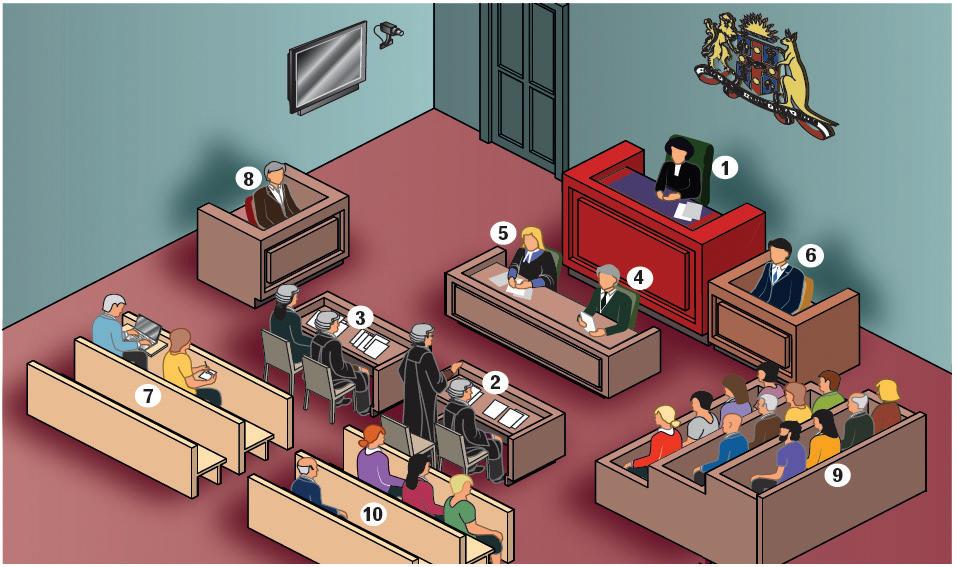
Figure 8.6.1 Court cases involve a number of key participants, including: 1 judge or magistrate; 2 prosecutor (e.g. police prosecutor or Director of Public Prosecutions); 3 accused’s barrister or solicitor; 4 judge’s associate; 5 court reporter; 6 accused; 7 media; 8 witness; 9 jury; and 10 public gallery.
Judges and magistrates
Judges and magistrates are judicial officers who preside over court cases and make determinations in court based on the evidence presented. Judges and magistrates are legally qualified professionals who have considerable experience in the law. They act as the umpires of court cases, making sure that the rules are followed and that a fair trial is carried out (procedural fairness). Whether a case is heard by a judge or a magistrate will depend on the jurisdiction of the court in which the crime will be heard.
Judges
Judges are the judicial officers who preside over the intermediate and superior courts – the District Court and the Supreme Court. Judges oversee proceedings,
maintain order in the courtroom and ensure that the procedures of the court are followed. Judges will make decisions about points of law and give instructions to the jury to make sure they understand the proceedings and the evidence presented to them. Once the jury has reached a verdict, the judge will hand down sentences and rulings. In some cases, the judge will sit without a jury – in such cases the judge will determine the verdict.
UNCORRECTEDSAMPLEPAGES
Magistrates
Magistrates are the judicial officers who preside over hearings in the Local Court. Specialised magistrates also hear cases in the Children’s Court. In criminal law, magistrates will hear summary proceedings in the Local Court, as well as indictable offences triable summarily where the accused has consented to the case being heard by a magistrate. Magistrates oversee proceedings and make a determination on the basis of the evidence presented. Once a magistrate has found an accused person guilty, they will also pass sentence. Magistrates also conduct committal proceedings for indictable offences and will usually hear bail proceedings.
Prosecutors
In criminal trials, the state or “Crown” is represented by a prosecutor who brings the action against the accused. It is the prosecutor’s role to prosecute the offender in a court of law with the intention of obtaining an appropriate form of sanction or punishment for the offence. There are two types of prosecutors in criminal trials: police prosecutors and public prosecutors .
Police prosecutors
Each criminal investigation begins with the police, who are an essential part of any criminal case. The police must undertake an intensive and exhaustive investigation of the matter and gather all the evidence and information that will be used at trial to form the case against the accused. The police will often also be required to give testimony at the trial to aid the prosecution’s case.
For summary offences in the Local Court and Children’s Court, cases will usually be prosecuted by police prosecutors. Police prosecutors are members of the NSW Police Force with specialised legal training to conduct prosecutions. Police prosecutors handle most summary cases in New South Wales. More serious offences are dealt with by the public prosecutors (see below).
Director of Public Prosecutions
For indictable offences and some summary offences, cases will be prosecuted by the New South Wales Office of the Director of Public Prosecutions (DPP). The DPP will also conduct some committal proceedings for indictable offences. The DPP is an independent authority that prosecutes all serious offences on behalf of the New South Wales government.
Prosecutors employed by the DPP are barristers or solicitors and have numerous years of experience in the criminal justice system. It is their job to prosecute the case using the evidence gathered by the police. In court their role is to present evidence, ask
police prosecutor a NSW Police Force officer trained in prosecution; usually prosecutes summary offences public prosecutor a legal practitioner employed by the Director of Public Prosecutions; usually prosecutes indictable offences
questions of the witness on the stand and draw out the truth from the evidence and testimony given by the witnesses.
The DPP does not investigate crime – that is the responsibility of the NSW Police Force – but it prosecutes cases once sufficient evidence has been gathered. It reviews cases proposed by the police to determine if there is enough evidence to succeed. The independence of the DPP from government is vital to ensure that cases selected for prosecution are chosen on their merits and not because of political interference or public pressure.
The decision to prosecute will depend on many factors, including:
• whether the evidence is sufficient to establish the elements of the offence
• whether the evidence is sufficient to gain a conviction by a reasonable jury
• certain discretionary factors that relate to the public interest, which include the seriousness of the offence; the special circumstances of the offence, accused or victim; the need to maintain public confidence’ the likely length and expense of the trial; and the likely outcome and consequences of a conviction
• whether it is in the public interest to do so.
Barristers and solicitors
A person charged with an offence will usually contact a solicitor, who will be able to give the accused advice on a range of matters, including the charge, the alleged offence and the procedures surrounding a trial, and will assist in interactions with the police investigating the case. A solicitor will usually prepare a brief for a barrister to present in court. It will overview the case and outline the key facts, legal issues and relevant law such as legislation and precedents. Solicitors may also advise on any available defences, the likelihood of conviction and possible sentences. Many solicitors specialise in criminal law or particular areas of criminal law.
A solicitor may also represent the accused in court or engage (employ) a barrister to represent the accused. It is common to see solicitors appearing in the Local Court, but it is more common to see barristers in the higher courts. This is because barristers are specialists in their field and deal specifically with criminal law. Barristers have two main roles in court proceedings: to provide legal advice for the accused on the likely outcome of the case and to present that case in court.
Public defenders are paid public barristers who are independent of the government and perform the same duties as other barristers. They will appear or advise in relation to criminal trials, sentencing matters and appeals in the District Court or Supreme Court, and may be briefed (instructed) by a private solicitor, through the Legal Aid Commission or through a community based legal group.
Public defenders
If an accused has been charged with a serious indictable offence and is eligible to receive legal aid, they may be granted a public defender to represent them in court. public defender a public barrister who can appear for an accused in a serious criminal matter where legal aid has been granted
UNCORRECTEDSAMPLEPAGES
Where an accused cannot afford to pay for a barrister or solicitor, they may be granted access to a public defender . Public defenders are barristers who appear in serious criminal matters for an accused who has been granted legal aid.
Juries
Juries are a central part of the adversary system of criminal law. They reflect the historic right of an accused person to be judged, impartially, by a group of their peers, based on evidence presented at a trial.
UNCORRECTEDSAMPLEPAGES
A jury is a group of citizens who are randomly chosen from the electoral roll. Their role is to listen to the evidence presented during the trial and use this to decide whether the accused person is guilty or not guilty.
Their decision is called a verdict. It is a task that brings with it enormous responsibility. In most cases, a criminal trial involves a jury of 12 people.

In New South Wales, juries are used to hear most indictable offences where a plea of “not guilty” is entered and may be used in either the District Court or the Supreme Court. The Local Court does not have jurisdiction to conduct trials with a jury. Many of the rules about juries are found in the Jury Act 1977 (NSW).
Eligibility for jury duty
Australian citizens aged 18 years or over become eligible to sit on a jury once they are on the electoral roll (enrolled to vote). It is very difficult to gain an exemption from jury duty, and some people view jury duty as an inconvenience and a burden, especially when they are selected to sit on a long trial. Jurors are paid for their attendance on the jury and employers are required to give leave to their employees for jury duty. It is an important part of our justice system for an accused person to be tried by a group of their peers. Some people can ask to be exempted – such as those who are aged over 65 years, are pregnant or care for children full-time. There are also some groups of people who are ineligible to sit on a jury including people who do not speak English, emergency services workers (police, fire and ambulance), people with a disability, convicted criminals and members of the legal profession. If you fail to attend jury duty when requested, you can face a $1100 fine from the Justice Office of the Sheriff. If a jury is empanelled and you are not selected, you may be requested to attend another selection over the course of the next one to three months.
One criticism of the jury system is that too many people are able to avoid jury duty due to the exemptions available, and at times, as a result, it calls on a smaller crosssection of the community for the accused to be judged by.
Challenging jurors
In a criminal trial, both the prosecution and the defence have the right to challenge either the selection of the entire panel of jurors or individual jurors. Both sides can also exercise a certain number of peremptory challenges of prospective jurors. This is when they disqualify individual jurors without having to give a reason. However, peremptory challenge when the legal team rejects a juror without needing to provide a specific reason
Figure 8.6.2 Antoinette Lattouf with her lawyers speaks to media about her wrongful dismissal case at the ABC, outside the Laws Courts Building. January 18th, 2024.
challenge for cause when the legal team rejects a juror because they believe that for some reason the juror will be prejudiced
challenging the selection of a juror can be difficult: neither side knows anything about them in advance apart from their names, and peremptory challenges are usually based on nothing more than name or appearance (e.g. age, gender, race, clothing or physique).
A challenge for cause is a challenge based on the person not being qualified to serve on a jury – through being ineligible or disqualified, or because of being suspected of bias. For instance, one of the jurors may be acquainted with the defendant or have been a victim of a similar crime and therefore may be thought to be biased.
Jury role
Before a court case begins, jurors are sworn in. During the trial, the role of a juror is to listen to the evidence presented to the court, apply the law as directed by the judge and come to a verdict as to the accused’s guilt or innocence.
Jurors are permitted to make notes in order to refresh their memory of what has happened in court. They are not permitted to talk to anyone, except for their fellow jurors, when they are all together, about the case. They may also ask for clarification on matters from the judge. Throughout the case, they have to be alert and focused on what is being presented to them in the courtroom. Their role is to be unbiased and impartial, and to make a judgment based solely on the evidence presented. Each jury elects a foreperson to speak on their behalf.
The jury must remain fair and open-minded when reaching their decision. The jury should not be influenced by the media or their own personal beliefs while deliberating a verdict. When deciding on the verdict, the jury does not have any set time limits. Jurors are encouraged to take their time and discuss the court proceedings as much as they need to.
Verdict
A jury has to reach a verdict of guilty or not guilty and present that verdict to the court. The accused will then be acquitted if found not guilty. If the accused is found guilty, the judge will then pass sentence.
The system of unanimous verdicts in criminal trials was inherited from British law. Unanimous verdicts mean every single one of the jurors must agree. Sometimes it is easy for the jury to arrive at a decision, but in other matters they can deliberate for days and still not reach a verdict. A jury that is unable to reach a verdict is called a “hung jury”. In these situations, the case is dismissed and a retrial will be ordered. This means that the whole case will begin all over again. A hung jury puts significant strain on all parties to a case and places a subsequent burden on the time and cost for the accused and the prosecution. If the accused is in remand during the trial, it may result in an extended period of custody for an offence they may ultimately be acquitted of. Also, a prolonged or repeated trial can cause great anguish to victims and witnesses.
UNCORRECTEDSAMPLEPAGES
In 1967, the United Kingdom changed the requirement for unanimous verdicts, to allow for majority verdicts of 10 or 11 jurors. Arguments for the change to majority verdicts include that a majority verdict removes the power of rogue or unreasonable jurors who are unrepresentative of the community, and it avoids the time delays, cost
and stress on the victim of a retrial. Arguments against majority verdicts include that a majority verdict removes the possibility of a “reasonable doubt” decision if only one juror is disagreeing, that disagreements are rare, and that the possibility of a majority verdict may change jury deliberations from the beginning of the case.
In 2006, the New South Wales parliament amended the Jury Act 1977 (NSW) with the Jury Amendment (Verdicts) Act 2006 (NSW) to allow majority verdicts in cases where reasonable time for deliberation has passed, and the court is satisfied that a unanimous verdict will not be reached. Under section 55F of the Jury Amendment (Verdicts) Act 2006 (NSW), a “majority verdict” is defined as:
• a verdict agreed to by 11 jurors where the jury consists of 12 persons, or
• a verdict agreed to by 10 jurors where the jury consists of 11 persons.
At the time the amendment was passed, it was suggested the changes were more political than practical as the extent of hung juries was not as great as had been suggested (the extent of hung juries was the stated reason for the amendment). The available evidence suggests that hung juries occur in less than 5 per cent of criminal trials, according to the results of an Administrative Review Council funded study of sexual assault trials in 2022. Recent highprofile examples include the Hayne and the de Belin sexual assault trials, which highlighted the implications of hung juries in terms of delaying justice, additional costs and the impact on the complainants and witnesses.
The Act does not apply to Commonwealth offences, as unanimous verdicts for those offences are protected under section 80 of the Australian Constitution.
UNCORRECTEDSAMPLEPAGES

Review 8.6 questions
1. Explain the difference between the adversary system and the inquisitorial system of law.
2. Outline the strengths and weaknesses of the adversary system of trial in criminal matters.
3. Identify areas of criminal law where an inquisitorial style of inquiry is used. Explain why this style is used.
4. Describe the types of cases heard by a magistrate and by a judge.
5. Why might some indictable offences be heard by a judge alone without a jury?
Figure 8.6.3 Bruce Lehrmann, charged with sexually assaulting Liberal staffer Brittany Higgins, leaves the ACT Magistrates Court on October 26, 2022 in Canberra, Australia.
sentencing hearing a hearing following a finding of guilt in which a magistrate or judge will determine the sentence to be given to the accused
8.7 Types and aims of punishments
LEARNING OBJECTIVE 8.7
DESCRIBE the different types of punishments, and what their aims are
UNCORRECTEDSAMPLEPAGES
Once a crime has been committed, the police investigate it and lay a charge or charges, and then the relevant authority prosecutes the case. If the person accused of the crime pleads not guilty, the case will be tried in court by a magistrate or a judge or a judge and jury. If the accused is found not guilty, they will be acquitted and set free.
Where an accused pleads guilty, or if the jury reaches a guilty verdict at the trial, the accused will be sentenced. It is the responsibility of a judicial officer – the magistrate or judge – to set the most appropriate sentence. The jury is not involved in sentencing an offender.
Sentencing occurs in a sentencing hearing . The sentencing hearing is where the magistrate or judge hears and considers arguments and evidence about the relevant law and what the most appropriate sentence ought to be in the matter at hand. The magistrate or judge will then determine and announce the sentence. This may take place at the same time a verdict is reached or a guilty plea is given, but it often will happen on a different day from the trial or summary hearing.
The sentence is the sanction imposed by the state in relation to the offender’s criminal conduct. As such, the sentencing of an offender is one of the most crucial steps in the criminal process. It involves a judgment about the severity of the offence, the mens rea of the accused and the need for the crime to be punished. In high-profile cases, sentencing can attract significant publicity or become heavily politicised. However, regardless of the publicity, all sentences require careful balancing of the interests of all parties concerned. This includes the victims, the community, the state and the accused. This can be the most difficult role the judge has to perform. It is usually the discontent of the victim or the family of the victim that is conveyed through the media.
The Crimes (Sentencing Procedure) Act 1999 (NSW) is the primary source of sentencing law in New South Wales. It sets out the purposes for which a sentence may be imposed, the types of penalties that can be imposed and when they can be used, as well as a number of factors and guidelines for sentencing generally.
Crimes (Sentencing Procedure) Act 1999 (NSW)
3A Purposes of sentencing
The purposes for which a court may impose a sentence on an offender under the act are as follows:
a. to ensure that the offender is adequately punished for the offence
b. to prevent crime by deterring the offender and other persons from committing similar offences c
c. to protect the community from the offender
d. to promote the rehabilitation of the offender
e. to make the offender accountable for his or her actions
f. to denounce the conduct of the offender
g. to recognise the harm done to the victim of the crime and the community.
UNCORRECTEDSAMPLEPAGES
Types of penalties
There are many different penalties that a court can apply in its sentencing of an offender. The Crimes (Sentencing Procedure) Act 1999 (NSW) lists the various penalties that can be imposed, from no conviction recorded, cautions and fines, through to imprisonment and even deportation. The type of penalty imposed will depend on how the magistrate or judge ultimately weighs all the factors discussed above, and the penalty cannot exceed the maximum penalty specified for the offence.
Caution
Before a charge is laid and a person goes to court, police have the power to issue a person with a caution . A caution is a formal warning and is used for certain less serious offences as a way to avoid the court system, in the hope that the offender has learnt a lesson and will not reoffend.
For example, under the Young Offenders Act 1997 (NSW), police can issue a formal caution to offenders between the ages of 10 and 18 years for a variety of minor offences, such as damaging property, stealing or a minor assault. A formal caution can only be issued when the offender admits to the offence in the presence of an appropriate adult. It usually involves a formal conference where the offender, police, family and support people meet and discuss the crime. It includes discussion of the offence, its implications and the reasons why it occurred. The caution is kept on police record, and the offender will be told what will happen if they reoffend.
Another example in New South Wales is the Cannabis Caution Scheme, where police may issue a caution for minor offences involving cannabis if a person has no prior conviction. It does not apply to people caught supplying cannabis. It involves a warning about the health and legal consequences of cannabis use as well as information about certain counselling and support services. The NSW Bureau of Crime Statistics and Research suggests that the New South Wales government scheme has been quite successful in diverting minor offences away from the court system. Cautions were predominantly issued for possession (96%).
Criminal infringement notice
A criminal infringement notice is another type of penalty that can be issued by police. Introduced in New South Wales in 2007, it allows police to issue on-the-spot fines for certain offences, including larceny of goods valued at less than $300, offensive behaviour or language, and obstructing traffic. The aim of criminal infringement notices is to remove some of the burden on the criminal court system by allowing police to issue fines for these minor offences. Although they do represent an increase in police powers, the notices are not final, and offenders can choose to have the matter heard in court. The benefit to offenders is that no conviction is recorded when they accept the notice.
caution a formal warning given by police to a person who has committed a minor offence, serving as an alternative to a court procedure
criminal infringement notice a notice issued by the police outside of court alleging a criminal infringement and requiring payment of a fine
fine a monetary penalty imposed for infringement of a law
Conviction or no conviction recorded
When a person is charged with an offence and declared guilty by a judge or jury, that person is considered convicted of that offence. In sentencing, the judicial officer can either record the conviction against the offender or pass sentence with no conviction recorded. Normally, a conviction will be recorded and an appropriate sentence imposed. For less serious offences, particularly where they involve young offenders or first-time offenders, a judicial officer might choose not to record a conviction. Alternatively, the court may decide to record the conviction but impose no other sentence.
Fine
Fines are the most common sentencing option used in Australia. A fine is a monetary penalty imposed on an offender and usually applies for less serious offences, such as driving offences or breaches of local laws, or for particular types of offences, such as some violations of environment law or corporate law. For minor offences, a fine will usually be issued outside of court by the police or by local law enforcement officers (such as council parking officers). These are often referred to as “on-the-spot” fines. Such fines can be challenged in court.

proceeds of crime any property, money or assets that are derived or realised, directly or indirectly, as a result of criminal activity. Law enforcement agencies use specific legislation to freeze or confiscate these gains to ensure that individuals cannot financially benefit from their illegal conduct.
conditional release order an order requiring an offender to accept compulsory restrictions for up to two years, during which time the offender undertakes to regularly report to and obey directions from their community corrections officer
UNCORRECTEDSAMPLEPAGES
Forfeiture of assets
Where an offender has obtained money or property through their criminal activities, a court may order that the money or property be recovered. Such assets might have been obtained through theft, fraud, money laundering, drug trafficking or tax evasion. The court might order that the assets be recovered in addition to any other form of punishment.
When the state believes that a person has acquired assets through the proceeds of crime it will confiscate these unless that person can prove how those assets were acquired. This is called forfeiture of assets and is provided for under the Criminal Assets Recovery Act 1990 (NSW). In 2010, the New South Wales government reversed the onus of proof onto the person suspected of acquiring the assets through the proceeds of crime.
The laws are wide-ranging and can allow examination of an offender’s financial affairs and allow the assets to be restrained, seized and forfeited. The court might also require the offender to pay an amount assessed as the value of the proceeds (profits) of their crimes.
Conditional release order
A court may decide to issue an offender with a conditional release order (CRO), either by itself or in conjunction with another penalty, for up to two years. If the offender breaches the CRO, they will have to appear in court again and may be sentenced to more serious penalties, such as imprisonment. Other conditions imposed can include:
• attending family counselling
• attending anger management courses
• avoiding visiting a particular place or associating with certain people
Figure 8.7.1 Parramatta Correctional centre
• attending a drug and/or alcohol rehabilitation program
• refraining from particular activities such as gambling.
Community service orders
Community service orders were among the penalties abolished under the Crimes (Sentencing Procedure) Amendment (Sentencing Options) Act 2017 (NSW). They have been replaced by community correction orders
UNCORRECTEDSAMPLEPAGES
Community correction order
A community correction order (CCO) is a penalty that can be imposed by the court for a period of up to three years instead of a period of detention or imprisonment. They replace two previous penalties: community service orders and good behaviour bonds. CCOs usually apply to theft, common assault, property damage and drug possession where a fine or a bond is insufficient, but imprisonment is considered unwarranted. They are a flexible sentence allowing the court to take into account the nature of the offender and the offence. Compulsory supervised work in the community, supervision by community corrections officers and curfews are imposed so that offenders are held accountable.
Imprisonment
Imprisonment is the most severe sentence that can be imposed in Australia and is considered a sentence of last resort. Section 5 of the Crimes (Sentencing Procedure) Act 1999 (NSW) makes this clear, stating that “a court must not sentence an offender to imprisonment unless it is satisfied, having considered all possible alternatives, that no penalty other than imprisonment is appropriate”.
A sentence of imprisonment deprives a person of their liberty and removes them from the community.
It will require careful consideration by a judicial officer of the purposes of sentencing as well as of all the relevant factors of the case. All purposes may be relevant: deterrence, retribution, rehabilitation and incapacitation. The magistrate or judge will consider the severity of imprisonment that can be imposed in New South Wales.
If the court deems imprisonment appropriate, the judicial officer will need to announce the total sentence as well as a non-parole period. The non-parole period is the minimum amount of time the offender is kept imprisoned before being eligible for release on parole . Unless there are special circumstances, the non-parole period will be at least three-quarters of the total sentence.
Use of imprisonment still raise many issues in regard to the objectives of punishment and impacts on offenders and costs to the community. Since the 1980s, the imprisonment rate in Australia has tripled from 66 per 100,000 of the adult population in 1985 to 218 per 100,000 in 2025. Australia now has one of the highest incarceration rates in OECD countries. Furthermore, the already disproportionate number of Indigenous people who are incarcerated has doubled in the past thirty years – from 14.4 per cent in 1991 to 37 per cent in 2025.
As well as the cost to taxpayers in the billions, it further entrenches disadvantage given that most people in prison come from a background of unemployment, social
community correction orders a penalty that can be imposed by the court involving compulsory supervised work in the community, supervision by community corrections officers and curfews parole release of a prisoner before the expiry of an imprisonment term, temporarily or permanently, on the promise of good behaviour
intensive correction orders an alternative to a custodial sentence where an offender has restricted movement and must attend a rehabilitation program
disadvantage, family breakdown, homelessness, and poor physical and mental health. Rates of recidivism remain high, but for many non-violent offenders the system seems unable to effectively explore the range of diversion options that already exist.

Figure 8.7.2 Prisoners in Australia, 2016 to 2025
Intensive correction order
On 1 October 2010, periodic detention (where offenders serve a period of time each week or month in prison, rather than the full period of a sentence) was replaced by intensive correction orders (ICO). This was brought about by an amendment to the Crimes (Sentencing Legislation) Amendment (Intensive Correction Orders) Act 2010 (NSW). A further amendment, the Crimes (Sentencing Procedure) Amendment (Sentencing Options) Act 2017 (NSW), strengthened ICOs to improve community safety and support victims as well as aiming to reduce reoffending by increasing supervision by trained community correction officers.
An offender who has been sentenced to a maximum term of two years is eligible for an ICO. They are not available for offenders guilty of murder, manslaughter, sexual assault, any sexual offence against a child, discharge of a firearm, terrorism offences or organised crime. An ICO has strict conditions, not unlike bail conditions. Offenders who breach these conditions may be liable for a fulltime custodial sentence for the remainder of their sentence. Some of those conditions are:
• strict cur fews and association restrictions
• electronic monitoring 24 hours a day, seven days a week
• random breath tests and urine analyses
• completion of mandatory community service (32 hours per month)
• restrictions on travel and behaviour
UNCORRECTEDSAMPLEPAGES
• mandatory participation in rehabilitation and education programs.
ICOs aim to reduce the likelihood of reoffending, which periodic detention failed to address. This is a far more flexible system as it enables people to keep their full-time employment and attend rehabilitation and counselling services, which are aimed at making lifestyle changes better for them.

ANALYSIS 8.7.1
Read the following media articles:
• “The NSW law changes that put an extra 1000 people behind bars”, The Sydney Morning Herald, 2 March 2025. https://www.smh.com.au/politics/nsw/the-nsw-law-changesthat-put-an-extra-1000-people-behind-bars-20250302-p5lg9a.html
• “A wake-up call”: NSW government under fire as Indigenous incarceration hits new record’, The Guardian, May 2025. I can’t find this article online – checking with the author
• “NSW prison population reaches five-year high due to rise in Aboriginal incarceration”, NSW Bureau of Crime Statistics and Research, 21 May 2025. https://bocsar.nsw.gov.au/ media/2025/mr-custody-mar2025.html
1. What is the substantive reason cited by the first two articles for an increase in the number of people in New South Wales incarcerated?
2. What are some of the implications of these increases for the government and various sections of the community?
3. Using the report from the NSW Bureau of Crime Statistics and Research, explain some of the reasons cited for the increase in Aboriginal adults in custody in early 2025.
Review 8.7 questions
1. Outline the main reason for sentencing of offenders found guilty of a crime.
2. What influences a magistrate or judge in regard to the sentence handed down?
SAMPLEPAGES
3. What makes forfeiture of assets as a criminal punishment different from other forms of sentences?
4. What is the purpose of not recording a conviction if a person is found guilty of an offence?
5. Imprisonment determines that some offenders need to be incarcerated to protect the community and future victims as well as paying for their crimes. Outline some of the criticisms of imprisonment as it currently stands in New South Wales.
Go
Figure 8.7.3 Climate Activist Deanna ‘Violet’ Coco (R) arrives at NSW District Court on March 15, 2023 in Sydney, Australia. Coco was arrested and jailed for 15 months over a protest that blocked the Sydney Harbour Bridge in April 2022, but was released as she appeals her conviction.
8.8 Case study on key concepts of justice: R v Dawson [2022] NSWSC 1130
LEARNING OBJECTIVE 8.8
UNCORRECTEDSAMPLEPAGES
EXPLAIN the key concepts of justice as illustrated in the case R v Dawson [2022] NSWSC 1130
There are a number of legal protections that are enshrined in the criminal justice system, particularly in criminal trials to ensure, to the extent possible, there is balance between the rights of community to be safe and the rights of individuals (victims) for justice and (accused) a fair trial.
The fundamental cornerstones of justice, pre-trial and criminal trial include:
• rules regarding investigation and limits of police powers
• guidelines in regard to gathering and presenting evidence
• the burden of proof (prosecution) and a high criminal standard of proof (beyond a reasonable doubt)
• trial procedures in line with the adversary system of trial to allow both the prosecution and defence to present and test the evidence before the court
• judicial discretion and guidelines for sentencing
• the pathway to appeal as appropriate.
Some of these have been discussed previously or will be covered in depth in the HSC Core Topic – The Criminal Justice System. Many of these rules and procedures are relied upon in all criminal trials but more so in serious and complex cases such as the Christopher Dawson case R v Dawson [2022] NSWSC 1130, more popularly known from “The Teacher’s Pet” podcast.
Facts of the case
The Parties
Christopher Michael Dawson (a former high school PE teacher) was charged with the murder of his wife, Lynette Dawson.
The Disappearance
Lynette disappeared from the couple’s home in Bayview, Sydney, in January 1982. Her body was never found, and she left behind two young daughters.
The Motive
The prosecution alleged that Chris Dawson was obsessed with a 16-year-old student (referred to as JC). He wanted to replace Lynette with JC to start a new life without the financial burden of a divorce.
The Delay
Despite two coronial inquests recommending charges in the early 2000s, Dawson was not charged until 2018, following renewed public interest generated by the podcast “The Teacher’s Pet”. This podcast, hosted by journalist Hedley Thomas and published by The Australian, was an investigation into Lynette’s disappearance. It ran for 14 episodes from 17 May to 14 August 2018, with some follow-up episodes after Chris Dawson’s arrest.
UNCORRECTEDSAMPLEPAGES

Issue to be proven
Because there was no body, no murder weapon and no eyewitnesses to the killing, the prosecution had to rely entirely on circumstantial evidence. They had to prove beyond reasonable doubt:
• direct proof of death – that Lynette Dawson was dead and had not simply walked out on her family (as Chris Dawson claimed)
• causation – that her death was caused by a conscious and voluntary act of Chris Dawson
• intent – that he intended to kill her or inflict grievous bodily harm
• exclusion of alternatives – the court had to be satisfied that no other rational explanation for her disappearance existed except for her murder by the accused.
Outcome (The decision)
Justice Ian Harrison, sitting without a jury (judge-alone trial), found Dawson guilty of murder. Key findings included:
• The “runaway” theory – The judge rejected Dawson’s claim that Lynette had called him or had been seen alive after January 1982, describing the claims as “entirely fabricated”.
Figure 8.8.1 Chris Dawson was found guilty of his wife Lynette Dawson’s murder on 30 August 2022.
• The motive – The judge accepted that Dawson’s “possessive” and “unsettled” obsession with JC provided a powerful motive.
• Reasoning – The judge concluded that the probability of Lynette – a devoted mother –voluntarily abandoning her children without ever contacting them again was so low that it could be discounted.
UNCORRECTEDSAMPLEPAGES
Significance
This case is significant for a number of reasons:
• No-body conviction – The case is a significant example of a successful murder prosecution in the absence of a body (corpus delicti), demonstrating the power of a strong circumstantial case.
• Impact of media – The case raised serious legal questions about pre-trial publicity. Dawson’s legal team argued that the podcast “The Teacher’s Pet” had biased the community, leading to the decision for a judge-alone trial rather than a jury.
• Justice for families – The case was seen as a major victory for the families of missing persons, proving that “time is no barrier to justice”.
• Sentencing – Dawson was later sentenced to 24 years in prison with a non-parole period of 18 years.
This case was also an example of the “beyond reasonable doubt” standard applied in a circumstantial case (where there is no body, no weapon and no direct witness).
To find Dawson guilty, the judge had to be satisfied that there was no other rational explanation for the evidence other than that Chris Dawson killed his wife.
When handing down his decision on 30 August 2022, Justice Harrison famously stated: “I am satisfied beyond reasonable doubt that the only rational inference is that Lynette Dawson died … as a result of a conscious or voluntary act committed by Christopher Dawson.”
By systematically eliminating every other possibility (that she ran away, was kidnapped by a stranger or died of natural causes), the judge reached a point where only one conclusion remained.
The following sources provide more information about the case:
• The complete, 200+ page judgment is available on the official New South Wales Caselaw website: https://www.caselaw.nsw.gov.au/search/advanced
• The Rule of Law Education Centre has a Case Note on Chris and Lynette Dawson: https://www.ruleoflaw.org.au/wp-content/uploads/ Chris-Dawson-Case-Note-FINAL-incl-appeal-update-July-24-.2.pdf
• “The Teacher’s Pet” podcast was removed from broadcast in Australia in the leadup to the trial, but all episodes are now available at https://podcasts.apple.com/ us/podcast/the-teachers-pet/id1385379989

ANALYSIS 8.8.1
Explore the Dawson Case in more detail from the sources listed or your own research.
1. Highlight the area where decisions about criminal trial rules or procedures in the case were inferenced by Justice Harrison to the case before the court.
2. Chris Dawson appealed all the way to the High Court. Review the decisions in the Dawson v R [2024] NSWCCA 98 (June) and Dawson v The King [2025] HCASL (June) and briefly explain the reason for the decision of the courts.
Go online to assign and download questions, view results and more!
Review 8.8 questions
1. Outline three legal protections which ensure balance between rights of the community and individuals and rights of the accused to a fair trial.
2. Identify why a judge-alone trial was used in the case of R v Dawson.
3. Identify the challenges for the prosecution in the R v Dawson case.
4. Analyse why the fundamental cornerstones of justice are important using R v Dawson as an example.
Figure 8.8.2 Hedley Thomas, host of the popular ‘Teacher’s Pet’ podcast speaks to the media at NSW Supreme Court after Chris Dawson was found guilty on August 30, 2022 in Sydney, Australia.
End of chapter
Revise and consolidate your learning with these online tools:
• Interactive checklist
UNCORRECTEDSAMPLEPAGES
• Chapter summary
• Download or answer questions online
• View suggested responses
• Depth study support
Teachers can access these additional downloadable resources and Learning Management System features:
• Individual student reports
• Assign tasks and track results
• Print or assign chapter tests
• Exam Generator: create custom practice exams
Chapter summary
• The purpose of criminal law is to maintain social order, protect the community and provide a framework for dealing with unlawful conduct. What is deemed to be criminal is significantly influenced by the historical notions of rights and wrongs and the values and beliefs of the community at the time.
• Criminal law is fundamentally about protecting society from acts that are deemed harmful to individuals and the community.
• Two elements must be proven for a crime to be committed: actus reus which is a Latin term meaning “guilty act” and refers to the physical act of carrying out the crime and mens rea which is a Latin term meaning “guilty mind” and refers to the mental state of the accused. For some offences, only the element of actus reus will need to be shown. These offences are known as strict liability offences.
• There are two categories of crime: summary offences which are less serious and indictable offences which are more serious.
• Two main types of crimes are offences against the people which usually involve harm or injury to an individual/s and property offences which predominantly involve depriving a person/s or other legal entities such as businesses or government of their property.
• In a criminal trial, the burden of proof rests with the state (prosecution) and the standard of proof is “beyond a reasonable doubt”.
• Criminal trials in Australia are based the adversary system and have well-established procedures that must be followed to ensure a fair trial is held. These include rules of evidence and procedure, the opportunity for both sides to present their case (evidence) and the test the evidence of the opposing side.
• A person has a limited right of legal representation in New South Wales to ensure a fair hearing at the trial.
• Juries are empanelled to hear the facts of the case and under the direction of the trial judge to apply the law explained to them in delivering a verdict.
• There are a range of punishments that can be applied to people found guilty of a crime. These vary depending on the nature and serious of the crime and if there are any mitigating or aggravating factors to be considered by the judge.
Multiple-choice questions
1. Of the following statements, which best defines the nature of crime?
A. An act or omission that harms society
B. An act or omission that harms society and the people in it
UNCORRECTEDSAMPLEPAGES
C. An act or omission that harms society and is punishable by the state
D. An act or omission that harms society in the context of the public morality of the time
2. Which of the following refers to the physical element of a crime?
A. The ratio feature
B. The mental and physical elements combined
C. The mens rea
D. The actus reus which includes causation
3. Which of the following statements best reflects the difference between an indictable offence and a summary offence?
A. Indictable offences usually involve juries, whereas summary offences are matters only heard on appeal.
B. Summary offences must be committed first, followed by a more serious/indictable offence.
C. Indictable offences are serious matters, whereas summary offences are minor matters.
D. Summary matters are heard in the District Court, whereas indictable offences are heard in the Supreme Court.
4. Which of the following statements is correct in reference to the burden and standard of proof in criminal matters?
A. The burden of proof is on the plaintiff, and the standard of proof is “beyond a reasonable doubt”.
B. The burden of proof is on the state, and the standard of proof is “on the balance of probabilities”.
C. The burden of proof is on the victim, and the standard of proof is “beyond a reasonable doubt”.
D. The burden of proof is on the state, and the standard of proof is “beyond a reasonable doubt”.
5. One more question
A. Option.
B. Option.
C. Option.
D. Option.
Short-answer questions
1. Outline why criminal law should reflect the moral and ethical standards of the community.
2. Describe the purpose of possible penalties a magistrate or judge could consider before sentencing an offender.
3. Explain the role of the jury during a criminal trial.
4. What are the key concepts of justice that underpin criminal law?
Extended-response question
There is a constant tension between the interests of the community and individuals’ rights and freedoms. Outline how the criminal law attempts to balance the competing rights of individuals and the community during a criminal trial.
Marking criteria for extended response questions can be found on the Cambridge GO website. Refer to these criteria when planning and writing your responses.
UNCORRECTEDSAMPLEPAGES
Video 8.9.1
Answering an exam question
Example question and response
Tocome.