MODERN HISTORY
Daryl Le Cornu, Kay Carroll, Christopher Bradbury
Stephen Powell, Troy Neale, Jack Morel
UNCORRECTED SAMPLEPAGES
Shaftesbury Road, Cambridge CB2 8EA, United Kingdom
One Liberty Plaza, 20th Floor, New York, NY 10006, USA
477 Williamstown Road, Port Melbourne, VIC 3207, Australia
314–321, 3rd Floor, Plot 3, Splendor Forum, Jasola District Centre, New Delhi – 110025, India
Cambridge University Press & Assessment is a department of the University of Cambridge.
We share the University’s mission to contribute to society through the pursuit of education, learning and research at the highest international levels of excellence. www.cambridge.org
First edition © Daryl Le Cornu, Christopher Bradbury and Kay Carroll 2018
Second edition © Daryl Le Cornu, Kay Carroll, Christopher Bradbury, Stephen Powell, Troy Neale, Jack Morel 2026
This publication is in copyright. Subject to statutory exception and to the provisions of relevant collective licensing agreements, no reproduction of any part may take place without the written permission of Cambridge University Press & Assessment.
First published 2018
Second edition 2026
20 19 18 17 16 15 14 13 12 11 10 9 8 7 6 5 4 3 2 1
Cover and text designed by Denise Lane (Sardine)
Typeset by QBS Learning
Printed in <TBC>
A catalogue record for this book is available from the National Library of Australia at www.nla.gov.au
ISBN ISBN 978-1-009-83908-2
Additional resources for this publication at www.cambridge.edu.au/go
Reproduction and Communication for educational purposes
The Australian Copyright Act 1968 (the Act) allows a maximum of one chapter or 10% of the pages of this publication, whichever is the greater, to be reproduced and/or communicated by any educational institution for its educational purposes provided that the educational institution (or the body that administers it) has given a remuneration notice to
Copyright Agency Limited (CAL) under the Act.
For details of the CAL licence for educational institutions contact:
Copyright Agency Limited
Level 12, 66 Goulburn Street
Sydney NSW 2000
Telephone: (02) 9394 7600
Facsimile: (02) 9394 7601
Email: memberservices@copyright.com.au
Reproduction and Communication for other purposes
Except as permitted under the Act (for example a fair dealing for the purposes of study, research, criticism or review) no part of this publication may be reproduced, stored in a retrieval system, communicated or transmitted in any form or by any means without prior written permission. All inquiries should be made to the publisher at the address above.
Cambridge University Press & Assessment has no responsibility for the persistence or accuracy of URLs for external or third-party internet websites referred to in this publication and does not guarantee that any content on such websites is, or will remain, accurate or appropriate. Information regarding prices, travel timetables and other factual information given in this work is correct at the time of first printing but Cambridge University Press & Assessment does not guarantee the accuracy of such information thereafter.
Please be aware that this publication may contain images of Aboriginal and Torres Strait Islander people who are now deceased. Several variations of Aboriginal and Torres Strait Islander terms and spellings may also appear; no disrespect is intended. Please note that the terms ‘Indigenous Australians’ and ‘Aboriginal and Torres Strait Islander Peoples’ may be used interchangeably in this publication.
Cambridge University Press & Assessment acknowledges the Aboriginal and Torres Strait Islander Peoples of this nation. We acknowledge the traditional custodians of the lands on which our company is located and where we conduct our business. We pay our respects to ancestors and Elders, past and present. Cambridge University Press & Assessment is committed to honouring Aboriginal and Torres Strait Islander Peoples’ unique cultural and spiritual relationships to the land, waters and seas and their rich contribution to society.
1.1
1.2
1.3
1.4
UNCORRECTED SAMPLEPAGES
Head
2.1
2.2
2.3
2.4
2.5
Chapter 3 The twenty-first century: constructing history in an era of digital transformation
3.1 Introduction: constructing a history of the twenty-first century
3.2 1990–2000: the best decade?
3.3 2001–2008: a decade of disruption
3.4 2009–2016: from hope to shock
3.5 2017–2025: the rise of misinformation in the United States
3.6 2017–2025: Australia in the age of misinformation
3.7 What next in the twenty-first century?
3.8 Chapter review
Online-only chapter
Chapter 4 Contestability and commemoration: the January 6 United States Capitol attack
4.1 Introduction: an exploration of American exceptionalism
4.2 Previous challenges to US political norms
4.3 “Trumpism” prior to Trump
4.4 Who is Donald Trump?
4.5 Trump’s entry into politics and the 2016 election
4.6 Trump’s 2017–2020 presidential term
4.7 The 2020 electoral trail
4.8 2020 Election Day and its aftermath
4.9 Events of January 6
4.10 Reactions to the January 6 attack and how it has been commemorated
4.11 Steps for the future
4.12 Chapter review
UNCORRECTED SAMPLEPAGES
5.3 The origins and nature of the Russian Empire
5.4 The role of Nicholas II as autocrat
5.5 Political, social and economic grievances in the Russian Empire
5.6 The development of opposition to the Romanovs
5.7 After the 1905 Revolution
5.8 The role of the First World War in the collapse of the Romanov dynasty
5.9 The end of tsarism
5.10
6.5
6.6
6.7
6.8
6.9
6.10
6.11
Chapter 7 Volodymyr Zelenskyy: personality study
7.1 Introduction: a different kind of leader
7.2 The Ukraine of Zelenskyy’s birth
7.3 Independent Ukraine
7.4 The Russian question
7.5 (Acting) President
7.6 The Russian invasion
7.7 Defending Ukraine’s existence
7.8 International implications
7.9 Chapter review
UNCORRECTED SAMPLEPAGES
List B: Case studies from Asia, the Pacific, Africa, the Middle East and Latin America
Chapter 8 The Meiji Restoration 192
8.1 Introduction: the origins of modern Japan 194
8.2 Key developments that allowed modernisation to take place in Japan 198
8.3 The end of Japan’s isolationism
8.4 The Meiji Restoration: how and why Japanese modernisation occurred 210
8.5 The consequences of modernisation for Japan 214
8.6 The significance of the Meiji Restoration in Japan, Asia and the West 223
8.7 Chapter review 226
Chapter 9 Nelson Mandela: personality study
9.1 Introduction: the loss of a great leader
9.2 The historical context and background of Nelson Mandela
9.3 Mandela’s leadership of the African National Congress
9.4 Rivonia Trial, 1963
9.5 Imprisonment on Robben Island
9.6 From prisoner to president
9.7 Mandela’s historical significance as a global leader
9.8 Chapter review 262
Chapter 10 Chairman Xi Jinping: personality study
10.1 A victory parade in Beijing
10.2 The rise of Xi Jinping: the China of Xi’s birth
10.3 The rise of Xi Jinping: persecution
10.4 The rise of Xi Jinping: promotions in the CCP
10.5 Xi Jinping as China’s leader: party chief
10.6 Xi Jinping as China’s leader: paramount leader
10.7 Xi’s signature policies: trade and climate
10.8 Xi Jinping Thought
10.9 Implications of Xi Jinping: China watchers on Xi’s nationalism
10.10 Implications of Xi Jinping: international relations and Australia
10.11 Chapter review
Part 3: The shaping of the modern world
Chapter 11 The First World War: a twenty-first century perspective
11.1 Introduction: the First World War’s lasting significance
11.2 The historical context
11.3 The nature and course of the war: expanding the war, 1914
11.4 The nature and course of the war: the impact of the war on the home front
11.5 The nature and course of the war: stalemate and escalation, 1915–16
11.6 The nature and course of the war: hope and despair, 1917
11.7 The nature and course of the war: from catastrophe to Allied victory, 1918
11.8 The significance of the First World War: short-term effects of the war 315
11.9 The significance of the First World War: legacy of the war 319
11.10 Chapter review 323
Part 4: Historical inquiry skills
Chapter
12.1
UNCORRECTED SAMPLEPAGES
Acknowledgments and index for the digital chapters are available with the digital-only chapters.
About the authors
UNCORRECTED SAMPLEPAGES
Dr Daryl Le Cornu
Dr Daryl Le Cornu has extensive experience teaching Modern History in New South Wales high schools. He completed a PhD in 2005 on the search for a negotiated peace in the First World War and spent 10 years educating pre-service history teachers at university. His interests include nuclear disarmament, contemporary history, geopolitics, and human rights and democracy. He is a former Vice President of the United Nations Association of Australia (UNAA) NSW and the World Citizens Association of Australia (WCAA), and has been a board member of the International Campaign to Abolish Nuclear Weapons (ICAN) Australia since 2015.
Dr Kay Carroll
Dr Kay Carroll is a Lecturer in History Education and Coordinator of the Secondary Teaching Program at Western Sydney University. Her research focuses on history curriculum and pedagogy. She is a former Vice President of the History Teachers’ Association of NSW (HTANSW) and has worked across several universities. She has held roles as HSIE Head of Department and teacher across Catholic, independent and state schools, and has supported implementation of the NSW History K–10 syllabus. She has published in global education, historical inquiry and pedagogy.
Christopher Bradbury
Christopher Bradbury, Principal at Radford College in the ACT, is a distinguished educational leader and former Principal of Northholm Grammar. He has a wealth of experience teaching Modern History and Legal Studies. Among his awards, he has been the recipient of a scholarship for the Gandel Holocaust Studies Program for Australian Educators, the NSW Premier’s Westfield Teacher’s Scholarship, and an Honorary Fellowship from the Teachers’ Guild of New South Wales.
Dr Stephen Powell
Dr Stephen Powell has taught Years 7–12 History and Humanities in Canberra for over a decade under the Australian Curriculum and the International Baccalaureate. He holds a PhD in Modern History and previously worked in the public service in environment, heritage and international negotiations. Stephen has been the recipient of a scholarship for the Gandel Holocaust Studies Program for Australian Educators. His research and writing focus on twentieth-century history, and he has been a contributing and lead author on multiple Cambridge textbooks.
Troy Neale
Troy Neale is Head Teacher of Human Society and Its Environment at Macquarie Fields High School. He is an author of junior and senior history textbooks and a recipient of the Premier’s Scholarship for Modern History. He is co-author of Cambridge Checkpoints Modern History Year 12 and Power and Authority in the Modern World 1919–1946.
Jack Morel
Jack Morel is an HSIE teacher at Macquarie Fields High School in south-western Sydney. His interests include the Cold War, geopolitics, civil rights, anti-imperialist movements and revolutions. He was a 2019 recipient of the Western Sydney University Fast Forward Academic Excellence Scholarship and is active in social justice, anti-war and union initiatives.
Introduction: modern history for the twenty-first century
UNCORRECTED SAMPLEPAGES
Writing any history textbook involves making choices. This is especially true for Modern History. For teachers who begin a new Modern History class at the start of Year 11, there is the opportunity to plan which topics they will teach across the twoyear course. There is a rich selection of topics available in Year 12. The same is true for Year 11, but with even greater flexibility and opportunities for creativity. While there are strong suggested topics for Year 11, teachers are also encouraged to create their own. There are two main reasons for doing so. The first is to better support one or more of the topics planned for Year 12. The second is to design a topic that connects with students, has greater relevance, and is therefore more engaging.
In the first edition of Modern History Transformed, the authors took advantage of the option to create new topics that were both relevant for students and supportive of a range of Year 12 topics. The Q Station site study was relevant because it focused on disease and pandemic control across its 150-year history, and in the early 2020s the world experienced the global COVID-19 pandemic. The inclusion of history up to the end of Donald Trump’s first 100 days in 2017 was also relevant, as events over the previous decade had transformed the world in several significant ways. Donald Trump also linked strongly to the Core in Year 12. The Digital Revolution was similarly relevant, as it explored the social, political and economic impacts of rapid technological change that continue today.
The dilemma facing textbook authors and publishers is that they cannot include everything. Choices must be made. The choices in this edition prioritise what will engage Generation Alpha students (born since 2010). All topics in the second edition have been updated with this generation in mind. Seven new topics have been created. Four explore history within the lifetime of Gen A students: constructing history in the twenty-first century (Chapter 3), the January 6 Capitol attack (Chapter 4), Zelensky (Chapter 7) and Xi Jinping (Chapter 10). Three examine issues that remain highly relevant today: feminist peace activists (war; Chapter 2), the American Revolution (democracy; Chapter 6) and Nelson Mandela (racism; Chapter 9). The Romanov and Meiji Restoration chapters (Chapters 5 and 8) have also been updated to highlight their contemporary relevance and historical significance: the first illustrates the influence of autocratic dynastic rule in Russia and Europe, while the second shows how the Meiji Restoration initiated modernisation in the Asian region.
The Q Station site study (Chapter 1), which combines local, national and global history, has been updated to include the recent global COVID-19 pandemic and the ongoing risk of future pandemics that require international cooperation. Finally, the First World War (Chapter 11) remains in The Shaping of the Modern World because its global scope and nature influenced events, people and nations in ways that could not have been predicted before the war.
Introduction: modern history for the twenty-first century
Over the past decade, there has been a growing sense that we are living in historically significant times. The rise of populist politics, fuelled by the internet, global social media corporations and now artificial intelligence, has contributed to rapid and often dramatic change. Many developments in recent years represent significant breaks from the past. It is important that the study of modern history helps students identify connections between the topics they study and events in the present.
The syllabus states that students should be equipped to investigate issues that continue to resonate today and to understand how the past shapes the present. It also emphasises preparing students to be active and informed citizens. The new syllabus highlights the importance of developing knowledge and understanding of the modern world, alongside critical thinking skills, which are central to a functioning democracy. It has never been more important to study history than in the present time. One of the pillars of a healthy democratic society is a strong education system that upholds the dignity and worth of all people. History plays a vital role in this. It enables students to understand the forces that have shaped societies in the past and to make sense of those transforming the world today. A study of history fosters curiosity and imagination, enriches students’ understanding of humanity, and equips them to be active and informed citizens.
The authors believe that history provides a valuable vantage point from which to view the past, understand the present, and consider future possibilities. This book aims to support students in that task.
UNCORRECTED SAMPLEPAGES
About the cover
UNCORRECTED SAMPLEPAGES
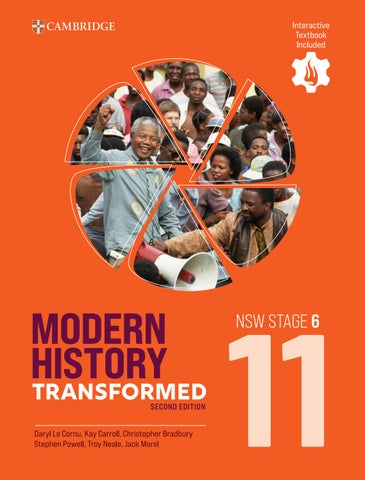
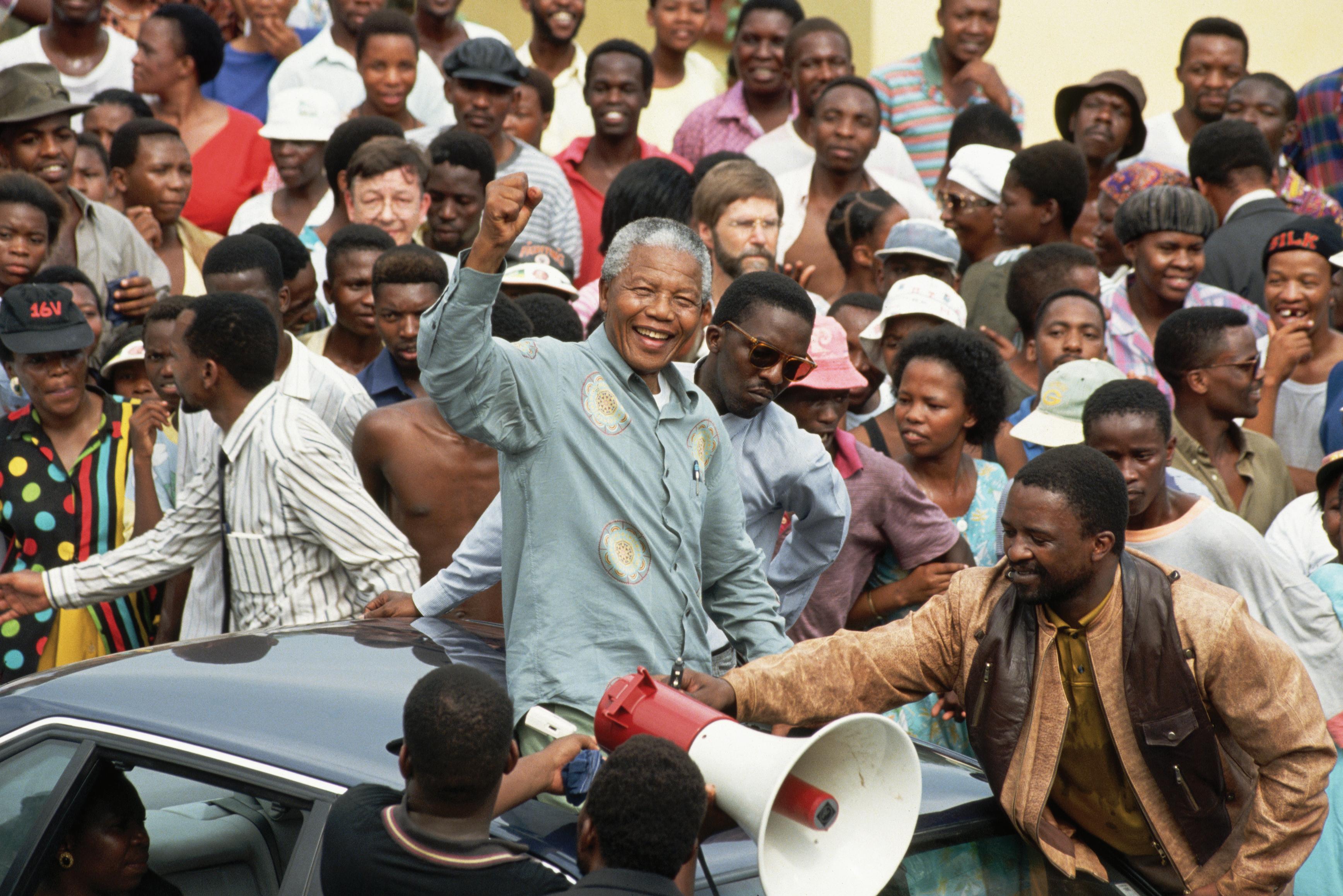
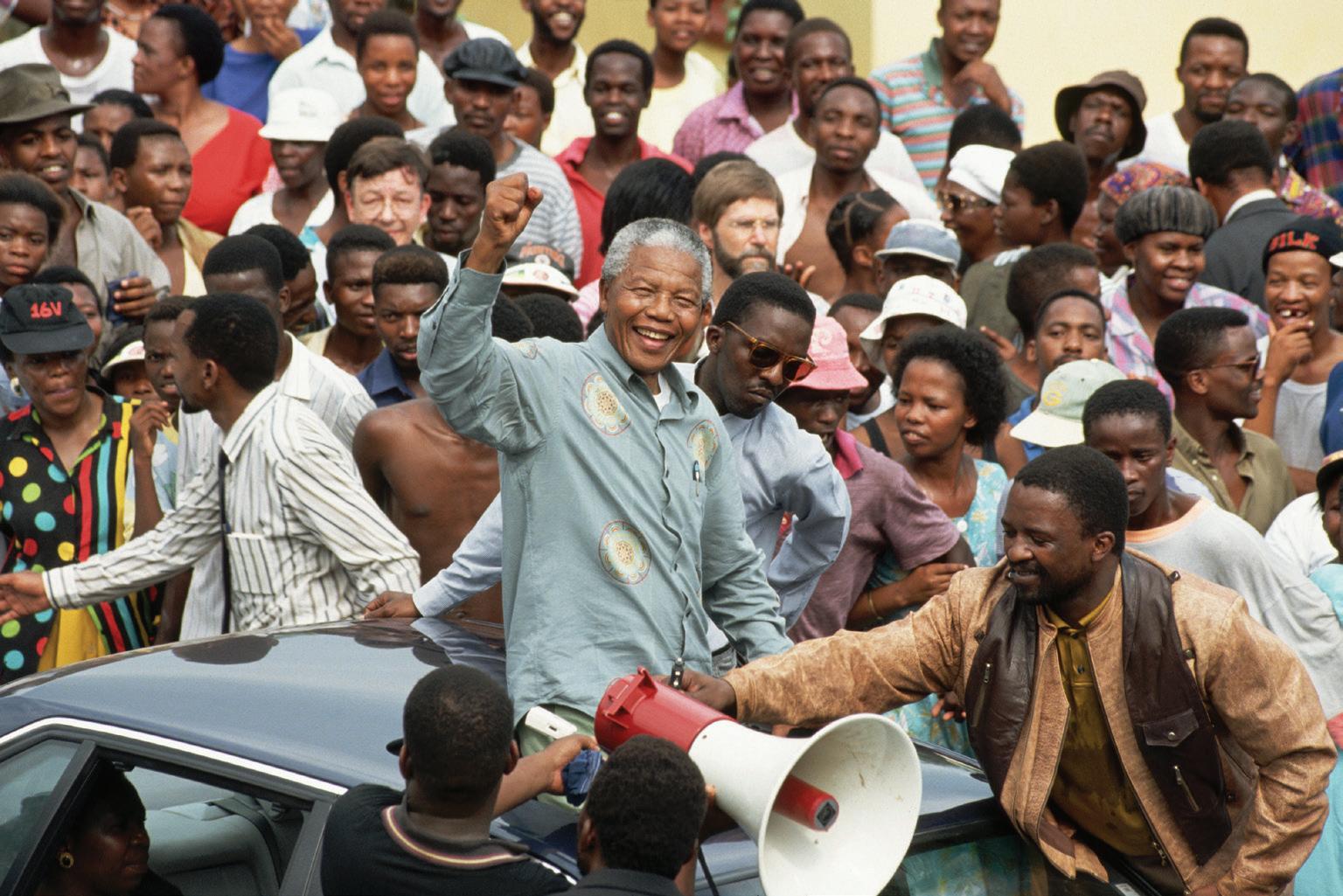
A key figure in modern history is the late South African politician and anti-apartheid activist, Nelson Mandela (1918–2013). In this image, Mandela is pictured on the election campaign trail in 1994, shortly after being freed from prison after 27 years of imprisonment. Mandela became South Africa’s first Black President and was revered as a statesman on the global stage and seen as a symbol of hope to many people.
2

Investigating modern history: case studies


CHAPTERS
List A: Case studies from Australia, Europe and North America
5. The decline and fall of the Romanov dynasty
6. No kings? The American Revolution, 1760s–1780s
7. Volodymyr Zelenskyy: personality study
UNCORRECTED SAMPLEPAGES

List B: Case studies from Asia, the Pacific, Africa, the Middle East and Latin America
8. The Meiji Restoration
9. Nelson Mandela: personality study

10. Chairman Xi Jinping: personality study


FOCUS
The decline and fall of the Romanov dynasty

By using a range of historical sources, you will investigate the downfall of the Romanov dynasty.
KEY ISSUES
You will explore:
• The historical context of the Romanov dynasty, including:
– the origins and character of the Russian Empire
– challenges to the Russian Empire in the twentieth century
• The nature of the features, people, ideas, movements, events and developments in the fall of the Romanov dynasty, including:
– the autocracy of Tsar Nicholas II
– the growth of opposition to the Romanovs
– the causes and effects of the Russian revolutions
– the consequences of Russia’s role in the First World War
– the transfer of power from the Romanovs
• A relevant historical event, including:
– the killing of the Romanov family


Enhance your learning with these integrated online resources:
UNCORRECTED SAMPLEPAGES
Students:
• Suggested responses
• Download or answer questions
• Writing focus worksheets
Teachers:
• Writing focus workbook
• Exam Generator
• Planning documents
TIMELINE

1613The Romanov dynasty begins, with the election of Michael Romanov as the tsar of Russia
1721The Russian Empire begins, under Peter the Great
1894Nicholas Romanov becomes the 18th Romanov tsar after the death of his father; marries his second cousin Alexandra
1895Vladimir Lenin forms the “Saint Petersburg League of Struggle for the Emancipation of the Working Class”
1896Coronation of Tsar Nicholas II; he promises to maintain autocracy
1898The Russian Social-Democratic Workers’ Party is formed
1901The populist Socialist Revolutionary Party is formed
1903The Social-Democratic Workers’ Party splits into revolutionary “Bolsheviks” and democratic “Mensheviks”
1904–05Russo-Japanese War results in Russia losing territory
1905Revolution of 1905 forces the Tsar to promise political reform and civil rights
1906First written constitution (Fundamental Laws); State Duma (parliament) elected, but then closed by the Tsar; conservative Prime Minister Stolypin appointed; the mystic Grigori Rasputin begins to influence the royal family
1907New electoral laws reduce worker and peasant representation
1911Prime Minister Stolypin assassinated

1912Worker unrest sparked by the Lena River goldfields massacre; daily Bolshevik and Menshevik newspapers are permitted by law
1914Outbreak of the First World War: Russia at war with Germany and Austria
1915Tsar takes personal command of Russia’s armed forces

1916Nobles assassinate Rasputin to end his influence on the royal family
1917 February Revolution: mutinies and strikes force Nicholas II to abdicate; power shared by the Provisional Government and the Petrograd Soviet
October Revolution: Bolsheviks seize power; civil war begins
1918Tsar Nicholas II and his family shot on 17 July
1922Communist victory establishes the Union of Soviet Socialist Republics

UNCORRECTED SAMPLEPAGES
5.1
Introduction: death in a basement
UNCORRECTED SAMPLEPAGES
DRIVING QUESTION
• How did the Romanov dynasty end?
The last hours of the Romanovs
Around midnight on 16 July 1918, in a large house in Yekaterinburg, a city east of Moscow near the Ural Mountains, armed guards woke a family of seven. They told everyone to get dressed and move downstairs, because the house was at risk of coming under attack. The family did what they were told. They were being lied to.
This was no ordinary Russian family. The prisoners walking down the 23 dark stairs were the last members of the Romanov dynasty, which had ruled for over 300 years. Nor was it their home. For three months, the Ipatiev House – which their guards ominously called “the House of Special Purpose” – had been their prison. A doubleheight wooden fence had been hastily built around the yard, and paint splashed over the windows to block the view.
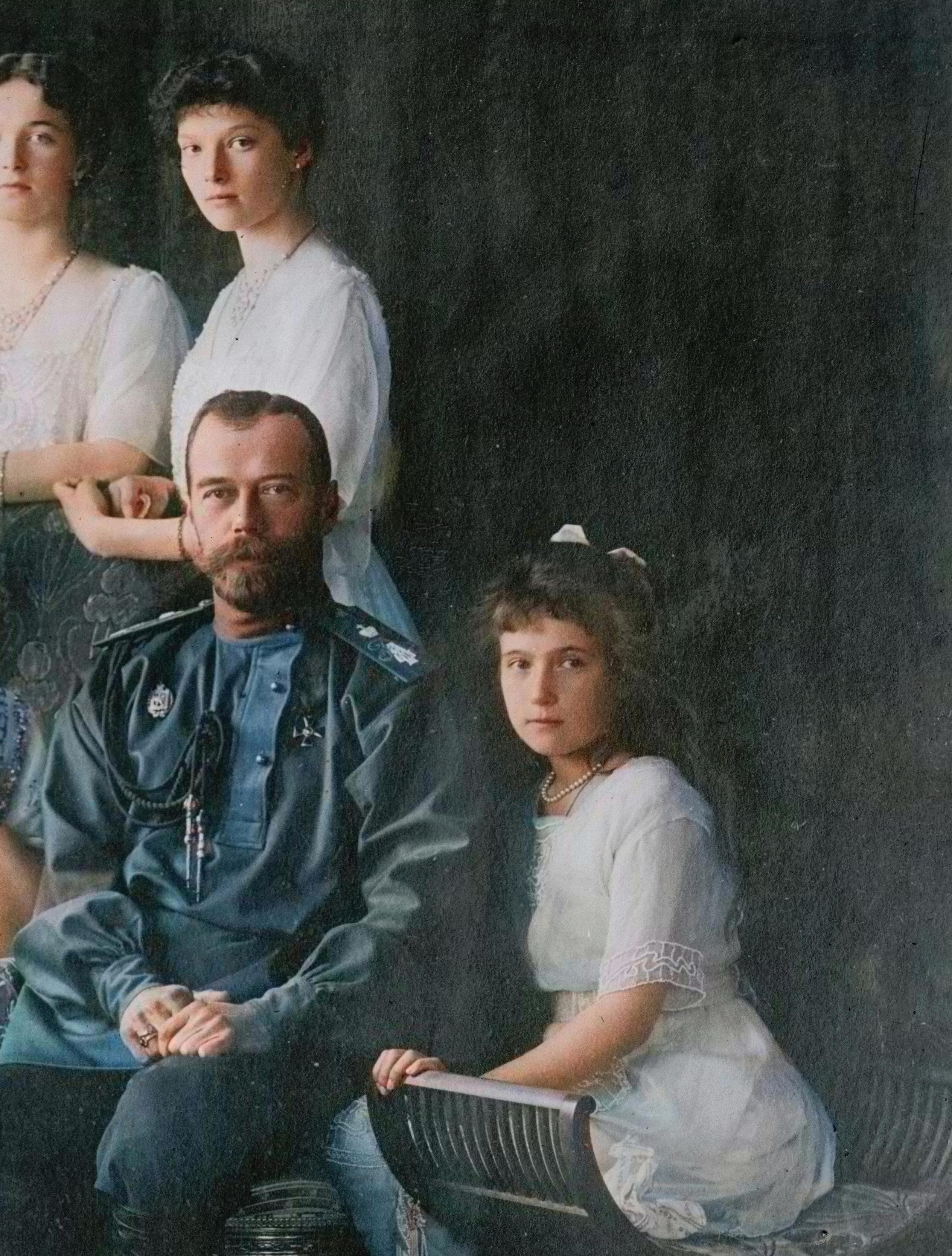
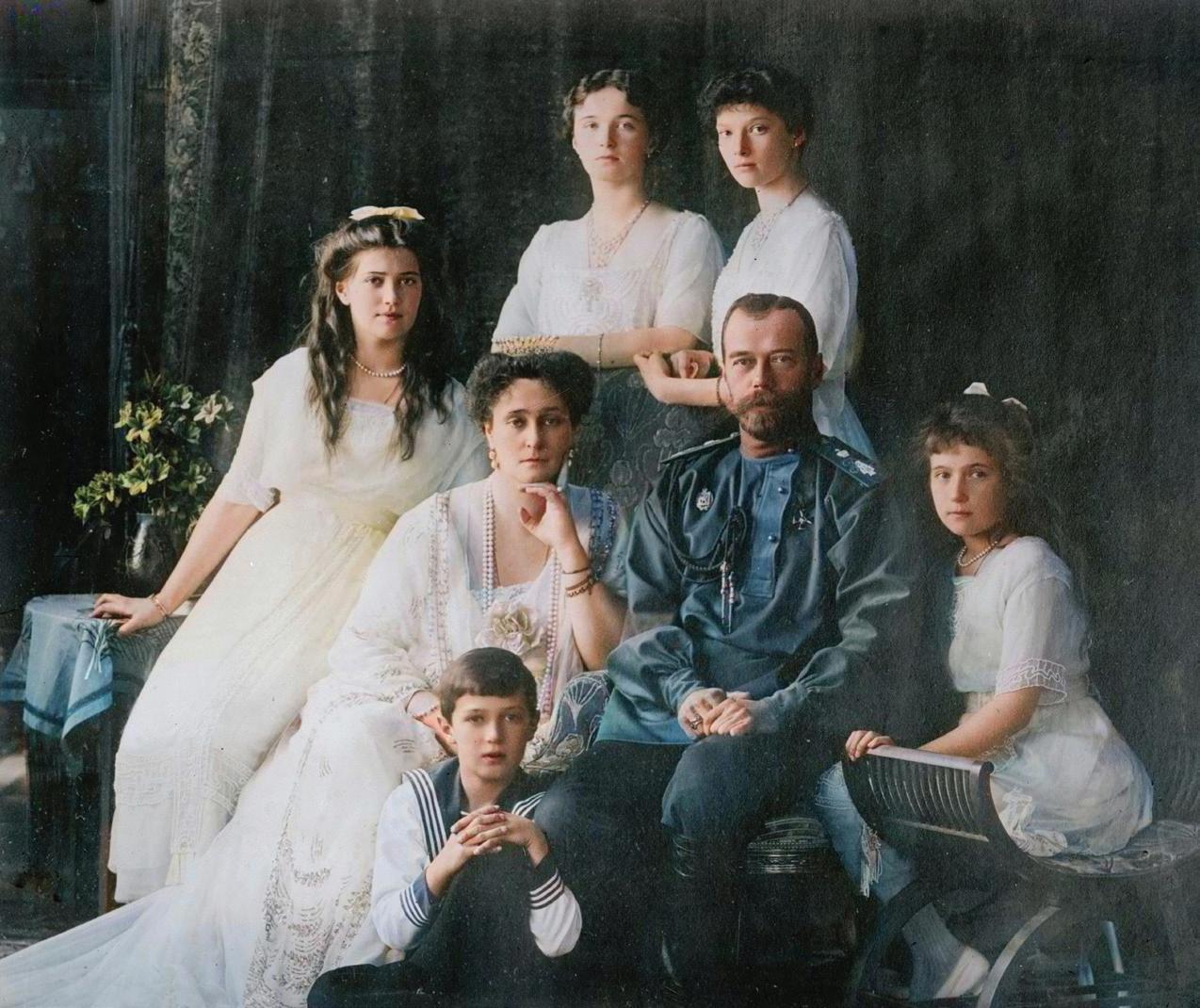
The Romanovs had more wealth and lived in greater luxury than any other European royal family. The recently deposed monarch of the Russian Empire, Tsar Nicholas II, “Emperor and Autocrat of All the Russias”, was now plain Citizen Romanov. He was carrying his sick 13-year-old son, Alexei Nikolaevich, who had once been the heir to his throne. Descending the stairs with them was Nicholas’s wife, the former Tsarina Alexandra, and their four daughters aged 17–22: Olga, Tatiana, Maria and Anastasia. Also with them were their personal doctor, maid, cook and footman – all that remained of the hundreds of servants who had once tended to their every need.
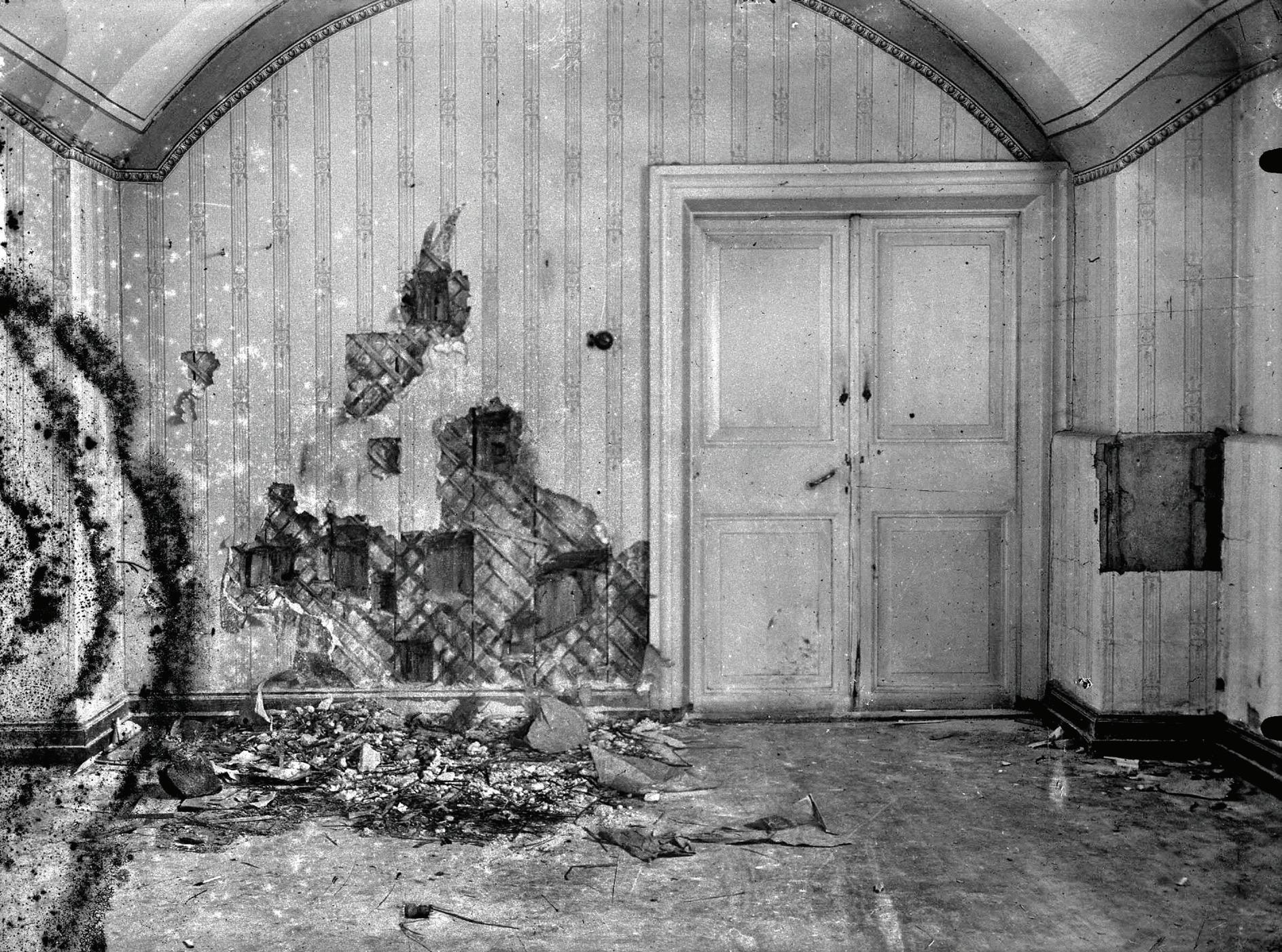
Once downstairs, the family was told to cross the yard, crowd into a narrow basement room, and assemble for a photograph. Father, mother and the five young adults arranged themselves – and a chair was brought for the boy, who seemed too weak to stand. But when they looked up, they saw no camera. Instead, they saw eight or nine pistols. The terrified family, who had for so long been looked up to with awe, saw nothing but disdain in the eyes that looked down at them.
tsar (or czar) the male ruler of Russia from 1547 (Ivan IV) to 1917 (Nicholas II); a title meaning both “king” and “emperor”, probably derived from the Roman word Caesar
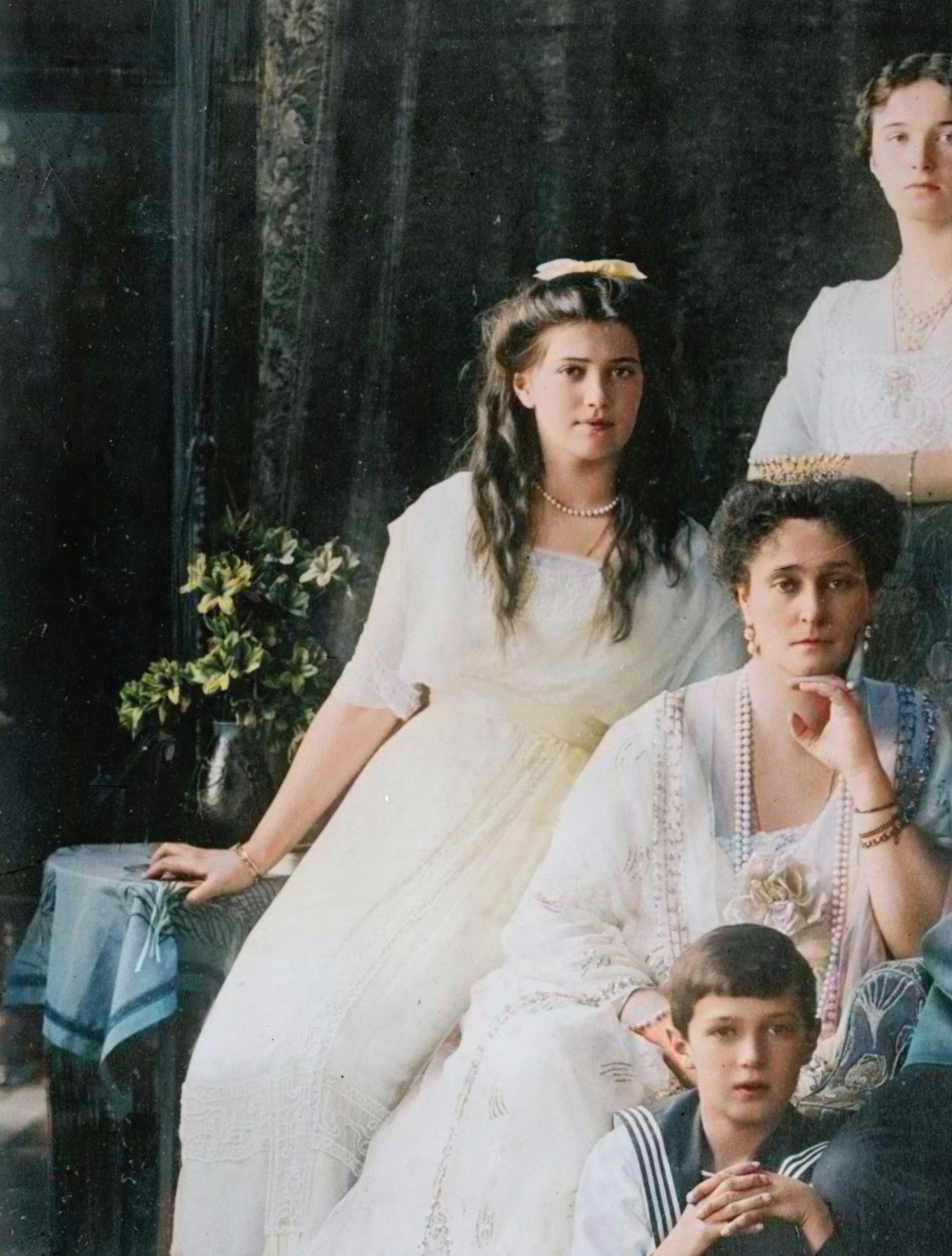
Source 5.1.1 A colourised family photograph of the Romanovs before their imprisonment, c. 1914
It had been a year and a half since Nicholas had given up the throne, in the wake of popular revolutions that began in the Russian capital of Petrograd (Saint Petersburg). People who were starving and fed up with the corruption of the Tsar’s officials, and his repeated failures to make good on his promises to reform politics and improve the lives of his people, were relieved when he abdicated . Many people blamed his poor judgement and refusal to listen to advice for the chaos spreading across Russia.
For the first few months, the ex-royal family had been allowed to live quietly under house arrest in the Alexander Palace, with their full retinue of servants. However, when rumours of plots to free them emerged, they – along with only several dozen of their servants – were moved to a mansion in remote Siberia.
In October 1917, another revolution occurred and the Bolsheviks took power. Their leader, Vladimir Lenin, wanted to sweep away everything the tsarist system represented – centuries of oppression that had kept millions of Russians in poverty while royals and nobles lived in luxury – and replace it with a communist system that claimed to put workers and peasants first. The Bolsheviks, known as the “Reds”, withdrew Russia from the First World War and began to make radical changes to politics and society. At the same time, they were drawn into a civil war against their enemies, the “Whites” – a loose alliance of anti-communist forces that included monarchists, conservatives and foreign-backed armies.
What to do with the Romanovs, then, was a major problem. Lenin and Red Army commanders believed that as long as members of the former ruling family remained alive, foreign powers supporting the Whites would attempt to rescue them and restore them to the Russian throne. The family was related, by blood and marriage, to almost every other European monarchy, and it was no secret that their relatives were desperately seeking ways to help them escape.
In March 1918, following the discovery of further plots to rescue the family, the Bolsheviks transferred them to the more secure city of Yekaterinburg. This time, the Romanovs were allowed to take very little with them. They secretly sewed some of their remaining fortune – diamonds and other jewels – into their underwear, belts and hats. They were confined in the so-called “House of Special Purpose”, guarded day and night, and could only wonder at what was unfolding beyond its walls.
As fighting in the civil war intensified, coded telegrams were exchanged between trusted Bolshevik contacts in Yekaterinburg and headquarters elsewhere. Although no evidence has been found of a direct written order to “liquidate” the family, a group of 11 guards – the youngest just 17 – was told to be ready to kill the captives if such an order arrived. Two guards refused, saying they could not bring themselves to kill the girls, whom they had come to know. A second team was therefore assembled, and preparations were made to dispose of the bodies in a way that would prevent them from being found or identified.
abdicate to give up a high position, especially when a king or queen gives up the throne, or to stop controlling something they were in charge of Bolsheviks a revolutionary political party led by Vladimir Lenin, which seized power in Russia in 1917 and became the Communist Party in 1925
UNCORRECTED SAMPLEPAGES
And so, in the dank basement of a requisitioned house, in the early hours of 17 July 1918, the Romanovs of old Russia confronted the fury of the new. The commander who had overseen the previous 98 days of their imprisonment, Yakov Yurovsky, briefly announced that because of ongoing attacks on revolutionary Russia by foreign powers, the local Bolshevik authorities had ordered the family’s execution. Nicholas barely had time to ask, “What?”, before the soldiers opened fire. This was the brutal end of the Romanov dynasty.
Why should we regard the death of one family, carried out in a remote basement, as a turning point in history at a time of widespread death, destruction and the dislocation of millions of people? To appreciate the full significance of this event, we need to examine the Romanov dynasty and its decline and fall in detail. This requires looking at where the Romanovs began, how they came to define the Russian Empire for over 300 years, and the forces that ultimately brought them down.
REVIEW 5.1
Online quiz
Go online to assign and download questions, view results and more!
UNCORRECTED SAMPLEPAGES
Writing focus 5.1
Question words
Review questions
Access sample responses and results
1. Identify who was killed in the “House of Special Purpose” basement on 17 July 1918.
2. Explain why the Romanovs were taken to the city of Yekaterinburg.
3. Various terms have been used to describe the Romanovs’ deaths: liquidate, execute, firing squad, assassination, murder. Discuss which term seems most appropriate, and why.
4. Discuss why the fate of one family, the Romanovs, was considered so significant at a time of widespread death and destruction.
5. Discuss what perspectives the soldiers may have held when they were ordered to join the firing or burial squads.
Source 5.1.2 A 1919 photograph of the basement of the Ipatiev House (the House of Special Purpose), where the Romanovs were killed. White Army investigators caused some of the damage to the walls during their search for evidence.
5.2 Tsarism
DRIVING QUESTION
• What was the ruling system known as tsarism?
UNCORRECTED SAMPLEPAGES
Russian leaders were called “tsar” for nearly four centuries. The title indicated that they were at the head of a system of power and authority specific to Russia, known as tsarism.
The origins of tsarism
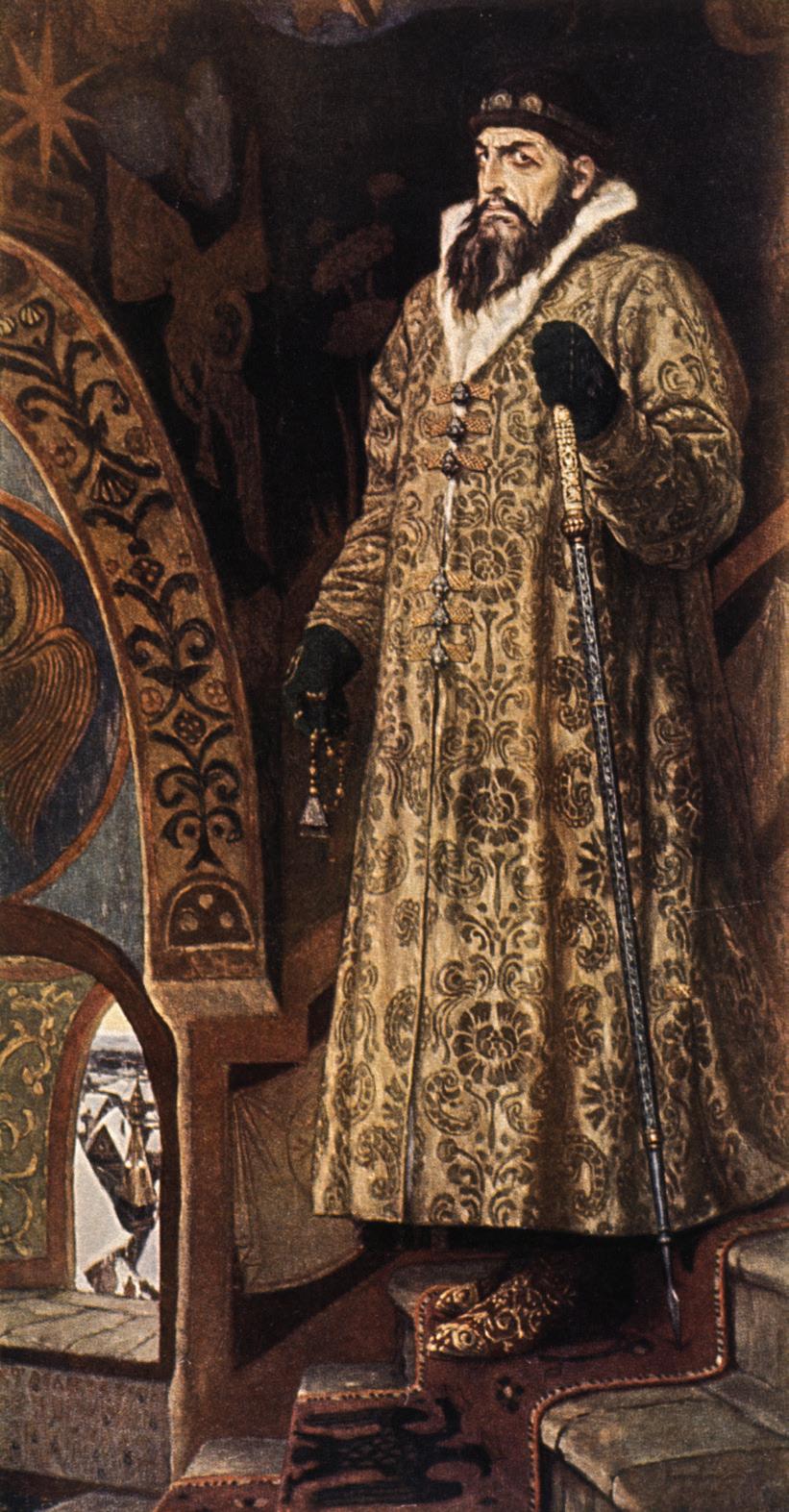
The first Russian leader to be called a tsar (a word meaning both “king” and “emperor”) was Ivan the Terrible (1530–1584). He was the Grand Prince of Moscow and was crowned “Tsar of all the Russias” at the age of 16. The following year, he married Anastasia from the Romanov boyar family. At the time, most of the people he ruled were peasants or serfs – effectively living in slavery. Ivan established a standing army to expand Russia’s territory through wars against the Polish and Ottoman Empires. He set a pattern that later Russian autocrats followed: concentrating power in his own hands, using secret police to terrorise people, and persecuting minorities, particularly Jews.
After Ivan’s death, there was a thirty-year period known as the Time of Troubles. This period was marked by famine, disease, invasions and repeated contests for the throne. In 1613, the Zemsky Sobor (an assembly of nobles and clergy), placing its faith in a new ruler from a well-known family, selected Anastasia’s great-nephew, Michael Romanov, as tsar. He was 16 years old when he left the Ipatiev Monastery and travelled to Moscow to become the first Romanov tsar. His family would remain on the throne for over 300 years, until the murder of the 18th Romanov tsar – in the basement of a house, curiously also called Ipatiev.
boyar a member of the highest rank of the feudal nobility in Eastern European states, just below princes in rank autocrat a ruler with unlimited power who demands obedience without question or regard for others’ opinions
Writing focus 5.2
Noun phrases (identify)
Source 5.2.1 Ivan the Terrible, whose reign as tsar began in 1547. Late nineteenth-century portrait by Viktor Vasnetsov.
Notable Romanov tsars
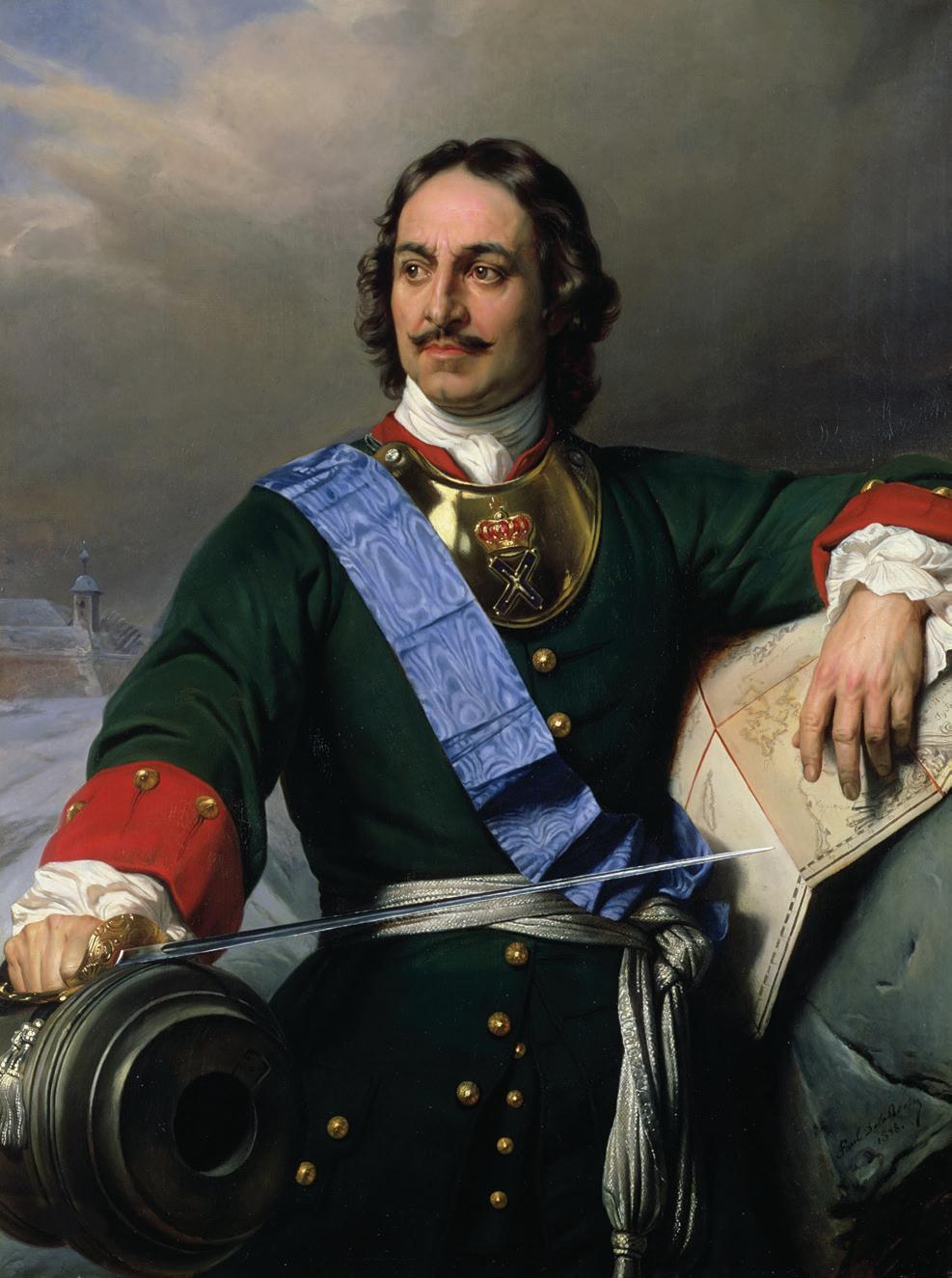
Peter Alekseyevich Romanov, Michael’s grandson, ruled as tsar from 1696 to 1725. In 1697, Peter went on a “Grand Embassy”, a tour of Western Europe. On his return, he introduced radical reforms to modernise Russia. In 1698, he banned men from wearing long beards and traditional clothing, despite Orthodox Church rules requiring followers to wear long beards. He also introduced Western calendars, writing systems and architectural styles.
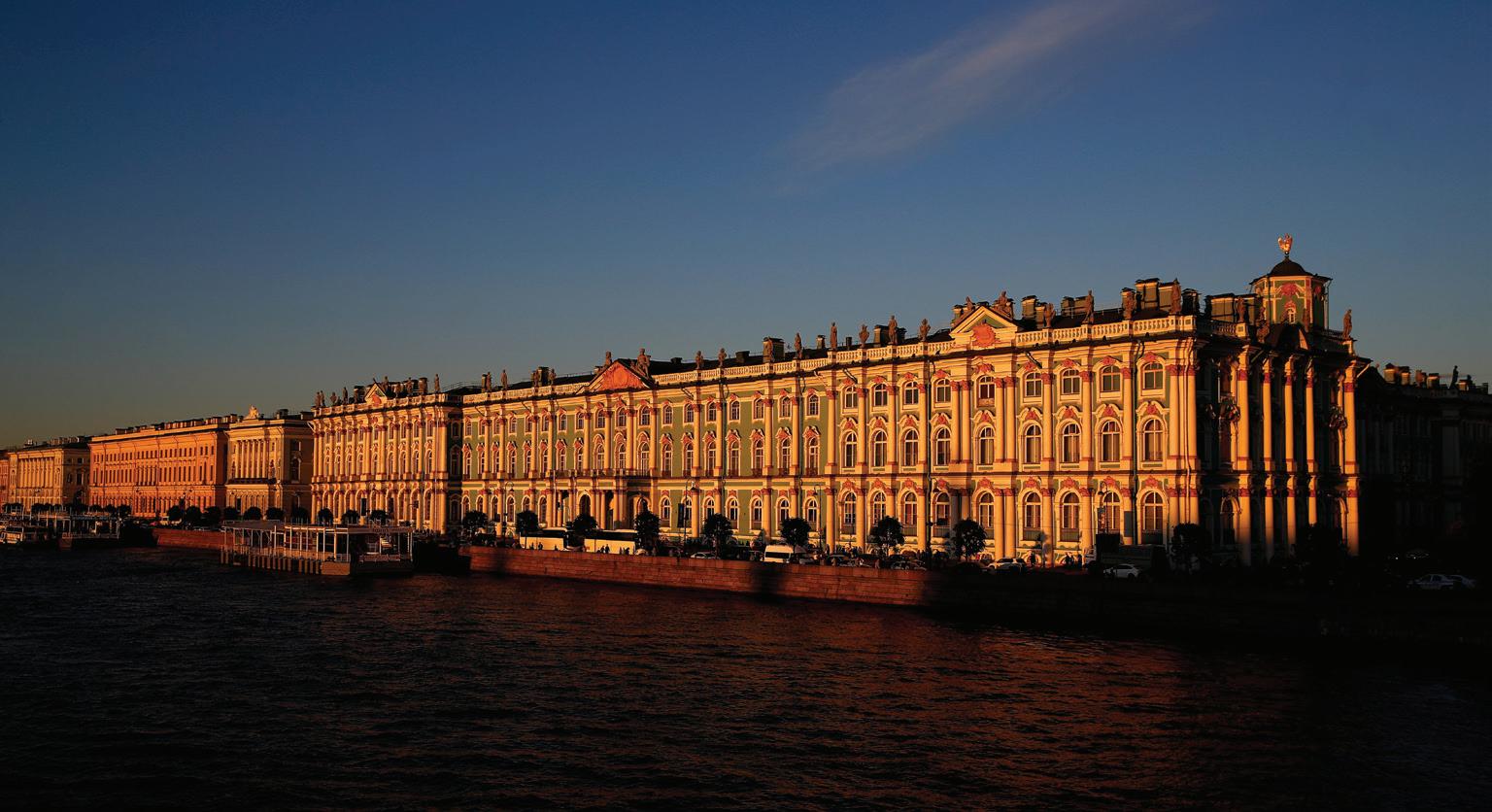
Peter’s enduring impact on Russia is shown by the entirely new capital city he began building in 1703 near the Baltic Sea, which he named Saint Petersburg in honour of his patron saint. He moved major national institutions from Moscow to his new city, over 700 kilometres north-west, closer to Russia’s borders with Western Europe.
Peter the Great used his power ruthlessly. In 1698, for example, he ordered around 1200 elite army soldiers to be executed and had their bodies displayed publicly for their role in a rebellion. He also had hundreds of peasant protesters executed. Later, in 1718, when he discovered that his own son, Alexei, was conspiring against him, he had him tortured repeatedly, ultimately leading to his death. At the same time, Peter strengthened the power of the Romanov dynasty through reforms that removed many of the boyars’ privileges.
UNCORRECTED SAMPLEPAGES
After Peter’s reforms, Boyar sons could no longer inherit seats in the Boyar Duma, an advisory parliament to the Tsar, or senior administrative positions. Instead, from 1722, promotions were governed by a Table of Ranks.
Source 5.2.3 Tsar Peter the Great built Saint Petersburg as a new capital city designed to rival Paris and Vienna, including the Winter Palace (now the Hermitage Museum).
Source 5.2.2 Peter the Great, who ruled from 1696 to 1725. Nineteenth-century portrait.
Chapter 5 The decline and fall of the Romanov dynasty
Source 5.2.4 Historian Ferdinand Feldbrugge on the significance of changes during Peter the Great’s reign
The impact of the reign of Peter the Great on Russia can only be compared to that of the October Revolution of 1917; both consisted of comprehensive and fundamental changes resulting in the emergence of a country and a society that presented an entirely different look.
Dutch legal historian Ferdinand Feldbrugge.2023. A History of Russian Law. Boston: Brill/ Nijhoff, 26.
ANALYSIS 5.1
Summarising
Summarise the significance of Peter the Great’s reign as tsar by completing the following sentences:
1. In 1697, Peter the Great … [did what] … because … [why he did it] … which showed [why it mattered].
2. In 1698, Peter the Great … [did what] … because … [why he did it] … which showed [why it mattered].
3. In 1698, Peter the Great also … [did what] … because … [why he did it] … which showed [why it mattered].
4. In 1703, Peter the Great … [did what] … because … [why he did it] … which showed [why it mattered].
5. In 1722, Peter the Great… [did what] … because … [why he did it] … which showed [why it mattered].
Historical concepts: Significance, Time and chronology Historical skills: Explanation and communication
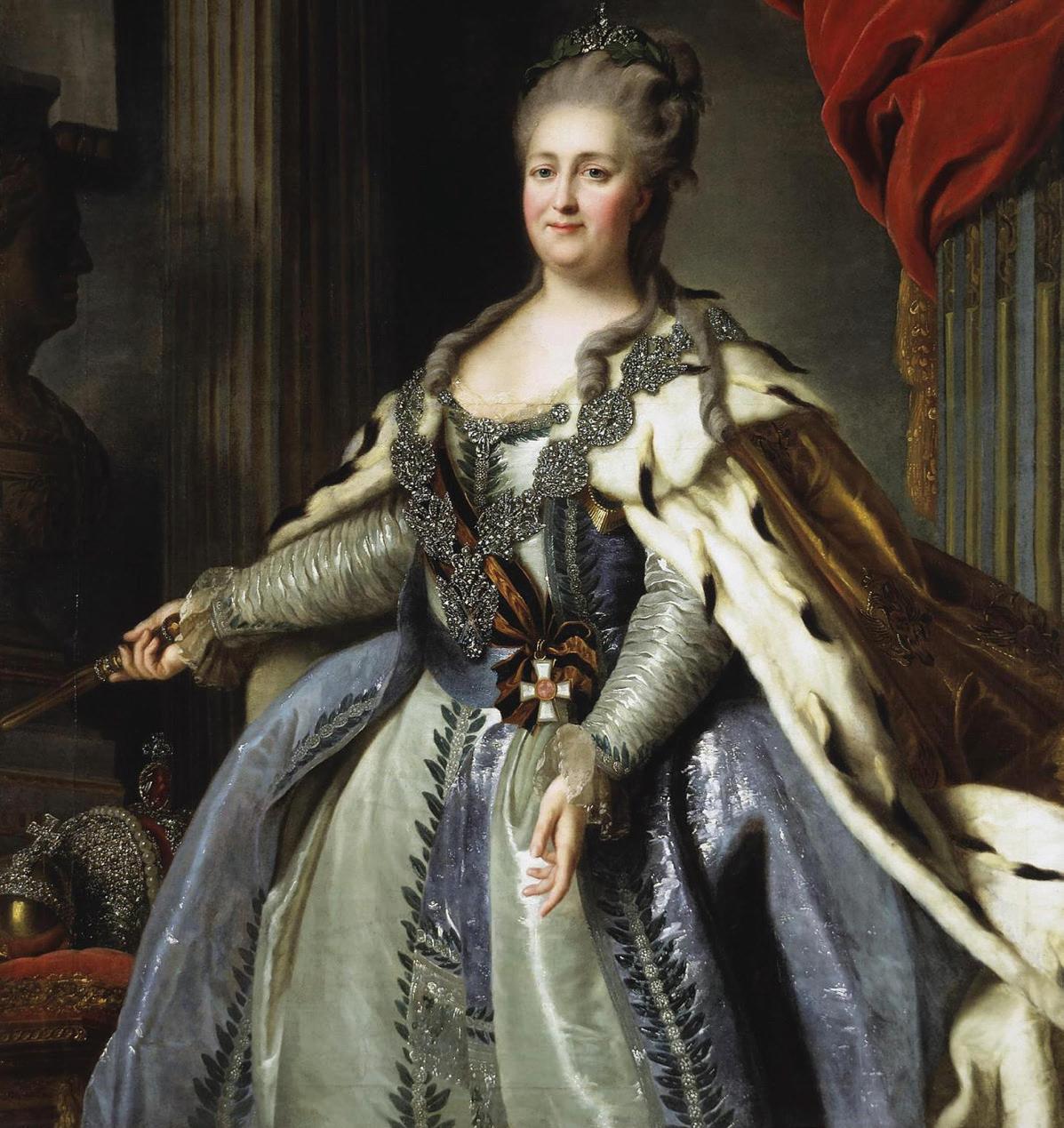
Peter the Great’s autocracy was continued by another ruler who earned the title “Great” – Catherine the Great. Catherine was born in Germany and moved to Russia for an arranged marriage to her Romanov cousin, Peter III, whom she later replaced on the throne (and probably had killed).
Catherine’s rule is known as a “golden age” for the Russian Empire, during which it expanded its territory, including east into Alaska in North America and south into the Crimea, and built many grand cities in a classical style.
UNCORRECTED SAMPLEPAGES
Source 5.2.5 Empress Catherine II expanded the Russian Empire during her reign from 1762 to 1796. Portrait by Fyodor Stepanovich Rokotov.
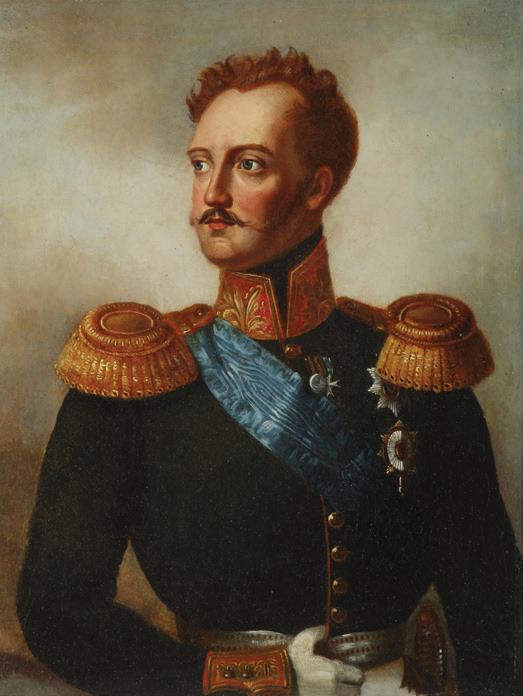
Tsar Nicholas I was another significant Russian ruler. He reigned from 1825 to 1855, and was the great-grandfather of Nicholas II, the final tsar. Like Nicholas II, he was raised in Russia and married a German princess. Nicholas I ruled through fear and intimidation. In 1833, he announced the doctrine of Official Nationality, which had three key elements: orthodoxy (the Orthodox Church was supreme), nationality (Russian people should love their motherland) and autocracy (the tsar had a divine right to rule). Romanov tsars who followed him continued to promote this doctrine. However, Nicholas I’s reign ended with Russia’s defeat by European and Ottoman powers in the Crimean War of 1853-1856.
UNCORRECTED SAMPLEPAGES
Source 5.2.7 German intellectual August von Haxthausen on Russian society’s reliance on the tsar
Russian society is very much like a colony of bees, in which royalty is a natural necessity. Just as the colony would cease to exist without its queen, so, too, would Russian society cease to exist without the Tsar. German intellectual August von Haxthausen. 1844. Studies on the Interior of Russia
Source 5.2.8 British historian Simon Sebag Montefiore on the Romanovs’ power
The Romanovs have become the very definition not only of dynasty and magnificence but also of despotism, a parable of folly and arrogance of absolute power.
British historian Simon Sebag Montefiore. 2016. The Romanovs, 1613–1918. London: Vintage, 3.
A MATTER OF FACT
Few Romanov rulers lived beyond their 40s. Several suffered violent deaths, including Ivan VI (murdered by prison guards during an attempted rescue, aged 23, after spending most of his life in captivity), Peter III (killed, possibly on the order of his wife, aged 34), Paul I (killed by palace guards, possibly on the order of his son, aged 46), Alexander II (assassinated by revolutionaries, aged 62) and Nicholas II (shot by Bolsheviks, aged 50).
Go online to assign and download questions, view results and more!
1. Identify what the word “tsar” meant, and for how long it was used.
2. Identify what a “boyar” was.
3. Identify the first Russian leader to centralise power and be called a “tsar”.
4. Explain the impact of Peter the Great on the geography of Russian power.
5. Explain, using examples, how Romanov tsars were connected with another country.
6. Discuss why Tsar Nicholas I may have influenced the leadership of the last tsar, Nicholas II.
7. Discuss why tsars were known as autocrats.
Source 5.2.6 Tsar Nicholas I, shown here in an 1832 portrait attributed to Franz Krüger.
The decline and fall of the Romanov dynasty
5.3 The origins and nature of the Russian Empire
DRIVING QUESTION
• How large and how stable was the Russian Empire at the start of the twentieth century?
The last tsar, Nicholas II, inherited an empire that had been built up over centuries, with heavy involvement from his own ancestors, the Romanov dynasty.
Expansion under the Romanovs
Russian tsars viewed neighbouring nations as opportunities for territorial expansion. From 1613, under successive members of the Romanov dynasty, the Russian Empire’s geographic boundaries expanded significantly. Peter the Great and Catherine the Great used both war and diplomacy to take land from other kingdoms, while nineteenth-century Romanovs competed with other empires for territory as part of the so-called “Great Game” between the world empires. In the 1850s, Nicholas I was prevented from expanding the empire further south when France and Britain joined forces against Russia in the Crimean War.
Writing focus 5.3
Noun phrases (identify and develop)
1533–1689
1689–1801
Alexander
(1801–1825)



(1825–1855)
Alexander II (1855–1881)
Alexander III (1881–1894) Acquisitions:





Kuril Is.
By the mid-nineteenth century, Russia was a multinational empire spanning Europe and Asia. It even temporarily included parts of North America, including Alaska and a short-lived settlement in northern California. The empire covered around one-sixth of the Earth’s land surface, making it arguably the third-largest empire in history, behind only the British and Mongol Empires in territorial extent.
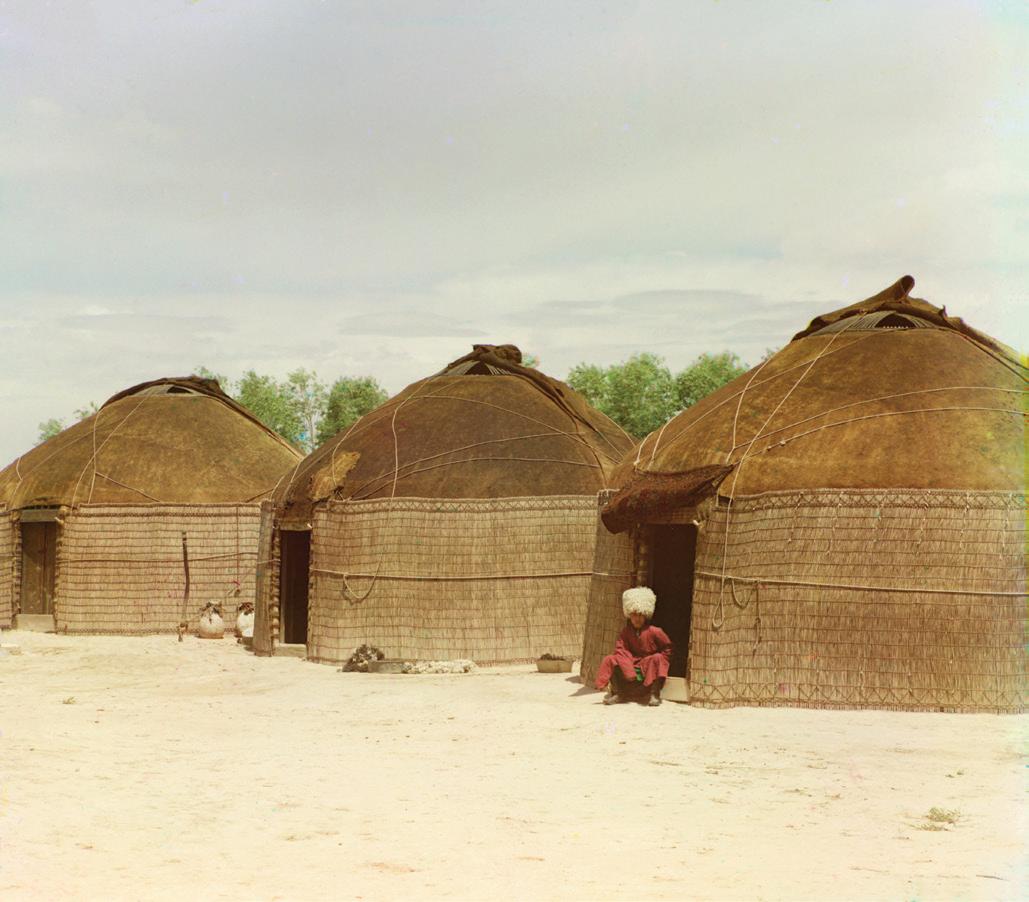
According to the Russian Imperial Census of 1897, the empire’s population was almost 126 million people. There were around 70 distinct nationalities. A little over half of Nicholas II’s subjects were recorded as ethnically Russian (nearly 68 million). The rest of the population had their own languages and customs. For those subjects of the Russian Empire, Russian was a foreign language and Russian people themselves were foreigners.
ANALYSIS 5.2
Analysing a primary source
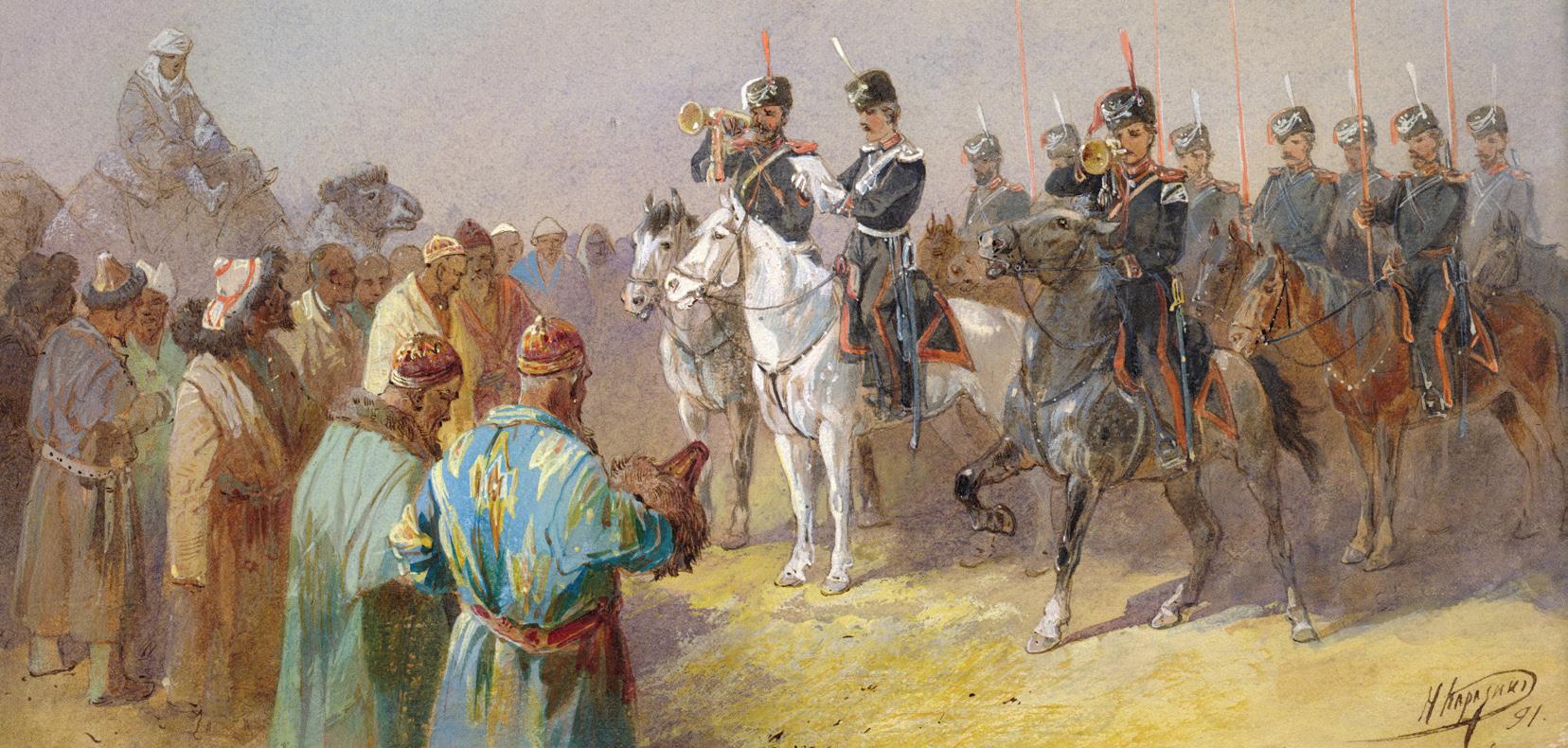
1. Identify the ethnic groups depicted in the painting.
2. Explain what is happening and what this shows about the Russian Empire.
3. Find out how far modern Kazakhstan is from Saint Petersburg. Discuss what this distance reveals about the Russian Empire.
UNCORRECTED SAMPLEPAGES
4. Explain the intended audience of the painting.
5. Considering the purpose and content of the source, analyse its value in helping us understand Nicholas II’s beliefs about his empire.
Historical concepts: Perspectives Historical skills: Analysis and use of sources
Source 5.3.3 A painting of a Russian soldier reading the Tsar’s decree to Kyrgyz-Kazakhs (modern Kazakhstan), ordering them to pay taxes. The painting was created as a gift for the future Tsar Nicholas II when he was young.
Source 5.3.2 A colourised photograph, c. 1910, of a local man in front of traditional yurt housing in Turkmenistan, which the Russian Empire conquered in 1881
Chapter 5 The decline and fall of the Romanov dynasty
Russia’s relationship with foreign powers
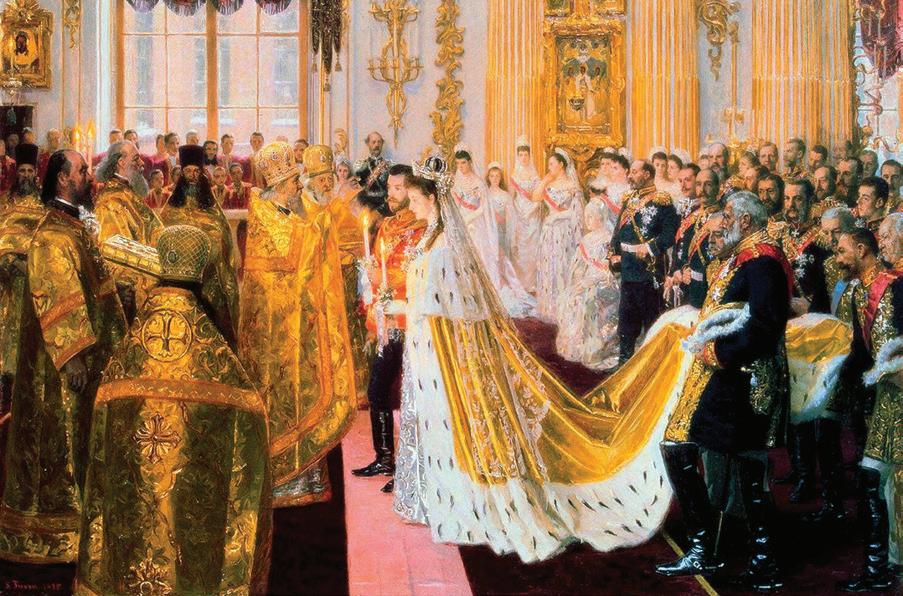
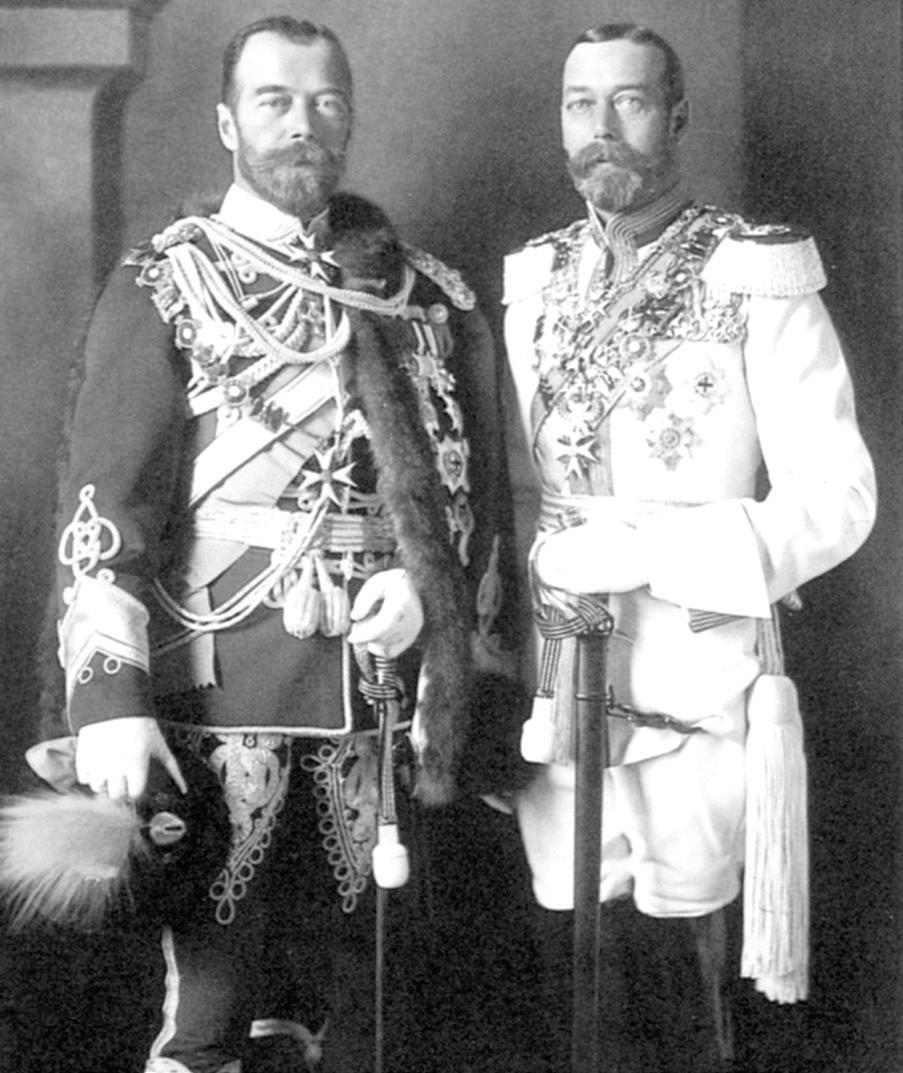
Russia had complex relationships with other world powers. This was reflected in Nicholas II’s own family. When he married his second cousin, a princess from Hesse-Darmstadt (central Germany), in 1894, their wedding linked the royal families of Russia, Germany and Britain. She was known as Alexandra in Russia, Alix in Germany and “Alicky” by her British relatives. Her veil was designed by her grandfather, Prince Albert, the German-born husband of Britain’s Queen Victoria. When Nicholas was crowned, he used the crown that had belonged to the German-born Catherine the Great.
Historically, the Russian Empire had strong ties with German states, particularly Prussia, reinforced by frequent royal marriages. Under the Treaty of Kalish (1813), Russia and Prussia formed a military alliance, which later expanded to include Austria-Hungary under the League of the Three Emperors from 1873. This arrangement collapsed in the late 1880s, when Germany and Austria-Hungary allied with Italy in the Triple Alliance.
In search of a new ally, Nicholas’s father, Alexander III, turned to Russia’s former enemy, France. The FrancoRussian Alliance (often called the Dual Entente) began with secret agreements promising mutual support if Germany attacked, and by 1894 it became a formal treaty. Under Nicholas II, Russia signed the AngloRussian Entente in 1907, bringing Britain into the alliance and forming the Triple Entente. This alliance united Russia with its former enemies from the Crimean War and later became the foundation of the Allied Powers in the First World War.
UNCORRECTED SAMPLEPAGES
1. Identify two eighteenth-century tsars who expanded the Russian Empire.
2. Explain Russia’s role in “the Great Game”.
3. Explain the diversity of the Russian Empire.
4. Explain how Russia’s alliances changed between the 1870s and 1890s.
5. Discuss how the Romanovs’ family connections related to Russia’s alliances.
6. Research how the Franco-Russian Alliance was arranged. What does it show about international relations at the time?
Source 5.3.4 Nicholas and Alexandra’s wedding was attended by representatives of many different world powers.
Source 5.3.5 Nicholas II (left) and his cousin George V, King of Great Britain. Although they were allied against Germany, they are shown here visiting family in Berlin in 1914.
5.4 The role of Nicholas II as autocrat
DRIVING QUESTION
UNCORRECTED SAMPLEPAGES
Writing focus 5.4
Transitional phrases
• To what extent was Nicholas II’s leadership style a factor in the Romanovs’ downfall?
Autocracy
We have seen that autocracy means rule by an individual with unlimited power, who demands that people obey them without question or regard for their opinions. Today, to call someone an autocrat is a criticism. For a Russian tsar, it was merely a description.
Nicholas II was reluctant to become tsar of the enormous Russian Empire at a time when it was going through major social changes. The possibility of success seemed remote, and the chances of failure were very high. His father, Alexander III, had been a towering figure – physically and politically – but he died unexpectedly and had not spent time preparing his 26-year-old son to take his place. In fact, he regularly humiliated his son in public, calling him a weakling or scolding him in front of other people.
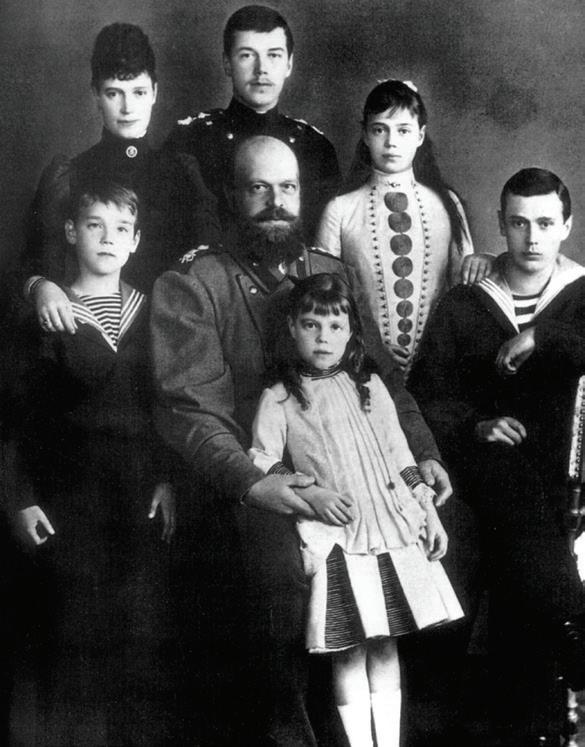
Source 5.4.1 Nicholas II as a teenager (standing at rear) in a family portrait. Even as an adult, he only reached the shoulders of his father, Alexander III, who made it clear he regarded Nicholas as a disappointment.
Source 5.4.2 Nicholas II’s response to his father’s death and becoming tsar
I am not prepared to be the Tsar. I never wanted to become one. I know nothing of the business of ruling. I have no idea of even how to talk to ministers.
Nicholas II. 1894. Statement on hearing of the death of his father.
SIGNIFICANT INDIVIDUAL
Nikolai Alexandrovich Romanov (1866–1918; Emperor 1894–1917) became the last tsar of the Russian Empire on the unexpected death of his highly conservative father, Alexander III. He was trained in the military but inexperienced in politics. While society around him changed, he held onto a belief in autocracy: the absolute power of the tsar, based on a bond of love and devotion between the tsar and his people. His reign was characterised by periodic crises and his efforts to resist demands to modernise Russian systems to allow more participatory government and civil rights. Historian Simon Sebag Montefiore described Nicholas II as “the least capable and most narrow-minded” of the Romanov rulers.
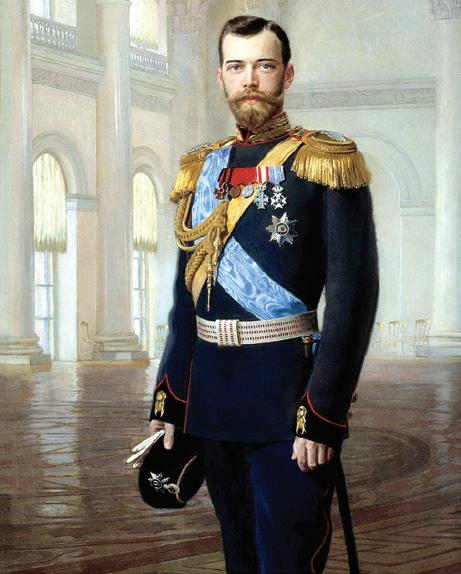
Source 5.4.3 Tsar Nicholas
II – the last of the Romanov autocrats; Nicky to his family
Chapter 5 The decline and fall of the Romanov dynasty
While he may not have relished the opportunity to become tsar, Nicholas chose the path of a traditional autocrat like his father, Alexander III, rather than the way of a reformer like his grandfather, Alexander II. He was 13 years old when he saw his grandfather die from an assassination. His tutors taught him that this was a result of liberal reforms, and he grew up convinced that autocracy was the wisest course. In January 1895, he told an assembly of local government delegates, “I shall defend the principles of autocracy as unswervingly as my deceased father.”
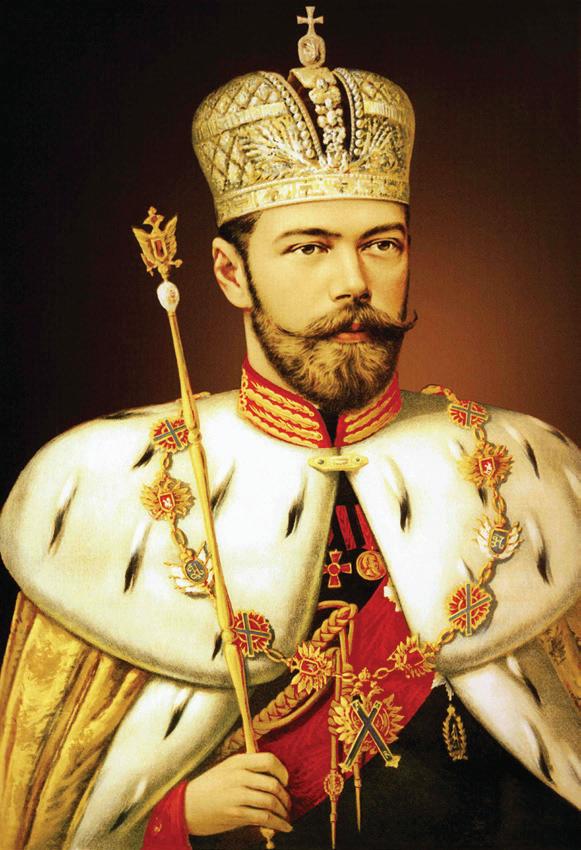
In 1896, Nicholas II’s coronation had all the trappings of autocracy. Members of royal families from across Europe and Russia’s rich and powerful nobility crowded into the cathedral in Moscow, and all focus was on the new tsar. He was invested with a long royal title, which included Emperor and Autocrat of All the Russias, as well as the titles of places that Russia had acquired over the centuries.
However, the coronation was remembered for a tragedy that could have been prevented. The public had been invited to a festival held on Khodynka Field, for free food, beer and souvenirs to honour their new leader. A larger than expected crowd – perhaps 500,000 people – arrived, and rumours spread that there was not enough of the advertised refreshments for everyone. A stampede began, and the soldiers who were supposed to manage the crowd failed to prevent a deadly crush. By the end of the day, over 1300 people were dead and thousands more seriously injured. Nicholas’s reign began with disaster. Nicholas was not responsible for the poor arrangements, but observers criticised his response. Several hours passed before he visited the injured (partly because he and the tsarina were praying), and the royal couple still made an appearance at a gala coronation ball for diplomats and the nobility that evening. Nicholas the autocrat did not seem to care about his people.
5.4.4 Nicholas II was crowned tsar in 1896 with the imperial crown of Catherine the Great. It is adorned with nearly 5000 diamonds, worth several hundred million dollars.
UNCORRECTED SAMPLEPAGES
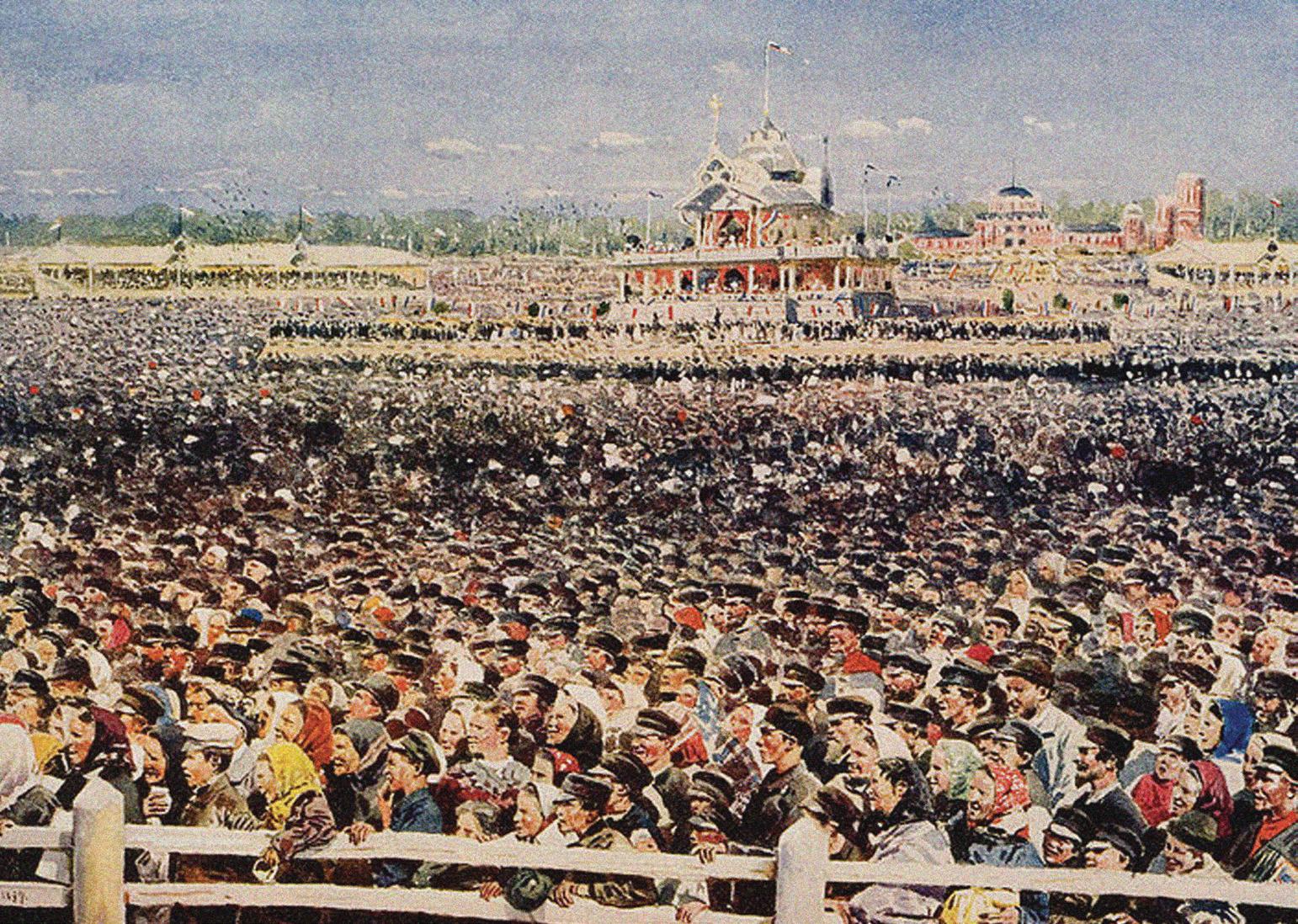
Source 5.4.5 A painting of peasants on Khodynka Field for the coronation celebrations, before the deadly crush began
Source
ANALYSIS 5.3
Analysing a primary source
UNCORRECTED SAMPLEPAGES
Source 5.4.6 Key articles from the Fundamental Laws of the Russian Empire
Article 4. The Emperor of All the Russias possesses Supreme Sovereign Power. Obedience to His authority, not only out of fear, but in good conscience, is ordained by God Himself ...
Article 59. The full title of His Imperial Majesty is the following: “By the Grace of God, We, Nicholas the Second, Emperor and Autocrat of All the Russias, Moscow, Kiev, Vladimir, Novgorod; Tsar of Kazan, Tsar of Astrakhan, Tsar of Poland, Tsar of Siberia, Tsar of Chersonese Taurian, Tsar of Georgia; Lord of Pskov and Grand Prince of Smolensk, Lithuania, Volhynia, Podolia, Finland; Prince of Estland, Livland, Courland, Semigalia, Samogitia, Belostok, Karelia, Tver, Yugra, Perm, Vyatka, Bolgar and others; Lord and Grand Prince of Nizhny Novgorod, Chernigov, Ryazan, Polotsk, Rostov, Yaroslavl, Beloozero, Udoria, Obdoria, Kondia, Vitebsk, Mstislav, and all of the northern countries Master; and Lord of Iberia, Kartli, and Kabardia lands and Armenian provinces; hereditary Sovereign and ruler of the Circassian and Mountainous Princes and of others; Lord of Turkestan; Heir of Norway; Duke of Schleswig-Holstein, Stormarn, Dithmarschen, and Oldenburg, and so forth, and so forth, and so forth.”
Fundamental Laws of the Russian Empire. 1906. Articles 4 and 59.
1. Identify the source of the tsar’s power, according to the Fundamental Laws.
2. According to Article 4, how should people regard the tsar’s authority, and why?
3. Discuss what the tsar’s full title reveals about his authority.
4. Analyse the value and limitations of the source in helping us understand autocracy under Nicholas II.
Historical concepts: Change and continuity Historical skills: Analysis and use of sources
Some opponents referred to the Tsar as “Bloody Nicholas” because he ruled Russia effectively as a police state, in which his Okhrana (secret police) dealt brutally with anyone who dared challenge his authority.
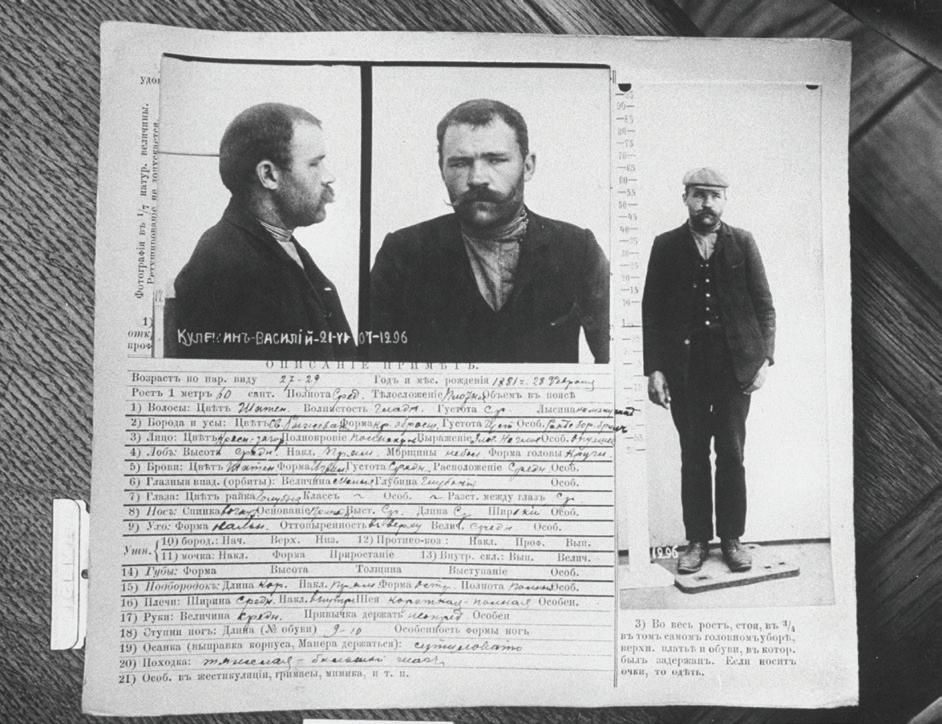
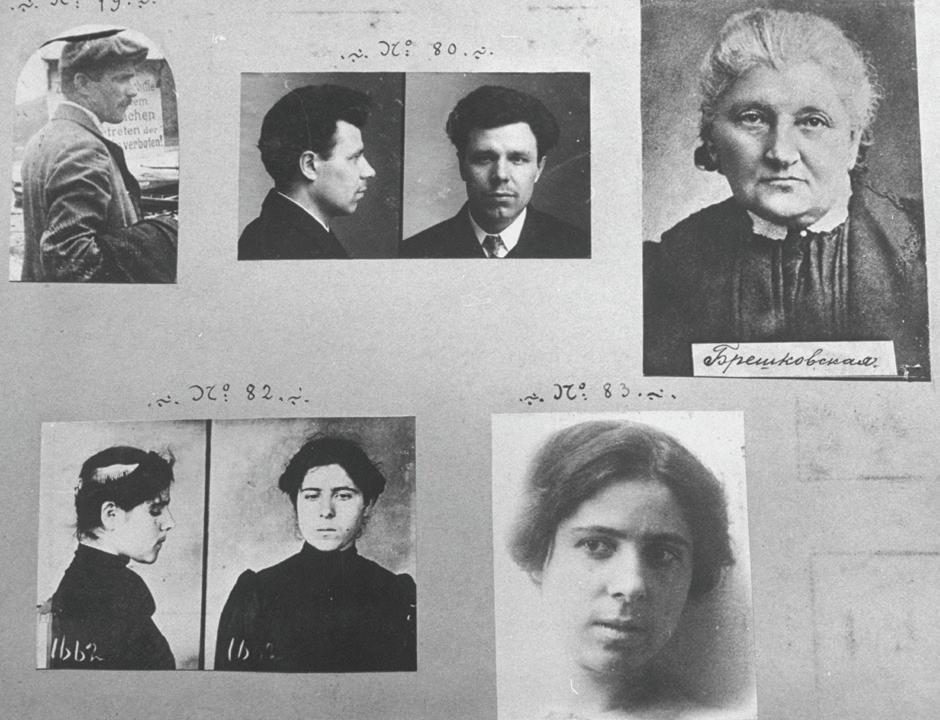
Source 5.4.7 Declassified Okhrana files of some arrested revolutionaries. The Tsar’s secret police kept dossiers on political suspects.
Nicholas’s reputation was also shaped by his love of luxurious gifts. Every Easter, he commissioned the jeweller Peter Carl Fabergé to create two highly decorated eggs, with gold, enamel and precious stones and a surprise inside – one for his wife and one for his mother. A century later, each egg was valued at $10–30 million.
Chapter 5 The decline and fall of the Romanov dynasty
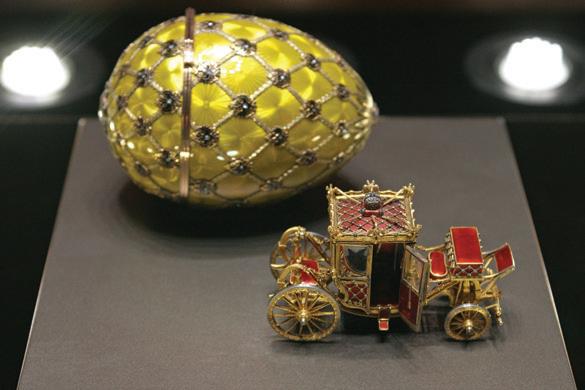
Source 5.4.8 The Fabergé coronation egg, made of gold, diamonds and enamel in 1897
SIGNIFICANT INDIVIDUAL
Alexandra Feodorovna (1872–1918) was born Princess Alix into the House of Hesse, in the German Empire. She married her cousin Nicholas II in 1894 and became tsarina of Russia. Although sometimes shy, she had a strong will and influenced her husband’s political decisions, including urging him to remain an autocrat and not share power. They had four daughters – Olga (1895), Tatiana (1897), Maria (1899) and Anastasia (1901) – and, in 1904, a son and heir, Alexei. Alexei was born with haemophilia, a genetic condition that prevented his blood from clotting, which doctors believed would shorten his life. This led Alexandra to seek the help of the controversial mystic Grigori Rasputin, damaging the reputation of the Romanovs.
UNCORRECTED SAMPLEPAGES
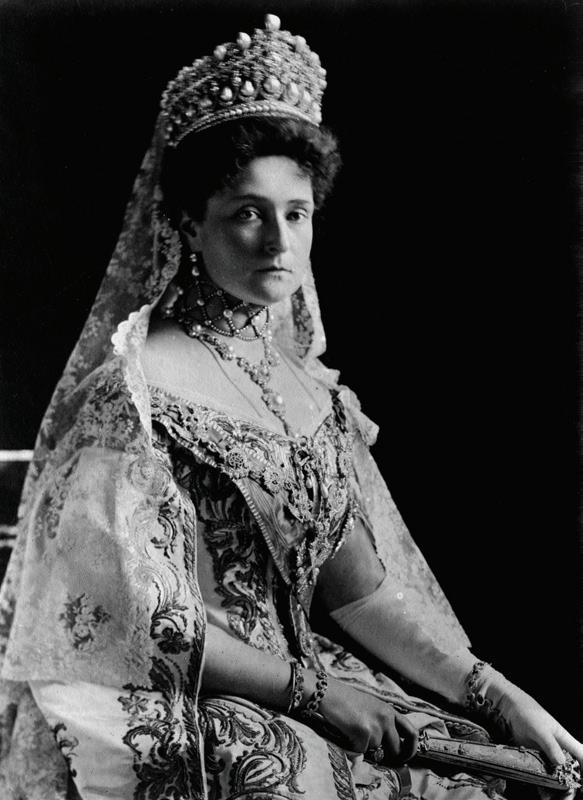
Source 5.4.9 Empress Alexandra, known to her German family as Alix and to her British relatives as Alicky.
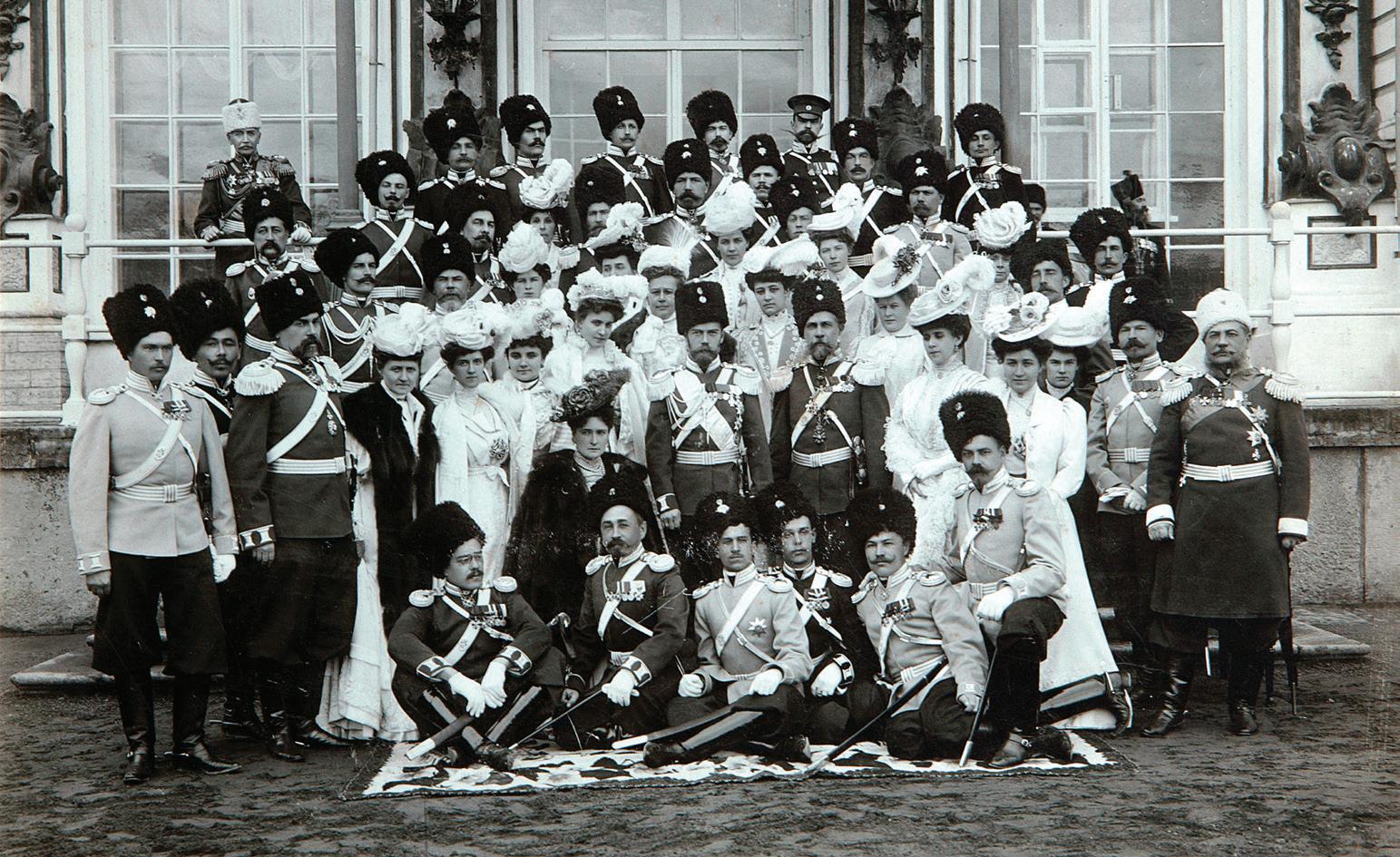
Source 5.4.10 The Tsar and Tsarina pose with army officers at the Catherine Palace, their summer residence, built in the eighteenth century and featuring over 140 rooms.
Go online to assign and download questions, view results and more!
Nicholas’s leadership qualities
As an autocrat, Nicholas II believed that the tsar had a divine right to rule – coming directly from God, who spoke and acted through him – and the Russian Orthodox Church supported this belief. However, observers who met him, and historians who studied him, have raised doubts about his personal abilities. American historian Tsuyoshi Hasegawa (2024), in his book The Last Tsar describes Nicholas II as “the most ill-equipped and inadequate ruler in all of Europe”.
Source 5.4.11 Alexander Kerensky on Nicholas II’s approach to leadership
The daily work of a monarch he found intolerably boring. He could not stand listening long or seriously to ministers’ reports, or reading them … He liked such ministers as could tell an amusing story and did not weary the monarch’s attention with too much business.
Alexander Kerensky (Russian politician and Prime Minister in 1917). 1934. The Crucifixion of Liberty, 264.
Source 5.4.12 Sir George Buchanan compares Nicholas II’s qualities to his predecessor’s.
The Emperor Nicholas has not inherited his father’s commanding personality nor the strong character and prompt decision making which are essential to an autocratic ruler.
Sir George Buchanan, British Ambassador to Russia, 1910
Source 5.4.13 Historian Helen Rappaport on Nicholas II’s politics
As a man of limited political ability and wisdom, Nicholas had done what came naturally. He had assiduously maintained the autocratic rule of his father whilst blindly resisting all political innovation and condoning the suppression of the empire’s turbulent minorities.
American historian Helen Rappaport. 2008. The Last Days of the Romanovs. New York: St Martins Press, 5.
UNCORRECTED SAMPLEPAGES
1. Identify what Nicholas said in 1895 he would defend “as unswervingly as my deceased father”.
2. Explain Nicholas’s attitude towards becoming tsar in 1894.
3. Explain what disaster occurred during Nicholas’s coronation celebrations.
4. Explain, with evidence, the belief in the divine right of the tsar to rule.
5. Discuss Nicholas’s limitations as a leader, using examples.
6. Find the full text of the Fundamental Laws of the Russian Empire online. Select and explain at least three parts of the laws that show the role of the tsar.
5.5 Political, social and economic grievances in the Russian Empire
DRIVING QUESTION
• How did division and discontent emerge in Russian society?
Under the tsars, Russian society was strictly ordered. Over time, however, increasing numbers of people began to question that order and their place within it.
Russian nobility
The upper classes of Russian society comprised the nobility, who held titles such as count, prince or duke. They owned most of the estates where the empire’s food was grown and grew rich from rent and the sale of crops. In addition, they were exempt from some laws and taxes, attended privileged schools and universities, and wore colourful uniforms that set them apart from “common” people.
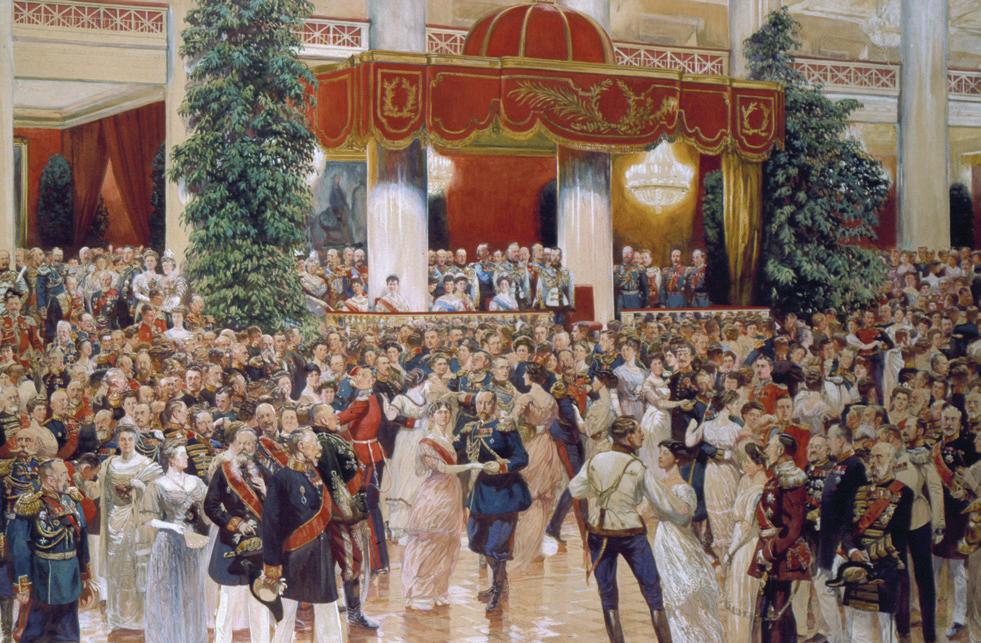
Since the reforms of Peter the Great, it had been possible for anyone who became educated to earn a job that granted noble rank. Even so, by the time of Tsar Nicholas II, the nobility remained a small, privileged group, numbering around 1.9 million people.
Peasants
UNCORRECTED SAMPLEPAGES
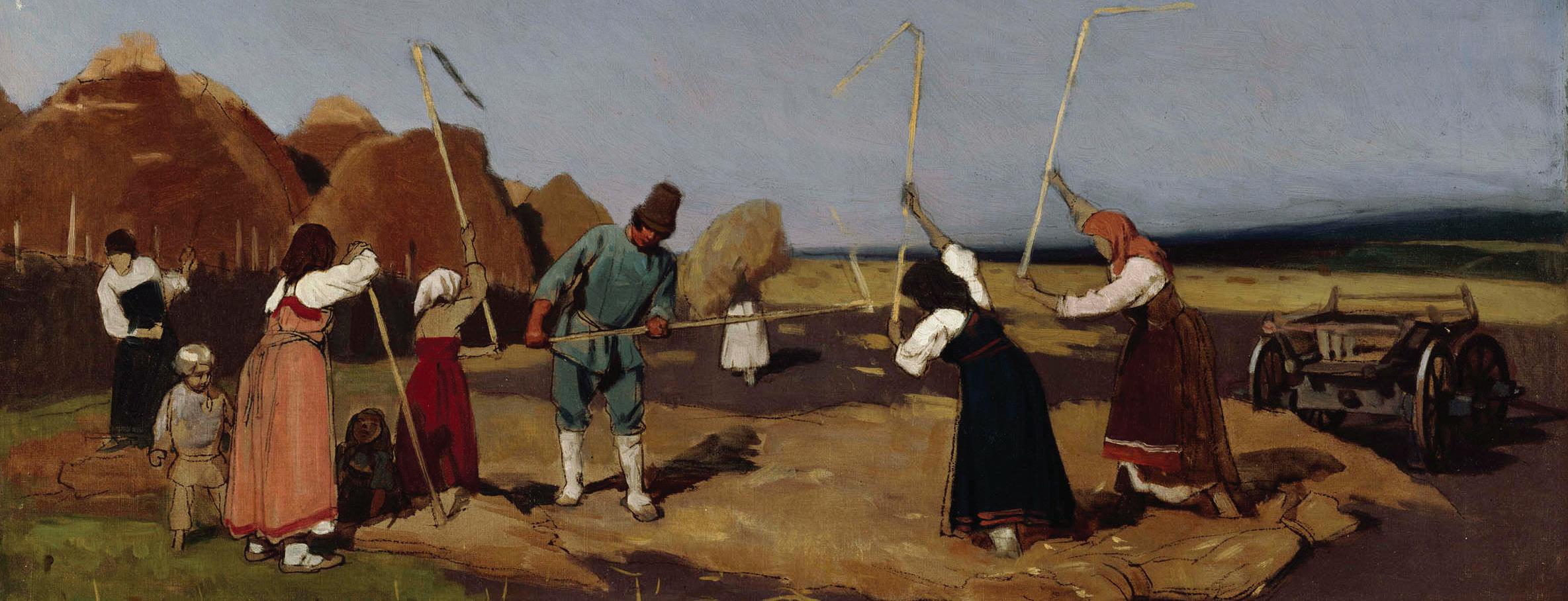
Beyond the grand palaces of Saint Petersburg, most people were poor. Around 8% of the population were peasants, who worked land that belonged to someone else – the church, the state or wealthy landowners. They had little access to education and few opportunities to improve their prospects. To visitors from Western Europe, their lives appeared closer to medieval times than to modern Europe.
Source 5.5.1 Dmitry Kardovsky’s painting of the 1913 ball in the Assembly of the Nobility House, Saint Petersburg, held in honour of 300 years of Romanov rule, shows the uniforms worn by the privileged ranks of Russian society.
Until the mid-nineteenth century, most peasants were serfs , who were effectively “owned” by their landlords, including the royal family and the nobility. The tsars gave landowners legal power over the lives of their serfs, including where they lived, what work they did and whether they could marry. Owners were entitled to whip serfs who disobeyed orders and could sell them to others, often splitting families apart.
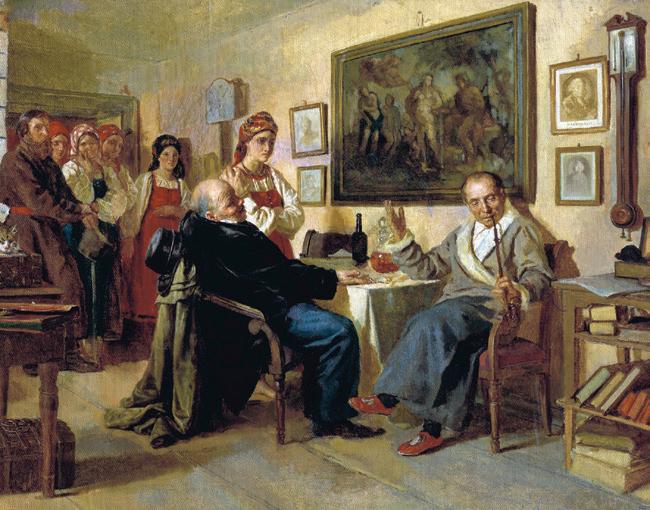
Source 5.5.3 A depiction of two wealthy landowners haggling over the price of a serf girl. Serfs had no rights and could be sold away from their families.
Russia was the last major European nation to emancipate its serfs. By the mid-nineteenth century, at least 23 million people in the empire were serfs, and they were not freed until Tsar Alexander II issued an emancipation decree in 1861. After this, former serfs were free to marry, own property and take part in the economy. However, emancipation did not end hardship. Russian peasants continued to live difficult lives.
A typical extended family shared one room and lived mainly on bread and cabbage soup, with meat eaten only occasionally. Infant mortality was high, and farms generally relied on outdated technology that often failed to produce enough food to meet the nation’s needs. Russia’s cold climate meant a short growing season, and when conditions were poor, famine could occur. Western European visitors often wrote that Russian peasants appeared to be living in the sort of poverty not seen since medieval times in other countries.
Education offered little relief. Few Russian peasants could read – the literacy rate across the empire was only around 24% when Tsar Nicholas II came to the throne. Many landowners believed that keeping peasants ignorant reduced the risk of discontent and demands for reform. Despite this, many peasants wanted access to more land, and some began to consider whether they should fight for it.
UNCORRECTED SAMPLEPAGES
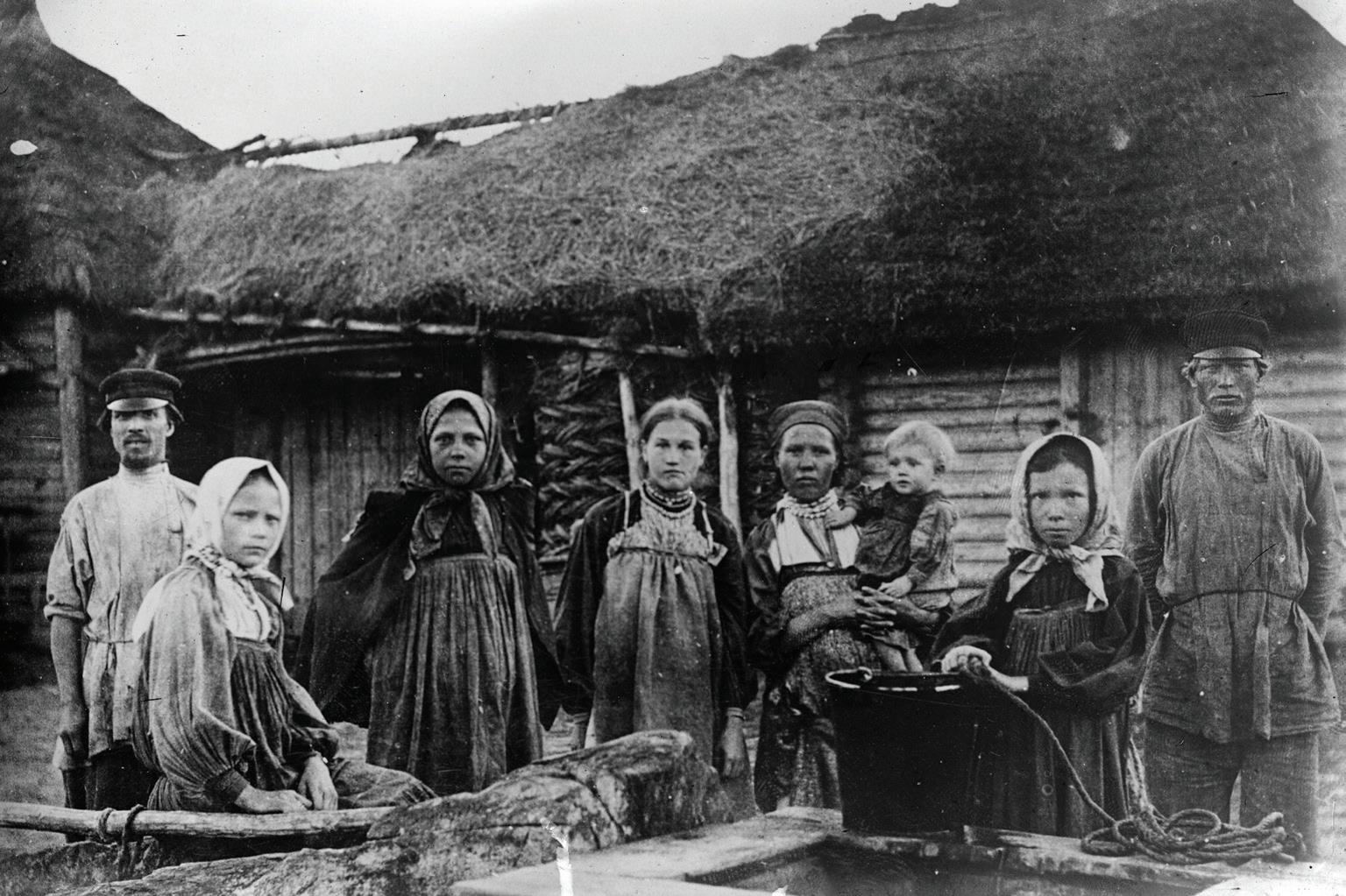
Source 5.5.4 Russian peasants outside a rural farmhouse, c. 1910
serf a member of the lowest social class of farm workers and servants, bound to the land and ruled by the landowner
Chapter 5 The decline and fall of the Romanov dynasty
Industrial working class
Russia was late to industrialise compared to other European nations. Factories had existed since the eighteenth century to manufacture iron, weapons and textiles, but as long as serfs were available as cheap labour, there was little incentive to introduce machinery and improve efficiency. After the abolition of serfdom, however, factory owners increasingly adopted imported machines.
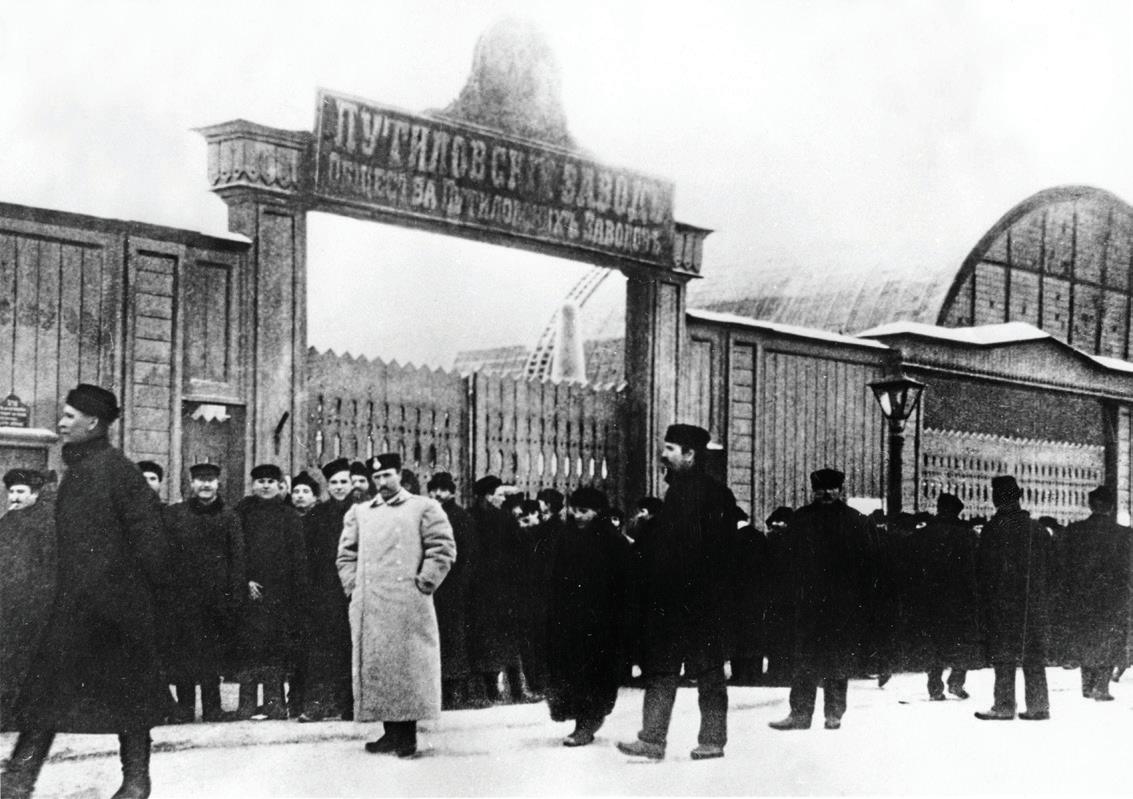
The largest factory in Saint Petersburg was the Putilov steel works, which employed thousands of workers. It produced rolling stock for the expanding railway network, built ships and manufactured artillery for the Imperial Army.
UNCORRECTED SAMPLEPAGES
Writing focus 5.5
Noun phrases (drafting)
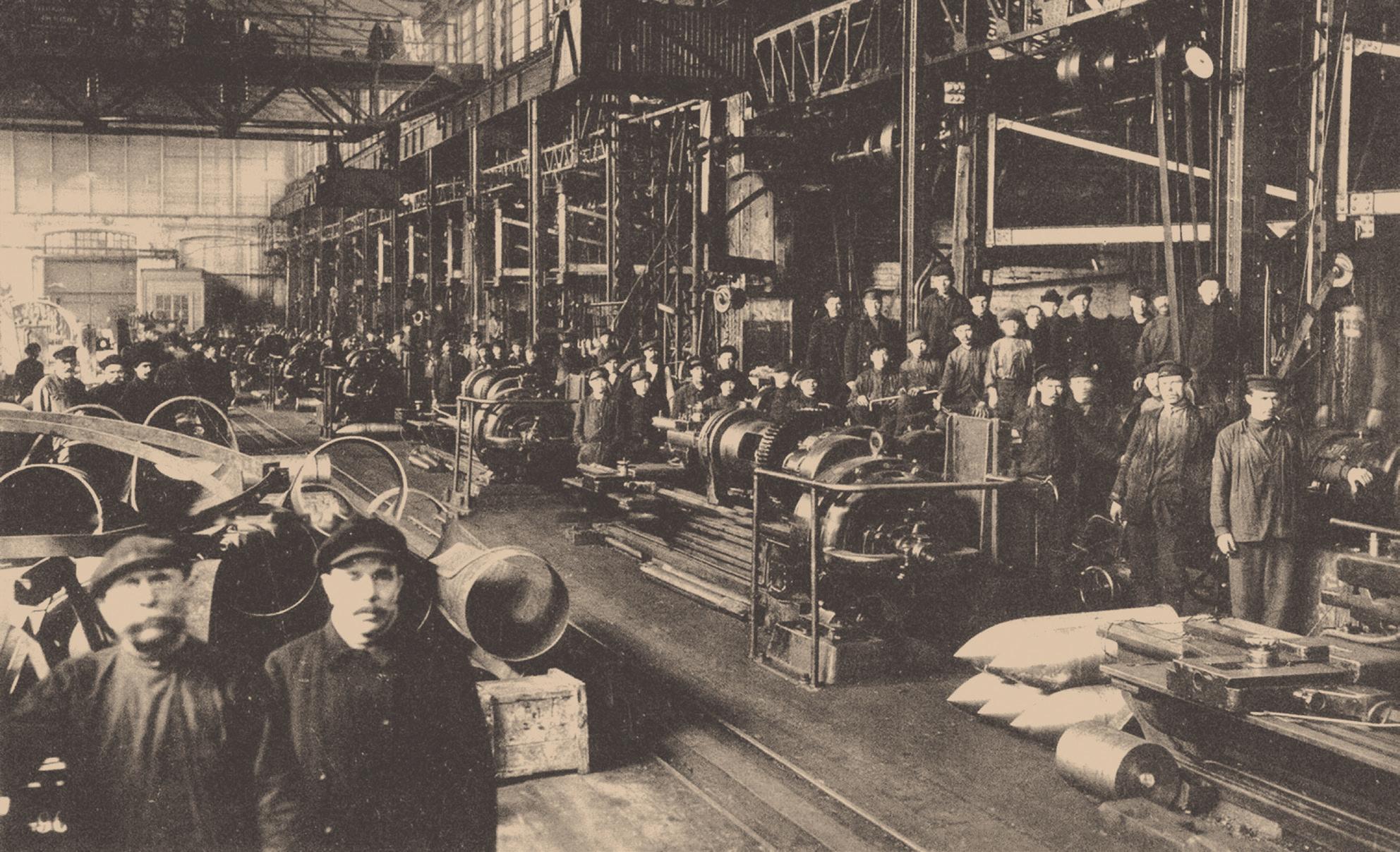
By the start of the twentieth century, industrialisation had created a growing working class in major cities such as Saint Petersburg and Moscow. Workers laboured 10–12 hours a day in noisy and dangerous factories and could afford only crowded, unsanitary housing.
Saint Petersburg’s population doubled in two decades, and a 1904 survey revealed an average of 16 people per apartment, often without running water. When trade unionists and socialists visited factories to demand better conditions and political rights, they found a receptive audience.
Source 5.5.5 One of the Putilov workshops making artillery, c. 1914. By 1900, the factory employed over 12,000 men.
Source 5.5.6 Putilov factory workers on strike, Saint Petersburg, 1905
ANALYSIS 5.4
Analysing a primary source
UNCORRECTED SAMPLEPAGES
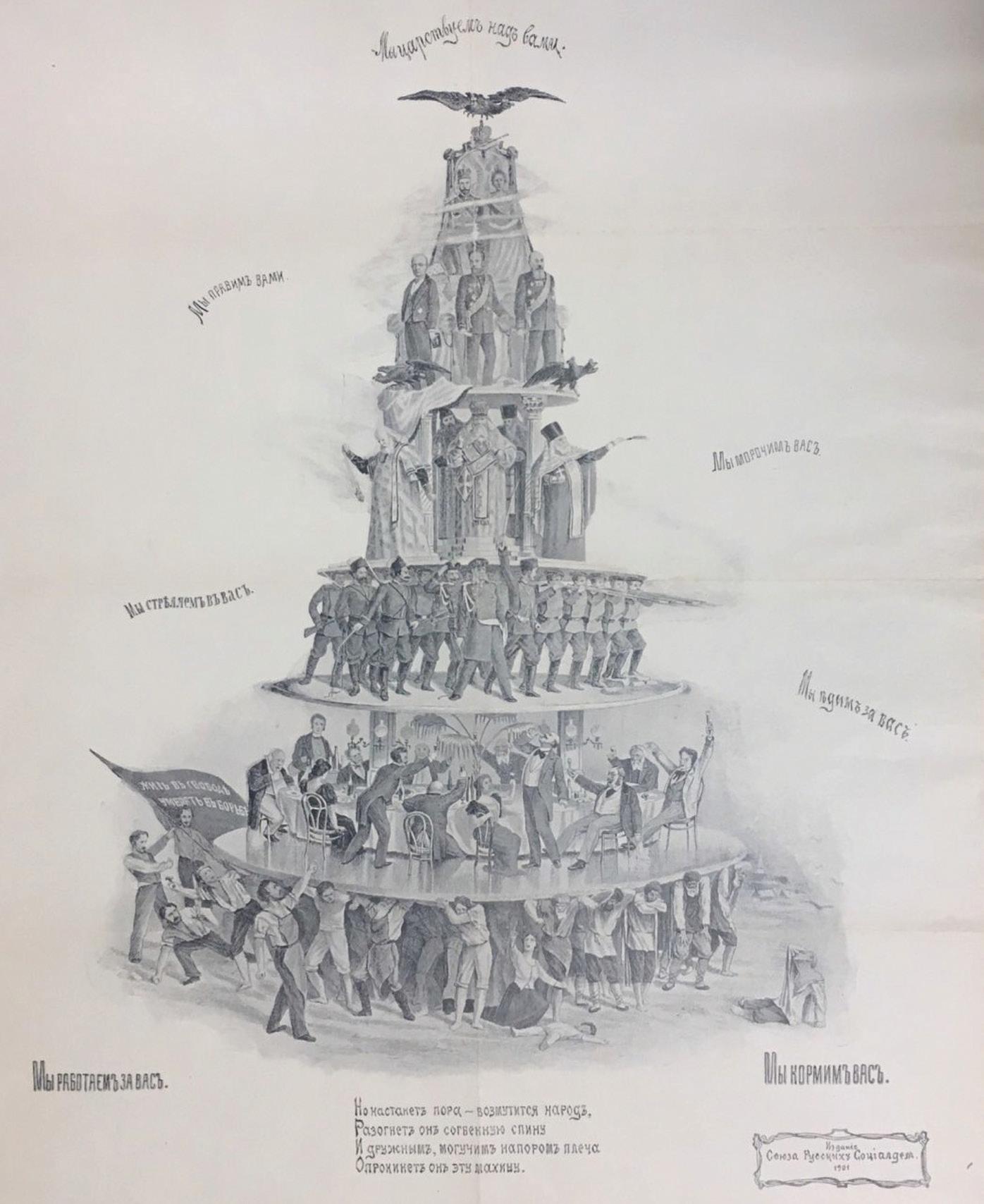
Source 5.5.7 A socialist caricature of the social pyramid of the Russian Empire, 1901.
Translation (top to bottom): “We reign over you” / “We rule you” / “We fool you” / “We shoot at you” / “We eat for you” / “We work for you – we feed you”. Bottom text: “The time will come: people will be indignant. They will straighten bent backs and with joint, mighty pressure of their shoulders they will overturn this colossus.”
1. Identify the social groups depicted in the cartoon.
2. Explain the message and purpose of the cartoon.
3. Describe the intended audience of the cartoon. Justify your answer.
4. The same pyramid style was used by socialists in other countries (e.g. France, Belgium and the United States). What does this suggest?
5. Analyse the value and limitations of the source in helping us understand Russian society at the time.
Historical concepts: Perspectives Historical skills: Analysis and use of sources
Chapter 5 The decline and fall of the Romanov dynasty
Ethnic tensions
The Russian Empire included diverse cultures, languages and religions, and tensions sometimes arose between groups. The Romanov tsars were members of the Orthodox Christian Church and favoured Orthodox worshippers and ethnic Russians. Many tsars also encouraged antisemitism (hatred of, or violence towards, Jews).
After Jewish revolutionaries were linked to the assassination of Tsar Alexander II in 1881, his son Tsar Alexander III allowed over 200 pogroms to take place within a single year. He also restricted where Jews could live, limited the number who could attend schools and banned Jews from working in government service. As a result, many Jewish people emigrated to the United States or Western Europe to escape persecution, while a significant proportion of those who remained joined reform movements, including socialist groups.
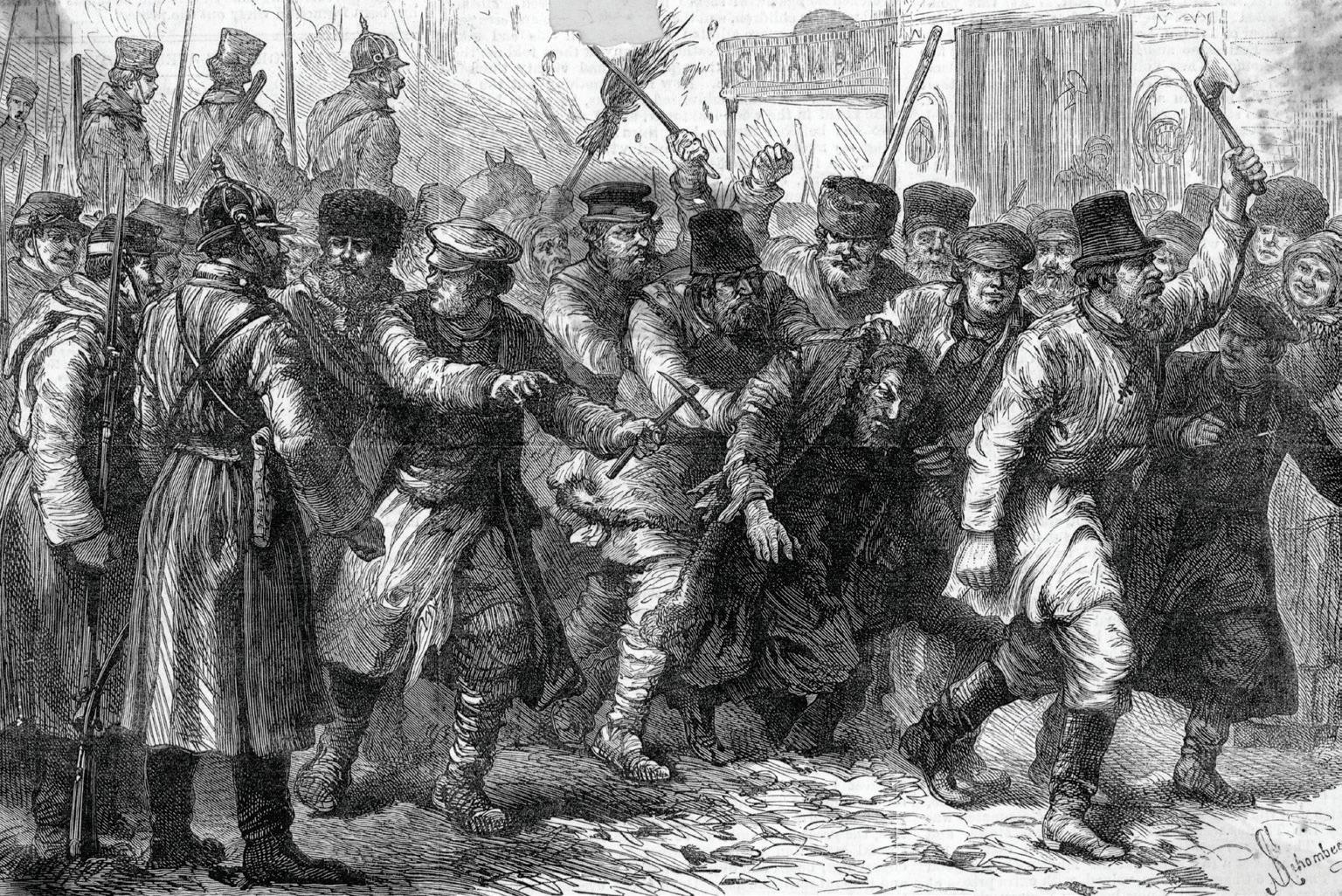
Source 5.5.8 An illustration depicting the assault of a Jewish man during a Russian pogrom, 1881
REVIEW 5.5
UNCORRECTED SAMPLEPAGES
1. Identify three key social groups in the Russian Empire.
2. Explain the privileges of the Russian nobility.
3. Explain the situation of around 80% of the population.
4. Explain why reformers and socialists found receptive audiences in Russian cities.
5. Select one source from this lesson (image or text) and develop at least five questions to research its historical context.
6. Research when serfdom and slavery were abolished in other countries (e.g. Britain, Austria, Germany and the United States). What does this suggest about Russia under the tsars?
pogrom an organised, violent attack on a particular ethnic or religious group, especially Jewish communities, involving killings, looting and the destruction of homes and property
Go online to assign and download questions, view results and more!
5.6 The development of opposition to the Romanovs
UNCORRECTED SAMPLEPAGES
DRIVING QUESTION
• What forms of opposition to the Romanovs developed, and why?
By the early twentieth century, two forces were on a collision course. One was Tsar Nicholas II’s faith in the Romanov tradition of autocracy. The other was modernisation: Russia’s cities and economy were industrialising, people were moving, and new ideas were developing.
Revolutionaries and reformers
Tsar Nicholas II did not welcome debate. For the first decade of his reign, political parties were illegal, and opposition movements could only develop underground.
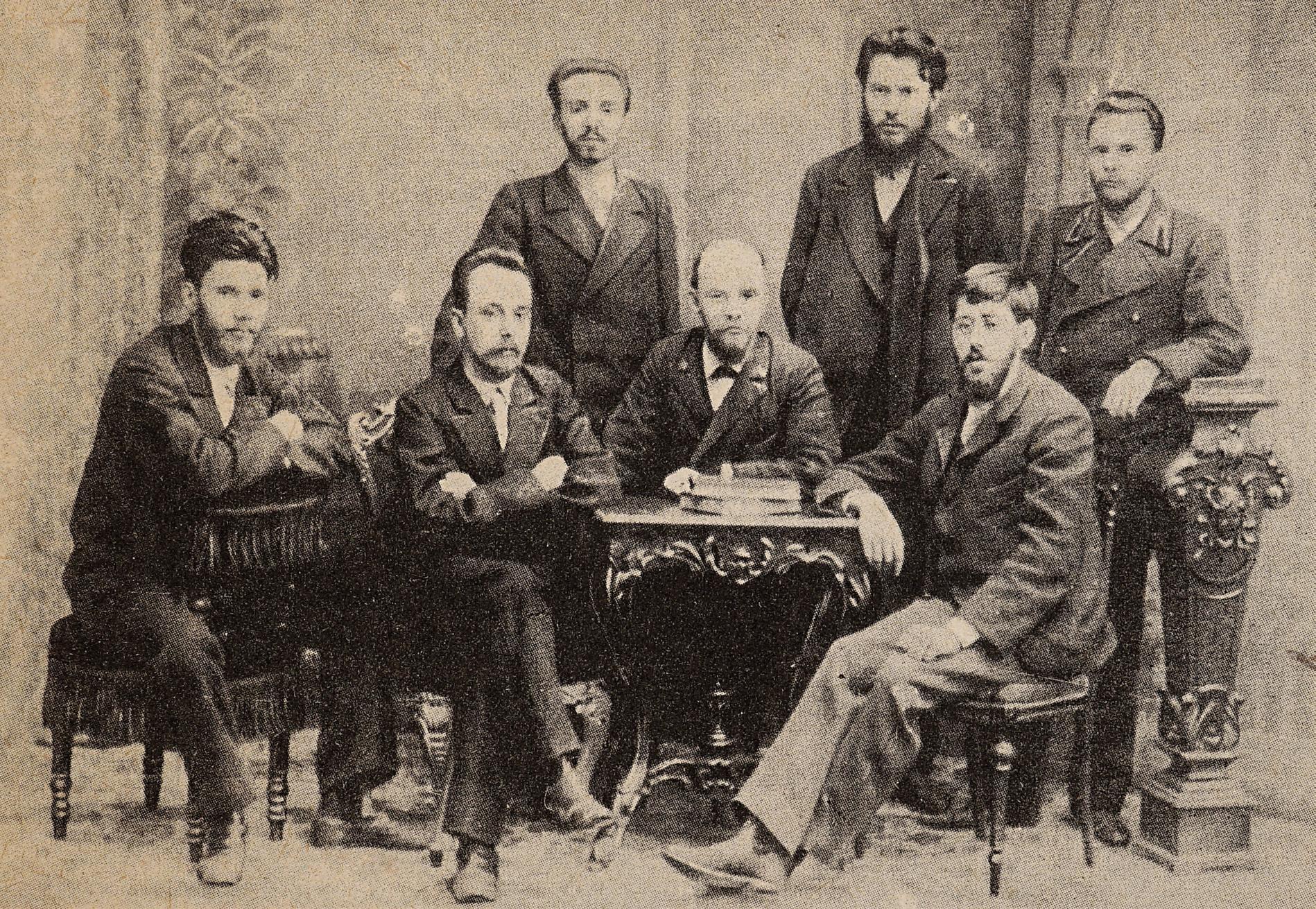
In 1895, when the Saint Petersburg League of Struggle for the Emancipation of the Working Class was established, its members were arrested. They later reorganised in secret as the Social Democratic Workers’ Party in 1898. Inspired by Marxism , they argued that the exploitation of workers in Russia’s new factories was no different from the centuries of exploitation of serfs and peasants in the countryside. When people questioned whether Nicholas II was leading Russia in the right direction, the Marxists’ answer was that the entire system needed to be swept away.
Marxism the social, political and economic theory based on the nineteenth-century writings of Karl Marx and Friedrich Engels, arguing that the means of production should be owned and controlled collectively
Source 5.6.1 Members of the Saint Petersburg League of Struggle in 1897. Lenin is seated in the centre; Martov is on the left.
SIGNIFICANT IDEA
Karl Marx (1818–1883) was a German philosopher whose ideas formed the basis of Marxism, a theory developed through his study of industrial economies and expressed most clearly in The Communist Manifesto, written in 1848 with Friedrich Engels. Marx and Engels argued that capitalist systems inevitably produced extreme inequality, which would eventually cause workers (the proletariat) to organise violent revolutions against factory owners and landowners (the capitalists). The working class would seize factories, mines and land, and redistribute them equally. Marx and Engels called this sharing of wealth “socialism”, and described the ideal end state as “communism”: a classless society in which people would work according to their abilities and be provided for according to their needs.
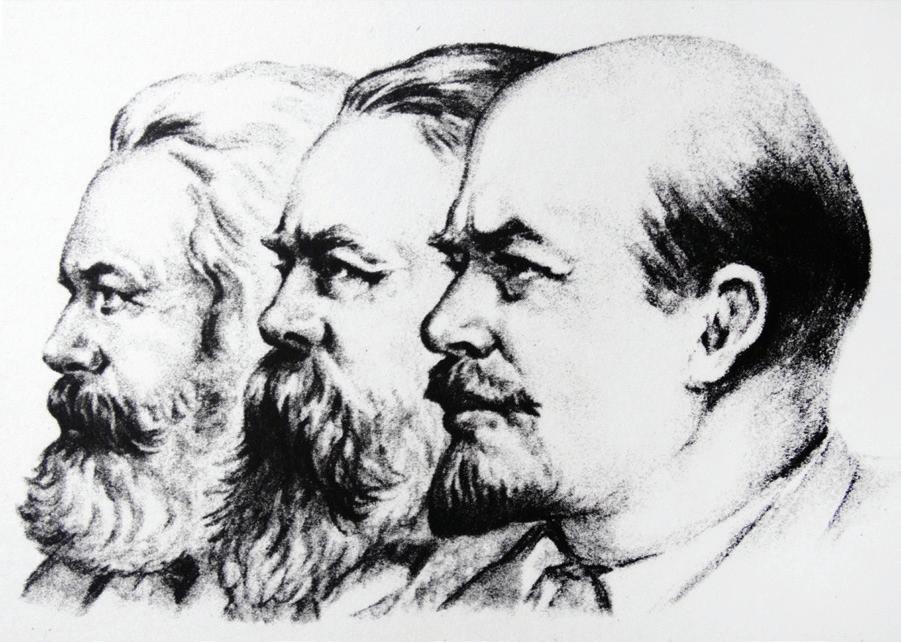
5.6.2 A popular representation of leading Marxists, from left: Karl Marx, Friedrich Engels and Vladimir Lenin
In 1903, the Social Democratic Workers’ Party – meeting outside Russia in Western Europe to avoid arrest – split into two factions: the Bolsheviks (revolutionaries) and the Mensheviks (more moderate). Another group, the Socialist Revolutionary Party, was less directly inspired by Marxism but also sought revolution. Its members used political violence to weaken the existing state. Some of its founders had previously belonged to earlier revolutionary organisations, including Narodnaya Volya (People’s Will), which had organised the assassination of Tsar Nicholas II’s grandfather in 1881. Between 1901 and 1917, Socialist Revolutionary members killed 139 tsarist officials. Other political parties called for reform rather than revolution.
Table
Party
Bolsheviks Vladimir LeninMarxists. Based on workers, but decisions made by leaders alone. Believed the party should seize power as the “vanguard” of a revolution and skip the capitalist stage, moving directly to socialism.
Nearly 10,000 members before 1914, but with Lenin living in exile, they had limited influence.
Mensheviks Julius MartovMarxists. Believed socialism should develop through a capitalist stage. Based on workers; decisions made by vote. Sought to educate workers to develop class consciousness.
Around 40,000 members; closely monitored by the Okhrana as a major threat.
Socialist Revolutionaries Viktor ChernovDemocratic socialists. Based mainly on peasants; organised into local cells. Believed land should be redistributed to peasants.
Over 50,000 members by 1906 and around 1 million by 1917.
Kadets Pavel MilyukovConstitutional Democratic Party. Mostly white-collar professionals. Believed the powers of the Tsar should be limited through constitutional monarchy; sought to abolish noble privilege.
The largest party; won one-third of seats in the first election.
UNCORRECTED SAMPLEPAGES
Octobrists Alexander Guchkov
Conservatives. Supported the Tsar’s October Manifesto: a parliament (Duma) with limited powers, while retaining the foundations of the Russian Empire.
Due to vote rigging, won the most seats in 1907.
Source
5.6.1 Overview of revolutionary and reformist groups
Writing focus 5.6
Transitional phrases
As long as the Russian people felt secure, they had little reason to question the status quo and continued to revere the Tsar as “our little father”. During times of crisis, however, people become more likely to question authority and listen to movements calling for reform or revolution.
UNCORRECTED SAMPLEPAGES
SIGNIFICANT EVENT
The Russo-Japanese War 1904–05
Nicholas II wanted to expand Russia’s influence in East Asia, through a strong presence in Manchuria, in north-eastern China, and the Korean Peninsula. However, the Japanese Empire also sought territory and influence in the region. The Tsar rejected advice from his minister of war to negotiate with China and Japan, leaving Russia without a clear strategy. In February 1904, Japan launched a surprise torpedo attack on the Russian naval base at Port Arthur (now Lüshun, China). The two sides then fought the first major war of the twentieth century, largely at sea.
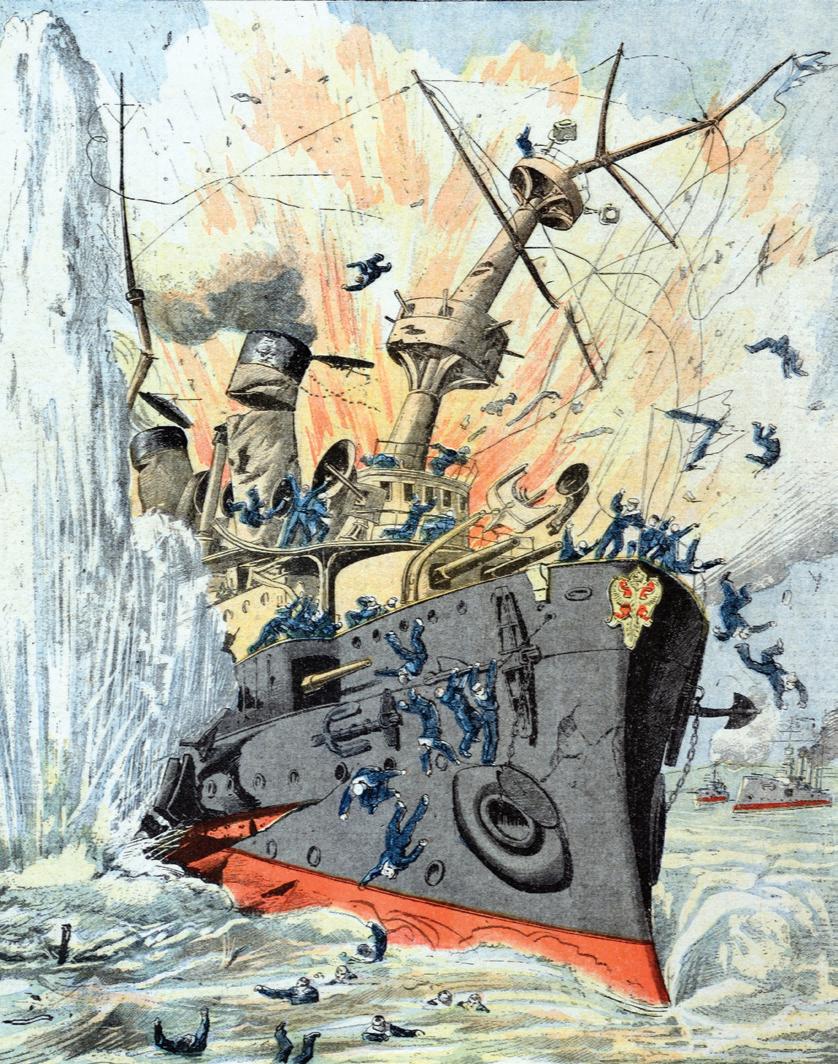
The Russo-Japanese War ended in September 1905 with Japan gaining control of Korea, parts of Manchuria and the southern half of Sakhalin Island, which Russia did not reclaim until 1945. Internationally, Japan’s victory was significant because it was the first time an Asian power had defeated a European one since the thirteenth century. In Russia, the defeat undermined confidence in Nicholas II’s leadership.
The 1905 Revolution
Alongside military defeat, an economic downturn left workers in Russian cities facing rising prices and unemployment. Workers organised strikes and protests to demand change. These pressures culminated in the 1905 Revolution.
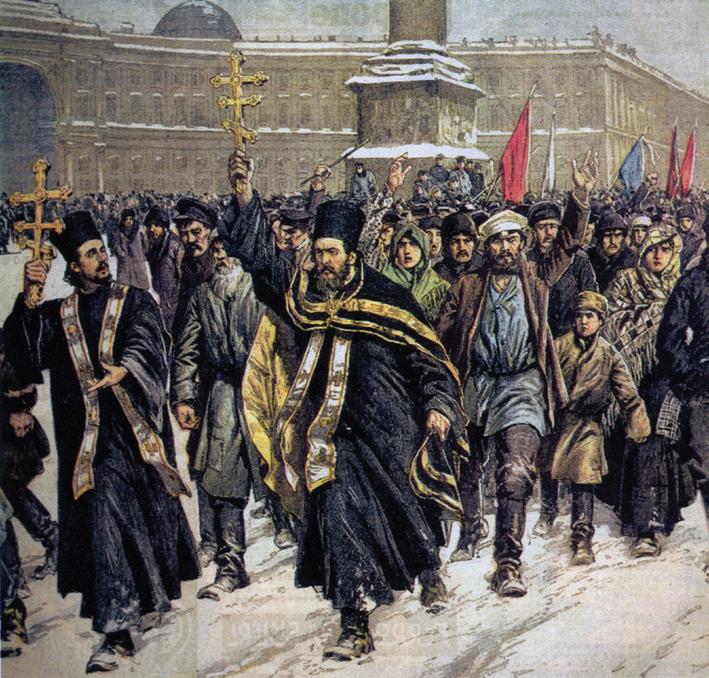
On a freezing Sunday morning on 22 January 1905, Russian Orthodox priest and leader of the Assembly of Russian Factory Workers, Father Georgii Gapon, led a march of tens of thousands of workers to the Winter Palace in Saint Petersburg. They carried a petition signed by 135,000 people, appealing to Nicholas II to improve workers’ living conditions and establish a “pre-parliament” – a constituent assembly to draft a modern constitution based on universal suffrage and civil liberties. The Tsar, however, was away from the palace, and the unarmed marchers were confronted by heavily armed security forces.
Source 5.6.3 An illustration of the sinking Russian battleship Petropavlovsk. More than 675 men drowned.
5 The decline and fall of the Romanov dynasty
A MATTER OF FACT
Georgii Gapon was originally set up in his role as leader of the factory workers’ union by the Okhrana (the secret police). The Tsar’s government mistakenly believed that Gapon would lead workers away from radical actions. Instead, Gapon became an inspirational leader of the workers and came into contact with socialists.
UNCORRECTED SAMPLEPAGES
ANALYSIS 5.5
Analysing a primary source
Sire, –
We working men of St Petersburg, our wives and children, and our parents, helpless, aged men and women, have come to you, O Tsar, in quest of justice and protection. We have been beggared, oppressed, overburdened with excessive toil, treated with contumely [contempt]. We are not recognized as normal human beings, but are dealt with as slaves who have to bear their bitter lot in silence ...
Refuse not to succour [save] your people; give orders without delay to representatives of all classes in the land to meet together. Let capitalists and workmen be present; let officials, priests, physicians, and teachers all come and choose their own delegates. Let all be free to elect whom they will, and for this purpose let the elections to the Constituent Assembly be organized on the principle of universal suffrage. This is our principal request, on which everything else depends.
January 1905 petition, quoted in Georgii Gapon. 1906. The Story of My Life, 257.
1. Identify the creators of the source. How do they describe themselves?
2. Explain the nature and status of the source.
3. Explain to whom the source is addressed. What does this show?
4. Explain the principal request of the petition.
5. Discuss the significance of the petition.
Historical concepts: Significance Historical skills: Analysis and use of sources
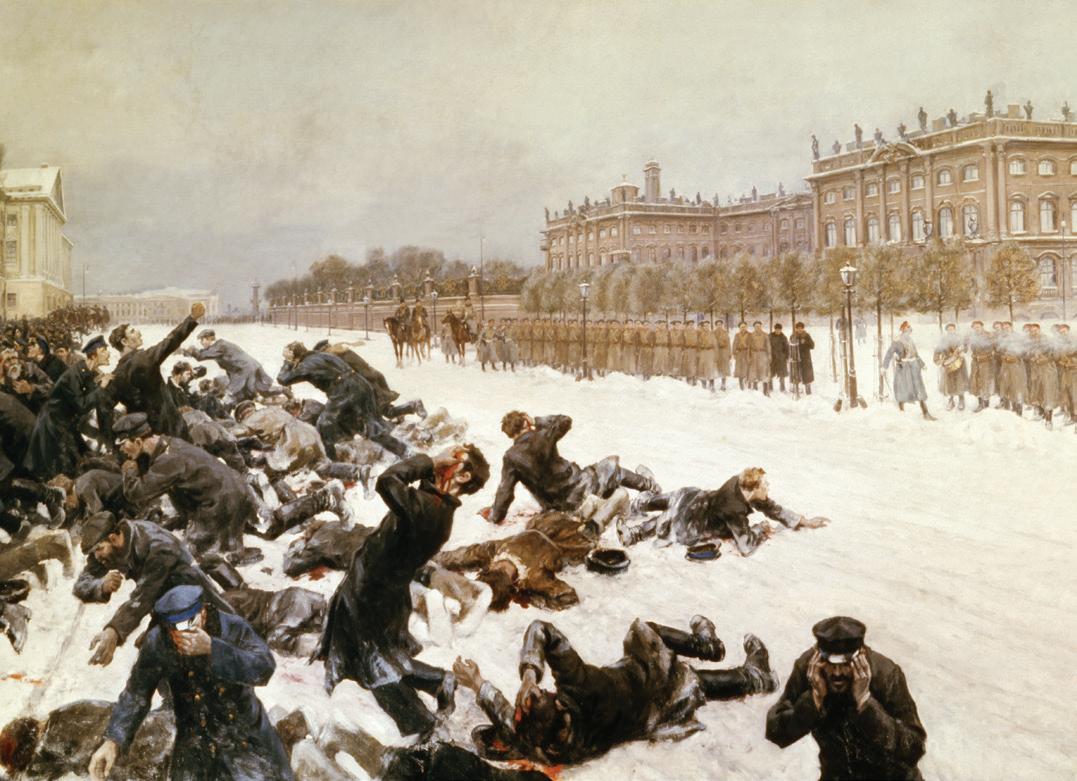
Outside the empty palace stood troops with orders to fire on anyone who approached. They did so. Hundreds of unarmed protesters were shot; historians estimate that around 200 people were killed and 800 wounded. The massacre became known as “Bloody Sunday”. Father Georgii Gapon reportedly told Lenin, “We have no Tsar any more. Rivers of blood separate the Tsar from the people.”
Source 5.6.4 A painting of Father Gapon leading the crowd on Bloody Sunday
Source 5.6.5 Extract from the 1905 petition from the Russian people to Nicholas II
In his diary, Nicholas II described the march as “serious disorder” and said the killings were “painful and sad”. In response to continued unrest, the Tsar offered limited concessions, including a consultative assembly whose representatives could advise the Tsar. However, protesters demanded a genuine legislature and full voting rights. Workers joined trade unions and the unions published their own newspapers, even though both activities remained illegal.
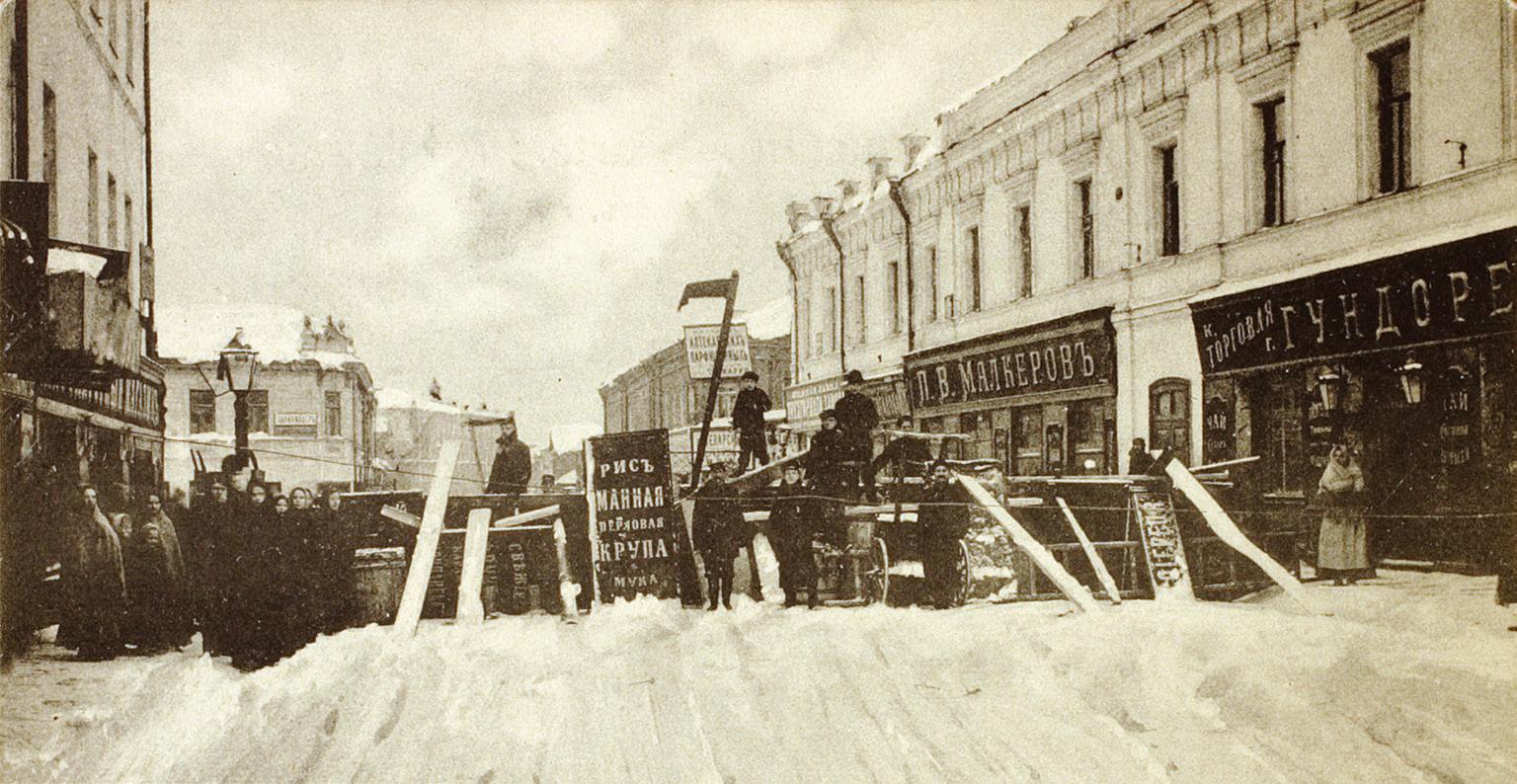
Protests continued for 10 months. In October, a nationwide general strike brought factories, railways, government offices, businesses, schools and universities to a halt. Millions of workers stopped work, and naval sailors in the port of Sevastopol mutinied against their commanders. The strikers repeated the demands of Bloody Sunday: civil liberties and a constitution.
UNCORRECTED SAMPLEPAGES
1. Identify the underground socialist group that developed in secret in the late 1890s.
2. Explain the role of Marxism in the development of opposition groups.
3. Explain what the Russo-Japanese War revealed about Tsar Nicholas II’s leadership.
4. Explain why the events of Bloody Sunday were significant.
5. Discuss the reforms that workers and other opposition movements were calling for. How radical were they?
6. Discuss Tsar Nicholas II’s responses to the growth of opposition movements. What does this suggest about his character?
Source 5.6.7 Barricades on Seleznevskaya Street, Moscow, during the 1905 Revolution
Source 5.6.6 An artist’s representation of the Tsar’s troops shooting demonstrators on Bloody Sunday
5 The decline and fall of the Romanov dynasty
5.7 After the 1905 Revolution
DRIVING QUESTION
• How did Russia change after the 1905 Revolution?
The October Manifesto
At first, Tsar Nicholas II believed that he could silence the 1905 Revolution through force, but his advisers changed his mind. Sergei Witte, Chairman of the Council of Ministers, persuaded Nicholas II to issue the October Manifesto, offering some of what protesters were demanding.
Source 5.7.1 Extract from The Manifesto on the Improvement of Social Order, 1905
The oath which We took as Tsar compels Us to use all Our strength, intelligence and power to put a speedy end to this unrest which is so dangerous for the State ...
1. Fundamental civil freedoms will be granted to the population, including real personal inviolability, freedom of conscience, speech, assembly and association.
2. Participation in the Duma will be granted to those classes of the population which are at present deprived of voting powers …
3. It is established as an unshakeable rule that no law can come into force without its approval by the State Duma …
Nicholas II. 1905. Manifesto on the Improvement of Social Order, 17 October.
The October Manifesto was welcomed by moderate liberals, who saw it as a step towards parliamentary democracy and away from autocracy. Socialists, however, criticised the manifesto for doing little to improve conditions for the poor and for making promises rather than delivering genuine change. These doubts deepened in November 1905, when the Tsar’s police arrested 260 members of the Saint Petersburg Soviet and forced workers’ newspapers to close.
Writing focus 5.7
Source analysis (perspective)
UNCORRECTED SAMPLEPAGES
Soviet a workers’ council based on socialist principles (soviet is Russian for council or assembly)
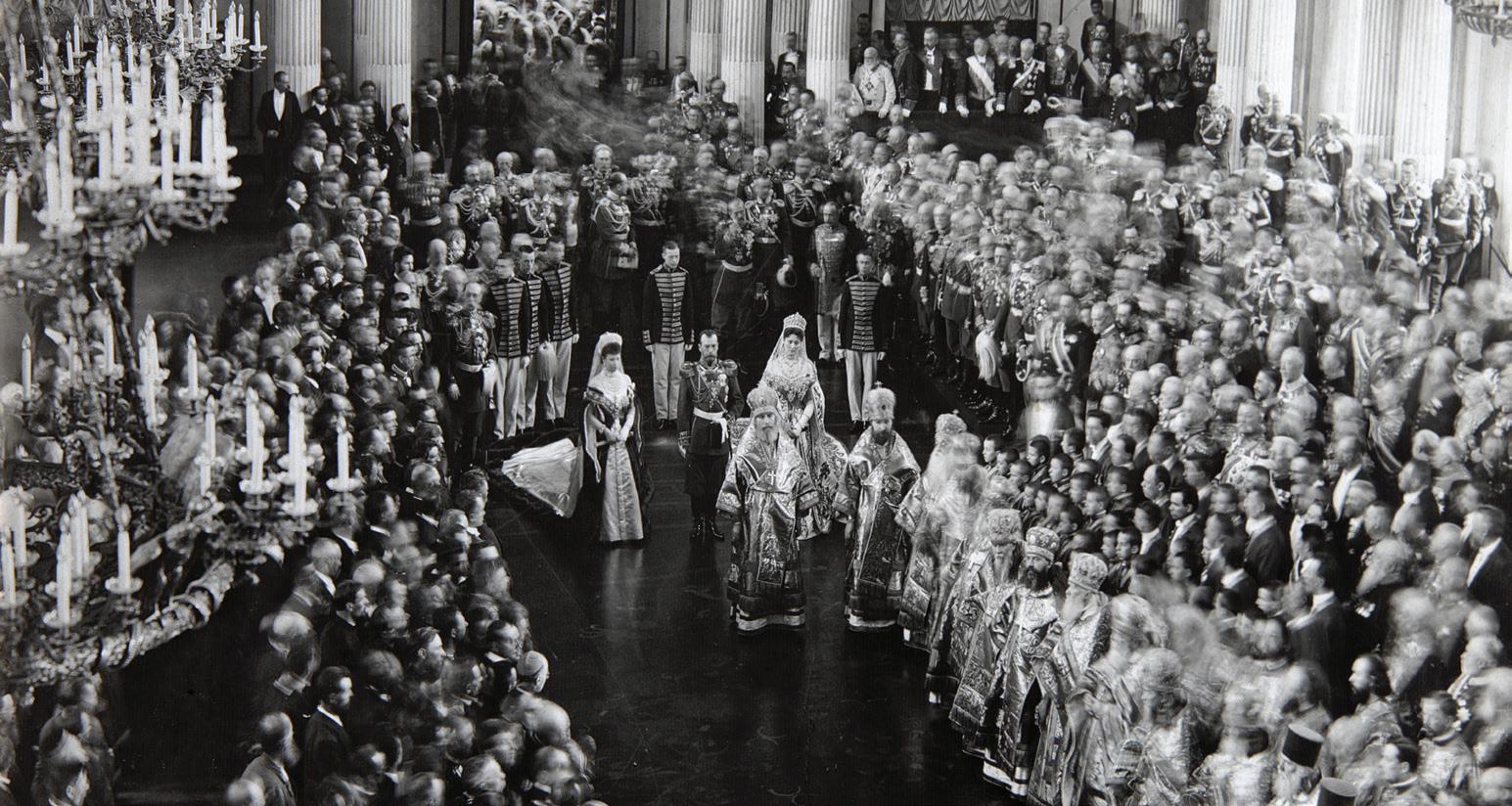
Source 5.7.2 Nicholas II and Alexandra formally open the first Duma (parliament) in Saint Petersburg, April 1906.
Tsar Nicholas II waited six months before delivering the promised reforms. In April 1906, he introduced the Fundamental Laws of the Russian Empire, Russia’s first constitution. Political parties were legalised, all Russian men were granted voting rights, and a legislature – the Duma – was established. However, the laws also confirmed that the Tsar was Russia’s “Supreme Sovereign”, whose authority must be obeyed. Many limits remained on the reforms, and these were tightened further in 1907, when the rules were suddenly changed.
ANALYSIS 5.6
Analysing continuity and change
Table 5.7.1 Key provisions of the Fundamental Laws of the Russian Empire, 1906
Fundamental law Effect
Voting rightsInitially, voting laws for Duma elections were weighted in favour of landowners and peasants. In 1907, after peasant delegates criticised the government, the laws were changed to favour landowners. Although most adult men could still vote, the system ensured that only 2–3% of the population controlled the majority of seats in the Duma.
Law-making powersThe Tsar could veto (block) any piece of legislation.
Upper house The State Council, whose members were appointed by the Tsar and/or came from high-ranking noble families, could reject any proposed law from the Duma.
Ministers Finance, the military, foreign policy and other key areas of power were controlled by ministers personally appointed by the Tsar.
Article 87 The government (the Tsar and his ministers) could declare a state of emergency at any time and pass laws while the Duma was not in session.
1. Identify the source summarised in Table 5.7.1. What is its origin?
2. Explain two ways in which the law-making power of the Duma was limited.
3. Explain the significance of the powers of the Tsar and his ministers under the law.
4. Analyse the continuities and changes that were occurring to autocracy in Russia, according to the source.
Historical concepts: Continuity and change Historical skills: Analysis and use of sources
In 1906–07, the Tsar was reasserting his autocratic authority even while allowing new political arrangements. Workers’ organisations were placed under surveillance by the secret police, and in July 1906, when the Bolsheviks and other socialists used Duma debates to criticise the regime, Nicholas II dissolved the Duma. He and his ministers then ruled alone for the next six months. Liberals and socialists responded by signing the Vyborg Manifesto, which urged citizens to refuse to pay taxes until the Duma was restored.
Source 5.7.3 Historians Bucklow and Russell on Nicholas II's relationship with the Duma
UNCORRECTED SAMPLEPAGES
The Tsar never accepted the Duma. It was a concession granted reluctantly in a moment of panic; when the crisis subsided it was a concession he was only too happy to retract …
M Bucklow and G Russell. 1991. Russia: Why Revolution? 112.
Chapter 5 The decline and fall of the Romanov dynasty
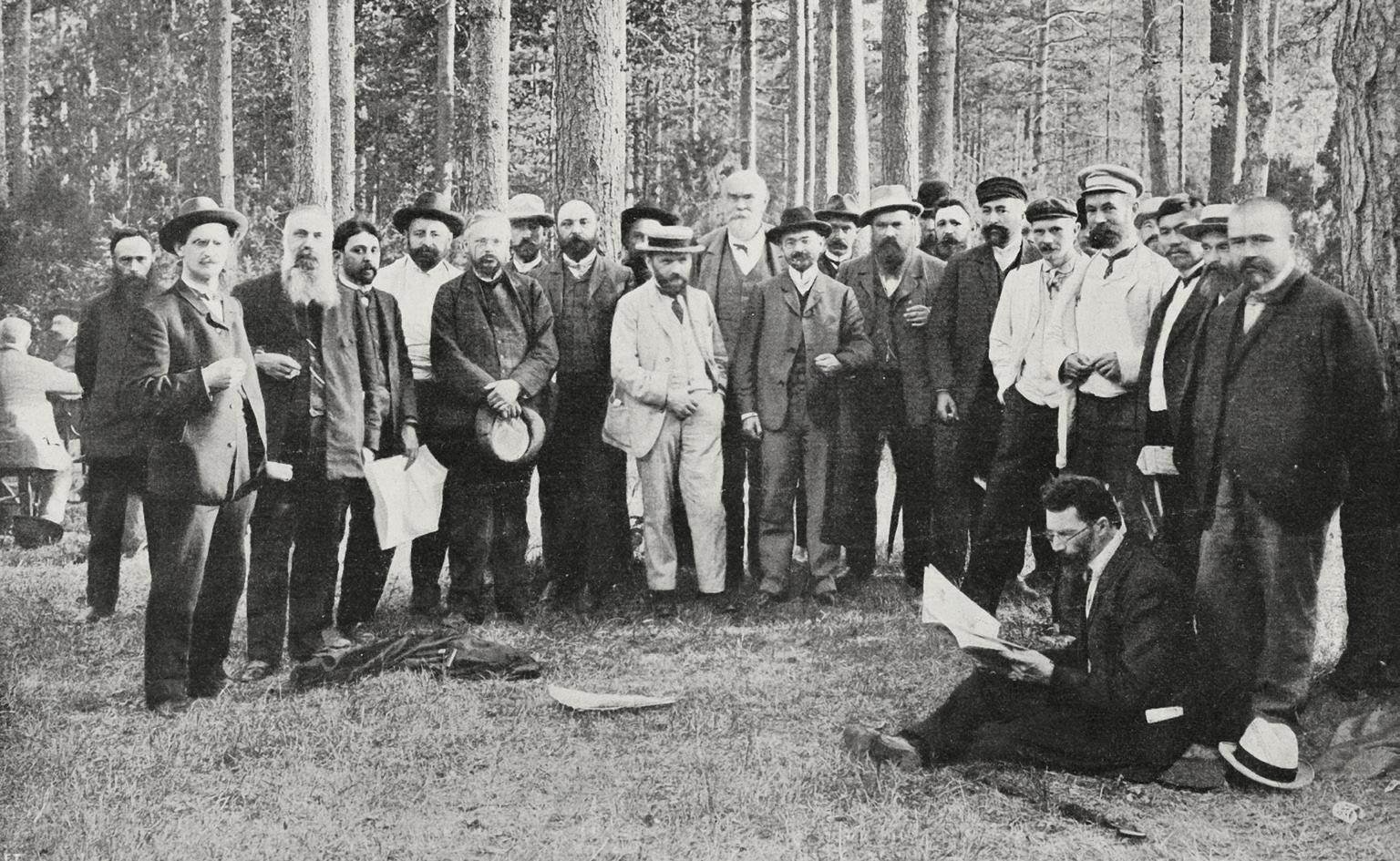
UNCORRECTED SAMPLEPAGES
The Tsar’s ministers
Nicholas II appointed increasingly harsh ministers to deal with opposition. In July 1906, Pyotr Stolypin was appointed Prime Minister. Stolypin believed that reform and repression had to occur together, stating: “As the revolution is so strong … I must carry through effective measures of reform, and at the same time I must face revolution, resist it, and stop it.” He relied on martial law and the secret police to maintain order. One Bolshevik grimly referred to the hangman’s noose as “Stolypin’s necktie” owing to the thousands of revolutionaries he had executed.
SIGNIFICANT INDIVIDUAL
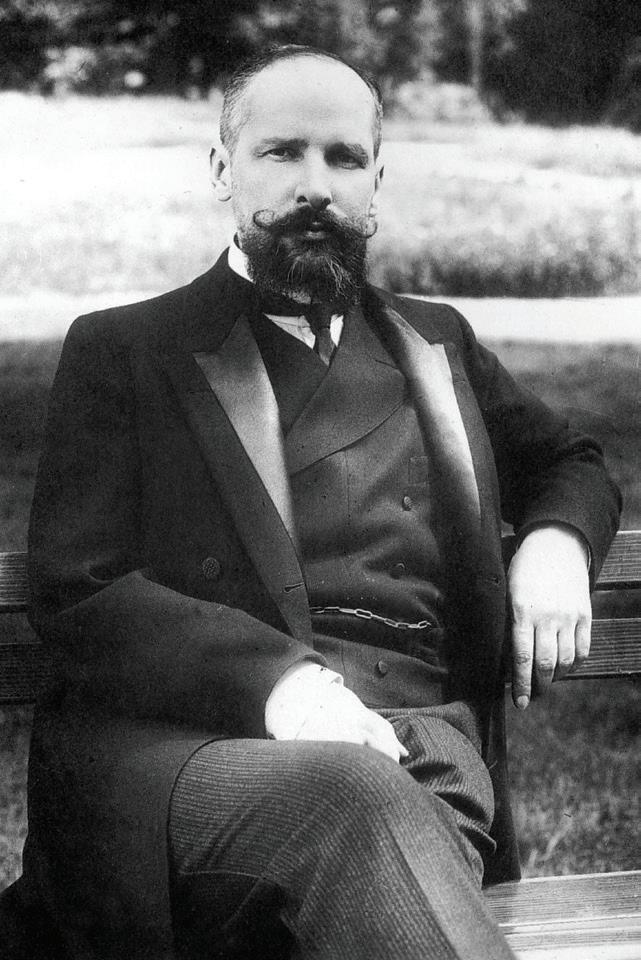
Pyotr Stolypin (1862–1911) was born in Germany to a prominent Russian noble family. He studied agriculture and impressed the Tsar while serving as a regional governor in Lithuania, where he supported limited reforms for peasants while enforcing strict public order. Appointed prime minister in 1906, he excluded socialists from the Duma, changed voting laws to favour conservatives and promoted private land ownership among peasants. His policies angered socialists, and he moved into the Winter Palace for protection after several assassination attempts. Stolypin eventually lost the Tsar’s trust after presenting Nicholas II with a report detailing the drunken and sexual behaviour of the mystic healer Rasputin, who was close to the Tsarina. Shortly afterwards, Stolypin was assassinated.
Source 5.7.4 After Nicholas II dissolved the Duma in July 1906, some elected deputies continued their meeting outside in protest.
Source 5.7.5 Prime Minister Pyotr Stolypin
Russia before the world war
After the 1905 Revolution subsided, Tsar Nicholas II’s position appeared more secure. There was less discontent among peasants, the economy grew and the military began to modernise. However, urban workers were angry at being locked out of politics and regularly shut down industries to demand better conditions. Meanwhile, revolutionaries operating outside Russia had not abandoned their goals.
Historians point to two events that suggest Russia was on the brink of more unrest:
• In September 1911, Prime Minister Stolypin was assassinated at an opera performance in Kyiv, despite heavy security. Because the assassin, a Jewish Ukrainian socialist revolutionary, was being paid by the secret police, and Tsar Nicholas II personally intervened to cancel the investigation, conspiracy theories quickly emerged.
• In April 1912, the Tsar’s troops were sent to the Lena River goldfields in Siberia to suppress a major strike. Soldiers opened fire and killed around 250 unarmed workers. In solidarity, workers across Russian cities shut down industries in strikes that rolled on for months.
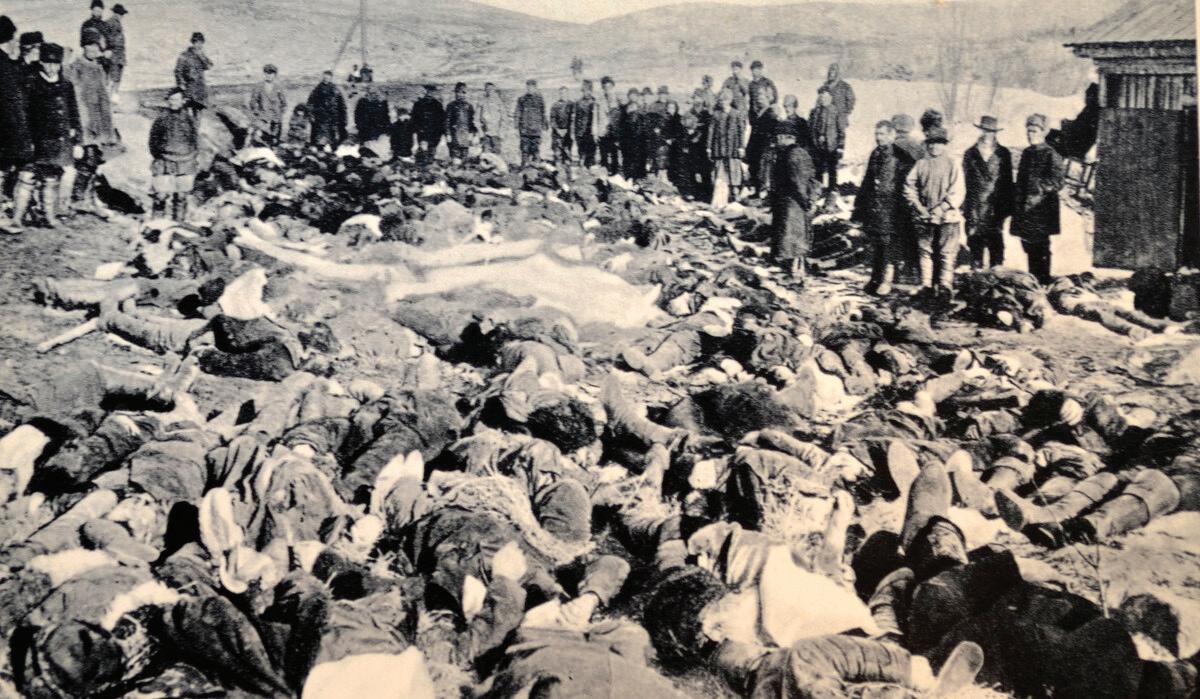
UNCORRECTED SAMPLEPAGES
1. Identify what the Tsar did in October 1905 and why.
2. Explain how political groups responded to the Tsar’s October 1905 action.
3. Explain what the Tsar did in April 1906, and the consequences.
4. Explain what the Tsar did in July 1906, and the consequences.
5. Research the Vyborg Manifesto. In a paragraph, summarise its causes and consequences.
6. Research the Lena River goldfields massacre. In a paragraph, summarise its causes, consequences and links to the Tsar and the Romanov family.
5.8 The role of the First World War in the collapse of the Romanov dynasty
UNCORRECTED SAMPLEPAGES
DRIVING QUESTION
• How did the First World War affect Russia?
The Romanovs had grandparents, uncles, aunts and cousins in the royal families of Britain, Denmark, Germany, Greece, Hesse, Norway, Romania, Spain and Sweden. For generations, these families married among themselves, meaning they often had more in common with each other than with the peoples they ruled. Kaiser Wilhelm of Germany, King George of Britain and Nicholas II’s wife, Alexandra, were all grandchildren of Britain’s Queen Victoria. In theory, such close family relationships should have helped preserve peace and understanding between nations. However, during the First World War, Nicholas II found himself allied with his cousin King George against Kaiser Wilhelm.
Russia’s involvement in the war
Russia entered the war because of its commitments under the Triple Entente and its support for Serbia, a fellow Orthodox Christian nation. After tensions escalated across Europe following the assassination of the heir to the Austro-Hungarian throne by a Bosnian Serb on 28 June 1914, Nicholas II attempted to use his family connections to prevent war. Despite exchanging telegrams with the German Kaiser –in which they addressed each other as “Nicky” and “Willy” – neither cousin was able to prevent their alliances from drawing them into conflict. On 30 July 1914, Nicholas II ordered the general mobilisation of Russian troops, and on 1 August 1914, Germany declared war on Russia.
When Russia entered the war, crowds cheered as troops paraded past the Tsar on their way to the front. This early enthusiasm soon faded. It quickly became clear that the enormous Russian army – the largest in Europe at the outbreak of war, with 1.4 million regular soldiers and several million reserves – was poorly equipped, with fewer rifles than soldiers. There was also vocal opposition to the war. Lenin and the Bolsheviks argued that it was simply another example of the wealthy classes “fighting a war for the purpose of retaining the colonies they have grabbed and robbed”.
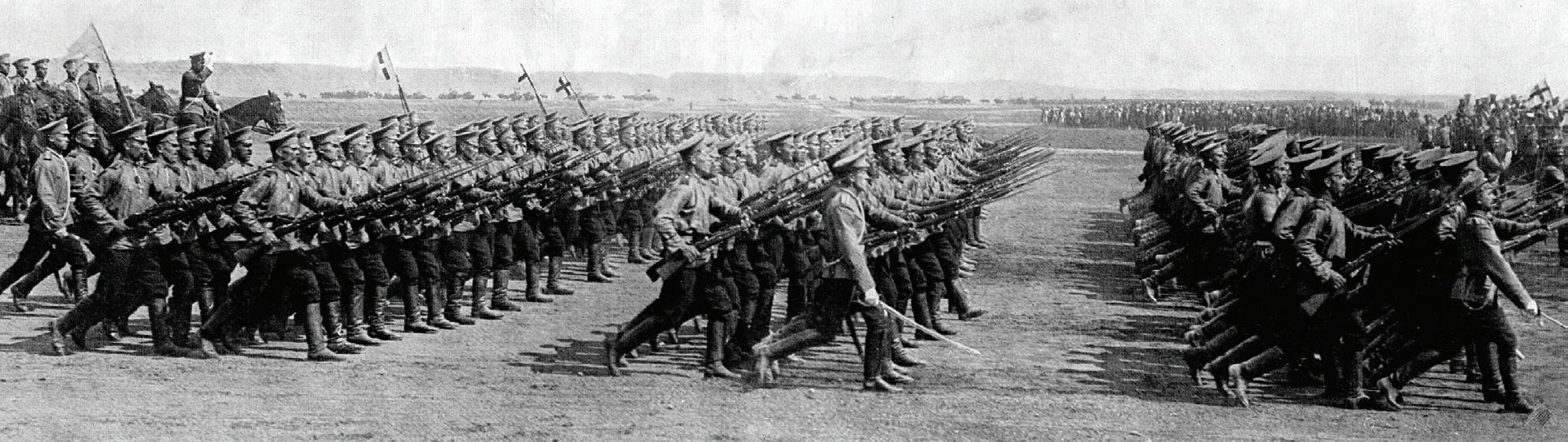
Source 5.8.1 Russian troops march towards the front at the start of the First World War, 1914. Some marched there without weapons, due to a national shortage.
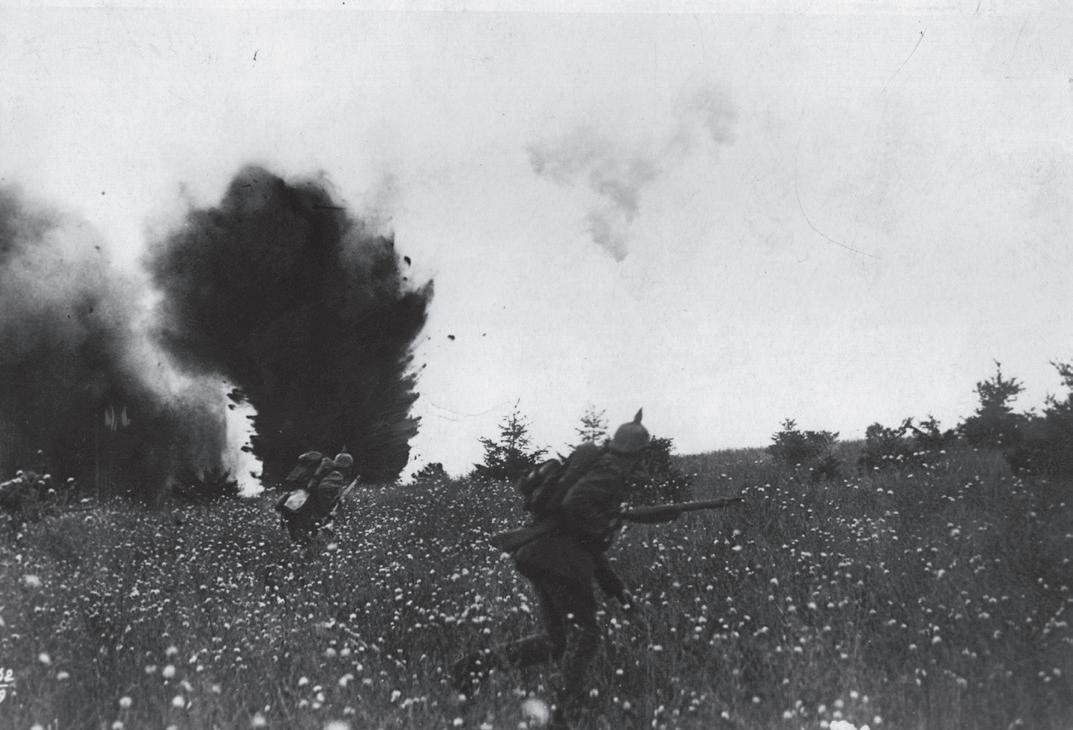
Military difficulties
Russia fought Germany and Austria-Hungary on the Eastern Front, while other Allied forces fought on the Western Front. Nicholas II believed that the war offered an opportunity to expand Russian territory, particularly at the expense of the Ottoman Empire along the Black Sea.
UNCORRECTED SAMPLEPAGES
Congress Poland corresponds to modernday central and eastern Poland, including small regions of Lithuania and Belarus

Key:Key Russian attacks
German attacks
Austrian attacks
Frontline 1914
Pre-war border
These hopes were quickly undermined by major defeats. At the Battle of Tannenberg in August 1914, Russian forces suffered around 130,000 casualties, and more than 100,000 soldiers were captured. At the Battle of the Masurian Lakes on 2 September, an entire Russian army unit was forced to surrender. By the end of 1914, around 400,000 Russian soldiers had been killed and 1 million wounded. From June to September 1915, in an effort to reduce further losses, the Russian army carried out a strategic “Great Retreat” from parts of the Eastern Front, including Galicia and Congress Poland . Morale among soldiers was often low, as they endured muddy trenches and chronic shortages of uniforms, ammunition and food.







RUSSIA
Source 5.8.3 The Eastern Front, 1914
Source 5.8.2 German soldiers in action against the Russian army during the Battle of Tannenburg
5 The decline and fall of the Romanov dynasty
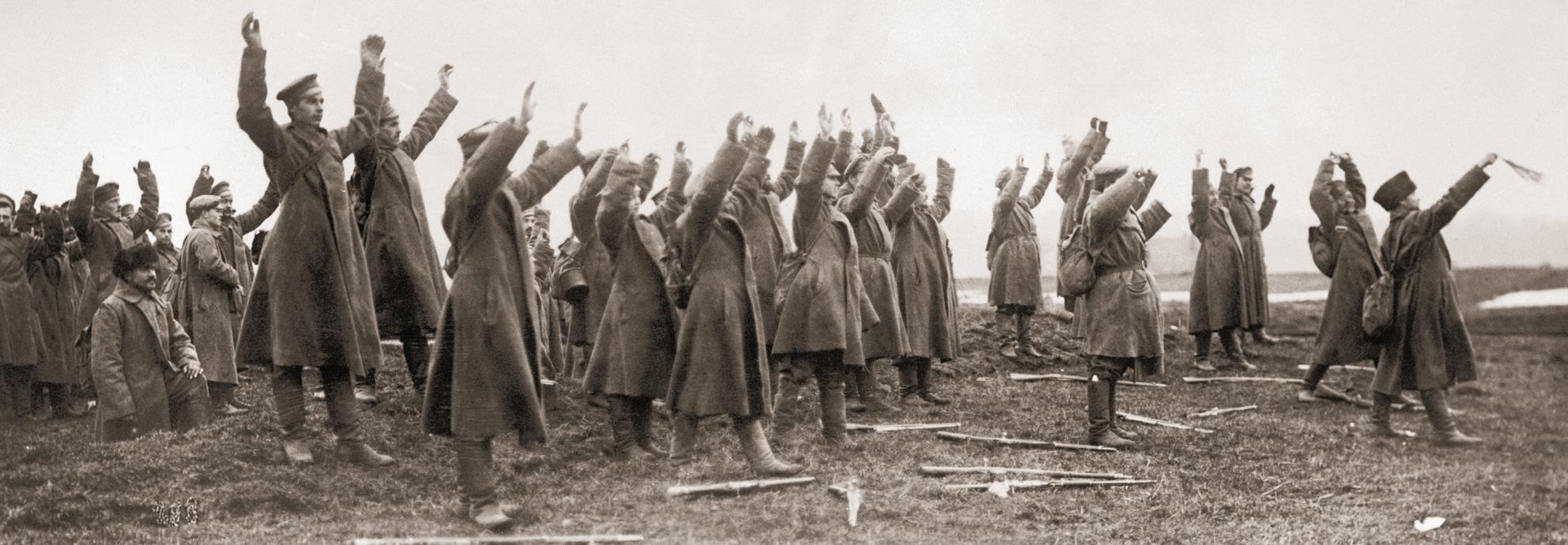
UNCORRECTED SAMPLEPAGES
By 1916, the Russian army had grown through conscription – by law, the government could call up every fit man aged between 20 and 43 – and its performance began to improve. Russian forces held Germany on the Eastern Front and achieved some successes against Austria-Hungary and the Ottoman Empire. These gains, however, came at a huge cost. By 1916, around 3 million Russians had been killed or wounded, and nearly as many had been captured.
Economic and social impacts
On the home front, civilians also suffered. The army was given priority access to grain, food, clothing and supplies, leaving people at home facing shortages. Many peasants responded as they had in earlier hard times by hoarding grain, which further worsened food scarcity.
In cities such as Petrograd (the new name for Saint Petersburg), people queued for hours outside bakeries and food stores in the harsh Russian winter. Even when basic goods were available, inflation meant wages bought less than before. Fuel shortages reduced heating in homes and limited power for factories, lowering output in industries that supplied everyday, non-military goods. In response, some workers went on strike to demand higher wages and more food.
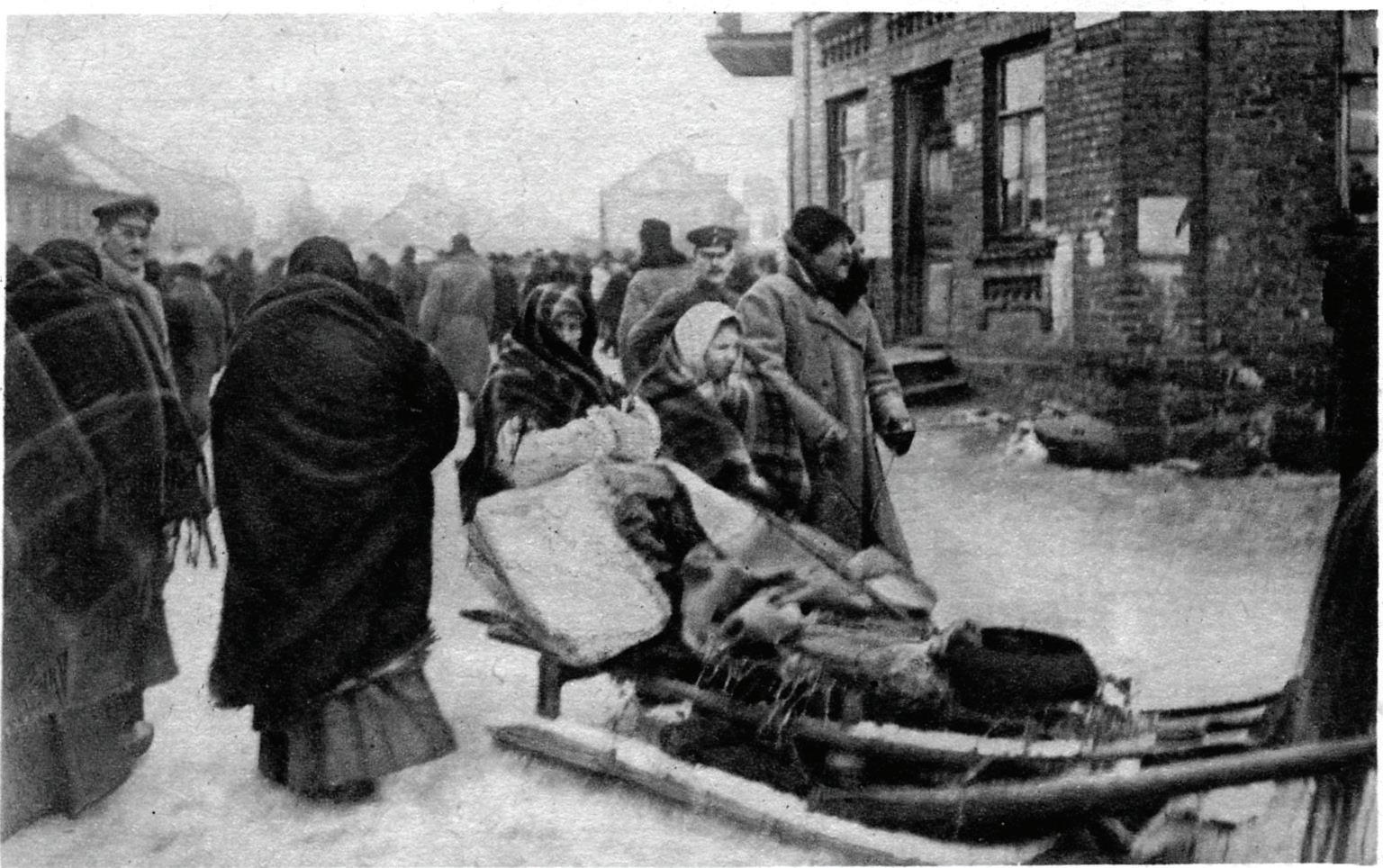
A MATTER OF FACT
In September 1914, the name of Russia’s imperial capital was changed from the original “Saint Petersburg” (German for “Saint Peter’s city”) to the Russian equivalent, “Petrograd”. Similarly, the Romanovs’ relatives, the British royal family, changed their German surname and adopted the British name “Windsor”.
Source 5.8.4 A photograph staged by German troops, showing some of the thousands of Russians who surrendered at the Battle of Tannenberg
Source 5.8.5 A photograph taken by a German soldier of Russian peasants going to market in a town that the Germans had occupied, c. 1916
The Tsar’s decisions
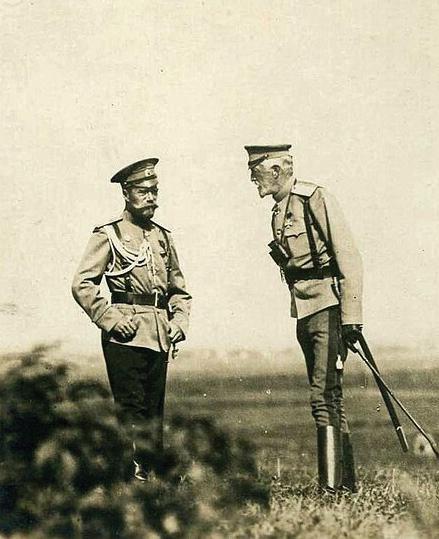
When war broke out, Nicholas II initially wanted to serve as commander-in-chief of the Russian army. His advisers persuaded him not to, given his lack of military experience. Instead, he appointed another Romanov, his second cousin Grand Duke Nikolai Nikolaevich. Although the Grand Duke had never commanded an army in the field, he had solid military experience and was respected by senior officers and soldiers. After the Grand Duke struggled with severe supply shortages and was forced to organise the Great Retreat, Nicholas II made himself commander-in-chief on 5 September 1915. His ministers warned him against this decision and urged him to remain in the capital, but Nicholas believed his presence at the front would inspire the troops. This decision had two major consequences:
1. As commander-in-chief, the Tsar became personally associated with military defeats and heavy casualties, and was increasingly blamed by the public for Russia’s losses.
UNCORRECTED SAMPLEPAGES
Writing focus 5.8
Transitional phrases
2. Upon leaving Petrograd for army headquarters in Mogilev, the Tsar placed the German-born Tsarina in charge of the government. This fuelled conspiracy theories about the Romanovs’ loyalties. Critics labelled Alexandra “the German empress”, despite the fact that she was Queen Victoria’s favourite grandchild and generally spoke English with her husband and children.
When World War I broke out, the Russian monarchy could have taken advantage of the upsurge of patriotic feeling to sustain itself. Nicholas II did nothing of the sort. Clinging to archaic notions of autocracy and egged on by his wife, he squandered an opportunity to create a government of national unity that integrated all layers of society … The prestige of Nicholas’s autocratic power fell to its nadir [lowest point] …
American historian Tsuyoshi Hasegawa. 2024. The Last Tsar. New York: Basic Books, 1–2.
In total, the Russian Empire mobilised approximately 12 million troops – more than any other nation – contributing over one-quarter of all Allied forces. Russian casualties were enormous: around 1.7 million killed, 4.95 million wounded, and 2.5 million taken prisoner or missing.
Source 5.8.6 Tsar Nicholas II (left) in discussions with his cousin, whom he replaced as Commander-in-Chief, Grand Duke Nikolai Nikolaevich
Source 5.8.7 American historian Tsuyoshi Hasegawa on Nicholas II’s response to the outbreak of WWI
5 The decline and fall of the Romanov dynasty
ANALYSIS 5.7
Summarising
Summarise the significance of early events during the First World War by completing the following sentences.
1. On 30 July 1914, Nicholas II … [did what] … because … [why he did it] … which showed [why it mattered].
2. On 1 August 1914, Kaiser Wilhelm … [did what] … because … [why he did it] … which showed [why it mattered].
3. In August-September 1914, the Russian army … [did what] … because … [why he did it] … which showed [why it mattered].
4. On 5 September 1915, the Tsar … [did what] … because … [why he did it] … which showed [why it mattered].
Historical concepts: Significance, Time and chronology Historical skills: Explanation and communication
Royal scandal: Rasputin
One of the strangest aspects of the Romanovs’ rule was their association with a notorious mystic known as Rasputin. Both contemporaries and later historians struggled to explain how an uneducated peasant, who claimed to be a holy man, drank heavily and bathed infrequently, gained access to high society and influence at court, and then went on to have hundreds of affairs with wealthy Russian noblewomen. The Tsarina believed he possessed divine powers of healing and prophecy. As Rasputin’s influence grew, public respect for the Romanovs steadily declined.
SIGNIFICANT INDIVIDUAL
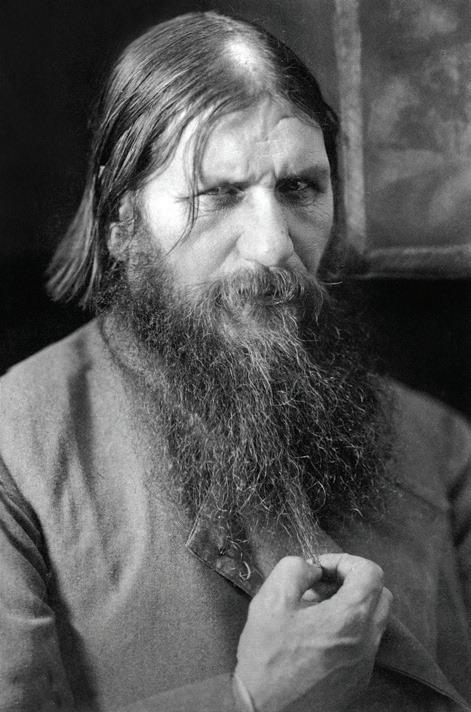
UNCORRECTED SAMPLEPAGES
Grigorii Rasputin (1864–1916) was born a peasant in rural Siberia, but developed a reputation as a holy man with unusual abilities. He attracted a devoted personal following, particularly among aristocratic women, and was believed by some to possess healing powers. Rasputin gained the confidence of the Romanov family in 1905, when he appeared to ease a severe episode of internal bleeding suffered by their haemophiliac son, Alexei. As a result, he became a powerful and controversial figure within the royal inner circle.
Source 5.8.8 Grigorii Rasputin, sometimes referred to as “the mad monk”
Nicholas II’s advisers repeatedly warned him that Rasputin should not be allowed to influence government decisions. Rumours circulated that Rasputin was engaged in an illicit relationship with Tsarina Alexandra, who believed that only Rasputin could keep her son alive. Alexandra wrote him numerous admiring letters and increasingly based her more difficult decisions on Rasputin’s mystical predictions. Before the war, this had been an embarrassment for the Romanovs. During the war, when the Tsarina effectively governed in Nicholas’s absence, it became politically dangerous.
Source 5.8.9 Sir Bernard Pares on the Russian political figureheads during the First World War
We are faced with the strangest of human triangles … Rasputin, the empress and the emperor; set in ascending order of authority and a descending order of influence.
Sir Bernard Pares, an English secret service agent who specialised in Russian politics during the First World War, 1926. Orion Publishing Group.
Source 5.8.10 Historian Ian Gray on the joint political power of Rasputin and the empress
The time soon came when the empress and Rasputin were virtually ruling Russia.
Zealand historian Ian Grey. 2016. The Romanovs. New Word City Editors, 196.
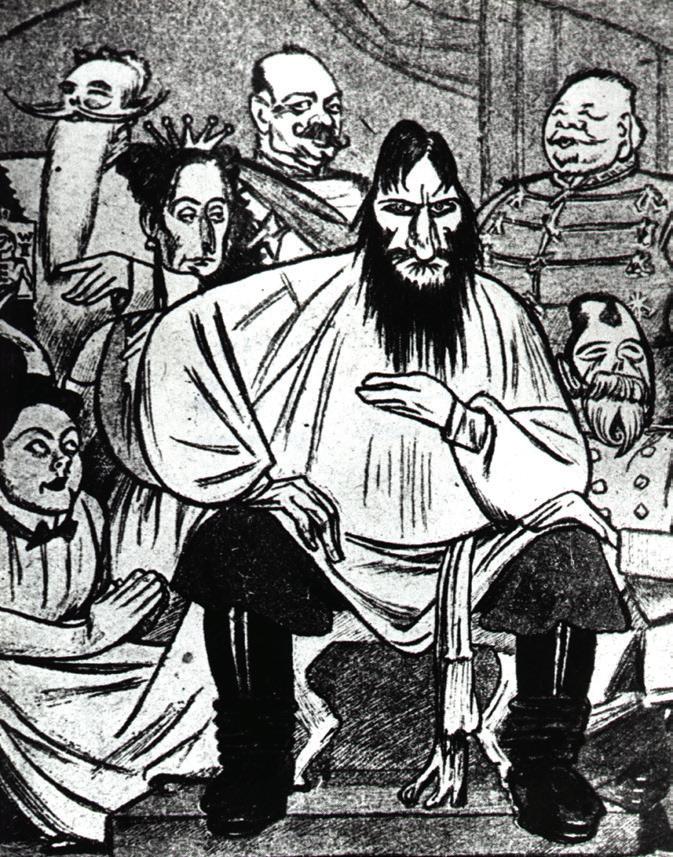
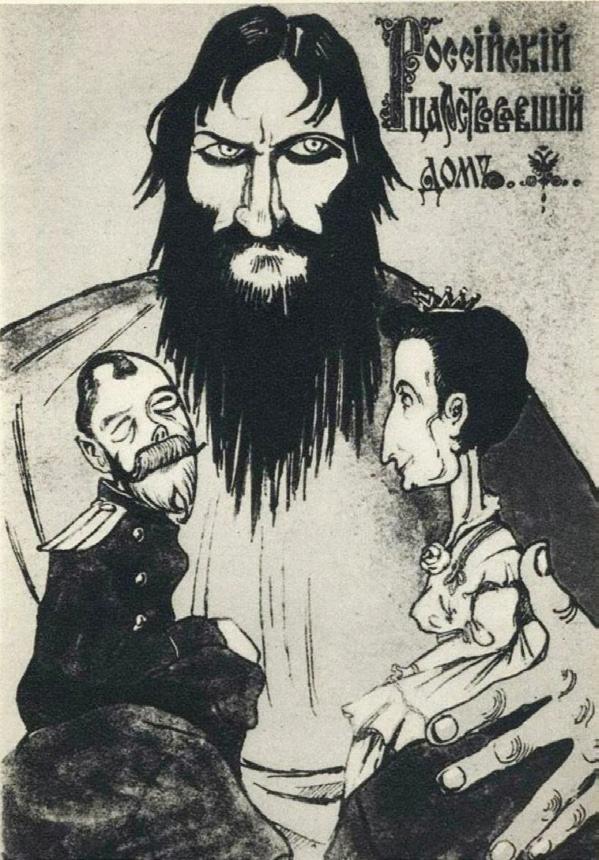
With Nicholas away at the front, Alexandra exercised autocratic authority. She often relied on Rasputin rather than experienced advisers. During the 16 months she was effectively in charge, she made 20 ministerial changes. Russia had four prime ministers, five ministers of the interior and three ministers of war in quick succession. Under Rasputin’s influence, many people began to view the Russian government as disorganised and incompetent.
In December 1916, members of the nobility conspired to end Rasputin’s influence by killing him. They attempted to poison him with wine and cakes laced with cyanide, which failed. Prince Felix Yusupov then shot him several times, but he still showed signs of life. His body was then dumped into the freezing River Neva.
REVIEW 5.8
Online quiz Review questions
UNCORRECTED SAMPLEPAGES
Go online to assign and download questions, view results and more!
Access sample responses and results
1. Identify who exchanged telegrams in 1914 and why.
2. Explain at least three events that drew Russia into war.
3. Explain the scale of Russia’s commitment to the war, using specific evidence.
4. Explain the consequences of Nicholas becoming the commander-in-chief.
5. Research the numbers of troops mobilised and casualties of other major nations on the Allied side (e.g. the British Empire and France) and the Central Powers (e.g. Germany and Austria-Hungary). How do these compare with Russia?
6. Analyse the extent to which Rasputin influenced the fate of the tsarist autocracy.
New
Source 5.8.11 Two Russian cartoons from 1916 depicting (left) Rasputin dominating the Romanovs’ royal court and (right) “The Russian Tsars at home”
5 The decline and fall of the Romanov dynasty
5.9 The end of tsarism
UNCORRECTED SAMPLEPAGES
DRIVING QUESTION
• What brought about the end of tsarism?
By 1917, Nicholas II had reigned for 22 years. Despite his personal weaknesses, defeat (to Japan), revolution (1905), scandals in the royal court and three years of world war, he remained in power. This was about to change.
The February 1917 Revolution
In early 1917, a protest movement began in the capital of Petrograd, a city with over 400,000 factory workers, most of whom were employed in metalworking. These workers had played a central role in the 1905 Revolution and had organised hundreds of strikes between 1912 and 1916. Their strikes typically ended with their leaders – often Bolsheviks – being arrested by the Okhrana and sent to prison in Siberia. By 1917, many workers believed that they might finally prevail.
On Saturday 18 February 1917
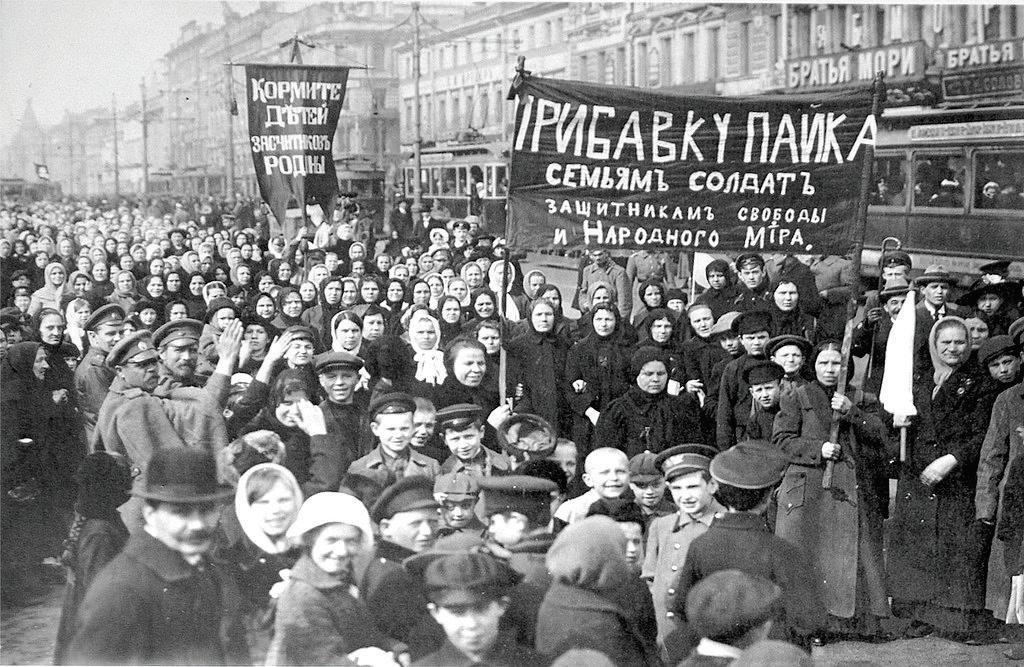
(3 March by the Western European calendar), 20,000 workers at the largest factory, the Putilov Steel Works, were locked out by their managers after a dispute over pay. Other workers – including many women who had replaced men serving at the front – went on strike in solidarity. Thursday 23 February was International Women’s Day, and thousands of female textile workers shut down their factories and marched through the streets carrying banners reading “Bread”, “Down with the war” and “Down with the autocracy”. Crowds swelled to around 90,000, shop windows were smashed and clashes with police broke out. The capital was effectively shut down.
A MATTER OF FACT
Russia used the Julian (Old Style) calendar, which was 13 days behind the Gregorian (New Style) calendar used in Western Europe, until 1918. This can be confusing. Dates in this lesson are Old Style; otherwise, the “February Revolution” would appear to have taken place in March.
Source 5.9.1 International Women’s Day 1917 – workers, soldiers, women and children unite in protest, sparking the February Revolution
Writing focus 5.9
Source analysis (perspective)
The Tsar responded as he had before: he dissolved the Duma and ordered soldiers and the Okhrana to restore order by force. However, alarming reports soon arrived by telegraph.
UNCORRECTED SAMPLEPAGES
Source 5.9.2 Telegraph from Mikhail Rodzianko regarding the social and political crisis in Russia, February 1917
The situation is serious. The capital is in a state of anarchy. The government is paralysed; the transport service has broken down; the food and fuel supplies are completely disorganised. Discontent is general and on the increase. There is wide shooting on the streets; troops are firing at each other. It is urgent that someone enjoying the confidence of the country be entrusted with the formation of a new government. There must be no delay. Hesitation is fatal.
Telegram from Mikhail Rodzianko, President of the Duma, to Tsar Nicholas II, 26 February 1917.
At first, soldiers obeyed orders and fired on demonstrators, who in turn denounced the Tsar as “bloodstained” and a “vampire”. On 27 February, with workers armed and ready to fight, the situation shifted.
Source 5.9.3 Historian Eric Hobsbawm on the breakdown of loyalty to the Tsar
The fragility of the regime was revealed when the Tsar’s troops, even the always loyal Cossacks, hesitated, then refused to attack the crowds and began to fraternise with them.
British historian Eric Hobsbawm. 1994. Age of Extremes: The Short Twentieth Century 1914–1991, 60.
Amid the chaos, senior army generals and Duma leaders informed Nicholas that he had three options: try to form a “ministry of confidence”, including a wider range of liberal views; create a constitutional monarchy, making himself answerable to the parliament; or abdicate. Nicholas rejected all three options. Meanwhile, railway workers blocked his return to the capital.
On 2 March 1917, stranded in a railway carriage near the Estonian border, Nicholas met a Duma delegation and agreed to abdicate. He also abdicated on behalf of his 12-year-old son Alexei, believing his health was too fragile. Nicholas passed authority to his brother, Grand Duke Michael, but Michael refused the throne. Power was not transferred to a new ruler; it was simply abandoned.
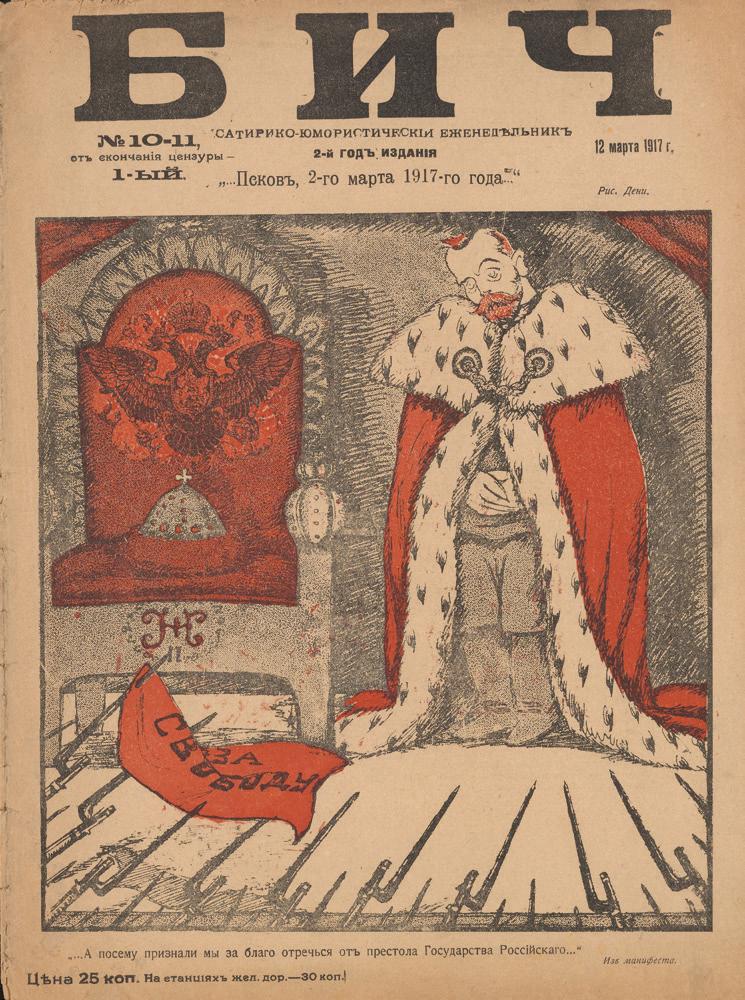
Source 5.9.4 A Russian journal satirises Tsar Nicholas II’s decision in March 1917. Confronted with the guns of Petrograd revolutionaries, the Tsar says, “So we considered it to be good to abdicate the throne of the Russian State.”
Chapter 5 The decline and fall of the Romanov dynasty
ANALYSIS 5.8
Analysing historical interpretations
UNCORRECTED SAMPLEPAGES
To what extent was Nicholas responsible for the end of tsarism?
Historians do not agree on how far Nicholas II was responsible for the collapse of tsarism. The interpretations below present different perspectives on Nicholas’s role in the end of tsarist rule.
Source 5.9.5 Historian Richard Charques on Nicholas II’s “negative” character
[Nicholas II was] a negative character, commonplace in mind, weak of will and fatalistic in temperament ... a man transparently immature and of patently insignificant interests.
Richard Charques, The Twilight of Imperial Russia, 1958.
Source 5.9.6 Historian Dominic Lieven on Nicholas II's natural qualities
Nicholas II was not stupid. On the contrary, his problem tended to be that he could understand many points of view and wavered between them … He was a very kind, sensitive, generous and initially naïve man. These traumatic years required something very different and would probably have destroyed any man who sat on the throne.
British historian Dominic Lieven. 1993. Nicholas II: Emperor of All the Russias, 261–62.
Source 5.9.7 Historian Katy Turton on Nicholas II’s culpability for the collapse of Russian autocracy
Tsar Nicholas was a young man unsuited to autocratic rule, but utterly determined to uphold his father’s strict authoritarian regime regardless of the need to reform a modernising Russia.
Katy Turton. 2015. ‘The enduring mystique around the Romanovs, Russia’s last royals’ The Conversation, 3 October.
Source 5.9.8 Historian J. N. Westwood on wavering Russian loyalty in the First World War
It was only to be expected that after two years of war and sacrifice, with no apparent result, Russians would be beginning to ask themselves whether the country was being properly led.
British historian J. N. Westwood. 2002. Endurance and Endeavour: Russian History 1812–2001, 222–23.
Source 5.9.9 Historian Tsuyoshi Hasegawa on Nicholas II’s response to war
Some autocrats feed off the passions of war, rallying both the people and the elite to the cause. Others respond to war by planting the seeds of their destruction.
American historian Tsuyoshi Hasegawa. 2024. The Last Tsar. New York: Basic Books, 5.
1. Identify Nicholas’s flaws, using short quotations from the historians.
2. Identify factors outside Nicholas’s control, using short quotations from the historians.
3. Explain why some historians argue that Nicholas was responsible for the end of tsarism.
4. Explain why some historians argue that Nicholas was not entirely responsible for the end of tsarism.
Historical concepts: Historical interpretations Historical skills: Analysis and use of sources
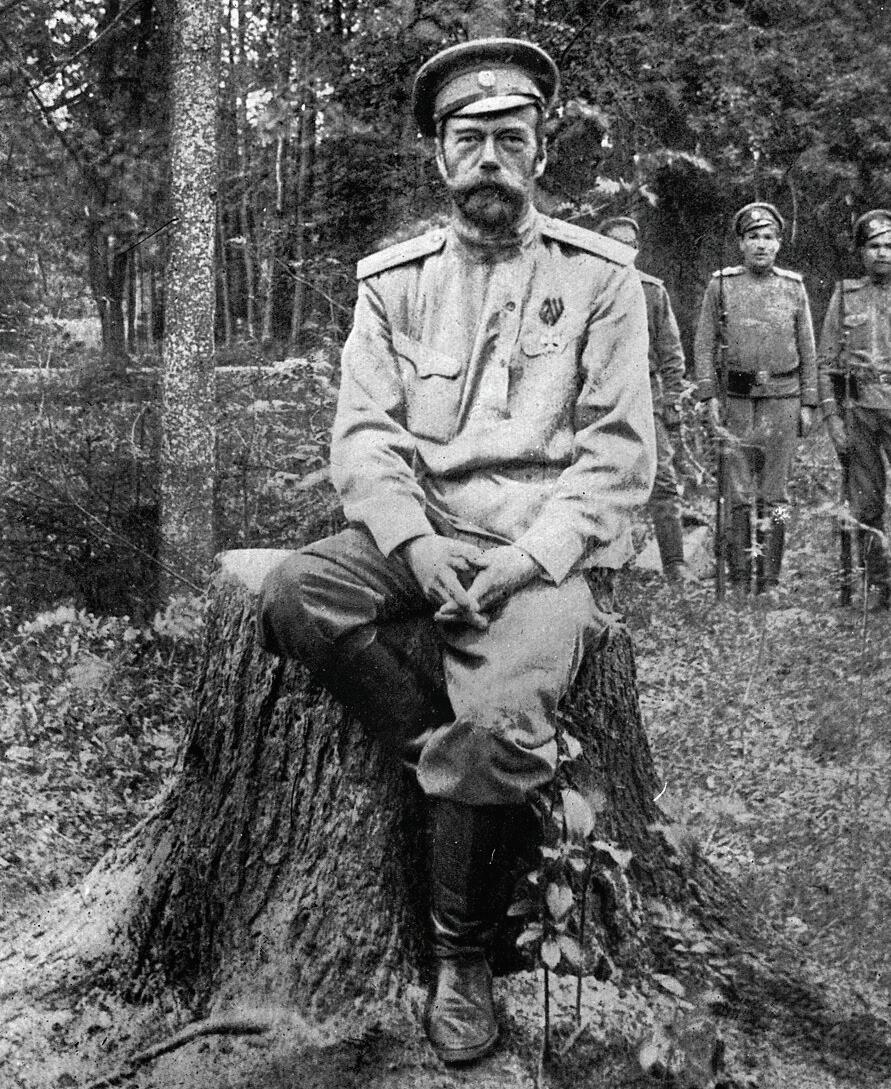
Provisional Government
After Nicholas II abdicated, Russia entered a period of what was known as Dual Power. Liberal politicians from the Duma combined with moderate socialists to form a Provisional Government, which controlled the formal machinery of state. However, at the same time, more radical Soviets (councils) of Workers’ and Soldiers’ Deputies, elected across the country by factory workers and soldiers, controlled key infrastructure, such as the railways.
UNCORRECTED SAMPLEPAGES
The Provisional Government had authority without power whilst the Soviet had power without authority. Alexander Kerensky. 1934. The Crucifixion of Liberty,
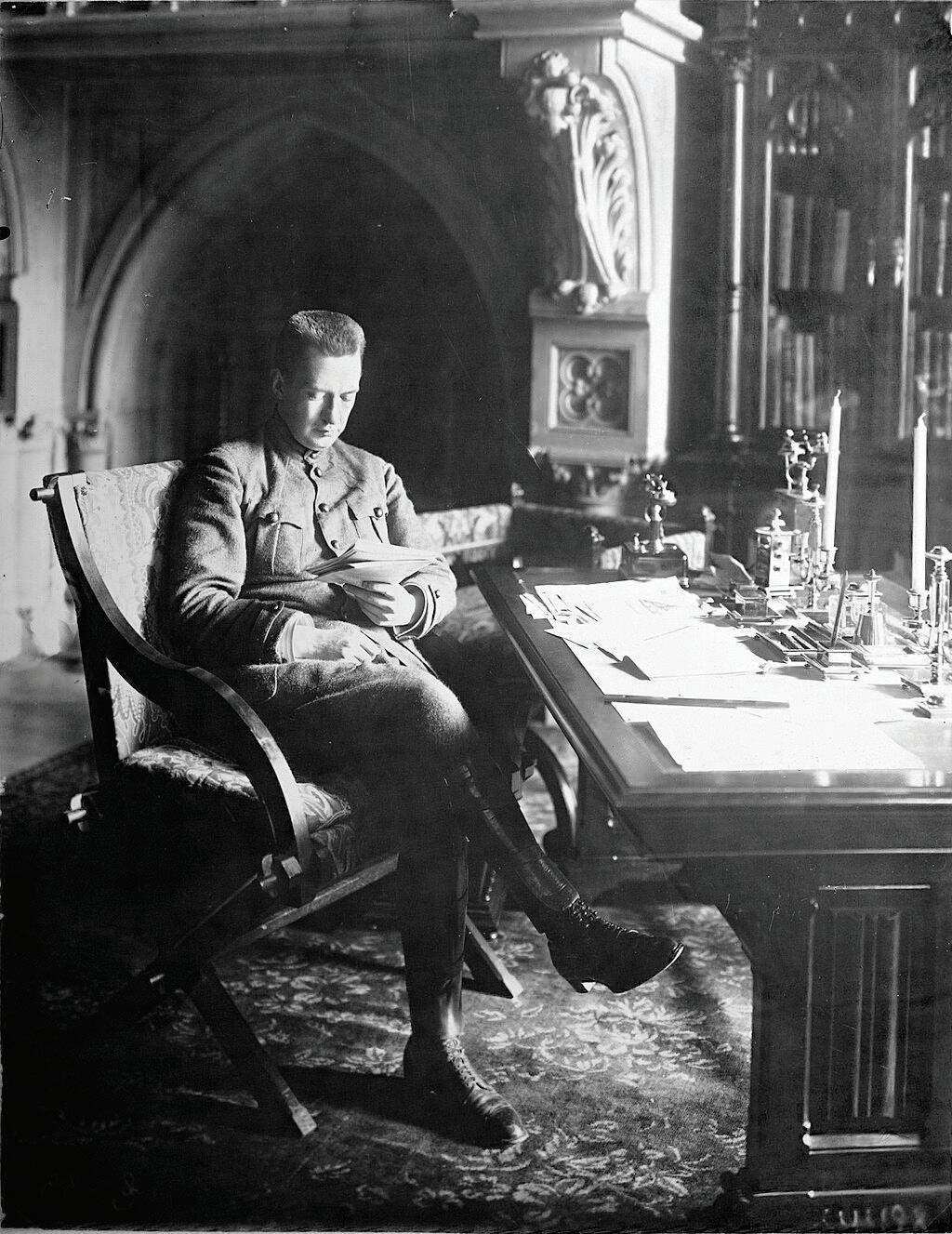
Source 5.9.11 Alexander Kerensky on Dual Power
Source 5.9.12 Liberal nobleman Georgy Lvov (left) led the Provisional Government after the abdication of the Tsar. In July 1917, he was replaced by democratic socialist lawyer Alexander Kerensky (right).
264.
Source 5.9.10 Nicholas Romanov under guard at Tsarskoye Selo after his abdication.
Chapter 5 The decline and fall of the Romanov dynasty
The Provisional Government not only faced the challenge of competition with the Soviets; it had to try to design a new framework for post-tsarist politics, address the economic problems of shortages and inflation, and decide whether to continue Russia’s commitment to its allies in the war.
Table 5.9.1 Achievements and challenges of the Provisional Government, 1917
Achievements
Gave all Russians civil liberties: freedom of speech, assembly and the right to strike
UNCORRECTED SAMPLEPAGES
Challenges
Decided to continue Russia’s commitment to the war, which was expensive and unpopular
Released thousands of the Tsar’s political prisonersDid not use state powers to improve the economy by controlling prices or production
Set an eight-hour day for workers and planned land reform for peasants
Abolished the Okhrana secret police and extreme punishments
Removed discrimination based on nationality or religion
Refused to allow peasants to seize land, telling them to wait for legal frameworks to be finalised
Government members were seen as nobles and elites (e.g. Kerensky moved into the Tsar’s Winter Palace)
Bolsheviks who were released from prison or returned from exile organised an anti-government movement
A further complication for the Provisional Government was the fate of the Romanov family. They were under house arrest in the opulent Alexander Palace, but by August 1917, Kerensky’s government was concerned that they were too close to the instability of Petrograd. He sent them to a governor’s mansion in Tobolsk, Siberia, but what to do next remained unresolved.
The October 1917 Revolution
SIGNIFICANT INDIVIDUAL
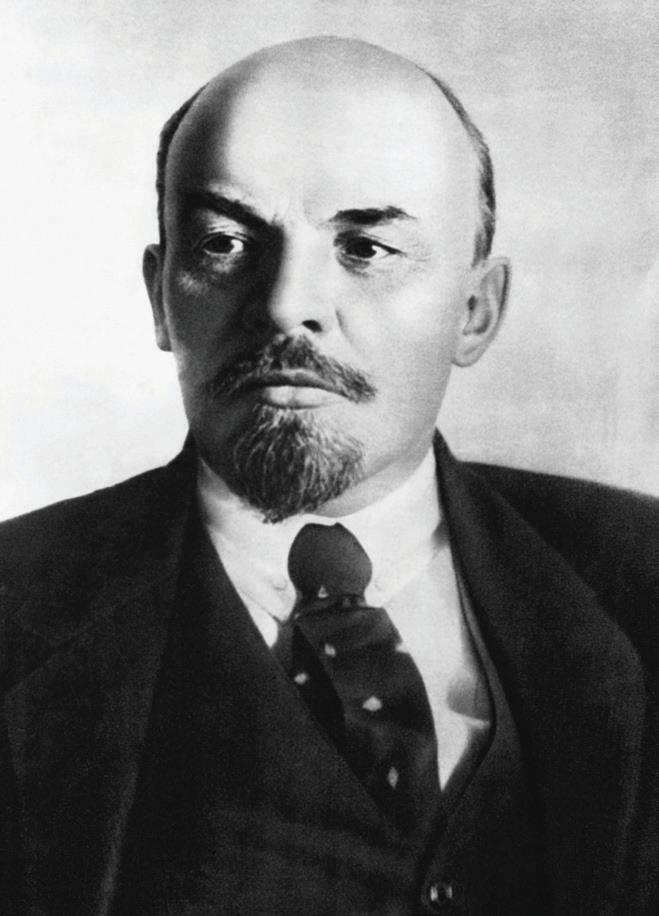
Source 5.9.13 Vladimir Lenin, leader of Soviet Russia after the October Revolution of 1917
Vladimir Ilich Ulyanov, “Lenin” (1870–1924), led the revolutionary Bolshevik Party from 1903. He was born into a middle-class family and became involved in revolutionary activity after the execution of his older brother for an attempted assassination of Alexander III. In 1895, Lenin helped establish the Saint Petersburg League of Struggle for the Emancipation of the Working Class. For safety, however, he spent much of his life outside Russia, living in Munich, London, Geneva and Paris. In his book What Is to Be Done? (1902), Lenin argued that a socialist revolution required a disciplined group of professional revolutionaries to act as the “vanguard” of the working classes. After 1903, Lenin led the Bolshevik faction, which seized power in October 1917. He then governed Soviet Russia until his death in April 1924.
comrade friends, fellow soldier, or member of the same political group, especially a communist or socialist group or a labour union
In April 1917, the Bolshevik leader Vladimir Lenin returned to Russia after years of exile in Western Europe. When he stepped off the train at Finland Station in Petrograd, he was greeted by a large and enthusiastic crowd. Lenin told them that Russia’s future was not to share power with the Provisional Government, but to begin a worldwide socialist revolution. Lenin, together with Leon Trotsky – leader of the Petrograd Soviet, who had recently returned from exile in the United States – then began planning the seizure of power.
Source 5.9.14 Vladimir Lenin addresses the Russian people to announce the Socialist Revolution.
Dear Comrades , soldiers, sailors, and workers!
I am happy to greet in your persons the victorious Russian revolution, and to greet you as the vanguard of the worldwide proletarian army … The worldwide Socialist revolution has already dawned … the Russian revolution accomplished by you has prepared the way and opened a new epoch. Long live the worldwide Socialist revolution!
Vladimir Lenin. 1917. Speech at Finland Station, Petrograd, 16 April.
SIGNIFICANT EVENT
The October Revolution of 1917
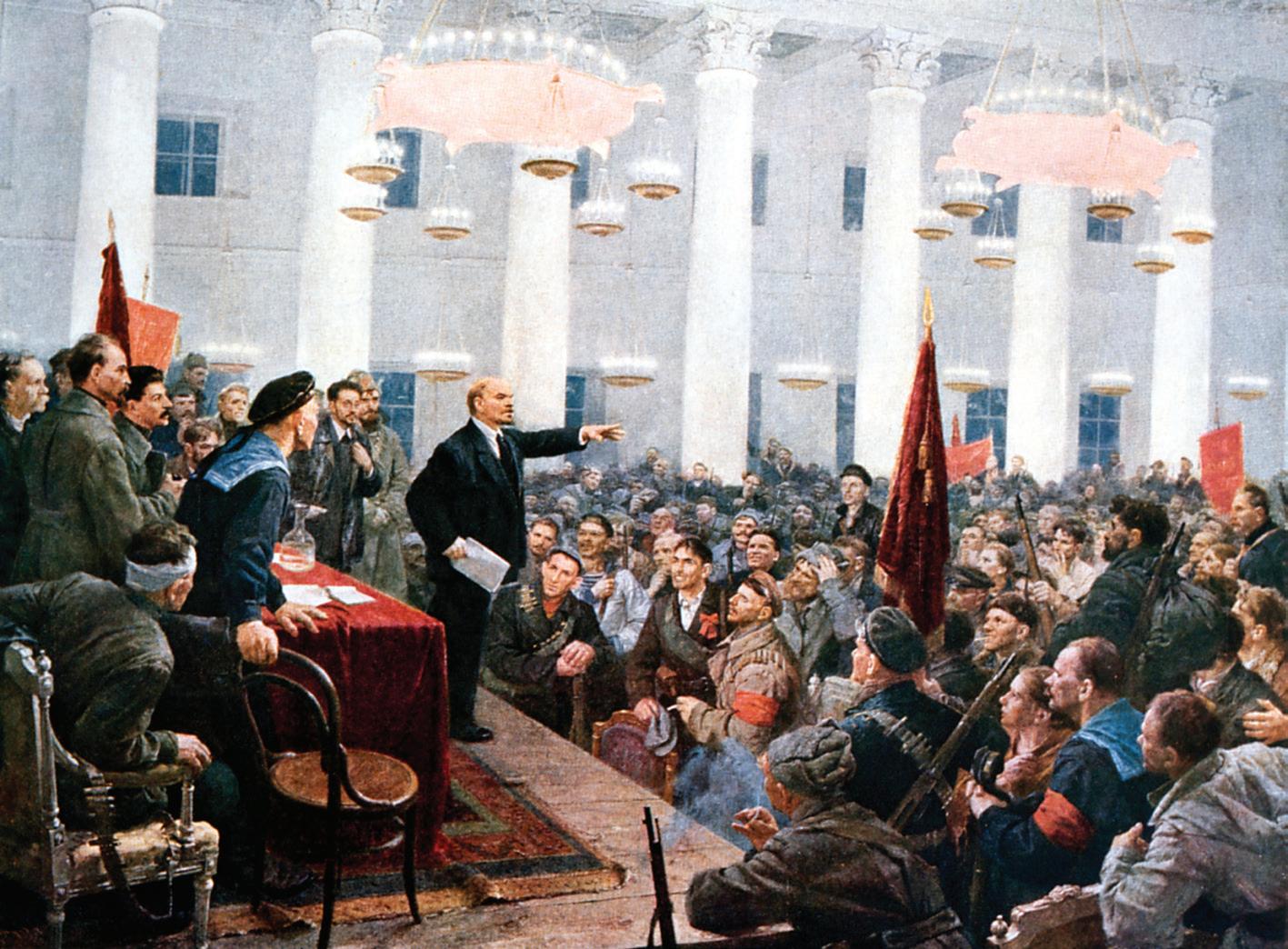
Source 5.9.15 A painting of Lenin addressing the Petrograd Soviet during the October Revolution
By October 1917, the Bolsheviks had increased their support in some local elections but had not won majorities. Lenin argued that instead of waiting for electoral success, the Bolsheviks should lead the people in a revolution. He and Trotsky secured the backing of the Petrograd Soviet for an armed uprising.
UNCORRECTED SAMPLEPAGES
On the night of 24 October, Bolshevik “Red Guards” began seizing strategic locations across the capital. The following day, the naval ship Aurora, captured by Bolshevik sailors, sailed up the river and fired on the Winter Palace, where the Provisional Government was based. Red Guards quickly overwhelmed the palace guards. The Bolsheviks declared themselves the new government. Russia had become the first socialist state in modern history.
Chapter 5 The decline and fall of the Romanov dynasty
In line with the ideas of Karl Marx, the Bolsheviks declared that workers now controlled Russia’s factories and that land owned by landlords would be redistributed to peasants. The government nationalised banks, railways and some industries, and set targets for production and trade. The Bolsheviks withdrew Russia from the First World War in March 1918, and then turned their attention to a civil war against the anti-communist “Whites”, which raged until 1922.
To the Bolsheviks, the Romanovs symbolised the old imperial Russia that their revolution had just swept into the “dustbin of history”. While debating what to do with the former royal family, they sent them by train east of Moscow to the city of Yekaterinburg, to await their fate.
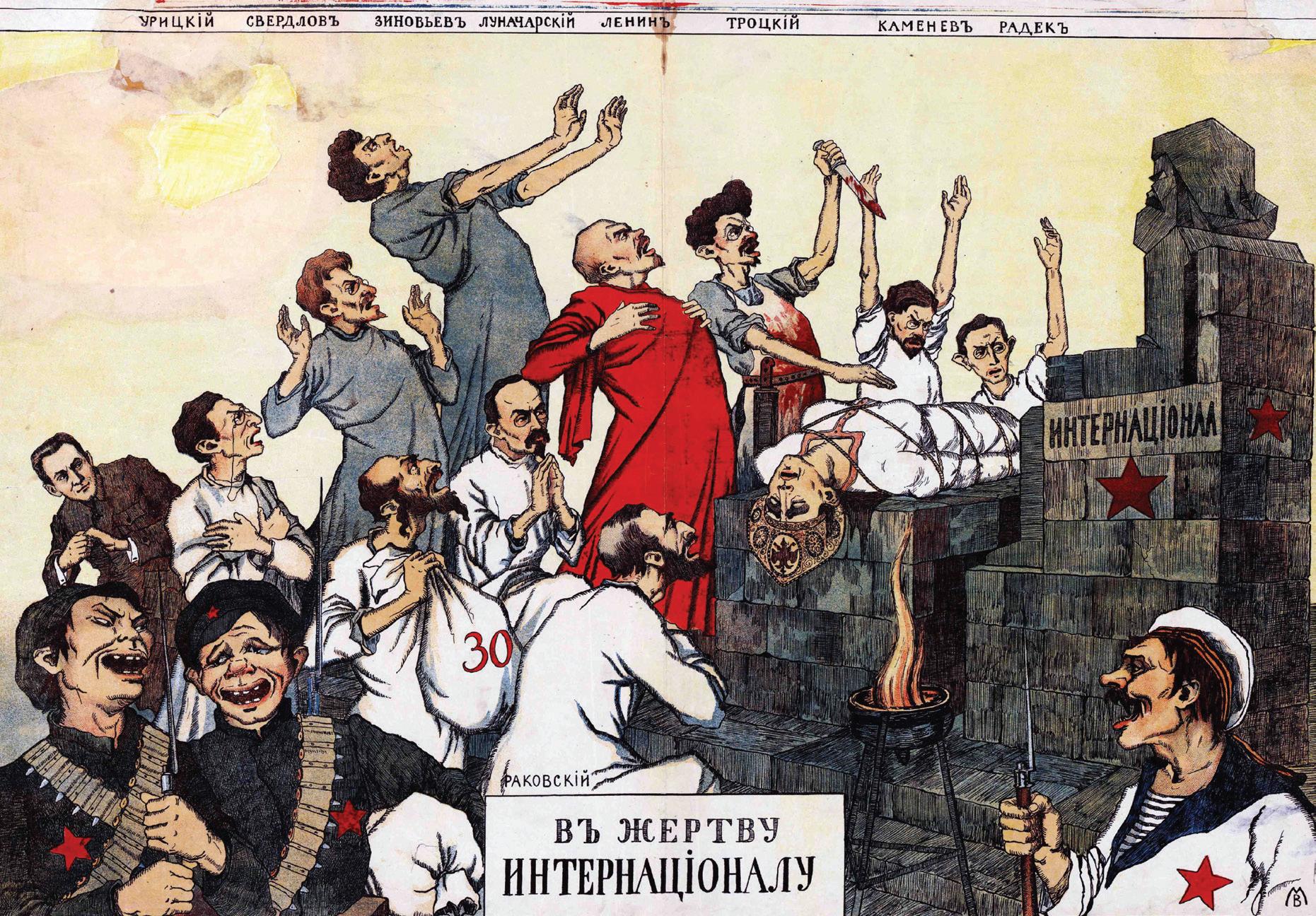
UNCORRECTED SAMPLEPAGES
1. Identify where the 1917 protests began and explain why.
2. Explain who participated in the February 1917 Revolution.
3. Explain what Nicholas II did on 2 March 1917 and why it was significant.
4. Explain why the Provisional Government had limited power and outline what it achieved.
5. Discuss why Lenin and the Bolsheviks appealed to many Russians.
6. Research the political philosophy known as Marxism–Leninism. Explain its key beliefs and identify where it has been put into practice.
online to
Source 5.9.16 A White Russian propaganda poster depicting Bolsheviks (using racist Jewish and Asian stereotypes) sacrificing a figure representing Russia to a statue of Karl Marx
Writing focus 5.10
Noun phrases (drafting)
5.10 The execution of the Romanovs
UNCORRECTED SAMPLEPAGES
DRIVING QUESTION
• Why were the Romanovs killed?
Planning the end of the Romanovs
During their six months under house arrest in the Alexander Palace, seven months in Tobolsk and three months in the House of Special Purpose in Yekaterinburg, the fate of the last Romanov tsar and his heirs was widely debated. Outside Russia, the family’s royal relatives viewed their continued imprisonment as a source of deep anxiety.
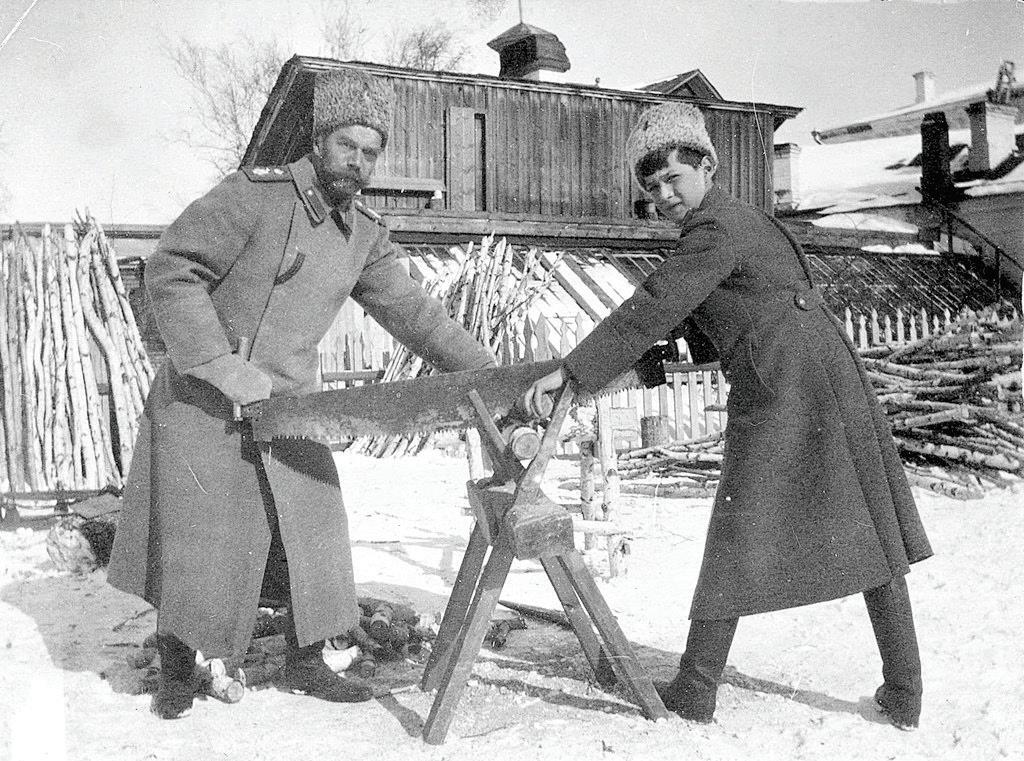
Source 5.10.1 One of the last known photographs of Nicholas and his son Alexei, shown cutting wood while in captivity in western Siberia, late 1917
The Provisional Government initially hoped that the Tsar and his family would be granted asylum in a foreign country ruled by one of his relatives. However, because of the ongoing world war and fears that anti-royal sentiment might spread across Europe, no realistic offer eventuated. The British government first offered asylum but later withdrew the offer. Kaiser Wilhelm of Germany did not assist, despite being godfather to the Tsar’s son Alexei. The Spanish king, Alfonso XIII, offered asylum, and the Danish royal family was willing to help, but because the Provisional Government did not control Russia’s railways and ports, this proved impractical. Russian monarchists also attempted, unsuccessfully, to organise a rescue. Moreover, according to historian Helen Rappaport in The Race to Save the Romanovs, the family themselves wished to remain in Russia, believing that it was where they belonged.
Chapter 5 The decline and fall of the Romanov dynasty
After the October Revolution, any prospect of a future role for the Romanovs in Russia collapsed. Bolshevik ideology was fuelled by anger at centuries of inequality produced by tsarism. While most Russians were poor and uneducated, the royal family had lived in dozens of opulent palaces and controlled wealth worth the equivalent of more than US$300 billion today (although this wealth was not held as private personal property). When the Romanovs’ train arrived in Yekaterinburg, an angry mob attempted to lynch the Tsar and had to be dispersed before the family could be taken to their final place of imprisonment.
In 1918, the Bolsheviks planned to charge Tsar Nicholas II with treason against the Russian people. Leon Trotsky began making arrangements for a public trial, similar to that which had condemned Louis XVI during the French Revolution. At some point, however, it was decided that such a trial risked turning Nicholas into an object of sympathy or, as Lenin put it, “a live banner to rally around”. Keeping him imprisoned indefinitely was also considered dangerous. Several of the family’s former servants had already been arrested for passing secret messages to pro-monarchist groups that might attempt a rescue.
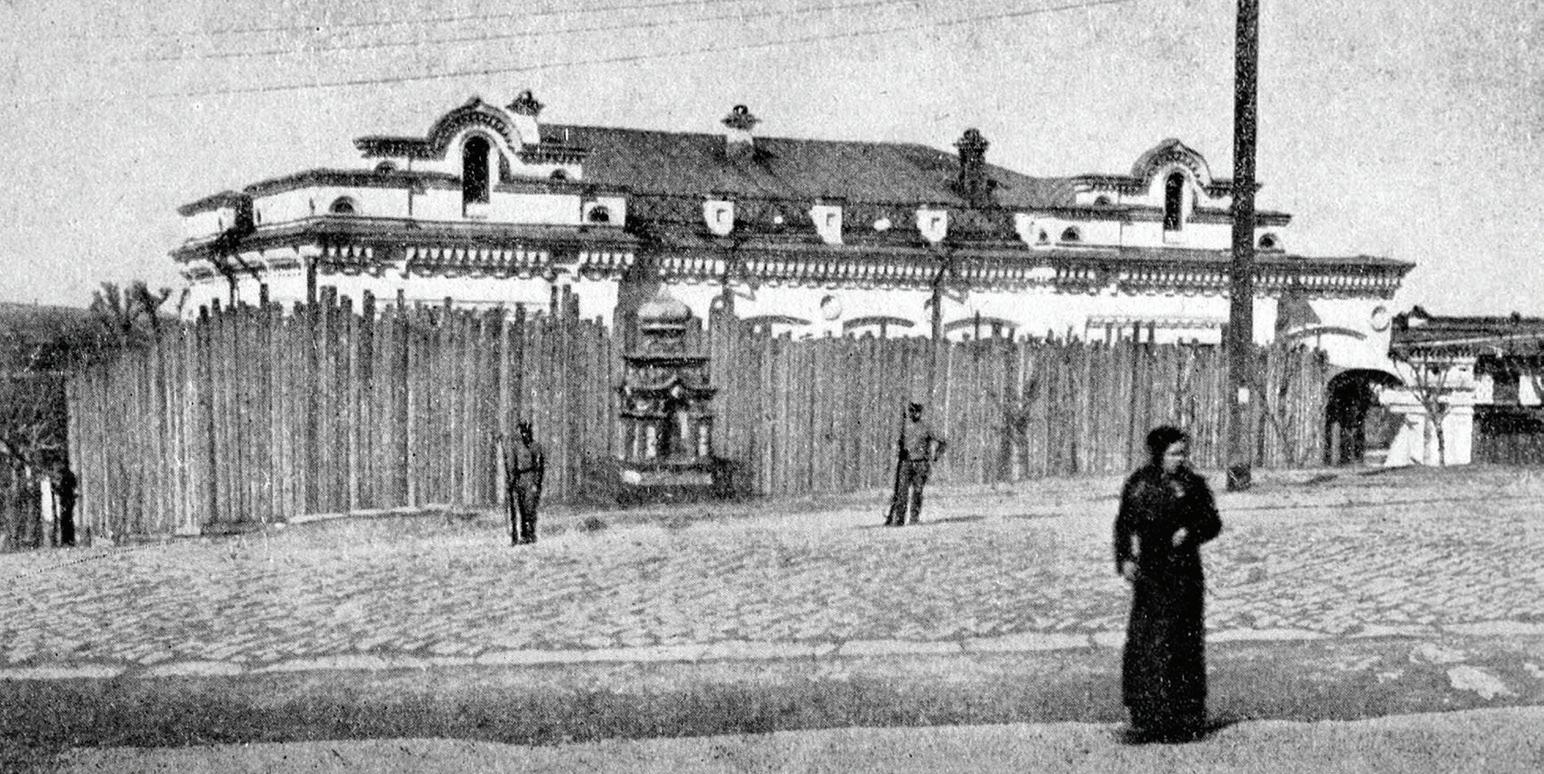
UNCORRECTED SAMPLEPAGES
Summarising
Summarise the significance of the final months of the Romanovs, by completing the following sentences.
1. In Petrograd, the Provisional Government … [did what] … because … [why they did it] … which showed [why it mattered].
2. Other European nations … [did what] … because … [why they did it] … which showed [why it mattered].
3. After the October Revolution, the Bolsheviks … [did what] … because … [why they did it] … which showed [why it mattered].
4. In 1918, the Bolsheviks … [did what] … because … [why they did it] … which showed [why it mattered]. Historical concepts: Significance
Source 5.10.2 The Ipatiev House in Yekaterinburg, surrounded by a high palisade and armed guards
The shootings and burials
When the Bolsheviks decided to kill the Romanovs before dawn on 17 July 1918, the family’s final moments were horrific. The firing squad was issued unfamiliar weapons, and in the confined space of the basement they were forced to shoot over one another’s shoulders. Around 70 bullets were discharged in a matter of minutes, quickly filling the room with smoke and dust. Several of the Romanovs were wounded but still alive and pleaded for mercy. Jewels sewn into the girls’ clothing may have deflected some bullets, or the shooters may simply have missed. The executioners then spent the next 20 minutes finishing their gruesome task with bayonets.
Source 5.10.3 Yurovsky’s account of the execution of the imperial family
Nicholas had put Alexei on the chair and stood in such a way, that he shielded him. Alexei sat in the left corner from the entrance, and so far as I can remember, I said to Nicholas approximately this: His royal and close relatives inside the country and abroad were trying to save him, but the Soviet of Workers’ Deputies resolved to shoot them. He asked “What?” and turned toward Alexei. At that moment I shot him and killed him outright. He did not get time to face us to get an answer. At that moment disorganized, not orderly firing began …
“Yurovsky’s Account of the Execution of the Imperial Family.” 1934. Declassified file, Documentation Centre of the Social Organization of the Sverdlovsk Region.
Source 5.10.4 Historian Helen Rappaport on the death of the Romanovs
People still insist, even today, on referring to what happened to the Romanov family as an “execution”. It was not. Nor was it an assassination, for even that word suggests a degree of planning and skill. There was no trial for any of the family, no due process of law, no possibility of a defence or appeal. What happened in the basement of the House of Special Purpose on Voznesensky Prospekt, Ekaterinburg, in the early hours of 17 July 1918, was nothing less than ugly, crazed and botched murder.
Helen Rappaport. 2018. The Race to Save the Romanovs. New York: St Martin’s Press, 243.
These killings were not the final effort to erase the Romanovs. The bodies were loaded onto a truck and driven to the Koptyaki forest, where they were stripped, doused in acid and buried. The following day, fearing the burial site was insecure, the executioners returned, dismembered and burned the remains, reburied them and drove repeatedly over the grave to conceal it.
One day later, seven other Romanov relatives were thrown down a mine shaft and killed with grenades. A week after that, the Whites captured Yekaterinburg, finding little evidence of what had occurred. Over the following months, at least two dozen additional members of the imperial household were killed.
UNCORRECTED SAMPLEPAGES
The Bolsheviks announced that the Tsar had been executed but concealed the deaths of the rest of the family. Despite frantic inquiries from other royal families, their fate remained unknown for months. In December 1918, international media reported that the entire family was likely dead, although some continued to believe that one or more members had survived. In 1919, Nicholas’s mother and his sister Xenia were
Chapter 5 The decline and fall of the Romanov dynasty
evacuated to England. The Bolshevik government did not officially acknowledge that the whole family had been murdered until 1926, a delay that fuelled enduring conspiracy theories about what had “really” happened.
A MATTER OF FACT
A woman claiming to be Anastasia Romanov appeared in New York in 1928, and several novels and films popularised the story, which claimed that Anastasia had miraculously survived under her siblings’ bodies. Later DNA testing proved that “Anastasia” was a Polish impostor.
The location of the Romanovs’ remains remained a mystery until 1979. A second burial site, containing the remains of two missing family members, was discovered in 2007. Forensic investigations conducted into the 2020s confirmed the identities of all seven Romanovs.
In 1998, the family’s remains were interred in the eighteenth-century Peter and Paul Cathedral in Saint Petersburg (restored from “Petrograd’ in 1991) – the burial place of Russian tsars since Peter the Great. In 2000, Tsar Nicholas II and his family were canonised as martyrs by the Russian Orthodox Church. In 2006, Russian President Vladimir Putin – who has since used military force to occupy territories that were once part of the tsarist empire – authorised the reburial of Nicholas’s mother alongside the rest of the family.
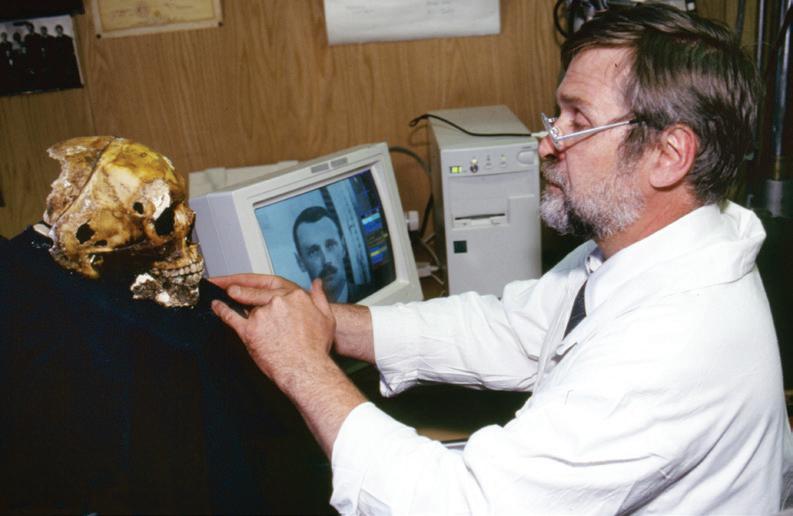
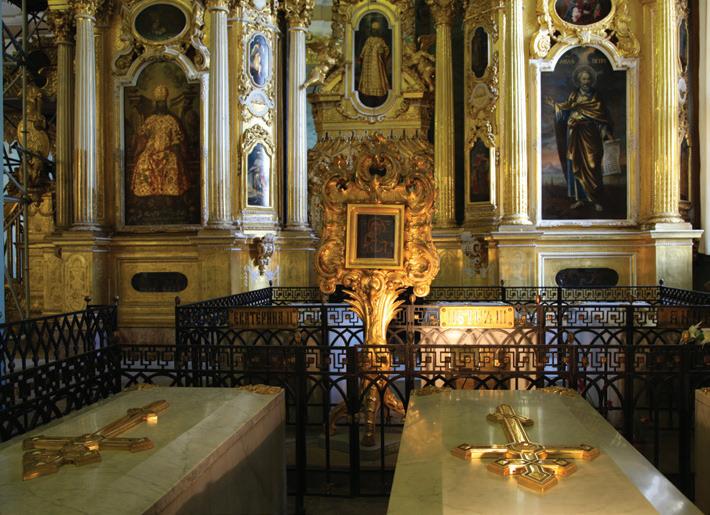
martyr a person who suffers or is killed because of their political or religious beliefs, and is often admired as a result
UNCORRECTED SAMPLEPAGES
REVIEW
5.10
1. Identify the two authorities that imprisoned the Romanovs.
2. Describe the House of Special Purpose.
3. Explain why the Romanovs were moved to the House of Special Purpose.
4. Explain why the family was killed without a trial, and who gave the order.
5. At the start of the chapter, several terms were used to describe the Romanovs’ deaths: liquidate, execute, firing squad, assassination, murder. Based on what you have learned, discuss which term is most appropriate and why.
6. Discuss why conspiracy theories about the Romanovs developed after 1918, using examples.
online to assign and download questions, view results and more!
Source 5.10.5 A forensic expert matches a skull with the photograph of a Romanov, 1992.
Source 5.10.6 The Romanov family crypt in the Peter and Paul Cathedral
5.11 Chapter review
UNCORRECTED SAMPLEPAGES
Revise and consolidate your learning with these online tools:
• Download or answer questions online
• View suggested responses
• Writing focus worksheets.
Teachers can access these additional downloadable resources and Learning Management System features:
• Individual student reports
• Assign tasks and track results
• Exam Generator: create custom practice exams
• Writing focus workbook.
Chapter summary
• Russia’s political system was based on autocracy, with a single tsar, whose powers were not shared or limited.
• The Romanov dynasty ruled Russia from 1613 to 1917, including Tsar Peter the Great and later ancestors of Tsar Nicholas II.
• Romanov tsars expanded Russian territory through war and diplomacy, creating a vast multinational empire covering around one-sixth of the Earth’s land surface.
• In the late nineteenth century, Russia’s alliances shifted towards France and Britain.
• Tsar Nicholas II was an inexperienced and reluctant ruler who came to power in 1894 after the unexpected death of his father, Tsar Alexander III.
• The Tsar believed his autocratic authority was granted by God, but his leadership abilities were limited.
• Russia’s social system privileged the upper classes while exploiting urban industrial workers and rural peasants.
• Deep internal tensions and crises had developed by the end of Nicholas II’s first decade as Tsar.
• Marxism, based on the theory of class struggle and revolution, inspired many revolutionary groups.
• The 1905 Revolution revealed the depth of opposition to the Tsar. In response, he offered limited concessions before reasserting autocratic rule.
• Russia entered the First World War despite the Romanovs’ close family ties with rulers of enemy nations.
• Despite having one of the largest armies in the world, Russia suffered from poor organisation, supply shortages and low morale.
• Severe hardships on the home front and the Rasputin scandal further turned public opinion against the Romanovs.
• The February 1917 Revolution forced the Tsar to abdicate, leading to a system of Dual Power between the Provisional Government, which held political authority, and the Soviets, which exercised practical control.
Chapter 5 The decline and fall of the Romanov dynasty
• In the October 1917 Revolution, the Bolshevik Party seized power and established the modern world’s first socialist state.
• Bolshevik forces killed the entire Romanov family on 17 July 1918 in a chaotic and violent shooting.
• The murder of the Romanovs marked a definitive rejection of tsarism and the old imperial order.
How to answer an exam question
Example question (4 marks)
Describe the principles of Russian autocracy that shaped the leadership of Tsar Nicholas II. The key verb in this question is describe, which means you need to present the features and characteristics of autocracy.
Note that the question is about the principles of autocracy, so your answer should focus on these as much as possible.
Marking criteria
Criteria Marks
• Describes the features and characteristics of Russian autocracy that influenced Nicholas II
• Communicates logically using historical terms and concepts 4
• Provides information about Russian autocracy
• Communicates using some appropriate historical terms and concepts 3
• Provides some information about Russian autocracy
• Communicates using some appropriate historical terms and/or concepts
• Provides some relevant information 1
2
UNCORRECTED SAMPLEPAGES
Sample response
Tsar Nicholas II was an autocratic Russian leader, which means a ruler with unlimited power, who demanded that people obey him without question or regard for their opinions. Nicholas’s leadership was shaped by the classical beliefs of autocracy, including that the Tsar had the divine right to rule the land, that he should not share his power with others, and the people should honour the Tsar as their “little father”. As a child and the heir to the throne, he was taught that autocracy was the wisest way to keep the nation stable, and when he became the Tsar, “autocrat” was one of his official titles. Although he lacked confidence in his abilities, he chose to lead as an autocrat, and Tsarina Alexandra encouraged him. Nicholas used secret police to suppress people who challenged his authority, resisted attempts to reform the political system, and made decisions by himself, sometimes against the advice of his more experienced advisers.
Source 5.11.1 Video on answering the exam question
Exam-style short-answer questions
As NESA reminds us, your answer will be assessed on how well you:
UNCORRECTED SAMPLEPAGES
• demonstrate historical knowledge and understanding relevant to the question
• communicate ideas and information logically
• use historical terms and concepts appropriately
Marking rubrics are available in the Interactive Textbook.
Question 1 (4 marks)
Describe the character and leadership style of Tsar Nicholas II.
Question 2 (4 marks)
Explain how forms of opposition developed to challenge the rule of the Romanovs.
Question 3 (7 marks)
Explain why the perspectives of Source A and Source B would be useful to a historian studying the fall of the Romanovs.
In your answer, integrate evidence from Source A and Source B
Question 4 (10 marks)
How significant was the February Revolution to the fall of the Romanovs?
In your answer, integrate evidence from Source C
Exam-style extended-response question
As NESA reminds us, your answer will be assessed on how well you:
• demonstrate historical knowledge and understanding relevant to the question
• use relevant evidence and interpretation to support your response
• communicate ideas and information using historical terms and concepts appropriately
• present a sustained, logical and cohesive response
Marking rubrics are available in the Interactive Textbook.
Question 5 (25 marks)
a. Assess the significance of the Bolsheviks in the fall of the Romanovs. OR
b. To what extent did Nicholas II’s own actions contribute to the end of the Romanov dynasty?
Chapter 5 The decline and fall of the Romanov dynasty
Source booklet
Source A
UNCORRECTED SAMPLEPAGES
When World War I broke out, the Russian monarchy could have taken advantage of the upsurge of patriotic feeling to sustain itself. Nicholas II did nothing of the sort. Clinging to archaic notions of autocracy and egged on by his wife, he squandered an opportunity to create a government of national unity that integrated all layers of society. … The prestige of Nicholas’s autocratic power fell to its nadir [lowest point] … American historian Tsuyoshi Hasegawa. 2024. The Last Tsar. New York: Basic Books, 1–2.
Source B
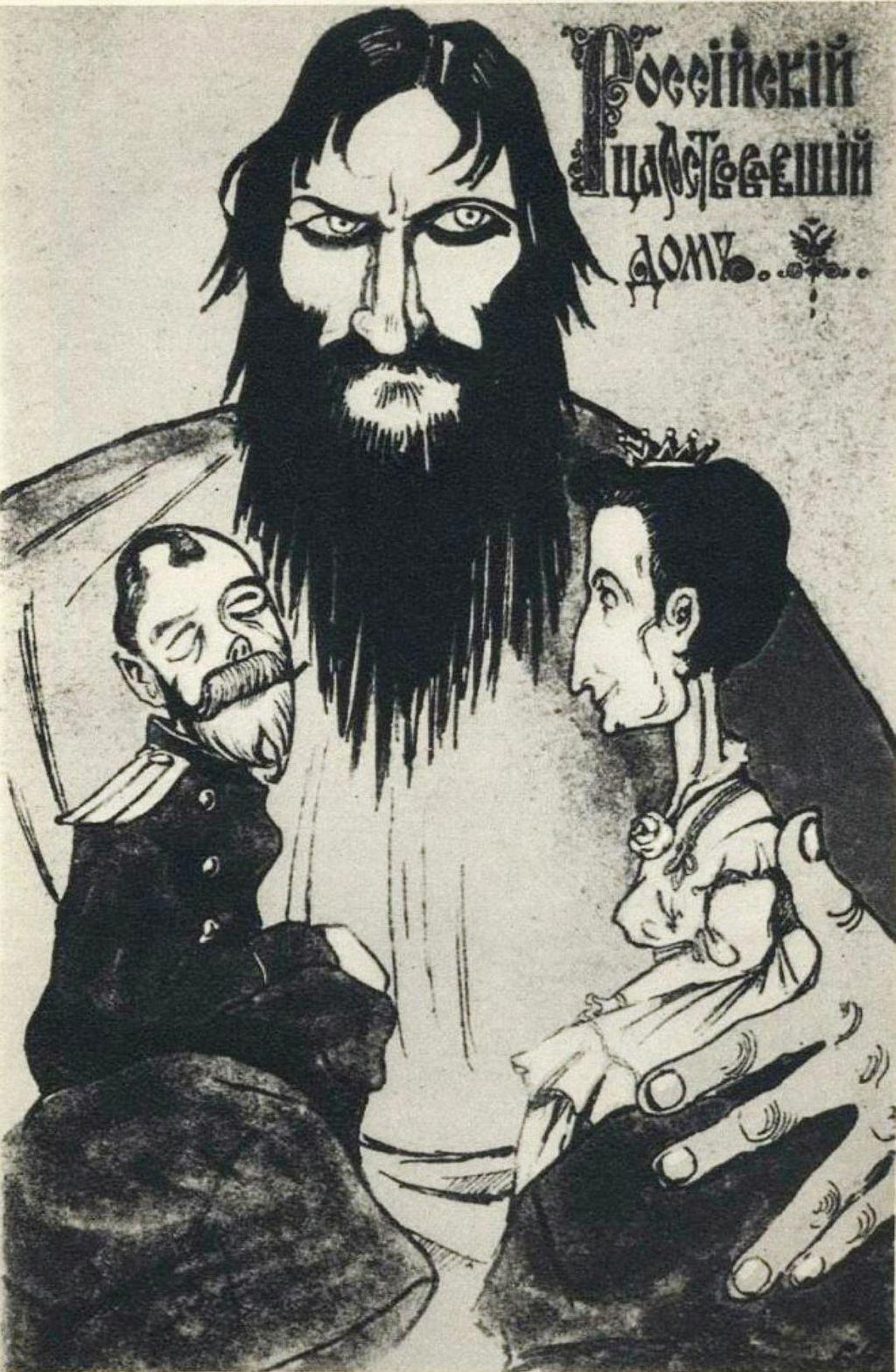
Source C
The situation is serious. The capital is in a state of anarchy. The government is paralysed; the transport service has broken down; the food and fuel supplies are completely disorganised. Discontent is general and on the increase. There is wide shooting on the streets; troops are firing at each other. It is urgent that someone enjoying the confidence of the country be entrusted with the formation of a new government. There must be no delay. Hesitation is fatal. Telegram from Mikhail Rodzianko, President of the Duma, to Tsar Nicholas II, 26 February 1917.
‘The Russian Tsars at home’, a 1916 cartoon
No kings? The American Revolution, 1760s–1780s

FOCUS
By using a range of historical sources, you will investigate the origins, key events and lasting significance of the American Revolution.
KEY ISSUES
You will explore:
• The historical context of the American Revolution, including:
– an examination of British rule over the 13 American colonies in the eighteenth century
• The nature of the features, people, ideas, movements, events and developments selected for study, including:
– the rule of British King George III over the 13 American colonies
– the contest of the great powers
– the influence of revolutionary ideas from the Enlightenment
– the Seven Years’ War and Pontiac’s Rebellion
– the Sons of Liberty and the Boston Tea Party
– the midnight ride of Paul Revere
– key battles of the Revolutionary War


– the leaders of both sides of the Revolutionary War, including George Washington
– the end of the war and constitutional democracy
• A relevant historical debate or issue, including:
– the legacy of the American Revolution
– the significance of the “No Kings” protests

UNCORRECTED SAMPLEPAGES
Teachers:
•
•

TIMELINE
Origins of the conflict
Late 17th centuryAge of Enlightenment begins
1763
Seven Years’ War (French and Indian War) ends 1764 Sugar Act
1765 Stamp Act and Quartering Act
Sons of Liberty founded 1766 Declaratory Act
1767 Townshend Duties
1770 Boston Massacre
1772
1773
Committees of Correspondence founded
Boston Tea Party
1774 Coercive (Intolerable) Acts
Continental Congress founded War
1775
1776


First battle at Lexington and Concord
George Washington takes command of the Continental Army
Olive Branch Petition
Thomas Paine’s Common Sense
4 July: Declaration of Independence
1777 Continental victory at Saratoga
Articles of Confederation 1778 France-US alliance 1781 British surrender at Yorktown


UNCORRECTED SAMPLEPAGES
6.1 Introduction: a significant anniversary –America 250
UNCORRECTED SAMPLEPAGES
DRIVING QUESTION
• Why is the American Revolution significant today?
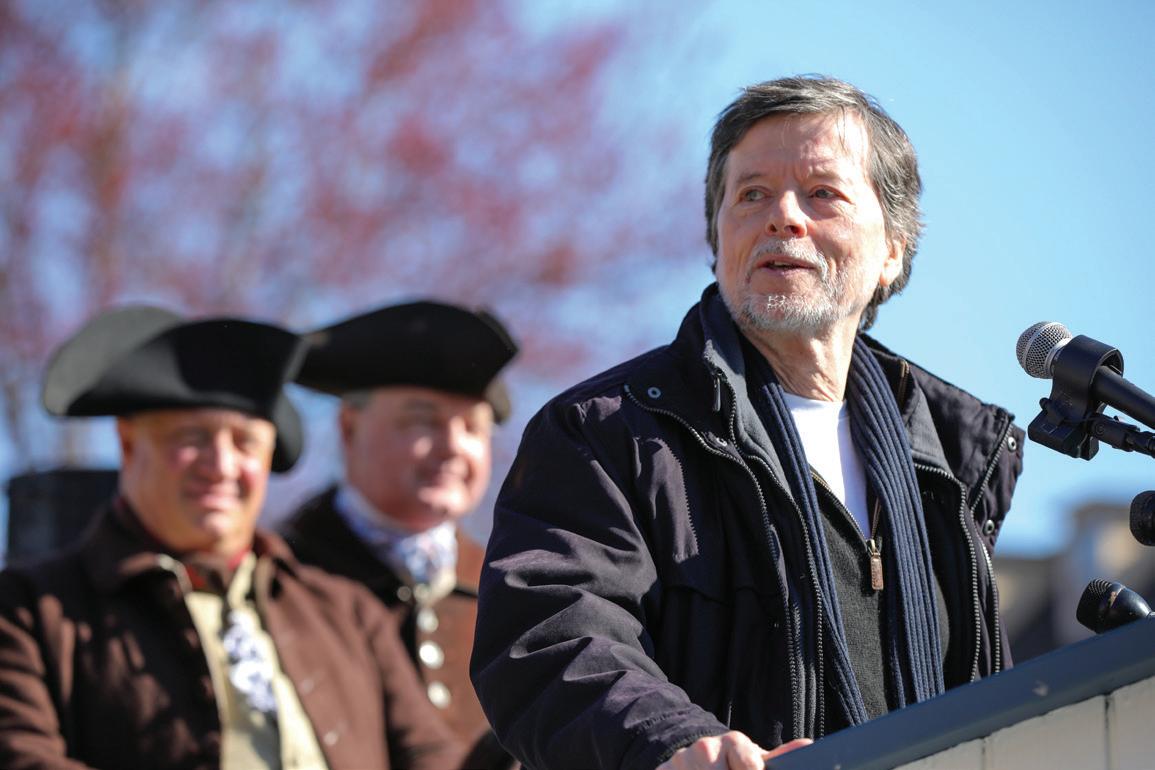
Source 6.1.1 Filmmaker Ken Burns speaks at the 250th anniversary of the Battle of Lexington, near Boston, with historical re-enactors behind him
America 250
From 2026 to 2033, the United States of America marks 250 years since the American Revolution. The Revolution, also known as the War of Independence, lasted eight years and cost over 50,000 lives. It ended the reign of the King of Great Britain over the American colonies and established an independent republic. For one of the most celebrated directors of historical films, Ken Burns, the anniversary was an ideal opportunity to create a comprehensive documentary series about the history of the Revolution.
Burns has been producing documentaries since the 1980s. He popularised the “Ken Burns effect”: panning and zooming a camera across historical photographs, paintings and documents to add depth and movement. During a decade of research with his long-term collaborator, the historian Geoffrey C. Ward, Burns’s production team identified over 18,000 primary sources. These include the testimonies of more than 140 witnesses and participants: patriots, loyalists, founding fathers, women, British soldiers, Native Americans, enslaved Africans, Irish immigrants and German mercenaries. The resulting 12-hour documentary series The American Revolution first aired on television in late 2025. Burns hoped that his series would bring Americans together to acknowledge “our American story”, regardless of who they are, what they believe or how they vote.
Source 6.1.2 An account of what John Adams and Thomas Jefferson thought about how the history might be retold, in the 1810s
Adams wrote to Jefferson: “Who shall write the history of the American revolution? Who can write it? Who will ever be able to write it?”
The problem, as Adams saw it, was that so much was done in secret. Nobody recorded the debates and speeches of the Continental Congress, the governing body during the revolution. Therefore, how could a true history ever exist?
Jefferson agreed. After restating Adams’ question about who could write a true history, Jefferson’s response was “nobody; except merely its external facts.”
Marianne Holdzkom. 2026. “John Adams and Thomas Jefferson disagreed about the American Revolution’s meaning even as they lay dying”, The Conversation, 14 May.
However, 2025 was the first year of Donald J. Trump’s second term as president, a time of upheaval in American government and society. As Burns toured theatres and battle sites to promote his documentary, the Trump White House was taking a series of controversial actions, without consulting the legislative arm of government. These included:
• declar ing an illegal immigration emergency and sending masked agents to raid houses and factories and deport people without citizenship papers
• declar ing a crime emergency and deploying armed National Guard troops to patrol major cities
• firing career public servants who criticised the Trump administration
• pardoning some rioters convicted over the 6 January 2021 attack on police and lawmakers after Trump lost the 2020 election.
He also shared edited images of himself wearing a crown, with the caption “long live the king”.
Trump was also taking actions to shape how history was portrayed. He ordered museums and parks to remove signs and exhibits that were not “patriotic” or that could be regarded as promoting “divisive race-based ideology”. He cancelled government funding for the Public Broadcasting Service (PBS), on which Burns’s documentary was televised, saying that most of its programming was “radical, woke propaganda”. Because Republican Party and Democratic Party lawmakers failed to reach compromise on the federal budget, the longest-ever government shutdown was in effect, forcing government workers to stay away from their offices or to work without pay. Meanwhile, the president demolished the entire East Wing of the White House to build a new gold-trimmed ballroom.
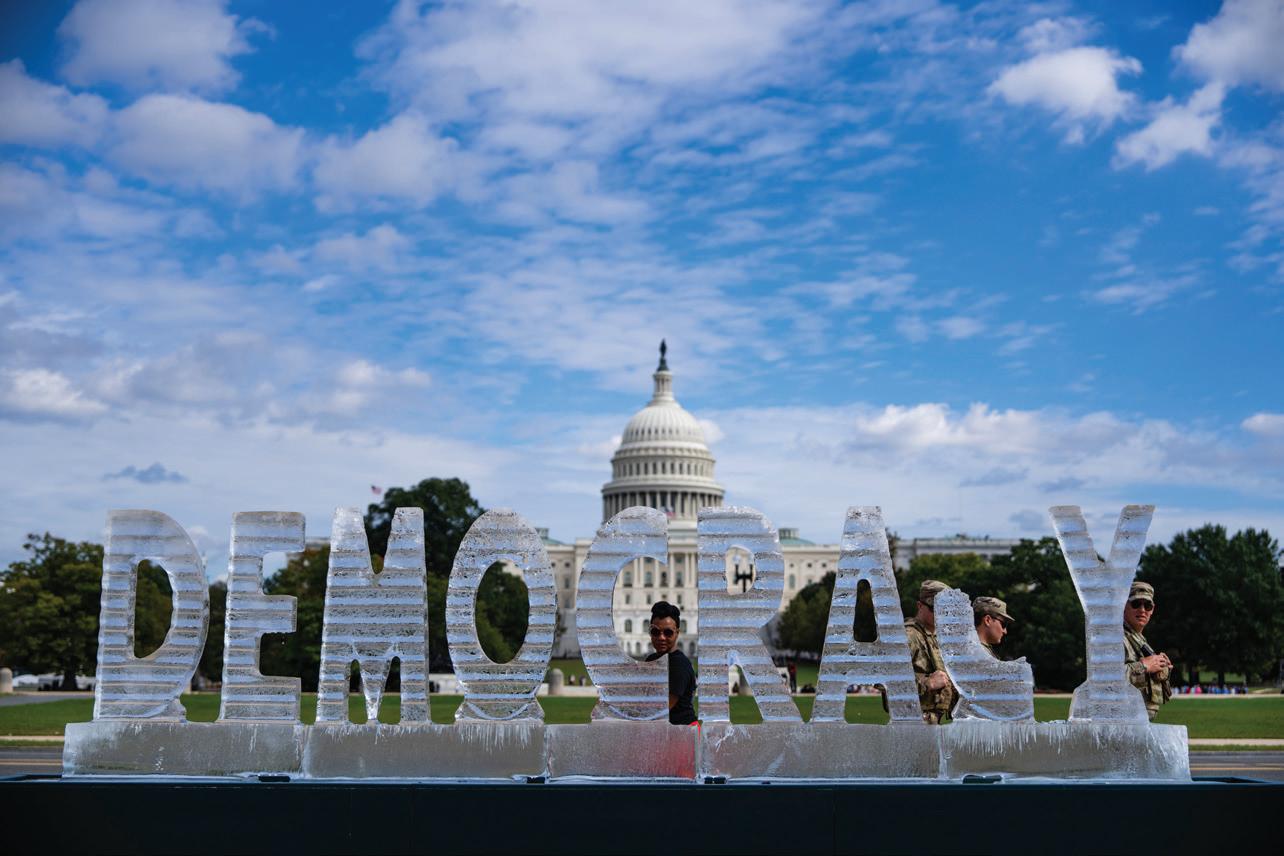
6.1.3 An ice sculpture of
UNCORRECTED SAMPLEPAGES
A month before the documentary launched, around 7 million Americans joined a day of “No Kings” protests. Protesters accused the president of undermining their rights.
In light of these events, how can we best understand the Revolution with which the United States began? Burns’s team hoped that viewers would have open discussions about the core ideals of liberty, democracy and independence, and the legacies of the Revolution.
Source 6.1.4 A remark on The American Revolution by a historian
It really is actually kind of remarkable, the way that that nation ends up cohering [in the 1770s], not around culture, not around religion, not around ancient history. It was coming together around a set of purposes and ideals for one common cause.
Christopher Brown, Historian. 2025. Interview in Episode 1 of The American Revolution
Writing focus 6.1
Question words
Source
“democracy” by anti-Trump artists melts on the National Mall in Washington, DC in October 2025, as members of the National Guard patrol past
Go online to assign and download questions, view results and more!
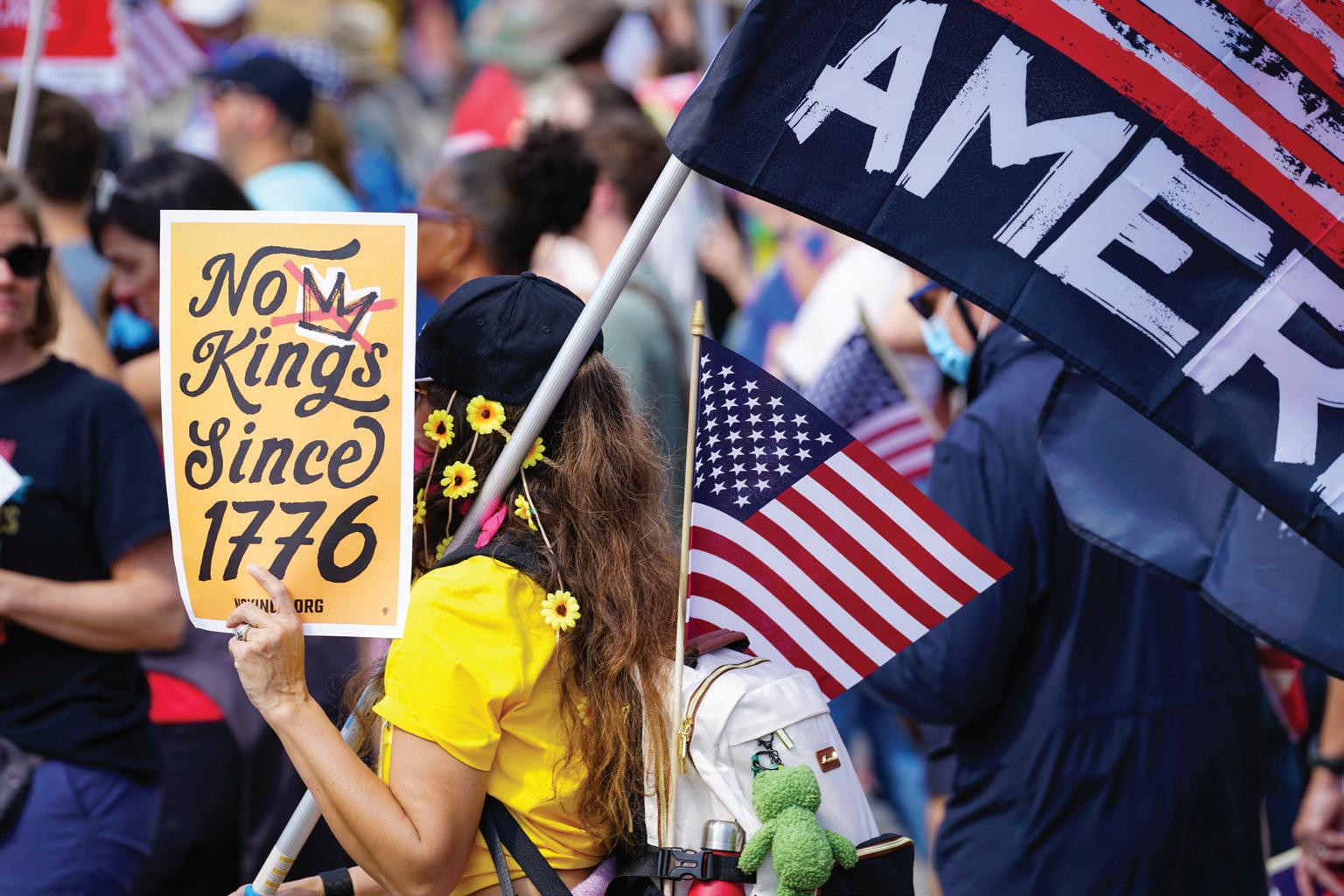
Source 6.1.5 A member of the “No Kings” protest in Atlanta, Georgia, 18 October 2025, holding a sign referring to the Declaration of Independence
RESEARCH 6.1
Analysing a documentary
View the trailer or opening episode of Ken Burns’s The American Revolution (http://cambridge.edu.au/redirect/11751) and discuss the following questions as a class.
1. What do you notice about the format of the documentary (style, kinds of sources, etc.)?
2. What message about the Revolution does it appear to present?
3. How does this match or challenge your prior knowledge of the American Revolution?
4. How does this relate to events in the United States today?
5. What do you hope to learn more about, to understand the Revolution more fully?
Historical concepts: Significance Historical skills: Historical investigation and research
UNCORRECTED SAMPLEPAGES
1. Identify how long the American Revolution lasted and the major outcome.
2. Describe the “Ken Burns effect”.
3. Explain whose voices from primary sources Burns’s team includes as voices in The American Revolution documentary.
4. Explain what the “No Kings” protests were reacting to in 2025.
5. Discuss what Ken Burns aimed to achieve with his documentary.
6. Discuss how the events of the present may influence how Americans interpret the ideals and legacies of the American Revolution.
6.2 The historical context: British colonies in America
DRIVING QUESTION
• What was the nature of the 13 colonies and their relationship with Britain before the American Revolution?
Colonies prior to the revolution
Before the American Revolution, there were 13 British colonies between the Appalachian Mountains and the east coast of North America. They covered an area only one-tenth as big as the current United States, but as large as Britain, France and Germany combined. The first English settlement was at Jamestown in 1607. It was established by the Virginia Company of London under a royal charter, hoping to make money from mining and forestry.
UNCORRECTED SAMPLEPAGES
Key:

British colonies/frontier regions
French colonies/claimed territories
Spanish colony and mission zone
VA – Virginia (est. 1607) MASS – Massachusetts (est. 1620) NH – New Hampshire (est. 1623) MD – Maryland (est. 1634) CONN – Connecticut (est. 1636) RI – Rhode Island (est. 1636) DEL – Delaware (est. 1638) SC – South Carolina (est. 1653) NC – North Carolina (est. 1653) NJ – New Jersey (est. 1664) NY – New York (est. 1664) PA – Pennsylvania (est. 1682) GA – Georgia (est. 1732) Original 13 British Colonies in America in 1732
Source 6.2.1 The original 13 British colonies, on the east coast of North America
The Virginia Settlement was followed by the Plymouth Colony in present-day Massachusetts in 1620, founded by “Pilgrims” escaping religious intolerance in Europe and seeking to separate completely from the Church of England. The colonies displaced most of the more than 300 Native American tribes and Nations that had lived there for centuries. By 1760, the colonies had a total population of nearly 2.5 million. There were three types of colonial governments:
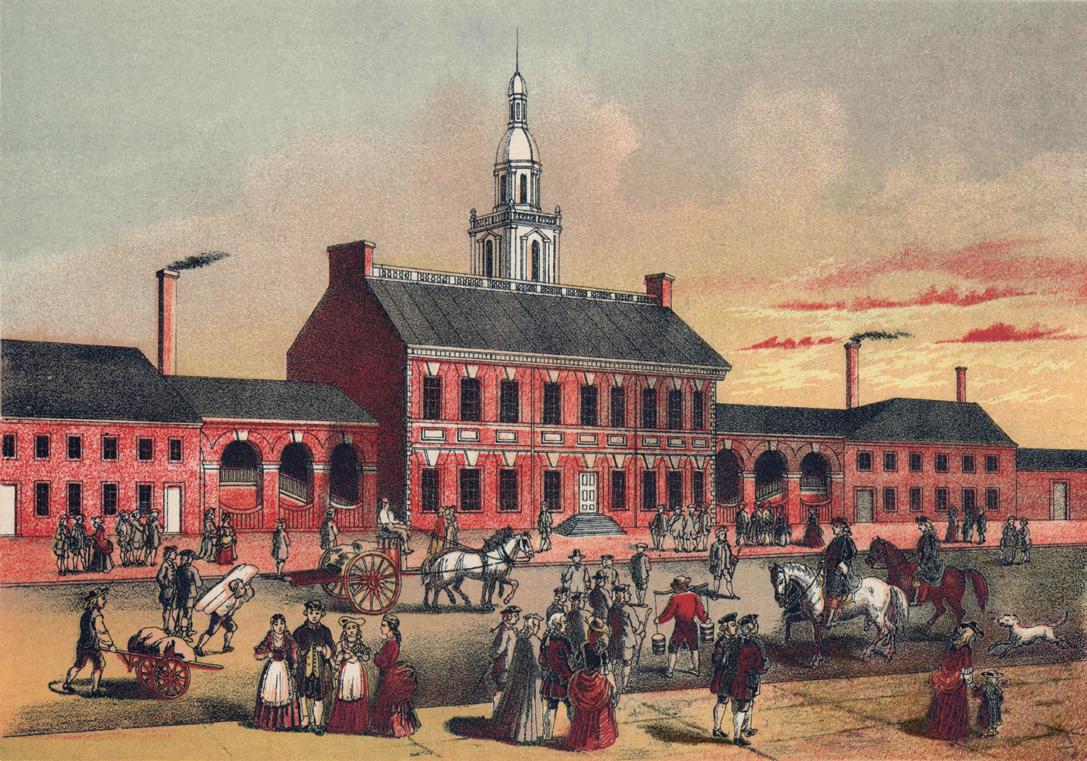
UNCORRECTED SAMPLEPAGES
• Royal colonies: The King appointed a royal governor to make final decisions, usually with an appointed colonial council and an elected assembly.
• Proprietary colonies: The King granted a wealthy “proprietor” land in America to run as a colony, either personally or through a governor.
• Charter colonies: The King gave a company or a group of settlers a royal charter, allowing them to operate a colony, typically with an elected governor.
Colonial assemblies had the power to make local laws and charge taxes. However, the governor chose most of the influential officials, and the King was the ultimate authority. Voting for representatives was generally limited to white men who owned property, which was between 40% and 70% of white adult males. They usually voted by saying the candidate’s name aloud, often after receiving free food and alcohol from the candidate. By the 1760s, most provinces were royal colonies, even if they had started in another form. Therefore, regardless of who was elected to the legislature, the colonies were ultimately subject to the control of King George III.
SIGNIFICANT INDIVIDUAL
King George III of Britain and Ireland (1738–1820) ruled the British Empire from 1760 to 1820. He was the first king from his royal family to be born in England and speak English fluently, and was the longest-reigning king in British history. Although he paid close attention to politics, he was a constitutional monarch. Major policy decisions, including taxing the American colonies, were made by ministers and Parliament. George was strongly anti-Catholic and is remembered as the “mad king” because, later in life, he suffered bouts of severe illness that affected his mental health. During his reign, Britain lost its American colonies, established new colonies in Australia, took more control over Ireland, increased its possessions in India and defeated France. From 1811, his son took over his duties due to his father’s ill health. With his queen Charlotte Sophia, George had 15 children!
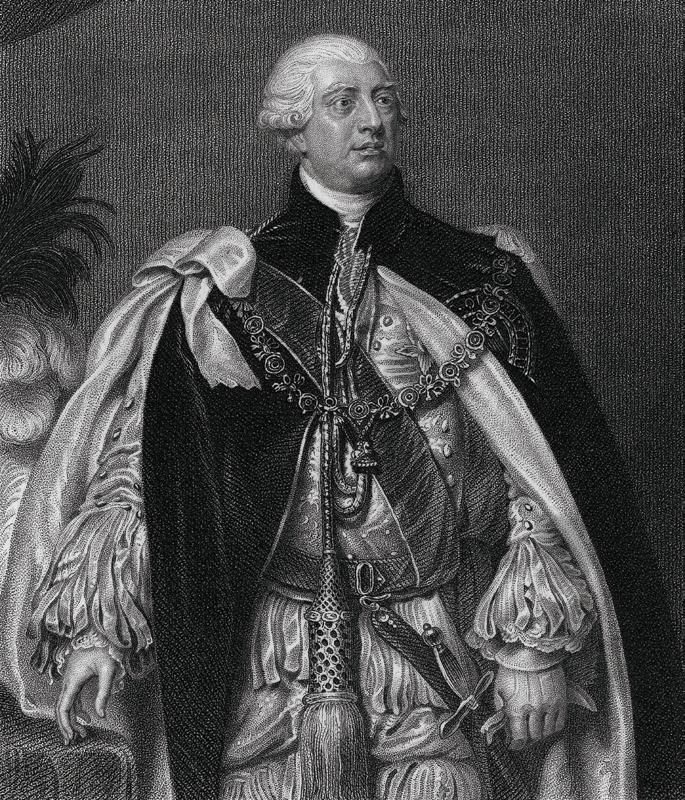
Source 6.2.3 A portrait of King George III
Source 6.2.2 The State House, Philadelphia, where the Pennsylvania colonial assembly met. After 1776, it was known as Independence Hall.
Source 6.2.4 A summary of the 13 British colonies before the Revolution
Colony
New England colonies
Massachusetts 1620; Royal colony 220,000
Connecticut 1635; Charter colony 142,000
Rhode Island 1636; Charter colony 45,000
New Hampshire 1623; Royal colony 39,000
Middle colonies
Pennsylvania 1681; Proprietary colony 184,000
New York 1624; Royal colony 117,000
New Jersey 1664; Royal colony 94,000
Delaware 1682; Proprietary colony 33,000
Southern colonies
Virginia 1607; Royal colony 340,000
Maryland 1634; Proprietary colony 162,000
North Carolina 1663; Royal colony 110,000
South Carolina 1663; Royal colony 94,000
Georgia 1733; Royal colony 9,600
Analysing significance
Society and economy
UNCORRECTED SAMPLEPAGES
Mostly English: “white” people comprised around 98% of the population.
Merchant-based: shipping, fishing and trade.
Mixed English, Scottish, Irish, Dutch, German and Swedish populations: around 90% “white”.
Mixed trade and agriculture.
English, Scottish, Irish and enslaved Africans: around 40% “black”.
Plantation-based economy.
1. Explain the difference between the governments of a royal colony and a charter colony.
2. Explain what made southern colonies different from northern colonies.
3. Explain the extent to which colonists had a say over law making.
4. Discuss why the colony of Virginia might have been particularly significant.
Historical concepts: Significance Historical skills: Historical interpretation
Writing focus 6.2 Noun phrases (identify)
1. Identify the location of the 13 British colonies before the American Revolution.
2. Describe the three types of colonial governments.
3. Explain who held ultimate authority over the colonies.
4. Compare the economies of the southern colonies and the New England colonies.
5. Explain the effects of the different types of colonial governments on the level of political power held by colonists.
Go online to assign and download questions, view results and more!
mercantilism the belief that a nation’s strength comes from its wealth, and governments should manipulate trade to their people’s advantage (e.g. tariffs)
6.3 The historical context: European influences
DRIVING QUESTION
• How did European imperial competition and Enlightenment ideals influence American resistance?
Great powers contest
In the eighteenth century, the great powers of Portugal, Britain, France, the Dutch and Spain competed for land, markets and colonies. The theory of mercantilism drove empires to seize lands across the globe to access raw materials and markets, deploy armies to fight off competitors, and apply tariffs to protect industries at home. The empires engaged in the slave trade, which forcibly took over 12 million African people to colonies in North and South America. Most were taken to Brazil and the islands of the Caribbean. Around 388,000 were taken to colonial America, where plantation owners exploited enslaved people to grow crops that were in demand in Europe, such as sugar, coffee, tobacco and cotton.
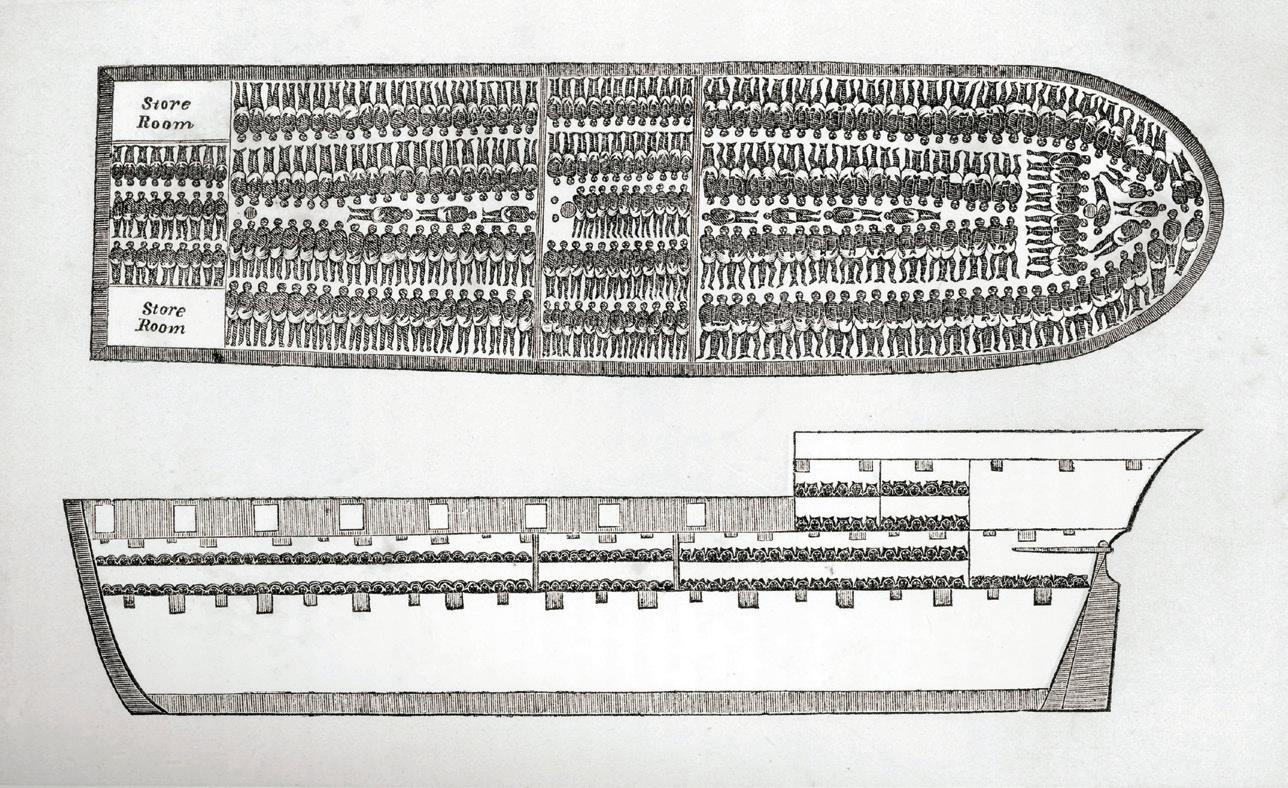
UNCORRECTED SAMPLEPAGES
Writing focus 6.3
Noun phrases (identify and develop)
The major imperial conflict of the eighteenth century was the Seven Years’ War (1756–63), fought between Great Britain and France, and their respective allies. In Europe, Britain’s ally Prussia defeated Austria, France and Russia, with British naval support. In India, the British East India Company defeated French troops, making Britain the dominant colonial power over India and its cotton and tea trade. In the Caribbean and Africa, the stronger British navy weakened French colonies there.
In North America, the Seven Years’ War was known as the French and Indian War. British and American colonists – some of whom were led by George Washington – were supported by allies from the Iroquois Nation. (Europeans called Native Americans “Indians” because the first explorers thought the Americas were India.) At war’s end, Britain had won control of Canada from France and of lands east of the Mississippi River. These lands had been Native American lands for centuries and had no colonial settlements. Officers were rewarded with land grants that ignored Native American rights – for example, George Washington was given thousands of acres in what is now West Virginia. The war put Britain heavily in debt. To begin to repay these debts, the British Parliament decided to start taxing the American colonies, which, as we shall see, was one of the causes of the revolution for American independence.
Source 6.3.1 A plan for transporting enslaved people below the decks of an eighteenthcentury British slave ship, for a two-month transatlantic journey
The Enlightenment
The Age of Enlightenment, a mostly European philosophical movement through the seventeenth and eighteenth centuries, also influenced thinking about the future of the American colonies. This was a time of great advances in philosophy, astronomy, physics, mathematics and chemistry. Enlightenment thinkers argued that each individual should shine the “light of reason” onto the world, rather than accepting what had been common sense for generations.
In Paris, the centre of the European Enlightenment, philosophes began to raise doubts about the social status quo, such as the right of kings to rule people. The French nobleman Baron de Montesquieu argued in The Spirit of Laws (1748) that any system that allowed a monarch to be an “absolute ruler” was inevitably unfair. Jean-Jacques Rousseau, in The Social Contract (1762), said “Man is born free, and yet everywhere he is in chains”. Rousseau wrote that all people were born with “rights”, and embraced the Enlightenment idea of popular sovereignty: the people as a whole, not an individual king, should make the laws, and no-one should be above the law.
Prominent Americans also celebrated human knowledge, read widely, experimented with the new sciences and discussed radical ideas. When they met to discuss their concerns about the way the British were controlling their colonies, they used Enlightenment language. Some of the most influential founding fathers, including Benjamin Franklin and Thomas Jefferson, also spent many years in Paris.
UNCORRECTED SAMPLEPAGES
popular sovereignty political theory that government is created by and subject to the will of the people founding father a leader who was instrumental in creating the United States, particularly its Declaration of Independence and Constitution
Source 6.3.2 Joseph Wright’s An Experiment on a Bird in the Air Pump, 1768. Enlightenment-era painters depicted people’s fascination with scientific experiments and new ways of understanding the world.
SIGNIFICANT INDIVIDUAL
Benjamin Franklin (1706–1790) was born in Boston, one of 17 children. His father struggled to make a living from making soap and candles. After his formal education finished when he was 10, he became an apprentice printer and later a man of many talents –author, scientist, inventor and diplomat. He worked as a writer, newspaper editor and printer in London and Philadelphia. After he had made enough money, he became a “gentleman” and devoted his energies to philosophical pursuits and public service. His famous scientific experiment with a key attached to a balloon in a lightning storm developed new insights into electricity. Franklin was a delegate to the Second Continental Congress, which dispatched him to Paris in 1776 to secure French military support. He remained in France for the entire war and negotiated the final peace treaty in 1783. After returning to America, he attended the Constitutional Convention of 1787.
6.3.3 A portrait of Benjamin Franklin during his years in London, beside a bust of the great scientist Isaac Newton
UNCORRECTED SAMPLEPAGES
Source 6.3.4 The importance of freedom of speech
Freedom of speech is a principal pillar of a free government; when this support is taken away, the constitution of a free society is dissolved, and tyranny is erected on its ruins.
Benjamin Franklin. 1737. Article in Pennsylvania Gazette
Source 6.3.5 Thomas Jefferson’s view on King George III
His majesty … is no more than the chief officer of the people, appointed by the laws, and circumscribed with definite powers, to assist in working the great machine of government.
Thomas Jefferson. 1774. A Summary View of the Rights of British America
Source
Source 6.3.6 An extract of the document that served as a platform upon which many subsequent state papers of the American Revolution were based
Among the natural rights of the Colonists are these: First, a right to life; Secondly, to liberty; Thirdly, to property; together with the right to support and defend them in the best manner they can.
Samuel Adams. 1772. The Rights of the Colonists: The Report of the Committee of Correspondence to the Boston Town Meeting. Old South Leaflets no. 173. Boston: Directors of the Old South Work, 1906.
Source 6.3.7 A portrait of Thomas Jefferson, c. 1805-07. Constantly reading, he said, “I cannot live without books”.
RESEARCH 6.2
Researching Thomas Jefferson
Starting with the Monticello website (http://cambridge.edu.au/redirect/11752), research the life of Thomas Jefferson to respond to the following prompts.
1. Identify the sort of family into which Jefferson was born.
2. Explain how Jefferson became involved in politics, and his main official roles.
3. Explain three great achievements of Jefferson.
4. Explain what Jefferson’s plantation of Monticello revealed about his character.
Historical concepts: Significance, Perspectives Historical skills: Historical investigation and research
UNCORRECTED SAMPLEPAGES
1. Identify the belief that encouraged European empires to seize land and control trade.
2. Define the Enlightenment idea of popular sovereignty.
3. Explain the effects of the Seven Years’ War on Britain’s role in North America.
4. Explain how Enlightenment thinkers influenced American colonial attitudes.
5. Discuss how useful primary sources from before the Revolution are in helping us understand what American colonists believed, using examples.
Go online to assign and download questions, view results and more!
6.4 Build-up to conflict: Native American lands
UNCORRECTED SAMPLEPAGES
DRIVING QUESTION
• How did British policies anger Native Americans and colonists and contribute to discontent with British rule of the American colonies?
Chief Pontiac’s Uprising
While the Enlightenment raised theoretical questions about the power of kings, colonists began to question specific actions taken by King George III. His government, over 5000 kilometres away, was placing limits on colonists’ lives and ambitions, including their access to Native American lands.
SIGNIFICANT INDIVIDUAL
Much of Chief Pontiac’s life (c. 1720–1769) is poorly documented. Historians believe that his parents came from two powerful Nations of the Great Lakes region, the Ojibwa and the Ottawa. As a leader of the Ottawa, Pontiac allied with the French against rival Nations such as the Huron and fought alongside the French during the Seven Years’ War. Pontiac was also influenced by a spiritual leader, or prophet, named Neolin of the Delaware Nation (from the region of modern-day Oklahoma). Neolin taught that British influence was harmful and corrupting. He warned that British goods and practices, including metal tools, alcohol, missionaries and colonists, were a “poison” that threatened Native American cultures and ways of life.
After Britain defeated France and took control of Canada, the British governor Jeffrey Amherst abandoned the diplomatic practices the French had used when dealing with Native Americans. Instead of honouring alliances and gift-giving traditions, the British adopted a policy of “subjection”. This involved restricting trade and sending British troops into Native American lands. For the Ottawa and other Nations in the Great Lakes region, these actions appeared to be an attempt to destroy them. Pontiac argued that the British should be driven out and sent back across the Atlantic. In May 1763, Pontiac called for an armed uprising. He led attacks on British forts, including the siege of Detroit, in what became known as “Pontiac’s Uprising” (1763–66). After the uprising failed, Pontiac is believed to have lived quietly in a French-speaking area of Illinois. He was killed in 1769 during a dispute with a rival warrior.
Long after his death, Pontiac’s name continued to be used as a symbol of strength and resistance. In his honour, the Detroit-based car manufacturer General Motors produced vehicles under the “Pontiac” brand from 1926 to 2010.
Source 6.4.1 An artist’s impression of Chief Pontiac
ANALYSIS 6.2
Analysing a source
Source 6.4.2 Chief Pontiac called for Native American unity against the British after the French and Indian War.
UNCORRECTED SAMPLEPAGES
It is important for us, my brothers, that we exterminate from our lands this nation which seeks only to destroy us. You see as well as I do that we can no longer supply our needs, as we have done from our brothers, the French. The English sell us goods twice as dear as the French do, and their goods do not last …
When I go to see the English commander and say to him that some of our comrades are dead, instead of bewailing their death, as our French brothers do, he laughs at me and at you. If I ask for anything for our sick, he refuses with the reply that he has no use for us. From all this you can well see that they are seeking our ruin. Therefore, my brothers, we must all swear their destruction and wait no longer. Nothing prevents us: They are few in numbers, and we can accomplish it.
… What do we fear? It is time.
Chief Pontiac of the Ottawa Nation. 1763. Address to a gathering of Ottawa, Huron and Potawatomie peoples, 5 May. Translated by Robert Navarre, a French-Canadian official in Detroit.
1. Describe Pontiac’s view on the difference between the English and the French.
2. Describe what Pontiac accuses the English of doing.
3. Explain the origin of the source (where, when, who) and how that relates to the events of the time.
4. Analyse the value and limitations of the source in helping us understand the origins of the American Revolution.
Historical concepts: Perspectives Historical skills: Analysis and use of sources
Pontiac’s attacks on British forts spread quickly along the frontier between white settlements and Native American lands. Fourteen Nations joined the uprising: the Ottawa, Delaware, Potawatomie, Shawnee, Mingo (Seneca), Wyandot, Ojibwe, Huron, Choctaw, Piankashaw, Kickapoo, Tunica, Peoria and Mascouten Nations. They fought to reassert their sovereignty over their lands.
Within two months, they had overrun most British forts in the west, cut British communication lines and laid siege to nearby white settlements. Around 500 white settlers were killed, along with an unknown number of Native Americans. As violence spread, “anti-Indian” sentiment grew among colonists. When 20 unarmed Susquehannock people were massacred in December 1763, many colonists blamed British policies for creating the conditions that led to the violence.
Although Pontiac’s uprising did not achieve outright victory, it forced a change in British policy. In 1766, Pontiac negotiated a peace settlement that included British recognition of Native American autonomy over western lands. This angered many colonists, as British officials declared further white settlement west of the Appalachian Mountains illegal. The boundary was marked on maps as the Proclamation Line.
Writing focus 6.4
Transitional phrases
Key:

Original 13 colonies
Other British colonies, 1763
British interior territories (Quebec)
Spanish territory
Indian Reserve
Proclamation Line of 1763


Source 6.4.3 Map of British colonies in North America after the Seven Years’ War, showing the (pink) Proclamation Line that limited any further westward settlement
Go online to assign and download questions, view results and more!
UNCORRECTED SAMPLEPAGES
1. Identify Chief Pontiac and which Nation he led.
2. Explain why Native Americans viewed British policies as a threat.
3. Explain Pontiac’s Uprising.
4. Explain the Proclamation Line, and colonists’ attitudes towards it.
5. Explain how Pontiac’s Uprising changed British policy.
6. Discuss why British decisions after the Seven Years’ War increased colonial unrest.
6.5 Build-up to conflict: movements against British taxes
DRIVING QUESTION
• How did rising colonial resistance to British taxes and events in Boston push the colonies towards armed conflict?
From 1764, facing debts from the Seven Years’ War and threats from Native American Nations, the British Parliament imposed taxes on the colonies to raise funds. Colonists started to identify as either “loyalists” or “patriots”.
RESEARCH 6.3
Investigating colonial laws
Starting with the Library of Congress website (http://cambridge.edu.au/redirect/11753), research the British taxes/laws imposed on the colonies between 1764 and 1774. For at least five laws, note their purpose and consequences.
Historical concepts: Causation Historical skills: Historical investigation and research
SIGNIFICANT INDIVIDUAL
Samuel Adams (1722–1803) was a leading Boston radical. He struggled in business and did not do well in his original job as a tax collector, but he excelled in politics. Adams developed the secret organisation called the Sons of Liberty in 1765, and spoke at many town meetings to inspire crowds to reject British goods and interference. He supported complete independence from Britain earlier than most other colonists. Adams represented Massachusetts in the Continental Congresses and signed the Declaration of Independence, although he refused to support the Constitution until it was amended to include a Bill of Rights. He later served as governor of Massachusetts, and his second cousin, John Adams, served as the second US president.
UNCORRECTED SAMPLEPAGES
In 1766, the British Parliament passed the Declaratory Act, stating that it had the right to make laws for the American colonies “in all cases whatsoever”. The following year, Parliament imposed the Townshend Duties, a series of tariffs on imported goods such as paper, glass and tea. Patriots were outraged that a legislative body in which they had no representatives was taxing them. In “Letters from a Farmer in Pennsylvania” (1767–68), the lawyer John Dickinson condemned this practice as “taxation without representation”, arguing that “those who are taxed without their own consent, expressed by themselves or their representatives, are slaves”.
loyalists colonists who remained loyal to the British crown, also known as Tories
patriots colonists who supported independence/ the Revolution, also known as Whigs
Source 6.5.1 A portrait of Samuel Adams
Samuel Adams called on the colonies to unite in resistance. Groups such as the Sons of Liberty and other patriotic gangs began intimidating loyalists and enforcing boycotts. In response to growing unrest, Britain sent two regiments of troops to Boston.
UNCORRECTED SAMPLEPAGES
Writing focus 6.5
Noun phrases (develop)
SIGNIFICANT GROUP
The Sons of Liberty was a secret paramilitary group established in Boston and New York in 1765 to organise protests against British taxes and actions. It was probably started by Samuel Adams in Boston, and took its name from a speech by the Irishman Isaac Barré in the British Parliament, who referred to American colonists as “these Sons of Liberty”. Their motto was “No taxation without representation”, and their methods included gathering mobs from taverns to join protests, including the ransacking of Thomas Hutchinson’s house in Boston because of his role under the Stamp Act, street marches and the 1773 Boston Tea Party. By the outbreak of war, there were Sons of Liberty chapters in all 13 colonies.
Source 6.5.2 The Sons of Liberty sometimes “tarred and feathered” loyalists, or officials who collected taxes.
Justice and injustice: the Boston Massacre
By 1770, 4000 British troops had been stationed in Boston for two years, resulting in tension between the Redcoats (named for the red uniforms worn by British soldiers) and the town’s 15,000 colonists. In February, a customs official shot dead a 12-yearold boy who had been throwing snowballs and rocks at his house. On Monday, 5 March, a sentry guarding the Custom House on King Street hit a young man who had been taunting him. That evening, a crowd of 300 angry civilians gathered to protest. Facing them was Captain Thomas Preston and seven armed Redcoats. When Preston ordered the crowd to disperse, they threw sticks and snowballs at the soldiers.
When Private Hugh Montgomery was knocked off his feet by one of the projectiles, he fired his gun into the crowd. Other soldiers then joined in. Within moments, they had shot 11 civilians, killing five instantly. Two more later died of their injuries. Shocked protesters regrouped in nearby streets, and additional armed soldiers arrived. However, Thomas Hutchinson, the American-born loyalist acting as governor of Massachusetts, managed to calm the situation and promised that the incident would be investigated.
The following day, a town meeting was held. It demanded that British troops leave the city, and they were withdrawn to Fort William in Boston Harbor. Within days, competing accounts of the incident began to circulate. The town meeting published a pamphlet describing the event as an unprovoked “horrid massacre”. Loyalists responded with their own pamphlet, portraying it as an “unhappy disturbance” caused by violent street gangs. Another form of propaganda attracted even greater public attention. Within three weeks, Boston printers began selling broadsides, or posters, depicting what became known as the “Boston Massacre”.
The best-known broadside was “The Bloody Massacre” by Paul Revere, a metalworker strongly committed to patriot causes. However, Revere’s image was not original. The original drawing, titled “The Fruits of Arbitrary Power”, had been created by a younger artist, Henry Pelham. Pelham had lent the drawing to Revere while he struggled to organise engraving and printing. Revere produced and published his own version without Pelham’s consent, leading Pelham to accuse him of being as dishonest as a highway robber.
Both broadsides expressed the artists’ horror at British “Redcoat” soldiers killing colonists. Neither Revere nor Pelham had witnessed the event, although both lived nearby. Their images were based on second-hand accounts and were intended as propaganda to turn public opinion against British rule. The images accurately show the number of soldiers and victims involved, but they do not represent the full scale of the crowd or the objects thrown at the soldiers. This omission downplays the Redcoats’ claim that they were acting in self-defence. The Boston Town Meeting sent copies of the broadsides, along with its report describing a “horrid massacre”, by ship to Britain. There, a local printer reproduced and sold them to the British public, raising serious doubts about the role of British soldiers in America.
ANALYSIS 6.3
Analysing a source
1. Describe the body language of the soldiers. Why might the artist have depicted them in this way?
2. Describe the body language of the civilians. Why might the artist have depicted them in this way?
3. Explain the origin of the source (where , when, who) and how that relates to American–British relations at the time.
4. Analyse the value and limitations of the source in helping us understand the origins of the American Revolution.
Source 6.5.3 Paul Revere’s print of the Boston Massacre, based on Henry Pelham’s engraving, 1770
UNCORRECTED SAMPLEPAGES
The Redcoats were arrested and spent months in prison awaiting trial. Loyalist lawyers refused to defend them, fearing retaliation from local residents. John Adams, a patriot and future president, agreed to act as their lawyer to demonstrate that the colonists valued a fair trial.
In October 1770, Captain Thomas Preston was found not guilty on the grounds that he had not ordered his men to fire. In December, the trials of the soldiers concluded. Two of the seven soldiers were found guilty, but only of manslaughter, due to acting in self-defence. Their punishment was branding on the thumb, a mark that meant any second serious offence would result in execution.
UNCORRECTED SAMPLEPAGES
SIGNIFICANT INDIVIDUAL
Thomas Hutchinson (1711–1780) was a Boston-born businessman who entered colonial politics in his 20s and became a lawmaker. He rose to the posts of judge and lieutenant-governor of the colony of Massachusetts Bay by the 1760s. Although he supported greater cooperation between the American colonies, he was a loyalist who opposed moves to separate the colonies from the British crown. After the Sons of Liberty attacked his home and destroyed his possessions in 1765, he grew increasingly suspicious of patriots and supported their repression. He became highly unpopular for his role as the acting governor during the Boston Massacre and the governor during the Boston Tea Party, and moved to England in 1774, where he became an adviser to George III.
Source 6.5.4 Thomas Hutchinson, the last royal governor of Massachusetts
After the Boston Massacre, the acting governor Thomas Hutchinson wrote a letter to London, offering to resign. However, while the ship carrying his resignation letter was on its way to Britain, a letter from the British government arrived. He had been promoted to royal governor of the colony of Massachusetts. As governor, Hutchinson would face more problems.
The Boston Tea Party
In May 1773, Parliament passed the Tea Act. This reduced the tariffs on British tea sold in the colonies, giving Britain’s East India Company an unfair advantage over Dutch tea, which many colonists preferred. Once again, the act reinforced the belief that colonists’ lives were being shaped by decisions made in London. The Sons of Liberty and other patriotic groups encouraged the people of Boston to resist by preventing British tea ships from unloading their cargo. In late 1773, three tea ships were delayed in Boston Harbour. Governor Thomas Hutchinson, whose sons held two of the city’s six tea-importing licences, insisted that the ships would not be allowed to leave until the tea was unloaded.
On 16 December 1773, Bostonian patriots held a lengthy public meeting to debate how to respond. Samuel Adams, John Hancock and other opponents of British rule urged the crowd to take strong action. The meeting was highly charged but unable to reach a clear decision. Late in the day, a group of about 40 men disguised themselves as Mohawk Native Americans and, shouting “No taxation without representation!”, announced their intention to board the ships and destroy the tea.
While about 2000 Bostonians watched and cheered from the docks, the men boarded the vessels, pried open 342 wooden chests with tomahawks and tipped the tea into the harbour. This was hard work – each chest contained up to 160 kilograms of tea. After three hours, tea worth about £10,000 was floating in the salt water, equivalent to the value of 45 houses in Boston at the time (Bell, 2025). News of the daring “Tea Party” spread rapidly. Similar acts of protest soon followed at other colonial ports, including New York Harbor in April 1774.
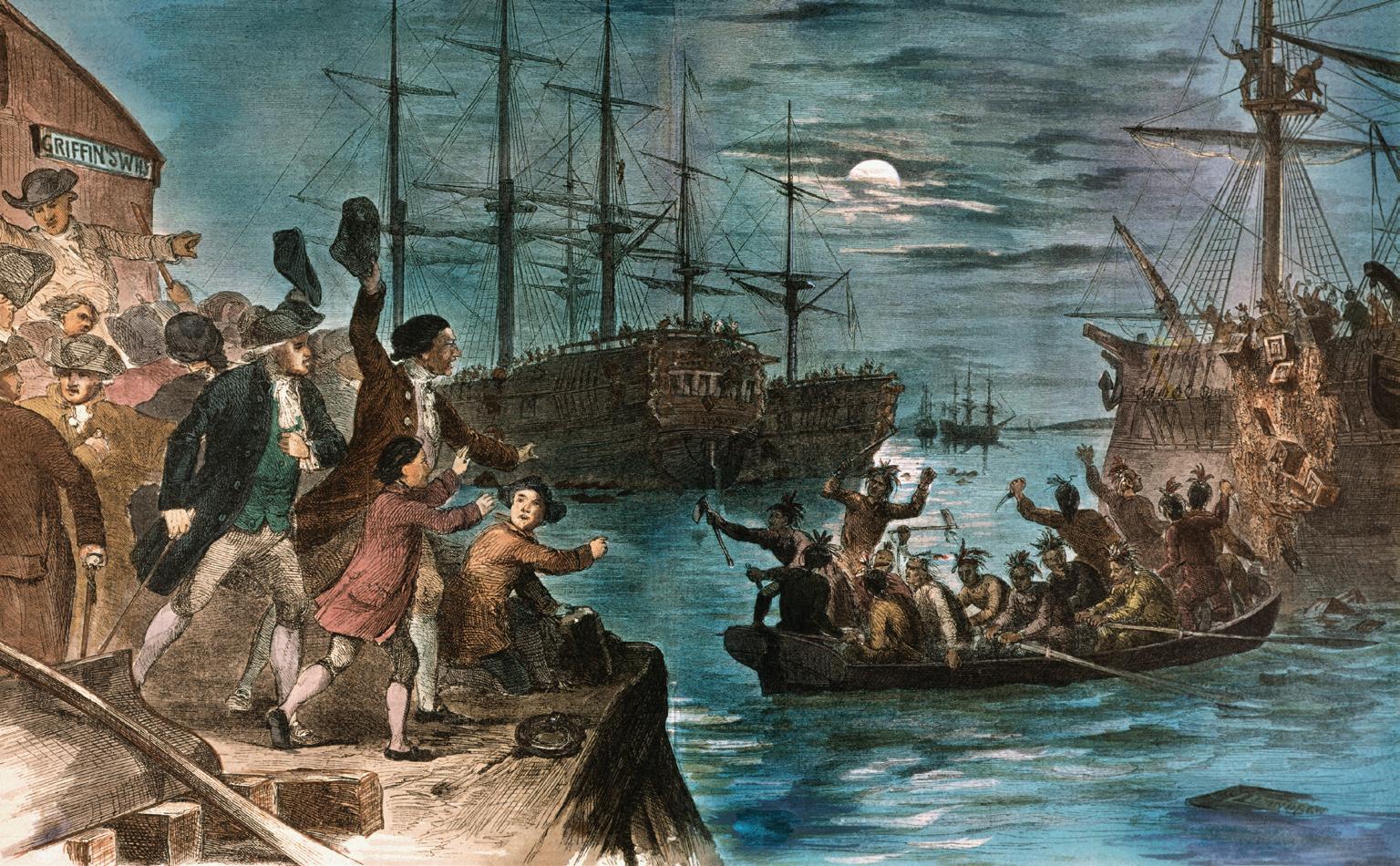
UNCORRECTED SAMPLEPAGES
In London, Parliament decided to respond with force. Hutchinson was replaced by a military governor, General Sir Thomas Gage, who brought four regiments of soldiers to patrol the streets of Boston. The city was under martial law. A series of laws known as the Coercive Acts closed Boston port to all trade until the East India Company was paid compensation, reduced the independence of the Massachusetts government and courts, and allowed soldiers accused of crimes to be tried in Britain, not the colonies.
Historians agree that the Boston Tea Party was a turning point. However, different historians emphasise different aspects of the causes and consequences, depending on the interpretation they are building.
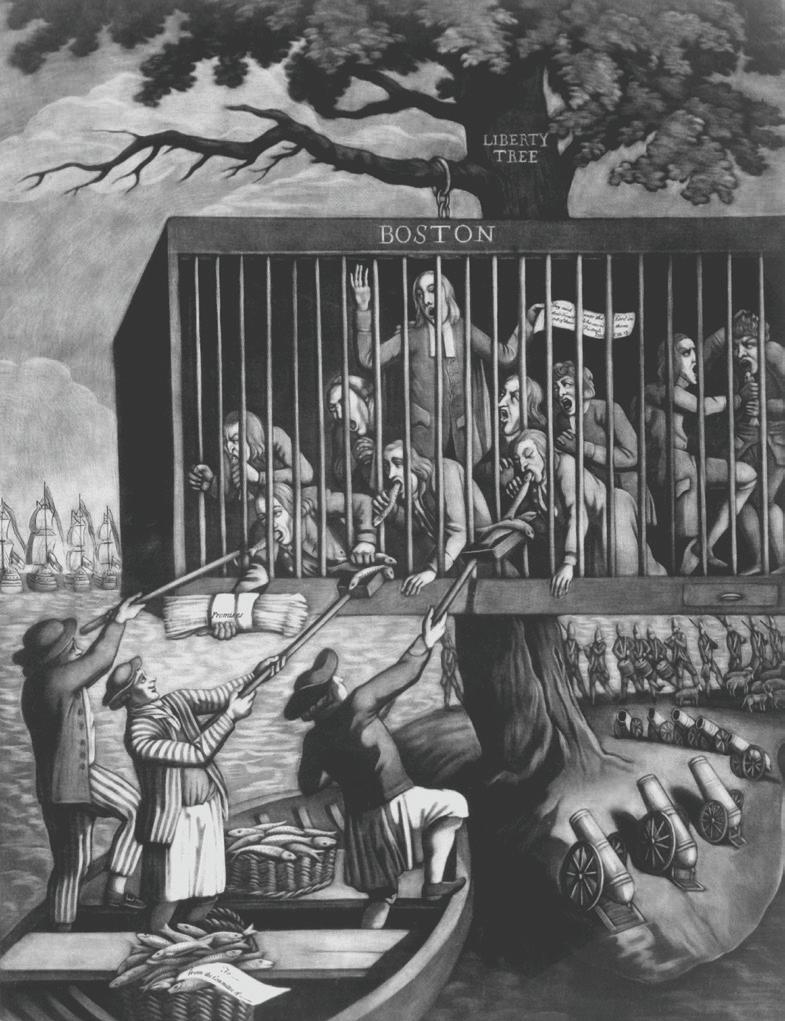
Source 6.5.5 An artist’s impression of the 2000-strong crowd cheering on the Boston Tea Party in December 1773
Source 6.5.6 This image from a London newspaper in 1774 shows “Bostonians in Distress”. They are effectively prisoners under the Coercive Acts.
Go
Biographers of American leaders of the period refer to the Tea Party as the trigger for their subject’s decision to prepare to fight British rule. Thomas Jefferson, for example, called for people in his colony of Virginia to have a day of prayer and fasting to show their support for Boston. Alexander Hamilton’s biographer, Ron Chernow, points to the Tea Party as the reason that the future founding father (then still a 19-year-old student) gave his first patriotic speech in July 1774. George Washington’s biographer James Flexner notes that the harsh British response convinced Washington that he had a duty to oppose the empire.
Many histories of the Revolution refer to the Tea Party as the spark that ignited the Revolution. This is true of Rick Atkinson’s The British Are Coming, Gordon Wood’s The American Revolution and Nick Bunker’s An Empire on the Edge. While the Coercive Acts intended to punish the people of Boston and deter others, the consequence was that Bostonians became martyrs. When Boston harbour was blockaded, sympathisers from other colonies sent thousands of barrels of food over land to Boston, a “major tipping point on the road to revolution” (Bell, 2025, p. 31).
ANALYSIS 6.4
Analysing significance
1. Summarise the actions of the “patriots” in the Boston Tea Party by completing the following sentence, using as much detail as you can.
In [where and when], American patriots … [did what] … because … [why they did it] … which showed [why it mattered].
2. Summarise the response of the British authorities to the Boston Tea Party by completing the following sentence, using as much detail as you can.
In [where and when], the British authorities … [did what] … because … [why they did it] … which showed [why it mattered].
3. Explain the influence of the Boston Tea Party on future founding fathers Jefferson, Hamilton and Washington.
4. Explain why the Boston Tea Party is regarded as a turning point in the Revolution.
5. In 2009, a political movement in the United States was established known as the Tea Party. Research the organisation and explain what it stood for and what it did.
UNCORRECTED SAMPLEPAGES
1. Define “loyalists” and “patriots”.
2. Explain why colonists opposed the Townshend Duties.
3. Explain what happened during the Boston Massacre.
4. Explain the role of propaganda, using the Boston Massacre as an example.
5. Explain why the Boston Tea Party was significant.
6. Discuss different historical interpretations of the significance of the Boston Tea Party.
6.6 Revolutionary War: opening battles
UNCORRECTED SAMPLEPAGES
DRIVING QUESTION
• How did rising colonial resistance to Britain turn into organised armed conflict?
After the 1774 Coercive Acts, colonial representatives met in Philadelphia, forming a “Continental Congress”. The First Continental Congress, which met from September to October 1774, agreed to boycott British goods and issued a Declaration of Rights and Grievances. This document stated that the colonists had “a right … to participate in their legislative council”, a right Britain was denying them. Each colony then debated whether to prepare to take up arms against the British by building stronger militias. In Virginia, Patrick Henry made a passionate speech that inspired many to believe that the time had come to fight.
Source 6.6.1 Patrick Henry gave a speech at the Virginia Convention to convince the American colonists that they needed to seek freedom from the British Empire.
There is no longer any room for hope. If we wish to be free – if we mean to preserve inviolate those inestimable privileges for which we have been so long contending – if we mean not basely to abandon the noble struggle in which we have been so long engaged, and which we have pledged ourselves never to abandon until the glorious object of our contest shall be obtained – we must fight! … I know not what course others may take; but as for me, give me liberty or give me death!
Excerpt from Patrick Henry’s speech of 23 March 1775. In William Wirt. 1818. Sketches of the Life and Character of Patrick Henry. 2nd ed. Richmond, pp. 122–123. Special Collections, Library of Virginia.
The shot heard round the world
In Massachusetts, Governor Gage ordered his soldiers to seize weapons and ammunition from the militia by marching into the towns of Lexington and Concord, 20–30 kilometres from their barracks in Boston. However, the patriots were better prepared than he realised. They had a network of spies, including Paul Revere, who sped on horseback on a “midnight ride” on the evening of 18 April 1775 to warn the colonists that “the regulars are coming out”, giving them time to prepare.
The militia were strengthened by “Minute Men”, who were trained to be ready “at a minute’s notice” to pick up their weapons and join a battle.
The 1500 British regulars were surprised to encounter organised resistance. At about 9:30 am on 19 April, near Concord, the British opened fire. The answering volley from the Massachusetts militia killed at least three soldiers and has since been called “the shot heard around the world”, because it marked the start of a revolutionary war against the British Empire. The British regulars retreated and were ambushed along the road by Minute Men hiding behind trees and buildings. These attacks caused around 300 British casualties. The first skirmishes of the war were an astonishing success for the patriots.
militia a military force whose members are trained soldiers but have civilian jobs, and are usually only called into action for specific periods of time
SIGNIFICANT INDIVIDUAL
Paul Revere (1735–1818) was a Boston-based silversmith and goldsmith who learned his trade from his father, a French immigrant. He also made engravings for prints and practised dentistry. In the 1770s, he served as a courier for patriotic political movements, gathering intelligence and delivering messages by fast horse –including spreading the word about the Boston Tea Party and, in April 1775, his “midnight ride” to warn the militia of advancing troops. This event was later made famous by Henry Wadsworth Longfellow’s 1861 poem
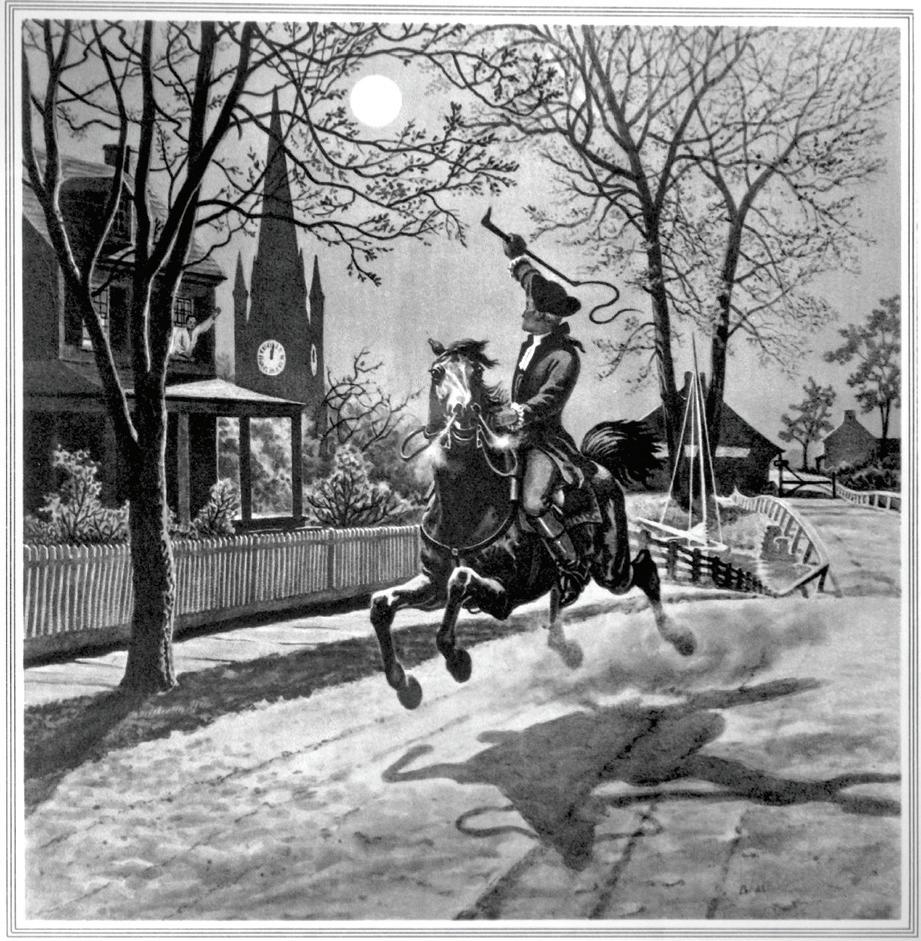
Source 6.6.2 There are numerous imagined depictions of “Paul Revere’s Ride” of 1775, in which he warned people that the regulars were coming.
“Paul Revere’s Ride”. He served as a colonel in the Revolutionary War but was not particularly successful in this role. Revere had eight children with his first wife and a further eight children with his second wife.
The following day, the Massachusetts militia decided to lay siege to Boston to cut British supply routes. However, the Royal Navy still controlled the harbour, allowing British soldiers to receive food and supplies. Reinforcements soon increased the number of British troops in the city to more than 6000. In May 1775, patriot forces captured Fort Ticonderoga to the north. They seized a large supply of British weapons and transported them to Boston to strengthen the siege, including 78 cannons and about 18,000 pounds of musket balls.
UNCORRECTED SAMPLEPAGES
Writing focus 6.6
Transitional phrases
On 17 June 1775, Gage decided to break the siege. Patriot spies again discovered the plan, allowing around 1000 soldiers to prepare defensive positions on Bunker Hill, just outside Boston. This became the first major battle of the war. When British troops advanced up the hill in formation, the defenders were ordered to hold their fire until they could see “the whites of their eyes”. This discipline enabled them to inflict heavy casualties. The patriots repelled two attacks, but after fierce hand-to-hand fighting, they were eventually overrun and forced to retreat. Although the battle was technically a British victory, it came at a heavy cost: 1054 British casualties compared with about 450 American casualties. When news of the battle reached King George III and Prime Minister Lord North, the King declared that the colonies were in “open and avowed rebellion” and must be suppressed. Meanwhile, the Continental Congress established a Continental Army and appointed George Washington as its commander.
ANALYSIS 6.5
Analysing
a source
UNCORRECTED SAMPLEPAGES
John Trumbull was a member of a prominent Patriot family and served in the Continental Army from 1775 to 1777, including at the Battle of Bunker Hill, before focusing on art. He painted this scene while living in London in 1786. The painting shows two men dying: on the right, wearing blue, Dr Joseph Warren, president of the Massachusetts Provincial Congress; and on the left, wearing red, British Major John Pitcairn, who is shown falling into the arms of his own son.
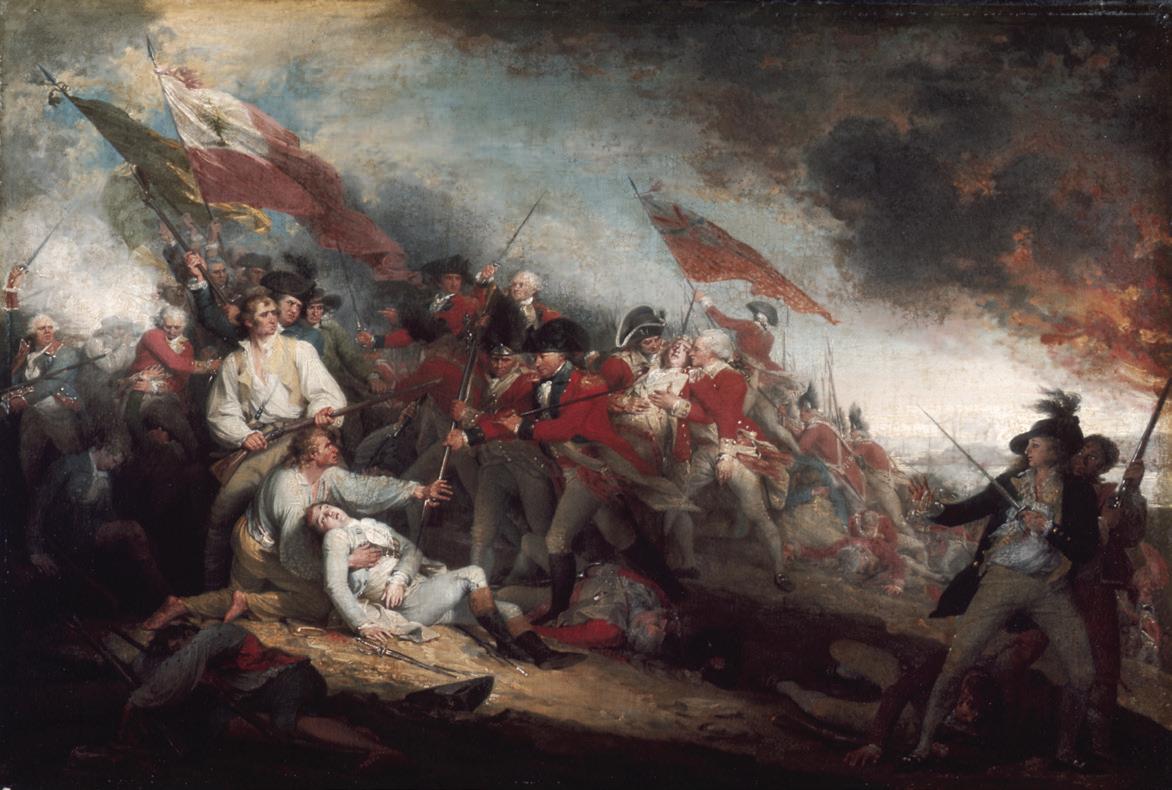
1. Describe the aspects of the painting that suggest the patriots are retreating.
2. Describe how Joseph Warren’s death is depicted. What does this suggest about how the artist viewed him?
3. Describe how Major John Pitcairn’s death is depicted. Why might the artist have chosen to include this detail?
4. Explain the origin of the source (who, where, when) and its purpose. How does this affect its value and limitations as a historical document?
5. Research Joseph Warren’s role in the Revolutionary War and explain why he may have been chosen as the central figure in such a famous painting.
Historical concepts: Perspectives, Contestability Historical skills: Analysis and use of sources
REVIEW 6.6
Online quiz Review questions
1. Explain what the First Continental Congress decided.
2. Explain why Paul Revere rode on the night of 18 April 1775.
3. What is meant by the phrase “the shot heard around the world”?
Access sample responses and results
4. Explain how colonial preparation affected the outcomes at Lexington and Concord.
5. Explain the outcome and significance of the Battle of Bunker Hill.
Go online to assign and download questions, view results and more!
Source 6.6.3 John Trumbull’s 1786 painting, The Death of General Warren at the Battle of Bunker’s Hill, June 17, 1775
6.7 Revolutionary War: Republican ideas
UNCORRECTED SAMPLEPAGES
DRIVING QUESTION
• What ideas about a republic and equality were debated during the American Revolutionary War?
As American colonists were increasingly called to risk their lives and fight, it became necessary to clarify what they were fighting for. Was it still for representation within the British Empire? Some argued that the struggle was now for a new nation. If so, what ideas would that nation stand for?
The “Olive Branch Petition”
In July 1775, the Second Continental Congress made a final effort to prevent fullscale war by sending an “Olive Branch Petition” to George III. Perhaps the king could keep his colonies, and the colonies could keep the king.
Source 6.7.1 A final plea for peace, sent by the American Continental Congress to King George III in July 1775
Attached to your Majesty’s person, family, and government, with all devotion that principle and affection can inspire, connected with Great Britain by the strongest ties that can unite societies, and deploring every event that tends in any degree to weaken them, we solemnly assure your Majesty, that we not only most ardently desire the former harmony between her and these colonies may be restored, but that a concord may be established between them upon so firm a basis as to perpetuate its blessings …
[We request] that, in the meantime, measures may be taken for preventing the further destruction of the lives of your Majesty’s subjects; and that such statutes [laws] as more immediately distress any of your Majesty’s colonies may be repealed. Second Continental Congress. 1775. Olive Branch Petition
George III refused to accept the petition and declared that the Congress was an illegal gathering. The last chance for reconciliation was lost.
In the colonies, discussion turned to life without a king – life in a republic. Thomas Paine, recently arrived from England where he had been a poor shopkeeper, published a pamphlet that sparked as much excitement in taverns as in stately halls. Common Sense sold 150,000 copies in its first three months, more than any other book in the American colonies before. Paine argued that the American people were fighting not just for themselves, but for “the natural rights of all Mankind”.
Source 6.7.2 Thomas Paine challenged the divine right of kings and advocated for republican government. But there is another and greater distinction for which no truly natural or religious reason can be assigned, and that is the distinction of men into KINGS and SUBJECTS. Male and female are the distinctions of nature, good and bad the distinctions of Heaven; but how a race of men came into the world so exalted above the rest, and distinguished like some new species, is worth inquiring into, and whether they are the means of happiness or of misery to mankind …
To the evil of monarchy we have added that of hereditary succession; and as the first is a degradation and lessening of ourselves, so the second, claimed as a matter of right, is an insult and imposition on posterity. For all men being originally equals, no one by birth could have a right to set up his own family in perpetual preference to all others for ever … One of the strongest natural proofs of the folly of hereditary right in Kings, is that nature disapproves it, otherwise she would not so frequently turn it into ridicule, by giving mankind an Ass for a Lion [replacing a competent ruler with an incompetent successor].
Thomas Paine. 1776. Common Sense
UNCORRECTED SAMPLEPAGES
Writing focus 6.7
Source analysis (perspective)
On 4 July 1776, the Continental Congress adopted the ultimate statement of republican beliefs, the Declaration of Independence. Drafted by Thomas Jefferson, the document listed 27 complaints, this time not against British ministers, as in the Olive Branch Petition, but against the king himself, as Paine had done in Common Sense. The declaration announced that the colonies would become the founding states of an independent republic, to be known as the United States of America.
Source 6.7.3 The US Declaration of Independence serves as a cornerstone of American founding ideals.
We hold these truths to be selfevident, that all men are created equal, that they are endowed by their Creator with certain unalienable rights, that among these are Life, Liberty and the pursuit of Happiness … that to secure these rights, governments are instituted among Men, deriving their just powers from the consent of the governed … that whenever any form of government becomes destructive of these ends, it is the right of the people to alter or to abolish it, and to institute new Government
Second Continental Congress. 1776. Preamble to the Declaration of Independence, 4 July.
Copies of the declaration were sent to military commanders. On 9 July, George Washington assembled the brigades under his command in New York City to hear the declaration read aloud. As soldiers cheered and crowds tore down statues of the king, British officials and loyalists based in the city packed up and left.
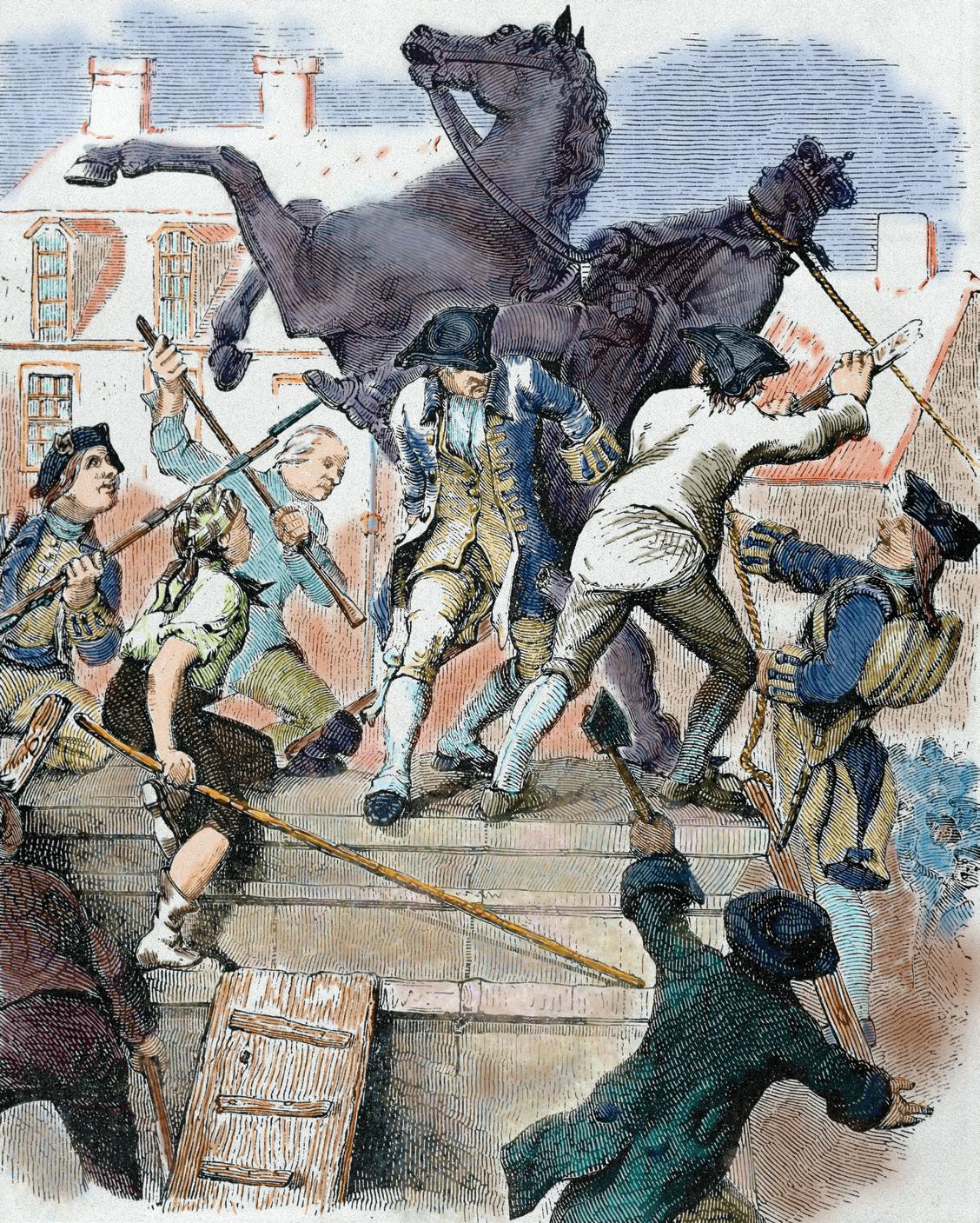
Source 6.7.4 Americans tear down a statue of King George III on 9 July 1776, after a public reading of the Declaration of Independence.
Historian Richard Bell (2025) argues that the declaration was not only about independence, but also about relations of interdependence. Copies were printed on Dutch paper by an Irish immigrant, and within days translated copies were sent as the basis for negotiations over alliances to the kings of France and Spain. Within weeks, further translations were sent to Austria, the Dutch Republic, Denmark, Switzerland, Poland and the Italian states, seeking support for the Continental Army.
UNCORRECTED SAMPLEPAGES
Seven weeks after the declaration of independence, British ships landed the largest expeditionary force of the century on Staten Island in New York Harbour: 30,000 professional troops, including more than 10,000 Hessian mercenaries hired by George III from German princes. Washington’s 23,000 soldiers, mostly amateurs, were overrun at the Battle of Long Island. Washington asked for permission to burn New York City to ashes before retreating, but Congress refused. Nevertheless, a fire broke out and destroyed a quarter of the city. New York would serve as British headquarters for the rest of the war.
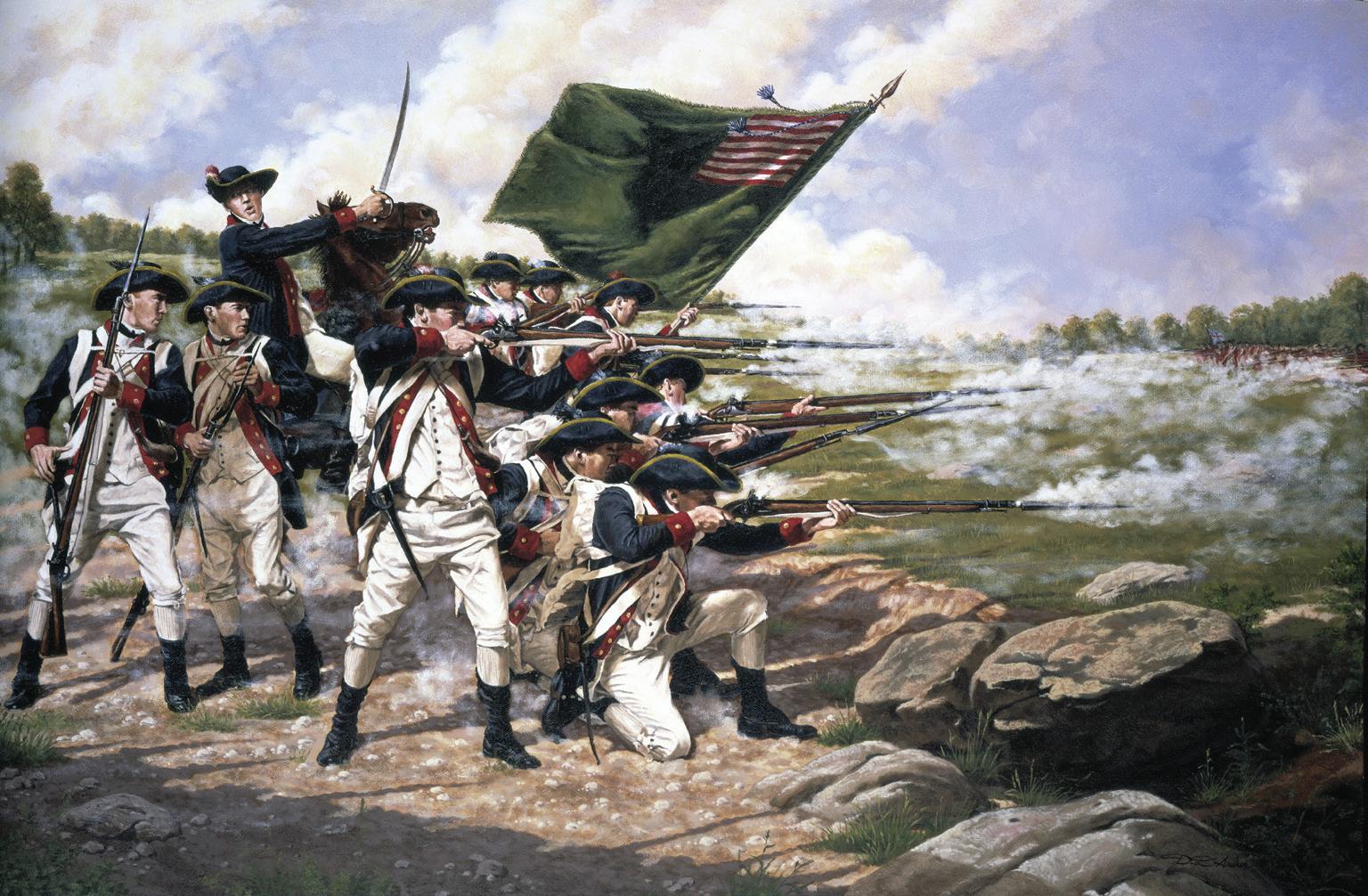
Racial and gender equality
Would the patriots fight for racial equality? In 1775, George Washington ordered that enslaved people would not be accepted into the Continental Army. (He changed this policy in 1778.) In November 1775, Virginia’s royal governor, who had fled to a ship for safety, issued an opposite proclamation. John Murray, Earl of Dunmore, offered freedom to any indentured servants or enslaved men of Virginia who fought under the British flag.
Dunmore was no abolitionist – he personally enslaved 56 people on his plantation –but his offer had widespread consequences. Over the course of the Revolution, more than 80,000 enslaved people escaped towards areas under British control.
Source 6.7.5 The Delaware Regiment firing muskets at the Battle of Long Island, August 1776. They were among the few patriots with uniforms. Their blue jackets with red facings became the Continental uniform.
This pushed many slave-owning colonists to support the patriots, not necessarily because they were committed to the ideals of representation and independence, but to protect their “property”.
Would the patriots fight for gender equality? Women were excluded from political and military roles at the time. However, women were present at Continental Army encampments, where they cooked, laundered clothes, made uniforms and, in some cases, helped to load artillery.
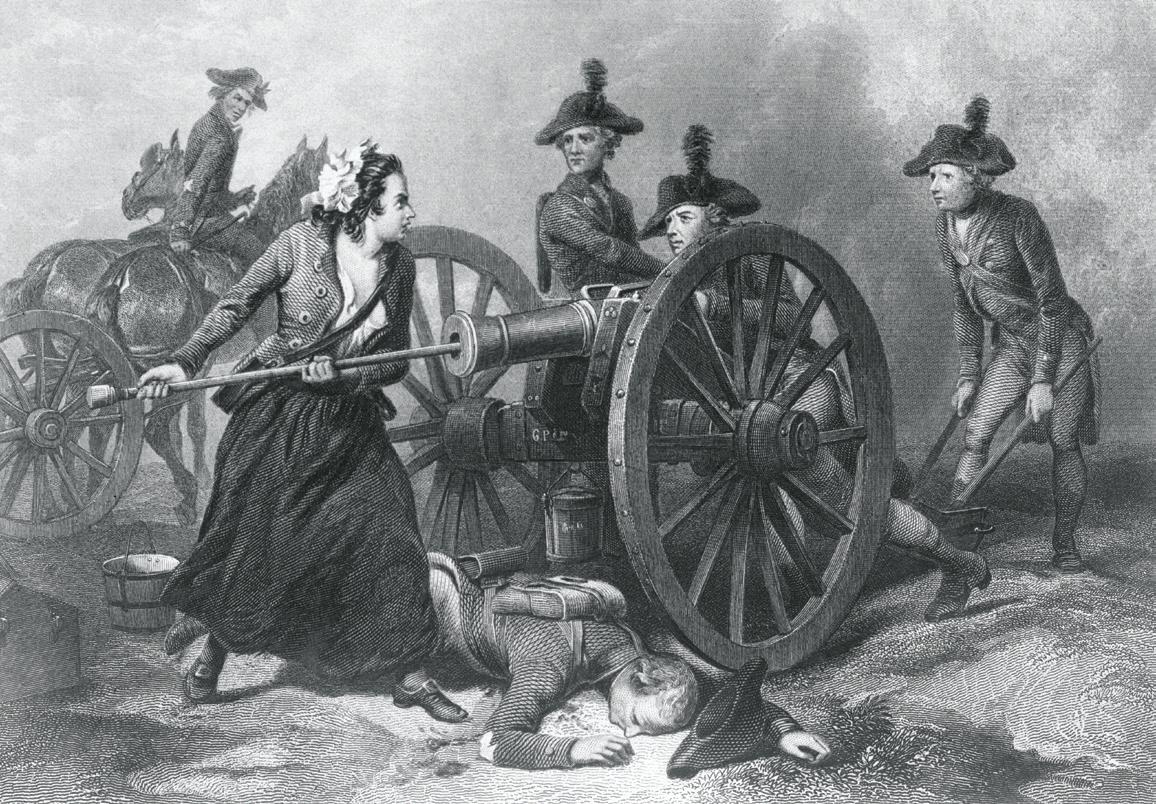
In March 1776, Abigail Adams wrote to her husband John, who was attending the Continental Congress. She reminded him of the principle of “no taxation without representation” and urged him to speak on behalf of women, famously asking him to “Remember the Ladies”.
Source 6.7.7 Abigail Adams to John Adams, 31 March 1776
Source 6.7.6 In June 1778, after Mary Hayes’s husband was injured, she took over his role in an artillery crew.
UNCORRECTED SAMPLEPAGES
If particular care and attention is not paid to the Ladies we are determined to foment a Rebellion, and will not hold ourselves bound by any Laws in which we have no voice, or Representation. That your Sex are Naturally Tyrannical is a Truth so thoroughly established as to admit of no dispute, but such of you as wish to be happy willingly give up the harsh title of Master for the more tender and endearing one of Friend.
Abigail Adams. 1776. Letter to John Adams, 31 March.
SIGNIFICANT INDIVIDUAL
Abigail Adams (1744–1818), the daughter of a Massachusetts religious minister, did not receive a formal education but became one of the best-read women in colonial America. After marrying John Adams, she managed the family farm and finances while he worked as a lawyer and politician. She wrote regularly to her husband, reporting on local events and urging him to take more progressive views on equality. John Adams regarded his wife as his intellectual equal and his most trusted adviser during his terms as US vice-president (1789–97) and president (1797–1801). Several years after her death, their son John Quincy Adams became the sixth president of the United States.
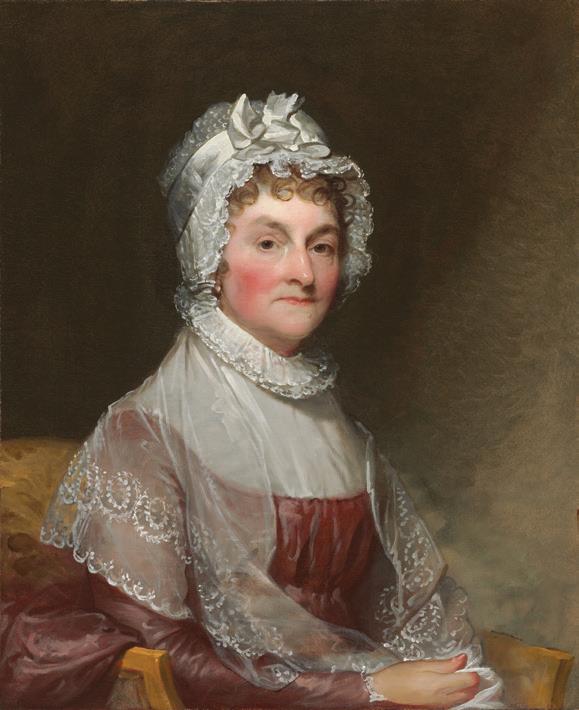
Source 6.7.8 A portrait of Abigail Adams, c. 1800-15. She was sometimes referred to as “Mrs President”.
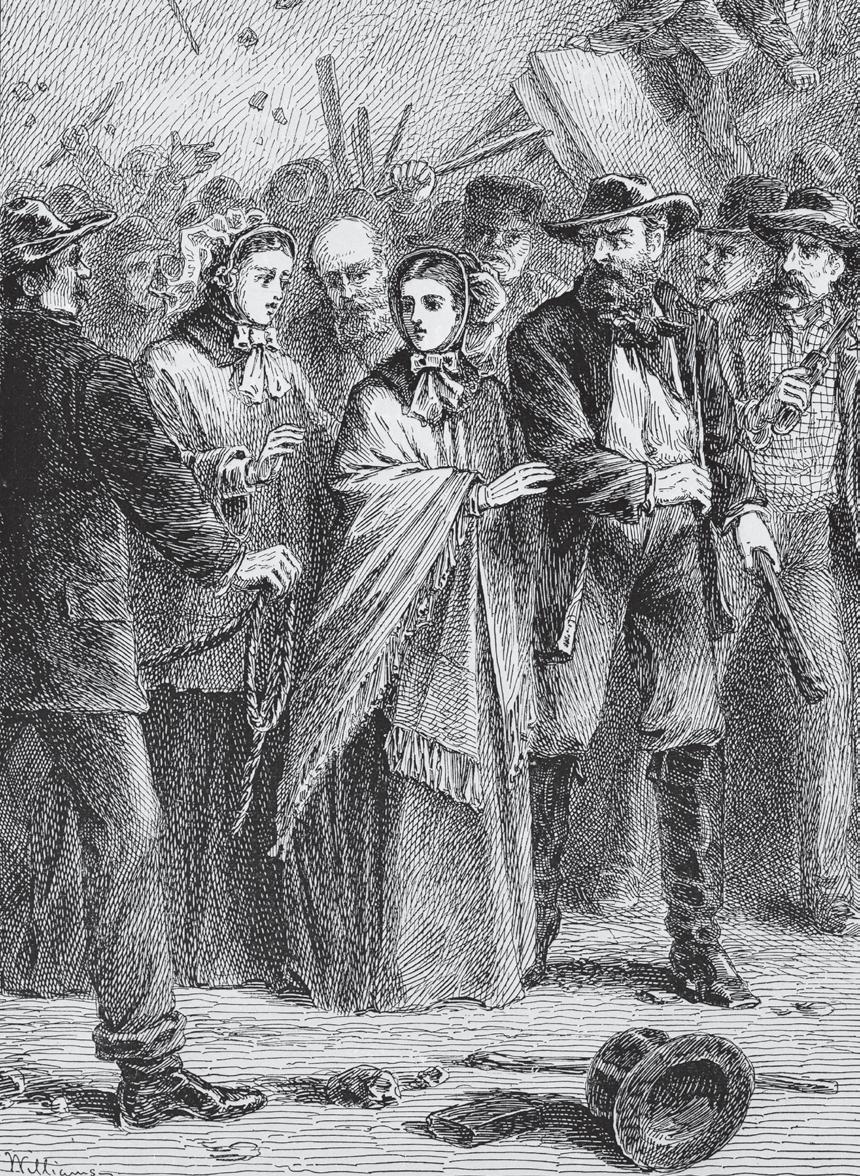
Source 6.7.9 Lucretia Mott was one of four women in upstate New York who organised the first Women’s Rights Convention at Seneca Falls, New York, in 1848. In this old print, Mrs. Mott and another early suffragette are being protected from an angry mob which broke up a suffragette meeting.
ANALYSIS 6.6
Analysing significance
Normally, John Adams took the advice of his wife. On this issue, however, he did not. He interpreted “all men are created equal” to mean people like himself – white men who owned property. In a letter written two months later, he argued that allowing men without property to vote could lead to “dangerous” demands for rights, including from women and young boys. However, when the colony of New Jersey adopted its state constitution on 2 July 1776, it did “remember the ladies”, granting the vote to all adults over 21 who owned £50 worth of property, whether man or woman, white or black. (This right was later removed in 1807, when voting was restricted to white men.)
Generations later, women continued to demand political equality. In 1848, the Seneca Falls Convention echoed the language of the Declaration of Independence to demand voting rights for women, declaring, “We hold these truths to be self-evident, that all men and women are created equal”. Women in the United States finally gained the right to vote in 1920, 144 years after the Declaration of Independence.
1. Explain the origin and purpose of the Olive Branch Petition.
2. Explain the origin and purpose of Common Sense
3. Explain the origin and purpose of the Declaration of Independence.
4. Discuss why the Declaration of Independence could be considered to have global consequences.
5. Analyse what limitations applied to the Declaration’s claim that “all men are created equal”.
Historical concepts: Significance Historical skills: Analysis and use of sources
REVIEW 6.7
Go online to assign and download questions, view results and more!
UNCORRECTED SAMPLEPAGES
1. Identify the final plea for peace that asked Britain to treat the colonists more fairly and avoid further fighting.
2. Identify the popular pamphlet that argued against monarchy and supported independence and natural rights.
3. Explain what the Declaration of Independence announced.
4. Explain how enslaved people responded to British and colonial actions during the war.
5. Discuss how republican ideas changed what colonists believed they were fighting for between 1775 and 1776.
6. Evaluate the extent to which the Revolutionary cause supported equality for women and enslaved people.
6.8 Revolutionary War: leadership
UNCORRECTED SAMPLEPAGES
DRIVING QUESTION
• How did significant leaders command their troops during the American Revolutionary War?
Significant leaders
Leadership played a decisive role in shaping how the American Revolutionary War was fought. Two of the most significant figures were the British commander William Howe and the American commander George Washington.
SIGNIFICANT INDIVIDUAL
William Howe (1729–1814) was born into a wealthy and titled British family whose members were involved in parliament, the East India Company and the navy. As a member of parliament, he argued against the Coercive Acts and was perceived to sympathise with the American colonies. Nevertheless, he believed it was his duty to serve, and sailed to America to lead British troops in Boston. He was appointed overall British commander in North America in November 1775. Although he successfully captured New York and Philadelphia and won every major battle he fought against George Washington, he was criticised for failing to press his advantage and decisively defeat the Continental Army. He was replaced in May 1778 and returned to England to face an inquiry into his leadership.
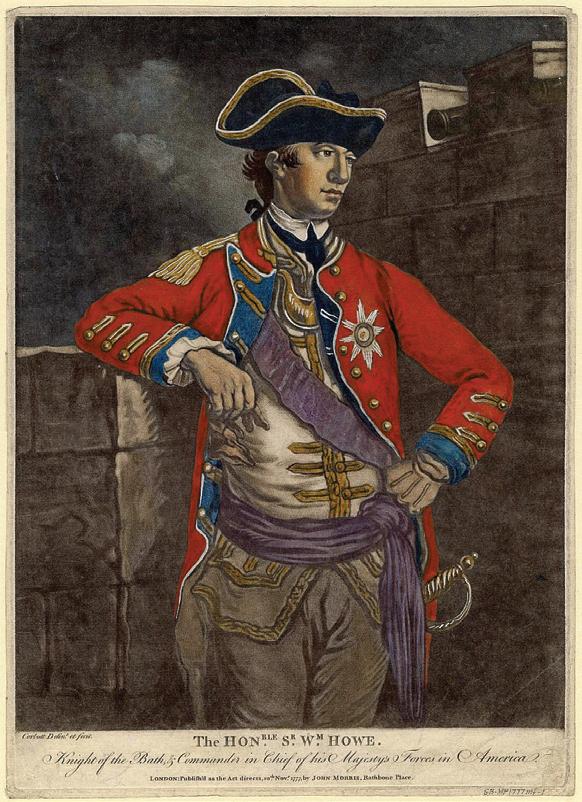
SIGNIFICANT INDIVIDUAL
George Washington (1732–1799) was born into a wealthy Virginia planter family. His family used slavery, and although he was uncomfortable with the system, he did not emancipate the people he enslaved until his death. Washington worked as a surveyor and gained early fame at the age of 21 for his actions during the Seven Years’ War. He was elected to the Virginia House of Burgesses before Congress appointed him commander of the Continental Army in 1775. Washington was physically imposing – at 188 cm tall, he stood a head taller than many soldiers – and was known for his horsemanship and immaculate uniforms, in contrast to his poorly equipped troops. He spent eight years away from his plantation, Mount Vernon, while leading the army, relying on his wife Martha to manage the estate. Washington was admired for his steady leadership and for willingly returning to civilian life at the end of the war. He later became the first US President (1789–1797). Numerous places in the United States are named in his honour, including the capital city.
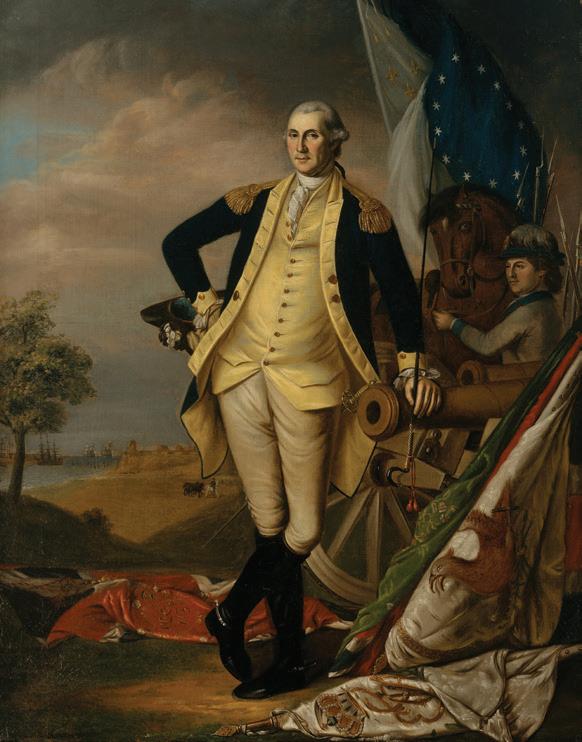
Source 6.8.1 William Howe, 1777
Source 6.8.2 A portrait of George Washington, by James Peale, 1782
Writing focus 6.8
Source analysis (perspective)
British and Hessian forces fought in disciplined lines, supported by heavy artillery, and could outman and outgun the inexperienced colonial troops. Washington often surprised the enemy through unconventional warfare, sometimes drawing on tactics used by Native American groups. Washington came to understand that his army’s greatest strength was their sense of purpose, so he regularly addressed his soldiers to strengthen their resolve.
Source 6.8.3 George Washington urged his troops to brave resistance against the British.
The time is now near at hand which must probably determine whether Americans are to be freemen or slaves; whether they are to have any property they can call their own; whether their houses and farms are to be pillaged and destroyed, and themselves consigned to a state of wretchedness from which no human efforts will deliver them. The fate of unborn millions will now depend, under God, on the courage and conduct of this army. Our cruel and unrelenting enemy leaves us only the choice of brave resistance, or the most abject submission. We have, therefore, to resolve to conquer or die. George Washington. 1776. General Orders, 2 July.
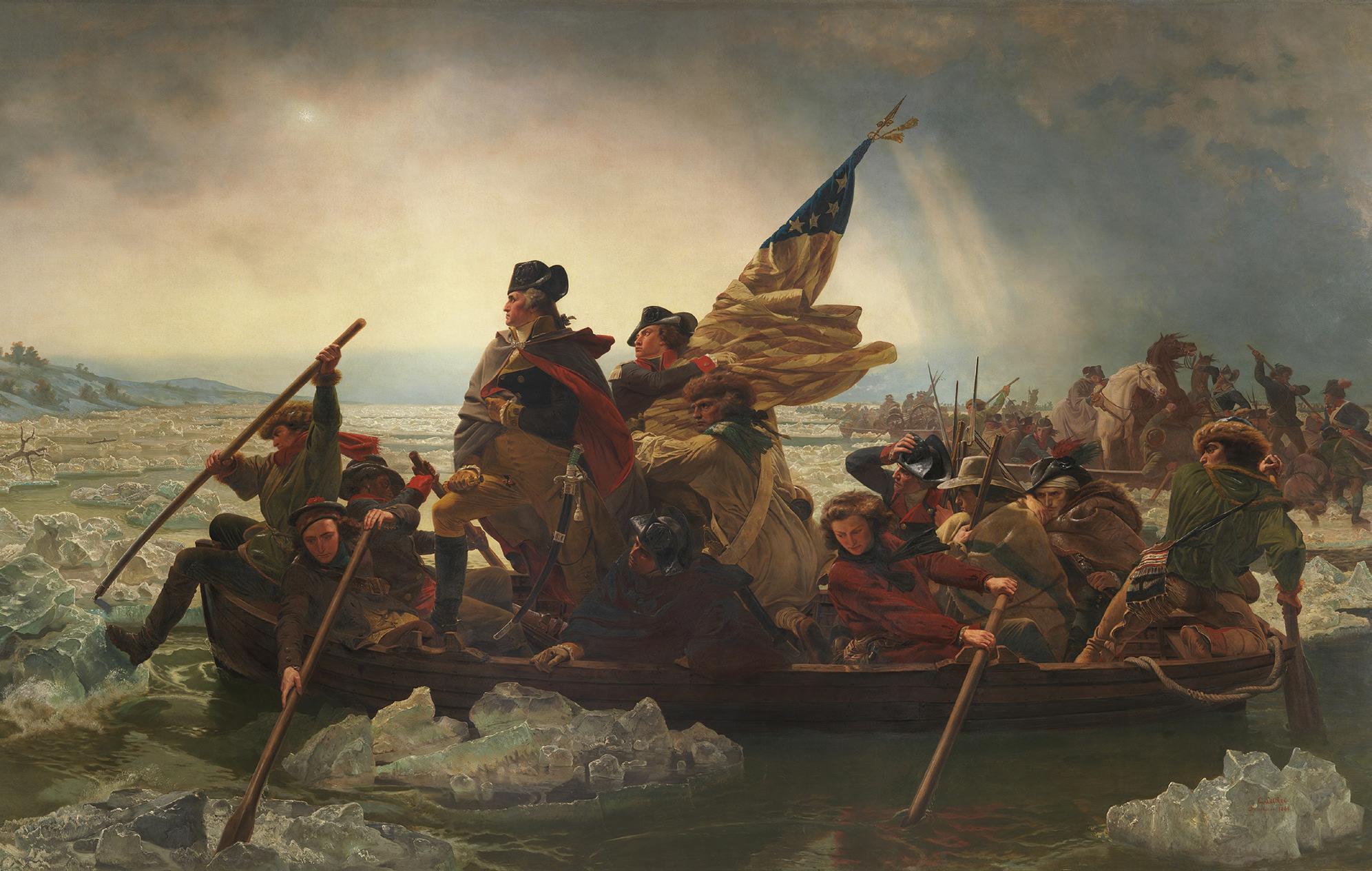
UNCORRECTED SAMPLEPAGES
Source 6.8.4 A painting of General George Washington making the unexpected move of crossing the frozen Delaware River on Christmas night, 1776 (Emmanuel Gottlieb Leutze, Germany, 1851)
ANALYSIS 6.7
Analysing interpretations
George Washington lived much of his life in the public eye and has been closely examined by historians. Biographers often conclude that he was flawed, but an exceptional leader.
Source 6.8.5 Historian James Flexner’s comment on George Washington
In history, few men who possessed unassailable power have used that power so gently and self-effacingly for what their best instincts told them was the welfare of their neighbours and all mankind.
James Flexner. 2012. Washington: The Indispensable Man. Boston: Little, Brown & Co. Originally published 1974.
Source 6.8.6 Historian Maurizio Valsania comment on George Washington
For Washington, valor was never the same as recklessness. Success, he believed, depended on foresight, not fury, and certainly not bravado… Washington’s own “warrior ethos” was grounded in decency, temperance and the capacity to act with courage without surrendering to rage. That ideal built an army – and in time, a republic.
Maurizio Valsania. 2025. “Where George Washington would disagree with Pete Hegseth about fitness for command and what makes a warrior,” The Conversation, 2 October.
Source 6.8.7 American biographer Ron Chernow’s comment on George Washington
His unerring judgment, sterling character, rectitude, steadfast patriotism, unflagging sense of duty, and civic mindedness – these exemplary virtues were achieved only by his ability to subdue the underlying volatility of his nature and direct his entire psychological makeup to the single-minded achievement of a noble cause. Ron Chernow. 2010. Washington: A Life. New York: Penguin.
1. Describe the positive qualities that the biographers note about Washington.
2. Explain, according to Chernow, what made Washington’s virtues possible to achieve.
3. Research the Battle of Trenton of 1776, using https://cambridge.edu.au/redirect/11812, and explain what it reveals about Washington’s leadership.
4. Analyse what the song “History Has Its Eyes On You”, from the musical Hamilton (inspired by a Ron Chernow book), suggests about Washington’s leadership.
Historical concepts: Perspectives, Contestability Historical skills: Analysis and use of sources, Historical interpretation
REVIEW 6.8
UNCORRECTED SAMPLEPAGES
1. Identify William Howe and explain his role during the Revolutionary War.
2. Explain why William Howe was criticised despite winning battles.
3. Explain the qualities that made George Washington a respected leader.
4. Explain how Washington’s strategies helped the Continental Army compete against stronger British forces.
Go online to assign and download questions, view results and more!
6.9 Revolutionary War: turning points
DRIVING QUESTION
• What were the major turning points in the Revolutionary War?
A British surrender
In 1777, British forces were gaining the upper hand. They still held New York City and, in September, captured Philadelphia. The Continental Army was using weapons and ammunition smuggled into the colonies by France, but foreign powers were not yet coming directly to their aid, fearing the strength of the Royal Navy. This changed after a major battle near Saratoga, around 300 kilometres north of New York City.
UNCORRECTED SAMPLEPAGES
Writing focus 6.9
Noun phrases (identify and develop)
In September 1777, British General John Burgoyne marched 7500 British and Hessian troops south from Canada towards Saratoga. Facing them was a strong Continental fort on a 30-metre-high river cliff, designed by the Polish engineer Tadeusz Kościuszko, who had travelled to America to join the Revolution after being inspired by Enlightenment ideals. (Kościuszko later became a national hero in Poland, and Australia’s highest mountain, Mount Kosciuszko, was named in his honour.) The British failed to break through the defences and dug trenches in the surrounding forest while waiting for reinforcements. None arrived, and the trapped British forces surrendered on 17 October.
After Saratoga, the patriots gained new confidence. On 15 November 1777, the Continental Congress adopted the Articles of Confederation. As a temporary constitution, the Articles formally adopted the name “United States of America” and described the emerging nation as a “firm league of friendship”. Each state would be represented in a national legislature called “the United States in Congress”. The Articles did not mention slavery, and although Article IV referred to equal rights and freedoms, these were limited to “free inhabitants”.
French support
In December 1777, France recognised the United States as an independent nation. Many French officers had already arrived to support the Revolution, including the young aristocrat the Marquis de Lafayette. With a formal alliance now in place, French support became decisive. Historians argue that this marked the point at which the American War of Independence became a global conflict.
Source 6.9.1 President Barack Obama speaks in the United States Capitol building in 2009 in front of John Trumbull’s painting titled “Surrender of General Burgoyne”, one of eight historical scenes depicted in the Capitol rotunda.
In 1779, Spain began supporting the French and American cause in the Americas in return for French assistance against Britain in the Mediterranean. In 1780, France sent a fleet of ships and 5000 soldiers to Rhode Island. The Royal Navy was now forced to fight enemies in the Gulf of Mexico, the Mediterranean, the English Channel, the Caribbean and India.
A Franco-American victory
In 1781 at Yorktown, Virginia, British General Charles Cornwallis was constructing a port to supply his 9000-man army in the southern colonies. General Washington requested French assistance to cut the British off by sea. Admiral François Joseph Paul de Grasse sailed a fleet of 37 warships from the French Caribbean to the mouth of the Chesapeake Bay, joined by another eight French ships, before 19 British ships arrived to challenge them.
RESEARCH 6.4
Researching the Marquis de Lafayette
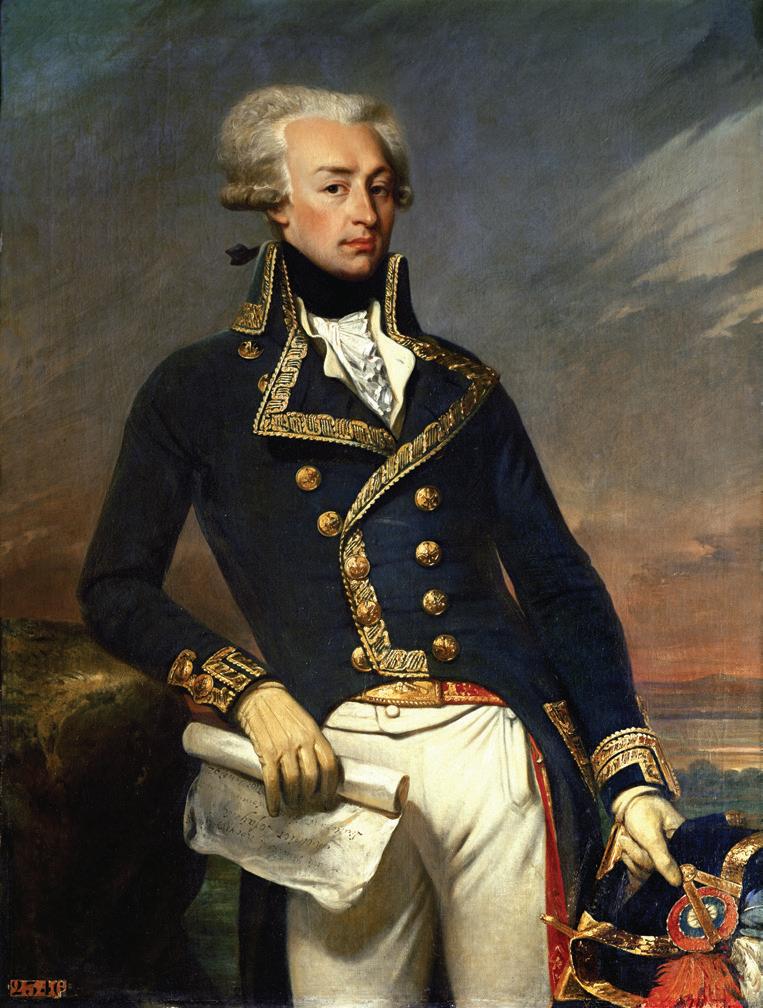
UNCORRECTED SAMPLEPAGES
Starting with the Mount Vernon website (http://cambridge.edu.au/redirect/11754), research the life of the Marquis de Lafayette and respond to the following prompts.
1. Identify the full name and social class of the Marquis de Lafayette.
2. Explain why Lafayette travelled to America.
3. Explain the relationship between L afayette and George Washington.
4. Explain what Lafayette did after the Revolutionary War.
Historical concepts: Significance Historical skills: Historical investigation and research
The naval engagement, known as the Battle of the Chesapeake or the Battle of the Capes, took place on 5 September. It involved around 32,000 sailors. After limited exchanges of fire, the British fleet realised it was outgunned and retreated. Cornwallis’s army was now trapped on the Yorktown peninsula. Many historians regard this naval battle as the greatest turning point of the war. If so, the most significant battle of the eight-year American Revolutionary War lasted only two hours, caused few casualties and involved no American forces!
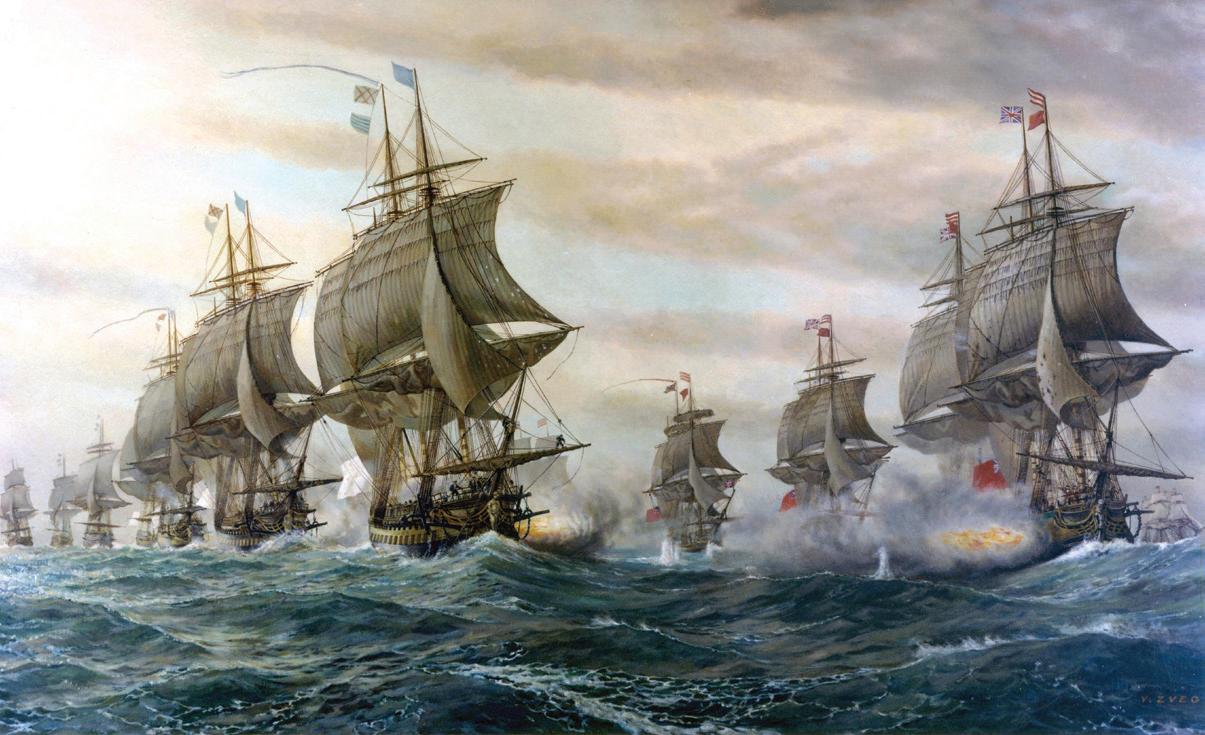
Source 6.9.2 A portrait of the Marquis de Lafayette, a prominent French officer who sided with the colonists
Source 6.9.3 An artist’s depiction of French and British warships in the Battle of the Chesapeake, in September 1781
On land, George Washington and General Comte de Rochambeau led around 20,000 American and French troops to besiege the British at Yorktown. After days of sustained American artillery bombardment, the Franco-American forces attacked, with Alexander Hamilton leading one flank. On 19 October, Cornwallis surrendered. With this defeat, roughly a quarter of British forces in North America were taken prisoner. When the news reached London, Prime Minister Lord North resigned, and negotiations for peace began.
SIGNIFICANT INDIVIDUAL
James Armistead (c. 1760–1832) was an enslaved man on a Virginia plantation whose owner granted permission for him to enlist with the Marquis de Lafayette’s forces. Armistead first worked as a spy for the patriots and then convinced British commanders to employ him as an informant, making him a double agent. The intelligence he gathered proved crucial to the FrancoAmerican victory at Yorktown. After the war, the Virginia legislature refused to grant him freedom, despite his owner’s support, because state law only freed enslaved people who had fought as soldiers, not spies. Armistead was finally emancipated in 1787 at Lafayette’s personal request. In gratitude, he adopted the surname Lafayette and lived as a free farmer in Virginia.
ANALYSIS 6.8
Analysing sources
UNCORRECTED SAMPLEPAGES
Source 6.9.4 A portrait of James Armistead, an enslaved man who acted as a double agent during the Revolutionary War
Source 6.9.5 The British forces under Lord Cornwallis surrendered at Yorktown in 1781.
Article I. The garrisons of York and Gloucester including the officers and seamen of his Britannic Majesty’s ships, as well as other mariners, to surrender themselves prisoners of war to the combined forces of America and France …
Article III … The garrison of York will march out to a place to be appointed in front of the posts, at two o’clock precisely, with shouldered arms, colors cased, and drums beating a British or German march. They are then to ground their arms, and return to their encampments, where they will remain until they are despatched to the places of their destination …
Article V. The soldiers to be kept in Virginia, Maryland, or Pennsylvania, and as much by regiments as possible, and supplied with the same rations of provisions as are allowed to soldiers in the service of America. A field-officer from each nation, to wit, British, Anspach [Belgian], and Hessian [German], and other officers on parole, in the proportion of one to fifty men to be allowed to reside near their respective regiments, to visit them frequently, and be witnesses of their treatment …
Continental Army and British Forces. 1781. Articles of Capitulation at Yorktown, 19 October.
Source 6.9.6 A British cartoon published in 1781 titled “The Balance of Power”. It shows Britain (the goddess Britannia) on the left and France, Spain and the Dutch joining the exhausted American colonies on the right.
1. Describe the national identities referred to in the Articles of Capitulation and explain what this suggests about the nature of the war.
2. Describe the depiction of national identities in the cartoon and explain how it could be used as evidence.
3. Using one or both sources, explain the significance of the Battle of the Chesapeake.
4. The historian Richard Bell describes the Revolution as “a global event” (Bell, 2025, p. 2).
Using the sources, support that interpretation.
Historical concepts: Contestability Historical skills: Analysis and use of sources
UNCORRECTED SAMPLEPAGES
and
1. Describe what happened to the British army at Saratoga in October 1777.
2. Describe the significance of the Battle of Saratoga.
3. Explain the purpose of the Articles of Confederation.
4. Explain how French forces affected the outcome at Yorktown.
5. Explain why many historians consider the Battle of the Chesapeake to be a major turning point in the war.
6. Evaluate what James Armistead’s experience revealed about revolutionary ideals.
6.10 A new nation: no kings?
UNCORRECTED SAMPLEPAGES
DRIVING QUESTION
• Why did the United States reject having a king, and what were the key events that shaped the new republic?
Who would lead the new nation?
There were no further major battles after the British surrender at Yorktown. However, British and loyalist forces remained in place, particularly in New York City, while the Continental Army stayed mobilised as both sides waited for a formal peace treaty to be negotiated.
This raised a critical question: who would lead the new nation? At the time, the world’s great powers were ruled by kings or princes. To some Americans, it did not seem illogical for the United States to appoint one of its war heroes as “King of America” to guide the work of future elected assemblies. In May 1782, Colonel Lewis Nicola wrote to the widely admired commander-in-chief, George Washington, arguing that although Americans had fought a war to remove one king, there were “strong arguments” in favour of establishing an American constitutional monarchy. He urged Washington to accept the role of dictator or king. Washington angrily rejected the suggestion and reprimanded Nicola (Flexner, 2012, p. 1900).
In November 1782, Britain and the United States agreed to preliminary articles of peace. Because the war was not officially over until all parties reached agreement, Britain and France signed similar articles in January 1783. The final Treaty of Paris was signed in September 1783. Under its terms, King George III recognised the 13 former colonies as “free sovereign and Independent States”, with borders defined as the land south of Canada, north of Florida and east of the Mississippi River. This territory included large areas described as “unoccupied” land, which were in fact the homelands of Native Americans. (The much larger modern United States later expanded through purchases, wars, annexations and cessions between 1803 and 1853.)
In late November 1783, British forces evacuated New York City in an “exodus” that included about 35,000 loyalists bound for Canada or the Caribbean. Among them were between 3000 and 4000 free and enslaved Black people. Other enslaved men who had fought for the loyalists were returned to slavery. By contrast, some enslaved men who had served as Continental soldiers were granted their freedom, while others were forced to return to their former owners. About one quarter of the Hessian soldiers chose to remain in the United States, joining established German-speaking communities.
Source 6.10.1 Washington resigns his commission – painting by John Trumbull, 1824
The following month, General Washington did the opposite of what many of his admiring soldiers had hoped for and resigned his commission, returning to private life. Historians regard this decision as a crucial moment in ensuring that the United States became a republic governed by civilians, rather than a kingdom or a military dictatorship.
Source 6.10.2 George Washington’s Address to Congress on 23 December 1783
Happy in the confirmation of our Independence and Sovereignty, and pleased with the opportunity afforded the United States of becoming a respectable Nation … I retire from the great theatre of Action; and bidding an Affectionate farewell to this August body under whose orders I have so long acted, I here offer my Commission, and take my leave of all the employments of public life. George Washington. 1783. Address to Congress on resigning his commission, Annapolis, 23 December. Library of Congress.
ANALYSIS 6.9
Analysing significance
1. Summarise what Britain did at the end of the war by completing the following sentence, using as much detail as you can.
In [where and when], the British king … [did what] … because … [why they did it] … which showed [why it mattered].
2. Summarise what George Washington did at the end of the war by completing the following sentence, using as much detail as you can.
In [where and when], the British authorities … [did what] … because … [why they did it] … which showed [why it mattered].
3. Explain the significance of the Treaty of Paris.
4. Explain what Washington might have done if he had not resigned. Why is that significant?
Writing focus 6.10
Noun phrases (develop)
UNCORRECTED SAMPLEPAGES
1. Describe the situation after the British surrender at Yorktown.
2. Explain who suggested George Washington become king and how he responded.
3. Explain what the Treaty of Paris of 1783 recognised.
4. Explain the significance of Washington’s resignation of his commission.
5. Explain how the departure of British and loyalist forces affected the population of the new United States.
6.11 A new nation: constitutional democracy
UNCORRECTED SAMPLEPAGES
DRIVING QUESTION
• What were the key features of the United States Constitution?
Designing the constitution
The 1777 Articles of Confederation established only a weak bond between the states. There was so much work required to develop a national system of government that some historians describe the period from 1783 to 1789 as a second American Revolution. From May to September 1787, delegates from 12 states met in Philadelphia to design a republican constitution. George Washington was called out of retirement to chair the meeting.
At the Constitutional Convention, delegates gravitated towards the “Virginia Plan”, supported by Washington and others. This plan proposed a strong central government balanced by a separation of powers between the legislative branch (the Senate and House of Representatives), the executive (the President and Cabinet) and the judiciary (the Supreme Court). The delegates created the world’s first written national constitution, setting out the entire structure of government in just 4400 words. Any powers not granted to the federal government were retained by the states. The document was then sent to ratifying conventions in each state.
To promote the Constitution, Alexander Hamilton, James Madison and John Jay published 85 essays in newspapers between October 1787 and May 1788 under the pseudonym Publius, a reference to a Roman consul associated with the overthrow of monarchy. The essays explained why a strong central government was necessary for defence and why national taxation was required. Federalist Paper No. 67, probably written by Hamilton, addressed concerns about a single executive. Would a powerful president become a dictator or king? Hamilton argued that this would not occur because of the separation of powers. When Pierre-Charles L’Enfant, a French-born artist who served in the Continental Army, designed the new capital city on the Potomac River, he symbolised this relationship. He placed the people’s house, Congress, on a hilltop, and the executive mansion, later known as the White House, on lower ground.
SIGNIFICANT INDIVIDUAL
Alexander Hamilton (c. 1755–1804) was born on the Caribbean island of Nevis to a Scottish father and a French mother. Orphaned at a young age, he relied on charitable donations for his education and moved to New York in 1772. Hamilton was ambitious and deeply committed to American independence. He served as General Washington’s senior aide from 1777 to 1781. After the war, he practised law and was elected to the New York legislature and the Constitutional Convention. Hamilton campaigned for a strong central government, bringing him into conflict with Thomas Jefferson. As the United States’ first secretary of the treasury, he designed the nation’s financial system and established a national bank. Hamilton was relatively little known outside the United States until 2015, when Lin-Manuel Miranda’s musical Hamilton, inspired by Ron Chernow’s 2004 biography Alexander Hamilton, became a global success.
UNCORRECTED SAMPLEPAGES
In June 1788, with ratification by the ninth state, New Hampshire, the Constitution came into effect. In 1789, elections were held for the new Congress, and George Washington was chosen as the nation’s first president. He served two terms, a total of eight years.
ANALYSIS 6.10
Analysing a source
Source 6.11.3 The 1787 US Constitution is the supreme law and foundational framework of the federal government.
We the People of the United States, in Order to form a more perfect Union, establish Justice, insure domestic Tranquillity, provide for the common defense, promote the general Welfare, and secure the Blessings of Liberty to ourselves and our Posterity, do ordain and establish this Constitution for the United States of America.
Source 6.11.2 A statue of Alexander Hamilton outside the headquarters of the US Treasury Department, of which he was the first secretary
Writing focus 6.11
Noun phrases (drafting)
Go online to assign and download questions, view results and more!
Article I All legislative Powers herein granted shall be vested in a Congress of the United States, which shall consist of a Senate and House of Representatives …
Section 7 Every Bill which shall have passed the House of Representatives and the Senate, shall, before it become a Law, be presented to the President of the United States; If he approve he shall sign it, but if not he shall return it …
Section 9 No Title of Nobility shall be granted by the United States: And no Person holding any Office of Profit or Trust under them, shall, without the Consent of the Congress, accept of any present, Emolument, Office, or Title, of any kind whatever, from any King, Prince, or foreign State …
Article II The executive Power shall be vested in a President of the United States of America. … The President shall be Commander in Chief of the Army and Navy … He shall have Power, by and with the Advice and Consent of the Senate, to make Treaties, provided two thirds of the Senators present concur … he shall have Power to grant Reprieves and Pardons for Offences against the United States, except in Cases of Impeachment …
Article III The judicial Power of the United States, shall be vested in one supreme Court, and in such inferior Courts as the Congress may from time to time ordain and establish.
United States Constitutional Convention. 1787. Constitution of the United States
1. Explain in your own words the purposes of the Constitution (“in order to …”).
2. Explain why the Constitution was significant in world history.
3. Identify the three branches of government (powers) created by the Constitution.
4. Explain the effect of having a separation of powers.
5. Over time, political parties developed in the United States. The parties nominate candidates for the President and for seats in Congress. The President nominates candidates to become Supreme Court judges. Discuss how this party politics affects the separation of powers.
6. Discuss how the US Constitution may have influenced other systems, such as the Australian Constitution of 1901.
Historical concepts: Significance Historical skills: Analysis and use of sources
REVIEW 6.11
Online quiz Review questions
UNCORRECTED SAMPLEPAGES
Access sample responses and results
1. Explain why some historians describe 1783–89 as a second American Revolution.
2. Describe the Virginia Plan.
3. Explain how the Federalist Papers related to the Constitution.
4. State when the Constitution came into effect.
5. Explain why the Constitution included the separation of powers.
6. Discuss why Alexander Hamilton was an influential figure in shaping the new nation.
6.12 A new nation: legacies
UNCORRECTED SAMPLEPAGES
DRIVING QUESTION
• What is the legacy of the American Revolution, and how has the Revolution been interpreted over time?
Whose rights?
The Constitution made no reference to Enlightenment ideas of “rights”. James Madison argued that including a list of rights would lead to lengthy disagreements over which rights to include. Thomas Jefferson, writing from Paris, believed this omission was a serious flaw. Some states refused to ratify the Constitution unless there was an agreed process to protect individual rights.
Madison later led the development of a list of rights as amendments to the Constitution. By the end of 1791, 10 amendments, known as the Bill of Rights, had been ratified and became part of the Constitution. In Jefferson’s view, they were its most important feature. Other nations, and later the United Nations in 1948, drew on the Bill of Rights when codifying human rights.
Source 6.12.1 A summary of the Bill of Rights of 1791
1Freedom of religion, speech, media, assembly and petition
2People’s right to keep and bear arms, in order to maintain a militia
3No quartering of soldiers without the homeowner’s consent
4Freedom from unreasonable searches and seizures
5Right to due process of law
6Accused persons have the right to a speedy and public trial and a jury
7Right of trial by jury in civil cases
8Freedom from excessive bail, fines and cruel and unusual punishments
9People keep other rights that they have, but are not listed
10Powers not given to the federal government are reserved to the states
Neither the Constitution nor the Bill of Rights set rules about suffrage. Instead, this power was left to the states. Most states limited the vote to white men who owned property, although all states had removed property qualifications by 1856. Originally, members of the Electoral College who chose the President were selected by state legislatures, and Senators were also chosen by state legislatures. In both cases, these systems were later replaced by popular votes. Expanding voting rights required constitutional amendments: for African American men in 1870, for women in 1920 and for younger citizens aged 18 and above in 1971.
The Constitution and the Bill of Rights also did not mention slavery. Of the 55 delegates to the Constitutional Convention, 25 owned enslaved people. Some leading figures, including Benjamin Franklin (a former slaveowner) and Alexander Hamilton, joined anti-slavery societies, and several northern states abolished slavery within their borders.
Writing focus 6.12
Transitional phrases
However, slavery was effectively protected by the Constitution. It counted threefifths of a state’s enslaved population towards its total population, increasing representation for slave states, and it prevented Congress from banning the Atlantic slave trade for 20 years. Jefferson, who owned a slave-based plantation, was President when the United States finally outlawed the slave trade in 1808.
UNCORRECTED SAMPLEPAGES
Three generations later, tensions between “free” states that had abolished slavery and “slave” states, mainly in the south, where about 3.95 million people were enslaved on plantations, erupted into the Civil War (1861–65). It was the deadliest conflict in American history and ended with President Abraham Lincoln securing a constitutional amendment to abolish slavery, although discrimination based on skin colour continued.
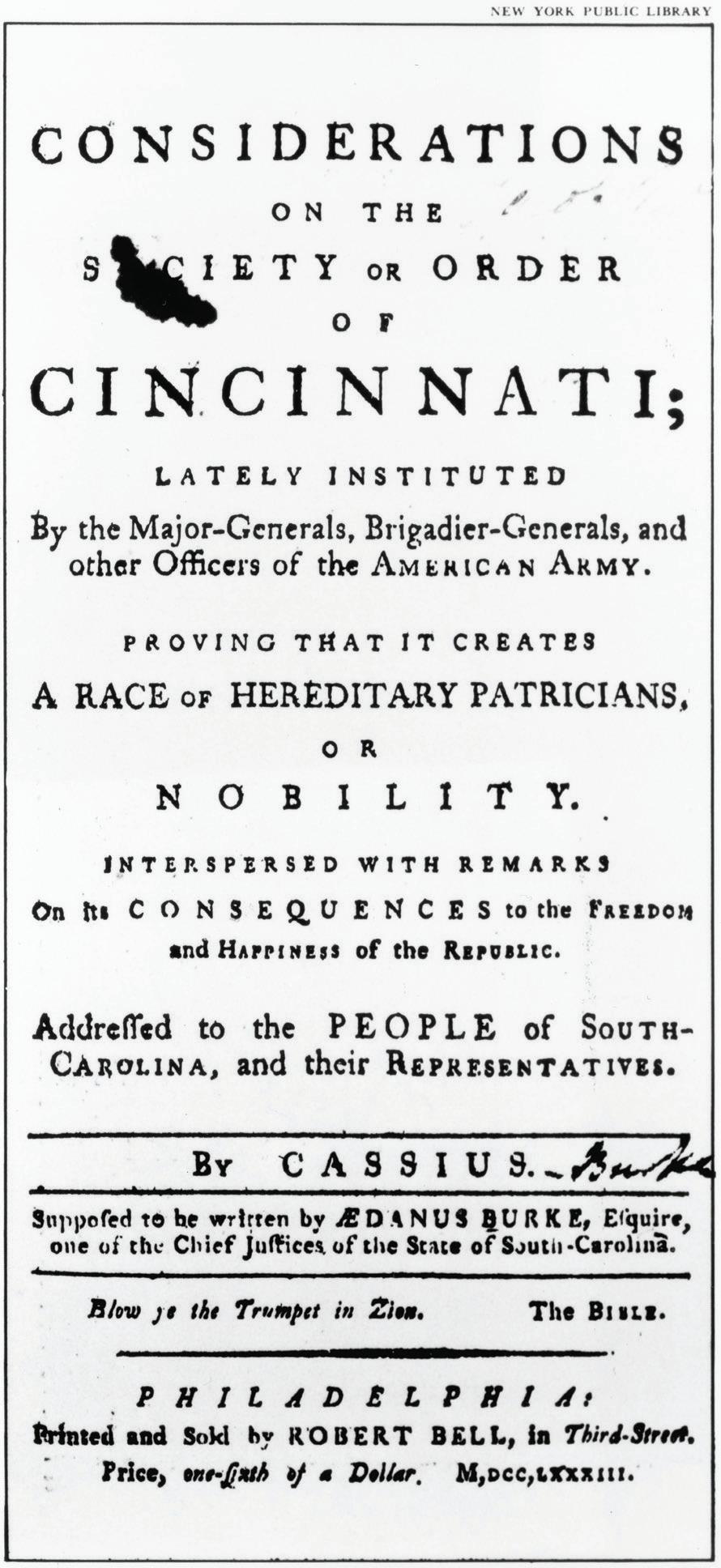
Source 6.12.2 A 1783 pamphlet by the judge Aedanus Burke (Cassius), criticising the Society of the Cincinnati
Whose legacy?
In May 1783, before they demobilised and returned to civilian life, 36 United States officers met at an army camp in Newburgh, New York, and decided to establish a “fellowship” called the Society of the Cincinnati. The organisation took its name from the ancient Roman hero Lucius Quinctius Cincinnatus. The officers admired Cincinnatus because, after leading the Roman army to a crucial victory, he returned to civilian life, just as George Washington intended to do. Washington was appointed the first president-general of the Society. Membership of the Society was limited to senior officers and, on their death, membership passed to a son or male descendant. The officers had fought to establish a democracy, but critics questioned whether the Society was instead creating a privileged elite.
Other “patriotic societies” were later established, particularly in the late nineteenth century. Historians suggest that this coincided with a period of high immigration to the United States, and that families whose ancestors had lived in America since the Revolution formed these societies to give themselves a special status over more recent immigrants. Since 1876, the Sons of the Revolution has been open to any man descended from someone who fought in the war and organises a “Let Freedom Ring” bell-ringing ceremony every Fourth of July.
Since 1890, the Daughters of the American Revolution (DAR) has welcomed women descendants, who had previously been excluded from male-only societies. The DAR also established the Children of the American Revolution to educate young people about American history and patriotism. The Daughters of the Cincinnati, formed in 1894, funds scholarships for daughters of defence force officers.
UNCORRECTED SAMPLEPAGES
RESEARCH 6.5
Investigating a historical society
Use the website of the Society of the Cincinnati (http://cambridge.edu.au/redirect/11755) to respond to the following prompts.
1. Identify where the constituent societies of the Society of the Cincinnati are located and explain why.
2. Describe the symbol of the Society, including what it represents.
3. Explain why the Society has been criticised as elitist.
4. Explain the purposes of the Society’s “American Revolution Institute” and what it claims are the legacies of the Revolution.
Historical concepts: Significance, contestability Historical skills: Historical investigation and research
“Leader of the free world”
To the rest of the world, the new United States was a model, a potential partner and a potential threat. When the French Revolution began to challenge King Louis XVI, it was directly inspired by the American Revolution. The 1789 French Declaration of the Rights of Man and Citizen resembled the Declaration of Independence. Its first draft was prepared by Lafayette and Thomas Jefferson. However, in 1793, when France called on the United States for assistance in its war with Britain, Washington and Hamilton chose to remain neutral. Since then, American foreign policy has alternated between periods of isolation and periods of international intervention through military force or trade measures.
Source 6.12.3 Historian Richard Bell’s comment on the Revolution
From its inception, the Revolution was a global event that drew participants from all over the world. And in its consequences, both immediate and long range, it shook every quarter of the globe. It is not an exaggeration to say that the American Revolution set much of the world as we know it in motion.
Richard Bell. 2025. The American Revolution and the Fate of the World. New York: Riverhead.
In 1796, George Washington, aged 64 and having been encouraged to remain president for life, again chose to stand aside. (The rule limiting presidents to two terms was not introduced until 1951.) In his farewell address, he urged Americans to identify with their country rather than their political party.
Source 6.12.4 George Washington’s Farewell Address was his final public message as President.
Citizens by birth or choice of a common country, that country has a right to concentrate your affections. The name of American, which belongs to you, in your national capacity, must always exalt the just pride of Patriotism, more than any appellation [name] derived from local discriminations. With slight shades of difference, you have the same Religion, Manners, Habits, and political Principles.
In this sense it is, that your Union ought to be considered as a main prop of your liberty, and that the love of the one ought to endear to you the preservation of the other.
This government, the offspring of our own choice … has a just claim to your confidence and your support. … [If political parties are allowed to develop, then] cunning, ambitious, and unprincipled men will be enabled to subvert the Power of the People, and to usurp for themselves the reins of Government; destroying afterwards the very engines which have lifted them to unjust dominion.
George Washington. 1796. Farewell Address.
Through the nineteenth century, the United States rapidly developed an industrial economy and two political parties emerged: the Republicans and the Democrats. America’s growth was driven by waves of immigration. Fourteen million people migrated to the United States between the 1840s and the 1880s, and a further 18 million arrived between 1890 and 1919. By the twentieth century, the United States had become the world’s richest country, highly multicultural and possessing the most powerful military. Its late but decisive involvement in World Wars I and II demonstrated its capacity to shape the global order, earning it the nickname “Leader of the Free World”.
UNCORRECTED SAMPLEPAGES
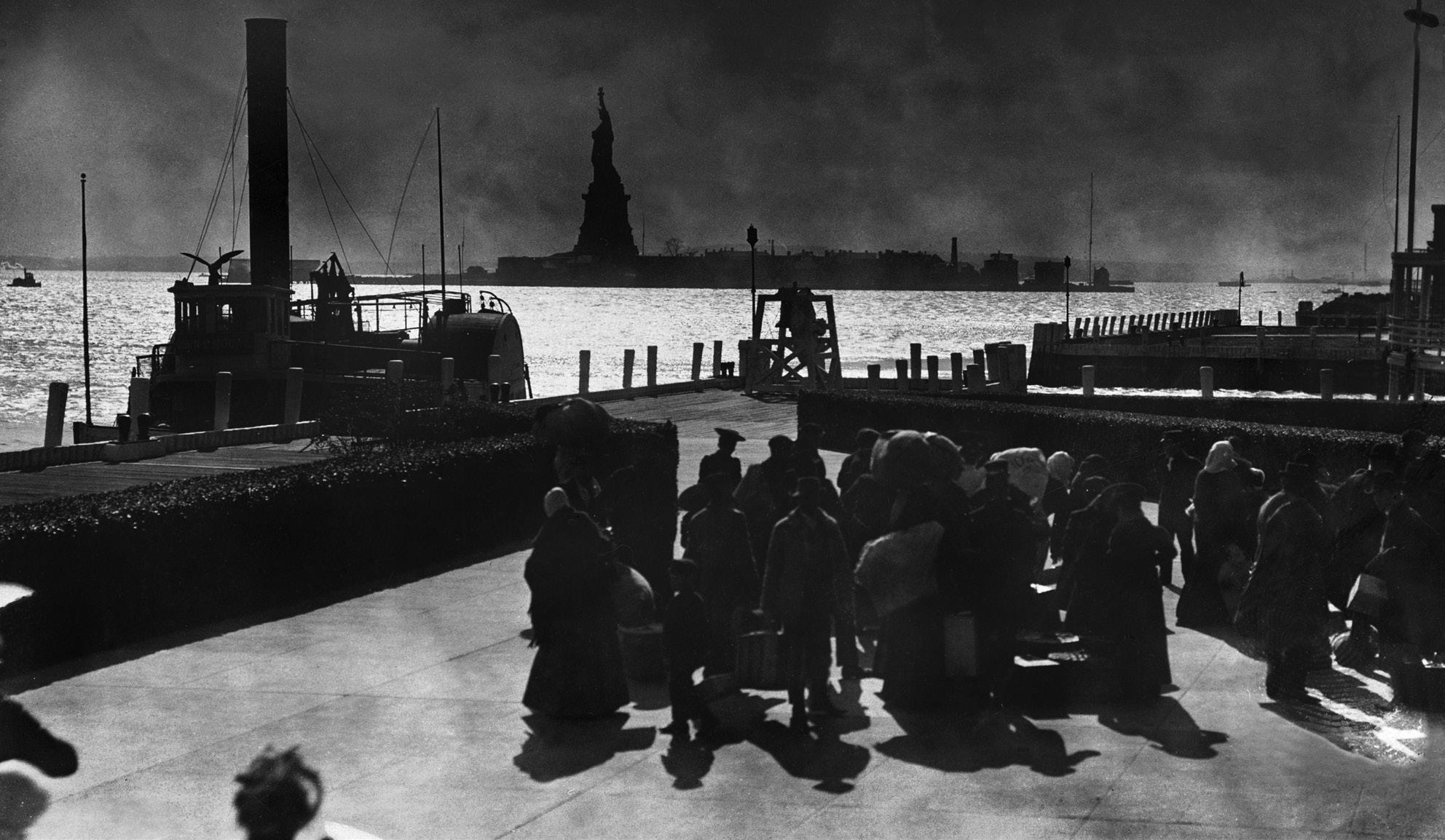
Source 6.12.5 Some of the millions of immigrants who arrived at the port of New York to begin new lives, looking towards the Statue of Liberty, which France gifted to the United States for the centenary of the Revolution.
Interpretations
“America 250” provides an opportunity to reassess the legacies of the American Revolution. One hundred years earlier, in 1926, celebrations of the sesquicentennial included a six-month-long world’s fair in Philadelphia, and the issue of commemorative coins. An influential historian of the time, J. Franklin Jameson, called for people to appreciate the American Revolution not as just a political revolution, but a social or “popular” revolution.
Source 6.12.6 Historian J. Franklin Jameson’s argument on the American Revolution
A popular revolution usually consists in the transfer of political power from the hands of a smaller into those of a larger mass of the citizens, or from one great section of the population to another. As the result of such a revolution, we expect to see the new group exercising its new-found power in accordance with its own interests or desires, until, with or without fixed intention of so doing, it alters the social system into something according better with its own ideals.
J. Franklin Jameson. 1926. The American Revolution Considered as a Social Movement Princeton: Princeton University Press.
In 1976, during the bicentennial celebrations, Americans gathered for fairs and events, including visits to the American Freedom Train, a national exhibition of historical artefacts. The historian Bernard Bailyn reminded Americans of the Revolution’s “inner drives”.
Source 6.12.7 Historian Bernard Bailyn’s description of the core ideology behind the American Revolution
The first [principle of the Revolution] is the belief that power is evil, a necessity perhaps but an evil necessity; that it is infinitely corrupting; and that it must be controlled, limited, restricted in every way compatible with a minimum of civil order.
… [The second is] the belief that through the ages it had been privilege –artificial, man-made and mansecured privilege, ascribed to some and denied to others mainly at birth – that, more than anything else except the misuse of power, had crushed men’s hopes for fulfillment.
Bernard Bailyn. 1973. Essay in Essays on the American Revolution, edited by Stephen G. Kurtz. Chapel Hill: University of North Carolina Press.
For the 2025–2033 semiquincentennial, President Trump held a military parade in Washington, DC on the anniversary of the founding of the US Army, which also fell on his birthday. He also ordered the creation of a National Garden of American Heroes, an outdoor sculpture garden in Washington, DC intended to celebrate the “greatness and goodness” of the United States. The project proved controversial, as Trump stated that one of its purposes was to counter the actions of left-wing Black Lives Matter protesters, who had targeted statues of Americans who owned enslaved people.
UNCORRECTED SAMPLEPAGES
The anniversary period began at a time when Trump’s use of presidential powers was already sparking debate. Members of his staff included authors of “Project 2025”, a plan that argued a conservative president should “aggressively” use executive power to dismantle what it described as an “administrative state” that had taken control of Americans’ lives. His supporters included American influencers who said that Trump should rule like a dictator or king, because the best leaders in history “were basically national C.E.O.s” (Curtis Yarvin, 18 January 2025). After deploying soldiers to American cities, Trump denied that he was a dictator but remarked: “I stop crime. So, a lot of people say: ‘You know, if that’s the case, I’d rather have a dictator’” (White House, 25 August 2025).
Historians and politicians continue to debate how compatible Trump’s actions were with the vision of America that emerged from the Revolution.
ANALYSIS 6.11
Analysing interpretations
In groups, read the following statements. Discuss the extent to which you agree with each interpretation, based on what you have learned about the Revolution and the American political system.
Source 6.12.8 Matthew Redmond on freedom and monarchies
Those who sacrifice their own freedom on the altar of monarchy also sacrifice that of future generations. Their “unwise, unjust, unnatural compact might (perhaps) in the next succession put them under the government of a rogue or a fool.” [According to Thomas Paine] Ouch. … The problem of unchecked power is not nearly counterbalanced by any number of indulgences the wielder of that power deigns to bestow.
Matthew Redmond. 2025. “In 1776, Thomas Paine made the best case for fighting kings − and for being skeptical”, The Conversation, 9 October.
Source 6.12.9 Teaching Fellow Dafydd Townley on Project 2025
Project 2025 … has several broad objectives. It aims to reassert presidential power by removing federal agencies’ independence and appointing political loyalists rather than career civil servants. It sets out to dismantle the administrative state by cancelling initiatives and projects that do not match conservative aims.
Dafydd Townley. 2025. “How Project 2025 became the blueprint for Donald Trump’s second term”, The Conversation, 26 April.
Source 6.12.10 University Professor of Law David Lopez’s interpretation of Trump’s subversion of the Constitution
UNCORRECTED SAMPLEPAGES
in my public school ... we learned, Congress passes the laws, the president administers the laws, and the courts interpret the laws. This elegant but simple system stood in contrast to the nearly unshackled power of the British king, who ruled over the American colonies before independence ... During its first month, the second Trump administration has pushed a new balance of these powers, granting the president expansive and far-reaching authority.
David Lopez. 2025. “3 ways Trump is acting like a king and bypassing the Constitution’s checks and balances on presidential authority”, The Conversation, 25 February.
Source 6.12.11 Zohran Mamdani’s interpretation of the American Revolution
America is beautiful, contradictory, unfinished. I am proud of our country even as we constantly strive to make it better, to protect and deepen our democracy, to fulfill its promise for each and every person who calls it home. Happy Independence Day. No Kings in America.
Zohran Mamdani (later elected Mayor of New York). 2025. X (formerly Twitter) post. 4 July.
Source 6.12.12 Historian Colin Woodward’s interpretation of American identity based on Revolutionary ideals
We’re a nation defined not by shared bloodlines, religion, or history, but by a commitment to a set of ideals, the world-changing propositions about inherent rights of humans set forth in our opening statement as a people, the Declaration of Independence.
Nationhood Lab, The Story of America: A rebooted civic national narrative for the United States.
Source 6.12.13 Vice President J. D. Vance’s interpretation of the American Revolution
America is not just an idea. We’re a particular place, with a particular people, and a particular set of beliefs and way of life. We should demand that our people, whether first- or tenth-generation Americans, have gratitude for this country. We should be skeptical of anyone who lacks it, especially if they purport to lead it.
J. D. Vance, Vice President of the United States. 2025. American Statesmanship for the Golden Age. Speech delivered 5 July.
Historical concepts: Contestability Historical skills: Analysis and use of sources, Historical interpretation
UNCORRECTED SAMPLEPAGES
1. Describe why the Bill of Rights was added to the Constitution.
2. Describe what voting restrictions existed in most states after independence.
3. Explain how the Constitution related to slavery.
4. Explain why George Washington did not become president for life.
5. Explain the limitations of the Constitution and Bill of Rights in protecting rights and equality.
6. Discuss what issues about the meaning and legacy of the American Revolution historians continue to debate.
Go online to assign and download questions, view results and more!
6.13 Chapter review
Revise and consolidate your learning with these online tools:
UNCORRECTED SAMPLEPAGES
• Download or answer questions online
• View suggested responses
• Writing focus worksheets.
Teachers can access these additional downloadable resources and Learning Management System features:
• Individual student reports
• Assign tasks and track results
• Exam Generator: create custom practice exams
• Writing focus workbook.
Chapter summary
• 2025–2033 marks the 250th anniversary of the American Revolution.
• Divisions in United States politics and society shape how people view the legacy of the Revolution.
• Before the Revolution, people in the 13 British colonies in North America had varying levels of autonomy but remained subject to the British king.
• Southern colonies were plantation-based and relied on slavery, while northern colonies were more heavily involved in trade.
• The eighteenth century was shaped by great power rivalries between major empires.
• The Enlightenment encouraged new ideas about science, reason, individual freedoms and political legitimacy.
• Native Americans were displaced by colonists and developed resistance movements.
• An uprising led by Chief Pontiac forced Britain to recognise Native American autonomy over western lands.
• British policies banning settlement west of the Appalachian Mountains angered many colonists.
• Boston became a major flashpoint of conflict between colonists and British forces in the 1770s.
• The Boston Massacre of 1770 convinced many colonists that British rule should end.
• The Boston Tea Party of 1773 was a turning point because it provoked harsh British policies aimed at punishing opposition to “taxation without representation”.
• Patriot organisations developed networks of messengers and Minute Men, preparing them for armed conflict with the British.
• The first shots at Concord on 19 April 1775 became known as the “shot heard round the world”, signalling the start of war against the British Empire.
• Although Britain achieved early victories, these came at a high cost due to American strategies.
• Patriots were inspired both by the idea of independence from Britain and by debates over the kind of republic they should create.
• Thomas Paine’s Common Sense and the Declaration of Independence of 4 July 1776 expressed American opposition to rule by a distant king.
• British commander William Howe was experienced but criticised for failing to press his advantage after early victories.
UNCORRECTED SAMPLEPAGES
• American commander George Washington focused on maintaining troop morale and experimenting with unorthodox strategies.
• The war can be described as a world war because other nations were involved. Hessian mercenaries from German states fought with the British, while French forces fought alongside the Americans.
• British defeat at Saratoga in 1777 convinced France that the Americans could win and that French support should be committed.
• French and American forces combined to win the decisive Battle of Yorktown in 1781, after which Britain began negotiating peace.
• The war ended with the Treaty of Paris in 1783, which recognised the independence of the United States.
• George Washington rejected suggestions that he become king and resigned his military commission.
• The creation of the Constitution and the framework of the new nation between 1783 and 1791 can be seen as a second American Revolution.
• American citizens’ fundamental rights were set out in the Bill of Rights as amendments to the Constitution in 1791.
• Equality was not extended to enslaved people or to women. These struggles continued through the American Civil War (1861–65), the women’s suffrage movement (1920s) and the civil rights movement of the 1950s–1960s.
• The United States came to be viewed as the “Leader of the Free World” and an example of representative democracy based on individual liberty.
• Some historians emphasise the political achievements of the patriots and their Constitution, while others place the Revolution within the broader context of eighteenthcentury global power struggles.
• The legacies of the American Revolution were subject to greater than usual debate during the 250th anniversary celebrations due to the controversial actions of President Donald Trump.
How to answer an exam question
Example question (4 marks)
UNCORRECTED SAMPLEPAGES
Source 6.13.1
Video on answering the exam question
Explain how British colonial policies in the 1760s and 1770s led to the outbreak of the American Revolution.
The key verb in this question is explain. This means you should show the relationships between events and decisions; for example, how British policies affected the colonies and how those effects contributed to war.
Note that the question focuses on British colonial policies, so your response should concentrate on these rather than retelling the whole story of the Revolution.
Marking criteria
Criteria
• Explains how multiple British policies in the 1760s and 1770s led to unrest in the American colonies
• Communicates logically using appropriate historical terms and concepts 4
• Provides information about British policies in the 1760s and 1770s that caused unrest in the American colonies
• Communicates using some appropriate historical terms and concepts 3
• Provides some information about British policies in the 1760s and 1770s that caused unrest in the American colonies
• Communicates using some appropriate historical terms and/or concepts 2
• Provides some relevant information 1
Sample response
In the 1760s and 1770s, British colonial policies introduced new forms of taxation and greater imperial control over the American colonies. Taxation measures, including the Sugar Act (1764), Stamp Act (1765), Townshend Duties (1767) and Tea Act (1773), were designed to raise revenue, but many colonists regarded them as unjust because they imposed “taxation without representation”.
Patriots protested against these policies and formed resistance groups such as the Sons of Liberty and colonial militias. In response, Britain attempted to suppress unrest by increasing its military presence, particularly in Boston. This contributed to tensions that led to the Boston Massacre of 1770 and the Coercive Acts of 1774, which patriots labelled “Intolerable”.
In the Declaration of Independence (1776), American leaders cited British taxation and military actions as reasons for seeking independence. These policies therefore played a direct role in the outbreak of the American Revolution.
Exam-style short-answer questions
As NESA reminds us, your answer will be assessed on how well you:
UNCORRECTED SAMPLEPAGES
• demonstrate historical knowledge and understanding relevant to the question
• communicate ideas and information logically
• use historical terms and concepts appropriately.
Marking rubrics are available in the Interactive Textbook.
Question 1 (4 marks)
Explain what American patriots found “intolerable” about British rule in the 1770s.
Question 2 (4 marks)
Describe the influence of other European powers on the American Revolution.
Question 3 (7 marks)
Explain why the perspectives of Source A and Source B would be useful to a historian studying the development of republican ideals in colonial America.
In your answer, integrate evidence from Source A and Source B
Question 4 (10 marks)
How significant was the leadership of General George Washington to the goals and outcomes of the American Revolution?
In your answer, integrate evidence from Source C
Exam-style extended-response question
As NESA reminds us, your answer will be assessed on how well you:
• demonstrate historical knowledge and understanding relevant to the question
• use relevant evidence and interpretation to support your response
• communicate ideas and information using historical terms and concepts appropriately
• present a sustained, logical and cohesive response.
Marking rubrics are available in the Interactive Textbook.
Question 5 (25 marks)
a. Assess the significance of the principles and ideas for which American patriots fought. OR
b. How important were events in 1777 to the outcome of the American Revolution?
Source booklet
Source A
UNCORRECTED SAMPLEPAGES
But there is another and greater distinction for which no truly natural or religious reason can be assigned, and that is the distinction of men into KINGS and SUBJECTS. Male and female are the distinctions of nature, good and bad the distinctions of Heaven; but how a race of men came into the world so exalted above the rest, and distinguished like some new species, is worth inquiring into, and whether they are the means of happiness or of misery to mankind …
To the evil of monarchy we have added that of hereditary succession; and as the first is a degradation and lessening of ourselves, so the second, claimed as a matter of right, is an insult and imposition on posterity. For all men being originally equals, no one by birth could have a right to set up his own family in perpetual preference to all others for ever … One of the strongest natural proofs of the folly of hereditary right in Kings is that nature disapproves it, otherwise she would not so frequently turn it into ridicule, by giving mankind an Ass for a Lion.
Extract from Thomas Paine. 1776. Common Sense, January.
Source B
We hold these truths to be self-evident, that all men are created equal, that they are endowed by their Creator with certain unalienable rights, that among these are Life, Liberty and the pursuit of Happiness … that to secure these rights, governments are instituted among Men, deriving their just powers from the consent of the governed … that whenever any form of government becomes destructive of these ends, it is the right of the people to alter or to abolish it, and to institute new Government
Extract from Second Continental Congress. 1776. Preamble to the Declaration of Independence, 4 July.
Source C
His unerring judgment, sterling character, rectitude, steadfast patriotism, unflagging sense of duty, and civic mindedness – these exemplary virtues were achieved only by his ability to subdue the underlying volatility of his nature and direct his entire psychological makeup to the single-minded achievement of a noble cause.
Ron Chernow. 2010. Washington: A Life. New York: Penguin, xx.
9 CHAPTER
Nelson Mandela: personality study

FOCUS
By using a range of historical sources, you will investigate the political contribution, key events in domestic and global leadership, and the lasting significance of Nelson Mandela.
KEY ISSUES
You will explore:
• The historical context of Nelson Mandela, including:
– his family background and education
– his career as a lawyer
– Mandela as head of Umkhonto we Sizwe, “The Spear of the Nation” (MK)
• The nature of the features, people, ideas, movements, events and developments selected for study, including:
– Mandela’s leadership of the ANC
– The Rivonia Trial
– Mandela’s imprisonment on Robben Island
• The “Free Nelson Mandela” campaign and the growing international fight against apartheid, including:
– Mandela’s rise from prisoner to president
– the Truth and Reconciliation Commission
– Mandela’s role in shaping the Rainbow Nation of South Africa
• A relevant historical debate or issue, including:
– the significance of Mandela’s leadership of the anti‑apartheid movement
– the legacy of Nelson Mandela as an influential and moral world leader
UNCORRECTED SAMPLEPAGES
TIMELINE

18 July 1918Born Rolihlahla Mandela at Mvezo in the Transkei
1925Becomes the first person in his family to attend school; a teacher gives him the name Nelson
1941Moves to Johannesburg to avoid an arranged marriage
1942 Begins work as a law clerk at a Johannesburg law firm
Meets African National Congress (ANC) activist Walter Sisulu
1943–44Joins the ANC; becomes a founding member of the ANC Youth League alongside Oliver Tambo and Walter Sisulu
1948 National Party formed government and began its policy of apartheid (separateness) to strengthen white minority rule
1955The Freedom Charter is adopted at the Congress of the People, calling for equal rights and a more equal sharing of the country’s wealth
1956–61Mandela, along with 155 other political activists, is charged with high treason for allegedly conspiring to overthrow the South African state by violent means; after a four-year trial, all charges are dropped
1962Mandela travels secretly outside South Africa, addressing meetings of African nationalist leaders and undergoing guerrilla training. After returning, he is arrested for leaving the country illegally and sentenced to five years’ imprisonment.
1963Returns to court as part of the Rivonia Trial, accused of sabotage
1964On 20 April, Mandela makes a famous speech from the dock before being sentenced to life imprisonment, along with seven other defendants. He is imprisoned on Robben Island
1982Transferred from Robben Island to Pollsmoor Prison in Cape Town with other ANC leaders, including Walter Sisulu, Andrew Mlangeni, Ahmed Kathrada and Raymond Mhlaba
1985President P.W. Botha offers to free Mandela on condition that he unconditionally rejects violence as a political weapon; Mandela refuses
1990On 11 February, Mandela is released after 27 years in prison following the unbanning of the ANC and the easing of apartheid laws by President F.W. de Klerk. He begins pursuing a negotiated path to majority rule.
1991Elected president of the ANC at the party’s first national conference held in South Africa
1993Jointly awarded the Nobel Peace Prize with President F.W. de Klerk

1994Participates in South Africa’s first fully democratic elections and is elected president by the National Assembly. On 10 May, he is inaugurated as president and declares “Let freedom reign, God bless Africa!”.
1995Presents the Rugby World Cup trophy to Springbok captain Francois Pienaar in a symbolic act of reconciliation
1996 The Truth and Reconciliation Commission begins its work under legislation passed by the democratic government
1999 Retires as President of South Africa and is succeeded by Thabo Mbeki Tours the world as a global statesman
2000Acts as a mediator in the civil war in Burundi
2010Makes his final public appearance
2013Passes away at his home in Johannesburg
Enhance your learning with these integrated online resources:
downloads

UNCORRECTED SAMPLEPAGES
Students:
• Suggested responses
• Download or answer questions
• Writing focus worksheets
• Writing focus workbook
• Exam Generator
• Planning documents
9.1 Introduction: the loss of a great leader
DRIVING QUESTION
• Why does Nelson Mandela’s leadership continue to matter in the world today?
A light just went out across the world
Source 9.1.1 South African President Jacob Zuma announcing the death of Nelson Mandela in a televised address, 2013
Our nation has lost its greatest son.
President Zuma, National Address, 5 December 2013.
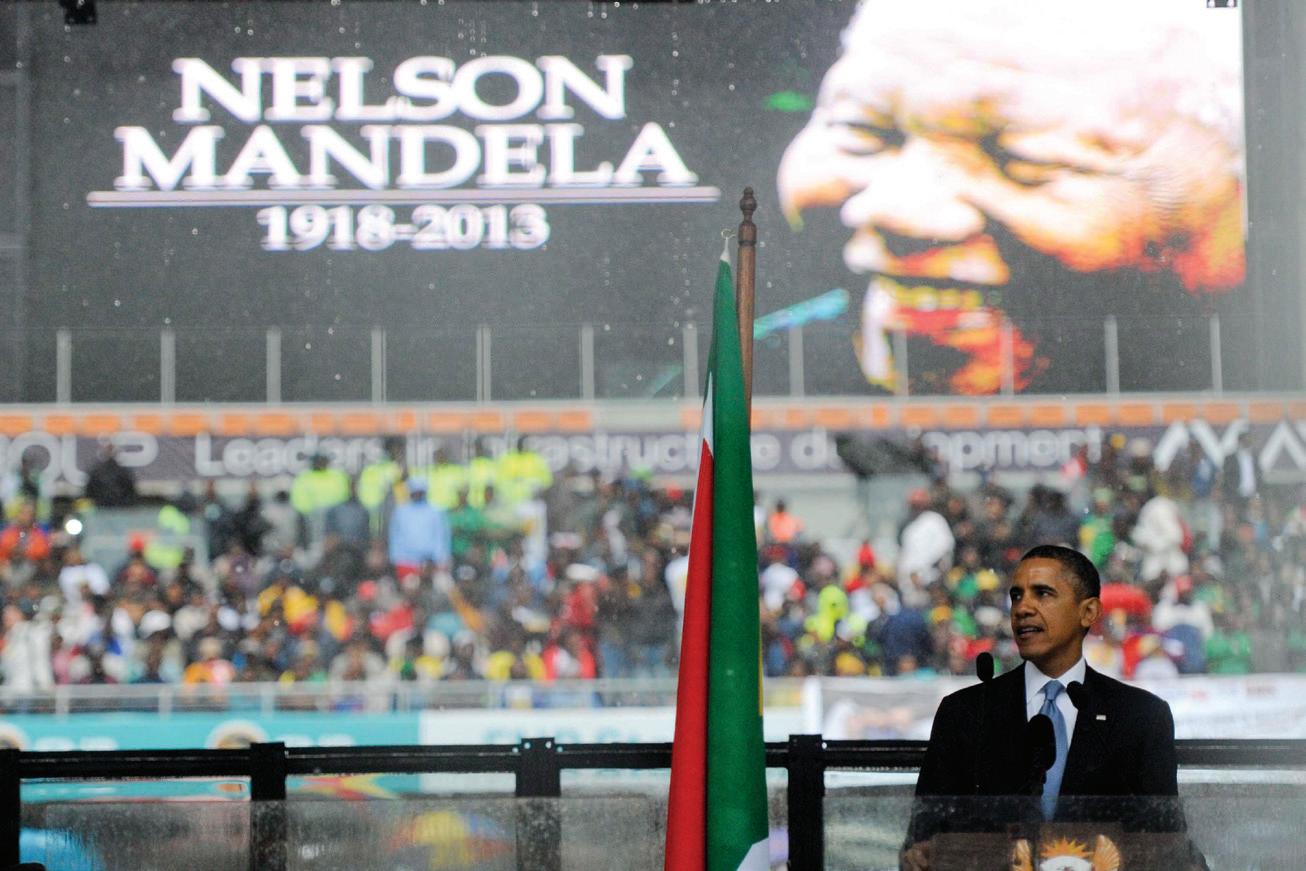
Source 9.1.2 Former US President Barack Obama addresses crowds at the memorial service for former South African president Nelson Mandela, 2013
UNCORRECTED SAMPLEPAGES
rules-based international order the post-1945 system in which countries follow agreed international laws, rules and institutions to manage relations, resolve disputes and promote cooperation
On 5 December 2013, Nelson Mandela passed away peacefully at the age of 95 at his home near Johannesburg, South Africa. News of his death quickly spread around the world, and international leaders, including US President Barack Obama, issued statements reflecting on Mandela’s moral courage and leadership. Many emphasised his ability to bring people from across deep political divides together in defence of humanity and dignity, and his commitment to opposing oppression without hatred.
In his memorial address, Obama observed that Mandela achieved more than could reasonably be expected of any one person, stating that “He no longer belongs to us – he belongs to the ages”. Obama further reflected that Mandela had “taken history in his hands and bent the arc of the moral universe towards justice”.
Former Australian Prime Minister Kevin Rudd also commented on Mandela’s global significance, tweeting that “a light just went out across the world” following his death.
In the political turmoil seen in many parts of the world in the 2020s, leaders who set aside hatred and work tirelessly for peace and humanity appear increasingly rare. Against a backdrop of rising authoritarianism, violence and division, Mandela’s leadership raises important questions for the present. How can his example be used by contemporary leaders to uphold a rules-based international order that rejects discrimination, violence and oppression, and instead promotes freedom, democracy and human dignity?
Supporters and admirers have written extensively about Nelson Mandela, while criticism has been comparatively limited. He is widely remembered as a symbol of resistance to oppression and reconciliation in the face of injustice. Mandela and F. W. de Klerk were jointly awarded the Nobel Peace Prize in 1993, and Mandela received numerous international honours, including multiple honorary degrees and major awards. These included the Freedom of the City of Sydney Award in 1987, granted while he was still imprisoned.
Nelson Mandela’s leadership continues to stand as an example of courage, humility and persistence. The key role he played in the struggle against apartheid reminds us that great leaders do not rely solely on power or position. Rather, it is their capacity to influence others to commit to a moral and principled course of action that ultimately shapes their legacy.
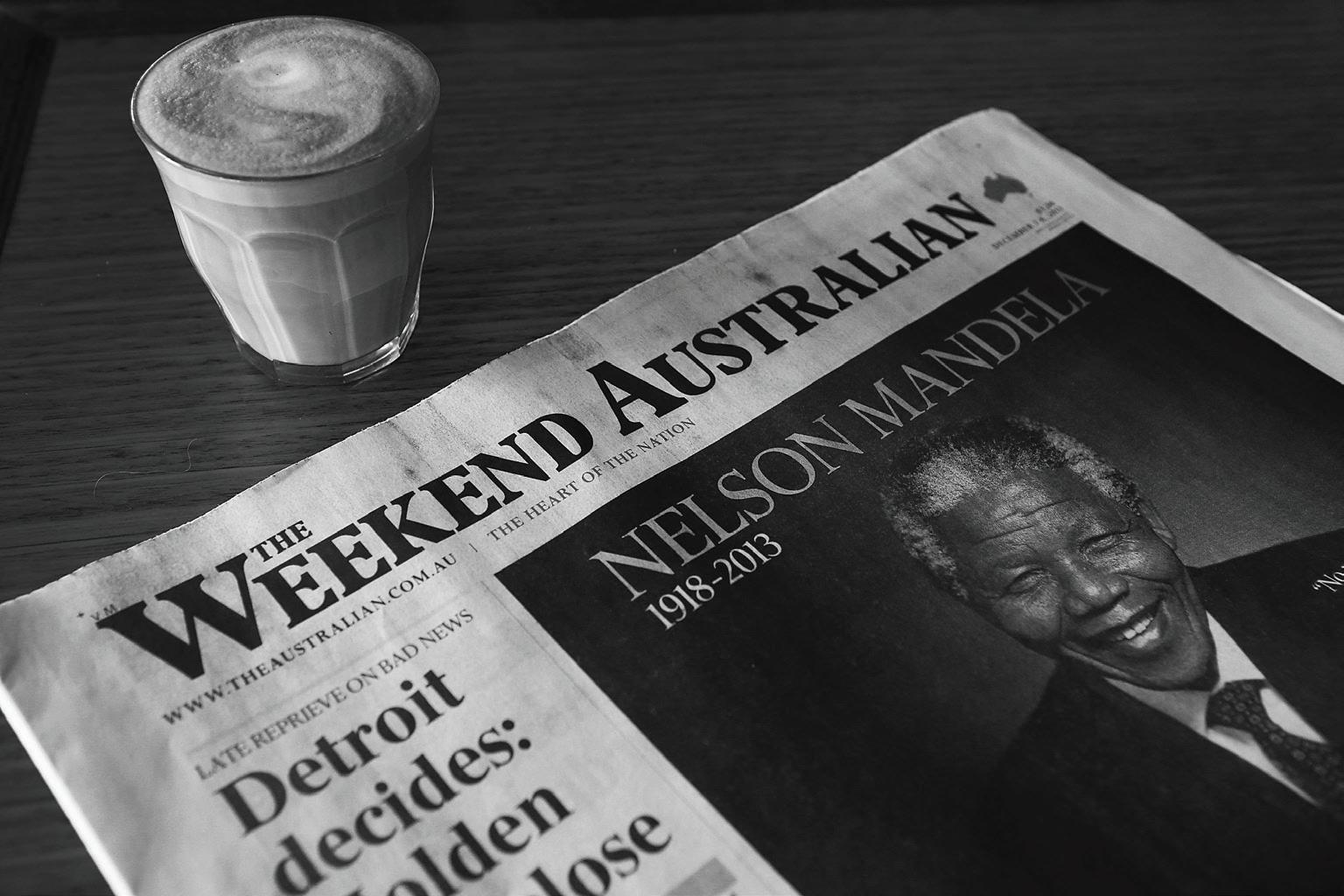
REVIEW 9.1
UNCORRECTED SAMPLEPAGES
apartheid a system of racial segregation enforced by law in South Africa, under which people of different races were kept separate and white people were given greater political, educational and social rights
1. Identify and summarise the leadership characteristics that President Barack Obama attributes to Nelson Mandela in his memorial speech, available at: https://cambridge.edu.au/redirect/11765.
2. Explain why these leadership characteristics are particularly important in the contemporary world. (Hint: consider the types of political instability and global tensions evident in the early twenty-first century.)
3. Compare these characteristics with leadership styles that are common in global politics today.
4. Identify and justify one or more world leaders, past or present, who demonstrate leadership qualities similar to those shown by Nelson Mandela. Online
Go online to assign and download questions, view results and more!
Writing focus 9.1
Question words
Source 9.1.3 The Weekend Australian reports the death of former South African president Nelson Mandela, Perth, Australia, 7 December 2013
9.2 The historical context and background of Nelson Mandela
UNCORRECTED SAMPLEPAGES
Transkei a region in southeastern South Africa traditionally associated with Xhosa-speaking peoples. During the apartheid era, it was designated by the South African government as a homeland (bantustan) for Xhosa-speaking people.
Declared “independent” by South Africa in 1976 (a status not recognised internationally), the Transkei was used to deny Black South Africans citizenship and political rights in South Africa proper. It was reintegrated into South Africa in 1994 following the end of apartheid.
rondavel a traditional round African hut with a thatched, cone-shaped roof
DRIVING QUESTION
• How did Mandela’s early life and experiences shape his role in the fight against apartheid?
Family background and education
Birth and family background
A member of the Madiba clan and the royal family of the Thembu people, Nelson Mandela was born Rolihlahla Dalibhunga Mandela on 18 July 1918 in the small village of Mvezo, on the banks of the Mbashe River. At the time, Mvezo was located in the district of Umtata, in what was then known as the Transkei. Mandela grew up in a peaceful rural area between the Cape and Natal, living in a thatched rondavel with his mother, Nonqaphi Nosekeni, and his father, Nkosi Mphakanyiswa Gadla Mandela. Mandela belonged to the Xhosa nation, within which his father was a respected chief of the Thembu people. His birth was celebrated within the local community. His father named him Rolihlahla, which in Xhosa literally means “pulling the branch of a tree”, but is more commonly understood to mean “troublemaker”. Mandela’s father was known for his independence and stubbornness, often clashing with white colonial authorities. When Mandela was about one year old, his father had a dispute with local officials and was stripped of his position as chief. He lost his cattle and home, and the family was forced to move to the nearby village of Qunu. There, Mandela was raised alongside extended family members, including his aunts uncles and half-siblings, who helped support the household. His mother later converted to Christianity and joined the Methodist Church.
Education
In 1925, at the age of seven, Mandela began attending a Wesleyan mission school. When he arrived, his teacher, Miss Mdingane, gave him the Christian name Nelson, following a common practice in mission education at the time.
In 1930, after Mandela had been in school for only two years, his father died of lung disease. Mandela was then placed in the care of Jongintaba Dalindyebo, the Chief Regent of the Thembu. Under his guardianship, Mandela learned the traditions, customs and responsibilities associated with leadership in Xhosa society.
During his teenage years, Mandela excelled academically at Clarkebury Boarding Institute. He then enrolled at Healdtown, a Methodist college in Fort Beaufort.
In 1938, Mandela completed his studies at Healdtown and enrolled at Fort Hare University, then one of the few higher education institutions in South Africa open to Black students. At the time, people’s lives were becoming increasingly defined by their “race”. Although white people comprised only 20% of the population of around 10 million, they owned over 80% of the land. Voting rights had recently been extended to all white men and women, but Black people either had no vote, or voted for a small number of representatives, who had to be white.
Early career and political development
Mandela began a Bachelor of Arts degree at Fort Hare and later sought to study law at the University of the Witwatersrand (Wits), the leading English-speaking university in South Africa. While at Wits, he encountered racism from some lecturers but also formed important political connections. He met Joe Slovo and his partner Ruth First, both white members of the South African Communist Party and committed opponents of apartheid. Through them, Mandela was introduced to a wider network of politically active white South Africans.
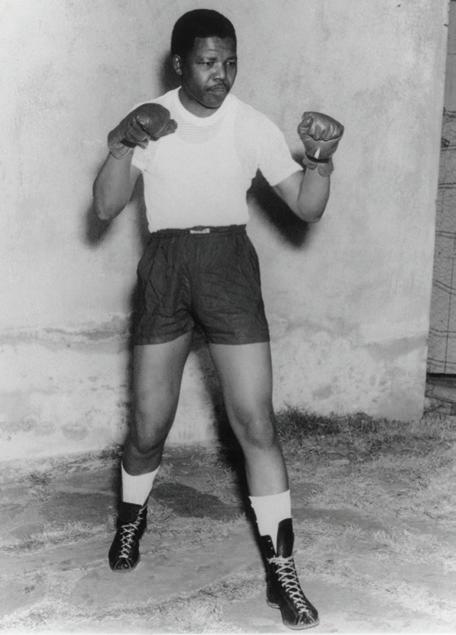
While studying at Fort Hare, Mandela’s guardian attempted to arrange a marriage for him. Unwilling to accept this, Mandela fled to Johannesburg, where he initially found work as a security guard at Crown Mines. There, he witnessed firsthand the harsh precursors of apartheid and the treatment of Black South Africans. After losing this job, Mandela met Walter Sisulu, an estate agent who helped him secure employment as a law clerk. The two became close friends, and Sisulu’s involvement in the African National Congress (ANC) strongly influenced Mandela’s political development. Soon after, in 1943, Mandela joined the ANC.
Mandela eventually left Wits without completing his law degree. He later completed his Bachelor of Arts through correspondence at the University of South Africa and, many years later, completed a law degree via correspondence while imprisoned. In the 1950s, Black South Africans came under the provisions of apartheid, the system of racial segregation that the National Party, after forming government in 1948, introduced to secure the legal supremacy of the “white” minority. From 1950, the Population Registration Act classified people by race. Under the Group Areas Act, tens of thousands of Black families were forcibly moved to racially zoned living areas. The Pass Act required non-white people to carry identity passes at all times, and they were subjected to frequent harassment by security forces.
Writing focus 9.2
Noun phrases (identify)
UNCORRECTED SAMPLEPAGES
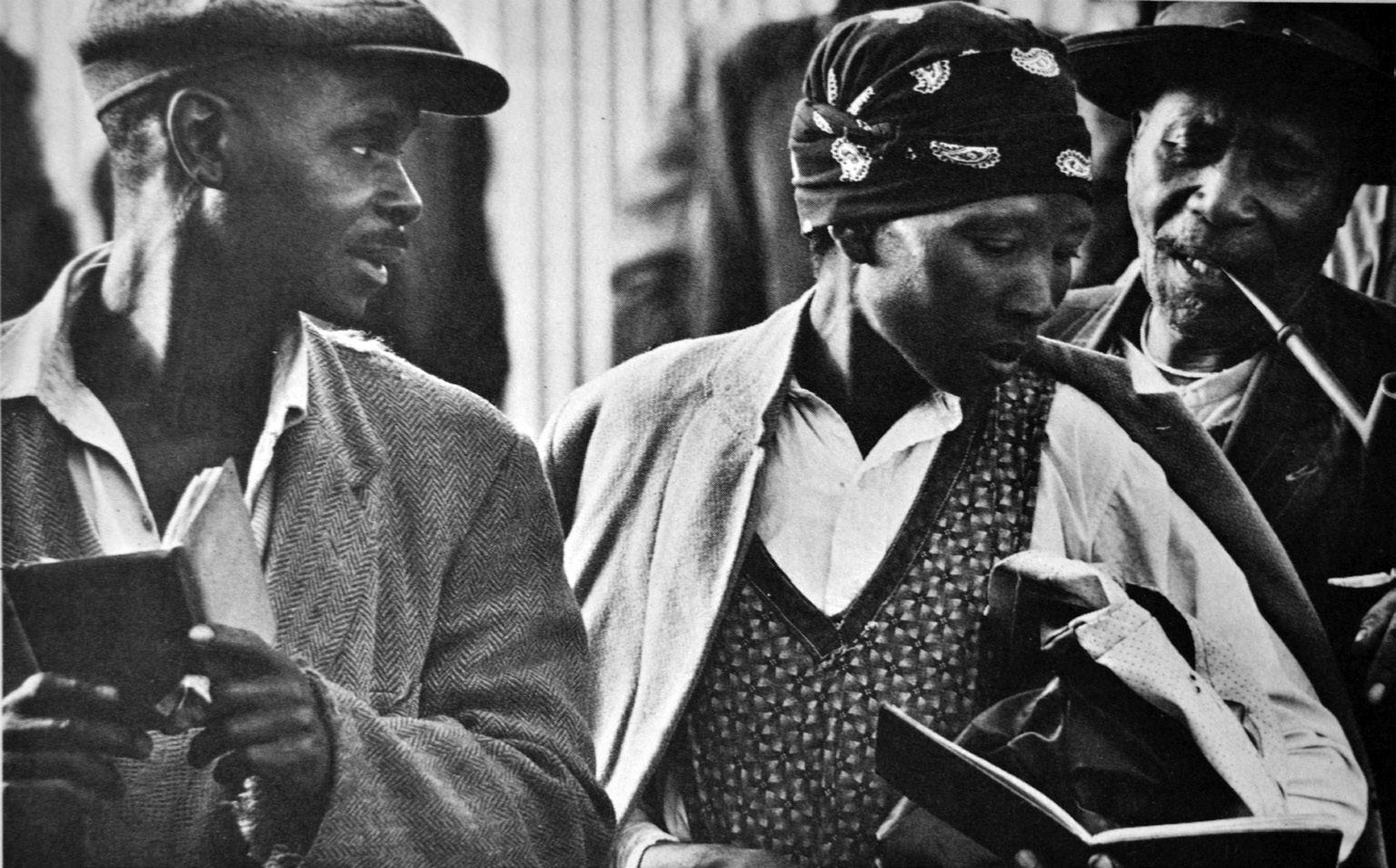
African National Congress (ANC)
South African political organisation founded in 1912 that led the struggle against apartheid and formed government after winning South Africa’s first democratic election in 1994
Source 9.2.1 Nelson Mandela posing in boxing attire, c.1950
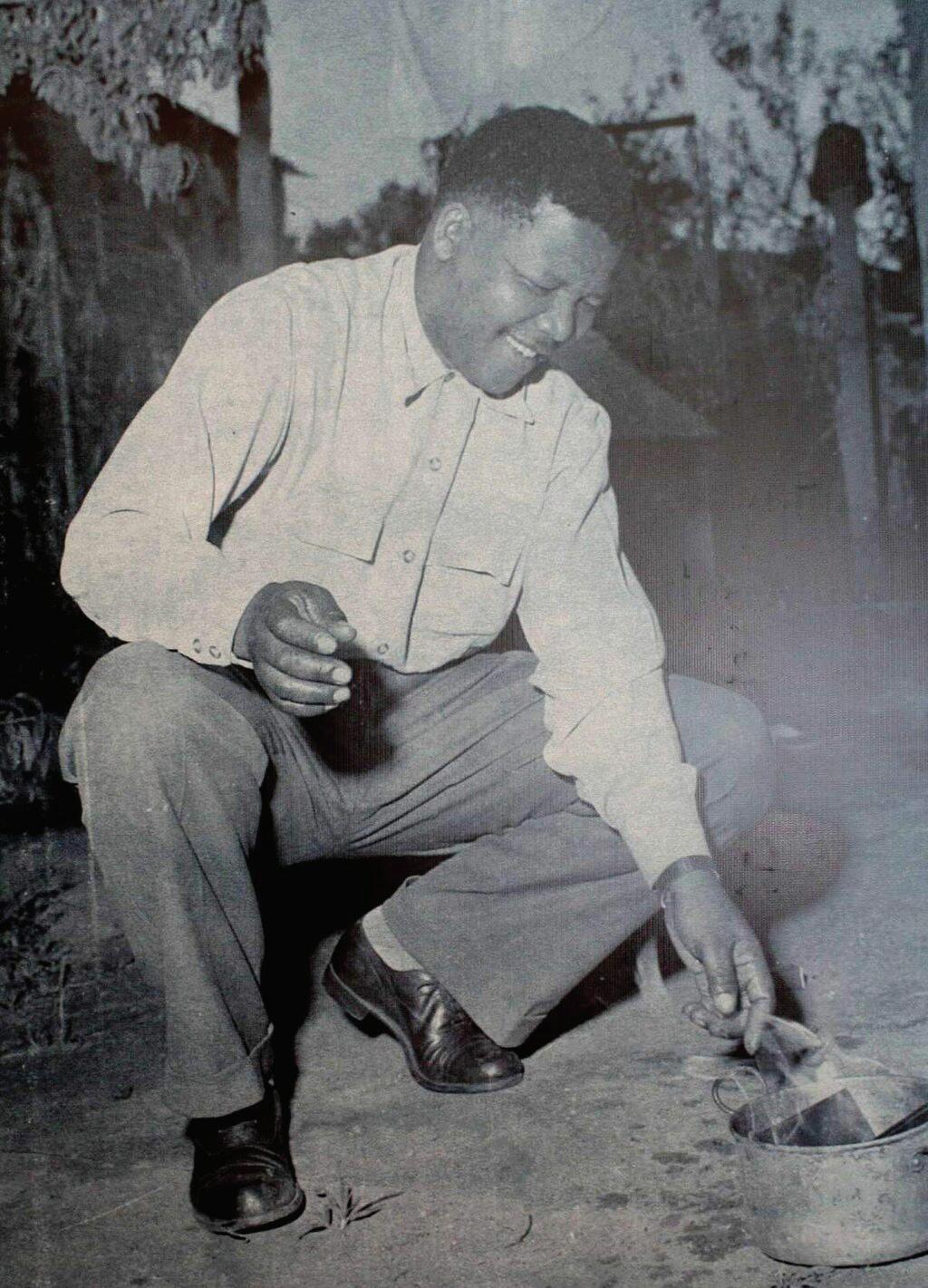
Mandela and Tambo
Mandela first met Oliver Tambo at Fort Hare. In 1952, Mandela and Tambo established the first Black legal practice in South Africa. Operating under the name “Mandela and Tambo”, the firm provided free or low-cost legal assistance to Black South Africans who would otherwise have had no access to legal representation. The firm dealt daily with the injustices of the apartheid legal system.
Mandela and Tambo defended clients charged with minor breaches of apartheid laws, such as entering “whites only” beaches or using segregated public transport. In doing so, they encountered entrenched racism within the legal system and frequent resistance from white officials. Mandela increasingly found himself advocating for victims of police brutality and challenging decisions made by the Racial Classification Board, which determined a person’s “racial” identity under apartheid law.
In his autobiography Long Walk to Freedom, published in 1994, Mandela explained that his experiences at the law firm played a crucial role in shaping his belief that radically different methods would be required to bring apartheid to an end.
Source 9.2.4 Nelson Mandela reflects on his growing belief that non-violent resistance alone could not defeat apartheid
I began by speaking about the increasing repressiveness of the government in the wake of the Defiance Campaign. I said the government was now scared of the might of the African people. As I spoke, I grew more and more indignant. In those days, I was something of a rabble-rousing speaker. I liked to incite an audience, and I was doing so that evening … As I condemned the government for its ruthlessness and lawlessness, I overstepped the line: I said the time for passive resistance had ended, that non-violence was a useless strategy and could never overturn a white minority regime bent on retaining its power at any cost. At the end of the day I said that violence was the only weapon that would destroy apartheid, and we must be prepared, in the near future, to use that weapon.
UNCORRECTED SAMPLEPAGES
1. Describe the major events connected to Mandela’s family background and education.
2. Explain the importance of the following people in Mandela’s move towards political activism:
a. Walter Sisulu
b. Joe Slovo and Ruth First
c. Oliver Tambo.
Nelson Mandela. 1994. Long Walk to Freedom. London: Abacus, 181–82.
Source 9.2.3 Mandela burns his passbook in an act of defiance against apartheid, c.1960
9.3 Mandela’s leadership of the African National Congress
UNCORRECTED SAMPLEPAGES
DRIVING QUESTION
• In what direction did Nelson Mandela lead Umkhonto we Sizwe (MK), and how did this affect the fight against apartheid?
Joining the African National Congress
In 1943, Mandela joined the African National Congress (ANC) and, in 1944, became one of the founding leaders of its Youth League. That same year, he met and married Evelyn Ntoko Mase. Through a range of ANC leadership roles, Mandela helped revitalise the organisation and challenge the apartheid policies of the ruling National Party. In the late 1940s, he assisted in launching the ANC’s defiance program and, in 1955, played a key role in drafting the Freedom Charter
Mandela’s growing prominence as an antiapartheid activist made him a frequent target of the authorities. From 1952, he was subjected to repeated banning orders, which severely restricted his movement, associations and ability to speak publicly. In December 1956, Mandela was arrested alongside more than 100 other activists on treason charges designed to harass and weaken the anti-government movement. He stood trial from that year and was eventually acquitted in 1961. During the lengthy legal proceedings, Mandela divorced his first wife and married Nomzamo Winifred Zanyiwe Madikizela.
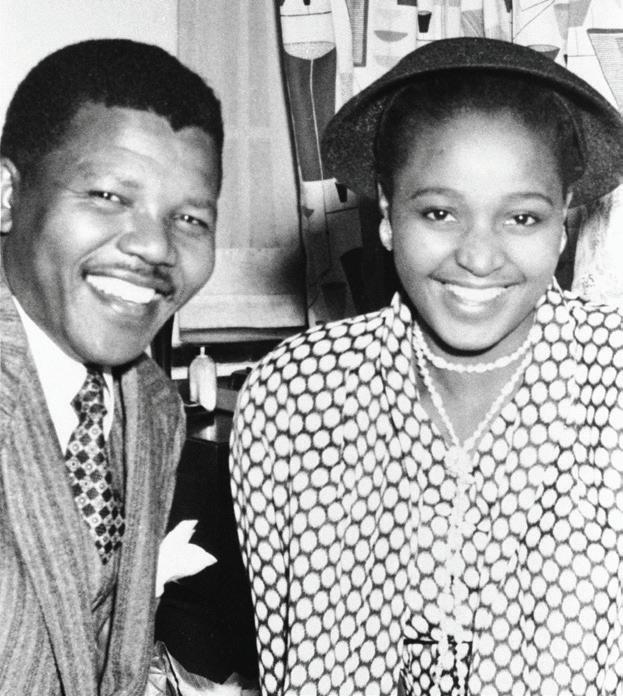
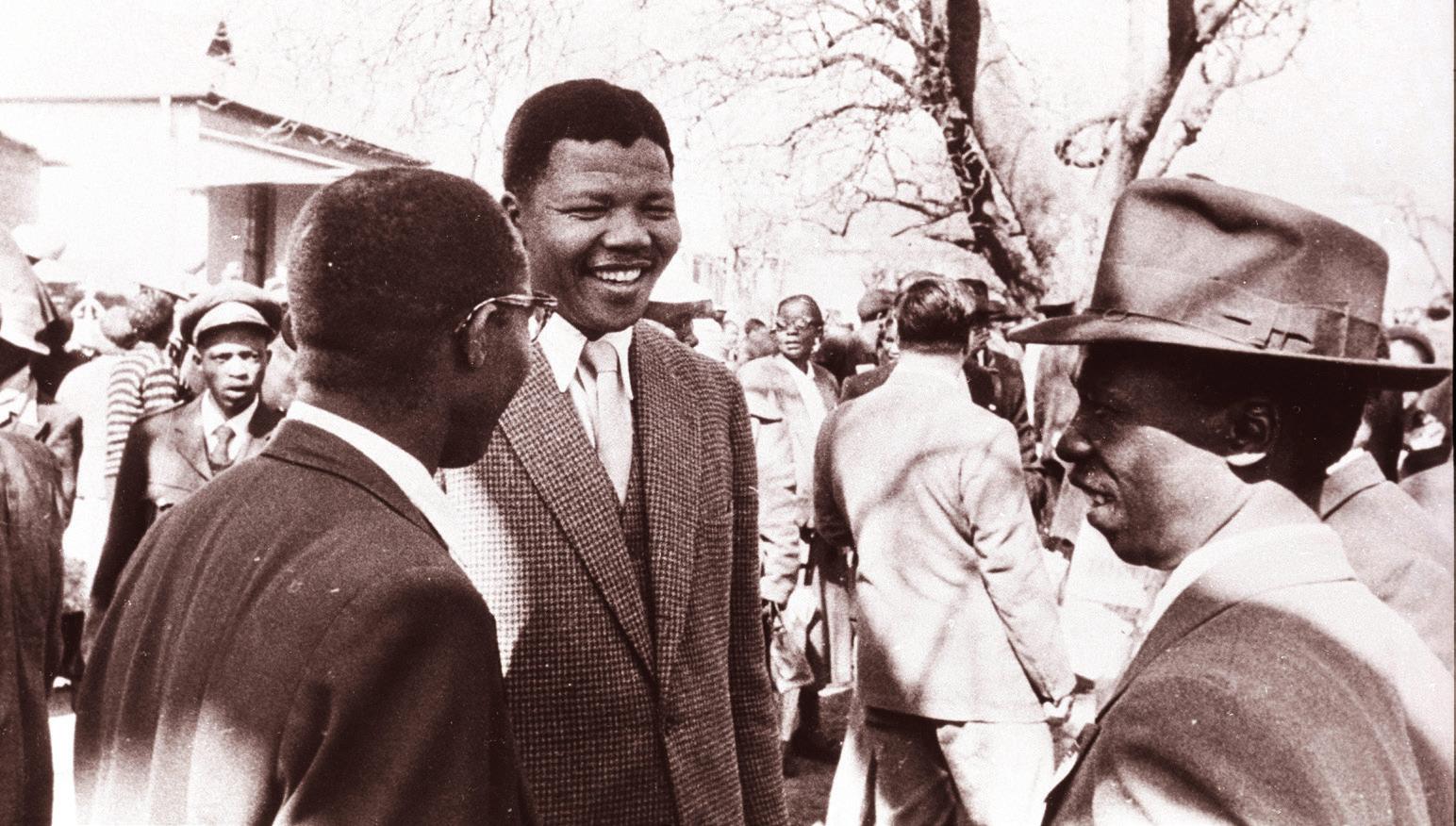
Freedom Charter an important document created in South Africa in 1955. It set out ideas for a fair, non-racial democracy and helped shape the country’s later constitution banning orders legal restrictions used by the apartheid government to control political opponents; people under banning orders could be confined to specific areas, prohibited from attending meetings, and prevented from publishing or speaking publicly
Source 9.3.1 Nelson Mandela and Winnie Madikizela on their wedding day, June 1958
Source 9.3.2 Nelson Mandela speaks with co-defendants outside the Treason Trial court, 1956
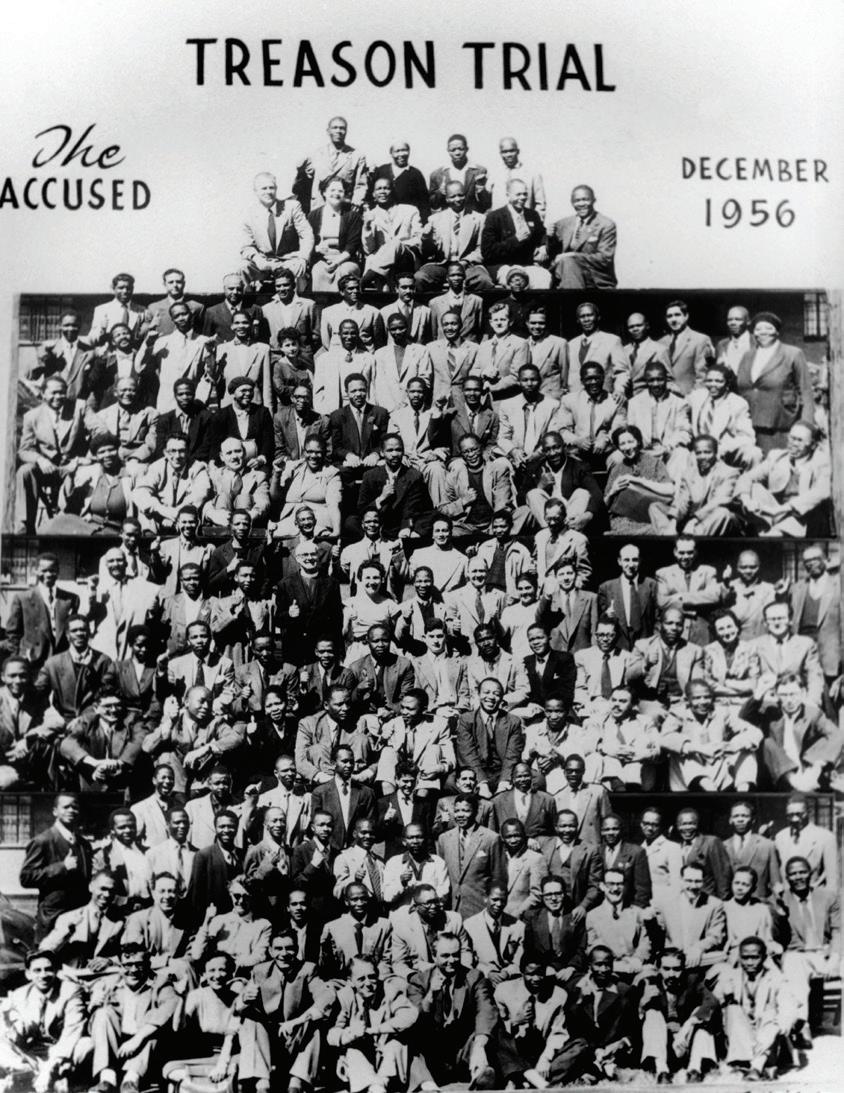
Source 9.3.3 Accused members of the Treason Trial, 1956
A MATTER OF FACT
The Treason Trial (1956–1961)
In December 1956, 156 members of the ANC were arrested and charged with high treason. The accused included Black South Africans, Indians and white South Africans, reflecting the ANC’s commitment to non-racialism. Among those charged were Nelson Mandela, Walter Sisulu and Oliver Tambo. The charges centred on the Freedom Charter, adopted in 1955, which called for a non-racial democracy and a more equal distribution of wealth in South Africa. The apartheid government argued that these aims amounted to a revolutionary threat. After a lengthy trial lasting until 1961, all defendants were acquitted.
Mandela as head of Umkhonto we Sizwe, “The Spear of the Nation” (MK)
The policy of violence
Sharpeville Massacre the killing of 69 unarmed Black South Africans by police on 21 March 1960 during a peaceful protest against apartheid pass laws at Sharpeville Umkhonto we Sizwe (MK) the armed wing of the African National Congress, formed in 1961 after the banning of the ANC
UNCORRECTED SAMPLEPAGES
Writing focus 9.3
Noun phrases (identify and develop)
Following the Sharpeville Massacre on 21 March 1960, the ANC was banned by the South African government and forced to operate underground. In response, Mandela argued that the ANC and its armed wing, Umkhonto we Sizwe (MK), should adopt a strategy of sabotage. Beginning in 1961, MK carried out attacks against power stations and other strategic government targets and symbols of apartheid, including offices of the Department of Bantu Administration and Development.
For Mandela and many within the ANC leadership, the banning of the organisation left few alternatives. They believed that decades of non-violent resistance had resulted only in increased repression by the white minority government. Sabotage was intended to damage the economy, avoid loss of life where possible, and draw both national and international attention to the ANC’s cause.
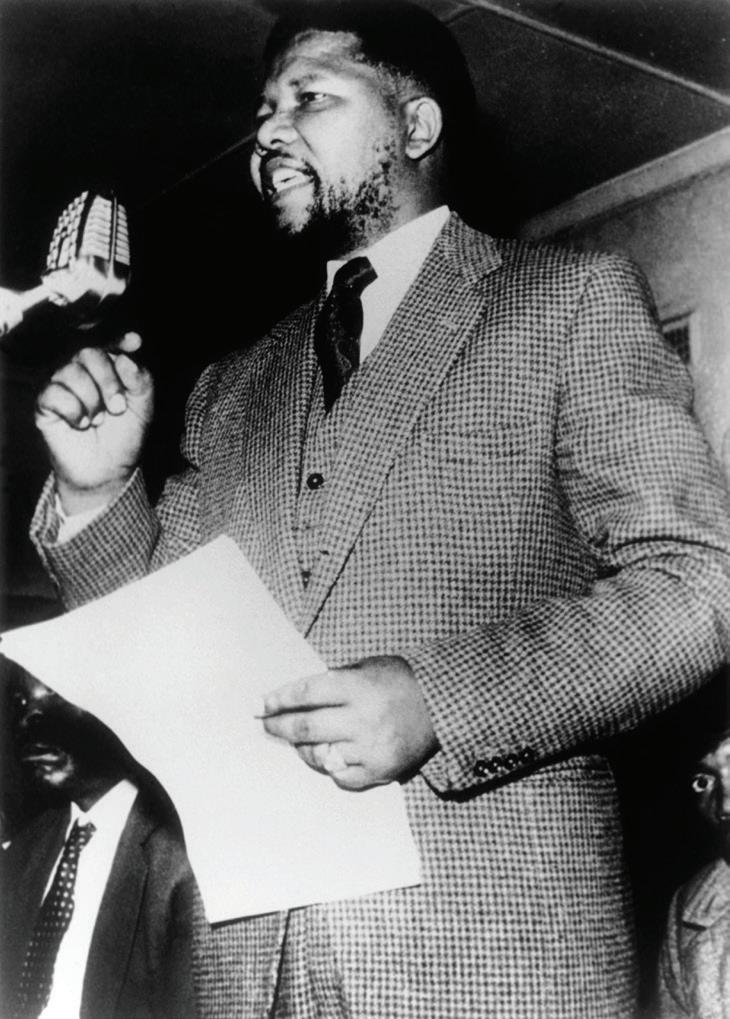
Source 9.3.4 Nelson Mandela addressing members of the African National Congress, c.1961
Operating underground
After the ANC was banned, Mandela and MK operated underground for almost two years. During this period, Mandela travelled covertly across South Africa and later underwent guerrilla training in Ethiopia alongside other MK members. As he evaded capture, Mandela became known as “the Black Pimpernel”, a reference to The Scarlet Pimpernel, a novel about a hero who adopts secret identities to avoid his enemies.
Mandela narrowly avoided arrest on several occasions. To evade police detection, he at times disguised himself as a chauffeur, gardener, milkman or chef. He also travelled to Britain and several African countries, where he sought support and advice on how best to challenge the apartheid regime. His most significant role during this period, however, was providing leadership to MK and ensuring that the organisation’s political aims and sabotage campaigns were communicated to the public. In August 1962, Mandela was arrested in Natal and later sentenced to imprisonment for incitement and for leaving the country illegally.
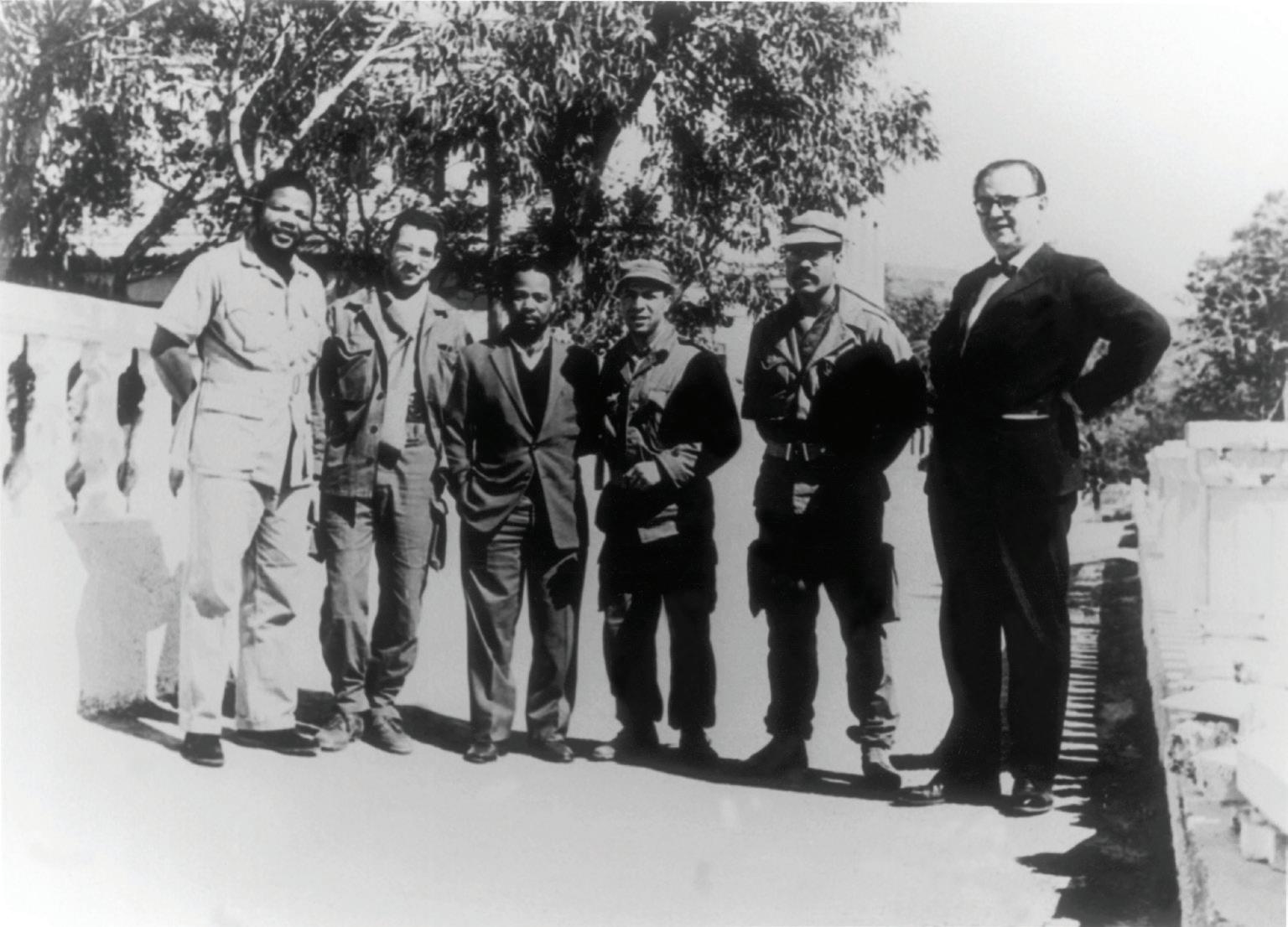
UNCORRECTED SAMPLEPAGES
1. Identify the different roles Nelson Mandela played within the African National Congress.
2. Construct a timeline outlining the major roles Mandela played in the ANC.
3. Explain how and why Mandela’s role within the ANC changed between the 1940s and 1960s.
4. Discuss why the ANC ended its policy of non-violence. To what extent was its new strategy justified?
Go online to assign and download questions, view results and more!
Source 9.3.5 Nelson Mandela learns guerrilla tactics from commanders of the Algerian Army, 1962
9.4 Rivonia Trial, 1963
UNCORRECTED SAMPLEPAGES
Writing focus 9.4
Transitional phrases
DRIVING QUESTION
• Why was the Rivonia Trial such a pivotal moment, and how did it affect the ANC and Nelson Mandela?
Operation Mayibuye
The activities of Nelson Mandela and MK came to a sudden halt in July 1963, when police raided a hideout at Lilliesleaf Farm in Rivonia, Johannesburg. Several members of MK’s executive, including Walter Sisulu, were arrested. During the raid, police discovered documents outlining a plan for a large-scale military campaign, codenamed Operation Mayibuye, meaning “bringing back what was lost”. The discovery of these documents provided the government with strong evidence that MK was preparing for armed resistance against the apartheid state. The raid marked a decisive turning point, leading directly to the Rivonia Trial and the arrest of many of the ANC’s senior leaders.
Source 9.4.1 Extract from an MK planning document outlining Operation Mayibuye, seized by police at Rivonia, July 1963
The white state has thrown overboard every pretence of rule by democratic process. Armed to the teeth it has presented the people with only one choice and that is its overthrow by force and violence. It can now truly be said that very little, if any, scope exists for the smashing of white supremacy other than by means of mass revolutionary action, the main content of which is armed resistance leading to victory by military means …
African National Congress. 1963. Operation Mayibuye: Part 1. UMKC School of Law, 3.
The charges and the state’s case
Following the Rivonia raid, leading members of the ANC, along with white members of the South African Communist Party, were arrested and charged with sabotage and conspiracy. Mandela, who was already imprisoned at the time, was brought from prison to stand trial with the other accused.
The apartheid government reacted with outrage to the discovery that a banned organisation was planning armed resistance. In the context of the Cold War and a recent wave of decolonisation across Africa, the government portrayed the accused as “traitors” and “terrorists”. The alleged involvement of communists became a central focus of the prosecution’s case. The state did not formally impose the death penalty but “left little doubt that the [they] believed this was the appropriate penalty” –determined to crush what it viewed as a revolutionary threat to white minority rule.
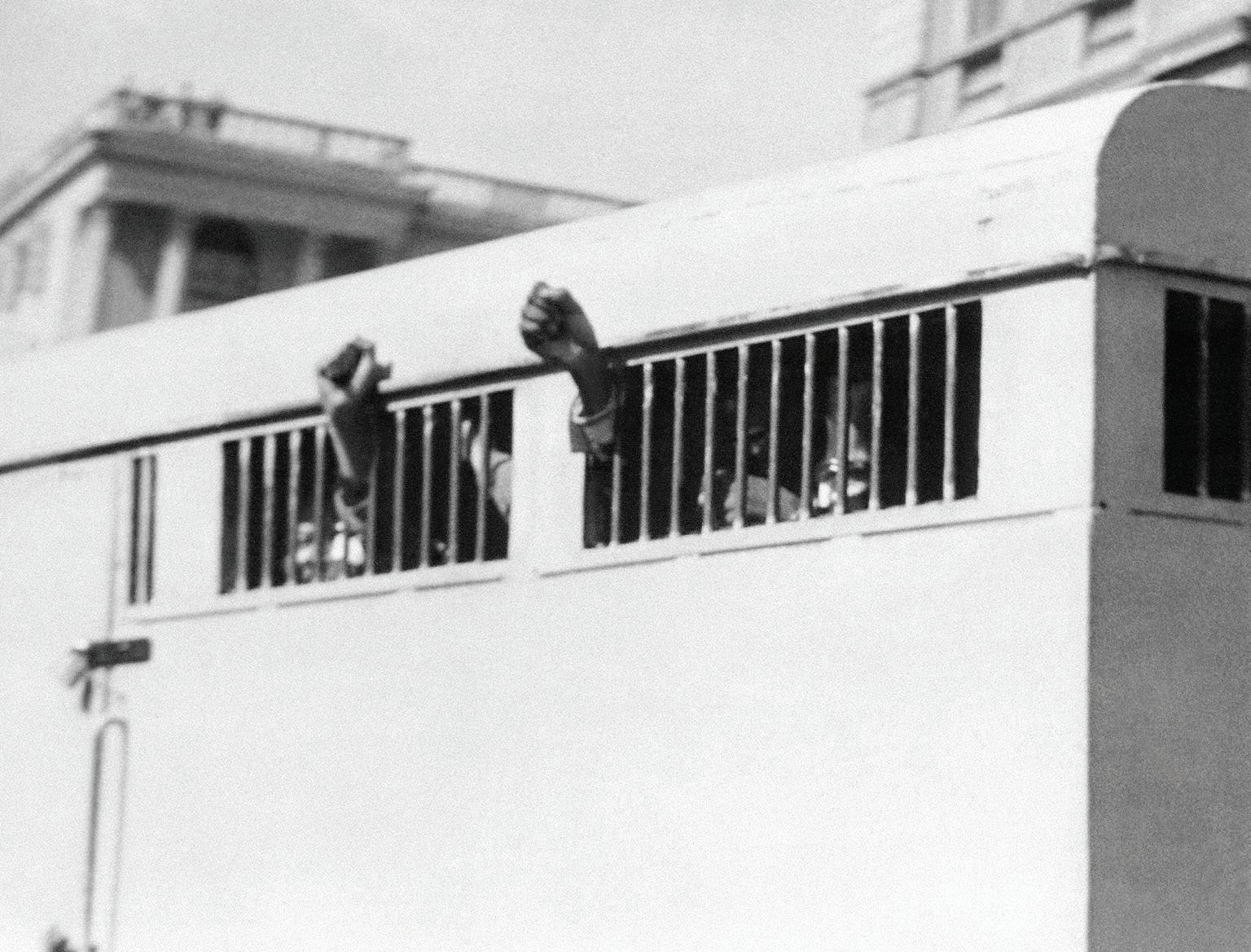
Source 9.4.2 Nelson Mandela and seven co-accused leave the Palace of Justice after being sentenced to life imprisonment in the Rivonia Trial, Pretoria, June 1964
Mandela’s role in court
The Rivonia Trial and the life sentences imposed on senior ANC leaders in 1964 severely weakened MK’s leadership and disrupted its immediate capacity for resistance. However, Mandela’s conduct during the trial played a crucial role in sustaining the broader anti-apartheid movement. With legal training and courtroom experience, Mandela used the trial as a public platform to explain and justify the ANC’s actions. In a historic address to the court, he outlined the reasons why the ANC had decided to adopt sabotage after decades of non-violent resistance had failed to bring meaningful change.
ANALYSIS 9.1
Analysing a primary source
Source 9.4.3 Nelson Mandela explains the ANC’s decision to adopt sabotage during his Rivonia Trial speech, 20 April 1964.
UNCORRECTED SAMPLEPAGES
Four forms of violence are possible. There is sabotage, there is guerrilla warfare, there is terrorism and there is open revolution. We chose to adopt the first method and to exhaust it before taking any other decision. In the light of our political background, the choice was a logical one. Sabotage did not involve loss of life, and it offered the best hope for future race relations. Bitterness would be kept to a minimum and, if the policy bore fruit, democratic government could become a reality
The initial plan was based on a careful analysis of the political and economic situation of our country. We believed that South Africa depended to a large extent on foreign capital and foreign trade. We felt that planned destruction of power plants, and interference with rail and telephone communications would tend to scare away capital from the country, making it more difficult for goods from industrial areas to reach the seaports on schedule, and would in the long run be a drain on the economic life of the country, thus compelling the voters of the country to reconsider their position …
This then was the plan. Umkhonto was to perform sabotage, and strict instructions were given to members right from the start, that on no account were they to injure or kill people in planning or carrying out operations.
Nelson Mandela. 1964. I Am Prepared to Die. Opening statement for the Rivonia Trial, Pretoria Supreme Court. United Nations website.
1. Explain the four forms of violence identified by Mandela in the source.
2. According to the source, why did the ANC choose sabotage over other forms of violence?
3. According to the source, what outcomes was Umkhonto we Sizwe hoping sabotage would achieve?
Historical concepts: Significance, Perspectives Historical skills: Analysis and use of sources
Mandela also used the trial to explain his personal commitment to the struggle against apartheid and his vision of a democratic, non-racial South Africa.
Source 9.4.4 Nelson Mandela declares his commitment to a democratic and non-racial South Africa during his Rivonia Trial speech, 20 April 1964.
During my life I have dedicated my life to the struggle of the African people. I have fought against white domination, and I have fought against black domination. I have cherished the idea of a democratic and free society in which all persons live together in harmony, and with equal opportunities. It is an ideal which I hope to live for and to achieve. But, if needs be, it is an ideal for which I am prepared to die.
Nelson Mandela. 1964. I Am Prepared to Die. Opening statement for the Rivonia Trial, Pretoria Supreme Court. United Nations website.
UNCORRECTED SAMPLEPAGES
1. Outline Mandela’s reasons for opposing apartheid.
2. Explain the significance of the Rivonia Trial in 1963.
3. Explain why the judge of the Rivonia Trial did not give Nelson Mandela the death penalty.
4. Explain why Mandela’s role during the trial was so important in the fight against apartheid.
9.5 Imprisonment on Robben Island
UNCORRECTED SAMPLEPAGES
DRIVING QUESTION
• How did Nelson Mandela’s imprisonment on Robben Island strengthen the anti‑apartheid movement?
Fortunately for those on trial, including Nelson Mandela, Walter Sisulu and Govan Mbeki, intense international attention was focused on the Rivonia Trial. Although the apartheid government had sought harsh punishment, the death penalty was not imposed. The accused were found guilty and sentenced to life imprisonment on Robben Island, a small, desolate island off the coast of Cape Town.
Mandela’s willingness to defy apartheid law under the threat of death, and to make his stand on universal moral grounds, elevated the struggle of Black South Africans and their representatives in the ANC. His conduct during the trial and sentencing brought him international recognition, and he became a central figure and enduring symbol in anti-apartheid protests for many years to come.
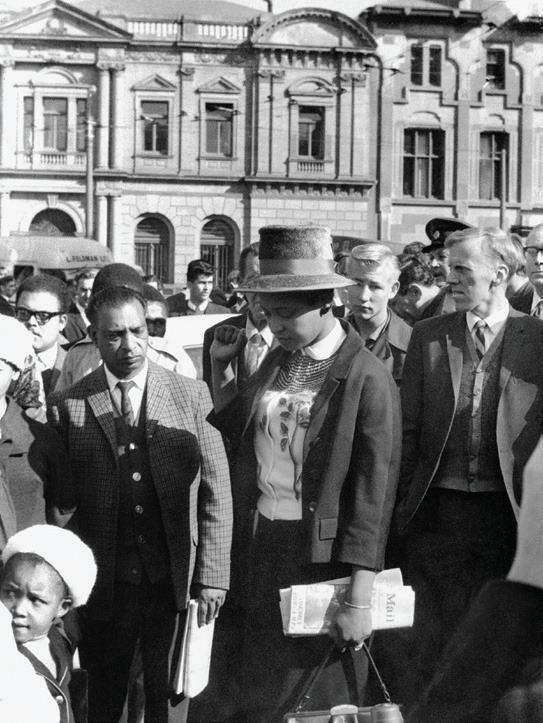
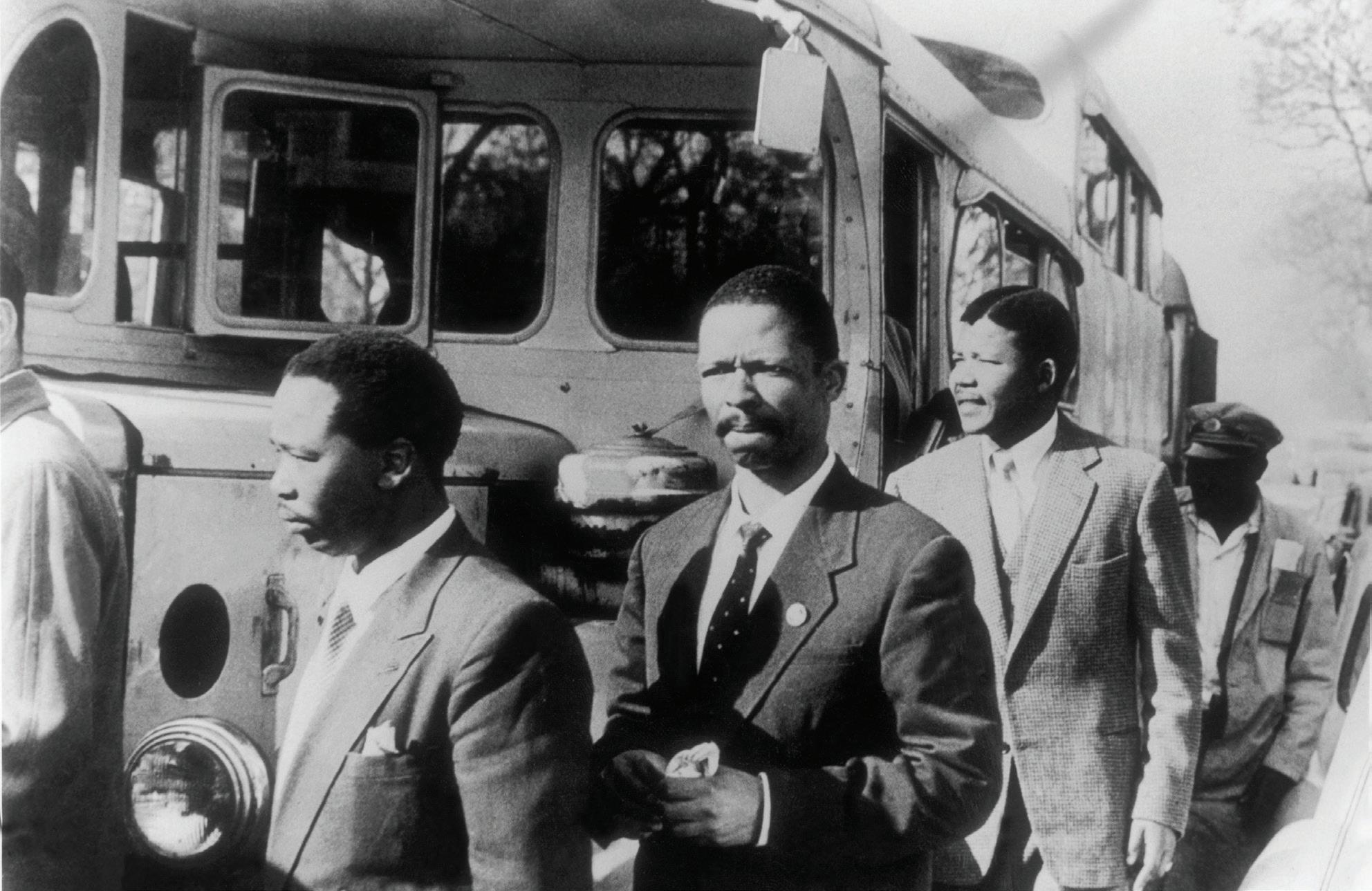
Source 9.5.2 Nelson Mandela walks to court with Robert Resha and Patrick Molaoa after being charged with treason, Johannesburg.
Source 9.5.1 Winnie Mandela leaves the Palace of Justice in Pretoria after the Rivonia Trial verdict sentencing, June 1964
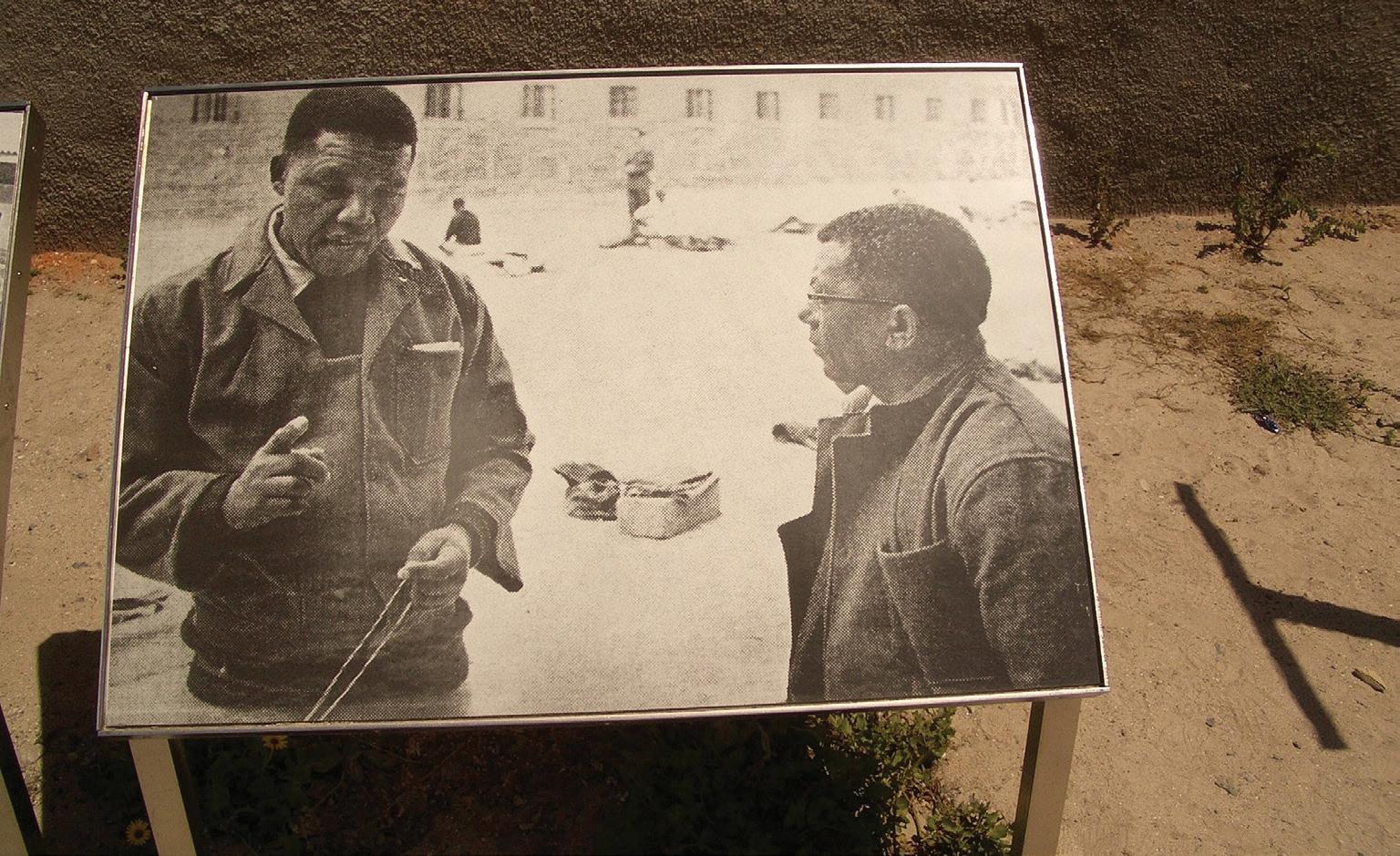
UNCORRECTED SAMPLEPAGES
Source 9.5.4 Robben Island is located just off the coast of Cape Town.
Atlantic Ocean
Indian Ocean
Cape Town
Pretoria
Johannesburg
SOUTH AFRICA
LESOTHO
Robben Island
SWAZILAND (now called ESWATINI)
BOTSWANA NAMIBIA
Source 9.5.3 Nelson Mandela with Walter Sisulu on Robben Island, 1966. The government made it illegal to publish Mandela’s image or spoken words, meaning that the public did not know what he looked like until a photograph emerged in 1986.
ANALYSIS 9.2
Analysing a primary source
1. Explain the origin of the source (who created it, when and where) to outline its historical context.
2. Identify the figures depicted in the cartoon. Why are they significant?
3. Research the Sabotage Act mentioned in the cartoon. Explain how it allowed the apartheid government to suppress opposition and maintain its authority.
4. Analyse the value and limitations of the source in helping historians understand the role of the legal system in apartheid South Africa.
Source 9.5.5 British political cartoon by Leslie Illingworth in Punch magazine, criticising South Africa’s use of detention laws during the apartheid era, 1963. Caption reads: “Under the ‘Sabotage Act’ there is no need for South Africa to bring accused persons to trial. They may be kept in prison for an indefinite series of ninety-day periods merely on suspicion, even when – as last week – indictments are quashed.”
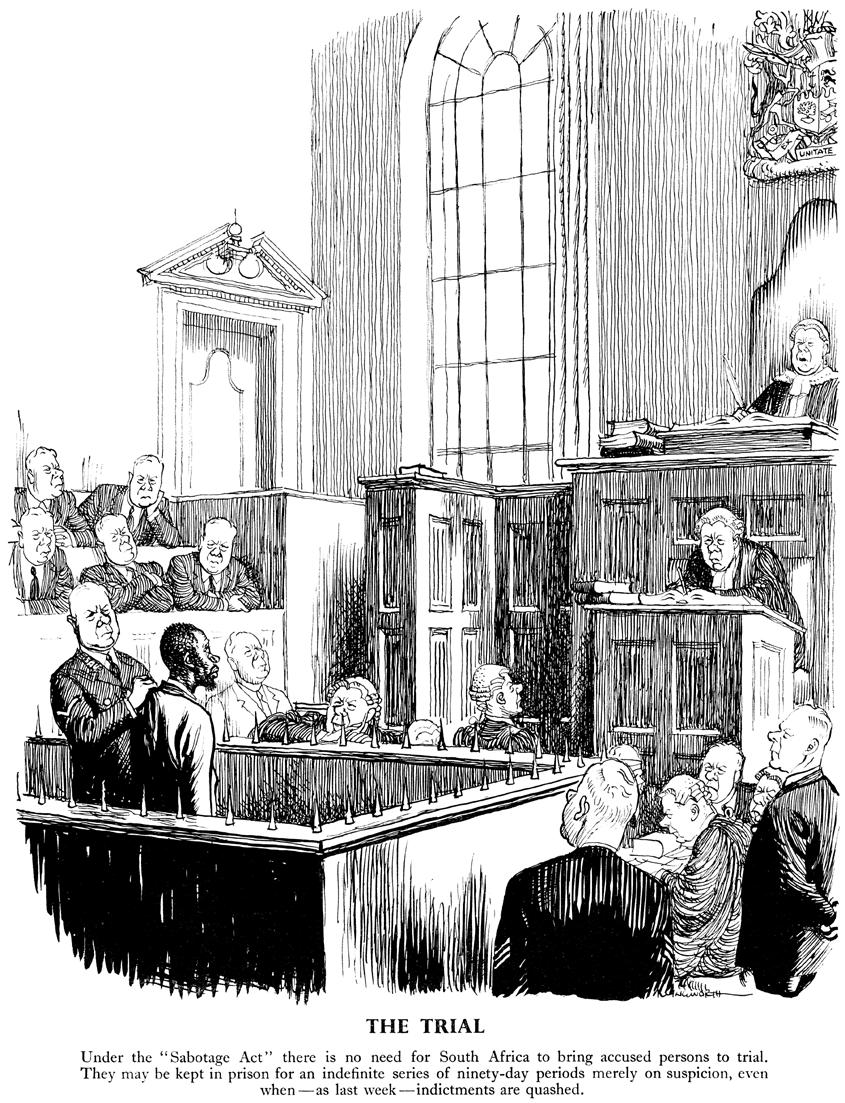
Historical concepts: Significance, Continuity and change Historical skills: Analysis and use of sources
The “Free Nelson Mandela” campaign and the growing international fight against apartheid
The apartheid government hoped that Mandela would be lost to history during his long imprisonment on Robben Island. Instead, while apartheid policies became more extreme – depriving Black South Africans of citizenship, forcibly moving millions of people into “bantustan” townships, and making the white South African language, Afrikaans, compulsory in schools – the growing international anti-apartheid movement transformed Mandela into the symbol of the liberation struggle. Mandela came to be known worldwide as the most famous political prisoner of his time, identified by his prison number, 46664. In 1980, ANC leader Oliver Tambo launched the “Free Nelson Mandela” campaign. The campaign made Mandela a household name internationally and helped galvanise global opposition to South Africa’s racist regime.
UNCORRECTED SAMPLEPAGES
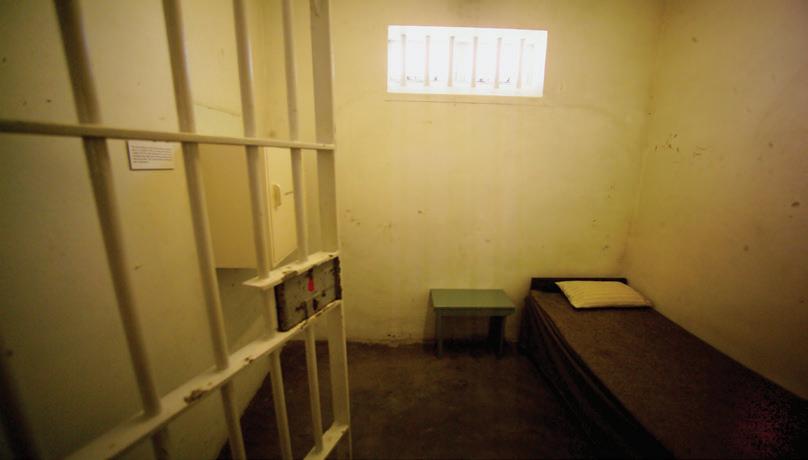

Source 9.5.6 (Left) Nelson Mandela’s prison cell on Robben Island; (Right) the corridor he viewed daily during his imprisonment
Writing focus 9.5
Source analysis (perspective)
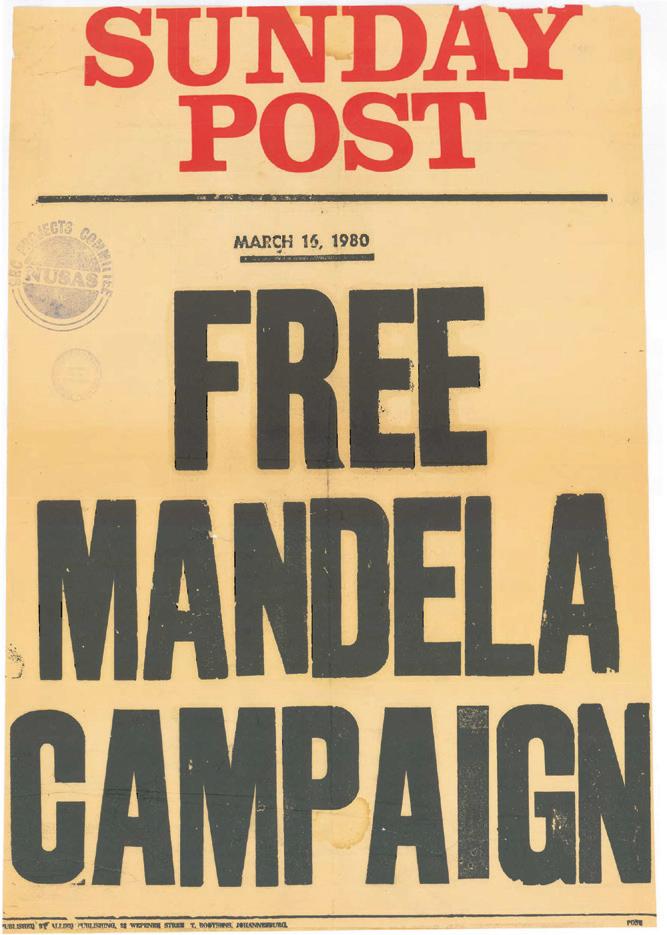
Source 9.5.7 Newspaper flyer announcing the launch of the “Free Nelson Mandela” campaign, Johannesburg, March 1980
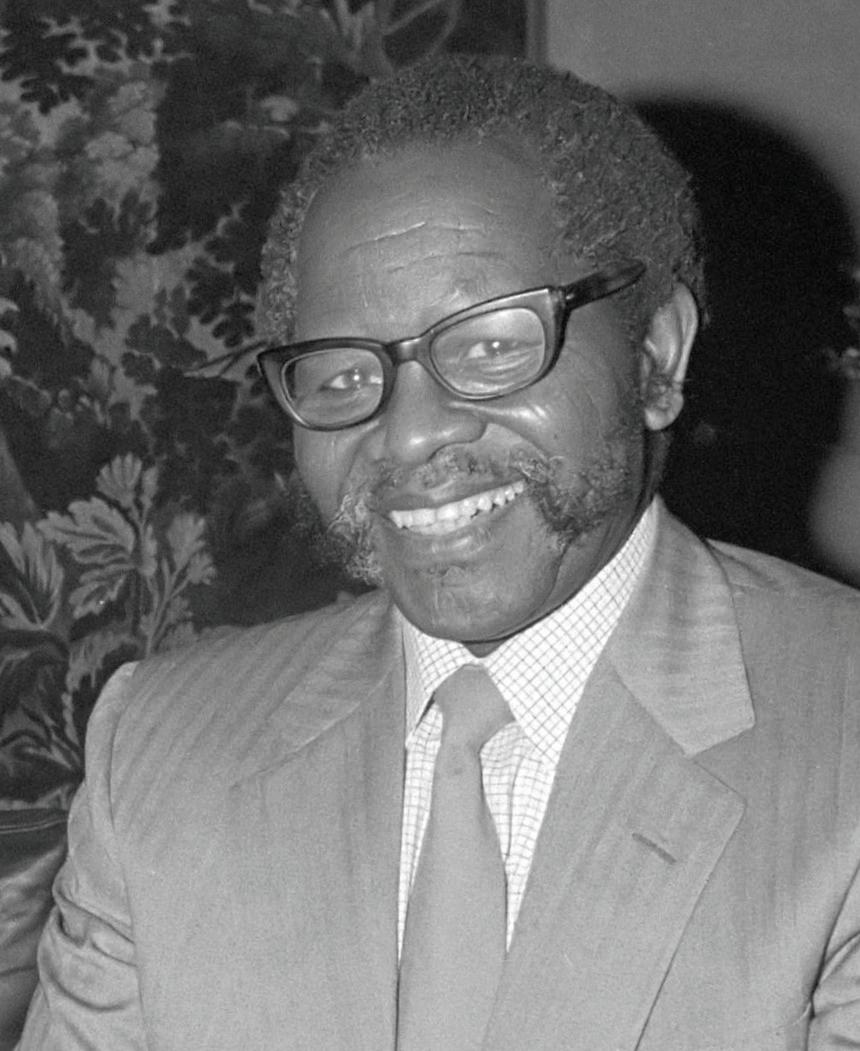
Source 9.5.8 Oliver Tambo was a leading organiser of the “Free Nelson Mandela” campaign.
By the mid-1980s, Mandela’s release had become a central political demand. In 1985, Albertina Sisulu, the wife of Walter Sisulu and one of the campaign’s presidents, stated that Mandela’s freedom was now the number one political priority for many Black South Africans. Supporters believed his release would open the way not only to ending apartheid but also to negotiating a new “non-racial, democratic” constitutional system to replace white minority rule.
Source 9.5.9 Albertina Sisulu on the demand for Nelson Mandela’s release, 1985
We have come to demand that Nelson Mandela be released and that no conditions be attached to his release … Mandela is our leader. He is a man known to the people and chosen by the people. As long as the government won’t release Mandela, there will be no peace in this country.
Albertina Sisulu. 1985. Speech calling for the unconditional release of Nelson Mandela, South Africa.
UNCORRECTED SAMPLEPAGES
The 1980s featured an international movement to pressure the South African government to bring apartheid to an end, including economic sanctions. In the mid-1980s, for example, Australia banned various forms of trade, as did the United States (despite the opposition of President Ronald Reagan) and Britain (although Prime Minister Margaret Thatcher prevented more widespread sanctions).
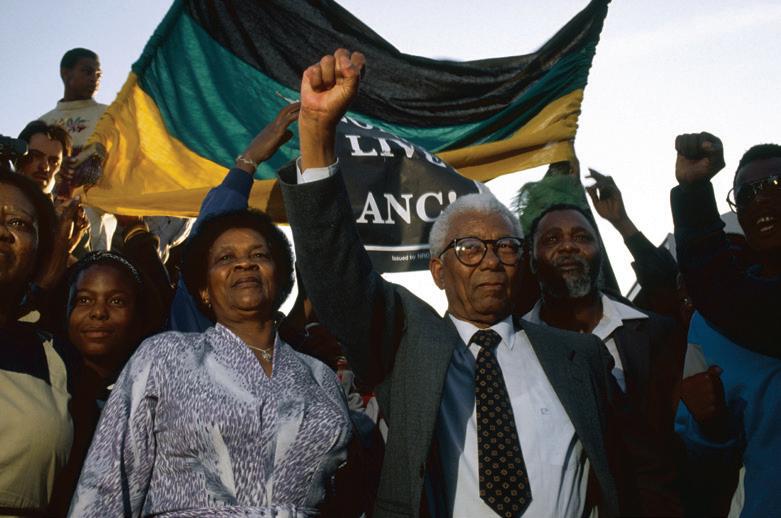
Source 9.5.10 Anti-apartheid activists Albertina and Walter Sisulu, 1989
In the late 1980s, the National Party government understood that Mandela had become a focal point for the anti-apartheid movement, and began negotiations with him. Initially, government leaders believed Mandela would be able to call off violent resistance if they offered him minor compromises. They moved him to a mainland prison, and later to a house on the prison grounds. However, while Mandela welcomed the possibility of reconciliation, he insisted that nothing short of replacing minority rule with majority rule would be acceptable.
The following account, provides a useful summary of the aims and achievements of the “Free Mandela” campaign up to that point.
ANALYSIS 9.3
Analysing a source
Source 9.5.11 British anti-apartheid activism and the global campaign to free Nelson Mandela
Particularly during the 1960s and 1970s, many British politicians tolerated South Africa because it was an important anti-communist ally in the cold war. There were also substantial trade links between the two countries that would have hurt British business if they were unwound.
Yet the AAM kept apartheid on the British political agenda throughout the cold war years and during major UK crises such as the miners’ strike of 1984-85. The movement constantly innovated and adapted campaign methods to raise public awareness.
Thousands of activists from Plymouth to Inverness devoted enormous time and energy to building a mass social movement. Besides lobbying politicians, they held public rallies and vigils, petitioned to have political prisoners released, disrupted sporting events, and pushed boycotts of everything from rock concerts in South Africa to oranges in supermarkets.
Activists regularly picketed stores selling South African products and distributed leaflets and stickers to passing shoppers encouraging them to “look at the label”. By 1986, an estimated 15 million in Britain were boycotting South Africans goods.
Even so, Margaret Thatcher was reluctant to impose economic sanctions on South Africa. She was heavily criticised by many Commonwealth leaders and of course the AAM, which began targeting major corporations like Barclays Bank and Shell to withdraw from South Africa.
Activists picketed company headquarters and disrupted shareholder meetings. They also campaigned for students not to bank with Barclays. In 1986, the bank duly withdrew from South Africa, citing global opinion as a key reason.
Yet the most well-known AAM campaign of all was Free Nelson Mandela. It began in the late 1970s, when the ANC and AAM decided to promote Mandela’s reputation, presenting him as the symbol of the anti-apartheid struggle.
Matthew Graham and Christopher Fevre. 2020. “Boycotts, rallies and ‘Free Mandela’: UK anti-apartheid movement created a blueprint for activists today.” The Conversation, 4 April.
1. Identify the organisation being discussed, and its function.
2. Describe the methods of the organisation.
3. Explain the barriers to the anti-apartheid movement, according to the source.
4. Analyse the value and limitations of the source in helping us understand the end of apartheid.
UNCORRECTED SAMPLEPAGES
Historical concepts: Significance, Causation Historical skills: Analysis and use of sources
In the late 1980s, the National Party began to indicate that it would be open to negotiating with the ANC about reforming apartheid. However, the system remained in place. Five million “white” South Africans continued to dominate the political system, while 25 million “native” South Africans were disenfranchised. Since 1984, there had been separate chambers of parliament for “white”, “coloured” (mixed heritage) and “Indian” delegates. There was no chamber for “native” (Black) delegates. In the 1989 election, 2.1 million white voters participated, re-electing the National Party to government, with 48 per cent of the vote and 94 of the 178 seats in the white House of Assembly. There were separate elections for 85 seats in the “coloured” House and 45 seats in the “Indian” House. In protest against apartheid, around 80 per cent of eligible voters from the “coloured” and “Indian” communities boycotted the election.
RESEARCH 9.1
Researching Mandela’s prison experience
Access the PBS website (https://cambridge.edu.au/redirect/11766) and complete the following activities.
1. Explore the Letters to Winnie and explain what they reveal about the emotional and political challenges Mandela faced during imprisonment.
2. Explore the Ahmed Kathrada interview excerpt and describe how, according to Kathrada, Mandela emerged as a natural leader among fellow inmates such as Walter Sisulu and Govan Mbeki.
3. Explore the “Robben Island – The Dark Years” excerpt and summarise what it reveals about daily life for Mandela on Robben Island.
4. Explore the Fikile Bam interview excerpt and explain how Mandela prepared himself for future leadership while imprisoned.
Historical concepts: Significance, Continuity and change, Perspectives Historical skills: Historical interpretation, Explanation and communication
UNCORRECTED SAMPLEPAGES
1. How did the South African government attempt to diminish Nelson Mandela’s political influence during his imprisonment on Robben Island?
2. Explain the importance of international media attention in strengthening the fight against apartheid.
3. Explain why Mandela’s role during the Rivonia Trial was so important in the broader struggle against apartheid.
4. What role has Robben Island played in the history and memory of the anti-apartheid movement in South Africa?
9.6 From prisoner to president
UNCORRECTED SAMPLEPAGES
DRIVING QUESTION
• What were some of the key challenges facing South African democracy during Nelson Mandela’s presidency?
Mandela’s release from prison
In September 1989, F.W. de Klerk replaced P.W. Botha as the leader of the National Party and President of South Africa. In what historians regard as a sudden conversion, the new leader, who had been known as a conservative, decided that the only realistic future for South Africa would be a negotiated end to apartheid. In February 1990, he overturned the ban on antiapartheid movements. So, after decades of increasing international pressure, combined with internal negotiations led by F. W. de Klerk, Nelson Mandela was released from prison on 11 February 1990 after serving 27 years. On the day of his release, millions of supporters watched as Mandela walked free from Victor Verster Prison and delivered an address at Cape Town City Hall.
ANALYSIS 9.4
Analysing a primary source
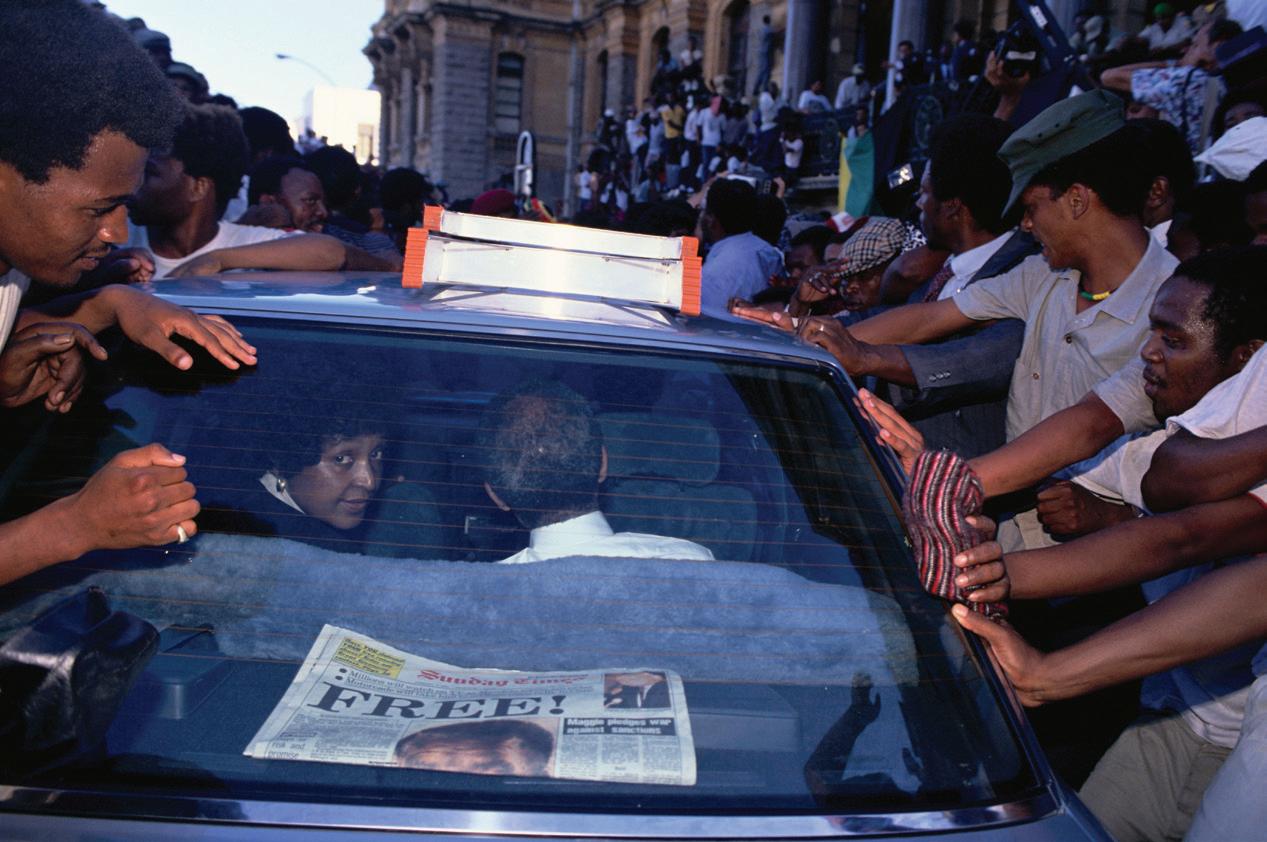
Amandla! Amandla! i-Afrika, mayibuye! (Power! Power! Africa it is ours!)
Friends, comrades, and fellow South Africans, I greet you all in the name of peace, democracy, and freedom for all. I stand here before you not as a prophet but as a humble servant of you, the people.
Your tireless and heroic sacrifices have made it possible for me to be here today. I, therefore, place the remaining years of my life in your hands.
On this day of my release I extend my sincere and warmest gratitude to the millions of my compatriots and those in every corner of the globe who have campaigned tirelessly for my release. ...
[Mandela acknowledges supporters, including the people of Cape Town, the Communist Party, the Mass Democratic Movement, white students, the working class, religious communities, traditional leaders, youth, women, the world community and his wife and family] ...
Source 9.6.1 Nelson and Winnie Mandela ride through crowds at the Grand Parade in Cape Town shortly after his release from prison, before his first public address, February 1990
Source 9.6.2 Nelson Mandela’s first public speech following his release from prison, Cape Town, 11 February 1990
Today, the majority of South Africans, black and white, recognise that apartheid has no future. It has to be ended by our own decisive mass action in order to build peace and security. The mass campaigns of defiance, and other actions of our organisations and people, can only culminate in the establishment of democracy. The apartheid destruction on our subcontinent is incalculable. The fabric of family life of millions of my people has been shattered. Millions are homeless and unemployed. Our economy, our economy lies in ruins and our people are embroiled in political strife.
Our resort to the armed struggle in 1960, with the formation of the military wing of the ANC, Umkhonto we Sizwe, was a purely defensive action against the violence of apartheid.
The factors which necessitated the armed struggle still exist today. We have no option but to continue. We express the hope that a climate conducive to a negotiated settlement would be created soon so that there may no longer be the need for the armed struggle. ...
Mr de Klerk has gone further than any other Nationalist President in taking real steps to normalise the situation.
However, there are further steps as outlined in the Harare Declaration that have to be met before negotiations on the basic demands of our people can begin. ...
It is our belief that the future of our country can only be determined by a body which is democratically elected on a non-racial basis.
Negotiations on the dismantling of apartheid will have to address the overwhelming demands of our people for a democratic, non-racial, and unitary South Africa.
There must be an end to white monopoly on political power, and a fundamental restructuring of our political and economic systems to ensure that the inequalities of apartheid are addressed and our society thoroughly democratised.
It must be added that Mr de Klerk himself is a man of integrity, who is acutely aware of the dangers of a public figure not honouring his undertakings.
But as an organisation we based our policy and strategy on the harsh reality we are faced with. And this reality is that we are still suffering under the policies of the Nationalist government. Our struggle has reached a decisive moment. We call on our people to seize this moment so that the process towards democracy is rapid and uninterrupted.
We have waited too long for our freedom. We can no longer wait. Now is the time to intensify the struggle on all fronts. To relax our efforts now would be a mistake which generations to come will not be able to forgive.
The sight of freedom looming on the horizon should encourage us to redouble our efforts. It is only through disciplined mass action that our victory can be assured. ...
In conclusion, I wish to quote my own words during my trial in 1964. They are as true today as they were then. I quote
“I have fought against white domination and I have fought against black domination. I have cherished the ideal of a democratic and free society in which all persons live together in harmony and with equal opportunities. It is an ideal which I hope to live for and to achieve. But, if needs be, it is an ideal for which I am prepared to die.”
My friends, I have no words of eloquence to offer today except to say that the remaining days of my life are in your hands. I hope you will disperse with discipline. And not a single one of you should do anything which will make other people to say that we can't control our own people.
Nelson Mandela. 1990. First Speech after Release from 27 Years in Prison: South Africa’s New Era. Google Arts & Culture, 11 February.
UNCORRECTED SAMPLEPAGES
1. Describe the overall tone of Mandela’s speech.
2. Explain why Mandela described himself as a “servant” rather than a “prophet”.
3. Identify the ways Mandela suggested South Africa could be improved.
4. Explain why Mandela was complimentary towards F.W. de Klerk. What does this suggest about Mandela’s leadership style?
Historical concepts: Significance Historical skills: Analysis and use of sources
South Africa’s transition to democracy
As a free man, Mandela balanced his commitment to the ANC with the need to negotiate with the National Party government to design a transition to democracy. The period was marked by significant violence. Mandela’s former comrades from MK were allowed to return to South Africa, but many were then targeted by special forces, and some were murdered.
The period from 1990 to 1994 is referred to as the “Reform” era. It involved not only dismantling laws of racial segregation and discrimination, but also protracted and, at times, bitter negotiations over a post-apartheid constitution. De Klerk and his National Party opposed Mandela and the ANC on numerous issues. There was also an increase in inter-community violence as the future remained uncertain. Although animosity developed between Mandela and de Klerk, who continued to argue for power sharing between white and Black citizens rather than majority rule through democratic elections, the two men shared the 1993 Nobel Peace Prize. By late 1993, an interim constitution based on majority rule had been agreed upon, and elections were scheduled for the following year.
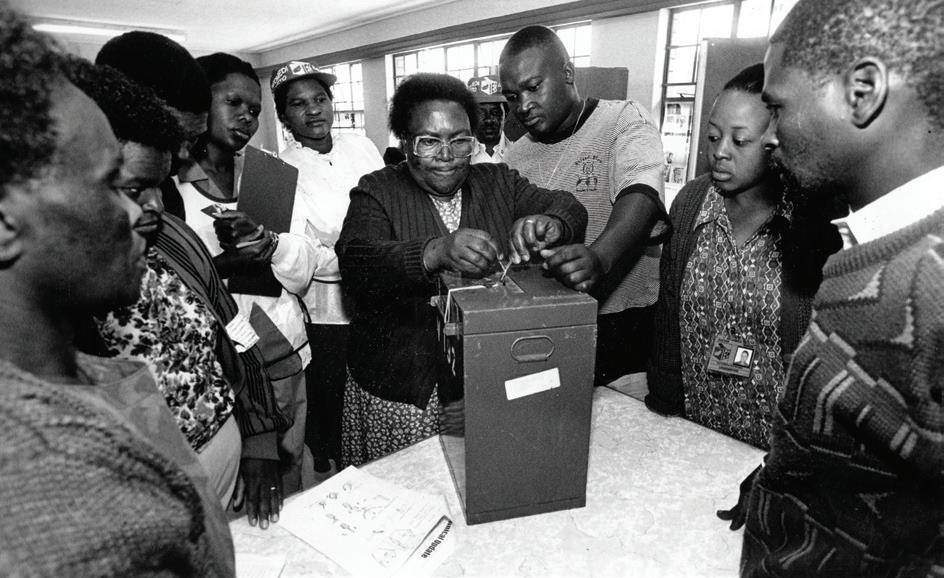
UNCORRECTED SAMPLEPAGES
South Africans of all races turned out to vote in their first non-racial election on 27 April 1994. People lined up in long queues that stretched for miles to cast their historic ballots.
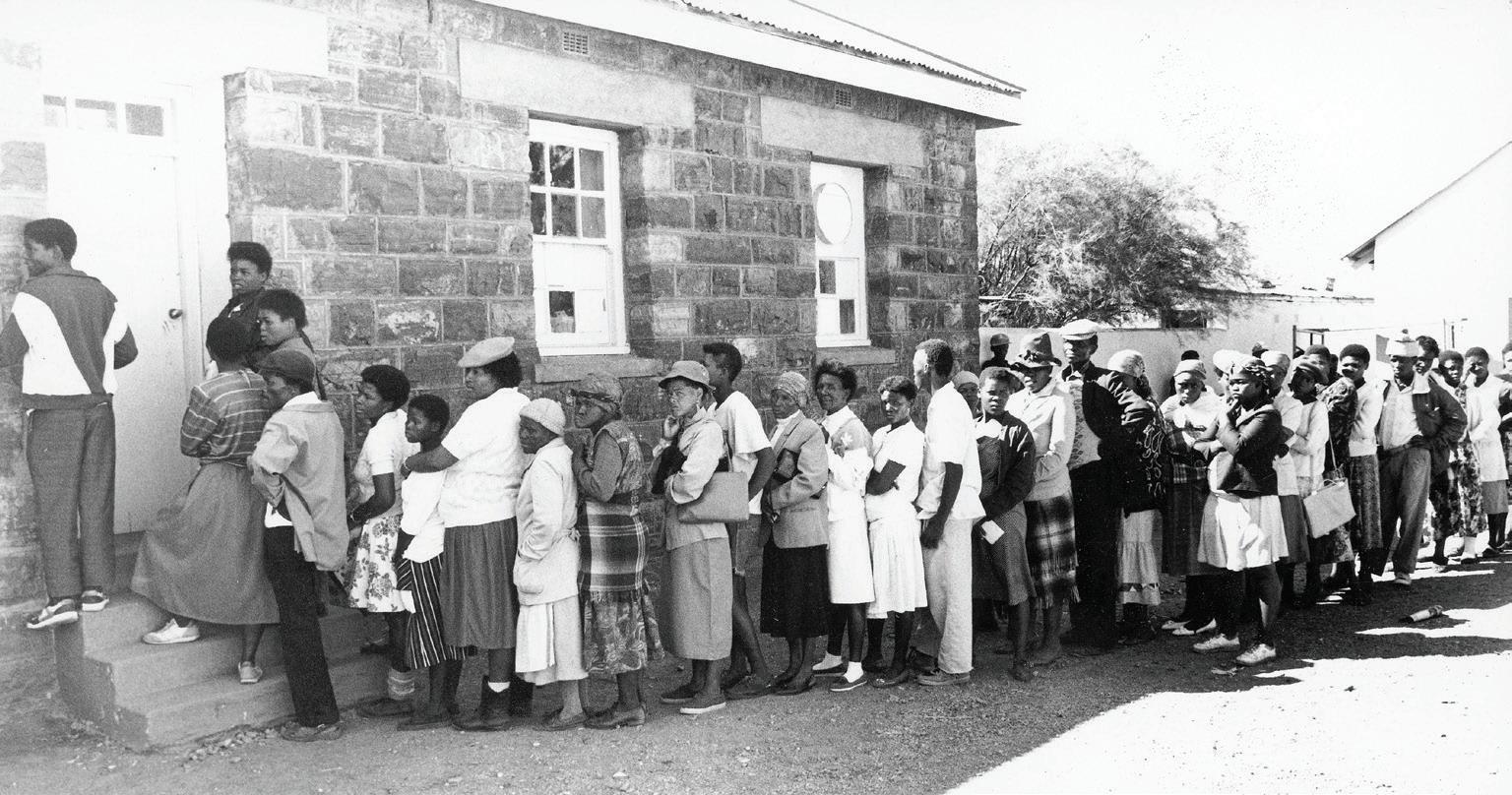
Writing focus 9.6
Noun phrases (drafting)
Source 9.6.3 A woman seals a ballot box during South Africa’s first non-racial democratic election, Johannesburg, 27 April 1994
Source 9.6.4 Voters wait in a long queue to cast their ballots.
Government of National Unity (GNU) a multi-party government formed in South Africa after the 1994 election under Nelson Mandela, bringing together former rival parties, including the ANC and National Party, to support a peaceful transition from apartheid to democracy
With Black South Africans free to participate, there were eight times as many voters as in the previous apartheid-era election. The ANC was the clear winner, with over 62% of the vote and 252 of the 400 seats in the National Assembly, as well as 60 out of 90 seats in the Senate. The National Party was the next largest group, with 82 seats in the Assembly. After spending almost three decades in prison, Nelson Mandela became President of South Africa. As part of a negotiated transition, F. W. de Klerk (National Party) and Thabo Mbeki (ANC) became deputy presidents in the new Government of National Unity (GNU), a coalition government formed to stabilise the country and guide South Africa’s transition from apartheid.
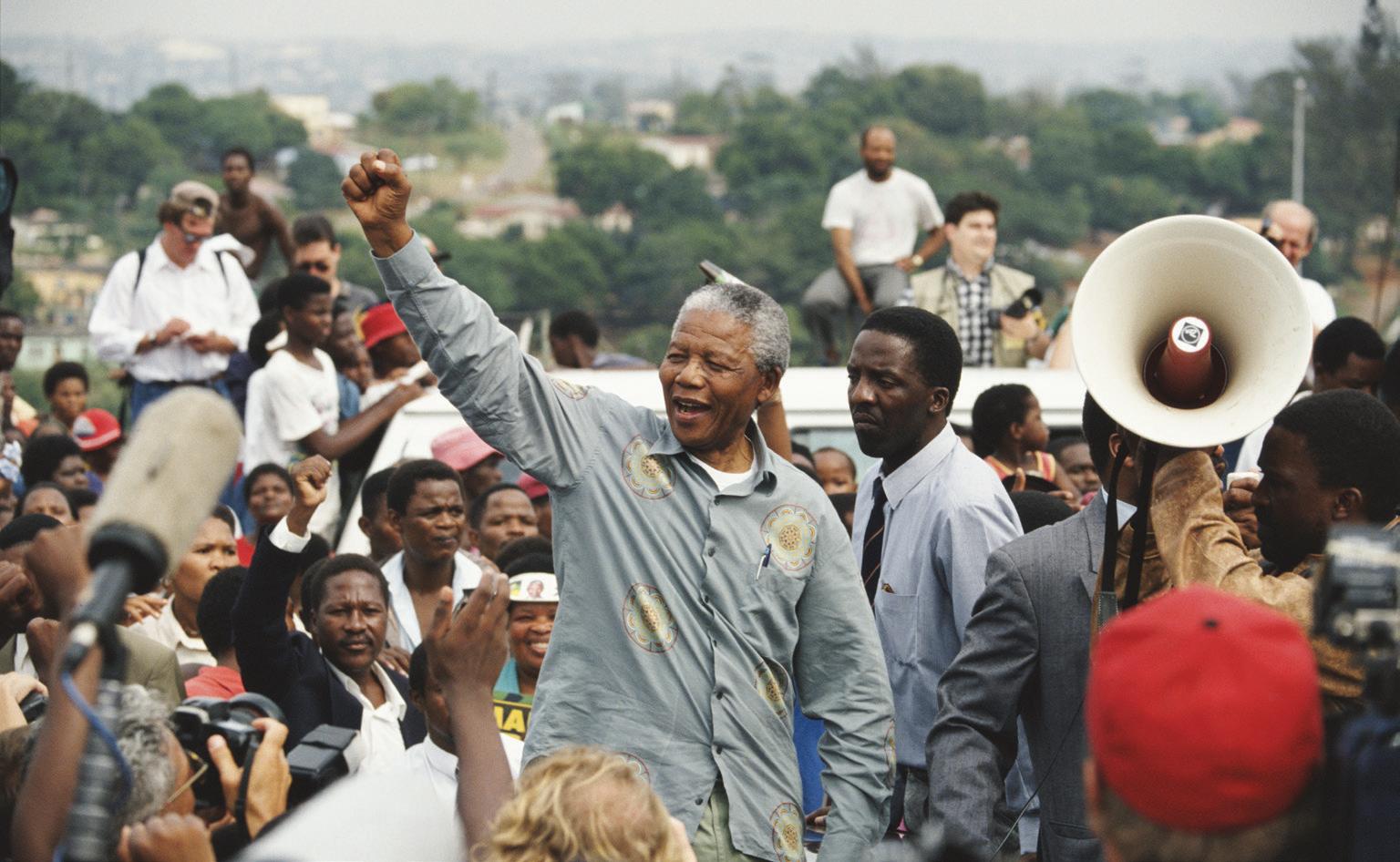
Mandela was inaugurated as President on 10 May 1994 on the vast lawn of the Union Buildings in Pretoria. In his inaugural address, he spoke of freedom and the end of oppression.
Source 9.6.6 Nelson Mandela addresses the nation at his inauguration as President of South Africa
Never, never and never again shall it be that this beautiful land will again experience the oppression of one by another … The sun will never set on so glorious a human achievement.
Let freedom reign. God bless Africa.
Nelson Mandela. 1994. Inauguration speech.
UNCORRECTED SAMPLEPAGES
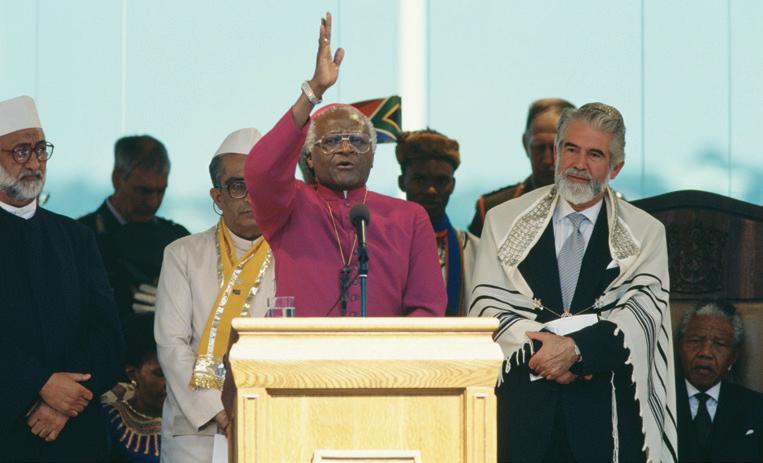
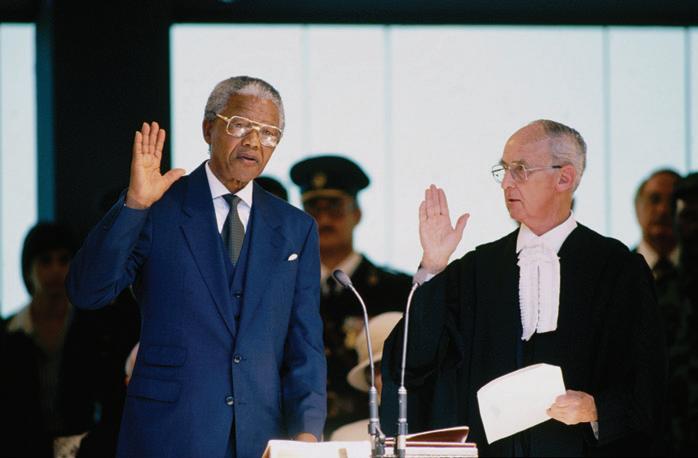
Source 9.6.5 Mandela on the election trail, 1994
Source 9.6.8 Nelson Mandela being sworn in as President of South Africa
Source 9.6.7 Archbishop Desmond Tutu speaks during Nelson Mandela’s presidential inauguration.
South Africa during Mandela’s presidency
Economic and social challenges
UNCORRECTED SAMPLEPAGES
South Africa faced enormous challenges during Mandela’s presidency. The economy (measured as Gross Domestic Product) had shrunk during the final three years of apartheid, and when Mandela became leader, 17 million people lived below the poverty line, around two-thirds of homes had no electricity and there was a shortage of decent housing. During the first decade of ANC government, unemployment remained high, at over 22% Large numbers of white South Africans, including 58,000 in 1999 alone, uncertain about their future, emigrated to countries such as Australia and England, taking their capital and skills with them.
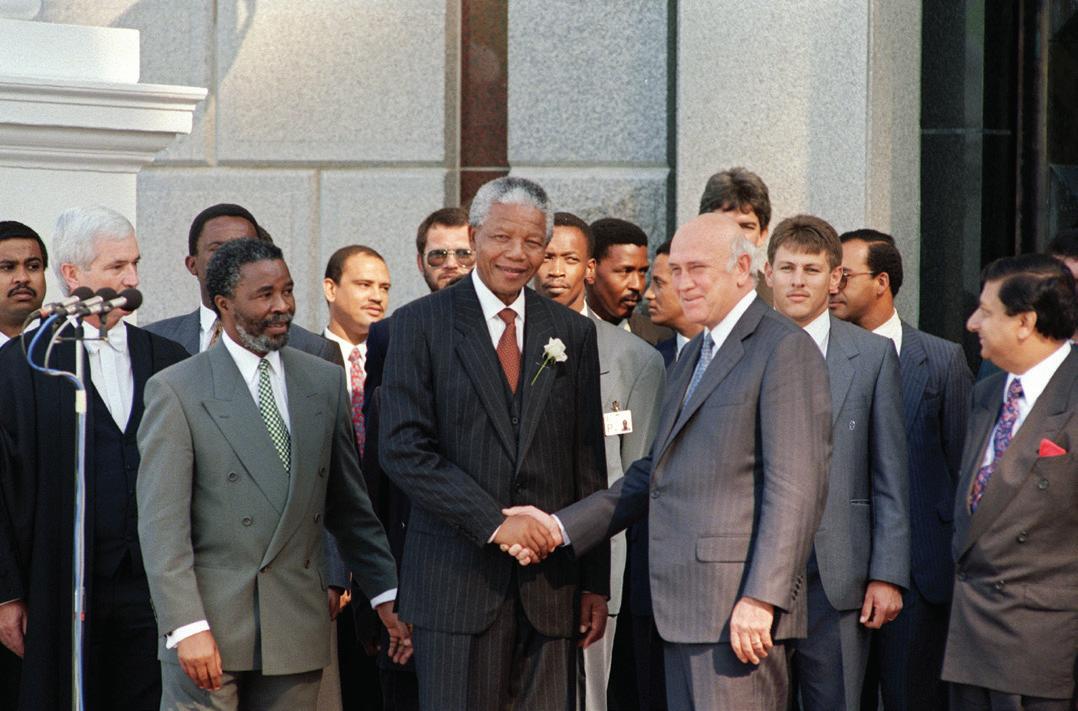
Mandela acknowledged that centuries of racial and economic oppression could not be overcome quickly. The ANC introduced the Reconstruction and Development Programme (RDP), which aimed to build millions of new homes and expand access to education and basic services. A budget of 2.5 billion Rand per year (around A$ 700 million at the time, or A$ 1.6 billion today) was allocated to the RDP. Mandela also hoped that Western countries would reinvest in South Africa and support economic recovery, but this occurred to a more limited extent than expected.
Crime, corruption and public discontent
Despite political change, crime levels increased, and media reports of carjackings, rapes and murders became widespread. Economic difficulties proved hard to resolve, and corruption emerged as a political and economic reality as South Africa struggled to overcome the legacy of apartheid. Public frustration grew across communities. Many Black South Africans were disappointed by the slow pace of social and economic change, while many white South Africans blamed unemployment, crime and corruption on the end of apartheid. Johannesburg gained a reputation as one of the most dangerous cities in the world.
Public health and national morale
Another major challenge for the GNU was the HIV/AIDS epidemic. Human immunodeficiency virus (HIV) attacks and destroys key cells in the immune system, which can lead to Acquired Immune Deficiency Syndrome (AIDS). South Africa had one of the world’s highest infection rates. By 1998, the Department of Health estimated that 3.6 million South Africans, around ten per cent of the population, were infected, and the number continued to rise. The government struggled to control the epidemic.
One significant moment of hope came in 1995, when South Africa successfully hosted the Rugby Union World Cup. Mandela’s visible support for the Springboks, including presenting the trophy to captain Francois Pienaar, symbolised reconciliation and helped foster a shared sense of national identity.
Source 9.6.9 Nelson Mandela shakes hands with F.W. de Klerk and Thabo Mbeki at his inauguration.
SIGNIFICANT EVENT
The 1995 Rugby World Cup
In 1995, South Africa hosted the Rugby Union World Cup, the first major international sporting event held in the country since the end of apartheid. Rugby and the Springboks had long been associated with white South Africans and were widely disliked by many Black South Africans. On the eve of the final, President Nelson Mandela visited the team and told the players they would “help bind our country into a single unit”. When South Africa won the final, Mandela appeared wearing a Springbok jersey and presented the trophy to captain Francois Pienaar. This highly symbolic gesture was broadcast worldwide and became a powerful image of reconciliation, marking an important step towards unity between Black and white South Africans.
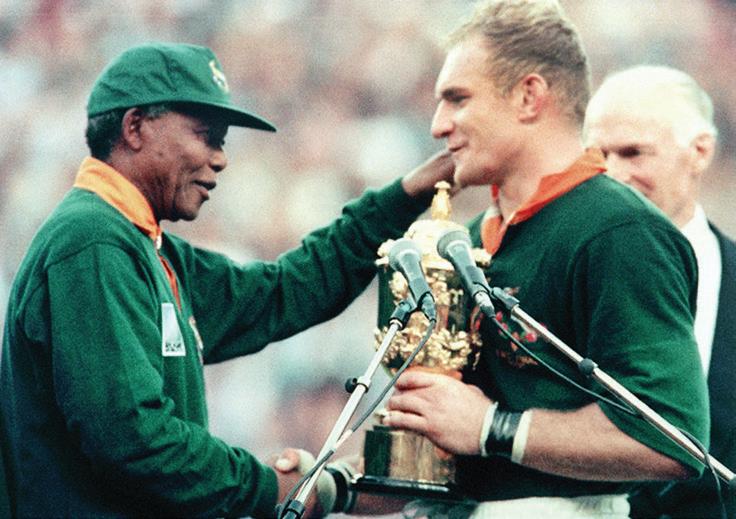
UNCORRECTED SAMPLEPAGES
Commitment to reconciliation and democracy
As South Africa’s first Black President and a former political prisoner, Nelson Mandela faced enormous challenges. His central focus was reconciliation and national unity, particularly bridging divisions between South Africa’s diverse political and ethnic groups and the powerful white minority. Through an inclusive and principled leadership style, Mandela helped guide the country through a fragile transition from apartheid. Mandela’s presidency was marked by significant political achievements, most notably the negotiation of a new democratic constitution and the early restructuring of the civil service. Despite serious economic difficulties and the ongoing threat of political violence, including conflict between the African National Congress (ANC) and the Zulu-dominated Inkatha Freedom Party, Mandela maintained political stability and kept South Africa on a democratic path. Although major problems such as crime, unemployment and HIV/ AIDS were not resolved during his presidency, Mandela’s commitment to reconciliation reduced divisions within society and laid the foundations for a more stable and democratic future. By prioritising unity, negotiation and moral leadership, he helped ensure that South Africa emerged from apartheid without descending into widespread civil conflict. In 1999, Nelson Mandela retired as President of South Africa and was succeeded by Deputy President Thabo Mbeki.
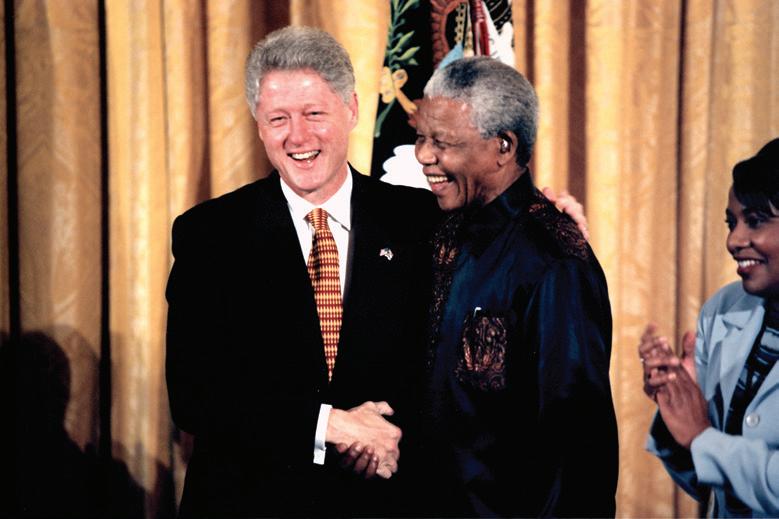
Source 9.6.11
President Bill Clinton meets South African President Nelson Mandela during an official visit, 1998; Mandela remained on the United States’ “terrorist watch list” until 2008.
Source 9.6.10 Nelson Mandela presents the Rugby World Cup trophy to Springbok captain Francois Pienaar after South Africa’s victory, 1995
US
Forgiving without forgetting
To help heal the wounds of apartheid, Mandela supported the establishment of the Truth and Reconciliation Commission (TRC). Its guiding principle was “forgiving without forgetting”. Chaired by Desmond Tutu, the TRC investigated human rights violations committed during the apartheid era.
Victims were able to give testimony, and perpetrators could apply for amnesty if they made full disclosure of politically motivated crimes. The hearings were often emotional and traumatic, revealing the extent of state repression.
UNCORRECTED SAMPLEPAGES
One high-profile case examined by the TRC concerned the death of Steve Biko. Amnesty was denied to members of the security forces involved. The TRC also heard evidence about Eugene de Kock, a former South African Police colonel who commanded C10, a secret police counter-insurgency unit based at Vlakplaas near Pretoria. C10 targeted political opponents through surveillance, abduction, torture and murder. De Kock was later convicted by a criminal court in 1996 on multiple counts of murder and torture and sentenced to a lengthy prison term.
In 1998, the TRC published its final report, which verified at least 7000 political killings during the apartheid era, mostly committed by white groups and security forces. It condemned atrocities committed by all sections of society, including kidnappings and several murders carried out by the Black vigilante group Mandela United Football Club, led by Nelson Mandela’s former wife, Winnie. The commission’s extraordinary ambition was to heal the nation’s past by acknowledging its truths. South Africa’s willingness to confront this history won it widespread international respect. In response to the findings, Mandela called on South Africans to “celebrate and strengthen what we have done as a nation as we leave our terrible past behind us forever”.
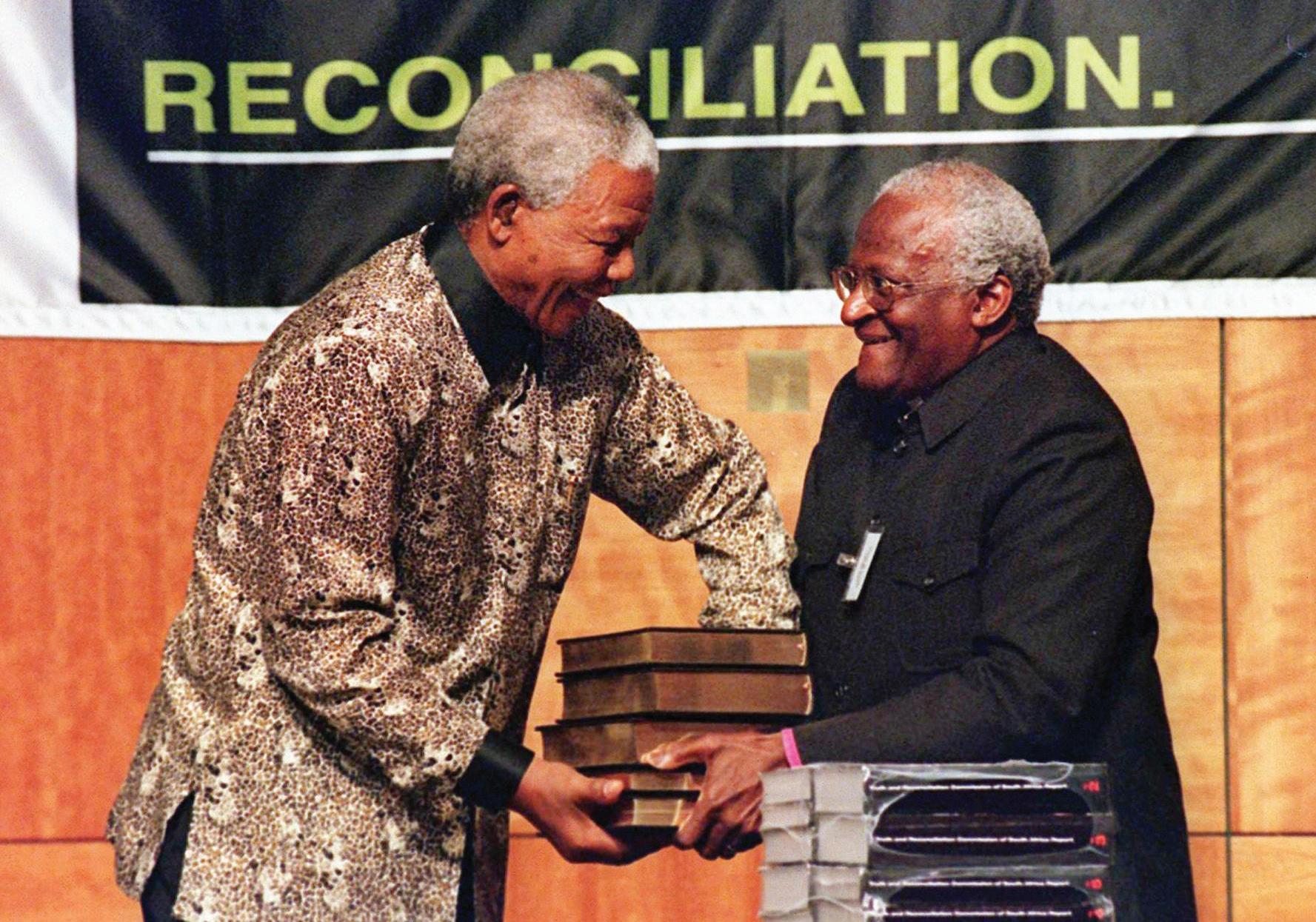
Source 9.6.12 Former South African police officer Eugene de Kock, sentenced to 289 years’ imprisonment for apartheid-era crimes, 1996
Source 9.6.13 Nelson Mandela receives the five volumes of the Truth and Reconciliation Commission’s final report from Archbishop Desmond Tutu, Pretoria, 29 October 1998
Go online to assign and download questions, view results and more!
RESEARCH 9.2
Investigating the Truth and Reconciliation Commission
1. Access the full TRC findings through the South African public broadcaster SABC’s website.
2. Choose three events and organise your findings by completing the table below.
Name of event Date of event Who was involved Witness testimony quotation Verdict of the TRC Significance of the event in your view
3. Reflecting on your findings, to what extent do you think the TRC was a positive process for South Africa?
4. Discuss how other countries, including Australia, have dealt with past injustices. Can you identify any processes comparable to the scope of South Africa’s TRC?
Historical concepts: Contestability, Continuity and change Historical skills: Historical interpretation
RESEARCH 9.3
Researching leadership and legacy
1. Research the promises Nelson Mandela made to voters during the 1994 election campaign. What campaign slogans did the ANC use?
2. Research contemporary South Africa. To what extent has life improved since the end of apartheid? Include statistics comparing Black and white South Africans in areas such as income, education and life expectancy, and summarise your findings in a short report.
3. Research the life of Winnie Mandela:
a. Outline her role in the fight against apartheid.
b. Explain why she remains a controversial figure in South African history.
Historical concepts: Significance, Continuity and change Historical skills: Historical interpretation, Explanation and communication
REVIEW 9.6
Online quiz Review questions
UNCORRECTED SAMPLEPAGES
Access sample responses and results
1. Describe Mandela’s rise from political prisoner to President of South Africa.
2. Identify key events in Mandela’s life and explain which were most significant in his rise to power.
3. Outline the major economic and social challenges facing South Africa during Mandela’s presidency.
4. Explain the steps taken by Mandela to promote reconciliation in South Africa.
9.7 Mandela’s historical significance as a global leader
DRIVING QUESTION
• How should Nelson Mandela’s leadership and legacy be understood by historians?
Competing interpretations of Mandela’s leadership
Nelson Mandela is a modern giant of both South African and international history. He is widely regarded as the most significant African freedom fighter among many, including Walter Sisulu, Oliver Tambo and Robert Sobukwe. Mandela dedicated his life, and sacrificed his freedom, to ending apartheid. His struggle for liberation is often compared with that of Martin Luther King Jr, who fought racial segregation in the United States. Like King, most accounts of his life are intended to praise his leadership as a model for others to follow, rather than to examine potential flaws in his character.
Mandela may have been lost to history on Robben Island – the outcome the apartheid government desired – had it not been for the international anti-apartheid movement. Instead, he became the central symbol of the liberation struggle, transformed from an imprisoned “terrorist” into the world’s most famous political prisoner. Over time, Mandela acquired an almost messianic status for his role in transforming South Africa from centuries of white domination into what became known as the “miracle” rainbow nation.
Since the first democratic election in 1994, Mandela’s legacy has been the subject of ongoing historical debate. In December 1994, he published an autobiography, Long Walk to Freedom, which became an international bestseller, selling over 6 million copies. It became the dominant account of his life, presenting a heroic journey into anti-apartheid activism and highlighting his refusal to give in to hatred during his long imprisonment. Other biographies are often written in dialogue with Mandela’s own account.
UNCORRECTED SAMPLEPAGES
messianic describing a leader who is seen as a saviour-like figure, believed to bring hope, deliver change or rescue a people or nation from crisis rainbow nation a term used to describe postapartheid South Africa as a multiracial, multicultural society seeking unity, reconciliation and equality after decades of racial division
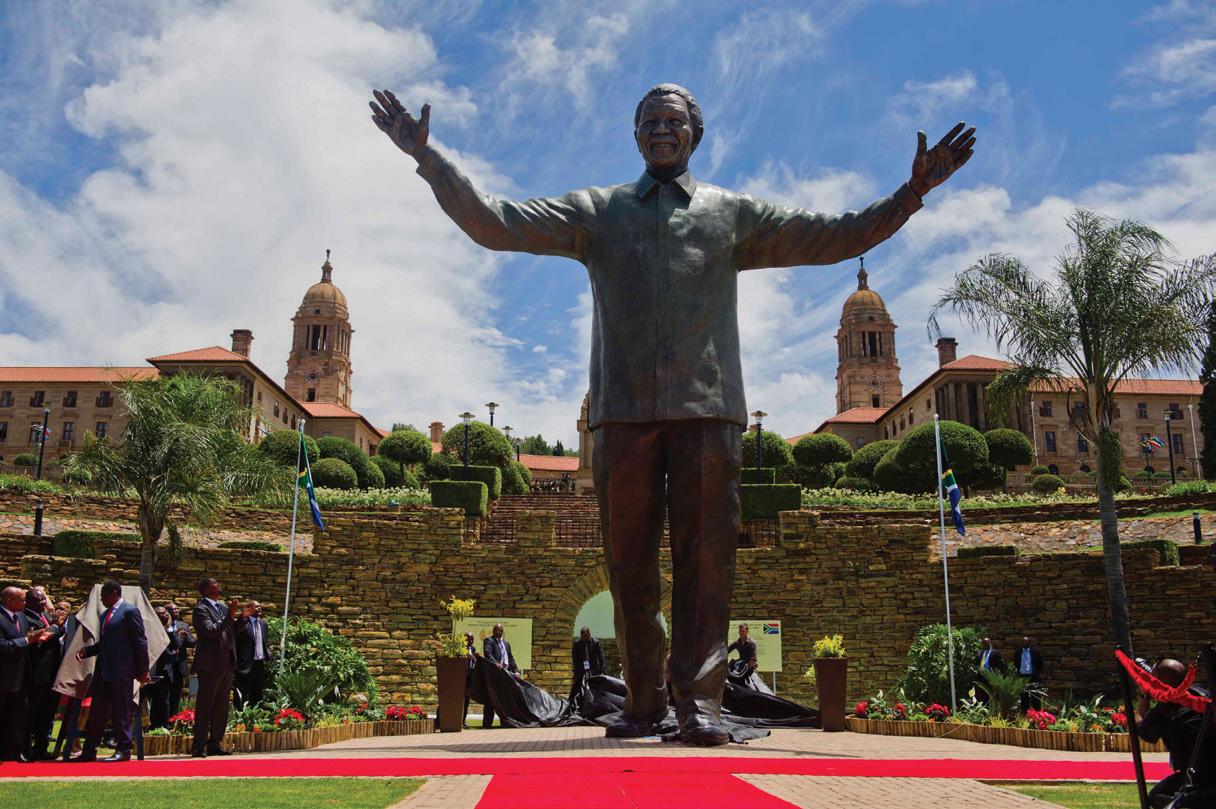
A common trend in the hundreds of biographies that have been published is to explore the relationship between Mandela and the broader movement. Some historians argue that Mandela was carefully stage-managed by the African National Congress (ANC) for political advantage. Others contend that he exercised considerable political skill while imprisoned, influencing the direction of the ANC and shaping political developments both within South Africa and internationally.
Source 9.7.1 A statue of Nelson Mandela in Pretoria, South Africa
Writing focus 9.7
Transitional phrases
Historical interpretations of Mandela’s leadership
Mandela’s political life was complex and continues to invite historical interpretation. His first authorised biography, Higher than Hope by fellow activist Fatima Meer, was published while he was still in prison. Later biographies extended the narrative to cover his career in politics, typically retaining the theme of hope, although his authorised biography of 1999 by British journalist Anthony Sampson also accused F.W. de Klerk of secretly supporting the Inkatha Freedom Party (IPF) violence against the ANC. Unauthorised biographers, including Martin Meredith (1997), were more willing to acknowledge that Mandela was at times short-tempered and autocratic, but they continued to marvel at his achievements. Historians will continue to debate his contribution for many years. Biographer Peter Limb argues that Mandela “helped transform a bitterly divided land and led South Africa to freedom and democracy”, becoming “a worldwide symbol of the endurance of the human spirit”.
UNCORRECTED SAMPLEPAGES
Mandela’s leadership evolved significantly over time – from organising armed resistance through MK, to leading the ANC, and ultimately from prisoner to president. As president, he emerged as a unifying national and global figure who avoided civil war and helped guide South Africa towards multiracial democracy.
Historian Raymond Suttner characterises Mandela as a man who adopted different roles in different contexts, ranging from revolutionary to conservative/nationalist.
To understand Mandela, and especially Mandela as a political figure, it is essential to locate him as a changing political and human being in a dynamic and diverse political environment.
Raymond Suttner. 2007. “(Mis)Understanding Nelson Mandela.” African Historical Review 39 (2)
Mandela as a revolutionary Mandela can clearly be described as a revolutionary. His leadership of MK, the armed wing of the ANC, and its campaign of sabotage against the apartheid state were revolutionary actions. Mandela openly acknowledged that peaceful resistance alone would not succeed in South Africa, unlike in India, and that violence should be a course of action in the future. Operation Mayibuye, which ultimately contributed to his imprisonment, was a revolutionary plan aimed at overturning the existing political order in South Africa. Jacob Dlamini’s 2024 book Dying for Freedom analyses how Mandela and his comrades saw a willingness to risk death in their revolutionary cause as a test of their manhood.
Source 9.7.2 The South African flag adopted in 1994, symbolising unity after apartheid
Source 9.7.3 Historian and ANC activist Raymond Suttner reflects on how Mandela’s political identity changed over time.
However, these actions must be understood within a global context of liberation struggles, alongside figures such as Martin Luther King Jr, Malcolm X and radical movements in the United States. Mandela argued that “the attacks of the wild beast [the apartheid state] cannot be fought off with only bare hands”.
Mandela and communism Suttner also examines Mandela’s relationship with communism and the influence of Marxist ideas on his thinking. He notes Mandela’s reading of Marxism, the course on Marxism he taught while on Robben Island, his attendance at Communist Party meetings and the presence of images of Lenin and Stalin in his cell. However, Suttner emphasises that engagement with communist ideas does not necessarily indicate lifelong adherence to communist ideology.
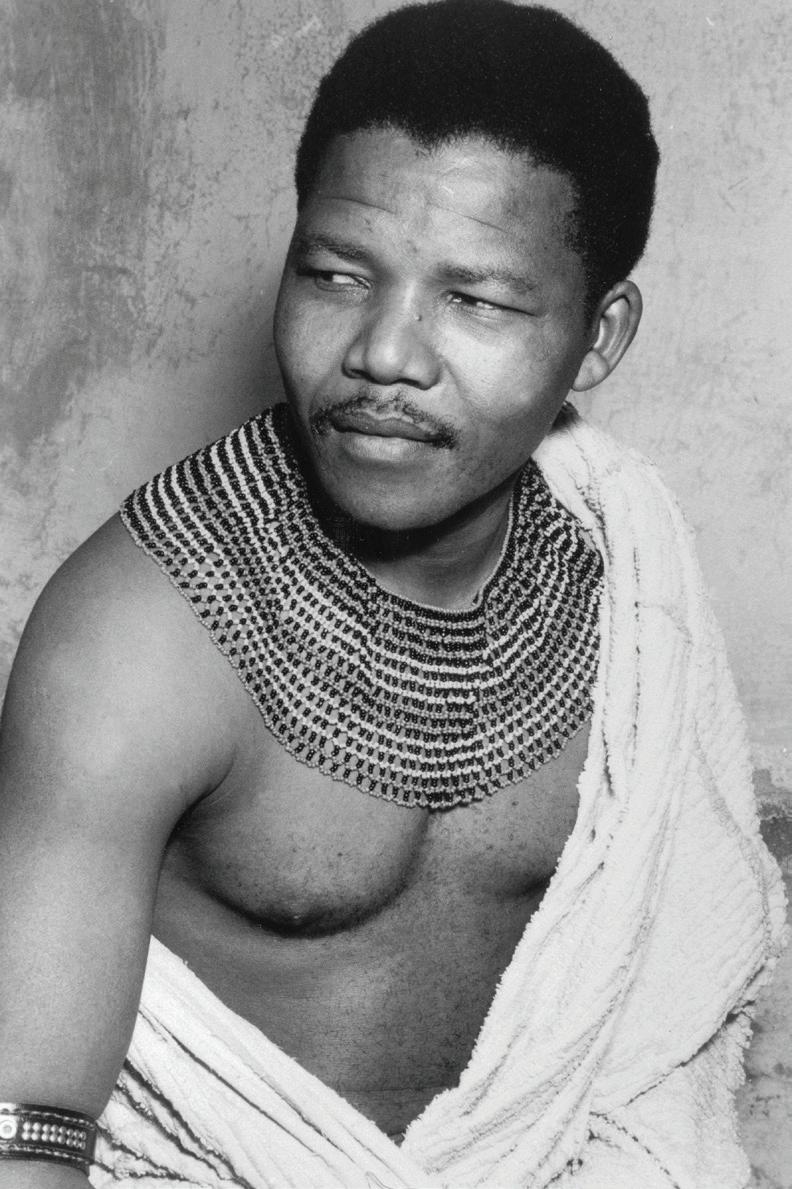
Mandela denied being a communist during the Rivonia Trial. Under the Suppression of Communism Act, the apartheid government used the label “communist” to ban organisations such as the South African Communist Party (SACP), as well as the ANC and the Pan Africanist Congress (PAC). White SACP members such as Joe Slovo and Ruth First were among the first white South Africans to support the struggle for a non-racial democracy. As a member of an oppressed racial group, Mandela was drawn to these individuals and ideas. His statements during the Rivonia Trial must also be understood in the context of a trial in which the state was seeking the death penalty.
Marxism the social, political and economic theory based on the nineteenth-century writings of Karl Marx and Friedrich Engels, arguing that the means of production should be owned and controlled collectively
Pan Africanist Congress (PAC) a South African political organisation formed in 1959 after splitting from the ANC, which promoted African nationalism and rejected multiracialism, arguing that political power in South Africa should belong exclusively to Black South Africans
UNCORRECTED SAMPLEPAGES
I am not a communist and have never been a member of the Communist Party … The most important political document ever adopted by the ANC is the Freedom Charter. It is by no means the blueprint for a socialist state. The ANC has never … advocated a revolutionary change in the economic structure of the country, nor … ever condemned capitalist society …
It is true that there has often been close cooperation between the ANC and the Communist Party. But cooperation is merely proof of a common goal … not of a complete community of interests.
Nelson Mandela. 1964. I Am Prepared to Die. Opening statement for the Rivonia Trial, Pretoria Supreme Court. United Nations website.
Source 9.7.4 Nelson Mandela in traditional attire while in hiding from police, South Africa, 1961
Source 9.7.5 Nelson Mandela denies being a communist in his statement from the dock at the Rivonia Trial, 1964
liberal conservative
a person who supports individual rights and limited social reform, but believes change should occur gradually and within existing political and social institutions to maintain stability
African nationalist a person who believes African peoples should govern themselves, preserve their culture, and unite to achieve independence from colonial or external control
diplomat an official representative of a country who works in another nation to manage international relations, usually through an embassy or formal negotiations
Mandela as a conservative or an African nationalist
Some historians and political commentators view Mandela’s actions in the struggle to end apartheid as those of a liberal conservative or African nationalist. These interpretations have merit and reflect the complexity of his political life. Mandela was raised a Methodist and educated by the Wesleyan Church, which influenced his admiration for British institutions and his preference for legal and constitutional change. Some historians, including Daniel Douek (2024), argue that, once in power, Mandela became too conservative. They argue that his failure to end inequality and remove elites compromised, or even “betrayed”, the principles of the revolutionary MK that he had once led. His preference for peaceful change was also evident in his conduct as an international statesman. For example, Mandela met with British Prime Minister Margaret Thatcher, who had called the ANC a “typical terrorist organisation”, as part of his pursuit of a peaceful and legal path to revolution.
Such actions were aimed at building international support for the liberation struggle and narrowing the support base of the apartheid regime. These were the tactics of an astute politician who adapted to changing political circumstances; they ultimately made him a unifying diplomat rather than a political conservative.
Mandela can most convincingly be evaluated as an African nationalist. He fought for the freedom of South Africa as a whole, not only for Black South Africans. This explains his consistent support for a multiracial democracy based on the Freedom Charter and his rejection of the PAC’s exclusive Black nationalism. His central objective was to end apartheid and begin healing the divisions created by the system for all South Africans.
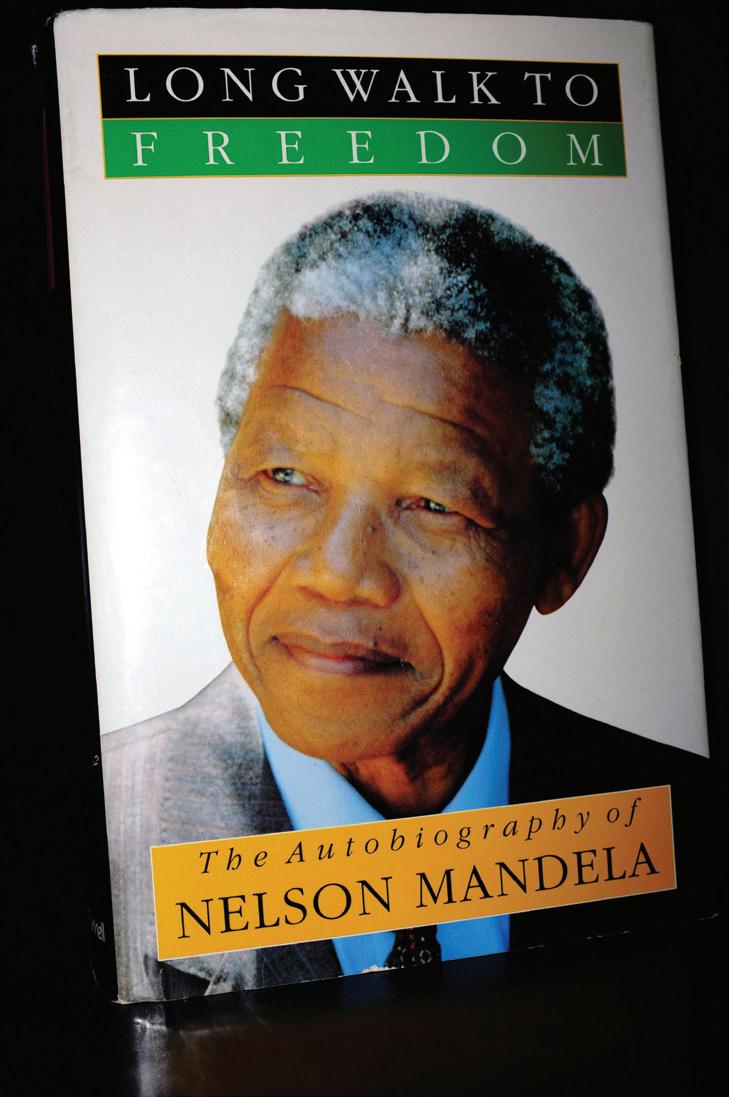
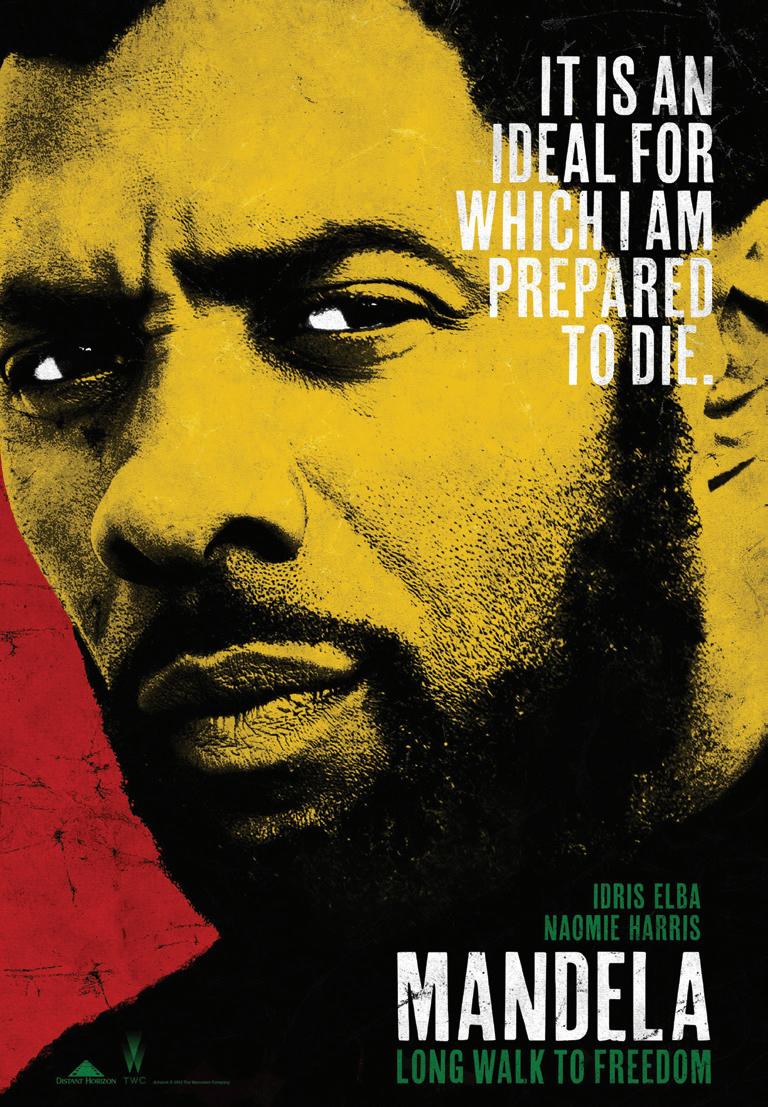
UNCORRECTED SAMPLEPAGES
Source 9.7.6 Nelson Mandela’s autobiography Long Walk to Freedom, published in 1994
Source 9.7.7 Poster for the 2013 film Mandela: Long Walk to Freedom, starring Idris Elba
ANALYSIS 9.5
Analysing a source
Source 9.7.8 Extract from historian Raymond Suttner regarding Mandela’s significance in defeating apartheid
... many people saw in him a saviour, and attributed saint-like characteristics to him. But the question which immediately arises is whether messianic imagery drove the struggle to defeat apartheid and indeed whether an individual leader was the central element of that struggle.
Raymond Suttner. 2007. “(Mis)Understanding Nelson Mandela.” African Historical Review 39 (2).
1. Explain Raymond Suttner’s interpretation of Nelson Mandela’s role in the struggle against apartheid.
2. Mandela’s Rivonia Trial speech and his autobiography, Long Walk to Freedom, are important historical sources. Explain their limitations for historians assessing Mandela’s leadership.
3. Identify evidence from the chapter that supports Suttner’s views of Mandela. Evaluate which description best represents Mandela’s leadership, giving reasons.
4. Explain different historians’ interpretations of Mandela’s leadership. Research at least two historians and use your findings to write an essay on the life of Nelson Mandela.
Historical concepts: Perspectives Historical skills: Historical interpretation, Explanation and communication
REVIEW 9.7
Online quiz
UNCORRECTED SAMPLEPAGES
Review questions
Access sample responses and results
1. Assess the strengths and weaknesses of Nelson Mandela’s leadership during the antiapartheid struggle and as President.
2. To what extent do historians present a balanced interpretation of Mandela’s life and actions?
3. Identify key characteristics of effective leadership. To what extent did Mandela demonstrate these qualities?
4. Select two key events in Mandela’s life and explain how each shaped his political views or leadership style.
Go online to assign and download questions, view results and more!
9.8 Chapter review
Revise and consolidate your learning with these online tools:
UNCORRECTED SAMPLEPAGES
• Download or answer questions online
• View suggested responses
• Writing focus worksheets.
Teachers can access these additional downloadable resources and Learning Management System features:
• Individual student reports
• Assign tasks and track results
• Exam Generator: create custom practice exams
• Writing focus workbook.
Chapter summary
• Nelson Mandela was born in 1918 in Mvezo into the Madiba clan of the Xhosa people.
• His family moved to Qunu after his father lost his chieftainship.
• Mandela attended mission schools, received the name “Nelson” from a teacher, and excelled academically during his youth.
• After his father’s death, he was placed in the care of the Thembu Regent Jongintaba Dalindyebo, who exposed him to Xhosa traditions and leadership.
• Mandela fled to Johannesburg to avoid an arranged marriage and worked in various jobs before becoming a law clerk with the assistance of Walter Sisulu.
• He studied law at the University of the Witwatersrand, facing racism but forming key political connections, and later completed his legal qualification by correspondence.
• In 1952, Mandela and Oliver Tambo opened South Africa’s first Black law firm, offering affordable legal services to those affected by apartheid laws.
• Mandela joined the African National Congress (ANC) in 1943 and participated in major anti‑apartheid actions.
• As a leader of Umkhonto we Sizwe (MK), Mandela supported a campaign of sabotage against apartheid targets after the ANC was banned and non‑violent protest was suppressed.
• Arrested in 1962 and later tried in the Rivonia Trial, Mandela was sentenced to life imprisonment on Robben Island, becoming a global symbol of resistance until his release in 1990 and South Africa’s first democratically elected President in 1994.
• As the first Black President of South Africa and a former prisoner of the apartheid regime, Nelson Mandela faced enormous challenges in the early years of democratic rule.
• Mandela established the Government of National Unity (GNU) as part of a negotiated transition from apartheid.
• To address past injustices and promote national healing, Mandela established the Truth and Reconciliation Commission (TRC), based on the principle of “forgiving without forgetting”.
• South Africa faced serious social and economic challenges during Mandela’s presidency. Unemployment increased as many white South Africans emigrated, taking capital and skills with them, while crime rates rose and violent crime became a major public concern.
• HIV/AIDS emerged as a severe public health crisis, spreading rapidly from the early 1990s and devastating many communities during Mandela’s presidency.
• Mandela emerged as a unifying national leader and global statesman, helping South Africa avoid civil war and transition towards a multiracial democracy.
• In 1999, Mandela retired as President of South Africa.
How to answer an exam question
Example question (4 marks)
Account for Nelson Mandela’s popularity as a world leader after he was released from prison on 11 February 1990.
The key verb in this question is account for, which means you need to state reasons for, or explain, Mandela’s popularity.
Note that the question focuses on Mandela’s popularity after his release in 1990. Your response should concentrate on why he was internationally respected at that moment, rather than retelling his entire life story or the full history of apartheid.
Marking criteria
• Explains Mandela’s global recognition as a freedom fighter in the 1990s and the reasons for it
• Communicates logically using historical terms and concepts
• Provides information about Mandela’s role as a freedom fighter while still a prisoner in South Africa
• Communicates using some appropriate historical terms and concepts
• Provides some information about Mandela role as a global freedom fighter
• Communicates using some appropriate historical terms and/or concepts
• Provides some relevant information 1
Sample response
On 11 February 1990, Nelson Mandela was released after 27 years in prison, during which he had become the world’s most famous political prisoner (466/64). Throughout his imprisonment, the global anti apartheid movement had campaigned for his freedom, and the “Free Nelson Mandela” campaign transformed him into an international symbol of resistance to racial injustice.
Mandela’s willingness to endure long imprisonment without renouncing his commitment to equality gave him enormous moral authority. Unlike many revolutionary figures, he emerged from prison calling for reconciliation rather than revenge, which strengthened his global appeal. His message of peace, democracy and multiracial cooperation reassured both supporters and former opponents.
At a time when many countries were confronting questions of human rights and democratic reform, Mandela represented the possibility of peaceful political transition. His leadership during negotiations to end apartheid confirmed his reputation as a statesman capable of guiding South Africa towards democracy, explaining why he was so widely admired as a world leader after 1990.
UNCORRECTED SAMPLEPAGES
Source 9.8.1 Video on answering the exam question
Exam-style short-answer questions
As NESA reminds us, your answer will be assessed on how well you:
UNCORRECTED SAMPLEPAGES
• demonstrate historical knowledge and understanding relevant to the question
• communicate ideas and information logically
• use historical terms and concepts appropriately.
Marking rubrics are available in the Interactive Textbook.
Question 1 (4 marks)
Account for the success of the anti apartheid movement in South Africa.
Question 2 (4 marks)
Explain Mandela’s role and influence in the fight against apartheid in his early years.
Question 3 (7 marks)
Explain why the perspectives of Source A and Source B would be useful to a historian studying Mandela’s leadership.
In your answer, integrate evidence from Source A and Source B
Question 4 (10 marks)
How significant was Mandela’s role as a freedom fighter and political prisoner in leading the global fight against apartheid?
Exam-style extended-response question
As NESA reminds us, your answer will be assessed on how well you:
• demonstrate historical knowledge and understanding relevant to the question
• use relevant evidence and interpretation to support your response
• communicate ideas and information using historical terms and concepts appropriately
• present a sustained, logical and cohesive response.
Marking rubrics are available in the Interactive Textbook.
Question 5 (25 marks)
a. Assess the significance of Mandela’s relationships with other leaders and organisations after the fall of apartheid. OR
b. To what extent did Mandela shape a positive narrative about the importance of international peace and democracy in his role as a global leader?
Source booklet
Source A
UNCORRECTED SAMPLEPAGES
Many people have been sceptical of our capacity to realise the ideal of a rainbow nation. It is true that South Africa was often brought to the brink of destruction because of differences. But let us re-affirm this one thing here today: it is not our diversity which divides us, it is not our ethnicity, or religion or culture that divides us. Since we have achieved our freedom, there can only be one division amongst us: between those who cherish democracy and those who do not!
As freedom loving people, we want to see our country prosper and provide basic services to all. For our freedom can never be complete or our democracy stable unless the basic needs of our people are met. We have seen the stability that development brings. And in turn we know that peace is the most powerful weapon that any community or nation can have for development.
As we rebuild our country, we should remain vigilant against the enemies of development and democracy, even if they come from within our own ranks. Violence will not bring us closer to our objectives. All of us should ask ourselves the question: Have I done everything in my power to bring about lasting peace and prosperity in my city and my country?
Nelson Mandela, speech in Durban, South Africa, 16 April 1999, reproduced by the United Nations in “Mandela Day – His Legacy”.
Source B
There is still too much discord, hatred, division, conflict and violence in our world here at the beginning of the 21st century. A fundamental concern for others in our individual and community lives would go a long way in making the world the better place we so passionately dreamt of. … It is so easy to break down and destroy. The heroes are those who make peace and build.
Nelson Mandela, speech in Soweto, South Africa, 12 July 2008, reproduced by the United Nations in “Mandela Day – His Legacy”.