Interactive Textbook Included
MODERN HISTORY TRANSFORMED SECOND EDITION
Daryl Le Cornu, Kay Carroll, Christopher Bradbury Stephen Powell, Troy Neale, Jack Morel
Interactive Textbook Included
11 NSW STAGE 6
© Le Cornu et al. 2026 ISBN 978-1-009-83909-9 Photocopying is restricted under law and this material must not be transferred to another party.
Cambridge University Press & Assessment
Shaftesbury Road, Cambridge CB2 8EA, United Kingdom One Liberty Plaza, 20th Floor, New York, NY 10006, USA 477 Williamstown Road, Port Melbourne, VIC 3207, Australia 314–321, 3rd Floor, Plot 3, Splendor Forum, Jasola District Centre, New Delhi – 110025, India Cambridge University Press & Assessment is a department of the University of Cambridge. We share the University’s mission to contribute to society through the pursuit of education, learning and research at the highest international levels of excellence. www.cambridge.org First edition © Daryl Le Cornu, Christopher Bradbury and Kay Carroll 2018 Second edition © Daryl Le Cornu, Kay Carroll, Christopher Bradbury, Stephen Powell, Troy Neale, Jack Morel 2027 This publication is in copyright. Subject to statutory exception and to the provisions of relevant collective licensing agreements, no reproduction of any part may take place without the written permission of Cambridge University Press & Assessment. First published 2018 Second edition 2026 20 19 18 17 16 15 14 13 12 11 10 9 8 7 6 5 4 3 2 1 Cover and text designed by Denise Lane (Sardine) Typeset by QBS Learning Printed in Singapore by Markono Print Media Pte Ltd A catalogue record for this book is available from the National Library of Australia at www.nla.gov.au ISBN 978-1-009-83909-9 Additional resources for this publication at www.cambridge.edu.au/go Reproduction and Communication for educational purposes The Australian Copyright Act 1968 (the Act) allows a maximum of one chapter or 10% of the pages of this publication, whichever is the greater, to be reproduced and/or communicated by any educational institution for its educational purposes provided that the educational institution (or the body that administers it) has given a remuneration notice to Copyright Agency Limited (CAL) under the Act. For details of the CAL licence for educational institutions contact: Copyright Agency Limited Level 12, 66 Goulburn Street Sydney NSW 2000 Telephone: (02) 9394 7600 Facsimile: (02) 9394 7601 Email: memberservices@copyright.com.au Reproduction and Communication for other purposes Except as permitted under the Act (for example a fair dealing for the purposes of study, research, criticism or review) no part of this publication may be reproduced, stored in a retrieval system, communicated or transmitted in any form or by any means without prior written permission. All inquiries should be made to the publisher at the address above. Cambridge University Press & Assessment has no responsibility for the persistence or accuracy of URLs for external or third-party internet websites referred to in this publication and does not guarantee that any content on such websites is, or will remain, accurate or appropriate. Information regarding prices, travel timetables and other factual information given in this work is correct at the time of first printing but Cambridge University Press & Assessment does not guarantee the accuracy of such information thereafter. Please be aware that this publication may contain images of Aboriginal and Torres Strait Islander people who are now deceased. Several variations of Aboriginal and Torres Strait Islander terms and spellings may also appear; no disrespect is intended. Please note that the terms “Indigenous Australians” and “Aboriginal and Torres Strait Islander Peoples” may be used interchangeably in this publication. Cambridge University Press & Assessment acknowledges the Aboriginal and Torres Strait Islander Peoples of this nation. We acknowledge the traditional custodians of the lands on which our company is located and where we conduct our business. We pay our respects to ancestors and Elders, past and present. Cambridge University Press & Assessment is committed to honouring Aboriginal and Torres Strait Islander Peoples’ unique cultural and spiritual relationships to the land, waters and seas and their rich contribution to society.
© Le Cornu et al. 2026 ISBN 978-1-009-83909-9 Photocopying is restricted under law and this material must not be transferred to another party.
Cambridge University Press & Assessment
Contents
Contents About the authors How to use this resource Introduction: modern history for the twenty-first century About the cover
vii viii xii xiv
Part 1: Investigating modern history: the nature of modern history
1
Chapter 1
The investigation of historic sites and sources: disease, pandemics and Q Station
2
1.1
Introduction: contagion, control and containment
4
1.2
What makes North Head a significant historical site?
8
1.3
What led to quarantena in the new colony?
10
1.4
The reconstruction of Q Station using historical evidence
16
1.5
Etchings and evidence from the site
25
1.6
The contribution of archaeology and science in the investigation of the past
30
1.7
Q Station’s contribution to understanding Australia’s past
36
1.8
Chapter review
39
The contestability of the past: peacemakers – feminist peace activists in the First World War
42
2.1
Introduction: peacemakers
44
2.2
The contestability of the past
48
2.3
Evaluating sources
52
2.4
The Hague Peace Congress
56
2.5
Wilson’s War
62
2.6
Still working for a just peace: April 1917 to 1919
70
2.7
The legacy of the feminist peace activists
75
2.8
Chapter review
78
Chapter 2
Chapter 3
The twenty-first century: constructing history in an era of digital transformation
3.1
Introduction: constructing a history of the twenty-first century
3.2
1990–2000: the best decade?
3.3
2001–2008: a decade of disruption
3.4
2009–2016: from hope to shock
3.5
2017–2025: the rise of misinformation in the United States
3.6
2017–2025: Australia in the age of misinformation
3.7
What next in the twenty-first century?
3.8
Chapter review
© Le Cornu et al. 2026 ISBN 978-1-009-83909-9 Photocopying is restricted under law and this material must not be transferred to another party.
Online-only chapter
Cambridge University Press & Assessment
iii
iv
Modern History Transformed Year 11 Second Edition
Chapter 4 Online-only chapter
Contestability and commemoration: the January 6 United States Capitol attack
4.1
Introduction: an exploration of American exceptionalism
4.2
Previous challenges to US political norms
4.3
“Trumpism” prior to Trump
4.4
Who is Donald Trump?
4.5
Trump’s entry into politics and the 2016 election
4.6
Trump’s 2017–2020 presidential term
4.7
The 2020 electoral trail
4.8
2020 Election Day and its aftermath
4.9
Events of January 6
4.10 Reactions to the January 6 attack and how it has been commemorated 4.11 Steps for the future 4.12 Chapter review
Part 2: Investigating modern history: case studies
85
List A: Case studies from Australia, Europe and North America Chapter 5
The decline and fall of the Romanov dynasty
86
5.1
Introduction: death in a basement
88
5.2
Tsarism
91
5.3
The origins and nature of the Russian Empire
95
5.4
The role of Nicholas II as autocrat
98
5.5
Political, social and economic grievances in the Russian Empire
103
5.6
The development of opposition to the Romanovs
108
5.7
After the 1905 Revolution
113
5.8
The role of the First World War in the collapse of the Romanov dynasty
117
5.9
The end of tsarism
123
5.10 The execution of the Romanovs
130
5.11 Chapter review
134
Chapter 6
No kings? The American Revolution, 1760s–1780s
138
6.1
Introduction: a significant anniversary – America 250
140
6.2
The historical context: British colonies in America
143
6.3
The historical context: European influences
146
6.4
Build-up to conflict: Native American lands
150
6.5
Build-up to conflict: movements against British taxes
153
6.6
Revolutionary War: opening battles
159
6.7
Revolutionary War: Republican ideas
162
6.8
Revolutionary War: leadership
167
6.9
Revolutionary War: turning points
170
6.10 A new nation: no kings?
174
6.11 A new nation: constitutional democracy
176
6.12 A new nation: legacies
179
6.13 Chapter review
186
© Le Cornu et al. 2026 ISBN 978-1-009-83909-9 Photocopying is restricted under law and this material must not be transferred to another party.
Cambridge University Press & Assessment
Contents
Chapter 7
Volodymyr Zelenskyy: personality study
7.1
Introduction: a different kind of leader
7.2
The Ukraine of Zelenskyy’s birth
7.3
Independent Ukraine
7.4
The Russian question
7.5
(Acting) President
7.6
The Russian invasion
7.7
Defending Ukraine’s existence
7.8
International implications
7.9
Chapter review
Online-only chapter
List B: Case studies from Asia, the Pacific, Africa, the Middle East and Latin America Chapter 8
The Meiji Restoration
192
8.1
Introduction: the origins of modern Japan
194
8.2
Key developments that allowed modernisation to take place in Japan
198
8.3
The end of Japan’s isolationism
207
8.4
The Meiji Restoration: how and why Japanese modernisation occurred
210
8.5
The consequences of modernisation for Japan
214
8.6
The significance of the Meiji Restoration in Japan, Asia and the West
223
8.7
Chapter review
226
Nelson Mandela: personality study
230
9.1
Introduction: the loss of a great leader
232
9.2
The historical context and background of Nelson Mandela
234
9.3
Mandela’s leadership of the African National Congress
237
9.4
Rivonia Trial, 1963
240
9.5
Imprisonment on Robben Island
243
9.6
From prisoner to president
249
9.7
Mandela’s historical significance as a global leader
257
9.8
Chapter review
262
Chapter 9
Chapter 10 Chairman Xi Jinping: personality study 10.1 A victory parade in Beijing
Online-only chapter
10.2 The rise of Xi Jinping: the China of Xi’s birth 10.3 The rise of Xi Jinping: persecution 10.4 The rise of Xi Jinping: promotions in the CCP 10.5 Xi Jinping as China’s leader: party chief 10.6 Xi Jinping as China’s leader: paramount leader 10.7 Xi’s signature policies: trade and climate 10.8 Xi Jinping Thought 10.9 Implications of Xi Jinping: China watchers on Xi’s nationalism 10.10 Implications of Xi Jinping: international relations and Australia 10.11 Chapter review © Le Cornu et al. 2026 ISBN 978-1-009-83909-9 Photocopying is restricted under law and this material must not be transferred to another party.
Cambridge University Press & Assessment
v
vi
Modern History Transformed Year 11 Second Edition
Part 3: The shaping of the modern world
267
Chapter 11 The First World War: a twenty-first-century perspective
268
11.1 Introduction: the First World War’s lasting significance
270
11.2 The historical context
273
11.3 The nature and course of the war: expanding the war, 1914
284
The nature and course of the war: the impact of the war on 11.4 the home front
289
11.5 The nature and course of the war: stalemate and escalation, 1915–16
295
11.6 The nature and course of the war: hope and despair, 1917
302
The nature and course of the war: from catastrophe to 11.7 Allied victory, 1918
308
11.8 The significance of the First World War: short-term effects of the war
315
11.9 The significance of the First World War: legacy of the war
319
11.10 Chapter review
323
Part 4: Historical inquiry skills
329
Chapter 12 The historical investigation project
330
12.1 Planning and conducting historical investigations
332
12.2 Locating and interrogating a range of sources
337
12.3 S ynthesising evidence from a range of sources to develop and support a reasoned account or argument
341
12.4 P resenting and communicating the findings of a historical investigation
344
Glossary
351
Index
359
Acknowledgements
367
An index for the online-only chapters is available in the Interactive Textbook.
© Le Cornu et al. 2026 ISBN 978-1-009-83909-9 Photocopying is restricted under law and this material must not be transferred to another party.
Cambridge University Press & Assessment
About the authors
About the authors Dr Daryl Le Cornu Dr Daryl Le Cornu has extensive experience teaching Modern History in New South Wales high schools. He completed a PhD in 2005 on the search for a negotiated peace in the First World War and spent 10 years educating pre-service history teachers at university. His interests include nuclear disarmament, contemporary history, geopolitics, and human rights and democracy. He is a former Vice President of the United Nations Association of Australia (UNAA) NSW and the World Citizens Association of Australia (WCAA), and has been a board member of the International Campaign to Abolish Nuclear Weapons (ICAN) Australia since 2015.
Dr Kay Carroll Dr Kay Carroll is a Lecturer in History Education and Coordinator of the Secondary Teaching Program at Western Sydney University. Her research focuses on history curriculum and pedagogy. She is a former Vice President of the History Teachers’ Association of NSW (HTANSW) and has worked across several universities. She has held roles as HSIE Head of Department and teacher across Catholic, independent and state schools, and has supported implementation of the NSW History K–10 syllabus. She has published in global education, historical inquiry and pedagogy.
Christopher Bradbury Christopher Bradbury, Principal at Radford College in the ACT, is a distinguished educational leader and former Principal of Northholm Grammar. He has a wealth of experience teaching Modern History and Legal Studies. Among his awards, he has been the recipient of a scholarship for the Gandel Holocaust Studies Program for Australian Educators, the NSW Premier’s Westfield Teacher’s Scholarship, and an Honorary Fellowship from the Teachers’ Guild of New South Wales.
Dr Stephen Powell Dr Stephen Powell has taught Years 7–12 History and Humanities in Canberra for over a decade under the Australian Curriculum and the International Baccalaureate. He holds a PhD in Modern History and previously worked in the public service in environment, heritage and international negotiations. Stephen has been the recipient of a scholarship for the Gandel Holocaust Studies Program for Australian Educators. His research and writing focus on twentieth-century history, and he has been a contributing and lead author on multiple Cambridge textbooks.
Troy Neale Troy Neale is Head Teacher of Human Society and Its Environment at Macquarie Fields High School. He is an author of junior and senior history textbooks and a recipient of the Premier’s Scholarship for Modern History. He is co-author of Cambridge Checkpoints Modern History Year 12 and Power and Authority in the Modern World 1919–1946.
Jack Morel Jack Morel is a Human Society and Its Environment teacher at Macquarie Fields High School. His interests include the Cold War, geopolitics, civil rights, anti-imperialist movements and revolutions. He was a 2019 recipient of the Western Sydney University Fast Forward Academic Excellence Scholarship and is active in social justice, anti-war and union initiatives.
© Le Cornu et al. 2026 ISBN 978-1-009-83909-9 Photocopying is restricted under law and this material must not be transferred to another party.
Cambridge University Press & Assessment
vii
viii
Modern History Transformed Year 11 Second Edition
How to use this resource Syllabus coverage A focus statement at the start of each chapter, followed by syllabus content dot points. Chapters are divided into numbered sections, each with a driving question. reporting Learning tools
note taking
scorcher
Practical colour-coding makes it easy for you to find different types of activities and learning support. Glossary definitions appear in the margin where the key term first appears in the chapter.
ANALYSIS download download pdf Analysisword boxes offer source-based activities, using
primary and secondary sources, both visual and text-based.
RESEARCH Research boxes provide opportunities for further historical investigation.
CREATIVE TASK Creative task boxes encourage historical imagination and empathetic understanding.
SIGNIFICANT INDIVIDUAL Significant individual boxes showcase key figures reporting note taking from history.
scorcher
Links to the Interactive Textbook Worksheets can be completed online or downloaded.
download word
Videos are embedded within the content. download pdf
© Le Cornu et al. 2026 ISBN 978-1-009-83909-9 Photocopying is restricted under law and this material must not be transferred to another party.
Cambridge University Press & Assessment
video
widget How to use this resource
video
widget
reporting
report
ix
no
Exam practice and revision tools quiz
questions
download
CHAPTER REVIEW quiz
video
widget
questions The following features appear at download the end of word each chapter.
do
reporting note taking A Chapter summary to consolidate learning.
sco
How to answer an exam question, including a sample NESA-style question, model paragraph response, marking rubric and video from our authors to help unpack the sample response. Exam-style short-answer questions including source analysis questions. Exam-style extended-response questions related to the topic.
quiz
questions
A Source booklet to provide stimulus materials for exam-styleword questions. download download pdf
REVIEW video video video
widget
reporting
widget
A set of review questions provide opportunities for revision at the end of every section and are also widget reporting available in the Interactive Textbook. note taking
report
no
scorcher
Auto-marked quizzes provide instant feedback on your progress.
quiz
quiz
questions
video
download word quiz
widget
download pdf questions
reporting
© Le Cornu et al. 2026 ISBN 978-1-009-83909-9 Photocopying is restricted under law and this material must not be transferred to another party.
Questions can be completed online in workspaces, which include selfassessment functionality.
questions
Access sample responses and results online
download
download word
do
note taking
sco
Cambridge University Press & Assessment
x
Modern History Transformed Year 11 Second Edition
Using the Interactive Textbook •
Glossary: roll over key terms to view the definition.
•
Quiz: complete an auto-marked quiz in every section to quickly check your understanding.
•
Videos are embedded in the content and include captions. Exam practice videos appear at the end of each chapter and walk you through how to answer an exam question.
•
Workspaces: you can answer questions online by typing into the provided workspaces. Self-assessment tools enable you to check your answers and mark your own work (if your teacher has provided access to suggested responses).
•
Review: complete the review questions at the end of each section, which also appear in the textbook.
Using the Online Teaching Suite For your teacher The Online Teaching Suite is integrated with your teacher’s copy of the Interactive Textbook and includes the powerful Edjin Learning Management System.
Teaching and planning tools • • • •
Create and view tasks for your class using the Task manager. Project editable chapter summary PowerPoint slides in class. Access teacher notes and suggested responses. Download editable teaching programs for each topic, as well as Scope and sequence, Course overview and Suggested pathways across Stage 6 Modern History.
© Le Cornu et al. 2026 ISBN 978-1-009-83909-9 Photocopying is restricted under law and this material must not be transferred to another party.
Cambridge University Press & Assessment
How to use this resource
Writing focus worksheets Writing focus worksheets are included in every chapter and take you through a series of activities to improve your writing skills. The activities progress from word- and sentencelevel writing to paragraph composition, building in difficulty as the level of language, including directive verbs, increases. Download individual worksheets from each chapter section in the Interactive Textbook. You can also download them altogether as a student workbook in the Chapter review.
Assessment tools •
• •
Create custom practice exams using exam-style questions. Filters for topic area, difficulty level and key words make targeted exam-practice easy. Download analysis, research, creative and review activity worksheets from the textbook. View students’ working and self-assessment. Student access to suggested responses for every actvity can be toggled on or off by the teacher.
Reporting tools •
View and export individual student reports or whole class reports.
Access in-platform support from the bottom right of your screen. © Le Cornu et al. 2026 ISBN 978-1-009-83909-9 Photocopying is restricted under law and this material must not be transferred to another party.
Cambridge University Press & Assessment
xi
xii
Modern History Transformed Year 11 Second Edition
Introduction: modern history for the twenty-first century Writing any history textbook involves making choices. This is especially true for Modern History. For teachers who begin a new Modern History class at the start of Year 11, there is the opportunity to plan which topics they will teach across the two-year course. There is a rich selection of topics available in Year 12. The same is true for Year 11, but with even greater flexibility and opportunities for creativity. While there are strong suggested topics for Year 11, teachers are also encouraged to create their own. There are two main reasons for doing so. The first is to better support one or more of the topics planned for Year 12. The second is to design a topic that connects with students and has greater relevance, and is therefore more engaging. In the first edition of Modern History Transformed, the authors took advantage of the option to create new topics that were both relevant for students and supportive of a range of Year 12 topics. The Q Station site study was relevant because it focused on disease and pandemic control across its 150-year history, and in the early 2020s the world experienced the global COVID-19 pandemic. The inclusion of history up to the end of Donald Trump’s first 100 days in 2017 was also relevant, as events over the previous decade had transformed the world in several significant ways. Trump also linked strongly to the Core in Year 12. The Digital Revolution was similarly relevant, as it explored the social, political and economic impacts of rapid technological change that continue today. The dilemma facing textbook authors and publishers is that they cannot include everything. Choices must be made. The choices in this edition prioritise what will engage Generation Alpha students (born since 2010). All topics in the second edition have been updated with this generation in mind. Seven new topics have been created. Four explore history within the lifetime of Gen A students: constructing history in the twenty-first century (Chapter 3), the January 6 Capitol attack (Chapter 4), Volodymyr Zelenskyy (Chapter 7) and Xi Jinping (Chapter 10). Three examine issues that remain highly relevant today: feminist peace activists (war; Chapter 2), the American Revolution (democracy; Chapter 6) and Nelson Mandela (racism; Chapter 9). The Romanov dynasty and Meiji Restoration chapters (Chapters 5 and 8) have also been updated to highlight their contemporary relevance and historical significance: the first illustrates the influence of autocratic dynastic rule in Russia and Europe, while the second shows how the Meiji Restoration initiated modernisation in the Asian region. The Q Station site study (Chapter 1), which combines local, national and global history, has been updated to include the recent global COVID-19 pandemic and the ongoing risk of future pandemics that require international cooperation. Finally, the First World War (Chapter 11) remains in The Shaping of the Modern World because its global scope and nature influenced events, people and nations in ways that could not have been predicted before the war.
© Le Cornu et al. 2026 ISBN 978-1-009-83909-9 Photocopying is restricted under law and this material must not be transferred to another party.
Cambridge University Press & Assessment
Introduction: modern history for the twenty-first century
Over the past decade, there has been a growing sense that we are living in historically significant times. The rise of populist politics, fuelled by the internet, global social media corporations and now artificial intelligence, has contributed to rapid and often dramatic change. Many developments in recent years represent significant breaks from the past. It is important that the study of modern history helps students identify connections between the topics they study and events in the present. The syllabus states that students should be equipped to investigate issues that continue to resonate today and to understand how the past shapes the present. It also emphasises preparing students to be active and informed citizens. The new syllabus highlights the importance of developing knowledge and understanding of the modern world, alongside critical thinking skills, which are central to a functioning democracy. It has never been more important to study history than in the present time. One of the pillars of a healthy democratic society is a strong education system that upholds the dignity and worth of all people. History plays a vital role in this. It enables students to understand the forces that have shaped societies in the past and to make sense of those transforming the world today. A study of history fosters curiosity and imagination, enriches students’ understanding of humanity, and equips them to be active and informed citizens. The authors believe that history provides a valuable vantage point from which to view the past, understand the present, and consider future possibilities. This book aims to support students in that task.
© Le Cornu et al. 2026 ISBN 978-1-009-83909-9 Photocopying is restricted under law and this material must not be transferred to another party.
Cambridge University Press & Assessment
xiii
xiv
Modern History Transformed Year 11 Second Edition
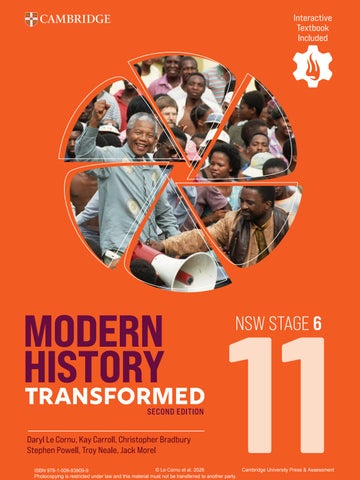
About the cover A key figure in modern history is the late South African politician and anti-apartheid activist, Nelson Mandela (1918–2013). In this image, Mandela is pictured on the election campaign trail in 1994, shortly after being freed after 27 years of imprisonment. Mandela became South Africa’s first Black president and was revered as a statesman on the global stage and seen as a symbol of hope to many people.
© Le Cornu et al. 2026 ISBN 978-1-009-83909-9 Photocopying is restricted under law and this material must not be transferred to another party.
Cambridge University Press & Assessment
1 PART
Investigating modern history: the nature of modern history
CHAPTERS 1. The investigation of historic sites and sources: disease, pandemics and Q Station 2. The contestability of the past: peacemakers – feminist peace activists in the First World War 3. The twenty-first century: constructing history in an era of digital transformation 4. Contestability and commemoration: the January 6 United States Capitol attack
© Le Cornu et al. 2026 ISBN 978-1-009-83909-9 Photocopying is restricted under law and this material must not be transferred to another party.
Cambridge University Press & Assessment
1
2
The investigation of historic sites and sources: disease, pandemics and Q Station
CHAPTER
1
FOCUS By using a range of historical sources, you will investigate the significance of historic sites and sources. You will focus on the contribution of science and archaeology in developing an understanding of the nature of modern history.
KEY ISSUES You will explore: •
The importance of, and different types of, archives available to historians of modern history, including digital archives
•
The construction of a historical site’s chronology using evidence
•
The contribution of archaeology and science to our understanding of the past, such as site excavations, DNA analysis and exhumation
•
How historic sites can improve our understanding of events, developments and life in the past
Enhance your learning with these integrated online resources: Digital downloads
Videos
Students:
Teachers:
• •
• • •
•
Suggested responses Download or answer questions online Writing focus worksheets
Writing focus workbook Exam Generator Planning documents
© Le Cornu et al. 2026 ISBN 978-1-009-83909-9 Photocopying is restricted under law and this material must not be transferred to another party.
Cambridge University Press & Assessment
3
TIMELINE 14,000 bce
Formation of North Head island in Sydney Harbour
1788
Governor Arthur Phillip makes contact with the Gayamaygal clan of the Eora Nation and names the area Manly in recognition of the qualities of the Gayamaygal warriors
1790
During a gathering at Manly Cove, Governor Arthur Phillip is speared by a Gayamaygal man
1828
The first ship, Bussorah Merchant, is quarantined at North Head in Sydney Harbour
1832
First Quarantine Act is passed in the colony of New South Wales
1837
Quarantine Station is established at Spring Cove
1852
The gold rush brings new migrants to the colonies
1873
New steamships reduce travel time and introduce more luxurious, class-based accommodation
1880
Smallpox outbreaks are quarantined at North Head
1900
The bubonic plague reaches Sydney
1901
Federation of Australia; control of the Quarantine Station is assumed by the Commonwealth government
1908
Federal Quarantine Act 1908 is passed
1913–14
A smallpox outbreak reaches Sydney
1918–19
Australian soldiers return home from the First World War and the Spanish influenza pandemic reaches Australia
1939–45
Second World War; the site is used as a military base
1950s–1970s
European migrants are accommodated at the site to control the spread of foot-and-mouth disease
1974
Cyclone Tracy destroys Darwin; evacuees are housed at the Quarantine Station
1975
Vietnamese refugees, including over 100 children and babies, are brought to the site
1984
The site is returned to the State Government of New South Wales
2001
The former third-class accommodation building is destroyed by fire
2002
The 1883 hospital is destroyed by fire; a Commission of Inquiry considers the site’s future use
2003
An adaptive reuse project and conservation plan is approved
2003
A novel coronavirus called SARS-CoV-1 outbreak leads to quarantine and face masks across Asia
2008
Q Station opens to the public as a museum, hotel and leisure destination
2015
Concerns about Zika virus result in control measures in northern Australia
2020
A novel coronavirus called SARS-CoV-2 (COVID-19) becomes a global pandemic; a 14-day quarantine for all arrivals to Australia is mandatory from March 2020; parks and museums are temporarily closed
2025
The Australian Centre for Disease Control is established to coordinate public health advice
WARNING Aboriginal and Torres Strait Islander people should be aware this chapter discusses culturally sensitive matters, and mentions the names of Aboriginal people who have died. Educators should take care to create a culturally safe environment for students of Aboriginal and/or Torres Strait Islander backgrounds.
© Le Cornu et al. 2026 ISBN 978-1-009-83909-9 Photocopying is restricted under law and this material must not be transferred to another party.
Cambridge University Press & Assessment
4
Modern History Transformed Year 11 Second Edition
1.1 Introduction: contagion, control and containment DRIVING QUESTION •
What do the site and sources of the Q Station reveal about Australia’s social, cultural, economic and political development?
Pandemics, present and past
Source 1.1.1 The Ruby Princess cruise ship, linked to 900 cases of COVID-19, leaves Sydney Harbour in March 2020, having sailed past the historic Quarantine Station at North Head.
In March 2020, one week after the World Health Organisation declared SARS-CoV-2 (COVID-19) to be a global pandemic, a cruise ship docked at Circular Quay, Sydney Harbour. At least 120 of its passengers were showing what would later be known as the tell-tale symptoms of the deadly virus: fever, coughing, fatigue, shortness of breath and a sore throat. However, all 2700 passengers were allowed to disembark and spread into the community. All were eventually traced, but at least 900 of the passengers tested positive for the virus, and 28 died from it.
At the time, medical experts around the world were still identifying how the virus was transmitted. The media began issuing daily updates on infection rates, hospitalisations and deaths. Soon, “quarantine” and isolation would be imposed on anyone who may have come into contact with the virus (such as the cruise ship passengers), while everyone else was encouraged to practise social distancing and hygiene routines, and wear face masks. When case numbers hit designated thresholds, whole communities went into lockdown.
Source 1.1.2 A woman waves to family members in a Sydney quarantine hotel in July 2021 during a city-wide COVID-19 lockdown. © Le Cornu et al. 2026 ISBN 978-1-009-83909-9 Photocopying is restricted under law and this material must not be transferred to another party.
Cambridge University Press & Assessment
Chapter 1 The investigation of historic sites and sources: disease, pandemics and Q Station
During the COVID-19 pandemic, quarantine was a core feature of national defences against the virus. In Sydney, from late March 2020 to October 2021, around 250,000 arrivals were placed in quarantine. There was no dedicated facility to keep such a large number of people separate from the community. Therefore, the government scrambled to rent hotel rooms, ringed by security guards, and to develop contactless ways to deliver meals and medical tests. During the COVID-19 pandemic, authorities and citizens had to adjust quickly to the realities of a sudden outbreak of deadly disease. People were frightened because they had not Source 1.1.3 RMS Niagara, which was required to dock at the North Head been forced to confront such a problem before. Quarantine Station during the Spanish flu pandemic in 1918 Before it ran its course, at least 7 million people around the world died, including over 22,000 in Australia. The number would have been quarantine deriving from the Italian term considerably higher without the control measures implemented. From an historical perspective, however, this was far from the first pandemic to afflict humankind; nor was it the first time that the city of Sydney had been the front line in the defence of Australians’ health. In 1918, a century before the COVID-19-affected cruise ship, another vessel had arrived in Sydney Harbour with a similar problem. The RMS Niagara, a steampowered ocean liner that carried over 650 passengers, was flying a yellow flag to warn that there was a dangerous disease on board. By the time the ship reached Sydney, “Spanish flu” had spread through its passengers and crew (in Lesson 11.8, you’ll learn why this name is misleading). Entertainment rooms were converted to hospital wards for the sick, and dead bodies were placed in storage. When ships reached land, the key initial protection measure was quarantine. The Niagara stopped just inside the entrance to Sydney Harbour and docked well away from residential neighbourhoods. This was 14 kilometres north-east of the central business district, at North Head. There, a dedicated Quarantine Station had been operating since 1837. Doctors and nurses were on site to take the passengers ashore, dividing them into the “healthy”, who would be kept separate and monitored for any signs of infection, and the “sick”, who were given treatment at the on-site hospital in the hope of improving their condition and saving their lives. A week later, the vast majority of the passengers were cleared and allowed to enter Sydney.
quarantena, a 40-day isolation period used in fifteenth-century Venice to protect people from disease during Black Death outbreaks Spanish flu a highly contagious influenza pandemic at the end of the First World War that infected millions and often caused fatal respiratory illness
Spanish flu was a highly contagious strain of H1N1 influenza. It would become the worst pandemic of the twentieth century, claiming at least 50 million lives. There were strict public health responses, not unlike COVID-19 measures: people wore face masks, state borders were closed, and schools were closed for several months. In this way, deaths in Australia were limited to around 15,000. The Spanish flu was one of many public health emergencies connected to the North Head Quarantine Station in Sydney Harbour, now more commonly known as Q Station. To visit or study Q Station today is a rich opportunity to understand how one place can reveal many insights about the past. © Le Cornu et al. 2026 ISBN 978-1-009-83909-9 Photocopying is restricted under law and this material must not be transferred to another party.
Cambridge University Press & Assessment
5
6
Modern History Transformed Year 11 Second Edition
North Head Quarantine station xenophobia an extreme dislike or fear of foreigners, their customs or beliefs
This site provides archaeological and historical evidence about Australia’s history, offering insights into immigration, xenophobia, mortality, disease and survival. From 1832, the location’s fresh water supply, safe anchorage in Sydney Harbour and distance from the growing colony made it an ideal geographical, physical and psychological space to detain new arrivals who were considered to be a threat to public health. It became a large quarantine station, a site for “inspection, decontamination, inoculation, detention and exclusion” (Longhurst, 2016, p. 591). This response to the fear of contagion and pandemics continues to resonate into the modern day, especially since the COVID-19 pandemic.
Source 1.1.4 Margaret Wheeler greeting her granddaughter, Alice Sarah-Lay, through a window at the Trentham Aged Care facility in Victoria during COVID-19 restrictions, 26 May 2020
Source 1.1.5 An inscription painted on a rock by Xie Ping De in 1917 while he was detained at the North Head Quarantine Station
Source 1.1.6 A translation of Xie Ping De’s inscription
Fearful of contagion … Hand-tied doctors powerless to find a magic remedy A burst of grief so unbearable that it is inexpressible … My friends, this is not a place of pleasure. A translation of an inscription painted on the sandstone by Xie Ping De while detained at the North Head Quarantine Station, 1917.
fumigate to disinfect or purify using steam or chemicals
Q Station offers insight into how quarantine functioned in practice. Quarantine involved separating the healthy from the sick and controlling people’s movement, daily life, activities, education and employment, and in some cases shaped the circumstances of their death. Beginning in 1832, when ships were required to fly a yellow flag if disease or contagion had been present on board within the previous 30 days, more than 13,000 people were fumigated, medically assessed and showered in phenol and carbolic acid at Q Station.
© Le Cornu et al. 2026 ISBN 978-1-009-83909-9 Photocopying is restricted under law and this material must not be transferred to another party.
Cambridge University Press & Assessment
Chapter 1 The investigation of historic sites and sources: disease, pandemics and Q Station
A relatively small number – 572 individuals – died from disease (including smallpox, scarlet fever, typhoid, bubonic plague and Spanish flu) and were buried in one of the three cemeteries at the site. The material remains of quarantine reveal much about these experiences. When people from ships with suspected outbreaks disembarked at the station’s wharf, their luggage, handwritten letters, journal entries and personal belongings were fumigated in large autoclaves using steam and sulphur. Over 12,362 of these artefacts survive. These objects, along with other artefacts, from beer bottles and apple corers to medical apparatus, allow historians to reconstruct the social, political and cultural attitudes of the nineteenth and twentieth centuries, revealing how class and race shaped perceptions of survival in a new world. Source 1.1.7 Historian Peta Longhurst reflects on the experience of quarantine and the artefacts it left behind.
For passengers, quarantine was not a site of permanent detention but rather a transitional state, and artefacts that would speak to the individual experience transitioned with them, leaving behind only the collective and institutional. Peta Longhurst. 2016. “Quarantine Matters: Colonial Quarantine at North Head, Sydney and Its Material and Ideological Ruins.” International Journal of Historical Archaeology 20: 596–597.
Over its 147 years of operation, Q Station housed children, orphans, soldiers, migrants, evacuees from Cyclone Tracy and Vietnamese refugees. North Head reflects the changing nature of Australia, from early contact with Gayamaygal People to Federation, world wars and the present-day commemoration of the graves and inscriptions that remain. As a historical site, Q Station signifies how “epidemics leave no corporal traces, whence their history is perhaps more intellectual” (Hecker, 1832). Its practices of physical isolation, themselves derived from quarantena responses to the Black Death, are preserved in the stone buildings, shower blocks, metal fumigators and mortuary slab.
smallpox an extremely infectious disease that causes a fever, spots on the skin and often death scarlet fever a bacterial disease that develops from strep throat, causing high fever and a red rash; often fatal before the advent of antibiotics typhoid a bacterial disease spread through contaminated food or water, causing prolonged fever and severe stomach illness; historically often fatal bubonic plague a bacterial disease spread by fleas on rodents, infecting lymph nodes and often leading to death autoclave a piece of equipment that uses steam at high pressure to sterilise (clean) objects inscription a marking, scratching, etching or painting that has been chiselled, inked or engraved
This chapter will focus on how archaeological and historical evidence from Q Station has been used to commemorate, reconstruct and position the past. It will also explore the challenges of evidence in understanding Australia’s history, through the stories of detainees.
REVIEW 1.1 Online quiz
1. 2. 3. 4. 5. 6. 7.
Review questions
Access sample responses and results
Define the term xenophobia. Describe the practice of quarantine. Explain why North Head was a suitable place for quarantine. Identify what the yellow flag on a ship represented. List the diseases that quarantine aimed to control the spread of in Sydney. Identify the personal items that tell the stories of people detained at Q Station. Explain why time spent in quarantine was considered a transitional state for detainees.
© Le Cornu et al. 2026 ISBN 978-1-009-83909-9 Photocopying is restricted under law and this material must not be transferred to another party.
Go online to assign and download questions, view results and more!
Writing focus 1.1 Question words
Cambridge University Press & Assessment
7
8
Modern History Transformed Year 11 Second Edition
1.2 What makes North Head a significant historical site? DRIVING QUESTION •
How did early contact, disease and colonisation shape the significance of North Head?
A long history
Source 1.2.1 William Bradley’s watercolour recording the first meeting with Eora women at Eve’s Cove (Manly), 1788. (Mitchell Library, State Library of New South Wales)
In addition to being home to Australia’s oldest and most well-preserved quarantine site, North Head has enduring cultural significance for Gayamaygal People of the Eora Nation. North Head is a sandstone headland, shaped over tens of thousands of years through wind and coastal erosion. Due to its relative isolation, it was used by koradgee (medicine men and women healers) of the Gayamaygal clan for spiritual ceremonies and healing practices. Middens, engravings and rock art provide evidence of long-standing connections to Gayamaygal history, art and culture.
North Head and the adjacent Manly Cove were also places of early contact between British colonists and Gayamaygal People. On 21 January 1788, Governor Arthur Phillip explored the northern part of the harbour and headlands and was met by 20 warriors who waded out to his boats. In his account, Phillip described the place of this encounter as “manly”, in recognition of what he considered the admirable qualities of Gayamaygal People. Later, a beachside suburb of the city of Sydney grew up there, and was named “Manly”. These early encounters marked the beginning of a complex and often violent relationship between Gayamaygal People and British colonists, shaped by misunderstanding, coercion and the growing impacts of colonisation.
Source 1.2.2 Governor Arthur Phillip’s account of his naming of Manly Cove
The boats, in passing a point of land in this harbour, were seen by a number of men, and twenty of them waded into the water unarmed, [and] received what was offered them … their confidence and manly behaviour made me give the name of Manly Cove to this place. L. Becke & W. Jeffery, 1899. Admiral Phillip: the founding of New South Wales. London: T.F. Unwin, 63.
In September 1790, Governor Phillip was speared by Gayamaygal warriors. Historians such as Grace Karskens, in Colony: A History of Early Sydney, suggest this act may have represented ritual punishment for the actions of colonists, or premeditated payback for the kidnapping of Gayamaygal man Arabanoo and the later abductions of Cadigal man Coleby and Wangal man Bennelong.
© Le Cornu et al. 2026 ISBN 978-1-009-83909-9 Photocopying is restricted under law and this material must not be transferred to another party.
Cambridge University Press & Assessment
Chapter 1 The investigation of historic sites and sources: disease, pandemics and Q Station
The spearing occurred during a ceremonial gathering at Manly Cove, where Phillip had been invited to participate in feasting on a stranded humpback whale. Phillip was struck in the shoulder with a barbed wooden spear, but he recovered within 10 days and no retribution followed. Tragically, Arabanoo, the first Gayamaygal warrior kidnapped from North Head, later contracted smallpox from Europeans, highlighting how contact and colonisation brought devastating diseases to Aboriginal communities. These incidents foreshadow the later development of the North Head Quarantine Station as a place of conflict, contagion and control. The North Head Quarantine Station became a point of contact between global movements of people and the growing colony of New South Wales, and later the federation of Australia. From 1837 to 1984, over 13,000 individuals were isolated at the station, with 572 people dying there from infectious diseases. Disease was difficult to contain in the early colony, and outbreaks of scarlet fever, smallpox, Spanish influenza, typhus and bubonic plague were all managed at this site. Q Station therefore tells a rich story of attitudes towards disease, different cultures and death.
Writing focus 1.2 Noun phrases (identify) source any written or non-written material (such as a painting) that can be used to investigate the past. Historians use sources to draw out “evidence” to answer historical questions, support historical inquiry or challenge interpretations.
Q Station documents the lives of convicts, migrants, returning soldiers, lovers, families and refugees fleeing conflict and natural disasters who lived at North Head while awaiting their fate. The site contains a wide range of historical and archaeological sources. Historical sources include ships’ logs, passenger manifests, hospital records, death notices, letters and station records, archaeological inscriptions, cemeteries and memorials, which reveal personal stories through paint, etching and symbolic motifs. These sources offer insight into family backgrounds, dates of quarantine and emigration, hopes for the future and fears of death. The surviving buildings, structures and fittings are evidence of nineteenth- and twentiethSource 1.2.3 A bird’s-eye view of some of the buildings of Q Station century daily life and public policy.
REVIEW 1.2 Online quiz
Review questions
Access sample responses and results
1. Explain the enduring cultural connections of Gayamaygal People to North Head and Manly Cove. 2. Describe how Governor Phillip recorded his encounter with Gayamaygal warriors on 21 January 1788. 3. Outline what happened to Governor Phillip in September 1790. 4. Explain why the colonists did not seek retribution for the spearing of Phillip. 5. Identify some of the groups detained at Q Station. 6. Identify the sources of evidence located at Q Station.
© Le Cornu et al. 2026 ISBN 978-1-009-83909-9 Photocopying is restricted under law and this material must not be transferred to another party.
Go online to assign and download questions, view results and more!
Cambridge University Press & Assessment
9
10
Modern History Transformed Year 11 Second Edition
1.3 What led to quarantena in the new colony? DRIVING QUESTION •
How were disease and the containment of disease related to social class or position?
Early quarantine responses Anxieties about the spread of disease were prominent in the media and colonial policy from the early nineteenth century into the twentieth century. The containment of cholera, typhus, smallpox, bubonic plague and influenza was considered critical to the survival of the new colony and the emergent nation. Spring Cove (located between North Head and Manly Cove) became an early site for containing disease outbreaks in the colony of New South Wales. In 1832, following a smallpox outbreak among convicts and crew on the Bussorah Merchant, the quarantine site was expanded to include North Head. Here, stationed in tents along the cove, European crew members and convicts who were suspected of coming into contact with contagious diseases were geographically and socially isolated.
precinct a defined area where certain activities or groups were arranged Sick Ground an area for those infected with disease, located closest to the landing wharf and with access to the hospital Healthy Ground an area for those who had been exposed to disease but had yet to develop symptoms; geographically isolated from the Sick Ground and elevated above the wharf area
In 1837, crew and passengers from the Lady M’Naghten contracted scarlet fever and typhus during the voyage from England. Historical records indicate that 10 adults and 44 children died during the passage, with a further 14 adults dying in Sydney Harbour while the ship was held in quarantine. Such outbreaks of deadly disease, combined with the financial penalties associated with delaying ships at port (demurrage), prompted the Legislative Council of the Colony of New South Wales to begin constructing permanent quarantine accommodation on the shores of North Head. Here, quarantine cases could be taken ashore for isolation or treatment, well away from the rest of the population. Construction of the North Head Quarantine Station commenced in May 1837, and facilities were ready to receive detainees by October 1838. These early structures included a wharf at the Spring Cove landing area and two segregated precincts designed to separate the sick from the healthy. The “Sick Ground” was located on the southern side of the site near the wharf, providing direct access to medical facilities, while the “Healthy Ground” was situated uphill, requiring detainees to climb a steep path away from the beach. A hospital with 32 beds was established on the Sick Ground, while basic accommodation was constructed on the Healthy Ground for passengers travelling in steerage class (the lowest-tier accommodation on passenger ships). The two precincts were divided by a series of stone cairns (stacked stones) that were clearly visible from the shore. These boundaries were patrolled at night to prevent detainees from the Sick and Healthy Grounds from escaping or intermingling.
Expanding quarantine at North Head From 1852, following the discovery of gold in western New South Wales, immigration increased dramatically and Q Station’s capacity was soon exhausted. Facilities proved inadequate for the scale of maritime arrivals. In response, additional buildings were hastily constructed, and the former convict hulk Harmony was converted into a floating hospital for infected male passengers. © Le Cornu et al. 2026 ISBN 978-1-009-83909-9 Photocopying is restricted under law and this material must not be transferred to another party.
Cambridge University Press & Assessment
11
Wh
Manly
Entrance Roa d
ar f
Ro ad
Chapter 1 The investigation of historic sites and sources: disease, pandemics and Q Station
Q Station
in
Former Second Class Precinct
Ma
Sydney
Ro
Whar
ial Ax ad
eR
g tta
Co
d f R oa
Former First Class Precinct
d
oa
Main Axial Roa
ad
d
Sydney Harbour
Former Isolation Precinct
Roa
Former Hospital Precinct
s atic
Whar f Roa d Hospital Road
d
Former Third Class Precinct
Isolation
Isolation Road
Ro
Asi
Wharf Precinct
Wharf
Quarantine Beach Quarantine Wharf
Road
Source 1.3.1 Layout of Q Station
Moored in Spring Cove, the vessel flew the yellow flag, signalling disease on board. Single female passengers were accommodated in newly constructed barracks on the Sick Ground. In 1853, two additional buildings were erected to house a further 60 detainees. These structures included wide verandas for dining and recreation, and accommodation for the Superintendent of Quarantine. The cemetery, which was visible from the Healthy Ground and from incoming ships, was relocated further away. The remains buried in what became known as the First Quarantine Cemetery were left undisturbed, while the “unsightly” headstones were removed from view. As wealth increased following the gold rush, ship voyages became more comfortable and carried passengers from increasingly distinct social classes. However, quarantine conditions remained harsh. Healthy detainees often spent long periods undergoing fumigation, isolation and medical scrutiny for emerging signs of disease.
Writing focus 1.3 Noun phrases (identify and develop)
social class position in society based on wealth, status and education
Despite the efforts of medical staff, some patients could not be saved. In 1878, when passengers from the Smyrna were placed in quarantine due to an outbreak of scarlet fever, two children – Isaac Lowes aged 6, and his friend Thomas Convoy aged 4 – were buried in the Second Cemetery, with headstones made by their families.
© Le Cornu et al. 2026 ISBN 978-1-009-83909-9 Photocopying is restricted under law and this material must not be transferred to another party.
Cambridge University Press & Assessment
12
Modern History Transformed Year 11 Second Edition
The regulation of quarantine In 1882, 64 detained passengers and crew from the steamship Gunga petitioned against their treatment at Q Station. They argued that their detention for three weeks following the identification of a single person suspected of having smallpox on their ship (a Fijian servant to Sir Arthur Gordon, High Commissioner for the Western Pacific and former Governor of New Zealand) was unjustified. In particular, they cited the inconsistent enforcement of isolation procedures: the nurses caring for the patient mingled with workers constructing tents for healthy detainees, while medical staff dined with the captain of the supposedly infected ship. This complaint coincided with a Royal Commission into Q Station, conducted in 1882 following serious smallpox outbreaks the previous year. In 1881, smallpox spread beyond quarantined ships, with 39 confirmed cases and a further 65 contacts identified across Sydney. Quarantine periods were significantly extended, placing strain on facilities and resources. Although the Commission dismissed detainees’ complaints as “frivolous and without foundation”, compensation was nonetheless paid to those detained for extended periods. Another reform was to start employing steerage class detainees in manual labour and maintenance work, paying them for their labour. Source 1.3.2 Extract from a petition by detainees of the steamship Gunga
As detainees we [are] … fully prepared to suffer personal inconvenience, if it be shown that it is required for the benefit of the Colony, but they are reluctant to sacrifice their interests either to secure official tranquility or to satisfy those who may conceive their dignity diminished by the admission that a mistake on their part (however pardonable and natural) is of possible occurrence. New South Wales Legislative Assembly. 1883. Steamship “Gunga” (Quarantining Of): Copies of All Correspondence, Reports, Minutes … Having Reference to the Recent Quarantining of the Steamship “Gunga”. Sydney: Thomas Richards, Government Printer.
Detainees had mixed experiences at the station. For some, quarantine offered a welcome improvement on life at sea, providing access to fresh water, meat, clean housing and bedding. Boredom, however, was a persistent problem, with recorded requests from detainees for equipment to play tennis or cricket. Source 1.3.3 Thomas Platt’s 1886 diary praised the reception he received.
We were disembarked at 3 P.M. and marched up to large lofty buildings (smelling strongly of carbolic) looking nice and clean, close to the sea, in fact on the beach. After being comfortable [sic] treated and told off to [assigned] our various apartments we were all invited to partake of a good substantial meat tea (Australian) and I can assure you that the whole of the passengers, some 240, did justice to their first meal in … Australia, for I thought some of them would never leave off eating. Thomas Platt. 1886. Quoted in Krista Maglen. 2006. “‘In This Miserable Spot Called Quarantine’: The Healthy and Unhealthy in Nineteenth-Century Australian and Pacific Quarantine Stations.” Science in Context 19 (3): 317–336.
© Le Cornu et al. 2026 ISBN 978-1-009-83909-9 Photocopying is restricted under law and this material must not be transferred to another party.
Cambridge University Press & Assessment
Chapter 1 The investigation of historic sites and sources: disease, pandemics and Q Station
13
Source 1.3.4 An artist’s depiction of the quarantine hulk Harmony moored in Spring Cove, drawn in 1870 by George Slade
In the 1880s, steam-powered ships shortened travel times, allowed for distinct levels of accommodation for different social class groups, and increased the frequency of arrivals. These developments intensified concerns about disease transmission, particularly during two significant smallpox outbreaks, at a time when vaccination was not universally available or effective in practice.
A MATTER OF FACT Smallpox has been identified in Egyptian mummies dating from around the third century bce. It presents with characteristic “pocks” or blisters associated with fever and a progressive rash. Caused by the variola virus, it spreads through close contact. Historically, more than three out of every 10 infected people died, while others were left blind or permanently scarred. Smallpox has since been eradicated globally through vaccination, with the last recorded case in 1977. At Q Station, surviving artefacts include two wax models (or moulages) showing the effects of smallpox and chickenpox on the body. One depicts the hand and forearm of an adult, and the other the face of a baby, both showing blistering, inflammation and discolouration. These models were used to train medical staff to recognise early signs of infection and remained in use until the Second World War, when advances in photography began allowing for the capture and identification of diseases.
© Le Cornu et al. 2026 ISBN 978-1-009-83909-9 Photocopying is restricted under law and this material must not be transferred to another party.
moulage a replica or cast of a wound or lesion used for medical training
Cambridge University Press & Assessment
14
Modern History Transformed Year 11 Second Edition
ANALYSIS 1.1 Analysing a source Refer to Source 1.3.5. 1. Describe Source 1.3.5 and what it shows about smallpox. 2. Explain what this source reveals about attitudes to contagious disease in the early 1900s in Australia. 3. Evaluate to what extent attitudes towards pandemics and contagious diseases have changed today. You may like to consider the COVID-19 pandemic.
Source 1.3.5 One of Q station’s wax casts showing the symptoms of smallpox, c. 1900
Historical concepts: Perspectives, Continuity and change Historical skills: Analysis and use of sources
White Australia Policy government policies that restricted non-European immigration, including the Immigration Restriction Act 1901 and the Pacific Island Labourers Act 1901; abolished in 1973
The housing of different groups together in temporary accommodation became widely criticised as indecent and negligent. A related outcome of the 1882 Royal Commission into quarantine practices was the establishment of the Board of Health and the commencement of a large-scale building program to accommodate the growing number of detainees by class as well as health status. Although quarantining remained a state responsibility, fears of global epidemics increasingly shaped public policy. In the lead-up to Federation, concerns about disease merged with racial stereotypes and anxieties about migration from China and other non-British regions. These social and political fears contributed to the White Australia Policy, enacted in 1901, which restricted immigration.
Source 1.3.6 An early photograph of the North Head Quarantine Station showing the different areas of the site and its location
© Le Cornu et al. 2026 ISBN 978-1-009-83909-9 Photocopying is restricted under law and this material must not be transferred to another party.
Cambridge University Press & Assessment
Chapter 1 The investigation of historic sites and sources: disease, pandemics and Q Station
Following Federation in 1901, responsibility for quarantine shifted from the states to the Commonwealth. Advocates of Federation promoted the idea of a “working man’s paradise”, protected through strong border control and quarantine measures. In 1908, the Commonwealth introduced the Quarantine Act, granting broad powers to control, detain and exclude people, goods, animals and plants to prevent the spread of disease. Source 1.3.7 Extract from the Quarantine Act
Quarantine has relation to measures for the exclusion, detention, observation, segregation, isolation, protection and disinfection of vessels, persons, goods, animals, or plants and having as their object the prevention of the introduction or spread of diseases or pests affecting man, animals, or plants. Commonwealth of Australia. 1908. Quarantine Act No. 3 of 1908, s. 4.
ANALYSIS 1.2 Analysing sources Refer to Sources 1.3.1, 1.3.6 and 1.3.7. 1. 2. 3. 4.
Identify whether these sources are primary or secondary sources. Explain the intent of quarantine with reference to Source 1.3.7. Identify methods used in quarantine as described in Source 1.3.7. Explain why the site of the North Head Quarantine Station was chosen, using Sources 1.3.1 and 1.3.6.
Historical concepts: Causation Historical skills: Analysis and use of sources
Under federal control, quarantine became increasingly regimented, with daily routines governing meals, accommodation, rest and movement. Spaces around Q Station were designated according to health status, social class and cultural background. The detainees’ daily lives were strictly controlled.
REVIEW 1.3 Online quiz
Review questions
Access sample responses and results
1. Identify the diseases that led the colony of New South Wales to establish quarantine measures. 2. Describe the buildings constructed at Q Station. 3. Explain why the hospital was located near the Sick Ground. 4. Define the term steerage class. 5. Explain how quarantine treatment of different social and cultural groups reflected Australian attitudes towards migrants in the late nineteenth and early twentieth centuries. 6. Explain the powers granted under the Quarantine Act 1908. 7. Suggest what may have occurred if the First Quarantine Cemetery had not been relocated from its original site.
© Le Cornu et al. 2026 ISBN 978-1-009-83909-9 Photocopying is restricted under law and this material must not be transferred to another party.
Go online to assign and download questions, view results and more!
Cambridge University Press & Assessment
15
16
Modern History Transformed Year 11 Second Edition
1.4 The reconstruction of Q Station using historical evidence DRIVING QUESTION •
reconstruction an attempt to get a complete description of a past event using the evidence available
What does historically reconstructing the process of quarantine reveal about the technology and medical treatments of the early nineteenth and twentieth centuries?
So far in this chapter we have considered the purpose of Q Station as a key site in Australian history for the containment of infectious diseases. To reconstruct exactly how the North Head Quarantine Station operated during the nineteenth and early twentieth centuries, we will now use a range of historical evidence, including photographs from site studies and other key primary and secondary sources.
Reconstructing the process of quarantine The procedures of quarantine were regimented, and were updated as medical knowledge advanced. On arrival, detainees were inspected by a ship’s doctor or a station doctor and classified according to health status and class. Healthy passengers were disinfected and their luggage was fumigated using autoclaves in the flat area adjacent to the wharf. They then made their way up the steep incline to the accommodation and administration area. The level of accommodation and personal liberty allowed to individuals during their detention depended on their class and cultural background. From the twentieth century, detainees typically disembarked at the wharf and, in addition to having their luggage fumigated, took a disinfection shower, bathing in an antimicrobial solution of phenol (carbolic acid) and water. Early on, the Sick Ground and cemetery were visible to arriving passengers, which sometimes caused panic among those disembarking. After 1853, these were moved out of sight.
CREATIVE TASK 1.1 Outlining Create a flowchart or table demonstrating the process of quarantine at Q Station in the early twentieth century. Process of quarantine Step 1 Step 2 Step 3 Step 4 Step 5
Historical concepts: Continuity and change Historical skills: Explanation and communication
© Le Cornu et al. 2026 ISBN 978-1-009-83909-9 Photocopying is restricted under law and this material must not be transferred to another party.
Cambridge University Press & Assessment
Chapter 1 The investigation of historic sites and sources: disease, pandemics and Q Station
Source 1.4.1 Luggage fumigation autoclave, constructed in 1912
Space, class and control Housing at the site reflected social and cultural boundaries. The First Class precinct was elevated above the wharf and far removed from Isolation Road, the hospital and the morgue. This area was considered the most comfortable, with buildings aligned with the beach. The two Second Class buildings were similar in style but separated by an imposing two-metre fence. Third-class passengers experienced more limited comfort and stricter control, reinforced by fencing and by the placement of administration and staff buildings, which provided a supervisory view over the area.
Source 1.4.2 This photograph from 1932 shows some of the temporary tents used to house detainees.
© Le Cornu et al. 2026 ISBN 978-1-009-83909-9 Photocopying is restricted under law and this material must not be transferred to another party.
Cambridge University Press & Assessment
17
18
Modern History Transformed Year 11 Second Edition
Accommodation for people labelled “Asiatics”, built in the 1880s, was the most basic. This segregation reflects the xenophobic and racist attitudes that shaped policy and practice from the 1880s well into the twentieth century. This quarters was also often allotted to ship crews, reflecting how occupation and class shaped treatment.
Source 1.4.3 Photograph of the disinfection shower
Over time, accommodation for all classes improved. Developments included wide verandas for shelter from the extreme winds and summer heat, brick and sandstone piers to raise buildings above damp ground and run-off from sanitation drains, and separate spaces for dining and sewing for women in higher social classes. Kitchens and meals were segregated according to class, and artefacts such as serving platters and chinaware suggest that, for some detainees, quarantine became less associated with incarceration and more with relative comfort. Similarly, the staff who lived and worked at the station were treated differently, according to gender. While all staff lived on high ground above their patients, female medical staff shared dormitory-style accommodation in the Nurses’ Quarters, while most male medical staff and managers had individual detached cottages, with significantly more personal space.
Source 1.4.4 (Left) The elevated first-class accommodation and (right) a typical first-class room
Source 1.4.5 The museum sign for the sewing room, and sewing artefacts for first-class passengers © Le Cornu et al. 2026 ISBN 978-1-009-83909-9 Photocopying is restricted under law and this material must not be transferred to another party.
Cambridge University Press & Assessment
Chapter 1 The investigation of historic sites and sources: disease, pandemics and Q Station
Source 1.4.6 Displays of silver serving ware and other tableware in the first-class dining areas
ANALYSIS 1.3 Analysing sources Refer to Sources 1.4.4, 1.4.5 and 1.4.6. 1. Examine what the archaeological sources reveal about daily life in the First Class precinct. 2. Propose how you imagine days in quarantine were spent by first-class passengers. 3. Explain the rationale for different levels of accommodation. Historical concepts: Causation, Perspectives Historical skills: Analysis and use of sources, Explanation and communication
Further changes followed the transfer of quarantine to Commonwealth control. The wharf area was refurbished to include a large luggage shed, disinfection showers, an industrial laundry, a boiler house and waiting shelters for different classes. Additional isolation spaces, new dining and accommodation facilities, a cable tramway and later electric lighting were introduced as quarantine became more regulated and institutionalised.
Source 1.4.7 The “Asiatic” Quarters had bunks and shared accommodation.
After the Second World War, changes in migration policy (“populate or perish”) led to renewed use of the site. From the 1950s, Q Station housed migrants arriving through assisted passage schemes, as well as others classified at the time as “illegal immigrants” – most commonly crew members, often referred to as “ship jumpers”, who arrived on merchant vessels and failed to leave Australia when their ships departed.
© Le Cornu et al. 2026 ISBN 978-1-009-83909-9 Photocopying is restricted under law and this material must not be transferred to another party.
Cambridge University Press & Assessment
19
20
Modern History Transformed Year 11 Second Edition
funicular a word deriving from the French term for a cord that is tensioned. In this early-twentiethcentury context, “funicular” refers to a cable railway in which a cable attached to a pair of tram-like vehicles on rails moves them up and down a steep slope.
These included people from countries such as Norway, the Netherlands and Italy, as well as China, India and the Philippines. Those who were unvaccinated were also detained for fixed periods. Buildings constructed in the late nineteenth and early twentieth centuries were refurbished, with some demolished or relocated, and others refitted with new furniture and facilities. Q Station remained in use until 1984. Over its lifetime, hospitals, isolation wards, morgues, fumigation showers and a funicular system for transporting luggage to the Healthy Ground were added to support quarantine operations.
Diseases, death and contagion Over the lifetime of the North Head Quarantine Station, smallpox epidemics were a constant source of concern. The last recorded outbreak occurred in 1917, during the early years of Australia’s involvement in the First World War. Infrastructure developed from the 1880s was later used to manage outbreaks of bubonic plague, which proved deadly and generated widespread public fear.
Writing focus 1.4 Transitional phrases
From January 1900 until 1922, the site served as a first line of defence against bubonic plague. Those infected on shore or arriving by ship were isolated, along with their close contacts, often for up to 40 days. Records indicate that 1746 people were quarantined at North Head during these outbreaks and that 103 died, although there were likely additional cases that were not reported. The use of “death boats” to transport bodies from Woolloomooloo to the station caused particular alarm and attracted intense media attention. One of the earliest victims was a two-year-old boy from the Dovey family.
A MATTER OF FACT The bubonic plague, also known as the “Black Death”, is caused by a bacterium spread by fleas that live primarily on black rats. In crowded and unsanitary environments, fleas often migrated from rats to human hosts, infecting people through their bites. In Sydney at the turn of the twentieth century, poor sanitation, overcrowded waterfront areas and the frequent arrival of ships created ideal conditions for large rat populations to thrive. Images from the period showing dense rat infestations illustrate how easily the disease could spread, and help explain why a plague outbreak occurred in Sydney in 1900. The symptoms of bubonic plague included headaches, fatigue, nausea, chills and high temperatures, as well as swollen lymph glands in the neck, groin and armpits. These glands, known as buboes, could become mottled and purple or black – giving the disease its name. Most deaths occurred between one and nine days of infection.
Source 1.4.8 An image of dead rats taken during cleansing operations, North Head Quarantine Station, Sydney, 1900
The first officially recorded case of bubonic plague in Sydney occurred in 1900, when Arthur Paine, a wharf delivery worker, became ill on 19 January. Government records show at least 1371 cases and 535 deaths from plague across Australia, with Sydney the most severely affected by the outbreaks.
© Le Cornu et al. 2026 ISBN 978-1-009-83909-9 Photocopying is restricted under law and this material must not be transferred to another party.
Cambridge University Press & Assessment
Chapter 1 The investigation of historic sites and sources: disease, pandemics and Q Station
ANALYSIS 1.4 Analysing a source Source 1.4.9 Quarantine statistics showing the duration and scale of plague detention at North Head
All in all, 1795 persons were quarantined, 1746 at North Head, 1496 as contacts and 263 as actual cases … Patients were normally discharged as soon as they had a normal temperature for ten days with no unhealed sore and were generally considered fit for discharge. Of the 200 people who caught plague but survived the epidemic, the average length of time spent in quarantine at North Head was forty-five days. Many however spent much longer. Peter Curson and Kevin McCracken. 1989. Plague in Sydney: The Anatomy of an Epidemic. Sydney: UNSW Press, 150–51.
1. 2. 3. 4. 5. 6.
Identify how many people were quarantined at North Head for bubonic plague. Identify the number of cases of bubonic plague. Identify the average length of time spent in quarantine. Interpret what is meant by “contacts” in this source. Describe what signs were used to discharge patients. Explain how useful this source is in describing the effects of bubonic plague on Sydney.
Historical concepts: Causation Historical skills: Analysis and use of sources
venereal disease (VD) a disease that is spread through sexual activity with an infected person
Plague victims’ remains were handled by staff such as nurses, administrators and doctors, who organised burial, kept records and arranged funerals. Death lists were published in New South Wales newspapers and numerous reports on the plague were published during 1900 and 1901, reflecting public concern about the spread of disease. The site was also used during and after the First World War to isolate soldiers suffering from venereal disease (VD), influenza and tuberculosis (TB). VD was often treated as a moral failing, with soldiers subjected to shame, reduced pay and punitive detention. In 1916, for example, records indicate that over 50% of the 17,000 returning soldiers were sick and that approximately 2000 were suffering from VD. Tuberculosis (TB) was incurable and transmissible. Over 3000 returning soldiers had contracted TB and, in the last year of the war, more than 90 of these were cared for in the station hospital, which by this time was effectively operating as a military hospital. In contrast to soldiers with VD, soldiers suffering from TB were generally provided with Red Cross care packages, medical attention and fresh food. However, death rates from this virulent disease remained high. Evidence of the treatments received can be found in prescription lists from the time.
Source 1.4.10 An article in the Sydney Morning Herald, 1 February 1900
© Le Cornu et al. 2026 ISBN 978-1-009-83909-9 Photocopying is restricted under law and this material must not be transferred to another party.
Cambridge University Press & Assessment
21
22
Modern History Transformed Year 11 Second Edition
In 1918, the main threat to the nation was pneumonic influenza, commonly referred to as Spanish flu. Medical records today identify this as a pandemic. Globally, Spanish flu is estimated to have caused tens of millions of deaths. At first, the threat was considered unlikely to reach Australian shores, but it arrived with infected passengers on board ships, starting with the civilian RMS Niagara in October 1918, which was forced to dock at the station. Grateful patients left an inscription on a rock at North Head to Source 1.4.11 The street sign for Isolation Road honour Sister Hargreaves and Mr R.E. Jeffrey, who cared for the sick on the journey and caught influenza themselves. Spanish flu also affected returning soldiers and those who gathered to greet them at ports. During this period, quarantine regulations were rigid. Ships were quarantined for seven days, with everyone on them observed for signs of illness. Social gatherings were restricted, schools were closed, travel was limited and masks were worn to reduce transmission. By the end of 1920, 692 patients had been quarantined in the station hospital with Spanish flu, and 21 people died there, including medical staff. Twenty-seven-year-old nurse Annie Egan was one victim, and her grave is a prominent feature of the Third Cemetery. In Sydney, there were 30,000 cases of Spanish flu and, by July 1919, there had been over 600 deaths. Quarantine of infected patients appeared less effective than earlier measures used against plague or smallpox, and questions were raised publicly about relocating quarantine facilities further south, away from Sydney.
Source 1.4.12 Entries in Q Station’s register of deaths during the 1918–1919 Spanish flu pandemic © Le Cornu et al. 2026 ISBN 978-1-009-83909-9 Photocopying is restricted under law and this material must not be transferred to another party.
Cambridge University Press & Assessment
Chapter 1 The investigation of historic sites and sources: disease, pandemics and Q Station
ANALYSIS 1.5 Analysing sources View these sources related to Private Hector Fraser Hicks, then answer the questions that follow. Source 1.4.13 Carmel Kelleher, “Death register sheds light on those laid to rest”, National Archives of Australia website, 4 October 2011
One of [the people who died] was Private Hector Fraser Hicks, a mechanic who was born on 22 February 1900 in Albury, New South Wales. He enlisted on 9 September 1918, aged 18 years, with the consent of his father. Hector embarked from Sydney on 2 November 1918 on board the Medic, but the ship was recalled due to the signing of the Armistice. Hector contracted influenza, was quarantined on 25 November, and died at the station on 30 November 1918. He was laid to rest at the Third Cemetery. Carmel Kelleher. 2011. “Death Register Sheds Light on Those Laid to Rest.” National Archives of Australia website, 4 October.
Source 1.4.14 Private Hector Hicks’s gravestone in the Third Cemetery
1. Describe what information is provided about Private Hicks in Source 1.4.15. Source 1.4.15 Private Hector Hicks’s death certificate, 1918 2. Assess why this source would be useful to a historian studying the effects of Spanish flu. 3. Identify which other sources historians could use to understand the impact of the pandemic. 4. Propose what you imagine could have been the impact on his family of Hector Hicks’s death just after the war had ended. Historical concepts: Continuity and change, Contestability Historical skills: Analysis and use of sources
© Le Cornu et al. 2026 ISBN 978-1-009-83909-9 Photocopying is restricted under law and this material must not be transferred to another party.
Cambridge University Press & Assessment
23
24
Modern History Transformed Year 11 Second Edition
The death register from the North Head Quarantine Station records deaths from 1881 to 1925 and provides a grave number for each entry. From the 1880s, burial sites became overcrowded and, according to news reports, produced an offensive odour. The Third Quarantine Cemetery was created in 1881. Recent archaeological work at this cemetery has identified a number of graves and the causes of death associated with them.
ANALYSIS 1.6 Analysing sources Table 1.4.1 Causes of death of bodies in the Third Quarantine Cemetery Disease
Number of burials
Percentage of total deaths (%)
Smallpox (1881–82)
6
2.5
Scarlet fever (1883–84)
5
2.1
Smallpox (1884–85)
4
1.7
Smallpox (1887–88)
15
6.2
Bubonic plague (1900–01)
105
43.6
Pneumonic influenza (1918–19)
63
26.1
There were another 44 isolated deaths (17.8%) from infectious diseases or other causes recorded as resulting in burials.
1. Identify which disease accounted for the most burials at North Head over the period 1881–1918. 2. Identify which disease accounted for the fewest burials at North Head over this period. 3. Using evidence and reasons, justify which disease you think was the most difficult to contain at North Head. Historical concepts: Causation Historical skills: Analysis and use of sources, Explanation and communication
REVIEW 1.4 Go online to assign and download questions, view results and more!
Online quiz
Review questions
Access sample responses and results
1. Describe how the system of quarantine worked. 2. Explain how a newly arrived detainee might have felt when greeted by a view of the Sick Ground and graveyard from the ship. 3. Define the term carbolic acid. 4. Explain likely attitudes towards people who had been in contact with those infected. 5. Describe how accommodation was segregated into different classes. 6. Explain what these different precincts reveal about changing attitudes to class and race over time.
© Le Cornu et al. 2026 ISBN 978-1-009-83909-9 Photocopying is restricted under law and this material must not be transferred to another party.
Cambridge University Press & Assessment
Chapter 1 The investigation of historic sites and sources: disease, pandemics and Q Station
1.5 Etchings and evidence from the site DRIVING QUESTION •
What do inscriptions and material remains at Q Station reveal?
The evidence in the sandstone Scattered throughout the Q Station site are 1600 sandstone inscriptions, carvings and paintings that tell archaeologists the stories of those quarantined from the 1800s until the early 1980s. These inscriptions were made by chiselling, carving, inking, scratching and painting onto the rock face. Unlike accommodation boundaries, the inscriptions are not segregated, but are temporally and socially interconnected. Inscriptions include different languages and cultural symbols. For example, a Chinese inscription sits alongside an earlier engraving near the wharf. These engravings can be seen on sandstone cliffs as you disembark at the wharf, and continue on drains, slate covers, tree trunks, concrete blocks and the walls of buildings. The inscriptions provide historical evidence of detainees’ names, the ships they arrived on, family members they lost, illnesses they suffered, scandals that occurred during their stays and their states of mind – despair, joy and relief.
Source 1.5.1 Inscription on sandstone rock about the voyage of the Forest Monarch
The inscription in Source 1.5.1 was made by 32-year-old stonemason Daniel Yeates and documents the Forest Monarch’s journey from Southampton, England. The engraving reflects the scale of migration from Britain and lists the names of the ship’s Superintendent, Commander and First Mate, who were accountable for passengers. Curiously, the inscription does not record how many survived to reach Sydney. It also does not refer to the death of Daniel Yeates’s second wife, Mary Ann Yeates, who suffered “debilitas scorbulus”, or scurvy. Mary Ann’s death is commemorated in Source 1.5.2, which includes Source 1.5.2 A sandstone inscription commemorating Mary Ann Yeates, who died during the voyage of the the simple inscription M.A.Y. and an elaborate outline of a Forest Monarch cross. Her death was caused by malnutrition and a lack of vitamin C from fresh fruit and vegetables. She would have suffered bleeding gums, oozing sores and skin infections, and experienced extreme exhaustion. Mary Ann was a young mother with a two-year-old child, William, and a new baby, Maria, born shortly before the family boarded the ship. William died during the voyage, and Mary Ann faced this loss while caring for a newborn. Her death in these circumstances shows how difficult long sea journeys could be for the vulnerable, the sick and the very young. Daniel Yeates arrived in Sydney and was left to care for children (from his first and second marriages) while trying to find his place in the gold rush sweeping the colony. © Le Cornu et al. 2026 ISBN 978-1-009-83909-9 Photocopying is restricted under law and this material must not be transferred to another party.
Cambridge University Press & Assessment
25
26
Modern History Transformed Year 11 Second Edition
Source 1.5.3 An engraving of a British emigrant ship being towed out of harbour before sailing for Sydney in the 1850s. The Forest Monarch looked much like this.
Such inscriptions carved into Sydney sandstone also demonstrate the skills and technologies of the period. Stonemasonry was a desirable trade in the colony, useful for the construction of buildings, wells and roads. The Sydney sandstone was plentiful and relatively easy for a mason to work. Daniel Yeates’ inscription is a testament to his craft and serves as a historical record of a migrant’s voyage. His decision to carve the number who left Southampton, rather than the number lost to sickness along the journey, poses interesting questions for historians about the significance of the voyage.
Historical records relating to Daniel Yeates and his family reveal the hopes and desperation of migrants seeking wealth and opportunity in the gold rush era. They also show the risks families accepted in undertaking a four-month voyage to a new country.
potato famine a period of mass starvation, disease and emigration in Ireland between 1845 and 1852, which caused the nation’s population to fall by between 20% and 25% Chartist movement a working-class movement for political reform in Britain that existed from 1838 to 1857; some leaders were transported to Australia
The Forest Monarch was one of many ships that carried a wave of migrants to Australia during the gold rush. From 1851, the population of the colonies of New South Wales and Victoria more than doubled, from 437,000 to 1,152,000. Each year from 1851 to 1861, over 50,000 migrants arrived by ship, mostly young, male and eager to begin a new life. Migrants came from China, Ireland, Britain and Scotland, including people fleeing the potato famine in Ireland and others avoiding arrest for involvement in the Chartist movement in Britain. Many believed that hard work, rather than class, should provide opportunities for advancement. Many were skilled and some were literate. Masons, carpenters, wheelwrights (people who made and repaired wooden wheels) and coopers (people who made wooden barrels or tubs) were needed, along with miners and shopkeepers. The surge in migration brought economic growth and prosperity, but also undesirable effects, including the more rapid spread of diseases. The engravings at Q station name the ships that arrived there, and reveal the diverse and distant places people travelled from. The depth of the incisions reveals something about the tools and techniques used, and the placement of inscriptions also mattered. In effect, the carvings acted as signposts and documents for travellers, recording journeys and origins, and holding both historical and personal significance.
Chinese immigration Other inscriptions reveal tensions linked to class and race. One inscription, written in Chinese characters and translated in Source 1.5.5, conveys contempt and anger in response to growing hostility towards Chinese and other Asian migrants from the 1880s. During this period, several colonies introduced limits on Chinese immigration.
Source 1.5.4 Stones at Q Station showing inscriptions by nineteenth-century immigrant detainees
© Le Cornu et al. 2026 ISBN 978-1-009-83909-9 Photocopying is restricted under law and this material must not be transferred to another party.
Cambridge University Press & Assessment
Chapter 1 The investigation of historic sites and sources: disease, pandemics and Q Station
Source 1.5.5 Translation of a Chinese-language inscription carved by a detainee in 1880
We set out from Hong Kong on [?] of April of the sixth year of the Kuang Hsu Era. On the eighth of May, one person detained, and we were all left struck on account of this person having a [disease]. The Westerners’ regulations are really useless. We should not rest until [we] have killed off all foreigners. Chu [?] of Nein Yip, July 10th. Unknown author. c. 1880. Translation from Chinese of a rock inscription.
The inscription in Source 1.5.5 is early evidence of Chinese detainees at North Head. It comes from one of the passengers detained following concern about smallpox on the ship SS Java. On this ship in 1880, 299 Chinese passengers were quarantined for 64 days, even though no deaths were recorded. This quarantine period was far longer and harsher than usual. The stated reason was smallpox, but there were reportedly no cases during detention. Some historians suggest that anti-Chinese sentiment, rather than sickness, was the real reason for such prolonged and oppressive quarantine. The inscription’s response to the poor treatment and restrictions imposed on the Chinese detainees has a violent tone, and it incites action against “Westerners”. We can consider this sentiment as reflecting the state of race relations in the lead-up to the White Australia Policy. It also shows how Chinese and other Asian migrants were frequently associated with the spread of diseases such as smallpox. Historians’ claims that the quarantining of SS Java was driven primarily by race rather than disease are supported by the fact that Chinese detainees, unlike European passengers, reportedly spent over a month on board before being allowed ashore. European passengers were given more comfortable accommodation. Quarters for Chinese passengers were also segregated from other precincts. Reports from the Colonial Treasurer illustrate the extent of anti-Chinese sentiment and racial tension. Source 1.5.6 Extract from a statement by the Colonial Treasurer of New South Wales, reflecting government fears and racial prejudice towards Chinese detainees
It would be totally impossible to keep these Chinese within the limits of the Quarantine Ground. If they escaped into nearby Manly or the city of Sydney itself … the consequences might have been very serious … Translated by E Finch in P Hobbins, UK Frederick and A Clarke, Stories from the Sandstone: Quarantine Inscriptions from Australia’s Immigrant Past, 2016. Sydney: Arbon Publishing.
Writing focus 1.5 Source analysis (perspective)
It is also noted that Chinese people were blamed for the smallpox epidemic of 1881, yet there were only 168 incidents in which victims came from a Chinese background. The issue was contentious for Sir Henry Parkes, then Premier of New South Wales, who declared that China posed a major risk to Australia and that ships carrying Chinese passengers should be detained. Once detained, they were subject to strict quarantine, and their clothing and personal items were sometimes burned, supposedly to prevent contamination. In 1881, the New South Wales parliament passed an “Influx of Chinese Restriction Act” targeting Chinese and other Asian migrants. These laws and attitudes paved the way for the White Australia Policy in 1901.
© Le Cornu et al. 2026 ISBN 978-1-009-83909-9 Photocopying is restricted under law and this material must not be transferred to another party.
Cambridge University Press & Assessment
27
28
Modern History Transformed Year 11 Second Edition
ANALYSIS 1.7 Analysing a source 1. Identify what this source associates with the Chinese figure. 2. Explain how the cartoon conveys a sense of fear. 3. Discuss what the purpose of the cartoon is. 4. Evaluate what perspective of the Australian society this source reveals. 5. How useful is this source in showing attitudes towards disease and race in the 1880s? Explain, referring to the source. Source 1.5.7 “The Mongolian Octopus – His Grip on Australia”, a cartoon by Philip May, published in The Bulletin magazine, 1886. (National Museum of Australia)
Historical concepts: Perspectives Historical skills: Analysis and use of sources
Smallpox and plague By 1917, the First World War was still raging in Europe, and trade and migration continued between Australia and parts of Asia. The ship St Alban’s, travelling from Kobe in Japan, stopped at Canton (now Guangzhou, China) to collect additional passengers. The ship’s doctor noted a case of smallpox and, when the ship arrived in Sydney, it was quarantined for three weeks. The Chinese inscription on sandstone in Source 1.5.8 is attributed to Leong Wo, who was responsible for the day-to-day running of the St Alban’s, including that the ship’s anchors held, signal lamps were lit and the crew operated effectively. The date in the inscription is significant, as it refers to the end of the Qing (Manchu) Dynasty in China in 1911, six years earlier, and may suggest the beginning of a new life through the sea journey. The cross-cultural message, using both English and Chinese characters, is unusual.
ANALYSIS 1.8 Analysing a source 1. Interpret what this inscription says about the time and the lives of the quarantine detainees. 2. Explain why you think this inscription was written in both Chinese and English. Source 1.5.8 The translation of the Chinese characters reads: “Erected in the sixth year of the Republic, first month, twenty-fifth day; to commemorate St Alban’s.”
Historical concepts: Perspectives Historical skills: Analysis and use of sources © Le Cornu et al. 2026 ISBN 978-1-009-83909-9 Photocopying is restricted under law and this material must not be transferred to another party.
Cambridge University Press & Assessment
Chapter 1 The investigation of historic sites and sources: disease, pandemics and Q Station
29
Smallpox was not the only disease to sweep through Sydney. In 1900, bubonic plague appeared in the city, with the first recorded case occurring in January of that year. Tragically, one of the early victims of the plague in Sydney was Eleanor Matilda McCann, known to her family and friends as Nellie. Nellie was 14 years old and attending the Lower Fort Street School when she fell ill on 16 March. Vomiting and nauseous, Nellie left school and a doctor was summoned the following day. Within an hour of the doctor’s visit on 17 March, Nellie had died. It was a rapid and virulent case of plague. Nellie’s death was unexpected and an inquest was held. Classic buboes were not evident on her body, but an autopsy found evidence of plague bacilli. The morgue near Circular Quay was immediately isolated and Nellie’s family were sent into quarantine at North Head. Her parents were barred from attending her burial in the Third Quarantine Cemetery. Her body was interred in a coffin filled with disinfectant, then wrapped in multiple layers of sheets and sailcloth. The coffin was lowered around three metres into the earth to reduce the risk of contamination, and a temporary rather than permanent headstone was used. Although her death was recorded, her grave was not marked. This was the fate of many who died in quarantine, which has made it challenging for modern archaeologists to document the site fully.
plague bacilli the bacteria that cause bubonic plague; in some cases, it can be found in the body even when the usual signs of plague (e.g. buboes) are not visible
CREATIVE TASK 1.2 Commemorating Nellie 1. Write an epitaph for Nellie. 2. Discuss whether a headstone should be created for Nellie.
Source 1.5.9 Unearthed tombstones from the cemeteries at Q Station
Historical concepts: Perspectives Historical skills: Explanation and communication
REVIEW 1.5 Online quiz
Review questions
Access sample responses and results
1. Define what it means that the inscriptions at Q Station are connected “temporally”. 2. Explain why detainees created inscriptions and engravings on the cliffs, wharves and walls around Q Station. 3. Identify which story from these inscriptions resonated most with you, and explain why. 4. Explain what these inscriptions reveal about attitudes towards Chinese migrants during this period. 5. Evaluate why Nellie was wrapped in layers and buried so deeply.
© Le Cornu et al. 2026 ISBN 978-1-009-83909-9 Photocopying is restricted under law and this material must not be transferred to another party.
Go online to assign and download questions, view results and more!
Cambridge University Press & Assessment
30
Modern History Transformed Year 11 Second Edition
1.6 The contribution of archaeology and science in the investigation of the past DRIVING QUESTION •
Ground Penetrating Radar (GPR) mapping a method used to conduct a geophysical survey of a site; a non-intrusive way to develop an understanding of what lies beneath the surface. It is commonly used to locate graves and headstones and to map subsurface features.
How do new archaeological and scientific methods of inquiry help us to understand Q Station as a historical site?
Constructing and interpreting the evidence In 2014–15, a major conservation project led by Dr Louise Steding of Swinburne University for the Sydney Harbour Federation Trust was conducted on the Third Quarantine Cemetery. The purpose of the project was to undertake archaeological research, investigation and conservation works on graves within the cemetery and to interpret the evidence at the site. Geophysical survey and fieldwork included Ground Penetrating Radar (GPR) mapping and thermal imaging. GPR uses radar pulses to detect changes in ground material and locate underlying features and objects. It is often considered more reliable in sandy coastal soils. GPR can help detect human burials by revealing changes in soil stratigraphy caused by digging a grave shaft. It can also indicate the presence of material culture such as coffins, sheets, clothing and jewellery. Over time, chemical changes associated with decomposition, such as calcium leaching, can also alter soil composition and affect how radar signals travel through the ground.
Source 1.6.1 An example of GPR technology being used on location
Writing focus 1.6 Noun phrases (drafting)
Forensic archaeologists also used grid references to identify different locations within the cemetery. The ground was systematically scanned to locate marked and unmarked graves.
Historic records and headstones indicate that there are 241 graves within the Third Quarantine Cemetery, dating from 1881 to 1925. This cemetery was established in the 1880s, after the earlier Second Cemetery became poorly maintained and was reported to give off offensive odours and to be linked to water contamination. Excavation of the Third Quarantine Cemetery has revealed that 105 of the burials were attributed to bubonic plague, with Nellie’s unmarked grave being the first. The remaining graves are largely associated with deaths from Spanish flu, smallpox and scarlet fever. Further investigation of the site suggests that there may be more than 100 additional unmarked graves. According to Dr Steding, this is likely the result of remains from other cemeteries at the site being exhumed and reinterred here without permanent grave markings.
© Le Cornu et al. 2026 ISBN 978-1-009-83909-9 Photocopying is restricted under law and this material must not be transferred to another party.
Cambridge University Press & Assessment
Chapter 1 The investigation of historic sites and sources: disease, pandemics and Q Station
31
Source 1.6.2 A GPR image from a historic cemetery, showing the location of graves, including one without a headstone (unmarked grave)
Of particular interest is the way that temporal and cultural divisions that structured daily life at the station did not apply in death. Evidence suggests that an Aboriginal man who died of smallpox was buried here in the 1880s alongside European victims. Similarly, victims of plague and Spanish flu were buried close together despite the 17-year gap between these epidemics.
Conservation and adaptation of the site In 1984, the Quarantine Station was handed back by the Commonwealth Government to the State Government of New South Wales, under arrangements made through the Quarantine Act 1908. The site then came under the administration of the New South Wales National Parks and Wildlife Service. Although both the Premier and Prime Minister pledged funding for conservation, this funding was not provided, and the heritage value and future purpose of the site became the subject of public debate. Central to this debate was the need to conserve the site’s unique heritage value for social and medical history – while also adapting it to meet contemporary public needs. One proposed solution was “adaptive reuse”, an approach that allows heritage sites to be preserved while enabling public access and ongoing maintenance. Adaptive reuse can provide opportunities for visitors to engage with the past through tourism, research and education, while also generating funding for preservation and documentation. However, such adaptation carries risks. Refurbishment can alter the historical character and interpretation of the site, and construction processes can disrupt both built structures and underlying strata. In this case, the risks were accepted on the basis that, when carefully managed, adaptive reuse can actively preserve the site’s history, support public engagement and provide a valuable funding source for costly preservation and documentation work.
adaptive reuse the creation of a new viable purpose for a heritage site by preserving key features and adding modern elements that have a limited impact on the site’s cultural or historic significance
Following public debate, the North Head Quarantine Station became subject to a formal tendering process intended to support innovative and culturally appropriate adaptive reuse. In the 1990s, the Mawland Group successfully tendered on the project, with adaptive reuse central to its vision. This approach involved opening the site to the public for accommodation, conferences and events, while retaining its historical character. In 2022, a new operator, North Head Sydney Pty Ltd, took over the lease. © Le Cornu et al. 2026 ISBN 978-1-009-83909-9 Photocopying is restricted under law and this material must not be transferred to another party.
Cambridge University Press & Assessment
32
Modern History Transformed Year 11 Second Edition
Adapting the site for public use required significant physical changes. Modern plumbing and bathrooms were installed, ceramic tiles were laid over original floors, and a new stairway was constructed over the original 90-metre long funicular trackway that once transported luggage from the Wharf Precinct to the upper areas of the site.
Source 1.6.3 Walkways and bridges were constructed throughout the site to protect its flora and fauna.
Source 1.6.4 The historic (sandstone) and modern (brick) footings of the Second Class precinct accommodation
At the same time, measures were taken to protect both the natural and built environment. Elevated walkways were erected to limit damage from visitors, while conservation works included removing rotted wooden flooring, repairing broken drainage pipes and using traditional repair methods and complementary materials. Repainting used heritage colour schemes and modern lead-free paints. Roofs were repainted in their original colours, helping to reduce heat absorption and limiting the need for contemporary cooling systems such as air conditioning. Blocked sewers and stormwater drains were also cleared and repaired. The site’s machinery was preserved through cleaning, repainting and the removal of oxidation from brass, copper and iron fittings. Spaces such as the autoclaves were restored so visitors could see how clothing and luggage were sterilised using heat and steam.
Source 1.6.5 Autoclaves and other machinery were part of the facilities at the North Head Quarantine Station.
© Le Cornu et al. 2026 ISBN 978-1-009-83909-9 Photocopying is restricted under law and this material must not be transferred to another party.
Cambridge University Press & Assessment
Chapter 1 The investigation of historic sites and sources: disease, pandemics and Q Station
Artefact conservation and documentation formed another key part of the adaptive reuse process. Objects including glass, china, cutlery, luggage, violin cases, leather suitcases and Chinese wicker baskets were identified, catalogued, restored and displayed throughout the site and in a museum on site. These artefacts reveal both class divisions and attempts to control disease. First- and second-class passengers were provided with silverware and Wedgwood china, while third-class passengers and “lascars” (a derogatory term historically used for sailors) used metal or enamel plates and cups. Wedgwood porcelain was believed to be disease resistant, and any chipped or cracked items were often discarded. Damaged glass and ceramics were frequently burned, reflecting the fear of contagion that shaped quarantine practices.
Source 1.6.6 Glass artefacts and china found at the site
The former Luggage Store was converted into a Visitor Museum, with suitcases mounted on rails to recreate how luggage was stored on ships arriving at Spring Cove. Historians have described luggage as “emblematic” of the quarantine experience. At Q Station, suitcases were routinely subjected to sulphur and steam disinfection, meaning that many personal belongings were altered or destroyed. As a result, much of the material culture of new migrants has been lost.
Source 1.6.7 Luggage and cases on display at the museum
© Le Cornu et al. 2026 ISBN 978-1-009-83909-9 Photocopying is restricted under law and this material must not be transferred to another party.
Cambridge University Press & Assessment
33
34
Modern History Transformed Year 11 Second Edition
Source 1.6.8 Some of the rock inscriptions have been faded by weathering and lichen growth.
The sandstone inscriptions at Q Station have also been carefully conserved and documented. In 1983, archaeologist Wendy Thorp conducted surveys that recorded around 1000 historical inscriptions. Each inscription was documented using a range of techniques, recognising that weathering, lichen growth and erosion continue to threaten their preservation. Some inscriptions record the names of detainees, such as four individuals in 1893 – “John, Alice, Oliver and George”. Historians Anne Clarke and Ursula Frederick have questioned what motivated these individuals to carve their names: whether to mark time spent in isolation, to record survival, or to document arrival after a long and dangerous voyage. Other inscriptions record significant events, such as the final voyage of Captain Fleetwood on the infamous ship Gunga, which prompted the 1882 Royal Commission into quarantine practices.
Archaeological techniques and processes for the sandstone inscriptions Archaeological recording of the inscriptions involved interpreting stylistic features such as letter formation, symbols, motifs and decorative flourishes. Inscriptions were sketched by hand at different times of day to capture variations in light and shadow, photographed in situ using high-resolution cameras, and, where necessary, carefully repainted to preserve fading details. Conservation of Q Station remains costly, with current expenditure estimated at $7 million. Ongoing funding is supported through accommodation, conferences, events and functions. Today, the site includes 70 guest rooms across multiple precincts, conference and entertainment facilities, and hospitality venues housed in historic buildings such as the Boilerhouse.
© Le Cornu et al. 2026 ISBN 978-1-009-83909-9 Photocopying is restricted under law and this material must not be transferred to another party.
Cambridge University Press & Assessment
Chapter 1 The investigation of historic sites and sources: disease, pandemics and Q Station
Guided historical and “ghost tours” are regularly conducted, with spaces such as the morgue and shower block used for historical immersion and to encourage empathy. However, the balance between historically grounded interpretation and more imaginative reconstruction continues to be debated.
Source 1.6.9 Inside the Q Station Sydney Harbour National Park Hotel
Source 1.6.10 A review of Q Station from the travel website Trip Advisor
CREATIVE TASK 1.3 Curating a tour Create a historical virtual tour of five critical parts of the site and highlight the key stories, buildings or artefacts you would include. For each, include a historical or cultural justification of its significance. Prepare your tour with notes and relevant sources or photographs. Historical concepts: Perspectives Historical skills: Explanation and communication, Historical investigation and research
REVIEW 1.6 Online quiz
Review questions
Access sample responses and results
1. Describe how Q Station has been investigated. 2. Explain how GPR is used to detect graves and human remains. 3. Explain why people from different cultural and social groups may have been buried side-by-side in the cemeteries. 4. Explain the challenges archaeologists face in preserving the remains and significance of the Third Quarantine Cemetery today. 5. Define the term adaptive reuse. 6. Explain the benefits of preserving and conserving Q Station.
© Le Cornu et al. 2026 ISBN 978-1-009-83909-9 Photocopying is restricted under law and this material must not be transferred to another party.
Go online to assign and download questions, view results and more!
Cambridge University Press & Assessment
35
36
Modern History Transformed Year 11 Second Edition
1.7 Q Station’s contribution to understanding Australia’s past DRIVING QUESTION •
Writing focus 1.7 Transitional phrases
How does Q Station help historians understand Australia’s responses to disease, migration and social control over time?
Q Station provides us with many stories and opportunities to understand and appreciate Australia’s past. It shows how migrants arrived in Australia and reveals how the new nation coped with disease, death and contagion. As a place of despair, isolation and survival, it reflects how the fear of disease, as well as prejudices caused by class and racism, were woven into everyday experience. These forces are embedded in the fabric of the site through engravings, buildings, class precincts and historical records. Through modern historical and archaeological methods, these traces of the past form a tableau that can be examined, interpreted and experienced. Letters, inscriptions, buildings and artefacts allow historians to reconstruct the experiences of those detained. Their histories are a reminder of the significance of disease to the human experience.
Twenty-first-century disease control Since the Quarantine Station was converted into a museum, there have been multiple global health events of concern. Table 1.7.1 Global health events of concern Date
Global health event
Australian effects and responses
2010
Cholera (Haiti)
Global disease control; no Australian cases; Australian government provided humanitarian aid
2012
MERS (Middle East Respiratory Syndrome)
No Australian community transmission; travel advisories and strengthened hospital infection control
2015–16
Zika virus epidemic
Travel-related cases in Australia; public health warnings; mosquito control programs
2018
Ebola (Congo)
Biosecurity screening to detect any incoming cases; support for international responses
2019
Measles resurgence
Outbreaks in Sydney and Melbourne linked to travel and vaccine gaps; “No Jab, No Play” policies; vaccination campaigns
2020–23
COVID-19 pandemic
Major global impacts; border closures; quarantine and lockdown periods; financial support for businesses and the unemployed; widespread testing and vaccination
In 2020, Q Station, like other museums, parks and public facilities, was forced to close to the public due to a global pandemic. In January, the World Health Organization (WHO) reported that a novel coronavirus had been detected in Wuhan, China.
© Le Cornu et al. 2026 ISBN 978-1-009-83909-9 Photocopying is restricted under law and this material must not be transferred to another party.
Cambridge University Press & Assessment
Chapter 1 The investigation of historic sites and sources: disease, pandemics and Q Station
37
Due to the speed and volume of international travel, particularly by aeroplane, the outbreak spread rapidly. By March 2020, the WHO had declared the outbreak, now called COVID-19, a pandemic. In Australia, this triggered the declaration of a “human biosecurity emergency”, a high level of response that was planned to last three months but had to remain in effect for two years. All Australian states and territories imposed strict public health measures. These included testing and tracing procedures, social distancing, lockdown periods, remote working and learning mandates, compulsory face masks and government-funded vaccines. International arrivals were required to spend 14 days in quarantine, either in supervised hotel accommodation or at a special facility.
Source 1.7.1 The first overseas arrivals enter the newly established Howard Springs Quarantine Facility in the Northern Territory during the COVID-19 pandemic, October 2020.
In April 2020, Q Station shut its gates as part of the New South Wales pandemic response. Over the next two years, the site operated on a modified basis. There were periods of complete closure, partial opening and limited guest accommodation until October 2021. When the station finally reopened for school excursions, including the Stage 6 “Death, Disease and Division” program, guides were delivering their educational tours to students who had lived through a pandemic. They had all experienced firsthand the anxieties and restrictions associated with a major outbreak of disease, as well as the ways in which communities come together to cope. The history of the Quarantine Station began to take on new significance. During COVID-19, communities were isolated, civil liberties were restricted and daily activities were disrupted. According to the National Library of Australia, by late October 2024 Australia had recorded over 25,000 deaths and 12,000,000 cases.
© Le Cornu et al. 2026 ISBN 978-1-009-83909-9 Photocopying is restricted under law and this material must not be transferred to another party.
Cambridge University Press & Assessment
38
Modern History Transformed Year 11 Second Edition
Recognising the historical significance of these experiences, the National Library of Australia conducted 250 interviews with a diverse range of Australians to ensure that personal responses to the COVID-19 pandemic were preserved for future generations. The extract in Source 1.7.2 comes from Emma Harding, a young researcher living in Sydney who was in the early stages of a PhD in virology when COVID-19 reached Australia. In addition to her studies, she volunteered her time to test sewerage viral loads as a way of applying her skills to support her community. Source 1.7.2 Extract from an oral history interview reflecting on experiences during the COVID-19 pandemic
I think time slowed down. It's difficult now because I’m already starting to forget it or blank it over those … years, but it seemed like a long time. And I think that’s because of the amount of stuff I was doing that just dragged out … It was the kind of work where you're too busy and there's not enough time to get it all done. So I think just having that feeling for a lot of time did slow down every day … I'm not sure why, but it seemed very long. Emma Harding. 2024. Interviewed by Anna Zhu for the Australian Responses to COVID-19 oral history project. National Library of Australia.
Today, it is people who lived through the anxieties of COVID-19 who visit Q Station. The multi-layered site continues to intrigue the historical imagination, offering rich archaeological and historical insights into the practices developed to manage contagion, including detention, isolation, restriction and segregation, which are preserved in the site’s Source 1.7.3 Signs like this were common during the structures, records and material COVID-19 pandemic remains. While these practices offer interesting comparisons with more recent public health measures, historians will continue to interpret the lived experiences preserved at Q Station as integral parts of Australia’s collective national story.
REVIEW 1.7 Go online to assign and download questions, view results and more!
Online quiz
Review questions
Access sample responses and results
1. 2. 3. 4.
Evaluate whether Q Station has lost its historical significance. Identify some of the archaeological contributions to the site and its story. Explain how the site is being preserved and evaluate the effectiveness of these methods. Discuss the extent to which you think the experience of the COVID-19 pandemic affects the perspectives of students and others who visit the site today. 5. Research the Australian Centre for Disease Control, established in 2025. Explain its purpose, and the extent to which its activities are based on the principles applied at the North Head Quarantine Station and across Australia during COVID-19.
© Le Cornu et al. 2026 ISBN 978-1-009-83909-9 Photocopying is restricted under law and this material must not be transferred to another party.
Cambridge University Press & Assessment
Chapter 1 The investigation of historic sites and sources: disease, pandemics and Q Station
1.8 Chapter review Revise and consolidate your learning with these online tools: • • •
Download or answer questions online View suggested responses Writing focus worksheets.
Teachers can access these additional downloadable resources and Learning Management System features: • • • •
Individual student reports Assign tasks and track results Exam Generator: create custom practice exams Writing focus workbook.
Chapter summary • •
• • • •
•
• • • • •
Q Station at North Head, New South Wales, is Australia’s oldest and best-preserved quarantine site. In the 1830s, outbreaks of deadly diseases on incoming ships to New South Wales increased the need for quarantine; this led to construction of the North Head Quarantine Station. From 1837 to 1984, many detainees were isolated there, with 572 recorded deaths and burials on the site. In 1908, the Commonwealth initiated the Quarantine Act, which gave powers to control, detain and exclude people, goods, animals or plants to protect Australia. On arrival, passengers were sorted into “sick” and “healthy” categories and sent to different precincts within the station for treatment and observation. Class sensibilities of the time were reinforced through the establishment of different precincts for first-, second- and third-class passengers, with differing quality of accommodations and amounts of personal freedom. Over the lifetime of the station, smallpox epidemics were a constant concern; at one time, Q Station was a first line of defence against bubonic plague; and during and after the First World War, it housed soldiers with venereal diseases, influenza and tuberculosis. In 1918, the site helped protect the nation during the Spanish flu pandemic. Scattered throughout the site are 1600 sandstone inscriptions, carvings and paintings that tell the stories of those quarantined. Rock inscriptions have been carefully conserved and documented, along with other artefacts from the site now on display to the public. In recent years, archaeological research has focused on historic graves within the Third Quarantine Cemetery. Conservation and adaptation of the site have been priorities, and Q Station is now open to the public for tours, conferences and accommodation.
© Le Cornu et al. 2026 ISBN 978-1-009-83909-9 Photocopying is restricted under law and this material must not be transferred to another party.
Cambridge University Press & Assessment
39
40
Modern History Transformed Year 11 Second Edition
How to answer an exam question Example question (4 marks) Explain why quarantine was important to the early colony of New South Wales. The key verb in this question is explain, which means you should show the relationships between ideas. For example, link colonial government decisions about quarantine to the need to protect the population from disease, and explain their effects.
Marking criteria Criteria
Marks
• •
Explains multiple reasons for the practice of quarantine in the NSW colony Communicates logically using historical terms and concepts
4
• •
Provides information about the practice of quarantine in the NSW colony Communicates using some appropriate historical terms and concepts
3
•
2
•
Provides some information about the practice of quarantine in the NSW colony Communicates using some appropriate historical terms and/or concepts
•
Provides some relevant information
1
Sample response
Source 1.8.1 Video on answering the exam question
In the early nineteenth century, disease posed a major threat to the new colony of New South Wales. There were serious outbreaks of disease on inbound ships, including smallpox, scarlet fever and typhus in the 1830s. If infected passengers were allowed into Sydney, disease could spread rapidly and become an epidemic. To prevent this, the colonial government introduced quarantine measures to isolate people suspected of being infected. Sites near the entrance to Sydney Harbour were used as temporary quarantine facilities to keep potential cases isolated until they were free of disease. By 1838, recognising the ongoing importance of quarantine, a permanent station was established at North Head.
Exam-style short-answer questions As NESA reminds us, your answer will be assessed on how well you: • • •
demonstrate historical knowledge and understanding relevant to the question communicate ideas and information logically use historical terms and concepts appropriately.
Marking rubrics are available in the Interactive Textbook.
Question 1 (4 marks) Explain what has happened over time at the North Head Quarantine Station site.
Question 2 (4 marks) Identify the problems faced by modern archaeologists in preserving and maintaining Q Station as a historical site.
© Le Cornu et al. 2026 ISBN 978-1-009-83909-9 Photocopying is restricted under law and this material must not be transferred to another party.
Cambridge University Press & Assessment
Chapter 1 The investigation of historic sites and sources: disease, pandemics and Q Station
Question 3 (7 marks) With reference to the dedication on the plaque in Source A, explain why the North Head Quarantine Station site is historically significant for Australia.
Question 4 (10 marks) Discuss the importance of Q Station as a place of social and cultural history for Australia. Give evidence for your response.
Exam-style extended-response question As NESA reminds us, your answer will be assessed on how well you: • • • •
demonstrate historical knowledge and understanding relevant to the question use relevant evidence and interpretation to support your response communicate ideas and information using historical terms and concepts appropriately present a sustained, logical and cohesive response.
Marking rubrics are available in the Interactive Textbook.
Question 5 (25 marks) a. Identify and discuss the problems of constructing Sydney’s migration history on evidence from Q Station. OR b. To what extent are the experiences of a pandemic in the past or present historically significant?
Source booklet Source A A plaque at the site to commemorate the North Head Quarantine Station states the following. NORTH HEAD QUARANTINE STATION 14th AUGUST 1832 TO 29th FEBRUARY 1984 COMMEMORATING THE QUARANTINE SERVICE OFFICERS THEIR DEDICATION AND VIGILANCE HAS SIGNIFICANTLY CONTRIBUTED TO THE HEALTH AND PROSPERITY OF OUR NATION
© Le Cornu et al. 2026 ISBN 978-1-009-83909-9 Photocopying is restricted under law and this material must not be transferred to another party.
Cambridge University Press & Assessment
41