HISTORY TRANSFORMED 5 NSW STAGEUNCORRECTEDSAMPLEPAGES
SECOND EDITION
Stephen Clarke, Julie Bover, Melissa Bright
Kendra Bruseker, Tom Dunwoodie, Annabel Elliot
Andrew Finlay, Alexandra Munton, Stephen Powell
Renee Preval-Mann, Robyn Randev, Aria Ritz
Shaftesbury Road, Cambridge CB2 8EA, United Kingdom
One Liberty Plaza, 20th Floor, New York, NY 10006, USA
477 Williamstown Road, Port Melbourne, VIC 3207, Australia
314–321, 3rd Floor, Plot 3, Splendor Forum, Jasola District Centre, New Delhi – 110025, India
Cambridge University Press & Assessment is a department of the University of Cambridge. We share the University’s mission to contribute to society through the pursuit of education, learning and research at the highest international levels of excellence.
UNCORRECTEDSAMPLEPAGES
www.cambridge.org
First edition © Cambridge University Press & Assessment 2020 Second edition © Cambridge University Press & Assessment 2026
This publication is in copyright. Subject to statutory exception and to the provisions of relevant collective licensing agreements, no reproduction of any part may take place without the written permission of Cambridge University Press & Assessment.
First published 2020 Second edition 2026
20 19 18 17 16 15 14 13 12 11 10 9 8 7 6 5 4 3 2 1
Cover designed by Denise Lane (Sardine)
Text designed by Loupe Studio Typeset by QBS Learning
Printed in C&C
A catalogue record for this book is available from the National Library of Australia at www.nla.gov.au
ISBN 978-1-009-78794-9
Additional resources for this publication at www.cambridge.edu.au/go
Reproduction and Communication for educational purposes
The Australian Copyright Act 1968 (the Act) allows a maximum of one chapter or 10% of the pages of this publication, whichever is the greater, to be reproduced and/or communicated by any educational institution for its educational purposes provided that the educational institution (or the body that administers it) has given a remuneration notice to Copyright Agency Limited (CAL) under the Act.
For details of the CAL licence for educational institutions contact:
Copyright Agency Limited Level 12, 66 Goulburn Street
Sydney NSW 2000
Telephone: (02) 9394 7600
Facsimile: (02) 9394 7601
Email: memberservices@copyright.com.au
Reproduction and Communication for other purposes
Except as permitted under the Act (for example a fair dealing for the purposes of study, research, criticism or review) no part of this publication may be reproduced, stored in a retrieval system, communicated or transmitted in any form or by any means without prior written permission. All inquiries should be made to the publisher at the address above.
Cambridge University Press & Assessment has no responsibility for the persistence or accuracy of URLs for external or third-party internet websites referred to in this publication and does not guarantee that any content on such websites is, or will remain, accurate or appropriate. Information regarding prices, travel timetables and other factual information given in this work is correct at the time of first printing but Cambridge University Press & Assessment does not guarantee the accuracy of such information thereafter.
Please be aware that this publication may contain images of Aboriginal and Torres Strait Islander people who are now deceased. Several variations of Aboriginal and Torres Strait Islander terms and spellings may also appear; no disrespect is intended. Please note that the terms ‘Indigenous Australians’ and ‘Aboriginal and Torres Strait Islander peoples’ may be used interchangeably in this publication.
Cambridge University Press & Assessment acknowledges the Aboriginal and Torres Strait Islander Peoples of this nation. We acknowledge the traditional custodians of the lands on which our company is located and where we conduct our business. We pay our respects to ancestors and Elders, past and present. Cambridge University Press & Assessment is committed to honouring Aboriginal and Torres Strait Islander Peoples’ unique cultural and spiritual relationships to the land, waters and seas and their rich contribution to society.
2.11
2.12
2.13
Chapter 3
3.1
3.2
3.3
3.4
3.5
3.6
3.7
3.8
UNCORRECTEDSAMPLEPAGES
3.11
3.12
3.13
3.14
3.15
3.16
3.17
4.1
4.2 Asian empires and regional powers before 1750
4.3 Portuguese, Dutch and English exploration and trade with China and Japan before 1750
4.4 European trading companies in Asia after 1750: Par t 1
4.5 European trading companies in Asia after 1750: Par t 2
4.6 Key event: The Indian Rebellion (Sepoy Mutiny), 1857
4.7 Nationalism and resistance movements: China
4.8 Site study: Macau
4.9 The role of Japan in regional power dynamics
4.10 Asia and World War I (1914–1918)
4.11 Chapter review and historical inquiry
Chapter 5 Key ideas and movements (1750–1918) Online only chapter
5.1 Setting the scene
5.2 Political rights – Democracy and universal suffrage
5.3 Political rights – Egalitarianism
5.4 Political rights – Chartism
5.5 Economic fairness – Capitalism
5.6 Economic fairness – Socialism
5.7 Economic fairness – the abolition of slavery
5.8 The Enlightenment
5.9 The Industrial Revolution
5.10 The American War of Independence
5.11 The French Revolution
5.12 The Haitian Revolution
5.13 The American Civil War
5.14 The impact and legacies of ideas and movements globally: Movements for political rights and economic fairness
5.15 Site study: New Lanark
5.16 The impact of key ideas and movements in Australia: Political rights
5.17 The impact of key ideas and movements in Australia: Economic fairness
5.18 Impacts on Aboriginal and Torres Strait Islander Peoples
5.19 Chapter review and historical inquiry
UNCORRECTEDSAMPLEPAGES
6.1
6.2
6.3
6.4
6.5
6.6
6.7
6.8
6.9
6.10
6.11
6.12
6.13
6.14
6.16
6.17
7.8
7.9
7.10
7.11
7.13
7.14
7.15
7.16
7.17
8.1
8.2
8.3 The rise of Nazism
8.4 Nazi propaganda and anti-Jewish laws, 1933–1939
8.5 Radicalisation from Kristallnacht to ghettoisation, 1938–1940
8.6 The move towards the “Final Solution”
8.7 Labour and death camps
8.8 Resistance to and development of the Holocaust
8.9 Impacts of the Holocaust on Jewish people
8.10 Holocaust centres, memorials and museums
8.11
8.12
UNCORRECTEDSAMPLEPAGES
10.2 The struggle for rights and freedoms of Aboriginal and Torres Strait
10.3 The
10.4
10.5
for rights and freedoms of Aboriginal and Torres Strait
Islander Peoples before 1965: Early twentieth-century activism
11.10
13.9 Advances in technology: Television 00
13.10 Overseas influences on Australian popular culture: Anime 00
13.11 Australia’s contribution to international popular culture: Music and 00 performing arts
13.12 Australia’s contribution to international popular culture: Film and television 00
13.13 Australia’s contribution to international popular culture: Spor t 00
13.14 Impact of Americanisation and globalisation on Australian societ y 00
13.15 Site study: National Film and Sound Archive (NFSA) 00
13.16 Chapter review and historical inquir y 00
Chapter 14 The environmental movement (c. 1960–c. 2015) Online only chapter
14.1 Setting the scene
14.2 United Nations Educational, Scientific and Cultural Organization (UNESCO) World Heritage Sites
14.3 The Stockholm Conference (1972)
14.4 The 1970s NSW Green Bans movement in NSW
14.5 Site study: Cockatoo Island (Wareamah)
14.6 The impact of events on changing attitudes to the environment: The Tasmanian dams and the Jabiluka mine
14.7 The impact of events on changing attitudes to the environment: Chernobyl
14.8 International cooperation and actions since the 1960s
14.9 The actions of the Australian Government in response to nuclear contamination at Maralinga
14.10 The impact and legacies of human activities on the environment for Aboriginal and Torres Strait Islander Peoples
14.11 The impact and legacies of human activities on the environment for international indigenous peoples
14.12 Chapter review and historical inquiry
About the authors
Dr Stephen Clarke has taught Ancient and Modern History and Languages for 20 years. He has been a Head of HSIE and Head of Teaching and Learning in both the public and independent systems. Steve has lectured and tutored in Ancient History at The University of Sydney and in Education at Western Sydney University, and completed his PhD in Classical Athenian history at The University of Sydney.
Juliette Bover is a teacher and the co-founder of Goorlil Consulting. Julie has taught in early childhood and primary schools for over 10 years and has two degrees in education from the University of Canberra. She works hard to make schools and workplaces welcoming for everyone, especially First Nations students and LGBTIQA+ people. Julie also helps guide organisations that support gender diversity and fairness in schools. Together, Julie and Sharon Davis use their knowledge and experiences to help make education better for all students.


Melissa Bright is a Modern and Ancient History teacher working in a high-achieving HSIE faculty at a NSW high school. She has been an HSC marker for Modern and Ancient History, and was one of the accompanying teachers on the 2019 NSW Premier’s ANZAC Memorial Scholarship Tour. She is also a co-author of Cambridge Checkpoints HSC Modern History and Power and Authority in the Modern World: 1919–1946
UNCORRECTEDSAMPLEPAGES
Kendra Bruseker is the Director of Teaching and Learning at a school in Sydney. With a passion for Modern History, she was a scholarship recipient for the Gandel Holocaust Studies Program for Australian Educators and was granted the opportunity to study in Israel. Kendra’s dedication to quality curriculum has seen her develop and facilitate professional learning seminars for the Society and Culture Association and the AISNSW. Additionally, she is a sessional tutor for pre-service teachers at Macquarie University. With experience in Stages 4 and 5, as well as Modern History, Kendra brings her knowledge of assessment and the curriculum to her delivery of course content, while developing students of history who are engaged, con dent and curious.


Dr Stephen Clarke
Julie Bover
Melissa Bright
Kendra Bruseker



Tom Dunwoodie is currently the Head of English and librarian in a NSW high school. He has previously served as Head of History for the multicampus M.E.T Schools in NSW. Tom has attended several universities, most recently obtaining a Masters of Humanities in research from the University of New England, Armidale.
UNCORRECTEDSAMPLEPAGES

Annabel Elliot is a graduate of St Andrews University (Scotland) and Victoria University (Melbourne) and is passionate about both history and teacher education. She has taught Humanities and ATAR Ancient and Modern History in secondary classrooms across Australia, and taught at tertiary level on initial teacher education courses. Annabel is currently working as a Sessional Academic and Professional Placement Supervisor for the School of Education at Curtin University.
Andrew Finlay is a Deputy Principal at a public high school in Western Sydney. Andrew is a senior modern and ancient history teacher, an experienced HSC marker, and was a member of NESA’s Quality Teaching Council for 6 years. Andrew has a particular focus and passion for developing student writing, working with Cambridge University Press as a Literacy Consultant. Andrew has degrees in modern history, ancient history, politics, palaeontology, museum practice and education, as well as currently completing a Bachelor of Law
Alexandra Munton is a History teacher and Head of Student Engagement at a NSW independent school. With over thirteen years’ experience in independent education, she has taught across the NSW Stage 4-6 History curricula, including the senior Ancient History, Modern History and History Extension syllabuses. Alexandra specialises in curriculum design, critical thinking, and fostering positive learning cultures. She committed to evidence-based, student-centred pedagogy and to supporting learners to develop strong historical thinking skills, and a lifelong interest in History.
Andrew Finlay
Annabel Elliot
Alexandra Munton
Tom Dunwoodie
Dr Stephen Powell has taught year 7–12 History/Humanities under the Australian Curriculum and the International Baccalaureate in Canberra for over a decade. Stephen holds a PhD in Modern History, and before entering teaching had a career in the public service, specialising in international negotiations. He has lived and worked in Victoria, Tasmania, the ACT, Samoa and the United States. Stephen won a scholarship for the Gandel Holocaust Studies Program for Australian Educators. His research and writing interests lie primarily in twentieth-century history.
Renee Preval-Mann works with preservice teachers at the University of Sydney, teaches HSIE method units and supports professional placement experiences in schools. Prior to working in higher education, Renee taught Modern, Ancient and History Extension in secondary schools. Her PhD examined hose best to support early career teachers transitioning into the profession, and her publications explore the impact of out-of-field teaching in the humanities and effective pedagogical strategies for developing historical literacy skills.


Robyn Randev is Head of History at a Sydney, NSW school, with over twenty years of expertise. She is an experienced HSC marker and examiner and previously served for ve years as President of the History Teachers Association of NSW. Robyn has participated in archaeological eldwork through the University of Sydney and was a recipient of the Gandel Holocaust Studies Program for Australian Educators. She is passionate about practical, high-quality history education, helping students build con dence in their historical thinking, and developing strategies to boost student engagement.
Aria Ritz is a proud Palawa woman, undertaking her Bachelor of Laws. Grounded in a deep commitment to Aboriginal rights, truth-telling, and human rights, she brings experience as a public speaker and workshop facilitator, creating spaces that centre Aboriginal voices and lived experience. Aria’s passion for culturally safe education is at the heart of both her community engagement and professional work, guiding her commitment to justice, accountability, and self-determination.

UNCORRECTEDSAMPLEPAGES

Dr Stephen Powell
Renee Preval-Mann
Robyn Randev
Aria Ritz
How to use this resource
Syllabus coverage
Each historical context study and depth study in the syllabus has a dedicated chapter (some as digital-only) with all syllabus dot points addressed. Activities are explicitly aligned to historical concepts, skills and inquiry. Each depth study chapter contains a site study, while a selection of case studies are included as downloadable files in the Online Teaching Suite.
Lesson structure
The content chapters are broken into consistently structured lessons, which can be completed in a single class period, or over several periods, as appropriate.
‘Setting the scene’ lessons open each chapter with a timeline, overview and activity to hook students into the lessons ahead.
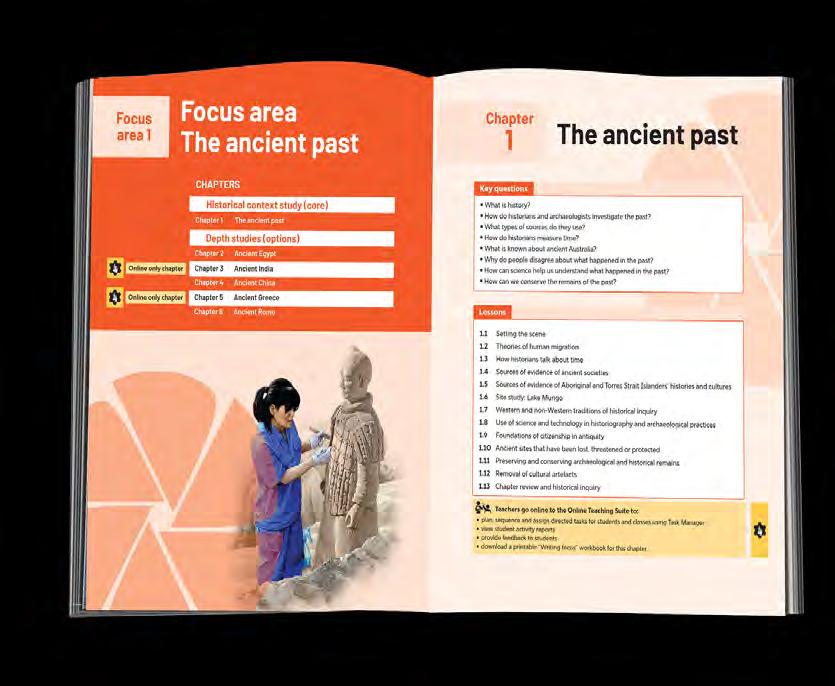
Lessons begin with clear learning intentions and success criteria, and a starter activity to engage student interest. Content is supported by a wide range of sources including text, images and video.
An end-of-lesson review including an online quiz, and review questions that apply students’ skills divided into Knowledge and understanding questions and Thinking and researching tasks.
Historical concepts, skills and inquiry development
Activities and reviews in the book have a footer bar identifying which historical concepts and skills they address, to assist teachers in ensuring full coverage of the syllabus.
Directive verbs in the questions increase in difficulty both within a question set and from Stage 4 to Stage 5.
Each chapter concludes with a scaffolded historical analysis activity, tied to one of the historical concepts. Links
Writing focus
Every student needs to develop strong skills in creating written texts. Our evidence-based approach to building writing skills, overseen by NSW-based literacy experts, uses key high-impact writing strategies in every chapter, including practical, downloadable Writing focus worksheets and chapter review activities.
UNCORRECTEDSAMPLEPAGES
OVERSET TEXT
Additional review questions develop language and sentence structure, auto-marked quizzes include a subject-specific vocabulary focus, and exemplar paragraph-responses in the chapter review model strong writing structure.
Writing focus worksheets can be downloaded as Word files for completion digitally or on a printout
Other worksheets, question sets, and more can be downloaded for completing.
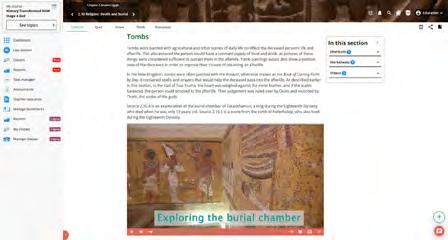
Videos are embedded with in the content.

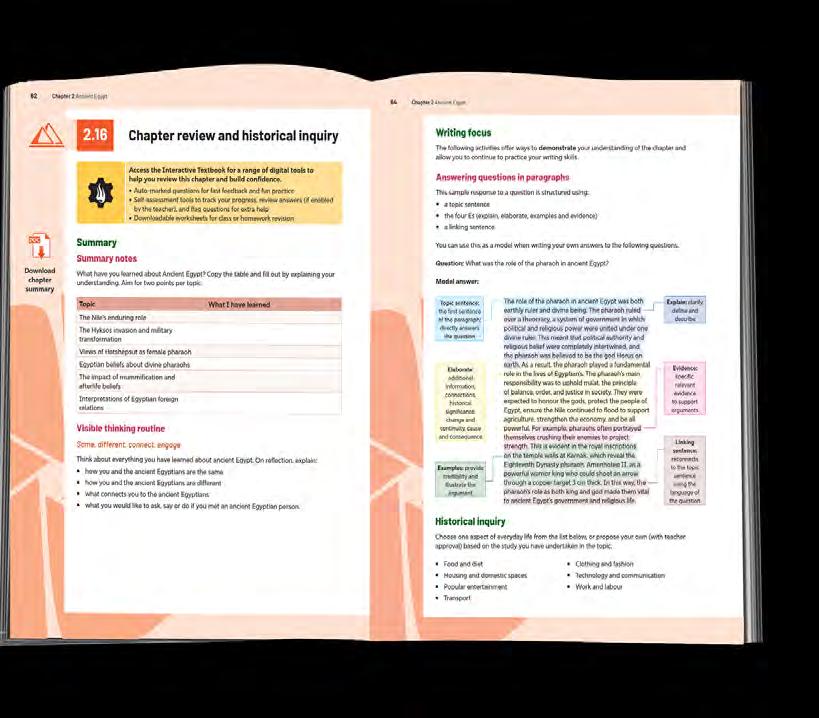
Glossary definitions appear in the margin where the key term first appears in the chapter, and at the end of the book.
Starter activity
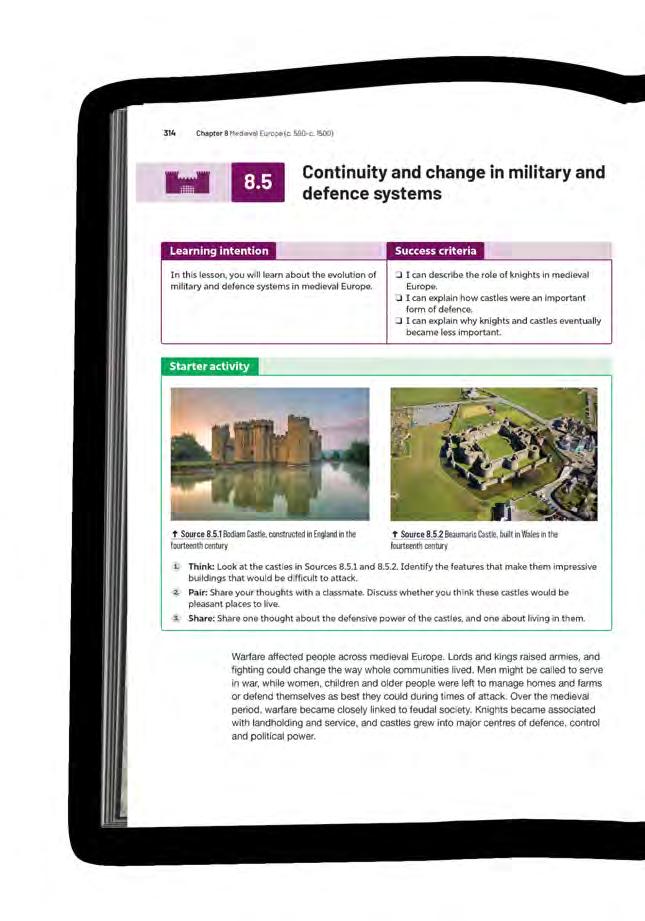
Lesson starter activities spark student interest at the start of class and often include sources as stimulus materials.
Site study
Every depth study chapter includes a site study with activity questions. In some cases sites can be visited in person, while others are virtual site studies.
Activity
A range of activity types, including source analysis, support differentiated learning.
Review
End-of lesson reviews include Knowledge and understanding questions focused directly on the content covered, and Thinking and researching tasks, ranging from creative to historical inquiry tasks.


UNCORRECTEDSAMPLEPAGES
Auto-marked quizzes provide instant feedback on your recall.
Knowledge and understanding questions can be completed in your workbook, or online in workspaces.
Thinking and researching tasks combine engaging content with stimulating activities.
Access sample responses and results online
Chapter review
The chapter review is divided into four sections:
– Summary: complete summary notes and a Visible Thinking Routine
– Questions and activities: answer short questions and undertake creative and research activities
OVERSET TEXT
– Writing focus: read a sample question with annotated response and then complete extended response questions.
– Historical inquiry: undertake a historical inquir y related to the topic.
Using the Interactive Textbook
• Videos: Watch archival primary source videos and video explorations of other sources
• Glossary: Roll over key terms to view the definition.
• Chapter summaries: Revise chapter content with downloadable chapter summaries.
• Quiz: Complete an auto-marked quiz at the end of every section to quickly check your understanding.
• Workspaces: Answer Knowledge and understanding questions online by typing your responses. Self-assessment tools enable you to check your answers if your teacher has provided access to suggested responses.

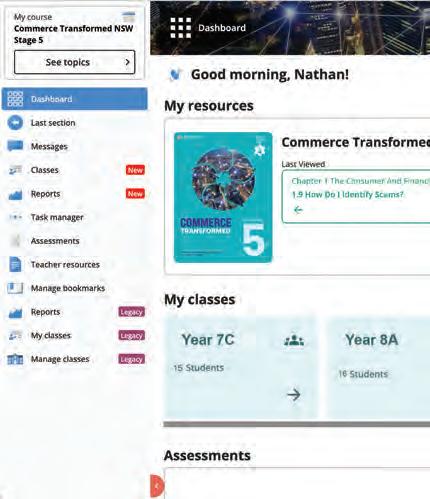
Using the Online Teaching Suite
For your teacher
The Online Teaching Suite is integrated with your teacher’s copy of the Interactive Textbook and includes the powerful Edjin Learning Management System.
Teaching and planning tools
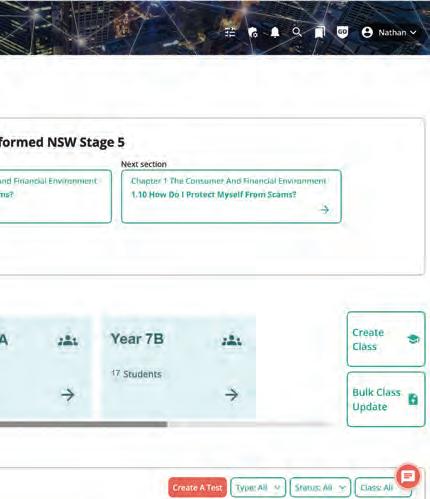
• Create and view tasks for your class using the Task manager.
• Project editable chapter summary PowerPoint slides in class.
• Access teacher notes, Writing focus support documents and suggested responses for all activity questions.
UNCORRECTEDSAMPLEPAGES
• Download an editable syllabus grid and teaching plans for each topic.

The Writing focus worksheets
Writing focus worksheets in every chapter take you through a series of activities to improve your writing skills.
The activities progress from word and sentence to paragraph and composition building as the level of language, including directive terms, increases.
Download individual worksheets from within each chapter in the Interactive Textbook. Your teacher can choose to download all worksheets for the chapter as a workbook.
UNCORRECTEDSAMPLEPAGES
Assessment tools
• Create customised tests from a bank of questions. Tests are auto-marked in the Interactive Textbook or can be printed and used for homework or assessment practice.
• Download chapter test sand worksheets, with or without answers.
• View students’ answers and self-assessment of Knowledge and understanding questions. Student access to suggested responses can be toggled on or off by the teacher.
Reporting tools
• View and export individual student reports or whole class reports.

Focus area
The making of the modern world
CHAPTERS
Historical context study (core)
1. The making of the modern world (1750–c. 1930s)
Depth studies (core and options)
2. The Industrial Revolution (1750–1850)
3. The movement of peoples (1750–1901)
4. Imperialism in Asia (1750–1918)
5. Key ideas and movements (1750–1918)
6. Australia: Making a nation – from Federation to WWI (1889–c. 1919) (core)


Online only chapter
Online only chapter
7. Australia at war – WWII (1939–c. 1945) (core)
8. The Holocaust (1933–1945)
Online only chapter
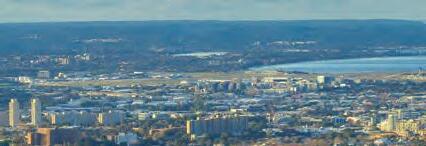



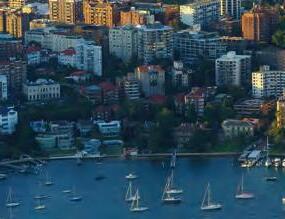













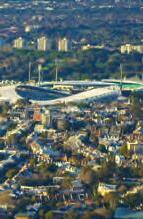









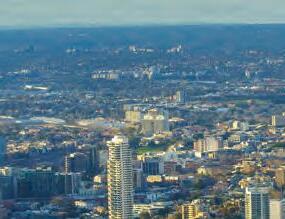
Image: Modern cities like Sydney would not exist without the Industrial Revolution. ➜
Chapter 1
Key questions
Historical context: The making of the modern world (1750–c. 1930s)
• What were the consequences of the Industrial Revolution?
• How did imperialism, migration and slavery affect people?
• What were the consequences of the American and French Revolutions?
• How did nation–states begin?
• Why did World War I start?
• What were the effects of the way World War I ended?
• Which political ideologies emerged in the interwar period?
Lessons
1.1 Setting the scene
1.2 Consequences of the Industrial Revolution
1.3 The impact of imperialism, migration and slavery on the movement of peoples
1.4 The American and French Revolutions
1.5 The rise of nation–states
1.6 The causes of World War I
1.7 The Paris Peace Conference
1.8 Political ideologies in the interwar period
1.9 Chapter review and historical inquiry
Teachers access the Online Teaching Suite to:
• plan, sequence and assign directed tasks for students and classes using Task Manager
• view student activity reports
• provide feedback to students
• download a printable “Writing focus” workbook for this chapter.
1.1 Setting the scene
Learning intention
In this lesson, you will learn about key events that contributed to the making of the modern world.
Success criteria
❏ I can identify key events that caused changes to the way people lived, worked and thought between 1750 and the 1930s.
In the eighteenth century, factories began to replace farms as the main places where people worked. This shift started in Britain, where inventors developed machines that started an “Industrial Revolution”. Steam power made transport and manufacturing much faster and more efficient. This revolution led people to move to industrial towns and cities for work and eventually became a global trend.
While the way people worked and lived changed, their ideas about how the world should be organised also changed. Migration, slavery and revolutions to replace kings with leaders chosen by the people transformed the world. Modern nations such as France and the United States of America emerged, and inspired new ideas about fairness and equality, which led many other people to seek their own independence. Into the twentieth century, rivalries between empires also led to major conflict, resulting in the outbreak of World War I in 1914. The difficult process that ended the war created new organisations for international peace and security, but these failed to prevent a second global war.
UNCORRECTEDSAMPLEPAGES
American Revolutionary War starts
Marx and Friedrich Engels publish The Communist Manifesto
1865
The American Civil War ends and American slavery is abolished
The Meiji Restoration returns the Japanese emperor to power
1901 Australia becomes a federation
1914
World War I starts
1918
World War I ends
1928
The first FiveYear Plan sets goals for the Soviet Union
1933
Hitler takes power in Germany
1917
The Russian Revolution ends the reign of the tsars
1911
The first Chinese Revolution ends the reign of emperors
See, think, wonder
Look at Source 1.1.1.
• What do you see? What design are the two ships in the painting? (I see...)
• What do you think? What is the key difference between them? (I think...)
• What do you wonder? (I wonder...)
1919
The Paris Peace Conference 1929
The Wall Street Crash sparks the Great Depression
Writing focus 1.1
Question words
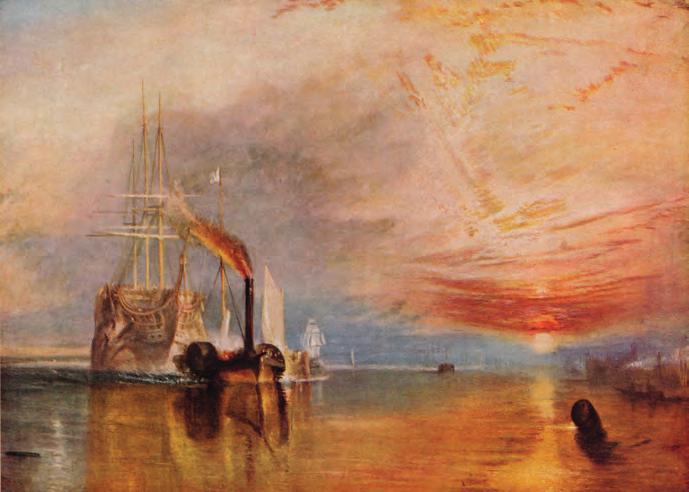
Source 1.1.1 Joseph Turner (British painter), The Fighting Temeraire tugged to her last berth to be broken up, 1838. The painting depicts one of the last remaining British Navy sail-powered ships, being towed away for scrap by a steam-powered tug boat.
1.2
Consequences of the Industrial Revolution
Learning intention
In this lesson, you will learn about the consequences of the Industrial Revolution on living and working conditions.
Starter activity
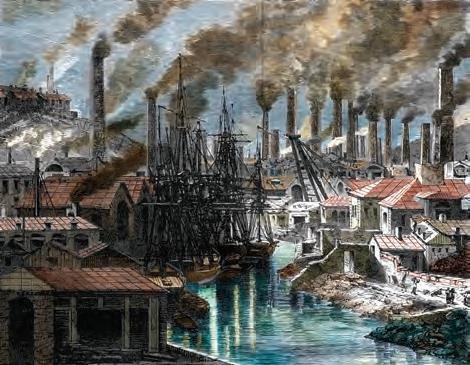
See, think, wonder
Look at Source 1.2.1.
– What do you see in the image?
– What does that make you think about living conditions during the Industrial Revolution?
– What does this make you wonder about life in Cornwall?
Source 1.2.1 View of a copper-making town in Cornwall, England, 1887
Writing focus 1.2
Transitional phrases
Success criteria
❏ I can explain how the Industrial Revolution changed the way people worked.
❏ I can explain how industrial towns developed.
UNCORRECTEDSAMPLEPAGES
From the eighteenth century, when inventors developed a way to harness the power of steam, the Industrial Revolution caused enormous changes to the way people lived and worked. First in Britain and then across much of the world, coal-fired machines dramatically changed the way products were made and transported. This in turn affected the environment and society.
Industrial work
Before the Industrial Revolution, daily necessities such as household goods and clothing were made one at a time, by hand, by skilled artisans. Often, work was done in the family cottage. Family members helped to make the goods, and grew much of their own food. They carried what they made to a market in a nearby town, either in their arms as they walked or on a cart pulled by a horse or mule. When steam power arrived, every step of this process changed.
Many of the changes related to how textiles were made. First, inventors developed more efficient ways to spin fibre into yarn, so that one spinner could do the work of over 100 people. Soon after, inventors combined this idea with larger machines.
The first textile mills were built over fast-flowing rivers, with a large wooden wheel that the running water turned. Belts connected the water wheel to the gears of the machines and looms on the floors above. The mills produced much more cloth than families in their cottages. However, they could only be built where there was a reliable source of flowing water.
From the 1770s, thanks to James Watt’s invention of a new type of steam engine, coalfired steam power began to take the place of water wheels. Steam-powered textile mills could be built closer to the source of the raw fibres. Coal was abundant in Britain, and mine owners sent low-paid workers (men, women and children) deep underground to mine the fuel to sell to mills and factories.
Source 1.2.2 Ms Betty Harris, a 37-year-old drawer in a coal mine describes the conditions in coal mines in 1842.
I have a belt round my waist, and a chain passing between my legs, and I go on my hands and feet. The road is very steep, and we have to hold by a rope; and when there is no rope, by anything we can catch hold of. There are six women and about six boys and girls in the pit I work in; it is very hard work for a woman. The pit is very wet where I work, and the water comes over our clog-tops always, and I have seen it up to my thighs; it rains in at the roof terribly. My clothes are wet through almost all day long.
British Parliamentary Papers, 1842, Vol. XV, p. 84
Source analysis
➜
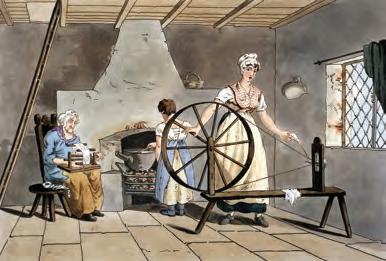
Source 1.2.3 An illustration of a cottage in Yorkshire, northern England, in the 1750s: a mother spins wool while a grandmother reels yarn and a girl stirs a pot on the fire.
UNCORRECTEDSAMPLEPAGES
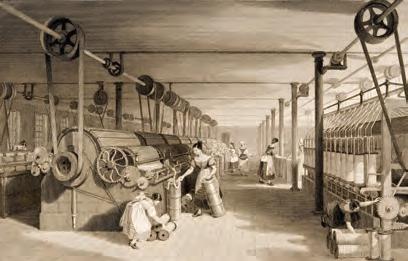
Source 1.2.4 An illustration of a British cotton factory in the 1830s: workers card, draw and rove around the steam-powered textiles machines.
Identify the similarities between the two illustrations of the process of making textiles.
Identify the differences between the two illustrations of the process of making textiles.
Explain what these sources suggest about change in the Industrial Revolution.
Analyse how useful these sources are as evidence of the effects of the Industrial Revolution.
Historical concepts: Continuity and change, Cause and effect Historical skills: Analysis and use of sources, Perspectives and interpretations
urbanisation the migration of people away from the countryside towards cities, which increases the proportion of the population who live in towns
Large and loud steam-powered machines needed enormous buildings. These were called factories, and were designed to maximise the efficiency of production. More efficient factories earned higher profits for factory owners, and lowered the price of goods for customers. However, conditions for workers were frequently poor. There was often limited natural light and fresh air. Owners expected their employees to work for 14 hours a day, paid them low wages and, to begin with, there were no safety laws, so the risk of injuries was high.
Industrial towns
As machinery and steam power revolutionised manufacturing across Britain, Europe and North America, the way people lived changed too. Where there were factories, industrial towns grew up to house the people who moved there in search of work. The pace of urbanisation was faster than any previous point in history.
In Britain at the end of the eighteenth century, only 20 per cent of people lived in towns or cities of more than 10 000 people: the rest lived in the countryside or small towns. One century later, at the start of the twentieth century, around 75 per cent lived in towns or cities of more than 10 000 people. Other industrialising nations also changed from mostly rural to mostly urban: more than half of the Australian population has been concentrated in cities since the 1890s, and the United States hit this point in the 1920s.
Industrial towns grew quickly, and they were planned mostly to support business and trade. Manchester, in northern England, was the first place to grow from a market town (with a population of 10 000 people) to a major industrial city (over 300 000 people by 1851). It became the centre of Britain’s textile industry, and it was linked to other centres by canals and railways. Few industrial towns were planned to include green spaces or community areas for families’ wellbeing. The priority was to support modern industries, and to fit in as many workers as possible.
UNCORRECTEDSAMPLEPAGES
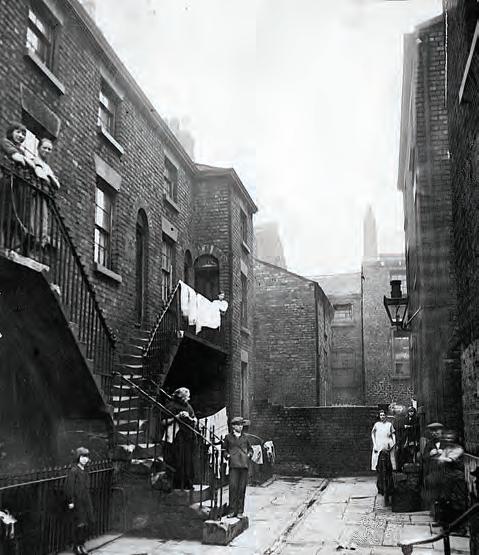
While many factory owners developed housing for their workers, most provided only basic accommodation, which was often crowded and with limited hygiene. The worst examples were known as “slums”, where factory workers, who formed the working-class majority of the population, were forced to live. They had to earn enough wages in the factory to pay the weekly rent to their landlord, who may also have been their employer. It was not unusual for slum houses to have no running water, and for neighbours to share outdoor toilets. Diseases, such as cholera, spread quickly there.
Source 1.2.5 A 1900 photograph of slum housing in Liverpool, England, built during the Industrial Revolution for factory and port workers.
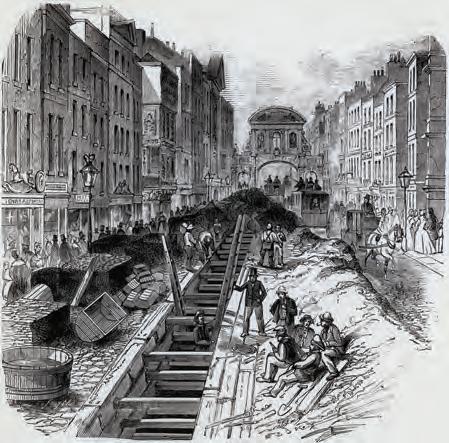
Industrial towns produced economic growth and progress, but they also suffered from environmental problems. The burning of coal for steam power produced air pollution, which was sometimes so severe that it limited visibility in the streets, and caused breathing disorders. At first, waste from factories and houses was thrown into rivers, which became poisoned. In London in the 1850s, the lack of waste management resulted in “The Great Stink”, a notorious episode when people found the smell of water pollution in the Thames River during warm weather to be unbearable. The government was forced to fix the problem by building an enormous sewer system to pump waste out of the city.
Workers also formed trade unions to represent their interests and call for better conditions and services. Gradually, reforms made industrial towns and cities safer and more healthy places to live.
Knowledge and understanding
Identify where and for what purpose the Industrial Revolution began.
Identify the first major industrial city.
Explain the significance of steam power.
Explain the significance of factories.
Explain the positive and negative effects of industrial towns on workers.
Thinking and researching
UNCORRECTEDSAMPLEPAGES
Source 1.2.6 Part of the London sewer under construction in Fleet Street, to reduce the problems of smell and disease by diverting human waste from the Thames River.
Teachers can go online to assign questions, view results, reports and more!
Research an invention from the period of the Industrial Revolution. The invention may be a more efficient way of growing food or fabricating goods, or a machine that changed the world by giving people a whole new way of travelling or communicating. On a single page or screen, present the following information in text and images:
• The who/what/where/when/how of your invention and its inventor.
• How the invention worked.
• How the invention made a difference, by comparing how things were done before and after it was available.
(1750–c. 1930s)
The impact of imperialism, migration and slavery on the movement of peoples
Learning intention
In this lesson, you will learn how European empires, migration and slavery impacted the movement of peoples in the eighteenth and nineteenth centuries.
Starter activity
See, think, wonder
Success criteria
❏ I can describe European imperialism.
❏ I can explain the effects of slavery.
❏ I can explain push and pull factors relating to migration.
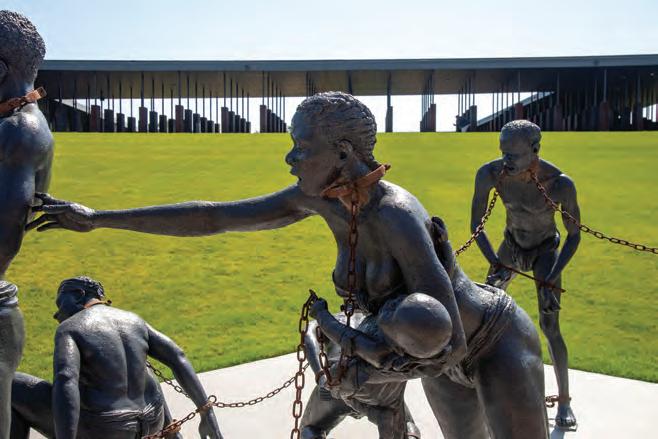
Look at Source 1.3.1.
• What do you see? How are the people represented? (I see...)
• What does it make you think? (I think...)
• What do you wonder? (I wonder...)
European
imperialism
Writing focus 1.3
Developing sentences
European nations that grew in power and wealth through the Industrial Revolution looked to Africa, Asia and the Pacific for places that they could claim as colonies, to give them access to resources, ports and military positions.
Source 1.3.1 Sculptures of enslaved people at the National Memorial for Peace and Justice in Montgomery, Alabama, USA ➜
Early imperialism was focused on trade and coastal ports; later the empires decided to take direct control over huge land areas and large populations of local people. To profit from trade with the rich subcontinent of India, for example, European empires set up “East India Companies”, to control trade in Indian spices, tea and other valuable items. The British East India Company had bases at strategic ports across India from the seventeenth century. The French East India Company (1666–1769) established the city of Pondicherry, while the Dutch East India Company (1602–1799) developed bases across what is now Indonesia, Sri Lanka, and several trading ports along the Indian coast.
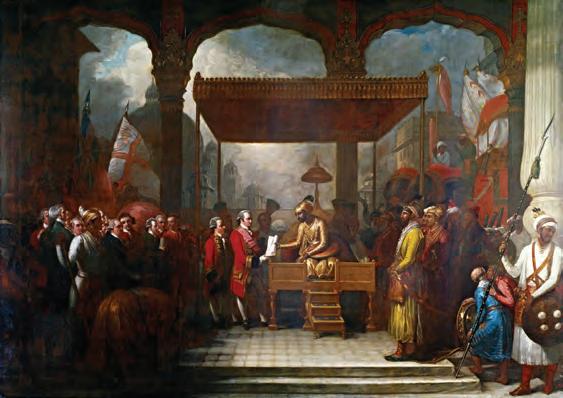
In the late eighteenth century, Britain allowed its East India Company to become a type of government over the colony, with an army larger than the actual British army. They forced Indian princes to allow British officials to collect taxes from local people, and they controlled trade in Indian products such as spices, tea and cotton, so that Britain kept most of the profits.
In 1857, Indian soldiers who were employed by the East India Company mounted a rebellion to protest against military orders that would cause them to break their religious rules. After 14 months, the British prevailed, but they changed the way they controlled the colony of India, removing the East India Company and placing the British Government in direct control of India. The period known as the British Raj began; small groups of British administrators continued to rule the lives of hundreds of millions of Indian people, who would not win their independence until 1947.
Imperialism had similar characteristics on other continents. In South America, for example, the imperial powers of Spain and Portugal used slavery to grow the products they wanted from the Americas. In far away Europe, they drew up borders between Portugal’s colony, Brazil, and other lands claimed by Spain.
In North America, France and Britain fought the Seven Years’ War, starting in 1754, which resulted in Britain taking more control over North American colonies. In the nineteenth century came the “Scramble for Africa” (1880s–1900), where Britain, France and Germany competed for more African colonies.
UNCORRECTEDSAMPLEPAGES
As European powers expanded their empires, they seized land from indigenous populations, and exposed them to new diseases such as smallpox, measles and influenza, which devastated local populations and disrupted their traditional ways of living. People who fought against imperial rule were often punished, and those who died took their language and cultural knowledge with them. Some of this knowledge was lost forever.
Source 1.3.2 The Mughal Emperor Shah Alam, having been defeated in battle in 1765, signs a document to allow the British East India Company to collect taxes from Indian people.
Activity 1.3.1
Source analysis
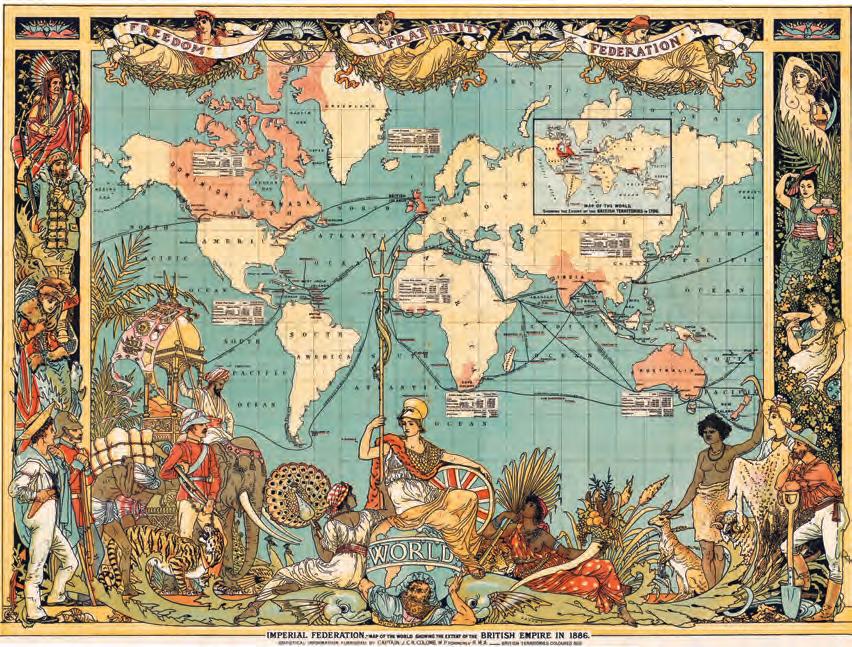
Source 1.3.3 A map depicting the British Empire in 1886, when it was the largest empire in history. British territories are coloured red, and the borders are filled with stereotypes of the people who lived there.
Identify where Britannia, the goddess symbolising Britain, is and what she is holding. What does this suggest?
Explain where British territories are on the map, and what that shows about the role of imperialism at the end of the nineteenth century.
Discuss what the men in red uniforms are holding and what this might represent. Discuss the banners the three women on the top border are holding. What do they suggest about the British Empire?
Historical concepts: Continuity and change Historical skills: Analysis and use of sources, Comprehension
UNCORRECTEDSAMPLEPAGES
The existence of empires, which spanned multiple continents, dramatically increased the movement of people, because it became possible for a person to move to a distant land and remain within their own empire. Thousands of people were employed by imperial governments or companies to leave their homes and move to a far-off colony, to serve as public servants, police or army personnel there. Others moved to a colony to chase the opportunity for a better life.
For example, after Portugal claimed Brazil as a colony, between 700 000 and 800 000 Portuguese people moved there, to take advantage of land offers created by discrimination against local people. In the British Empire, tens of thousands of British families moved to India, first to run the East India Company operations, and after the 1850s, as part of the British colonial government of India. Also, because the British Empire claimed the continent of Australia, large numbers of British people moved to the Southern Hemisphere – as convicts, jailers, or free settlers.
Slavery
Between the sixteenth and nineteenth centuries, over 12 million people were captured in Africa and taken by Portuguese, British, French, Dutch and Spanish ships across the Atlantic Ocean. They were then sold to white plantation owners in European colonies in North and South America, to work without pay. They grew valuable crops like sugar, tobacco and cotton, under the system of slavery. The slave trade was one of the largest movements of people in human history. It changed both the African societies from which people were taken and the American societies into which they were moved.
Conditions on trans-Atlantic slave ships were so poor that historians estimate two million people died. Survivors of the journey then spent the rest of their lives doing hard physical work without pay, with just enough housing and food to keep them able to work. If they had children, they were born into slavery and became the “property” of their parents’ owners. Most enslaved people were taken to Brazil and the islands of the Caribbean. Around 388 000 were taken to what became the United States.
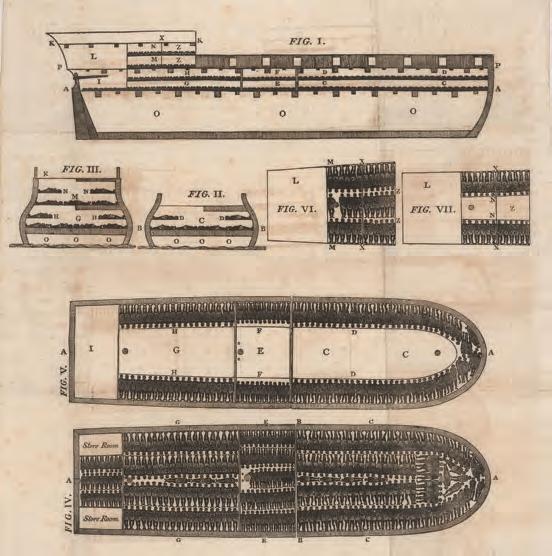
Source 1.3.4 A plan for transporting enslaved people below the decks of an eighteenth-century British slave ship, for a two-month trans-Atlantic journey
UNCORRECTEDSAMPLEPAGES
the
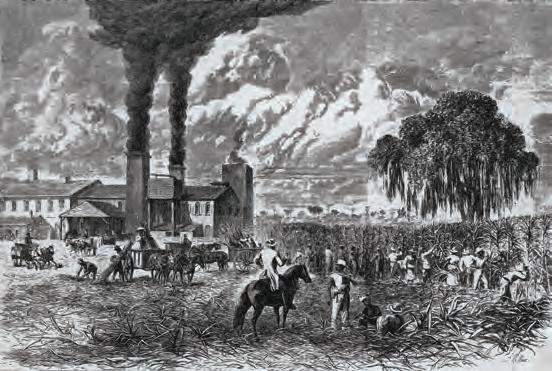
The hard work and suffering of enslaved people changed the environment of colonies in the Americas and contributed to the wealth of European cities and their people. Major industrial ports in Britain and Europe grew rich, both because of the trade in goods created through new industries, and because of the trade in people, as slave ships passed through.
Source 1.3.5 Enslaved people cutting sugar cane on a nineteenth-century American plantation.
slavery
activity of legally owning other people who are forced to work for or obey you
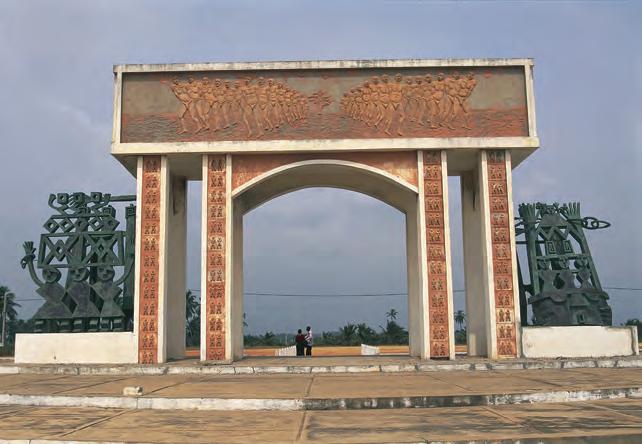
Source 1.3.6 The “Door of No Return” sculpture in Benin, West Africa, a memorial to the people taken via the slave port of Ouidah to the Americas.
From the late eighteenth century, there were movements to abolish the slave trade and to make the system of slavery illegal. Public pressure eventually led to the end of the international slave trade: by France in 1794, Denmark in 1802, and by Britain and the United States in 1807. However, it was still possible to buy and sell people in many places, and illegal smuggling continued.
Movements to end slavery altogether faced opposition, because plantation owners regarded the people they enslaved as their “property”, and claimed that white people were superior to black people. On the Caribbean island of Saint Domingue, a slave revolt won people’s freedom and created the independent nation of Haiti in 1804. In 1829, after winning its independence from Spain, Mexico abolished slavery. In 1833, slavery was abolished throughout the British Empire, including British colonies in the Caribbean. Other South American countries followed in the second half of the nineteenth century. In the United States, the 3.95 million people who were enslaved in southern states were only freed by the victory of the northern states in a Civil War, from 1861 to 1865.
Most people who were freed from slavery remained in the Americas. The culture their families had brought with them from Africa mixed with the culture that had been brought over from Europe, in a new culture known as “Creole”. However, in many places the racist beliefs behind slavery persisted, and oppressed people of African origin. Their fight for equal civil rights would continue into the twentieth century.
Migration
“Migration” usually refers to the movement of people by choice, rather than by force (as in slavery). Even so, people have had various reasons to decide to move to another place.
• “Push” factors are those which force people out of their homelands. They decide to move, because at home their lives involve poverty, famine, overcrowding, or persecution.
UNCORRECTEDSAMPLEPAGES
• “Pull” factors are those which draw people to a different place. This may include the appeal of safety in a new place, financial incentives, land, work, or healthier living conditions.
After the Industrial Revolution, migration occurred in greater numbers than ever before. Locally, especially in Europe, there was the highest ever level of migration from rural areas to towns and cities.
Some were “pushed” away from their farms by new land laws that made it harder for them to access enough land to feed themselves and make a living. Others were “pulled” towards the growing cities, where there was the promise of new types of jobs in factories. Barges on canals and the new technology of railways created links between industrial towns, ports and cities, to transport coal and iron, goods to markets, and passengers. Between 1800 and 1900, London’s population grew from 950 000 to 6.6 million, and Paris from 550 000 to 3.3 million.
Beyond the rise in internal migration, technologies also made possible a rise in international migration. Steamships made long-distance trade and migration more efficient and reliable than wind-powered vessels. Families increasingly used steamships to move between countries and between continents. Again, some felt “pushed” away from the lands of their birth when life became difficult. For example, in the 1840s, the “Potato Famine” left families in Ireland starving and unable to pay their rents, and at least one million people were pushed to migrate to destinations such as the United States and Canada. Several thousand orphan girls from Ireland were also sent to Australia to work as domestic servants.
In India, people who were victims of famines in the nineteenth century similarly left their homelands. Large numbers were forced to accept the offer of free travel to other colonies such as Mauritius or Fiji, where they had to work as indentured servants.
Others chose to migrate due to the “pull” of hope and opportunity. The discovery of gold in Australia in the 1850s, for example, convinced hundreds of thousands of people to purchase tickets and move to British colonies in Australia, in the hope of earning enough to start a new life. As immigrants arrived from multiple different places of origin, the popular destinations, including the United States, Canada, Argentina and Australia became multicultural societies.
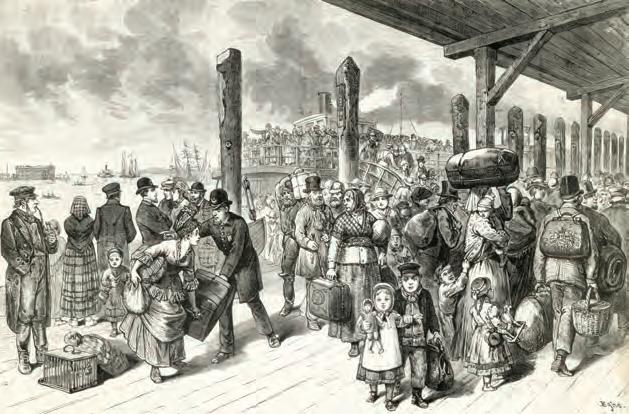
There was a major surge in immigration to the United States towards the end of the nineteenth century. Most of those immigrants moved from Germany, Ireland and England, as well as large groups of Chinese people, until government racial policies turned against Asian immigration. Australia attracted a similar mix of immigrants, to double the Australian population from a little over one million in 1860 to around two million in 1880. In total, historians estimate that over 100 million people migrated to a different country between 1850 and World War I. Source 1.3.7 An illustration of immigrants arriving in New York City, USA, 1878. Seventy per cent of immigrants to America landed in New York.
UNCORRECTEDSAMPLEPAGES
Cause and effect
Classify the following reasons for migration into push and pull factors. Create a table or two lists to show how you have classified the factors.
• Europe’s population doubled in the nineteenth century, making cities more crowded.
• Missions in colonies needed volunteers to teach Christianity.
• European cities had outbreaks of disease due to lack of sanitation.
• Newly developed colonies offered fresher air and cleaner water.
• Gold was discovered in the USA and Australia.
• Droughts in India and China led to famines.
• The Irish Potato Famine (1845–1852): families starved and were unable to pay rent.
• British colonies offered British people the opportunity to settle and run a business.
• New nations such as the USA, Australia and Argentina offered cheap land.
• African people were taken to the Americas to work in plantation slavery.
• Some religious groups were persecuted at home (e.g. Jews in Russia).
• Famines struck India in the 1860s–1870s and 1890s.
• Unemployed people were offered free travel to migrate as “indentured” servants.
• Prisons were full, so convicts were transported to colonies.
Summarise in a short paragraph the causes of high levels of migration after the Industrial Revolution, using some push and pull factors as examples.
Historical concepts: Cause and effect, Significance Historical skills: Comprehension –chronology, terms and concepts, Communication
Knowledge and understanding
Identify which nations built East India Companies to expand their empires.
Explain what happened in India in 1857.
Explain what slavery was, and which nations were involved in the practice.
Explain the effects of slavery on the United States of America.
Explain the scale of migration in the late nineteenth century.
UNCORRECTEDSAMPLEPAGES
Thinking and researching
Research how the nation of Haiti became independent, and how that related to slavery. On a single page or screen, present in text and images the who/what/where/when/how of the independence of Haiti.
concepts: Cause and effect, Significance
1.4
The American and French Revolutions
Learning intention
In this lesson, you will learn about two events in the late eighteenth century, which not only completely changed the way individual nations were ruled, but also influenced ideas about rights and democracy across the modern world.
Starter activity
Claim, support, question
Success criteria
❏ I can explain the consequences of the American Revolutionary War.
❏ I can explain the consequences of the French Revolution.
Source 1.4.1 Extract from the Preamble to the US Declaration of Independence, 4 July 1776 ➜
We hold these truths to be self-evident: that all men are created equal, that they are endowed by their Creator with certain unalienable rights, that among these are Life, Liberty and the pursuit of Happiness.
Source 1.4.2 Extract from the Declaration of the Rights of Man and Citizen, August 1789 ➜
Men are born and remain free and equal in rights. … These rights are liberty, property, security, and resistance to oppression. US Declaration of Independence, Philadelphia, 4 July 1776
Declaration of the Rights of Man and Citizen, National Assembly, Paris, August 1789
Claim: Based on these sources and what you may already know, what do you think the American and French Revolutions may have tried to achieve?
Support: What evidence or reasoning can you provide to support your claim?
Question: What questions do you have about your claim?
The revolutions in France and America were inspired by the “Age of Enlightenment”, a time of new ideas and great advances in science, the arts and philosophy. Enlightened thinkers argued that each individual should shine the “light of reason” onto the world, rather than accepting what had been common sense for generations.
UNCORRECTEDSAMPLEPAGES
Writing focus 1.4
Paris, France was the centre of the European Enlightenment. Groups of thinkers, known as philosophes, gathered to discuss how the world could be improved. They raised doubts about the common sense of the time, which said that kings were born to rule everyone else.
Transitional phrases
They wondered whether it was more reasonable to say that all people were born with “natural rights”. If all people had rights, why did so few people have a say over how their society was run?
Enlightened ideas spread widely, through books and pamphlets that carried the new ways of thinking. Some made their way to the American colonies, so on both sides of the Atlantic Ocean, the Enlightenment inspired change. Major principles that guide modern societies, including the idea of universal human rights, the rule of law and democratic ideals, began to take form in the American and French Revolutions.
The American Revolution (War of Independence)
Until 1775, Britain ruled 13 English-speaking colonies in North America. Valuable goods and taxes from the American colonies were shipped back to British cities across the Atlantic Ocean, to help make the British Empire the largest and most powerful empire in the world. People who lived in the American colonies had some say over how their communities were run, but they were not represented in the British Parliament that made the major laws.
The eight-year-long War of Independence, or American Revolution, was fought to decide the future of the American colonies. It cost each side over 25 000 lives, and drew in other major empires, including France, Spain and the Netherlands. The American “patriots” won the opportunity to design an independent republic. The United States of America was an example to the modern world of how a nation could be designed, without a king, based on a written set of principles, rights and rules.
Americans were inspired to take up arms because they were annoyed at being forced to pay taxes and tariffs to the British. “No taxation without representation” became their rallying cry. When British soldiers were shipped over to patrol the streets of American cities, violent clashes broke out, and the patriots began to organise armed militias to fight back. They also broke laws that they said were unfair, including throwing the entire cargo of three British Indian tea ships into Boston Harbour in 1773.
UNCORRECTEDSAMPLEPAGES
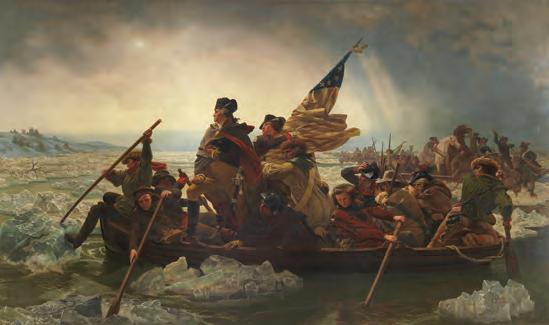
As they converted their separate colonial militias into a single United States Army, the patriots also formed their own law-making body, called the “Continental Congress”. On 4 July 1776, the Congress adopted the Declaration of Independence. They declared that they had the right to reject the British king and live independently: “whenever any form of government becomes destructive of these ends, it is the right of the people to alter or to abolish it, and to institute new Government”. July 4 is now celebrated as the United States Independence Day.
Source 1.4.3 General George Washington crosses the frozen Delaware River on Christmas night, 1776 (Emmanuel Gottlieb Leutze, 1851).
Leaders such as George Washington, the commander of the US Army who would later become the first president of the USA, knew that they would only win if they had outside support. France – a long-time rival of Britain –gave crucial support to the Americans.
In 1783, Britain withdrew its troops and recognised its former colonies as independent states, forming the nation of the United States of America. The United States developed the world’s first complete written national constitution, creating a representative democracy in which no one was above the law, which came into effect in 1789, and put into effect the political ideas of the Enlightenment.
The French Revolution
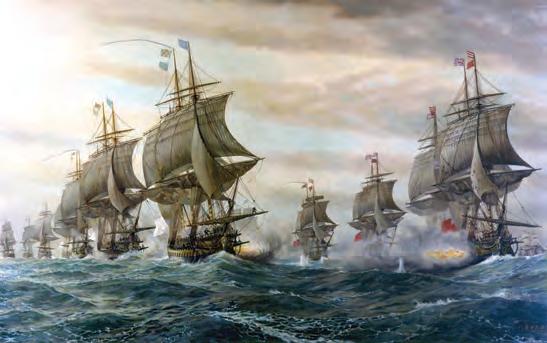
Source 1.4.4 An artist’s depiction of French warships defeating the British in the Battle of the Chesapeake, and turning the war in Americans’ favour, September 1781
France, having committed its resources heavily to support the Americans against the British, hit a financial crisis in the 1780s. King Louis XVI and Queen Marie-Antoinette were criticised for living in luxury, while the national treasury was running low and prices were rising so rapidly that common people were struggling to afford loaves of bread.
Louis XVI believed that God had given him the right to rule the country as he saw fit. This attitude had the support of most of the “First Estate” in French society – people who worked for the powerful Catholic church – and the “Second Estate” – noble families who owned land and advised the king. However, the “Third Estate”, which was around 27 million people, or 98 per cent of the population, suffered and began to question why. They did the physical work and paid rent and taxes, but had none of the privileges of the other two estates. Enlightened philosophes said that this denied the people their natural rights.
On 14 July 1789, a mob of outraged protesters in Paris demanded action. They broke into a royal weapons store, and then stormed the Bastille fortress. The building had been used as a state prison, where people who opposed the king or the way that taxes were applied had been locked up and tortured. The mob, inspired by the slogan of “Liberté, Égalité, Fraternité” (freedom, equality, brotherhood), overpowered the guards, entered the fortress, killed the senior officer and cut off his head. They then marched through the streets with his head on the end of a pike.
UNCORRECTEDSAMPLEPAGES
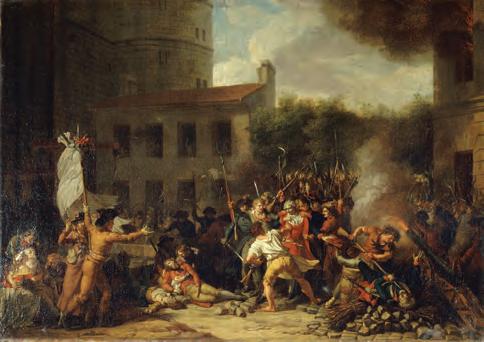
1.4.5
Source
A painting of the storming of the Bastille by an artist living in Paris at the time
The fall of the Bastille became a symbol of the power of common people; Bastille Day is now celebrated as France’s independence day. Afterwards, the Third Estate’s “National Assembly” began to work as the government of France and to restructure the political system. Inspired by the American Declaration of Independence, they issued the Declaration of the Rights of Man and Citizen, which sidelined the king and proposed power by the people, based on rights and freedoms.
The French Revolution ended the monarchy, and abolished the system of privileges that put the nobility and the church above the majority of citizens. Although the later years of the revolution descended into bloodshed, its ideas would inspire people elsewhere to demand more rights, and ultimately the development of international human rights laws.
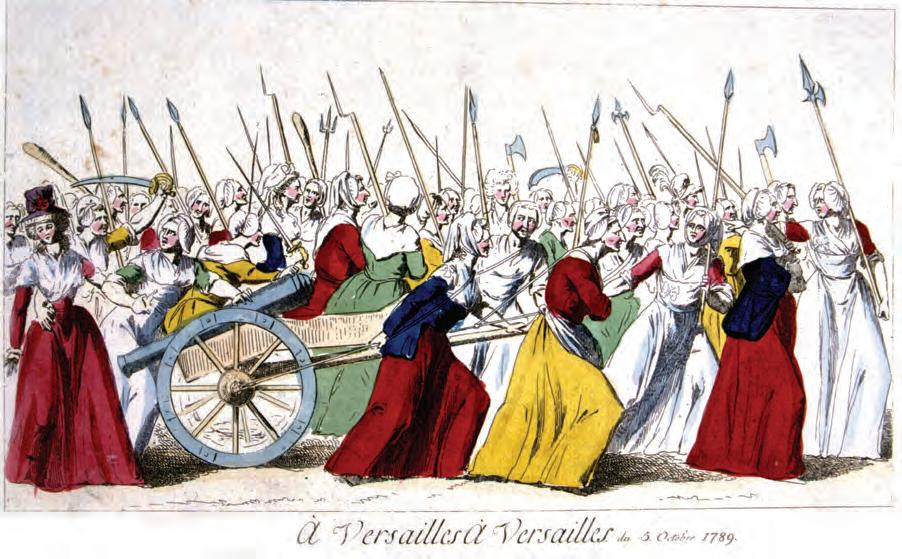
Source 1.4.6 A depiction of the women’s march to Versailles of October 1789, which forced Louis XVI and Marie-Antionette to move to Paris, effectively as prisoners.
Revolutions as a foundation for modern human rights, rule of law and democratic ideals
UNCORRECTEDSAMPLEPAGES
At the time of the American and French revolutions, kings, philosophers and everyday people in many parts of the world followed their progress with great interest. They understood that revolutionaries were not only changing their own countries, but also showing people how to change the way they thought about big ideas, like rights, laws and freedoms. Ever since, the statements made by American and French revolutionaries have influenced the way the modern world has approached those ideals too.
Activity 1.4.1
Source analysis
Source 1.4.7 Excerpts from the French and American declarations of political rights.
Declaration of the Rights of Man and the Citizen, France, 26 August 1789
1. Men are born and remain free and equal in rights. Social distinctions may be founded only upon the general good.
7. No person shall be accused, arrested, or imprisoned except in the cases and according to the forms prescribed by law …
9. As all persons are held innocent until they shall have been declared guilty, if arrest shall be deemed indispensable, all harshness not essential to the securing of the prisoner’s person shall be severely repressed by law.
11. The free communication of ideas and opinions is one of the most precious of the rights of man. Every citizen may, accordingly, speak, write, and print with freedom, but shall be responsible for such abuses of this freedom as shall be defined by law.
United States Bill of Rights (amendments to the Constitution) 15 December 1791
Amendment I: Congress shall make no law respecting an establishment of religion, or prohibiting the free exercise thereof; or abridging the freedom of speech, or of the press; or the right of the people peaceably to assemble, and to petition the government for a redress of grievances.
Amendment IV: The right of the people to be secure in their persons, houses, papers, and effects, against unreasonable searches and seizures, shall not be violated … Amendment VI: In all criminal prosecutions, the accused shall enjoy the right to a speedy and public trial, by an impartial jury of the state and district wherein the crime shall have been committed …
Amendment VIII: Excessive bail shall not be required, nor excessive fines imposed, nor cruel and unusual punishments inflicted.
Identify the main rights that both the French and American documents aimed to protect.
Explain what these documents aim to protect citizens from.
Explain how it could be argued that this was a turning point in history, using these sources as evidence.
Analyse how useful these sources are as evidence of the goals of the American and French Revolutions.
Historical concepts: Cause and effect Historical skills: Analysis and use of sources, Significance
The United States, therefore, was brought into existence by a war for independence and the world’s first written national constitution. The constitution set an example for other modern nations, many of which adopted some of the features of the US Constitution when creating their own constitutions. When they created their independent nation, American patriots established the “rule of law”: that is, the ultimate authority would be laws created by the people, not an individual ruler. The will of the people would be voiced through their representatives, whom they would select through democratic elections. Other written constitutions, including Australia’s, followed this example.
UNCORRECTEDSAMPLEPAGES
The French Republic was also brought into existence by conflict and violence, but this was an internal fight between people who wanted change, and others who wanted to keep the king. Like the American patriots, once the French had swept away the monarchy and the old system, they had the opportunity to create something new, and they decided to base the new system on the principle of equal “rights”. From the late eighteenth century onwards, people had two clear examples of major nations that were based on the idea that all citizens had human rights, including democratic rights, and no ruler or other person could take those rights away from them. Many nations followed this example, by enshrining “rights” in law, and the principle would eventually be adopted by the United Nations, in the Universal Declaration of Human Rights (1948).
Teachers can go online to assign questions, view results, reports and more!
Knowledge and understanding
Identify why American patriots took up arms against the British.
Explain the significance of the Fourth of July.
Explain what the American Revolution achieved.
Identify why the king and queen of France were criticised.
Explain the significance of 14 July.
Explain what the French Revolution achieved.
Explain how the ideas of the American and French revolutions influenced the development of the modern world.
Thinking and researching
Research the life of the Marquis de Lafayette, a prominent French officer who was involved in both the American and French Revolutions. Starting with the Mount Vernon website (https://cambridge.edu.au/redirect/12035), draft five questions – e.g. beginning with who, what, where, when, and why – and note your answers.
UNCORRECTEDSAMPLEPAGES
Historical concepts: Perspectives, Significance Historical skills: Research, Communication
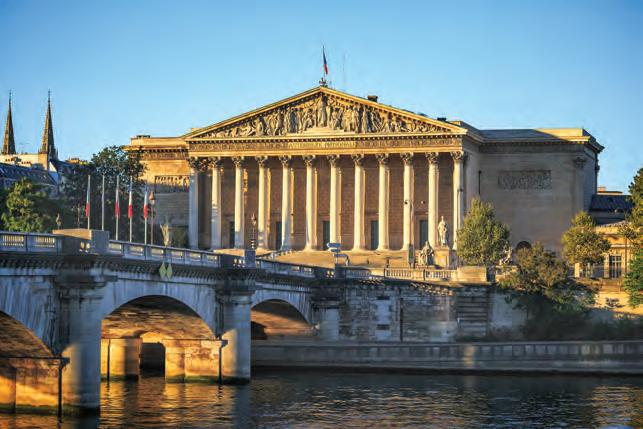
Source 1.4.8 Old building of the National Assembly in Paris
1.5 The rise of nation–states
Learning intention
In this lesson, you will learn about the ways in which some of the main modern nation–states emerged.
Success criteria
❏ I can describe the key features of a modern nation–state.
❏ I can explain the significance of the 1848 revolutions.
❏ I can explain how Japan, Australia, China and Russia became modern nation–states.
Claim, support, question
Consider the following definitions:
• A nation: a large group of people within defined borders who share a common language, culture and identity
• A state: a government that is sovereign over its territory, or independent and not controlled by any other country.
Claim: Based on these definitions, what do you think a “nation–state” is?
Support: What evidence or reasoning can you provide to support your claim?
Question: What questions do you have about your claim?
The 1848 revolutions
In 1848, uprisings and revolutions broke out across Italy, Austria, Germany, France, Poland and Denmark. They were led by people who wanted to establish new nation–states and give their people a greater say in the way they were ruled. Most of the uprisings were fought against kings and queens, monarchs who had failed to support their people during hard times.
Italy
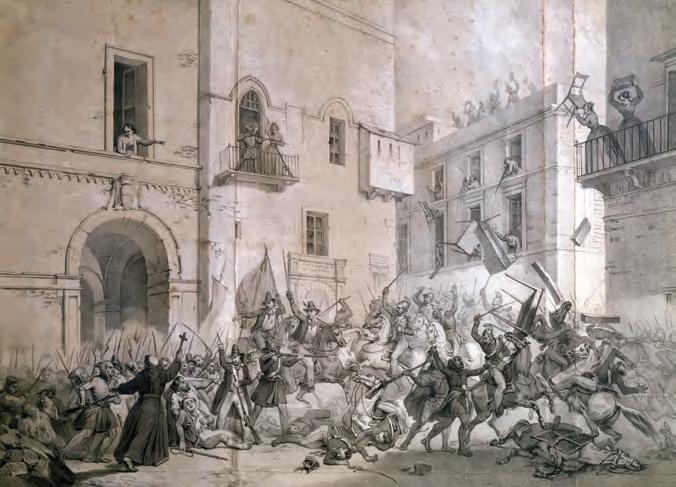
At the time, there was no nation–state of Italy. A movement to create one started in an 1848 revolution in Sicily, where protesters took to the streets to rise up against the Spanish Bourbon dynasty of Ferdinand II. The revolution was at first successful and a new state of Sicily, with its own parliament, existed for several months. Sicily was then defeated by the Bourbon army, but the movement for an Italian nation–state continued in the north of Italy. It was a fight for the “Risorgimento”, or resurrection, of Italy, led by Giuseppe Garibaldi, who was known throughout Europe and South America as a daring leader of guerilla wars of liberation.
UNCORRECTEDSAMPLEPAGES
Modern Italy came into being after a further series of battles against foreign rulers, again involving Garibaldi. His soldiers were welcomed into Sicily and Naples by the local people, and Garibaldi then handed control of southern Italy to King Victor Emmanuel. This meant that from 1861, there was a united “Kingdom of Italy”, in which the king controlled the armed forces and chose the ministers of state, while the elected parliament made all other laws.
France
In France, the monarchy was deposed during the French Revolution, but in 1804 Napoleon Bonaparte was declared Emperor, and then in 1814 the monarchy returned. However, in 1848, people took to the streets again, and replaced the king with a state ruled by a sovereign parliament. This created the Second Republic (1848–1852), which allowed all men to vote, and abolished remaining forms of slavery. However, the government was unstable, and Napoleon III (the first Napoleon’s nephew) brought it to an end, by seizing power with the help of the military.
France did not finally end its time as a monarchy until Napoleon III was overthrown in 1870. France then became a democratic nation–state, known as the “Third Republic”, with a new written constitution adopted in 1875.
Germany
In Germany in 1848, people rose up to replace the Austrian Habsburg monarchy, and created a unified German nation, with its own parliament.
UNCORRECTEDSAMPLEPAGES
This did not last, but when Germany won the Franco-Prussian War in 1871, a new “German Empire” was proclaimed. The empire united 26 German states into a single nation, under King William I of Prussia. This idea was developed not by the people as a whole, as in 1848, but by military leaders and other rulers, especially Prince Otto Von Bismarck, who ruled as Chancellor (similar to prime minister) from 1871 to 1890. Although Bismarck’s motto was “blood and iron” – which suggested that Germany would rise through conflict and strength – the new nation–state also included democratic principles of elections, in which some people were allowed to vote. The new Germany became a world leader in social welfare, education and scientific research.
Source 1.5.1 Sicilian people protest in the streets of Palermo, in the 1848 revolution that sparked the idea of the modern nation of Italy
Other pathways to becoming nation–states
The rise of nation–states across Europe
In the nineteenth century, there were also other movements to create new nations, involving people who shared a common language or culture. In 1830, following a revolution against rule by the King of the Netherlands, Belgium – which had been known as the Southern Netherlands, and before that, part of France – became an independent kingdom. It would become a constitutional monarchy, where the king shared powers with his ministers. At a similar time, following a war against the Ottoman Empire, the separate kingdom of Greece was created. Following a revolution, the king of Greece was forced to accept a constitution, in which the king shared powers with a parliament.
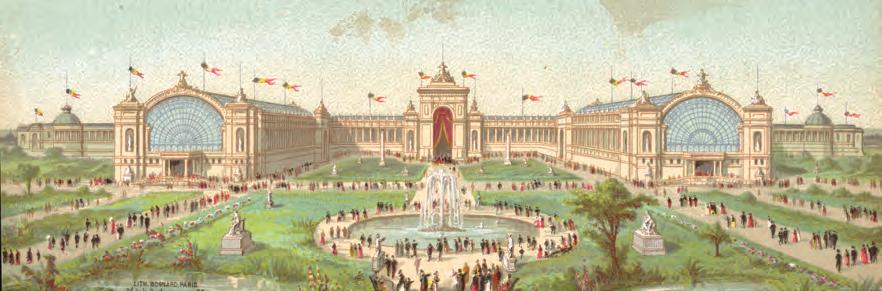
Source 1.5.2 Belgian flags fly over the Brussels Exhibition of 1880, celebrating 50 years of independence from Dutch rule. ➜
In the Balkans region, there were long-running rebellions to try to separate countries from their colonial master, the Ottoman Empire. Romania won a war to separate itself from the Ottomans and declared its independence in 1877. The Russian Empire helped other Balkan states to fight for their independence. These wars enabled Serbia to declare independence in 1878 and Bulgaria to become an autonomous (self-governing) state within the Ottoman Empire.
Interestingly, although Belgium, Greece, Romania and Bulgaria were created to give groups of people their own separate national identity, borders and flag, they all were given a member of a German royal family to sit on the throne. Serbia, on the other hand, had its own royal family. Serbian kings had more individual power than the other Balkan rulers.
Japan
In Japan in the 1860s, centuries of military rule by powerful shoguns came to an end. A teenaged boy named Mutsuhito was crowned as Emperor Meiji in September 1868. During the “Meiji Restoration” period, the feudal system that gave privileges to certain families was replaced, and Japan’s political system and economy were modernised.
UNCORRECTEDSAMPLEPAGES
The goals of modern Japan were laid out by the Charter Oath of 1868. It stated that Japan should abandon old customs and restrictions on contact with the outside world.
Westminster model a parliamentary system where there is a head of state (e.g. the Sovereign), an elected parliament, and a government formed by the party that has majority support
Instead, Japan would seek knowledge from Westerners that would help to build industries and strengthen the nation. Over the next 20 years, Japan would develop a written constitution and a more democratic government, to take into account the views of the whole population. Japan quickly modernised and built a large military, to enable it to compete with other nations and seek new territories as colonies.
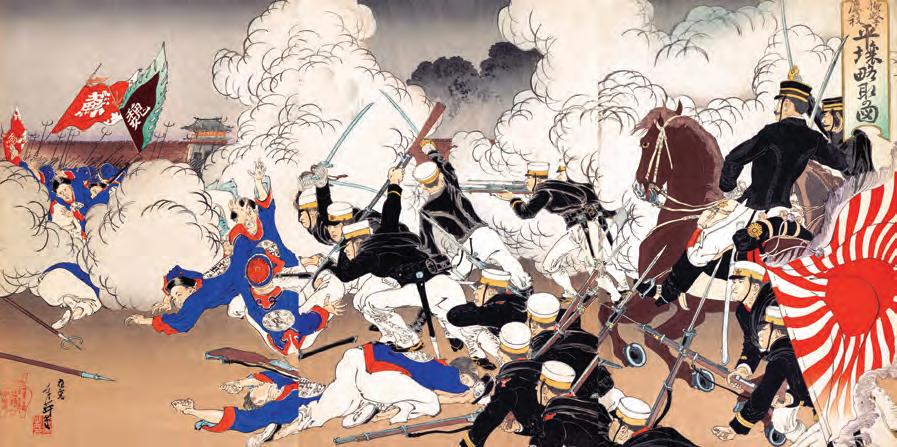
Source 1.5.3 A Japanese depiction of the modernised Japanese army, under its new “rising
defeating China during a battle at Pyongyang, Korea in the 1890s.
Australia
In the last decade of the nineteenth century, there was a movement in Australia to combine the six British colonies into a single nation. Each colony was self-governing. Each had developed its own constitution with laws, courts and parliaments based on Britain’s Westminster model, overseen by a colonial governor, who was Queen Victoria’s representative. The majority of the population on the continent of Australia spoke English as their first language and traced their ancestors to Britain or Ireland. However, when colonial governments needed to discuss issues they had in common, such as their shared borders or policies, they related to each other as foreign governments.
People living in Australia were British subjects, but there was a growing debate about how being “Australian” might be different from other ways of being British.
UNCORRECTEDSAMPLEPAGES
Between 1891 and 1899, representatives of the colonies gathered to discuss how they might combine into a single nation. This would be achieved through a public vote, by referendum. They decided not to abolish the colonial systems, but to turn them into states, within a federation – like the USA. The national government became responsible for defence, foreign affairs and trade. They also decided to remain within the British Empire, as a British “dominion” – like Canada, South Africa and New Zealand. A dominion was self-governing, but treated Britain as a partner rather than a foreign country.
sun” flag,
Activity 1.5.1
Source analysis
Source 1.5.4 In 1889, Henry Parkes (premier of NSW) gave a speech at Tenterfield, in which he called for Federation.
The great question which we have to consider is, whether the time has not now arisen for the creation on this Australian continent of an Australian government and an Australian parliament.
… Surely what the Americans have done by war, Australians can bring about in peace. Believing, as I do, that it is essential to preserve the security and integrity of these colonies, then the whole of our forces should be amalgamated into one great Federal army.
… This subject brings us face to face with another subject. We have now, from South Australia to Queensland, a stretch of about two thousand miles of railways and if the four colonies could only combine to adopt a uniform gauge, it would be an immense advantage in the movement of troops. These are two great national questions which I wish to lay before you: one great federal army and a nationwide uniform-gauge railway line.
Identify what Parkes says is essential to be done for the colonies. What does this suggest?
Explain how Parkes refers to another nation as an example. Explain the other great national question that Parkes raises, and the reason he gives for it.
Discuss how Parkes’s support for Federation relates to the definition of a nation–state.
Historical concepts: Significance; Perspectives Historical skills: Analysis and use of sources; Comprehension
China
Nineteenth-century China was a monarchy ruled by the Qing Dynasty, which faced a series of crises that questioned the future of the nation of 450 million people. Two “Opium Wars” were fought against Western powers between 1839 and 1860, because Britain wanted more access to trade with China, and refused to obey the Qing’s attempts to limit imports of the highly addictive drug opium. Following China’s defeat, the island of Hong Kong became a colony of Britain and Chinese ports were forced to open to foreign trade.
UNCORRECTEDSAMPLEPAGES
In the 1860s, a “Self-Strengthening” movement began. The goal was to rebuild China’s prestige by adopting modern technologies, science and military training. In 1900, tens of thousands of radical Chinese nationalists who wanted to end Western influence in China mounted the Boxer Rebellion. They attacked foreign interests in the capital city Beijing and demanded that foreigners leave.
Henry Parkes, “Tenterfield oration”, 24 October 1889
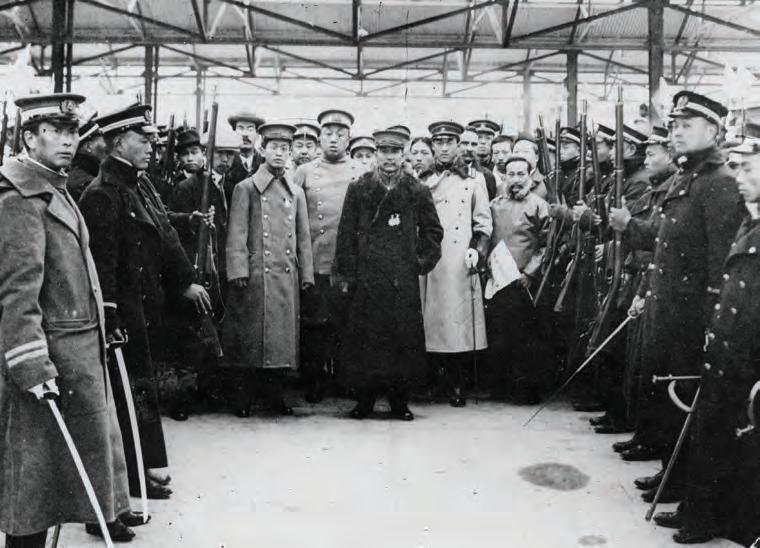
In response, eight western nations sent troops, which defeated the Boxers. The failure of the Boxer Rebellion inspired other nationalists to replace the royal dynasty. The movement was led by Sun Yixian, a medical doctor who had travelled and studied in the West and promoted the principles of nationalism, democracy and livelihood.
The 1911 revolution succeeded in overthrowing the Qing Dynasty and setting up a republic, with political parties represented in a law-making body. However, China fell into the hands of competing warlords, until nationalists retook control in the 1920s. Then in the 1930s and 1940s, while also fighting against the Japanese in WWII, an all-out civil war between nationalists and communists took place, eventually ending in the 1949 creation of the People’s Republic of China, a one-party state under communist control.
Russia
The modern Russian nation–state came about due to revolutions. Russia had been an empire under a ruler called the Tsar since the sixteenth century. Russia contained more than 20 different nationalities and generated enormous wealth. While this benefited the royal family and the nobility, most of the population lived without rights or property, and with poor living standards. In 1905, workers and peasants went on strike and called for a change of leadership. The authorities were brutal in their response, but Tsar Nicholas II was still forced to make changes. He allowed representatives of the people more say in the making of laws, and more civil rights.
UNCORRECTEDSAMPLEPAGES
In 1917, there were two more revolutions. The Tsar lost the confidence of his people due to Russian losses in World War I, food shortages, and his failure to respond to demands for greater democracy. The February Revolution ended the monarchy and placed the royal family under arrest. A provisional government took over. However, communists wanted more radical change, to put the whole nation in the hands of workers and peasants. They promised “peace, bread and land”. After leading a second revolution in October, the Communists killed the tsar and his family to prevent the monarchy from coming back.
Source 1.5.5 Sun Yixian (centre), who inspired the nationalist movement in China, in 1912. ➜
Following the communist revolution, private property was banned, all noble titles and privileges were abolished, and civil rights included gender equality. They believed that Russia as a one-party workers’ state would inspire a worldwide revolution. Because Western nations saw this as a threat, they supported the White Army of monarchists and anti-communist fighters in a civil war across Russia, which lasted until 1922. The Red Army won the war, and made the nation–state of Russia the centre of a federation of republics called the Soviet Union.
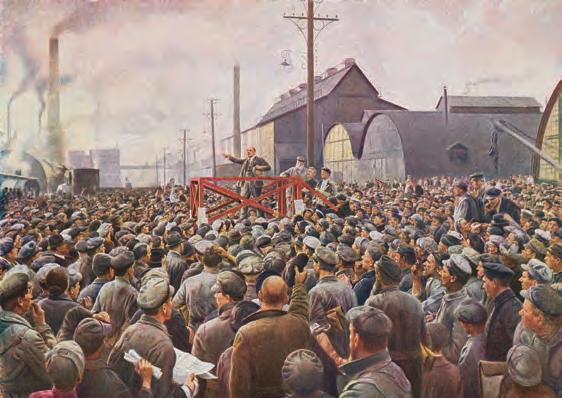
Source 1.5.6 A painting of Vladimir Lenin, leader of the communist Bolshevik Party, gathering support by speaking to workers on strike at one of Russia’s largest factories, 1917.
Knowledge and understanding
Define a nation–state.
Explain how the modern nation of Italy was established. Explain the significance of the Charter Oath in Japan.
Explain what the nation–state of Australia had in common with the design of the United States, and how the process of becoming a nation–state was different.
Compare how China and Russia changed in the early twentieth century.
UNCORRECTEDSAMPLEPAGES
Teachers can go online to assign questions, view results, reports and more!
Research the ideas of Karl Marx, who inspired communist revolutions. In a single paragraph, summarise what he said about the problems of the world and how they should be solved.
1.6 The causes of World War I
Learning intention
In this lesson, you will learn about factors that had built up in Europe over decades, which made the outbreak of war more likely, and how an assassination sparked the fire of war.
Success criteria
❏ I can explain the long-term and short-term causes of World War I.
❏ I can analyse the usefulness of historical sources about key events.
See, think, wonder
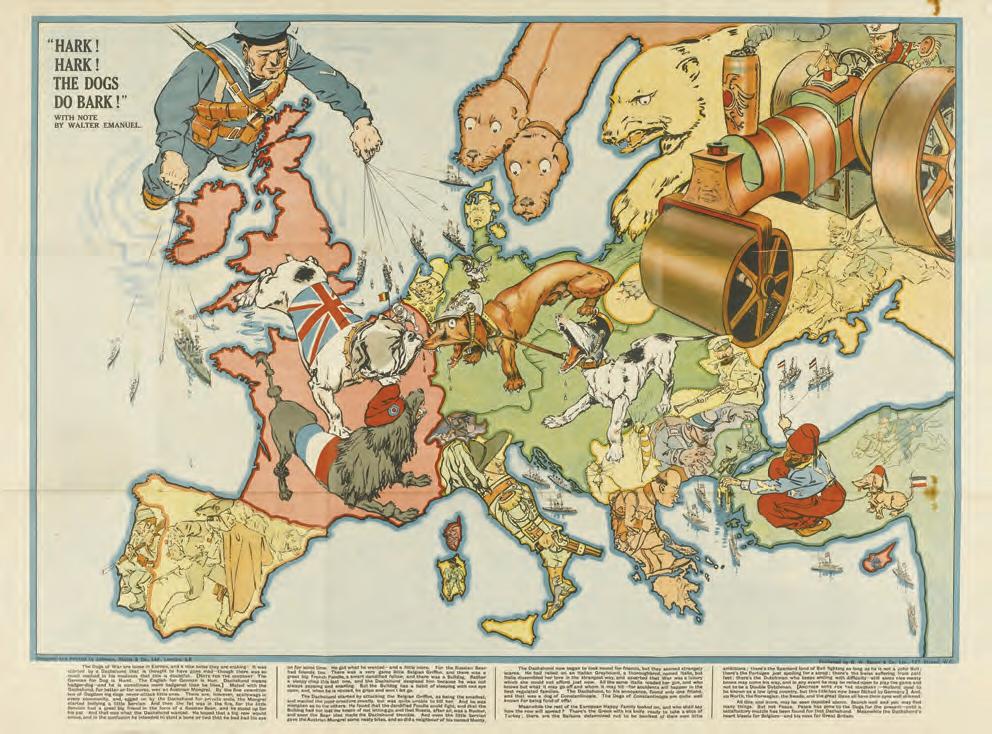
What do you see? How are the countries represented? (I see...)
What does it make you think? (I think...) What do you wonder? (I wonder...)
World War I broke out in 1914, triggered by the assassination of Archduke Franz Ferdinand, heir to the Austro-Hungarian throne. However, this was the short-term catalyst which sparked hostilities. There had been a long-term build-up of tensions and rivalries between Europe’s great powers – Britain, France, Germany, Austria–Hungary and Russia.
Long-term causes
These long-term causes of the war can be summarised using the acronym MAIN: militarism, alliances, imperialism and nationalism.
Militarism
In the nineteenth century, war was considered an acceptable means of achieving national glory and international prestige. At the time, it was believed that a nation needed military strength to protect its economic interests abroad; that a strong defence force was needed to defend the homeland and any colonies from invasion; and that a strong military presence would deter other nations from starting new conflicts.
In 1898, Germany began building a naval fleet to protect and extend its international trade. Britain, who “ruled the waves” with the most powerful navy in the world, was alarmed. An arms race developed between the two nations, as each tried to outdo the other with giant gunships and floating fortresses. This only served to inflame tensions and rivalries between the great powers.
Alliances
Writing focus 1.6
Creating topic sentences
assassination the murder of a prominent individual, often for political purposes catalyst a person or thing bringing about a change or an event
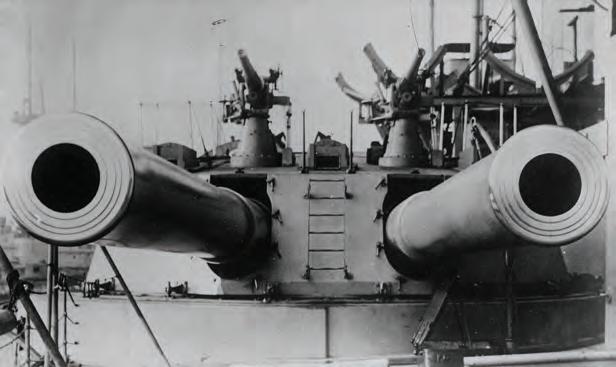
As the great powers grew fearful of each other’s military strength, they signed treaties, alliances and promises of aid with each other. These obliged countries to defend their allies, if fighting began. On the one hand, alliances deterred conflict. On the other hand, if deterrence failed and conflict began between two nations, it could rapidly draw in their allies and escalate into a regional war.
UNCORRECTEDSAMPLEPAGES
By 1907, there were two clear alliance systems – the Triple Alliance, which was formed by Germany, Austria–Hungary and Italy; and the Triple Entente, involving Britain, France and Russia (in 1914, they became the core of “The Allies”). The sense of security provided by membership in an alliance emboldened some nations to act more assertively than perhaps they otherwise would. These developments also increased fear and tension between the two groups.
arms race the increasingly competitive procurement of offensive armaments or spending on the military
deterrence a show of strength or use of threats to discourage others from taking unwanted actions
Source 1.6.2 The giant guns on HMS Dreadnought, the monster battleship launched in 1906 and known as the “most powerful thing in the world”. Each of her 10 guns could fire a half-ton shell as far as 16 km.
➜






















ATLANTIC OCEAN






































Imperialism















Triple Alliance



Triple Entente
Neutral countries
RUSSIAN
29-30 July 1914











UNCORRECTEDSAMPLEPAGES




















Source 1.6.3 Countries and empires that made up the Triple Entente and the Triple Alliance in 1916 (note Italy switched its alliances). The year each participant entered the war is also listed. ➜
The great powers of Europe had for centuries expanded their empires across Africa and Asia. When a great power ruled a colony, they had a source of cheap labour, valuable resources and prestige. This practice of imperialism put them in competition with each other.
Britain and France had established empires throughout the world long before Germany unified in 1871. Now Germany hoped to establish its own “place in the sun”. This led to competition to control territory and establish colonies, particularly in Africa, for the purpose of exploiting native peoples and acquiring raw materials to transport back to Europe for industrial manufacturing.
UNCORRECTEDSAMPLEPAGES
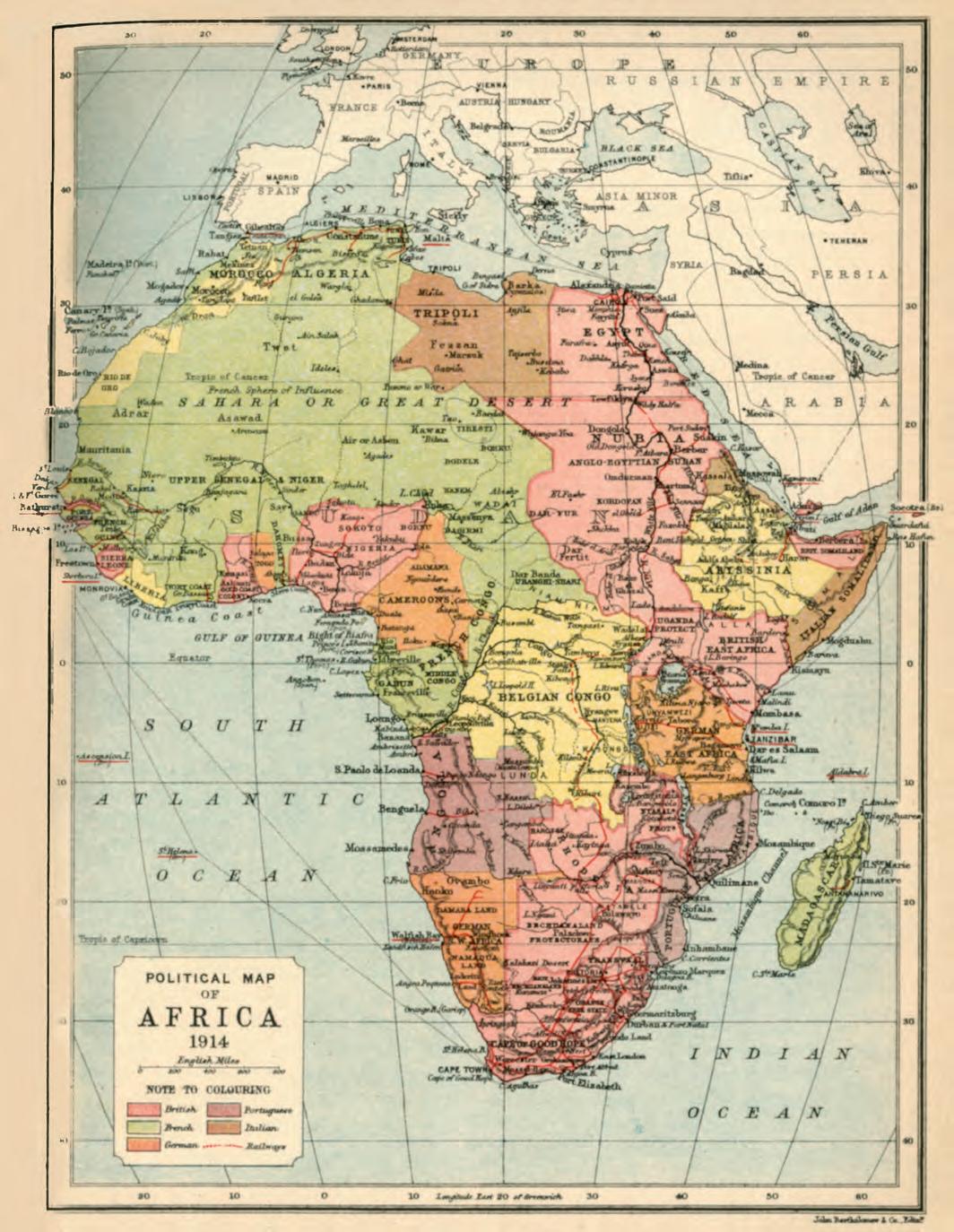
Source 1.6.4 A 1914 map, showing how European empires had claimed colonies during the “scramble for Africa”: British (pink), French (green), German (orange), Portuguese (purple) and Italian (brown).
annexed the incorporation of another territory into the domain of a country or empire Black Hand a secret Serbian organisation that employed terrorist methods to promote the liberation of Serbs outside of Serbia during the early twentieth century
Nationalism
Nationalism developed throughout the niineteenth century in Europe as modern nation–states replaced smaller kingdoms. Nationalists believed that their country or “race” was different and superior to other people. This belief went beyond “patriotism”, which is a love of your homeland. Nationalism could be used to justify violent actions against perceived threats.
Nationalism further inflamed the growing sense of mistrust and rivalry, because it led governments to work towards goals irrespective of how they might affect other countries. For example, Germany wanted to build an empire of its own even though this would upset Britain and France.
The build-up of tensions and rivalries between the great powers just needed a catalyst to spark open hostilities. This catalyst arrived in June 1914.
Communication
Create a graphic organiser to summarise the MAIN causes of World War I.
Using your knowledge of the Industrial Revolution, write a persuasive argument that explains how the Industrial Revolution encouraged the rise of European nationalism and imperialism. In your response, you should explain how the emergence of these two ideas played a key role in causing World War I.
Historical concepts: Cause and effect Historical skills: Comprehension, Explanation and communication
Short-term causes
The assassination of Archduke Franz Ferdinand
Extension 1.6.1 Young Bosnia and the Black Hand
UNCORRECTEDSAMPLEPAGES
On 28 June 1914, Archduke Franz Ferdinand, heir to the throne of Austria–Hungary, was attending an official event in Sarajevo, the capital of Bosnia Herzegovina. Bosnia Herzegovina had been annexed by Austria–Hungary in 1908, causing resentment among many Bosnian Serbs who wished to join with Serbia. Ferdinand and his wife were travelling in an open-top car when they were shot by Gavrilo Princip, a 19-yearold student. Princip was a member of the “Young Bosnia” nationalist/terrorist group, who had been armed by the Serbian Black Hand organisation.
The assassination of their heir to the throne was the ultimate excuse for Austria–Hungary to punish Serbia, which had been working to undermine the Austrian Empire.
Activity 1.6.2
Source analysis
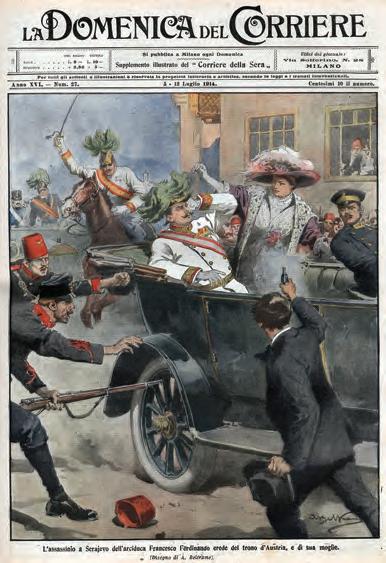
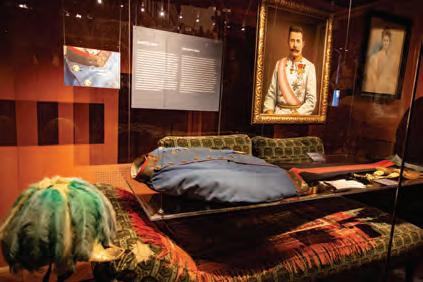
Source 1.6.5 The assassination of the Austrian Archduke Franz Ferdinand, as depicted by an artist in a popular Italian magazine, 5 July 1914.
Examine Source 1.6.5. Why might the choice of transport have left the royal couple vulnerable to potential assassins?
How reliable is Source 1.6.5 as a source of historical facts? Explain your thinking.
In your opinion, is it appropriate to display the coat shown in Source 1.6.6 in a public museum? Discuss, giving reasons for your answer.
Historical concepts: Significance, Perspectives Historical skills: Analysis and use of sources, Perspectives and interpretations
The July Crisis
Austria blamed the Serbian nationalist movement, but before taking action, Austria sought support from its ally Germany. Germany responded with an open offer to support whatever action Austria–Hungary chose to take against Serbia, known as the “blank cheque” (a term for promising an unlimited amount of something). Feeling confident, Austria issued Serbia with an ultimatum: unless Serbia met a long list of demands, they would be at war. When Serbia refused to allow Austrian police into Serbia, Austria–Hungary declared war on 28 July 1914, and started bombing the Serbian capital Belgrade two days later.
UNCORRECTEDSAMPLEPAGES
This triggered other nations’ obligations under alliances. Within a week, Russia mobilised its forces in support of Serbia, and Germany declared war on Russia and France. When Germany implemented the “Schlieffen Plan” it had developed a decade earlier, by invading France through neutral Belgium, Britain was obliged to defend Belgium because of a treaty it had signed in 1839.
Source 1.6.6 Franz Ferdinand’s blood-stained uniform, on display in the Military Museum in Vienna, Austria. ➜
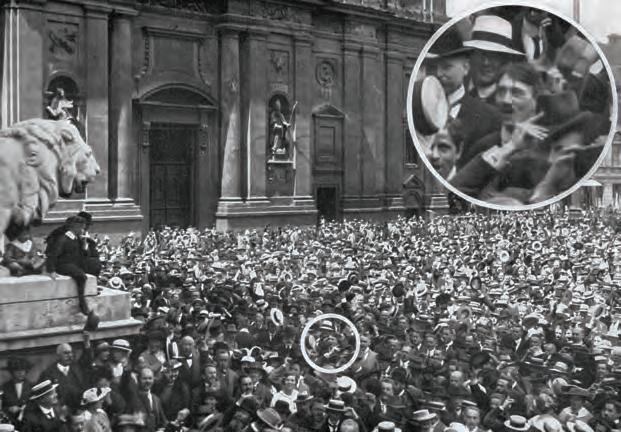
Britain declared war on Germany, on behalf of all its empire (including Australia, Canada, India, New Zealand and South Africa), on 4 August.
➜ patriotism an intense love and support for one’s nation and its interests
Source 1.6.7 Photograph of a crowd in Munich, Germany, 2 August 1914, celebrating Germany’s declaration of war on Russia. Circled is future Nazi leader Adolf Hitler.
The leaders of each nation involved said that their cause was just, that they were fighting in self-defence, and that “God was on their side”. Each said that the “other side” was to blame for causing the war. Swept up by the atmosphere of patriotism and misguided optimism, people flocked to the major cities to enlist, or to cheer on their young men. Many people believed that the war would be “over by Christmas”. While no-one was surprised that the war broke out, it came as a terrible shock that the war would eventually drag out over four years, claim the lives of 20 million people, and end three of the world’s great empires.
Teachers can go online to assign questions, view results, reports and more!
Knowledge and understanding
List the five great powers of Europe.
Define the term “militarism” and explain how it created tension between the great powers.
Explain alliances and how they made a world war more likely.
Identify the long-term causes of World War I.
Explain the aim of the Young Bosnia group.
Explain why many members of the public may have reacted positively to the outbreak of war.
Which of the long- and short-term causes was the most important contributor to the outbreak of war in August 1914? Discuss, giving reasons for your answer.
UNCORRECTEDSAMPLEPAGES
Research what the politician Andrew Fisher said about Australia becoming involved in the war of 1914–1918. Discuss what this shows about how Australians saw themselves at the time of the outbreak of war, and what this shows about links between Australia and other countries at the time.
1.7 The Paris Peace Conference
Learning intention
In this lesson, you will learn how the ways in which World War I ended, at the Paris Peace Conference, shaped the post-war world.
Success criteria
❏ I can explain the effects of the Treaty of Versailles.
❏ I can explain how the League of Nations shaped international relations.
See, think, wonder
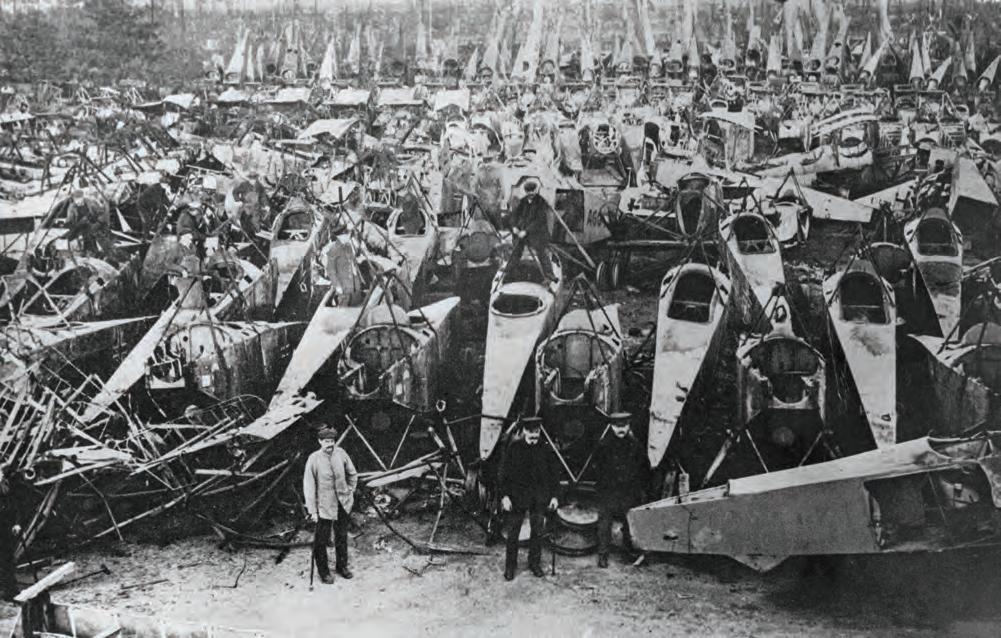
Source 1.7.1 German aircraft being dismantled, c. 1919, under the rules of the Treaty of Versailles, which required Germany to abolish its air force and send scrap metal to France.
UNCORRECTEDSAMPLEPAGES
Consider the following questions for discussion.
What can you see in this image? (I see …)
What do you think about this image? (I think …)
What does this image make you wonder about the end of the war? (I wonder …)
Writing focus 1.7
The language of source analysis
armistice a formal agreement between countries or groups at war to stop fighting for a particular time, especially to negotiate a peace treaty
In late 1918, as the German High Command realised that there was no hope left of victory, the Allies imposed a blockade, which began to starve Germany. Parts of the German military and population then started an uprising, which forced Kaiser Wilhelm to abdicate (step down) on 9 November. He fled to the Netherlands, and power in Germany passed to politicians. Before dawn on 11 November, on a train carriage in a forest north of Paris, their representatives signed an armistice. A cease fire came into effect at 11:00 am that day, and 11 November has ever since been known as “Armistice Day”, or “Remembrance Day”.
The Armistice brought the shooting to an end, but it was only temporary. The war officially continued until permanent peace treaties were signed with each warring nation. These treaties were created during months of discussion in Paris, involving up to 10 000 negotiators representing 32 Allied countries. The Paris Peace Conference drafted the “Treaty of Versailles” to end the war and redraw international borders, and established a “League of Nations” to design a new framework for international relations, to prevent future wars.
The Treaty of Versailles
The main authors of the Treaty of Versailles were the “Big Four” allies, Britain, the USA, France and Italy. They all agreed that they had the right to draft a treaty and force Germany to accept its terms, without inviting Germany to the negotiations in Paris. The key effects were:
• Reduce the size of Germany’s territory: Germany had to surrender all its colonies; return Alsace–Lorraine to France; cede land to Belgium, Poland and Czechoslovakia; accept French occupation of the Rhineland; and never again unify with Austria.
• Charge Germany compensation: reparations of 269 billion marks (approximately $440 billion in today’s money) would have to be paid to the Allies; plus the equivalent of 96 000 tons of gold; and Germany would formally admit that it was guilty of causing the war.
• Weaken Germany: Army to be limited to 100 000 men, with no conscription, no tanks, no heavy artillery, no poison gas supplies, no aircraft and no airships; the German navy to be limited to six battleships and no submarines.
In May 1919, the text of the 440 articles of the treaty was delivered to German politicians, who protested that the terms would make their country poor and weak. They proposed changes, but every proposal was rejected. In mid-June, the Allies gave Germany five days to accept the treaty unchanged, or face invasion. Some German officials resigned in protest, but the terms were ultimately accepted.
Source 1.7.2 The controversial “War Guilt Clause”, article 231 of the Treaty of Versailles ➜
… Germany accepts the responsibility of Germany and her Allies for causing all the loss and damage to which the Allied and Associated Governments and their nationals have been subjected as a consequence of the war imposed upon them by the aggression of Germany and her allies.
Treaty of Versailles, Part VIII, Article 231, 28 June 1919
On 28 June 1919, German representatives signed the treaty at Versailles. The date was exactly five years since the assassination of Archduke Franz Ferdinand of Austria. The room was the same place where France had been forced by Germany to sign a humiliating peace treaty in 1871, after the last major European war.
Many Germans saw the “war guilt” clause as unfair, and they believed that they faced economic ruin, given the size of the compensation payments. German taxpayers would be paying reparations in instalments for at least the next five decades for the war pensions of British soldiers and the reconstruction of French roads and factories.
Source 1.7.3 German representatives sign the treaty on 28 June 1919, watched by the leaders of the victorious Allies (President Wilson of the USA, Prime Minister Clemenceau of France and Prime Minister Lloyd George of Britain), in the Palace of Versailles. ➜
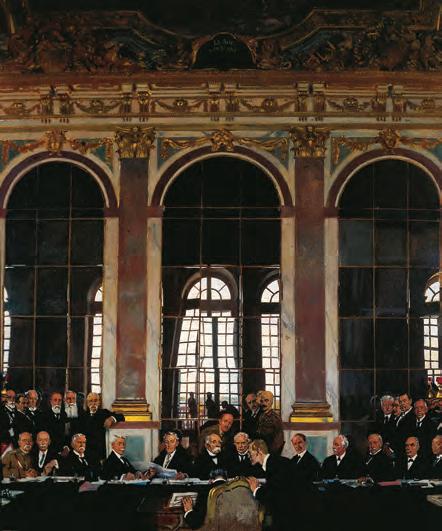
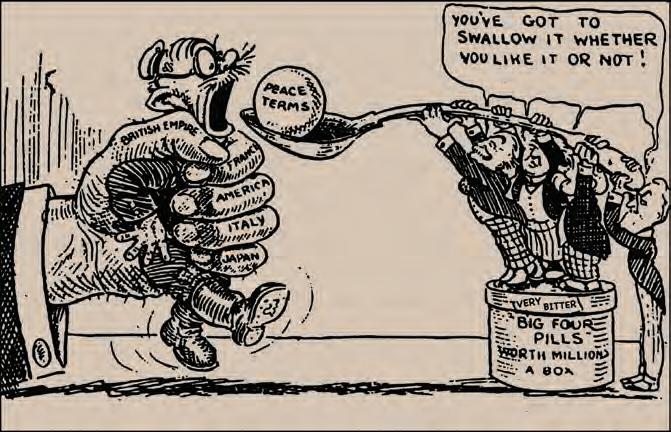
UNCORRECTEDSAMPLEPAGES
Source 1.7.4 “Peace Terms”, a cartoon in a British newspaper, c. early June 1919
Look at the country names written on the hand. These are also represented by the people on the right. Identify what the cartoon says about what they are doing to Germany.
Explain the origin of the source: where was it made and what was happening at the time? Which side were its audience on (the newspaper readers)?
Explain the purpose of the source: what is its message? What emotions might it evoke?
Discuss what makes this cartoon a valuable source for historians, and what it does not help us to understand (its limitations).
A major task of the Paris Peace Conference was to draw new borders to define the post-war world. A huge team of cartographers worked long days in special map rooms, redrawing maps to show the decision-makers what effects the proposals they were debating would have. Many people who before the war had lived in the Russian Empire, the Austro-Hungarian Empire or the Ottoman Empire, now lived in an independent nation. In Europe, these new entities included Czechoslovakia, Estonia, Finland, Latvia, Lithuania, Poland and Yugoslavia.
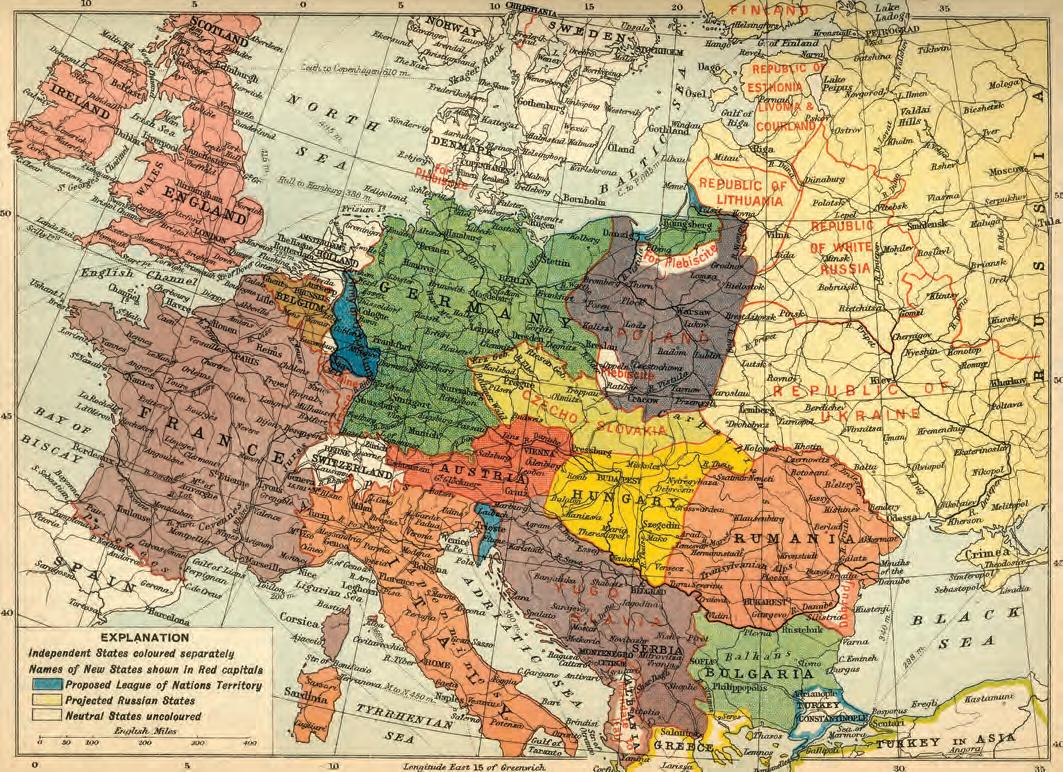
UNCORRECTEDSAMPLEPAGES
It is often said that the seeds of World War II were sown at the Paris Peace Conference. At the time, the Treaty of Versailles was not considered especially harsh by everyone. It was common practice for the winners to punish the defeated, as Germany had done to France in 1871. However, it was clear that Germany would suffer. Some of the newly independent nations would also face difficulties, because they included people who had historical disagreements. In the 1930s, the National Socialist (Nazi) Party rose to power in Germany, in part because the Nazi leader Adolf Hitler promised to ignore the Treaty.
1.7.5 A 1920 map of the redrawn borders of Europe following 1919
The League of Nations
For many people at the Paris Peace Conference, especially US President Woodrow Wilson, the most important question was how to prevent another world war. Wilson brought a list of “Fourteen Points” to the negotiations. His fourteenth point was to create a permanent international organisation involving all countries of the world. This had not been tried before.
The Paris Peace Conference decided to set up a League of Nations, “in order to promote international co-operation and to achieve international peace and security”.
The goals of the League included:
(a) Disarmament: reducing militarism, by limiting the number of weapons in the world and the size of national military forces and banning some weapons
(b) Preventing war: reducing the role of competitive alliances, by requiring all nations to respect each other’s independence, and setting up an international process to resolve disputes
(c) Promoting independence: moving beyond imperialism, to support smaller and poorer countries to become independent, including by giving League members “mandates” to supervise areas that had been colonies before World War I
(d) Encouraging a one-world view: reducing the power of nationalism by setting up international organisations and international standards for people’s rights, health and welfare, to aid refugees and ethnic minorities, improve women’s equality and workers’ conditions, and end the trade in drugs.
The League of Nations was not a world gover nment, but it was the first step in modern history towards a global system of standards, laws and rights. The hope was that the more often representatives from different nations met each other, the better they would understand each other’s cultures and points of view.
In the early 1920s, the League of Nations had 48 member states, and by the early 1930s that rose to 58. The League made some significant achievements. It transported over 500 000 prisoners of war home after World War I, housed and fed refugees, freed over 200 000 people from slavery, reduced the spread of diseases such as malaria and leprosy, and resolved some disputes.
UNCORRECTEDSAMPLEPAGES
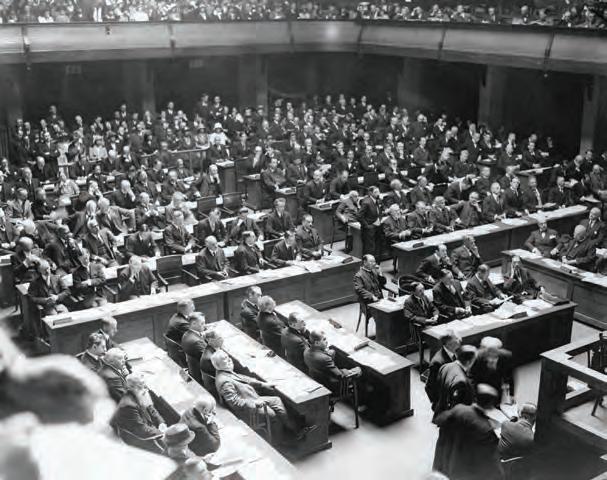
However, the League had no armed forces, and limited powers. Plus, the richest and arguably most powerful nation, the United States, chose not to join. Source 1.7.6 A League of Nations conference in 1924, organised in a similar way to a parliament.
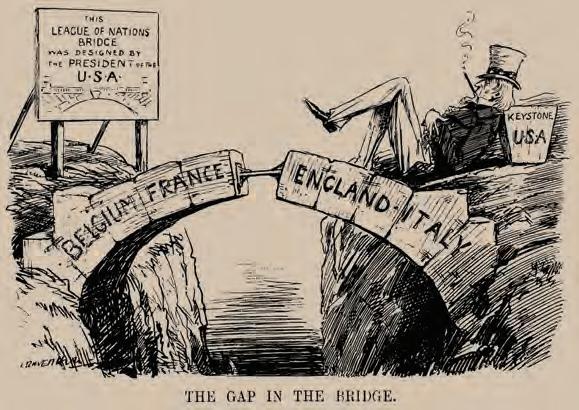
Woodrow Wilson’s party was defeated at the 1920 election, and Americans swung towards “isolationism”, to keep out of other countries’ problems. Into the 1930s, Italy and Germany (which had not been allowed to join the League until 1926) would expose the League’s limits, by ignoring the League’s decisions, building powerful armies and invading territories.
The Mandate system was also controversial. The League decided which nations were not yet ready to be fully independent, and needed “advanced nations” to supervise them. Some believed that they were treated as mere colonies. For example, Britain was given a mandate to supervise Palestine and Iraq, France to supervise Syria and Lebanon, Australia to supervise New Guinea, and New Zealand to supervise Samoa. In Palestine, Britain said that it would support both a national home for the Jewish people (which later became Israel), and do nothing to take away the rights of Arab communities who lived there. That would prove to be an extremely difficult balancing act which, like other League-led efforts, began to collapse in the late 1930s, as another world war threatened.
Knowledge and understanding
Identify the difference between an armistice and a peace treaty.
Explain points for and against the argument that the Allies were justified in imposing the terms of the Treaty of Versailles on Germany.
With reference to the main causes of World War I, explain the goals of the League of Nations.
Explain why the League of Nations was an achievement.
Explain the weaknesses of the League of Nations. Use Source 1.7.7 as evidence in your response.
Thinking and researching
Look up information about the Palace of Nations. Create a one-page summary, in a detailed paragraph, poster, or mind-map that explains how the palace represented the ideals of the League of Nations, and to what extent those ideals are still relevant today.
UNCORRECTEDSAMPLEPAGES
Source 1.7.7 “The Gap in the Bridge” left by American isolationism, according to a 1919 cartoon.
1.8 Political ideologies in the interwar period
Learning intention
In this lesson, you will learn about the Great Depression and the political ideologies that emerged after World War I and before World War II.
Starter activity
See, think, wonder
Success criteria
❏ I can explain economic problems that emerged in the interwar period.
❏ I can explain competing political ideologies of the interwar period.
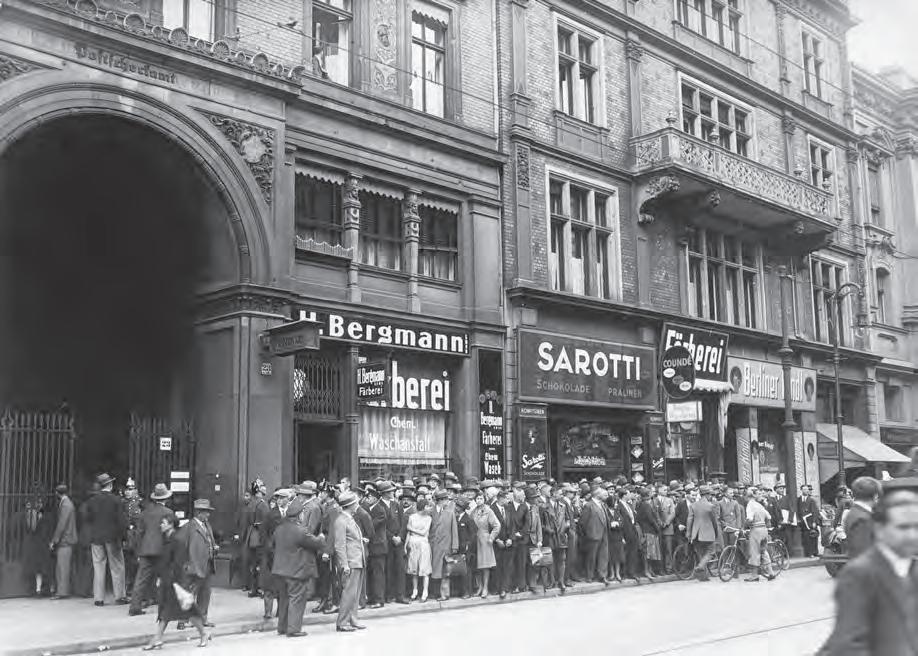
Source 1.8.1 German bank customers line up to try to withdraw money from their accounts after they heard that the German national bank had collapsed, July 1931. Shortly after the photo was taken, all German banks were closed for three weeks.
Look at Source 1.8.1.
• What so you see in the image?
• What do you think about this image?
• What does this image make you wonder about?
1.8
Economic and social turmoil
As the world rebuilt following the end of the First World War, there was hope that the 1920s would be a decade of peace and prosperity. In some ways, this came true. The League of Nations represented a new focus on international cooperation, and the richest and most powerful country – the United States – saw a boom in its economy. The value of company shares traded on the Wall Street stock market in New York was growing so quickly that people borrowed money to buy shares, speculating that they too could become rich.
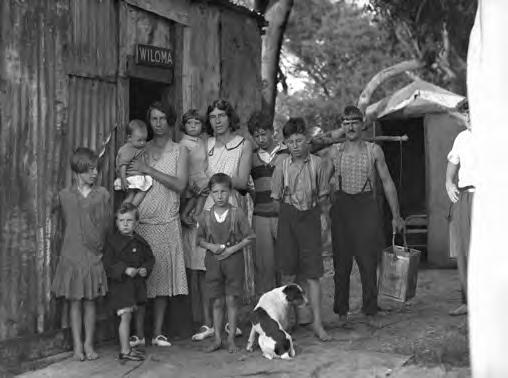
Source 1.8.2 Some families who lost jobs during the Great Depression had to live in shacks in parks, like this family at Brighton-leSands, Sydney, in 1934.
UNCORRECTEDSAMPLEPAGES
In October 1929, the American stock market crashed, sparking a worldwide crisis known as the Great Depression (1929–1939). It was the worst economic downturn in history. By 1930, most companies’ shares had fallen sharply in value. Even people who had been living comfortably through the 1920s began to experience hardship.
When customers had less money to spend, companies had less to invest in their businesses, which reduced their output and led to many workers losing their jobs. By 1933, half of America’s banks were failing and around 15 million people were unemployed. Countries that were closely linked to the USA through trade, including Britain and Australia, experienced similar effects.
Democracies came under pressure. In the United States, the government of President Franklin D. Roosevelt set up a “New Deal” of programs to stabilise the economy and give people work. However, recovery would take many years, and many people questioned whether they could rely on the free market and democracy, and looked around the world at the examples of other political ideologies.
Socialism in Russia
In the interwar period, many people who were concerned about the Great Depression and the future looked to socialism as an alternative. The idea of socialism had first emerged in the nineteenth century, as thinkers like Karl Marx criticised the inequality caused by the Industrial Revolution. Marx said that the means of production, such as factories, and their profits, should be owned by the workers, not rich individuals.
“Workers of all Lands, Unite!” was the movement’s slogan, and its symbols were the hammer, representing workers, and the sickle, representing peasants.
The largest interwar experiment with socialism was the Soviet Union. After Vladimir Lenin led the Bolsheviks to victory in the Russian Revolution of 1917, his party transformed the nation with the promise of “peace, bread and land” for the suffering Russian people.
In practice, the Soviet Union became a one-party state, with Moscow controlling many aspects of people’s lives. The central government managed the economy, set prices and created targets for production in Five Year Plans.
After Lenin’s death in 1924, Joseph Stalin became the ruler of the Soviet Union. He concentrated power in his own hands, to become a dictator. He used this power to impose socialism in the form of state-owned industries and collective agriculture on Russia and the other Soviet republics. The economy was mostly closed off from Western markets, which meant that the Soviets were not directly affected by the Great Depression. In fact, the Soviet economy grew stronger at the time, being able to export grain to Western nations and import machinery cheaply.
The outside world had limited access to unbiased information about the rapid changes taking place in the Soviet Union. Many outsiders were impressed by the development of advanced industries and the equality between people of different ethnic origins and between women and men. Some Western observers who toured Russia called on their governments to follow the Soviet model, even though they were concerned about Stalin’s personal power. What they did not realise until later was that, in practice, Stalin was eliminating his opponents through assassinations and imprisonments, and allowing millions of people, particularly in Ukraine, to starve in avoidable famines.
Source analysis
Identify the content: who was Joseph Stalin?
Explain the origin of the source: where was it made and what was happening at the time?
Explain what the source shows: who and what is included?
Explain the purpose of the source: what seems to be its message?
UNCORRECTEDSAMPLEPAGES
Source 1.8.3 A 1932 Russian propaganda poster showing Joseph Stalin: “By the end of the five-year plan, collectivisation should be finished”.
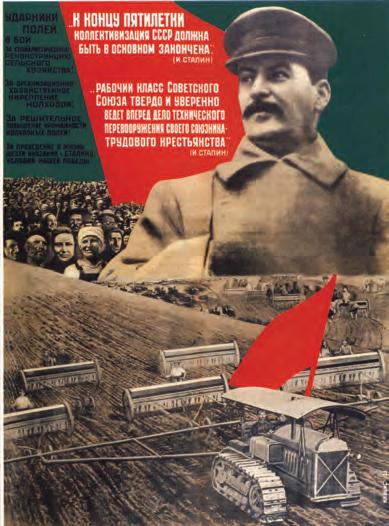
Historical concepts: Cause and effect, Perspectives Historical skills: Analysis and use of sources, Comprehension
Socialism in other countries
Most developed nations, particularly in Europe, saw a rise in socialist movements in the interwar period. In Italy and Germany, socialist parties were popular, but the nations soon moved in a very different direction, under fascism. In Spain, socialists won a clear majority of seats in parliament in the 1931 elections, and began to transform the nation, which had previously been ruled by a monarchy and military dictatorship. However, in the Spanish Civil War the fascist nations of Italy and Germany helped the military dictator Francisco Franco take control. In France, socialists and communists put their differences aside to form a “popular front” national government for several years in the 1930s. This government passed pro-worker laws, including the 40-hour week and holiday pay.
In other parts of the world, including Australia and the United States, socialists appealed to people who were concerned about rising inequality and the effects of the Great Depression. Socialism mostly had an influence on workers’ movements, such as trade unions. However, beyond the Soviet Union, there were no long-term socialist states until after World War II.
Fascism in Italy and Germany
In other parts of Europe, different political regimes emerged. Italy did not benefit from the terms of the Treaty of Versailles in the same way that other victorious Allies did, and its economy was in crisis. By 1920, the Italian currency, the lira, was worth only one-sixth of its pre-war value, and many businesses collapsed. Socialist parties were unable to control uprisings among workers. These factors made a radical alternative appealing. In 1922, former soldier Benito Mussolini came into power. He said that the Italian government had become too weak to deal with the nation’s troubles and needed a “ruthless and energetic” dictator to take control.
Mussolini started with squads of terrorists that he called “blackshirts”. They wore armylike uniforms as they intimidated or beat up opponents on the streets. They became a political movement called the Fascist Party, based on fasces, the word for the bundles of rods that in ancient Rome symbolised power and authority. Later, the term fascism would be used for any similar movement of nationalism and intolerance.
UNCORRECTEDSAMPLEPAGES
At first, many people were impressed by improvements in Italy under fascism. However, soon they realised that Mussolini was a ruthless leader and a threat to world peace. Mussolini was theatrical in his speeches at rallies, which his supporters admired, even when he invented facts or lied. He was seen as a strong man, Il Duce (The Leader), who could restore Italian pride. The way to do this was to make everything in the country revolve around the government: “Everything in the State, nothing outside the State, nothing against the State” was a key slogan.
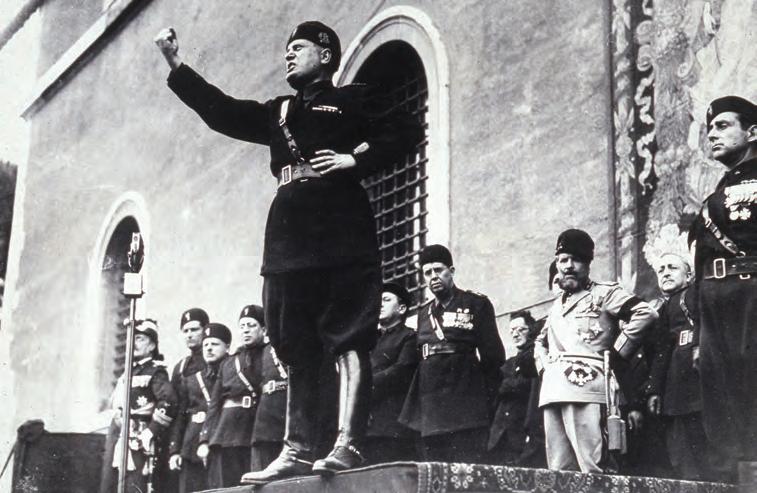
To achieve this, fascists ended democracy and free speech, silenced anti-fascist critics, and criticised foreigners. In 1935, Italian troops invaded the African nation of Abyssinia (Ethiopia) to begin an overseas empire. In 1936, Mussolini signed the Rome–Berlin Axis, to ally Italy with the neighbouring fascist state of Germany.
In Germany, fascism took longer to come into power. In 1921, the former soldier, Adolf Hitler, became the leader of the National Socialist German Workers Party, known as the Nazis. The Nazis’ form of fascism was based on racism and nationalism. In the early 1920s, hyperinflation reduced the value of the German currency – the mark – to almost nothing. The Nazis told the German people that communists and foreigners – including Jewish people whose families had lived in Germany for centuries – were to blame for their suffering, and should be regarded as their enemies. The political system of the new German republic was also chaotic, with no single party ever winning a majority in elections. Nazi “brownshirt” stormtroopers marched in the streets, to give people the impression that the Nazi movement was popular and strong.
By the mid-1920s, the German economy was improving, and most people did not find the Nazis appealing. However, in the 1930s the Great Depression severely affected Germany. Six million workers lost their jobs. In 1931, German banks collapsed, making some customers lose their savings.
UNCORRECTEDSAMPLEPAGES
German people began to show more interest in radical solutions. The Nazis held enormous rallies to build public support, and tens of thousands of people joined in, to be part of a movement that promised to transform Germany. The Nazis claimed that their racism was based on science, and said that they would ignore the Treaty of Versailles and rebuild the military power of their nation. In 1933, they took control of the nation. Once Hitler became the ruler of Germany, he declared a state of emergency and banned all opposition parties. He combined the roles of president and chancellor, to become a dictator, using the title “Führer”.
Source 1.8.4 Mussolini using his trademark theatrical gestures as he speaks to a crowd in Italy in 1933. ➜
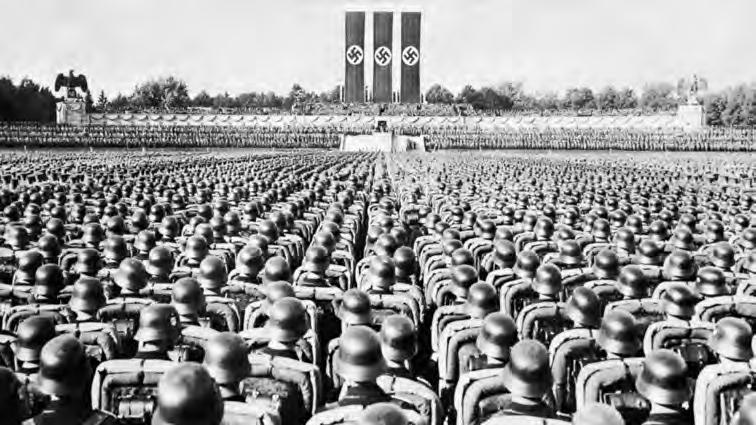
Source 1.8.5 Members of the SS, the Nazi Party’s elite paramilitary and security force, line up to listen to their leaders at a huge Nazi rally in Nuremberg.
German fascism required extreme loyalty. All soldiers, public servants, doctors and teachers were forced to swear an oath of obedience to the Führer, or lose their jobs. Schools and youth groups trained young people to become loyal Nazis. Boys were taught to love their nation and to be prepared to fight for it, and girls were taught that their future was to be mothers of the German “master race”. The Nazis were obsessed with the myth that white Europeans were superior. Ultimately, this led ordinary Germans to persecute the Jews in their communities and then across Europe, resulting in the Holocaust, and the murder of six million Jews.
Teachers can go online to assign questions, view results, reports and more!
Identify the major event of October 1929 and what it caused.
Explain the effects of the Great Depression.
Explain the political ideology that emerged in Russia.
Explain the political ideology that emerged in Italy and Germany.
Explain what caused the Nazis’ increase in popularity.
Explain how the Nazis changed Germany.
UNCORRECTEDSAMPLEPAGES
Draw a mind-map to summarise key issues relating to political ideologies in the 1920s and 1930s. Include the Great Depression, socialism and fascism and add as many linking points as you can.
1.9 Chapter review and historical inquiry
Access the Interactive Textbook for a range of digital tools to help you review this chapter and build confidence.
• Auto-marked questions for fast feedback and fun practice
• Self-assessment tools to track your progress, review answers (if enabled by the teacher), and flag questions for extra help
• Downloadable worksheets for class or homework revision
Summary
Summary notes
What have you learned about the making of the modern world? Copy the table and fill out by explaining your understanding. Aim for two points per topic.
Topic What I have learned
Key events and ideas that shaped the modern world (1750–1930s)
Causes and consequences of the Industrial Revolution
How imperialism, migration and slavery effected the movement of peoples
The American and French Revolutions
The rise of nation-states and global political change
The global impact of World War I and the interwar period
Visible thinking routine
Claim, support, question
Select one of the topics you have studied in this chapter.
• Claim: Make a claim about why the topic was significant.
• Support: What evidence or reasoning can you provide to support your claim?
• Question: What questions do you have about your claim?
UNCORRECTEDSAMPLEPAGES
Questions and activities
Scorcher quiz
Access a fast, fun, competitive quiz that puts your understanding to the test.
UNCORRECTEDSAMPLEPAGES
Quick questions
The Industrial Revolution transformed production by replacing skilled handcraft with large-scale manufacturing, powered first by ______ and later by ______.
European expansion was driven by imperial competition for resources, often carried out through organisations such as the British ______ Company.
In both the American and French Revolutions, leaders argued that governments must protect the natural rights of citizens, including liberty, property and ______.
The unification of modern nation-states such as Italy and Germany was strongly influenced by ______, which refers to rising movements of cultural identity.
The Treaty of Versailles imposed severe military restrictions and financial reparations on Germany, formalised in the “______” clause.
Define the term ‘imperialism’ and give one example.
Describe one major consequence of the Industrial Revolution for workers. Identify one impact of the trans-Atlantic slave trade on societies in Africa, and one impact for societies in America.
Explain why the American colonists declared independence from Britain in 1776. Summarise how the League of Nations aimed to prevent future wars.
Group work activity
Allocate one group to each of the seven main topics of this chapter. Review what you have learned, and develop a short presentation to the class to argue that your topic was the most significant topic of the period 1750–1930s. You might argue, for example, that the topic affected the most people, had the most far-reaching impact, or had the longest impact. At the end of the presentations, vote as a class on which seems to be the most significant.
Research activity
Research the current situation in one of the nation–states mentioned in this chapter (e.g. Britain, the United States, France, China, Japan, Russia, Italy, Germany, Australia or another country). Since it was established, what has changed and what has continued the same? You could research its territories and borders, its population, its system of government and/or its relationship with other countries.
Creative task
On one page or slide, create a timeline that summarises the key events of the period 1750–1930s. You might use key phrases and images to illustrate your timeline.
Writing focus
The following activities offer ways to demonstrate your understanding of the chapter and allow you to continue to practise your writing skills.
Answering questions in paragraphs
This sample response to a question is structured using:
• a topic sentence
• the four Es (explain, elaborate, evidence and examples)
• a linking sentence.
You can use this as a model when writing your own answers to the following questions.
Question: What were the consequences of the Industrial Revolution?
Model answer:
Topic sentence: the first sentence of the paragraph; directly answers the question
Elaborate: additional information, connections, historical significance, change and continuity, cause and consequence Examples: provide credibility and illustrate the argument
The Industrial Revolution had significant social, economic and environmental consequences that transformed how people lived and worked. It introduced steam-powered machinery that replaced traditional hand-making processes, which dramatically increased production and changed the organisation of labour. These changes led to rapid urbanisation, poor working conditions and environmental pollution, but it also drove economic growth and technological innovation. The photograph in Source 1.2.5 shows overcrowded slum housing in Liverpool. This exemplifies how industrial towns grew too quickly to develop proper sanitation, which allowed the spread of diseases like cholera. Meanwhile Source 1.2.2 describes mine worker Betty Harris crawling through wet, dangerous tunnels. This demonstrates the harsh and unsafe conditions faced by many labourers. Overall, the Industrial Revolution reshaped societies by creating new opportunities for wealth and progress whiel also generating major challenges for workers and urban populations.
Extended-response questions
What were the consequences of the Industrial Revolution?
How did imperialism, migration and slavery affect people?
UNCORRECTEDSAMPLEPAGES
What were the consequences of the American and French Revolutions?
How did nation–states begin? Explain using examples. Why did World War I start?
What were the effects of the way World War I ended?
Explain: clarify, define and describe Evidence: specific, relevant evidence to support your arguments
Linking sentence: reconnects to the topic sentence using the language of the question
Which political ideologies emerged in the interwar period? Summarise what they stood for.
Historical inquiry
Investigating cause and effect
In this historical investigation into cause and effect in the making of the modern world, you will undertake the following steps:
Part 1: Develop historical questions
• Step 1: Choose a topic
● Select an aspect of the making of the modern world that interests you. Examples include:
➤ the impact of the Industrial Revolution on a group of people.
➤ the effect of growth of the Spanish Empire.
➤ the cause of the rise of nation-states in the nineteenth century.
➤ the cause of the rise of fascism after the First World War.
• Step 2: Brainstorm what you already know
• Step 3: Develop a historical inquiry question
● Your question should focus on cause and effect. Examples include:
➤ Assess the impact of the growth of of industrialism on the urban poor in England.
➤ Evaluate the effect of the growth of the Spanish Empire on the country.
➤ To what extent did nation-states arise as a result of poverty?
➤ Explain the importance of the factors that led to the rise of fascism in Europe after the First World War.
• Step 4: Explain why the question is important
Part 2: Locate and analyse evidence
• Step 1: Collect primary sources
• Step 2: Analyse your primary sources
• Step 3: Research the topic
• Step 4: Organise your evidence
Part 3: Communicate your findings
Part 4: Reflect
UNCORRECTEDSAMPLEPAGES
Teachers, access the Online Teaching Suite for digital resources and tools that support review, assessment and reporting, including:
• student and class activity reports
• a test generator to create custom assessments
• built-in feedback tools
• editable downloadable support material
• a downloadable and printable “Writing focus” workbook for this chapter.
Chapter 2
Key questions
The Industrial Revolution (1750–1914)
• What were the key features of the Industrial Revolution in Britain?
• How did the expansion of the British Empire contribute to the speed of industrialisation?
• What were the significant developments (inventions) and changes brought about by the Industrial Revolution?
• How were the lives of people transformed by the Industrial Revolution?
• What groups were impacted by the changes in working conditions brought about by the Industrial Revolution?
• What have been the long-term impacts of the Industrial Revolution?
Lessons
2.1 Setting the scene
2.2 Agricultural Revolution and population movements
2.3 Imperialism and industrialisation
2.4 Technological inventions: Industrialisation
2.5 Technological inventions: Manufacturing
2.6 Technological inventions: Transportation
2.7 Social structure in Britain
2.8 Living conditions in Britain
2.9 Working conditions
2.10 Child labour
2.11 Social movements and ideologies
2.12 Contribution to the development of Britain
2.13 Site study: Museum of Applied Arts and Sciences
2.14 Short- and long-term impacts of the Industrial Revolution
2.15 Chapter review and historical inquiry
UNCORRECTEDSAMPLEPAGES
Teachers access the Online Teaching Suite to:
• plan, sequence and assign directed tasks for students and classes using Task Manager
• view student activity reports
• provide feedback to students
• download a printable “Writing focus” workbook for this chapter.
2.1 Setting the scene
Learning intention
In this lesson, you will learn what the Industrial Revolution was, and key events that took place during this time period.
Success criteria
❏ I can identify some of the key events that took place during the Industrial Revolution.
The Industrial Revolution was an era of unprecedented change. Beginning in Britain in the eighteenth century with a series of improvements made to farming, people began to be able to produce more food with less labour. The rapid changes in technology during this period had an enormous effect on how people worked, impacting both the economy and society. Life for many in the middle and upper classes changed for the better, because business opportunities expanded their wealth and improved their living conditions. Some people in the lower class benefited from learning new skills, but, for many others, living and working conditions declined sharply. The terrible conditions inside factories, mines and new urban centres only improved after long campaigns for reforms by groups representing the rights of workers.
During this period, Britain also expanded its reach around the world as it competed for overseas markets and access to raw materials, leading to the further growth of the British Empire. New developments in transportation, such as the steam engine, revolutionised the ways in which people and goods could move around the world. In the twenty-first century, we are seeing similarly rapid changes brought about by developments in communication and social media technologies.
1730
1709
Abraham Darby discovers a more efficient means of producing iron
Joseph Foljambe patents the Rotherham triangular plough, cutting costs and the time it takes to plough a field
1761
Bridgewater Canal opens, the first of its kind in Britain, allowing faster shipping of coal from mines in Worsley
1769
James Watt creates a new efficient steam engine
1701
Jethro Tull invents the seed drill, significantly increasing agricultural productivity
UNCORRECTEDSAMPLEPAGES
1712 Thomas Newcomen creates a steam engine to pump water out of coalmines
1733
John Kay invents the flying shuttle, allowing weavers to make larger pieces of fabric more quickly
1764
James Hargreaves’ “spinning jenny” increases the production of yarn eightfold
1785
The first steam-powered mills equipped with automatic weaving machines are built
1796
Edward Jenner inoculates his first patient against smallpox, using cowpox
1788
Australia is colonised by Britain
1794
Eli Whitney invents and secures a patent for the cotton gin (engine), creating an efficient means to clean cotton
1801
Richard Trevithick builds a steampowered locomotive
1803
Cotton becomes Britain’s biggest export, overtaking wool
1833
The Factory Act (1833) is passed, banning children under the age of nine from working in the textile industry. Children aged 13 and over can no longer work more than 12 hours a day.
1825
First railway opens, between the Stockton and Darlington collieries
1838
Launch of Brunel’s SS Great Western, the first steamship to engage in a service across the Atlantic
1850
More than half of Britain’s population lives in urban centres
See, think, wonder
Based on the image in Source 2.1.1, consider the following questions for discussion.
• What can you see in this image? (I can see …)
UNCORRECTEDSAMPLEPAGES
• What do you think about this image? (I think that …)
• What does it make you wonder about changes that took place during the Industrial Revolution? (I wonder …)
Writing focus 2.1
Question words
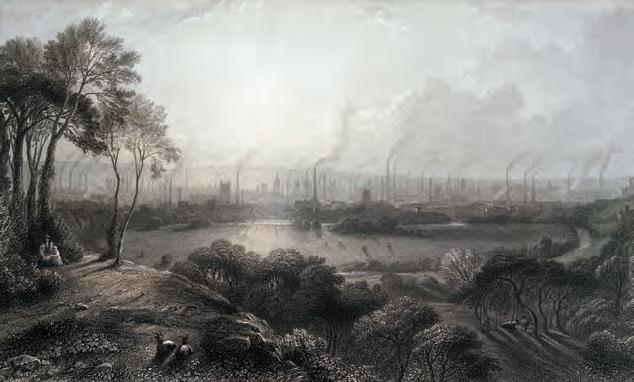
Source 2.1.1 Manchester from Kersal Moor, 1852, by William Wyld ➜
2.2 Agricultural Revolution and population movements
Learning intention
In this lesson, you will learn about the Agricultural Revolution and its impact on the human population.
Success criteria
❏ I can describe the Agricultural Revolution.
❏ I can name some key developments in farming practices and explain how they improved agricultural efficiency.
❏ I can explain how the Agricultural Revolution led to people moving from the country to urban centres.
Look at the two images in Source 2.2.1. For each image: What sort of tool do you think it is?
Who would use it?
How would it change/affect people’s daily work?
2.2.1 Two important tools that originated during the Agricultural Revolution
Writing focus 2.2
Transitional phrases
The Agricultural Revolution
The transformation of agriculture in the British countryside, known as the Agricultural Revolution, was an important factor in the start of the Industrial Revolution. In the seventeenth century, agricultural changes were mainly improvements to traditional farming practices, rather than completely new technology.
More farmland was created by clearing forests and draining marshlands. The enclosure system also meant that small farming plots were combined into larger farms. During the 100 years preceding the Industrial Revolution, Britain increased its farmland by 30 per cent. In 1700, about 70 per cent of land was enclosed, but by 1830 this figure had jumped to 90 per cent.
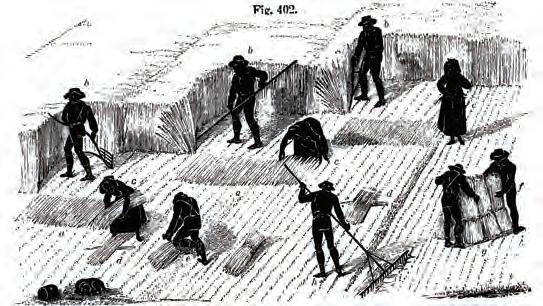
In the early eighteenth century, farmers across England had also begun to use crop rotation In the old system, crops were grown for two seasons then the field was left fallow (unused) for the third year, meaning no crops were grown at all. Crops such as wheat used a lot of nutrients from the ground that then needed to be regenerated. Beginning in the seventeenth century, farmers grew crops that took less nutrients from the soil, such as turnips or clover, rather than leave their fields unused. By the 1840s the benefits of fertilisers were also becoming well known.
Activity 2.2.1
Source analysis
Source 2.2.3 This article from 1767 gives advice on rotation of crops in Scotland
Having observed that many, without any natural advantages of soil or climate for the crops hereafter mentioned, taking the start of us in summoning reason to the aid of industry, now enjoying the profit and satisfaction of having forsaken the old irrational practise of running out land [fallow] by repeated robbing of crops … With this view, the following rotation of crops is recommended, whether open or enclosed.
First year: Vetch, Hay and Turnips
Second year: Flax
Third Year: Wheat or Barley
UNCORRECTEDSAMPLEPAGES
Source 2.2.2 A page from an 1855 manual describing the suggested method for harvesting wheat. Such texts improved farming by sharing better techniques with other farmers and were a symptom of the industrial age.
enclosure system system under which land that had previously been available for common usage became incorporated into a larger farm, and could only be used by the owner – improving the agricultural output, but causing suffering for people who had relied on the land for feeding their families crop rotation growing different crops in different years, so that the soil in the field can regain its nutrients
The Scots Magazine, 1 March 1767, p. 14
What does the author suggest is the better way for farmers to manage their crops?
What is the advantage of using this crop rotation system?
Besides word of mouth, what does this source suggest were the other means that farmers were spreading the news about crop rotation?
Historical concepts: Continuity and change Historical skills: Analysis and use of sources
The invention of farming machinery also increased Great Britain’s agricultural productivity. In 1701 Jethro Tull invented a seed drill to place seeds in the ground, rather than scattering them by hand, and by the 1730s lighter and easier ploughs were produced. In 1786 Andrew Meikle invented a mechanical thresher that improved grain harvesting.
Improvements were also made with livestock. From the late eighteenth century, Robert Blackwell began to selectively breed livestock on his farm. He developed breeds of sheep that were quicker to fatten, and had tastier meat and finer wool. Blackwell also developed better techniques for raising beef cattle.
These changes to farming contributed to the conditions that led to the Industrial Revolution. The new systems improved food production so much that, by 1800, farmers were producing one-third more food at lower prices. The extra food helped contribute to a period of immense population growth. Importantly, it now took fewer people to produce the extra food, which meant that fewer workers were needed on farms. Therefore, people began to move into towns and cities to work in new industrial jobs in workshops or factories.
Farming had also become an important business. Rather than farming merely to eat, farmers grew more food to sell on a larger scale. Landowners invested more money in farming to make a profit. As profits increased, landowners became wealthier, and this enabled them to invest in better transportation systems, such as roads and canals, to move their goods more easily into the newly developing urban centres.
Source analysis
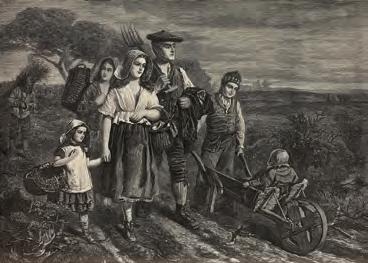
➜
Source 2.2.4 A farming family returning from labour. Engraving from the Illustrated London News, 5 August 1871 (based on a painting by William Fyfe).
Using Source 2.2.4, answer the following questions.
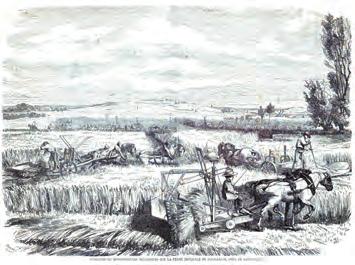
Source 2.2.5 Farmers reaping wheat in France, using mechanical harvesters. Illustration from L’Illustration, Journal Universel, 1859.
a. Who appears to make up the farming workforce in this picture?
b. Who do you think is in charge of the work?
c. With this many workers, how efficient might the farming be?
Using Source 2.2.5, answer the following questions.
a. Who appears to be working on the farm in this picture?
b. Who do you think is in charge?
UNCORRECTEDSAMPLEPAGES
c. With this many workers, how efficient would the farm be?
d. What evidence of mechanisation can you see in this image? What effects would these have on farming?
Using Sources 2.2.4 and 2.2.5 and other evidence, describe the changes to agriculture in Great Britain in the lead-up to the Industrial Revolution.
Population movements
Like the rest of Europe, Great Britain enjoyed a huge population explosion after 1750. Even today, the reasons for this rise in population are difficult to define, but it is clear that the process began before the Industrial Revolution. Since 1500, the British population had increased by over 20 per cent every 50 years. In 1700, it was estimated that the population of Great Britain stood at 5.2 million people. By 1801, when the first official census took place, the population was 10.9 million people. Similar increases also occurred in other parts of Europe. Overall, between 1750 and 1900, Europe’s population nearly tripled from 144 million to 423 million.
In the pre-industrial age, most people worked in rural areas. With the changes to farming and the rapid increase in population that took place during the Agricultural Revolution, many rural dwellers found themselves out of work, and so they moved to urban centres in search of new opportunities for employment. The development of these urban centres was not centrally planned, as workers flocked to the places that had better paid jobs. The development of infrastructure for a clean-living environment, such as sewerage systems and supplies of clean water, were not yet developed. The government did not take responsibility for providing such things, and the technology to build successful systems on a large scale had not been invented.
Development of urban centres
The rapid development of urban centres was one of the most important outcomes of the Industrial Revolution. By 1850, half the British population lived in cities. By contrast, this did not happen in Germany until 1900 and in France until 1930. Despite this new urban population in Britain, there was no public transport system and workers were required to work long hours, so most employees tried to live as close as possible to their place of work. Factory and mining towns across England grew at a rapid rate. In particular, the city of London grew substantially in a very short time. In 1801 London’s population stood at 1.1 million, but by 1851 this had ballooned to more than 2.6 million people. While London was already a large city by world standards, other places that became manufacturing or mining hubs expanded relatively quickly from small townships to major centres.
Activity 2.2.3
Source analysis
2.2.6 Urban population growth between 1801 and 1851
UNCORRECTEDSAMPLEPAGES
Which British city listed in Source 2.2.6 grew by the largest amount during the period 1801–51?
Almost all of this rapid population growth was due to migration, because poor agricultural workers from the countryside relocated to the new industrial towns in search of jobs. Several towns transformed during the Industrial Revolution. Glasgow in Scotland initially grew because of the expansion of the cotton, textiles, chemicals, glass, paper and soap industries. However, by the mid1800s, it had diversified into heavy industries such as shipbuilding and locomotive construction.
Source 2.2.7 Etching from 1851 satirising the effects of potential overpopulation. It shows people having to go to extraordinary lengths to manage their overcrowded living conditions.
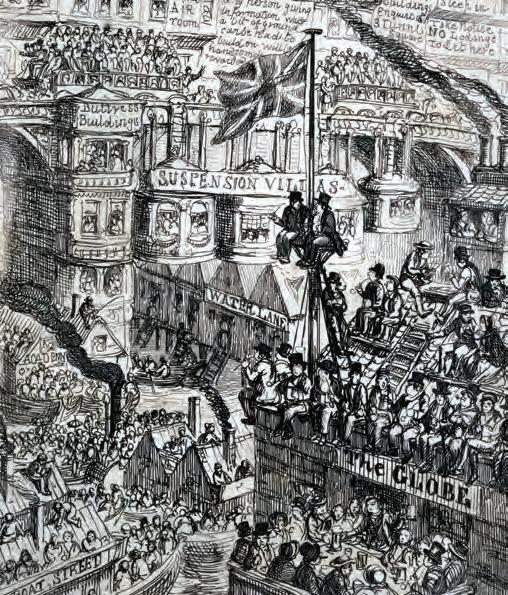
Teachers can go online to assign questions, view results, reports and more! Knowledge and understanding
and researching
Students can access sample responses and results online
Knowledge and understanding
Describe how Britain’s population changed between 1700 and 1800.
Outline the reasons for Britain’s population increase over this period.
Identify where most of this new population went to live.
List some of the British towns that developed into major urban centres during this time.
Explain how the Agricultural Revolution in Britain helped to create the conditions for the Industrial Revolution.
Explain why workers moved into urban centres during the Industrial Revolution.
Thinking and researching
Choose one of the British towns that developed into major urban centres during the Agricultural Revolution (such as London, Glasgow or Manchester).
Create a fact sheet, identifying population growth, main jobs and industries, and the typical housing/ living conditions of the time.
UNCORRECTEDSAMPLEPAGES
Compare life in a rural village with life in a growing town, and explain which you believe would have been easier or harder to live in.
Historical concepts: Continuity and change, Cause and effect Historical skills: Perspectives and interpretations, Research
2.3 Imperialism and industrialisation
Learning intention
In this lesson, you will learn about the relationship between the growth of the British Empire and the Industrial Revolution.
Starter activity
Success criteria
❏ I can describe the ways in which British imperialism both benefitted from and contributed to the Industrial Revolution.
Look at Source 2.3.1. Identify all the continents on which Britain had settled colonies before and after 1793. Based on this map, in what parts of the world was Britain involved in wars?
St Dominque (Haiti) Leeward Islands
Guadeloupe
British territory settled before 1793
Territory permanently acquired by Britain during wars, 1793–1814 Cape of Good Hope
British territory claimed but not settled before 1793
Territory occupied by Britain during wars, 1793–1814
Source 2.3.1 The British Empire in 1815 ➜
UNCORRECTEDSAMPLEPAGES
Growth of the British Empire
The British Empire was established in the late 1500s when Britain began sending expeditions to North America, and then the Caribbean, Africa and India. The second phase of British Empire–building occurred in the eighteenth century, when Britain become the world’s greatest naval power and began establishing Pacific colonies. Success in the Seven Years’ War (1756–63) significantly expanded the British Empire.
Writing focus 2.3
Developing sentences
Amboyna
Source 2.3.2
Video: Growth of the British Empire
As Britain industrialised, it sought to secure raw materials from far-flung parts of the empire, and to find markets for its manufactured goods in its colonies. The video in Source 2.3.2 gives an overview of the expansion of the British Empire.
Raw materials
Many of Britain’s colonies provided raw materials, slaves and ready markets to drive the Industrial Revolution. Through its empire, by the mid-nineteenth century Britain had access to supplies of sugar from areas as diverse as Australia and the West Indies. The British Empire also supplied wool from New Zealand and Australia, tea, spices and cotton from India, rubber from its Malayan colony and wood for shipbuilding from Canada. More readily available after the advent of steamships was coffee from Jamaica and Africa, and wheat from Australia and Canada. The British were also supplied with gold from Australia (mainly thanks to the 1851 gold rush) and, by 1886, from South Africa as well.
Source 2.3.3 Raw materials supplied to Britain from other parts of the world, 1750–1900
Supply region Raw materials
Africa (including South Africa)Cotton, corn, diamonds, gold, vegetable oil and rubber
Asia Spices, tin, silk and tea
Australia Copper, gold, meat and wool
Canada Corn, dairy products, fish, gold and wood
Europe
Dairy produce, fish, fruit, metal ores, manufactured goods, wool and wood
India Coffee, cotton, dyes, jute, spices, tea and wood
United States of AmericaCorn, cotton and tobacco
South America (and Caribbean)
Coffee, copper, cotton, wool, nitrates, rubber, sugar, tobacco and wood
Source 2.3.4 British economic trade during the first half of the 1800s
Using Source 2.3.3, identify the raw materials that came to Britain from its empire. Identify two raw materials from Source 2.3.3 that would have been useful for the industrialisation of Britain. Give reasons for your choices.
Evaluate what the statistics in Source 2.3.4 suggest about the importance of raw materials and the growth of British industry.
Trade within the empire
The British used what was known as a triangular trade system to move goods around their empire. They shipped manufactured goods, textiles and rum to Africa. Enslaved people were shipped from West Africa to North America, while raw materials such as cotton, tobacco and sugar were returned to Europe. Colonial agents, called the West Indian Interest, were created in the early 1740s to promote the interests of West Indian sugar planters and British merchants. With the support of the British parliament, the success of these plantation operations saw places like Barbados and Jamaica become the world’s largest sugar producers. Trading companies, like all companies in Britain, had to be created by a royal charter. This guaranteed that people would invest in trade and the empire. Investors were found from all walks of life in Britain, because significant profits could be made.
With the invention of steam-powered ships in the nineteenth century, trips across the Atlantic Ocean, which had once taken 30 to 45 days, became much faster. By 1900, a steamship made the crossing in a little over five days. This had enormous implications for transporting food, which became cheaper and more plentiful. In Liverpool in the 1890s, imported wheat from Canada, the USA, South America or Russia was cheaper than it had been two centuries earlier.
By the beginning of the twentieth century, the mechanisation of textile production created a surplus in textiles, threatening to swamp the European market. However, by the same time, the British Empire had expanded to cover over 25 per cent of the world’s population and land area, and Britain commanded a large fleet of ships. This allowed easier transportation of the textiles to places far from Europe, such as India and other colonies, and an opportunity for Britain to sell to different markets.
Source 2.3.5 This article was published in 1796, in a small regional newspaper in England.
BRITAIN
Nature seems to have taken a particular care to disseminate her blessings among the different regions of the world, with an eye to the mutual intercourse and traffic among mankind, that the natives of the several parts of the globe might have a kind of dependence upon one another, and be united together by their common interest. But how wonderfully favourable has she been to this little island of Great Britain? … Our food often grows in one country and the source in another. – The fruits of Portugal are corrected by the products of our West-India islands, and the infusion of a Chinese plant is sweetened with the pith of an American cane.
UNCORRECTEDSAMPLEPAGES
The dress of a single woman of quality, is often the production of the most opposite climates.
If we consider our own country in its natural state, without any of the benefits and advantages of our trade, what a barren spot of earth falls to our share! … Nor has commerce more enriched our vegetable world, than it has improved the whole face of nature among us. Our ships are laden with the harvest of every climate; our tables exhibit spices, oils, and wines. Our rooms are stored with pyramids
triangular trade trade between the three regions of Britain, West Africa and the American colonies
from China, adorned with the workmanship of Japan … and we repair our bodies by the drugs of America … our trade gives us a great variety of what is useful, and at the same time supplies us with every thing that is convenient and ornamental. …
Our English merchant, at present, converts the tin of his own country into gold. …
How many private men, who in former times would have been the vassals of some powerful Baron, are now negotiating like Princes, for greater sums of money than was formerly to be met with in the royal treasury! Our trade has given us a kind of additional empire. It has multiplied the number of the rich, made our landed estates infinitely more valuable than they were formerly … What a contrast between this and the unfortunate country of France, where, by revolutionary manoeuvres, trade and commerce are almost totally annihilated!
This flourishing condition we owe to our present Constitution.
UNCORRECTEDSAMPLEPAGES
Courant, 15 March 1796, p. 1
What does Source 2.3.5 identify as the benefits of trade to the British?
Explain in your own words what the article means when it says, “the natives of several parts of the globe might have a kind of dependence upon one another, and be united together by their common interest”.
What examples does it give of what the British were trading, and where does it say these products come from?
Explain in your own words what the article means when it says “How many private men, who in former times would have been the vassals of some powerful Baron, are now negotiating like Princes”?
How does the article contrast the situation in Britain and France at that time?
Using the source as evidence, how important was trade to the British economy?
Note the date of this article. With the improvements in technology and steamships, how much more would trade have benefited the British?
Historical concepts: Cause and effect, Significance Historical skills: Analysis and use of sources, Perspectives and interpretations
Growth of new markets
While the Industrial Revolution and the growth of its empire greatly increased Britain’s access to raw materials, the colonies and territories within the empire also became important potential markets for products manufactured in British factories. For example, India became a major market for British textiles such as cotton, while other colonies imported British machinery, tools and consumer goods. The empire also invested in infrastructure development, such as railways and ports, to support trade and the movement of goods to the colonies. This also helped to integrate colonial economies into a new global trade system dominated by Britain. For example, in Africa, British colonists aimed to build a railway line stretching from Cape Town in South Africa to Cairo in Egypt.
Chester
Source 2.3.6 An advertisement for the British company Lipton’s Tea showing one of its plantations in Ceylon (Sri Lanka), c. 1860
To make their manufactured goods more appealing to the colonies, Britain implemented economic policies and trade agreements. These policies often included preferential tariffs and trade terms that made British products less expensive in colonies such as Australia, New Zealand, South Africa and Canada. This economic integration helped create a captive market for British products. The spread of British culture and social norms through the empire also played a role in creating new markets. As British influence grew, so did the demand for British goods, fashion and lifestyle products. tariff a tax or duty paid on certain imported or exported goods
Knowledge and understanding
How and why did the British Empire grow from the 1600s?
Outline which raw materials were brought into Britain from Australia. Why would Britain’s empire have been important to its industrial development?
“Without the British Empire the Industrial Revolution would not have developed so easily in Britain.” Evaluate the accuracy of this statement, using specific examples in an extended response.
Thinking and researching
Watch the video (Source 2.3.7) and then conduct further research into the Opium Wars in China in 1839–42 and 1856–60. What were the British selling in China and how did they react when the Chinese tried to ban this trade? Was the British behaviour ethical?
Historical concepts: Contestability Historical skills: Research
UNCORRECTEDSAMPLEPAGES
Teachers can go online to assign questions, view results, reports and more!
Source 2.3.7
Video: The Opium Wars in China ➜
can access sample responses and results online
Technological inventions: Industrialisation 2.4
Learning intention
In this lesson, you will learn about the invention of the steam engine and improvements to the production of iron and steel, which improved the efficiency of production during the Industrial Revolution.
Starter activity
Success criteria
❏ I can describe specific inventions developed during the Industrial Revolution.
❏ I can explain the effect of these inventions on industrialisation.
Examine the two images in Source 2.4.1. One depicts a female coal bearer, and the other depicts a steampowered mine. If machines powered by steam can do the work of multiple people, identify at least two pros and two cons for greater society.
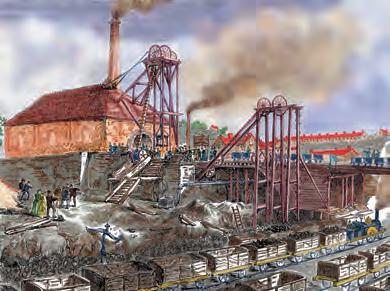
➜
Source 2.4.1 A drawing of a female coal bearer in 1842 compared with an engraving of a steam-powered mine later in the nineteenth century
Writing focus 2.4
Transitional phrases
UNCORRECTEDSAMPLEPAGES
Developments during the Industrial Revolution were due to many inventions rather than one single discovery. Many of the most important developments were in the production of coal, cotton, wool and iron. These developments had significant impacts on the way people worked, the way goods were produced, and how people and goods were moved around the world.
Steam engines
The development of steam engines drove the Industrial Revolution. Before the invention of steam engines, power could only be obtained via human, animal, wind or water energy. Wind was unreliable, while water could only be used in very particular circumstances.
The first steam engines were created to meet a specific need. Coal and tin miners found that when they sank shafts into the ground, these shafts would often fill with water. Mine owners therefore needed an effective means of pumping out large volumes of water. In 1712 Thomas Newcomen built what was known as an “atmospheric” steam engine. This worked on the principle of steam creating a vacuum to drive the engine.
Newcomen’s engine was simple but used a lot of coal, because the cylinder had to be cooled on every stroke to condense the steam. It also had no potential for adaptation for transport or other applications. Nevertheless, in 1750 there were at least 100 Newcomen engines operating around the United Kingdom, and by 1800 there were 550.
Two breakthroughs in the development of steam engines were made when Scottish engineer James Watt was asked to repair a working model of a Newcomen engine. He realised that it was inefficient and came up with the idea of a separate condenser; this would draw steam away from the cylinder, keeping it hot. The second innovation was Watt’s development of a system of gear wheels, known as “sun and planet motion”. It was now possible to drive textile machinery with steam power for the first time. Watt’s engines used less than a third of the coal of a Newcomen engine and were much cheaper to run. By 1800, about 450 of these steam engines were working across Britain.
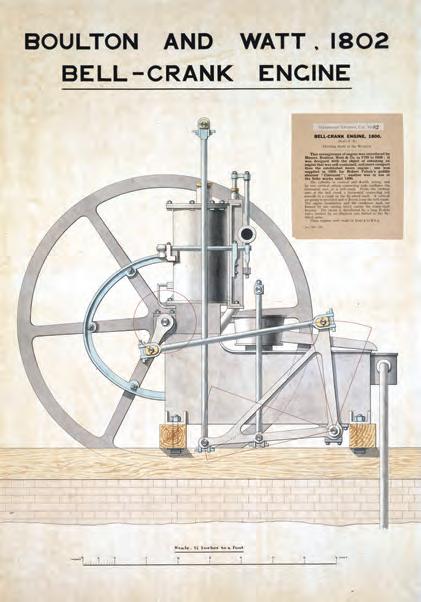
Significant individual: James Watt (1736–1819)
James Watt is famous for his improvements to the steam engine, which significantly contributed to the Industrial Revolution. Watt’s father was a wealthy shipbuilder. Watt’s first job was making mathematical instruments, but he soon developed an interest in the new technology of steam engines. At this time, Newcomen steam engines were being used across the country to pump water from coal mines. After being asked to repair one, Watt realised that Newcomen’s steam engine was very inefficient, so he began to work on a new design that would increase the power and potential. Watt’s idea was to build a separate condensing chamber for the steam engine. This prevented an enormous amount of energy loss, something that the Newcomen engines suffered from. Watt patented this design in 1769 and began to try to manufacture his steam engines. Initially, he was unable to do so because the engineering capabilities to produce cylinder shafts and pistons of such close tolerance were beyond the average engineering works. In 1775 Watt met Matthew Boulton, an engineer who had the required skill to produce the materials needed for Watt’s engines.
UNCORRECTEDSAMPLEPAGES
Source 2.4.2 Scale drawing of an engine built by James Watt (1736–1819) and Matthew Boulton (1728–1809)
Source 2.4.4
Video: James Watt’s workshop
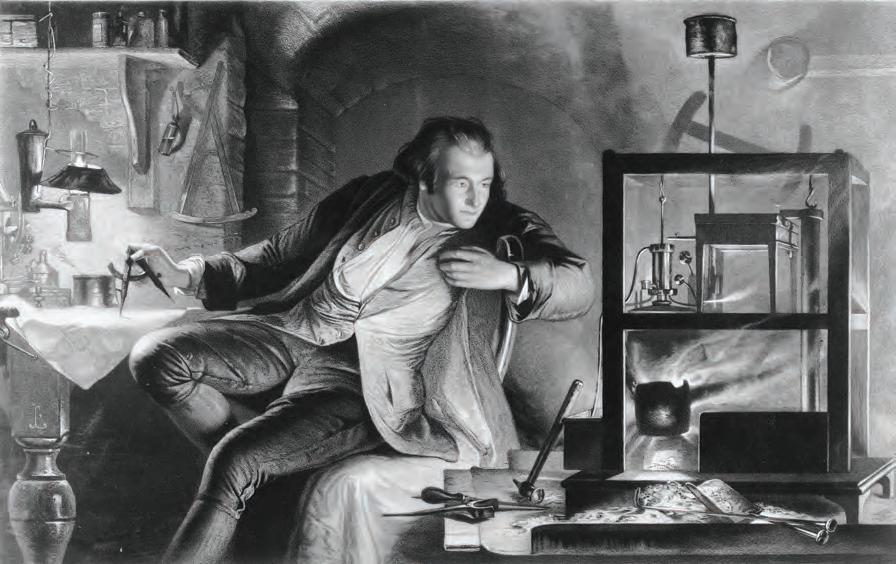
Source 2.4.3 James Watt, Scottish inventor and mechanical engineer. Watt is pictured repairing a model of a Newcomen engine at the moment when he discovered that he could dramatically improve its performance.
Boulton & Watt, based in Birmingham, soon became the most important engineering firm in Britain. Its engines initially powered mines, but soon the company was producing engines for paper, flour and iron mills. Watt retired in 1800 and devoted the rest of his life to research. He invented several more important devices, including a rotary engine, a double-action engine and a steam gauge that could monitor the steam pressure inside an engine. A unit of measurement of electrical and mechanical power was named in his honour. Watt died on 19 August 1819.
Iron and steel production
2.4.1 James
UNCORRECTEDSAMPLEPAGES
Over the course of the eighteenth century, several innovations greatly improved the quality and quantity of iron produced in Britain. In 1709, Abraham Darby was able to create coke (a very pure, efficient fuel substance) from coal, which facilitated the improved production of iron, being smoke-less and much hotter than the traditionally used charcoal. In 1784, Henry Cort combined two processes: “puddling” and “rolling”. Puddling purified pig iron by removing carbon, improving British iron so that it was equal to that produced in Sweden, the world leaders at that time. Rolling enabled wrought iron to be produced in long rectangular bars, which could be used to make rails for railways and girders for construction. These two improvements dramatically increased pig iron production in Britain.
Source 2.4.5 British pig iron production per year ➜
1728
25 000 tonnes
1788 60 000 tonnes
Further progress came with the invention of a process to convert iron into steel, a metal that was much stronger and more reliable. In 1856, Henry Bessemer created steel using a small amount of carbon. This process enabled cheaper steel to be produced, which was far more practical for building machinery and engine parts. Due to Bessemer’s work, Britain remained the world’s largest steel producer until 1902.
Source analysis
What has Pry included in this image?
List all the unusual things you can see.
How useful would this source be to a historian studying the beginning of the Industrial Revolution in Britain?
Source 2.4.6 March of Intellect, a coloured satirical print by Paul Pry from 1829, about the fad for steam transport. The world of invention goes mad: here are fantastic balloons, flying machines, castles in the air, a Grand Vacuum Tube travelling system and other strange ideas.
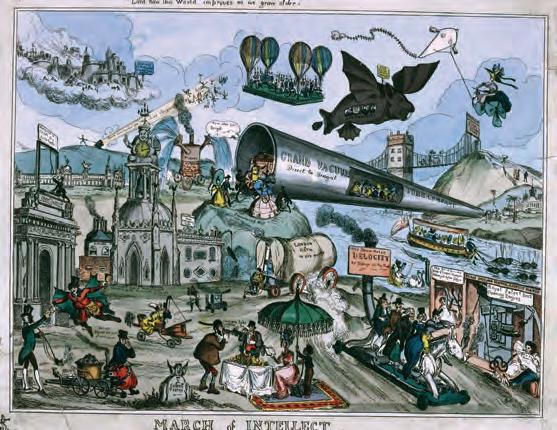
Historical concepts: Significance Historical skills: Analysis and use of sources
Knowledge and understanding
Identify the industries that steam engines were developed for.
Identify the key change in James Watt’s design for an improved steam engine.
Define the “puddling” and “rolling” processes in iron production.
If the steam engine had not been improved during the Industrial Revolution, discuss how Britain’s industrialisation might have been affected.
Thinking and researching
UNCORRECTEDSAMPLEPAGES
Teachers can go online to assign questions, view results, reports and more!
Consider a factory powered by horses compared with a factory powered by a steam engine. What would be the social, economic and environmental consequences of switching to steam power?
Create a report made up of three sections: “Social”, “Economic” and “Environmental”. Conduct research to explain your reasoning, including, within each section, one possible solution to the negative effects.
Historical concepts: Continuity and change, Perspectives Historical skills: Perspectives and interpretations, Research
Technological inventions: Manufacturing 2.5
Learning intention
In this lesson, you will learn about technological inventions in the cotton manufacturing industry during the Industrial Revolution, and the growth of the factory.
Success criteria
❏ I can identify the key machines developed during the Industrial Revolution that improved the production of cotton.
❏ I can explain the effect of these machines upon manufacturing during the Industrial Revolution, and upon the development of cotton mills.
Starter activity
Examine the two images in Source 2.5.1. One is of a pre-industrial loom, and the other depicts a factory of power looms, a technology that developed during the Industrial Revolution. With the person next to you, compare and note any differences you see.
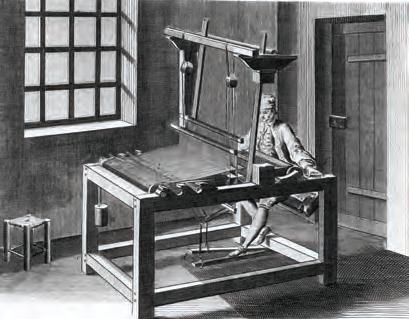
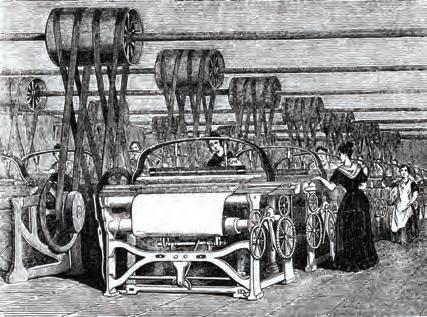
Cotton mills
Writing focus 2.5
Developing sentences
The factory system, which is a defining feature of the Industrial Revolution, only emerged after many smaller developments in industry. Before the Industrial Revolution, manufacturing occurred on a small scale. Workers, such as weavers, blacksmiths, potters and millers, all worked on an individual basis making their products, often inside their own homes or small workshops.
The factory system changed this working situation forever. Factories were created to house new machines, which were too large to fit into the small homes and workshops of individual craftspeople. They brought together many workers who no longer needed special skills because these new machines did much of the work.
Source 2.5.1 A pre-industrial loom, compared with a factory of power looms ➜
Workers in factories mostly did smaller, repetitive tasks, completing one section of the manufacturing process instead of the whole job as previous artisans had done.
Cotton mills were the first factories of the Industrial Revolution, and a series of inventions made them more and more efficient.
Flying shuttle
The flying shuttle was invented by John Kay in 1733. It introduced a more efficient way to weave on hand looms, because a single weaver could move the yarn from one side to the other. This vastly improved production with wide looms and increased the production of cloth.
Spinning Jenny
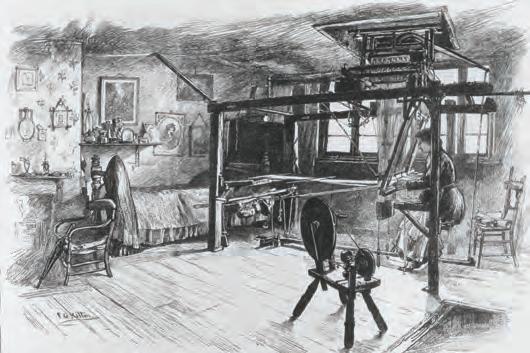
Source 2.5.2 The pre-industrial system: a weaver working at a
As seen here, weavers had their workplace inside their home and usually worked at their own pace.
Spinning cotton improved with the development of the Spinning Jenny by James Hargreaves in 1764. Traditional spinning wheels could only spin one thread at a time, but the Spinning Jenny allowed operators to spin eight threads at once. By 1784, larger Jennies were spinning 80 spindles at once.
UNCORRECTEDSAMPLEPAGES
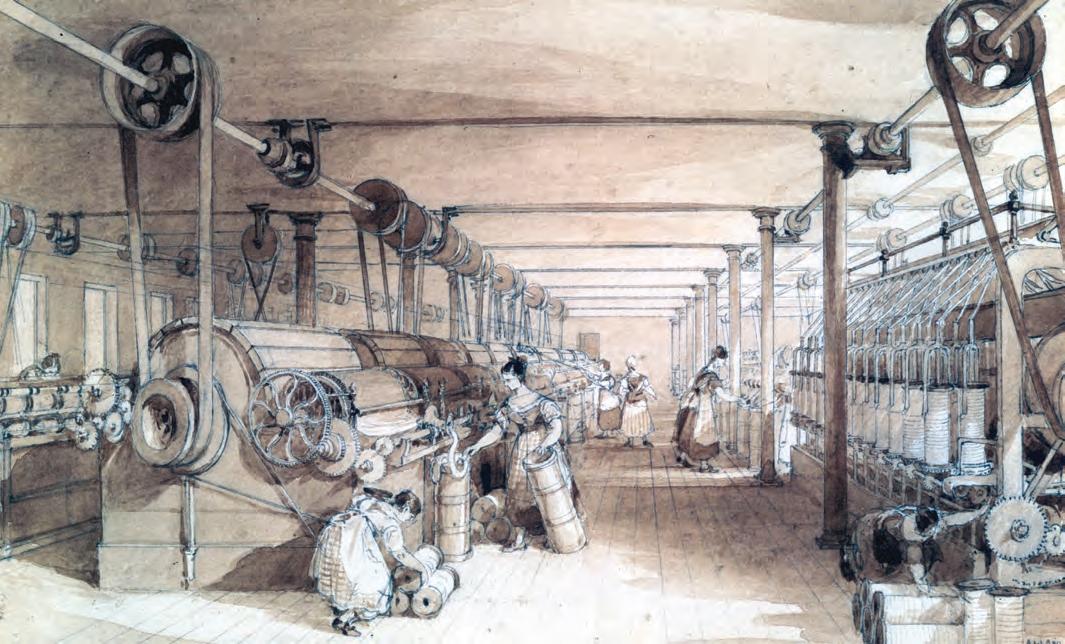
loom.
Source 2.5.4 The Industrial system: a cotton mill in Lancashire, 1834. This view of the mill shows women carding, drawing and roving the cotton. Note the power supply connected along the ceiling powering the mills.
Source 2.5.3 Video: Technology improvements in cotton mills ➜
Water frame
Larger Jennies were possible because of Richard Arkwright’s invention of the water frame in 1769, which was essentially a larger Spinning Jenny powered by a water wheel.
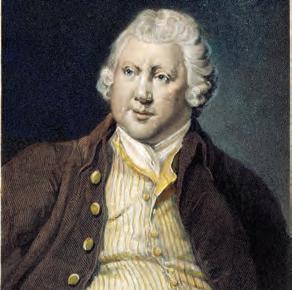
By 1767, a machine had already been invented to process cotton (carding) and was being used in England. With the help of John Kay, Arkwright improved the design so that a stronger yarn could be produced that required less human intervention in the process. Patenting his machine in 1775, Arkwright then moved on to build a horse-driven spinning mill in Preston. Arkwright’s contribution was that his mills produced yarn based around one machine. They also divided the labour required, meaning they were more efficient and could have labourers in only one part of the process. By 1788, there were 143 of these water frame mills operating across Britain, and some were already driven by steam engines. Later, Arkwright improved the power system available by adapting one of Watt’s steam engines to power the machinery. This enabled the development of more efficient machinery, such as the power loom.
Crompton’s Mule
UNCORRECTEDSAMPLEPAGES
c.
In 1779, Samuel Crompton invented Crompton’s Mule. This machine combined the Spinning Jenny’s carriage and the rollers from the water frames to enable a single power source to spin multiple machines. It initially required a skilled weaver to operate it, but after further improvements it could be operated by an unskilled worker. It also created a very fine and smooth weave, meaning that, for the first time, the British produced a better-quality weave than textiles from India.
Britain became a centre for cotton production, importing raw cotton from the United States and India. Over time, these cotton factories went from being powered by water, to steam and eventually electricity.
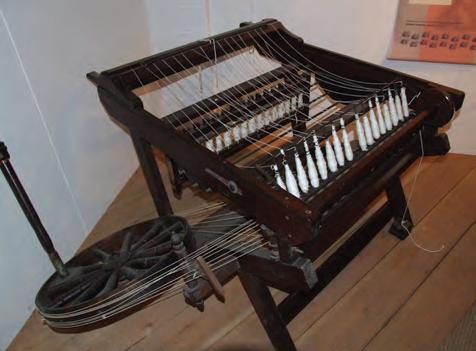
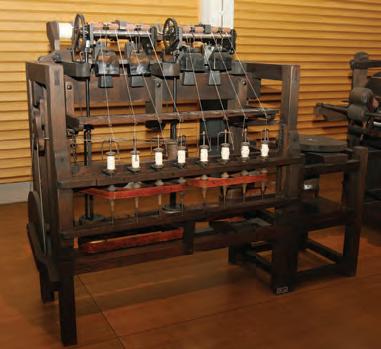
Source 2.5.5 Portrait of Sir Richard Arkwright (1732–92),
1790, by Joseph Wright of Derby (1734–97)
Source 2.5.6 The technology of the Spinning Jenny (left) and the water frame (right) were combined by Samuel Crompton to make Crompton’s Mule, which enabled a single power source to spin multiple machines.
Source analysis
Who is operating the machinery?
What skills were required to operate the machinery?
In what way did spinning machines develop over time?
A The large wheel is turned by running water from a river or stream. A system of belts and shafts are turned by the wheel, providing power to the machines.
B Carding and drawing machines. The raw cotton fibres are fed into these machines, which straighten and loosely twist them.
C Spinning machines. These turn the fibres into thread.
D Power looms. These weave the individual threads into pieces of cloth.
➜
Source 2.5.7 A water-powered mill. Note the method by which the power is transferred from the river to the machines.
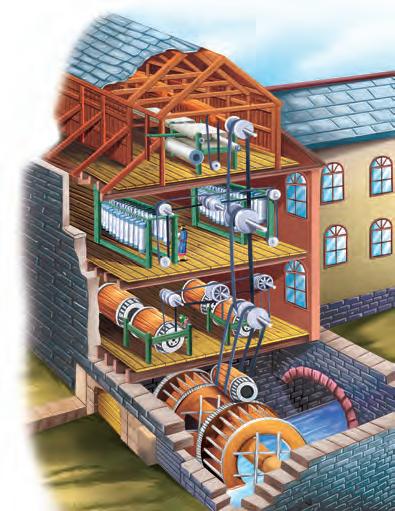
Historical concepts: Continuity and change Historical skills: Analysis and use of sources
Knowledge and understanding
In what industry were the first factories of the Industrial Revolution?
Explain how the way people worked was permanently altered by the factory system.
Identify two listed manufacturing inventions of the Industrial Revolution, and explain their impact upon the processes of the cotton mill.
Explain why the invention of Crompton’s mule was significant in a global sense.
“Nowadays, scientific advances lead to practical applications, but it was people who made things with their hands who drove the Industrial Revolution.” Discuss this statement in relation to Arkwright and Watt. Were they driven by science or by practical needs?
Thinking and researching
Compare Richard Arkwright and Samuel Crompton.
UNCORRECTEDSAMPLEPAGES
Teachers can go online to assign questions, view results, reports and more!
Create a tabled report, containing information about their lives, a list of their inventions and how their work impacted the process of industrial manufacturing. What problems were they both trying to solve?
What might have happened if their inventions had not been created?
Historical concepts: Continuity and change, Significance Historical skills: Perspectives and interpretations, Research
Technological inventions: Transportation 2.6
Learning intention
In this lesson, you will learn about developments in the transportation industry during the Industrial Revolution, and their impact on society and the economy.
Starter activity
Timeline challenge
Success criteria
❏ I can name the four key developments in transportation during the Industrial Revolution.
❏ I can explain the impacts of these developments on the British economy, and on how people lived.
With the person next to you, organise the following transport methods into chronological order of their development in Britain:
• railways
• roads
• canals
• ships.
Discuss how each new transport method improved the movement of people and goods.
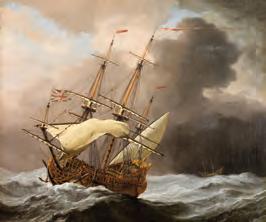
Source 2.6.1 The English Ship Hampton Court in a Gale, 1678–80, by Willem Van de Velde the Younger, a Dutch marine painter ➜
Writing focus 2.6
Developing sentences
UNCORRECTEDSAMPLEPAGES
Improvements in transportation were both a cause and an effect of the Industrial Revolution. Poor transport constrained economic development. Food for markets could not travel long distances because transportation was slow, and without any means of refrigeration, it quickly spoiled. People and manufactured materials were also restricted by poor transportation. Goods could be transported by sea, but this was risky and time-consuming. While improvement in Britain’s transport networks provided a foundation for the Industrial Revolution, the new technology that was developed during this period made further improvements possible.
Roads
The best way to transport goods was by road. While Britain did have a network of roads in the 1500s, they were in a poor state, turning to muddy lanes in winter and to dusty tracks full of potholes and ruts in summer.
From the mid-sixteenth century, local businesses began to create turnpike trusts. These bodies were created by an Act of Parliament and were responsible for repairing and maintaining stretches of road in exchange for charging tolls. In 1760, the number of turnpike roads was 250, but by 1830 this had risen to 1116.
Although not all turnpike trusts made a profit, they nonetheless improved the road network significantly, and eventually created innovations we still use today. For example, the engineer John Loudon McAdam began to build roads using crushed stone to cover larger rocks, which made travel smoother.
Improved roads had a significant effect on transportation around Britain, and the use of stagecoaches became popular. The journey from Manchester to London (a distance of over 330 km) took four days in 1754. Thirty years later, this was halved to two days, and in 1836 was reduced further still to just 29 hours. In the 1830s, there were 3300 stagecoaches operating across Britain. The improvement of roads had a significant impact because it allowed for manufactured goods to be transported more easily and quickly. However, the roads were still bumpy, and delicate items broke, so a further development was required for smooth transport of fragile manufactured goods.
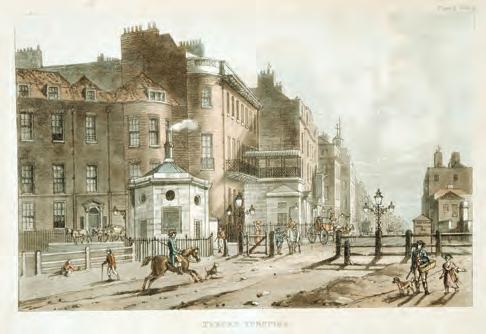
Source 2.6.2 Tyburn Turnpike, London, 1813. Turnpike roads charged tolls for users; the better the road, the more traffic would use it and the greater the profit.
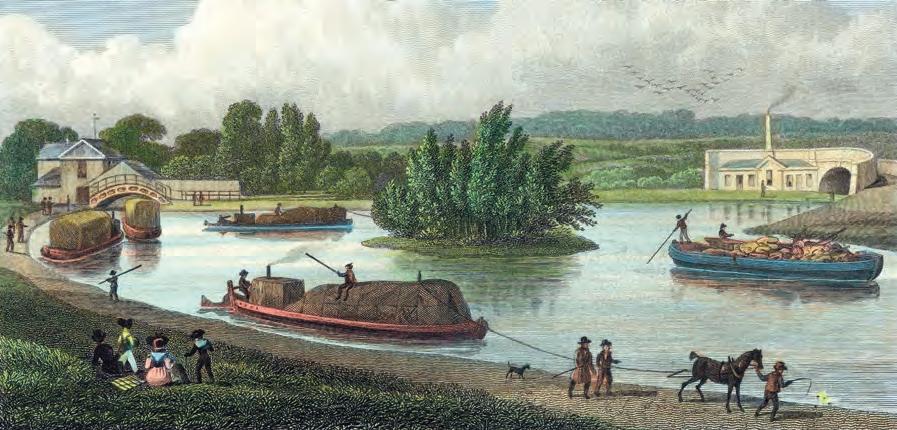
Source 2.6.3 A canal system at Paddington Basin, London, 1828. Canals offered a cheap and viable method to transport goods relatively quickly before the development of steam engines.
Canals
At the same time, another form of transport was developed: the British canal system. Canals had been used successfully in Europe for centuries, but had not been built in Britain.
UNCORRECTEDSAMPLEPAGES
In 1757, the Duke of Bridgewater commissioned a canal to be built to run from his mine in Worsley to Manchester, 16 km away. This canal was a raging success. While it cost £200 000 to build, it soon brought in £80 000 a year in tolls from those who used it. In addition, the price of coal in Manchester dropped by half. These developments meant that coal became cheaper for many people to access.
This began a period known as “canal mania”, where the construction of canals became the major focus of investors and businesses. In 1760, there were 2250 km of canals in England, but by 1830 this had grown to 6236 km. Canals meant that materials could be transported more quickly and easily. Canals proved useful for moving coal, wool and fragile goods, but were of less value for transporting perishables, such as food.
Railways
Before the Industrial Revolution, coal was pulled out of mines on animal-drawn carts, where the wheels ran along tracks. The inventor Richard Trevithick realised that it would be possible to use steam technology to make the wheels of a vehicle turn, and in 1804 he developed a steam-powered locomotive that could pull carts along a track. Other inventors, such as William Hedley and George Stephenson, developed these ideas further. The first railroad train began hauling coal to the northern English town of Stockton in 1825, and the first passenger train began service between Liverpool and Manchester in the north of England in 1830, a 50-km journey that took two hours.
In Britain, investment in railways became popular with the middle class, with a strong 10 per cent return. By the mid-nineteenth century, railway investment achieved better returns than other large businesses, such as the East India Company. The popularity of this investment in turn led to a dramatic increase in Britain’s railway network.
1

3
UNCORRECTEDSAMPLEPAGES
In 1830 there were 600 km of rail lines in Britain; in 1852 there were over 10 000 km of track.
2

Between 1844 and 1850 the number of railroad companies doubled.
In 1846 railway construction already employed over 200 000 people, and by 1900 this had increased to well over 600 000 people (including 30 000 women).

Embankments, tunnels and bridges slowly transformed the English countryside, while railway stations became centres of town life.
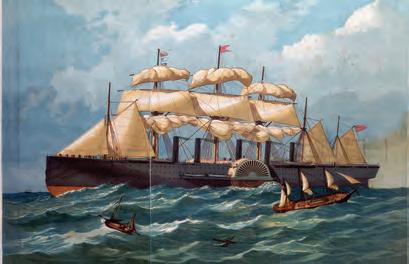
Source
afloat. The vessel was fitted with paddle wheels and a screw propeller, as well as sails.
Ships
In 1803 Charles Symington fitted a steam engine to a boat, the Charlotte Dundas, and towed two boats for 31 km along a canal near Glasgow. Strangely, no orders were placed for Symington’s boat, but it had proven the viability of steam on water. Nearly 10 years later another inventor, Henry Bell, built the PS Comet, a steamer fitted with paddle wheels on either side of the hull. In 1812, this vessel established the first commercial steam passenger service between Glasgow and Greenock in Scotland. In 1815 steamships were sailing from Glasgow to London, while the first crossing of the Atlantic was made under steam power in 1838.
2.6.4 When the SS Great Eastern was launched in 1858, this steamship was the largest vessel
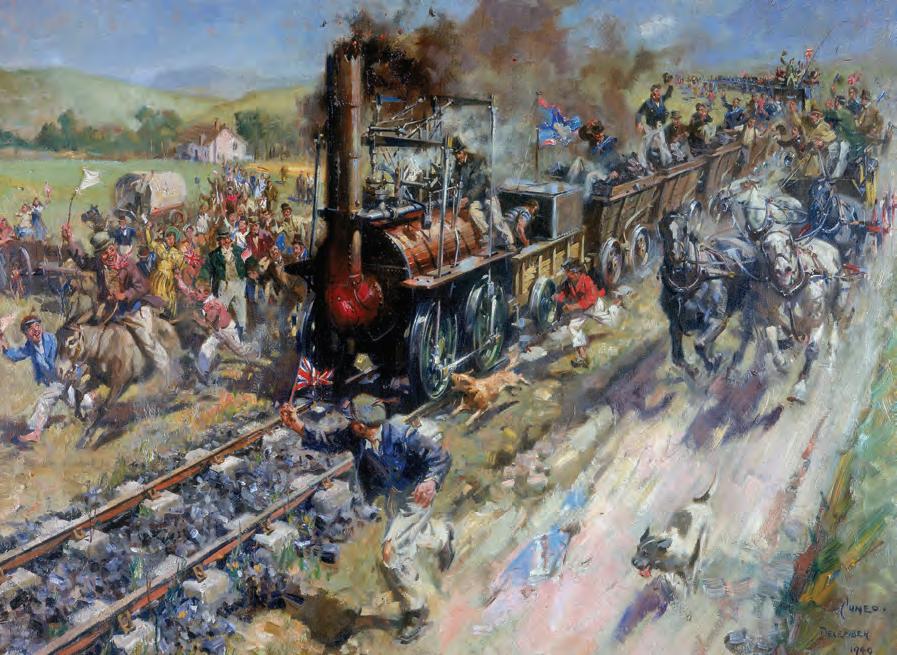
Source 2.6.5 Oil painting of the first railway journey, 27 September 1825. Large crowds watched Robert Stephenson at the controls of Locomotion as it pulled 36 wagons to the Stockton terminus.
Knowledge and understanding
Knowledge and understanding
Thinking and researching
Students can access sample responses and results online
Identify examples of how the British transport system improved during this period. What were one advantage and one disadvantage of using canals instead of roads?
Explain how improvements to British transport helped push the Industrial Revolution forward. Explain why railways were especially important for industrial cities and factories. Justify their economic and social impact.
Compare the four transport methods discussed. Which transport invention do you think was the most important? Justify your answer.
Thinking and researching
UNCORRECTEDSAMPLEPAGES
Teachers can go online to assign questions, view results, reports and more!
Create a mind map, flow chart or infographic that explains how the following were connected to the Industrial Revolution in Britain:
2.7 Social structure in Britain
Learning intention
In this lesson, you will learn about the impact of the industrialisation on daily life, including the changing social structure in Britain during the Industrial Revolution.
Starter activity
Success criteria
❏ I can name the three main social groups in Britain during the Industrial Revolution.
❏ I can describe the similarities and differences in the daily lives of these social groups.
Imagine three different people living in Britain during the Industrial Revolution – a worker in an industrial factory, the owner of the factory, and a middle-class clerk running a small business.
• How might their homes and daily routines be different?
• Who would have the most income? The most power?
• In terms of a social power structure, do you think much has much changed between then and now?
bourgeoisie the class of professional workers. This group included bankers, merchants and business owners, as well as lawyers, doctors, engineers and other skilled professions that offered specialised services.
proletariat the class of industrial workers. This group included factory workers, miners and other manual laborers who were often subjected to harsh working conditions, low wages and limited social mobility.
industrialist member of the wealthy elite who owned or managed large businesses, factories or other industrial enterprises, such as railways or canals
UNCORRECTEDSAMPLEPAGES
The Industrial Revolution was not simply a change in how and where people worked. It also profoundly transformed Britain’s social structure. People could now make money without having to own land or work it. This led to the rise of a new industrial middle class, the bourgeoisie, who gained significant economic power and influence, and an improved quality of life. Meanwhile, the industrial working class, known as the proletariat, expanded rapidly as more people moved into cities in search of work. At the same time, members of the wealthy elite became industrialists, profiting enormously from the new economic system.
The working class
The rapid expansion of factories and other industrial enterprises during the Industrial Revolution led to the growth of the urban working class, or proletariat. As mechanised production increased, there was a high demand for workers, which prompted many people to move from rural areas into cities in search of employment. These workers were often employed in factories or mines. They worked in harsh and unsafe conditions, facing long hours and low wages. Adult men typically received about 10 shillings per week, while women earned 5 shillings for the same work, and children were paid just 1 shilling. With rent alone costing around 5 shillings per month, working-class families had little left for food, clothing and other necessities. As a result, many working-class families struggled to meet their basic needs. Despite these challenges, the urban working class played a crucial role in the economic transformation of Britain, contributing to increased production and the overall growth of the industrial economy.
The middle class
Until the 1800s, there had only really been two classes in society: members of the upper class, who had been born into their lives of wealth and privilege, and commoners, who were born into the working class of farmers and labourers. Towards the end of the nineteenth century, a middle class began to emerge in industrial cities. The term “middling sort” emerged in the mid-eighteenth century to describe people who were socially positioned between the aristocracy and the working class. A number of factors related to the Industrial Revolution enabled the growth of this new class.
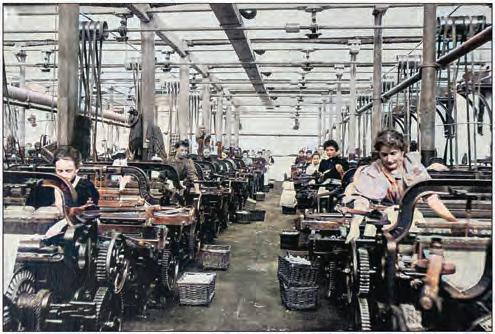
Writing focus 2.7
Appositives
The rise of manufacturing brought about an increase in small business owners, including shopkeepers and merchants who managed the distribution and sale of the goods produced in factories and around the growing British Empire. Retail shops in England increased dramatically in the second half of the nineteenth century, and this period saw the rise of department stores, with companies such as Harrods and Selfridges opening their doors in the early 1900s.
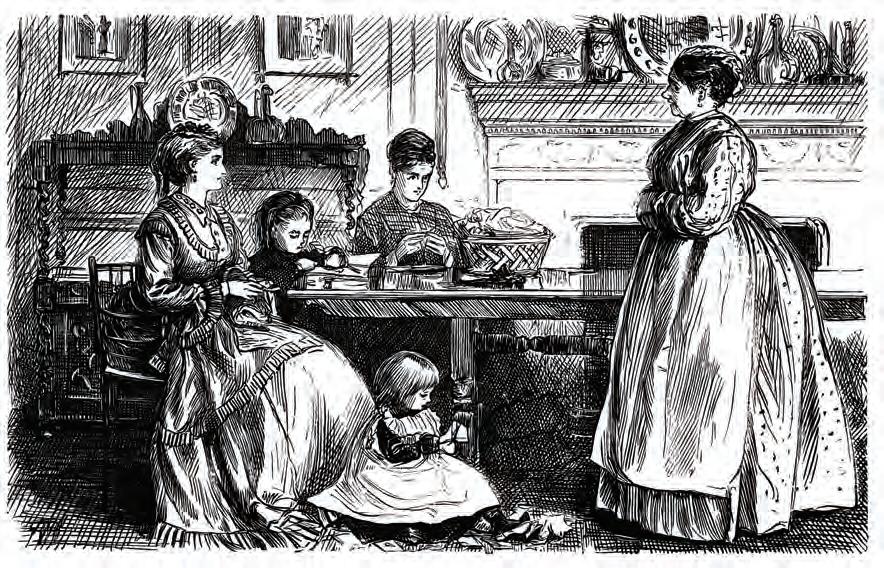
UNCORRECTEDSAMPLEPAGES
Source 2.7.2 A
Source 2.7.1 A photograph of women working in a Lancashire cotton mill, nineteenth century ➜
drawing of a middle-class Victorian woman with her children and a companion or relative, talking to her cook or housekeeper. This was published in the Punch Almanack for 1865–79. Punch was a popular magazine during the nineteenth century.
entrepreneur someone undertaking a new enterprise with a chance of profit or loss
The expansion of industry and overseas trade also spurred the development of banks, insurance, shipping and railway companies, which needed new systems of regulation and management. As such, the nineteenth century saw a significant expansion of local government and bureaucracy, creating jobs for a wide range of civil servants, teachers, doctors, lawyers and government officials, as well as the clerks and assistants who supported these institutions and services. It was this diverse group of people who became known as the bourgeoisie.
UNCORRECTEDSAMPLEPAGES
Life for the middle class
The term “Victorian” was first used in 1851. It referred to a sense of pride and confidence that the British middle class enjoyed during the long reign (63 years) of Queen Victoria. Members of the bourgeoisie had rising incomes, and were able to enjoy some of the luxuries that had previously only belonged to the upper classes. For example, they were able to hire servants to cook for them and clean their houses. Between 1851 and 1871, the number of domestic servants in Britain rose from 900 000 to 1.4 million. Members of the bourgeoisie could also afford to send their children to school. Middle-class families were able to indulge in leisure activities, and they emulated the lifestyles of the upper class by enjoying new music and travel opportunities during their free time. Additionally, team sports like cricket, rugby and soccer attracted large followings and audiences. New recreational activities like skiing, biking and hiking also emerged. Many of these activities became accessible to the working classes when they could afford them.
Along with these activities, the middle classes developed a strict moral code of behaviour, emphasising self-discipline, hard work and personal achievement. The Victorian consensus was formed around the entrepreneurial ethic, emphasising self-reliance, faith in progress and respectability. Respectability meant different things to different families. For a comfortable middle-class family, it might mean having three servants; for a lower middle-class family, it might mean having an area next to the kitchen where the family could eat and for a working-class family it might be to avoid a pauper’s funeral (funerals paid for by the government that often used a communal grave and had no service or headstone).
Source 2.7.3 Victorian advertisements for women’s fashion in Pearson’s magazine, 1898 ➜
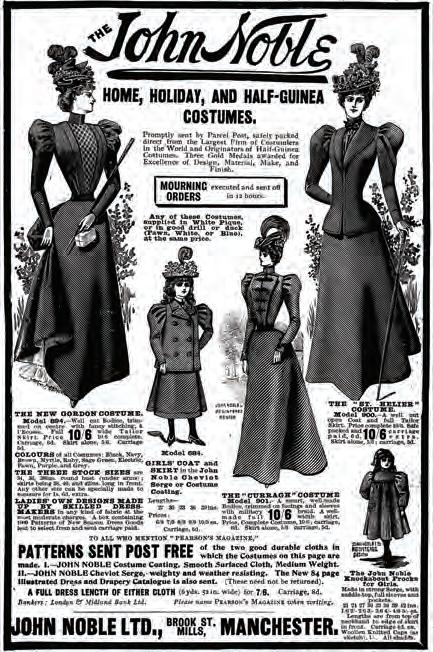
Activity 2.7.1
Source analysis
Source 2.7.4 The text below is an extract from Punch Magazine, or the London Charivari, a British weekly magazine containing humorous and satirical articles and cartoons that commented on the contemporary social and political scene.
DIRECTIONS TO LADIES FOR SHOPPING,
Shopping is the amusement of spending money at shops. It is to a lady what sporting is to a gentleman; somewhat productive, and very chargeable. Sport, however, involves the payment of one’s own shot; shopping may be managed by getting it paid for. Ride all the way till you come to the shoppingground in a coach, if you can; in an omnibus, if you must; lest you should be tired when you get there. If you are a lady of fashion, do not get out of your carriage; and when you stop before your milliners, particularly if it is a cold, wet day, make one of the young women come out to you, and without a bonnet, in her thin shoes, stand on the kerb-stone in the damp and mud.
Explain why a historian might need to be cautious about using Source 2.7.4 as evidence. 1. 2.
Describe the value of Source 2.7.4 for a historian studying life for the middle classes in the nineteenth century.
Historical concepts: Significance Historical skills: Analysis and use of sources
The middle class began to assert that the working class were responsible for their own disadvantages in life, and saw drunkenness and gambling as dangerous vices that affected the weaker individuals in society. Morality and purity were seen as middleclass virtues, and the many members of the bourgeoisie were disdainful of what they saw as the uneducated and culturally inferior urban poor.
At the same time, during the Industrial Revolution religious tolerance grew. Parliamentary decrees in 1854 and 1856 allowed non-Anglicans to attend Cambridge and Oxford Universities, where they had previously been denied entry. An 1851 government survey on a Sunday discovered that, out of a population of 18 million, fewer than half had actually attended church that day. Nevertheless, religion played an important part in middle-class Victorian life. Between 1841 and 1876, the Anglican Church built 1727 new churches and restored more than 7000 old ones.
Industrialists
For the upper classes during the Industrial Revolution, land ownership continued to be important. By 1876, an overwhelming 95 per cent of the population of Britain did not own any land. However, during the Industrial Revolution, another key characteristic of the elite emerged: capital. Capitalists maintained their status by directly investing their money in industry and businesses, providing loans to inventors in exchange for future profits, and purchasing shares in canal, railway and shipbuilding companies. These wealthy individuals took on the financial risks of the new economic system, and they benefited by accruing greater personal wealth in return.
UNCORRECTEDSAMPLEPAGES
capitalist wealthy person who invested money in businesses or industry, with the aim of making a profit. Capitalists typically owned capital, such as land or other property, and used it to generate more wealth for themselves.
Punch, July–December 1844
Beneath the landowners and wealthy capitalist investors were the business owners who wielded significant power due to minimal government oversight of their industries. There was no minimum wage for factory workers. Consequently, factory owners became wealthier while factory workers became poorer.
While education offered a potential route to gain greater wealth and social status, it required a financial investment that not many industrial workers could afford. Some individuals, like the multiple mill owner Robert Owen (1771–1858), did rise from humble origins to become prominent industrialists, but they were rare exceptions. Most industrialists had received a good education, often up to university level.
Some wealthy capitalists believed that their wealth came with a responsibility to use their money to give back to the community, and help address the social problems of the time, such as poverty and disease. The nineteenth century saw the growth of many charitable organisations. For example, the Salvation Army was founded in 1865 by William and Catherine Booth, who secured funding from wealthy donors to support their mission. Notable industrialists who became prominent philanthropists included Andrew Carnegie, who spent huge sums of money to fund public libraries in the United States. While these industrialists sought to promote positive change in society, they also faced criticism. There were those who saw their actions as a method of increasing their own power and influence in society, using the wealth gained from the exploitation of the working class to fund public institutions and gain further prominence and prestige in the process.
Source analysis Activity 2.7.2
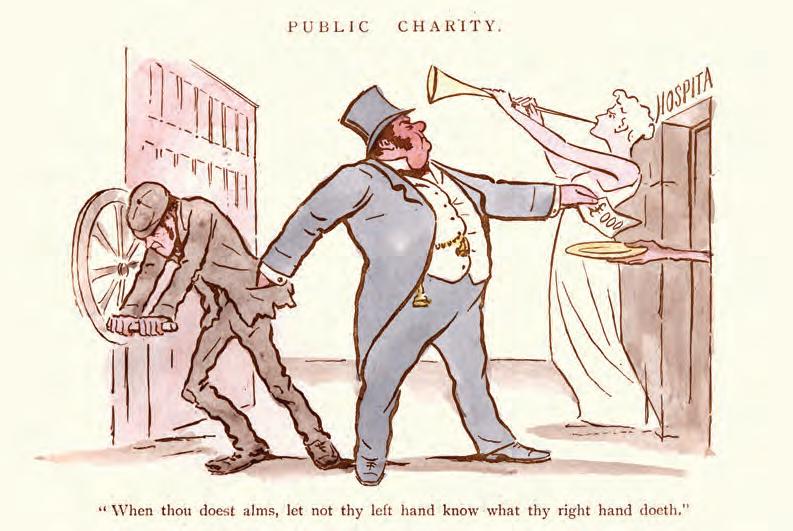
UNCORRECTEDSAMPLEPAGES
Source 2.7.5 Vintage engraving of a Victorian satirical cartoon entitled “Public Charity”. Note the sign over the door on the right reads “Hospital”.
➜
Source 2.7.6 An extract from the novel The Mysteries of London, published in 1844. Written in weekly instalments, it sold more than a million copies in total and was one of the most popular novels of its time. The novel emphasised the poverty, crime and violence of a big city, and included detailed and often sympathetic descriptions of the lives of the working class. In the extract below, a capitalist called Greenwood is looking for someone to invest in a new project.
He turned into the office of a well-known merchant and capitalist on Cornhill … raising his eyes from the morning paper which lay before him, he [the merchant] said in a cold tone, “Oh! Mr. Greenwood, I believe? Pray, sir, what is your business?”
…. – “The fact is, my dear sir, I have conceived a magnificent project for making a few thousands into as many millions, I may say; and as on former occasions you and I have done some little business together – and I have put a few good things in your way – I thought I would give you the refusal of my new design.”
…“The risk is nothing – the gains certain and enormous. You and I can keep it all to ourselves; and –”
“You require me to advance the funds, I presume?” asked the merchant, eyeing his visitor askance.
“Just so – a few thousands only – to be repaid out of the first proceeds, of course,” returned Greenwood.
“Then, sir, I beg to decline the speculation,” said the merchant, drily.
“Speculation! It is not a speculation, cried Greenwood “it is a certainty.”
➜
Source 2.7.7 The extract below was created by London Publisher Edward Mogg, who issued travel guides and maps for London and other areas of England and Wales. In it, he comments on the poor state of London’s water companies.
The Water Companies of London, although of late years much increased, have still left ample room for augmentation; and if, instead of wasting their substance in ruinous railroad speculations, and diverse other projects… capitalists would direct their attention to the formation of water companies, the proprietors might rely with safety upon a return of their capital, with ample interest, and reap the additional satisfaction of having greatly contributed to the health, convenience, and comfort of the metropolis.
UNCORRECTEDSAMPLEPAGES
Using Source 2.7.5, answer the following questions:
a. Identify the two classes of people portrayed in the cartoon.
c. Explain the value of the source for learning about the growth of capitalism in the nineteenth century. Consider aspects such as where, when and why the source was created, as well as why it was created. 1. 2.
b. Explain the message being communicated by the cartoon.
Using Source 2.7.6, answer the following questions:
a. Based on what you have learned about the growth of industry in the nineteenth century, what kind of projects might Mr Greenwood be trying to invest in?
b. What is the main motivation that Greenwood gives for wanting to invest in his new project, and why does the merchant decline?
Edward Mogg, 1844, Mogg’s New Picture of London and Visitor’s Guide to Its Sights
George W.M. Reynolds, 1844, The Mysteries of London, Containing Stories of Life in the Modern Babylon, London
Using Source 2.7.7, answer the following questions:
a. In your own words, explain what Mogg believes capitalists should do with their money, and why.
b. Account for the perspective of Source 2.7.7.
What do the sources reveal about the way wealthy capitalists were viewed by members of the lower classes in the nineteenth century?
In what ways did capitalists contribute to the economic and social developments of the Industrial Revolution? In your response, make use of evidence from any two of Sources 2.7.5, 2.7.6 and 2.7.7.
Historical concepts: Perspectives Historical skills: Analysis and use of sources
Teachers can go online to assign questions, view results, reports and more!
Knowledge and understanding
What was the name given to the growing urban working class that emerged during the Industrial Revolution?
Identify four types of jobs undertaken by the new working middle class.
Outline the kinds of ideas that were associated with the Victorian age.
Explain how the middle class justified their new wealth and position in society.
Evaluate the contributions made by industrialists during the Industrial Revolution.
Thinking and researching
Is society more equal today than it was in Britain during the Industrial Revolution? Conduct research to justify your response, focusing on one of the following areas:
• Similarity: who are the modern-day equivalents of the proletariat, bourgeoisie and industrialists? Explain one difference and one similarity for each group.
• Fair work: Discuss how working hours, safety and pay have changed since the Industrial Revolution.
• Power: who had power during the Industrial Revolution, and who holds power today? Has it changed? Identify one way power is shared more evenly today, and one way it is not.
Historical concepts: Continuity and change, Perspectives, Significance Historical skills: Perspectives and interpretations, Research
Living conditions in Britain 2.8
Learning intention
In this lesson, you will learn about the growth of cities and the impact of city living on the working class in Britain during the Industrial Revolution.
Starter activity
Success criteria
❏ I can describe the impact of urbanisation on the living conditions of the working class.
❏ I can identify some improvements to urban living that benefited people’s lives during the Industrial Revolution.
Imagine walking through an industrial town in 1800s England, using the image in Source 2.8.1 as reference alongside your own imagination.
• What would you see?
• What would you hear?
• What would you smell?
• What would you taste?
• Witnessing all this, what would you feel?
In 1750, only 20 per cent of Britain’s population lived in cities. By 1880, that number had risen to 80 per cent. Due to the lack of government planning for this population shift, urbanisation led to a stark contrast in living conditions between the wealthy upper and middle classes and the working poor. A lack of government oversight created slums where poorer citizens lived in overcrowded areas close to factories. Their working and living conditions typically lacked both comfort and safety. Members of the bourgeoisie, on the other hand, enjoyed a significant improvement in their living conditions during the Industrial Revolution, and were able to live on the outskirts of cities, commuting into town on the new rail lines. For the working class, traditional lifestyles and family structures were also disrupted, leading to changes in social dynamics and the emergence of new social issues.
The working class
UNCORRECTEDSAMPLEPAGES
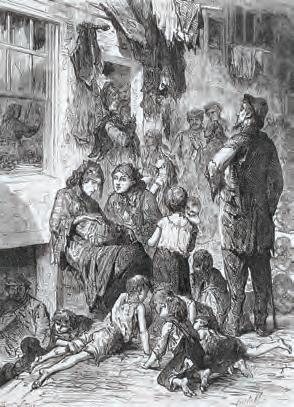
Source 2.8.1 Overcrowded living conditions in Britain, stemming from Industrial Revolution displacement ➜
Outside the factories, workers on low wages lived in terrible conditions, crammed into tiny bedsits where whole families often slept in a single bed. Tenements became increasingly common in cities around Britain to accommodate workers and their families. These buildings were cheaply and poorly constructed, and they lacked proper ventilation because they were often constructed back-to-back.
Writing focus 2.8
The language of source analysis
urbanisation the growth of cities
tenement type of building shared by multiple dwellings, with flats or apartments on each floor
cholera an infectious and often fatal bacterial disease that causes severe vomiting and diarrhoea, usually spread by contaminated water
Sewerage systems and garbage collection did not exist at this time. To make matters worse, there was no public transport. This meant that rents were high in the city because people wanted to live as close as possible to work. It was not unusual for more than one family to share a living space. Such conditions were very unsanitary, and this led to outbreaks of disease.
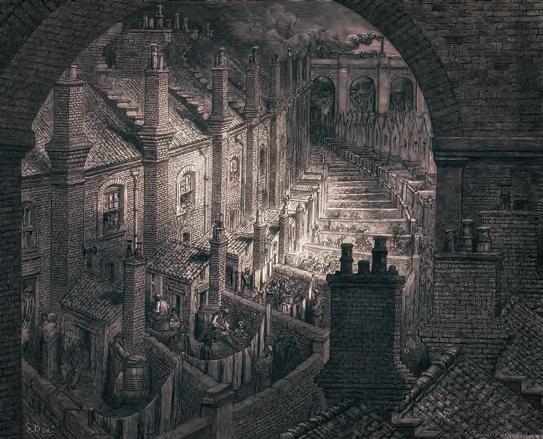
Source 2.8.2 OverLondonbyRail, 1872, by Adolphe François Pannemaker. Men and women in the back yards of tenements in the East End of London, with a steam locomotive passing over a bridge in the background.
Activity 2.8.1
Source analysis
Between 1832 and 1866 there were multiple outbreaks of cholera in Britain. In 1853–54 alone, more than 10 000 Londoners died from cholera. In London, the “Great Stink” of 1858, where the sheer amount of waste being dumped into the River Thames caused an unbearable smell, finally forced the government to act.
Improvements in urban living
Urban life did improve slowly. In 1807 coal gas streetlamps were installed at Pall Mall in central London. In 1829 the modern police force was created by Robert Peel, then Home Secretary (hence, the police nickname of “bobbies”). This greatly improved public safety. By 1866, most of London was connected to a sewerage network.
Source 2.8.3 Hippolyte Taine, a French writer, described a visit to London in the 1860s.
What dreary streets. Through half-open windows we could see the wretched rooms at ground level, or often below the earth’s damp surface. Masses of … children, dirty and flabby of flesh, crowd each threshold and breath the vile air of the street, less vile than that within.
Taine, H., 1872, Notes on England, cited in Mason, J., 1993, Expansion, Trade and Industry Britain 1750–1900, Longman, London, p. 18
Source 2.8.4 The Swansea Medical Officer of Health gave this report in 1853.
No cleanliness within, and no drainage without: stagnant water soaking through the walls, with no space to discharge itself … the floors in many cases … unbricked and in wet weather becoming a mass of mud … the garden … heaped with ashes, and in many cases stored with pig dung.
UNCORRECTEDSAMPLEPAGES
Quoted in Mason, J., 1993, Expansion, Trade and Industry Britain 1750–1900, Longman, London, p. 18
What picture do Sources 2.8.3 and 2.8.4 paint of life in urban centres during the Industrial Revolution? Is one of these sources more reliable than the other? Justify your answer.
Historical concepts: Significance Historical skills: Perspectives and interpretations
When Europe was struck with subsequent cholera outbreaks, London did not suffer another major epidemic. In 1878 London also had the first version of electric street lighting installed.
It was during this era that education for children became a mass phenomenon. In 1816 it was found that of 1.5 million children of school age in England, 875 000 attended school “of some description”. It must be stated that school “of some description” only needed to last one year. In 1833, the government allocated funding to create schools for the poor, and in 1851 the definition of school was expanded to include at least two years of schooling. By 1861, of a school-age population of 2.75 million children, 2.5 million were registered as attending school. In 1880, the government legislated that school was compulsory for all five- to 10-year-olds.
Extension 2.8.1 Living conditions for the working classes DOC
Knowledge and understanding
Describe some of the ways that life improved for city dwellers in the 1800s.
Define “tenements” and explain who lived in them.
Explain why disease was so prevalent in Britain during the Industrial Revolution. Summarise three major improvements in urban living that occurred during the 1800s, and explain how they contributed to making Britain a safer or healthier place.
Thinking and researching
Imagine you are the Mayor of Manchester in 1851. Manchester is a city in the north of England that saw a massive expansion of industry, but also a decline in the quality of life for the poor because of bad living conditions. Your city has quadrupled in size within 50 years. Write a summary of what you see are the advantages and disadvantages of expansion.
UNCORRECTEDSAMPLEPAGES
Teachers can go online to assign questions, view results, reports and more!
Working conditions
Learning intention
In this lesson, you will learn about the standard of working conditions within mines and factories during the Industrial Revolution in Britain.
Starter activity
Success criteria
❏ I can describe what it was like to work in mines and factories during the Industrial Revolution.
Look at the two images in Source 2.9.1. One shows a coal mine, and the other shows a forge within a factory. What would you choose – to work long hours in an underground mine or to work long hours in a dangerous factory? For the working class, often there were no better choices.
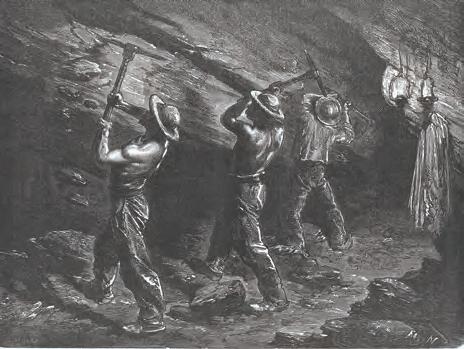
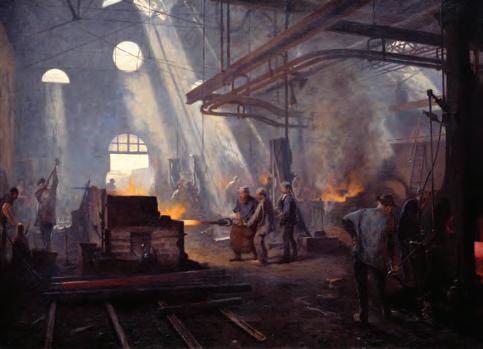
Writing focus 2.9
The language of source analysis
UNCORRECTEDSAMPLEPAGES
The effects of the Industrial Revolution on the working population were not fully appreciated at the time. The tremendous disruption, hardships and downright dangerous working conditions that workers were exposed to were not things that the government had anticipated needing to monitor. Governments had never before needed to regulate working conditions for workers, and it created a new set of responsibilities for the people’s representatives.
Workers were expected to work harder to ensure profits as enterprises became larger, and investments were made on a greater scale. This was a significant change compared with the recent past, where cotton spinners or tradespeople generally worked for themselves. The bulk of the population now worked in factories, mills or mines as employees, often with no rights or protection at all. Lack of worker protections allowed the owners of factories, mines and mills to exploit their workers.
Source 2.9.1 Workers underground in a darkened coal mine (left), and workers in the heat of a dangerous forge (right). ➜
Working conditions in factories
In the pre-industrial age, skilled workers (or artisans) such as locksmiths and weavers were members of guilds, which gave them some limited protection. In 1799, guilds were formally abolished in Britain. This meant that in new industrial factories, cotton mills and mines, workers had no protection to regulate their hours, pay rates or working conditions. A normal shift for a factory worker in Britain in the early 1800s was usually 12 to 14 hours a day, with extra time required during busy periods. Workers were often required to clean their machines during their meal breaks. They could have their pay docked for lateness, missing a shift or even for taking a meal break. Early factories were often unsafe, and deaths and injuries occurred regularly. Many factories lacked heating in winter, were extremely noisy, and exposed workers to hazardous equipment or materials. These conditions were endured by workers because there was no avenue for them to request improvements. The employment of women and children was also considered acceptable at the time because, before industrialisation, women and children had previously worked in the fields and on farms. The rules for safe factory operation had not yet been written.
Activity 2.9.1
Source analysis
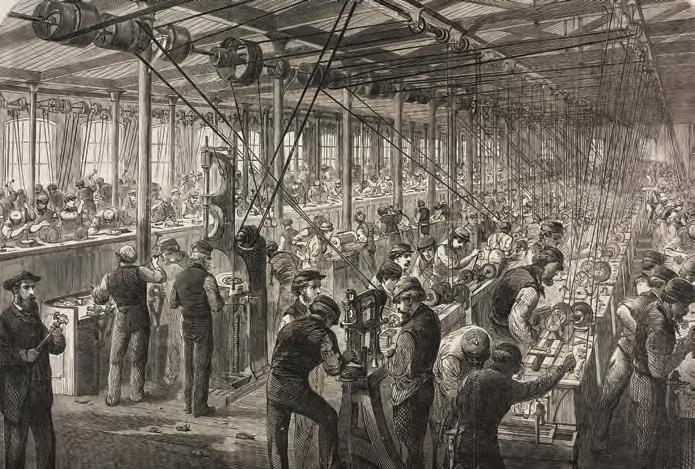
guild an association of people in a particular trade or business that sets standards for that particular industry
Source 2.9.2 An engraving showing workers manufacturing guns – illustration for The Illustrated London News, 5 April 1862 ➜
Source 2.9.3 Elizabeth Bentley was six years old when she began working in a flax mill. The source below is an extract from her interview with the House of Commons Committee. She told of how working in the factory had seriously damaged her health.
UNCORRECTEDSAMPLEPAGES
I worked from five in the morning till nine at night. I lived two miles from the mill. We had no clock. If I had been too late at the mill, I would have been quartered. I mean that if I had been a quarter of an hour too late, a half an hour would have been taken off. I only got a penny an hour, and they would have taken a halfpenny.
4 June, 1832
Elizabeth Bentley, interviewed by Michael Sadler's Parliamentary Committee on
Source 2.9.4 Below is an extract from a factory worker, speaking to a newspaper about her experiences working in a textile factory in the 1840s. ➜
There was a young woman, Sarah Goodling, who was poorly and so she stopped her machine. James Birch, the overlooker knocked her to the floor. She got up as well as she could. He knocked her down again. Then she was carried to the apprentice house. Her bed-fellow found her dead in bed. There was another called Mary. She knocked her food can down on the floor. The master, Mr. Newton, kicked her where he should not do, and it caused her to wear away till she died. There was another, Caroline Thompson. They beat her till she went out of her mind.
What do these sources reveal about the working conditions in factories during the Industrial Revolution?
Compare the value of images such as Source 2.9.2 with the accounts provided in Sources 2.9.3 and 2.9.4 for understanding the experience of factory workers.
Historical concepts: Perspectives Historical skills: Analysis and use of sources
colliery a coal mine where coal is extracted, as well as the buildings above the mine such as washhouses and offices. Collieries are often part of larger mining operations that also include the transportation and processing of coal.
UNCORRECTEDSAMPLEPAGES
Working conditions in mines
During the Industrial Revolution, coal became the primary fuel source for powering steam engines, which were crucial for running factories, trains and ships. Coal was also used to produce iron and steel. The increased demand for coal had significant impacts on regions with abundant coal reserves. New coal pits required new miners and villages to accommodate them. These colliery villages in coal-rich areas like Durham, England, saw the population grow from 97 000 to 160 000 between 1730 and 1801. Children as young as six were reported to be working in the mines by 1800.
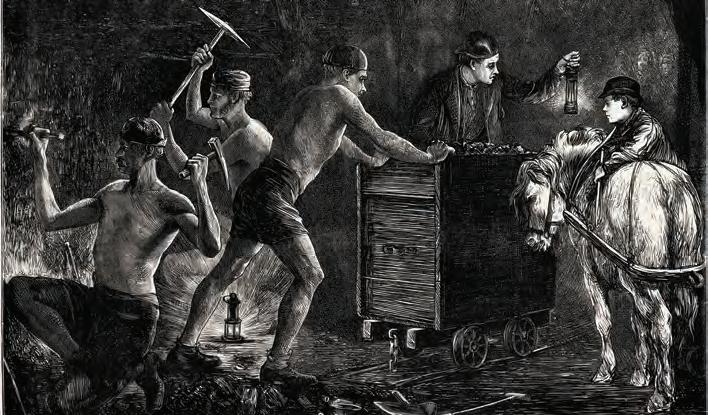
Source 2.9.5 Pitmen Hewing the Coal in a Mine, 1871 ➜
Work in the mines was extremely dangerous. Coal seams deep underground emitted a highly flammable gas known as firedamp, and many miners lost their lives to gas explosions. In 1812, an explosion at Felling Colliery near Gateshead claimed the lives of 92 miners. Poor ventilation in mines also led to long-term health issues for miners. The accumulation of coal dust in their lungs caused many to develop diseases such as emphysema and bronchitis. This contributed to the premature deaths of many miners. In 1813, Dr George Pearson observed that by the age of 65, most miners’ lungs were completely black. This condition was known as “black lung disease” or “black spit”.
Sarah Carpenter, The Ashton Chronicle, 23 June, 1849
In addition to these dangers, miners could also be killed in accidents caused by fires, flooding and roof collapses, as well as rope and chain breakages. One of the worst mining disasters occurred at Hartley Colliery near Seaton Delaval on 16 January 1862, when the beam of the pit’s pumping engine broke and fell down the shaft, trapping and killing 204 men below. It has been estimated that in some nineteenth-century collieries, workers had a 50 per cent chance of being killed in a mining accident.
Knowledge and understanding
Where did the bulk of the population work during the Industrial Revolution?
Why were workers so vulnerable to suffering poor conditions at the beginning of the Industrial Revolution?
Outline the evidence that governments tried to improve the lives of the British working class during this period.
Explain the importance of coal during this period.
Describe the dangers of mine work.
Why might more government focus have been given to reforming working conditions in factories rather than mines?
How successful were attempts to improve the lives of the working class in Britain during the Industrial Revolution?
Thinking and researching
• chimney sweep. 1.
A lot of difficult jobs evolved during the Industrial Revolution. Choose one job from the list below and research what it involved and the people who were most likely to do this job:
• legger
• soap boiler
• knocker upper
• bone cleaner
• presser
• match maker
• tosher or mudlark
2.10 Child labour
Learning intention
In this lesson, you will learn about child labour in Britain during the Industrial Revolution.
Starter
activity
Success criteria
❏ I can explain the cause and effect of child labour in Britain during the Industrial Revolution.
Do you agree or disagree with the following statements? Discuss as a class, or with the person next to you. Explain your reasoning.
• Children should work if their family is poor.
• School is more important than earning money.
• Children should never perform dangerous jobs.
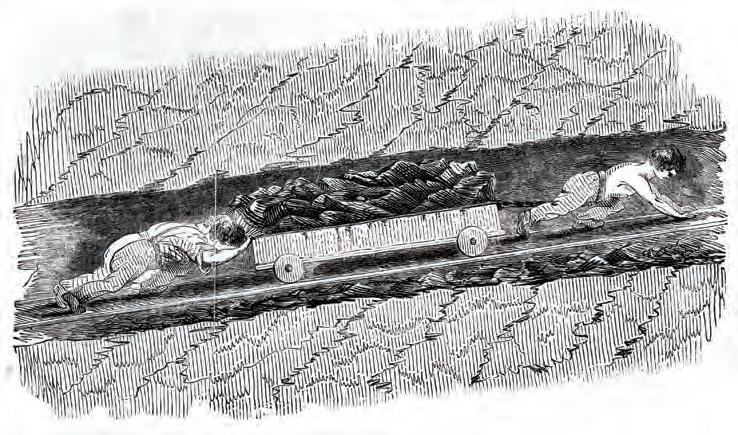
Source 2.10.1 Three young children hurrying a loaded wagon in a mine, 1842. One child is seen pulling the wagon along a narrow and steep tunnel, while two other children push it from behind.
Child labour was not new in Britain: for centuries the children of working-class families were expected to work from an early age. The biggest change in the Industrial Revolution was the nature of that employment.
Child labour in mines
Writing focus 2.10
Creating topic sentences
In the past, children helped spin wool or worked in the fields at harvest time. During the Industrial Revolution, children found themselves doing things such as working down a mineshaft for a shift of 12 hours or longer, beginning at 1 or 2 a.m. Children would often have the job of carrying coal on their hands and knees, as they were the only people small enough to fit into some of the thin coal seams deep underground. They might also be employed to monitor ventilation doors deep within the mines. In one mining accident at Huskar Colliery in 1838, a ventilation shaft flooded, killing 26 children – boys and girls aged between nine and 16.
In 1838, after the Huskar Colliery accident, Queen Victoria ordered an inquiry into working conditions in the mines, and by 1842 the publication of the First Report of the Children’s Employment Commissioners: Mines and Collieries had been prepared by Lord Shaftesbury. The report caused a sensation when first published in the newspapers, as the majority of people living in Britain were not aware of the widespread employment of women and children in mines. This led to the passing of the Mines and Colliers Act in the same year, which banned women and girls from working in coal mines and introduced a minimum working age of 10 for boys.
Due to a lack of public support and government oversight, this law was not widely enforced. As historian Peter Kirby highlights, nearly three-quarters of the petitions to Parliament during this time were against any proposal to regulate child labour, as employers feared that the change of law would lead to lower profits. Most of these petitions came from coal-mining areas where child labour was widely used. In 1850, the Commissioner of Mines, Hugh Seymour Tremenheere, estimated that 200 women and girls, many of whom were as young as 11 or 12, were working in mines in South Wales. It was not until 1903 that the age of boys who could work in the coal mines was raised to 13 years. The practice of employing children in collieries continued for a long time afterwards.
Child labour in factories
Child labour in factories was a more visible exploitation of young people than in coal mines, and complaints about the use of child labour in factories eventually led to parliamentary action. Robert Peel, a member of parliament and a factory owner who was concerned about the health and welfare of children working in factories, was instrumental in getting the first Factory Acts passed through parliament. In 1831, the Ten Hours Movement was formed to lobby for a 10-hour day for all workers – men, women and children. Many believed it was wrong for the government to interfere with working conditions, and factory owners argued that if hours were lowered, factories would not be profitable and would close. Eventually, the government decided that it was not its place to interfere in the working hours of adults, but that children were a different matter.
Source 2.10.2 Key events relating to child labour in factories
Year Event
1802 Health and Morals of Apprentices Act. This applied to orphan apprentices in the textile industry. No children under the age of nine were to be apprenticed and the working day was limited to 12 hours with no night work. There was no system for enforcement.
UNCORRECTEDSAMPLEPAGES
1819 Cotton Mills and Factories Act. This applied only to the cotton mills and restricted the working week for those aged 9–16 to 72 hours. No children under the age of nine were to be apprenticed. No system of enforcement was devised.
1831 Labour in Cotton Mills Act. This Act applied only to cotton mills and restricted the working hours for those under 18 years old to 12 hours a day. Working at night was forbidden for any workers under 21 years old. Once again, there was no enforcement system.
Year Event
1833 Factory Act 1833 (3 & 4 Will. IV) c. 103. No children under nine years old were to be employed except in silk mills. Those aged nine to 13 were restricted to nine hours a day and 48 hours a week with two hours of school a day. Children and young persons were not to work outside the period 5.30 a.m. to 8.30 p.m. For the first time, factory inspectors were appointed.
1842 Mines and Collieries Act. This Act stopped children under nine years old and women from working underground.
1844 Factory Act (Textiles). This Act applied only to the textile industry and limited the work of children aged eight to 13 to 6.5 hours a day, which was considered to be “half-time”.
1847 Factories Act 1847. Women and young persons in textile factories were limited to 10 hours a day or 10.5 hours if Saturday was a half holiday. This is sometimes known as the Ten Hour Act.
1850 Factories Act 1850. This Act related to mills and required that the work of women and young persons be between the hours of 6 a.m. to 6 p.m. in summer and 7 a.m. to 7 p.m. in winter.
1867 Factories Act Extension Act 1867. This brought any workplace employing more than 50 persons in manufacture under the Factory Acts
1874 Factories (Health of Women, etc.) Act 1874. This forbade employment of children in mills under the age of nine. In 1876 the age limit was raised to 10. Children aged eight could still be employed in workshops and non-textile factories.
1891 Factory Act 1891. Mothers were not to return to work within four weeks of giving birth. From 1893 the limit was raised to 11 weeks.
Source analysis Activity 2.10.1
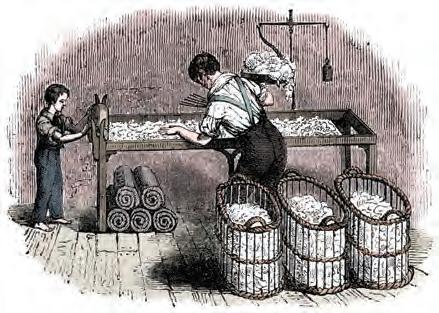
➜
Source 2.10.3 A man and young boy work in cotton manufacturing in London in 1845. They are cleaning the cotton by removing seeds to make it ready for use in textile mills. The baskets at the front are full of cleaned cotton.
UNCORRECTEDSAMPLEPAGES
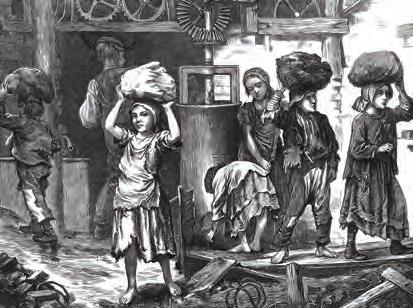
Source 2.10.4 British children carrying clay in a brickworks in 1871. Some estimates suggest that between 20 000 and 30 000 children between the ages of five and 16 worked in similar brickworks at the time.
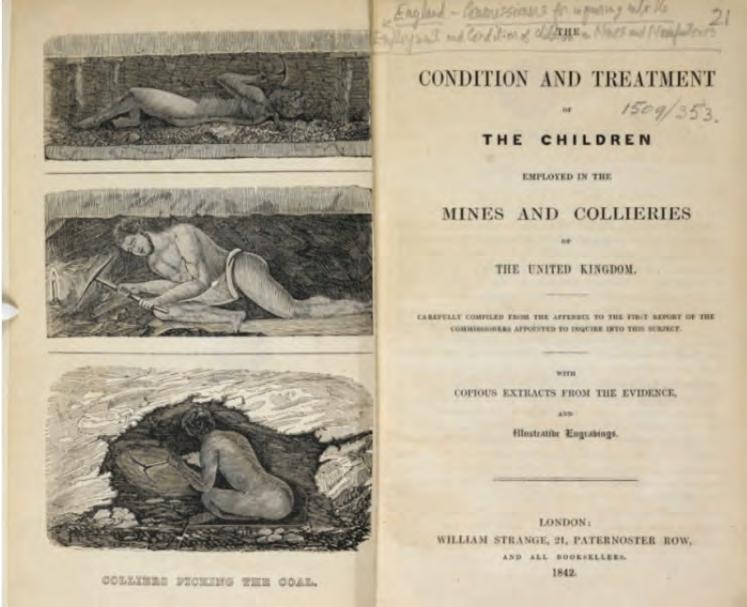
Source 2.10.6 In 1818, the Manchester Mercury reported on a court case about child labour.
Source 2.10.5 Opening spread of the parliamentary report on children working in mines and collieries, 1842 ➜
This is not the only Factory noticed in the Minutes of Evidence, where Children are detained five days in the week during the dinner time, to clean the Machinery. It is further on evidence, that at one Mill the people are detained during the dinner hour every day; that they are employed 14 hours a day without intermission, the Steam Engine never stopping during that time; consequently whatever refreshment they get, is taken as the works go on.
Manchester Mercury, 26 May 1818
Source 2.10.7 An 1843 article in the Bristol Mercury expressed concern about child and female labour. ➜
One of the great evils of our present social condition … is the excess of child labour.
Another great evil is the excess and intensity of female labour. Men are starving for want of employment, and women and children are, by thousands; crushed out of existence in consequence of their strength not being equal to their tasks. In the child labour department, too, there is no distinction of sex. In the mine, the factory, and the workshop, boys and girls work together from the ages of five to 15 and upward. It is not desirable to more than hint at the consequences which arise from the promiscuous intercourse of beings whose moral faculties are in a great degree in abeyance, and in whom perceptions of delicacy and decency have been either obliterated, or have never been developed. It is sufficient to know that the females, in a vast majority of instances, become totally unfitted to discharge the duties of wives and mothers. They are never trained to domestic management; consequently, the poor man’s “home” is too often some fetid den, where squalid vice has taken up her abode, and where himself and partner, and their children, are huddled together in one common misery; the children only exchanging the garret and the cellar for the mine and the workshop, where enduring noxious influences prepare them to run the same career as their wretched parents.
UNCORRECTEDSAMPLEPAGES
“Child and female labour”, Bristol Mercury, 11 March 1843
Examine the images in Sources 2.10.3, 2.10.4 and 2.10.5. What kinds of work do they show children doing?
Using Sources 2.10.3 to 2.10.6 and other evidence, describe the conditions in which the children are working.
Source 2.10.5 is a report conducted by the British Government. What does it tell us about the different attitudes to child labour during this period?
In Source 2.10.6, what unfair practices were factory owners accused of expecting their workers to do?
Read Source 2.10.7.
a. Who could be employed instead of women and children?
b. According to the source, what “knock-on effect” does the employment of women have on family life?
What does Source 2.10.7 see as the great evils of the time?
Why does the author of Source 2.10.7 think boys and girls working together from a young age is a bad thing?
Do you think the arguments made in Source 2.10.7 are valid? Justify your response.
Historical concepts: Perspectives Historical skills: Analysis and use of sources
Teachers can go online to assign questions, view results, reports and more!
Knowledge and understanding
Explain why factory owners argued against the regulation of child labour.
How did working hours affect children’s education?
Identify and summarise two key events relating to child labour in factories.
How long was an average shift for a child working down within a mineshaft? Why do you think factory owners preferred to hire children instead of adults?
How did public opinion eventually help reduce child labour?
Thinking and researching
Conduct research to answer the following question: How might long working hours affect a child’s health and development? Prepare either a short report or a letter written from the perspective of a child working in a factory or mine that focuses on the following sub-questions.
• What kinds of jobs did children have in factories and mines during the Industrial Revolution? How many hours were they expected to work?
• How did long working hours affect children’s physical health (such as injuries, illness and growth)? How did it affect their emotional wellbeing?
UNCORRECTEDSAMPLEPAGES
• How did long working hours affect children’s ability to go to school and learn?
• What moments of hope, rest or play could a child find amid the Industrial Revolution’s harsh working environment?
Historical concepts: Cause and effect, Perspectives Historical skills: Perspectives and interpretations, Research, Communication
Social movements and ideologies 2.11
Learning intention
In this lesson, you will learn about the different social movements and ideologies that developed during the Industrial Revolution.
Success criteria
❏ I can define different social movements and ideologies that existed during the Industrial Revolution.
❏ I can compare different social movements and ideologies that existed during the Industrial Revolution.
Starter activity
Based on the image in Source 2.11.1, consider the following questions for discussion.
• What can you see in this cartoon? (I can see…)
• What do you think the cartoon is attempting to communicate? (I think…)
• What does this image make you wonder? (I wonder…)
UNCORRECTEDSAMPLEPAGES
Source 2.11.1 Engraving entitled “Capitalism and Labour”, 1890 ➜
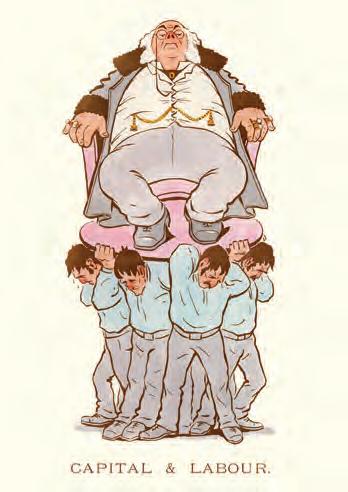
From the middle of the seventeenth century, new ideas had begun to emerge that challenged the ways of thinking that had dominated the Middle Ages, particularly about the primacy of religion and the dominance of the Church in all aspects of life. This period, known as the Enlightenment, focused on the role of human reason and science in understanding the world. The Scientific Revolution and the Agricultural Revolution were both products of the Enlightenment that, as we have seen, gave rise to the Industrial Revolution.
During the nineteenth century, in response to the huge inequalities of living and working conditions, and the growing social instability created by the Industrial Revolution, people started to develop new ideas to make life fairer and create a greater sense of social cohesion. This period saw the growth of progressive ideas and movements.
Writing focus 2.11
Transitional phrases
nationalism a political ideology that emphasises the interests, culture and identity of a particular nation or group of people. It often involves a sense of pride in one’s nation, as well as a sense that one’s nation is superior to other nations.
Nationalism
Before the nineteenth century, people were more likely to identify themselves with their local village, or ruler. The American Revolution (1775–83) and the French Revolution (1789–99) were significant events that helped shape the concept of a nation as we understand this term today. These revolutions allowed France and America to become independent nations, with a strong sense of identity. Throughout the nineteenth century, the spread of nationalism continued across Europe and beyond, leading to the unification of countries like Germany and Italy by 1871.
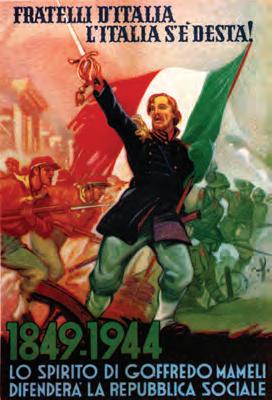
Source 2.11.2 In this poster, the ghost of Italian patriot Goffredo Mameli (1827–49), who was involved in the unification of Italy, leads Italian troops into battle during World War II, in 1944. The caption reads “Brothers of Italy, Italy has awoken! The ghost of Goffredo Mameli will defend the Social Republic”.
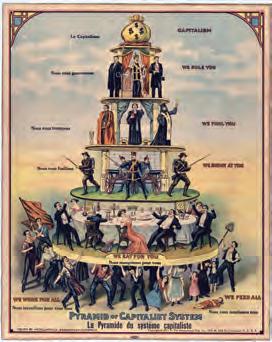
UNCORRECTEDSAMPLEPAGES
Nationalism also played a crucial role in the decline of large empires and the rise of nation-states. For example, in 1829 Greece became independent from the Ottoman Empire, and in 1839 Belgium gained its freedom from the Netherlands. In the early twentieth century, the rise of nationalism in the Balkans region of south-eastern Europe was the catalyst for the outbreak of World War I.
Capitalism
As we have seen, innovations in technology and production methods led to the rise of industrialists, who earned profits from large-scale manufacturing, infrastructure and the factory system. The new economic system from which these capitalists benefited was known as industrial capitalism.
Capitalist ideology believes that individuals and businesses have the right to own and control property, including land, buildings and resources. What to produce, and how much to sell if for, is determined by the market, in what is known as a free market economy. This ideology sees workers at all levels of the social system as driven by the pursuit of profit, which in turn drives efficiency, technological innovation, and social and economic progress. The profits generated from economic activity are then reinvested back into the economy to generate further wealth.
Britain was a major capitalist economy in the nineteenth century. As other nations such as the USA industrialised, capitalism spread to these countries as well.
Socialism
Source 2.11.3 ‘Pyramid of Capitalist System’, published in 1911 by the Industrial Worker in Cleveland, Ohio. The image was a copy of a Russian flyer, created in around 1901.
Socialist ideas began to take shape during the Industrial Revolution as a response to the harsh conditions and inequalities faced by workers. They presented an alternative viewpoint to capitalism. Under a socialist economic system, the government (the state) is responsible for the distribution of resources and wealth. The means of production, such as factories and raw materials, are owned by all of society, and the state’s job is to manage and allocate them fairly.
Thinkers like Karl Marx and Friedrich Engels were pivotal to our understanding of socialism today. Their works such as The Communist Manifesto, published in 1848, laid the foundation for Marxist socialism. Before Marx, however, industrialists like Robert Owen proposed ideal societies based on cooperative living and shared wealth, though their ideas were often considered impractical.
Chartism
Chartism developed in Britain during the mid-nineteenth century. It was a workingclass movement that aimed to achieve political reforms and improve the poor treatment faced by workers in factories and mines. Workers formed trade unions to try and protect themselves, and gain better pay and safer working conditions.
In 1838, a group connected to the trade unions published the People’s Charter. This document outlined several demands, including granting voting rights and access to political office for all men over the age of 21, regardless of their wealth. People who supported the aims of the People’s Charter became known as Chartists. The aim of Chartism was to gain greater political representation for the working class, and to prevent only the wealthiest men in society from dominating politics and decisionmaking. Chartists and trade unionists were often met with political repression, and some, like the Tolpuddle Martyrs, were even arrested and sent as convicts to Australia, where they continued to campaign for political equality.
rights and interests. It aims to improve working conditions, negotiate wages and ensure fair treatment for its members.
Source 2.11.4 The text is an extract from the People’s Charter, published by the London Working Men’s Association. The charter was publicly launched on 21 May 1838.
The fundamental principle of the people’s charter is: that every man who pays to the support of the State, has a right to vote in choosing those who are to spend the money and make the laws. This is what is meant by UNIVERSAL SUFFRAGE.
The charter asserts that the voter has a right to be secured against any loss, or compulsion, in the use of franchise, therefore it demands VOTE BY BALLOT.
It is also claimed that each man’s vote shall be as good as any other man’s … Therefore, the People’s Charter insists on having EQUAL ELECTORAL DISTRICTS.
Another principle of the Charter is that voters have a right to be faithfully represented at all times … for the above reasons, in connection with the full belief that it is the most effectual way to prevent bribery at elections, its advocates claim to have ANNUAL PARLIAMENTS.
The People’s Charter also asserts that voters ought to be at liberty to choose the man whom they consider to be most worthy of their trust, without any regard to the amount of his wealth, therefore it claims for the whole kingdom the liberty of choice … NO PROPERTY QUALIFICATION.
UNCORRECTEDSAMPLEPAGES
And to wind up the whole, it is considered that those who do this part of the work of the country have as just a claim … to fair remuneration for their time … Therefore the People’s Charter aims to abolish all back-handed means of reimbursement, and to establish in their place PAYMENT OF MEMBERS.
William Lovett and Francis Place, The People’s Charter, London Working Men’s Association, 1838
trade union organisation formed by workers to protect their
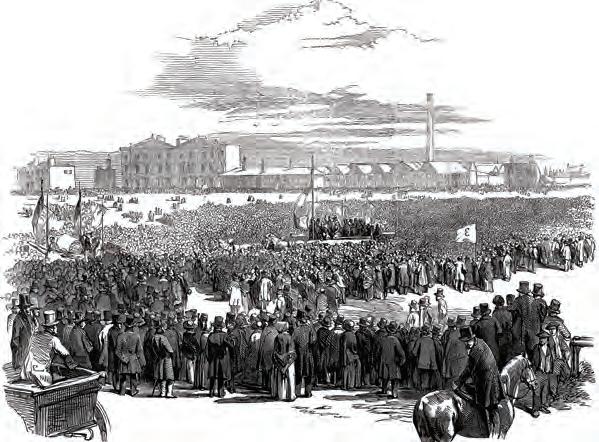
Read Source 2.11.4 and answer the following questions.
a. What are the Chartists demanding?
b. What does the People’s Charter tell you about what Chartists thought was wrong with the existing political system?
What does the image in Source 2.11.5 suggest about the Chartist movement?
Source 2.11.5 Drawing of a Chartist meeting on Kennington Common, 1848 ➜
Historical concepts: Significance Historical skills: Analysis and use of sources, Perspectives and interpretations
Teachers can go online to assign questions, view results, reports and more! Knowledge and understanding Thinking and researching
Students can access sample responses and results online
Knowledge and understanding
Provide one example of the rise of nation-states in nineteenth-century Europe.
Describe the aims of Chartism.
Why did socialist ideas become popular during the Industrial Revolution?
To what extent did the Industrial Revolution give birth to the ideas and movements that shape the modern world?
Thinking and researching
There were a number of important nationalist movements in nineteenth-century Europe that had an important legacy into the twentieth century. Choose one nationalist uprising from the list below and research the background to the event, the key figures involved and the key events of the uprising.
• Unification of Italy (1870)
• Unification of Germany (1871)
UNCORRECTEDSAMPLEPAGES
• Greek War of Independence (1821–29)
• Serbian Revolution (1804–78)
Historical concepts: Significance Historical skills: Research
Contribution to the development of Britain 2.12
Learning intention
In this lesson, you will learn about some of the ways the Industrial Revolution contributed to Britain’s society and economy in the nineteenth and twentieth century.
Starter activity
Success criteria
❏ I can identify examples of how the Industrial Revolution impacted the development of Britain’s society and economy, including living and working conditions.
Consider what Britain was like before the Industrial Revolution and what it is like today by conducting some brief research. Think of three aspects of modern-day Britain that are a result of the Industrial Revolution. You could consider the social structures (living and working conditions, class structure and politics) or some of the economic or environmental changes that it brought about.
As we have seen, industrialisation had many impacts on the development of Britain during the eighteenth and nineteenth centuries. The Industrial Revolution fundamentally altered Britain’s social and economic structures, shifting the way that people lived and worked. It also contributed enormously to the growth of the British Empire around the world, and to Britain’s sense of itself as a world leader in technological innovation.
Living and working conditions
Living conditions
The growth and development of cities had both positive and negative effects on the general population. There was an initial rush to get workers living close to their factory or mine, and this resulted in urban centres being constructed with little to no planning, so that streets and dwellings were too small and too close together. There was also minimal consideration of sewage and the supply of fresh water. This led to climbing disease and mortality rates. In several new industrial towns, such as Manchester and Liverpool, the average age of death was staggeringly low at 20 years old.
With the dawn of the Victorian era in 1837, there was an increased focus on trying to improve the lives of the poor. This idea wasn’t new – it had started earlier with things like Sunday schools, which taught poor children about religion and good behavior. Many people who wanted to help the poor were religious, especially Nonconformist Christians. They set up groups like the National Society for Promoting the Education of the Poor in 1811 to improve the lives of the working class. These efforts showed that some people were starting to care about the problems caused by factories and crowded cities.
UNCORRECTEDSAMPLEPAGES
Writing focus 2.12
Developing sentences
Nonconformist Protestant Christians who did not adhere to the standard doctrines and practices of the Church of England
Source 2.12.1 An engraving of British author Charles Dickens
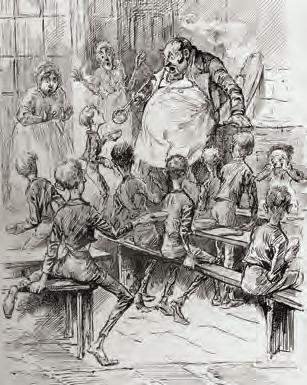
It was only in the 1830s that more people became aware of how hard life was for the poor, through newspapers, books and art. Novels like Oliver Twist by Charles Dickens helped people understand that children needed protection and that the poor deserved a chance to improve their lives.
Working conditions
As with living conditions, the Industrial Revolution initially led to extremely poor working conditions. However, this caused workers to band together, which was the basis of trade unionism and political movements to support the working class. This ultimately led to improvements.
Longer-term effects
The longer-term positive effects of the Industrial Revolution were the establishment of cleaner living conditions, better working conditions and improved food security in cities. Improvements in farming techniques and the creation of better transport systems meant that food supplies to cities were rarely cut off. This improved people’s diets and food intake, which led to better general health. Once governments began to take responsibility for improvements to water quality and supply, people began to enjoy far better living conditions than they had in the past. Citizens later benefited from the construction of hospitals and schools. It should be noted, however, that many of these improvements were only brought about when workers began to exercise a political voice, and the power of the factory and mine owners was challenged. Many of the systems that were needed to help people were not in place until after the Industrial Revolution was over.
Teachers can go online to assign questions, view
Name a nineteenth-century society that was set up to help the poor.
Why did more people become aware of how hard life was for the poor in the 1830s?
UNCORRECTEDSAMPLEPAGES
Explain the factors that led to improved living conditions in Britain by the later nineteenth century.
Conduct research to explain why the Netherlands, France and China did not industrialise at the same time or at
same rate as Britain.
Source 2.12.2 Illustration by Harry Furniss for the Charles Dickens novel Oliver Twist, showing a scene in the workhouse, in which the boys are asking for more food
Site study: Museum of Applied Arts and Sciences
Learning intention
In this lesson, you will learn about the Museum of Applied Arts and Sciences, and its history as an important technological showcase.
Success criteria
❏ I can outline the history of the Museum of Applied Arts and Science.
❏ I can explain the importance of the museum as an example of the technological developments of the nineteenth and twentieth centuries.
Starter activity
The Museum of Applied Arts and Sciences in Sydney has a collection of over 500 000 items, spanning technology, design, music and more. If you could choose one thing to add to its collection, what would you choose? Share your answer with the person next to you, and explain your choice.
The Museum of Applied Arts and Sciences (MAAS) is a Sydney museum with a focus on history, science, technology, design, industry, decorative arts, music, transport and space exploration. It has three separate locations: Powerhouse Museum, Sydney Observatory and Museums Discovery Centre.
The museum’s origins date back to 1879, when the Sydney International Exhibition was held. The purpose of this exhibition was to promote commerce and industry, and it was modelled on the Great Exhibition. Many of the participants took their displays to the Melbourne International Exhibition, but after that many of the exhibits returned to Sydney to be included in the Technological, Industrial and Sanitary Museum.

SAMPLEPAGES
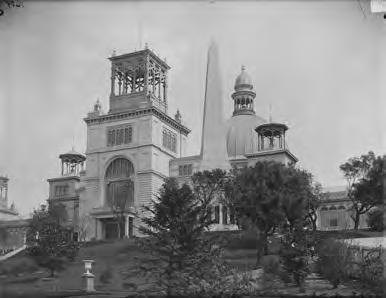
This museum was first based in a shed in the Domain (which it shared with the Sydney Hospital morgue) and then in a location near Sydney Technical College, when it was renamed the Museum of Applied Arts and Sciences, and branches were established in other industrial centres in New South Wales.
In 1982, the Sydney Observatory became a museum under the MAAS banner, and in 1988 the main museum moved to a venue in Ultimo and was renamed the Powerhouse Museum. The museum’s collection is so vast that the majority of it could not be displayed in the Ultimo venue and was maintained in storage.
UNCORRECTEDSAMPLEPAGES
In 2004, the Museums Discovery Centre was created in Castle Hill to enable greater access to the whole collection. This consists of seven enormous sheds, which can hold 60 per cent of the collection, and in 2006 it was made open to the public (although only prebooked groups are allowed).
In 2015, the NSW Government announced that the Powerhouse Museum would be relocated to Parramatta, but in 2021 it was decided to retain the Ultimo venue and build an additional venue in Parramatta. On 5 February 2024, the Ultimo venue closed for redevelopment. It is due to reopen in 2027.
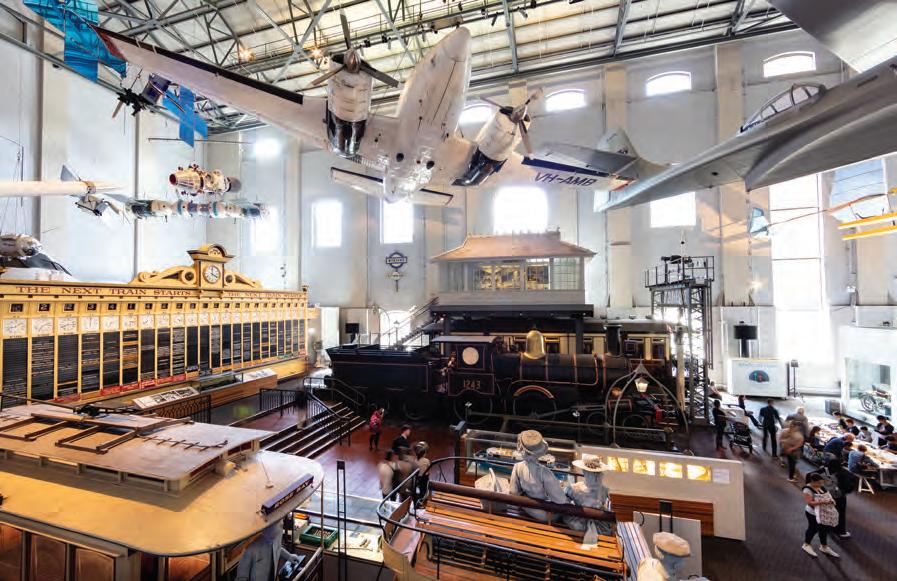
Source 2.13.3 The 2019 “Transport: The Past in the Present” exhibition at the Powerhouse Museum ➜
The Powerhouse Museum regularly runs specialised exhibitions drawn from the collection, such as “Transport: The Past in the Present”, held during 2019.
Since 2019, the Powerhouse Museum has been working on one of the world’s largest digitisation projects to make its collection available to view online. To date, more than 338 000 objects have been digitised. You can view the digitised collection on the museum website (search online for “Powerhouse Collection”), where you can read short, illustrated articles on objects in the collection.
Explain why it is important to have a museum that showcases technology. Deduce reasons for the various locations selected for the Powerhouse Museum, bearing in mind its focus on technology, design and inventions. Visit one of the MAAS venues or explore the website, and select one artefact that dates back to the Industrial Revolution. Create a poster that describes the purpose of the artefact and explains why it is held in the museum. In the twentieth century, many Australian inventions spread throughout the world. Using the museum website, or the broader internet, write a paragraph on one of these inventions. Possibilities include the cochlear ear implant, the black box flight recorder and the dual-flush toilet.
Historical concepts: Significance Historical skills: Research
2.14
Short- and long-term impacts of the Industrial Revolution
Learning intention Success criteria
In this lesson, you will learn about some of the short- and long-term impacts of the Industrial Revolution upon Britain and the world.
❏ I can describe the aims and actions of key groups such as the Luddites and the Tolpuddle Martyrs.
❏ I can explain the short-term impacts of the Industrial Revolution upon Britain, including changes to workers’ rights and improvements to transport and communication.
❏ I can explain the long-term impacts of the Industrial Revolution upon the natural world.
Starter activity
With the person next to you or as a class, discuss the following “what-ifs”.
Writing focus 2.14
Creating topic sentences
UNCORRECTEDSAMPLEPAGES
• What if the steam engine had never been invented?
• What if factories had never been built?
What short-term changes wouldn’t have happened? What long-term effects might have been delayed, or even avoided?
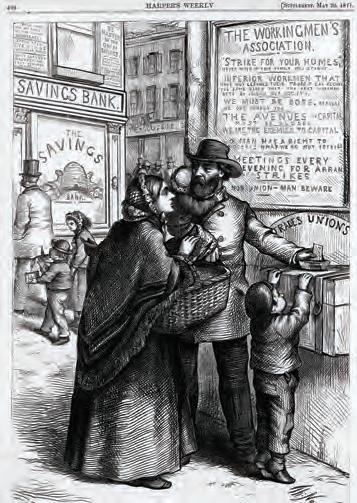
Source 2.14.1 “Voting for Union” cartoon, c. 1871. Despite the warnings on the sign above him, a man accompanied by his family votes to join a trade union. In the background, a non-union man who has learned “how much you can work, not how little”, takes his family to the bank.
Workers’ rights and government policy
It is no coincidence that major political upheavals in Britain occurred in the 1820s and 1830s, at the same time that living and working conditions were at their worst during the Industrial Revolution.
Calls for reform and change outside of Britain, such as the American War of Independence (1776–81) and the French Revolution (1789), encouraged British workers to improve their rights and conditions. The same events also encouraged the British authorities to be vigilant against revolts and upheaval. Many business owners viewed workers as naturally unruly and requiring stern measures of control to be cooperative at work, and factory owners were often suspicious of attempts by workers to protest their conditions. Management skills were an unknown quality among the managers themselves, and often the terrible working conditions were completely unknown to those who invested money in creating a factory or business enterprise. It was in response to terrible living conditions and the lack of workers’ rights that many people became politically active at the start of the Industrial Revolution, and trade unions became increasingly popular.
Luddites
In Britain some textiles workers, realising that their livelihoods were under threat, decided to organise themselves and smash new machinery in a hopeless attempt to postpone the future. These people were called Luddites, and the movement became widespread. The response of the authorities was swift and brutal. In 1788 the Protection of Stocking Frames Act was passed that made the smashing of machinery a capital offence. A number of Luddites were arrested, and some were put on trial and executed, for smashing equipment. This may have contributed to the unsympathetic view authorities took when other workers tried to get changes to their living and working conditions.
In this climate of suspicion and spurred on by fears of revolution in France, the government passed the Combination Acts in 1799. This made any sort of strike action illegal. The Act also prohibited workers from creating trade unions and engaging in collective bargaining (negotiating better conditions as a group with their employer). This drove unionism underground and saw the government hunt down union leaders. As working conditions deteriorated, however, people became more vocal in their demands for political changes.
In 1819, a gathering was organised that attracted between 60 000 and 80 000 people at St Peter’s Fields, Manchester. Although it was a peaceful protest, soldiers charged the crowd, killing 18 protestors in what became known as the Peterloo Massacre. This led to a public outcry, but the government implemented more repressive measures, including what was known as the Six Acts. The Six Acts forbade any sort of meeting, increased magistrates’ powers to search, sped up court processes, and toughened laws for those who wrote against the government.
The Tolpuddle Martyrs
In 1834, six agricultural labourers from the village of Tolpuddle in Dorset, England, were arrested and transported to Australia for forming a trade union. The six men – George Loveless, James Loveless, James Brine, Thomas Standfield, John Standfield and James Hammett – had formed the Friendly Society of Agricultural Labourers to protest against wage cuts and improve their working conditions. The authorities, fearing the spread of unionism, arrested them. The six men were tried and sentenced to seven years’ transportation to Australia. The harsh punishment sparked a massive public outcry and a campaign for their release. After three years of campaigning, the men were pardoned and returned to England.
UNCORRECTEDSAMPLEPAGES
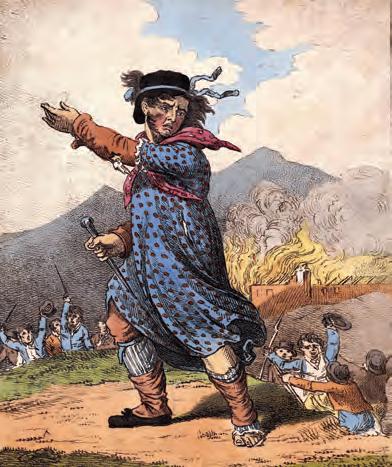
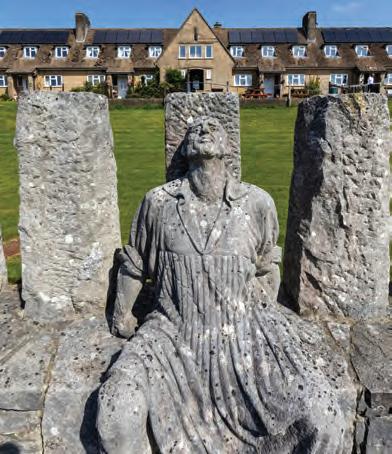
Source 2.14.2 The leader of the Luddites, 1812, hand-coloured etching
Luddites groups who tried to block industrialisation by smashing machinery
Source 2.14.3 Stone statue of George Loveless in front of Tolpuddle Martyrs Museum, Tolpuddle, England ➜
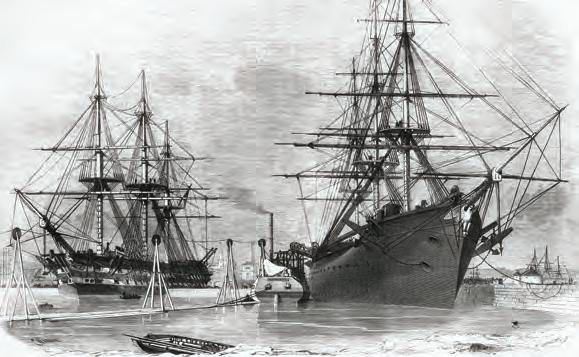
Source 2.14.4 The HMS Agamemnon and USS Niagara taking aboard cable to be laid for the transatlantic telegraph, 1858
The case of the Tolpuddle Martyrs became a symbol of the struggle for workers’ rights and the right to organise. While the Combination Acts had been repealed in1824 and 1825, this case highlighted the need for further legal protection for workers. Eventually, the Trade Union Act 1871 formally recognised trade unions and protected their right to exist and operate, marking a significant step forward for workers’ rights. The Unlawful Oaths Act 1797, under which the Tolpuddle Martyrs had been prosecuted, was eventually reformed to prevent its use against trade unionists.
The broader impact of the Tolpuddle Martyrs’ case helped to strengthen trade unionism in Britain and paved the way for further labour legislation in the late nineteenth and early twentieth century. This included laws that improved working conditions, regulated working hours, and provided protections for workers’ rights to organise and strike.
Transport and communications
Before the invention of steam-powered ships, journeys across the Atlantic Ocean had taken more than a month. As technology progressed, the journey was reduced to 19 days, and by 1900 a transatlantic crossing took a little over five days to complete. This enabled a greater supply of food from outside the country, and increased demand resulted in cheaper prices. Wheat from Canada, the USA, South America or Russia was cheaper in Liverpool in the 1890s than it had been under the reign of Charles II, two centuries earlier. Transport of food was aided by the invention of refrigeration, which meant that meat could be frozen for sea transport. In 1882, the Dunedin became the first ship to successfully carry frozen meat from New Zealand to London.
The invention of telegraphic communication had a similar effect. The first transatlantic line was laid in 1858 and brought the New World much closer to the Old World. Even Australia was connected to the rest of the world via telegraph in 1872.
The natural environment
UNCORRECTEDSAMPLEPAGES
Humans have effected changes on the natural environment since the earliest civilisations. The Industrial Revolution caused an exponential increase in the amount and rate of change.
Many of the environmental issues we are facing today, such as pollution, climate change, waste management and the importance of sustainability, can be linked to the Industrial Revolution.
Source analysis
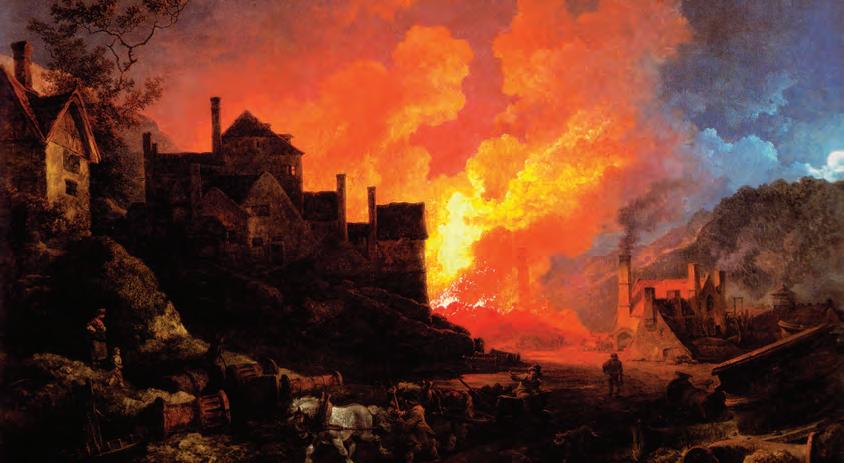
Source 2.14.5 Coalbrookdale by Night, 1801, Philippe Jacques de Loutherbourg
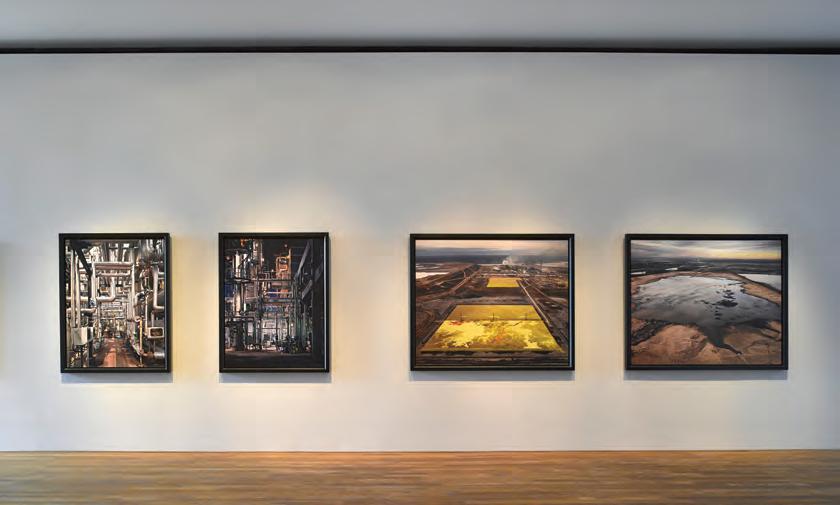
Source 2.14.6 A selection of photographs by Edward Burtynsky, whose works focus on industrialised landscapes
UNCORRECTEDSAMPLEPAGES
Richard Warner, a writer and priest, described Coalbrookdale in 1801 as “a scene in which the beauties of nature and processes of art are blended together in curious combination”. Looking at Source 2.14.5, do you agree with his statement today?
Choose one of the photographs in Source 2.14.6 and describe what it is depicting. Write a paragraph responding to the statement: “The works of de Loutherbourg and Burtynsky identify both the beauty and the destructive effects of industrialisation.”
Historical concepts: Significance Historical skills: Analysis and use of sources
Extension 2.14.1
Professor John Majewski’s support of the Industrial Revolution
Activity 2.14.2
Source analysis
Source 2.14.7 Sir David Attenborough, in a 2019 speech about climate change, was critical of the effects of the Industrial Revolution.
Who started the problem? This country. It was the Industrial Revolution which started here, and what was the Industrial Revolution, it was based on burning coal. As it was us who started the problems, and if we are now taking a lead in solving the problem that is only the right and responsible thing to do. I’m OK for the next decade, all of us are OK, we won’t face the problems that are coming. The problems of the next 20 to 30 years are great problems that are going to cause great social unrest and cause great changes in what we eat and how we live.
Sir David Attenbourgh, July 2019, speech to the British Parliament’s Business, Energy and Industrial Strategy Committee
What link to current climate issues does Sir David Attenborough make with the Industrial Revolution?
Do you think this link and criticism is justified? Explain your answer.
Historical concepts: Significance Historical skills: Analysis and use of sources
Teachers can go online to assign questions, view results, reports and more!
Knowledge and understanding
Identify who the Luddites were.
Explain the effect that faster transportation had on food availability and prices.
Explain the significance of the Tolpuddle Martyrs.
“The drawbacks of the Industrial Revolution were only short-term.” Do you agree or disagree with this statement? Draw on material from across the chapter to illustrate your answer.
Thinking and researching
Complete one of the following tasks.
Research the development of infrastructure and technology in various parts of the world – for example, railways in India. Analyse whether the benefits of the Industrial Revolution outweighed the negatives in these specific cases.
Create a picture-essay. Collect five or six images that highlight the most important effects of the Industrial Revolution. Each image should be accompanied by 50–100 words that explains what the image reveals or suggests about the effects of the Industrial Revolution.
2.15
Chapter review and historical inquiry
Access the Interactive Textbook for a range of digital tools to help you review this chapter and build confidence.
• Auto-marked questions for fast feedback and fun practice
• Self-assessment tools to track your progress, review answers (if enabled by the teacher), and flag questions for extra help
• Downloadable worksheets for class or homework revision
Summary
Summary notes
What have you learned about the Industrial Revolution? Copy the table and fill out by explaining your understanding. Aim for two points per topic.
Topic
The transformation of work and production systems
Agricultural Revolution and population movement
Different views on Industrial Capitalism and workers’ rights
Child labour in mines and factories
The steam engine’s impact on industrial development
The benefits and costs of the Industrial Revolution
Visible thinking routine
Compass points
What I have learned
Think about the legacy of the Industrial Revolution and how important it was for the world, not just for Britain, and consider the following statement.
Overtaken by power, by possessions and great new freedoms, and unable to make any civilised use of them at all.
UNCORRECTEDSAMPLEPAGES
H.G. Wells, 1911, The New Machiavelli, p. 30
Critically discuss H.G. Wells’ suggestion. Did the Industrial Revolution give birth to increased power, wealth and freedoms that were largely lost as the world moved into the early twentieth century?
On a large piece of paper or cardboard, or using a digital application, draw a compass with N, E, S and W around the edges. On each compass point respond to the questions below by considering:
• Need to know – what else do you need to know or access to help you answer the question?
• Excited – what do you find exciting or interesting about investigating this idea?
• Stance – what is your current stance (position) on this question? How might you move forward to evaluate how accurate your position is?
• Worrisome – what are you worried about when thinking about how to research this question?
UNCORRECTEDSAMPLEPAGES
Using the information you have recorded in groups, write an individual answer to the question. Once you have read them, swap with a partner and read each other’s paragraph. Write down one thing you liked about their response and one thing you think could be different to improve it.
Questions and activities
Scorcher quiz
Access a fast, fun, competitive quiz that puts your understanding to the test.
Quick questions
The transformation of agriculture in the British countryside, known as the __________ __________, was an important factor in the start of the Industrial Revolution.
In 1712 Thomas Newcomen built what was known as an “__________ steam engine”. Between 1832 and 1866 there were multiple outbreaks of __________ in Britain.
The Mines and Colliers Act of 1842 banned women and girls from working in coal mines and introduced a minimum working age of __________ for boys.
The National Society for Promoting the Education of the Poor was established in
Define the term “triangular trade” as it was used by the British Empire.
Outline the key characteristics that defined respectability for middle-class Victorian families.
Describe the typical working hours and conditions for factory workers in early 1800s Britain.
Identify the main demands outlined in the People’s Charter of 1838.
Summarise the story of the Tolpuddle Martyrs and its significance for workers’ rights.
Access the Group work activity, Research activity and Creative task in the Interactive Textbook.
Writing focus
The following activities offer ways to demonstrate your understanding of the chapter and allow you to continue to practice your writing skills.
Answering questions in paragraphs
This sample response to a question is structured using:
• a topic sentence
• the four Es (explain, elaborate, evidence and examples)
• a linking sentence.
You can use this as a model when writing your own answers to the following questions.
Model answer:
Question: How influential were inventors on the Industrial Revolution?
Topic sentence: the first sentence of the paragraph; directly answers the question
Elaborate: additional information, connections, historical significance, change and continuity, cause and consequence Examples: provide credibility and illustrate the argument
Inventors were highly influential in driving the Industrial Revolution because their innovations transformed how goods were produced, how people worked and how industries expanded. Inventors created new machines that increased efficiency by replacing slow manual labour with mechanised production. Their inventions triggered major changes, including the rise of factories and mass production, which allowed Britain to dominate global manufacturing. They also contributed to long-term changes such as new transport networks and even new social classes. For instance, James Watt’s improvement of the steam engine, as illustrated in Source 2.4.2, allowed engines to be used outside of mines, which powered textile machines. Similarly, Richard Arkwright’s water frame and factory system enabled unskilled workers to produce huge quantities of high-quality yarn, which helped cotton mills become Britain’s first major factories. Therefore, the Industrial Revolutoin’s rapid growth was shaped by inventors whose idas transported production and society itself.
Extended-response questions
How influential were inventors on the Industrial Revolution?
Explain: clarify, define and describe
Download single paragraph model
UNCORRECTEDSAMPLEPAGES
Evidence: specific, relevant evidence to support your arguments Linking sentence: reconnects to the topic sentence using the language of the question
How successful were attempts to improve the lives of the British working class during the Industrial Revolution?
“The Industrial Revolution mostly led to positive outcomes for humanity.” To what extent do you agree with this statement? Provide evidence to support your response.
Historical inquiry
Investigating significance
In this historical investigation into the significance of the Industrial Revolution, you will undertake the following steps:
Part 1: Develop historical questions
• Step 1: Select an aspect of the Industrial Revolution that interests you. Examples include:
● famous inventors and their inventions
● the effects of the Industrial Revolution in Australia
● the movement of peoples and the rise of urban centres
● the rise of the labour movement
● long-term environmental impacts of the Industrial Revolution.
• Step 2: Brainstorm what you already know
• Step 3: Develop a historical inquiry question. Examples include:
● To what extent was the development of the steam engine significant in the Industrial Revolution?
● Select one inventor of the Industrial Revolution. Explain why their inventions were significant.
● Assess the impact of the Industrial Revolution in Australia.
● In what ways did countries such as England change due to the rise of industrialisation?
● Evaluate the impact of the Industrial Revolution on the rise of trade unions.
● Explain the long-term environmental impacts of the Industrial Revolution.
• Step 4: Explain why the question is important
Part 2: Locate and analyse evidence
Part 3: Communicate historical findings
Part 4: Reflect
UNCORRECTEDSAMPLEPAGES
Teachers, access the Online Teaching Suite for digital resources and tools that support review, assessment and reporting, including:
• student and class activity reports
• a test generator to create custom assessments
• built-in feedback tools
• editable downloadable support material
• a downloadable and printable “Writing focus” workbook for this chapter.
Chapter 3
The movement of peoples (1750–1901)
Key questions
• What was life like during the Industrial Revolution?
• What were the causes of mass migration during this period?
• What were the differing experiences for those involved in the movement of peoples?
• Why did the movement of peoples cease?
• How did cultures interact during the movement of peoples?
• How did the movement of peoples affect the world today?
Lessons
3.1 Setting the scene
3.2 Movement of people in Britain
3.3 The transatlantic slave trade
3.4 The movement of enslaved people
3.5 The life of an enslaved person
3.6 Resistance to slavery
3.7 The abolition movement
3.8 Legacies of the transportation of enslaved people to the Americas
3.9 Transportation to Australia
3.10 Experiences of convicts in Australia
3.11 Experiences of emancipated convicts in Australia
3.12 Experiences of free settlers to Australia
3.13 Site study: Belgenny Farm
3.14 Blackbirding of Pacific Islander peoples
3.15 Impact of European arrivals on First Nations Peoples
3.16 Legacies of the movement of peoples on Australia
3.17 Chapter review and historical inquiry
UNCORRECTEDSAMPLEPAGES
Teachers access the Online Teaching Suite to:
• plan, sequence and assign directed tasks for students and classes using Task Manager
• view student activity reports
• provide feedback to students
• download a printable “Writing focus” workbook for this chapter.
Aboriginal and Torres Strait Islander Peoples should be aware that this chapter contains images and names of people who have, or may have, passed away.
3.1 Setting the scene
Learning intention
In this lesson, you will learn about the main causes and effects of migration during the eighteenth and nineteenth centuries.
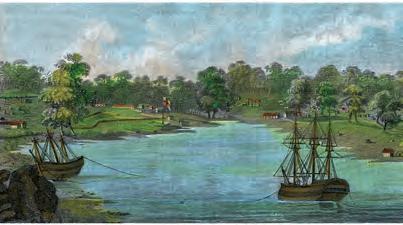
Source 3.1.1 A facsimile of Sydney Cove, New South Wales, Australia, 20 August 1788 (c. 1885)
Writing focus 3.1
Question
words
1700s
Britain and Portugal commence mass transportation of enslaved people from the Caribbean and Americas 1775
1502
African enslaved people arrive at Hispaniola, marking the beginning of the transatlantic slave trade
Success criteria
❏ I can outline reasons for migration during the eighteenth and nineteenth centuries.
People have moved around the world for many thousands of years, but in the eighteenth and nineteenth centuries migrations increased in both the amount of people moving and the distance they travelled. Some migrations were forced, rather than being voluntary. The British, Spanish, French, Dutch and Portuguese transferred 12.5 million enslaved people to the Americas. Britain transported convicts to Australia, followed soon after by a steady migration of settlers to the newly founded colonies. People from Britain, Ireland, China and other parts of the world settled in Australia from 1788.
The American War of Independence stops convict transportation to America
1788
1760
Beginning of the Industrial Revolution in Britain
1793
The first free settlers arrive in Australia
The First Fleet of convicts arrives in Australia from Britain. The Second Fleet arrived in 1790, and the Third Fleet in 1791.
1833
Britain abolishes slavery
1845
The Great Famine begins in Ireland, leading to mass migration
1847
First blackbirding operation sees Melanesian labourers arrive at Eden
1848
The Gold Rush causes migration to the United States. The Australian gold rush began in 1851
1865
The United States abolishes slavery
1861
The Civil War commences in the United States, lasting until 1865
Claim, support, question
Based on the image in Source 3.1.2, consider the following questions for discussion.
• Make a claim about this painting. (What does it show?)
1867
The last transatlantic slave voyage is completed
1868
The final convict ship arrives in Australia
1901 Australian Federation. The Immigration Restriction Act prevents nonwhite migration
UNCORRECTEDSAMPLEPAGES
• Identify things to support for your claim. (Things you see and know that support your claim.)
• Ask a question related to your claim that you would need to research.
1882
Migration between China and the United States stops
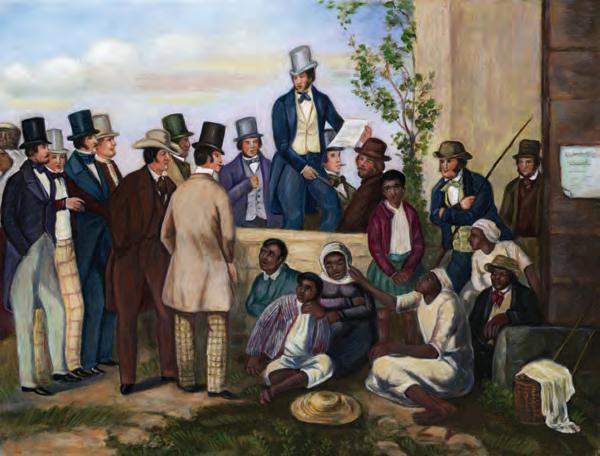
Writing focus 3.2
Transitional phrases
flax a plant grown for its stems or seeds. Linen cloth is woven from thread made from this plant guano sea bird or bat droppings; accumulations are often used as a fertiliser
3.2 Movement of people in Britain
Learning intention
In this lesson, you will learn about the push-and-pull factors that motivated people to migrate within Britain during the eighteenth and nineteenth centuries.
Success criteria
UNCORRECTEDSAMPLEPAGES
❏ I can identify the push-and-pull factors that influenced movement of people in Britain.
❏ I can explain how the push-and-pull factors influenced movement of people in Britain.
Starter activity
The increase in the movement of peoples in the eighteenth and nineteenth centuries was a result of what can be termed “push” and “pull” factors. Push factors were reasons that could make a person want – or be forced – to leave their current location. Pull factors were reasons why they might find another location more attractive.
Think of reasons people move to another location, either today or from your knowledge of the nineteenth century, and decide whether they are “push” or “pull”.
Technology and industrialisation
The Industrial Revolution was a time of profound change for Britain and its people. Britain underwent massive growth in its industrial sector, largely driven by new technologies that enabled faster production. Exploration of new territories opened up a wealth of different resources and trade markets, such as the discovery of safe routes to India, China and the Americas. As an island nation, Britain had developed a strong navy throughout the seventeenth and eighteenth centuries, and this allowed it to establish colonies in a range of countries across the world. The British East India Company was set up by merchants to trade with India, China and South-East Asia in 1600, and it became increasingly powerful with the growth of trade. British colonies became permanent settlements, allowing for the import and export of products. Britain imported raw materials such as cotton, wool, wheat, sugar, tea, silk, flax, rice and guano, and exported textiles, clothing, and metals used in machinery, industry and railway construction.
Source analysis
How important do you believe shipping was to the British Empire’s supremacy? Justify your answer by referring to Source 3.2.1.
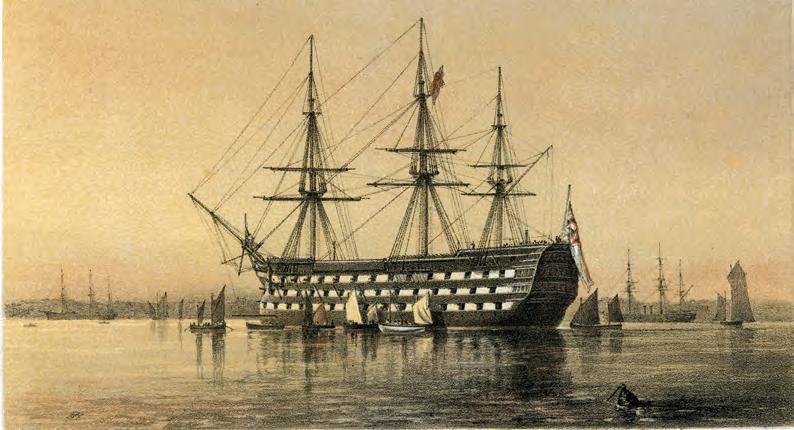
Source 3.2.1 This lithograph of HMS Victory from 1872 illustrates the type of ships Great Britain commanded in the eighteenth and nineteenth centuries.
Historical concepts: Significance Historical skills: Analysis and use of sources
Many new technologies were invented during the Industrial Revolution. Previously, machines such as flour mills were powered by water or wind, which meant factories had to be located with access to these resources. The development of a steam engine by Thomas Newcomen allowed coal mines to be drained efficiently, which increased coal production. James Watt and Thomas Boulton refined Newcomen’s engine, and in 1776 constructed a version that could be adapted to an individual factory. This allowed businesses to construct factories anywhere, rather than only near rivers or highwind areas. Steam power prompted the invention of trains and steamships, leading to rapid transportation of more goods and people. Steam power also contributed to developments in the iron industry, as it meant that metal goods could be massproduced, and so were cheaper to buy.
Textiles were one of Great Britain’s most important industries, but production was slow and monotonous work. Wool and cotton were individually carded, hand-spun and woven to create a piece of fabric. The invention of mechanised spinning and the power loom increased the production of a worker by 40 times. Similarly, the invention of the cotton gin made production around 50 times more efficient due to its faster spin rate. Because of these technological advances, Great Britain became the largest textiles producer in the world, with easy access to European markets for sales. Great Britain swiftly established itself as an importer of raw materials and an exporter of finished products. This brought great wealth to some people in Britain.
UNCORRECTEDSAMPLEPAGES
carding the process of using wire brushes to separate the threads of some materials such as cotton or wool before they can be used cotton gin a machine used for separating the fibres of the cotton plant from the seeds
crop rotation growing different crops in different years, so that the soil in the field can regain its nutrients fallow land that is not planted with crops
Changes to agriculture
Traditionally, agriculture had formed the centre of the British economy. During the medieval period, villages had used a three-field crop rotation system to maintain their crop production. One field was fallow, or bare, while the other two had different crops –one being legumes that fixed nitrogen in the soil, while the other was a grain crop such as wheat. The fallow field could be used to graze animals. Each year, the fields were rotated to keep the soil fertile.
From the 1500s, wealthier landowners realised there was more money in raising sheep for wool than planting crops. They began to enclose fields with fences, creating one large field instead of many small strips. In 1604 the government began passing a series of Enclosure Acts, which were laws stopping the use of common land by peasants. There were positive effects, such as less land wastage, fewer labour requirements and prevention of disease from spreading across one contained area. However, there were also negative impacts. Farmers whose families had worked the land for generations were evicted, while poorer farmers struggled to compete with large landowners. Many lost their businesses and their lands and were pushed to migrate to cities to find employment, where they often endured poor living and working conditions and low wages.
Developments in agriculture led to a significant increase in the quality and quantity of goods. The seed drill more efficiently planted seeds, threshing and reaping machines harvested crops using less human labour, and steam-powered ploughs replaced rows once hand-dug by peasants. Crop rotation was improved by the Norfolk four-course system, where the crops of wheat, turnips, barley, and clover or undergrass were rotated. Selective breeding increased the size and qualities of animals. For example, the average size of a cow going to market in 1710 was around 160 kg, but by 1795 it had more than doubled to 362 kg. The same applied to sheep, which averaged 17 kg in 1710 but 36 kg in 1795.
UNCORRECTEDSAMPLEPAGES
Describe the main reasons people moved from the country to the city. Your answer should be approximately a paragraph in length.
Historical concepts: Continuity and change, Cause and effect Historical skills: Communication
Urbanisation
Housing shortages in the cities were common. Often, multiple families lived in a single, poorly maintained house, with no plumbing and only candles as a source of light. Public sanitation did not exist, so sewage flowed down the streets and into the rivers or sea, which contaminated the drinking water.
Cities continued to grow despite overcrowding. Between 1750 and 1900, London’s population grew by over two million people. Country towns also experienced population explosions, quickly becoming industrial centres for surrounding areas. The cities of Liverpool, Manchester and Newcastle all experienced rapid growth during the eighteenth and nineteenth centuries, benefiting from ports next to large rivers. Ports allowed easy transportation of goods, which encouraged the development of factories and warehouses and, in turn, attracted workers to the cities.
Activity 3.2.3
Source analysis
Describe what evidence of industrialisation you can see in Source 3.2.2.
3.2.2 Aerial view of London as it industrialised, 1850
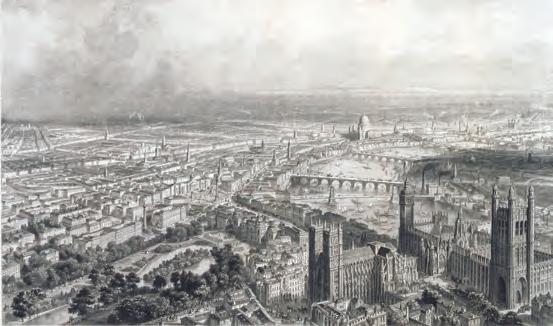
Historical concepts: Continuity and change Historical skills: Analysis and use of sources
Review 3.2
Knowledge and understanding
Why did employers pay low wages during the Industrial Revolution period?
In your own words, describe the push and pull factors that cause the movement of peoples.
Thinking and researching
Complete one of the following.
UNCORRECTEDSAMPLEPAGES
Teachers can go online to assign questions, view results, reports and more!
Imagine you are a factory worker or a small business owner living in a major European city at the end of the 1700s. Write a letter to a friend or family member in the countryside describing how the Industrial Revolution has changed your daily life, including your work, living conditions and any hopes or concerns you have for the future.
Use the internet to research what London looks like today. Using Source 3.2.2 and your research, describe the differences between London in 1850 and the present day.
Historical concepts: Continuity and change, Perspectives Historical skills: Research, Communication
3.3
The transatlantic slave trade
Learning intention
In this lesson, you will learn about the slave trade and how it was affected by the Industrial Revolution.
Starter activity
Success criteria
❏ I can identify key events that happened during the history of the slave trade.
❏ I can explain how the Industrial Revolution affected the slave trade.
You will notice that while this chapter talks about the “slave trade”, the people involved are referred to as “enslaved people” rather than “slaves”. Why do you think this is, and why is it important?
Slavery has existed since ancient times and in many different societies. The period between 1750 and 1900 was different, however, due to the size and nature of the slave trade.
Pre-1750
Writing focus 3.3
Developing sentenecs
UNCORRECTEDSAMPLEPAGES
In the middle of the fifteenth century, the Portuguese began the mass transportation of African enslaved people to Portugal for labour. New colonies and the trade of crops such as sugar, cotton and tobacco required a large, cheap labour force. Slavery increased as labour requirements increased. Europeans living in the American colonies believed that Native Americans were vulnerable to disease, so they looked to other parts of the world to find workers. By 1518, Spain began transporting African captives 5000 km away to colonies in the Americas. Most of the enslaved people came from what is now Senegal, Angola, Benin, Nigeria and Cameroon. Historians debate the number of enslaved Africans, but estimates place this figure at around 12.5 million. Arab countries took another 10 to 20 million enslaved people. The loss of such a large number of its population devastated the continent of Africa, and left it open to increased exploitation by European countries due to its inability to defend itself.
Before European intervention, Africa’s social and economic development was on the same level as Europe’s. The nation of Mali covered a larger area than all of Europe combined. When Mali’s leader, Mansa Musa, went to Egypt in the 1300s, oral histories describe how he took so much gold it became almost worthless. The varied cultures of Africa had different political structures; some were kingdoms and others were citystates. Education, universities and artistic trades were growing, evidence of which can still be seen today when looking at the quality of terracotta, bronze, ivory and gold pieces from this time.
Slavery was already present in Africa, but European demand for cheap labour, particularly in the Americas, brought a different form. Enslaved Africans had traditionally been captured in battle, or were serving a punishment for their crimes or paying off a debt. Enslaved people taken this way could work to buy their freedom and, unlike what happened in the Americas, their children were not usually born into slavery. But as the European interest grew, some African kingdoms began deliberately taking captives during war or capturing members of different ethnic groups and selling them to European slave traders for profit. However, some kings refused to have anything to do with the European slave trade.
The effect of the Industrial Revolution
From the seventeenth century, the “Slave Triangle” developed across the Atlantic Ocean (see Source 3.3.1). Enslaved people were transported from Africa to North America, where they worked on plantations producing sugar, wood, rice, cotton and tobacco. These products were shipped to Europe, while rum, iron and other goods were exported to Africa. Europe manufactured goods from the raw materials they obtained and traded to both Africa and the Americas for gold, spices and ivory.
NORTH AMERICA
Boston ENGLAND
New York Philadelphia Charleston Slaves
Whale oil, lumber, furs Slaves, sugar, molasses
Rice, silk, indigo, tobacco
Fish, livestock, flour, lumber
CARIBBEAN ISLANDS
UNCORRECTEDSAMPLEPAGES
Slaves
Sugar, molasses, wood
ATLANTIC OCEAN
Gold, iron, spices, hardwoods
Manufactured goods, luxuries London Liverpool Bristol
Guns, cloth, iron, beer
EUROPE
SOUTH AMERICA
Rum, iron, gunpowder, cloth, tools
Source 3.3.1 Map of trade imports and exports across the Atlantic Ocean ➜
AFRICA
indigo a tropical plant that produces a blue dye
By the 1850s, the southern states of the United States produced two-thirds of the world’s cotton. These crops were harvested and shipped to Britain, where they were processed into manufactured goods and traded across the British Empire. The expansion of cotton plantations in the southern states increased the demand for enslaved labour. Census data from 1790 shows that around 650 000 enslaved people worked on cotton, rice, indigo and tobacco plantations – a number that had risen to 3.2 million by 1850, with more than half working on cotton plantations. The Industrial Revolution increased the demand for slaves because British factory owners required increasing supplies of the raw materials often provided by slave labour. The slave trade brought immense wealth to plantation owners, manufacturers and slave traders.
Source analysis
Using Source 3.3.1, create a table summarising the main imports and exports for Europe and North America.
Historical concepts: Significance Historical skills: Analysis and use of sources
Knowledge and understanding
and researching
Identify three crops that required a large, cheap labour force.
How many enslaved people are estimated to have been transported to the Americas?
What type of plantation in the Americas had the greatest demand for enslaved labour?
Describe slavery as it existed in Africa before the European slave trade.
Describe the “Slave Triangle”.
Teachers can go online to assign questions, view results, reports and more!
How did European demand for plantation crops and the Industrial Revolution change slavery in Africa and the Americas? Use examples from the Slave Triangle and cotton production to support your response.
Thinking and researching
To what extent did the transatlantic slave trade transform African societies before 1750 and after European involvement? Consider population loss, economic change and African responses to European traders.
Historical concepts: Continuity and change Historical skills: Explanation and communication
3.4 The movement of enslaved people
Learning intention
In this lesson, you will learn about the situations of enslaved people during transportation and after arriving at their destination.
Starter activity
Look at Source 3.4.1 and think about auctions today. Why do you think an auction was used in this situation?
❏ I can summarise how enslaved people were treated during transportation.
Source 3.4.1 Newspaper advertising a slave auction outside of Brooke and Hubbard Auctioneers office, Richmond, Virginia
Transport to the Americas
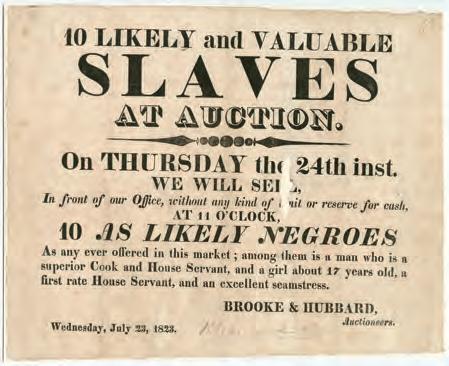
Success criteria Writing
What information can be obtained by analysing Source 3.4.2? Justify your answer.
Source 3.4.2 An interior diagram of a slave ship from 1821
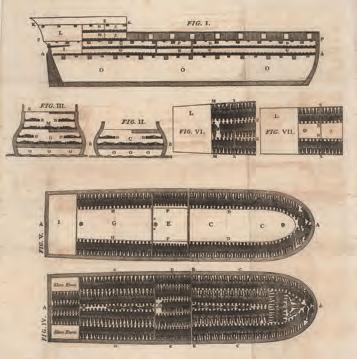
Middle Passage the sea voyage taken by slave ships between the west coast of Africa and the West Indies and American colonies
Once African people were captured and enslaved, they were marched to the coast for sale and held in large forts or castles. Estimates by historians suggest around 4 per cent of all enslaved people died in these forts due to poor conditions. During the voyage through the Middle Passage, another 12.5 per cent of enslaved people died from inhumane treatment. Conditions on board ships were poor, with enslaved people crammed into small, unsanitary spaces. Women and children were often in separate quarters from men, but this made them vulnerable to sexual abuse by sailors. Enslaved people who protested by starving themselves were force-fed, while exercise could be enforced through ‘dancing’ above deck. The cramped and unsanitary conditions resulted in the spread of fatal diseases, while other fatalities included suicides by people jumping overboard. If supplies ran low, sometimes living people were thrown overboard.
Activity 3.4.2
Source analysis
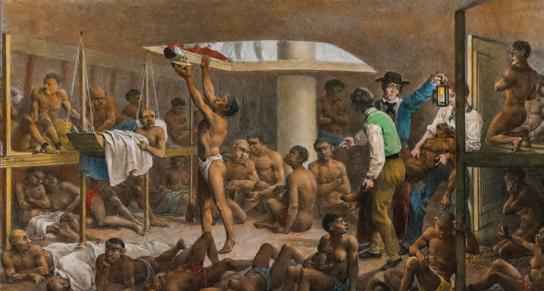
Source 3.4.3 Enslaved people in the cellar of a slave boat (1830) ➜
Source 3.4.5 A description of life aboard a slave ship
UNCORRECTEDSAMPLEPAGES
Source 3.4.4
Video: Enslaved people’s experiences while travelling ➜
The only food we had during the voyage was corn soaked and boiled. I cannot tell how long we were thus confined, but it seemed a very long while. We suffered very much for want of water, but was denied all we needed. A pint a day was all that was allowed, and no more; and a great many enslaved people died upon the passage. There was one poor fellow became so very desperate for want of water, that he attempted to snatch a knife from the white man who brought in the water, when he was taken up on deck and I never knew what became of him. I supposed he was thrown overboard.
Law, R. & Lovejoy, P.E., 2001, The Biography of Mahommah Gardo Baquaqua: His Passage from Slavery to Freedom in Africa and America, Markus Wiener Publishers, Princeton, New York
Summarise the key features of slavery that are visually demonstrated in Source 3.4.3. How might a source like Source 3.4.3 be useful to a historian studying the experiences of African enslaved people in the nineteenth century?
In a detailed paragraph, explain why enslaved people were treated so poorly when transported to the Americas. Your response should make specific reference to Sources 3.4.2, 3.4.3 and 3.4.4.
Arrival in the Americas
At their destination in the Americas, life did not get easier for enslaved people. The crew of slave ships prepared the African captives for sale by displaying their best features. How strong a man or woman appeared was an indication of whether they would handle repetitive physical tasks. Enslaved people were stripped naked, shaved, washed and then rubbed with palm oil to hide any injuries, chain marks or the colour of sickness. Families were separated to maximise profits. The enslaved people were then put up for auction. Historical concepts: Significance
Knowledge and understanding
Identify what percentage of enslaved people died while being held in forts or castles. Explain the conditions experienced by enslaved peoples while being transported to North America. Describe the experience of enslaved peoples when they arrived in North America. 1. 2. 3. Review 3.4
Thinking and researching
Complete one of the following.
Using evidence from the lesson learned, create an illustrated timeline showing the journey of enslaved people from capture in Africa to sale in the Americas. Include mortality rates and conditions at each stage.
Write a letter from the perspective of an enslaved person experiencing the Middle Passage, describing the conditions aboard the ship and the treatment received. Use specific details from Mahommah Gardo Baquaqua’s account.
Comprehension, Communication
UNCORRECTEDSAMPLEPAGES
Teachers can go online to assign questions, view results, reports and more!
3.5 The life of an enslaved person
Learning intention Success criteria
In this lesson, you will learn about the life of an enslaved person.
❏ I can summarise the daily life of an enslaved person.
❏ I can identify laws and regulations regarding enslaved people.
Starter activity
Look at Source 3.5.1.
See: What do you see in the image?
Think: What does it make you think about the lives of an enslaved person?
Wonder: What do you wonder?
plantation estate where crops such as sugar, tobacco or cotton were grown
Writing focus 3.5
Appositives
UNCORRECTEDSAMPLEPAGES
Once purchased, enslaved people were taken to their owners’ plantations. They were branded, given new names and forbidden from speaking their native languages or practising their customs and traditions. The experiences of enslaved people in North America could be vastly different, depending upon their owner or which state they lived in. Each owner had the right to do with their slave whatever they pleased, which could lead to brutality. They were often mistreated, beaten and sexually assaulted. Many were also forced to practise Christianity.
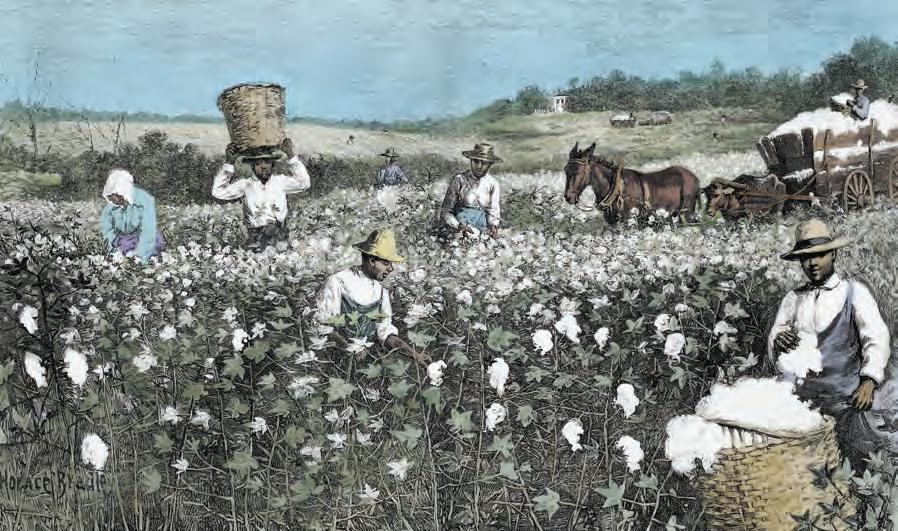
The effect of industrialisation on the cotton industry led to a surge in the number of enslaved people in that sector, but they also worked on coffee, sugarcane, tobacco or rice plantations. European growth created demand for these products and enslaved people were increasingly used to meet production requirements. Enslaved people could be employed within the household to perform servant duties such as washing, cooking or mending. They may have been taught a trade such as carpentry or blacksmithing. They were given instructions by an overseer, who was usually a white man who treated them violently. Sometimes a plantation might use a driver, who was also an enslaved person. Drivers became unpopular with other enslaved people if they were suspected of conspiring with the owner.
Unlike other countries in the Americas, the enslaved population in the United States continued to grow through the nineteenth century. Enslaved people were a commodity – they had value to their owners. “Breeding” more enslaved people, who became the property of the owner, could further increase the owners’ wealth.
Laws regarding enslaved people
In the early days of the American colonies, few laws existed relating to slavery. The growth in the number and economic importance of enslaved people saw many new laws passed regarding ownership and regulation of enslaved people. The laws differed from state to state, but the most common elements included the following:
• Restrictions on who an enslaved person could marry. Owners did not want to risk losing their enslaved people to another plantation, so they forbade marriage from outside it. Marriage between enslaved and free peoples were not permitted.
• Restrictions on movements of enslaved people. Any enslaved person away from their master was required to have a signed pass. Some cities required enslaved people to wear slave tags.
• “Slave” patrols were conducted by owners to ensure enslaved people did not travel at night and followed the laws.
• Few laws dealt with the physical treatment of enslaved people. Accidentally killing an enslaved person during punishment did not bring a penalty. In some districts, it was illegal to not punish an enslaved person recaptured after running away.
• Education of enslaved people was restricted, and it could be illegal to teach enslaved people to read.
• Large groups of enslaved people were not permitted to gather away from their plantations, including for religious purposes.
overseer a person who supervised others, especially workers driver an enslaved person given privileges in return for supervising other enslaved people commodity an item that is bought and sold, especially a raw material or something that is manufactured, for which there is a commercial demand slave tag small copper identification badges enslaved people wore when moving about or operating a business for their owners
UNCORRECTEDSAMPLEPAGES
• Enslaved people were not allowed to buy, sell or produce goods.

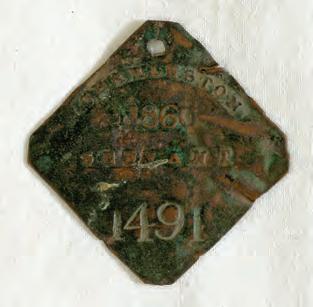
Source 3.5.2 Slave tags from Charleston, South Carolina, 1860 ➜
States in the north sought to end slavery altogether. The abolitionist movement began in the 1770s and gained support in the north where the economy was less dependent on labour-intensive farming. In 1780 the state of Pennsylvania passed a law abolishing slavery, and by the early 1800s slavery was illegal in many of the northern states. abolitionist someone who wanted to end slavery by freeing enslaved people
Identify the rights and freedoms you have in Australia today.
Describe the most important differences between these rights and freedoms and those of enslaved people in the period explored in this chapter so far.
UNCORRECTEDSAMPLEPAGES
Historical concepts: Continuity and change Historical skills: Perspectives and interpretations
A daily routine
Each slave had a different experience depending on their location, duties and the nature of their owner. Historians can make some generalisations about what the daily routine was like for an enslaved person working in the fields.
• An enslaved person woke before dawn.
• At sunrise, they started work after receiving the call from the supervisor.
• Enslaved people worked in the field throughout the day. They had short breaks and a brief lunch. During harvest, enslaved people might work 18 hours each day.
• Any food eaten was taken from their rations, which were given out at the beginning of the week and managed by the enslaved person. Eating rations too quickly meant starving.
• Enslaved people returned to their small hut-like houses when it was completely dark.
• During the night, they cooked food rations and completed small tasks such as mending clothing. Children were cared for and put to bed.
• Enslaved people slept until dawn before repeating the cycle. They might be given a Sunday off for rest.
The life of an enslaved field worker was extremely difficult, as proven by the fact that the average life of an adult enslaved person lasted seven to nine years after beginning work in the fields. Enslaved people who did not perform their duties to the owners’ standards were often beaten or whipped. Owners also varied: some treated their enslaved people appallingly, while others were kinder.
Marriage and families
Despite being treated as less than human, enslaved people were the same as everyone else in the way they felt when they fell in love and wanted to commit their lives to each other. They could marry, but this had no legal basis and was not recognised by the government or supported by the Christian churches.
Deciding to marry often led to heartbreak for husband and wife. An owner could sell a married enslaved person whenever they desired, and this also applied to any children who may have come from the marriage. Most laws stated that the status of the mother determined whether the children would be an enslaved person or free. In other words, if the mother was an enslaved person, the children became enslaved people. It was common for enslaved people to experience five sales during their life, which had a devastating effect on their relationships, sense of belonging and emotional well-being.
Activity 3.5.2
Source analysis
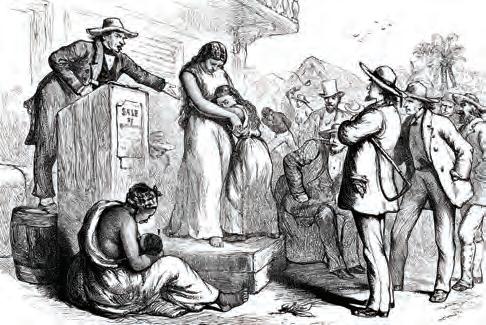
Source 3.5.3 An 1850s drawing of a slave auction of a mother and child ➜
Source 3.5.5 An account of the workday for an enslaved person
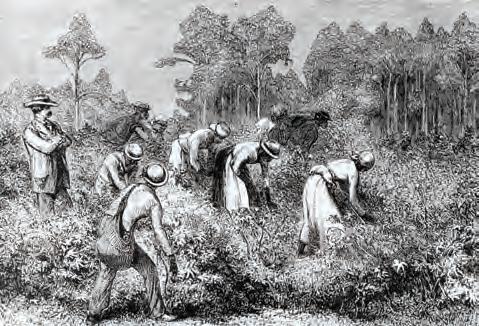
Source 3.5.4 A white landowner overseeing black cotton pickers at work on a plantation in the southern USA
An hour before day light the horn is blown. Then the enslaved people arouse, prepare their breakfast, fill a gourd with water, in another deposit their dinner of cold bacon and corn cake, and hurry to the field again. It is an offence invariably followed by flogging, to be found at the quarters after day-break. Then the fears and labours of another day begin; and until its close there is no such thing as rest … Such is a true, faithful, unexaggerated picture and description of the slave’s daily life, during the time of cotton-picking, on the shores of Bayou Boeuf.
Source 3.5.6 A letter from 1783 by a famous British abolitionist after the Zong incident
I think it my Duty to lay before your Lordships two Manuscript Accounts wherein are stated from unquestionable authority the circumstances of a most inhuman and barbarous murder committed by Luke Collingwood the Master, Colonel James Kelsall, the Mate, and other persons, the Mariners or Crew of the Ship Zong … a Liverpool Trader freighted with Enslaved people from the Coast of Africa; which Master, Mate, and Crew, on pretence of necessity lest there should be a want of water, wilfully and deliberately destroyed poor Negro Enslaved people, by casting them alive into the Sea with their hands bound or fetter’d, to deprive them of all possibility of escaping!
UNCORRECTEDSAMPLEPAGES
Granville Sharp, Letter to the Lord Commissions of the Admiralty, 1783
Northrup, S., 12 Years a Slave: A True Story, 1853
How has the artist represented the following in Source 3.5.3:
a. the auctioned mother and child
b. the auctioneer
c. the potential buyers (to the right of the image)?
Do you believe the artist of Source 3.5.3 supported the slave trade, or was against it? Explain why.
Using Sources 3.5.3 to 3.5.6, summarise the duties enslaved people performed.
Describe how enslaved people were treated in each of the four sources.
a. How does Source 3.5.4 compare with the information provided in Source 3.5.5?
b. Discuss whether a historian would gain a different impression of slavery if they looked at each of the sources in isolation.
c. Explain why a historian would benefit from having multiple sources about a topic of study.
d. Explain the benefit of having different perspectives, such as the treatment of enslaved people on the Zong in Source 3.5.6.
Which of the four sources do you believe is the most useful to a historian studying the experiences of an enslaved person? Justify your answer.
Historical concepts: Perspectives Historical skills: Analysis and use of sources
access
Teachers can go online to assign questions, view results, reports and more!
Knowledge and understanding
Describe the effect of industrialisation on the cotton industry.
Explain what a slave tag was.
How many times was an enslaved person usually sold?
Describe what the enslaved or free status of the children depended on.
Why might the average life expectancy of an enslaved person working in the fields have been so low?
Create a mind map or write a short piece that describes the common experiences of slavery explored so far in the text.
UNCORRECTEDSAMPLEPAGES
3.6 Resistance to slavery
Learning intention
In this lesson, you will learn about different ways of resistance to slavery and related significant individuals.
Success criteria
❏ I can outline ways of resistance to slaver y. ❏ I can identify significant individuals related to the resistance of slavery.
Think about what you have learned about enslaved people in the previous lessons. How did you view enslaved people prior to reading this material?
Describe how this view has changed. What do you know now that you did not before?
In 1882, Harvard University historian James Schouler described enslaved people as having “child-like simplicity”, who were “easily intimidated [and] incapable of deep plot”. To this day, his description remains influential on the way some people think about enslaved people. After a great deal of research by historians, these stereotypes of passive and docile enslaved people are beginning to change. They are being replaced by historical evidence that demonstrates how creative enslaved people could be in the way they resisted their owners.
There were many different ways enslaved people could resist their masters. Some pretended they did not speak English and therefore could not perform the required duties. Other enslaved people worked slowly, did poor work or deliberately sabotaged the tools they were using or the job they were required to do. Abdulrahman Ibrahim Ibn Sori ran away to hide in the swamps for several weeks before returning to his owner, while other enslaved people attempted to flee to different states in the hope of finding freedom. These methods were ways enslaved people could show they did not willingly submit to their enslavement.
Writing focus 3.6
Developing sentences
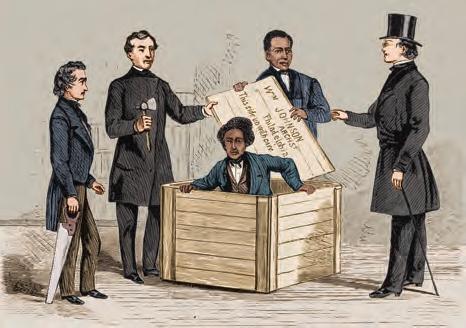
Source 3.6.1 This illustration depicts former enslaved person Henry ‘Box’ Brown as he emerges from a box he used to mail himself to freedom, Philadelphia, 1849.
UNCORRECTEDSAMPLEPAGES
Enslaved people who disobeyed or resisted their owners put themselves at great risk. Enslaved people had no rights in America. While many enslaved people attempted to flee to the free states of the north or Canada, this was a difficult journey for someone of colour with no money or passes.
stereotype a widely held but fixed and oversimplified image or idea of a particular type of person or thing
Newspapers posted rewards for enslaved people, and professional slave hunters tracked them down to return to their masters. Apart from those who escaped, there are numerous examples of enslaved people who decided to violently resist their enslavement.
Source 3.6.2 A poster offers a cash reward for the return of a runaway slave to his oppressor, Monroe County, Missouri, 1850s. ➜
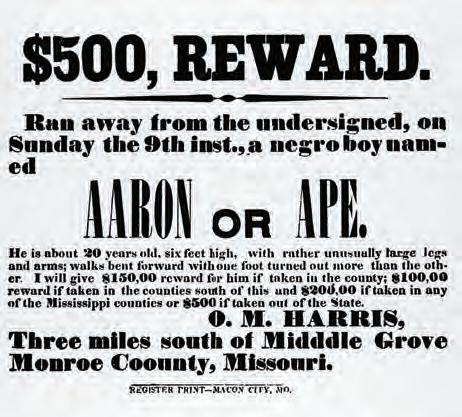
• Gabriel was enslaved on a plantation in Richmond, Virginia. He was rare in that he could read and had developed skills at blacksmithing. This led his owner, Thomas Prosser, to hire him out for profit. As a result, Gabriel travelled widely and he developed a plan to rebel with other hired enslaved people. The rebels believed they would trigger a desire for freedom, which would spark over one thousand enslaved people in and around Richmond to join their revolt. But heavy rain delayed their planned date in 1800 and led to their betrayal to the authorities by a fellow enslaved person. Gabriel and 27 other enslaved people were publicly hanged, and tighter restrictions were placed on enslaved people to prevent further rebellions.
• Toussaint L’Ouverture led a rebellion in Saint-Domingue, a French colony in the Caribbean, in 1791. An army of enslaved people attacked the plantations responsible for producing half the coffee and sugar used by Europeans. As the estimated 500 000 enslaved people greatly outnumbered the 70 000 members of the general population, the enslaved people captured the island and resisted any future attacks to re-establish control. Britain tried to take Saint-Domingue in battles between 1793 and 1801, but lost 45 000 soldiers without success.
UNCORRECTEDSAMPLEPAGES
• Nat Turner was a preacher who used his skills at public speaking and belief in God to inspire rebellion among enslaved people in South Hampton County, Virginia. On 21 August 1831, around 70 men moved across the countryside and attacked and murdered any white owners. They did not spare women or children, using knives and blunt weapons. After two days the rebellion was over, with Nat Turner and his rebel enslaved people seeking to hide in the forests. Fifty-five enslaved people were found, arrested, tried and executed for suspected ties to the rebellion. White revenge groups killed 120 other enslaved people. Nat Turner’s body was flayed and beheaded.
The biggest consequence of these rebellions was a crackdown on enslaved people. Anti-abolitionists believed kind treatment was what made enslaved people desire freedom and resist their owners. For them, the solution was simple: be firmer when with enslaved people, and ensure any resistance was met with severe punishment.
The Underground Railroad
The Fugitive Slave Acts (1793 and 1850) made it the law to seize and return runaway enslaved people, even if they managed to cross state borders. Between 1810 and 1850, somewhere between 40 000 and 100 000 escaped enslaved people defied this law to travel the Underground Railroad to find freedom in the northern states or Canada. To this day, the number of assisted enslaved people is difficult to calculate due to the extent of the secrecy involved in the operation.
The Underground Railroad was not a physical railway, but instead a sequence of houses, barns, churches and businesses that provided refuge to escaped enslaved people. The network used railroad terminology to disguise its operation. “Stations” were safe locations where an enslaved person could safely rest. Often, these safe houses were identified by a lantern hanging outside, to symbolise the safety found within. “Conductors” were the people who guided, sheltered or protected the escapees as they journeyed the railroad. “Passengers” or “cargo” were the enslaved people themselves.
anti-abolitionist someone who opposes the abolition of slavery (i.e. who wants slavery to continue as a practice)
UNCORRECTEDSAMPLEPAGES
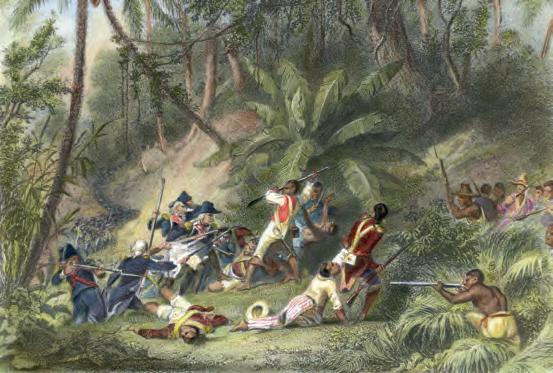
Source 3.6.3 Engraving showing Toussaint L’Ouverture’s revolution in Saint-Domingue ➜
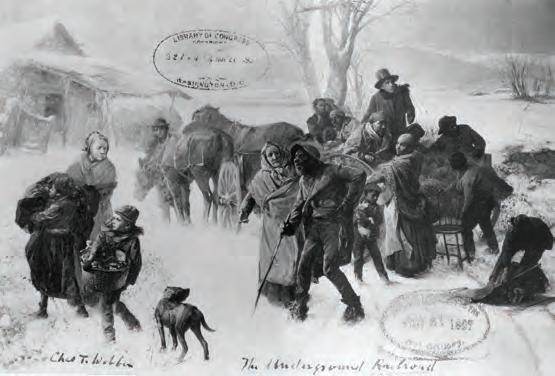
At its peak in the mid-1800s, the Underground Railroad had evolved into a complex network of supporters, including freed enslaved people, Northern abolitionists, philanthropists and church leaders. Harriet Tubman, a former enslaved person, famously risked her life on 12 missions, freeing over 70 people. William Still, a free black abolitionist in Philadelphia, organised escape routes and recorded historical accounts of fugitives. Levi Coffin, a Quaker known as the “President of the Underground Railroad”, sheltered over 3000 enslaved individuals in his homes in Indiana and Ohio.
Source 3.6.4 A painting entitled The Underground Railroad by Charles Webber, c. 1850 ➜
3.6.5 A portrait of Harriet Tubman (1820–1913)
Knowledge and understanding
What passive resistance methods did enslaved people use to resist their owners without violent confrontation?
Why did Gabriel’s planned rebellion in Richmond, Virginia fail in 1800?
Explain the Underground Railroad’s terminology system and identify three key figures who operated it, including their specific contributions.
“Enslaved people were effective at resisting their masters.” Discuss this statement.
Thinking and researching
Complete one of the following.
Research and create a comparison chart analysing the different methods of resistance used by enslaved people. Evaluate the risks and potential outcomes of each method based on the learned examples.
UNCORRECTEDSAMPLEPAGES
Design a museum exhibit poster about the Underground Railroad that explains its operations, key figures and historical significance. Include why historians face challenges in researching this network and what debates exist about its effectiveness.
The secrecy of the Underground Railroad has led to its mythologising in history, which makes uncovering facts a difficult pursuit for historians. Debate has developed over how secretive the Underground Railroad actually was, with several historians believing the operation did not act solely at night, but often in broad daylight. Historians struggle to decipher the planning, operation and execution of the Underground Railroad, with modern research suggesting the network was more a group of individuals, rather than a collective, organised group. A further historical debate surrounds the actual success of the Underground Railroad, and how much it contributed to undermining the institution of slavery. However, historians’ quests to find further answers do not take away from the contributions the men and women of the Underground Railroad did make to the lives of enslaved people. Historical concepts: Cause and consequence
Teachers can go online to assign questions, view results, reports and more!
3.7 The abolition movement
Learning intention
In this lesson, you will learn about the abolition of slavery in Britain and the United States and related significant individuals.
Look at Source 3.7.1.
See: What do you see in the image?
Think: What does it make you think about the abolition movement?
Wonder: What do you wonder?
Success criteria
❏ I can outline key events that happened during the abolition movement.
❏ I can identify significant individuals related to the abolition movement.
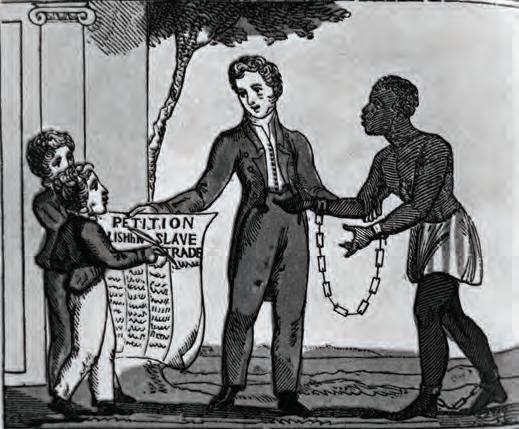
The abolition of slavery in Britain
Slavery became a divisive issue in America with the rise of the abolitionist movement in the 1830s. This partly stemmed from the British abolitionist movement ,which developed in the late eighteenth century when various people opposed slavery and wanted enslaved people granted freedom and recognition as equal humans. Activists in England campaigned to expose the brutal treatment of enslaved people in the transatlantic slave trade through public lectures or petitions detailing the accounts of previously enslaved people. In 1807, in response to growing public pressure, the Slave Trade Act passed through parliament to ban the trading of enslaved people with the British Empire. Slavery did remain in British territories until 1833, when the legislation of the Slavery Abolition Act freed 800 000 enslaved people.
UNCORRECTEDSAMPLEPAGES
Writing focus 3.7
Developing sentences
Source 3.7.1 Children presenting a petition for abolition of the slave trade, c. 1830
➜
Key figures in the abolition movement
Ignatius Sancho
A prominent figure in the abolitionist movement of England was the writer and composer Ignatius Sancho (1729–80). Born aboard a slave ship, Sancho had been sent to Britain to be enslaved by a wealthy family, until he gained his freedom in 1751 with the help of the Duke of Montagu. The Duke realised the value of Sancho’s intellect, after he taught himself to read and write. Freed, Sancho went on to work for the Montagu family, and became a writer, publishing his views on the injustices of slavery, racism and the oppression of African people. Corresponding with a variety of public figures at the time, Sancho’s letters were published in 1782, and they significantly contributed to increasing British society’s understanding of African people and the prejudice they experienced.
William Wilberforce
Another leading figure in the abolition movement in England was the British politician and philanthropist, William Wilberforce (1759–1833). Motivated by a deep sense of morality stemming from his Christian faith, Wilberforce used his platform as a member of parliament for nearly 50 years to campaign against the inhuman practice of slavery.
UNCORRECTEDSAMPLEPAGES
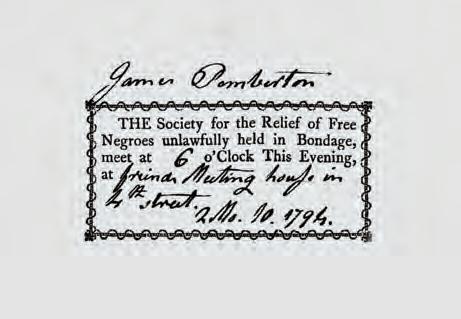
Wilberforce was the first British politician to introduce a motion to end the slave trade, in 1789. While his motion failed in the face of economic fears and vested interests, he continued to reintroduce bills with other politicians, and gave speeches to the British parliament citing statistics and testimonies, and stirring moral outrage against the treatment of enslaved people. His strong advocacy on the issue of slavery led to the passage of the Slave Trade Act 1907. Poor health Source 3.7.2 Partially handwritten notice of a meeting of the forced Wilberforce to retire in 1825, but Society for the Relief of Free Negroes Unlawfully Held In Bondage not before he had made a significant contribution to public awareness, and outrage, regarding slavery. He would die in 1833, three days after the British parliament ended slavery with the emancipation of enslaved people under the Slavery Abolition Act
The abolition of slavery in the United States
In the United States, Britain’s abolition of slavery demonstrated that a major economic power could effectively remove slavery from its society. The campaign and events that had transpired in England only strengthened the resolve of abolitionists in the United States.
Abolitionists in the United States came from a variety of backgrounds and different states, and sought their goals in different ways. Newspapers and pamphlets were published to create awareness, such as articles written in the Boston newspaper, The Liberator. Anti-slavery conventions took place across various states, even with the threat of violence from anti-abolitionist groups. The movement gained more support when US President Abraham Lincoln – who was not an abolitionist himself –worked beside abolitionist groups to create a legal pathway to free American enslaved people.
Source 3.7.3 “Emancipation of the Slave”, proclaimed on 22 September 1862, by Abraham Lincoln, President of the United States
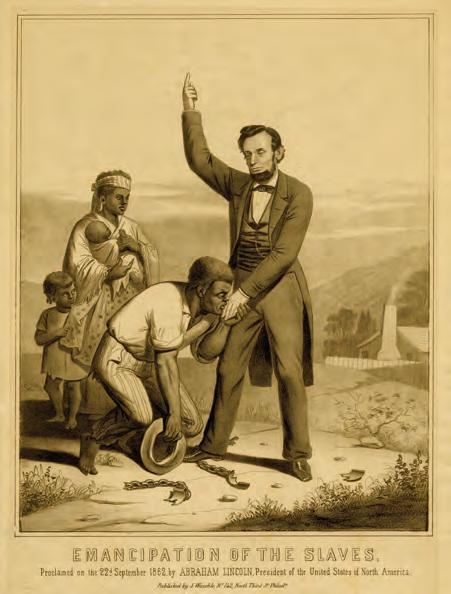
Knowledge and understanding
Thinking and researching Online quiz
Knowledge and understanding
Students can access sample responses and results online
What were people and groups working towards freeing enslaved people known as?
Summarise the achievements of William Wilberforce in abolishing the slave trade.
Account for how each of the following people felt about the end of slavery:
a. an enslaved person
b. a plantation owner with many enslaved people
c. an abolitionist
d. a poor white worker in the South.
Thinking and researching
Complete one of the following.
UNCORRECTEDSAMPLEPAGES
Teachers can go online to assign questions, view results, reports and more!
Compare the British and American abolition movements by creating a Venn diagram. Identify similarities in their methods and motivations and explain how Britain’s success in 1833 influenced American abolitionists’ strategies and determination.
Write a persuasive speech from the perspective of either Ignatius Sancho, William Wilberforce or an American abolitionist, arguing for the end of slavery. Use specific methods and arguments mentioned in the textbook content. 1.
Historical concepts: Cause and consequence, Empathy Historical skills: Perspectives, Empathetic understanding
3.8
Learning intention
Legacies of the transportation of enslaved people to the Americas
Success criteria
In this lesson, you will learn about the long-lasting effects of slavery that shaped the United States.
Starter activity
Look at Source 3.8.1. What effect do you think such behaviour would have on accelerating the abolition of slavery, and why?
❏ I can explain how slavery changed the United States both economically and politically.
➜
Source 3.8.1 “The Abolition of the Slave Trade: ‘Or the inhumanity of dealers in human flesh exemplified in Captain Kimber’s treatment of a young Negro girl’”
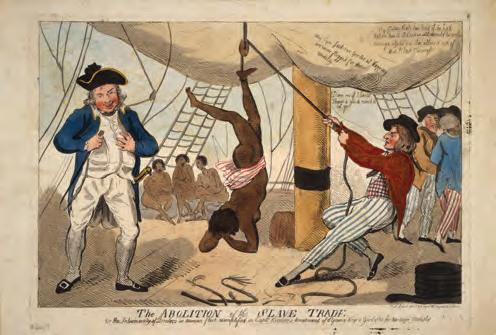
Writing focus 3.8
Creating topic sentences
dehumanising deprivation of positive human qualities
UNCORRECTEDSAMPLEPAGES
Slavery was different in the United States compared with other countries in the Americas. From 1810 to 1860, the population of enslaved people in the United States grew from over one million to four million. In contrast, slave populations in places like Cuba or Brazil declined over time. The difference between the United States and other countries in the Americas was the “breeding” of enslaved people. An enslaved mother could bear numerous children to sell, making a great profit for the owner. Slavery had devastating, brutal and dehumanising effects on people removed from their country and placed into a life of forced servitude. Because enslaved people were the property of others, they had no rights, freedoms or choices. The physical, mental and emotional damage inflicted on these people is difficult to understand today.
The broader effect of slavery on society is a question passionately debated by historians. One of the key issues is whether modern America is so powerful and prosperous as a direct result of its slave past. Most historians now agree that the United States did benefit from slavery, but there is less agreement on the extent to which slavery increased the wealth and power of the country.
It should be remembered that not all Americans owned enslaved people. The United States was a society with a clear class structure and a significant gap between the rich and the poor. Around 66 per cent of families in the south of America did not own enslaved people, and many of those who did owned less than five. This meant that rich families in the South owned the majority of enslaved people because they could afford their purchase and maintenance costs. Unlike paid labour in a typical job, enslaved people needed to be bought, fed, clothed and housed. Although an owner could hire out a skilled enslaved person, they needed to invest time in training the person first, which could be costly. In rare cases, an enslaved person could hire themselves out and pay their owner a percentage of their earnings.
Who did slavery benefit? Some industries were dependent on slavery to function, such as the large cotton plantations in the South. The shipping merchants profited from growing trade because of increased production, as did British companies who received the cotton to create textiles. Improved profits for companies led to greater taxes, which states were happy to collect. Individuals, such as slave traders, made hefty profits from buying and selling enslaved people, as did those who transported enslaved people by rail or steamboat. Those who benefited the most, however, were the rich families in the South of the United States.
Origins of the civil war in the United States
Slavery was a key issue of the American Civil War, fought between the North and South from 1861 to 1865. During the middle of the nineteenth century, slavery became a pressing issue. A major point of dispute was whether new states admitted to the Union should be free or slave-owning. The divisions between the North and South in the United States were clear. The North had developed its industrial capacity, focusing on manufacturing to grow its economy, and as a result of a growing abolitionist movement, a number of Northern states had enacted laws to abolish slavery. By contrast, the South primarily focused on farming, and had a strong dependence on the labour of enslaved people. The most enthusiastic defence of slavery came from rich families who could exert political influence to protect their interests. They wanted to keep slavery because it made them wealthy, therefore ensuring their lifestyle and social status. The lower class of society in the South were largely uneducated and saw the abolition of slavery as a threat to their own livelihoods. How would they find jobs or buy houses and food if they had to compete against freed enslaved people? Any attempt to end slavery was viewed in the South as an attack on their economy and way of life.
Within four months of Abraham Lincoln’s election as US President in November 1860, the states of Mississippi, South Carolina, Louisiana, Alabama, Georgia, Florida and Texas seceded from the Union and began gathering their military forces. The civil war between the North and South was brutal, but it ended with victory for the North and the signing of the 13th Amendment in the US Constitution – slavery was abolished in the United States.
UNCORRECTEDSAMPLEPAGES
secede the formal withdrawal from membership of a federal union, an alliance or a political or religious organisation
The US Constitution and amendments
One loophole did exist in the US Constitution, and this was exploited by those who sought to keep enslaved people. The 13th Amendment stated: “Neither slavery nor involuntary servitude, except as a punishment for crime whereof the party shall have been duly convicted, shall exist within the United States …” The key words “except as punishment for a crime” provided law enforcement with the opportunity to put freed people back into slavery as a result of any crimes committed. This was significant because many enslaved people had nothing when freed, so they resorted to stealing to survive. Those arrested were placed in prisons and used for public works programs such as building roads. As most people arrested and imprisoned were black people, the various states of America were able to use slave labour for governmental gain. In reality, slavery had changed to a prison labour system.
In 1868 and 1870, the 14th and 15th Amendments, respectively, were made to the Constitution of the United States. These changes to the Constitution gave African American people citizenship rights, and the ability to vote without reference to their “race, colour or previous condition of servitude”. Many southerners immediately sought ways to prevent black people from voting due to their education, taxes or other reasons. This was successful in Mississippi, where fewer than 10 per cent of African American people registered to vote from 1890.
Segregation and racism
Another method used by white people to maintain their supremacy over black people was established in the court case Plessy v Ferguson (1896). This passed into law the idea that white and black people were “separate but equal”. Plessy v Ferguson was the legal foundation for segregation in the United States, an issue that continued to be fought by people of colour well into the 1960s.
The abolition of slavery did not result in an immediate improvement in the lives of many black Americans because it basically freed them into lives of poverty, where they continued to be regarded as inferior to white Americans and were often subject to abuse, racism and violence. Extreme groups like the Ku Klux Klan emerged. “The Klan”, or KKK, is a secret white supremacist group formed in 1865 that conducted violent assaults and murders of African American people. These attacks often went unpunished due to the lack of respect and rights for black people in the courts and the influence of white supremacists in many states. While enslaved people had achieved their freedom, the struggle for recognition had only just begun.
UNCORRECTEDSAMPLEPAGES
Source analysis
How does this engraving from Thomas Nast depict emancipation?
How does the impression in Source 3.8.2 differ from the actual experience of emancipated enslaved people?
3.8.2 An engraving by Thomas Nast celebrating emancipation
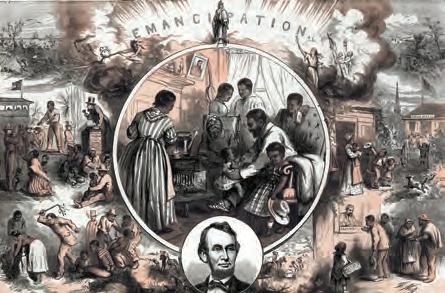
Historical concepts: Perspectives, Significance Historical skills: Analysis and use of sources
Modern legacies
Over 100 million people in the United States are estimated to be of African descent today. In countries across North, Central and South America, many people also trace their ancestry to Africa. The United States still struggles with its cultural identity and healing the wounds that exist between black and white people.
Knowledge and understanding
Identify the country with the largest slave population.
Identify the major owners of enslaved people.
Describe the main impacts of slavery on modern America. Why is it important for a historian to understand slavery in the United States? How is it relevant to understanding the world today?
Thinking and researching
Complete one of the following.
UNCORRECTEDSAMPLEPAGES
Teachers can go online to assign questions, view results, reports and more!
Create an infographic examining the economic legacy of slavery in the United States. Identify which groups benefited most from slavery, explain the class divisions in Southern society, and analyse how slavery contributed to America’s wealth and power.
Develop a timeline tracing the journey from slavery’s abolition (1865) to continued oppression of African Americans. Include the 13th, 14th and 15th Amendments, legal loopholes, segregation laws and the rise of the white supremacist violence.
Historical concepts: Significance, continuity and change Historical skills: Comprehension, Chronology
3.9 Transportation to Australia
Learning intention
In this lesson, you will learn about how Australia was chosen by Britain as its penal settlement.
Success criteria
❏ I can summarise the reasons for Britain to choose Australia as its penal settlement.
❏ I can identify key events that led to Britain transporting convicts to Australia.
❏ I can describe the hardships suffered on the journey to Australia.
Source 3.9.1 The routes of convict transportation between 1618 and 1874 ➜
Look at Source 3.9.1.
Identify and describe the main convict transportation routes.
convict a person found guilty of a crime and serving a sentence of imprisonment
The mass movement of people out of Africa was the result of slavery. However, there was a second form of forced mass migration across the world: the transportation of convicts to penal settlements. During the eighteenth century, prisons in Britain became overcrowded, and the country began sending prisoners to penal colonies in its empire.
Rising crime and incarceration rates in Britain
Urbanisation from the Industrial Revolution had created a generation of poor, unemployed people. When confronted with the choice of starving or committing crimes to feed themselves or their families, many turned to theft to stay alive. From 1800 to 1840, the crime rate in Britain increased by approximately 15 000 offences each year. The government introduced the “Bloody Code”, so-called because many of the offences it contained were punishable by death. In today’s world, countries using the death penalty generally apply it only to severe crimes, such as murder. In the nineteenth century, however, the death penalty could be applied for crimes such as cutting down trees, stealing or even being out at night with a blackened face (the government thought this was a sign of mischief even though many workers could not avoid this because of their dirty jobs).
The rapid rise in the crime rate during the Industrial Revolution created a backlog in sentencing, which overcrowded prisons. The government resorted to using prison hulks moored on rivers. Disease was rife in the hulks due to the crowded and unsanitary conditions. Each prisoner had an area 1.8 m long and 60 cm wide in which to lie. In 1788, the weekly bread ration was approximately 3.5 kg, with one piece of beef cheek per week and occasional supplies of green vegetables.
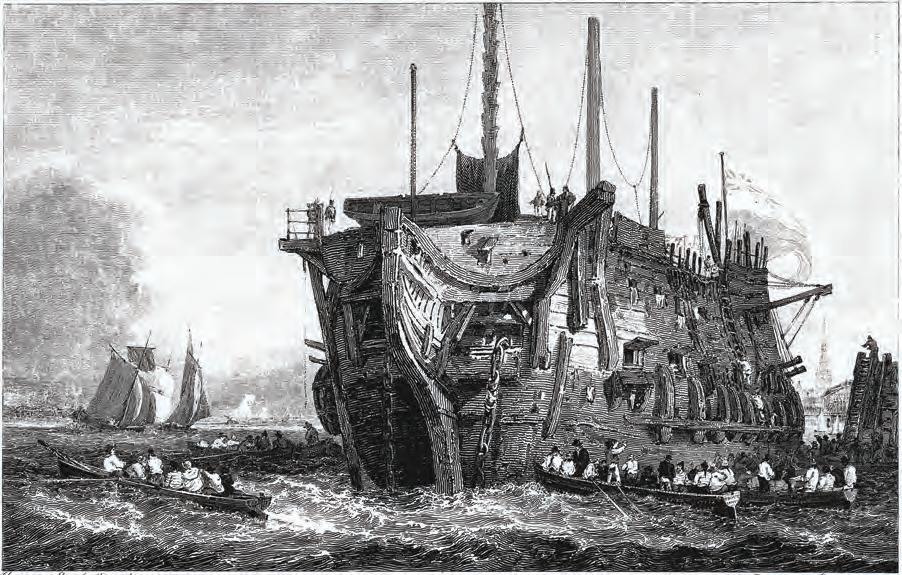
Writing focus 3.9
The language of source analysis
UNCORRECTEDSAMPLEPAGES
prison hulk an old ship stripped of fittings and permanently fixed on a river for use as a prison
Source 3.9.2 Prison hulk at Deptford, London, c. 1826 ➜
scurvy a disease caused by vitamin C deficiency; symptoms include swollen, bleeding gums and the opening of previously healed wounds dysentery an infection of the intestines causing severe diarrhoea typhus an infectious disease causing a purple rash, headaches, fever and delirium
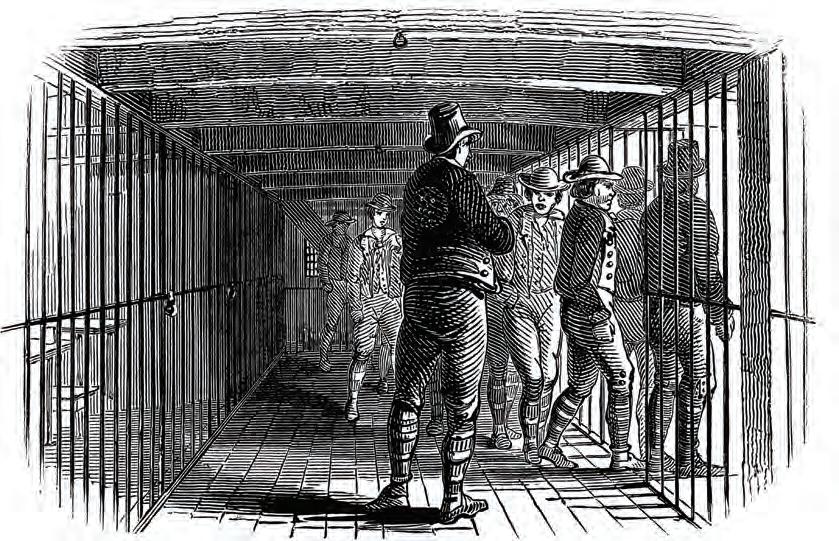
Source
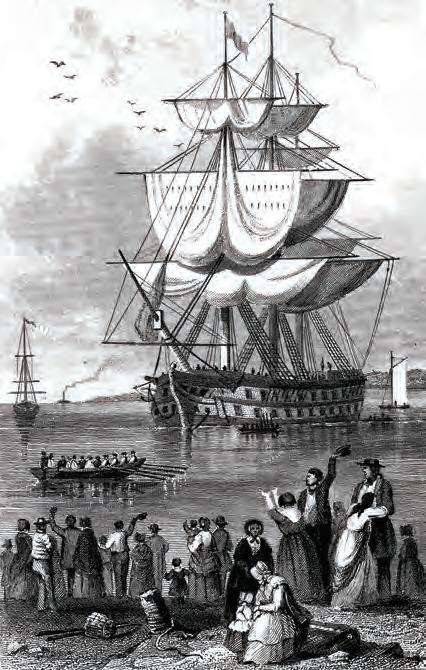
UNCORRECTEDSAMPLEPAGES
Source 3.9.4 An early-nineteenth-century engraving of a convict ship ready to sail from England to Australia
Britain had transported over 50 000 convicts to its colonies in America until the War of Independence began in 1775. After the loss of the American colonies, Britain needed a new location to transport convicts, but an experiment in 1781 transporting convicts to the west coast of Africa failed, ending this plan. During this time, Britain also wanted to secure its trade and territorial interests in South-East Asia against possible French, Dutch or even Russian competition. As a result, the British saw Australia as an ideal penal settlement. Lieutenant James Cook had recently mapped territory on the far side of the globe, describing it as an “uninhabited” landmass with abundant sailing resources at Norfolk Island, such as tall pine trees for masts and flax for sails. The new land was perfect for a convict settlement, and in 1787 the First Fleet departed for Australia carrying convicts.
Transport to Australia
Life on board a transport ship was horrendous during the eight-month, 20 000-km journey to Australia. Male convicts were chained within the ship, with little room to move, and provided with only small supplies of poor drinking water and rationed food. Diseases such as scurvy, dysentery and typhus were common. Diagnosed diseases were difficult to treat due to limited medical services available, if they were available at all.
3.9.3 A warder watching prisoners entering their ward on board convict hulk Warrior ➜
Source analysis
Source 3.9.5 James Hardy Vaux describes the conditions on the hulk Retribution – the hulks were static in rivers across Britain, but conditions were similar to the First Fleet ships.
There were confined in this floating dungeon nearly six hundred men, most of them double ironed; and the reader may conceive the horrible effects arising from the continual rattling of chains, the filth and vermin naturally produced by such a crowd of miserable inhabitants, the oaths and execrations constantly heard amongst them.
James Hardy Vaux, 1809, Memoirs of James Hardy Vaux
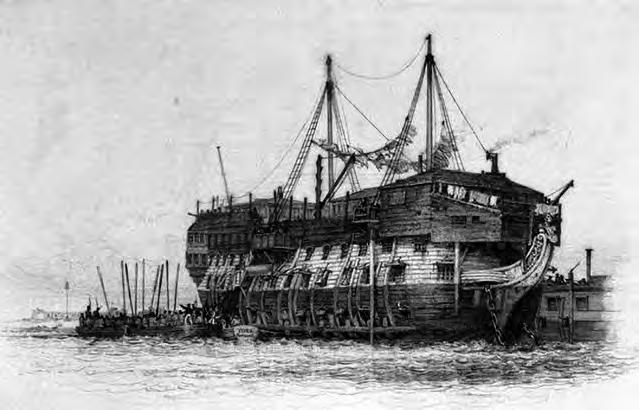
Source 3.9.7 David Collins, the first Secretary to the Governor of NSW, described his journey on the First Fleet.
Thus, under the blessing of God, was [the journey] happily complete, in eight months and one week, a voyage which, before it was undertaken, the mind hardly dared venture to contemplate … [W]hen it is considered, that there was on board a large body of convicts, many of whom were embarked in a very sickly state … we might be deemed peculiarly fortunate … only thirty-two had died since their leaving England, among whom were to be included one or two deaths by accident, although previous to our departure it was generally conjectured, that before we should have been a month at sea one of the transports would have been converted into a hospital ship.
Collins, D.,
UNCORRECTEDSAMPLEPAGES
Write three things in Sources 3.9.5, 3.9.6 and 3.9.7 that you think are important to know about transportation. For example, you might find a particular fact important, so you would write this down.
For each of the three things you noted in Question 1, explain why you think it might have been that way. For example, if you chose an important fact, you would then need to explain that fact.
Historical concepts: Significance Historical skills: Analysis and use of sources
Source 3.9.6 Convicts boarding a prison hulk in Portsmouth Harbour, 1828 ➜
1798, An Account of the English Colony in New South Wales embarked boarded a ship or plane
Britain sent multiple fleets of convicts to its new colony in Australia. The Second Fleet arrived in 1790, and in the following years around 160 000 convicts arrived until the end of convict transportation in 1868. One peculiarity of the settlement in Australia was the gender imbalance because of the transportation of predominantly male convicts. Despite Governor Arthur Phillip’s desire to bring women to the colony, men outnumbered women until the twentieth century. Four of the 11 First Fleet ships carried women, but only 193 in comparison to the 780 men on board. Those convicts following the First Fleet arrived in much poorer health. Reverend Johnson, the chaplain of the colony, described the misery of the convicts as “indescribable … their heads, bodies, clothes, blankets, were all full of lice. They were wretched, naked, filthy, dirty, lousy, and many of them utterly unable to stand, to creep, or even to stir hand or foot”.
Teachers can go online to assign questions, view results, reports and more!
Knowledge and understanding
Identify three crimes for which the death penalty could be applied in nineteenth-century Britain. Why did Britain need to find a new location to transport convicts after 1775?
Identify the time period during which convicts were sent to Australia.
Identify the diseases that convicts regularly endured during transportation.
Describe the conditions inside prison hulks during the Industrial Revolution, including space allocation and food rations provided to prisoners.
Thinking and researching
Complete one of the following.
Analyse the causes and consequences of Britain’s rising crime rate during the Industrial Revolution. Create a cause-and-effect diagram showing how poverty, the Bloody Code and prison conditions led to the decision to transport convicts to Australia.
Imagine you are a British Government official in 1786 tasked with solving the convict crisis. Write a report recommending Australia as a penal colony, addressing why America is no longer viable and why Australia meets Britain’s needs.
UNCORRECTEDSAMPLEPAGES
3.10 Experiences of convicts in Australia
Learning intention
In this lesson, you will learn about who convicts were, why they were transported to Australia, and their experiences during transportation and at their penal settlements.
Starter activity
Success criteria
❏ I can summarise their journeys and lives in Australia.
How are the officers and the convicts visually differentiated in Source 3.10.1 What does the fact that the government officials are military officers, wearing military uniforms, tell you about the nature of life in Sydney at the time?
Life in a penal settlement
The arrival of the First Fleet led to the establishment of a small encampment around Port Jackson, with shelters built from simple materials like cabbage palms and clay. As the colony expanded, construction techniques improved, gradually transforming the settlement into a small town. Continued growth eventually saw it develop into Australia’s largest city.
Convicts served as a key labour force in the colony. Governor Phillip assigned male convicts to build roads, bridges, courthouses and farms. Permanent structures were erected, with roads interwoven throughout the settlement and fortifications built for protection. Convicts also built their own shelters, leading to clusters of small houses across the penal colony. Unlike male convicts, who performed physically demanding labour, female convicts were often assigned to officers’ households, carrying out tasks such as cleaning and serving.
UNCORRECTEDSAMPLEPAGES
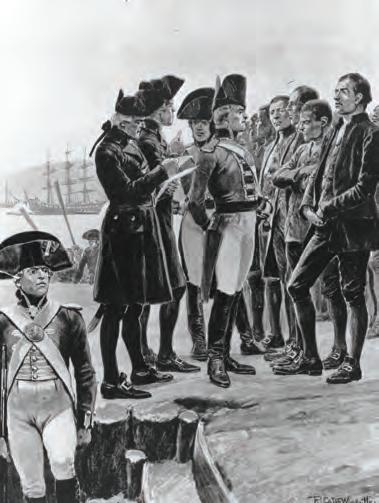
Source 3.10.1 Inspection of convicts at Botany Bay. This undated painting was created in the nineteenth century.
Life for the convicts was harsh. Food was difficult to obtain due to Australia’s isolation. The First Fleet had initially arrived at Botany Bay, but was forced to move north to Port Jackson where fresh water and decent soil for farming were found. In general, convicts did not make effective farmers because most came from the towns and cities of Britain and therefore had limited experience in agriculture. Ships were sent from Australia to South Africa for resupply, but months passed before their return.
Writing focus 3.10
Developing sentences
Convicts with appropriate skills could forage for food along the foreshore, or hunt, fish and gather oysters. They also took to making small vegetable gardens, which they tended in their free time.
The convicts were prisoners and the officers believed they should be held securely, with shackles if necessary. This was quite impractical, so the reality was that convicts had much free time without chains. They were often rebellious towards officers, seeking to avoid work and focus on tasks they enjoyed, such as making alcohol. Some convicts continued to steal, and hid anything they stole in their small huts. By 1789, behaviour in the colony had deteriorated and needed addressing. Laws became stricter, with those committing crimes facing severe punishments.
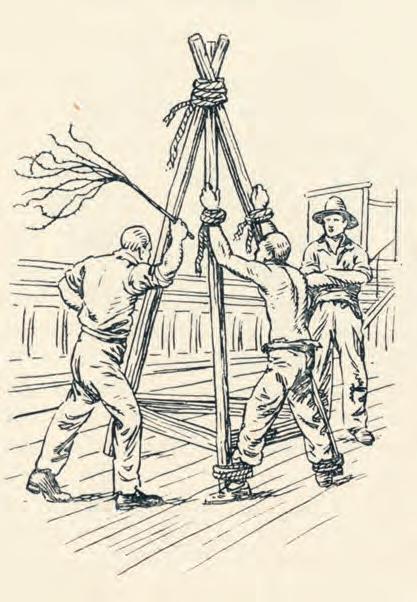
Source 3.10.2 A convict being flogged with the cat-o’-nine-tails
UNCORRECTEDSAMPLEPAGES
Crime and punishment
The officers believed that harsh punishments shown publicly would prevent other convicts from repeating the same behaviour and reform them into functioning members of society who did not require constant supervision. The notorious “cat-o’-nine-tails” whip was used, which left horrific wounds across the back. Any lashes from whipping left scars, but 50 lashes exposed a convict’s spine.
Leg irons were used for convicts who tried to escape. Varying weights were chained around convicts’ ankles, and they could also be chained together in a gang. The weight of the leg iron depended upon the severity of the punishment, with heavier irons causing substantial muscular pain, cutting and bruising where they attached to the body. Convicts generally did not attempt to run away because they did not have the skills to survive in the Australian bush. First Nations Peoples did not always welcome convicts, which made survival difficult without food, clean drinking water or shelter from the cold. Illness or injury could rapidly lead to death in the wild.
The treadmill was another form of punishment used to ensure the cooperation of convicts. First introduced to Sydney in 1823, the treadmill was an attempt to make poorly behaved convicts complete productive work by powering a mill to grind grain. Merchants could pay a fee to have their grain milled by the convicts. A convict would work for an entire day on the mill with only small breaks. It was a tiring and dangerous activity due to rotating blades that cut anyone who slipped. Convicts who did not mill at a fast-enough rate were whipped.
Female convicts received lighter punishments than men, although they were often still severe. If a woman committed a crime, she could be beaten, have her head shaved, be sent to work in a factory or placed in solitary confinement.
Activity 3.10.1
Source analysis
Is Source 3.10.3 a primary or secondary source?
Justify your answer.
Source 3.10.3 demonstrates a treadmill from London, 1821. How useful would this source be for a historian studying the Australian experience of convict punishment?
Explain your answer.
Source 3.10.3 A version of the treadmill at Brixton Prison in London, 1821
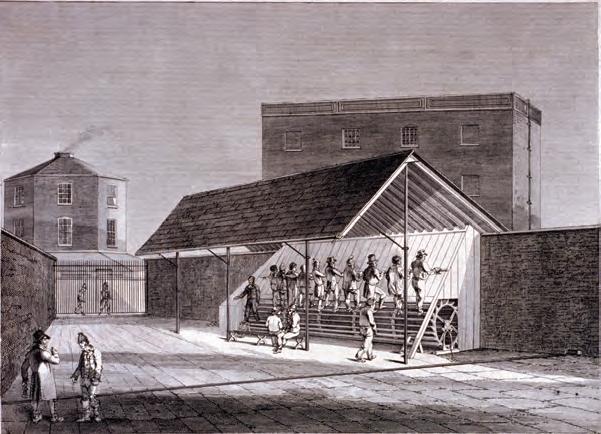
Historical concepts: Perspectives Historical skills: Analysis and use of sources
Knowledge and understanding
Thinking and researching Online quiz
Knowledge and understanding
Students can access sample responses and results online
Identify the tasks Governor Phillip assigned to male convicts in the early days of the colony.
Identify the type of work given to female convicts in the early days of the colony.
Why did convicts not make effective farmers?
Identify some actions taken to address the difficulties of obtaining food in the colony.
Explain your answer.
Teachers can go online to assign questions, view results, reports and more!
Do you believe that convicts who were exposed to harsh punishments would change their behaviour?
Create a series of alternative punishments to physically harming a guilty convict. Explain why you think these would be more effective. Make sure any alternatives you suggest were available to managers of the Sydney colony in the early nineteenth century.
Thinking and researching
Complete one of the following.
UNCORRECTEDSAMPLEPAGES
Create a diary entry from the perspective of a convict during either the eight-month voyage to Australia or their first month in the penal settlement, describing daily experiences, challenges and emotions based on lesson details.
Compare the experiences of male and female convicts in Australia by creating a table covering their assigned work, living conditions, punishments and freedoms in the colony.
Historical concepts: Perspectives Historical skills: Perspectives, Communication
3.11
Experiences of emancipated convicts in Australia
Learning intention
In this lesson, you will learn about how emancipated convicts lived beyond their punishment and how they contributed to building Australian society and identity.
Starter activity
Success criteria
❏ I can explain convict emancipation.
❏ I can define the types of pardons and freedoms.
❏ I can summarise how emancipated convicts shaped Australian societ y.
Many convicts who had finished serving their sentences in Australia decided to remain rather than return to Britain. What reasons can you think of that might have encouraged them to do this?
Writing focus 3.11
Developing sentences
UNCORRECTEDSAMPLEPAGES
Governor Macquarie (in office 1810–21) recognised that convicts were an integral part of building the colony of New South Wales. They were needed for their labour, any skills they possessed before their arrest, and to eventually contribute to a growing society by marrying and having children. Convicts were encouraged to reform and start a new life, but it is important to realise that some convicts did not change their behaviour. These people were moved to harsher penal colonies with stricter rules and punishments.
In the 80 years following the arrival of the First Fleet, another 800 ships arrived from Britain with convicts. Those transported to Australia often had sentences only lasting a few years, and once these expired they were faced with a choice of how to live their lives. Many dreamed of returning to Britain, to restart their lives or find their families. For others, life in Britain presented too many challenges, and they sought to explore opportunities in their new homeland.
When a convict’s sentence expired, they were given a Certificate of Freedom. Convicts could also be emancipated for other reasons, such as the following:
• A ticket of leave if a convict behaved well and served a certain amount of their sentence. This allowed the convict to live and work within a nominated police district, with a greater sense of freedom. Every year, they were required to report to a muster or risk losing their ticket.
• A conditional pardon that allowed the convict freedom within the colony, but they were not allowed to return to Britain.
• An absolute pardon that allowed the convict to return home to Britain.
Experiences of emancipated convicts in Australia
Activity 3.11.1
Source analysis
Describe the key features of Source 3.11.1.
How useful is this source for a historian studying the emancipation of convicts?
Justify your answer.
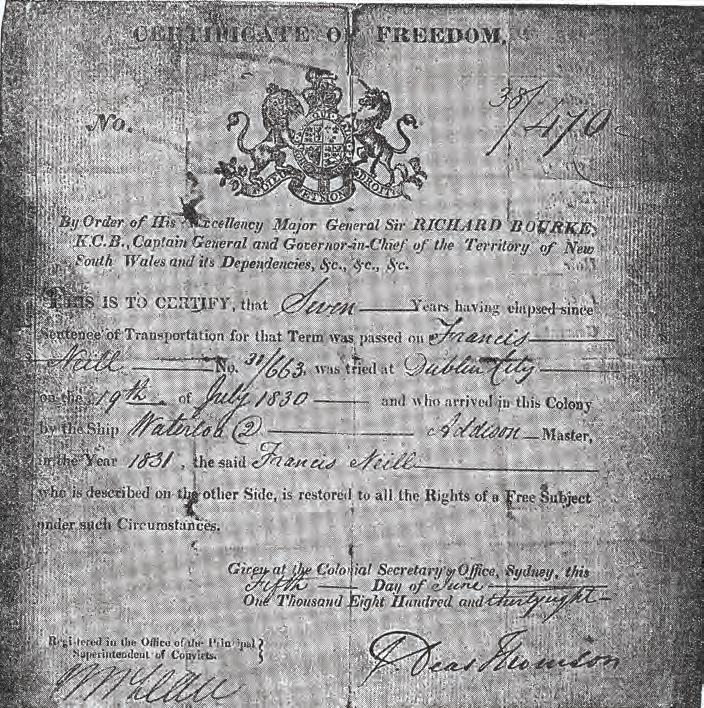
UNCORRECTEDSAMPLEPAGES
Once a convict had served their seven- or 14-year sentence, their Certificate of Freedom proved their release and allowed them to leave the colony. Over 40 000 Certificates of Freedom were awarded to convicts. Throughout the nineteenth century, the number of convicts who were locked away declined because they either worked for the government or settled with a conditional or absolute pardon. Freed convicts often decided to try their luck in Australia rather than retur n home to hardships in Britain. Despite the social stigma of being ex-convicts, they had the opportunity to own land and create a new life. A letter from Reverend Richard Johnson in 1794 stated that “a great number of those whose terms have expired have turned settlers, some of whom are doing well, better than many farmers in England”. Historical concepts: Significance Historical skills: Analysis and use of sources
One example of an emancipist was Samuel Terry. On 22 January 1800, Terry was sentenced to transportation to Australia after committing theft. He worked his way to freedom through a collection of jobs – as a stonecutter, private soldier and shopkeeper as a convict, and as a farmer, landholder, innkeeper and trader as a free man – and went on to become one of Australia’s wealthiest men. With the money he earned, Terry bought land and invested in the Bank of New South Wales. A rough estimate of his wealth today would be over $20 billion.
The process of convict emancipation continued into the late nineteenth century, but by this time even ex-convicts were becoming unhappy with the continued shipping of ‘criminals’ to the new colony. This reveals the changing nature of those who viewed themselves previously as convicts. By the middle of the nineteenth century, Australia began to develop a sense of country and identity, and as its population increased, it could sustain itself without further convicts arriving. emancipist
Knowledge and understanding
Why were convicts important to the colony?
How long were sentences for convicts?
Compare the features and requirements of a conditional pardon with an absolute pardon.
Explain the reasons convict transportation to Australia stopped.
Assess whether Samuel Terry’s experience as an emancipated convict was typical. Give reasons for your answer.
Thinking and researching
Complete one of the following.
Research emancipist Samuel Terry’s journey from convict to wealthy landowner. Create a biographical timeline showing his various occupations, how he gained freedom and the opportunities available to freed convicts in colonial Australia.
Write a letter from an emancipated convict in 1820s Australia to family in Britain, explaining your decision to stay or return home. Use lesson information about freedoms, opportunities and challenges faced by ex-convicts.
UNCORRECTEDSAMPLEPAGES
3.12 Experiences of free settlers to Australia
Learning intention
In this lesson, you will learn about free settlers’ migration to Australia and impacts of Irish and Chinese migration during the nineteenth century.
Starter activity
Success criteria
❏ I can outline reasons for free settlement.
❏ I can explain free settlers’ living conditions in Australia.
❏ I can summarise the impacts of Irish and Chinese migration.
Would you consider moving to another country? Why? What do you think are the reasons for people to migrate? Think back to what you have learned about “push” and “pull” factors.
The first free settlers arrived in Australia in 1793 after several fleets of convicts had already been sent. Four families were given free passage by the British Government, as well as tools, land and convict labourers. The government wanted to develop the colony in Sydney and offered attractive conditions for those who were willing to make the journey. It feared a colony solely made up of convicts would lead to a rebellion. At this point, New South Wales was a six-month journey into the unknown, and it was hard to convince people to move there. As time passed, more settlers journeyed to Australia, where they hoped to make better lives for themselves and their families. Settlers travelled in better conditions than convicts, because they paid for their accommodation on the trip. This provided them with better food, doctors and a private room on a ship.
To encourage free settlers, several governors awarded large grants of land and free convict labour. While this made life easier, the quality of life in Australia was still challenging. Fires, drought, convicts and sometimes First Nations Peoples all provided potential hazards for settlers, as did disease, poor water quality and lack of ready food. All these challenges made migrating to Australia a significant commitment. However, with hard work, many settlers believed they could make a good life for themselves and possibly become quite rich. Governor Phillip asked settlers and freed convicts to write home to their families, in the hope of encouraging relatives, especially women, to come to Australia. Around 58 000 people came to Australia on the recommendation of those already settled before 1840. Others came because they sought a better life in the new colony, away from poverty or hardship at home.
UNCORRECTEDSAMPLEPAGES
Forty years after the establishment of the colony, the quality of life for settlers began to change. As free settlers moved further away from the coast, they opened up new grazing pastures and agricultural areas. Large rivers running through New South Wales provided excellent places to establish cities and residential farming districts.
Writing focus 3.12
Developing sentences
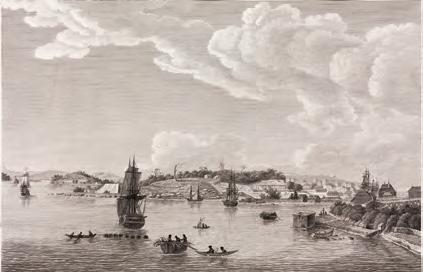
Source 3.12.1 Illustration of Port Jackson and Sydney, 1801–03, from the book Voyage de decouvertes aux terres Australes, execute par ordre de S M l’empereur et roi, published in 1815
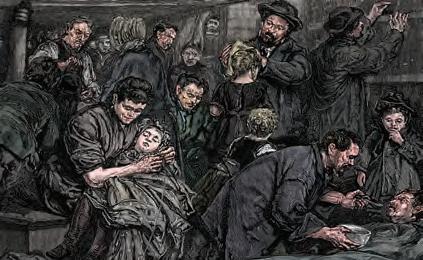
Source 3.12.2 Steerage passengers on an Atlantic steamer bound for America, c. 1850
Great Famine a period of mass starvation and disease in Ireland from 1845 to 1849
From the 1820s, settlers began to arrive in larger numbers, establishing themselves not only in the Sydney area, but also in Van Diemen’s Land (Tasmania), Perth, Melbourne and Adelaide. Free settlers from other countries migrated as well, such as the Germans who migrated to Camden in New South Wales. The gold rush of the 1850s triggered mass migration to Australia. In Ireland, the Great Famine led to approximately 25 per cent of the population either dying or migrating, a large number of whom came to Australia.
UNCORRECTEDSAMPLEPAGES
The Irish Famine and Irish migration to Australia
The country with the greatest proportion of its population emigrating during the nineteenth century was Ireland, largely due to the Great Famine. Potatoes were a staple food in Ireland but, in 1845, blight, a disease of the potato plant, wiped out half of the entire country’s crop and continued to cause crops to fail over the following three years. Many Irish farmers could not produce enough food to eat, let alone to sell to market. This increased the prices of other crops because those with money could afford to buy the food they needed at higher prices. The famine caused seven years of starvation and poverty across Ireland. Under these conditions, many Irish citizens sought to find a better life and around 2.1 million people emigrated between 1846 and 1855. The wealthy could afford to pay for their ticket and food, and they made the trip from Ireland with a greater level of comfort. Poorer travellers suffered more on their voyage.
The ships travelling from Ireland to the United States or Canada became known as “coffin ships” because of the death rate – calculated at 30 per cent of those on board. In many cases, people had been sent off by landlords who found it cheaper to pay for their tenants’ passage rather than maintain unemployed labourers. In contrast, incidents of immigrants suffering while migrating to Australia were relatively low because passengers paid their way or obtained a government support scheme, which provided them with better food and living spaces. Paying passengers were overseen by a superintendent and a surgeon who was tasked with ensuring the health of the passengers.
The Earl Grey scheme was one example of an early migration system from Ireland to Australia. Between 1849 and 1851, 4000 orphan girls travelled from the overcrowded workhouses of Ireland to Australia. The colony desired female migrants, and the Great Famine provided an easy justification to transport teenage women. They did escape the horrors of famine and the devastating conditions of the workhouses, but they were also sent to an uncertain future to work as servants, maids or other domestic helpers. The girls also arrived in Melbourne just as anti-Irish and anti-Catholic sentiment was beginning to spread.
Source 3.12.3 An article in Melbourne newspaper, The Argus, discussed the arrival of Irish immigrants.
Another ship-load of female immigrants from Ireland has reached our shores, and yet, though everybody is crying out against the monstrous infliction, and the palpable waste of the immigration fund, furnished by the colonists in bringing out these worthless characters
The Argus, 4 April 1850
These teenagers endured challenging lives. Some raised families, happy with their newfound wealth and prosperity. Others struggled to adapt to their new surroundings and knew nothing but hardship. It did not help that the Irish people were discriminated against for employment opportunities.
Around 300 000 Irish people had migrated to Australia by 1914, making up one-fifth of the population, including the descendants of Irish immigrants. They worked a variety of jobs, such as servants, whalers, fishermen, factory workers and farmers. Census data from the middle of the nineteenth century revealed the Irish to be more likely to live in large rural communities like Boorowa in New South Wales. Continued migration from Ireland ensured that the Catholic Church in Australia grew, often leading to conflict with English Protestantism. This did not fade until the late twentieth century.
Chinese immigration during the gold rush
The discovery of gold in Australia in 1851 saw a rapid rise in the migration of people from many backgrounds, including Chinese-speaking people seeking their fortune. In 1856, 13 396 Chinese people migrated to Australia and many worked in the goldfields. While this may seem like a small number, Chinese-speaking people (including both those who had migrated from China and those who were born in Australia to Chinese migrant parents) formed around 3 per cent of the population at this time.
A large proportion of the Chinese people who migrated during the gold rush were poor. Like the earlier free settlers, they were searching for the chance to make their fortune as they struggled with conditions in their home country. They often hired themselves out as contract labourers after arriving in Australia. By 1861, over 30 000 Chinese people worked across the goldfields of Victoria and New South Wales and the discovery of gold in Queensland in the 1870s saw them also settle in the north.
Unlike Irish and British migrants, Chinese migrants were from a significantly different culture. A lack of cultural understanding led to racism and poor treatment, including by the colonial governments in Australia. In 1855, Victoria placed limits on Chinese migration by restricting the number of Chinese passengers arriving by ship.
UNCORRECTEDSAMPLEPAGES
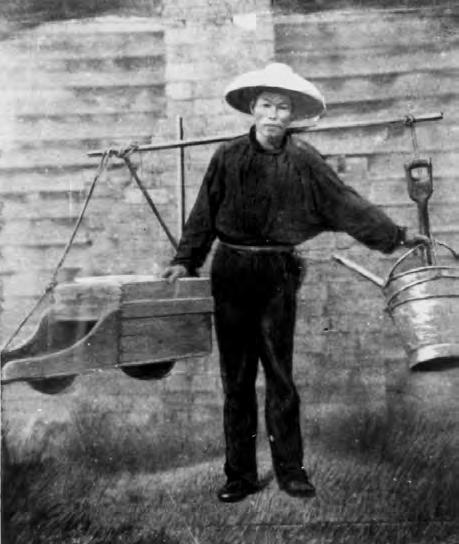
Any migrants were forced to have a Victorian licence, which they paid for every two months. South Australia introduced similar policies in 1857 and New South Wales in 1861. Even without discriminatory government policies, Chinese migrants endured a hard life in the colony. The racist beliefs of many white people living in Australia meant that they considered the Chinese people to be foreign, different and worshippers of dangerous gods or idols. This exposed Chinese miners to discrimination and violence. These beliefs ultimately led to the newly established Australian Government passing the Immigration Restriction Act 1901, which targeted Chinese migration.
Teachers can go online to assign questions, view results, reports and more!
Knowledge and understanding
Why were settlers desired in Australia?
Discuss in a paragraph why Irish people migrated to Australia.
Describe the Earl Grey scheme.
Create a list of five questions you would ask a Chinese migrant about their experiences when travelling and living in Australia during this period.
Assess how important a free settler’s country of origin was to how they were treated.
Thinking and researching
Complete one of the following.
Compare the migration experiences of three groups to Australia: early free settlers (1793), Irish Great Famine migrants (1840s–50s) and Chinese gold rush migrants (1850s–70s). Create a comparison chart examining their reasons for migrating, journey conditions and challenges faced upon arrival. Analyse government policies towards different migrant groups in colonial Australia. Write a report examining how free settlers, Irish orphan girls and Chinese migrants were treated differently by authorities, and explain what this reveals about the colonial society’s values.
UNCORRECTEDSAMPLEPAGES
3.12.4 Chinese gold miner in Australia, c. 1860s
3.13 Site study: Belgenny Farm
Learning intention
In this lesson, you will learn about the origin and development of Belgenny Farm and the impacts of settlement on First Nations Peoples.
Starter activity
Success criteria
❏ I can summarise the development and success of Belgenny Farm.
❏ I can outline its agricultural significance and impacts on First Nations Peoples.
Look at Source 3.13.4 showing a blacksmith’s forge and bellows. What kind of tools do you think could be made here?
Agriculture was one of the key sectors of Australia’s growth. John and Elizabeth Macarthur were an example of settlers who were able to construct a farm on 2024 hectares of the Cowpastures in 1805. Macarthur was previously an army officer who had returned to England after shooting his commanding officer in a duel. However, the papers required for Macarthur’s trial did not make it to England, so he was able to return to Australia with a plan to export wool from Camden, the property that he established in the Cowpastures. This land was traditionally owned by the Dharawal, Gundungarra and Dharuk Peoples.
Despite the fertile land, the initial conditions for the Macarthurs were difficult, with the family occupying a house at Belgenny Farm known as the “small miserable hut”. However, the farm soon became very successful through breeding, raising and shearing sheep, and, most importantly, exporting wool. The estate grew to 11 206 hectares, and by the 1830s it included a stable, blacksmith, vineyards, orchards, creamery and the beautifully constructed Camden Park House.
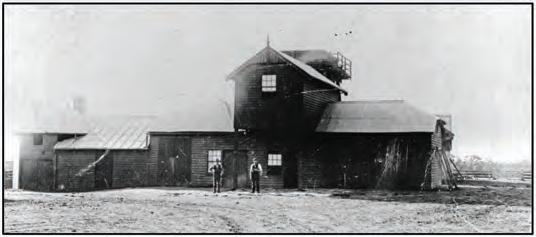
Source 3.13.1 Photo from the early 1900s of the original creamery on Belgenny ➜
UNCORRECTEDSAMPLEPAGES
Belgenny Farm demonstrated the potential for successful agriculture by free settlers across Australia. If managed properly, commercial farms provided settlers and emancipated convicts the chance to start a new life where they could create great wealth.
Source 3.13.2 Video: History of Belgenny Farm
Of course, this came at the expense of First Nations Peoples. Records of interactions between First Nations Peoples and the Macarthur farm are limited. More broadly, we know that First Nations People experienced widespread violence and dispossession from their traditional lands as a result of European settlement.
Macarthur was forced to remain in England for eight years after he went there in 1809. During this time, his wife and children ran the farm and continued the construction and expansion of buildings. When Macarthur returned to Belgenny in 1817, the farm underwent further upgrade and expansion. He died on the Belgenny estate in 1834, while Elizabeth Macarthur lived until 1850. The family owned the farm for over 100 years.
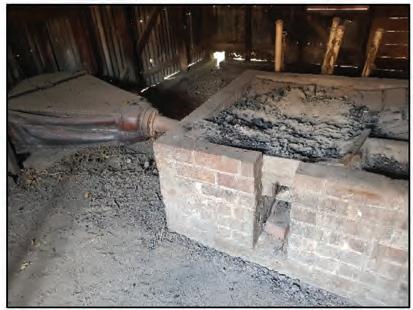
3.13.4 The blacksmith’s forge and bellows
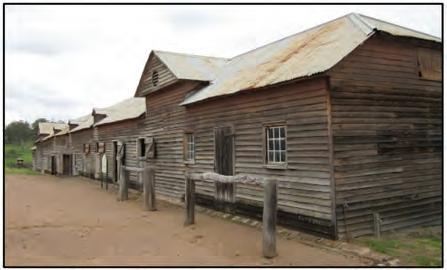
Source 3.13.3 The Belgenny Farm stables as they look today ➜
3.13.5 The interior of the mill. It was renovated to become two bedrooms.
UNCORRECTEDSAMPLEPAGES
Research Elizabeth and John Macarthur and summarise the key information about their lives.
Using Google Maps, identify the location of the land awarded to the Macarthurs.
Identify the main source of income for the Macarthurs.
Do you believe agriculture was an important industry to the free settlers?
Discuss your answers in pairs before recording them.
Conduct research and describe how agricultural practices evolved at Belgenny Farm.
Select one of the heritage site photographs. Explain what this photograph reveals about the lives of early settlers.
Did the Macarthurs live a typical migrant experience in Australia? Justify your response.
concepts: Perspectives, Empathy Historical skills: Research, Explanation and communication
3.14 Blackbirding of Pacific Islander peoples
Learning intention
In this lesson, you will learn about blackbirding and debates over whether blackbirding was a form of slavery.
Starter activity
Success criteria
❏ I can explain blackbirding.
❏ I can summarise its impacts and links to racism and slavery.
What do you think the life of a Pacific Islander person should be? What difficulties or threats do you think they may face?
The rising need for cheap labour was a contributing, significant factor in the onset of slavery in the United States. Likewise, cheap labour was a driving force behind the blackbirding of South Pacific Islanders. In 1847, Benjamin Boyd, a colonial businessman from Scotland, transported 65 indentured men from New Caledonia and Vanuatu to Eden on the south coast of New South Wales in what was the first blackbirding operation.
From 1847 to 191, over 62 000 men, women and children were dubiously “transported” from their homes to Australia, New Zealand and even as far as Mexico, Guatemala or Peru. Blackbirders often used a combination of false promises, deception, threats and force to get Islanders to agree to leave their homes. They would lure people with promises of well-paid work or better living conditions, exploiting the Islanders’ limited understanding of the wider world or other cultures. Islanders did not always understand the nature of the labour they would endure, the time they were agreeing to serve or the distance they would be taken from their islands. If these methods of trickery did not work, blackbirders might resort to threats of violence.
Source 3.14.1 A description of men being taken from the island of Tanna, in southern Vanuatu ➜
On my asking him, “Have you ever seen violence used by any trader to the Tanna people?” he replied, “Yes, I saw Ross Lewin forcibly take two men by the hair of their heads and drag them on board his vessel (the “Spunkie”), and then point a musket at them to keep them quiet. Lewis also stole away a girl, and afterwards sold her for 2 pounds to a Maré man in Australia.
Extract from Thomas Richards, Votes and Proceedings of the Legislate Assembly (1871–1872), p. 351
Writing focus 3.14
Question words
blackbirding the coercion, deception or kidnapping of the South Pacific Island peoples to perform manual labour indentured refers to individuals who were bound by a labour contract, for a set number of years, often under coercion or exploitation
Conditions on ships was brutal for those transported to Australia, with Islanders enduring cramped conditions that were often overcrowded and unsanitary. The ocean voyages were long, and with poor ventilation, limited food and no medical care, disease quickly spread to the workers and potentially resulted in death. It did not help that workers were malnourished and exhausted.
The workers were typically told they would be able to return home after a set period, but many were kept for years, unable to escape their indentured servitude. The brutal conditions from the ships continued upon their arrival to Australia: workers were often subjected long hours of work in the sun, where they performed physically taxing activities such as harvesting sugarcane, cotton or other crops. Workers were housed in basic shelters, with poor sanitation and privacy, and only minimal rations provided. Many faced physical abuse or harsh punishment for disobedience or attempts to escape, and their contracts were often manipulated to keep them working far longer than originally promised, with little hope of returning home. In 1884, the Queensland Government calculated the mortality rate for Islander people to be around 147 deaths per 1000 people. Other calculations have estimated a 30 per cent death rate for those transported as a result of blackbirding.
UNCORRECTEDSAMPLEPAGES
Source 3.14.2 Plantation house for South Sea Island workers, Mackay, c. 1918
Source 3.14.3 Group of South Sea Islanders planting sugarcane at Seaforth ➜
Islanders also received little sympathy among parts of the population due to racist attitudes that existed towards them.
Source 3.14.4 Extract from an 1847 newspaper article, showing the racist attitudes towards Pacific Islander peoples. ➜
These fiendish looking cannibals have become a complete nuisance in the city. They enter without ceremony at every open door, and demand food, clothing, and money in a tone and manner at once impudent and threatening. Surely some means of subsistence and place of shelter ought to be furnished these unfortunate wretches by their importers, or is it the intention of these gentlemen that Government shall be at the expense of re-shipping them for the Islands? Why do not the police interfere to prevent their intrusion into the residences of the citizens? … Or is it because the object for which they were seduced from their native wilds has failed, that they are now mercilessly left to their fate by their selfcreated masters, and that the citizens are subjected to insult and outrage from a mob of starving, and consequently, desperate intruders?
“The Feejee Savages”, in Bell’s Life in Sydney and Sporting Reviewer, 20 November 1847, p. 1
Both the Australian and British Governments did make some attempt to regulate blackbirding, although with limited success. The Polynesian Labourers Act 1868, passed by the Queensland Government in an attempt to regulate blackbirding, was difficult to enforce beyond Queensland’s borders. The regulations were easily worked around, and many notorious blackbirders were able to retain their licences despite acts of brutality and failure to provide for Islanders on their ships.
In 1901, the “White Australia Policy” slowed the practice of blackbirding, before it came to an end in 1906 with the mass deportation of Islanders. With the White Australia Policy’s restriction of migration of non-Europeans, 10 000 Pacific Islanders were to be deported from Australia, with only 700 eligible for an exemption. The workers attempted to challenge the legislation, even going to the extent of petitioning King Edward VII to intervene.
UNCORRECTEDSAMPLEPAGES
White Australia Policy a set of laws aimed at restricting non-European immigration from 1901 to the 1970s
Around 2500 were successful, after the categories for exemptions were broadened. These deportations were funded from the remaining unpaid wages of dead workers held by the Queensland Government, which is calculated at roughly $38 million today.
Was blackbirding slavery? This is a question that provokes debate, as the nature of those contracted varied from person to person. Islanders were paid at around six pounds ($12 in today’s currency) each year – a comparably low wage – and they were provided with some basic needs, such as food and shelter. Some of the men also signed contracts voluntarily, which made them indentured servants as opposed to enslaved people. These elements loosely make the practice of blackbirding legal, and it was regulated by the government.
However, there is no doubt that the validity of the contracts is questionable due to trickery, coercion or threats of violence. By modern standards, that would void, or cancel, the contract. Also, some Islanders did not have contracts at all, and were simply kidnapped and forced into work. Added to this, many workers were kept in slave-like conditions with limited rights, freedoms or protections. While slavery had been abolished in British colonies in 1864, the treatment of the native peoples of the Pacific Islands raises serious questions about whether blackbirding was simply slavery in a different form.
Blackbirding has a dark place in Australia’s past that many believe has not been adequately resolved. Numerous locations around Australia – Boydtown south of Eden, and Mackay and Townsville in Queensland, are named after people associated with blackbirding. The Pacific Islanders brought to Australia, who became known by the term “Kanakas” – now considered insulting or offensive – still process the trauma of loss, separation and cultural displacement resulting from this practice.
Complete one of the following.
Create a detailed timeline of blackbirding (1847–1906) showing key events, government responses and how the practice evolved. Include Benjamin Boyd’s first operation, the Polynesian Labourers Act and the White Australia Policy’s impact on deportations.
UNCORRECTEDSAMPLEPAGES
Write an argumentative essay examining whether blackbirding constituted slavery. Use evidence from the textbook about recruitment methods, working conditions, contracts, mortality rates and workers’ rights to support your position.
3.15 Impact of European arrivals on First Nations Peoples
Learning intention
In this lesson, you will learn about the impacts of European arrival on First Nations Peoples, including disease, violence, land loss, cultural disruption and ongoing consequences.
Starter activity
Success criteria
❏ I can explain the impacts of European settlement on First Nations Peoples.
❏ I can identify ongoing effects and historical injustices.
Look at Source 3.15.1 and identify the areas where conflicts happened. Why do you think conflicts broke out in these areas?
1880s – 1920s: Kimberley area
1880s – 1930s: Outback areas in most states
Broome (1883)
WESTERN AUSTRALIA
Perth (1829)
1829 – 1845:
South West Western Australia
1830s – 1840s: South Australia
Darwin (1869)
NORTHERN TERRITORY
Alice Springs (1872)
SOUTH AUSTRALIA
1870s – 1890s: North Queensland
Cairns (1876)
Townsville (1864)
Cloncurry (1867)
QUEENSLAND
Adelaide (1836)
Melbourne (1835)
NEW SOUTH WALES
VICTORIA
1850s –1860s: Central Queensland
Rockhampton (1858)
1820s - 1860s: Brisbane (1825) and surrounding area
1820s – 1840s: Inland New South Wales
1788 – 1818: Sydney (1788) and Hawkesbury areas
1830s – 1840s: South Eastern mainland Australia
UNCORRECTEDSAMPLEPAGES
*Dates in brackets refer to the date the city/town was founded.
Hobart (1804)
TASMANIA
1804 – 1820s: Tasmania
Source 3.15.1 Map of violent conflict between Aboriginal and Torres Strait Islander Peoples and settlers, where six or more people died
Writing focus 3.15
Transitional phrases
As the penal colony in Australia expanded, more contact with Aboriginal and Torres Strait Islander Peoples took place. In the early years of the settlement, this was limited to small, sometimes violent confrontations occurring far from the settlement. But the effect of the convicts’ arrival also included the transfer of dangerous diseases.
In 1789, the deadly smallpox virus spread across Aboriginal communities in the Sydney area and surrounds. The introduction of European diseases soon became one of the most significant effects of the arrival of the First Fleet in Australia. Governor Phillip estimated that 50 per cent of the Aboriginal population around Sydney died following European arrival. This estimate is based on his personal knowledge, while modern historical research places this figure at 70 per cent of the population.
aquatint a type of etching that gives a watercolour effect rather than lines
In the early days of the colony, no laws existed to regulate the relationship between the new European arrivals and First Nations Peoples. Many issues resulted from convicts or settlers coming onto traditional lands, which sometimes led to violence. Governor Phillip himself was speared by an Aboriginal man after his actions were misunderstood to be threatening. Violence against Aboriginal and Torres Strait Islander Peoples by settlers became common as the colony grew and expanded further inland. This included kidnapping, poisoning and mass murders. The Myall Creek massacre on 10 June 1838 is an example of this violence, when a group of emancipated convicts tied up and slaughtered the Wirrayaraay People. Seven men were arrested, tried (twice) and hung for the murders at Myall Creek. A guilty verdict was unusual in these sorts of trials and triggered public outrage at the treatment of the white people. As a result, most violence against First Nations Peoples was ignored or went unpunished.
Source 3.15.2 Extract of an aquatint depicting the British settlement in Sydney, 1801–03. In the foreground, First Nations People can be seen making fire.
Source analysis
Describe the information displayed in Source 3.15.3.
What three conclusions can you draw from Source 3.15.3?
In pairs, discuss how helpful visual representations of data are for a historian. Record your answer in your workbook.
Summarise the challenges for positive relations between First Nations Peoples and white people.
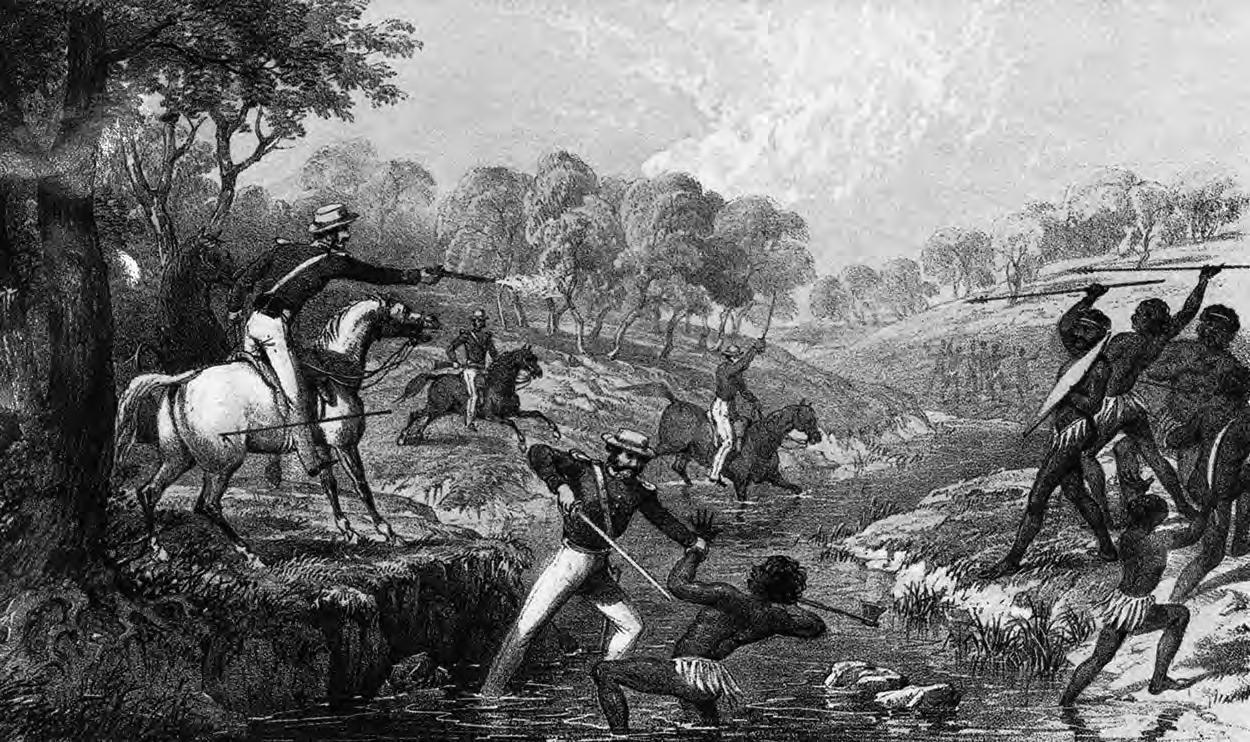
UNCORRECTEDSAMPLEPAGES
Following the European arrival, First Nations Peoples lost their territories and were subjected to British rule, despite inhabiting the land for tens of thousands of years. This was often undertaken violently and with no compensation. Aboriginal and Torres Strait Islander Peoples are spiritually linked to their ancestral lands, so these actions had a devastating impact on their cultures. Some adapted, taking agricultural or skilled jobs, and some women were employed on large stations and as domestic servants. Integration such as this was part of government policies to “civilise” First Nations Peoples.
The past still affects the lives of First Nations Peoples. The struggle for recognition and equality, ongoing racism and the Stolen Generations of First Nations children are challenging issues to this day, as is the nature of European colonisation, legal cases over land rights and protests of events such as Australia Day.
Stolen Generations the Aboriginal and Torres Strait Islander children forcibly removed from their families during the twentieth century to be brought up by white foster families or in institutions
Source 3.15.3 Mounted police attacking Aboriginal people during the Slaughterhouse Creek Massacre of 1838 ➜
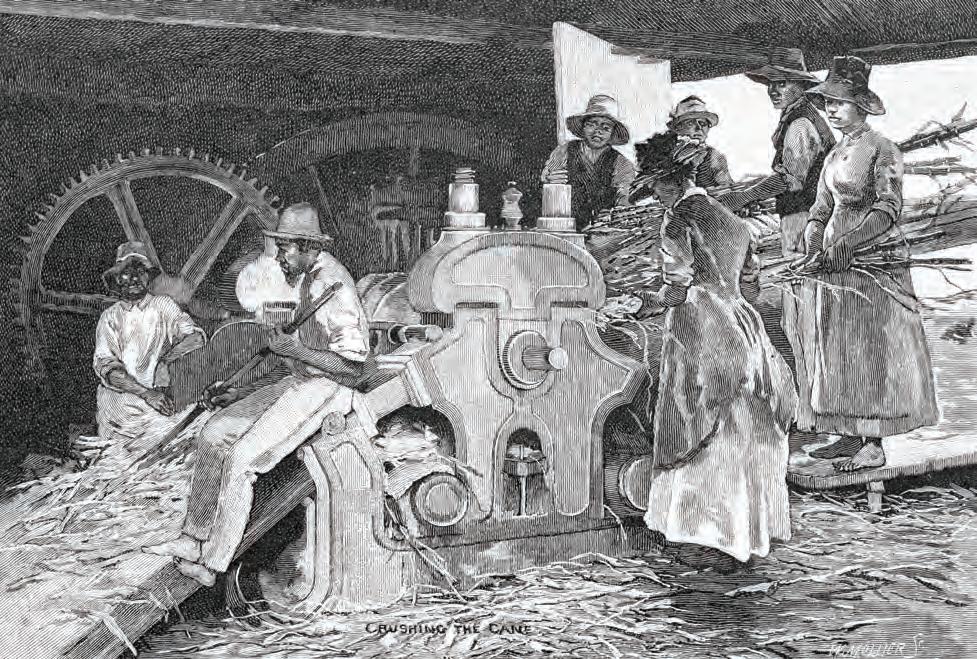
3.15.4 Illustration of Aboriginal people working on a sugar plantation, 1886
Knowledge and understanding
Teachers can go online to assign questions, view results, reports and more!
How many of the Aboriginal Peoples around Sydney did Governor Phillip estimate to have died?
Identify the disease that was the major cause of death.
Explain how maps are a useful tool for historians to display data (e.g. Source 3.15.2).
Assess the effect of mass migrations on the First Nations Peoples of Australia.
Thinking and researching
Complete one of the following.
Create an infographic showing the multiple impacts of European arrival on First Nations Peoples from 1788–1838. Include disease mortality rates, land loss, violence (including the Myall Creek massacre), and the breakdown of traditional cultures and spiritual connections to ancestral lands.
UNCORRECTEDSAMPLEPAGES
Research and present a report analysing why the Myall Creek massacre trial outcome was unusual and what it reveals about colonial attitudes towards violence against First Nations Peoples.
Explain the public response and its consequences.
Historical concepts: Cause and consequence, Significance Historical skills: Explanation and communication
3.16 Legacies of the movement of peoples on Australia
Learning intention
In this lesson, you will learn about how migration experiences shaped Australia’s culture, identity, economy, politics and ongoing historical legacies.
Starter activity
Think, pair, share
Success criteria
❏ I can explain how movement of peoples shaped Australian identit y.
❏ I can outline positive and harmful legacies, including impacts on First Nations Peoples.
Think: Think about the plants in your neighbourhood. How do you think they were affected by migration?
Pair: Discuss your thoughts with a partner. Does this discussion change or expand your ideas? Share: Share your ideas with the larger group. Does this change your thinking? What do you need to do to confirm your ideas?
In the early twenty-first century, an ancestry tracking website estimated that 22 per cent of Australians are the descendants of convicts. Some Australians take pride in the fact that Australia was formed from convict settlements. Some also believe that Australia’s convict heritage contributed to the development of a unique cultural identity. This includes the way Australians speak and the slang they use, as well as an attitude critical of authority, and a particular style of humour. The bushranger Ned Kelly is often used as an example by those who want to promote the belief that challenging authority is part of Australian culture. Others would claim that the peculiar humour, or ‘larrikinism’, and undisciplined behaviour of Australian troops in World War I was influenced by the nation’s convict roots. These are selectively positive traits, while the elements of violence, brutality, racism and aggressive behaviour by convicts and early settlers are frequently overlooked in the creation of Australian’s national identity.
Convicts were used to build the early settlement and played a key role in the construction of vital infrastructure across the nation. Once emancipated, many convicts contributed to the establishment of businesses or developed farms to produce goods for the colony. Scientific and industrial knowledge obtained in Europe assisted in the transition of Australia from a simple prison colony to an industrialised nation with the ability to trade its products and grow wealth.
UNCORRECTEDSAMPLEPAGES
Free settlers made Australia a diverse country in the eighteenth and nineteenth centuries. Australia was heavily influenced by British and Irish cultures – their traditions, style of government, legal system and religion.
Writing focus 3.16
Transitional phrases
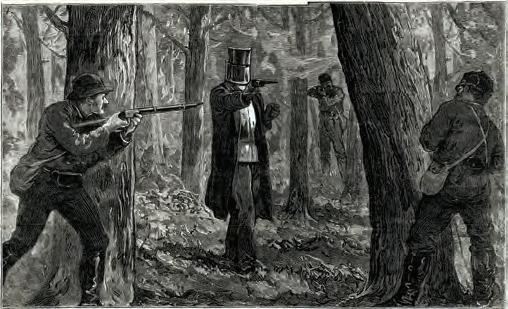
Source 3.16.1 The bushranger Ned Kelly is often used as an example by those who want to promote the belief that challenging authority is part of Australian culture.
Despite Australia being a country where free settlers lived, they often referred to Britain as “home”. It was this attitude that contributed to many men signing up to fight in World War I for the British Empire, even those who were descended from convicts as well as free settlers.
Convict resistance in Australia played a crucial role in shaping the nation’s labour and civil rights movements, promoting a culture defiance, collective action and the fight for fair treatment. Many convicts were transported for political dissent or rebellion, and continued to resist harsh colonial conditions through strikes, mutinies and escapes. This spirit carried through as former convicts and their descendants campaigned for workers’ rights, fair wages and better conditions, leading to key milestones such as the eight-hour workday and union-led strikes. The convict “identity”, or the myth of it across history, contributed to civil rights efforts, and building a national identity based on challenging injustice and advocating for equality.
But, when considering the making of Australian society and cultural identity, it is important to understand the harm done to First Nations Peoples. The sickness, deaths, loss of cultural identity and detachment from their land and beliefs is a legacy still felt deeply in many communities.
3.16
Knowledge and understanding
Identify three ways in which convicts contributed to the Australian legacy.
How did free settlers benefit Australia?
Explain why Australians fought in World War I for the British Empire.
Teachers can go online to assign questions, view results, reports and more!
“Multiculturalism has made Australia a better place to live.” How accurate is this statement? Justify your response.
Thinking and researching
Complete one of the following.
UNCORRECTEDSAMPLEPAGES
Analyse how Australia’s convict heritage influenced the development of a national identity. Create a two-column chart showing the “selectively positive traits” promoted in Australian culture versus the “frequently overlooked” negative elements.
Write a reflective essay examining the multiple legacies of migration to Australia. Compare the contributions of convicts and free settlers with the devastating impact on First Nations Peoples.
3.17
Chapter review and historical inquiry
Access the Interactive Textbook for a range of digital tools to help you review this chapter and build confidence.
• Auto-marked questions for fast feedback and fun practice
• Self-assessment tools to track your progress, review answers (if enabled by the teacher), and flag questions for extra help
• Downloadable worksheets for class or homework revision
Summary
Summary notes
What have you learned about the movement of peoples? Copy the table and fill out by explaining your understanding. Aim for two points per topic.
Topic
Agricultural practices and land ownership in Britain and Australia
The Industrial Revolution’s impact on migration and urbanization
Different views on transportation and settlement
Understanding the experience of enslaved people
The abolition movement’s impact on human rights
Blackbirding: slavery or indentured labour?
Visible thinking routine
Tug of war
What I have learned
As a class or in small groups, consider the following statement: “Through the actions of industrialised countries, a ‘better world’ was created.”
Create a table of evidence for and against this claim. When your teacher has drawn a line on the board, writing FOR and AGAINST at opposite ends, place your ideas where you think they best fit.
UNCORRECTEDSAMPLEPAGES
After the discussion, write your personal response to the claim using some of the evidence gathered in the previous activities. Conclude whether or not you believe that a better world was created.
Questions and activities
Scorcher quiz
Access a fast, fun, competitive quiz that puts your understanding to the test.
UNCORRECTEDSAMPLEPAGES
Quick questions
The development of a steam engine by Thomas Newcomen allowed coal mines to be drained efficiently, which increased coal __________.
Estimates by historians suggest around __________ per cent of all enslaved people died in these forts due to poor conditions.
Gabriel and __________ other enslaved people were publicly hanged after their planned rebellion was betrayed to authorities.
From 1810 to 1860, the population of enslaved people in the United States grew from over one million to __________ million.
The treadmill was first introduced to Sydney in __________.
Define what the “Slave Triangle” was and identify the goods traded between the three regions.
Outline the typical daily routine of an enslaved person working in the fields.
Summarise William Wilberforce’s contributions to the abolition movement in England. Define blackbirding and identify the methods blackbirders used to get Islanders to agree to leave their homes.
Outline the impacts of European diseases on First Nations Peoples following the arrival of the First Fleet.
Group work activity
In a group, brainstorm key words to describe the experiences of enslaved people, convicts and free settlers. Use A3 paper, or an appropriate digital application, to create an infographic representing these words and their meaning. The infographic should include text, images, statistics and other features to help your audience understand some of the important experiences identified.
Research activity
Research the enslaved person Olaudah Equiano.
• Create a timeline of 10 to 15 important events in his life.
• Why did his experiences become important for enslaved people across America?
• How is he remembered today?
• Create a properly formatted bibliography of the sources used in your research.
• Present your findings to the class as a written report, website or poster.
Creative task
Choose one historical figure you have studied in this unit and write a series of three diary entries from their perspective. Each entry should reflect a different stage of their migration experience:
• Before leaving – describe their life in their homeland and the reasons behind their decision to migrate.
• The journey – detail their experiences during the migration journey, including challenges they faced.
• New life – reflect on their arrival in their new country, the difficulties of adjusting and how their life changed.
Writing focus
The following activities offer ways to demonstrate your understanding of the chapter and allow you to continue to practice your writing skills.
Answering questions in paragraphs
This sample response to a question is structured using:
• a topic sentence
• the four Es (explain, elaborate, evidence and examples)
• a linking sentence.
You can use this as a model when writing your own answers to the following questions.
Question: Explain how the Industrial Revolution contributed to modern mass migrations.
Model answer:
Topic sentence: the first sentence of the paragraph; directly answers the question
Elaborate: additional information, connections, historical significance, change and continuity, cause and consequence
UNCORRECTEDSAMPLEPAGES
Examples: provide credibility and illustrate the argument
The Industrial Revolution contributed to modern mass migrations by transforming work, living conditions and global movement patterns. New machines reduced rural jobs while factories created urban employment, pushing people out of the countryside and pulling them into towns and overseas. This shift caused overcrowding, poverty and rising demand for labour elsewhere, which encouraged large-scale migration both within Britain and abroad. London’s population grew by more than two million between 1750 and 1900 as rural workers were displaced by agricultural change. Improved steamships and railways also made long-distance travel easier, helping groups such as Irish famine migrants and Chinese gold-seekers move to places like Australia. Overall, the Industrial Revolution set the economic and technological conditiosn that shaped modern global migration.
Explain: clarify, define and describe
Evidence: specific, relevant evidence to support your arguments
Linking sentence: reconnects to the topic sentence using the language of the question
Extended-response questions
Account for the mass migrations of the modern world.
Explain how the Industrial Revolution contributed to modern mass migrations.
Explain the causes and the consequences of the establishment of slavery in America. Compare and contrast the experiences of two groups covered in this chapter that migrated to Australia.
Assess the importance of migration to Australia in the eighteenth and nineteenth centuries.
Historical inquiry
Investigating significance
In this historical investigation into the significance of the movement of peoples, you will undertake the following steps:
Part 1: Develop historical questions
• Step 1: Select an aspect of the movement of peoples that interests you. Examples include:
● the abolition of the slave trade
● the Transatlantic Slave Trade
● the lives of enslaved peoples
● the Underground Railroad
● the abolition of slavery in one country of your choice
● the lives of convicts in Australia.
• Step 2: Brainstorm what you already know
• Step 3: Develop a historical inquiry question. Examples include:
● Assess the significance of the abolition of the Slave Trade for Britain.
● How did the Transatlantic Slave Trade work in practice.
● Explain what primary source accounts tell us about the lives of enslaved peoples.
● Assess the significance of the Underground Railroad.
● Explain how was slavery abolished in one country of your choice.
● Explain what primary source accounts tell us about the lives of convicts in Australia.
• Step 4: Explain why the question is important
Part 2: Locate and analyse evidence
Part 3: Communicate historical findings
Part 4: Reflect
UNCORRECTEDSAMPLEPAGES
Teachers, access the Online Teaching Suite for digital resources and tools that support review, assessment and reporting, including:
• student and class activity reports
• a test generator to create custom assessments
• built-in feedback tools
• editable downloadable support material
• a downloadable and printable “Writing focus” workbook for this chapter.
Chapter 4
Key questions
Imperialism in Asia (1750–1918)
• What was the political and economic landscape of Asia in the period before European imperialism?
• How did early European trade and exploration shape relationships with China, Japan and Indonesia?
• How did European trading companies like the British and Dutch East India Companies gain and exert imperial control in Asia?
• How did Asian nations respond to imperial expansion and colonisation?
• What role did resistance movements and nationalism play in challenging imperial rule in Asia?
• How did Japanese expansion reshape power dynamics in East Asia?
• What were the key treaties and conflicts that changed the balance of power in Asia during the period?
• How did World War I impact imperialism in Asia and the future of colonial rule in the region?
Lessons
4.1 Setting the scene
4.2 Asian empires and regional powers before 1750
4.3 Portuguese, Dutch and English exploration and trade with China and Japan before 1750
4.4 European trading companies in Asia after 1750: Part 1
4.5 European trading companies in Asia after 1750: Part 2
4.6 Key event: The Indian Rebellion (Sepoy Mutiny), 1857
4.7 Nationalism and resistance movements: China
4.8 Site study: Macau
4.9 The role of Japan in regional power dynamics
4.10 Asia and World War I (1914–1918)
4.11 Chapter review and historical inquiry
UNCORRECTEDSAMPLEPAGES
Chapter 5
Key questions
Key ideas and movements: 1750–1918
• What ideas about rights and fairness emerged in the eighteenth and nineteenth centuries?
• What were the backgrounds and origins of key ideas and movements?
• Who were the significant groups and individuals in the ideas and movements?
• What were the impacts and how do their legacies affect the world today?
Lessons
5.1 Setting the scene
5.2 Political rights: Democracy and universal suffrage
5.3 Political rights: Egalitarianism
5.4 Political rights: Chartism
5.5 Economic fairness: Capitalism
5.6 Economic fairness: Socialism
5.7 Economic fairness: The abolition of slavery
5.8 The Enlightenment
5.9 The Industrial Revolution
5.10 The American War of Independence
5.11 The French Revolution
5.12 The Haitian Revolution
5.13 The American Civil War
5.14 Movements for political rights and economic fairness
5.15 Site study: New Lanark
5.16 The impact of key ideas and movements in Australia: Political rights
5.17 The impact of key ideas and movements in Australia: Economic fairness
5.18 Impacts on Aboriginal and Torres Strait Islander Peoples
5.19 Chapter review and historical inquiry
This digital chapter can be accessed via Cambridge GO
This topic includes historical sources that may contain outdated and offensive terms, images, or descriptions. These have been included for educational purposes and historical context only.
Australia: Making a nation –from Federation to World War I (c. 1889–c. 1919) Chapter 6
Key questions
• What were the key developments that led to Federation in Australia?
• How significant was Australia’s relationship with Britain in shaping its early national identity?
• What are the key features of the Australian Constitution?
• To what extent has the NSW governance structure changed over the period of study?
• How significant was World War I in shaping Australia’s national identity and collective memory?
• To what extent did Federation and World War I improve rights and freedoms for different groups in Australia?
Lessons
6.1 Setting the scene
6.2 Development of democracy in Australia
6.3 Perspectives and developments leading to Federation
6.4 The Australian Constitution
6.5 Protection of workers’ rights
6.6 Advancement of women’s rights
6.7 NSW governance structure
6.8 Reasons for involvement in World War I
6.9 The War Precautions Act 1914
6.10 Australian enlistment in World War I
6.11 Australians at Gallipoli and the development of a national identity
6.12 Australians on the Western Front
6.13 Site study: World War I War Memorial
6.14 Civic and humanitarian response during World War I
6.15 The democratic process during World War I
6.16 The Anzac legend
6.17 The impact of Federation and World War I on different groups in Australia
6.18 Chapter review and historical inquiry
Teachers access the Online Teaching Suite to:
• plan, sequence and assign directed tasks for students and classes using Task Manager
• view student activity reports
• provide feedback to students
• download a printable “Writing focus” workbook for this chapter.
6.1 Setting the scene
Learning intention
In this lesson, you will learn about key events that took place as Australia moved from Federation to World War I.
Success criteria
❏ I can identify key events that took place as Australia moved from Federation to World War I.
❏ I can briefly describe a key event and link it to the Key questions for this unit.
On 24 October 1889 New South Wales politician Sir Henry Parkes delivered the Tenterfield Oration, a speech calling for the six Australian colonies to federate into one nation. It marked a turning point in Australia’s political development and reflected the growing support for Federation. He argued that Australia needed a national government to address shared concerns like defence, trade and immigration. Importantly, this was the first time the public were being asked to support the idea of federation, even though politicians had been discussing it for some time.
The process of Federation created the Commonwealth of Australia in 1901, after more than 100 years of British rule. Despite being one of the most progressive nations in the world in some ways, democracy in Australia at this time was still limited and unequal. Tensions between democratic ideals and the exclusion of certain groups continued long after Federation.
Australia’s experience of World War I was a defining moment in shaping the young nation’s identity. On the Home Front, civic action, democratic processes and the humanitarian response were representative of the emergence of a national identity. Overseas, Australian men and women served all over the world and played an important role in the Allied war effort. As a result of these contributions, the development of the Anzac legend provided Australians with a shared story of national pride as they emerged onto the post-war world stage. 1902
1850
UNCORRECTEDSAMPLEPAGES
1854
Miners rise up against the government in the Eureka Rebellion
The Australian Colonies Government Act was passed in Britain, enabling all the colonies to have similar forms of government to the colony of New South Wales
Australasian Federation Conference
24 October 1889
The Tenterfield Oration. The first direct call to the public for Federation
The Commonwealth of Australia is formed
1902
The Commonwealth Franchise Act 1902 guarantees women the right to vote in federal elections
The Constitution Act 1902 (NSW) establishes the structure of government in NSW
1907
The Harvester Judgment grants a living wage to white, male workers
July–August 1914
European countries mobilise and declare war on each other
25 April 1915
Australian and New Zealand (Anzac) forces land on the Gallipoli Peninsula, but are evacuated in December
July to November 1916
Australian forces take part in the Somme Offensive, particularly the battles of Pozières and Fromelles
28 June 1919
The Treaty of Versailles is signed, formally ending World War I 1919
Australian troops begin to return home
1911
Canberra is founded and named as the capital
25 April 1916
First Anzac Day commemorations held
29 October 1914
The War Precautions Act is passed
28 October 1916 First conscription referendum held in Australia
April to November 1917
Australian forces take part in the Battles of Bullecourt, Messines and Passchendaele
20 December 1917
Second conscription referendum held in Australia
Writing focus 6.1 Question words
31 October 1917
The Light Horse charge at Beersheba, Palestine
April–August 1918
Australian forces re-take VillersBretonneux from German forces, and then take part in the Battles of Hamel and Amiens
11 November 1918
UNCORRECTEDSAMPLEPAGES
Based on the image provided, consider the following questions for discussion.
• What can you see in this image? (I can see …)
• What do you think about this image? (I think …)
• What does this image make you wonder about what it meant to be Australian in 1919? (I wonder …)
The armistice ends the war at 11 a.m.
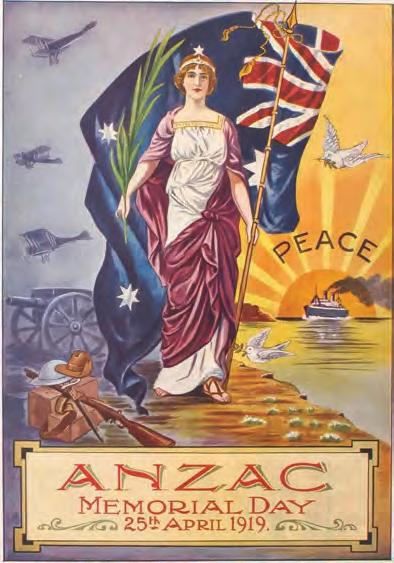
Source 6.1.1 An Anzac Memorial Day souvenir. Victorian Branch of the Returned Sailors’ and Soldiers’ Imperial League of Australia, Melbourne, 25 April 1919
6.2 Development of democracy in Australia
Learning intention
In this lesson, you will learn about how democracy developed in Australia.
Success criteria
❏ I can identify several factors that influenced the development of democracy in Australia.
❏ I can explain how these factors helped democracy develop in Australia.
Think, pair, share
Look at Source 6.2.1.
Think: Why do you think the miners chose to swear allegiance to a new flag, and why did they choose that design?
Pair: Discuss with a partner and see if you have different views.
Share: Share your ideas with the class.
Source 6.2.1 Swearing Allegiance to the Southern Cross, Charles A Doudiet, 1854. This is a painting from the Eureka Rebellion of 1854, when gold miners in Victoria rebelled against the British administration. This painting shows them swearing allegiance to a flag with the Southern Cross on it.
secularism the separation of state institutions from religious organisations
UNCORRECTEDSAMPLEPAGES
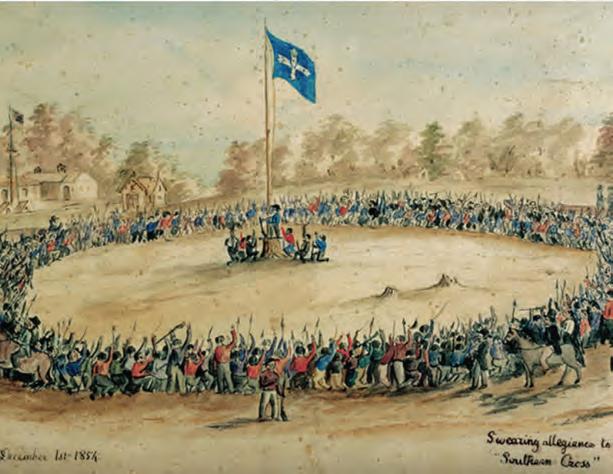
Australia did not suddenly become democratic at Federation in 1901. Influenced by British political traditions, democratic ideas had been developing in the colonies for several decades leading up to Federation in 1901. This process was shaped by various factors that influenced how Australians understood democracy and how they thought power should be shared. Economic and defence issues, immigration, secularism and the development of nationalist and egalitarian ideas all contributed to the development of Australian democracy and the build-up to Federation in 1901.
Popular movements like the gold rushes and the growth of trade unions shaped public debates about Federation and democracy. They encouraged greater political participation and promoted ideals of equality and a “fair go”. As electoral reforms progressed, a range of political parties emerged to represent different stakeholder interests.
These included the Free Trade and Protectionist parties. Issues about trade, labour, tariffs, defence and immigration were central to different parties’ platforms. Calls for a united Australia were challenged by the different parties. Each colony had its own agenda and interests to protect.
From the arrival of the British in 1788, Australia was governed according to British legal and political traditions, including the rule of law, parliamentary government and representative institutions. Unlike other countries, Australian colonies developed as secular societies, keeping religion and government separate. There was no official state religion, and laws were made by elected representatives rather than religious leaders. This reinforced the democratic ideals of equity before the law and freedom of religious belief.
Immigration concerns
Australia offered opportunities to start a new life, especially during the gold rush, and attracted people from all over the world. Other than Europeans, people came from the Middle East, Asia and the Pacific. Immigration was a major political issue in Australia as colonists feared that non-European, more specifically Asian, migration would threaten social unity and undermine living standards.
Source analysis
Please note that the two cartoons in this activity would be recognised today as highly racist.
Victoria – “Girls, there’s but one way to rid ourselves of this unsightly thing, and that’s by all taking hold together. A strong unanimous heave with this lever and the job is done.”
Chorus – “Yes and if John should be the means of bringing us together, we’d have something to thank the Chinese question for after all.”
Source 6.2.2 A cartoon that appeared in Melbourne Punch on 10 May 1888. The cartoon’s accompanying text is written underneath the image. Victoria is depicted as Queen Victoria, wanting to get rid of the “Chinese Pest”. “John” is from “John Chinaman”, a racist term in use at the time.
Identify who each of the girls in Source 6.2.2 represents. Describe how China and the Chinese people are depicted in Source 6.2.2?
free trade trade is not restricted by tariffs, quotas, or other restrictions protectionist a policy of protecting domestic industry from foreign competition by taxing imports tariff a tax or duty paid on imports or exports rule of law a set of laws that people in a society must obey
UNCORRECTEDSAMPLEPAGES
Discuss the perspective of the Federation movement shown in Source 6.2.2.
Identify and explain the message of Source 6.2.3.
Explain the purpose of these cartoons.
Source 6.2.3 A cartoon published in British magazine Punch, June 1888
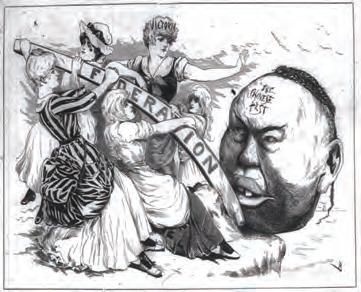
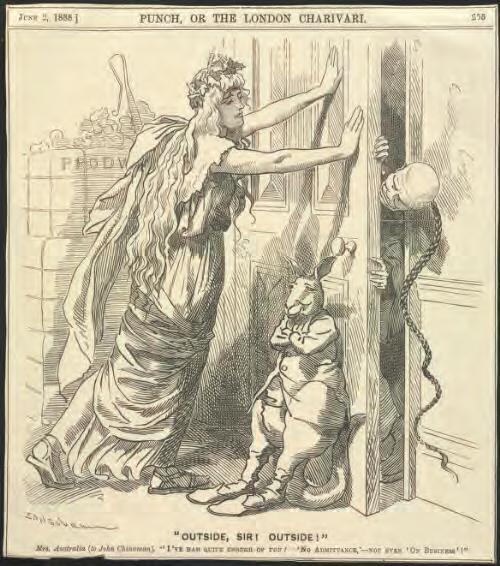
Historical concepts: Perspectives, Significance Historical skills: Analysis and use of sources, Perspectives and interpretations, Communication
Writing focus 6.2
Transitional phrases
Colonial governments in the late 1800s passed laws aimed at restricting Chinese immigration. In Victoria, the Chinese Immigration Act (1855) introduced a £10 tax per person and limited the number of Chinese passengers on a boat to one person for every 10 tons of cargo. New South Wales and Queensland introduced similarly restrictive laws, and in 1898 NSW also introduced a dictation test for all non-European passengers. These restrictions would eventually evolve into broader restrictions under the White Australia Policy and federal legislation like the Immigration Restriction Act in 1901.
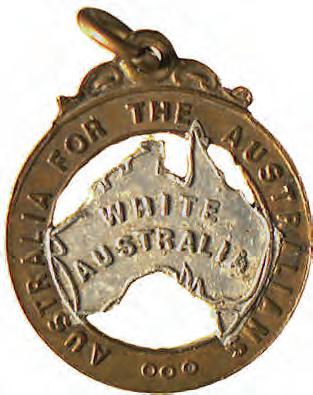
Defence
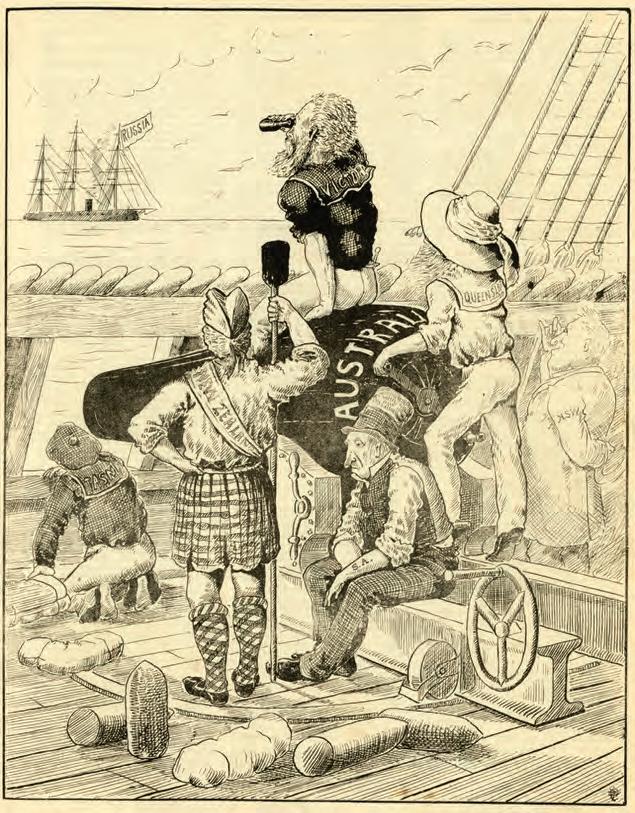
➜
UNCORRECTEDSAMPLEPAGES
Source 6.2.4 A White Australia badge, 1910 ➜
As the colonies grew, there were increasing concerns about defence and security, especially given Australia’s long coastlines and its reliance on the British for military protection. In the late 1880s, several European countries were expanding their territories into Africa and Asia. Colonists in Australia worried about further spread into the Pacific (especially by France) and the potential loss of some Australian territory as a result. These defence concerns encouraged cooperation between the colonies and supported the ideas that Australia should make its own decisions about security through its emerging democratic institutions, independent of the British. These ideas were supported in 1889 by a report to the British Government about defence systems in the colonies, which recommended a united defence force. In his Tenterfield Oration, Sir Henry Parkes also called for a federal army to aid in the colonies’ defence.
Source 6.2.5 Getting it together. “Well mates, you wouldn’t federate when I wanted you to; but if yonder craft comes this way, Federation or no Federation, you’ll have to work together.” A cartoon published in Australia, 1885.
White Australia Policy a racist policy introduced in Australia from 1901, designed to intentionally restrict “non-white” immigration to Australia; finally abolished in the 1970s
Source analysis
Source 6.2.6 Report on the Tenterfield Oration, from The Sydney Morning Herald, 25 October 1889
General Edwards had also advised that the forces of the various colonies should be federated together for operation in unison in the event of war, so as to act as one great federal army. If an attack were made upon any of the colonies, it might be necessary for us to bring all our power to bear on one spot of the coast
The great question which they had to consider was, whether the time had not now arisen for the creation on this Australian continent of an Australian Government and an Australian parliament … to preserve the security and integrity of these colonies that the whole of their forces should be amalgamated into one great federal army … Surely what the Americans have done by war, Australians can bring about in peace.
Identify some of Henry Parkes’ reasons for Federation. Describe the effect on the audience that you think such an address might have had.
Historical concepts: Perspectives, Significance Historical skills: Analysis and use of sources, Perspectives and interpretations
Economic issues
Economic issues also played an important role in shaping early democratic discussion in Australia. Each colony was economically independent and had different priorities, which made it difficult to manage trade. Some also believed these different systems were an obstruction to economic growth. In Victoria there were protective tariffs to shield local industries from imported goods, but in New South Wales there was a free trade policy, with no extra charge placed on imported goods. Moving goods across colonies’ borders was expensive, slow and inefficient as a result.
The Sydney Morning Herald, 25 October 1889
egalitarian the principle that all people are equal and deserve equal rights and opportunities franchise the right to vote
Many historians believe the debate around economic policy was a key reason for Federation. Following an economic depression in the 1890s, people in the eastern states argued that a centralised economy could help protect them from, or lessen the impact of, future economic depressions. Under Federation there could be a single national tariff system, free trade between Australian colonies, greater stability for businesses and workers and a stronger, more unified economy.
Nationalist and egalitarian ideas
UNCORRECTEDSAMPLEPAGES
In the late nineteenth century, nationalist and egalitarian ideas played an important role in encouraging Australians to see themselves as a part of a shared community with common interests. These ideas also encouraged greater public participation in politics and strengthened demands for fair representation, political rights and an accountable government. There was a growth in the belief that a united country could provide a chance for a better society, mixing the best parts of their British heritage with new opportunities for everyone.
The rapid population growth and social change following the gold rushes of the 1850s sparked the belief that people were entitled to a say in how they were governed, and democratic ideas of civil and labour rights started to develop. This was demonstrated during the Eureka Stockade in 1854, when frustrated miners protested against frequent police raids, the licence fee system and lack of political representation. The rebellion was repressed, but it led to reforms in mining licenses and the extension of the franchise for men in Victoria. One stockade leader, Peter Lalor, became a representative in the Victorian Legislative Council.
The growth of trade unions and working-class organisations in the late nineteenth century reinforced these emerging egalitarian ideas. They argued that democracy should protect the interests of ordinary people, not just the wealthy elites.
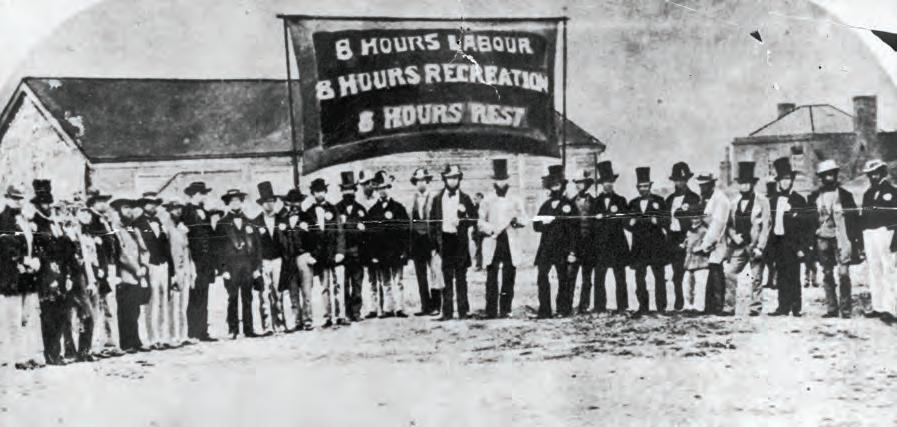
Source 6.2.8 The committee and president of a labour organisation celebrate the third anniversary of the 8-hour day in Australia, 1858. This did not include household labour and was focused primarily on white men.
The Australian Labor Party was founded in the 1890s and gave workers a direct voice to colonial parliaments. It expanded political representation and reflected the growing belief that democracy should deliver social and economic equality. Unfortunately, this equality was yet to include women or Aboriginal and Torres Strait Islander Peoples.
Democracy in New South Wales
In 1855, a system of responsible government was created in New South Wales with a Legislative Assembly and Legislative Council. The Legislative Assembly consisted of elected representatives based on male voters who were 21 years or older. The Legislative Council members were appointed by the governor for a period of five years.
Between 1880 and the early 1900s, a series of electoral reforms occurred in New South Wales allowing for the payment of parliamentarians. The existing system of voting, which gave more votes to those who were educated or owned land, was abolished. The democratic principle of “one man and one vote” was endorsed, and by 1893 most white men had a democratic vote.
Women, in contrast, were denied the right to vote for the Legislative Assembly and the right to be elected. Aboriginal and Torres Strait Islander men and women were also denied the practical exercise of voting, even though in principle they had the right.
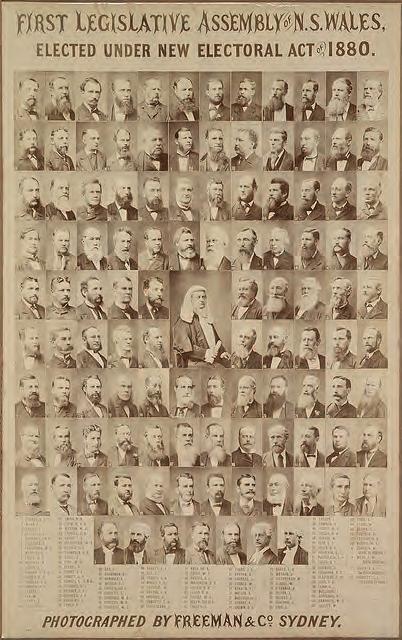
Source 6.2.9 Members of the Legislative Assembly of NSW in 1880 ➜
Knowledge and understanding
Identify at least three factors that influenced the development of democracy in Australia.
Describe how defence concerns led to increased cooperation between the colonies.
Discuss the economic issues that shaped early democratic discussion in Australia.
Teachers can go online to assign questions, view results, reports and more!
Outline the main egalitarian ideas that emerged in Australia in the late nineteenth century.
Explain Australian immigration concerns in the late 1800s and the response of colonial governments to those concerns.
Compare and contrast the democratic rights in the late 1800s of white Australian men, women and Aboriginal and Torres Strait Islander Peoples in NSW.
UNCORRECTEDSAMPLEPAGES
Thinking and researching
Research the Tenterfield Oration (1889).
Create a graphic organiser that demonstrates key information about the speech, the short- and longterm effects and why it is considered to be a significant moment in Australian political history.
skills: Comprehension – terms and concepts, Analysis and use of sources, Perspectives and interpretations, Research, Communication
6.3 Perspectives and developments leading to Federation
Learning intention
In this lesson, you will learn about the developments that led to Federation.
Success criteria
❏ I can outline the views of each colony in the lead up to Federation.
❏ I can list some reasons for and against Federation.
Think, pair, share
Think about who Source 6.3.1 is addressing and who it’s leaving out.
Pair up with the person next to you and share your thoughts.
Discuss as a class.
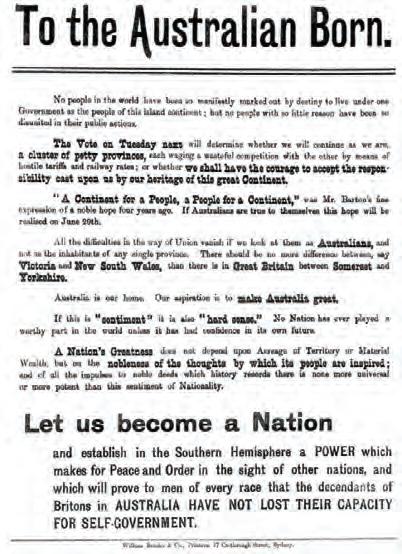
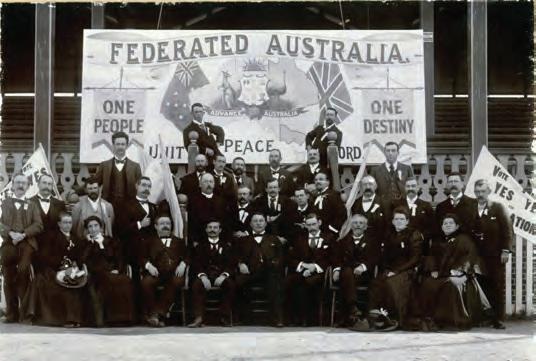
By the 1890s, most colonies had achieved responsible self-government. A series of key political developments in the 1890s shaped the final steps towards Federation. While many Australians now supported the idea of a united nation, there were differing perspectives between the colonies and significant debates over how Federation should work.
Source 6.3.1 Voters of New South Wales Constitution Bill referendum poster, 1899 ➜
Source 6.3.2 Vote “yes” for Federation, Western Australia, 1900 ➜
The defence of Australia and to protect against new territorial expansion into the Pacific European Empires
Women supported Federation as a means towards achieving the vote
The emergence of a shared national identity in literature, art, music and political movements, with works from writers such as Banjo Patterson, Henry Lawson and artist Tom Roberts
Concern over cheap migrant labour and anti-European attitudes that had already led to the restriction of different migrant groups
Reasons for Federation
Improved communication between colonies
Source 6.3.3 Reasons for the Federation of Australian colonies ➜
Loss of colony's individual power and prestige with only one federal parliament
Anti-suffragette movements who did not want women to secure the vote
The labour movement wanted to continue to use different colonies to drive up wages and conditions internally for all workers
Reasons against Federation
The ability to create one naval and military force to defend the Australian colonies
UNCORRECTEDSAMPLEPAGES
Loss of British tradition and belonging if Australia became independent of Britain
The removal of tariffs between colonies that restricted trade
Issues over standardisation of rail gauges where goods had to be unloaded and reloaded onto trains as they crossed the border due to different railway gauge systems across the colonies
Rivalry among colonies and feuding between New South Wales and Victoria, which were the largest colonies
Concern that smaller colonies such as Tasmania would be disadvantaged and not have equal representation in the system
Reduction in the wealth of each colony with the loss of tariffs on imports to the colony
Source 6.3.4 Reasons against the Federation of Australian colonies ➜
Westminster system a democratic parliamentary system of government modelled on the British system. Features include: a responsible government accountable to an elected legislature, a ceremonial head of state, bicameral (two houses) or unicameral (one house) parliament and an independent civil service referendum a national “yes” or “no” vote on a political question by the government to the people
Australasian Federation Conference (1890)
The Australasian Federation Conference was held in February 1890 in Melbourne. This conference brought together leading politicians from across the Australian colonies and New Zealand to discuss the possibility of forming a federal system of government. Some delegates to the conference supported a strong national government, but others were concerned about protecting the power and independence of individual colonies.
The conference ended without clear outcomes, but it helped place Federation firmly on the political agenda.
National Australasian Convention (1891)
The colonial premiers held a constitutional convention in Sydney in March 1891. The aim was not to debate if the colonies should federate, but how. The convention drafted the first proposed constitution that the leadership of individual colonies would take to their legislatures for debate. This draft constitution was based on a range of institutions, including the US federal model, the Canadian government with the monarch as head of state, the British Westminster system of accountability and the Swiss model of referendum
Australasian Federal Convention (1897–1898)
Writing focus
Appositives
Opposition to Federation and a lack of political momentum meant the movement stalled for a few years until a series of conventions revisited the plans. Leaders met in Hobart in 1895 and Bathurst in 1896 but significant progress was made at the three sessions of the Australasian Federal Convention, held in Adelaide in March 1897, Sydney in September 1897 and Melbourne in January 1898.
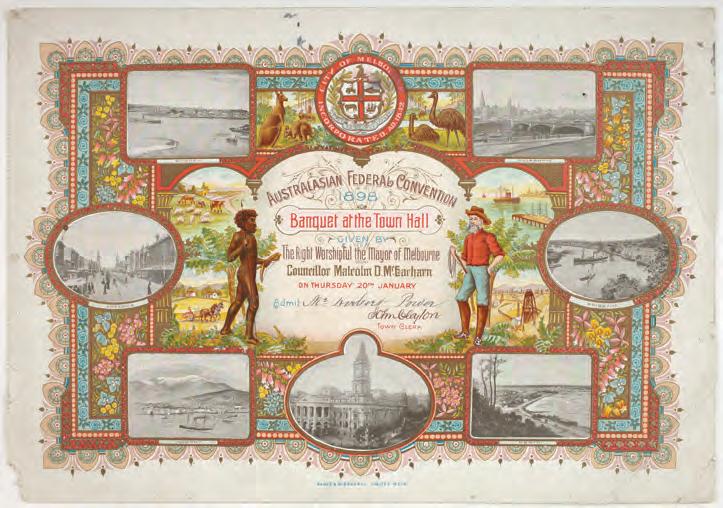
Delegates debated key issues such as the division of powers between state and federal governments, the structure of parliament and the role of the High Court. Debates around these issues led to a modified version of the 1891 draft and shaped the final constitution.
Constitutional referendums, 1898–1900
Once a draft constitution was agreed upon, it was put to the people in a series of constitutional referendums between 1898 and 1900. At the time, voting was not compulsory, and many people were not eligible to vote. The only states in which women could vote in the referendums were South Australia and Western Australia. First Nations peoples, Asians, Africans and Pacific Islanders were not allowed to vote in Queensland or Western Australia unless they owned property. In many of the colonies, poor people receiving assistance could not vote, and in Tasmania there were property ownership qualifications to be eligible to vote.
These referendums revealed differing levels of public support for Federation. The first referendum on the Federal Constitution in 1898 was passed by Victoria, Tasmania and South Australia. However, Queensland and Western Australia did not take part and New South Wales rejected the proposal, fearing that it could lose economic and political influence. NSW Premier George Reid wanted the national capital to be in NSW not Victoria, and for the Constitution to recognise New South Wales as the largest and oldest colony, and therefore the most important. Following some compromise and changes to the Constitution, another referendum was held in 1899 in all states except Western Australia and was passed in all cases.
UNCORRECTEDSAMPLEPAGES
Identify which colony had the most “yes” votes as a proportion of the population.
Why do you think Tasmania had such a small number of “no” votes?
Identify the colony in which the number of “yes” and “no” votes are the closest.
Identify the colony that had the greatest total number of votes.
Historical concepts: Significance Historical skills: Analysis and use of sources, Perspectives and interpretations
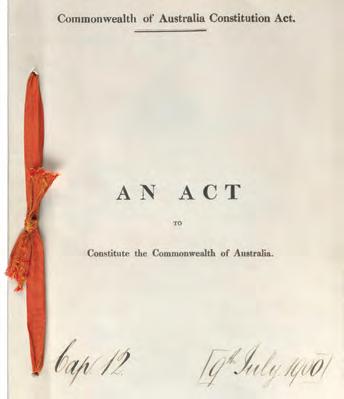
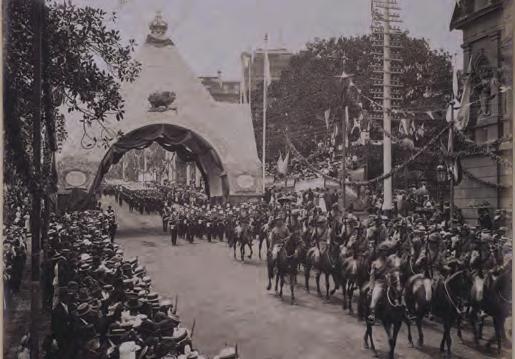
The Constitution Act, 1900
The Commonwealth of Australia Constitution Bill was debated and passed by the British Parliament, and Queen Victoria signed the Commonwealth of Australian Constitution Act 1900 in July. As Western Australia had yet to hold a referendum, provision was made in the Act for them to join at a later date should they choose to. Finally, in late July 1900 Western Australia held a referendum on Federation. Despite calls for secession from a federated Australia, Western Australians voted in favour of joining the other states.
Source 6.3.8 A group of Light Horsemen pass through one of the temporary arches at the Commonwealth procession, 1 January 1901.
The Act made the Australian Constitution legal and on 1 January 1901 the Commonwealth of Australia was inaugurated. This was celebrated with a public procession of Commonwealth and Imperial troops, marching through temporary arches set up on the streets. secession the formal withdrawal from membership of a federal union, an alliance, or a political or religious organisation Source 6.3.7 The Commonwealth of Australia Constitution Act 1900 ➜ Teachers can go online to assign questions, view results, reports and more!
Knowledge and understanding
Identify the institutions upon which the 1891 draft constitution was based.
Identify who was ineligible to vote in the constitutional referendums that took place between 1898 and 1900.
Outline the reasons for, and against, Federation.
Explain why the Constitution Bill was debated in British Parliament, and signed by Queen Victoria.
UNCORRECTEDSAMPLEPAGES
Thinking and researching
“The Australian people were largely apathetic about the prospect of becoming an independent nation.” Discuss this statement in a paragraph, drawing on information included in this section.
Historical concepts: Perspectives, Contestability Historical skills: Analysis and use of sources, Perspectives and interpretations, Research, Communication
6.4 The Australian Constitution
Learning intention
In this lesson, you will learn about how Australia is governed including concepts like federalism and concurrent powers.
Success criteria
❏ I can explain the separation and division of powers between the Commonwealth and states.
❏ I can identify the key features of Australia’s system of government.
❏ I can define what concurrent powers are, and provide an example.
See, think, wonder
What do you see in Source 6.4.1?
What do you think this shows about the relationship between Australia and Britain?
What does it make you wonder about the role the monarchy plays in Australia today?
Source 6.4.1 The Royal Commission of Assent to the Commonwealth of Australia Constitution Act signed by Queen Victoria on 9 July 1900. The Queen's assent enacted the Australian Constitution, founding the Commonwealth of Australia.
UNCORRECTEDSAMPLEPAGES
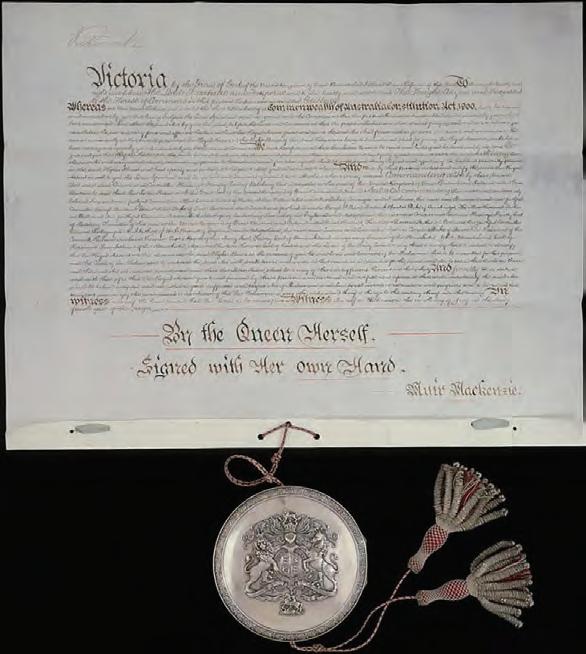
The Commonwealth of Australia was created on 1 January 1901 when Federation was achieved. The Australian Constitution is divided into 8 chapters and 128 sections and established the framework for how Australia is to be governed. It set out the structure of government, the powers held at each level of government and the limits on government authority. The Constitution can only be changed with the approval of the Australian people through the process of a referendum.
The key features outlined in the Constitution of Australia’s system of government are:
• the Australian Parliament and government are responsible for making national laws
• the Parliament is bicameral (there are two houses)
• there are six state governments, responsible for state matters
• some powers are shared (concurrent) between state and federal parliaments
• the High Court of Australia is the final court of appeal, interprets the Constitution and settles disputes between state and federal governments.
These key features were designed to create a stable, democratic system of government while balancing a need for national unity and regional independence.
Federalism
Federalism is a system of government in which power is shared between a central (federal) government and regional governments (the states). In Australia, federalism was a deliberate choice made during the Federation debates of the 1890s. Many Australians supported uniting the colonies but were concerned about losing control over important local matters.
Under the Constitution, Australia became a federal nation, the Commonwealth of Australia, made up of six states – New South Wales, Victoria, Tasmania, Queensland, Western Australia and South Australia. Each state retained its own parliament, law courts and government.
Separation of powers
UNCORRECTEDSAMPLEPAGES
Chapters I to III of the Australian Constitution outline the separation of powers. Federal Government authority is divided into three branches, each with its own set of powers:
• the legislative branch (lawmaking)
• the executive branch (enforcing laws)
• the judicial branch (interpreting the law).
This is designed to prevent one group or individual from holding too much authority and to protect democratic rights and freedoms. It ensures equality and follows ideals and principles surrounding the rule of law.
Source 6.4.2 The Australian Coat of Arms, 1912 ➜
Federal Government Authority

Legislative
Power is held in the Commonwealth Parliament.
Consists of:
the House of Representatives the Senate
the Governor-General (the Crown’s representative).
Parliament debates and passes laws. The bicameral structure reflects democratic representation (the House) and federal representation (the Senate). It provides a safeguard against the abuse of power.
Executive
Power is held by the Prime Minister and Cabinet, who are drawn from the elected Parliament.
The Governor-General also formally holds executive authority, but in practice this power is exercised on the advice of elected ministers.
This overlap between the executive and legislative branches reflects Australia’s Westminster System
Judiciary
Power is held by the High Court of Australia and other federal courts.
The High Court plays a crucial role in interpreting the Constitution and resolving disputes between states and the Commonwealth.
Judicial independence is a vital democratic safeguard. Judges are appointed, not elected, and are protected from political interference, ensuring laws are applied consistently and fairly.
Source 6.4.3 The structure and functions of the three branches of Federal Government in Australia ➜
As Australia is a constitutional monarchy, it has a King or a Queen as the Head of State. This is a formal, symbolic and ceremonial position. The power of the monarch is limited by law and generally only exercised according to the advice of an elected government. In Australia, the powers of the monarch have been delegated by the constitution to the Governor-General. While the monarch appoints the Governor-General, they will do so on the advice of the Prime Minister. Although the Constitution does give the monarch the power to overrule an Act of Parliament, this has never been done and would be extremely unlikely to happen.
Division of powers
UNCORRECTEDSAMPLEPAGES
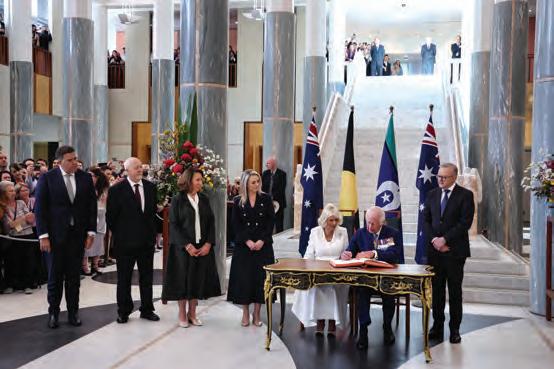
The Constitution also clearly lays out the division of powers between the Commonwealth and the states. The division of powers is a compromise designed to balance national unity with state autonomy. It ensures that the Federal Government does not dominate all aspects of governance.
Source 6.4.4 King Charles III and Queen Camilla sign a visitors’ book at Parliament House in Canberra on 21 October 2024. ➜
Federal powers
Section 51 of the Constitution details federal authority over specific matters where national coordination is essential. There are 39 areas listed in Section 51 over which the Federal Parliament has legislative (lawmaking) power. They include:
• defence
• foreign policy
• citizenship and immigration
UNCORRECTEDSAMPLEPAGES
• international and Australian trade and commerce
• pensions
• Medicare
• currency.
Residual (state) powers
Any powers not listed in the Constitution are known as residual powers and remain with the state. State laws relate to matters that are primarily of state interest. They include:
• schools
• hospitals and ambulance services
• roads and railways
• mining
• agriculture
• forests
• police and prisons
• utilities (such as electricity and water supply)
• community services
• public transport.
This ensured continuity with the existing colonial governance structures and allowed the states to maintain control over key aspects of everyday life.
Concurrent powers
Some powers, like taxation, health and education, are shared or concurrent powers. This means that both levels of government can make laws on the same issue. It allows for flexibility as some issues impact both national and local interests and are not easily placed under the control of just one level of government.
However, concurrent powers can also create conflict when both the Commonwealth and a state pass a law on the same issue. To address this, Section 109 of the Constitution states that in the case of a disagreement between state and federal laws, the federal law will prevail. Although it allows states to legislate in areas of concurrent power, their laws may become invalid if they conflict with federal legislation.
Aboriginal and Torres Strait Islander Peoples
When the Australian Commonwealth Constitution was inaugurated in 1901, there were only two parts that referred to Aboriginal and Torres Strait Islander Peoples, Section 51 and Section 127.
Section 51 (Part xxvi) gave the Commonwealth power to make laws with respect to “people of any race, other than the Aboriginal race in any state, for whom it was deemed necessary to make special laws.” Individual state governments were supposed to make laws and provide for the welfare of Aboriginal and Torres Strait Islander peoples. However, different state and territory governments in the twentieth century created laws that were unequal and unjust for Aboriginal and Torres Strait Islander Peoples. These laws restricted mobility, citizenship, right to employment, right to marry, to drink alcohol and own property, and care for their children and families.
Section 127 stated that “in reckoning the numbers of people of the Commonwealth, or of a State or other part of the Commonwealth, aboriginal natives shall not be counted”. Aboriginal and Torres Strait Islander peoples were not included in any census or population data until 1967, when Australians voted in a referendum to change the constitution.
Students can access sample responses and results online
Knowledge and understanding
Writing focus 6.4
Developing sentences
Teachers can go online to assign questions, view results, reports and more!
Identify the key features of Australia’s system of government, as outlined in the Constitution.
Outline the concept of separation of powers.
List at least three Federal, State and concurrent powers.
Describe what a constitutional monarchy is.
Identify how Sections 51 and 127 of the Australian Constitution excluded Aboriginal and Torres Strait Islander peoples.
Explain the effect of these exclusions on legislation involving Aboriginal and Torres Strait Islander peoples.
Thinking and researching
Research both sides of the debate about if Australia should become a republic.
UNCORRECTEDSAMPLEPAGES
Create an infographic outlining the key arguments for and against removing the monarch as Head of State in Australia.
Historical concepts: Continuity and change, Perspectives, Significance, Contestability Historical skills: Analysis and use of sources, Perspectives and interpretations, Research, Communication
6.5 Protection of workers’ rights
Learning intention
In this lesson, you will learn about workers’ rights in Australia including the role of trade unions and immigration.
Success criteria
❏ I can explain the relationship between trade unions and workers’ rights.
❏ I can describe the reasons for, and outcomes of, the establishment of the Immigration Restriction Act 1901
❏ I can outline how minimum wages were established.
See, think, wonder
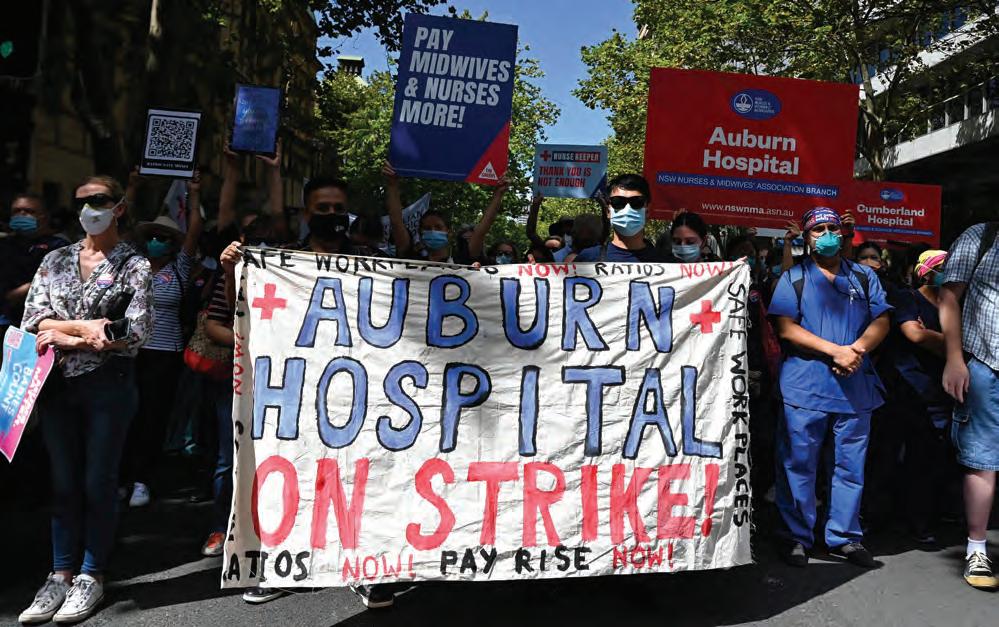
Source 6.5.1 Public hospital nurses in NSW strike over staff shortages and the stresses and strains of post-pandemic hospital work in February 2022.
Many of the Australians who supported Federation believed that democracy should extend beyond the right to vote. This included access to fair wages, safe working conditions, job security and pensions. Trade unions, labour politics and industrial arbitration helped secure these conditions for many Australians and strengthened democratic participation. However, while white Australian workers benefited from growing labour protections, the Immigration Restriction Act 1901 highlighted how these rights were often denied to non-European migrants and Aboriginal and Torres Strait Islander Peoples. Women were also significantly under-represented and even ignored under these growing protections.
The role of trade unions
Following the gold rush, unemployment and poverty levels rose. A severe drought lasting over 10 years in the late nineteenth century made rural and agricultural work difficult and pushed the cost of living higher. The trade unions that had been established to represent different crafts and workers’ rights called on employers to improve living and working conditions. In 1890, a national maritime strike on the docks began when employers refused to pay better wages. This was followed by a six-month shearers’ strike in Queensland, New South Wales and Victoria.
Following these failed strikes, many union leaders were convinced that industrial action alone was not enough and that workers needed political representation. In New South Wales, the Labor Electoral League was formed in 1891 to represent workers’ interests in parliament and use legislation to improve wages and conditions.
Trade unions encouraged workers to participate in elections, engage in political debate and campaign for legislative reform. By 1914, Australia had one of the highest rates of union membership in the world. This growth of labour politics helped normalise the idea that workers’ rights were a legitimate concern of democratic government, not just the concern of private contracts between employers and employees. The influence of trade unions extended into parliament, the courts and public policy.
UNCORRECTEDSAMPLEPAGES
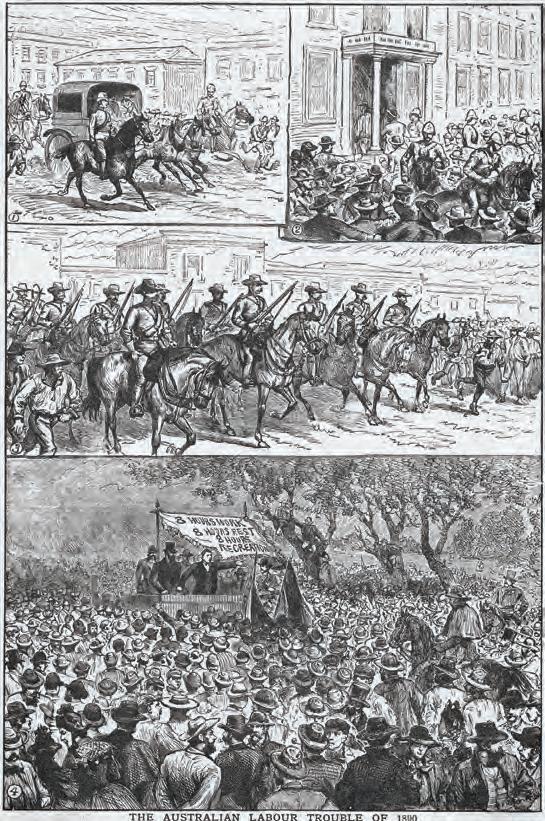
Source 6.5.2 Depictions of the labour and shipping strike at Melbourne in 1890. These illustrations show non-union men escorted by troopers to the Melbourne gas works; picketing to prevent some from reaching the gas company’s office for employment; mounted infantry arriving to preserve order at Spencer Street Station; and a mass meeting of strikers in Flinders Park, Melbourne.
Writing focus 6.5
Creating topic sentences
The Harvester Judgment
Living standards in Australia in the early twentieth century were generally good compared to the rest of the world. Nevertheless, as in most places, they were variable and subject to employment. The concept of a basic living wage was an ideal sought in many countries. Securing the labour force and providing an adequate standard of living could drive production and future prosperity. Trade unions established in the nineteenth century demanded better wages and opportunities for their workers, and, as seen in the 1890s, used militant strike action to achieve this.
arbitration commission an independent court that specialises in industrial disputes
UNCORRECTEDSAMPLEPAGES
In 1904, the Commonwealth Court of Conciliation and Arbitration was established and became a distinctive feature of Australia’s approach to workers’ rights. Arbitration commissions, which could regulate basic wages and negotiate with unions and employers to avoid crippling strike action, were an important lever for a newly federated nation.
A significant early case heard by the court was Ex parte H.V. McKay (1907), also known as the Harvester Judgment. In this case, Hugh McKay wanted the court to declare that the wages he paid to employees of his Sunshine Harvester factory were “fair and reasonable”, as he would have to pay an excise tax if they were not.
When deciding the case, Justice HB Higgins compared McKay’s wages with those of other employers, including public bodies, but importantly he also considered the cost of living.
Activity 6.5.1
Source analysis
Source 6.5.3 In this extract from his judgment of the case, Justice Higgins explains why and how he considered the cost of living.
I cannot think of any other standard appropriate than the normal needs of the average employee, regarded as a human being living in a civilised community. … I have tried to ascertain the cost of living – the amount which has to be paid for food, shelter, clothing, for an average labourer with normal wants, and under normal conditions. Some very interesting evidence has been given, by working men’s wives and others; and the evidence has been absolutely undisputed. … the necessary average weekly expenditure for a labourer’s home of about five persons would seem to be about £1 12s. 5d. The lists of expenditure submitted to me vary not only in amounts, but in the bases of computation. But I have confined the figures to rent, groceries, bread, meat, milk, fuel, vegetables, and fruit; and the average of the list of nine housekeeping women is £1 12s. 5d.
Henry Bournes Higgins, Ex parte H.V. McKay (1907), pp. 3, 5–6
Why did Higgins use the cost of living as the basis for his decision?
How did he determine average expenditure?
Identify the household size he calculated the expenditure for. Why do you think he chose this number?
Historical concepts: Significance Historical skills: Analysis and use of sources
As there were 20 shillings in a pound, the weekly expenditure calculated by Higgins was 32 shillings and 5 pence. McKay was paying his workers only 6 shillings per day. For a six-day week, this would allow 36 shillings, leaving only a small amount for other expenses, such as clothing, education, fares and entertainment. Higgins decided that the basic living wage for a male should be set at 7 shillings per day, or 10 shillings for a more skilled worker. This was quite revolutionary by world standards.
The Immigration Restriction Act 1901
As Australians became more unionised, concerns arose about cheap migrant labour that allegedly took work away from white men. The Immigration Restriction Act 1901 aimed to restrict non-European immigration. It formed the basis of what became known as the White Australia Policy.
The Act used a 50-word dictation test to deny entry to people who could not write a passage in a European language. A person could pass the test in English, but if the Immigration Officer felt they were “racially unsuitable”, they could be asked to sit it in another European language. This policy effectively excluded Asian, Pacific Islander and other non-European migrants from Australia. British migrants were not asked to sit the test. Out of the 1359 tests taken between 1901 and 1909, only 52 people passed. After 1909, no one passed.
Support for the Act came from across the political spectrum, including trade unions. Unionists feared that non-European workers might accept lower wages or poorer conditions, undermining their hardwon labour protections. Racial exclusion was seen as necessary to protect workers’ rights. Two more Acts in 1901 further limited migration to Australia. The Pacific Islanders Labourers Act 1901 outlawed imported labour and the Post and Telegraph Act 1901 banned non-white workers from transporting Australian mail.
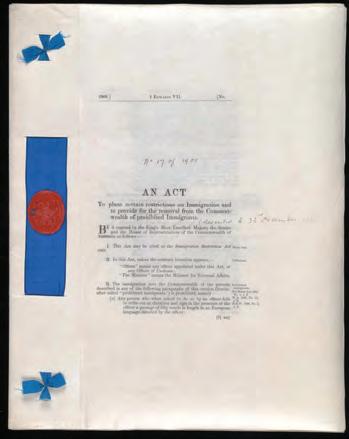
Source 6.5.4 The Immigration Restriction Act 1901 ➜
UNCORRECTEDSAMPLEPAGES
Source 6.5.5 Dictation test passages from September and October 1925 ➜
The White Australia Policy also meant Aboriginal and Torres Strait Islander Peoples were excluded from many labour protections.
The early protection of workers’ rights helped shape Australia’s national identity as a fair and egalitarian society. Arbitration, unionism and labour legislation distinguished Australia from other industrial nations, especially Great Britain and the United States, where industrial conflict was often violent and unregulated. However, historians have noted that the system was built on exclusion. The same laws that protected white workers also reinforced racism and limited the rights of others. Over time, changing attitudes led to the dismantling of the White Australia Policy, but it would not formally end until the 1970s.
Knowledge and understanding
Knowledge and understanding
and researching
Identify the key functions of arbitration commissions
Describe the role of trade unions.
Students can access sample responses and results online
Teachers can go online to assign questions, view results, reports and more!
Outline the argument that the Immigration Restriction Act 1901 could help protect Australian living standards.
Explain how Justice Higgins determined what an Australian basic living wage should be.
Thinking and researching
What was life like in Australia around the time of Federation? Form groups of three. Each member of the group is to research the technological, political and economic changes that a person living in Australia might encounter in the period 1889 to c. 1901.
Areas to consider include:
• technology: transport, housing, lighting, shopping, games, toys, clothing, machines
• economic: work, school opportunities, living conditions
• legislation: effect of legislation (particularly around Federation).
As a group, create a presentation using your format of choice (poster, infographic, PowerPoint, short movie, podcast) outlining the changes. Remember to include sources to support your response.
Historical concepts: Continuity and change, Perspectives Historical skills: Analysis and use of sources, Perspectives and interpretations, Research, Communication
UNCORRECTEDSAMPLEPAGES
6.6 Advancement of women’s rights
Learning intention
In this lesson, you will learn about how Federation, legislation and key figures advanced women’s rights in Australia.
Success criteria
❏ I can describe how the Commonwealth Franchise Act 1902 changed women’s rights. ❏ I can outline the link between Federation and the suffrage movement.
See, think, wonder
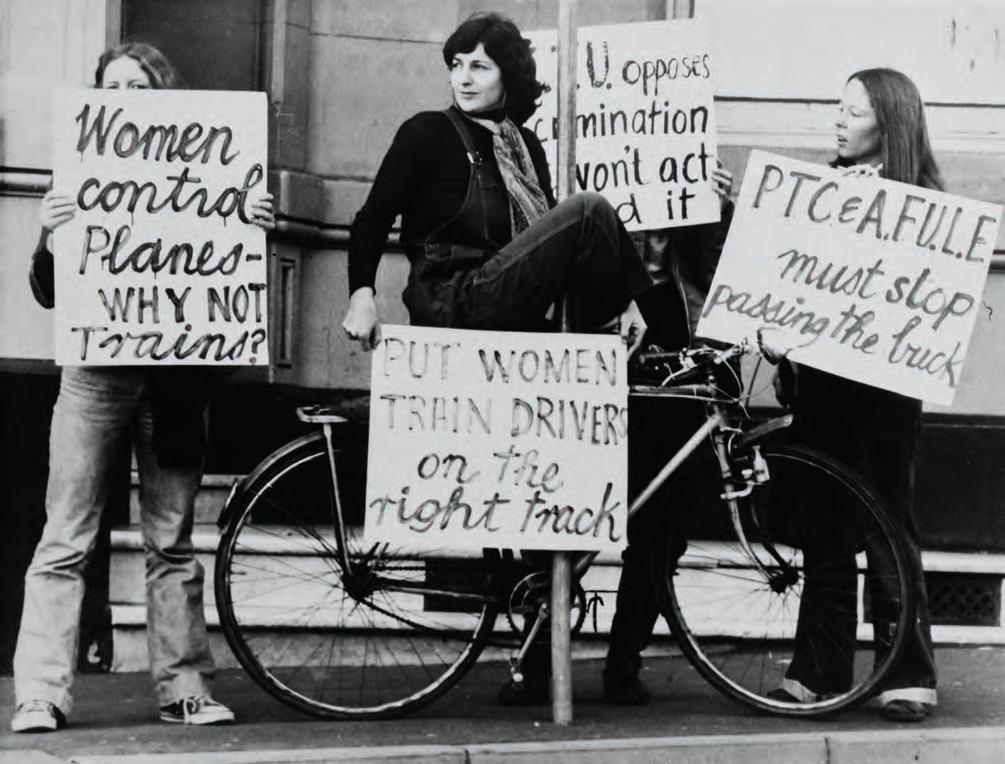
suffrage the right to vote in an election, especially to vote for representatives in a government temperance abstaining from alcohol, or drinking only moderately. The nineteenth-century “temperance movement” promoted laws against the sale and consumption of alcohol
Despite the growing engagement with egalitarian ideals during this period, Aboriginal and Torres Strait Islander Peoples, immigrants and women were still discriminated against. While Federation strengthened democratic institutions, it also reflected the limitations and values of the time.
Before Federation, women’s rights varied across the Australian colonies. During the 1880s and 1890s, women were increasingly involved in public life and women’s suffrage movements emerged across Australia, influenced by similar movements in Britain, New Zealand and the United States. Voluntary organisations like the Women’s Christian Temperance Union were formed in each colony to advance women’s issues, including seeking the vote.
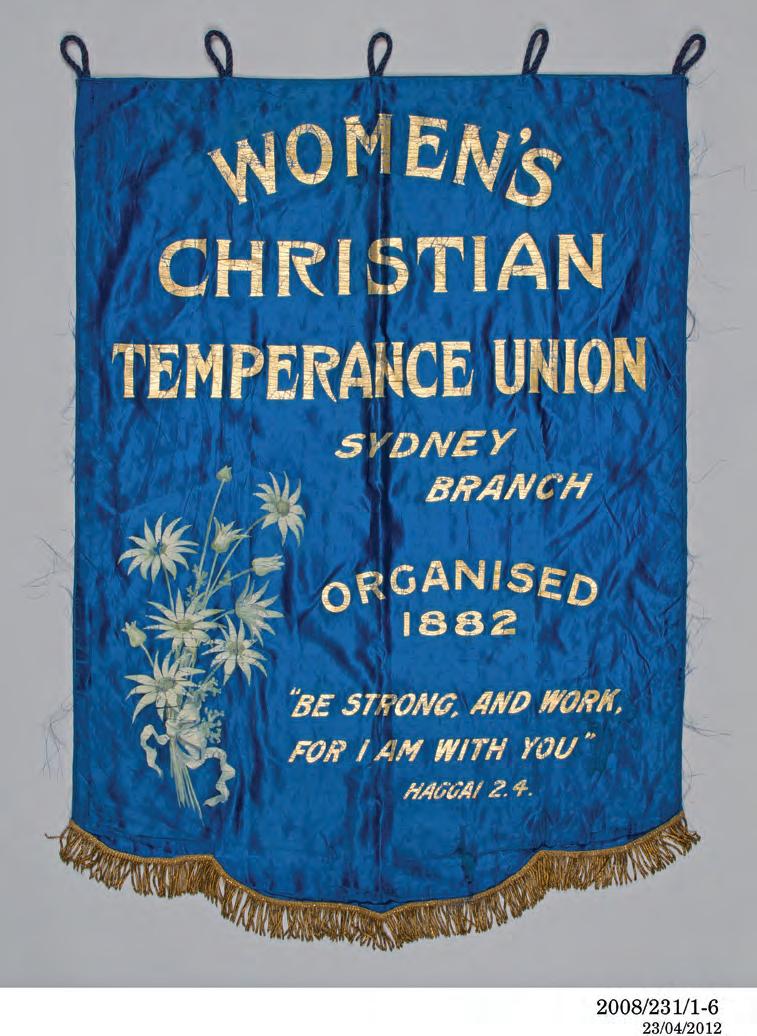
Campaigning for the vote
Women campaigned for improvements in areas such as public health, child welfare, temperance and education, arguing that women had a moral responsibility to improve society. They organised public meetings, travelled to regional areas to gain spread their message, wrote letters to the press and members of parliament and drew up petitions.
In 1891, suffragists gathered over 30 000 signatures on a petition asking the Victorian Parliament to grant the vote to women. It contained arguments presented during the American Revolution that taxation and representation should go together and that “Government of the People, by the People” should mean all the People, not just half.
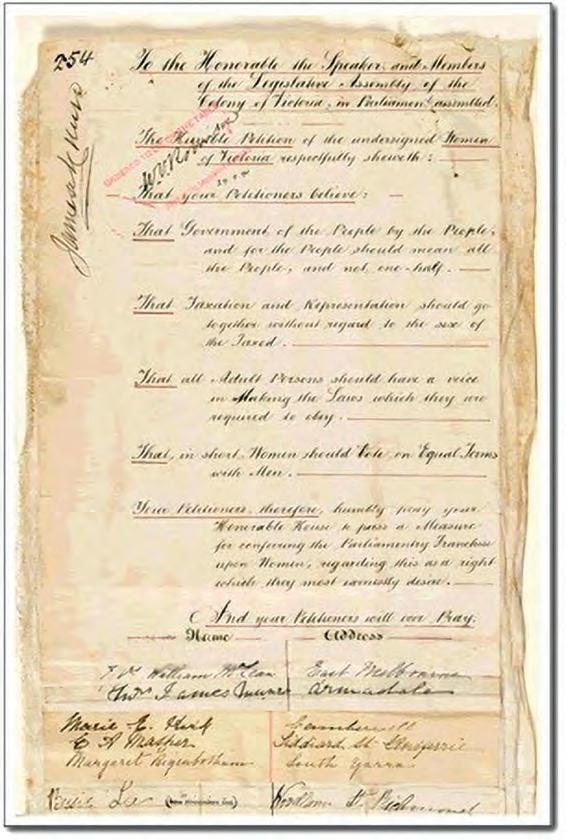
UNCORRECTEDSAMPLEPAGES
Source 6.6.3 Women’s Suffrage League petition, 1891
Despite this, and several other similar petitions presented in other colonies, women would have to wait until 1894 when South Australia gave adult women the vote, and allowed them to stand for State Parliament elections. Other colonies followed: Western Australia allowing women to vote from 1899, New South Wales and Tasmania after Federation in 1903, Queensland in 1905 and finally Victoria in 1908.
suffragist a person who campaigned for women’s right to vote using peaceful and legal methods
Writing focus 6.6
Developing sentences
Source analysis
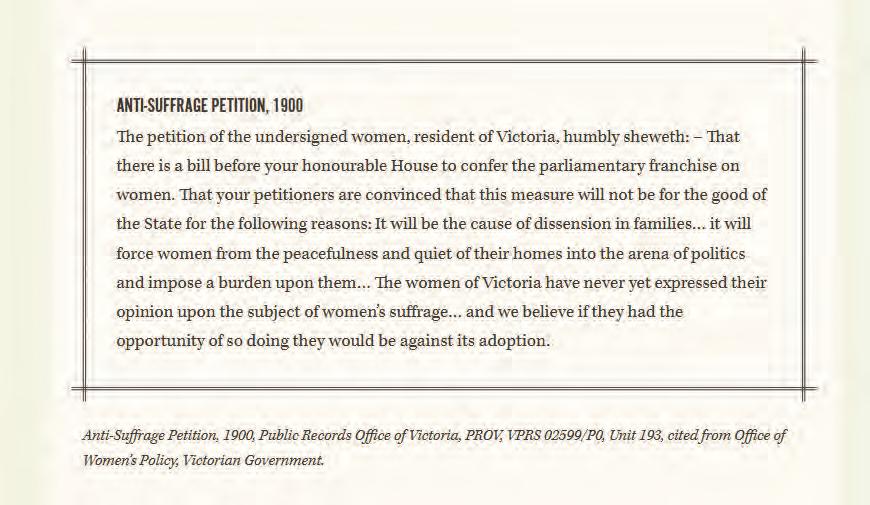
Source 6.6.4 An anti-suffrage petition, 1900 ➜
UNCORRECTEDSAMPLEPAGES
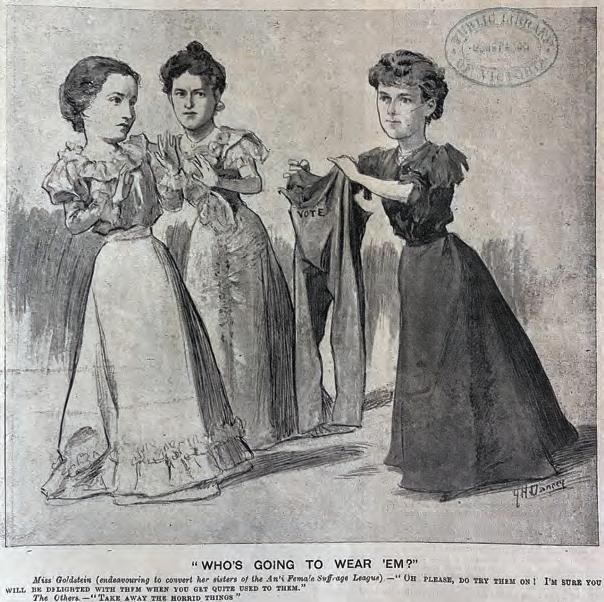
Identify the message of Source 6.6.4 and Source 6.6.5.
Source 6.6.5 Cartoon of Vida Goldstein, a pioneering Australian suffragist, trying to persuade women to support female enfranchisement. Melbourne, 1900 ➜
Discuss how the sources support the argument that not everyone was in favour of female enfranchisement in Australia in the early 1900s.
Historical concepts: Perspectives Historical skills: Analysis and use of sources, Perspectives and interpretations
During the lead up to Federation, prominent female suffragettes such as Louisa Lawson, Catherine Spence Rose Scott, Maybanke Anderson and Vida Goldstein had campaigned to get women to support Federation in return for female franchise.
Source 6.6.6 A
UNCORRECTEDSAMPLEPAGES
Source 6.6.7 Catherine Spence featured on a 2001 limited issue $5 banknote commemorating 100 years of Australian Federation. She is the first woman apart from the Queen to feature on an Australian banknote. Henry Parkes, the “Father of Federation”, appeared on the other side of the note.
statue of Louisa Lawson in Mudgee, New South Wales ➜
Source 6.6.8 Cartoon by Monte Scott, published in The Worker, a Queensland unions newspaper, 17 November 1900. Suffragettes who fought for woman’s right to vote were often caricatured as nags and spinsters in an effort to dismiss them.
Source 6.6.9 Sixteen Reasons for Supporting Woman’s Suffrage, A Women’s Christian Temperance Movement leaflet, 1890. Originally printed in New Zealand, it was re-printed in South Australia.
They recognised that Federation could create an opportunity to standardise voting rights at the national level. Using political rallies, letters to parliament, speeches and political brochures, these women advocated for their right to vote and for representation in the new parliament.
The Australian Labor Party and many liberal and more progressive politicians also supported women’s suffrage. They believed that women voters would support social reform, workers’ rights and welfare policies, strengthening democracy and moral governance.
Commonwealth Franchise Act 1902
UNCORRECTEDSAMPLEPAGES
The Commonwealth Franchise Act 1902 played a crucial role in advancing women’s rights in Australia and positioned Australia as a world leader in challenging traditional gender roles. It reflected the belief held by many Australians that democracy should be inclusive and that women, as citizens, had the right to participate in the political process.
After considerable debate and several attempts to get the bill passed, on 12 June 1902 the Commonwealth Franchise Act 1902 was passed by the Commonwealth Parliament. All white women over the age of 21 years were given the right to vote and stand as candidates to be elected to Federal Parliament.
Source 6.6.10 The Commonwealth Franchise Act 1902 ➜
This was revolutionary for the time and attracted international attention, reinforcing Australia’s reputation as a democratic innovator. Australia was the first country to allow women to stand for national parliament and was only the second country in the world to give women the right to vote. New Zealand had done so in 1893, but women in the United States and Britain had to wait until the 1920s. However, it still took until 1943 for the first female to be elected to Federal Parliament, when Enid Lyons became the member for Darwin (Tasmania) in the House of Representatives.
Unfortunately, the Act also had significant limitations. Aligning with the broader White Australia Policy, it explicitly excluded “Aboriginal natives of Australia, Asia, Africa or the Islands of the Pacific” from voting. And while women gained the right to vote and stand for parliament, Australian political institutions remained dominated by men. Social attitudes, limited access to education and economic inequality continued to restrict women’s opportunities.
Knowledge and understanding
Identify the reasons that some women might not have supported female enfranchisement.
Describe how women campaigned for the vote.
UNCORRECTEDSAMPLEPAGES
Account for why Australian democracy in the early 1900s might be considered more advanced than in Britain and the United States.
Research the lives of Rose Scott, Maybanke Anderson, Louisa Lawson, Catherine Spence and Vida Goldstein and evaluate their influence on the advancement of women’s rights.
Historical concepts: Continuity and change, Significance Historical skills: Analysis and use of sources, Research, Communication
6.7 NSW governance structure
Learning intention
In this lesson, you will learn the extent to which the governance structure of NSW changed after Federation.
Success criteria
❏ I can identify key people in the development of NSW governance structure and outline their role.
❏ I can outline the changes introduced by the NSW Constitution Act 1902.
❏ I can discuss areas of NSW governance that remained unchanged in the period of study.
Think, pair, share
In 1855, Britain passed the New South Wales Constitution Act, which granted NSW its own constitution and parliament. Source 6.7.1 shows the government structure after this Act was passed.
Think: This was 50 years before the Australian Constitution, which you learned about earlier in this chapter. What similarities and differences do you see between the structure of the NSW Parliament in 1856, and the Commonwealth Parliament in 1901?
If you know anything about the current structure of the NSW Parliament, can you identify any changes that have happened since 1856?
Pair: Discuss your thoughts with a partner.
Before Federation
In 1855, NSW was granted responsible government. Parliament consisted of an elected Legislative Assembly and an appointed Legislative Council. Executive power was exercised by a Premier and Cabinet drawn from the Assembly, and the Governor represented the British Crown. This structure reflected British constitutional traditions and remained largely unchanged in the period of study.
During the intense debates around Federation in the late 1880s and 1890s, leaders like Sir George Reid and Sir Henry Parkes argued that NSW should play a leading role in shaping federated Australia while preserving its own autonomy.
Source 6.7.1 NSW government structure in 1856 ➜
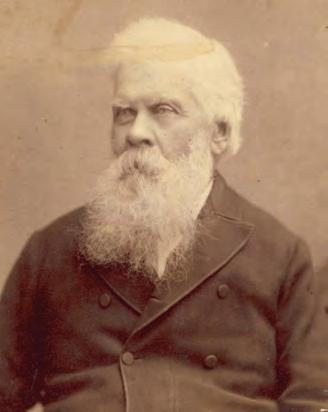
Source 6.7.2 Sir Henry Parkes (NSW Premier 1872–1891) has been referred to as the “Father of Federation” due to his early calls to unite the six colonies of Australia.
Effect of Federation
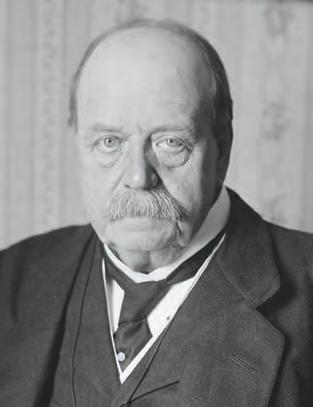
Source 6.7.3 Sir George Reid, NSW Premier 1894–1899 and Prime Minister 1904–1905. Reid was involved in writing the Constitution and was a strong advocate for NSW interests during the Federation debates.
Source 6.7.4 Sir Edmund Barton was Australia’s first Prime Minister from 1901–1903. He played a key role in shaping the new political system following Federation before resigning and becoming a founding member of the High Court of Australia, where he served until his death in 1920.
Federation marked the most significant change to NSW governance during the period of study. With the creation of the Commonwealth of Australia, powers were divided between state and federal governments and NSW ceded some powers to the Federal Government. While NSW retained control over areas like education, health and the police, powers including defence, immigration and customs duties were transferred to federal control.
Rather than replacing state government, Federation redefined its role. NSW continued to be governed by its own parliament, Premier and Governor, and now also operated within a federal system that required cooperation and negotiation with the Commonwealth.
The New South Wales Constitution Act 1902
A major development in state governance, the New South Wales Constitution Act 1902 consolidated and clarified the structure of government in NSW following Federation. The Act confirmed the roles of Governor, the Executive Council and the two houses of parliament, while also modernising aspects of parliamentary procedure. Existing institutions were preserved and adapted to operate within a federal system. NSW maintained the Westminster system of parliamentary democracy that had been in place since 1855, and this system of governance continued largely unchanged into the twentieth century.
UNCORRECTEDSAMPLEPAGES
Writing focus 6.7
Transitional phrases
Source 6.7.5 Sir John See, NSW Premier from 1901 to 1904, oversaw the transition to Federation and supported cooperation with the Commonwealth Government.
By clearly defining the powers of the NSW Parliament, the Act strengthened democratic governance at the state level and reduced uncertainty about the relationship between state and federal authority. However, a point of ongoing controversy was the Legislative Council. Reformers argued that an unelected upper house was undemocratic, but supporters claimed it provided stability and protection against radical change.
UNCORRECTEDSAMPLEPAGES
NSW also retained its constitutional link to Britain through the role of Governor. The Governor represented the British Crown, and continued to play a central role in the formal structure of government in NSW. Governors like Sir Harry Rawson and Sir Gerald Strickland acted as the monarch’s representatives, granting Royal Assent to legislation and performing ceremonial duties. Although their political power was limited by convention, their presence reflected the continuity of imperial authority and constitutional practice in the period.
Supreme Court of NSW
The Supreme Court of NSW was established in 1823 and remained a cornerstone of governance throughout the period of study. It ensured that laws passed by parliament were interpreted and applied consistently.
Sir Francis Forbes was the first Chief Justice of the Supreme Court of NSW, and his influence on the legal system continued well into the Federation era. Forbes had established the principle that government actions should be subject to legal limits, reinforcing the idea that no individual, including the Governor, was above the law. This commitment to judicial independence remained a defining feature of NSW governance before and after Federation.
Political leadership and reform
The period after Federation saw the development of organised political parties and the rise of the Australian Labor Party. The election of James McGowan’s Labor government in 1910, followed by William Holman in 1913, marked a shift in governance priorities to include a focus on workers’ rights, industrial regulation and social reform. There was a more active role for government in addressing social and economic inequality.
Source 6.7.6 Admiral Sir Harry Rawson, Governor of NSW, 1902–1909
Source 6.7.7 Sir Gerald Strickland, Governor of NSW, 1913–1917
➜
Source 6.7.8 Sir Francis Forbes, the first Chief Justice of NSW, 1824–1837
➜
Source 6.7.9 James McGowan, NSW Premier from 1910–1913, led a Labor government that reflected the growing influence of the labour movement in NSW politics.
Throughout the period of study, New South Wales saw its basic structures of parliamentary democracy, rule of law and ties to the British Crown remain largely intact. Federation in 1901 brought broader democratic change to Australia and reshaped the relationship between the people, the state government and the new Commonwealth Government.
Women gained the right to vote in NSW in 1902, marking an expansion of democracy at state level. While still underrepresented in parliament, the enfranchisement of women demonstrated a shift towards more inclusive governance.
The rise of Labor politics and expanding democratic participation reshaped governance as it responded to growing demands for representation and reform. Despite this, Aboriginal and Torres Strait Islander Peoples remained excluded from political participation and decision-making and their voices were largely ignored by state governments, including in NSW.
Students can access sample responses and
Knowledge and understanding
Identify the role of the Supreme Court of NSW.
Outline the changes introduced by the NSW Constitution Act 1902
Discuss areas of NSW governance that remained unchanged in the period of study.
Describe the influence of the rise of Labor politics on governance in NSW.
Thinking and researching
Source 6.7.10 William Arthur Holman, NSW Premier 1913–1920, introduced social and industrial reforms, including changes to workers’ compensation and industrial arbitration. ➜ Historical concepts: Continuity and
Teachers can go online to assign questions, view results, reports and more!
UNCORRECTEDSAMPLEPAGES
Choose one of the key individuals featured in this lesson to research.
Write a newspaper article to explain why their role in the development of the NSW governance structure was so significant.
6.8 Reasons for involvement in World War I
Learning intention
In this lesson, you will learn about why Australia was involved in World War I.
Success criteria
❏ I can identify why Australia was automatically at war when Britain declared war.
❏ I can describe Australian sentiment towards World War I and how it changed over time.
❏ I can outline the impact of World War I on Australian trade and industry.
See, think, wonder
What do you see in Source 6.8.1?
What do you think is the message of this postcard?
What does it make you wonder about Australian sentiment towards World War I in 1914?
World War I began in July 1914 following a period of rising tensions in Europe. Long term causes such as increasing militarism and nationalism, imperial rivalries and a rigid system of alliances had gripped Europe in the early twentieth century. The assassination of Archduke Franz Ferdinand in Serbia in June triggered a domino effect of alliance obligations. What began as a regional dispute between Serbia and Austria–Hungary escalated into a global conflict involving empires and colonies all over the world.
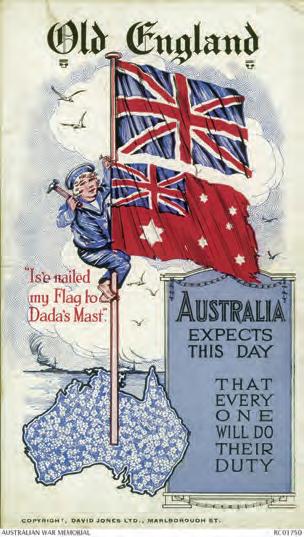
Australia’s new nation status raised important questions about its relationship with Britain and the rest of the world. Despite Federation, Australia remained closely connected to the British Empire and this connection was particularly evident when World War I broke out in 1914. Australia was automatically at war when Britain declared war on Germany and its allies, because it was a member of the British Empire. However, Australia’s participation was influenced by more than legal obligation alone. Political loyalty, cultural identity, strategic concerns and domestic pressures all contributed to Australia’s decision to support the Allied war effort.
Source 6.8.1 An Australian postcard, 1914 ➜
UNCORRECTEDSAMPLEPAGES
Initially, there was widespread public enthusiasm for Australia’s involvement and support of the British Empire. Public rallies, recruitment campaigns and patriotic organisations encouraged men to enlist. Social pressures also played a significant part in the high initial enlistment numbers, as those who did not volunteer were sometimes labelled as unpatriotic or cowardly.
News of Britain’s declaration of war broke during the middle of an election campaign, and both the Australian Prime Minister Joseph Cook and the Opposition Leader Andrew Fisher declared their public support for Australia’s involvement.
Activity 6.8.1
Source analysis
Source 6.8.2 Opposition Leader Andrew Fisher’s response to the declaration of war ➜
Australians will stand beside [the mother country] to help and defend her to our last man and our last shilling.
Source 6.8.3 Prime Minister Joseph Cook’s response to the declaration of war ➜
When the Empire is at war, so is Australia at war. All our resources are in the Empire and for the preservation and security of the Empire.
Explain what you think Opposition Leader Andrew Fisher meant by “defend her to our last man and our last shilling”.
Compare the statements. How are they similar?
Explain how these sources might be useful to a historian studying the reasons for Australia’s involvement in World War I?
Historical concepts: Perspectives, Significance Historical skills: Analysis and use of sources, Perspectives and interpretations
Strategic economic and security concerns also played a role in Australia’s support for the Allied war effort. Australia relied on Britain for naval protection and defence of its position in the Asia–Pacific region. Germany possessed colonies in the Pacific, which could be potential threats to Australian security and trade routes. One of Australia’s first military actions in the war was to capture German territories in the Pacific, demonstrating the regional, European and global implications the war would have.
Activity 6.8.2
Source analysis
1.
Describe how Germany is portrayed in this poster.
Identify the message of this poster.
Explain whether you think this would be an effective recruitment poster. Give reasons for your answer.
Source 6.8.4 An Australian propaganda poster depicting a German ogre with blood-covered hands and forearms clutching at a globe of the world. Blood pours over Europe, and slowly oozes towards other countries, including Australia, demonstrating the threat of the “German menace” and the need to contain it. This poster was the first of a series drawn by Norman Lindsay for a nation-wide Australian recruiting campaign in 1918.
Writing focus 6.8
The language of source analysis
UNCORRECTEDSAMPLEPAGES
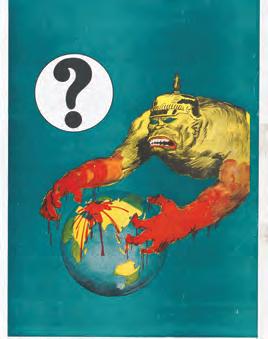
Historical concepts: Perspectives, Significance Historical skills: Analysis and use of sources, Perspectives and interpretations, Communication
Andrew Fisher, The Argus, 1 August 1914
Joseph Cook, The Argus, 3 August 1914
Britain was Australia’s largest trading partner, so maintaining strong economic ties was crucial for exports such as wool, wheat and meat. The war also created increased demand for Australian agricultural products and raw materials. Supporting the Allied war effort ensured continued access to imperial markets and created some economic stability during the war.
Source 6.8.5 Graphs show the impact of the war on Australian exports and imports as well the mining and manufacturing industries. ➜
Despite the early stages of the war being met with enthusiasm and public support, opposition gradually grew over time, especially following high Australian casualty numbers in battles like Gallipoli and Fromelles. Conscription became a particularly divisive policy, with public debate and referendums in 1916 and 1917 revealing deep social tensions about the extent of Australia’s commitment to the Allied war effort. The conscription debate will be discussed later in this chapter. conscription compulsory military service in a
Teachers can go online to assign questions, view
reports and more!
Knowledge and understanding
Outline why Australia became involved in World War I.
Identify which country Australians considered to be the “mother country”.
Explain why the Australian public reacted to the outbreak of war with enthusiasm.
Discuss the reasons for changing opinions towards the war.
Using evidence from the graphs in Source 6.8.5, describe the impact of World War I on Australian trade, mining and manufacturing.
UNCORRECTEDSAMPLEPAGES
Research the arguments for and against Australian involvement in WWI. Hold a class debate on the issue.
6.9 The War Precautions Act 1914
Learning intention
In this lesson, you will learn about how legislation was used during the war, including the introduction of the War Precautions Act 1914.
Success criteria
❏ I can explain why laws were changed during World War I.
❏ I can identify key regulations of the War Precautions Act 1914 and discuss how they might have contributed to the war effort.
❏ I can outline opposition to the War Precautions Act 1914
Starter activity
Participate in a short, timed class debate or discussion about the following statement: “Governments should be allowed to restrict freedoms to protect national security.”
When war broke out in 1914, the governments of most countries severely curtailed the civil liberties of their populace in an effort to protect national security and meet the demands of war. The Australian Government was quick to force strict controls on their population. Laws and regulations were passed that covered censorship, food supplies, the economy, opposition to the war, and the treatment of enemy aliens. For example, the Trading with the Enemy Acts 1914–16, made it illegal to trade with individuals or companies from enemy countries. Other acts included the Income Tax Act 1915, which introduced federal income tax, the Daylight Savings Act 1916, which added an extra hour of daylight to increase agricultural production, and a 6 p.m. closing time for hotels (implemented in New South Wales and Victoria).
The War Precautions Act 1914 was modelled on similar legislation passed in Britain. It gave the Commonwealth Government wide-ranging powers to make laws and regulations deemed necessary for “public safety and the defence of the Commonwealth”. The Act, which was passed in October 1914, reflected concerns about national security, loyalty and the need for strong executive authority in a time of global conflict and uncertainty.
UNCORRECTEDSAMPLEPAGES
censorship the act of banning any material deemed offensive or objectionable
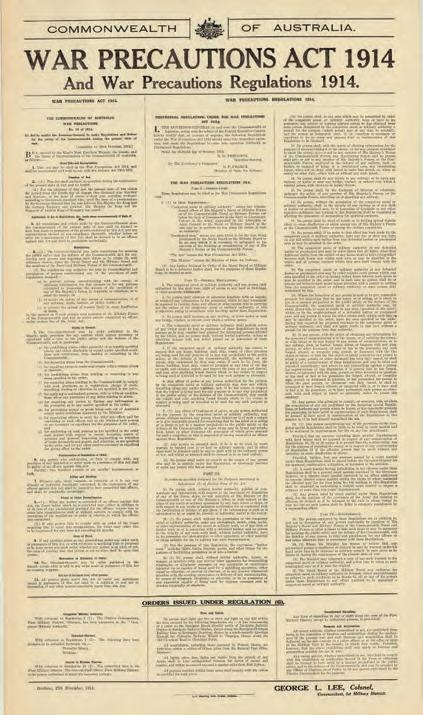
Source 6.9.1 The War Precautions Act, 1914 ➜
The deliberately broad language of the Act ensured the executive had significant reach and power to maintain order, protect infrastructure and ensure public support for the war effort. It was used to make more than 100 regulations which included:
• censorship of newspapers, letters and publications
• control or suppression of public meetings and gatherings, including sporting events
• detaining individuals without trail
• restricting trade with “enemy” nations
• seizing property
UNCORRECTEDSAMPLEPAGES
• limits on interest rates
• fixing the price of basic food items
• regulations of industries important to the war effort.
Through these regulations, the government expanded its influence into many aspects of daily life in Australia. Censorship was particularly significant. Newspapers, magazines, civilian mail and soldiers’ letters and postcards home were all heavily censored to prevent the Australian people from learning the horrifying realities of the war, and ensuring that they continued to support the war effort. Anti-war statements were monitored, and public criticism of the war could result in prosecution. Censorship was coupled with Department of Defence-produced propaganda to create an idealised version of the war for Australia’s population. Military defeats were presented as successes or were not reported at all.
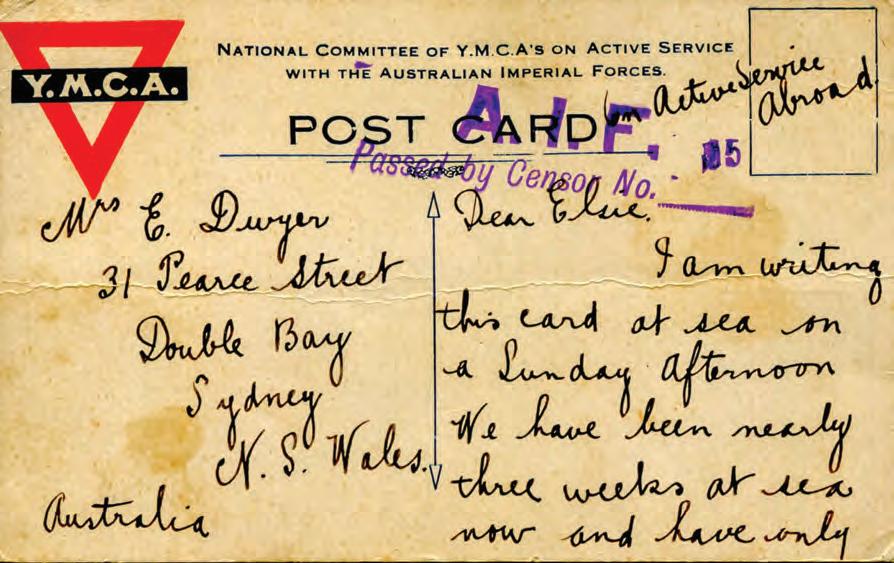
Source 6.9.2 A YMCA postcard sent by an Australian soldier to Sydney in 1916 with the purple censor’s stamp clearly visible
The War Precautions Act 1914 marked a major shift in the balance between freedoms and government authority. Civil liberties were restricted in the name of national security and thousands of people, especially those of German descent, were investigated, monitored, or interned in camps during the war. Initially, the government classed foreign nationals of countries at war with Australia as “enemy aliens”. Australia interned almost 7000 people during World War I, including 4500 of these “enemy aliens”.
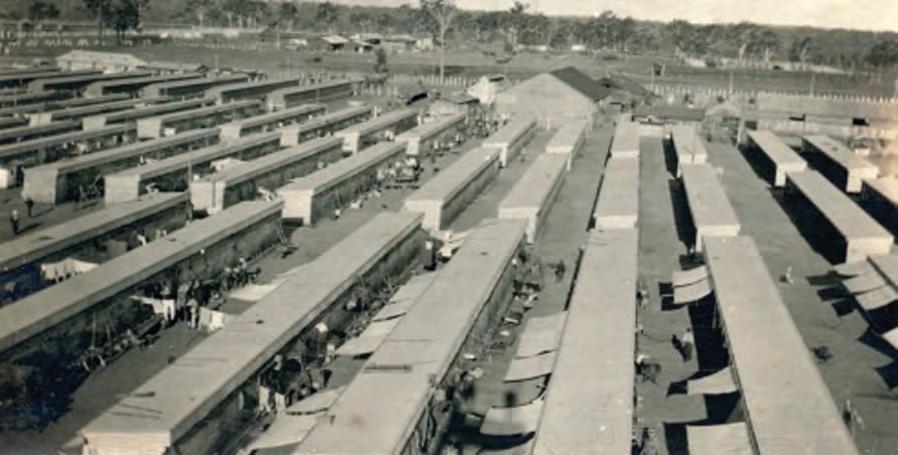
Source 6.9.3 Holsworthy Internment Camp, NSW c. 1915. The largest internment camp in Australia, Holsworthy held between 4000 and 5000 internees. Most were either from the Austro-Hungarian Empire, staff of German companies, crews of captured vessels and Australians of German descent.
➜ The Act was amended several times during World War I to further expand government powers. In 1915, amendments strengthened censorship powers and expanded the government’s ability to control “enemy aliens”, trade and communications. In 1916, further amendments significantly increased the government’s power to supress dissent, particularly during the first conscription referendum. Final amendments were made in 1917 to introduce additional regulations during the second conscription referendum, allowing tighter control over publications and public meetings. Political dissent was targeted and members of socialist organisations, trade unions and anti-conscription campaigners were all prosecuted under the Act.
UNCORRECTEDSAMPLEPAGES
While many Australians initially supported strong wartime measures, opposition grew as the war continued. Before 1914, the Commonwealth Government’s powers were limited by the Constitution. However, wartime conditions had allowed the Federal Government to exercise much broader control than had previously been possible and set a precedent for future emergency powers legislation. Critics argued that the Act gave the government excessive power and undermined democratic freedoms, as the government were able to make regulations which would have been unlawful in peace time. Writing
focus 6.9 Creating topic sentences
Activity 6.9.1
Source 6.9.4 Professor Joan Beaumond, Strategic and Defence Studies Centre, Australian National University, talks about the surrender of Civil Rights, 19 March 2014
Given the abuse of the War Precautions Act we might ask why it passed through Parliament so easily. Some parliamentarians were in fact nervous about its potential to introduce “something like martial law” and the Member of Parliament for the South Australian seat of Angus, which included the German district of the Barossa Valley, questioned the clause which allowed the government to deem naturalised Australians as aliens. Yet these reservations dissipated before the pervasive sense of crisis, much as reservations about greater government surveillance of the citizenry did in the aftermath of 9/11. Parliamentarians seem to have been reassured by the argument of Sir William Irvine that “In time of war Governments do … many things not authorised by law” and Hughes’ assurance that the government would use the new powers as sparingly as possible. The ease with which civil rights were surrendered is a salutary lesson for anyone concerned about individual privacy today.
Joan Beaumont, “Going to war 1914–18: the view from the Australian Parliament”, a Parliamentary library Lecture, The Australian National University, 19 March 2014.
Source 6.9.5 Labor MP Edward Riley voices his concerns, 28 April 1915
“The Ministry must be very careful how it hands over the civil rights of the people to military control and the judgments of courts martial … Those who have read the early history of Australia know that when the military power ruled this country there was nothing but stagnation and tyranny, and it was only when civil Courts were established, and people were no longer at the mercy of the courts martial that there was any progress … We are a civilized community, with the whole machinery of the law ready to be put into operation at any moment, yet this Bill proposes to take certain civil offenders away from the civil Courts and hand them over to a military Court which is given power to impose the sentence of death. To my mind, that is giving altogether too much power to the military authorities …
The civil Courts should be clothed with power to deal with all actions against civilians that may arise out of the passing of this Bill. Another reason why I am loth to agree to this Bill is that we are handing away the right of trial by jury, which is the keystone of the liberties contained in Magna Charta. Further than that, I see no necessity for these extreme powers. We have control of the Pacific and the whole of the wireless stations, and the postal, telephone, and telegraphic services are under the administration of the Commonwealth Government, so that Australia is perfectly safe.”
Edward Riley, 28 April 1915
UNCORRECTEDSAMPLEPAGES
Identify the message of Source 6.9.4.
List the concerns that Edward Riley raises in Source 6.9.5?
Identify which War Precautions Act 1914 regulations are addressed in Source 6.9.6.
Explain how these sources might be useful to a historian’s understanding of Australian public sentiment towards government wartime restrictions and legislation.
➜
Source 6.9.6 The honest man. Published in the Australian Worker, April 1916
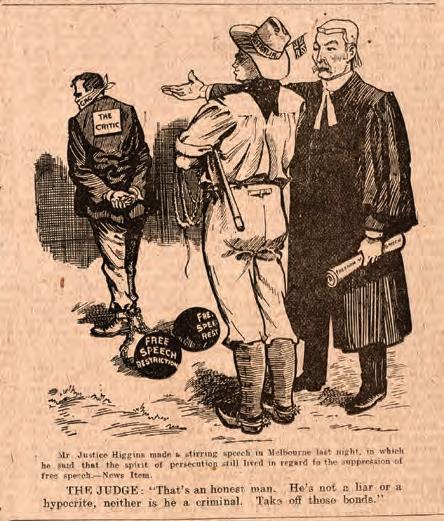
Historical concepts: Cause and effect, Perspectives, Significance Historical skills: Analysis and use of sources, Perspectives and interpretations
The Act was formally repealed in 1920, but it highlights an important historical question: to what extent should governments be allowed to restrict freedoms in order to protect national security? repealed a law removed or reversed so it is no longer valid
Review 6.9
Teachers can go online to assign questions, view results, reports and more! Knowledge and understanding
and researching
Students can access sample responses and results online
Knowledge and understanding
Identify some of the regulations in the War Precautions Act 1914.
Describe the impact of wartime legislation on those deemed to be ‘enemy aliens’.
Outline some of the reasons why people were opposed to the wartime controls.
Explain why the Australian Government introduced restrictions during war.
Thinking and researching
1.
UNCORRECTEDSAMPLEPAGES
Visit the Australian War Memorial website at https://cambridge.edu.au/redirect/12038 and complete the activities about “Enemy aliens”.
Historical concepts: Perspectives, Significance, Contestability Historical skills: Comprehension – terms and concepts, Analysis and use of sources, Perspectives and interpretations
6.10 Australian enlistment in World War I
Learning intention
In this lesson, you will learn about why Australians enlisted to fight in World War I and where they fought.
Success criteria
❏ I can outline the reasons for, and influences on, Australian enlistment
❏ I can identify where Australians fought in WW1.
See, think, wonder
What do you see in Source 6.10.1?
What do you think this reveals about how World War I soldiers were perceived?
What does it make you wonder about why people chose to enlist?
propaganda information, especially of a biased or misleading nature, used to promote a political cause or point of view mother country the country from which the people of a former colony originate conscientious objector an individual who, for reasons of conscience or religion, objects to participating in military service pacifist a person who believes that war and violence are morally unjustifiable
UNCORRECTEDSAMPLEPAGES
The popular reaction to the declaration of war was enthusiasm. At the time, most Australians thought of themselves as citizens of the British Empire, rather than distinctly Australian. This love for empire was reinforced by the education system and the Anglican Church (also known as the Church of England).
Australian boys were brought up on the heroic deeds of British soldiers in the great wars of the past, and compulsory military training for all boys aged 12 and over helped to instil obedience and discipline. Propaganda encouraged young men to enlist by emphasising Australia’s links to the “mother country”, promoting the concept of war as heroic and glorious, and portraying Britain as good and Germany as evil.
While evidence suggests that the majority of Australians supported the war effort, there were still some small pockets of opposition from socialists, trade unionists and other groups. They argued that the burden of war would fall mostly on the working class, who would bear the brunt of the fighting. Opposition also came from conscientious objectors and pacifists, who objected to all war and violence.
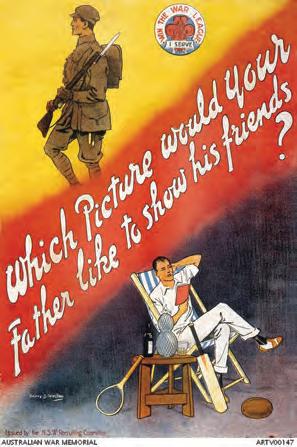
Source 6.10.1 World War I recruitment poster created at the start of the war by a state recruiting committees and volunteer organisation “Win the War League”. ➜
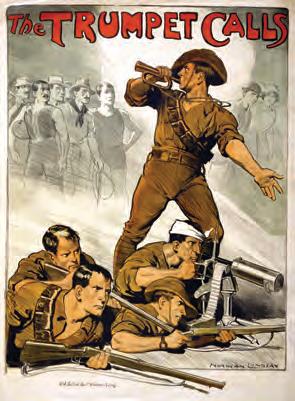
6.10.1 Recruitment
Source 6.10.2 “The trumpet calls”, an Australian WWI recruitment poster by artist Norman Lindsay between 1914 and 1918. ➜
Why Australians enlisted
From 10 August 1914 onwards, thousands of young Australian men enlisted in the Australian Imperial Force (AIF), and by the end of 1914 over 52 000 men had voluntarily enlisted. The first troops left for overseas on 1 November. By the end of the war, 416 809 men had enlisted in the AIF, and of those, 334 000 served overseas. Out of a population of approximately 4.9 million, this was roughly 38.7 per cent of all eligible men aged between 18 and 44 years.
Slouch hat a differentcoloured cloth band denoted rank and service branch.
Bayonet a bayonet was attached to the end of the rifle for close-range combat. The blade could be invaluable when low on ammunition.
Rations on average, 30 kg of rations would be carried. The most common foods were bully beef, hard biscuits, tea, sugar and beef cubes. They also carried firewood and spare clothes.
Rifle the Lee-Enfield rifle was wielded by the infantry, while officers carried small revolvers.
Bolt-action loading









Some common reasons for enlisting in the AIF included:
Epaulettes to steady straps
Uniform khaki helped the Anzac troops stay concealed
Magazine for bullets
Equipment a standard Anzac soldier would carry on their Sam Browne belt: a revolver holster, ammo pouch, sword frog, compass, binoculars, map case, shovel, haversack and water bottle
Puttees leggings
• A sense of patriotic duty to defend Australia and to support king and empire
• The spirit of adventure and excitement or to escape the monotony of everyday life
• An opportunity to travel and see the world
• A belief that the war would be over before Christmas – many men did not want to miss out on their chance to fight and prove themselves
• A hatred of the enemy or Hun, as they were known. Anti-German hostility was high because propaganda emphasised alleged atrocities committed by German troops.
• Social pressure from members of the community. Able-bodied men did not want to be shamed as cowardly for not helping the troops overseas. Women would often express their disapproval of “shirkers” by giving them a white feather, which was a symbol of cowardice. Men also felt obliged to sign up if their friends did.
Writing focus 6.10
Transitional phrases
UNCORRECTEDSAMPLEPAGES
Hun a derogatory term given to German soldiers shirkers people who wish to avoid what many consider to be their duty
• Financial incentives. Severe drought and high unemployment led many men to seek the regular pay (six shillings a day), clothes and food provided by the army.
Source 6.10.3 An artist’s representation of an Australian recruit ➜
Where Australians fought
Australian forces were involved in the war against the Triple Alliance in a number of different locations during the war.
1916 - 1918 The Western Front: Australians fought in the trenches in battles resulting in high casualties.
1915: Anzac Forces fought in the Allied attempt to defeat the Turks at Gallipoli from April to December.
1916-18: The Australian Light Horse fought in Egypt, Sinai and Palestine.a
September 1914: The Australian Navy, under British control, captured the German colony of New Guinea and other Pacific German territories.
1916-18: Three squadrons of the Australian Flying Corps flew with British fighter and reconnaissance squadrons.
November 1914: The German ship, Emden, was sunk by HMAS Sydney near the Cocos Islands.
Thinking and researching Online
Knowledge and understanding
Knowledge and understanding
Identify the reasons Australians enlisted in WW1.
Identify where Australians fought in WW1.
Students can access sample responses and results online
Teachers can go online to assign questions, view results, reports and more!
Describe some of the pressures or influences on Australian men to enlist.
Explain the reasons for some people’s opposition to the war and enlistment.
UNCORRECTEDSAMPLEPAGES
Thinking and researching
1.
Research Australian recruitment posters from World War I. Design your own recruitment poster. Think about the following aspects:
• target audience • message • symbolism • use of colour.
Historical concepts: Perspectives, Significance, Contestability Historical skills: Analysis and use of sources, Perspectives and interpretations, Research, Communication
6.11 Australians at Gallipoli and the development of a national identity
Learning intention
In this lesson, you will learn about Australian participation in the Gallipoli Campaign and how it contributed to the development of Australian national identity.
Success criteria
❏ I can describe the Australian soldier’s experience of the Gallipoli Campaign.
❏ I can explain the significance of Gallipoli to Australian national identity.
See, think, wonder
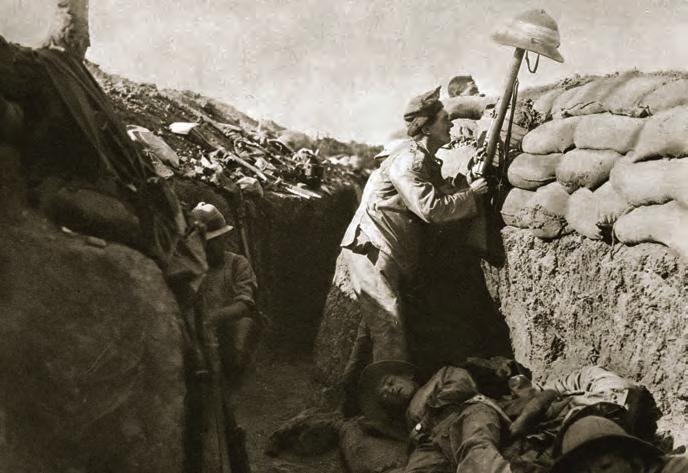
What do you see in this picture?
What does it make you think about what these soldiers are doing? What does it make you wonder about the experience of Australians at Gallipoli?
The Gallipoli campaign
UNCORRECTEDSAMPLEPAGES
Perhaps the best-known ANZAC (Australia and New Zealand Army Corps) contribution to the war was the Gallipoli campaign in 1915. Proposed by First Lord of the Admiralty Winston Churchill as a solution to break the stalemate of the Western Front, the campaign was intended to weaken Germany by attacking and defeating Germany’s newest ally, the Ottoman Empire (Turkey). It would also allow Allied troops and supplies to reach Russia and the Eastern Front through the Dardanelles.
stalemate a situation where opposing forces are deadlocked, so no winner is possible
Source 6.11.1 In the trenches at Gallipoli ➜
Source 6.11.2
Location of the Gallipoli campaign, showing the strategic advantage of the Turkish defenders. Scan the QR code to watch a video about the landings.
At 4.30 a.m. on 25 April 1915, the first of 16 000 Anzac troops landed at Ari Burnu (now known as Anzac Cove). The impact of the current, combined with poor navigation and the chaos of manoeuvring in the dark, meant that they landed approximately 2 km north of the intended site. Instead of a wide beach and a gentle slope up towards their objective, Hill 971, the Anzacs were faced with a narrow beach, steep cliffs and a small number of well-positioned Turkish defenders firing on them from all three sides.
By the end of the first day, Anzac forces had advanced a maximum of 900 metres inland, and their casualties amounted to 2000. The landings had been so disastrous that more than one British general considered evacuating immediately.
Source 6.11.3 British war correspondent, Ellis Ashmead-Bartlett, described the landing at Gallipoli.
UNCORRECTEDSAMPLEPAGES
The Australians rose to the occasion. Not waiting for orders, or for the boats to reach the beach, they sprang into the sea, and, forming a sort of rough line, rushed at the enemy’s trenches … The Australians found themselves facing an almost perpendicular cliff … Somewhere, about half-way up, the enemy had a second trench, strongly held, from which they poured a terrible fire on the troops below … [The Australians] proceeded to scale the cliffs without responding to the enemy’s fire. They lost some men, but did not worry
Suvla Bay
The Nek
TURKEY
AEGEAN SEA
Cape Helles
Dardanelles
Dardanelles
Krithia
Achi Baba
ANZAC
Lone Pine
Boghali Maidos
Chanak Kale
Tepe
There has been no finer feat in this war than this sudden landing in the dark and the storming of the heights, above all holding on whilst reinforcements were landing …
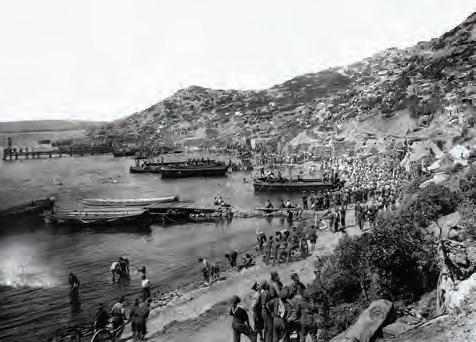
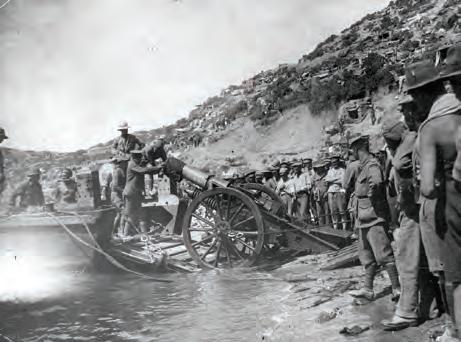
According to Ellis Ashmead-Bartlett, describe how the first waves of Anzacs reacted to the landing. Outline his portrayal of the Australian soldiers? Do you think this is a reliable version of events? Give reasons for your answer.
Using the information contained in Sources 6.11.3–6.11.5, describe the challenges experienced by Anzac troops attempting to land at Anzac Cove.
Historical concepts: Perspectives, Significance, Contestability Historical skills: Analysis and use of sources, Perspectives and interpretations, Communication
During the Gallipoli campaign, mortars, shrapnel shells, grenades and machine-gun fire inflicted heavy casualties on both sides, and snipers were an ever-present danger. Disease and extremes in weather often inflicted more casualties than the fighting as dehydration, lice, diarrhoea and dysentery spread due to the unsanitary conditions.
Despite being designed as a solution to the stalemate of the Western Front, the Gallipoli campaign quickly descended into a frustrating stalemate itself. In early August, the British High Command decided to launch a series of actions aiming to break out of the Gallipoli Peninsula. The August Offensive involved close-combat fighting in the Turkish trenches at Lone Pine, with the Anzacs eventually succeeding in capturing their objective, and a futile assault by men of the Light Horse on the Turkish trenches at The Nek. The August Offensive was eventually called off after the Allies suffered heavy losses for very little gain.
UNCORRECTEDSAMPLEPAGES
On 7 December, the Allies decided to evacuate all their forces from the Gallipoli Peninsula. This became the most successful aspect of the entire campaign. Under the cover of darkness 85 000 troops, 200 guns and other necessary supplies were evacuated off the Peninsula, unbeknownst to the Turkish defenders. Only about half a dozen casualties were recorded.
Source 6.11.4 Troops landing at Anzac Cove after the initial invasion, 1915 ➜
Source 6.11.5 Anzac troops manoeuvring a gun ashore at Anzac Cove, 1915
sniper a highly trained and skilled soldier who excels in shooting targets from long distances
Source 6.11.6 Video: The August offensive ➜
Ellis Ashmead-Bartlett, Daily Telegraph (London), April 1915
Writing focus 6.11
Transitional phrases
The last troops left in the early hours of 20 December. Most felt a mixture of pride and guilt as they sailed away from the shores of Gallipoli: pride for having proved their worth in battle, and guilt for having to leave the dead behind.
Gallipoli and Australian national identity
Australian casualties in the Gallipoli campaign amounted to 26 111 including 8141 deaths. Furthermore, it has been said that the campaign had no impact on the course of the war. However, despite being a military failure, the Gallipoli Campaign has become one of the most powerful and enduring symbols in Australian history, a foundational moment in the development of Australian national identity.
When Australia joined the war in 1914, many Australians still identified strongly with Britain and saw themselves as loyal members of the British Empire. Gallipoli marked the first major overseas campaign in which Australian troops fought as a distinct national force – the “Australian Imperial Force” or AIF. Although they served within a British-led command structure, Australians increasingly began to see their campaigns as their own experiences, separate from Britain. The conditions and heavy casualties experienced at Gallipoli created a shared sense of sacrifice and resilience amongst Australian soldiers. Newspapers and political and military leaders began to speak of the soldiers’ bravery, endurance and mateship as distinctly “Australian” qualities. It is often suggested that the Gallipoli campaign was the moment Australia “proved itself” on the world stage.
Teachers can go online to assign questions, view results, reports and more!
Outline the objectives of the Gallipoli campaign.
Describe the challenges faced by Allied forces at Gallipoli.
Outline the course of the campaign.
Explain why the Gallipoli campaign became so important in the development of Australian national identity.
Thinking and researching
In groups or as a class, research what life was like for soldiers at Gallipoli. Each group should consider the one of the following: the role of animals, the climate, the terrain, the soldiers’ shelter/food/health/hygiene/medical treatment, the fighting conditions/weaponry or the Turkish and other troops’ experience as compared to the Anzacs.
UNCORRECTEDSAMPLEPAGES
Combine the class research to create an engaging visual display for your classroom.
6.12 Australians on the Western Front
Learning intention
In this lesson, you will learn about Australian contributions to fighting on the Western Front in World War I.
Success criteria
❏ I can identify the significant battles in which Australians fought on the Western Front. ❏ I can explain how this participation contributed to the development of an Australian national identity
See, think, wonder What do you see in this map?
does it make you think about the Western Front during World War I?
does it make you wonder about the experiences of Australian servicemen on the Western Front?
Source 6.12.1 The Western Front, 1914–1918
After their evacuation from the Gallipoli Peninsula, the Australian forces were transferred to the Western Front, where the fighting between German and Allied forces had been bogged down in a stalemate since late 1914. In late 1916, the Germans built the Hindenburg Line, a heavily fortified line of trenches they considered to be impregnable and their last line of defence (see Source 6.12.1). The Allies on the Western Front fought to push the Germans back from this line.
Battles in which Australians fought
There were a number of key battles in which the AIF were involved.
Battle of Fromelles, 1916
The first major engagement on the Western Front involving Australian soldiers was at Fromelles on 19–20 July 1916. The newly arrived Australian 5th Division were part of a failed diversionary attack on heavily entrenched and experienced German positions. By the early hours of 20 July, there were 5533 casualties, including almost 2000 killed. This remains the single most devastating loss of life in one day in Australian military history.
UNCORRECTEDSAMPLEPAGES
Battle of Pozières, 1916
A few days after the Battle of Fromelles, the Australian 1st Division was tasked with attacking well-fortified German positions around the village of Pozières. Unlike the attack on Fromelles, the attack on Pozières was carefully planned and Australian soldiers were able to pin the German defenders down with machine-gun fire. The Australians captured their strategic objectives on 23 July 1916, but it was almost 50 days before their new position was secured. When they were withdrawn in early September, the Australians had lost 23000 men. What little respect the Australians had had for their British commanders prior to Fromelles and Pozières was all but gone after this.
Activity 6.12.1
Source analysis
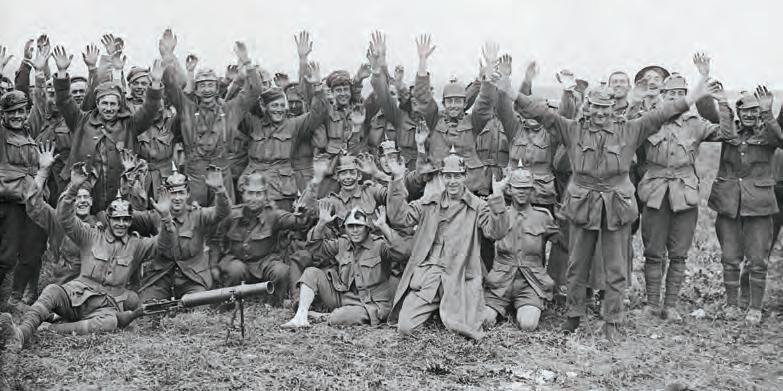
Source 6.12.2 Men of the 1st Anzac Division, some wearing German helmets, pose for the camera after fighting near Pozières, 23 July 1916.
Describe the mood of the soldiers in this photograph. How reliable is this source? Consider the purpose of taking a photograph like this. Why might it be acceptable for soldiers to collect souvenirs from the enemy, dead or alive? Give reasons to justify your answer.
Historical concepts: Perspectives, Contestability Historical skills: Analysis and use of sources, Perspectives and interpretations
Battle of Bullecourt, 1917
The Battle of Bullecourt (April–May 1917) was one of the most controversial and costly engagements fought by Australians on the Western Front. On 11 April, the 4th Australian Division was ordered to assault German positions with support from British tanks. Many of the tanks failed to reach the start line or broke down early in the attack, leaving the Australian infantry exposed to intense German machine gun fire. The Australians were forced to withdraw having suffered more than 3000 casualties and had large numbers taken prisoner.
The second battle in May, involving the 2nd Australian Division, eventually secured parts of the German line after weeks of brutal fighting. However, this cost the Australians another 4000 casualties.
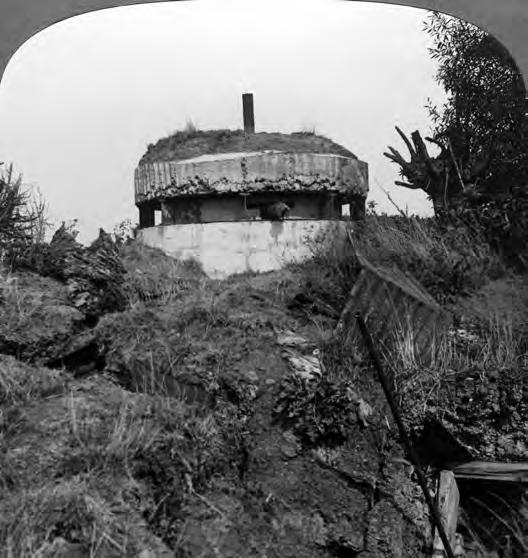
Source 6.12.3 A heavily defended German pillbox at Bullecourt, 1917
According to Charles Bean, an Australian War Correspondent,
“Bullecourt, more than any other battle, shook the confidence of Australian soldiers in the capacity of the British command; the errors, especially on April 10th and 11th, were obvious to almost everyone.”
Although less well-known than Gallipoli, Bullecourt contributed significantly to Australia’s wartime experience and the development of a national identity. Australian troops had demonstrated determination, endurance, mateship and resilience under extreme conditions.
Battle of Messines, 1917
The Battle of Messines in June 1917 was one of the most successful Allied operations on the Western Front. Its objective was to capture the strategically important Messines Ridge in Belgium, which overlooked British positions near Ypres. After months of tunnelling beneath German lines, Allied forces detonated 19 huge mines at the same time, devastating German defences and shocking troops on both sides. Three Australian Divisions took part in the following assault, advancing beneath a carefully planned creeping artillery barrage.
UNCORRECTEDSAMPLEPAGES
Unlike earlier offensives, Messines was well-coordinated and achieved its objectives within days. Once again, Australian soldiers had demonstrated that they were disciplined and effective soldiers, representing the growing professionalism and confidence within the AIF.
salient a bulge in the battle line that projects into enemy territory.
Surrounded by enemy on multiple sides, troops occupying a salient are vulnerable to being cut off and isolated from the main force
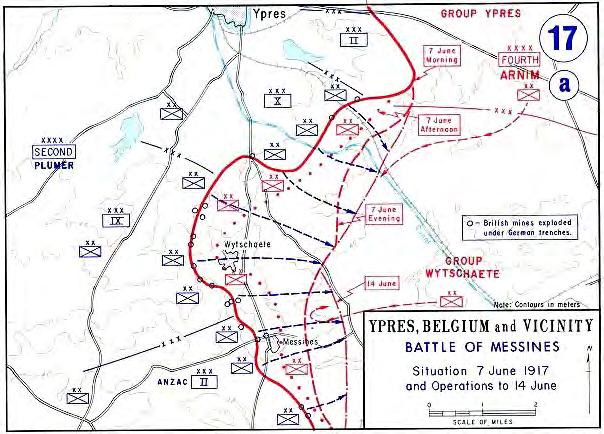
Source 6.12.4 A map showing the Allied advance at the Battle of Messines ➜
Battle of Passchendaele, 1917
The battle of Passchendaele (July–November 1917), also known as the Third Battle of Ypres, became infamous for its appalling conditions and heavy losses. Following their success at Messines, Allied commanders launched a broader offensive in the Ypres salient in Belgium. Relentless rain and constant shelling turned the battlefield into a sea of mud. Soldiers struggled through knee-deep mud under heavy artillery fire, and evacuation of the wounded was slow and exhausting. By the end of the campaign, there were approximately 38 000 Australian casualties. Although the village of Passchendaele was eventually captured, the strategic gains were limited.
Extension 6.12.1 Transporting the wounded at Passchendaele
Passchendaele became yet another symbol of the futility and horror of trench warfare. For Australians it served to further reinforce the emerging “national” characteristics of sacrifice, mateship and endurance under unimaginable hardship that Australian soldiers represented.
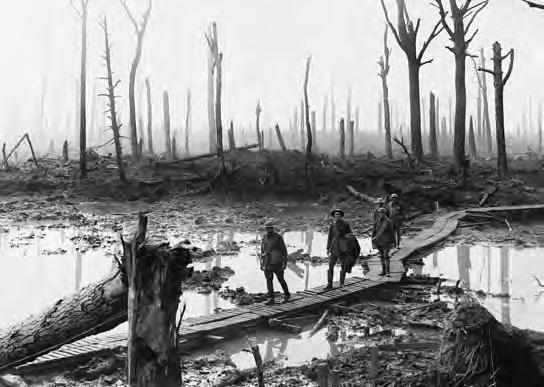
Source 6.12.5 The Battle of Passchendaele, 1917 ➜
Battle of Villers-Bretonneux, 1918
On Anzac Day 1918, Australian forces retook the French village of Villers-Bretonneux during the Spring Offensive. Villers-Bretonneux was a significant town because it overlooked Amiens, a strategically important city for Allied supply lines. It was captured by German forces on 24 April, but the Australians launched a daring night-time counterattack without preliminary artillery support, gradually encircling the town and recapturing it.
The victory came on the third anniversary of the Gallipoli landings, further strengthening the symbolic links between the Western Front and the emerging Anzac Legend. The Australians had demonstrated courage, initiative and professionalism. Today, the Australian National Memorial stands near the town, commemorating more than 10 000 Australian soldiers who died in France and have no known grave.

Battle of Hamel, 1918
The town of Hamel was key to the defence of the important city of Amiens and would allow the Allies to launch counter-offensives against German positions. General Sir John Monash, Commander of the Australia Corps, planned the attack to take the form of an infantry assault, but with significant tank, artillery and aircraft support.
UNCORRECTEDSAMPLEPAGES
The Battle of Hamel was described as a brilliant success. In exactly 93 minutes, all objectives were obtained. Combined Allied losses totalled 1400 killed or wounded. Of that number, Australian troops suffered 1062 casualties, with 800 killed. This was relatively low when compared to the devastating losses of the previous year.
Spring Offensive a series of major attacks launched by Germany from March 1918 on the Western Front after Russia’s withdrawal from the war in late 1917 ended fighting on the Eastern Front
Source 6.12.6 The Australian National Memorial at Villers-Bretonneux ➜
The Battle of Hamel is seen as a textbook battle because Monash effectively used every weapon and innovation at his disposal in a truly coordinated and meticulously planned attack. He established a template that every other Allied commander would apply to devastating effect in the last months of the war.
The Battle of Hamel also marked the first involvement of American troops in the war.
6.12.2
Source analysis
Source 6.12.7 Comment from French President Georges Clemenceau upon visiting Australian troops after the Battle of Hamel
I shall go back tomorrow and say to my countrymen: “I have seen the Australians. I have looked into their eyes. I know that they, men who have fought great battles in the cause of freedom, will fight alongside us, till the freedom for which we are all fighting is guaranteed for us and our children.”
Source 6.12.8 Comment from Australian War Memorial senior historian, Dr Aaron Pegram
Quoted in C. Hunter, Remembering the Battle of Hamel, 4 July 2018. Accessed from https://www.awm.gov.au/articles/blog/the-battle-of-hamel-100-years-on
How did President Georges Clemenceau describe the Australian troops at Hamel (Source 6.12.7)?
In Source 6.12.8, explain what you think Dr Pegram means by the “recent myth that Monash’s tactics helped bring an end to the war and helped save lives”?
In your opinion, does the high casualty rate of the Australian Corps under Monash’s command detract from the significance of the Battle of Hamel? Give reasons to justify your answer
Historical concepts: Perspectives, Significance, Contestability Historical skills: Analysis and use of sources, Perspectives and interpretations
Battle of Amiens, 1918
There has been a recent myth that Monash’s tactics helped bring an end to the war and helped save lives, but we have to keep in mind that the Australian Corps still suffered casualties in these costly but successful actions … Although successful, the Australian Corps under Monash’s command loses about 35 000 men – dead, missing and wounded. Extension
6.12.2 Battle of Hamel
UNCORRECTEDSAMPLEPAGES
On 8 August British, Australian and Canadian soldiers led the Allied counter-offensive at Amiens, marking a turning point in the war on the Western Front. The attack achieved dramatic results. Large sections of German lines were broken, thousands of German prisoners were taken and significant territory was regained. German General Ludendorff famously called this astonishing defeat “the black day of the German army in this war”.
Although the Australians suffered around 6500 casualties, the Battle of Amiens was one of the most successful operations involving Australian forces during World War I. Australians were seen as innovative, disciplined and highly effective.
Georges Clemenceau, address to the Diggers after the victory at the Battle of Hamel
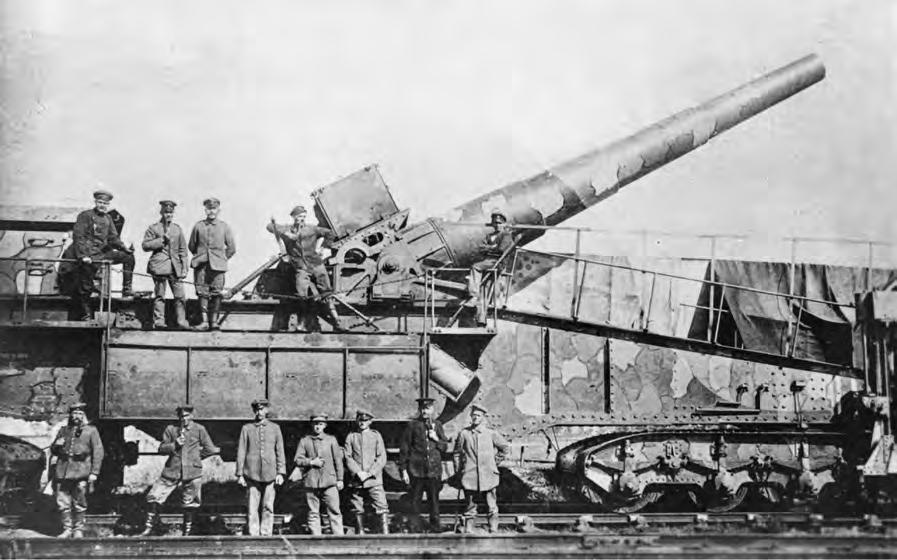
Source 6.12.9 The “Amiens Gun” with its German crew shortly before it was captured by the 5th Australian Division during the Battle of Amiens in August 1918. The barrel is now on display at the Australian War Memorial.
The Hundred Days Offensive, 1918
The period between the Battle of Amiens and the end of the war is known as the Hundred Days Offensive. The Allies, with the Australians playing a crucial role, continued to push the Germans back, and eventually broke through the Hindenburg Line in early October. It was at this point that General Ludendorff came to the realisation that defeat was inevitable and made the recommendation that the German Government seek to sign an armistice with the Allies. The armistice came into effect at 11 a.m. on 11 November 1918. People rejoiced throughout the world at the announcement.
UNCORRECTEDSAMPLEPAGES
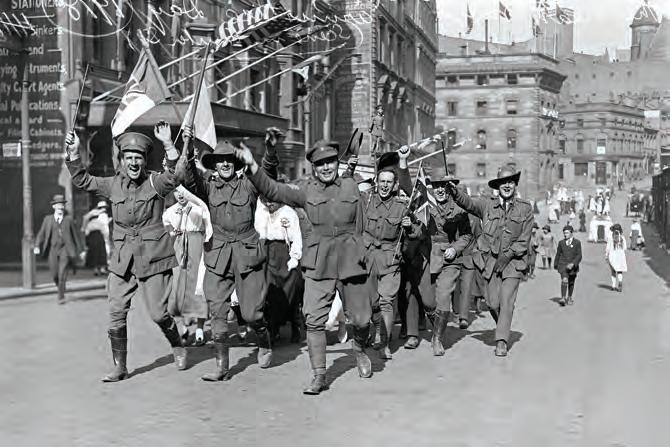
Australian soldiers in Flanders
Source 6.12.10 Video: Extracts from The Australians’ Final Campaign in 1918 ➜
The Western Front and Australian national identity
During their time in France and Belgium, Australian soldiers earned a reputation as good fighters who could get the job done. They also earned a reputation among some British officers for poor discipline and for disrespecting authority. British officers usually originated from the upper classes. Due to England’s rigid class structure and their privileged upbringing, these officers demanded a more subservient attitude from “common soldiers”. This was something that many Australian soldiers weren’t prepared to give the officers.
Just like at Gallipoli, Australian soldiers had proven themselves on the world stage by holding their own on the Western Front, demonstrating the characteristics that we now associate with the Anzac Legend and Australian national identity.
Knowledge and understanding
Identify the key battles in which Australian soldiers fought on the Western Front.
Identify the characteristics demonstrated by Australian soldiers on the Western Front.
Describe what kind of reputation Australian soldiers earned during their time on the Western Front.
Explain the symbolic link between Gallipoli and the Western Front.
Discuss how Australian involvement in key battles on the Western Front contributed to the growing Australian national identity and ANZAC Legend.
Investigate and write an extended response on the involvement of the Australian Light Horse in the Middle Eastern campaign, 1916–1918 and create an informative display for a museum exhibit.
Research the following aspects of the campaign:
• the location and outcome of important battles, such as the attack on Beersheba in 1917
• the objective of the campaign
• the nature of warfare in this campaign
• the course and outcome of the campaign
• how the campaign might have contributed to the emerging Australian national identity and ANZAC Legend.
You should include a timeline, maps, images and sources (visual and written) that reflect Australian and Arab perspectives of the campaign to include in your display. Your response should be engaging, wellpresented and informative.
6.13 Site study: World War I War Memorial
Learning intention
In this lesson, you will learn about the World War I War Memorial(s) in your community.
Success criteria
❏ I can explain the significance of the World War I memorial(s)s in my community.
❏ I can describe the main features of the design of the memorial.
Starter activity
Discussion on the purpose of war memorials
Anzac Day is traditionally marked by a dawn service held at a local war memorial to coincide with the time of the original Gallipoli landings.
• Why do you think war memorials are important structures for communities to gather around?
• What purpose do war memorials serve as reminders of past conflicts?
Source 6.13.1 The central Cenotaph, or “empty tomb” after the morning Dawn Service on 25 April 2024 in Hobart
UNCORRECTEDSAMPLEPAGES
Almost every city and town in New South Wales contains a war memorial, funded and constructed by the local inhabitants to remember and honour the service of members of their community.
Your task is to visit your local war memorial and answer these following questions.
Source 6.13.2 The Duke of Sussex waits to unveil a plaque, as New South Wales Premier Gladys Berejiklian speaks during the official opening of the refurbished Anzac Memorial at Hyde Park, Sydney, 20 October 2018.
Site study questions 6.13
What does it commemorate? For example, specific battles or conflicts, particular individuals, branches of the armed forces.
When was it constructed?
Who does it commemorate? All those who served or just those who died in combat? Servicewomen and nurses as well or just servicemen?
How was it funded? Was it paid for by the local council? Community donations? Government grants?
Why was it built? Was there a specific purpose for its construction? Was it built by a local school to commemorate former students who served?
What are the main features of the memorial’s design? Does it contain common symbols found on most memorials throughout Australia, such as plinths, arches, obelisks, captured enemy guns, etc.?
UNCORRECTEDSAMPLEPAGES
What is the significance of this memorial to the local community? How is it used for commemorative events such as Anzac Day, Remembrance Day and other local events? Where is it located – central to the town or on a road approaching town? Is it located at a historically significant site in the town? (Your local RSL, library, or historical society may be able to assist in this regard. www.trove.nla.gov.au also contains historical newspapers that might provide valuable information).
You should also take some photos to include in your finished work, which can be presented however you choose.
Historical concepts: Continuity and change, Perspectives, Significance Historical skills: Analysis and use of sources, Perspectives and interpretations, Research, Communication
6.14 Civic and humanitarian response during World War I
Learning intention
In this lesson, you will learn about how Australian civilians supported the war effort through volunteering, fundraising and providing medical support.
Success criteria
❏ I can outline how Australian women contributed to the war effort.
❏ I can describe how fundraising and volunteer organisations like the Australian Red Cross supported the war effort.
See, think, wonder
What do you see in Source 6.14.1?
What does it make you think about the challenges faced by humanitarian and medical services?
What does it make you wonder about the help that might be available to soldiers?
UNCORRECTEDSAMPLEPAGES
World War I reshaped life on the Australian home front. Across the country, civilians mobilised to support soldiers overseas, care for the wounded and assist families impacted by the war. Voluntary organisations, medical services and fundraising movements became central to Australia’s national war effort. This civic and humanitarian response reflected the widespread patriotism and loyalty to the British Empire still held in Australia. It also strengthened ideas of Australian citizenship, service and national responsibility.
Source 6.14.1 An ambulance wagon struggling in the mud in Gully Ravine, Gallipoli 1915 ➜




Source 6.14.2 An artist’s representation of an Australian nurse ➜
6.14.3 A field
Australian nurses
Like the young men who rushed to enlist in the early days of the war, Australian women were eager to contribute. They were more restricted than men by their “traditional” role in society at the time, so the only way they could get close to the action was to serve as nurses.
For many nurses, their wartime experience was transformative. It provided independence, international experience and professional recognition. Treating casualties in field hospitals and on hospital ships was both traumatising and overwhelming, but nurses cared for sick, injured and dying soldiers with care, compassion and tenderness. Conditions were often dangerous and exhausting. Even removed from the frontlines, they were not immune to the dangers: 13 nurses were killed during the war.
UNCORRECTEDSAMPLEPAGES
Source analysis
Source 6.14.4 A nurse’s description of the aftermath of the Gallipoli landing, 25 April 1915 ➜
They came in an endless stream, some walking holding arms, hands covered with blood, some on stretchers with broken legs, some shivering and collapsed through loss of blood and some with faces streaming with blood … we went for the worst cases first and worked like fury while all the sound of firing was going on … we took onboard 750 wounded … we filled every space, mattresses lying everywhere on deck … we got to bed between 2 and 3am.
Quoted in Oppenheimer, M., 2008, Australian Women and War, Department of Veterans’ Affairs, Canberra, p. 28
How does the nurse describe the volume of wounded coming aboard the hospital ship?
Describe what kinds of emotions these nurses might have been experiencing in the aftermath of such battles.
Explain how useful this source might be to a historian studying both the experiences of women and the Gallipoli landing.
Historical concepts: Perspectives Historical skills: Analysis and use of sources, Perspectives and interpretations
Source
station on the Western Front, in the nave of a rural church, 1915 ➜
The Australian Red Cross Society
The Australian Red Cross Society was established in 1914, just days after war was declared. Originally created as a branch of the British Red Cross, it quickly expanded across Australia.
Members of the Red Cross Society raised funds to organise and send thousands of items of clothing and food parcels to Australian soldiers and POWs. They also established the Wounded and Missing Enquiry Bureau, run by Vida Goldstein, a prominent suffragist, social reformer and magazine editor. By 1918, hundreds of thousands of Australians – most of them women – were involved in Red Cross activities. Volunteers knitted socks, prepared bandages, raised funds and worked in depots.
By the end of the war, there were 2200 branches across Australia and 102 000 members – 82 000 of which were women. The scale of the organisation demonstrated the depth of civilian commitment to supporting the war effort. The organisation’s success strengthened the idea that supporting the war was a shared civic responsibility. It also expanded women’s roles beyond domestic life, contributing to shifting attitudes to women’s capabilities and leadership.
Australian Comforts Fund
UNCORRECTEDSAMPLEPAGES
The Australian Comforts Fund (ACF) was founded in 1916 and unified state-based patriotic groups into a national system. It represented one of the largest voluntary wartime organisations in Australia. Members of the ACF fundraised and organised “comfort boxes” to cheer the soldiers up – these included luxury items that members of the AIF otherwise went without, such as tobacco, soap and toiletries, writing paper, small food items and handknitted scarves and socks. The steady supply of clean, dry socks helped to counter the effects of trench foot
The items the ACF sent to soldiers were not essential for survival, but they boosted morale and reminded soldiers they were supported and appreciated at home. The emphasis on morale highlights an important aspect of the war. Victory depended not only on weapons and strategy, but also on maintaining the morale and emotional resilience of soldiers.
Writing focus 6.14
The language of source analysis
Source 6.14.5 A Red Cross Society poster used for fundraising, 1918 ➜
Source 6.14.6 Junior Red Cross workers knitting and spinning at Coonamble Public School, NSW, 1918. ➜
trench foot a medical condition caused by prolonged exposure of the feet to damp, unsanitary and cold conditions
Throughout the war, Australians organised hundreds of thousands of fundraising events. Patriotic funds collected money for soldier’s families, hospitals and medical supplies, prisoners of war and returned servicemen. Schools, churches, sporting clubs and local councils all participated, and public events such as concerts, fetes and donation drives became common. Occasionally, debates emerged about how the money should be allocated, and some critics argued that welfare was the government’s responsibility, not that of voluntary charity. Despite this, relief movements strengthened the shared sense of sacrifice. Civilians felt personally connected to the war effort and soldiers overseas, reinforcing the idea of a unified national Australian community.
can go online to assign questions, view results, reports and more!
Identify the various methods used by charity organisations to collect funds.
Outline the role of the Australian Red Cross Society.
Outline the importance of comfort boxes to an Australian soldier’s morale.
Describe the experience of nurses during the war.
Discuss the various ways in which women contributed to the war effort.
Lyons to discover how her public life was shaped by a legacy of wartime civic action. Create a written report of your findings.
UNCORRECTEDSAMPLEPAGES
6.15 The democratic process during World War I
Learning intention
In this lesson, you will learn about how the federal election campaigns and referendums that took place during World War I showcased Australia’s commitment to the democratic process.
Success criteria
❏ I can outline the key political debates that took place in Australia during World War I.
❏ I can explain how Australia followed democratic processes during the war.
❏ I can list the reasons used for and against conscription in referendums.
See, think, wonder
Writing focus 6.15
Transitional phrases
World War I placed enormous pressure on Australian society as civil liberties were restricted under the War Precautions Act 1914 and political divisions deepened. Yet despite these challenges, the democratic process did not collapse during the war. Australia continued to hold Federal elections and national referendums and democratic participation remained central to Australian political life during the war.
During the war, special arrangements were made to allow AIF soldiers serving overseas to vote, including the expansion of postal voting and absentee voting systems. Australia already had relatively advanced voting rights, but this was significant. Even as men fought overseas, they could participate in the democratic process and shape national policy.
UNCORRECTEDSAMPLEPAGES
However, it is worth noting that not all Australians were able to participate equally in this democratic process. Many Aboriginal and Torres Strait Islander Peoples were excluded from voting in practice, women could vote federally but were under-represented in Federal Parliament, and political surveillance under the War Precautions Act 1914 limited freedom of speech and public opposition to the war in election campaigns.
The 1914 federal election
The 1914 Australian federal election was held in September, just one month after war was declared. Prime Minister Andrew Fisher led the Labor Party into the election with a strong pro-Empire rhetoric, promising that Australia would support the British war effort “down to the last man and the last shilling”.
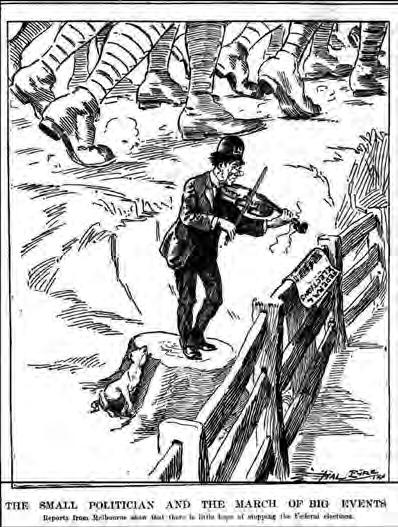
➜
Source 6.15.2 “The small politician and the march of big events. Reports from Melbourne show that there is little hope of stopping the Federal elections”, cartoon published in The Daily Telegraph, Sydney, 7 August 1914
The election campaign was dominated by patriotic sentiment with both major parties supporting participation in the war. There was little open debate about whether Australia should fight. Instead, the campaign focused on leadership, economic management and wartime responsibility.
Labor won a decisive victory, forming a majority government in both houses of Parliament. The result suggested strong public support for the government’s handling of the early war effort. Even in the first months of a global conflict, Australia did not suspend its democratic process.
The conscription debate
The conscription debate of World War I had a bitterly divisive impact on Australian society. Thousands of Australian men enlisted in the AIF at the start of the war, but as casualty lists grew, enlistment numbers declined. In the early stages of the war, ignorance of the reality of modern warfare played a crucial role in the eagerness of many men to rush and enlist.
Source analysis
Enlistments
Enlistments
Total Battle Casualties
Total Battle Casualties
Jan.-Mar. 1916 Apr.-June
Jan.-Mar. 1916 Apr.-June
Sources: E.Scott, Australia During the War, Sydney, Angus and Robertson, 1936), p. 871-2., and A. G. Butler, The Official History of the Australian Army Medical Services, 1914 - 1918, vol. III, Special Problems and Services, Canberra, Australian War Memorial, 1943, p. 911, Table 41. July-Sept.Oct.-Dec.Jan.-Mar. 1917 Apr.-JuneJuly-Sept.Oct.-Dec.Jan.-Mar. 1918 Apr.-JuneJuly-Sept.Oct.-Dec.
Sources: E.Scott, Australia During the War, Sydney, Angus and Robertson, 1936), p. 871-2., and A. G. Butler, The Official History of the Australian Army Medical Services, 1914 - 1918, vol. III, Special Problems and Services, Canberra, Australian War Memorial, 1943, p. 911, Table 41. July-Sept.Oct.-Dec.Jan.-Mar. 1917 Apr.-JuneJuly-Sept.Oct.-Dec.Jan.-Mar. 1918 Apr.-JuneJuly-Sept.Oct.-Dec.
Source 6.15.3 Enlistments and casualty figures from 1916 to 1918. From “Going to war 1914–18: the view from the Australian Parliament”. A Parliamentary Library Lecture delivered by Professor Joan Beaumont, Strategic and Defence Studies Centre, ANU College of Asia and the Pacific, The Australian National University on 19 March 2014
Source 6.15.4 Enlistments by year
AG Butler, Special problems and services: the official history of the Australian Army Medical Services in the war of 1914–1918, vol. III (AWM, 1943, p. 889)
UNCORRECTEDSAMPLEPAGES
Identify the year with the highest number of enlistments. Use the information in the table (Source 6.15.4) to construct a bar graph showing Australian enlistment figures for each year of the war. Describe the overall trend of enlistments during the course of the war.
Using evidence from the sources, discuss possible reasons for the decline in enlistments after 1915.
Historical concepts: Cause and effect, Significance Historical skills: Comprehension – chronology, terms and concepts, Analysis and use of sources, Perspectives and interpretations, Communication
Following a tour of Britain and France, Prime Minister William “Billy” Hughes (in office 1915–1923) was convinced that conscription was needed to maintain Australia’s fighting strength and uphold the commitment to support Britain. If the Australian public voted yes in a referendum*, he would pressure the Federal Parliament to pass the bill.
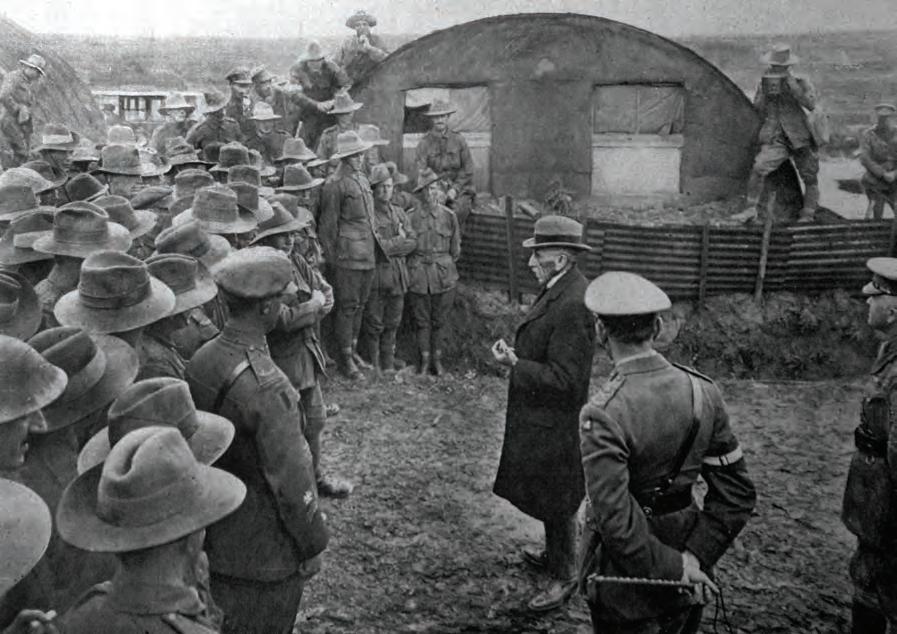
UNCORRECTEDSAMPLEPAGES
*It is worth noting that although the two public votes held about conscription are commonly referred to as referendums, they were technically plebiscites. A referendum is a national “yes” or “no” vote to change the Constitution, while a plebiscite is used to decide a national question that is not related to the Constitution. However, as a plebiscite may also be called an “advisory referendum”, and much of the documentation surrounding these votes also said “referendum”, we will continue to use the term “referendum” in this chapter.
Hughes found a range of supporters for conscription from many backgrounds. These included:
• soldiers who wanted fresh recruits to aid the cause
• the Anglican Church, which was loyal to the British Empire
• many upper and middle-class Australians with close ties to Britain who viewed the “No” vote as unpatriotic
• some business owners who stood to profit from the war
• some women’s groups, such as the Women’s National League and the Women’s Christian Temperance Union, who wanted support for those already serving.
Source 6.15.5 Australian Prime Minister Billy Hughes visiting Australian troops on the Western Front, 1918 ➜
Not everyone agreed and several groups arose who opposed conscription.
These included:
• Irish Catholics, led by the Archbishop of Melbourne (Daniel Mannix), who opposed the war
• some trade unionists and socialists, who believed conscription would benefit rich capitalists at the expense of the working class
• wives and mothers who did not want their husbands or sons sent overseas to potentially die in battle
• those who felt that it was undemocratic to force young men to fight in a war that did not directly threaten Australia
• farmers who were worried that conscription would deprive them of essential workers
• soldiers who did not want anyone forced to fight against their will.
The first referendum
The first referendum was held in October 1916. Both sides passionately and emotionally argued their cause in newspaper articles, political addresses and on billboards.
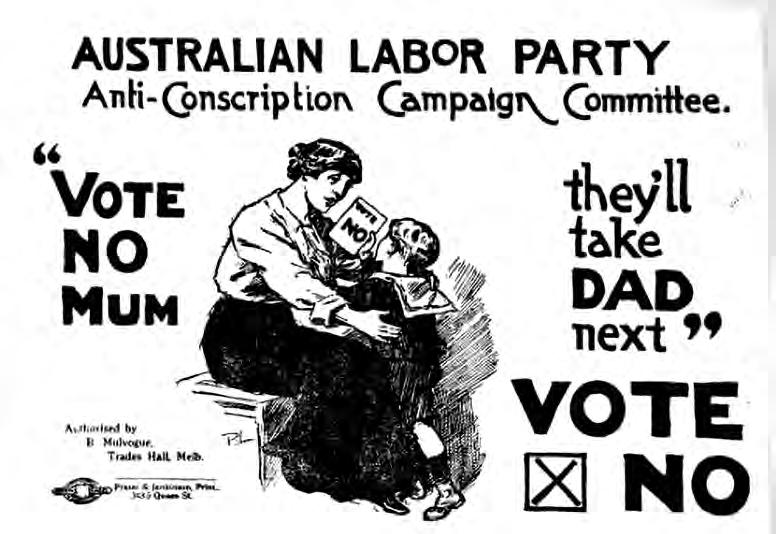
Source 6.15.6 A Labor Party advert during the conscription debate ➜
The “no” vote won by just 3.2%. The fallout included political pain for Hughes as his own party (the Australian Labor Party) strictly opposed conscription. In November 1916, Hughes and other pro-conscription parliamentarians formed their own party (the National Labor Party) and campaigned on strong support for the war and national unity.
UNCORRECTEDSAMPLEPAGES
Extension
16.15.1
Sources on the conscription referendums
The second referendum
As the war progressed, only around 4500 men were enlisting per month, despite the government’s huge recruitment drive. This fell far short of Hughes’ goal of 16 000 per month. Still convinced that conscription would solve this problem, Hughes decided to hold a second conscription referendum in December 1917.
Hughes’ government adopted underhanded tactics to try to guarantee a “yes” result, including closing the polls after just two days, preventing anyone with a German-born father from voting, and censoring anti-conscription propaganda. Despite this, the “no” vote won again, this time by an even larger margin. Thus, the AIF remained one of the few completely voluntary armies fighting in WWI.
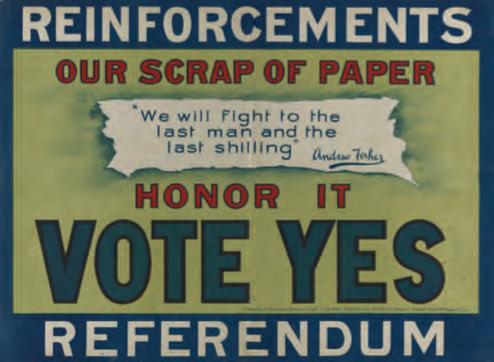
Source 6.15.7 A pro-conscription poster produced for the second referendum in December 1917
UNCORRECTEDSAMPLEPAGES
The 1917 federal election
In May 1917, shortly after the first conscription referendum, the 1917 Australian federal election was held.
➜
Source 6.15.8 The Nationalist Party positions itself as the “Win-the-War” party in 1917 and outlines repatriation policies for returned men.
Source 6.15.9 A returned soldier explains his support for the Australian Labor Party campaign, claiming Labor as the party to “win the war”.
Hughes’ Nationalist Party promoted itself as the “win the war” party and won a decisive election victory, despite the country’s rejection of conscription. This result reflected voter frustration with internal Labor divisions and ongoing wartime challenges, but demonstrated that voters could distinguish between supporting the war effort and supporting compulsory service.
The continuation of democratic processes in World War I became part of Australia’s developing character – a nation forged not only in battle, but also in the ballot box. Australia’s rejection of conscription demonstrated that the nation would not automatically follow Britain’s policies (Britain introduced conscription in 1916). Furthermore, the conscription debates had revealed a politically engaged population. Australians actively debated questions of citizenship, obligation, class, religion and national loyalty.
and understanding
Knowledge and understanding
Define the term “conscription”.
Identify the groups who supported and those who opposed the introduction of conscription. Discuss why Prime Minister Billy Hughes wanted to introduce conscription.
Explain how the 1914 and 1917 federal elections demonstrated Australia’s commitment to democratic process, even in wartime.
Explain why the National Party (which was pro-conscription) won the 1917 federal election despite having lost a conscription referendum.
Thinking and researching
Research four examples of Australian posters from the 1916 and 1917 conscription campaigns. You should try to find two anti-conscription and two pro-conscription posters.
For each poster, identify the author or creator, date of publication, audience, message and technique. Compare and contrast the effectiveness of the anti-conscription and pro-conscription posters.
Historical concepts: Perspectives, Contestability Historical skills: Comprehension – terms and concepts, Analysis and use of sources, Perspectives and interpretations, Research
UNCORRECTEDSAMPLEPAGES
6.16 The Anzac legend
Learning intention
In this lesson, you will learn about the creation of the Anzac legend, its purpose and its significance in the Australian consciousness.
Success
criteria
❏ I can explain what the Anzac legend represents to Australians past and present.
❏ I can discuss the different perspectives of the Anzac legend or the Anzac myth.
See, think, wonder
What do you see in Source 6.16.1?
What do you think about how Anzac Day represents Australian national identity?
What do you wonder about how Australian national identity is represented and celebrated in today’s multicultural society?
Source 6.16.1 Veterans and relatives celebrating the centenary of the Anzac landing of 1915, during the Anzac Day Parade on 25 April 2015, Sydney, Australia
UNCORRECTEDSAMPLEPAGES
One of the most significant legacies of Australian involvement in World War I was the “Anzac legend”. Born out of the bravery, suffering, successes and defeats of the Gallipoli campaign, the legend grew during the remainder of the war and has since played an important role in promoting an idealised version of Australia’s national identity. Over time, Gallipoli has become shorthand for Australia’s national values and represented the moment the nation “came of age”. The story has been retold and reinforced across generations through marches, dawn services and memorials.
Although Australia Day is on 26 January, many social commentators consider Anzac Day (first observed on 25 April 1916, one year after the landing at Gallipoli) to be Australia’s true national day.
According to Australia’s official World War I correspondent and historian, CEW Bean,
“ANZAC stood and still stands for reckless valour in a good cause, for enterprise, resourcefulness, loyalty, fidelity, comradeship and endurance that will never own defeat.”
In addition to Bean’s definition, the qualities most commonly associated with the Anzac legend are courage, endurance, mateship and sacrifice. Other characteristics identified and emphasised include an independent spirit, resourcefulness, a larrikin sense of humour, stoicism and egalitarianism.
The legend has become so important to how we see ourselves as a nation, that anyone who criticises the legend frequently comes under attack and is labelled “un-Australian” and lacking respect.
Myth and debate
Historians still fiercely debate the extent to which Gallipoli “created” Australian national identity. Some argue that the sense of national consciousness had developed before 1914 through Federation, industrial struggles, immigration debates and defence concerns. Others suggest the importance of Gallipoli has been exaggerated in the decades since the war and the Anzac Legend can overshadow other aspects of Australian history that contribute to national identity. More recently, historians have examined how political leaders have invoked Gallipoli to promote unity or patriotism, and it continues to shape discussions about what it means to be Australian.
In Activity 6.16.1, you will be considering some perspectives on the Anzac legend.
Source analysis
Activity 6.16.1 Source 6.16.2 Historian David Kent comments on a difference between Bean’s diary and his published work ➜

veterans on ANZAC Day
Source 6.16.5 Former Prime Minister Paul Keating criticised the Anzac legend in 2008. ➜
The truth is that Gallipoli was shocking for us. Dragged into service by the imperial government in an ill-conceived and poorly executed campaign, we were cut to ribbons and dispatched. And none of it in the defence of Australia. Without seeking to simplify the then bonds of empire and the implicit sense of obligation, or to diminish the bravery of our own men, we still go on as though the nation was born again or even was redeemed there. An utter and complete nonsense. For these reasons, I have never been to Gallipoli and I never will.
Source 6.16.6 In the epilogue to their book What’s Wrong with Anzac?, Australian historians Henry Reynolds and Marilyn Lake consider the key premise of the Anzac legend.
In the myth of Anzac, military achievements are exalted above civilian ones; events overseas are given priority over Australian developments; slow and patient nation-building is eclipsed by the bloody drama of battle; action is exalted above contemplation. The key premise of the Anzac legend is that nations and men are made at war. It is an idea that had currency a hundred years ago. Is it not time to cast it aside?
Reynolds, H. and Lake, M., “Moving on” in What’s Wrong with Anzac? 2010, NewSouth Books, Sydney, p. 167
Intriguingly, these do not mirror exactly the values that the original Anzacs embraced. They were often staunch British imperialists and prided themselves on being effective killers – something we tend to forget today when soldiers are often depicted as victims of catastrophe and trauma. But these values are arguably those which Australian society needs to affirm in the 21st century when, for all our materialism and rampant individualism, we still need at least some individuals to volunteer to subordinate their personal interests to the collective good. Anzac, in this sense, can validate not only the men and women of the Australian Defence Force who are the direct heirs of the legend of Gallipoli, but also the service of police officers, civil defence forces and fire fighters. Source 6.16.7 Historian Joan Beaumont looks at the legend in a 2015 article for The Sydney Morning Herald
The question of Anzac’s significance for multicultural Australia generated considerable heat in 2011. A report of the official National Commission on the Commemoration of the Anzac Centenary suggested that Australia’s military history was “something of a double-edged sword”. The centenary might provide opportunities for a great sense of national unity but it might also prove “a potential area of divisiveness”. The community simply did not know what recently arrived Australians thought about the commemorations, but the centenary commemorations should be “culturally sensitive and inclusive.”
The legend is also, and primarily, about values and ways of imagining the national identity. These values … are currently courage, endurance, sacrifice and mateship.
UNCORRECTEDSAMPLEPAGES
Beaumont, J., “Is the Anzac legend still the core of Australia’s national identity?”, The Sydney Morning Herald, 21 April 2015
Paul Keating, speaking at a book launch for Churchill and Australia by Graham Freudenberg, 30 October 2008
Complete the following table in your books:
Source
Discuss how Source 6.16.2 assists our understanding of Bean’s motivations in creating the Anzac legend.
Identify former Prime Minister Paul Keating’s perspective on the Gallipoli campaign.
Identify which perspective of the Anzac legend you most agree with and briefly explain why.
Explain how Sources 6.16.3 and 6.16.4 differ.
Writing focus 6.16
Transitional phrases
Discuss how Source 6.16.6 critiques the militaristic nature of the Anzac legend. How does Source 6.16.7 explain the relevance of the Anzac legend in contemporary multicultural Australia?
Historical concepts: Continuity and change, Perspectives, Significance, Contestability Historical skills: Analysis and use of sources, Perspectives and interpretations
Knowledge
Identify the year in which the first Anzac Day ceremony was held.
Identify the common characteristics associated with the Anzac Legend.
Discuss what was left out of the Anzac legend and why.
Explain why the concept of “mateship” is associated with the Anzac legend.
Explain why the label “un-Australian” is commonly applied to people who criticise the Anzac legend.
Write a speech about what the term “Anzac Legend” or “Anzac Myth” means to you.
Teachers can go online to assign questions, view results, reports and more!
UNCORRECTEDSAMPLEPAGES
6.17 The impact of Federation and World War I on different groups in Australia
Learning intention
In this lesson, you will learn about the effects of Federation and World War I on different groups in Australia.
Success criteria
❏ I can outline the impact of Federation and World War I on Aboriginal and Torres Strait Islander Peoples.
❏ I can explain how the White Australia policy was formed and identify its impacts.
❏ I can discuss the impact of Federation and WWI on women in Australia.
See, think, wonder
What do you see in Source 6.17.1?
What does it make you think about Aboriginal and Torres Strait Islander Peoples’ military service?
What does it make you wonder about why they are marching in June, and not on Anzac Day?
UNCORRECTEDSAMPLEPAGES
Source 6.17.1 Aboriginal ex-servicemen march to the War Memorial at Hyde Park, for a special service being held as part of National Aborigines Day, 11 July 1969.
Federation and World War I did not have an equal impact on all Australians. While some groups experienced expanded opportunities and stronger feelings of national belonging, others faced exclusion, discrimination and limitation of their rights, exposing the unequal nature of early Australian citizenship.
Aboriginal and Torres Strait Islander Peoples
Constitutional exclusion
Section 51 and Section 17 of the Constitution that excluded Aboriginal and Torres Strait Islander Peoples from Federal law and census data were overturned in a 1967 referendum. However, the recognition of Aboriginal and Torres Strait Islander Peoples within a preamble to the constitution is still being debated to this day, along with considerations of a treaty. The racial inequality that was created by early constitutional exclusions still exists, with structural disadvantage and lack of educational and economic opportunities for Aboriginal and Torres Strait Islander Peoples still commonplace.
Participation in World War I
The Australian War Memorial estimates that between 1000 and 1300 Aboriginal and Torres Strait Islanders served in the AIF, with approximately 250 making the ultimate sacrifice. However, it is difficult to provide an exact figure because they did not record their ethnicity on recruitment forms. During the initial months of the war, many Aboriginal and Torres Strait Islanders were rejected for enlistment based on their skin colour and race. As the war progressed and enlistment figures declined, such restrictions were relaxed or overlooked. In 1917, exceptions were made to allow Aboriginal and Torres Strait Islander individuals with mixed heritage to enlist, as long as the medical officer was able to determine that at least one parent was of European origin.
Aboriginal and Torres Strait Islander Peoples served in every Australian campaign during the war. For the most part it is believed that they did not experience the same prejudice and discrimination they suffered while in Australia. Perhaps this was a result of the horrendous conditions and struggle to survive. It could also be that the values of mateship and teamwork were more important in the trenches than skin colour and ethnic background.
Writing focus 6.17
Creating topic sentences
UNCORRECTEDSAMPLEPAGES
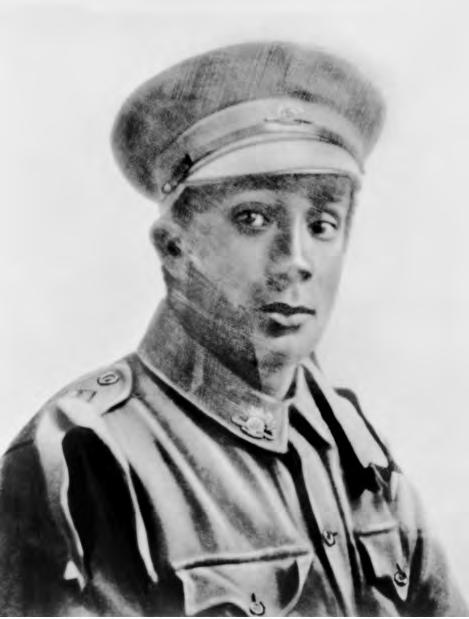
Despite their loyalty and service to the nation, upon returning to Australia after the war Aboriginal and Torres Strait Islander soldiers experienced the same levels of prejudice and discrimination as in the pre-war period. Even though a few Aboriginal and Torres Strait Islander soldiers earned official military recognition for individual acts of bravery, their overall contribution and sacrifice to the war effort went unrecognised and unrewarded. It is not surprising, therefore, that many Aboriginal and Torres Strait Islander servicemen chose not to march during Anzac Day commemorations.
Source 6.17.2 Private William Reginald Rawlings, awarded a Military Medal for his actions at Morlancourt Ridge in late July 1918
Migrants
The White Australia Policy
As discussed earlier in the chapter, even before Federation, there had been concerns about cheap migrant labour from Asia and the Pacific. The newly established Commonwealth passed several significant pieces of legislation that formed the basis of what became known as the White Australia Policy, including the Immigration Restriction Act 1901, the Pacific Islanders’ Labourers Act 1901 and the Post and Telegraph Act 1901.
UNCORRECTEDSAMPLEPAGES
The White Australia Policy was designed to protect the “working man’s paradise” and ensure employment and fairness, but only if you were white. It shaped racial and social attitudes for most of the twentieth century. The policy was only officially abolished in 1975 with the Anti-Discrimination Act under the Whitlam government.
“Enemy aliens”
World War I intensified suspicion towards certain migrant communities, particularly German Australians. The War Precautions Act 1914 led to thousands of people being interned in camps, having their movement and employment restricted and their correspondence monitored. Many migrants tried to demonstrate loyalty to Australia through military service or public fundraising, but suspicions lingered. Migrant communities faced exclusion as the war reinforced the White Australia ideals and strengthened the belief that Australian identity was British in culture and allegiance.
Women
Australia was internationally progressive in granting women the right to vote in federal elections in 1902. However, women were under-represented in, and largely excluded from, Parliament and senior public roles by the conventions of society.
The war had a profound effect on the role of women in European society. As men went to the Front, women started taking their places in workplaces such as munitions factories. These jobs were often higher in status and better paid than traditional female roles such as domestic service, teaching, office work and nursing.
However, Australian women were not needed or encouraged to enter the workforce in such large numbers. As the conscription referendums failed, fewer men were lost to the war. Additionally, trade unions were opposed to women entering male-dominated occupations because they feared that it could decrease men’s wages. There were approximately 10 000 women who took on clerical roles in banking, insurance, or the public service. Others continued to work as shop assistants, teachers, or nurses. Women who replaced men on farms or in factories did so on a short-term basis and were paid less than half their male colleagues for the same work. When the war was over, they were expected to return to their traditional role in the home.
Activity 6.17.1
Source analysis
Source 6.17.3 In 1915, nearly 100 women marched to the Public Works Department to protest when the Central Unemployment Committee stopped financial assistance to the Women’s Bureau. This report was published in The Woman Voter, a suffragist paper run by Vida Goldstein.
➜ The procession created a sensation, as this was the first time in history that Australian women had made any sort of political demonstration in defence of their own rights. Then the speakers, unemployed women, spoke of their situation: “Dear sir, we are here because we want work, not charity. My father wouldn’t let me learn a trade or go in for any profession, because he said, the home is the woman’s place, but I lost my home because the landlord doubled the rent … For those of us who have no other source of income, two days work isn’t enough …
The Woman Voter, 3 June 1915
1.
Explain what you think the value of this source would be for a historian studying the impact of World War I on women.
Historical concepts: Perspectives, Significance, Contestability Historical skills: Analysis and use of sources, Perspectives and interpretations
Returned soldiers
Although lauded for their wartime heroics, most soldiers struggled to return to a normal civilian life. Most suffered lifelong physical agony as a result of wounds inflicted during the war. Psychologically, many veterans experienced “shell shock”, or what we now refer to as post-traumatic stress disorder (PTSD), which was neither diagnosed nor treated. They suffered recurring nightmares, anxiety and depression, with some turning to alcohol in an attempt to cope. Domestic violence, suicide and crime rates were high among returned soldiers, and family breakdowns were common.
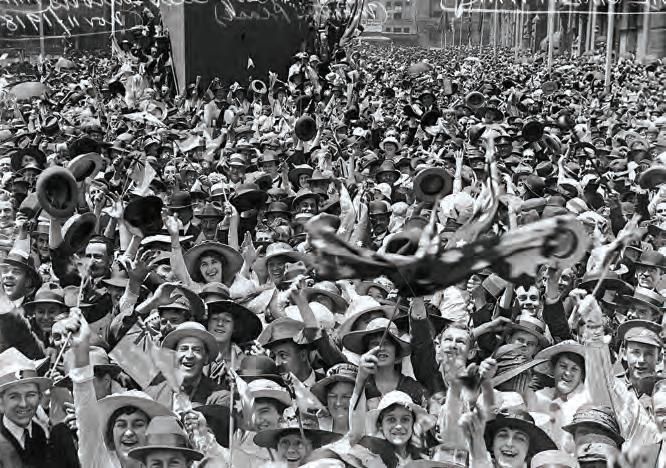
Extension 6.17.2
Australian casualties DOC post-traumatic stress disorder a particular set of reactions that can develop in people who have been through a traumatic event; they often experience feelings of intense fear, helplessness or horror
UNCORRECTEDSAMPLEPAGES
Source 6.17.4 Armistice Day Celebrations, Martin Place, Sydney, 11 November 1918
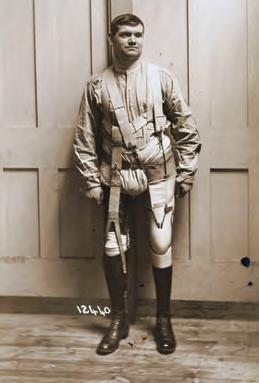
The Federal Government tried to smooth the transition to civilian life, but many veterans who had fought so bravely for “King and Empire” were angry at what they perceived to be a lack of gratitude from Australian society. They resented the government’s failure to effectively assist returned soldiers to find jobs, training, employment, or housing.
Federal and state governments attempted to settle veterans in rural areas under Soldier Settlement Schemes. Unfortunately, such schemes were largely unsuccessful because veterans lacked farming experience, the land chosen was usually unproductive, and the effects of drought exacerbated the problems. To make matters worse, veterans of Aboriginal and Torres Strait Islander descent were all but excluded from the scheme, and some of the land chosen for these settlements had been forcibly taken from Aboriginal and Torres Strait Islander communities.
Knowledge
understanding
Knowledge and understanding
Thinking and researching
Students
access sample responses and results
Teachers can go online to assign questions, view results, reports and more!
Identify the three pieces of legislation in 1901 that formed the basis of the White Australia Policy and explain the purpose of each.
Outline why Federation and restrictions on allowing Aboriginal and Torres Strait Islander males to enlist were gradually relaxed.
Discuss the impact of World War I on Australian women.
Explain why it is difficult to provide an exact figure for the number of Aboriginal and Torres Strait Islander soldiers serving in the AIF.
Explain why many Aboriginal and Torres Strait Islander veterans felt resentful and angry in the postwar period.
Discuss the following statement in a paragraph: “The racism demonstrated in Australia in the nineteenth century set the stage for the twentieth-century White Australia Policy.” Write a paragraph discussing this statement.
Thinking and researching
Using this chapter, create a timeline to represent key moments that impacted women, migrants, and Aboriginal and Torres Strait Islander Peoples in Australia during the period of study. Use a different colour to represent each.
Identify and discuss the impact of Federation and World War I on women, using evidence to support your response.
Identify and discuss the impact of Federation and World War I on migrants, using evidence to support your response.
UNCORRECTEDSAMPLEPAGES
Identify and discuss the impact of Federation and World War I on Aboriginal and Torres Strait Islander Peoples, using evidence to support your response.
Historical concepts: Continuity and change, Cause and effect, Perspectives, Significance, Contestability
Historical skills: Comprehension – chronology, Analysis and use of sources, Perspectives and interpretations, Research, Communication
Source 6.17.5 A soldier wearing prosthetic legs, country unknown ➜
and
Online quiz
can
6.18 Chapter review and historical inquiry
Access the Interactive Textbook for a range of digital tools to help you review this chapter and build confidence.
• Auto-marked questions for fast feedback and fun practice
• Self-assessment tools to track your progress, review answers (if enabled by the teacher), and flag questions for extra help
• Downloadable worksheets for class or homework revision
Summary
Summary notes
What have you learned about the making of Australia as a federated nation? Copy the table and fill out by explaining your understanding. Aim for two points per topic.
Topic What I have learned
The development of Australian democracy and the movement toward Federation
Creation of the Australian Constitution
Workers’ rights, women’s rights and the changing nature of citizenship
Australia’s involvement in World War I
The impact of World War I and the Anzac legend on Australian society
How did Federation and World War I affect different groups in Australia?
Visible thinking routine
I used to think … Now I think …
Reflect on your thinking about Australia’s development as a nation, and how and why this thinking may have changed now that the unit is complete. Using the prompts below, write a couple of sentences explaining what you used to think about the topic and what you think now. Share your thoughts with the class.
• I used to think …
Questions and activities
UNCORRECTEDSAMPLEPAGES
• But now I think …
Scorcher quiz
Access a fast, fun, competitive quiz that puts your understanding to the test.
Quick questions
In 1899, Sir Henry Parkes delivered the ________ Oration, calling for Australian colonies to unite under a federal government.
The ________ Act 1902 granted most Australian women the right to vote and stand for parliament, while still excluding Aboriginal and Torres Strait Islander peoples.
The failed ________ campaign became central to the formation of the Anzac legend, emphasising qualities such as courage, mateship and endurance.
The Immigration Restriction Act introduced the ________ test to limit non-European migration.
UNCORRECTEDSAMPLEPAGES
During World War I, Australians voted twice on whether to introduce compulsory overseas service, known as the ________ referendums.
Define the term “federalism” in the context of the Australian Constitution.
Identify one key reason supporters argued for Federation in the 1890s.
Describe why many Australians initially support World War I.
Outline how Australian women contributed to the war effort.
Explain how the experiences of Aboriginal and Torres Strait Islander soldiers differed before, during and after World War I.
Group work activity
In groups of three to four, research a World War I veteran, from your local area if possible. Using the following sites, plus others, find out what you can about your veteran’s life prior to the war, their wartime experience, death, and how they have been commemorated.
• https://cambridge.edu.au/redirect/12040
• https://cambridge.edu.au/redirect/12041
Choose a format to present your research. You may wish to create a website or weeble, a multi-media presentation, a poster, a podcast, or another product.
Make sure that you clearly assign roles and ensure everyone in the group contributes. You will also need to include a bibliography that acknowledges all the sources you utilised in your research.
Research activity
Choose one of the following topics to research and write a report on:
• weapons and tactics used in World War I
• the Battle of Pozières, July 1916
• the first Anzac Day ceremony, 1916.
Ensure that your report contains an introduction, body paragraphs, a conclusion, and a bibliography including all the websites, articles and books referenced.
Creative task
You have been asked to speak in support of women gaining the right to vote. Prepare a speech to be given at the new Commonwealth Parliament in 1901. When preparing your speech, use a range of primary sources to consider the historical motivation, different views and perspectives, the context of the time, and the style of language that would appeal to the audiences of the era.
Scaffold to write the speech:
• What is the purpose of the speech?
• Who will be the audience for this speech?
• What style of language should be used?
Writing focus
• How will I structure the speech?
• What are the main arguments for the speech?
• How will I conclude the speech?
The following activities offer ways to demonstrate your understanding of the chapter and allow you to continue to practise your writing skills.
Answering questions in paragraphs
This sample response to a question is structured using:
• a topic sentence
• the four Es (explain, elaborate, evidence and examples)
• a linking sentence.
You can use this as a model when writing your own answers to the following questions.
Question:Explain the key turning points for Australia becoming a nation.
Model answer:
Topic sentence: the first sentence of the paragraph; directly answers the question
Elaborate: additional information, connections, historical significance, change and continuity, cause and consequence
UNCORRECTEDSAMPLEPAGES
Examples: provide credibility and illustrate the argument
A number of key turning points helped Australia move from six separate colonies to one united nation. The first key turning point was Henry Parkes’ push for Federation. The second was the drafting of the Constitution in the 1897–98 conventions. The third was the passing of the Commonwealth of Australia Constitution Act 1900. Each of these turning points strengthened cooperation between colonies, clarified how a national government would work and made Federation legally possible. Parkes’ Tenterfield Oration called for “an Australian Government and an Australian Parliament” to unify defence and decision-making, as reported in Source 6.2.6. This speech triggered public momentum towards Federation. Source 6.3.5 illustrates an invitation to the 1898 Federal Convention Banquet. It was here that they debated powers, parliament structure and the High Court, creating the Constitution that the colonies later voted on. Finally, the Commonwealth of Australia Act 1900, as seen in Source 6.3.7, legally created a new nation. This Act made the Australian Constitution legal and was inaugurated on 1 January 1901. Together, these turning points transformed Australia from separate colonies into a single self-governing nation.
Explain: clarify, define and describe
Evidence: specific, relevant evidence to support your arguments
Linking sentence: reconnects to the topic sentence using the language of the question
Extended-response questions
Explain the key turning points for Australia becoming a nation. Identify five key pieces of legislation during the period of study and evaluate their significance.
Evaluate the significance of Australia’s contribution to the war.
Discuss the impact of the Gallipoli campaign on the broader course of the war.
Discuss why the issue of conscription was so divisive.
Assess the impact of World War I on Australia.
Account for the link between the Anzac legend and Australia’s national identity.
Historical inquiry
Investigating continuity and change
In this historical investigation into continuity and change in Australia from Federation to World War I, you will undertake the following steps:
Part 1: Develop historical questions
• Step 1: Select an aspect of the making of a nation topic that interests you. Examples include:
● Federation of Australia in 1901
● Workers’ rights
● Reasons for Australian involvement in World War I
● The ANZAC legend
● Indigenous Australians fighting in World War I.
• Step 2: Brainstorm what you already know
• Step 3: Develop a historical inquiry question. Examples include:
● Assess the changes on Australia of Federation in 1901.
● What led to the rights of workers change in Australia between 1889 and 1919?
● In what way did continuing relations with Britain lead to Australian involvement in the First World War?
● What caused Indigenous Australians to want to be involved in the fighting in the First World War?
• Step 4: Explain why the question is important
Part 2: Locate and analyse evidence
Part 3: Communicate historical findings
Part 4: Reflect
UNCORRECTEDSAMPLEPAGES
Teachers, access the Online Teaching Suite for digital resources and tools that support review, assessment and reporting, including:
• student and class activity reports
• a test generator to create custom assessments
• built-in feedback tools
• editable downloadable support material
• a downloadable and printable “Writing focus” workbook for this chapter.
Australia at war: World War II (1939–c. 1945) Chapter 7
Key questions
• What were the long-term and short-term causes of World War II?
• What was the nature of Australia’s involvement in World War II?
• What motivated people to enlist in Australia’s defence forces in World War II?
• What was the significance of the Fall of Singapore to Australia?
• What was the impact of World War II on the Australian home front?
• What were the experiences of Australian prisoners of war during World War II?
• What lasting effects did the Holocaust and the Nuremberg Trials have on Australia?
• What did the treatment of returning soldiers, including Aboriginal and Torres Strait Islander personnel, highlight?
Lessons
7.1 Setting the scene
7.2 Causes of World War II
7.3 Reasons for Australia’s involvement in World War II
7.4 Reasons men enlisted to fight in the war
7.5 Where Australians fought in the war
7.6 The experiences of servicemen and servicewomen in Australia’s defence forces
7.7 The beginning of the war in the Pacific
7.8 Naval battles in the Pacific
7.9 The Kokoda Track Campaign 1942–43
7.10 The end of the war
7.11 The home front
7.12 The experiences of prisoners of war (POWs)
7.13 The experiences of Jewish people and other victims of the Holocaust
7.14 Impact on people returning from active service
7.15 Jewish Holocaust survivors in Australia
7.16 Impact and legacy of World War II
7.17 Site study: Australian War Memorial Museum and archive
7.18 Chapter review and historical inquiry
Aboriginal and Torres Strait Islander Peoples should be aware that this chapter contains images and names of people who have, or may have, passed away.
7.1 Setting the scene
Learning intention
In this lesson, you will learn about the background to World War II and some of the key events that took place during this time period.
Success criteria
❏ I can outline the background to World War II and some of the key events that took place during this time period.
When war was declared in September 1939, the enthusiasm of August 1914 was replaced with a grim sense of duty as Australia became involved in another war, but one on a scale never seen before or since. The Anzac legend forged at Gallipoli was perpetuated by the next generation of Anzacs who fought in North Africa, Europe, Asia, the Pacific and Australia. Many thousands of these men were to become prisoners of war in German or Japanese prisoner of war camps, and many were treated inhumanely at the hands of their Japanese captors. World War II also saw Australia come under direct attack when Darwin was bombed and Sydney Harbour was attacked by midget submarines. Similar to the previous war, World War II would prove to have a transformative effect on Australian society as everyone rallied together to fight the threat of a Japanese invasion.
October 1929
Wall Street crash and the beginning of the Great Depression
28 June 1919 Treaty of Versailles signed, formally ending World War I
30 January 1933
Adolf Hitler becomes Chancellor of Germany
September 1939
Germany invades Poland, Britain declares war on Germany, and Prime Minister Robert Menzies announces that Australia is also at war against Germany
1940
20 May 1941
Germans attack the island of Crete. Australian troops who had evacuated there from Greece are again forced to evacuate July 1940 Intense air war starts in Europe with the Battle of Britain
The 6th, 7th and 9th Divisions of 2AIF transferred to the Mediterranean and North Africa
1941
2AIF joins Allies to fight Axis forces in North Africa, capturing Tobruk and enduring the five-month Siege of Tobruk
15 February
1942
Singapore falls to the Japanese
8 December 1941
Japan bombs the US naval base at Pearl Harbor, marking the start of the war in the Pacific theatre
19 February 1942
Japan launches the first of 64 bombing raids on Darwin
31 May 1942
Japanese midget submarines attack Sydney Harbour
June 1942
Battle of Midway. US defeats Japan, the turning point of war in the Pacific
January 1943
Battle of Stalingrad sees the Russians defeat Germany, turning point of war in Europe
6 June 1944
Allied forces invade Germanoccupied France on D-Day
February 1943
July 1942 to January 1943
November 1942
Battle of El Alamein sees the Allies defeat Axis forces in North Africa
Australian forces push the Japanese back along the Kokoda Track in New Guinea
The Australian Government decides to send conscripts outside of Australianheld territories
15 August 1945
Japan surrenders (VP Day)
8 May 1945
Germany surrenders (VE Day)
October 1944
Australian warships join US Navy in Battle of Leyte Gulf, largest naval battle in the war
6 and 9 August 1945
The United States detonates two atomic bombs over the Japanese cities of Hiroshima and Nagasaki
1946–1952
Australians form a large part of the British Commonwealth Occupation Force in Japan
See, think, wonder
UNCORRECTEDSAMPLEPAGES
Based on Source 7.1.1, consider the following questions for discussion.
• What can you see in this image? (I can see …)
• What do you think about this image? (I think …)
• What does this image make you wonder about World War II? (I wonder …)
Writing focus 7.1
Question words
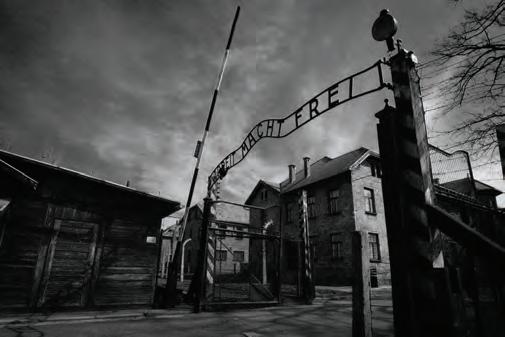
Source 7.1.1 Photograph of the main gate of Auschwitz-Birkenau concentration camp, Poland, taken in 2008. In 1947, Poland founded a museum on the site where 1.1 million Jewish victims of the Holocaust were killed. It was named a UNESCO World Heritage Site in 1979.
7.2 Causes of World War II
Learning intention Success criteria
In this lesson, you will learn about the causes of World War II. ❏ I can identify the causes of World War II.
Starter activity
Look at Source 7.2.1. Based on what you know about World War I, identify some of the territorial changes that were imposed upon Germany.
In addition to these territories, Germany also lost all her colonies
Eupen and Malmedy given to Belgium
North Schleswig given to Denmark
New government met here - so Germany was called the Weimar Republic
Saar coalfields given to France for 15 years
Germany was forbidden to unite with Austria
Danzig - a free city run by the League of Nations
Posen West Prussia
Poland was given a ‘corridor’ to the Baltic Sea, cutting off East Prussia from Germany
Posen - rich farmland given to Poland
Territory lost by Germany to other countries
Territory lost by Germany to the League
Displaced Germans
Source 7.2.1 Map showing territorial changes following World War I ➜
The Treaty of Versailles
The Treaty of Versailles, signed on 28 June 1919, was mostly influenced by the Big Three leaders of the victorious Allies: British Prime Minister David Lloyd George, French Premier Georges Clemenceau and US President Woodrow Wilson.
Demilitarised zone
Because it was created in a climate of distrust and the immediate devastation caused by World War I, the intention of the treaty was to punish and undermine German military and economic power to prevent a resurgent Germany from posing a risk to European peace in the future. According to the treaty, Germany:
• lost 13% of its European territory, and was also denied overseas investments and colonies, which were confiscated and divided among the Allies
• was not permitted to have tanks, heavy artillery, a navy or an air force, and could not enforce conscription
• was forced to demilitarise the Rhineland, with Allied forces to occupy the Rhineland for 15 years to serve as a buffer zone between France and Germany
• was forbidden from implementing Anschluss with Austria
• was forced to accept the blame for starting the war (Article 231) and to pay reparations, amounting to over £6 billion plus interest, to the Allied nations for damages inflicted during the war.
Many Germans resented the government of their new Weimar Republic for having accepted the terms of a treaty they believed to be harsh and humiliating. This discontentment was exasperated by the economic hardship caused by the treaty’s reparations clause and the impact of the Great Depression. Both left-wing and rightwing groups became openly hostile towards the government, and these popular feelings of resentment provided opportunities for individuals and political groups to undermine the democratic government by promising to revise the Treaty of Versailles.
Hitler and the rise of Nazism
Adolf Hitler served with distinction in the German army during World War I and was recuperating from the effects of a gas attack when the armistice was declared. After the war, Hitler subscribed to the popular view that Germany had been “stabbed in the back” by its government. This myth promoted the idea that Germany had not lost the war on the battlefront, but had been betrayed by internal enemies (especially Jewish people and socialists) who caused Germany’s downfall. Disillusioned, Hitler became the leader of the small, right-wing Nationalsozialistische Deutsche Arbeiterpartei, or National Socialist German Workers’ Party (later shortened to the Nazi Party) in 1921.
The party’s platform sought to restore Germany’s honour and position on the international stage and consisted of the following key ideas:
• opposing the Weimar Government
• revising the Treaty of Versailles
• strengthening Germany’s armed forces and achieving self-sufficiency.
Writing focus 7.2
Transitional phrases
Anschluss refers to the annexation of Austria into Germany
Weimar Republic the name given to Germany’s democratic government between 1919 and 1933, which was based in Weimar rather than the historic capital of Berlin ideology a set of ideas or beliefs that form a framework for a person or country’s point of view and actions
UNCORRECTEDSAMPLEPAGES
Nazi ideology also promoted the ideologies of Aryan racial supremacy, antisemitism and anti-communism. Hitler repeatedly spoke of his vision of a Thousand-Year Reich where Nazi Germany would rule for a thousand years, a new empire that would require raw materials and slave labour to survive. This desire for Lebensraum meant territorial expansion, most notably in Eastern Europe and the Soviet Union.
Aryan as propagated by the Nazi Party, people of Caucasian race not of Jewish descent antisemitism prejudice, hatred and/or violence directed against Jewish people Reich German for ‘empire’ Lebensraum the policy adopted by Hitler to justify his drive to conquer more land: to create more living space for the German people
Great Depression a period of severe economic hardship around the world between 1929 and about 1939 Reichstag the German parliament Führer German for “leader” appeasement the policy adopted by Britain and France to negotiate with, rather than fight, Hitler. This allowed Hitler to annex territories and revise treaty clauses without facing immediate consequences Nazi–Soviet Non-Aggression Pact an agreement between Germany and the Soviet Union signed in August 1939, allowing Germany to invade Poland without fear of Soviet intervention
Hitler and the Nazi Party took advantage of the devastating impact of the Great Depression, which resulted from the Wall Street crash in the United States in October 1929. During public speeches, Hitler spoke passionately about the Weimar Government’s inability to solve the problem of high unemployment, how Germany had been betrayed by its own government in 1919, how the Jewish population were to blame for all of Germany’s problems, and how only the Nazi Party could redress these issues. By stirring up nationalist sentiment and distancing themselves from the Weimar Government, the Nazis were able to increase their support base and become an influential political force in the 1932 Reichstag elections. On 30 January 1933, Hitler was appointed to the position of Chancellor (head of government), after which he quickly set about eliminating political opponents. By August 1934, Germany was a one-party state and Hitler was its Führer.
Major steps towards war

In 1935 conscription was reintroduced in Germany, and in the following year 30 000 troops occupied the demilitarised Rhineland. This was not permitted under the terms of the Treaty of Versailles.

Nazi Germany and the Soviet Union shocked the world with the announcement of the Nazi–Soviet NonAggression Pact on 23 August 1939.
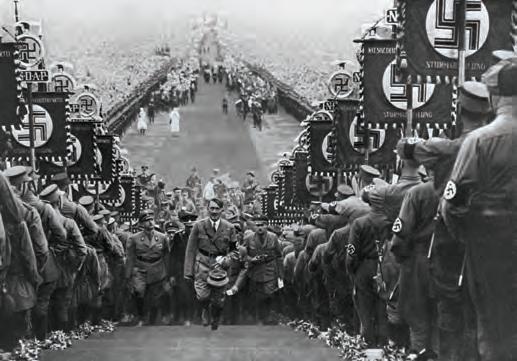

Anschluss with Austria in March 1938. Also not permitted under the Treaty of Versailles.

In March 1939 Germany invaded Czechoslovakia and the policy of appeasement was abandoned.
Hitler requested the Sudetenland of Czechoslovakia in September, 1938, promising that it would be his last territorial demand.

At the Munich Conference in September 1938 the governments of Britain and France, who were adhering to the policy of appeasement at the time, granted Hitler’s request for the Sudetenland.

Hitler ordered the invasion of Poland to begin on 1 September 1939 with no ultimatum or declaration of war. Fifty German divisions invaded Poland and ignored Allied demands to withdraw.

UNCORRECTEDSAMPLEPAGES

On 3 September 1939 Britain and France declared war on Germany; World War II had commenced.
Source7.2.2 Adolf Hitler (centre) ascending the steps at a Harvest Festival, flanked by banner-carrying storm troopers, Buckeberg, 1934

Source analysis
UNCORRECTEDSAMPLEPAGES






Germany before World War II
March 1936
Germany reoccupies the demilitarised region of Rhineland
March 1938
German annexation of Austria
September 1938
Sudetenland given to Germany at the Munich Conference
March 1939
Germany takes the rest of Czechoslovakia
September 1939
German invasion of Poland
By October 1939
Soviet Union takes the rest of Poland
Source7.2.3 German expansion during the 1930s ➜
The figures in Source 7.2.4 represent Adolf Hitler and Joseph Stalin. What does the coffin represent?
What is the cartoonist’s view of the relationship between Hitler and Stalin?
Explain the message of this cartoon.
Source7.2.4 A political cartoon titled “Putting the Lid on It”, published 2 October 1939. This was two weeks after the Soviet invasion of eastern Poland. ➜
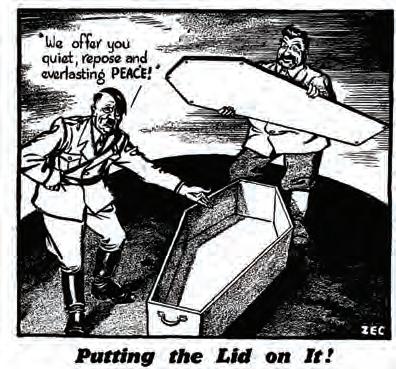
Historical concepts: Significance Historical skills: Analysis and use of sources
Soviet Union the Union of Soviet Socialist Republics (1922–91); the successor to the Russian Empire League of Nations an international organisation formed after World War I with the aim of resolving disputes between countries and preventing conflict through the policy of “collective security” –members of the League of Nations who would come to the defence of other member nations if threatened embargo a governmental order prohibiting trade with a country
Japanese ambitions in the Asia-Pacific region
After World War I there was growing resentment in Japan towards the major world powers due to the Japanese perception that Japan was not being treated as an equal partner on the world stage. During the 1930s, there was also a growing belief that domination in East Asia was essential for Japan’s security and self-sufficiency as its population continued to grow. The Chinese Nationalist Party began to pose a threat to Japanese interests in the region by the late 1920s, as did the increasing power of Stalin’s Soviet Union, which placed Japanese interests in northern China and Manchuria at risk. Militaristic leaders began to promote nationalism and expansionism as the means to secure Japan’s interests in the region.
In September 1931 field army officers of Japan’s Kwantung Army, stationed in Manchuria, triggered a skirmish with Chinese soldiers on the South Manchurian Railway. They did this without consent from the Japanese Government and it marked the beginning of a full-scale invasion and defeat of Chinese forces. The Japanese Government proceeded to declare that Manchuria, with its fertile land and rich mineral deposits, was now a Japanese state, called “Manchukuo”. This marked the beginning of the Sino-Japanese conflict and was another key step in Japan’s expansionist foreign policy The League of Nations publicly condemned Japan’s actions, which led to Japan withdrawing from the League altogether. This would prove to be the first major failure of the League of Nations in its quest to promote peace and security throughout the world.
Extension
7.2.1 Cartoon on Japanese aggression in Manchuria
UNCORRECTEDSAMPLEPAGES
On 7 July 1937, Japanese forces moved beyond Manchukuo and invaded east China. The United States opposed Japan’s actions and encouraged a “moral” embargo on the trade of strategic materials to Japan. However, by late 1939 the Western colonial powers of Britain, France and the Netherlands were distracted by Germany’s early victories in Europe. This created a power vacuum in South-East Asia. It was the opportune time for Japan to launch its bid to increase its empire’s sphere of influence and secure the raw materials it needed.
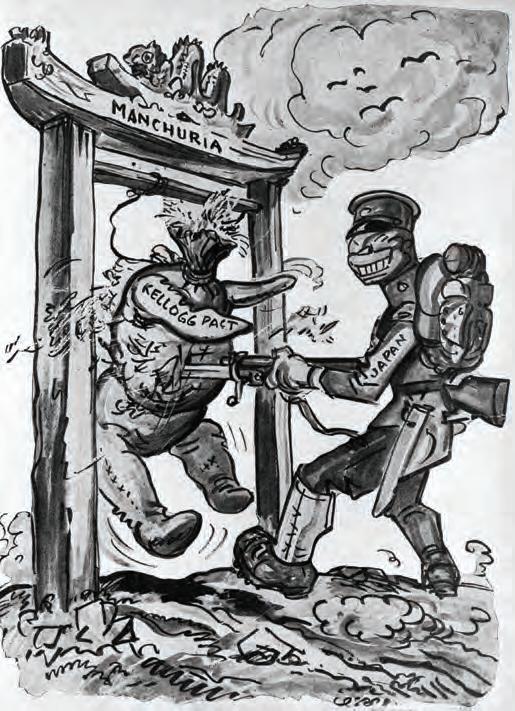
Source 7.2.5 Political cartoon depicting a Japanese soldier bayoneting a “Kellogg Pact” dummy hanging in the doorway to Manchuria, 1931. The Kellogg Pact was a 1928 agreement to outlaw war. Japan was among the signatories to this pact.
After Japan signed the Tripartite Pact to form the Rome-Berlin-Tokyo Axis in September 1940 and started to move troops into French Indochina, the United States imposed an embargo on iron and steel scrap against Japan, before extending it to all war materials with the exception of oil. This reinforced Japanese perceptions of encirclement and strangulation by the Western powers. Japan was dependent on imports of raw materials in order to survive and faced a crucial decision: either refrain from aggressive expansionist ambitions or advance swiftly into South-East Asia to secure the resources it now desperately needed. The main obstacle to expansion was the United States, which possessed an overwhelming economic and military advantage against Japan. The Japanese solution was a surprise attack on the United States’ Pacific Fleet, stationed in Pearl Harbor, Hawaii. Planned by Admiral Isoroku Yamamoto, the Japanese attack on Pearl Harbor took place on 7 December 1941, before any formal declaration of war was made.
Japanese aircraft sank or damaged 21 ships, including eight battleships and four destroyers, and damaged or destroyed nearly 350 aircraft. Almost 2400 American military personnel were killed and another 1000 wounded. This was the start of the war in the Pacific. Within three days, two British warships were sunk off the coast of Malaya by the Japanese navy. Germany and Italy declared war on the United States in support of their ally on 11 December.
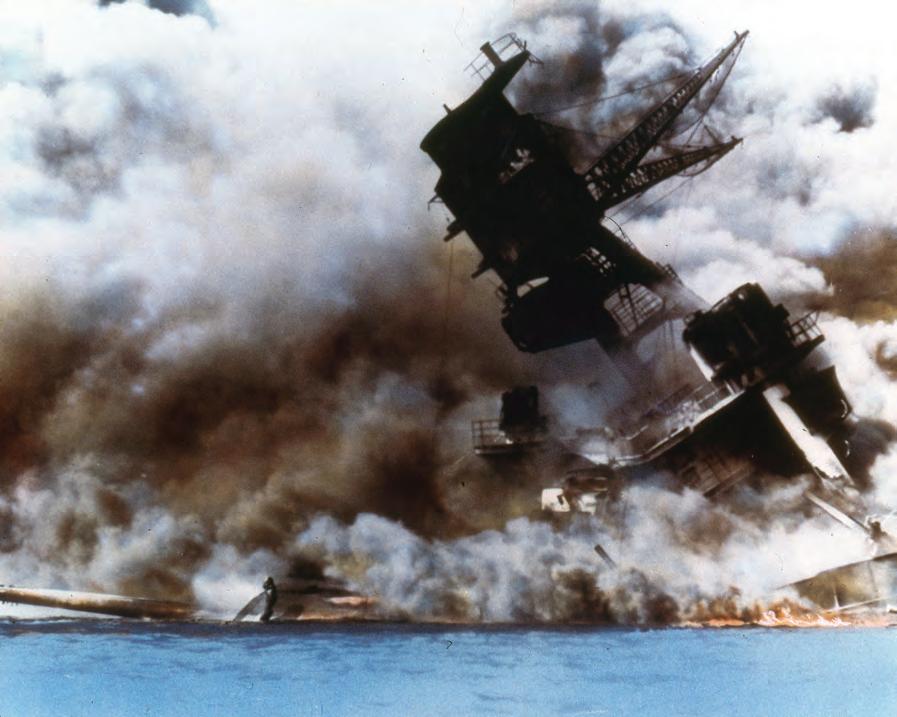
UNCORRECTEDSAMPLEPAGES
Source 7.2.6 The battleship USS Arizona burns and sinks after the Japanese attack on Pearl Harbor.
Activity 7.2.2
Categorise the following events into a table or Venn diagram, labelled “Short-term causes of World War II”, “Both/Connecting” and “Long-term causes of World War II”:
a. Treaty of Versailles (1919)
b. Rise of Hitler and the Nazi Party
c. Japanese militarism and expansion
d. Economic depression in Germany (1929–33)
e. Japanese invasion of Manchuria (1931)
f. League of Nations failing to moderate aggression
g. Anschluss (Germany annexes Austria) (1938)
h. German invasion of Poland (1939).
Explain which long-term cause you believe was most consequential in creating the conditions for World War II.
Explain which short-term cause you believe was the final trigger for war.
Historical concepts: Cause and effect Historical skills: Comprehension, Communication
Teachers can go online to assign questions, view results, reports and more!
Knowledge and understanding
Define the “Big Three”.
Identify the political position that Hitler held prior to becoming Führer.
Identify which two countries were beginning to threaten Japanese interests in the late 1920s.
Explain the impact of the Japanese invasion of Manchuria.
Discuss the main aspects of Nazi ideology.
Account for factors that led to the rise of Hitler and the Nazi Party.
Analyse the impact of the terms of the Treaty of Versailles on Germany and how these contributed to the rise of Hitler and the Nazi Party.
Evaluate the Japanese decision to attack the US naval fleet at Pearl Harbor in December 1941.
Thinking and researching
Using the information in the text and your own research, create an informative and creative infographic titled “The interwar years: the background to World War II”. Your infographic should include the following elements:
• images
• maps
UNCORRECTEDSAMPLEPAGES
• symbols
• information on the Treaty of Versailles, the Great Depression, the rise of Nazism, growing Japanese aggression and territorial expansion.
Historical concepts: Continuity and change, Cause and effect Historical skills: Analysis and use of
Communication
7.3 Reasons for Australia’s involvement in World War II
Learning intention
In this lesson, you will learn about the reasons for Australia’s involvement in World War II.
Look at the image in Source 7.3.1. Consider the following questions:
Why do you think Australia would fight a war far away from its borders?
How do you think Australians would feel about going to war to help another country?
What risks might be associated with Australia joining the war?
Success criteria
❏ I can identify reasons for Australia’s involvement in World War II.
Source 7.3.1 A parade of Australian soldiers in Darwin, 1939 ➜
As a direct result of the German army’s invasion of Poland on 1 September 1939, Britain and France declared war on Germany at 11 a.m. on 3 September 1939. Addressing the Australian people via radio just two hours later, Australian Prime Minister Robert Menzies announced that because Britain had declared war, Australia was also at war. As a self-governing and loyal dominion of Britain, Australia was obligated to support Britain. While most Australians supported Menzies’ declaration, there was some opposition to sending troops overseas because Britain was not yet under direct threat from Germany. Menzies therefore waited until 1 November to announce that a “Second Australian Imperial Force” (2AIF) would be sent to fight overseas. Australia’s commitment to the war expanded further when Japan attacked Pearl Harbor in December 1941. The new Australian Prime Minister, John Curtin, declared war on Japan as a sign of support for the United States.
Activity 7.3.1
Source analysis
➜
Source 7.3.2
Video: On 3 September 1939 at 9.15 p.m. every radio station in Australia broadcast Prime Minister Robert Menzies’ announcement that Australia had joined the war. Scan the QR code to see a video.
Fellow Australians. It is my melancholy duty to inform you officially that, in consequence of the persistence of Germany in her invasion of Poland, Great Britain has declared war on her, and that, as a result, Australia is also at war…
It may be taken that Hitler’s ambition is not to unite all the German people under one rule, but to bring under that rule as many countries as can be subdued by force. If this is to go on, there can be no security for Europe and no peace for the world.
A halt has been called. Force has had to be resorted to, to check the march of force. Honest dealings, the peaceful adjustment of differences, the rights of independent people to live their own lives, the honouring of international promises and obligations – all these things are at stake.
There was never any doubt as to where Great Britain stood in relation to them. There can be no doubt that where Great Britain stands, there stands the people of the entire British world.
Minister Robert Menzies, 3 September 1939
Source 7.3.3 On 8 December 1941, Prime Minister John Curtin announced on ABC Radio that Australia was at war with Japan.
We are at war with Japan. That has happened because, in the first instance, Japanese naval and air forces launched an unprovoked attack on British and United States territory; because our vital interests are imperilled and because the rights of free people in the whole Pacific are assailed. As a result the Australian Government this afternoon took the necessary steps which will mean that a state of war exists between Australia and Japan.
Prime Minister John Curtin, 17 December 1941
How does the announcement in Source 7.3.2 assist our understanding of why Australia became involved in World War II?
Explain why this announcement was made over the radio.
UNCORRECTEDSAMPLEPAGES
Identify the reasons Prime Minister Curtin gives for declaring war on Japan in Source 7.3.3.
Compare the reasons given for Australia declaring war in both sources. How are they similar and/or different?
Historical concepts: Significance Historical skills: Analysis and use of sources
Prime
7.3.4 Australian and New Zealander soldiers cheer the King upon their arrival in Britain, c.1940.
Knowledge and understanding Thinking and researching Online
Knowledge and understanding
Students can access sample responses and results online
Writing focus 7.3
Appositives
Teachers can go online to assign questions, view results, reports and more!
Identify the Australian Prime Minister who declared war on Germany on 3 September 1939.
Explain why Australia declared war on Germany.
Explain why Australia needed to support the United States in December 1941.
Account for the similarities between the September 1939 declaration of war and the August 1914 declaration.
Discuss the response to Prime Minister Menzies’ declaration of war.
Thinking and researching
Conduct research to answer the following question: Which reason do you think was the most important in Australia’s decision to join World War II?
• Loyalty to Britain
• Fear of Japanese expansion
UNCORRECTEDSAMPLEPAGES
• National security
• International responsibility
In your answer, review each possible reason with a quick summary of each, identify how they interconnect, and explain your conclusion using cited historical evidence.
Historical concepts: Cause and effect, Perspectives, Significance, Contestability Historical skills: Perspectives and interpretations, Research
Reasons men enlisted to fight in the war
Learning intention
In this lesson, you will learn about the reasons men enlisted to fight in World War II.
Starter activity
Success criteria
❏ I can explain the reasons men enlisted to fight in World War II.
As a class or with the person next to you, discuss the following question: You are 20 years old in 1939. War has just been declared. What factors would influence your decision on whether to enlist?
7.4.1 A “Together” British propaganda poster from during the war
When Prime Minister Menzies declared war in September 1939, the people of Australia reacted to the news with a sense of reluctant acceptance to support Britain, as well as a shared sense of duty to stop German aggression. When Menzies announced the formation of the 2AIF in November 1939, able and willing men enlisted in it, but more slowly than they had done in World War I. Initially, age limits for enlistment were set at 29 to 35, but these were adjusted as the war progressed.
By the end of World War II, nearly one million Australian men and women had served in the armed forces, including an estimated 6500 to 7000 Aboriginal and Torres Strait Islander men and women. This was despite a 1909 amendment to the Defence Act 1903 that prohibited individuals not of “substantially European origin” from enlisting. It is believed that Aboriginal and Torres Strait Islander recruits either did not present themselves as Indigenous, did not identify with their heritage or it was simply ignored by recruitment officers who viewed Indigenous enlistment as a solution to critical shortages in manpower.
Some of the common reasons Australian men enlisted in World War II included:
• a sense of patriotic duty to defend Australia and other nations (especially after Japan became involved)
• a sense of loyalty to support the British Empire
• a desire to be part of the proud Anzac tradition forged by the AIF in World War I
• for the spirit of adventure and excitement or to escape the monotony of everyday life
• to emulate the achievements of the previous generation of servicemen
• the financial incentive. For many men, enlisting in the AIF would be their first job in years. Unemployment in Australia was extremely high during the 1930s.
7.4 Reasons men enlisted to fight in the war
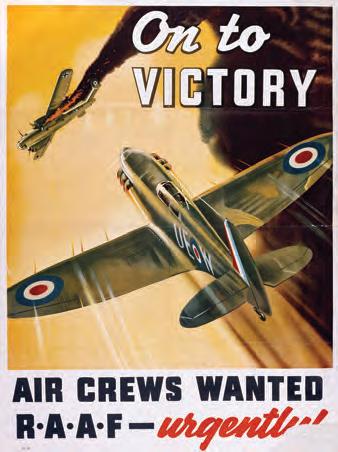
Source 7.4.2 RAAF recruitment poster, 1942 ➜
When war broke out in September 1939, many in the Aboriginal and Torres Strait Islander community were divided over the issue of military service. Some hoped that active service could potentially lead to an improvement in their living conditions, greater recognition of their rights and possibly citizenship. However, there were also many who argued that Aboriginal and Torres Strait Islander soldiers had fought bravely during World War I, with many making the ultimate sacrifice, only to see no improvement in their rights and conditions in the post-war period. Many Aboriginal and Torres Strait Islander communities and individuals still faced prejudice and discrimination, segregation and social exclusion, and poverty, with their civil liberties severely restricted by state Protection Acts.
Despite all this, when Australia declared war on Germany in September 1939, Aboriginal and Torres Strait Islander men still sought to enlist in the armed forces, with their main reasons including:
• access to an education and a regular wage
• the opportunity to earn the respect of their non-Indigenous peers
• a sense of patriotism and adventure
• freedom beyond the severe restrictions imposed by life on the missions
• the opportunity to prove their loyalty to Australia
• to fight for equality in post-war Australia.
Source analysis
Source 7.4.3 Australian official historian, Gavin Long, wrote about enlistment. ➜
segregation the practice of keeping people or groups separate, often based on characteristics like race, religion or gender Protection Acts laws that controlled many aspects of Aboriginal and Torres Strait Islander Peoples’ lives, restricting their freedom, movement and rights under the guise of protection
Reinforcing this common culture [between Australia and the United Kingdom] was the powerful tradition of the Australian Imperial Force of twenty years before. So high was the prestige of that volunteer army that a desire to qualify for the membership of its brotherhood and to march on Anzac Day was to some a strong motive for enlistment. Some men said that they enlisted to escape from uninteresting occupations, dull towns or suburbs, or domestic difficulties – in fact, for adventure; and this motive, mixed with other feelings of duty and of desire for self-enhancement, was undoubtedly powerful …
Long, G., 1961, Australia in the War of 1939–1945, Series 1 – Army, Volume 1: To Benghazi, p. 57
UNCORRECTEDSAMPLEPAGES
Explain the origin and motive of this source.
Identify the reasons Long gives for men wanting to enlist in the AIF.
How reliable do you consider this source to be? Give reasons to justify your answer.
Historical concepts: Perspectives, Significance Historical skills: Analysis and use of sources
Writing focus 7.4
Developing sentences
Review 7.4
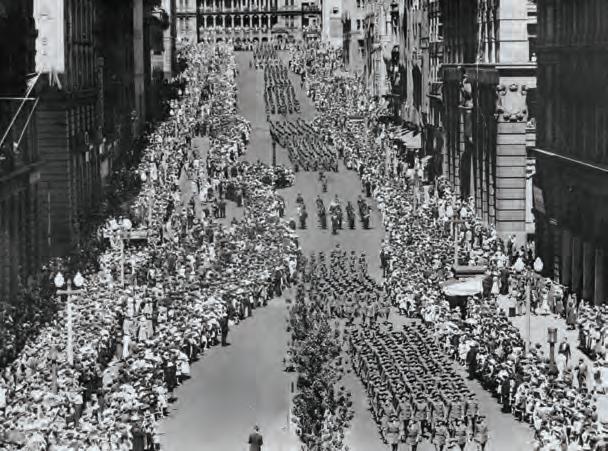
Source 7.4.4 6th Infantry Division, 2AIF, parade through the streets of Sydney before shipping out, January 1940. ➜
Knowledge and understanding Thinking and researching
Knowledge and understanding
Students can access sample responses and results online
Teachers can go online to assign questions, view results, reports and more!
Why was there a sense of reluctant acceptance to support Britain after Prime Minister Menzies’ declaration of war?
When did Prime Minister Menzies announce the formation of the second Australian Imperial Force?
What was the Defence Act 1903, and how did it affect the enlistments of Aboriginal and Torres Strait Islander Peoples?
Identify five reasons why Australian men enlisted to serve in World War II.
Explain why Aboriginal and Torres Strait Islander communities were divided over the issue of service.
Justify why some Aboriginal and Torres Strait Islander Peoples saw enlistment as an opportunity, while others were reluctant to join.
Evaluate the view that a desire to join the Anzac tradition was an important reason why men enlisted to serve in World War II.
Thinking and researching
Using the internet or a library, find one Australian World War II recruitment poster. Analyse your source by answering the following questions:
UNCORRECTEDSAMPLEPAGES
What message is the poster trying to communicate?
What sort of emotional appeal does the poster make?
What reason, or reasons, does it urge for enlisting?
Historical concepts: Perspectives, Significance Historical skills: Analysis and use of sources, Perspectives and interpretations
7.5 Where Australians fought in the war
Learning intention
In this lesson, you will learn about where Australians fought during World War II.
Starter activity
Success criteria
❏ I can identify the locations where Australians fought during World War II.
Look at the map in Source 7.5.2. Do any of the locations shown surprise you? Why do you think Australians were sent to these locations?
Australian forces were involved in the war against the Axis powers (Germany, Italy and Japan) in several different locations during the war. There were two main theatres of operation in World War II:
• the war against Nazi Germany and fascist Italy in Europe and North Africa
• the war against Japan in the Pacific.
Some of the military actions involving Australian soldiers are shown in Source 7.5.2.
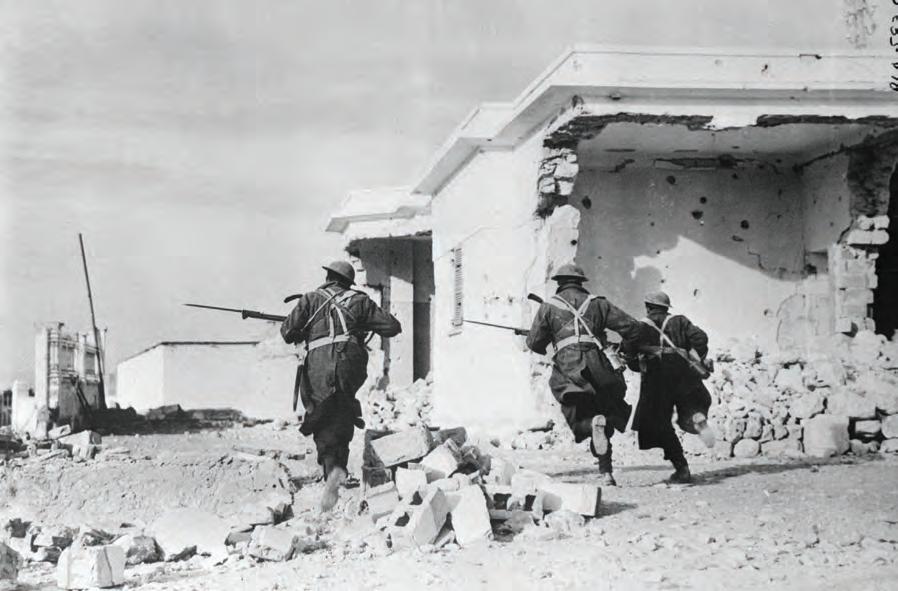
UNCORRECTEDSAMPLEPAGES
Source 7.5.1 Australians seize Bardia, North Africa, 1942. ➜
Writing focus 7.5
Creating topic sentences
1940 Australian pilots assisted in the victorious Battle of Britain, which secured British air superiority and ended Hitler’s plans of invading Britain.
1939–45 Thousands of Australian airmen also served with the RAF and RAAF in the skies over Europe. Many served with Britain’s Bomber Command units, which took part in sustained bombing campaigns of German cities and industrial targets.
1943 Once the North African campaign was concluded, Australian forces provided land, air and sea support to the Allied invasion of Sicily, which was an important step in preparing for the eventual invasion of mainland Italy.
UNCORRECTEDSAMPLEPAGES
1939–45 The Royal Australian Navy (RAN) played a role in the Battle of the Atlantic, assisting British and United States’ warships in escorting and protecting merchant ships from German U-Boat attacks, as they carried men and supplies from America to Britain.
1940–43 The RAN were active in Mediterranean during fight in North Africa and in the lead-up to the invasion of Italy.
1940 Italian forces attempted to expand their imperial possessions by invading Egypt from their colony of Libya. Aiming to defend the Suez Canal and protect British oil supplies from the Middle East, the Australian army helped British forces defeat Italian troops in Bardia, Benghazi and Tobruk (North Africa).
1941 Hitler’s famed Afrika Korps, led by the “Desert Fox” Erwin Rommel, counter-attacked and besieged Australian defenders holed up in Tobruk from April. They were referred to as “Rats of Tobruk” in German propaganda, and they adopted this name for themselves. They persevered and were finally relieved towards the end of the year.
Source 7.5.2 Places where Australians fought ➜
1942 Australian forces fought as part of the British 8th Army defeating Rommel’s Afrika Korps in the Battle of El Alamein (North Africa). British victory here marked the beginning of the end of the conflict in North Africa as Rommel’s forces were pushed back and eventually defeated in early 1943.
1941 Australian troops were also sent to Greece but were forced to evacuate to Crete by German forces. Within three weeks the island was overrun by the Germans, with those unable to evacuate hunted down by German troops.
1941 Australian troops came up against pro-German Vichy French forces in Syria and Lebanon to protect British bases in Palestine.
1941–41 Japanese forces swiftly advanced down the Malayan Peninsula and, despite Allied efforts, captured the British naval base at Singapore. As a result, more than 80 000 Allied soldiers became POWs, including 15 000 Australians. This was a crushing blow to Allied morale and threatened Australia’s security.
UNCORRECTEDSAMPLEPAGES
1945 Australian troops attempted to recapture the island of Borneo, which had been held by the Japanese since 1941. A series of Australian-led operations captured strategic assets like airfields and oil facilities, while also liberating POWs.
1942–43 Australian forces defended a Japanese attempt to advance over the Owen Stanley mountain range and capture Port Moresby. These forces were eventually halted and were forced to return to their beachheads on the northern coast.
1943–45 The Bougainville Campaign was a series of land and naval battles, led by US forces, in which Australian forces primarily engaged in moppingup operations to recapture Rabaul from Japanese forces.
1942 A group of Allied warships, including two Australian ships, successfully turned back a Japanese force aiming to invade Port Moresby.
Vichy refers to the French government, under Marshal Philippe Petain, which governed France and collaborated with the German occupation forces from 1940–44
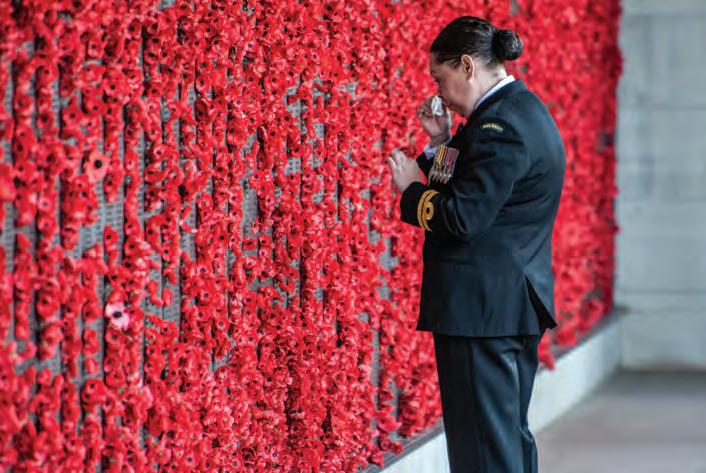
Knowledge and understanding
Knowledge and understanding
and researching
Source 7.5.3 The Wall of Remembrance in Canberra, ACT, honours members of the Australian armed forces who have died during or as a result of war service.
Teachers can go online to assign questions, view results, reports and more!
What were the two main theatres of operation in which Australian forces fought during World War II?
Identify three main actions involving Australian servicemen in the European theatre of fighting during World War II.
Identify three main actions involving Australian servicemen in the Pacific theatre of World War II.
Summarise Australian involvement in the war in North Africa.
Why was the Siege of Tobruk significant for Australian forces, and how did they earn the name “Rats of Tobruk”?
Summarise the key events that led to Australia shifting its defence strategy from Britain to the United States during World War II.
Evaluate the view that World War II was truly a world (or global) war.
Thinking and researching
Referencing Source 7.5.2, pick two of the locations in which Australians fought during World War II, and compare:
• their distance from Australia
• when soldiers were sent there (earlier or later in the war)
• why soldiers were sent there
UNCORRECTEDSAMPLEPAGES
• their climate and terrain
• the challenges faced by Australian forces there
• a source from each location (a photo, a quote, a statistic, etc.).
Historical concepts: Cause and effect, Significance Historical skills: Comprehension, Analysis and use of sources, Research
7.5 The experiences of servicemen and servicewomen in Australia’s defence forces
7.6 The experiences of servicemen and servicewomen in Australia’s defence forces
Learning intention
In this lesson, you will learn about the experiences of servicemen and servicewomen in Australia’s defence forces.
Starter activity
Success criteria
❏ I can compare the difference experiences of servicemen and servicewomen in Australia’s defence forces.
As you look at the images in Source 7.6.1 consider the following wartime experiences:
• enlistment
• training
• daily routine
• danger
• returning home.
Would these experiences be the same for everyone in the defence forces? Discuss as a class or with the person next to you.
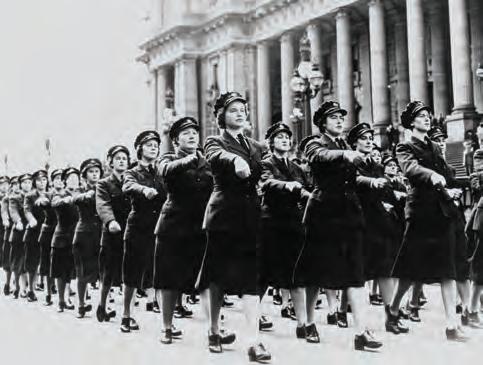
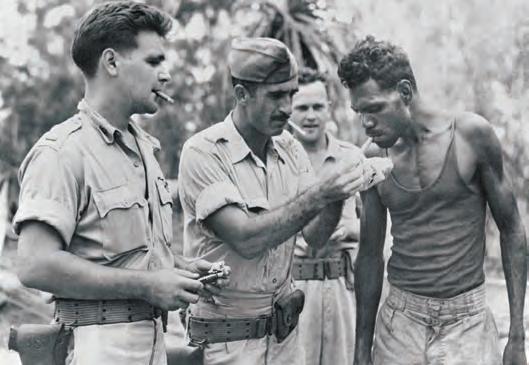
Source 7.6.1 Members of the Women’s Auxiliary Australian Air Force (WAAAF) marching past Parliament House in 1943; US soldiers lighting the cigarette of an Indigenous soldier, 1942.
Men
The experiences of servicemen in Australia’s defence forces during World War II were marked by a blend of camaraderie, hardship and the harsh realities of warfare. Many young men enlisted in the 2AIF, the Royal Australian Air Force (RAAF) and the Royal Australian Navy (RAN) before undergoing rigorous basic training.
UNCORRECTEDSAMPLEPAGES
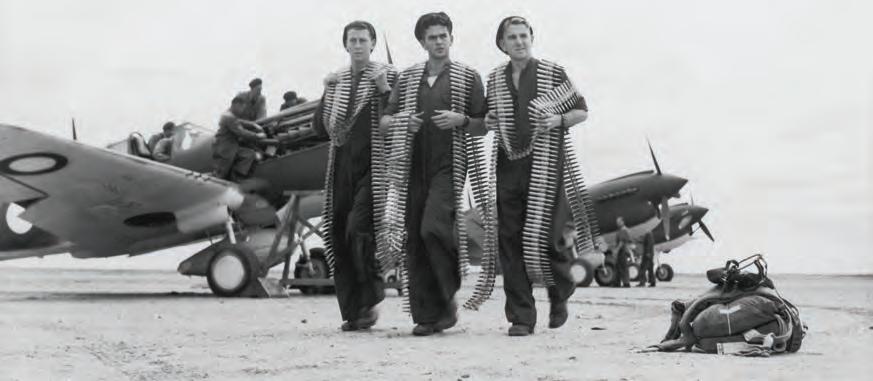
Source 7.6.2 Royal Australian Air Force mechanics carrying ammunition belts for Curtiss P-40 Kittyhawk fighters at an Australian airfield, c. 1943
Once deployed, Australian servicemen found themselves engaged in numerous significant battles and operations across both theatres of war, the European and the Pacific. They fought in the skies over Europe, in the harsh desert climate of North Africa, on the high seas of the Atlantic and Pacific Oceans, and in the unforgiving tropical jungles of South East Asia. These trying conditions, coupled with the threat of disease and the psychological strain of battle, tested their resilience and took a significant physical and mental toll. The experiences of those who fought in the Pacific were particularly intense, as they faced a determined Japanese enemy and challenging terrain, with the Kokoda Track being a prime example. Many servicemen returned home with physical injuries and psychological scars. This was particularly the case for men who spent time as prisoners of war (POW) in German or Japanese POW camps.
Women
UNCORRECTEDSAMPLEPAGES
Unlike their World War I counterparts, Australian women were actively encouraged to enlist in the non-combatant auxiliary branches of the armed services. Around 18 000 women were employed by the Women’s Australian Auxiliary Air Force (WAAAF), serving mainly as wireless and telegraph operators, and mechanics. In the Women’s Royal Australian Naval Service (WRANS), women worked as interpreters, wireless operators, coders, typists, clerks and drivers. Women were also restricted to playing a supportive role in the Australian Women’s Army Service (AWAS), again working mainly in communications, maintenance and transport.
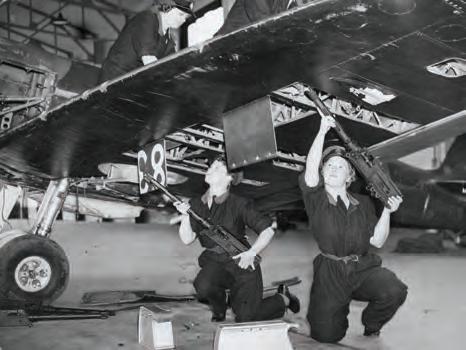
Source 7.6.3 Members of the Women’s Auxiliary Air Force learning to mount guns on to a Spitfire, August 1941
Members were also trained in combat so that they could assist in the defence of Australia in the event of a Japanese invasion.
In most of these roles, women were only paid at two-thirds the rate given to their male counterparts. Joining these organisations was clearly still a popular choice, because just under 80 000 women signed up during the war.
Australian women were also able to support the war effort by joining the Australian Army Medical Women’s Service (AAMWS) and the pre-existing Australian Army Nursing Service (AANS). Only members of the AANS were permitted to serve overseas wherever the Australian Army fought, working in both land hospitals and on hospital ships. Unfortunately, serving so close to the fighting placed these nurses at terrible risk. In the days just before the surrender of Singapore, many of the island’s Australian nurses were ordered to evacuate by ship along with civilians and nonmilitary personnel. Many were successful, but not all. One ship, the SS Vyner Brooke, was sunk by Japanese bombers just off Bangka Island on 14 February. Twenty-two of the nurses were able to drift to shore, only to be rounded up with 20 British soldiers and forced back into the surf of Radji Beach, where they were machine-gunned. Vivian Bullwinkel was the lone survivor, feigning death until the soldiers left. She managed to hide in the jungle for 10 days until she was captured and interned in a POW camp in Indonesia. Eleven nurses were also killed when a Japanese submarine sank the clearly marked hospital ship AHS Centaur just off the coast of Brisbane in May 1943.
Aboriginal and Torres Strait Islander Peoples
It is difficult to provide an exact figure as to how many Aboriginal and Torres Strait Islander soldiers served during World War II. Australian defence force enlistment forms did not allow for soldiers of Aboriginal and Torres Strait Islander background to declare their heritage until 1980.
First Nations Peoples were still not considered citizens of Australia when war broke out in 1939, and both the Australian Army and the Royal Australian Navy had policies that restricted enlistment to individuals of “European origin or descent”. However, the policies were unclear and not consistently enforced, so a small number of volunteers successfully enlisted and served in Europe and the Middle East.
UNCORRECTEDSAMPLEPAGES
The Royal Australian Air Force, however, was far more lenient in terms of allowing First Nations Peoples to serve, mainly to replace lost manpower and to maintain their commitment to supplying 27 000 airmen to the Empire Air Training Scheme.
Source 7.6.4 Sister Vivian Bullwinkel survived the sinking of the SS Vyner Brooke
Writing focus 7.6
Developing sentences
As the war progressed and the threat of a Japanese invasion grew, particularly following the air raids on Darwin and northern Australia, the initial restrictions on the enlistment of Aboriginal and Torres Strait Islander Peoples were relaxed or overlooked entirely. Military authorities now sought to incorporate First Nations knowledge of the terrain and unique survival skills into specialist land, air and sea units designed to bolster the defence of northern Australia.
Source 7.6.5 Aboriginal Australian servicemen of the “Special Platoon” who volunteered from Lake Tyers, Victoria (known as Bung Yarnda by the local Gunai/Kurnai community) during World War II.
anthropologist an individual who studies human origins, institutions and beliefs
The defence of Australia’s northern coastline was considered an immensely difficult task due to the length of coastline, the rugged and inaccessible terrain, and the sparse distribution of Australia’s population in the north. A few anthropologists lobbied for the formation of Aboriginal and Torres Strait Islander speciality units, despite groundless fears that these men might view the Japanese as liberators and provide assistance in the event of an invasion. Many Aboriginal and Torres Strait Islander Peoples were able to enlist in some of these smaller units, such as the Torres Strait Light Infantry Battalion, formed in 1941. However, because the units were not ‘regular army’, the members were not afforded the same pay rate or conditions as non-Indigenous soldiers.
Other examples of the contribution of First Nations Peoples to the defence of Australia include the formation of irregular units, such as the Special Reconnaissance Unit, based in Arnhem Land, and the 2/1st North Australia Observer Unit, colloquially known as the “Nackeroos”, based in Katherine. Their objective was to patrol designated areas, assist downed pilots, shadow any Japanese troops who landed and engage in guerrilla warfare tactics to undermine their advances. Once the threat of invasion ceased, these units were restricted to coastal observation only.
Aboriginal and Torres Strait Islander Peoples served in every Australian campaign during World War II, and at least a dozen died as POWs. Again, they earned the same wage as their fellow soldiers, and opportunities for promotion were available. For example, Reginald Saunders, who served in Libya, Greece, Crete and New Guinea, became the first First Nations military officer after he was commissioned in November 1944. Another example was Warrant Officer Leonard Waters, who became the first First Nations man to earn his “wings” as a pilot, flying more than 90 missions in the skies over New Guinea, Morotai and Borneo. For the most part, it is believed that the estimated 3000 First Nations men who served in the regular armed forces, and up to 150 who served in irregular units, did not experience the same prejudice and racism they suffered back home in Australia.
Activity 7.6.1
Create a visual timeline of Australian involvement in the war in Europe using the information in the text. You can use Canva or another appropriate application to create your timeline. For each action involving Australian servicemen and servicewomen, you should locate and include a visual image that is representative of the selected action and will support the information you have included.
Historical concepts: Significance Historical skills: Comprehension
Knowledge and understanding
Identify two irregular units that First Nations Australians contributed to the formation of during World War II and explain their objectives.
Summarise the ways women could play an active role in the war effort.
Describe the conditions for Australian servicemen during the war.
Compare the reasons why some anthropologists lobbied for the formation of speciality Aboriginal and Torres Strait Islander units, and why others opposed it.
Explain why it is difficult to provide an exact figure as to how many soldiers of Aboriginal and Torres Strait Islander background served during World War II.
Thinking and researching
Using the information in the text and some of your own research, choose one of the following perspectives:
• Australian servicewomen
• Aboriginal and Torres Strait Islander servicemen.
You are to imagine that you have been asked to interview a fictional member of your chosen group for a documentary or newspaper article. Give them a name and think of eight to 10 potential interview questions. Then write responses that have been informed by your research.
Possible questions include:
• What was your life like prior to enlisting?
• Why did you enlist?
• Where did you serve and who did you fight against? Or, where were you stationed as a nurse?
• Describe your experiences.
UNCORRECTEDSAMPLEPAGES
• What do you remember most vividly about your wartime experience? The aim is to convey an accurate and detailed understanding of the person’s experiences, so choose questions that will provide detailed responses to demonstrate the challenges and successes of their experience in service.
Historical concepts: Perspectives Historical skills: Comprehension, Research, Communication
The beginning of the war in the Paci c
Learning intention
In this lesson, you will learn about the beginning of the war in the Pacific during World War II.
Success criteria
❏ I can identify the beginning of the war in the Pacific during World War II.
Based on Source 7.7.1, consider the following questions for discussion.
• What can you see in this image? (I can see …)
• What do you think about this image? (I think …)
• What does this image make you wonder about World War II in the Pacific? (I wonder …)
Source 7.7.1 Key regions and battles in the Asia–Pacific region during World War II
Atomic bombing of Hiroshima and Nagasaki, August 1945
Midway, June 1942 Pearl Harbor, December 1941
Fall of Singapore, February 1942
Leyte Gulf, October 1944
Coral Sea, May 1942
Guadalcanal, August 1942
Kokoda Track, July 1942 to January 1943
First bombing of Darwin, February 1942
Union
INDIAN OCEAN
The war in the Pacific began with the 7 December 1941 surprise Japanese attack on the United States naval fleet based at Pearl Harbor, Hawaii. Then, on 15 February 1942, the Japanese took Singapore, Britain’s major base in the Pacific region. Australian Prime Minister John Curtin clashed with British Prime Minister Winston Churchill over the intended destination of AIF’s 6th and 7th Divisions, which were no longer required in North Africa after being relieved following the siege of Tobruk. Churchill had previously adopted a policy of “Germany first”, but after Singapore fell, his strategic objective in the Pacific theatre was the defence of British India. While Churchill wanted the 7th Division redeployed to Burma (now Myanmar), Curtin insisted they be returned to defend Australia. This would prove a pivotal turning point in Australian foreign policy, with Australia now seeing the United States, rather than Britain, as its principal ally in the fight against Japan.
While some RAF and RAN personnel and units continued to serve in the European theatres, Australia’s defence policy and deployments were now focused on the defence of Australian territories and interests threatened by the Japanese advance. With the assistance of the United States’ equipment and reinforcements, Australian forces contributed to Allied victories in a number of decisive battles against Japanese forces, such as the naval battles of the Coral Sea and Midway (1942), the New Guinea Campaign (1942–43) and, significantly, the Borneo campaign of 1945.
The Fall of Singapore 1942
The day after the attack on Pearl Harbor, Japanese forces began their invasion of the Malay Peninsula. The Australian 8th Division of the 2AIF had been stationed in Malaya since 1940, and the island of Singapore, at the southern end of the peninsula, was the base of the British navy in Asia. This base was considered to be an impregnable fortress: while it stood strong, the people of Australia felt confident that the British navy would come to their aid in the event of a Japanese attack.
The British defenders in Singapore expected Japanese forces to attack by sea. Instead, Japanese soldiers rapidly advanced down the Malay Peninsula towards the island while Japanese aircraft bombed strategic targets. Japanese forces attacked the island on 8 February 1942 and were threatening the city itself within days. The British Commander General Percival surrendered Singapore on 15 February. Churchill described the defeat as the “worst disaster and largest capitulation in British history”.
UNCORRECTEDSAMPLEPAGES
Source 7.7.2 A detachment of Australian soldiers on their way to reinforce the garrison in Singapore, 1942
Source 7.7.3 Smoke from bombs and artillery fire during the conflict in Singapore
Writing focus 7.7
Transitional phrases
The Fall of Singapore directly led to the capture of 130 000 Allied troops, including an entire division of Australian soldiers who had been ordered to hold their positions rather than withdraw. Fifteen thousand Australians became prisoners of the Japanese and were held captive until Japan’s surrender in August 1945.
The bombing of Darwin and attacks on Northern Australia
The city of Darwin was strategically important due to its port and airfield, which had potential as a base for counter-attacks against Japanese advances in South-East Asia. On 19 February 1942, just four days after the Fall of Singapore, an estimated 90 Japanese aircraft were involved in at least two bombing raids on Darwin. Eight ships were sunk in the harbour, 23 planes were destroyed, the airfield suffered significant damage (along with some other buildings in town) and 243 Australian military personnel and civilians were killed. Fearing an imminent invasion, at least half of Darwin’s population fled south. Subsequent bombing raids occurred in April, June, July, November and March 1943, with smaller operations taking place in between. In total, Darwin was subjected to at least 64 bombing raids.
Source 7.7.4 The aftermath of a Japanese bombing raid on Darwin. In the foreground right is a US destroyer, and behind it (left to right) are the burning remains of an Australian ship, an Australian hospital ship and a British ship.
Source 7.7.5 A destroyed Japanese Zero Plane shown in front of a barracks that was damaged by the raider’s bombs.
Source 7.7.6 On 21 February 1942, the Brisbane Courier-Mail reported on the bombing of Darwin.
Darwin was bombed twice yesterday by Japanese warplanes. Ninety-three bombers, with fighter escorts, took part in the raids, the first on the mainland of Australia. Four raiders were brought down. Damage to property was considerable. There were some casualties. Details are not yet available. The first attack was made at 10:52am by 72 twin-engined bombers, and lasted an hour. It was concentrated on the town and shipping in the harbour. There were some casualties and some damage was done to service installations. The second raid was made in the afternoon by 21 bombers.
UNCORRECTEDSAMPLEPAGES
Brisbane Courier-Mail, 21 February 1942
Source 7.7.7 Extract from the article “War came to Australia” in Soldiering On, the 1942 annual published and distributed among troops by the Australian War Memorial, and eventually available to the public.
[A description of the Kittyhawks’ tragic challenge to the bombers ended with the statement] “four of the American pilots lost their lives in a vain attempt to get into the air and fight [then] the first bomb to fall on Australia – a 1,000-pounder – scored a direct hit on the wharf, killing 20 labourers” [Then] “Burning oil from an oil tanker spread over the water of the harbour, adding to the holocaust. Men drowned because they could not swim in the heavy oil. Men burned because they could not escape the flames.” [Then] “The Peary sank with two-thirds of her compliment.” [However, the author carefully avoided any mention of chaos, looting or the civilian exodus. Those facts were still not for public consumption.]
UNCORRECTEDSAMPLEPAGES
Explain the tone of reaction to the bombing in Source 7.7.6.
How does the article underplay the magnitude of the damage inflicted by the bombers?
Explain the motive of the author of the newspaper article.
Identify the differences between these two versions of the bombing raid in Sources 7.7.6 and 7.7.7.
Why do you think the Australian public at the time were not given the full details of the raid and its effect?
The film footage (Source 7.7.9) is from July, by which time Darwin had been bombed on multiple occasions. Identify differences in approach between this report and the earlier ones.
Historical concepts: Significance Historical skills: Analysis and use of sources, Perspectives and interpretations
Source 7.7.9
Video: Darwin bombing ➜
Quoted in Grose, P., 2009, An Awkward Truth: The Bombing of Darwin, February 1942, Allen & Unwin, pp. 185–6
Source 7.7.8 Darwin bombing, July 1942 ➜
In addition to Darwin, other towns and strategic locations in northern Australia were subjected to Japanese air attacks, including Broome, Wyndham, Port Hedland and Derby in Western Australia, Katherine in the Northern Territory, Townsville and Mossman in Queensland, and Horn Island in the Torres Strait. These raids succeeded in interrupting the use of these northern cities for the war effort, while also preventing anti-aircraft defences and air force units from being deployed in more forward areas.
Teachers can go online to assign questions, view results, reports and more!
Knowledge and understanding
Identify which event marked the beginning of World War II in the Pacific.
Identify which Australian division had been stationed in Malaya since 1940.
Identify how many Australians became prisoners of war when Singapore fell.
Identify when the first bombing raid on Darwin occurred. How many people were killed in bombing raids?
Explain the importance of the British naval base in Singapore for Australia’s defence.
Explain why Darwin was a strategic target for Japanese bombing raids.
Account for the Fall of Singapore.
Discuss the impact of the Fall of Singapore on Australian morale and its defence strategy.
Evaluate the significance of the Fall of Singapore in the developments of World War II.
Thinking and researching
Account for the Australian public’s panic and fear of a Japanese invasion following the bombing of Darwin.
Students can be assigned teams, with one arguing that the Australian Government and people were justified in their fear of a Japanese invasion, while the other team argues against this proposition. Each team justifies its arguments to the class.
UNCORRECTEDSAMPLEPAGES
7.8 Naval battles in the Pacifi
Learning intention
In this lesson, you will learn about the naval battles that unfolded in the Pacific during World War II.
Success criteria
❏ I can identify the naval battles that unfolded in the Pacific during World War II.
❏ I can explain why these battles occurred.
Look at the image in Source 7.8.1.
See: List everything you can observe in the photo.
Think: What do you think is happening in the photo?
Wonder: What questions do you have about what is happening in this image?
Source 7.8.1 Japanese midget submarine, believed to be the scuttled M14, is raised from Sydney Harbour the day after the attack.
During World War II, the RAN played a significant role in the Pacific theatre, engaging in several key battles that contributed to the Allied efforts against Japan.
The Battle of the Coral Sea
By the end of April 1942, Japanese forces had swiftly expanded through South East Asia, capturing the resource-rich Dutch East Indies, Malaya, Singapore and Burma. However, Japan wanted to extend its defensive zone and cut off communication and supply lines between Australia and the United States.
On 4 May 1942, a combined Japanese force consisting of two aircraft carriers, heavy cruisers and destroyers, and supporting fighter planes and bombers, advanced into the Coral Sea. Allied Task Force 44, which consisted of a group of Allied warships, including two Australian ships, mobilised to intercept the Japanese Port Moresby Invasion Group.
Over the next four days, Allied forces launched a coordinated air assault. Both fleets suffered heavy losses, with the United States losing more ships and Japan losing significantly more aircraft. On 8 May 1942, the Port Moresby Invasion Group turned back.
UNCORRECTEDSAMPLEPAGES
Despite both sides claiming victory, Allied victory in the Battle of the Coral Sea was a turning point in the war in the Pacific. In addition to being the largest naval battle ever fought off Australia’s coast, it marked the first major naval battle fought entirely by aircraft from carriers. It was also the first naval battle in which opposing ships not only failed to sight each other, but they also failed to fire a single shot at each other.
Writing focus 7.8
The language of source analysis
Significantly, Allied victory put an end to Japan’s seaborne plan to invade Port Moresby, but it also marked the first time Japanese forces had experienced failure in a major military operation.
UNCORRECTEDSAMPLEPAGES
The Battle of Midway
A month after the Battle of the Coral Sea, Japanese and American aircraft carriers engaged in a decisive battle near the United States territory of Midway, an atoll halfway between Hawaii and Japan. Admiral Yamamoto’s objective was to destroy the remaining US Pacific Fleet, but he was again thwarted by Allied intelligence, which successfully intercepted and deciphered Japanese communications, allowing US Admiral Chester Nimitz to ambush the Japanese fleet unawares.
Beginning 4 June 1942, the advancing Japanese ships were sighted by dive bombers launched from US aircraft carriers Yorktown, Enterprise and Hornet. By the end of the day, three of Japan’s frontline carriers had been sunk, 248 aircraft destroyed and over 3000 men killed, severely crippling their naval air power. On 6 June, the remaining Japanese carrier, Hiryu, was also located and destroyed by American aircraft. Allied victory shifted the balance of power in the region. By severely weakening the Japanese fleet, the Allies would now be able to take the offensive in future campaigns and begin the arduous task of reclaiming territory captured by the Japanese.
CORAL SEA
Port Moresby Invasion Group
Empire
Rabaul
Port Moresby
Horn Isl. Coen
Cooktown
Jomard Pass
Choiseul
Malaita
San Cristobal
Tulagi Rennel
Guadalcanal
Defeat U.S. fleet here
Airstikes
New Caledonia
Santa Isabel
From Truk
To Naruru and Ocean Island
NEW GUINEA
Townsville
Source 7.8.2 Map showing Japanese objectives during the Battle of the Coral Sea ➜
Other naval battles
In addition to these two main battles, Australian naval units also supported Allied forces during the Battle of Guadalcanal (August 1942–February 1943), the Battle of the Bismarck Sea (March 1943), and the Battle of Leyte Gulf (October 1944), the last of which was one of the largest naval battles in history and played a crucial role in the liberation of the Philippines. Throughout the war, the RAN also engaged in numerous escort and patrol missions, contributing to the overall naval strategy in the Pacific and ensuring the protection of supply lines vital to the Allied war effort.
Submarine attacks on Sydney Harbour and Newcastle
On the night of 31 May 1942, three Japanese midget submarines entered Sydney Harbour. They had launched from a mother submarine stationed 11 km off the coast and intended to target Allied battleships and cruisers anchored in the harbour. Each craft had a two-person crew.
One of the submarines became entangled in an anti-submarine boom net that guarded the entrance to the harbour, and the other two were detected and fired upon. Two of the crews committed suicide, and the third submarine was wrecked. However, one torpedo released by a submarine detonated beneath the hospital ship HMAS Kuttabul, killing 21 and injuring 10.
UNCORRECTEDSAMPLEPAGES
Japanese submarines remained off the eastern coastline following the attack on Sydney Harbour and continued to shell coastal suburbs in Sydney, causing some structural damage to buildings but no casualties.
Source 7.8.3 The USS Abner Read burns and sinks during the Battle of Leyte Gulf. ➜
Additionally, in the early hours of 8 June 1942, a Japanese submarine positioned itself 9 km off the Newcastle coast. It is believed that its intended target was the Newcastle shipyard at Carrington, with the possibility that it was also targeting the BHP works at Kooragang, Fort Scratchley and the bulk carrier Iron Knight. After 13 minutes of the submarine firing 34 rounds at its targets, Fort Scratchley’s gunners returned fire with four rounds, after which the submarine went quiet. The shelling caused minimal damage and no casualties.
Source 7.8.4 The Japanese two-person submarine captured in Sydney Harbour, now on display at the Australian War Memorial. ➜
Knowledge and understanding
Why did Japan want to extend its defensive zone in the Pacific in 1942?
How did Allied intelligence contribute to the outcome of the Battle of Midway?
Explain why the Battle of the Coral Sea was considered a strategic victory for the Allies, despite their losses.
Compare the tactical approaches of the Battle of the Coral Sea and the Battle of Midway.
Compare the impact of the bombing of Darwin with the submarine attacks on Sydney Harbour.
Evaluate the significance of naval battles in the overall success of the Allied forces in the Pacific.
UNCORRECTEDSAMPLEPAGES
Thinking and researching
Using your knowledge of the Japanese attacks on Darwin and Sydney Harbour, write 2–3 diary entries from the perspective of a teenager living at the time. You should attempt to include historical facts about the events, as well as your reactions to what happened and your worries about what will happen next.
7.9 The Kokoda Track Campaign 1942–43
Learning intention
In this lesson, you will learn about the events of the Kokoda Track Campaign during 1942–43.
Success criteria
❏ I can explain the events that unfolded during the Kokoda Track Campaign (1942–43).
Having suffered a setback in the Battle of the Coral Sea on 7–8 May, Japan’s plans to capture Port Moresby by sea were replaced with plans to launch a land-based invasion from the north coast of New Guinea. Significantly for Australia, the Japanese army would experience its first major setback on land against Australian forces on the notorious Kokoda Track. New Guinea was a former German colony that was confiscated and given to Australia in the terms of the Treaty of Versailles in 1919. As such, for the first time since 1901, Australians were defending their own territory and fighting off a direct threat to their security.
Writing focus 7.9
Creating topic sentences
militia a military force made up of ordinary citizens rather than highly trained soldiers



















UNCORRECTEDSAMPLEPAGES










Source7.9.2 The height of Japanese expansion, 1942 ➜


Japan’s objective was to capture the capital, Port Moresby, by landing an infantry force on the north coast and sending them to advance across the Owen Stanley Mountain Range via the Kokoda Track, a 96-km human-made trail connecting Kokoda village to Owers’ Corner, just outside Port Moresby. The track, wide enough only for single-file movement in places, runs over extremely challenging terrain.
Standing between the Japanese attackers and their goal were approximately 400 members of the 39th Infantry Battalion of the Australian militia, many as young as 18 years of age. These militia men were derogatorily labelled “chocolate soldiers” or “chocos/chockos” by members of the AIF. The common view was that they would melt like chocolate in the heat of battle against more experienced Japanese soldiers. However, this view was soon proven to be unfair.
Source7.9.3 The main battle sites and other locations of interest along the Kokoda Track during the New Guinea campaign
Jungle warfare
Japanese forces landed at Gona on the north coast of New Guinea on 21 July 1942. They soon forced the Australian militia out of the village of Kokoda, capturing its airstrip on 11 August, before they advanced rapidly and pushed the 39th Battalion south over the mountain range. The Australian forces struggled to compete against a superior and far more experienced foe. They were poorly trained and ill-prepared for jungle warfare, disease-ridden, exhausted, struggling with the challenging terrain, and lacking in adequate supplies.
Fortunately, the Australian militia were reinforced by the arrival of men from the 2AIF’s 7th Division, who had returned from fighting in the Middle East. The Japanese maintained their advance towards Port Moresby while the Australians continued to retreat, halting at Imita Ridge. From their positions at Ioribaiwa, the Japanese attackers could see the searchlights of Port Moresby, but this was the closest they ever got. Japanese supply lines were now stretched, meaning that critical food and ammunition supplies were struggling to reach the advancing troops. Heavy losses inflicted on the Japanese in the Battle of Guadalcanal in the Solomon Islands during early August also caused a change in strategy: Japanese troops in New Guinea were ordered to retreat over the Kokoda Track and defend their positions at Gona, Buna and Sanananda on the north coast.
From September 1942, the Australians began to slowly push the Japanese forces back along the track, in what was some of the most brutal and vicious fighting of the war. At the same time, Australian and American forces were engaged in fighting Japanese units at Milne Bay, in the island’s east. The Australian troops recaptured the village of Kokoda on 2 November before Australian and American soldiers attacked the heavily defended Japanese beachheads, eventually capturing Gona, Buna and Sanananda.
By 23 January 1943, the Japanese invasion of New Guinea had come to an end, but it came at a cost: over 600 Australian soldiers were killed during the campaign.
Source 7.9.4 December 1943: a column of Australian soldiers on a muddy trail in the jungle of New Guinea
UNCORRECTEDSAMPLEPAGES
Source 7.9.5 In 2004, a former Papua New Guinean war carrier, Ovuru Ndiki, 98, is reunited with Kokoda veteran Stan Bisset, 91, whose brother Butch died in his arms during the campaign. The native Papuans and their knowledge of the terrain and jungle was invaluable to the Australians, along with their assistance in transporting supplies and carrying the wounded to medical stations.
Another 1600 troops were wounded, and even more contracted tropical diseases, such as malaria. The Allied victory in the New Guinea campaign put an end to Japanese advances in the Asia-Pacific and the momentum swung to the Allies.
Conditions
The conditions endured by the soldiers fighting in New Guinea were some of the worst ever experienced by Australian soldiers. The Kokoda Track could only be travelled by foot, meaning that all supplies of food, water and ammunition had to be delivered by air drops and then carried over the track by hand. This was exhausting for soldiers who were already malnourished and struggling to cope with the extreme heat, humidity, rugged terrain and dense jungle. Movement along the track was slow and dangerous, made worse by the torrential rain that transformed the track into thick mud and creeks into raging rivers.
Source analysis
UNCORRECTEDSAMPLEPAGES
Activity 7.9.1
Source 7.9.8 Australian troops moving along the Kokoda Track in 1943
➜
Source 7.9.9 Australian troops on the Kokoda Track ➜
Source 7.9.10 Kokoda Track, 1942 ➜
Source 7.9.11 The Kokoda Track today. Trekkers crossing a makeshift bridge, 2010. Australian engineers had to construct over 100 bridges during the campaign, many of which were washed away by floods during the wet season.
Identify one feature that strikes you in the video and each of the black and white photographs. Explain why you find it meaningful.
How do these sources assist our understanding of the conditions experienced by Australian soldiers along the Kokoda Track?
Explain why modern Australian tourists might want to walk the Kokoda Track.
Historical concepts: Significance Historical skills: Analysis and use of sources
Why was New Guinea an Australian territory at the time?
Explain why the Japanese invasion of New Guinea occurred on land.
How important was capturing Port Moresby for Japan’s ambitions?
How did the terrain of the Kokoda Track affect both Japanese and Australian soldiers?
Discuss why the 39th Infantry Battalion were referred to as “chocos”.
Compare the challenges faced by Australian soldiers in the Kokoda Track Campaign with those faced in other World War II battles.
Analyse the significance of the New Guinea campaign to the course of the war in the Pacific.
Thinking and researching
Teachers can go online to assign questions, view results, reports and more!
Extension 7.9.1 Paul Keating reflects on the New Guinea campaign
Evaluate the view that Australian involvement in the New Guinea campaign of 1942–43 should be awarded a more prominent position in the Anzac legend than the Gallipoli campaign.
Form small groups and argue for or against this view. Each group will discuss its opinions to the class.
Historical concepts: Significance, Contestability Historical skills: Research, Interpretations, Explanation and communication
UNCORRECTEDSAMPLEPAGES
7.10 The end of the war
Learning intention
In this lesson, you will learn about the events that led to the end of World War II.
Starter activity
As a class or with the person next to you, discuss the following statements. Do you agree or disagree? Explain why.
• “Victory automatically brings peace.”
• “The end of a war is the same for everyone involved.”
• “How a war ends matters as much as how it is fought.”
Source 7.10.1 View of Hiroshima after the explosion ➜
Victory in Europe
From 1943 onwards, German forces in Europe were being gradually pushed back into German territory, and by late April 1945 American, British and Soviet forces had captured most of Germany. Knowing that defeat was inevitable, German leader Adolf Hitler committed suicide in his bunker in Berlin on 30 April 1945. Representatives from the German armed forces negotiated Germany’s formal surrender to the Allies on 8 May, now known as VE (Victory in Europe) Day.
Success criteria
❏ I can identify the events that led to the end of World War II.
UNCORRECTEDSAMPLEPAGES
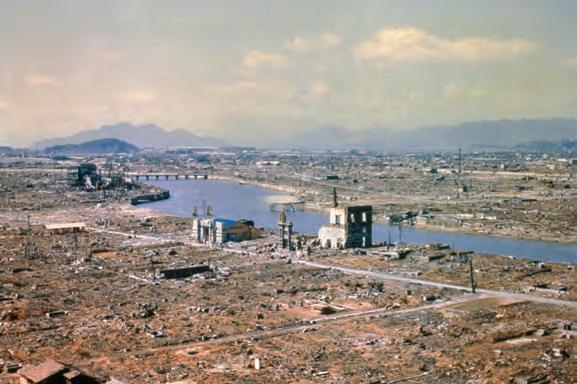
7.10.2 Young people celebrate VE Day in Kings Cross, Sydney, 8 May 1945
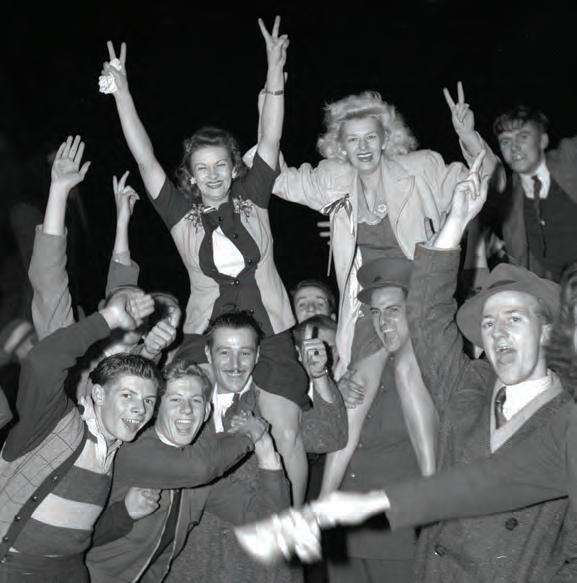
Victory in the Pacific
The Allies were also having success in the Pacific. Throughout 1944 Allied forces retook Saipan, Tinian and Guam. These strategically important islands were within range of the outer Japanese islands and allowed the American navy to begin bombing raids. In February and March of the following year, American forces captured the island of Iwo Jima, and by June they took the island of Okinawa. Allied forces were now in a position to launch an attack on the Japanese mainland. Tokyo and other major cities were firebombed in preparation for a planned invasion of Japan.
The atomic bomb
At the Potsdam Conference in July–August 1945, the Allies called on Japan to surrender unconditionally. It refused, and on 6 August the United States dropped an atomic bomb on the city of Hiroshima: upwards of 80 000 people were killed instantly. Two days later, the Soviet Union declared war on Japan and invaded Manchuria. The next day the United States controversially dropped a second atomic bomb, this time on the city of Nagasaki. Japan’s Emperor Hirohito signed the formal surrender of Japan on board the USS Missouri in Tokyo Bay on 2 September 1945. World War II had finally come to an end.
Source 7.10.5 shows Emperor Hirohito with General Douglas MacArthur, Supreme Commander of the Allied Powers. The emperor was considered a living god, rarely seen by the Japanese public, and his photos were traditionally staged to reinforce his height. Also, according to Japanese tradition, men would stand to the right of women in photos. The Japanese Government attempted to ban this photo, but MacArthur ordered all Japanese newspapers to print it.
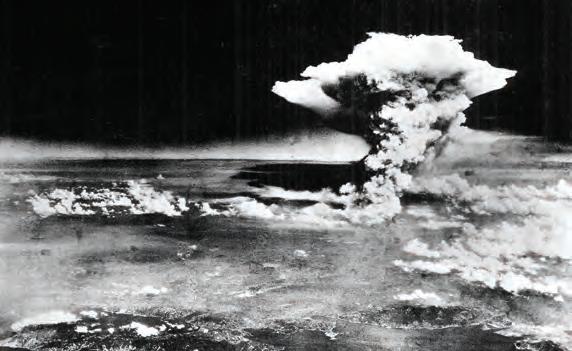
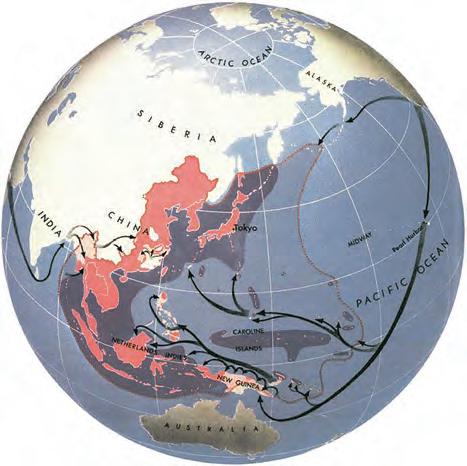
UNCORRECTEDSAMPLEPAGES
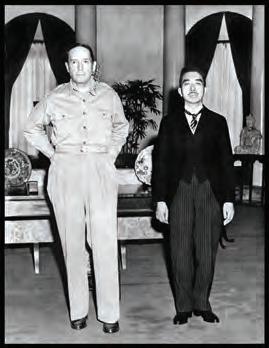
Source 7.10.3 Map showing Allied attack routes against Japan. From the 1943–45 biennial report by the Chief of Staff of the United States Army.
atomic bomb a bomb that relies on nuclear fission for its destructive power; the United States dropped two atomic/nuclear bombs, on the Japanese cities of Hiroshima and Nagasaki, ending World War II in the Asia-Pacific
Source 7.10.4 An aerial view of the mushroom cloud over Hiroshima after the detonation of the atomic bomb, named “Little Boy”, 6 August 1945
Source 7.10.5 General Douglas MacArthur and Emperor Hirohito after Japan’s formal surrender
Writing focus 7.10
Transitional phrases
A US force of about 160 000 personnel led the Allies in occupying Japan until April 1952, when full sovereignty was restored to the country. Australia supported the occupation and provided up to 12 000 personnel at any one time to the 40 000-strong British Commonwealth Occupation Force (BCOF). This was responsible until 1951 for supervising demilitarisation and the dismantling of Japan’s war industries.
Activity 7.10.1
Tug of war
You have been presented with the following dilemma: “The use of atomic weapons on civilian targets can be a necessary evil that may eventually save more lives than it takes.”
Think of a series of justifications, both for and against this statement, and write them on post-it notes.
When your teacher has drawn a line on the board, writing FOR and AGAINST at opposite ends, place your ideas where you think they best fit.
When the class has done this, generate “what ifs”: questions, issues, factors or concerns that might need to be explored further to resolve the issue. Write and post these above the line.
Reflect on the activity. What new ideas do you have about the use of atomic weapons on civilian targets? Do you still feel the same way about it? Have you made up your mind or changed your mind?
Historical concepts: Perspectives Historical skills: Perspectives and interpretations
Teachers can go online to assign questions, view results, reports and more!
Knowledge and understanding
Why did Germany surrender in May 1945?
How did the United States force Japan to surrender in August 1945?
Define the role of the British Commonwealth Occupation Force (BCOF) in post-war Japan.
Assess whether the use of atomic bombs on Hiroshima and Nagasaki was justified in ending the war.
Thinking and researching
Using the internet, research the Manhattan Project and the development of the atomic bomb. Explain the arguments used to justify dropping the bombs at the time, and compare them with the views of modern historians now. In your opinion, was the US justified in dropping the bombs? Give reasons for your answer.
UNCORRECTEDSAMPLEPAGES
Historical concepts: Continuity and change, Perspectives, Contestability Historical skills: Analysis and use of sources, Perspectives and interpretations, Research, Explanation and communication
7.11 The home front
Learning intention
In this lesson, you will learn about the actions undertaken on the home front during World War II.
Success criteria
❏ I can identify the use of censorship and propaganda on the home front during World War II.
❏ I can explain the changing roles of women on the home front during World War II.
❏ I can explain the contributions of Aboriginal and Torres Strait Islander Peoples during World War II.
Imagine a normal day in Australia interrupted by the news of war. How might the everyday routines of the following things change?
• Work/school
• Food/shopping
Government controls
• Movement/freedom
• Information/entertainment
• Home life
The National Security Act 1939 gave the Federal Government the power to make laws beyond the scope of the Australian Constitution, and without the approval of parliament. This allowed the government to take control of the nation’s resources. Rationing was introduced and covered basic foodstuffs, petrol and other items that were in scarce supply, including clothing and footwear. Businesses could also be redirected to war production, and the Trading with the Enemy Act 1917 prevented trade with enemy nations. In addition, the National Security Act increased the government’s control over the national economy. A federal income tax was introduced in 1942, replacing the states as the main collectors of income tax. Banking, wages and prices were regulated and controlled by the government. The National Security Act also gave the government the power to arrest people without warrants and to hold trials in closed courts.
Censorship
Censorship was introduced by Prime Minister Menzies within days of the outbreak of war. The government’s Department of Information monitored and restricted the content of newspapers, radio stations and films, while also encouraging the reporting of positive news stories that would lift morale and maintain support for the war effort. For example, newspapers reported that 17 people were killed during the Japanese raids on Darwin in February 1942, when the death toll was actually 243.
UNCORRECTEDSAMPLEPAGES
rationing limiting specific goods to a certain amount per person
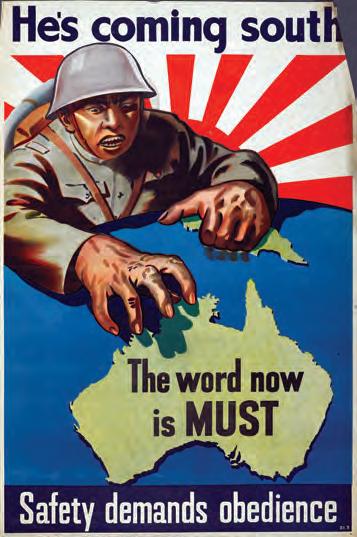
Source 7.11.1 “He’s coming south”: Australian propaganda poster emphasising the Japanese threat, 1942
All forms of communication were subject to censorship, including telegraphs, telephones and mail. Even soldiers’ letters home were heavily censored lest they unintentionally divulge sensitive strategic information that could advantage the enemy. Servicemen and women were also prohibited from writing diaries for the same reason.
Propaganda
The Australian Government produced propaganda in the form of newspaper articles, posters, cartoons, films and leaflets. The intended purposes were much the same as in World War I: encouraging men to enlist, boosting national morale, maintaining support for Australia’s involvement in the war, or encouraging people to contribute to the war effort by rationing vital products or investing in war loans.
Conscription
Conscription was introduced by the Australian Government in October 1939. Initially, all men over the age of 20 were required to complete three months’ military training. From June 1941, all unmarried men aged 21 and over were conscripted into the Citizens Militia Force (CMF), the same name used for the Australian militia in New Guinea. This was extended to all childless married men and single men aged 18 to 35 in 1942. The maximum punishment for failing to turn up was six months’ jail with hard labour.
Writing focus 7.11
Transitional phrases
UNCORRECTEDSAMPLEPAGES
Source 7.11.2 The Daily Telegraph (London) explained the purpose of the Australian militia. ➜
It was a sound democratic principle that sacrifices should be borne as equitably as possible … It is the Government’s policy to maintain the strength of the militia at not less than 75,000. The question for Cabinet was how the additional men for Australia’s defence should be recruited. I emphasise the word Australian defence because it must once more be made clear that there is no obligations for service abroad except in the case of volunteers for such service. Cabinet decided that the strength of the militia should be kept up by the reintroduction of compulsory training …
Daily Telegraph (London), 21 October 1939
Explain what you think is meant by the phrasing “sacrifices should be borne as equitably as possible”. How is this democratic? Identify the question Cabinet was attempting to answer, and its solution.
Historical concepts: Perspectives, Significance Historical skills: Analysis and use of sources
The AIF could be sent anywhere in the world to fight, but the CMF could not be sent overseas. However, the Defence Act 1943 extended the area in which conscripts could serve to include the major war zones in the Pacific. Prime Minister Curtin argued that because American soldiers were fighting in these zones, it would be unjust if Australia did not send its own soldiers to do their bit for the defence of Australia.
The Defence Act allowed the government to conscript women into the auxiliary branches of the armed forces, while the National Security Act gave the government the power to direct people into war-related industries, or to prevent men from enlisting if their occupation was considered an essential service.
Most Australians were supportive of the new laws, because they considered them an acceptable sacrifice to make given the threat of a Japanese invasion and the loss of more than 20 000 Australian servicemen who were being held as POWs.
Changing role of women
Many women took on volunteer work: knitting items of clothing to be sent to men serving overseas, organising entertainment for men on leave, or raising funds that allowed for the Red Cross to continue its services both at home and abroad. Some women supported the war by volunteering in hospitals as part of Voluntary Aid Detachments (VADs) or Red Cross Aid Units, while others drove and serviced army vehicles, ambulances and aircraft as part of the Women’s Australian National Service (WANS), or trained with the Women’s Emergency Signalling Corps.
UNCORRECTEDSAMPLEPAGES
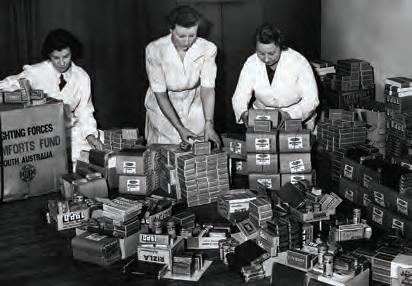
Source 7.11.3 Women prepare care packages of chocolate, tobacco, cigarette papers, toothpaste, razor blades and soaps for Allied troops, all gifts from the South
, Penguin, Melbourne, pp. 195–6
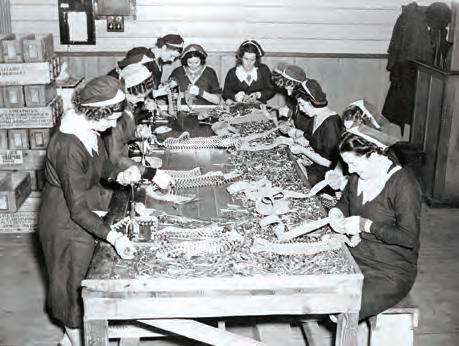
Source 7.11.5 Women replaced male employees at the Government Munitions Factory at Footscray, Victoria. Some of the women are loading bullets in machine-gun belts.
Source 7.11.6 Three female motorcycle messengers of the National Emergency Services in New South Wales, Australia during World War II, c. 1943
Women’s participation in the workforce dramatically increased in World War II as many women took advantage of employment opportunities after the shortage of male workers lost to the war. Large numbers of women also left traditional, low-skilled jobs for war work. By 1943 there were 184 000 women directly involved in war work, helping to produce food, steel, munitions and other military equipment needed for the war against Japan. Receiving the same training as men, women were also now working as mechanics, truck and bus drivers, technicians, radar operators, delivery drivers, welders and signallers. In late 1942, women were even permitted to join the police force, although in supporting positions only. By mid-1943 there were almost 850 000 women involved in paid employment throughout Australia.
In July 1942, the Commonwealth Government formed the Australian Women’s Land Army to help to free farm workers to enlist in the armed forces. In New South Wales, 69 camps were established, and more than 6000 women between the ages of 18 and 50 volunteered, travelling constantly to various areas where the work was needed or volunteering to help in a seasonal role in their local area. Most assisted with herding livestock, harvesting crops or milking cows.
UNCORRECTEDSAMPLEPAGES
Source 7.11.7 Photograph of the Australian Women’s Land Army members picking an almond crop at Hamilton’s Vineyard at Marion, South Australia, dated 1943 ➜
Despite some resistance from religious leaders and trade unions, the involvement of women in paid employment in male-dominated industries was accepted out of necessity. Governmentled propaganda campaigns targeted women, portraying working women in a positive and patriotic light, even if women working in essential war work only received 75 per cent of the male rate. But this enlightened change in attitudes towards the traditional role of women was short-lived. Working women were expected to return to their traditional role as wives and mothers once the war ended.
Contributions of Aboriginal and Torres Strait Islander Peoples to the war effort
In addition to military service, Aboriginal and Torres Strait Islander Peoples contributed to the war effort on the home front. Many worked in essential industries, including agriculture, manufacturing and munitions, helping to support the war economy by filling gaps in the labour force caused by worker shortages. They also participated in volunteer organisations and community efforts to support troops overseas.
Much thought was given to First Nations assistance for the war effort. In Northern Australia, the Special Reconnaissance Unit raised in 1941 by anthropologist Flight Lieutenant Donald Thomson was formed almost exclusively of Aboriginal and Torres Strait Islander Peoples. Similar units were formed at Bathurst and Melville Islands, at Groote Eylandt and on the Cox Peninsula. The First Nations Peoples who served in these units were not formally enlisted and nor were they paid. In 1992, they were finally awarded medals and remuneration.
UNCORRECTEDSAMPLEPAGES
Source 7.11.8 American officers and an Aboriginal man in the bush region of northern Australia, 1942. First Nations Peoples were highly regarded by the Americans as great trackers.
Aboriginal and Torres Strait Islander women also assisted the war effort by joining the auxiliary branches of the armed forces, including the AWAS, WAAF and WRANS, which allowed for the release of more men for active service both in Australia and abroad. While the number of First Nations women who joined these branches is unknown due to the lack of accurate recordkeeping, it is known that they filled vital roles as clerics, radio operators, domestic workers and hospital orderlies. Other women joined the Australian Women’s Land Army and contributed to the war effort by helping to maintain agricultural production.
Teachers can go online to assign questions, view results, reports and more!
Why did the Australian Government introduce the National Security Act 1939?
Define the role of censorship in Australia during World War II.
Explain what rationing is and why you think it had to be introduced.
Explain how women contributed to the war effort in both volunteer and paid roles. Identify when and why the government introduced conscription into a militia.
Justify why there was less controversy over conscription in World War II compared with World War I.
Account for the lack of recognition given to Aboriginal and Torres Strait Islander Peoples for their wartime contributions.
Why did people accept government restrictions placed on most aspects of their lives during the war?
Discuss the importance of the National Security Act 1939.
Compare and contrast the role of women in World War I (refer to Chapter 6 of this textbook) and World War II.
7.12
The experiences of prisoners of war (POWs)
Learning intention
In this lesson, you will learn about the experiences of Australian POWs during World War II.
Starter activity
Imagine you are a POW during World War II. What would it be like to have almost no control over your daily life?
Discuss as a class or with the person next to you. Organise your ideas under the following headings:
• Effects on body
• Effects on mind
• Effects on behaviour.
Success criteria
❏ I can identify the experiences of POWs during World War II.
❏ I can compare the experiences within German and Japanese POW camps.
Source 7.12.1 Changi Prison Camp, Singapore, 1945. All the men pictured are wearing artificial limbs made in the camp.
In World War II, more than 31 000 Australian servicemen and women became POWs. This was nearly eight times as many as in World War I, and the survival rate was much lower. Their treatment and rate of survival was largely dependent on whether they were imprisoned in German or Japanese camps.
German camps
UNCORRECTEDSAMPLEPAGES
Approximately 8600 Australian soldiers were held captive by the Germans in camps in Austria, Germany and Poland. Of these, almost 8400 were alive at the war’s end.
Activity 7.12.1
Source analysis
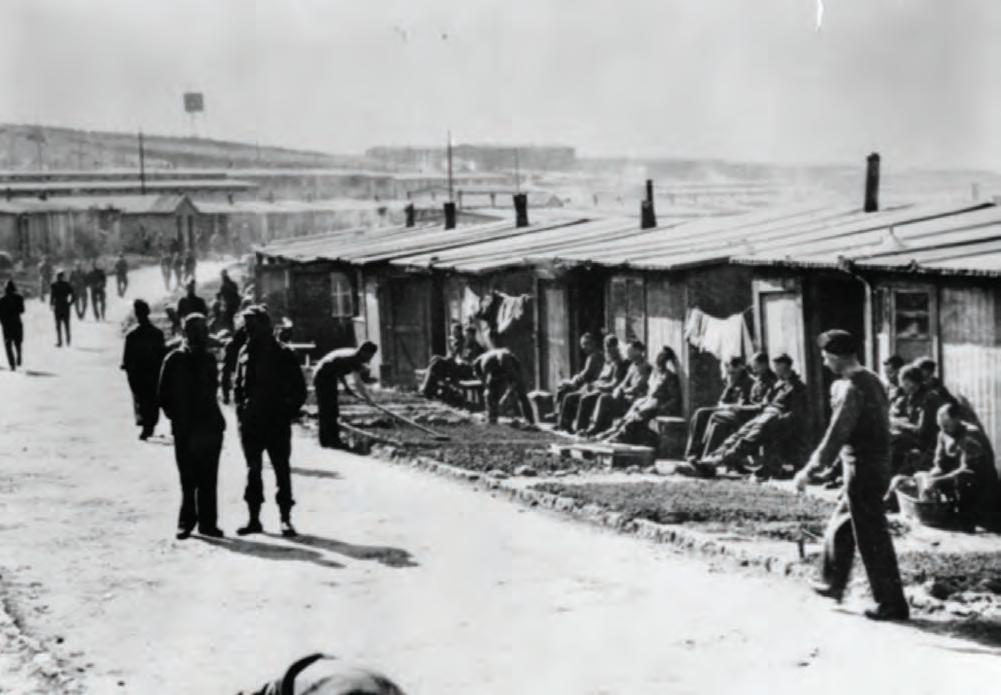
UNCORRECTEDSAMPLEPAGES
Japanese camps
Approximately 22 000 Australian troops and 71 nurses became prisoners of the Japanese. They were held in camps throughout South East Asia, including in Borneo, Korea, Manchuria, Hainan, Rabaul, Ambon, Singapore, Thailand, Burma and Japan itself. The Japanese treated their prisoners harshly, often beating, torturing, starving or denying basic medical care to soldiers in need. Failure to show respect to their captors often resulted in barbaric and humiliating punishments and executions; one such punishment involved forcing prisoners to stand in the sun all day with their arms outstretched. Prisoners of war were also used by the Japanese as forced labour on massive construction projects designed to benefit the Japanese war effort. Using prisoners in this way was prohibited by the Geneva Conventions, which set clear rules for the treatment of POWs, but Japan had not signed the Convention and so it did not adhere to the rules. More than one in three of these POWs had died by the end of the war.
Historical concepts: Perspectives Historical skills: Analysis and use of sources
Writing focus 7.12
Creating topic sentences
UNCORRECTEDSAMPLEPAGES
POWs by their Japanese captors.
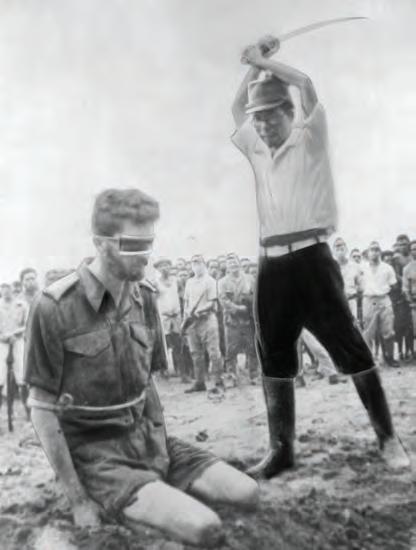
Source 7.12.5 A Japanese soldier prepares to execute an Australian POW
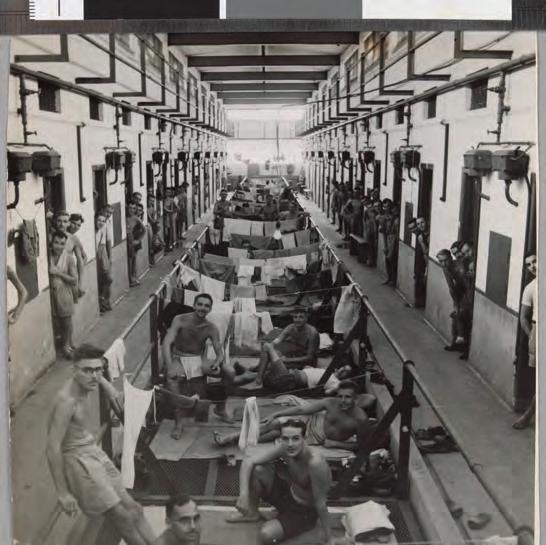
Source 7.12.6 A general view of one of the many wards in the Changi POW camp in Singapore, showing the emaciated Allied prisoners, September 1945
Changi After the Fall of Singapore and the Allies’ surrender, some 15 000 Australians and 35 000 British soldiers were held captive in the former British barracks at Selerang and the civilian prison in Changi.
Burma–Thailand Railway In 1943, 12 000 Australian prisoners were transferred from Changi to work alongside 50 000 other Allied prisoners, and approximately 180 000 Asian slave labourers called “Romusha” on what became the Burma-Thailand railway.
Sandakan In 1942, 1494 POWs were transferred from Changi to Sandakan in northern Borneo. Alongside British POWs, their job was to construct an airfield. Another 500 Australian prisoners joined them in June 1943.
Source 7.12.7 Three examples of Japanese POW camps. Additional information about the camps is available in the Interactive Textbook.
Internment of “enemy aliens” in Australia
Extension
7.12.1 The Burma–Thailand railway
UNCORRECTEDSAMPLEPAGES
Under the National Security Act 1939, “enemy aliens” were placed in internment camps during the war due to the fear that they could not be trusted to refrain from acting against Australian interests as spies or to sabotage the war effort. “Enemy aliens” was a rather vague label and included Germans and Italians living in Australia. From late 1941 onwards, it also included Japanese individuals, naturalised Australians, Australian-born people of German and Italian descent, enemy POWs, Nazi sympathisers and anyone else branded “enemies” due to their political stance. During the years 1939 to 1946, there were about 7000 Australian residents, 8000 overseas internees and 19 000 enemy POWs held in camps throughout Australia.
Men, women and children were interned, but most were released after a short period and kept under surveillance. They were seemingly treated well while interned. While the conditions in the internment camps may have been better than the Japanese POW camps, due to Australia’s compliance with the Geneva Conventions, it is hard to imagine the indignity suffered by the many people who were interned solely based on their nationality, heritage or even acquaintances. Among those locked up with no evidence of wrongdoing were the Dunera Boys, a group of mostly Jewish men who had fled persecution in Europe only to be interned in Australian camps, and almost 300 First Nations Australians who were interned because their pastor was German.
After the war
After Japan’s surrender in August 1945, the surviving POWs were liberated from camps all over South-East Asia, including Japan. The majority of POWs found that the cruelty and indifference they suffered at the hands of their captors was an experience that had lasting negative consequences.
War Crimes Trials were held by the victorious Allies in both theatres of war. Political and military leaders of both Japan and Germany were tried for conspiracy to wage aggressive war, crimes against peace, crimes against humanity and war crimes. However, the trials were tainted by “victor’s justice”, as Allied war crimes were completely omitted.
In the trials relating to crimes committed against Australian POWs, over 900 Japanese guards and officers were tried; 641 were found guilty, and 137 were executed for their crimes.
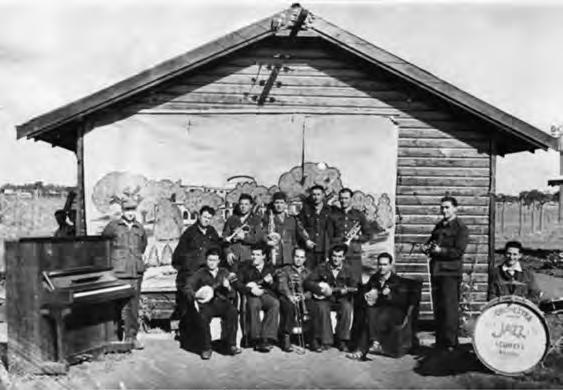
UNCORRECTEDSAMPLEPAGES
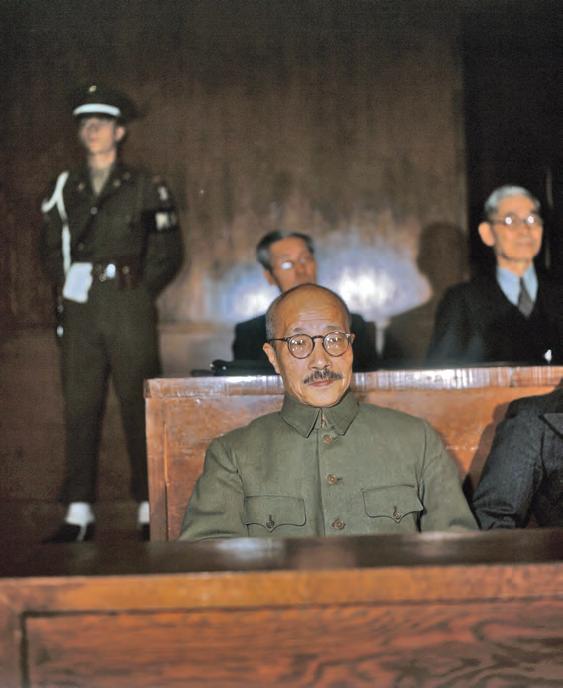
Source 7.12.9 War Crimes Trial of Hideki Tojo, general of the Imperial Japanese Army and Prime Minister of Japan during much of World War II. Tojo was arrested, sentenced to death for Japanese war crimes by the International Military Tribunal (IMT) for the Far East and hanged on 23 December 1948.
Source 7.12.8 A group of Italian POWs interned at No. 6 POW group, who formed themselves into a camp orchestra, Hay, Australia, 1943
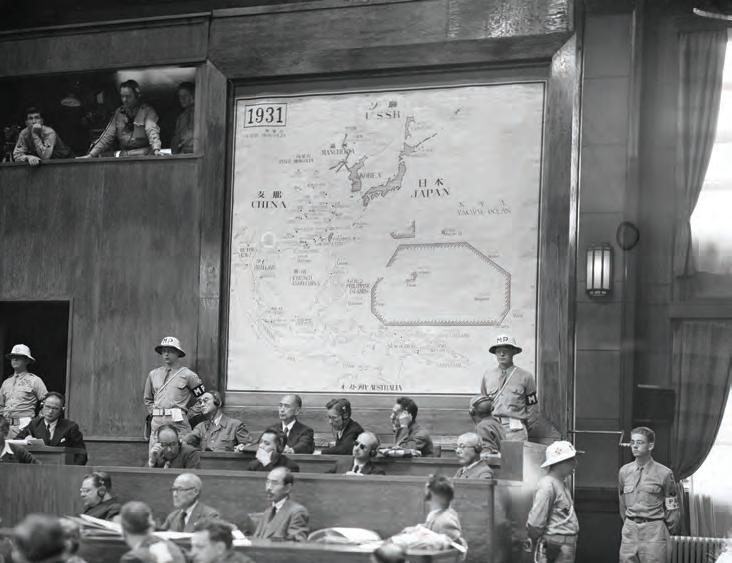
Source 7.12.10 The IMT’s prosecution introduced exhibits including historical records, documents and maps. Displayed here is one of the maps showing growth and recession of the Japanese Empire from 1931 until the surrender.
Teachers can go online to assign questions, view results, reports and more! Knowledge and understanding
Thinking and researching
Students can access sample responses and results online
Knowledge and understanding
Identify how many Australians became POWs during this war.
Why did more Australian servicemen become POWs in World War II compared with World War I?Outline the key features of the Geneva Conventions. Why did Japan not adhere to them?
Explain how War Crimes Trials addressed the treatment of Australian POWs after the war.
Describe how the Japanese troops treated Australian POWs.
Explain why Japanese captors treat the POWs so poorly
Explain what is meant by the “the trials were tainted by victor’s justice”.
Identify the groups of people considered to be “enemy aliens” within Australia.
Evaluate the ethical implications of interning civilians as “enemy aliens” during the war.
Thinking and researching
Divide the class into groups of three. Each member of the group is to research one of the POW camps listed in Source 7.12.7. Try to locate at least one firsthand account of the camp and evaluate the source’s usefulness and limitations to someone studying their experiences. Each member of the group should share their findings with the others. During your research, consider location, purpose, conditions and statistics.
UNCORRECTEDSAMPLEPAGES
7.13
The experiences of Jewish people and other victims of the Holocaust
Learning intention
In this lesson, you will learn about the experiences of Jewish people and other victims of the Holocaust during World War II.
Starter activity
Success criteria
❏ I can define the ideology of the Nazi Party.
❏ I can explain the experiences of Jewish people, Roma, homosexuals and other victims during World War II.
When we study people’s experiences during the Holocaust, what are we trying to understand – for example: fear, loss, choices, identity, survival and resistance?
As a class or with the person next to you, discuss the following questions: Which of these would be the hardest to describe with only numbers or dates?
1. 2.
Why does personal experience matter when we are considering history?
The term “Holocaust” refers to the Nazis’ attempt to systematically destroy European Jewry during World War II. Approximately six million Jews were murdered, alongside other victims who included people with disability, male homosexuals and hundreds of thousands of people from nomadic minorities such as the Roma and Sinti.
The Nazi Party
Driven by what he felt was the betrayal of the German people with the signing of the Treaty of Versailles, as well as anti-Jewish myths, Adolf Hitler became leader of the rebranded National Socialist German Workers Party in 1920.
Hitler was offered the position of Chancellor and was sworn in on 30 January 1933. Following the Reichstag fire less than a month later, the Nazis introduced new laws that restricted civil liberties and transformed Hitler’s government into a legal dictatorship, with himself as the Führer.
Nazi ideology was heavily influenced by the belief in the superiority of the Aryan race and the wickedness of the impure Untermenschen races, which included Jews, Slavs, Roma and disabled people. According to Hitler, the Aryan race was the strongest and would dominate the world.
UNCORRECTEDSAMPLEPAGES
Writing focus 7.13
The language of source analysis
During the 1930s, the Jewish population in Germany amounted to less than 1 per cent (500 000) of the total population. Yet Hitler used the Jewish population as a scapegoat for all that was evil in the world. The Nazi Party spread its ideology through harmful antisemitic propaganda.
Activity 7.13.1
Source analysis
Other than advertising the exhibition, what insights into Nazi racial ideology are provided by the poster in Source 7.13.1?
Outline the main techniques used by the creator of this poster.
Historical concepts: Cause and effect Historical skills: Analysis and use of sources
➜ Groups targeted by the Nazis Jewish people
Source 7.13.1 “The Eternal Jew”, poster. “The Eternal Jew” exhibition first opened in the Library of the German Museum in Munich, November 1937. It was the largest pre-war antisemitic exhibit produced by the Nazis.
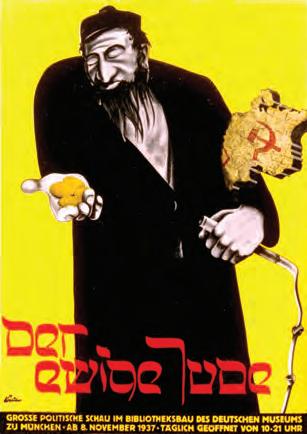
UNCORRECTEDSAMPLEPAGES
Between 1933 and 1939, Nazi antisemitism evolved from simple discrimination that aimed to encourage Jews to emigrate to more sinister measures, including a boycott of Jewish businesses, and banning sexual relations and marriages between Jews and Germans. Escalating tensions culminated in Kristallnacht, the “Night of Broken Glass”, in which Jewish property was destroyed and most synagogues burnt. In addition, 100 Jews were killed and about 20 000 arrested and placed in concentration camps.
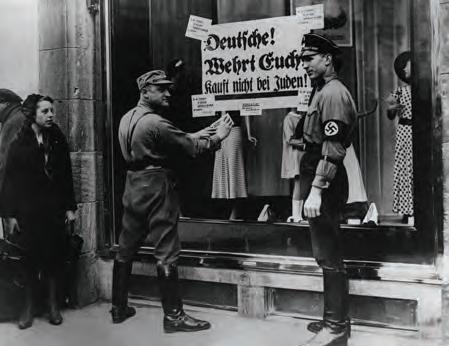
Source 7.13.2 Nazi pickets outside a Jewish shop in Berlin during the Nazis’ national boycott of Jewish business, April 1933
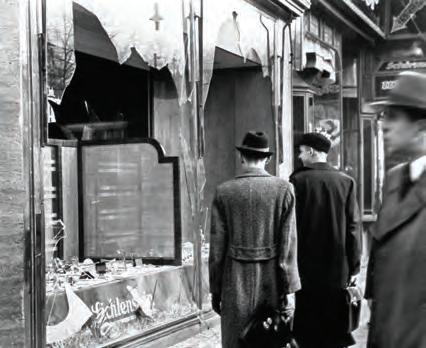
Source 7.13.3 The shattered window of a Jewish business vandalised during the events of Kristallnacht
Ghettos and labour camps
The Holocaust began with the invasion of Poland on 1 September 1939. Up to two million Polish Jews were rounded up and forced into overcrowded ghettos, the largest being the Warsaw Ghetto, which housed 500 000 people. Thousands of Jews perished as a result of starvation, disease and a lack of medical assistance while living in the ghettos. In 1940, plans were begun to deport Jews from all German-occupied territories to Poland, where they were forced to wear the yellow Star of David as a form of identification. At this time, the first labour camps were built and the Nazis began experimenting with euthanasia, targeting psychiatric patients in addition to the disabled, the old and the sick.
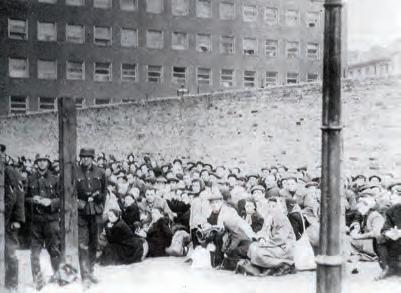
Source 7.13.4 The Umschlagplatz, the point from which hundreds of thousands of Jews were deported to death camps from the Warsaw Ghetto, Poland, 1942 ➜
As the German Wehrmacht advanced into Russia in June 1941, special SS (Schutzstaffel) units called Einsatzgruppen followed, killing thousands of Bolsheviks (Soviet Communists) and Jews. Mass shootings and pogroms were committed in Lithuania, Latvia, Ukraine, Romania and other major centres. In 1942, the Nazis began to use gassing vans, and by the end of the year, over two million Russians had been killed. But there was still a vast number of Jews in Nazi-occupied territories.
UNCORRECTEDSAMPLEPAGES
Source 7.13.5 Map showing the locations of the Jewish ghettos and Nazi concentration and extermination camps ➜
SS (Schutzstaffel) elite guard of the Nazi regime; SS officers were in charge of operating the regime’s concentration and extermination camps
Einsatzgruppen special SS units whose role was to execute conquered citizens, particularly Jews
Treblinka
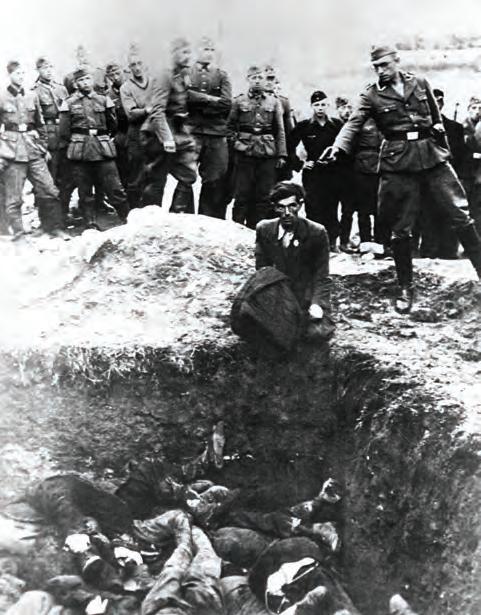
Source 7.13.6 A member of the German SS Einsatzgruppen D prepares to shoot a Polish Jew who is kneeling on the edge of a mass grave almost filled with previous victims
The “Final Solution”
At the Wannsee Conference on 20 January 1942, leading Nazis made plans for the systematic extermination of Europe’s Jewry, or as Richard Heydrich (deputy leader of the SS) called it, “the Final Solution”. Hermann Go¨ring might have signed the order, but it seems more likely that the idea came from Heydrich, with approval from Hitler. Under the supervision of the SS, Jews in Nazi-occupied Europe were deported to industrialised death camps and concentration camps in the east. The major death camps were Treblinka, Sobibor, Majdanek, Belzek and Auschwitz-Birkenau, while Belsen, Dachau and Buchenwald served as work camps. The Jewish occupants of Poland’s ghettos were also shipped out to these camps: those deemed unfit were killed immediately, while others were forced to work, often to the death. These camps were liberated as the Allies and Soviets advanced into German-occupied territory. It is believed that at least one million of the estimated six million Jews who were murdered during the Holocaust were killed in the gas chambers at Auschwitz-Birkenau. It is difficult to know the exact number of deaths due to the fact that camp records were destroyed in the dying stages of the war.
Roma
Roma an ethnic group originally from Northern India who travelled from place to place, living a nomadic lifestyle. During the twentieth century and earlier, they were often known as gypsies, but this term is now considered offensive.
UNCORRECTEDSAMPLEPAGES
The Nazis viewed Roma as a burden on society due to their nomadic nature and lack of employment. They also “associated them with criminality and degeneracy”. As the carriers of foreign blood, Roma were subjected to Nazi racial laws. As part of his attempt to separate them from German citizens, in 1938 Himmler issued the decree “For the Struggle against the Gypsy Nuisance”, which provided for a register of all Roma living in Germany and confined them to selected regions. After the September 1939 invasion of Poland, Germany’s Roma population joined the Jews in being deported to the East, where they were eventually sent to concentration camps. By the end of the war, it is estimated that the Nazi regime had killed a quarter of all the Roma in Europe.
Homosexuals
Homosexuality had been illegal in Germany since 1871, and homosexuals were targeted by the Nazi regime, which was insistent on increasing the German population. In 1935, the Nazis included “acts likely to offend public morality” in their definition of criminal behaviour. As a result, approximately 15 000 homosexuals were sent to concentration camps during the period 1933 to 1945.
Other victims
On 14 July 1933, the Reichstag passed the Law for the Prevention of Diseased Progeny, which resulted in the involuntary sterilisation of more than 300 000 Germans with hereditary diseases or mental disabilities, as well as homosexuals and Roma, all in the name of eradicating inferior blood. These conditions could include alcoholism, “social feeblemindedness”, deafness and blindness.
The Nazis also planned and carried out a “secret” euthanasia programme from 9 October 1939, which aimed to eliminate the weakest individuals in order to increase the collective strength of the nation. The Nazis originally targeted children with birth abnormalities and the chronically ill, but they extended the program after war broke out to include psychiatric patients, the elderly, the homeless, “work shy” individuals and those suffering from depression. Before it was cancelled in August 1941, approximately 140 000 individuals were killed by the Nazi Euthanasia Program. The chosen method was gas, making these killings the forerunner to the gas chambers of the Final Solution.
Also targeted for persecution, incarceration and potential sterilisation were career criminals, vagrants, beggars and anyone identified as being “anti-social”. Freemasons and Jehovah’s Witnesses were also targets of Nazi harassment and persecution.
Liberation
Liberation from the Nazi killing system only came with the defeat of the German army following Hitler’s suicide and Germany’s unconditional surrender. As the Allies advanced through German-occupied territory, they discovered and liberated a number of camps, including Majdanek, Auschwitz-Birkenau, Bergen-Belsen and others. When Allied troops entered the camps, they discovered scenes of unimaginable horror. Even in camps that had been deserted and dismantled, naked corpses lay in piles. Malnourished survivors were described by liberators as “living skeletons”, on the verge of death and too weak to move.
Displaced persons
Some survivors returned to their hometowns to find rubble where their houses had been, or that neighbours had settled in their “abandoned” property. Others only resided in their pre-war homes for a short while until they were able to emigrate. The United States and Palestine were the most popular destinations for Jewish refugees, but annual immigration quotas left many waiting in displaced persons (DP) camps for years. By 1952, 137 450 Jewish refugees had settled in the United States. Immigration to Palestine, then under British control, was heavily restricted, but significant numbers of Jewish refugees entered Palestine illegally. Though many DP camps were closed when the State of Israel was established in 1948 and encouraged Jewish immigration, the last Jewish DP camp in Germany did not close until 1957.
UNCORRECTEDSAMPLEPAGES
Source analysis
1.
Why do you think a member of the Red Army who liberated the camp took this photo?
Source 7.13.7 A group of child survivors behind a barbed wire fence at Auschwitz-Birkenau, Poland, on the day of the camp’s liberation by the Red Army, 27 January 1945
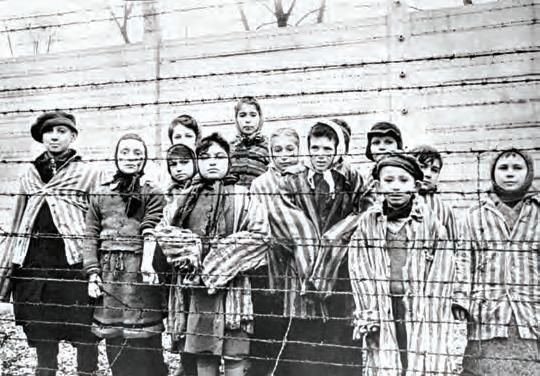
Historical concepts: Significance Historical skills: Analysis and use of sources, Perspectives and interpretations
Teachers can go online to assign questions, view results, reports and more!
Knowledge and understanding
Why is the Holocaust considered one of the most significant genocides in history?
Define Nazi ideology and explain how it justified persecution.
Explain the significance of the Nuremberg Laws in Nazi Germany.
Discuss how Kristallnacht marked a turning point in the Nazis’ persecution of Germany’s Jewish population.
Justify the argument that the Final Solution was premeditated genocide rather than a wartime measure.
Compare the treatment of Jews with that of Roma and other persecuted groups.
Account for the differences in Nazi policies towards Jews before and after 1939.
Evaluate the role of the Einsatzgruppen in the early stages of the Holocaust.
Assess the challenges faced by Holocaust survivors in rebuilding their lives after the war.
Thinking and researching
Read an extract from Eli Wiesel’s memoir Night Summarise what Eli had to say about the following:
• The selection process, food, living conditions, treatment by the guards, the role of hope in survival.
Using this information and your own knowledge, answer the following question: Evaluate the role of hope in assisting Jewish inmates in surviving the conditions in the concentration camps.
Historical concepts: Perspective Historical skills: Comprehension, Analysis and use of sources, Research, Explanation and communication
7.14
Impact on people returning from active service
Learning intention
In this lesson, you will learn about the impact on people returning home from active service during World War II.
Starter activity
Success criteria
❏ I can identify the impacts on people returning home from active service during World War II.
❏ I can explain the impacts on people returning home from active service during World War II.
Imagine, following your service at the end of the war, that you get the opportunity to finally return home to Australia. As a class or with the person next to you, discuss the following questions:
• What are some of the first things you might notice upon returning home?
• What feels the same?
• What has changed?
Returning home to Australia
The approximately 250 000 Australian servicemen and women serving overseas at the time of Japan’s surrender faced a long and arduous journey home due to a lack of shipping, and the paperwork involved in organising their discharge from the armed forces. Some volunteers were required for the Japanese occupation force, while others would be required to give testimony at War Crimes Trials, or to guard Japanese POWs prior to their repatriation home.
Priority was given to Australian POWs due to their obvious ill-health and poor physical condition. By the middle of 1946, over 80 per cent of service personnel had been discharged and returned home, and in February 1947 the final discharges were organised. While they awaited their return home, servicemen kept busy with competitions or training courses, which were designed to help prepare them for their return to civilian life. On discharge, they were given information about civilian employment, land settlement, re-establishment loans, training and other benefits.
UNCORRECTEDSAMPLEPAGES
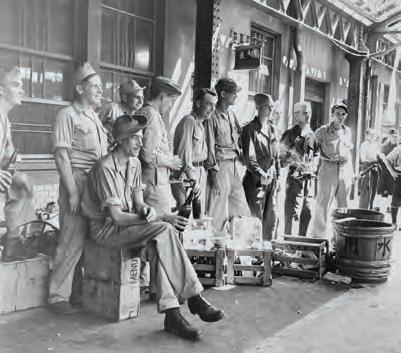
Source 7.14.1 A group of liberated Australian POWs waiting for a train that will carry them part of the way home, Kyoto, Japan
Writing focus 7.14
Transitional phrases
Reintegration into society
Often, returning soldiers struggled to adapt to a normal civilian life. Many veterans suffered lifelong pain as a result of wounds inflicted during the war. Some required hospitalisation, rehabilitation and intense therapy to overcome their injuries, both physical and psychological. Under the Australian Soldiers’ Repatriation Act 1920, veterans were entitled to free medical treatment for war-related injuries at repatriation hospitals and clinics, as well as access to rehabilitation services.
UNCORRECTEDSAMPLEPAGES
While there was now some awareness of post-traumatic stress disorder (PTSD), there was very little understanding of the treatment, nor adequate numbers of people with expertise to treat the symptoms. This meant that affected individuals were likely to suffer anxiety and depression for the remainder of their lives.
Some attempted to self-medicate with alcohol, and suicide rates were also high. Families often broke up – sometimes due to domestic violence committed by the returned soldiers and sometimes because family members could not imagine the horrors undergone, and so they were unable to reconnect with their loved ones.
Government measures to support returned servicemen included:
• the establishment of the Commonwealth Employment Services in 1946, which aimed to assist veterans in finding jobs, encouraged various industries to hire veterans, and developed job training programs to assist their transition into civilian roles
• the War Service Homes Act 1945, which allowed veterans to apply for low-interest loans to purchase homes with government assistance
• the Veterans’ Education Scheme, which provided financial assistance for veterans to pursue further education, vocational training and apprenticeships
• the War Service Land Settlement Agreement, which allowed veterans to apply for agricultural land at reduced prices or with low-interest loans under the Soldier Settlement Scheme. Unfortunately, despite the scheme’s good intentions, many veterans struggled with the realities of farming, including market fluctuations, droughts and the physical demands of agricultural work. As a result, some were unable to sustain their farms and faced financial difficulties.
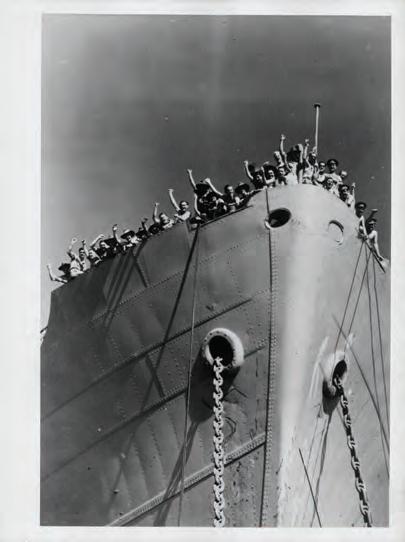
Source 7.14.2 Australian troops returning home after the end of the war, 1945 ➜
Aboriginal and Torres Strait Islander personnel
As was the case following the end of World War I, Aboriginal and Torres Strait Islander personnel returned home to a society that continued to discriminate against them,
and any hopes of being rewarded for their courage with citizenship and voting rights went unfulfilled. Furthermore, many returned First Nations personnel continued to be ejected from hotels and public places or denied employment. This rejection and exclusion extended to many being banned from having a drink with their fellow veterans in Returned and Services League clubs, except on Anzac Day.
In addition to this discrimination, First Nations men and women did not receive the same recognition for their service as other veterans. Some were not offered the same compensation as non-Indigenous veterans, such as soldier settlement blocks or spousal pensions. While not specifically excluded from schemes such as the War Service Land Settlement Agreement, Aboriginal and Torres Strait Islander personnel struggled to meet the qualifications of the assessment procedures, and thus many were rejected. This was particularly disheartening and would cause long-term trauma because the scheme offered land that had always been Aboriginal and Torres Strait Islander lands.
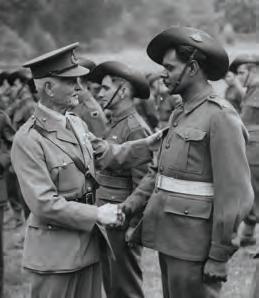
Knowledge and understanding
and researching
can access sample responses and results online
Define the purpose of the Veterans’ Education Scheme introduced after World War II.
Source 7.14.3 British Field Marshal Lord Birdwood chats with Private H.R. Davis of Perth, Australia, while visiting Australian former POWs awaiting repatriation in Eastbourne, UK, July 1945 ➜
Teachers can go online to assign questions, view results, reports and more!
Identify two challenges faced by Aboriginal and Torres Strait Islander veterans when they returned to Australia after the war.
Explain why some World War II veterans struggled with the Soldier Settlement Scheme.
Explain the difficulties faced by Australian servicemen and women returning home after the war.
Discuss the government initiatives introduced to help veterans reintegrate into society after the war.
Justify the need for government-funded medical and psychological treatment for returning servicemen and women.
Compare the treatment of Aboriginal and Torres Strait Islander veterans with that of non-Indigenous veterans after the war.
Account for the struggles faced by veterans who participated in the Soldier Settlement Scheme.
Thinking and researching
UNCORRECTEDSAMPLEPAGES
Students are to investigate the challenges faced by returning servicemen. Using the internet and information in this section, students are to build a mind-map that summarises the main impacts on returning servicemen. Your mind-map can be drawn or designed using Canva, and should include information and primary sources on the following impacts:
• physical
psychological
economic
Rank them from what you consider to be the most significant impact to the least. Give reasons for your answers. Students are also encouraged to devise possible solutions to these problems.
7.15
Learning intention
Jewish Holocaust survivors in Australia
Success criteria
In this lesson, you will learn about Jewish Holocaust survivors in Australia in the aftermath of World War II.
Starter
activity
❏ I can explain the impacts on Jewish Holocaust survivors in Australia in the aftermath of World War II.
Imagine you are a Jewish person arriving in Australia in 1947 after surviving the war in Europe. As a class or with the person next to you, discuss:
• one hope you might have about the future
• one worry you might have about the future
• one thing you might miss about the past.
Source 7.15.1 Jewish survivors on board the Cyrenia en route to Australia, 1949 ➜
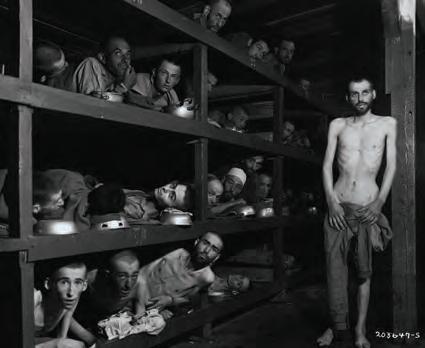
Source 7.15.2 Survivors at Buchenwald concentration camp remain in their barracks after liberation by Allies, April 1945. Elie Wiesel, the Nobel Prize–winning author of Night, is on the second bunk from the bottom, seventh from the left. ➜
UNCORRECTEDSAMPLEPAGES
During the 1930s, thousands of Jewish people who tried to emigrate to safety faced many challenges. Any Jewish person fleeing Nazi Germany had a strong case to be considered a genuine refugee. However, so-called “safe” countries were inundated with visa applications, while their strict immigration quotas remained in place. In mid1938, the refugee problem was discussed by 32 countries who met in Evian, a French resort near Switzerland and Germany. They criticised Nazi policies and sympathised with the victims, and set up an Intergovernmental Committee on Refugees. However, Western governments did not change their policies to accept more refugees. The United States set an annual limit of around 27 000 immigrants from Germany and Austria. Britain placed strict limits on the number of Jews who could settle in Palestine. Canada and France said they had already reached saturation point with refugees. Australia still had its White Australia Policy, and the Australian delegate claimed, “as we have no real racial problem, we are not desirous of importing one by encouraging any scheme of large-scale foreign migration”. In October 1941, Jewish emigration was officially forbidden by Nazi authorities, leaving 163 000 Jews trapped in Germany and Austria.
In the immediate aftermath of the war and the liberation of Nazi concentration and death camps, more than one million Europeans were displaced from their country of origin, including hundreds of thousands of Jewish survivors. These survivors faced the daunting prospect of rebuilding their lives, with many fearing to return to their former homes because of the antisemitism that persisted in parts of Europe and the trauma they had suffered. Most of the surviving remnant of European Jewry decided to leave Europe altogether, establishing new lives in Israel, the United States, Canada, Great Britain, South America and South Africa.

Source 7.15.3 Australian Holocaust survivor and author of The Happiest Man on Earth, Eddie Jaku (1920–2021), displaying the tattoo he received while in Auschwitz-Birkenau ➜
More than 31 000 Holocaust survivors rebuilt their shattered lives in Australia. On a per capita basis, no other country outside the State of Israel welcomed more Holocaust survivors. Many survivors tried to recover from their trauma by never speaking of their experiences. Some, eventually, decided to share their experiences with the public. They established Holocaust museums in Melbourne in 1984 and in Sydney in 1992. Eddie Jaku, who made his way to Sydney in 1950, vowed never to set foot on German soil again. He lived to be 101 and kept his vow. As a founding member of the Sydney Jewish Museum, Eddie published the best-selling autobiography, The Happiest Man on Earth, in 2020. In it, he recounted how he viewed himself as German rather than Jewish, the harmful impact of Nazi propaganda, the deprivations he and his family suffered during the 1930s, the murder of his mother and father at Auschwitz, and his ultimate survival as a result of a series of lucky escapes.
Students can access sample responses and results online
Knowledge and understanding
Why did so many Jewish refugees struggle to emigrate from Nazi Germany in the 1930s?
How did Holocaust survivors decide where to settle after the war?
Define the role of Holocaust museums in Australia and explain their significance.
Discuss the experiences of Eddie Jaku and how he contributed to Holocaust education.
Thinking and researching
Using the internet, visit the Sydney Jewish Museum’s website at https://cambridge.edu.au/redirect/12041 survivors and listen to a few of the survivors discussing their experience.
Teachers can go online to assign questions, view results, reports and more!
UNCORRECTEDSAMPLEPAGES
Using the information from the testimonies and what you have learned, answer this short-response question using a persuasive text type:
“Assess the value of survivor testimonies in assisting students to understand the conditions experienced by Jewish survivors of the Holocaust. Support your response with quotes from the video testimonies.”
7.16 Impact and legacy of World War II
Learning intention
In this lesson, you will learn about the impact and legacy of World War II.
Success criteria
❏ I can identify the impact and legacy of World War II.
❏ I can explain the impact and legacy of World War II
As a class or with the person next to you, discuss the following questions:
In the aftermath of a war, where does responsibility lie? The individual, the leader, the government or everyone?
What matters more after a war – punishment or justice?
The United Nations
The United Nations (UN) was created in 1945 as a reaction to the tragedy of World War II. Its main aim was to prevent future conflicts. Australia was one of the founding members and has supported the work of the UN in its work towards peacekeeping and other global issues.
Source 7.16.1 The first convening of the UN’s Security Council, New York, 25 March 1946. It is the most powerful body of the UN, primarily responsible for maintaining international peace and security. It has the authority to prevent and resolve conflicts, authorise military interventions, impose sanctions, and approve peacekeeping missions. The Security Council consists of 15 member states, including five permanent countries who hold the power to veto any resolution: the United States, Russia, China, France and the United Kingdom.
UNCORRECTEDSAMPLEPAGES
The Nuremberg Trials
Beginning in November 1945 and lasting until October 1946, 24 top Nazi leaders, men of industry and prominent generals were tried before an International Military Tribunal at Nuremberg, the German city the Nazis had made their “moral” capital. However, only 21 would stand trial; for example, Hitler, Himmler, Goebbels and Labour Front Leader Robert Ley had already committed suicide.
Four judges from each of the four victorious powers, the United States, Britain, France and the Soviet Union, sat in judgment as each of the men faced some or all of four charges: conspiracy to wage aggressive war, crimes against peace, crimes against humanity and war crimes.
Source 7.16.2 US soldier Herbert Boe from the translation division holding a pile of transcripts representing a little part of the evidence for prosecution at the Nuremberg Trials
While Hitler, Goebbels and Himmler escaped justice, the Allies felt the need to make an example of the remaining Nazi leaders, in the hope that similar atrocities would not be repeated in the future. Furthermore, it was considered crucially important that the German people be made aware of what had happened and the enormity of the crimes that had taken place right under their noses.
Evidence presented by the prosecution documented the crimes of the Nazi state: the death factories, the extermination of European Jewry, the enslavement of forced labourers and the barbarities committed against the Russians and the Poles.
However, the trials were tainted by “victor’s justice” as Allied war crimes were completely omitted. According to historian Roland Stromberg, an expert on twentiethcentury European history..., “those who won the war wreaked vengeance on the defeated under a thin guise of legality, while refusing to countenance any discussion of their own crimes”.
Of the accused, 10 were hanged (Goering committed suicide in his cell just hours before his scheduled execution), seven were given long prison sentences and three were acquitted. However, the arrest and trial of Nazi war criminals, concentration camp guards and former SS officers lasted for decades after the war.
UNCORRECTEDSAMPLEPAGES
Source 7.16.3 The defendants at the Nuremberg Nazi trials. Pictured in the front row are: Hermann Göring, Rudolf Hess, Joachim Von Ribbentrop, Wilhelm Keitel and Ernst Kaltenbrunner. In the back row are: Karl Doenitz, Erich Raeder, Baldur von Schirach and Fritz Sauckel.
Writing focus 7.16a
Creating topic sentences
By prosecuting more than 1500 Nazi war criminals, it was hoped that the trials would not only punish the Germans found guilty of their horrific crimes, but would also deter future aggression by establishing a precedent in international law.
The creation of the Convention on the Prevention of the Crime of Genocide
The Convention on the Prevention and Punishment of the Crime of Genocide was adopted by the UN General Assembly in 1948. As a direct response to the atrocities of World War II, particularly the Holocaust, the convention represented a global acknowledgement of the need to prevent such horrors from occurring again. The Convention established genocide as a distinct international crime, defining it clearly and providing a legal framework for its prosecution. As defined in the Convention, genocide is “a crime committed with the intent to destroy a national, ethnic, racial or religious group, in whole or in part. It does not include political groups or so called ‘cultural genocide’”. By defining genocide and obligating signatory nations to take action against it, the Convention laid the groundwork for holding individuals and states accountable for committing genocide in the future.
Writing focus 7.16b
The language of source analysis
The Convention has become a foundational document for human rights organisations and advocates worldwide. It serves as a vital tool in raising awareness about the dangers of hate speech, discrimination and violence against particular groups, promoting the protection of vulnerable populations.
Students
access
Teachers can go online to assign questions, view results, reports and more!
Knowledge and understanding
Why was the United Nations created in 1945?
How did the Nuremberg Trials seek to hold Nazi leaders accountable for their crimes?
Define the term “victor’s justice” and explain how it applied to the Nuremberg Trials.
Discuss the significance of the Convention on the Prevention and Punishment of the Crime of Genocide.
Evaluate the long-term impact of the Nuremberg Trials on international law.
Thinking and researching
Using your knowledge of the entire topic, and in particular this section, research and answer the following essay question: Why do historians argue that WWII changed the way the world thinks about justice and human rights?
UNCORRECTEDSAMPLEPAGES
7.17 Site study: Australian War Memorial Museum and archive
Learning intention
In this lesson, you will learn about why the Australian War Memorial museum and archive is an important record of the history of Australians at war.
Success criteria
❏ I can explain the role of the Australian War Memorial in preser ving the history of Australians in war.
❏ I can identify key features of its World War II collection.
Starter activity
See, think, wonder

Source 7171 Avro Lancaster Bomber aircraft, known as "G for George", on display at the Australian War Memorial. This plane was flown by RAAF Squadron 460 in Britain. Between 1942 and 1944 it took part in ninety missions over Germany and occupied Europe.
Anzac Day is traditionally marked by a dawn service held at a local war memorial to coincide with the time of the original Gallipoli landings.
UNCORRECTEDSAMPLEPAGES
See: Look at Source 7.17.1. What can you see in this image? (I see…)
Think: Why do you think it is considered one of the main attractions of the Australian War Memorial? (I think…)
Wonder: What do you wonder about the other displays in the museum? (I wonder …)
If you completed the site study in Chapter 6, you will have visited your local war memorial. The Australian War Memorial (AWM), located in Canberra, is the national war memorial, first opened to the public in 1941. Like local war memorials, it serves as a commemoration of members of the Australian armed services who have died at war. It also includes a world class museum with different galleries covering major conflicts in which Australians were involved, and a vast archive, some of which is available online.
The commemorative part of the AWM consists of the Pool of Reflection, the eternal flame, and the Hall of Memory with the Tomb of the Unknown Australian Soldier. There is also the Roll of Honour, which contains the names of over 103,000 Australians who have been killed in war These are all spaces in which visitors can remember and reflect. If you are able to visit the AWM in person, you should spend time in these areas
However, this site study focuses on the museum collection relating to the Second World War
The galleries
The AWM Second World War Galleries cover the experiences of Australians in the various campaigns, and also of those on the home front.
In addition, the new Anzac Hall, which was opened to the public in 2026, includes exhibitions such as "Australians in Bomber Command 1936-45", and the "Sydney Harbour Under Attack 1942"
The AWM also has a newly reopened Aircraft Hall on Level 2, which includes some objects from World War II including an Avro Anson aircraft, a Japanese fighter, and an exhibition on the bombing of Darwin.
UNCORRECTEDSAMPLEPAGES
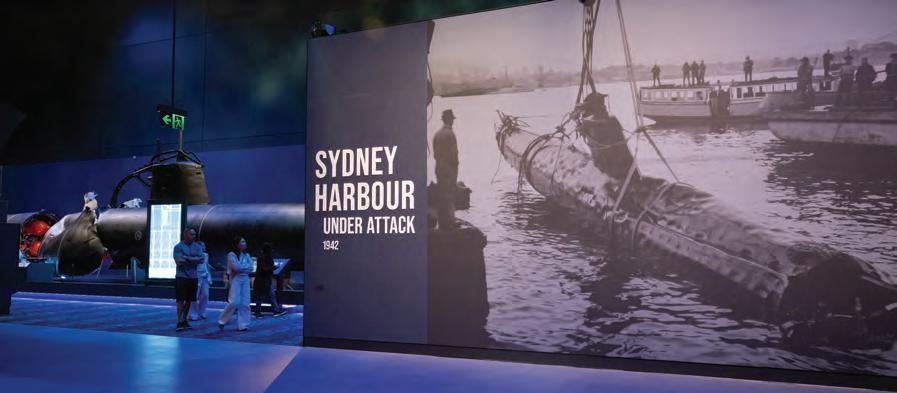
Another important space is the Hall of Valour. This room honours the Australians who have received the Victoria Cross (VC), the highest award for bravery in wartime. Of the 102 VCs awarded to Australians, 20 were for actions in the Second World War Source 7.17.2 One of the World War II displays in the Anzac Hall. ➜
The collection
The collection of World War II items ranges from large pieces of machinery, including the "G for George" Lancaster aircraft and a Spitfire Mark IIa, through to smaller and personal items, such as a pair of flying boots, a bugle from the Cowra POW Camp, a Volunteer Air Observers Corps badge, and a child’s jigsaw puzzle.

Source 717.3 Secret radio receiver created by Private Reginald Glanville while in a European prisoner of war camp.
Visual items in the collection include photographs, video recordings and works of artduring both the First and Second World Wars, official war artists were appointed and spent time with soldiers on deployment.
Documents in the collection include official records from the Australian military services and historians. In addition to this, the AWM holds over 9,500 collections of personal diaries, letters, and other papers, across all conflicts. There is also a collection of published items, such as books, maps stamps, sheet music and other items: these collections cover over 3,200 metres of shelving.
➜
UNCORRECTEDSAMPLEPAGES
Source 7.17.4 Baton of Field Marshal Sir Thomas Blamey. Blamey was the first Australian army officer to attain the rank of field marshal.
Source 7.17.5 Stella Bowen was appointed as an official war artist by the AWM, based in the UK and with a focus on activities of the RAAF. This painting in the AWM collection, D-Day, 0300 hours, interrogation hut, Warrant Officer George Lindenberg, shows an Australian Flight Officer of the British Womens’ Auxiliary Airforce and an Australian pilot.
Source of items in the collection
Many significant objects in the collection were provided directly from the Australian Defence Force, and in addition representatives of the AWM often travel with the military on overseas deployments to actively acquire items. Official records come from the government.
But a vast amount of material in the AWM collection has come from serving or former members of the military, and their families, who have donated personal items, including uniforms, medals and diaries.
The AWM website
Digital versions of many of the items in the collection can be viewed on the AWM website, which can be searched at https://www.awm.gov.au/advanced-search. The AWM has also put together some guidelines to assist people undertaking research –these can be viewed at https://www.awm.gov.au/advanced-search
UNCORRECTEDSAMPLEPAGES
Identify the main purposes of the AWM.
Describe the types of materials held in the AWM museum.
Why is the AWM an important part of Australia’s history and future?
Go to the AWM website and read the material on donating to the collection (https:// www.awm.gov.au/about/organisation/corporate/national-collection-developmentplan#uPMu20U64kACJZVBdpHp7KJIQ0k3wCKn).
a. Why do you think people might want to donate items to the AWM?
b. How do personal donations enhance the collection?
On either a visit to the AWM, or through the AWM website, choose two contrasting items from the World War II collections (e.g. a physical artefact and a document; an official item and a small personal item) and create a presentation in which you:
a. Describe each item and its history
b. Justify why each item needs to be preserved in the museum
c. Compare the two items and explain how each one helps you understand an aspect of World War II.
Chapter review and historical inquiry
Access the Interactive Textbook for a range of digital tools to help you review this chapter and build confidence.
• Auto-marked questions for fast feedback and fun practice
• Self-assessment tools to track your progress, review answers (if enabled by the teacher), and flag questions for extra help
• Downloadable worksheets for class or homework revision
Summary
Summary notes
What have you learned about World War II? Copy the table and fill out by explaining your understanding. Aim for two points per topic.
Topic
Women’s roles in the military and workforce
The treaty of Versailles and the path to World War II
Different views on Australian involvement in World War II
Understanding the Holocaust and Nazi persecution
The Kokoda Track Campaign’s impact on Australian military history
Debates over allied war crimes and “victor’s justice”
Visible thinking routine
I used to think … Now I think …
What I have learned
Reflect on your thinking about “Australia at war: World War II (1939–c. 1945)” and how and why this thinking may have changed now that the unit is complete. Using the prompts below, write two sentences that explain what you used to think about the topic and what you think now. Share your thoughts with the class.
• I used to think…
• Now I think…
SAMPLEPAGES
Questions and activities
Scorcher quiz
Access a fast, fun, competitive quiz that puts your understanding to the test.
Quick questions
1.
2.
3.
4.
5.
6.
7.
8. 9.
10.
UNCORRECTEDSAMPLEPAGES
On 30 January 1933, Hitler was appointed to the position of __________.
Around 18,000 women were employed by the _____ _____ _____ _____ _____ (WAAAF).
On 6 August, the United States dropped an atomic bomb on the city of __________.
Approximately __________ Australian soldiers were held captive by the Germans in camps in Austria, Germany and Poland.
The United Nations was created in __________ as a reaction to the tragedy of World War II.
Define the term “militia” as it applied to Australian forces during the Kokoda Track Campaign.
Identify the purposes of propaganda used by the Australian Government during World War II.
Outline the bombing raids on Darwin and their impact.
Describe when and why Prime Minister John Curtin declared war on Japan.
Summarise the challenges Jewish refugees faced when trying to emigrate during the 1930s.
Access the Creative, Research and Group activities in the Interactive Textbook.
Writing focus
The following activities offer ways to demonstrate your understanding of the chapter and allow you to continue to practise your writing skills.
Answering questions in paragraphs
This sample response to a question is structured using:
• a topic sentence
• the four Es (explain, elaborate, evidence and examples)
• a linking sentence.
You can use this as a model when writing your own answers to the following questions.
Question: Explain the impact of the war on Australian society.
Model answer:
Topic sentence: the first sentence of the paragraph; directly answers the question
Elaborate: additional information, connections, historical significance, change and continuity, cause and consequence
Examples: provide credibility and illustrate the argument
World War II had a major impact on Austrlian society, changing daily life, government power and social roles.Australians experienced strict government controls, new responsibilities at home and major changes to work and national security as the war intensified. These changes affected almost every aspect of civilian life, from the food people ate to the jobs they worked and the information they were allowed to hear.The government used the National Security Act 1939 to enforce rationing and censor news reports so heavily that newspapers claimed only 17 people died in the bombing of Darwin, when it was really 243 people.This shows how the government reshaped society by tightly controlling resources and information to maintain morale and support for the war effort.Overall, the war transformed Australian society by increasing government authority, altering everyday life and fostering a stronger sense of national unity under pressure.
Extended-response questions
Explain: clarify, define and describe
Evidence: specific, relevant evidence to support your arguments
Linking sentence: reconnects to the topic sentence using the language of the question
Describe the treatment of Australian POWs at the hands of their Japanese captors.
Explain the impact of the war on Australian society.
“The imposition of government controls is justified in times of war.” To what extent do you agree with this statement? Include specific examples in your response.
Account for the changing roles of women during World War II.
Historical inquiry Investigating contestability
In this historical investigation into contestability in World War II, you will undertake the following steps:
Part 1: Develop historical questions
• Step 1: Select an aspect of Australian involvement in World War II that interests you. Examples may include:
● the relationship between Britain and Australia
UNCORRECTEDSAMPLEPAGES
● the Japanese invasion of Australia
● John Curtin as Prime Minister
● the treatment of Aboriginal Australians during the war
● the “Rats of Tobruk”.
• Step 2: Brainstorm what you already know
• Step 3: Develop a historical inquiry question. Examples include:
● To what extent did Britain abandon Australia during the war?
● Was the Japanese threat of invasion of Australia genuine or wartime propaganda?
● How far was John Curtin responsible for shaping Australia’s wartime identity?
● Did World War II create meaningful change for Aboriginal Australians?
● “Heroes, or something else?” Why do historians have differing views on the “Rats of Tobruk”?
• Step 4: Explain why he question is important
Part 2: Locate and analyse evidence
Part 3: Communicate historical findings
Part 4: Reflect
UNCORRECTEDSAMPLEPAGES
Teachers, access the Online Teaching Suite for digital resources and tools that support review, assessment and reporting, including:
• student and class activity reports
• a test generator to create custom assessments
• built-in feedback tools
• editable downloadable support material
• a downloadable and printable “Writing focus” workbook for this chapter.
The Holocaust Chapter 8
Key questions
• To what does the term “Holocaust” refer?
• Why was antisemitism so powerful in Germany?
• How did the Nazis rise to power?
• Who were the perpetrators of the Holocaust and why did they participate in it?
• Who were the victims of the Holocaust?
• How aware were bystanders of the Holocaust?
• What were the connections between the Holocaust and World War II?
• How should we understand the legacy of the Holocaust?
Lessons
8.1 Setting the scene
8.2 Jewish civilisation and historic antisemitism
8.3 Rise of Nazism
8.4 Nazi propaganda and anti-Jewish laws, 1933–1939
8.5 Radicalisation from Kristallnacht to ghettoisation, 1938–1940
8.6 The move towards the “Final Solution”
8.7 Labour and death camps
8.8 Resistance to and development of the Holocaust
8.9 Impacts of the Holocaust on Jewish people
8.10 Holocaust centres, memorials and museums
8.11 Site study: Sydney Jewish Museum
8.12 Chapter review and historical inquiry
UNCORRECTEDSAMPLEPAGES
This digital chapter can be accessed via Cambridge GO
This chapter contains discussions of sensitive and potentially distressing topics related to the Holocaust, including acts of violence, trauma and human suffering. We encourage readers to approach the material with care and respect, being mindful of the enduring effects such events have on individuals and communities today.
Focus area
The modern world
CHAPTERS
Historical context study (core)
9. The modern world
10. Human rights and freedoms (c. 1938–c. 2017)
Depth studies (options)
11. Rights and freedoms of Australian women (c. 1945–c. 2012)
12. Migration experiences (1945–c. 2016)
13. Popular culture in Australia (1945–c. 2010)
14. The environmental movement (c. 1960–c. 2015)
Image: Australians celebrate marriage equality in November 2017 ➜
Online only chapter
UNCORRECTEDSAMPLEPAGES















The modern world Chapter 9
Key questions
• How was the United Nations designed?
• What was the significance of the concept of human rights?
• Why did the Cold War happen, and what were its effects?
• What did movements for civil rights achieve?
• How did migrants contribute to Australia?
• How did new technologies drive change?
• What environmental and sustainability issues emerged?
Lessons
9.1 Setting the scene
9.2 The formation and structure of the United Nations
9.3 The United Nations Charter and the Universal Declaration of Human Rights
9.4 The Cold War
9.5 Movements for civil, political, social, cultural and economic rights
9.6 The contribution of migrants to Australia post-World War II
9.7 New technologies
9.8 Environmental and sustainability issues
9.9 Chapter review and historical inquiry
Teachers access the Online Teaching Suite to:
• plan, sequence and assign directed tasks for students and classes using Task Manager
• view student activity reports
• provide feedback to students
• download a printable “Writing focus” workbook for this chapter.
UNCORRECTEDSAMPLEPAGES


9.1 Setting the scene
Learning intention
In this lesson, you will learn about key events that affected the lives of people and the history of nations after World War II.
Success criteria
❏ I can outline key events that shaped the modern world.
When World War II ended in 1945, destruction, displacement and loss dominated many parts of the globe. Decision-makers debated not only how to rebuild cities and communities, but also how to prevent a third world war from breaking out. The choices and actions that people took in the post-war world would shape the modern world as we know it. At first, there were signs of cooperation and unity. A new international framework for peace and security, the United Nations, was quickly established. It was more inclusive and stronger than previous organisations, and it would strive to build global consensus. By 1948, that consensus led to the adoption of the landmark Universal Declaration of Human Rights.
However, tensions festered. By the 1950s, the world was split into blocs of nations who competed for influence and allies. This “Cold War” – between nations aligned with the Western capitalist superpower the United States and the Eastern communist superpower the Soviet Union – threatened world peace and created anxiety. Meanwhile, movements for change emerged to fight for equal civil rights, and more people than ever migrated to build new lives for their families. Later in the twentieth century and into the twenty-first century, new technologies transformed our daily lives, amid existential concerns about human impacts on the environment.
1967
UNCORRECTEDSAMPLEPAGES
The Cuban Missile Crisis nearly sparks nuclear war
Referendum changes the Australian Constitution to count Aboriginal people equally
1969
Apollo 11 takes the first people to land on the Moon
Civil Rights Act,
1975
Racial Discrimination Act, Australia
1989
Fall of the Berlin Wall sparks the end of the Cold War
Pro-democracy protesters massacred in Tiananmen Square, China
1980 Smallpox becomes the first disease officially eradicated by vaccines
1991 Internet: the World Wide Web is launched The Soviet Union is dissolved
1992
Mabo land rights case, Australia
See, think, wonder
Based on Source 9.1.1, discuss the following questions.
• What can you see in this image? (I can see …)
2023–25
Israel’s war on Gaza, following Hamas’ attack on Israel 2007 Smartphones (Apple iPhone) become commercially available
UNCORRECTEDSAMPLEPAGES
• What do you think about this image? (I think …)
• What does this image make you wonder about the modern world? (I wonder …)
2001–21 US war in Afghanistan, following the 9/11 World Trade Center attack
2020
Black Lives Matter protests COVID-19 pandemic
Writing focus 9.1
Question words

Source 9.1.1 An American couple watch a report about the Vietnam War in February 1968, the first war in the era of television.


9.2
The formation and structure of the United Nations
Learning intention
In this lesson, you will learn about how the United Nations was formed and its structure.
Starter activity
Claim, support, question
• Claim: Based on this image and what you may already know, what do you think is the purpose of the United Nations?
• Support: What evidence or reasoning can you provide to support your claim?
• Question: What questions do you have about your claim?
Success criteria
UNCORRECTEDSAMPLEPAGES
❏ I can explain the purpose of the United Nations. ❏ I can describe the structure of the United Nations and its Security Council.

From April to June 1945, representatives of 50 countries that were allied together in the fight against fascist Germany and Japan met in San Francisco, USA. Their purpose was to design new international organisations for future peace, security and cooperation. While their troops continued to do battle in Europe and the Pacific, the delegates imagined what the world might look like and how it could be made safer, once World War II was finished. The conference was hosted and paid for by the United States, which was significant, not only because the USA was the world’s richest and most powerful nation, but also because it had avoided joining the previous League of Nations.
The conference decided to establish a “United Nations Organization”, to bring together in one place the voices and interests of the people of the world. The United Nations would become a network of political, legal and research organisations.
Source 9.2.1 A United Nations flag at the war museum in Seoul, Korea.
Purpose of the United Nations
The United Nations was created by people who had experienced two world wars and wanted to prevent another one. They based their new organisation on multiple inspirations: the example of the League of Nations that was formed after the First World War; the principles developed during wartime meetings between the key allied powers of the United States, Great Britain, the Soviet Union and China; and their outrage at what they were learning about the atrocities of the Holocaust, as the Nazis retreated.
When the founding document, the United Nations Charter, was agreed on 28 June 1945, it was welcomed as front-page news across the world. The Sydney Morning Herald called the text the “New Basis of World Peace”. Some reporters said it would create a “world parliament”, or a “world police force”. Those who drafted the text wanted the new United Nations to achieve multiple purposes, all of which related in some way to international peace and development.
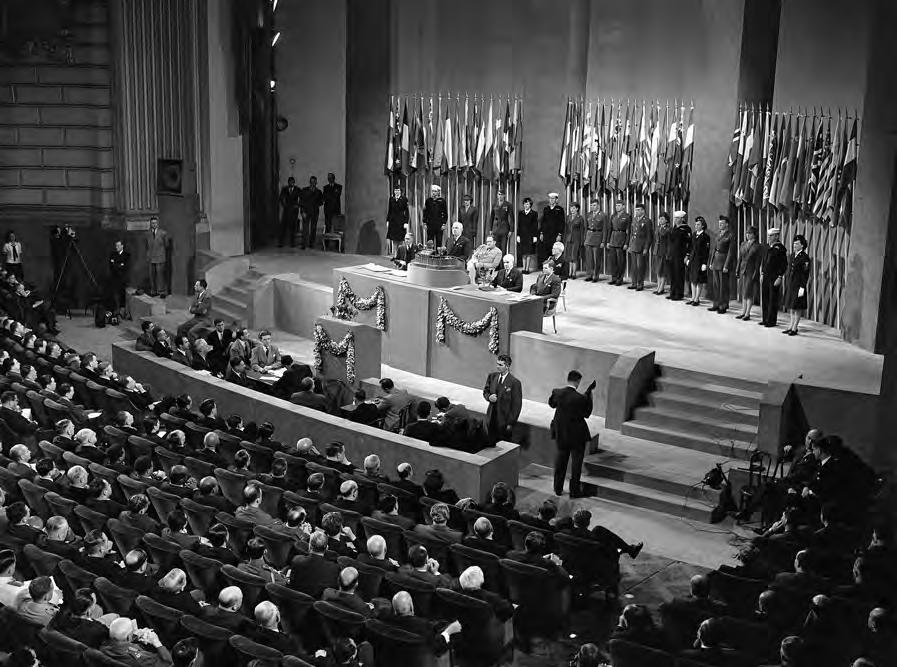
Source 9.2.2 The flags of 50 nations on stage with US President Harry Truman at the United Nations Conference on International Organizations, San Francisco, June 1945
UNCORRECTEDSAMPLEPAGES
The San Francisco conference ended with delegates from 50 nations signing the United Nations Charter, which stated the purposes and structure of the organisation. The preamble of the Charter explained the rationale for the United Nations and offered a vision for a better future. The United Nations would begin operation once the charter was ratified (approved) by the governments of all the “Big Five” nations and two-thirds of the other member states. This milestone was achieved in October 1945.
Big Five the great powers on the Allied side of World War II: the USA, the USSR, Britain, China and France. They became the “Permanent Five” members of the UN Security Council
Writing focus 9.2
Transitional phrases
Activity 9.2.1
Source analysis
Source 9.2.3 The preamble of the United Nations Charter, 1945
We the peoples of the United Nations, determined to save succeeding generations from the scourge of war, which twice in our lifetime has brought untold sorrow to mankind, and to reaffirm faith in fundamental human rights, in the dignity and worth of the human person, in the equal rights of men and women and of nations large and small, and to establish conditions under which justice and respect for the obligations arising from treaties and other sources of international law can be maintained, and to promote social progress and better standards of life in larger freedom,
And for these ends to practice tolerance and live together in peace with one another as good neighbours, and to unite our strength to maintain international peace and security, and to ensure, by the acceptance of principles and the institution of methods, that armed force shall not be used, save in the common interest, and to employ international machinery for the promotion of the economic and social advancement of all peoples, Have resolved to combine our efforts to accomplish these aims.
Identify, in single words or short phrases, the four purposes that the United Nations charter says its people are “determined” to achieve.
Identify what the Charter says is the only reason for armed force to be used.
Explain what had gone wrong in the years before the Charter, by referring to what its authors say they are determined to achieve.
Explain the significance of the last two lines (“to ensure” and “to employ”). What do they suggest?
Discuss what the source is useful for, in terms of understanding the United Nations.
UNCORRECTEDSAMPLEPAGES
Over time, the purposes of the United Nations have come to be understood as:
(a) peace: preventing war and developing friendly relations between nations, and (b) development: organising international cooperation to eliminate poverty, disease and illiteracy, deliver humanitarian aid, protect the environment, and encourage respect for all people’s rights and freedoms.
United Nations Charter, 1945
Structure of the United Nations
The United Nations was designed with six key sections, known as “organs”. Each was given a function that supported the overall aims of the organisation.
Source 9.2.4 UN organs
UN organFunctions
Security Council Taking decisions about peace and security. A 15-member organ with the power to commit armed forces. Its decisions are binding.
General Assembly A forum where all member states have an equal voice and vote, on international issues. Decisions carry moral weight as they represent “world opinion”, but are non-binding.
SecretariatPutting into effect UN decisions; the administration / public service offices of the UN.
Economic and
Social Council
International Court of Justice
Coordinating the work of the UN’s specialised and regional agencies, particularly relating to development.
An international court to resolve legal disputes between member states.
Trusteeship Council Supporting colonies to become independent (stopped operating regularly in 1994).
The General Assembly, being the largest forum of the United Nations, resembles a world parliament. Members bring proposals for discussion, where they are accepted or voted on. It is often seen as the main organ of the UN, because every member state – from the smallest to the largest in the world – has an equal right to speak and vote in the Assembly. In 1945, there were 51 member states. Today, there are 193. Small and middle powers, such as Australia, welcomed the equality that the Assembly promised.
Source 9.2.5 Representatives of the “Big Five” nations (US, UK, France, China and the USSR) gather separately from the main negotiations about the UN, San Francisco, May 1945. They ensured that the design of the UN included a special status for the Big Five.
Source 9.2.6 Dr Herbert V Evatt, Australian Minister for External Affairs and delegate to the San Francisco Conference, on the purpose of the United Nations
UNCORRECTEDSAMPLEPAGES
… the United Nations Assembly will become the great forum of the globe, a place where world opinion will be freely expressed and take definite shape, where world opinion can also be formed into a sharp weapon to be used against any Power that defies the Charter, or permits the seeds of Fascism to threaten the welfare of our peoples.
Dr Herbert V Evatt, Australian Minister for External Affairs and delegate to the San Francisco Conference, quoted in the Sydney Morning Herald, 30 June 1945, p. 3
veto the official power or right to refuse to accept or allow something, effectively to block it from happening even if it is agreed by a majority
The Security Council, however, was the UN organ that was given real power. The Security Council focuses on peace and security, and it is the only part of the UN that can commit armed forces to solve problems. The Council’s decisions are binding on all UN members. Council members include 10 non-permanent members, who are chosen by vote to serve for two-year terms, and the “Big Five” nations, who are permanent members. Further, each permanent member has the power to veto any proposed Council action. This special status was given to the Big Five nations in 1945 and has remained in place ever since.
The United Nations Headquarters was built in New York City, on land that is recognised as international territory. In addition to New York, the Secretariat has major offices in Geneva, Switzerland; Vienna, Austria; and Nairobi, Kenya. UN meetings are simultaneously interpreted in six official languages: Arabic, Chinese, English, French, Russian and Spanish.
Members of the United Nations are officially “member states” rather than “nations”. While a nation refers to a group of people who share a language, religion, history, or homeland, a state refers to a government that is sovereign over a defined territory. Therefore, although many UN members are nation–states, some members are actually states that contain multiple nations. Over the years, some of these nations have not felt that their state represents them fully.
Identify where, when and by whom the United Nations was established.
Explain the purpose of the United Nations.
Explain who the “Big Five” were, and their status in the UN.
Discuss the extent to which the UN represents “world opinion”.
Explain how the UN can use its powers as “world police” to intervene in international problems by sending its members’ armed forces.
UNCORRECTEDSAMPLEPAGES
Research current United Nations “peacekeeping” operations, e.g. on the UN website. In which parts of the world are peacekeepers operating? What does this show about the UN?
Source 9.2.7 New York City was chosen for the headquarters of the UN, when millionaire John D Rockefeller donated land as the site for its modern buildings.
9.3 The United Nations Charter and the Universal Declaration of Human Rights
Learning intention
In this lesson, you will learn about the two core documents of the United Nations, the Charter and the Universal Declaration of Human Rights.
Success criteria
❏ I can explain the main ideas of the United Nations Charter.
❏ I can explain why the Universal Declaration of Human Rights is significant.
Think, pair, share
Source 9.3.1 The preamble of the Universal Declaration of Human Rights, 1948
Whereas recognition of the inherent dignity and of the equal and inalienable rights of all members of the human family is the foundation of freedom, justice and peace in the world,
Whereas disregard and contempt for human rights have resulted in barbarous acts which have outraged the conscience of mankind …
Article 1. All human beings are born free and equal in dignity and rights. They are endowed with reason and conscience and should act towards one another in a spirit of brotherhood.
Universal Declaration of Human Rights, 1948
Think: Based on these statements, think about what events in world history before 1948 may have inspired the people who wrote the Universal Declaration of Human Rights
Pair : With a partner, compare the events you have both thought of.
Share: In your pairs, share your ideas with the class as a whole.
United Nations Charter
The United Nations Charter was agreed in San Francisco in the final months of the Second World War. It is a declaration of principles for the UN, stating core beliefs.
The drafters of the Charter borrowed ideas and phrases from the past, such as the concept that all people are born with equal rights from the American and French Revolutions, and the intentions of the League of Nations. They also had the present devastation of World War II uppermost in their minds. The war had been sparked by armed forces invading the territory of sovereign nations, and the full horrors of the Holocaust were coming to light.
UNCORRECTEDSAMPLEPAGES
Source 9.3.2 An official UN poster promoting the UN Charter, 1945
genocide the intentional act of destroying an entire group of people on the basis of their race, nationality, or religion sovereignty the authority of an independent state to govern itself (for example, to make and apply laws; impose and collect taxes; make war and peace; and form treaties with foreign states) self-determination the right for a group of people to have their own government and laws territorial integrity a state’s right to defend its borders and territory from another state
The international community could scarcely comprehend the fact that approximately 6 million Jewish people had been systematically murdered, and a new word had just been created to describe the unprecedented crime: genocide. They were determined never to allow such atrocities to take place again.
At the core of the Charter are three principles:
• All member states keep their sovereignty: while they support the UN, they keep their authority to govern themselves. The UN is not a world government.
• All people have the right to self-determination, and should not be governed by a foreign ruler or empire.
• National borders must be respected, to uphold the value of territorial integrity
The key purposes of the UN are stated in Chapter I of the Charter. They are:
• to maintain international peace and security
• to develop friendly relations between countries
• to solve social and economic problems and promote human rights
• to be a centre for harmonising the actions of nations to achieve their shared goals.
The rest of the Charter’s 19 chapters outline the structure and operations of the UN organisation.
Australia’s delegation to the UN was headed by NSW lawyer and politician Dr Herbert Vere Evatt, later the leader of the Australian Labor Party. Evatt gave a strong voice to nations who were small and middle powers. He helped to convince the conference to support the idea that the UN should work on people’s economic and social development, and not confine its work to peace. He was unsuccessful in arguing that the Big Five on the Security Council should not get the power to veto decisions. He said that the General Assembly, where all nations had an equal vote, should be the more important organ.
UNCORRECTEDSAMPLEPAGES
Australia’s delegation in San Francisco included one woman: Jessie Street of NSW. Street was an expert on equality and rights, and a strong advocate for the rights of women. The draft UN Charter referred to the need to protect people from discrimination based on their race, language, or religion.
Source 9.3.3 Australia’s Dr HV Evatt (right) listens to advice from a colleague during his term as President of the General Assembly in 1948.
Street helped to convince the conference to change that to “race, sex, language, or religion”. She pushed for work to be done on human rights, and for the creation of a UN Commission on the Status of Women. She was then elected as the vice-president of the Commission, in 1947. Its work was to raise the status of women to equality with men.
Thanks to the leadership of Evatt and Street, Australia was voted onto the first UN Security Council, as a non-permanent member, from 1946 to 1949. Australia won this honour again in 1956–57, 1973–74, 1985–86 and 2013–14. Evatt won so many admirers that he was selected to be President of the UN General Assembly in 1948. Therefore, he was the chair of the meetings when the Assembly would be asked to consider the issue of international human rights.
Universal Declaration of Human Rights
The UN Charter mentioned human rights in principle, but it would be a separate task of UN committees to define what human rights were, and how the international community should promote and protect them. To clarify what this meant, the UN’s Economic and Social Council decided in 1946 to set up a Human Rights Commission.
The Human Rights Commission was asked to develop the world’s first-ever common definition of human rights, and a way for the international community to implement them. The US representative on the commission, Eleanor Roosevelt, who had been the wife of America’s wartime president Franklin Roosevelt, was asked to chair the process. She realised that the best hope for success was to split up the task, and first focus on clarifying a list of rights in a declaration. The task of creating more formal treaties and systems to enforce those rights would be left for later.
Roosevelt worked closely with Peng Chun Chang of China and Charles Malik of Lebanon to keep the work on track. She lobbied delegates and heads of government to work towards consensus, even though they had quite different world views Eventually, she secured the UN’s approval of a Universal Declaration of Human Rights in December 1948. In total, 48 member nations voted in favour, none against (although eight abstained and two did not vote).
In the Commission on the Status of Women, Jessie Street and her colleagues edited draft versions of the declaration on human rights, to make them more gender inclusive. They said that to use the term “men” for all people excluded half of the population, and successfully proposed that the declaration use terms like “all human beings”, “men and women” and “everyone”.
UNCORRECTEDSAMPLEPAGES
The declaration recognises 30 rights that are common to all people and all nations. It reflects a shared understanding of how people should be treated everywhere. Eleanor Roosevelt said:
“We could not have peace, or an atmosphere in which peace could grow, unless we recognised the rights of individual human beings … their importance, their dignity … and agreed that was the basic thing that had to be accepted throughout the world.”
world view the way in which someone sees the world and its history; shaped by their specific beliefs and personal experiences
List five examples of “negative” rights in the UDHR – i.e. a right you should be able to enjoy without it being interfered by the state or someone else.
List five examples of “positive” rights in the UDHR – i.e. something to which you should be entitled, often because the state is obliged to give it to you.
Identify and explain at least three the rights or freedoms may have been directly inspired by the horrors of genocide in the Holocaust.
Identify and explain at least three the rights or freedoms may have been of particular relevance to women, who did not enjoy equality in many places.
Discuss why it was difficult for international meetings to develop the final list of rights and freedoms in the Universal Declaration of Human Rights.
Review 9.3
Students can access sample responses and results
Knowledge and understanding
In the years since the declaration was adopted, it has been used as the basis for a Human Rights Charter outlining the rights and freedoms of all people, and over 70 other regional and global human rights treaties. The declaration has also been used by many nations as the template for their own national laws to protect their citizens’ rights and equality. Similarly, the declaration became the basis for the way disadvantaged groups campaigned for their civil rights and equality. The African American population in the United States and Aboriginal and Torres Strait Islander Peoples in Australia both used the declaration to support their campaigns. civil rights a set of rules designed to protect individuals from unfair treatment within their own society
Teachers can go online to assign questions, view results, reports and more!
Identify the document that was designed to be like a constitution for the United Nations.
Define “human rights”.
Identify two Australians who were involved in the design of the UN and explain their roles in its early years.
Explain where the drafters of the UN Charter got their ideas.
Explain the principles at the core of the UN Charter.
Explain what Australia’s HV Evatt failed to convince the drafters of the UN Charter.
Explain what the UDHR is.
UNCORRECTEDSAMPLEPAGES
Thinking and researching
Find the website of the Australian Human Rights Commission. On one page or slide, summarise: a. The categories of human rights that the Commission highlights or gives guidance about.
b. What this shows about human rights today.
9.4 The Cold War
Learning intention
In this lesson, you will learn about the emergence of the Cold War, and its influence on popular culture.
Success criteria
❏ I can explain how the Cold War emerged. ❏ I can describe how the Cold War affected people’s lives and cultures.
Starter activity
See, think, wonder
• What do you see in the photograph? (I can see …)
• What does it make you think about how people lived in Berlin at the time? (I think …)
• What does it make you wonder? (I wonder …)
Source 9.4.1 American tanks and troops at Checkpoint Charlie, a crossing point between the American and Soviet sectors of occupied Berlin, 1961.
UNCORRECTEDSAMPLEPAGES
Cold War divisions and conflicts
During World War II, the communist Soviet Union had formed an alliance with democracies, including Britain and the USA, to achieve victory. However, as soon as the Allied victors began to negotiate what the post-war world should look like, their cooperation turned to rivalry. This rivalry became known as the Cold War, because the two sides avoided direct (“hot”) armed confl ict with each other. However, there was fi erce competition between opposing ideologies – capitalism emphasised free markets and democracy, while communism advocated for state control and a classless society.
The Cold War shaped global affairs for nearly half a century. In Europe, the former Allies occupied the city of Berlin and the nation of Germany, and split the territory up between them. Residents were eventually stuck on one side or the other of the barriers that were built between the two sides of the Cold War.
Source 9.4.2
The Cold War
In Berlin, armed soldiers guarded checkpoints between the different sectors of the city, until the Soviet side built the Berlin Wall, which split the city from 1961 to 1989. Across central Europe, border patrols prevented people from moving between East and West. Former British wartime prime minister Winston Churchill called this dividing line “the Iron Curtain” (you can see an extract from this speech in Source 9.4.2).
Source analysis
The following sources show the Berlin Wall through the 1960s.
Identify how the Berlin Wall was originally built.
UNCORRECTEDSAMPLEPAGES
Describe how the Berlin Wall changed over the 1960s, using details from the images.
Explain how the Berlin Wall could divide families and communities, with examples. Discuss what these sources show about the Cold War.
Historical concepts: Perspectives, Significance Historical skills: Communication
Source 9.4.3 August 1961. East German soldiers erect barbed wire fences across a street.
Source 9.4.4 April 1962. A West Berlin couple look over the Berlin Wall to talk to the young woman’s mother, who was in East Berlin
Source 9.4.5 1969. A view of the Berlin Wall and its watch towers ➜
The superpower rivalry was also an arms race. Both sides developed nuclear weapons, with the power to destroy whole cities. After the USA used the first nuclear bombs on Japanese cities to force Japan to surrender in August 1945, Russian scientists quickly developed similar technology. By 1949, the Soviets also had nuclear weapons. By the mid 1950s, the USA had over 2000 nuclear warheads and the Soviet Union around 100. Into the 1960s, there were tens of thousands of bombs. So long as the other side possessed a similar quantity of “nukes”, any attack on them would result in a deadly retaliation. Everybody would be completely destroyed. This became known as the theory of Mutual Assured Destruction (MAD), which stopped either side from starting a nuclear war.
UNCORRECTEDSAMPLEPAGES
The international community split into Western and Eastern blocs. The United States and its allies in Western Europe formed NATO (the North Atlantic Treaty Organisation). NATO headquarters were in Brussels, Belgium, and NATO members promised to defend each other, if ever they came under “an armed attack”. The US sent military and financial support to anti-communist nations and encouraged them to join NATO. The Soviet Union and its Eastern European allies established the Warsaw Pact, which established “a joint command for their armed forces”, with headquarters in Moscow, Russia. The Soviet Union supported the development of communist systems around the world, particularly in developing nations.
Source 9.4.6 An atomic bomb is tested under water at Bikini Atoll in the Pacific Ocean, 1946, one of 23 atomic bombs exploded at the island between 1946 and 1958.
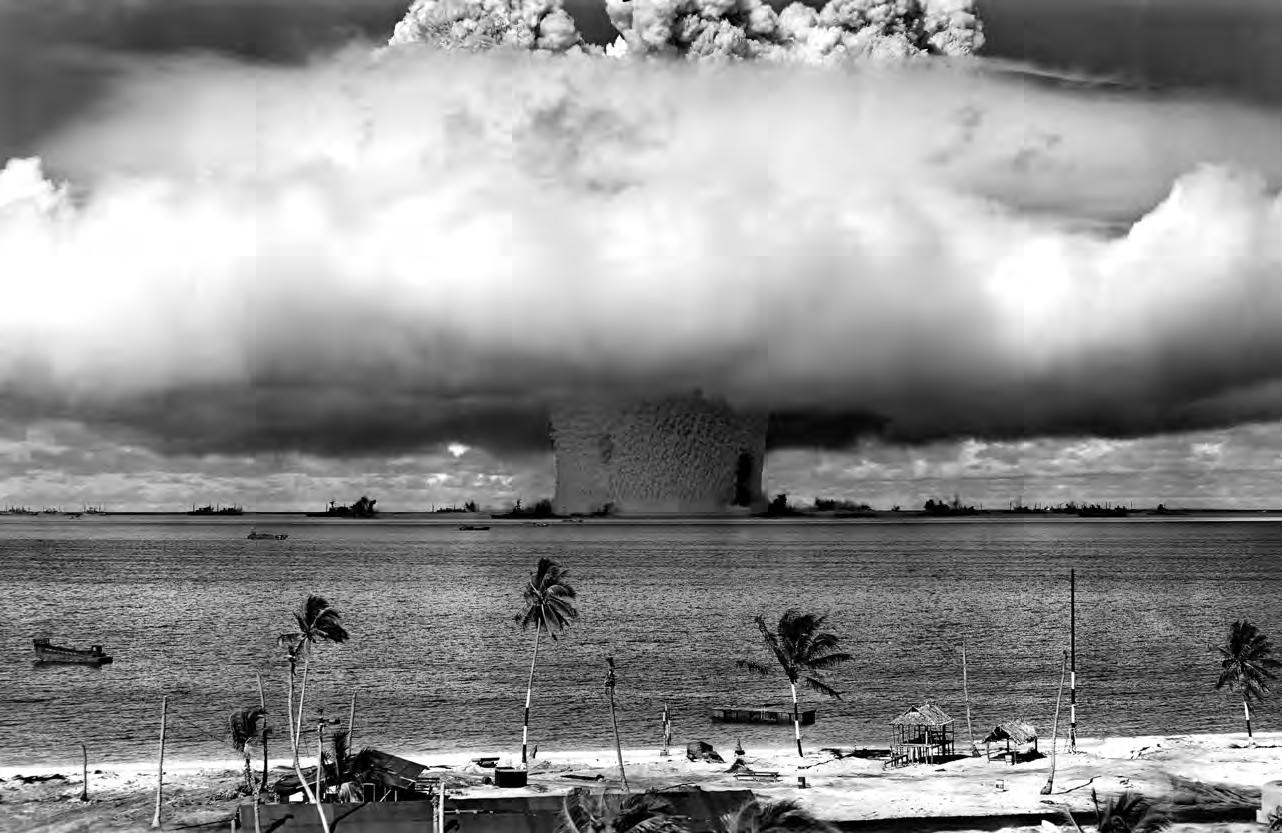
Cold War Military alliances
Founding members of the North Atlantic Alliance (NATO) 1949
Entry: Greece and Turkey 1952, West Germany 1955, Spain 1982
Founding members of the Warsaw Pact 1965
Entry: East Germany 1958
Withdrawal: Albania 1968
Neutral country
The island of Cuba, less than 150 km from the southern tip of the USA, became a Cold War flashpoint in 1962. American spy planes discovered that the Soviet Union was building launch sites for nuclear missiles on Cuba, within reach of US cities. US President John F Kennedy imposed a naval blockade to stop Soviet supply ships. If they tried to barge through, it could provoke a nuclear war. Over 13 tense days, with near misses between ships and submarines and secret negotiations, the world was on high alert. It was the closest the world had ever come to nuclear war.
Ultimately, the Soviet leader Nikita Khrushchev agreed to remove the missiles, and in return the US promised to stay out of Cuba and move some of its missiles away from the borders of the Warsaw Pact. Reporters around the globe welcomed the deal with headlines like, “World Hails Easing of Tension in Cuban Crisis” (The Canberra Times, 30 October 1962).
Writing focus
Developing sentences
UNCORRECTEDSAMPLEPAGES
SOVIET
Source 9.4.7 Map of the nation–state members of NATO and the Warsaw Pact ➜
Source 9.4.8 Extract from President John F Kennedy’s address to the nation about the naval blockade in Cuba. ➜
9.4
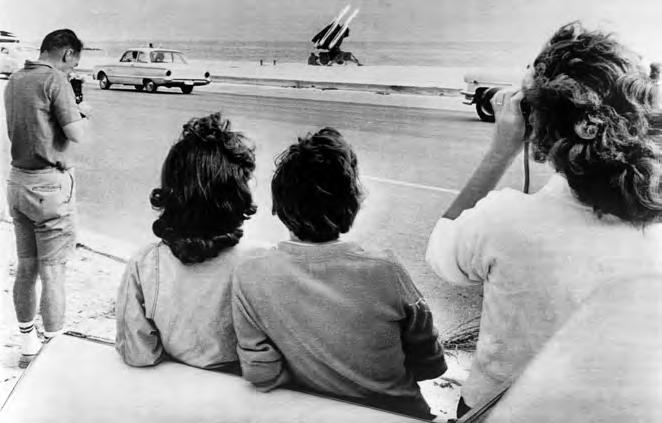
Source 9.4.9 Sightseers in Florida, USA, find anti-aircraft missile launchers on the beach normally used by swimmers, during the Cuban Missile Crisis of 1962.
There were also major conflicts during the Cold War. The main ones were:
• The Korean War (1950–1953) saw communist China send troops to support North Korea in its attempt to reunify with South Korea; South Korea was supported by the USA and allies, including Australian troops. Despite high levels of destruction and millions of deaths, fighting ended with the two Koreas once again split at the “38th Parallel” (38º north of the Equator).
• The Vietnam War (1955–1975) was between communist North Vietnam, supported by the Soviet Union and China, and non-communist South Vietnam, supported by the US and others, including Australia. The war became increasingly unpopular in Western nations, as people questioned whether it was worth the loss of life. After Western troops withdrew, Vietnam was unified as a communist nation.
• In 1979, the Soviet Union invaded Afghanistan, to try to stop Islamic fighters removing a communist government there. After a decade of costly battles, the Soviets eventually left without achieving their goal.
There was more peaceful competition between the superpowers, in space. The “Space Race” saw Russian and American governments invest in scientists and engineers, to try to be the first to achieve certain feats. The Soviet space program was the first to put an object into orbit around Earth, with the Sputnik satellite in 1957, and the first person to fly in orbit, in 1961. The United States decided to set a different goal: the Moon. In July 1969, Apollo 11 landed an American on the Moon, and the Americans were regarded to have “won” the Space Race.
Cold War popular culture
UNCORRECTEDSAMPLEPAGES
The Cold War made many people anxious. Their governments told them not to trust people from the “other” side, and to look for potential traitors in their own community. Many people were concerned that the world was so divided that tensions between superpowers might lead to war, and that nuclear weapons could destroy human civilisation. This context affected popular culture.
Hollywood cinema reflected the fear of communism, or of being invaded by an alien power. In some cases, the invaders were depicted not as communists, but as aliens, who were disguised as average Americans.
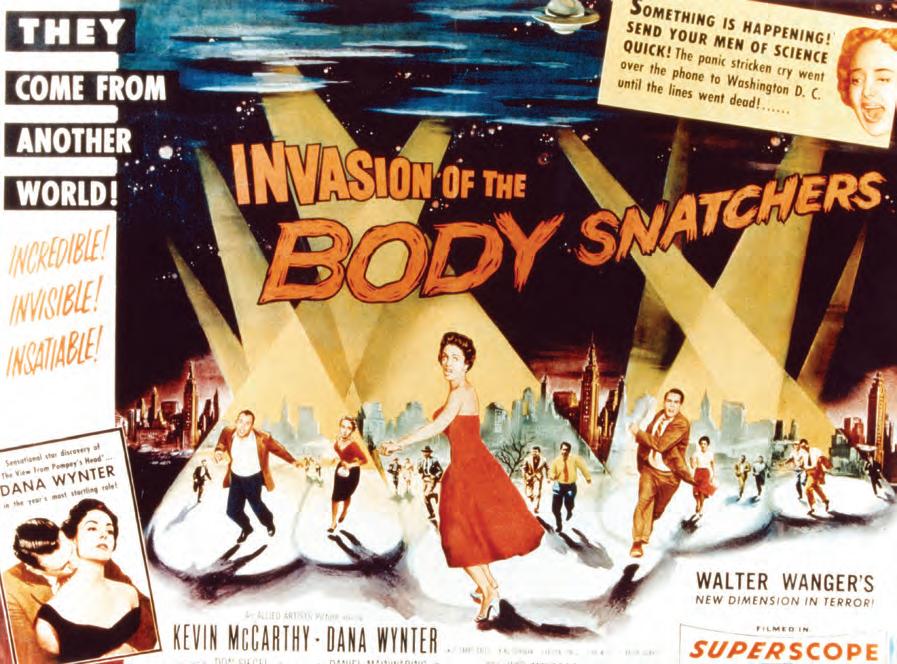
Source 9.4.10 Poster for the 1956 science fiction film, Invasion of the Body Snatchers, which depicts an alien force that takes control of the world by taking over people’s bodies.
Other films created heroic characters who saved the west from communism. One of the longest-running series was James Bond, based on a British spy, who regularly found himself in grave danger as he outwitted criminal organisations and Russian agents. Another highly popular franchise was “Rocky”, based on a tough, patriotic American boxer, who in Rocky IV fought against a powerful Russian who cheated with performance-enhancing drugs.

UNCORRECTEDSAMPLEPAGES
Source 9.4.11
.

Source 9.4.12
Scottish actor Sean Connery plays the spy James Bond in the 1963 film, From Russia with Love
American actor Sylvester Stallone (left) plays the boxer Rocky Balboa in the 1985 film, Rocky IV.
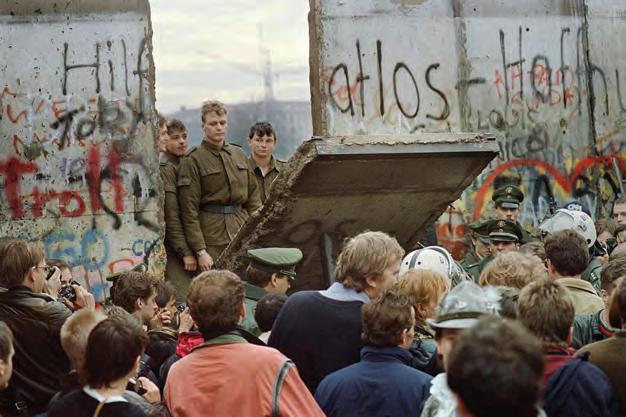
Music was also influenced by Cold War concerns. In the 1960s, a “counterculture” developed in the West, to protest against nuclear weapons and war. Many of the most popular songs from the era were protest songs. One example is “Masters of War” by American folk musician Bob Dylan, released in 1963. In the 1970s, British musician John Lennon sang “Imagine” about a world without nations or war, and American artist Edwin Starr sang “War – What is it Good For? Absolutely nothing”.
In the 1980s, West German pop band Nena released “99 Luftballons”, about an accidental nuclear launch based on misunderstandings, British musician Elton John released “Nikita”, about a love affair that is made impossible by the Berlin Wall, Australian band Midnight Oil sang anti-war songs including “Armistice Day”, British artist Sting released “I hope the Russians love their children too”, and American musician Billy Joel sang “We Didn’t Start the Fire”.
Teachers can go online to assign questions, view results, reports and more!
Identify the ideologies of the two sides of the Cold War.
Describe the two blocs of Cold War security alliances.
Explain what happened in Cuba in 1962.
Explain why the city of Berlin was significant in the Cold War.
Explain, using examples, how the Cold War influenced popular cinema.
Select one of the musical artists mentioned in this lesson and research their songs. What did their music show about how the Cold War affected people?
Historical concepts: Significance Historical skills: Research, Perspectives and interpretations
UNCORRECTEDSAMPLEPAGES
Source 9.4.13 East German border guards look on in confusion as a crowd breaks down the Berlin Wall, marking the symbolic end of the Cold War, November 1989.
9.5 Movements for civil, political, social, cultural and economic rights
Learning intention
In this lesson, you will learn about movements for equal rights (civil, political, social, cultural and economic), and how they affected Australia.
Starter activity
See, think, wonder Look at Source 9.5.1.
• What do you see in the photograph? (I can see …)
• What does it make you think about how laws affect people? (I think …)
• What does it make you wonder? (I wonder …)
➜
Source 9.5.1 An African American mother and her daughter sit on the steps of the US Supreme Court in 1954.
Success criteria
❏ I can explain what the civil rights movement achieved in the United States.
❏ I can explain movements for gender and racial equality in Australia.
After World War II, popular movements developed, to challenge forms of inequality in modern societies. These movements encountered resistance, involved personal sacrifi ce and used various methods.
Civil rightsmovements
In the United States, although the American Civil War (1861–1865) brought an end to slavery, it did not eliminate racism. In most states, laws segregated “African American” people from “white” society. African American people could not sit in the same sections of theatres and cinemas as white people. They had to attend separate schools, ride in different sections of public transport, eat in separate restaurants and drink from separate water fountains. In southern states, where slavery had once dominated the economy, special measures were also in place that effectively disenfranchised African American people. These laws were often called “Jim Crow” laws, based on a derogatory term for black men that came out of an early nineteenth-century mocking performance of a black character (played by a white actor) called Jim Crow.
UNCORRECTEDSAMPLEPAGES
The American civil rights movement challenged these inequalities. One method was to use the courts to argue for changes in the law. In 1954, the Supreme Court ruled that it was illegal to segregate schools into separate facilities for black and white students.
disenfranchised not to have power or opportunities, especially the right to vote, because it has been denied to the group to which you belong
Writing focus 9.5
Creating topic sentences
Another method was non-violent protest and civil disobedience, such as boycotts, protest marches and the “sit-in”, in which black customers sat at tables reserved for “whites only” at segregated restaurants and lunch counters. In December 1955, in Montgomery Alabama, Rosa Parks was arrested when she refused to give up her seat on a bus to a white passenger. The National Association for the Advancement of Colored People (NAACP) organised the Montgomery Bus Boycott, through which the African American population of the city – which made up 75 per cent of bus customers – refused to use the service. Instead, they walked or shared rides. They maintained economic pressure for over a year, ultimately forcing the bus company and local government to desegregate city transport.
The civil rights movement was inspired by strong leaders. The Reverend Dr Martin Luther King Jr was a young pastor when he helped the Montgomery Bus Boycott. He grew into a national leader, and called for protesters to persist with non-violence, even when they faced racist intimidation and police violence. King was inspired by the example of Mahatma Gandhi and the movement to make India independent from Britain, and in turn he inspired a new generation of activists. Their goal was to draw attention to racism and change the law.
Non-violent protest was often met by racist violence. In 1961, the Congress of Racial Equality organised the “Freedom Rides”, in which students travelled on buses to southern states. They exposed the reality of segregation by using “white only” facilities, and in places were violently attacked, sometimes by white supremacist groups like the Ku Klux Klan, and often with the support of local police. Eventually, the Federal Government intervened by sending National Guard soldiers to protect the riders and made segregation on interstate transport illegal.
The civil rights movement used mass rallies and marches to demonstrate public support for equality. In 1963, a “March on Washington for Jobs and Freedom” attracted over 250 000 people to the US capital. Of the many speakers on the day, Martin Luther King Jr captured the spirit of the movement, with his “I Have a Dream” speech.
UNCORRECTEDSAMPLEPAGES
“I have a dream that my four little children will one day live in a nation where they will not be judged by the colour of their skin but by the content of their character”.
Extension
9.5.1 “I have a dream” DOC
The Federal Government responded to public pressure with the 1964 Civil Rights Act, which outlawed discrimination based on race, colour, religion, sex or national origin, and the 1965 Voting Rights Act, which banned racial discrimination in elections.
Source 9.5.2 Black students stage a “sit-in” at a whites-only lunch counter in Greensboro, North Carolina, in 1960, to protest against segregation. ➜
The Civil Rights movement faced many forms of opposition. Local authorities continued to find ways to discriminate against people, and African Americans continued to experience poverty and exclusion. Martin Luther King and other activists were murdered. Some activists pushed for a more direct and forceful approach, known as “Black Power”. Malcolm X called for African Americans to arm themselves and be prepared to fight for their rights, to win freedom, justice and equality “by any means necessary”. His organisation was at times seen as a terrorist threat to the United States. Similarly, the Black Panthers Party challenged the policy of nonviolence by carrying arms and wearing militarystyle uniforms.
As shown by the revival of the civil rights movement in the “Black Lives Matter” protests in the 2010s, racial equality in the USA is still a matter of intense debate.
Australian movements for equality Aboriginal and Torres Strait Islander Peoples
In Australia, after World War II, many Aboriginal and Torres Strait Islander Peoples lived under government controls and restrictions. Families who lived on Aboriginal missions or reserves had to seek permission to travel or get a job, and they were often forbidden from speaking their languages or practising cultural traditions. Children could be removed from their families, to be raised by white Australians and become assimilated into white Australian society, under policies known as the Stolen Generations.
Australian civil rights activists employed similar techniques to American civil rights campaigns. They formed organisations, such as the Aborigines Advancement League. They pressured governments to remove racial discrimination from laws, which won the right to vote for all Aboriginal people in federal elections in 1962. They also used petitions and boycotts.
UNCORRECTEDSAMPLEPAGES
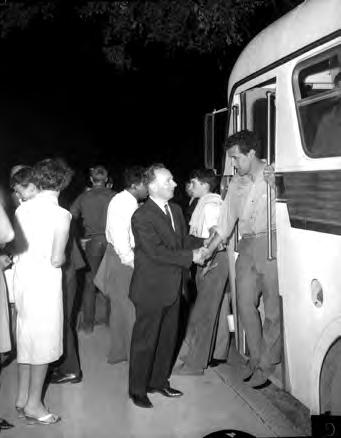
assimilated absorbed into another group, adopting
become
Source 9.5.3 Rev. Dr Martin Luther King Jr spoke to a crowd of over 250 000 people at the March on Washington, 1963.
Source 9.5.4 Members of the Black Panther Party give the “Black Power” salute outside a New York court, where their leaders were on trial for alleged terrorist attacks on police stations, 1969.
Source 9.5.5 Charles Perkins steps out of the Australian freedom ride bus to meet a supporter in 1965.
the new group’s customs, to
indistinguishable from the new group
In 1965, Arrernte and Kalkadoon activist Charles Perkins organised a group of University of Sydney students to conduct a “freedom ride” directly inspired by the American example. The ride toured through towns in rural NSW, where segregation was used to exclude Aboriginal people from local services. The media coverage showed Australians the reality of racism.
In 1967, a referendum was held in which the Australian people were asked to change the constitution to include Aboriginal and Torres Strait Islander Peoples in the national census, and to ensure that Federal laws applied to them in the same way that they applied to all other Australians, removing state control over their lives. Thanks to the campaigns that came before, the Australian public was enthusiastic for the change, and the referendum received the highest ever “yes” vote in Australian history – over 90 per cent.
Changing the Constitution made the rights of Aboriginal and Torres Strait Islander Peoples a national concern. However, real change was slow. Activists who were frustrated by the lack of progress formed more aggressive movements, inspired by the US Black Power movement, including an Australian Black Panther Party and the Aboriginal Tent Embassy, as a permanent protest in Canberra.
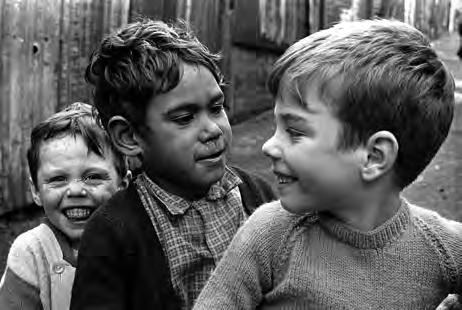
UNCORRECTEDSAMPLEPAGES
Into the twenty-first century, as the gap between Indigenous and non-Indigenous health and wealth continued, there was also an alarming number of Aboriginal arrests and deaths in custody. In 2023, a further referendum – to change the Constitution to create a First Nations “Voice to Parliament” –failed to receive sufficient support.
➜
Source 9.5.6 The Sydney Morning Herald showed Aboriginal and non-Aboriginal children playing together in the city streets in the lead-up to the 1967 referendum.
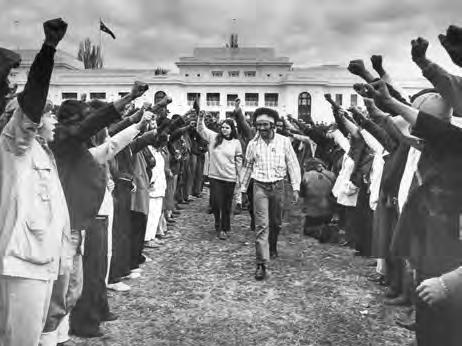
Source 9.5.7 Over 1000 supporters give the “Black Power” salute to cheer the return of the Aboriginal Tent Embassy to the lawns in front of Parliament House, Canberra in July 1972, after police had tried to demolish the embassy.
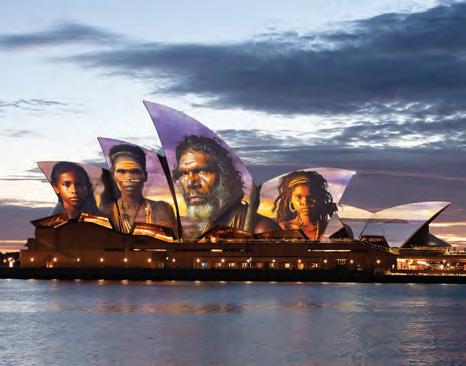
➜
Source 9.5.8 The First Nations projection by Indigenous artist Brett Leavy lights up the Sydney Opera House on 26 January 2024, during the debate over how “Australia Day” should be commemorated.
Women
Although Australian women were among the first in the world to have the right to vote (1902), they were still excluded from aspects of public life and paid less in the workplace. In the 1960s, trade unions led campaigns for equality for women in the workplace. The first steps were to remove the rule that women had to resign from the public service once they got married, and to ban discrimination based on gender. The next was equal pay. In 1972, the Australian Conciliation and Arbitration Commission ruled that it was illegal to pay women any less than men doing work of similar value.

Into the twenty-first century, campaigns highlighted other issues, including the rights of transgender people and ongoing concerns about women’s safety in the community. Teachers can go online to assign questions, view results, reports and more!
Knowledge and understanding
Define Jim Crow laws.
Explain what happened in Alabama in 1955–56.
Explain the technique of the “sit-in”.
Explain the philosophy of non-violence and an alternative approach.
Analyse why campaigns for Aboriginal and Torres Strait Islander rights in Australia used the techniques they did, giving examples.
Thinking and researching
Select one of the campaigns for Aboriginal and Torres Strait Islander rights mentioned in this lesson to research. Summarise in a paragraph how the campaign was organised and what it achieved.
UNCORRECTEDSAMPLEPAGES
Historical concepts: Significance, Cause and effect Historical skills: Research, Perspectives and interpretations
9.6
The contribution of migrants to Australia post-World War II
Learning intention
In this lesson, you will learn about postWorld War II migration, and how immigrants contributed to Australia.
Starter activity
Claim, support, question
Look at Source 9.6.1.
• Claim: Based on this image and what you may already know, what do you think were the key factors driving immigration in the period?
• Support: What evidence or reasoning can you provide to support your claim?
• Question: What questions do you have about your claim?
Source 9.6.1 Five children aged between six and 10 arrive at the “Migrant Hostel” at Villawood, NSW, in 1977, as part of a group of migrants from Vietnam, Cambodia and Laos. They had spent four months in a refugee camp in Thailand, having fled their homes during the Vietnam War.
Success criteria
UNCORRECTEDSAMPLEPAGES
❏ I can explain the post-war push and pull factors affecting international migration.
❏ I can describe how migration shaped modern Australia.
After World War II, greater numbers of people migrated to Australia, and to many other nations, than ever before.
Post-war push and pull factors
Migration is caused by push and pull factors. “Push” factors force people out of their homelands. They feel compelled to leave their old lives, due to the effects of poverty, famine, overcrowding, or persecution. “Pull” factors draw people to a different place from the land of their birth. They are attracted to new lives by the appeal of safety, incentives, land, work, or healthier living conditions. Both push and pull factors shaped migration after the Second World War:
• Following the Holocaust, 1.2 million Eastern European displaced persons refused to return home.
• As the Cold War loomed and the “Iron Curtain” separated Eastern and Western Europe, people moved their families to seek opportunities before borders were closed.
• Growing nations, including Australia, needed more workers and provided incentives for migrants to make the move.
• New nations displaced some people; for example, Arab people fled Palestine in large numbers in 1948 in fear of attacks from Zionist settlers and became refugees in neighbouring countries and the enclaves of Gaza (initially part of Egypt) and the West Bank (Jordan). This displacement was called the Nakba (“catastrophe”) by Palestinian Arabs.
• New nations were established and invited people to help them grow; for example, Jews from around the world were welcomed to settle in Palestine in the newly created country of Israel from 1948. This immigration was called Kibbutz Galuyot ("ingathering of the exiles") by Jews.
• Following the British decision to partition India in August 1947, chaotic mass movements of Hindus and Muslims crossed the new borderlines: Muslims from India to the newly created state of Pakistan, and Hindus from Pakistan to India. These movements were accompanied by violence and sectarian massacres.
• Cold War conflicts in Korea and Vietnam forced people to flee for safety.
• Easier access to media and information raised people’s awareness of better living standards in other countries.
• Some people became victims of human trafficking, and they were tricked by false promises of good work in another country, only to find themselves trapped.
• Education became more global, encouraging people to become international students, or to earn qualifications that would enable them to win a job in another country.
• Highly developed countries faced shortages in some workforces, particularly in lower-paid manual work, which first-generation immigrants were prepared to do.
UNCORRECTEDSAMPLEPAGES
Writing focus 9.6
Developing sentences
Source 9.6.2 Trains carrying some of the 14.5 million people who migrated during the partition of India and Pakistan in 1947, the largest migration in history that was forced by a political decision.
➜
Source 9.6.3 The low-lying Pacific island of Tuvalu is affected by rising sea levels. Since 2023, the Australian government has given residents the right to migrate to Australia, if they become climate change refugees.
Source 9.6.4 A family farewells young people leaving Nepal. In 2025, 800 000 Nepalis emigrated for work or education, many to the Middle East.
Many immigrants bring skills and cultures with them to enrich the communities they join. Studies in multiple countries have found that immigration benefits a country’s economy.
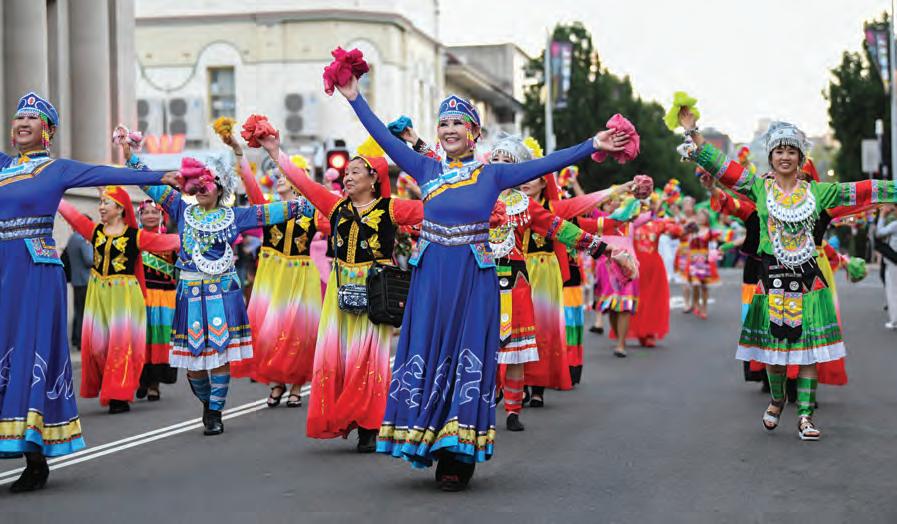
UNCORRECTEDSAMPLEPAGES
Contribution of migrants to Australia
Before the Second World War, diversity in Australian society was limited. One of the first laws of the newly established Federal Parliament in 1901 was The Immigration Act, also known as the White Australia Policy. This limited the number of non-white or non-British people who could immigrate to Australia. Both sides of politics accepted the racist idea that “white” people were in some way superior, and that other ethnicities would not fit in well in Australian society.
Source 9.6.5 Performers in the annual Parramasala Festival, which celebrates South Asian cultures and their contribution to Australian society, in Parramatta, Greater Sydney.
The notion of White Australia began to fade after the Second World War. In 1945, Australia’s population was around 7.4 million. Federal governments – under the slogan “populate or perish” – decided to try to grow the Australian population, to deter potential invasions and to expand the economy. Also, governments chose to undertake large construction projects, such as the giant Snowy Mountains Hydro-Electric Scheme in southern NSW, which required tens of thousands more workers than were available in Australia.
Source analysis
Source 9.6.6 Arthur Calwell, Australia’s first-ever Minister for Immigration, gave a speech known as “Populate or Perish” on 2 August 1945.
If Australians have learned one lesson from the Pacific war now moving to a successful conclusion, it is surely that we cannot continue to hold our island continent for ourselves and our descendants unless we greatly increase our numbers. We are but 7 000 000 people and we hold 3 000 000 square miles of this earth’s surface. It would be prudent for us, therefore, not to ignore the possibility of a further formidable challenge within the next quarter of a century to our right to hold this land. We may have only those next 25 years in which to make the best possible use of our second chance to survive. Our first requirement is additional population. We need it for reasons of defence and for the fullest expansion of our economy. We can increase our 7 000 000 by an increased birth-rate and by a policy of planned immigration within the limits of our existing legislation.
Immigration is, at best, only the counterpart of the most important phase of population building, natural increase. Any immigration policy, therefore, must be intimately related to those phases of Government policy that are directed towards stimulating the birth-rate and lowering the infant mortality rate in Australia itself. It must, further, be related to the whole social service programme of creating greater economic security and a higher standard of living, as an inducement to young Australian couples to have larger families.
… For the foregoing reasons, we intend to embark on an adequate publicity campaign in Britain and in other centres of potential immigration on the European continent
Calwell, Australia’s first-ever Minister for Immigration, “Populate or Perish” speech in Federal Parliament, 2 August 1945 [Hansard].
Identify Arthur Calwell’s role, and explain why that was significant. Explain the context – what was happening at the time?
UNCORRECTEDSAMPLEPAGES
Describe why Calwell said Australia needed to increase its population. Explain how Calwell said Australia should increase its population. Explain where Calwell said potential immigrants might come from. How does this relate to previous immigration policies?
Evaluate how useful the phrase “Populate or Perish” is to describe the policy Calwell was introducing.
Historical concepts: Significance, Continuity and change Historical skills: Analysis and use of sources, Comprehension
Arthur
multiculturalism the recognition, acceptance and celebration of cultural diversity –or the coexistence of multiple cultures – within a society or organisation
Under the “Populate or Perish” policy, Australian officials actively recruited immigrants. One method was the offer of discounted voyages to British people to immigrate to Australia. People who registered for the Assisted Passage Migration Scheme became known as “Ten-Pound Poms”, because they only had to pay £10 for the journey.
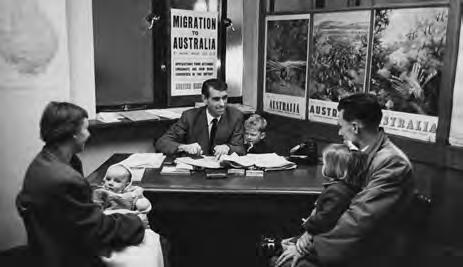
UNCORRECTEDSAMPLEPAGES
Source 9.6.7 An Australian immigration officer in London explains to a young English family the incentives to move to Australia, in 1953. ➜
For the first time, large numbers of people from Continental Europe also arrived. Skilled tradesmen from 30 different nations comprised around 65 000 of the 100 000 people who worked on the Snowy Mountains Hydro-Electric Scheme from 1949 to 1972. Their skills built what was at the time the country’s largest and most complex engineering project, and it continues to supply clean electricity. Many of the workers initially experienced challenges as “New Australians”, learning the English language and adapting to a different environment, but they and their families remained in Australia, enriching communities with their cultures. This became a consistent pattern, as migrants embraced opportunities in Australia, with high levels of participation in education and the labour market, and high rates of new business creation. As people appreciated the benefits of multiculturalism, the White Australia Policy became a thing of the past. The policy was officially abandoned in 1973.
➜
Source 9.6.8 Al Grassby, Minister for Immigration, Grassby was the first Australian official to use the term “multiculturalism”. This is an extract from a speech he gave in August 1973.
My concept of a society able to sustain growth and change without disintegration is a society based on equal opportunity for all – a goal which no right-thinking person could dispute, but the striving for which has led traditionally to some of the deepest conflicts within society. This means full scope for all to develop their personal potential, no matter how diverse their origins, beliefs, wealth or ability.
Some waves of immigration were caused by people fleeing conflict, drought and famine, often arriving in Australia via perilous journeys to refugee camps.
Immigration has been found to be an economic benefit to Australia.
Studies in the 1980s, 2010s and 2020s all found that immigration boosts economic growth and workforce productivity. This is partly because Australia came to rely on strong levels of immigration for population growth.
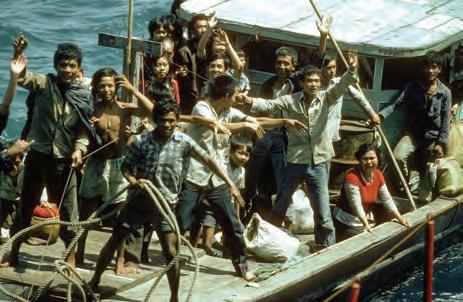
➜
Source 9.6.9 Vietnamese refugees, sometimes called “boat people”, are relieved to be rescued at sea in 1978. Around 2000 of the 100 000 Vietnamese immigrants to Australia after the Vietnam War arrived by boat.
Al Grassby, Minister for Immigration, “A Multi-cultural Society for the Future”, speech, August 1973
By the twenty-first century, most of Australia’s annual population growth was due to immigration, which increased the number of consumers, workers and taxpayers in the country, and in turn expanded the economy and government revenue.
Since the 1980s, Australia’s migration program has emphasised attracting skilled workers, to fill vacancies in specialised professions, and to increase the levels of expertise in industries. There have also been programs to encourage migrants to live in regional and rural areas, which have had some success in reversing the population decline of small towns. The “pull” factor of a safer, better life for their families remains a key reason that people move to Australia, and embrace Australian values: 80 per cent of immigrants who have lived in Australia for over 10 years choose to become Australian citizens.
By the mid 2020s, around 300 million people around the world were living in a different country from where they were born. Around 8.6 million of those were living in Australia. Many proudly maintain a link to their birth country’s culture, and share it with their fellow Australians. Therefore, there is more religious diversity in Australia than in most countries, and in most Australian cities and towns it is possible to try cuisines from around the world, such as Italian, Vietnamese, Thai, Lebanese and Chinese, and to participate in multicultural festivals including Lunar New Year, Diwali, the Greek Festival of Sydney, and Ramadan celebrations.
Knowledge and understanding
Define the two types of factors behind migration. Identify two examples of people who were displaced by the creation of new nations. Explain three positive factors that might pull people towards immigrating into a different country. Explain the post-war migration policy of Australian governments. Explain the concept of multiculturalism and how it became government policy.
Thinking and researching
UNCORRECTEDSAMPLEPAGES

Most Australian families have a migration story. Research the migration story of one of the branches of your family tree, or of a friend’s family, if yours is a mystery. Summarise in two to three paragraphs the family’s migration story (who, when, where, why), how it relates to the push and pull factors of human mobility, and how it relates to multiculturalism. Note that this migration may be within Australia or between countries. 1.
concepts: Cause and effect, Perspectives
skills: Perspectives and interpretations, Research, Communication
Source 9.6.10 Young Bollywood dancers in Melbourne, celebrating the contribution of Indian immigrants to Australia’s multiculturalism.
9.7 New technologies
In this lesson, you will learn about new ❏ I can explain how people’s lives changed due to
consumerism
a way of thinking that values the free choice of individuals to buy large amounts of goods for personal consumption, to help the economy grow
UNCORRECTEDSAMPLEPAGES
The second half of the twentieth century saw rapid developments in new technologies, followed the trends set by the world’s largest economy, the United States, where the decades from the 1950s onwards were characterised by consumerism. Families embraced the motor car, labour-saving devices in the home, and other technologies designed with convenience in mind.
When war ended, many of the resources and workers that had been dedicated to manufacturing vehicles and weapons for the war effort could be redeployed. In the United States, this enabled a boom in sales of the motor car, fuelled by petrol and powered by the internal combustion engine. In 1945, there were around 25 million cars in America, and three-quarters of American households owned a car. Thirty years later, there were over 105 million cars and on average every American household owned two vehicles. Private motor cars were embraced as symbols of freedom, and governments paid for huge road and highway networks to enable the car to become a dominant form of transport.
Labour-saving devices also fuelled consumerism. When they could afford to, families replaced wood- or coal-burning water heaters and ovens with electric or gas devices, which took less time and effort. Electric toasters, kettles, refrigerators and mixers also became common in the modern kitchen, while vacuum cleaners, washing machines and dryers reduced the amount of time it took to keep homes clean. Advertising was directed towards women, who were expected to do the vast majority of work around the home. The modern world was becoming more convenient, but also more wasteful, as the devices needed to be replaced regularly, and they consumed increasing amounts of electricity.
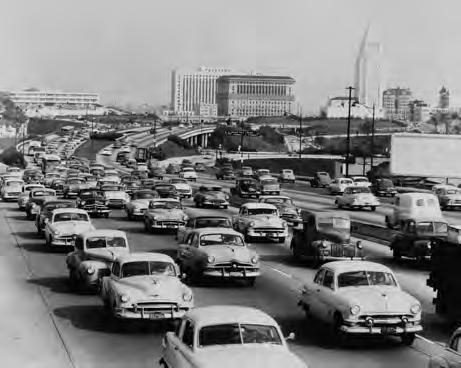
UNCORRECTEDSAMPLEPAGES

Television was invented in the late 1920s, but TV sets were not common in family homes until after World War II. Once affordable sets became available, people were eager to try the new technology. Broadcasting networks were formed to develop content, and television quickly became a key way for people to access news and entertainment. By 1960, there was a television set in 90 per cent of American households; Australia reached that level around 1973. With satellites in orbit, it became possible to transmit broadcasts across vast distances, even between continents. In the 1970s, colour television was the next innovation.
Technologies also affected health care. Early improvements were based on wartime innovations, including the use of penicillin to treat infections, and blood transfusions to save lives. By the 1960s, more powerful surgical microscopes, new techniques in heart and brain surgery, and the first successful organ transplants gave surgeons the ability to extend people’s lives. Birth control pills gave women more control over their fertility, and the first baby born with the help of in vitro fertilisation was in 1978. There were also major advances in the use of vaccines to protect populations from disease. In 1980, smallpox became the first disease officially eradicated from the world, thanks to a massive global effort to vaccinate people.
Source 9.7.2 Commuters stuck in a traffic jam on a highway in Los Angeles, USA, c. 1950.
➜
Source 9.7.3 A farm family have a snack in their 1960s kitchen, equipped with the latest electric devices.
➜
Writing focus 9.7
Transitional phrases

Source 9.7.4 The Atari games console, launched in 1977, was the first to use a silicon chip memory system and games cartridges.
The digital revolution
The late twentieth century saw the digital revolution, or the Third Industrial Revolution. Mechanical and analogue technology was increasingly replaced by digital electronic means of storing and transferring information. Although digital computers were available from the 1950s, they were not widely used in homes and businesses until the 1980s, when personal computers (PCs) became commercially available. Some of the main developments were made by innovative companies, which started small and became multinational giants: software giant Microsoft was founded by Bill Gates and Paul Allen in 1975, and hardware designer Apple was founded by Steve Jobs and Steve Wozniak in 1976. Computers transformed the way people worked and played games.
By the early 1990s, digital technology expanded dramatically. Mobile telephones and cameras were becoming commercially available. The development of digital servers and browser systems made it possible for people to share and search for information via their personal computers, using existing telephone lines. The World Wide Web was first used for academic information, and eventually became a dominant medium in news, shopping and social networking. Search engines using advanced algorithms became available, with Google – launched in 1998 – becoming dominant. Some historians regard this as the start of the “Information Age”. People began to spend significant portions of their life on the internet or “online”. By the 2010s, the internet was so important to people’s access to information and networks that the United Nations passed resolutions to call on nation–states to protect people’s human rights online.

UNCORRECTEDSAMPLEPAGES
Source 9.7.5 Customers line up to buy an Apple iPhone in New York City, on the first day of sales for the smartphone: 29 June 2007.
Around the year 2000, mobile phone networks began to allow users to send text messages from their handsets. In 2007, the “smartphone” was launched, beginning an era in which people no longer viewed their phone as merely a way to talk to other people. Now, a device that could be carried anywhere by hand could include a camera, plus features previously only available on a computer, through applications giving users access to maps, the internet, emails, music and games. Social media platforms emerged (e.g. Facebook in 2004, Twitter (X) in 2006, Instagram in 2010 and TikTok in 2017), which made it possible for people to share and view content instantly, and for companies to track users’ activities, to maximise the impact of their advertising.
Into the 2020s, it became clear that the next stages of the digital revolution would require a great deal of electricity. Electric vehicles, using larger versions of the batteries developed for computers and mobile phones, began to claim a significant share of the market in passenger cars. Technology companies and nation-states started to compete with each other to be the first to develop reliable forms of Artificial Intelligence (AI) to serve as robot assistants, to answer people’s questions, analyse huge quantities of data, operate machinery and transport without the need for human workers and help people design things. Analysts, politicians, and religious leaders including Pope Leo XIV debated how major the impacts of AI were likely to be, and the extent to which AI would solve world problems, or create new problems, including ethical concerns and aggressive competition between countries.
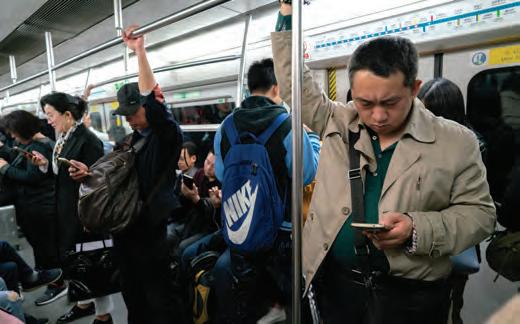
➜ Source 9.7.7 A data centre in Chile in 2024, one of many being developed around the world to power artificial intelligence. At a time of drought in South America, the data centres became controversial, for consuming vast quantities of water
Knowledge and understanding Define consumerism.
Explain the link between consumerism and new technologies.
Explain the steps involved in television sets becoming widely used. Explain the start of the “Information Age”.
Explain the significance of the year 2007 to the “Digital Revolution”.
Thinking and researching
UNCORRECTEDSAMPLEPAGES
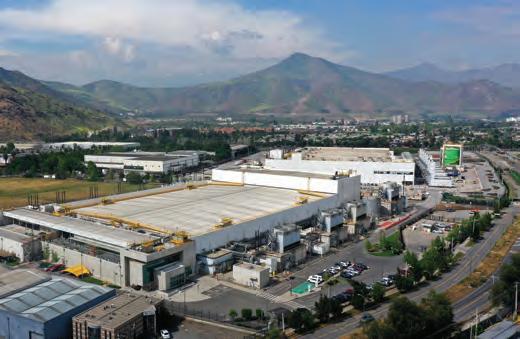
Teachers can go online to assign questions, view results, reports and more!
Select one of the technologies mentioned in this lesson and research the history of its development. Create a one-page summary, using text and images, of what people did before the technology was available, how the technology came to exist, and what people were able to do with the technology. Try also to include information about the negative impacts of the technology, if applicable.
Source 9.7.6 Commuters on a train in Beijing, China, scrolling on their phones. Around 1.1 billion people in China use a smartphone.
9.8 Environmental and sustainability issues
Learning intention
In this lesson, you will learn about the emerging awareness of environmental and sustainability issues after World War II.
Success criteria
❏ I can describe international efforts to protect the environment.
❏ I can explain how sustainability became a concern to the modern world.
UNCORRECTEDSAMPLEPAGES
In the second half of the twentieth century, concerns about the environment became more prominent. Governments worked together to develop international environmental protections, while non-government organisations (NGOs) built strong supporter bases, to increase pressure for more action. Many of the early campaigns aimed to preserve the natural environment and its species. Later, the focus shifted to sustainability and how to manage human activities to limit people’s impacts on environmental systems.
International environmental protections
In 1962, Rachel Carson, an American biologist, published a book called Silent Spring, about the way that chemical pesticides, particularly DDT, were destroying fish and wildlife populations. So many birds were dying from eating insects poisoned by chemicals that Carson predicted that future springtimes would be silent, rather than filled with the sounds of birds. People, she said, needed to master their own actions to protect the environment over the long term, rather than try to master the environment in , 3 April 1963
responded with new powers to protect the environment, including the US Environmental Protection Agency, and the Australian Department of Environment and Conservation.
In 1972, the United Nations held a “Conference on the Human Environment” in Stockholm, Sweden, also known as the Earth Summit. It was the first international conference to consider both environmental and economic needs, and it decided to set up new international organisations to improve the way the environment and human activities were managed. This was the origin of the UN Environment Programme (UNEP).
Source 9.8.3 The first two principles from the Earth Summit report ➜
Principle 1. Man has the fundamental right to freedom, equality and adequate conditions of life, in an environment of a quality that permits a life of dignity and well-being, and he bears a solemn responsibility to protect and improve the environment for present and future generations …
UNCORRECTEDSAMPLEPAGES
Principle 2. The natural resources of the earth, including the air, water, land, flora and fauna and especially representative samples of natural ecosystems, must be safeguarded for the benefit of present and future generations through careful planning or management, as appropriate.
of the United Nations Conference on the Human Environment, Stockholm, 1972
Writing focus 9.8
Transitional phrases
Another outcome of the Stockholm Conference was the World Heritage Convention. Under the United Nations Educational, Scientific and Cultural Organization, places around the world that are of outstanding universal value for their natural and/or cultural aspects are placed on the World Heritage List and given the highest possible form of protection.
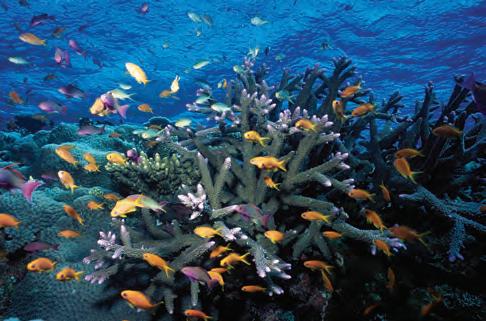
➜
Source 9.8.4 Queensland’s Great Barrier Reef was placed on the World Heritage List in 1981. In recent years, scientists have considered placing the reef on the “World Heritage in Danger” list, due to the impacts of warming oceans on coral.
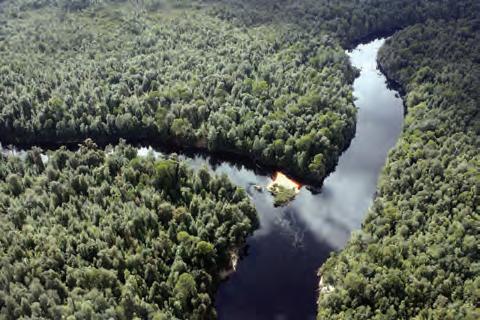
➜
Source 9.8.5 To stop the Tasmanian government from building a hydroelectric dam on the Franklin River in 1983, the Federal Government nominated the region for World Heritage List protection.
Other arrangements were developed for international areas of wilderness with unique qualities. Around the North and South Poles, where in the past there was competition for resources, particularly through hunting wildlife including whales and seals, new cooperative organisations were established.

Source 9.8.6 Antarctica has been protected as a zone of peace and scientific cooperation under the Antarctic Treaty since 1959.
UNCORRECTEDSAMPLEPAGES
Nations with an interest in the continent of Antarctica around the South Pole set up the Antarctic Treaty in 1959. The treaty – signed by Australia and all other nations involved in southern polar issues – treats the frozen continent as an international zone, where only scientific research and peaceful cooperation is allowed.
Conservation organisations drew widespread support for their campaigns to save endangered species. Many campaigns focused on large, beautiful animals, sometimes known as “charismatic megafauna”. Movements were developed to end hunting and poaching of elephants, tigers and giant pandas, and to protect their habitats. In the oceans, the campaign to “Save the Whale” came to symbolise modern conservation.
Another environmental success was the signing of the 1987 Montreal Protocol on Substances that Deplete the Ozone Layer. Scientists working in Antarctica had discovered a hole in the ozone layer, which protects the Earth’s surface from ultraviolet radiation. Under the Protocol, all governments of the world agreed to phase out the chemicals that were causing the hole – which were found in aerosol products, refrigerators and fire extinguishers. Soon, the hole began to close.
Other intergovernmental organisations were established to set international rules to protect the environment: the Ramsar Convention on Wetlands (1971), the Convention on International Trade in Endangered Species (1975), the Convention on Migratory Species (1979), and the Convention on Biological Diversity (1992).
Sustainability
Towards the end of the twentieth century, environmental concerns were broadened from endangered species and protected areas to “sustainability”. In 1987, world leaders met as the World Commission on Environment and Development, and defined sustainability as development that “meets the needs of the present without compromising the ability of future generations to meet their own needs”. This concept gave the UN and the international community a new principle to use to address human activities and the environment.
Source 9.8.7 The final report of the World Commission on Environment and Development defined sustainable development.
Humanity has the ability to make development sustainable to ensure that it meets the needs of the present without compromising the ability of future generations to meet their own needs. The concept of sustainable development does imply limits – not absolute limits but limitations imposed by the present state of technology and social organization on environmental resources and by the ability of the biosphere to absorb the effects of human activities. But technology and social organization can be both managed and improved to make way for a new era of economic growth.
Our Common Future, Final report of the World Commission on Environment and Development, 1987, paragraph 27 Scientists and policy makers agreed that a central aspect of sustainability was the relationship between human activities and the climate. In 1988, the UN established the Intergovernmental Panel on Climate Change (IPCC), comprising climate scientists and government officials. Since then, the IPCC has provided regular assessments of the scientific proof that the Earth’s climate is warming, due to human activities, particularly the emissions caused by the burning of coal, oil and gas. In 2007, the IPCC experts shared the Nobel Peace Prize with former US Vice President Al Gore,
“for their efforts to build up and disseminate greater knowledge about man-made climate change, and to lay the foundations for the measures that are needed to counteract such change”.
Government responses to the evidence of climate change were coordinated through the United Nations Framework Convention on Climate Change, which came into force in 1994. Targets to limit and reduce emissions were set through the 1997 Kyoto Protocol (which Australia decided not to ratify, until a change of government in 2007) and the 2015 Paris Agreement.
UNCORRECTEDSAMPLEPAGES

Source 9.8.8 Warmer temperatures threaten the survival of glaciers. The Aletsch Glacier in Switzerland lost 4.6 metres of ice thickness in 2025. ➜
World leaders also met to discuss sustainable development at several “Earth Summits”, notably in Rio de Janeiro, Brazil, in 1992, Johannesburg, South Africa, in 2002 and Rio again in 2012. The purpose of the summits was to identify the world’s major challenges, discuss solutions and develop a plan of action.
In 2015, the United Nations held a Sustainable Development Summit, which adopted a set of 17 “Sustainable Development Goals” to set targets for quality human lives and a healthy environment. Under each goal, the UN identified 8–12 targets to be achieved by 2030. This gives governments at all levels a way to measure progress towards the goals.

Teachers can go online to assign questions, view results, reports and more!
Knowledge and understanding
Identify the 1962 book that inspired the environment movement. Explain the purpose of the World Heritage List.
Explain how the Antarctic environment was protected.
Explain the link between “charismatic megafauna” and conservation.
Explain what sustainable development means, and the origin of the term.
Analyse the significance of climate change, using examples.
UNCORRECTEDSAMPLEPAGES
Thinking and researching
Select one of the Sustainable Development Goals, which you think is especially important. How close is the world to achieving that goal? Find the online tracker https://cambridge.edu.au/redirect/12048 and summarise what it shows.
Historical concepts: Cause and effect, Significance Historical skills: Comprehension – chronology, terms and
Source 9.8.9 The Sustainable Development Goals, adopted in 2015 ➜
Chapter review and historical inquiry 9.9
Access the Interactive Textbook for a range of digital tools to help you review this chapter and build confidence.
• Auto-marked questions for fast feedback and fun practice
• Self-assessment tools to track your progress, review answers (if enabled by the teacher), and flag questions for extra help
• Downloadable worksheets for class or homework revision
Summary
Summary notes
What have you learned about the modern world? Copy the table and fill out by explaining your understanding. Aim for two points per topic.
Topic What I have learned
The creation of the United Nations
Human rights in the modern world — the UN Charter and Universal Declaration of Human Rights
The Cold War and its global impacts
Movements for civil, political, cultural and economic rights
Migrants’ contribution to modern Australia
Technologies shaping the modern world
Visible thinking routine
Claim, support, question
Select one of the topics you have studied in this chapter.
• Claim: Make a claim about why the topic was significant.
• Support: What evidence or reasoning can you provide to support your claim?
• Question: What questions do you have about your claim?
UNCORRECTEDSAMPLEPAGES
Questions and activities
Scorcher quiz
Access a fast, fun, competitive quiz that puts your understanding to the test.
UNCORRECTEDSAMPLEPAGES
Quick questions
In 1945, delegates from 50 nations met in _______ to design the United Nations.
The Universal Declaration of Human Rights was adopted by the UN General Assembly in ________.
The military and political rivalry between the United States and the _______ after World War II was known as the Cold War.
The 1967 Australian Referendum changed the Constitution to include Aboriginal and Torres Strait Islander Peoples in the national ______.
The slogan used to encourage post-war migration to Australia was “______ or Perish”.
Define the purpose of the United Nations.
Identify one key idea expressed in the Universal Declaration of Human Rights. Identify one major conflict associated with the Cold War and name the countries involved.
Outline one way migrants contributed to post-war Australia.
Explain how new technologies changed everyday life in the late-twentieth century.
Group work activity
Allocate one group to each of the seven main topics of this chapter. Review what you have learned, and develop a short presentation to the class to argue that your topic was the most significant topic for the world after 1945. You might argue, for example, that the topic affected the most people, had the most far-reaching impact, or had the longest impact. At the end of the presentations, vote as a class on which seems to be the most significant.
Research activity
Choose one of the international organisations or agreements mentioned in this chapter (e.g. a United Nations organ, the Universal Declaration of Human Rights, NATO, the Antarctic Treaty, International Whaling Commission, Convention on Biological Diversity, UN Framework Convention on Climate Change). Since it was established, what has changed and what has continued the same? You could research, for example, its goals, its membership, its achievements and its messages for the world.
Creative task
On one page or slide, create a timeline that summarises the key events of the period 1945 to the present. You might use key phrases and images to illustrate your timeline.
Writing focus
The following activities offer ways to demonstrate your understanding of the chapter and allow you to continue to practise your writing skills.
Answering questions in paragraphs
This sample response to a question is structured using:
• a topic sentence
• the four Es (explain, elaborate, evidence and examples)
• a linking sentence.
You can use this as a model when writing your own answers to the following questions.
Question: What was the significance of the concept of human rights?
Topic sentence: the first sentence of the paragraph; directly answers the question Model answer:
Elaborate: additional information, connections, historical significance, change and continuity, cause and consequence
Examples: provide credibility and illustrate the argument
The concept of human rights was significant because it established a universal standard for how people should be treated, regardless of nationality, gender, or background. After World War II, nations recognised that preventing future atrocities required a shared agreement about dignity, equality and freedom for every individual. This global shift meant that governments were no longer judged only by their power or alliances, but also by how well they protected the rights of their own people. This is shown in the Universal Declaration of Human Rights (UDHR) of 1948, which begins by stating that “all human beings are born free and equal in dignity and rights”. The UDHR’s influence helped inspire civil rights campaigns across the world, such as those led by African Americans and Aboriginal and Torres Strait Islander Peoples. Therefore, the concept of human rights was significant because it reshaped global expectations, providing a lasting framework that nations and citizens continue to use to promote justice and protect human dignity.
Extended-response questions
How was the United Nations designed?
What was the significance of the concept of human rights?
Why did the Cold War happen, and what were its effects?
UNCORRECTEDSAMPLEPAGES
What did movements for civil rights achieve? Refer to two countries. How did migrants contribute to Australia?
Explain: clarify, define and describe
Evidence: specific, relevant evidence to support your arguments Linking sentence: reconnects to the topic sentence using the language of the question
How did new technologies drive change? Refer to at least one example from the 1940s to 1960s and one example from the 1990s to 2020s.
What environmental and sustainability issues emerged? Give examples of how the international community responded to the issues.
Historical inquiry
Investigating significance
In this historical investigation into the significance of the modern world, you will undertake the following steps:
Part 1: Develop historical questions
• Step 1: Select an aspect of the modern world core topic that interests you. Examples include:
● the formation of the United Nations
● the influence of the Cold War on popular culture
● the influence of migration on Australian society
● increasing awareness of the US civil rights movement in Australia.
• Step 2: Brainstorm what you already know
• Step 3: Develop a historical inquiry question. Examples include:
● How significant was the United Nations in promoting peace and cooperation around the world?
● Assess the impact of the Cold War on music in the 1960s and 1970s.
● To what extent is post-war migration a turning point in Australian history?
● Explain how significant the US Civil Rights movement was in influencing campaigns for Indigenous rights in Australia.
• Step 4: Explain why the question is important
Part 2: Locate and analyse evidence
Part 3: Communicate historical findings
Part 4: Reflect
UNCORRECTEDSAMPLEPAGES
Teachers, access the Online Teaching Suite for digital resources and tools that support review, assessment and reporting, including:
• student and class activity reports
• a test generator to create custom assessments
• built-in feedback tools
• editable downloadable support material
• a downloadable and printable “Writing focus” workbook for this chapter.
Human rights and freedoms (c. 1938–c. 2017) Chapter 10
Key questions
• How were the rights and freedoms of Aboriginal and Torres Strait Islander Peoples denied before 1965 and how did they fight for their rights and freedoms?
• In what ways did the US civil rights movement influence Aboriginal activism in Australia?
• To what extent did government policies and laws change in response to campaigns for rights?
• How have human rights movements shaped Australia and the world since World War II?
Lessons
10.1 Setting the scene
10.2 The struggle for rights and freedoms of Aboriginal and Torres Strait Islander Peoples before 1965: Rights and freedoms denied
10.3 The struggle for rights and freedoms of Aboriginal and Torres Strait Islander Peoples before 1965: Early twentieth-century activism
10.4 The US Civil Rights movement and its influence on Australia
10.5 Action for Aborigines (SAFA) and the significance of the 1965 Freedom Ride
10.6 1967 Referendum for Aboriginal and Torres Strait Islander Peoples
10.7 Government policies on the Stolen Generations
10.8 Site study: Mt Annan Stolen Generations Memorial
10.9 Land rights and native title
10.10 Struggle for rights and freedoms of indigenous peoples in Canada
10.11 Impacts of inequality on the lives of Aboriginal and Torres Strait Islander Peoples
10.12 Languages, cultures and identities
10.13 Human rights conventions
10.14 Chapter review and historical inquiry
Teachers access the Online Teaching Suite to:
• plan, sequence and assign directed tasks for students and classes using Task Manager
• view student activity reports
• provide feedback to students
• download a printable “Writing focus” workbook for this chapter.
UNCORRECTEDSAMPLEPAGES
Aboriginal and Torres Strait Islander Peoples should be aware that this chapter contains images and names of people who have, or may have, passed away. These materials are presented with respect for First Nations cultures and communities, and with care for how this content may be experienced by readers.
Please note that in this chapter Indigenous (capital I) refers to the original inhabitants of Australia, Aboriginal and Torres Strait Islander Peoples, and indigenous (lower-case i) refers to all First Nations peoples of the world. Language has been chosen carefully and respectfully throughout this chapter.
10.1
Setting the scene
Learning intention
In this lesson, we will learn about key events that have shaped the struggle for human rights and freedoms in Australia. We will explore how these events are remembered and interpreted from different perspectives, and how truth-telling and truth-listening help us better understand the experiences of Aboriginal and Torres Strait Islander Peoples and other Australians.
truth-telling openly sharing, recognising and dealing with past and present realities, especially those involving injustice, conflict or colonisation
Success criteria
❏ I can outline key events that have influenced human rights and freedoms in Australia. ❏ I can explain how different perspectives affect the way history is recorded and remembered.
UNCORRECTEDSAMPLEPAGES
After World War II and the Holocaust, the international community sought new ways to prevent further atrocities and protect human dignity. The formation of the United Nations in 1945 was a response to this global crisis and led to the development of international agreements intended to guide how nations treat people.
For Aboriginal and Torres Strait Islander Peoples, however, the struggle for rights and recognition did not begin in 1945. It had already been ongoing since 1788.
Global civil rights movements, including Aboriginal and Torres Strait Islander Peoples’ fight against colonisation and African American peoples’ campaigns against racism, continued after the creation of the United Nations. Since 1945, campaigns for human rights around the world have expanded, shaped both by international frameworks such as those developed by the United Nations and by the leadership and resistance of indigenous peoples and marginalised communities demanding recognition, respect and justice.
Aborigines Welfare Board and Stolen Generations policy
Aboriginal Tent Embassy set up in Canberra
Australian referendum on increased Aboriginal and Torres Strait Islander Peoples’ rights
Rudd Government apologises for the Stolen Generations
UNCORRECTEDSAMPLEPAGES
• See: What do you notice in the image? Who is present? What symbols, words, or actions stand out?
• Think: What does this image suggest about the struggle for rights and freedoms in Australia?
• Wonder: What questions does this image raise about the events that led to this moment and the challenges people were trying to overcome? See, think, wonder
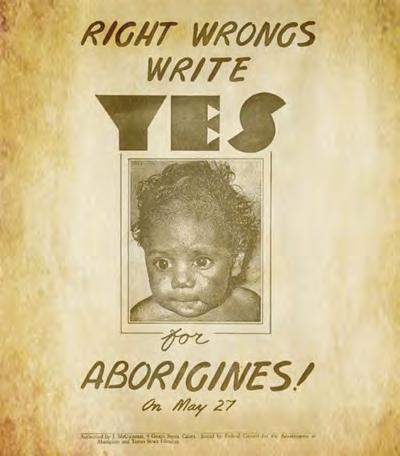
Source 10.1.1 1967 Referendum poster encouraging Australians to vote yes to change two sections of the Australian Constitution that referred to Aboriginal and Torres Strait Islander Peoples.
Uluru National Park Board votes to ban climbing of Uluru
Learning intention
The struggle for rights and freedoms of Aboriginal and Torres Strait Islander Peoples before 1965: Rights and freedoms denied
In this lesson, we will examine how laws, government policies and political structures denied Aboriginal and Torres Straight Peoples’ basic rights.
Success criteria
❏ I can identify key events that limited the rights and freedoms of Aboriginal and Torres Strait Islander Peoples before 1965.
❏ I can explain how government policies and laws affected Aboriginal and Torres Strait
dispossession the process of taking land, rights, or possessions away from a person or group. In Australian history, dispossession refers to the removal of Aboriginal and Torres Strait Islander Peoples from their traditional lands and waters through colonisation, laws and government policies
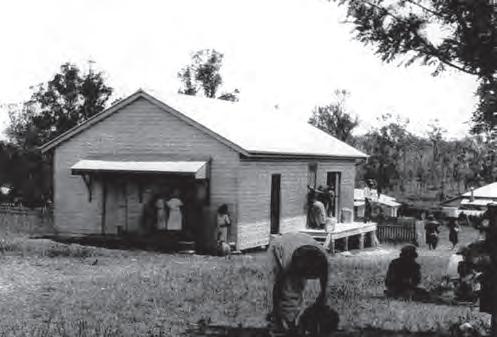
In 1788, Britain invaded and began to colonise the continent now known as Australia. This ongoing process of colonisation inflicted violence and resulted in dispossession of the lands and cultures of many First Nations Peoples.
First Nations communities had resisted dispossession, defended Country and maintained culture, law and sovereignty despite systematic discrimination and violence. In the decades after 1945, Aboriginal and Torres Strait Islander activists intensified their campaigns for justice, equality and self-determination, challenging Australian governments and institutions to confront the realities of colonisation and its continuing impacts.
However, before 1965, Aboriginal Peoples across Australia were still denied many of the rights enjoyed by non-Indigenous Australians. They were largely excluded from political decision-making, had little legal protection and were subject to strict government control over their lives. At Federation in 1901, Aboriginal and Torres Strait Islander Peoples were not counted in the national census and were not recognised as citizens in the Australian Constitution.
In New South Wales, the Aborigines Protection Act 1909 gave the government heavy powers over Aboriginal Peoples. The Aboriginal Protection Board controlled where Aboriginal people could live, work and travel, how their wages were managed, and whether children could remain with their families. These policies were enforced through policing, restrictions and the forced removal of children, causing deep and lasting harm to Aboriginal communities.
Despite these restrictions, First Nations Peoples did not accept the loss of their rights or freedoms. Across the continent, Aboriginal and Torres Strait Islander leaders and communities organised, petitioned governments, formed political organisations and demanded change. Their actions challenged discriminatory laws and laid the groundwork for later national campaigns for First Nations’ rights.
The struggle for rights before 1965 was therefore not only a story of control and exclusion, but also one of resilience, leadership and determination by Aboriginal and Torres Strait Islander Peoples to protect their communities and their future.
In order to understand the injustices that Aboriginal and Torres Strait Islander Peoples campaigned against, it is useful to closely examine events between 1901 and 1965.
Source 10.2.2 Key events between 1901 and 1965
1901 Federation of Australia. First Nations Peoples excluded from the census and from many political rights.
1902 Commonwealth Franchise Act determines that all “native” people are to be disenfranchised in Commonwealth countries (with the exception of New Zealand, who had a pre-existing treaty with the Maori people).
1909 Aborigines Protection Act (NSW) passed, granting extensive control over Aboriginal lives.
1915 NSW amendments allow the forced removal of Aboriginal children without court order.
1925 Aboriginal leader Fred Maynard establishes the Australian Aboriginal Progressive Association, strengthening Aboriginal-led resistance and demands for land rights and self-determination
UNCORRECTEDSAMPLEPAGES
1927 Coniston massacre in the Northern Territory.
1933 Aboriginal activist William Cooper forms the Australian Aborigines’ League in Melbourne to campaign for Aboriginal rights and freedoms.
1937 Australian Government adopts formal policy of assimilation suggested by the Chief Protector of Aborigines, Auber Octavius Neville
1938 Australian Aborigines’ League “Day of Mourning” protests the 150th anniversary of Australian colonisation.
disenfranchised depriving a person or group of people of citizenship or the right to vote Commonwealth international collective of states and countries that maintain a formal association with the UK, formerly part of the British Empire treaty a formal agreement between two separate peoples or states selfdetermination the right of Aboriginal and Torres Strait Islander Peoples to make decisions about their own lives, communities and futures, including political, social, cultural and economic choices, free from external control
assimilation when a minority culture merges into a dominant culture, with the minority being required to leave its own culture behind
land rights the recognition of Aboriginal and Torres Strait Islander Peoples’ enduring relationship with Country and their legal and cultural rights to own, access, use and care for their traditional lands
1939 Approximately 200 Aboriginal people walk off Cummeragunja Mission in a coordinated act of resistance, protesting the arrest of Aboriginal leader Jack Patten.
1950 Council for Aboriginal Rights pushes for the Australian Government to abandon any laws that contradict the Universal Declaration of Human Rights.
1952–57 Anglo-Australian nuclear weapons testing near Aboriginal communities at Maralinga, Montebello and Emu Field. Many Aboriginal people affected by radiation fallout.
1958 The Federal Council for the Advancement of Aborigines and Torres Strait Islanders (FCAATSI) is formed, bringing together Aboriginal and nonIndigenous advocates to campaign for the land rights, legal equality and political representation of Aboriginal and Torres Strait Islander Peoples.
1962 Commonwealth Electoral Act grants Aboriginal and Torres Strait Islander Peoples the right to enrol and vote in federal elections.
1963 Yolngu people from Arnhem Land present the Yirrkala Bark Petition to Federal Parliament to try to prevent a mining company from exploiting their traditional lands.
1965 Freedom Ride through NSW towns.
Source analysis
The extract from the Aborigines Protection Act 1909 (NSW) reflects the attitudes and policies of the time in which it was written. This legislation denied First Nations Peoples basic rights and gave governments extensive control over Aboriginal lives, families and communities. Some of the language used in this document is historically racist and remains racist today. The language and ideas contained in this source are confronting and may be distressing for some readers. This material is included to support understanding of the historical realities Aboriginal communities faced and to highlight the significance of Aboriginal resistance and ongoing struggles for rights, recognition and self-determination.
Source 10.2.3 Extract from the Aborigines Protection Act 1909 (NSW)
Section 7 Duties of the Board
The board shall have the authority:
a. to distribute and control funds for the relief of aborigines;
b. to distribute blankets, clothing and relief to aborigines at the discretion of the board;
c. to provide for the custody, maintenance and education of the children of aborigines;
d. to manage and regulate the use of reserves;
e. to exercise a general supervision and care over all matters affecting the interests and welfare of aborigines. …
Section 11(1) Employment of female or infant aborigines
The board may bind or cause to be bound the child of any aborigine, or any neglected child of any person apparently having an admixture of aboriginal blood, to be apprenticed to any master, and may collect wages and institute proceedings for the recovery of wages payable under such indenture. …
UNCORRECTEDSAMPLEPAGES
Section 14 Powers to remove aborigines
The board may cause any aborigines, or any persons apparently having an admixture of aboriginal blood, to remove from any reserve, town or township to such distance as they may direct.
Extract from the Aborigines Protection Act 1909 (NSW), (Sections 7, 11 and 14)
According to the Act, what powers did the government have over the lives of Aboriginal people?
Which rights and freedoms of Indigenous Peoples were limited or denied under these laws?
What perspective or bias does the source reflect?
Reserves and missions
By the early 1900s, government policies across Australia had placed strong controls over where Aboriginal and Torres Strait Islander Peoples could live, where they could travel and how their everyday lives were managed. One of the main ways these controls were enforced was through the system of reserves and missions.
By the 1930s, there were more than 100 reserves and missions across Australia. These were areas of land set aside for Aboriginal and Torres Strait Islander Peoples and were used to keep them separate from white settlements. This separation was a deliberate policy known as segregation.
Most reserves were run by government-appointed managers, while many missions were controlled by Christian churches. Although these places were often described by authorities as providing “protection” or “care”, in reality they placed Aboriginal and Torres Strait Islander Peoples under strict control. Rules on reserves and missions controlled nearly every part of daily life. Aboriginal and Torres Strait Islander People often needed written permission to leave, even to visit family, go to hospital, or look for work. Families were forced to live in overcrowded housing with poor food, sanitation and medical care. Children were frequently separated from their parents and placed in dormitories or sent away for work or training. People were punished for speaking their own languages, practising culture, or leaving without approval. Wages were taken and controlled by managers, personal belongings could be confiscated, and most decisions about work, marriage, movement and family life were made by authorities, not by the people themselves.
These policies were based on racist beliefs that Aboriginal and Torres Strait Islander cultures were inferior and would eventually disappear. Some non-Indigenous Australians believed that reserves could be used to force Aboriginal people to live like white people, while others saw them as a way of isolating Aboriginal communities from the rest of society. Neither view respected Aboriginal sovereignty, culture or deep connection to Country
Writing focus 10.2
Transitional phrases
UNCORRECTEDSAMPLEPAGES
Even under these harsh conditions, Aboriginal and Torres Strait Islander Peoples did not give up their identity, culture or rights. Families and communities supported one another, kept culture strong, and resisted unfair treatment whenever possible. The history of reserves and missions therefore shows not only government control, but also the strength, resilience and survival of Aboriginal and Torres Strait Islander Peoples.
reserves and missions areas of land set aside by governments or churches where Aboriginal and Torres Strait Islander Peoples were forced to live under strict control, with limited freedom over their movement, work, family life and culture segregation a policy or system that keeps different groups of people physically and socially separated from one another, often in unequal and unfair ways sovereignty the ongoing right of Aboriginal and Torres Strait Islander Peoples to govern themselves, maintain authority over their lands and communities, and make decisions about their own futures connection to Country the deep cultural, spiritual, social and physical relationship Aboriginal and Torres Strait Islander Peoples have with their lands, waters, skies and all living things, passed down through generations
Stolen Wages wages earned by Aboriginal and Torres Strait Islander workers that were withheld, controlled, or taken by governments and authorities, often without consent, causing long-term financial harm to individuals, families and communities
Aborigines Protection Board a government organisation created under the Aborigines Protection Act 1909 to manage issues to do with housing, employment, travel and family affairs
Wages
Aboriginal and Torres Strait Islander Peoples were widely exploited as a cheap labour force in the early to mid-twentieth century. Many worked on cattle and sheep stations, farms and in domestic service, often in harsh conditions and for long hours. Despite their contribution to the economy, they were rarely paid fairly.
In many parts of Australia, Aboriginal and Torres Strait Islander workers were not paid their full wages. Instead, much of their pay was taken and controlled by government authorities or reserve managers. In Queensland, for example, Aboriginal workers were given only about 25 per cent of the wages they earned directly. The rest of the money was kept and placed into government-managed accounts, supposedly for the workers’ benefit, but often used to pay for the running of reserves, given to the government as “tax”, or simply never returned.
Workers were told they were being “looked after” and that their money was being saved for them, yet many never saw the wages they had earned. This practice is now known as the Stolen Wages. For families, this meant ongoing poverty, limited access to food and education, and little chance to improve their living conditions, even though they had worked for years.
Despite these injustices, Aboriginal and Torres Strait Islander workers continued to support their families and communities and later fought for recognition of what had been taken from them. Campaigns for justice for stolen wages continue today as part of the broader struggle for rights and economic equality.
Aborigines Protection Board
From 1909, the lives of many Aboriginal and Torres Strait Islander Peoples were controlled by the Aborigines Protection Board. Although the word “protection” suggested care and support, the Board’s real role was to regulate and control almost every aspect of Aboriginal life.
The Board decided where Aboriginal people could live, where they could work, how their wages were managed, and whether they were allowed to leave reserves. It controlled the care and education of Aboriginal children and had the power to remove children from their families. These decisions were made without the consent of Aboriginal parents or communities and caused long-lasting harm.
UNCORRECTEDSAMPLEPAGES
The Board also enforced strict rules on reserves and missions. People could be punished for speaking their own languages, practising culture, or refusing to follow orders. Many Aboriginal families lived under constant surveillance, with little privacy and almost no control over their own lives.
Despite this intense control, Aboriginal and Torres Strait Islander Peoples continued to resist. Families protected their children when they could, supported one another, and challenged unfair treatment. Their strength and determination laid important foundations for later movements for justice, rights and self-determination.
Right to vote federally
For much of Australia’s history, Aboriginal and Torres Strait Islander Peoples were excluded from the political system that governed their lives. In some states, such as NSW, Aboriginal and Torres Strait Islander adults had the right to vote in state elections, but they could not vote in federal elections. The Commonwealth Franchise Act 1902 excluded Aboriginal and Torres Strait Islander people, unless they already had the right to vote before 1901.
In 1949, the right to vote federally was extended to Indigenous people who had been in the defence forces, but the vast majority were still excluded.
Years of sustained campaigning by Aboriginal leaders and organisations, including the Federal Council for the Advancement of Aborigines and Torres Strait Islanders (FCAATSI), led to the government setting up the Select Committee on Voting Rights of Aborigines. This committee delivered a report in 1961 which recommended that the right to vote be extended to
“all aboriginal and Torres Strait Islander subjects of the Queen, of voting age, permanently residing with the limits of the Commonwealth.”
The Australian Government responded by passing the Commonwealth Electoral Act 1962 to allow Aboriginal and Torres Strait Islander adults to enrol and vote in federal elections.
The change was significant but limited. Enrolment was not compulsory for Aboriginal and Torres Strait Islander voters, unlike other Australians, showing that full political equality had not yet been achieved. The right to vote became an important step in the continuing struggle for recognition, justice and selfdetermination.
UNCORRECTEDSAMPLEPAGES
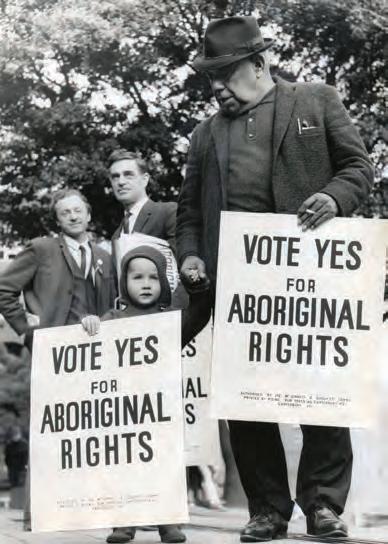
10.2.4 Campaigner Bill Onus holding a sign urging support for the 1967 Referendum
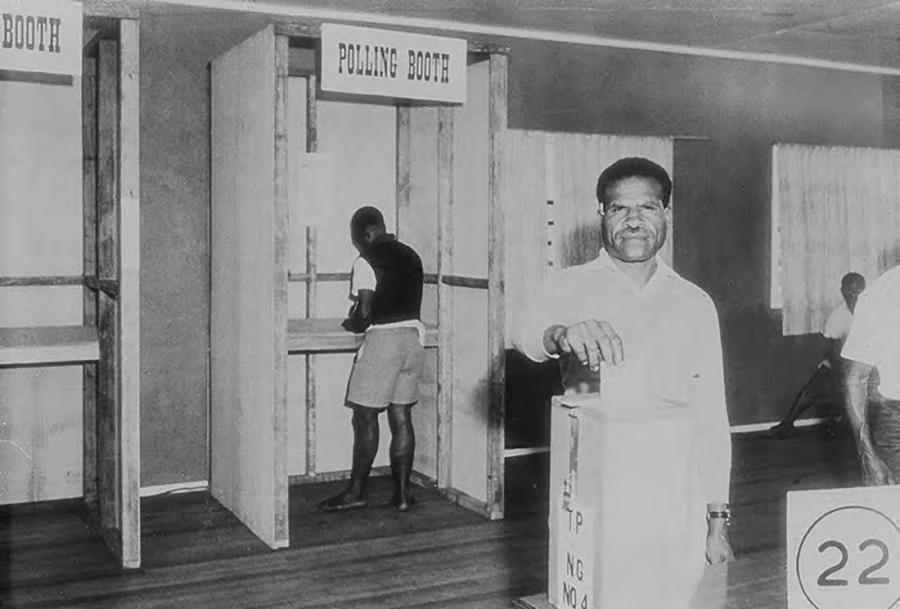
Knowledge and understanding
Knowledge and understanding
Define segregation.
Thinking and researching
Students can access sample responses and results
Teachers can go online to assign questions, view results, reports and more!
Identify two ways reserves and missions controlled the daily lives of Aboriginal and Torres Strait Islander Peoples.
Explain the role of the Aborigines’ Protection Board.
Describe what is meant by the term “Stolen Wages”.
Outline one reason why the right to vote was important for Aboriginal and Torres Strait Islander Peoples.
Discuss how government policies before 1965 limited rights and freedoms.
UNCORRECTEDSAMPLEPAGES
To what extend did government policies, including segregation and protection systems, restrict the freedoms of Aboriginal and Torres Strait Islander Peoples before 1965?
10.3
The struggle for rights and freedoms of Aboriginal and Torres Strait Islander Peoples before 1965:
Early twentieth-century activism
Learning intention
In this lesson, we will learn about how Aboriginal communities resisted the systems and continued to assert their rights.
Success criteria
❏ I can describe how Aboriginal and Torres Strait Islander Peoples challenged restrictions and fought for change.
See, think, wonder
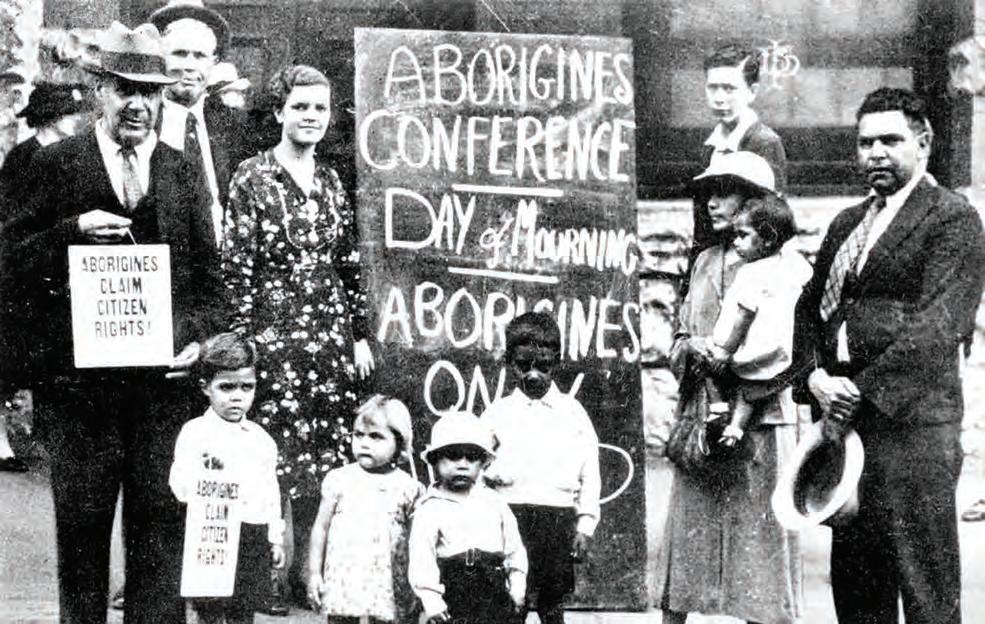
Source 10.3.1 Day of Mourning protest in Sydney, 1938. Left to right: William (Bill) Ferguson, Jack Kinchela, Isaac Ingram, Doris Williams, Esther Ingram, Arthur Williams Jr, Phillip Ingram, unknown, Louisa Agnes Ingram holding daughter Olive, Jack Patten
UNCORRECTEDSAMPLEPAGES
What do you see in Source 10.3.1?
What does it make you think about Aboriginal and Torres Strait Islander Peoples’ resistance? What does it make you wonder about early twentieth-century activism?
activism organised action taken by individuals or groups to bring about social or political change petition a formal written request, often signed by many people, calling on those in power to address an issue or make a change civil rights the basic rights and freedoms that belong to all people, including equality before the law and freedom from discrimination
From the early 1900s, Aboriginal leaders and communities were organising, protesting and demanding change. This activism developed in response to the laws and systems of control described earlier in this chapter, including reserves, stolen wages and the authority of the Aborigines Protection Board. Aboriginal and Torres Strait Islander Peoples formed political organisations, held meetings, wrote letters and petitions, and worked together across communities to challenge discrimination. These efforts aimed to improve living conditions, protect families, defend land and culture, and secure equal rights within Australian society.
UNCORRECTEDSAMPLEPAGES
Many of these campaigns were led by Aboriginal activists, while some also involved non-Indigenous supporters. Together, these movements helped expose the injustice of existing policies and built the foundations for later national campaigns for civil rights and self-determination.
This early activism shows that the struggle for rights and freedoms was not sudden or short-lived. It was sustained, organised and deeply connected to community leadership, cultural survival and the demand for justice.
Three key moments for Aboriginal and Torres Strait Islander activism before 1965 were the Day of Mourning protest, the Cummeragunja Mission Walk-Off and the Yirrkala Bark Petition. These events reveal the determination of Aboriginal communities to challenge injustice, protect their rights and demand lasting change.
The Day of Mourning Protest, 1938
In 1938, while much of Australia was preparing to celebrate the 150th anniversary of the arrival of the First Fleet, Aboriginal leaders and communities organised one of the first national protests for Aboriginal rights. This event became known as the Day of Mourning.
The protest was led by the Australian Aborigines’ League, formed in Melbourne in 1932 by William Cooper and other Aboriginal activists, and the Aborigines Progressive Association, formed in New South Wales by Jack Patten and William Ferguson. These organisations worked together to challenge discrimination, demand political rights and expose the harsh conditions experienced by Aboriginal communities on reserves and missions.
Aboriginal people refused to take part in the official celebrations of colonisation. Instead, on 26 January 1938, they gathered in Sydney to protest what the anniversary represented: 150 years of dispossession, violence and exclusion. After meeting at Sydney Town Hall, the group marched to Australian Hall, where they held a conference attended by around 100 Aboriginal people. Entry was only permitted through the back door, reflecting the racism of the time and strengthening the protest’s message.
At the meeting, Aboriginal leaders presented clear demands for full citizenship rights, equal treatment under the law, better education for Aboriginal children and improved living conditions. Jack Patten wrote at the time:
“The 26th of January 1938 is not a day of rejoicing for Australia’s Aborigines; it is a day of mourning.”
The Day of Mourning marked a turning point in Aboriginal political activism. It demonstrated the strength of Aboriginal leadership, the power of organised protest and the determination of Aboriginal communities to demand justice, dignity and self-determination.
Cummeragunja Mission Walk-Off 1939
In 1939, Aboriginal people at Cummeragunja Mission in southern New South Wales carried out the first large-scale organised strike by Aboriginal communities in Australia. The walk-off became one of the most powerful acts of Aboriginal resistance in the early twentieth century.
Conditions at Cummeragunja had become increasingly harsh after the government appointed Arthur McQuiggan as mission manager. McQuiggan had previously faced complaints for violent behaviour at the Kinchela Aboriginal Boys’ Home, and similar violence and intimidation continued at Cummeragunja. Residents lived under strict control, with limited food, poor housing and constant surveillance.
Aboriginal leader Jack Patten, who had been born at Cummeragunja and was a member of the Australian Aborigines’ League, was asked by his father to visit the mission. After witnessing the conditions, Patten encouraged the community to take action. On 4 February 1939, around 200 Aboriginal people walked off the mission without permission. People camped on the banks of the Murray River, refusing to return under the existing conditions.
When residents heard that the New South Wales government was planning further removals of Aboriginal children, many crossed the river into Victoria, placing themselves outside NSW government control. The walk-off received support from workers’ organisations in Melbourne and became a national symbol of Aboriginal resistance.
Although some families later returned due to hardship and lack of resources, the Cummeragunja Walk-Off showed the strength, courage and leadership of Aboriginal communities. It demonstrated that Aboriginal people were not passive victims of government policy, but active agents in the struggle for justice, dignity and self-determination.
Yirrkala Bark Petition
Writing focus 10.3
Appositives
UNCORRECTEDSAMPLEPAGES
The Yirrkala Bark Petition, identified earlier as one of the key moments of Aboriginal activism, is a powerful example of Aboriginal communities using both cultural authority and Australian law to defend their rights.
In 1963, the Australian Government approved mining on Yolngu land in Arnhem Land without consultation. In response, Yolngu leaders, led by Wandjuk Marika, prepared a formal petition to Parliament.
strike a form of protest in which workers or communities refuse to work or follow orders in order to challenge unfair treatment or conditions
The document was written in English and Yolngu Matha, placed on bark and signed by Yolngu elders, combining Yolngu law with Western political processes.
Although the government allowed mining to continue, the petition led to a national investigation and later to the Gove Land Rights case (1968–1971), the first court challenge by Aboriginal people over land rights.
The Yirrkala Bark Petition remains a landmark moment in the struggle for Aboriginal rights, demonstrating leadership, strategy and the ongoing assertion of sovereignty and connection to Country.
UNCORRECTEDSAMPLEPAGES
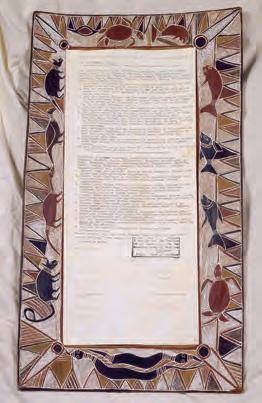
10.3.2 Yirrkala Bark Petition, Yolngu artists and elders, 1963 ➜
Source 10.3.3 Transcript of the Yirrkala Bark Petitions 1963 ➜
Transcript of the Yirrkala Bark Petitions 1963
To The Honourable The Speaker and Members of the House of Representatives in Parliament Assembled
The Humble Petition of the Undersigned aboriginal people of Yirrkala, being members of the Balamumu, Narrkala, Gapiny, and Miliwurrwurr people and Djapu, Mangalili, Madarrpa, Magarrwanalinirri, Gumatj, Djambarrpuyny, Marrakulu, Galpu, Dhalnayu, Wangurri, Warramirri, Maymil, Rirritjinu, tribes, respectfully sheweth –
That nearly 500 people of the above tribes are residents of the land excised from the Aboriginal Reserve in Arnhem Land.
That the procedures of the excision of this land and the fate of the people on it were never explained to them beforehand, and were kept secret from them.
That when Welfare Officers and Government officials came to inform them of decisions taken without them and against them, they did not undertake to convey to the Government in Canberra the views and feelings of the Yirrkala aboriginal people.
That the land in question has been hunting and food gathering land for the Yirrkala tribes from time immemorial; we were all born here.
That places sacred to the Yirrkala people, as well as vital to their livelihood are in the excised land, especially Melville Bay.
That the people of this area fear that their needs and interests will be completely ignored as they have been ignored in the past, and they fear that the fate which has overtaken the Larrakeah tribe will overtake them.
And they humbly pray that the Honourable the House of Representatives will appoint a Committee, accompanied by competent interpreters, to hear the views of the Yirrkala people before permitting the excision of this land.
They humbly pray that no arrangements be entered into with any company which will destroy the livelihood and independence of the Yirrkala people.
And your petitioners as in duty bound will ever pray God to help you and us.
8. Certified as a correct translation: Kim E Beazley
Compare the Yirrkala Bark Petition to the extracts from the Aborigines Protection Act 1909 (NSW) in Source 10.2.3.
How does the Yirrkala Bark Petition challenge the controls and restrictions of the Aborigines Protection Act?
What do these sources together reveal about the struggle for Aboriginal rights before 1965?
Why is it essential to include Aboriginal voices when learning about this period in Australian history?
Historical concepts: Perspectives, significance Historical skills: Analysis and use of sources
Take note
After reading the information in this lesson, record your thinking using the following prompts.
Important
What do you think is the most important idea or event in this lesson? Why?
Questions
What questions do you still have about the experiences of Aboriginal and Torres Strait Islander Peoples during this period?
Connections
How does this information connect to what you have already learned about rights, freedoms and citizenship in Australia?
Significance
Why are the Day of Mourning protest, the Cummeragunja Walk-Off and the Yirrkala Bark Petition considered key moments in Aboriginal activism?
Then write a short paragraph explaining:
“How did Aboriginal and Torres Strait Islander people challenge injustice and raise awareness of the problems they faced in the early twentieth century?”
Historical concepts: Cause and effect, significance Historical skills: Analysis and use of sources
Teachers
Knowledge and understanding
Extra question needed (lower order).
Extra question needed (lower order).
Summarise the goals of early Aboriginal activism in the first half of the twentieth century.
Analyse why the Day of Mourning protest is considered a turning point in the struggle for Aboriginal rights.
Evaluate the importance of the Cummeragunja Walk-Off and the Yirrkala Bark Petition in the movement for Aboriginal rights before 1965.
Thinking and researching
Choose one of the following topics to investigate further:
• The life and activism of William Cooper, Jack Patten, or Wandjuk Marika
• The long-term impact of the Stolen Wages policies on Aboriginal and Torres Strait Islander communities
• How Aboriginal and Torres Strait Islander activism before 1965 influenced later campaigns for rights and recognition.
Present your findings in one of the following formats:
• a short, written report
• a digital presentation
• a visual timeline with explanatory captions.
Guidance:
• Use at least two reliable sources
• Use the AIATSIS Guide to Evaluating and Selecting Educational Resources
• Explain why the chosen topic is significant in Australia’s human rights history.
UNCORRECTEDSAMPLEPAGES
10.4
The US civil rights movement and its in uence on Australia
Learning intention
In this lesson, we will learn how the US civil rights movement influenced Aboriginal activism in Australia, including the strategies used to challenge discrimination and inspire change.
Success criteria
❏ I can explain key features of the US civil rights movement.
❏ I can describe how events in the United States influenced Aboriginal activism in Australia.
❏ I can analyse how people used non-violent protest to challenge unfair laws.
See, think, wonder

Source 10.4.1 Segregated drinking fountains ➜
Look at Sources 10.4.1 and 10.4.2.
What do you see in these two photos?
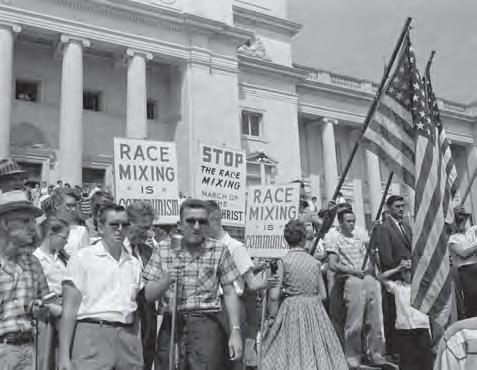
Source 10.4.2 Pro-segration rally in Little Rock, Arkansas, 1959, to protest against the integration of Central High School ➜
What does it make you think about between Black and white people in the United States?
What does it make you wonder about how change was brought about?
While Aboriginal and Torres Strait Islander communities were challenging discrimination and fighting for rights in Australia, a major civil rights movement was also unfolding in the United States. Although the struggles took place in different countries, the ideas, strategies and successes of the US movement strongly influenced Aboriginal activists, particularly during the 1960s.
Writing focus 10.4
Developing sentences
It is important to recognise that these events in the United States occurred on the traditional lands of many Native American Nations, whose lands were taken through colonisation. At the same time that African American communities were fighting segregation, Native American Peoples were continuing their own struggles for land, sovereignty and self-determination. This reminds us that many movements for justice were unfolding together on indigenous lands.
In the United States, African American people were still facing deep discrimination decades after slavery had been abolished in 1865. From the late 1800s, southern states enforced racist “Jim Crow” laws that separated Black and white people in schools, transport, restaurants and public spaces. These laws created a system where African American citizens were treated as second-class and denied basic rights. The name is based on a derogatory term for Black men that came out of an early nineteenth-century mocking performance of a black character (played by a white actor) called Jim Crow.
Aims and methods of US civil rights movement
The US civil rights movement sought to challenge racial discrimination and create a fairer society for African American people. Its main aims were:
• to end segregation in schools, transport and public spaces
• to improve economic opportunities such as employment and housing
• to increase political participation, especially the right to vote
• to reduce violence and intimidation used to enforce racism.
UNCORRECTEDSAMPLEPAGES
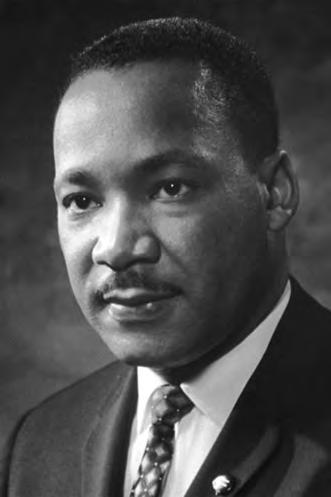
Source 10.4.3 Martin Luther King Jr, portrait from the Nobel Foundation, 1964 ➜
These goals closely matched the concerns being raised by Aboriginal activists in Australia at the same time, who were also seeking equality, legal protection and full citizenship rights.
One of the most influential leaders of the movement was Dr Martin Luther King Jr. King believed that social change could be achieved through nonviolent protest, inspired by the ideas of Indian leader Mahatma Gandhi. He travelled widely, spoke at rallies and led peaceful demonstrations in cities where discriminatory laws were strongest. His methods of protest, organisation and public communication were closely studied by activists in Australia.
Jim Crow laws segregation and disenfranchisement laws in the USA
Another prominent figure was Malcolm X, who offered a very different approach. After experiencing severe racism and violence as a child, Malcolm X argued that African American people should defend themselves and take control of their own future. At times, he supported separation from white society and rejected non-violence as the only path to change. His ideas also influenced global conversations about resistance, power and self-determination.
Together, these leaders shaped an international movement for racial justice whose ideas, strategies and successes would soon inspire Aboriginal activism in Australia.
Some key events of the US civil rights movement
During the 1950s and 1960s, African American communities organised powerful campaigns, including boycotts, marches and the famous Freedom Rides. These actions exposed injustice, pressured governments to change unfair laws and inspired people around the world, including Aboriginal activists in Australia, to adopt similar methods of resistance.
Source 10.4.5 Key events for the US civil rights movement
1954 Brown v Board of Education case in Supreme Court ruled segregation in schools as unconstitutional.
1955 Montgomery Bus Boycott – African American people refuse to use buses in Montgomery after the arrest of Rosa Parks.
Malcolm X advocates for African American separation from white society.
1956 Supreme Court rules that buses in Montgomery are to be desegregated.
1960 Greensboro Counter sit-ins – African American teens break segregation rules by sitting at the front counters of restaurants throughout the city of Greensboro.
1961 Freedom Rides – African American and white activists drive buses through segregated towns in the American south as a means of drawing attention to local discriminatory laws
UNCORRECTEDSAMPLEPAGES
1962 Martin Luther King, Jr leads non-violent demonstrations in the city of Albany.
1963 Martin Luther King, Jr leads non-violent demonstrations in the city of Birmingham. Ku Klux Klan launches a series of bombings against African American families in the area. White business leaders are eventually forced to negotiate desegregation after African American people boycott their stores. Malcolm X and the Nation of Islam gain attention from the media through their advocacy of violence against white racists.
March on Washington – mass protest led by Martin Luther King, Jr.
1964 New president Lyndon B Johnson passes the Civil Rights Act after John F Kennedy’s assassination
1965
Martin Luther King, Jr wins the Nobel Peace Prize
Martin Luther King, Jr leads demonstrations in the city of Selma. King is arrested and imprisoned, and another activist named Jimmie Lee Jackson is murdered by police.
Malcolm X assassinated.
1966 Black Panther Party founded in Oakland, California.
1967 Black Panthers hold rallies in California and release their “Ten-Point Program”.
1968 Martin Luther King, Jr assassinated. Nation-wide riots erupt in response. Fighting between Black Panthers and police officers ends in the death of Black Panther, Bobby Hutton.
Black Power salute popularised by Black Panthers and other activists, including Olympians Tommie Smith and John Carlos.
The Montgomery Bus Boycott
The Montgomery Bus Boycott (1955–56) became one of the most influential campaigns of the US civil rights movement and changed protest strategies around the world. After Rosa Parks was arrested for refusing to give up her seat to a white passenger, African American community leaders, including Dr Martin Luther King Jr, organised a city-wide boycott of buses. For more than a year, thousands of people refused to use public transport, instead walking or sharing cars. Despite arrests, threats and violent attacks, the campaign remained non-violent and highly organised. In December 1956, the US Supreme Court ruled that bus segregation was unconstitutional. The success of the Montgomery Bus Boycott showed how organised, non-violent action could force legal change.
The Freedom Rides
One of the most significant campaigns of the US civil rights movement, and the one that most directly shaped Aboriginal activism in Australia, was the Freedom Rides of 1961.
In May 1961, African American and white activists travelled together by bus through southern states of the United States to challenge segregation in public transport. These non-violent protests deliberately confronted local segregation laws and exposed the violence and intimidation used to enforce them. The Freedom Rides received international media attention and demonstrated how organised, peaceful protest could force governments to act.
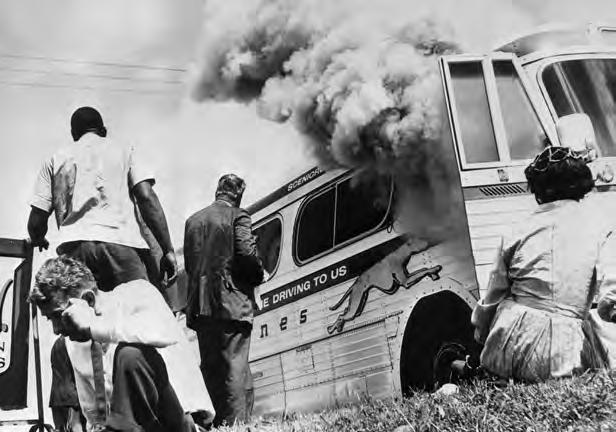
boycott a form of protest in which people deliberately refuse to use, buy from or take part in something in order to force change or draw attention to injustice unconstitutional not allowed under a country’s constitution; against the highest law of the nation
UNCORRECTEDSAMPLEPAGES
Source 10.4.7 Freedom Riders’ bus after being firebombed by a white mob in Anniston, Alabama, 1961. The attack shocked the world and revealed the extreme violence used to defend segregation. Images like this were seen by Aboriginal and Torres Strait Islander activists in Australia and influenced later campaigns for change, including the NSW Freedom Ride.
What do you notice about what has happened to the bus and the people nearby?
What does this image suggests about the risks the activists were taking?
Why might images like this have influenced people in other countries, including Australia, who were also challenging racism and other discrimination?
News of the Freedom Rides reached Australia at a time when Aboriginal communities were facing ongoing racism, segregation and denial of basic rights. Aboriginal students and activists, particularly those involved with Student Action for Aborigines (SAFA), closely followed these events and began to adapt similar strategies to the Australian context.
In 1965, inspired by the US Freedom Rides, a group of Aboriginal and non-Aboriginal university students led by Aboriginal activist Charles Perkins organised the NSW Freedom Ride. This is discussed in more detail in the next lesson.
UNCORRECTEDSAMPLEPAGES
March on Washington, 1963
One of the most important public protests of the US civil rights movement was the March on Washington in 1963.
On this day, more than 250 000 people gathered in Washington DC to demand racial equality, fair treatment and an end to segregation. It was here that Dr Martin Luther King, Jr delivered his famous speech commonly known as “I have a dream”. The march placed strong pressure on the US Government and helped push President John F Kennedy to begin preparing new civil rights laws to end racist policies still operating in many states.
News of the march was followed closely around the world, including in Australia. For Aboriginal students, leaders and activists, it reinforced the power of peaceful protest, clear leadership and public action to change laws and attitudes. These lessons continued to influence Aboriginal campaigns for rights and recognition throughout the 1960s.
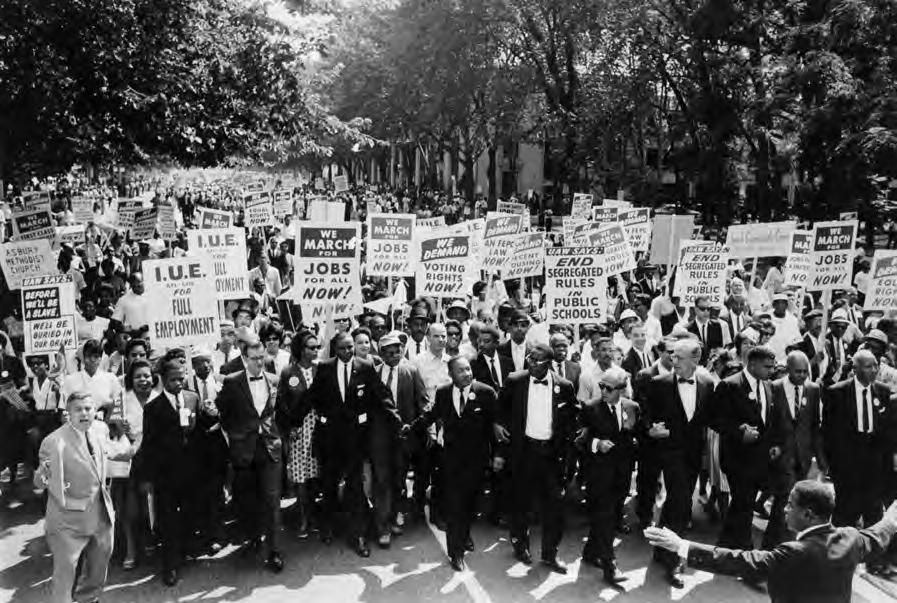
Source 10.4.8 Leaders of the March on Washington lock arms and put hands together as they move along Constitution Avenue. Martin Luther King Jr is in the centre.
Black Power movement
In the later 1960s, many younger African American activists began to look for new ways to challenge racism and demand change. One powerful influence was the Black Power movement, which promoted pride, political strength and self-determination for African American communities. The movement encouraged people to reject discrimination and to speak out publicly against injustice.
Black Panther clashes with police and FBI
The Black Panther Party, which was formed in 1966, arose out of the Black Power movement. Unlike the peaceful protests led by Martin Luther King Jr, the Black Panthers believed that communities had the right to defend themselves if they were being attacked or threatened.
As the movement grew, clashes with police became more common. At the same time, the US Government, through the FBI, worked secretly to weaken the organisation by spreading misinformation, monitoring members and disrupting their activities.
Aboriginal and Torres Strait Islander activists were inspired by the Black Panthers’ focus on community strength, pride, education and self-determination. While Aboriginal and Torres Strait Islander movements generally chose different strategies, these ideas helped shape new Aboriginal organisations and services in Australia during the late 1960s and 1970s.
Black Power salute at the Olympics, 1968
At the 1968 Olympic Games in Mexico City, during the medal ceremony for the 200-metre race, American athletes Tommie Smith and John Carlos raised their fists in what became known as the Black Power salute. The gesture was a silent protest against racial inequality in the United States and a call for human rights. Also on the podium was Australian athlete, Peter Norman, who wore a badge for the Olympic Project for Human Rights, in solidarity with the other two runners
Acts like this had an important impact beyond the United States. The use of visible, peaceful protest to expose injustice helped strengthen Aboriginal and Torres Strait Islander campaigns for rights, recognition and self-determination during the 1960s and beyond.
selfdetermination the right of a people to make decisions about their own lives, communities and futures misinformation false or misleading information that is shared, often to confuse people or influence opinions
UNCORRECTEDSAMPLEPAGES
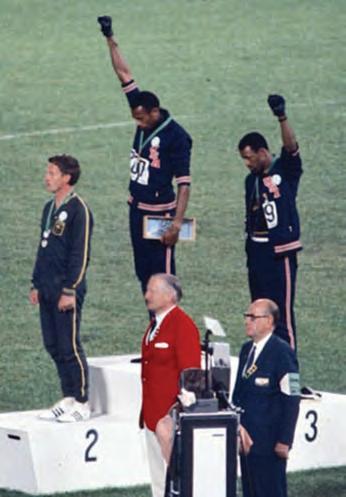
Source 10.4.9 Tommie Smith (centre) and John Carlos (right) display the Black Power salute at the 1968 Mexico City Olympics.
Connect, extend, challenge
Read the sections on the US civil rights movement, including the Black Power movement, the Black Panther Party, Martin Luther King Jr, Malcolm X and the Freedom Rides.
• Connect: How do the ideas, methods and goals of the US civil rights movement connect to the struggle for rights and freedoms in Australia? Consider links to Aboriginal activism you have already studied.
• Extend: What new ideas, perspectives or information about protest, leadership or social change does this section add to your understanding?
• Challenge: What questions does this raise about how change happens? What seems most difficult about challenging discrimination and injustice?
Write a short paragraph response addressing all three parts of the routine.
Historical concepts: Perspectives, Significance, Cause and effect Historical skills: Analysis and use of sources, Explanation and communication
Knowledge and understanding
What was the purpose of the Freedom Rides in the United States?
How did the Freedom Rides influence Aboriginal activism in Australia?
Explain the importance of the March on Washington.
Explain the significance of the Black Power salute at the 1968 Olympics.
Teachers can go online to assign questions, view results, reports and more!
Evaluate the methods used by those who supported peaceful protest and the methods of the Black Power movement.
Historical concepts: Cause and effect, significance
skills: analysis and use of sources, research
10.5 Action for Aborigines (SAFA) and the significance of the 1965 Freedom Ride
Learning intention
In this lesson, we will learn about the role of Student Action for Aborigines (SAFA) and why the 1965 Freedom Ride was a significant moment in the struggle for Aboriginal rights in New South Wales and Australia.
Success criteria
❏ I can explain why Aboriginal and nonAboriginal students formed SAFA.
❏ I can describe the aims and impact of the 1965 Freedom Ride.
❏ I can identify how racism and inequality in country towns led to student action.
❏ I can explain why the Freedom Ride is considered a significant event in Australian history.
Starter activity
Look at Source 10.5.1 and discuss with your class.
• What do you notice?
• What do you think these students were trying to change?
• Why might travelling from town to town be an effective form of protest?
Source 10.5.1 The SAFA group in front of their hired “Freedom Ride” bus. Photograph reproduced with permission of Wendy Watson-Ekatein (née Golding) and supplied by Ann Curthoys
Student Action for Aborigines (SAFA)
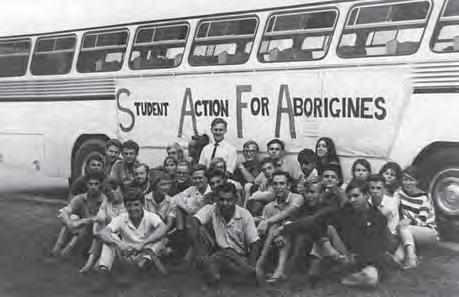
In the early 1960s, many Aboriginal communities in New South Wales continued to experience open racism, segregation and unfair treatment in everyday life. Aboriginal people were often refused entry to swimming pools, cinemas, hotels and clubs, and faced poor living conditions, limited access to education, and discrimination in employment and health care.
At the same time, a growing number of university students were becoming aware of these injustices. In 1964, Aboriginal and non-Aboriginal students at the University of Sydney formed Student Action for Aborigines (SAFA). Their goal was to support Aboriginal rights and bring national attention to the racism faced by Aboriginal people, especially in rural and regional NSW.
UNCORRECTEDSAMPLEPAGES
Writing focus 10.5
Creating topic sentences
SAFA believed that young people could play an important role in social change. They worked closely with Aboriginal leaders and communities, listened to their concerns, and used peaceful protest, public speaking and media coverage to challenge discrimination. One of the most influential Aboriginal leaders working with SAFA was Charles Perkins, a young Arrernte man from Alice Springs who became one of the main organisers of their most famous campaign.
The 1965 Freedom Ride
UNCORRECTEDSAMPLEPAGES
Inspired by the Freedom Rides in the United States, Student Action for Aborigines (SAFA) organised a similar campaign in Australia in 1965. The campaign was led by Aboriginal activist Charles Perkins, working alongside non-Aboriginal student supporters including Ted Noffs.
Perkins and Noffs wanted to expose the racism operating in some of New South Wales’ most prejudiced country towns and challenge everyday practices that unfairly discriminated against Aboriginal and Torres Strait Islander Peoples. The group travelled by bus through towns such as Walgett, Moree and Kempsey. In each place, they deliberately visited public swimming pools, pubs, cinemas and hospitals that segregated Aboriginal people from the wider community or refused them service altogether.
The students also travelled to Aboriginal reserves to speak directly with the people most affected by racism. They listened to local experiences and encouraged communities to speak out and organise for change. In many towns, Aboriginal families gathered to hear Perkins speak and share their own stories.
The Freedom Riders were not welcomed by everyone. In several towns, white residents tried to disrupt their activities. In Walgett, some local community members forced the Freedom Riders’ bus off the road. Despite this hostility, national newspapers began to report on the campaign. The media attention placed strong public pressure on local councils and businesses to change their policies.
The Australian Freedom Ride used the same core methods as the US campaign: nonviolent protest, direct action, strategic use of media, and public exposure of injustice. It marked a turning point in national awareness and helped accelerate demands for legislative change in Australia.
Within a year of the Freedom Ride, important changes had occurred. Moree and Kempsey lifted their bans that had prevented Aboriginal people from using public swimming pools, and Walgett ended the segregation of its cinema. The Freedom Ride became a powerful example of how student action, guided by Aboriginal leadership and supported by community voices, could expose injustice and help bring about real social change.
















































































(c. 1938–c. 2017)
Perkins shows how strongly some members of the community resisted change and how racism was openly expressed when Aboriginal people challenged unfair treatment.
True for who?
The 1965 Freedom Ride brought national attention to segregation and discrimination in some NSW towns. It also showed how public protest can create pressure for change. People did not all respond the same way, and their views were shaped by their experiences and what they stood to gain or lose. Some people believed that the Freedom Ride had created trouble where it wasn’t invited, whereas others saw it as a necessary campaign.
Before you begin
This activity asks you to compare perspectives, not to “debate” whether racism was acceptable. Keep discussion respectful and focus on evidence from the sources and the text.
Discuss: Was the 1965 Freedom Ride necessary? Use evidence from the section to explain:
a. what discrimination the Freedom Riders were challenging b. what the Freedom Riders hoped would change
c. why some local people supported the Ride
d. why some local people opposed it.
Brainstorm: List different viewpoints you could explore. Try to include at least one Aboriginal viewpoint and at least one non-Aboriginal viewpoint.
Historical concepts: Contestability Historical skills: Perspectives and interpretations
Teachers can go online to assign questions, view results, reports and more!
Knowledge and understanding
Define Student Action for Aborigines (SAFA).
Identify two problems in daily life that Aboriginal people described in the sources about the Freedom Ride.
Explain why the 1965 Freedom Ride was organised.
Describe one action taken by the Freedom Riders to challenge discrimination.
Explain one change that happened as a result of the Freedom Ride.
Explain why media coverage was important to the success of the Freedom Ride.
Evaluate the historical significance of the 1965 Freedom Ride.
UNCORRECTEDSAMPLEPAGES
Thinking and researching
How did Aboriginal activism in the 1960s influence later campaigns for rights and equality in Australia?
Investigate how international events can influence movements for change within Australia. Use the Freedom Rides and the NSW Freedom Ride as a case study.
Historical concepts: Cause and effect, Perspectives, Significance, Continuity and change Historical skills: Comprehension, Analysis and use of sources, Research, Explanation and communication
10.6 1967 Referendum for Aboriginal and Torres Strait Islander Peoples
Learning intention
In this lesson, we will learn how Aboriginal and Torres Strait Islander activism led to the 1967 Referendum and why this vote was significant for rights, recognition and self-determination.
Starter activity
See, think, connect
• See: What words, symbols, people or actions can you see in this poster? What details stand out to you?
• Think: What message do you think the poster is trying to communicate? Who do you think this campaign was for, and who was being asked to act?
• Connect: How does this campaign connect to what you already know about Aboriginal activism, such as the Freedom Ride, campaigns for equal rights, and struggles for recognition?
Success criteria
❏ I can explain what the 1967 Referendum changed in the Australian Constitution.
❏ I can describe why the referendum was important for Aboriginal and Torres Strait Islander peoples and for Australia as a whole.
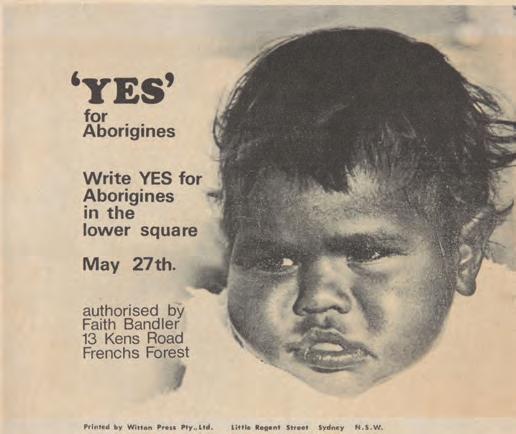
Source 10.6.1 Poster for the “yes” campaign, 1967, authorised by Faith Bandler ➜
When the Australian Constitution was established at Federation in 1901, there were some places where Aboriginal and Torres Strait Islanders were specifically excluded. The 1967 Referendum was about changing two key sections:
• Section 51 – Before 1967, the Commonwealth Government was not allowed to make laws for Aboriginal and Torres Strait Islander Peoples. That power belonged to the states, who had created very different and often deeply harmful policies.
UNCORRECTEDSAMPLEPAGES
• Section 127 – This section excluded Aboriginal and Torres Strait Islander Peoples from the national census. Their exclusion sent a racist message about whose lives were considered important in Australia.
A referendum is the only way the Constitution can be changed.
Writing focus 10.6
Developing sentences
Why the Referendum happened
By the mid-twentieth century, Aboriginal and Torres Strait Islander activists were organising themselves across the continent. Leaders such as Faith Bandler, Oodgeroo Noonuccal and many community organisers worked with Aboriginal-led organisations, including the Federal Council for the Advancement of Aborigines and Torres Strait Islanders (FCAATSI), to build national support for constitutional change.
UNCORRECTEDSAMPLEPAGES
They travelled, spoke publicly, organised petitions, and educated non-Indigenous Australians about the injustice written into Australia’s founding laws. Their goal was not only about symbolic recognition, but practical change that would allow Aboriginal and Torres Strait Islander Peoples to be treated as full participants in the nation and to gain greater power over decisions affecting their lives.
This long and ongoing activism led directly to the 1967 Referendum.
Changes proposed in the Referendum
Source 10.6.2 The text on the voting form at the 1967 Referendum ➜
DO YOU APPROVE the proposed law for the alteration of the Constitution entitled—
“An Act to alter the Constitution so as to omit certain words relating to the People of the Aboriginal Race in any State and so that Aboriginals are to be counted in reckoning the Population”?
Constitution Alteration (Aboriginals) 1967 Referendum
This vote was about making changes to Sections 51 and 127.
This involved changing Section 51 to remove the words “other than the Aboriginal race in any State”. This meant that the Commonwealth could create national laws relating to Aboriginal and Torres Strait Islander Peoples and could override state laws that caused harm or inequality.
Section 127 was completely removed, meaning that Aboriginal and Torres Strait Islander people would be counted as part of Australia’s population.
The campaigns leading up to the referendum ensured that Australians knew what they were voting for.
The campaign
There was very little organised opposition to the 1967 Referendum, as much of the public messaging was encouraging of the yes vote. A wide range of groups supported the proposed change, including community organisations, churches, unions, student groups and advocacy groups, who believed the constitutional change would be a great step towards fairness and equality.
No political party was opposed to the alteration of the Constitution, meaning there was bipartisan political support. This broad political agreement helped present the issue as one of national importance rather than political conflict.
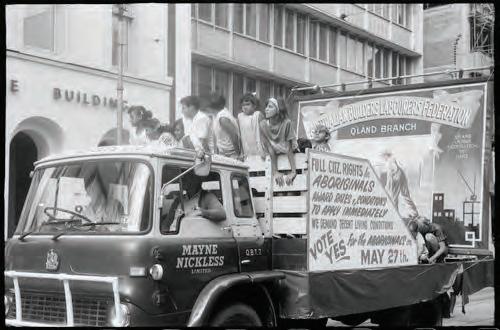
The result
Since Federation, Australians have voted on 44 proposed constitutional changes. Only eight have succeeded. The 1967 Referendum was the most successful in Australian history. The result of the vote was that 90.77 per cent of Australians wanted changes to the racist ideas in the Constitution.
UNCORRECTEDSAMPLEPAGES
This result did not come from sudden changes by politicians or the community. It reflected decades of Aboriginal-led resistance through campaigning, community organising and public education.
Source 10.6.3 The Queensland branch of the Builders Labourers’ Federation (a trade union) shows support for the Yes campaign.
Source analysis
Source 10.6.4 The results from the 1967 Referendum
New South Wales 2 315 8282 166 5071 949 03691.46182 0108.5435 461
Victoria 1 734 4761 630 5941 525 02694.6885 6115.3219 957
Queensland904 808848 728748 61289.2190 58710.799 529
South Australia 590 275560 844473 44086.2675 383
Western Australia 437 609405 666319 82380.9575 282
Tasmania
UNCORRECTEDSAMPLEPAGES
Identify which Australian state recorded the strongest support for the 1967 Referendum.
Identify which Australian state recorded the lowest support for the changes. How does this source help historians understand the national response to Aboriginal activism at the time?
Using Source 10.6.4 and the information in this section, explain why the 1967 Referendum was significant for Aboriginal and Torres Strait Islander Peoples. Why is it important to understand the referendum as the result of long-term Aboriginal activism rather than a sudden change in government policy?
Historical concepts: Cause and effect, Significance Historical skills: Analysis and use of sources
Why the referendum was significant
The referendum did not immediately end racism, discrimination, or deliver full equality It did not grant citizenship or voting rights. These had been achieved earlier through separate fights.
However, it removed racist sections of the Constitution and created a new foundation for future change. The referendum, although creating a platform for change, still did not guarantee equal living conditions or opportunities. First Nations Peoples still experienced poorer access to health care, education, housing and employment compared to non-Indigenous Australians. The referendum did not include any specific measures to fix these inequalities.
After the referendum, the Federal Government established the Council of Aboriginal Affairs and became directly involved in policies affecting Aboriginal and Torres Strait Islander Peoples. Funding increased for housing, education and health services, and Aboriginal-controlled organisations gained greater recognition and influence.
Most importantly, the referendum symbolised a profound shift in public attitudes. It showed that large numbers of Australians saw and wanted to address injustice and support Aboriginal and Torres Strait Islander Peoples’ demands for fairness, recognition and self-determination.
Because of this, the 1967 Referendum is remembered not only as a legal event, but as a turning point in the relationship between Aboriginal and Torres Strait Islander people and the Australian nation.
Knowledge and understanding
Explain what the 1967 Referendum changed in the Australian Constitution.
Describe the role of Aboriginal and Torres Strait Islander activism in achieving the referendum.
Explain why the 1967 Referendum is considered a turning point in Australian history.
Explain the significance of the 90.77 per cent “Yes” vote.
Evaluate the limitations of the 1967 Referendum.
Explain how the 1967 Referendum contributed to later developments in Aboriginal and Torres Strait Islander rights.
Thinking and researching
Using the content from this section, respond to the following inquiry:
“How did Aboriginal and Torres Strait Islander peoples use activism to influence the 1967 Referendum, and why does this matter for Australia today?”
In your response, you should:
• explain the goals of Aboriginal-led organisations and activists involved in the referendum campaign
• evaluate what the referendum achieved and what it did not immediately change
Teachers can go online to assign questions, view results, reports and more!
• describe how public education and community action helped achieve the referendum result
• reflect on why the referendum remains significant for discussions about rights, recognition and self-determination today.
UNCORRECTEDSAMPLEPAGES
Historical concepts: Continuity and change, Cause and effect Historical skills: Analysis and use of sources, Communication
10.7 Government policies on the Stolen Generations
Learning intention
In this lesson, we will learn about how Australian Government policies led to the forced removal of Aboriginal and Torres Strait Islander children from their families, and why the Bringing Them Home report remains significant today.
Success criteria
❏ I can explain what the Stolen Generations are and why removals of children from their families occurred.
❏ I can describe the long-term effects of these policies on individuals, families and communities.
❏ I can explain the importance of the Bringing Them Home report and the 2008 National Apology.
See, think, wonder





Look at the image of the Healing Foundation website in Source 10.7.1.
See: What emotions or relationships can you observe between the people shown? What words or ideas stand out from the Healing Foundation text on the page?
Think: What might this image suggest about the meaning of healing for individuals, families and communities?
Wonder: How might healing be connected to the experiences of the Stolen Generations?
UNCORRECTEDSAMPLEPAGES
The Stolen Generations
From the late 1800s through much of the twentieth century, Australian governments created and enforced laws and policies that allowed Aboriginal and Torres Strait Islander children to be taken from their families. These removals were not accidents or isolated events. They were the result of deliberate government decisions that aimed to control Aboriginal and Torres Strait Islander Peoples.
Between approximately 1910 and 1970, state and territory authorities, often through Aborigines Protection Boards, were given legal power to remove Aboriginal and Torres Strait Islander children from their parents and place them into missions, institutions, foster care, or non-Indigenous households. In many cases, families were not told where their children had been taken, and official records were often incomplete or never kept.
Between 10 and 30 per cent of all Aboriginal and Torres Strait Islander children were removed during this period. This means that tens of thousands of children were separated from their families and communities.
Once removed, many children were prevented from speaking their languages, practising their cultures, or maintaining contact with their families. They were taught to reject their identities and were expected to adopt non-Indigenous ways of life. The goal of these policies was not to protect children, but to force assimilation, the racist belief that Aboriginal and Torres Strait Islanders must lose their identity and take on the identity of white Australian society.
For many children, life in institutions and foster homes involved loneliness, cultural loss and, in some cases, neglect and abuse. When children were trained for work in nonIndigenous society, they were often denied equal rights, fair pay and acceptance. The damage caused by these policies continues to affect families and communities today.
The term Stolen Generations is used to describe all Aboriginal and Torres Strait Islander People who were removed from their families as a result of these policies. The term recognises that this history was not random or unintentional, but part of a broader system of government control.
In 1995, the Australian Government established the National Inquiry into the Separation of Aboriginal and Torres Strait Islander Children from Their Families. The inquiry’s report, Bringing Them Home (1997), documented the experiences of survivors and confirmed the widespread harm caused by these policies. It called for truth-telling, justice and long-term healing
In 2008, the Australian Government formally apologised to the Stolen Generations and their families. While the apology was an important national moment, many Aboriginal and Torres Strait Islander Peoples continue to call for practical action to support healing, reunification and community-led solutions.
As organisations such as the Healing Foundation explain, healing from the trauma of child removal is not only personal but collective. It involves families, communities, culture and Country, and continues across generations.
UNCORRECTEDSAMPLEPAGES
Stolen Generations Aboriginal and Torres Strait Islander People who were taken from their families as children as a result of Australian Government laws and policies. These removals caused deep harm to individuals, families and communities and continue to affect later generations healing the process of recovery, reconnection and strengthening for individuals, families and communities affected by trauma. Healing includes restoring culture, identity, family and connection to Country
Source analysis
Florence Onus is a descendant of the Birri-Gubba and Kairi/Bidjara clans of north-east Queensland.
She is the fourth generation of women from her family to be forcibly removed from land, culture and family.
My grandmother and my mother were both trained and sent out as domestic servants on properties. “They weren’t allowed to speak their native language or practice cultural ceremonies, or they would be severely punished,” Florence said.
“And then I became part of the Stolen Generations when I was removed from my family to be raised in a white foster home.”
Her two older sisters were sent to Rockhampton to live with nuns, while Florence and her two other siblings went to Townsville foster homes. There, Florence spent most of her childhood.
“I embarked on my healing journey when at 21 my mother attempted suicide and I became her full-time carer and together we began the journey of healing.”
“Survivor Story: Florence Onus”, Healing Foundation, healingfoundation.org.au
How does Source 10.7.3 show the impact of government removal policies on families?
What does the Healing Foundation video (Source 10.7.4) explain about “intergenerational trauma”?
Explain what Sources 10.5.3 and 10.5.4 tell us about the experiences of the Stolen Generations.
Why are sources created by Aboriginal people and survivors important for historians?
Do the government’s claims of “protecting” Aboriginal children match what the sources show? Explain your answer.
UNCORRECTEDSAMPLEPAGES
How does the Healing Foundation support healing today?
concepts: Cause and effect, perspectives Historical skills: Analysis and use of sources
Source 10.7.3 The Healing Foundation spoke with Florence Onus about her experiences as a member of the Stolen Generations
Source 10.7.4 The Healing Foundation’s Intergenerational Trauma animation
Source 10.7.2 Florence Onus, Stolen Generations survivor
Understanding the impact
Using Source 10.7.3 (Florence Onus) and Source 10.7.4 (Healing Foundation video), answer:
Describe two ways that child removal affected Aboriginal families over time.
Explain why the effects of the Stolen Generations did not end when the removals stopped.
Sample ideas: loss of family, loss of culture and language, emotional trauma passed through generations, ongoing healing needs.
From Harm to Healing
The Healing Foundation explains that healing happens through culture, community, truth-telling and support.
In your own words:
Why is healing an important part of Australia’s history today?
How does understanding the Stolen Generations help all Australians work toward a fairer future?
Reflection
Write a short paragraph (6–8 sentences):
• Why does this history matter today?
• Include one idea from Florence Onus and one idea from the Healing Foundation.
Historical concepts: Perspectives Historical skills: Perspectives and interpretations
Reconciliation and the Bringing Them Home report
In 1991, the Australian Government established the Council for Aboriginal Reconciliation to support a long-term process of building understanding and respectful relationships between Aboriginal and Torres Strait Islander peoples and the wider Australian community.
This process became known as reconciliation. It refers to the ongoing effort to address the impacts of past government policies, recognise the deep history and rights of Aboriginal and Torres Strait Islander peoples, and work towards a fairer future for everyone in Australia.
Reconciliation focuses on listening to the voices of Aboriginal and Torres Strait Islander peoples, acknowledging past harms, and creating positive change through truth-telling, respect and shared responsibility.
UNCORRECTEDSAMPLEPAGES
In 1995, the Australian Government launched a national investigation into the forced removal of Aboriginal and Torres Strait Islander children from their families. This inquiry became known as the National Inquiry into the Separation of Aboriginal and Torres Strait Islander Children from Their Families.
reconciliation the process of building respectful relationships by acknowledging past wrongs, understanding different experiences and working together for a fairer future
Writing focus 10.7
Transitional phrases
The final report of the inquiry, Bringing Them Home, was tabled in Parliament on 26 May 1997. It contained the testimonies of 777 Aboriginal and Torres Strait Islander people and documented the widespread harm caused by child removal policies, including trauma, loss of culture and language, and long-term impacts on families and communities.
The report deeply affected the Australian public. Historian Henry Reynolds later wrote that its release led to an unprecedented national response, with public meetings, apology books and formal statements of acknowledgement across the country.
UNCORRECTEDSAMPLEPAGES
The Apology (2008)
One of the key recommendations of the Bringing Them Home report was that the Australian Government should issue a formal apology to members of the Stolen Generations.
For many years this did not occur. Instead, the government expressed regret without accepting responsibility. This led to a long national campaign for justice and recognition. Important moments during this period included
• the establishment of National Sorry Day in 1998
• the Sorry Day March in 2000, when more than 250 000 people walked across Sydney Harbour Bridge
• the Long Walk in 2004, when Aboriginal activist and former AFL player Michael Long walked from Melbourne to Canberra to demand action on Aboriginal and Torres Strait Islander issues.
Finally, on 13 February 2008, Prime Minister Kevin Rudd delivered a formal apology on behalf of the Australian Government to the Stolen Generations and their families. The apology acknowledged the suffering caused by past government policies and marked a significant moment in Australia’s journey towards reconciliation.
Source 10.7.5 The “Sea of Hands” near the Sydney Opera house. Each hand represents an Australian supporting reconciliation. This photo was taken two days after the Sorry Day March in 2000.
Source analysis
Source 10.7.6 Apology to the Stolen Generations. Scan the QR code to watch a video of the apology.
Identify the actions for which Prime Minister Kevin Rudd apologises on behalf of the Australian Government.
Outline the hopes that Prime Minister Rudd expressed for Australia’s future.
Historical concepts: Perspectives, Significance Historical skills: Analysis and use of sources
Knowledge and understanding
Define the term “Stolen Generations”.
Explain why government policies led to the removal of Aboriginal and Torres Strait Islander children. Identify the purpose of the Bringing Them Home report.
Describe two impacts of the Bringing Them Home report on the Australian community. Explain why reconciliation became an important national goal after the report’s release.
Explain why many Aboriginal and Torres Strait Islander Peoples wanted a formal apology from the government.
Evaluate the significance of the 2008 National Apology.
Thinking and researching
Teachers can go online to assign questions, view results, reports and more!
UNCORRECTEDSAMPLEPAGES
How does the work of organisations such as the Healing Foundation continue the process of healing and reconciliation for the Stolen Generations today?
Historical concepts: Perspectives, Continuity and change Historical skills: Analysis and use of sources
memorial a plaque, sculpture, statue, or structure intended to encourage people to remember a person or historical event
Site study: Mt Annan Stolen Generations Memorial
Learning intention
In this lesson, we will learn about how the Botanic Gardens of Sydney’s Stolen Generations Memorial at Mt Annan in New South Wales demonstrates a commitment to reconciliation, and why it is important for the Stolen Generations to be remembered through memorials.
Success criteria
❏ I can explain why the Mt Annan Stolen Generations Memorial was created.
❏ I can explain how it commemorates the Stolen Generations.
See, think, wonder
Look at Source 10.8.1.
What do you see in this photograph? What are some features of the memorial?
What does it make you think about what the memorial is representing?
What does it make you wonder about commemorating the Stolen Generations?
Source 10.8.1 Mt Annan Stolen Generations Memorial, with its creator, sculptor Uncle Badger Bates.
In response to the reconciliation movement and the release of the Bringing Them Home report, there was a growing sense that the Stolen Generations needed to be appropriately remembered through memorials. One such memorial is the Botanic Gardens of Sydney’s Stolen Generations Memorial at Mt Annan in New South Wales, which was conceived by Stolen Generations survivor, Carol Kendall, in 2003. The Botanic Gardens Trust worked with the NSW Stolen Generations Committee and Link-Up NSW, both organisations who seek to assist those most affected by the government’s past assimilation policies, to establish a memorial that would “acknowledge these events in Australia’s history” and demonstrate a commitment to reconciliation.
Badger Bates, an artist of the Paakantyi people, was commissioned to create a sculpture that would signify the legacy left by the government’s policy of removing children. The result was unveiled to the public in 2007, just one year before Kevin Rudd’s Apology.
Source 10.8.2 The website of the Botanic Gardens of Sydney contains the following description of the Stolen Generations Memorial ➜
Mount Annan was known as Yandelora, which means “a meeting place of all peoples”, with the Stolen Generations Memorial site located in a pristine section of the critically endangered Cumberland Plain Woodland. Visitors will experience the memorial as a journey of healing and reflection, as they walk through the forest via a series of boardwalks leading to a peaceful meeting place with water and a sculpture space.
Megan Harvey, Botanic Gardens of Sydney website, 2018
The following photographs have been annotated with information collected from primary sources found at the memorial site – combining the words of the artist, Badger Bates, and official statements from the Botanic Gardens of Sydney, as depicted on plaques and information signage near to the sculpture.
UNCORRECTEDSAMPLEPAGES
Source 10.8.3 Front panel of the sculpture. The sculpture is at home in this place and brings a feeling of peacefulness. The parents have an engraved boundary between them, and the child is looking away. “The water feature represents the tears of sorrow shed by all affected by the Stolen Generations – tears that are still being shed today.” Badger Bates

Source 10.8.4 Footprints on the ground. “The child-sized footprints … represent the child being taken away, and the adult footprints on the other side represent the grown-up child returning to find his/her people.” Badger Bates ➜
Source 10.8.5 Back panel of the sculpture. “The back panel is my gift to the Stolen Generations. It represents a thundercloud and rain called up by the Ngatyi or Rainbow Serpent, who is angry and sad over the hurt done to his people who were taken away from their Country.” Badger Bates ➜
Why do you think the memorial was built before the official apology issued by the federal government?
Explain how the legacy of the Stolen Generations has been represented in the form of a memorial.
Account for the repeated use of the word “peace” or “peacefulness” in the official statements created by the Botanic Gardens of Sydney.
Explain the body language of the figures depicted in the sculpture.
Explain why it is important that those involved in the construction of this memorial were Aboriginal and/or Torres Strait Islander people.
Historical concepts: Significance Historical skills: Analysis and use of sources, Communication
10.9 Land Rights and native title
Learning intention
In this lesson, we will learn how Aboriginal and Torres Strait Islander Peoples have always maintained sovereignty over their lands, and how the Land Rights movement challenged unjust laws and helped bring about important changes such as the Mabo decision, the Wik decision and the Native Title Act 1993.
Starter activity
See, think, connect
Success criteria
❏ I can explain what “Aboriginal sovereignty” means and why it is central to Land Rights.
❏ I can describe how Aboriginal leaders and communities fought for land justice.
❏ I can explain the significance of the Mabo and Wik decisions and the Native Title Act 1993.
Look at Source 10.9.1.
What people, actions and symbols can you see? What do you think this moment represents? Why might this event be important? How does this image connect to what you already know about fairness, justice, or land ownership?
Source 10.9.1 Gough Whitlam pours sand into the hand of Vincent Lingiari at the 1975 handback ceremony.
For Aboriginal and Torres Strait Islander Peoples, Country is much more than land. Country includes landforms, waterways, seas, skies, plants, animals, ancestors, stories, songlines, culture, identity and future generations. Country is living and relational. It holds knowledge, memory and responsibility. Aboriginal people have deep, enduring connections to Country and ongoing obligations to care for it. Unlike Western ideas of ownership, First Nations cultures understand people as custodians of Country, guided by laws and responsibilities that have existed for tens of thousands of years.
UNCORRECTEDSAMPLEPAGES
This connection to Country is the foundation of Aboriginal societies and has never been ceded
When Britain invaded and claimed Australia in 1788, it relied on the false doctrine of terra nullius, meaning “land belonging to no one”. This legal fiction ignored the reality that the continent was already home to hundreds of First Nations Peoples, each with their own systems of governance.
never been ceded a phrase meaning that Aboriginal and Torres Strait Islander Peoples have never given up, surrendered, or legally handed over their lands and sovereignty to another nation or government terra nullius a Latin term meaning “land belonging to no one”. It was a false legal idea used by the British when they claimed Australia in 1788
walk-off a form of protest in which people collectively stop working and leave the workplace
Terra nullius allowed British authorities to justify taking land without treaty, negotiation, or consent. It became the legal foundation for widespread dispossession, the removal of people from Country, and the destruction of cultural, social and economic systems.
Aboriginal and Torres Strait Islander Peoples never accepted dispossession as lawful or just. Throughout the nineteenth and twentieth centuries, communities organised, resisted and advocated for recognition of their rights.
UNCORRECTEDSAMPLEPAGES
Land Rights are not simply about property. They are about justice, culture, survival and sovereignty. Country remains central to Aboriginal and Torres strait Islander identity and wellbeing. The growing Land Rights movement asserted two core truths:
Sovereignty was never surrendered.
Aboriginal peoples have the right to self-determination, to make decisions about their own lives, communities, land and futures.
These ideas challenged the authority of colonial governments and exposed the deep injustice and racism written into Australian law and policy. The Land Rights movement continues today because sovereignty has never been extinguished, and the fight for recognition, healing and self-determination is ongoing.
Gove and the Yolngu Bark Petitions
As we learnt earlier in this chapter, in 1963 the Australian Government granted leases for mining companies to operate on Yolngu land at the Gove Peninsula in Arnhem Land. Yolngu leaders from Yirrkala presented the Australian Parliament with a formal protest over the fact that they had not been consulted. This reflected a broader pattern across Australia, where Aboriginal communities were excluded from decisions affecting their land, lives and futures. The Yirrkala Bark Petitions were written in Yolngu Matha (a traditional language) and English, and they were decorated with traditional designs. Yolngu leaders created and sent the Yirrkala Bark Petitions to the Australian Parliament. The petitions forced parliamentarians to consider Yolngu law and connection to Country, and were the first Aboriginal documents recognised by the Australian Parliament.
This led to the Gove Land Rights Case (Milirrpum v Nabalco Pty Ltd, 1971), where Yolngu leaders argued that their traditional law gave them ownership of their land. Although the court rejected the claim, it acknowledged for the first time that Aboriginal law was a coherent legal system. This was a crucial step toward later recognition of First Nations land rights.
Wave Hill Walk-Off: Land, wages and justice
In 1966, Gurindji workers at Wave Hill Station in the Northern Territory, Vincent Lingiari led a walk-off in protest against poor working conditions and unfair pay. At first the action focused on wages and basic rights, but it quickly grew into something much larger. The Gurindji people made it clear that their fight was also about the return of their Lands. Vincent Lingiari expressed this goal simply and powerfully when he said, “We just want our land back.”
The protest continued for almost 10 years. With strong support from Aboriginal communities, trade unions and activists across Australia, the Gurindji campaign drew national attention to Land Rights and Aboriginal selfdetermination. Their stand helped many non-Indigenous Australians better understand the deep connection between Aboriginal people and Country.
In 1975, Prime Minister Gough Whitlam formally handed back a portion of Gurindji land. In a now famous moment, he poured sand into Vincent Lingiari’s hand as a symbol of the land being returned to its owners. His speech concluded with the words:
Source 10.9.2 Vincent Lingiari stands beside a plaque marking the handing over of the lease in Daguragu (Wattie Creek), 1975
Vincent Lingiari I solemnly hand to you these deeds as proof, in Australian law, that these lands belong to the Gurindji people and I put into your hands part of the earth itself as a sign that this land will be the possession of you and your children forever.
This event became one of the most significant and widely recognised symbols of justice and the Land Rights movement in Australian history.
Activity 10.9.1
Source analysis
Writing focus 10.9
The language of source analysis
The following source is a newspaper article from 1966. It reflects the attitudes, language and assumptions of that time. Parts of the article use outdated and offensive terms to describe Aboriginal people. These words were racist at the time and are racist today, but they have been left in the source because it is important to understand how Aboriginal and Torres Strait Islander Peoples were spoken about and treated in the past.
When reading this source, remember:
• The article was written from a non-Indigenous perspective and centres the views of station managers rather than the Gurindji people.
• The language does not reflect the dignity, knowledge, or authority of Aboriginal peoples.
• Aboriginal voices and experiences are only partially represented.
• Reading historical sources critically helps us understand how racism and inequality were normalised in Australian society.
You are not being asked to agree with the attitudes expressed in this article. Instead, you are being asked to analyse it as a historical document and to think carefully about whose voices are heard, whose are missing, and how the Gurindji struggle for justice was represented at the time.
Source 10.9.3 The Canberra Times of 27 August 1966 reported on the strike action
UNCORRECTEDSAMPLEPAGES
The pastoral manager for Vesteys, which owns the station, Mr Peter Morris, flew to Wave Hill yesterday to try to talk the Aborigines into returning to work. Mr Morris admitted the station depended on aboriginal stockmen and he said it employed 100 stockmen and domestics.
Mr Morris talked the issue out on a river bed with aboriginal leader Mr Vincent Lingiari before a crowd of 200 employees and their families.
The talk was friendly with Christian names used on both sides between Mr Lingiari and Wave Hill manager Mr Tom Fisher. But Mr Lingiari was adamant that at this stage the men wanted $50 a week and wages paid fortnightly instead of monthly.
Mr Morris told Aborigines there would soon be an interim wage rise and he could arrange for payment fortnightly.
Mr Lingiari said the men would discuss the situation with the union organiser and Aboriginal Rights Council representative Mr Dexter Daniels (…) at the weekend and give their answer on Monday. (…)
Members of the Aboriginal Rights Council claim that men on many other stations are ready to pull out at any time.
There are 1,500 Aborigines employed in the NT cattle industry and application of the award wage is expected to cost pastoralists about $1 million a year in larger pay packets if they keep on a full quota of Aborigines.
The Wave Hill group is reported to be almost out of food as kangaroos are scarce in the area at present.
The station is so far providing Aborigines with meat and the local welfare branch officer is feeding the children.
“Aborigines strike on NT station”, The Canberra Times, 27 August 1966
Before you answer, remember this is a 1966 newspaper report. It is not written from a Gurindji perspective. Read it critically and notice whose voices are included, and whose are missing.
Identify who is speaking and who is being spoken about in this source.
Describe what the article says the Gurindji workers wanted at this point in the walk-off.
Identify two details in the source that show the station depended on Gurindji labour.
Explain what the source shows about the immediate living conditions for the Gurindji group during the walk-off.
Identify one example of biased or outdated language in the source and explain why it matters for historians.
What evidence in the source suggests the walk-off could spread to other stations, and why might that have worried station owners or governments?
Analyse how the newspaper frames the issue. What does it focus on, and what does it not explain?
Historical concepts: Perspectives, Continuity
Historical skills: Analysis and use of sources
Mabo, native title and the end of terra nullius
UNCORRECTEDSAMPLEPAGES
In 1992, the High Court decision in Mabo v Queensland (No 2) overturned the doctrine of terra nullius. The case was brought by Eddie Koiki Mabo and others from Mer (Murray Island). Mabo argued that his people had always lived on the land and followed their own laws and customs. The court looked at whether their traditional connection to the land could be recognised by Australian law. The Court recognised that Aboriginal and Torres Strait Islander Peoples had legal rights to land based on their traditional laws and customs. This judgment confirmed that Australia was never “land belonging to no one”.
The aim of the Mabo case was to have Indigenous land rights officially recognised in Australian law and to prove that the land was never empty. This decision helped bring more fairness and respect for Aboriginal and Torres Strait Islander Peoples. The following year, the Australian Government passed the Native Title Act 1993, establishing a legal process for Aboriginal and Torres Strait Islander Peoples to seek recognition of their land rights.
Wik and the continuing struggle
The Wik Peoples v Queensland case was about whether Indigenous people could still have rights to land (native title) that had been given to others as pastoral leases, for the purpose of farming and grazing. The Wik people, from Cape York in Queensland, argued that their traditional connection to the land had never been completely lost, even though the government had granted leases to farmers. In 1996, the Wik decision clarified that native title could co-exist with pastoral leases, although in practice native title remains difficult to prove. Communities are often required to demonstrate continuous connection to Country since before 1788, despite the widespread displacement caused by colonisation. The Wik case helped clarify how native title works and showed that it can co-exist with other land uses.
Review 10.9
Thinking and researching Online quiz
Knowledge and understanding
Knowledge and understanding
Students can access sample responses and results online
Define the term terra nullius and explain why it was important in the Mabo decision.
Describe the outcome of the Wave Hill campaign.
Explain the aim of the Mabo case.
Describe one major change created by the Native Title Act 1993.
Discuss one reason why gaining land rights can be difficult.
Thinking and researching
How did the Wave Hill Walk-Off influence later campaigns for Aboriginal and Torres Strait Islander Land Rights across Australia?
Use information from this section to write a short response that:
• explains what happened at Wave Hill
• describes how Aboriginal leadership and community action created change
Teachers can go online to assign questions, view results, reports and more!
UNCORRECTEDSAMPLEPAGES
• connects the walk-off to later events such as the Mabo decision and the Native Title Act
Historical concepts: Significance, Cause and effect
skills: Comprehension, Communication
10.10 Struggle for rights and freedoms of Indigenous peoples in Canada
In this lesson, we will learn about the struggle for rights and freedoms of First Nations, Inuit and Métis peoples in Canada, and how indigenous peoples have worked for truth, justice and selfdetermination.
❏ I can describe some of the injustices faced by Indigenous Peoples in Canada.
❏ I can explain how Indigenous Peoples in Canada have fought for rights and recognition.
❏ I can compare key similarities and differences between the experiences of Indigenous Peoples in Canada and Australia.
Explore: How might this quote connect to what you already know about Indigenous rights struggles in Australia?
Settler colonialism in Canada
UNCORRECTEDSAMPLEPAGES
For thousands of years before Europeans invaded, the lands now called Canada were home to many different Indigenous Nations. These include First Nations, Inuit and Métis peoples. Each Nation had its own languages, laws, cultures, trade networks and deep relationships with Country.
From the late 1500s onwards, European powers, first France and later Britain, began to establish colonies in what is now known as North America. Over time, more settlers arrived and claimed control over Indigenous lands.
Like Australia, Canada was created through settler colonialism. This meant that new governments and settlers took over land that was already occupied, often ignoring or breaking agreements made with Indigenous peoples.
In 1867, Canada became a self-governing nation. Soon after, the Canadian Government introduced the Indian Act (1876). This law gave the government control over many parts of Indigenous life. It decided who was legally considered “Indian”, controlled reserve lands, and limited Indigenous self-government. Indigenous peoples were not asked to agree to this law.
One of the most harmful policies was the creation of residential schools. From the 1880s until the 1990s, more than 150 000 Indigenous children were taken from their families and placed in government and church-run boarding schools. Children were punished for speaking their languages or practising their cultures. Many experienced neglect and abuse. The goal of the schools was to force Indigenous children to abandon their identities and cultures.
At the same time, the government confined Indigenous Nations to small reserves, restricted their traditional economies, and ignored or failed to honour many treaties. These policies caused deep and lasting harm to families, languages and communities.
Indigenous resistance and activism in Canada
From the nineteenth century onwards, Canadian governments used laws, treaties and institutions to control Indigenous peoples, take land and suppress cultures. One of the most powerful tools of control was the Indian Act, which regulated almost every aspect of First Nations people’s lives, including governance, movement, land use and identity.
Source 10.10.2 Indigenous children at boarding school in Canada, 1950 ➜
settler colonialism a system of colonisation in which settlers move onto land that is already inhabited, take control of it, and establish permanent societies. In settler colonial systems, Indigenous peoples are displaced, their laws and cultures are undermined, and their sovereignty is denied, even though they have lived on and cared for their Country for thousands of years residential schools a system of government-funded, church-run boarding schools in Canada that operated from the late 1800s to the late 1900s, created to forcibly remove First Nations, Inuit and Métis children from their families and communities. Children were often prohibited from speaking their languages or practising their cultures and many experienced neglect, abuse and loss of connection to family and Country. The residential school system caused long-term harm that continues to affect Indigenous communities today.
By the mid-twentieth century, Indigenous peoples across Canada were increasingly organising to challenge these systems. Rather than accepting assimilation, Indigenous leaders asserted that they were Nations with inherent rights that had never been surrendered or ceded.
Source 10.10.3 A protest against land treaties made by the Federal Government. Parliament Hill in Ottawa, Ontario, 22nd June 1965
In 1969, the Canadian Government released a policy proposal known as the White Paper. It claimed that removing the Indian Act would create “equality” by treating all Canadians the same. Indigenous peoples strongly rejected this proposal. They argued that the White Paper ignored treaties, denied Indigenous sovereignty, and attempted to erase Indigenous Nations as political and cultural Peoples who wanted to be considered as distinct to settlers. For many, it was seen as another form of assimilation rather than justice.
Indigenous resistance was coordinated. Organisations across the country produced their own political responses that clearly articulated Indigenous perspectives and demands. One of the most influential was Wahbung: Our Tomorrows (1971), written by the Manitoba Indian Brotherhood. Wahbung rejected solutions suggested by the White Paper and set out a vision grounded in Indigenous self-determination.
Writing focus 10.10
Transitional phrases
UNCORRECTEDSAMPLEPAGES
The document called for Indigenous self-government, control over education and community services, recognition of treaty and land rights, and an end to government policies made without Indigenous consent. It made clear that Indigenous Peoples were no longer willing to be spoken for or managed by the government or accept the racism within their policies. Instead, they demanded to be recognised as decision-makers in their own futures.
Land rights and constitutional change
Indigenous activism in the 1960s and 1970s led to significant political and legal changes in Canada. These changes did not come easily or quickly. They were the result of sustained pressure, legal challenges and public advocacy by Indigenous Nations.
In 1982, Canada introduced a new Constitution. For the first time, it formally recognised existing Indigenous and treaty rights. While this recognition did not define those rights in detail, it was an important change. Indigenous rights were no longer treated as temporary or granted by government but acknowledged as enduring and legally protected, in the ways that only constitutional change can provide.
Following this change, a series of court cases affirmed Indigenous land rights and established that governments have a duty to consult Indigenous Nations when decisions may affect their land or rights. These rulings challenged the long-standing assumption that the state could act without consultation with Indigenous Peoples over Indigenous territories.
During the same period, new land agreements were negotiated, particularly with Inuit communities in northern Canada. These agreements returned control of large areas of land and resources to their owners and recognised Indigenous authority over decisionmaking in those regions.
Despite these gains, colonial impacts remain. Many Indigenous communities continue to experience inequality, intergenerational trauma and the ongoing effects of residential schools, where Indigenous children were forcibly removed from their families in an attempt to erase language and culture. Acknowledging this history is essential to understanding why land rights, sovereignty and self-determination remain central to Indigenous activism in Canada today.
Comparing Indigenous struggles in Canada and Australia
Although the histories of Canada and Australia are different, both are settler-colonial societies built on the dispossession of Indigenous peoples. In both countries, Indigenous Nations have resisted policies designed to erase their identities, cultures and rights, and have organised long campaigns for land, justice and self-determination.
UNCORRECTEDSAMPLEPAGES
Source 10.10.4 A display of 215 pairs of children’s shoes outside Vancouver Art Gallery, to commemorate 215 children whose remains were been found buried at a Canadian residential school. ➜
Source
10.10.5 Comparison of Australia and Canada
Australia Canada
Colonisation justified using the doctrine of terra nullius, which denied the existence of Indigenous law and ownership
Forced child removal policies created the Stolen Generations
Aboriginal and Torres Strait Islanderled Land Rights movement challenged dispossession and demanded recognition of unceded sovereignty
Legal change through cases such as Mabo overturned terra nullius
Ongoing struggle for justice, selfdetermination and sovereignty
Colonisation proceeded through treaties that were often ignored, misrepresented, or broken
Forced child removal through the residential school system
Ongoing struggle for justice, selfdetermination and sovereignty ➜
Indigenous-led activism challenged assimilation and demanded recognition of treaty and indigenous rights
Legal and constitutional change recognised indigenous and treaty rights in 1982
In both countries, Indigenous peoples have consistently asserted that their sovereignty was never ceded and that justice requires recognition of land, law, culture and Indigenous decision-making authority.
Teachers can go online to assign questions, view results, reports and more!
Knowledge and understanding
Define the term “settler colonialism”.
Identify the changes called for in Wahbung: Our Tomorrows.
Explain two impacts of the residential school system on Indigenous peoples in Canada.
Explain one way the Indian Act affected Indigenous communities.
Explain why Indigenous peoples in Canada demanded self-determination rather than assimilation.
Evaluate the significance of constitutional recognition of indigenous and treaty rights in Canada.
Thinking and researching
Investigate a later Indigenous rights movement in Canada, such as the Idle No More movement. In your response:
• Explain what the movement was responding to.
• Identify how it connects to earlier struggles for land rights and self-determination.
UNCORRECTEDSAMPLEPAGES
• Describe one way it challenged government power or public attitudes.
Historical concepts: Cause and effect, Significance Historical skills: Research
Impacts of inequality on the lives of Aboriginal and Torres Strait Islander Peoples
Learning intention Success criteria
In this lesson, you will learn how racist laws and government policies restricted the rights and freedoms of Aboriginal and Torres Strait Islander Peoples, and how Aboriginal activism challenged these inequalities.
Starter activity
Quick reflection
❏ I can explain how policies such as assimilation and exemption certificates limited rights and freedoms.
❏ I can analyse how Aboriginal activism challenged structural inequality.
Write two sentences in response to the below questions:
• What does it mean to have equal rights under the law?
• What might daily life look like if the law treated some people as less equal?
Structural inequality after Federation
When Australia became a nation in 1901, Aboriginal and Torres Strait Islander Peoples were not recognised in the Constitution. Federal law-making powers did not include Aboriginal and Torres Strait Peoples, and in many states voting rights were denied. Protection laws placed Aboriginal lives under government control.
Under these laws, government officials controlled where Indigenous people could live, whom people could marry, how wages were managed and where children would be educated. Many children were forcibly removed from families in policies now known as the Stolen Generations.
These measures were not isolated decisions. The system reflected earlier dispossession of land and the denial of Aboriginal sovereignty. Inequality was built into law
Assimilation and cultural suppression
From the 1930s to the 1960s, governments promoted assimilation. The policy claimed that Aboriginal people should adopt the ways of white Australian society. In practice, this often meant suppressing language, discouraging cultural practices and separating children from families.
Assimilation did not create equality. Access to limited rights was often linked to abandoning identity and community.
Writing focus 10.11 Creating topic sentences
Exemption certificates
Exemption certificates provide a clear example of inequality before the law.
An Aboriginal person could apply for a certificate stating that the person was no longer considered “an Aboriginal native” under protection law. A certificate holder might be permitted to:
• Live outside a reserve
UNCORRECTEDSAMPLEPAGES
• Access certain welfare payments
• Enter specific public facilities.
However, acceptance of a certificate often required separation from family members who remained under protection laws. Certificates had to be carried and shown on request.
The system reinforced inequality by suggesting that Aboriginal identity itself prevented access to rights.
Everyday inequality
Despite serving in both World Wars, many Aboriginal veterans returned to communities where discrimination remained. Equal access to citizenship rights and benefits was frequently denied.
Government authorities controlled or withheld wages earned by Aboriginal workers in some states. Mission education often directed children into low-paid labour.
Segregation operated in housing, health care and public facilities.
By the 1960s, these inequalities shaped everyday life across Australia.
The 1965 Freedom Ride revealed how discrimination operated in swimming pools, cinemas, clubs and hospitals. National media coverage made visible practices that Aboriginal communities had challenged for decades.
The 1967 Referendum: Significance and limits
In 1967, more than 90 per cent of Australian voters supported constitutional change. The referendum removed a clause excluding Aboriginal people from being counted in the census and enabled the Federal Government to make laws regarding Aboriginal people.
The referendum did not grant citizenship, and it did not automatically end discrimination. However, it marked a significant public acknowledgement that constitutional reform was necessary.
The campaign succeeded because of sustained Aboriginal activism. Organisations such as the Federal Council for the Advancement of Aborigines and Torres Strait Islanders (FCAATSI), alongside leaders including Faith Bandler, worked for years to build national support.
Constitutional change resulted from organised political action, not from spontaneous government reform. Grassroots activism was crucial because it mobilised communities, raised public awareness, and built the pressure needed to influence politicians and the legal system.
Ongoing impacts
Although reforms followed in later decades, the long-term effects of earlier policies continue to shape Australian society. Loss of land, disruption of family structures, economic exclusion and cultural suppression have had intergenerational consequences.
Contemporary calls for land rights, Treaty processes and self-determination are grounded in this history. Understanding the impacts of inequality helps explain why rights movements have continued beyond 1967.
Review 10.11
Teachers can go online to assign questions, view results, reports and more! Knowledge and understanding
and researching
Knowledge and understanding
Define assimilation.
Explain how protection laws limited freedoms.
Describe two impacts of inequality between 1901 and 1965.
Analyse why the 1967 Referendum is historically significant.
Evaluate the relationship between activism and legal change.
Thinking and researching
What was assimilation and how did it aim to reshape Aboriginal society and identity?
UNCORRECTEDSAMPLEPAGES
10.12
Languages, cultures and identities
Learning intention Success criteria
In this lesson, we will learn how language is connected to sovereignty, identity and resistance, and why reclaiming both Traditional Aboriginal Languages and Aboriginal English is important for Aboriginal and Torres Strait Islander resistance today.
Starter activity
Read the two short statements below.
❏ I can explain what is meant by ‘sovereignty never ceded’
❏ I can describe how language is connected to power and identity.
❏ I can explain how Aboriginal English developed as a form of resistance and survival.
❏ I can identify why reclaiming languages is an important part of Aboriginal and Torres Strait Islander self-determination.
Statement A: “To be taken seriously, people should speak correct English.”
Statement B: “Different ways of speaking carry different kinds of knowledge.”
Class discussion:
• Which statement do you agree with more? Explain why.
• Who do you think decides what counts as “correct” or “proper” language in a society?
• How might language rules be connected to power?
Unceded sovereignty and language
Aboriginal and Torres Strait Islander Peoples lived on and governed the continent now called Australia for tens of thousands of years before invasion and colonisation. Each Nation had its own systems of governance, kinship structures and languages. These systems were passed down through language, ceremony and story, rather than through written documents.
UNCORRECTEDSAMPLEPAGES
One way to understand this idea is though examining language. Aboriginal and Torres Strait Islander languages hold knowledge about Country, law, responsibility and relationships. They express how people have relationships and responsibilities to land. When language is spoken, sovereignty is practised.
Because sovereignty was never ceded, Aboriginal peoples continue to assert the right to speak their languages, follow their laws and define their identities on their own terms.
Traditional Aboriginal Languages as law, culture and identity
Traditional Aboriginal languages are not simply ways of communicating. They carry law, cultural authority and deep connections to Country. Through language, people learn who they are related to, what responsibilities they hold, and how to care for land, water and community.
Colonisation deliberately targeted language. On missions, reserves and in government institutions, Aboriginal and Torres Strait Islander people were often punished for speaking their own languages. Children were removed from families and placed in environments where English was enforced and Aboriginal languages were banned. These policies aimed to deliberately weaken cultural identity and break connections to Country.
Despite this, many languages survived through continued use, quiet resistance and the determination of Elders. Today, language revival programs, community-led teaching and intergenerational learning are important acts of cultural strength. Reclaiming language is not about returning to the past, but about continuing sovereignty into the future.
UNCORRECTEDSAMPLEPAGES
Writing focus 10.12
Developing sentences
Aboriginal English
When Aboriginal and Torres Strait Islander Peoples were forced onto missions and reserves, many different language groups were brought together. English was imposed as the dominant language, and Traditional Languages were restricted or banned. Aboriginal and Torres Strait Islander Peoples did not simply adopt English unchanged. Instead, First Nations people adapted it in in ways that allowed them to continue to communicate with each other and with non-Indigenous people.
Aboriginal English developed over time as a distinct linguistic system with its own rules, meanings and cultural purposes. Today, around 80 per cent of Aboriginal people across Australia use it, ranging in degrees from heavy to light use. It carries Aboriginal ways of relating, storytelling, humour, respect and care. It allows people to communicate safely, indirectly and relationally.
Source 10.12.2 Sharon Davis, a Bardi Kija person and CEO of the National Aboriginal and Torres Strait Islander Education Corporation, talks about Aboriginal English.
For me, Aboriginal English isn’t just how we talk. It’s where we’ve survived. It’s what we made when everything else was taken … That’s more than just surviving, unna? That’s resisting.
Aboriginal English is an expression of sovereignty. It shows how Aboriginal people retained control over meaning, identity and connection, even under conditions designed to erase their languages. Reclaiming Aboriginal English as legitimate challenges deficit views of language and recognises it as a powerful cultural resource.
Activity 10.12.2
Source analysis
This source contains Aboriginal political language asserting sovereignty, and rights. It reflects Aboriginal perspectives that have often been ignored or challenged within Australian legal and political systems. Read this source respectfully and to understand it as an expression of Aboriginal authority.
Source 10.12.3 Extract from the Barunga Statement ➜
We, the Indigenous owners and occupiers of Australia, call on the Australian Government and people to recognise our rights:
• to self-determination and self-management, including the freedom to pursue our own economic, social, religious and cultural development;
• to permanent control and enjoyment of our ancestral lands;
UNCORRECTEDSAMPLEPAGES
• to compensation for the loss of use of our lands, there having been no extinction of original title;
• to respect for and promotion of our Aboriginal identity, including the cultural, linguistic, religious and historical aspects, and including the right to be educated in our own languages and in our own culture and history;
• And we call on the Commonwealth Parliament to negotiate with us a Treaty recognising our prior ownership, continued occupation and sovereignty and affirming our human rights and freedom.
Excerpt from the Barunga Statement
Identify three rights Aboriginal peoples are asserting in this statement.
Explain what is meant by “there having been no extinction of original title.”
How does this statement describe the relationship between land, culture and language?
Why do Aboriginal leaders include the right to be educated in their own languages as part of their political demands?
Analyse how the Barunga Statement challenges the idea that sovereignty only exists if recognised by the Australian Government.
Evaluate why the authors call for negotiation of a Treaty rather than asking for inclusion within existing government systems.
Knowledge and understanding
Define the term “sovereignty never ceded”.
Explain why language is central to Aboriginal sovereignty and identity.
Identify one way colonisation attempted to suppress Aboriginal languages.
Explain how Aboriginal English developed as a response to colonisation.
Summarise the key demands made in the Barunga Statement.
Thinking and researching
Choose one Aboriginal language or language group from Australia.
Research and respond in one to two paragraphs:
• Where is this language from and which Nation or Nations speak it?
• What impact did colonisation have on the language?
• What actions are being taken today to reclaim, teach, or revitalise the language?
• How does this work support self-determination and sovereignty?
UNCORRECTEDSAMPLEPAGES
10.13 Human rights conventions
Learning intention
In this lesson, we will learn why human rights conventions were created and how they influence governments and people around the world.
Starter activity
Success criteria
❏ I can describe what human rights conventions are and why they matter.
❏ I can give examples of how human rights conventions protect different groups of people.
Imagine there were no rules about how people should treat each other.
Think about the following questions:
• What problems might happen if there were no shared rules?
• Who could be at risk if there were no rules?
UNCORRECTEDSAMPLEPAGES
The United Nations
As you saw in Chapter 9, the United Nations was formed after World War II, when many countries recognised that global rules were needed to prevent violence and protect people’s rights. The UN was created to:
• prevent future wars
• protect human rights
• promote peace and cooperation between countries.
At first, 51 countries joined. Today, almost every country in the world is a member.
Source 10.13.1 US President Harry Truman speaking at the first United Nations conference ➜
Activity 10.13.1
Source analysis
Source 10.13.2 Preamble to the UN Charter
Preamble
WE THE PEOPLES OF THE UNITED NATIONS DETERMINED
to save succeeding generations from the scourge of war, which twice in our lifetime has brought untold sorrow to mankind, and to reaffirm faith in fundamental human rights, in the dignity and worth of the human person, in the equal rights of men and women and of nations large and small, and to establish conditions under which justice and respect for the obligations arising from treaties and other sources of international law can be maintained, and to promote social progress and better standards of life in larger freedom, AND FOR THESE ENDS
to practice tolerance and live together in peace with one another as good neighbours, and to unite our strength to maintain international peace and security, and to ensure, by the acceptance of principles and the institution of methods, that armed force shall not be used, save in the common interest, and to employ international machinery for the promotion of the economic and social advancement of all peoples,
HAVE RESOLVED TO COMBINE OUR EFFORTS TO ACCOMPLISH THESE AIMS.
Accordingly, our respective Governments, through representatives assembled in the city of San Francisco, who have exhibited their full powers found to be in good and due form, have agreed to the present Charter of the United Nations and do hereby establish an international organization to be known as the United Nations.
“Preamble”, Charter of the United Nations, 1945
Read the preamble to the United Nations Charter (Source 10.13.4). Then answer the following questions in complete sentences.
What events made countries realise global rules were needed?
What values does the UN Charter say are important to protect?
Why do you think countries agreed to work together instead of acting alone?
Historical concepts: Continuity and change Historical skills: Analysis and use of sources
UNCORRECTEDSAMPLEPAGES
The Universal Declaration of Human Rights
One of the first things the United Nations did was to establish a Human Rights Commission. This Commission was asked to create a shared framework for human rights, which would help countries decide whether basic freedoms were being respected or violated. As you saw in Chapter 9, the result was the Universal Declaration of Human Rights (UDHR), a document that set out how all people should be treated, regardless of nationality, race, gender, or belief.
UNCORRECTEDSAMPLEPAGES
The UDHR became the foundation for later legally binding human rights conventions and helped establish a global understanding that human rights are universal and apply to all people.
United Nations human rights conventions
Human rights conventions are formal agreements between countries. They help to hold governments responsible for their actions. When a country agrees to a convention, it promises to follow certain rules about how people should be treated.
Conventions are adopted by the United Nations General Assembly, but they do not come into force until they have been ratified by a minimum number of countries. They are only legally binding on those countries that have ratified them.
Human rights conventions:
• set shared expectations for how governments should treat people
• give communities a way to speak up when rights are ignored
• influence laws, policies and court decisions in many countries.
For example, the Unted Nations Declaration on the Rights of Indigenous Peoples (UNDRIP) provides a framework for indigenous rights, including recognition of traditional lands, cultural practices, self-determination, and participation in decision-making. In Australia, UNDRIP has been a powerful tool for Aboriginal and Torres Strait Islander communities to advocate for stronger legal protections and political recognition.
However, agreeing to a convention does not automatically fix injustice. Many governments do not fully follow the rules they have signed. This means people often need to continue campaigning and advocating for their rights to be respected.
Source 10.13.3 shows some key United Nations human rights conventions. We will look at one of them in more detail: the Convention on the Rights of the Child.
Source 10.13.3 Key human rights conventions
International Convention on the Elimination of All Forms of Racial Discrimination
International Covenant on Civil and Political Rights (rights such as freedom of speech and fair trials)
International Covenant on Economic, Social and Cultural Rights (rights such as education, health and housing)
Convention on the Elimination of All Forms of Discrimination Against Women
Convention on the Rights of the Child
Convention on the Rights of Persons with Disability
Convention on the Rights of the Child (1990)
The Convention on the Rights of the Child (CRC) was based on the idea that children are entitled to distinct human rights, and that these rights include both individual rights and collective responsibilities. It recognised that children need special protection because of their age and vulnerability, and that governments have a duty to act in the best interests of children.
As part of the convention, a committee was established to maintain a universal understanding across all of the member countries as to how “childhood” should be defined and protected. According to UNICEF, the UN Convention of the Rights of the Child is the most agreed-upon human rights treaty in history and “has helped transform children”s lives around the world”. However, the Convention has also been debated. Some countries argue that the UN’s definition of children’s rights reflects a Western worldview and does not always recognise the cultural values, family structures, or philosophies of childhood held in some Asian, Middle Eastern and Indigenous societies. This highlights an ongoing tension between universal human rights and cultural differences.
Writing focus 10.13
Creating topic sentences
UNCORRECTEDSAMPLEPAGES
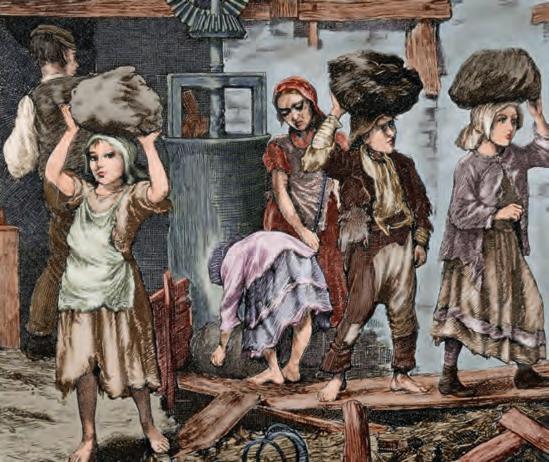
Source 10.13.4 Colour engraving from the nineteenth century depicting child workers
The Convention includes rights that focus on protection, participation and wellbeing, including:
• the right to non-discrimination
• the right to be protected from harm and abuse
• the requirement that the best interests of the child be a primary consideration in decisions
• the right to basic needs, including food, health care and education
• special protections for children seeking refugee status
UNCORRECTEDSAMPLEPAGES
• additional support for children with disability
• recognition of the importance of children’s survival and development
• the right for children’s views to be heard and considered in matters that affect them.
The convention has been criticised for not adequately addressing the issue of child soldiers, particularly in conflict zones. In addition, some countries still practise “child marriage”, which has been compared to a form of slavery.
Australia responded to the Convention by making changes to gover nment policy and law. In 2002, the Australian Government created a Minister for Children and Youth and established the Department of Family and Community Services to provide national leadership on children’s issues. New laws and programs were also introduced to address child homelessness, child protection and juvenile justice.
While these steps reflected the influence of the Convention, debates continue in Australia about how well children’s rights are protected, particularly for Aboriginal and Torres Strait Islander children. Many Aboriginal and Torres Strait Islander children continue to experience inequality in areas such as health, housing, education and access to culturally safe services.
One major concern is the over-representation of Aboriginal and Torres Strait Islander children in child protection and youth justice systems. Although the Convention on the Rights of the Child emphasises keeping children safe while respecting their family, culture and identity, many Aboriginal families argue that government systems still remove children at much higher rates than non-Indigenous children. This has led some communities to describe current practices as continuing the harms of past policies, including the Stolen Generations.
United Nations Declaration on the Rights of Indigenous Peoples (2007)
For many indigenous peoples around the world, earlier human rights agreements did not fully recognise their unique histories, cultures, or political rights as First Peoples. While documents like the Universal Declaration of Human Rights focused on individuals, they did not address collective rights such as land ownership, cultural survival or self-determination.
According to the United Nations, there are more than 5000 indigenous communities worldwide, representing approximately 375 million people. For decades there had been global calls for justice from indigenous peoples who had experienced dispossession, forced assimilation and denial of sovereignty under colonial rule.
In response to this, in 2007 the United Nations adopted the United Nations Declaration on the Rights of Indigenous Peoples (UNDRIP). The UN describes UNDRIP as
“the most comprehensive international agreement on the rights of Indigenous peoples.”
Its purpose is to recognise Indigenous peoples as distinct political and cultural groups with the right to survive, thrive and make decisions about their own futures.
It is important to note that UNDRIP is not a convention, like those listed in Source 10.13.3. It is a resolution that was adopted by the UN General Assembly, which
“establishes a universal framework of minimum standards for the survival, dignity and well-being of the Indigenous Peoples of the world”
but unlike a convention, it is not legally binding.
Key rights recognised in UNDRIP
Some of the most significant articles of UNDRIP are shown below.
Source 10.13.5 Extracts from the United Nations Declaration on the Rights of Indigenous Peoples, 2007
ArticleWhat it says
Article 3
Indigenous peoples have the right to self-determination and to freely decide their political, economic, social and cultural development.
Article 7.2 Indigenous peoples must not be subjected to genocide or violence, including the forced removal of children.
Article 8 Indigenous peoples have the right not to be forced to assimilate and to have their cultures protected.
Article 14 Indigenous peoples have the right to control their own education systems and access all levels of education.
Article 18 Indigenous peoples have the right to represent themselves in political decisions that affect them.
Article 26 Indigenous peoples have the right to lands and territories they traditionally owned or occupied.
UNCORRECTEDSAMPLEPAGES
Together, these articles directly challenge the colonial idea that indigenous peoples should be absorbed into settler societies. Instead, UNDRIP affirms that indigenous cultures, languages, governance systems and land relationships must continue.
Voting on UNDRIP
When the United Nations voted on UNDRIP in 2007, countries responded in different ways.
Source 10.13.6 Results of the vote on the UNDRIP
UNCORRECTEDSAMPLEPAGES
Australia, Canada, the United States and New Zealand were among the countries that initially voted against the Declaration. In Australia and Canada, governments expressed concern that UNDRIP might strengthen Indigenous land and resource claims.
However, both countries later formally endorsed UNDRIP (Australia in 2009, Canada in 2016), following continued pressure from Indigenous communities and international advocacy.
Concerns about UNDRIP
Although many indigenous peoples welcomed UNDRIP, it caused tension between governments and indigenous nations in several countries:
• UNDRIP does not allow indigenous nations to separate and form new countries, even though it recognises their sovereignty and self-determination. Some indigenous leaders argue this limits true sovereignty.
• Many settler governments prefer centralised control, while indigenous governance systems often allow multiple legal, cultural and political systems to coexist.
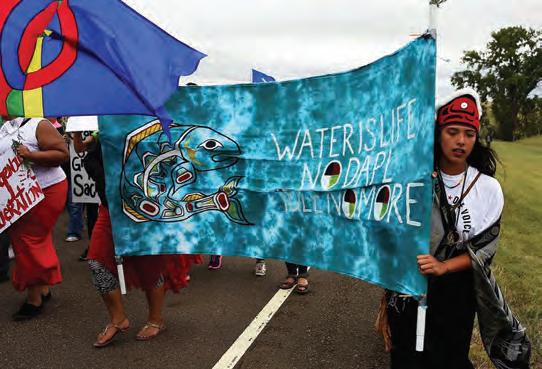
Source 10.13.7 First Nations people march to protest the destruction of a sacred burial ground in North Dakota.
• In countries such as Canada, some indigenous nations already exercise limited self-government through treaties and agreements, while others continue to fight for recognition and land rights.
• Governments were particularly concerned about Article 26, which recognises indigenous rights to land and resources. This raised fears about challenges to mining, pipelines and other resource projects.
These tensions reflect the ongoing struggle between indigenous sovereignty and settler-state power, rather than a failure of indigenous peoples to cooperate.
UNDRIP today
UNDRIP does not automatically change laws. It is not legally binding, but it provides an important international standard that Indigenous peoples can use to argue for rights, recognition and justice.
In Canada, UNDRIP connects directly to struggles over treaties, land claims and selfgovernment discussed earlier in this chapter. In Australia, it supports Aboriginal and Torres Strait Islander arguments that sovereignty was never ceded and that land, culture and political voice must be respected.
UNDRIP shows that the struggle for Indigenous rights is ongoing – and that global recognition does not replace the need for local action, resistance and reform.
Review 10.13
Knowledge and understanding
Answer the following questions using information from the text.
Define the term “human rights”.
Explain what the Universal Declaration of Human Rights (UDHR) is.
Discuss what the Convention on the Rights of the Child hoped to achieve.
Define the UNDRIP and explain one difficulty it has faced.
How did Australia respond to the UNDRIP?
Describe one way that specific groups were still disadvantaged when the UDHR was adopted.
Thinking and researching
Research one of the key human rights conventions listed in Source 10.13.3:
• Why was it implemented?
• Are there any significant countries that have not ratified it?
• Why do you think it is important?
Historical concepts: Cause and effect Historical skills: Analysis and use of sources
UNCORRECTEDSAMPLEPAGES
Chapter review and historical inquiry
Access the Interactive Textbook for a range of digital tools to help you review this chapter and build confidence.
• Auto-marked questions for fast feedback and fun practice
• Self-assessment tools to track your progress, review answers (if enabled by the teacher), and flag questions for extra help
• Downloadable worksheets for class or homework revision
UNCORRECTEDSAMPLEPAGES
Summary
Summary notes
What have you learned about human rights and freedoms? Copy the table and fill out by explaining your understanding. Aim for two points per topic.
Topic
Denial of rights and early activism of Aboriginal and Torres Strait Islander peoples
Influence of the US civil rights movement
Significance of the NSW Freedom Ride 1965
Constitutional reform and recognition – 1967 Referendum
Stolen Generations, reconciliation and the Bringing Them Home report
Land rights and sovereignty
Global indigenous rights movements and conventions
Visible thinking routine
I used to think … Now I think …
What I have learned
Reflect on your thinking about the development of human rights and freedoms, and how and why this thinking may have changed now that the unit is complete. Using the prompts below, write a couple of sentences explaining what you used to think about the topic and what you think now. Share your thoughts with the class.
• I used to think …
• But now I think …
Questions and activities
Scorcher quiz
Access a fast, fun, competitive quiz that puts your understanding to the test.
Quick questions
The 1909 _________ Act in New South Wales gave the government extensive control over the lives of Aboriginal and Torres Strait Islander peoples.
In 1938, Aboriginal leaders organised the national protest known as the _________.
The NSW _________ of 1965 was a student-led campaign that exposed segregation in country towns.
The 1967 Referendum moved two discriminator sections of the Australian _________.
The High Court decision in Mabo v Queensland (No 2) overturned the doctrine of
Identify one way reserves and missions restricted the lives of Aboriginal and Torres Strait Islander peoples before 1965.
Describe the main aim of the US Freedom Rides and their influence on Australia.
Outline why the 1976 Referendum was a significant moment in Australian history.
Describe one long-term impact of the Stolen Generations on families and communities.
Identify the key ideas about sovereignty expressed in the Baruna Statement.
Group work activity
Plus One
Statement: “Human rights conventions create change on their own.”
Sit in a circle with your group.
Spend one minute writing ideas that support or challenge the statement.
Pass your list to the person on your right.
Add at least one new idea to the list you receive.
Repeat the process three times.
Return the list to its original writer.
Review the ideas and reflect on how your thinking has changed.
Task: Write a 500-word response explaining your final position. Use evidence from this chapter to support your view.
UNCORRECTEDSAMPLEPAGES
Creative task
Protest, rights and public voice
Public protests have been an important way for groups to demand rights, challenge injustice and make their voices visible.
wUsing Source 10.14.1 and what you have learned in this chapter, create a protest poster that communicates a clear message about rights and freedoms.
Design a protest poster that could belong to one movement studied in this chapter, such as:
• the NSW Freedom Ride
• Aboriginal and Torres Strait Islander civil rights campaigns
• movements influenced by the Universal Declaration of Human Rights.
Your poster should:
• communicate a specific demand or message about rights or freedoms
• include words, symbols, or images that would be effective in a public protest
• use ideas from human rights conventions studied in this chapter
• be historically appropriate in tone and message.
You are creating a poster about a movement, not from the point of view of a person within it.
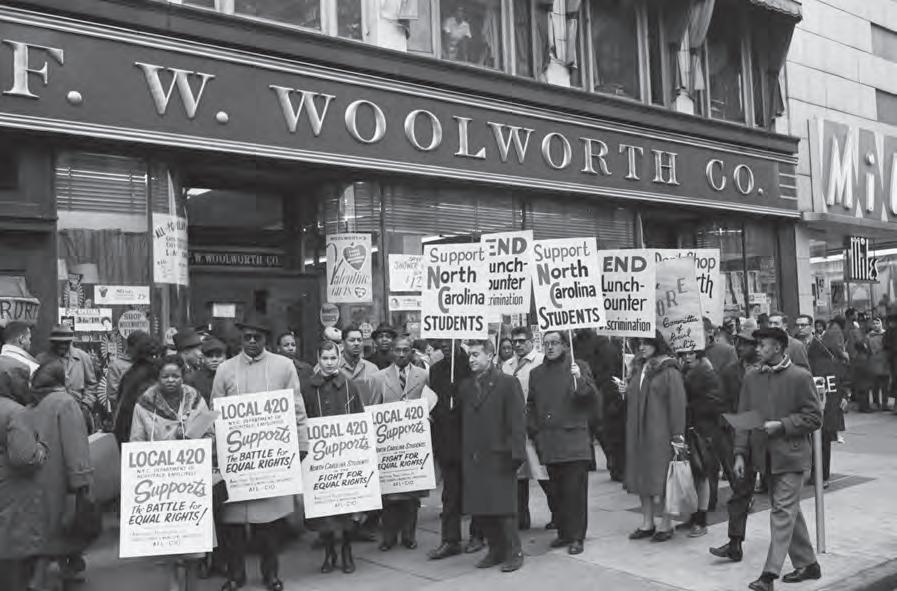
➜
UNCORRECTEDSAMPLEPAGES
Writing focus
The following activities offer ways to demonstrate your understanding of the chapter and allow you to continue to practise your writing skills.
Answering questions in paragraphs
This sample response to a question is structured using:
• a topic sentence
• the four Es (explain, elaborate, evidence and examples)
• a linking sentence.
Source 10.14.1 Protesters in Harlem, New York, encourage boycotting Woolworth, a store chain practicing ‘lunch-counter discrimination’ against people of colour in the southern state of North Carolina. The protesters belong to a group called Congress of Racial Equality (CORE).
You can use this as a model when writing your own answers to the following questions.
Question: Explain the purpose of the United Nations Declaration on the Rights of Indigenous Peoples (UNDRIP) and why it has been controversial.
Model answer:
Topic sentence: the first sentence of the paragraph; directly answers the question
Elaborate: additional information, connections, historical significance, change and continuity, cause and consequence
Examples: provide credibility and illustrate the argument
The purpose of the United Nations Declaration on the Rights of Indigenous Peoples (UNDRIP) was to recognise Indigenous Peoples’ rights to selfdetermination, culture and land after centuries of colonisation. It aimed to set minimum global standards to protect Indigenous communities from the ongoing effects of dispossession and forced assimilation. In doing so, it gave Indigenous Peoples a framework they could use to pressure governments to change harmful laws and policies. However, UNDRIP become controversial because many governments feared that recognising Indigenous Peoples’ rights would challenge state control over land and resources. This tension emerged largely because acknowledging Indigenous self-determination could affect how countries manage mining, development and sovereignty. This resistance is shown by Australia, Canada, New Zealand and the United States voting against UNDRIP in 2007, as recorded in Source 10.13.6.Article 26 of the Declaration recognises Indigenous ownership of traditionally occupied lands, which raised concerns that these governments might face increased land claims or limits on development. Overall, while UNDRIP was designed to protect Indigenous rights, its controversy highlights ongoing struggles over land, power and the long-term impacts of colonisation.
Extended-response questions
Explain: clarify, define and describe
Evidence: specific, relevant evidence to support your arguments Linking sentence: reconnects to the topic sentence using the language of the question
Describe how international human rights movements after World War II influenced the development of rights frameworks around the world. In your response, refer to the United Nations and the Universal Declaration of Human Rights.
Discuss the role Australia played in the creation and promotion of international human rights frameworks.
Why was the Convention on the Rights of the Child created, and what limitations does it face?
UNCORRECTEDSAMPLEPAGES
Explain the purpose of the United Nations Declaration on the Rights of Indigenous Peoples (UNDRIP) and why it has been controversial.
Analyse how Indigenous peoples have used international human rights frameworks to challenge injustice within nation-states.
“Human rights conventions are effective only when governments are willing to listen to those most affected.” To what extent do you agree with this statement?
w Historical inquiry
Investigating perspective
In this historical investigation into perspective in human rights and freedoms, you will undertake the following steps:
Part 1: Develop historical questions
• Step 1: Select an aspect or event of human rights and freedoms that interests you. Examples include:
● the 1967 referendum
● the Freedom Rides in the USA
● Native Title and land Rights of Aboriginal Peoples in Australia
● the importance of human rights conventions.
• Step 2: Brainstorm what you already know
• Step 3: Develop a historical inquiry question. Examples include:
● Evaluate the reasons for different views in 1967 about the 1967 referendum.
● Assess why groups in the southern states of the USA had different views about the Freedom Rides.
● Explain the arguments for and against Native Title in Australia.
● To what extent has the human rights convention been successful?
• Step 4: Explain why the question is important
Part 2: Locate and analyse evidence
Part 3: Communicate historical findings
Part 4: Reflect
UNCORRECTEDSAMPLEPAGES
Teachers, access the Online Teaching Suite for digital resources and tools that support review, assessment and reporting, including:
• student and class activity reports
• a test generator to create custom assessments
• built-in feedback tools
• editable downloadable support material
• a downloadable and printable “Writing focus” workbook for this chapter.
CHAPTERS 11–13 TO FOLLOW UNCORRECTEDSAMPLEPAGES
Chapter 14
Key questions
The environmental movement (c. 1960–c. 2015)
• How can we explain the emergence of the environmental movement?
• What are the significant events and groups that have influenced the environmental movement?
• How has the international community cooperated in the environmental movement?
• Is the environmental movement successful in achieving its aims?
• How has the environmental movement grown and changed over time?
• What is the impact and legacy of human activities on the environment and Indigenous Peoples?
Lessons
14.1 Setting the scene
14.2 United Nations Educational, Scientific and Cultural Organization (UNESCO) World Heritage Sites
14.3 The Stockholm Conference (1972)
14.4 The 1970s NSW Green Bans movement in NSW
14.5 Site study: Cockatoo Island (Wareamah)
14.6 The impact of events on changing attitudes to the environment: The Tasmanian dams and the Jabiluka mine
14.7 The impact of events on changing attitudes to the environment: Chernobyl
14.8 International cooperation and actions since the 1960s
14.9 The actions of the Australian Government in response to nuclear contamination at Maralinga
14.10 The impact and legacies of human activities on the environment for Aboriginal and Torres Strait Islander Peoples
14.11 The impact and legacies of human activities on the environment for international indigenous peoples
14.12 Chapter review and historical inquiry
UNCORRECTEDSAMPLEPAGES
Aboriginal and Torres Strait Islander people should be aware that this chapter contains images and names of people who have passed away.
Glossary
Focus area 1
Chapter 1 The making of the modern world (1750–c. 1945)
annexed the incorporation of another territory into the domain of a country or empire
armistice a formal agreement between countries or groups at war to stop fighting for a particular time, especially to negotiate a peace treaty
arms race the increasingly competitive procurement of offensive armaments or spending on the military
assassination the murder of a prominent individual, often for political purposes
Black Hand a secret Serbian organisation that employed terrorist methods to promote the liberation of Serbs outside of Serbia during the early twentieth century
catalyst a person or thing bringing about a change or an event
deterrence a show of strength or use of threats to discourage others from taking unwanted actions
fascism a political philosophy that exalts a dictator and places the good of the nation or the race above the individual patriotism an intense love and support for one’s nation and its interests
slavery the activity of legally owning other people who are forced to work for or obey you
socialism a political ideology based on equality: shared contributions to and shared benefits from society and the economy
urbanisation the migration of people away from the countryside towards cities, which increases the proportion of the population who live in towns
Chapter 2 The Industrial Revolution (1750–1914)
bourgeoisie the class of professional workers. This group included bankers, merchants and business owners, as well as lawyers, doctors, engineers and other skilled professions that offered specialised services
capitalist wealthy person who invested money in businesses or industry, with the aim of making a profit. Capitalists typically owned capital, such as land or other property, and used it to generate more wealth for themselves
cholera an infectious and often fatal bacterial disease that causes severe vomiting and diarrhoea, usually spread by contaminated water colliery a coal mine where coal is extracted, as well as the buildings above the mine such as washhouses and offices. Collieries are often part of larger mining operations that also include the transportation and processing of coal crop rotation growing different crops in different years, so that the soil in the field can regain its nutrients
enclosure system system under which land that had previously been available for common usage became incorporated into a larger farm, and could only be used by the owner – improving the agricultural output, but causing suffering for people who had relied on the land for feeding their families
entrepreneur someone undertaking a new enterprise with a chance of profit or loss
UNCORRECTEDSAMPLEPAGES
Westminster model a parliamentary system where there is a head of state (e.g. the Sovereign), an elected parliament, and a government formed by the party that has majority support
Great Exhibition definition to come guild an association of people in a particular trade or business that sets standards for that particular industry industrialist member of the wealthy elite who owned or managed large businesses, factories or other industrial enterprises, such as railways or canals
Luddites groups who tried to block industrialisation by smashing machinery
nationalism a political ideology that emphasises the interests, culture and identity of a particular nation or group of people. It often involves a sense of pride in one’s nation, as well as a sense that one’s nation is superior to other nations
Nonconformist Protestant Christians who did not adhere to the standard doctrines and practices of the Church of England
proletariat the class of industrial workers. This group included factory workers, miners and other manual labourers who were often subjected to harsh working conditions, low wages and limited social mobility
tariff a tax or duty paid on certain imported or exported goods
tenement type of building shared by multiple dwellings, with flats or apartments on each floor
trade union organisation formed by workers to protect their rights and interests. It aims to improve working conditions, negotiate wages and ensure fair treatment for its members
triangular trade trade between the three regions of Britain, West Africa and the American colonies
urbanisation the growth of cities
Chapter 3 The movement of peoples (1750–1901)
abolitionist someone who wanted to end slavery by emancipating enslaved people
anti-abolitionist someone who opposes the abolition of slavery (i.e. who wants slavery to continue as a practice)
cotton gin a machine used for separating the fibres of the cotton plant from the seeds
crop rotation growing different crops in different years, so that the soil in the field can regain its nutrients
dehumanising deprivation of positive human
driver an enslaved person given privileges in return for supervising other enslaved people
UNCORRECTEDSAMPLEPAGES
blackbirding the coercion, deception or kidnapping of the South Pacific Island carding the process of using wire brushes to separate the threads of some materials suchas cotton or wool before they can be used
commodity an item that is bought and sold, especially a raw material or something that is manufactured, for which there is a commercial demand convict a person found guilty of a crime and serving a sentence of imprisonment
dysentery an infection of the intestines causing severe diarrhoea
emancipist a convict who has served their sentence
embarked boarded a ship or plane
fallow land that is not planted with crops flax a plant grown for its stems or seeds. Linen cloth is woven from thread made from this plant
Great Famine a period of mass starvation and disease in Ireland from 1845 to 1849
guano sea bird or bat droppings; accumulations are often used as a fertiliser
indentured refers to individuals who were bound by a labour contract, for a set number of years, often under coercion or exploitation
indigo a tropical plant that produces a blue dye
Middle Passage the sea voyage taken by slave ships between the west coast of Africa and the West Indies and American colonies
overseer a person who supervised others, especially workers peoples to perform manual labour
plantation estate where crops such as sugar, tobacco or cotton were grown
prison hulk an old ship stripped of fittings and permanently fixed on a river for use as a prison qualities
scurvy a disease caused by vitamin C deficiency; symptoms include swollen, bleeding gums and the opening of previously healed wounds
secede the formal withdrawal from membership of a federal union, an alliance or a political or religious organisation
slave tag small copper identification badges enslaved people wore when moving about or operating a business for their owners
stereotype a widely held but fixed and oversimplified image or idea of a particular type of person or thing
Stolen Generations the Aboriginal and Torres Strait Islander children forcibly removed from their families during the twentieth century to be brought up by white foster families or in institutions
typhus an infectious disease causing a purple rash, headaches, fever and delirium
White Australia Policy a set of laws aimed at restricting non-European immigration from 1901 to the 1970s
Chapter 4 Imperialism in Asia (1750–1918)
annex to formally take control of the territory of another state
capitalism an economic and political system based on private ownership of the means of production to make a profit caste the ancient Indian system of organising Hindu society into strict hierarchical groups (jati), ranked according to status
colonialism the domination of a people or area by a foreign group
concessions things that are given up or granted, usually in response to demands
Confucianism an ancient Chinese belief system founded on the philosophical teachings of Confucious
consulate a government office in a foreign country
decolonisation the process of challenging and taking apart economic, political, social, cultural and psychological colonial systems and restoring indigenous knowledge and self-determination
Gurkha a member of a regiment in the British army made up of recruits from Nepal and northern India, renowned for their military prowess
imperialism a policy of extending a country’s power and influence through colonisation using military force, political control, or economic dominance
imperialism the domination of one or more nations by another that seeks to use the wealth and people of the dominated nation for its own interests
infrastructure physical and organisational structures and facilities that help a society operate; for example, roads, bridges and canals
Jesuit a member of the Society of Jesus, a Roman Catholic order of priests founded in the 1500s to do missionary and educational work
lacquerware decorative objects made from wood or metal with that are painted with a liquid varnish called lacquer to make their surface hard and shiny
maharajah an Indian prince
maritime a general term that refers to anything connected to the ocean/sea
monopoly the exclusive control of the supply of and/or trade in a product or service
munitions military weapons, ammunition and equipment
Raj a Hindi word meaning king or ruler; also used to describe the period of British rule of India from 1858 to 1947
Sakoku Policy an isolationist Japanese policy that lasted over 200 years
sepoy a professional Indian soldier hired by the EIC to protect its interests; sepoys were volunteers and generally signed up seeking steady income and regular meals
UNCORRECTEDSAMPLEPAGES
Sikh a follower of Sikhism, an Indian religion founded in the Punjab region in the fifteenth century
Enlightenment an intellectual and philosophical movement that took place in Europe from the late seventeenth to early nineteenth centuries; it emphasised reason rather than tradition
subjugate to bring under control, especially by conquest
vassal state a country with limited independence, controlled by a more powerful state
Yihetuan “Righteous and Harmonious Fists” were a Chinese secret society who practised a form of martial arts
Chapter 5 Key ideas and movements (1750–1918)
abolition the act of ending an activity or custom officially, usually by changing the law
abolition the act of ending an activity or custom officially, usually by changing the law
absolute ruler a monarch or ruler who has unlimited and unquestionable power
Bolsheviks the larger and more radical of the two groups formed when the Social Democratic Workers’ Party split in 1903
bourgeoisie a term to describe the growing French middle class who had accumulated some wealth but no political representation before 1789 capitalism an economic system based on private ownership and free market enterprise
Chartism a social movement of people committed to the People’s Charter, a set of basic political claims, including the right to vote
collectivism the practice or principle of prioritising the interests of a group over each individual in that group
colony a country or area under the full or partial political control of another country and occupied by settlers from that other country
communism a theory or system of social organisation in which all property is owned by the community and each person contributes and receives according to their ability and needs
Enlightenment a European intellectual movement of the eighteenth century that emphasised reason and individualism rather than tradition
feudalism the dominant social system in medieval Europe, where the ruler owns all the land and allows others to occupy and use it, in return for taxes, money, goods or services.
UNCORRECTEDSAMPLEPAGES
conservatism the idea that traditional values and institutions should be preserved, and change avoided, to keep things stable
egalitarianism the idea that everyone should have the same rights and opportunities
emancipation the process of setting people free from restrictions, or giving them social and political freedom and rights
individualism the habit or principle of being independent and self-reliant
philanthropy the act of giving away money, especially in large amounts, to good causes
popular sovereignty political theory that government is created by and subject to the will of the people
populism a political movement that champions the common person, usually by saying that common people were being betrayed by elite, or establishment, politicians proletariat the lowest class of people in a society, who do not control production and must work in order to live reason the power of the mind to think, understand and form logical judgements reform an improvement to an existing system, to make it more modern or effective republic a country or a form of government that has no king or queen, where power is held by elected representatives of the people revolution a complete change in the way a country is governed, usually to a different political system, and often using violence
secede to withdraw from or become independent from a country or area of government
slavery the activity of legally owning other people who are forced to work for or obey you
socialism a political ideology based on equality: shared contributions to and shared benefits from society and the economy
status quo the present situation or condition, especially one to which people have grown accustomed (a Latin phrase)
strike when workers refuse to continue working because of an argument with their employer about working conditions or pay
subjugate to defeat a people and rule them in a way that allows them no freedom
trade union organisation of workers joining together in order to achieve common goals such as better wages or working conditions
Utopian relating to or aiming for a perfect society in which everyone works well with each other and is happy
Chapter 6 Australia: Making a nation – from Federation to WWI (c. 1889–c. 1919)
arbitration commission an independent court that specialises in industrial disputes
arbitration settling a dispute censorship the act of banning any material deemed offensive or objectionable conscientious objector an individual who, for reasons of conscience or religion, objects to participating in military service conscription compulsory military service in a nation’s armed forces
egalitarian the principle that all people are equal and deserve equal rights and opportunities
franchise the right to vote free trade trade is not restricted by tariffs, quotas, or other restrictions Hun a derogatory term given to German soldiers
mother country the country from which the people of a former colony originate pacifist a person who believes that war and violence are morally unjustifiable post-traumatic stress disorder a particular set of reactions that can develop in people who have been through a traumatic event; they often experience feelings of intense fear, helplessness or horror propaganda information, especially of a biased or misleading nature, used to promote a political cause or point of view
protectionist a policy of protecting domestic industry from foreign competition by taxing imports
referendum a national “yes” or “no” vote on a political question by the government to the people repealed a law removed or reversed so it is no longer valid rule of law a set of laws that people in a society must obey
UNCORRECTEDSAMPLEPAGES
salient a bulge in the battle line that projects into enemy territory. Surrounded by enemy on multiple sides, troops occupying a salient are vulnerable to being cut off and isolated from the main force
secession the formal withdrawal from membership of a federal union, an alliance, or a political or religious organisation
secularism the separation of state institutions from religious organisations shirkers people who wish to avoid what many consider to be their duty
sniper a highly trained and skilled soldier who excels in shooting targets from long distances
Spring Offensive a series of major attacks launched by Germany on the Western Front after Russia’s withdrawal from the war in late 1917
stalemate a situation where opposing forces are deadlocked, so no winner is possible
suffrage the right to vote in an election, especially to vote for representatives in a government
suffragist a person who campaigned for women’s right to vote using peaceful and legal methods
tariff a tax or duty paid on imports or exports
temperance abstaining from alcohol, or drinking only moderately. The nineteenthcentury “temperance movement” promoted laws against the sale and consumption of alcohol
trench foot a medical condition caused by prolonged exposure of the feet to damp, unsanitary and cold conditions
Westminster system a democratic parliamentary system of government modelled on the British system. Features include: a responsible government accountable to an elected legislature, a ceremonial head of state, bicameral (two houses) or unicameral (one house) parliament and an independent civil service
White Australia Policy a racist policy introduced in Australia from 1901, designed to intentionally restrict “non-white” immigration to Australia; finally abolished in the 1970s
Chapter 7 Australia at war: WWII (1939–c. 1945)
Anschluss refers to the annexation of Austria into Germany anthropologist an individual who studies human origins, institutions and beliefs
antisemitism prejudice, hatred and/or violence directed against Jewish people appeasement the policy adopted by Britain and France to negotiate with, rather than fight, Hitler. This allowed Hitler to annex territories and revise treaty clauses without facing immediate consequences.
Aryan as propagated by the Nazi Party, people of Caucasian race not of Jewish descent
atomic bomb a bomb that relies on nuclear fission for its destructive power; the United States dropped two atomic/ nuclear bombs, on the Japanese cities of Hiroshima and Nagasaki, ending World War II in the Asia-Pacific
League of Nations an international organisation formed after World War I with the aim of resolving disputes between countries and preventing conflict through the policy of “collective security” – members of the League of Nations who would come to the defence of other member nations if threatened Lebensraum the policy adopted by Hitler to justify his drive to conquer more land: to create
UNCORRECTEDSAMPLEPAGES
Einsatzgruppen special SS units whose role was to execute conquered citizens, particularly Jews embargo a governmental order prohibiting trade with a country
Führer German for “leader”
Great Depression a period of severe economic hardship around the world between 1929 and about 1939
ideology a set of ideas or beliefs that form a framework for a person or country’s point of view and actions
militia a military force made up of ordinary citizens rather than highly trained soldiers more living space for the German people
Nazi–Soviet Non-Aggression Pact an agreement between Germany and the Soviet Union signed in August 1939, allowing Germany to invade Poland without fear of Soviet intervention
Protection Acts laws that controlled many aspects of Aboriginal and Torres Strait Islander Peoples’ lives, restricting their freedom, movement and rights under the guise of protection rationing limiting specific goods to a certain amount per person
Reich German for ‘empire’
Reichstag the German parliament
Roma an ethnic group originally from Northern India who travelled from place to place, living a nomadic lifestyle. During the twentieth century and earlier, they were often known as gypsies, but this term is now considered offensive segregation the practice of keeping people or groups separate, often based on characteristics like race, religion, or gender
Soviet Union the Union of Soviet Socialist Republics (1922–1991); the successor to the Russian Empire
SS (Schutzstaffel) elite guard of the Nazi regime; SS officers were in charge of operating the regime’s concentration and extermination camps
Weimar Republic the name given to Germany’s democratic government between 1919 and 1933, which was based in Weimar rather than the historic capital of Berlin
Chapter 8
Aktion T4 involuntary euthanasia program in Germany, under which people with disabilities were killed, using gas
Aryanised confiscation of Jewish property into German hands
bystander someone who is present during an event but does not take part or intervene
Christendom the area in which Christianity was the majority/dominant religion
civil liberties rights and freedoms extended to a citizen that the government is supposed to protect degenerate abnormal and immoral
Einsatzgruppen special SS units whose role was to execute conquered citizens, particularly Jews
exile someone who has been barred from or has escaped from their home country, usually because of political issues
fascism political philosophy that exalts a dictator and places the good of the nation or the race above the individual genocide acts done with the intent to destroy a national, ethnic, racial, or religious group; the word was coined by Raphael Lemkin, a Polish Jewish lawyer who fled in 1941
Gestapo political police force established under Hermann Göring in 1933; the name comes from the German words for secret state police, “GEheime STAatsPOlizei.”
ghetto an area in a city in which (Jewish) people were forced to live, originally in Venice
Operation Barbarossa code name for the German invasion of the USSR, 22 June 1941
Passover a festival associated with the delivery of Jews from oppression (the escape from slavery in Egypt)
propaganda biased or misleading information to promote a particular cause
Reich a German word meaning “realm”; the Nazis referred to their reign as the Third Reich, to distinguish it from the First Reich (Holy Roman Empire, from 800–1806 CE) and the Second Reich (German Empire from 1871–1918)
reparations compensation paid to the victim of a crime, usually in the form of money
UNCORRECTEDSAMPLEPAGES
perpetrator someone who commits a harmful, illegal, or immoral act
pogrom a Russian term meaning “anti-Jewish riot”, often linked with massacres and expulsions
Schutzstaffel (SS) a paramilitary organisation founded by Hitler Semitic a group of languages (primarily Hebrew, Arabic and Aramaic)
shtetl a Jewish town or village in Eastern Europe
Sonderkommando Nazi death camp prisoners forced to work in the crematoria of Auschwitz-Birkenau
synagogue Jewish house of worship
tuberculosis an infectious lung disease caused by bacteria
victim someone who suffers harm, injury, or death
Focus area 2 The modern world
Chapter 9 The modern world
assimilated absorbed into another group, adopting the new group’s customs, to become indistinguishable from the new group
Big Five the great powers on the Allied side of World War II: the USA, the USSR, Britain, China and France. They became the “Permanent Five” members of the UN Security Council
civil rights a set of rules designed to protect individuals from unfair treatment within their own society
consumerism a way of thinking that values the free choice of individuals to buy large amounts of goods for personal consumption, to help the economy grow disenfranchised not to have power or opportunities, especially the right to vote, because it has been denied to the group to which you belong
genocide the intentional act of destroying an entire group of people on the basis of their race, nationality, or religion
multiculturalism the recognition, acceptance and celebration of cultural diversity – or the coexistence of multiple cultures – within a society or organisation self-determination the right for a group of people to have their own government and laws
sovereignty the authority of an independent state to govern itself (for example, to make and apply laws; impose and collect taxes; make war and peace; and form treaties with foreign states) territorial integrity a state’s right to defend its borders and territory from another state veto the official power or right to refuse to accept or allow something, effectively to block it from happening even if it is agreed by a majority world view the way in which someone sees the world and its history; shaped by their specific beliefs and personal experiences
Chapter 10 Human rights and freedoms (c. 1938–c. 2017)
Aborigines Protection Board a government organisation created under the Aborigines Protection Act 1909 to manage issues to do with housing, employment, travel and family affairs activism organised action taken by individuals or groups to bring about social or political change assimilation when a minority culture merges into a dominant culture, with the minority being required to leave its own culture behind
boycott a form of protest in which people deliberately refuse to use, buy from, or take part in something in order to force change or draw attention to injustice civil rights the basic rights and freedoms that belong to all people, including equality before the law and freedom from discrimination
Commonwealth international collective of states and countries that maintain a formal association with the UK, formerly part of the British Empire connection to Country the deep cultural, spiritual, social and physical relationship Aboriginal and Torres Strait Islander Peoples have with their lands, waters, skies and all living things, passed down through generations disenfranchised depriving a person or group of people of citizenship or the right to vote dispossession the process of taking land, rights, or possessions away from a person or group. In Australian history, dispossession refers to the removal of Aboriginal and Torres Strait Islander Peoples from their traditional lands and waters through colonisation, laws and gover nment policies healing the process of recovery, reconnection and strengthening for individuals, families and communities affected by trauma. Healing includes restoring culture, identity, family and connection to Country Jim Crow laws segregation and disenfranchisement laws in the USA. The name is based on a derogatory term for Black men that came out of an early nineteenth-century mocking performance of a black character (played by a white actor) called Jim Crow land rights the recognition of Aboriginal and Torres Strait Islander Peoples’ enduring relationship with Country and their legal and cultural rights to own, access, use and care for their traditional lands memorial a plaque, sculpture, statue, or structure intended to encourage people to remember a person or historical event misinformation false or misleading information that is shared, often to confuse people or influence opinions never been ceded a phrase meaning that Aboriginal and Torres Strait Islander Peoples have never given up, surrendered, or legally handed over their lands and sovereignty to another nation or government
UNCORRECTEDSAMPLEPAGES
petition a formal written request, often signed by many people, calling on those in power to address an issue or make a change
picket line a line of people standing outside a place to protest and draw attention to unfair treatment or unsafe conditions, often to stop others from entering reconciliation the process of building respectful relationships by acknowledging past wrongs, understanding different experiences and working together for a fairer future
reserves and missions areas of land set aside by governments or churches where Aboriginal and Torres Strait Islander Peoples were forced to live under strict control, with limited freedom over their movement, work, family life and culture residential schools a system of government-funded, church-run boarding schools in Canada that operated from the late 1800s to the late 1900s, created to forcibly remove First Nations, Inuit and Métis children from their families and communities. Children were often prohibited from speaking their languages or practising their cultures and many experienced neglect, abuse and loss of connection to family and Country. The residential school system caused long-term harm that continues to affect Indigenous communities today. segregation a policy or system that keeps different groups of people physically and socially separated from one another, often in unequal and unfair ways self-determination the right of a people to make decisions about their own lives, communities and futures self-determination the right of Aboriginal and Torres Strait Islander Peoples to make decisions about their own lives, communities and futures, including political, social, cultural and economic choices, free from external control
settler colonialism a system of colonisation in which settlers move onto land that is already inhabited, take control of it, and establish permanent societies. In settler colonial systems, Indigenous peoples are displaced, their laws and cultures are undermined, and their sovereignty is denied, even though they have lived on and cared for their Country for thousands of years
UNCORRECTEDSAMPLEPAGES
sovereignty the ongoing right of Aboriginal and Torres Strait Islander Peoples to govern themselves, maintain authority over their lands and communities, and make decisions about their own futures
Stolen Generations Aboriginal and Torres Strait Islander People who were taken from their families as children as a result of Australian Government laws and policies. These removals caused deep harm to individuals, families and communities and continue to affect later generations
Stolen Wages wages earned by Aboriginal and Torres Strait Islander workers that were withheld, controlled, or taken by governments and authorities, often without consent, causing long-term financial harm to individuals, families and communities strike a form of protest in which workers or communities refuse to work or follow orders in order to challenge unfair treatment or conditions
terra nullius a Latin term meaning “land belonging to no one”. It was a false legal idea used by the British when they claimed Australia in 1788 treaty a formal agreement between two separate peoples or states
truth-telling openly sharing, recognising and dealing with past and present realities, especially those involving injustice, conflict, or colonisation
unconstitutional not allowed under a country’s constitution; against the highest law of the nation
walk-off a form of protest in which people collectively stop working and leave the workplace
Chapter 11 Rights and freedoms of Australian women (c. 1945–c. 2012)
advocating supporting or promoting a cause to bring about change
Apprehended Domestic Violence Order (ADVO) issued by the Court in order to protect the complainant from future harassment, abuse (verbal, physical, emotional), stalking, intimidation with an intent to harm and any such behaviour of the offender coercive control a pattern of controlling behaviour, used by a perpetrator to establish and maintain control over another person
convention a large meeting or conference, especially of members of a political party or a particular profession or group
convention a large meeting or conference, especially of members of a political party or a particular profession or group
feminism belief in and advocacy for gender equality, aiming to achieve equal rights, opportunities and treatment for all genders
intersectionality the ways in which different aspects of a person’s identity can expose them to overlapping forms of discrimination and marginalisation
suffragette a woman who actively campaigned, often using direct or confrontational methods, for women’s right to vote
suffragist a person who campaigned for women’s right to vote using peaceful and legal methods
temperance abolishing or not partaking in alcohol
UNCORRECTEDSAMPLEPAGES
Maternity Allowance Act 1937 one of the first pieces of legislation in Australia aimed at directly supporting women financially during pregnancy and childbirth. It provided financial support for mothers in the form of a £5 baby bonus, specifically targeting those in lower-income brackets matrimonial relating to marriage or married people petition a document signed by a large number of people demanding or asking for some action from the government or another authority suffrage the right to vote in elections
theocratic a system of government in which priests rule in the name of God or a god
Widows’ Pension Act 1942 provided financial support to widows with dependent children to alleviate some of the economic burdens on women who lost their primary breadwinner husbands
Chapter 12 Migration experiences (1945–c. 2016)
assimilation when a minority culture merges into a dominant culture, with the minority being required to leave its own culture behind
asylum seeker someone who has fled their own country and applies to the government of another country for protection as a refugee
bilingualism the ability of an individual to speak two languages
census an official count of the number of people living in a country and collection of information about them. The first Australian census was in 1911, then 1921, 1933, 1947, 1954, 1961 and since then, every five years
colloquially informal, everyday, or conversational language
colonialism the act of taking control and possession over another territory to exploit its resources, economy and people
demographic characteristics of a population and the groups in it
diaspora a community of people who live outside their shared country of origin or ancestry but maintain active connections with it
Displaced Persons people who are forced to move from their homes and country due to a crisis such as a war
Displaced Persons people who have been forced to flee their homes by conflict, violence, persecution, or disasters
dispossession the act of taking land, property, or rights, often by force or unfair means
durable solutions long-term strategies to resolve a refugee’s displacement and allow them to rebuild their lives in safety and dignity
emigrate leave one’s country to permanently reside in another country identified when a person aligns themselves with a certain identity (e.g., cultural, nationality, gender, professional).
immigrants a person who moves to another country to live permanently integration a society in which segregation between the races would no longer exist, allowing peaceful co-existence between all races
monocultural the policy of supporting the culture of a single social or ethnic group to the exclusion of all others multiculturalism the idea that diverse cultural backgrounds can coexist within a society, each contributing to the collective identity while maintaining their unique traditions. It promotes inclusivity, respect, and equality among different ethnic, religious and cultural groups
net overseas migration the net gain or loss of population through international migration to and from Australia. High net overseas migration means more people came to Australia than departed pejorative a way of expressing that something is disapproved of, or considered to be of no importance plight a difficult, unfortunate, or dangerous situation that someone is experiencing. It is often used to describe hardship or struggle.
post-war reconstruction a process involving efforts to re-establish law and order, governance, economic rehabilitation and development, and social conditions following conflict. refuge a place that provides safety, protection, or shelter from danger or hardship
refugee a person who, due to a wellfounded fear of persecution, is outside their country of nationality and is unable or unwilling to return to that country
respondents a person who replies or answers something
United Nations International Refugee Organisation (UNIRO) a specialised agency dedicated to assisting and protecting displaced people and refugees White Australia Policy a series of immigration laws and policies designed to restrict non-European immigration to Australia. It was implemented in 1901 and gradually dismantled in the 1960s and 1970s
Wog in Australian slang, a derogatory term for a person of Mediterranean origin
Chapter 13 Popular culture in Australia (1945–c. 2010)
Americanisation influence of American culture and practices on other countries outside the United States
Americanisation the influence that US culture and business have on other countries outside the United States, including their media, cuisine, business practices, popular culture, technology, or political techniques
anime initially used as a propagandabased tool, it is a style of animation originating in Japan characterised by bright colours, highly stylised graphics and vibrant characters
UNCORRECTEDSAMPLEPAGES
politicising turning something into a political issue or debate when it wasn’t originally political.
populate or perish a post WWII Australian Government policy designed to boost the nation’s population in response to real and perceived foreign threats to its sovereignty
audiovisual using both sight and sound, typically in the form of images and recorded speech or music
baby boom generation people born between 1946 and 1964, during a period of increased birth rates after World War II due to improved economic conditions and social stability
Bangarra means ‘to make fire’ in the Wiradjuri language of southeast Australia
Beatlemania extreme enthusiasm for the Beatles, as manifested by the frenzied behaviour of their fans in the 1960s
blockbuster a film, book, or other product that has great commercial success
box office the term used to refer to the commercial success of a film or play in terms of audience size based on tickets sold
boycott ban or refuse to attend an event, sporting fixture, business or similar Cold War the state of hostility that existed between Soviet countries and Western powers from 1945 to 1990 conservative having traditional values and being averse to change or innovation
consumerism the purchasing of goods and services in vast amounts cosplay the act of dressing up as a character from a film, book, or video game
countercultural rejects or opposes mainstream cultural values or ideas cult following a highly dedicated and passionate group of fans that closely follow a work of culture
distributor an agent, organisation, or company who supplies goods and/or services to retailers
drive-in cinema an outdoor theatre that consisted of a large outdoor movie screen, which allowed customers to view films from the comfort of their own car
globalisation is the process of countries becoming more connected through trade, travel, technology, and the sharing of ideas and culture.
globalisation the way the world has become more interconnected through international trade and technological advances
immigrant a person who migrates to another country to live permanently inducted formally admitting someone to a post or organisation
juvenile delinquency the habit of committing criminal acts or offences by a young person
mass consumption when many people buy and use the same products, like popular clothes, music, or technology, on a large scale
multiculturalism the presence of, or support of the presence of, several distinct cultural or ethnic groups within a society
non-conformist someone who doesn’t follow other people’s ideas of how things should be
paranoia unjustified suspicion and mistrust of other people or their actions pioneer to develop or be the first to use or apply a new method, knowledge, or activity
power dressing dressing in a style intended to show that one holds an important position in business, politics and their career
UNCORRECTEDSAMPLEPAGES
economic depression a long-term state of the economy categorised by extended periods of unemployment, declining income and lower production; often the result of a period of negative economic activity such as during a war
economic pressures financial strain and challenges such as unemployment and inflation
espionage the act of secretly collecting and reporting information, especially secret political, military, or business information
psychedelic music designed to replicate and enhance the use of perception-altering hallucinogenic drugs revolutionise a radical change in something
risqué slightly indecent or shocking behaviour, comments, or attitude
satire the use of humour, irony, exaggeration, or ridicule to expose and criticise something
subgenre a smaller subdivision of a genre of literature, music, film, etc.
teenagers distinct stage of life between childhood and adulthood, first popularised in the 1940s
underground media media that is distributed in secret or without the knowledge of the wider population yuppie young urban professionals
Chapter 14 The environmental movement (c. 1960–c, 2015)
conservationism seeks to protect natural resources by managing their effective use to allow for the replenishment of the resource. Originally aimed at forest areas only, it has since been expanded to include all biomes and environments
half-life the time it will take for the material to lose half of its radioactivity
High Court of Australia Australia’s highest and most powerful decisionmaking body for legal matters
preservationism promotes the preservation of wildlife and natural areas. It is similar to conservationism and environmentalism, but the focus is on keeping an area as untouched by humans as possible
ratify signing a treaty, indicates its agreement but does not create a legal obligation to take action, while ratifying a treaty legally binds the parties to action the treaty.
sustainable development development that meets the needs of today, without compromising the ability of future generations to meet their own needs trade union an organised group of workers in a similar trade, formed to protect and promote their rights and interests
United Tasmania Group the world’s first political party focused on protecting the environment, formed in Tasmania in 1972
UNCORRECTEDSAMPLEPAGES
Acknowledgements
The publisher would like to thank following authors for their contributions:
The publisher would like to thank the following educators for their help and guidance in reviewing the text:
The author and publisher also wish to thank the following sources for permission to reproduce material:
UNCORRECTEDSAMPLEPAGES
Images: © <TBC>
Text: <TBC>
Every effort has been made to trace and acknowledge copyright. The publisher apologises for any accidental infringement and welcomes information that would redress this situation.