CAMBRIDGE
HUMANITIES & SOCIAL SCIENCES FOR QUEENSLAND 2nd Edition
KATE BUCHANAN KATHLEEN COLLIN BENJAMIN HEGERTY NINA HOLLAND RICHARD LEO JESSICA PROUTEN ALISON QUIN NATASHA ROSKY EMILY SILL
Buchanan et al © Cambridge University Press & Assessment 2026 ISBN 978-1-009-41036-6 Photocopying is restricted under law and this material must not be transferred to another party.
Shaftesbury Road, Cambridge CB2 8EA, United Kingdom One Liberty Plaza, 20th Floor, New York, NY 10006, USA
477 Williamstown Road, Port Melbourne, VIC 3207, Australia
314–321, 3rd Floor, Plot 3, Splendor Forum, Jasola District Centre, New Delhi – 110025, India Cambridge University Press & Assessment is a department of the University of Cambridge. We share the University’s mission to contribute to society through the pursuit of education, learning and research at the highest international levels of excellence. www.cambridge.org
© Cambridge University Press & Assessment 2023
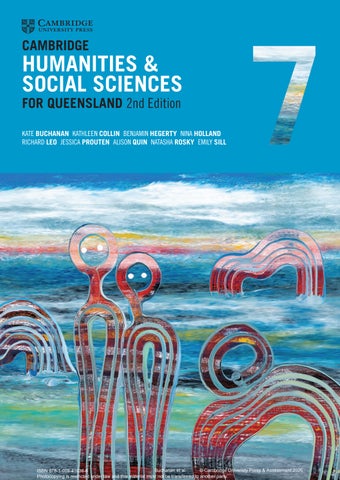
This publication is in copyright. Subject to statutory exception and to the provisions of relevant collective licensing agreements, no reproduction of any part may take place without the written permission of Cambridge University Press & Assessment. First published 2021 Second edition 2023 20 19 18 17 16 15 14 13 12 11 10 9 8 7 6 5 4 3 2 Cover and text designed by Matthias Lanz Cover artwork by Fiona Omeenyo Typeset by QBS Learning Printed in India by Multivista Global Pvt Ltd.
A catalogue record for this book is available from the National Library of Australia at www.nla.gov.au ISBN 978-1-009-41036-6 Paperback
Additional resources for this publication at www.cambridge.edu.au/go Reproduction and Communication for educational purposes
The Australian Copyright Act 1968 (the Act) allows a maximum of one chapter or 10% of the pages of this publication, whichever is the greater, to be reproduced and/or communicated by any educational institution for its educational purposes provided that the educational institution (or the body that administers it) has given a remuneration notice to Copyright Agency Limited (CAL) under the Act. For details of the CAL licence for educational institutions contact: Copyright Agency Limited Level 12, 66 Goulburn Street Sydney NSW 2000 Telephone: (02) 9394 7600 Facsimile: (02) 9394 7601 Email: memberservices@copyright.com.au
Reproduction and Communication for other purposes
Except as permitted under the Act (for example a fair dealing for the purposes of study, research, criticism or review) no part of this publication may be reproduced, stored in a retrieval system, communicated or transmitted in any form or by any means without prior written permission. All inquiries should be made to the publisher at the address above. Cambridge University Press & Assessment has no responsibility for the persistence or accuracy of URLs for external or third-party internet websites referred to in this publication and does not guarantee that any content on such websites is, or will remain, accurate or appropriate. Information regarding prices, travel timetables and other factual information given in this work is correct at the time of first printing but Cambridge University Press & Assessment does not guarantee the accuracy of such information thereafter.
Please be aware that this publication may contain images of Aboriginal and Torres Strait Islander people who are now deceased. Several variations of Aboriginal and Torres Strait Islander terms and spellings may also appear; no disrespect is intended. Please note that the terms “Indigenous Australians” and “Aboriginal and Torres Strait Islander Peoples” may be used interchangeably in this publication.
Cambridge University Press & Assessment acknowledges the Aboriginal and Torres Strait Islander Peoples of this nation. We acknowledge the traditional custodians of the lands on which our company is located and where we conduct our business. We pay our respects to ancestors and Elders, past and present. Cambridge University Press & Assessment is committed to honouring Aboriginal and Torres Strait Islander Peoples’ unique cultural and spiritual relationships to the land, waters and seas and their rich contribution to society.
Buchanan et al © Cambridge University Press & Assessment 2026 ISBN 978-1-009-41036-6 Photocopying is restricted under law and this material must not be transferred to another party.
Contents
Introduction
VI
About the authors and contributors
VII
How to use this resource
XI
Cognitive verbs glossary
XIV
PART 1: History UNIT 1: Deep time history of Australia CHAPTER 1: How have First Peoples sustained a regenerative relationship with the Australian continent through deep time?
1
Setting the scene: people and place Chapter overview Timeline of key events 1.1 How did the First Peoples come to the Australian continent? 1.2 How have the First Peoples interacted with the Australian continent through deep time? 1.3 What technological achievements have First Peoples developed? 1.4 What are respectful ways for historians to work with First Peoples’ cultural heritage? Conclusion: end-of-chapter reflection End-of-chapter assessment
UNIT 2: The ancient world CHAPTER 2: Ancient Egypt: what made ancient Egypt a
successful civilisation?
Setting the scene: a history mystery – how did King Tutankhamun die? Chapter overview Timeline of key events 2.1 What are the different methods and sources of evidence used by historians and archaeologists to investigate ancient Egypt? 2.2 How did ancient Egypt’s physical features influence its success? 2.3 How important was the role of the pharaoh to ancient Egypt’s success? 2.4 What was life like for key groups in ancient Egypt and how did they contribute to its success? 2.5 What role did religious beliefs, values and practices play in ancient Egypt’s success? 2.6 How did ancient Egypt benefit from contact and conflict with other societies? 2.7 What role did individuals, such as Hatshepsut, play in making ancient Egypt successful? Conclusion: end-of-chapter reflection End-of-chapter assessment
6 8 8 10 12 14 36 50 67 74 75
76 78 78 82 84 86 89 97 103 110 119 124 129 130
Buchanan et al © Cambridge University Press & iii Assessment 2026 ISBN 978-1-009-41036-6 Photocopying is restricted under law and this material must not be transferred to another party.
HUMANITIES & SOCIAL SCIENCES FOR QUEENSLAND 2ND EDITION
CHAPTER 3: Ancient Rome: what made ancient Rome a successful civilisation?
132
Setting the scene: Pompeii – a historical time capsule 132 Chapter overview 138 Timeline of key events 140 3.1 What are the different methods and sources of evidence used by historians and archaeologists to investigate ancient Rome? 142 3.2 How did ancient Rome’s location and physical features influence its success? 145 3.3 What was life like for different social classes in ancient Rome and how did they contribute to its success? 150 3.4 What was life like for women in ancient Rome and how did they contribute to its success? 155 3.5 What was life like for slaves in ancient Rome and how did they contribute to its success? 159 3.6 What role did religious beliefs, values and practices play in ancient Rome’s success? 165 3.7 How did ancient Rome benefit from contact and conflict with other societies? 169 3.8 What role did individuals, such as Julius Caesar, play in making ancient Rome successful? 176 Conclusion: end-of-chapter reflection 181 End-of-chapter assessment 182
CHAPTER 4: Ancient China: what made ancient China a successful civilisation?
184
Setting the scene: the legacies of ancient China 184 Chapter overview 187 Timeline of key events 188 4.1 What are the different methods and sources of evidence used by historians and archaeologists to investigate ancient China? 192 4.2 How did ancient China’s physical environment and physical features influence its success? 198 4.3 How was ancient China organised and how did this contribute to its success? 200 4.4 What key beliefs, values and practices emerged in ancient China and how did they influence its success? 205 4.5 How did ancient China benefit from contact and conflict with other societies in this period? 213 4.6 What role did individuals, such as Qin Shi Huangdi and Fu Hao, play in making ancient China successful? 216 Conclusion: end-of-chapter reflection 225 End-of-chapter assessment 226
PART 2: Geography UNIT 1: Water in the world CHAPTER 5: Water in the world Setting the scene: water – an essential part of human existence Chapter overview 5.1 How is water used as an environmental resource and how does it connect and change places? 5.2 The location and distribution of water resources in Australia 5.3 The economic, cultural, spiritual and aesthetic value of water for people 5.4 Hydrological hazards: floods End-of-chapter assessment
229 234 238 238 240 241 256 270 276 298
Buchanan et al © Cambridge University Press & Assessment 2026 ISBN 978-1-009-41036-6 iv Photocopying is restricted under law and this material must not be transferred to another party.
CONTENTS
UNIT 2: Place and liveability CHAPTER 6: Place and liveability
300 304
Setting the scene: Canberra – a planned city 304 Chapter overview 307 6.1 Why do people choose to live where they do? 308 6.2 How does the location and distribution of services and facilities affect liveability? 320 6.3 How does culture and connection impact perceptions of place and a sense of belonging? 333 6.4 How do design strategies enhance the liveability of a place? 339 End-of-chapter assessment 344
PART 3: Economics and Business UNIT 1: Economic relationships, influences and choices CHAPTER 7: Economic influences and future planning Setting the scene: panic-buying in Queensland Chapter overview 7.1 Consumers and producers: the fundamentals of economics 7.2 The reasons businesses exist: the relationship between consumers and producers 7.3 How do consumers and producers influence the market, and what is opportunity cost? 7.4 Consumer and financial products and services: the importance of financial planning for consumers and businesses 7.5 Managing finances and financial planning End-of-chapter assessment
CHAPTER 8: Workplace evolution Setting the scene: entering a new world of working remotely Chapter overview 8.1 Entering the world of work 8.2 Being entrepreneurial End-of-chapter assessment
PART 4: Civics and Citizenship CHAPTER 9: Government and democracy, Laws and citizens, Diversity and identity Setting the scene: the Magna Carta Chapter overview 9.1 The key features of Australia’s system of government and the characteristics of our democracy 9.2 The key principles and features of the Australian legal system 9.3 Australia’s diverse cultural origins and social cohesion End-of-chapter assessment
347 350 352 352 353 354 356 360 364 368 374
376 376 377 378 383 389
391 394 394 395 396 403 405 410
Glossary 411 Permissions acknowledgements
421
Buchanan et al © Cambridge University Press & Assessment 2026 ISBN 978-1-009-41036-6 v Photocopying is restricted under law and this material must not be transferred to another party.
Introduction
The Humanities subjects teach us about people – their conflicts and common ground. Allowing us to explore what has changed and what has stayed the same – across space, time, and cultures. Additionally, these disciplines inspire us to consider how we might respond in a world that is facing the challenges of climate change, pandemics, military tension, and economic uncertainty. We have much to learn about resilience from the world’s most ancient cultures – Australia’s First Nations peoples. I acknowledge the Turrbal and Yuggerah peoples on whose land I wrote my contributions to this text and extend that respect to the traditional owners of the lands on which you live and learn. We also acknowledge the elders past, present and emerging who have taught and continue to teach us about the history of this country, its geography, the economy and the richness that diversity, inclusion and equity can bring to our experience as citizens. It is fitting that this text opens with a study of the Deep time history of Australia. While you are a year 7 student today, you are also a future solution seeker. The skills you learn in your Humanities classroom this year will ensure that you are able to understand and tackle complex problems, communicate ideas clearly, adapt to change, be creative and think critically. This text has deliberately taken an inquiry approach – where open ended questions are posed to challenge you to seek your own answers and understanding. You will also have opportunities to collaborate with your peers, as you learn through thinking routines, developing an independent, analytical and empathetic mind. The Australian Curriculum Humanities and Social Sciences learning area has as one of its aims “to ensure that students develop a sense of wonder, curiosity and respect about places, people cultures and systems throughout the world, past and present, and an interest in and enjoyment in the study of these phenomena”. Year 7 Humanities will introduce you to the wonders of the ancient world and the life-giving resource of water. It will develop your understanding of what makes a place liveable and will deepen your understanding of laws, democracy and the economy. Most of all we hope that as you use this text you will have fun and develop a love of learning about our past, places, people and our planet. - Kathleen Collin, series author Buchanan et al © Cambridge University Press & Assessment 2026 ISBN 978-1-009-41036-6 vi Photocopying is restricted under law and this material must not be transferred to another party.
About the authors and contributors
Kate Buchanan (lead author: Geography) is a Geography and Humanities teacher at her current school. She has worked in Queensland schools for six years and has experience teaching Geography, History and Religion across Years 7–12. Prior to teaching, Kate was an urban planner and demographer. She has experience as a QCAA endorser and confirmer for Geography and as a committee member of the GTAQ. Kate is passionate about the importance of Geography as a discipline to help students understand the world and their place in it. Kathleen Collin (contributing author: History) has over 25 years of History teaching experience at Independent and Catholic high schools in New South Wales and Queensland. She has held a range of roles, including Head of Faculty, Dean of Curriculum, Director of Learning and Teaching and Head of Secondary. She was a member of the writing team for the NSW Ancient History HSC Examination and an Assessor for the NSW HSC Extension History paper, and is a confirmer and external marker in Senior History for the QCE. Kathleen is now the Assistant Principal – Strategy and School Operations at her current school. She is also an executive member of the Queensland History Teachers’ Association. Kathleen has always had a love of History that she gained from her father and grandfather, who inspired her passion for politics and the past. It has been a delight for her to be able to nurture her three children and numerous students’ interest in the discipline as well. Benjamin Hegerty (lead author: History) is a History teacher and Head of Humanities and Social Sciences at his current school in Brisbane. He is an executive member and past Vice-President of the Queensland History Teachers’ Association and has contributed to the QCAA in various roles, as the Brisbane Central District Review Panel Chair for Ancient History, QCAA Subject Matter Expert for Ancient History, Lead Endorser and Lead Confirmer. Ben was involved as a contributing author for the Cambridge University Press textbook Senior Ancient History for Queensland and completed his Master of History through Buchanan et al © Cambridge University Press &vii Assessment 2026 ISBN 978-1-009-41036-6 Photocopying is restricted under law and this material must not be transferred to another party.
HUMANITIES & SOCIAL SCIENCES FOR QUEENSLAND 2ND EDITION
the University of New England. He has presented multiple workshops and seminars on History pedagogy at state and national education conferences. Nina Holland (contributing author: Geography) has been a high school teacher since 2003, teaching humanities subjects of Senior Geography and junior Humanities. Within this job, Nina has also created opportunities for teachers to network and share their knowledge through the development of the ‘Gold Coast GeoNet’. Developing from that, Nina joined with Bond University from 2009 to 2013 to organise and run a yearly conference for Geography teachers. Nina is currently an Experience Senior Teacher with Education QLD and part of the GTAQ committed to Building Geography in Queensland as she is passionate about sharing more geography with more teachers. Richard Leo (contributing author: History) is a highly experienced educator in History and Geography with over 20 years of experience in both the higher education and secondary school sectors having taught in schools across both South Australia and Queensland. He has published several articles and peer-reviewed book chapters. Richard has lectured in both Education and History at CHC in Brisbane and also acts as an Education Advisor, specialising in intercultural and interfaith pedagogies, for Together for Humanity, an inclusive educational organisation that works with school communities to foster intercultural understanding. Jessica Prouten (contributing author: Economics and Business, and Civics and Citizenship) has been teaching in Queensland schools for over 15 years, teaching across a range of curriculum areas from History to English, Business, Geography and Legal Studies. She has also been involved in designing ACARA-based programs stretching business down to the primary years. Jessica is currently a Head of Department on the Gold Coast and has been involved in the implementation of the new QCE.
Buchanan et al © Cambridge University Press & Assessment 2026 ISBN 978-1-009-41036-6 viii Photocopying is restricted under law and this material must not be transferred to another party.
ABOUT THE AUTHORS
Alison Quin (contributing author: History and First Nations Advisor for the series) is descended from the Tagalak people of the Gulf Country of far north Queensland. Alison has worked in First Nations education through her career, starting as a high school teacher and moving into community-led education initiatives. Her vision is for all students in Australia to learn about and through the two knowledge traditions of this continent – First Nations and Anglo-Australian – to create a future that respects and empowers this country and its many peoples. Natasha Rosky (contributing author: History) is a seasoned educator with over 20 years of experience teaching history in Australia and abroad. As a Head of the Faculty of Humanities and Social Sciences, Natasha is committed to instilling in her students a passion for history and the humanities. She is a skilled designer of inquiry-based assessments that effectively link theory and practice, and she has developed numerous resources to support students. Natasha is a reputable assessor and member of the Queensland History Teachers Association. In addition to her teaching career, she is currently pursuing a Doctor of Education at QUT, with a focus on Consent Education. Emily Sill (contributing author: Economics and Business, and Civics and Citizenship) is a Head of Faculty in Business and Technology at a Catholic school in Brisbane. She actively supports business education in Queensland and has taught Business, Economics and Mathematics for over a decade. Emily has developed resources to support students in Senior Business, is an experienced assessor, and is a member of the Business Educator’s Association of Queensland’s executive team. Emily enjoys designing classroom resources drawn from recent events, effectively linking theory and practice for students. Before teaching, Emily worked extensively in Marketing and HR.
About the illustrator Jean-Michel Girard is an illustrator based in Québec City, Canada, who has 30 years’ professional experience working around the world. While Jean-Michel is able to work in a wide variety of styles (from hyperrealism to cartoon), he has specialised in historical illustrations as he is a longtime history aficionado. His attention to historical detail is extraordinary. Jean-Michel uses digital tools but with traditional drawing methods. Buchanan et al © Cambridge University Press & ix Assessment 2026 ISBN 978-1-009-41036-6 Photocopying is restricted under law and this material must not be transferred to another party.
HUMANITIES & SOCIAL SCIENCES FOR QUEENSLAND 2ND EDITION
About the cover artist Fiona Omeenyo first appeared on the contemporary art scene in the late 1990s as one of the more prominent members of the newly established far north Queensland’s renowned Lockhart River ‘Art Gang’. Source: Photo by Mick Richards
‘My country Pathacy (Chester River near Coen) that’s where my Grandmother is from. My figures are about family and country. I do my painting to carry my culture on and so my children will know our stories.’ The artist’s figurative compositions connect ancestral spirits with her kin relationships. For the artist, ancestors exist simultaneously with the present-day generation. Accordingly, her themes constantly revolve around bloodline and connectivity. A continuous relationship with past and present is expressed through the artist’s sense of line and space (both positive and negative).
About the cover
Fiona Omeenyo Day on the beach Acrylic on canvas, 72 × 102 cm This painting by Fiona Omeenyo is called Day on the beach (2018). This is a representation of the connection to a specific place, here the natural environment of Lockhart River – in particular Double Stone at Quintell Beach. This is particularly explored in the Geography subject within the Humanities and Social Sciences for Queensland series.
Publisher acknowledgements The Publisher and Authors would like to thank Vince Wall and Brett Dascombe for their valuable contributions to the first edition of this text. Buchanan et al © Cambridge University Press & Assessment 2026 ISBN 978-1-009-41036-6 x Photocopying is restricted under law and this material must not be transferred to another party.
How to use this resource
Book structure
• All chapters have been closely aligned to the Australian Curriculum
V.9.0 for Humanities and Social Sciences for Year 7. • This book contains four parts, with each part covering one of the four topic areas: History, Geography, Economics and Business, and Civics and Citizenship. • Every chapter starts with an engaging ‘Setting the scene’ story to help you jump into a new topic, and includes an activity that can be used to spark classroom discussion. • Each chapter has a ‘Chapter overview’ that lists ‘Learning goals’ for the chapter. • Each chapter is divided into numbered sections, and each of these sections covers content descriptors from the Australian Curriculum. • Each chapter section starts with ‘Focus questions’ to drive your inquiries into the Humanities. • In History, following the inquiry approach, each chapter is constructed around an over arching key inquiry question and several sub-inquiry questions. The inquiry questions are colour-coded to help students recognise their features:
• An interrogative • A historical concept • Specific content • Scope and scale.
• In all chapters QR codes are included for easy access to related videos. • At the end of each section are Developing your understanding questions. The History chapters also have Reflecting on your learning questions. At the end of each chapter are End-of-chapter assessment activities.
Buchanan et al © Cambridge University Press & xi Assessment 2026 ISBN 978-1-009-41036-6 Photocopying is restricted under law and this material must not be transferred to another party.
HUMANITIES & SOCIAL SCIENCES FOR QUEENSLAND 2ND EDITION
Activity types This series uses a range of activity types, including the following:
• Developing concepts and skills (activities that scaffold important
concepts and skills from the Australian Curriculum) • Reflecting on your learning and Developing your understanding review questions at the end of each section (questions in both print and digital formats) • Multiple other activity types, particularly in End-of-chapter activities, that vary from analysing historical visual sources to graph interpretation and map-reading.
Activities cover a range of different learning types and levels.
Making Thinking Visible activities In this series, one of the common activity types we have employed is called Making Thinking Visible. These activities are inspired by the Visible Thinking routines devised by Harvard University’s Project Zero group. Visible Thinking routines are engaging classroom activities which challenge students to reflect on, and articulate, their thinking about a prompt or stimulus material. By using the same routines (such as ‘See, Think, Wonder’), students develop familiarity and confidence with the rules of the activity. For more information, teachers can visit the Online Teaching Suite or the Project Zero website at https://pz.harvard.edu/ thinking-routines.
ACTIVITY 2.23 MAKING THINKING VISIBLE
Think, pair, share 1 Think: Take a minute to consider the following question: ‘Was life in ancient Egypt fair for
all groups?’ 2 Pair: Turn to a neighbour and discuss your responses to the question. Take turns to speak, listen carefully and ask questions of one another. 3 Share: Share your ideas as a whole class to create a list of ideas to respond to this question.
Buchanan et al © Cambridge University Press & Assessment 2026 ISBN 978-1-009-41036-6 xii Photocopying is restricted under law and this material must not be transferred to another party.
HOW TO USE THIS RESOURCE
Digital resources This series uses the interactive Edjin platform, and includes both a student and a teacher edition. In the Interactive Textbook version of this book, students will find the following key resources:
• Images that can be zoomed in on (this is really useful for reviewing any
images to analyse at a larger size) • Interactive Chapter quizzes and Scorcher quizzes (timed, competitive and fun tests of knowledge) • Videos, image galleries and other multimedia materials, such as zoomable maps • Additional geographic tools, such as a guide to using topographic maps and a series of skills videos • Downloadable worksheets for all activities • Suggested solutions • Additional content to the print book • A PDF downloadable version of this student textbook.
In the Online Teaching Suite, teachers will find:
• Guidance on using the digital versions of the book • Teaching programs and teaching tips • Curriculum grids for each topic area • Additional activity worksheets. Icons This icon in the margin of the page represents additional material is in the Interactive Textbook. This brain icon with bracketed text indicates a Deeper thinking question, or questions, to help you dive deeper into an idea within the History chapters.
Buchanan et al © Cambridge University Press & Assessment 2026 ISBN 978-1-009-41036-6 xiii Photocopying is restricted under law and this material must not be transferred to another party.
Cognitive verbs glossary
Knowledge utilisation Conduct direct an action or course
Discuss examine by argument; sift the considerations for and against; debate; talk or write about a topic, including a range of arguments, factors or hypotheses
Create produce or evolve from your own thought or imagination; reorganise or put elements together into a new pattern or structure or to form a coherent or functional whole
Distinguish recognise as distinct or different; note points of difference between; discriminate; discern; make clear a difference/s between two or more concepts or items
Decide examine alternatives to choose an option; reach a resolution as a result of consideration
Examine determine the nature or condition of something
Determine demonstrates understanding of knowledge using varying levels of skills; establish, conclude or ascertain after consideration, observation, investigation or calculation; decide or come to a resolution
Generalise to make a statement that relates to many people, things, or conditions, based on limited facts Infer reach a conclusion on the basis of evidence or reasoning Interpret explain the meaning of information or actions
Evaluate make an appraisal by weighing up or assessing strengths, implications and limitations; make judgments about ideas, works, solutions or methods in relation to selected criteria; examine and determine the merit, value or significance of something, based on criteria
Judge form an opinion or conclusion about; apply both procedural and deliberative operations to make a determination
Generate produce; create; bring into existence
Comprehension
Investigate carry out an examination or formal inquiry in order to establish or obtain facts and reach new conclusions; search, inquire into, interpret and draw conclusions about data and information Justify give reasons or evidence to support an answer, response or conclusion; show or prove how an argument, statement or conclusion is right or reasonable Predict give an expected result of an upcoming action or event; suggest what may happen based on available information Propose put forward a point of view (or an idea, an argument or a suggestion), for consideration or action Research study in detail, especially in order to discover new information or reach a new understanding Synthesise combine different parts or elements (such as information, ideas or components) into a whole, in order to create new understanding
Analysis Analyse consider in detail, for the purpose of finding meaning or relationships, and identifying patterns, similarities and differences Apply use or employ in a particular situation Compare estimate, measure or note how things are similar or dissimilar Consider think deliberately or carefully about something, typically before making a decision; take something into account when making a judgment; view attentively or scrutinise; reflect on
Reflect on think about deeply and carefully Suggest communicate or show an idea to consider
Communicate convey knowledge and/or understandings to others; make known; transmit Describe give an account of characteristics or features Explain provide additional information that demonstrates understanding of reasoning and/or application Illustrate show the meaning or truth of something more clearly, especially by giving examples Organise arrange, order; form as or into a whole consisting of interdependent or coordinated parts, especially for harmonious or united action Represent use words, images, symbols or signs to convey meaning Sequence place in a continuous or connected series; arrange in a particular order
Retrieval Demonstrate prove or make clear by argument, reasoning or evidence, illustrating with practical example; show by example; give a practical exhibition Identify establish or indicate who or what someone or something is Recognise identify or recall particular features of information from knowledge; identify that an item, characteristic or quality exists; perceive as existing or true; be aware of or acknowledge Select make a choice between options Use operate or put into effect; apply knowledge or rules to put theory into practice
Buchanan et al © Cambridge University Press & Assessment 2026 ISBN 978-1-009-41036-6 xiv Photocopying is restricted under law and this material must not be transferred to another party.
PART
1
History
Buchanan et al © Cambridge University Press & Assessment 2026 ISBN 978-1-009-41036-6 Photocopying is restricted under law and this material must not be transferred to another party.
What is History? People have always been interested in who they are and where they come from. They have often asked questions about themselves, such as ‘What happened?’, ‘Why did it happen?’ and ‘How did it happen?’ These questions, in some cultures, have led to the study of a field of knowledge called ‘history’. The word ‘history’ comes from the ancient Greek language and means ‘to inquire’ or to seek to know. The person often referred to as the first historian was an ancient Greek man called Herodotus. Herodotus and other early historians used memories and records of past events to make sense of their world. By learning about the history of our world, we too can use what we learn about the past to help us understand our moment in time and to plan for the future.
▲ Source A Uncovering evidence of the past: an archaeologist excavates ancient human remains at an archaeological site. Archaeology is the study of the buildings, graves, tools and other objects that belonged to people who lived in the past, in order to learn about their culture and society – a process you will learn about in the chapters that follow.
2
Buchanan et al © Cambridge University Press & Assessment 2026 ISBN 978-1-009-41036-6 Photocopying is restricted under law and this material must not be transferred to another party.
The ancient Greeks understood time as linear – that is, like a line joining the past, present and future in order. This is called chronological order. Historians often show this understanding of time passing through a diagram known as a timeline. Determining chronological order and creating and interpreting timelines are some of the skills you will develop in the following chapters. However, not all cultures understand time as a line. For example, Aboriginal and Torres Strait Islander peoples bring past, present and future together through connections to place. We apply different ways of knowing when we learn about different past peoples who understand the world in a different way. The skills and knowledge that you gain in history will give you a new understanding and appreciation of the world today. Through your studies of history, you will learn how to find and understand historical sources. You will learn to think creatively and critically about information that you study. Finally, you will come to your own conclusions about historical issues based on the evidence available. Using historical sources People can have quite different perspectives of the same events, so when historians are devising answers about what happened in the past, they need to base their proposed answers on evidence. A primary source is made at the time of what is being studied, while a secondary source is a later description or interpretation. Historians need to think carefully about whether a source is primary or secondary and the limits of what a source can tell us about the past. Historians often work with artefacts, objects from the past time being studied. Oral histories are the spoken or performed knowledge of the past that has been systematically passed down through generations of people. THINKING DEEPER
chronological order the method of arranging events in the order in which they occurred, from earliest to latest timeline a graphical representation of the passing of time, usually arranged by periods, and on which important events are marked in chronological order perspective the way we see something, a point of view or attitude to something primary source a source of information about the past created in the time being studied secondary source a source of information about the past created after the time being studied artefact an object that is made by a person, such as a tool or a decoration; it is usually of historical interest oral history the recording of past events in a spoken form, including through song, story or dance
If a historian 100 years from now tried to write a history of what your school was like while you were a student there, what might be some primary sources they could use? Can you think of any possible issues with the accuracy of their interpretations of these sources?
Buchanan et al © Cambridge University Press & Assessment 2026 ISBN 978-1-009-41036-6 Photocopying is restricted under law and this material must not be transferred to another party.
3
analyse consider in detail for the purpose of finding meaning or relationships, and identifying patterns, similarities and differences evaluate examining and judging the merit or significance of something origin analysis of a source to establish who created the source as well as where and when it was produced context the analysis of sources to understand the nature of society and the historical period in which the source is created, the significant event/s related to the source, and the language and ideas of the time purpose analysis of a source to establish the original reason for its creation accuracy the analysis of a source to establish correctness by identifying purpose, corroborating the information with another source and assessing bias usefulness the analysis of a source to determine how relevant it is in relation to historical questions
What type of source is this? Who wrote or produced this? Origin
What is it useful for? Usefulness
Is it supported by information in other sources? Accuracy
Questions to ask when using historical sources
Where and when was it produced? Origin
What was happening at the time it was produced? Context
Is the information factual, or an opinion? Accuracy What does it show about the past? Content
When and why was it created? Purpose
▲ Source B Questions to ask when using historical sources. Depending on the source, some of these questions may not always be relevant or easy to answer.
As a historian, you will need to analyse and evaluate evidence from primary and secondary sources to be able to form your own opinions about the lives of people in the past. As you will learn, the key concepts to consider when working with historical sources are the origin, context, purpose, accuracy and usefulness of sources. Source B shows some of the questions you could consider when analysing and evaluating information from the sources you encounter in the following chapters.
Introducing historical concepts and skills Historical concepts and skills help to guide the way you question and think about an issue. The six concepts from the Australian Curriculum: History V9.0 that are used in the following chapters on History are: evidence, perspectives, interpretations and contestability, continuity and change, cause and effect and significance. We will also have a special emphasis in this book on the development of empathy – an important part of trying to understand the lives of people who came before us. As you work through the History chapters, you will come across these seven historical concepts, and will learn more about them.
4
Buchanan et al © Cambridge University Press & Assessment 2026 ISBN 978-1-009-41036-6 Photocopying is restricted under law and this material must not be transferred to another party.
History concepts The information obtained from interpreting and analysing primary and secondary sources that can be used to support, revise or challenge a particular historical explanation, interpretation or argument.
The ability to share someone else’s feelings or experiences by imagining what it would be like to be in that person’s situation through a historical inquiry.
Importance is assigned to an issue, event, development, person, group, place, society, process, interaction or system over time and place. The importance is determined by the prominence of the event, development or issue at the time, its scope and depth, its long-term consequences and its ability to explain issues in the present.
Cause and effect includes the long- and short-term causes, and the intended and unintended consequences of an event, decision, process, interaction or development.
Empathy
Evidence
Sig
nifi can
ce Perspectives
ct
e us
d
an
fe ef
Ca
Interpretations and contestability
Continuity and change
Aspects of society, such as institutions, ideas, values and problems, remain the same and/or change over certain periods of time (some point in the past and the present) or in the past (two points in the past).
Historical perspectives are the positions from which people view events, developments and issues, and explain why people and groups at certain times have particular points of view. These views are shaped by people’s beliefs, values, culture, gender, age, location and experiences. Explanations of the past about specific people, groups, events or developments use evidence from historical sources. Contestability occurs when particular interpretations about the past are open to debate; for example, as a result of a lack of evidence, the discovery of new evidence, or different perspectives of historians, public commentators or groups.
▲ Source C Adapted from ACARA, ‘Understand this learning area: History 7–10’, Australian Curriculum: History V9.0
Buchanan et al © Cambridge University Press & Assessment 2026 ISBN 978-1-009-41036-6 Photocopying is restricted under law and this material must not be transferred to another party.
5
UNIT
1 Deep time history of Australia
▲ Source D A Bininj knowledge site in western Arnhem Land. Historians have used scientific techniques to date the site to around 20 000 years old. Buchanan et al © Cambridge University Press & Assessment 2026 ISBN 978-1-009-41036-6 Photocopying is restricted under law and this material must not be transferred to another party.
Overview In this topic, you will explore the 65 000 years or more of human history on the continent now called Australia. We will learn about the people who lived here through deep time history, and how those past times connect to the many vibrant First Peoples and cultures of today. We will explore the beliefs, values and practices that contribute to sustaining relationships between First Peoples and Country.
Studying Aboriginal and Torres Strait Islander history means studying both an ancient and a contemporary society. This chapter brings together Aboriginal and Torres Strait Islander ways of knowing about the past as well as historians’ ways of knowing about the past. It shares some of the First Peoples’ stories of what has come before now. Through this chapter, you will develop skills to respectfully engage with First Peoples’ cultural heritage. While learning about First Peoples through deep time history, you will develop an understanding of how historians and archaeologists investigate history, including the range of sources that can be used. This chapter utilises oral histories and archaeological evidence.
Learning goals After completing this unit, you should be able to answer these questions: • How do we investigate the deep time history of Australia using historical concepts and skills? • Why and where did the earliest human societies develop? • How did people migrate to and around the Australian continent? • What emerged as defining characteristics of First Peoples’ societies?
Protocols
For many First Peoples, people who have passed away need to be treated with respect and their image or name should be avoided. Aboriginal and Torres Strait Islander peoples should be aware that this chapter may contain images, names and links to footage of people who have passed away. Aboriginal and Torres Strait Islander students and teachers learning from this chapter can apply their own cultural protocols for working with references to people and objects from the past. Aboriginal and Torres Strait Islander peoples are contemporary peoples who have the longest continuing cultures on Earth. There are more than 260 distinct First Peoples. Each has its own languages, cultures, knowledge systems and histories. In studying this living culture, we respect diversity and apply integrity by identifying the clan, nation, language group and/or place that historical particular knowledge comes from. significance The term ‘First Peoples’ will be used to refer to the people of the past and the people of the present to convey continuity. Terms such as ‘Europeans’, ‘settlers’ and ‘settler-colonisers’ are used to describe arrivals since 1788.
relating to the long‑term importance of an event, this is a term people today apply to things that happened in the past
Through the deep time history that this chapter is focused on, this continent was not called Australia. First Peoples focused on Country rather than the entire continent. However, in this text, the continent will be called Australia for easier reading.
settlers people who move to a new place and establish a permanent society
Wherever possible, offensive terms have been avoided; however, we have opted to retain offensive terms in original sources as these are of historical significance.
First Peoples and history Until very recently, the First Peoples were not able to contribute to histories written about Australia. The discipline of ‘history’ came to this continent with the First Fleet. When settlers wrote their versions of the history of Australia, it began in 1788 and was about the activities of settlers from their perspectives.
perspective the way we see something, a point of view or attitude to something
This means that there is a need to deliberately include First Peoples’ activities and perspectives in history. This chapter recognises that the First Peoples and settler historians have different ways of knowing the continent now known as Australia, and different ways of knowing the history of this place. As you go through this chapter, you will develop your skills to think about the different perspectives that are found when you study the past and how to work with these in respectful ways. Buchanan et al © Cambridge University Press & Assessment 2026 ISBN 978-1-009-41036-6 Photocopying is restricted under law and this material must not be transferred to another party.
7
CHAPTER 1: How have
First Peoples sustained a regenerative relationship with the Australian continent through deep time? Setting the scene: people and place Acknowledgement of Country Munyara yunda! Hello, my name is Ada. I acknowledge all the First Peoples and their Countries that we are living and learning on. I pay my respects to the Elders, past and present.
8
Buchanan et al © Cambridge University Press & Assessment 2026 ISBN 978-1-009-41036-6 Photocopying is restricted under law and this material must not be transferred to another party.
This is a photo of Tagalaka Country, the home of my ancestors. Tagalaka people have lived here and looked after this Country since the beginning. Tagalaka people belong to this Country. Those hills are the Brolga Dreaming. People used to travel long distances and come from all around to have a big ceremony here. There's a cattle station here now but it is still the Brolga place, and it always will be. This Country tells us about Brolgas. People can read Country, just like a book. Different places have different knowledge stories and you have to find the right people who can tell you about that Country or that place. In this chapter, First Peoples and scientists tell us about the long time that First Peoples have been on this continent and the ways First Peoples live here. They also share their different understandings of time and history so we can learn to be respectful historians. – Ada
▲ Source 1.1 An image of Tagalaka Country from the air
Tagalaka a First People from the Gulf Savannah region of north Queensland Country ancestral lands and waters that people are custodians for ancestors those who have come before in a family or kinship line Dreaming a spiritual concept of knowledge and lore, often specific to a place or being
ACTIVITY 1.1 1 Find Tagalaka Country on the AIATSIS map of Indigenous Australia. Hint: it is in Queensland,
halfway between Cairns and Normanton. It is spelled ‘Takalak’. You can use the following link to help you: https://cambridge.edu.au/redirect/10083. 2 Use the AIATSIS map and your teacher's guidance to determine the First People's Country your school is on. 3 Brainstorm what you know about the history of your area, going back in time as far as you can.
Buchanan et al © Cambridge University Press & Assessment 2026 ISBN 978-1-009-41036-6 Photocopying is restricted under law and this material must not be transferred to another party.
9
Chapter overview Key inquiry question ‘How have First Peoples sustained a regenerative relationship with the Australian continent through deep time?’ Every key inquiry question should have: • An open interrogative • A historical concept • Specific content • Scope and scale.
regenerative relationship a reciprocal and respectful relationship between First Peoples and the natural environment that sustains the health and wellbeing of both
So, let’s dissect this key inquiry question: ‘How have First Peoples sustained a regenerative relationship with the Australian continent through deep time?’ To answer a key inquiry question in a historical investigation, it is helpful to break the question into subinquiry questions.
Sub-inquiry questions After completing this chapter, you should be able to answer these sub-inquiry questions: • How did the First Peoples come to the Australian continent? • How have the First Peoples interacted with the Australian continent through deep time? • What technological achievements have First Peoples developed? • What are respectful ways for historians to work with First Peoples’ cultural heritage?
Historical skills After completing this chapter, you should be able to: • Develop historical questions about the past to inform historical inquiry • Locate and identify primary and secondary sources to use in historical inquiry • Identify the origin, content, context and purpose of primary and secondary sources • Identify and describe the accuracy and usefulness of primary and secondary sources as evidence • Describe causes and effects and explain continuities and changes • Identify perspectives, attitudes and values of the past in sources • Explain historical interpretations about significant events, individuals and groups • Create descriptions, explanations and historical arguments, using historical knowledge, concepts and terms that reference evidence from sources.
▶ Source 1.2 Fossilised human footprints discovered in the Willandra Lakes Region, a World Heritage site, in New South Wales. These prints were made 19 000 to 23 000 years ago. 10
Buchanan et al © Cambridge University Press & Assessment 2026 ISBN 978-1-009-41036-6 Photocopying is restricted under law and this material must not be transferred to another party.
Buchanan et al © Cambridge University Press & Assessment 2026 ISBN 978-1-009-41036-6 Photocopying is restricted under law and this material must not be transferred to another party.
11
Timeline of key events
▶ Researcher Elspeth Hayes with Mark Djandjomerr and traditional owner May Nango extracting comparative samples at a cave adjacent to Madjedbebe, an ancient site in Arnhem Land, Northern Territory. Credit: David Vadiveloo / Gundjeihmi Aboriginal Corporation ▲ Remains of Lake Mungo
65 000 bp Earliest archaeological evidence of the First Peoples dates from this time; the artefacts are from Madjedbebe in the Northern Territory.
40 000 bp Mungo Lady and Mungo Man lived at this time in the lands of the Paakantji, Ngyiampaa and Mutthi Mutthi peoples, which are a part of what is now known as the Willandra Lakes Region, a World Heritage area of New South Wales
50 000–25 000 bp Evidence of megafauna living in Australia at this time has been found in many locations in Queensland. Megafauna existed alongside the First Peoples.
20 000 bp Peak of the Ice Age; the climate was dry and there was little rain, which made the deserts of Australia much larger. Australia is joined to nearby land masses (New Guinea and Tasmania) by ‘land bridges’. However, archaeologists believe water crossing by boats or rafts was always necessary to reach mainland Australia.
20 000 bp First Peoples live through the coldest parts of the Ice Age in places like Kutikina Cave in Tasmania, which is occupied between 20 000 bp and 13 000 bp
▲ A representation of Diprotodon optatum, the largest known marsupial from the Pleistocene of Australia
11 000 bce Much of Australia’s coastline begins to be changed by inundation as ice sheets covering Earth begin to melt. New Guinea and Tasmania are separated from mainland Australia. Australia’s current coastline took shape around 6000 years ago.
Ngaarba Dreaming This story is shared with the permission of Tagalaka knowledge holders. Near the bottom of these hills is an important waterhole that always has water. All the animals know they can always come for a drink here. There are emus, nuukan and brrook (wallabies), waangu and kaani (goannas), zalk (bustards), possums, yarngarddith (turtles), snakes, birds and ngaarba (brolgas). It's a big waterhole and there is enough for everyone. The ngaarba are starting to get worried because they know there is a lot of waal (water) – a flood is coming. They warn everyone, watch out, there's a flood coming! Everyone starts to panic because they realise the ground is flat and there is nowhere to go to escape the water. The ngaarba start building big mounds, like their nests, that rise up out of the ground – the hills you can see. This provides high ground for all the animals to go to when the floods come. This is why this is the Ngaarba Dreaming place; the ngaarba ancestors created this place, and people have travelled here from other Countries in the region to hold the Ngaarba ceremony.
12
Buchanan et al © Cambridge University Press & Assessment 2026 ISBN 978-1-009-41036-6 Photocopying is restricted under law and this material must not be transferred to another party.
CHAPTER 1: HOW HAVE FIRST PEOPLES SUSTAINED A REGENERATIVE RELATIONSHIP WITH THE AUSTRALIAN CONTINENT THROUGH DEEP TIME?
What came after this topic? • 1770 ce British navigator James Cook arrived in Australian waters and mapped the east coast. He had contact with numerous First Peoples, sometimes violent, including the Guugu Yimithirr people at Gungardie, what came to be known as Cooktown in the Cape York Peninsula. Cook spent 48 days at Gungardie repairing his damaged vessel HMB Endeavour. Cook claimed the east coast of the continent for the British Empire. • 1788 ce onwards Invasion and colonisation of Australia by the British Empire. During the 1800s, much of Australia experienced a period known as the Frontier Wars between First Peoples and settlers.
7500 bce Sea levels rise 100 metres and the extensive plains of the Northern Territory, in what is now the Gulf of Carpentaria, are inundated. The rising sea levels had a profound impact on societies, with numerous First Peoples’ oral histories preserving the details of coastal flooding and populations evacuating the coastal regions and migrating inland.
8000 bce Climate settled into a pattern broadly similar to presentday Australia
3000 bce There is evidence of the arrival of the dingo and the extinction of the Tasmanian tiger on mainland Australia around 5000–4000 years ago
7000 bce Evidence of stone houses from this time has been found in the Dampier Archipelago, Western Australia
▲ A typical Makassan boat. This depiction was painted by a Yolngu artist, Nagingapa Naminyamanja, in 1969.
Responding to the timelines
1500 ce Makassan peoples from Indonesia begin to visit northern Australia on a seasonal basis, trading with Aboriginal people on the mainland. There were many visits to Australia’s shores during the 1600s and 1700s. Seafarers from the Dutch East India Company also regularly sailed along the Australian coastline at this time on their way to the East Indies (now Indonesia) as part of the spice trade.
1 Compare the two understandings of time (the timeline compared to the
Ngaarba Dreaming story). How might these influence how you study history and know the past? 2 Describe how the environment might have changed while the First Peoples have lived here and propose how they might have adapted to survive. bp stands for ‘Before Present’. This is the most appropriate dating system to use when learning about Australia’s deep time. Other systems have been used for dating, so you might come across bce: ‘Before the Common Era’ (sometimes, ‘Before the Current Era’); ce: ‘Common Era’ (sometimes, ‘Current Era’); bc: ‘Before Christ’; and ad: ‘Anno Domini’ (Latin for ‘the year of our lord [Jesus]’). bce/bc is before and ace/ad is after the year ‘0,’ so this is why bce/bc counts ‘backwards’.
Buchanan et al © Cambridge University Press & Assessment 2026 ISBN 978-1-009-41036-6 Photocopying is restricted under law and this material must not be transferred to another party.
13
1.1 How did the First Peoples come to the Australian continent?
1 FOCUS QUESTIONS
deep time history refers to the events and processes over vast spans of time evolve the process through which living things change over millions of years fossil record evidence of ancient life found in rocks and geological deposits that provides insights into change over geological time DNA the genetic material that contains instructions for the development and functioning of living organisms
• Where did humans come from? • What routes did humans take to travel around the world? • How did people come to the Australian continent? • When did First Peoples come to the Australian continent?
In this section, we will learn about the deep time history of humans and the techniques scientists use to investigate this. This provides a scientific understanding for how the First Peoples arrived on the Australian continent. For many First Peoples today, the ancestors created this place and its First Peoples. The First Peoples have been here ‘since the beginning’. Respectful historians can recognise and work with both these perspectives on the origins of the First Peoples.
Where did humans come from? WHAT DO WE KNOW ABOUT EARLY HUMANS?
Determining the origins of humans has been the result of findings from a range of science disciplines, including archaeology, palaeontology and and geology. Scientists find small clues and make inferences about what they could mean. This means that there can be differences of interpretation. New discoveries and new technologies can mean that scientists need to reconsider previously established ideas or assumptions. Scientists now think that modern humans, Homo sapiens, first evolved in Africa and then migrated around the world. A ‘family tree’ has been compiled by looking at the fossil record and analysing DNA (deoxyribonucleic acid) from ancient fossil samples as well as modern humans. Analysis of the DNA of several current animal species (including humans) as well as fossils indicates that the human family tree likely split from other great apes between five million and seven million years ago.
◀ Source 1.3 DNA 14
Buchanan et al © Cambridge University Press & Assessment 2026 ISBN 978-1-009-41036-6 Photocopying is restricted under law and this material must not be transferred to another party.
CHAPTER 1: HOW HAVE FIRST PEOPLES SUSTAINED A REGENERATIVE RELATIONSHIP WITH THE AUSTRALIAN CONTINENT THROUGH DEEP TIME?
1
▲ Source 1.4 A skull of Homo erectus called 'Sangiran 17'. It is 1.2 million years old. It was found in 1969 in Sangiran, Indonesia.
▲ Source 1.5 Homo erectus model. Reconstruction of a specimen of Homo erectus. Known as Java Man, this early human species was identified based on fossil evidence first found in 1891 in archaeological sites along the Solo River, East Java, Indonesia. This model is based on the Sangiran 17 skull, found in 1969 in the Sangiran Cave, Central Java. It has been dated to between 1.3 and 1 million years ago, though estimates vary. Reconstruction by Elisabeth Daynes of the Daynes Studio, Paris, France.
The fossil record indicates that our ancestor Homo erectus (Homo meaning ‘human being’, erectus meaning ‘upright’ in Latin) lived in Africa and across Asia between 1.9 million and 135 000 years ago. Although there are different theories put forward by historians, fossil evidence suggests that the earliest modern humans ▲ Source 1.6 Replica of a Denisovan finger bone fragment, originally evolved in Africa between 400 000 found in Denisova Cave in 2008, at the Museum of Natural Sciences in and 130 000 bp. Brussels, Belgium Modern humans share this short, stocky ancestor with several other branches of the family tree who evolved and migrated around the world. Known species include H. neanderthalensis (Neanderthals) and H. heidelbergensis. DNA samples suggest that H. sapiens interbred with other hominins. About 2 per cent of modern human DNA comes from Neanderthals. The discovery of the tip of a finger bone in Denisova Cave in Siberia revealed that humans share up to 5 per cent DNA with ‘Denisovans’.
migrate to move from one place to another, sometimes over large distances hominin the group that consists of modern humans, extinct humans and human ancestors
Recently identified human species include H. floresiensis, nicknamed ‘hobbits’ due to their small stature, who lived on the island of Flores in contemporary Indonesia until 50 000 bp. In 2019, it was confirmed that another group of early humans, H. luzonensis, lived on the modern island of Luzon in the Philippines around 60 000 bp. Today, Homo sapiens is the only surviving human species.
Buchanan et al © Cambridge University Press & Assessment 2026 ISBN 978-1-009-41036-6 Photocopying is restricted under law and this material must not be transferred to another party.
15
HUMANITIES & SOCIAL SCIENCES FOR QUEENSLAND 2ND EDITION
1
▶ Source 1.7 Neanderthal model. Reconstruction of a H. neanderthalensis based on the La Chapelleaux-Saints fossils. Neanderthals did not use complex tools but had mastery of fire and built shelters. It is thought that they had language and a complex social structure, living in small family groups and hunting for food. It is not known why Neanderthals became extinct, but one theory is that they were outcompeted by modern humans (H. sapiens). Reconstruction by Elisabeth Daynes of the Daynes Studio, France.
▶ Source 1.8 Neanderthal DNA extraction. Technician drilling a sample of fossilised H. neanderthalensis bone. The sample will have its genetic material extracted and sequenced. Photographed at the Max Planck Institute for Evolutionary Anthropology, Germany.
▶ Source 1.9 Homo floresiensis. Artist’s impression of a group of H. floresiensis with a freshly killed dwarf elephant (Stegodon species). These hominids had an average height of 1 metre. They had small brains but evidence suggests that they used fire and tools and hunted in groups. It is believed that H. floresiensis survived after the arrival of modern humans to the island but later became extinct. 16
Buchanan et al © Cambridge University Press & Assessment 2026 ISBN 978-1-009-41036-6 Photocopying is restricted under law and this material must not be transferred to another party.
CHAPTER 1: HOW HAVE FIRST PEOPLES SUSTAINED A REGENERATIVE RELATIONSHIP WITH THE AUSTRALIAN CONTINENT THROUGH DEEP TIME?
ACTIVITY 1.2 MAKING THINKING VISIBLE
Research task: human species
1
Use the internet to research all known and possible Homo species and the approximate dates they lived. Find out where they lived and how scientists know about their existence. Species
Dates lived
Where lived What evidence have scientists found?
Homo erectus Homo floresiensis Homo habilis Homo heidelbergensis Homo naledi Homo neanderthalensis Homo rudolfensis Homo sapiens
HOW DO SCIENTISTS FIND AND DATE FOSSILS?
Archaeologists find locations where ancient people may have lived, such as caves. They then dig pits with straight sides. This shows the layers (or strata) of sediments that have accumulated over time. Each layer, or stratum, is excavated one at a time. Generally, the deeper you go, the older the layers. Finds, such as stone tools and even human remains, ▲ Source 1.10 Excavating Liang Bua cave, a limestone cave as well as smaller items like on the island of Flores where fossils of Homo floresiensis were found tool flakes, bone fragments and pollens, can be found in each layer. Some of these can be tested to see how old they are, but items like stone tools can’t be tested. Instead, samples of dirt from the layer are tested to determine how old it is. This allows archaeologists to draw some conclusions about the ages of the artefacts they find in each stratum and the relationship between layers and artefacts. It is important to keep each stratum separate to be able to accurately date the finds. Identifying, analysing and studying these layers is called stratigraphy. Historians can then put artefacts and what they tell historians in order from earlier to later. This is called chronological order.
artefact an object that is made by a person, such as a tool or a decoration; it is usually of historical interest stratigraphy the archaeological term that refers to interpreting and analysing the way different layers of earth (or strata) represent the relationship between events and time periods
Buchanan et al © Cambridge University Press & Assessment 2026 ISBN 978-1-009-41036-6 Photocopying is restricted under law and this material must not be transferred to another party.
17
HUMANITIES & SOCIAL SCIENCES FOR QUEENSLAND 2ND EDITION
ACTIVITY 1.3 RESPONDING TO THE SOURCE
Early humans
1
Refer to Source 1.10. 1 Describe what you see in the image. 2 Explain how this pit provides stratigraphy information. 3 Explain how archaeologists can create a chronology of when H. floresiensis lived in this cave.
What routes did humans take to travel around the world? HOW DID EARLY HUMANS SPREAD AROUND THE WORLD? land bridge a connection between two land masses that allowed humans and animals to cross to new areas
▲ Source 1.11 Out of Africa
According to the ‘Out of Africa’ theory, Homo sapiens migrated from Africa to Europe and Asia more than 100 000 years ago. It is unknown exactly why humans first migrated from Africa; however, the main theory is that there was a change in climate. It is thought that harsher droughts in Africa and increased rain in the Middle East led to a greening of previously arid regions, encouraging early humans to follow the better conditions. Other theories suggest that early humans were tracking migratory herds across the continents or that the movement of humans from the south of Africa pushed humans located in the east of Africa to move into Asia and Europe. During the last glaciation period (Ice Age), which began 115 000 years ago, ocean water became locked in ice and sea levels fell. This helped early humans to access lands by walking over land bridges or taking short boat trips.
EUROPE
NORTH AMERICA
ASIA
ATLANTIC OCEAN AFRICA
PACIFIC OCEAN INDIAN OCEAN
0
2000 km
SOUTH AMERICA
AUSTRALIA Probable migration routes Before 100 000 years ago From 100 000 to 10 000 years ago
▲ Source 1.11 This map shows the migration routes of early humans, as explained by the ‘Out of Africa’ theory. Scan the QR code to watch a video explaining this in more detail. 18
Buchanan et al © Cambridge University Press & Assessment 2026 ISBN 978-1-009-41036-6 Photocopying is restricted under law and this material must not be transferred to another party.
CHAPTER 1: HOW HAVE FIRST PEOPLES SUSTAINED A REGENERATIVE RELATIONSHIP WITH THE AUSTRALIAN CONTINENT THROUGH DEEP TIME?
ACTIVITY 1.4 RESPONDING TO THE SOURCE
Migration paths
1
Source 1.11 shows the movement of early humans across the world. These waves of migration took place over thousands of years. 1 Identify the continent where humans first emerged. 2 Explain where the first humans migrated to before 100 000 years ago. 3 Explain what was geologically different about Australia and its neighbouring countries at the
time when First Nations peoples are believed to have first arrived.
4 Suggest why human migration to North America probably occurred earlier than human migration
to New Zealand.
5 Propose other routes that early humans could have taken around the world and identify
evidence you would need to look for to confirm these possibilities.
6 Use the internet to research a theory for why and how early humans migrated out of Africa and
around the world. Identify 1–2 pieces of evidence that have been used to support this theory.
HOW DO SCIENTISTS EXPLAIN HUMANS REACHING SAHUL?
The land mass of Sahul connected what are now New Guinea and Tasmania to mainland Australia with land bridges. Land bridges also connected some of the islands of what is now Indonesia to South-East Asia in a land mass called Sunda. There was no land bridge between Sahul and Asia. People would have needed to travel by boat to reach Sahul.
Sahul an ancient continent that once existed; it was made up of modern mainland Australia, Tasmania, the Torres Strait Islands, New Guinea and parts of Indonesia
Mindanao SUNDA Borneo
Sumatra
Sulawesi
Java
Buru Timor
Bali Lombok
Halmahera Ceram
Tanimbar Islands Babr Torres Strait Madjedbebe
SAHUL
0
1000 km Present-day mainlands Mainland extensions by lower sea levels during the Ice Ages
Bass Strait
▲ Source 1.12 Australia’s landform 20 000 years ago Buchanan et al © Cambridge University Press & Assessment 2026 ISBN 978-1-009-41036-6 Photocopying is restricted under law and this material must not be transferred to another party.
19
HUMANITIES & SOCIAL SCIENCES FOR QUEENSLAND 2ND EDITION
Most prehistorians take seafaring – defined as deliberate, place-to-place, open-ocean voyaging – to be a relatively recent phenomenon, dating no earlier than the terminal Pleistocene, 10 000–15 000 years ago. Others regard this assessment as too conservative, drawing attention to evidence of a more remote origin, associated with the initial colonisation of Sahul (Pleistocene Australia-New Guinea).
1
Archaeological evidence and demographic modelling indicate that seafaring was central to the colonisation of Sahul and parts of Near Oceania roughly 45 000 years ago.
▲ Source 1.13 Non-Indigenous anthropologist James O’Connell and others explain that people made deliberate ocean voyages to get to Sahul. Extract from James O’Connell et al., ‘Pleistocene Sahul and the origins of seafaring’, Academia website, March 2008. Our results demonstrate that … the chances of randomly making the voyage to Sahul is low except when unrealistically high numbers of adults are washed off an island at unrealistically high frequencies … [O]ur results indicate that peopling of Sahul ‘by accident’ is implausible … [and] that Sahul was initially peopled by intentional and directed voyaging. The conclusion that large numbers of individuals were required to establish a viable population on Sahul is consistent with the genetic diversity represented in the initial founding population.
▲ Source 1.14 Non-Indigenous scientists explain that people deliberately travelled to Sahul. Extract from Michael Bird et al., ‘Early human settlement of Sahul was not an accident’, Scientific Reports, 17 June 2019. New research has revealed that the process of ‘peopling’ the entire continent of Sahul – the combined mega continent that joined Australia with New Guinea when sea levels were much lower than today – took 10 000 years. Sophisticated models combined recent improvements in demography and models of wayfinding based on geographic inference to show the scale of the challenges faced by the ancestors of Indigenous people making their mass migration across the supercontinent more than 60 000 years ago.
▲ Source 1.15 Non-Indigenous scientists explain how long it took people to travel around the land mass of Sahul. Extract from Corey Bradshaw et al., ‘Remapping superhighways travelled by first Australians’, News, Flinders University website, 6 February 2023.
ACTIVITY 1.5 RESPONDING TO THE SOURCES
Scientific findings Refer to Sources 1.13–1.15. These are extracts from scientific research papers and they can be hard to understand. Use this table to find the main messages. Select the right word/s to complete the sentences. 1 People came to Sahul by travelling across ______. 2 To travel deliberately from place to place, people needed 3 4 5 6
20
10 000 years accident
to be able to ______. People have been skilled boat builders, navigators and open oceans travellers for ______. People did not come to Sahul by ______. Large numbers ______ of people came to Sahul at the same time. tens of thousands of years It took ______ for people to populate the entire Sahul supercontinent. navigate
Buchanan et al © Cambridge University Press & Assessment 2026 ISBN 978-1-009-41036-6 Photocopying is restricted under law and this material must not be transferred to another party.
CHAPTER 1: HOW HAVE FIRST PEOPLES SUSTAINED A REGENERATIVE RELATIONSHIP WITH THE AUSTRALIAN CONTINENT THROUGH DEEP TIME?
How do First Peoples explain their existence on the Australian continent? One way to gain insights into the past is to understand how First Peoples today understand their presence in Australia. To explore how the First Peoples came to the Australian continent, historians need to know that there are different ways of understanding time and these provide different types of knowledge.
1
HOW DO FIRST PEOPLES UNDERSTAND TIME?
For many First Peoples today, the past is part of the present, connected in Country and knowledge stories. This connection is often described with the word ‘everywhen’, which means time is both the past and the present. The ancestors created the land, Country, people, animals, plants and water sources, and this is still visible where people live today. When these landscapes and events are cared for and celebrated in song, story and dance, First Peoples are maintaining and celebrating the past in the present.
everywhen describes the eternal and interconnected nature of time in First Peoples’ understandings terra nullius a Latin term that means ‘nobody’s land’
Australian Aboriginal people hold a sense of a much longer history that challenges the western historical imagination … Time is multi-layered … [There is a] connectedness between human and other living beings, and in which the Earth itself is a living force. [It is an] undated, multi-layered ‘now’, with living spirits present and walking around, conducting themselves in the everyday.
▲ Source 1.16 Non-Indigenous researcher Ann McGrath describes how deep time connects to the present. The human presence here [in Australia] has been revealed to be more ancient than that of Europe … and the Australian landscape, far from being terra nullius is now recognized to be cultural as much as natural, imprinted with stories and law and shaped by the hands and firesticks of thousands of generations of Indigenous men and women.
▲ Source 1.17 Settler researcher Billy Griffiths explains deep time in his book Deep Time Dreaming: Uncovering Ancient Australia, 2018, p. 2.
ACTIVITY 1.6 RESPONDING TO THE SOURCES
Reflecting on time Refer to Sources 1.16 and 1.17. 1 Explain First Peoples’ understanding of time. 2 Describe your perspective of time. 3 How can historians respond respectfully to First Peoples’ understanding of time?
Buchanan et al © Cambridge University Press & Assessment 2026 ISBN 978-1-009-41036-6 Photocopying is restricted under law and this material must not be transferred to another party.
21
HUMANITIES & SOCIAL SCIENCES FOR QUEENSLAND 2ND EDITION
HOW DO FIRST PEOPLES UNDERSTAND THEIR ORIGINS?
Many First Peoples understand there was a creation time when the ancestors created Country and all living things, including people. This means people have been here ‘since the beginning’ or ‘always’. Because the land and all living things are here, we are still living in the time of creation. People continue the world the ancestors created by looking after it physically and spiritually. Some First Nations people do not consider scientific information to be essential in understanding where they came from, while others find it useful.
1
White fellas like theorising we come from somewhere else other than Australia to lessen our connection to Country. We are from here. Our knowledge of our history is embedded in our blood and our country. Whitefellas’ knowledge of our history is only as good as their technology.
▲ Source 1.18 Aunty Val Cooms, a Quandamooka Elder, explains her understanding of her origins. Aboriginal people have always known that we have been on our land since the start of our time, but it is important to have science show that to the rest of the world.
▲ Source 1.19 Kaurna Elder Lewis O’Brien. Kaurna Country is in South Australia. We have no books, our history was not written by people with pen and paper. It is in the land, the footprints of our Creation Ancestors are on the rocks. The hills and creek beds they created as they dwelled in this land surround us. We learned from our grandmothers and grandfathers as they showed us these sacred sites, told us the stories, sang and danced with us the Tjukurpa (the Dreaming Law). We remember it all; in our minds, our bodies and feet as we dance the stories. We continually recreate the Tjukurpa.
▲ Source 1.20 Nganyinytja, a Pitjantjatjara woman and Elder, tells how her people’s history is written in the land.
▲ Source 1.21 This painting is called Yarrkalpa (Hunting Ground) and is by a group of artists called the Martumili Artists. These artists are from the Martu people and they live in central northern Western Australia. This painting tells part of the Dreaming story of the Seven Sisters, a creation and knowledge story that extends across the Western Desert. In this knowledge story, the sisters are pursued across the country and the land, foods, animals and water are created. The creation and songline can be seen in the landscape and is ever-present. 22
Buchanan et al © Cambridge University Press & Assessment 2026 ISBN 978-1-009-41036-6 Photocopying is restricted under law and this material must not be transferred to another party.
CHAPTER 1: HOW HAVE FIRST PEOPLES SUSTAINED A REGENERATIVE RELATIONSHIP WITH THE AUSTRALIAN CONTINENT THROUGH DEEP TIME?
ACTIVITY 1.7 RESPONDING TO THE SOURCES
Diversity
1
Refer to Sources 1.18–1.21. 1 Explain how these sources show the diversity of First Peoples' perspectives. 2 Suggest why you think there is not one unified perspective for all First Peoples.
ACTIVITY 1.8
RESPONDING TO THE SOURCES
Refer to Sources 1.13–1.15 and 1.18–1.21. Compare the ways the sources explain the origins of the First Peoples.
THINKING DEEPER HISTORICAL CONCEPTS Did you know you are engaging in conceptual thinking? The historical concept in this question is Perspectives. Your response should contain: • A clear identification of the source’s perspective • Evidence from the source to demonstrate this perspective (note, this may include implied meaning) • Discussion of how the source’s origin or context may account for this perspective • Discussion of how this perspective compares to other perspectives (in questions that use more than one source) • Consideration of how this source’s perspective is useful in responding to the question.
HOW DO FIRST PEOPLES PASS ON THEIR KNOWLEDGE?
First Peoples pass on knowledge through storytelling – spoken stories but also stories shared through art, dance and song. Telling stories is a powerful way to remember details as well as to convey abstract ideas. Each First People has its own body of traditional knowledge and its own belief system, and this knowledge has been passed on for thousands of years. Each language group has its own word to name this traditional set of knowledge and beliefs. Often these names have been translated into English using the word ‘Dreaming’. ‘Dreaming stories’ are connected to specific Country, specific places or specific things in a place. For example, Tagalaka people of North Queensland have a Brolga Dreaming that connects to a specific place on their country. To be a custodian or traditional owner of a place is to also be a custodian of the knowledge of that place and be responsible for passing the traditional knowledge on to the right people. Knowledge custodians are often called Elders.
diversity a range of different people, ideas or things Knowledge stories/ Dreaming stories knowledge connected to specific Country, places or things, with deepening levels, connected to dance, song, art, ceremony and cultural practices, passed on through kinship Elders knowledge holders respected by First Peoples, often called Aunty or Uncle
Buchanan et al © Cambridge University Press & Assessment 2026 ISBN 978-1-009-41036-6 Photocopying is restricted under law and this material must not be transferred to another party.
23
HUMANITIES & SOCIAL SCIENCES FOR QUEENSLAND 2ND EDITION
oral history the recording of past events in a spoken form, including through song, story or dance
1
Historians refer to the history-related content of these knowledge stories as ‘oral history’; however, the stories involve much more information.
He points to the sky and explains: ‘Aboriginal people, according to creation stories, that’s where we came from – up there as opposed to walking across the land bridge [from mainland Australia]’.
▲ Source 1.22 pakana man Tony Brown explains his understanding of his people’s origins.
It’s an extraordinary thing. We don’t find this in other places around the world … Say I’m a man from central Australia, my father teaches me stories about my Country. My sister’s children, my nephews and nieces, are explicitly tasked with the kinbased responsibility for ensuring I know those stories properly. They take those responsibilities seriously. At any given point in time, my father is telling the stories to me and his grandkids are checking. Three generations are hearing the story at once … that’s a kind of scaffolding that can keep stories true. When you have three generations constantly in the know, and tasked with checking as a cultural responsibility, that creates the kind of mechanism that could explain why [the First Nations peoples of Australia] seem to have done something that hasn’t been achieved elsewhere in the world: telling stories for 10 000 years.
▲ Source 1.23 Settler researcher Nicholas Reid describes how oral traditions could be accurately passed down in First Nations cultures across 300 generations in a way that does not exist in any other part of the world.
ACTIVITY 1.9 RESPONDING TO THE SOURCES
Knowledge stories Refer to Ngaarba Dreaming (page 12), and Sources 1.16–1.23. 1 Explain First Peoples’ understandings of time and their origins. Use information
from sources to support your explanation.
2 Describe First Nations peoples’ knowledge systems and techniques for
sharing knowledge.
3 Investigate why pakana is written with a lowercase first letter.
language groups a community of people who speak a common language, often reflecting cultural, historical and ancestral ties
24
HOW DO FIRST PEOPLES CONNECT TO PLACE?
First Peoples consider that they have always been in place, since their ancestors created living landscapes. First Peoples know where their connections to Country are. Source 1.24 shows different language groups across the continent.
Buchanan et al © Cambridge University Press & Assessment 2026 ISBN 978-1-009-41036-6 Photocopying is restricted under law and this material must not be transferred to another party.
CHAPTER 1: HOW HAVE FIRST PEOPLES SUSTAINED A REGENERATIVE RELATIONSHIP WITH THE AUSTRALIAN CONTINENT THROUGH DEEP TIME?
▲ Source 1.24 A map of Indigenous Australia. This map attempts to represent the language, social or nation groups of Indigenous Australia. It shows only the general locations of larger groupings of people, which may include clans, dialects or individual languages in a group. It used published resources from the eighteenth century to 1994 and is not intended to be exact, nor the boundaries fixed. It is not suitable for native title or other land claims. David R Horton (creator), © AIATSIS, 1996. No reproduction without permission. To purchase a print version visit: https://shop.aiatsis.gov.au.
Buchanan et al © Cambridge University Press & Assessment 2026 ISBN 978-1-009-41036-6 Photocopying is restricted under law and this material must not be transferred to another party.
25
HUMANITIES & SOCIAL SCIENCES FOR QUEENSLAND 2ND EDITION
ACTIVITY 1.10 MAKING THINKING VISIBLE
See, think, wonder
1
Examine Source 1.24.
See 1 Identify three details that you can see when you look closely at the map. 2 Identify the source line. Source lines often explain who created the source, and when and where it was created. Think 3 The source line for the map tells you where the person who created the map got their information from. Most information came from sources written by non-Indigenous people. Consider whose perspectives and information are being used to create this map, and whose perspectives and information might be missing. 4 How does this map differ from a map that shows the states of Australia? Why might this difference exist? 5 There are hundreds of distinct language groups on this map, showing the diversity of First Peoples’ perspectives. How does this diversity impact on the work of historians? Wonder 6 What does this map make you wonder?
ACTIVITY 1.11
Research task Learning from local knowledge holders Ask a local knowledge holder to share some of their knowledge with your class. 1 Explore with your teacher ways that you might engage with local knowledge
holders. Who are the knowledge holders for your area, and who might be an appropriate person to engage with? 2 Identify ways in which your class might engage respectfully and reciprocally (which means responding to a gesture with a corresponding one) with a knowledge holder. 3 Generate a list of things you would like to know about the deep time history of your area. Share your list of questions with your class and create a class set of questions for your guest knowledge holder. 4 Investigate yarning, a way to learn by sharing rather than asking questions. How could your class learn from the knowledge holder through yarning?
26
Buchanan et al © Cambridge University Press & Assessment 2026 ISBN 978-1-009-41036-6 Photocopying is restricted under law and this material must not be transferred to another party.
CHAPTER 1: HOW HAVE FIRST PEOPLES SUSTAINED A REGENERATIVE RELATIONSHIP WITH THE AUSTRALIAN CONTINENT THROUGH DEEP TIME?
When did the First Peoples come to the Australian continent? To explore this topic, we will learn about how historians understand time and construct timelines. HOW DO HISTORIANS UNDERSTAND TIME?
1
Historians imagine time as a line joining the past, present and future in chronological order. Historians often show this understanding of time passing using a diagram known as a timeline. In this understanding, from a moment in the present, people look back at things that have already happened – these are things in the past. ‘The past’ covers a very long period, so people who work with the past develop ways to divide it to describe and study it. For example, the geological time-scale refers to processes that have happened over millions of years. Geologists call the series of Ice Ages from 1.6 million to 11 000 bp the Pleistocene era; our current Holocene era started 11 000 bp. Era
Period Quaternary
Cenozoic
Neogene
Epoch Holocene
Holocene era (or epoch) a period of geological time that begins at the end of the last glacial period, where global temperatures began to warm and sea levels rose (11 000 years bp to the present)
Today 11 800 years ago
Pleistocene Pliocene Miocene Oligocene
Paleogene
Eocene Paleocene
Mesozoic
Cretaceous
–
Jurassic
–
Triassic
–
Pleistocene era (or epoch) a long period of geological time that includes the last glacial period, where temperatures were cooler and sea levels lower (1.6 million to 11 000 years bp)
66 million years ago
252 million years ago
▲ Source 1.25 This geological time-scale is not to scale and is measured in millions and billions of years. It explains key geological and life form differentiation over the lifespan of the planet.
pre-history the time of human existence before recorded history
European historians constructed a timeline that starts about 10 000 bp that was divided into Ancient, Medieval (Middle Ages) and Modern histories. The period before this was usually described as pre-history, which means a time before history started being recorded. 48 000
Pre-history Classical antiquity 48 000 BP – 800 BCE 800 BCE to 500 CE
1300
Middle Ages 500 CE – 1500 CE
1000
500
Modern era 1500 CE – present
▲ Source 1.26 A timeline representing European historical periods
Buchanan et al © Cambridge University Press & Assessment 2026 ISBN 978-1-009-41036-6 Photocopying is restricted under law and this material must not be transferred to another party.
27
HUMANITIES & SOCIAL SCIENCES FOR QUEENSLAND 2ND EDITION
ACTIVITY 1.12
Create a timeline Australia has a deep time history – that is, it has a human history tens of thousands of years long. This activity provides two ways to understand this time.
1
In this activity, you will need: • A piece of string that is 6.5 metres long • A list of key events and dates from the deep time history of Australia • Sticky tape • A measuring tape. The string represents the 65 000 years of human presence on the Australian continent. Attach your key dates/events to the timeline at the appropriate intervals. You will need to use maths and a measuring tape to work out where they sit along the timeline. You may wish to add other significant dates from around the world for comparison, such as the founding of Rome and the building of the pyramids of Giza. Once completed, hold the timeline taut. This is the type of timeline compiled by historians. There is a clear understanding that one thing happens before or after another and there can be relationships between these events. Now curl the timeline into a small circle on the floor, about 50 centimetres across. This conveys a First Peoples way of understanding the past, which is in the present.
deep time history of Australia the long timespan of human existence on the Australian continent, back to at least 60 000 bp radiocarbon dating a method to determine the age of organic materials, such as hair, bones or wood, by measuring how much carbon-14 is left luminescence dating a method to determine how long ago mineral grains were last exposed to sunlight or heat
The term ‘pre-history’ was often used to convey that meaningful human history had not started yet. Settler historians in Australia once dismissed the presence of the First Peoples before 1788 by labelling the time before their own arrival as pre-history; however, today there is increasing recognition of the extraordinary achievements of the First Peoples, demonstrated in the longevity of their cultures and the sustainable nurturing of landscapes. The term deep time history of Australia refers to the long period of time that people have interacted with the Australian continent. HOW DO SCIENTISTS WORK OUT WHEN THE FIRST PEOPLES CAME TO THE AUSTRALIAN CONTINENT?
Scientists have worked out that people first arrived on Sahul at least 65 000 years ago. By using archaeology, stratigraphy and scientific dating techniques such as radiocarbon dating and luminescence dating, scientists have found physical evidence of human activity on mainland Australia that is more than 65 000 years old. This evidence was found in northern Arnhem Land at the Madjedbebe rock shelter in Mirrarr Country, in the Northern Territory. The Madjedbebe site is a sandstone rock shelter – an overhanging rock wall that is painted with art knowledge. This site contains the oldest evidence of human occupation in Australia. Working in partnership with the traditional custodians of the Mirrar Country, a team of archaeologists led by Professor Chris Clarkson from the University of
28
Buchanan et al © Cambridge University Press & Assessment 2026 ISBN 978-1-009-41036-6 Photocopying is restricted under law and this material must not be transferred to another party.
CHAPTER 1: HOW HAVE FIRST PEOPLES SUSTAINED A REGENERATIVE RELATIONSHIP WITH THE AUSTRALIAN CONTINENT THROUGH DEEP TIME?
Queensland has excavated the location. The site contains evidence of very early human occupation in this area of mainland Australia during the Pleistocene era. More than 10 000 artefacts were found there, including wall paintings, charcoal from cooking fires, food remains, and artefacts such as stone axe heads, ▲ Source 1.27 Non-Indigenous archaeologist Chris Clarkson working with local Djurrubu grinding stones and bone rangers at the Madjedbebe excavation site in the Mirrarr Country of Arnhem Land, fragments. Northern Territory, in 2015. Evidence of human activity 65 000 years ago was found here.
1
We found evidence for the mixing of ochre with reflective powders made from ground mica to make a vibrant paint … We also found new forms of stone tools such as edge-ground hatchet heads (and even the grinding stones used to sharpen them). These were useful in cutting bark and wood, shaping wooden tools and extracting difficult-to-obtain foods from trees. The grinding stones from the site indicate a range of fruits, seeds, animals and other plants were ground up for food. These are the oldest known examples of seed-grinding stones found in Australia, if not the world. In ancient fireplaces from the site we also recovered pieces of burnt pandanus nuts, fruit seeds and yams, which give us clues to the earliest plant foods consumed at the site.
▲ Source 1.28 Non-Indigenous archaeologist Chris Clarkson writing about the finds at the Madjedbebe site. Extract from Chris Clarkson et al., ‘Buried tools and pigments tell a new history of humans in Australia for 65,000 years’, The Conversation, 20 July 2017.
Among the charred plant remains are fruit pips, nutshells, peelings and fibrous parts from tubers, and fragments of palm stem. These are the discarded leftovers of meals cooked and shared at the rockshelter tens of thousands of years ago … Several of these plant foods would have required processing. This included the peeling and cooking of roots, tubers and palm stems; the pounding of palm pith to separate its edible starch from lessdigestible fibres; and the laborious extraction of pandanus kernels from their hard drupes.
▲ Source 1.29 Axes and grinding stones found in the excavations
▲ Source 1.30 Non-Indigenous archaeobotanist Anna Florin and others explain what can be inferred from archaeological finds. Extract from Anna Florin et al., ‘65,000-year-old plant remains show the earliest Australians spent plenty of time cooking’, The Conversation, 18 February 2020.
Buchanan et al © Cambridge University Press & Assessment 2026 ISBN 978-1-009-41036-6 Photocopying is restricted under law and this material must not be transferred to another party.
29
HUMANITIES & SOCIAL SCIENCES FOR QUEENSLAND 2ND EDITION
ACTIVITY 1.13 RESPONDING TO THE SOURCES
Primary and secondary sources
1
Primary sources are objects that were created at the time of the event or person you are studying. Primary sources include artefacts (like an axe head) or documents (like a diary). Secondary sources are things that were created after the event that interpret the event and help us to understand it, such as a textbook or a documentary. 1 Fill in the following graphic organisers to clarify your understanding of
primary and secondary sources. Definition
Features
secondary source a source of information about the past created after the time being studied
Definition
Primary source
Examples
primary source a source of information about the past created in the time being studied
Features
Secondary source
Non-examples
Examples
Non-examples
2 Refer to Sources 1.28–1.30. Select one of the sources and write 2–3 lines that identify whether it
is a primary or secondary source and justify your answer. Here are some questions to help you:
• Was it created at the time being studied (deep time history of Australia)? = Primary source • Was it created after the time being studied (deep time history of Australia) to describe, interpret or explain? = Secondary source 3
Many First Peoples’ knowledge stories originated in deep time and have been handed down from generation to generation. These stories can be extremely reliable and provide a valuable insight into the values, attitudes and beliefs of First Peoples. As a class, discuss whether oral histories are primary or secondary sources, or whether a new category is needed for historians of Australian deep time.
ACTIVITY 1.14 RESPONDING TO THE SOURCES
The life of the First Peoples Primary and secondary sources help us to understand different perspectives and, sometimes, the reasons why people acted the way they did. When we explain what we think happened in the past, we need to use primary and secondary sources to justify our ideas. People can have quite different perspectives of the same events, so primary and secondary sources are useful tools to help us to develop our own ideas about the past. 1 Using Sources 1.28–1.30, suggest what the evidence from this site reveals about the daily life
of First Peoples. Justify your claims using evidence from both primary and secondary sources. 2 Discuss as a class what respectful collaboration with First Peoples might reveal when researching at an archaeological site. 30
Buchanan et al © Cambridge University Press & Assessment 2026 ISBN 978-1-009-41036-6 Photocopying is restricted under law and this material must not be transferred to another party.
CHAPTER 1: HOW HAVE FIRST PEOPLES SUSTAINED A REGENERATIVE RELATIONSHIP WITH THE AUSTRALIAN CONTINENT THROUGH DEEP TIME?
HOW DO SCIENTISTS INVESTIGATE THE MIGRATION OF THE FIRST PEOPLES?
Scientists use a range of techniques to work out how the First Peoples migrated across Sahul. By dating evidence at a range of sites, a picture emerges of when people were in certain locations. It is likely that people travelled along waterways and places that had more abundant food sources than across areas such as deserts. Scientists can find evidence of past climates and ecosystems to infer the pathways humans travelled.
1
Following an initial migration 50 000 years ago, populations spread rapidly around the east and west coasts of Australia … The Gulf of Carpentaria was a massive freshwater lake at the time and most likely a very attractive place for the founding population. … [T]he first Aboriginal populations swept around the coasts of Australia in two parallel waves. One went clockwise and the other counterclockwise, before meeting somewhere in South Australia. The occupation of the coasts was rapid, perhaps taking no longer than 2000 to 3000 years. But after that … populations quickly settled down into specific territory or Country, and have moved very little since … [These] people – once settled in a particular landscape – stayed connected within their realms for up to 50 000 years despite huge environmental and climate changes. We should remember that this is about ten times as long as all of the European history we’re commonly taught. This pattern is very unusual elsewhere in the world and underlines why there might be such remarkable Aboriginal cultural and spiritual connection to land and Country.
▲ Source 1.31 Non-Indigenous scientists Alan Cooper, Ray Tobler and Wolfgang Haak from the University of Adelaide describe the Aboriginal migration into Australia that took place about 50 000 years ago. Modern cities Migration super-highways Secondary routes
Sorong
Archaeological sites Highly visible terrain Ice age sea levels
Port Moresby
Darwin
Cairns
Broome
Alice Springs Brisbane Perth Sydney
Adelaide Melbourne Hobart
▲ Source 1.32 This image shows the routes scientists think people took to migrate across the land mass of Sahul. Buchanan et al © Cambridge University Press & Assessment 2026 ISBN 978-1-009-41036-6 Photocopying is restricted under law and this material must not be transferred to another party.
31
HUMANITIES & SOCIAL SCIENCES FOR QUEENSLAND 2ND EDITION
ACTIVITY 1.15 MAKING THINKING VISIBLE
See, think, wonder
1
Refer to Source 1.32.
See 1 List three things you see on the map. 2 Describe the relationship between pathways and mountains. Think 3 Describe the difference between ‘super-highways’ and ‘secondary routes’. 4 Compare this map to a physical map (that shows features like mountains and deserts). Do these pathways align with current physical landscape features? What might have changed? 5 Some pathways have been drawn in where there are no archaeological sites. Why might scientists have suggested these pathways? Wonder 6 What does this map make you wonder?
ACTIVITY 1.16 RESPONDING TO THE SOURCES
Mapping migration pathways The following sources provide dates and locations for human activity across the continent.
▲ Source 1.33 Basalt axe flakes discovered in the Kimberley, Western Australia. These fragments were found in the same layer of sediment as a charcoal sample that was radiocarbon dated to be 48 875 to 43 941 years old.
32
▲ Source 1.34 Fossilised human footprints discovered in the Willandra Lakes Region, a World Heritage site in New South Wales. These prints were made 19 000 to 23 000 years ago.
Buchanan et al © Cambridge University Press & Assessment 2026 ISBN 978-1-009-41036-6 Photocopying is restricted under law and this material must not be transferred to another party.
CHAPTER 1: HOW HAVE FIRST PEOPLES SUSTAINED A REGENERATIVE RELATIONSHIP WITH THE AUSTRALIAN CONTINENT THROUGH DEEP TIME?
1
▲ Source 1.35 A kangaroo bone fragment discovered 20 years ago in the Kimberley, Western Australia, is Australia’s oldest-known piece of Indigenous jewellery. This bone artefact, which is over 40 000 years old, was excavated at Carpenter’s Gap 1, a rock shelter in the traditional country of Bunuba people. Photograph provided by Michelle Langley.
It’s a shaped point made on kangaroo leg bone, and at each end we can see traces of red ochre … This artefact was found below a deposit dated to 46 000 years ago, so it is older than that date … The bone we found is most consistent with those used for facial decoration.
▲ Source 1.36 Researcher Dr Michelle Langley, discussing Source 1.35
▲ Source 1.37 Bone tools found in Riwi Cave in the Kimberley, Western Australia. These artefacts have been dated to be more than 35 000 years old. Permission granted by Gooniyandi Traditional Owners of Mimbi Community.
Buchanan et al © Cambridge University Press & Assessment 2026 ISBN 978-1-009-41036-6 Photocopying is restricted under law and this material must not be transferred to another party.
33
HUMANITIES & SOCIAL SCIENCES FOR QUEENSLAND 2ND EDITION
1
▲ Source 1.38 A shell midden located in Weipa on the Cape York
Peninsula. This midden is about 2700 years old. Some still sit on the surface, and they can extend under the ground. Often, middens are located at traditional feasting locations near the coast.
shell midden a large mound of seashells piled up as a result of being thrown away after humans consumed the shellfish within the shells
▲ Source 1.39 Art in Carnarvon Gorge National Park. Demonstrating the richness of Australia’s First Nations cultures, this fragile art is on the sandstone walls of Carnarvon Gorge National Park in Queensland’s Central Highlands, near Rolleston. Ochre stencils of tools, weapons, ornaments and ceremonial objects are primary sources that provide an insight into the lives of the gorge’s traditional owners. The Carnarvon Gorge system is described as a place of learning and of great spirituality by the Bidjara and Karingbal communities. There is occupational evidence of this site dating back 19 500 years, and it is thought to have been in use for at least 3650 years.
34
Buchanan et al © Cambridge University Press & Assessment 2026 ISBN 978-1-009-41036-6 Photocopying is restricted under law and this material must not be transferred to another party.
CHAPTER 1: HOW HAVE FIRST PEOPLES SUSTAINED A REGENERATIVE RELATIONSHIP WITH THE AUSTRALIAN CONTINENT THROUGH DEEP TIME?
1
▲ Source 1.40 Rock art in Cape York. This example of rock art is at the Giant Horse archaeological site in Queensland’s Cape York. Quinkan rock art was created between 28 000 and 4000 bp and holds great spiritual significance. The art links the past with the present and is studied by archaeologists who work together with local people. In this photograph, a local Laura Ranger, Gene Ross, is sharing his traditional knowledge with a Djurrubu Ranger, Clarrie Nadjamerrek, who was visiting the site from the Northern Territory. 1 Explain what archaeology can tell us about the lives and deep time history of First Peoples.
Consider what it cannot tell us. 2 Generate a question that interests you about the lives and deep time history of First Peoples.
REFLECTING ON YOUR LEARNING 1.1 Reflect on what you have learned in this section: 1 Take 2–3 minutes of individual reflection to create, from memory, a list of key ideas you recall 2 3 4 5
6
7
from this section. Swap your list with the list of one of your classmates. Take 1–2 minutes to read that list and add new things (such as details, missing ideas or a correction). Repeat step 2 at least twice with different classmates. Retrieve your list. Read through and review all the additions made to your list. Add any new ideas you might have had from reading three other lists. Based on the information and sources in this section, either create a mind map or write a short response of 5–10 sentences to summarise what you have learned and to answer the question: ‘How did the First Peoples come to the Australian continent?’ Be sure to consider both First Peoples’ and historians’ understandings of time and place. Consider how the information and sources in this section could contribute to answering the overall inquiry question: ‘How have First Peoples sustained a regenerative relationship with the Australian continent through deep time?’ Reflections are personal explorations. Write, sketch, create or tell to explore your thinking on the content in this topic. Use these sentence starters to help you: • I used to think … • Now I think …
Complete the Quiz and the ‘Developing your understanding’ questions in the Interactive Textbook. Buchanan et al © Cambridge University Press & Assessment 2026 ISBN 978-1-009-41036-6 Photocopying is restricted under law and this material must not be transferred to another party.
35
1.2 How have the First Peoples interacted with the Australian continent through deep time?
1
THINKING DEEPER One of the key historical concepts you will learn about in your studies of History in Year 7 is change and continuity. Historians need to think about why certain things have changed or stayed the same over time.
FOCUS QUESTIONS
• How do First Peoples interact with Country? • How have the First Peoples responded to changes in land and landscapes?
The First Peoples of Australia have the oldest continuous culture in the world. This means that First Peoples today are custodians of the cultural and intellectual heritage of their ancestors from thousands, and tens of thousands, of years ago. Historians can look to First Peoples today for insights into deep time history. To understand how First Peoples have interacted with the Australian continent, historians need to explore how the First Peoples understand the land as a living being called ‘Country’. People and Country are connected. The First Peoples record their history in their knowledge stories. Scientists use dating techniques to determine what has happened to land through deep time and how people responded to these changes. Respectful historians can recognise and work with both these ways of knowing time and place.
How do First Peoples interact with Country? First Peoples today understand Country as a living being that is interacted with culturally and spiritually. This provides insights into how First Peoples in the past may have interacted with and responded to changing landscapes. WHAT IS COUNTRY?
change and continuity the reasons why things have changed or stayed the same cultural landscape an area shaped by the practices, beliefs and cultural traditions of First Peoples, reflecting their spiritual and historical connection
36
Country is more than a boundary that sets out the land that someone owns. Country is a living thing, created by the ancestors, interacted with, known and loved as its own entity. It is given a capital letter, just like a person’s name. People and Country need each other. Country takes care of people and people need Country. More than 60 000 years of people– Country interdependence means that people and Country have found a way to be together that benefits both. Country is also a vibrant web of spiritual relationships. This makes it a cultural landscape, a place that people belong to, not land that belongs to people. People have an important role in caring for Country. People need to know all the plants, animals, seasons, weather patterns, waterways, canopy, sky country and sea country and how these fit together, and take actions that make sure all these aspects of Country are healthy and thriving. Part of the important role of people is managing who is on Country and who is using which resources, to ensure nothing is exploited or damaged.
Buchanan et al © Cambridge University Press & Assessment 2026 ISBN 978-1-009-41036-6 Photocopying is restricted under law and this material must not be transferred to another party.
CHAPTER 1: HOW HAVE FIRST PEOPLES SUSTAINED A REGENERATIVE RELATIONSHIP WITH THE AUSTRALIAN CONTINENT THROUGH DEEP TIME?
First Peoples are connected to Country in kinship. This means Country is like family and you treat Country like it is a person. Connections to Country are so important that they give someone their identity. Country is a living being, much like the people reading this book.
kinship a social system that establishes a person’s relationships and responsibilities to other people and entities
The land is the mother, and we are of the land; we do not own the land rather the land owns us. The land is our food, our culture, our spirit, and our identity.
▲ Source 1.41 Gai-mariagal and Wiradjuri man Dennis Foley explains his perspective on the relationship to Country. Foley is an academic and university lecturer specialising in business. People talk about country in the same way that they would talk about a person: they speak to country, sing to country, visit country, worry about country, feel sorry for country, and long for country. People say that country knows, hears, smells, takes notice, takes care, is sorry or happy … [C]ountry is a living entity with a yesterday, today and tomorrow, with a consciousness, and a will toward life.
▲ Source 1.42 Non-Indigenous anthropologist Deborah Bird Rose describes how First Peoples that she has interacted with describe Country. The first lesson from my friends around the campfire is the way they look at the world around them. They see its riches. They look at the sky and understand its meanings. They look to the land and sea around them and see additional sources of food. They look at the people who make up their family and community and they see the blessings in what they do have … There is also interconnectedness to the natural world … the interconnectedness to country is a source of a contented life.
▲ Source 1.43 Eualeyai and Kamillaroi woman Larissa Behrendt explains her perspective on the Aboriginal and Torres Strait Islander connection to Country and community. Behrendt is an academic specialising in the law, a writer, a filmmaker and an Indigenous rights advocate. To not know your country causes a painful disconnection … It is this knowledge [of Country] that enables me to identify who I am, who my family is, who my ancestors were and what my stories are. We are indistinguishable from our country.
▲ Source 1.44 Arrente and Luritja woman Catherine Liddle explains her perspective on the importance of Country and community. Liddle is a journalist and media expert.
We long for the land and the land longs for us … When there is no one there on the land it grows uncared for. Everything overgrows because you don’t look after it, you don’t burn it, you don’t hunt on it to make a balance. So things get overgrown, they get out of balance. For us, we balance as we care for Country and it cares for us. But we are not separate from it. We are in kinship with it.
▲ Source 1.45 Gay’wu Group of Women explain their relationship with their Yolngu Country.
Buchanan et al © Cambridge University Press & Assessment 2026 ISBN 978-1-009-41036-6 Photocopying is restricted under law and this material must not be transferred to another party.
37
1
HUMANITIES & SOCIAL SCIENCES FOR QUEENSLAND 2ND EDITION
In northern Australia the storm burns are usually at the end of the year, but you can apply fire to storm burn country any time of the year, as long as you have plenty of rain. This is the same for most systems that can also be shifted depending on changes in weather and climate. The indicators in the country matching with shifting seasons will show you how to adjust your fire for the right place.
1
▲ Source 1.46 Tagalaka fire practitioner Victor Steffensen explains some of his fire knowledge. The Nhunggabarra [a First People] … had to maintain and improve the habitats of all the plants that the animals fed from. They learned this by observing animal behaviours from a young age. Knowledge and rules of behaviour were also embedded in stories, dances and ceremonies. It was the people’s responsibility to keep this knowledge alive and in this way the animals were kept alive …
▲ Source 1.47 Non-Indigenous author Karl-Erik Sveiby with Nhunggabarra man Tex Skuthorpe explain the connection between knowledge and purpose. ACTIVITY 1.17 RESPONDING TO THE SOURCES
Connections to Country 1 Practise naming sources by following the models in Sources 1.41–1.47 – for example, Arrente
and Luritja woman Catherine Liddle. How would you name yourself if you were a source? 2 Suggest reasons why some First Peoples have connections to more than one Country. 3 Reflect on your relationship with land or Country. 4 Using Sources 1.41–1.47, write a 100-word paragraph to explain how First Peoples connect to Country. Justify your explanation by discussing the diversity of First Peoples' understandings of connection to Country.
ACTIVITY 1.18
Brainstorming: experts in place First Peoples are responsible for keeping Country strong by becoming experts in place. In small groups, brainstorm the features of the Country around you and what you would need to know to keep it healthy and strong.
Acknowledgement of Country/ Traditional owners a formal statement or gesture of respect for the traditional owners of the land and their spiritual and cultural connection to it Welcome to Country where a custodian introduces a person to, and grants permission to go on to, Country
38
WHAT ARE APPROPRIATE PROTOCOLS WHEN WRITING ABOUT PEOPLE AND COUNTRY?
Being a custodian means ensuring Country is not damaged or exploited. It is customary to ask permission to go into someone’s Country and Acknowledge the custodians there, and for the custodian to Welcome you and let you know what you can and can’t do there. First Peoples often explain who they are, where they are and what their relationship to that place is.
Buchanan et al © Cambridge University Press & Assessment 2026 ISBN 978-1-009-41036-6 Photocopying is restricted under law and this material must not be transferred to another party.
CHAPTER 1: HOW HAVE FIRST PEOPLES SUSTAINED A REGENERATIVE RELATIONSHIP WITH THE AUSTRALIAN CONTINENT THROUGH DEEP TIME?
ACTIVITY 1.19
Brainstorming: knowing place 1 Identify the First Nations Country
your school is located on. 2 Is there any evidence of connections to this Country at your school (e.g. language, artworks or First Nations people regularly visiting the school)? 3 Brainstorm ways your school could increase its recognition of the First Nations Country it is on.
1 ▲ Source 1.48 Aunty Joy Murphy performs a Welcome to Country before the round 14 WNBL match between Southside Flyers and Perth Lynx at State Basketball Centre, on 19 February 2023, in Melbourne, Australia.
ACTIVITY 1.20
Brainstorming: Acknowledging Country Welcome to Country and Acknowledgement of Country are ancient practices that continue into present-day Australian society. They are an example of a continuity in Australia’s past and present. They are often performed at sporting and community events, as well as work and social gatherings. View some examples of these ceremonies and practices online. 1 Describe some features of a Welcome to Country
ceremony or Acknowledgement of Country that you have seen. 2 Compare the Welcome to Country and Acknowledgement of Country practices. Include a consideration of who can conduct each ceremony. 3 Explain why these practices are described in the text
as a ‘continuity’ in Australia’s past and present. 4 Discuss as a class why many schools, organisations
and others consider Welcome to Country and Acknowledgement of Country ceremonies an essential part of the way they organise their events, and why these are important in present-day Australian society. 5 Devise as a class an Acknowledgement of Country, or Welcome to Country if appropriate.
THINKING DEEPER HISTORICAL CONCEPTS Did you know you are engaging in conceptual thinking? The historical concept in this question is Change and continuity. Your response should contain: • A clear statement about what stayed the same and/or what changed • Corroborating evidence or examples that show how things stayed the same (i.e. continuity) • Differing evidence or examples that demonstrate how things changed • A reason that accounts for this continuity and/or change.
Buchanan et al © Cambridge University Press & Assessment 2026 ISBN 978-1-009-41036-6 Photocopying is restricted under law and this material must not be transferred to another party.
39
HUMANITIES & SOCIAL SCIENCES FOR QUEENSLAND 2ND EDITION
How have the First Peoples responded to changes in land and landscapes?
1
climate the general weather conditions usually found in a specific place
When people first came to Sahul and migrated around the continent, the world was in an Ice Age, which was cooler and drier than today. Climate changes over the next 60 000 years changed patterns of occupation and food sources, and at times forced people to move to more sheltered areas; however, the First Peoples maintained systems of connection to the entire continent that remain today. HOW HAVE FIRST PEOPLES RESPONDED TO LOSS OF LAND?
The most dramatic landscape change that First Peoples have lived through is the end of the Ice Age about 11 700 years ago. This marks the beginning of the era scientists call the Holocene era. Sea levels rose and ‘drowned’ one-quarter of the Sahul land mass. Sahul separated into several land masses that today we call the mainland Australian continent, Tasmania, the Torres Strait Islands and Papua New Guinea. Rising sea levels made the gaps between lands larger, and some groups were cut off from other groups entirely. The inundation that took place after the Ice Age wasn’t a sudden flood. Sea levels rose only 1–2.5 centimetres each year. Goulburn Islands Cape Don (Cobourg Peninsula) Bathurst and Melville Islands Darwin Shoreline during Last Glacial Maximum
40
Gulf of Carpentaria and the Wellesley Torres Strait Islands Cape York
Arnhem Land
Brue Reef
500 km
Cairns-Great Barrier Reef
KIMBERLEY
Hinchinbrook and Palm Islands NORTHERN AUSTRALIA QUEENSLAND
25°S
▶ Source 1.49 A map – developed by non-Indigenous researchers Patrick Nunn (from the University of the Sunshine Coast) and Nicholas Reid (from the University of New England) – showing 21 locations where recorded Aboriginal and Torres Strait Islander peoples’ knowledge stories tell of rising sea levels
Elcho Island
WESTERN AUSTRALIA
Rottnest, Carnac and Garden Islands
Perth
bor
ar Null
n
Plai
Eucla
Cape Chatham Oyster Harbour
Brisbane
Bremer Bay
SOUTH AUSTRALIA
NEW SOUTH WALES Adelaide
Fowler Bay
Spencer Gulf Kangaroo Island
VICTORIA Melbourne Bass Strait
MacDonnell Bay Port Phillip Bay (Melbourne) 135°E
Sydney Canberra
Moreton and North Stradbroke Islands Botany Bay and Georges Rivers
Gippsland TASMANIA
Australia's land mass today Land exposed by lower sea levels during the Ice Ages
Buchanan et al © Cambridge University Press & Assessment 2026 ISBN 978-1-009-41036-6 Photocopying is restricted under law and this material must not be transferred to another party.
CHAPTER 1: HOW HAVE FIRST PEOPLES SUSTAINED A REGENERATIVE RELATIONSHIP WITH THE AUSTRALIAN CONTINENT THROUGH DEEP TIME?
However, in low-lying coastal areas, this small increase was enough to submerge areas of land hundreds of metres wide in just one year. In a single lifetime, First Peoples living near the sea may have experienced significant loss of land. Some groups had to move further inland when the seas rose. Others found that their ancestral Country located on peaks of higher ground had, over generations, become transformed into islands.
1
For thousands of years a land bridge, known as the Bassian Plain, connected mainland Australia to Tasmania, and First Peoples could travel back and forth between Victoria and Tasmania. Once sea levels rose, the Tasmanian First Peoples remained isolated for around 8000 years, from the end of the Ice Age until European exploration and colonisation. Researchers Nunn and Reid summarised the following knowledge stories that were shared with them in 2016 (Sources 1.50 and 1.51). The principal story concerns two Aboriginal peoples, the Noonuccal of North Stradbroke and the Nughies of Moreton. One version states that a bailer shell kept by the Noonuccal contained power over the winds and was coveted by the Nughies. When the keeper of the bailer discovered this, he summoned the winds and commanded them to blow so hard that the connection between the islands would be severed, something that caused the Nughies to become stranded thereafter on Moreton Island.
▲ Source 1.50 A knowledge story about the rising sea levels in the area that separated Moreton and north Stradbroke Island near Brisbane According to Gungganyji informants … the barrier reef was the original coast here at a time when a man called Gunya was living here. [After he] consumed a customarily forbidden fish, the [ancestors] caused the sea to rise in order to drown him and his family. He evaded this fate by fleeing to the hills but the sea … never returned to its original limits.
▲ Source 1.51 A knowledge story about the rising sea levels near Cairns In the Whitsunday Islands … the distance became too great, with the mainland over 30 kilometres away … the people were left to cope on their own [and] they did so by becoming specialised marine foragers. They developed their own artistic traditions and a distinct social and linguistic identity. They invented new tools to suit their particular subsistence needs: fishhooks from shellfish and turtle shell, spear points from bone and wood, as well as nets and shell-scraping tools.
▲ Source 1.52 A non-Indigenous archaeologist, Scott Cane, explains the impact of rising sea levels on the Ngaro Country in Queensland’s Whitsunday Islands. The Ngaro were skilled seafarers who navigated their threepiece canoes over large distances to trade, fish and hunt small whales.
forager a person or animal that goes from place to place in search of things that they can eat or use linguistic related to language or the study of language subsistence the state of existing by having just enough resources like food and water to stay alive
Buchanan et al © Cambridge University Press & Assessment 2026 ISBN 978-1-009-41036-6 Photocopying is restricted under law and this material must not be transferred to another party.
41
HUMANITIES & SOCIAL SCIENCES FOR QUEENSLAND 2ND EDITION
ACTIVITY 1.21 RESPONDING TO THE SOURCES
Rising sea levels
1
Use Sources 1.49–1.52 to answer the following questions: 1 Explain the features of the map. 2 Interpret the map and write what it conveys in
your own words. 3 Empathy is the ability to share someone else’s
feelings or experiences by imagining what it would be like to be in that person’s situation. Developing a sense of empathy for people in the past is one of the great skills you will learn in this subject. Brainstorm the impacts that rising sea levels may have had on First Peoples. 4 Suggest how First Peoples might have responded
to rising sea levels with innovations.
empathy the ability to relate to other people
THINKING DEEPER HISTORICAL CONCEPTS Did you know you are engaging in conceptual thinking? The historical concept in this question is Empathy. Your response should contain: • Language that shows that you understand the values, beliefs, experiences and emotions of people from the past • Consideration of how these values, beliefs, experiences and emotions align with or differ from your own • Explanation of how the origin and context of the source may account for similarities or differences with your own experience.
HOW HAVE FIRST PEOPLES RESPONDED TO CHANGING VEGETATION?
People arrived on Sahul more than 65 000 years ago; however, the Ice Age reached its coldest point about 20 000 years ago. As the climate changed, across Sahul many forests disappeared, waterways dried and some areas transformed into deserts. Researchers have discovered that when the climate significantly cooled, the populations of First Peoples sought sanctuary in well-watered areas and population numbers decreased.
Great & Little Sandy Deserts
Simpson Desert
Great Victorian Desert
▶ Source 1.53 The black shading shows the well-watered areas where First Peoples congregated during the last Ice Age. Adapted from work by Peter Veth.
42
Refuges Barriers 0
725
1,450 Kilometres
These climate changes occurred over many thousands of years. Archaeologists have discovered numerous sites across Australia that show evidence of changes in how First Peoples lived in response to these changes, from changes in food collection to expressions of
Buchanan et al © Cambridge University Press & Assessment 2026 ISBN 978-1-009-41036-6 Photocopying is restricted under law and this material must not be transferred to another party.
CHAPTER 1: HOW HAVE FIRST PEOPLES SUSTAINED A REGENERATIVE RELATIONSHIP WITH THE AUSTRALIAN CONTINENT THROUGH DEEP TIME?
cultural thought. Allen’s Cave, located in the Nullabor in the west of South Australia, was first occupied about 40 000 bp but was abandoned between 17 500 and 15 000 years ago. This appears to coincide with a period of lower rainfall and when sea levels fell. The new coastline was about 160 kilometres further to the south. The people who lived in the area probably moved to live on the new plain closer to the coastline. At the beginning of the Holocene, sea levels rose again and we can see that the cave was used more regularly again.
1
ACTIVITY 1.22 RESPONDING TO THE SOURCE
Refuges Refer to Source 1.53. 1 Compare the refuges with where most people live on the continent today. Identify similarities
and differences.
2 Propose environmental reasons for any differences or similarities.
CASE STUDY 1.1
The Kutikina Cave story Kutikina Cave is in the south-west of Tasmania. It was rediscovered in the speleologist a late 1970s by speleologists who noticed evidence of human occupation. scientist who studies Archaeologists soon realised it was a treasure trove of artefacts and the caves, or a person who Tasmanian Aboriginal Centre suggested it be named Kutikina, meaning explores caves for sport ‘spirit’. At the time, there was a proposal to dam the nearby Franklin River, which would have flooded the cave. The importance of this First Peoples’ site was one of the reasons the dam was stopped. … Ros Langford yesterday stood on the edge of the most significant archaeological find in the southern hemisphere. With one more step she would be the first Aborigine in 14,500 years known to enter [Kutikina Cave] on the banks of the Franklin River … There were several minutes of silence as Ms Langford and three other members of the Tasmanian Aboriginal Centre wandered about in what is a nearly inaccessible and almost perfectly preserved stone age home. ‘You can sense the spirit here,’ Mike Mansell, a member of the party said. ‘This is the sort of stuff we need to get the Dreaming back. We have been cut off from the past.’ More than 15,000 years ago, Mr Mansell’s ancestors … occupied [Kutikina Cave], archaeologists believe, for about 5000 years, and have left behind more than 100,000 artefacts as clues to their battle with animals and a glacier-covered environment. … Archaeologists, like Professor John Mulvaney from the Australian National University, believe the site is in the top five in the world … It is regarded as the most significant find on the western Pacific rim, and marks the beginning of the southern-most extension of [humanity’s] spread on the globe.
▲ Source 1.54 A newspaper report from 1982 describing the importance of Kutikina Cave by non-Indigenous journalist Peter Ellingsen, ‘Back in Fraser Cave, after 14,500 years’, The Age, 23 December 1982 Buchanan et al © Cambridge University Press & Assessment 2026 ISBN 978-1-009-41036-6 Photocopying is restricted under law and this material must not be transferred to another party.
43
HUMANITIES & SOCIAL SCIENCES FOR QUEENSLAND 2ND EDITION
Kutikina Cave is a deep cave with holes that form skylights. The cave floor was covered with stone tool artefacts, charred animal bones and the charcoal of an ancient hearth. The stratigraphy of the site contained layers of charcoal, burnt clay, ochre, animal bone and stone tools. Throughout these layers there were also layers of sediment without evidence of occupation. Tool flakes were concentrated around the skylights, suggesting people shaped tools in these better-lit areas. A small 1.2-metre deep test-pit, which was only about 1 per cent of the total area, was dug. This pit contained 75 000 artefacts and 250 000 animal bone fragments. This cave contained some of the richest archaeological history ever discovered on the Australasian continent. Dating of these artefacts showed that Kutikina Cave was occupied during the last Ice Age, from about 20 000 to about 13 000 bp, when it was abandoned. The animal bones showed a diet dominated by wallabies.
1
At the time of occupation, average temperatures were 4–6°C lower than today and Tasmania had many glaciers. There would have been more open vegetation and grassy plains near Kutikina Cave. Researchers who have worked on the site think that around 20–30 people camped in the cave for a few weeks each year while they hunted in the area before moving to a new location. This way, the food resources of an area would be managed and not overexploited. The animal bone fragments are largely made up of red-necked wallabies (75 per cent) with the remainder being wombats and other species. When the climate began to change at the beginning of the Holocene, the glaciers retreated, sea levels rose and the First Peoples of the region were cut off from the mainland as the Bassian Plain was inundated. The warming climate also meant that rainforest began to reclaim the gorges and ravines of south-west Tasmania, growing over the grassy plains that wallabies liked.
THINKING DEEPER cause and effect the reasons for events and the consequences of these events
One of the key historical concepts you will learn about in your studies of History in Year 7 is cause and effect. Historians need to think about why certain events have taken place, and what the consequences of these events may be.
▲ Source 1.55 The entrance to Kutikina Cave. Note the dense rainforest that exists in the region today. 44
Buchanan et al © Cambridge University Press & Assessment 2026 ISBN 978-1-009-41036-6 Photocopying is restricted under law and this material must not be transferred to another party.
CHAPTER 1: HOW HAVE FIRST PEOPLES SUSTAINED A REGENERATIVE RELATIONSHIP WITH THE AUSTRALIAN CONTINENT THROUGH DEEP TIME?
ACTIVITY 1.23 THINKING DEEPER HISTORICAL CONCEPTS Did you know you are engaging in conceptual thinking? The historical concept in this question is Significance. Your response should contain: • Identification of what elements are significant in relation to the content of the question • A clear statement about the degree of significance (i.e. very significant, somewhat significant) • Evidence from the sources to support this judgement of significance.
Brainstorm: Kutikina Cave 1 Brainstorm what life
may have been like for the First Peoples during this time. What made Kutikina Cave a good place to live? 2 Explain why the
researchers described it as a ‘significant’ discovery. 3 Suggest reasons why
First Peoples stopped using the cave.
THINKING DEEPER HISTORICAL CONCEPTS Did you know you are engaging in conceptual thinking? The historical concept in this question is Cause and effect. Your response should contain: • A clear identification of the causes and/or effects relating to the question • A clear explanation of how the causes are connected to the effects (i.e. how one event or action led to an outcome or consequence) • Evidence or examples to support this explanation of the relationship between cause and effect.
ACTIVITY 1.24 RESPONDING TO THE SOURCE
Kutikina Cave 1 Read Source 1.54. In this chapter, you have been learning how to use two
different types of knowledge to understand deep time. Identify where the two types of knowing about the past are being practised. 2 What do you think Mike Mansell means when he says ‘We have been cut off from the past’? How does your learning about ‘Country’ in this chapter help you to understand what he means?
HOW HAVE FIRST PEOPLES RESPONDED TO ANIMAL EXTINCTIONS?
Many First Peoples’ stories tell of a time of giant animals. The wellknown story of the Rainbow Serpent is just one of these stories. For at least 20 000 years, the First Peoples lived alongside now-extinct large animals called megafauna. Physical evidence of megafauna and representations of these creatures in First Peoples’ art have been found in many archaeological sites, including at Madjedbebe.
megafauna large animals over 40 kilograms, such as the elephant, rhinoceros and extinct diprotodon
Buchanan et al © Cambridge University Press & Assessment 2026 ISBN 978-1-009-41036-6 Photocopying is restricted under law and this material must not be transferred to another party.
45
1
HUMANITIES & SOCIAL SCIENCES FOR QUEENSLAND 2ND EDITION
Australia’s extinct megafauna included animals such as:
• Macropus – the world’s biggest kangaroo • Protemnodon – a giant forest wallaby • Thylacine – sometimes called the ‘Tasmanian Tiger’, a carnivorous
1
wolf-like animal • Zygomaturus – a giant marsupial believed to be like a modern hippopotamus • Diprotodon – a marsupial that is a distant relative of wombats and koalas • Megalania – a giant goanna that may have fed on the Diprotodon • Quinkana – a land-dwelling crocodile.
▲ Source 1.56 The skeleton of a Diprotodon as displayed at the
Queensland Museum, Brisbane
▲ Source 1.57 Part of a skeleton of a Diprotodon from Cox’s Creek, Tambar Springs, New South Wales. Diprotodon was a megafauna marsupial that is a distant relative of wombats and koalas. It lived until about 44 000 years ago.
▲ Source 1.58 Illustration of some of Australia’s extinct megafauna. Can you identify Megalania, the world’s largest land-dwelling lizard, Macropus, the world’s biggest kangaroo, Protemnodon, a giant forest wallaby, Quinkana, a land-dwelling crocodile and Phascolonus, a giant wombat?
46
Buchanan et al © Cambridge University Press & Assessment 2026 ISBN 978-1-009-41036-6 Photocopying is restricted under law and this material must not be transferred to another party.
CHAPTER 1: HOW HAVE FIRST PEOPLES SUSTAINED A REGENERATIVE RELATIONSHIP WITH THE AUSTRALIAN CONTINENT THROUGH DEEP TIME?
Since the beginning of time my ancestors have been telling stories … as a young Adnyamathanha kid I was told the story about the Yamuti. The Yamuti was a very large and scary animal that specifically looked to steal little kids. This story was not told in a way that placed it in the past, Yamuti existed in real time. We were always told that if we ever saw the Yamuti we had to run to the nearest tree and climb high, because the Yamuti had one flaw, the Yamuti could not look up … one of the striking descriptions of the Yamuti was that he is very big. Bigger than us kids especially.
1
Thousands of years ago megafauna were abundant on this land. One animal in particular was the Diprotodon, the largest marsupial to have existed. The Diprotodon was incredibly large and thought to have been a browser, eating plants like shrubs. However it’s mostly believed to have been a harmless animal. Thinking more about the Diprotodon’s physical description, it is oddly similar to that of the Yamuti. Interestingly, I was even told that our understanding that a Yamuti could not look up, did show some potential of being present on a Diprotodon’s skeleton … If the Yamuti and the Diprotodon are the same animal, this shows an incredible depth of knowledge that has flowed through thousands of Adnyamathanha generations [more than 40 000 bp]. Whether or not you believe the Diprotodon is the Yamuti, our stories are derived from the truth. Something happened over 40 000 years ago that made my ancestors tell a story to protect their children.
▲ Source 1.59 Jacinta Koolmatrie, an Adnyamathanha and Ngarrindjeri person, shares a story of a Yamuti.
ACTIVITY 1.25 RESPONDING TO THE SOURCES
Yamuti Refer to Sources 1.56–1.59. 1 Compare the description of the Yamuti with Diprotodon. 2 Suggest what Koolmatrie’s knowledge could tell historians about deep
time history.
3 Categorise each source as a primary or secondary source and justify
your choice.
The extinction of Australia’s megafauna remains, to this day, the subject of a scientific debate. The following sources provide a selection of some hypotheses that have been presented to explain the extinction of megafauna in Australia.
hypothesis a theory based on facts, or a suggested answer to a question, to be proved or disproved
Buchanan et al © Cambridge University Press & Assessment 2026 ISBN 978-1-009-41036-6 Photocopying is restricted under law and this material must not be transferred to another party.
47
HUMANITIES & SOCIAL SCIENCES FOR QUEENSLAND 2ND EDITION
The megafauna extinction debate hinges on the coincidence of the arrival of Aboriginal Australians around 45 000 years ago, and the impacts they had on Australia’s environment, including extinctions. Some scientists have suggested Aboriginal people drastically transformed the ecology of Australia.
1
The hypothesis is that through sustained burning Aboriginal people wiped out fire sensitive ‘dry rainforest’ that once grew across inland Australia. This changed the vegetation to flammable eucalypts and spinifex grasslands, and drove Australia’s megafauna extinct.
▲ Source 1.60 Extract from David Bowman, ‘Did fire kill off Australia’s megafauna?’, The Conversation, 30 October 2013
Our study found that the demise of the megafauna in south-west Australia took place from 45 000 to 43 100 years ago and was not linked to major changes in climate, vegetation or biomass burning but is consistent with extinction being driven by ‘imperceptible overkill’ by humans.
▲ Source 1.61 Extract from Karl Gruber, ‘Humans killed most of Australia’s megafauna: study’, Australian Geographic, 24 January 2017
Climate change, not early humans, was likely responsible for the extinction of Australia’s megafauna, according to groundbreaking research that has rewritten the ancient history of our continent.
▲ Source 1.62 Extract from Stuart Layt, ‘Groundbreaking research rewrites Australia’s ancient history’, Brisbane Times, 18 May 2020
It is generally thought from the archaeological record that people first arrived in Australia about 50 000 years ago, perhaps as long as 60 000 years back. Many of the megafauna were slow-moving and perhaps easily hunted, but they would also have been vulnerable to changes in their environment. However there is little evidence to show that early Australian people hunted the big animals. lunette a crescentshaped chain of dunes bordering a lake bed or valley in arid or semi-arid locations
The earliest signs of people at Willandra Lakes are more than 50 000 years old, and preserved in their campsites are the remains of what they ate. None of the Willandra megafauna have been found in campsites. In the ancient Willandra menu, meat meant mainly shellfish, yabbies, fish and a vast array of small mammals, including hare wallabies, bettongs, bandicoots, bilbies and native rats. These species could be caught in either the lake or in lunette burrows. Larger kangaroos are less common in the remains, but perhaps these were caught and eaten away from the lakes. Maybe megafauna too were hunted and eaten on the plains?
▲ Source 1.63 Extract from the Visit Mungo website, visitmungo.com.au
48
Buchanan et al © Cambridge University Press & Assessment 2026 ISBN 978-1-009-41036-6 Photocopying is restricted under law and this material must not be transferred to another party.
CHAPTER 1: HOW HAVE FIRST PEOPLES SUSTAINED A REGENERATIVE RELATIONSHIP WITH THE AUSTRALIAN CONTINENT THROUGH DEEP TIME?
ACTIVITY 1.26 RESPONDING TO THE SOURCES
Megafauna 1 Analyse Sources 1.60–1.63 to identify the
hypotheses presented by each author regarding the extinction of Australia’s megafauna. 2 When historians have different interpretations
of something such as an event, we use the term contestability to refer to a clash of ideas. It lets us keep in mind that not everyone agrees about the meaning of things in History. Conduct additional research and, with a partner, discuss which hypothesis you think is most convincing regarding Australia’s megafauna extinction. Justify your choice with evidence.
THINKING DEEPER HISTORICAL CONCEPTS Did you know you are engaging in conceptual thinking? The historical concepts in this question are Interpretation and Contestability.
1
Your response should contain: • A clear identification of the interpretations of the past • An assessment of the degree of corroboration or contestability between interpretations • Evidence from the sources that illustrates the historical interpretations • A judgement about which of the differing interpretations is best supported by evidence.
3 Analyse whose voices are missing from these
hypotheses and your research.
4 Discuss what kind of new evidence would
contribute to this exploration. How could scientists and historians find new evidence? contestability where interpretations of the past differ
REFLECTING ON YOUR LEARNING 1.2 Reflect on what you have learned in this section: 1 Take 2–3 minutes of individual reflection to create, from memory, a list of key ideas you recall from
this section. 2 Swap your list with the list of one of your classmates. Take 1–2 minutes to read that list and add new
things (such as details, missing ideas or a correction). 3 Repeat step 2 at least twice with different classmates. 4 Retrieve your list. Read through and review all the additions made to your list. Add any new ideas you
might have had from reading three other lists. 5 Based on the information and sources in this section, either create a mind map or write a short response of 5–10 sentences to summarise what you have learned and to answer the question: ‘How have the First Peoples interacted with the Australian continent through deep time?’ Be sure to consider both First Peoples’ understanding of time and place and historians’ understandings of history. 6 Consider how the information and sources in this section could contribute to answering the overall inquiry question: ‘How have First Peoples sustained a regenerative relationship with the Australian continent through deep time?’ 7 Reflections are personal explorations. Write, sketch, create or tell to explore your thinking on the content in this topic. Use these sentence starters to help you: • I used to think … • Now I think … Complete the Quiz and the ‘Developing your understanding’ questions in the Interactive Textbook. Buchanan et al © Cambridge University Press & Assessment 2026 ISBN 978-1-009-41036-6 Photocopying is restricted under law and this material must not be transferred to another party.
49
1.3 What technological achievements have First Peoples developed?
1 FOCUS QUESTIONS
• What techniques have First Peoples developed to cultivate food? • What techniques have First Peoples developed to catch fish? • What techniques have First Peoples developed to manage water sources? • What techniques have First Peoples developed to use fire to care for Country? • How do First Peoples use seasons and patterns in the landscape and sky?
First Peoples developed sophisticated systems of agriculture that included building dams and wells; planting, irrigating and harvesting seeds; and preserving, storing and trading surplus produce. First Peoples used complex land management alongside hunting and foraging practices. Many of these methods are still in use ‘on Country’ to this day. In many areas of Australia, large settled campsites were long-established features of First Peoples’ societies before the Europeans arrived. Primary sources, archaeological records and oral traditions give us insight into what Australia was like before the Europeans came. Research reveals that Australia’s precontact communities were diverse and complex, and that trade and communication between large campsites and villages were key features of the life of First Peoples in many areas.
▲ Source 1.64 Warlpiri people burning spinifex to promote growth, Tanami Desert, Northern Territory 50
Buchanan et al © Cambridge University Press & Assessment 2026 ISBN 978-1-009-41036-6 Photocopying is restricted under law and this material must not be transferred to another party.
CHAPTER 1: HOW HAVE FIRST PEOPLES SUSTAINED A REGENERATIVE RELATIONSHIP WITH THE AUSTRALIAN CONTINENT THROUGH DEEP TIME?
ACTIVITY 1.27 MAKING THINKING VISIBLE
See, think, wonder
1
Refer to Source 1.64.
See 1 Describe what you see in the photo. Look at the kind of vegetation, how green it is, the direction of the wind and the strength of the fire. Think 2 Before starting a fire, First Peoples feel the ground for moisture. Suggest why they would do this and what it would tell them. 3 How would animals respond to this fire? 4 Who could you ask to find out more information? Wonder 5 What does this type of burning make you wonder?
What techniques have First Peoples developed to cultivate food? WHAT ARE FIRST PEOPLES’ REGENERATIVE FOOD CULTIVATION TECHNIQUES?
First Peoples on Country today continue to actively manage the land in sophisticated ways. They use unique food cultivation systems developed by their ancestors shared through the generations, as well as incorporating new techniques. These systematic ways of using the Australian landscape have also been recorded by non-Indigenous people since the earliest times of European contact, exploration and colonisation. First Peoples’ food cultivation works with plants and animals to develop regenerative practices that avoid exploitation. Historian Bruce Pascoe used the original journals of the first European explorers and settlers in Australia to examine how different First Peoples farmed. The historic journals that Pascoe quotes from reveal glimpses of what Australia might have been like before the Europeans came, and perhaps what ancient First Peoples’ societies were like. Yam cultivation was widespread in areas with more rainfall, and different varieties were grown with differing techniques according to location. A European colonist commented there were ‘millions of murnong’ (yams) being grown and harvested by First Peoples in south-east Australia. Other Europeans commented on the growing of grain crops such as millet in the more arid areas.
regenerative food cultivation a method of farming that creates biodiverse, sustainable and resilient food systems yam a type of root vegetable grains small, hard, dry seeds from grasslike plants, used as a staple food source, often ground into flour for making bread
Buchanan et al © Cambridge University Press & Assessment 2026 ISBN 978-1-009-41036-6 Photocopying is restricted under law and this material must not be transferred to another party.
51
HUMANITIES & SOCIAL SCIENCES FOR QUEENSLAND 2ND EDITION
Ancient First Peoples’ grain belt Contemporary grain belt Where the ancient First Peoples and contemporary grain belts overlap Region along the Darling River where European explorer Hamilton Hume noted, in the 1820s, that First Nations Peoples gathered grain from wild oats and made an edible paste by grinding it
1
0
500
4000 km
▲ Source 1.65 This diagram shows the traditional First Peoples’ grain belt compared to the modern Australian grain belt. It shows how much of the continent First Peoples were able to use for grain cultivation. [The] women were spread over the plain as far as the eye could see, collecting murrnong … I inspected their bags and baskets … and each had a load as much as she could carry.
▲ Source 1.66 An 1841 description by George Augustus Robinson of Aboriginal and Torres Strait Islander women digging for yam, similar to a sweet potato, cited in historian Bruce Pascoe’s book Dark Emu, 2014
▲ Source 1.67 An illustration of a decorated digging
stick. Murnong yams were harvested using special digging sticks often made from wattle wood.
52
▲ Source 1.68 A murnong yam plant, also known as a yam daisy. This photograph shows the flower (above ground), while the edible tuber grows beneath the ground. The blooming of the flower was an indicator that the root was ready to be harvested.
Buchanan et al © Cambridge University Press & Assessment 2026 ISBN 978-1-009-41036-6 Photocopying is restricted under law and this material must not be transferred to another party.
CHAPTER 1: HOW HAVE FIRST PEOPLES SUSTAINED A REGENERATIVE RELATIONSHIP WITH THE AUSTRALIAN CONTINENT THROUGH DEEP TIME?
The Aborigines farmed as an activity rather than a lifestyle. They grew crops of tubers such as yams, grain such as native millet, macadamia nuts, fruits and berries. People reared dingoes, possums, emus and cassowaries, moved caterpillars to new breeding areas and carried fish stock across country.
1
They knew that kangaroos preferred short grass, native bees preferred desert bloodwood, koalas tall eucalypts and rock wallabies thick growth. The Aborigines set templates to suit land, plants and animals. Explorers such as Eyre, Mitchell and Leichhardt noted how Indigenous Australians fired grass to bring on short green pick to attract kangaroos and other animals. To do this they had to make sure the grass was nutritious and to provide shelter so that the kangaroos would not feel vulnerable.
▲ Source 1.69 Extract from Tony Stephens, ‘The first farmers’, Sydney Morning Herald, 1 October 2011, a review of the book The Biggest Estate on Earth by Bill Gammage
The Nhunggabarra did not store food in large containers and they did not use any conservation technique, such as smoking or salting … [Instead, they used] ‘live larder’ technology: … fish, eels and lobsters were trapped and stored alive in waterholes and ponds along the watercourse of every river … A simple log felled and positioned at precisely the right spot in a creek acted as a barrier against predators for small fish. [First Peoples] placed fresh saplings and small branches by the log every year so small fish could congregate there, creating safe havens or ‘voluntary’ natural coves … The live larders made maximum use of the natural environment and were indistinguishable from nature itself.
▲ Source 1.70 Non-Indigenous author Karl-Erik Sveiby explains Nhunggabarra food storage techniques. Australian National University archaeologists have found the earliest evidence of indigenous communities cultivating bananas more than 2000 years ago … at Wagadagam on the tiny island of Mabuyag in the western Torres Strait. The site comprised a series of retaining walls associated with gardening activities along with a network of stone arrangements, shell arrangements, rock art and a mound of dugong bones. Soils from the site showed definitive evidence for intensive banana cultivation in the form of starch granules, banana plant microfossils and charcoal. Lead researcher, Kambri-Ngunnawal scholar Robert Williams, says the findings help dispel the view that Australia’s first peoples were ‘only hunter gatherers’.
▲ Source 1.71 Extract from ‘Indigenous banana cultivation dates back over 2000 years’, Australian National University website, 12 August 2020
Buchanan et al © Cambridge University Press & Assessment 2026 ISBN 978-1-009-41036-6 Photocopying is restricted under law and this material must not be transferred to another party.
53
HUMANITIES & SOCIAL SCIENCES FOR QUEENSLAND 2ND EDITION
ACTIVITY 1.28 RESPONDING TO THE SOURCES
Food cultivation
1
Refer to Sources 1.65–1.71. 1 Create a mind map or visual representation of how First Peoples produce and store food. 2 Identify features of First Peoples’ food production techniques. 3 Explain the connection between food production techniques, knowledge of the environment and
sustaining food sources.
4 Compare First Peoples’ regenerative food cultivation practices to Anglo-Australian agricultural
practices today.
5 Discuss the benefits and limitations of each system.
HOW HAVE HISTORIANS UNDERSTOOD FOOD CULTIVATION AND AGRICULTURE?
From the 1700s into the 1900s, European and settler historians categorised types of societies and put them in a hierarchy. They proposed that people started as nomadic hunter-gatherers and progressed through stages to develop agriculture and villages. Associated with these stages were different political systems from no leadership to a single monarchlike leader. Settlers writing about First Peoples considered that the First Peoples were ‘primitive’ as they had not developed European agricultural techniques, and that it was a responsibility to teach First Peoples ‘advanced’ farming techniques. These ideas have been refuted today and the value of First Peoples’ sustainable and regenerative agricultural practices is slowly being recognised. Hunter-gatherer
Agricultural
People in nature
Mastery over nature
Pre-history
History
Simple technology
Complex technology
Primitive social development
Advanced social development
▲ Source 1.72 This graphic shows how European and settler historians understood the hierarchy of societies. Adapted from B. David and T.P. Denham, ‘Unpacking Australian prehistory’, in B. David et al., The Social Archaeology of Australian Indigenous Societies, 2006, p. 63 ACTIVITY 1.29 RESPONDING TO THE SOURCE
Food cultivation and ideas of social evolution Refer to Source 1.72. 1 Identify features of First Peoples’ food production methods. Use these to create new categories
in the diagram. 2 Yarn about whether a hierarchical scale is a helpful way to compare food production techniques. 3 Suggest ways the achievements of First Peoples’ regenerative practices could be promoted and recognised. 54
Buchanan et al © Cambridge University Press & Assessment 2026 ISBN 978-1-009-41036-6 Photocopying is restricted under law and this material must not be transferred to another party.
CHAPTER 1: HOW HAVE FIRST PEOPLES SUSTAINED A REGENERATIVE RELATIONSHIP WITH THE AUSTRALIAN CONTINENT THROUGH DEEP TIME?
What techniques have First Peoples developed to catch fish? HOW HAVE FIRST PEOPLES CAUGHT FISH IN RIVERS AND CREEKS?
Fish traps and fish weirs are quite common throughout northern Australia. Fish traps and fish weirs were used to catch fish and to farm fish. The Burarra people of Arnhem Land, for example, farmed barramundi in fish traps and fish weirs. Fish traps were built in locations along sandy beaches, near mangrove forests, near rivers and creeks. Each trap is traditionally cared for by the people with custodial connection to it. Indigenous people throughout Australia have constructed fish traps and weirs over a long period of time and there is considerable variety in types, numbers, size and location of these sites. They were designed to capture aquatic animals, predominantly fish, and the more durable of these structures (i.e. those made of stone) are still visible on Australia’s coasts and rivers today. Fish were also caught in natural pools and in a variety of small portable traps … The terms ‘traps’ and ‘weirs’ are often used interchangeably … A ‘weir’ is an obstruction placed in a stream or tideway or along a shoreline to channel fish to where they can be gathered … a ‘trap’ is a device placed in an area to capture and impound fish …
fish traps methods for capturing fish in seas, rivers, creeks and streams, such as pools of shallow water against artificially built walls or fences or woven nets or baskets placed in weir and pond systems fish weir a way of channelling fish into fish traps by using a fence or wall built into the water of a river, creek or stream; the fence allows the water to freely flow through it
▲ Source 1.73 Non-Indigenous Queensland researchers Michael Rowland and Sean Ulm explain First Nations’ fish traps and weirs.
A fence made of wooden branches and other vegetation. The gaps between the branches are wide enough to allow water and small fish to move through the fence.
Creek bed Water level Woven nets, shaped like tubes, are placed into gaps in the fence to capture larger fish as they try to swim through the barrier. Often nets had woven funnels inserted into their entrance and wider bellies to make it hard for larger fish to swim out of the net.
▲ Source 1.74 This illustration shows an example of a fish weir. Fish weirs were built across creeks and narrow rivers. Water can continuously flow through the weir. Weirs were built from materials readily available in the landscape, including wood, logs, branches, rock or coral. Buchanan et al © Cambridge University Press & Assessment 2026 ISBN 978-1-009-41036-6 Photocopying is restricted under law and this material must not be transferred to another party.
55
1
HUMANITIES & SOCIAL SCIENCES FOR QUEENSLAND 2ND EDITION
1
▲ Source 1.75 This illustration shows an example of a fish weir and a fish trap typical of those used in northern Australia. A fish trap is positioned behind a fish weir. A woven funnel is inserted into the mouth of a net. It depicts a barramundi fish trap used by the Burarra people of Arnhem Land. First Peoples also used these traps to farm fish.
▲ Source 1.76 Brewarrina Fish Traps. A complex system of channels built on the Barwon River in northern New South Wales. Use the QR code to watch a video with more information about the fish traps.
ACTIVITY 1.30 RESPONDING TO THE SOURCES
River fish traps ▲ Source 1.76
Brewarrina Fish Traps
Using Sources 1.73–1.76 and additional independent research if necessary, suggest how fish traps might have worked in a creek or a river. Draw a diagram and share it with your partner to compare each other’s ideas.
HOW HAVE FIRST PEOPLES CAUGHT FISH ON THE COAST?
Coastal fish traps rely on making use of the changing tides to trap fish. First Peoples have detailed and complex knowledge of tidal patterns and the seasons. This knowledge often relied on studying moon cycles and, in some areas, astronomy.
▲ Source 1.77 An aerial photograph of the stone fish traps underwater at the Torres Strait Island of Erub. There are many documented fish traps and weirs along Queensland’s coast and inland waterways. Researchers have mapped over 30 fish traps on the island of Erub alone. 56
Buchanan et al © Cambridge University Press & Assessment 2026 ISBN 978-1-009-41036-6 Photocopying is restricted under law and this material must not be transferred to another party.
CHAPTER 1: HOW HAVE FIRST PEOPLES SUSTAINED A REGENERATIVE RELATIONSHIP WITH THE AUSTRALIAN CONTINENT THROUGH DEEP TIME?
A rock or coral wall separating shallow water from deeper waters. The walls create pens that flood at high tide and drain at low tide. These pens are the fish traps.
Shoreline
1
Fish and other marine creatures swim over the walls and into the pens at high tide. When the water level goes down at low tide, the fish are trapped inside the pens. They are gathered from the traps by the local people.
▲ Source 1.78 Coastal fish traps. This diagram shows fish traps along a coastline.
ACTIVITY 1.31 RESPONDING TO THE SOURCES
Fish traps Use Sources 1.74–1.79 to answer the following questions: 1 Compare a fish trap and a fish weir.
2 3
4
5
Explain the difference and how they can work together. Explain how fish traps work in coastal areas. Suggest what might have been the advantages and disadvantages of using fish traps as a source of food. Explain how these sources provide an insight into the way First Peoples managed their environment in a sustainable manner. Create a model of a fish trap.
▲ Source 1.79 Stone fish traps exposed at low tide at the Torres Strait Island of Mer. Stone fish traps consist of complex systems of rock walls. Building and maintaining these stone traps took enormous effort over many generations. The fish traps on Mer were built using approximately 3500 tonnes of lava rock that was hauled to the coast from inland areas.
Buchanan et al © Cambridge University Press & Assessment 2026 ISBN 978-1-009-41036-6 Photocopying is restricted under law and this material must not be transferred to another party.
57
HUMANITIES & SOCIAL SCIENCES FOR QUEENSLAND 2ND EDITION
What techniques have First Peoples developed to manage water sources? Water systems vary across the Australian continent, and First Peoples managed their water supplies and resources in different ways depending on where they lived. Aboriginal and Torres Strait Islander communities across many regions of Australia built systems of rock wells. Some wells collected rainwater. Other wells collected water from underground sources. Since animals also seek fresh water, these precious water reserves often needed to be carefully protected from animal pollution and contamination.
1
Rock wells are common in areas of Queensland. The Gunggari people and other First Peoples carved rock ‘water tanks’. Ancestors of the Wakka Wakka, Jarowait and Barrungam peoples carved wells into hard ironstone rock formations near the Bunya Mountains. One rock well in south-west Queensland is believed to be about 12 metres deep. [Wells] are located along dreaming paths and at other sites of mythological significance. Many of the wells and rock holes are associated with other evidence of human occupation, including artefact scatters, scarred trees, grinding grooves and quarries. The wells represented significant quantities of water, especially for small groups, which may have stayed in any one location for only short periods. Water supplies were often protected by placing a rock or branches over the opening. People in the Charleville area said Aboriginal people used to walk from Charleville to Maranoa downs, sinking wells along the tracks they made.
▲ Source 1.80 In 1998, North West Natural Resources Management Cultural Heritage Strategy – a First Nations group that works with governments – commented on the wells of south-west Queensland. The illustration depicts a rock well with a stone cover, as the report described. They’d find a big flat sandstone rock where all the water went to the middle. They’d light fires there and they’d crack all the sandstone; they dug it away. They’d light another fire. They built these wells – most were shaped like a keg. They were narrow at the top, wider in the belly and narrow at the bottom. They dug them around 4 foot (about 1 metre) deep on the tops of sandhills, where the sandstone is. Some of them have a big flat rock on top of them, some of them are just open. That’s how they saved their water!
▲ Source 1.81 Elder Lindsay Black explains how Aboriginal people made wells in the Central Highlands area of Queensland. 58
Buchanan et al © Cambridge University Press & Assessment 2026 ISBN 978-1-009-41036-6 Photocopying is restricted under law and this material must not be transferred to another party.
m
7c
13
46 cm
48 cm
37 cm
CHAPTER 1: HOW HAVE FIRST PEOPLES SUSTAINED A REGENERATIVE RELATIONSHIP WITH THE AUSTRALIAN CONTINENT THROUGH DEEP TIME?
156 cm
1
▲ Source 1.82 Longitudinal section, showing the profile of Bull
Gully Aboriginal Rock Wells, Victoria. The wells were strategically dug into sandstone in a natural rainwater catchment. The narrow mouths serve to reduce evaporation and pollution by animals or wind-borne debris. It is possible that the wells were, in the past, covered to further conserve water. The maximum depth of the wells is about 130 centimetres, for a capacity of approximately 160 litres, which represents a valuable water resource, particularly in dry seasons. Local residents indicated that they don’t have any knowledge of the wells ever drying up.
▶ Source 1.83 Water tanks, known as ‘gnamma’ holes, are natural cavities varying in shape and depth commonly found in hard rock and used by First Nations Peoples. They are replenished from underground stores and rainwater run-off. These gnamma holes are on top of Pildappa Rock, a granite outcrop in Eyre Peninsula, South Australia.
ACTIVITY 1.32 RESPONDING TO THE SOURCES
Water sources Use Sources 1.80–1.83 to answer the following questions: 1 Explain how rock wells were used by First Peoples to collect and manage water supplies. 2 Suggest what knowledge First Peoples need to be able to make these water storage areas, and
to be able to collect and store water. 3 Research other innovative ways First Peoples managed their water sources. 4 Yarn about the kind of sustainable ethos that is needed to manage water sources in this way.
What techniques have First Peoples developed to use fire to care for Country? Fire has practical and spiritual applications for many First Peoples today. The ancestors gave fire to people and showed them how to use it to keep Country clean and strong. The right fire does many things, such as keeping waterways clear where they need to be, encouraging the growth of the right seeds for an area, providing new grass for animals that
Buchanan et al © Cambridge University Press & Assessment 2026 ISBN 978-1-009-41036-6 Photocopying is restricted under law and this material must not be transferred to another party.
59
HUMANITIES & SOCIAL SCIENCES FOR QUEENSLAND 2ND EDITION
depend on it, keeping competing undergrowth away from trees that need resources, protecting sacred parts of the landscape, allowing areas to grow without fire, and clearing selected areas. In this way, people are part of Country; Country cannot be strong without First Peoples. First Peoples pass on the knowledge stories and ceremonies about fire, and when they burn Country they are continuing the ancestors’ creation.
1
Fire is used for cooking and warmth, and smoke has important spiritual, ceremonial and communication purposes. Fire has been used to crack rocks and to shape tools. First Peoples use fire in ceremonies such as a Smoking Ceremony. This involves smouldering particular plants on embers to produce a steamy smoke that First Peoples consider to have spiritually cleansing and healing properties. Many First Nations people have this knowledge passed on from previous generations, and researchers have found evidence of these practices through deep time. This knowledge and these practices continue today. WHAT IS CULTURAL BURNING?
Cultural burning, sometimes called fire-stick farming, has been used by First Peoples for tens of thousands of years. It is still used today, although it is difficult in many areas for First Peoples to access Country to do cultural burning. Doing the right fire involves knowing Country in detail. The right fire is generally small and contained. Not all Country is burnt with cultural burning. Deep gullies and rainforests, for example, are usually avoided, as are areas that contain bush foods and bush medicines. The tops of trees are also spared. This allows safe havens for birds, animals, insects, seeds and fruits. The best time to light a fire is carefully selected so it only burns what needs to be burnt. ‘Cool fires’ burn slowly, ‘trickling’ through the landscape, and can be easily put out. David Claudie, a custodian of the north Kaanju homelands of Cape York, describes the use of fire as ‘Indigenous science’. NonIndigenous historian Bill Gammage has argued that fire-stick farming made resources ‘abundant, convenient and predictable’ for First Peoples. Fire is really important. It has its own dreaming. There are people and families who are responsible for the fire dreaming. They know the songs and the ceremony … My grandfather used to talk with the other men about the best time and place to burn. They would wait for the right wind and pick the right grass. They were careful not to burn Country belonging to other people.
▲ Source 1.84 Veronica Dobson – a skilled educator and Arrente woman – describes the traditional importance of fire.
60
Buchanan et al © Cambridge University Press & Assessment 2026 ISBN 978-1-009-41036-6 Photocopying is restricted under law and this material must not be transferred to another party.
CHAPTER 1: HOW HAVE FIRST PEOPLES SUSTAINED A REGENERATIVE RELATIONSHIP WITH THE AUSTRALIAN CONTINENT THROUGH DEEP TIME?
That plume of smoke would indicate that you had been sitting there. That’s just like the knock on the door. You could be there for a day, you could be there for a week – until they’ve [worked] you out. They’ll know you’re there. They’ve seen the fire and when they’re ready they will send some young blokes up to get you.
1
From there you should lay any weapons on the ground in front of you and walk over them to indicate your peaceful intention … Until you’ve had a feed, sat down, you was looked after – then the boss would talk to you. After you’ve settled down, that was acceptance.
▲ Source 1.85 Yamatji actor Ernie Dingo explains the importance of using smoke and fire as a cultural practice when visiting a different Country or area.
Canopy up to 17 m The canopy is not burned during cultural burning. This gives shelter to animals while also preserving seeds and fruits. Caring for the canopy also provides shade and helps the landscape to recover.
In ‘hot fires’, the flames often reach high into the canopy of the trees. Hot fires can destroy the entire landscape. The soil is often baked and all wildlife, fruits and seeds are often destroyed. Non-Indigenous fire management practices often burn large areas of land at a higher height than cultural burning. These fires are considered ‘hot fires’.
Shrubs up to 5 m
Cultural burning, or 'cool fires', involves burning grasses, leaf litter, and the lower bark of trees. The fire spreads slowly and is closely watched. Animals have time to flee. They are sometimes channelled and hunted as they flee. Grasses With cultural burning, seeds, nutrients and roots remain safe and some moisture remains in the soil. This helps the landscape to recover and the native grasses and herbs to regrow. Fallen logs remain largely unburnt. This leaves behind habitat for animals.
▲ Source 1.86 This diagram shows an example of First Peoples’ cultural burning practices.
Buchanan et al © Cambridge University Press & Assessment 2026 ISBN 978-1-009-41036-6 Photocopying is restricted under law and this material must not be transferred to another party.
61
HUMANITIES & SOCIAL SCIENCES FOR QUEENSLAND 2ND EDITION
1
▲ Source 1.87 This watercolour was painted by Joseph Lycett (c. 1817). It is titled, Aborigines using fire to hunt kangaroos. This painting was created about 30 years after the arrival of the First Fleet.
▲ Source 1.88 Engraved drawing of Aboriginal people hunting kangaroos, from the book Ridpath’s Universal History by John Clark Ridpath, 1897 62
Buchanan et al © Cambridge University Press & Assessment 2026 ISBN 978-1-009-41036-6 Photocopying is restricted under law and this material must not be transferred to another party.
CHAPTER 1: HOW HAVE FIRST PEOPLES SUSTAINED A REGENERATIVE RELATIONSHIP WITH THE AUSTRALIAN CONTINENT THROUGH DEEP TIME?
Fire, grass, kangaroos, and human inhabitants, seem all dependent on each other for existence in Australia. For any one of these being wanting, the others could no longer continue. Fire is necessary to burn the grass, and form those open forests, in which we find large forest-kangaroo; the native [sic] applies that fire to the grass at certain seasons, in order that young green crop may subsequently spring up, and so attract and enable him to kill or take the kangaroo with nets. In summer, the burning of the long grass also discloses vermin, birds’ nests etc., on which the females and the children, who chiefly burn the grass, feed.
natives a colonial word for First Peoples that is no longer used as it has derogatory meanings
▲ Source 1.89 This is an account, in 1848, by the Scottish explorer Thomas Mitchell, describing the fire management practices he observed being used by the First Nations Peoples he encountered. Extract from T. Mitchell, Three Expeditions into the Interior of Eastern Australia; with Descriptions of Recently Explored Region of Australia Felix, and of the Present Colony of New South Wales, 1848, pp. 412–13. In eastern Tasmania, human firing increased the extent of the mosaic pattern of open sclerophyll forest and grassland plains. This is the optimum habitat for some of the macropods, such as the Forester Kangaroo, and the plains provided extra food for the Kangaroos, wallabies, emus, and native hens on which the Aborigines fed … It is interesting that, through firing, man may have increased his food supply and thus probably his population. At the most general level, firing at the bush, in the same way as clearing a forest to create a field, increased the proportion of solar energy per unit of the ground that man could utilize. Perhaps we should call what the Aborigines did ‘fire-stick farming’.
mosaic pattern a combination of diverse pieces of land, as in grass and adjoining forest
▲ Source 1.90 Extract from non-Indigenous archaeologist Rhys Jones, ‘Fire-stick farming’, Australian Natural History, vol. 16, 1969, pp. 226–7
ACTIVITY 1.33 RESPONDING TO THE SOURCES
Fire Refer to Sources 1.84–1.90. Each of the sources has been produced at a different time and contains different perspectives. 1 Categorise the painting in Source 1.87 as either a primary source or a
secondary source if you are investigating the practices of: a Europeans recording the hunting practices of First Peoples b The hunting practices of First Peoples in the early 1800s c The hunting practices of First Peoples in the deep time history of Australia.
Justify your answers. 2 Analyse what each source tells you about the relationship between fire and
First Peoples.
3 Compare how each source understands the purpose of the burning practices
and what this tells you about their perspective.
4 Research cultural burning online. Compare Lycett’s painting (Source 1.87)
with photographs of modern cultural burning practices. Have the practices changed drastically in the past 200 years? What might this indicate?
Buchanan et al © Cambridge University Press & Assessment 2026 ISBN 978-1-009-41036-6 Photocopying is restricted under law and this material must not be transferred to another party.
63
1
HUMANITIES & SOCIAL SCIENCES FOR QUEENSLAND 2ND EDITION
How do First Peoples use seasons and patterns in the landscape and sky? HOW DO FIRST PEOPLES READ SEASONAL INDICATORS?
1 indicators events, such as a tree flowering, that indicate other known events will happen
First Peoples have been able to generate sustainable and sustaining life patterns and technologies due to their extraordinary knowledge of Country, all things of it and the relationships between all things. This includes an understanding of relationships, cycles and patterns of seasons, the movement of stars, the life cycles of animals and plants, and human activities related to all of these. Careful custodianship of Country means being able to read the indicators – that is, identify, understand and respond to the expected changes in the environment. This knowledge was refined over tens of thousands of years and forms the living culture of First Peoples. WHAT HAPPENS IN SKY COUNTRY?
constellation a group of stars that appear to form a recognisable pattern in the night sky celestial a celestial, or astronomical, object is a natural thing existing outside Earth’s atmosphere
Just as we are standing on Country, the world above is ‘Sky Country’ and it has its own seasonal relationships and indicators. For many First Peoples, Sky Country is where people came from or will go to; it is the home of many ancestors. First Peoples see constellations in the night sky, know the phases of the moon and movement of planets, and can use this information as indicators, to monitor passing seasons, to navigate and to be connected to other people and knowledge. For some Torres Strait Islander people, a shark constellation, Baidam, was used to help navigate boats on long voyages, to predict the seasons for growing fruits and vegetables, and to indicate shark mating season – a dangerous time to be in the water! Europeans know this constellation as the ‘Pleiades cluster’. In many parts of mainland Australia, the stars of the Pleiades were thought to be ancestor women travelling across the landscape. On the east coast of Australia, this constellation was used as an indicator of whale migrations. The Milky Way galaxy is known by most First Peoples and often represents a celestial river or stream. Several First Peoples, including the Kamilaroi and Euahlayi people of New South Wales, watch an emu in the sky as an indicator of seasonal change and action.
64
Buchanan et al © Cambridge University Press & Assessment 2026 ISBN 978-1-009-41036-6 Photocopying is restricted under law and this material must not be transferred to another party.
CHAPTER 1: HOW HAVE FIRST PEOPLES SUSTAINED A REGENERATIVE RELATIONSHIP WITH THE AUSTRALIAN CONTINENT THROUGH DEEP TIME?
1
▲ Source 1.91 The emu in the sky as seen from Kuringai National Park. Credit: Barnaby Norris/Ray Norris.
This is not a constellation but a dark space in the night sky. When the emu first appears in the sky in midautumn, it marks the beginning of the emu breeding season. By mid-winter, the emu has changed direction and indicates the emus are sitting on their eggs. Eggs can be sustainably collected for food. By late winter, the emu appears as two circles in the night sky. This indicates that it’s time for sacred ceremonies to begin at the Kamilaroi and Euahlayi circular-shaped bora grounds. Through spring, the emu sits at a waterhole, indicating that waterholes are full in Kamilaroi and Euahlayi Country. In late summer, the emu dips below the horizon, indicating that the waterholes are drying and that it is time to move on to new areas. The emu does not appear in the sky again until the breeding season. ▲ Source 1.92 A non-Indigenous researcher has speculated
bora a location where sacred rituals are held by First Peoples; there are different words in different languages
that this rock engraving, at the Basin Track, Ku-ring-gai Chase National Park, New South Wales, represents the Sun woman and Moon man during an eclipse, as one figure partially obscures the other (which is what happens during an eclipse).
Buchanan et al © Cambridge University Press & Assessment 2026 ISBN 978-1-009-41036-6 Photocopying is restricted under law and this material must not be transferred to another party.
65
HUMANITIES & SOCIAL SCIENCES FOR QUEENSLAND 2ND EDITION
ACTIVITY 1.34 RESPONDING TO THE SOURCE
Rock engraving
1
Refer to Source 1.92. 1 Brainstorm the kinds of evidence that would help you decide if this is a
depiction of an eclipse. 2 Develop a position on whether you agree or disagree with the speculation that this is a depiction of an eclipse. Justify your position with evidence from both science and First Peoples in a 100-word paragraph.
REFLECTING ON YOUR LEARNING 1.3 Reflect on what you have learned in this section: 1 Take 2–3 minutes of individual reflection to create, from memory, a list of key 2 3 4 5
6
7
ideas you recall from this section. Swap your list with the list of one of your classmates. Take 1–2 minutes to read that list and add new things (such as details, missing ideas or a correction). Repeat step 2 at least twice with different classmates. Retrieve your list. Read through and review all the additions made to your list. Add any new ideas you might have had from reading three other lists. Based on the information and sources in this section, either create a mind map or write a short response of 5–10 sentences to summarise what you have learned and to answer the question: ‘What technological achievements have First Peoples developed?’ Be sure to consider both First Peoples’ understanding of time and place and historians’ understandings of history. Consider how the information and sources in this section could contribute to answering the overall inquiry question: ‘How have First Peoples sustained a regenerative relationship with the Australian continent through deep time?’ Reflections are personal explorations. Write, sketch, create or tell to explore your thinking on the content in this topic. Use these sentence starters to help you: • I used to think … • Now I think …
Complete the Quiz and the ‘Developing your understanding’ questions in the Interactive Textbook.
66
Buchanan et al © Cambridge University Press & Assessment 2026 ISBN 978-1-009-41036-6 Photocopying is restricted under law and this material must not be transferred to another party.
1.4 What are respectful ways for historians to work with First Peoples’ cultural heritage? FOCUS QUESTIONS
• What funerary customs have First Peoples practised? • How can First Peoples, historians and scientists work together respectfully?
This chapter has been concerned with the deep time history of Australia, which is the time before Europeans arrived. Since 1788, First Peoples have faced massacres, displacement, dispossession and cultural damage and loss. First Peoples’ societies have always been culturally and linguistically diverse; different histories since 1788 have added more dimensions of diversity. Scientific investigations are one way for First Peoples to reclaim their cultural heritage. This means that scientists, historians and First Peoples today must ▲ Source 1.93 On 17 November 2017 at Lake Mungo, Mungo Man and the remains of other people who lived about 40 000 years ago were find respectful ways to carried in a casket made from 5000-year-old red gum to their ancestral work together. lands, with Aboriginal Elders leading a ceremony.
1
displacement forced removal of people from their ancestral lands, often resulting in loss of culture, connection and livelihood dispossession the taking of lands and resources without consent
ACTIVITY 1.35 MAKING THINKING VISIBLE
See, think, wonder Refer to Source 1.93.
See 1 Describe what you see in the photo. Think 2 Who could be inside the casket? 3 Why might it be important that these remains are returned to ancestral lands? 4 The casket has been made of very old wood. Why might this have been chosen? 5 Who could you ask to find out more information? Wonder 6 What does this practice make you wonder?
Buchanan et al © Cambridge University Press & Assessment 2026 ISBN 978-1-009-41036-6 Photocopying is restricted under law and this material must not be transferred to another party.
67
HUMANITIES & SOCIAL SCIENCES FOR QUEENSLAND 2ND EDITION
What funerary customs have First Peoples practised? WHAT IS ‘SORRY BUSINESS’?
Peoples all over the world have important cultural practices that guide what to do when someone passes away. For many First Peoples, the death of a family member and period of mourning is known as ‘Sorry Business’ in Aboriginal English. It is a significant time and various protocols, ceremonies and rituals can be practised in which people are expected to participate. There is cultural diversity across the Australian continent.
1
For many First Peoples, if Sorry Business is not completed properly a deceased person’s spirit cannot find its way home to the ancestors and will be restless and unhappy. It is an important cultural obligation to ensure deceased spirits are taken care of and returned to their ancestral home. For example, the Yolngu Peoples of Arnhem Land used log coffins, or hollow logs, in which to hold the bones of those who have died. Today, these log coffins are valued as works of art.
▲ Source 1.94 Aboriginal Memorial, an artwork at the National Gallery of Australia (NGA) in Canberra, is created in the style of Yolngu log coffins.
Hollow logs made for a burial ceremony are large. Smaller hollow logs may be made to keep the bones of the deceased at the home of the family for a period of time. The hollow logs can also represent the deceased person – the designs on the log are the same as the designs painted on the body during the burial rites. Many of the hollow logs have a small aperture [a small opening or hole] either carved or painted towards the top. Yolngu believe that this provides the soul of the deceased with a viewing hole to look through and survey the land.
▲ Source 1.95 The NGA’s description of why hollow logs were made 68
Buchanan et al © Cambridge University Press & Assessment 2026 ISBN 978-1-009-41036-6 Photocopying is restricted under law and this material must not be transferred to another party.
CHAPTER 1: HOW HAVE FIRST PEOPLES SUSTAINED A REGENERATIVE RELATIONSHIP WITH THE AUSTRALIAN CONTINENT THROUGH DEEP TIME?
In Torres Strait Islander communities, Sorry Business includes ‘tombstone unveiling ceremonies’ or a ‘tombstone opening’. This ceremony refers to the ritual of a decorated headstone being unveiled for the family and community to remember a loved one. This reinforces the connections between the living and those who have gone, and marks the completion of an extensively decorated tombstone and the family’s final goodbye. The entire family is involved with the ceremony, which lasts a whole day and ends with feasting and dancing.
1
The in-laws, who arranged and performed the burial now have a tombstone made. People have sent in money. The family wraps the tombstone in cloth and decorates it. They then give a feast for the in-laws after ‘going to rest’ prayers and hymns are said. The oldest man in the village may speak of the person’s life. Gifts of cloth, produce, money, garden are given by the family to the in-laws to say thank-you for arranging the funeral. The head in-law returns the thanks and calls everyone to eat together. The two-way sharing between in-laws and family is paralleled by a reciprocal balance between the living and the departed one, whose spirit is freed to a new world. This new rite is of first-order importance among the Meriam and other Torres Strait Islanders: it completes a two-stage burial rite, which was outlawed by the missionaries. Wherever Torres Strait Islanders are, and more [than] half of them live today in towns of North Queensland, tombstone unveiling ceremonies continue to have a central place in their lives today.
▲ Source 1.96 Non-Indigenous anthropologist Nonie Sharp describes a ‘Tombstone Opening’ ceremony.
How can First Peoples, historians and scientists work together respectfully? Since 1788, some settlers have shown interest in the funerary practices of First Peoples but generally the approach has been disrespectful. Many funeral grounds or markers have been destroyed and remains of deceased people have been disturbed or destroyed, often deliberately. Scientists have also often disregarded First Peoples’ funerary customs and associated understandings, believing that their interest in the science of human remains is more important than First Peoples’ relatives receiving proper funerary rites. These circumstances have led to mistrust and difficult relationships.
ACTIVITY 1.36
Building trust 1 Reflect on your own cultural practices around funerary customs. What would
it feel like if these were not completed properly? 2 Suggest ways that historians and scientists could build trust with First Peoples. Buchanan et al © Cambridge University Press & Assessment 2026 ISBN 978-1-009-41036-6 Photocopying is restricted under law and this material must not be transferred to another party.
69
HUMANITIES & SOCIAL SCIENCES FOR QUEENSLAND 2ND EDITION
CASE STUDY 1.2
Respecting First Peoples’ funerary traditions: the story of Mungo Man
1
Lake Mungo, in the Willandra Lakes region in south-west New South Wales, is home to the Paakantyi, Mutthi Mutthi and Ngiyampaa peoples. Each has their own understanding of their origins. Today, Lake Mungo is a semi-arid desert environment, but thousands of years ago this was a lush area surrounding a lake filled with water. Scientists have determined that the lake has been dry for about 10 000 years. Lake Mungo is one of the most significant archaeological sites in Australia. When researchers – led by a non-Indigenous geologist and archaeologist, Jim Bowler – began to study the area in the late 1960s and early 1970s, they found evidence of the traditions of First Peoples in the area. This included evidence of funeral practices in which bodies were washed with ochre and cremated. Australian archaeologists excavated the remains of ‘Mungo Man’ and removed the bones from the area. Over the years, research teams took many other bones and artefacts that they found in that area ‘out of Country’ for study. This was not an uncommon practice at the time around the world. The researchers made many important scientific discoveries about the length of human settlement in Australia and about ancient customs and practices – especially those regarding funeral practices. The excavations, however, came to be widely criticised. Paakantyi, Mutthi Mutthi and Ngiyampaa peoples actively campaigned to have the remains returned. In November 2017, ‘Mungo Man’ and the ancestral remains of 104 other people were returned to Elders and reburied according to traditional custom, on Country, at Lake Mungo.
Let remains alone Aboriginal people have demanded that excavation of archaeological remains from Lake Mungo in western New South Wales cease … A lawyer acting on behalf of the people had written to the archaeologists concerned to say they should stop and return all finds to the traditional owners. A similar letter had been sent to the National Parks and Wildlife Service asking that permits no longer be given for this type of archaeological work. Some other groups had also written letters about interference with burial sites in other areas. The Lake Mungo excavation was described as a ‘crisis’ … [and] draft laws which had been drawn up for the protection of sacred sites were criticised … There were also calls made for the Australian Government to consider legislation to control the trade in valuable Aboriginal artefacts. Some of these were even being sold overseas.
▲ Source 1.97 Adapted from ‘Let remains alone, Aborigines say’, The Canberra Times, 28 September 1974, p. 7
70
Buchanan et al © Cambridge University Press & Assessment 2026 ISBN 978-1-009-41036-6 Photocopying is restricted under law and this material must not be transferred to another party.
CHAPTER 1: HOW HAVE FIRST PEOPLES SUSTAINED A REGENERATIVE RELATIONSHIP WITH THE AUSTRALIAN CONTINENT THROUGH DEEP TIME?
The recovery and management of the remains of ancestors is an issue of great sensitivity to Aboriginal people. This sensitivity comes from both cultural beliefs and the treatment of Aboriginal people by governments, scientists and others in the recent past. Many ancestorial remains and other remains, both ancient and modern, were taken and studied without permission. Some were scattered, sent overseas and kept in collections. This is still a controversial issue today and not all remains have been returned to their Country and their people.
1
▲ Source 1.98 An extract from the Visit Mungo website, written by the Willandra Lakes Traditional Tribal Groups Elders Council and New South Wales National Parks and Wildlife Service, 2021
▲ Source 1.99 In November 2017, the remains of ‘Mungo Man’ and 104 other ancestors were returned to their Country at Lake Mungo. Proper ceremonies were conducted.
A 42 000-year-old man finally goes home Traditional owners say the return of the remains of the historic Mungo Man, who was removed by scientists from his resting place more than 40 years ago, will provide closure and is a step toward reconciliation. More than four decades ago anthropologists removed the ancient skeleton of an Aboriginal man – the discovery of which rewrote Australian history. Now he has been returned home to his descendants, travelling for days in a hearse from Canberra … Traditional owners hosted a welcome home ceremony attended by hundreds to celebrate the historic return of the 42,000-year-old remains of Mungo Man to his original resting place.
anthropologists scientists engaged in the study of humankind, both from past and present societies
‘Today is one of those catalytic moments that we need to enhance Australian society, and bring empathy into, understanding the Aboriginal culture,’ said Paakantyi man Michael Young, who is also a member of the Aboriginal Advisory Group for Mungo Man’s return … Mungo Man was buried with his limbs stretched out, his hands crossed across his groin and was covered in ochre that had been brought from more than 200 kilometres away.
Buchanan et al © Cambridge University Press & Assessment 2026 ISBN 978-1-009-41036-6 Photocopying is restricted under law and this material must not be transferred to another party.
71
HUMANITIES & SOCIAL SCIENCES FOR QUEENSLAND 2ND EDITION
It was some of the earliest uncovered evidence of ritualistic burial in the world, and proved that early Aboriginal Australians had a robust belief and burial system – around the same time as Neanderthals were roaming Europe. After his remains were uncovered he was moved to Australian National University in Canberra where he was kept for about 40 years.
1
Geologist Jim Bowler found Mungo Man and said the profound scientific discoveries could not have taken place if he was not moved … ‘The Aboriginal people voiced their objection, we were intruding into their history, not our history.’ … While many are celebrating the historic return of Mungo Man, there are major concerns there is still no final resting place for him … Mr Bowler said state and federal governments should do more to create a respectful final place of rest … ‘He needs a major memorial, a major identification of his iconic status. In the pages of earliest Australian history his name stands out, and we have failed to make a final resting place for a historic remains.’
▲ Source 1.100 Extracts from non-Indigenous journalist Isabella Higgins, ‘Mungo Man returned to ancestral home where he died 40,000 years ago’, ABC website, 17 November 2017
▲ Source 1.101 First Nations Peoples and others gather for a traditional on-Country funeral ceremony for Mungo Man’s remains and the remains of others. Mungo Man was the ancestor of the Mutthi Mutthi, Ngiyampaa and Paakantyi peoples. These three communities worked together for 40 years to achieve a government decision in 2015 to repatriate (return) his and other remains. 72
Buchanan et al © Cambridge University Press & Assessment 2026 ISBN 978-1-009-41036-6 Photocopying is restricted under law and this material must not be transferred to another party.
CHAPTER 1: HOW HAVE FIRST PEOPLES SUSTAINED A REGENERATIVE RELATIONSHIP WITH THE AUSTRALIAN CONTINENT THROUGH DEEP TIME?
ACTIVITY 1.37 RESPONDING TO THE SOURCES
Mungo Man
1
Refer to Sources 1.97–1.101. 1 Discuss: Why do you think non-Indigenous scientists felt they could take the
remains of buried First People?
2 Reflect: If you were a scientist interested in the deep time history of Australia,
how would you have acted in this situation?
3 Identify: What does respectful deep time history research look like?
REFLECTING ON YOUR LEARNING 1.4 Reflect on what you have learned in this section: 1 Take 1–2 minutes of individual reflection to create, from memory, a list of key 2 3 4 5
6
7
ideas you recall from this section. Swap your list with the list of one of your classmates. Take 1–2 minutes to read that list and add new things (such as details, missing ideas or a correction). Repeat step 2 at least twice with different classmates. Retrieve your list. Read through and review all the additions made to your list. Add any new ideas you might have had from reading three other lists. Based on the information and sources in this section, either create a mind map or write a short response of 5–10 sentences to summarise what you have learned and to answer the question: ‘What are respectful ways for historians to work with First Peoples’ cultural heritage?’ Be sure to consider both First Peoples’ understanding of time and place and historians’ understandings of history. Consider how the information and sources in this section could contribute to answering the overall inquiry question: ‘How have First Peoples sustained a regenerative relationship with the Australian continent through deep time?’ Reflections are personal explorations. Write, sketch, create or tell to explore your thinking on the content in this topic. Use these sentence starters to help you: • I used to think … • Now I think …
Buchanan et al © Cambridge University Press & Assessment 2026 ISBN 978-1-009-41036-6 Photocopying is restricted under law and this material must not be transferred to another party.
73
Conclusion: end-of-chapter reflection PART 1: LEARNING FROM FIRST NATIONS PEOPLES
1
1 In small groups, use resources from this chapter to create a detailed mind map on how First Nations Peoples sustained the environment for thousands of years. You may want to use a mix of words, symbols and drawings in your mind map. 2 Using your group’s mind map, write a short paragraph about one particular aspect (such as fire management or bush food). 3 Share your paragraph with your group and discuss how the practices of ancient First Nations Peoples can be valuable today. PART 2: REFLECTING ON THE CHAPTER
• What has been the most important thing you have learned in this chapter? Everyone will have a different response!
74
Buchanan et al © Cambridge University Press & Assessment 2026 ISBN 978-1-009-41036-6 Photocopying is restricted under law and this material must not be transferred to another party.
End-of-chapter assessment 1 Project Investigating deep time history A project assesses students’ responses to a single task, stimulus, question, situation or scenario that gives students authentic opportunities to demonstrate their historical knowledge, understanding and skills. Using additional background research, create a short presentation (2–3 minutes) in response to the question: ‘What is the deep time history of where you live?’
2 Investigation Testing a hypothesis An investigation assesses students’ abilities to identify, select, analyse, organise and draw conclusions about evidence from primary and secondary sources. This involves testing a hypothesis or answering a research question. Using information and evidence from this chapter, and additional research, create a short presentation (2–3 minutes) assessing the accuracy of the following hypothesis: ‘The First Peoples arrived on the Australian continent more than 65 000 years ago’.
3 Investigation Answering a research question Using the evidence included in this chapter and additional background research, create a short presentation (2–3 minutes) responding to the question: ‘How have First Peoples sustained a regenerative relationship with the Australian continent through deep time?’ Hints: you could research what science techniques have revealed; the knowledge stories that First Peoples have shared; and the continuous practices that First Peoples still use.
Digital resources Visit the Interactive Textbook or Online Teaching Suite to access: • General Capability Project • Interactive chapter quiz • Interactive Scorcher quiz • Videos, image galleries and other extra materials.
SCORCHER
Buchanan et al © Cambridge University Press & Assessment 2026 ISBN 978-1-009-41036-6 Photocopying is restricted under law and this material must not be transferred to another party.
75