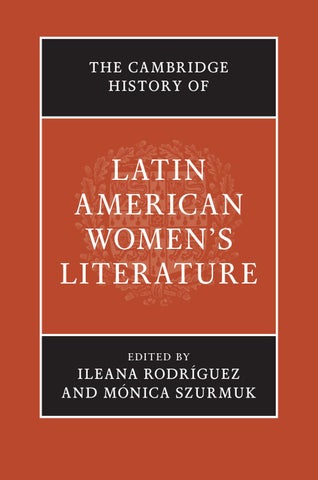
T H E C A M BR I D GE HISTORY OF
L at i n A m er ica n Wom en ’ s L i t er at u r e E DI T E D BY
I L E A N A RO D R I G U E Z A N D MON ICA SZU R MU K
The Cambridge History of
LATIN AMERICAN WOMEN’S LITERATURE
The Cambridge History of Latin American Women’s Literature is an essential resource for anyone interested in the development of women’s writing in Latin America. Ambitious in scope, it explores women’s literature from ancient indigenous cultures to the beginning of the twenty-first century. Organized chronologically and written by a host of leading scholars, this History offers an array of approaches that contribute to current dialogues about translation, literary genres, oral and written cultures, and the complex relationship between literature and the political sphere. Covering subjects from cronistas in colonial Latin America and nation building to feminicide and literature of the indigenous elite, this History traces the development of a literary tradition while remaining grounded in contemporary scholarship. The Cambridge History of Latin American Women’s Literature will not only engage readers in ongoing debates but also serve as a definitive reference for years to come. Ileana Rodríguez is Distinguished Professor of Humanities Emerita at the Ohio State University. She is the author of Liberalism at Its Limits: Crime and Terror in the Latin American Cultural Text; Transatlantic Topographies: Island, Highlands, Jungle; and Women, Guerrillas, and Love: Understanding War in Central America. Mónica Szurmuk is a Professor at the University of Buenos Aires, and a Researcher at the National Scientific and Technical Research Council of Argentina. She is the author of Mujeres en viaje and Women in Argentina: Early Travel Narratives. She coedited Memoria y ciudadanía, the Dictionary of Latin American Cultural Studies, and Sitios de la memoria: México Post-68.
Downloaded from http:/www.cambridge.org/core. Cambridge University Press, on 04 Oct 2016 at 12:01:29, subject to the Cambridge Core terms of use, available at http:/www.cambridge.org/core/terms. http://dx.doi.org/10.1017/CHO9781316050859
THE CAMBRIDGE H I S TO RY O F
LAT I N A M E R I C A N W O M E N ’ S L I T E R AT U R E * ILEANA RODRÍGUEZ The Ohio State University (Emerita) Instituto de Historia de Nicaragua y Centroamérica (IHNCA-UCA Research Associate) MÓNICA SZURMUK National Scientific and Technical Research Council of Argentina (Conicet) University of Buenos Aires
Downloaded from http:/www.cambridge.org/core. Cambridge University Press, on 04 Oct 2016 at 12:01:29, subject to the Cambridge Core terms of use, available at http:/www.cambridge.org/core/terms. http://dx.doi.org/10.1017/CHO9781316050859
32 Avenue of the Americas, New York, NY 10013-2473, USA Cambridge University Press is part of the University of Cambridge. It furthers the University’s mission by disseminating knowledge in the pursuit of education, learning, and research at the highest international levels of excellence. www.cambridge.org Information on this title: www.cambridge.org/9781107085329 © Ileana Rodríguez and Mónica Szurmuk 2016 This publication is in copyright. Subject to statutory exception and to the provisions of relevant collective licensing agreements, no reproduction of any part may take place without the written permission of Cambridge University Press. First published 2016 Printed in the United States of America A catalog record for this publication is available from the British Library. Library of Congress Cataloging in Publication Data The Cambridge history of Latin American women’s literature / edited by Ileana Rodríguez, Ohio State University; Mónica Szurmuk, National Scientific and Technical Research Council of Argentina, Argentina. pages cm Includes bibliographical references and index. ISBN 978-1-107-08532-9 (hardback) 1. Latin American literature – Women authors – History and criticism. 2. Women and literature – Latin America. I. Rodríguez, Ileana, editor. II. Szurmuk, Mónica, editor. PQ 7081.5.C 34 2016 860.9′9287098–dc23 2015014250 ISBN 978-1-107-08532-9 Hardback Cambridge University Press has no responsibility for the persistence or accuracy of URLs for external or third-party Internet Web sites referred to in this publication and does not guarantee that any content on such Web sites is, or will remain, accurate or appropriate.
Downloaded from http:/www.cambridge.org/core. Cambridge University Press, on 04 Oct 2016 at 12:01:29, subject to the Cambridge Core terms of use, available at http:/www.cambridge.org/core/terms. http://dx.doi.org/10.1017/CHO9781316050859
Introduction: Light and Proud and Fervent, Like a Flag Fulfilled in the Wind Ileana Rodríguez and Mónica Szurmuk
Porque la mujer [Gertrudis Gómez de Avellaneda] era hermosa, de grande estatura, de esculturales contornos, de bien modelados brazos y de airosa cabeza, coronada de castaños y abundantes rizos. . .: Era una mujer; pero lo era sin duda por un error de la naturaleza, que había metido por distracción una alma de hombre en aquella envoltura de carne femenina. José Zorrilla, Recuerdos del tiempo viejo, 382–383. [Because the woman (Gertrudis Gómez de Avellaneda) was beautiful, tall, of statuesque contours, shapely arms, and graceful, framed by abundant brown ringlets. . .: She was a woman, but only because, in a moment of distraction, Nature had clothed the soul of a man in female flesh.]
In the mid-nineteenth century, long before Queer Studies unraveled the field of Latin American literature, José Zorrilla described something momentous: a woman who is truly a man, a lapsed appearance of a male soul enveloped in a woman’s body. His impaled perception of gender plays him a trick and leaves him in awe of what he affirms is an error of nature. When we undertook the project of editing the Cambridge History of Latin American Women´s Literature, we did not expect surprises like the one quoted here. However, as contributions began pouring in, the variety of approaches far exceeded our expectations. What we are presenting now is a huge inventory of proposals that express the joy of examining women’s place in the literary space, and of constructing and engrossing the archive. We put forth a diversity of gazes that attest to the ingenuity of women across continents, the inventiveness of genres, the reach and dare of transatlantic connections, the spread of women’s qualities of writing, the force and might of their steady entrance into the flesh of the earth in order to make public their plight and to publicize their nerve. This description is far from an exaggeration. Our volume puts culture on notice and covers with increasing, unwavering, and steady determination all areas of world affairs, from the tiny spaces allocated to the giant tasks of
1
Downloaded from http:/www.cambridge.org/core. Cambridge University Press, on 04 Oct 2016 at 12:01:35, subject to the Cambridge Core terms of use, available at http:/www.cambridge.org/core/terms. http://dx.doi.org/10.1017/CHO9781316050859.001
Ileana Rodríguez and Mónica Szurmuk
maternity to the production of decisive venues of publication; from the intimacy of home and the pleasures of the flesh to journalism, political activism, and worldwide pedagogy in a network that renders a firm testimony of a new mode of being in the world, and a wide gamut of adamant resolutions of selves that are eager to make their mark on it. The studies included here leave an imprint of gender that begins with the recognition of genuflections, and ends in the projection of the infinite universe of possibilities offered by revelation, revolution, and the overall umpf of being on the social, the cultural, and the political stage. Women of all social classes, ethnic backgrounds, professions, and ages move to the fore to make explicit their power in all kinds of fora and podiums, whispering or moaning, yelling and shouting, reasoning or loving; they make their presence felt through the obdurate effort of a group of cultural critics who relentlessly search their genealogies, to make them available to a larger audience through this publication. We are still perplexed. How could so much talent be made to disappear so easily into the folds of male concealment? How could such excellence have been left to hover at the margins? While faithfully complying with the mandate to write original and wide-encompassing chapters, our contributors have produced very different pieces. The bibliographies are undoubtedly the result of groundbreaking research; the approaches are novel. Differences in style and rhetorical strategies underscore the interpretation of a mandate to contribute to the Cambridge History of Latin American Women’s Literature. How to approach the subject, what to say and how, whom to include, what topics are the most relevant are challenges met in different ways in these chapters. As editors we are more than pleased with the range of approaches, topics, and authors included. The critics themselves have established the parameters of the thematics and limits of the problematics at hand. In this Introduction, we outline the wellspring of initiatives, fields of knowledge, and rhetorical performances of the contributors as well as the figures that are angular in the pantheon of women writers. There are many different styles of writing in the Cambridge History of Latin American Women’s Literature. Some of the contributors first constructed a map of authors with their respective salient traits and contributions, and their regional locations. Others wove their quest within the fabric of women’s writings into witty essays that open up areas of examination well beyond Latin America. Some extricated themselves from a hardened placenta and organized their works around a topic in which all the literary women partook; yet some others chose to highlight the regional, continental, and even transcontinental position of women writers or to focus on the problematic of the indigenous to let solidarity prevail. What we have here is the filling up of 2
Downloaded from http:/www.cambridge.org/core. Cambridge University Press, on 04 Oct 2016 at 12:01:35, subject to the Cambridge Core terms of use, available at http:/www.cambridge.org/core/terms. http://dx.doi.org/10.1017/CHO9781316050859.001
Introduction
gaps, and the suturing of wounds left by neglect and oblivion. The number of women-authored texts is phenomenal; women’s contributions, outstanding; their performance, excellent. It is hard to believe that they were washed off, postponed, demeaned, debased, ignored, bypassed. This erasure reveals deafness, blindness, and fear. Therefore, this volume unveils the wealth of women’s writings in different centuries and situates them in their different manners of being, living, writing styles, and overall participation in history, society, and the republic of letters, wisdom and knowledge. What is significant about these different approaches to the subject is that they add several important perspectives and angles to the history of literature itself, to the context in which the works were written, as well as to the relevant topics of yesterday and of today alongside the positioning of the contributors to the text. It is unquestionable that the national and regional traditions press certain issues and approaches, some more bound to the political in traditional terms speaking about social justice and injustice; some more modern, playful, and witty, turning politics into a theater of the absurd or underscoring the cruelty of modernity and the indifference of postmodernity. We include novel examinations of marketing structures, and of the hopeful entrance of the previously neglected into lettered culture. Very provocative is the need to highlight the south-south dialogue as well as the bridge between the Americas and transworldism. The chapters of this book can be grouped together under the following nomenclatures: (1) very informative essays that provide novel information acquainting the reader with a whole battery of women writers not previously mentioned by any history of culture, totally ignored by the archive. These essays thus provide us with an unedited feminist view of cultural history and a theory of genres that expand upon well-trodden ones. The texture of these chapters is a fine-tuning of the intervention of women writers in history and their participation in all kinds of cultural and social affairs since the colonization of Latin America and beyond. (2) Very well argued pieces in which ideas like modernity, cosmopolitanism, the global and local, the peripheral and centric are deployed so that we can see the arch of their distribution through time and the deaf dialogue between systematizers of the center, and of the periphery as well as male versus female considerations of the questions at hand. (3) Very inventive pieces that chart the roots and the routes of consciousness informed by a feminist point of view that looks at the world otherwise. Proposing alternative meanings to old concepts such as sense and sensibility, transoceanic localizations, criminality, inheritance, and sexuality, these pieces turn our heads around with a new twist. 3
Downloaded from http:/www.cambridge.org/core. Cambridge University Press, on 04 Oct 2016 at 12:01:35, subject to the Cambridge Core terms of use, available at http:/www.cambridge.org/core/terms. http://dx.doi.org/10.1017/CHO9781316050859.001
Ileana Rodríguez and Mónica Szurmuk
Ambitious in geographical and spatial terms, The Cambridge History of Latin American Women’s Literature explores the lettered production of women from the ancient indigenous worlds up to the beginning of the twenty-first century. It is organized chronologically, but it is much more than a list of periods, names, and topics, and much more than a series of chapters on individual writers, genres, and movements. It is a book that thinks over the relationships among literacy, the literary, and literature; it reconsiders the historical articulation between oral and written worlds, accounts for the key role of women in inventing new genres, and in creatively engaging in the social and political spheres from the ancient indigenous worlds to the present. While it is a book that can be read from cover to cover, students and scholars can also use it as a resource for specific information on an author or topic. We envisioned it as both a readable narrative and a reliable conceptual reference source. Its treatment of a drastically changing literary canon is both sophisticated and sensitive. We hope readers will value its narrativity as well as the wealth of original information it offers, and that they will share our delight in the depth and creativity of our contributors and in the commitment of the hundreds of women on whose words this volume is built. The volume is divided into four parts: I, Women in Ancient America: The Indigenous World; II, Women Writers in Creole Societies: Nation Building Projects; III, Women Writers In-Between: Socialist, Modern, Developmentalists, and Liberal Democratic Ideals; IV, Women Writers in a One World Global System: Neoliberalism, Sexuality, Subjectivity. These rubrics cover the field as amply as possible and allow the contributors to provide the specificities for each case. Part I encompasses the indigenous worlds, the confrontations between peoples of the Iberian Peninsula and American indigenous empires – Aztec, Maya, Inca, and Aymara. The second part corresponds to the disengagement from empire and the newly imagined independent world known as nation building, when Creole or local-born Spanish descendants struggled for their independence; Part III describes the struggle between social and socialist liberations and modern, developmentalist, and liberal democratic ideas; and the fourth part corresponds to the aftermath, in which liberal capitalism as a one world system establishes the era of globalization and neoliberalism with its effects on the population, and on the written word. Our list of contributions presents a developed map of the field, and the prominent place women occupy in it. It underscores major salient points. The field is very large and serious academic studies on women’s literature very abundant. We move within and away from romanticized roles assigned to 4
Downloaded from http:/www.cambridge.org/core. Cambridge University Press, on 04 Oct 2016 at 12:01:35, subject to the Cambridge Core terms of use, available at http:/www.cambridge.org/core/terms. http://dx.doi.org/10.1017/CHO9781316050859.001
Introduction
women toward more historically accurate imaginaries. Our trajectory begins with the original societies, moves through the colonial and the national, and into the postcolonial. There is no enigma left unteased, as there is no relevant issue kept out of focus. The consolidation of epoch-making imaginaries is highlighted, but so are the dilemmas that cause rifts, fractures, and ruptures. The volume visits issues critical to the plotting of the continent, ranging from domination and sovereignty, to natives and citizens, nationalism, national security and official imaginings, gendering ethnicities and populations, all viewed from the catalyzing, organizing, and transcending power of literature. The point is to offer indispensable access to Latin American women’s literature in an all-encompassing volume that rethinks the field by reorganizing its totality in a scenario whose unfolding greatly partakes in the social unraveling of the continent. In summary, the principles behind The Cambridge History of Latin American Women’s Literature are (a) the articulation of chronology, space, and place; (b) the heavy contextualization and thematic and topical structure; (c) the organization into categories and groupings that are highly debated and debatable; (d) the historicization of “Latin America” rather than of “Spanish” literature. Thus, The Cambridge History of Latin American Women’s Literature tracks the time line that runs from one writer to the next in close proximity to regional emphasis. It focuses on women who write in different languages – prominently Spanish and Portuguese, but also English, French, Creole, and indigenous languages, or in a mixture thereof. The Cambridge History does not attempt to cover all the written tradition in these diverse languages, but it recognizes the intersections with other traditions and considers the literature written inside, as well as outside the continent, in exile, or by expatriates, and the borders crossed by them – for instance, that literature that is Mexican or Puerto Rican or Nicaraguan in its origins becomes Latino/a in the United States, or Sudaca in Spain. It recognizes the fl uidity and shifting definitions of languages and linguistic communities in the region over the centuries.
5
Downloaded from http:/www.cambridge.org/core. Cambridge University Press, on 04 Oct 2016 at 12:01:35, subject to the Cambridge Core terms of use, available at http:/www.cambridge.org/core/terms. http://dx.doi.org/10.1017/CHO9781316050859.001