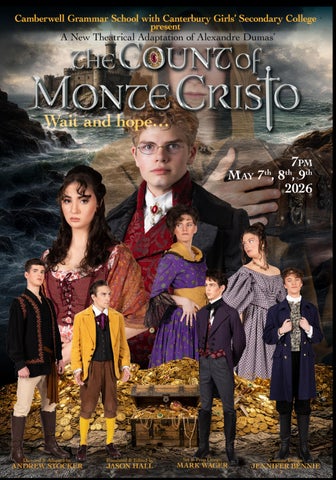
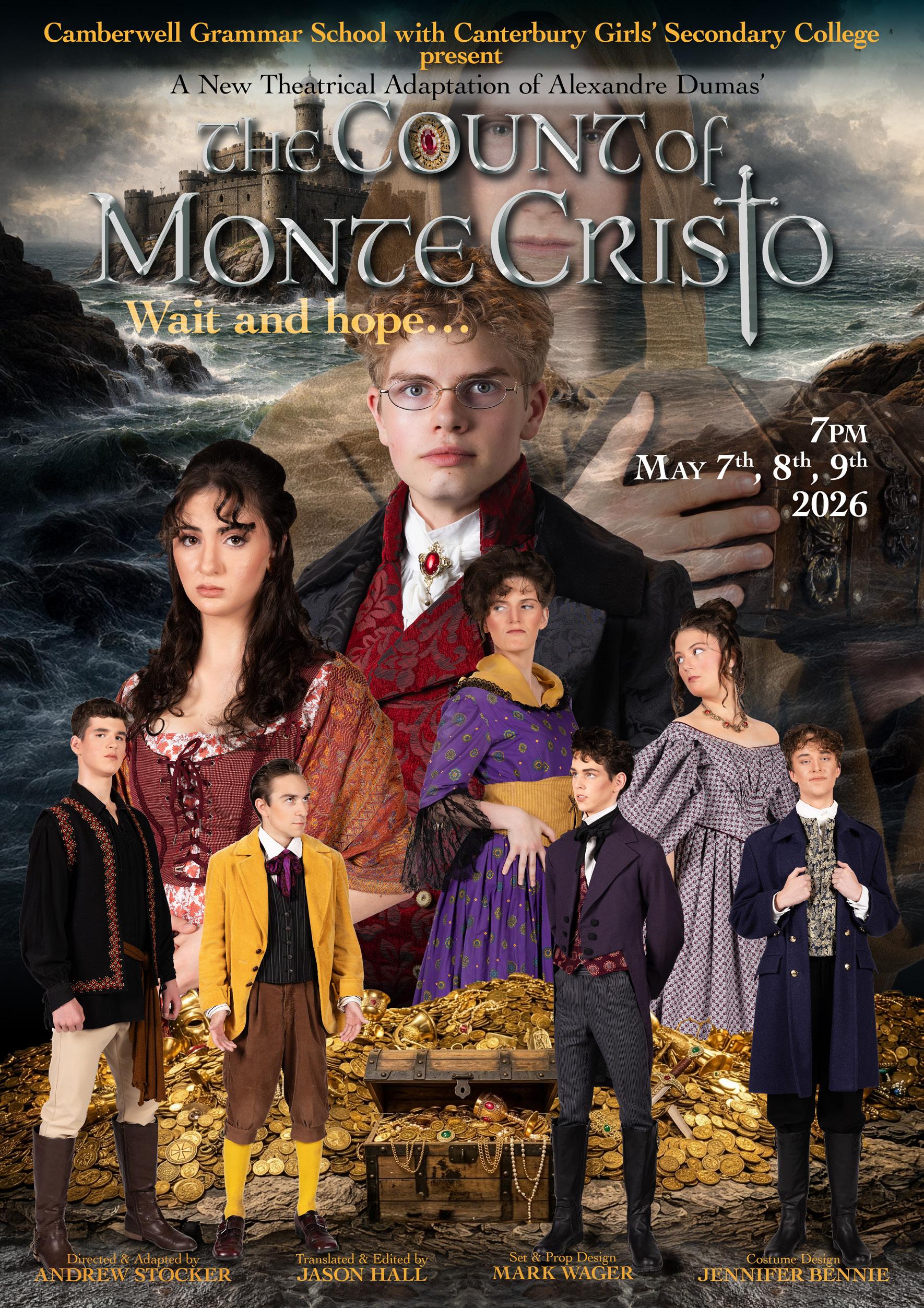
From the Director
This story is a ripping yarn. It is broad and convoluted, with many characters, and it is for this reason I embarked on my own theatrical adaptation of the novel to provide a play for a large number of actors. One suitable for a school production. I thank my dear friend, Jason Hall, for translating the source material made up of four melodramas for the stage written by Dumas after the success of the novel, and providing me with the first edit. He took on a huge challenge, and reduced the material from 12 to 6 hours, and has been a trusted advisor during the whole process, but any errors in the final adaptation I must fully accept as my own. Any changes to Dumas’ story, the conflation of scenes, deletion of sub-plots, the use of dramatic conventions and devices along with other inventions, are equally my responsibility. I trust I will be forgiven for these too.

I believe a school show should be an educational and artistic challenge for students and thereby audiences alike. The cast have risen to the challenge and I am very proud of them.
Mrs Jennifer Bennie has moved mountains to create the incredible costuming for the show. You will, I am sure, agree they set the several periods of the story and reveal character in an extraordinary manner.
I thank Mr Mark Wager for his restrained unit set and superb ornamentation, and congratulate him on his 65th set design for Camberwell Grammar School. He has been a fierce champion for our school’s theatre over so many years, and contributed so much to its success.
- Andrew Stocker
Part One
Acts 1, 2 and 3
20 minute interval

Part Two
Acts 4 and 5

A Tale of Betrayal and Revenge
Act 1 - The Prison Château d’If
In a prison cell, Edmond Dantès dwells on memories of events surrounding his arrest. After returning home aboard the merchant ship, Pharaon, during which he feels obliged to obey Captain Leclère’s dying wish to deliver a letter from Elba, he is promised the captaincy by the ship’s owner, Morrel, and prepares to marry Mercédès. At his engagement feast, Danglars and Caderousse discuss Edmond’s good fortune, while Fernand, in love with Mercédès, is drawn into their scheme. Danglars drafts an anonymous note accusing Edmond as a Bonapartist agent in possession of a seditious letter he suspects is from Bonaparte’s Grand Marshall, and Fernand delivers it anonymously to the Magistrate, Villefort.
Edmond is arrested mid-celebration. When questioned by Villefort, he truthfully explains the letter is addressed to a Noirtier, but, as a man of honour, had not read the letter, and neither did he have any political affiliations. Realising Noirtier is his own father, Villefort burns the letter and orders Edmond to be imprisoned in the Château d’If without trial.
Years later in prison, Edmond meets Abbé Faria, who tunnels into his cell. Faria teaches him memory techniques, and helps him reconstruct the events of the betrayal, identifying Danglars, Fernand and Villefort. Before dying, Faria reveals a burned document hidden in a bible dating from the Knights Templar. He discovered by heating the paper, its invisible ink reveals instructions to a vast treasure buried on the Island of Monte Cristo, but part of the instructions were burnt beyond recognition. This is when the Friar developed his technique to intimately interrogate memories and discover details formerly missed. He reconstructs the missing instructions, and gifts Edmond the details as he dies. Edmond escapes by taking the Friar’s place in the burial sack, and is thrown into the sea by the Jailers. Assuming the identity of Sinbad the sailor, he is rescued by a band of smugglers, led by Bertuccio and his adopted son Benedetto. They land on the Island of Monte Cristo, setting Edmond on the path to find the treasure.
A montage spans the years following Edmond’s escape. He builds immense wealth and adopts more identities as he transforms into the Count of Monte Cristo. Along the way, he gathers allies, including his valet Baptistan, and a Greek princess Haydée, whom he rescues after she had been sold into slavery by Fernand. Maximillian Morrel, the son of his previous employer and now a soldier in an elite cavalry division, the Sipahi, visits the island by chance. He is befriended by the Count and is shown his fortune, and is taught the Friar’s memory techniques.
At the same time, those who betrayed Edmond rise in status: Danglars becomes a powerful banker; Fernand returns from war with wealth to become The Count de Morcerf and marries Mercédès; and Villefort advances his legal career. In the shadows, Edmond begins to plan his revenge.

Act 2 - France
Utilising his newfound fortune, Edmond uses his identities to infiltrate the lives of those who betrayed him. Disguised as the priest, Abbé Busoni, Edmond visits his former neighbour Caderousse, manipulating him into confirming the full reasons of his arrest, which he only previously suspected through the use of the Friar’s memory techniques, and sets in motion Caderousse’s downfall.
As Yorik, supposedly a clerk from the Italian firm of Thompson and French, Edmond gathers intelligence on the magistrate Villefort. He also learns from the Corsican smuggler Bertuccio, the existence of Benedetto, an illegitimate child of Villefort and the Baroness Danglars. Bertuccio, thinking he had killed Villefort (for ordering the execution of his brother), escaped with the box not containing treasure, but the child he adopted. Edmond begins to weave a complex web of providence. He secretly saves his former employer, Pierre Morrel, from financial ruin, rewarding his past loyalty . He then moves to Paris, where he builds his new reputation as the Count. He recruits Bertuccio as his steward and transforms the fugitive Benedetto into the fictional nobleman Andrea Cavalcanti, planning on using him to bring down the Danglars through an arranged marriage to Valentine and Villefort’s secret affair with Baroness Danglars.

Act 3 - Paris
A Ball is hosted by the Morcerfs in Paris. Albert de Morcerf, the son of Fernand and Mercédès, moves through the crowd with his inner circle of friends: Lucien Debray, a bored but powerful government official; Beauchamp, a sharp-tongued journalist; and the Baron Château-Renaud, a soldier who was recently saved on the battlefield by Maximilian Morrel. To the delight of the guests, the Count of Monte Cristo arrives. Albert introduces him to his friends as the fascinating man of mystery who saved him from bandits in Italy. The Count charms the guests with his worldly wit and unfathomable wealth, easily infiltrating the social world of his enemies.
Throughout the Ball, the Count begins to hatch his plans, learning more about the dark history of the Villefort and Morcerf families. He uses his time at the Ball to gather more intelligence to expose the Janina Affair; the assasination of the Vizier and the selling into slavery of his daughter, Haydée, and Fernand’s other crimes. By the night’s end, the Count has established himself as an indispensable mentor to Albert and a fixture in Parisian society. Baron Danglars is informed of a vital business deal that has failed and his ruin is enjoyed by the Count, who had engineered it. As the Ball draws to a close, Maximillian Morrel and Valentine Villefort begin to fall for each other.

Act 4 - Paris
At the Paris Opera, the Count talks with Maximilian Morrel and his family, whom the Count had secretly saved from ruin, the events of which Maximillian recounts through the use of the Friar’s memory techniques taught to him by the Count on the Island of Monte Cristo. In conversation, their gratitude and loyalty are revealed, though they remain unaware of his intervention.
Fernand’s actions in the Janina Affair have been exposed in the newspaper. When his son Albert learns that the source of these claims is the Count of Monte Cristo, he challenges him to a duel.
In the Chamber of the Peers, Fernand is called to answer for his actions. Haydée is brought forward, and her testimony directly connects him to his betrayal and her sale into slavery. In a formal and public setting, the truth is no longer rumour but evidence, and Fernand’s position begins to collapse. He arrives before his son to the duel, where he fights the Count, to save his son, but flees when he loses and discovers the Count’s true identity.
Mercédès confronts the Count, recognising him beneath his constructed identity and pleading with him to reconsider the duel for the sake of her son. He agrees, seeing no honourable escape from the fight without submitting to death himself. Albert soon arrives, having been told by his mother the truth of the Count’s incarceration at the hands of his now disgraced father Fernand. He apologises to the Count before leaving with his mother.
Act 5 - Paris
In Villefort’s household, a series of unexplained illnesses and deaths has thrown the family into panic. Doctor d’Avrigny is called, and through careful observation he identifies a pattern, revealing that poison is being administered over time. Suspicion turns inward as the truth begins to emerge from within Villefort’s own home.
Elsewhere, the Count completes another thread of his plan. Caderousse reappears, driven once again by greed, and is drawn into a final encounter in which his earlier actions over the diamond return to seal his fate. Villefort’s past crime is revealed through an interrogation with Andrea Cavalcanti (Benedetto). The combined weight of present tragedy and past guilt causes Villefort’s authority, and his family, to collapse around him.
In the Epilogue, the aftermath of these events is revealed. With the truth exposed, his revenge complete, and his realisation that there is hope for the younger generation to plough their own course in life with honour, the Count must face what remains, and what it has cost his soul, as Maximillian and Valentine look toward the future with hope.

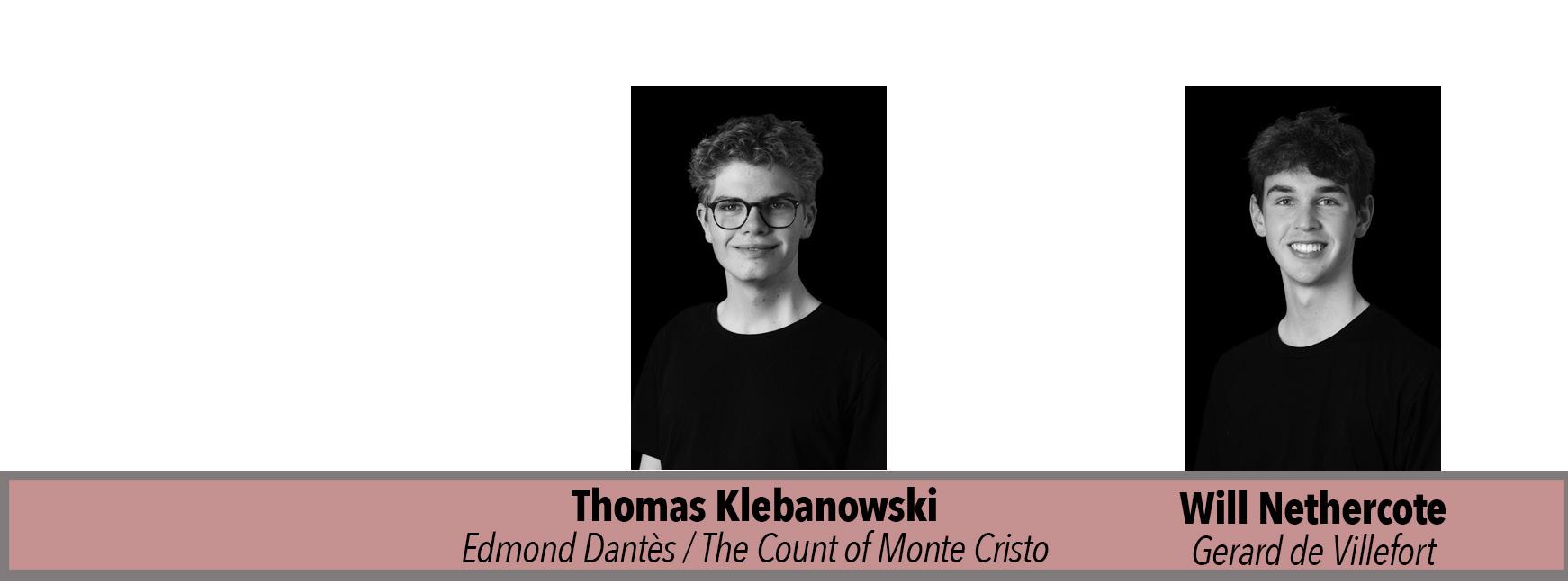
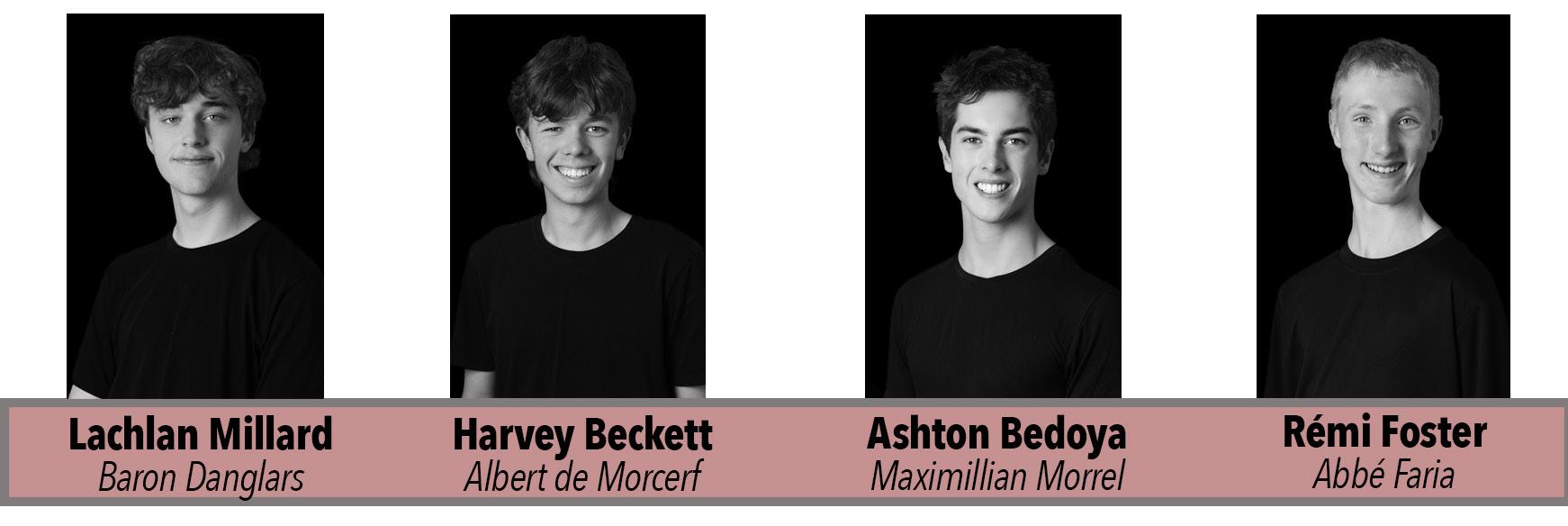
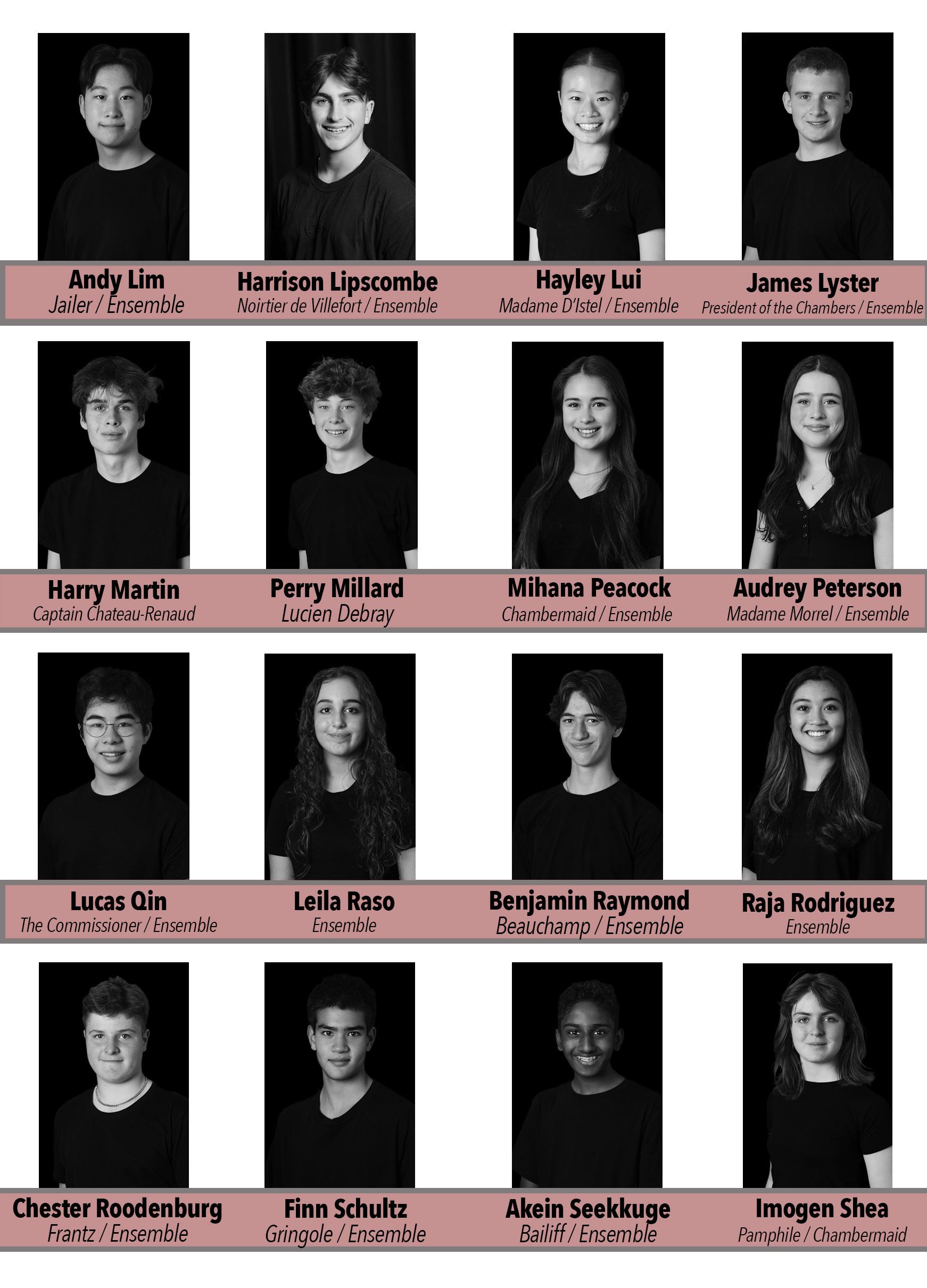
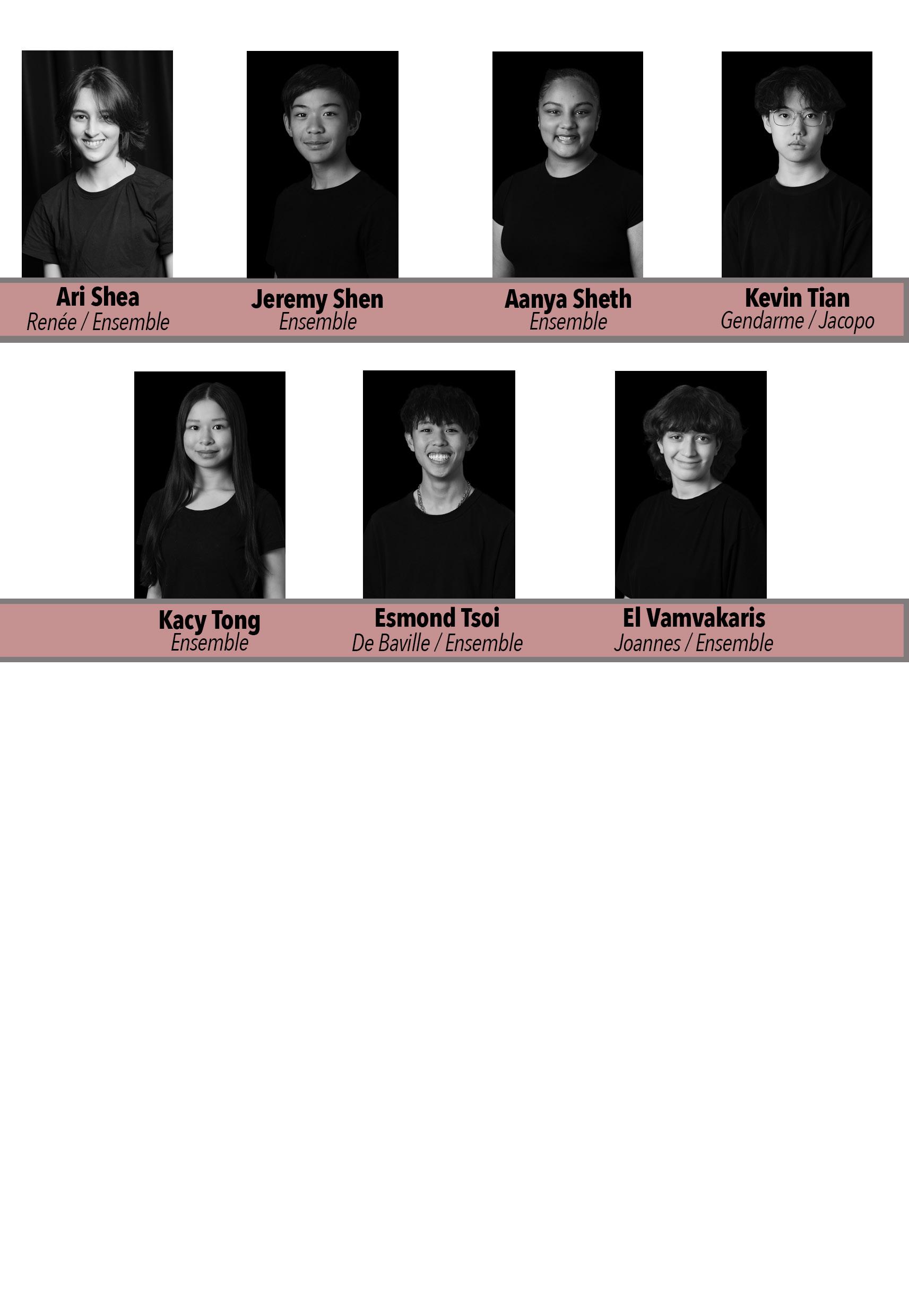
Cast
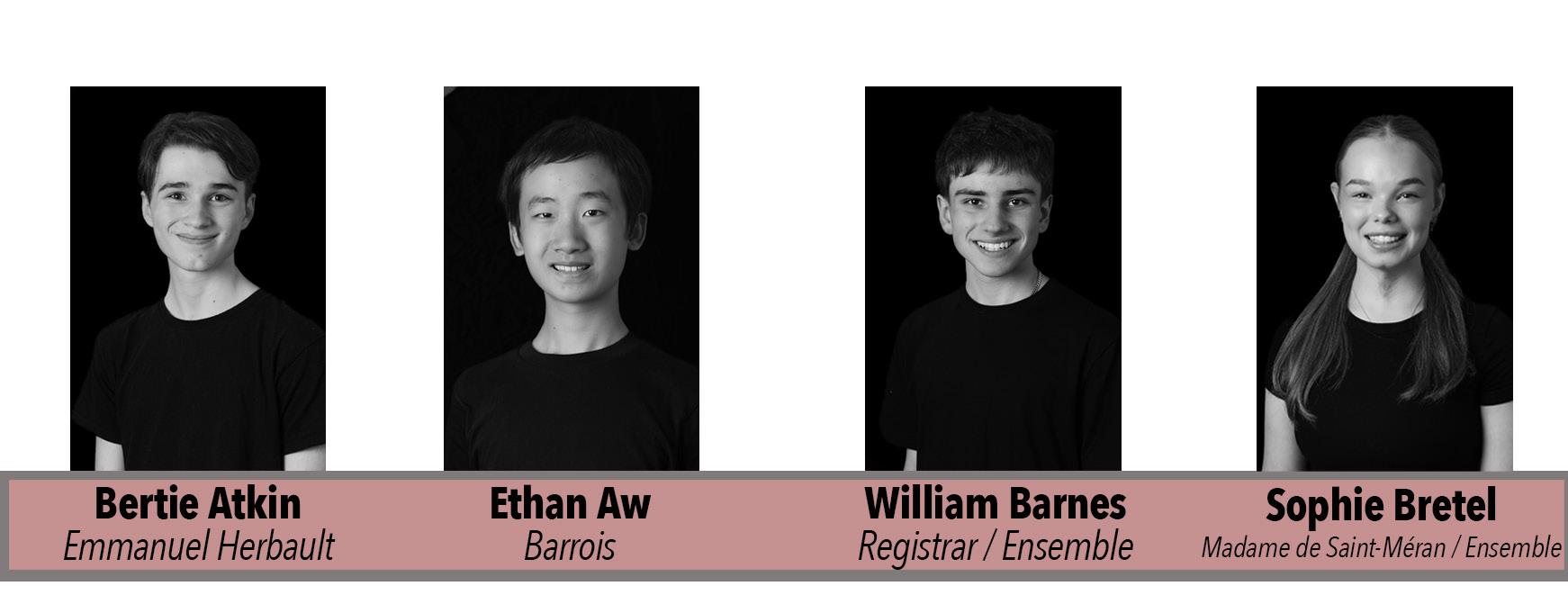

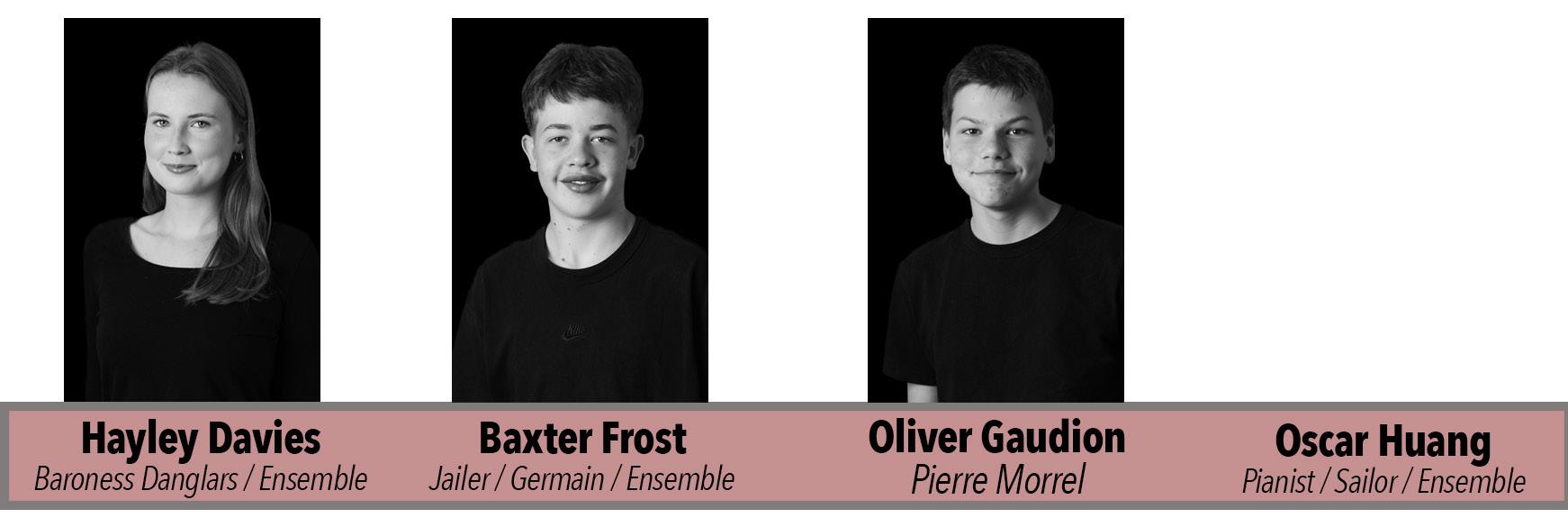



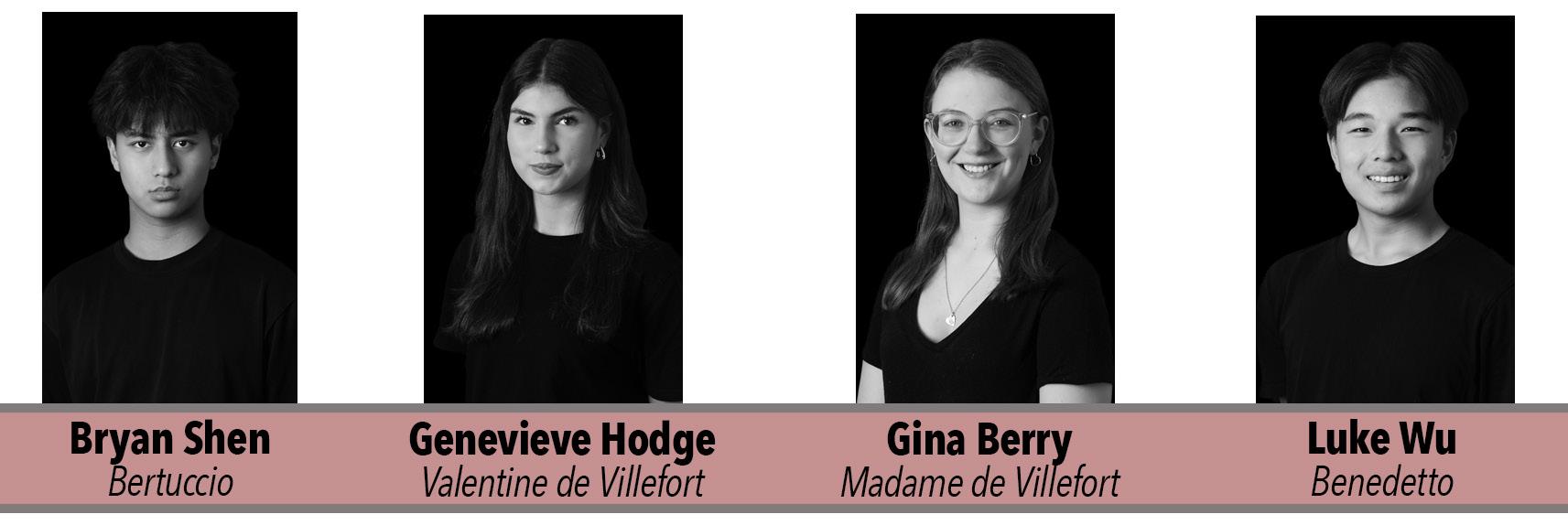

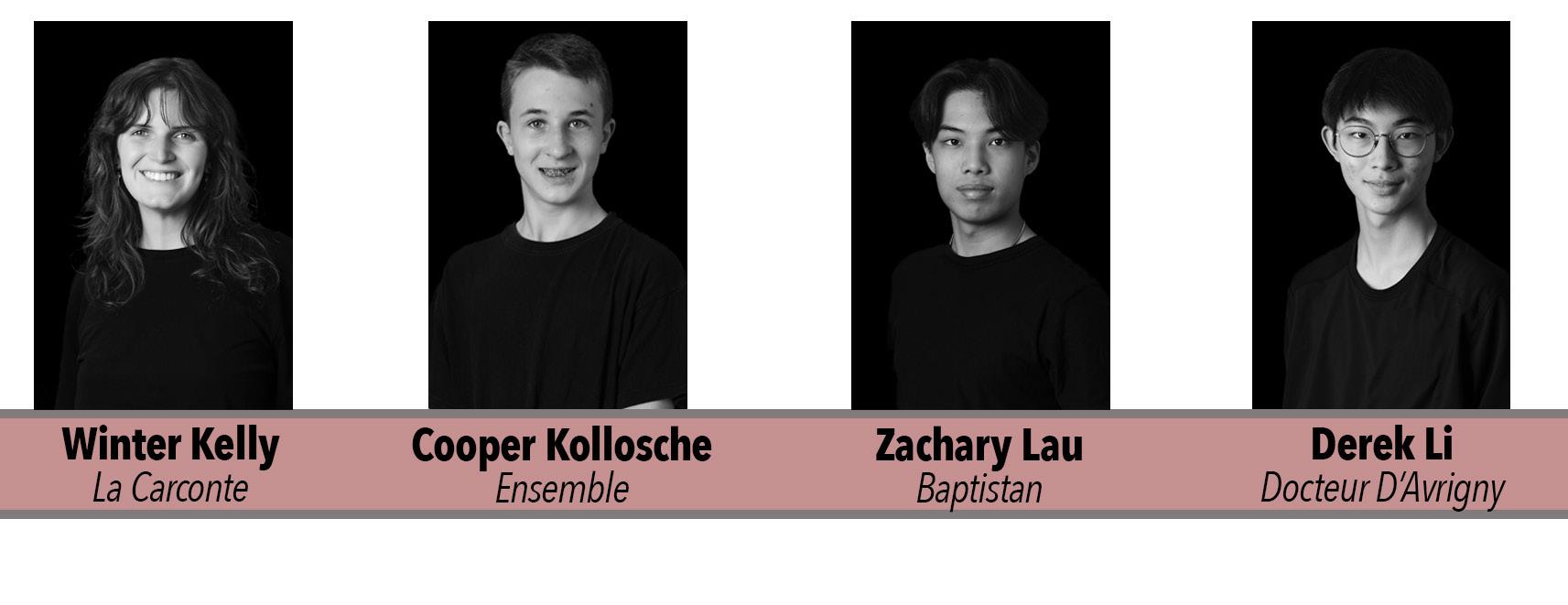

Technical Crew
Showcaller
Lighting/Camera Operator
Follow Spot /Lighting Operator Sound Operator
Sound Effects Operator
Montage Sound Designer/Operator
Stagehands
Stagehand/Camera Operator
Prop Manager
Vision Mixer
Camera Operator

Marcus Lai
Horus Cheung
James Newell
Keaghan Ho
Thomas Torre
Thomas Pritchett
Drew Bernadi
Henry Carron
Jimmy Price
Jenson Huynh
Ethan Zhao
Sebastian Lui
Dominic Burns
Production Team
Director/Adaptor/Dramaturg/Sound Designer
Translator/Editor
Production Coordinator
Costume Designer
Set and Prop Designer
Technical Coordinator
Lighting Designer
Set and Prop Design Assistants
Costume Technician
Costume Construction Assistants
Andrew Stocker
Jason Hall
Jessica Johnson
Jennifer Bennie
Mark Wager
Stuart Feldt
Michael Zagarn
Erica Moffat
Walter Lu
Breanna Handfield
Phillip Toole
Isabel Collyer
Amy Chidgzey
Stephen Bennie
Hair Stylist
Makeup Artists

Set Construction
Fight Choreographer
Assistant Fight Choreographer
Backstage Supervisor/Stagehand
Acting Consultant
Pique la Baleine Backing Track
Poster Designer
Photographer
Kerin Barker
Martina Lindsey
Genevieve Hodge
Claire Wilson
Olivia Wilson
Grace Wilson
Mietta Wilson
Chloe Wilson
Rocky Cannizzaro
Josh Bell
Jett Chudleigh
Nicholas Sarlos-Welsh
Paul Cotton
Grant Arthur
Simon Barry
Ken Nakanishi

Music
Pique la Baleine
A traditional French whaling shanty, popularised by the Canadian folk punk band The Dreadnaughts.
Robert Le Diable
An opera by Giacomo Meyerbeer
Recorded in 2022 at the Palazzetto Bru Zane
Featuring John Osborn (Robert), Nicolas Courjal (Bertram), Amina Edris (Alice), Erin Morley (Isabelle), Nico Darmanin (Raimbaut) L’Orchestre
National Bordeaux Aquitaine, Chœur de l’Opera National de Bordeaux and Marc Minkowski
Sir William Sterndale Bennet:
Piano Sonata No.1 in F Minor Opus 13
Performed by Hiroaki Takenouchi
Recorded in 2017, Artalinna Label