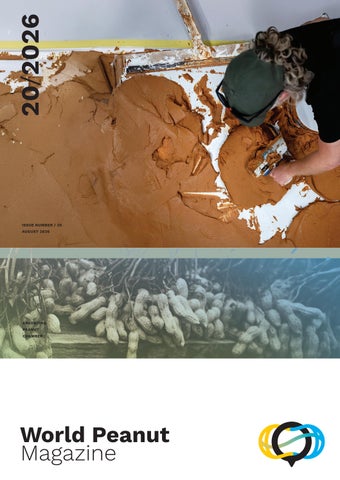
20/2026 ISSUE NUMBER / 20 AUGUST 2026
ARGENTINA PEANUT CHAMBER
World Peanut Magazine
02
index _ _
_ A Powerful El Niño Approaches / 04
Laws and Regulations
_ Green Claims Under New Scrutiny / 06
. What the EU’s EmpCo Directive Means for Peanut Marketing
Market Trends
_ “Peanuts tick a lot of the boxes the industry is currently chasing” / 10 . Sebastian Emig, Director of the European Snack Association, talks about the last edition of Snackex
_
_ SAVE THE DATES for the 2027 International Peanut Forum! / 16
_
_ Charts & Tables / 13
_ _
Peanut Market Data Science and Technology
_ Breeding the Next Generation of Peanuts in Texas / 22 . The Research programs at AgriLife
Peanut Farming
_ Nigeria’s Peanut Sector / 28
. A Former Export Powerhouse Seeking a Return to World Markets
Peanuts as a Superfood
_ Kuli-Kuli / 38
. Peanut Tradition and Everyday Food Culture in West Africa
_ When Peanut Butter Becomes Art / 44
01
02
_ Market Trends
This section of the wpm deals with the dynamics of the demand and supply of peanuts in the international markets. We will try to keep track of the changes in peanut consumption in the main areas of the world, the factors that can affect production, and the price shifts of the various peanut products.
_ Industrial Processing
This area of the magazine focuses on shellers as well as companies transforming peanuts into consumer products. We will focus on current industry standards, quality issues, new technologies and the different industrial solutions adopted by producing countries. A special section will be dedicated to new products and tools for peanut processing developed by the best manufacturers.
_ Science and Technology
The activities of the universities and other research institutes engaged in scientific research on peanuts are of paramount importance for the future of the business. We will follow the main discoveries, from the latest issues concerning peanut genetics to the development of projects on pathogens or the impact of peanut consumption on human health. The consequences of scientific research on the future of the industry are hard to overstate, so we will be putting them in perspective in order to try to understand where the sector is heading in the long term.
03
_ Laws and Regulations
The Laws and Regulations section of World Peanut Magazine analyses the impact of new legislation and regulations affecting the production and trade of peanuts. The main issues treated in this section are governmental measures directly affecting international trade (such as the introduction of tariffs or quotas), health safety issues (such as the establishment of Maximum Residue Limits for certain substances) but also legislation impacting distribution, packaging and sales.
_ Peanut as a Superfood
This section offers peanut professionals news and insights into the world of peanut consumption and all its aspects. Typical news is related to findings concerning the nutritional values of peanuts, the impact of peanut consumption on human health, and the development of peanut-based food.
_ Peanut Farming
The primary production is where the peanut business starts, of course, so we will have a dedicated section for all events, activities, techniques and equipment related to growing peanuts in different parts of the world. The general idea is to bring farming in the producing countries closer to all peanut professionals so that they can have a better grasp of the business from a grower’s perspective and maybe on what the future of peanut farming may look like.
Nº 20 A Powerful El Niño Approaches Since our last issue, the outlook has become clearer across the main peanut origins. In the United States, the crop appears to be back on track after a difficult beginning. However, planting was delayed by drought, and weather conditions over the coming months will remain critical to the crop’s final performance. Brazil has completed its harvest, while Argentina—believe it or not—is still struggling to bring the season to a close. An estimated 10% to 15% of the crop remains unharvested, a situation that will almost certainly result in lower yields and some deterioration in quality. The market is beginning to confirm a firmer price trend, although the adjustment remains gradual. The pace is being moderated by a supply pipeline that is largely covered through the end of the year, thanks to purchases made from previous crops. Looking ahead, lower prices, rising production costs, financial constraints and, ultimately, negative margins are contributing to reduced planting intentions in several origins. The seeds that do reach the ground will face the effects of a strong El Niño, whose consequences may be beneficial in some producing regions and highly disruptive in others.
Weather will therefore be one of the decisive factors shaping global peanut output in the 2026/27 season. El Niño does not affect every origin in the same way, but it increases the risk of severe drought in some areas and excessive rainfall or flooding in others. Regional forecasts and crop developments will need to be followed particularly closely. Whether connected to this wider climate pattern or not, a recent extreme storm in Brazil reportedly caused serious damage to facilities in a peanut-producing area, offering another reminder of the sector’s exposure to increasingly disruptive weather events. This may be a year in which maintaining adequate stocks proves wiser than relying too heavily on future production. Time will tell. In this issue of World Peanut Magazine, we examine Nigeria’s peanut industry. Once a major exporter, Nigeria is now one of the world’s largest producing countries but remains largely absent from international markets. We also explore one of the country’s best-known peanut delicacies: kuli-kuli. We then consider new European Union rules governing environmental and sustainability claims and examine how they may affect peanut processors, exporters and consumer brands. Just a few weeks ago, one of the snack industry’s leading trade events, SNACKEX, took place in Lisbon. We speak with a representative of the European Snacks Association, the event’s organiser, about the role of peanuts at the show and within the wider European snack market. Another major industry gathering is already approaching. Early next year, the American Peanut Council will host the International Peanut Forum, bringing together participants from across the global peanut supply chain. Peanuts are not only a nutritious food and an important agricultural commodity; they can also become a medium for artistic expression. In this issue, we present Peanut Butter Floor, the extraordinary installation created by Dutch conceptual artist Wim T. Schippers. Last but certainly not least, we take a closer look at the important peanut research programme being conducted at Texas A&M University.
05
— Section —
LAWS AND REGULATIONS
06
Green Claims Under New Scrutiny What the EU’s EmpCo Directive Means for Peanut Marketing
07
Sustainability is now a familiar language in food marketing. Peanut products are promoted as “responsibly sourced,” “climate-friendly,” “zero waste” or packed in “eco-friendly” materials. From 27 September 2026,
however, companies selling to European consumers will face stricter rules on how such messages may be used.
The change comes from Directive (EU) 2024/825, known as the Empowering Consumers for the Green Transition, or EmpCo, Directive. It amends
EU rules on unfair commercial practices and targets greenwashing, misleading sustainability labels and environmental claims that consumers cannot properly assess.
For peanut exporters, processors and brand owners, the main lesson is simple: broad environmental adjectives should be replaced by precise, verifiable facts.
A statement such as “sustainable peanuts” may create difficulties because it does not explain what is sustainable, which stage of the supply chain
is covered or how performance was assessed. It may concern farming,
packaging, energy use or one certified ingredient, while consumers could understand it as describing the entire product.
— Section —
LAWS AND REGULATIONS
08
The same applies to expressions such as “green,” “eco-friendly”
and “planet-friendly.” Under EmpCo, generic environmental claims will be prohibited unless supported by recognised excellent environmental performance. A detailed explanation hidden on a website may not correct an overly broad message displayed prominently on a package.
Specific statements are safer. “This jar contains 60% recycled glass” or “electricity use per processed tonne fell by 18% between 2022 and 2025” tell consumers what was measured. Even these claims must be accurate, current and supported by evidence, and they must not turn a limited benefit into a claim about the whole product.
Carbon-neutrality language requires particular attention. Claims that a product is “carbon neutral,” “climate positive” or has a reduced
climate impact because emissions were offset elsewhere will be prohibited. Companies may still communicate verified emissions data and reductions achieved within their own operations or value
chains. They should not deduct purchased offsets and present the product itself as having no climate impact.
Sustainability logos will also be scrutinised. Self-created green
seals will no longer be acceptable simply because a company has developed its own criteria. Voluntary labels must be based on a
qualifying certification scheme with transparent requirements,
independent verification and effective monitoring. Their scope must also be respected: a company-level certification does not automatically prove that every peanut product has superior environmental performance.
The financial consequences of non-compliance may also be
significant. For serious and widespread cross-border infringements, EU consumer law requires Member States to provide for maximum
fines of at least 4% of the trader’s annual turnover in the countries
concerned, or at least €2 million when turnover cannot be established. These penalties are not automatic for every inaccurate
label, and the amount imposed will depend on national law, the scale and duration of the infringement, and whether the company
acted promptly to correct it. Even so, a misleading environmental claim used across several European markets could also lead to
packaging withdrawals, corrective advertising, consumer claims and substantial reputational damage.
Exporters should be cautious with familiar sector narratives. Phrases such as “zero-waste crop,” “regeneratively grown” or “the lowestcarbon nut” may be attractive, but they can mislead when the
boundaries, methodology, comparison and production volumes
covered are not identified. A safer claim would specify the farms, crop year, verification system and percentage of product included.
Life-cycle assessments and Environmental Product Declarations
can provide a strong evidence base, but they do not by themselves prove that a product is “green” or better than every competitor. They
are most useful when companies report a defined result and clearly identify the methodology, life-cycle boundary and validity period.
The rules apply to consumer-facing communications in the EU, including packaging, websites, online shops and advertising. Exporters may therefore be affected even when the final claim
is made by an importer, retailer or private-label customer. Sustainability data will increasingly need to travel through the supply chain with the same care as information on quality, origin and food safety.
Companies should now review packaging, websites and customer
materials; identify every environmental statement and logo; document the evidence behind each one; and remove or narrow
claims that cannot be substantiated. Packaging produced before
September may also create transitional issues, making early coordination with European partners advisable. EU consumer authorities have indicated that genuine old-stock difficulties may
be considered proportionately, but companies are still expected to take timely, good-faith compliance measures.
EmpCo does not prohibit sustainability communication. It changes
its grammar. Credible peanut marketing will rely less on ambitious slogans and more on transparent information: what improved, by how much, during which period, across what share of production and according to which independently verified method.
09
— Section — MARKET TRENDS
10
“Peanuts tick a lot of the boxes the industry is currently chasing”
11 Sebastian Emig, Director of the European Snack Association, talks about the last edition of Snackex
One of the most important events for the international snack industry took place in Lisbon last June, Snackex, the trade show organized every two years by the European Snack Association. Sebastian Emig has acted as the Director General of the association for more than 14 years, we asked him a few questions regarding the 2026 edi-
tion. “SNACKEX is the only trade show internationally focussed solely around savoury snacks” Sebastian explains, “It is the key nucleus and hub for manufacturers and suppli-
ers. Due to this special character of our show and the strong growth over the last years our show keeps growing from edition to edition.”
// In your view, what are the main challenges currently facing the savoury snacks industry, particularly in Europe? There's no shortage of them. On the regulatory side, we're watching closely how new EU rules affect the sector - from
packaging and sustainability requirements under Packaging and Packag-
ing Waste Regulation, to a recent Common Market Organisation Regulation amendment that touches how certain products can be described on pack. Beyond regulation, the industry is navigating real cost pressure - input costs, energy, logistics - at the same time as it's expected to reformulate, decarbonise
and respond to shifting consumer expectations around health, including the broader conversation around GLP-1 medications and their effect on dietary habits. None of these are simple, and most of them are moving targets.
// How can events such as SNACKEX help the industry address these challenges and identify new opportunities? This is precisely where a show like SNACKEX
earns its place. It's not just a marketplace - it's where manufacturers, ingredi-
ent suppliers, retailers and policymakers end up in the same room, often for the only time in a two-year cycle. That proximity accelerates everything: partnerships form, ideas get pressure-tested, and companies see first-hand how competitors and adjacent categories are responding to the same pressures. A
challenge discussed in the abstract in a policy paper looks very different once you're standing in front of the product that solves it.
— Section — MARKET TRENDS
12
// Since our magazine has a special interest in peanuts, how would you assess the presence of peanuts and peanut-based products at SNACKEX?
I don't have hard numbers on peanuts specifically, but my general impression walking the floor was that peanuts remain a steady, well-es-
tablished presence rather than a standout "trend" this edition - reliable rather than flashy, which in some ways says something about their enduring role in the category.
// What role do you expect peanuts to play in the future of the savoury snacks
industry? Peanuts tick a lot of the boxes the industry is currently chasing - they're a recognisable, relatively clean-label protein source, they
lend themselves naturally to flavour innovation, and they have deep consumer trust built up over decades. I'd expect them to keep punching
above their weight as manufacturers lean into protein and "better-foryou" positioning without abandoning indulgence.
// Are there any trends, innovations or market developments from this edition that you believe are especially relevant for the international snack
sector? Two things stood out clearly. First, flavour - bold, adventurous, often globally-inspired flavour innovation was everywhere, and it's clearly where a lot of companies are putting their creative energy right
now. Second, sustainability - not as a single headline initiative, but as a thread running across the entire value chain, from packaging to sourcing to production. It's no longer a side conversation; it's built into how companies are presenting themselves.
// Is there anything else you would like to add for your readers? Just that SNACKEX continues to prove its value edition after edition, and this one raised the bar again. My thanks to everyone who exhibited, visited and
contributed to making it such a strong event - and I'd encourage anyone
in the sector who hasn't yet experienced it to put the next edition in their diary. It will be in June 2028 in Vienna, Austria.
charts & tables — Section —
PEANUT MARKET DATA
13
peanut exports of brazil. kernels (mt). 1202.42 + 2008.11
2022
2023
2024
2025
2026
TOTAL EXPORTS JAN-JUN 133.433 | 134.057 | 108.105 | 122.473 | 158.647
eu 27 imports, tm (shelled - 1202.42). jan-may
2023
2024
2025
2026
TOTAL PERIOD JAN-MAY 252.042 | 240.827 | 267.101 | 260.808
— Section —
PEANUT MARKET DATA
eu 27 imports, tm (prepared hs 2008.11) . jan-nov
14
2023
2024
2025
2026
2025
2026
TOTAL PERIOD JAN-MAY 252.042 | 240.827 | 267.101 | 260.808
exports of argentina (tm 1202.42+2008.11).
2022
2023
2024
TOTAL PERIOD JAN-JUN 328.257 | 354.711 | 220.492 | 334.853 | 432.444
china future prices (settle value - rbm)
— Section — MARKET TRENDS
16
SAVE THE DATES for the 2027 International Peanut Forum! With the successful completion of the 2026 World Peanut Meeting in Argentina, it’s time to grab your 2027 diary and save the dates for the next International Peanut Forum (IPF). Being held at the Hilton Hotel, Portomaso, St. Julians, Malta, during 14-16 April 2027, this is your chance to connect with the global peanut industry. Malta is an island located in Southern Europe in the Mediterranean Sea, featuring rich history, clear waters, diverse architecture, delicious food, and is much enjoyed by everyone who travels there. So, plan now to join global peanut leaders and suppliers when they converge for the next IPF at this beautiful location. Keenly looked forward to by the world’s peanut industry, the IPF is one conference not to be missed! It provides an ideal opportunity to network and conduct business with current and potential customers and suppliers, as well as a platform to discuss issues and opportunities for the peanut industry with farmers, shellers, exporters, brokers, dealers, manufacturers and service suppliers from around the globe. Key speakers will share their knowledge of how we can help shape the future of the peanut industry and increase consumption around the world.
17
— Section — MARKET TRENDS
18
If you’d like to increase your company’s visibility within the global peanut industry, consider a sponsorship to promote your services, products and brand to key decision makers. Sponsor logos are included on all IPF mailings and promotional materials both before, during and following the event. There are options to suit all budgets and if you’d like information on the categories, benefits and prices please email Louise McKerchar (click here)
Save the dates now!
Don’t miss out on the world’s leading peanut networking and conference event. We look forward to seeing you in Malta next April. The IPF conference program will cover key areas of interest to all segments of the peanut supply chain, including research updates, market trends and new product development, and the ever-popular supply and demand panels. Details on IPF registration, and a dedicated hotel booking link, will be shared this Autumn.
— Section —
PEANUTS AS A SUPERFOOD
THE LARGEST SHAKER IN LMC HISTORY HAS ARRIVED.
20 WORLD CLASS MACHINERY
• Double flow design • 120” deck width • Unique screen hold-down system • Robust drive system
800.332.8232 info@lmcarter.com www.lmcarter.com
LMC
10‘ SIZING SHAKER
Unmatched Performance, Capacity, and Reliability
In partnership with VIS Consul
21
— Section —
SCIENCE AND TECHNOLOGY
22
Breeding the Next Generation of Peanuts in Texas The Research programs at AgriLife
Peanuts are one of the most recognizable foods. They appear in lunchboxes, snacks, confectionery products, peanut butter jars and restaurant kitchens across the world. Yet behind this familiar crop lies a highly specialized research effort aimed at improving nutrition, flavor, shelf life and field performance.
In Texas, that effort is closely connected to the work of Texas A&M AgriLife, where scientists, breeders, growers and industry partners are developing peanut varieties adapted to the needs of farmers, processors and consumers.
The goal is not simply to produce more peanuts. It is to produce better peanuts: varieties that can perform under challenging Texas growing conditions, offer improved nutritional profiles, meet specific market demands and support a more resilient peanut supply chain.
The peanut is a remarkably versatile plant. Its value extends beyond the edible
kernel. Different parts of the plant can be used in food products, animal feed and even potential energy applications. At the same time, peanuts continue to gain importance as an affordable and nutrient-dense source of plant protein for consumers around the world.
This combination of agricultural, industrial and nutritional value makes peanut
breeding a strategic area of research. For Texas, the opportunity is especially significant.
Texas occupies a distinctive position in the U.S. peanut sector. It is the only state able to bring together several important advantages: it produces all four com-
mercial peanut types — runner, Virginia, Spanish and Valencia — and it can serve
both organic and conventional markets. Most importantly, Texas has developed a strong specialization in high oleic peanuts. High oleic varieties are especially valued because of their higher concentration of monounsaturated fats and their improved shelf life. These characteristics make them attractive to manufacturers, retailers, foodservice operators and consumers.
For Texas A&M AgriLife, this market position allows research to be closely aligned
with the needs of different segments of the peanut industry. The Texas A&M AgriLife Research and Extension Center at Stephenville is home to the largest peanut breed-
ing program in the state. Its work covers a wide range of growing regions, from South Texas to the Panhandle, reflecting the diversity of Texas peanut production.
This diversity is important because a variety that performs well in one region
may not necessarily be suitable for another. Water availability, disease pressure, soil type, season length and temperature all influence the performance of a peanut cultivar.
23
— Section —
SCIENCE AND TECHNOLOGY
24
Researchers therefore evaluate new lines not only for yield, but also for traits
that matter directly to growers, shellers, manufacturers and consumers. These include drought tolerance, disease resistance, oil composition, protein levels, amino acid profile, seed quality and processing characteristics.
The breeding program is shaped by a constant exchange between science and the marketplace. Farmers need varieties that are productive, reliable and
economically viable. Shellers need peanuts that process efficiently and meet quality specifications. Manufacturers look for consistency, flavor, stability
and nutritional attributes. Consumers increasingly expect foods that combine taste, health and value.
Peanut breeding must respond to all these expectations at the same time. One of the emerging priorities for the peanut industry is protein quality. Peanuts are already recognized as a nutrient-dense food and are used in products such as protein bars and ready-to-use therapeutic foods. These shelf-sta-
ble peanut-based pastes have played an important role in nutrition programs around the world.
However, peanuts are not classified as a complete protein because they are relatively low in two essential amino acids: lysine and methionine. Improv-
ing the presence of these amino acids is one of the long-term scientific challenges facing breeders.
The issue has implications beyond human nutrition. When peanuts are crushed for oil, the remaining meal can be used as animal feed. Today, peanut
meal is often priced below soybean meal because of its lower levels of lysine
and methionine. Improving the amino acid profile of peanuts could therefore increase the value of peanut meal while also expanding the role of peanuts in human nutrition.
Texas A&M AgriLife researchers are exploring this challenge through one
of the country’s most important collections of wild peanut species. This genetic material, assembled and preserved through decades of work by peanut breeder Charles Simpson, has provided valuable natural variation.
Wild peanut species contain traits that may not be present in modern com-
mercial varieties. Researchers have identified variation related to the amino acids of interest and are working to transfer those traits into cultivated, high oleic peanuts. The process is complex and still at an early stage, but it may eventually lead to varieties with stronger nutritional profiles.
While protein quality is a growing area of interest, high oleic chemistry remains one of the most important competitive advantages for Texas peanuts.
High oleic peanuts contain more oleic acid, a heart-healthy monounsaturated fat. This composition is valued for nutritional reasons, but it also de-
livers a practical advantage: longer shelf life. Products made with high oleic peanuts tend to remain fresh for longer periods, which is important for confectionery companies, peanut butter manufacturers, snack processors, restaurants and retailers.
For growers, high oleic varieties can also help preserve access to specific markets. Some buyers are willing to pay premiums for peanuts with the desired
oil profile, although breeders must balance this trait with agronomic perfor-
mance. A variety must not only satisfy end users; it must also make sense for producers in the field.
This balance between market demand and farm economics is central to the work of the Texas breeding program.
Another area of research is oil content. While a large renewable fuel market for peanuts has not yet developed, oil quality remains relevant for cooking and food applications. At the same time, drought tolerance is becoming increasingly important in Texas, where water availability is one of the defining challenges for agriculture.
Declining water tables and more variable weather conditions mean that fu-
ture peanut varieties will need to perform under greater stress. Breeders are therefore working on traits that can help Texas remain competitive: short-
er-season varieties, better drought tolerance, disease resistance and stable yields under limited water.
For researchers, the objectives are closely connected. Higher oil content,
drought resistance and improved nutritional quality may serve different markets, but all contribute to a stronger and more adaptable peanut industry.
One of the strengths of the Texas peanut sector is the close relationship among researchers, growers, shellers and industry organizations. New va-
rieties are not developed in isolation. They must be tested in real production conditions and evaluated by the people who will grow, shell, process and mar-
ket them. This creates a continuous flow of information from the field to the research program and back to the industry.
25
— Section —
SCIENCE AND TECHNOLOGY
26
Shellers play an especially important role because they are close to both producers and manufacturers. They understand the specifications required by
end users and can identify problems that need scientific solutions. Research-
ers, in turn, bring the tools of genetics, agronomy and innovation to address those problems.
This cooperation has already produced important results. One notable exam-
ple is the development of resistance to root-knot nematode, a serious threat
in parts of Texas peanut production. Genetic resistance introduced from wild peanut species collected in Bolivia helped create a cultivar capable of addressing that challenge.
The same collaborative model applies to other industry concerns, including hard seed, processing efficiency, shelf life and the development of high oleic varieties. Commercial growers are essential to the success of any breeding program. Field trials on research stations are valuable, but varieties must also
be tested under commercial conditions, where soils, management practices and environmental pressures reflect the realities of production.
For growers such as Otis Johnson of Seminole, high oleic peanuts represent more than a product attribute. They are part of the strategy that allows Texas to maintain a competitive niche in the U.S. peanut market. Al-
though Texas accounts for a smaller share of total U.S. peanut production than some other states, its specialization in high oleic peanuts gives it a distinctive market identity.
Growers also rely on research to address practical challenges such as pod rot, drought, shorter growing seasons and disease pressure. By participating in
field trials, they can observe new varieties under their own conditions and provide feedback that helps researchers refine their work.
27 This direct relationship between scientists and producers is one of the most
important links in the development of commercially successful cultivars.
Shellers also depend on strong breeding programs. Their role is to move peanuts from the field into the processing and manufacturing chain, ensuring that the crop meets the specifications required by customers.
The peanut industry is evolving. Consumers are paying more attention to nutrition. Manufacturers are looking for ingredients with better stability and consistent quality. Farmers are facing water constraints, disease pressure
and economic uncertainty. Global food systems are searching for affordable sources of protein.
By combining traditional breeding, wild genetic resources, field testing and
industry collaboration, researchers are working to develop cultivars that can serve multiple objectives at once: stronger performance for growers, better
quality for processors, improved nutrition for consumers and greater competitiveness for the Texas peanut industry.
The peanut may be a familiar crop, but the science behind it is anything but simple. In Texas, the next generation of peanuts is being shaped through a
long-term effort that connects the laboratory, the greenhouse, the field, the shelling plant and the final consumer.
From seed to snack, the future of peanuts will depend on this ability to bring research and industry together.
— Section —
PEANUT FARMING
28
Nigeria’s Peanut Sector A Former Export Powerhouse Seeking a Return to World Markets
According to the latest estimates from the Foreign Agricultural Service of the United States Department of Agriculture, Nigeria is expected to produce approximately 5.3 million metric tons of peanuts in the 2026/27 season. This would make it the world’s third-largest producer, behind China, with 18.8 million tons, and India, with 7.75 million tons. Nigeria’s production would be more than twice that of the United States, which ranks fourth with an estimated 2.51 million tons. Despite this enormous output, Nigeria has only a marginal presence in international peanut markets. Exports of peanut kernels are practically nonexistent, while shipments of peanut oil remain extremely limited. According to WTO data, the country exported less than 2,000 tons of peanut oil in 2023 and recorded no exports in 2024. This performance contrasts sharply with that of Sudan and Senegal, which export considerably larger volumes despite producing far fewer peanuts overall.
Nigeria’s absence from international markets is particularly striking because the country was once one of the world’s leading peanut exporters. Until the 1970s, groundnuts were among the foundations of the national economy.
A difficult economic and political environment Nigeria’s agricultural sector currently operates within a challenging economic and political context. The country is undergoing a painful process of macroeconomic adjustment. Although some indicators have begun to improve, large parts of the population continue to face high food prices, declining purchasing power, inadequate public services and persistent insecurity. Since assuming office in 2023, President Bola Tinubu’s administration has introduced several major economic reforms. These have included the removal of the petrol subsidy, reductions in electricity subsidies and the liberalization of the foreign-exchange system. The measures were intended to correct longstanding fiscal and currency distortions, but they also produced a sharp increase in the cost of fuel, transportation and imported products. The resulting pressure on household incomes has contributed to what has been described as Nigeria’s most serious cost-of-living crisis in a generation. The economy nevertheless continues to expand. The International Monetary Fund projects real GDP growth of approximately 4.1% in 2026, with both oil and non-oil activities contributing to the increase. Official inflation was reported at 15.9% in June 2026, while food inflation stood at approximately 17.5%. Comparisons with previous years must be treated cautiously, however, because Nigeria recently rebased its consumer price index. Security represents another major obstacle to economic development. In the northeast, the country continues to confront Boko Haram and groups linked to Islamic State. The northwest is affected by armed banditry and mass kidnappings, while farmer-herder conflicts and communal violence remain serious problems in the Middle Belt. These conditions increase production and transport costs, discourage investment and complicate agricultural activity in several important rural areas.
29
— Section —
PEANUT FARMING
30
The age of the groundnut pyramids During the 1950s and 1960s, peanuts were among Nigeria’s most important export commodities. At the height of the agricultural export boom, they generated a substantial share of the country’s foreign-exchange earnings and supported a large network of farmers, traders, transport operators and processors. The most visible symbol of this prosperity was the famous groundnut pyramids of Kano. These enormous structures were constructed by stacking thousands of sacks of peanuts into carefully arranged pyramid-like formations. Some reportedly rose higher than many of the surrounding buildings and became both an emblem of commercial wealth and a distinctive feature of Kano’s urban landscape. The pyramids were not created simply for visual effect. They functioned as temporary storage and aggregation centers, bringing together large quantities of peanuts before they were transported to processing facilities, railway terminals or export destinations. Kano became the main commercial center of the northern peanut economy and an essential link between producing areas and international markets. For decades, this trade contributed significantly to Nigeria’s economic development. Peanut production generated income for rural communities, provided raw materials for local industries and earned foreign currency through exports to Europe and other destinations.
Why the industry declined By the 1980s, however, Nigerian peanut production and exports had fallen sharply. The Kano pyramids gradually disappeared, surviving mainly in photographs and in the memories of those who had witnessed the industry’s most prosperous years. The decline had no single cause. Instead, it resulted from a combination of biological, economic, demographic and policy-related factors. One important problem was the spread of crop diseases, particularly groundnut rosette disease. This viral disease, transmitted by aphids, affects peanut-growing regions across sub-Saharan Africa. Infected plants may become severely stunted, develop distorted or discolored leaves and produce few or no pods. When infection occurs early in the growing cycle, losses can be extremely high. Major rosette outbreaks caused severe damage in northern Nigeria and weakened the productive base of the industry. Rural-to-urban migration also reduced the availability of agricultural labor. As cities expanded and new employment opportunities emerged, many people left farming communities in search of work in construction, public administration, services and the growing petroleum-related economy. The most important structural change, however, was the rise of the oil industry. Commercial petroleum production began in the late 1950s but became dominant during the 1970s, particularly following the increase in international oil prices. Oil revenues rapidly transformed government finances and changed Nigeria’s economic priorities. Agriculture, which had previously supplied most export earnings, gradually received less political attention and investment. The country became increasingly dependent on petroleum revenues, while infrastructure, research, storage systems and marketing institutions serving crops such as peanuts deteriorated. The experience followed a pattern observed in several resource-rich countries: the initial benefits of an oil boom were accompanied by greater economic concentration, import dependence and neglect of other productive sectors.
31
— Section —
PEANUT FARMING
32
A large domestic market Nigeria remains one of the world’s largest peanut producers, but today most of its crop is consumed domestically. Peanuts are an important source of calories, protein, edible oil and other nutrients and are widely used in household cooking, traditional foods and processed products. The principal producing zones are located in northern and central Nigeria. Kano State remains one of the most important production and trading areas, while Nasarawa State has also emerged as a significant center. Other northern states contributing substantially to the cultivated area include Kaduna, Katsina, Jigawa, Sokoto, Bauchi, Niger and Borno. Production is largely carried out by smallholder farmers, often under rain-fed conditions. Yields vary according to access to improved seeds, rainfall, soil conditions, pest and disease control, mechanization and post-harvest practices.
33
Dawanau: the modern center of the Kano trade Although the historic groundnut pyramids have disappeared, Kano continues to play a central role in Nigeria’s agricultural economy. The Dawanau International Grain Market remains one of the most important centers for the collection, trade and distribution of peanuts and other agricultural commodities. Dawanau is widely regarded as the largest grain market in West Africa. Peanuts arriving from rural production areas are unloaded in open yards and stored in adjoining sheds. Traders, brokers, transporters and processors operate within the market, making it a crucial meeting point between farmers and buyers. Many stages of the peanut value chain can be observed there. Produce is transported in bulk from rural communities, assembled by intermediaries, sorted and graded by traders and then repackaged for delivery to processors, wholesalers or potential exporters. Unlike the old pyramids, today’s market is less visually dramatic but more commercially diversified. Dawanau handles a broad range of grains, legumes and oilseeds, and it remains an essential distribution hub for food products consumed throughout Nigeria and neighboring countries.
— Section —
PEANUT FARMING
Doma and the rural marketing network
34
Another important peanut production and distribution center is Doma, in Nasarawa State. Its periodic market connects farmers from surrounding rural areas with traders, processors and urban consumers. On market days, producers bring freshly harvested peanuts in large jute bags or spread them on tarpaulins for drying and display. The method of commercialization depends heavily on the volume available. Farmers with smaller quantities often carry their produce to market by motorcycle or other light transport and sell it to traders or purchasing agents. Where larger volumes are involved, agents may travel directly to producing villages, assemble the crop from several farmers and organize transport to a processor, wholesaler or exporter. This system allows small-scale producers to participate in commercial networks, but it also gives intermediaries considerable influence over prices, quality assessment and access to markets. Limited storage capacity and the need for immediate cash frequently oblige farmers to sell soon after harvest, when prices may be at their lowest.
Processing and value addition Peanuts also support a wide range of small-scale processing activities. Across Nigeria, women play a particularly important role in transforming the crop into edible oil, roasted snacks, peanut paste and kuli-kuli, a widely consumed fried cake made from the residue left after oil extraction. These activities provide household income, employment and affordable food products. They also demonstrate the resilience and entrepreneurial capacity of small operators throughout the Nigerian peanut value chain. Most processing remains informal or semi-industrial, however. Limited access to finance, modern equipment, reliable electricity, appropriate packaging and food-safety certification restricts the ability of small businesses to increase production or enter higher-value markets. Improved processing standards could create significant opportunities. Better control of moisture, aflatoxins, storage conditions and traceability would make Nigerian peanuts more suitable for formal retail, food manufacturing and international trade.
Varieties and technological development The main peanut types cultivated in Nigeria include Virginia, Spanish and Valencia varieties. Traditional varieties remain widespread, but farmers and research institutions are increasingly interested in improved seeds offering higher yields, shorter growing cycles, greater drought tolerance and resistance to diseases such as rosette. Access to quality seed is therefore a central issue. Improved varieties can raise productivity and reduce risk, but their impact depends on effective multiplication and distribution systems. Many farmers still rely on seed retained from previous harvests or purchased in informal markets, where genetic purity and germination rates may be uncertain. Mechanization is also gradually expanding. Equipment for land preparation, planting, lifting, threshing and shelling can reduce labor requirements and post-harvest losses. Nevertheless, the high cost of machinery remains a barrier for most smallholders. Shared-equipment schemes, contractor services and farmers’ cooperatives may provide more realistic solutions than individual ownership. Government policies for the sector are overseen primarily by the Federal Ministry of Agriculture and Food Security, together with state-level agricultural institutions and research organizations. Producer organizations, including the Integrated Groundnut Farmers Association of Nigeria, also seek to represent farmers and promote the development of the industry.
Can Nigeria return to international markets? Nigeria has the scale required to become an important international supplier. Few countries produce more than five million tons of peanuts annually, and Nigeria possesses a large farming population, extensive suitable land, established trading centers and a substantial domestic processing tradition. Production volume alone, however, is not sufficient. A successful return to export markets would require major improvements in productivity, quality control, traceability, storage, logistics and food-safety management. International buyers require consistent varieties, uniform sizing, controlled moisture, reliable documentation and strict compliance with aflatoxin limits.
35
— Section —
PEANUT FARMING
36
Nigeria would also need to strengthen the connection between farmers, processors and exporters. At present, the supply chain is highly fragmented, and much of the crop is absorbed by domestic consumption before it can be consolidated into standardized exportable lots. Investment in certified seed, irrigation, agricultural extension, laboratories, warehouses, modern shelling plants and port logistics could gradually change this situation. Regional trade within West Africa may offer an initial opportunity, followed by higher-value markets for kernels, oil and processed peanut products. The great groundnut pyramids of Kano are unlikely to return in their original form. They belonged to a particular commercial and logistical era. Yet the productive capacity they symbolized has not disappeared. With annual output exceeding five million tons, Nigeria has the potential to re-emerge as an influential participant in the global peanut economy. Whether that potential is realized will depend on the country’s ability to convert enormous production volumes into consistent quality, effective processing and reliable access to international markets.
37
— Section —
PEANUTS AS A SUPERFOOD
38
Peanut Tradition and Everyday Food Culture in West Africa
39
One of the best-known peanut-based foods in Nigeria is kuli-kuli, a crisp snack that is also widely consumed in several other West African countries. With its rich roasted-peanut flavour and crunchy texture, it can be eaten in much the same way as chips, crackers or salted nuts, either on its own or as an accompaniment to drinks and informal meals.
Kuli-kuli appears in many shapes and sizes. The most common varieties are formed into small sticks, rings, balls or irregular pieces before being fried. Recipes and shapes differ according to local traditions, family practices and the preferences of individual processors.
Although it is frequently eaten as a snack by itself, kuli-kuli is also combined
with other traditional foods. One popular accompaniment is garri, sometimes
spelled gari, a granular product made from processed cassava. Garri is a staple food throughout much of West Africa and may be mixed with water and sugar, and sometimes with milk, before being eaten with pieces of kuli-kuli.
Two other common accompaniments are fura and koko. Fura is traditionally prepared from millet flour, which is mixed with spices and formed into small balls. Ginger is often included in the mixture. The balls are cooked in hot water
and may then be crushed or blended with milk and sugar to produce a thick, nourishing drink or soft meal.
Koko is a spiced porridge generally made from fermented cereal flour. Some versions use maize, while Hausa koko, which is particularly associated with
northern Ghana and neighbouring areas, is usually prepared from millet. The millet-based version is naturally gluten-free.
Kuli-kuli may also be crushed and sprinkled over salads or other dishes. In this form, it adds both peanut flavour and a contrasting crunchy texture.
40
Kuli-kuli, suya and kilishi Peanuts are also closely connected with suya, the highly seasoned grilled-meat skewers found throughout Nigeria and other parts of West Africa. In Ghana, related preparations may be known as chinchinga or tsitsinga.
Suya is commonly prepared with beef, goat or chicken, although liver, kidney, tripe and other cuts may also be used. The distinctive flavour comes from a dry spice mixture generally known as yaji. Recipes vary, but yaji often contains ground peanuts or finely crushed kuli-kuli together with chilli, ginger, salt and other spices.
The meat is coated with the seasoning, sometimes with the addition of vegetable oil, and then grilled over an open flame. The peanut component gives the spice mixture body, richness and a characteristic roasted flavour.
A related Nigerian product is kilishi, made from meat sliced into very thin sheets
and dried before being coated with a seasoned paste and roasted. As with suya, the seasoning may contain ground peanuts or kuli-kuli, along with chilli and other spices. Kilishi is therefore closer to a form of dried, seasoned meat than to a skewer.
Garri, by contrast, is a cassava product rather than part of the suya or kilishi preparation. Two broad types are commonly distinguished: white garri and yellow garri. Yellow garri obtains its colour from the palm oil added during processing.
Cultural importance Kuli-kuli occupies an important place in Nigerian food culture. It is commonly associated with the Nupe people and with the broader culinary traditions of
northern and north-central Nigeria, although it is now consumed across the country and in neighbouring West African societies.
Its production has traditionally been undertaken largely by women. After
peanuts are roasted and ground, part of the oil is extracted from the paste. The remaining peanut mass is seasoned, shaped and fried, producing a nutritious snack while the extracted oil can be used separately for cooking or sale.
The preparation process reflects an efficient use of the crop: a single batch of
peanuts can produce both edible oil and a marketable food product. It also requires considerable practical knowledge. The processor must judge how
finely to grind the peanuts, how much oil to remove, how to season the paste and how long to fry each piece.
These skills are often passed from one generation to the next within families
and local processing groups. Kuli-kuli therefore represents not only a food product but also a form of intergenerational culinary knowledge.
Its commercial importance is equally significant. Kuli-kuli is sold in markets, along roadsides, at bus stations and through informal retail networks. Its
portability, relatively long shelf life and affordable price make it suitable for travellers, schoolchildren, workers and households.
For many women, small-scale peanut processing provides an important source of independent income. The activity connects farmers with processors, market
traders, street vendors and consumers, creating employment throughout the local value chain.
In this sense, kuli-kuli brings together several dimensions of Nigerian life: peanut agriculture, women’s enterprise, traditional knowledge, informal commerce and the shared culinary culture of West Africa.
— Section —
PEANUTS AS A SUPERFOOD
How to Make Kuli-Kuli 42
Ingredients _ 8 ounces, or approximately 225 grams, of salted dry-roasted peanuts _ 1 tablespoon of freshly grated ginger _ ¼ teaspoon of ground chilli pepper _ Peanut oil for frying Instructions . Place the peanuts and grated ginger in a food processor or grinder and process them until they form a smooth paste. . Add the ground chilli pepper and mix thoroughly so that the seasoning is evenly distributed. . Wrap the peanut paste in a clean cloth or place it in a fine strainer. Press or squeeze it firmly to extract as much oil as possible. Removing sufficient oil is essential for producing crisp kuli-kuli. . Once the paste has become relatively firm, divide it into approximately twenty portions. . Shape each portion into a small stick, ring, ball or flattened piece. . Should the mixture be too dry or crumbly to shape, add a small quantity of water. Begin with one tablespoon and add a second only when necessary. . Pour enough peanut oil into a deep pan to allow the pieces to fry freely. Heat the oil over medium heat. . Fry the kuli-kuli in batches, avoiding overcrowding the pan. Cook until the pieces become firm and golden brown. . Remove them from the oil and place them on absorbent paper to drain. . Serve warm or allow them to cool completely. Once cooled, they can be stored in an airtight container.
When Peanut Butter...
Peanut butter usually belongs on bread, in confectionery products or in a kitchen cupboard. In Rotterdam, however, it has taken over the floor of an art gallery.
Becomes Art The Museum Boijmans Van Beuningen has recreated Pindakaasvloer, or Peanut
Butter Floor, one of the best-known works of Dutch conceptual artist Wim T. Schippers. The installation uses approximately 800 pounds—more than 360 kilograms— of smooth peanut butter spread across a hexagonal section of the gallery floor.
The exhibition was mounted as a tribute to Schippers, who died in June 2026 at the age of 83. Although the work was conceived in 1962 and first presented publicly in 1969, the artist left precise directions regarding how future versions should be prepared.
According to those instructions, curators must use 15.6 kilograms of smooth,
non-crunchy peanut butter for every square metre of floor. The surface should be spread as evenly and monotonously as possible. Visitors are not permitted to
walk, sit or lie on the installation. Schippers also requested that it should not be presented with an explicitly “educational purpose”.
That instruction reflects the spirit of his work. Rather than explaining what the public should think, Schippers preferred to create confusion. Why is a floor covered in peanut butter considered art? Is the result appealing, ridiculous, wasteful or strangely beautiful? The uncertainty is part of the experience.
46
Schippers was one of the most unconventional figures in postwar Dutch cul-
ture. Born Willem Theodoor Schippers in Groningen, he became known for combining conceptual art, humour and absurdity. In the early 1960s, he
helped establish the A-Dynamic Group, an artistic collective that opposed excessive seriousness, commercialism and boredom in the arts.
Everyday materials played an important role in the group’s activities. Schippers shaved cactuses, filled exhibition spaces with salt or broken glass and
frequently turned food into an artistic medium. Apart from the peanut butter floor, he covered a chair with canned noodles and created a table installation using peas.
His career extended well beyond museums. From the late 1960s onward, he worked extensively in Dutch radio and television, where his provocative programmes and comic characters reached a much larger public. He was also fa-
miliar to generations of Dutch children as the voice of several characters in the local version of Sesame Street, including Ernie, Kermit the Frog and Count von Count.
This unusual combination of experimental art and popular entertainment made Schippers a singular cultural figure. His influence has sometimes been
compared to that of Monty Python: irreverent, absurd and capable of treating
something as completely serious and completely ridiculous at the same time.
47
The Peanut Butter Floor has been recreated on several occasions, and the public has not always respected its boundaries. During a 1997 exhibition in Utrecht, schoolchildren added slices of bread and chocolate sprinkles, transforming the work into a giant version of a popular Dutch snack. Schippers reportedly did not entirely disapprove of their intervention.
At another exhibition in 2011, a distracted visitor stepped onto the peanut butter and slipped, damaging the carefully smoothed surface. During that presentation, visitors submitted 648 questions about the work. Schippers answered every one of them in writing.
The Rotterdam installation will remain on display until 6 September. The museum has extended the peanut theme beyond the gallery: its restaurant is offering peanut butter sandwiches, which visitors may order with additions including cheese and spicy sambal. Smooth peanut butter is also available in the
museum shop for anyone inspired to experiment with their own edible conceptual art at home.
Pindakaasvloer may not provide a conventional celebration of peanuts, but it
demonstrates the extraordinary cultural reach of one of the world’s most familiar foods. In Schippers’ hands, peanut butter became not only something to eat, but a material capable of provoking humour, discomfort, curiosity and debate.
This issue of the World Peanut Magazine has been completed thanks to the efforts of:
Tracy Grondine Louise McKerchar
Sebastian Emig
USA
European Snack Association
American Peanut Council Jane Zheng China
EU
Kishore Tanna India
IOPEPC
Qingdao Shengde Foods Co. LTD
Gabriela Alcorta Soledad Bossio Javier Martinetto Edoardo Fracanzani Sebastián Della Giustina Argentina cam (Argentina Peanut Chamber)
Graphic Design and illustrations. Sebastián Della Giustina. ese-estudio.com.ar · @ese.estudio.ok Other Resources. Hea Poh Lin from the Noun Project/ tellthatstory.com.ng / media.agrilifetoday.tamu.edu plantbreeding.ncsu.edu Typography. Journalist by Sergio Rodriguez / Work Sans by Wei Huang / Noto Sans /
Cámara Argentina del Maní 20 de Septiembre 855 “A”. (X5809AJI) General Cabrera · Córdoba, Argentina Tel +54 358 4933118 cam@camaradelmani.org.ar www.camaradelmani.org.ar