


_ The Speed of Change / 02
_
Supply Panel
_ World Peanut Meeting – The Supply Panel / 08
Demand Panel
_ World Peanut Meeting – The Demand Panel / 28
_
_ Wrapping it All Up / 48
Beef and Wine, Argentina Style
_ The Social element of the World Peanut Meeting 2026 / 50
_
PromArgentina Promotes Business Opportunities in Mendoza, Highlighting Argentina’s Leadership in the Global Peanut Industry / 58
Peanut Market Data
_ Charts & Tables / 60
During the World Peanut Meeting in Mendoza, we concluded that 2026 would be a year of transition. With reduced supply from South America and potentially lower planting areas in the Northern Hemisphere, the oversupply situation of 2025 was expected to give way to a more balanced supply–demand scenario in 2026.
A few elements are now accelerating this process.
First, the wet weather in Argentina during digging and harvesting is delaying the start of operations and putting at risk the expected yields, which have so far been estimated as average.
Another issue is the extremely dry weather in the US, which is delaying sowing. This situation may not only jeopardize the development of the next crop, but also raises questions about the extent of the reduction in planted area this year.
Last, but not least, the Iran–US war is impacting input costs for farmers and may also influence planting decisions.
All in all, producing countries are cautious about providing quotes, and when they do, price expectations tend to be higher than those seen in Mendoza.
At the World Peanut Meeting , we suggested closely monitoring weather developments in the following weeks as they could alter the entire scenario. Time is showing that this was indeed the case. For better or worse, the market is evolving faster than expected, reminding us that, ultimately, nature continues to make the most important decisions.
We dedicate this issue of World Peanut Magazine to the Mendoza event in March, with a summary of the presentations from the Supply and Demand panels, as well as the memorable moments we shared while enjoying excellent Argentinian beef and sipping the renowned wines of Mendoza.
This section of the wpm deals with the dynamics of the demand and supply of peanuts in the international markets. We will try to keep track of the changes in peanut consumption in the main areas of the world, the factors that can affect production, and the price shifts of the various peanut products.
This area of the magazine focuses on shellers as well as companies transforming peanuts into consumer products. We will focus on current industry standards, quality issues, new technologies and the different industrial solutions adopted by producing countries. A special section will be dedicated to new products and tools for peanut processing developed by the best manufacturers.
The activities of the universities and other research institutes engaged in scientific research on peanuts are of paramount importance for the future of the business. We will follow the main discoveries, from the latest issues concerning peanut genetics to the development of projects on pathogens or the impact of peanut consumption on human health. The consequences of scientific research on the future of the industry are hard to overstate, so we will be putting them in perspective in order to try to understand where the sector is heading in the long term.

The Laws and Regulations section of World Peanut Magazine analyses the impact of new legislation and regulations affecting the production and trade of peanuts. The main issues treated in this section are governmental measures directly affecting international trade (such as the introduction of tariffs or quotas), health safety issues (such as the establishment of Maximum Residue Limits for certain substances) but also legislation impacting distribution, packaging and sales.
This section offers peanut professionals news and insights into the world of peanut consumption and all its aspects. Typical news is related to findings concerning the nutritional values of peanuts, the impact of peanut consumption on human health, and the development of peanut-based food.
The primary production is where the peanut business starts, of course, so we will have a dedicated section for all events, activities, techniques and equipment related to growing peanuts in different parts of the world. The general idea is to bring farming in the producing countries closer to all peanut professionals so that they can have a better grasp of the business from a grower’s perspective and maybe on what the future of peanut farming may look like.

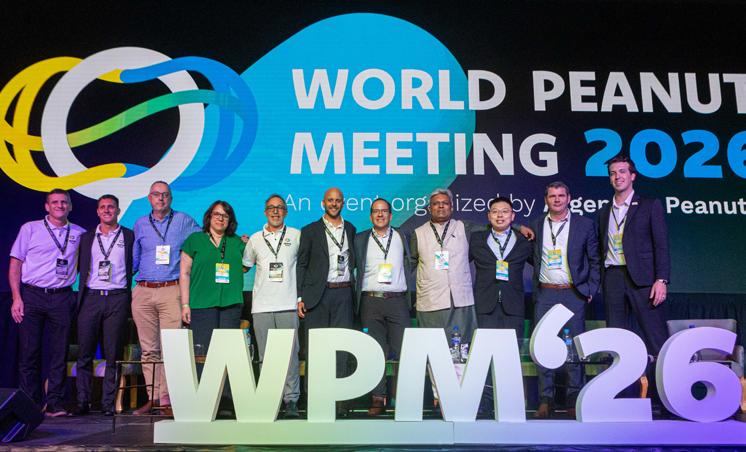




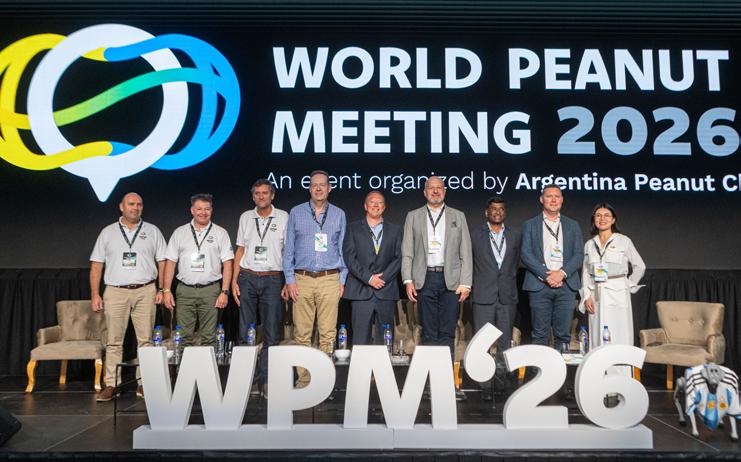
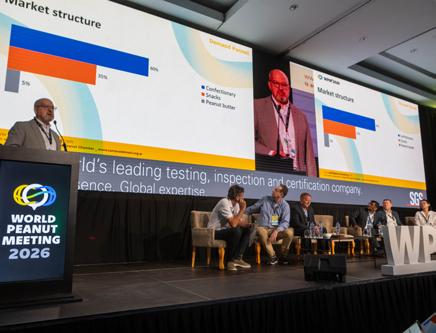






March 18th, 2026

The format of the presentation was the same as for the first edition of the in-person World Peanut Meeting, held in Cordoba in 2024. This time, however, the organizers decided to introduce both panels — supply and demand — with an issue of general interest across the different producing countries. For the supply panel, this task was taken on by Adam Tindal and Peggy Tsatsos from the Mars Wrigley company, who shared their experiences of supporting long-term peanut supply around the globe.

Diego Yabes, former president of the Argentina Peanut Chamber, moderated the panel and introduced Adam, a senior executive in Mars’s procurement team, to the stage.
“Some of you may remember previous international meetings, where Mars speakers had a habit of throwing peanut products at the audience…”
Adam was clearly referencing Ann Marie De Lorenzo, who, at the WPM 2025, lobbed Snicker bars and M&M packs among the gathering.
“…sorry to say that, for insurance reasons, that won’t be happening today.”
Adam went on to explain the company’s Protect the Peanut Plan and why it started: “In the early 2000s, peanut yields showed robust growth and supply disruption was rare and short lived.”
He then spoke of how things have changed significantly in recent years, with stagnation in global yields — and even losses in many cases — along with increased aflatoxin detections and logistical disruptions.
“All this is related to changing climate patterns… Ultimately we are seeing a system under pressure, and this is a threat to global food security and economic stability.”
Mars’s investment to support peanut production was underscored last year by an article in the New York Times: “How an M&M Sparked the Search for the Next Perfect Peanut” (July 24, 2025).
The specifics were presented by Dr Peggy Tsatsos, Senior Scientist at Mars. “Adam talked about the commercial aspects. I will deal with the science, and I will try to make it as accessible as possible. By moving the solution directly into the ‘germ’ of the plant, we are addressing these economic impacts at their source,” she explained.
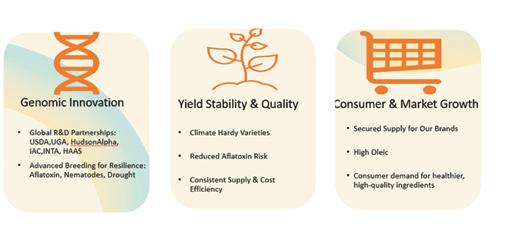
“The genome of peanut is wonderful, you can see the whole map of peanuts and from there you can pick the direction in which to move toward the development of different varieties… As regards the engineering tools that we use, we have the CRISPR (a revolutionary geneediting technology that enables precise, efficient, and cost-effective modifications to DNA in living organisms). Although there is controversy around it, it allows us to make better varieties quicker… it took peanuts 10,000 years to become what they are today, but now we can dramatically reduce the development time.”
Peggy went on to explain the different projects around the world: smut resistance in Argentina in cooperation with INTA (Argentina’s National Institute for Agricultural Technology), high-oleic varieties in India, working with International Crops Research Institute for the Semi-Arid Tropics, and the identification of fungal pathogens in the US.
Partners are essential to Mars’s project: “We cannot do it alone, this is a global issue… The findings are open source, there is no Intellectual Property and no royalties are sought. Peanut is our hero ingredient. It is what differentiates us from any other chocolate company.”

Peggy Tsatsos is a distinguished Principal Scientist specializing in ingredient science at Mars Wrigley. With a dynamic focus on peanut quality and spearheading numerous external research initiatives centered on aflatoxin mitigation, Peggy plays a pivotal role in ensuring product excellence and safety within the global confectionery giant.
Adam Tindall has been with Mars for five years, serving as a member of the Global Nuts sourcing team. He holds specific responsibility for South American peanut procurement and global hazelnut sourcing, ensuring the supply of high-quality materials for the manufacture of iconic brands such as Snickers, M&Ms, and Dove. Adam manages the flow of these ingredients into Europe and other regions, supporting Mars’ commitment to excellence across its confectionery portfolio.
Nick Smith, a second-generation operator in his family’s nut brokerage business, R. Smith Nut Company, presented the current situation of the US as a major world peanut producer.
Nick highlighted the progress made by the US industry in terms of aflatoxin management in recent years: according to JLA data, the average in 2025 was around 10%, following years with higher rates of contamination (particularly 2019, with more than 25%).
A major issue during 2025 was tariffs: “We all followed the news regarding tariffs from the US administration… things changed quite a bit in this regard. Right now, the administration is occupied with the war in the Middle East; hopefully after that we can get back to improving trade agreements… we know that the Supreme Court is engaged with the administration concerning the legality of the tariffs, though it may take a while to iron up these conflicts. However, the good thing is that the USDA and the American Peanut Council are used to this, going back to the first Trump administration, so we are ready to help importers deal with the uncertainty.”
As for expectations regarding the 2026 crop, there is little doubt that there will be a reduction. “In 2025 we had the largest peanut crop in several years… Currently the consensus is that there will be a reduction, the question is how much; estimates range in the 6–8 % level. Most of it will probably be in Texas, maybe with a 20% fall, while the planting area can be maintained in Georgia and other southeast states.”
According to the Prospective Planting report from the US Department of Agriculture, released at the end of March, the reduction exceeds 14%, with 1.674 million acres for 2026 as opposed to 1.953 million in 2025.
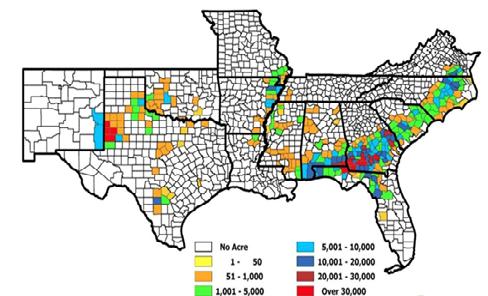
A significant new element is that “the government has changed the loan rate: that number used to be 355 dollars per ton; it is now increasing to 390 dollars per ton. It has some pros and some cons. A positive element is that it allows growers to achieve financial help; the problem is that it may attract the wrong type of growers, people simply looking to plant peanuts only for financial reasons. The people in this room all work for the health of the industry, those not in the room may have different motives. All in all, the industry is looking at this increase which makes it more expensive to buy the crop, to shell the crop, and buy the shelled goods.”
Nick mentioned some of the challenges the industry may face in the coming years: “It is more difficult than ever to be a grower in the US: as one farmer told me, they are one of the few industries in which they buy inputs at retail and sell goods wholesale… inflation is really affecting the market.” Other serious issues include generational changes — particularly the fact that the next generation may not be willing to inherit the family farming business — and the expansion of urban areas, which is reducing the land available for agriculture in the southeast.
Last but not least, the weather: “I will talk about the weather: right now, we are exiting la Niña, and every time we go from la Niña to el Niño, or vice versa, there is a transition period. The question is how long this period is. Currently meteorologists see a quick transition. Normally el Niño brings warm weather and copious rains. This may help the season and, so far, precipitations are pretty good.”
“There are many challenging factors, but we need a re-balancing of supply and demand,” Nick explained in response to a question from the audience, “…the 6-8% reduction will start this correction; the increase in government rates is a big deal; for some farmers it will provide relief, but looking at macro trends we are not sure if it is a positive thing because it will make the crop more expensive for shellers. Overall, I think we are looking at healthy reductions in 2026 and probably 2027.”
Nick Smith is a second generation operator in his family’s nut brokerage business, R. Smith Nut Company. Having spent significant time studying in London and Asia deepening his understanding and appreciation for global markets, Nick enjoys the challenge of figuring out the market every year. With a data-driven approach to nut commodities and long standing relationships, RSNC maintains loyal and deep ties to clients.
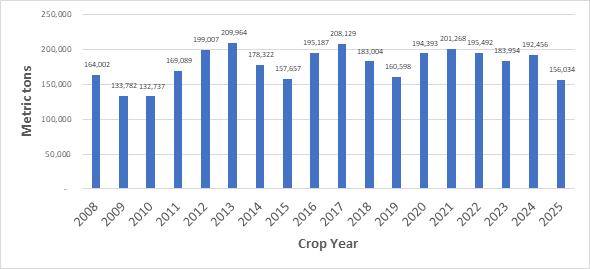
Joaquin Zavala is the President of Comasa, Nicaragua’s largest peanut company. His presentation stressed the difficulties that farmers and shellers in his country have faced due to market conditions over the last year or so.
“We planted in July and August 2025 and harvested during December 2025 and January this year. Planting was down about 14% to 38.500 hectares compared to the almost 45,000 of the previous season. The reduction, of course, is due to the low prices we have seen in 2025 and 2026. I would argue the prices were below production costs. All our production is for export, so we depend on the international markets.”
Overall peanut production in Nicaragua saw an even steeper reduction (19%), as yields were lower than expected due to reduced rainfall and its uneven distribution during the plant cycle. The total production for the 2025–26 season is estimated at 156,000 tons.
“We are a small producer but we do have a lot of experience planting peanuts and have a great farming community, with growers with experience belonging to the second and even third generation in some cases. I have to say, however, that many farmers are struggling right now, because of the low prices that we are seeing…”
Zavala reflected on the broader lessons of the past year: “I would like to share some lessons from what I have seen in 2025, which will be on record as the highest production internationally we have seen in a long time, but it wasn’t necessarily a good year. I don’t think more peanuts is better. The high supply did translate into lower prices, too low if
you ask me. But we have not seen lower prices translate into higher consumption… I will be happy if tomorrow our colleagues on the demand side surprise us with expectations for double digit growth in peanut demand.”
Overall the lesson is “that when we plan our production, we should have a clear understanding of how much we will be able to sell; if we grow 30% assuming that the market will grow at that rate, it is probably not a good assumption. Looking at the long-term, sustainability, and I mean economic sustainability, should be a priority.”
The first question Joaquin received from the audience concerned planting intentions for the next season: “It depends on the news I gather here during the rest of the week, because our farmers are getting ready to plant in June and July; well we have already seen reduction in areas, which I think is a sound decision. Hopefully we will see more stable prices…”
Joaquin also stressed the importance of venues such as the WPM: “It is an honor to participate again. I think that the World Peanut Meeting has become a reference for the entire industry, a place to exchange views and issues concerning the industry.”
Joaquin Zavala serves as President and General Manager of Comasa, bringing more than 26 years of experience in the peanut industry. He holds an Industrial Engineering degree from Texas A&M University and an MBA from Carnegie Mellon University.
After working for various Chinese corporations, Kobe decided to create his own enterprise and is now the General Manager of Beijing Prime Source Corporation. His presentation stressed how China aims to be selfsufficient in terms of peanut demand. During the last season, kernel production peaked at 10.5 million tons, the highest of the last decade except for the 2021–22 season, which reached 10.6 million tons.
Food security in peanuts is clearly a priority of the Chinese government, as “in 2025, The No.1 Central Document supported the expansion of peanut planting for the second time, especially in Xinjinag province, which has a great potential to develop peanut production of high oleic.”
As far as exports are concerned, after a reduction during the pandemic (2020–22), they increased again in the 2023–25 cycle: “In 2025, China exported 580k MT, compared with 380k MT in 2022, due to the 23/24 Argentina high price interval and lower freight from China to EU, plus three years consecutive good production and better currency rate against USD, above 7.”
The main export destinations are Japan (11%, or 55,000 tons in 2025), Indonesia (53,000 tons), the Philippines (44,000 tons), South Korea (37,000 tons), the Netherlands (30,000 tons), Spain (25,000 tons), and Thailand (22,000 tons). A notable feature of Chinese exports is that most of the product is processed: “78% of the total export consists of peanut products, while peanut kernels account for only 18% of the total.”
The trend in peanut imports is something of a mirror image of exports, with a significant increase during the pandemic years (“China imported approximately 1 million tons of peanuts annually
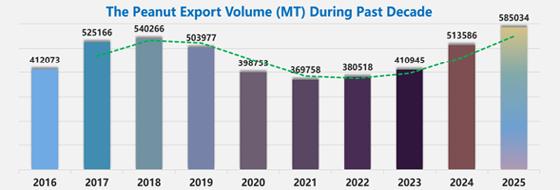
during the COVID-19 pandemic, household consumption demand remained very strong at the beginning stage” ), followed by a reduction in the 2022–25 period, “due to the recovery of China’s peanut good production.”
Kobe explained the relevance of recent trade disputes: “The world economy and trade face many uncertainties, with considerable risks and difficulties remaining. Global economic and trade growth remains slow, and the external environment is still challenging and complex. US tariff policies and their impacts will be a long-term process, and high tariffs are bound to become normalized.”
The policy framework mentioned is, to a large extent, a response to these trade tensions and reflects the intention of achieving selfsufficiency in peanuts as well as other crops.
A second effect has been the increase in the number of African countries able to export peanuts to China with no tariffs: “The Zero-Tariff policy is expected to boost African exports to China, reduce trade costs, and enhance the competitiveness of African products in the Chinese market. This means that 100% of the tariff lines of goods imported from 53 African countries will enjoy the duty-free treatment after May 1, 2026.”
Among sources of disruption in international relations, Kobe, in response to a question, mentioned the war in the Middle East: “Freight costs are increasing, not only the traffic going to the Middle East but also Europe.”
Mr. He Miao (Kobe HE) earned his Master’s degree from the University of London in 2012. As the Founder and General Manager of Beijing Prime Source Corporation. With over 11 years of dedicated experience in the peanut industry, he previously served as Edible Oil and Grain Department Manager at a state-owned enterprise.
Tushar Thumar, a chemical engineer by training, is the Director of Khedut Feeds and Foods Pvt. Ltd., a family-owned agro-processing company.
Before discussing the crop scenario, Tushar took the audience through the main features of India’s millenary culture: “For us the entire world is one family, and today the peanut industry is helping us accomplish this.”
“Groundnut,” Tushar explained, “was introduced into India in the 16th century by Portuguese traders from South America. Over time, it adapted very well… also thanks to people such as Shri Padma Bhagat, considered the father of groundnut in India, who in 1910 introduced groundnut cultivation in the Gondal area and helped expand groundnut farming across the region, contributing significantly to Gujarat becoming one of the leading groundnut-producing areas. Another important person was Dr Venkata Rao Krishnaji Badami, who developed the Hebbal Groundnut-1 (HG-1) variety and played a key role in introducing scientific genetics into groundnut improvement programs. His major research contributions to groundnut were made during the late 1920s and 1930s.”
As the world’s second-largest producer, in the 2024–25 season India reached a total planted area of 5.76 million hectares and a production of 11.9 million tons. The 2025–26 season, however, was heavily affected by weather conditions: “In October and November last year, a large quantity of harvested groundnut was kept in open fields for natural drying when unexpected rains lashed the region, leading to serious deterioration in crop quality. Due to prolonged exposure to moisture and waterlogging, the produce suffered soaking, fungal infestation, discoloration, sprouting, and quality degradation, making a substantial portion of the crop unfit for market and processing purposes. More than 50% of the crop was affected.”
The consequent shortage led to higher prices, affecting the international competitiveness of Indian peanuts. India nevertheless remains one of the strongest exporting countries, especially in Asian markets: Indonesia accounts for 37% of kernel exports, followed by Viet Nam, the Philippines, Malaysia, and Thailand. Oil exports go almost entirely to China.
When Tushar mentioned the European Union as a market, he could not avoid a sigh: “Indian peanut processors and exporters are facing growing difficulties in the EU market despite full compliance with Agricultural and Processed Food Products Export Development Authority prescribed sampling and testing protocols aligned with EU regulations. Nearly 50% of export consignments are being selected for re-sampling and testing by EU health authorities at destination. Due to very stringent limits for Aflatoxin B1 and the naturally heterogeneous nature of peanuts, variation in analytical results frequently occurs between Indian and EU laboratories. This results in shipment delays, rejections, financial losses, and increased uncertainty, posing a serious challenge to the competitiveness of Indian peanut exports in the EU market.”
India’s domestic market is expanding, raising the question of whether the country, as happened with China years ago, could shift from a net exporter to an importer:
“Growing health awareness and rising demand for affordable plant-based protein are driving rapid adoption of peanut protein and peanut butter in India. Increasing fitness consciousness, vegetarian dietary preferences, and focus on preventive nutrition are transforming peanuts from a traditional oilseed into a modern, healthy protein food for daily consumption.”
Most consumption consists of snacks, confectionery, and other uses (45%), oil accounts for 30%, while the remainder goes to seeds and exports.
Traditionally, the role of the government in peanut production is significant. It purchases large amounts of peanuts every year at a fixed price (Minimum Support Price): “Groundnut MSP has increased by nearly 80% over the last decade, reflecting the government’s strong policy commitment toward doubling farmers’ incomes and ensuring better price realization for agricultural produce. In the last season the government’s procurement of nearly 2.1 million tons of groundnut under MSP at ₹72.63/kg (USD 807/MT) stands as a historic and farmer-centric intervention…”
Tushar concluded his presentation by recalling a 2012 trip to Goa by a delegation from the Argentina Peanut Chamber, which included Javier Martinetto (moderator of the Demand panel, scheduled for the following day), who signed an agreement with India’s Oilseeds Council. “Please come back to India!” said Tushar.
Answering a question from the audience, Tushar confirmed the high level of import duties on peanuts from any origin: “That is a serious obstacle to imports…. The government wants to protect the farmer. We would have probably imported peanuts this year if not for this tax.”
Mr. Tushar Thumar, is the Director of Khedut Feeds and Foods Pvt. Ltd. and Shreeya Peanuts Pvt. Ltd., family owned agro-processing companies. A Chemical Engineer by education and an entrepreneur by choice, he is amongst the third generation into the family business of agri commodities and edible oils since 1967.
Adri Botha leads the South Africa Groundnut Forum. Unfortunately, she could not make it to Mendoza for the event and so presented online: “I am really disappointed at not being able to join in person.
“Africa has enormous potential for peanut production,” and many African countries are already major world producers: Nigeria, with 4.3 million tons; Sudan, with 2.5 million; and Senegal, with 1.5 million. However, production systems across the continent face a number of challenges: “It is made up predominantly of smallholders, with informal aggregation and side-selling, limited drying, storage, and processing infrastructure; aflatoxin and quality management are big challenges; market orientation is strongly oil-weighted. System structure remains the primary constraint to premium market access…”
Producing countries in Africa benefit from production scale and genetic resources, “but the seed enterprises are mostly fragmented and the seeds are recycled informally by farmers.”
Domestic consumption is very strong, particularly in Nigeria, the main producer, while oil crushing is a major outlet for exports in countries such as Sudan and Senegal. “The access to premium edible markets is often limited by aflatoxin compliance requirements, postharvest constraints, and inconsistent quality systems.”
A special case is South Africa, traditionally a producer of high-quality peanuts and an exporter of niche products to markets such as Japan and the Netherlands. “South Africa operates primarily as an edible-driven market, where quality and food safety determine competitiveness more than volume alone.” Production is concentrated in the Free State region and the North West and Northern Cape, and amounts to around 60,000 tons, depending on the season. Output is not sufficient to meet domestic demand, and imports of around 24,000 tons are usually required.
“The South African Groundnut Association plays a central role in strengthening the national groundnut system through industry coordination and stakeholder alignment, active participation, coordination and management of trials, support for research and varietal development in collaboration with local and international research institutes, cultivar and gene bank maintenance and certified seed multiplication, investment in DNA testing capabilities, engagement with processors, farmers, and scientists, promotion of quality standards and best practices, facilitation of collaboration across the value chain, and marketing and promotion of groundnuts.”
José Rossato is the president of the Camara Setorial do Amendoim, the main reference institution for peanut producers in Brazil.
His first words were for the host: “Congratulations for the 50 years of the Argentina Chamber last year, you are a reference for the development of the peanut culture, so, on behalf of Brazil, thank you! We are the second-largest delegation at this event and this shows how important this is and how engaged we are.”
José highlighted the export performance of 2025, both for kernels (with a historic record high of 311,000 tons) and oil (the second highest volume of the decade, with 154,000 tons). A significant development in 2025 also concerned export destinations: China is now the second-largest buyer, with 62,000 tons, just behind Russia (68,000 tons).
“Where are we now? The area we are starting to harvest went through a 29% reduction; that means farmers were not happy with prices and not happy with the cost of production. Farmers are moved by the passion, by what they love to produce, but they also must be profitable…”
However, the production prospects for the 2025–26 season look good: “With 30% of the area harvested, the weather right now is regular to good, with the last few days kind of rainy … but so far so good in terms of yields and quality.”
Brazil’s supply/demand balance includes 270,000 hectares of planted area, a yield of 4.5 tons per hectare, for a total production (in shell) of 1.107 million tons (845,000 in kernels), and expected exports of 302,000 tons.
“Let’s look at the future. The state of Sao Paulo now represents 73% of the total peanut area, just about three years ago it was more than 90%: we are going to new states that never saw peanuts before. It is not easy… but we are trying, and those areas are gigantic, for example the Mato Grosso and Mato Grosso do Sul.”
There are challenges to be sure: according to a recent survey, 44% of peanut farmers are first-generation growers, and almost 40% started cultivating peanuts only within the last five years. Another key challenge is market diversification, particularly with regard to the European Union: “Last year was the lowest rate of export to the EU, 14%, despite having done a good job considering RASFF stats.”

Rossato also highlights Brazil’s broader agricultural success: “We can learn from other crops. Brazil has first place in the world in the production of many agricultural products; we can learn and understand how to increase. Peanuts are an opportunity and Brazil will be responsible for a 42% increase in food production according to FAO (the Food and Agriculture Organization). Why is FAO pointing to Brazil? Because 66% of the soil is native vegetation, and we do not need to cut any trees, because we have 21% pasture…”
He concluded with a powerful metaphor: “From here in Mendoza you have the opportunity to drive to Chile: there are many curves, though, and the road is called the caracol, the snail. It is dangerous and difficult, but it is beautiful. We do not expect to see our sector go from A to B in a smooth way, we expect to see curves like that; we must be prepared, but we are learning with our neighbors and trying to become a great player.”
Chairman of Peanut Chamber in Sao Paulo State and Board Member in agribusiness organizations, including Coplana. He drives a family farm and he has a professor position in four universities. He is Ph.D. in Agronomy from São Paulo State University with internship at the University of Nebraska, USA, a postdoctoral fellowship at the University of Alberta, Canada, and Executive MBA from Fundação Dom Cabral, Brazil.
Diego Bracco is the president of the Argentina Peanut Chamber and a senior manager at Maniagro.
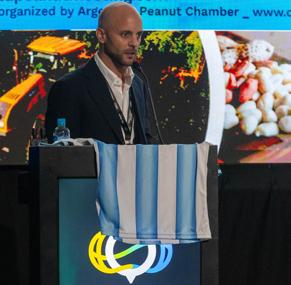
He opens his presentation with what is becoming his signature move: displaying the official shirt of the Argentine national soccer team, current world champions after winning the 2022 World Cup. “I have to use this — it could be the last opportunity before the next soccer world championship, just few months away…”
Then, looking at Rossato (five-times champions Brazil are another strong contender), he added: “You will have a re-match this year.”
Diego presents Argentina’s latest export figures by season (from May to April of the following year). The 2025–2026 period is expected to close with a record volume of 850,000 tons of exported peanut kernels — a strong increase from the previous season (741,000 tons), and even more so compared with 2023–24 (the season severely affected by drought), which totaled only 464,000 tons..
As in the case of Brazil, the geographic distribution of exports in 2025 shows the remarkable growth of China as a destination. “It has been the second main destination after Europe, an opportunity that arose because of low prices.”
As far as 2026 is concerned, the harvest is just a few weeks away, but it is still difficult to make accurate predictions. “We already know that we had a reduction of 26% of the planted area. Cordoba is mostly stable if compared with historic average areas, but there has been a big reduction in Buenos Aires, La Pampa, and Santa Fe, the relatively new provinces for peanuts. All in all, 2026 sees a return to the average acreage for Argentina.”
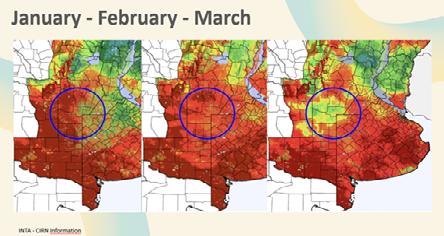
Final production figures will obviously depend on weather conditions in the last few weeks: “We had a rather rainy season in August and September, with moisture for planting and during the first month; the same thing in October through December, during the initial growing stages. But then we had very little rain in January and February, in some places up to 40 days with no or very little rain. Of course, the situation is diversified: in some places the moisture is fairly good, but not in others; in particular the south of Cordoba has been suffering and the plants are not covering the furrows, with a delay of development of about 25–30 days. El Niño is coming in April, so we expect higher temperatures, but also more chance of rains: in the first half of March in some areas we had up to 300mm of rain, so now we will need sun and hot weather for the rest of the crop.”
“At this time our yield estimate is for 2.42 tons per hectare in kernels, quite in line with historic figures. However, we are proposing a chart with three possibilities: an optimistic one with a yield of 2.52; a central one, which I mentioned, of 2.42, and a pessimistic one of 2.2. If we consider the central one we will have a total production of 918,000 tons in kernel and exports for 687,000.”
“As speakers before me have said, it is not good to have low prices, It is not easy to support farmers with those prices, but I expect we will be going back to a regular scenario in the following months…”
Looking ahead, Diego noted an element of uncertainty due to the new Argentine economic policy introduced by the government: conditions are expected to tighten for farmers and exporters. This will be the main challenge for Argentina’s peanut industry in the coming years.

March 19th, 2026

On March 19, the second panel of the World Peanut Meeting was ready to start at 9:00 a.m. This time the moderator was Javier Martinetto, another former president of the Chamber. He briefly summarized the main themes that emerged from the Supply Panel before introducing the speakers.
Markets in 2025 were dominated by oversupply in most producing countries. In 2026, most operators appear to be aiming for a rebalancing, mainly through reductions in planted area. Weather-related issues in several producing countries may complicate the situation.
Looking at the long term, and recalling the remarks made by Adam Tindal and Peggy Tsatsos the previous day, it is paramount for the global peanut industry to invest in the development of technological tools, especially genetic solutions — “areas where we can all cooperate rather than compete.”
After all the speakers joined him on stage, Javier introduced the first guest of the day, who would open the Demand Panel. Tomislav Ivančić is an expert and adviser on trade, development, and risk in global supply chains, and works with the Investment Centre of the Food and Agriculture Organization of the United Nations.
After providing a general overview of global peanut production and trade, Tomislav focused on long-term trends in population growth and food demand.
“In terms of population growth there will be sharp differences among areas. World population reached 8.2 billion in 2024 and is projected to peak at 10.3 billion in the 2080s, but growth through mid-century will be largely concentrated in sub-Saharan Africa. While today 56% of the world’s population lives in urban areas, by 2050 around 68% is projected to live in urban areas, reflecting a continued shift away from rural areas.”
What could the consequences be for the peanut sector? “Urbanization may strengthen demand, but constrain rural economies. In aging or peaking markets — such as China and Europe — volume growth may slow, but price points may rise for higher-value products, incentivizing producers to diversify beyond raw exports.”
It is also important to consider that much of the growth in food demand will likely be concentrated in low- and middle-income economies. One possible positive effect for the peanut industry may come from sustained demand for vegetable oils, including groundnut oil, in these markets.
Two global phenomena, according to Tomislav, will significantly affect the peanut industry worldwide: increasingly volatile weather patterns and land degradation, as well as changes in global agricultural labor structures.
As far as weather is concerned, “Drought accounts for 65% of global disasterrelated agricultural losses and extreme heat can reduce yields by up to 50%, according to FAO data. Soil degradation and declining water quality reduce nutrient availability, soil stability, and water retention, lowering resilience to climate shocks. The economic consequences in the 1991–2023 period have been dire, with global agricultural disaster losses of about USD 3.26 trillion.”
There are also reasons for concern on the labor front, as younger generations are becoming less attracted to agricultural employment, potentially tightening labor availability in the future.
An additional major trend is the increasing importance of sustainability standards. “Products with sustainability claims grew consistently by 28% over five years, outperforming conventional products according to McKinsey. A 2025 survey of 37,000 consumers in 40 countries confirms growing consideration of environmental claims and willingness to pay more.”
For peanut producers this will imply greater farm-level traceability, stronger documentation of environmental and social risk management, and improved understanding of sustainability requirements in destination markets.

Tomislav Ivančić is an expert and adviser on trade, development, and risk in global supply chains. He works with the Investment Centre of the Food and Agriculture Organization of the United Nations (FAO), advising governments, companies, and other stakeholders on market opportunities, investment strategy, and development risk. In addition to his work with FAO, he advises the World Bank on global supply chains and sustainable agricultural investment, works with the Organisation for Economic Cooperation and Development (OECD) on the development of a programme on responsible commodity sourcing in Guatemala, and acts as an expert to the International Labour Organization (ILO) SECTOR Department (agriculture and building materials) on supply chain risk.
Jane Zheng, a senior manager in the family business Qingdao Shengde Foods, and with three decades of experience in the peanut industry, focused her presentation on China’s transformation from a net exporter into a net importer due to the spectacular growth of domestic consumption over a relatively short period of time.
“In the 1990s China was still developing and every dollar mattered. Peanuts were mostly seen as a source of foreign currency. In this period, peanuts were considered just too precious to eat. Lower-grade kernels went to oil production. Our prices were very competitive then: half, and in some cases even one-third, of American peanuts. The main markets were all in Asia, especially Japan, the Middle East, and the countries of Southeast Asia.”
Then, in the 2000s, China joined the World Trade Organization and everything changed. “Standards of living improved very quickly and peanut consumption grew year by year. Peanuts shifted from export commodity to domestic staple.”
“Actually, Chinese culture really favors the peanut. Its name, huā shēng, means ‘born from a flower,’ and it is a very beautiful image, full of life and prosperity. In many dialects in our country, it is called the longevity nut; these dialects were telling us in the industry: if you eat peanuts, you will live longer.”
As a consequence, China — despite remaining by far the world’s largest producer — began importing peanuts to satisfy growing domestic demand. “Prices started to rise and we turned from seller to buyer… I remember the first time I bought peanuts from Argentina; it was 11 years ago. We have a great relationship with our suppliers and we treasure it because we used to be there — we know how tough it can be.”
Jane explained that most peanuts in China are consumed in the form of oil, probably more than 55%, as Kobe had noted during the Supply Panel. Peanut oil is widely regarded as a premium cooking oil and often becomes the preferred choice when families can afford it.
“We have to realize that peanuts actually live a double life: on one side they are an oilseed, like soybeans or sunflower, and on the other they are a nut, like pecans, pistachios, and almonds. But peanuts are truly unique… All the other seeds grow above the ground, all the other nuts grow on trees. But peanuts are very different: with the flower above the ground and the fruit underneath. It grows quietly, low profile… And we peanut people are kind of like that: we work quietly all year round and once in a while we pop up at conferences like this one, to see what happened in the world and exchange ideas.”
Jane Zheng is the founder of Qingdao Shengde Foods, a respected peanut producer, exporter, and importer based in Qingdao, China. For over three decades, Jane has built deep expertise in peanut production and marketing, grounded in quality assurance, sustainable farming, and farmers’ prosperity. Her work links farmers, processors, and buyers to strengthen resilient value chains and community well-being. She continues to pursue collaborative opportunities to deepen trade relationships and deliver meaningful economic benefits across continents.
Julie Thakker, manager at JKT Foods Europe, could not travel to Mendoza but joined the World Peanut Meeting online to discuss the bird feed market, an important segment of the peanut business.
Believe it or not, birds eat peanut butter as well. “It may be surprising to a lot of you but we also feed peanut butter to our birds. It is a highenergy supplemental feed in the wild bird feeding market in the UK and EU. It is not the same as human peanut butter; it is unsalted and formulated with mealworms, seeds, and animal fat for birds.”
Julie presented the main figures of the bird feed market. Geographically, the most important areas are the UK, with a market size between 20,000 and 30,000 tons per year; Germany and the Netherlands, with 20,000–26,000 tons; and the rest of Europe — mainly Northern and Central Europe — with 4,500 to 6,500 tons.
Each region has its own product preferences: whole peanuts in mesh feeders and splits in foil bags in the UK; crushed peanuts in fat balls and suet, as well as blanched splits, in Germany; and high-fat energy cakes and tubs in other European countries.
“In 2026, the UK bird feed market is undergoing a ‘Value Revolution,’ with economic pressures shifting demand from premium brands to highvolume, energy-focused budget products — most notably driving hulled sunflower kernels to emerge as the primary competitive threat to peanuts.”
The major issue for peanuts in bird feed today is indeed competition from sunflower kernels. “They have officially overtaken peanuts as the UK’s ‘default’ high-energy feed, driven by price stability and perceived utility.” While peanuts provide more protein, Julie explained, sunflower seeds present lower aflatoxin risks and are easier to use, requiring less specialized equipment.
Her final remarks focused on trade wars. “Agricultural commodities have become ‘pawns on a geopolitical chessboard,’ particularly between the US and China. This impacts peanut demand, shifting sourcing from the US toward Argentina and Brazil in response to tariffs and government subsidies.”
Julie Thakker, the driving force behind JKT Global Group, brings almost 20 years of sharp, hands-on expertise in the international peanut trade. A recognised specialist in EU and UK demand for bird-feed peanuts, she navigates global supply markets with ease—collaborating across Asia, Europe, South America, North America, and the Middle East. Armed with a Master’s degree in International Business Management and Risk Management, Julie blends academic insight with real-world commercial instinct.
Ashley James, based in Melbourne, is a senior manager at Scalzo Food, one of the leading players in the Australian and New Zealand peanut industry.
He began with a general overview of Australia: a highly multicultural country with a relatively small population of around 29 million people, largely shaped by immigration — Italians and Greeks after WWII, and more recently migrants from Asia. Overall, he described Australia as a stable country with high living standards and efficient public services.
Australia also has its own peanut production. “In the last 20 years it probably averaged 20,000 tons in-shell, which means just shy of 15,000 tons in kernels.” However, production has been declining: more than 17,000 tons in 2024, but only 14,000 in 2025, with expectations for a further reduction in 2026. A major processor, Bega, recently sold its facilities to Crumpton, now the sole sheller in the country.
“Peanuts are extremely versatile and, compared to other snacking nuts, are by far the cheapest. This makes them a widely used product across many supermarket categories in Australia. We have seen consumers shift spending toward peanuts when cost-of-living pressures increase: you buy a five-dollar bag of peanuts instead of a fifteendollar bag of almonds.”
The total import market over the last 12 months amounted to approximately 36,600 tons. “If we add local production, we can see that per capita consumption is close to 1.5 kilos yearly.” Most imports come from Argentina (almost 70%) and Brazil (10%).
“Peanut sales are very significant for retailers as they total 267 million dollars — a big number for a single item… We only see the number of SKUs growing, especially in spreads, confectionery, health products, and fresh produce.”
The spreads category is by far the largest segment. “Peanut butter is the real hero. It contributes 59 million dollars and is growing at a rate of 7% per year, mostly at the expense of jam.”
New Zealand presents a different scenario. The country is currently experiencing recessionary conditions, with private labels accounting for up to 15% of total grocery sales. “Private-label penetration in peanut butter is high at 35%, growing by 7.5%. However, growth is slowing and has halved in the last six months. Natural premium peanut butter in New Zealand unusually makes up 50% of all peanut butter sales and is still growing.”
In general, peanut consumers tend to be older than average. “Our challenge is innovation to get younger consumers buying peanut products.” Ashley noted that the industry can learn a great deal from other sectors, especially almonds. “The Almond Board of California and the almond sector in general have done a great job with innovation, creating occasions to eat almonds.”
Scalzo Food Industries is a leading food manufacturer in Australia and New Zealand, operating five manufacturing sites. I began my career at Scalzo Foods in 2003 as part of the Quality team, later moving into the Commercial Department as a junior buying assistant. Over the years, I have managed a diverse range of product categories, including peanuts. In 2022, I joined the senior leadership team, contributing to strategic direction and ongoing business development.
Srivatsava (“Vatsa”) Ganapathy is the CEO of Eventell Global Advisory Private Ltd., organizer of a major international sesame and peanut conference, and has decades of experience in commodity market research.
Vatsa began by presenting key data concerning ASEAN countries. Established in 1967 and later expanded, ASEAN now includes 11 Southeast Asian countries: Indonesia, Malaysia, the Philippines, Singapore, Thailand, Brunei, Vietnam, Laos, Myanmar, Cambodia, and TimorLeste. It constitutes “the fifth largest economic bloc, aspiring to become the fourth, with a collective GDP of four trillion dollars, 700 million people, and growth of around 5%. It also benefits from an important trade agreement with China.”
Several ASEAN countries are major peanut producers, particularly Myanmar, with 1.2 million tons during the 2024–25 season. Other important producers include Indonesia (567,000 tons expected in 2025–26) and Vietnam (264,000 tons).
Indonesia is also the region’s largest importer, with more than 300,000 tons imported in both 2024 and 2025. Vietnam follows with almost 200,000 tons per year, then the Philippines (around 100,000 tons), Malaysia (87,000 tons in 2025), and Thailand (about 56,000 tons). Altogether, ASEAN countries have imported more than 750,000 tons annually in recent years.
“There is seasonality in purchasing,” Vatsa explained. “Imports are higher before local harvesting, when domestic production is insufficient, but also during important festivals that generate peaks in consumption.”
India has traditionally been the region’s largest supplier, particularly for Indonesia. “Though in 2025, due to a temporary ban imposed by Indonesia, Indian imports were partly substituted by China.”
Prices for bold peanuts from India ranged between USD 980 and 1,020 per ton, while Java peanuts sold for USD 1,200–1,350 FOB India, with an upward trend beginning in September 2025.
Vatsa also discussed sanitary regulations and import policies. “Indonesia has installed tariffs to protect local production. Thailand, the Philippines, and other countries are doing the same. Recently there has also been increasing focus on aflatoxin limits.”
Because Indonesia and Malaysia are major palm oil producers, peanut oil is not dominant in the region. “The exception is Myanmar, which still uses peanuts for oil when prices are not too high.”
Across ASEAN countries, snacks remain the principal use for peanuts — accounting for more than 50% in Indonesia — followed by confectionery and other processed peanut products, while peanut butter still represents only a small niche.
“As far as the future is concerned, I think we can expect significant growth, especially in Vietnam and Indonesia, as these countries expand their retail structures and tourism continues to rise.”
Srivatsava Ganapathy (Vatsa) is the CEO & Director, Eventell Global Advisory Private Limited, with over 28 years experience in commodity market research, especially those commodities with long, fragile supply chain. Eventell launched its “Peanut Weekly” in 2022 as an independent market information service and has been organising the annual World Sesame & Peanut Conference since 2019. Eventell is known for its industry-leading platforms, unbiased research and advisory services for market participants along the commodity value-chain.
Sergei Khaesh, founder and General Manager of Agroimpex Co., the largest Russian importer and processor of peanuts, opened his presentation with an overview of the Russian market.
Russia’s population of 146 million consumes approximately one kilo of peanuts per capita each year, for total annual consumption of around 150,000 tons — all imported.
“We do not have preferences in terms of origins; each has its own niche depending on the buyer’s requirements. However, the main supplier in terms of market share is Brazil, followed by Argentina.” Together, the two countries account for about 75% of total imports.
Confectionery is by far the dominant consumption category, representing about two-thirds of the market, followed by snacks and peanut butter.
“But confectionery itself can be divided into subsegments,” Sergei explained. “There are peanuts for multinational corporations or large national enterprises, regional products, halva producers… all of these prefer peanuts with high oil content, so in many cases they source from Brazil and India. Then there are cookies and biscuits, where importers prefer processed peanuts, roasted or peanut butter.”
Different buyers also have different purchasing behaviors. Large corporations usually maintain strict quality specifications and “prefer to outsource through importers who manage quality and logistics.” Regional producers, on the other hand, tend to be more pricesensitive and rely more on visual inspection than laboratory analysis.
The snack market is heavily dominated by private labels, making price especially important. “That is why most peanuts purchased are splits rather than blanched whole kernels.”
Peanut butter remains a relatively small segment — around 7,000 tons — but it has grown rapidly, averaging 15% annual growth in recent years. “It is a very diversified market, with around 300 different brands and strong e-commerce sales, allowing even consumers in small villages to purchase it.”
Sergei also reviewed sanitary regulations. Maximum permitted moisture is 7%, while aflatoxin limits are 5 ppb for B1 and 10 ppb total. Russia also operates a traceability system called ZERNO, which tracks containers from entry to final destination.
Finally, Sergei addressed several misconceptions about the Russian market. Russia should not simply be considered a price market: “Quality and delivery schedules are very important.” Peanut butter is growing, but “confectionery is the real driver.” Likewise, specifications are not flexible as some exporters assume — “they are actually quite strict.”
Mr. Sergei Khaesh is founder and General Manager of AGROIMPEX Co. the largest Russian importer and processor of peanuts. He has more than 30 years of experience in Agriculture Commodity trading, farming and processing. He has done Mechanical Engineering from ITMO University St. Petersburg and did his EMBA from Graduate School of Management St. Petersburg State University
Brian Reed is a senior manager at JM Smucker, a Fortune 500 company with more than 8 billion dollars in sales and 8,000 employees.
“The company is now in its fifth generation of leadership. Some of you may know Mark Smucker, our current CEO — he actually lived in Argentina for a couple of years.”
“As we know, peanut butter remains the main category within US peanut consumption. It has remained flat over the last five years and we are working to understand why and figure out how to increase demand. The snack category is also down, along with peanut candy.”
One factor behind this trend is declining bread consumption, traditionally one of peanut butter’s closest associated products.
Brian then focused on broader consumer trends. “Behavioral change is happening faster than in past cycles. The conversation is moving beyond convenience toward dietary needs, food scores, and personalization — with continued evolution expected.”
As a consequence, “relevance will hinge on adapting brands faster than before. Speed and agility are critical to winning in the new environment.”
Among the strongest trends are growing demand for less processed foods and increased attention to protein and fiber. “Protein is everywhere. Fiber is gaining momentum, already a priority in the UK and parts of Europe, and consumers continue to show heightened interest in functional benefits from the foods and drinks they enjoy.
Manufacturers must be proactive in addressing interest in nutrient density and functional claims.”
Pricing also remains crucial. “The consumer is fragile right now in the US.”
Additional challenges stem from the rapid digitalization of retail. “We are working with Walmart and they plan to deliver products within 45 minutes after the customer orders them, so we have to adapt our service accordingly.”
Ultimately, however, the industry’s central objective remains demand growth. “In order to increase demand, we have to focus on messaging around the benefits of peanuts and how nutritious they are, particularly from a protein and fiber standpoint.”
Returning to the issue of slowing demand, Brian addressed the impact of weight-loss drugs. “About 25% of people in the US are on Ozempic… If you look at reduced consumption in certain food categories, for example bread, you can see a pattern. It has taken the food industry somewhat by surprise.”
Brian Reed is the Senior Director of Global Procurement for nuts, fruit, and packaging at The J.M. Smucker Company. In this role, Brian leads a team of 12 procurement professionals, overseeing risk management for more than $1 billion in raw material costs. He also partners with Smucker’s top five customers and works closely with sales and marketing teams during customer visits.
Russel Mooney, Managing Director and Chief Procurement Officer at Intersnack, began by presenting an overview of the European savory snacks market.
The European market — including the UK and other non-EU countries — was worth 32.5 billion euro in 2025, continuing its steady growth from 30.3 billion in 2023 and 31.7 billion in 2024.
Within this market, peanuts account for a relatively modest share: 1.413 billion euro in 2025, with fairly stable sales volumes of approximately 224,000 metric tons. These figures exclude confectionery and other non-savory segments.
“Some people asked why lower prices have not resulted in increased volumes. There is indeed a strong correlation between price and volume; we saw this clearly in 2023 and 2024, when rising prices choked some demand. So why no rebound now?”
Russel identified two fundamental reasons. “First, the power of retailers: they are extremely influential in determining whether consumers actually benefit from lower wholesale prices. Second, Ozempic and similar drugs are having a major impact across the food and beverage industry. We have seen with Brian how important this phenomenon is in the US, but in Europe these drugs are often available free of charge.”
From a geographic standpoint, Germany, France, Great Britain, and Spain together account for more than half the European market. Per capita consumption in these countries approaches half a kilo annually, compared, for example, with Italy, where consumption remains around a quarter kilo per year, albeit with a growing trend.
“The European average is 0.42 kilos per capita and if you add confectionery and other peanut products, you probably reach one kilo. But compared to North America, that is still less than half their consumption — so there is considerable potential.”
One fast-growing segment is coated peanuts, particularly in Germany and the Netherlands. Peanut butter also shows promise. “It remains very small compared to the US, but it is growing rapidly in some countries, especially France.”
Overall, innovation remains key. “Consumers are looking for something new, exciting, different.”
Russel concluded on a more cautious note. “I tried to think of something positive and exciting to close my presentation, but I think I will fail. 2026 was already going to be a difficult year, and that was before what is happening now in Iran.”
European growth remains weak — “around 1%” — and, apart from Spain, many economies are struggling. “The gas price rose 20% just today, and that is money taken directly out of consumers’ pockets. Consumer confidence was already fragile; now, given current geopolitical tensions, it is even more so.”
Russell Mooney is the Managing Director / Chief Procurement Officer for Intersnack – a leading European savoury snacks manufacturer. He has been with the Group for nearly 9 years having previously worked for Nestle, Kellogg’s and Diageo in a variety of different roles & responsibilities across 3 Continents in his near 40 year career.




A brief summary of the panels

The panels provided a comprehensive overview of the global market, covering both supply dynamics and consumption trends. A stable market undergoing adjustment Among the key takeaways highlighted by speakers was that global peanut demand remains stable, with no major expansion but also no signs of contraction. Regions such as Russia, Europe, and China are maintaining steady volumes, while the US has experienced a decline in consumption over the past two years. In contrast, markets such as ASEAN are showing significant growth in imports, and countries like India and Africa are expected to increase demand driven by population growth and changing consumption habits. Smaller markets such as Australia are also showing positive growth trends.
On the supply side, 2025 was characterized by a global oversupply, while 2026 marks the beginning of a rebalancing process. The United States is showing strong production levels, China remains stable with some quality challenges, and India is facing reduced availability due to unexpected rainfall during harvest. In South America, Argentina and Brazil are entering harvest with reduced planted areas, aligning with the need to rebalance the market. In this context, international prices appear to have reached their lowest point in recent months and are now entering a recovery phase, with close attention on weather conditions during harvest in key producing countries. The event made clear that the global peanut market will become increasingly complex, driven by three major trends:
1. Greater climate sensitivity in production
2. Accelerated demographic growth (especially in Sub-Saharan Africa)
3. Sustainability as a key market access requirement
In this scenario, speakers emphasized the need to strengthen research efforts to shift from vulnerability to resilience, promoting more efficient practices, reduced use of chemical inputs, and lower production costs. An integrated value chain to compete better Another key consensus was the importance of strengthening coordination across all segments of the value chain. Producers, suppliers, and manufacturers share the challenge of optimizing the supply chain to deliver high-quality products at competitive prices to final consumers. The common goal is clear: to produce more peanuts per hectare at the lowest possible cost, while meeting increasingly demanding quality and sustainability standards.






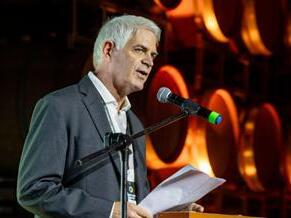





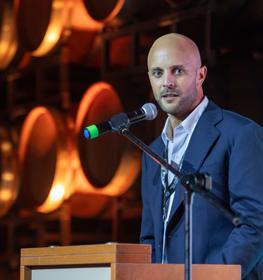
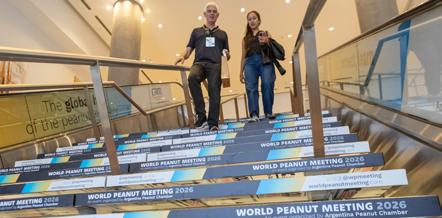





























Mendoza, May 2026: In a context where Argentine agribusiness reaffirmed its competitiveness in the world’s most demanding markets, PromArgentina, the Argentine Agency for the Promotion of Investment and International Trade, hosted an institutional pavilion highlighting the technical support it provides to local peanut exporters.
The fourth edition of the World Peanut Meeting, held from March 17 to 19 at the Hilton Mendoza Hotel, “exceeded expectations in terms of attendance and confirmed that Argentina is an essential player in the international trade of the peanut production sector,” stated Diego Sucalesca, Executive President of PromArgentina.
The World Peanut Meeting brought together more than 300 industry leaders from 30 countries in the city of Mendoza. This in-person edition, the second held in the country after its run in Córdoba, highlighted Argentina’s significant role as a global leader in peanut exports, alongside India, and surpassing giants like the US, China, and Brazil.

For three days, PromArgentina’s institutional booth aimed to bridge the gap between the country and emerging and established markets. The agency’s presence at the World Peanut Meeting was designed to function as a dynamic business office for forging key connections.
Business meetings, for example, were facilitated between leading Argentine companies, such as Visconsul, Prodeman, AGD, Olega Cía., LMC, and Cotagro, and a trade representative from Azerbaijan, Elnur Asgarov. These connections open new trade routes in regions with a growing demand for high-quality food. Along with peanuts, the meeting in Mendoza also served to promote other regional production sectors. For example, in collaboration with ProMendoza, a specific business matchmaking event was organized for the nuts and dried fruit sector.
In total, 25 companies dedicated to the production of walnuts, dried plums, raisins, pistachios, and almonds were able to connect with international importers and take advantage of the World Peanut Meeting’s infrastructure to diversify the Andean region’s export offerings.
exports of brazil (tm 1202.42 + 2008.11) &
peanut exports of argentina - kernels (mt)
eu 27 imports, mt (shelled hs 1202.42)
china future prices (settle value - rbm)
eu (27) imports (prepared 2008.11) mt

Thank you to everyone who was part of the World Peanut Meeting 2026, for showing up, sharing, connecting, and making this global community stronger than ever. What we experienced together goes beyond an event… it’s the energy of an industry that keeps growing, evolving, and inspiring.

This issue of the World Peanut Magazine has been completed thanks to the efforts of: Nick
Tomislav Ivančić
Julie Thakker the netherland Manager at JKT Foods Europe
Kishore Tanna
Rutuparna Dole, Khushwant Jain, IOPEPC
He Miao
Gabriela Alcorta
Srivatsava Ganapathy
Chamber)


Cámara Argentina del Maní 20 de Septiembre 855 “A”.
(X5809AJI) General Cabrera · Córdoba, Argentina Tel +54 358 4933118
cam@camaradelmani.org.ar www.camaradelmani.org.ar