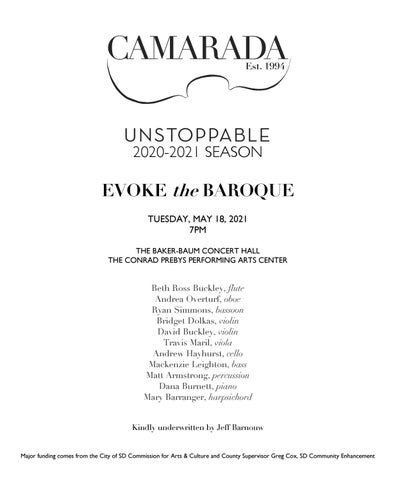
2020-2021 SEASON
EVOKE the BAROQUE TUESDAY, MAY 18, 2021 7PM THE BAKER-BAUM CONCERT HALL THE CONRAD PREBYS PERFORMING ARTS CENTER
Beth Ross Buckley, flute Andrea Overturf, oboe Ryan Simmons, bassoon Bridget Dolkas, violin David Buckley, violin Travis Maril, viola Andrew Hayhurst, cello Mackenzie Leighton, bass Matt Armstrong, percussion Dana Burnett, piano Mary Barranger, harpsichord Kindly underwritten by Jeff Barnouw
Major funding comes from the City of SD Commission for Arts & Culture and County Supervisor Greg Cox, SD Community Enhancement
Les Boreades Act IV: Entrée de Polymnie flute, bassoon, strings, percussion Selections from the Fairy Queen Z. 629 Act I-prelude Hornpipe Air Dance for the Fairies Dance for the Green Men Act 5 prelude Act 3 hornpipe strings, continuo, percussion Gabriel’s Oboe oboe and strings Concerto for Harpsichord & Piano in Eb Major, Wq 47 Allegro de molto Larghetto Presto flute, oboe, bassoon, strings, piano, harpsichord Symphony Concertante for Harpsichord & Piano Allegro Tempo de Minuetto
Jean Phillipe Rameau (1683-1764) Henry Purcell (1659-1695)
Ennio Morricone (1928-2020) Carl Phillip Emmanuel Bach (1714-1788)
Jean-Francois Tapray (1738-1819)
Concerto in C Major for Bassoon, RV 472 Allegro non molto Andante Molto Allegro bassoon, strings, continuo
Antonio Vivaldi (1678-1741)
Concerto in E minor for flute & oboe, TWV 52e1 Fantasia - Largo Allegro Largo Presto flute, oboe, strings, continuo
G.Ph. Telemann (1681-1767)
Program Notes Purcell’s Fairy Queen is a semi-opera, a hybrid genre largely peculiar to the English Restoration Stage, in which the plot, acted without singing, is used as an excuse for a series of masques. A masque is more spectacle than drama. This Fairy Queen has nothing to do with Edmund Spenser’s poem. The plot is taken, with extreme liberty, from Shakespeare’s Midsummer Night’s Dream. There is no reference, for example, to the marriage of Hippolyta and Theseus, and Shakespeare’s character Hippolyta is left out altogether. The masques are presented by either Oberon or Titania, the King and Queen of the Fairies, as diversions linked to the plot only by thematic association. Ranging from the celebratory to the grotesquely comic, the masques include dances and songs composed by Purcell, many of which are now performed on their own. But the music collected in the Suite played this evening is largely “incidental”, setting the tone or atmosphere. Purcell’s music creates the Fairy World, framed by court pageantry. After the premiere season the play was augmented for presentation to the real Queen, Mary, who was close to Purcell and the focus of many of his creations. The occasion of the Wedding Anniversary of William and Mary was part of a new finale. The perhaps implausible formula of semi-opera seemed to have justified itself with the great success of Purcell’s immediately preceding work, King Arthur, which was presented in a concert version, detached from plot or action, by the Bach Collegium San Diego in May 2019. The suite drawn from Purcell’s Fairy Queen is an orchestral work that holds its own when matched with Mendelssohn’s Incidental Music to A Midsummer Night’s Dream. Drawing on the overture he had written at the age of 17, Mendelssohn came back to the material 17 years later. He died 4 years after that at the age of 38. Purcell, also a child prodigy, died three years after the Fairy Queen at the age of 35. Purcell notes courtesy of Jeff Barnouw, Professor Emeritus & Camarada Vice President
Music history is not always what we imagine it to be. When Haydn and Mozart claimed they admired the music of Bach, they were not referring to the Leipzig cantor whose choral cantatas and Passions we so reverently performed in churches and contemporary concert halls. No, they meant Carl Philipp Emanuel Bach, the second surviving son of Johann Sebastian Bach, the virtuoso keyboard player, personal accompanist to King Frederick of Prussia (who was an avid flautist!), and widely published composer of music for the keyboard instruments he loved, the clavichord and the pianoforte.
In 1714, Maria Barbara and Sebastian Bach must have expected their newborn son was destined for a musical career, since they invited their good friend Georg Philipp Telemann to Weimar to be godfather to Carl Philipp Emanuel, who was given Telemann’s middle name at the baptism. At that time, Telemann was the music director of Frankfort’s two main Protestant churches, composing music for the church as well as operas and a wide variety of instrumental music. Telemann took the prestigious post of music director of Hamburg’s five largest churches in 1721, where he flourished until his death in 1767. His musical style was rooted in the tradition we call “Baroque,” and the Concerto in E Minor for Flute and Oboe, TWV 52e1, on tonight’s program displays that basic premise of Baroque style: an ensemble of strings anchored by the harpsichord continuo part, but decorated with obbligato soloists. A more prolific composer than J. S. Bach, Telemann was unjustly disparaged by Bach’s early biographers, even though they knew little of his music, which finally enjoyed a serious revival in the early 20th century. C. P. E. Bach, however, maintained a relationship with his urbane, successful godparent, and from correspondence between the two musicians, some biographers believe that Telemann urged the Hamburg city fathers to award C. P. E. Bach his post upon his demise. In the realm of late 18th-century keyboard instruments, C. P. E. Bach’s Concerto for Harpsichord and Piano in E-flat Major, Wq 47, preserves in amber the transition from harpsichord to piano. By 1788, the year C.P. E. Bach wrote his double concerto, Mozart had written all but one of his 27 piano concertos, and C. P. E. Bach’s charming double concerto reveals the piano’s superior ability to engage a chamber orchestra with sonic brilliance and dramatic prowess. In his score, C. P. E. Bach treats the two instruments equally, but the piano commands the listener’s attention. We may observe a wistful irony in this double concerto: C. P. E. Bach’s father originated the genre of the harpsichord concerto, and in the son’s work, he dramatizes the harpsichord’s farewell to the concerto in favor of the piano. C.P.E. Bach & Telemann notes courtesy of Kenneth Herman, Classical Music Writer and Critic