Autumn 2012
Proteins with unnatural amino acids Going green and air-cooled computers
Knotted molecules and fuel catalysts The importance of chemical safety
As I see it... Cambridge PhD Daniel Horowitz is now managing director of the US Chemical Safety Board. He tells Sarah Houlton what the agency does, and how it’s working to make the chemicals sector safer, from lab work through to offshore drilling Photo: Shauna Lawhorne, CSB
How did you wind up working for the Chemical Safety Board? I was born in California and went to Harvard to study chemistry as an undergraduate. I became interested in environmental issues and public policy, but that didn’t stop me from going to Cambridge for a PhD on bioplastics – an area with environmental promise – with Jeremy Sanders. After that, I worked for Congress as a science fellow, and after a few years out in the private sector, I came to work here at the CSB, a small federal agency. So what is the CSB? Set up in 1998, our mission is to prevent industrial disasters, through in-depth scientific investigations of the causes of previous disasters. We try to understand them in as much detail as possible, and then get the information we’ve learnt into the hands of those who can make a difference in the future. There have been innumerable disasters in the past, but they often only command attention for a short while before being forgotten, and then similar disasters occur in the future. We’re trying to break that pattern. Can you give me an example? We’re perhaps best known for our investigation of the 2005 explosion at BP’s refinery in Texas City. It killed 15 workers and injured 180 more, causing long-term damage to the company and its reputation. During our investigation, we learnt a lot about how refineries are operated and how they can be made more safe. For example, all the victims died in temporary trailers, and we looked at why the trailers were present in the hazardous environment of a refinery. As a result, industry adopted new standards to move such trailers away from areas where there is a risk of explosion. However, during our investigation we found that similar accidents had happened in the past; for example, there had been one in Pennsylvania about a decade earlier where, again, workers had died in trailers. I think the key difference now is that there wasn’t an organisation like the CSB around then to ensure that lessons were learnt from the tragedy. We also looked at the culture of the organisation, and found that there had been dramatic cost-cutting as a result of a series of mergers and acquisitions. While this had been seen as very positive to investors in the stock market, it had unforeseen negative impacts on safety that weren’t understood at the time. The way this was felt on the ground in refineries was through deferred maintenance, or keeping decades-old, obsolete equipment in service. We recommended that companies develop better systems for looking at these organisational changes because of subtle impacts on safety that can cause a disaster down the road. There’s certainly a human case for process safety – and a strong business case, too. The Texas City incident cost the company billions in terms of its market value compared to, say, 2
Chem@Cam Autumn 2012
Exxon, which did not have a major incident during that period. Yet the investments that could have prevented the accident were small in comparison, such as updating the emissions system to use flares – a technique that had been around for decades – plus better inspection of alarms and instruments to make sure they were working properly, and more operator training to deal with emergency situations. While these changes would incur expense, those costs are very small compared with the cost of the disaster – the fine alone was $21 million, at that time the largest fine ever issued by the Occupational Health and Safety Administration. Do you have statutory powers? No – but we do have the power of the ‘bully pulpit’, which can be more effective than regulatory power. Regulatory fines haven’t necessarily prevented disasters in the past, and the overall fatality rate has plateaued in recent years. We believe the key to reducing accident rates further is a better understanding of their causes by regulators, companies and members of the public. We find that, in most cases, once the causes are explained to people, they see the value of making changes. So even though our recommendations are, technically, voluntary, we now have a 72% rate of adherence, and this continues to increase. Is all your activity in response to incidents, or are you also proactive? We promote measures that can help prevent accidents. One initiative we’re very excited about is the greater use of process safety indicators, something that is much further advanced in the UK. In the US, the primary indicator now is the rate of workplace injury and illness. While that’s important, it’s not a very good indicator of whether a large-scale disaster might occur.
We are encouraging companies and regulators to adopt a greater use of leading performance indicators, looking at issues such as asset integrity, maintenance backlogs and effectiveness of training that might give clues to future problems. These need to get equal weight with lagging indicators such as accident and injury rates to give better information about the health of an organisation and its safety systems. Do you just work in the process sector, or are you active in lab settings, too? While our primary focus is on the process industries, we have started investigating lab accidents too. With my own lab background I always felt the sector could do more to improve the safety of workers. On the industrial side, there has been decades of effort in understanding accidents as a systems problem and not the problem of individuals. In the laboratory, there’s a tendency simply to blame the person who had the accident. This doesn’t do much to prevent the next accident, because the next person will probably act in much the same way, particularly if they don’t have the training or the strong safety systems to back them up. We completed our first investigation of a laboratory accident a year ago – an accident at Texas Tech University in 2010 where a graduate student was seriously injured. We found many of the same underlying factors as in industrial accidents – the lack of a strong reporting and learning culture, a lack of training, and a lack of attention to the principles of inherent safety, such as minimising the amount of hazardous material in a process. We took our findings out to the US academic community, and have had a great reception – the American Chemical Society is now developing a whole new guidance ➢ continued on page 12
Letters
Reluctant reactions Fighting fires
Dear Editor Your summer 2012 issue describing the minor fire and the major response was rather interesting and indicative of the tightening of regulations on the use of chemicals worldwide. If carried to the extreme, chemicals will soon only be able to be manipulated on the computer. However, the fire never should have happened, if safety procedures were followed that were in place in the mid 1960s when I was working with Harry Emeleus. Hydrolysable metal (or metalloid) halides and organometallic halides were never to be disposed of with any other materials. Prior to disposal, they were deactivated by controlled chemical reactions in a fume hood, for example by reaction with an appropriate alcohol. Similar precautions were also in place during my McGill PhD in the early 1960s. However, we would cringe today at the method of disposal of volatile, spontaneously flammable and/or explosive silanes. They were sealed in vials under vacuum and kept in liquid nitrogen until there was enough for a disposal run. The dewar(s) were carried up a ladder to the hazards lab on the roof (the ladder in itself a hazard leading to at least one broken leg), placed in a heavy steel object resampling a trench mortar with a plunger held by a pin with a long chain, one went around the corner of the brick wall of the custodian's flat, and pulled the chain, removing the pin, the plunger dropped breaking the vials. A loud explosion and or a flash of flame was observed, with the plunger kept from launching into orbit over town by a very heavy chain. On another matter, isn’t the trivalent phosphine involved a reducing agent not an oxidising agent? Dr. Jack M. Miller Special Advisor on Buildings & Space
Emeritus Professor of Chemistry Brock University St. Catharines, ON, L2S3A1 Back to the Jungle
Dear Editor, I read with interest your item ‘Calling the class of 1972’ in the spring 2012 issue. Although not strictly belonging to that year (I started my PhD in the autumn in Brian Johnson’s ‘nitrosyl’ group), I do remember a number of the names mentioned who were either in my own lab (the Jungle) or other labs occupied by members of the Lewis/Johnson group. Of those Doug Yarrow has already managed to contact, I remember two Evans (Jon and Graham), Jim Howell and John Ashley-Smith. Of the 'missing' people I remember John Segal (whose work I continued at the start of my PhD), Colin Eadie and Bob Edwards. Other names I recall from the Jungle are Sumit Bhaduri, John Kelland (sadly deceased) and Trevor Matheson. Regrettably I am not in contact with any of these, but recalling their names has awakened memories of my life in chemistry at Cambridge 40 years ago. For my part. I went on to Munich in 1975 to do a one-year postdoc with Heinrich Noeth and then worked for Unilever (Isleworth) in cosmetics for nine months before embarking on a lifetime career as a chemical patent translator, initially with a specialist company and then (to the present time) as a freelance. Although I traded hands-on chemistry for a passive, language-centred profession, I have always considered myself first and foremost a chemist since chemistry has formed the knowledge base of all my work. I remain a member of the RSC and continue to enjoy my chem-
Cover
Contents News
4
Research
7
Alumni
11
Chat lines
13
Puzzle corner
15
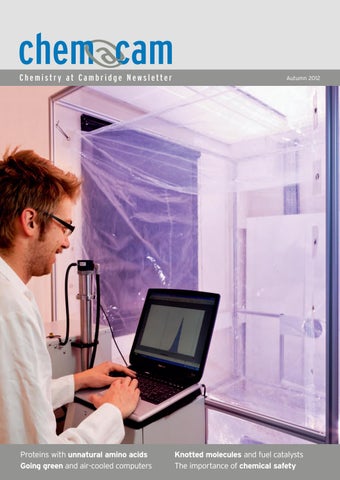
Atmospheric chemist Steve Fuller and the bag that allows him to replicate high altitude atmospheric conditions in the lab Photograph: Caroline Hancox and Nathan Pitt
eChem@Cam Chem@Cam is now being sent out by email to those who have asked for a pdf version rather than a hard copy in the mail. If you would like to swap your paper magazine for an e-version, then please send an email with the subject line ‘eChem@Cam’ to jsh49@cam.ac.uk, and we’ll start to send you the mag electronically from the next issue. Don’t forget to tell us your postal address so we can check that the correct person is being removed from the mailing list for the paper magazine. If you’re not sure what it will look like, you can check out e-back issues on the newly redesigned department website, www.ch.cam.ac.uk Don’t worry if you still want to receive a paper copy – we’ll continue to print and mail the magazine for the foreseeable future, so you won’t miss out!
istry immensely with absolutely no regrets for having quit the bench. I wonder how many other readers have made similar career changes without falling out of love with chemistry.... Yours, Robert Walter (Jesus 1972)
This newsletter is published three times a year by the University of Cambridge Chemistry Department. Opinions are not necessarily those of the editor, the department, or the university. Editor-in-Chief: Steve Ley Editor: Sarah Houlton Photographers: Nathan Pitt, Caroline Hancox Editorial Board: Brian Crysell, Bill Jones, Jonathan Goodman, Rosemary Ley, Jeremy Sanders Address: Chem@Cam, Department of Chemistry, University of Cambridge, Lensfield Road Cambridge CB2 1EW Phone: 01223 763865 email: news@ch.cam.ac.uk website: www.ch.cam.ac.uk Chem@Cam Autumn 2012
3
News
A cool new computer The computer officers (with some logistical assistance from Jeremy Sanders) have come up with a solution to the shortage of space for large new computers within the Lensfield Road building – installing a computer cluster for David Wales and Daan Frenkel’s groups in the engineering department down the road. The new cluster is non-adiabatically cooled. ‘This is a fancy way of saying that cold air is pumped in from outside, and hot air taken out, rather than using conventional air-conditioning,’ explains the department’s head of computing, Tim Dickens. ‘This method of cooling uses 10% or less of the energy that we use here in chemistry to cool the equipment using conventional methods. As a consequence, engineering have made a very significant saving on their electricity bill.’ The cooling relies on bringing cold air in from outside down a cold corridor,
and then taking the hot air made by the computers through a hot corridor. ‘It means that if you need to work in the hot corridor for ay length of time, you need to be dressed in shorts and T-shirt, as well as wearing ear defenders!’ he says. Unfortunately, space issues preclude similar cooling techniques being employed in chemistry, as the machine rooms are either too small or the necessary plant would be too far away. ‘However, we are looking at a few things that we could do to reduce our carbon footprint, such as switching off nodes in clusters when they’re not in use, and turning them on again when the demand for processing goes up,’ Tim explains. ‘We are also looking to see if we can improve the airflow to see if this improves the efficiency of the air chillers.’ Just getting the machine into the engineering building was a challenge – there’s no lift to the top of the building so they had to use a fork lift truck to get
the computer, which is about the size of a wardrobe, up to the final floor. ‘However, there’s a great view of the chemistry department from outside the engineering machine room!’ Tim says. As it’s not located within the department, the machine is being supported remotely. Engineering is not far away, so the computer officers can easily pop round if something needs to be done, but most actions don’t need a physical presence from the computer officer. There is now a dedicated fibre optic link between the two departments to run the network. ‘In the process, we are honing our experience so that we can support equipment remotely at the West Cambridge site when the new University Data Centre is built there,’ Tim says. ‘This is currently planned for 2014. Before then – sometime in the next few months – two more similar clusters will be installed, one for Stuart Althorpe’s group, and a second for Michele Vendruscolo’s group as part of the Elan collaboration.
Sanders symposium Saudi agreement signed
The International Conference on Physical Organic Chemistry, held in Durham in September, featured a whole day’s Sanders Symposium. Thirteen exmembers of Jeremy’s group, from K.N. Ganesh (1977–80) to Dan Pantos (2006–10) travelled from India, US, Denmark, Italy, France, Netherlands and Spain to give lectures and show embarrassing photos. Jeremy was particularly proud that his ex-students and postdocs have academic positions in chemical engineering and in biology as well as several branches of chemistry. Louise and Jeremy hosted a dinner for 22 current and ex-members of the group; the current group were fascinated to finally meet some of the names that they knew so well from papers and theses. In his symposium lecture Jeremy was able to announce his group’s results on a new generation of molecular knots, the first of which has since been published in Science – as you can see in the story on page 7. 4
Chem@Cam Autumn 2012
energy from Clare Grey, one from Oren Scherman on polymers, and one from David Spring on catalysis. Sabic’s aim is to intensify cooperations with key partners in research – of which Cambridge is one – to accelerate its product and technology developments. The strategic agreement with Cambridge focuses on many areas of research in which Sabic has an interest. These include biotechnology, energy, functional materials, and modelling. Photo: Nathan Pitt
In September, the university had a visit from petrochemical company Sabic, or the Saudi Basic Industries Corporation. Representatives from chemistry, engineering, physics and materials met with senior Sabic executives to sign a multiyear research agreement. As part of the meeting, a poster session was held in Pembroke College, where the signing also took place, with presentations including one on smart coatings by Stuart Clarke, another on
Jeremy and Louise plus the group, past and present, at the symposium
Pictured are Sabic executive vice-president of technology and innovation Ernesto Occhiello and Cambridge pro-vice chancellor for research and chemical engineer Lynn Gladde (front), along Richard Friend from physics, Sabic chief executive Mohamed Al-Mady and Daan Frenkel from chemistry (back row)
www.ch.cam.ac.uk
A Wellcome grant By Royal appointment! Shankar Balasubramanian has been awarded a Senior Investigator grant by the Wellcome Trust. These awards provide funding for established academic scientists, and give them the flexibility and time to tackle important questions in their field. Shankar’s grant provides a financial boost to his work on the chemical biology of the genome and the epigenome.
Left: The royal couple enjoy a briefing from John and scientists from the centre, including local Malaysian scientists; below: the team that runs the field centre
You never know who you’re going to bump into in the rainforest… and in John Pyle’s case recently it just happened to be the Duke and Duchess of Cambridge, perhaps better known as Prince William and Kate. The royal couple visited the Royal Society’s Danum Valley Field Centre in Borneo as part of their Diamond Jubilee Far East tour in September. John chairs the Royal Society’s South East Asia rainforest research committee, and in that capacity he helped to show them
around, and explain the range of activities that go on in the centre. ‘I was on my way to a big international meeting in China, so the timing worked out really well!’ he says. The royals learnt about the ongoing conservation research at the centre, and met the group of both British and Malaysian scientists who work there. They even trekked into the rainforest and climbed up a 50m tall tree to get an orang-utan’s eye view of the area’s remarkable biodiversity.
Alessio’s ERC award Alessio Ciulli has been awarded an ERC starting grant. These grants aim to support up-and-coming research leaders as they start to establish their own independent research careers. The idea behind the grants is to improve the opportunities available for young investigators to make the transition from working under a supervisor to being indep e n d e n t researchers in their own right. Alessio’s five-year grant will support his group’s research on the druggability of protein–protein interactions within multi-subunit and multi-domain protein complexes. However, we are about to say a fond farewell to Alessio, as he is to become a reader in chemical and structural biology at Dundee University. ‘I am very excited about this new opportunity for me and my research group,’ he says. ‘But I will be sad to leave Cambridge, where over the past 13 years I have enjoyed every single moment of a fantastic journey from Erasmus student to PI.’
Daan’s developing world honour Head of department Daan Frenkel has been elected as an Associate Fellow of the Academy of Sciences for the Developing World, or TWAS. The honour has been conferred in recognition of his outstanding contribution to science and
its promotion in the developing world. TWAS is an autonomous international organisation, which was founded in Trieste, Italy in 1983 under the leadership of the late Pakistani physics Nobel laureate Abdus Salam. Its mission is to promote scientific capacity and excellence for sustainable development in the developing world, or the ‘South’. It is made up of Fellows and Associate Fellows, all of whom have made significant contributions to the advancement of science in the South. Fellows live and work in the South, and Associate Fellows, like Daan, in the North. Daan is one of four new Associate Fellows, joining 45 new Fellows, who were elected at this year’s general meeting of the academy, held in Tianjin, China. The Academy now has more than 1000 members. Chem@Cam Autumn 2012
5
News
The university has launched a Green Impact scheme, and chemistry is getting involved. The idea is to celebrate and recognise environmental achievements, while also supporting and encouraging people to improve their environmental performance. The scheme has its roots in the National Union of Students’ Sound Impact Awards, designed to decrease the negative environmental impacts of students’ unions. It has since been expanded to cover university departments. Nearly 50 universities are now participating, including Cambridge. Departments can work towards gaining bronze, silver and gold accreditation, with the criteria becoming increasingly challenging. For bronze, we need to fulfil 20 different criteria covering six main themes: communication, training and awareness-raising; energy; water, procurement; travel’ and waste and resource management. These are recorded in a workbook, which will be submitted in late April, with audits being carried out in May. Silver criteria are more stringent, and the three teams within the university who have completed all bronze and silver requirements and the most bonus criteria will win gold. Leila McElvenney from the university’s environmental office explains that the criteria are designed to be clear and simple actions that green impact teams can take in their departments. ‘These range from the very practical, such as ensuring the department has energy awareness stickers and posters displayed in officers, to the fun, such as an environmentally themed event for staff,’ she says. ‘They can even be quirky, such as a
stationery amnesty to encourage staff to make efficient use of existing resources.’ There are also special criteria for labs. ‘These cover chemicals and materials, cold storage, fume cupboard operation, and more particular criteria for water and waste,’ she says. ‘Labs can achieve additional awards for taking part.’ These awards provide departments with a real opportunity to increase their reputation, McElvenney says, letting other departments know they are working to manage their environmental impacts. ‘Green Impact was designed by the NUS because they understood that students are concerned with the impact of their institutions, and having a recognised award lets students know their department is working to reduce it’ she says. ‘It introduces a friendly competition element, where departments compete to win one of three coveted gold awards, but focuses on the actions that teams can take and does not prejudice departments like chemistry which are large and energy-intensive.’ Chemistry’s Green Impact team is already up and running, with support from numerous senior academics. It is led by Xin Yang from John Pyle’s group, who encourages everyone within the department to get involved. ‘It does not matter if you are a PhD student, postdoc, assistant or academic staff, everyone is encouraged to join the team and make a contribution to improving our environment,’ he says. ‘We aim to achieve at least one accreditation, but to achieve it we need everyone’s contribution.’ You can find out more on the department website, or by emailing Xin at xy214@cam.ac.uk.
King’s honour for Chris Chris Dobson has been awarded an honorary doctorate of science by King’s College London. The citation states that he has ‘demonstrated the power of
6
Chem@Cam Autumn 2012
chemistry to understand protein misfolding disorders, including neurodegenerative conditions such as Alzheimer’s and Parkinson’s diseases, and provided new insights into the evolutionary constraints upon the chemistry of life’. Chris believes his role as an adviser to King’s on the way to maintain chemistry after the previous department closed down a decade or so ago may have had some bearing on his award, too. ‘I encouraged them to consider opening a new department based on their South Bank campus, where the emphasis is on biological sciences and their medical schools,’ he says. ‘They have now done so, and appointed the first half-dozen faculty. I suspect it is the first new chemistry department to be opened in a UK university for some time!’
Photos: Nathan Pitt
Time to go green!
Painting by chemistry The landing on the first floor of the department between the main building and the Unilever Centre has had a bit of a change – the plain white walls are now covered with a mural. Back in October, the Slovakian artists Pavel and Peter Mester spent three weeks of evenings and weekends creating the mural. They were commissioned to paint it as a gift to the department from the company Alexu, a group of artists and scientists, co-founded by Jean Cocteau and Albert Szent-Gyorgyi in 1957. Szent-Gyorgyi was a physiologist who received his PhD from Cambridge in 1927. He won the Nobel Prize in 1937, and is credited with discovering vitamin C and the components and reactions of the citric acid cycle.
Pavel and Peter Mester in action (below), and pictured with the finished mural in all its glory (above), alongside Daan Frenkel and one of their colleagues
Research
Supramolecular chemistry gets knotted Work from Jeremy Sanders’ lab has generated novel molecules that assemble and link together to tie themselves in knots. The results, published in Science in November, represent a major step forward towards understanding the complex non-covalent chemistry that determines the assembly of larger molecules such as proteins. Molecules designed to be rings on rods (rotaxanes) or interlocked rings (catenanes) have long been the target of supramolecular chemists, using noncovalent forces to self-assemble molecules into higher order structures. More recent targets successfully synthesised include Borromean Rings and the field is sufficiently developed for some groups to generate molecular electronic devices based upon these chemistries. But how much do we really understand the self-assembly process involved this assembly, from a fundamental thermodynamic and structural perspective? Until now these complex interlocked structures have required help to direct
their assembly by templating, using metal ions for example. The new knotted structure, a trefoil knot, emerged from dynamic combinatorial libraries of naphthalene diimides linked with amino acids which exchanging ‘partner’ building blocks through disulphide bond interchange. This approach allows the molecules themselves to explore different assemblies in solution, with those attaining lowest thermodynamic energy persisting in the mixture once it has reached equilibrium. The work, led by Jeremy and Dan Pantos, now at Bath University, shows how the hydrophobic effect is a dominant thermodynamic driving force in this context. In this respect, of course, the supramolecular chemistry involved is a simpler example of exactly the same knotting observed in some folded proteins. Indeed, the assembly (folding) process by which some proteins adopt their knotted structure has been the target of a lot of Sophie Jackson’s research in recent years.
So as well as having significant impact on the supramolecular world, the new work, involving much simpler molecules, will help protein folders understand the complex topological processes involved in their assembly by allowing systematic variations to the molecules and the experimental conditions. The size of the assemblies involved will also whet the appetite of our computational chemists who will no doubt already be coding their computers to search the conformational and energy landscapes of these knotted molecules. Paul Barker N. Ponnuswamy, F.B.L. Cougnon, J.M. Clough, G.D. Pantos and J.K.M Sanders, Science, 2012, 338, 783
From water to hydrogen A real problem that scientists looking to find renewable sources of hydrogen face is finding a catalyst that is both efficient and inexpensive but also – importantly – functions under real-world conditions, not just the rarefied atmosphere of the lab. A catalyst will never be of practical use in hydrogen generation as a fuel if the reactions have to be carried out under a blanket of nitrogen! Erwin Reisner’s group has now discovered a homogeneous cobalt catalyst that can be used to create hydrogen from water. Importantly, the water is pH neutral, surrounded by atmospheric oxygen, and the process runs at room temperature. The industrial water splitting process, in which water is separated into its hydrogen and oxygen components, would represent the ultimate renewable source of hydrogen for use as a fuel by
fuel cells. But in the real world, oxygen would be present, with additional oxygen being produced as part of the splitting process. Currently, catalyst systems to split water use metals such as platinum, which are very expensive, but the cheaper alternatives tend to be very inefficient. Erwin’s group has found that a catalyst based on the common, cheap metal cobalt, works well. The group is now working on finding improved versions of the catalyst, as it remains less stable than they would like. But it is an important first step towards their goal of developing a system to generate ‘green’ renewable hydrogen fuel from water, with the process driven by sunlight. F. Lakadamyali, M. Kato, N.M. Muresan and E. Reisner, Angew. Chem. Intl Ed. 2012, 51, 9381
Calling all postdocs... The department’s postdoctoral affairs committee (PDAC) held its inaugural event for postdocs on Friday 9 November at Emmanuel College. A series of short presentations on issues of direct concern to postdocs, with contributions from PDAC, members of the academic staff and the university careers service. This was followed by wine and nib-
bles. Feedback from attendees was very positive, with everyone strongly agreeing they would recommend the event to a colleague. PDAC exists to look after the interests of the postdoc community in chemistry – it is the largest single cohort within the department. ‘For PDAC to be most effective, we need the widest possible engagement with all our postdocs,’ says
committee member Steve Driver. ‘So please get in touchtell us what you like (or even don’t like!) about life as a postdoc in chemistry – and please consider getting involved yourself.’ Email the committee at chem-postdoc-affairs@lists.cam.ac.uk, or you can contact any of them individually – their names and contact details are on the department website. Chem@Cam Autumn 2012
7
Science
Unnatural amino acids and protein modification Photos: Nathan Pitt
Jason Chin is looking at ways in which proteins can be altered to change their properties, which can create new therapeutics, and even give an insight into what’s going on inside living cells
Despite having chosen Oxford over Cambridge as an undergraduate because he wanted to focus solely on chemistry, during his time there Jason Chin found himself increasingly drawn to the interface between chemistry and biology, partly as a result of his finalyear project with John Sutherland, now a colleague at the LMB. ‘This was – as much research at Oxford was at that time – on the biosynthesis of cephalosporin and penicillin,’ he says. ‘It was my first exposure to molecular biology, and I’ve been hooked ever since.’ He was drawn to the US and Yale for a PhD because of the taught courses that are available in the first year there. He took all the biology courses and then, although his PhD with Alanna Schepartz, was in chemistry, he used a lot of biological methods such as phage display to help him develop high-affinity binders for protein and DNA targets. A postdoc with Peter Schultz at the Scripps Institute in California pushed him towards the broad area he’s been 8
Chem@Cam Autumn 2012
working on in his group at the LMB since he returned to the UK in 2003 – inserting novel types of amino acids into proteins to modify their function in a very specific way. Proteins are, essentially, polymers that are made in the cell, with amino acids being strung together to make polypeptides. This is done by the ribosome, which is the cell’s large molecular ‘machine’ that assembles the peptide bonds between the amino acid residues to build up the proteins. ‘We are interested in synthesising new types of amino acids, and then engineering the cell to use them to make new proteins,’ Jason says. ‘Instead of building a protein where each monomer is one of just 20 possible amino acids, there are now additional choices that can be built into the polymer chain. These are encoded in the DNA, which provides all the information the ribosome needs to put the amino acids together in the right order. We can now encode the incorporation of these new kinds of building blocks
Below: structure of the curcubiturils and the formation of a hydrogel, enabling the slow release of medications
into proteins and cells in a very specific way. It’s a complete fusion of engineering biology, and synthetic chemistry to make the molecules that biology uses to construct the protein.’ One application these altered proteins might have is in the development of novel pharmaceuticals. Eight out of the current top 20 biggest selling drugs are proteins of one form or another, and very many others are under development. ‘One of the way in which protein therapeutics can be improved is by adding components to the protein chain that will prevent them from being metabolised too quickly, for example,’ he says. ‘In fact, a biotech company is using early versions of this sort of technology that I developed during my postdoc at Scripps, and various molecules are already in clinical trials for conditions as diverse as multiple sclerosis, cancer and diabetes. By derivatising protein therapeutics in some way that stabilises them, perhaps the dose the patient needs to take will be lower, or they might even be made more efficacious.’ His group has also been developing methods for putting just one or two unnatural amino acids very precisely into a protein sequence. The ability to do this has real potential in providing a better understanding of how natural biology works. ‘For example, if we label proteins with fluorophores, we can then look at what those proteins are doing inside the cell by light microscopy,’ he says. ‘The protein will glow inside the cell, so we can see where it goes.’ PROTEIN INTERACTIONS Another project involves developing ways to figure out which proteins interact with each other. This is how a lot of biology is regulated, so being able to see the interactions will give a real insight into what is going on. ‘We’ve created ways techniques to put photocrosslinkers into proteins,’ Jason explains. ‘These are amino acids that, when you shine a light on them, become photoactivated to an excited state, so they form covalent bonds with other neighbouring proteins. ‘We can then use analytical methods to see which proteins are now linked. This enables us to identify precisely what the labelled protein was interact-
Research
CHEMICAL CHANGES The study of post-translational modifications has become extremely important in recently years. While the gene codes for the proteins that are made by the ribosome, that’s not the end of the story – enzymes act on some of the amino acid sidechains within that protein to introduce chemical changes, perhaps by phosphorylating, acetylating or methylating them. This regulates the activity and the function of what the protein does within the cell. While mass spectrometry has been used to catalogue many of these modifications and what look like, it has been much more challenging to make the modified proteins synthetically, and understand exactly what the alterations do to the function of the proteins. ‘Using our approaches to protein modification, we’ve developed tech-
Born: London, where he grew up and went to school Education: A chemistry degree at Oxford was followed by a PhD at Yale with Alanna Schepartz Career: From Yale, he moved across the US to the Scripps Institute in San Diego and a postdoc with Peter Schultz. He moved back to the UK to start his own group the LMB in 2003, and was promoted to professor this year
Jason Chin
niques for installing these modifications without any need to know the identity of the natural enzyme that causes the modification,’ he says. ‘By recreating the post-translational modifications in the lab, it allows us to understand how they affect the structure and function of proteins and, again, lets us dig deeper insto how these modifications regulate biological function.’ Unusually, Jason’s lab carries out experiments right through from chemistry to genetic manipulations to whole animal biology. ‘We have a set of labs with chemistry space, molecular biology space, and space for doing cell biology and animal biology,’ he says. ‘The background of the people in the group is quite diverse – all the way from fly and worm geneticists to people whose PhD is in total synthesis. Postdocs will bring in their own particular expertise, but they are encouraged to work across these areas, and the lab is driven by an interest in asking and answering questions, rather than an overriding interest in any particular techniques. Everyone has to be able to explain not only why they find their individual questions interesting, but why in a broader sense they are interesting. It’s a healthy reality check on the science we do, and its value to the wider society.’ One of the really interesting frontiers for chemistry in his lab, Jason believes, is the work on developing chemical reactions that take place in water inside living cells, and happen very rapidly without reacting with anything else in the biological system. ‘We’ve put quite a bit of effort into developing unnatural amino acids that we can put into proteins and then label with, for example, fluorophores,’ he says. ‘And recently this field has started to move a lot more quickly because, until relatively recently, a lot of the reactions people were use were simply too slow. We have now been able to develop
Status: His wife Stacey works at the pharmaceutical company Medimmune; they have two children, William who’s 6, and Rosalind, who’s 3
CV
ing with at the instant the light was shone on it. If we really want to understand how biology works at a molecular level, this is exactly the sort of fundamental question we have to ask – about which molecules are interacting with each other, and how.’ This work led on to a programme investigating ways to activate the function of enzyme proteins inside cells using pulses of light. ‘We take the active site of the enzyme, and replace an amino acid there with another that bears a protecting group that can be removed by shining a light on it,’ he says. ‘So when we illuminate the cell, the enzyme immediately becomes active, enabling us to try and understand what happens when an enzyme is activated at a specific site within the cell. All of these techniques combine the ability to control the molecular properties of an individual amino acid using chemistry, and then to position it precisely within a protein using genetics and biology.’
Interests: Having fun with the family, particularly outdoor activities like walking and going to the park.
reactions that allow you to carry out chemical reactions inside living cells on specific proteins, and we’re very excited about this. ‘But at the other end of the spectrum, we’ve developed approaches that allow you to put new amino acids into proteins in specific tissues within whole animals. We think these types of approaches are going to be particularly useful in terms of studying the precise molecular mechanisms of how biology works in, say, the nervous system, in learning and memory. ‘We’d really like to bring to some of these complicated areas the kind of precision that is more typically associated with molecular descriptions of processes. The goal here is to bridge this gap between really complicated phenomena, and a molecular level description of what is going on – and provide tools that will allow us to do this.’ SYNTHESIS WITH GENETICS Another area in which he has had a long-term interest is the translation system itself. ‘The ribosome is unrivalled in the way it builds polymers,’ he says. ‘It takes a nucleic acid template – DNA – and the genome gets copied to RNA. The ribosome then reads thousands and thousands of bases in triplets in the RNA, with each three successive bases coding for a specific amino acid, and decodes them one after another to build a really long polypeptide. ‘This polymer has a defined sequence and composition, and is made with a really low error rate. So if you were able to reprogramme that system to make different types of polymers, the potential would be enormous. We’re not just talking about being able to make modified, stabilised versions of existing protein therapeutics – we’re talking about being able to explore the synthesis of new types of materials using genetics. These might be entirely new classes of therapeutic molecules, using the natural evolutionary processes that biology uses to make molecules functional from random sequences, but to redirect those processes to make new types of polymers. How can we co-opt biology to do our chemistry for us?’
Jason and his group squeeze into shot!
Chem@Cam Autumn 2012
9
Obituary
Chemist, war hero and engineering pioneer Chemistry alumnus and freelance writer Peter Varey has passed on a copy of his first book. It’s a fascinating biography of Peter Danckwerts, a chemist by training, and a chemical engineer by practice, who spent the war dealing with unexploded bombs and mines in the Thames Estuary before being deployed to Italy, and winning the George Cross for his troubles. Peter Varey himself studied chemistry here at the beginning of the 1960s, staying on for a PhD with David Hutchinson and Malcolm Clark, and moving with them to the new University of Warwick for his final year. Danckwerts, meanwhile, was was brought up as a chemist, inspired by his mother. To quote Danckwerts: I believe I was about seven years old when I first decided to become a chemist. I had been reading a school story about an illicit ‘stinks’ experiment. It was necessary to turn out the reaction mass into a large vessel at some crucial stage. The only vessel available was the Junior Inter-House Hockey Challenge Cup. It turned black. I was fascinated and asked my mother what chemistry was about. Although she had no idea, she rose splendidly to the occasion: ‘It’s about things like making diamonds, darling.’ What red-blooded boy could In this extract from the book, Varey describes Danckwerts’ time in Cambridge in the 1950s, as the nascent chemical engineering department moves into Pembroke Street. In the five year Peter had been away from Cambridge – first grappling with the peaceful uses of atomic energy and then reviving spirits at Imperial College with international fresh air – things had changed. The chemical engineering department of which he took charge in 1959 had at last acquired a permanent building. It was all made possible because the departments of chemistry had got the go-ahead at the beginning of the decade for a new joint building in Lensfield Road, allowing them to pull out of the gloomy Pembroke Street premises they had occupied since the beginning of the 20th century. The design of their new building on Lensfield Road was controlled by the two professors of chemistry, Ronald Norrish and Alexander Todd. In those days, professors of traditional depts. operated like tsars, and Todd had the added status of the 1957 Nobel prize, something Norrish – his senior as a professor – would not equal until 10 years later. Norrish and Todd couldn’t stand each other and saw to it that their new 10
Chem@Cam Autumn 2012
laboratories, although in a single building, were designed to keep the two of them, and their staff and students, apart. Even the joint library had a dividing line across the floor. The new building was occupied progressively from 1956, and opened formally in 1958. Those present, as New Scientist reported at the time, must have felt that Cinderella had truly entered her golden coach. Meanwhile, the site of the old chemistry departments on Pembroke Street had been allocated to chemical engineering. But before anyone could move out of the temporary buildings in Tennis Court Road, the building facing on to Pembroke Street had to be modernised and the ‘Oil Companies building’ behind it demolished and rebuilt for its new purpose. Head of department Terence Fox had known what he wanted and he ran the architects ragged. His attention extended to the design of benches and filing cabinets, and the effort involved was huge. With his colleague Denys Armstrong he went over the plans with a fine toothcomb. A specific characteristic of a chemical engineering experimental area is a roof high enough to cope with columns and a floor area uncluttered enough to make them accessible. Fox envisaged a flexible area two-anda-half storeys high, with distillation
have resisted such a challenge? While he ended up working as a chemical engineer, in both academic and industrial settings, his roots in chemistry (Balliol, Oxford, followed by Fullers’ Earth Union, Redhill) helped inform his innovative life as a scientist. The book is extremely readable, from the page-turning exploits of his army days during the war, to the time he spent in Cambridge in the early days of chemical engineering, which took over the old chemistry labs in Pembroke Street after the chemists decamped to the new building in Lensfield Road. The narrative is wound around short ‘backgrounder’ pieces on topics from people and anecdotes to scientific ideas and even gives instructions for making a fire balloon. It kept Chem@Cam amused throughout a transatlantic flight, and gives a fascinating insight into the dramatic upsand-downs of the life and career of a private and reserved man who was both a war hero and an inspirational scientist and chemical engineer. The book costs £14 in paperback and £28 for the hardback, and can be bought directly from Amazon, or ordered from all good bookshops (the ISBN for the paperback version is 9780-9538440-2-9).
columns accommodated on peninsulas made from Dexion. Architects Easton & Robertson, regarded as a progressive company, nevertheless drew up plans which featured pillars in this space, wrecking Fox’s required flexibility, but Fox was ready for them. At the next review meeting he answered. ‘But the roof is strong enough. have a look at these calculations,’ Fox suggested, pulling some papers from his pocket. The pillars duly disappeared. Fox could be stubborn, too. He had seen some very practical laboratory doors planned for the new chemistry laboratories, and wanted the same. Easton & Robertson considered themselves to be artists; they deployed arguments implying that they couldn’t possibly repeat the doors, and they produced plans without them. Six weeks later doors identical to the chemistry building’s new ones were agreed. Decades of contamination of the old building on Pembroke Street presented another challenge, particularly within the small radiochemistry laboratory. Peter recalled later: ‘Its parquet floor (not good practice) was found to be heavily contaminated with radioactive elements. It had to be ripped up and disposed of; the Shell professor was seen in the back of the truck which took it away, dressed in a gas mask and full protective clothing.’
www.ch.cam.ac.uk
Nick Handy 1941–2012 Professor Nicholas Charles Handy FRS was born in Swindon, Wiltshire on the 17 June 1941 to parents Kenneth and Ada. His father was a corn merchant and his maternal grandparents were farmers. Nick attended Claysmore Preparatory and then Senior school, where his potential was noted by his maths teacher, Mr Hilton, who encouraged him to apply to Cambridge. In 1960, he came to St. Catharine’s college to read for the mathematical tripos. In his fourth year, Nick took many interesting courses from Dirac, Polkinghorne and Goldstone amongst others, but was particularly intrigued by the course of S. Frank Boys, on the quantum theory of molecules. After a distinction in Part III, he moved to theoretical chemistry to start his PhD with Boys in 1964. His PhD, entitled ‘Correlated wave functions and energies of atoms and molecules’, was awarded in 1967, and the following year he received the prestigious Harkness Fellowship that enabled him to go to Johns Hopkins University in the US to undertake a postdoc with Bob Parr. He returned to Cambridge in 1969 were he was appointed to a college fellowship in 1970 and finally to a position in the chemistry department in 1972, followed by a lectureship in 1977. A sabbatical trip to Berkeley in 1978 proved hugely influential on Nick’s career as well as cementing collaborations and life-long friendships with Fritz Schaefer and Bill Miller. He was made a fellow of the Royal Society in 1990 and appointed to a personal chair in 1991. Nick won many awards over his illustrious career including the Schrödinger Medal (1997), the Leverhulme Medal of the Royal Society (2002), the RSC Boys-Rahman Prize (2005), and the ACS Award in Theoretical Chemistry (2011). QUANTUM CHEMISTRY Nick’s research was in the field of quantum chemistry, looking at both the electronic structure problem as well as theoretical spectroscopy for vibration-rotation energy levels of small molecules. He became one of the foremost quantum chemists of his generation, widely respected throughout the world and making invaluable contributions to the development of the field. Some of his most important early work was in the full configuration interaction exact solution of the Schrödinger equation. The computer code that he wrote along with Peter Knowles is still used as the basis of several computational packages. Another very important area was the development of analytic gradients of energy. The techniques for the analytic
derivatives were utilised in the code, Cambridge Analytic Derivatives Package (CADPAC), with Roger Amos as the main author. This code provided an invaluable tool for Nick’s group, as well as the wider scientific community, to tackle the problems and challenges of quantum chemistry. He was interested in many other lines of research, and his interest in nuclear dynamics to calculate high accuracy vibration-rotation spectra of small molecules continued throughout his scientific career. It was long known that every Tuesday was dedicated to this work, and long-time collaborator Stuart Carter would drive up from Reading to discuss the latest results. Nick had personally seen the challenge of quantum chemistry move from the realm of the supercomputer to being able to be run on a single modern PC. However, it always seemed that the complexity of the problem would never be addressed by computation alone. This lead to the search for new paths to progress in the quantum electronic structure problem. A MOVE TO DFT Upon prompting by his friend and Nobel Prize winner John Pople, Nick switched to the field of density functional theory in the early 1990s. After returning from a conference in Menton, he announced that DFT was now the way forward. In a few short months (quite long ones for his students!) his group had made the modifications to CADPAC that enabled DFT calculations to be routinely carried out. It is this uncompromising style that summarises his intuition, and one that is needed for tackling the truly hard problems of science. The switch of the group in Cambridge was no doubt one of the factors for the rapid rise of DFT within the chemistry community – especially when DFT calculations on both sides of the Atlantic with different codes agreed to eight significant figures, it was time for DFT to be thought of as a true method of quantum chemistry. Nick had a unique tone and insight that could both inspire and strike fear in to students at the same time. From the outside his tone could sound quite loud and harsh (he could easily be heard several offices away). However, the words were always ones of kindness and inspiration. He surprised many students with his willingness to help them with both large and small problems. If a bug in the code was causing difficulties, it was not unknown for him to find the time to sit down and go through the code line by line until it was located. He also had a unique single finger style of typing that
was a slow and steady path to progress. He was always willing to talk and to share ideas. It took the students many years to realise that when he asked in his gruff professorial tone, ‘Do you understand?’ the answer did not have to be ‘yes’ but, rather, he took delight in explaining when the students finally plucked up the courage to say ‘no’. It was this love of teaching that helped Nick influence so many people. He taught generations of St Catharine's mathematics students and continued even after he had retired. Countless Cambridge chemistry students will have seen his joy and enthusiasm bring quantum mechanics to life. He also played a pivotal role in educating the wider quantum chemistry community, teaching DFT at successive ESQC summer schools organised by his friend Björn Roos. With a keen sense of humour and understanding the intricacies of quantum chemistry, Nick was able to direct an outstanding research group. He always managed to choose key topics and also to find challenges that were well suited to the skills of each individual. He made large impacts on the field of quantum chemistry by both his science and also the positive influence on the many people that came through his research group. Many of these have taken professorships around the world from the UK to France, Germany, US and Australia. Nick retired in 2004, and a conference, ‘Molecular quantum mechanics: the no-nonsense path to progress’, was held in his honour at St. John’s College attended by more than 300 people. He later moved to the beautiful location of Thornthwaite in the Lake District. He passed away on 2nd October 2012 after a short illness. He is survived by his wife Carole, sons Paul and Julian, and six grandchildren. Aron Cohen Chem@Cam Autumn 2012
11
Photo: Shauna Lawhorne, CSB
As I see it The photos here and on p2 show Daniel in action, at a Chevron refinery in Richmond, California in August 2012, after a major processrelated fire in the crude unit. Here he talks to the press; on p2 he’s standing in front of a burnt-out – and brand new – fire engine
➢ document on how to identify laboratory hazards, particularly physical hazards such as explosion and fire that rarely get as much attention as toxic hazards. People working in lab safety are now looking at the issue of indicators and how to measure the health of a system before a disaster occurs. That’s an extremely positive sign. Has there been a reduction in the number of incidents, or is it too early to tell? It really is too soon to tell, though of course we believe we’re making a difference through our identification of concrete hazards, such as trailers in refineries, and other hazards where we can point to specific changes we think will prevent a certain kind of accident. The problem is evergreen as new technologies bring new hazards – we’re now seeing a fair number of accidents happening in the alternative fuel sector, for example with all the new biodiesel and bioethanol plants that are springing up. The challenge is to get these industries to pay just a little more attention to the safety of their processes. In so doing they will help their bottom line, and protect their workers and their communities. What do you think will be the next challenge? Well, we’re right in the middle of a huge one now – the investigation of the Deepwater Horizon disaster. We’re probably the last major body still looking at it, but we have got into many areas that the other investigations haven’t. We’re looking at process safety indicators as they apply offshore, and also human factors. These are well developed in the aviation sector – how people interact with the machines around them and how that can some12
Chem@Cam Autumn 2012
times lead to disaster. We’ve not been able to find any guidance in the offshore sector, but you can see that the issues facing drilling crews are similar to those facing pilots in the cockpit, in terms of the signals around them – understanding if the plane is going to crash or the well is about to blow out, and how this can be prevented. We’re also looking at issues of safety automation, which is well-developed in the onshore process industries, but offshore there is still a great deal of reliance on individual actions and manual controls. It will be a huge undertaking to encourage the offshore industry to adopt the safety measures that are now routine in refineries and chemical plants. The 1984 Bhopal disaster, for example, prompted a lot of legislative developments around the world designed to prevent that kind of accident in chemical plants, and leading to the adoption of new management systems. But, at least in the US, the offshore industry hadn’t had a major disaster since the 1960s. Yet there were a lot of accidents happening overseas – why didn’t the industry here learn from them? We will issue our final report in the next few months, and follow through to ensure all our safety recommendations are adopted. How did your time at Cambridge affect your future career? Well, I really valued the experience and education I got there, and I would encourage students to think broadly about what their future might hold. The kind of education people receive at Cambridge can be applied in many different areas, and has been invaluable to me. Even if they don’t involve holding test tubes on a daily basis, there are so many other important ways that their chemistry education can contribute.
A trio of babies
First in our triple baby celebration is Diogo Reisner de Vasconcelos e Sa – second son of Erwin Reisner and his Portuguese wife Debora. He was born on 5 August, weighing in at 3.6 Eurobabyunits and – like his proud big brother Vasco, whom he’s pictured with above – he shares his name with a Portuguese explorer. Next up, and pictured on the right, is Musfirah Iqbal, daughter of Amjid Iqbal, who’s just finishing off his PhD in Finian Leeper’s group. His wife Saria is a medic, and returned to Pakistan to be with family for the birth on 11 September, so family could take care of heras Amjid’s thesis deadline was looming. Finally, we have Matthew Brooker’s son James William. He clearly has a rock star future ahead of him, being pictured doing his best Spencer Elden impersonation. For those not au fait with early 1990s grunge music, he was the baby pictured on the cover of Nirvana’s seminal album ‘Nevermind’.
Chat lines
Summer garden party The weather was kind to the head of department’s staff garden party in Emmanuel College, with the sun showing up despite the extremely rainy summer. Nathan Pitt was delighted he didn’t have to dodge the raindrops while taking the photographs! Clockwise from left: Chris Chalk and Daan Frenkel; Daphne Kaufhold and Patricia Irele; Graeme Day and Isabelle de Wouters; enjoying the absence of rain; Andy Milner, Richard Preston and Matt Bushen; Finian Leeper, Daniel Beauregard and Paul Wood
Photos: Nathan Pitt
Clockwise from left: A fine spread; Dave Plumb, Richard Turner and Kevin Brown; Victoria Blake, Patricia Irele and Lucy Riches; Adam Thorn, Frank Lee and Russell Currie
Chem@Cam Autumn 2012
13
Heroes & mentors We have all experienced individuals whose personalities and behavour have influenced the way we live and work. Here, Bill Jones reflects on some of the very different people who have had a major impact on the way he works and thinks First of all: my parents. I guess we all owe thanks to our parents – we are their mirror in life and how we proceed and they provide the principles upon which we subsequently develop and behave. My father worked as miner in the North Wales coalfield for all his working life – 50 years – and until the end worked underground. And my mother worked part-time. Although life was relatively hard there was a strong family bond – and a very extensive network of aunts, uncles and cousins. Large and happy family celebrations. They were extremely proud when Mr Trevor Morris and Dr John Agar were formative influences in my early chemistry education. Mr Morris was my chemistry teacher in Mold Alun Grammar. I have no photographs of Mr Morris – only the memories of a chemistry teacher while I was at school who made chemistry seem, most of all, fun and a fascinating subject. His lessons were always a mixture of hard work and light hearted humour. I cannot remember him once being cynical or unpleasant when handing back homework (unlike some of my other teachers!). He gave me the following advice at the time of applying to universities for my degree (I was totally at a loss as to the process) – make sure you put a Welsh one on the list Jones. His opinion was
that no Welsh University would not let a worthy welsh lad not go on to University. In the end I chose Aberystwyth. They gave me a matriculation offer of two Es! I was the envy of the class. And more recently there was Dr Agar. I knew little of College life when I first arrived in Cambridge. John was acting head of department of physical chemistry after the sudden death of Jack Linnett. John was, in my opinion, an intellectual giant in all matters of physical chemistry. He was also a very gentle person who most importantly introduced me to Sidney Sussex College and a Fellowship there. Life and work in Sidney has so much enriched my life since 1980 and it is to John that I owe this part of my Cambridge experience.
Professor Mendel Cohen was my host while I was a Fellow at the Weizmann Institute in Israel from October 1975 to September 1976. He was one of the leading scientists at the time in the area of solid state chemistry. As head of the structural chemistry department at the Weizmann he was leading one of the world’s top groups
with scientists such as Wolfe Traube, Ada Yonath, Les Leiserowitz and Meir Lahav on the staff. I knew little crystallography at the time and while I continued my electron microscopic studies I also joined in with the X-ray diffraction people. I often think that this year was the most scientifically productive one of
It is a fairly safe bet that I would not have been in Cambridge for the last 30+ years without the support of Professor Sir John Meurig Thomas. My first contact with him was as a third year undergraduate when he gave a series of lectures on the new and rapidly developing field of surface analysis. Siegbahn would soon win his Nobel Prize for electron spectroscopic studies of solids and John’s lectures were (as one would expect) truly inspirational. The whole class was spell bound. A few days after my degree result came out I was asked by John if I would 14
I became the first of the family to get to University. It was little reward for all the support they had given me and my sister and brother. And then in later life a new influence came in the form of my wife Anne. A native of Presteigne in Powys and a schoolteacher (French) she provided the understanding to enable me to spend too much ‘family time’ on being an academic and all that involves. We had two lovely children, Sarah and Matthew, who still provide the support and security that only a family can supply.
Chem@Cam Autumn 2012
like to do a PhD in his group. I had no plans or ideas as to where I was going next. The transition from school to university was semi-automatic. Now a decision was needed! I accepted John’s offer and as they say the rest is history. I learnt many things from John – but the most important for me was from his role as my supervisor. I never left a meeting with him (and his young colleague, J.O. Williams) without being encouraged and challenged to go on to the next important experiment. I hope this ‘positivity and enthusiasm’ comes across from me now to my own PhD students!
my life – not measured in journal output but more in an understanding of how to appreciate the good fortune we have as researchers to explore important and exciting issues. Mendel was also a kind, warm and supportive person. He was an excellent mentor whose quiet words of advice meant a great deal at that period of my career.
Puzzle corner Last issue’s solutions ChemDoku – ahaaaaa! As many readers spotted (and one or two didn’t), Ma is the archaic symbol used in the grid, and stands for masurium. This was the name given to element 43 (now technetium) by Walter Noddack, Otto Berk and Ida Tacke when they claimed to have discovered it in 1925. Their discovery could not be repeated so was dismissed as an experimental error. And Masuria, in eastern Prussia, from where Noddack hailed, is not commemorated in element form after all. Technetium – a wholly radioactive element – was finally discovered properly in 1936 by Carlo Perrier and Emilio Segrè at the University of Palermo in Italy. It was deposited on cyclotron parts that were given to him by its inventor Ernest Lawrence in California. The powers-that-be at the University of Palermo wanted to call it panormium (the Latin name for Palermo is Panormus), but instead it officially became, in 1947, technetium, after the Greek word for ‘artificial’ – it was the first element that was produced artificially. Interestingly, Mendeleev left a hole in his periodic table for an element he believed should be there with atomic number 43. He called it ekamanganese, and even managed to predict many of its properties accurately. Technetium-99 is now commonly used as a radioactive tracer in medical diagnostic tests. Anyroadup. As ever, we had a goodly selection of correct solutions. These came from John Wilkins, Kim Whittaker, Ian Fletcher, Norman Sansom, Diana Sandford, Tim O’Donoghue, Elizabeth Collier-Taylor (who says she’s 12 years old and the magazine is her dad’s), Jerry Tianhi Zhou (a Chinese applicant for the under-
graduate natural sciences course who found Chem@Cam on the internet, enjoyed reading it, and solved the puzzle), Richard Chambers, Tom Banfield, W. Anthony Pike, Jim Dunn, A.J. Wilkinson, John Turnbull and Keith Parsons. As Chem@Cam is actually in her office in Cambridge for once (rather than at home a mere quarter of a mile outside the ‘other’ Cambridge), the only living soul nearby is not feline this time, but rather more Tony Kirby shaped. And by dint of impersonating a random number generator, Tony picked Elizabeth Collier-Taylor. Congratulations – and the 20 quid is on its way to you!
Olympic Word Record Perhaps unsurprisingly, fewer people attempted this. In fact, we had just two entries. Keith Parsons suggested ‘statistical’, made up of S, Ta, Ti, C and Al, which adds up to 11 letters in total. ‘This was my best attempt, but as it is no longer than Graham’s, I enclose it only for interest,’ he says. ‘I shall be very interested to see whether anyone manages a longer word as it seems very difficult, given the restrictions of atomic symbols and the layout within which they must be positioned.’ Well, Keith, someone did manage to exceed 11, and that’s Ian Fletcher, who came up with ‘nationalities’, which can be made up of O, Ti and Es along the top row of Graham’s Olympic ‘rings’, plus Na and Li at the bottom. He adds that if hyphens were permitted, then there is the 15-letter ‘catch-as-catch-can’, a style of wrestling that is actually in the Chambers 2011 dictionary, made up from Ca, Tc, H, As and N. Well done, Ian – 20 quid also winging its way in your direction. Incidentally, John Wilkins also sent in an entry, though says he struggled to find anything
lacking ‘understand’ing. If hyphens were allowed, he suggests taser-understanders (people who understand tasers), or stander-understanders (people who understand standing). I have a sneaky suspicion that neither of those feature in Chambers!
This issue’s puzzles ChemDoku Actually, just the one puzzle this time – and a plea for my regular puzzle-setters to send me more for next time! So just the ChemDoku this time. As a bonus, can anyone tell me why I chose the elements I did - what’s the link? Th
Ne
Hg Sn
Yb
Yb
Th Hg
Yb Hg
Zr
Nd
Zn
Nd Sn
Hg Sn
Ca
Nd
Yb Ne
Zn
Th
Ca
£20 prizes are on offer for each puzzle. Send entries by email to jsh49@cam.ac.uk or by snail mail to Chem@Cam at the address on p3
The Corporate Associates Scheme
Arecor Astex Therapeutics AstraZeneca AstraZeneca Cambridge – Medimmune Asynt Biotica Technology Boehringer Ingelheim Pharma BP BP Institute Bristol-Myers Squibb Cambridge Biotechnology Cambridge Display Technology Cambridge Medical Innovations CambridgeSoft Chemical Computing Group Cornelius Specialties Dr Reddy’s Custom Pharmaceutical Services
Thanks to the generosity of the department’s Corporate Associates, we have been able to benefit the education and environment for students and staff. For example, the Associates make significant contributions to the library for journal subscriptions. Moreover, they provide exam prizes, faculty teaching awards and summer studentships, and have recently funded the refurbishment of a state-of-the-art meeting room with teleconferencing and display facilities. Corporate Associate membership not only provides essential support for the department, but also provides numerous benefits to help members work with us and achieve their business objectives. Members enjoy many benefits through their enhanced partnership with the department, such as: ■ Visibility within the department; ■ A dedicated meeting room and office for members to use while visiting the department; ■ Invitations to recognition days and networking events at the department;
■ Access to emerging Cambridge research via conferences, special briefings and various publications; ■ Access to the department library and photocopying/printing facilities; ■ Regular communications about upcoming events and colloquia; ■ Subscriptions to department publications, including Chem@Cam; ■ Priority notification of and free access to departmental research lectures; ■ Ability to hold ‘Welcome Stalls’ in the department entrance hall; ■ Preferential conference rates; ■ Free access to the teaching lectures held within the department; ■ The full services of the Corporate Relations team to facilitate interaction with students, staff, and other parts of the University of Cambridge to help achieve your corporate objectives. If your organisation would be interested in joining the Corporate Associates Scheme, then please email Sian Bunnage at cas-admin@ch.cam.ac.uk, or call 01223 336339.
F. Hoffmann-La Roche GlaxoSmithKline Heptares Therapeutics IDBS Illumina Johnson Matthey Catalysts Maruzen International Merck, Sharp & Dohme Research Laboratories Novartis Pfizer Procter & Gamble Royal Society of Chemistry Sigma-Aldrich Society for Chemical Industry Takeda Cambridge Unilever Uniqsis
Chem@Cam Autumn 2012
15
I don’t remember reading anything about raining fire in the safety documentation
Chem@Cam is written, edited and produced by S A R A H H O U LT O N Printed by Callimedia, Colchester