Summer 2011
Looking at solid–liquid interfaces War hero — and Cambridge chemist
Computer simulations of biologics Chemistry’s new head of department
As I see it... On 1 October, Daan Frenkel is taking over from Bill Jones as head of department. He talks to Sarah Houlton about how he perceives the future of Cambridge chemistry Perhaps you could start by telling us a little about your own background. I’m now a theoretician, but I was trained as an experimentalist – my PhD was in experimental physical chemistry, and I really did get my hands dirty in the lab! But about 10 years after my PhD I switched to a focus on theoretical work, although for the past 20 years I was working at the FOM Institute in Amsterdam, a research lab that was 80–90% experimental, so I never lost contact with experiments. Why did you accept the head of department role here? I was part of the senior management team at the FOM Institute for 15 years, and although I escaped being director, it did give me an insight into what’s involved in running a department. Of course, the department here is three times larger and undergraduate education is a key part of our activities. I believe it’s very important that an academic institution like this is run by someone who has direct contact with both teaching and research. I’ve seen places where the person in charge was more of an administrator, and however competent they may be in getting their budget figures right, it doesn’t work. Also, this is a great department, and in a sense I wanted to pay something back. Though my main weakness may make me totally unsuitable for this job – I have an awful memory for names and faces! I hope people will be tolerant with me – I’ll do my best not to forget, but apologies in advance if I do. What do you think are the main challenges facing the department? Although I don’t like the business terminology, I made a list of strengths, weaknesses, opportunities and threats. Starting with the strengths, we have many fantastic scientists, and the average age is quite young. The academic-related and technical support staff are very committed and helpful. Without academics there would be no department, but without the support staff it would be impossible to run it, and we have to work together, which I believe is something we are good at. What about the weaknesses? There is a vicious ‘triangle’ of funding, space and optimal department size. In principle, if we had infinite space, our academics would attract funding to make the department grow without limit, but the place would lose coherence. Growth for its own sake should never be an objective – we should limit our size. I don’t know what the optimum size is, but I think about it. In the current climate, funding really comes under the list of threats, but if we spend all our time worrying about this, and other concerns such as how we should allocate space, then this becomes a weakness. It’s impossible to satisfy all the people all the time, hence the choices that we make must be perceived to be fair. My personal bias is towards supporting young people 2
Chem@Cam Summer 2011
dents, and we may need more partnerships with industry or private donors. As scientists, we like to think our research is the most important thing, but if you look at the people who come out of the department and go on to key positions in society, my view is that our main product walks out of the department on two legs. We have been good at working in an interdisciplinary way, and this has to continue and improve. Yet when we are competing for university-wide projects such as doctoral training centres, Cambridge has, in the past, been slower than other institutions. To succeed we must strengthen our collaboration with other departments. The nano DTC is a good example – there should (and will) be more of these inter-departmental centres. rather than senior people. But we should value and cherish the world leaders that we continue to attract in senior positions. Another weakness is the amount of red tape that we have to cope with. A lot of bureaucracy is imposed on us – government imposes rules on the university, and departments have to comply. But at the same time you want life to be as easy as possible for everyone involved. There’s no easy answer, but I believe it’s important that the support staff responsible for implementing the rules feel they are 100% covered by me if we want to minimise paperwork. Yes, we have to comply with rules for the simple reason that we have to show that we spend the taxpayers’ money in a responsible way. But if procedures don’t work, we should be pro-active and improve them. A source of potential weakness is the perception that some academics do more for the departmental good than others. From my Dutch experience I know that this perception is partly correct and partly a matter of incomplete information. Yet it is never constructive to set your standards by looking at those who appear to do less. I think the best solution is to make people personally responsible for specific things – and accept that there are differences in the ways in which people function best. So what about the opportunities? One is that we are academically strong in areas with a fantastic future, such as energy, atmospheric chemistry, materials and biologically related research with a strong link between theory and experiment. We need to ensure that we cash in on these things, and thus attract the necessary revenue to support the department. We also have stellar students, but with funding and visa regulations it’s becoming increasingly difficult to attract non-EU students, and as fees go up it may be more difficult to attract them from the EU, too. We have to think very hard about how to maintain the influx of toplevel students. In principle, this is an opportunity, but the routes have to be explored – we need to expand our links with organisations in countries that are an important source of stu-
And what are the threats? First of all, a decrease in funding. Not only is funding more difficult to acquire, it also often comes with more strings attracted. Many groups here are already working in areas that fit in with the themes that the funding bodies currently deem important. But I worry that if we focus exclusively on the top-down programmes that tell us what’s important, we would miss out on the big breakthroughs as these rarely result from top-down planning. Important contributions and good research do come out of programmatic research, but we should always try to defend our ability to do totally blue sky research too. Of course, to keep the department financially healthy we have to do well in the Research Excellence Framework. This is part of a game we simply have to play – we may object to the rules but once they are set we have to play by them. How will the new structure with a head of department and two deputies work? Jane Clarke will be mainly in charge of human resources-related matters, and David Wales resource and space-related issues. The idea is they will deal with these on a day-to-day basis, unless it’s something more strategic that the whole senior management team will need to consider. The new research interest group structure has been running for about a year and it’s working well – it has clearly shaken up the department and created new interactions. There are one or two things that haven’t worked quite so well, so we will look at these in the coming months. One thing I would like to do is have a faculty meeting once a term so all academics can have an input on topics such as research and teaching. But this has to be done without increasing the total number of meetings! Finally, how important is it to you to continue with your research? It’s essential. My predecessor, Bill Jones, also kept doing research, and I believe it’s important to show people who follow after us that it’s not scientific suicide to be head of department. I plan to do head of department duties in the mornings, and focus on research in the afternoon. Of course there will have to be flexibility, but that’s my aim and I hope it will work.
Letters
Reluctant reactions Electronic love
Canned coffee
Dear Editor I was very interested to read the article ‘A picture from Pembroke Street’ in the Summer 2010 issue of Chem@Cam. I did my postdoctoral research in the upstairs laboratory in Pembroke Street between 1953 and 1956. The article took my mind back to 1953, when I came up to Cambridge, to Trinity Hall, from Swansea University. I was there to carry out research on novel methods of synthesis of polyphosphoric acids under Professor Todd and George Kenner. I held a postgraduate research fellowship from the University of Wales, which enabled me to come up to Cambridge. On completion of my postdoc in 1956, I obtained a research post with ICI’s agrochemical division at the Jealotts Hill research station in Berkshire. Then, in 1959, I left ICI for a lectureship in organic chemistry at Brunel College of Technology at Acton in West London. Then in 1962, I was appointed senior lecturer in organic chemistry at Hatfield Technical College in Hertfordshire. There I remained for more than 30 years, eventually retiring as emeritus professor of organic chemistry in the new University of Hertfordshire, having gained a series of promotions along with the college! It was good to hear from Bal Joshi – I remember him working a 12-hour day! I also remember Jack Cannon from Australia – he always brewed up his coffee in a billycan when he was in the Australian bush, and he continued to do exactly the same thing in the lab in Cambridge. Happy days! Yours sincerely Richard Cremlyn (Trinity Hall, 1953) Coggeshall, Essex
Dear Editor I like the electronic version of Chem@Cam very much. I think you have made a satisfactory compromise with the compression of the photographs. The cover photograph surprised me a bit until I realised that the human in the background was probably intended to be out of focus. Best wishes George Clarke, Bottmingen, Switzerland Franklin info?
Dear Editor My colleague and friend Ron Bathgate (from after 1957 in Phys Chem, Free School Lane, years after we moved on from there and Lensfield Rd Labs before it became all one!) brought to my attention to your interesting newsletter with excellent picture coverage. While I was there, I was working on the electrical properties of cadmium, thallium, zinc salts – thermal diffusion and the Soret effect. I later switched my expertise to blood cells, and have had a most interesting time looking at the problems of day to day blood transfusion, and the further needs of this billion-dollar market in clinical medicine and pharmaceutical biotechnology. I have been trying to find details of the time Rosalind Franklin (Newnham) spent in that building, perhaps 7–10 years before we went there (Norrish apparently gave her a hard time?). Fred Dainton her supervisor and George Porter had left by then. I have been intending to write about this in a little more detail. Can any readers help? Best wishes. Jay Mehrishi, Impington, Cambridge
Cover
4
Research
6
Alumni
9
Chat lines
14
Puzzle corner
15
Chem@Cam is now being sent out by email to those who have asked for a pdf version rather than a hard copy in the mail. If you would like to swap your paper magazine for an e-version, then please send an email with the subject line ‘eChem@Cam’ to jsh49@cam.ac.uk, and we’ll start to send you the mag electronically from the next issue. Don’t forget to tell us your postal address so we can check that the correct person is being removed from the mailing list for the paper magazine. If you’re not sure what it will look like, you can check out e-back issues on the newly redesigned department website, www.ch.cam.ac.uk Don’t worry if you still want to receive a paper copy – we’ll continue to print and mail the magazine for the foreseeable future, so you won’t miss out!
This newsletter is published three times a year by the University of Cambridge Chemistry Department. Opinions are not necessarily those of the editor, the department, or the university. Editor-in-Chief: Steve Ley Editor: Sarah Houlton Photographers: Nathan Pitt, Caroline Hancox Editorial Board: Brian Crysell, Bill Jones, Jonathan Goodman, Rosemary Ley, Jeremy Sanders
Contents News
eChem@Cam
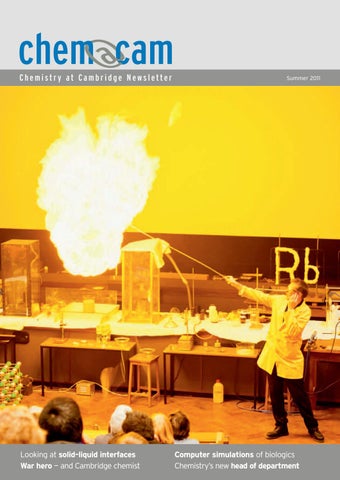
Peter Wothers in fiery action at this year’s chemistry open day Photograph: Nathan Pitt
Address: Chem@Cam, Department of Chemistry, University of Cambridge, Lensfield Road Cambridge CB2 1EW Phone: 01223 763865 email: news@ch.cam.ac.uk website: www.ch.cam.ac.uk Chem@Cam Summer 2011
3
News
Remembering Dudley A memorial concert to celebrate the life of Dudley Williams through live music, tributes and reminiscences was held at Churchill back in May. The programme reflected Dudley’s eclectic love of music. The poem below was written for the occasion by physicist and Churchill fellow Archie Howie.
Lines for Dudley The chemists love the molecules we need Draw with each breath, and with each bite to feed. On DNA all progeny depend And vancomycin may our lives defend. At every synapse molecules convene Keep memories of Dudley Williams green! Timing and resonance were skills he knew In music and in NMR they grew; At meetings sensed when best to interject With brain and vision gently he’d dissect. On Churchill science that fine talk he devised – Sweet swansong that can now be recognised! No Sat Nav calls such parting of our ways A jolt of broken symmetry conveys; Until by time the balance is restored Sam Butler’s words some comfort may afford – ‘Yet meet we shall and part and meet again – Where dead men meet – on lips of living men.’
Andreas’ Indian adventure Andreas Bender, lecturer in the Unilever Centre, spent much of July teaching in India. He teaches a course on chemoinformatics at Bangalore’s Institute for Bioinformatics and Applied Biotechnology, which gives the PhD students there a basic foundation in the analysis of chemical data. He also jointly supervises some masters’ research projects at the institute. Andreas has been making this trip every year since 2007. This time, he also found time to visit industrial companies out there, notably AstraZeneca and Unilever, to set up research collaborations. 4
Chem@Cam Summer 2011
Andreas is the one in the middle with the stripy shirt!
A collection of prizes for Cambridge chemists Summer is award season, and Cambridge chemists have been extremely successful in the prize stakes. First of all, Steve Ley has been awarded the Royal Society’s Royal Medal. These medals were founded by King George IV in 1825, and three are given every year by the Queen for the most important contributions in the physical, biological and applied sciences. Steve was given the medal for his pioneering research in organic chemistry and outstanding contributions to the methodology of synthesis. Clare Gray is the first recipient of the Royal Society’s Kavli Medal and Lecture, for her pioneering work in the use of solid state NMR in the development of lithium-ion batteries. Supported by the Kavli Foundation, a California-based organisation dedicated to the goals of advancing science for the benefit of humanity and promoting increased public understanding and support for scientists and their work, the prize will be given every other year for excellence in all fields of science and engineering relevant to the environment or energy. Another award has gone to Daan Frenkel – the Joseph O. Hirschfelder prize in theoretical chemistry from the University of Wisconsin. He will be giving three Hirschfelder lectures at the US university in October. Some of our younger academics have been getting in on the prize act, too Jonathan Nitschke has been given a C o r d ay - M o rg a n medal by the Royal Society of Chemistry. These medals are given to three chemists under the age of 40 every year for ‘meritorious contributions to chemistry’, and Jonathan received the medal for his innovative use of dynamic metal-ligand chemistry to create entirely new functional supramolecular systems in water. Jonathan also received a second RSC prize – the Dalton Transactions European/African lectureship, given by
the journal to recognise the achievement of a young African or European inorganic chemist. The RSC’s Norman Heatley award has gone to David Spring. It recognises the importance of interdisciplinary research between chemistry and the life sciences. David won for his work on diversity generation in organic synthesis and its application to the discovery of novel bioactive compounds including chemical probes. Another RSC prize went to Peter Wothers. He’s been given the President’s award for his outstanding contribution to public outreach in the chemical sciences. These are in the sole gift of the RSC president – currently David Phillips – and are given in recognition of major contributions to advancing the chemical sciences. As this is the International Year of Chemistry, Phillips wanted to recognise Peter’s successful efforts over the years in promoting chemistry to a wide audience, and raising the profile of the subject with the public. And a HarrisonMeldola memorial prize for chemists under 32 went to Tomislav Friscic. Tomislav was rewarded for his work in developing solid-state methodologies which explore and combine new types of molecular self-assembly. After three years here in Cambridge as a Herchel Smith fellow, Tomislav is now leaving us to take up an assistant professorship at McGill University in Canada – we wish him well. Finally, Andreas Bender won the fourth annual Molecular Graphics and Modelling Society’s silver jubilee prize. According to the society, there are currently very few prizes or awards for young molecular modellers, compared to many different awards for more ‘traditional’ physical chemistry, and with this award it aims to redress the balance a little.
www.ch.cam.ac.uk
A quartet of fellowships
Going live! Graeme Day recently had a paper published in Nature – and it proved so interesting that it led to him appearing on the radio to talk about his work. ‘It was about designing new porous molecular crystals that could be used to separate molecules or gases,’ Graeme says. He used computational techniques to predict the structures of the materials, which had been made by his collaborators, led by Andy Cooper at Liverpool. The predictions proved very accurate. ‘By predicting whether the molecules would have the desired porous crystal structure or not, weeks of synthetic effort could be saved when designing new materials,’ he says. The paper attracted the attention of the Cambridge-based Naked Scientists, who broadcast a science show every week live on local radio in the east of England. It’s also available to download via a podcast. In the show on 14 August, the focus was on designer chemistry, and Graeme’s work was perfect for it. So he spent his Sunday evening in the studio, for his first experience of live radio. ‘It was pretty nerve-wracking!’ he says. ‘As it was live, I was worried about what questions they might ask and that I’d struggle to find answers quickly.’ His fears were unfounded – and he even enjoyed the experience. ‘I’ll be much less nervous next time!’ he says. If you want to listen to the podcast, it’s at http://tinyurl.com/3fgmh3h
Academic promotions Four members of chemistry staff are on this year’s list of academic promotions. Ali Alavi is being made a professor, while Melinda Duer, Jonathan Nitschke and David Spring are all being promoted to reader.
ety was set up to recognise Welsh talent across the arts, science and industry, and ‘act as a defender of and protagonist for the very activities and functions that necessarily underpin the notion of Welsh cleverness’. As a Welsh society, it’s perhaps unsurprising that no less than seven of the new fellows rejoice in the name Jones! Meanwhile, Shankar Balasubramanian has been elected a Fellow of the Academy of Medical Sciences. And John Pyle has been made a Fellow of the American Geophysical Union. Congratulations all! This year’s Alex Hopkins memorial lecture was given by David Leigh (right) of Edinburgh University on the magic of molecular machines; Bill Eaton (below) of the National Institutes of Health in Bethesda, Maryland was this year’s Todd Professor
Funding news
Photos: Nathan Pitt
In the studio with presenter Helen Scales
Clare Grey has been made a Fellow of the Royal Society. She is one of this year’s 44 new fellows across the whole of science. She has been recognised for her work on using solid state NMR to study structure and function in inorganic materials, where her in situ NMR studies of batteries and fuel cells have a direct and important impact on the optimisation and development of systems for energy storage and conversion. Bill Jones has been elected as one of the inaugural fellows of the newly created Learned Society of Wales. The soci-
It’s good news on the funding front for a couple of our academics. Jane Clarke has had a Senior Research Fellowship from the Wellcome Trust for some time, and this has been now been renewed. Ali Alavi, meanwhile, has been awarded a Leadership Fellowship by EPSRC. These highly competitive senior investigator awards from the research councils provide the opportunity for a scientist to focus their time on research. A bonus is that it also massively increased the computational resources available to Ali’s group, largely through a large grant of time on HECToR, the UK supercomputer.
Jeremy to become a pro-vice chancellor As of 1 October, Jeremy Sanders has a new job – he’s to be pro-vice-chancellor for institutional affairs. The role will take up about 80% of his time, with the rest spent in chemistry. There are three main components to the job, Jeremy says. The first – and by far the largest – of these is HR related. ‘It’s not hands-on management of 9,000 employees!’ he says. ‘It’s more about developing policy about important topics such as pensions, retirement age, career structures and training. ‘I will act as something of an intermediary between academics and HR professionals – trying to explain the way the university works to HR, and vice
versa. They often have very different priorities! I will also be encouraging academics to take on leadership roles within the university, such as heads of department, and provide them with appropriate support.’ The second aspect of the new role is fostering relationships with the outside community, whether that’s the city or county councils, local businesses or schools – the same sort of outreach Jeremy was doing when he was looking after the 800th anniversary celebrations. And the third part is responsibility for the university’s estate and environmental strategy. ‘Developing North West Cambridge to create homes and a com-
munity for a couple of thousand postdocs, graduate students and others in an environmentally sustainable way is a big, exciting project that should have a huge (positive!) impact on life in the university and the city.’ he says. .’The one part of the environmental portfolio I don't have at the moment is reducing carbon emissions. ‘But it is pretty much everything else, such as water and waste management, and transport planning – so trying to persuade people to cycle, share cars or even use the new guided busway rather than driving alone. And, of course, anything else that the vice chancellor, in his infinite wisdom, decides to throw at me!’ Chem@Cam Summer 2011
5
Science
Interfacial investigations
Understanding what happens at the solid–liquid interface can give an insight into how products like lubricants and dispersants might be improved, and this is the focus of Stuart Clarke’s research There are many applications where it’s important to understand exactly what’s going on at a solid–liquid interface. Stuart Clarke’s chemistry is focused on a number of these interfaces, most recently on mineral-liquid and metalliquid interfaces, where the liquid is water or oil. These have important applications in products such as dispersants, lubricants and anticorrosion agents, where being able to control the behaviour at the interface is crucial. He’s been using a variety of novel approaches to study these interfaces, notably neutron reflection measurements. The experiments themselves require a big international facility to generate the neutron beams, and Stuart uses both the ISIS facility just outside Oxford and the ILL facility in Grenoble in the south of France. ‘ISIS is a spallation source, where protons are rammed into a target and neutrons are thrown out, whereas the ILL is a reactor source which produces a steady state flux of neutrons,’ he says. ‘In both cases, a “pencil” of neutrons is made, and this is bounced off the surface you’re interested in. ‘We then collect the intensity that’s bounced off, and 6
Chem@Cam Summer 2011
look at the intensity as a function of reflected angle. At very low angles, everything is reflected, and as the angle of reflection increases, the intensity reflected falls. The way it falls is a very sensitive measure of what’s happening at the surface. This means one can see the presence of molecularly thin layers, how thick the layers on the surface are, and exactly what molecules are sticking to it. This allows them to look at the precise structure of molecules on the surface – whether they’re arranged in single layers, bilayers, or even multiple layers of molecules. INTENSE EXPERIMENTS The time at ISIS and ILL is very intense. Typically, they get three or four days of beam time – day and night – and if the experiment needs it, they will work all night. The particular power of the neutrons, Stuart says, is that it’s possible to enhance the sensitivity of the scattering to highlight each component of complex mixtures, one can think of it as making different materials change colour. For example, with a multicomponent mixture, everything except one
component could be made to disappear in the reflection data. Hence a complex mixture becomes a one component system and much easier to interpret. His group is the first to have made successful neutron reflection measurements from calcite. This is a very important mineral – not only is it the limescale that forms in kettles, it’s also used in paper whitening, and is the reservoir rock for much of the world’s oil. The group has recently had a lot of success using large single calcite crystals from Brazil. ‘They’re really beautiful crystals, about 5 or 6 cm3 in size, with excellent optical clarity,’ he says. ‘We get them polished very flat on one side – to within 10Å of roughness, and put them against a little Teflon trough to hold the liquid. The two are clamped together and we bounce the neutrons off the interface between the liquid in the trough and the crystal.’ The adsorption of molecules at the surface is important for a number of reasons. ‘For example, if you want to make a dispersion of tiny calcite crystals in a liquid to use as a paper whitener or overbasing agent in an engine oil, you need to stop them sticking to each other,’ he says. The best way to do this is often by adsorbing polymer or other molecules to the surface. Knowing exactly how they adsorb and desorb, and the structure of those layers, is very important to controlling the dispersion behaviour. ‘We’d like to understand what the molecules actually do on the surface – in many cases it’s not even clear if they even are adsorbed to the surface – and how this relates to their behaviour,’ Stuart says. A great thing about this technique, he adds, is that it enables them to look at the molecules on the surface and see which ones are actually there, and what their structure is. For example, polyacrylic acid is commonly used as a dispersant for calcite, but it needs to be used carefully. ‘We now know that if you add a little it adsorbs strongly, but if you add too much it starts to dissolve the surface, and we can see this dissolution on an angstrom scale, well before it would be evident in a commercial system,’ he says. ‘We can see all the fine structural details of the adsorbed layer and its interaction with the surface and the solvent.’ A coating or dispersant formulation is usually a cocktail of molecules, and it’s often not clear which ones actually adsorb to the surface. ‘These approaches can also tell you which additives are doing the job – the different ingredients compete for
Photos: Nathan Pitt
MINERALS AND METALS Stuart’s group is now extending the work to other minerals as well, such as quartz, kaolinite and chlorite, and they are also looking at neutron reflection from metal surfaces, in collaboration with a group at Queen Mary College in London. ‘This is important in designing anticorrosion agents and friction modifiers to prevent wear,’ he says. ‘It’s also opening up new avenues in electrochemistry – a new area for us that we’re just starting to look at.’ To look at metals rather than minerals, they are using an extension of the neutron reflection technique. Neutrons can polarised in a magnetic field to be either spin-up or spin-down. ‘In this way we can perform the reflection experiments with spin polarised neutrons, up or down,’ he says. Instead of a single experiment, it’s now possible to make two measurements, each of which tells them something slightly different about the interface. The extra
CV
the surface,’ he says. ‘It’s also important to see if the additives stay on the surface with changes in time and conditions – many will desorb on heating or adding a different solvent. Understanding how and whether they stay on the surface is critical for knowing how they work and to design new and better molecules where the molecules stick better – or worse – depending on what you want it to do.’ Calcite has retrograde solubility – when you heat it up, it precipitates, and that’s why kettles develop scale in hard water areas. ‘It’s a real problem for heat exchanges in industry – when you heat water up, the calcite drops out,’ he says. ‘Understanding how additives can stop this from happening, or keep the particles dispersed, is extremely important in a commercial setting.’
Stuart Clarke
Research Born: Aylesbury, and grew up in Leighton Buzzard
fellowship engaging with surface scientists across BP.
Education: Degree and DPhil in chemistry with Bob Thomas at Oxford
Status: Married to Carolyn, who’s a Cambridge graduate. They have two children, Rosemary, who’s 16, and 12-year-old Elliott
Career: Postdoc at Oxford, after which he trained as a chartered accountant, working in personal and corporate insolvencies. He returned to science in the Cavendish Lab at Cambridge in 1993 to the newly formed Polymer and Colloids Group and moved to chemistry in 1999, and is now a Senior Lecturer, based in chemistry and the BP Institute. He is presently on a BP Technology
information can be essential when trying to solve the structure of the adsorbed layer. ‘This is a particular advantage of neutrons over X-rays and other related techniques, and why they’re particularly good for metal surfaces,’ Stuart explains. ‘Many commercial additives include long-chain fatty acid components. These approaches enable us to see them, all head-down and tail-up on the metal surface. We can see how tightly packed they are, and how much solvent has penetrated the layer. How the molecules arrange themselves like this is key to understanding their function as antiwear agents.’ More recently, Stuart has started to use synchrotron X-rays to look at the interfaces, too. ‘Neutrons are very good at seeing organic molecules, and X-rays are very good at seeing heavier elements,’ he explains. ‘In many cases, the combination of the two is very powerful.’ The other main focus of his research is on non-covalent interactions in physisorbed layers. ‘Organic molecules can also sit on surfaces like graphite, where the dominant interactions are the molecules on the surface interacting with each other,’ he says. ‘This is impor-
Interests: Hill walking and playing the guitar Did you know? Stuart almost ended up an actor rather than a chemist – he spent much of his teenage spare time with the National Youth Theatre. As a student, his arty side found another outlet –playing guitar in a band called ‘Stagnancy’.
The Clarke group pose outside the BP Institute: Stuart, Charanee Dharmasiri, Kate Miller, Chenguang Sun, Beth Howe, Nick Parkes, Adam Brewer, Xiaofan Wang, BingLun Li, Isabella Stocker and Rachel Chapman
tant as a subtle probe of intermolecular interactions, where we’re interested in what governs whether a physisorbed layer is stable or unstable. So far, people have looked at simple van der Waals interactions, and the idea that these layers have to be close-packed. More recently people have expanded into other interactions such as strong and weak hydrogen bonding between molecules like alcohols and fatty acids, and pyridine. The hydrogen bonds do indeed lead to more stable monolayers, in a number of cases they have a higher melting point than the bulk materials.’ Stuart’s group has recently been looking at combinations of adsorbed acids and amines, and they have seen an interesting series of complexes forming. These co-crystals contain both acid and amine molecules in a single crystal lattice. ‘There is evidence that not only do you get 1:1 complexes with one molecule of acid and one of base, but also 2:1 and 3:1 as well,’ he says. ‘That implies some very interesting surface phase behaviour, and very strong hydrogen bonds holding the crystals together. Most significantly, the layer formed by the combination is much more stable than either of the two pure materials, a synergy that can have commercial importance.’ He has now started looking at halogen interactions, too, where the halogen atoms interact with themselves, for example iodine with iodine. ‘We’ve seen some evidence of non-bonding interactions there. ‘In collaboration with Bill Jones, Graeme Day and Tomislav Friscic in the department, we’ve also been looking at halogen bonds, where halogens interact with atoms such as nitrogen, sulfur and oxygen – we recently had a publication that reported the first diffraction pattern from a 2D layer of a halogen-bonded co-crystal. These are proving to be extremely stable layers, with strong directional noncovalent interactions. This gives a very exciting new way of controlling surface structure.’ Much of Stuart’s work has direct industrial relevance, with funding from a number of industrial companies such as BP, Procter & Gamble, Unilever and Castrol. Chem@Cam Summer 2011
7
Research
The dynamics of biomolecules
8
Chem@Cam Summer 2011
molecules from bacteria, and if this binding switches them on they generate an immune response to get rid of the invading pathogen.’ He’s looking at a TLR system that recognises glycolipid molecules that are found in many kinds of bacteria. ‘The molecular structures of these lipids are, at first sight, fairly similar,’ he explains. ‘Yet not all lipids from all bacteria switch the receptor pathways on. Some partially switch it on, and others generate no immune response at all. It’s not at all clear from the structures of the lipids what the mechanism of this is. Normally, a small molecule interacts with a protein by binding specifically to a small, relatively rigid binding pocket. But as the lipids are large and very flexible, they cannot work like this.’ When the receptors go wrong, disease results, notably endotoxic shock syndrome resulting from sepsis, where an overreaction causes the immune system to go into overdrive. It’s often fatal, and is not easy to treat – and it’s unclear how the TLR proteins are activated. ‘This particular TLR complex is quite big in its activated state,’ he says. ‘There are two really large signalling proteins which bind to another couple of regulatory proteins. When you add the lipids and water into the system as well that gives about half-a-million atoms
Peter Bond
Born: Torquay Education: School in Torquay, followed by a biochemistry degree at Oxford, then a DPhil there with Mark Sansom, on molecular dynamics simulations of membrane proteins Career: Moved to Frankfurt in 2008 with a two-year EMBO long-term fellowship to work in the Max Planck Institute of Biophysics, and came to Cambridge as a lecturer in May 2010 Interests: Drawing, painting, writing and travelling. ‘I’ve got into travelling in South America,’ he says. ‘I love finding out what different cultures are like, and in particular, tasting their food. There’s always something interesting and new to try, wherever you go – though I invariably get ill as a result. But I don’t let that deter me!’ Did you know? He has a keen interest in genealogy, and recently found long-lost relatives in the USA. Thanks to the Augusta Chronicle keeping records over several centuries, he discovered that his grandfather was a highly decorated war hero, but that his greatgrandfather was a cut-throat, philanderer, and convict!
Photo: Nathan Pitt
Peter Bond’s computer simulations are designed to give an insight into some of the incredibly complicated systems designed by nature
CV
Nature created many complex, beautiful systems – many of which we still don’t understand. Peter Bond is using computer simulations to gain an insight into how some of these work. ‘As an undergraduate, I found I was much more interested in using computers in biochemistry than practical lab work,’ he says. ‘I was inspired when I learnt what they could do, allowing you to manipulate and model the structures of biomolecules, and I’m still inspired today.’ During his DPhil, he focused on using computer simulations to try and understand the dynamics of systems that hadn’t been modelled before, such as membrane proteins in arrangements like micelles and crystals. A postdoc in Germany allowed him to broaden his application of molecular simulation to a range of large-scale biophysical systems. Now in Cambridge, he’s continuing to use a variety of different computer approaches to elucidate biological mechanisms. ‘I’m particularly interested in biological assemblies, normally large and heterogeneous macromolecular complexes,’ he says. ‘Sometimes, there are NMR spectra or crystal structures for parts of them, but these can only provide one, or at most a few, snapshots of what’s going on. But for these things to function, their dynamics are important, and a snapshot isn’t really enough to describe how they are working.’ Many biological macromolecules are, essentially, tiny machines designed to carry out functions such as signalling, transport or energy conversion. ‘Their mechanisms of action are quite intricate, and can’t be understood from that single snapshot,’ he says. ‘I’m using simulation approaches to look at the bigger picture.’ He uses Newton’s laws of motion to generate a trajectory – and if you get the physics right, alongside descriptions of how all the elements of the system interact, this should reflect the biological or chemical phenomena that are going on inside a cell, for example. He’s using these approaches to look at signalling pathways – the mechanisms by which receptors recognise and bind to a particular ligand on a cell surface, for example. If it’s the right ligand, it switches the receptor on, passing a message into the cell and causing it to release a chemical signal. The toll-like receptor (TLR) system is a good example of this. ‘TLRs are cellular membrane proteins involved in immune responses,’ he says. ‘They bind to pathogenic patterns such as small
to model. The computer experiments are large and expensive! But it’s starting to give us clues about how the TLRs are regulated, and it’s becoming clear that the dynamics are particularly important.’ He says the regulatory protein seems a little like a molecular tape measure that can adapt to squeeze around its ligand. This helps to sense the size and shape of the lipid and, ultimately, determine whether it’s able to activate the receptor. ‘This is something you can only really look at using simulations in combination with experimental data,’ he says. TARGETING RECEPTORS Peter is working with Clare Bryant in the Cambridge veterinary school, who uses experimental methods to mutate TLRs and see how they respond to different ligands. ‘We’re doing the same thing, but at a molecular level. The ultimate hope is that we will be able to design drugs that will target this receptor pathway, in order to treat sepsis or to facilitate vaccine development.’ Another project, in collaboration with Andreas Bender in the department and Oliver Korb in the Cambridge Crystallographic Data Centre, is using structure-based approaches to look at enzymes involved in HIV. ‘We’re trying to predict how different molecules will bind to the enzymes, and mutants of the enzymes,’ he says. ‘This is important, as HIV is constantly mutating to try and evade the immune system and different drugs. We want to use this simulation-based approach to predict the likelihood that a particular drug will be able to bind to a particular enzyme mutant. I guess the ultimate aim would be to see which viral mutations a patient has, and be able to choose the right drugs to give them.’
Alumni
A Cambridge chemist – and a war hero A request for information to the academic secretary’s office led Howard Jones on a trail of discovery that led to a story of extreme bravery during the Second World War. Howard tells us more Periodically, we receive requests for historical information about the department or its former members. Most enquiries relate to events or people from the past 30 years or so, where we have reasonable archived records, or can rely on the memories of our older members of staff. But when Susan Cowen received an enquiry in April about a chemistry undergraduate from the 1930s, we held out little hope of finding anything useful. We were asked if we could confirm that Flying Officer Kenneth Campbell, believed to have been a member of the University Air Squadron and killed in action in April 1941, was a chemistry student at Clare College in the 1930s. No pre-war paper records remain in the department, and there is certainly nobody from that time still in the department to consult. I have a subscription to a genealogy website, and so first I used it to check World War II death records, and found that a K. Campbell of 22 Squadron was, indeed, killed in action in April 1941. I then searched the internet for information on 22 Squadron. I thought I would find his name on the squadron’s roll of honour but, to my amazement, I unearthed the story of how he was awarded the Victoria Cross for singlehandedly attacking and severely damaging the battleship Gneisenau in Brest harbour on 6 April 1941. SOLO RAID A planned attack on the harbour by a group of aircraft had been hampered by bad weather. Setting out from St Eval in Cornwall, Kenneth was the only airman to arrive on schedule at Brest and, rather than return home without engaging the enemy, he launched a solo raid. Unfortunately, the flight path he had to take when delivering the crucial strike gave German defences a clear view of his aircraft, and he was shot down, crashing into the harbour. All four crew were killed, and were buried in Brest by the Germans with full military honours. He was two weeks short of his 24th birthday. His efforts were recognised with the award of the Victoria Cross. His act of heroism was judged so important to the course of the war that the VC was awarded within a year – VCs are not usually awarded until hostilities have
Although he was killed in action in 1941 at the age of just 23, Campbell’s heroism played a vital role in the Allied victory
ceased in order to get a full picture of the context of the bravery. In fact, his attack on Brest harbour is seen by military historians as one of the defining moments of the war in Europe. In spring 1941, it was a generally held view that Germany had the upper hand: the UK may have won the Battle of Britain in 1940 and survived the worst of the Blitz, but the time the spring came around the UK was virtually on its knees, thanks to attacks on merchant shipping in the Atlantic bringing vital supplies to Britain. Brest was the German base for launching many of those attacks, led by the two battleships Gneisenau and Scharnhorst. Kenneth’s action left the Germans without one of its key attack ships. It took more than six months for the German Navy to recover its strength, by which time the Americans had joined the conflict, and Hitler had turned his attention to the invasion of Russia. The rest, as they say, is history. But the original query remained unanswered. A little more detective work looking up official class lists from the 1930s revealed that K. Campbell from Clare College gained a Class II in Part I Natural Sciences in 1938, and graduated in 1939 after obtaining a II.2 in Part II Natural Sciences (Chemistry). So a Cambridge chemist really did single-handedly influence the outcome of the war with Germany. Another Cambridge link: Campbell’s 22 Squadron was disbanded at the end of World War II. Part of the modern day 22 Squadron is based in Anglesey, where none other than Prince William – the new Duke of Cambridge – is a serving officer.
Campbell’s VC citation In recognition of most conspicuous bravery. This officer was the pilot of a Beaufort aircraft of Coastal Command which was detailed to attack an enemy battle cruiser in Brest Harbour at first light on the morning of 6th April 1941. The aircraft did not return but it is known that a torpedo attack was carried out with the utmost daring. The battle cruiser was secured alongside the wall on the north shore of the harbour, protected by a stone mole bending around it from the west. On rising ground behind the ship stood protective batteries of guns. Other batteries were clustered thickly round the two arms of land which encircle the outer harbour. In this outer harbour near the mole were moored three heavily-armed anti-aircraft ships, guarding the battle cruiser. Even if an aircraft succeeded in penetrating these formidable defences, it would be almost impossible, after delivering a low-level attack, to avoid crashing into the rising ground beyond. This was well known to Flying Officer Campbell who, despising the heavy odds, went cheerfully and resolutely to the task. He ran the gauntlet of the defences. Coming in at almost sea level, he passed the anti-aircraft ships at less than mastheight in the very mouths of their guns and skimming over the mole launched a torpedo at point-blank range. The battle cruiser was severely damaged below the water-line and was obliged to return to the dock whence she had come only the day before. By pressing home his attack at close quarters in the face of withering fire on a course fraught with extreme peril, Flying Officer Campbell displayed valour of the highest order.
Chem@Cam Summer 2011
9
Alumni
Physical chemistry: the next days Brian Thrush’s reminiscences in the Autumn 2010 issue of Chem@Cam, prompted me to complement his remarks with my own recollections of the era from August 1961 until the end of 1966. When I was preparing to embark on a transatlantic voyage to become a research student of Professor Norrish, Charles McDowell, head of chemistry at the University of British Columbia and a sometime companion with Norrish in bibulous overindulgence, cautioned me that Norrish would enter my prospective laboratory in the building in Lensfield Road with a cigarette dangling from his lips and complain that I was spending too much money. In the event, Norrish abandoned that filthy habit during my interlude in his department. Although he mentioned that I spent more money than any other research student – rather than too much money – he was fond of bringing guests to my laboratory because the instruments and apparatus on a grand scale therein were impressive. This vindicated the visits to stimulate financial support from industrialists. I was Norrish’s only research student not to have a joint publication with him; although, after his retirement, I dutifully carried a draft manuscript to his home at 7 Park Terrace. He graciously commended its publication, but without his coauthorship. Despite my doctoral thesis running to only about 100 typewritten pages, the subsequent enhanced publications extended to more than 150 pages printed in reputable journals. Brian Thrush also alluded to Morris Sugden’s work on suppression of gun flash as a war project. As Norrish’s last assistant in research, one task (of few) that he assigned me in 1965 was to inspect a cabinet containing files from preceding decades. One such file indeed concerned a project during the war years precisely on that suppression, presumably the project in which Morris Sugden was actively involved. FLASH PHOTOLYSIS Brian also named some notable technical assistants and mentioned the origin of flash photolysis after the failure of the experiments with steady photolysis. A few years before the award of the Nobel prize to Norrish and George Porter, one assistant narrated to me this anecdote. While those unsuccessful experiments were in progress, another assistant (either unnamed or whose name I fail to recall) suggested to Porter that he try using a flash of light instead. Porter, who had been a Research Fellow of Emmanuel College (as I was subse10
Chem@Cam Summer 2011
quently), was the external examiner of my doctoral thesis in 1965, but when I met him again at a symposium on molecular spectroscopy in 1995, he failed to recall our preceding encounter. Another task that Norrish occasionally assigned me was to assist in gatherings at his home. After filling the glasses for the second round, I was permitted to leave. On one such occasion on a Sunday evening during the summer term, he took dinner in Emmanuel College and tried to arrange a revelry afterward at this home, as he was lonely in the absence of his wife. The fellows of Emmanuel College, well aware of the likely consequences of such festivity – namely an aftermath of prodigious cranial pain – resisted such an invitation, but the chaplain, who later organised religious broadcasting at the BBC, found a few undergraduate members of the college choir – ‘naughty boys’ – who were persuaded to participate. So we sat in Norrish’s garden backing on Emmanuel College listening to Laurence Olivier from a gramophone record intoning ‘In the beginning...’ from the book of Genesis while they imbibed whisky under a dark but warm summer sky. The technical assistance available to researchers in department of physical chemistry was certainly admirable. Tom Fletcher was then chief techician, and Norrish assigned him to assist in the development of my laboratory project. In the old building in Free School Lane, there was a bell with which Norrish summoned Fletcher, but in the new building in Lensfield Road a telephone system replaced that mechanism. When my experiments with precious liquid helium as refrigerant continued beyond the hour for mandatorily terminating laboratory work for the day, Tom insisted on returning to my laboratory at 7.15pm to look after my experiment while I took dinner at the high table in Emmanuel College, returning directly afterward to complete the experiment as appropriate. He and other assistants made innumerable contributions to the success of my project. I retain a mercury lamp designed by Fletcher and Fred Webber and constructed by the latter in fused silica, with an aluminium coating as a reflector on one side. This enabled me to do experiments with milliwatts of electric power into that lamp that my competitors in the US, such as Pimentel in Berkeley and Jacox and Milligan in NBS Washington, could not do with kilowatts of power in their mercury lamps. That type of lamp requires a ‘stray-field’ transformer which, in that era, com-
monly served to ignite neon signs. With their demise, perhaps that lamp can never function again. One of Pimentel’s students came to Cambridge in 1966 as postdoctoral fellow with Jack Linnett, Norrish’s successor, but began his sojourn with theoretical exercises in a large communal office at the top of the building. After I left, Joseph Nibler worked in my former laboratory, but little seemed to result from those efforts despite the potential productivity of that apparatus. I do not recall ever meeting Nibler then, but I was subsequently a visitor in his laboratory in Oregon State University, in which we investigated spectra from ‘active nitrogen’. Another contemporary postdoctoral fellow from US was Don Setser, who worked under Brian Thrush. In about 1991 we published a paper on Einstein A coefficients, of which I became aware while attending a course of eight lectures on spectroscopy presented by Brian in 1961 Michaelmas term. That course had a strong influence on my subsequent appreciation of that topic in physical science. NOUGHTS & CROSSES Among a collection of my books that I recently unearthed was one published in 1964 by J.W. Linnett, identified as Fellow of Queen’s College Oxford but who was concurrently demonstrator in inorganic chemistry at that university. It was entitled ‘The electronic structure of molecules – a new approach’. As his formal inaugural lecture (which I missed because I took dinner in Emmanuel College at the same hour) to the Chemical Society in Cambridge University when he became, a year later, professor of physical chemistry, Linnett discussed aspects of that approach, which consisted of considering Lewis’s octet comprising four pairs of electrons to operate instead as a double quartet, each of opposite spin and each denoted with a separate symbol. At the conclusion of the lecture in a vote of thanks to the speaker, Norrish alluded to the ‘noughts and crosses’ that were intrinsic in that discussion. Near the end of my first term as assistant in research after he inherited me from Norrish, Jack Linnett invited me to remain in Cambridge, but I preferred to return to Canada to continue a career as scientist and educator. So far this has resulted in some 200 technical articles and three books from scholarly activities in locations around the globe. J.F. Ogilvie Honorary professor of chemistry, Universidad de Costa Rica
Chat lines
Colloid reminiscences Dear Editor I was fascinated by the photo of the colloid lab in 1931–32. I was a member of the lab from 1942–46. I wonder how old Frank Henry is, as I am 89? I have two photographs of the lab, from 1944 and 1945. The 1945 one recently appeared in Chem@Cam, where I identified everybody in it. Frank Henry’s photo is something of a puzzle, as they all look so young. But I will give the following attempt: Back Row. The young man at the end looks awfully like a Norwegian, I think he could be Leif Tronstad who was a legend, as he died with a team which made an attack on the heavy water plant in Norway in ?1941, and everybody spoke of it. I cannot make out the next two but the man with the high forehead in the middle is A.S.C. Lawrence who was a friend of mine, as he was also a member of the Communist Party. He was one of my examiners for my PhD after moving to Imperial College, London. His leg was amputated because he had diabetes. Next to him was Hurst, whose Christian name I have forgotten. He was a very affable friendly fellow. The two others I do not recognise. The front row starts with F.R. Eirich. I went to Paris in 1947 and carried out experiments on the flow birefringence of gelatin gels at the Institut Pasteur. I wrote it all up as a paper for publication, and during a visit to the lab Eirich offered to look over it and improve it. It was my only copy because I had no means of copying it in Paris. Not long after I found he had moved to the US, and when I asked him about my paper he confessed he had lost it. I was unable to recover what I had done, apart from a short note in Nature. Next is Henry himself, and then G.H. Twigg. I remember him because when I joined the lab I had to build glass vac-
uum equipment. I had very little money so I could not buy a blowtorch. I found the one belonging to Twigg, who was on holiday but when he got back he was most annoyed. Then there is Eric Rideal, and his right hand man, Jack Schulman next to him I think the man on the end is my PhD supervisor, A.E. Alexander – at least, he was the only person in the lab who had a toothbrush moustache. He was the brother of the commandant of the International Brigade that fought Franco in Spain. He went to Sydney University after the war and suddenly died of a brain tumour. When I went to New Zealand I tried to visit him in Sydney, but I had to be satisfied by meeting his widow. The first man on the floor is Philip George. I do not recognise the other one. I am interested in the project to write a history of the period. I went up for a scholarship in 1940 and during the chemistry practical a man came up to me and asked would I go to his rooms in Christ College that evening. It was Dr C.P. Snow, and he told me he was recommending me for a scholarship. I was very surprised as they could not have marked the papers yet and I still had not taken mathematics. He left the university soon after, and I did not meet him again until he was Minister of Technology in the Government some years later. I was puzzled that so many of Snow’s novels dealt with scientific fraud. I wonder if anyone encountered any real life incidents which might have inspired him? Sincerely Vincent Gray Wellington, New Zealand Frank Henry replies:Thanks very much for including my father’s photo in your newsletter. Vincent Gray’s information is both interesting and helpful, and provides the basis for further research on this topic.
Some more names
Dear Editor I spent the summer vacations of 1938 and 1939 in Rideal’s department as a volunteer working with Jack Schulman, and from that experience I think I can identify the following persons in Frank Henry’s photograph. In the back row, third from the left may be the ginger-headed George Tuckett. Standing next to him, I’m fairly sure is A.S.C. Lawrence, known as Soapy Lawrence because of his interest in soaps, who I think went as a professor to Sheffield. Sitting, third from the left could well be Geoffrey Gee, who subsequently went to the rubber research place in Welwyn Garden City, and on Rideal’s other side is Jack Schulman, looking as ever like the film actor Ronald Colman. Some of the others do look vaguely familiar, but there is a considerable gap between 1932 and my first acquaintance with the department, which must have been in 1937. Peter Plesch, Northampton We hope to have Peter’s reminiscences of his time in Cambridge in the next issue Physical faces
Colloid Sciences in 1961 – can you see yourself? We’d love to hear from you!
Dear Editor I was interested by the picture of the physical chemistry department taken in 1958. Though I arrived at Cambridge two years later, in the colloid sciences department, I recognise Professor Norrish in the middle of the front row in the picture. I met Norrish met in the company of Professor S.R. Palit, the distinguished visiting Indian polymer chemist. In the spirit of physical reminiscences, here is a photograph of the colloid sciences group, taken in the academic year 1960–61. I am extreme left in the back row. I remember most of the faces in the picture – and many of the names – and would be interested to see if any of your other readers recognise themselves. My own Cambridge chemistry was in 1959–61, when I qualified for my PhD working with Denis Haydon at Free School Lane. I was Denis’s first student at Cambridge. Yours faithfully, Byomkesh Biswas, Calcutta, India Chem@Cam Summer 2011
11
Science day
Chemistry in action… Flash, bang, wallop, what a picture… Nathan Pitt and Caroline Hancox had their cameras ready to capture the action at this year’s department open day Once again, on a Saturday in March, the department threw its doors open to the public – and their children – for the chemistry contribution to Cambridge science week. Once again, hundreds of schoolchildren and their parents flocked to the department to find out more about chemistry, and how much fun it can be. As always, Peter Wothers’ demonstration lecture drew huge crowds. This year, it was entitled, ‘The Wothers Guide to the Periodic Table – Group 1, the alkali metals’. As Peter says, ‘It’s not as catchy as some of the titles I’ve had in the past – but it pretty much says what it is!’ It gave plenty of opportunity for flashes and bangs alongside the educational bits. For example, he compared the reactivities of each alkali metal with water, by adding 10ml of water to the same molar quantity of each metal in side. He also floated a
12
Chem@Cam Summer 2011
metal block on a solution of caesium formate to demonstrate its high density – Peter bemoans the lawyers stopping him floating himself on it! He also demonstrated the incredible energy for the reaction between sodium and sulfur. ‘My demonstration was a very violent explosion, but this reaction has been used to generate the electricity for a whole town!’ he says. The kids could also get their hands on fun chemistry experiments, from extracting DNA and liquid nitrogen ice cream, to the messy loveliness of blue goo and the cornflour slime tank. Our grateful thanks once again go to everyone in the department who made the day possible, in particular Emma Graham and Emma Powney, and the Walters Kundert Charitable Trust for its generous support.
www.ch.cam.ac.uk
Chem@Cam Summer 2011
13
Chat lines
Joining Tim in a leaving beer (or three) Technician Tim Layt, who had been working in the department for 23 years, left us in July. He married former department receptionist Kirsten Scholefield a couple of years ago. She’s a New Zealander and the pair have headed off for a new life in her homeland. Regular readers of Chem@Cam will recall seeing many photos of Tim with
drink in hand over the years, so it seemed rude not to bid him a fond farewell with another suitably beery picture. Actually, now Chem@Cam comes to think of it, she’s struggling to remember seeing a photo of Tim without a drink in his hand! Tim, we hope you find the beer is to your taste down under…
A retiring pair…
Comings & goings Leavers Tim Layt John Sendall Christine Wilson
Photo: Caroline Hancox
We recently said ‘farewell’ to two longserving members of the department on their retirements. Vicky Spring retired after 26 years in chemistry, where she worked in the reprographics department, printing theses, lecture notes and all manner of other jobs. She’s pictured above with photography colleagues past and present – from the left Nathan Pitt, Caroline Hancox, Vicky, John Holman and Eric Smith. Also sailing off into the retirement sunset was Liz Alan, who had been the head of department’s secretary for a decade – working first for Jeremy Sanders and then Bill Jones. She’s pictured below with both of her ex-bosses. We wish both Vicky and Liz a happy retirement – and we’re sure we’ll be seeing them at department social events in the future!
14
Chem@Cam Summer 2011
Another departure was Christine Wilson, who moved on in July. She’d been in the department for six years as assistant academic secretary, looking after the welfare and training of research personnel. Somehow we don’t think her desk usually looked quite like this!
Also leaving us – albeit only temporarily – is Clare Rutterford from reception. As you can probably guess from the photo on the right (posing with her reception colleagues Emma Graham and Sheila Bateman), she’s off on maternity leave. The bump turned into a baby boy as Chem@Cam went to press – look out for a photo in the next issue!
Photo: Nathan Pitt
New staff Jasper Canty March Davies Daphne Kaufhold Helen Johnson Gabriella Bocchetti
Photo: Nathan Pitt
Photo: Caroline Hancox
Retired Liz Alan Vicky Spring
Puzzle corner
Once again we had plenty of correct ChemDoku entries. These came from Andrew Milner, Nick Broughton, Robin Foster, Steve Sunderland, Tony Pike (who says that in 1947 he met a young lady from Homerton – he was at Downing – and they celebrate their diamond wedding anniversary in September with a luncheon at Downing – congratulations from us!), Jim Dunn, A.J. Wilkinson, Helen Stokes, Audrey Herbert, John Turnbull, Godfrey Chinchen, Pat Lamont Smith, John Wilkins, Annette Quartly, Mark Alderton, Tom Banfield, Tim Dickens, Morgan Morgan, Diana Sandford, David Wilson, Bill Collier (who says he’s new to computing and is struggling to produce a 9x9 grid that will allow him to type in the chemical symbols – don’t worry, Bill, it made perfect sense with just the elements!), Richard Chambers, Donald Stedman, Frank Henry, Grant Buchanan, John Blasdale, Sarah Taylor, Alison Griffin (has your prize from last time turned up yet? Let Chem@Cam know if not and we’ll send you another) and John Carpenter. And a $ equivalent to the £20 prize is winging its way from Chem@Cam’s shiny new dollar cheque (or should that be check?) book to Donald Stedman in Denver, who was first out of the metaphorical hat (actually a John Lewis carrier bag – Chem@Cam’s dad used to wear a plastic bag as a hat when it rained when she was little, but she doesn’t think she’ll be following his sartorial lead!).
Thanks to the wonders of the internet facilitating the search for obscure facts, we had quite a few correct answers to David Wilson’s puzzle. They came from from John Carpenter, Bill Collier, Roger Duffett, Asha Boodhun, Annette Quartly, John Wilkins, Pat Lamont Smith, Godfrey Chinchen, Sarah Taylor, Steve Sunderland and Robin Foster. The first name to emerge from the bag was Robin Foster. And the answers? Othello wanted to be roasted in sulfur, King Lear’s tears scalded like molten lead, the Prince of Morocco chose the golden casket, Henry V’s English soldiers ate great meals of iron, Cleopatra’s oars were made of silver, and Brutus (of Julius Caesar fame) had the elements so mixed in him that nature might say ‘This was a man.’
Anyone for Bletchley Park?
This issue’s puzzles Elementary dice Here’s another little something from Graham Quartly… Professor Haddock had an unusual way of deciding which chemistry practical to work on; he had some dice made with the symbols for various chemical elements on the faces. However, with two of them (pictured), he noted that which ever way they landed, a word could be found reading consecutively around the four vertical faces. Given that the dice shown used the standard symbols for elements between hydrogen and copernicium, and have no repeats other than the ‘sulfur’ at the top, what are the hidden elements on each die? All words are UK English and involve no place names or proper nouns.
S
ChemDoku
Shakespearean elements
B
I
Se
ChemDoku
The solution is ‘fractional distillation’, and the code was cracked – not always the simplest way, and one a total guess – by Finian Leeper, Pat Lamont Smith, John Carpenter, Graham Quartly and Gwen Dawes. And the prize goes to John Carpenter.
As Ag Au
S
Hg
P
Au
P
Zn Ni
Ag
Life on a buckyball, redux Having reopened Graham Quartly’s spideron-a-buckyball puzzle, we got a handful more entries, and this time five correctly identified that there were six routes, each nine rods long, and the longest possible path 60 units. The correct five were Richard Chambers, John Blasdale, Tom Banfield, David Wilson and Richard Butler. John Blasdale’s entry emerged first and he gets the delayed prize. Congratulations!
H
S
Last issue’s solutions
S
Au
Co
Hg As
Ni
P Ag
Zn P
S
S
Co
£20 prizes are on offer for each puzzle. Send entries by email to jsh49@cam.ac.uk or by snail mail to Chem@Cam, Department of Chemistry, University of Cambridge, Lensfield Road, Cambridge, CB2 1EW
No MEN allowed in this issue’s ChemDoku… but can any eagle-eyed readers tell us why? Solutions (with or without explanation) to the usual address.
The Corporate Associates Scheme
Arecor Astex Therapeutics AstraZeneca AstraZeneca Cambridge – Medimmune Asynt Biotica Technology Boehringer Ingelheim Pharma BP BP Institute Bristol-Myers Squibb Cambridge Biotechnology Cambridge Display Technology Cambridge Medical Innovations CambridgeSoft Chemical Computing Group Cornelius Specialties Dr Reddy’s Custom Pharmaceutical Services
Thanks to the generosity of the department’s Corporate Associates, we have been able to benefit the education and environment for students and staff. For example, the Associates make significant contributions to the library for journal subscriptions. Moreover, they provide exam prizes, faculty teaching awards and summer studentships, and have recently funded the refurbishment of a state-of-the-art meeting room with teleconferencing and display facilities. Corporate Associate membership not only provides essential support for the department, but also provides numerous benefits to help members work with us and achieve their business objectives. Members enjoy many benefits through their enhanced partnership with the department, such as: ■ Visibility within the department; ■ A dedicated meeting room and office for members to use while visiting the department; ■ Invitations to recognition days and networking events at the department;
■ Access to emerging Cambridge research via conferences, special briefings and various publications; ■ Access to the department library and photocopying/printing facilities; ■ Regular communications about upcoming events and colloquia; ■ Subscriptions to department publications, including Chem@Cam; ■ Priority notification of and free access to departmental research lectures; ■ Ability to hold ‘Welcome Stalls’ in the department entrance hall; ■ Preferential conference rates; ■ Free access to the teaching lectures held within the department; ■ The full services of the Corporate Relations team to facilitate interaction with students, staff, and other parts of the University of Cambridge to help achieve your corporate objectives. If your organisation would be interested in joining the Corporate Associates Scheme, then please email Sian Bunnage at cas-admin@ch.cam.ac.uk, or call 01223 336339.
F. Hoffmann-La Roche GlaxoSmithKline Heptares Therapeutics IDBS Illumina Johnson Matthey Catalysts Maruzen International Merck, Sharp & Dohme Research Laboratories Novartis Pfizer Procter & Gamble Royal Society of Chemistry Sigma-Aldrich Society for Chemical Industry Takeda Cambridge Unilever Uniqsis
Chem@Cam Summer 2011
15
When I asked you to study the solid–liquid interface, that wasn’t quite what I meant
Chem@Cam is written, edited and produced by S A R A H H O U LT O N Printed by Callimedia, Colchester