chem@cam
Chemistry at Cambridge Magazine SPRING 2022
ISSUE 64
www.ch.cam.ac.uk
Focus on sustainability ______________________________ The air we breathe 12 ______________________________ Green fuels 22 ______________________________ Capturing carbon 26 ______________________________
Contents GREEN FUELS
THE AIR WE BREATHE
6 A BETTER BLUE
12 A SUPER SUPERCAPACITOR
16 _________________________________________________________ Focus on sustainability 4 _________________________________________________________ As I see it 5 _________________________________________________________ Fueling the green economy 6 _________________________________________________________ A leap of innovation 8 _________________________________________________________ Tiny green machines 10 _________________________________________________________ The air we breathe 12 _________________________________________________________ A better blue 16 _________________________________________________________ The positive side 18 _________________________________________________________
26 ________________________________________________________ PhD student promotes Black Women in Science network 20 _________________________________________________________ Power cuts spark passion 22 _________________________________________________________ Royall support 24 _________________________________________________________ Noticeboard 25 _________________________________________________________ A super supercapacitor 26 _________________________________________________________ When spending a penny... 28 _________________________________________________________ New hope for Parkinson’s disease blood test 30 ________________________________________________________ How you can contribute 32 _________________________________________________________
A sustainable future
I
t’s the end of Easter term and at long last we have been able to end special Covid restrictions, although we are still following sensible rules to avoid passing on any types of infections in the workplace.
chem@cam
Chemistry at Cambridge Magazine SPRING 2022
ISSUE 64
www.ch.cam.ac.uk
Focus on sustainability ______________________________ The air we breathe 12 ______________________________ Green fuels 22 ______________________________ Capturing carbon 26 ______________________________
You may recall that in the last issue of Chem@Cam we focused on research spin-outs - this time we are shining our (solar-powered) light on sustainability research in the Department. Much of our research is related to sustainability issues and we cannot possibly cover it all, but you can find out more in this issue about several research groups in the Department who are specifically addressing sustainability challenges.
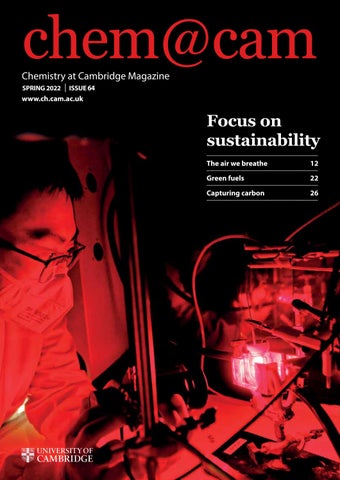
Cover photo depicts Zhang group researcher Xiaolong Chen monitoring photoelectrochemical apparatus, courtesy Department of Chemistry.
It’s often been said that imitation is the sincerest form of flattery, and many of our research groups have been inspired to copy scientifically what nature does naturally. For example, the Reisner group has several different projects which aims to transform waste products like carbon dioxide (also a greenhouse gas, of course) and plastic into valuable feedstocks. They are finding that using enzymes isolated from bacteria as catalysts can greatly increase the efficiency of these processes.
Chem@Cam Yusuf Hamied Department of Chemistry University of Cambridge Lensfield Road Cambridge CB2 1EW
Similarly, the Zhang lab is combining the best of the natural world with technology, by using cyanobacteria dredged from the ocean to improve artificial photosynthesis.
Views expressed in this magazine are not necessarily those of the Editor, the Yusuf Hamied Department of Chemistry or the University of Cambridge.
Later in the issue you can read about the many different interests of our atmospheric scientists – from local issues such as how pollution affects health both inside and outside the home, to the globally critical issue of climate change, and even on to exoplanet atmospheres.
Print: Belmont Press
Add to that biodegradable glitter from the Vignolini group – weddings will never be the same again! – more breakthroughs in battery efficiency from the Grey and Forse groups, and our regular features, and we hope we have provided you not only with an enjoyable and educational read, but also with some hope through our research for the future of our planet.
01223 761479 news@ch.cam.ac.uk www.ch.cam.ac.uk @ChemCambridge
2022 Yusuf Hamied Department of Chemistry University of Cambridge Chem@Cam is published twice a year, and is sent free to chemistry alumni, postdoctoral researchers, retired staff and friends of the Department.
CONTRIBUTORS Editor Diane Harris Contributors Caroline Reid Clare Wilkes Photography Nathan Pitt Gabriella Bocchetti
James Keeler Head of Department
3
Issue 64
Spring 2022
Focus on sustainability W
e’ve all heard the headlines: We are in a climate emergency. We are losing bio-diversity. The oceans (and our bodies) are filled with microplastics.
H
ere in the Department we are working hard to tackle many of these pressing issues, and this edition of Chem@Cam is devoted to sharing some of this innovative research.
group members, but also those in the Department’s many research groups. And note that much of this science is done in collaboration with researchers across Cambridge and the world: it is becoming clearer and clearer that solutions to these complex problems can only be found by drawing on expertise from a wide range of fields.
Of course, in just one issue we cannot possibly detail all the fascinating work going on in these areas. And some has been featured in previous editions, such as the Knowles group’s revolutionary plastic substitute made from biodegradable vegetable waste products and the Vignolini group’s edible hydrogels, which were both highlighted in Issue 63 (Winter 2021).
We do hope these stories will also give you some insight into how our Cambridge environment supports the most rigorous research, by giving students and early career researchers the opportunity to work with and learn from word-renowned academics.
So this can only be a small glimpse of the research we are doing to improve the sustainability of our planet. You will probably notice when reading the articles how researchers utilise the skills and knowledge not only of their own
We hope you enjoy finding out more about how our scientists are working on solutions to these crucial problems. We always appreciate your feedback, so please send your views (positive or negative) to news@ch.cam.ac.uk.
Ayaka Kamada displays Xampla’s revolutionary plastic substitute.
The Vignolini group’s edible hydrogels.
4
As I see it
P
Nathan Pitt, ©University of Cambridge
rofessor John Pyle CBE FRS recently retired as the 1920 Professor of Physical Chemistry, and was Head of the Department of Chemistry from 2014 to 2018. John is one of four international co-chairs of the Scientific Assessment Panel that advises parties to the Montreal Protocol. He continues to research ozone depleting substances, greenhouse gases and potential replacement fuels.
T
he state of science on climate change is very clear: if you put greenhouse gases in the atmosphere you will raise global mean temperature. I think most scientists believe that we are unlikely to hit our target of keeping global temperature rise to 1.5ºC above pre-industrial levels, which could have a devastating impact on life as we know it. On the other hand I think there was a certain momentum coming out of COP 26 (the UN Climate Change Conference held in Glasgow last year).
but now we must see if there will be real progress across the board, and build on it at COP27 in Egypt next year.
I believe one of the reasons the Montreal Protocol on Ozone Depleting Substances has been so successful is that an international agreement was reached early on. In hindsight the initial goals were relatively modest, but they were gradually strengthened over the years based on scientific input. It’s better to have a solution that – while not perfect – can be improved in time; that at least gives a groundwork for change.
In this country we could easily reduce energy use by making more efficient use of resources, for example in cutting down food waste and improving home insulation. We should be ensuring rigorous standards for new houses – why don’t all new houses have solar panels?
Another reason for the success of the Montreal Protocol is its Multilateral Fund, which helps developing countries comply with their obligations under the treaty. A lot of the discussion at COP26 was how richer nations can help poorer ones make the needed transitions – we must find a way of doing it for climate change or there will be no progress.
I share everyone’s frustration that the pace of change is too slow, but there’s an increasing recognition that we have a problem that needs to be sorted and that the sooner we can get a wide range of solutions in place the better. Governments have finally taken their blindfolds off; let’s hope they are not diverted yet again.
So overall I think COP26 was an advance in that (1) countries at last agreed in writing that coal is bad, and (2) there was a pledge to significantly reduce human-induced emissions of methane by the end of this decade. That there is an agreement to do something on methane, the second most important greenhouse gas, is a nudge in the right direction,
If we reduce emissions aggressively then, with a bit of luck, we can perhaps keep close to 1.5ºC. 5
Issue 64
Spring 2022
Fueling the green economy P
rofessor Erwin Reisner’s group is turning carbon dioxide into green fuels to promote a circular carbon economy. Gabriella Bocchetti, ©University of Cambridge
Electrolysis Researchers in the Reisner group have developed an efficient concept to turn carbon dioxide into clean, sustainable fuels, without any unwanted by-products or waste. The team are using enzymes isolated from bacteria to power the chemical reactions which convert CO2 into fuel, in a process called electrolysis. Enzymes are more efficient than other catalysts, such as gold, but they are highly sensitive to their local chemical environment. In collaboration with the Universidade Nova de Lisboa in Portugal, the researchers have developed a method to create favourable conditions for the enzymes during operation in an electrolyser. Most methods for converting CO2 into fuel also produce unwanted by-products such as hydrogen. But the team has been able to improve fuel production efficiency by 18 times in a laboratory setting by optimising the conditions in the electrolyser, demonstrating that polluting carbon emissions can be turned into green fuels efficiently without significantly wasting energy. “Electrolysis has a big part to play in reducing carbon emissions,” explains Reisner. “Instead of capturing and storing CO2, which is incredibly energy-intensive, we have demonstrated a new concept to capture carbon and make something useful from it in an energy-efficient way. “Right now carbon dioxide is seen as a waste feedstock because people don’t want it. In a zero carbon economy, we envision that people will pay to get carbon dioxide.”
Professor Erwin Reisner
Bio-hybrids
idealised model catalysts,” explains Reisner. “We are trying to combine the best of the two worlds of synthetic systems and biology for solar energy harvesting.”
A related area of research is semi-artificial photosynthesis, in which biological catalysts are combined with synthetic light absorbers to convert light into green fuel. In natural photosynthesis, plants use light energy from the sun to convert water and carbon dioxide to chemical energy in the form of oxygen and sugars. In artificial photosynthesis, scientists use an artificial catalyst to convert light into simple fuels such as hydrogen. Here, the researchers are combining the two approaches by developing biological catalysts that more efficiently mimic the process that occurs in natural photosynthesis. “We are aiming to overcome the limitations of natural and artificial photosynthesis, using enzymes as
To accomplish this, the group has taken a new research direction by isolating enzymes from bacteria and integrating them with photo-voltaic cells to create a more efficient ‘bio-hybrid’ conversion process. “Photo-voltaic cells are very good for the production of electricity, but we are looking at how we can integrate these materials with biological catalysis,” says Reisner. “For me, it’s very exciting, because this type of biological interface with photo-voltaic cells is largely unexplored.”
6
Gabriella Bocchetti, ©University of Cambridge
PhD student Ava Lage takes a sample of the photocatalyst for analysis. The group has also developed an artificial leaf, which converts sunlight into syngas, a widely used gas that is currently produced from fossil fuels. Syngas is a mixture of hydrogen and carbon monoxide, and is used to produce a range of commodities, such as fuels, pharmaceuticals, plastics and fertilisers. In the artificial leaf, two light absorbers are combined with catalysts. When immersed in water, one light absorber uses a catalyst to produce oxygen, while the other carries out the chemical reaction that reduces carbon dioxide and water into the syngas mixture.
technology. This process is called photoreforming, which uses sunlight, water and low-cost non-precious metal catalyst materials to ‘reform’ organic waste into hydrogen. Researchers in the Reisner group have been developing this technology, and are currently attempting commercialisation (see Issue 63 Winter 2021). Photoreforming using plastics led to Reisner’s launch of the Cambridge Circular Plastics Centre. “For me, it has had an extremely positive impact, with eight different departments being involved. We have learned so much about plastics and sustainability more broadly, and it has had a very positive impact on our research group,” he says.
Photoreforming
You can find out more about the group’s research on the Reisner Lab website www-reisner.ch.cam.ac.uk. Gabriella Bocchetti, ©University of Cambridge
Imagine being able to take waste plastic and turn it into hydrogen, in a sustainable and potentially economic
Dr Sam Cobb at the flow electrolysis station, which is connected to a solar light simulator.
7
Issue 64
Spring 2022
A leap of innovation
T
aking research and using it to start a business can be daunting, even more so with climate change on the horizon. Dr David Wakerley and Dr Sarah Lamaison from the Reisner lab recount their experience founding a company that aims to convert carbon dioxide emissions into valuable chemicals.
Dioxycle co-founders Sarah Lamaison and David Wakerley.
Dioxycle
years have pumped energy into these sources for us, forming coal, gas and oil). It is fundamentally hard to compete with energy-rich oil when we start from CO2, as we have to pump energy into it to produce these commodities.”
Carbon dioxide (CO2) contributes to climate change and global warming, but with over 34 billion tonnes of emissions poured into the atmosphere last year alone, the problem can seem overwhelming. The team of two started Dioxycle to produce electrolyzers that can convert industrial CO2 emissions into more valuable carbon-based products so that CO2 isare no longer considered a waste product.
The main cost during electrolysis is the energy used to convert the CO2. The solution to this problem starts at the nanoscale in the development of high energy efficiency proprietary catalysts, that can reduce the energy cost of conversion. On the electrode level, the team is optimising the catalytic interface and the overall electrode architecture. This work is a natural extension for Lamaison, who worked on designing and optimising catalyst matrices during her PhD at Stanford University.
“Our mission at Dioxycle is to provide large-scale solutions for the conversion of industrial emissions into sustainable commodities, chemicals & fuels,” comments Lamaison. “Right now, such commodities are mostly produced from inexpensive fossil sources (inexpensive because millions of
8
Lessons from the lab
“It is going to take an exceptional amount of effort to get the technology from lab scale to a cost-competitive industrial solution,” comments Lamaison. “But it is incredibly thrilling to embark on this journey as this technology is necessary. You know, a century ago, Haber and Bosch invented a way to make fertilizers by “pumping energy” into nitrogen from the air and solved the biggest problem of their time. What is happening today is similar, but the atmospheric molecule that we can use is CO2.”
“My PhD research in Professor Reisner’s lab was on transforming cellulose into hydrogen, so that in theory you could take any biomass and convert it into hydrogen using sunlight,” says Wakerley, who is at the helm of Dioxycle with Lamaison. “Sarah was studying photosynthesis with Dr Zhang. They studied the water oxidation mechanisms of photosystem II, and these topics really gave us the foundational knowledge of the redox reactions that are essential in this field.”
Revving up
This combination of specialties was essential for the innovation that led to Dioxycle. Wakerley also recounts that it wasn’t solely chemistry that he learned at Lensfield Road but also how to communicate his research with people who don’t have a scientific background.
“Our longterm goal is to help industries take their CO2 emissions and turn them into something valuable,” says Wakerley. “We want to really give companies the financial incentive Dioxycle aims to convert CO2 emissions into more valuable products. to convert their CO2 emissions. The way that we do this is through a process called CO2 electrolysis, converting it to higher “I always participated in Professor Reisner’s outreach. energy carbons such as carbon monoxide, ethylene, Sometimes he shows a Lego movie which I made with ethanol, that then serve as precursors for even more Dr Christopher Windle, that took about a year and a half valuable products.” of my life,” comments Wakerley with a chuckle. “Those skills also work really well when you go to pitch your There are numerous challenges with scaling any new own business to an investor. People you work with in the technology. In this case there is no supply chain, so the future don’t necessarily have a chemistry background team has a lot of chemistry to do, such as defining and and it’s really important to put forward your ideas--even fabricating catalysts and electrodes. They are looking to if you have the most genius idea in the world it’s very test their designs directly in a pilot program that plumbs hard to sell it if no one understands it.” the electrolyzers to chimney outputs and converts the CO2 from there. Breakthrough Energy Fellows Little is more thrilling, daunting and uncertain than the “Even if we do everything we can to limit our carbon first year of a startup company. However, after leaping footprint, there are emissions we cannot avoid without into the unknown world of Dioxycle, the team were scientific breakthroughs,” comments Lamaison. “I am selected as fellows by the Breakthrough Energy Fellows thinking in particular about the emissions in hard-toprogram founded by Bill Gates, which supports climate abate industrial sectors such as steel, chemistry and innovations from the lab to widespread adoption with cement, where some emissions are associated with the the aim of accelerating technology to reach net zero processes themselves. This is why we are devoted to emissions by 2050. develop solutions to help decarbonize these sectors at Dioxycle.” “The first nine months were really tough because you are working on what you believe is a really great Opportunities in the renewable idea and you have to be the one to really push the energy sector technology forwards to prove it,” comments Wakerley. Dioxycle is currently hiring and has a number of “So it was really good to have that confirmation that the positions open for PhDs, postdocs, and anyone who program was behind our route to make ‘electrofuels’: is very passionate about using technology to combat which is to say fuels made from electricity. We really issues like climate change. Interested parties can feel now that our technology is something that has the contact David Wakerley via the dioxycle.com website. potential to gain momentum on an international stage.”
9
Issue 64
Spring 2022
Tiny green machines
A
Gabriella Bocchetti, ©University of Cambridge
lthough we can now produce green electricity we are still searching for sustainable ways to generate new chemicals and fuels. The Zhang group is looking for inspiration from the green life all around us that reaps the benefits of the sun. Specifically, the most abundant lifeform on the planet: cyanobacteria.
Dr Jenny Zhang and Dr Xiaolong Chen examine the structure of the nanoskyscapers.
Biofuel Land Tussle
bacteria is the great ancestor of chloroplasts that turn light into energy and make plants green. They are 3.5 million years old, and even contributed to the oxygen atmosphere we rely on today.
Many fuel sources rely on mining, which can seriously damage ecosystems and rely on exploitative labour practices. Additionally, other common energy sources such as batteries employ the use of rare transition metal catalysts which are expensive and finite. Finding sustainable alternatives is essential.
When cyanobacteria have both sunlight and moisture, they produce electrons. Her team created a prototype solarpowered electron pump that, when flooded with light, produces a flow of electrons. Dr Jenny Zhang is bringing these marine-born organisms into the lab and figuring out the most efficient way to incorporate photosynthesis for electron and fuel generation.
Biofuels have some advantages; they can be grown quickly, are low tech, and can be grown in abundance. . There are still limitations though. Biofuels made from crops, such as sugar beet and wheat, compete with farming land and reduce diverse ecosystems.
If you zoom in on a plant, it uses the energy from sunlight to rip electrons from water. These electrons then travel around the plant to create sugars. The latest prototype from the
Therefore, Zhang looked to the oceans for a solution and found cyanobacteria. Known as blue green algae, these
10
Gabriella Bocchetti, ©University of Cambridge
laboratory can harvest these electrons before they are turned into sugars, and can instead be used to generate other useful chemicals. Another bonus is that it also generates electricity at a rate that outcompetes the efficiency of biofuel generation.
“The rate of current that previous experiments could harvest from cyanobacteria was around 14 microamperes per centimetre squared, where the natural value is 340.In our latest paper, we could derive currents one order of magnitude greater than previous experiments! We are also now close to achieving the Electrode flooded with light. predicted values,” comments Zhang.
The team were surprised at how much better than the previous generation of electrode this version was. Just altering the structure of the electrode led to • electricity extraction that was almost within calculated theoretical values. Lawrence notes that he had expected to tick off a long list of variations, such as genetically engineering cells or altering chemical conditions, before seeing this much improvement.
Stop. Collaborate. “The reason we can have such successful projects like this is because we are such an interdisciplinary group,” comments Lawrence. “A lot of my work focuses on the biology behind the cells producing electricity but in order to study the biology I need very good electrodes. So I rely on Xiaolong and other people with experience in engineering and materials to do that.”
This outstanding improvement involved rethinking what an abiotic interface looked like. The team 3-D printed tiny tree-like structures using nanoparticles which could then be loaded with cyanobacteria which cling to the branches like leaves.
Nanoforests The inspired shape of these structures balanced the amount of light needed by the bacteria and the number of electrons the interface could collect. Finding the perfect electrode took time and refinement. “This is something out of my imagination,” comments Xiaolong Chen, the first author on the paper who designed and 3D printed the electrolytes.
light and can even fall over. It’s all about finding these trade-offs.”
Zooming in on the tree-like structure.
Chen adds, “Engineering is my subject so it’s really interesting to work across different disciplines. Once we started working together and filling in the gaps from one subject to another, that was when we overlapped new ideas and innovation began.”
The branches are the design feature that gives the structure a bigger surface area that can support a lot of bacteria.
At the moment, these electrodes are nanosized. There are a lot of challenges ahead before this technology reaches the consumer. “Practically, a forest farm could look like a paint that covers the outside of buildings, however, this is more of an architectural problem!” comments Zhang. Another interesting challenge will be taking advantage of different bacterial ecosystems and balancing them. Bacteria don’t exist in a monoculture like they do in laboratories.
Joshua Lawrence, a PhD student with a background in biology, brought his knowledge PhD student Joshua Lawrence. of bacteria to the project. He adds: “if you have an electrode with a larger surface area then more cyanobacteria cells will be attached and you will generate more electricity. But then, if the pillars are too tall, they block out the
“Since the bacteria need water flowing through the electrodes, some people imagine them in the oceans – back to where cyanobacteria began. Since the ocean covers 70% of the Earth’s surface there may be areas that we can use to harvest energy.”
“The first thing that our group did was to alter the electrode’s height. Which sounds like a lot but it went from about 50 micrometres to about 800 micrometres. You could barely see the change with the naked eye. Then we changed the roughness of the pillars so some of them are very smooth and some of them are more branched.”
11
Issue 64
Spring 2022
The air we breathe
T
he Centre for Atmospheric Science (CAS) brings together research in a wide range of areas: from ozone depletion and climate change, to portable sensors which detect pollution, and even to modelling how climate and policy interact. The following pages offer a brief introduction to some of the work going on within the Centre.
Atmospheric modelling on Earth – and beyond
D
Nathan Pitt, ©University of Cambridge
r Alexander Archibald and his group are primarily looking at the gases and aerosols in the atmosphere: how they got there, how they are changed, and how they affect the climate and our health. “As a group we are broadly interested in how we can apply physical chemistry techniques to understand how the gases and aerosols present in atmospheres affect the climate and quality of air we breathe,” explains Archibald. “But we don’t pigeonhole ourselves,” he says, explaining that the 22 group members are working on a whole range of questions. “We’ve worked on volcanoes, ozone in the stratosphere and troposphere, climate – as long as it involves gases and aerosols in the atmosphere, we’re interested.” the respected UN body which regularly assesses the science related to climate change.
As NCAS@Cambridge, the group is also the Cambridge base of the National Centre for Atmospheric Science, co-funded by the National Environmental Research Council (NERC). Archibald is Chief Scientist for the UKCA model, an NCASMet Office joint project to create an atmospheric chemistryaerosol global model.
A new contract with BEIS (the government agency for Business, Energy & Industry Strategy) has also given Archibald a direct line of communication with government policymakers. “Our remit is to help deliver climate services for the net zero world,” says Archibald.
Several NCAS-funded postdocs in the group maintain, develop and test the UKCA model, which is not only used by the Met office to forecast air pollution, but is also essential to a range of topics in climate change research. For example, the group is continuing to pioneer Professor John Pyle’s work on measuring the changing ozone depleting substances in the atmosphere, and investigating the ultimate recovery of the stratospheric ozone layer.
All of these strands reflect Archibald’s defining interest in the atmosphere – and not just on Earth. Earlier this year, it was announced that Cambridge has been awarded a Leverhulme Trust £10 million grant to establish a new interdisciplinary research centre dedicated to exploring the nature and extent of life in the Universe. Archibald says: “It’s an atmospheric chemist’s dream, because atmospheres are the way we can probe what’s going on in planets. I don’t think you could think of a more fundamental question to work on.”
Some members of the group use the model to predict shortlived climate forces or pollutants. “We look at substances like methane, ozone and aerosols, which are seen as an important lever on climate solutions because they are often more potent than long-lived greenhouse gases like carbon dioxide and nitrogen,” explains Archibald. “As the name implies, they have a short lifetime, so if we go after them now we might rapidly reduce their abundance to create quick wins.” Much of the group’s research has impacted the reports of the Intergovernmental Panel on Climate Change,
The group is also looking at the history of Earth’s own atmosphere and how it has evolved. “It’s a real detective puzzle to understand the composition of the atmosphere back then based on limited data,” says Archibald. But he also points out: “If we can understand how it evolved in the past we can better predict how it will evolve in the future. With climate change it is important to understand how our earth’s atmosphere works, to predict how it might evolve. “
12
The policies of climate change
D
r Annela Anger-Kraavi approaches climate change from an economics and environmental policy background and leads the Climate Change Policy Group situated in the Centre for Atmospheric Science.
available literature and synthesize the information into a 40page summary that governments can easily digest. There is a lot of trust at government level in the IPCC, but even then there is uncertainty,” she explains.
Anger-Kraavi uses integrated assessment models, combining them with climate change models to assess the economic, social and climate impacts of government actions on climate change. The results can be used by government policymakers to help determine the most effective policies for reducing greenhouse gas emissions, taking into account their potential economic and social impacts balanced against the possible severe consequences of climate change.
“My focus is on climate policy and relevance. We are looking at future climate and emissions scenarios, and how policy, economics and atmospheric science all interact,” she says. Recently she has been considering how renewable energy technologies are not quite ready yet to replace current energy sources, leading to high energy prices (exacerbated by Russia’s recent actions in Ukraine), and how this impacts the poorest members of society. “I am very much pro reducing emissions as fast as possible, but not at the cost of people on low incomes and without exacerbating health, gender, ethnic and age-related inequalities,” she says.
“We are looking at how we can use the models better so key players can understand what they mean – we are trying to make them more usable, more transparent. We attempt to combine economics, atmospheric science and policy,” explains Anger-Kraavi. “We are very interested in looking at the uncertainties and how these could affect policy each time you add a new layer to a model there are more uncertainties. And if everything is uncertain, what should a government base its actions on?”
However, there is one thing she is certain of as a result of her modelling: “What we do know is that we need to get carbon dioxide emissions to zero as fast as possible.”
Some of her studies also aim to take into account how government policies might affect health, existing inequalities, human rights and gender. “It’s quite a challenging thing to do,” she adds. Anger-Kraavi became interested in the interactions of policy with climate change when she began running environmental and economic models while pursuing her PhD as a member of the Cambridge Centre for Climate Change Mitigation Research in the Department of Land Economy. She wondered how greenhouse gas emissions and climate change would affect the economic models, and began collaborating with Professor John Pyle (see page 5). Their first paper together combined the two models to consider how to decarbonise international transport. Anger-Kraavi, who is a native of Estonia, has held several international roles relating to policy and climate change and is a Senior Consultant on Climate Change and Intergovernmental Panel on Climate Change (IPCC) matters to various government institutions of the Republic of Estonia. “In terms of climate change-related science, the IPCC is the most authoritative source, because they assess the latest
13
Issue 64
Spring 2022
Analysing ice cores and monitoring air quality
C
hiara Giorio is interested in the composition of the atmosphere, both past and present, and how it relates to human health and climate change.
funded ‘Ingenious’ project will provide a comprehensive understanding of indoor air pollution in UK homes. In a cross-disciplinary collaboration with partners across the UK, the researchers will be examining different aspects of indoor pollution, including comparing houses in deprived urban settings with those in more affluent areas, measuring impacts on health, and recommending simple behavioural changes to improve indoor air quality.
It seems that for Giorio, proposals are a bit like buses. “You write proposals hoping to get one funded, then you either get none and you’re disappointed, or they’re all funded and you’re really busy!” But she is clearly delighted to have received backing for several new projects which recognise and support the importance of her research in analysing and monitoring atmospheric emissions.
“For example, cooking produces lots of atmospheric particles,” says Giorio. “An extractor fan can reduce the pollution, but not everyone uses it because it’s noisy. Because every family is different, we are developing lowcost instrumentation which can be put in each house. Our goal is to improve indoor air quality by using some simple technologies, but also by changing behaviour.” The first monitoring will start later this year.
Giorio has recently taken delivery of a new mass spectrometer, partially paid for by Dr Yusuf Hamied’s generous gift to the Department, from a fund which supports early career scientists like her.
As part of a new project funded by the National Environment Research Council and led by the University of Cambridge, Giorio’s group is also developing lower cost instrumentation to measure greenhouse gas emissions. When ready, the new instruments will be deployed in the local fens, with the ultimate goal of providing the knowledge and tools needed to regenerate essential British ecosystems such as the fenlands.
Giorio will use the instrument primarily to determine the presence and composition of organic compounds in Antarctic ice cores. “This new mass spectrometer has state of the art sensitivity, which is very important because the organic compounds are only present at very low concentrations,” she explains.
Gabriella Bocchetti, ©University of Cambridge
Giorio explains that analysis of these organic compounds will lead to a greater understanding of past levels of oxidants in the earth’s atmosphere. “Oxidants are a key atmospheric component because they can remove important greenhouse gases, such as methane, so it’s important to understand their concentration in the atmosphere and how it has changed over the years,” she says. Atmospheric oxidants dissipate and so cannot be measured directly. Instead, Giorio deduces oxidant concentrations by examining the oxidative by-products of compounds emitted by terrestrial plants, which are found in the ice cores. “The plants’ emissions carry the signature of the concentrations of oxidants, and they are stable enough to be transported to Antarctica and stored in the cores. By measuring them we can determine the nature and level of oxidants that were present in the atmosphere at the time,” she says. In another project, Giorio and Professor Rod Jones are deploying small, portable sensors to investigate the impact of indoor air quality on human health. The UKRI-
14
Air quality and climate change: joined-up thinking
P
Nathan Pitt, ©University of Cambridge
rofessor Rod Jones and his group use a wide range of measurement and modelling techniques to study the chemical composition and physical structure of the earth’s atmosphere. They have developed networks of low-cost air quality sensors which monitor urban pollution and its health impacts. Most recently they have been exploring ways to examine the interplay of air quality and greenhouse gas emissions in one model. “A lot of the causes of poor air quality also have a significant carbon footprint,” says Professor Rod Jones. “If you look at this in a synergistic way you could actually reduce our carbon footprint at the same time as improving air quality. We need joined-up thinking between air quality and climate -- in some ways this is the focus of my research.”
the fact that the type of houses in a particular street influence the distribution of air pollutants. We can pick that up and deal with it in some of the models we use,” says Jones.
“This is incredibly important - something like ten million people world-wide die prematurely as a result of poor air quality. Covid has absolutely transformed the world, but fewer people died of that than of polluted air annually. But because we have no ‘lateral flow test’ for air quality, we can’t see it and can’t recognise it.”
“One of the things we did routinely going back to some of our first projects, was to include CO2 in the air quality measurements we were making,” explains Jones. For example, when measuring emissions from a combustion source, we would measure CO2 and also nitrogen oxides (NOx) which are often co-emitted. And NOx can lead to the formation of ozone, which is not only a potent greenhouse gas but also can adversely impact health.”
The Jones group has long been noted for its measurements of atmospheric composition, which underpin scientists’ understanding of air quality and climate change. They have also pioneered the development of portable sensors to make more localised measurements of air quality in urban areas and its impact on health.
“The measurements of CO2 and NOx can be used to determine emission ratios, which is the amount of atmospheric pollutant created per unit of fuel burned. This in turn can be used to determine how government regulations might reduce both air pollution and greenhouse gas emissions – if you don’t understand emission ratios, you can’t do policy.”
Two senior researchers in the group, Dr Lia Chatzidiakou and Dr Lekan Popoola, have been particularly involved in using the low-cost sensors to more accurately measure individual exposures to pollutants and particulates in urban settings such as London, Beijing and Dhakar. Chatzidiakou has used sensors carried by individuals with COPD (chronic obstructive pulmonary disease) to evaluate the effect of various pollutants on their symptoms. Popoola monitors and interprets the measurements from several sensor networks, building further on the group’s early work deploying air quality sensor nodes at Heathrow.
Amongst other projects, Jones is also involved in a project to install CO2 monitors into one thousand schools across the UK. “It’s a really good metric for Covid effectiveness,” he explains. “Because if we can work out the CO2 enhancement in a room we can tell you how much of someone else’s air you’re breathing.”
“Measuring carbon footprints has traditionally required very expensive and large instruments installed on tall towers. What Lia and Lekan are doing instead is measuring on street corners with portable sensors, which are much cheaper and easier to deploy than the traditional methods,” explains Jones. “By taking street-level measurements we can look at smaller, individual pictures. So, for example, we can take account of
The new project is also about education, outreach, engagement and behavioural change, and Jones plans to include students in the monitoring process. “It’s important to have the next generation looking at this data and being wellinformed,” he says. “I am pleased that we are finally joining things up.”
15
Issue 64
Spring 2022
A better blue
P
rofessor Silvia Vignolini’s Bio-Inspired Photonics Group researches colour that originates not from a dye or pigment, but from the structuring of transparent materials on the nanoscale. Such unusual materials offer exciting properties such as metallic or iridescent visual appearances or vibrant fade-resistant colours that are sustainable and non-toxic. Here is an overview of some of their projects.
Sustainable glitter made from cellulose sheets like that in the photo could turn celebrations greener.
Birds like shiny things
build the structure that reflects the blue colour. Lipids are a nutritionally valuable resource because they are energy-rich.”
Whilst wandering around Colorado, Dr Miranda SinnottArmstrong, a plant evolutionary biologist, happened upon a plant with iridescent blue berries. As a scientist looking at fruit with structural as opposed to pigmented colour, she began studying the berries and concluded their structure was near identical to berries from the shrub Viburnum tinus. Both of these fruits are unusual because their colour is based on lipids, or fats.
Regardless of why birds might flitter to a blue berry, the Vignolini group also has plenty of reasons for researching these plants. Although, like birds, it all has to do with the shine.
Sparkling botanicals On the pursuit to produce more sustainable colour is Dr Benjamin Droguet, who uses inspiration from plants to create pigments and glitter from cellulose, the most abundant biopolymer on Earth. These plant-based glitters are an attractive alternative to conventional plastic-based or mineral-based glitters, which respectively pose challenges in terms of microplastic pollution, and potential issues with both toxicity and ethical mining. Droguet comments: “This year, titanium dioxide was banned in the European Union for use in food and it is foreseen that the cosmetic industry will follow soon afterwards. So there is a need to create an ethical and sustainable replacement for these plastics and mineral glitters.”
“There are only six known structurally coloured fruits or seeds in the world,” comments Dr Sinnott-Armstrong, who is continuing her research as a postdoc in the Vignolini group. “The vast majority of plants use pigments: the two main classes are anthocyanins and carotenoids.” The berries that she stumbled upon became the subject of her latest paper, adding another structurally pigmented fruit to the not-so-long list. Yet the purpose of structural colour is not entirely clear. Sinnott-Armstrong postulates that: “We think that fruit colour attracts seed dispersers; birds like shiny things ! So it is possible that the colour communicates information like the nutritional value. The fruits that I work on use lipids to
Since the colours from the cellulose-based glitter particles stem from their periodic nanostructure, rather than a dye,
16
Photonics Group researchers a rainbow of colours can be made by simply tuning the structure to reflect different wavelengths of light. These can even be expanded into the infrared and ultraviolet regions of the light spectrum to, for example, potentially replace titania compounds in sun cream. Droguet is also the founder of Sparxell (“sparkle” and “cellulose”), a new start-up which is looking to scale up the production of these cellulose-based pigments and glitters and bring them to the market .
Dr Miranda Sinnott-Armstrong
Quicker glitter PhD student Sonja Osbild also works with plant-derived cellulose to produce structural colour. Faster methods to drive the self-assembly of cellulose nanocrystals in water are desperately required to allow such materials to be commercially relevant.
“I’m interested in understanding how weird things in plants evolve and the ways that plants are interacting with animals. I’ve been looking into structural colours of fruits with Silvia, and the nanostructures that interfere with light.”
“Normally when you want to self-assemble cellulose nanocrystals in the lab, you use evaporation,” comments Osbild. “That just means you wait for the suspension to dry under ambient conditions, which takes one to two days to produce beautifully coloured films.” Osbild is now looking at ways to speed up this process using electric fields, which will allow it to be shortened from days to minutes. The challenge is now to understand how the properties of the individual cellulose nanocrystals and the surrounding solution can influence the film-forming process such that vibrant coloured films can be achieved at scale.
Dr Benjamin Droguet “My PhD combined nature with advanced manufacturing techniques that ultimately helped demonstrate the production of structurally coloured pigments. I am keenly looking forward to the next steps for Sparxell.”
Working towards cellulose-based colour pigments as an alternative to conventional pigments is one drop in the bucket for Osbild. Her research ties into the bigger question of how scientists can design materials that are more ecologically friendly and sustainable and hence contribute to a more carbon-neutral future.
Viburnum tinus
Hectonichus, Wikimedia Commons.
If you are ever wandering around Cambridge, you may spot a bush that has clusters of small white flowers called Viburnum tinus. This plant bears the structurally coloured blue fruit described in this article.
Sonja Osbild “Before joining the Vignolini Group for my PhD, I worked on organic dyes for sensing and other photonic applications. I was very interested in continuing my work with colours and also including the aspect of sustainability. My PhD project allows me to combine my passion for both colours and sustainable materials.” All photos by Gabriella Bocchetti, ©University of Cambridge
17
Issue 64
Spring 2022
The positive side
H
ow do you find out something new about a material that is so common it’s probably in your phone? Working out which processes are limiting how quickly you can charge or discharge a battery is essential to improving them. Members of Professor Clare Grey’s research group reveal how they crack open these questions.
Alice Merryweather monitors battery function in real-time with specialised equipment.
L
ithium cobalt oxide is the first cathode material that was commercialised for reversible lithium-ion batteries. To shine new light on the inner workings of the lithium cobalt oxide cathode, members of the Grey group used an adapted battery cell with a window. Using an optical microscope, the team could see what was happening to the particles inside while it was charging and discharging.
squeeze out of gaps in the cathode material. These same ions are reinserted when the battery discharges. The intriguing discovery was that each process, charging and discharging, had a different limiting factor. Merryweather explains: “For charging, the limiting factor was the diffusion of ions through the bulk of the material. When the lithium ions leave the cathode material, i.e. when it is charging, the ions all around the edges leave first, like a crowd leaving a stadium, and the ions in the centre leave last. This indicates that the diffusion of ions through the host material is limiting the rate of discharge.”
Changes in light reflected off the electrode were analysed and then compiled to make a video of how lithium-ions moved inside the battery. This has led to discoveries about this otherwise very well-established material. “It wasn’t known that you could have one process limiting the charge rate and then something else limiting discharge,” comments Alice Merryweather, a PhD student jointly supervised by Grey and Dr Akshay Rao in Physics, who was involved in this research.
“On the other hand, for discharging the limiting factor was putting ions into the surface of the material. So, when the lithium-ions enter the material, i.e. when it is discharging, the ions accumulate at one corner and then disperse throughout the material like a wave entering a lagoon. This shows that the lithium-rich region nucleates at one point and then spreads from that point.”
Crowd control Lithium-ion batteries store charge when lithium-ions
18
Dr Israel Temprano uses mass spectrometry to analyse battery emissions.
Not your average window
they produce waste products that pollute the battery. To try and define these unwanted reactions, Temprano captured the waste gas and runs it through a mass spectrometer. He describes this as a “breathalyser for batteries”. Mass spectrometry involves recording the gas flow over the battery as it charges and discharges for a minute-by-minute evolution of what gases are being emitted and under which conditions.
Before the battery microscopy innovation, the best ways to characterise the internal workings of a battery on the singleparticle scale could not be used while it was operating normally. Previous methods either took averages over the whole cathode or took more detailed images only while the battery was operating slowly. Seeing the individual particles working in real-time generates more data.
“We are most interested in the carbon monoxide and carbon dioxide which forms. That tells us that the oxygen that is released from the cathode material is highly reactive. As soon as this gas leaves the cathode it reacts completely so all we can see using the mass spec are the products of this reaction.”
Merryweather comments: “Our technique finds that sweet spot which means we could see something new in this wellstudied material. I think that shows the power of innovative analytics so that we can achieve these kinds of sampling rates and imaging scales.” After this great start, Merryweather will be continuing her PhD and moving into different battery materials.
Figuring out why this oxygen is so reactive is part of the puzzle that Temprano is solving. “It is postulated that the oxygen is released in an excited state so it wants to react with something to lose that extra energy. But the jury is still out as to how the oxygen leaves the material.”
Charging better faster stronger Also lengthening the life of batteries is Dr Israel Temprano Farina. Commercial batteries have very good capacity retention so they can be reused thousands of times but their ability to hold charge reduces over time. Some alternatives can hold much more charge but they degrade quickly. Temprano is looking for the best of both worlds: one that holds more charge and can be reused numerous times.
Solutions for 2050 “We have some potential strategies in mind to reduce this oxygen loss,” comments Temprano, “for example, we could try a coating on the cathode, but we need to fully understand the underlying mechanisms for the best solutions.”
“So why does the material degrade? To store and release charge, the battery relies on a chemical reaction that is constantly happening and then reversing. However, sometimes those electrons go to some unrelated chemical reactions. This damages the battery and cannot reclaim that energy. It’s gone. This is what causes degradation,” explains Temprano.
Professor Clare Grey comments: “The fewer times you need to replace a battery, the more sustainable it is. This is a problem that raises questions at every stage of development, from engineers to chemists to geologists. We have to do this in a sustainable way, we can’t add more problems to the 2050 agenda.”
Breathalysing batteries These unwanted reactions have a detectable side effect:
19
Issue 64
Spring 2022
Students
Student promotes Black Women in Science network
A
s an undergraduate at the University of Nottingham in 2018, Oluwatomi Akingbade was keen to meet other Black women in science. Now ‘The Black Women in Science Network’ she founded has over 100 members and is still growing.
PhD student Tomi Akingbade researches Alzheimer’s disease in her ‘day job.’
“I
A regular feature of the network is the monthly virtual brunch talks which are private and non-recorded, giving Black women a much-needed platform to freely discuss issues which affect their everyday lives.
After completing her Integrated Master’s in Neuroscience at Nottingham, Tomi joined Professor David Klenerman’s research group to pursue her PhD, but has continued to organise events, podcasts and webinars for the everexpanding network.
Tomi has also run a series of webinars in collaboration with organisations such as Quantum Black and Cell Press about potential jobs in the scientific field. “The webinar theme is ‘A Date with…’ referring to a date with your future career,” Tomi explains. “These are for Black women who are interested in learning about scientific fields of work – we are asking all sorts of companies and groups to come and talk to us about their jobs.”
t started off with me working from my room to set up this network, because I wanted to connect with other Black women in science, and sometimes it was hard to find them,” explains Tomi. “I wanted to give Black women a platform – there are many excellent Black women scientists, and we have quite a unique voice that people don’t often hear.”
20
For her next initiative, Tomi has been planning a series of podcasts and has already recorded all the episodes for the initial series, which will focus on Black women’s health. Tomi points out this is a topic that is seldom covered on mainstream media. She is already researching topics for future series, and is always looking to attract experts for the podcasts.
any money!” However, as she plans the network’s second annual event, she now realises she is “getting to the point where the potential is much greater than my purse!” Tomi is now looking into other ways to expand the network, which is open to members world-wide. She would like to provide an even broader range of outputs that meet the particular needs of Black women in science. She says humbly: “I’m just a PhD scientist who happens to have a network. I am working to progress the idea to a long term project that can reach as many people as possible. We are aiming to be responsive to the times and provide what is needed.”
In her ‘day job’, Tomi is researching the relationship between Alzheimer’s disease and inflammation and does a lot of her work in the lab of Professor Clare Bryant at the Addenbrooke’s campus. Bryant is a member of the Department of Medicine with a keen interest in immunology and inflammation who regularly collaborates with Klenerman. “I’d always been interested in the multidisciplinary aspects of research,” says Tomi. She jokingly explains: “The way I think about my area is that a neuroscientist has an interesting hypothesis about inflammation in brain disorders, a biophysicist is needed to develop the techniques and tools to confirm or prove the hypothesis, and you need an inflammation specialist to marry the two together. Working with Dave and Clare’s groups has given me all of that in one place – he’s got a strong bio-physics background and Clare has an amazing command of knowledge over the immunology and inflammatory side of things.” And Tomi’s neuroscientist background has turned out to be a perfect fit. The Black Women in Science Network is very definitely a labour of love, and so far Tomi has been funding these activities herself. “I don’t have any sponsorship yet,” she admits, grinning: “No one was going to give a 21-year-old
21
Issue 64
Spring 2022
Women in Chemistry
Power cuts spark passion in Gates Scholar
F
inal year PhD student, Sandile Mtetwa, experienced a lot of power cuts during her undergraduate years at the University of Zimbabwe, which got her thinking about energy and sustainability.
22
C
Gabriella Bocchetti, ©University of Cambridge
lean fuels, such as hydrogen, produce only water as a waste product instead of greenhouse gases when consumed for energy. Hydrogen can be extracted from many sources, such as water using electrolysis, but that requires electrical energy. For this reason Sandile is working with monolithic metal-organic frameworks (MOFs) that split water and evolve hydrogen using light energy. MOFs are structures which are often porous and this property can be employed to separate and capture gases. Their application is also extended to catalysis. Often, MOFs are in powder form so Mtetwa’s novel research includes testing the capabilities of larger structures called monolithic MOFs as photocatalytic agents, with Dr Andrew Wheatley’s group.
“I didn’t think that I would get into Cambridge but the Gates scholarship is what actually made me apply. I fit the criteria. “The sorts of people that the Gates scholarship attracts are a diverse mix, and also people who are really involved in other things besides being an academic.”
Monolithic MOFs have more potential in industry compared to powders because of their robustness and structural integrity which is useful for engineers.
And Mtetwa has packed her time in Cambridge to the brim. In 2018, as the president of the African Society of Cambridge University, Mtetwa hosted the Africa Together conference. Here, she saw a need for a more specialist space that catered for Africans in STEM.
At the same time, Mtetwa in collaboration with a research group in Sheffield is experimentally validating a comprehensive database of metal-organic frameworks (MOFs). Their aim is to categorise substances that possess charge-carrying properties which make them conductive.
This led to the co-founding of Africans in STEM, an organisation that highlights and celebrates the profiles of African scientists and hosts an annual symposium.
“MOFs have some pretty cool properties, such as variable conductivity in the presence of different gases,” comments Mtetwa. “This could be used for toxic-gas sensing further down the line which is an exciting prospect.”
“When I was schooling in Zimbabwe, I could barely tell you the name of an African who did something scientifically or invented something.”
Mtetwa isn’t certain exactly how her future will look, but is certain on one thing: accessible and sustainable energy.
“So we decided to curate profiles of people historically and currently, including students at Cambridge, who are doing amazing research.”
“My ultimate goal is to be able to influence energy policymaking. Getting the best scientific ideas into the real-world conversation is what will drive progress on.”
The next symposium is on the 29th April 2022 and will have an in-person component at the Maxwell Centre.
Yet, as an undergraduate, things could have been very different.
23
Issue 64
Spring 2022
Alumni
Royall support
D
egenerative diseases can be devastating for patients and their loved ones, as alumnus Sven Royall knows only too well. His personal experience as well as a desire to repay a debt of gratitude for the education he received here over 40 years ago inspired him to sponsor a studentship in the Knowles group.
Sven Royall
A
s part of the Centre for Misfolding Diseases, the Knowles group is taking strides to accelerate research into degenerative diseases on the cellular level. PhD student Nadia Erkamp, now in her second year, is the recipient of Royall’s generous sponsorship and is researching the behaviour of proteins dissolved in our cells.
form in cells, how they move, and how they interact,” explains Erkamp. “There is so much we don’t know about these biomolecular condensates, and it’s essential that we do because their malfunctioning causes so many diseases,” she says.
Erkamp wants to find out why and how proteins sometimes transition from a functional and healthy liquid form into unhealthy solid condensates, which have been identified as a probable cause of degenerative disorders such as Alzheimer’s disease.
“We don’t really understand the driving forces on a molecular level that cause degrading deposits to appear in previously functional molecules,” comments Dr Tuomas Knowles. “We need advancements in the field of neurodegenerative diseases -- this problem is only likely to worsen over the next thirty years, as one of the risk factors is simply ageing.”
To do this, the Knowles team use tiny microfluidic devices which they design and build in the Sir Rodney Sweetnam microfluidics laboratory. “This means that we can see precisely when protein liquids
You can watch the Dr Hamied ‘Frontiers in Chemistry’ webinar featuring Tuomas and Nadia on the Chemistry YouTube channel.
24
As a member of Corpus Christi College, I studied Natural Sciences and graduated after Part II Chemistry way back in 1973. The research in the Chemistry department was inspiring back then, and it continues to be so now. This research is not only advancing fundamental science, but also improving people’s lives. I loved my experience as a student here, and I am funding a threeyear studentship for someone who might not otherwise have the opportunity I had for this life-changing education. I have been thrilled to watch Nadia’s progress since she arrived and I am looking forward to seeing all the contributions she may bring to this incredibly important area of work.
Noticeboard Awards and recognition Nathan Pitt, ©University of Cambridge
Professor Jonathan Nitschke has been awarded the International Izatt-Christensen Award in Macrocyclic and Supramolecular Chemistry for 2022. Award co-founder Professor Reed M. Izatt said: “The field has experienced remarkable growth and will continue to produce exciting discoveries in the future. I am sure that Professor Nitschke will continue to be one of the leaders in the field and the recipient of many future recognitions.” Recognising the long-term team effort which led up to this achievement, Nitschke said: “This award reflects the group’s hard work and creativity. I’m very honoured to be a part of the team. This is a slender ray of light in a time of dark tidings.” Dr Gonçalo Bernardes and Dr Anja Schmidt were selected as finalists for the Blavatnik Award for Young Scientists, which recognises quality, impact, novelty and promise in the work of young researchers in the United Kingdom. Schmidt investigates volcanoes and how they impact the chemistry of the atmosphere and ecosystems, while Bernardes researches proteins and how to modify them, with potential applications in Alzheimer’s disease and chemotherapy. Head of Department Dr James Keeler said: “I am absolutely delighted that both Gonçalo and Anja have been recognised as finalists for these major awards, which are surely richly deserved. Fourth-year PhD student David Izuogu has been awarded the Dr Amit Bhasin Prize, which was created in memory of the Cambridge-Africa programme manager, who died suddenly last year. David founded the “Africa of Our Dream Initiative” which supports students from Africa to apply for postgraduate studies in Cambridge. He initiated and was the first president of the Wolfson Entrepreneurs’ Society, and has been a postgraduate representative in this Department. David has received numerous awards for his many activities, including the Vice-Chancellor’s Social Impact Award in 2019. “I feel honoured to receive this award,” said David, who is a theoretical chemist in the Thom group here. “Amit’s memory will always live with me and I will continue to support the African community in Cambridge and beyond.”
25
Issue 64
Spring 2022
A super supercapacitor
T
he Forse group’s goal is to find, understand, and optimise materials that reduce greenhouse gas emissions. One technology they are exploring is supercapacitors that can absorb can absorb carbon dioxide gas; a two-pence-sized device that the Forse lab is banking on to help tackle climate change.
Dr Israel Temprano Farina and Grace Mapstone with the supercapacitor.
T
he Forse laboratory is fine-tuning a supercapacitor that can selectively capture the greenhouse gas carbon dioxide while it’s charging. Then, when it discharges, the CO2 is released and can be collected.
batteries charge, but for something like carbon capture we would prioritise durability,” comments Grace Mapstone, a PhD student in the Forse group who is building and optimising these supercapacitors.
“Around 35 billion tonnes of CO2 are released into the atmosphere each year and we urgently need solutions to eliminate these emissions,” says Dr Alexander Forse, who leads the group.
Low-cost materials “The best part is that the materials used to make The best part is that the materials used to make supercapacitors are quite cheap and abundant. are quite cheap and abundant. We want to use materials that are inert, that don’t harm environments, and that we need to dispose of less frequently. For example, the CO2 dissolves into a water-based electrolyte which is basically seawater and it’s not going to harm the environment.
A supercapacitor is very similar to a rechargeable battery but instead of using chemical reactions in order to store charge, it simply separates charges at the two electrodes. The advantage is that there is less degradation over time because there are no chemical reactions so it can tolerate many more charge-discharge cycles.
“The electrodes are made of carbon. We have plenty of carbon, in fact, the carbons we use are made out of waste coconut shells.”
“The trade-off is that supercapacitors can’t store as much as
26
Working together Dr Israel Temprano, part of the Grey group, contributed to the project by developing an analysis technique. Temprano had developed a gas analysis technique to probe electrochemical devices in general and, in the Grey group, used this technique to study the mechanisms of batteries. He comments, “Alex got me involved in this project because he needed to develop this technique to study electrochemical absorption of CO2. I joined the team to adapt the techniques that I have previously developed to this new supercapacitor.” The technique uses a pressure sensor that responds to changes in gas adsorption in the electrochemical device. For lithium-air batteries, the pressure sensor responds when the battery is absorbing oxygen as it charges or releasing oxygen as it discharges.
The two-pence sized supercapacitor, shown here attached to a structural support.
Drawing in CO2
This way, you can tell how much oxygen is required for the battery to function. In turn, this indicates which mechanisms are at play inside the device.
The supercapacitor consists of two electrodes of positive and negative charge. In work pioneered by Trevor Binford while completing his Master’s degree with the Forse group, the team tried alternating from a negative to a positive voltage to extend the window of voltage. “Our new insight is that by slowly alternating the current between the plates we can capture more CO2,“ comments Dr Alexander Forse.
“Alex and I started talking and wanted to adapt the system that I had designed for the supercapacitor for CO2 absorption,” explains Temprano. “This field of research is very new so the precise mechanism working inside the supercapacitor still isn’t known.”
However, this supercapacitor does not absorb CO2 spontaneously: it must be charging to draw in CO2. When the electrodes become charged the negative plate draws in the CO2 gas. The goal is for the supercapacitor to selectively draw in CO2 gas and ignore other emissions, such as oxygen, nitrogen and water, which don’t contribute to climate change. This method means that the carbon can be captured alongside the secondary function of storing energy in a capacitor.
The results from Temprano’s contribution help narrow down the precise mechanism at play inside the supercapacitor when CO2 is absorbed and released. Understanding these mechanisms, the possible losses, and the routes of degradation are all essential before the supercapacitor can be scaled up. These sorts of bold visions for a carbon-free future require intelligence, tenacity and collaboration.
Currently, the most advanced carbon capture method employed in industry involves bubbling emissions through a solution of amines. The second step involves collecting the carbon and boiling the amines to refresh them. However, this process involves energy input and is expensive.
Nathan Pitt, ©University of Cambridge
“That’s one of the good things about the chemistry department,” comments Temprano, “is that it promotes really good inter-team collaborations.”
“The charging-discharging process of our supercapacitor potentially uses less energy than the amine heating process used in industry now,“ explains Forse. “Our next questions will involve investigating the precise mechanisms of CO2 capture and improving them. Then, it will be a question of scaling up!” The research was funded by a Future Leaders Fellowship awarded to Forse, a UK Research and Innovation scheme developing the next wave of world-class research and innovation. It documents the improvements made in the carbon capture capacity of this device.
Dr Alexander Forse.
27
Issue 64
Spring 2022
Alumni
When spending a penny… H
ave you ever spent a penny in the Department of Chemistry? If so, you may have unwittingly seen a small piece of British design history.
The decorative Festival glass is also fitted on several office doors in the building.
T
he glass in the mezzanine toilet doors was featured at the 1951 Festival of Britain, and was installed when the Lensfield Road building was built later in the decade. Its discreet spotted pattern represents the crystal structure of an apophyllite mineral, (K,Na)Ca4Si8O20(F,OH).8H2O, derived from a crystal diagram produced by William Hodge Taylor of the Cavendish Laboratory.
From crystallography to glass The use of crystal patterns in commercial design was the brainchild of Dr Helen Megaw, another Cambridge crystallographer, and fellow of Girton College. She worked with the Council of Industrial Design to form the Festival Pattern Group and provided a variety of British manufacturers with crystal patterns (both crystal structure diagrams and electron density maps) to use as a basis for design.
Helen Megaw (front row, third from left) and WH Taylor (centre front) with colleagues in front of the Cavendish Laboratory circa 1968 (courtesy Mike Glazer).
28
Helen Megaw’s crystal diagram used as part of the Festival Pattern Group (courtesy Design Council).
Advert for Festival glass (courtesy Pilkington).
The aims were to showcase Britain’s pre-eminence in the field of crystallography, to bring to the general public the beauty of the natural world at the atomic level, and to kickstart a new genre of pattern design.
The panes in the department were manufactured by Birmingham company Chance Bros. under the name Festival. Of all the designs produced, the Festival glass was arguably the most successful. At the close of the Festival a representative of Chance Bros. commented: “We claim that our Festival pattern met with greater success than we had a right to anticipate, but whether it is a pattern that will maintain general favour remains to be seen.”
Megaw had harboured the idea since the 1930s when she designed Christmas cards based on crystal structures and embroidered a cushion as a wedding present for Dorothy Crowfoot Hodgkin. She saw that the repeating patterns in crystals would work well as wallpaper and textile designs and sought out the most visually attractive, enlisting the cooperation of crystallographers in Cambridge (Lawrence Bragg, John Kendrew, Max Perutz, W H Taylor) and around the country (J D Bernal, Dorothy Crowfoot Hodgkin, Kathleen Lonsdale and others).
He need not have worried; it was one of the few designs to make it into commercial production and was especially popular in the glazed doors of 1960s kitchen wall cabinets. Its popularity endured for more than twenty years, with production continuing until the mid 1970s, but it is rarely seen today. Next time you are in the Lensfield Road building, be sure to take a comfort break and pay close attention to your surroundings. The vintage glass can also be found in several office doors on the first and second floors.
Members of the Festival Pattern Group produced around 80 designs in textiles, papers, ceramics, metals and glass. Their products were presented at the Festival of Britain in the Regatta Restaurant on the South Bank and in the Exhibition of Science in Kensington.
Written by Clare Wilkes.
29
Issue 64
Spring 2022
Research
New hope for Parkinson’s disease blood test
U
sing a new technique developed in the Klenerman Lab, researchers have imaged protein aggregates in blood for the first time, which could lead to a new diagnostic tool for Parkinson’s disease.
Image taken within the enclosure of a class 2 laser system.
PhD student Evgenia Lobanova.
T
A miniature “DNA paintbrush”
he researchers, led by Professor Sir David Klenerman of this Department and Professor Caroline H. WilliamsGray from the Department of Clinical Neurosciences, used a technique called aptamer DNA-Paint to count and image protein aggregates in the blood.
Proteins are the essential building blocks of life in human cells. Proteins can form larger clusters called aggregates, which occur naturally in our brains, cerebrospinal fluid (CSF) and blood. The body’s clearance systems normally keep these aggregates under control, maintaining a healthy ‘protein homeostasis.’
Using this technique, they were able to discriminate early Parkinson’s disease cases from a healthy control group with an accuracy of 98.2 percent.
30
However, for unknown reasons, protein aggregates can build up in the brain, CSF and bloodstream and overwhelm the body’s coping mechanisms. Some aggregate build-up is part of the normal ageing process, but certain aggregates such as alpha-synuclein and amyloid beta are associated with neurodegenerative disorders such as Parkinson’s and Alzheimer’s disease.
“We’re basically pushing the boundaries. We measured the aggregates in CSF first, but surprisingly we did not see a clear difference between CSF in the Parkinson’s disease group and the control group. We then decided to try the same technique in blood. The idea was let’s see what’s possible and not possible, and – surprisingly – we found it is possible.”
In a paper published in the journal Brain, the researchers describe how they used the new technique to measure aggregates of alpha-synuclein and amyloid beta in the blood and CSF of early-stage Parkinson’s disease patients and a control group.
The ability to measure which aggregates in the bloodstream are a clear indicator of Parkinson’s disease is a real breakthrough, because it opens up the possibility of a diagnosis at a much earlier stage of the disease than ever before possible. Klenerman explains: “The early diagnosis would be very powerful; it means you could treat people before the disease develops. By the time people are treated now, they have usually already developed debilitating symptoms.”
Potential blood test
The method works like a miniature “DNA paintbrush” by repetitively “painting” the aggregates with fluorophorelabelled DNA. By determining the location of the DNA when bound to the aggregate, the researchers can build up a super-resolution image of the aggregates present in blood samples.
The new technique may also lead to a better understanding of how and why aggregates form in the first place. “The key finding is that there are aggregates present in blood whose size and relative numbers we can now measure with excellent sensitivity and selectivity, and which correlate with Parkinson’s disease,” says Klenerman. “This research not only opens up early diagnostic potential, but now we can also start to understand how aggregates are formed in real humans rather than model systems.”
Astonishingly clear The results were astonishingly clear. The researchers found that alpha-synuclein aggregates in blood were larger in Parkinson’s disease patients than in the healthy control group. They also found that the proportion of alpha-synuclein to amyloid beta aggregates in blood was significantly increased in patients with Parkinson’s disease, from 30 percent to 50 percent. Combined with other techniques and statistical analysis, the researchers were able to discriminate early Parkinson’s disease cases from the control group with an accuracy of 98.2%.
First author Dr Evgeniia Lobanova, a postdoctoral researcher in the Klenerman Lab, says next steps will include working on a simplified version of the test that can then be tried on a larger cohort. “We are also investigating other parameters that can be extracted from the data, such as those characterising the morphological features of aggregates to establish whether there is a difference in the shape of aggregates in people with Parkinson’s disease. We would also like to look at other protein aggregates implicated in the disease,” she says.
Previously, scientists lacked the tools to effectively count and measure protein aggregates in the blood, due to their extremely low concentration, which can be as little as one part per billion. The new aptamer DNA-paint technique allowed them to gradually build up an image of the size and shape of the alpha-synuclein and amyloid beta aggregates within the blood serum samples.
The new technique also has potential for the diagnosis of other neurodegenerative disorders such as Alzheimer’s disease.
“Most people would not believe that this was a feasible experiment,” says Klenerman, who holds a Royal Society GSK Research Professor in this department and is also based at the UK Dementia Research Institute. “Blood is an incredibly complicated sample, so the fact we can see the aggregates in blood and image their size is quite amazing.”
Research Imaging protein aggregates in the serum and cerebrospinal fluid in Parkinson’s disease, Lobanova et al, Brain, Vol. 145, Issue 2, 632-645 (Feb 2022).
31
Issue 64
Spring 2022
Nathan Pitt, ©University of Cambridge
How you can contribute
Supporting chemistry at the highest level
P
rofessor Jonathan Nitschke is one of the world’s leading macrocyclic, supramolecular and coordination chemists. So said Jonathan’s colleagues when they nominated him for the International Izatt-Christensen Award in Macrocyclic and Supramolecular Chemistry, which he received earlier this year (see page 25).
Of course, Nitschke and his group members have many interests, including designing molecular cages which could recognise and attract particular DNA sequences, or creating self-assembling polymers which shrink physically in response to an electric field, with potential applications as an ‘artificial muscle’.
One of Nitschke’s areas of interest is creating complex structures, known as supramolecular capsules, using chemical self-assembly. Nitschke coined the term ‘subcomponent self-assembly’ to describe the technique his group developed to design reactions in which these complex structures may be cleanly generated from simple building blocks.
The presence in our Department of a highly esteemed, award-winning chemist like Nitschke benefits researchers, undergrads and postgrads, and lays the groundwork for brilliant research at the highest level. The ideas and inspiration are unlimited, but the projects are, as always, reliant on funding.
The resulting molecular cages can be used to transport cargoes of molecules for particular purposes. They have many potential uses, such as the safe delivery of drug therapies or the removal of pollutants during the refining process.
To find out how you can support this process by funding a studentship, a new laboratory or an endowed research position, please contact our Head of Department Dr James Keeler.
32