chem@cam
Chemistry at Cambridge Magazine WINTER 2020
ISSUE 61
www.ch.cam.ac.uk
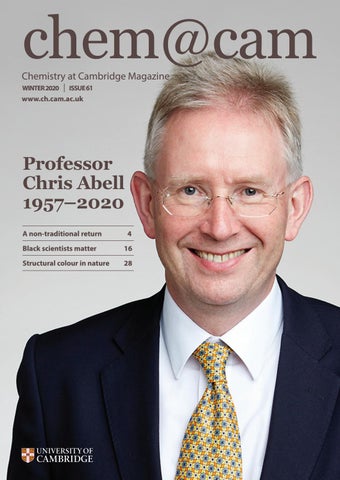
Professor Chris Abell 1957–2020 ______________________________ A non-traditional return 4 ______________________________ Black scientists matter 16 ______________________________ Structural colour in nature 28 ______________________________
Contents FOR YOU
Alumni webinars promote diversity
PEOPLE
11
ALUMNI
More memories of Stuart Warren
Chris Abell and his work
12
RESEARCH
23
_________________________________________________________ A non-traditional return 4 _________________________________________________________ ChemSoc returns 6 _________________________________________________________ What do the students say? 7 _________________________________________________________ Outstanding Supervisor announced at Postgraduate Reboot 8 _________________________________________________________ 50 years and 888 papers 9 _________________________________________________________ The Chemistry of Wine 10 _________________________________________________________ Annual alumni Diversity in Chemistry event goes online 11 _________________________________________________________ Professor Chris Abell 1957–2020 12 _________________________________________________________ Noticeboard 15 _________________________________________________________ Black scientists matter 16 _________________________________________________________ Ramping up production of anti-Covid drugs 18 _________________________________________________________
Structural colour in nature
28
_________________________________________________________ Alumnus makes a difference with remdesivir 20 _________________________________________________________ Royall student to investigate neurodegenerative diseases 22 _________________________________________________________ Alumni correspondence – Memories of Dr Stuart Warren 23 _________________________________________________________ Wireless device makes clean fuel from sunlight, 24 CO and water 2 _________________________________________________________ Four-stranded DNA structures found to play role in 26 breast cancer _________________________________________________________ Fighting fatigue in lithium-ion batteries 27 _________________________________________________________ Researchers show why blues and greens are the 28 brightest in nature _________________________________________________________ Irreplaceable 30 _________________________________________________________ How you can contribute 32 _________________________________________________________
Welcome back
chem@cam
Chemistry at Cambridge Magazine WINTER 2020
ISSUE 61
www.ch.cam.ac.uk
S
o much has changed over the last six months that we have found ourselves having to cope on a daily basis with many new challenges. But we are still here, still working hard on our science, and still offering our students an outstanding education. It is clear that we are by no means out of the woods yet, but I have been impressed by the positive ‘can do’ attitude shown by everyone over the last few months. After the almost complete shut-down in the spring we were finally able to re-open for experimental research in late June. In October we welcomed undergraduates back into the Department, along with the new batch of research students. Things are as near to normal as we can manage – read more about what we are doing to create a Covid-secure environment on page 4. The sudden and untimely death of our colleague Chris Abell came as a huge blow. Chris was a hugely energetic person who has had a major impact through his science, his commercial activities, and through his leadership of the University as a pro-vice-chancellor. Finian Leeper has written a personal account of Chris which you can read on page 12. I was very pleased to see that former and present postgrads Jerelle Joseph and David Izuogu were both featured in the “Black Legacies in STEM exhibition” marking Black History month, which was co-organised by Chemistry PhD student and Gates Scholar, Sandile Mtetwa. You can find out more on page 16. The Department still feels very empty compared to how things normally are in the exceptionally busy Michaelmas Term, and I do feel sorry that all those little social interactions which knit us together are at present barely possible. Nevertheless, I am confident that we have the strength and resilience to cope with the ‘new normal’, and to continue to adapt and thrive.
Professor Chris Abell 1957–2020 ______________________________ A non-traditional return 4 ______________________________ Black scientists matter 16 ______________________________ Structural colour in nature 28 ______________________________
Cover photo courtesy of the Royal Society
Chem@Cam Department of Chemistry University of Cambridge Lensfield Road Cambridge CB2 1EW
01223 761479 news@ch.cam.ac.uk www.ch.cam.ac.uk @ChemCambridge Views expressed in this magazine are not necessarily those of the Editor, the Department of Chemistry or the University of Cambridge. Print: Orchard Press Cheltenham Ltd 2020 Department of Chemistry, University of Cambridge Chem@Cam is published twice a year, and is sent free to chemistry alumni, postdoctoral researchers, retired staff and friends of the department.
CONTRIBUTORS Diane Harris Editor Nathan Pitt Head of Photography and Reprographics Gabriella Bocchetti Photographer Contributors: Sarah Collins Craig Brierley
James Keeler
Head of Department
3
Issue 61
Winter 2020
A non-traditional return Nathan Pitt
“A rather unusual Michaelmas term is underway,” said Vice-Chancellor Stephen Toope in a vast understatement recently. Read on to see how the Department is coping – and even thriving – in these extraordinary times.
A socially distanced induction The traditional return of students in October was transformed by Covid-19, but the Department’s extensive preparations meant that teaching and research were able to carry on with a few key modifications.
timetabling for Part II and Part IB Chemistry A & B practicals to comply with social distancing, but otherwise they are pretty much the same,” he notes proudly. “The main adverse effect is on the Part IA lab course, which for the time being is a series of exercises on experimental work involving videos of experiments, write-ups, and data analysis, which we feel are meeting the needs of the course.”
Up close and (not) personal All large lectures are now online, and the adjustment of both lecturers and students has been surprisingly successful. “This has been pretty straightforward, because we were already involved in a pilot to record lectures that started three years ago, so we had a good system set up and in use,” says Head of Department Dr James Keeler.
Universities were exempted from the November lockdown, but everyone is aware that the situation can change at any time during this academic year. “We are being as flexible as possible with our arrangements and reviewing them regularly,” says James. “But our aim at all times is to offer the students the best possible experience and to provide the high-quality education and experience that they rightly expect from Cambridge Chemistry.”
In contrast, small-group supervisions, which are considered by many to be the hallmark of a Cambridge education, can still be conducted in person using socially-distanced facilities in the library and other areas, but with the option to go online if desired.
Research Postgrads officially returned to the Department on the 1st of October, although many had continued their research throughout the summer, either in Cambridge or from different parts of the world. “We were quite keen to have a steady return of postgrads over the summer and early autumn, to ease the return, so even students who did not need to undertake experimental work but wanted to return to Cambridge were welcomed back,” explains James. “Our
But what about that traditional foundation of chemistry training – lab practicals? “Thanks to the hard work of everyone involved, Part III projects are running as normal, although we’ve moved some synthetic projects to the teaching labs,” says James. “We’ve also made some small changes to the experiments and
4
new online registration system also made everything more streamlined. I am very proud of the graduate team, who have worked so hard with the students and colleges to ensure as much as possible a safe return.”
The Department at time of writing has had very few positive cases. “In each case their work area was quarantined for 72 hours, followed by additional cleaning and identification of contacts with the involvement of NHS track and trace. But I’m very happy to say that it does not appear that the source of the infection was in the Department, although of course we remain vigilant and continue to be rigorous about hygiene,” says James.
“Our policy remains ‘only come in if you have to,’” says James, and altogether occupancy of the Department remains low. “Working practices must be safe, and we are keeping an eye on particular issues with ‘pinch points’ in the labs, and the way in which circulation leads to people crossing one another. We’ve done things like define maximum occupancy for group offices and instituting schedules for work space in the labs, and we’re still using a one-way system with face masks required in public areas.”
“The good news is that service has resumed in the Cybercafé, which is a sign that we are back and we mean to stay!” As VC Toope said: “I am in no doubt that the year ahead will be challenging. It will require us to be resilient, resourceful and kind to one another. I am confident that we will be.”
The precautions mean that some areas like the synthetic labs – where working from home is not an option – have been able to continue research at close to normal levels. “Our priority is to maintain a safe environment in which experimental research can continue,” says James.
RSC Hardship Grants For postgrads and postdocs who were unable to continue their research during the lockdown, the Royal Society of Chemistry has stepped in with RSC Hardship Grants, supported by the Chemists’ Community Fund. These grants provide one-off, short term support to non-RSC members to alleviate the financial impact that some students and researchers are facing as a result of Covid-19.
Testing, testing, testing A key University policy has been to regularly test undergrads and postgrads in college accommodation whether or not they have symptoms. Because of the limited number of tests available, one innovation has been to pool the samples: if a pooled screening test is positive, all the students in that pool then get an individual test.
www.rsc.org/membership-and-community/ chemists-community-fund/hardship-grant
Early results identified a number of positive asymptomatic cases of Covid. “Every student we identify as infected but asymptomatic – and who is now therefore self-isolating – represents a valuable intervention to prevent further transmission of the virus,” says Vice-Chancellor Toope. “The other good news is that although the infection rate has been rising in the population as a whole, the rate in the students being tested has remained stable,” says James.
Stay Safe Cambridge Uni: www.cam.ac.uk/coronavirus/stay-safe-cambridge-uni Department Covid information: www.ch.cam.ac.uk/intranet/covid-19-information
Lab coats ‘socially distancing’ for safety
5
Issue 61
Winter 2020
ChemSoc returns
T
he University of Cambridge Chemical Society tradition of hosting term-time talks and events for the chemistry community was rudely disrupted, like so many other Cambridge traditions, by the coronavirus.
something the committee would love to continue. “We’re hoping to set up some social events this term if we can do it safely,” says Gareth, but we’ll start with outdoors events where it’s easier to maintain social distancing.” The new committee want to create a greater engagement between ChemSoc and the Department. “At the moment they’re very different entities, and we want to emphasize that we are all part of a broader chemistry community,” says Gareth. “We’d also like to engage with alumni and hear more about their experiences.”
All talks for Easter term were cancelled as students returned to their homes to complete the term via online supervisions and lectures. The officers were scattered around the globe: newly elected President Gareth Hart was in Surrey while Secretary Richard Danylyuk went home to the Ukraine, only returning to college at Catz at the start of Michaelmas term.
With no paid membership, ChemSoc is also seeking alternative ways of funding. They receive some Department funding, and are sponsored by TPP, InfoActive, Benevolent AI and Teach First. “But we’d also like to develop relationships with the chemical industry,” says Gareth. “For example, a company could sponsor an industrystyle event in which a speaker talks about what working in that industry is like and compares it to academia. This is what a lot of Gareth Hart students would like to hear more about, and it would also give publicity to the company.”
The purpose of the Chemical Society, or ChemSoc as it is popularly known, is to bring together University members who share a common interest in Chemistry. “We normally host four talks a term in the Pfizer or Wolfson Lecture Theatres, and everyone is welcome,” says Gareth, who is in his third year at Magdalene and is now specialising in Chemistry. “It’s really about Richard Danylyuk the fact that we all enjoy the subject and that’s why we want to talk about it,” says second-year student Richard. Since starting the Natural Sciences tripos, Richard has always known he wanted to study chemistry, but he hasn’t settled into a particular field. One of the things he enjoys about being in ChemSoc is meeting chemists at different stages of their studies. “It’s not just undergrads, but also postgrads and postdocs– it’s good to meet people in different year groups that you can ask questions and compare experiences with,” he says.
ChemSoc is also increasing its social media presence and regularly posts on its Facebook and Twitter accounts. “We released a post on the synthetic route of remdesivir, and we reached several thousand people with that post.” ChemSoc were also fortunate to have alumnus Richard Mackman, who helped develop remdesivir at Gilead Sciences, as one of their speakers in November. (See related article page 20).
Gareth is confident that ChemSoc will be able to use the restrictions caused by Covid-19 to forge a new direction and possibly reach even larger audiences through the introduction of Webinars or perhaps Q & A sessions with key speakers, eventually making the transition back to live lectures when safe.
Other committee officers include Vice President Domantas Kuryla (Christ’s), Logistics Officers Ryan Kang (Trinity) and Tristan Spreng (Trinity), Publicity Officers Benji Rowlands (St John’s) and Juan DF Pottecher (St Catharine’s), Junior Treasurer Margaret Fomenko (Corpus Christi) and Webmaster Xueyan Huang (Peterhouse).
ChemSoc has also been active in organising social events, which offer another opportunity to meet fellow students with similar interests. Pub quizzes, picnics, film nights and socials have all been regular features in the past, and this is
W
6
www.chemsoc.ch.cam.ac.uk/ www.facebook.com/camchemsoc/ https://twitter.com/CChemsoc
What do the students say? Aryaman Raj Sokhal, first year NATSCI, Chemistry IA
Margaret Fomenko, fourth year, Chemistry Part III
Aryaman arrived from India in September and self-isolated for 14 days; he wants to specialise in chemistry.
In her Part III project Margaret is using computational methods to study Liquid-Liquid Phase Separation with the Knowles group. I understand it’s a difficult situation and everybody is doing their best, but I think the lectures could be handled much better. Most are using last year’s recordings, which means we can’t ask questions and can’t always see what they are referring to. Live Q & As would be very helpful, or office hours where we can ask questions. As a Part III, I was really looking forward to being part of a group and feeling like a full member of the Department, so it’s been disappointing that we don’t have our own desks in the building like last year. Because my project is computational I don’t need lab access, but it would be nice to get outside. My supervisions are held in the library, where we are socially distanced and wear masks, but I don’t understand why they can’t open the library or the BMS for Part IIIs when they are not being used at other times. (To ensure adequate space for social distancing, the library is only open to people who must be in the building for experimental work).
I know four NATSCIs who are self-isolating right now, but my household has tested negative so far. I’d say that they have planned the Part IA lab course really well, so I give them kudos for that, but we are missing the joy of mixing all those chemicals and doing the live experiments. At 4pm the demonstrators go through the practicals with us in a Zoom session – they are as passionate about it as we are, and we all have a chance to ask questions. My biggest worry is whether I will have all the necessary lab skills when I get to second year. I’ve learned I can be adaptable and patient; I’ve also been able to manage my time well because with the pre-recorded lectures I can save them for later. I’m ahead of my work in everything – something I didn’t know I could pull off! I know I’ll be here for three years, so for a small compromise now, we will get to experience all of these things later for sure.
Elena Sheppard, third year, Chemistry Part II
Hikaru Seki, third-year PhD candidate
Elena lives at Murray Edwards and self-isolated for two weeks in October when one of her housemates tested positive. Elena is interested in organic chemistry and materials science.
Hikaru spent the summer at home in Japan and returned to Trinity College in August. He is a synthetic chemist in the Spring group.
Last year I did half my lectures online anyway because I find it more useful to pause and re-listen when needed, and it’s nice to schedule them when I want -- although it can be easy to fall behind if you don’t have to get up and go to the lectures. The content is fine, but the only way to ask questions is by emailing lecturers. They’ve always responded promptly, but it does feel more formal. The practicals are run similarly to last year, but with only six of us at a time spaced far apart, and we all wear masks and goggles (which keep steaming up!). I miss the social aspects of having someone next to you in the lab or at a lecture that you can talk to – when you’re watching a lecture alone in your bedroom, it’s easy to forget that others are also struggling with the material. I have learned that I’m organised, which was a surprise! I’ve been good at scheduling and managing my own timetable.
I am researching ways to deliver anticancer agents selectively to cancer cells, which is mostly lab work, so I couldn’t do much during lockdown. Luckily a postdoc in the group (Stephen Walsh) helped some of us PhD students write a review paper, which kept me going. When we first re-opened we used the lab in shifts, but as the fourth years moved on we’ve had more space. The rule is only come in if you have to do experiments, otherwise stay at home. I think the Department has put in lots of work to make things safe, especially Andrew and Duncan in NMR, and also Mass Spec and Stores. They’ve all adapted well, so we can have services to a similar extent as before. My research suffered pretty badly because all experimental work was on pause, and now I’m doing my best to catch up. I think I’ve gotten much better at planning experiments, because we’re discouraged to be in the office area at work, I usually plan out my day in the morning before heading in to the department.
7
Issue 61
Winter 2020
Outstanding Supervisor announced at Postgraduate Reboot
T
his year’s Student Welcome and Reboot was held online in October and played an important function in supporting postgraduate students during these Covid-restricted times.
Vivien Lechner
After discussing the positive changes made in response to the annual student survey, Vivien Lechner and David Izuogu, who represent students on the Postgraduate Education Committee, took students through a flow chart of how to raise issues, and described support services such as the Student Advice Service, Disability Resource Centre and University Counselling Service.
Professor Ian Paterson academically, but also in other ways. “We’ve had lots of nominations, more than we expected, and we hope it can be a recurring feature of the Department,” said Aruna.
Fabio Albertani of the Graduate Social and Networking Committee then spoke of the Committee’s plans to hold virtual events, and put a call out for ideas from current students.
“The award recognises and encourages our amazing supervisors, but we also will circulate the reasons for the nominations, to help supervisors see what students’ value, and to improve the supervision and learning experience,” said David.
The RIG chairs then presented the awards for September’s Showcase Week, at which third-year postgrads gave twominute online presentations of their research, followed by two minutes of questions. “Although shorter than they’ve had in the past, this was great practice for networking scenarios,” said Graduate Education Manager Dr Aruna Reddy, “and also a good opportunity to hone their oral presentation skills.” A full list of the awards for the presentations and posters (submitted by second-year postgrads) can be seen on the Postgraduate web pages at www.ch.cam.ac.uk/gradstudents/chemistry-showcase-week.
The nominations were judged by Dr Keeler, Dr Bampos and the Postgraduate Education Committee. Dr Keeler said: “Professor Ian Paterson was nominated very strongly for this award, and when we think of so many who have been through his lab, who have been so well supported and have demonstrated their appreciation, we believe he’s an extremely worthy winner of this first award.” “This is a wonderful surprise to be honoured in this way for enjoying supervising my graduate students and sharing the journey of discovery with them -- although I generally expect them to be firmly in the driving seat,” said Professor Paterson. “On my retirement next year, I will have had the pleasure of supervising 94 PhD students over the course of my career at Cambridge. As a bookend to this, I am very much looking forward to a memorable 67/94 symposium and group reunion when socialising in person becomes possible again.”
Head of Department Dr James Keeler then presented Professor Ian Paterson with the Outstanding Supervisor award, an idea proposed by postgrads and run for the first time this year. For the award, postgrads had been asked to nominate supervisors they judged to be outstanding, not only
8
50 years and 888 papers
I
n July Steve Ley celebrated a personal milestone: his 888th paper was published online exactly 50 years after the publication of his first research paper in synthetic chemistry. “Isn’t that a wonderful number?” he says, with obvious delight. “888 is about as lucky as it gets.” Steve’s first paper, published on the 20th of July 1970, was based on the research he was doing for his PhD at Loughborough University with supervisor Harry Heaney, now an Emeritus Professor of Organic Chemistry. Science has changed a lot in the intervening 50 years, but some things are still the same. “I’m still an organic chemist, I still love making molecules,” says Steve. “There was always something to discover, and that hasn’t changed one bit.” After completing his PhD, Steve did postdoctoral research at Ohio State University with Professor Leo A. Paquette (who is now best known for achieving the first total synthesis of the Platonic solid dodecahedrane in 1982). Steve returned to the UK in 1974 for further research at Imperial College with Sir Derek Barton, who had recently been awarded the Nobel Prize in Chemistry. Steve went on to become Professor of Organic Chemistry and Head of Department at Imperial, before being lured to Cambridge in 1992 as BP (1702) Professor of Chemistry, a post he held until 2013.
The new normal: Steve skyping with his PA Jacqui Worster from home The other key difference is the speed of communication of research, says Steve, which he hails as a very positive development. “The more you share with people, the more you learn. I learn something new every day – even in lockdown!” One of the things that has brought great joy to Steve over the years has been his students. “My students are my collaborators, and I love every single one of them. It’s one of the most important elements of my career. I’ve had over 250 postdocs and nearly 200 PhD students (keep up the good work Ollie!) – these are the people I work with and they’re the ones who make the difference.”
Although he has officially reached retirement age, Steve continues to conduct research, and runs a small research group here in the Department. One of the things that has changed, he says, is the sophistication of the analytical tools. “Early in my career, we did all our calculations long-hand and drew all the structures ourselves. We did have NMR machines but they were only 60 Mhz compared with 1000 Mhz today. And, we had to blow our own specialised glassware.”
There is a link between his first and latest paper: “I’m a molecule maker, and both papers were about making molecules. My first paper was about changing the chemical architecture of a molecule, and this one is on the generation and coupling of sulfonyl radicals - chemical steps that we were never able to do in the past.”
“Machines today can do thousands of experiments where previously you could typically do and analyse one or two reactions a day – now we stack them up. Because of our advanced analytical tools, we are braver and more ambitious in the studies we set up. We can ask bigger questions.”
Why does he do it? “I still bubble with ideas, I’ve got lots of things I want to do. I haven’t lost any of my enthusiasm for science – I loved my first paper 50 years ago, and I’m just as excited by the paper that came out in July.”
Reference H. Heaney and SV Ley, J Chem Soc D, Chem Commun 1970, 1184 Rearrangement reaction of 1-N, N-dimethylaminobenzobarrelene derivatives Photoredox Generation of Sulfonyl Radicals and Coupling with Electron Deficient Olefins Y. Chen, N. McNamara, O. May, T. Pillaiyar, D. C. Blakemore, and S. V. Ley, Org Lett. 2020 Aug 7;22(15):5746-5748
9
Issue 61
Winter 2020
Alumni Events
The Chemistry of Wine
T
Nathan Pitt
here’s a lot more to wine than grapes. In addition to alcohol, acidity and water, wine is made up of hundreds of different volatile molecules which vary from year to year, grape to grape, wine to wine.
Dr Alex Thom explained some of these variations to an audience of over 400 alumni, family and friends as part of the 50th annual Alumni Festival in September.
“Chemistry Call My Bluff” wine tasting was missed, this was deemed to be a worthy replacement which also reached a much larger audience through the magic of modern technology.
In the online webinar, Alex explained how chemistry – of course – is the key to making good wine. He and the audience then altered the acidity of a rather nice Riesling by adding bicarbonate of soda, and tested the acidity with their own home-made pH indicators made from blueberry juice (prepared earlier, naturally). This was a good lesson in how altering a wine’s acidity radically changes its flavour, and not necessarily in a good way. But in a fun twist, Alex then showed the viewers how to re-introduce the acidity by adding cream of tartar, itself a by-product of the winemaking industry.
If you were unable to attend the event, but would like to make your own indicator solution and experiment with wines, we will be posting a “Director’s Cut” on the Department of Chemistry YouTube channel soon [www.youtube.com/channel/UC3Jf5CxTQD5_h-HEBl5qoIg/ featured?view_as=subscriber]
Gabriella Bocchetti
Cheers!
Alex also created his own sparkling wine using CO2, and explained why his version didn’t taste nearly as good as ‘real’ Champagne (and why you shouldn’t do this at home without the right equipment). The audience then had the opportunity to ask questions, which ranged from Alex’s opinion of the Cambridge Colleges’ wines (unmentionable) to the meaning of terroir (complex). The webinar was a great success for our many chemistry alumni who miss the joy of messing around in labs, or possibly who just like wine. And although our ever-popular
10
Annual alumni Diversity in Chemistry event goes online in February
A
s part of our commitment to improving diversity in this Department, we are hosting two webinars in February to build on our previous events about Women in Chemistry in 2019, and broader issues of diversity and success in 2020.
We encourage you to attend these webinars, which are open to all alumni and department members and feature excellent speakers on relevant and timely diversity issues. Although we won’t be able to chat with old friends as at previous events, there will still be plenty of time for questions, audience polls and other interactions.
The Covid crisis and racial injustice
Unseen Disabilities
Has Covid-19 amplified systemic racial discrimination or is it an opportunity for change?
How do we deal with unseen disabilities when they are just that – unseen?
Speakers
Speakers
Dr Karen Salt was a clear and passionate speaker at our Diversity in Chemistry event earlier this year. With over 27 years working with communities, organisations, charities and governmental bodies, Karen is Deputy Director for Research and Development Culture and Environment at UKRI and acts as Deputy Chair for UKRI’s External Advisory Group for Equality, Diversity and Inclusion.
Dr Hisham Ziauddeen is a consultant psychiatrist working in early intervention in psychosis, and is a Clinical Senior Research Associate in the Department of Psychiatry and the Wellcome-MRC Institute of Metabolic Science. He is a University Wellbeing and Disability Champion and is also a keen advocate for people with mental illnesses, a dabbler in public engagement and an occasional stand-up comedian.
Dr Maggie Semple is a successful businesswoman and entrepreneur who is a thought leader on cultural change, diversity, inclusion and ethics. Maggie began advising governments in the 1990s, was Director of the Millennium Dome Learning Experience from 1997-2001, and recently led the University of Cambridge Reverse Mentoring programme.
Helen Duncan is the Senior Neurodiversity Adviser at the University of Cambridge Disability Resource Centre. She is a qualified teacher and diagnostic assessor for individuals with specific learning difficulties and ADHD. Her current research is into the attainment gap and the impact of exam access arrangements on students with specific learning difficulties.
Thursday 11 February 2021 3:30pm – 4:30pm GMT
Thursday 11 February 2021 2pm – 3:15pm GMT
Register now on Eventbrite: www.annualdiversityinchemistrywebinars.eventbrite.co.uk
11
Issue 61
Winter 2020
Professor Chris Abell 1957–2020
P Nathan Pitt
rofessor Chris Abell FRS, FMedSci, Professor of Biological Chemistry and Pro-ViceChancellor for Research, died suddenly on Monday 26th October 2020, just short of his 63rd birthday. Dr Finian Leeper has provided this account of his research and life.
Chris at his desk
Chris and Katherine
Chris’s research spanned studies into the biosynthesis of natural products, enzymic reaction mechanisms, microfluidic microdroplet reactors, and most notably fragment-based drug design. He co-founded Astex Pharmaceuticals to exploit this technique, which has transformed pharmaceutical research worldwide. As Pro-Vice-Chancellor for Research he spearheaded many of the University’s research initiatives, while remaining a loyal supporter of the Chemistry Department.
was the first in his family to go to university. I met him within days of his arrival at St John’s College, Cambridge in 1976 to read Natural Sciences, As a second year PhD I had just started to tutor first year undergrads – Chris and his supervision partner Tim were my first supervisees and I was their first supervisor. I was very inexperienced but fortunately Chris and Tom were my first group each week, and taught me what I needed to teach my other groups. Forty-four years later I was still learning from Chris, as so many of us were.
Chris was the son of a farmer in the village of Gateforth in Yorkshire. He studied at Selby Grammar School and
Chris specialised in Chemistry (despite my inept supervisions ) and graduated with a first in 1979. I
12
Chris in his lab in 1980 returned to Jim Staunton’s group in Cambridge from a postdoc abroad to find that Chris had also joined as a PhD student. During this time Chris pioneered the use of dual isotopic labelling techniques in polyketide biosynthesis. He also met Katherine, who was doing her PhD in the same lab (lab 122) with Tony Kirby, and they were married while still graduate students.
Chris also started projects on combinatorial chemistry. Shankar Balasubramanian (now Prof. Sir Shankar) was one of his early PhD students and worked in this area. I collaborated with him on another interest, catalytic antibodies.
Gradually, however, Chris’s interest shifted to the development of enzyme inhibitors. He and Prof. Sir Tom “In the 1980s, lab 122 was a Blundell promoted the fragment-based In 1982 Chris left for postdoctoral research mixed lab. Chris had a bench in approach to drug discovery, which proved in the US with Prof. David Cane at Brown the middle of this big lab. My to be far more efficient than the strategies University, studying the biosynthesis of bench was at the other end, most pharmaceutical companies were terpene antibiotic pentalenolactone. pursuing at that time. On the back of and it was natural for us to This was the start of a lifelong friendship socialise within our respective these results Chris, Tom and Harren Jhoti between Chris and David, which included research groups. Many months founded Astex Pharmaceuticals in 1999, many joint family holidays, and my family passed by before one fateful which continues to be very successful, was lucky enough to be included in these evening we were both working with three drugs already on the market. as well. late. He walked by my fume The use of fragment-based drug discovery cupboard and said hello. The continued in Chris’s research group, where In 1984 Chris returned to Cambridge to it was used to target enzymes associated rest is history, as they say.” take up a lectureship, bringing the newly with diseases such as tuberculosis, cystic Katherine Abell established techniques of gene-cloning fibrosis and cancer. with him. He applied these techniques in his own research on enzyme mechanisms, and also, assisting Chris’s research on microdroplets also took off. These Prof. Alan Battersby (a role I shared), to the biosynthesis of picolitre aqueous droplets can be produced in their millions, tetrapyrroles. Without this Alan’s subsequent discoveries in allowing massively high-throughput testing of different the biosynthesis of porphyrins and vitamin B12 would not conditions for enzyme assays or growth of micro-organisms. have been possible. Two companies were spun out from this research: Sphere Fluidics sells instruments that use microdroplets, whereas
13
Issue 61
Winter 2020
Aqdot produces microcapsules that absorb odours (sold as Oderase).
He competed in the Paris, Boston, Amsterdam, Tokyo and other marathons. He also enjoyed watching sport, and we regularly watched rugby or cricket internationals together. He also enjoyed cards and we had a regular bridge four. He and Katherine used to spend long weekends in Stratford-upon-Avon about twice a year to take in plays by the Royal Shakespeare Company.
Chris published over 350 papers and mentored over 150 MPhil, PhD and postdoctoral researchers during his career. He was elected F.Med.Sci. in 2012, F.R.S. in 2016 and won the 2020 R.S.C. Interdisciplinary Prize. With his acknowledged entrepreneurial background, Chris was appointed one of the founding directors of Cambridge Enterprise, the University-owned company that helps commercialise research. About ten years ago Chris, looking for further challenges, started promoting the welfare and support of postdoctoral researchers. As a result the University created in 2013 the Office of Postdoctoral Affairs with Chris as its first Director. In 2016 he moved on to become Pro-Vice-Chancellor for Research. Since then Chris has had a hand in almost all high-level research initiatives in the University, as well as preparations for Brexit and, with Dr Emily Shuckburgh, setting up the Cambridge Zero initiative. He also led preparations for the upcoming Research Excellence Framework (REF) assessment, on which depend many millions of pounds of government funding per year. He has been instrumental in setting up both the University/AstraZeneca COVID testing facility for the NHS and the University’s own testing facility. Chris never did things by halves. Over the last 30 years he has been a keen hiker, runner and cyclist, typically fitting in a lengthy run or cycle several days a week.
14
Katherine’s career has focused on research management and administration firstly in Engineering, and then for many years in Chris’s group. Together they had a close and highly effective partnership and the level of care for and management of the research group has been second to none. Katherine is a keen gardener and Chris ably assisted her in this as well as everything else. Their son Daniel graduated with a degree in Natural Sciences from Downing College, and has worked in consultancy and strategy planning for organisations including the Cabinet Office and the NHS. Our deepest sympathy is with them at this difficult time. I have been very touched by the huge number of messages of condolence for Chris on www.remembr.com/professor.chris.abell and elsewhere. They paint a picture of someone whose main concern was for others, always interested in the people he dealt with. A great many say what an encouraging and supportive mentor he was. He came across as immensely intelligent and astute but never overpowering. I echo all these sentiments. He will be greatly missed by all that knew him.
Recognition and awards
Noticeboard
Nathan Pitt
Emeritus Professor Sir Alan Fersht has been named as the 2020 winner of the world’s oldest scientific prize, the Royal Society’s prestigious Copley Medal., for the development and application of methods to describe protein folding pathways at atomic resolution, revolutionising our understanding of these prizes. Professor Clare Grey has been awarded the 2020 Royal Society Hughes Medal and the 2020 Richard R. Ernst Prize in Magnetic Resonance.
Gabriella Bocchetti
The Hughes medal is awarded to an outstanding researcher in the field of energy. The Ernst Prize was given for Grey’s contributions to the use of solid state nuclear magnetic resonance (NMR) methods to study paramagnetic materials.
Professor Angelos Michaelides has been awarded the Royal Society of Chemistry 2020 Surfaces and Interfaces award for his outstanding contributions towards the understanding of complex aqueous interfaces and the formation of ice at such interfaces.
Nathan Pitt
Emeritus Professor Daan Frenkel has been awarded the European Physical Liquid Matter Prize, considered one of Europe’s most prestigious prizes in the field of condensed matter physics. The prize, which is only given every three years, was instituted in 1988 to reward outstanding achievements in this area of physics.
Nathan Pitt
Professor Christopher Hunter has been awarded the Royal Society of Chemistry 2020 Supramolecular Chemistry Award for his pioneering work in the field.
Welcome Professor Franklin Aigbirhio, an affiliated member of staff with several active collaborations in the Department, whose research in the Department of Clinical Neurosciences is in molecular imaging, with a particular focus on PET. Dr Rosana Collepardo, a Winton Advanced Research Fellow and a joint appointment with the Department of Genetics. Her work focuses on the development of multiscale modelling approaches to the packing of biomolecules in cells. Dr Chiara Giorio, an atmospheric chemist whose work involves combining field measurements and laboratory experiments to understand the evolution of particles in the atmosphere and assess their effects on climate and public health. Professor Angelos Michaelides, our new 1968 Professor of Theoretical Chemistry, whose work focuses on computer simulations of catalytic and environmental interfaces.
Dr Pietro Sormanni, who was a Borysiewicz Fellow in the Centre for Misfolding Diseases, has been awarded a Royal Society University Research Fellowship to establish his own research group.
15
Issue 61
Winter 2020
News
Black scientists matter
T Gabriella Bocchetti
he idea behind Africans in STEM is a simple one. “We wanted to give students involved in STEM research who are African or African heritage a forum to connect, share ideas and collaborate,” says third-year PhD student and Gates scholar Sandile Mtetwa, who founded the organisation with three other African students here in 2019.
Sandile Mtetwa and Head of Department, Dr James Keeler With the surge of interest in the Black Lives Matter STEM departments throughout October, and can still be movement earlier this year, the group decided to expand viewed on the Africans in STEM website. on this idea. “We wanted to include issues “I think this project is that a lot of Black students in general The exhibition is divided into a series of important because it really might face, not only in Cambridge but posters of notable Black scientists. The uncovers hidden stories in other UK universities,” says Sandile. first two sections, Historic Black Legacies about Black people We held an event earlier this year to in STEM and Black Legacies in STEM, in STEM.” discuss these issues, and we found a lot highlight Black scientists past and present of students were concerned about the from around the world. Sandile Mtetwa under-representation of Black students, especially in the sciences,” says Sandile. The third section, Black (Early Career) Scientists in Cambridge, features Black scientists in Cambridge, In response, Sandile and Africans in STEM co-founder including Jerelle Joseph, who was a Gates scholar in Cynthia Okoye, a PhD student in Pharmacology, wanted to the Wales group and is now a postdoc in the Cavendish commemorate Black History month by creating something Laboratory, and David Izuogu, a PhD student in the that showcased and celebrated black scientists in STEM. Thom group. The resulting exhibition, entitled “Past & Present: Black Legacies in STEM”, was displayed in Chemistry and four other
Although Africans in STEM started with four members, two have since left Cambridge, which means Sandile and Cynthia
16
Gabriella Bocchetti
Nathan Pitt
David Izuogu
Jerelle Joseph
put a lot of work into the exhibition. “It took a lot of time because we had a specific idea which then changed over time, and was a bit of a struggle,” says Sandile. “But I think this project is important because it really uncovers hidden stories about Black people in STEM.” It was also inspiring for Sandile personally: “I didn’t know much about these people and as I got learn about them I thought: if someone is able to do that, then so am I.”
enables the economic, social and academic empowerment of young women and girls. Sandile is also working hard on her PhD project in the Wheatley group. As an experimentalist she missed out on some research time over lockdown, but she is back in the lab now. “I lost time for practical work, but in one way it was good for me because I took the time to learn more about the conductive materials I’m working with,” she says
To further mark Black History month, Sandile and Cynthia helped organise a virtual panel discussion with the Graduate and Postdoc Committee of the Department of Pharmacology, called “Spotlight on Black Female Scientists in Cambridge,” in which six scientists spoke about their research and how they navigate academia and Cambridge.
Sandile is researching metal-organic frameworks (MOFs), with the aim of developing materials suitable for energy production and sensing technologies. She investigates both semi-conductive MOFs, which could potentially be used to evolve hydrogen as an energy carrier using photocatalysis, and conductive MOFs, which can be useful to sense toxic gases.
Since arriving in Cambridge two years ago, Sandile has also taken part in events to encourage more girls to take STEM subjects while continuing to run the non-profit she set up as an undergraduate at the University of Zimbabwe, which Gabriella Bocchetti
Sandile is working in collaboration with a team of theoretical chemists at the University of Sheffield. “They create the calculations to identify or discover new MOFs, and my goal is to be able to validate these calculations through practical chemistry, and to also give them insight on what to look out for when doing their calculations so we can discover novel materials that might be used in these applications,” she says. Africans in STEM is looking for more committed members, because the next step is to grow the group within the UK. They have already made contact with representatives from other universities, and are hoping to organise a UK-wide symposium next year (this year’s was cancelled due to Covid), which can eventually be rotated annually with other hosts. www.africansinstem.co.uk/
Sandile Mtetwa
17
Issue 61
Winter 2020
,
Alumni
Ramping up production of anti-Covid drugs As Chairman of Indian pharmaceutical company Cipla, alumnus Dr Yusuf Hamied is increasing the production of remdesivir and other anti-Covid-19 treatments for millions of sufferers. There is no known cure for SARS-CoV-2, the coronavirus that causes Covid-19, but several antiviral and corticosteroid drugs have been shown to be effective in alleviating symptoms and reducing mortality.
At a time when there are worries that the US has bought up virtually all the available stocks of remdesivir, Hamied says that Cipla could manufacture enough for up to 30,000 injections a week and build up stocks to between one and two million. Cipla’s version, called Cipremi, is also affordable. Hamied says that the price in India is approximately $50 per injection, whereas in America it may be up to 8–10 times this.
The issue as Hamied sees it, is that there is a world-wide shortage of the availability of many of these drugs, and some are prohibitively expensive. “The problem is the shortages and the expense,” he says. For example, Cipla is licensed to distribute Actemra in India, manufactured by Roche, “but it is expensive.” Cipla has been increasing its production of potentially beneficial drug treatments and supplements at humanitarian prices.
Hamied is also happy that Gilead has granted the remdesivir voluntary licence to five other Indian pharmaceutical companies. “I don’t like the words ‘exclusive’ and I don’t like the words ‘monopoly’,” he says. “So there are half a dozen other Indian companies also making the same drug, which is good for the size of our country and for treating the pandemic.”
Cipla has recently been licensed to manufacture and market remdesivir in 130 countries. Remdesivir is an antiviral drug developed by the American biopharmaceutical company Gilead, which was approved for Covid-19 treatment by the US Food and Drug Administration (FDA) in October. Hamied says: “Hats off to companies like Gilead, who have given us a voluntary licence for the duration of the pandemic and beyond.”
Hamied is all for approaching Covid-19 with a wide range of prevention, treatments and supplements. “My stand is that every individual who gets Covid is a different case. This depends on their age and pre-existing health conditions. Every person is different and will respond differently.” Because of this view, Cipla is manufacturing and marketing a variety of corticosteroids, neubulisers and inhalers, and antiviral drugs that may be useful in treating Covid symptoms.
“Hats off to companies like Gilead, who have given us a voluntary licence for the duration of the pandemic and beyond.” “There are a lot of drugs which can be beneficially used as either treatments or supplements to treatments,” says Hamied.. “For example, one of the side-effects of Covid is breathlessness, so a lot of the anti-asthma drugs are being used.” He points out that Gilead is also working on developing a version of remdesivir that can be inhaled by neubulisation.
18
Nathan Pitt
Cipla chairman and alumnus Dr Yusuf Hamied has been increasing production of potentially beneficial Covid treatments. Dexamethasone is a corticosteroid with anti-inflammatory and immunosuppressant effects that has recently been shown to reduce mortality in hospitalised patients with Covid -19.1 Hamied says: “There are also a number of corticosteroids that we manufacture and distribute such as Ciclesonide, a corticosteroid with anti-inflammatory and antiviral properties. It was used very effectively a few years ago in the MERS-CoV (Middle East Respiratory Syndrome) epidemic.”
Cipla is a socially conscious pharmaceutical company known for providing low-cost generic antiretrovirals to people with HIV/AIDS in developing countries, and in the early 2000s reduced the cost of treatment to under a dollar a day by providing a 3-drug combination, Triomune. Hamied’s action as Chairman of Cipla at that time saved hundreds of thousands of lives in Sub-Saharan Africa and other developing countries. Dr Yusuf Hamied is an alumnus and Honorary Fellow of Christ’s College and completed his PhD in this Department in 1960 under the supervision of Lord Todd. In 2014 he was awarded an Honorary Doctorate of Science by Cambridge University. Later he received the Department’s inaugural Alumni Medal for services to the community in 2016. On that occasion he said: “There has always been a deep bond between the University, Christ’s College, and in particular for me the Chemistry department. Cambridge educated me, Cambridge taught me how to live, Cambridge showed me how to contribute to the world. I will always be indebted to this great institution and what it stands for.” For his humanitarian work, in the year 2019 he was elected as an Honorary Fellow of the Royal Society, UK and a Fellow of the Indian National Academy.
Cipla is also making and distributing Ciplenza (known generically as Favipiravir), an oral antiviral drug. It is not used as yet in the United States, but Hamied says: “Favipiravir is used extensively for Covid and seasonal flu in Japan, China and Russia. It is off-patent, meaning there are no restrictions on manufacturing and marketing it. I can tell you that when products are not covered under patent, the big pharma companies are not interested in the product and it is therefore left to companies like Cipla to market and promote them.” Hamied is proud to be an organic chemist. He admits: “I am not a medical doctor. I am a chemist and our company Cipla provides a range of medications and supplements that can give relief to Covid-19 patients. It is up to the doctors treating them to decide what treatment to administer.” 1
www.sps.nhs.uk/articles/dexamethasone-and-covid-19/; www.who.int/news-room/q-a-detail/q-a-dexamethasone-and-covid-19
19
Issue 61
Winter 2020
Alumni
Alumnus makes a difference with remdesivir As a third-year undergrad in Natural Sciences, Richard Mackman gradually realised what he wanted to do: “I wanted to create something as a chemist that would make a difference,” he says. And with the development of remdesivir, he has. Richard had never forgotten how his school chemistry teacher had described his work on a new cancer treatment. “The science was amazing to me, that chemists could manipulate compounds to change their medicinal properties. By my third year I had a singular vision – I wanted to do medicinal chemistry and drug discovery.” Now, as Vice President of Medicinal Chemistry at Gilead Sciences, Richard has achieved his goal with the development of remdesivir, which was first used against Ebola and has recently been approved for Covid-19 treatment by the US Food and Drug Administration (FDA). Richard feels lucky to have made it to Cambridge in the first place. His comprehensive school in West Yorkshire did not have a record of sending students to Oxford and Cambridge. However, the Head of Chemistry encouraged Richard to look at both universities.
Richard at his desk in Gilead Sciences. traditions and talent. “You come from a school where you are a bright student at the top of the class, and then find when you arrive here you are just middle of the road – that can be challenging and make you wonder if it was a good decision.”
Richard particularly liked the Natural Sciences tripos at Cambridge and decided to apply to Jesus. “The Head arranged for my chemistry teacher David Morris, a Cambridge alum, to help me prepare for the exam. David taught me the special chemistry course after school, all without charging my parents,” Richard recalls gratefully.
However, Richard soon became captivated by organic chemistry. Perhaps this has something to do with his Chemistry supervisor at Jesus, Professor Ian Paterson, an organic chemist known for his work on the synthesis of biologically active natural products. “I remember feeling very intimidated at first, but Ian’s great because his approach really puts you at ease,” says Richard. “Everything I know about organic chemistry I pretty much learned from Ian.
Richard came up to Jesus in 1985. He had chosen Natural Sciences because it allowed him to explore different subjects. “At Cambridge I liked that I didn’t have to limit myself to just one subject straight away. Coming to Cambridge from a comprehensive school background, Richard felt intimidated and awed by the
20
One of Richard’s best experiences at Cambridge was going to the Senate House to get his final year grades. “I got the right grade that I needed to have a chance at getting a PhD place: I immediately went to see Prof Battersby and he said ‘Yes - I was in!’”
lab colleagues at the Spread Eagle – “we had lots of great pub discussions there.” “When I learned to embrace the Cambridge life, I had a brilliant time,” he says. “The PhD years were the best – having the lab family in Prof’s group was great. Doing a PhD is really when you build those lifelong bonds of friendship.”
As an undergrad, Richard played football and tennis for Jesus, but he says “one of the things it took me too long to do was come out of my shell.” His advice to his younger self would be “Don’t waste your time in your shell – get out of your comfort zone, join some societies, try some new things and build friendships.”
Richard continues: “I loved Cambridge and didn’t want to leave, but I wanted to do drug discovery for a career, and I really wanted to see the world too. Prof recommended Paul Ortiz de Montellano at the University of California in San Francisco, who agreed to fund me for two years, so that worked out brilliantly.”
Having taken up rowing in his third year, as a postgrad Richard continued to row for Jesus (Richard is third back in the photo). He also obtained a full blue in Karate, which is exceptionally given for meeting certain criteria.
Richard then worked for several start-ups in the Bay area before joining Gilead, which focuses on drug discovery, particularly related to anti-virals. The company had recently developed Tenofovir, a treatment for HIV, and was growing rapidly. Richard is proud to be associated with the development of remdesivir. “On the personal level, I succeeded in doing something that I set out to do more than 20 years a go, achieving a life ambition, if you like. The other part is that we occasionally get to see messages from the heart that come from people who were helped by remdesivir, so you recognise how people’s lives were made better by something you’ve contibuted to.” Remdesivir is delivered intra-venously, so very early on in the crisis, Gilead started to develop a formulation that can be inhaled. “We had some experience in our group working on another respiratory product with inhaled delivery, so we could draw on that to move an inhaled version of remdesivir forward quite quickly. But these developments still don’t happen overnight – there’s a lot of new data required.” However, Richard is pleased to note that Gilead has now publicly announced that clinical studies on inhaled remdesivir have started. “The hope is that it will provide another option for patients, particularly when the drug might prevent the development of more serious disease leading to hospitalisation.”
Richard recounts his typical day as a postgraduate: “A crew outing in the morning at 6am, then in lab by 8:30, tea at 10:30, lunch, lab all afternoon then karate training for two hours at 5pm, then back in the lab for another couple of hours.” Richard thrived on this life. “The lab really became your home – we’d order Chinese food from the shop on the corner of Lensfield Road [editor’s note: this is still there!]. It was like a large family, and there was a great feeling of camaraderie – it wasn’t hard to be motivated.” “Prof Battersby was a terrific gentleman and mentor, and he had this amazing way of getting the best out of you without being a task master.”
What advice would Richard give to young people coming from a comprehensive school background like his? “Take the chance and don’t look back,” he says without hesitation. “Even though the Cambridge system was challenging, it was the best decision I made in my life.”
Richard also remembers Dr Finian Leeper as a real support, and has fond memories of Friday afternoons with Finian and
This article was adapted with permission from an original story on the Jesus College website.
21
Issue 61
Winter 2020
Postgraduate Studentships
Royall student to investigate neurodegenerative diseases
R
oyall studentship holder Nadia Erkamp may have been delayed, but has not been deterred by Covid. When she arrived in Cambridge from the Netherlands in August, Nadia had to quarantine for two weeks, but after that she dived straight into her new PhD research in the Knowles group. “I was even trained on the microscope via Zoom, which took a bit longer since I had to keep asking which buttons they were pointing to,” she laughs. It means a lot to Nadia to be funded by the studentship set up by Department alumnus Dr Sven Royall. “This scholarship really has made my PhD possible, otherwise I wouldn’t be sitting here today,” she says. “It allows me to work both on the physical mechanisms and the biological implication of my research topic. I am very grateful for this opportunity and hope to contribute to discovering the underlying causes of certain diseases.”
equilibrium, in order to better understand other out-of-equilibium systems like cells, which are continuously reacting and changing,” she explains. As part of her degree she held an internship with Professor George Whitesides at Harvard University, where she gained further experience in using microfluidics, and she learned to use microscopy to study these systems with Harvard’s Professor Jack Szostak.
Nadia will be studying the growing area of liquid-liquid phase separation (LLPS).“ It was found relatively recently that this phenomenon of two liquids separating like water and oil do is actually very common in cells. We know now that there are a large range of LLPS condensates, which slow reactions down or speed them up. But when these droplets malfunction, it can cause problems.”
With the Knowles lab Nadia has found a perfect fit. “I told my professor in the Netherlands I was interested in combining microfluidics and complex systems with microscopy, and he told me about Tuomas and the work he is doing here in the microfluidics lab,” she says.
During LLPS, a homogeneous solution converts into two or more liquids or droplets. Researchers have found that these liquids can become solid and form toxic aggregates. It is still unknown what exactly causes these changes, and Nadia is eager to find out more.
Nadia is excited about the PhaseScan project she will be working on, in which researchers will be creating phase diagrams to investigate the phase separation of proteins and peptides relevant to a broad range of diseases. She will be working in the Sir Rodney Sweetnam Lab, where she will also be using the microfluidic devices to investigate how and when microfluidic droplets become the solids which are thought to be toxic.
“I am particularly interested in this field since there is still much unknown about both the underlying physics of LLPS and its specific function in disease,” she says. She enjoys using chemistry to investigate a physical phenomenon and then applying that knowledge to its effect on a living cell. “Most of the physical chemistry that we do is aimed at better understanding the biology,” she says.
“I hope that the combination of research on the physical and biological aspects of this phenomenon will help us to prevent or find treatments for diseases associated with LLPS, which include the neurodegenerative disorders Alzheimer’s disease, Parkinson’s disease and ALS (motor neuron disease),” she says.
Nadia comes to Cambridge from Radboud University in the Netherlands, where she completed a Master’s degree focusing on reaction networks. “The idea of reaction networks is to make a system of reactions that stay out-of-
22
Alumni Correspondence When Dr Stuart Warren died in March, we received an outpouring of alumni reminiscences, which can be viewed on the Department website at www.ch.cam.ac.uk/alumni/alumni-remember-drstuart-warren. We also recently received this account from Philip Evans (Churchill 1967).
Dr Stuart Warren
Dr Stuart Warren – a few memories
should be done’. In that sense he was indeed a revolutionary and, like the best of that ilk, changed the future course of Cambridge chemistry teaching forever. He also organised group tutorials. As I recall these were in his office, with discussions, debates, questions; and all this with coffee, cakes and biscuits. In my mind’s eye the coffee was brewed in a fume cupboard in the corner of the office. Surely not? The mind is playing tricks perhaps, but I like my mental picture. Colourful cravats, treating us as the intelligent adults that we were, a seriousness of purpose, lightly displayed. It was an introduction of how to be a serious scientist – a lesson many of us never forgot.
My own memories of Stuart Warren are the oldest – or perhaps more politely to me – the first of those I have read. Stuart’s impact on the undergraduate chemists of the late ‘60s was extraordinary: he was both the lightning and the thunder that followed !
We of the ‘class of ’67’ etc. owe him a great deal. I was greatly saddened to learn of his death, as all the above makes clear.
Context is needed: 1967, when I came up, was the start of an extraordinary time in higher education. Bob Dylan’s songs, the war in Vietnam, the Paris students of May ’68 are but symptoms of a heady time of a societal re-alignment nationally and a sort of democratisation in education. There was Woodstock and free love….
One further personal thought if I may : I would also like to name Dudley Williams (organic chemist, Churchill) and Alan Sharpe (inorganic chemist, Jesus) who also took pains in their teaching and who were important to me in my growth both as a chemist and as a person. But it was half a century ago; they’re all gone now.
Well, no, not really. In the late ‘60s many of the scientists were, boringly, worried about examination results and whether the SRC grants we wanted for PhDs would be forthcoming .
The Stuart Warren PhD Studentship at Churchill College Churchill College, where Stuart was a Teaching Fellow, is joining with the Department of Chemistry to fund a PhD studentship in Stuart’s memory. Master of Churchill, Professor Dame Athene Donald FRS, writes : “With your help we aim to provide an opportunity for an outstanding PhD student from sub-Saharan Africa to undertake research in chemistry at Churchill College. “
In 1967, the science/maths lectures were almost uniformly bad: the maths dept, who gave the courses for scientists, were the worst; but the chemistry dept were only marginally better. By early ’68, some enterprising Nat Sci students (no Natskis yet) had organised a questionnaire re lecturing; there was a staff/student committee set up via real elections. I was one of these student revolutionaries elected – a more unlikely one you could never find.
The studentship would fully fund a student from Angola, Botswana, Eswatini, Lesotho, Malawi, Mozambique, Namibia, South Africa, Zambia or Zimbabwe to study in Cambridge for four years. The cost of a one-off studentship is £200,000, which represents annual costs of £50,000 to cover £29,000 in overseas PhD student fees and £21,000 in living expenses. Alternatively, if the fundraising is successful, we will aim to raise £625,000 for a fully endowed studentship, which would benefit further students in the future.
And that is when Stuart arrived. It would have been ’68 or more probably ’69; dept records will tell. Not only were his lectures meticulously prepared with clear handouts, he was also a lecturer of real gifts: always a clarity and empathy with us in front of him, trying our best, being but two aspects. He was more than a breath of fresh air – within a few lectures he had established ‘how it could and
23
Issue 61
Winter 2020
Wireless device makes clean fuel from sunlight, CO2 and water Researchers in the Reisner group have developed a stand-alone device that converts sunlight, carbon dioxide and water into a carbon-neutral fuel, without requiring any additional components or electricity. The device is a significant step toward achieving artificial photosynthesis – a process mimicking the ability of plants to convert sunlight into energy. It is based on an advanced ‘photosheet’ technology and converts sunlight, carbon dioxide and water into oxygen and formic acid – a storable fuel that can be either be used directly or be converted into hydrogen.
Harvesting solar energy to convert carbon dioxide into fuel is a promising way to reduce carbon emissions and transition away from fossil fuels. However, it is challenging to produce these clean fuels without unwanted by-products. “It’s been difficult to achieve artificial photosynthesis with a high degree of selectivity, so that you’re converting as much of the sunlight as possible into the fuel you want, rather than be left with a lot of waste,” said first author Dr Qian Wang, a Marie Curie Fellow and postdoctoral researcher in the Reisner Lab. “In addition, storage of gaseous fuels and separation of byproducts can be complicated – we want to get to the point where we can cleanly produce a liquid fuel that can also be easily stored and transported,” said Professor Erwin Reisner, the paper’s senior author. In 2019, researchers from Reisner’s group developed a solar reactor based on an ‘artificial leaf’ design, which also uses sunlight, carbon dioxide and water to produce a fuel, known as syngas. The new technology looks and behaves quite similarly to the artificial leaf but works in a different way and produces formic acid. While the artificial leaf used components from solar cells, the new device doesn’t require these components and relies solely on photocatalysts embedded on a sheet to produce a so-called photocatalyst sheet. The sheets are made up of semiconductor powders, which can be prepared in large quantities easily and cost-effectively.
The sheet is 20cm2 but could be scaled up (courtesy University of Cambridge) The results represent a new method for the conversion of carbon dioxide into clean fuels. The wireless device could be scaled up and used on energy ‘farms’ similar to solar farms, producing clean fuel using sunlight and water.
In addition, this new technology is more robust and produces clean fuel that is easier to store and shows potential for producing fuel products at scale. The test unit is 20 square centimetres in size, but the researchers say
24
Caroline Hancox
Research
Dr Qian Wang displays the new device (courtesy University of Cambridge) that it should be relatively straightforward to scale it up to several square metres. In addition, the formic acid can be accumulated in solution, and be chemically converted into different types of fuel.
a range of different catalysts to improve both stability and efficiency. The current results were obtained in collaboration with the team of Professor Kazunari Domen from the University of Tokyo, a co-author of the study.
“We were surprised how well it worked in terms of its selectivity – it produced almost no by-products,” said Wang. “Sometimes things don’t work as well as you expected, but this was a rare case where it actually worked better.”
The researchers are now working to further optimise the system and improve efficiency. Additionally, they are exploring other catalysts for using on the device to get different solar fuels. “We hope this technology will pave the way toward sustainable and practical solar fuel production,” said Reisner
The carbon-dioxide converting cobalt-based catalyst is easy to make and relatively stable. While this technology will be easier to scale up than the artificial leaf, the efficiencies still need to be improved before any commercial deployment can be considered. The researchers are experimenting with
Story written by Sarah Collins, Office of Communications, University of Cambridge.
Reference Qian Wang et al. ‘Molecularly engineered photocatalyst sheet for scalable solar formate production from carbon dioxide and water.’ Nature Energy (2020).
25
Issue 61
Winter 2020
Research
Nathan Pitt
Researchers have shown for the first time that four-stranded DNA structures play a role in certain types of breast cancer, providing a potential new target for personalised medicine.
Thomas Splettstoesser
Four-stranded DNA structures found to play role in breast cancer
These structures form in regions of DNA that are rich in one of its building blocks, guanine (G), when a single strand of the double-stranded DNA loops out and doubles back on itself, forming a four-stranded ‘handle’ in the genome. As a result, these structures are called G-quadruplexes.
erroneously duplicated several times, leading to so-called copy number aberrations (CNAs). The team found that G-quadruplexes are prevalent within these CNAs, particularly within genes and genetic regions that play an active role in transcription and hence in driving the tumour’s growth.
Professor Sir Shankar Balasubramanian and colleagues have previously developed sequencing technologies and approaches capable of detecting G-quadruplexes in DNA and in chromatin (a substance comprised of DNA and proteins). They have shown that G-quadruplexes play a role in transcription, a key step in reading the genetic code and creating proteins from DNA. Crucially, their work also showed that G-quadruplexes are more likely to occur in genes of cells that are rapidly dividing, such as cancer cells.
Professor Balasubramanian said: “We’re all familiar with the idea of DNA’s two-stranded, double helix structure, but over the past decade it’s become increasingly clear that DNA can also exist in four-stranded structures and that these play an important role in human biology. They are found in particularly high levels in cells that are rapidly dividing, such as cancer cells. This study is the first time that we’ve found them in breast cancer cells.”
Now, for the first time, the team has discovered where G-quadruplexes form in preserved tumour tissue/biopsies of breast cancer.
“The abundance and location of G-quadruplexes in these biopsies gives us a clue to their importance in cancer biology and to the heterogeneity of these breast cancers,” added Dr Robert Hänsel-Hertsch, who is now at the Center for Molecular Medicine Cologne, and is first author on the publication.
The team, led by Professor Balasubramanian and Professor Carlos Caldas of Cancer Research UK, used their quantitative sequencing technology to study G-quadruplex DNA structures in 22 model tumours. These models had been generated by taking biopsies from patients at Addenbrooke’s Hospital, Cambridge University Hospital NHS Foundation Trust, then transplanting and growing the tumours in mice.
“Importantly, it highlights another potential weak spot that we might use against the breast tumour to develop better treatments for our patients.” The research was funded by Cancer Research UK. This article originally appeared on the University of Cambridge Research web pages and was written by Craig Brierley.
During the process of DNA replication and cell division that occurs in cancer, large regions of the genome can be
Reference Hänsel-Hertsch, R et al. Landscape of G-quadruplex DNA structural regions in breast cancer. Nat Gen; 3 Aug 2020
26
Fighting fatigue in lithium-ion batteries Researchers in the Grey group working with colleagues at the University of Liverpool and Diamond Light Source have identified a potential new degradation mechanism for electric vehicle batteries – a key step to designing effective methods to improve battery lifetime. Nathan Pitt
depth understanding of how they work and why they fail over a long time is crucial to improving their performance.” To monitor the changes of the battery materials in real-time over several months of battery testing, the researchers used laser technology to design a new coin cell (also known as button cell). “This design offers a new possibility of studying degradation mechanisms over a long period of cycling for many battery chemistries,” said Xu. During the study, the researchers found that a proportion of the cathode material becomes fatigued after repetitive charging and discharging of the cell, and the amount of the fatigued material increases as the cycling continues.
Global warming and over-reliance on non-renewable energy resources such as fossil fuels are major issues for our society. As part of efforts to combat this, many countries around the world have announced ambitious plans to replace traditional internal combustion engine vehicles with electric vehicles (EVs) by 2050 or even earlier.
Xu and his colleagues dived deep into the structure of the material at the atomic scale to seek answers as to why such fatigue process occurs. “In order to fully function, battery materials need to expand and shrink as the lithium ions move in and out,” said Xu. “However, after prolonged use, we found that the atoms at the surface of the material had rearranged to form new structures that are no longer able to store energy.”
The lithium-ion batteries used by EVs are likely to dominate the EV market for the foreseeable future, and nickel-rich lithium transition-metal oxides are the state-of-the-art choice for the positive electrode, or cathode, in these batteries. Currently, most EV batteries contain significant amounts of cobalt in their cathode materials, but their wide deployment would require an enormous amount of cobalt, which could cause severe environmental damage. So researchers have been looking to replace cobalt with nickel, which also offers higher practical capacities than cobalt. However, nickel-rich materials degrade much faster than existing technology and require additional study to be commercially viable for applications such as EVs.
What’s worse is that these areas of reconstructed surface apparently act as stakes that pin the rest of the material in place and prevent it from the contraction which is required to reach the fully charged state. As a result, the lithium remains stuck in the lattice and this fatigued material can hold less charge. With this knowledge, the researchers are now seeking effective countermeasures, such as protective coatings and functional electrolyte additives, to mitigate this degradation process and extend the lifetime of such batteries.
“Unlike consumable electronics which typically have lifetimes of only a few years, vehicles are expected to last much longer and therefore it is essential to increase the lifetime of an EV battery,” said Dr Chao Xu a postdoc in the Grey group, and the first author of the article. “That’s why a comprehensive, in-
The research, led by Professor Clare P Grey, has been supported by the Faraday Institution Degradation Project.
Reference Chao Xu et al. ‘Bulk fatigue induced by surface reconstruction in layered Ni-rich cathodes for Li-ion batteries.’ Nature Materials (2020).
27
Issue 61
Winter 2020
Researchers show why blues and greens are the brightest in nature Researchers in the Vignolini group have shown why structural colour in nature produces blue and green hues which appear much brighter than red, yellow or orange.
Image of blue Macaw, courtesy Will Zhang, Pixabay Structural colour, which is seen in some bird feathers, butterfly wings or insects, is not caused by pigments or dyes, but internal structure alone. The appearance of the colour, whether matt or iridescent, depends on how the structures are arranged at the nanoscale.
Researchers from Professor Silvia Vignolini’s research group used a numerical experiment to determine the limits of matt structural colour, and found that it extends only as far as blue and green in the visible spectrum. The results could be useful in the development of non-toxic paints or coatings with intense colour that never fades.
Ordered, or crystalline structures result in iridescent colours, which change when viewed from different angles. Disordered, or correlated structures result in angle-independent matt colours, which look the same from any viewing angle, and produce some of the most intense colours in nature.
“In addition to their intensity and resistance to fading, a matt paint which uses structural colour would also be far more environmentally-friendly, as toxic dyes and pigments would not be needed,” said first author Gianni Jacucci. “However, we first need to understand what the
28
Nathan Pitt
Research
Ordered: iridiscent, blue appearance
Correlated: matte, blue appearance
Random: matte, white appearance
Assemblies of 2D spherical particles with crystalline (ordered), shortrange correlated and disordered arrangements. The ordered structure leads to iridescent, angle-dependent colours. The correlated structure allows matt, angleindependent colours. The disordered structure is the basis of white colour. Credit Gianni Jacucci and Mélanie Bay
limitations are for recreating these types of colours before any commercial applications are possible.” “Most of the examples of structural colour in nature are iridescent – so far, examples of naturally-occurring matt structural colour only exist in blue or green hues,” said coauthor Lukas Schertel. “When we’ve tried to artificially recreate matt structural colour for reds or oranges, we end up with a poor-quality result, both in terms of saturation and colour purity.” So the researchers used numerical modelling to determine the limitations of creating saturated, pure and matt red structural colour. They modelled the optical response and colour appearance of nanostructures, as found in the natural world. They found that saturated, matt structural colours cannot be recreated in the red region of the visible spectrum, which might explain the absence of these hues in natural systems. “Because of the complex interplay between single scattering and multiple scattering, and contributions from correlated scattering, we found that in addition to red, yellow and orange can also hardly be reached,” said Vignolini. Despite the apparent limitations of structural colour, the researchers say these can be overcome by using other kinds of nanostructures, such as network structures or multilayered hierarchical structures, although these systems are not fully understood yet.
First author Gianni Jacucci celebrating passing his Viva This article has been adapted from the story which originally appeared on the University of Cambridge research pages, written by Sarah Collins.
Reference Gianni Jacucci et al. ‘The limitations of extending nature’s colour palette in correlated, disordered systems.’ PNAS (2020).
29
Issue 61
Winter 2020
People
Irreplaceable A tearful but joyful Zoom was held on the 30th of July to say goodbye to Sheila Bateman on her last day in the Department before retirement.
Our computer screens were much too small to display the faces of all the staff, past and present, who popped in over the course of two hours to express their appreciation for all Sheila has done.
One of the many highlights of the morning included the “tearoom group” of custodial staff supervised by Sheila, who sent their ‘masked greetings’ (all suitably attired in PPE) from the Cybercafé. “Thank you so much for being a wonderful boss,” said Cleaner Josh Jones. Another staff member (hidden Head of Department James Keeler kicked off by behind her mask) said: “We think of you as a “I have thoroughly thanking Sheila for her hard work and support enjoyed my 23 years in parent – sorry for being naughty sometimes.” over the years, with former Heads John Pyle, the Department; there To which Sheila shot back: “That’s okay, every Daan Frenkel, Bill Jones and Jeremy Sanders has never been a dull mother has naughty children adding their own memories and messages moment. It has been an sometimes.” of thanks. Noting the restrictions of meeting honour and a privilege remotely, James added: “Many, many thanks for Marita Walsh recalled amusing incidents to work with you.” everything Sheila, and let’s hope that we can they had shared, concluding: “We had a few Sheila Bateman do all of this in person before too long.” adventures, didn’t we Sheila?” at which point Sheila admitted: “I do have a rottweiler side, but not very One unexpected benefit of Zoom was that former staff often.” members were able to join in from far afield: for example, former Research Lab Technician Tim Layt and Admissions Many people noted how Sheila had been an important Secretary Kirsten Scholefield connected from New part of their lives. As Secretary Jacqui Worster pointed out: Zealand to say their goodbyes. Closer to home, past You’ve always been there for the past 18 years. You’ve seen Reception team members Helen Johnson, Harriet my children grow up and I’ve seen your children and now Kerridge and Clare Rutterford (joining by video later) grandchildren – I can’t imagine the Department without you.” spoke of their affection for working with Sheila, and Researcher Lekan Popoola recalled how he arrived as a former Safety Technician Stephen Sear also joined in. newcomer to the UK ten years ago and immediately felt welcomed by Sheila, who helped him learn the ropes. “I
30
consider you more a friend than a colleague,” he said. Many current and retired academics also gave tributes to Sheila, including Ruth Lynden-Bell, Chris Abell, Pete Wothers, Sophie Jackson, Jane Clarke, Oren Scherman, Anthony Stone, Melinda Duer and Alex Forse.
To top off the occasion, Emma Graham created an amazing Radley handbag cake, which was shared in an appropriately socially distanced manner with a glass of bubbly. The many words people used to describe Sheila included helpful, kind, competent, resilient and strong guidance. But perhaps Lab Technician Simon Chapman summed it up best when he called her “irreplaceable.”
The following Saturday, Harriet Kerridge, Lynn Davies, Lisa Masters and Emma Graham visited Sheila in her garden to make an important delivery. This was a large sack of gifts purchased with the many donations received from staff members past and present, accompanied by a retirement card filled with six A4 pages of messages, and personal notes from many retired academics. Many of the gifts related to Sheila and her husband’s plans to build a wildlife garden, including a Japanese statue, fountain, birdbath, pond (yes, that’s right), a hedgehog house, birdhouse, acer tree, Camellia bush, garden pots, and two camping/garden chairs that Sheila and her husband can relax in to view their handiwork.
Emma’s amazing cake...
...and the real handbag
31
Issue 61
Winter 2020
How you can contribute The Stuart Warren PhD studentship
“This scholarship has made my PhD possible, otherwise I wouldn’t be sitting here today,” says Nadia Erkamp, who has been awarded the Royall studentship to investigate the causes of neurodegenerative diseases in the Knowles group.
The Stuart Warren PhD studentship would fully fund a student from sub-Saharan Africa for four years. We are seeking to raise £100,000, with the remainder covered by matching funds. If we exceed this target, we will aim to fund a studentship in perpetuity.
Dr Sven Royall, who studied Natural Sciences here in 1976 at Corpus Christi, funded this threeyear postgraduate studentship in order to create an opportunity for an outstanding young chemist to experience the same life-changing education he received. Now we are asking for your help to fund another PhD studentship.
As Dr Royall says: “Our outstanding universities have, for generations, kept the UK at the forefront of global scientific research, but we shouldn’t take these institutions for granted, which is why I am committed to support Chemistry at Cambridge.”
Because so many of you wrote in earlier this year with your reminiscences about our colleague Stuart Warren, you inspired us to find a tangible way to honour his life and achievements. The result is that we have joined with Churchill College to provide an opportunity for an outstanding student to undertake postgraduate research in chemistry.
32
You can contribute to the Stuart Warren Studentship Fund via the Churchill College website or by contacting Head of Department Dr James Keeler. www.chu.cam.ac.uk/alumni/giving-college/currentappeals/stuart-warren-fund/ chemhod@hermes.cam.ac.uk