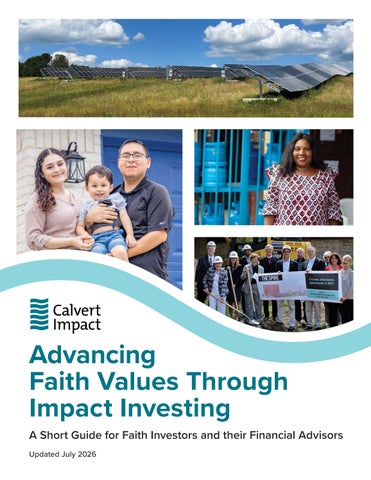
Advancing Faith Values Through Impact Investing A Short Guide for Faith Investors and their Financial Advisors Updated July 2026
What is impact investing? Communities of faith across religions and cultures have long, rich traditions of considering how financial decisions align with common shared pillars of stewardship, human dignity, community service, and creation care. In recent decades, faith institutions have helped foster the impact investing market, and proven it can be a powerful investment strategy to advance their vision for a better world. Impact investments create intentional, measurable social and environmental outcomes alongside financial returns. They finance solutions that benefit people and the planet — like affordable housing, quality jobs, community services, and clean energy. Impact investing builds on the pioneering work faith investors have led for decades in screening out harmful industries and by advocating as shareholders for changes at corporations, but with a more direct and tangible impact in vulnerable communities. Catholic women religious, like the Adrian Dominican Sisters in Michigan beginning in the 1970s, were the earliest investors in community organizations addressing the needs of low-income people, which helped lead to the impact investing industry of today.
What sets impact investing apart from other forms of investing? Impact investing spans a wide range of asset classes and risk/return profiles, but it is defined by two essential features: 1. Intentionality: The deliberate effort to create social and/or environmental impact alongside financial returns. 2. Impact Measurement and Management: Collecting and reporting on the social and environmental outcomes of investments.
A growing market. The impact investing industry is an established market that offers a range of products across asset classes that deliver both financial returns and measurable social and environmental outcomes. Demonstrated financial and impact rigor, and consistent reporting that allows for comparability across managers has enabled impact investing to attract sophisticated institutional investors like pension funds, insurance companies, and faith institutions. In its 2024 Sizing the Impact Investing Market report, the Global Impact Investing Network estimated that roughly 4,000 organizations manage US$1.571 trillion in impact investing assets, representing 21% compound annual growth since 2019.1 In the 2025 US SIF Trends Report, 46% of US asset managers said they plan to increase their impact investing allocations in the next year.2 This was a similar finding to Calvert Impact’s 2024 Investor Survey, where more than 56% of respondents planned to increase their impact investments over the next year.3
Simply put, impact investing is faith in action.
46%
planned increase by asset managers
As impact investors, faith communities can: • Answer faith’s calling to steward financial assets towards creating a more equitable and sustainable world • Switch from investments that might unintentionally cause harm and contradict faith values, to investments that better align with values, philanthropy, and service work
• Provide further diversification to portfolios across asset classes and risk/return profiles
56%
planned increase by investors
• Invest collaboratively with institutions across faiths to advance shared values and goals • Be a model for how to use assets to serve community and higher calling
02 | Advancing Faith Values Through Impact Investing: A Short Guide for Faith Investors and their Financial Advisors
https://thegiin.org/publication/research/sizing-the-impact-investing-market-2024/ https://ussif.org/trends 3 https://calvertimpact.org/resources/investor-survey-results 1
2
4,000 FIRMS $1.57 TRILLION 21% GROWTH
Advancing Faith Values Through Impact Investing: A Short Guide for Faith Investors and their Financial Advisors
| 03
Impact investing allows faith investors to support issues and communities they care about. Impact investing offers a wide range of opportunities — both local and global — to support different sectors and themes that align with faith communities’ priorities. Some examples, include:
SUSTAINABLE AGRICULTURE
SMALL BUSINESS
ENVIRONMENTAL SUSTAINABILITY
ENVIRONMENTAL SUSTAINABILITY
HEALTH
Azure Source Capital
LATIN AMERICA
Azure Source Capital, supported by Catholic Relief Services, provides capital to local financial institutions (rural banks and credit cooperatives) to on-lend to water service providers. Impact Story: In El Salvador, over 20% of people lack piped water at home and 40% have unreliable access (less than 12 hours a day or 7 days a week). About two-thirds of rural and small urban water systems need major investment to expand and improve services. To date, Azure has supported 83 providers, benefiting over 63,000 families, and mobilized $1.6 million for water and sanitation upgrades, including nearly $500,000 in loans through Azure Source Capital. A community member shared: “From the very first day I received water access, I have been much happier. I bathe often, water my plants, and keep my house clean.” Another noted that children now spend less time fetching water and more time studying.
COMMUNITY DEVELOPMENT
AFFORDABLE HOUSING
Volunteers of America National Services UNITED STATES
Volunteers of America National Services (VOANS) is a subsidiary of Volunteers of America, one of the nation's largest faith-based human services organizations. VOANS manages approximately 14,500 affordable housing units and operates over 46 senior healthcare programs nationwide. Impact Story: For more than a decade, 94-year-old Noreen has called North Park Plaza in suburban Minneapolis home, where she receives support through VOANS' home healthcare program. What began as a caregiving relationship with Home Health Aide Latoshata “Pumpkin” Bibbs has grown into a close friendship. Pumpkin not only assists Noreen with daily tasks and medical appointments but also starts each day by preparing her favorite breakfast. Noreen, a former educator who lives with fibromyalgia, credits Pumpkin and the VOANS team for helping her maintain her independence and quality of life.
04 | Advancing Faith Values Through Impact Investing: A Short Guide for Faith Investors and their Financial Advisors
responsAbility Climate Smart Agriculture & Food Systems Fund GLOBAL
The Climate Smart Agriculture and Food Systems Fund provides long-term financing to innovative businesses around the globe that are working to mitigate climate change, reduce food loss, and strengthen the climate resilience of smallholder farmers, while incorporating a gender lens to promote women’s inclusion and empowerment across portfolio companies. Impact Story: Coffee supports the livelihoods of over 125 million people globally, with smallholder farmers producing around 80% of supply, yet the value chain faces challenges including low farmer incomes and environmental degradation. Falcon Coffees, a UK-based trader, promotes transparency, fair compensation, and sustainable sourcing, scaling its specialty coffee procurement with a subordinated debt investment from responsAbility’s Climate Smart Agriculture and Food Systems Fund. Over 80% of Falcon’s coffee is certified, verified, or traceable, and its initiatives— such as climate risk assessments and gender action plans—aim to strengthen resilience and reduce inequality across the supply chain.
COMMUNITY DEVELOPMENT
AFFORDABLE HOUSING
Fahe
UNITED STATES Fahe is a network of over 50 communitybased nonprofits working to cultivate thriving Appalachian communities by developing and preserving affordable housing, providing mortgage services to increase homeownership accessibility, investing in community facilities, and initiating economic and infrastructure development. Impact Story: In response to the devastating 2022 Eastern Kentucky floods, FAHE launched Housing Can’t Wait with its members and housing partners to provide immediate and permanent housing for survivors. After months of temporary housing, Arnold and Virgina Weaver used their FEMA award, insurance, and other funding—along with support from Fahe Member HOMES—to buy a new house built safely out of the floodplain, allowing them to remain in their community. Since 2022, Housing Can’t Wait and its partners have built 88 new homes and rehabilitated 305 across Eastern Kentucky.
Advancing Faith Values Through Impact Investing: A Short Guide for Faith Investors and their Financial Advisors
| 05
Impact investing opportunities.
Getting started in impact investing.
Impact investments can be found across both public and private markets and offer financial characteristics comparable to traditional investments. Like conventional investment strategies, impact investments exist across a spectrum of liquidity profiles, return expectations, and risk levels. What differentiates impact investing from traditional investing approaches, including ESG (environmental, social, and governance) integration, is the intentional pursuit of measurable social and environmental outcomes alongside financial performance.
Financial Considerations Include:
$
• Return: Impact investments offer various financial returns depending on the investor’s and product’s strategy. These range from risk-adjusted market rates to concessionary returns for more catalytic impact.
ESG and Impact Investments Compared ESG INVESTMENTS
IMPACT INVESTMENTS
Products
Mutual funds, ETFs, stocks, bonds
Cash, fixed income/debt, venture capital, real assets, direct investments
Impact Tools
Screening companies for inclusion/ exclusion, proxy voting, shareholder engagement
Investing in vehicles that reach communities and markets not served by traditional finance
Impact Intent
Reduce harm and risk, improve corporate practices
Create solutions to social and environmental challenges
Impact Reporting
Examples of changed corporate practices (e.g., board representation, disclosure on political spending, understanding climate risk)
Measurable outputs (e.g., affordable housing units built, emissions reduced, jobs created), outcomes, and stories of lives changed for every investment
EXAMPLE INVESTMENTS
• Volatility/uncorrelation: Impact investments can have little correlation to changes in interest rates and stock market fluctuations. Most impact investments did well during the 2008 housing and financial crisis, as they represented affordable housing and critical services where demand might even increase in a recessionary environment. • Performance: Given the diversity of structures and approaches, as well as the uncorrelation, some impact investments don’t have widely accepted financial benchmarks. That said, investors consistently see them as performing in line with expectations, with many managers having long track records of doing so.
Level of Portfolio Commitment: • Phased Commitment or Pilot Approach: Consider starting with a pilot commitment or phased approach to assess the effectiveness of the impact strategy before scaling up. • Carve-out: A common strategy is to allocate a specific dollar amount or percentage (e.g., $1 million or 5% of the total portfolio) toward impact investing.
Impact Investment Opportunities by Asset Class ASSET CLASS
• Risk: Many impact investments have exposure to underserved and emerging markets, and therefore it is very important to evaluate the risk management process and track record of managers and how it aligns with the investor's risk appetite.
INVESTMENT EASE
Cash
Account/deposit at community development (CDFI) bank or credit union
Easy
Fixed Income
Debt investment in impact note/security; Loan to a community development (CDFI) fund; Debt investment in microfinance or small/medium enterprise fund
Easy - Medium
Private Equity
Equity investment in a clean tech or community development venture capital fund
Medium
Real Assets
Equity investment in a community real estate fund; Equity investment in a farmland or conservation fund
Medium
Direct Investments
Debt or equity investment in a private company/ social enterprise or project
Hard
• Asset Class Approach: Some investors target specific asset classes, such as moving cash or fixed income investments to impact, rather than applying across a whole portfolio, at least to start. • Full Portfolio Integration: More investors are choosing to integrate impact across all asset classes and sectors, to fully align their investments with their mission. Examples include gender lens investing or child lens investing.
Measuring Impact: Impact Measurement and Management (IMM) frameworks assess whether investments are advancing intended social and environmental outcomes in alignment with faith and mission. The complexity of IMM varies depending on investors capacity and goals; IMM can be a simple exercise that helps to select and monitor investment managers’ impact performance, or it can be a highly technical practice following industry frameworks. For additional guidance, see Calvert Impact’s An Impact Measurement & Management Primer for Faith Investors, which outlines practical approaches for integrating IMM throughout the investment process.
06 | Advancing Faith Values Through Impact Investing: A Short Guide for Faith Investors and their Financial Advisors
Advancing Faith Values Through Impact Investing: A Short Guide for Faith Investors and their Financial Advisors
| 07
Faith investor profiles. Mercy Partnership Fund
CATHOLIC | ST. LOUIS, MO | IMPACT INVESTING SINCE 1995 Health & Education; Environmental Sustainability For more than 30 years, Mercy Partnership Fund, the global community investing program of Mercy Investment Services, the socially responsible asset management program of the Sisters of Mercy, has put its financial resources to work in the communities that need it most – such as immigrants and refugees, small businesses affected by COVID-19, and communities devasted by climate disasters – while also financing the work of innovative partners that advance economic inclusion, environmental sustainability and strengthen communities.
Impact Story
MPF's investment supports Vita Green Impact Fund’s climate mitigation efforts to advance sustainable energy, water, and forestry solutions such as their clean cookstove project. Providing these to households in Ethiopia and Eritrea reduces the burden and deforestation from firewood collection, increases accessibility to clean water, and improves livelihoods and health outcomes, for women and girls in particular.
When an institution wants to start impact investing, Sarah Smith, Director of MPF, suggests finding a CDFI or credit union in your community to begin saving and investing with. “Then build relationships with others in the impact investing field. Discuss mutual objectives and opportunities with other values-aligned faith communities to learn how they have built and maintained their impact investing programs. Partner with and learn from them. No need to reinvent the wheel. There are an extraordinary number of resources now available to prospective impact investors.”
Even in uncertain times, be flexible and nimble to respond to the needs of your partners. Often times, this is when impact investing is needed most and can have the greatest influence.” – Sarah Smith, Director of Mercy Partnership Fund Advancing Faith Values Through Impact Investing: A Short Guide for Faith Investors and their Financial Advisors
08 |
These universal values have guided the development of the leading impact investing program in the Jewish community.” - Rebecca Randall, Chief Philanthropy Officer
Jewish Federation Bay Area
JEWISH | SAN FRANCISCO, CA | SERVING NORTHERN CALIFORNIA Financial Inclusion; Jewish Community; Affordable, Quality Housing With $2.5 billion in assets under management and over 1,250 donor-advised funds, the Jewish Federation Bay Area is one of California's largest community foundations — and they've figured out how to make that capital work harder. Built on Jewish values of Kehilla (building community), Tzedek (pursing justice), Tzedakah (caring for people in need), and tikkun olam (repairing the world), the Federation’s impact investing program has invested more than $70 million across 30 nonprofits, mission-driven financial institutions, and impact funds. These impact investments have helped build affordable housing, fund Jewish communal projects, and provide affordable loans to small business owners across the Bay Area, U.S., and Israel. The Federation found donors eager to do more than give – they wanted their philanthropic dollars to work harder and reach further. By connecting them with targeted opportunities across issues and geographies, the Federation built a program that reflects their values and priorities. For these donors, investing through donor-advised funds has become a powerful complement to grantmaking, putting capital to work not just once, but repeatedly.
Impact Story The Federation’s impact investing program began during COVID, when our donor-advised funds and supporting foundations provided economic lifelines for the Northern California Jewish community through partner, Hebrew Free Loan of San Francisco. “Our donors answered the call and loaned $5.6 million in less than six weeks to help business owners, students, and families weather the tide of early COVID shutdowns,” says Rebecca. The success of this effort led to an expansion of investing and lending with other mission-driven partners.
Advancing Faith Values Through Impact Investing: A Short Guide for Faith Investors and their Financial Advisors
| 09
Faith investor resources.
Praxis Investment Management and Everence Financial MENNONITE/ANABAPTIST | GOSHEN, IN IMPACT INVESTING SINCE 1999 Vulnerable Communities; Sustainable Development
There is a robust community of practitioners dedicated to helping faith-driven investors discover mission-aligned investment opportunities, connect with like-minded peers, and collaborate through shared learning:
For over 30 years, Praxis Investment Management, an Everence Company, has helped churches, institutions, and individuals apply a stewardship investing approach to being co-stewards of God’s resources. Today, through the Praxis Mutual Funds and Praxis Impact ETFs, the organization employs a range of impact strategies from screening, shareholder and bondholder advocacy, proxy voting, and substantial investment in social, green and sustainability bonds, along with catalytic community development investing in every fund. Everence includes community development investments in its own portfolios and offers these options to clients as well. Mark Regier, VP of Stewardship Investing, suggests a paradigm shift from maximizing financial returns at all costs.
• FaithInvest: resources and guidance specifically for faith-based investors seeking to align investments with ethical and spiritual values. • Faith Driven Investor (FDI): faith-focused network and resource hub that helps integrate faith and stewardship into investing. Offers education, small groups, and events to align investments with values. • GIIN Faith-Based Investor Hub: impact investing research, case studies, webinars, books, and other resources for faith-based actors and organizations.
When assessing the balance between financial returns and impact, it is a yes and…rather than an either/or. With that shift, you can determine what impact investing looks like practically for your needs.” – Mark Regier, VP of Stewardship Investing
• Interfaith Center Corporate Responsibility (ICCR): coalition of faith-and values-based investors focused on shareholder advocacy.
Impact Story
• Francesco Collaborative: community of investors working to align their finances with the values and principles of Catholic Social Teaching.
Praxis invested with Calvert Impact Capital to support the Facility for Energy Inclusion Off-Grid Energy Access Fund (FEI OGEF), which lends — largely in local currency — to companies expanding clean, off-grid energy access across Africa. FEI OGEF finances distributors, manufacturers, and end-user credit providers such as M-KOPA and Easy Solar, which put solar home systems, lighting, and appliances within reach of underserved households through affordable digital payment plans.
• ImpactAssets 50: sortable database of leading impact investment fund managers that meet certain investability and track record standards. • ImpactAlpha’s The Liist: curated database of Impact investing funds actively raising capital. • Impact Principles Signatories: list of asset managers committed to integrating impact throughout the investment lifecycle. • Mission Investors Exchange (MIE): resources and networks for foundations and faith-based institutions to collaborate on impact investing. • US/SIF (The Sustainable Investment Forum): guidance, research, and tools on sustainable and values-aligned investing.
Calvert Impact serves as a partner and resource for faith-based investors seeking to align capital with mission and values. Over the past 30 years, we have worked with more than 20,000 individual and institutional investors, along with hundreds of financial advisors, to support their engagement in impact investing and deepen their stewardship of financial resources. We offer a number of faith-driven investor educational resources on our website www.calvertimpact.org/faith: • Building an Impactful Faith Portfolio: A Foundational Guide to Impact Investing for Faith Institutions • An Impact Measurement & Management Primer for Faith Investors
10 | Advancing Faith Values Through Impact Investing: A Short Guide for Faith Investors and their Financial Advisors
• Catholic Impact Investing Collaborative: global network of Catholic asset owners and financial intermediaries dedicated to aligning investments with Catholic Social Teaching.
• Faith Investor Profiles
Please reach out for more information! Patricia Redsicker predsicker@calvertimpact.org 800.248.0337 Holly Williams hwilliams@calvertimpact.org 800.248.0337
Advancing Faith Values Through Impact Investing: A Short Guide for Faith Investors and their Financial Advisors
| 11
7550 Wisconsin Avenue 8th Floor Bethesda, MD 20814 info@calvertimpact.org 800.248.0337 calvertimpact.org
linkedin.com/company/calvert- impact
PHOTO CREDITS (in order of appearance): Cover: Sunwealth, Affordable Homes of South Texas, Africa Go Green, Affordable Homes & Communities p. 3: Self Help Enterprises p.4: Azure Source Capital, Volunteers of America National Services P.5: responsAbility Climate Smart Agriculture & Food Systems Fund, Falcon Coffees, Fahe P.8: Mercy Partnership Fund, Vita Green Impact Fund P. 9 P.10: Lendable, FEI OGEF
NO INVESTMENT ADVICE This guide is for informational purposes only and you should not construe any such information or other material as legal, tax, investment, financial, or other advice. This guide does not constitute a comprehensive or complete statement of the matters discussed or the law relating thereto, nor does it address the circumstances of any particular individual or entity. Nothing contained in this guide constitutes a solicitation, recommendation, endorsement, or offer by Calvert Impact or any thirdparty service provider to buy or sell any securities or other financial instruments. Calvert Impact is not a fiduciary by virtue of any person’s use this guide. You alone assume the sole responsibility of evaluating the merits and risks associated with the use of any information in this guide before making any decisions based on such information. INVESTMENT RISKS There are risks associated with investing in securities. Investing in stocks, bonds, exchange traded funds, mutual funds, and money market funds involve risk of loss. Loss of principal is possible. Some high-risk investments may use leverage, which will accentuate gains & losses. Foreign investing involves special risks, including a greater volatility and political, economic and currency risks and differences in accounting methods. A security’s or a firm’s past investment performance is not a guarantee or predictor of future investment performance.