Grants and Calvert County Family Network Special Revenue Funds
Grants Coordinator
Mary Layman
FY 2027 Redesign of the Budget Book
Special thanks to the Department of Communications & Media Relations for making this redesign happen.
FISCAL YEAR 2027
CALVERT COUNTY, MARYLAND
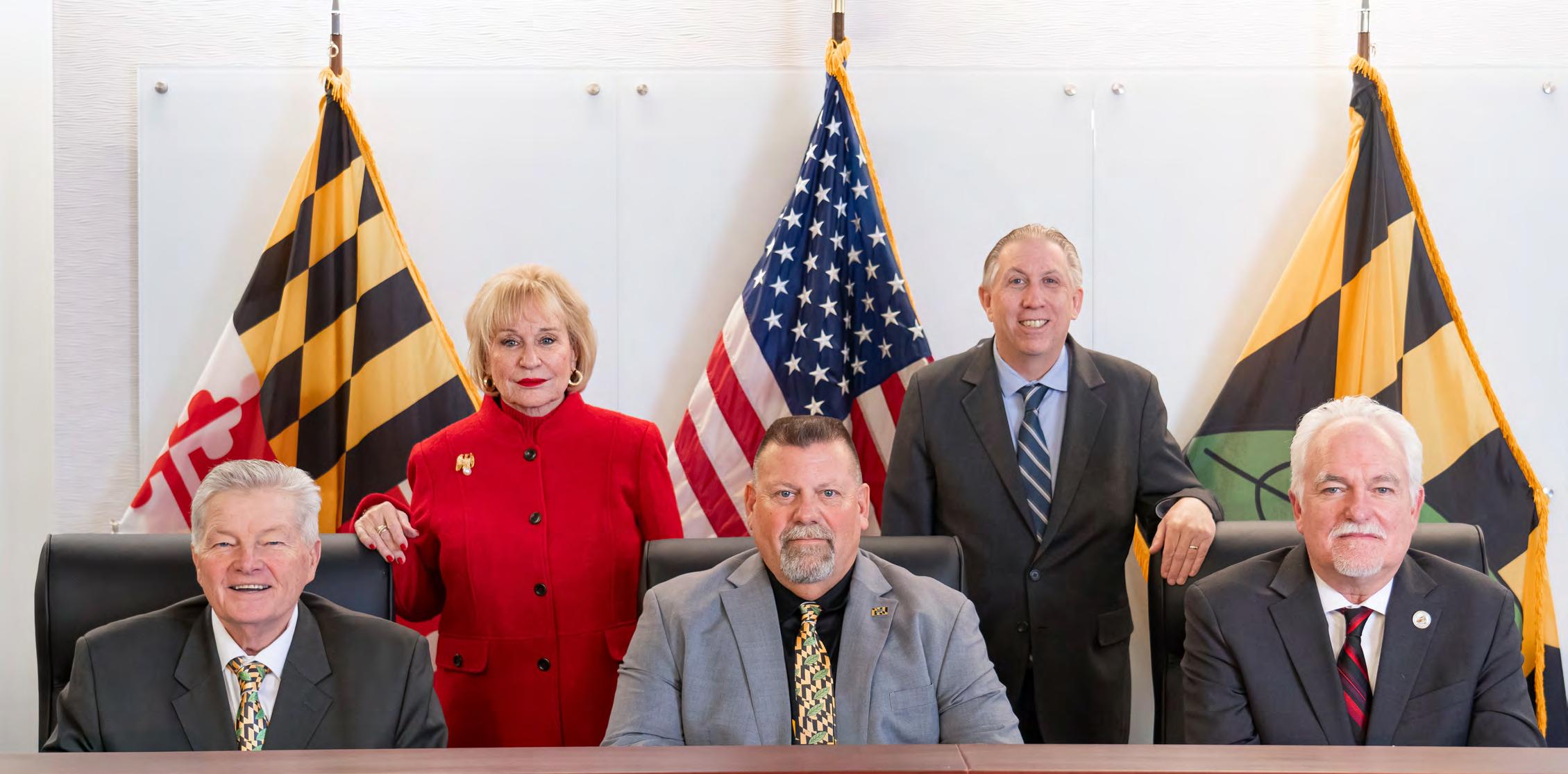
County Commissioners
Todd Ireland, President
Mark C. Cox Sr., Vice President
Catherine Grasso
Earl F. “Buddy” Hance
Mike Hart
County Administrator
Linda Turner
Deputy County Administrator
Stephen McGibbon
Calvert County Government 150 Main Street
Prince Frederick, MD 20678
410-535-1600 | 301-855-1243
Fax: 410-535-1787 www.calvertcountymd.gov
The Government Finance Officers Association of the United States and Canada (GFOA) presented a Distinguished Budget Presentation Award to the Calvert County Government for its annual budget for the fiscal year beginning July 1, 2025 (FY 2026).
In order to receive this award, a government unit must publish a budget document that meets program criteria as a policy document, as an operations guide, as a financial plan and as a communication device.
This award is valid for a period of one year only. We believe our current budget continues to conform or exceed program requirements and we are submitting it to the GFOA to determine its eligibility for another award.
BUDGET GUIDE
INTRODUCTION
The budget guide is designed to serve as both a comprehensive summary and a navigational aid to the full Calvert County budget document. It incorporates several features intended to enhance usability and improve the reader’s understanding of the county’s financial plans and priorities. Notably, the guide continues the use of visual icons representing the goals established by the Board of County Commissioners (BOCC), a practice initiated in Fiscal Year (FY) 2016. These icons are used throughout the document to clearly link departmental program objectives with the BOCC’s stated goals.
The BOCC goals are derived from the board’s mission statement. A consolidated summary aligning departmental objectives with these goals is provided within the document. Additional tools, including a quick reference guide, budget calendar and budget process chart, are included to assist readers in locating key information and understanding the timeline and responsibilities associated with the budget process.
BUDGET FRAMEWORK
Calvert County operates on a fiscal year that begins on July 1 and concludes on June 30. Each year, the Department of Finance & Budget produces five primary budget documents covering both operating and capital expenditures:
• Staff Recommended Operating and Capital Budget
• Commissioners Operating Budget
• Commissioners Capital Budget
• Adopted Operating Budget
• Adopted Capital Budget
These documents collectively present the county’s financial strategy, policy direction and resource allocation decisions.
ORGANIZATION OF THE BUDGET DOCUMENT
The budget document is structured into seven primary sections, followed by a seven-part appendix. Each section provides progressively detailed information regarding the county’s financial operations.
1. Introduction
This section includes the BOCC mission statement, transmittal letter and quick reference guide. It also provides general information about the county’s governance structure, economic conditions, organizational chart and a listing of county officials. Additionally, it outlines BOCC goals and departmental alignment, followed by the budget calendar and process overview. The section concludes with a summary of budgetary accounting practices and fund structures.
2. Budget Summary
The Budget Summary presents a high-level overview of total expenditures categorized by fund type. It explains revenue sources and expenditure allocations, often described as “where the money comes from” and “where the money goes.” It also includes summaries of fund balances and financial changes.
3. General Fund Summary
This section focuses on the county’s primary operating fund. It provides an overview of anticipated revenues and expenditures, highlights key financial trends, and includes historical data, forecasts and fund balance analysis.
4. General Fund Expenses
Detailed information is provided for departments, divisions and affiliated agencies. Each subsection typically includes:
• A program description
• Organizational objectives aligned with BOCC goals
• Performance measures
• Operating budget data, including historical comparisons
• Staffing summaries
Entitywide expenditures such as pensions, insurance and debt service are also included.
5. Enterprise Funds
The county maintains two self-supporting enterprise funds:
• Water & Sewer
• Solid Waste & Recycling
These sections follow a structure similar to the General Fund, including revenue highlights, operational details and budget data. The Water & Sewer Fund additionally provides a breakdown across major cost centers.
6. Grants Fund
This section outlines the aggregate Grants Fund, including revenue sources from federal, state and county contributions. It is organized into four program areas: general government, general services, human services and public safety. Each area includes summaries, staffing information and selected detailed grant descriptions.
7. Special Revenue Funds
Special Revenue Funds are presented with revenue highlights, fund descriptions, operating budgets and staffing information where applicable. These funds are designated for specific purposes supported by dedicated revenue sources.
APPENDIX
The appendix is divided into seven components: 1. Staffing 2. Pay Scales
3. Fees and Tax Rates
4. Economic Factors
5. Fiscal Policies and Resolutions
6. Glossary and Acronyms
7. Index
This section provides detailed supporting data and reference materials essential for a complete understanding of the budget.
CAPITAL IMPROVEMENT PLAN (CIP)
The FY 2027 Capital Budget represents the first year of the county’s six-year Capital Improvement Plan (CIP), which extends through FY 2032. The CIP serves as a long-term financial planning tool for major infrastructure investments. It prioritizes projects that address community needs, enhance public services and align with the county’s Comprehensive Plan. Capital projects typically involve expenditures of $50,000 or more and assets with a useful life of at least five years.
CONCLUSION
Overall, the budget guide provides a structured and accessible overview of Calvert County’s financial planning and policy framework. Through its organization, visual aids and detailed explanations, it supports transparency and enables stakeholders to better understand how county resources are allocated to achieve strategic goals.
INTRODUCTION
Board of County Commissioners of Calvert County
• Todd Ireland, President, At Large Representative
• Mark C. Cox, Sr., Vice-President, 2nd District Representative
• Catherine M. Grasso, 3rd District Representative
• Earl F. “Buddy” Hance, At Large Representative
• Mike Hart, 1st District Representative
VISION STATEMENT
Calvert County will be a safe and thriving community that balances economic growth with rural living, invests in every generation and provides opportunities and quality of life for all residents.
MISSION STATEMENT
Calvert County Government is dedicated to ensuring a safe and thriving community by promoting transparency, effective communication, balancing sustainable growth with the preservation of our rural character and ensuring all residents throughout their lifetime have access to meaningful opportunities and an exceptional quality of life.
To the Residents and Businesses of Calvert County:
The General Fund Budget for fiscal year 2027 (FY 2027), effective July 1, 2026, totals $420 million in revenues and expenditures. This budget reflects a disciplined approach to financial planning, a continued commitment to strengthening communication and transparency, and a focus on fiscal responsibility. It continues to prioritize education, public safety, capital investments and the maintenance of a high level of service to our community.
The FY 2027 budget sustains current service levels across all county departments and agencies while aligning with the county’s long-term vision of balancing economic growth with rural character, investing in every generation and ensuring a high quality of life for all residents.
FY 2027 budget highlights include:
• $169 million in operating funding for Calvert County Public Schools, approximately $9 million above the State of Maryland’s Maintenance of Effort (MOE) requirement, reflecting the county’s strong commitment to public education.
• $12 million in prior-year fund balance appropriated to support the pay -as-you-go component of the Capital Improvement Plan.
• A total FY27 Capital Budget of $89 million, prioritizing school construction, facility renovations and critical infrastructure improvements.
• Enterprise Funds supporting essential services, including $12 million for Water & Sewer operations and $17 million for Solid Waste operations.
• Establishment of two special revenue funds:
One to properly account for AMOSS grant funding supporting volunteer fire departments.
One to separately account for revenues and expenditures associated with the Emergency Medical Services (EMS) Cost Recovery Program.
We extend our sincere appreciation to the county administrator, county departments and agencies, and community partners for their collaboration throughout the budget process. Their efforts ensure that county resources are aligned with the community’s highest priorities and mana ged in a prudent and responsible manner.
We also thank our residents and businesses for their continued trust and support. Together, we remain committed to sustaining a strong, vibrant, and resilient Calvert County.
[SIGNATURE BLOCK ON FOLLOWING PAGE]
Sincerely,
BOARD OF COUNTY COMMISSIONERS CALVERT COUNTY, MARYLAND
Todd Ireland, President
Mark C. Cox Sr., Vice President
Catherine M. Grasso
Earl F. Hance
Mike Hart
QUICK REFERENCE GUIDE
CALVERT COUNTY INFORMATION
COMMUNITY PROFILE
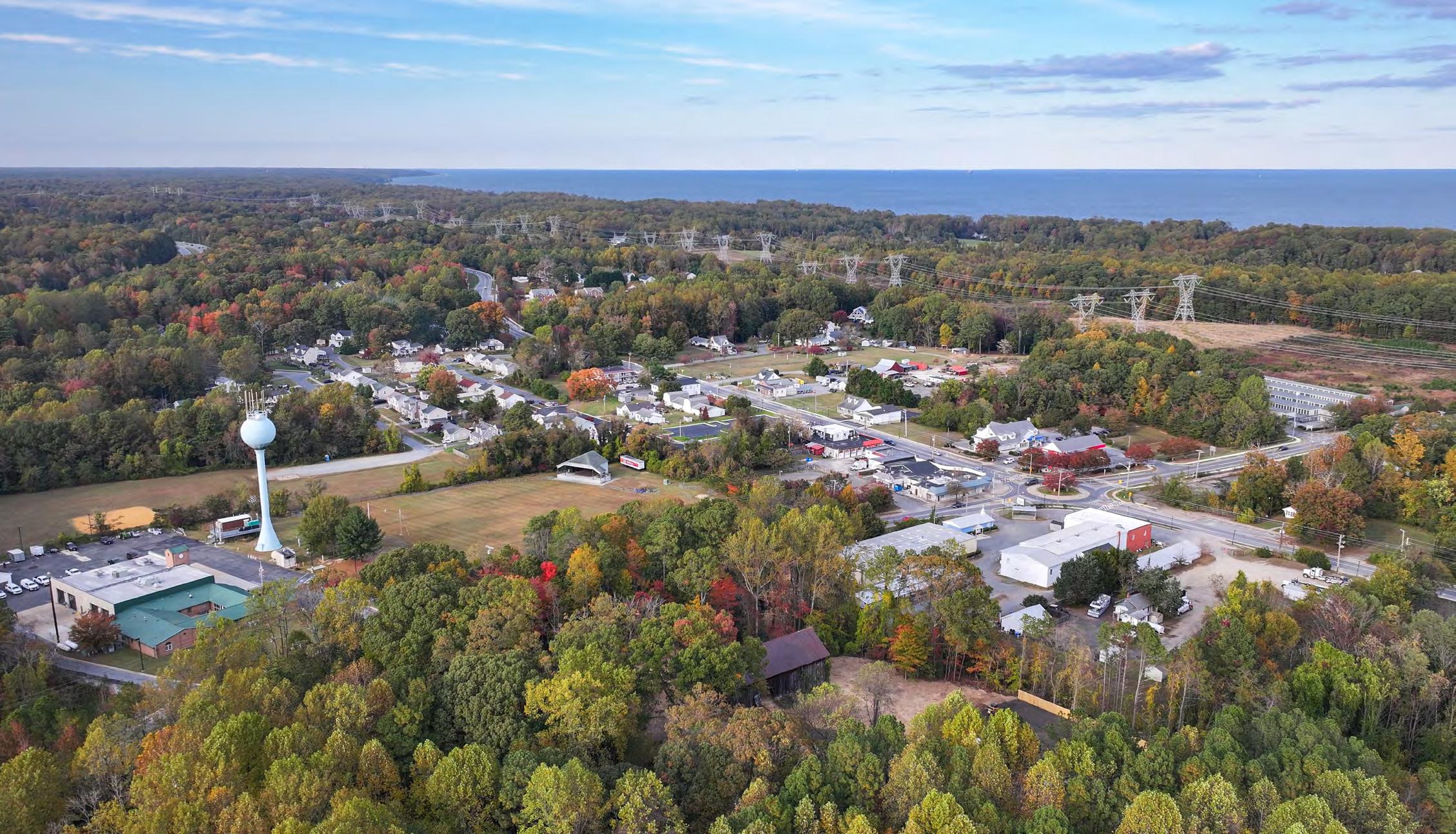
Calvert County, located in Southern Maryland, combines a growing population with a strong commitment to preserving its rural character and agrarian heritage. The county offers a high quality of life supported by strong public schools, a clean environment and access to natural resources. Geographically, Calvert County is a peninsula bordered by the Chesapeake Bay to the east and the Patuxent River to the west. The eastern shoreline is characterized by steep cliffs and wooded areas, while the western side features gently rolling farmland. Numerous creeks and waterways enhance environmental quality and support recreation, including boating and fishing.
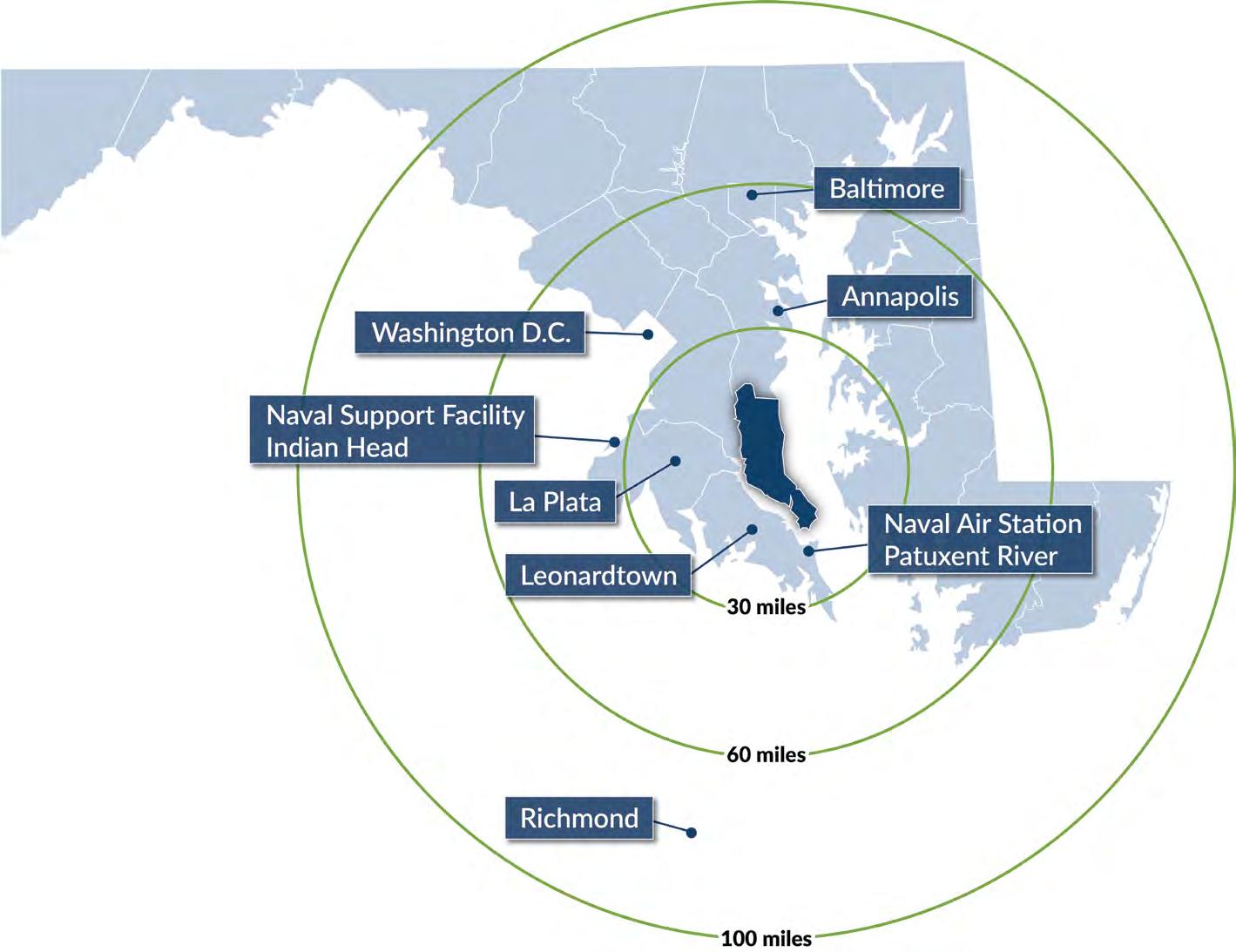
Prince Frederick, the county seat, is located approximately 41 miles southeast of Washington, D.C., and 60 miles south of Baltimore, providing residents with access to major employment centers while maintaining a suburban-rural setting. In addition to the incorporated towns of North Beach and Chesapeake Beach, the county’s Comprehensive Plan identifies seven town centers: Dunkirk, Owings, Huntingtown, Prince Frederick, St. Leonard, Lusby and Solomons. These centers serve as focal points for growth, services and economic activity.
HISTORICAL OVERVIEW
Established in 1654, Calvert County is one of the oldest counties in the United States. Archaeological evidence indicates that Indigenous peoples inhabited the area for more than 9,000 years, with the Piscataway Indians establishing villages along the Patuxent River. Early economies were based on agriculture, including corn and tobacco cultivation.
European exploration of the area dates to 1608, when Captain John Smith documented the region during his Chesapeake Bay expedition. English settlement followed between 1637 and 1642 under the leadership of Cecilius Calvert, Second Lord Baltimore. Early settlers included English gentry as well as religious groups seeking refuge, such as Puritans, Huguenots, Quakers and Scots.
In 1695, Calvert County was reorganized, resulting in the formation of neighboring counties and establishing boundaries that remain largely unchanged today. For much of its history, the county remained rural and agriculturally focused.
Significant infrastructure improvements in the 20th century contributed to population growth and economic development. The construction of Maryland Route 4, completed in 1987, and the Thomas Johnson Bridge, connecting Calvert County to St. Mary’s County, improved regional accessibility and supported residential and commercial expansion.
FORM OF GOVERNMENT
Calvert County operates under the commissioner form of government, in which the BOCC serves as both the legislative and executive authority. The county operates under the Code of Public Local Laws of Calvert County (revised in 1985), as well as applicable state legislation.
The five-member BOCC is elected by countywide vote. Three commissioners represent specific geographic districts, and two serve at-large. Commissioners serve four-year terms and assume office on the third Tuesday of December following the election.
The BOCC is responsible for establishing policy, adopting ordinances, approving the annual budget and making land use decisions. The board also appoints a County Administrator and Deputy County Administrator, who oversee the day-to-day operations of county government, as well as department heads and members of boards and commissions.
The board holds regular public meetings on Tuesdays at 10 a.m. in the Commissioners Hearing Room at the Calvert County Administration Building, with additional evening or special sessions scheduled as needed. Meetings are open to the public, except for executive sessions conducted in accordance with Maryland law.
From the Code of Public Local Laws of Calvert County, Section 2-102:
“Beginning with the general election to be held in Calvert County in November 1978, five county commissioners shall be elected by countywide vote. Beginning with the general election to be held in Calvert County in November 2014, one county commissioner shall be a resident of and shall represent the first election district of the county; one county commissioner shall be a resident of and shall represent the second election district of the county; and one county commissioner shall be a resident of and shall represent the third election district of the county. Of the remaining candidates, the two receiving the highest number of votes shall be selected; and two county commissioners shall be residents of the county and shall represent the county at large. Each candidate for the office of county commissioner shall specify at the time of filing a certificate of candidacy whether the candidate is seeking to represent the county at large. Commissioners who are elected and qualify shall take office the third Tuesday of December following the election. Each commissioner shall hold office for four years or until a successor is elected and qualified. (Code 1981,§ 4-102; 1985, chapter 715,§ 2; 2013, chapter 310, § 1)”
The commissioners establish policy, enact ordinances, review and approve annual budgets, conduct public hearings and make decisions on land use matters. The commissioners also appoint all department heads, members of boards and commissions and represent the county in dealings with other municipalities, the state and federal government.
ECONOMIC HIGHLIGHTS
94,913
CALVERT COUNTY GOVERNMENT ORGANIZATION CHART
FUNCTIONAL BUDGET AREAS
General Government
Community Resources
Economic Development
Parks & Recreation
Public Safety
Public Works
Treasurer’s Office Courts Bar Library
Election Board
Todd Ireland
President
DEPARTMENT HEADS AND AGENCY LIAISONS
BOARD OF COUNTY COMMISSIONERS
Email: Commiss@calvertcountymd.gov
Phone : 410-535-1600, ext. 2214
Mark Cox Sr.
Vice President
Email: Commiss@calvertcountymd.gov
Phone : 410-535-1600, ext. 2214
Catherine Grasso
Email: Commiss@calvertcountymd.gov
Phone : 410-535-1600, ext. 2214
Earl “Buddy” Hance
Email: Commiss@calvertcountymd.gov
Phone : 410-535-1600, ext. 2214
Mike Hart
Email: Commiss@calvertcountymd.gov
Phone : 410-535-1600, ext. 2214
CALVERT COUNTY DEPARTMENT HEADS
Linda Turner
County Administrator
Email: Linda.Turner@calvertcountymd.gov
Phone : 410-535-1600, ext. 2200
Stephen McGibbon
Deputy County Administrator
Email: Stephen.McGibbon@calvertcountymd.gov
Phone : 410-535-1600, ext. 2207
Jeff Murray
Director, Calvert Marine Museum
Email: Jeffrey.Murray@calvertcountymd.gov
Phone : 410-535-1600, ext. 8041
Jennifer Sterling
Acting Director, Communications & Media Relations
Email: Jennifer.Sterling@calvertcountymd.gov
Phone : 410-535-1600, ext. 2508
Jennifer Moreland
Director, Community Resources
Email: Jennifer.Moreland@calvertcountymd.gov
Phone : 410-535-1600, ext. 8801
Julie Oberg
Director, Economic Development
Email: Julie.Oberg@calvertcountymd.gov
Phone : 410-535-1600, ext. 2485
Malena Brookshire
Chief Financial Officer, Finance & Budget
Email: Malena.Brookshire@calvertcountymd.gov
Phone : 410-535-1600, ext. 2836
Melanie Woodson
Director, Human Resources
Email: Melanie.Woodson@calvertcountymd.gov
Phone : 410-535-1600, ext. 2383
Robert (Bob) Branham
Director, Parks & Recreation
Email: Robert.Branham@calvertcountymd.gov
Phone : 410-535-1600, ext. 2673
Jason Brinkley
Director, Planning & Zoning
Email: Jason.Brinkley@calvertcountymd.gov
Phone : 410-535-1600, ext. 2334
Dave McDowell
Director, Public Safety
Email: Dave.McDowell@calvertcountymd.gov
Phone : 410-535-1600, ext. 2303
John “JR” Cosgrove Jr.
Director, Public Works
Email: John.Cosgrove@calvertcountymd.gov
Phone : 410-535-1600, ext. 2568
Stephen Pereira
Chief Information Officer, Technology Services
Email: Stephen.Pereira@calvertcountymd.gov
Phone : 410-535-1600, ext. 2307
DEPARTMENT HEADS AND AGENCY LIAISONS
Richard (Ricky) Cox
ELECTED AND APPOINTED OFFICIALS
Sheriff, Calvert County Sheriff’s Office
Email: Richard.Cox@calvertcountymd.gov
Phone : 410-535-1600, ext. 2464
Lt. Col. David Payne
Assistant Sheriff, Calvert County Sheriff’s Office
Email: David.Payne@calvertcountymd.gov
Phone : 410-535-1600, ext. 2464
Amanda Dolina Treasurer, Treasurer’s Office
Email: Amanda.Dolina@calvertcountymd.gov
Phone : 410-535-1600, ext. 2278
Margaret Phipps Register of Wills
Email: MPhipps@registers.maryland.gov
Phone : 410-535-1600, ext. 2254
Mark S. Chandlee
County Administrative Judge, Circuit Court
Phone : 410-535-1600, ext. 2785
Mark Carmean
Associate Judge, Circuit Court
Phone : 410-535-1600, ext. 2262
Andrew Rappaport
Associate Judge, Circuit Court
Phone : 410-535-1600, ext. 2806
Robert Harvey Jr. State’s Attorney
Email: Robert.Harvey@calvertcountymd.gov
Phone : 410-535-1600, ext. 2311
Major Timothy Fridman Detention Center Administrator
Email: Timothy.Fridman@calvertcountymd.gov
Phone : 410-535-4300
Gail Hatfield Elections Administrator
Email: Gail.Hatfield@calvertcountymd.gov
Phone : 410-535-1600, ext. 8830
Thomas Pelagatti Chief Judge, Orphan’s Court
Email: Tom@tompel.com
Phone : 410-535-1600, ext. 2256
COURT OFFICIALS
Justin Sasser Family Magistrate
Phone : 410-535-1600, ext. 2424
Kathy Smith Clerk of the Court
Email: Kathy.Smith@mdcourts.gov
Phone : 410-535-1600, ext. 2263
Burgess Wood Court Administrator
Email: Burgess.Wood@calvertcountymd.gov
Phone : 410-535-1600, ext. 2296
THE BOARD OF COUNTY COMMISSIONERS GOALS
BE RESPONSIBLE AND ACCOUNTABLE
FISCAL RESPONSIBILITY
CULTURE OF ENGAGEMENT
PUBLIC STEWARDSHIP AND ACCOUNTABILITY
Exercise conservative financial management with the majority of resources directed to the most important services that our government provides, while seeking viable new sources of revenue.
Promote an environment where residents feel they can make a difference and work in partnership with others to understand and address pressing public issues. Continue to work on making county offices more citizen and business friendly and providing ample opportunities for citizen involvement.
Act responsibly with the planning and management of our county resources.
PROVIDE ESSENTIAL SERVICES AND SUPPORT SERVICES
EDUCATION
PUBLIC SAFETY
ROADS AND INFRASTRUCTURE
PARKS AND RECREATION
WORK TO PRESERVE CALVERT COUNTY
ENVIRONMENT, HERITAGE AND RURAL CHARACTER
GROWTH MANAGEMENT AND LAND PRESERVATION
Provide high quality, effective and efficient services to all stakeholders. Explore alternative approaches that would allow the county organization to operate in a more business-like fashion.
Provide educational resources, learning opportunities and training.
Maintain Calvert County as a safe and healthy place to live, work and play.
Maintain our roads, bridges and Water & Sewerage infrastructure, as well as other long-term physical assets and facilities.
Provide opportunities for leisure activities, including making the best possible use of the golf course and the indoor pool.
Create a sense of place, reflect the character, history and natural environment of the community.
Maintain the rural character through effective growth management with a proactive and consistent planning approach. Look at ordinances that impact growth outside of the town centers.
PROVIDE OPPORTUNITIES FOR RESIDENTIAL GROWTH AND ECONOMIC
HOMEOWNERSHIP
ECONOMIC DEVELOPMENT
DEVELOPMENT
Promote homeownership by providing assistance to our citizens through Homestead and Homeowner Tax Credit programs as well as our House Keys 4 Employees program.
Pursue many avenues of economic development to incentivize sustainable development while remaining a business-friendly community to small businesses, the farm and forestry community and corporations alike.
SUMMARY OF OBJECTIVES TO ACHIEVE BOCC GOALS
HOW CITIZEN INPUT SHAPES THE COUNTY’S FOCUS
Citizen input is a critical driver in shaping the priorities, strategies and service delivery of county government. Through engagement mechanisms such as public meetings, surveys, advisory boards and direct communication, residents provide valuable insight into community needs and expectations. This input informs decision-making at all levels, ensuring that county efforts remain responsive, transparent and outcome-oriented.
FRAMEWORK FOR TRANSLATING CITIZEN INPUT INTO RESULTS
The county utilizes a structured framework to translate citizen feedback into measurable actions and outcomes. This framework ensures alignment between community priorities and operational execution.
Board of County
Commissioners Goals
Department/ Division Objectives
At the highest level, citizen input informs the development of the Board of County Commissioners’ goals. These goals represent the county’s overarching priorities and reflect the needs and concerns expressed by residents. They serve as the foundation for all subsequent planning and resource allocation.
County departments and divisions translate the BOCC’s goals into strategic objectives. These objectives define how each functional area will contribute to achieving the county’s priorities while addressing specific community needs. Alignment at this level ensures consistency across government operations.
Activities
Activities represent the day-to-day actions undertaken by departments and staff to fulfill their objectives. These include program implementation, service delivery, project management and administrative functions. Activities are the operational backbone of county services.
Outputs
Outputs are the direct products or services resulting from county activities. Examples include completed infrastructure projects, permits issued, programs delivered and services provided to residents. Outputs provide a tangible measure of work performed.
Outcomes
Outcomes reflect the broader results and impacts of county efforts on the community. These include improvements in quality of life, enhanced public safety, economic development, environmental sustainability and overall resident satisfaction. Outcomes demonstrate whether county actions are effectively addressing community needs.
This structured approach ensures that citizen input is not only heard but systematically integrated into county planning and operations. By linking community feedback to goals, objectives, activities, outputs and outcomes, the county maintains accountability and continuously works to deliver meaningful results for its residents.
FY 2027 BUDGET CALENDAR
Graphic Key: ⭐ Board of County Commissioners ⚪ Planning Commission
Finance & Budget
County Departments �� Outside Agencies
2025 - Public comment is welcome beginning in August through the June budget adoption.
July On July 1, the current approved fiscal year budget is implemented by Finance & Budget and placed into County Cost Centers
August Maintenance and repair project requests due to General Services
September
October
Capital project requests due to Finance & Budget
Vehicle requests due to Fleet Maintenance
Revenue projections prepared
Staff presentation of high-level overview of the projected FY 2027 budget to the BOCC
Expenditure strategy developed for FY 2026
Budget packets distributed to departments
Legislative requests due to County Attorney
Initial CIP work session with the BOCC on FY 2027 CIP
Departmental budget requests due to Finance & Budget (all funds)
Outside agency requests due to Finance & Budget
November Budget work sessions with department heads begin
December
March Public Hearing - Staff Recommended Budget
receive public comment
Budget work sessions with the BOCC as required
The BOCC finalizes unresolved operating and capital project budget issues; Finance & Budget finalize the BOCC budget numbers
The BOCC approves semi-annual payment option service charge rate
April
The BOCC meets with town mayors to approve tax differential
Citizens are informed of budget process and start providing input
CAPITAL IMPROVEMENT PLAN (CIP)
CIP packages distributed
CIP meetings
CIP work sessions with BOCC
CIP requests due and reviewed by Finance & Budget
Present CIP to the Planning Commission for land use projects
Six-year CIP work session with the BOCC
BUDGET PROCESS
Maintenance and repair projects
Replacement vehicles requests
Budget packets distributed to departments and outside agencies
User training: budget database
Legislative requests due to County Attorney
Meet with delegation to review legislative requests
Department/division budget development
Non-county agency budget development
Budget work sessions
Finalize staff recommended budget
Line item review of all county budgets
Receive public comment on budget
BOCC finalize unresolved budget issues
BOCC approve semi-annual payment service charge rate
BOCC meet with town mayors to approve tax differential
Publish constant yield notice (if required)
BOCC adopt budget
Post adopted budget in financial system
BUDGETARY ACCOUNTING AND THE BUDGET PROCESS
OVERVIEW
The county’s budget represents a comprehensive financial plan that identifies all anticipated revenues and appropriations for the fiscal year. The budget includes the Operating Budget, Capital Improvements Program (CIP) and Budget Message, and serves as the primary policy and planning document guiding county operations.
Budgetary control is maintained throughout the fiscal year and applies to all county funds, including the General Fund, Special Revenue Funds, Capital Projects Funds and Enterprise Funds. This control framework ensures fiscal discipline, accountability and compliance with adopted policies and applicable laws.
BASIS OF BUDGETING AND ACCOUNTING
The county utilizes different bases of budgeting and accounting depending on the fund type, in accordance with standard governmental accounting practices.
• General Fund and Special Revenue Funds
These funds are budgeted using the modified accrual basis of accounting , under which:
{ Revenues are recognized when they are measurable and available
{ Expenditures are recognized when obligations are incurred, including encumbrances
Annual financial reporting for these funds is also prepared on the modified accrual basis in accordance with Generally Accepted Accounting Principles (GAAP). For financial statement purposes, encumbrances are reported as a reservation of fund balance rather than as expenditures.
• Capital Projects Fund
The Capital Improvements Program is developed on a multi-year (six-year) project basis, with only the first year formally adopted as the annual budget. This approach supports long-term planning and capital investment management. Financial reporting is conducted using the modified accrual basis.
• Enterprise Funds
Enterprise Funds (Water & Sewer; Solid Waste & Recycling) are budgeted on a cash basis, reflecting inflows and outflows of cash. However, financial statements are prepared using the full accrual basis of accounting , where:
{ Revenues are recognized when earned
{ Expenses are recognized when liabilities are incurred
This dual approach ensures both operational cash management and accurate long-term financial reporting.
BUDGET DEVELOPMENT PROCESS
The county’s annual budget process spans approximately ten months and is designed to promote transparency, accountability and public participation.
1. Revenue Forecasting (September–December)
The process begins with the development of revenue projections to establish available resources.
2. Departmental Requests
County departments, agencies and boards submit budget requests aligned with organizational priorities and service demands.
3. Executive Review and Recommendation
The County Administrator reviews requests and develops a proposed budget for consideration by the BOCC.
4. Public Engagement
The BOCC conducts public hearings to receive input from residents and stakeholders.
5. Adoption
The budget is legally adopted by the BOCC through the passage of a resolution, typically in June.
Detailed budget calendars for both Operating and Capital budgets are provided in the budget document. Fiscal policies guiding this process are included in the appendix.
BUDGET PREP CYCLE We are here
PHASE 1
BASELINE (November/December):
Conservative; no winter tax receipts or state data.
PHASE 2
STATE INTEGRATION (January/February):
Numbers adjusted based on the Governor’s budget and mid-year audits.
BUDGETARY CONTROL AND AMENDMENTS
PHASE 3
REVIEW PERIOD (March/April):
High-confidence numbers. Spring tax receipts arrive, and conservative estimates are replaced by actual cash performance.
PHASE 4
CLOSEOUT (June/July):
Final approval and implementation.
The county maintains a formal system of budgetary control to ensure expenditures do not exceed appropriations and that adjustments are made in a transparent and authorized manner. Authority for budget amendments is delegated as follows:
• Director of Finance & Budget : Authorized to approve transfers up to $25,000
• County Administrator : Authorized to approve transfers up to $50,000
• BOCC :
$50,000 to $150,000: approval required without formal resolution
Over $150,000: approval required by formal resolution following public hearing requirements
In the event of a public emergency affecting life, health or property, the BOCC may authorize emergency appropriations from contingent or surplus funds by resolution.
FISCAL ACCOUNTABILITY AND POLICY COMPLIANCE
The county’s budgetary practices are guided by established fiscal policies and comply with applicable legal requirements. These practices ensure:
• Responsible stewardship of public resources
• Alignment of expenditures with policy priorities
• Transparency in financial decision-making
• Consistency with GFOA best practices and GAAP standards
Additional details regarding fiscal policies, budget laws and related resolutions are provided in the appendix.
OPERATING REVENUE HAS GROWN A MODEST 2.8%
Our core Operating Revenue Subtotal for FY 2027 is $400 million. Isolating this reliable, steady income demonstrates that our structural base has only grown by a modest 2.8% since FY 2025. While the total proposed General Fund budget is $420 million, that larger figure simply includes over $20 million in non-operating revenue (such as reserves utilized for capital projects). Tracking our budget against the $400 million operating base ensures our ongoing operational spending remains aligned only with our reliable income, keeping our fiscal position stable.
DESCRIPTION OF FUNDS
The financial operations of the county are organized and accounted for on the basis of funds. A fund is defined as a separate fiscal and accounting entity with a self-balancing set of accounts used to record cash and other financial resources, together with all related liabilities, fund balances, revenues and expenditures. This structure ensures accountability, transparency and compliance with generally accepted accounting principles (GAAP) and Governmental Accounting Standards Board (GASB) requirements.
Funds are classified into three primary categories: Governmental Funds, Proprietary Funds and Fiduciary Funds, as described below.
GOVERNMENTAL FUNDS
Governmental funds are used to account for activities primarily supported by taxes and intergovernmental revenues. These funds focus on the inflow and outflow of current financial resources.
GENERAL FUND
The General Fund is the county’s primary operating fund and is used to account for all financial resources except those required to be accounted for in another fund. It finances the general operations of the BOCC, including public safety, public works, general government and other core services.
SPECIAL REVENUE FUNDS
Special Revenue Funds are used to account for the proceeds of specific revenue sources that are legally restricted or committed to expenditures for specified purposes, excluding major capital projects and expendable trust activities.
The county maintains multiple Special Revenue Funds, including but not limited to:
• Parks & Recreation Fund
• Golf Course Fund
• Excise Tax Fund
• Land Preservation Fund
• Bar Library Fund
• Planning & Zoning Fund
• Calvert Family Network Fund
• Housing Fund
• Tourism Development Incentive Fund
• Calvert Marine Museum Fund
• Calvert Public Library Fund
• Office on Aging Fund
• Safety Camera Fund
• PEG Fund
• Cannabis Fund
• Opioid Litigation Fund
• Loan Funds (Revolving Loan Fund, Economic Development Loan Fund, Economic Development Incentive Fund)
• Grants Fund
• AMOSS Fund
• EMS Cost Recovery Fund
• Benefits Fund
These funds ensure that revenues designated for specific purposes are used accordingly, enhancing fiscal accountability and compliance with legal and policy requirements.
CAPITAL BUDGET/CAPITAL IMPROVEMENT PLAN FUND
The Capital Budget and Capital Improvement Plan (CIP) Fund accounts for financial resources that are restricted, committed or assigned for the acquisition, construction or improvement of major capital facilities. This includes projects for both the county government and the Calvert County Public Schools system.
The CIP supports long-term planning and infrastructure investment, ensuring the county maintains and enhances its physical assets in alignment with strategic priorities.
PROPRIETARY FUNDS
ENTERPRISE FUNDS
Enterprise Funds account for operations that provide goods or services to the public for a fee. These funds emphasize financial sustainability and cost recovery.
The county maintains the following Enterprise Funds:
• Water & Sewer Fund
• Solid Waste & Recycling Fund
These funds are managed to ensure that user fees are sufficient to cover operating expenses, capital costs and debt service obligations.
FIDUCIARY FUNDS
Fiduciary funds are used to account for resources held by the county in a trustee or custodial capacity for the benefit of external parties. These funds are not available to support county programs and, therefore, are not included in the county’s budget.
The county’s fiduciary funds include:
• Length of Service Award Program (LOSAP) for volunteer fire and rescue squads
• Calvert County Sheriff’s Department Pension Plan
• Calvert County Employees Retirement Savings Plan
• Other Post-Employment Benefits (OPEB) Trust Fund
These funds are accounted for in a manner similar to proprietary funds and are administered in accordance with applicable legal and fiduciary requirements.
CONCLUSION
The county’s fund structure provides a comprehensive framework for financial management, ensuring that resources are allocated, tracked and reported in accordance with legal requirements, policy objectives and professional standards. This approach supports transparency, accountability and effective stewardship of public resources, consistent with GFOA budget presentation guidelines.
COUNTY FUND STRUCTURE
ALL COUNTY FUNDS
GOVERNMENTAL FUNDS
Used to account for most county services. Financed primarily through taxes, grants and other revenues.
GENERAL FUND
Accounts for general government activities not required to be accounted for in another fund.
Primary Revenues
• Property Taxes
• Income Taxes
• Licenses & Permits
• Charges for Services
Primary Uses
• General Government
• Public Safety
• Public Works
• Board of Education
• Parks & Recreation
SPECIAL REVENUE FUNDS
Accounts for specific revenues that are legally restricted to expenditures for particular purposes.
• Grants Fund
• Parks & Recreation Fund
• Golf Course Fund
• Excise Tax Fund
• Land Preservation Fund
• Bar Library Fund
• Planning & Zoning Fund
• Calvert County Family Network Fund
• Housing Fund
• Tourism Development Incentive Fund
• Calvert Marine Museum
• Calvert Public Library Fund
• Calvert Economic Development Revolving Loan Fund
• Economic Development Incentive Fund
• Office on Aging Fund
• Safety Camera Fund
Primary Revenues
• Grants
• Bonds/Proceeds
• User Fees
• Pay-Go
Primary Uses
• Capital Projects
• Land Acquisition
• Construction CAPITAL PROJECTS FUNDS
Accounts for financial resources to be used for the acquisition or construction of major capital facilities.
• PEG Fund
• Cannabis Fund
• Opioid Litigation Fund
• AMOSS Fund
• EMS Cost Recovery Program Fund
• Benefits Fund
Primary Revenue Sources
• Grants
• Fees and Charges
• Dedicated Taxes
• Other Restricted Revenues
COUNTY FUND STRUCTURE
PROPRIETARY FUNDS
Used to account for activities that operate like businesses and charge fees for goods or services.
ENTERPRISE FUNDS
Accounts for operations that are financed and operated in a manner similar to private business enterprises.
Primary Revenues
• User Charges
• Connection Fees
• Other Operating Revenues
Primary Uses
• Operations and Maintenance
• Debt Service
• Capital Improvements
FIDUCIARY FUNDS
Used to account for assets held by the county in a trustee capacity or as an agent.
PENSION & OTHER EMPLOYEE BENEFIT TRUST FUNDS
Accounts for retirement and other post-employment benefit plans.
Primary Revenues
• Employee Contributions
• Employer Contributions
• Investment Earnings
Primary Uses
• Benefits and Payments
• Plan Administration
COUNTY FUND STRUCTURE
1 All of the organizations shown in the State Agencies and Independent Boards are not county organizations and each has its own board. They are presented in this document to the extent that the county’s general funds are expended on them. The Calvert County Housing Authority is also not a part of county government, but is presented in the budget as the county acts as the pay agent for this organization. All but $103K of their expenses are reimbursed to the county.
2 The Water & Sewer and Solid Waste Funds function as enterprise funds.
3 The Golf Course fund was considered an enterprise fund from FY 2009 (inception) to FY 2012, but the fund’s status was changed to special revenue fund for FY 2013 and future years.
4 The Housing Opportunities Fund is rolled into the General Fund for presentation in the county’s financial statements because it does not qualify as a special revenue fund per GASB 54, but is budgeted separately.
BUDGET SUMMARY
• Expenditure Budget Summaries
• Where the Money Comes From
• Where the Money Goes
• Sources and Uses of Funds
TOTAL EXPENDITURE BUDGET SUMMARY (INCLUDING TRANSFERS)
1Actual reflects full accrual accounting as shown in the financial statements, whereas budget is on the cash basis.
2Actuals reflect General Funds, the ACFR rolls in other activity at the Library and CMM.
3The Housing Fund is included in the General Fund for the financial statements, as required by GASB.
4Actual reflects full accrual accounting, which requires that expenses for capital projects be moved to the balance sheet at year end.
WHERE THE MONEY COMES FROM
REVENUES
WHERE THE MONEY GOES
1 Excludes projects associated with the Board of Education.
2 Only includes the county contribution to the other post employment benefits trust fund.
3 Excludes debt associated with the Board of Education.
1
SOURCES AND USES - GOVERNMENTAL FUNDS
Summary of Estimated Financial Sources, Uses and Changes in Fund Balance
SOURCES AND USES - GOVERNMENTAL FUNDS
Summary of Estimated Financial Sources, Uses and Changes in Fund Balance
SOURCES AND USES - ENTERPRISE FUNDS
Summary of Estimated Financial Sources, Uses and Changes in Fund Balance
CATEGORIES
SOURCES AND USES - ENTERPRISE FUNDS
Summary of Estimated Financial Sources, Uses and Changes in Fund Balance
TOTAL SOURCES AND USES - ALL FUNDS
Summary of Estimated Financial Sources, Uses and Changes in Fund Balance - Combined
TOTAL SOURCES AND USES - ALL FUNDS
Summary of Estimated Financial Sources, Uses and Changes in Fund Balance - Combined
GENERAL FUND SUMMARY
• Statement of Revenues & Expenditures
• Revenue & Expenditure Summaries
• Revenue Detail
• Revenue Highlights
• Expenditures by Organization
• Expenditure Highlights
• Fund Balance Trends
• General Fund Forecast
STATEMENT OF REVENUES & EXPENDITURES
SUMMARY OF REVENUES
GENERAL FUND REVENUE DETAILS
GENERAL FUND REVENUE DETAILS
GENERAL FUND REVENUE DETAILS
GENERAL FUND REVENUE DETAILS
GENERAL FUND REVENUE DETAILS
OPERATING REVENUE HAS GROWN A MODEST 2.8%
Our core, Operating Revenue Subtotal for FY 2027 is $400 million. Isolating this reliable, steady income demonstrates that our structural base has only grown by a modest 2.8% since FY 2025. While the total proposed General Fund budget is $420 million, that larger figure simply includes over $20 million in non-operating revenue (such as reserves utilized for capital projects). Tracking our budget against the $400 million operating base ensures our ongoing operational spending remains aligned only with our reliable income, keeping our fiscal position stable.
REVENUE HIGHLIGHTS
This section summarizes the major revenue sources and key assumptions used in developing the FY 2027 budget. Additional detail is provided in the General Fund and Special Revenue Fund sections.
Real property tax remains the county’s largest revenue source, generated from both residential and commercial assessments. The FY 2027 budget is based on a tax rate of $0.967. Residents of the incorporated towns of North Beach and Chesapeake Beach receive a differential of $0.362, resulting in an effective tax rate of $0.605 to reflect services provided by the municipalities. Real estate tax revenue is projected at $141,098,798, representing 33.5 percent of total General Fund revenues. The increase is primarily attributable to higher state assessments.
The county maintains two payment in lieu of taxes agreements with Constellation, operator of the Calvert Cliffs Nuclear Power Plant, and Cove Point LNG, owned by Berkshire Hathaway. These agreements were renegotiated in FY 2025, retroactive to July 1, 2023. As a result, Constellation’s annual payment increased by $1 million and Cove Point LNG’s payment increased by $1.3 million.
Public utility assessments are determined by the state Department of Assessments and Taxation using a unit-cost method that considers income-generating capacity and asset values. The county’s personal, corporate and public utility tax rate remains $2.23 per $100 of assessed value, consistent with the statutory limitation that such rates may not exceed 2.5 times the real property tax rate.
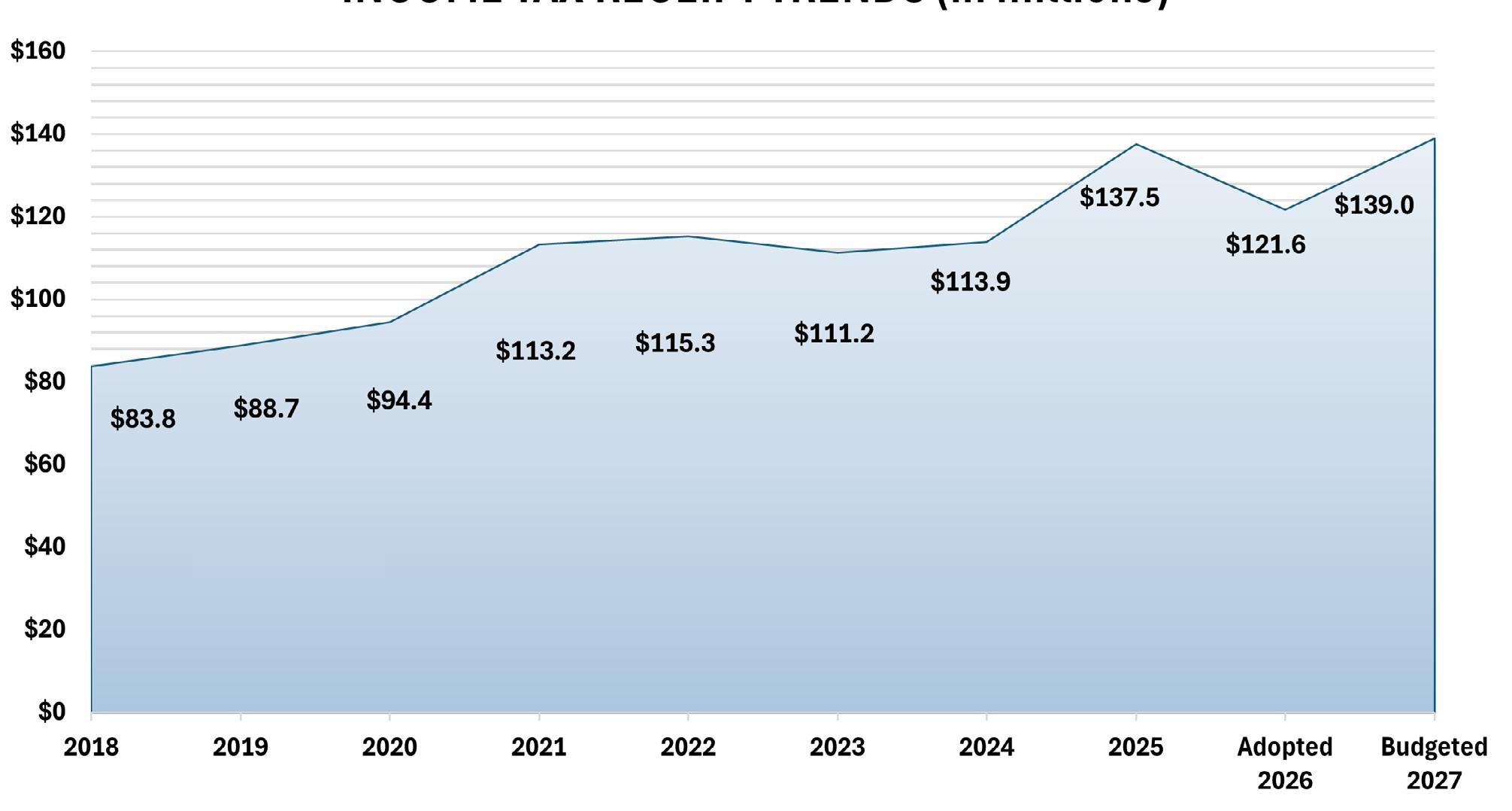
Income tax is the county’s second-largest revenue source. Local income taxes in Maryland are levied as a percentage of state taxable income; the county’s rate remains 3.2 percent. Income tax revenue for FY 2027 is estimated at $139 million, representing approximately 33 percent of General Fund revenues.
Other taxes consist primarily of recordation taxes generated from real estate financing transactions. Recordation tax revenue is projected at $8.7 million in FY 2027, reflecting an increase of $0.5 million over the FY 2026 budget.
Intergovernmental revenues are received from state and federal sources, as well as reimbursements from the Housing Authority for payroll processed on its behalf, with corresponding expenditures recorded by the county. Additional revenue is generated from 911 fees collected through telephone service providers. These revenues may be provided as formulabased aid or program-specific grants and may also support capital projects.
Charges for services represent fees assessed by the county to offset the cost of providing various services. These include zoning and inspection fees, protective inspection fees, reimbursements from the towns of Chesapeake Beach and North Beach for sheriff’s deputies, and fees collected from inmates participating in the Detention Center work-release program.
Miscellaneous revenues are derived from investment earnings, rents and concessions, donations, park entrance fees and recreation fees. This category can fluctuate from year to year; however, interest income in the General Fund is projected to increase in FY 2027, reflecting current market conditions.
Other financing sources include transfers between funds, which occur throughout the fiscal year to support operations and capital needs. Transfers in are recorded as revenue in the receiving fund, with corresponding transfers out recorded as expenditures in the originating fund.
REVENUE HIGHLIGHTS
INCOME TAX RECEIPT TRENDS (IN MILLIONS)
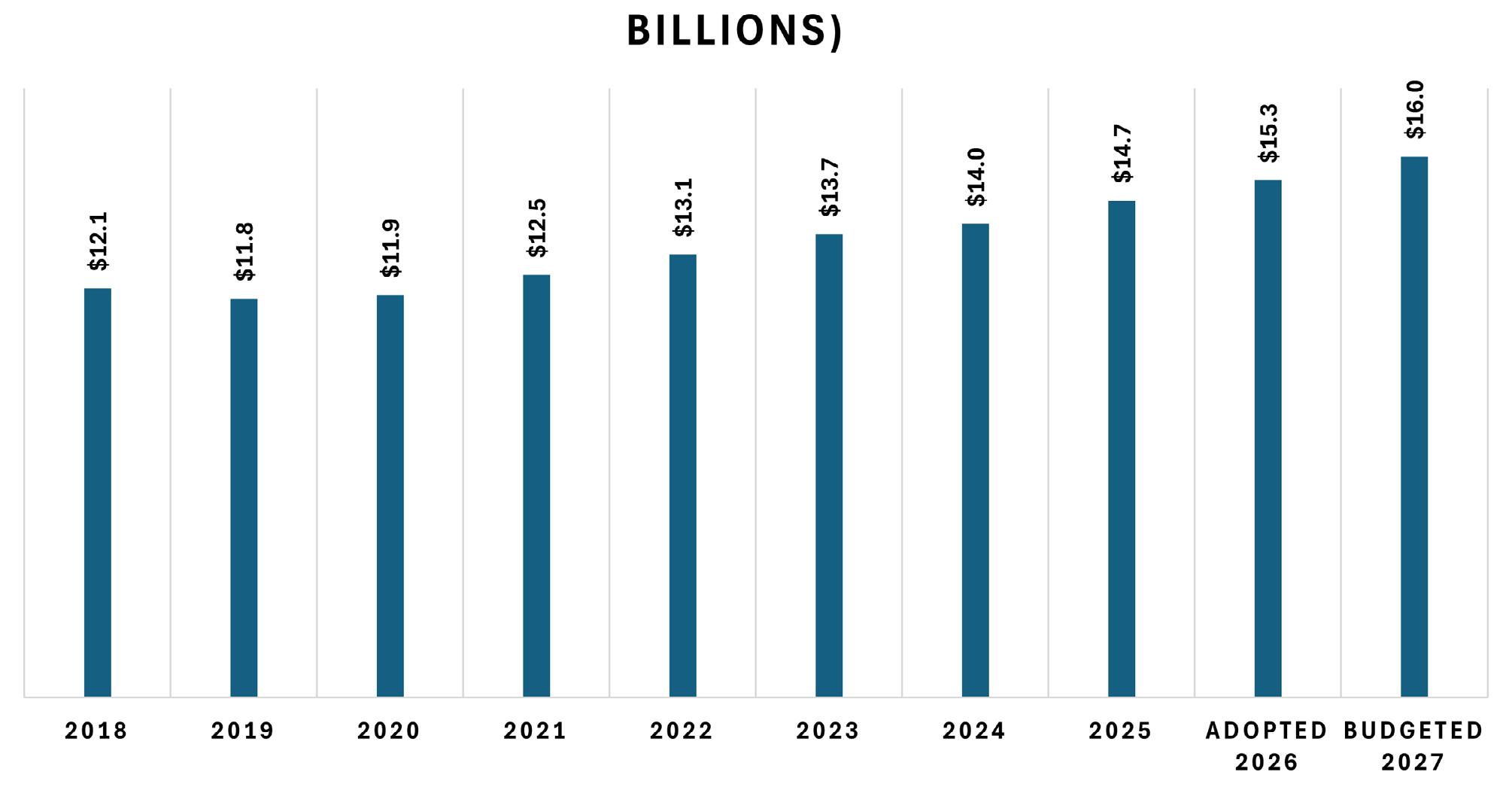
REAL PROPERTY ASSESSMENT VALUE TRENDS (IN BILLIONS)
REVENUE HIGHLIGHTS
MAJOR COMPONENTS OF GENERAL FUND REVENUES (IN MILLIONS)
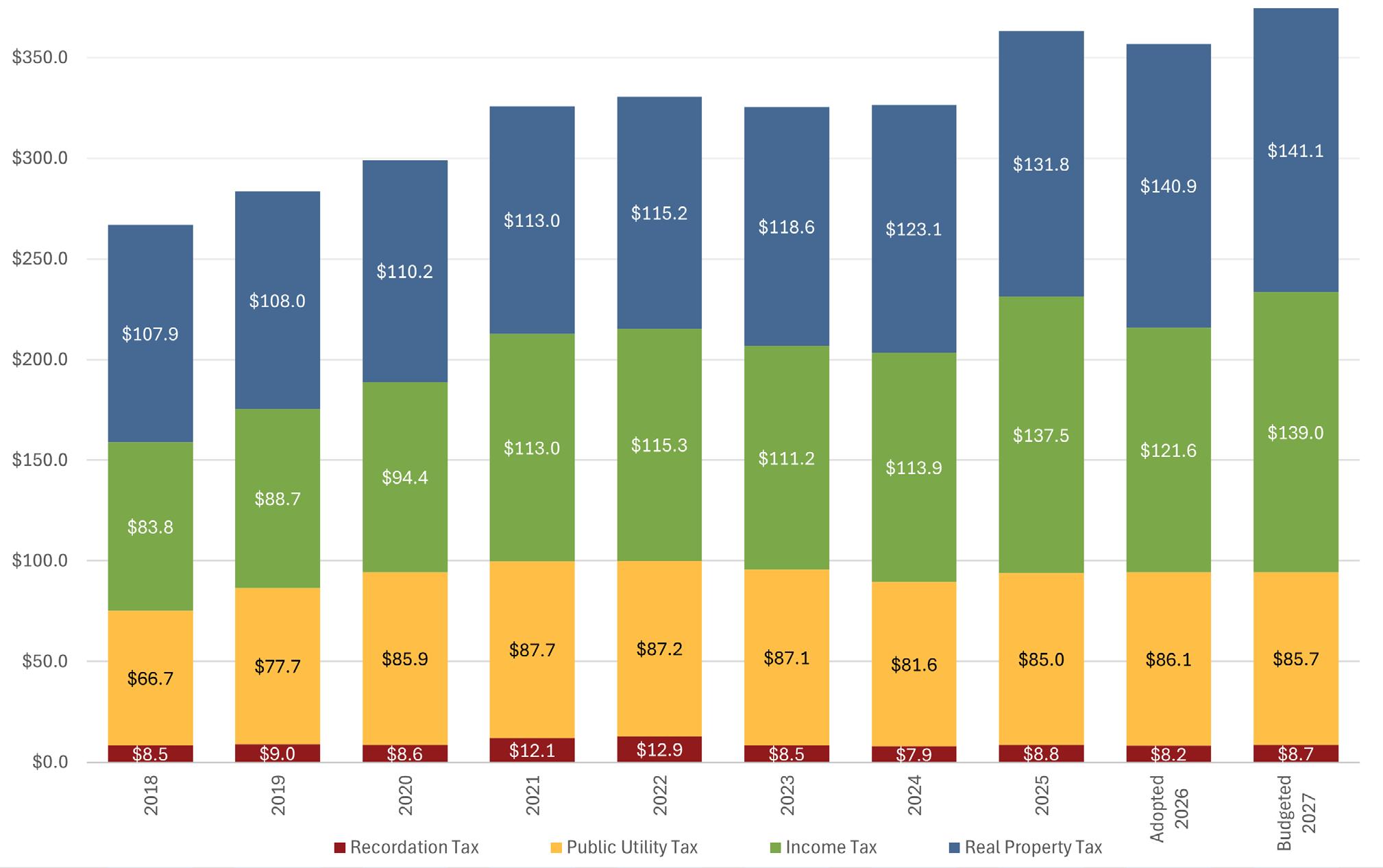
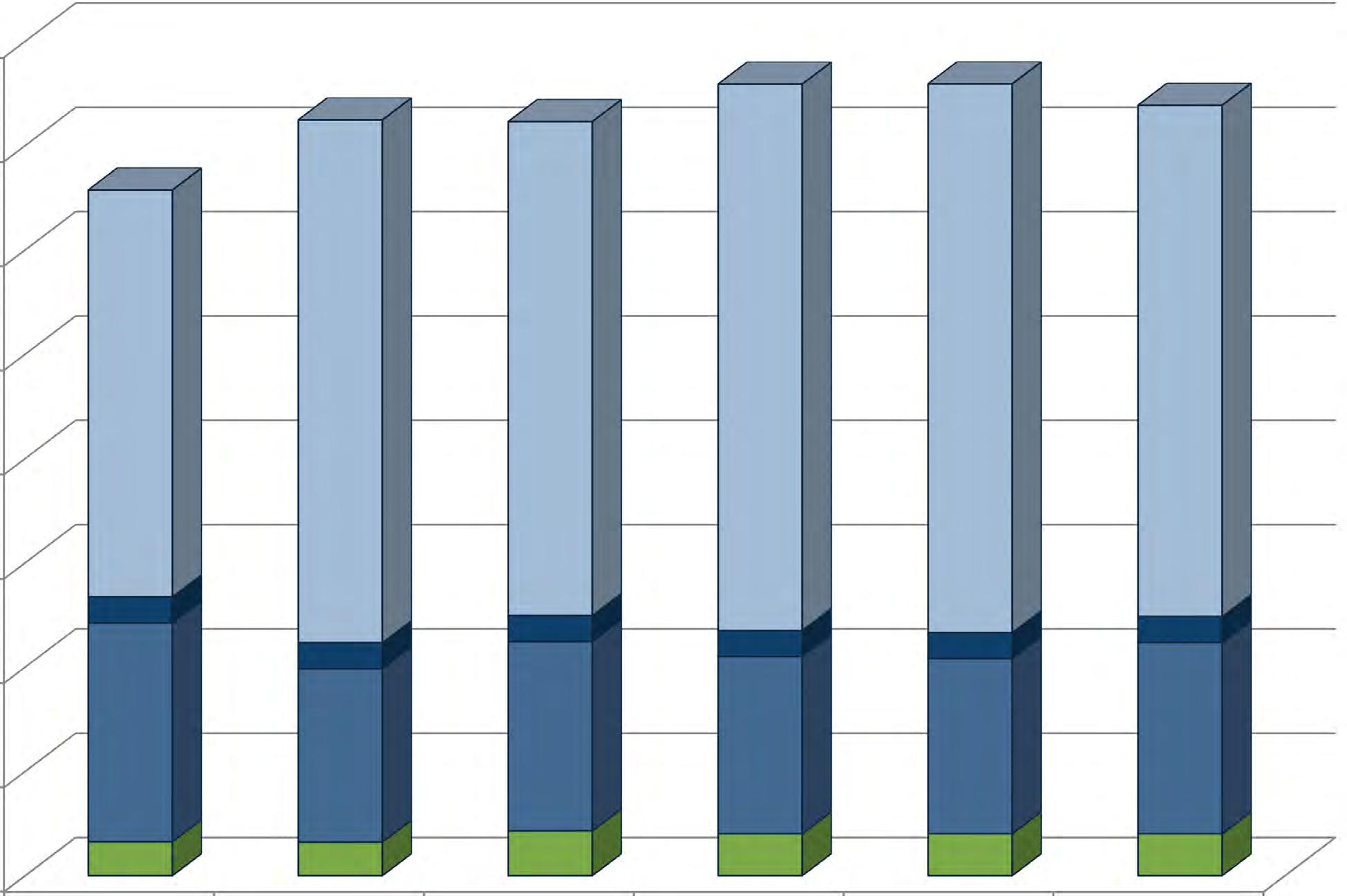
The General Fund takes in all of the taxes and many other revenue sources which fund local government services. In the FY 2027 budget, General Fund revenues total $420.5 million. The revenue components make up this total change from year to year. This chart reflects the changes in the Calvert County revenue “mix” over the past ten years.
The red bar area are recordation taxes which had trended up in recent years but are flattening out beginning in FY 2023.
The yellow bar area include corporate personal property taxes, payments in lieu of taxes and public utility taxes.
The green bar area represent income taxes. FY 2027 continues the historical upward trend for income taxes.
The blue bar area represent real property tax revenues.
GENERAL FUND EXPENDITURES BY ORGANIZATION
FUND BALANCE TRENDS
FUND BALANCE TRENDS
The fund balance schedule and the chart above present a recent history and a near-term projection of the county’s General Fund - Fund Balance. The income tax increases along with the revenues from the Cove Point LNG and Constellation facilities have allowed the county to maintain a strong fund balance.
Committed fund balance is mostly comprised of the county’s stabilization arrangement established by resolution at 9% of General Fund expenditures.
PROJECTED SURPLUS/(DEFICIT)
Revenue Assumptions:
GENERAL FUND FORECAST
$(15,303,516)
Real Property revenues are based on the values established by the State Department of Assessment and Taxation, commonly referred to as SDAT, multiplied by the County's tax rate equaling .967 per each $100 of assessed value.
Income Tax revenues are based on a tax rate of 3.2%.
Expenses Assumptions:
Projected Expenditures rely on the expenditure amount in the adopted budget. Future years will be adjusted once the FY 2027 budget is adopted.
COLA: Cost of Living Allowance
OPEB: Other Post Employment Benefits
PILOT: Payment in lieu of taxes
FY 2027 includes a step and a 2.7% COLA.
GENERAL FUND FORECAST
About this forecast:
Numerous assumptions are required in order to map out four years of revenues and expenditures. Financial forecasts can and will have many factors that affect the estimates. Few economists can accurately predict when the next recession or recovery will occur, and yet changes in the economy must be measured along with the growth in businesses, value of real and personal property, employment and the population of the county.
Revenue forecasts are generally based on recent historical data mixed with any known facts that mainly affect future revenues. If future rate or fee changes are not known or planned, it is assumed they remain at the current level. Revenue estimates are extremely important, especially those for real property and income taxes as they make up 91% of the county's general revenues.
Expenditures are estimated by applying inflationary factors to base year budgets. Future salary and fringe benefits are expected to increase as shown, and debt service is estimated based on what is required to fund the current six year Capital Project Budget during the forecasted four year period.
GENERAL GOVERNMENT
• Board of County Commissioners
• County Attorney
• County Administrator
• Communications & Media Relations
• Technology Services
• Circuit Court
• Orphan’s Court
• State’s Attorney
• County Treasurer
• Finance & Budget
• Human Resources
• Planning & Zoning
• Inspections & Permits
BOARD OF COUNTY COMMISSIONERS
DESCRIPTION
The Board of County Commissioner's (BOCC) mission is to ensure a safe and thriving community by promoting transparency, effective communication, balancing sustainable growth with the preservation of our rural character and ensuring all residents throughout their lifetime have access to meaningful opportunities and an exceptional quality of life.
OBJECTIVES
• Maintain strong financial stewardship: Protect the county’s long-term fiscal stability, preserve its AAA bond rating and ensure responsible use of public resources.
• Support safe and balanced growth: Support economic development while preserving Calvert County’s rural character and maintaining public safety.
• Deliver transparent and effective government: Advance clear communication, accountability and efficient delivery of county services.
• Enhance quality of life for all generations: Invest in services, programs and infrastructure that provide meaningful opportunities and support residents at every stage of life.
PERFORMANCE MEASURES
OPERATING BUDGET
COUNTY ATTORNEY
DESCRIPTION
Provides legal service and is legal counsel to the Board of County Commissioners, county administrator and various county departments, offices, agencies, boards, committees and commissions. It is essential that the Office of the County Attorney utilize a method of prioritizing work in order to provide prompt and efficient service. Furthermore, the Office of the County Attorney must assist and contribute to the overall mission of county government
BOCC GOALS
OBJECTIVES
• Prioritize workload within the Office of the County Attorney in order to provide timely and sound legal advice to clients, while maintaining the approved budget in a fiscally conservative manner.
• Attend Board of County Commissioner meetings, as well as other department agency boards and commission meetings, to provide legal guidance on issues that arise during public meetings and hearings.
PERFORMANCE MEASURES
OPERATING BUDGET
STAFFING
COUNTY ADMINISTRATOR
DESCRIPTION
The Office of the County Administrator provides executive leadership and strategic direction to effectively implement the Board of County Commissioners’ (BOCC) priorities, ensure efficient county operations and foster responsive, collaborative relationships with residents and stakeholders.
BOCC GOALS
OBJECTIVES
• Implement BOCC priorities effectively: Ensure timely and coordinated execution of the BOCC directives across all departments and divisions.
• Enhance operational effectiveness: Ensure efficient, accountable and high-quality daily operations across county government
• Strengthen intergovernmental collaboration: Enhance partnerships with local, state and federal agencies to advance county priorities.
PERFORMANCE MEASURES
STAFFING
COMMUNICATIONS & MEDIA RELATIONS
DESCRIPTION
Communications & Media Relations (CMR) manages internal and external communications, brand and image management, centralized marketing and advertising services, media relations, website services, emergency/crisis communications and operation of the Public Education and Government cable television station (HD1070 and Channel 99). CMR proactively and collaboratively provides clear, concise and relevant information to customers and citizens through innovative and effective products and services.
BOCC GOALS
OBJECTIVES
• Continue to expand outreach efforts for county government activities through electronic media including increased distribution and enhanced awareness of BOCC goals and objectives.
• Develop updated communications strategy and execute improved programs to deliver communications objectives throughout the county government organization and the public.
• Provide communications support to Public Safety during emergencies.
PERFORMANCE MEASURES
STAFFING
TECHNOLOGY SERVICES
DESCRIPTION
Enable county departments to accomplish their goals through the provision of dependable and secure computer systems and technological solutions.
BOCC GOALS
OBJECTIVES
• Foster the responsible and ethical use of AI across the organization.
• Implement GEOAI to enhance GIS capabilities and spatial intelligence.
• Complete organization-wide implementation of Windows 11.
PERFORMANCE MEASURES
Respond to a cyber incident within an hour and notify the state within one hour of detection. Provide state with full written report within 21 days of a cyber incident.
At least 66% of incidents shall be closed within one day, at least 16% shall be closed within five days and the remainder within 30 days.
Continue to improve and digitalize the permitting and zoning system.
Foster the responsible and ethical use of AI across the organization.
Implement GEOAI to enhance GIS capabilities and spatial intelligence. N/A
Adoption of an enterprise-wide data classification strategy that protects sensitive data while enabling clean, trusted information for analytics and automation.
OPERATING BUDGET
STAFFING
CIRCUIT COURT
DESCRIPTION
The Circuit Court is a court of general jurisdiction that serves the citizens of Calvert County by resolving issues in civil and criminal cases in a timely and professional manner.
BOCC GOALS
The Circuit Court for Calvert County takes pride in providing access to justice to all customers. The goal is to be responsive and adaptable to the ever-changing needs of the customers. Through this goal, we will assure that the highest level of service is provided to all customers.
OBJECTIVES
• Continued efficiency in handling court cases.
• Increased security in and around the courthouse for visitors, staff and litigants.
PERFORMANCE MEASURES
OPERATING BUDGET
STAFFING
STATE’S ATTORNEY
DESCRIPTION
Fulfills a state legislative mandate to prosecute all felony, misdemeanor and must-appear traffic offenses that occur in Calvert County, including homicide, assault, sexual assault, child abuse and neglect, elder abuse, narcotics, domestic abuse, economic crimes, driving impaired by drugs and/or alcohol, Department of Natural Resources violations and more. Handles certain civil proceedings, such as asset forfeiture and child support. Provides outreach services and education to the community through lectures and forums.
BOCC GOALS
OBJECTIVES
• Invite community leaders and law enforcement officials to address the problem of drug overdoses among juveniles.
• Expand the services available to military veterans through our mental health and drug court dockets.
• Bolster our crime victim restitution collection efforts by adding another attorney and support person to track and aggressively prosecute violation of probation cases involving restitution.
PERFORMANCE MEASURES
OPERATING BUDGET
STAFFING
COUNTY TREASURER
DESCRIPTION
Receive and disperse funds for Calvert County Government. Responsible for the initiation of the enforcement of tax collection.
BOCC GOALS
OBJECTIVES
• Continue to increase public awareness of the Treasurer's Office billing process and of credits offered by the State of Maryland Department of Assessments and Taxation and Calvert County Government via newspaper advertisements and Channel 1070 slides.
• Utilize innovative software programs to locate property owners with insufficient addresses.
• Continue with enhancements to Munis Tax System: tax sale, audit letters, credits, etc. to better assist the needs of the customers and the Treasurer's Office.
• Increase the number of Homeowner Tax Credits approved for homeowners in Calvert County.
PERFORMANCE MEASURES
OPERATING BUDGET
STAFFING
FINANCE & BUDGET
DESCRIPTION
The Department of Finance & Budget ensures the financial sustainability of Calvert County by providing accurate, timely and transparent fiscal information. We foster public trust and support informed decision-making, while our strategic procurement drives quality and value for county residents. Through efficient, innovative business processes, we maintain the county's AAA bond rating, support internal controls to mitigate risk and safeguard assets against fraud and waste. Core functions include budget development and execution; general accounting and auditing; procurement; financial reporting; payroll; and capital planning and debt management.
BOCC GOALS
OBJECTIVES
• Fiscal responsibility: Safeguard the county's AAA bond rating and enhance financial transparency by improving upfront budget forecasting and ensure rigorous reporting standards that support long term fiscal health.
• Public stewardship: Optimize operations through process improvements and automation to mitigate operational risks, improve compliance and strengthen internal controls.
• Workforce resilience: Strengthen the workforce by prioritizing continuous learning and skills development and enhancing process documentation to safeguard the county's financial operations.
PERFORMANCE MEASURES
OPERATING BUDGET
HUMAN RESOURCES
DESCRIPTION
Provides employment related services for Calvert County Government as well as to its employees and managers so that they may achieve their operational goals. Administers programs for recruitment, examination and selection; position classification; pay and leave; performance evaluation; training and development; safety and risk management; health, retirement and voluntary benefits; and employee relations. Provides staff support to the Police Accountability Board and Administrative Charging Committee.
BOCC GOALS
OBJECTIVES
• To provide employee development services to include personal growth, skill, safety and supervisor development training opportunities and tuition assistance.
• To provide an effective recruitment program.
• To provide a wide range of benefits to enhance the lifestyle of our employees, their families and their dependents while addressing rising healthcare costs.
• To provide efficient support to the Police Accountability Board and Administrative Charging Committee in collecting, reviewing and managing citizen complaints and investigations of police misconduct.
PERFORMANCE MEASURES
STAFFING
PLANNING & ZONING
DESCRIPTION
Coordinates all planning activities within Calvert County Government, including development review, permitting and inspections, appeals, variances and exceptions, as well as other boards and commissions. Administers the zoning ordinance, subdivision regulations and the Building Code. Advises the Board of County Commissioners about growth and development in Calvert County.
BOCC GOALS
OBJECTIVES
• Continue the process of updating the Master Plan of Town Centers and Zoning Ordinances with completion and adoption of the Prince Frederick and the Dunkirk Chapters 2025 and the Owings and Huntingtown Chapters in 2026.
• Update the Agricultural Preservation District Rules and Regulations in 2025.
• Continue to improve the INFOR/IPS land management system software for all staff to utilize to its fullest advantage, including the Development Review, Board of Appeals, Inspections and Permitting processes.
• To provide clarity of requirements and transparency in the review and permitting processes by developing enhanced design and process manuals to achieve better customer service.
PERFORMANCE MEASURES
OPERATING BUDGET
INSPECTIONS & PERMITS
DESCRIPTION
Provide for the health, safety and welfare of all citizens of Calvert County by preventing and correcting hazards attributed to the built environment. Provides effective, efficient and equitable administration and enforcement of the International Building Codes, National Electrical Code, the International Plumbing Code and all other applicable local ordinances. Acts as a liaison between local government agencies and the construction community and ensures that a service oriented, professional atmosphere is always present. Maintains effective working relationships with our customers, which include property owners, developers, contractors, sub-contractors, engineers, architects and co-workers through effective communication skills.
BOCC GOALS
OBJECTIVES
• Provide citizens with timely inspections (within 24 hours of scheduling) for all Calvert County construction projects.
• Provide at least two educational seminars for staff and public regarding code updates/compliance within the next fiscal year.
• Create public outreach and educational materials for citizens regarding code adoptions and permitting processes within the next two years.
• Provide "real time" results and information of inspections performed for all Calvert County construction projects.
PERFORMANCE MEASURES
OPERATING BUDGET
STAFFING
PUBLIC SAFETY
• Director of Public Safety
• Animal Services
• Emergency Communications
• Emergency Management
• Fire-Rescue-EMS
• Career EMS Division
• Sheriff’s Office
• Detention Center
DIRECTOR OF PUBLIC SAFETY
DESCRIPTION
The Department of Public Safety exists to enhance safety and preparedness in Calvert County through strong leadership, collaboration and meaningful partnerships. Our department is dedicated to the efficient management of daily calls requiring emergency responders and the operation of our 24-hour Emergency Communications Center (911), serving as the vital link between our citizens and life-saving assistance. We are committed to proactively mitigating manmade, technological and natural disasters, while responding effectively to fire, rescue and medical needs through our Volunteer and Career EMS services. This includes managing a centralized EMS transport cost recovery system, utilizing a "soft billing" model to secure financial reimbursement from insurance providers, ensuring that residents face no out-of-pocket expenses for emergency transport. Provides efficient management of daily calls requiring response and investigation by our Animal Control Officers. Provides humane sheltering of animals that have been surrendered by an owner, or stray animals that have been found. In addition, the Department of Public Safety is responsible for assertively reducing the number of false alarm dispatches and assisting the Calvert County Sheriff's Office, as well as the Maryland State Police, in the efforts to protect and service the citizens of Calvert County.
BOCC GOALS
OBJECTIVES
• Protect lives and property by effectively preparing for, preventing, responding to and recovering from natural disasters or storms in Calvert County.
• Collaborate with internal and external agencies to contain, supervise, enforce and mitigate events to include but not limited to; Dragon Boat Races, Balloon Festivals, Waterman's Association Boat Docking Contest, Calvert County Fair, concerts, etc. that have the potential of attracting large crowds in Calvert County.
• Educate the public on the purpose of the False Alarm Reduction Unit and EMS transport cost recovery system through social media and by attending special events such as resource fairs, Calvert County Fair, open houses, National Night Out, etc.
PERFORMANCE MEASURES
OPERATING BUDGET
STAFFING
ANIMAL SERVICES
DESCRIPTION
The Animal Services Division operates the Linda L. Kelley Animal Shelter. The division supports the care of animals received from Calvert County citizens and Animal Control. The division has developed and maintained successful volunteer and foster programs and has a good rapport with many rescue partners. Together with Animal Control, this division is committed to maintaining public safety and to facilitate the adoption of healthy animals to the citizens of Calvert County.
BOCC GOALS
OBJECTIVES
• Provide temporary housing to owner-relinquished, stray, abused and rabies-quarantined animals in Calvert County.
• Promote adoption of relinquished, stray and abused animals in Calvert County through the Linda L. Kelley Animal Shelter.
• Support the Animal Control Division with the management of animals brought to the shelter through animal cruelty or public safety investigations.
PERFORMANCE MEASURES
STAFFING
EMERGENCY COMMUNICATIONS
DESCRIPTION
Answers 911 calls and provides answers and/or directions to help save lives, protect property and assist the public during times of emergencies or crisis. Dispatches Police, Fire and EMS services to the citizens of Calvert County. Handles requests for services by phone or radio.
BOCC GOALS
OBJECTIVES
• Continue to submit projects to the Emergency Number Systems Board which meet guidelines for funding for reimbursement to Calvert County.
• Work in tandem with Quality Assurance Coordinator to improve overall protocol compliance.
• Continue to deploy the PEAR Team to as many events as possible to teach the citizens about 9-1-1.
PERFORMANCE MEASURES
deploy the PEAR Team to as many events as possible to teach the
STAFFING
EMERGENCY MANAGEMENT
DESCRIPTION
The Mission of the Emergency Management Division is to minimize the effects of disasters to citizens through planning, training, mitigation and response efforts: by coordinating the response agencies and fostering public education and awareness. The mission also includes developing recovery plans in order for the county and its citizens to recover as soon as possible from a natural or manmade disaster.
BOCC GOALS
OBJECTIVES
• Be responsive to and provide great customer service to the citizens and visitors of Calvert County.
• Enhance the ability to communicate during an emergency or disaster, both within the county government and to the citizens and visitors of Calvert County.
• Work with all stakeholders, county, state, citizens groups and private industry to ensure preparedness to respond to and recover from an emergency or disaster, as well as develop ways to prevent an emergency or disaster.
• Ensure that staff is trained and strives to meet the state and national training goals for Emergency Management in the Professional Development Series standard.
• Work with citizens groups to assist in preparing their families to protect themselves in the event of a natural or manmade disaster.
PERFORMANCE MEASURES
STAFFING
FIRE-RESCUE-EMS
DESCRIPTION
Our principle goal is to support the delivery of high-quality fire-rescue-emergency medical services to the citizens of Calvert County in the most effective, professional and efficient manner possible, while upholding the county's policies, procedures and directives. To promote partnerships within the public safety community and to promote recruitment and retention of volunteer personnel by providing education, training and benefit opportunities.
BOCC GOALS
OBJECTIVES
• Continue development of objective Fire-Rescue-Emergency Medical Services (EMS) response performance measures and work to identify areas where improvement is needed.
• Support promotional and educational activities in support of our Volunteer Fire-Rescue-EMS Departments.
PERFORMANCE MEASURES
OPERATING BUDGET
CAREER EMS DIVISION
DESCRIPTION
The Department of Public Safety's Career Emergency Medical Services (EMS) Division's principal goal is to supplement the delivery of high quality EMS to the citizens and visitors of Calvert County in the most effective, professional and efficient manner possible. The Career EMS Division utilizes paramedic staffed EMS apparatus strategically placed throughout the county to provide Advanced Life Support Care alongside our Volunteer Fire-Rescue-EMS providers.
BOCC GOALS
OBJECTIVES
• Recruit, orient and retain qualified Paramedics and Emergency Medical Technicians (EMT’s) for allotted Career EMS positions.
• When dispatched, trained personnel arrive on the scene of the emergency within 10 minutes.
• Expand presence in community outreach
PERFORMANCE MEASURES
OPERATING BUDGET
STAFFING
DESCRIPTION
Provide exceptional law enforcement services to the citizens of Calvert County. Prevent crime and the fear of crime through innovative law enforcement efforts. Serve as the primary law enforcement agency for Calvert County.
BOCC GOALS
OBJECTIVES
• Reduce drug overdose deaths.
• Reduce crashes on our roadways.
• Remove impaired drivers from our roadways.
PERFORMANCE MEASURES
OPERATING BUDGET
COVE POINT LNG SECURITY
DESCRIPTION
The Calvert County Sheriff's Office provides critical infrastructure security to the Cove Point Liquefied Natural Gas Facility.
BOCC GOALS
CHESAPEAKE BEACH & NORTH BEACH PATROLS
DESCRIPTION
Provide exceptional law enforcement services to the citizens of Calvert County. Prevent crime and the fear of crime through innovative law enforcement efforts. Serve as the primary law enforcement agency for the county.
BOCC GOALS
OBJECTIVES
• Reduce illegal drug use and it’s effects.
• Reduce crashes on our roadways.
• Remove impaired drivers from our roadways.
OPERATING BUDGET
STAFFING
DETENTION CENTER
DESCRIPTION
To protect the community through the safe housing of incarcerated inmates who range from dangerous to medically dependent and/or mentally ill. To provide programs to reduce the likelihood of recidivism. To conduct daily security operations while demanding the highest level of professionalism and integrity from our staff.
BOCC GOALS
OBJECTIVES
• Engage individuals in the criminal justice system struggling with behavioral health concerns with clinically appropriate services and supports.
• Educate and connect individuals to community programs that can provide resources upon release. These community programs are essential in promoting independent living and reducing recidivism.
• Expand the capabilities of the Detention Center to safely house and provide basic care for a burgeoning population of mentally ill inmates.
• Safely and efficiently provide mandated care to medically challenged and detoxifying inmates held in the facility.
• Continue to safely and efficiently operate within the original jail structure while planning new construction options to address the drastic changes in prisoner population needs.
PERFORMANCE MEASURES
OPERATING BUDGET
STAFFING
PARKS & RECREATION
• Parks & Recreation
• Natural Resources
PARKS & RECREATION
DESCRIPTION
In partnership with Calvert County residents, the Department of Parks & Recreation cultivates programs, parks and services that positively impact quality of life, preserve natural and cultural resources, promote economic stability and satisfy community needs for opportunities in recreation, wellness, knowledge and connecting with nature. The Department of Parks & Recreation strives to enhance the health, economy and wellbeing of our community through sustainable practices, leisure opportunities and environmental stewardship. The Strategic Plan for the Department of Parks & Recreation identifies eight goals.
BOCC GOALS
OBJECTIVES
• Meet the present and future needs of the community.
• Enhance services and facilities.
• Make significant progress toward strategic plan goals.
PERFORMANCE MEASURES
OPERATING BUDGET
NATURAL RESOURCES
DESCRIPTION
Preserve, manage and operate the natural resource areas for the purpose of providing compatible outdoor recreation and educational opportunities for the public. Areas/Sites managed: Battle Creek Cypress Swamp Sanctuary, Flag Ponds Nature Park, Kings Landing Park, Biscoe Gray Heritage Farm, Gatewood Preserve, Nan’s Cove, Solomons' Boat Ramp and Fishing Pier, Hughes Tree Farm, Hutchins Pond and Ward Farm Recreation and Nature Park.
BOCC GOALS
OBJECTIVES
• Provide curriculum-based educational field experiences for all 1st, 3rd and 5th grade classes in Calvert County Public Schools throughout the school-year.
• Schedule at least 130 outdoor recreation and environmental education programs at each nature park for the general public (ages 18 months through adult) throughout the year.
• Offer a comprehensive volunteer program to include job descriptions, recruitment, training, evaluation and recognition objectives to expand volunteer opportunities throughout the department. For FY 2027, we plan to maintain past levels of service for Calvert Stewards, while expanding the department's volunteer program to engage 50 volunteers in park stewardship and recreational programming providing an additional 1,000 hours of service throughout the year.
PERFORMANCE MEASURES
Citizens will learn about the ecology via naturalist led activities exploring the different nature parks
Volunteers will be engaged in a variety of projects in the implementation of Parks & Recreation Department programming, facilities and operations
OPERATING BUDGET
STAFFING
MUSEUM
• Railway Museum
RAILWAY MUSEUM
DESCRIPTION
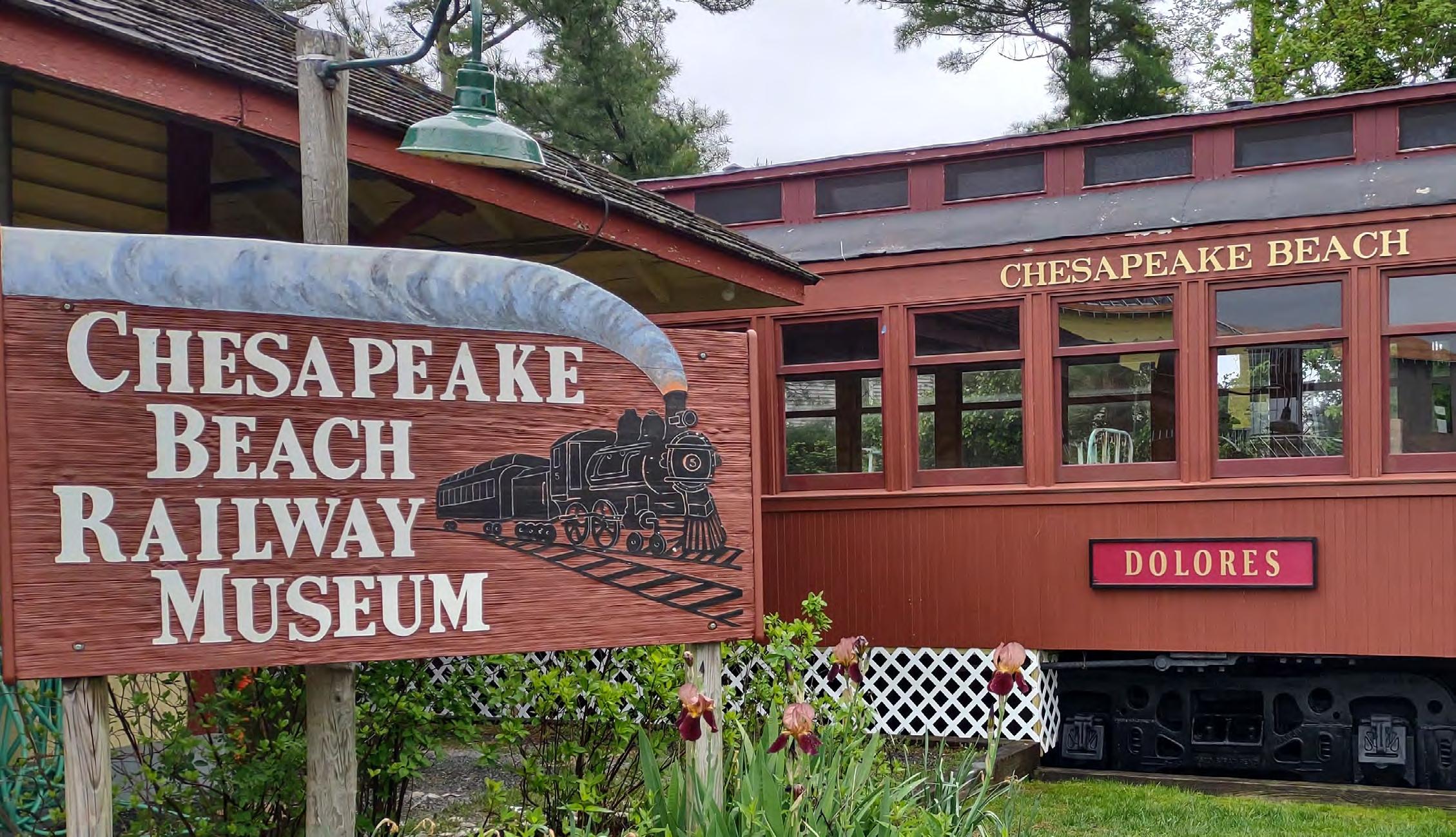
The Chesapeake Beach Railway Museum (CBRM) tells the story of the Chesapeake Beach Railway (CBRy) and its ultimate destination, the Chesapeake Beach Park, from the official opening day on June 9, 1900, to the demise of the railway in 1935 and the subsequent closing of the park in 1972. The museum, which is listed on the National Register of Historic Places, is housed within the railway station and includes the grounds area as part of its easement. It is the sole remaining railway station/depot from the CBRy and the only one of its kind in Calvert County. The 1880's refurbished "Dolores" parlor car sits on the grounds behind the museum and is the last remaining known parlor/passenger car from the railway.
BOCC GOALS
OBJECTIVES
• Provide opportunities for cultural engagement; provide resources and opportunities to citizens of all ages; provide opportunities for activities; work to protect the environment, heritage and rural character through everything we do; and contribute to the economic development of the county through tourism.
• To conserve and preserve utilizing best museum practices while maintaining the historical elements of the CBRM's historical railway.
• To enhance the public value of CBRM's collections through acquisitions and good stewardship, curation and interpretation while continuing on as a community and public resource for outreach, research and educational programs.
PERFORMANCE MEASURES
The museum's mission is served and our base of community stakeholders commit their talent and experience towards shared goals.
Continue to provide comprehensive collections material for research so that the collections may continue to tell the story of the CBR, the amusement park and the towns of Chesapeake Beach and North Beach.
Continue to engage citizens, staff, CBRM members and volunteers to help achieve these objectives with an ongoing expanded recorded history of the railway, the amusement park and the towns of Chesapeake Beach and North Beach.
OPERATING BUDGET
STAFFING
PUBLIC WORKS
• Public Works
• Project Management
• Capital Projects
• Engineering
• Highway Maintenance
• General Services
• Grounds
• Custodial
• Facilities
• Mosquito Control
• Fleet Maintenance
PUBLIC WORKS
DESCRIPTION
Provide Calvert County citizens with cost-effective, safe, quality and environmentally friendly facilities, infrastructure and services through creative planning, quality design, efficient construction and proper maintenance in a team-oriented environment.
BOCC GOALS
OBJECTIVES
• Objectives and performance program/service output and outcome measures are shown within each of the following divisions managed under the Department of Public Works.
PERFORMANCE MEASURES
Objectives and performance program/service output and outcome measures are shown within each of the following divisions managed under the Department of Public Works.
STAFFING
PROJECT MANAGEMENT
DESCRIPTION
The Project Management Division is responsible for reviewing and approval of all grading and utility permit applications for single-family dwellings, commercial sites, mass grading plans, road construction and county right-of-way utility cuts. Inspectors provide assurance to the citizens of Calvert County that construction and county contracted work related to this division meets the highest standards and complies with the county's Department of Public Works road ordinance, the erosion and sediment control ordinance and the storm water management guidelines. Citizen inquiries and environmental concerns are given the highest priority and receive timely responses.
BOCC GOALS
OBJECTIVES
• Provide excellent customer service to all citizens of Calvert County.
• To ensure the highest quality standards and specifications are met with contractors.
• To ensure that all grading and stormwater inspections are in compliance with the erosion and sediment control and stormwater management ordinances.
• To ensure that the rental service and other contracts including paving, guardrail, tree
and in a safe and cost-effective manner.
PERFORMANCE MEASURES
OPERATING BUDGET
STAFFING
CAPITAL PROJECTS
DESCRIPTION
Provide Calvert County citizens with cost-effective, safe, quality and environmentally friendly facilities, infrastructure and services through creative planning, quality design, efficient construction and proper maintenance in a team-oriented environment.
BOCC GOALS
OBJECTIVES
• Develop and maintain a division that is focused on being fiscally responsible and effectively planning out capital projects.
• Begin construction for the road improvements portions of Little Cove Point Road.
• Finish the construction of the new County Administration Building.
PERFORMANCE MEASURES
STAFFING
ENGINEERING
DESCRIPTION
Provide Calvert County citizens with cost-effective, safe, quality and environmentally friendly facilities, infrastructure and services through creative planning, quality design, efficient construction and proper maintenance in a team-oriented environment.
BOCC GOALS
OBJECTIVES
• Process road Public Works Agreements (PWA) within 30 days.
• Continue providing professional review of subdivision and site plans.
• Continue supervising all public facilities construction and maintenance projects.
• Continue reviewing road plans within 90 days.
• Continue designing and constructing county roadways.
PERFORMANCE MEASURES
STAFFING
HIGHWAY MAINTENANCE
DESCRIPTION
Oversees the maintenance and care of the county's road network and maintains over 900 lane miles as follows: improves drainage, repairs pot holes, maintains roadside shoulders, performs roadside mowing, maintains roadway guardrails, roadway line stripping, maintains road signage, litter pickup and cuts back roadside trees. Responds to all emergency weather related situations such as snow removal, fallen trees, roadway flooding, etc.
BOCC GOALS
OBJECTIVES
• Continue to serve the citizens of Calvert County by maintaining roadways through debris removal, patching and paving of roadways and providing proper and adequate signage.
• Maintain grassy areas by mowing in a timely manner to assure good sight distance for citizens visibility.
• Maintain and install new drainage systems to assist with proper stormwater management.
• Keep trees trimmed and cut back on all county roadways.
• Make sure all signage throughout the county meets required standards.
PERFORMANCE MEASURES
STAFFING
GENERAL SERVICES
DESCRIPTION
Provides real property management support. Oversees the operations and maintenance of all improvements in county offices, libraries, senior centers, community centers and the county mailroom. Provides oversight and direction to the following sections: buildings, grounds, custodial, fleet maintenance, mailroom and mosquito control.
BOCC GOALS
OBJECTIVES
• Initiate and complete Capital Improvement Projects.
• Provide appraisal services, property acquisitions, environmental phase I studies and leases.
• Continue to provide Calvert County Government with outgoing, printing and processing of package drop-offs and shipments.
PERFORMANCE MEASURES
STAFFING
GROUNDS
DESCRIPTION
Responsible for maintaining county grounds to include exterior maintenance and repairs to all landscape and hardscape areas related to county facilities.
BOCC GOALS
OBJECTIVES
• Provide a safe, well-maintained environment for citizens, the community and staff.
• Implement use of environmentally safe tools, machinery and supplies.
• Maintain grounds in cost effective manner, while complying with county and state codes and requirements.
PERFORMANCE MEASURES
STAFFING
DESCRIPTION
Oversees the operations and maintenance of all county offices, mailroom, senior and community centers. Provide a clean and safe environment at facilities for citizens, the community and staff.
BOCC GOALS
OBJECTIVES
• Provide a clean and safe environment at facilities for citizens, the community and staff.
• Maintain facilities at the highest standard possible with available resources.
• Implement practices to efficiently maintain buildings in a socially responsible and environmentally sensitive manner.
PERFORMANCE MEASURES
STAFFING
FACILITIES
DESCRIPTION
Provides comprehensive planning and delivery of maintenance services to all facilities owned by the county for the citizens, county departments and agencies.
BOCC GOALS
OBJECTIVES
• Provide excellent service to support use of buildings for all citizens, county departments and agencies.
• Continue to monitor acceptable standards for workplace environments in county occupied facilities.
• Provide comprehensive planning and delivery of maintenance services of building related operations at county facilities used by citizens, the community and staff.
PERFORMANCE MEASURES
STAFFING
MOSQUITO CONTROL
DESCRIPTION
Promote effective and environmentally sound control of disease-transmitting and pestiferous mosquitoes. Enhance public interest, awareness and support for the control of mosquitoes through meetings, training and education of the public. The mosquito control program is committed to an integrated approach that includes physical, biological and chemical control options to reduce the mosquito population throughout Calvert County.
BOCC GOALS
OBJECTIVES
• Continue community outreach presentations to educate homeowners on the habits and biology of the Asian tiger mosquito, Zika and West Nile Virus.
• Complete all scheduled spray routes.
• Reduction of ULV chemical usage by continuous testing via light traps and landing rate counts.
PERFORMANCE MEASURES
STAFFING
FLEET MAINTENANCE
DESCRIPTION
Provides premium quality repair and service on over 400 vehicles to assure customer safety and satisfaction. Regular checks on the vehicle are encouraged to achieve this goal and safety inspections on customers' vehicles are performed during each service, which occurs every 5,000 miles. The Fleet Maintenance Division ensures that fuel is available at all times for county vehicles and works with all of the end users of vehicles to ensure that the proper vehicle is purchased for the job requirements.
BOCC GOALS
OBJECTIVES
• Maintain an effective preventative maintenance program to ensure safety in all county vehicles.
• Ensure that fuel is available for all county vehicles at all times.
• Increase the number of in-house work orders completed from the previous fiscal year.
PERFORMANCE MEASURES
OPERATING BUDGET
STAFFING
ECONOMIC DEVELOPMENT
ECONOMIC DEVELOPMENT
DESCRIPTION
Enhances and diversifies the economy of Calvert County. Promotes quality economic development and tourism. Increases the commercial tax base and provides new employment opportunities for residents. Administers the county's business development, business retention, agriculture development and tourism programs.
BOCC GOALS
OBJECTIVES
• Provide ongoing assistance to the Calvert County business community through a number of activities including, Buy Local campaigns, workshops and training, implementation of loan/grant programs, matchmaking events, business consultations, job fairs and connection to enhanced resources and programs.
• Create exciting opportunities for visits by travel writers, meeting planners and tour operators to enhance awareness of the county’s assets with the overall goal of increasing visitors and tourism sales.
• Conduct strategic outreach to secure new business and capital investment to Calvert County.
PERFORMANCE MEASURES
STAFFING
COMMUNITY RESOURCES
• Director of Community Resources
• Office on Aging
• Transportation
DIRECTOR OF COMMUNITY RESOURCES
DESCRIPTION
Foster a coordinated and collaborative delivery of human services to the citizens of Calvert County; oversee the provision of programs and services through the Office on Aging, Public Transportation, Calvert Alliance Against Substance Abuse and Calvert County Family Network; serve as liaison for multiple agencies and nonprofits for county based services.
BOCC GOALS
OBJECTIVES
• Facilitate and monitor federal and state grants passed through the county to local agencies and providers to address human service needs.
• Responds to inquiries from citizens and professionals seeking information, referrals and ADA guidance.
• Promote resources at community outreach events and through online resource directories.
PERFORMANCE MEASURES
OPERATING BUDGET
STAFFING
OFFICE ON AGING
DESCRIPTION
Provides programs and services to Calvert County's older adults and their families, thereby enabling them to live with dignity and independence. Offers educational, nutritional, physical fitness and recreational activities at three senior centers, as well as provides volunteer opportunities. Provides information and assistance, benefits counseling, long term care options counseling and supports planning.
BOCC GOALS
OBJECTIVES
• Maintain/increase the number of nutritious congregate and home delivered meals provided to eligible participants.
• Utilize Level One Screening tool for the Maryland Access Point (MAP) program to determine eligibility for long term care support services.
• Provide clients with a range of services/programs that will improve their care and quality of life and promote independence of clients in the least restrictive living environment possible.
PERFORMANCE MEASURES
STAFFING
TRANSPORTATION
DESCRIPTION
Calvert County Public Transportation provides safe, dependable and fare free transportation services to the citizens of Calvert County through eight fixed routes, four demand response routes and one para-transit (ADA) route. The county provides public bus transportation to link residents with major shopping, medical and employment areas, as well as the ability to access transportation services in St. Mary's and Charles County through federal, state and local funding.
BOCC GOALS
OBJECTIVES
• Maintain an acceptable compliance rate with the Maryland Department of Transportation Maryland Transit Administration (MDOTMTA) through predetermined performance measures developed by MDOTMTA as reported in the annual grant application.
• Coordinate with MDOTMTA to update the Transportation Development Plan in FY 2027.
• Continued development of a local Transportation Transfer Station to include design and engineering with funds secured through FY 2026 grant funds.
PERFORMANCE MEASURES
STAFFING
STATE AGENCIES/ INDEPENDENT BOARDS
• Board of Education
• College of Southern Maryland
• Health Department
• Substance Abuse Treatment
• Soil Conservation District
• University of Maryland Extension
• Independent Boards
• Commissions
• State Agencies
• Non-County Agencies
BOARD OF EDUCATION
DESCRIPTION
The Calvert County Board of Education provides a school environment and culture that creates enthusiasm for learning, where all students embrace the value of learning for its own sake. The system serves over 15,000 students in thirteen elementary schools, six middle schools and four high schools. Calvert County Public Schools strive for partnerships with families, government, businesses, churches and community organizations to promote superior academic and extra-curricular activities. The goal is to always place children first.
OPERATING BUDGET
COLLEGE OF SOUTHERN MARYLAND
DESCRIPTION
Prepares its students and community to meet the challenges of individual, social and global changes. As a public two-year open-door institution, the college carries out its mission by promoting intellectual challenges, cultural exploration and social and environmental awareness; providing associate degree and certificate programs, job training opportunities, cultural enrichment, leadership development, community and economic development initiatives, customized workforce training and wellness and fitness opportunities; and encouraging educational excellence, innovative approaches to instruction, problem solving, resource development, system design and service delivery, collaboration with business, educational, community and cultural organizations and teamwork to foster constructive change.
OPERATING BUDGET
HEALTH DEPARTMENT
DESCRIPTION
Provide basic public health services in the areas of community health, mental health and environmental health. Community health includes communicable disease, maternal and child health, reproductive health, health promotion and health choice. Mental health provides evaluations, therapy, medication management and counseling on domestic violence/sexual assault and substance abuse. In environmental health, the department handles septic systems, food program, water sampling, animal rabies investigation and disaster responses.
OPERATING BUDGET
SUBSTANCE ABUSE TREATMENT
DESCRIPTION
Improve public health, safety and community life by providing intensive, outpatient and medically assisted substance abuse treatment to county residents in a fiscally responsible manner. A multi-disciplinary approach partnering with the Department of Public Safety and the local medical community to reduce the negative consequences of substance abuse disorders. Emphasis is placed on specifically reducing prescription drug and other opioid overdose rates through increased access and diversified treatment.
BOCC GOALS
OBJECTIVES
• Increase capacity and access to medically assisted treatment by increasing the number of participating private physicians by 20%.
• Increase number of opiate addicted patients enrolled in medically assisted treatment by 20%.
• Increase percentage of incarcerated patients released to the community enrolled in outpatient treatment for a minimum of 90 days by 20%.
PERFORMANCE MEASURES
OPERATING BUDGET
SOIL CONSERVATION DISTRICT
DESCRIPTION
Promote practical and effective soil, water and related natural resource programs to all county citizens. Services such as development of Soil Conservation and Water Quality (SCWQ). Plans and implementation of Best Management Practices (BMP) are provided on a voluntary basis, through leadership, education, cooperation and locally-led direction. Review single-lot and commercial erosion and sediment control plans.
BOCC GOALS
OBJECTIVES
• Review commercial and single lot erosion and sediment control plans within allotted timeframe.
• Develop Soil Conservation and Water Quality (SCWQ) plans for county landowners.
• Provide engineering and design assistance to county landowners for the installation of structural and nonstructural Best Management Practices (BMP).
PERFORMANCE MEASURES
OPERATING BUDGET
STAFFING
UNIVERSITY OF MARYLAND EXTENSION
DESCRIPTION
Provide informal education, training and programs to enhance the quality of life, safety and civic engagement of residents in the county using unbiased research from the University of Maryland (UMD) in the areas of finance, healthy living, agriculture, natural resources and youth engagement. University of Maryland Extension (UME) Calvert County is a part of a statewide educational system within the College of Agriculture and Natural Resources at the UMD, College Park, funded by federal, state and county.
BOCC GOALS
OBJECTIVES
• Increase local partnerships with schools, public and private agencies and social service organizations to provide research based educational opportunities and activities for Calvert County youth to reach their fullest potential and become responsible and caring citizens with life skills needed to engage in the community and society.
• Increase participant contacts and teaching opportunities to further disseminate information, share knowledge and administer services to help create economic growth, support community development, improve human health, enhance the environment and encourage wise use of natural resources in the county.
• Increase utilization of trained volunteers, fostering an approach that values diversity, equity and inclusion, for reaching county residents and supporting their engagement in protecting the environment/natural resources, mentoring youth and contributing to the economic vitality of the county.
PERFORMANCE MEASURES
OPERATING BUDGET
OPERATING BUDGET
INDEPENDENT BOARDS
COMMISSIONS
OPERATING BUDGET
STATE AGENCIES
OPERATING BUDGET
NON-COUNTY AGENCIES
OPERATING BUDGET
ENTITY-WIDE BUDGETS
• Pensions & Insurance
• Transfers
• Debt Service
PENSIONS & INSURANCE
DESCRIPTION
The county contributes to four pension plans: the Calvert County Sheriff ’s Department Pension Plan, the Calvert County Employees’ Retirement Plan (this plan is closed to new employees), the Calvert County Employees’ Retirement Savings Plan (a 401A plan to which the county contributes 5% of eligible employees’ salary) and the Volunteer Fire Departments’ and Rescue Squads’ Retirement Plan. In addition to pension benefits, the county contributes to employees’ health insurance benefits as well as the required employer related benefits, such as worker’s compensation, unemployment insurance and social security. Employee benefits are administered by the Department of Human Resources.
OPERATING BUDGET
TRANSFERS
OPERATING BUDGET
DEBT SERVICE
OPERATING BUDGET
ENTERPRISE FUNDS
• Revenue Highlights
• Water & Sewer
• Solid Waste & Recycling
REVENUE HIGHLIGHTS
WATER & SEWER FUND
CHARGES FOR SERVICES
Calvert County assesses service charges to residents and businesses connected to the county-operated water and sewer infrastructure. These charges are designed to cover the costs of operations, maintenance, equipment and debt service. Billing occurs on a quarterly basis.
The BOCC implemented the previous base-plus-variable rate structure on Jan. 1, 2006, establishing countywide rates to fully support operational and infrastructure needs. Effective July 1, 2024, the BOCC adopted a revised base-plus-tiered variable rate structure. This updated model promotes water conservation and strengthens the Water & Sewer Fund by increasing reserves to cover up to 180 days of operations, as well as ongoing maintenance and capital improvements. (Specific rates are provided in the appendix.)
CAPITAL CONNECTION FEES
Capital connection fees are assessed when new customers connect to the water & sewer system or when existing customers experience a substantial increase in usage, as determined through permit review and an annual commercial customer audit. These fees help offset the cost of expanding system capacity to accommodate growth.
For FY 2025, the county adopted a uniform capital connection fee of $3,200 per water connection and $21,000 per sewer connection.
OTHER REVENUE SOURCES
Additional revenues are generated from a variety of sources, including septage receiving, meter sales, cell tower lease agreements, bulk water sales, grinder pump fees, leachate treatment charges and interest earnings.
FISCAL YEAR 2025 RESULTS
The Water & Sewer Fund ended FY 2025 with a positive change in net position of $66,688 from operations.
SOLID WASTE & RECYCLING FUND
CHARGES FOR SERVICES
Tipping fees are assessed based on the weight of refuse disposed at the Appeal Transfer Station. These fees primarily apply to commercial haulers and others disposing of large volumes of waste.
Another key revenue source is the solid waste fee, which is assessed annually on all residential and commercial property tax bills as a fixed charge. These revenues support the general operations of the Solid Waste & Recycling program, including the operation of convenience centers and recycling initiatives.
A complete schedule of Water & Sewer and Solid Waste & Recycling rates and fees is available in the appendix (pages 325-326)
WATER & SEWER
DESCRIPTION
The Water & Sewer Division provides the best quality drinking water and wastewater treatment through highly trained and state certified professionals in the most environmentally responsible, sustainable and economical way while providing exemplary customer service to Calvert County customers. Water & Sewer currently serves approximately 5,675 county commercial and residential connections. The Division is responsible for the operation and maintenance of 19 water supply systems, 14 elevated storage tanks, 10 hydro pneumatics tanks, 782 fire hydrants, 45 wastewater pumping stations and five wastewater treatment plants. The Division is also responsible for operations and maintenance of approximately 75 miles of water distribution and 65 miles of sewer infrastructure. The Division produced 725,246,000 gallons of drinking water and treated 522,578,000 gallons of wastewater in FY 2025.
BOCC GOALS
OBJECTIVES
• Upgrade Prince Frederick Wastewater Treatment Plant #1 (Barstow) to increase capacity levels. Continue efforts to complete Geotechnical Investigation to promote design parameter approval by MDE.
• Complete water distribution line replacements in Chesapeake Heights Water system and Shores of Calvert to replace aging water distribution lines and install new valves and to improve service reliability.
• Enhance the efficiency and reliability of the wastewater collection system by implementing major sewer rehabilitation programs in Prince Frederick and Solomons.
PERFORMANCE MEASURES
OPERATING BUDGET
*Indicates staff is 80 hours per pay period.
† Water & Sewerage Division is participating in an apprenticeship program in cooperation with Maryland Rural Water Association and Maryland Department of Labor. This program provides employees with a structured path for career advancement.
SOLID WASTE & RECYCLING
DESCRIPTION
The Solid Waste & Recycling Division provides all customers with efficient, reliable and safe management of Calvert County's solid waste and recycling infrastructure. The Division oversees the county's waste transferred to an out-of-state facility, operates six county convenience centers and maintains one active and one closed landfill. Increases operational efficiency of Calvert County's recycling program, including logistics and handling of various commodities. The Division runs bulk pickup program and environmental monitoring and ensures compliance with federal and state disposal and environmental laws.
BOCC GOALS
OBJECTIVES
• Increase safety and compliance of Calvert County's Solid Waste & Recycling systems.
• Increase Calvert County residents' engagement in recycling activities.
• Improve cost efficiency of Calvert County's recycling programs.
PERFORMANCE MEASURES
OPERATING BUDGET
GRANT FUND
• Grants Summary
• Grants Revenue Highlights
• Schedule of Grant Revenues
• Grant Program Areas
• Schedule of Grant Expenditures
• Grants List
• Grant Areas
{ General Government
{ General Services
{ Human Services
{ Public Safety
SUMMARY AND REVENUE HIGHLIGHTS
SUMMARY
In Calvert County, grant funding helps the local government address a variety of needs. The Grants Fund is used for special projects that are supported in full or part by state and/or federal dollars granted with specific criteria for how the funding may be used. In many cases, Calvert County Government must also provide a match to support these projects.
Grants are typically awarded on a competitive basis. Factors considered in determining grant awards include: the need, the quality and creativity of the proposed project and how well the project meets the grant criteria.
Budgets for each of the proposed projects listed here should be considered preliminary and are not finalized until state or federal funds have been awarded. Typically, these awards are not made until after the county fiscal year has begun.
Once awarded, grants generally set specific requirements mandating that grant funded programs adhere to strict financial stipulations and are monitored for effectiveness. Additionally, a separate audit of federal grants is required each year.
REVENUE HIGHLIGHTS
Grant Fund – The primary sources of grant revenue are federal and state grants along with a County General Fund match and fees collected for services.
Federal grant revenues are projected to increase by $43,611 or 1% in FY 2027 when compared with the FY 2026 Adopted Budget. This is mainly due to changes in Transportation grants.
State grant revenues are projected to increase in FY 2027 by $455,366 or 19% over the FY 2026 Adopted Budget. There are many small increases and decreases that contributed to this revenue source. Maryland 9-1-1 Board grants are large contributing factors in this increase.
General Fund Transfers to support grant funded initiatives will increase by a total of $766,689 or 33% in FY 2027 as compared to the FY 2026 Adopted Budget.
Other revenues are projected to increase by $21,124 or 6% in FY 2027 as compared to the FY 2026 Adopted Budget.
GRANTS SUMMARY OF REVENUES
REVENUE TOTALS
SCHEDULE OF FEDERAL GRANT REVENUES
SCHEDULE OF FEDERAL GRANT REVENUES
SCHEDULE OF STATE GRANT REVENUES
SCHEDULE OF STATE GRANT REVENUES
SCHEDULE OF CHARGES FOR SERVICES
SCHEDULE OF OTHER REVENUE SOURCES
GRANTS
SUMMARY OF EXPENDITURES
REVENUE TOTALS
GRANT PROGRAM AREAS
Slightly less than half of the grant funds included in the FY 2027 Adopted Budget will be devoted to human services, including public transportation, programs for senior citizens, people experiencing homelessness and those in need of emergency food and shelter.
Grant funds are proposed for General Government to fund family services programs in Circuit Court, child support prosecution and marketing activities to enhance economic development.
Public Safety also benefits from grant funds in this budget. Grant dollars are used for such programs as child support enforcement, transportation of juvenile offenders, training of emergency services personnel and to provide protective equipment for police officers.
SCHEDULE OF GRANT EXPENDITURES
SCHEDULE OF GRANT EXPENDITURES
SCHEDULE OF GRANT EXPENDITURES
GRANTS LIST
GRANTS GENERAL GOVERNMENT
REVENUE TOTALS
EXPENDITURE TOTALS
STAFFING
ADULT TREATMENT COURT
DESCRIPTION
This is an 18 month minimum specialty court where participants plead guilty to their crime and as a condition of probation they voluntarily enter this court. It entails intensive treatment, weekly case management meetings and monthly judicial reviews. Treatment courts have been statistically proven to be the most cost effective way to combat substance abuse problems and therefore positively impact the criminal justice system.
OPERATING BUDGET
CHILD SUPPORT - FAMILY MAGISTRATE
DESCRIPTION
Provides financial support to operate a program designed to provide child support enforcement services, including hearings and court orders, in accordance with the Federal Department of Health and Human Services (HHS) approved state plan under Title IV-D of the Social Security Act and the Cooperative Reimbursement Agreement Application.
OPERATING BUDGET
- Family Magistrate
CHILD SUPPORT - STATE’S ATTORNEY
DESCRIPTION
Provides legal representation and enforcement of child support orders; prepares and reviews all pleadings for factual and legal sufficiency; files civil, contempt and criminal pleadings with the Clerk’s Office; meets with parties to negotiate an agreement for child support obligations; interviews customers; coordinates paternity testing and keeps a database list; prepares child support liens, garnishments and other documentation to facilitate child support payment collection.
OPERATING BUDGET
FAMILY SERVICES
DESCRIPTION
Develop and/or administer court-operated services to families and children including: alternative dispute resolution programs, parent education, substance abuse assessments, custody evaluations, home studies, mental health evaluations, visitation services, domestic violence programs, child counsel and Child in Need of Assistance Services.
OPERATING BUDGET
DESTINATION MARKETING
DESCRIPTION
Supports the county’s efforts to provide high visibility advertising and marketing of local tourist sites and attractions.
OPERATING BUDGET
METROPOLITAN PLANNING ORGANIZATION (MPO)
DESCRIPTION
Located in the southern portion of Calvert County and the western portion of St. Mary’s County surrounding the Patuxent River Naval Air Station, the Calvert-St. Mary’s Metropolitan Planning Organization (C-SMMPO) is a small regional transportation planning agency whose members include Calvert County, St. Mary’s County and MDOT. See the boundary map below.
OPERATING BUDGET
GRANTS GENERAL SERVICES
REVENUE TOTALS
EXPENDITURE TOTALS
GRANTS HUMAN SERVICES
REVENUE TOTALS
EXPENDITURE TOTALS
GRANTS HUMAN SERVICES
STAFFING
COMMUNITY FIRST CHOICE (CFC)
DESCRIPTION
Provides a supports planning service for applicants and participants who are applying to or enrolled in Home and Community-Based Services (HCBS) Programs. Key Areas of Supports Planning Service: coordinate medical eligibility determinations and redeterminations, engage individuals in person-directed planning, facilitate the process for individuals who choose to self-direct, assist applicants residing in a nursing facility with developing a transition plan to live in the community, identify potential barriers in the community and coordinating available services and support, and assist with locating and applying for available housing options, including identifying and assisting with resolving housing barriers.
OPERATING BUDGET
DEVELOPMENTAL DISABILITIES ADMINISTRATION (DDA)
DESCRIPTION
Provides a range of supportive services for older adults with developmental disabilities.
OPERATING BUDGET
GUARDIANSHIP
DESCRIPTION
Serves individuals 65 years of age and older, who have been deemed by a court of law to lack the capacity to make or communicate responsible decisions concerning their daily living needs. The program provides protection and advocacy on behalf of the disabled older adult through case management provided by guardianship specialists of the program.
OPERATING BUDGET
LIBRARY STAFF DEVELOPMENT
DESCRIPTION
Expanding skills and knowledge of library staff.
OPERATING BUDGET
MARYLAND ACCESS POINT (MAP)
DESCRIPTION
MAP is the gateway to long term services and supports in Maryland. MAP specialists work with caregivers, professionals and all individuals with long term-care needs to plan, identify, connect and assist with accessing private and public resources for long term services and supports.
OPERATING BUDGET
MEDICARE IMPROVEMENTS FOR PATIENTS AND PROVIDERS ACT (MIPPA)
DESCRIPTION
MIPPA funding is used to promote enrollment in low income programs for Medicare beneficiaries, especially in rural areas and for populations with disabilities.
OPERATING BUDGET
OMBUDSMAN AND ELDER ABUSE
DESCRIPTION
Provides advocacy and investigates complaints of residents in long term care facilities in Calvert County. Also provides education to older adults and their caregivers about various forms of abuse, how to prevent abuse and what to do if someone becomes a victim of a crime. Funding also supports a statewide database/reporting system.
OPERATING BUDGET
SUPPORTING OLDER ADULTS WITH RESOURCES (SOAR)
DESCRIPTION
Provides case management and funds for services for people 65 or older who may be at risk of nursing home placement; allows seniors to live with dignity and in the comfort of their own homes and at a lower cost than nursing facility care; provides a comprehensive assessment of an individual’s needs, a case manager to secure and coordinate services and a pool of gap filling funds to purchase services for individuals who meet program eligibility requirements. Services may include personal care, chore service, medications, medical supplies, adult day care, respite care, home delivered meals, transportation and emergency response systems.
OPERATING BUDGET
SENIOR CENTER OPERATING FUND
DESCRIPTION
Focuses on innovative senior citizen activities and center based programs for prevention and planning. Office on Aging uses SCOF funding to promote exercise and disease prevention with proven positive health outcomes for older adults.
OPERATING BUDGET
SENIOR INFORMATION AND ASSISTANCE
DESCRIPTION
Provides seniors, individuals with disabilities, caregivers and families with long term care information and counseling so informed decisions can be made.
OPERATING BUDGET
SENIOR MEDICARE PATROL (SMP)
DESCRIPTION
SMP is an anti-health care fraud project administered by the Maryland Department of Aging through the U.S. Department of Health and Human Services and the Administration on Aging. The mission of Maryland SMP is to develop a program that enlists senior volunteers to teach Medicare and Medicaid clients how to recognize and report health care fraud, waste, abuse or error.
OPERATING BUDGET
SENIOR NUTRITION
DESCRIPTION
Provides supplemental funding for nutrition services, both congregate and home delivered meals.
OPERATING BUDGET
STATE HEALTH INSURANCE PROGRAM (SHIP)
DESCRIPTION
Meets one of the most universal needs of Medicare beneficiaries, including those under 65 years of age; understanding their health insurance benefits, bills and rights. The Maryland SHIP program provides trained staff and volunteer counselors in all 24 counties. Counselors provide in-person and telephone assistance.
OPERATING BUDGET
TITLE III B - SUPPORTIVE SERVICES (PERSONAL CARE, TRANSPORTATION, LEGAL AID)
DESCRIPTION
Provides supportive services for senior citizens to include access services (transportation), legal assistance and in home care.
OPERATING BUDGET
TITLE III C - 1 - CONGREGATE (EATING TOGETHER)
DESCRIPTION
Improves the quality of life for older individuals through wholesome meals, nutrition education, counseling and assessment, improved socialization and referral to other appropriate services. County residents age 60 and older and their spouses of any age are welcome to visit one of the three senior centers for a hot nutritious meal and fun with new friends.
OPERATING BUDGET
TITLE III C - 2 - HOME DELIVERED (MEALS ON WHEELS) PROGRAM
DESCRIPTION
Meals are delivered to homebound seniors to help them to remain in their own homes for as long as possible. In addition to nutrition services, regular contact with program volunteers and staff provides a senior with a link to additional services in his or her community.
OPERATING BUDGET
TITLE III D - HEALTH PROMOTION AND DISEASE PREVENTION PROGRAM
DESCRIPTION
Available for persons age 60 and over throughout the state of Maryland. Physical and mental health risk assessments, counseling and referral, physical fitness activities and wellness education are key components of this statewide program. Promotes preventive health, wellness and physical fitness. A recent addition to health promotion in Maryland is Evidence-Based Programming.
OPERATING BUDGET
TITLE III E - NATIONAL FAMILY CAREGIVERS SUPPORT PROGRAM
DESCRIPTION
Provides a broad array of services to families and caregivers. The program offers several types of services: information to caregivers about available services, assistance to caregivers in gaining access to the services, individual counseling, organization of support groups and caregiver training, respite care and supplemental services on a limited basis.
OPERATING BUDGET
TRANSPORTATION
DESCRIPTION
Supports Calvert County’s public transportation system. This grant provides funding for purchases of new buses, operation of special bus routes to improve access to local employment and funds the operation and extension of existing bus routes and hours of service.
OPERATING BUDGET
GRANTS PUBLIC SAFETY
REVENUE TOTALS
EXPENDITURE TOTALS
GRANTS
PUBLIC SAFETY
STAFFING
BULLETPROOF VESTS
DESCRIPTION
Provides federal dollars to reimburse the county for 50% of the cost of body armor for law enforcement and correctional officers.
OPERATING BUDGET
CHILD SUPPORT - SHERIFF’S OFFICE
DESCRIPTION
The Sheriff’s Office provides services in: establishment of paternity, establishment of support obligations, modifications of support obligations, enforcement of collections and location of absent parents. The Sheriff’s Office also provides security support for the Magistrate’s Court and during pre-trial hearings for the State’s Attorney’s Office.
OPERATING BUDGET
DRUG INTELLIGENCE PROGRAM COORDINATOR
DESCRIPTION
Enters all drug investigations, drug seizures, drug arrests, heroin and opioid overdoses and other drug related activities into the High Intensity Drug Trafficking Areas (HIDTA) Case Explorer as well as assists law enforcement with drug related cellular phone extractions. Conducts analysis of drug investigation data for the jurisdiction and to further examine information provided by HIDTA. The work is performed under supervision of Sheriff’s Office staff.
OPERATING BUDGET
HIGHWAY SAFETY - CALVERT COUNTY SHERIFF’S OFFICE
DESCRIPTION
Reduces the number and severity of crashes on Calvert County roadways through education programs and enforcement activities.
OPERATING BUDGET
HOMELAND SECURITY
DESCRIPTION
Provides funds to enhance the ability of the county to prevent, deter, respond to and recover from threats and incidents of terrorism in a framework of regional cooperation and planning. This grant program integrates the State Homeland Security Program and Law Enforcement Terrorism Prevention Program.
OPERATING BUDGET
JUVENILE TRANSPORTATION
DESCRIPTION
Provides funding to cover the cost of transporting incarcerated juvenile offenders to and from court.
OPERATING BUDGET
MOTOR CARRIER SAFETY
DESCRIPTION
Funds from the Maryland State Highway Administration enable the county to patrol roads on an overtime status to perform routine commercial vehicle traffic enforcement and standard commercial motor vehicle inspections.
OPERATING BUDGET
RADIOLOGICAL PLANNER
DESCRIPTION
Funding from Calvert Cliffs Nuclear Power Plant will assist with the additional workload of planning current activities surrounding Calvert Cliffs Units 1 and 2.
OPERATING BUDGET
SEX OFFENDER AND COMPLIANCE ENFORCEMENT
DESCRIPTION
Funds the monitoring of local sex offenders who are required to participate in the Sex Offender Registry.
OPERATING BUDGET
SPECIAL REVENUE FUNDS
• Revenue Highlights
• Parks & Recreation Fund
• Golf Course Fund
• Excise Tax Fund
• Land Preservation Fund
• Bar Library Fund
• Planning & Zoning Fund
• Calvert Family Network Fund
• Housing Fund
• Tourism Development Incentive Fund
• Calvert Marine Museum Fund
• Public Library Fund
• Loan Funds
• Office On Aging Fund
• Safety Camera Fund
• Peg Fund
• Cannabis Fund
• AMOSS Fund
• EMS Cost Recovery Program
• Benefits Fund
REVENUE HIGHLIGHTS
This section provides descriptions of significant revenue sources within the Special Revenue Funds and the assumptions used in developing the FY 2027 budget. The pages that follow include detailed descriptions and purposes of each Special Revenue Fund.
The Parks & Recreation Fund generates revenue through program fees, facility rentals, concessions, camping, general admissions and miscellaneous income. Services are provided to residents and visitors at locations including Breezy Point Beach and Campground, Cove Point Pool, Kings Landing Pool and the Edward T. Hall Aquatic Center, as well as through a wide range of programs such as summer camps, sports leagues and concession operations. Fees are assessed based on program participation, facility usage or admission. Expenditures are also expected to increase, largely driven by higher salary and benefit costs covered by general fund contribution.
The Golf Course Fund derives revenue from charges for services, including green fees and cart rentals, as well as Pro Shop and concession sales and organized activities such as leagues and tournaments. Revenues are projected to decrease compared to prior year actuals, reflecting a more conservative estimate for charges for services.
The Land Preservation Fund is supported by projected revenues from fund balance usage and recordation taxes. These funds are used for Purchase and Retirement (PAR) programs, Transferable Development Rights (TDR) purchases and resale, leveraging programs and associated administrative and interest costs. The majority of funding supports PAR acquisitions.
The Planning & Zoning Fund generates revenue primarily from critical area fees, which are used to offset the cost of replacing forest cover in designated areas. Revenues are expected to remain relatively flat in FY 2027. Fund balance is also appropriated to cover eligible expenditures not supported by current-year fee collections.
The Calvert Family Network Fund receives revenue primarily from grant funding, supplemented by Local Management Board allocations. Funding is projected to remain relatively stable in FY 2027 compared to recent years.
The Calvert Marine Museum Fund provides operational resources to support the collection, preservation, research, and interpretation of the cultural and natural history of Southern Maryland. The primary revenue source is a General Fund contribution, with additional support from the Board of Governors and the Society. Revenues are expected to increase modestly over prior year actuals.
The Calvert Public Library Fund supports the county library system in providing access to information, entertainment, and lifelong learning opportunities. The primary funding source is a general fund contribution, supplemented by federal and state funding. Revenues are expected to remain relatively stable in FY 2027.
The Tourism Development Incentive Fund supports tourism marketing efforts and assists businesses with offsetting county service fees associated with special events. The primary revenue source is a general fund contribution supported by hotel tax revenues. Funding is expected to remain relatively flat compared to the FY 2026 adopted budget.
The Calvert Economic Development Loan Fund provides an alternative financing source to assist qualified businesses with capital expansion projects, supporting growth in the commercial tax base and employment opportunities. Fund balance remains the primary source of budgeted revenue.
The Economic Development Incentive Fund provides financial assistance to qualified businesses seeking to expand or establish operations within the county. Fund balance remains the primary source of budgeted revenue.
In addition, five Special Revenue Funds have been established in recent years: the Opioid Litigation Fund, Office on Aging Fund, Safety Camera Fund, PEG Fund, Cannabis Fund, Bar Library Fund, AMOSS Fund, EMS Cost Recovery Fund and Benefits Fund. Detailed descriptions and operating budgets for these funds are provided in the Special Revenue Fund section.
PARKS & RECREATION FUND
DESCRIPTION
The Parks & Recreation Fund, operated by the Department of Parks & Recreation, consists of four major components: recreational programs, Breezy Point Beach and Campground, concession operations and three aquatics facilities, including two seasonal pools at Cove Point and Kings Landing and the indoor Edward T. Hall Aquatic Center in Prince Frederick.
OPERATING BUDGET
STAFFING
GOLF COURSE FUND
DESCRIPTION
The Chesapeake Hills Golf Course, operated by the Department of Parks & Recreation, is located in Lusby, Maryland. The course includes an 18-hole golf course, driving range and clubhouse.
OPERATING BUDGET
STAFFING
EXCISE TAX
DESCRIPTION
The excise tax fund provides a funding resource for construction financing and major maintenance costs associated with school facilities, roads and parks and recreation. The Calvert County Excise Tax rate was established in 2001 and increased in 2003. The collection and use of excise tax is broken down for a single family dwelling as follows:
$7,800 schools
$1,300 recreation
$3,500 roads
These taxes have significantly enhanced the county’s ability to address capital needs in these areas without incurring new debt. Note: The $350 (per dwelling) Solid Waste & Recycling portion of excise tax collected is not included in the above breakdown as it is recorded in the Solid Waste & Recycling Fund.
OPERATING BUDGET
LAND PRESERVATION FUND
DESCRIPTION
Calvert County created one of the first land preservation programs in the state to Maryland. The Transferable Development Right (TDR) program is designed to help preserve the county’s agricultural land and rural character by shifting development away from our farms and directing it to residential areas. County programs complement the state’s land preservation tools, which include the Maryland Agricultural Land Preservation Program, the Rural Legacy and the GreenPrint programs. The county also uses taxes collected from the State Agriculture Transfer Taxes for land preservation purposes. Since the inception of the program, 32,063 acres have been preserved.
This fund is used to account for all of the land preservation tools currently used by the county:
State Programs:
• Maryland Agricultural Land Preservation Foundation (MALPF)
• Maryland Rural Legacy Program
County Programs:
• Purchase and Retire Program (PAR)
• Leveraging Program (LAR)
The General Assembly granted authority up to $17.8 million for leveraging agreements. To date the county has entered into agreements totaling $11,245,305, with remaining authority of $6,554,695.
Land Preservation Programs
Maryland Agricultural Land Preservation Foundation
Maryland Rural Legacy Program Purchase & Retire Program Leveraging Program
Cash up front for all protected easements
Limited to targeted areas and protected easements
Cash up front for limited number of TDRs annually
Payment for TDRs over a negotiated period of time
OPERATING BUDGET
BAR LIBRARY FUND
DESCRIPTION
The Calvert County Law Library is the local repository for numerous legal resources, which are available in book form and/or computerized data. The facility is used by the members of the Calvert County Bar Association, the staff of the Circuit Court, the State’s Attorney’s Office, various county agencies, visiting attorneys and the public.
OPERATING BUDGET
PLANNING & ZONING FUND
DESCRIPTION
The Calvert County Critical Area Program, implemented in December 1988, requires the county to maintain 100% of existing forest cover within the critical area (land within 1,000 feet of tidal waters). When maintenance or replacement of forest cover on site is not possible, a fee is collected to cover the cost of replacement on another tract within the critical area. These feesin-lieu of replanting are held in the Critical Area Reforestation Fund and subsequently used to plant appropriate sites. The Critical Area Reforestation Evaluation (CARE) Committee reviews all applications for reforestation or tree planting using the Critical Area Reforestation Fund.
OPERATING BUDGET
CALVERT FAMILY NETWORK
DESCRIPTION
The Calvert County Family Network (CCFN) is a Local Management Board (LMB). LMBs operate in each Maryland jurisdiction, partnering with county leadership, public and private agencies and businesses to build a community in which all children and families thrive.
OPERATING BUDGET
STAFFING
HOUSING FUND
DESCRIPTION
This fund is used to record funds available for affordable housing loans and the House Keys for Employees program.
BUDGET
TOURISM DEVELOPMENT INCENTIVE FUND
DESCRIPTION
This fund is used to help businesses offset county service fees associated with special events. Fund also supports tourism marketing. OPERATING BUDGET
CALVERT MARINE MUSEUM
DESCRIPTION
Collect, preserve, research and interpret the cultural and natural history of Southern Maryland. Dedicated to the presentation of our three themes: regional paleontology, estuarine life of the tidal Patuxent River and adjacent Chesapeake Bay, as well as the maritime history of these waters.
OPERATING BUDGET
STAFFING
CALVERT PUBLIC LIBRARY
DESCRIPTION
Inspires possibilities for county residents with access to information, entertainment and lifelong learning opportunities. We are the sixth busiest, per capita, library system in Maryland. Services include early literacy story times, events and classes for all ages, computer and technology access, STEM learning, community building, small business and non-profit support, workforce development, accurate and timely responses to questions and extensive print/audio/visual and digital downloadable materials for borrowing.
OPERATING BUDGET
LOAN FUNDS
DESCRIPTION
The Revolving Loan Fund was established in FY 1995 for the purpose of making funds available to non-profit land trusts as loans to preserve open space within the county. The money is to be repaid to supply future loans. Expenditure budget is not definitively established for this fund in the annual budget process, but funds are available for loans.
The Calvert Economic Development Loan Fund is a revolving loan that provides an alternative funding source for business expansion in the county. The fund is designed to help fund new capital expansion projects, increase the commercial tax base and increase business and employment opportunities in the county.
The Economic Development Incentive Fund was established by the Board of County Commissioners in 2005 and is administered by the Department of Economic Development. The purpose of the fund is to aid Economic Development within the county by providing assistance through loans or grants, or a combination of both to qualified companies to establish new operations or facilities or to significantly expand existing operations or facilities in Calvert County.
OPERATING BUDGET
OFFICE ON AGING FUND
DESCRIPTION
This fund is comprised of fees collected for recreational bus trips, various classes and the ceramics program for older adults.
OPERATING BUDGET
SAFETY CAMERA FUND
DESCRIPTION
The Safety for Students Program is a speed enforcement monitoring program implemented in the county’s designated school zones with the goal to reduce speed and traffic collisions, to modify driving habits and encourage safer driving overall, through the issuance of automated citations.
OPERATING BUDGET
PEG FUND
The Calvert Broadcast PEG Fund, established through a 4% annual fee on Calvert County Comcast subscribers as part of a 2018 franchise agreement, operates Calvert Broadcast, the county’s first government access television and streaming network. Its mission is to inform, educate, promote inclusion and serve as a subsidized business development and marketing resource for Calvert County citizens.
OPERATING BUDGET
CANNABIS FUND
DESCRIPTION
Revenues from cannabis sales may be used to fund community-based initiatives serving areas disproportionately impacted by the enforcement of cannabis. Funds from the Community Reinvestment and Repair Fund are distributed by the state to each county based on percentages formulated by the Office of Social Equity.
OPERATING BUDGET
OPIOID LITIGATION FUND
DESCRIPTION
The fund is comprised of state revenue generated through prescription opioid-related legal action. The purpose of this fund is to use opioid settlement funds to establish and administer effective opioid abatement programs and initiatives.
OPERATING BUDGET
AMOSS FUND
DESCRIPTION
The AMOSS Grant is state funding dedicated to supporting volunteer fire and EMS services, and counties track it in a restricted fund to ensure it is spent properly and transparently is spent properly and transparently
Purpose of the AMOSS Grant
The grant is intended to help local volunteer departments:
• Maintain operational readiness
• Improve public safety response capabilities
• Offset costs that volunteers would otherwise struggle to cover
OPERATING BUDGET
EMS COST RECOVERY PROGRAM
DESCRIPTION
The EMS Cost Recovery Program allows the Volunteer Fire Departments and Career EMS to:
• Bill a patient’s health insurance for ambulance transport and related EMS services
• Recover a portion of the cost of providing EMS care
• Generate revenue to sustain and improve EMS operations
OPERATING BUDGET
BENEFITS FUND
DESCRIPTION
Calvert County pays fixed monthly premiums to a health insurance provider (or administrator). At the end of the plan year:
• If premiums collected exceed actual claims and administrative costs, the county receives a refund (or surplus)
• If claims are higher, the county may absorb additional costs depending on the agreement
• That surplus is deposited into the Benefits Fund, which acts as a financial reserve for employee health benefits.
What the Benefits Fund Is
The Benefits Fund is essentially a restricted pool of money used to:
• Hold surplus funds returned from the health plan
• Stabilize future healthcare costs
• Pay for benefit-related expenses when needed
OPERATING
BUDGET
STAFFING
• Staffing Chart Key
• General Fund
• General Fund Staffing Summary
• Staffing Summaries and Graphs
• Enterprise Funds
• Grants Fund
• Special Revenue Funds
STAFFING CHART KEY
711 to 731
801 to 815
CC01 to CC17
CD1 to CD8
SDS01 to SMPS10
H01 to H24
Elected
Grade on the 70 hour pay scale (1)
Grade on the 80 hour pay scale (2)
Grade on Circuit Court pay scale (1)
Grade on Correctional Deputy pay scale (2)
Grade on Deputy Sheriff pay scale (2)
Grade on Hourly/Seasonal pay scale
Level, as used in all staffing sections, represents the type of employment and for all employees who are not elected, contract or appointed, a pay scale reference is given in the Level column.
Full Time Equivalent (FTE) is a method of measuring the equivalent full time personnel by comparing hours worked to an annualized equivalency. For personnel on a 70-hour pay scale the FTE is based 1,820 hours annually and for personnel on an 80-hour pay scale the FTE is based on 2,080 hours annually.
70-hour per pay period multiplied by 26 pay periods equals 1,820 hours annually 80-hour per pay period multiplied by 26 pay periods equals 2,080 hours annually
FTEs include full time, part time, seasonal, substitute, interns, hourly and co-op positions.
All county, Circuit Court, Detention Center and Sheriff ’s Office employees are paid every other week, for a total of 26 paydays per year. The county acts as a pay agent only for the library, Housing Authority and Calvert Museum Society, and these employees are paid on the same schedules as county employees.
The staffing charts on the following pages are in alphabetical order by organization and are also shown on the individual organization summary pages.
On the following staffing charts: the FY 2026 adopted budget column represents all approved staffing as of July 1, 2025. The FY 2027 requested budget includes all approved positions as of July 1, 2025 plus new positions requested by departments. The FY 2027 adopted budget includes all approved positions as of July 1, 2025 plus any position changes that have been approved either expressly by the BOCC or their designees between July 1, 2025 and April 1, 2026.
(1) 1 FTE = 1,820 annual hours on a 70-hour pay scale
(2) 1 FTE = 2,080 annual hours on an 80-hour pay scale
STAFFING GENERAL FUND DETAILS
STAFFING GENERAL FUND DETAILS
Circuit Court (All Appointed Positions)
STAFFING GENERAL FUND DETAILS (CONTINUED)
STAFFING GENERAL FUND DETAILS
STAFFING GENERAL FUND DETAILS
STAFFING GENERAL FUND DETAILS
STAFFING GENERAL FUND DETAILS
STAFFING GENERAL FUND DETAILS (CONTINUED)
Office on Aging
Orphan's Court
Project Management
STAFFING GENERAL FUND DETAILS (CONTINUED)
*Indicates staff is 80 hours per pay period.
STAFFING GENERAL FUND DETAILS (CONTINUED)
STAFFING GENERAL FUND DETAILS (CONTINUED)
STAFFING GENERAL FUND DETAILS
STAFFING GENERAL FUND DETAILS (CONTINUED)
STAFFING GENERAL FUND SUMMARY
COUNTY GOVERNMENT STAFFING
GENERAL FUNDS STAFFING SUMMARY (FTE) RECONCILIATION
REASON/EXPLANATIONS
FY 2026 ADJUSTMENTS
#1 County Attorney: Increase 1.00 FTE Chief Legal Officer, Decrease 1.00 FTE County Attorney. Total FTE Increase = 0.00
#2 County Administrator: Decrease 2.00 FTE Special Projects Program Manager, Increase 1.00 FTE Chief of Staff, Increase 1.00 FTE Executive Administration Assistant to the County Administrator. Total FTE Increase = 0.00
#3 Finance & Budget: Increase 1.00 FTE Chief Financial Officer, Decrease 1.00 FTE Director of Finance and Budget, Increase 1.00 FTE Budget Officer, Increase 1.00 FTE Capital Projects Analyst, Decrease 1.00 FTE Accountant III, Increase 1.00 FTE Procurement Manager, Decrease 1.00 FTE Procurement Specialist II . Total FTE Increase = 1.00
#4 Human Resources: Increase 1.00 FTE Executive Administrative Assistant I, Decrease 1.00 FTE Human Resources Administrative Specialist. Total FTE Increase = 0.00
#5 Planning & Zoning: Increase 1.00 FTE Land Management Division Chief, Increase 1.00 FTE Zoning and Permitting Division Chief, Decrease 1.00 FTE Planner III, Increase 1.00 FTE Administrative Aide, Decrease 1.00 FTE Administrative Aide-Board of Appeals Clerk. Total FTE Increase = 0.00
#7 Sheriff’s Office: Decrease 1.00 FTE DS Captain, Increase 1.00 FTE DS Lieutenant, Decrease 2.00 FTE DS Master, Increase 2.00 FTE DS First Class/Deputy Sheriff, Increase 1.00 FTE Staff Attorney, Decrease 1.00 Sheriff’s Communication Officer II, Increase 0.20 FTE Office Specialist II, Increase 1.00 FTE Sheriff’s Communications Officer I, Increase 0.36 FTE Office Specialist I, Decrease 1.00 FTE Office Assistant III. Total FTE Increase = 0.56
#8 Sheriff’s Office-Cove Point LNG: Decrease 2.00 FTE DS Master, Decrease 1.00 FTE DS Senior, Increase 3.00 FTE DS First Class. Total FTE Increase = 0.00
#9 Sheriff’s Office-Town Patrols: Decrease 1.00 FTE DS First Class, Increase 1.00 FTE Deputy Sheriff. Total FTE Increase = 0.00 #10 Detention Center: Increase 1.00 FTE CD Master, Increase 4.00 FTE CD Senior, Decrease 5.00 FTE CD First Class/Correctional Deputy. Total FTE Increase = 0.00
#11 Parks & Recreation: Increase 1.00 FTE Youth Programs Specialist, Decrease 1.00 FTE Park Maintenance Specialist II. Total FTE Increase = 0.00 #12 General Services: Increase 0.09 FTE Dockmaster. Total FTE Increase = 0.09
#13 Highway Maintenance: Increase 1.00 FTE Highway Equipment Mechanic II, Decrease 1.00 FTE Highway Equipment Operator III, Increase Executive Administrative Aide 1.00 FTE, Decrease 1.00 FTE Office Specialist II. Total FTE Increase = 0.00 #14 Office on Aging: Increase 0.57 FTE Long Term Care Advocate, Decrease 0.29 FTE Food Services Coordinator. Total FTE Increase = 0.28
FY 2027 ADJUSTMENTS
A State’s Attorney: Increase 0.50 FTE Assistant State’s Attorney II/I. Total FTE Increase = 0.50
B County Treasurer: Increase 1.00 FTE Accountant II. Total FTE Increase = 1.00
C Finance & Budget: Decrease 1.00 FTE Accountant II. Total FTE Decrease = 1.00
D Human Resources: Increase 1.00 FTE Public Safety Recruiter. Total FTE Increase = 1.00
E Sheriff’s Office: Increase 6.00 FTE DS First Class/Deputy Sheriff. Total FTE Increase = 6.00
F Economic Development: Increase 1.00 FTE Executive Administrative Assistant II, Decrease 1.00 FTE Executive Administrative Assistant I. Total FTE Increase = 0.00
G Community Resourses: Increase 0.10 Office Assistant II (CAASA). Total FTE Increase = 0.10
H Office on Aging: Increase 1.00 FTE Senior Center Facilities and Operations Technician, Decrease 1.00 FTE Buildings and Grounds Maintenance Worker. Total FTE Increase = 0.00
The final budget reflects updated position totals that were not included in earlier drafts. These updates ensure a more complete and accurate accounting of all authorized positions across departments. The change does not reflect new or unplanned additions but rather a reconciliation of existing positions to align with current staffing levels and operational needs.
STAFFING ENTERPRISE FUNDS
STAFFING GRANTS FUND DETAILS
STAFFING GRANTS FUND DETAILS (CONTINUED)
STAFFING
SPECIAL REVENUE FUNDS DETAILS
Calvert Marine Museum
-
STAFFING SPECIAL REVENUE FUNDS DETAILS
Point Park
Cove Point Pool
Cove Point Pool - Swim Lessons
OTHER FUNDS STAFFING SUMMARY (FTE) RECONCILIATION
OTHER FUNDS STAFFING RECONCILIATION REASONS / EXPLANATIONS:
#3 Office On Aging: Decrease 0.57 FTE Long Term Care Advocate. Total FTE Decrease = 0.57
#4 Parks & Recreation: Decrease 1.00 FTE Youth Mentor Program Coordinator. Total FTE Decrease = 1.00
#5 Sheriff’s Office: Decrease 0.52 FTE Master Deputy First Class, Increase 0.52 FTE Deputy First Class, Increase 0.80 FTE Office Specialist II, Decrease 0.80 FTE Office Specialist I. Total FTE Increase = 0.00
SPECIAL REVENUE FUNDS
#6 Calvert Marine Museum: Increase 1.00 FTE Exhibit Graphics Technician, Increase 0.50 FTE Exhibit Interpreter I (Part Time), Decrease 0.49 FTE Exhibit Graphics Technician (Hourly), Decrease 1.27 FTE Customer Service Attendant II. Total FTE Decrease = 0.26
#7 Parks & Recreation: Increase 1.00 FTE Customer Service Attendant, Increase 0.36 FTE Customer Service Attendenant II, Increase 0.09 FTE Swim Lesson Supervisor. Total FTE Increase = 1.45
FY 2027 ADJUSTMENTS
ENTERPRISE FUNDS
A Water & Sewer: Decrease 2.00 FTE W&S Plant Operator, Increase 2.00 FTE W&S Operator Trainee. Total FTE Increase = 0.00
GRANT FUNDS
B Office on Aging: Increase 0.46 FTE Dementia Care Navigator, Increase 0.20 FTE Program Assistant (Temporary). Total FTE Increase = 0.66
SPECIAL REVENUE FUNDS
C Calvert Marine Museum: Increase 1.18 FTE for positions paid by BOG. Total FTE Increase = 1.18
D Golf Course: Increase 0.50 FTE Office Assistant II. Total FTE Increase = 0.50
E Parks & Recreation: Increase 0.50 FTE Office Assistant II. Total FTE Increase = 0.50
PAY SCALES
• 70 Hour
• 80 Hour
• Circuit Court
• Correctional Officer
• Deputy Sheriff
• Hourly/Seasonal
70 HOUR CALVERT COUNTY PAYSCALE
EFFECTIVE JULY 1, 2026 (HOURLY
EFFECTIVE JULY 1, 2026
(BI-WEEKLY SALARY) (ANNUAL SALARY)
70
JULY 1, 2026
Bi-weekly salary is calculated by multiplying 70 hours X hourly rate. Annual salary is calculated by multiplying bi-weekly salary X 26 payrolls - annual salary will be rounded to the nearest dollar. Effective 10/3/16, the shift differential is $1.50 per hour for straight time and $2.25 per hour for overtime. Subject to the availability of funds and the terms of the pay scale, the Board of County Commissioners grants step increases to eligible employees once per fiscal year as described in Section 86-3-103 of the County Code.
80 HOUR CALVERT COUNTY PAYSCALE
EFFECTIVE JULY 1, 2026
80 HOUR CALVERT COUNTY PAYSCALE
EFFECTIVE JULY 1, 2026
Bi-weekly salary is calculated by multiplying 80 hours X hourly rate. Annual salary is calculated by multiplying bi-weekly salary X 26 payrolls - annual salary will be rounded to the nearest dollar. Effective 10/3/16, the shift differential is $1.50 for straight time and $2.25 hour for overtime. Subject to the availability of funds and the terms of the pay scale, the Board of County Commissioners grants step increases to eligible employees once per fiscal year as described in Section 86-3-103 of the County Code.
CALVERT COUNTY CIRCUIT COURT PAYSCALE
EFFECTIVE JULY 1, 2026 (HOURLY
CALVERT COUNTY CIRCUIT COURT PAYSCALE
EFFECTIVE JULY 1, 2026
CALVERT COUNTY CIRCUIT COURT PAYSCALE (CONTINUED)
EFFECTIVE JULY 1, 2026 (HOURLY SALARY) (BI-WEEKLY SALARY) (ANNUAL SALARY)
CALVERT COUNTY CIRCUIT COURT PAYSCALE (CONTINUED)
EFFECTIVE JULY 1, 2026
Bi-weekly salary is calculated by multiplying 70 hours X hourly rate. Annual salary is calculated by multiplying bi-weekly salary X 26 payrolls - annual salary will be rounded to the nearest dollar. Subject to the availability of funds and the terms of the pay scale, the Board of County Commissioners grants step increases to eligible employees once per fiscal year as described in Section 86-3-103 of the County Code.
Bi-weekly salary is calculated by multiplying 80 hours X hourly rate. Annual salary is calculated by multiplying bi-weekly salary X 26 payrolls - annual salary will be rounded to the nearest dollar. Effective 10/3/16, the shift differential is $1.50 per hour for straight time and $2.25 per hour for overtime. Subject to the availability of funds and the terms of the pay scale, the Board of County Commissioners grants step increases to eligible employees once per fiscal year as described in Section 86-3-103 of the County Code.
CALVERT COUNTY DEPUTY SHERIFF PAYSCALE
EFFECTIVE JULY 1, 2026 (HOURLY
CALVERT COUNTY DEPUTY SHERIFF PAYSCALE
EFFECTIVE JULY 1, 2026
SERGEANT
SSF07 FiRST SERGEANT
SLS08 LIEUTENANT
Bi-weekly salary is calculated by multiplying 80 hours X hourly rate. Annual salary is calculated by multiplying bi-weekly salary X 26 payrolls - annual salary will be rounded to the nearest dollar. Effective 10/03/2016, the shift differential is $1.50 for straight time and $2.25 hour for overtime.
Effective 03/27/2023, the K-9 Handler pay is an additional $2.00 per hour for regular hours and paid leave. Subject to the availability of funds and the terms of the pay scale, the Board of County Commissioners grants step increases to eligible employees once per fiscal year as described in Section 86-3-103 of the County Code.
HOURLY/SEASONAL CALVERT COUNTY PAYSCALE
EFFECTIVE JULY 1, 2026
This scale reflects changes to the minimum wage based on the law passed in 2019. Annual incremental increases are planned until the minimum wage reaches $15 on January 1, 2025. Subject to the availability of funds and the terms of the pay scale, the Board of County Commissioners grants step increases to eligible employees once per fiscal year as described in Section 86-3-103 of the County Code.
TEN-YEAR SALARY INCREASE HISTORY FOR CALVERT COUNTY EMPLOYEES
FEES AND TAX RATES
• Assessable Property Base
• Tax Rates & General Fees
• Property Tax Rates
• Water & Sewer Fee Schedule
• Solid Waste Fee Schedule
• Parks & Recreation Fee Schedule
• Communication & Media Relations - Calvert Broadcast Fee Schedule
• Animal Services Fee Schedule
• Sheriff’s Office Fee Schedule
• Planning & Zoning Fee Schedule
CALVERT COUNTY ASSESSABLE PROPERTY BASE
1Source: Maryland Department of Assessments and Taxation, Constant Yield Report, 2024 Constant Yield Tax Rate
2Source: Maryland Department of Assessments and Taxation, Constant Yield Report, 2025 Constant Yield Tax Rate
3Source: Maryland Department of Assessments and Taxation, Constant Yield Report, 2026 Constant Yield Tax Rate
CALVERT COUNTY TAX RATES AND GENERAL FEES
CALVERT COUNTY PROPERTY TAX RATES
WATER & SEWER FEE SCHEDULE
SOLID WASTE FEE SCHEDULE
and recycling 20/30/40 yd containers - rental fee with delivery [only with SERP or for community events] per container $250.00
*Annual Solid Waste Fee increase is based on Resolution 24-17
†Tipping fees are directly driven by the transfer station operation agreement which calls for 100% of CPI-U Washington-Arlington-Alexandria, DC-VA-MDWV Index Annual Solid Waste Fee increase is based on Resolution 24-17
PARKS & RECREATION FEE SCHEDULE
Breezy Point Beach -
* Military discount of 10% available with valid identification on all identified items.
+ Active Duty Calvert Resident Military discount of 50% available with valid identification on all identified items. % Calvert Non Profit Organization discount of 50% available with valid proof of non profit status on all identified items. Discounts may not be combined.
COMMUNICATION & MEDIA RELATIONS
BROADCAST FEE SCHEDULE
ANIMAL SERVICES FEE SCHEDULE
SHERIFF’S OFFICE FEE SCHEDULE
Category I Site Plans
PLANNING & ZONING FEE SCHEDULE
Category I - Concept Site Plan
$400 + $350/DA
Category I - Detailed Site Development Plan $400 + $1600/DA
Category I - Concept and DSDP Resubmittals, to address comments, Plan 2 and Plan 3
Category I - Concept and DSDP Resubmittals, to address comments, after Plan 3
Category I - Final Site Plan Submittal
Category I - "Redline" Revisions After Final Site Plan Approval - Revisions that do not change or intensify the existing use, vehicular access, or alter traffic patterns
Category I - DSDP Site Plan - Revisions after PC/PCA Approval requiring full redistribution & PC/PCA Re-approval. After initial Concept submittal & initial DSDP submittal, see appropriate resubmittal fees above.
Category II - Detailed Site Development Plan (DSDP)
Category II - Concept and DSDP Resubmittals, to address comments, Plan 2 and Plan 3
Category II - Concept and DSDP Resubmittals, to address comments, after Plan 3
Category II – Final Site Plan Submittal
Category II - "Redline" Revisions After Final Site Plan Approval - Revisions that do not change or intensify the existing use, vehicular access, or alter traffic patterns
Category II - DSDP Site Plan - Revisions after Final Plan Approval requiring full redistribution & PCA Re-approval. After initial Concept submittal & initial DSDP submittal, see appropriate resubmittal fees above.
Re-Route for re-approval of Final approved Site Plans prior to Building Permit
Inspections for Redline/As-Built
Subdivision
Minor Subdivisions (7 lots or fewer)
Minor SD Concept Plan
Minor SD Preliminary Plan
Minor SD Preliminary Plan Revisions Plan 2 and after
Minor SD Preliminary Plan Revisions after Preliminary Approval Letter issuance
Minor SD Final Plats, Reviews 1 & 2 (and for Primary Planner Review of Final Recording Package)
Subdivision Waiver of Concept Plan – Minor Subdivision Only (subject to DPW approval) $250
Major Subdivisions (8 residential lots or greater, or non-residential that requires site plan approval)
Major SD Concept Plan
Major SD Preliminary Plan
Major SD Preliminary Plan Revisions, Plan 2 and after
Major SD Preliminary Plan Revisions after PC Approval - Major Revision, requiring full redistribution & PC Re-approval Required.
Major SD Preliminary Plan Revisions after PC Approval - Minor Revision, requiring partial redistribution & PC Re-approval NOT Required.
Major Final Plats, Reviews 1 & 2 (and for Primary Planner Review of Final Recording Package for PC Certification)
Major Final Plats, Review 3 and after
Final Plat - Recording Package (8 1/2” X 14”)
Final Plat – Recording Package (18” x 24”)
Review and Processing of Legal/Supporting Documents
Major Subdivisions - in Tier 3 requiring a Public Hearing prior to Preliminary Approval (in this instance, DA is disturbed area and equal to the LOD).
Major Subdivisions - Preliminary Approval for Creation of a Public R/W in a TC, Requiring a Prior Public Hearing.
($300 + $100/lot)/submittal
$500 + $100/lot
$500/submittal
($500 + $100/lot)/submittal
($300 + $100/lot)/submittal
($300 + $100/lot)/submittal
$400/submittal
$75/document
$75 + $50/sheet
$35/document
$1,500 + $200/DA in CA or
$1,500 + $100/DA Non-CA This is a one-time fee due in addition to application fees
$500 - This is a one-time fee due in addition to application fees
Administrative Revisions to Approved Subdivision Applications – No Redistribution. No Change in Conditions $75
Administrative Plats (Previously known as Replats)
Administrative Plats (Replats) – 8 1/2" X 14" each Review Cycle (Including Primary Planner Review of Final Recording Package)
Administrative Plats (Replats) – 18" X 24" each Review Cycle (Including Primary Planner Review of Final Recording Package)
Administrative Plats (Replats) – Boundary Surveys
Administrative Plats (Replats) – Processing of Recording Package (8 1/2” X 14”)
Administrative Plats (Replats) – Processing of Recording Package (18” X 24”)
Supplemental Plats
Supplemental Plans, for Plan 1 & 2
Supplemental Plans, for Plan 3 and after
Supplemental Plans, Revisions to Approved Plans
Supplemental Plans, Site Inspections
($150 + $75/lot)/submittal
($150 + $75/lot)/submittal
$100/submittal
$50/document
$50 + $25/sheet
$250/submittal
$150/submittal
$250/submittal
$50/inspection
Supplemental Plans, Bond Processing & Administration Fee 15% of Bond Estimate
Planning Commission
Extension of Approvals as required by the Planning Commission
Planning Commission Administrator (PCA) Modifications/Variances/Waiver Requests pertaining to Site Plans, Subdivision & Administrative Plats) $250/request
Appeals to PC of PCA Decisions $150/item
PC Modifications/Variances/Waiver Requests for Site Plan/Subdivisions (prior to approval)
Reconsideration of an Approved Condition (does not include application fee for revised plans required before or after consideration)
Contested Case Application
Conceptual Grading Plan for disturbance of existing or recorded Conservation Areas or for grading prior to site plan approval
$250/request
$300/condition
$1,500/application
$200 + $250/DA
Critical Area Mitigation Fees-in-Lieu
Fees-in-Lieu for Clearing within the 100-foot Buffer (mitigation ratios are determined by staff / the ordinance). Note this is for authorized activities that don't require a variance
Critical Area Bonds
Equivalent to what bond amount would have been
Bond for Planting Outside the 100-foot Buffer (mitigation ratios are determined by staff / the ordinance) $3.00/sq.
Bond for Planting Inside the 100-foot Buffer (mitigation ratios are determined by staff / the ordinance).Note this is for authorized activities that don't require a variance
Violation / After-the-fact (First time violators) (mitigation ratios are determined by staff / the ordinance)
Violation / After-the-fact (Repeat violators) (mitigation ratios are determined by staff / the ordinance) $4.25/sq.
Solomons Town Center Tree Canopy
Solomons Town Center Tree Canopy Fees-in-Lieu (mitigation ratios are determined by staff/the ordinance)
Solomons Town Center Tree Canopy Bond (mitigation ratios are determined by staff/the ordinance)
Consultant Review Fees
Initial Submittal (This will cover the review cost by the independent consultant that will be billed to the county. This review fee will cover the initial reviews and be billed against at the hourly rate in this fee schedule. If this initial review fee collected does not cover the entire review of the project to final, approved attached fees will be billed at the hourly rate shown in this fee schedule and will be required before the project can move forward.)
Equivalent to what the bond amount would have been
$5,000
INSPECTIONS & PERMITS FEE SCHEDULE
ECONOMIC FACTORS
1
2
3
SELECTED DEMOGRAPHIC AND ECONOMIC FACTORS
POPULATION
The population of Calvert County has increased 485% over the last 60 years as set forth below.
The following table sets forth the population of Calvert County in its two incorporated municipalities for the years 1990, 2000, 2010, 2020 and 2024.
The following table sets forth the most recently published age and sex distribution estimates for Calvert County for the Census years 2010, 2020 and 2024.
5
BUSINESS, EMPLOYMENT AND LABOR
In the following table, statistics are provided relating to the distribution of employment by employer classification by place of work for calendar years 2020-2025.
Listed below are the 15 largest employers in Calvert County in 2025-2026.1
1 Source: Calvert County Department of Economic Development. Updated February 2026
UNEMPLOYMENT
The number of persons living in Calvert County who were available for work and composed the work force totaled 47,825 in December 2025 and the total employment for this force was 46,379 resulting in an unemployment rate of 3.0%. Certain comparative unemployment rates are given below for December 2025.2
DECEMBER 2025 UNEMPLOYMENT RATE
The following table indicates Calvert County’s annual unemployment rate as compared with some of the other counties of Maryland for the five most recent calendar years for which information is available.
*Due to Federal Government shutdown, October 2025 data is not available. Per Bureau of Labor Statistics, averages for 2025 are based on the 11 months for which data collection occurred. These 11-month averages will not be strictly comparable to annual averages for prior years.
2 Source: MD Dept of Labor, Bureau of Labor Statistics
3 Source: MD Dept of Labor, Bureau of Labor Statistics
SELECTED DEMOGRAPHIC AND ECONOMIC FACTORS
INCOME
Personal income growth in Calvert County, in Maryland and the United States from 2020 to 2024, is shown below.
Note:
Note: Per capita personal income is total personal income divided by total midyear population. All dollar estimates are in thousands of current dollars (not adjusted for inflation). Statistics presented in thousands of dollars do not indicate more precision than statistics presented in millions of dollars.
COMMUTING PATTERNS
The Census Bureau 2020-2024 American Community Survey five-year estimates determined the work commuting patterns for workers 16 years and older for the labor forces for each of Maryland’s counties with populations of 65,000 or more and the City of Baltimore. Comparative figures for workers commuting outside the county of residence for the subdivisions in the Maryland portion of the Washington Metropolitan Statistical Area MSA follows.3
1 Source: U.S. Bureau of Economic Analysis, “CAINC1 County personal income summary:
February 2026 (New statistics for 2024; revised statistics for 2020-2023).
2 Source: U.S. Bureau of Economic Analysis, “CAINC1 County personal income summary: personal
February 2026 (New statistics for 2024; revised statistics for 2020-2023).
3 Source: U.S. Census Bureau. “Commuting Characteristics by Sex.” American Community Survey, ACS
4
EDUCATION
Survey results of the number of high school students in the Maryland portion of the Washington PMSA and the state as a whole who graduated in 2024, as a percentage of their ninth-grade enrollment four grades earlier, are presented below:4
The following table sets forth the years of school completed by persons 25 years of age and older as a percentage of the population, as described in the Census Bureau 2020-2024 American Community Survey five-year estimates for Calvert County and the other counties in the Maryland portion of the Washington PMSA and the State:
ECONOMY
Over the past several decades, Calvert County’s economy has evolved from a primarily agricultural base into a diverse mix of suburban and rural. The county’s strategic location within commuting distance of Washington, D.C., Annapolis and Baltimore, along with its proximity to the Patuxent River Naval Air Station (PAX River), continues to shape local employment patterns and economic activity.
Today, Calvert County’s economic stability, which compares favorably to other jurisdictions in Maryland and the nation, is supported by a combination of local employment centers and regional commuting opportunities. Major contributors to economic strength include a strong and positive local business climate, job market stability and the presence of contracting jobs associated with PAX River. The county also benefits from a high median household income relative to state and national averages, as well as ongoing business retention and expansion initiatives that have strengthened existing industries and provided critical support during periods of national economic downturn. These efforts, combined with an enhanced focus on economic development activities, have encouraged diversification and long-term resilience across the local economy.
While many residents commute to jobs outside the county, local employment has continued to grow in key sectors such as healthcare, education and hospitality. The following table reflects employment located within Calvert County regardless of worker place of residence.
1 Source: Employment and Payrolls. Maryland Department of Labor, Licensing and Regulation.
2
PROPERTY TAX DATA
From the Statistical Section of the FY 2025 Annual Comprehensive Financial Report. County Commissioners of Calvert County, Maryland Summary of Property Tax Levies and Collections Last Ten Fiscal Years (unaudited) Schedule 9
MAJOR TAXPAYERS
From the Statistical Section of the FY 2025 Annual Comprehensive Financial Report. County Commissioners of Calvert County, Maryland Principal Property Taxpayers
Current Year and Nine Years Ago (unaudited, see related notes below) Schedule 8
FISCAL POLICIES AND RESOLUTIONS
• Fiscal Policy Summary
• Prior Year Adopted Budget Letter
• Formal Policies & Resolutions
• Long-Term Obligations
CALVERT COUNTY FISCAL POLICY SUMMARY
This section provides a comprehensive summary of the formal policies and accepted fiscal practices used by Calvert County to manage its financial and budgetary affairs. These policies represent long-standing principles that continually have guided the county and sustained its financial stability. The county’s formal policies are amended as necessary, often to maintain our compliance with the standards of the Government Accounting Standards Board. The resolutions that support the formal policies have been included in the appendix of this document and are referenced where applicable.
BUDGET POLICIES
Title 5 in the Code of Local Laws, Budget and Finance, requires the county budget consist of the budget message, the current expense budget as well as the capital program and capital budget. The budget message summarizes the proposed Operating Budget and Capital Program through a written letter from the Board of County Commissioners (BOCC) and also contains narratives, tables and graphs to lay out the important features of the budget and Capital Program. Also, the budget summary indicates any significant changes in programs, projects, fiscal policies or expenditures compared to the prior fiscal year.
The current Expense Budget incorporates:
• A detailed statement of all revenues estimated to be received by the county during the next fiscal year with all funds and sources of income shown.
• A statement of the indebtedness of the county and all debt service requirements.
• A statement of the estimated amount of cash surplus available for expenditures.
• Estimates of the amounts needed for the operations of the county for the upcoming year together with a comparative statement of the authorized budget from the prior fiscal year. These items should be classified by department, program, service and project (if applicable).
• Any other materials that the Commissioners require.
The Capital Program is a six-year plan for capital improvements. It contains a summary of the proposed capital projects previously authorized, projects to be undertaken in the next fiscal year and projects planned for the next five fiscal years. Additionally, there are schedules showing the proposed means of financing the projects, assigned priorities and a list of deferred projects.
The Capital Budget includes a statement of all the funding sources by project for the next fiscal year, borrowing included, together with the project amount proposed to be spent in that year.
BUDGET REQUESTS AND HEARINGS
Staff Recommended Budget: for the next fiscal year, each county department, agency, board or commission submits an itemized request. These requests are received and compiled by the budget staff as the requested budget. The requested budget is revised to meet criteria assigned by the Director and Deputy Director of Finance & Budget. This edited version becomes the staff recommended budget. A public hearing, usually in mid-March, is held and staff presents the budget to the BOCC and to the citizens. At this hearing, county citizens present their views on funding levels and priorities.
Commissioners’ Budget: After the staff recommended budget, the staff meets with the BOCC to determine the changes the BOCC wants to implement. The Commissioners’ budget is presented at a second budget public hearing, usually in late May. County residents have another opportunity to comment on the budget for the upcoming fiscal year. After this hearing, the record is held open for at least ten (10) days to allow the BOCC to consider the citizens input from both public hearings.
Adopted Budget: After the ten (10) day waiting period, the record is closed. The BOCC then votes on the resolution to adopt the budget. If the budget resolution is not adopted at that time, then further action will be needed in order to have an adopted budget for the upcoming fiscal year. The budget resolution is adopted formally by a majority vote of the Commissioners.
ADJUSTING THE BUDGET AFTER ADOPTION
The BOCC has the power to establish procedures for the administrative transfer of appropriations between specified categories of expenditures in the county’s budgets. The hierarchy currently in place is:
• The Director of Finance & Budget may make administrative transfers of up to and including $25,000 for each transfer. (Resolution 29-23)
• The County Administrator has the authority to approve administrative transfers in the amount of not more than $50,000 for each transfer. (Resolution 29-23)
• The BOCC can approve administrative transfers of more than $50,000 but less than $150,000 without passage of a budget resolution. (Resolution 29-23)
• The BOCC can approve administrative transfers of more than $150,000, provided an advertised public hearing is held and the budget transfer is accompanied by the passage of a budget resolution (revised by HB729-2018).
• Finally, if there is a public emergency affecting life, health or property, the BOCC may make emergency appropriations without meeting publication and public hearing requirements. (Resolution 29-23)
LIMITED DELEGATION OF AUTHORITY (RESOLUTION 29-23)
The BOCC delegated signature and approval authority to the County Administrator, or in their absence, their designee, the authority to:
• Approve line-item transfers within funds, including, without limitation, change orders within the approved current year’s budget, which may include alternates, bid options or unit pricing;
• Execute software licenses and agreements, grant applications, agreements and subrecipient agreements and other forms of agreement on behalf of the Board that are budgeted in the current year’s budget, notwithstanding whether the forgoing budget adjustment authority is utilized to satisfy the condition precedent, or not;
• Approve multi-year contracts allowed by § 6-103 of the Code of Public Local Laws of Calvert County, as amended from time to time, provided that the first year of the contract is budgeted in the current year’s budget;
• Reject all bids received for a solicitation upon the recommendation of the Director of Finance & Budget and the department on whose behalf the solicitation was made, if different;
• Approve reclassifications or modification of the number of Full-Time, Part-Time, Temporary and Seasonal employees set forth within the current year’s budget as necessary for the proper and efficient operation of county government; and
• Make administrative transfers of appropriations and approve budget adjustments in an amount not exceeding $50,000.00 each.
OPERATING BUDGET POLICIES
In accordance with Maryland law, Calvert County adopts a balanced budget for each fund type. This means that budgeted expenditures cannot exceed available resources in the budget year. Available resources include projected revenues available for each fund, plus use of fund balance. The use of fund balance, or savings, is used generally for one-time only type expenditures.
The county maintains a financial control system that ensures adherence to the budget. Reports that compare actual revenues and expenditures to budgeted amounts are available to management.
REVENUE POLICIES
The county maintains a diversified and stable revenue base to protect it from short-term revenue shortfalls. The main components of the general fund revenue base are Real Property and Income Taxes, although there are other revenue streams from Recordation Taxes, Excise Taxes, Hotel and Trailer Taxes and many other small sources. The annual taxing resolution is shown in the adopted budget document and it states the current Income and Real Property Tax rates, plus the current Water & Sewer rates and Solid Waste Tipping Fees. To protect against sudden declines in revenues or other emergency situations or in other words to provide revenue stability, the county has enacted by resolution a Stabilization Arrangement. This arrangement requires that a fund balance allocation of 9% of the current operating budget is maintained.
The county collects all legal revenues and generally establishes all discretionary user charges and fees at the full cost (operating, direct, indirect and capital) to provide the service. The county reviews the charges and fees periodically.
The county considers all revenues as used for general purposes in order to provide the maximum fiscal flexibility. The exceptions are:
• When a revenue source has been established for the sole purpose of providing a specific program or project, as in the case of a federal or state grant,
• The revenues have been set up as part of a Special Revenue Fund, and
• The county’s two enterprise funds, the Water & Sewer Fund and Solid Waste Fund.
EXPENDITURE BUDGET POLICIES
Expenditures may not legally exceed the overall appropriations established through the adoption of the budget each year. The appropriations are established by function and activity. Fiscal control is maintained through the county’s accounting system at the appropriation level. The following paragraphs reference specific spending areas.
GENERAL CAPITAL OUTLAY POLICIES
Capital Outlay items, not dollars, are approved by the BOCC during the budget process. Major changes in specifications cannot be made unless a department has sufficient budget dollars elsewhere to pay the added cost. An established level of Capital Outlay budget dollars does not exist for any county department. Funding levels for computer hardware and software will vary from year to year based on criteria supplied by Technology Services.
Funds remaining after the purchase of Capital Outlay items are not included in the requesting office or department’s budget and are not to be spent at their discretion. Unused Capital Outlay funds go to Fund Balance. The capitalization threshold for financial statement reporting purposes is set at $5,000 for equipment. Items under $5,000 are expensed. Depreciation is shown only in the Entity-Wide Statements for the governmental funds and in separate statements for Enterprise Fund.
CAPITAL OUTLAY: VEHICLE REPLACEMENT
It is county policy to operate a reliable, sustainable, efficient, safe and cost-effective fleet.
• Vehicle replacement requests must be reviewed and approved by the Fleet Manager before they will be considered for the budget.
• Fleet maintains a list of the criteria used to evaluate each vehicle for replacement.
RESTRICTED VS. GENERAL OPERATING ACCOUNTS
Restricted budgets are for the following expense lines: contracted services, benefit costs, training and conferences, wearing apparel when required for safety or legal reasons, law enforcement or other public safety uniforms, animal care, survey and land acquisitions, food, telephone and insurance, equipment that costs between $1,000 to $5,000, rent and vehicle fuel and repairs.
The General Operating budget group includes items such as advertising, printing and office supplies, equipment that costs up to $1,000, postage, copy machine costs, mileage, subscriptions and memberships and maintenance and janitorial supplies. Budgets within this group can go over budget as long as the total budget grouping is not exceeded.
Restricted budgets are controlled at the individual budget line, whereas General Operating expenses are controlled as a group. Utilities and some special purpose groupings are also controlled as a budget group. Moving budget between restricted lines and moving from non-restricted to restricted requires a strong justification.
PROJECT BUDGETS
Capital Project budgets are kept at the project level with detail lines for expenditures and for revenue sources. Capital Expenditure budgets may be moved between different budget lines without seeking the approval of the BOCC as long as the overall project budget is not changed.
SALARY AND STAFFING BUDGET POLICIES
• Department Salary Budgets are calculated from the approved full-time equivalent (FTE) percentages based on the job class and step level of the incumbent in the position, or if vacant, the expected step level for the anticipated new hire.
• Changes to staffing must be approved by the BOCC if the change will increase the Salary Budget, change the grade of a position, or increase the FTE percentage or add FTE to the overall count.
• Annual county-wide position reclassifications are performed at the discretion of the BOCC.
• Changes in class of employee (for example, temporary to seasonal) require further authorization (County Administrator or BOCC) unless it is part of a reorganization approved by the BOCC. In that case, departmental reorganization rules apply.
• Departmental reorganizations that meet specified criteria must be reviewed by Human Resources and by Finance & Budget before they can be submitted for BOCC approval. Reorganizations of less than $50,000 can be approved by the County Administrator and Director of Human Resources.
• Some changes do not have to be approved by the BOCC: if the change will alter the number of hours worked in a pay period (position FTE) but not change the overall organization’s FTE, and won’t increase the salary budget, or if a position is downgraded and the cost is lower.
• Salary budget cannot be reallocated to any other expense line.
ACCOUNTING, AUDITING AND FINANCIAL REPORTING POLICIES
(per Title 5 in the Code of Local Laws pages)
The county will pay for an independent audit of all persons, offices, boards and commissions that collect, handle, or disburse county funds. This audit will be performed annually by a Certified Public Accounting (CPA) firm.
The county will provide the auditor all books, vouchers, accounts and any other related records and papers required for the audit.
• The auditors will provide the county with a management letter in addition to the Annual Financial Report.
• One month after the audit is presented to the BOCC, a summary of the annual report will be published in at least one county newspaper.
• The county’s accounting system will be maintained in conformance with Generally Accepted Accounting Principles (GAAP) as established by the Governmental Accounting Standards Board and other authoritative sources, and with the goal of obtaining an unqualified opinion from the independent auditor. The modified accrual basis of accounting is used for all governmental fund types, while full accrual accounting is used for the Proprietary (Enterprise) Funds.
• Each department/office will conduct a physical inventory of all its fixed assets annually under the supervision of the county’s Procurement Department.
DEBT POLICIES
• The county will confine long-term borrowing to Capital Purchases and Improvements. The payback period for any loans will not exceed the useful life of the project.
• The county must request authorization for bond issuance from the Maryland General Assembly, which specifies “a not to exceed” principle amount that can be issued for a given project.
• The county may also borrow from one of the Maryland Department of the Environment Revolving Loan Funds or other similar government-supported loan funds, especially where there is a potential link to partial grant funding.
• Debt will not be used to fund current operating expenses.
• The county will adhere to the Debt Affordability Policy which was enacted by resolution. The model states that the ratio of General Fund debt service to General Fund revenues shall not exceed 9.5%, and that the ratio of General Fund debt to the assessed value of taxable Real Property shall not exceed 1.8%.
FUND BALANCE POLICIES
The county has adopted a Fund Balance Policy that adheres to the reporting requirements of the Government Accounting Standards Board (GASB) Statement 54 titled Fund Balance Reporting and Governmental Fund Type definitions . The requirements of GASB 54 requires a governmental entity to establish the order in which source of funds will be spent to meet the expenditures of the governmental entity.
The county has established the following order in which fund balances will be spent when multiple Fund Balance types are available for a specific purpose. The definitions of the Fund Balance types and the order of spending priority are as follows:
• Nonspendable- amounts that cannot be spent because they are either in a nonspendable form, or are legally or contractually required to be maintained intact.
• Restricted- amounts that can be spent only for the specific purposes stipulated by constitution, external resource providers, or through enabling legislation.
• Committed- amounts that can only be used for specific purpose pursuant to constraints imposed by formal action of the county’s highest level of decision making authority. The Board of County Commissioners (BOCC) is the highest level of decision-making authority, and committed funds are established by resolution or legislation. Those committed amounts cannot be used for any other purpose unless the BOCC removes or changes the specified use by taking the same type of action it employed previously to commit those amounts. The Stabilization Arrangement detailed in the Revenues section is considered committed Fund Balance.
• Assigned- amounts that are constrained by the county’s intent to be used for specific purposes, but are neither restricted nor committed. The authority for assigning Fund Balance is expressed by the BOCC or their designee as established in the county’s Fund Balance Policy.
• Unassigned- amounts that have not been restricted, committed or assigned to specific purposes within the General Fund. The General Fund is the only fund that reports a positive unassigned Fund Balance amount. Other governmental funds, besides the General Fund, can only report a negative unassigned Fund Balance amount.
The Director of the Department of Finance & Budget, or their designee, is authorized to identify the Fund Balance components from which funds are to be drawn to pay a particular expenditure.
INVESTMENT POLICIES
Disbursement, collection and deposit of all funds will be managed to insure maximum cash availability for investment purposes, while meeting the county’s cash flow requirements. The county has adopted a detailed Investment Policy and Investment Guidelines which are provided in the resolution section of this document.
The county will obtain the best possible return on all cash investments within the limits of state law, local policies and prudent investment practices. These investments include, but are not limited to, U.S. Treasury Securities, U.S. Agency Securities, deposits in banks and savings and loans, repurchase agreements collateralized by authorized investments; money market mutual funds and pooled investment trusts.
CONTRACTS AND PURCHASING
COMPETITIVE BIDDING
Contracts for the purchase of supplies or services involving $30,000 or more are formally bid. The contract will be awarded at a regularly scheduled meeting of the BOCC. A contract may not be subdivided to avoid the bidding requirements.
The BOCC will publicize all contracts subject to formal bid by publishing a notice in at least two county newspapers for two consecutive weeks. The county will publish notices of all bids on the internet on eMaryland Marketplace.
Contracts will be awarded to the lowest responsible, responsive bidder. In addition to considering price, the BOCC considers the following:
• The ability, capacity and skill of the bidder to perform the contract or provide the service;
• Whether the bidder can perform the contract or provide the service in a timely manner;
• The character, integrity, reputation, judgement, experience and efficiency of the bidder;
• The quality of performance of previous contracts or services;
• The previous and current legal compliance related to the contract or service;
• Whether a bidder is in arrears to the county on any debt or contract, is in surety default, or is delinquent on any taxes or assessments due the county.
• Any other information that may have a bearing on the decision to award the contract.
EXCEPTIONS TO COMPETITIVE BIDDING
• Purchases or contracts involving less than $15,000.
• Purchases of supplies or services available only through one source.
• Contracts for professional services such as those of an attorney, physician, architect, engineer, accountant, consultant, or others possessing a high degree of technical skill and expertise.
• Purchases or contracts made when the BOCC determine that an emergency exists, provided that the BOCC publish an explanation of the circumstances deemed to constitute the emergency in at least two county newspapers.
• Purchases based on federal, state, county or municipal contract that are established by a legal competitive process.
• Contracts for less than $250,000 where the county is acting as the general contractor, as long as the county obtains quotes for the purchase or contract from at least three vendors or subcontractors.
MULTI-YEAR CONTRACTS
When advantageous, the county may contract to purchase supplies or services for more than one year, if funds for the total cost of the contract are available at the time the contract is executed; or if a contract requiring payments that span more than one budget cycle is approved by resolution of the BOCC and is not for more than three years. During Fiscal Year 2017, the Maryland General Assembly passed a resolution to allow the county to enter into some long-term contracts such as a 20-year agreement for the operation of the county’s waste transfer station.
CONTRACTS FOR THE SALE OF REAL PROPERTY
The county may grant and convey any interest in real property other than by formal bidding procedures if the BOCC determines that it is in the best interest of the county, provided the consideration for the transfer is not less than the higher of two independent appraisals and the BOCC put on record the reasons for their determination. Before conveying any property interest, the BOCC will publish a notice for two consecutive weeks in at least two county newspapers.
FY 2026 COMMISSIONERS LETTER
To the residents and business owners of Calvert County:
On behalf of the Board of County Commissioners, we are pleased to present the Fiscal Year (FY) 2026 Budget for Calvert County. The General Fund budget for FY 2026 begins July 1, 2025 and ends June 30, 2026 and totals $386 million in expenditures and revenues. This budget prioritizes general government, education, public safety, capital investments and maintaining a high level of service to our community.
The FY 2026 budget anticipates $1.6 million less in general fund revenue compared to the FY 2025 budget. The primary reductions in general fund revenues in FY 2026 are due to the elimination of fund balance use and a reduction in interfund transfers Increases in areas such as property tax, income tax, investment revenue and public safety fees and charges for services also offset these reductions.
To ensure a balanced budget, expenditures have been reduced by the same amount. This $1.6 million decrease from the FY 2025 General Fund budget of $387.6 million was achieved through the adoption of zero-based budgeting and evaluating prior year expenditure trends to determine actual budgetary needs.
FY 2026 budget highlights include:
• More than $4 million in additional expenses are being shifted to the county due to the state’s budget constraints. These expenses include $1.8 million for state teachers’ pension contributions, $2.4 million for the Health Department’s core requirement and $371,000 for local State Department of Assessment and Taxation assistance.
• $163 million in operating funding for the Calvert County Public Schools, based on the State of Maryland’s Maintenance of Effort (MOE) calculation.
• When combined with capital investment in the FY 2026 Capital Budget, $4.4 million in debt service, and $3.3 million in additional support for state teacher pensions and retiree health benefits (OPEB), the county’s total FY 2026 education commitment exceeds $202 million
• $39.7 million to support the Calvert County Sheriff's Office, including funding for two new deputy sheriff positions to help maintain public safety and operational readiness.
• $20.5 million for Public Safety operations, including funding for 16 new positions eight in Emergency Communications to expand 911 coverage and eight in Career Emergency Medical Services to sustain timely community response. A combined $1.1 million in revenue increases from Public Safety fees and EMS Cost Recovery initiatives helps offset these expenses.
• $31.3 million for General Government services, ensuring core government functions remain responsive and efficient.
• A $6.9 million transfer to the county’s Capital Budget, including $5 million to maintain the county’s road paving program.
The FY 2026 Capital Budget represents the first year of the FY 2026–2031 Capital Improvement Plan, totaling $62.1 million in project appropriations. The county's Capital Budget book addresses discussion and analysis relative to these projects.
We would like to thank the county administrator, departments and local agencies for their continued work and collaboration in ensuring that county resources are allocated to the community’s highest priorities.
We sincerely appreciate the cooperation and efforts to ensure the county’s primary financial management plan is prudent, responsible, transparent and manageable. We also thank our residents and businesses for your trust and continued support.
Sincerely,
BOARD OF COUNTY COMMISSIONERS CALVERT COUNTY, MARYLAND
Earl F. Hance, President
Todd Ireland, Vice President
Catherine M. Grasso
Mike Hart
FORMAL POLICIES AND RESOLUTIONS
Resolutions (FY 2027)
The resolution documents referenced above can be found on the county’s website: www.calvertcountymd.gov/3063/Resolutions
LONG-TERM OBLIGATIONS
Over the years, Calvert County has issued debt to pay for Capital Projects and school construction. Our debt issues have been for 15-year terms with a recent extension to 25 years for public infrastructure (Enterprise Funds). The county has received the following ratings from the three major rating agencies:
• Fitch Ratings AAA
• Moody’s Investors Service, Inc. AAA
• Standard & Poor’s AAA
The Board of County Commissioners of Calvert County approved the debt affordability guidelines proposed by the county’s financial advisor, Davenport and Co. LLC, on Nov. 13, 2001 and modified on Nov. 19, 2013. The approved guidelines are as follows:
• General Fund debt to assessed value of 1.8%
• Debt service as a percent of current General Fund Revenues 9.5%
This means the county should only issue debt up to the point that the debt service, principal and interest payments do not exceed 9.5% of county revenues. Using Fiscal Year 2025 data, the county’s current ratios are as follows: debt to assessed value is 1.7% and debt service to General Fund revenue is at 5.2%.
The minimum annual requirements to amortize all outstanding debt, except compensated absences, estimated landfill post closure costs, net pension liability and net OPEB obligation for the General Fund as of June 30, 2025 are as follows:
The minimum annual requirements to amortize all outstanding debt, except compensated absences and estimated landfill closure and postclosure costs for the Enterprise Funds as of June 30, 2025 are as follows:
BUSINESS-TYPE ACTIVITIES
A summary of the changes in long-term obligations of the county for the year ended June 30, 2025 is shown below. This schedule is found in Note 7 of the Annual Comprehensive Financial Report.
GLOSSARY AND ACRONYMS
GLOSSARY
Term
Accounting System
Accrual Basis of Accounting
Appropriation
Arbitrage
Assessable Tax Base
Assessed Valuation
Audit
Authorized Position
Balanced Budget
Base Plus Variable Rate
Basis of Accounting
Bay Restoration Fee (BRF)
Bond
Description
The complete framework of records, procedures and controls used to identify, record, classify and report financial information on the position and operations of a governmental unit.
A method of accounting in which financial transactions are recorded when they occur, regardless of when cash is received or disbursed.
An authorization granted by a legislative body to incur obligations and make expenditures for specific purposes within a defined time period.
The financial gain that results when a governmental entity issues tax-exempt bonds at a lower interest rate and invests the proceeds in higher-yielding taxable securities. Because governments do not pay income taxes, the difference between interest earned and interest paid represents profit. Federal regulations may require that this profit be rebated to the federal government.
The total assessed value of real and personal property, less applicable exemptions, as determined by the State Department of Assessments and Taxation, upon which property taxes are levied.
The value assigned to property for taxation purposes by the state, generally reflecting 100 percent of market value for real property.
An official, independent examination of an organization’s financial records and statements to ensure accuracy and compliance with applicable standards and regulations.
A position that has been approved and funded in the annual budget by the governing body.
A budget in which total revenues equal total expenditures. The county’s General Fund budget is required by law to be balanced.
A utility rate structure consisting of a fixed-base charge that reflects system operating costs and a variable charge based on actual consumption, typically measured per unit of usage.
The method used to determine when revenues and expenditures are recognized. The county utilizes cash, modified accrual and full accrual bases depending on the fund and reporting requirements.
A fee assessed on Water & Sewer utility bills, as well as certain property tax bills, to support the Maryland Bay Restoration Fund. This fund finances upgrades to wastewater treatment facilities and other environmental initiatives aimed at reducing nutrient pollution in the Chesapeake Bay.
A written promise to repay a specified sum of money (principal) on a specified future date, along with periodic interest payments. Bonds are commonly issued to finance capital projects.
Term
Bond Rating
Budget
Budget Calendar
Budget Document
Budget Message
Capital Budget
Capital Connection Fee (Tap Fee)
Capital Improvement Plan (CIP)
Capital Outlay
Capital Project
Capital Project Fund
Class Specification
Code of Maryland Regulations (COMAR)
Component Unit
Description
An evaluation of the creditworthiness of a bond issue by independent rating agencies, indicating the likelihood of timely repayment of principal and interest.
A financial plan that outlines estimated revenues and proposed expenditures for a specified period.
A schedule of key dates and milestones followed in the preparation and adoption of the annual budget.
The official publication presenting the county’s comprehensive financial plan, including policy statements, financial data and program information.
A narrative provided by the governing body summarizing the adopted budget, highlighting key issues, priorities and funding decisions.
A plan of capital expenditures and funding sources for the current fiscal year, typically representing the first year of the Capital Improvement Plan.
A one-time fee charged to new users of water or sewer systems to recover the cost of expanding infrastructure capacity.
A multi-year plan identifying capital projects, associated costs, timelines and funding sources.
An expenditure for the acquisition or construction of assets with a useful life exceeding five years or meeting a specified cost threshold.
A major construction, acquisition, or renovation activity that adds value to or extends the useful life of a public asset.
A fund used to account for financial resources designated for capital expenditures.
A formal description of a job classification outlining duties, responsibilities, qualifications and required skills.
The official compilation of administrative regulations issued by agencies of the State of Maryland.
A legally separate organization for which the primary government is financially accountable.
Cost-of-Living Adjustment (COLA)
Debt Service
Department/Division
Depreciation
Encumbrances
Enterprise Fund
Enterprise Resource Planning (ERP)
Equivalent Dwelling Unit (EDU)
Excise Tax Fees (Impact Fees)
Expenditures
Expenses
Fiduciary Funds
Fiscal Year (FY)
An increase in employee compensation intended to offset the effects of inflation.
The payment of principal and interest on outstanding debt according to a predetermined schedule.
An organizational unit within government responsible for specific functions or service delivery.
The systematic allocation of the cost of a capital asset over its estimated useful life.
Commitments of appropriated funds for future expenditures, typically represented by purchase orders or contracts.
A fund used to account for operations that are financed and operated in a manner similar to private business enterprises, primarily supported by user fees.
Integrated software systems used to manage and automate core business processes and data across departments.
A standardized measure of water or sewer usage based on the average consumption of a single-family residence, used for billing and capacity calculations.
One-time charges imposed on new development to offset the cost of providing additional public facilities and services.
Payments for goods or services that reduce financial resources and are typically recognized in governmental funds.
The consumption or outflow of resources applicable to a specific reporting period, including both cash and non-cash items.
Funds used to account for resources held in trust or as an agent for individuals, organizations, or other governments.
A 12-month period used for budgeting and financial reporting purposes. The county’s fiscal year runs from July 1 through June 30.
Term
Fixed Assets
Full-Time Equivalent (FTE)
Fund
Fund Balance
General Fund Transfer
General Obligation Bonds (GO Bonds)
Governmental Funds
Grant
Homestead Tax Credit
Income Tax
Investment
Maintenance of Effort (MOE)
Modified Accrual Basis
Description
Long-term tangible assets such as land, buildings and equipment used in government operations.
A standardized measure used to represent staffing levels by converting part-time hours into full-time positions.
A fiscal and accounting entity with a self-balancing set of accounts used to track financial resources and obligations for specific purposes.
The difference between a fund’s assets and liabilities, categorized as nonspendable, restricted, committed, assigned, or unassigned based on constraints on use.
The movement of financial resources from the General Fund to other funds or purposes, including capital projects or enterprise operations.
Debt instruments backed by the full faith and credit of the issuing government, supported by general revenues.
Funds used to account for core governmental activities, including the General Fund, Special Revenue Funds and Capital Project Funds.
A financial contribution from another governmental entity or organization to support a specified program or activity.
A program that limits annual increases in the taxable assessment of owner-occupied residential property.
A tax imposed on individual or corporate income and a significant source of revenue for the county.
The purchase of financial instruments for the purpose of generating income, such as interest or dividends.
A statutory requirement that mandates a minimum level of local funding for public education based on prior year spending.
An accounting method under which revenues are recognized when measurable and available and expenditures are recorded when liabilities are incurred.
Term
Operating Budget
Operating Expenditures
Other Post-Employment Benefits (OPEB)
Pay Scale / Grade / Step
Pay-As-You-Go (Pay-Go)
Performance/Workload Indicator
Property Tax
Public-Private Partnership (PPP)
Revenue
Special Revenue Funds
Tipping Fee (Gate Fee)
Transferable Development Rights (TDR)
The portion of the budget that funds the day-to-day operations of government.
Costs associated with routine operations, including personnel, supplies and services.
Non-pension benefits, such as retiree healthcare, that must be accounted for and disclosed in accordance with accounting standards.
A structured compensation system that defines salary ranges and progression based on position classification and employee tenure.
A financing method in which current revenues are used to fund capital projects rather than borrowing.
Quantitative measures used to evaluate the efficiency, effectiveness and outcomes of government programs and services.
A primary source of local government revenue based on the assessed value of real and personal property.
A cooperative arrangement between government and private entities to finance and deliver public infrastructure or services.
Funds received by the government from taxes, fees, grants and other sources that increase financial resources.
Funds used to account for revenues that are restricted or committed to specific purposes other than debt service or capital projects.
A charge assessed for the disposal of solid waste at a landfill or transfer facility.
A land-use management tool that allows development rights to be transferred from designated preservation areas to designated growth areas.
CCFN
CCG Calvert County Government
CCPS Calvert County Public Schools
CDBG Community Development Block Grant
CHESPAX Chesapeake/Patuxent
CIP Capital Improvement Plan
CLG Certified Local Government
CMM Calvert Marine Museum COLA Cost-of-Living Adjustment
ACRONYMS
EDU Equivalent Dwelling Unit
EMD Emergency Medical Dispatcher
EMS Emergency Medical Service ENR Enhanced Nutrient Removal
Enterprise Resource Program
MALPF Maryland Agricultural Land Preservation Foundation
MAP Maryland Access Point
MARBIDCO Maryland Agricultural & Resource-Based Industry Development Corporation
MDE Maryland Department of the Environment
MHT Maryland Historical Trust
MIPPA Medicare Improvements of Patients and Providers Act
MOE Maintenance of Effort
MDGFOA Maryland Government Finance Officers Association
MTA Maryland Transit Authority
MTDB Maryland Tourism Development Board
MUNIS Municipal Information System
INDEX
INDEX
A
Accounting and Auditing 84–85
Acronyms 391–392
Administrator, County 72–73
African American Family Day 184
Animal Services 100–101
Annmarie Garden 184
Appeals, Variances and Exceptions 90
ARC of Southern MD 184
Arts Council of Calvert County 184
Attorney, Office of County 70–71
Attorney, Office of State’s 80–81
Auditing and Related Services 85
B
Bar Library Fund 258
Board of Appeals 90
Board of County Commissioners 22, 24, 68–69
Board of Education 170
Boys and Girls Club of Southern MD 184
Budget Calendar 27
Budget Process Chart 28
Budget Summary 37–47
Burial Assistance 69
C
Calvert Environmental Trust for Youth 184
Calvert Family Network Fund 260
Calvert Garden Club 184
Calvert Hospice 184
Calvert Library. See Library, Calvert
Calvert Marine Museum 262–263
Cannabis Fund 267
Capital Projects Division 138–139
Career EMS 110–111
Children’s Day at Jefferson Patterson Park 184
Christmas in April 184
Circuit Court 78–79
College of Southern Maryland 61, 171
Commission for Veterans and Military Families 184
Commission for Women 182
Communications & Media Relations 74–75
Community Planning & Building. See Planning & Zoning, Department of
Community Resources 162–163
Contingency, Board of County Commissioners 69
Control Center. See Emergency Communications
County Administrator 72–73
County Attorney, Office of 70–71
County Commissioners, Board of. See Board of County Commissioners
County Treasurer 82–83
Custodial 144–145
D
Debt Service 191
Description of Funds 32
Detention Center 118–119
Development Review 90
Directory, County Officials 22–23
INDEX (CONTINUED)
E
East John Youth Center 184
ECHO House/Project ECHO 184
Economic Development 158–159
Economic Factors 355–363
Economic Highlights 19
Election Board 180–181
Emergency Communications 102–103
Emergency Management 104–105
Employee Recognition Committee 184
Engineering 140–141
Enterprise Funds 193–202
Environmental Commission 182
Ethics Commission 182
Excise Tax Fund 255
F
Facilities 150–151
Fair Board 184
Farmer’s Market Association 184
Farming 4 Hunger 184
Fees & Tax Rates 323–354
Finance & Budget, Department of 84–85
Fire-Rescue-EMS, Division of 106–108
Fire-Rescue-EMS, Volunteer Department 107
Fiscal Policies and Resolutions 365–377
Fleet Maintenance, Division of 154–155
Forestry Service 180
Fund Balance Trends 63
Fund Structure 34, 35, 36
Fund Types 32–33
G
General Fund Expenditure Highlights 62
General Fund Expenditures by Organization 60–62
General Fund Forecast 64–65
General Fund Revenues 52–56
General Government 67–95
General Government Grants 218
General Services, Division of 144–145
General Services Grants 224
Glossary 385–390
Goals, Board of County Commissioners 24
Golf Course Fund 253
Grand Jury 79
Grant Fund 203–246
Grant Program Areas 213
Grants List 217
Grounds 146–147
H
Health Department 172
Heritage Committee 184
Highway Lighting 143
Highway Maintenance, Division of 142–143
Historical Society 184
Historic District Commission 182
Housing Authority 180
Housing Fund 261
Human Resources, Department of 88–89
Human Services Grants 225
Incentive Fund 261
Independent Boards 180
Inspections & Permits 94–95
Insurance 188
Jefferson Patterson Park 184
Land Preservation Fund 256–257
LEAP Forward 184
Library, Bar 258
Library, Calvert 264
Lifestyles of Maryland Foundation 184
Liquor Board 180–181
Long-Term Obligations 383–384
M
Mission Statement, Board of County Commissioners 13
Models: Long-Term Debt 383–384
Mosquito Control 152–153
N
Natural Resources, Division of 126–127
O
Office of County Attorney. See Attorney, Office of County
Office of State’s Attorney. See Attorney, Office of State’s
Office on Aging, Division of 164–165
Office on Aging Fund 266
Opioid Litigation Fund 268
Organization Chart 20–21
Orphan’s Court 79
Other Financing Uses 190 P
Parks & Recreation, Department of 122–123
Parks & Recreation Fund 250–252
Pay Scales 305–322
PEG Fund 267
Pensions & Insurance 188
Personnel, Office of. See Human Resources, Department of Planning Commission 91
Planning & Zoning, Department of 90–91
Planning & Zoning Fund 259
Police Accountability Board 89 Policies
Debt Policy 375
Fund Balance Policy 375
Investment Policy and Guidelines 375
Stabilization Arrangement 368, 375
Transfer of Budget Appropriations 375
Project ECHO/ECHO House 184
Project Management 136–137
Promise Resource Center, The 184
Public Safety, Director 98–99
Public Safety Grants 239–240
Public Works, Director 134–135
Quick Reference Guide 16
R
Railway Museum 130–131
Resolutions, Fiscal Policies. See Fiscal Policies and Resolutions
Revenue Highlights 57–59, 195
Revolving Loan Fund 265
S
Safety Camera Fund 266
Salary Increases, Chart 321
Salary Pay Scales. See Pay Scales
Schedule of Grant Revenue 206–209
Sheriff’s Office 112–114
Social Services, Department of 183
Soil Conservation District 176–177
Solid Waste Rates and Fees 328
Solid Waste & Recycling 200–201
Solomons Business Association 184
Sources and Uses
All Funds 46–47
Enterprise Funds 44–45
Governmental Funds 42–43
Southern MD Center for Family Advocacy 185
Southern MD Community Resources 185
Southern MD Higher Education Center 185
Southern MD Resource Conservation and Development 185
Special Revenue Funds 247–269
Stabilization Arrangement 63
Staffing 271–304
State Agencies 183
State Department of Assessment and Taxation 183
State’s Attorney, Office of. See Attorney, Office of State’s St. Mary’s College 185
Substance Abuse Treatment 174
Summary of Objectives to Achieve BOCC Goals 25
TTaxing Resolutions
Admissions and Amusement Tax 375
Budget Adoption FY 2027 375
Hotel Tax 375
Recordation Tax 375
Trailer Park Tax 375
Tax Rates and Fees 323–354
Technology Services, Department of 76–77
Transportation, Division of 166–167
Treasurer, County. See County Treasurer
Tri-County Council 185
University of Maryland Extension 178–179
Vision Statement, Board of County Commissioners 13
Water & Sewer Fees 327
Water & Sewer Fund 196–197
Where the Money Comes From 40
Where the Money Goes 41
Women, Commission for. See Commission for Women
Department of Finance & Budget
150 Main St., 4th Floor
Prince Frederick, MD 20678
www.CalvertCountyMD.gov
Calvert County services are accessible to individuals with disabilities. If you require Calvert County Government publications in an alternate format or need an accommodation, please contact us at adacoordinator@calvertcountymd.gov or 410-535-1600, ext. 8803.
Individuals who are hearing and speech impaired may contact Maryland Relay at 800-735-2258.