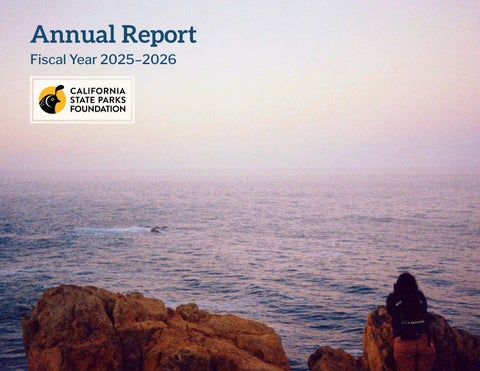
Annual Report Fiscal Year 2025–2026
Annual Report 2025–2026 1
Table of Contents
Executive Director
Volunteer Core Leaders
Founder
4 5 8 11 14 15
Rachel Norton
Joyce Abrams James Andersen Anna Anisova Milton Castro Thomas Chung Brendan Clifford Carolyn Craig Feramarz Damavandi Marcos Abraao De Souza Fonseca Corinne DeLouise Allyson Ferrari Louis Flores Kay Foster Aanya Gupta Rashmi Gupta Vijay Gupta Sally Han Pete Heller Brian Hembacher PJ Jeffery Namrata Kadambi
William Penn Mott Jr. (1909–1992)
Letter from Our Leaders
Staff Luis Alcala Amber Baldwin
Connect
Adele Escoto Lauren Gil Haley Gonzales
Preserve
Sonya Hammons Travis Hattori Robert Heim
Protect
Shakaylah Leonard Elise Matera
Our Ecosystem of Support
Kathleen McCurdy Sydney McGowan Sam Moody Ashley Moore
Financials 2025–2026
Jess Nixon Mika Perron David Pierce Taylor Pittman Melissa Potts Jessica Ro Nora Scally Sloane Shinn Cassandra Stockton Kaelib TeeGarden Joy Turrini Tricia Vlcek Emi Ward Zoe Whitworth Randy Widera
2 California State Parks Foundation
Sedona Williams
Charlotte Kerber Larisa King Perry King Michael Knue Alex Kuczwara Andrea Lee Frank Chung Lin David Littlejohn Sarah Maddux David Marx Rick McGarrity John Mlakar Piper Mophett Helen Ogden Andrew Poon John Salcido Randy Shannahan Joey Smith Stephanie Snyder Stephen Van Lydegraf Shanti Vellanki
Officers Ryan T’Kindt, Chair Ben Cipollini, Vice Chair Leslie Leonard, Treasurer Elisa Mendel, Secretary
Board of Trustees Rachel Alvarez Leo Chyi Angela Clark-Mubarak Michon Coleman Dan Goldman Meaghan Gorman Carol Hart Brian Hess Chuck Hornbrook Shiva Iyer Paul Luning Rao Rapeta Doug Rappoport Diane Ross-Leech Darry Sragow Tanya Tan Nate Taylor Will Turner
Advisory Trustees Arnoud de Villegas Kacy Hutchison Gail Kautz Asim Khan S.K. Lee Ren Liu Connie Lurie Meg McGraw
Our Mission California State Parks Foundation is an independent, member-supported nonprofit dedicated to protecting and preserving the California state park system, for the benefit of all.
Our Vision Californians have a state park system that is accessible and relevant, adequately and sustainably funded, and stewarded for future generations.
COVER: Point Dume State Beach | CREDIT: Ngoc Tran LEFT: Asilomar State Beach | CREDIT: Debra Dobosz
Annual Report 2025–2026 3
Letter from Our Leaders Dear Friends, Together, the generosity of this community made fiscal year 2025–2026 another successful one. In this report, we’re proud to share stories that highlight the impacts you fueled. California State Parks Foundation connected hundreds of thousands of people to their state parks this year via free passes. Your donations allowed us to contribute $200,000 to cover free entry to over 200 state parks in honor of Dr. Martin Luther King Jr. Day. We expanded upon this success by sponsoring a special edition of the Historian Passport. Throughout it all, our year-round programs — like the volunteer workdays at Topanga State Park that reopened a beloved trail after disaster — continued the everyday work of deepening Californians’ relationships to state parks. We also share a story of one family’s generous donation to preserve their favorite backyard state park, which enabled California State Parks to complete a long-term project of rerouting a portion of a popular trail and opening it to new recreation opportunities. This story brings to life just one project funded by the $1.2 million we directed to state parks this year. This legislative session, we built on our yearslong advocacy to protect and strengthen the California State Library Parks Pass by securing ongoing funding for the program in the state budget and sponsoring the successful passage of Assembly Bill 1804 to strengthen the program in state law and help ensure lasting access to California’s state parks. The stories and impact numbers in this annual report were created by and belong to you. Your commitment allows us to uphold our long-standing promises to California’s state parks: facilitating memorable experiences in state parks, funding projects that create meaningful change, and passing laws that protect these beloved spaces. We stand at the ready, looking ahead to a new administration at California’s helm, a winter with the potential for severe storms, and the ever-present need to make our parks more welcoming to all. We face these challenges steadfast, bolstered by the strength of our strategies for change: Connect, Preserve, and Protect. With your support, we can face unknowns with the power of our collective vision that Californians have a state park system that is accessible and relevant, adequately and sustainably funded, and stewarded for future generations. Thank you for being part of our movement for California’s state parks. With deep gratitude,
Rachel Norton, Executive Director 4 California State Parks Foundation
Ryan T’Kindt, Board Chair
ABOVE: MacKerricher State Park | CREDIT: Daneen Phillips
Connect
Ensuring Californians feel welcome in state parks and have meaningful experiences that connect them with nature. Our Connect pillar strengthens the bond between people and parks, fostering a relationship that benefits both. When people spend time in parks, they gain physical, mental, and emotional renewal. In turn, parks thrive when more people care for them, speak for them, and take action to ensure their future. We believe people protect what they love and love what they experience. Through volunteer projects, community events, and programs that make parks more accessible to all Californians, California State Parks Foundation helps everyone feel a sense of pride, awe, and belonging in these special places and become more inspired to care for them.
“I enjoy the friendly staff and when they provide snacks to keep us going while we give back to the state parks in California. Thank you for allowing me and my kids to volunteer; it has given my kids a better connection to this state and to nature in general.” — FY26 Volunteer
Over the past fiscal year, our Connect pillar delivered meaningful impacts for state parks, including:
3,402
volunteers were brought into 33 state parks in 13 state park districts.
153
volunteer workdays were hosted statewide.
11,880
volunteer service hours were contributed by community members.
454,000
people downloaded the special edition free Historian Passport.
19,500
visitors had meaningful experiences at 172 events across 86 state parks during California State Parks Week.
89%
of volunteer survey respondents reported that participating in a workday increased or greatly increased their feelings of being a part of a community of park supporters.
100%
of California State Parks and partner staff survey respondents felt very or extremely supported in the planning and execution of our volunteer workdays.
90%
of survey respondents said participation in California State Parks Week increased or greatly increased their ability to learn something new about what you can do in California’s state parks.
93%
of survey respondents were likely or extremely likely to return to California’s state parks after California State Parks Week. Annual Report 2025–2026 5
Connect Programs How We Do the Work We connect people to their state parks in a variety of ways. The following programs are central to advancing our Connect work: Volunteer Workdays
Hands-on events where volunteers plant native species, remove invasive plants, repair trails, and clear brush to reduce fire risk — directly supporting park health and visitor safety. Corporate Volunteerism
Customized opportunities for companies to turn employee engagement into environmental impact, building team connection and environmental stewardship. Earth Month Climate Action
Our signature volunteer campaign mobilizing thousands of Californians each April to restore ecosystems and address the urgent threats of drought, wildfires, and habitat loss. California State Parks Week
A statewide celebration of the diversity of California’s 280 state parks, offering hundreds of free events to the people who care for and rely on them. Park Passes
Promoting, informing the public about, and securing ongoing funding for the state of California’s access initiatives that introduce new audiences to nature and reduce barriers to access. The Library Parks Pass, Free Fourth Grade Pass, and Golden Bear Pass bring park passes to Californians annually to library cardholders, to fourth graders and their families, and to others accessing public benefits who may not otherwise be able to afford or access day use entry fees. California Coastal Cleanup Day
The nation’s largest volunteer event, for which we serve as fiscal sponsor, supporting the cleanup of beaches and waterways across the state. 6 California State Parks Foundation
BELOW FROM LEFT: California State Parks Foundation Senior Program Manager, Melissa Potts with Volunteer Core Leaders Hanna Katarzyna, Larisa King, and Perry King at a Trinidad State Beach volunteer workday.
Volunteer Spotlight
Park Pass Spotlight
Reconnecting People with the Los Leones Trail
Creating Meaningful Connections through Park Passes
Last year, California State Parks Foundation helped communities reconnect with Topanga State Park, which was severely impacted by the 2025 Palisades Fire. After providing critical support through our Climate Crisis Relief Fund to address immediate needs, our approach shifted from disaster response toward long-term restoration. California State Parks Foundation volunteers were critical to this effort, helping rehabilitate the popular Los Leones Trail so it could be enjoyed by neighbors and visitors.
California’s state parks are places where people come together — to explore nature, discover history, spend time with family and friends, and find moments of connection and renewal. This year, we worked to ensure more Californians could experience these places by funding two free-entry experiences across the state park system.
Across four workdays, volunteers contributed 280 total service hours regrading trail surfaces, removing burned trail edging, clearing overgrown vegetation, and restoring trails leading to footbridges. Park staff and a local Eagle Scout troop built on that work by installing replacement bridges where the originals had been lost in the fire. “The park is a favorite for local hikers. After the Palisades Fire, many people wanted to come back and use the Los Leones Trail. The example we were setting was a great inspiration to the community,” said Kay Foster, a Volunteer Core Leader who helped lead the Topanga workdays. “It was so edifying. Neighbors came by and thanked us, and they promised to help keep our work going.”
“It was so edifying. Neighbors came by and thanked us, and they promised to help keep our work going.”
These efforts have reopened the lower half of the trail to the public, and California State Parks Foundation volunteers continue to restore the upper section through year-round workdays.
To honor Dr. Martin Luther King Jr. Day in 2026, California State Parks Foundation funded free entry to more than 200 state parks. The response was immediate and enthusiastic, with many visitors exploring a state park for the first time. For Josh D., a divorced father who was unemployed at the time, free entry made it possible to bring his daughters to Olompali State Historic Park in Novato. “On the drive there, we talked about Dr. King’s work around social justice and the struggle for civil rights,” Josh shared. At the park, the family learned about the Coast Miwok and Ohlone people who inhabited the Bay Area long before European colonization, explored replica redwood bark shelters, and hiked the Miwok Loop Trail. “It was a great day out in nature with my girls, and we learned a lot! It helped make the park accessible to my family.” We also made it easier for Californians to connect with the state’s rich history by partnering with California State Parks and California State Railroad Museum Foundation to offer the Historian Passport for free for a limited time. More than 454,000 people downloaded the passport during the three-week offering period, opening the door to new discoveries at California’s state historic parks. When we help people access parks, discover their history, and return to places they love, we strengthen the connections that make California’s parks essential to all of us.
To volunteer with us and foster more connections to state parks, scan the QR code or visit calparks.org/ AR26volunteer.
FAR LEFT TOP TO BOTTOM: Half Moon Bay State Beach, Huntington State Beach, Candlestick Point State Recreation Area, Cardiff State Beach, Samuel P. Taylor State Park, and Candlestick Point State Recreation Area LEFT: Volunteer trail work at Topanga State Park. RIGHT: Limekiln State Park | CREDIT: Ross Richards
Annual Report 2025–2026 7
Preserve
Over the past fiscal year, our Preserve pillar delivered meaningful impacts for state parks, including:
Ensuring California state parks’ natural and cultural resources are stewarded and sustained for future generations.
$1.2 million+ 100%
Our Preserve pillar ensures California’s state parks remain ecologically vibrant, culturally relevant, and equitably available for future generations. Through place-based climate adaptation, community grantmaking, and park improvement work, we preserve the infrastructure, character, ecological health, and accessibility of our parks, building lasting resilience in a changing world.
59
“This grant catalyzed critical forest restoration work at Big Basin, one of California’s most iconic state parks, allowing us to build its resilience and shape its recovery after the CZU Fire.” — Save the Redwoods League, recipient of a $50,000 grant 8 California State Parks Foundation
was directed at state park projects.
state parks were directly supported across 19 districts.
of survey responses from Climate Crisis Relief Fund recipients rated California State Parks Foundation’s response time, from initial contact to funds being available, as excellent.
8
100% 10 0%
park partner organizations were supported.
of survey responses from Climate Crisis Relief Fund recipients rated the effectiveness of the funding in supporting park staff or public health and safety as very effective.
LEFT: Big Basin Redwoods State Park CREDIT: Elise Matera
Preserve Programs How We Do the Work We care for our cherished parklands by investing in the specific places, species, and community programs that need support the most — preserving everything we love about parks. The following programs are central to advancing our Preserve work: Climate Resilience and Biodiversity
Engaging Communities in Parks
Supporting scalable, science-based solutions to strengthen ecosystems, improve habitat health, and prepare parks for a changing climate.
Funding programs led by or cocreated with historically excluded communities to ensure that state parks are welcoming to all, lifting up the experiences and histories of Black, Indigenous, and People of Color.
» Climate Crisis Relief Fund
A rapid-response reserve that helps parks recover from wildfires, floods, and extreme weather, ensuring park staff can act quickly when disaster strikes.
» Building Climate Resilient Parks
Grants funding innovative projects that help state parks withstand climate threats like wildfires and flooding.
» Urban Parks Initiative
Partnering with local communities and leaders to invest in state parks in densely populated, underresourced communities and centering cultural relevance, community ownership, and workforce development.
» Community Partnerships
Developing climate resilience strategies to protect Joshua tree populations through adaptive restoration, climate modeling, and improved habitat management in desert parks.
Grants that empower local leaders and community nonprofits to design and create culturally relevant park programs and that reflect specific lived experiences, traditions, and barriers — ultimately increasing equitable access to California’s park system.
» Western Monarch Butterfly Habitat
Park Improvement and Enhancements
» Joshua Tree Survival
Protection
Restoring and stewarding critical overwintering habitat in coastal state parks, creating a scalable model for protecting western monarch migration sites.
TOP TO BOTTOM: Prairie Creek Redwoods State Park, Joshua Hallas; China Camp State Park, Steve Ziman; Arthur B. Ripley Desert Woodland State Park; Natural Bridges State Beach
Investing donor-designated and endowment funds into restoration, interpretation, and programming that help make parks thrive.
TOP TO BOTTOM: Sue-meg State Park, California State Parks; Baldwin Hills Scenic Overlook, Danita Delmont; Reinhardt Redwood Regional Park, Orenda Randuch; Candlestick Point State Recreation Area, Wenhua Chen
Annual Report 2025–2026 9
Preserve Spotlight One Family’s Legacy Opens New Pathways at Mount Tamalpais State Park Located just north of the Golden Gate Bridge, Mount Tamalpais State Park is an iconic Marin County landscape where visitors hike, bike, and take in sweeping views. For decades, however, a beloved route at the park was unsafe for cycling. Thanks in part to support from brothers Brian and Wayne Best, honoring their parents, Alan and Joy, much-needed trail improvements along the Easy Grade Trail are now complete, opening opportunities for future families to create memories along the new path. The project created a safer connection for cyclists traveling between Pantoll Station and the Mountain Theater. Previously, the Easy Grade Trail was closed to bicyclists, so they had to travel along the narrow, winding Pantoll Road alongside motor vehicle traffic. To open the trail to bikes, the project rerouted portions of the trail and added stonework and a footbridge. Completed in June 2026, these improvements now allow mountain
10 California State Parks Foundation
bikers to use the Easy Grade Trail instead of Pantoll Road, improving public safety, reducing vehicle congestion, and creating a better-connected, more enjoyable experience for cyclists. This long-awaited upgrade involved many moving parts — planning, preparation, financial resources, and devotion to the park — a puzzle California State Parks Foundation is uniquely poised to help solve. The project was first proposed by the Marin mountain biking community almost two decades ago in response to the unsafe biking route along Pantoll Road. In 2019, California State Parks approved the project through its official Change-in-Use process and determined that the addition of bicycle use on the Easy Grade Trail could be accommodated in a safe and sustainable manner that would not have significant effects on the environment. The multiyear plan was in place; the only thing lacking was the funding to make the project a reality. That is where California State Parks Foundation stepped in, sharing this need with the Best family, for whom the opportunity was a perfect, and deeply personal, match. The family provided the
seed funding of $200,000, inspiring other organizations and donors to give to the project. Alan and Joy Best grew up in Marin County and developed lifelong connections to the landscapes that surrounded them. Their shared love of outdoor recreation brought them together. That passion became part of family life for sons Brian and Wayne, who grew up exploring Mount Tamalpais’ fire roads on foot and by bike, camping at Pantoll, fishing in nearby lakes, and attending performances at the Mountain Theater. “Being outdoors was definitely an instrumental part of our lives,” Brian recalls. That history made supporting the Easy Grade Trail especially meaningful. Brian knows firsthand the risks cyclists face on Mount Tamalpais’ roads. “If you grew up in Marin, you know people who’ve been hurt or worse on those roads while on bikes,” he said. “Creating a safer way to experience the mountain — it just made sense.” The family’s philanthropy reflects a broader dedication to California’s state parks. Funds from Alan and Joy’s estate were intentionally designated to support parks.
Working with California State Parks Foundation has helped the family direct that commitment toward projects with lasting impact. Brian hopes their work with the Easy Grade Trail inspires others to honor loved ones through meaningful philanthropy. “There’s a big difference between just giving money and really enabling something meaningful to happen,” he said. In that sense, the project is more than a trail. It is a lasting preservation of Alan and Joy Best’s love of Mount Tamalpais — a path shaped by memory, grounded in place, and open to generations of visitors to come. To read more about the Best family’s contribution to the Easy Grade trail, please scan the QR code or visit calparks.org/AR26EasyGrade. ALL BELOW: Mount Tamalpais State Park CREDIT FROM LEFT: Brian Best; California State Parks; Brian Baer, California State Parks
Protect Ensuring California state parks are a priority for our state government and the people of California.
Lasting change requires a movement capable of building power and changing policy. Our Protect programs work across coalitions that impact parks to research critical park issues, advocate for effective solutions, and mobilize people to support them. By advocating for large-scale policy and funding wins at the state level, powered by our statewide knowledge and grassroots advocates, we are helping build a system where parks can thrive for generations.
RIGHT: Executive Director Rachel Norton and Sarina Jepsen, Head of Conservation Science at Xerces, preparing to testify on behalf of western monarch butterflies.
Over the past fiscal year, our Protect pillar delivered meaningful impacts for state parks, including:
11,000+ 13,500
Advocated with coalition partners against non-mission use of parklands, including pushing back on power lines through state park lands and expressing concern about infrastructure projects affecting parks that conflict with the mission of California State Parks.
50+
Conducted two lobby days in Sacramento to engage policymakers on issues affecting California’s state parks.
people engaged in park advocacy.
messages generated to legislators to protect parks from threats.
legislative meetings to educate state policymakers about park issues and elevate California State Parks Foundation as the go-to resource on state parks.
21
bills tracked impacting state parks across issues including funding for the California State Library Parks Pass program, state parks climate stewardship, and protecting parklands from harmful development.
Provided lead testimony twice before the State Legislature in support of AB 2277 (Schultz — state park climate stewardship) and AB 2254 (Addis — monarch butterfly habitat). Annual Report 2025–2026 11
Protect Programs How We Do the Work We strengthen the entire system that protects parks for the long term by advancing policies, funding, and public support that help keep parks open, accessible, and reflective of local and historical communities. The following programs are central to our Protect work: Policy, Research, and Education
Researching issues affecting state parks; producing data-driven findings and reports, developing policy and funding solutions; and providing policymakers, partners, and the public with trusted information about California’s state parks. Grassroots Advocacy
Educating and mobilizing Californians to advocate for state parks through petitions, action alerts, coalition building, and advocacy campaigns to make their voices heard. Government Affairs and Legislative Advocacy
Translating community-backed solutions into policy outcomes by advancing state policy and funding priorities through legislation, inclusion in the state budget, administrative advocacy, and direct engagement with lawmakers and state agencies. Defending Parks from Non-Mission Uses and External Threats
Protecting state park lands, resources, and public access from incompatible development, infrastructure, and other proposals that could undermine the integrity of the state park system. TOP LEFT TO BOTTOM RIGHT: California State Parks Director Armando Quintero, Brian Baer; A group of advocates in front of the California Capitol, Claudine Gossett; Executive Director Rachel Norton advocating for Proposition 4; Advocates meeting with legislators inside the California Capitol, Claudine Gossett; Julianne Hines, District »
12 California State Parks Foundation
» Director for State Senator Susan Rubio presenting California State Parks Foundation with a certificate of recognition; The California Capitol lit up at night, Randy Widera; California League of Park Associations conference attendees; Former Board Chair Birt Johnson Jr. shaking hands with Assemblymember Rebecca Bauer-Kahan
Protect Spotlight California State Library Parks Pass: A Lasting Commitment to Outdoor Access Since its launch in 2021, the California State Library Parks Pass has helped break down one of the most persistent barriers to visiting California’s state parks: cost. The state-run program, developed through years of advocacy and partnership following California State Parks Foundation’s 2018 Pathways to Parks initiative, provides library cardholders with the ability to check out a pass that gives them free vehicle day-use entry to more than 200 participating state parks. Today passes are available through more than 1,100 public libraries statewide and have become among libraries’ most popular circulating resources. The program’s success, however, has repeatedly been faced with uncertainty due to insecure funding. In 2024, when the library pass was left out of the Governor’s initial budget proposal, California State Parks Foundation mobilized supporters and legislators to protect it. More than 10,000 Californians ultimately signed petitions or contacted their representatives, helping secure $6.75 million in the final 2024–2025 budget, extending the program through December 2025. That victory proved temporary. In 2025, funding was again at risk when the Legislature’s budget agreement omitted the library pass appropriation. The Foundation quickly renewed its advocacy, working with legislative offices, partners, and supporters to demonstrate the program’s impact. The effort succeeded, and the pass survived another calendar year. In July 2026, that momentum culminated in a major budget win: California’s 2026–2027 state budget established ongoing funding for the California State Library Parks Pass. Rather than requiring lawmakers to approve an appropriation each year, funding will now continue automatically unless the Governor or Legislature takes action to change it. Recognizing that ongoing funding was only part of the solution, California State Parks Foundation also sponsored Assembly Bill 1804 (Hart) to strengthen the program’s long-term future. Signed into law by Governor Gavin Newsom in September, AB 1804 formally authorizes California State Parks to partner with the California State Library and local library systems to provide free park passes. Together, this legislation and ongoing state funding help ensure the California State Library Parks Pass remains a lasting part of California’s commitment to equitable access to nature. Assemblymember Gregg Hart, who introduced and championed AB 1804, underscored the importance of expanding access to California’s state parks: “California’s state parks belong to all of us, and every Californian
should have the opportunity to experience them. Libraries are trusted community resources, and the California State Library Parks Pass provides an important connection between our local libraries and greater access to the outdoors.” He continued, “I am proud to have authored AB 1804 and worked with California State Parks Foundation and our partners to make this successful program permanent. With AB 1804 now law and ongoing funding secured, we are ensuring more Californians can experience and enjoy the incredible natural resources our state has to offer.”
“I am proud to have authored AB 1804 and worked with California State Parks Foundation and our partners to make this successful program permanent.” — Assemblymember Gregg Hart
This landmark achievement reflects what sustained advocacy and strong partnerships can accomplish. From protecting the program during annual budget negotiations to advancing legislation, California State Parks Foundation worked alongside policymakers, libraries, community partners, advocates, and other stakeholders to build broad support for the program’s future. Together with thousands of park supporters who made their voices heard, this collaboration helped turn outdoor equity from an aspiration into a durable public policy. Ongoing funding and AB 1804 now give libraries, California State Parks, and community partners the certainty they need to keep connecting Californians with the parks and natural places that belong to all of us. TOP: California Library State Parks Pass at Castle Crags State Park, Elise Matera BOTTOM: Executive Director Rachel Norton presents First Partner Jennifer Siebel Newsom with the Golden Poppy Award at Bale Grist Mill State Historic Park, Janna Waldinger
Annual Report 2025–2026 13
Our Ecosystem of Support California State Parks Foundation is supported by an interwoven network of entities, similar to the biodiversity found in nature. Each of our supporters fills a specific niche — from making monthly donations to writing transformational legislation — coming together to create a system that’s stronger than the sum of its parts. We know that, like an ecosystem, diversity is a strength. Every role, no matter the size, plays a necessary part in our collective thriving. These creatures represent the diversity of our network throughout fiscal year 2025–2026. nia
268
64
Individuals giving $10,000+
qu
512
ai
Cal l
ra ss
61
Go
py
Park Protectors
Members giving $5+ monthly
po
p
r Califo
1,876
nia
la gr
ound squi
987
el
ar
Charitable foundations who supported our work
rr
be
Volunteers
Individuals who attended a workday
Foundations
n
anterelle
zzly
3,402
66
ch
Individuals who signed a petition or completed an action alert
nia gri
l de
ana slug
6,832
Californians Leadership Circle Members giving $1,000+
Park Staff
ce
liche
n
ia
ed
Advocates
or
an
California State Parks Foundation Staff and Board Members
eg
10,044
Donors giving for 30+ years
fornia
M
an
if ne
t
l i v e oak
Long-Time Donors
B
Purple
ba
Permanent full-time and temporary positions, seasonal employees, board members, retired annuitants, and limited term and permanent intermittent employees of California State Parks
rn
or
ta zani
n
ia
Pallid
Major Donors
Califo
e
Coast
pin
Cali
y
Individuals who committed to giving a legacy gift
l
re
167
er
William Penn Mott Jr. Legacy Society
14,529
Individuals who started giving in FY26
Calif
Companies that sponsor our work y
or
Legislators and state agency leadership we’ve worked with
New Donors
Corporate Donors
fl
State Leaders
T
86
or
butt
o
a
nd
ce
Calif
i rn
co
fa
Ca
l
or
dog
if
8
Partners
Other nonprofits we collaborated with
Financials 2025–2026
Statement of Activities for year ended 6/30/26
Revenue by Category
REVENUE
California State Parks Foundation’s revenue for the fiscal year was $12.3 million. We received significant support through gifts from individuals, foundations, and corporations for our work. Some revenue (such as investment returns on future projects, endowments, and operating reserves) has restrictions for how it can be spent.*
Individual Contributions
2,433,975
Member Dues Contributions
4,866,958
Corporate Contributions
1,510,246
Legacy Gifts
804,989
Donated Goods and Services
518,158
Foundation Grants
596,499
Net Investments
1,426,308
Earned Revenue
159,161
Total Revenues
$12,316,294
EXPENSES n Individuals 59%
Programs
n Corporate Contributions 12%
Fundraising
n Legacy Gifts 7% n Donated Goods and Services 4% n Foundation 5%
6,743,443 2,299,094 836,542
Administration Total Expenses
$9,879,079
Change in Net Assets
$ 2,437,215
n Net Investments and Earned Revenue 13%
Statement of Financial Position for year ended 6/30/26 ASSETS Current Assets
Expenses by Category California State Parks Foundation’s expenses for the fiscal year were $9.8 million. Expenses, broken down by programs, fundraising, and administration, reflect the work of California State Parks Foundation throughout the year to protect and preserve parks.
Cash and Equivalents
4,876,491.25
Restricted Money Market Accounts
4,196,447.32
Receivables
26,732.27
Inventory
61,297.50
Prepaids and Other Current Assets Current Assets Long-Term Assets Investments
13,721,650.80
Property Plant and Equipment, Net
n Fundraising 23% n Administration 8%
0.07
Other Long-Term Assets
95,467.80 14,165,374.26
Total Assets
$23,670,071.74
LIABILITIES AND NET ASSETS Liabilities Current Liabilities Accounts Payable and Accrued Expenses Deferred Revenues
*Financial data is unaudited. California State Parks Foundation’s 2025–2026 audited financial statements will be posted online when available at calparks.org/AR26financials, where you can also find financial and annual reports from previous years.
348,255.59
Due to/from Other Funds Long-Term Assets n Programs 68%
343,729.14 $9,504,697.48
628,433.45 392,495.23
Current Liabilities
1,020,928.68
Long-Term Liabilities
1,135,933.03
Total Liabilities
2,156,861.71
Net Assets
21,513,210.03
Total Liabilities and Net Assets
$23,670,071.74
Annual Report 2025–2026 15
LEFT: New Brighton State Beach CREDIT: Steve Schultz
235 Montgomery Street Suite #1202 San Francisco, CA 94104 calparks.org @californiaparks @calparks 16 California State Parks Foundation