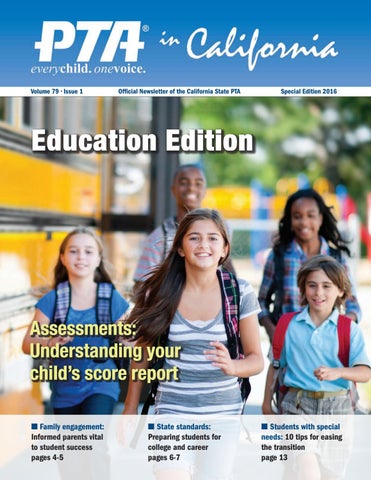
Volume 79 • Issue 1
Official Newsletter of the California State PTA
Special Edition 2016
Education Edition
Assessments: Understanding your child’s score report n Family engagement: Informed parents vital to student success pages 4-5
n State standards: Preparing students for college and career pages 6-7
n Students with special needs: 10 tips for easing the transition page 13
PTA Membership
Do good things for kids — join PTA!
Y
our PTA membership makes a difference. Just by joining PTA, you show your children that school matters and you are invested in their success – and their future. Here are just a few of the good things about joining PTA: n Get connected – There’s no better way to know what’s happening in schools or to develop relationships with teachers and principals
Everyone is part of the PTA family PTA believes family is the basic unit of society responsible for the support and nurturing of all
n Discover great resources – PTA offers a variety of unique programs and materials for students, parents, families, schools and communities n Speak up – PTA gives families and community members a “seat at the table” when important school decisions are being made n Be a role model – By becoming a PTA member, you demonstrate to your
children, and we recognize that “the family” is defined in many ways. So no matter who’s in your family or how you define it, your family is part of the diverse national family millions of members strong – PTA!
2 PTA in California • Special Edition 2016
child the importance you place on education n Enjoy extra benefits – PTA members enjoy exclusive money-saving member perks including discounts on school supplies, rental cars, amusement parks and much more n Make a difference – By working together, PTA members advance local, state and national laws and policies to improve the education, health and well-being of all children.
PTA membership is open to everybody – whether you’re a parent, student, educator, business leader or community member. Do good things for kids – join PTA!
From the President Positively impacting the lives of all children
I
would like to introduce you to my passion: PTA.
ongoing teachers!
– to positively impact the lives of all children and
know as families,
I am passionate about PTA because of its mission
families.
At PTA, we accomplish our mission in three ways:
1.
PTA is an advocacy association that supports families, schools and communities. We
communicate with and inform our members on issues that impact them, work with allied agencies and take action on proposed legislation.
2.
PTA is about leadership development. We train and
develop leaders at the local level, at school sites and
within school districts to be a support system to school
communities and to participate in the educational process of their child.
3.
PTA is a membership association. We welcome all those interested in supporting PTA’s mission to
join us and lend their voice to the message that ALL our children and families matter.
We know – and research tells us – that when families
actively engage in our children’s lives, it’s better for our students, our schools and our communities.
This special edition of PTA in California is filled with
valuable information to support your child’s education. You’ll find information for families about how student assessments are taken and why they are a valuable tool in determining student understanding of content.
The more information you have and the more you are
engaged in supporting your child, the better chance he or she will have at a successful school career.
This PTA in California, along with PTA’s other free
publications and online resources, are valuable tools for you to use to participate in the learning process with
your child. After all, families are their children’s first and
And the more we
the more successful our students,
schools and communities will be. So now you’ve
gotten to know more about my
passion: PTA. I
This special edition of PTA
this guide and our
in California is filled with
hope you will use
other resources at
capta.org to ensure
valuable information to
you and your stu-
support your child’s
and productive
education. You’ll find
dent have a positive school year! You
information for families
Facebook or follow
about how student
can also like us on us on Twitter or
Instagram. We will
assessments are taken and
keep you up to date
why they are a valuable
California and what
tool in determining student
on education in
you need to support
your child at school.
understanding of content.
Please also take a
moment to join PTA: Just by joining you are sending the
message that your child, your school and your community matter!
Thank you for doing the most important thing you can do for children – being involved in their lives!
Justine Fischer, President PTA in California • Special Edition 2016 3
Family + Engagement = Student Success Well-informed, engaged parents make a difference for student success in school and beyond. Your involvement is vital to your child’s achievement.
F
amily engagement has been PTA’s number-one priority since its founding, and that priority continues today. PTA leaders and volunteers work locally and in our state and national capitols to implement, strengthen and fund proven family engagement strategies throughout California.
Five family-engagement facts
1.
A home environment that encourages learning is a bigger factor in student achievement than a parent’s income, education level or cultural background.
2.
Schools would need to spend $1,000 more per pupil to reap the same gains to student achievement that an involved parent brings.
3.
Family-engagement programs in school districts provide great benefit to students including improved school readiness, higher grades and test scores, and healthier behavior.
Download a free copy of the entire guide to facilitate local conversations among parents and educators about how best to build stronger family-school partnerships and to measure progress: capta.org/resources 4 PTA in California • Special Edition 2016
4. 5.
Family-engagement programs bring an increased likelihood of graduating from high school and attending college. Family engagement in school communities is supported, strengthened and required by both state and federal laws.
Well-informed, engaged parents make a difference for student success in school and beyond. Whether it’s reading together, monitoring homework, talking to teachers, joining PTA or taking an active part in school governance and decision-making, your involvement is vital to your child’s achievement.
Standards for engagement success You can use the PTA National Standards for Family-School Partnerships Assessment Guide to define and measure how well your school community is engaging families. Based on decades of extensive research and developed with the guidance and support of prominent education leaders and practitioners, the guide provides specific goals for each of six accepted familyengagement standards:
• STANDARD 1: Welcoming All Families Into the School Community • STANDARD 2: Communicating Effectively • STANDARD 3: Supporting Student Success • STANDARD 4: Speaking Up for Every Child • STANDARD 5: Sharing Power • STANDARD 6: Collaborating With the Community
Increase family engagement at your school with PTA’s School Smarts Parent Engagement Program
“
Learning begins at home, then at school,
then back home – it’s just a cycle. School Smarts taught me how to get involved, to understand the school system, to know my children’s progress and what they’re learning.” — Marivic Quiba, Parent
School Smarts is an award-winning, research based program that helps parents help their children and their school. Featuring a seven-session parent academy with sessions on education, communication and leadership, the program emphasizes art activities and discussions to build inclusiveness among parents and school leaders. To bring School Smarts to your school, contact your PTA or principal, or write to schoolsmarts@capta.org.
PTA in California • Special Edition 2016 5
California’s state standards: The future belongs to your child
W
e don’t know what the jobs of tomorrow will be, but we do know our future depends on a strong workforce – and today’s schools must prepare our kids to be part of it.
Content standards in core subjects matter because: •
They’re part of an overall update to the way our schools ensure all students achieve – including more professional development opportunities for teachers, updated instructional materials and technology, and more useful assessments.
Content standards in core subjects mean: •
Deeper, richer, more relevant instruction for your child
•
Clearly defined learning goals for each grade level that build from year to year
•
They provide all students with hands-on experiences and opportunities to experiment and try new approaches.
•
A focus on key knowledge and skills, including communication, collaboration, critical thinking and creativity.
•
They help prepare your child, and every child, to navigate a fast-paced, super-connected changing world.
Free resources help you support your child’s success: n California State PTA’s Parents’ Guide to Student Success – Available in six languages, this guide for each grade level includes highlights of the standards, ideas to support learning at home and questions to ask your child’s teacher: www.capta.org/commoncore n Ed100.org – Available in English and Spanish, explore California’s education system in an easy-to-understand format: www.ed100.org n California Department of Education – Read the content standards and search a collection of resources, including resources for students with special needs: www.cde.ca.gov/re/cc and www.cde.ca.gov/sp/se/cc
Arts education makes a difference for all kids Parents know: The arts matter. That’s why California State PTA continues to advocate for a complete education that includes the arts for every child. As PTA members, we can lead the way to a quality education for all children that includes the arts! Join our network today and find out how you can be an arts-education superhero: www.capta.org/smarts
6 PTA in California • Special Edition 2016
Improving science education now is essential Science is central to how we understand and make sense of the world around us. Students need a strong education in science and engineering to make informed decisions about the scientific and technological issues that affect their lives and to prepare for a future we can’t yet predict. Science and engineering education can also open up career and economic opportunities. Jobs in science, technology, engineering and math (STEM) now comprise more than a quarter of all new job openings in California, including many of the highest paid occupations, and STEM skills are increasingly necessary for jobs across nearly all industries. Given these trends, science education should be a priority in all schools.
New science standards tap into curiosity
What your school can do to INFORM: n Hold a career fair. n Plan a family science night.
What you can do to LEARN MORE: n Ask your principal or superintendent what is being done to transition to CA-NGSS. n Request support of science in your school district’s Local Control and Accountability Plan (LCAP). Find more ideas, including STEM activities you can do with your kids, at www.capta.org/stem.
California has adopted new state standards for science – called the California Next Generation Science Standards (CA-NGSS) – to ensure students learn the most current science knowledge and how to apply it to analyze and solve problems. All students, including those in the earliest grades, will be introduced to science, encouraged to ask questions and discover with hands-on investigation through CA-NGSS. This approach is more engaging and consistent with what we know about how students learn best. Students will learn to think and behave like scientists and engineers, developing a deeper understanding of core scientific ideas and concepts, along with critical thinking and problemsolving skills – analyzing data, developing arguments based on evidence and working in teams – that reinforce learning in other core subjects and are essential for success throughout school, college and career.
As students learn to think like scientists/engineers, science education will involve more: • Students conducting investigations, solving problems and engaging in discussions with teachers’ guidance • Students discussing open-ended questions that focus on the strength of the evidence used to generate claims • Students reading multiple sources, including sciencerelated magazine and journal articles and web-based resources; students developing summaries and information • Students writing journals, reports, posters and media presentations that explain and argue.
Transition to CA-NGSS is in progress California’s science standards were last updated in 1998. Our schools are now embarking on a multi-year effort to retool science education. The state timeline allows for a gradual transition to the new standards, with schools expected to be fully teaching based on the CA-NGSS for the 2018-19 school year. This requires professional development, facilities and materials, instructional planning, etc. The transition will take time, and that’s why parents should start becoming familiar with the new standards now. Patience, planning, persistence and broad community support will be required for this change to succeed.
PTA in California • Special Edition 2016 7
Student Assessments and Scores:
Important information for student success C
alifornia’s new assessment program – called the California Assessment of Student Performance and Progress (CAASPP) – represents the next step in our state’s ambitious education remodeling project. As of spring 2015, California schools replaced old tests with new assessments built to let parents and teachers know how well students are learning the skills and knowledge they need to succeed in today’s world. Spring 2016 marked the second year of full implementation.
Types of questions in the new assessments • Selected Response: Includes traditional multiple choice such as multi-part questions, questions with more than a single answer, etc. • Constructed Response: Short response item, typed in by student.
• Performance Task: Application of the student’s knowledge and skills; uses a range of information sources; multi-part task including writing; one given in mathematics and one in English-language arts.
As of spring 2015, California schools replaced old tests with new assessments built to let parents and teachers know how well students are learning the skills and knowledge they need to succeed in today’s world.
8 PTA in California • Special Edition 2016
Features of the assessments • Computer-based: The tests are taken online.
• Computer-adaptive: Questions shift in difficulty based on student performance. Scores are calculated from both the number of correct items and the difficulty level of those items.
• Untimed: Students have as much time as they need to complete each part of the test.
NOTE: These features do not apply to the science assessments given in 2016 to students in grades 5, 8, and 10. These were still the older California Standards Tests in Science, administered with paper and pencil. New science assessments are under development in conjunction with the new science standards.
Understanding your child’s score report T
he new CAASPP assessment-score report uses four achievement levels:
• Standard not met • Standard nearly met • Standard met • Standard exceeded.
The levels designate the degree of “progress toward mastery of the knowledge and skills needed for success in future coursework.” For 11th-graders, they measure the degree to which students are on track to be ready for college or a career after graduating from high school.
Page one of the score report shows: • Scores between 2,000 and 3,000 representing your child’s overall performance in English language arts and in mathematics from this year’s assessment as well as from last year. The numerical score is indicated by a dot as well as bar showing likely scores if the assessment was taken multiple times. Like progress on a growth chart, the tests, scores and expectations change with your child’s age and grade. Scores are expected to increase from year to year, so achievement levels get higher as your child grows. • A breakdown of four areas of English language arts, describing your child’s performance on reading, writing, listening and research/inquiry portions of the assessment. • A breakdown of three areas of mathematics, detailing your child’s performance on concepts and procedures, problem solving/modeling/data analysis, and communicating reasoning.
Page two of the score report includes: • A letter from the state superintendent about your child’s assessment and score report. • The numerical score ranges in your child’s grade for “standard not met,” “standard nearly met,” “standard met” and “standard exceeded.” • Additional information based on your child’s grade such as the California Standards Test for Science in Grades 5 and 8 or the Early Assessment Program (EAP) Status for Grade 11.
PTA in California • Special Edition 2016 9
The academic check-up: Feedback for improvement Questions to ask T • Ask your child – “What areas do you think you should he tests are an academic checkup, designed to give teachers and schools feedback they can use to improve teaching and learning. Because the tests are taken online, information becomes available to teachers, schools and school districts on a timely basis, so it can be put to use to adjust instruction for better student learning.
• Now is a great time to ask questions. • The scores are used to help improve learning for your child. • The score ranges and standards for the next grade are higher than for the previous grade, so your child’s score is expected to rise each year. • The scores are just one measure of how your child is doing. Stay engaged in talking with your child and your child’s teacher throughout the year.
focus on, based on your test scores? What do you see as your strengths to build on?”
• Ask your teacher – “How will these test scores be used to guide instruction? How can I help my child be successful?”
• Ask your principal – “Are the scores being used for school decision-making? What did you learn from the overall results?”
• Ask your superintendent – “Are the district assessment scores helping guide professional development? What is the district doing to implement the new state standards?”
FREE assessment resources Help your child succeed at school • capta.org/assessments – California State PTA offers a wide variety of family-friendly fliers and resources in multiple languages • testscoreguide.org/ca – Resources for parents and students on understanding scores and their significance •caaspp.cde.ca.gov/sb2016 – Coming soon! View 2016 cumulative assessment results at the state, county, district and school levels • cde.ca.gov – The California Department of Education addresses frequently asked questions, assessment results and new education standards • ed100.org – Available in English and Spanish, this online system helps parents understand assessments as well as California’s education system.
10 PTA in California • Special Edition 2016
Assessment accessibility: Tools, resources, accommodations & supports
C
alifornia’s new assessments strive to meet the needs of all students.
The tests have embedded in their computer platform an array of resources that make the assessments usable for California’s diverse population of students including language resources, universal tools and designated supports. Additional tools and resources are available in the test setting for students with documented needs noted in their Individualized Education Programs (IEPs) or 504 plans. What’s more, additional CAASPP assessments have been designed specifically for students with disabilities:
n California Alternate Assessment (CAA) – The California
Alternate Assessment is an assessment of math and English-language arts aligned with the alternate academic achievement standards designed for students with significant cognitive disabilities. Using computer-based technology and delivered in a one-on-one setting by students’ teachers, CAA is designed to adjust to each student’s performance at selected points within the administration.
n California Alternate Performance Assessment (CAPA) in Science – This test is designed for students in grades
five, eight and 10 who have IEPs and have significant cognitive disabilities. Students are required to participate in this assessment until a successor alternate assessment aligned
with California Next Generation Science Standards is developed and administered. For more on the CAPA: cde.ca.gov/ta/tg/ca/caparentguide.asp And remember: If your child has an IEP or a 504 plan, the annual review meeting for that plan is a great opportunity to discuss what assessment tools or supports are considered appropriate for your child. For more information on assessment accessibility: smarterbalanced.org/accessibility
Universal tools for all students Embedded: • • • • • • • • • • • • •
Calculator (for calculator-allowed items) Digital notepad English glossary Expandable passages Global notes Highlighter Keyboard navigation Mark for review Math tools Spell check Strikethrough Writing tools Zoom
In the test setting: • • • •
Breaks Scratch paper English dictionary Thesaurus
High-school students will love this info! The new assessments offer a big benefit for 11th-grade students: Those who perform at “standard exceeded” level on the assessments don’t have to take the California State University (CSU) and some California Community College (CCC) placement tests, allowing your child to move right into many college-level courses upon enrollment. Students performing at “standard met” are encouraged to take appropriate courses in their senior year in order to move directly to college-level courses or career training. Knowing your child’s achievement level at the end of 11th grade gives you the opportunity to use their senior high-school year to improve skills for entry into college or career-technical education. Find out more: csusuccess.org PTA in California • Special Edition 2016 11
Homework Help
Supporting your child’s education
P
arents and families play an important role in the homework process. Together, families can help children develop good study habits and attitudes that lead to becoming lifelong learners. Your job is not to do the work for them, but to provide support, encouragement and ask questions that help them arrive at the answers themselves.
• Encourage your child’s resourcefulness and problemsolving skills. For example, if an assignment has been forgotten, ask questions such as “Is it posted online somewhere?” “Who could you call from your class to get it?” or “Have you searched your whole backpack?”
Why do teachers give homework?
• Participate in back-to-school night, parent-teacher conferences, and open house; and read all communications coming from school.
Teachers use homework: • To help students understand and review the work that has been covered in class • To see whether students understand the lesson • To help students learn how to find and use more information on a subject • To teach responsibility and routine.
• Set up a family routine of healthy eating and sleep habits.
How much time should my child spend on homework each night? Most educators agree: • For children in grades K-2, homework is more effective when it does not exceed 20 minutes each school day • Older children, in grades 3-6, can handle 30-60 minutes a day • For kids in middle and high school, two hours of homework may be assigned • However, homework time and strategies can vary from teacher to teacher and school to school.
Some things to ask about homework • Your child’s teacher can tell you, usually at back-to-school night, how much time he or she expects students to spend on homework. • Your child’s teacher may have a website or other resource that posts homework assignments. • Your child’s school may have an online grading system, which allows parents to check their child’s grades, attendance and homework status on a daily basis. This allows you to keep on top of any issues before they become problems.
Ways of supporting your child’s efforts in homework • Balance other demands on your child’s time – school activities, sports, chores – with expected time for homework. • Recognize your child’s learning style. Some students function better with frequent breaks, some in an active environment, some in absolute quiet. Discuss these issues with your child, possibly experimenting to find the right timing and setting for completing homework. 12 PTA in California • Special Edition 2016
• It is important to know how to handle homework if your child needs to be absent. Make sure you and your child know and understand this policy for each class.
For more information, go to: www.capta.org/homework Or search “homework” at www.PTA.org
Easing transition: 10 tips for parents of students with special needs T
o help ease the transition for students with special needs during this school year, here are some helpful tips:
1.
Visit the school site with your child. Point out bathrooms, the cafeteria, office, playground, etc. Older students may benefit from printed maps with time schedules. Talk to your child about exciting new classes, activities and events he or she can participate in.
understand what makes him or her unique, and things that may be difficult for your child.
6.
Keep paperwork organized. Create a family calendar of
school events, special education meetings, conferences, etc.
For more information
2.
Help your child reconnect with schoolmates.
Ask if your child’s school has a buddy system or if students in school leadership are available to help as mentors or guides.
3.
Review Individual Education Program (IEP)
goals. Ensure the goals are still relevant and note the date of the annual review. Remember, you can request an IEP review anytime. And be sure to discuss assessment accommodations for your child – see page 11 for more.
4.
Connect with the teacher. Write a brief
Get answers to these questions and more information at www.capta.org/special-needs:
Continue learning. Stay
8.
Create a communication log. This will help ensure
up-to-date on special education news and legislation, so you can advocate for your child, and all children.
n “How do I determine if my child has special needs?” n “What are the types of services available to my child?” n “What is the school psychologist’s role?” n “How do I begin the special education process?” n “What is an individual education program (IEP)?” n “What questions should parents ask?”
introduction about your child (including a photo) with his or her likes and dislikes, social/ emotional set-offs, motivators, methods of communication, pertinent medical information and any other important information. The more proactive and honest you are, the better teachers and school staff will be able to meet your child’s needs.
5.
7.
Help plan an ability-awareness training. If your child is in a general education class, consider helping to plan an ability-awareness training with the class. Make sure to get buy-in from your child first. Write a story for the other kids so they can
of the communications you have.
9.
that you and the school staff are on the same page. Be sure to note the dates, times and nature
Attend school events when possible. School events such as
back-to-school night and parent-teacher conferences offer a great opportunity to meet staff and other students and families.
10.
Offer to help, either in the classroom or at PTAsponsored events.
PTA in California • Special Edition 2016 13
Your voice matters: Stay engaged all year long
Y
our voice matters! Every school district must engage parents and community members to create a Local Control and Accountability Plan (LCAP) to prioritize and plan school funding and programs to help all students succeed. Parents, families and community members have a voice in the development and evaluation of their LCAP throughout the year – and that’s where you come in! Now is a great time to get involved in your school’s LCAP process, but the process continues all year long. Stay engaged, be informed and ask questions throughout the school year to ensure your school district’s LCAP is on-track for success – use this Seasons of LCAP tool to help stay engaged.
14 PTA in California • Special Edition 2016
T
here are many parent
groups, but there is only
one PTA – Parent Teacher Association. Connecting
families, schools and communities for almost 120 years, PTA is the largest
children’s advocacy association in the
country and the defining organization for family engagement.
PTA addresses topics that are
important to parents and public-school administrators. We fight for full
education funding, quality teachers, and programs and policies in the best interest of all children.
1.
Support – Each local
PTA is autonomous, but supported by a robust
regional, state and national structure that provides resources, training and guidance.
2.
Established Financial Safeguards – PTA officers, events and
finances are protected through low-cost group insurance. Leaders are trained in time-proven financial safeguards
and best practices. PTAs also have
access to tax-filing support to ensure
all state and federal nonprofit reporting requirements are met.
3.
Why your 4. school needs a PTA
achievement improves, and the school develops a positive reputation in the community.
Measurable Student Results – Research over the past three decades
shows that kids do better when families are involved. Grades are better,
graduation rates increase, test scores
improve, attendance increases and more students are college- and career-ready.
PTAs focus on what’s best for children
and connect to other groups to focus on student success.
5.
Proven Programs – Local PTAs have access
to ready-made, easy-to-use
programs with proven results. From health and safety topics, to collabo-
rating with teachers and community
members, to fundraising, the programs get results. As members of PTA,
leaders have opportunities to network
and collaborate with each other to share ideas locally, regionally and throughout the state and nation.
6.
Volunteer Power – PTA organizes, trains
and provides resources for
hard-working, dedicated volunteers.
Parents are ready to work as partners
Informed School
for student success.
Communities – Involved
Want to learn more about PTA? If your
parents understand the
school or district does not have a PTA,
challenges schools face and become
now is the time. Membership is open to
closer relationship with parents, student
information.
part of the solution. By developing a
everyone. Visit www.capta.org for more
PTA in California • Special Edition 2016 15
Articles appearing in this newsletter may be reprinted in PTA unit, council and district newsletters. Please credit California State PTA.
PTA IN CALIFORNIA 2327 L Street, Sacramento, California, 95816-5014 PH (916) 440-1985 FAX (916) 440-1986 capta.org Education Edition 2016, Official newsletter of the California State PTA, Volume 79, No. 1. Four issues published annually. Circulation 80,000. Š2016 California Congress of Parents, Teachers, and Students, Inc. All rights reserved. PTAŽ is a registered service mark of the National Congress of Parents and Teachers. President: Justine Fischer Vice President for Communications: Carol Green Vice President for Education: Celia Jaffe Executive Director: Sherry Skelly Griffith PTA Editorial and Design Team: Michelle Eklund, Brady Oppenheim, Ralph Ruiz and Pat Ruiz Graphic Designer: Susan Davis The mission of the California State PTA is to positively impact the lives of all children and families. Adopted August 2013
2327 L Street Sacramento, CA 95816-5014