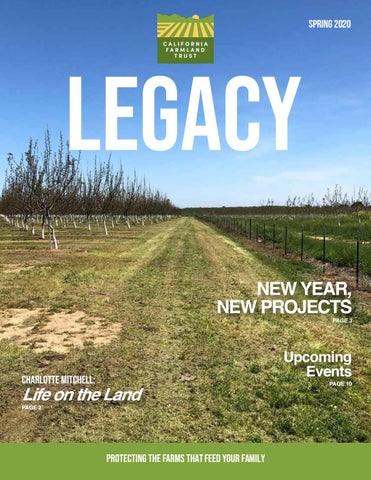
Spring 2020
NEW YEAR, NEW PROJECTS
PAGE 3
charlotte mitchell:
Life on the Land PAGE 2
PROTECTING THE FARMS THAT FEED YOUR FAMILY
Upcoming Events PAGE 10
Executive director’s message Charlotte Mitchell In this issue of the Legacy, we highlight Life on the Land stories, showcasing the people, the land and their commitment to conserving farmland. Making the decision to protect farmland, permanently protecting its agricultural use, can be difficult. It comes with ensuring that we have clearly forecasted what the future may bring and committed to this generation and the next that a legacy will be protected. But at the end of the day, the decision to protect the land is easy. Farming is a way of life that is not easily replaceable. As you will read about the Jorgensen family and the legacy of the farm they protected with a farmland easement, it was a decision at first that met some resistance. Some considered the easement might restrict the ability to have the flexibility needed to farm. But after the easement was placed on the land, and time passed, it was quickly recognized that this farmland easement lessened the worries about the future of the farm and simplified long-term planning.
“The need to protect vital farmland that is producing our world’s food supply ... is paramount.” I applaud the farmers with whom we worked with in 2019 who have forever protected their farming legacy. Their commitment ensures those who want to farm after them can do so, without the threat of conversion.
Our work must continue. The State continues to wrestle with the balance of providing homes, jobs, amenities, and protecting the environment, while ensuring the public’s interest in a food supply that is safe, affordable, and abundant. The need to protect vital farmland that is producing our world’s food supply and contribute to the State’s economy with over $50 billion annually in farm gate sales of agricultural goods is paramount. Our work in 2020 remains promising, as we continue to work with family farmers who are protecting the best farmland in the world. We are thankful to our supporters and donors who continue to help us protect the land so we can farm for generations to come. Together we can make a difference.
OUR MISSION Help Farmers Protect the Best Farmland in the World CURRENTLY SERVING Sacramento, San Joaquin, Contra Costa, Stanislaus, Merced, and Madera counties
Directors: Ron Dolinsek, Rocklin Denny Jackman, Modesto Jim Jorgensen, Rocklin Patrick Johnston, Brentwood Tom Rogers, Madera Larry Ruhstaller, Stockton Sam Zanutto, Sebastopol Editor/Design: Jennifer Luiz Patton, Twisted Twig Design and Print
2
Board Officers: Ron Freitas, Modesto | President Jon Harvey, Pleasanton | Vice President Maxwell Norton, Merced | Secretary Ken Oneto, Elk Grove | Treasurer Barbara Smith, Courtland | Immediate Past President
Trustee Council: George Gomes Ed Nishio Emily Rooney Ann Veneman Paul Wenger
Staff: Charlotte Mitchell | Executive Director Chelsea Molina | Conservation Director Aundriea Montzingo | Program Associate Katie Otto | Director of Operations and Development Madeline Schenken | Intern
Contributors: Vicky Boyd Charlotte Mitchell Chelsea Molina Katie Otto Madeline Schenken
LEGACY
New Year, New Projects
Meet Katie Otto
At the end of 2019, an announcement was made that CFT will receive funding for all four of our agricultural conservation easement projects that were submitted through a competitive grant application process. These projects were selected based on their risk of being converted to other non-agricultural uses, their potential to promote infill development, as well as their agricultural, economic, and ecological values.
The California Farmland Trust is pleased to announce Katie Otto as their new Development and Operations Director. She joins the CFT team after 12 years with the California FFA Foundation and brings her deep roots and experience with agriculture, fundraising and finance management to the organization.
The four projects will protect over 645 acres in Merced and San Joaquin counties, leaving some of the state’s most valuable farmland available for agricultural production, forever. Located on prime soils, these multigenerational farms produce almonds, cherries, walnuts, cotton, garlic, tomatoes and other various irrigated field and row crops all while utilizing practices that help build soil health for increased carbon sequestration. These funds were made available through the fifth round of the California Strategic Growth Council’s (SGC) Sustainable Agricultural Lands Conservation Program (SALC) in collaboration with the Department of Conservation. SALC is a part of California Climate Investments, a statewide initiative that puts billions of Cap-and-Trade dollars to work reducing greenhouse gas emissions, strengthening the economy, and improving public health and the environment — particularly in disadvantaged communities.
protecting the farms that feed your family
“Katie has a passion for agriculture and the meaningful work of non-profits in t h e i n d u s t r y, ” s a i d Charlotte Mitchell, CFT executive director. “She has a keen understanding of the challenges that face agriculture including the protection of farmland. Katie will be an important part of the California Farmland Trust team to continue our mission of protecting these important working landscapes.” Katie is charged with raising funds to support the permanent protection of farmland, advancing CFT’s mission, as well as providing oversight for general operations. Katie lives in Galt with husband Brady, and three children Caleb, Paige, and Colby.
Thank you Tim Byrd A sincere and heartfelt thank you to now f o r m e r, C a l i f o r n i a Farmland Trust (CFT) Director Tim Byrd. Tim recently completed his Board term, following an extensive and dedicated service to CFT. Tim is a founding board member and past president of the land trust that is now CFT. His passion and dedication to the mission of CFT has been felt by his colleagues on the Board, staff and in the industry. Thank you, Tim, for your support!
3
The Road to Conservation A family’s path to preserving their heritage and protecting the land. By Vicky Boyd The family history of Jim Jorgensen and his sisters, Joanne Mills and Janice Jorgensen, is deeply rooted in California agriculture. The three were raised on a farm where their parents, William P. and Elinor Jorgensen, grew walnuts and row crops just outside of Gustine, California. The siblings’ grandfather, Jacob Jorgensen, emigrated from Denmark as a 15-year-old to avoid serving in the German Army before World War I. He came with other young Danish men, who secured work in the San Joaquin Valley on farms growing dryland barley, wheat and oats. Their grandmother, Marie Jorgensen Andersen, became a widow at 32, with two young children in 1922. Yet she managed to hold onto the family farm even during the Great Depression. “My grandmothers’ strength, and ability to keep the farm under those circumstances, is really what made me realize that we need to do our part to ensure it stays in agriculture forever,” Janice shared. None of William and Elinor’s three children went into farming, with Jim and Joanne pursuing careers in education. Janice obtained bachelor’s and master’s degrees in education and went on to several leadership roles focused on training and management, primarily in the private sector, in addition to the Peace Corps, and Federal Emergency Management Agency. Yet, the three never forgot their roots and wanted to preserve them. “Knowing the history, even though we didn’t go into farming, we saw what our mom and dad thought of it,” Joanne said. “By their actions, we knew, and we knew the history of how the land came into our family. It was just, ‘Oh, gosh, we want to do this.’” Adding impetus to their quest to protect the family farmstead, which dates back to the early 1900s, was a proposal to divide nearby farmland into 20-acre ranchettes. As a tribute to William and Elinor, the three siblings successfully placed the family’s 290-acre farmstead into the Central Valley Farmland Trust, the predecessor to the California Farmland Trust, in 2008. Comprising mostly prime farmland, their ranch is planted predominately to row crops, including lima beans, wheat and alfalfa. Where their father once grew walnuts are 35 acres of young almond trees.
SHARING A PASSION Jim felt so passionately about the importance of preserving working ag ground, that he didn’t hesitate to join the California Farmland Trust’s board in January 2018 when asked. Charlotte Mitchell, CFT executive director, said he provides a unique perspective. “Jim is a valued board member, as he brings the perspective of a landowner who has an ag conservation easement to the organization,” she said. “Our mission is to protect farmland, and in doing so, we must stay vigilant to the needs
4
of the land and the industry. Jim’s passion for protecting the land, and ensuring the productive capability of agriculture, is an invaluable contribution to CFT.” Joanne said she understands why her brother was asked to serve. “I can see why he would be good and say, ‘yes, I want to do it,’” she said. “We’re really involved in our ranch even though we’re not farming it. We’re all in our 70’s. We’re all still learning, and we still want to learn.” Jim isn’t bashful about promoting conservation easements, either. During a recent tour of the family’s farmstead, he stopped his vehicle to talk to a passing farmer. As part of the conversation, Jim invited the other farmer to give him a call to find out more about farmland protection.
THE ROAD TO A CONSERVATION EASEMENT Jim said he first heard of conservation easements at a local American Farmland Trust meeting in the mid-2000’s. He followed up with Bill Martin, then-executive director of the Central Valley Farmland Trust, and liked what he heard.
LEGACY
With backgrounds in education, Jim, Joanne and Janice did their homework and researched what was involved in obtaining a conservation easement. They also met with John and Jeani Ferrari of Turlock, who had successfully placed the family’s 270-acre Humboldt Ranch in the Central Valley Farmland Trust in April 2005. The three then began the process of obtaining an agricultural conservation easement in 2006. Back then, such an effort was a rarity and took longer than anticipated. Steve Bell was farming the ground for the family at the time and expressed concern that the easement might restrict his ability to farm. In 2008, the papers were signed, and the William P. Jorgensen Ranch was to be forever in agriculture. A few years afterward, Jim said Bell expressed his gratitude, saying it lessened his worries about the future of the farm and simplified long-term planning. As Jim explained, an agricultural conservation easement simply prevents the ground from being used for anything other than agriculture. But it doesn’t otherwise constrict cropping choices, farm management decisions or day-to-day operations.
“My grandmothers’ strength, and ability to keep the farm under those circumstances, is really what made me realize that we need to do our part to ensure it stays in agriculture forever.”
Jim, Joanne and Janice’s cousins, who inherited the adjacent 275-acre Hooper Ranch, have followed in their footsteps, successfully obtaining a conservation easement in 2018.
THE NEXT GENERATION Joanne lives in Merced, while Jim resides in Rocklin and Janice calls Massachusetts home. Although they have Jim Ventura farm their ground, the three remain actively engaged in the operation. Joanne spent 25 years teaching first grade, and she said she loved every minute of it. But there’s a small part of her that is wistful for not having paid more attention to the farm as a child. “In retrospect, as involved as we’ve gotten with the ranch, farmland trust, and hiring farmers, there’s a part of me that wishes I knew more,” Joanne said. “I think growing up, you don’t realize, you don’t appreciate and don’t understand the importance of it.” Jim, Joanne and Janice have tried to pass along their appreciation of agriculture to the next generation.
JORGENSEN SIBLINGS JOANNE (CENTER) LIVES IN MERCED, WHILE JIM (RIGHT) RESIDES IN ROCKLIN AND JANICE (LEFT) CALLS MASSACHUSETTS HOME.
“I believe in ag,” Joanne said, “I just feel like city people don’t get it. They do not understand what farmers have to go through. They don’t understand where food comes from. They don’t understand any of it. For me, this whole valley is about ag.” Jim and Janice never had children. Of Joanne’s three children, two followed in her footsteps and became teachers, and one is an attorney. Nevertheless, they remain connected to the family farm in a small way. “They weren’t ag oriented at all, but they cared about their grandfather and grandmother and that we’re committed,” Jim said.
protecting the farms that feed your family
5
Why we must protect California’s Farms California’s population is estimated to reach 50 million people by the year 2050. That’s nearly 11 million more people over the next thirty years! What’s more concerning is how we will feed the growing population when the land best suited for food production continues to diminish at a rapid rate of an estimated 50,000 acres per year. Our farmers are the most efficient growers and stewards of the land, but unless we do something now to preserve and protect farmland, demand will exceed supply.
California Farmlands Represent:
24.3
M I L L ION ACR E S
69,400
23% OF TOTAL ACRES IN CALIFORNIA
F A R M S
DEVELOPMENT CONSUMES
50,000 ACRES OF AGRICULTURAL LAND ANNUALLY
6
OF CALIFORNIA’S CROPLAND IS CONSIDERED TO BE PRIME, UNIQUE, OR OF STATEWIDE IMPORTANCE
M I L L I O N A C R E S LEGACY
The value and impact of agriculture is significant. California Farmland Trust is working hard to keep it that way!
We work with landowners who want to ensure their land stays in production and remains protected in perpetuity with an agricultural conservation easement (ACE). An ACE does more than simply protect farms; they help protect our future.
Conserving Farmland Helps... CO2 O2
PROTECT FOOD DIVERSITY
IMPROVE CARBON SEQUESTRATION
PROVIDE WILDLIFE HABITAT
REDUCE GREENHOUSE GAS EMISSIONS
ENSURE FOOD SECURITY
California Farmland Trusts’ Success
TOTAL ACRES PROTECTED 705 ACRES IN 2019
You can help
protect farmland in California while preserving the landscape that characterizes so much of California’s splendor. Your financial support of California Farmland Trust helps to safeguard farmland for all Californians. Together, we will protect the farms that feed our families, our communities and the world.
protecting the farms that feed your family
7
Aunt’s words of wisdom spurred support for farmland conservation By Vicky Boyd Growing up, Webster Williams’ and Bonner Mendez’s aunt — Alberta Webster Lewallen — used to tell them, “You can never create more land. Don’t ever sell the land.” This was something Lewallen had heard from her father, Clarence Albert Webster, when she was young. Williams and his sister, Mendez, have taken that lesson to heart. Both own farms only a few miles apart near Linden, California, and they both successfully obtained agricultural conservation easements through the California Farmland Trust in October 2019. But that wasn’t the first time the family had committed to preserving farmland. Williams and Mendez recalled their mother admonishing a flood control district maintenance crew for removing vegetation along the banks of the Calaveras River as it passed their property. “’Don’t ever do that again — cleaning out the creek bed,’” Mendez remembered her mother saying. “’That’s habitat for the animals.’” In 1963, the family deeded development rights in perpetuity to the California Department of Fish & Game for one of their ranches along the Calaveras River. The action was similar to a conservation easement at the time. “So we’ve grown up with the conservation and preservation of land,” Williams said.
A PLACE TO RELAX AND GROW UP Their grandfather, C.A. Webster, founded the Stockton Box Co. with a partner in 1910. The company manufactured wooden boxes used to harvest field fruit, and smaller wooden boxes used for packing and shipping. In the early 1930s, C.A. Webster bought a ranch in the Linden area. Now known as Webster Ranch, it was a place for him to relax with his family on weekends. He developed an interest in ranching and raised Hereford cattle. Williams and Mendez’s mother, Marjorie Webster Williams, as well as her two sisters, built houses near Linden “within yelling distance” of one another, and the 10 cousins grew up and played together.
“Our families and our children understood that it continues to be important to ‘never sell the land’.”
8
Their father retired from the lumber business in 1973 and bought additional ground along the Calaveras River already planted in walnuts.
PLANTING THE SEED Mendez said she began thinking about an ag conservation easement for her ranch after attending a reception celebrating the Brandstad Brothers successfully obtaining protection of farmland in Stockton in 2014. “I got all of these materials and said, ‘I’m going to do this,’” Mendez said. “Our families and our children understood that it continues to be important to ‘never sell the land’ and that the philosophy of preserving this wonderful heritage is a legacy that can be handed down to future generations.” Williams had a similar reaction. “My kids are very dispersed, and I don’t think they’d want to live here,” Williams said. “I think it was pretty much the understanding that the best use of it was a farm, so it was never an issue. Of Mendez’s three children, her son, Will Mendez, has chosen to live
LEGACY
on the family ranch with his wife, Jessica. He currently manages a young walnut orchard. As was the case when their father grew walnuts, Williams and Mendez still have FFD Orchards and Frank DeBenedetti custom farm their mature orchards.
SUCCESSFUL CONSERVATION PARTNERSHIPS Williams’ and Mendez’s farms join the Messick Farm, two parcels of walnuts and cherries, totaling 84 acres, also near Linden. Owner James Messick donated the conservation easement on his properties to the California Farmland Trust in July 2018.
Two new agricultural conservation easements In October 2019 siblings, Bonner Mendez and Webster Williams, both permanently protected their multiple generation farmland by entering their land into agricultural conservation easements with funding provided by USDA Natural Resource Conservation Service.
“Protecting these key areas builds upon an important cluster of farmland that has unique natural resources and needs to be protected to ensure farming remains an economically viable industry in California,” said Charlotte Mitchell, executive director of the California Farmland Trust. The agricultural conservation easements on both the Williams Farm and Mendez River Ranch came to fruition as part of a partnership among the landowners, the California Farmland Trust, and the Natural Resources Conservation Service. “NRCS has funded agricultural conservation easements under different programs for nearly 30 years”, said Elizabeth Palmer, NRCS easement program specialist in Davis. “Working diligently to protect these working landscapes that have prime soils, water availability and other natural resources early provides a signal to local jurisdictions that agricultural use is forever protected,” Mitchell said. “Agricultural conservation easements are a tool that farmers can use to remove the uncertainty of adverse land uses, and they signal to local planners that urban development should be confined to appropriate areas and not allowed to sprawl on to agricultural lands.”
MENDEZ RIVER RANCH IS COMPRISED OF BOTH WALNUT ORCHARDS AND HAY FIELDS COVERING 251.49 ACRES AND LOCATED IN A SCENIC AGRICULTURAL AREA NORTH OF LINDEN IN SAN JOAQUIN COUNTY.
Abutting the property is a small creek that’s an offshoot of the Calaveras River. Much like his mother, Webster Williams has kept it in native vegetation. The 251-acre Mendez River Ranch, which is planted to walnuts and irrigated pasture, also has mostly prime soils and is considered “farmland of local importance,” Palmer said. When their grandfather, C.A. Williams, bought the ranch, it was entirely pasture. The family began pumping water, making them the first to have pasture irrigated on a contour. Slowly, the family has converted ground over to walnuts, with about 136 acres currently in trees. Mendez also is applying for funding through NRCS to help plant native vegetation around a small pond. “We want to start creating a wildlife area in the back of the ranch,” she said. “It’s not even an acre, but it runs along the back of Mosher Creek. There are also many other programs we’re both interested in — cover crops for the orchards and soil conservation programs — to name a few.”
protecting the farms that feed your family
WILLIAMS FARM COVERS 110.08 ACRES OF PRODUCTIVE WALNUT ORCHARDS AND IS LOCATED IN SAN JOAQUIN COUNTY NORTH OF THE TOWN OF LINDEN.
9
Save the Date - Big Day Of Giving
Save the Date - Concrete California
Save the Date, the Big Day of Giving (BDOG) 2020 is right around the corner! A program of the Sacramento Region Community Foundation, BDOG is an initiative to grow local philanthropy. The annual 24-hour community-wide movement unites the nonprofit sector to help raise unrestricted funds for nonprofits. For California Farmland Trust, BDOG is used to raise vital funds to better position us to protect valuable farmland throughout California. Look for more information on the BDOG coming soon to our website and social media.
Join CFT on March 18th, for our first Friend of Farmland event for 2020!! Following Ag Day at the Capitol in Sacramento, we invite you to join California Farmland Trust for a screening of Concrete California; a glimpse of what could become California’s last harvest. Immediately following, stay for a meaningful and thoughtprovoking discussion about the value of protecting the farms that feed our families, our communities and the world. For more information visit http://concretecalifornia.eventbrite.com
Our CFT family is growing!
California ‘Ag Plate’ Give-Away
CFT is excited to announce, our Program Associate, Aundriea Montzingo and her husband Tim, welcomed their first child, on December 10, 2019. Colton Timothy Montzingo entered the world weighing 7lb 5oz and was 19 inches long.
10
California FFA wants to buy a ‘CalAgPlate’ for your automobile! Started in 2014, the California Agricultural License Plate (CalAgPlate) has generated more than two-million dollars for agricultural education. The program, sponsored by the California Department of Food and Agriculture (CDFA), distributes ninetycents of every dollar generated by the specialty license plate in the form of grants to agricultural education organizations. In an effort to grow the program, the California FFA will purchase a CalAgPlate for the first 3,500 vehicle owners who want to support agricultural education in California by placing the license plate on their vehicle. Visit: https://www.calaged.org/calagplate and scroll down for the registration form, once the form is complete mail it to the California FFA at P.O. Box 186, Galt California, 95632. Questions? Call (209)744-1600.
LEGACY
Sponsor Spotlight Raley’s Raley’s is a privately-owned and family-operated customer experience grocery company headquartered in West Sacramento, CA. Raley’s stores are the destination for the best fresh products, affordable offerings, and personalized service. The company’s commitment to infusing life with health and happiness by changing the way the world eats, one plate at a time, has made it a trusted source for food, nutrition, and wellness. Raley’s strives to enhance transparency and education in the food system in order to help customers make more informed, healthy food choices. In celebration of the company’s 85th anniversary, Raley’s recently launched a new integrated campaign, entitled “Good Never Stops.” The campaign is intended to honor the everyday moments when Raley’s team members, customers and partners, including California Farmland Trust, make a positive impact in their communities.
YouTube.com/RaleysFamilyOfStores Since 2016, Raley’s has proudly sponsored the Raley’s Field Trips on the Farm program presented by CFT, sending 600+ fourth and fifth grade students on farm and store field trips. We’re grateful that Raley’s has helped CFT ensure the good that we do to impact and educate youth will continue. Raley’s operates 129 stores under five banners: Raley’s, Bel Air Markets, Nob Hill Foods, Food Source, and Market 5-ONE-5. Making healthier offerings accessible to everyone, Raley’s has expanded beyond the store to operate grocery curbside pick-up and delivery in their nearby communities.
Sponsors Legacy
Visionary
Heritage
Sustaining
Guardian
Diane Norton Insurance
protecting the farms that feed your family
11
9245 Laguna Springs Drive, Suite 110 Elk Grove, CA 95758
NON-PROFIT ORG U.S. POSTAGE PAID PERMIT #182 ELK GROVE, CA
916-687-3178 phone 916-685-1041 fax www.cafarmtrust.org
Protecting the farms that feed your family 20,000 ACRES BY 2020 20k
15k
16,646 ACRES CONSERVED
10k
5k
92% of every dollar donated goes directly to farmland conservation. Make a gift today at cafarmtrust.org