CENTRAL VALLEY FARMLAND TRUST
FALL 2017
PUTTING THE FIELD IN FIELD TRIP
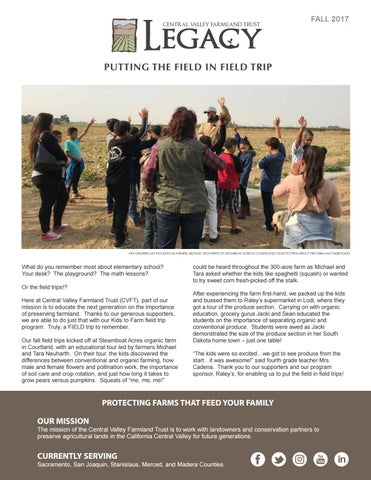
4TH GRADERS GET INVOLVED AS FARMER, MICHAEL NEUHARTH OF STEAMBOAT ACRES IN COURTLAND, TALKS TO THEM ABOUT HIS FARM AND THEIR FOOD
What do you remember most about elementary school? Your desk? The playground? The math lessons? Or the field trips!? Here at Central Valley Farmland Trust (CVFT), part of our mission is to educate the next generation on the importance of preserving farmland. Thanks to our generous supporters, we are able to do just that with our Kids to Farm field trip program. Truly, a FIELD trip to remember. Our fall field trips kicked off at Steamboat Acres organic farm in Courtland, with an educational tour led by farmers Michael and Tara Neuharth. On their tour, the kids discovered the differences between conventional and organic farming, how male and female flowers and pollination work, the importance of soil care and crop rotation, and just how long it takes to grow pears versus pumpkins. Squeals of “me, me, me!”
could be heard throughout the 300-acre farm as Michael and Tara asked whether the kids like spaghetti (squash) or wanted to try sweet corn fresh-picked off the stalk. After experiencing the farm first-hand, we packed up the kids and bussed them to Raley’s supermarket in Lodi, where they got a tour of the produce section. Carrying on with organic education, grocery gurus Jacki and Sean educated the students on the importance of separating organic and conventional produce. Students were awed as Jacki demonstrated the size of the produce section in her South Dakota home town – just one table! “The kids were so excited…we got to see produce from the start…it was awesome!” said fourth grade teacher Mrs. Cadena. Thank you to our supporters and our program sponsor, Raley’s, for enabling us to put the field in field trips!
PROTECTING FARMS THAT FEED YOUR FAMILY OUR MISSION
The mission of the Central Valley Farmland Trust is to work with landowners and conservation partners to preserve agricultural lands in the California Central Valley for future generations.
CURRENTLY SERVING
Sacramento, San Joaquin, Stanislaus, Merced, and Madera Counties.
EXECUTIVE DIRECTOR’S MESSAGE CHARLOTTE MITCHELL “When I fly over California, I see a lot of open space. Why do we need to protect farmland?” This question, asked of me by a college student in a recent presentation, got me thinking. Questions like this, posed by a student who has likely already had a long career (not your typical 20-something year-old student), emphasize the importance of educating the next generation. Of course, we all know the answer – because very little of that open space we fly over is prime farmland. We can’t farm in the Sierra Nevadas, or on the beaches, or even on dry rangelands; only the valley floor’s prime farmland can provide the abundant variety of crops that feed our families. And it is imperative that those of us who know the answer spread the word to those who don’t. Spreading the word is our second mission. While our first focus is, and always will be, on agricultural conservation easements, we are working hard to educate the general public and the next generation. From appearances at farmer’s markets, to brief educational radio spots, and even into the classroom – we are focused on education. This October and November, we are taking four classrooms of
...ONLY VALLEY FLOOR’S PRIME FARMLAND CAN PROVIDE THE ABUNDANT VARIETY OF CROPS THAT FEED OUR FAMILIES
a donation of just $20 enables us to put a kid on a farm for a day. Next year, we hope to make even more field trips happen, and to help more people understand the difference between open space, and the precious prime farmland that we protect every day.
fourth graders on a real field trip – out of the classroom and into the orchard for a hands-on farm education. You can read more about the trips on our website, www.valleyfarmland.org. Your support helps make these field trips possible –
Board Officers: Barbara Smith, Courtland | President Ron Freitas, Modesto | Vice President Maxwell Norton, Merced | Secretary Ken Oneto, Elk Grove | Treasurer Directors: Tim Byrd, Modesto Mike Darnell, Sacramento Ron Dolinsek, Rocklin Larry Ruhstaller, Stockton Staff: Charlotte Mitchell | Executive Director Melanee Cottrill | Associate Director
2
Founding Members: Markus and Elizabeth Bokisch Timothy and Suzanne Byrd Richard and Sharon Clauss John and Jeani Ferrari E & J Gallo Winery Hilmar Cheese Company, Inc. Vance Kennedy, Ph.D Brad Lange/Lange Twins Partnership Martin and Stacey Machado Charles and Sally Magneson Scott and Pamela Magneson Maxwell and Diane Norton Donald and Lynn Skinner Duncan and Barbara Smith Mike and Cathy Tanner
Charter Board Members: Don Bo Markus Bokisch Tim Byrd Jeani Ferrari Denny Jackman Brad Lange Linda Macedo Maxwell Norton Ken Oneto Mike Tanner Trustee Council: George Gomes Ed Nishio Paul Wenger Emily Rooney
Editor/Design: Erin Davis, Davis Communications Group Editing Team: Monica Bianci Melanee Cottrill Kelly Ewing Mike Darnell Ron Freitas Content: Melanee Cottrill Erin Davis Ron Dolinsek Charlotte Mitchell
LEGACY
FRIENDS OF FARMLAND – SOUTH Friends, farmland and fun go together in our quarterly supporter appreciation events! We were pleased to be joined by many long-time and brand-new friends of farmland at the dinner. Generously hosted by the fine folks at the Merced Fruit Barn (check out their unique roadside fruit barn at www.mercedfruitbarn.com), a great time was had by all in a charming venue with the added bonus of a fruit store next door.
Keep an eye out for your invitation to a Friends of Farmland event in the new year. Make a donation today to ensure you remain on our invite list! These quarterly events are hosted at rotating locations in our service area and open to our sponsors, donors, landowners, and other friends who support our efforts to protect the farms that feed your family.
L - R: DENNIS MEISNER, DENNIS PROSPERI, KYLE PROSPERI & RACHEL MEISNER
RALLY Did you know that Central Valley Farmland Trust is one of thousands of land trusts across the United States? Once a year, we get together with other land trusts of all shapes and sizes at the Land Trust Alliance’s Rally conference. This year, more than 2,000 people attended Rally, learning from and growing with other attendees. Our action-packed week included
LEADERSHIP REPRESENTING OUR LOVE FOR FARMLAND
PROTECTING FARMS THAT FEED YOUR FAMILY
on-the-farm tours; seminars on sustainability, stewardship, accreditation, and outreach; and special roundtable lunches on education and communication. It was a week well-spent as our Executive and Associate Directors sharpened their skills and added to their already substantial toolboxes.
THIS STUNNING OLD BARN WAS A SITE TO SEE ON ONE OF THE RANCHES WE VISITED WHILE TOURING DENVER FARMS AND RANCHES DURING THE LTA RALLY
3
AS LONG AS WE HAVE ENOUGH LIVING AND WORKING ON A CONSERVED FARM
THE ENTRANCE SIGN TO THE FARM STANDS AS A TESTAMENT TO THE FATHER WHO MADE SURE THIS PLACE WAS PROTECTED FOR THE MANY GENERATIONS OF FARMERS TO COME
“I haven’t been anyplace that I enjoy more than here.” There is nothing but humble honesty in farmer Tom Ulm’s voice, nothing but sincerity in his eyes, as he admits his adoration for the family farm that five generations of Ulms have called home. Tom’s grandfather purchased the property outside Modesto in 1943. Back then, the farm was the dairy Tom grew up working. Since then, it’s morphed from grapes and corn, to almonds and grapes, to almonds and walnuts. From one family farm, to two. From brothers, to uncles and nephews, to cousins. This rich history is proudly detailed on posters and in photographs lining a stairwell in the family home. Throughout the years, throughout the changes, one element has never wavered – Tom’s dedication to preserving the farm lifestyle.
FAMILY PHOTOS ADORN THE WALLS IN THE ULM FAMILY FARMHOUSE
Tom recalls his early days of being a farm advocate with a modest chuckle. When he was mayor for a day of his high school, his platform consisted of a simple, resonant statement: No more growth! Later, when Tom learned he could protect the family farm from the city’s growth with an easement, he encouraged his father to pursue one. Much to Tom’s dismay, his father, Bill, wasn’t convinced. That is, until
4
a friend of Bill’s placed an easement on his nearby farm – then “all of a sudden it’s a good idea!”
THROUGHOUT THE YEARS, THROUGHOUT THE CHANGES, ONE ELEMENT HAS NEVER WAVERED – TOM’S DEDICATION TO PRESERVING THE FARM LIFESTYLE. In 2011, that good idea became an agricultural conservation easement protecting the Ulm’s 151 acres of prime farmland. Tom and his wife Irene rest easy knowing that the family farm is safe, regardless of whose hands it is in. “We would definitely recommend [an easement], if you’re living in an area like we are,” Irene says, sitting in the family farmhouse. They want to “keep town as far away as we can,” Tom adds, “because right now the possibility is our driveway.” Tom and Irene are hopeful that more of their neighbors will move to permanently protect their farms. “We’ve had friends that have sold to development, we’ve seen what it does to them,” Tom notes, “money doesn’t do anybody any good – as long as we have enough to survive.” Before placing an easement, they advise their fellow farmers to “look far down the road.” “If you want to keep it there for your kids and grandkids,” protecting the farm with an easement is “the ideal thing to do.” When asked whether the easement protecting his farm has impacted how he farms, typically talkative Tom is nearly at a loss for words. “We’re farming anyway,” he says, “so it hasn’t.” He is almost amused by our annual visits to ensure the farm is still a farm, in compliance with the protective
LEGACY
AS LONG AS WE HAVE ENOUGH
SPONSORS LISTING
ARTICLE CONTINUED... GOLDEN FIELDS SPONSOR
VISIONARY SPONSOR
HERITAGE SPONSOR TOM AND IRENE ULM AMID THE ALMOND ORCHARD ON THEIR FARM
easement. To this man, whose idea of a good vacation is avoiding snakes at an Australian almond conference, doing anything other than farming his land is practically inconceivable. When he began working the farm, Tom took care of grapes during the day and dairy cows in the evening. Irene also grew up with cattle, caring for her family’s calves after school. Before he took over the family farm, Tom worked for Foster Farms, a career move mandated by his father Bill. The lessons Tom learned on both farms have stuck with him. “I’ve always been a big fan of working with the guys, not over them,” he says. “Whatever they’re doing, you need to do it.” And before Tom’s son, Bobby, began working on the family farm, he too was required to work on another farm. Over the years, Tom’s crops, and the technology he uses to grow them, have evolved. He fondly points out the old tractor, once featured in a newspaper photo accompanying an article on the family, now enjoying its retirement next to the relatively new barn. Constructed of repurposed shipping containers, the barn is itself an innovation, as is the equipment it holds. After fifteen years of monitoring water conditions with digital in-ground probes, last year the Ulms moved to using pressure bombs to sense moisture in leaves. Getting a more direct picture of the trees’ state has allowed Tom to be more strategic in his watering practices. Today, Tom is happy to be on the land he loves, with the family he loves, doing a job he loves. “It’s a world all it’s own,” he says. “Living out here is not like the rest of the world.” And he wouldn’t have it any other way.
PROTECTING FARMS THAT FEED YOUR FAMILY
GUARDIAN SPONSORS Diane Norton Insurance Mid Valley Agricultural Services, Inc. Madera County Farm Bureau Farmland Sponsors: Bokisch Ranches, Inc. Garton Tractor Hanson McClain Montpelier Farming Corporation Stanislaus Food Products Granville Homes Sacramento County Farm Bureau Stanislaus County Farm Bureau Pacific Southwest Irrigation
5
DIRECTOR’S MESSAGE
WELCOME EMILY ROONEY
RON DOLINSEK
Forty years ago (1977) we purchased a new home in a residential area in the Sacramento Valley. It was located next to a local farm and it was great to be living in the heart of farming country. But, our home was placed on some of the richest and most productive soil in the world and I thought, how unfortunate that it would never again be productive. Fast forward to nearly 10 years ago, when I decided to take a more active role in efforts to preserve prime farmland by joining CVFT. Frankly, it was one of the wisest and most rewarding decisions I ever made. Historically, I always found volunteer work to be exceptionally fulfilling and felt like it was “the right thing for me to do.” As Mark Twain said, “It is never wrong to do the right thing!” When we consider the essentials of life consist of air, food, and water, by the very nature of agriculture, it provides for these basics. Therefore, just ask yourself, isn’t preserving prime farmland “the right thing to do?” As a volunteer in different nonprofits, I always thought I gained more from the experience than I gave. One example, I recently teamed up with another CVFT supporter on a local project. Together, we successfully are on point to preserve an open area consisting of 183 acres located in the heart of our community. We capitalized on our experiences in CVFT, knew what was possible, and could leverage lessons learned through volunteerism. Not only was the land saved, we made tremendous relationships that will benefit the land and its continued sustainability. Being a volunteer, being willing to serve others and our lands, has made all the difference. Will Rogers perfectly summarized success. He stated, “If you want to be successful, it’s just simple: know what you are doing, love what you are doing, and believe in what you are doing.” This sums up the passionate CVFT management team and its board of directors. Please consider supporting this well-managed organization as a volunteer and through your generous financial contributions. Success is connected with action and our success is only possible with your help.
6
An infectious laugh and an earned yet, easy confidence summarize our newest Trustee Council member, Emily Rooney. Emily has a deep-rooted desire to help the next generation learn more about their food and more importantly, where it comes from. Emily was raised in the Bay area, but her family raises sheep and cattle in San Joaquin County. Only one generation away from the farm, Emily says, “kids are so quickly disengaged with agriculture, I want my child and others to know of and have a connection to our heritage of food and fiber production in California.” Emily majored in Agricultural Economics at University of California, Davis, and has spent her career working on Capitol Hill in Washington, D.C., at the California Farm Bureau Federation, and is now the President of the Agricultural Council of California. She is fluent in the ways of politics and California’s uniqueness in both the legislative and agricultural realms. “I like solving difficult issues. Farming in an urban state with the best natural resources while also being good stewards of the environment, our livestock, and our people, is one I am going to champion in all I do,” said Emily. Joining the CVFT Trustee Council was a natural move for Emily. “The members of the Trustee Council for CVFT are wise and I am honored to be in their circle,” she said. “I look forward to working with them and the board and staff to increase awareness of their mission throughout the state, help them grow, and help them be an alternative to the many issues facing farmers who must continually produce more with less.” Emily also serves as a member of the UC Davis College of Ag Dean’s Advisory Council, the statewide Foundation Board for Future Farmers of America, and the Community Advisory Board for Lodi Memorial Hospital. Emily is also a graduate of Class 39 of the California Agricultural Leadership Program.
LEGACY
WINNING WITH WINE Albarino, Tempranillo, and Verdejo – oh my! Spanish wines abound at Bokisch Vineyards, one of Lodi’s premier wineries and a founding CVFT supporter. The winery, located just off the beaten path on Atkins Road outside Lodi, is well-worth the adventure. True lovers of the land and masters of their craft, Markus and Liz Bokisch welcome guests to their tasting room Friday through Sunday from 11-5. Amazing views of the oak
studded rolling hills await. Want to visit for free? All donors to CVFT from October 1 to December 31 will be entered into a drawing to become one of three winners of a free tasting for 6 and a 10% discount on any purchase during the tasting. If you can’t make it to the vineyard, don’t fret – you can enjoy your own Sangria at home with their following recipe!
BOKISCH SANGRIA 1 bottle Bokisch Albarino 1/3 cup sugar 3 oranges, quartered 1 lemon, quartered
1 lime, quartered ½ liter club soda 2 shots Gin
PROTECTING FARMS THAT FEED YOUR FAMILY
Pour the entire bottle of wine into a pitcher. Squeeze in the juice from all three citrus fruits and place the wedges in the pitcher. Add sugar and stir or shake the pitcher. Add the Gin. Upon serving, add club soda to taste. Serve in a highball glass, filled with ice. Keep the pitcher in the refrigerator.
7
NON-PROFIT ORG U . S. POSTAGE PAID PERMIT #182 ELK GROVE, CA
CENTRAL VALLEY FARMLAND TRUST 8788 Elk Grove Blvd, Bldg 1, Ste I Elk Grove, CA 95624 916-687-3178 phone 916-685-1041 fax www.valleyfarmland.org
WE HAVE A GOAL – 20,000 ACRES BY 2020 – WE NEED YOUR HELP! 20k
15k
15,628
ACRES IN PROCESS
13,628
ACRES CONSERVED 10k
5k
0k
A SPECIAL OPPORTUNITY TO GIVE:
NATIONAL DAY OF GIVING - TUESDAY, NOV. 28 GET ONLINE AND GIVE! BLACK FRIDAY, CYBER MONDAY, GIVINGTUESDAY. VISIT US AT WWW.VALLEYFARMLAND.ORG
LEGACY
PROTECTING FARMS THAT FEED YOUR FAMILY