p S ring 20
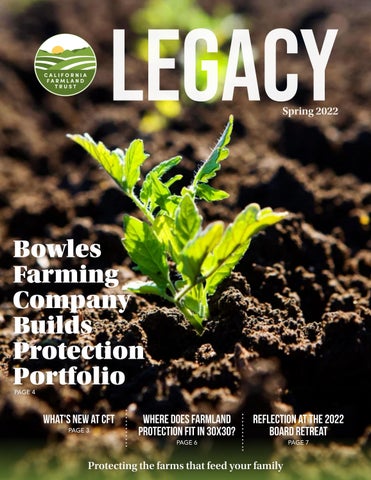
Bowles Farming Company Builds Protection Portfolio PAGE 4
What's New at CFT PAGE 3
Where does farmland protection fit in 30x30? PAGE 6
Reflection at the 2022 board retreat
Protecting the farms that feed your family
PAGE 7
Ensuring Environmental Sustainability and Agricultural Viability in California OUR MISSION Help Farmers Protect the Best Farmland in the World CURRENTLY SERVING Sacramento, San Joaquin, Contra Costa, Stanislaus, Merced, Madera, and Fresno counties Directors: Ron Dolinsek, Rocklin Denny Jackman, Modesto Ryan Jacobsen, Fresno Jim Jorgensen, Rocklin Theresa Kiehn, Modesto Barbara Smith, Courtland Sam Zanutto, Sebastopol Board Officers: Jon Harvey, Pleasanton | President Patrick Johnston, Brentwood | Vice President Maxwell Norton, Merced | Secretary Ken Oneto, Elk Grove | Treasurer Ron Freitas, Modesto | Immediate Past President Trustee Council: Jennifer Beretta Reagan Denny Ed Nishio Emily Rooney Ann Veneman Paul Wenger Becca Whitman Staff: Charlotte Mitchell | Executive Director Katie Otto | Development & Operations Director Chelsea Slaton | Conservation Director Adriana Toste | Communications Associate Contributors: Charlotte Mitchell Aundriea Montzingo Katie Otto Chelsea Slaton Adriana Toste Editor/Design: Jennifer Luiz Patton, Twisted Twig Design and Print Cover Photo: Courtesy of Bowles Farming Company
2 |
Legacy
By Charlotte Mitchell, CFT Executive Director
At the start of 2022, the Califor nia Farmland Trust (CFT) board of directors and staff outlined a five-year plan for the organization. The plan defined growth and progression in acquiring funding for more projects to protect more of our state’s working landscapes, help more farmers carry on their family farms, build our support networks, and invest in additional talented staff to take on these actions. These ambitions will be a collective effort over the coming years and will position us to make difference where it matters most. Additionally, the 20th anniversary of CFT is approaching in the near future, and come 2024, we are looking forward to honoring our roots and the several instrumental land trusts and conservation advocates who made CFT the organization it is today. this effort would prioritize our work in As we work to achieve these goals and assisting landowners who wish to put an celebrate our successes, it is critical that agricultural conservation easement on our leaders also recognize the need for their farmland, but this is not the case. our valuable work. Agricultural viability The draft does not account for these is essential to a robust economy, and lands, both farmland and rangeland, in the California state officials must inventory of lands that re m a i n c o n s c i o u s o f o u r " T h e s e n a t u r a l a n d have been conserved. diminishing natural resources Further, the definition working lands sustain of conservation used and the importance of these our economy, support i n t h e d r a f t p l a n resources. our unique biodiversity, clearly leaves out what Our networks understand and contribute to the G o v e r n o r N e w s o m that California’s lands provide g l o b a l f o o d s u p p l y , once stated as “the an important resource s t at e d by G ov e r n o r s t a t e ’s n a t u r a l a n d in limiting the impacts working lands that Newsom, in California's sustain our economy, of climate change, while protecting events such as quest to conser ve 30 support our unique wildfire, floods, droughts, percent of our land and b i o d i v e r s i t y, a n d and extreme heat. These coastal waters by 2030. " c o n t r i b u t e t o t h e natural and working lands global food supply.” sustain our economy, support our unique biodiversity, and contribute As a result, CFT, along with various to the global food supply, as stated by industry partners, have actively responded Governor Newsom in California’s mission to this draft plan, urging the California to conserve 30 percent of our lands and Natural Resource Agency to go back to coastal waters by 2030. This action was the drawing board to include the working signed in October 2020, and a draft plan lands that not only help achieve climate was released in December 2021, asking resiliency and biodiversity, but contribute for comments from people around the to the food supply for a growing state for what, in their view, are our best population and protect against fires and strategies for achieving 30x30. floods. A deeper analysis of this, by trustee council member and Agricultural Council When the Governor first announced the of California president Emily Rooney, can Executive Order, CFT was optimistic that be found on Page 6.
New Things at CFT... SAVE THE DATE! RACE TO SLOW THE PACE, SEPTEMBER 25, 2022 We are thrilled to announce the second annual Race to Slow the Pace at Bokisch Vineyards – which will now include a 5K AND 10K! Join us Sunday, September 25, 2022 for a one-of-a-kind experience through the Lodi countryside and scenic vines, paired with brunch, Spanish wine, and unique goodies. “Our inaugural Race to Slow the Pace was a great success, and we are happy to introduce our cause to more of the running community, wine enthusiasts, and land protection supporters with our 10K option,” said Katie Otto, development and operations director at CFT. With the shared goal of bringing attention to our diminishing, valuable farmland and connecting consumers back to the land that grows their food, CFT is excited to continue this tradition at Bokisch Vineyards. Registration is now open, so be sure to secure your spot! We are also looking for sponsors, so if you or someone you know is interested in being a race sponsor, please visit cafarmtrust.org/racetoslowthepace for more information. Be sure to keep up with our social media accounts for all things race related!
CFT BENEFITS FROM ROUND SEVEN SALC FUNDING AWARDS With the support of the Sustainable Agricultural Lands Conservation Program (SALC), CFT is proud to be awarded funding for future agricultural conservation easement projects. The projects proposed by CFT were two of the 19 projects chosen for funding under the seventh annual round of funding through the SALC Program, which will award more than $65 million for easements throughout California and the development of regional agricultural land conservation strategies. The SALC Program is a collaboration between the California Strategic Growth Council (SGC) and Department of Conservation (DOC). SALC is part of California Climate Investments (CCI), a statewide program that puts billions of cap-and-trade dollars to work reducing greenhouse gas emissions, strengthening the economy, and improving public health and the environment. Previous SALC rounds funded eight easements held by CFT, helping protect 1,350 acres in three counties, with one easement currently in the process that will protect 474 acres. The two easements chosen for funding in round seven will account for 53 acres protected in San Joaquin County and 59 acres protected in Merced County.
SAVE THE DATE! BIG DAY OF GIVING - MAY 5, 2022 Mark May 5 in your calendars as the 2022 Big Day of Giving (BDOG)! This annual communitywide program organized by the Sacramento Region Community Foundation is aimed to grow support for local nonprofits who make a difference in the Sacramento region, like CFT. The 24-hour giving challenge brings nonprofits and supporters together to raise unrestricted funds, helping further their development and additional resources. For CFT, BDOG is a critical movement that assists in our challenging mission of protecting the world’s best farmland. Be on the lookout for more information regarding BDOG on our social media channels and website!
Protecting the farms that feed your family
| 3
Building Upon Miller & Lux, Inc. Great-Great Grandson of Bowles Farming
I
t’s not every day you hear of a family farm that has lasted in California for six generations, reiterating that Bowles Farming Company (BFCo.) is truly one of a kind. What started as a meat processing operation over 160 years ago by Central Valley pioneer, Henry Miller, has since blossomed into a diversified fruit, fiber, and vegetable business.
FOLLOWING HENRY MILLER’S PATH
Miller, a German immigrant, made his name in California agriculture as a cattle rancher and butcher, said Cannon Michael, Miller’s great-great grandson.
“I used to love coming down with my grandfather, and I always had an affinity for it,” Michael recalled. “I worked here as a teenager doing irrigation and tractor driving and liked the business, the land, and the people.”
“Prior to coming to the United States, he had a brief stint as an apprentice butcher, so he knew the meat trade, and that’s as much as he’d ever been exposed to in his young life,” Michael said. DOMINATING CALIFORNIA AGRICULTURE Miller made his way to California in the 1850s and joined forces with his business partner Charles Lux who too, was a German immigrant. Together, the two became the largest cattle producers in California and some of the largest landowners in the United States.
Michael started with BFCo. in 1998 and follows five generations of family members involved in the business. Though he wasn’t raised in the valley, Michael spent summers working on the family farm and always felt a pull to come back.
Since assuming the management role, Michael has prioritized diversifying the operation to best serve consumer demands. They’ve expanded their crop markets to over 20 different commodities and incorporated both conventional and organic farming. Of the 11,000 acres under the BFCo. umbrella, 4,000 acres are owned by the Bowles and Lawrence families, while the remaining 7,000 acres are farmed by the company for other landowners. plan on
We don’t getting out of the farming business any time soon, and we want this land to stay in productive farming for the future.
As California becomes a more volatile place to farm, Michael realized the importance of keeping valuable far mland intact for generations to come.
Their partnership, known as Miller & Lux, Inc., started in the Bay Area and swept through “California continues to be a challenging place numerous territories in California, yet Miller’s for any business, not just farming,” Michael climate-inspired strategy and business intuition said. “We don’t plan on getting out of the helped him see the valley’s vast far ming farming business any time soon, and we want - Cannon Michael potential. Throughout his lifetime, Miller this land to stay in productive farming for the helped advance livestock genetics to better future.” meat quality, introduced alfalfa seed to the western United States, and was instrumental in building water Michael decided to pursue an agricultural conservation easement infrastructure and the foundations of California’s water rights (ACE) with California Farmland Trust (CFT) on BFCo’s “Lone system. Tree Ranch.” The easement, which closed in the fall of 2021, protected 327 acres, and helped CFT exceed 17,000 acres However, among the most treasured contributions he left behind of total farmland protected. CFT has an extensive portfolio of is BFCo. in Los Banos, California, a subset farm of the original protected farmland in Merced County, and Lone Tree Ranch was Miller & Lux, Inc. Today, it is managed by the sixth generation of the 35th property to be completed in this county. the Bowles and Lawrence families. Funds for this project were made available through the California “At one point, he owned over a million acres, and now we’re Strategic Growth Council’s (SGC) Sustainable Agricultural farming 11,000 acres,” Michael said, who serves as the President Lands Conservation Program (SALC), in collaboration with the and CEO of BFCo. “It’s a pretty big contraction from what it was Department of Conservation (DOC). SALC is part of California at one point, but we’re blessed to be farming some of the first Climate Investments (CCI), a statewide program that puts billions land Henry Miller owned.” of cap-and-trade dollars to work reducing greenhouse gas
4 |
Legacy
n Resilent Roots Company Works to Protect and Preserve Productive Lands emissions, strengthening the economy, and improving public health and the environment. SERVING AS AN INDUSTRY LEADER Of all their properties, Lone Tree Ranch was selected as the first to be put in an ACE, because of its high-quality characteristics and optimal field size, Michael explained. In the past, Lone Tree Ranch has grown a wide variety of commodities and is currently in the first year of being transitioned to organic, he added. Because of the farm’s long history, BFCo.’s water rights stem back to the early 1900s, and their surface water availability and water district are some of the best in California, Michael said. Still, they are conscious of their water use and much of their operation, including Lone Tree Ranch, uses drip irrigation to conserve water. To offset the electricity needed to power the drip irrigation system, they have installed over 1.5 megawatts of solar energy, which helps reduce their overall footprint.
avoided nearly 40,000 metric tons of carbon dioxide, which is equivalent to removing emissions from 8,566 vehicles driven for one year. LOOKING AHEAD Michael is confident the far m will provide opportunities in all areas – not just farming, and they’d like to see future generations adapt to these dynamics so the farm can continue to prosper. “The regulatory rigor in California ensures the products produced here are grown with the highest standards to protect people and the environment,” Michael said. “I certainly think you can't source from a better place than California, which is why we'd love to see the farm continue in agriculture.”
|Bowles Farming Company president and CEO, Cannon Michael
Additionally, Lone Tree Ranch was an excellent fit to demonstrate the easement process for their landowner partners, Michael added. “I think it opened the door to not just our landlords, but probably some of our neighbors in the area, to consider preserving more farmland,” he said. “You continue to see all these valley towns gobbling up these peripheral areas, and what you thought was the countryside is now the suburbs.” From an environmental standpoint, BFCo. focuses on improving the habitat throughout the farm, avoiding excess spraying, and restoring the native, beneficial species. They also aim to be leaders in regenerative agriculture by cover cropping, reducing tillage, and composting. “I always look to see how the farm can be a partner in solving problems for urban issues like food waste and green waste,” he said. “We can turn compost into a valuable product that can benefit the community, benefit the farm, and be a multibeneficial partnership.” By protecting this farmland under an easement, BFCo. has also
Protecting the farms that feed your family
| 5
30x30 Update: Ag Conservation Easements Not Accounted for in Draft Plan By Emily Rooney, President, Agricultural Council of California, emily@agcouncil.org California is on a quest to preserve 30 percent of California’s land and coastal waters by 2030 through Governor Gavin Newsom’s Executive Order N-82-80, commonly known as “30x30.” In the first quarter of 2022, the California Natural Resources Agency asked for public comment on a proposed draft strategy to achieve this goal. The final strategy will be released later this year. T h e p ro p o s e d s t r a t e g y h i g h l i g h t s three key objectives. Two of which include protecting California’s unique biodiversity and conserving places that help California achieve carbon neutrality and build climate resiliency. The third objective aims to expand equitable access t o na t ure a n d i t s b e n e f i t s . The strategy also includes a goal to incentivize the restoration of working lands that protect California’s food security through conservation easements. Interestingly, California’s agricultural c o n s e r v a t i o n e a s e m e n t s w e re n o t i ncl ud ed i n 30x 30’s c a l c u l a t i o n o f conserved lands. In our public comments, the agricultural community strongly encouraged the state to recognize agricultural easements as conserved lands, recognizing the climate and mitigation benefits these lands provide.
6 |
Legacy
Through conservation easements, farmers and ranchers voluntarily conserve their land and prevent that land from converting to urban uses. Farmland and rangeland that have been protected under conservation easements preserve open space and protect resources. It is important that lands conserved under the Williamson Act are included in 30x30. The proposed strategy identifies voluntary and collaborative approaches and the promotion of climate smart land management practices as principles for safeguarding economic prosperity and food supply. The state recognizes that voluntary practices yield success. California farmers and ranchers have improved soil health, water efficiency, and carbon sequestration through successful, voluntary climate smart programs such as Healthy Soils and the State Water Efficiency and Enhancement Program. Including the farmlands and rangelands that provide California’s food and fiber into 30x30 will be key to ensuring that agriculture continues – as it has for generations – to bring enduring conservation for California. We look forward to the continuing our work in this space in the months and years to come.
Humble Beginnings and a Bright Future Reflected on at the 2022 Board Retreat What a great start to the new year! Two years in the making, the CFT Board of Directors and staff began the year with a fresh perspective and hopeful outlook during the 2022 strategic planning retreat. Members and staff gathered in-person and virtually in January and worked on a comprehensive agenda reflecting on the past, embracing the present, and preparing for the future of the organization. Members and staff spent extensive time discussing what the future of California Farmland Trust looks like, especially as more challenges in farmland protection and environmental policies arise in California. Additionally, the group worked through a SWOT analysis activity, where each of the members examined the most important strengths, weaknesses, opportunities, and threats of the organization, based on a list created in 2021. The results of this activity provided great insight and will set CFT up for success over the coming years. A portion of the day was spent listening to guest speaker, Dr. Roland Fumasi from Rabobank, who reviewed California’s robust agriculture economy, the food chain, and market trends, and how land loss and farmland protection plays a role in this. Our board and staff also had the opportunity to meet and learn from one of our loyal sponsors since 2018 and well-respected Merced community members, Fluetsch and Busby Insurance. | Pictured left to right are board members Patrick Johnston, “ I t w a s a g o o d d a y o f re f l e c t i o n o n o rg a n i z a t i o n a l s t re n g t h s , accomplishments, and upcoming challenges,” said Jon Harvey, board president. “The landscape for continued capital funding as well as pressure for urban uses and water conservation drove our strategy discussions. CFT is in a strong position to adapt.”
Ron Freitas, Ron Dolinsek, Barbara Smith, Theresa Kiehn, Maxwell Norton, Jon Harvey, and Ken Oneto
Looking ahead, the board and staff are looking forward to implementing the plan established at the 2022 strategic planning retreat and plan for the highly antcipated 20-year anniversary of CFT.
Getting Ready to File Taxes? Don't forget to account for your IRA Required Minimum Distribution Did you know you can use your Individual Retirement Account to support California Farmland Trust? This popular gift option is typically known as the IRA charitable rollover, but you may also see it referred to as a Qualified Charitable Distribution, or QCD for short. If you are required to take a Required Minimum Distribution (RMD) we strongly encourage you to consult with your financial advisor or CPA on how your IRA can help provide you a tax benefit by contributing to a qualified nonprofit such as California Farmland Trust. Your contribution goes directly to California Farmland Trust and may be excluded from your taxable income.
“For years, Georgetta and I have been active community volunteers with our commitment to support the importance of education and the agriculture industry to build a better world for the younger generation. We give to CFT because of the critical importance and passion for preserving the valley's best farmland for future generations. We also know that CFT is led by a strong and highly professional team, resulting in a trusting administration of our donations. In recent years, we have chosen to increase our donations to CFT using the benefits afforded from IRA/RMD Qualified Charitable Donation, an easy and useful tool offering additional income tax benefits even though we use standard deductions when filing our annual income tax returns. We highly recommend you join us in supporting this very important cause.” -Ron Dolinsek
**Be sure to let us know of your gift because many popular retirements plan administrators assume no obligation to notify a charity of your designation. We would also like to thank you for your generosity.**
Protecting the farms that feed your family
| 7
Post Office Box 1960 Elk Grove, California 95759
NON-PROFIT ORG U.S. POSTAGE PAID PERMIT #182 ELK GROVE, CA
916-687-3178 phone 916-685-1041 fax www.cafarmtrust.org
Thank you to our 2022 Sponsors
Thank you to our 2022 sponsors. Many of our sponsors have provided CFT with ongoing support for years. We appreciate their support and investment in the mission of California Farmland Trust.
Legacy
Visionary
Heritage
Sustaining
Guardian
Make a gift today at cafarmtrust.org | Follow us @cafarmtrust